






































































Qatar slashes its budgets but doubles down on Al Jazeera
The network is adding a channel, 33 programs, AI infrastructure and expanding in the U.S. in a year the emir says Qatar's revenue fell 42% and ministries reportedly have lost up to 30% of their operating budgets
Getty Images
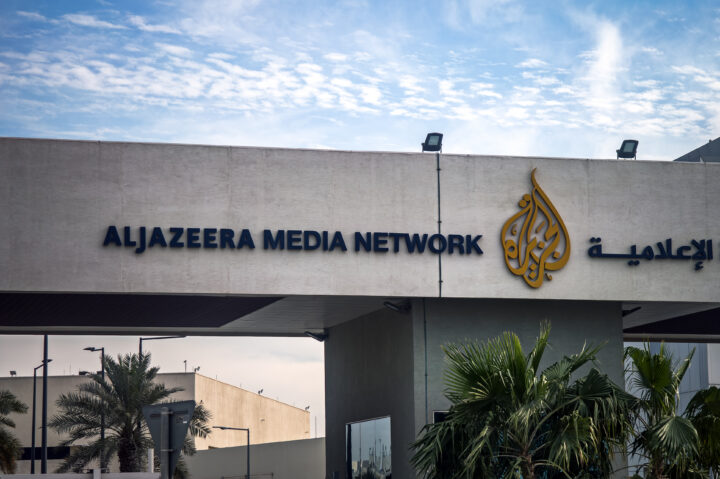
The headquarters of the Al Jazeera TV channel in Doha, Qatar. February 1, 2025


 Add JewishInsider on Google
Even as Qatar cuts government spending across multiple sectors in response to a steep decline in government revenue following attacks from Iran on its energy infrastructure, Al Jazeera, the influential media network owned by the Gulf state, is undertaking a sweeping expansion of its broadcasting and digital operations.
The move underscores what observers say is the network’s strategic value to Qatar, a country roughly the size of Connecticut with just over 3 million people, in projecting influence far beyond its borders.
The network announced on Oct. 29, ahead of its 30th anniversary this past weekend, a revamp of its Arabic-language operations, including the launch of Al Jazeera Now, a new channel dedicated to continuous breaking-news coverage. The expansion also includes a revamped Al Jazeera Arabic channel focused on in-depth reporting and analysis, and Al Jazeera Mubasher, which broadcasts live events. Al Jazeera is introducing 33 new programs, including investigative documentaries and political discussions, while expanding its digital platforms and investing in artificial intelligence technology.
The expansion extends to Al Jazeera English, which is pursuing a five-year strategy to push deeper into Africa, Asia and the United States, the channel’s managing director, Issa Ali, told Qatar’s The Peninsula on Sunday. Ali called the U.S. “one of our top priorities” and said the network would build on its existing broadcasting operations in Washington, while developing dedicated programming for African and Asian audiences.
The network, founded in Doha in 1996 with financial backing from Qatar’s ruling family, marked its anniversary on Sunday with a ceremony at its headquarters attended by Qatari Emir Sheikh Tamim bin Hamad Al Thani, who toured its new studios and newsroom.
Speaking at the celebration on Sunday, Al Jazeera Media Network Chairman Sheikh Hamad bin Thamer Al Thani recalled a conversation with Qatar’s former emir and founder of the network, Sheikh Hamad bin Khalifa Al Thani, about its growing international reach.
“The idea was to establish Al Jazeera as an Arab news channel that would have a presence across the Arab world, but for it to reach the position it has today was never something I had imagined,” the former emir said, according to the chairman’s account.
The expansion comes as Qatar has taken a severe financial hit from the ongoing war with Iran, which has disrupted its lucrative liquefied natural gas exports and damaged critical energy infrastructure. In an Oct. 13 address to Qatar’s Shura Council, Sheikh Tamim said government revenues had fallen 42% during the first half of 2026, while public expenditures declined 14% following the closure of the Strait of Hormuz and damage to the country’s energy facilities.
The Financial Times reported in August that some Qatari government departments faced operating-budget cuts of up to 30%, while overseas aid funding had been reduced by approximately 85%. Qatar’s Foreign Ministry disputed aspects of the report, saying the reductions concerned operating expenses rather than salaries or capital projects.
Despite the financial setbacks, experts told Jewish Insider that Qatar remains an exceptionally wealthy country with substantial financial resources to sustain its investment in the network. They said, however, that Al Jazeera’s continued expansion amid spending reductions elsewhere reflects the government’s longstanding reliance on a network it sees as an instrument of “soft power” influence.
Steven Cook, a senior fellow at the Council on Foreign Relations, noted that while Qatar had been “hit hard” during the Iran war, Doha remained unlikely to undermine its commitment to Al Jazeera.
“Al Jazeera is incredibly important to the country as a means of influence and power projection,” Cook said. “I think Al Jazeera is … a resource that the country has that they [Qatar] will, regardless of what their financial situation is, continue to nurture just because it’s so important in terms of influence and power projection.”
Cook said the network’s strategic value helps explain why Qatar would continue investing in its reach even as it makes spending cuts in other areas.
“Because Al Jazeera has been so successful and so helpful for [Qatar] globally, it strikes me that they would be willing to sacrifice in other places in order to continue the channel’s success,” Cook said.
Jonathan Schanzer, executive director of the Foundation for Defense of Democracies, similarly argued that Qatar’s wealth and relatively small citizen population would allow it to continue supporting the network despite the financial pressures.
“I still believe they have more money than they know what to do with,” Schanzer said. “It’s one of the wealthiest countries [in the] world, and a crisis in the Persian Gulf is not going to change that.”
Schanzer said the network has historically offered Qatar a relatively inexpensive way to reach international audiences compared with the country’s extensive investments in American institutions, businesses and other ventures.
“The thing that needs to be understood when you talk about Qataris is [that] soft power is their game,” Schanzer said. “If that is becoming expensive, Al Jazeera is how to do it on the cheap. It is the way in which the Qataris can reach wide audiences with minimal investments, and in fact, this is how the Qataris began influencing abroad when they created Al Jazeera in 1996.”
The network’s influence, Cook said, is rooted in its widespread reach throughout the Middle East, where it remains a major source of news even among audiences in countries whose governments have strained relations with Qatar.
He recalled seeing televisions tuned to Al Jazeera in homes and public spaces throughout the region during the war in Gaza, illustrating what he described as the network’s enduring influence over regional news consumption. That reach, Cook argued, gives Qatar an ability to shape how audiences understand regional events that is particularly valuable for a country with a small population but considerable financial resources.
“It’s the way it has become a frame for many people in the Arab world, and that’s worth much more than whatever money they’re putting into it,” Cook said.
Schanzer described Al Jazeera as a cornerstone of Qatar’s foreign policy strategy, arguing that its expansion during a period of financial pressure illustrates just how highly Doha values the network.
“I think Al Jazeera has always been the crown jewel of the Qatari government,” Schanzer said. “They’ve always seen this as one of their most important means of garnering influence. … This is the ultimate way to influence [people] abroad.”
The network’s strategic importance became particularly apparent during the 2017 Gulf diplomatic crisis, when Saudi Arabia and several neighboring countries demanded that Qatar shut down Al Jazeera as a condition for restoring relations, a move that Doha refused.
Schanzer suggested that the current expansion could reflect a renewed emphasis on the network as Qatar curbs some of its more expensive international expenditures.
“I think that it is interesting to see that some of the more lavish expenditures seem to be getting curbed right now, and a return to the tried-and-true of influence through the media appears to be the strategy,” Schanzer said. “There is something historically … fitting about this decision.”
He also raised concerns about the potential influence of Al Jazeera’s growing digital operations on artificial intelligence systems, suggesting that the production of additional media content could increase the prominence of Qatari perspectives in AI-generated responses.
“We are now in the age of AI, and the sourcing for AI responses is dependent in part on the volume of stories reflecting a certain perspective,” Schanzer said. “I would argue that the Qataris, by producing more media content, are ensuring that more of it appears in the answer to AI queries.”
Al Jazeera’s relationship with the Qatari government has also faced scrutiny in Washington. In September 2020, the Justice Department under the first Trump administration determined that AJ+, the network’s digital media subsidiary, was required to register under the Foreign Agents Registration Act because of its ties to Qatar. Al Jazeera contested the determination, which the Justice Department subsequently withdrew in May 2022 under President Joe Biden.
The network has also garnered longstanding concern from some U.S. lawmakers over its relationship with the Qatari government. Rep. Josh Gottheimer (D-NJ), who has previously called for greater scrutiny of Al Jazeera under the Foreign Agents Registration Act, criticized the network’s expansion in comments to JI.
“Al Jazeera is a foreign, state-controlled network that Qatar is investing in as one of their ‘most valuable public and diplomatic tools,’” Gottheimer said. “Consequently, Al Jazeera has spent years injecting misinformation into the veins of young Americans.”
“We need to recognize the difference between foreign propaganda and independent media,” he continued, “which is why I led my colleagues in calling on the DOJ to investigate whether Al Jazeera should be registered under FARA.”
More Stories

carlson's claim
Carlson’s claim of Israeli push for nuclear strike on Iran gains traction among liberal figures
AID ADJUSTMENT
Trump says he made deal ‘months ago’ with Netanyahu to end aid to Israel by end of year

PREACHING HATE
Hasan Piker compares suburban Jewish voters to white supremacists in online rant

60 MINUTES SPOTLIGHT
El-Sayed says Palestine has a right to exist, but puts conditions on Israel’s right to exist

CLOSED DOOR
Zohran Mamdani shuts out press for meeting with Ro Khanna in NYC

MOSKOWITZ MOMENT
Jared Moskowitz wins reelection despite GOP redistricting efforts
Please log in if you already have a subscription, or subscribe to access the latest updates.
 Continue with Google

 Continue with Apple