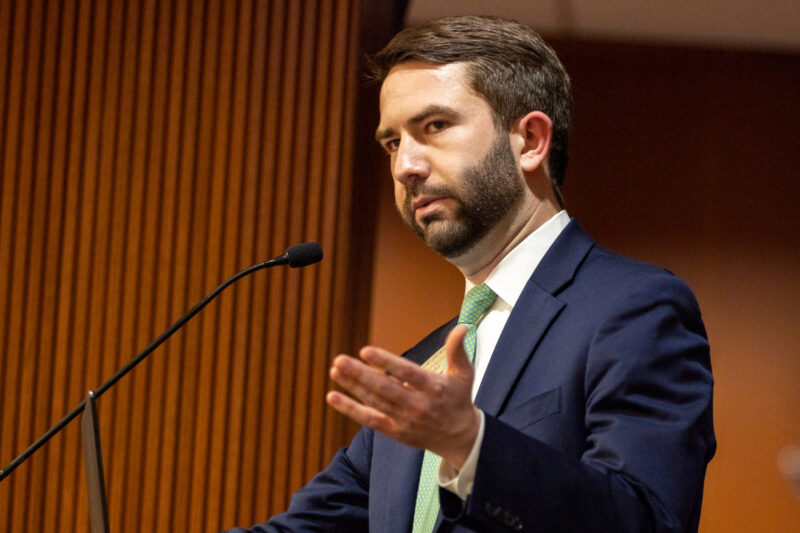












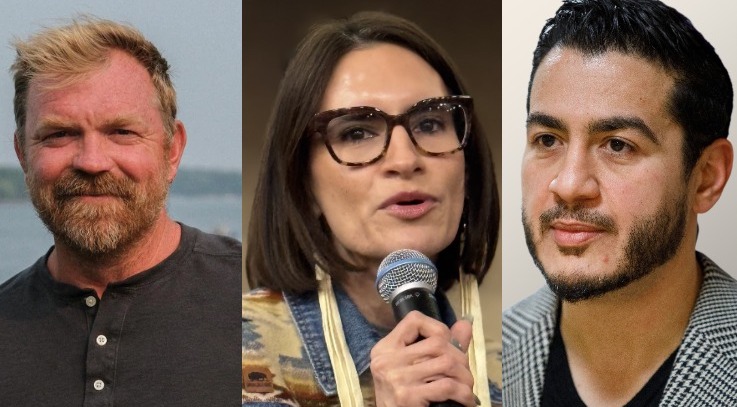






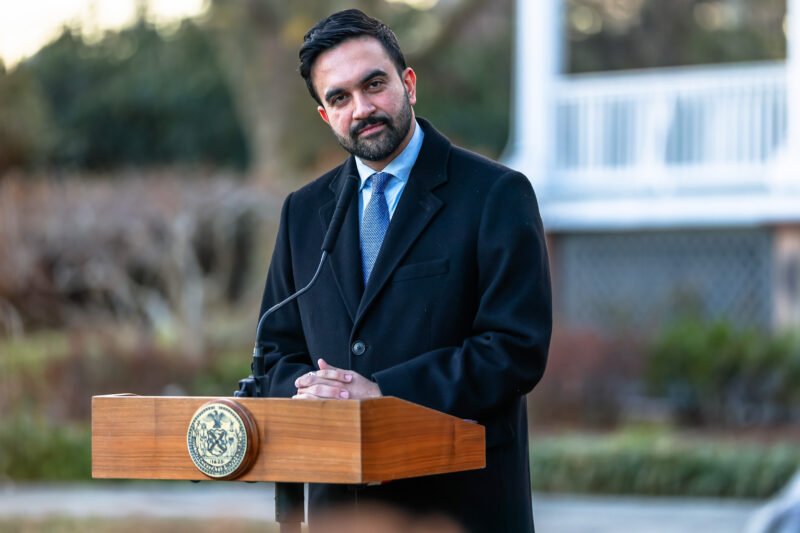
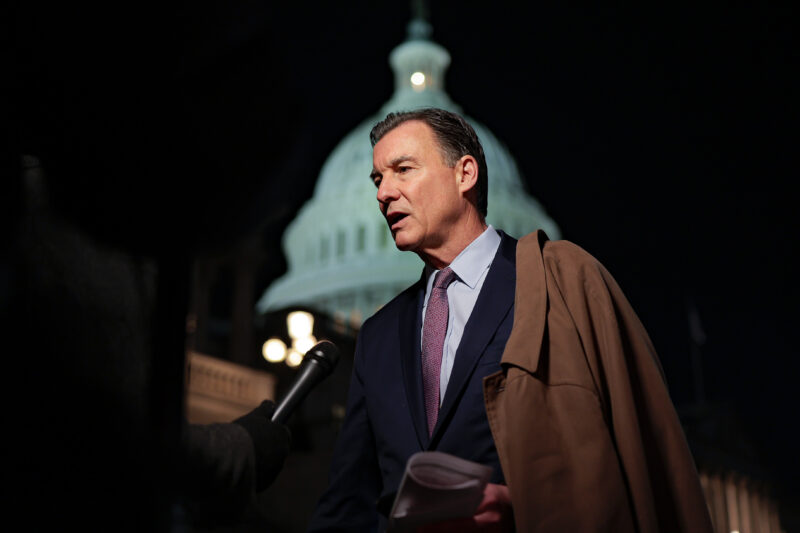
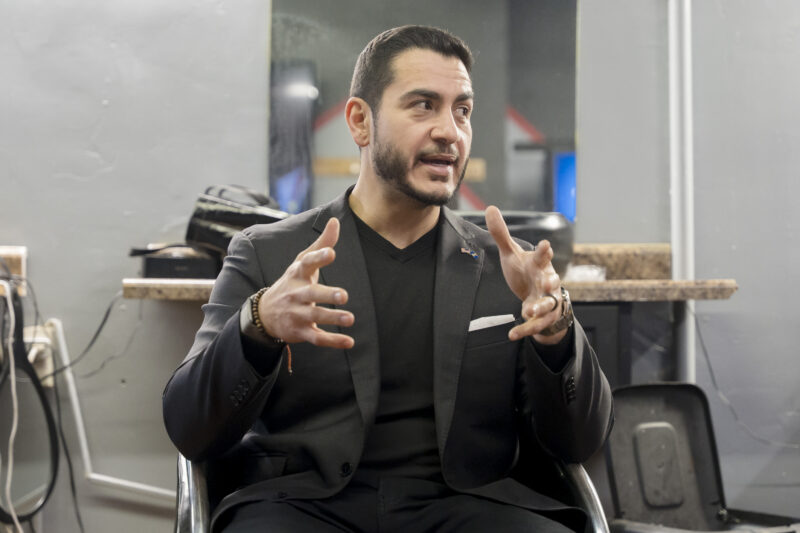
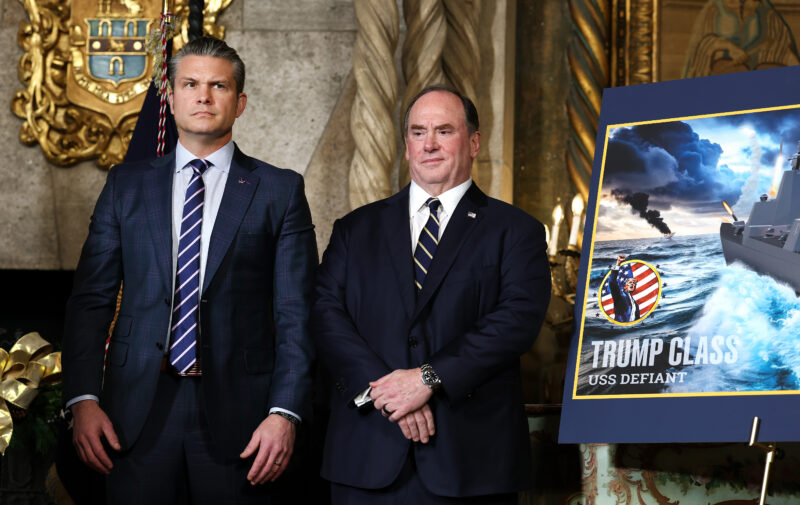







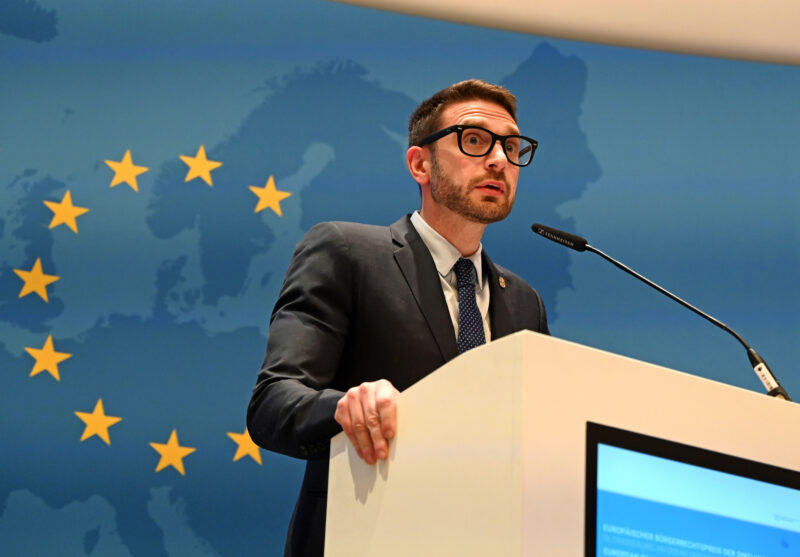
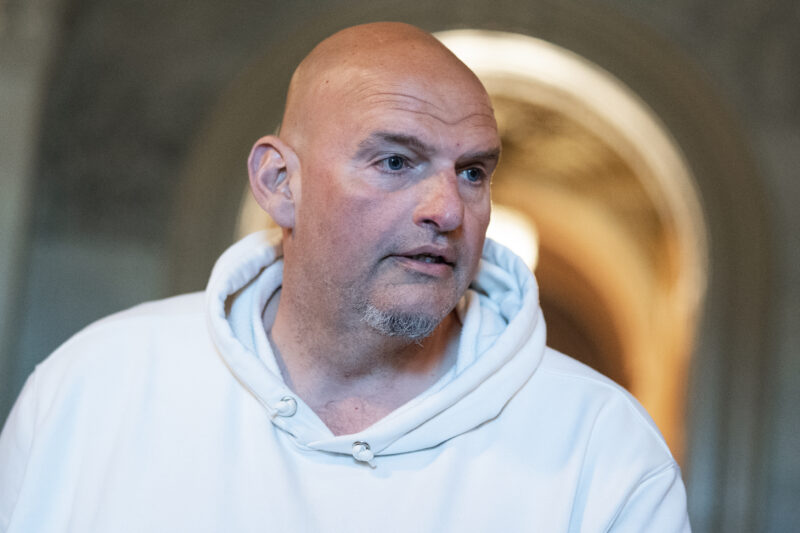



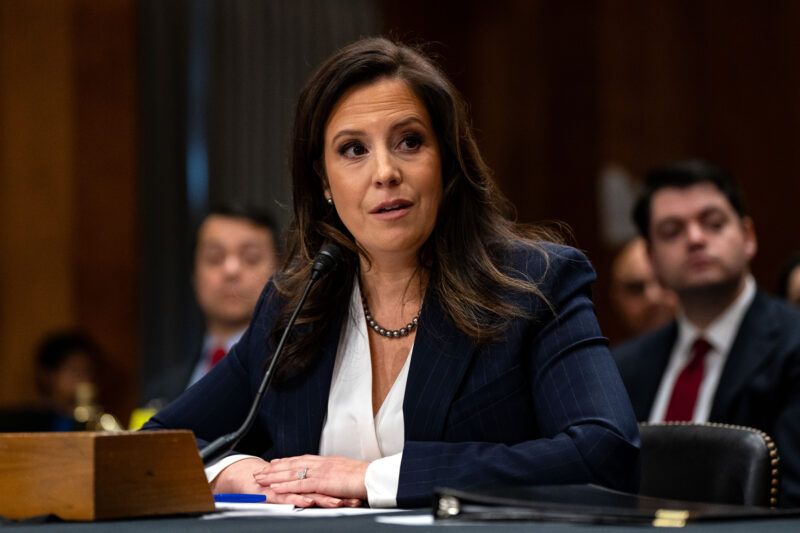











Mallory McMorrow, Haley Stevens and Mike Rogers condemned the attack; Abdul El-Sayed didn’t respond

JEFF KOWALSKY/AFP via Getty Images
Anti-Israel demonstrators set up a mock trial against the University of Michigan's Board of Regents on the university's campus in Ann Arbor, Michigan, on April 21, 2025.


 Add JewishInsider on Google
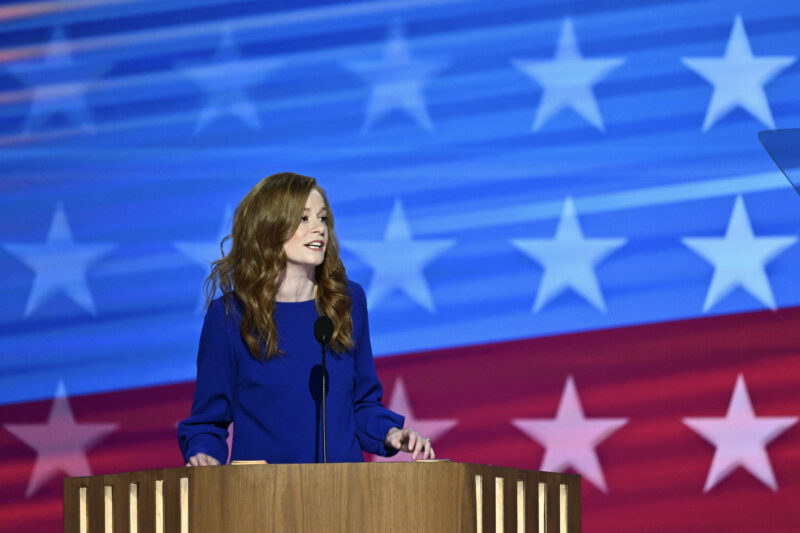
Two of the leading Democratic hopefuls looking to replace retiring Sen. Gary Peters (D-MI) condemned anti-Israel protesters for harassing University of Michigan Regent Sarah Hubbard over the weekend.
Protesters could be heard in video of the incident, which began circulating on social media on Sunday evening, shouting at Hubbard that she had “blood on [her] hands” along with other insults as she was guided away by a uniformed police officer. “Your money has gone to kill Palestinian children. Your money has killed our families. We are your students, you answer to us,” one protester shouted as they filmed Hubbard.
In response, Hubbard wrote on X that, “I remain steadfast in my commitment to make our campus a safe place for all our students and will not be intimidated by protestors.”
The incident prompted quick statements of condemnation from Rep. Haley Stevens (D-MI) and state Sen. Mallory McMorrow, two of the Democratic Senate candidates looking to replace Peters. Abdul El-Sayed, a Bernie Sanders-endorsed progressive candidate, did not issue a statement and did not respond to Jewish Insider’s request for comment.
“The harassment and antisemitism we’ve seen against University of Michigan regents in recent months is wrong, plain and simple. Regent Hubbard should be able to walk to her car without a police escort. And Regent [Jordan] Acker’s family was terrorized in their own home when vandals threw jars of urine through their windows and spray painted graffiti on their car,” McMorrow told JI in a statement.
“The attacks and intimidation need to stop now,” McMorrow, who launched her campaign earlier this month, added.
A spokesperson for Rep. Haley Stevens (D-MI), who announced her candidacy on Tuesday, told JI in a statement, “Rep. Stevens has been clear that violence and vandalism have no place in our communities and will continue to make sure all Michiganders are safe in their daily lives.”
Former Rep. Mike Rogers (R-MI), who is also running to replace Peters, similarly denounced the harassment in a statement.
“These activists’ criminal actions toward university leaders at their homes cannot be tolerated. I stand with Sarah Hubbard and the Michigan Regents as they continue to stand up to hate and antisemitism in their efforts to make the campus safe for all students,” Rogers told JI.
Jewish Insider’s senior congressional correspondent Marc Rod contributed to this report.
For Iran, ‘Israel is the appetizer and the U.S. is the entree,’ new ambassador said as he submitted his diplomatic credentials

AMOS BEN GERSHOM/GPO
U.S. Ambassador to Israel Mike Huckabee presents his credentials to Israeli President Isaac Herzog on Monday, April 21, 2025, in Jerusalem, Israel.
U.S. Ambassador to Israel Mike Huckabee conveyed a message to the growing isolationist camp on the American right as he submitted his diplomatic credentials on Monday: Maintaining close relations with Israel and countering the Iranian nuclear threat are beneficial to Americans.
“The Iranian regime and all the hostility it has inflicted on the world for 46 years continues to threaten not only the peace of Israel but the peace of the United States,” Huckabee said in the ceremony at the residence of Israeli President Isaac Herzog. “Iranians have always said, ‘Death to Israel,’ and chapter two is ‘Death to America’… Israel is the appetizer, and the United States is the entree.”
“We care deeply about the threats that face Israel because those are also the threats that face our country,” he added.
In remarks Huckabee specifically directed at his “American colleagues,” he said that Israel and the U.S. “share the values of the Bible. We share the understanding that the Judeo-Christian foundation is the foundation of all of Western civilization. Without it, there is no sense of democracy, and love, appreciation and respect of the individuals.”
“It’s also important for Americans to know that, while we hope to be a good friend of Israel and provide assistance when we can, I never want Americans to think that we Americans are not greatly benefitted by our partnership with our ally Israel,” the ambassador stated. “We benefit dramatically in the sharing of intelligence, in the sharing of technology and in the sharing of agricultural innovation that Israel has led the world in creating.”
Huckabee’s remarks come amid the rise of the isolationist faction in the Republican Party and the Trump administration that has been pushing for a nuclear agreement with Iran and opposes a U.S.-backed Israeli strike on Iran. In addition, a growing number of right-wing podcasters have grown increasingly skeptical of the U.S.-Israel relationship, and in some cases spread anti-Israel conspiracy theories.
Much of the ambassador’s remarks were dedicated to his personal connection to Israel, which he first visited in 1973, when he was 17 years old. Huckabee, a former governor of Arkansas, Fox News host and Southern Baptist pastor, has since been to Israel dozens of times and led tens of thousands of people on trips to the country, he said.
“I still feel a sense of absolute joy and an overwhelming sense of awe that I am in a land that God himself said ‘this is mine and these are my people,’” Huckabee said. “I come to stand today with the State of Israel and the Jewish people because I believe it is not simply a geopolitical position, but a divine position.”
Huckabee joked that he will reside in Israel for the next few years, “unless the president tweets something early in the morning and tells me to come home.”
The ambassador said that philanthropist and GOP donor Dr. Miriam Adelson suggested he be appointed to the job, but that he never spoke to Trump about it, until he “got a call out of the clear blue just a few days after the election.” Trump did not ask Huckabee if he wanted the job; Huckabee recounted. “[The president said,] ‘Mike, you’re going to be my ambassador to Israel.’” Huckabee said that when he responded to the president-elect’s statement, he wasn’t just saying yes to a job but “to a calling from God himself.”
Huckabee recounted that earlier this month, “the president handed [him] a handwritten note with a prayer for the peace of Jerusalem.” His first act as ambassador was to put the note in the Western Wall on Friday, “on behalf of the American people, with a reminder that we stand with you, we stand with the people of Israel.”
The ambassador expressed hope that in the coming years, he will “see times when…that young Israeli mother puts her babies to bed at night and does not fear that some harm will come upon them as they sleep, but they will rest with peace, and they will continue to live with the extraordinary resilience of the Israeli people, which I’ve come to admire, as second to none.”
He also said he prays for the return of all the hostages from Gaza.
Herzog commended Huckabee for being “a leading voice of moral clarity and conscience” and his appointment “a shining reflection of the president’s love, friendship and support for the State of Israel.”
Huckabee was one of several ambassadors to hand their credentials to Herzog on Monday. Such ceremonies are usually brief, with few guests and almost no media coverage, but the new American ambassador attracted a crowd.
Among the attendees were Yael Eckstein, the president of the International Fellowship of Christians and Jews, and Adelson, who wore a dress she had specially designed for the dedication of the U.S. Embassy in Jerusalem in 2018, which is emblazoned with the Hebrew words, “If I forget thee, Jerusalem, may my right hand lose its cunning.”
Herzog expressed solidarity with Shapiro after the attack, which took place hours after the governor hosted a Passover Seder

Kyle Mazza/Anadolu via Getty Images
Police line cordon is seen at Pennsylvania Governor's Mansion after a suspected arson attack caused significant damage in Harrisburg, Pennsylvania, United States on April 13, 2025.
Israeli President Isaac Herzog called Pennsylvania Gov. Josh Shapiro on Sunday, a week after an arsonist motivated by anti-Israel animus set the governor’s mansion on fire.
Herzog expressed solidarity with Shapiro after the attack, which took place hours after the governor hosted a Passover Seder.
Shapiro told Herzog he greatly appreciated the call, a spokesperson for the president told Jewish Insider.
The man who set fire to the governor’s mansion last weekend said in a 911 call that he “will not take part in [Shapiro’s] plans for what he wants to do to the Palestinian people.”
While Shapiro quoted the Jewish priestly blessing following the attack, he stopped short of attributing the attack to antisemitism in an interview on Friday with ABC News and rebuffed a call by Sen. Chuck Schumer (D-NY) to have Attorney General Pam Bondi investigate the attack as a hate crime.
Herzog was the first Israeli official to call Shapiro after the attack.
Ofir Akunis, the Israeli consul general in New York, sent a letter to Shapiro last week, saying that he was “deeply shocked and saddened to learn of the arson attack.”
“This appalling act of violence, carried out during one of the most meaningful nights of the Jewish calendar, could have resulted in a far greater tragedy,” Akunis added. “We commend law enforcement for their swift and effective response, and we stand in full solidarity with you and your family.”
Reps. Brad Schneider, Dan Goldman and Greg Landsman told Witkoff in a letter that ‘full, unfettered access to Iran’s nuclear facilities’ for inspectors must be a precondition of a new nuclear deal

CHANDAN KHANNA/AFP via Getty Images
Special envoy to the Middle East Steve Witkoff speaks during the FII Priority Summit in Miami Beach, Florida, on February 20, 2025.
A group of pro-Israel Jewish House Democrats wrote to Middle East envoy Steve Witkoff on Thursday warning that Iran must restore International Atomic Energy Agency access to its nuclear sites before any deal can move forward in earnest.
Under a reported proposal put forward by Iran, Iran would not allow such inspections to resume until well into the implementation of a nuclear agreement.
“Absent verifiable data on Iran’s current nuclear activities, it is not possible to conduct meaningful, comprehensive negotiations or assess compliance with any potential future agreement,” Reps. Brad Schneider (D-IL), Dan Goldman (D-NY) and Greg Landsman (D-OH) wrote, in a letter obtained by Jewish Insider. “The failure to establish a true baseline undermines the credibility of the negotiating process and exposes the United States and its partners to strategic miscalculation.”
They said that international inspectors must regain “full, unfettered access to Iran’s nuclear facilities, before establishing final parameters of a possible agreement.”
The lawmakers argued that, because inspectors have been blocked from key sites in recent years as Iran has significantly increased its enrichment and stockpile of nuclear materials, the U.S. and its partners “lack reliable visibility into the scope and status of Iran’s nuclear program.”
“Restoring inspector access is the necessary foundation for any serious diplomatic effort,” the lawmakers wrote. “Without verified insight into Iran’s current nuclear activities, the United States cannot credibly assess risks, define objectives, or safeguard the interests of our allies.”
The three Democrats said that better knowledge of Iran’s current activities and stockpiles is “particularly urgent” given recent assessments that Iran could quickly have sufficient fissile material for multiple nuclear weapons, its missile program continues to advance and it continues to support regional terrorism.
The letter is the latest in a series of signs in recent days that pro-Israel Democrats are alarmed by the Trump administration’s apparent interest in moving quickly toward a nuclear agreement with the Islamic Republic.
Asked on Thursday about a New York Times report that the U.S. had rejected an Israeli plan to strike Iran, Rep. Josh Gottheimer (D-NJ) told JI, “We should never play public footsie with the parent company of terror and one of our top adversaries. We should take the hardest line against Iran’s terror and nuclear programs.”
Rep. Jared Moskowitz (D-FL) similarly expressed alarm a day prior about the Times story.
Iran International reported on Thursday the alleged parameters of a deal that Iran had put forward — a proposal similar to the original 2015 Joint Comprehensive Plan of Action.
Under the deal, Iran would “temporarily” halt its enrichment to 3.67% in exchange for access to frozen assets and the ability to export oil. It would not restore IAEA inspections or “end high-level uranium enrichment” until the second stage of the deal, at which point the U.S. would be required to lift some sanctions and prevent the implementation of U.N. snapback sanctions on Iran.
Under the third phase of the proposed deal, Iran would move its stockpile of highly enriched uranium to a third country, while the U.S. would lift all sanctions on Iran. Iran would not be required to curtail its missile program or support for terrorism — which have prompted some of the sanctions in question. Iran is also demanding that Congress approve the deal.
Iran International reported that Witkoff “welcomed the proposals,” to the surprise of Iranian negotiators. Some in the U.S. have worried that Witkoff, who has delivered mixed messages publicly on the U.S. position, would negotiate a weak deal.
The proposal saw immediate backlash from Iran hawks.
“Terrible proposal. Iran has no reason to enrich ANY uranium. 3.67% enriched is just a few weeks away from weapons grade. And Iran is proposing to only TEMPORARILY limit enrichment to this level,” Fred Fleitz, the vice chair of the America First Policy Institute’s Center for American Security, a pro-Trump think tank, said. “This is a Iranian cynical ploy to buy time and continue its weaponization program.”
Fleitz served for several months as chief of staff of the National Security Council in Trump’s first administration.
“The regime wants a return to the failed JCPOA, which President Trump rightly rejected. The U.S. response must be firm: dismantle your nuclear program completely and verifiably — or face consequences,” FDD Action, an advocacy group affiliated with the Foundation for Defense of Democracies, said. “Congress must reject any deal that leaves Iran’s nuclear infrastructure intact.”
Jason Brodsky, the policy director of United Against Nuclear Iran, said the proposal is “unserious and should be dead on arrival.”
Close Netanyahu-Trump ties and GOP divisions on foreign policy make it harder for Israel to push back against a potentially weak deal

Kevin Dietsch/Getty Images
President Donald Trump (R) speaks alongside Israeli Prime Minister Benjamin Netanyahu with a model of Air Force One on the table, during a meeting in the Oval Office of the White House on April 7, 2025 in Washington, DC.
Israel finds itself in a familiar position this week: Washington is negotiating a nuclear deal with Tehran while blocking Israel from striking Iran at what it sees as an opportune time.
In contrast with a decade ago, when Israeli Prime Minister Benjamin Netanyahu publicly campaigned against then-President Barack Obama entering the U.S. into the Joint Comprehensive Plan of Action to curb Iran’s nuclear activity, President Donald Trump seems to have Netanyahu boxed in.
Trump announced the start of direct talks between the U.S. and Iran last Monday in the Oval Office with Netanyahu, who appeared uncomfortable. Israeli sources told Jewish Insider at the time that they knew negotiations between Washington and Tehran were set to begin soon but did not know the date before meeting with Trump. Netanyahu called for a Libya-style deal, meaning the full dismantlement of Iran’s nuclear program.
Behind closed doors that day, Trump ruled out a U.S.-supported Israeli attack on Iranian nuclear sites until the diplomatic option is exhausted, according to The New York Times. The time to decide on diplomacy or military action is limited, as nearly six months have passed since Israel destroyed Iran’s air defenses, and a mechanism of the 2015 deal to snap back U.N. sanctions on Iran expires in October 2025.
Days later, Trump’s Middle East envoy, Steve Witkoff, spoke with Iranian Foreign Minister Abbas Araghchi in Oman, the highest level dialogue between the two countries in years. On his return to Washington, Witkoff sent mixed messages about the potential contours of a new nuclear deal. First, he suggested that Iran would be able to continue its uranium enrichment program for civilian purposes, limited to 3.67% enrichment. Critics of the JCPOA, which included similar low-level enrichment, argued that it allowed Iran to maintain a path to a nuclear weapon. The following day, Witkoff walked those comments back, posting on X that a deal would mean that “Iran must stop and eliminate its nuclear enrichment and weaponization program.”
A Trump administration source told JI on condition of anonymity that while the president is firm on not letting Iran have a nuclear weapon, the policy of how to get there is still in flux. Witkoff faithfully represents the president to the extent that he, like the president, will float ideas publicly to see the reaction and adjust accordingly, the source said.
IDF Brig.-Gen. (res.) Yossi Kuperwasser, head of the Jerusalem Institute for Strategy and Security, told JI that the Trump administration is “speaking generally, not about the details. They understand very well the need to prevent Iran from developing nuclear weapons.”
Shira Efron, director of research at the Israel Policy Forum, noted that it is still too early to know what a deal will look like.
“There seem to be divisions within the administration itself,” Efron told JI. “There’s a camp that favors a deal … and really sees China as the main adversary while Iran isn’t a priority. Then there are those more aligned with the Israeli position. We don’t know which way this is going to go.”
That did not allay the concerns of some JCPOA critics that the new deal may recycle what they see as the weaknesses of the old one.
Former Israeli Ambassador to the U.S. Michael Oren told JI: “There is no right to enrich. It’s a made-up term … The whole premise plays into Iranian hands.”
Oren said that Obama-era CIA Director Bill Burns wrote in his memoirs that the U.S. conceded a “right to enrich” during the first negotiation meeting with Iran in 2013, and expressed concern that Witkoff had done the same in talks with the Islamic Republic in Oman on Saturday.
“Once you have the right to enrich, the negotiation is about how many centrifuges are active — because they won’t dismantle — and what is your cap on low-enriched uranium,” Oren said. “It’s a great deal for the Iranians.”
Kuperwasser said that any deal must “make sure Iran does not have the capability to develop a nuclear weapon, not just that it does not have a nuclear weapon. To not have the capability, it cannot be able to enrich uranium, or develop nuclear warheads or nuclear weapons based on uranium or plutonium. There can be no weaponization … The Americans understand that.”
According to Efron, “For Israel, a bad deal would be the worst of all outcomes. A bad deal in 2015 is not like a bad deal would be now. On the one hand, Iran is weaker” — after the Israeli strikes on its air defenses and defeat of its proxies in Lebanon and Syria — “but on the other, its nuclear program is a lot more advanced. The restrictions [in a deal] will have a different utility than they did 10 years ago.”
The Trump administration source said that Witkoff is focused on the nuclear issue in the negotiations and not Iran’s broader malign actions in the Middle East.
Oren expressed concern that, with the money coming in from sanctions relief that would come with a deal, “Iran will rebuild Syria. They’ll find someone to replace [toppled Syrian President Bashar] Assad. They’ll rebuild Hezbollah and Hamas … This is who the Iranians are. No deal will change that.”
Kuperwasser encouraged engagement between Jerusalem and Washington now to prevent a weak deal. He said that “Israel first and foremost must continue its very close communications with the Americans … to ensure that what we don’t want doesn’t happen.”
Simultaneously, he said, “we have to prepare for joint action so that there is a military option, which will increase the chances of getting what we want diplomatically. Israel and the U.S. have to increase their military capabilities so the Iranians are convinced to accept what they don’t want.”
If the Trump administration reaches an agreement with Iran that Israel views as weak, Jerusalem may have fewer channels to push back against it.
In 2015, when Israel sought to prevent the Obama administration from entering the JCPOA — because it allowed Iran to continue enrichment activity and did not address its ballistic missile program or funding proxies, among other criticisms — Capitol Hill became the main arena of debate. Pro-Israel organizations lobbied members and Netanyahu gave a speech before a joint session of Congress.
In 2025, however, it is less likely that Trump would face such challenges. Democratic members of Congress are unlikely to support a more hawkish policy on Iran, and while some GOP senators have already voiced opposition to a deal allowing Iran to enrich, few Republicans are willing to publicly speak out against the president’s policies.
“If the deal looks like a warmed-over JCPOA,” Efron said, “it will be the biggest challenge for Israel, because unlike with Obama, Netanyahu cannot go to Congress. I think the tools at Israel’s disposal are going to be much more limited and Israel will have to be much more sophisticated to campaign against a deal.”
Oren said that “back in 2015, Obama didn’t submit the JCPOA for congressional approval because he knew he wouldn’t get it. President Trump today could be confident that he would.”
The former ambassador suggested that, while “in the past Israel focused its efforts on Congress, today it must focus its efforts on the White House.”
Efron argued that Israel is already doing that, with Israeli Strategic Affairs Minister Ron Dermer “directly influencing the hawks on Iran in the White House and State Department, plus the Senate, as evidenced by statements by [Sen. Lindsey] Graham [(R-SC)] and [Sen.] Tom Cotton [(R-AR)].”
She also suggested that Israel has leaked details of Iranian weapons smuggling to the international media and will work with like-minded organizations and think tanks in Washington.
“This will continue in full force, but there won’t be a direct confrontation with Trump and his policies like there was with Obama,” she said.
One message Oren suggested that may be effective is to focus on expanding the Abraham Accords: “President Trump wants peace between Israel and Saudi Arabia, and the surest way not to get one is this” — a weak Iran nuclear deal, he said.
The former ambassador also pushed back against what he called “Obama’s line that it’s either diplomacy or war. That is a totally false dichotomy … It’s totally mythic. Iran has no air force, has no ground forces, has zero ability to make war against the U.S. The notion of being afraid of a war is ridiculous.”
As to whether Netanyahu’s public embrace of Trump would make things more difficult for the prime minister to counter a weak Iran nuclear deal, Efron said “it would be hard for any leader to come out against this administration’s policies.”
Efron described the situation as “complicated,” saying that Netanyahu was very influential on Trump’s Iran policy in his first term, when he withdrew from the JCPOA.
At the same time, Netanyahu’s February visit to Washington, in which Trump treated him very well and expressed seriousness about the idea of voluntary migration of Gazans, “bought [Netanyahu] the budget,” referring to the Israeli government’s passage of its budget in March. “It extended the life of his government. He got carte blanche to do what he wanted on all borders … Netanyahu has a personal debt to Trump.”
Though “Netanyahu clearly felt uncomfortable” when Trump announced Iran talks, Efron said, the Israeli leader was “in a bind.”
“I don’t see a situation in which Iran agrees to follow the Libya model,” she added. “If Israel continues to wish for a maximalist position, it might be left with a bad agreement. Maybe there needs to be a middle ground, something more realistic but doable and politically viable.”
Kuperwasser said it was unlikely that the Trump administration would enter into a deal that is similar to the JCPOA.
“The JCPOA paved the way for Iran to have the capability to develop massive amounts of nuclear weapons, hundreds of warheads,” he said. “I’m certain Trump does not mean for that to happen. He understands that cannot happen, so I don’t think there will be tensions with the Americans like in 2015.”
“It doesn’t mean that there won’t be disagreements at some stages of the agreement,” he added.
However, Kuperwasser argued that the chance of reaching any deal with Iran is slim. “The American demands are so great that it is hard to believe the Iranians will accept them,” he said.
As such, Kuperwasser added, “We need to be ready [for a strike on Iran], maybe with American cooperation. Trump doesn’t want to do it, but maybe he will see that he has to.”
If there is a deal that Israel views as bad, Kuperwasser said, “Israel will have no choice but to accept it. I don’t see Israel preventing an American agreement by attacking Iran.”
The alleged perpetrator said Shapiro needed to know that he ‘will not take part in his plans for what he wants to do to the Palestinian people’
Kyle Mazza/Anadolu via Getty Images
Police line cordon is seen at Pennsylvania Governor's Mansion after a suspected arson attack caused significant damage in Harrisburg, Pennsylvania, United States on April 13, 2025.
The man accused of setting fire to the governor’s residence in Harrisburg, Pa., hours after Gov. Josh Shapiro hosted a Passover Seder there for family and friends did so to protest Shapiro’s stance toward the Palestinians, according to a police search warrant.
Cody Balmer, the suspect, allegedly threw homemade explosives into the mansion in the middle of the night, igniting a fire that caused severe damage to the home. On a 911 call, Balmer said that Shapiro “needs to know that he ‘will not take part in his plans for what he wants to do to the Palestinian people,’” the warrant says.
Balmer then added that Shapiro “needs to stop having my friends killed, and ‘our people have been put through too much by that monster,’” referring to Shapiro, according to the warrant. After Balmer turned himself in to police, he “admitted to harboring hatred” of Shapiro, and claimed he would’ve attacked Shapiro with a hammer if he had encountered him.
Hours before Shapiro, his wife and their children were forced to evacuate their home during the fire, they hosted a Seder in the state dining room, one of the rooms that sustained heavy damage. A photo released by the governor’s office showed a charred piano, burnt furniture and ashes covering the floor. The windows were shattered.
Balmer, 38, who lives in Harrisburg, is charged with attempted murder, aggravated arson, terrorism and other offenses. In a press conference on Wednesday, Shapiro declined to say whether he believed he was targeted for practicing his faith, or whether Balmer should face hate crime charges, saying that is a question prosecutors will have to answer.
“I continue to find strength in my faith as we go forward here,” Shapiro said, noting that his family still had a Seder on Sunday evening for the second night of Passover, though not specifying where. “The prosecutors will ultimately determine what motivated this — the district attorney, the Department of Justice can comment on that further. But right now I think what we’re trying to do is find the good in society, not be deterred from our work, not be deterred from practicing our faith proudly and to continue to move forward as parents and continue to move forward as governor and first lady.”
Shapiro said he has heard from many Jewish families concerned about the attack and its timing on Passover.
“I want them to see that my wife and I and our kids continue to celebrate our faith proudly and openly,” said Shapiro. “I want them to see that people from all different faiths have reached out to condemn this act and to lift up our family in prayer, and that’s the Pennsylvania way.”
As investigators assess the damage at the home, Shapiro is still unsure what was lost in the fire. “I don’t know if our Seder plates or any of our other materials were damaged, melted, destroyed in the fire,” he said. “We brought Seder plates and other ritual items from our home, from our personal home there, to celebrate with family and the community that we had invited to the Seder there.”
Images shared by the governor’s office showed damage to some of the Passover material. One showed burnt pages from the Haggadah, left open to the final page, with the song “Chad Gadya” and Hatikvah, Israel’s national anthem. Another showed a charred poster, left out from earlier in the night, inviting children to participate in Passover crafts.
Orban says ‘Brussels elite’ won’t stop migration that ‘contributed to the rise of antisemitism’

AVI OHAYON/GPO
Israeli Prime Minister Benjamin Netanyahu and Hungarian Prime Minister Viktor Orban on April 3, 2025 in Budapest, Hungary.
BUDAPEST, Hungary — More countries plan to withdraw from the International Criminal Court, Israeli Prime Minister Benjamin Netanyahu said in remarks to the press on Thursday with Hungarian Prime Minister Viktor Orban, soon after Budapest announced that it would exit the court.
“You and your leadership have done remarkable things for Israel and the Jewish people,” Netanyahu said to Orban. “You stand with us at the EU and the U.N. You took a principled position on the ICC.”
Netanyahu called on “all democracies to stand up to this corrupt organization. It is important as we fight this battle against barbarism.”
“You are the first and dare I say not the last to walk away from this corruption, this rottenness,” he said to Orban.
Netanyahu and Orban spoke on the phone with President Donald Trump on Thursday about Hungary’s withdrawal from the ICC and possible next steps on the matter, according to a readout from Netanyahu’s office.
ICC Chief Prosecutor Karim Kahn issued warrants last year to arrest Netanyahu and former Israeli Defense Minister Yoav Gallant for alleged war crimes. In response, Hungary said at the time that it would not honor the warrant and invited Netanyahu to visit. Several other countries have said they would not arrest Netanyahu and Gallant were they to visit, but out of caution, the prime minister has thus far only traveled to the U.S. — which, like Israel, is not a party to the court — and Hungary.
In Budapest, Buda Palace rolled out the red carpet, receiving Netanyahu with an honor guard including a military marching band, cavalry and guards holding bayonets.
Orban said that he is “actually an expert when it comes to this matter” of the ICC because, as prime minister in 1999, he signed Hungary’s accession to the court.
“I am convinced that it has become a political court, not a court of the rule of law,” he said. “We do not wish to have any part of it in the coming period.”
Orban and Netanyahu also spoke of their countries as defenders of Western civilization.
“In recent years, Hungary has been an island of freedom in Europe, the standard-bearer of Judeo-Christian tradition … Israel can count on Hungary in the future as the impenetrable bastion of Judeo-Christian culture,” Orban declared.
The Hungarian prime minister tied issues on the continent to “illegal migration,” saying that it “contributed to the increase of antisemitism.”
“The Brussels elite does not move to stop [migration], however, Hungary does not accept any type of migration,” he said.
“There is a phenomenon that surprised all of us,” Orban said. “In Western Europe, antisemitism reached levels never before seen. People waving Hamas flags. There is zero tolerance in Hungary for antisemitism.”
Orban described the Hungarian Jewish community as the “third largest in Europe and the most safe in Europe.”
About 80,000-100,000 Jews live in Hungary, making it the third-largest community in the EU, and the country reports lower than the European average levels of antisemitism, according to a report published last year by the European Union Agency for Fundamental Rights.
Echoing Orban, Netanyahu said that “Western civilization is under assault from one powerful quarter: radical Islam.”
But rather than tie the issue to migration, Netanyahu said that the assault is “spearheaded by one country, Iran.”
”We were attacked by Iranian proxies in a murderous campaign, and we will smash the Iranian terror axis, which threatens not only us, but Europe and many of our neighbors in the Middle East. By doing that we are also protecting Europe,” he said, adding that Orban understands this while many other leaders do not.
More than half a million Hungarian Jews were murdered in the Holocaust, with the Hungarian government closely collaborating with the Nazis and killing tens of thousands on their own. Orban has faced accusations of whitewashing Hungarian complicity in the Holocaust.
The Hungarian prime minister briefly referenced the Holocaust in his remarks, saying that “Jews had a difficult past in Hungary [but] now regard it as their home.”
Netanyahu also downplayed Hungary’s role in the Holocaust. He recalled a visit to the country in 1991, when he was Israel’s deputy foreign minister and the countries were reestablishing relations.
“You had exited the ravages of World War II only to be under a new type of occupation, and it took many decades to liberate yourselves,” he said.
Netanyahu said that was reminiscent of the struggles of the Jewish people, which he acknowledged were at “another level,” and said “one-third of our people were murdered in the Holocaust, and we had to reestablish our historic homeland against all odds.”
He also praised Orban’s “bold stance against antisemitism,” including adopting the International Holocaust Remembrance Alliance’s working definition of antisemitism, which, he said, “says that if you think there shouldn’t be a Jewish state, you’re an antisemite.”
Israeli National Security Council releases travel warning for Israelis and Jews on Passover; Canada, Australia highlighted for anti-Jewish hate crimes

GIL COHEN-MAGEN/AFP via Getty Images
Passengers check their flights at Ben Gurion airport near Tel Aviv on August 6, 2024, amid regional tensions during the ongoing war between Israel and Hamas in the Gaza Strip.
Iran and global terrorist organizations, including ISIS, plan to target Jews and Israelis traveling during Passover, Israel’s National Security Council warned on Tuesday.
“Iran is the central generator of global terror, directly or through its proxies, against Israeli and Jewish sites around the world,” the National Security Council said in a statement released before Israeli schools go on Passover break on Sunday.
The Islamic Republic uses terror attacks as a policy and seeks to avenge the deaths of senior Hezbollah and Hamas officials, according to the travel warning.
In the last year, Iran has backed attempted terrorist attacks against the Israeli embassies in Sweden and Belgium, which were thwarted, as well as attempts to attack or abduct Israeli citizens around the world under the guise of making business contacts. Those attempts mostly began through e-mails and messages on social media.
Hamas has also attempted to attack Jews and Israelis outside of Israel, in light of the terror group’s weakened state in Gaza and the continuation of the war, the NSC stated. Hamas terror infrastructure was found in Denmark, Germany, Bulgaria and Sweden that aimed to attack Israelis.
In addition, in recent months, terrorist groups such as ISIS and Al-Qaida have increased their activities, especially in Europe. ISIS specifically has called on its supporters to strike Israeli and Jewish sites around the world.
The NSC said that “with the collapse of the ceasefire [last month] and the return to fighting in Gaza, an increase is expected in efforts to attack Jewish and Israeli sites abroad, including through local or individual initiatives.”
In addition, there continues to be a high-level threat in Egypt’s Sinai desert, where the beaches were once a popular travel destination for Israeli tourists.
The NSC also warned of possible hate crimes against Jews around the world, which have drastically increased since the Oct. 7, 2023, attacks on Israel.
Canada and Australia were singled out as potentially dangerous due to spikes in antisemitic attacks, including the burning of a Jewish preschool and a synagogue in Sydney, and the throwing of Molotov cocktails and shootings at Jewish schools and synagogues in Montreal and Toronto.
“The bottom line is that there remains a high motivation and activity of different terrorist factors to advance terrorist attacks against Israelis and Jews around the world,” the NSC statement reads. “An atmosphere of hate in many countries against Israel and Jews in light of the war continues to increase the motivation for individuals and independent cells to attack.”
The NSC recommended that Israelis be cautious when they travel and check their recommendations before buying tickets to go abroad.
Prime Minister Benjamin Netanyahu's plan for a lengthy war is running against political headwinds from a war-weary Israeli public

JACK GUEZ/AFP via Getty Images
An Israeli soldier operates a tank at a position along Israel's southern border with the northern Gaza Strip on March 19, 2025.
With ground troops and tanks returning to Gaza, Israel is hoping military pressure will force Hamas to free more hostages, while preparing to oust the Palestinian terror group from power, even if it requires a lengthy war, insiders and experts said.
Israeli Prime Minister Benjamin Netanyahu revealed some of his thinking to new recruits to the IDF Armored Corps on Sunday, telling them that Israel is “winning because we understand that, to defeat our enemies, those who are closing in on us, we must break through with crushing force … The tremendous crushing force is the tank corps.”
The prime minister vowed that Israel “will complete … victory as soon as possible.”
A source in the Knesset Foreign Affairs and Defense Committee, who was briefed after the fighting restarted, told Jewish Insider that while it may take many months to fully remove Hamas from power in Gaza, Netanyahu is likely to agree to a ceasefire as soon as the terrorist group is willing to release a “reasonable” number of the remaining 59 hostages taken on Oct. 7, 2023, of which as many as 24 are believed to be alive.
The source, who supports the government’s aim of ousting Hamas from power, expressed concern that Netanyahu would not continue the war to the total defeat of Hamas.
Michael Makovsky, president and CEO of the hawkish Jewish Institute for National Security of America, who met with senior officials and military figures in Israel last week, told JI that Israel is trying to put pressure on Hamas to release hostages.
“They’ll see in the next couple of weeks,” Makovsky said. “If they can get more live hostages, as many as they can, then there can be a ceasefire for a while.”
At the same time, he said he was not optimistic that all the hostages would be released: “I don’t know why Hamas would do that.”
While most Israelis support removing Hamas from power in Gaza, polls show that the prospect of a months-long war with no end in sight and without the remaining hostages released faces political headwinds from a war-weary Israeli public. The plan would require mobilizing a fatigued group of reservists, and would place additional challenges on the Israeli homefront.
Makovsky pointed out that continuing the war would be “tougher on the people” of Israel, and attributed the “fatigue” among reservists to mistakes made early in the war, which “went longer than it should have — for some legitimate reasons and some not — and this is one of the results, that people are tired.”
The Israeli public is divided. According to a poll conducted last month by the Israel Democracy Institute, 33% of Jewish Israeli support ending the war and seeking diplomatic arrangements, while 28% supported resuming full-scale war in Gaza. Netanyahu has faced protests from hostage families seeking an end to the war, and has faced opposition over his efforts to fire the head of the Shin Bet, who supports further diplomatic negotiations.
Makovsky said that despite the demonstrations in Tel Aviv against resuming the war, he saw a consensus among all military figures that “at some point, they’re going to have to go back in” to Gaza to defeat Hamas.
“They know they have to finish off Hamas as much as possible; that’s just a fact,” he said.
Retired IDF Maj.-Gen. Yaakov Amidror, a former Israeli national security advisor under Netanyahu and a distinguished fellow at JINSA, said that the new phase of the war and the final defeat of Hamas may take as long as a year.
Following heavy airstrikes in the first 24 hours last week, ground forces entered three areas — the Netzarim Corridor bisecting northern and southern Gaza, northwestern Gaza on the shore and the Shaboura area of Rafah, in southern Gaza. Israel has killed Hamas and Palestinian Islamic Jihad figures, including senior political figures in Hamas.
“If that doesn’t bring Hamas into negotiations [to release the hostages] in good faith, you’ll see more ground forces going in,” Amidror said in a JINSA webinar. “The purpose at the end is to eliminate Hamas totally … That will take a year.”
It will take a “slow process” for the IDF to eliminate Hamas as a leading force in Gaza, involving large numbers of ground troops, Amidror said.
“We don’t need to rush. We have all the time, and we need to do it cautiously,” he said.
The ceasefire between Israel and Hamas ended last week after lasting for two months. For the first six weeks, hostages were released each week in exchange for Palestinian prisoners, including mass murderers, and Israel’s withdrawal from parts — but not all — of Gaza.
At that point, negotiations were meant to continue for the second phase of the deal, which was expected to bring about the release of the rest of the hostages along with an Israeli withdrawal from much of Gaza, with Hamas relinquishing control of the enclave. Israel sought to extend the first phase of the deal, instead of negotiating the second phase, in which Hamas reportedly sought to effectively remain in power along with Israel’s withdrawal from all of Gaza.
U.S. negotiators subsequently suggested two interim deals with an aim to maintain a ceasefire through Ramadan and Passover, which ends in mid-April, but Hamas did not agree to the terms, insisting on continuing to the second phase of the original agreement.
Amidror said that “the idea was not a ceasefire. It was to release more hostages. What we wanted to achieve was an agreement about the period during which Hamas would release the hostages, and what we learned … is that is not Hamas’ intention. They want to achieve a total withdrawal of the IDF from Gaza without any plan for the future. The meaning of that is to allow Hamas to rebuild itself in Gaza.”
Once that became clear, Israel relaunched the fighting in Gaza to extricate itself from the “absurd situation in which we are limiting our efforts inside Gaza and at the same time not getting any hostages out.”
Now, Israel’s task is “to smash Hamas to a level at which they are no longer relevant inside the Gaza Strip,” Amidror said.
“To those who say ‘the IDF didn’t succeed, Hamas is still strong,’ yes, Hamas is still strong in the Gaza Strip,” Amidror explained. “They recruited young people with Kalashnikovs and RPGs and are the strongest force in Gaza … but Hamas is not relevant as an organization that can attack Israel. In the first days [of the renewed war] they only shot three or four missiles at Israel … They cannot provide new weapons systems to the people they recruited, because they cannot smuggle [arms] in from the Sinai.”
Amidror asserted that ground troops are necessary for Israel to win the war.
“This will not be a war that will be determined by intelligence,” he said. “We will have to go and fight in the Gaza Strip to find [Hamas terrorists] and kill them. It won’t end with intelligence and precise air raids. It will be a very hard, ground forces kind of urban war.”
The Hamas-run Health Ministry in Gaza, which does not differentiate between combatants and civilians and is not trusted as a reliable source by Israel, says 50,000 people have been killed since the beginning of the war. Israel says it has killed some 20,000 terrorists and more than 400 Israeli soldiers have been killed in the fighting.
The new IDF chief of staff, Lt.-Gen. Eyal Zamir, had a “much more aggressive orientation in Gaza” when he was the head of the IDF’s southern command, and as such, Makovsky said he’s “not surprised they’ve gone in decisively this time.”
Similar to earlier phases of the war, Israel is moving towards having Gazan civilians stay in humanitarian zones where they will have access to food and medical aid, overseen by Israel to prevent Hamas control, the Knesset source said.
“Control of aid has been empowering Hamas,” Makovsky said. “Israel has to disconnect the two.”
In that vein, Israel has dropped leaflets in Gaza and published warnings on social media.
Defense Minister Israel Katz said on Friday that the IDF would continue to capture territory in Gaza, evacuating the population, as long as Hamas continues to hold the hostages.
Makovsky said that “creating bigger, deeper buffer zones than the 1 kilometer they initially carved out … makes sense from an Israeli perspective.”
The Knesset source focused on the combination of splitting Gaza between its north and south with Israel blocking humanitarian aid, describing it as a “siege strategy” that is meant to lead to Hamas “begging on all fours for a ceasefire.”
The source noted that Israel was not previously able to try such a strategy because the Biden administration insisted on large quantities of humanitarian aid flowing into Gaza, but that the Trump administration supports Israel’s renewed fighting in Gaza.
However, Makovsky argued that early in the war, “the IDF was a bit cautious. They didn’t go into Rafah right away, they went point to point. They didn’t [have a] plan and they had to develop one. That’s not on Biden. It became more about Biden in January” — when the administration threatened to block arms to Israel if it went into Gaza. “I think the IDF and the war cabinet, for that matter, deserve some responsibility for that.”
A group of 30 editors collaborated to insert anti-Israel and antisemitic narratives and falsehoods into articles, working together in a way that may have violated Wikipedia’s policies, according to the ADL

Nikolas Kokovlis/NurPhoto via Getty Images
The Wikipedia logo is being displayed on a smartphone screen in Athens, Greece, on December 24, 2023.
In 2025, all it takes to answer any factual question, no matter how trivial — Who won the 1974 World Series? Where was Taylor Swift born? — is a quick Google search and, usually, a click to Wikipedia, which has 62 million pages in English alone. But a new report from the Anti-Defamation League urges people to think twice before using the popular free encyclopedia, arguing its administrators have failed to prevent biased editors from manipulating entries related to Israel and Judaism.
Wikipedia is maintained by an army of volunteer editors, many of whom have spent years amassing knowledge of the site’s wonky rules in order to keep its pages up-to-date and accurate. But that honor system is vulnerable to bias. The ADL found that a group of 30 editors collaborated to insert anti-Israel and antisemitic narratives and falsehoods into articles, working together in a way that may have violated Wikipedia’s policies.
“Despite Wikipedia’s efforts to ensure neutrality and impartiality, malicious editors frequently introduce biased or misleading information, which persists across hundreds if not more entries,” the report stated.
For instance, the main Wikipedia entry on Hamas was edited to downplay the Palestinian group’s terrorist activity. A subhead that was formerly ‘violence and terrorism’ is now just ‘violence’ — a change that was made on Oct. 19, 2023. ADL researchers found that the first reference of Hamas as a terrorist organization was pushed further down in the lead section, and the description of the Oct. 7 attack no longer mentions the total number of people who were killed during the massacres. Numerous other details about the attacks were also removed.
In the section titled, ‘The 2018-2019 Gaza border protests,’ an editor removed a reference to a 2018 NPR interview with a Palestinian in Gaza who was preparing to launch an incendiary balloon with a swastika on it.
A series of edit wars on Wikipedia’s main Zionism page has, since 2022, sought “to reframe Israel’s founding,” according to the report. After one editor changed the language used to describe the goal of Zionism and the Zionist movement, the editor put a 12-month discussion moratorium in place, which keeps other editors from making edits to the language.
The report issued recommendations toward policymakers, toward private companies that rely on Wikipedia’s information and toward Wikipedia itself, with the gist of its suggestions amounting to a plea to those actors to take antisemitism seriously.
An ADL spokesperson declined to say whether the leadership of Wikipedia has been willing to engage with the group. A spokesperson for the Wikimedia Foundation, the nonprofit that operates Wikipedia, said on Monday that the organization was “not asked to provide context that might have helped allay some of the concerns raised.”
“Though our preliminary review of this report finds troubling and flawed conclusions that are not supported by the Anti-Defamation League’s data, we are currently undertaking a more thorough and detailed analysis,” the spokesperson said.
After the Oct. 7, 2023, Hamas terror attacks, Wikipedia — like social media and other platforms where Internet users go to access information — became a proxy fight for the Israeli-Palestinian conflict, and digital battles emerged over how its story is told to news consumers.
A group of Wikipedia editors voted last summer to rate the ADL as an unreliable source on matters related to the Israeli-Palestinian conflict and antisemitism, which brought concerns about reliability and editorial integrity at the world’s largest encyclopedia to the public eye.
In the aftermath, the ADL tried to raise the issue with leaders at the Wikimedia Foundation. Wikimedia, which has for years taken a hands-off approach to content moderation, was not responsive to concerns from Jewish advocates. More than 40 Jewish organizations wrote to Wikimedia last June urging reform.
The problem has not receded, according to the new ADL report. If anything, it has become more entrenched. The biased anti-Israel editors — described by the ADL as “bad faith editors” — are much more active than the average editor on Wikipedia, even more so than those who edit other controversial topics.
These “bad faith editors” attacked other editors deemed hostile to their cause in Wikipedia discussion forums, and they often used “Zionist” as a slur to tar their opponents. They would make edits on other pages, on unrelated content, to avoid detection.
On pages dedicated to major historical events, like several Israel-Arab wars or peace negotiations, editors would make “extensive edits” in “tone, content and perspective” to advance an anti-Israel narrative, the report found.
“The larger pattern of changes demonstrates a systematic effort to skew numerous Wikipedia entries to promote a set of narratives critical of Israel, often delegitimizing Israel’s existence and actions,” the report stated. Wikipedia has a policy against advocacy, and the ADL argued that this pattern of edits violates that policy. The advocacy group’s key recommendation for Wikipedia is for the encyclopedia to enforce higher content standards and stronger moderation guardrails, although such a request is likely an impossible bar to clear, given Wikimedia’s leniency toward its editors.
“The values of Wikipedia and the Wikimedia Foundation reflect our commitment to integrity and accuracy, and we categorically condemn antisemitism and all forms of hate,” the Wikimedia Foundation spokesperson said. “Content added to the site must be presented, as far as possible, without editorial bias.”
“As we have shared previously, Wikipedia is a constantly evolving, living encyclopedia based on principles of neutrality, which means content added to the site must be presented, as far as possible, without editorial bias,” they added. “Wikipedia includes more than 65 million articles and is edited by nearly 260,000 volunteers from across the world.”
The ADL seemed to identify only limited opportunities for government officials to impact the state of affairs at Wikipedia. Policymakers “should prioritize raising additional awareness of antisemitism, and structural issues, within Wikipedia,” the ADL argued, writing that they should use their convening power to bring together academics, computer scientists, civic leaders and Wikipedians to study the issue further.
Search engines and the large language models being used to train artificial intelligence programs should limit their use of Wikipedia, the ADL argued — and in particular, they should try to avoid citing Wikipedia as a source, instead directing users to more reputable sources. Users should be warned that Wikipedia is an unreliable source.
A spokesperson for the ADL maintained that the report is not meant to be a repudiation of how Wikipedia currently operates. Rather, it is intended to be a very public reminder to Wikipedia “to apply its policies at scale, to prevent malicious manipulation.”
“We are not advocating for the abandonment of Wikipedia,” said Daniel Kelley, the interim head of the ADL’s Center for Technology and Security. “We want Wikipedia to address these issues, but we would urge people to use caution with contentious articles.”
Jewish Insider’s Tamara Zieve contributed to this report.
Heba Farouk Mahfouz expressed alignment with Hamas and Hezbollah and dismissed her critics as ‘Zio-Nazis’

Getty Images
Main entrance to the The Washington Post headquarter building located on 15th Street in Washington DC.
A Middle East reporter for The Washington Post is facing scrutiny for online commentary in which she has called Israel an illegal state, openly identified as an anti-Zionist and signaled support for Hamas and Hezbollah, among other posts now raising questions about the objectivity of her coverage on the region.
In an extensive series of social media remarks mostly published between 2012 and 2014, Heba Farouk Mahfouz, a reporter and researcher in the Post’s Cairo bureau whose recent coverage largely focuses on Israel and Hamas, frequently inveighed against Israel, saying it was “not a point of view” but “a fact” that the country is a “colonial, illegal” state. She also described Zionism as “racism,” while dismissing her critics as “Zio-Nazis” — a pejorative deemed by some watchdog groups as antisemitic.
“If my anti-Zionist views hurt your Zio-Nazi feelings, FUCK OFF & SHUT THE FUCK UP!” she wrote in an aggressively worded post in September 2012. “Better, go live in #Israel & see how they’d treat a brown man.”
“Call me a Nazi, call me a terrorist, call me backward, but still, fuck your illegal ‘state’ of #Israel,” she said in another post published the same day.
Elsewhere, Mahfouz claimed that Israel “despises #African #Jews and any dark skinned Jew,” and compared Israel’s treatment of Palestinians to the Holocaust. “‘Never again,’ said the Zionist settler who is killing Palestinians now in a genocide,” she wrote in November 2012, ending her comment with the words “Holocaust” and “Gaza.”
Mahfouz has otherwise expressed alignment with Hamas and Hezbollah, according to translated posts first written in Arabic. While she voiced disapproval of what she called “Hamas’ social suppression of the Palestinians,” Mahfouz wrote in May 2013 that she was “always and forever with the resistance as long as it is against the Zionist entity,” according to one translation.
“With the resistance always and forever,” Mahfouz said in a separate post published the following year. “And with Hamas and Hezbollah if their weapons are against Israel and not against Arabs like them.”
Mahfouz, now 34, began working at the Post in August 2016, according to her LinkedIn profile. Months before, she had publicly identified as “anti-Zionist” on her Twitter page, according to archived screenshots — a description she removed after joining the paper.
A spokesperson for the Post confirmed to Jewish Insider on Monday that the newspaper is “aware of the alleged social media posts and” is “looking into” the matter. The spokesperson added that the paper would provide additional information “should there be a development to share.”
Several posts were first uncovered last week by Eitan Fischberger, a writer and pro-Israel activist. Mahfouz has since locked her X account — though Fischberger and JI preserved many of her posts via screenshots.
Since Hamas’ Oct. 7, 2023, attacks, the Post has sparked backlash for its reporting on Israel and the war in Gaza, which critics have accused of veering into activism and presenting a one-sided picture of the conflict, among other issues. The paper has also dealt with a series of factual errors that have drawn major corrections — contributing to a perception of systemic sloppiness in its Middle East coverage.
Mahfouz’s newly unearthed social media comments underscore how the paper is continuing to navigate such issues, even as its new CEO and publisher, Will Lewis, has reportedly voiced private concerns about coverage he and others have interpreted as suffering from anti-Israel bias.
The Post, meanwhile, has been shedding several top editors and reporters amid internal discontent with changes implemented by its owner, Jeff Bezos, who has faced accusations of seeking to curry favor with President Donald Trump — after taking a more adversarial approach to his first administration.
Since January, Mahfouz’s byline has appeared on 13 Post stories, all of which have been focused on Israel and Gaza.
The Pennsylvania Democrat first traveled to Israel in June 2024
Tom Williams/CQ-Roll Call, Inc via Getty Images
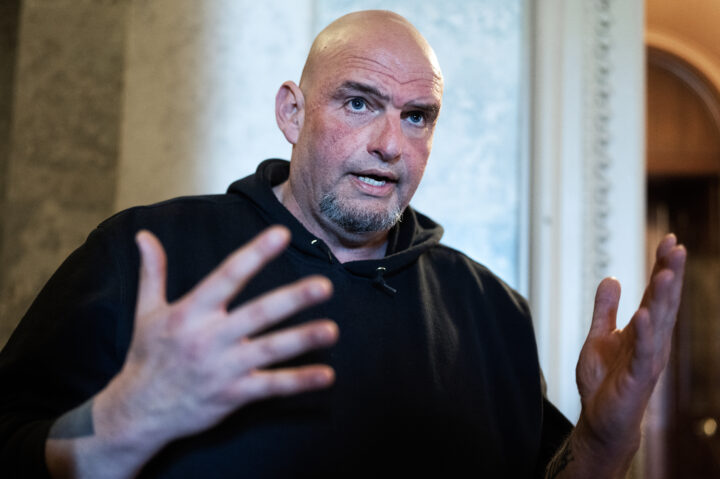
Sen. John Fetterman, (D-PA) talks with reporters after the Senate luncheons in the U.S. Capitol on Tuesday, March 11, 2025.
Sen. John Fetterman (D-PA) will travel to Israel on Sunday for his second visit to the Jewish state, the Pennsylvania Democrat told Jewish Insider on Friday.
Fetterman told JI of his plans in the Capitol early Friday evening while waiting to finish votes on funding legislation to prevent a government shutdown. The trip will mark Fetterman’s third international trip since being elected to the Senate in 2022. He did not elaborate on his schedule while in Israel.
The Senate will be out of session all of next week.
Fetterman visited the Jewish state for the first time last June, during which he had meetings with Israeli Prime Minister Benjamin Netanyahu, President Isaac Herzog, Opposition Leader Yair Lapid, former Defense Minister Benny Gantz, Labor Party leader Yair Golan and Defense Minister Israel Katz, who was then serving as the country’s foreign minister. He also met with then-U.S. Ambassador to Israel Jack Lew and families of hostages.
Fetterman opted against visiting the sites of Hamas’ on Oct. 7, 2023, massacres during his first trip, saying at the time that he did not want to make anyone relive their trauma. He instead visited with students and faculty at Hebrew University and took a tour of Yad Vashem, the nation’s Holocaust memorial and museum.
Fetterman has also only been on one other congressional delegation out of the United States. His first trip after being elected was a brief visit to Turks and Caicos last May as part of a bipartisan delegation that facilitated the release of five detained Americans.
Fetterman, who suffered a stroke during his Senate campaign, has spent most of his first term thus far between Washington and Pennsylvania.
DMFI says the plan is tied to ‘a dangerous trend: the lure of isolationism’

Kayla Bartkowski/Getty Images
A Trump banner hangs on the side of The Heritage Foundation ahead of the Inauguration on January 17, 2025 in Washington, DC.
Pro-Israel Democrats are pressing Republicans to disavow the Heritage Foundation’s report calling for the U.S. to phase out U.S. military aid to Israel over the next 20 years, arguing that a failure to do so would undermine their claims of supporting Israel.
“I’ll always oppose anti-Israel proposals, whether they come from the left or the right,” Sen. Jacky Rosen (D-NV) said on X. “I hope my Republican colleagues will join me in denouncing this plan from their side of the aisle to fully cut off U.S. support for Israel, one of our closest allies.”
Rep. Steny Hoyer (D-MD) said in a statement that “everyone — no matter their party — who claims to be a friend of Israel and the Jewish community needs to reject this report in the strongest possible terms.”
He said the report’s recommendations would undermine Israel and the United States, and that its very existence emboldens Iran and its terrorist proxies.
“Ensuring Israel’s security, and our own, is not a political issue,” Hoyer continued. “We must not let Heritage and the far right turn it into one.”
Robert Greenway, the director of the Allison Center for national security at Heritage, responded to Hoyer, saying “Your concerns are as gravely misplaced as your mischaracterization of our proposal,” and blasted recent Democratic presidents for having “throttled aid to Israel while appeasing our common enemies.”
Victoria Coates, the vice president of Heritage, added, “The only time a congressional Democrat will express support for Israel is when they think they can take a shot at Heritage.”
In a statement, Democratic Majority For Israel argued that the Heritage Foundation’s stature and influence in the conservative movement makes the proposal a serious concern for the pro-Israel community.
It noted that the think tank was responsible for the Project 2025 plan laying out an agenda for a Republican presidential term, which DMFI accused the Trump administration of implementing.
““The Heritage Foundation occupies a unique space in Washington, D.C., which is why this proposal must be taken seriously,” the organization’s CEO Mark Mellman said. “As the authors of Project 2025, which the Trump Administration has swiftly implemented, the Heritage Foundation is a leading right-wing think tank that sets the agenda for Republican elected officials and policymakers. The proposal should not only be rejected outright, but it must also be strongly condemned by Republicans and Democrats alike who are committed to a strong U.S.-Israel relationship.”
It also tied the proposal to “a dangerous trend: the lure of isolationism.”
“The U.S.-Israel relationship is stronger than any single partisan initiative, and it is essential that we continue to support and strengthen this alliance for the benefit of both nations,” DMFI continued.
Schumer said the school must ‘take prompt action,’ Stefanik called for participating students to be expelled and prosecuted

Kevin Carter/Getty Images
U.S. Capitol Building on January 18, 2025 in Washington, DC.
Senate Minority Leader Chuck Schumer (D-NY) condemned the “inappropriate and unacceptable” scene at Barnard College on Wednesday night when anti-Israel demonstrators stormed the college’s main administrative building and assaulted a staff member, sending him to the hospital.
“It is inappropriate and unacceptable that masked intruders forcibly stormed a Barnard campus building, assaulted a college worker and blocked classroom access. All this in support of other protestors who are being justifiably disciplined for inappropriately disrupting fellow students from learning in a history class on Israel, while spreading antisemitic flyers that encouraged violence and more,” Schumer said in a statement to Jewish Insider.
“Barnard College must stand firm against this behavior and take prompt action to maintain a safe and welcoming environment for all its students,” the statement continued.
Schumer’s statement came as lawmakers on both sides of the aisle began to condemn the violent, six-hour protest, which was held in response to the college’s decision to expel two second-semester seniors who last month disrupted a History of Modern Israel class.
A spokesperson for the NYPD told JI that a police report has been filed regarding the alleged assault itself, though no arrests have been made as of Thursday and the investigation remains ongoing.
“ENOUGH IS ENOUGH. Pro-Hamas mobs have NO place on our college campuses. Barnard College & Columbia University must put an end to the antisemitic chaos on campus,” House Speaker Mike Johnson (R-LA) wrote on X.
Rep. Elise Stefanik (R-NY), President Donald Trump’s nominee to be U.S. ambassador to the United Nations, wrote on the platform that, “On the same day that the world was mourning the burial of the Bibas family murdered by Hamas terrorists, an antisemitic pro-Hamas mob violently took over Barnard College.”
“Students committing these crimes should be immediately expelled and prosecuted by law enforcement. As President Donald Trump outlined in his executive order, any visa-holding student participating in these antisemitic acts must be stripped of their visa and be deported,” she continued.
Rep. Daniel Goldman (D-NY), the Democratic co-chair of the House Bipartisan Task Force to Combat Antisemitism, posted on X that, “This violation of university rules and city laws must stop. There should never be demands to follow rules and the law. Universities including Columbia must enforce their own rules so all students feel safe. I look forward to learning what consequences these students face.”
“Actions have consequences. Barnard was right to expel the students who disrupted class & distributed fliers calling for the death of Jews. Negotiating with pro-terror protesters who are breaking campus policies should be out of the question,” the House Education and Workforce Committee stated in a post.
Rep. Virginia Foxx (R-NC), the previous chair of the committee, wrote in a separate post on X: “Expel them all.”
Rep. Mike Lawler (R-NY) called the situation “disgraceful.”
“Pro-Hamas protesters force their way into Barnard College, assaulting an employee in the process. This is not “activism” — it’s lawlessness and intimidation. Every student involved should face serious consequences. No excuses,” he said in a statement.
Rep. Laura Gillen (D-NY) said in a statement, “This is despicable: hate-filled anti-Israel protestors stormed a school building at Barnard and assaulted a staff member. The university must hold them accountable.”
Dermer’s ascension highlights the growing rift between the Israeli prime minister and the military and intelligence establishment

Michael Brochstein/SOPA Images/LightRocket via Getty Images
Ron Dermer, Israeli ambassador to the United States, seen speaking at an AIPAC Policy Conference in Washington, DC.
Israeli Prime Minister Benjamin Netanyahu’s decision to appoint Strategic Affairs Minister Ron Dermer — his elusive close political confidante and advisor — as the head of Israel’s hostage negotiations team touched off a political controversy in the country that underscores why Netanyahu selected him for the role.
By putting Dermer at the helm of the sensitive talks, Netanyahu ensured the negotiations are led by someone he trusts to align the Israeli team with the prime minister’s position: that the war against Hamas in Gaza cannot end unless his definition of “total victory” is achieved and the terror group is removed from power. The prime minister also hopes to plug the incessant leaks that have plagued the process.
Dermer’s new position was leaked to the press earlier this month when Netanyahu was in Washington, but it became official last week. Dermer entered the negotiations as the first phase of the cease-fire and hostage-release deal was winding down, with the clock ticking to secure an agreement on phase two. Dermer arrived in Washington days later for meetings with President Donald Trump’s Mideast envoy, Steve Witkoff.
A source with knowledge of the issue, who was granted anonymity to discuss the delicate situation, said that Netanyahu appointed a new lead negotiator “because this is a different negotiation with a new president of the U.S. The Biden deal is no longer valid. [The Trump administration] is backing Israel on everything, and I think that puts things in a different position. The Biden administration wasn’t backing us; they wanted a cease-fire. They didn’t care if Hamas remained in Gaza.”
Phase two of the cease-fire would involve ending the war, something that the government of Israel does not want to do because — as seen in the macabre displays of the handover of hostages — Hamas has not been eliminated as a governing or military force, even as it has been significantly weakened.
Israel would prefer to extend phase one, exchanging dozens of Palestinian terrorists and security prisoners for each hostage. Foreign Minister Gideon Sa’ar told Jewish Insider last Thursday, “Theoretically, it’s within the framework [of phase one]. This option exists.” He estimated that there are 21 living hostages in Gaza, though there are 24 hostages who have not officially been declared dead.
A source familiar with the view in the Prime Minister’s Office told JI this week that the members of the previous team “were terrible negotiators, just terrible. They didn’t get the idea you’re supposed to bargain, not ‘whatever you want, whatever conditions’ [to bring back the hostages]. Now, you don’t have any leaks — everything was leaking before. It’s like [the previous team] were on a different side or something.”
One challenge Dermer will face in the negotiations will be convincing Hamas to continue those lopsided trades without the promise of Israel ending the war. Hamas views the hostages as the terror group’s best leverage to get what it wants: Hamas’ survival and a complete Israeli withdrawal from Gaza.
***
Mossad chief David Barnea led the talks before Netanyahu replaced him with Dermer. Shin Bet chief Ronen Bar and IDF representative Maj.-Gen. Nitzan Alon were also on the team, and Netanyahu repeatedly sent with them his diplomatic advisor, Ophir Falk, to the talks in Cairo and Doha, Qatar.
The security chiefs often disagreed with Netanyahu about how the negotiations were handled, and there were frequent leaks to Israeli media from the previous team portraying the prime minister as obstructive.
“A senior source familiar with the details” of the negotiation sent a statement to reporters last week indicating that this was Netanyahu’s reason for replacing them with Dermer. The source said that “the achievement of the agreement to release six of our living hostages at one time” last Saturday — as opposed to the three originally planned — “is the result of the prime minister’s decision to change the makeup of the negotiating team. The new team changed the dynamic and led negotiations instead of concessions. It also stopped the practice of regular and biased briefings against the prime minister and the political echelon that only caused Hamas to entrench its position and add demands.”
Anonymous security officials pushed back in Hebrew media, calling the claim “a disgrace” and arguing that the sped-up hostage release was an option previously written into the deal. Yair Lapid, the opposition leader, and National Unity party leader Benny Gantz railed against Netanyahu for undermining the defense establishment.
Labor MK Merav Michaeli, a member of the Knesset Foreign Affairs and Defense Committee, said that “obviously [Dermer is] the go-to person as far as Bibi is concerned, and he is extremely well-connected in the [Trump] administration, so by all means, appoint a capable person who is well-connected and can get stuff done. But why does this have to include removing the professionals who are the ones with all the mileage, experience and knowledge?”
The Hostages and Missing Families Forum called on everyone sparring publicly to “stop this behavior immediately” and focus on the fate of the hostages.
The source familiar with the view in the Prime Minister’s Office told JI this week that the members of the previous team “were terrible negotiators, just terrible. They didn’t get the idea you’re supposed to bargain, not ‘whatever you want, whatever conditions’ [to bring back the hostages].”
“Now, you don’t have any leaks — everything was leaking before. It’s like [the previous team] were on a different side or something,” the source added.
Labor MK Merav Michaeli, a member of the Knesset Foreign Affairs and Defense Committee, said that “obviously [Dermer is] the go-to person as far as Bibi is concerned, and he is extremely well-connected in the [Trump] administration, so by all means, appoint a capable person who is well-connected and can get stuff done.”
“But why does this have to include removing the professionals who are the ones with all the mileage, experience and knowledge?” Michaeli asked.
Michaeli also pointed out that “the negotiation is not with the Americans, it’s with Hamas, Egypt and so forth, and theirs is a language Dermer doesn’t speak … Why throw out the people who know how to talk with the Arab side — Bar and Barnea?”
“The inevitable conclusion is that Netanyahu’s aim is not to bring back hostages … It is to remain prime minister, whether from reigniting the war in Gaza or another way,” she said.
***
Dermer, the former Israeli ambassador to the U.S., played a role in advancing hostage deals even before he led the negotiations. He was instrumental in convincing the Cabinet to accept the first cease-fire in November 2023, in which over 100 hostages were freed.
Shortly after Trump was reelected, he told Israeli President Isaac Herzog in a call that he thought nearly all of the hostages were dead, and Herzog told him he was mistaken. Dermer visited Trump in Mar-a-Lago days later to share Israeli intelligence that most of the hostages were alive, JI has learned.
“This is the highest moral imperative: to rescue them from the tunnels of hell,” Mossad chief David Barnea told the Institute for National Security Studies’ Annual Conference. “There is no greater feeling — not even when carrying out a highly impactful operation — than the sense of duty and purpose in bringing the hostages home.”
At the same time, Dermer has a proven record of loyalty to Netanyahu in the face of public pressure regarding the hostages. Protesters stand outside Dermer’s house regularly — in a group chat viewed by JI, they talked about having followed him to synagogue and the gym — but it has not swayed him from being Netanyahu’s loyal soldier.
In a heated security cabinet meeting in August, from which there were extensive leaks to the media, Dermer took Netanyahu’s side against the security establishment that sought further concessions to reach a hostage deal. Netanyahu wanted the ministers to vote that the IDF’s continued presence along the Philadelphi Corridor between Gaza and Egypt must be a condition of a hostage deal. IDF Chief of Staff Herzi Halevi and Mossad head Barnea argued that it was unnecessary. Then-Defense Minister Yoav Gallant reportedly shouted: “You are voting that if we decide that there are two options — either stay in Philadelphi or bring back hostages — you are deciding to stay in Philadelphi. Does that seem reasonable to you? There are people alive there!”
Dermer reportedly responded: “The prime minister can do what he wants.”
Barnea continued to push back against Netanyahu’s approach after being replaced as chief negotiator, telling the Institute for National Security Studies’ Annual Conference on Tuesday that returning the hostages has been his “foremost mission since Oct. 7.”
“This is the highest moral imperative: to rescue them from the tunnels of hell,” Barnea said. “There is no greater feeling — not even when carrying out a highly impactful operation — than the sense of duty and purpose in bringing the hostages home.”
Commenting on Barnea’s remarks, Michaeli said: “You understand his priorities and the prime minister’s are not aligned. The person brought to be in charge of the negotiations is the one implementing Netanyahu’s priorities.”
***
Trust is also key in Netanyahu’s choice of Dermer to lead the negotiations. Netanyahu has gone through dozens of advisors in his four decades in politics, and many have left only to speak out against him and, in some high-profile cases, run against him in elections.
Dermer, however, has been advising Netanyahu since 1999. He has, over the years, been called “Bibi’s brain,” and “the son Netanyahu wishes he had” (Netanyahu has two sons, Yair and Avner, as well as a daughter, Noa, from a previous marriage).
Netanyahu’s deep trust in Dermer is partly because he has proven less susceptible to public pressure than others in similar positions. Dermer shies away from the media and the public, has never run for office, and even now, when he is a Cabinet minister, operates like Netanyahu’s top advisor and envoy.
In a segment titled “Who are you, Ron Dermer?” on Israel’s most-watched news program last November, former Netanyahu Chief of Staff Ari Harow said that “one of the unique things about Ron is he never had his own political aspirations. He isn’t looking for promotions or titles. He’s not looking for a place in politics for himself; he is looking to help the State of Israel.”
Dermer gives even fewer interviews than Netanyahu, and only to foreign media. The most recent Hebrew interview Channel 12 could find for the segment about Dermer was from 2010.
As such, the minister is unknown to most Israelis. At the beginning of the segment, journalists walked around Jerusalem’s Machane Yehuda market with photos of Dermer and asked shoppers to identify him. Only two could — and they had accents from English-speaking countries. A recent sketch on “Eretz Nehederet,” Israel’s version of “Saturday Night Live,” featured the show’s first-ever impression of Dermer in honor of his appointment as the top hostage negotiator. The thrust of the sketch was his lack of communication with the Israeli public. The way they portrayed him — as somewhat of a frat boy and a sycophant to Netanyahu’s wife, Sara, and son, Yair Netanyahu, of whom he is known to steer clear — betrayed the writers’ unfamiliarity most of all.
Dermer has given one speech in the Knesset plenum, a rare occasion in which lawmakers availed themselves of the legislature’s tools to require him to appear before them. He has limited his submission to parliamentary oversight to the Knesset’s confidential Subcommittee on Intelligence.
The Trump administration’s Middle East envoy also said that Lebanon and Syria could join the Abraham Accords
CHANDAN KHANNA/AFP via Getty Images
Special envoy to the Middle East Steve Witkoff speaks during the FII Priority Summit in Miami Beach, Florida, on February 20, 2025.
Steve Witkoff, the White House envoy who has led Gaza hostage-release and cease-fire talks for the U.S., said Tuesday evening that talks for phase two of the deal between Israel and Hamas remain in flux but that he’s hoping for progress by the weekend.
Witkoff also suggested, speaking at an American Jewish Committee event, that Lebanon and Syria could come to normalize relations with Israel.
On the hostage-release talks, Witkoff said that he’s “not entirely sure yet” how Israel and Hamas will get to phase two of the deal, “but we are working, we’re making a lot of progress.” If enough progress materializes in the next few days, Witkoff said he’ll travel to the region on Sunday to help finalize a deal.
“People are responsive,” Witkoff said. “Doesn’t mean it’s going to happen. It’s a very chaotic place, the Middle East.”
He said that his and the White House’s top goal is to return all of the hostages.
Witkoff was initially set to travel to the Middle East on Wednesday, but his plans were delayed by Ukrainian President Volodymir Zelensky’s visit to the United States, slated for the end of the week. Witkoff, a close friend of the president, has also become a key negotiator with Russia.
In the longer term, Witkoff suggested that Lebanon and Syria could join the Abraham Accords, the regional peace agreements between Israel and Arab states, without providing further details.
He criticized President Joe Biden’s May 2024 proposal for Gaza — which undergirds the cease-fire deal — because it assumed that reconstruction and rehabilitation of the Strip was feasible under a five-year timeline. Witkoff, who noted that he was the first American official to visit the territory in years, said that a 15- to 25-year timeline would be much more realistic.
“It’s a giant slum … it’s a slum that’s been decimated,” Witkoff said. “It is completely destroyed.”
He said that U.S. partners including Jordan and Egypt — both of which Trump has proposed as countries to relocate the population of Gaza to — are “dug in” and “focused on solutions,” actively engaging with the United States.
Regarding Trump’s proposal to remove the Palestinian population from Gaza, Witkoff said that “it’s not an eviction plan, it’s about creating an environment that — whoever should live there — is better than it’s ever been in the last 40 years.” He said that the Trump administration is not seeking to create a mass Palestinian diaspora, which he said would only drive further radicalization.
Witkoff said that Trump’s proposal was focused on “directionally chang[ing] what people are thinking there, how they’re going to live together.”
Trump, Witkoff continued, is not focused on reaching a two-state solution, but instead on “how you get to a better life” for Palestinians, including changing the Palestinian education system and providing better career and quality of life prospects for the Palestinians.
He suggested that the people in Gaza are not interested in waiting 20 years to reestablish normal lives. “Maybe we should be talking about the ability to come back later on, but right here, right now, Gaza is a long-term redevelopment plan.”
He further suggested that the five-year timeline laid out by Biden had hampered progress toward Saudi-Israel normalization, but that normalization efforts can resume once a Gaza redevelopment plan has been more fully articulated.
Witkoff predicted that Saudi Arabia and other Gulf states would ultimately embrace peace with Israel because the ongoing risks of war and regional instability make it difficult to finance major projects — “the underwriting risk on war is just too high.”
He said he expects that Saudi Arabia and others in the region will put forward development plans in line with the Trump administration’s proposal once they accept that Gaza cannot be rebuilt in the short term.
He said many countries are stepping up to volunteer to be part of the “permanent solution for the Gazan people” and that the U.S. soon plans to hold a summit with top regional developers to discuss Gaza.
“I think when people see some of the ideas that come from this, they’re going to be amazed,” Witkoff said.
The former real estate developer also said that the Biden administration was largely responsible for the amount of unexploded ordinance left in Gaza, which will make redevelopment more difficult, alleging that the Biden administration’s withholding of some arms from Israel had forced Israel to use old and ultimately non-functional ammunition.
He added that the tunnels under Gaza present a further challenge both in terms of the destruction in the territory and rebuilding it.
To facilitate peace in the Middle East, the U.S. needs to ensure stability in partner countries such as Egypt and Saudi Arabia and address discontent in their populaces, “but all in all, there are some really good things that are happening,” Witkoff said.
Witkoff praised Israeli Prime Minister Benjamin Netanyahu, saying that the Israeli government had taken numerous positive steps prior to Trump taking office, including decimating Hamas, degrading Hezbollah and eliminating its leadership and attacking Iran’s air defenses.
He repeatedly made reference to a film of Hamas’ atrocities on Oct. 7, describing the group as “barbarians” and emphasizing that the Trump administration agrees that Hamas cannot control post-war Gaza.
Speaking at an FDD event in Washington, the Israeli opposition leader said, ‘We can take these two problems and combine them into one solution’

GIL COHEN-MAGEN/AFP via Getty Images
Israeli opposition leader Yair Lapid addresses a rally in Tel Aviv on July 20, 2024.
Yair Lapid, the Israeli opposition leader and former prime minister, laid out a plan on Tuesday for Egypt to take temporary control of Gaza for eight to 15 years after the war in Gaza, in cooperation with various other regional powers, in exchange for international relief of its foreign debt obligations.
Under the plan, after the end of the three-phase cease-fire and hostage-release deal between Hamas and Israel, Egypt, backed by a United Nations Security Council resolution with some partnership from the Gulf and others in the international community, would take “temporary guardianship” of Gaza, Lapid said in an event at the Foundation for Defense of Democracies.
Lapid said that, based on the completion of “measurable benchmarks” in anti-corruption and deradicalization, Egypt would turn over control of Gaza to the Palestinian Authority at the end of its guardianship period, in coordination with Israel and the United States.
Lapid said that there’s precedent in the 1960s for such an arrangement, with support from the Arab League. He said that Saudi Arabia and the Abraham Accords states, as well as the U.S., would be part of the deal, with the U.S. and others making investments in reconstruction — a provision that Lapid claimed was consistent with President Donald Trump’s vision for Gaza.
“On the security side, Israel and Egypt have a deep and lasting strategic relationship supported by the United States. Egypt has an interest in the stability of Gaza and the region as a whole,” Lapid said. “Egypt wants to remove the idea of a population transfer from Gaza to Egypt.”
In exchange, the international community would pay off Egypt’s mounting international debts, both incentivizing Egypt to participate in the plan and stabilizing the Egyptian government.
“We can take these two problems and combine them into one solution,” Lapid said.
Any Palestinians who have somewhere else to move to would be allowed to do so, he continued.
Lapid framed his “Egyptian Solution” as having the effect of also solving long-running concerns from Israel and others in the region about the stability of the Egyptian government, a critical ally to Israel. Lapid warned that the fall of the Egyptian government could set off a chain reaction around the Middle East.
He suggested that it would also be in Egypt’s own security interests to deal with the potential threat from Gaza, as well as avert the possibility of forced mass population transfer from Gaza into Egypt.
While acknowledging that Egypt has not been a perfect partner to Israel, the opposition leader said it has a long-running relationship with Israel, is reasonably trustworthy and has worked with Israel on security issues before, making it the best option available.
“We know how to work together very well,” Lapid said. “Between bad dilemmas, this is the best option.”
Under the plan, Egypt would be responsible for leading the deradicalization and demilitarization of Gaza, including preventing arms smuggling to Hamas and destroying the terrorist group’s expansive network of tunnels under Gaza.
While he did not offer many specifics on what the security force in Gaza would look like, he said it would involve Egypt and a pan-Arab force, while allowing Israel to intervene militarily when necessary.
“We’re going to trust you but we’re not going to trust anyone if we’re going to see another bunch of guys with Toyota trucks and machine guns coming towards our border,” Lapid said. “It’s going to be a joint effort that will take a lot of time … It’s going to be a long process and a painful one, and the use of force part of it.”
Outside of Gaza, Lapid said that Israel and the international community need to go after Iran’s oil production to ensure that Iran cannot rearm and resupply Hamas, and ultimately precipitate the fall of the regime in Tehran.
Lapid, who sounded largely in lockstep with the current Israeli government on some key issues a day earlier in a speech to an AIPAC conference, criticized the Israeli government at FDD for failing to present a realistic alternative to Hamas or the Palestinian Authority in Gaza for effective governance, noting that Gulf states have refused to enter Gaza without cooperation from the PA.
“I supported it, I still do, but the use of force is not the goal,” Lapid said. “It is a tool to change reality. We need to get to a point where Gaza stops being a security threat to Israel and where it also stops being a hotbed of poverty, extremism and religious hatred.”
He dismissed suggestions that Israel should annex Gaza or the West Bank permanently as a “messianic” vision detached from reality and Israel’s own interests.
Asked during a Q&A session by FDD CEO Mark Dubowitz what deradicalization means and whether it would be realistic, Lapid pointed to educational curricula on tolerance promoted by the United Arab Emirates and emphasized the need to reform Palestinian textbooks. He also highlighted the need to address corruption in the PA.
He reiterated that he believes it’s in Israel’s interest to find a way to “divorce” from the Palestinians — which he said will not make the Israeli-Palestinian conflict go away permanently — but that the “burden of proof” will be on the Palestinians to demonstrate that they’re changing.
The former Israeli prime minister said that finding a viable path forward in Gaza is also a necessary precondition for Israel’s key challenge of building and reinforcing a regional coalition to oppose Iran, of which Saudi Arabia would be a key partner.
Lapid said he hasn’t discussed the plan with Egypt at this point, though he said he has talked about it with allies throughout the Middle East and the Gulf, and presumes that Egypt is aware of the proposal through such conversations.
“I’m estimating they’re going to say no and then yes,” Lapid said. “They understand this as the beginning of some sort of a negotiation towards a solution.”
Pressed during the Q&A by Middle East Institute senior fellow Brian Katulis on the clear inconsistencies between the Lapid plan and Trump’s proposal — which includes not just U.S. investment but direct U.S. control of Gaza and the forced permanent relocation of the Palestinian population — Dubowitz framed the Lapid plan as a potentially more feasible version of Trump’s proposal, taking it from an “11” and dialing it down to “a seven or eight, for a realistic plan.”
A group of protesters clogged the sewage system of Columbia’s international affairs school, and spray painted the business school with an antisemitic slur
Victor J. Blue for The Washington Post via Getty Images
Students protest against the war in Gaza on the anniversary of the Hamas attack on Israel at Columbia University in New York, New York, on Monday, October 7, 2024.
Columbia University’s administration has launched an investigation — together with law enforcement — to identify the perpetrators of an act of vandalism on Wednesday in which anti-Israel demonstrators clogged the sewage system in the School of International and Public Affairs building with cement and sprayed the business school with red paint.
Columbia defined the spray-painting as an “act of vandalism” in a Wednesday statement, adding that the graffiti “included disturbing, personal attacks.” It said it was “acting swiftly to address this misconduct” and “to identify the individual perpetrators and address their actions.”
“The university has done a better job [responding to antisemitic incidents] compared to in the past year, but at the same time, the actions of these perpetrators has gotten a lot worse,” a second-year graduate student in SIPA who requested to remain anonymous told Jewish Insider. “This went from antisemitic vitriol to cementing toilets and causing staff to be there overnight scrubbing fecal matter out of the toilets.”
In a Wednesday night email to SIPA students, the school’s dean, Keren Yarhi-Milo, wrote that the women’s restrooms on four floors of the building were “vandalized with a cement-like substance causing the toilets to clog.” The walls of the 15th floor restroom were also spray-painted, as was the business school’s Kravis Hall, according to the email.
The Columbia Spectator reported that the graffiti included the phrase “Keren eat Weiner,” a reference to Yarhi-Milo and Rebecca Weiner, the NYPD’s deputy commissioner of intelligence and counterterrorism, as well as “5.3.2018-1.29.2024 Hind called we must answer” and “Im scared please help – HIND AGE 6,” a reference to Hind Rajab, a Palestinian girl killed during the war in Gaza.
In April of last year, at the start of the illegal anti-Israel encampment movement, protesters occupied Hamilton Hall and unfurled a banner that read “Hind’s Hall,” announcing that they had renamed the building in her honor. New York City Resists with Gaza, Columbia University Apartheid Divest and Students for Justice in Palestine claimed responsibility for the vandalism in a social media post.
Columbia’s response comes as the university has reacted more quickly to antisemitism in recent weeks — a sharp contrast compared to what lawmakers and Jewish students and faculty have called a slow, or nonexistent, response to the frequent antisemitism occurring on campus since the Oct. 7 attacks in Israel. Last week, the university suspended a university affiliate for participation in a masked demonstration in which four people barged into a History of Modern Israel class, banged on drums, chanted “free Palestine” and distributed posters to students that read “CRUSH ZIONISM” with a boot over the Star of David.
Columbia’s Office of Student Affairs also mandated on Wednesday that a SIPA group chat, intended to distribute campus-related information to students, be restricted to “administrator-only” mode after several incidents of students espousing antisemitic rhetoric in conversations, a student familiar with the situation told JI.
“We have been monitoring the chats closely and while the discussions are warranted, we have been mandated by the OSA to pause all cohort group chats temporarily till we convene to find a resolution to the ongoing discussions. … I would urge everyone to reflect on how we can reinforce civility in our discourse as we navigate this,” an administrator wrote in one cohort chat, according to messages obtained by JI.
The SIPA graduate student described antisemitic rhetoric in the students’ chat to JI as “a constant stream of pretty outrageous messages.”
“It quickly devolved into the same two or three students from our cohort invoking the Holocaust,” he said. “OSA is getting the handcuffs on these [perpetrators] more quickly than they were last year.”
Asked whether the perpetrators of Wednesday’s vandalism would be suspended or expelled once identified, a spokesperson for Columbia told JI that the university won’t comment further.
The conservative legal scholar specifically scrutinizes law schools, which he argues have grown hostile to free speech and inquiry

Legal scholar Ilya Shapiro had a personal run-in with cancel culture in 2022, when a tweet he later admitted was poorly worded sparked an online uproar and allegations of racism, leading to an official investigation by Georgetown University Law Center, where he had been hired to lead the university’s Center for the Constitution.
Months later, the university closed its investigation and cleared Shapiro’s name. But too much damage had been done, Shapiro said, and he resigned just days after formally taking the helm of the center.
Now, three years after he posted the ill-fated tweet that criticized President Joe Biden for promising to name a Black woman to the Supreme Court, Shapiro has many more allies in his criticism of the “illiberal takeover” of higher education and legal education in particular, a problem he describes in his new book, Lawless: The Miseducation of America’s Elite.
The aftermath of the Oct. 7, 2023, Hamas attacks in Israel and the rise in antisemitism that followed at many top American universities proved to be a tipping point, Shapiro argued.
“It raised the issue of the dysfunction and pathologies in our institutions of higher education to a national level,” Shapiro, a senior fellow and director of constitutional studies at the Manhattan Institute, told Jewish Insider in an interview on Thursday.
Shapiro, whose career has been spent in libertarian and conservative institutions, asserts that his critique of legal education today is not about the fact that most law school faculty at the nation’s top universities lean to the left politically. In other words, he insists that his concerns are not just the grievances of someone whose views place him firmly in the minority in the legal sphere.
“I want to emphasize that this is not the decades-long complaint that conservatives have with the hippie takeover of the faculty lounge, if you will,” said Shapiro.
Instead, Shapiro is sounding the alarm about what he fears is the corrupting of the legal profession, a field that is crucial to so many facets of American life, by a culture of silence and groupthink.
“[Law students] are being acculturated into the idea that inquiry is not a high value, that certain topics can’t even be broached, that certain perspectives shouldn’t be raised,” said Shapiro. “It’s antithetical to the idea that you train lawyers to understand the other side of the issues so they can better advocate for their clients.”
“What happens at law schools matters,” Shapiro added, “because lawyers, for good or ill, are overrepresented among our political leaders, among the gatekeepers of our institutions.”
He drew a distinction between why people outside of academia should care about the shift away from nuance and openmindedness at America’s top law schools versus similar challenges in other academic disciplines.
“While it’s sad and unfortunate for the development of human knowledge and such if an English department or a sociology department goes off the rails, the law schools are more directly connected to our public life, so it matters what kind of lawyers are turned out,” Shapiro argued.
He pointed to early career associates pressuring their law firms to take them off cases with certain clients, or firms parting ways with prominent partners who worked on conservative cases — such as former Solicitor General Paul Clement, who in 2022 won a major gun rights case at the Supreme Court but then had to start his own firm when his employer decided it no longer wanted to work on Second Amendment issues.
In his book, Shapiro outlines some high-profile incidents that occurred in recent years at top law schools. In 2022, several student groups at Berkeley Law School said they would not allow any Zionists to give talks to their members, which prompted outrage by Berkeley Law’s dean, Erwin Chemerinsky — who last year faced antisemitic hate from his own students.
“I think a lot of people have come to realize that there really are issues, and it’s not just conservatives whining about this or that,” said Shapiro, who attributes many contemporary challenges on university campuses to Diversity, Equity and Inclusion bureaucracies that have increasing power over many parts of campus life.
As President-elect Donald Trump’s inauguration approaches, some major companies are doing away with their DEI programs, a “vibe shift” that Shapiro says hasn’t yet come to American law schools.
What Shapiro wants to see at law schools is more commitment to showcasing diverse viewpoints, and a recommitment to teaching America’s future lawyers that the legal system, though imperfect, is not broken beyond repair, even as many students now learn that the rule of law in America is “irrevocably spoiled with racism, sexism, inequality, imbalances.” He thinks fixing the problem isn’t actually that hard, if law school administrators can muster the courage to do it.
“This is not rocket science,” said Shapiro. “It’s just a matter of enforcing your own policy and applying common sense and standing up to the mob. But all too few university leaders are willing to do that.”
Shapiro is on a book tour this spring, which includes a speaking gig at Georgetown. He hasn’t been back since his ignominious departure.
The incoming Trump administration’s nominee to be secretary of state is expected to enjoy an easy glide-path to confirmation with overwhelming bipartisan support

Kevin Dietsch/Getty Images
President-elect Donald Trump’s nominee for Secretary of State, Sen. Marco Rubio (R-FL) testifies during his Senate Foreign Relations confirmation hearing at Dirksen Senate Office Building on January 15, 2025 in Washington, DC.
Sen. Marco Rubio (R-FL), the incoming Trump administration’s nominee to be secretary of state, said at his Senate confirmation hearing on Wednesday that President-elect Donald Trump’s administration is open to a new nuclear deal with Iran, under strict conditions.
Over the course of his testimony, Rubio also framed the announcement of a cease-fire between Israel and Gaza and recent losses for Iran and its proxies in the region as creating an opportunity for major steps forward on regional normalization and Israeli-Palestinian peace, condemned the International Criminal Court’s targeting of Israel and spoke forcefully about the need to combat antisemitism globally.
Overall, Rubio’s hearing — businesslike and cordial, focused on details of every region of the globe — marked a striking difference from the heated partisan slug-fests at confirmation hearings for other top Trump nominees this week. Rubio is expected to enjoy an easy glide-path to confirmation with overwhelming bipartisan support.
“My view is that we should be open to any arrangement that allows us to have safety and stability in the region, but one in which we’re clear-eyed,” Rubio said on the subject of Iran’s nuclear program. “Any concessions that we make to the Iranian regime, we should anticipate that they will use, as they have used in the past, to build their weapons systems and to try to restart their sponsorship of Hezbollah and other related entities around the region.”
He described the Iranian regime as at its “weakest point in recent memory, maybe ever,” with its air defenses degraded, its regional partners and proxies undermined and its economy in dire straits.
Secretary of State Nominee @marcorubio appeared at his confirmation hearing today, and discussed Israel, the ICC and Iran, among other issues. The following thread includes some of the highlights:
— Jewish Insider (@J_Insider) January 15, 2025
"How can any nation state on the planet co-exist side-by-side with a group of… pic.twitter.com/8x2Jl5oRab
Rubio said that this could push the Iranian regime in one of two directions: toward negotiations to buy time to rebuild, or toward rapid nuclearization as a method of regime protection.
He said that recent outreach from the regime to European nations, in the context of the expiration of snapback sanctions under the 2015 nuclear deal later this year, indicates that Iran may be leaning toward pursuing negotiations.
He said the U.S. cannot allow “under any circumstances” Iran to become a nuclear weapons state, to continue to sponsor terrorism or have the ability to attack its neighbors and the United States. He also noted that U.S. policy would be shaped by Iran’s yearslong efforts to assassinate Trump and other U.S. officials.
Rubio was careful to repeatedly draw a clear distinction between the Iranian regime of “radical Shia clerics” and the people of Iran, arguing that the gap between the regime and Iranian citizens is perhaps the widest of any country on Earth.
“In no way [are] the clerics who run that country representative of the people of that country and of its history and of the contributions it has made to humanity,” Rubio said.
He also noted that in Iran and other key U.S. adversaries, a “market” has developed for kidnapping and holding American citizens hostage, emphasizing the need for greater awareness about those risks.
Rubio described the cease-fire and hostage-release agreement between Israel and Hamas — announced in the middle of his hearing — as “a foundation to build upon” toward broader regional change, including Israeli-Palestinian peace and regional normalization. He said that the deal, in combination with the cratering of Hezbollah in Lebanon and the fall of the Assad regime, had altered the landscape of the Middle East, potentially opening pathways to renewed normalization and an Israeli-Palestinian peace process.
"I don't know of any nation on earth in which there is a bigger difference between the people and those who govern them than what exists in Iran. And that's a fact that needs to be made repeatedly." pic.twitter.com/cVAx1iUFCU
— Jewish Insider (@J_Insider) January 15, 2025
“There are opportunities now in the Middle East that did not exist 90 days ago,” Rubio said. “There are now factors at play in the Middle East that I think we can build upon and may open the door to extraordinary and historic opportunities, not just to provide for Israel’s security but ultimately begin to confront some of these other factors. But these things are going to be hard work and they’re going to require us to take advantage of those opportunities if they exist.”
Rubio said that the six-week first phase of the deal will be a critical period to build international cooperation to bring stability and new governance into Gaza. He said that both President Joe Biden and Trump deserved credit for working in tandem in the negotiations.
But he also noted that the deal did not ensure the release of all of the hostages, and emphasized that any cease-fire would be short-lived if hostages remain in Hamas captivity.
“Without the hostage situation resolved, this situation will not be resolved. It is the lynchpin,” Rubio said. “Hamas has been severely degraded, but these people, who include a number of American citizens, need to be home as soon as possible, and that will remain a priority in any engagement that we’re involved in.”
Rubio said that potential normalization between Saudi Arabia and Israel would be “one of the most historic developments in the history of the region,” adding that the Saudis and other partners in the Middle East should be part of the post-war stabilization efforts in Gaza and that a normalization agreement would help bring “a level of stability and peace” to the entire region.
He said that a key part of expanding and strengthening the Abraham Accords is ensuring that there are benefits to the countries joining the pact, such as, for Saudi Arabia, high tech investment, economic diversification and security against the mutual Iranian threat. He said the U.S. could help provide security assurances as well.
"Any concessions we make to the Iranian regime we should anticipate that they will use as they have used in the past to rebuild their weapons systems and to try to restart their sponsorship of Hezbollah and other related entities around the region." pic.twitter.com/CjH9BNsJVA
— Jewish Insider (@J_Insider) January 15, 2025
“We’re still going to have some issues with UAE and with Saudi Arabia, but we also have to be pragmatic enough to understand what an enormous achievement it would be if, in fact, you not just get a cease-fire but that leads to the opportunity of a Saudi-Israeli partnership and joint recognition,” Rubio said.
One such issue with the United Arab Emirates that Rubio said the U.S. should raise is Abu Dhabi’s support for a militant group in Sudan that Rubio and the Biden administration have said is commiting genocide. At the same time, he described the UAE as a critical partner to build stability in the Middle East.
On the subject of Israeli-Palestinian peace and a two-state solution, Rubio argued that the “conditions for that have not been in place for some time” — noting that the Palestinian Authority had rejected a Trump administration peace proposal in 2020.
He argued that if Israel had not responded forcefully to the Oct. 7 attack, the country may have faced existential threats from enemies on its various borders.
But Rubio said that there has been a potential “dynamic shift in the region” that has “an historic opportunity, if appropriately structured and pursued, that changes the dynamics of what might be possible.” He emphasized that for Israel, its existential safety is the non-negotiable starting point. If Israeli security can be guaranteed, Rubio said, there may be more opportunities for a peace process.
He said the key question for the Palestinians moving forward will be the future of governance in Gaza. “[Israel] can’t turn it over to people who seek [it’s] destruction … You cannot coexist with armed elements at your border who seek your destruction and evisceration as a state.”
Pressed by Sen. Ted Cruz (R-TX) — who accused the administration of secretly prohibiting Jews in the West Bank from accessing U.S. grants — Rubio committed to ending any waivers to sanctions in Gaza and the West Bank, ending what Cruz described as “discriminatory policies, including the Biden administration’s secret boycott policies” in the territory and ending the Biden administration’s sanctions regime against Israeli settlers accused of inciting violence in the West Bank.
One of the alleged boycotts, through the Development Finance Corporation, does not appear to have been revealed publicly before the hearing.
Senator @tedcruz pressed Senator @marcorubio during his secretary of state confirmation hearing on reversing discriminatory sanctions against Israeli Jews living in Judea and Samaria.
— Jewish Insider (@J_Insider) January 15, 2025
Rubio responded: "I'm confident in saying that President Trump's administration will continue… pic.twitter.com/i4p9mNkwny
He did not address a question from Sen. Chris Van Hollen (D-MD) about whether the Trump administration would oppose potential Israeli annexation of the West Bank.
Addressing the ICC prosecutions targeting Israeli leaders, Rubio said that the court had “done tremendous damage to its global credibility” with the effort, calling the case “completely flawed” and “completely offensive” in drawing equivalency between Israel and Hamas.
“Hamas carried out an atrocious operation. They sent a bunch of savages into Israel with the express and explicit purpose of targeting civilians,” Rubio said. “They deliberately targeted civilians. The ones they didn’t murder, the families they didn’t eviscerate, the people whose skulls they didn’t crack open, they kidnapped, and to this day continue to hold people, innocents that they took.”
He said that Israel cannot be expected to “coexist side-by-side with a group of savages like Hamas. They have to defend their national security and their national interest. And they didn’t target civilians.”
Rubio said that innocent people had been caught up in the war, “but there is a difference between those who in the conduct of armed action deliberately target civilians and those who do as much as they can to avoid civilians being caught up against an enemy that doesn’t wear a uniform, against an enemy that hides in tunnels, against an enemy that hides behind women and children.”
Further, Rubio said the case appeared to be a “test run” for a future case targeting U.S. leaders and military personnel.
Echoing rhetoric from other top Trump nominees, Rubio said that any individuals in the U.S. on visas who express support for Hamas or other terrorist groups should lose their visas and be forced out of the country.
Rubio committed to Sen. Jacky Rosen (D-NV) that the Trump administration would quickly nominate a qualified individual to serve as U.S. special envoy to monitor and combat antisemitism, saying that the nominee “needs to be someone that enjoys broad support across different sectors.”
He also said that the administration would promptly name a deputy envoy to run the office until an envoy is confirmed. Rubio said the antisemitism envoy role is particularly urgent in light of a recent Anti-Defamation League report that showed 60% of people hold some antisemitic views.
“Antisemitism is a unique danger. The suffering that it inflicted on the world historically, but within the last century, is unimaginable and can never be allowed to be repeated, and it’s something that we should make sure we’re constantly speaking out against, and identifying for what it is,” Rubio said. “I think the U.S.’s role in speaking out in that regard is indispensable, and we need to be forceful about it.”
Asked by multiple senators about the incoming administration’s approach to multilateral organizations such as the United Nations, Rubio said that the guiding philosophy for the administration’s engagement with such organizations will be whether engagement with them makes the U.S. safer and more prosperous. He said that no international organizations would be allowed to hold a veto over U.S. security interests.
Any funding to such organizations will require strict examination, Rubio added, suggesting that the administration may pull back funding from some of them.
He further described the U.N. Security Council as having become “almost irrelevant” and “weaponized” against the United States because of the power of Russia and China, which he called two of the top drivers of global conflict.
Rubio also said that international organizations had become “havens” for antisemitism, undermining their credibility.
Rubio characterized the new regime in Syria, led by leaders of an Al-Qaeda offshoot, as “not ideal” but nonetheless “worth exploring.”
“I do think it’s important to respond to this opportunity in Syria,” Rubio said. “It is in the national interest of the United States, if possible, to have a Syria that’s no longer a playground for ISIS, that respects religious minorities … that protects the Kurds and at the same time is not a vehicle through which Iran can spread its terrorism.”
Rubio said that an improved situation in Syria could positively impact Lebanon, Israel, Gaza and the Middle East as a whole. He said Iran and Russia would return to fill the gap in Syria if the U.S. does not “explore these opportunities.”
He described Turkish President Recep Tayyip Erdoğan as an “impediment” to that path forward, and said the Trump administration would communicate immediately to Erdoğan not to move against the Kurds in Syria. He said the U.S. should maintain its support for the Kurdish Syrian Democratic Forces — something Trump sought to pull back in his first administration.
The outgoing president laid out the terms of the agreement in a White House address

ROBERTO SCHMIDT/AFP
President Joe Biden, flanked by Vice President Kamala Harris and Secretary of State Antony Blinken, speaks about the Israel-Hamas ceasefire and hostage release deal in the Cross Hall of the White House on January 15, 2025.
Nearly eight months after President Joe Biden gave a White House address laying out the terms of a proposed cease-fire and hostage-release deal between Israel and Hamas, he again spoke at the White House lectern on Wednesday, this time to announce that the two warring sides had “finally” agreed to the deal.
“At long last, I can announce a cease-fire and a hostage deal has been reached between Israel and Hamas,” Biden said. “This is the cease-fire agreement I introduced last spring. Today, Hamas and Israel have agreed to that cease-fire agreement and the whole of ending the war.”
He offered a veiled rebuttal to conservative critics who opposed the deal when he outlined it last year but are now more supportive of it following the backing of President-elect Donald Trump, whose aides were central to bringing the deal about.
“This is the exact framework of the deal I proposed back in May. Exactly,” said Biden. But, he added, his administration and the incoming one have “been speaking as one team” while negotiating in the region in recent days.
Trump announced the deal earlier in a post on his social network Truth Social, where he called it an “epic” agreement.
The deal has three phases, the first of which will include a “full and complete cease-fire, withdrawal of Israeli forces from all the populated areas of Gaza and and the release of a number of hostages held by Hamas, including women and elderly and the wounded,” said Biden. “I’m proud to say that Americans will be part of that hostage release in phase one as well, and the vice president and I cannot wait to welcome them home.”
In the first phase of the deal, 33 hostages are set to be gradually released — including some who are not alive.
Phase one will also include the release of hundreds of Palestinian prisoners from Israel, Biden said, as well as a surge of humanitarian assistance into Gaza. Many of those prisoners are believed to be Palestinians serving life sentences, some for murder of Israelis. During this period, Israel “will negotiate the necessary arrangements to get phase two, which is a permanent end of the war,” said Biden.
At the start of phase two, there will be an exchange of all the remaining living hostages, including male soldiers, and “all remaining Israeli forces will be withdrawn from Gaza,” according to Biden. “A temporary ceasefire will become permanent.”
Phase three will include the release of the remains of any additional hostages who were killed, and a “major reconstruction plan for Gaza will begin,” said Biden.
“This is one of the toughest negotiations I’ve ever experienced, and we reached this point because of the pressure that Israel built on Hamas backed by the United States,” said Biden, who touted Hamas’ military losses, the weakening of Hezbollah in Lebanon and the U.S.-led coalition to combat the Houthis as significant achievements.
“I’m deeply satisfied that this day has come — finally come — for the sake of the people of Israel and the families waiting in agony, and for the sake of the innocent people in Gaza who suffered unimaginable devastation because of the war,” said Biden. “In this deal, the people of Gaza can finally recover and rebuild. They can look to a future without Hamas in power.”
‘Israel has gone even beyond Canada and Mexico and our closest friends in terms of not only wanting to help, but not wanting to be reimbursed for it,’ Rep. Brad Sherman said

Mario Tama/Getty Images
PASADENA, CALIFORNIA - JANUARY 08: The Pasadena Jewish Temple & Center burns shortly after sunrise during the Eaton Fire on January 08, 2025 in Pasadena, California. Over 1,000 structures have burned, with two people dead, in wildfires fueled by intense Santa Ana Winds across L.A. County.
The Israeli government has offered to send aid to California to assist with the response to the wildfires in the Los Angeles area, which have destroyed thousands of homes and killed at least two dozen people, and said it would pay all expenses associated with that assistance, according to a letter obtained by Jewish Insider.
“In light of the deep, long-standing friendship and alliance between our nations, which in recent years has proved itself stronger than ever, we would like to extend our support and help our friends in their time of need,” Raful Engel, the director general of the Israeli Ministry of Public Security said in a letter to California Gov. Gavin Newsom.
The Israeli official offered to send a delegation of “expert firefighters who specialize in fire and rescue operations to help combat these fires and share their experience in order to minimize the damage inflicted on property and more importantly on human lives.”
Newsom’s director of communications, Izzy Gardon, said in a statement, “We’re grateful to Israel and many other nations in offering their support to California. Emergency Officials are currently working with our international partners on planning and mobilization.”
Rep. Brad Sherman (D-CA), who represents the area affected by the Pacific Palisades fire, explained that U.S. jurisdictions have existing mutual aid agreements with various countries and other jurisdictions for such emergencies. He said that Israel’s offer to pay all expenses associated with its offered aid is a step above and beyond what those agreements usually entail.
“Israel has offered us help that I very much appreciate, and now they’ve gone one step further and said that they would absorb the entire cost,” Sherman said. “Obviously this fire has lots of moving parts, but Israel has gone even beyond Canada and Mexico and our closest friends in terms of not only wanting to help, but not wanting to be reimbursed for it.”
Sherman added that he believes the Israeli firefighters would be able to bring “skills that I think we need,” and said he’d personally raised the offer with Newsom.
Sherman said the California government has so far accepted assistance offers from Mexico and Canada, partners it has worked most closely with in the past.
Fire crews from surrounding states are also assisting the response in California.
Lt. Col. Shay Levy, head of the Research and Wildfire Branch at The Israeli National Fire and Rescue Authority, told JI on Wednesday that a delegation of expert firefighters in fire and rescue operations was set to leave for California on Wednesday night to assist the forces there. “We will be glad to help with anything we can, we see great importance in helping to save lives and advance fire safety,” Levy said.
The Israeli NGO SmartAid also said it would dispatch resources to help with the fire response. In addition, IsraAid is offering support, and plans to send personnel to assist.
Sherman described Israel’s offer as particularly generous in the context of the ongoing Houthi attacks, the response to which might require similar resources.
And he said that Israel’s willingness to offer these resources reflects confidence in its security situation and the diminished threat it faces from Hezbollah compared to the pre-Oct. 7 period.
Some anti-Israel activists in the U.S. and the Iranian state-owned outlet Press TV have sought to connect the fires to the war in Gaza, claiming that U.S. aid for Israel is depriving resources from the emergency response, or even that the war is contributing to global warming through increased carbon emissions.
JI Israel Editor Tamara Zieve contributed to this report.
Incoming national security advisor says on Dan Senor’s ‘Call Me Back’ podcast that Hamas ‘cannot have a role’ in governing Gaza
MANDEL NGAN/AFP via Getty Images
U.S. Representative Mike Waltz (R-FL).
Incoming White House National Security Advisor Mike Waltz addressed the emerging hostage deal being negotiated between Israel and Hamas in Qatar on Dan Senor’s “Call Me Back” podcast Tuesday night.
“Those have been brutally tough negotiations. I hate the fact that we even have to enter them, into them, with a terrorist group like Hamas, but we need to get our people out and then prosecute our objectives in this conflict,” Waltz said.
“This is about imposing consequences for those who would do this type of horrendous act like we saw on Oct. 7, who would take Americans or other allies hostage. He [Trump] made it clear there’ll be nothing but downside. And I’m convinced that’s why you’re seeing this movement,” Waltz added.
The imminent hostage deal, Waltz continued, comes in part due to Hamas’ isolation, “with [Hamas political bureau leader Ismail] Haniyeh gone, with [Yahya] Sinwar gone,” and in part due to “the Trump effect.”
Waltz said that the Trump administration will “make every effort to get everyone out, living or deceased, so that they can have a proper burial.”
On a number of occasions throughout the interview, Waltz referred to getting “our people” out in the first phase of the deal, ostensibly a reference to the seven Israeli-Americans still being held in Gaza. According to information given to the Israeli press on Monday, the first stage of the deal would see the release of 33 hostages, including women, the elderly and the sick.
As Senor noted that the negotiations are “basically a done deal,” Waltz acknowledged that Israel has not yet accomplished all of its stated goals — emphasizing that “Hamas cannot have a role” in governing Gaza moving forward.
“We’ve been clear that Gaza has to be fully demilitarized, Hamas has to be destroyed to the point that it cannot reconstitute, and that Israel has every right to fully protect itself,” Waltz said. “So all of those pieces, all of those objectives are still very much in place. Look, I mean, Oct. 7 was a terrible day. They put everybody in a terrible position, including the Palestinian people of Gaza, whom they regularly hide behind and are willing to sacrifice, and have sacrificed, for their own sick ends and objectives. And so we need to get our people out and then we need to achieve those objectives in this war.”
Some Republicans worry the terms of the agreement currently being negotiated could hurt Israel’s ability to defend itself and eliminate future terrorist threats

Amir Levy/Getty Images
Medical workers take out released hostages from an Helicopter at Sheba hospital on November 28, 2023 in Ramat Gan, Israel.
Despite President-elect Donald Trump’s push for a deal to secure the release of the remaining hostages in Gaza before his inauguration, some Republicans are raising concerns that the terms of the agreement currently being negotiated could hurt Israel’s ability to defend itself and eliminate future terrorist threats.
Details are still being finalized on the deal, which could be announced in the coming days, but it includes a 42-day cease-fire between Israel and Hamas that requires the IDF to evacuate from the heavily populated areas of Gaza to the edges of the Gaza Strip. It will also swap dozens of hostages for hundreds of Palestinian terrorists in Israeli prisons, with 30 prisoners released for each civilian hostage and 50 prisoners for each female soldier.
The agreement has been in the works under the outgoing Biden administration, with talks falling apart several times in the last year. Negotiations picked up again after the U.S. election in November, when President Joe Biden, Secretary of State Tony Blinken and National Security Advisor Jake Sullivan kicked their efforts to reach a deal before leaving office into overdrive. The team also began updating Trump and Steve Witkoff, the president-elect’s incoming Middle East envoy, on the talks.
Terms of the deal have not changed since Trump and Witkoff got involved, though the speed at which progress has been made has increased since the president-elect reiterated last week that “all hell will break loose” in the region if Hamas did not return the remaining hostages by the time he was sworn in. “I don’t want to hurt your negotiation,” Trump said to Witkoff before issuing the threat last Tuesday. “If they’re [the hostages] not back by the time I get into office, all hell will break out in the Middle East.”
Behind the scenes, congressional Republicans have begun fretting that Trump could force them to back a deal that involves terms they’ve opposed for over a year. Some lawmakers and senior staffers have privately discussed the issue among themselves, though none of them have taken additional steps beyond engaging with Trump’s transition team about their concerns.
None of the GOP lawmakers who spoke to Jewish Insider for this story praised or defended the terms of the deal as it is currently written. The few GOP lawmakers willing to voice their skepticism publicly pointed to specific details that worried them.
Sen. Thom Tillis (R-NC) said that he was “really in the skeptical column for anything related to Hamas.” Tillis expressed concern that the terror organization was included in negotiations at all.
“I feel like they’re the wrong people to be brokering the deal because, in some respects, that means you’re a part of the future of Gaza. That’s a bad thing,” Tillis told JI.
Sen. John Cornyn (R-TX) said that while he wasn’t read up on the specifics of the deal as it currently stands, he had reservations about some of the terms negotiated under the outgoing administration, pointing to the release of Palestinian terrorists being held in Israeli prisons.
“The Biden administration hasn’t shown itself to be a very effective negotiator, period,” Cornyn told JI. “I’d be concerned that he [Biden] negotiated a bad deal, which would be consistent with everything he’s done the last four years. While I would applaud the release of the hostages, I am concerned that Hamas is incentivized to take more hostages so they can trade them for more prisoners.”
Sen. Rick Scott (R-FL) said that he viewed the release of all remaining hostages and the complete surrender of Hamas as critical components for a deal. “I’d want all the hostages back and I’d want Hamas to drop their weapons,” Scott said of his conditions to support an agreement.
“My attitude is that the way to end this is for Hamas to surrender,” Sen. Pete Ricketts (R-NE) told JI when asked about the deal. “I think it’s up to Israel to decide how this should work. It’s about Israel’s security.”
Sen. Ted Cruz (R-TX) did not criticize the deal directly, but rather argued that the Biden administration’s inability to get the hostages released paired with Trump’s recent threats against Hamas proved that pressuring Israel had prolonged the conflict.
“Everyone knows that Hamas was emboldened to extend their war against Israel, and keep these hostages in unimaginable hell, because Hamas leaders were hoping that the Biden administration would force Israel to capitulate. Everyone also knows that the hostages would not be getting out without President Trump’s threat to unleash hell against Hamas and its patrons,” Cruz told JI in a statement. “The fundamental lesson from the first Trump administration remains just as true today as it was four years ago: The way to secure peace and stability in the Middle East is to stand shoulder-to-shoulder with our Israeli allies.”
Given the opportunity to speak anonymously, most Republicans said they thought the deal needed to be renegotiated or tossed altogether. Two sources told JI that the Trump team had responded to their concerns by arguing that this deal served as the best vehicle to deliver on the president-elect’s promise to get this done by his first day back in office.
“To me the fundamentals of this deal are flawed. My heart goes out to the victims’ families, but what we’re trying to do is to also make sure that we have something that has staying power and gives us certainty that there’s not going to be another tranche of victims,” one Republican senator said. “I’m not sure that we’re there yet. I don’t know that this deal works practically, so regardless of what may occur in the waning hours of the Biden administration, I believe that there are going to be additional requirements for the new administration to impose.”
“If we’re not getting basic concessions like every hostage returned or other guarantees, then what are we getting out of this Biden deal? I don’t see how it is sustainable if Hamas is still in the picture,” another GOP senator told JI.
Those who responded optimistically to the developments largely focused on Trump’s influence in moving the deal along after multiple failed efforts to bring the remaining hostages home. They did not, however, praise the deal itself.
Senate Majority Leader John Thune (R-SD) said that he hadn’t been tracking the most recent developments, “but obviously, any news that suggests we’re coming closer to a resolution in that part of the world would be welcome news.”
Asked if he was confident Trump and Witkoff wouldn’t endorse a deal that hurt Israel, Thune answered affirmatively. “I haven’t followed closely, but I’m aware of some of the conversations that have been engaged in around those issues. Yes, I am confident. I think President Trump and Mr. Witkoff will be very careful to ensure that Israel’s interests are protected and preserved.”
Another GOP senator, speaking on condition of anonymity, told JI, “I’m not worried about Trump accepting a deal that isn’t strong enough for Israel, because I can’t imagine [Israeli Prime Minister Benjamin] Netanyahu would feel that kind of pressure to take a weak deal.”
Sen. John Kennedy (R-LA) says he worried that Biden, Blinken and Sullivan would take any deal as they depart the White House because they were “trying to create their legacy.” Regardless, he said he would get behind an agreement if Trump and Sen. Marco Rubio (R-FL), Trump’s nominee to be secretary of state, gave it their blessing.
“Unless Trump and Rubio sign off on it, I wouldn’t support it. If they can look me in the eye and tell me that this does not hurt Israel’s effort to destroy Hamas and Hezbollah and the Houthi rebels, then I would consider it,” Kennedy told JI.
Kennedy added that any deal must “keep that Philadelphi corridor secure, because that’s how the weapons are getting in. They’re coming in from Egypt.”
A spokesperson for Trump did not respond to JI’s request for comment.
Reps. George Latimer (D-NY), Johnny Olszewski (D-MD), Julie Johnson (D-TX) and Sarah McBride (D-DE) are also joining the committee

Kevin Dietsch/Getty Images
Rep. Pramila Jayapal (D-WA) questions a witness in the House Judiciary Committee on April 28, 2022, in Washington, D.C.
Rep. Pramila Jayapal (D-WA), the former chair of the House Progressive Caucus who has been a leading supporter of efforts to block weapons sales to Israel, is set to join the influential House Foreign Affairs Committee, House Democratic leadership announced on Tuesday.
Jayapal will join Reps. George Latimer (D-NY), Johnny Olszewski (D-MD), Julie Johnson (D-TX) and Sarah McBride (D-DE) as the new Democratic members of the key House committee.
Since Oct. 7, 2023, Jayapal has repeatedly voted against legislation to support Israel, counter Iran and combat antisemitism, including supplemental U.S. aid for Israel’s war effort, and has called on the U.S. to withhold aid, accusing Israel of violating arms sales law and serious human rights violations.
Weeks after the Hamas attack, Jayapal voted present on a widely bipartisan resolution expressing support for Israel and condemning Hamas, even though she initially sponsored it. She was among the earliest lawmakers to call for a cease-fire, sponsoring a resolution to that effect on Oct. 18, 2023.
She also faced accusations that she had equivocated about or downplayed Hamas’ use of sexual assault as a weapon of war in public comments.
Prior to Oct. 7, Jayapal described Israel as a “racist state,” comments she walked back under criticism from Democratic leadership, and suggested that the Progressive Caucus might ban members from taking funding from the pro-Israel advocacy group Democratic Majority for Israel. She also voted against a resolution supporting the Abraham Accords and the U.S.-Israel relationship and pushed for the State Department to consider controversial alternative definitions of antisemitism.
She suggested as early as 2020 that the U.S. should consider conditioning aid to Israel if it pursued annexation of the West Bank.
She has also led efforts to restore funding for the United Nations Relief and Works Agency and opposed U.S. strikes against the Houthis as unconstitutional.
Outside of Middle East policy, in 2022, Jayapal led Progressive Caucus members on a letter calling for direct talks between Russia and Ukraine for a peace deal that was quickly disavowed by some of its key signatories.
Jayapal did not immediately provide comment.
Latimer, also joining the committee, was elected on a staunchly pro-Israel platform — ousting anti-Israel Rep. Jamaal Bowman (D-NY) — with the support of the large Jewish community in Westchester, NY. He voted last week in favor of sanctions on the International Criminal Court.
Olszewski also ran on a pro-Israel platform and has ties to the Maryland Jewish community. He voted against the ICC sanctions but signed a letter to the ICC condemning its efforts to arrest Israeli leaders, as did Johnson and McBride.
In her campaign, McBride also expressed strong support for Israel, a stance that earned her the particular ire of some in the progressive community.
Johnson holds the seat of Rep. Collin Allred (D-TX), a former HFAC member.
Elsewhere, Democrats announced that Reps. Jason Crow (D-CO), Gil Cisneros (D-CA), Eric Sorensen (D-IL), Maggie Goodlander (D-NH), Sarah Elfreth (D-MD), George Whitesides (D-CA), Derek Tran (D-CA), Eugene Vindman (D-VA) and Wesley Bell (D-MO) will join the Armed Services Committee.
Crow has repeatedly led letters accusing Israel of violating U.S. arms sales law.
Among the freshmen members, Cisneros and Bell voted for the ICC sanctions, while Cisneros, Elfreth, Tran and Vindman voted against. Whitesides was not present for the vote.
Vindman, a former military war crimes prosecutor and investigator, ran as a supporter of Israel but has also called for caution in Israeli military operations. He was one of the leaders of the letter condemning the ICC arrest warrants. Cisneros, Sorensen, Goodlander and Elfreth all signed it as well.
Goodlander, the wife of Biden national security adviser Jake Sullivan, is a former congressional national security adviser and intelligence officer in the Navy Reserves, who conducted research fellowships in the Middle East. She expressed support for Israel and continued U.S. aid on the campaign trail.
Elfreth received support from the AIPAC-affiliated United Democracy Project super-PAC and said she opposes conditions on U.S. aid, though she appeared to indicate support for such efforts at a candidate forum last year. A spokesperson said after that event that she supports the existing, universally applicable regulations on U.S. aid, not new conditions.
Bell ran on a staunchly pro-Israel platform, with support from St. Louis’ Jewish community, to oust anti-Israel former Rep. Cori Bush (D-MO).
Reps. Greg Casar (D-TX), Summer Lee (D-PA) and John Mannion (D-NY) are set to join the House Committee on Education and the Workforce, the committee that investigated campus antisemitism.
In the interview, Sachs blames ‘the Israel lobby’ for American foreign policy, and defends ousted Syrian dictator Bashar Al-Assad

Anna Moneymaker/Getty Images
Tesla CEO Elon Musk, co-chair of the newly announced Department of Government Efficiency (DOGE), arrives on Capitol Hill on December 05, 2024 in Washington, DC.
Elon Musk is facing scrutiny for amplifying Tucker Carlson’s controversial interview with Jeffrey Sachs, the Columbia professor who, in a lengthy discussion with the former Fox News host released on Monday, espouses a litany of conspiracy theories about Israel and the broader Middle East, among other spurious claims that have drawn criticism.
“Very interesting interview,” Musk wrote in a post to X, his social media platform, on Monday night, while sharing the conversation with his more than 207 million followers.
Musk’s comment is the latest example of how the brash billionaire tech mogul, who has become one of President-elect Donald Trump’s closest advisors in recent weeks, has stirred controversy for boosting extreme content on X — where he has perhaps most notably endorsed an antisemitic conspiracy theory.
In the interview, Sachs, who was once a renowned economist but now frequently promotes conspiracy theories on a range of issues, cast the fall of Syria’s authoritarian regime this month as the culmination of a decades-long plot led by Israeli Prime Minister Benjamin Netanyahu to oppose any Middle Eastern government supporting the creation of a Palestinian state.
“The United States goes to war on his behalf,” he said of Netanyahu, arguing that “Israel has driven so many American wars.”
Invoking a classic antisemitic trope about Jewish control of American politics, Sachs added that the U.S. “gave over Middle East foreign policy to Israel a long time ago, not to U.S. interest, but to Israel’s interest. That is the Israel lobby, and we don’t hear questioning of this at all.”
In the two-hour conversation with Carlson, who has hosted multiple anti-Israel guests on his streaming show, Sachs also claimed Americans were involved in the overthrow by Islamist rebel forces of Bashar Al-Assad, the ruthless Syrian dictator. He had led a “normal, functioning country,” according to Sachs, dismissing claims to the contrary as the product of misleading propaganda.
His comments otherwise touched on Russia’s invasion of Ukraine, looming conflict with China and U.S. intelligence agencies, among other topics Carlson has frequently covered with a conspiratorial eye.
Musk, who also approvingly shared comments from Sachs on social media last month and has likewise appeared on Carlson’s show, did not specify in his post if he agreed with Sachs’ views on Israel and the Middle East, which do not align with the incoming Trump administration. Musk did not respond to a request for comment through X. He otherwise could not be reached.
A spokesperson for the Trump transition team did not respond to a request for comment about Musk’s comment.
But as a key adviser to Trump who has been tapped to lead a new government efficiency department, his endorsement of the interview raises questions about how Musk’s assessment of Middle East policy could influence the administration’s plans to engage in the region.
Musk’s recent actions suggest he could have a hand, for instance, in helping to shape policy toward Iran — whose ambassador to the United Nations he met with last month for a private discussion that fueled concerns among national security experts. Trump’s team has indicated that it will return to a maximum pressure campaign against Iran — and is reportedly weighing preventive airstrikes to contain its nuclear program.
In the interview with Carlson, meanwhile, Sachs said that war with Iran would be the final stage in what he described as Israel’s effort to “reshape the Middle East in its image,” while claiming that the Islamic Republic “has been asking for peace” and “reaching out to the Biden administration for the last two years.”
While Musk has voiced support for Israel and met with Netanyahu and other Israeli leaders, he has faced backlash for allowing antisemitism to flourish on X, his social media site. Last year, he helped lend credence to an antisemitic conspiracy theory that is embraced by white nationalists. He later apologized for the offending post.
During the election, Musk, who spent more than $250 million to boost Trump, also funded a GOP super PAC behind a slate of contradictory ads that targeted Vice President Kamala Harris’ record on Israel. The ad campaign, which targeted Jewish and Muslim voters in different states, was criticized by members of both parties as a cynical effort to play both sides of a uniquely polarizing issue.
White House spokesman John Kirby: ‘It doesn’t surprise me that he would go into a bookstore and get a book of history, particularly about the Middle East, to try to keep learning’

MANDEL NGAN/AFP via Getty Images
US President Joe Biden (L) walks out of Nantucket Bookworks with son Hunter Biden, grandson Beau and daughter-in-law Melissa Cohen Biden in Nantucket, Massachusetts, on November 29, 2024. Biden holds the book "The Hundred Years' War on Palestine" by Rashid Khalidi.
Last Friday, a photographer captured President Joe Biden leaving a Nantucket, Mass., bookstore holding a copy of The Hundred Years’ War on Palestine, a controversial book by the Palestinian-American historian Rashid Khalidi, an anti-Israel academic who recently retired from Columbia University.
The Black Friday purchase drew immediate ire from pro-Israel advocates certain that Biden was either trying to telegraph a political shift or to reflect his true beliefs — something akin to Khalidi’s perspective that Israel is a racist, apartheid state committing genocide in Gaza.
But the image of Biden holding the book sparked fury among anti-Israel activists as well. In a post on the social media site X, Khalidi’s son, Ismail, weighed in: “Hey @JoeBiden, get my father’s book out of your blood soaked hands, you genocidal maniac.”
Khalidi did not seem pleased, either. “My reaction is that this is four years too late,” he told The New York Post.
What’s not clear is how the book found its way into the hands of Biden, who has often described himself as a Zionist. Nadia Bilbassy-Charters, Washington bureau chief of the Saudi-owned network Al Arabiya, described the book as “the most famous book narrating the Palestinian Nakkba,” referring to the Arabic word for “catastrophe,” which many Arabs use to describe the founding of the State of Israel in 1948 during which hundreds of thousands of Palestinians fled or were displaced.
A Nantucket Bookworks employee who answered the phone on Monday declined to say if Biden picked up the book himself or if someone — a family member, an employee or someone else — suggested it to him. “We don’t comment on anything, we just respect his privacy and his coming into the store,” the employee said before hanging up. The book is now out of stock at the bookstore, according to another employee reached by phone.
With Biden in the store were First Lady Jill Biden; their daughter Ashley; and their son Hunter, his wife Melissa Cohen Biden and their son, Beau.
John Kirby, the White House national security spokesperson, said Biden’s purchase of the book reflects only an interest in reading and learning about history.
“It doesn’t surprise me that he would go into a bookstore and get a book of history, particularly about the Middle East, to try to keep learning. He really does believe in speaking, learning and thinking broadly, and that’s what that tells me,” Kirby told reporters on Monday, noting that he had not spoken to Biden about the purchase.
A White House spokesperson did not respond to multiple requests for comment about why Biden picked up the book.
Displays of books about Palestinian history have become commonplace at bookstores, particularly those in liberal communities, after the Oct. 7 Hamas attacks sparked the ongoing Israel-Hamas war. Described as a “history of settler colonialism and resistance from 1917 to 2017,” Khalidi’s book spent 39 weeks on the bestseller list after last Oct. 7, despite being first released in 2020.
The incident marks something of a coda to the Obama-Biden era before it formally draws to a close on Jan. 20. The final days of the 2008 presidential campaign saw Barack Obama face scrutiny for his ties to Khalidi, with whom he had once been close when they both lived in Chicago’s Hyde Park neighborhood.
A Los Angeles Times story that year spotlighted Obama’s friendship with Khalidi, reporting that at Khalidi’s 2003 goodbye party as he prepared to move to New York, Obama offered a toast: His dinners with the scholar had provided “consistent reminders to me of my own blind spots and my own biases,” Obama said, and he pledged to “continue that conversation, a conversation that is necessary not just around Mona and Rashid’s dinner table … [but around] this entire world.”
The Haaretz journalist digs into the experiences and histories of more than 100 civilians and interweaves Jewish and Israeli history as well as political analysis through the chapters

courtesy/URI BAREKET
10/7: 100 Human Stories/Lee Yaron
Just a few weeks after the Oct. 7 Hamas terror attacks in Israel, Haaretz journalist Lee Yaron began gathering testimonies from the massacres and learning the personal stories of their victims. Having been thousands of miles away on the day of the attacks, at Columbia University where the Israeli reporter was on a fellowship, Yaron seized the only tool she felt she had to help the victims — to tell their stories thoroughly and faithfully and ensure they are remembered. In her book, 10/7: 100 Human Stories, which was released in September, Yaron digs deep into the experiences and histories of more than 100 civilians — spanning the gamut of Israeli society as well as foreign victims — through interviews with survivors, the bereaved and first responders.
Interwoven through the personal stories Yaron, 30, provides Jewish and Israeli historical background as well as political analysis. “I wanted the book to be a way to understand — not just to get to know the victims — but understand Israel and the history of the conflict better,” Yaron said in an interview with Jewish Insider during which she also discussed the impact Oct.7 had on Israel’s peace camp, the reaction of the global left to the Hamas attacks and the gender aspect of Israel’s intelligence failure leading up to Oct. 7.
The following interview is lightly edited for clarity.
Jewish Insider: What made you decide to write this book?
Lee Yaron: I started very early, in the end of October, and I just felt I needed to do something. There’s not much you can do for the dead. So the thing I felt like I could do is to write, and I really wanted to tell the story of Oct. 7 from the bottom-up. I couldn’t hear the politicians anymore. You know, all of these people taking this innocent civilian’s life and just revealing and mistelling their stories. And I wanted to hear it, to learn about them first, to learn about their lives and their beliefs and their communities, and as you saw, I went really deep on the research of their families’ histories two and three generations back, because I tried to understand Israel again and the Israeli-Palestinian conflict through these victims to use their stories as a mirror for a bigger story. But it started just from, you know, we’re after Yom Kippur now, and I really felt like I wanted to ask them, “slicha” [sorry], and I wanted to do something for them, at least to make them remembered.
JI: Was there anything that shocked you that you hadn’t already known, that you hadn’t heard already in the stories already out there?
LY: There were a lot of, for example, in the Moshe Ridler story, the story of the Holocaust survivor, I knew a little bit about his story from what was published in Israeli media, but when I was doing the research, I learned about just how crazy is the story of how he survived the Holocaust and was saved by this Ukrainian family. And then afterward, it was amazing the discovery that he was deported from his home in Hertza on the very same day of Simchat Torah, when he was murdered 82 years later. When we began the interviews, the family didn’t know it. And then after two or three interviews, we stayed in touch, and they told me, ‘You wouldn’t believe it, we got a letter from another survivor that is now living in Israel, and she said she knew Moshe from this town, and she wanted us to know that the Nazis deported them on Simchat Torah.’ And they were like, ‘We don’t know if it’s true, you know, it’s like a very old lady, but check it.’ And then I went to the community’s yizkor [remembrance] books, and there are documentations from them, and I discovered it was true.
So a lot of the things were about how this day is not just part of Israeli history, but it’s part of Jewish history, and putting this day in the wider context of you know, understanding the Shahar Zemach story [the peace activist killed defending Kibbutz Beeri], and then understanding his grandmother’s story fleeing the Farhud pogrom in Iraq in Baghdad in ‘41 and this family of generations of fleeing persecution, trying to find a safe place. And how, in that matter, Oct. 7 is not just about our immediate pain and grief. It’s about the shattering of a dream of generations of Israel as a place of safety. And I think that was something that I discovered in so many stories, and a question that is still open now, when we see so many young people now leaving Israel, using the passports of their grandparents to go back to other countries, this feeling of if this place can fulfill its mission, its dream, what we were promised Zionism will be.
JI: I know you split your time between Israel and the U.S. Were you in Israel on Oct. 7?
LY: The day it happened I was doing a fellowship in Columbia University. So it started far from me. But my family lives in Ofakim. It’s one of these border towns. So from the first moments, we understood that there were 20 terrorists near their home shooting and 49 of their friends and neighbors were murdered in Ofakim. My family was luckily saved because they stayed home. It’s so important for me to share the story of Ofakim, because I feel like people outside of Israel do not always understand who were the communities that were harmed by [Oct. 7], and it’s many times very poor communities. In Ofakim, they’ve been suffering from rockets from Gaza for more than 20 years now, since 2001, and people just don’t have shelters in their homes because they can’t afford it. We in Tel Aviv, most of us have [bomb shelters] in our building, at least, but they’re so close, and so many people don’t have it. So when the sirens start [in Ofakim], people are usually running to the street and go to the public shelter for safety. And that morning, of course, they didn’t know terrorists were there, but it just made them easy targets.
JI: You mentioned you were at Columbia University. A lot has been said about the rise in antisemitism since Oct. 7 and the war in Gaza. Has that impacted you as an Israeli reporter and in your capacity there as a fellow?
LY: I think, like a lot of people on the Israeli left, I was feeling betrayed by the global left movement. … [I was] the first climate correspondent for Haaretz. I was fighting for climate justice for years, for LGBTQ rights, Black Lives Matter. I was revealing so much policies of discrimination against asylum seekers. Everything I believed was aligned with the goals of the global left. … On Oct. 7, I discovered that our lives as Jews and as Israelis are not as worthy to this movement as I thought, and as a woman as well. I understand these people wish for justice for Palestinians, and I share this will that we’ll find a way to live here altogether. But I feel like so many people are looking now for this perfect justice and wishing to change the past. And as a person who lived all my life and grew up in Israel, for me, intifada is [one of] my first memories, it’s not a chant for me, and I know that justice will always be a compromise. No one is going anywhere. Palestinians are not going anywhere. The Jews are not going anywhere. There are 2 million Palestinian Israelis that show us that we can do it and can live together. And I really, I wish this energy that we see in the campuses would go to fight together, people with people against these governments that are, I think we’re all victims, you know, of these governments that don’t care about any of us, Israelis and Palestinians, and to really seek together for a two-state solution, to demand our leaders to work for it. And, you know, so many of the victims of Oct. 7 were part of this peace community, or the people that did more than anyone for a two-state solution, donating money to families in Gaza, driving sick Palestinian kids to hospitals.
JI: What do you think Oct. 7 has done to the peace community? How do you think it looks today?
LY: I’m speaking with so many families from this community and so many of them say they feel like not only they lost their loved ones, but everything they believed in was destroyed because they chose to live near the Gaza border, because they believed in peace, and they feel foolish, many of them. We see it in the numbers. I mean, a decade ago, 60% of Israelis believed in a two-state solution. A month before the attack, it was about 50% and when you see the numbers a few weeks ago, it’s about 25 to 35% of Israelis. So we look at it now when we’re still in the midst of war, when we’re still all waiting for the hostages and in grief, people lost their faith in peace, and we need to remember that for you know, [Israeli Prime Minister Benjamin] Netanyahu’s 17 years in power, he is trying to weaken the peace community, saying we can’t solve this conflict, we can only manage it.
I come from the younger generation of Israelis that is 50% of the Israeli society, that we are 30 years old or younger, and that means that we were born with the murder of Yitzhak Rabin and the murder of the Oslo Accords. So we’ve never lived in a time of real hope for peace. It’s so important for people to understand that Israel is so young in that way, and of Palestine as well, more than half of the people are 18 years old in Gaza or younger. So we’re all people who were born to this violence. I hope that my generation will be the generation to end what the shot of [Rabin assassin] Yigal Amir finished when we were born. Rabin has his famous words in Oslo when he says, ‘I come to you as a soldier today, I came from war. I know the price of war. I come from the country where parents buried their children. And as a soldier, I say to you, enough. Enough with the tears, enough with the blood.’ Now it feels like the peace community in Israel is destroyed. It feels like Hamas helped to destroy what remained of the peace community. But as a young woman, as a person whose grandparents came to Israel after the Holocaust, after they were deported from so many places, and that’s my only home, I have to be optimistic, and I do believe that hope is action, and that my generation has the responsibility to act, especially after going through this.
JI: You picked 100 stories for your book. How did you choose them?
I had these three principles that I followed. One was to represent the diversity in Israeli society. The book is following 12 chapters of very different communities. There’s a chapter about the refugees from Ukraine, an overlooked community of people who fled the rockets of Putin on Feb. 22 only to flee, again, Hamas rockets and stories in this community; stories of the Bedouin community, part of the Arab Israeli community that’s 22% of the Israeli society. A Holocaust survivor, the kibbutzim, the poor cities on the border — very diverse because the victims were as diverse as Israeli society.
The second principle was to represent the underprivileged, or people that we didn’t hear their stories a lot, like the story of Sujud, this young woman whose baby was the youngest victim of the attack — a 10-hour-old baby girl, a Bedouin Muslim baby girl that was shot in her mother’s womb [and died 10 hours after she was born]. It’s like this unbelievable, painful story that wasn’t really told. Or the story of the bus of the elderly immigrants from the former Soviet Union, people that we don’t see every day in the news. They come from very mostly from very weak or families that are struggling to make a living. Same thing about the Ukrainians. So I tried to go deep and give respect to people we didn’t hear about.
And the third and maybe most important one was that I understood that I don’t want to tell individual stories, but to tell stories that are connected to one another. So I chose in the beginning, when I started a few stories in each community that seemed interesting to me, and I started reaching out to the families. I had very little time to write the book. … So I had a few amazing research assistants that helped me to reach the families and ask them if they want to be interviewed, to take the basic information from them for the first interviews. And then we started to, you know, some families didn’t want to speak. It was too painful for them. And the families I could go deep into interviews with were the ones that felt like that was what they could do for their children or for their family members, to at least remember them and to be the ones telling their stories. So after I had a few families in each community, I always asked them about the relationships their loved ones had with other victims or survivors. And then this way one story led me to another. And this web of connections is really the backbone of the book. I built a book around these relationships, and I think it’s important, because I feel like it represents Israel better, because we’re such a small country, these communities were very close-knit communities. And it’s not the tragedy of individuals, of a family mourning one person, it’s communities that are mourning their family, their friends, their neighbors, losing their homes. Kibbutz Beeri lost 10% of the population that was murdered or taken hostage.
JI: Your book is in some way an answer to the denialism and fake news out there surrounding Oct. 7. How did you go about verifying accounts?
LY: I spoke on every story with multiple people that were connected to one another, with governmental and the IDF and the police and getting the information they had, speaking with families and friends and going to archives, pictures, messages, so I always made sure I had enough sources to verify every piece of information.
And I think a lot of the beauty… I tried to write a book that is not only about death, but it’s about life, and it’s about really seeing these people not merely as victims but also as the people they were. So some chapters started in the ‘50s, in the ‘40s, and just you know this, getting to know their families and what they’ve been through from these family archives with, I always try to go deep on the personal story and then also research the bigger political and historical picture. And these two lines are woven together because I wanted the book to be a way to understand, not just to get to know the victims, but understand Israel and the history of the conflict better.
So, for example, there’s this story of Chaim Ben Ariyeh and a chapter about victims of grief. It’s a story that is also mostly overlooked in the international media, of people who just couldn’t bear the grief and ended their lives. There are so many cases like this in Israel today that is hard to speak about because the authorities don’t want to encourage more people to do so, and they feel like when you publish this data, it’s encouraging more people, but it’s true that so many people chose to end their lives, and one of the stories is the story of Chaim Ben Ariyeh, a man who was a settler in the Gaza Jewish settlements and was evacuated with the rest of these 21 settlements and the thousands of people who live there in 2005 in the engagement plan. And it’s a good example … the way that we get to know Chaim and the way he met his wife. You read that they are from the right wing so they’re meeting in a protest against the Oslo peace process with a bus that is taking them to their home in Gush Katif. And then we see their struggle to fight this decision in a year that looks a lot like 2023 what happened in Israel before the war, we had 39 weeks of Israelis protesting against Netanyahu, against the judicial overhaul, was very, very similar from the other side of the map, and then understanding that Chaim was post-traumatic from recognizing the bodies of his neighbors in one of the most horrible terror attacks that happened, and the Kissufim road in Gush Katif. And then we follow one of his last rides, when on Oct. 7, he is sent to save the kids of Beeri, the ones who survived and taken to the hotels in Yam Hamelach (the Dead Sea). And he is just so traumatized by the fact of what he saw and the fact that he couldn’t help them, that after two weeks, he committed suicide. So this is a story, for example, that is a lot about speaking with with his family, but also just going to the archives and finding the articles from 2004, 2005, where he’s giving interviews about how he felt after he found the Hatuel family, or going deep into the these years of the disengagement. And I’m writing in the book about people from the left wing, from the right wing, settlers, people who didn’t care about politics at all, all the Israeli spectrum. It was important for me to represent also these people and to show what the disengagement was for them, as such a critical moment to understand the present.
JI: Was your perspective at all impacted through the conversations you’ve had with the wide range of people that you interviewed?
LY: I tried to leave my perspective, out of the book as much as possible, and to. I felt like my mission was to tell the stories of the victims of this war from their perspectives … in the introductions that are a bit more political and historical where I give a bit more of how I see things.
For me personally this war and writing this book made my commitment to peace and to a two-state solution stronger. I lost a very dear friend of mine, Gal Eisenkot, who was the son of Gadi Eisenkot, who was the chief of the IDF and a minister. And the book is dedicated to Gal. His death was extremely painful, still is. We were good friends since childhood, he was a good friend of mine and my whole family. And he died on Dec. 7, two months after, exactly two months after it started. And I got the call in the middle of an interview with a mother who lost her son and daughter-in-law, and just this feeling of anger, of losing him and feeling that, you know, he died in a mission to save hostages. He was a student. He was a reserve soldier. He didn’t choose a military way like his father. He wanted to be a doctor. He treated Syrian refugees. He wanted to save people and he had so many dreams and hopes, and he was so talented and so kind. And I feel like, when you experience it personally, I feel like, you know, every family in Israel has their own Gal. We’re all and this endless shiva, one-year shiva, still mourning. And just losing him, I feel like you know nothing, nothing is worth it. I mean, of course, Israel needed to respond, of course, what happened to us was horrible, but I would do anything to bring Gal back. We lost so many young lives, and I believe that, we always say in Israel that we need to be worthy. I think being worthy is really working for the next generations not needing to experience what we’ve experienced.
JI: Is there anything else you want to mention that we haven’t discussed?
LY: I am really upset about the fact that people are ignoring the gender aspect of this war, the fact that women were the first and almost only ones to warn us that that was coming. The tatzpitaniyot [observers] sitting there on the border, reporting to their commanders that they’re seeing a suspected activity and being ignored and dismissed. And then thinking about the peace community that was led by Vivian Silver that just won, that her movement, Women Wage Peace just won this award this week. They led a huge peace march on Oct. 4, with their sister Palestinian movement, Women of the Sun, 2000 women, Israel and Palestinian marching together, speaking about their Mother’s Call. It’s a file they signed together about having more that unites us as mothers than separates us, and their call for their leadership of both sides to go back to the negotiation table. Then three days later, Vivian was murdered with three other members of Women Wage Peace and just thinking that it’s so crucial that we’ll speak about the gender aspect of this war, and that whatever leadership comes next in Israel and in Gaza, we have to have women’s voices in the decision-making process. We need to speak about it — that it’s only men making the decisions of the war and the hostages.
‘I've been really fortunate to have the support of both Sen. Van Hollen and Sen. Cardin ... I will be Angela Alsobrooks as a senator,’ the Prince George’s County executive said

Kevin Dietsch/Getty Images
Maryland Democratic Senate candidate Angela Alsobrooks speaks to reporters following a Senate debate with Maryland Republican Senate candidate former Gov. Larry Hogan at Maryland Public Television on October 10, 2024 in Owings Mills, Maryland.
At the first and only Maryland Senate debate, held Thursday night, Prince George’s County Executive Angela Alsobrooks sidestepped a question on whether, as a senator, her position on Israel would be more aligned with retiring Sen. Ben Cardin (D-MD), a stalwart backer of Israel, or Sen. Chris Van Hollen (D-MD), who has emerged as one of the leading critics of the Jewish state in the Senate.
Alsobrooks, a Democrat, is running against former GOP Gov. Larry Hogan in the unusually competitive Senate race in the solidly-Democratic state.
“I’ve been really fortunate to have the support of both Sen. Van Hollen and Sen. Cardin, and we have a tremendous delegation who I’ve worked with over the years when it comes to this issue. I will be Angela Alsobrooks as a senator,” she said.
She later added that she would have attended Israeli Prime Minister Benjamin Netanyahu’s joint address to Congress, which Van Hollen skipped.
Hogan, the Republican former two-term governor, responded that he was “going to be a strong supporter of Israel, as I always have been. I’m going to be more like a champion for Israel like Ben Cardin, rather than trying to equivocate or do both side-isms or to follow Chris Van Hollen, who is probably the most anti-Israel member of the United States Senate.”
Alsobrooks further detailed her views on the Middle East: “Let me tell you what I believe: We recognize a horrific attack that occurred in Israel on Oct. 7, and I believe in this moment, we have an obligation to make sure that we’re getting those hostages home to their families, and that we get to a cease-fire, making sure as well that we get aid into Gaza for the Palestinians who are suffering. We’ve got to get to a two-state solution so that we have peace and security in Israel, peace, security and self-determination for the Palestinians in Gaza.”
Alsobrooks added that in the longer term, “Our multilateral relationships with UAE, Saudi Arabia, Jordan is going to be necessary for us to isolate Iran, to have the longterm sort of stability that we need. But I support Israel and support its right to defend itself, and I will continue to support that alliance.”
Taking aim at Alsobrooks for changing her position on offensive military aid to Israel, Hogan said, “I disagree with my opponent, who was calling for cutting off military aid to Israel and demanding an immediate cease-fire.” Alsobrooks said in May that she would vote against future arms sales to Israel if the IDF invaded Rafah and agreed with the Biden administration’s threat to withhold offensive weaponry.
“Just this week we celebrated the tremendous loss of life, the largest loss of Jewish life since the Holocaust, and we remember those victims and their families and those hostages that are still being held. It’s moments like this, people have to stand up and be counted, and we as a country have to stand with our allies, and Israel’s our most important ally, and we’ve got to stand up to our enemies. I don’t think you can try to walk down the middle of this issue. I think there’s no question we’ve got to back Israel,” he continued.
Many campus leaders are now conceding it is easier to give in to protesters than to stand firm against their rule-breaking

Jacek Boczarski/Anadolu via Getty Images
Students and residents camp outside Northwestern University during a pro-Palestinian protest, expressing solidarity with Palestinians with banners in Evanston, Illinois, United States on April 27, 2024.
It’s spring in Cambridge, Mass. — graduation season — which means that large white tents have started to appear on the leafy quads throughout Harvard Square.
Until Tuesday, a different kind of tent was still visible in Harvard Yard: small camping tents housing the stragglers who remained in Harvard’s anti-Israel encampment even after final exams wrapped up several days ago. Last week, Harvard suspended student protesters who refused to abide by campus administrators’ orders to disband the encampment, blocking access to their dorms.
But now, just a week from the start of official university commencement festivities, Harvard has backtracked on its disciplinary action, ahead of the arrival next week of thousands of graduates’ family members, alumni and honorary degree recipients to the Ivy League university. University officials seemed to be saying that Harvard cannot get ready for commencement if Harvard Yard is still gated and locked, accessible only to university affiliates and the handful of people still camped out in protest of Harvard’s alleged “complicity in genocide.”
In making a deal with the protesters, Harvard interim President Alan Garber joined a growing number of leaders at elite universities who are incorporating protesters’ voices into major university investment decisions and allowing student activists to get off with few, if any, repercussions after weeks of disciplinary violations. Harvard’s dean of the faculty of arts and sciences wrote in a Tuesday email that the outcome “deepened” the university’s “commitment to dialogue and to strengthening the bonds that pull us together as a community.”
The path Garber took is now a well-trodden one — remove the threat of disciplinary consequences and allow protesters to meet with university trustees or other senior leaders to pitch them on divesting their schools’ endowments from Israeli businesses, a concession that before last month would have been unthinkable at America’s top universities.
In a matter of days it has become commonplace. Just two years ago, Harvard’s then-president, Lawrence Bacow, responded to the campus newspaper’s endorsement of a boycott of Israel by saying that “any suggestion of targeting or boycotting a particular group because of disagreements over the policies pursued by their governments is antithetical to what we stand for as a university.”
Northwestern University set the tone two weeks ago when President Michael Schill reached an agreement with anti-Israel protesters in exchange for them ending their encampment. Jewish leaders on campus found the agreement so problematic that the seven Jewish members of the university’s antisemitism committee — including Northwestern’s Hillel director, several faculty members and a student — stepped down in protest. Lily Cohen, a Northwestern senior who resigned from the committee, summed up their concerns: “It appears as though breaking the rules gets you somewhere, and trying to do things respectfully and by the books does not.”
Her observation has proven prescient as universities negotiate with anti-Israel protesters who break campus rules while they slow-walk reforms long sought by Jewish students — or even avoid meeting with Jewish community members altogether.
University of Wisconsin-Milwaukee Chancellor Mark Mone signed onto a far-reaching agreement with protesters this week that calls for a cease-fire in the war between Israel and Hamas in Gaza, condemns “genocide” and denounces “scholasticide” in Gaza and cuts off ties between a university-affiliated environmental NGO and two government-owned Israeli water companies. Meanwhile, Hillel Milwaukee said in a statement that Mone has refused to meet with Jewish students since Oct. 7. Where universities fumbled over statements addressing the Oct. 7 attacks last fall in failed bids to satisfy everyone, many campus leaders have now conceded it is easier to give in to protesters than to stand firm against their rule-breaking. (The president of the University of Wisconsin system said he is “disappointed” by UWM’s actions.)
Princeton University and Johns Hopkins University made concessions to encampment leaders this week. At Johns Hopkins, the school pledged to undertake a “timely review” of the matter of divestment, and to conclude student conduct proceedings related to the encampment. Hopkins Justice Collective, the group that organized the protests, characterized the agreement as “a step towards Johns Hopkins’ commitment to divest from the settler colonial state of Israel.”
In a campus-wide email on Monday, Princeton President Christopher Eisgruber said all students must vacate the campus quad where they had organized an anti-Israel encampment. He offered the campus protest leaders an audience with the body that reviews petitions for divestment. Other student groups can also petition for a meeting, he wrote.
Students who were arrested during the course of the protests may have a chance to take part in a so-called “restorative justice” process, whereby the university “would work to minimize the impact of the arrest on the participating students.” If protesters take responsibility for their actions, Eisgruber wrote, the school will conclude all disciplinary processes and allow the protesters to graduate this month.
At many more universities, top administrators — including university presidents — have met with demonstrators, giving them a chance to air their concerns even when they didn’t reach an agreement. University of Chicago administrators held several days of negotiations with encampment leaders before the talks fell apart and police cleared the protesters. The George Washington University President Ellen Granberg met over the weekend with student protesters who lectured her about “structural inequality” at GW and likened the university’s code of conduct to slavery and Jim Crow-era segregation, according to a video recording of the meeting.
College administrators’ negotiations to end the protests might bring a wave of good headlines and promises of quiet at campus commencements, the largest and most high-profile event of the year for most universities. But students haven’t said what they’ll do when school is back in session next year.
By promising meetings with university investment committees, the administrators are almost certainly guaranteeing that campus angst over the war in Gaza will not die down. Brown University President Christina Paxson pledged that protest leaders can meet with the university’s governing body to discuss divestment from companies that operate in Israel — in October, a year after the Hamas attacks that killed more than 1,200 people and ignited the ongoing bloodshed in the Middle East.
Correction: This article was updated to more accurately reflect negotiations between Princeton’s president and the protesters.
Eural Warren Jr. served 17 years for his role in an altercation in which one person was killed

Getty images
View of the Carrier Dome and Syracuse University hill in Syracuse, N.Y.
A man convicted of manslaughter has been participating in an anti-Israel encampment in the middle of Syracuse University’s campus for more than a week, Jewish Insider has learned.
Eural Warren Jr. was convicted of manslaughter in the first degree in 1996 when he beat a victim’s head with a firearm, causing multiple skull fractures, according to the New York State Department of Correctional Services website. (He was also charged with criminal possession of a firearm.)
The victim was punched and knocked down by a second person, and died due to his injuries. Warren appealed the conviction in 1997, but was denied. According to court documents from his appeal, “Medical testimony established that the victim died from the cumulative effect of several skull fractures, only one of which was caused by the second assailant. [D]efendant’s conduct was an actual cause of death, in the sense that it forged a link in the chain of causes which actually brought about the death.” Warren was released from prison in 2013 after serving 17 years, records show. His LinkedIn shows him as the “CEO/Executive Director/Founder” of No Space For Hate since April 2023.
The 49-year-old is unaffiliated with the upstate New York university, but several photos obtained by Jewish Insider show him protesting and sleeping alongside students since the “Gaza solidarity encampment” overtook Syracuse’s campus on April 29. (On Tuesday, the encampment was directed by the administration to relocate off of the central quad to make room for graduation ceremonies; it was not shut down).
Onondaga County District Attorney William Fitzpatrick confirmed to JI that Warren is the person photographed at the encampment. “I can confirm it is absolutely the same person. I have looked up his mugshot just to be sure,” Fitzpatrick said. Of the encampment, Fitzpatrick added, “Syracuse administration has decided to handle it ‘internally’… my position is that [all of the protesters] are breaking the law [and] should be removed and arrested.”
A spokesperson for Syracuse University did not respond to multiple inquiries from JI asking whether the school is aware of Warren.
Warren’s troubling history came to light after a vocally pro-Israel female student alleged that, on several occasions, he photographed her and a friend passing by the encampment. “We were creeped out,” the student, who requested to remain anonymous to speak about a sensitive topic, told JI. “It wasn’t hard to find his name because he follows Syracuse’s Students for Justice in Palestine and Jewish Voice for Peace Instagram pages. Then we did a quick Google search and found out he’s a criminal,” she said.
The student, who is active in the school’s pro-Israel group, said that last Sunday she reported Warren to the Syracuse Department of Public Safety, which encouraged her to fill out a bias report. She submitted the report on Tuesday, rather than going to the police. Also on Tuesday, Warren was photographed at the encampment, dressed in Syracuse gear to blend in with student protesters.
By Thursday, the student hadn’t heard a response from the school.
“It’s difficult, [especially] when the encampments were in the middle of campus because you couldn’t avoid it,” she said, noting that “intimidating” slogans have been tossed around by the protesters, “including calling for the intifada and ‘from the river to the sea Palestine will be free.’”
Munther Isaac justified Oct. 7 attack and is on the board of an organization calling Judaism a ‘dead letter”

MARCUS YAM / LOS ANGELES TIMES
Rev. Munther Isaac poses for a portrait next to a Christmas nativity scene with a the symbolic Baby Jesus in a manger of rubble and destruction to reflect the reality of Palestinian children living and being born today, at the Evangelical Lutheran Christmas Church in Bethlehem, West Bank , Thursday, Dec. 14, 2023.
When Tucker Carlson said he wanted to know how the government of Israel treats Christians, he opted against interviewing Israeli Christians, choosing instead to speak to a Palestinian Christian pastor who founded an anti-Israel organization and justified Hamas’ Oct. 7 attack on Israel.
Munther Isaac, the pastor featured in a 40-minute interview with Carlson that aired on X on Tuesday, gave a sermon on Oct. 8, 2023, in which he said the attack — a day prior — in which 1,200 Israelis were slaughtered by Hamas was a logical outcome.
“What is happening is an embodiment of the injustice that has befallen us as Palestinians from the Nakba until now,” Isaac said in the sermon, using the Arabic word for “catastrophe,” that Palestinians use to mark the creation of Israel in 1948 and displacement of some 750,000 Palestinians. “Frankly, anyone following the events was not surprised by what happened yesterday… One of the scenes that left an impression on my mind yesterday, and there are many scenes, is the scene of the Israeli youth who were celebrating a concert in the open air [the Nova music festival] just outside the borders of Gaza, and how they escaped. What a great contradiction, between the besieged poor on the one hand, and the wealthy people celebrating as if there was nothing behind the wall. Gaza exposes the hypocrisy of the world.”
On Christmas Eve last year, Isaac, the pastor of the Evangelical Lutheran Christmas Church in Bethlehem, in the West Bank, delivered a sermon in which he said that “if Jesus were to be born today, he would be born under the rubble in Gaza.” Jesus, who was Jewish and not Palestinian, a term that was only officially used for the region by the Romans a century later, was born in Bethlehem, which is near Jerusalem and not where the war is currently taking place. Bethlehem is currently under Israeli military control, but civilian matters – such as official religious tolerance – in the city are the responsibility of the Palestinian Authority.
Isaac is a board member of Kairos Palestine, an organization launched in 2009 whose founding document makes antisemitic statements, such as engaging in replacement theology to deny the Jewish people’s historic connection to Israel. The Kairos Document calls the Torah a “dead letter…used as a weapon in our present history in order to deprive us of our rights in our own land.” The document also states that “Christian love invites us to resist,” and describes the First Intifada, a campaign of attacks on Israelis as a “peaceful struggle.” The Kairos home page currently describes the war in Gaza as a genocide, and the organization supports boycotts against Israel.
Isaac is also the director of the Bethlehem Bible College’s biannual “Christ at the Checkpoint” annual conferences, meant to promote Palestinian nationalism among Christian leaders, or as they put it “challenge evangelicals to take responsibility to help resolve the conflicts in Israel-Palestine by engaging with the teaching of Jesus.” Its manifesto states that “the occupation is the core issue of the conflict.” While the conference’s manifesto states that it opposes antisemitism and delegitimization of Israel, it also describes current Israeli policy as “discrimination or privileges based on ethnicity” stemming from “worldviews that promote divine national entitlement or exceptionalism.”
Among the antisemitic statements made at the conference over the years, collected by NGO Monitor, an organization that researches the activities and funding of nonprofits relating to the Arab-Israeli conflict, are: “If God wanted the Jews to have the land…I didn’t want that God anymore!” “If you put King David, Jesus and Netanyahu [through a DNA test], you will get nothing, because Netanyahu comes from an East European tribe who converted to Judaism in the Middle Ages.” “Jews who reject Jesus Christ are outside the covenant of grace and are to be regarded as children of Hagar,” as opposed to Abraham and Sarah. The final quote is from Stephen Sizer, a British pastor who has engaged in Holocaust denial and blaming Israel for 9/11.
Rev. Johnnie Moore, president of the Congress of Christian Leaders, said that “those of us who track these things know that Munther Isaac has long been the high priest of antisemitic Christianity; sadly, he spreads his hate from the city of Jesus’ birth.”
“Since Oct. 7,” Moore added, “Isaac seems to have graduated from being an anti-Zionist Lutheran preacher to a terror sympathizer. There’s really just no other way to describe him.”
Jonathan Elkhoury, a Christian Lebanese refugee granted Israeli citizenship, said he was “appalled and ashamed” at Carlson’s choice to invite Isaac onto his show, preferring “rhetoric of lies and misinformation about Israel or its treatment of minorities” rather than “a voice that speaks about Christian life in the Holy Land.”
“Tucker Carlson should have taken his platform more seriously, and not invite political activists, in the disguise of a religious robe, to support the ongoing dehumanization of Israelis and the denial of the right of Israel to exist,” he said.
In his introduction to the interview with Isaac, Carlson said that Christians suffer disproportionately in wars in which the U.S. supplies weapons.
However, the Christian population in the West Bank and Gaza declined significantly in recent decades since coming under Palestinian control, amid pressure from the PA and attempts to Islamize the city, in addition to difficulties relating to Israel’s security control of the area experienced by Palestinians regardless of religion.
Elkhoury said that when Israel had control over Bethlehem, the city had a population that was over 60% Christian. After the 1993 Oslo Accords, which gave the PA control of the city, the number of Christians has since declined to about 12%.
There were 3,000 Christians in Gaza when Israel withdrew from the coastal enclave in 2005, a number that fell to about 1,100 as of last year, he said.
“Hamas prevented Christians [from] celebrat[ing] their holidays freely under its control since taking power, and Christians under the PA have faced many ongoing threats and attacks,” Elkhoury said. “The last one of them was an attack on the Jacob’s Well monastery in Nablus by a Palestinian mob last January.”
Israel’s Christian community, which is about 2% of the country’s population, has been rising steadily for the past few years, and is the only growing Christian population in the Middle East. Arab Christians are also the most educated population group in Israel, with a higher percentage of university graduates than Jewish or Muslim Israelis.
Rep. Dan Crenshaw (R-TX) said Carlson’s take on Israel’s treatment of Christians is “nonsense,” calling the former Fox News host “a cowardly, know-nothing elitist who is full of shit.”
“Tucker’s MO is simple: defend America’s enemies and attack America’s allies,” Crenshaw wrote on X. “There isn’t an objective bone left in that washed up news host’s body. Mindless contrarianism is his guiding principle…He uses his platform to sow doubt and paranoia and false narratives.”
Days after Oct. 7, Susheela Jayapal declined to sign onto a statement condemning Hamas and standing with Israel

Susheelaforcongress website
Susheela Jayapal
Pro-Israel activists in Portland, Ore., are bracing for what could be a bitterly divided House race as longtime Rep. Earl Blumenauer (D-OR) prepares to retire at the end of his current term, opening up a rare vacancy in one of the state’s most progressive districts.
The Democratic primary field, which is expected to grow in the coming weeks, has so far drawn two candidates, most prominently Susheela Jayapal, a former Multnomah County commissioner whose younger sister, Rep. Pramila Jayapal (D-WA), leads the Congressional Progressive Caucus and is among the most outspoken critics of Israel in the House.
While the elder Jayapal, 61, had no discernible history of public engagement on Middle East policy until recently, her approach to the war between Israel and Hamas suggests there is little distance between the two siblings on such matters — fueling concerns among local pro-Israel advocates who have yet to coalesce behind a viable candidate.
One major source of contention stems from an emotionally charged county board meeting days after Hamas’ Oct. 7 terror attack, when Jayapal, who stepped down as commissioner last month to launch her campaign, voted to reject a resolution seeking to show unified support for lighting a Portland bridge in blue and white.
“I don’t think I can acknowledge [the] loss of one group when there are Palestinian lives being lost as well,” Jayapal said of the resolution, even as she endorsed illuminating the Morrison Bridge in solidarity with Israel.
Later that day, Jayapal drew heightened scrutiny from Jewish and pro-Israel leaders after she chose not to include her name on a joint statement — signed by two commissioners and the county chair — condemning Hamas and standing with Israel as well as Portland’s Jewish community.
“We were disappointed that she didn’t sign on,” Bob Horenstein, the director of community relations at the Jewish Federation of Greater Portland, told Jewish Insider in a recent interview. “I can only surmise that she didn’t feel like it was balanced.”
Sharon Meieran, the lone Jewish commissioner on Multnomah County’s board, who led the statement, said that Jayapal had initially seemed open to adding her name but ultimately pulled out “at the very last minute,” even after some of the language had been revised at her behest during a strained editing process.
In written comments to JI last week, Meieran alleged that Jayapal had also tried to remove a Holocaust reference from the draft statement, creating further tension behind the scenes. “I was somewhat reassured when Commissioner Jayapal indicated she would consider signing on to the statement,” Meieran said. “But then I heard that she had sought to remove reference to the Holocaust.”
“I refused to remove the reference,” Meieran said, noting that the request had been conveyed by her communications director. “As someone who had numerous family members murdered in the Holocaust, one of the most terrifying aspects of the Hamas attack was the scale and targeting of innocent civilians because they were Jewish. No one affected by the Holocaust could fail to feel the connection.”
Meieran said she could not speculate about Jayapal’s reasons for backing out of the statement but explained that she was “surprised” and “deeply saddened” by her former colleague’s decision. “The situation in the Middle East is complicated beyond measure at every possible level,” she acknowledged. “But issuing a statement seemed like the least our board could do.”
In a statement shared with JI on Sunday, Jayapal said it was “unequivocally false” that she had sought to excise the Holocaust reference. “In fact, I had suggested the language that was ultimately used (‘the deadliest day for Jewish people since the Holocaust’) as an alternative to the original language, which I feel made an equivalency with the Holocaust, which is a singularly horrific event on an incomparable scale,” she countered.
“While working on edits with my colleagues, it became clear that the urgency of the moment superseded the time it would take for us to agree on what words to use to describe our strong condemnation of terror and violence against civilians,” Jayapal continued. “That’s why there were separate statements. My views then and now are largely shaped by my conversations with Jewish community members in Multnomah County.”
Jayapal’s response, which was more broadly worded and released the same day as the joint statement, denounced Hamas while expressing support for the bridge lighting as “a symbol of our absolute condemnation of violence in all its forms, and of our solidarity with the people of Israel in this moment of their grief.”
“My heart breaks for all those across Israel and Palestine who are living in a state of war and continued violence,” Jayapal said in her Oct. 12 statement, which did not mention the Holocaust or explicitly cite the Jewish community, “and for the loss and fear that all their families and friends here in Multnomah County are experiencing. It is unimaginable.”
“What I make of it is that she is running for Congress and is weighing the political implications of what she might say,” said a person familiar with some of the deliberations behind Jayapal’s recent comments on the Hamas attack, who requested anonymity to discuss a sensitive topic. “She was going to try very hard to issue a statement that she hoped would appease both sides.”
Despite her opposition to the board resolution, Jayapal insisted in a separate statement to JI last week that she had been “clear and consistent” about her support for lighting the bridge. “I said so from the dais in the public meeting, I said so in my statement afterwards, and I said so in local news interviews.”
Hannah Love, Jayapal’s campaign spokesperson, clarified in an email to JI that the former commissioner’s “position was that lighting the bridge was within the county chair’s authority, not the board’s.”
As Israel’s war against Hamas shapes the trajectory of several Democratic primaries across the country, Jayapal’s recent maneuvering — and the resulting fallout — underscores the perils some progressive candidates are now facing as they navigate a politically charged issue that is sowing increasingly sharp divisions among party members.
“There are strongly felt perspectives on both sides of the conflict here locally,” said Jake Weigler, a Democratic strategist in Oregon, speculating that Portland’s activist community may push candidates “to stake out a clear position that could then drive national groups to get more involved in the race.”
“What I make of it is that she is running for Congress and is weighing the political implications of what she might say,” said a person familiar with some of the deliberations behind Jayapal’s recent comments on the Hamas attack, who requested anonymity to discuss a sensitive topic. “She was going to try very hard to issue a statement that she hoped would appease both sides.”
The Portland contest is among a few House races in the Pacific Northwest that Democratic strategists and Jewish activists in the region expect to draw spending from leading pro-Israel groups, even as they have yet to disclose their plans.
“There are strongly felt perspectives on both sides of the conflict here locally,” said Jake Weigler, a Democratic strategist in Oregon, speculating that Portland’s activist community may push candidates “to stake out a clear position that could then drive national groups to get more involved in the race.”
But while pro-Israel groups are already setting their sights on House races where far-left incumbents have been among the most strident critics of Israel, it is unclear how such organizations are assessing a growing number of open-seat races fueled by a new burst of impending retirements.
Democratic Majority for Israel is “closely” following the Portland race but is still weighing where it will direct its resources, according to a source familiar with internal deliberations. A spokesperson for AIPAC, meanwhile, said in an email to JI that the group is “in the process of evaluating congressional races” but has “made no decisions at this time.”
With six months to go until the May primary, the race is almost certain to draw more candidates, setting up a potential clash between “an anti-Israel progressive and a pro-Israel progressive,” as one pro-Israel leader in Portland who opposes Jayapal put it in a recent conversation with JI.
One likely candidate who could possibly gain traction within the pro-Israel community is state Rep. Maxine Dexter, who has been characterized as a pragmatic progressive but does not appear to have issued any statements on Middle East policy. In a recent email to JI, Dexter, who is expected to launch a campaign soon, said she has received “strong encouragement” to run and will be announcing her plans this week.
While Dexter did not address questions on her approach to Israel — and local Jewish activists surveyed by JI were unaware of her positions — Meieran said she is “excited about her potential candidacy.”
“I can’t speak to her views on Israel, but I was impressed that she attended an event hosted by Congregation Beth Israel in Portland last night to learn about the Zioness movement,” Meieran told JI on Saturday. “The focus was on intersectional identities and how standing up for social justice and Zionism are not mutually exclusive, but rather are inextricably linked. Showing up and being willing to listen and learn matters, now more than ever, and Maxine walks that walk.”
Eddy Morales, a Gresham City councilman with ties to national Democratic leaders, is also running for the seat held by Blumenauer — who has embraced more critical positions on Israel — for more than 25 years.
In an email to JI last week, Morales, who has visited a kibbutz that was targeted during the Oct. 7 attack, shared his own views on the Israel-Hamas war, which he addressed on social media days before Jayapal released her own statement.
A pro-Israel leader in Portland, who asked to remain anonymous to protect his privacy, said there is growing concern among other like-minded local activists that Jayapal’s Middle East policy positions “will not differ that much from her sister.”
“We must do everything we can to prevent any further atrocities and crimes against civilians, no matter what they look like or where they live,” he said. “Today, as people in Palestine and Israel mourn and seek safety, we must demand that our leaders support immediate steps to help those in danger, like continuing to bring hostages home, preventing and stopping massive civilian deaths and restoring food, water and electricity in Gaza.”
He added that the U.S. “must also demand long-term solutions for people of the whole region, whether they’re Palestinian or Israeli, and support those who simply want to live their lives and raise their families in peace.”
As the race unfolds, the pro-Israel leader in Portland, who asked to remain anonymous to protect his privacy, said there is growing concern among other like-minded local activists that Jayapal’s Middle East policy positions “will not differ that much from her sister,” who faced bipartisan backlash last summer for calling Israel “a racist state,” remarks she later walked back. The progressive leader also drew scrutiny on Sunday for comments that some House colleagues accused of equivocating over Hamas’ use of sexual violence against Israeli women.
For her part, Jayapal’s rhetoric as an aspiring congresswoman has been more carefully worded than that of her sister, who has endorsed her campaign. Still, her comments so far have indicated that they are aligned on hot-button issues including calls for a cease-fire and conditioning aid to Israel.
In a statement shared on social media last week after JI had reached out to her campaign for comment, Jayapal voiced hope that the now-broken truce between Israel and Hamas would be “a step towards a more long-term and mutual cessation of hostilities, or ceasefire.”
During an interview with a local TV station last month, Jayapal, a former corporate lawyer, also suggested that she is in favor of reconsidering the continuation of U.S. funding to Israel, noting that she supports humanitarian and military assistance “where necessary and with appropriate conditions.”
Morales, for his part, did not address requests for comment from JI regarding his positions on such issues. Dexter declined to weigh in on specific policy questions until she makes a decision about whether to run.
The Jewish federation in Portland is planning to organize a forum to hear candidates’ views on Israel and other subjects of interest to Jewish voters in the coming months, according to a spokesperson for the organization.
Elizabeth Mazzara Myers, a Democratic strategist in Portland, said she assumes that the war in Gaza will “play a role” in the race, especially if candidates stake out contrasting views. “I expect many of the candidates in this district are going to be shades of gray in terms of progressive Democrat policy differences,” she told JI last week, “so that actually may be a space where there are differences.”
'Please do not think about us only as a headline,' father pleads

Maya Alleruzzo/AP Photo
Relatives of U.S. citizens that are missing since Saturday's surprise attack by Hamas militants near the Gaza border, in Tel Aviv, Israel attend a news conference on Tuesday, Oct. 10, 2023 in Tel Aviv, Israel. Seated from left: Jonathan Dekel-Chen, father of Sagui Dekel-Chen (35) from Nahal Oz; Ruby Chen, father of Itay Chen, 19, a soldier in the armored corps; Ayala Neta, daughter, and Nahal Neta, son of Adrienne Neta, 66, a nurse living in Kibbitz Be'eri; Rachel Goldberg, mother of Hersh Goldberg-Polin, 23, who was attending the music festival, and Jonathan Polin, Hersh's father.
A nurse and midwife who has delivered more than 1,000 babies. A soldier who swapped weekend shifts so that he could attend his brother’s bar mitzvah. A young man attending an outdoor rave with friends. A father awaiting the birth of his third child.
The families of four American citizens who believe their loved ones are being held by Hamas in Gaza gathered in Tel Aviv on Tuesday afternoon to deliver a public, emotion-laden plea to both the Israeli and American governments, neither of which, relatives say, have provided adequate support or information about their family members.
On Tuesday afternoon, National Security Advisor Jake Sullivan said that 20 or more Americans remain unaccounted for. A National Security Council spokesperson confirmed on Monday that at least 11 American citizens have been killed in the attacks.
On Tuesday afternoon, following a phone call with Israeli Prime Minister Benjamin Netanyahu and Vice President Kamala Harris, President Joe Biden said he had “directed my team to share intelligence and deploy experts from across the United States Government to consult with and advise Israeli counterparts and hostage recovery efforts. Because as president, I have no higher priority than the safety of Americans being held hostage around the world.”
Rachel Goldberg, who grew up in Chicago and now lives in Jerusalem, last heard from her son, Hersh Goldberg-Polin, on Saturday morning. Goldberghad turned her phone off on Friday evening as the sunset ushered in Shabbat and Simchat Torah. After a siren alerted her to a rocket attack near Jerusalem on Saturday morning, she turned on her phone, concerned about Hersh, who was attending the Tribe of Nova music festival near Kibbutz Re’im.
“I turned my phone on, I believe, at 8:23 in the morning,” Goldberg said. “And when I turned it on, there were two texts in a row from Hersh at 8:11. The first one said, ‘I love you’ and immediately at 8:11 also it said, ‘I’m sorry.’ And so I knew immediately wherever he was, it was a terrible situation.”
Goldberg identified her son, whom she has not heard from since, in a photo taken inside a bomb shelter. In collecting eyewitness accounts, she said, she learned that Hersh had been injured in a firefight.
“They were fish in a barrel sitting in this bomb shelter,” Goldberg explained. “Terrorists came to the door, they were throwing grenades in, shooting machine guns, and we know that Hirsch’s arm from the elbow down was severed, was blown off, and that he tied a tourniquet around with his shirt.” She has not received any further information about her son’s whereabouts.
Goldberg was joined by the families of Itay Chen, Sagui Dekel-Chen (who is not related to Itay) and Adrienne Neta, whose son, Nahar Neta, issued a plea to President Joe Biden and Secretary of State Tony Blinken. The administration, Neta said, is “responsible to bring the U.S. citizens back home safe and sound. We expect nothing less from the U.S. administration and from President Biden and Secretary of State Blinken.”
Adrienne Neta is a California-born nurse and midwife who moved to Israel in 1981. She lived for decades on Kibbutz Be’eri, one of the deadliest sites of Saturday’s attack. When Hamas terrorists invaded the kibbutz, her children said, she was sitting on her patio on the phone. It was roughly 9:30 a.m. “Both my brother and my sister were on the call with her as the terrorist barged into her home, and we heard a little bit of screaming and that was our last contact with her,” her son Nahar Neta said. “There was no shooting on the call.”
His mother, Neta added, tried to use the limited Arabic she had picked up as a longtime nurse at Soroka Hospital to communicate with her captors.
A half-hour’s drive from Neta’s Kibbutz Be’eri sits Kibbutz Nahal Oz, which is where 35-year-old Sagui Dekel-Chen was taken hostage as he and other men on the kibbutz attempted to overpower the terrorists who had infiltrated the property. Dekel-Chen’s wife is pregnant with the couple’s third daughter.
Of the roughly 400 residents of the kibbutz, Sagui’s father, Jonathan Dekel-Chen, said, more than half have been killed or taken hostage. The roughly 160 survivors, the elder Dekel-Chen said, “call this a pogrom.”
“What happened to us, it’s not a war,” he said. “It’s not a fair fight. It is a pogrom. Hundreds of heavily armed, well-organized terrorists walked, rode, ran over the border with one object in mind: and that was to kill, maim, to destroy civilian life along the border.”
“As such,” he continued, “it seems to me that the United States, my original home, and still a very beloved place for me, always wants to be and must be on the side of good.” He called on the “United States government, to the Congress, to do what they can on the side of good here. We’re waiting for Sagui to come home.”
Rubi Chen, whose son Itay was captured while on duty, said he has connected with about 10 other families who are missing a relative with American citizenship following Saturday’s ambush.
Itay Chen had not been scheduled to be on duty the weekend of the attack. His younger brother’s bar mitzvah was the following weekend, when he had been originally scheduled to report for duty. Itay had traded weekend shifts so that he could be a part of his family’s celebrations.
Rubi Chen said the IDF had informed the family that Itay was listed as missing in action.
“You would think it would be a good assumption to say that after 70 hours, if he’s not in the State of Israel, he might be some other place. If that is the case, then he is by definition a POW.” Chen called for his son to be treated as a POW according to international law.
Chen said he had been in contact with the State Department and the U.S. Embassy in Jerusalem, but that he has received few answers as to his son’s whereabouts and any plans to rescue the hostages. There has “been no formal or concentrated attempt to talk to us as a group and update us about what they are doing in this matter,” Chen said on Tuesday.
“Please do not think of us only as a headline,” Rubi Chen pleaded. “We are more than that.”
Matti Friedman’s latest book shines a light on Leonard Cohen’s tour across the front lines of the Yom Kippur War

Gary Wolstenholme/Redferns via Getty Images
Leonard Cohen performs on stage at Leeds Arena on September 7, 2013, in Leeds, England.
It is difficult to think about a present that doesn’t include the melancholy, haunting music of Leonard Cohen, the dark and sultry edges of “Hallelujah,” the words of a young man grappling with his faith in “Lover, Lover, Lover.”
But that present almost didn’t exist. In October 1973, the 39-year-old singer-songwriter was living on a Greek island, mourning what he considered to be the end of his career.
And then the Yom Kippur War began.
Cohen hopped a boat to the mainland, and then a flight to Israel, where he found himself wandering in and out of Tel Aviv cafes before being recognized by like-minded musicians. Cohen was soon on the road, where he and the other wartime entertainers — most of them Israelis — traveled from army base to outpost to camp to raise the spirits of disheartened fighters on the brink of catastrophic loss. Less than a year later, he would release one of his most acclaimed albums.
“I think that, for him, our crisis here in Israel was, in some ways, a way out of his own personal crisis, which might have been a more pressing crisis for Leonard Cohen,” Matti Friedman, author of the new book Who By Fire: Leonard Cohen in the Sinai, told Jewish Insider in a recent interview.
The tour has become a historical event of its own, encapsulated within a much bigger historical event, and despite the myriad writings, films and documentation surrounding the war, little was recorded about Cohen’s tour through the desert. He is mentioned in passing in news articles from the time, and some who saw him perform have photographs, but no concert video exists.
Enter Friedman, the Israeli-Canadian writer and journalist, who has for years chronicled little-known events in modern Israeli history. His Pumpkinflowers reflects on his own experiences in the First Lebanon War; Spies of No Country spotlights the young Mizrahi men who undertook dangerous missions across the region to help secure Israel’s independence in the 1940s.
The former Associated Press reporter made aliyah in 1995, when he was 17, but grew up in Toronto. Cohen was from Montreal. “I grew up, of course, with Leonard Cohen playing in the background, a kind of childhood soundtrack,” Friedman said. “It’s really my parents’ music, but I just had ‘Sit Down,’ ‘Bird on the Wire,’ and those songs were always on. If you’re Canadian, and certainly if you’re a Canadian Jew, you don’t have a lot of cultural heroes. So Leonard Cohen looms very large.”
In 2008-09, Cohen staged a comeback tour to recoup some of the losses sustained after his manager — who later was sentenced to 18 months in prison for harassment — stole upwards of $5 million from the singer. The tour stopped in Tel Aviv.
An Israeli newspaper covering the concert mentioned Cohen’s 1973 tour through the Sinai, sparking Friedman’s interest in a story that was nearly lost to history.
“I understood that Israelis felt a deep personal connection to Cohen, that it was beyond this, ‘Look at this cool star coming from America.’ It really felt like they know him. In some ways they feel like he’s Israeli, which is very weird. It’s not true of all Jewish artists; they don’t feel that way about Bob Dylan, for example, or Paul Simon. They do feel that about Leonard Cohen, and it had something to do, I realized, with this shared experience that they had had with this guy.”
Friedman set off to learn more about Cohen’s Sinai tour, clipping news articles and eventually talking to soldiers who remembered catching — or just missing, as was the case with one exhausted medic who couldn’t summon the energy to chase the music he was hearing on the base — a performance. Interviews with once-young soldiers led Friedman to one person, and then another, and then another who caught a “show” — often no more than the musicians playing for a group of several dozen exhausted young Israelis.
Who By Fire — originally a line from the Yom Kippur liturgy “Unetanneh Tokef” and, millennia later, used as a song title on Cohen’s first album in the post-war years — is interspersed with entries from Cohen’s 45-page manuscript recollecting his trip as well as pocket diaries he kept during the tour. The singer’s estate gave Friedman permission to read and use Cohen’s journals. The entries, largely unedited, present an account of the singer’s travels through the Sinai.
“It felt a bit weird, because I’m not sure what he’d think about people seeing, you know, behind the curtain, but I had the really incredible pleasure, for someone who loves Leonard Cohen, of looking through these notebooks, for example, and seeing drafts of his songs as they come out of his head,” said Friedman. “I saw the draft of ‘Who By Fire,’ [as it’s] being written down and the draft of ‘Lover Lover,’ literally the first time it is written on paper, and words are scratched out… ‘Chelsea Hotel [#2],’ there’s a few rough fragments of ‘Chelsea Hotel’ where he is still messing around with the words. So that’s an amazing thing.”
The diaries also contained, Friedman noted, Cohen’s “raw thoughts about this experience, before he had the opportunity to really polish them, or decide not to publish them, which is what ultimately happens. He writes a whole manuscript about the experience, which is a very strange and remarkable document that is written down really in the heat of the moment. He comes back from the war, sits down and writes this account of it, which is not the average account of a war. It’s not exactly a journal, but it feels very real, and very unfiltered.”
Cohen’s recollections were ultimately never published — until now.
“It was quite amazing to sit with it and to be able to quote it,” Friedman added. “I just let Leonard Cohen speak to us about what this feels like.”
Who By Fire provides an unfiltered window into Cohen’s mindset and moments of self-awareness. At one point, he sees injured young soldiers being taken out of a helicopter and is overcome with emotion.
“Helicopter lands,” Cohen wrote. “In the great wind soldiers rush to unload it. It is filled with wounded men. I see their bandages and I stop myself from crying. These are young Jews dying.”
In the next sentences, Cohen faces reality: “Then someone tells me that these are Egyptian wounded. My relief amazes me. I hate this. I hate my relief. This cannot be forgiven. This is blood on your hands.”
Cohen would later say he wrote his hit “Lover, Lover, Lover” to soldiers on both sides of the conflict. But when the song was released, a line had been changed, and Cohen no longer sang of going down “to help my brothers fight.” Those words, and the subsequent ones — “I knew that they weren’t wrong / I knew that they weren’t right” — didn’t make the final cut.
The year after the Yom Kippur War, Cohen would release “New Skin for the Old Ceremony,” featuring “Lover, Lover, Lover.” The album relaunched his career and set him on a path to global celebrity.
“It’s got some of his best songs on it. He’s never going make it easy for us,” Friedman said. “He never says, ‘The war restored my faith in my music.’ He never says that. So we’re kind of guessing. But I think it’s quite clear that that’s what happened.”
‘I believe the Forward Party is, in many ways, a natural response to many of the concerns of the Jewish community,’ Yang explained to Jewish Insider

Rob Kim/Getty Images
Andrew Yang, New York City mayoral candidate takes a selfie with a guest as he visits Morningside Park during the first annual Juneteenth Festival in Harlem, on June 19, 2021 in New York City.
Andrew Yang, the entrepreneur and former presidential longshot, said his experience navigating the fraught politics of the Israeli-Palestinian conflict last spring as a Democratic candidate for New York City mayor — when escalating violence between Israel and Hamas in Gaza coincided with an uptick in antisemitic incidents — informed his decision to launch a third party that he hopes will act as a moderating force in American politics.
“We’re seeing antisemitism arise in different ways now, and that’s something that I find very worrisome,” Yang said in an interview with Jewish Insider. “I believe that’s another reason why we should have a more robust, multi-polar system.”
Yang, who recently registered as an independent after decades as a Democrat, recently revealed that he was starting the Forward Party in an effort to reshape what he views as an entrenched political system in thrall to various forms of extremism and groupthink. The announcement appears in the final chapter of his eponymously titled new book, Forward: Notes on the Future of Our Democracy, published by Crown.
“I believe the Forward Party is, in many ways, a natural response to many of the concerns of the Jewish community,” Yang said.
The 46-year-old businessman turned politician, who is ultimately aiming to attract 20 million members to his new party, lays out six “key principles” in his book, touching on such procedural ambitions as “ranked-choice voting and open primaries” as well as broad policy initiatives like “human-centered capitalism” and “universal basic income.”
While guaranteed monthly payments of $1,000 for American citizens 18 and older was the central proposal of his 2020 presidential campaign — helping him garner a sizable fan base of enthusiastic young followers — Yang emphasized that he is now largely focused on ballot initiatives that will enable ranked-choice voting and open primaries in states around the country ahead of the 2022 midterms.
“There’s not a whole lot of time,” he told JI.
Yang placed fourth in the June New York City mayoral primary, which used a ranked-choice voting system. But instituting such changes more expansively, he argued, would help create the conditions for new coalitions — such as the one he forged with the Jewish community during his mayoral campaign — capable of loosening the current two-party framework that he views as “very vulnerable to authoritarianism.”

New York City mayoral candidate Andrew Yang places his hands on the shoulders of Assembly Member Simcha Eichenstein during a press conference on June 21, 2021 in the Bensonhurst neighborhood of the Brooklyn borough in New York City. (Photo by Michael M. Santiago/Getty Images)
“I think if you have certain ideas, and you only have two parties, that those ideas can become more pernicious and widespread and powerful than if you have more parties that represent different points of view,” Yang told JI. “The last thing that you’d want is certain points of view that are in a subset of the Democratic Party to become more prevalent.”
Yang was alluding, at least in part, to what he characterized as a “strong narrative” among progressive Democrats “that tries to separate everyone into either oppressor or oppressed” — a sorting mechanism that, he suggested, takes a particularly malevolent turn when coupled with growing anti-Israel sentiment on the far left.
“In this narrative, the people of Israel are the oppressors, and what’s interesting is that when you have conversations with other people in other contexts, you could make the case that Jews are actually historically the most oppressed people in the history of the world,” Yang said. “There’s this narrative that’s taking place that’s very binary that will give rise to antisemitism, and that oppressor versus oppressed narrative leaves no room for nuance.”
Yang indicated that he had “encountered people who very much held” that view when his mayoral campaign overlapped with the conflict between Israel and Hamas. As violence intensified last May, Yang weighed in with a supportive statement for the Jewish state. “I’m standing with the people of Israel who are coming under bombardment attacks,” he wrote on Twitter, “and condemn the Hamas terrorists.”
Though his pro-Israel statement echoed those of a number of leading Democratic candidates in the crowded field, Yang found himself subject to the most intense scrutiny from critics who protested that he had excluded Palestinians impacted by the conflict. Over the following days, Yang was uninvited from a Ramadan event and heckled by pro-Palestinian activists at a campaign stop in Queens.
“Utterly shameful,” Rep. Alexandria Ocasio-Cortez (D-NY) declared of Yang’s comments.
Seeking to quell the backlash, Yang released a lengthy note of contrition in which he clarified his initial remarks. “I mourn for every Palestinian life taken before its time as I do for every Israeli,” he said at the time. His statement, however, appeared to do little to appease his detractors, many of whom excoriated the follow-up on social media.
“There were very, very strong emotions and exchanges, certainly around Israel, and some of the sentiments I encountered I did disagree with very significantly,” Yang recalled. He declined to elaborate, simply remarking that he “had exchanges with people who have extreme points of view that I don’t think should be mainstream.”
“During my mayoral campaign, I became aware of just how much a rising danger antisemitism is, and it’s genuinely frightening to me,” he told JI. “I saw that antisemitism is getting stronger on a level that, I imagine, Jewish people are very aware of and sensitive to. I’m not sure other people would realize.”
“I was brought up to believe that the U.S. and Israel are the best of friends, and I was also brought up to believe that your friend can do something that you disagree with and they’re still your friend,” Yang said. “Those are some of the principles that I grew up with that I’ve taken for granted my entire adult life.”
But if Yang was disoriented by the intense pushback elicited by his social media message, he was more alarmed by the string of antisemitic attacks that had many Jews in New York on high alert during the May conflict..
“During my mayoral campaign, I became aware of just how much a rising danger antisemitism is, and it’s genuinely frightening to me,” he told JI. “I saw that antisemitism is getting stronger on a level that, I imagine, Jewish people are very aware of and sensitive to. I’m not sure other people would realize.”
Despite his newcomer’s status in the mayoral primary field, Yang, who lives in Manhattan, earned widespread support from the local Orthodox Jewish community thanks in part to his laissez-faire approach to the yeshiva education system as well as his unequivocal rejection of the Boycott, Divestment and Sanctions movement targeting Israel. Yang described the movement as “rooted in antisemitic thought” in an opinion piece at the beginning of his mayoral campaign.
Yang said his newfound relationships with Jewish leaders in Brooklyn and Queens have imbued the Forward Party with a “different urgency,” highlighting “some of the excesses” on “the Democratic side,” most recently including a House vote last month in which an outspoken cohort of progressive Democrats opposed the approval of $1 billion in supplemental funding for Israel’s Iron Dome missile-defense system. “I thought that vote was deeply troubling,” he said.
“I learned a lot from the Jewish community,” Yang told JI. “There’s an integrity to the community I just really adored and appreciated and I’m very grateful for. It’s something that’s missing in far too many parts of this country.”
As he embarks on his latest political project, Yang said he has spoken with Jewish supporters who are disenchanted by the Democratic Party. “They’ve expressed a number of concerns that have made them excited about the Forward Party,” he told JI. “Number one, they see that there is a strain within the Democratic Party that will make support for Israel more and more contentious moving forward — a strain that does, unfortunately, include antisemitism.”
“Jews and Asians are kind of in a similar boat in terms of, like, we need a functioning system of integrity to stand the test of time or else our communities are among those that will be targeted,” he said. “Truly.”
The other element, he said, “is that they see that right now the system is not designed for success, and it’s subject to very negative and authoritarian impulses.”
“I just had a call today with someone who’s the child of Holocaust survivors, and he said to me that the Forward Party is the most important thing going right now because it has a chance to preserve a stable system and that most people don’t see it,” Yang told JI. “Most people are trapped in the bipartisan back and forth. It’s like, OK, this party wins, that party wins. But then my Jewish friend who I just spoke to said, ‘No, the issue is really whether democracy itself will maintain integrity and survive.’ And that’s what the Forward Party’s laser-focused on.”
Yang, who is Taiwanese-American, believes that Jews and Asians in particular represent a natural coalition for the Forward Party amid a rise in hate crimes against both groups. “A lot of this stuff I discovered during the mayoral [campaign],” he said. “I didn’t realize how tied together the Jewish community is with my community and the survival of the system.”
“Jews and Asians are kind of in a similar boat in terms of, like, we need a functioning system of integrity to stand the test of time or else our communities are among those that will be targeted,” he said. “Truly.”

NEW YORK, NEW YORK – JUNE 22: Mayoral candidate Andrew Yang greets supporters at a Manhattan hotel as he concedes in his campaign for mayor on June 22, 2021 in New York City. Early polls showed Yang, who has never held a political office before, far behind other candidates in the Democratic primary. Ranked choice voting is being used for the first time, a system that lets voters prioritize more than one candidate on their ballot. The winner of the Democratic primary will face off against the Republican candidate in the fall (Photo by Spencer Platt/Getty Images)
Yang recalled attending an anti-Asian hate rally when he was running for mayor that helped clarify why he now believes forming a third party is necessary. “People started chanting ‘defund the police,’” he told JI. “I said to a friend at the time, ‘If someone thinks that defunding the police would be a good thing for Asians, they need to have their head examined.’”
“The Forward Party is going to build a very significant coalition of Americans who are typically more moderate, more practical, less ideological and want the system to work,” Yang claimed. “I think that will have high overlap with the Jewish communities and the Asian communities who, I think, tend to be a little bit more moderate and practical.”
More broadly, Yang speculated that his party would also appeal to business people and those who work in the tech industry. “Business people right now look at our current political system and are like, ‘Where am I supposed to fall in this?’ — in part because the two parties are hewing toward various extremes,” he said. “I have a lot of friends in the tech community, and many of them are very excited about trying to upgrade the system itself.”
“It’s going to be a really interesting, diverse coalition, and I’m super excited about it.”
Asked if he would run for office again as a member of his own party after two failed Democratic campaigns, Yang said he is currently dedicated to liberalizing electoral systems at the state level.
But he didn’t explicitly rule out the possibility either.
“Right now, I’m focused on 2022,” he said. “We have to try and make the system stronger. I’ll do whatever I think I’m called to do, but I’m genuinely laser-focused on trying to use the time we have, because we don’t have limitless time.”
The former Jerusalem mayor told JI that U.S. lawmakers ‘understand’ the Israeli public opposes the move

SHAHAR AZRAN
MK Nir Barkat
Israeli MK Nir Barkat, a member of the Likud party with aspirations for party leadership, referred to Israel’s new coalition government as an ineffectual “interim government” in an interview with Jewish Insider on Tuesday.
“They have no vision. They have no ideology. They have a mutual veto between the left and the right,” Barkat, the former mayor of Jerusalem, said of the new Naftali Bennett-led government. “And they agree to only do things that are not controversial. Therefore they can’t really make any bold moves. They start legislation and never finish a lot of it,” Barkat explained. “Nobody expects anything from them.”
Barkat predicted that Likud will “return [to lead the government] probably quicker than people think.”
The former Jerusalem mayor spoke to JI while visiting Capitol Hill on Tuesday to push back on Biden administration efforts to reopen the shuttered East Jerusalem consulate, which previously functioned as a hub for U.S.-Palestinian relations.
Barkat met with eight lawmakers — split between parties — on Monday and Tuesday to discuss what he said was Israeli opposition to the consulate. He would not name the legislators with whom he met. Israeli opponents argue that a consulate serving Palestinians in Jerusalem would undermine the goal of a united Jerusalem as the undisputed capital of Israel.
“I’ve been conveying my views and the understanding of the Israeli public — 75% of the public in Israel does not support such a move,” Barkat said, citing a poll that showed that 72% of Israelis oppose a U.S. consulate in Jerusalem for Palestinians.
U.S. lawmakers “understand that this is something that the Israeli public is strongly against” he added. “It’s a move you don’t want to make without thinking. And they understand that this is a process that America respects, as a democracy.”
Barkat did not meet with any of the nine Democratic senators who wrote a letter to President Joe Biden in support of reopening the consulate.
Barkat emphasized that no new diplomatic missions to the Palestinians have been opened in Jerusalem since Israel achieved statehood — although several nations have preexisting Palestinian missions in the city that predate 1948. Former President Donald Trump shuttered the consulate in 2019 after moving the U.S. embassy from Tel Aviv to Jerusalem.
Barkat worries that reopening the consulate would spark a wave of attempts by European countries to open similar missions in Jerusalem. The MK added that the U.S. and other nations should open diplomatic missions inside the Palestinian territories, such as in Ramallah, if they want to serve the Palestinians.
Barkat said he emphasized to U.S. lawmakers that “this is not a time for a partisan move against the Israeli public opinion.”
“I think we need to focus on bipartisan issues, and shy away from [a] partisan one-sided move,” Barkat said.
The MK said he further argued that the new Israeli government would be unlikely to support the consulate move, as right-wing members in Prime Minister Naftali Bennett’s ruling coalition would be unlikely to vote in favor.
“Many people understand that this is something that could dramatically shake the new government and risk the new government because the right-wingers of the government are going to be in a very bad situation… if they have to give consent to the American request, and I believe that they will not give consent,” Barkat said.
In addition to his diplomatic efforts in the U.S., Barkat is pursuing legislation in the Knesset to block any foreign government from opening a mission to the Palestinians in Jerusalem.
“It’s similar to if there’s a lawsuit against something, you just wait for the courts to decide. You don’t want to sneak a decision knowing that there’s a legal procedure… happening in Israel,” Barkat said.
Barkat, a member of the Likud party which is now in the minority in the Knesset for the first time in over a decade, delivered a pessimistic report on the new government’s first weeks in office.
“We realize that sometimes sitting in the opposition sharpens your thinking. We work as a group,” he said. “We were able to derail a number of government decisions that could not pass in the parliament without a majority.”
Looking to the future, Barkat made clear his aspirations to lead Likud, but said he doesn’t plan to challenge longtime party leader and former Prime Minister Benjamin Netanyahu directly.
“When Netanyahu… [decides] to resign, I will be there to compete for the leading role in Likud,” Barkat said. “We are a democracy, and Netanyahu was elected to be the head of the party, and I respect that.”
Barkat indicated he would not have handled the recent conflicts in Jerusalem — over issues like evictions and access to the Temple Mount — differently than the city’s current mayor, emphasizing that the evictions are the purview of Jerusalem’s court system, meaning politics “are totally irrelevant.”
Call comes as Democratic leadership looks to strengthen relationship with Israel

Caroline Brehman/CQ-Roll Call
Senate Majority Leader Chuck Schumer, D-N.Y., talks on his flip phone before the start of a news conference.
Sen. Chuck Schumer (D-NY) spoke with Israel’s new foreign minister, Yair Lapid, in a phone conversation on Thursday afternoon that touched on strengthening Israel’s relationship with Democrats, according to Schumer’s press secretary.
During a short break off the Senate floor, Schumer called Lapid, the leader of Israel’s Yesh Atid Party, to congratulate him on successfully forming a new unity government earlier this month.
If the ideologically diverse coalition, which ousted former Prime Minister Benjamin Netanyahu after 12 years in power, holds, Lapid will take over as prime minister in two years in accordance with a dual power-sharing agreement with Naftali Bennett, the current prime minister and leader of Israel’s Yamina Party.
The Senate majority leader said he looked forward to strengthening the U.S.-Israel relationship and told Lapid that he appreciated the foreign minister’s public comments about bolstering Israel’s rapport with Democrats following recent violence between Israel and Hamas that has divided Democrats in the House and Senate, according to the press secretary, Angelo Roefaro.
Schumer and Lapid also spoke about the importance of bipartisan support for Israel among Democrats and Republicans.
The call comes on the heels of a recent conversation between Lapid and House Speaker Nancy Pelosi (D-CA), who, in a phone conversation on Tuesday, also discussed continuing a bipartisan consensus on Israel.
Secretary of State Tony Blinken is scheduled to meet with Lapid in Rome on Sunday.
The trip will depart in July and include meetings with Israeli and Palestinian leaders

Bebeto Matthews/AP
Congressman Gregory Meeks, D-NY, Wednesday, May 22, 2019, at LaGuardia Community College in New York.
An upcoming congressional delegation to Israel will be an opportunity for legislators to “be focused on support for Israel and its security and at the same time focused on the humanitarian concerns of the Palestinians,” House Foreign Affairs Committee Chairman Gregory Meeks (D-NY), who is leading the delegation, told Jewish Insider on Wednesday.
The trip to Israel and the Palestinian territories will be Meeks’s first as chairman.
Meeks, who took over the committee in January, replacing pro-Israel stalwart former Rep. Eliot Engel (D-NY), cited last month’s war in Gaza, the Abraham Accords and the new Israeli government as having shaped his decision to prioritize traveling to Israel.
“To have an opportunity to sit down with this new government in Israel and bring together a bipartisan delegation from the United States Congress, where we can be focused on support for Israel and its security and at the same time focused on the humanitarian concerns of the Palestinians, it seems to me to be the right time and the right message to get that done,” Meeks said. “I just think that it’s really important to do.”
The group is also planning to meet with Palestinian leadership. Meeks, who represents parts of Queens and Brooklyn, said multiple committee members had already joined the trip, which is set to depart sometime in July, but did not name any of the legislators who had already signed onto the delegation, deferring to the members themselves.
“We have a lot of members who want to go, so that’s not an issue,” he added.
No committee members contacted by JI have confirmed participation so far.
Meeks said he hopes to hear how the U.S. can help keep Israel safe and address Palestinians’ humanitarian concerns.
“We’ve got to try to figure out how to move forward with a two-state solution,” Meeks said, adding that he sees the Abraham Accords, which normalized relations between Israel and several Arab states, as “a window of strong opportunity to have change.”
Two prominent critics of Israel’s policies during the recent conflict — Reps. Ilhan Omar (D-MN) and Joaquín Castro (D-TX) — are members of the Foreign Affairs Committee. Meeks said he hopes that representatives who oppose some of Israel’s positions will join the delegation.
“Hopefully we’re going to have a cross-section of members from all different viewpoints. I think that’s what’s good about our committee,” he said. “That’s what we’re going to be looking to travel with so that everybody can get information and ask questions.”
Amid a global shift away from fossil fuels, Council for a Secure America pivots to focus on Israel-Gulf relations

Alex Brandon/AP Photo
Israeli Prime Minister Benjamin Netanyahu, United Arab Emirates Foreign Minister Abdullah bin Zayed al-Nahyan and Bahrain Foreign Minister Khalid bin Ahmed Al Khalifa, stand on the Blue Room Balcony during the Abraham Accords signing ceremony on the South Lawn of the White House, Tuesday, Sept. 15, 2020, in Washington.
The Abraham Accords marked a major shift in Middle East diplomacy and provided a new opportunity for technology, security and cultural exchanges across the region. But a little-noticed side effect of the normalization agreements between Israel and several Arab nations — its potential consequences for the energy industry and the world’s climate — is now coming into sharper view.
Victoria Coates, a former Trump administration official and an architect of the normalization agreements between Israel and the Arab countries, argues that the deals would not have been possible had Israel not begun commercial production of natural gas in 2019.
“It’s my position that the Abraham Accords, absent the shift in Israel’s energy posture, would not have occurred,” Coates, who served as special advisor to Energy Secretary Dan Brouillette in the Trump administration, told Jewish Insider. Seizing on that insight, she joined the advisory board of the Council for a Secure America (CSA), a nonprofit originally founded in the 1980s to build ties between the American energy industry and the pro-Israel community, to rewrite its mission to focus exclusively on furthering the goal of the Abraham Accords within the energy industry. According to the new mission statement, which was unveiled last week, CSA will work to connect people working in the oil and gas industry in the U.S. with counterparts in Israel and Gulf nations, and to make American professionals aware of the benefits of working with Israel.
The move underscores the degree to which the diplomatic agreements have also opened the door to lucrative business opportunities for energy companies both in the U.S. and Gulf countries.
Last year Chevron acquired Noble Energy, a Houston-based company that has been a top investor in the Israeli energy sector. “What the Chevron deal meant was that U.S. energy [companies] were no longer afraid of going into Israel. Historically, they had been terrified, because the fear was, [if] you go into Israel the Gulf was going to freeze you out in some kind of boycott,” Coates explained. With the largest American energy company now invested in Israeli natural gas, the landscape changed for Gulf nations as well, Coates argued. “I think it will make Israel a very attractive partner to a lot of our Gulf allies,” she said.
CSA’s new mission comes as alternative forms of energy have gained traction in recent years, particularly in the wake of climate change caused by the burning of fossil fuels. The organization worried about staying relevant as political winds shifted against the core of its mission.
“There is a major, major, major movement away from fossil fuel towards alternative fuels,” said Fred Zeidman, the co-chair of CSA’s board and a longtime oil industry executive and Republican activist. “We decided we had to come up with some way to expand the agenda of the Council for a Secure America. What we could not do was to forsake fossil fuel, because that was 100% of our whole mission.” Cooperating with Gulf nations was an easy choice; energy is those countries’ primary source of revenue.
The organization has a diverse array of supporters — former Rep. Steve Israel (D-NY) is on CSA’s advisory board and it was, in part, founded by Malcolm Hoenlein, the vice chair of the nonpartisan Conference of Presidents of Major American Jewish Organizations. As a nonprofit, CSA is also nonpartisan. “I’ve been very encouraged by everything the new administration has said, about their ongoing support for the Abraham Accords,” said Coates. “It’s vitally important that it be bipartisan.”
CSA joins the small but growing industry of think tanks and other nongovernmental organizations looking to further the work of the Abraham Accords. CSA plans to work with the Abraham Accords Institute for Peace, a nonprofit founded earlier this year by former senior Trump administration officials Jared Kushner, Avi Berkowitz andRob Greenway to increase trade and tourism between Israel and the United Arab Emirates, Bahrain, Morocco and Sudan — the countries that signed onto the agreements.
“We want to be in a place where if any of our folks [in the oil industry] say, ‘Hey, look, I really got something I want to sell into Dubai or into Oman,’ that we can connect them either directly or with Rob [Greenway] and Victoria [Coates],” said Zeidman.
The organization also aims to bolster America’s credibility within the energy industry. “For us as an American institution, to be able to connect with both Israel and with the Gulf and with Eastern Mediterranean countries that are interested in these things and coordinate, it amplifies our role in that global market for fossil fuels,” noted Coates.
CSA does not intend to only engage with the countries that were part of last year’s Abraham Accords. Coates pointed to Egypt, which has had a diplomatic agreement with Israel for more than 40 years but has only recently seen economic cooperation increase, as exemplified by the Egyptian energy minister’s recent visit to Israel. She also wants CSA to help move the Abraham Accords forward: “I would be very hopeful that Saudi Arabia would see it the same way,” she said.
Recent travel to Israel by several 2024 hopefuls is turning the Jewish state into a must-visit campaign stop

GALI TIBBON/AFP via Getty Images
Rabbi Shmuel Rabinowitz (R) shows US Ambassador to the United Nations Nikki Haley (C) photos as she visits the Western Wall, the holiest site where Jews can pray in Jerusalem's Old City on June 7, 2017.
After the recent round of intense fighting between Israel and Hamas, several Republican politicians have visited Israel or announced plans to do so. One of the first to announce travel plans was Indiana Gov. Eric Holcomb, who arrived in Israel days after a cease-fire was announced. Sens. Ted Cruz (R-TX), Bill Hagerty (R-TN) and Lindsey Graham (R-SC) visited on official congressional delegations. Former Secretary of State Mike Pompeo traveled to Israel last week for a goodbye party for the head of Mossad and former U.S. Ambassador to the U.N. Nikki Haley announced plans to visit with a Christians United for Israel delegation — even though neither of them currently holds public office.
It’s still two and a half years before any voters will head to the polls for the 2024 primaries, but potential candidates — like Cruz, Pompeo and Haley, who are all seen as likely 2024 Republican presidential contenders — are often trying to position themselves for the next race. Pompeo, for instance, was spotted in Iowa in March.
“I think for Republicans in particular, visiting Israel and being supportive of Israel has now become a requirement,” said Elliott Abrams, currently a senior fellow at the Center on Foreign Relations who served in diplomatic roles in the administrations of Ronald Reagan, George W. Bush and Trump.
But Abrams notes that politicians’ visits to Israel are not a new phenomenon, even if they have increased in recent years. “This is not new, and I think it’s particularly unsurprising right now, because you’ve got political change happening in Israel, because you just had a war, because you have a new American president who’s just setting his policy toward Israel and the Middle East. So it strikes me as pretty normal and predictable.”
Jewish Insider reached out to nearly a dozen Republicans who are considered to be potential 2024 contenders to see whether any of them have plans to visit Israel in the near future. Florida Gov. Ron DeSantis, Sen. Tom Cotton (R-AR), Sen. Rick Scott (R-FL) and former New Jersey Gov. Chris Christie told JI that they have no such plans, though all of them have traveled to Israel in the past.
Spokespeople for Sens. Josh Hawley (R-MO), Tim Scott (R-SC) and Ben Sasse (R-NE); South Dakota Gov. Kristi Noem; Texas Gov. Greg Abbott; former Vice President Mike Pence; and former President Donald Trump did not respond when asked whether they plan to travel to Israel.
Presidential candidates have a history of traveling to Israel while campaigning, although such visits usually occur much closer to an election. The late Sen. John McCain (R-AZ) toured Israel on a Senate “fact-finding” delegation in March 2008 during the Republican primaries. A few months later, after clinching the Democratic nomination, Barack Obama visited the country for the first time. Now-Sen. Mitt Romney (R-UT), the Republican who ran against Obama four years later, visited Israel in July 2012. Trump was scheduled to travel to Israel as a candidate in 2015, but canceled the trip after Israeli Prime Minister Benjamin Netanyahu publicly criticized Trump’s campaign pledge to ban Muslims from entering the U.S.

Sens. Ted Cruz (R-TX) and Bill Hagerty (R-TN) flank Israeli Prime Minister Benjamin Netanyahu during a meeting in Jerusalem.
President Joe Biden did not travel internationally during the 2020 campaign — most of his general election campaigning took place virtually due to the COVID-19 pandemic — but he has visited the country on several other occasions, including several times as vice president.
Many lawmakers from both parties have visited Israel on congressional delegations or on biennial trips for freshman lawmakers run by the AIPAC-affiliated American Israel Education Foundation. Pressure from other pro-Israel groups has also highlighted the political importance of these trips. “I think that as America’s strongest ally in the region and one of our closest allies in the world, elected officials who are able should make an effort to visit Israel,” Pastor John Hagee, the founder and chairman of CUFI, told JI.
Republican visits to Israel might also be linked to the 2022 midterms, when Republicans will seek to regain control of the House and Senate. “It’s going to be very important for the Republicans to recapture both houses of Congress in 2022,” said Marc Zell, an American attorney who lives in Israel and is the chairman of the Israel chapter of Republicans Abroad. “I think we have a really good chance of doing that, and Israel is part of the formula that many candidates will adopt as they prepare for 2022.”
Support for the U.S.-Israel alliance has become a key tenet of Republican campaigns at both the federal and state levels in recent years. “As a state governor, Gov. DeSantis is not in the same position to enact foreign policy as, say, U.S. senators,” his press secretary, Christina Pushaw, told JI, but she noted that his “first trip abroad as governor, in 2019, was to Israel for a historic business-development mission to promote stronger ties between Florida and Israel.”
This trend is not new. Governors and state officials have traveled to Israel on trade missions for decades. Tim Pawlenty, a former Republican governor of Minnesota, traveled to Israel on a 2008 trade mission ahead of a possible presidential run. But the first Minnesota governor to travel to Israel, Arne Carlson, had done so 15 years prior, in 1993.
One thing that has changed in recent years is the growing affinity between Republican lawmakers and Netanyahu, who has cultivated close relationships with Republicans in the U.S. Netanyahu welcomed Trump to Israel in May 2017 on the president’s first foreign trip while in office, and in early 2020, Netanyahu referred to Trump as “the greatest friend that Israel has ever had in the White House.”
With a new Israeli coalition set to take control from Netanyahu in the Knesset, Zell suggested that Republican support for the country might falter. Mike Evans, a prominent evangelical Christian, said at a Monday press conference that his followers would “go into the opposition” with Netanyahu rather than support Israel’s potential new government.

Republican 2012 presidential candidate Mitt Romney visits the Western Wall on July 29, 2012 in Jerusalem’s old city, Israel.
“I’m not sure that we’re going to be seeing the same frequency of visits by Republican legislators and party leaders in the event that the [Naftali] Bennett-[Yair] Lapid government actually is sworn in,” Zell noted. “They might come to try to keep Israel in line with what Republicans consider proper U.S. policy, or they may stay away because they don’t want to have any friction with the new government on the issues where this new government may be playing up to the Biden administration.”
However, there is no evidence that this view has been adopted by any prominent American lawmakers. While visiting Israel last week, Sen. Graham stressed that U.S. support for Israel is not contingent upon who governs the country. “No matter who they select to run the government here in Israel, American will be in your camp,” Graham said at the press conference. “If a new government is formed, the relationship will stay the same between us and Israel.”
Recent Republican travel to Israel could also stem from a desire to signal politicians’ opposition to Biden’s policies in the region. Rather than relating directly to any political campaigns, “I think it has more to do with the critique of the current administration’s foreign policy,” Zell explained.
This might also explain why Democratic senators have not traveled to Israel since the conflict: A number of senior administration officials, including Secretary of State Tony Blinken and Deputy Assistant Secretary for Israeli and Palestinian Affairs Hady Amr, have already done so. Sens. Chris Coons (D-DE) and Chris Murphy (D-CT) visited the Middle East in early May, before the fighting broke out between Israel and Hamas. Coons visited the UAE to discuss nuclear negotiations with Iran, and Murphy stopped in Oman, Jordan and Qatar to discuss the war in Yemen.
Ultimately, the reason candidates visit Israel is not to influence policy, which many can’t yet do. It “gives you the opportunity, when you’re writing an op-ed or making a speech, to say, ‘I stood there across from Hamas-ruled Gaza,’ or, ‘I could see from the U.N. observation post Hamas 1000 yards away,’” Abrams said.
New York City councilmember is vying to become the next Brooklyn borough president

Matthew Kassel
Robert Cornegy
With his towering 6-foot-10 frame topped by a bundle of impressive dreadlocks, Robert Cornegy, Jr., a New York City councilmember who until recently claimed the title of tallest politician in the world, was hard to miss as he sauntered into Basquiat’s Bottle, a trendy bar and restaurant on a commercial drag in the Brooklyn neighborhood of Bedford-Stuyvesant.
“This is one of the restaurants that’s kind of central to the community,” Cornegy, 55, told Jewish Insider on a recent Sunday afternoon, settling in at a table in the back while contemplating an order of shrimp and grits.
Cornegy, whose district includes Bedford-Stuyvesant as well as Crown Heights, is now competing for the more high-profile role of Brooklyn borough president — and he has been savoring the opportunity to step away from Zoom, hit the pavement and make a more personal impression on potential voters with just weeks remaining until the June 22 Democratic primary.
“Because I’m such an attraction, I’m used to meeting people and engaging people,” said Cornegy, who wasn’t boasting so much as accurately characterizing his striking height. “I’m on the doors, I’m in the streets, I’m in bars, I’m in restaurants talking to people. When people generally get a chance to speak to me and know me, whether they’re with me or not, they walk away with a solid impression.”
But Cornegy is relying on more than just his memorable presence as he jockeys to succeed Eric Adams, the outgoing borough president and mayoral hopeful. In recent months, Cornegy has established himself as a leading contender in the crowded field of more than a dozen candidates, tying for first place in one poll alongside fellow city councilmember Antonio Reynoso, with Assemblymember Jo Anne Simon, who leads in fundraising, not far behind.

Robert Cornegy in Coney Island (Courtesy)
While Reynoso has pulled in support from a number of leading progressives, Cornegy is carving out a center-left lane, having earned endorsements from several prominent Jewish community leaders as well as influential celebrities including Tracy Morgan and Spike Lee.
Facing term limits in the City Council, where he has served since 2014, Cornegy believes that he is best qualified to usher his home borough into a post-pandemic era, citing his current role leading the housing and buildings committee as well as his prior experience chairing the small business committee.
“During the pandemic, it became incredibly evident to me that whoever was going to lead this borough had to have a solid understanding for the recovery process of small business and job creation and responsible development,” said Cornegy, who is also chairman of the council’s Democratic Conference. “While we try to fight for affordability in an ever-increasing, unaffordable borough, the person couldn’t be just a ‘no, no, no’ person. It had to be somebody who was willing to fight the hard fight around affordability and who had some acumen within that.”
The borough presidency is largely ceremonial, holding some substantive duties like community board appointments and zoning and land use recommendations. But Cornegy says he is excited by the role because it nevertheless represents a powerful platform.
“We have the largest bully pulpit probably in the state outside of the mayor of New York and the governor,” he argued, indicating that the primary pillars of his campaign are job growth, affordable housing and public safety — perhaps the issue on which he is most passionate.
The city councilman was an active presence last summer at social justice demonstrations in his district, where a Black Lives Matter mural was painted in bright yellow letters onto a block-length stretch of Fulton Street he helped turn into a pedestrian plaza. But while Cornegy advocates for increased policy accountability, he has distanced himself from efforts to defund or abolish the police.
“I don’t think it’s mutually exclusive to demand reform and accountability in the criminal justice system — I’m a Black man in America — while still supporting a platform for solid public safety,” said Cornegy. “I don’t think you have to abandon one for the other.”
He says his constituents are largely in agreement with his views. “My community, the community of Bedford-Stuyvesant and northern Crown Heights, has never demanded abolishing or defunding the police,” said Cornegy, who believes that police officers should live in the neighborhoods they work in and advocates for the establishment of a mental health emergency response unit. “They’ve demanded policing in their communities that didn’t violate their civil and human rights, and I think most people would agree with that as a narrative.”

Henry Butler and City Councilman Robert Cornegy speak during “The Last O.G. Season 2” Garden Party For Good at the Hattie Carthan Community Garden in Brooklyn on March 28, 2019 in New York City. 547100 (Credit: Mike Coppola/Getty Images for TBS)
Still, Cornegy has found himself at odds with progressives who support more sweeping reforms. “He’s trying to signal that he understands policing is a problem, but almost every elected official is saying that,” said Alex Vitale, a professor of sociology at Brooklyn College and the author of The End of Policing. “He does support some small investments in non-police public safety strategies, but those proposals are very small in scale and don’t reduce the burden of policing.”
Cornegy took issue with such criticism, noting that he is deeply engaged in reform efforts, pointing to his sponsorship of a chokehold criminalization bill as well as his support for ending qualified immunity, which has long protected police officers from wrongdoing.
“I can go all the way back where we’ve been witnessing this regularly in our communities and trying to find a substantive way for long-term, substantial change, and have been working towards that,” he told JI. “I think that there was a little bit of a disregard for that hard work that some of us have put in.”
Others have appreciated his approach. “Security is a major issue, especially considering all the anitsmeitic incidents,” said Leon Goldenberg, a prominent Orthodox Jewish real estate executive and talk radio host in Midwood who, as a member of the Flatbush Jewish Community Coalition, recently endorsed Cornegy.
If elected, Cornegy said he will use the borough president’s office as a “sanctuary” for victims of hate crimes while working to assemble a task force for attacks within Brooklyn. “In order to get a hate crime designation, it takes almost an act of god,” said Cornegy, who adds that he will encourage Brooklyn’s district attorney to act more forcefully on such designations. “This kind of hatred, unchecked, only escalates.”
Cornegy has longstanding ties with Brooklyn’s Orthodox Jewish community thanks in part, he said, to his support for causes like security funding of yeshivas. “My agenda for public safety certainly encompasses the Orthodox community and my narrative around public safety,” he said.
Such relationships, he says, have only accrued over time. “I celebrate the fact that, yes, while I’ve gotten Orthodox support,” Cornegy said, “it has come out of hard work together.”

Robert Cornegy in Cobble Hill, Brooklyn (Courtesy)
“I’ve worked on behalf of an issue that was germane to a particular demographic, and so that demographic now feels confident that, as a Black man, I could still have Jewish issues or Hispanic issues or Polish issues. I have a Polish contingency,” Cornegy told JI. “But those are all forged out of doing work that positively impacted those communities. So there’s this kind of feeling that, ‘OK, he’s Black, but he has a larger view of what the needs of public communities outside of his own are, and potentially can advocate on our behalf as well.’”
“I would say his claim to fame is he’s really a consensus builder,” said David Greenfield, the CEO of the Met Council and a former city councilman who served alongside Cornegy. “In Brooklyn, which is a big, complicated, complex borough, he’s done a good job bringing people together.”
The son of a Southern Baptist minister who grew up in Bedford-Stuyvesant, Cornegy — now a father of six — played basketball at St. John’s University, went to the Final Four and then played professionally overseas for 15 years. He spent some of that time playing in Israel in the early ’90s — while also living briefly on a kibbutz because he wanted to immerse himself in the culture — an experience he describes as formative. “I played on teams where they were professional athletes and still served in the military,” he recalled. “When I would ask why, there was a level of patriotism that existed that I didn’t even think existed in the United States.”
“I’m a patriot,” Cornegy said. “I love the United States of America. But I hadn’t seen that before.”
Cornegy described the recent violence between Israel and Hamas as “incredibly disturbing,” adding: “I was there, and I understand protecting your homeland from people who really have to do that on a consistent basis.”
“Because we’re such a diverse borough, it is always on my mind how to bring peace here, at least, because you’ll see that there are conflicts that are happening on our homeland because of what’s happening there,” Cornegy told JI. “That disturbs me a lot, because for the most part, here in the borough, we kind of live cohesively together, and I’m always thinking about what can I do as the Brooklyn borough president to alleviate some of that pressure that people are experiencing.”

Robert Cornegy at a rally
That impulse was on display, on a smaller scale, at Basquiat’s Bottle in Bedford-Stuyvesant the other day, when a kitchen worker approached Cornegy to thank him for providing a free suit for his graduation not long ago. And although the city councilman only had a glass of water, he still bought a round of drinks for the wait staff — he abstained — rather than leaving the restaurant without having ordered anything.
It was clear that Cornegy was enjoying his status as a kind of community fixture as he campaigns for the opportunity to expand his web of connections.
Cornegy gained some prominence outside of Brooklyn when, having undergone a rigorous vetting process, Guinness World Records deemed him the world’s tallest politician a couple of years ago. But he lost his crown after an insurance commissioner in North Dakota beat him by a centimeter. “A centimeter,” Cornegy emphasized, sounding a note of amused annoyance, “and some obscure elective role that I’ve never even heard of before.”
He didn’t seem too bothered by it, though. “I’m still the people’s champ here in New York,” he said. “I’ll take that.”
The Tennessee senator suggested that the administration’s reengagement with Iran led Iranian proxy groups to ‘test’ Biden by attacking Israel

Alex Wong/Getty
Sen. Bill Hagerty (R-TN) speaks during a hearing of the Senate Appropriations Committee on May 12, 2021.
Sen. Bill Hagerty (R-TN) laid much of the blame for the recent conflict between Israel and Gaza on the Biden administration’s Middle East policies, in an interview with Jewish Insider on Wednesday.
Hagerty, who returned from a multi-day trip to Israel on Wednesday morning, said he traveled to the region to “show my unwavering support for Israel.”
The Tennessee senator characterized the recent conflict as a “test of the will of the Biden administration” on behalf of Iran and its proxies.
“This onslaught of violence and terrorism has been encouraged by policy positions coming out of the Biden administration because their embrace of Iran has emboldened Iran and its proxies like Hamas to step up and test this administration,” he said. “I think the Biden administration has put us in great jeopardy by reengaging with the Iranians… I think that puts the entire region at risk.”
Hagerty’s comments stand in stark contrast to those of Sen. Lindsey Graham (R-SC), who also visited the region this week. Graham argued on Tuesday that most Democrats, including Biden, are strongly pro-Israel.
“You’ve got to look at how they vote. It’s hard to know what’s in a person’s heart… When they vote in a way that’s not supportive, I think that sends a very bad message,” Hagerty said, before adding that his constituents in Tennessee are pro-Israel regardless of party affiliation.
Hagerty confirmed that Israeli leaders told both him and Sen. Ted Cruz (R-TX), with whom Hagerty was traveling, that they plan to request $1 billion in additional funding from the U.S. to resupply and upgrade Iron Dome, as first announced by Graham on Tuesday. Hagerty declined to say if he expects — as Graham does — that Biden and congressional Democrats will support that request.
“If every member of Congress had the benefit of what Senators Graham, Cruz and I saw, in terms of the effectiveness of the Iron Dome… I think that they would be supportive of that,” Hagerty said.
While in Israel, Hagerty met with Israeli Prime Minister Benjamin Netanyahu, Foreign Minister Gabi Ashkenazi, Defense Minister Benny Gantz, National Security Adviser Meir Ben-Shabbat and Energy Minister Yuval Steinitz, as well as members of the Israeli Defense Forces and business and think-tank leaders.
Speaking to JI less than two hours after Israeli opposition party leaders announced they had agreed to form a new government, setting the stage for Netanyahu’s ouster, Hagerty predicted that U.S.-Israel relations would not be impacted by the potential change in government.
“It should have no change at all. Israel remains our ally. It has since 1948 and will continue with our ally,” Hagerty said. “I look forward to working with Israeli leadership, whomever it may be, over the course of the coming year… I’ve gotta believe that the strategic interests remain the same.”
Hagerty did not travel to the Palestinian territories or meet with Palestinian leaders during his trip. He told JI that “the Palestinian leaders have got some problems to clear up,” pointing to Hamas’ control of Gaza and the Palestinian Authority’s ongoing payments to the families of terrorists.
“I think we want to be engaged with the Palestinian people, but the Palestinian Authority and Hamas both are very challenged in terms of the lack of leadership there and the terrorism that results from that,” he said. “My most important point right now is for us to show our solidarity with Israel.”
Hagerty said that to advance permanent peace between Israel and the Palestinians, the U.S. should continue to work to facilitate regional economic cooperation through agreements, pointing to last year’s Abraham Accords. Hagerty also suggested that the U.S. should restrict aid to the Palestinian Authority and the United Nations Relief and Works Agency (UNRWA).
“[The Palestinian Authority] walked away from the vision for prosperity that was placed before them. A plan was put before them that would have created a million jobs for the Palestinian people,” Hagerty said. “That’s why it shocks me that the Biden administration would come back, just in a knee-jerk fashion… to re-initiate aid to the Palestinian Authority with no preconditions, to re-initiate aid to UNRWA with no preconidtions.”
“We know we need to build economic prosperity in the region,” Hagerty continued, “and when the Palestinian Authority sees that it’s in their interest, which it should be, when the Palestinain people push them in that direction, I hope they’ll find their way to the bargaining table.”
In Israel, the GOP senator discussed the Iron Dome system, partisanship over Israel and a new Iran deal proposal

Maya Alleruzzo/AP
U.S. Sen. Lindsey Graham (R-S.C.) speaks to journalists in Jerusalem during his visit to Israel, Tuesday, June 1, 2021.
In a press conference from the roof of the King David Hotel in Jerusalem on Tuesday, Sen. Lindsey Graham (R-SC) said that the Israeli government plans to seek significant additional funding for the Iron Dome missile defense system and announced a new bipartisan proposal to counter Iran’s nuclear ambitions.
Graham said Israel will request $1 billion in Pentagon funding to replenish and upgrade the Iron Dome system, which intercepted thousands of rockets aimed at Israel during the recent conflict with Hamas. Defense Minister Benny Gantz is expected to make the ask during meetings with Defense Secretary Lloyd Austin later this week.
“Iron Dome performed incredibly well, saving thousands of Israeli lives and tens of thousands of Palestinian lives,” Graham said. “I would imagine that the administration would say yes to this request and it will sail through Congress.”
The new funding will likely have support from the majority of Congress, though the request is likely to raise controversy among some congressional Democrats. Last month, Sen. Bernie Sanders (I-VT) and several House Democrats led by Rep. Alexandria Ocasio-Cortez (D-NY) attempted to block a $735 million sale of guided munitions to the Jewish state.
Graham sought to downplay the extent of Democratic opposition to the aid, despite efforts by some Republicans to accuse Democrats at large — and President Joe Biden specifically — of having abandoned Israel and sided with Hamas.
“There’s been a big dustup over the last engagement with Hamas and the State of Israel in the United States, but I’m here to tell you there is a wide and deep support for Israel among the Democratic Party,” he said. “I want to thank President Biden for standing with Israel during this last conflict. I appreciate the administration’s willingness to seek from Congress more money for the Iron Dome system.”
Some of the House’s strongest critics of U.S. aid to Israel — including Reps. Mark Pocan (D-WI) and Betty McCollum (D-MN) — have expressed support for Iron Dome as a life-saving tool.
The South Carolina senator also discussed plans to propose an alternative to the Biden administration’s moves to seek a “longer and stronger” nuclear deal with Iran amid ongoing negotiations in Vienna.
“If the international community allows the Iranians to enrich, the Arabs are going to want that same capability, and we’re off on the road of a nuclear arms race in the Mideast,” the senator said on Tuesday. “‘Longer and stronger’ is not possible,” he added.
Graham said that he — along with Sen. Robert Menendez (D-NJ), the chairman of the Senate Foreign Relations Committee and an opponent of the 2015 deal — are planning to propose an alternative deal that would allow Iran and Arab states to develop nuclear reactors to be powered with fuel from an international fuel bank. That proposal would prevent participating states from conducting enrichment.
“Without enrichment, you can’t make a bomb,” Graham explained, adding that such a proposal would test whether Iran is sincere about wanting nuclear power, rather than a nuclear bomb.
Graham also announced plans to propose a defense agreement with Israel similar to Article V of the North Atlantic Treaty Organization treaty, which would obligate the U.S. to intervene when Israel is attacked.
Graham has met with high-ranking Israeli officials, including Prime Minister Benjamin Netanyahu, Foreign Minister Gabi Ashkenazi, Gantz and opposition leader Yair Lapid, since arriving in Israel on Monday.
The senator met on Monday with Netanyahu, who lauded Graham saying “no one has done more for Israel than you, Lindsey.”
“Nobody does more to protect America from radical Islam than our friends in Israel,” Graham responded, brandishing a sign reading “More for Israel” in English and Hebrew. “This sign says all you need to know about my trip. What happens with Iran matters not only to America but the world.”
Speaking to reporters, Graham acknowledged Netanyahu’s precarious political position as Lapid and Yamina head Naftali Bennett appear close to forming a coalition government.
“No matter who they select to run the government here in Israel, American will be in your camp,” Graham said in the press conference. “If a new government is formed, the relationship will stay the same between us and Israel.”
“If you like politics, this is the place to come,” Graham quipped in a video on Tuesday.
Rep. Elaine Luria told JI the attacks are ‘a flat-out lie’ and ‘disgraceful,’ and Rep. Carolyn Bourdeaux said they are ‘nonsense’

Steve Helber/AP
Rep. Elaine Luria (D-VA) speaks to participants at a USO event in Virginia Beach, Va., in 2019.
House Democrats pushed back on Wednesday against Republican attack ads accusing them of not supporting Israeli security after their votes on a GOP procedural motion last week.
The controversy centers around a failed motion to recommit introduced by Rep. Tony Gonzales (R-TX) last Thursday which would have blocked passage of a supplemental funding bill for Capitol security — which House Republicans opposed — by returning it back to the Appropriations Committee, potentially killing it entirely.
Gonzales also proposed an amendment to the bill for Appropriations Committee consideration that would have entirely replaced the Capitol security funding with additional funds for Israel’s Iron Dome missile defense system. The House vote, however, was only on sending the security supplement bill back to the committee, not on the Iron Dome amendment.
The motion failed largely along party lines, with all Democrats present voting against it, as well as one Republican, Rep. Thomas Massie (R-KY). Rep. Jared Golden (D-ME) did not vote on the measure.
House Republican leadership has sought to use the vote to paint House Democrats as unsupportive of Israel. Meanwhile, the conservative group American Action Network launched a five-figure ad buy, according to Fox News, claiming four Democrats — Reps. Elaine Luria (D-VA), Mikie Sherrill (D-NJ), Carolyn Bourdeaux (D-GA) and Susan Wild (D-PA) — abandoned Israel while it was under attack by voting against Gonzales’s motion.
Luria called the attacks “disgraceful” and “a flat-out lie.”
“The Republicans have taken this as a vehicle to just create a narrative that’s false and say that based on this procedural vote we — being every Democrat — were somehow voting against Israel and against supporting the Iron Dome,” Luria told Jewish Insider. “It’s absurd, it’s harmful, to try to make an issue that’s important to the security of Israel, to our strongest ally in the Middle East, and to try to use it as a political tool, especially when it’s just a straight-out lie.”
Bourdeaux similarly characterized the attacks as scurrilous.
“I voted to provide critical funding for law enforcement at the Capitol after 140 officers were injured in the January 6th attack,” Bourdeaux explained to JI. “Republicans opposed funding for the Capitol Police and our National Guard, and in a bizarre procedural gimmick, tried to make this about funding for Iron Dome. This kind of nonsense is why Republicans lost in Georgia.”
The motion to recommit was one of multiple attempts by Republicans last week to put Democrats in a bind on matters relating to Israel. Rep. Brian Mast (R-FL) unsuccessfully attempted to use a procedural maneuver to scuttle planned votes on opioid addiction treatments and condemning anti-Asian hate crimes and instead hold a vote on sanctioning Hamas — legislation that passed the House in 2019.
Rep. Mary Gay Scanlon (D-PA), who was leading House Democrats on the floor at the time, called Mast’s move a “red herring” which “would hand control of the House over to [Republicans].”
“Let’s not distract from the bills that we’re here to move forward today,” Scanlon added. House Democrats voted unanimously — with the exception of Golden, who again did not vote — to proceed with business as planned.
House Minority Leader Kevin McCarthy (R-CA) attempted to capitalize on the Gonzales procedural vote, alleging that “Instead of standing with Israel, Democrats continue to stand aside.” And on the Mast legislation, he told The Washington Free Beacon: “Today every member in the House will have a choice between siding with our ally or siding with a status quo that will only perpetuate the unrest… the House should make it clear to the world that we stand united in support of Israel.”
Luria criticized the attacks as a transparent campaign tactic.
“This is to go after Democrats [in] seats they think they can and want to win back so that they can hand the gavel to McCarthy,” Luria said. “It’s purely a political maneuver. I think this is an issue that shouldn’t be politicized. I can understand policy differences, but strong bipartisan support of Israel in the U.S. Congress is not something that should be politicized because I think it sends the wrong message to the rest of the world.”
“The fact that anyone wants to send a message that our Congress is somehow divided on [Iron Dome] is really damaging,” she continued.
Luria emphasized that she has introduced and supported a range of measures intended to bolster Israel’s security and combat regional threats and supports the $3.8 billion in military aid the U.S. sends to Israel annually. All four members targeted in the attack ads also signed onto a bipartisan letter earlier this year expressing support for continuing unconditioned U.S. aid to Israel.
AIPAC spokesperson Marshall Wittmann told JI the organization “[does] not take a position on these types of procedural motions. We are confident that there will be overwhelming bipartisan support when Congress votes on funding for Iron Dome.”
As she runs to the left of the field, Morales admits to ‘really complicated feelings’ about Israel

Courtesy
Dianne Morales
Donning their foreign policy hats, candidates in New York City’s hotly contested mayoral race were quick to weigh in as violence erupted between Israel and Hamas this week. “I stand proudly with Israel,” former Citigroup executive Ray McGuire pronounced Monday evening in a statement later echoed by Eric Adams, the Brooklyn borough president. Andrew Yang, the apparent frontrunner who has earned key endorsements from several Orthodox Jewish leaders, also made sure to signal his unwavering support for the Jewish state. “I’m standing with the people of Israel,” he said, condemning “the Hamas terrorists.”
The lone dissenting voice was Dianne Morales, the outspoken former nonprofit executive who, by varying degrees, has positioned herself to the left of every leading candidate in the crowded Democratic primary field. “Our world needs leaders who recognize humanity and the dignity of all lives,” Morales wrote on Twitter early Tuesday morning. “Whether in NYC, Colombia, Brazil or Israel-Palestine, state violence is wrong. Targeting civilians is wrong. Killing children is wrong. Full stop.”
With her statement, rhetorically limp by pro-Israel standards, Morales demonstrated that she is willing to stray from the pack on an issue where most mainstream Democratic candidates in New York, home to the largest Jewish population in the United States, are usually aligned. While the majority of her opponents identify as solidly pro-Israel, Morales has veered in the opposite direction.
During a private virtual event with Jewish high school students last December, for instance, Morales accused Israel of “apartheid” while describing a 2015 mission sponsored by the Jewish Community Relations Council of New York as “propaganda,” according to leaked audio obtained by The Forward.
“I’ve been to Israel, and I participated in what would be considered a propaganda trip,” Morales said bluntly in the recording. “The country is beautiful, so I understand why everybody wants a piece of it. That being said, I believe that Israel is an apartheid state. I think that is highly problematic. I cannot advocate for equity and justice in New York City and turn a blind eye to the challenges around those issues in Israel and with the folks living in Gaza and in Palestine.”

Dianne Morales at a march for transgender rights. (Courtesy)
In a recent interview with Jewish Insider, however, Morales seemed hesitant to invoke the same feisty rhetoric. “The first thing that’s really important to say is that I really appreciate the opportunity to have taken that trip,” Morales said of her week-long excursion with the JCRC, which has been leading missions to Israel for more than two decades. “JCRC does really incredibly important work for the community of New Yorkers around leadership development and advocacy for the Jewish community, and I certainly look forward to continuing to support that work as mayor.”
But Morales admitted to harboring “really complicated feelings” about her visit. “I see myself as a champion for equal rights and protections under the law,” she said, without making mention of “apartheid.” “I don’t think any child should be denied the right to a home or to their full potential and that everyone deserves to be free of state violence.”
Even having softened her views somewhat, Morales’s public and private comments would almost certainly have come at a cost in previous mayoral races. Instead, it is Yang who has drawn intense feedback for his pro-Israel views. After his Monday night tweet, Yang found himself uninvited from a Ramadan event as pro-Palestinian activists disrupted a campaign stop in Queens. “Utterly shameful,” Rep. Alexandria Ocasio-Cortez (D-NY) said of Yang’s comments.
By Wednesday morning, Yang had clarified his initial statement, sending out a white flag of contrition to his 1.9 million Twitter followers. “I mourn for every Palestinian life taken before its time as I do for every Israeli,” he said in a lengthy statement.
“I’ve been to Israel, and I participated in what would be considered a propaganda trip,” Morales was recorded saying. “The country is beautiful, so I understand why everybody wants a piece of it. That being said, I believe that Israel is an apartheid state. I think that is highly problematic. I cannot advocate for equity and justice in New York City and turn a blind eye to the challenges around those issues in Israel and with the folks living in Gaza and in Palestine.”
Adams, too, has faced some criticism for defending Israel in the conflict with Gaza. Earlier this week, the Muslim Action Network announced that it was pulling its endorsement of Adams, claiming he had “failed to take a principled stance.”
For her part, Morales appears to be gaining a modicum of momentum as she slipstreams behind New York’s ascendant far-left, which has carved out prominent footholds at the state and federal levels in recent years. “We’ve been defying all kinds of expectations and also bucking the traditions as to what criteria you need to have in order to be considered viable or a contender,” she told JI. “This campaign is, in fact, resonating with New Yorkers.”
That boast comes with some supporting evidence. Having lagged behind her opponents in most polls, Morales suddenly found herself in third place with 12% of the vote, just four points behind Adams, who topped the list, according to a survey commissioned by the Hotel Trade Council’s political arm and released earlier this week. Those numbers suggest that the June 22 Democratic primary remains in flux as underdog candidates like Morales and Kathryn Garcia, the city’s former sanitation chief who received a surprise endorsement from the The New York Times on Monday, show signs of life.
Further scrambling the dynamics, Scott Stringer, the city comptroller and until recently the leading progressive candidate in the race, was rocked by allegations of sexual assault that have hobbled his once formidable campaign. Morales, who has called for Stringer to withdraw his name from the ballot, believes his embattled position has likely pushed some voters to her side as she notches new endorsements that would otherwise have gone his way.
“I think it’s freed people up who might have felt indebted to him to feel like they can back me or support me or be louder about supporting me,” Morales said, while making sure to add that her grassroots campaign would be cresting with or without the scandal. “We’re just starting to surge,” she said. “The groundwork for that has been laid over the course of the last year.”
***
Morales, a resident of Bedford-Stuyvesant, announced her campaign last November with the hope of becoming New York’s first Afro-Latina mayor. A former employee in the city’s Department of Education, she served for a decade as the executive director and CEO of Phipps Neighborhoods, an affordable housing nonprofit in the Bronx, before seeking office as a first-time candidate. “I spent my entire career actually working on the ground,” said Morales, casting herself as a candidate of the people, “helping communities that have just been historically disenfranchised, underserved, marginalized.”
“She was the most believable, transparent candidate that I met,” said Harvey Epstein, a state assemblyman in Manhattan who endorsed Morales in March. “She had a plan that was achievable and she had a track record that proved she could get things done.”
The platform Morales puts forth is unapologetically progressive, including a municipal Green New Deal, a public bank for underserved New Yorkers and a plan to provide free college education through the city’s public university system.
“She is predictably consistent on the left side of the spectrum,” said David Bloomfield, a professor of education at Brooklyn College and the CUNY Graduate Center, “opposing screens in school admissions, looking toward a highly collaborative form of school governance that gives greater weight to community education councils and parents than most other candidates have indicated.”
Perhaps most notably, Morales is the only candidate in the race who wholeheartedly supports defunding the police. “I understand that the language of defunding is scary to some,” she acknowledged. “But what it really means is that we need to be investing in alternative services and supports for our community members.”
After a shooting in Times Square last weekend, most candidates struck a balance in their messaging on public safety, calling for robust policing while emphasizing a need for reform. But Morales rejects such rhetoric, notwithstanding a violent crime surge that has put many New Yorkers on edge as the city emerges from a destabilizing pandemic. “We’ve seen the escalation in violence despite the fact that there actually has been no real decrease in policing, despite the fact that Times Square is one of the most heavily surveilled communities in the city,” she argued. “I think that we have to debunk the idea that the police are actually creating safer communities.”
Morales advocates for a “multi-pronged” response amid an uptick in hate crimes against Jews and Asian-Americans. “I think antisemitism, anti-Asian violence, anti-Black violence, all of these things are rooted in white supremacy,” she said, while advocating for a humanistic approach to public education that embraces differences. “From a social perspective, I think we need to meet the needs of communities,” Morales continued. “I think the systems right now pit communities against each other and fosters this sort of us-them dynamic, and we need to actually counter that and really sort of lift up this perspective of solidarity and combating these things together.”

Dianne Morales at a rally for Breonna Taylor. (Courtesy)
“I truly believe that all communities that have been historically marginalized or oppressed or harmed deserve to be centered and prioritized moving forward, and to me, that includes the Jewish community,” Morales said, adding: “I understand the history of oppression and discrimination and exclusion and the fear that so often can instill in people. I’m committed to actually creating a safe city for all of us to coexist peacefully and with dignity.”
Morales’s message appears to be falling on receptive ears. Her coalition, she says, represents a diverse patchwork of New York City’s voting populace, including teachers, LGBTQ voters and Hispanic women. Unemployed workers, according to Morales, make up 30% of her donor base. Morales has also been buoyed by a passionate young fan base of volunteers as well as digitally savvy supporters who are enthusiastically promoting her campaign on social media.
Last month, Morales notched an endorsement from the Jewish Vote, the political arm of Jews for Racial and Economic Justice, whose 6,000 members live mostly in New York. “We want to make sure that the next New York City mayor is fighting to really transform New York City and fighting for people who are working-class and fighting for racial justice,” Sasha Kesler, who sits on the Jewish Vote’s steering committee, told JI in an interview. “Dianne fit the bill.”
“We want a mayor who takes a firm, principled stance against forms of state violence, militarism and abuse,” Kesler added, expressing her appreciation for Morales’s recent comment on the conflict between Israel and Gaza. “That’s what she said in her message.”
JFREJ says it remains neutral on the Boycott, Divestment and Sanctions movement, only opposing efforts to criminalize BDS on free speech grounds — and Morales echoed that view in conversation with JI. “We should not create an environment that penalizes people’s right to organize and protest,” she said, adding: “That being said, that doesn’t mean I support hate or fear mongering or antisemitism. I don’t think that those two things are one and the same.”
“I truly believe that all communities that have been historically marginalized or oppressed or harmed deserve to be centered and prioritized moving forward, and to me, that includes the Jewish community.”
Asked for her personal stance on the BDS movement — which is rejected by almost every mayoral candidate in the race as well as by a number of the most progressive candidates now running for public office across the country — Morales was noncommittal. “As a candidate and the mayor of New York City, it’s less important what I believe than what I’m going to uphold for New Yorkers,” she said. “I am going to uphold that it not be criminalized.”
Morales was equally hesitant to weigh in on a controversial questionnaire, distributed last summer by the New York City chapter of the Democratic Socialists of America, asking that City Council candidates pledge not to visit Israel. “I never actually saw the questionnaire,” she said. “But what I understood was that it was just poorly worded.”
Morales said she was open to visiting Israel again if she is elected — something of a rite of passage for New York City mayors. Bill de Blasio, the outgoing two-term mayor, toured the Jewish state on a 48-hour trip in his second year in office. But Morales made clear that any future visit would likely be on her own terms. “I’m not opposed to visiting Israel,” she said. “I would want to do that independently rather than through any kind of sponsored trip because I think it’s important to being able to maintain my own sort of independence, judgment and decision-making.”
Ultimately, Morales was reluctant to discuss such issues in much depth, despite her apparent readiness to speak out on social media and in at least one private forum. “I don’t want to distract from the race that I am in,” she said. “If I had wanted to get mired in the international stuff, I’d probably run for a different thing.”
But while New York City mayors wield no direct influence over foreign policy, Morales may discover that the scope of the job is broader than she expects.
“There was a time in New York City politics, years back, that if you ran for mayor you had to go immediately and visit the three ‘I’s: Italy, Ireland and Israel,” said Hank Sheinkopf, a veteran Democratic consultant in New York. “Now the ethnic population has shifted, so what’s left? Just one ‘I,’ and that’s Israel.”
The former envoy on Iran during the Trump administration joins JI's 'Limited Liability Podcast' this week

U.S. Department of State
Elliott Abrams
Elliott Abrams, the former special envoy on Iran and Venezuela during the Trump administration and a current fellow at the Council on Foreign Relations, joined Jewish Insider’s “Limited Liability Podcast” hosts Jarrod Bernstein and Rich Goldberg to discuss violence in Israel and negotiations with Iran.
Eye on Israel: “Is it Intifada 3.0? I don’t think so,” predicted Abrams of the current conflagration between Israel and Hamas in Gaza. “I think Hamas has gotten pretty much what it has wanted, and I don’t think that this will turn into another major war in Gaza. And I’m inclined to think things will quiet down a bit in Jerusalem as well.” Abrams suggested that Hamas is motivated at least in part by the cancellation of the Palestinian national elections by Palestinian Authority President Mahmoud Abbas last month. “Mahmoud Abbas cancels those Palestinian elections, and what does Hamas do to show, ‘Well, he’s doing nothing, but we’re here, we’re active, we’re leading the Palestinian people’?” Abrams asked. “They do what you see in the last few days in Israel. A lot of violent attacks.”
Regional turmoil: Abrams said that the violence in Israel puts the Arab countries that recently normalized relations with Israel via the Abraham Accords in a difficult situation. “It does put them in a tough spot,” he said. “And you’ve seen several of them make statements decrying the violence and asking Israel to make sure its police do not, any longer, go into East Jerusalem.” But he added that they ultimately want to see “Hamas defeated — so does Mahmoud Abbas and the PLO, the Palestinian Authority and Fatah leadership, whatever they say, because Hamas is their enemy.” The UAE, Bahrain and other nations are “judging Israel now. They’re wondering how are the Israelis going to handle this? Are they in a kind of crisis where they can’t make decisions? Are they unable to hit back the way they normally would? Is this going to be a defeat for the Israelis? If the Israelis come out of this looking weak, their attractiveness to the Arab governments as a friend is greatly diminished.”
Tehran talks: Abrams rejected the Biden administration’s suggestion that Trump’s “maximum pressure” campaign on Iran failed. “It clearly didn’t fail,” he said. “Our view was that had President Trump won the election, had we been able to face Iran with four more years of the same and actually increasing sanctions, they would have had to make a deal, because of the condition their economy is in right now.” Tehran didn’t make a deal, Abrams suggested, because they were waiting to see who won the 2020 presidential election. Abrams laid out four potential options on Iran: “A successful negotiation with Iran… giving up, finally, the path to a nuclear weapon”; regime change in Tehran; Iran attaining nuclear capability; and the possibility that “someone steps in militarily.” He added: “I don’t think it’s the JCPOA or war. I think it’s the JCPOA or a tougher, better policy.”
Kerry critic: “When you talk to European diplomats, which of course I did, you find that they had—I want to be careful with my language and be diplomatic here—minimum high regard for John Kerry’s negotiating skills. I mean, it’s pretty widely known that the French were near contemptuous of his negotiating skills. For one thing he desperately wanted to deal. That’s obvious. We all know that. So I don’t see any reason to believe that this was the only deal possible. As a matter of fact, if carried out his way, it would have been worse. It’s well known in the State Department that there were moments when Wendy Sherman, for example, or the French, were trying to pull him back from further concessions…it could have been worse.”
Lightning round: Favorite Yiddish word? “Machatunim.” Favorite Jewish food? “Pot roast with kasha varnishkes.” Book recommendation? A Savage War of Peace: Algeria 1954-1962 by Alistair Horne. Favorite boss in government? “It’s a toss-up for me between George Shultz and George W. Bush.”
The letter calls for the State Department to consider both the Nexus Document and the Jerusalem Declaration on Antisemitism

Keith Mellnick
Rep. Jan Schakowsky (D-IL)
A group of progressive House Democrats plans to encourage Secretary of State Tony Blinken to consider alternatives to the International Holocaust Remembrance Alliance working definition of antisemitism, suggesting two definitions that allow for broader criticism of Israel.
A draft of a letter to Blinken obtained by Jewish Insider, which is being led by Rep. Jan Schakowsky (D-IL), and has been signed by Reps. Mark Pocan (D-WI), Andy Levin (D-MI), Jamie Raskin (D-MD) and Pramila Jayapal (D-WA), urges Blinken to “consider multiple definitions of antisemitism, including two new definitions that have been formulated and embraced by the Jewish community,” pointing to the Nexus Document and the Jerusalem Declaration on Antisemitism.
The IHRA definition, first developed in the mid-aughts by a collective of government officials and subject experts, was used as guidance by successive Republican and Democratic administrations dating back to the George W. Bush administration, and codified by a 2019 executive order from former President Donald Trump. The push to codify the definition was born out of a 2014 meeting in then-Senate Majority Leader Harry Reid’s (D-NV) office.
While there is some overlap between the two more recent definitions and the IHRA working definition of antisemitism — which has been adopted by dozens of countries, many of them European — both the Jerusalem Declaration on Antisemitism, a majority of whose signatories are academics, and the Nexus Document, which was authored by U.S.-based academics, allow more space for criticism of Israel. The Jerusalem Declaration describes the Boycott, Divestment and Sanctions movement as “not, in and of themselves, antisemitic.”
The Nexus Document pushes back on the idea — included in some of the IHRA definition’s associated examples — that applying double standards to Israel is inherently antisemitic. The Nexus Document argues instead that “paying disproportionate attention to Israel and treating Israel differently than other countries is not prima facie proof of anti-Semitism” and that “there are numerous reasons for devoting special attention to Israel and treating Israel differently.” The Jerusalem Declaration similarly argues that boycotts of Israel are not inherently antisemitic.
“While the IHRA definition can be informative, in order to most effectively combat antisemitism, we should use all of the best tools at our disposal,” the letter argues. The letter will remain open for signatures until Tuesday.
Left-wing Jewish groups, including J Street, have been vocal about their concerns with the IHRA definition.
Abe Foxman, the former director of the Anti-Defamation League who led the organization while the IHRA definition was being developed, argued that this criticism stems from disagreements with Israeli policy, rather than legitimate issues with the IHRA definition itself.
“The common denominator of all the groups who don’t like the current definition are groups that have issues with Israel,” Foxman said. “[The IHRA definition] included a new dimension of antisemitism which was anti-Israel and anti-Zionism because in the last 20 years or so, antisemitism metastasized to use Israel as a euphemism for attacking Jews.”
In a letter to the American Zionist Movement in February, Blinken said that the Biden administration “enthusiastically embraces” the IHRA definition, indicating that efforts to implement alternative definitions may struggle to gain traction at the State Department.
Foxman told JI that he is concerned that considering other definitions of antisemitism, as Schakowsky’s letter urges, would “water down” the State Department’s efforts to fight antisemitism and could also lead the range of other governments and private institutions that have adopted the IHRA definition to reconsider doing so.
Other House Democrats have defended the IHRA definition in the past and its adoption by the federal government. In a 2019 Times of Israel op-ed, Rep. Ted Deutch (D-FL) urged the government to adopt the IHRA definition as “an important tool to guide our government’s response to antisemitism.”
“Opponents of this definition argue that it would encroach on Americans’ right to freedom of speech,” Deutch wrote. “But this definition was drafted not to regulate free speech or punish people for expressing their beliefs, however hateful they may be. It would not suddenly make it illegal to tweet denial of the Holocaust or go on television accusing Jews of being more loyal to Israel than the United States. But it would identify those views as anti-Semitic.”
In January, the Conference of Presidents of Major American Jewish Organizations adopted the IHRA definition, and it has the support of major mainstream Jewish organizations including the American Jewish Committee and the Anti-Defamation League.
Read the full text of the letter here:
Dear Secretary Blinken:
We write to thank you and the entire Biden Administration for your commitment to fighting against the rising threat of antisemitism, both globally, and here in the United States. We applaud your prioritization of combatting this ancient hatred. In carrying out this critical work, we urge you to consider multiple definitions of antisemitism, including two new definitions that have been formulated and embraced by the Jewish community.
In 2016, the International Holocaust Remembrance Alliance (IHRA), of which the United States is a member, adopted a non-legally binding definition of antisemitism. The Department of State began using this working definition at this time. In September of 2018, the Trump Administration announced that it was expanding the use of the IHRA definition to the Department of Education. This was followed by the 2019 “White House Executive Order on Combatting Antisemitism” that formally directed federal agencies to consider the IHRA working definition and contemporary examples of antisemitism in enforcing Title VI of the Civil Rights Act.
While the IHRA definition can be informative, in order to most effectively combat antisemitism, we should use all of the best tools at our disposal. Recently, two new definitions have been introduced that can and should be equally considered by the State Department and the entire Administration. The first is the Nexus Document, drafted by the Nexus Task Force, “which examines the issues at the nexus of antisemitism and Israel in American politics.” The Task Force is a project of the Knight Program on Media and Religion at the Annenberg School of Communication and Journalism at USC. The definition is designed as a guide for policymakers and community leaders as they grapple with the complexities at the intersection of Israel and antisemitism.
Another valuable resource is the recently released Jerusalem Declaration on Antisemitism (JDA). The JDA is a tool to identify, confront and raise awareness about antisemitism as it manifests in countries around the world today. It includes a preamble, definition, and a set of 15 guidelines that provide detailed guidance for those seeking to recognize antisemitism in order to craft responses. It was developed by a group of scholars in the fields of Holocaust history, Jewish studies, and Middle East studies to meet what has become a growing challenge: providing clear guidance to identify and fight antisemitism while protecting free expression.
These two efforts are the work of hundreds of scholars and experts in the fields of antisemitism, Israel and Middle East Policy, and Jewish communal affairs, and have been helpful to us as we grapple with these complex issues. We believe that the Administration should, in addition to the IHRA definition, consider these two important documents as resources to help guide your thinking and actions when addressing issues of combatting antisemitism.
Once again, we thank you and President Biden for prioritizing this important matter and urge you to use all tools at your disposal to combat the threat of antisemitism.
Former Shin Bet chief Ami Ayalon and former Defense Minister Naftali Bennett have disparate expectations from the next U.S. president

Debbie Hill, Pool via AP
Then-Vice President Joe Biden gives a statement in Jerusalem on March 9, 2016.
Former Israeli defense officials offered differing views of the incoming Biden administration’s top Middle East priorities this week. Former Shin Bet chief Ami Ayalon celebrated the former vice president’s victory, while former Defense Minister Naftali Bennett praised President Donald Trump for his work in the region and expressed hope that President-elect Joe Biden’s administration will chart a different course from previous Democratic administrations.
Bennett said the outgoing Trump administration “was simply outstanding in so many dimensions of support of Israel,” highlighting the U.S. Embassy move to Jerusalem; the killing earlier this year of Qassem Soleimani, the head of Iran’s Quds Force; and the maximum pressure campaign on Iran.
For Ayalon, Biden’s election and the selection of his national security team are a welcome moment for the security and future of Israel as a Jewish and democratic state.
In a recent interview with Jewish Insider, Ayalon emphasized that the Biden administration’s emphasis on diplomacy will prioritize both resolving the Israeli-Palestinian conflict as part of a broad initiative to move forward with advancing peace and countering Iran’s efforts to destabilize the region.
“Israel will not be safe, it will not be a Jewish democracy, unless we come to an agreement with the Palestinians,” posited Ayalon, who co-founded the Israeli NGO Blue White Future in 2009 to push for a negotiated peace deal between Israel and the Palestinians. “I believe that in order to create this Sunni coalition as a future basis to confront Iran and create more stability in the region, we have to come to an agreement with the Palestinians.”
Ayalon suggested that while Israelis appreciated Trump’s support of Israel, the foreign policy team Biden has assembled will gauge Israeli concerns about a return to the Obama administration’s approach to the conflict, which was perceived by Israeli leadership at the time as aggressive and somewhat hostile. “Even if they are the same people [who served in the Obama administration], they are older and they are much more experienced,” he stressed.
Israeli leaders may also be more willing to consider peace process concessions depending on the next administration’s approach to Iran, Ayalon said. “If Israelis will feel that [a two-state solution] is the price that Israel will have to pay in order to remove the Iranian threat, a majority will support it,” he suggested.
Bennett expressed different expectations from the Biden administration. In a Zoom call hosted by the Zionist Organization of America on Wednesday, Bennett — whose party, Yamina, is polling in second place behind its right-wing rival Likud — projected that the Biden administration will learn from the mistakes of the past and take a different approach that will be more acceptable to the nationalist camp.
“The other path has been taken so many times and failed so many times, and brought immense damage and suffering on the region,” Bennett asserted. “There is a price to pay for failed so-called peace attempts — usually it ends up with another round of violence and people die. And I think the incoming administration is very experienced. They’ve been there, seen that, done that. I’m not ignoring the well-known opinions, but I do think that we need to sit down and think thoroughly about how to manage the disagreements that we might have.”
It is unlikely that U.S.-Israel ties will be as strained as they were during the Obama administration, Bennett said, explaining that the peace process is likely to be “far down the list” of Biden’s priorities. Bennett also expressed hope that “stopping Iran from acquiring a nuclear weapon does not become a partisan issue” in the U.S.
The former defense minister predicted that as more Arab countries express willingness to normalize relations with Israel, the paradigm of first resolving the Palestinian issue will become irrelevant. “I’ve always said that I’m okay with ‘land for peace’ — we are willing to accept land for peace from anyone who wants to provide us [with land],” Bennett quipped, adding, that “more seriously, the notion of ‘land for peace’ is crazy, and certainly, this will be one of the issues that we’re going to have to address.”
Advocacy groups say a potentially divided government will not change their approach, priorities

Amos Ben Gershom/GPO
Israeli Prime Minister Benjamin Netanyahu and his wife, Sara, meet with U.S. Vice President Joe Biden and his wife, Jill, at the Prime Minister’s Office in Jerusalem on March 9, 2016. (Amos Ben Gershom/GPO)
As President-elect Joe Biden’s cabinet shapes up and the final few days of the 116th Congress tick by, national Jewish and pro-Israel groups are planning out their agendas for the next administration and new Congress.
Priorities and approaches, laid out in a series of interviews with Jewish Insider, vary from group to group, but frequent themes for at least three — including J Street, the American Jewish Committee and the Jewish Federations of North America — unsurprisingly include diplomacy with Iran, the Israeli-Palestinian peace process and tackling domestic antisemitism.
Some of the organizations, like JFNA, have communicated with Biden’s transition team in the weeks following the election. The group laid out a detailed set of priorities in a memo to Biden’s transition team, according to Elana Broitman, JFNA’s senior vice president for public affairs, that fall into several categories including COVID relief, increasing nonprofit security funding and fighting antisemitism. Broitman added that the organization is pushing legislators to codify the International Holocaust Remembrance Alliance working definition of antisemitism, prioritize healthcare and increase efforts to support Holocaust survivors.
J Street’s policy agenda includes reentering the 2015 nuclear deal with Iran and deescalating military tensions, rolling back Trump administration actions the organization sees as antithetical to Israeli-Palestinian peace, opposing annexation and settlement expansion and otherwise promoting peace.
Dylan Williams, J Street’s senior vice president for policy and strategy, told JI the Biden administration should take a number of major early steps toward peace, including reestablishing a separate consulate in Jerusalem to serve Palestinians, reissuing State Department guidance on discussing settlements and reinstating and expanding humanitarian aid to the Palestinians, including through the U.N. agency tasked with working with Palestinians.
Williams added that the organization has urged Palestinian leadership to “take advantage of the opportunity that this new administration provides” and change its policy of paying Palestinian prisoners jailed for terrorist activities — something the Palestinian Authority is reportedly working toward.
“I think that you will see a vast amount of opportunity for improvements in U.S.-Palestinian relations, in the event that Palestinian leadership follows through on those discussions,” he added.
In the longer term, Williams argued that Congress will be critical in pushing back against “deepening occupation and creeping annexation,” and called for legislators to investigate the Trump administration’s efforts to “blur the distinction between Israel and the settlements,” introducing new measures to clarify that distinction and conducting oversight of how Israel is using American aid.
J Street communications director Logan Bayroff added that he’s hopeful the Biden transition team and Congress will signal their commitment to re-entering the Iran deal to counter what he described as the Trump administration’s efforts to foreclose the possibility of diplomacy with Iran.
“Trump’s trying to start a lot of fires and deliberately trying to provoke the Iranians into saying, ‘Well, we can’t work with any American administration,’” Bayroff said.
The American Jewish Committee, which opposed the JCPOA in 2015, is taking a more restrained approach. “We had grave concerns about the Joint Comprehensive Plan of Action,” said Jason Isaacson, the group’s chief policy and political affairs officer. “We will be urging the Biden administration to work in close coordination with our European and Middle East allies.”
The group — in contrast with J Street — will encourage the administration not to “remove from the U.S. negotiating arsenal the leverage that exists because of the sanctions imposed under President Trump,” Isaacson added.
AJC intends to focus on two pieces of legislation it supported during the current session of Congress in the event that they do not pass this year: the Jabara-Heyer NO HATE Act and the Partnership for Peace Act.
AIPAC declined to discuss its policy agenda until it announces its priorities for the new Congress next year, but spokesman Marshall Wittmann said: “We look forward to working with the incoming administration and Congress on an agenda of further strengthening the U.S.-Israel relationship and advancing our mutual interests in the region.”
Each group will also have to contend with a potentially divided Congress, should Democrats not sweep January’s Senate run-offs, and a shrunken Democratic majority in the House, which will likely create hurdles for lawmaking on a range of issues.
While Williams was not optimistic about the possibility of bipartisan compromise, he noted that a divided Congress is “a situation we’ve been in for some time.”
“I can’t point to anything that we’re not pushing for anymore, just because the Senate doesn’t happen to be held by Democrats,” he added.
Leaders from AJC and JFNA highlighted their groups’ abilities to work with both Republicans and Democrats.
“AJC has always been an organization that values nonpartisanship, that worked with members of Congress from both sides, administrations of both parties, that hews to the center representing the broad mainstream of the American Jewish community,” Isaacson said. “I believe that in the center lie solutions to many of the problems we’re discussing.”
“We’ve been in the business of advocacy on issues of concern to our community for more than a century… We have found ways over the years to work with leaders on both sides of the Hill and both sides of the aisle,” Isaacson continued. “I believe the message from the voters is stop playing games. Try solutions.”
JFNA President Eric Fingerhut said his organization is in a similar position.
“Our strength is in bipartisan work,” he said, noting JFNA’s longstanding relationships with officials in Washington and among state and local legislators.
“This is, I think, the moment when the longstanding work of our community to build relationships on all sides comes to fruition,” Fingerhut said. “We’re in a very strong position to put forward the priorities of the Jewish community… We have leaders who are on both sides of the aisle, and we’ve always had that.”
The letter, led by Rep. Mark Pocan, was signed by more than 40 Democratic members of Congress

USDA
Rep. Mark Pocan (D-WI)
A letter sent by several dozen congressional Democrats to Secretary of State Mike Pompeo this week raises concerns about the Israeli government’s demolition of a Palestinian Bedouin community earlier this month.
The Israeli government demolished the Khirbet Humsah village in the West Bank, displacing 73 Palestinians, in early November. The Israeli military claimed the settlement was illegally constructed in a firing range in the Jordan Valley.
The letter, spearheaded by Rep. Mark Pocan (D-WI) urges Pompeo, who is visiting Israel this week, to communicate U.S. disapproval of the demolition to the Israeli government, and push the Israeli government to cease similar actions going forward.
The letter — which describes the demolition as “a serious violation of international law” and a “grave humanitarian issue” — also requests information on whether Israel used military equipment it received from the U.S. in the demolition.
Rep. Alan Lowenthal (D-CA), one of the letter’s signatories, told Jewish Insider he signed on because he sees the Israeli government’s actions as impediments to peace.
“I think these Israeli demolitions bring us further away from a two-state solution at a time when we need to see both sides moving in the opposite and more peaceful direction,” Lowenthal said. “We do not believe the U.S. should support, directly or indirectly, any action which undermines a two-state solution.”
Rep. Ro Khanna (D-CA) characterized Pompeo’s failure to address the demolitions as particularly concerning given his upcoming visit to a West Bank settlement.
“For the secretary of state to visit the West Bank without even acknowledging the home demolitions, that’s counter to American values and our framework for a two state solution,” Khanna said. “The only way we’ll make progress in the region is by standing up for both Israel’s security and the human rights of Palestinians.”
Other notable signatories include Reps. Joaquín Castro (D-TX) — a candidate for the House Foreign Affairs Committee chairmanship — Debbie Dingell (D-MI), Jamie Raskin (D-MD) and Nydia Velázquez (D-NY).
In his new memoir, former President Barack Obama shines a light on tensions with the Israeli premier and AIPAC

In a new book looking back at his eight years in the White House, former President Barack Obama details his sometimes turbulent relationship with Israeli Prime Minister Benjamin Netanyahu going back to 2009, when both world leaders took office. A Promised Land, the first of two memoirs the former president is writing about his time in office, is set to be released on Tuesday.
Obama describes Netanyahu as “smart, canny, tough and a gifted communicator” who could be “charming, or at least solicitous” when it benefited him, Obama writes in the book, a copy of which was reviewed in advance by Jewish Insider.
Obama points to a conversation the pair had in a Chicago airport lounge in 2005, shortly after Obama was elected to the Senate, in which Netanyahu was “lavishing praise” on him for “an inconsequential pro-Israel bill” the newly elected senator had supported when he served in the Illinois state legislature. But when it came to policy disagreements, Obama observed, Netanyahu was able to use his familiarity with U.S. politics and media to push back against efforts by his administration.
Netanyahu’s “vision of himself as the chief defender of the Jewish people against calamity allowed him to justify almost anything that would keep him in power,” Obama wrote.
The former president writes that his chief of staff at the time, former Chicago Mayor Rahm Emanuel, warned him when he took office, “You don’t get progress on peace when the American president and the Israeli prime minister come from different political backgrounds.” Obama said he began to understand that perspective as he spent time with Netanyahu and Palestinian Authority President Mahmoud Abbas.
Looking back, Obama wrote, he sometimes wondered whether “things might have played out differently” if there was a different president in the Oval Office, if someone other than Netanyahu represented Israel and if Abbas had been younger.
In the book, the former president also grumbles about the treatment he received from leaders of the American Israel Public Affairs Committee (AIPAC), who questioned his policies on Israel. Obama wrote that as Israeli politics moved to the right, AIPAC’s broad policy positions shifted accordingly, “even when Israel took actions that were contrary to U.S. policy” and that lawmakers and candidates who “criticized Israel policy too loudly risked being tagged as ‘anti-Israel’ (and possibly anti-Semitic) and [were] confronted with a well-funded opponent in the next election.”
Obama writes that he was “on the receiving end” of a “whisper campaign” that portrayed him as being “insufficiently supportive — or even hostile toward — Israel” during his 2008 presidential run. “On Election Day, I’d end up getting more than 70 percent of the Jewish vote, but as far as many AIPAC board members were concerned, I remained suspect, a man of divided loyalties; someone whose support for Israel, as one of [David Axelrod’s] friends colorfully put it, wasn’t ‘felt in his kishkes’ — ‘guts,’ in Yiddish.”
Obama wrote that former deputy national security advisor Ben Rhodes, who worked as a speechwriter for the 2008 campaign, told him that the attacks against him were a result of him being “a Black man with a Muslim name who lived in the same neighborhood as Louis Farrakhan and went to Jeremia Wright’s church” and not based on his policy views that were aligned with the positions of other political candidates.
The former president writes that while in college, he was intrigued by the influence of Jewish philosophers on the civil rights movement. He noted that some of his “most stalwart friends and supporters” came from the Chicago’s Jewish community and that he had admired how Jewish voters “tended to be more progressive” on issues than any other“ethnic group. Obama writes that a feeling of being bound to the Jewish community by “a common story of exile and suffering” made him “fiercely protective” of the rights of the Jewish people to have a state of their own, though these values also made it “impossible to ignore the conditions under which Palestinians in the occupied territories were forced to live.”

President Barack Obama talks with Israeli Prime Minister Benjamin Netanyahu, center, and White House Chief of Staff Rahm Emanuel in the Oval Office Monday, May 18, 2009.
According to Obama, while Republican lawmakers cared less about the right of Palestinians to have a state of their own, Democratic members of Congress — who represented districts with sizable Jewish populations — were reluctant to speak out about the matter because they were “worried” about losing support from AIPAC’s key supporters and donors and imperiling their reelection chances.
In the memoir, Obama recalled his visit to the Western Wall as a presidential candidate in the summer of 2008 and the publication of the prayer note he stuffed into the cracks of the wall by an Israeli newspaper. The episode was a reminder of the price that came with stepping onto the world stage, he wrote. “Get used to it, I told myself. It’s part of the deal.”
The book provides an inside look into the political jockeying between the Israeli government and the administration over the Israeli-Palestinian conflict. Obama maintains that he thought it was “reasonable” to ask for Israel, which he viewed as the “stronger party,” to take a “bigger first step” and freeze settlements in the West Bank. But “as expected,” Netanyahu’s response was “sharply negative.” That was followed by an aggressive pressure campaign by the prime minister’s allies in Washington.
“The White House phones started ringing off the hook,” Obama recounts, as his national security team fielded calls from lawmakers, Jewish leaders and reporters “wondering why we were picking on Israel.” He wrote that Rhodes once arrived late for a staff meeting “looking particularly harried” after a lengthy phone call with a “highly agitated” liberal Democratic congressman who pushed back against the administration’s attempt to stop settlement activity.
Obama accused Netanyahu of an “orchestrated” effort to put his administration on the defensive, “reminding me that normal policy differences with an Israeli prime minister exacted a domestic political cost” that didn’t exist in relations with other world leaders.
In 2010, when Netanyahu visited Washington to attend the annual AIPAC policy conference, media reports claimed that Obama deliberately “snubbed” Netanyahu by walking out from a tense meeting and leaving the Israeli leader and his aides in the Roosevelt Room until they came up with a solution to the impasse in peace talks.
But in the book, Obama insists he suggested to Netanyahu to “pause” their meeting and reconvene after he returned from a previously scheduled commitment. The discussion, the former president said, ran well over the allotted time, and “Netanyahu still had a few items he wanted to cover.” Netanyahu said “he was happy to wait,” Obama writes, and the second meeting ended on “cordial terms.” However, the next morning, Emanuel “stormed into” the Oval Office citing the media reports that he humiliated Netanyahu, “leading to accusations” that the president had allowed his personal feelings to damage the U.S.-Israel relationship. “That was a rare instance when I outcursed Rahm,” Obama writes, referencing Emanuel’s well-known use of profanity.
Former Israeli Ambassador to the U.N. Danny Danon suggests Israel ‘will have to recalculate’ its approach if Biden returns to the JCPOA

Israel's Mission at the UN
Amb. Danny Danon
As the Biden-Harris transition team begins to build out its incoming administration and speak with foreign leaders, Israeli political observers caution that an immediate return to the 2015 Joint Comprehensive Plan of Action (JCPOA) with Iran — while renegotiating the agreement’s terms — could put the Biden administration and the Israeli government on a collision course.
“I believe that on most issues, we will be able to work with the new administration. But I think the key question is the Iranian issue,” former Israeli Ambassador to the United Nations Danny Danon said in an interview with Jewish Insider. “This is a crucial issue for Israel. We heard Joe Biden speak about re-entering the JCPOA with some amendments. And the question is how it will look at the end. If the U.S. returns to an agreement that will be similar to the [previous] agreement, it means that Israel will have to recalculate its approach regarding Iran.”
Danon suggested that if a new Iran deal were to have the same outcome, just “with different titles,” Israel would be obligated to oppose the deal and “take the necessary steps to ensure Iran will never obtain nuclear capabilities.”
The former Israeli diplomat, who is a member of Israeli Prime Minister Benjamin Netanyahu’s Likud Party, said that Israel will have to “carefully” examine the Biden administration’s approach to the Middle East and engagement with international organizations as it shifts away from President Donald Trump’s policies. Danon, who represented Israel at the U.N. during the last year of former President Barack Obama’s second term and for most of Trump’s time in office, said that while he expects some changes to Israel’s standing at the U.N. — especially if the new administration rejoins the Human Rights Council and reinstates currently frozen U.S. funds to the U.N. body that supports Palestinian refugees — “I think we will still have the support of the U.S., but it will require more effort from our side.”
Danon added that if Biden is “supportive of Israel, he will gain the trust and support of Israelis very fast.”
Israeli author Yossi Klein Halevi suggested that the two sides will “inevitably come into conflict” over the Iranian issue, predicting a “tough fight” for Israel to keep the U.S. from returning to the terms of the 2015 deal.
“The Palestinian issue is not going to cause a major rupture between Israel and America,” explained Klein Halevi, a senior fellow at the Shalom Hartman Institute in Jerusalem. “Biden isn’t Obama. He’s not going to go to war for a two-state solution. He is a seasoned enough politician to understand what Obama did not understand, which is that you don’t go for broke on an issue that you don’t have sufficient leverage on for both sides.”
But on the Iranian threat, he argued, Israel has more leverage than it had in 2015. In the wake of the recently signed normalization agreements with the United Arab Emirates and Bahrain, Klein Halevi suggested, Israel now has “a shared strategic structure to confront the international community.”
On Tuesday, Netanyahu pushed back against the notion that strained ties between Israel and the Democratic Party in recent years would undercut a good working relationship with the Biden administration. “What I see before my eyes is not Democrats and not Republicans. It is just the State of Israel,” Netanyahu said during a speech at the Knesset. “I am committed to stand behind the interests that are crucial to our future and our existence and this is how I will continue even with the next American administration.”
In his remarks, Netanyahu pointed to his decades-long relationship with Biden and the personal moments they shared “that are beyond politics and beyond diplomacy.”
The Israeli premier said that over the last four years, he has met with 134 Democratic members of Congress — of the 292 who have visited Israel since 2017 — including House Speaker Nancy Pelosi (D-CA) and House Majority Leader Steny Hoyer (D-MD), as well as Vice President-elect Kamala Harris. Netanyahu said the meetings occurred “because I believe that strengthening the bipartisan support for Israel is a basic foundation of our foreign policy.”
Netanyahu noted that even amid tension with the Obama administration, Israel and the U.S. signed a record $38 billion memorandum of understanding of security assistance. “That’s how a prime minister in Israel must act,” he said. “Not by submitting or groveling and also not arrogantly but with the wisdom, courage, dignity of a person who fights for his people, for his land and for his country.”
Shimrit Meir, an Israeli analyst and commentator, told JI that Netanyahu’s defense “was mainly about domestic politics at the moment.” According to Meir, Netanyahu needs to position himself as “a strong experienced prime minister” who is able to handle relations with the U.S. regardless of which party controls the White House.
Meir noted that while Netanyahu speaks perfect English, “I don’t think he speaks their language.”
Klein Halevi concurred: “Bibi has burned most bridges with the Democrats.”
The legislation reaffirms U.S. support for Israel’s qualitative military edge

Bill Clark/CQ Roll Call/AP
Rep. Brad Schneider (D-IL) walks up the House steps on April 4, 2019.
As the Trump administration reportedly nears a deal to sell F-35 fighter jets to the United Arab Emirates, a group of Democratic and Republican members of Congress are reaffirming their commitment to Israel maintaining its qualitative military edge (QME).
On Friday, Rep. Brad Schneider (D-IL) introduced a bill, with 17 cosponsors, reaffirming U.S. support for Israel’s QME and adding new requirements, including mandating the president consult with Israeli government officials before making any arms sales in the Middle East that could affect the QME. The bill’s cosponsors include Reps. Ted Deutch (D-FL), Brian Fitzpatrick (R-PA) and Debbie Wasserman Schultz (D-FL). Rep. Brad Sherman (D-CA), who is vying for chairmanship of the House Foreign Affairs Committee, is also a cosponsor.
The bill would also require the president to submit an assessment to Congress of the impact such a deal would have on Israel’s QME within 60 days of notifying Congress of a Middle East arms deal.
While Schneider’s bill does not specifically mention the F-35 sale to the UAE, he stressed to Jewish Insider that the issue was the impetus for the legislation.
“I thought it was important to reiterate that the United States has a commitment to ensure Israel’s qualitative military edge,” Schneider told JI. “God willing, there’ll be peace, not just with the UAE and Bahrain, but with all of Israel’s Arab neighbors. That doesn’t change the fact that Israel always needs to have that qualitative military advantage, because things change. Just look at Turkey.”
Although House Democrats have been more vocal in their opposition to the F-35 sale, Schneider believes that support for Israel remains bipartisan.
“I think that’s reflected in the fact that this was a bill introduced with Republican and Democratic support,” he said. “And I have no doubt that my Republican colleagues are just as committed to Israel’s security as my Democratic colleagues.”
Schneider added that he is concerned that an F-35 sale to the UAE would create a precedent and lead other Arab nations to seek the aircraft as well.
“We’ll look for the president to take whatever steps necessary to comply with the law and protect our ally,” Schneider said.
Rabbi Yehuda Sarna said hundreds of thousands of Israeli and Jewish tourists could soon be visiting Dubai and Abu Dhabi

Screenshot
Rabbi Yehuda Sarna
United Arab Emirates Chief Rabbi Yehuda Sarna predicted during a Jewish Insider webcast yesterday that the small Jewish community in Dubai and Abu Dhabi could soon number in the thousands.
“It would not surprise me if in a number of years, if we’re not looking at 1,000 Jews in the UAE, but we’re looking at something closer to 10,000 — and we’re looking at hundreds of thousands of Israeli and Jewish tourists a year,” Sarna said.
When Sarna was named the inaugural chief rabbi of the UAE in March 2019, the announcement made waves around the world. But, said UAE Ambassador to the United Nations Lana Nusseibeh during the JI virtual event, the appointment marked an important moment in relations between Israel and the UAE, and more broadly, between Jews and Muslims across the globe.
“I think what it demonstrated to colleagues at the U.N. is that this is what is at stake in our work every day in multilateral diplomacy and these agreements that we sign, that ultimately they are about the people-to-people connection,” Nusseibeh said.
Sarna first visited the UAE after New York University — where he has served as a university chaplain since 2002 — opened a campus in Abu Dhabi in 2008.
“When I received the invitation from [then NYU] President John Sexton to come to Abu Dhabi, truth is I’d never heard of it before, I could not have pointed to it on a map and knew nothing of its history or heritage,” Sarna admitted.
“From that first moment when I landed in the airport in Abu Dhabi and was just treated like everyone else, was treated with such a sense of welcoming and hospitality. But [what] it almost immediately did is it began pulling apart my own stereotypes. Even though I had been the one working to combat Islamophobia, nevertheless, there were still remnants, which I had to come to terms with on my own.”
And the recent UAE-Israel peace accord, Sarna said, will have a major global impact.
“I think what we’re looking at is really a tipping point in Muslim-Jewish relations worldwide,” Sarna added. “There is a tremendous, tremendous enthusiasm, curiosity, energy, excitement, about building out not just the political dimensions of the accord, but building out everything else that it’s giving a platform to.”

UAE Ambassador to the United Nations Lana Nusseibeh
Nusseibeh agreed, telling the webcast: “I don’t find it surprising that I spent Yom Kippur yesterday speaking to a synagogue in Rye, [New York].”
Both panelists agreed that the normalization process could serve as a model for future relationships in the region.
“Our foreign minister announced today that we would be seeking election to the U.N. Security Council, the highest body for peace and security,” Nusseibeh shared. “The vote will happen in June next year. And I think it’s an opportunity for us to demonstrate everything that we have been discussing here today about our model, our perspective for the region, a perspective of openness, tolerance, integration, working to find regional solutions.”
Beyond the political and cultural impacts of the normalization agreement, both Nusseibeh and Sarna expressed optimism for the economic opportunities afforded by the normalization of two growing economies.
“Jews who are living in the UAE came, for the most part, because they feel safe there. And for economic opportunity, whether they’re coming from Europe or South Africa, or the United States, or Canada, or Syria, or Lebanon or Tunisia,” Sarna explained. “With rising antisemitism in several countries, and with economies in certain countries not being as strong, they felt like there was opportunity.”
Nusseibeh echoed that sentiment. “I think, on the people-to-people level, everyone is looking for the opportunities for growth,” she said. “We understand we have a massive youth demographic, we need to provide opportunities for that youth demographic around our region. And we’re looking at ways to innovate startups, AI, and all these other industries.”
“What struck me is that while we’re witnessing a moment and an opportunity,” she continued, “we’re also taking on a responsibility, all of us who witnessed that, who supported that, who thought it was the right step for the region. And I think that responsibility is to make this work, to realize this vision for peace in our region.”
Sarna shared with the webcast that he spent Rosh Hashanah in Abu Dhabi this year. He said he met Israelis who had already moved to the UAE in the weeks since the Abraham Accords were announced. And he believes the free movement between the countries will have a long-lasting effect.
“I think one unforeseen consequence of this is that a deeper engagement between Israelis and Emiratis will actually challenge, for many Israelis, their notion of what does it mean to be Arab,” Sarna concluded. “And I think that will very much have a bit of a moderating effect on the Israeli political spectrum.”
The UAE ambassador to the U.S. discussed the deal on a Jewish Insider webcast with Haim Saban and Dina Powell McCormick

Screenshot
Dina Powell McCormick (left), Haim Saban (top), and Yousef Al Otaiba (bottom).
United Arab Emirates Ambassador to the United States Yousef Al Otaiba on Tuesday hailed the Trump administration for working to finalize a normalization agreement between the UAE and Israel, which he said came as a result of Emirati efforts to halt Israel’s planned annexation of parts of the West Bank.
During a Jewish Insider webcast alongside Israeli-American businessman Haim Saban — moderated by former White House deputy national security advisor Dina Powell McCormick — Al Otaiba described the behind-the-scenes efforts that culminated in the groundbreaking Abraham Accords.
One of the first steps in the process, Al Otaiba said, came when he asked Saban to help him publish an op-ed aimed at the Israeli public during the time that annexation was being considered. “Haim told me where it should be placed, when it should be placed and, the most important piece of advice on this was, you have to do it in Hebrew,” the ambassador said. “If you really want to speak to the Israelis, it has to be translated in Hebrew.”
“I remember a subsequent conversation with [Saban], asking, ‘Hey, do you think this article made an impact?’” Al Otaiba recalled. “He started laughing at me, like laughing loudly. He’s like, ‘You have no idea how much impact this article had.’ And it was shortly after the article we then started thinking of actual concrete ideas to avoid annexation.”
Al Otaiba said he remembered “having a really serious conversation with [White House Mideast peace envoy] Avi Berkowitz on July 2, right after he returned from Israel, and figuring out what we can do to prevent [annexation], how do we trade this? How do we give something better?”
The deal, which was formally signed earlier this month during a ceremony on the White House South Lawn, jump-started the normalization of relations between the two countries in exchange for Israel’s commitment to shelve a planned annexation of West Bank territory.
The panelists noted that while the threat of annexation may have brought the sides to the negotiating table, there was little doubt that the larger threat posed by Iran was also a driving force. “There is no question that when you have a common enemy that is, basically, a cancer in the region, you unite forces against that enemy,” remarked Saban, who explained that “people have realized that there is much more upside, aligning with Israel, and forming a front against Iran.”
Both Saban and Al Otaiba credited U.S. leadership for helping to manage the negotiation process and deliver on the agreements. “I think the United States government came through every single time,” Al Otaiba said. “And that’s the reason we had the signing ceremony two weeks ago at the White House.”
The Emirati ambassador lauded Berkowitz, Jared Kushner and Brig. Gen. Miguel Correa for their efforts. “I spoke and talked to them and met with them, probably more in that four weeks than I did with anybody else, including my own family. If it wasn’t for them, I’m not sure this deal would be done,” Al Otaiba said, adding: “for anything like this to happen, it takes an incredible amount of trust.”
Saban, a longtime donor to Democratic candidates and causes, including the presidential campaign of former Vice President Joe Biden, also praised Kushner, Al Otaiba, UAE Foreign Minister Abdullah Bin Zayed, Emirati Crown Prince Mohamed Bin Zayed and Mossad director Yossi Cohen for paving the way for the deal. The Israeli-American businessman called the agreement “game-changing,” explaining: “There was no precedent for public commitment to normalization… Israelis would give their right arm to have peace with all its Arab neighbors.”
Al Otaiba echoed a similar interest in bilateral peace on the Emirati side, telling the webcast: “People always think we do not pay attention to public opinion inside the Emirates because we’re not a democracy. And it’s actually quite the opposite. Because we’re not a democracy, we have to be very in tune with what our people want, and what the streets feel. And people really wanted this. This is not something that we are forcing against the popular will of the parties that live in the country. There is a genuine energy, that people are excited about this.”
The three participants also sought to emphasize the economic benefits of the recent agreement.
Powell McCormick, who serves on Goldman Sachs’s management committee, noted that “we’re already having clients call us and ask about investment opportunities.”
Al Otaiba said he thinks “people forget about the immediate benefits that we’re going to have once you have direct commercial flights and tourism, about trade, investment, research, development, COVID research.” The ambassador added: “It is not a coincidence that when Jared Kushner came from Tel Aviv to Abu Dhabi on that historic flight, the first set of MOUs that we submitted to the United States to get done were on consular affairs, civil aviation, trade, prevention of double taxation, protection of investments — what we feel is the foundation, the infrastructure for any healthy relationship, so we can have mutual wins, so you can have trade investment R&D.”
Saban said at least five Israeli entrepreneurs have reached out to him with ideas to invest in the UAE. “Even my chief investment officer and the head of my VC division, they came to me and they said, ‘We have an idea that we can do with the Emiratis.’”
Al Otaiba noted how much has already occurred in just the few weeks since the accord was announced.
“We’ve already seen MOUs on AI, on COVID research, on health care and just today, a very prominent soccer club in Dubai bought an Israeli soccer player,” he noted. “Once an Emirati investor feels that he can invest in Israel safely, and an Israeli investor feels that he can invest in the UAE safely and not get taxed twice… I think the stars are the limit.”

Following the historic signing of the Abraham Accords earlier this week, Jewish Insider will be hosting a pair of back-to-back panel discussions featuring leaders from the United Arab Emirates in conversation with other top JI readers.
On September 29 at 1 p.m. ET, hear from Ambassador of the United Arab Emirates Yousef Al Otaiba in conversation with business leader Haim Saban and Dina Powell McCormick, the former U.S. deputy national security director, on how the peace agreement between Israel and the UAE came to be.
Al Otaiba has met with a number of Jewish organizations in recent weeks, including several in the last few days, but this event will be his first public conversation with a largely Jewish audience. Saban, a close friend of Al Otaiba and UAE Crown Prince Mohammed Bin Zayed, is credited with helping broker the normalization agreement between Israel and the UAE and encouraging Al Otaiba to write a groundbreaking op-ed in an Israeli newspaper earlier this year.
Ambassador Lana Zaki Nusseibeh has served as the Emirates’ representative at the United Nations since 2013. Nusseibeh holds a masters degree in Israeli and Jewish Diaspora Studies from the University of London. Earlier this year, Nusseibeh addressed an American Jewish Committee webcast on combating the coronavirus. For this conversation, she’ll be joined by Rabbi Yehuda Sarna, the inaugural chief rabbi of the UAE, to discuss the growing relationship between the UAE and the Jewish community, both locally and around the world.
Spots are limited, so register now through the form below.
(Contact [email protected] with any questions or issues.)
‘If we don’t win, Israel is in big trouble,’ Trump told participants

President Donald Trump implored American Jewish leaders to back his administration’s efforts to bring peace in the Middle East and support his reelection bid during an annual High Holidays conference call with rabbis and Jewish community leaders on Wednesday afternoon.
“Whatever you can do in terms of November 3rd, it’s going to be very important because if we don’t win, Israel is in big trouble,” Trump told participants on the call, adding that if he loses reelection and Republicans lose control of the Senate, “you are going to lose control of Israel. Israel will never be the same. I don’t know if it can recover from that.”
Trump noted the previous lack of widespread support among Jewish voters for his campaign, saying he was surprised to have only received 25% of the Jewish vote in 2016. “Here I have a son-in-law and a daughter who are Jewish, I have beautiful grandchildren that are Jewish, I have all of these incredible achievements,”” he said. “I’m amazed that it seems to be almost automatically a Democrat vote. President Obama is the worst president, I would say by far, that Israel has ever had in the United States… And yet the Democrats get 75%.”
“I hope you can do better with that,” Trump continued. “I hope you could explain to people what’s going on. We have to get more support from the Jewish people — for Israel… We have to be able, to hopefully, do well on November 3, and I hope you can get everybody out there. Otherwise, everything that we’ve done, I think, could come undone and we wouldn’t like that.”
On the call, White House Senior Advisor Jared Kushner touted the administration’s record. “I can honestly say that there’s been no greater president for the Jewish people in history than Donald Trump,” Kushner said.
Trump ended the call by saying, “We really appreciate you. We love your country also.”
The ex-White House spokesperson said she and Josh Raffel later became close friends

Gage Skidmore
In Sarah Huckabee Sanders’s new book, Speaking for Myself: Faith, Freedom, and the Fight of Our Lives Inside the Trump White House, the former White House press secretary describes her relationship with her former colleague Josh Raffel, whose White House communications responsibilities included the Israeli-Palestinian file.
“Josh and I hadn’t known each other before starting in the White House. He was a liberal, aggressive, foulmouthed Jew from New York City who had spent most of his career working in Hollywood. I was pretty much his total opposite,” Sanders writes in the book, obtained by Jewish Insider, in a chapter detailing what happened behind the scenes of President Donald Trump’s first visit to Saudi Arabia in 2017.
Raffel, who also served as a spokesperson for Jared Kushner and Ivanka Trump, was senior vice president at Hiltzik Strategies and head of public relations at Blumhouse Productions before joining the Trump administration in 2017. He left the White House in the spring of 2018.
Sanders writes that “despite our differences, I had grown to love Josh. He is one of the funniest people I know, intensely loyal, and probably the most talented communications strategist I’ve ever worked with. Nobody in the White House could work a story better than Josh, and he was always one of the first colleagues I turned to for help on the toughest assignments.”
Raffel told JI that Sanders “is a close friend.”
In the book, Sanders also describes her close relationship with Ivanka. “When I was home sick with strep throat and high fever Ivanka had matzo ball soup sent over from her favorite deli,” she writes.
In an interview with Ami Magazine, Jared Kushner details the moments leading up announcing the Israel-UAE accord, including Avi Berkowitz’s special honor

Avi Berkowitz/White House
White House Mideast peace envoy Avi Berkowitz had the honor of posting President Donald Trump’s tweet announcing a groundbreaking normalization agreement between Israel and the United Arab Emirates last Thursday, White House senior advisor Jared Kushner revealed in an interview published on Wednesday.
“[Deputy Chief of Staff for Communications] Dan Scavino was sitting in the back, and he let Avi push the button,” Kushner detailed in an interview with Ami Magazine, a weekly print-only publication widely read in the Orthodox community. “Avi has been working around the clock, and it’s really an incredible deal. He did a great job, so we all thought it would be an honor for him to do that.”
The presidential tweet came after a 15-minute phone call between Trump, Israeli Prime Minister Benjamin Netanyahu and Emirati Crown Prince Mohammed Bin Zayed. “HUGE breakthrough today! Historic Peace Agreement between our two GREAT friends, Israel and the United Arab Emirates!” A follow up tweet by Trump read.
Kushner shared with the publication what went on behind the scenes in the Oval Office ahead of Trump’s public statement: “We made the call in the Oval Office with a bunch of people on our team who wanted to be there. After we hung up, everyone in the room started to applaud. Then the president stood up and started clapping too, because he realized that we were all clapping for peace. As we were getting ready to bring in the media, we sent out the tweet which was all set up and ready to go. Dan Scavino was sitting in the back and Avi pushed the button. Then we brought the press in and shared what had happened with the world.”
The White House senior advisor noted that this was the first time Trump had given someone from his wider team the permission to tweet out from his account. “The president never lets anyone do it. It’s always either the president or Dan [Scavino],” Kushner noted.
Berkowitz and U.S. Ambassador to Israel David Friedman also spoke to Ami, which featured them on the front cover as “the peacemakers.”
The two seemed to offer differing views on the shelving of Netanyahu’s annexation plan as part of the U.A.E.-Israel accord. “The application of sovereignty to areas of the West Bank is something that our vision for peace accommodates, as we don’t fundamentally disagree with it,” Berkowitz told the magazine. “We believe that for the next few months it’s worthwhile to continue advancing the cause of peace and suspend the discussion about what the application of sovereignty and recognition by the United States would look like. We were in the middle of those discussions, and quite honestly we would still have some work to do should that path be opened up in the future.”
The administration official suggested that Netanyahu “understands the historic achievement” of shifting gears away from his plan to annex parts of the West Bank and take the route of peace with the Arab world and “that for the foreseeable future the Israeli people are going to be excited about following that path.”
Friedman, however, noted that the deal “doesn’t require that the sovereignty efforts that have begun be reversed. They’re just going to be delayed a little bit… We were on the path of support for the application of sovereignty to the settlements, and we were certainly moving along that path, when this opportunity came along. We had the intellectual flexibility to say, ‘Let’s shift gears a bit, because this is better.’”
The ambassador also expressed his dismay at the ongoing political crisis in Israel. “The unity government hasn’t really created the unity I would have hoped for,” Friedman explained. “Jewish unity around the world is important, and Jewish unity within Israel is very important. I think we are still challenged in that regard, and because those political currents are still working their way through the system, those who see political advantages or disadvantages to making strong statements will continue to do so.”
This post has been updated to clarify Ambassador Friedman’s remarks on Israel’s political crisis.
Speakers say support for Israel is incompatible with Democratic Party

AAI/Zoom
Dr. James Zogby, Arab American Institute founder and president, speaks during a panel discussion organized by AAI.
Longtime Palestinian activists expressed their disappointment at the language in the Israel plank of the 2020 Democratic National Committee platform during a webinar hosted by the Arab American Institute on Tuesday.
James Zogby, AAI’s president, who has been involved in the drafting process of the party’s platform for decades, said this year’s process was markedly more friendly to Palestinian activists and their supporters than in prior election cycles, but still expressed frustration that the 2020 platform did not reference “occupation,” condemn all Israeli settlements or support conditioning U.S. aid to Israel.
Zogby accused party leaders of caving to pressure from the pro-Israel community for political reasons. “It’s not about policy, ever. It’s really about politics,” he asserted. “And it’s sort of a power pull. It’s a question of who can make who jump through hoops… We were always on the downside of that debate. In this case, they did it again, they wouldn’t let those words in the platform just to show who’s boss.”
Zaha Hassan, a human rights lawyer and visiting fellow at the Carnegie Endowment for International Peace, called this year’s platform drafting process “difficult to understand” and “not very transparent,” adding that Palestinian-American delegates were disappointed with the results. She also decried the party for failing to explicitly support “equality” between Israelis and Palestinians, not using the word “sovereignty” in discussing Palestinian statehood and including language calling for Israel to remain a Jewish state.
Zogby praised the platform’s language regarding the Boycott, Divestment and Sanctions movement, which says the party opposes “any effort to unfairly single out and delegitimize Israel, including at the United Nations or through the Boycott, Divestment, and Sanctions Movement, while protecting the constitutional right of our citizens to free speech.” Zogby said he sees the second clause as essentially nullifying the previous anti-BDS language and as a disavowal of the state-level anti-BDS legislation that has been adopted by 30 states.
Jewish Currents editor-at-large Peter Beinart, who recently sent shockwaves through the Jewish community with a column arguing that liberal Zionists should abandon hope for a two-state solution, claimed that there is no longer a viable argument in support of Israel from a Democratic perspective.
“One of the things that I think we see more and more clearly is it’s not really possible to cordon off the Israel-Palestinian debate from all of the other debates… People have a set of values and principles,” he said. “In the Republican Party that is not such a problem because those principles fundamentally are not about equality.”
“But in the Democratic Party,” he continued, “the move that people who want the United States to support the Israeli government… is essentially to kind of cordon off, or try to defend the Israeli policies in the language of progressivism, which really doesn’t work when you have a government that’s denying millions of people basic rights because of their ethno-religious status.”
Hassan noted that the platform does not use language seen in previous platforms about “shared values” between the U.S. and Israel — recognition, she said, of this dynamic.
Beinart partly blamed Prime Minister Benjamin Netanyahu’s government for this shift.
“We’ve had an Israeli prime minister now for 11 years who is very American, and who often looks to many progressive Americans as a kind of Israeli version of the Republicans that we like least domestically,” he said. “That makes it so easy for Americans to understand why the values that he represents are so anathema to us.”
Despite his criticisms of the platform, Zogby went on to downplay its significance, noting that it often does not reflect how the party, and its members, actually behave in practice.
“I dare say most people never even read the damn thing after it’s done,” he said. “Secondly, I think it’s important to see that the platform is never adhered to even by Democratic administrations… So I’m not going to make much right now of where [Joe] Biden and [Kamala] Harris are going to be.”
The Colorado governor cited the number of presidential candidates with Jewish backgrounds

Colorado Gov. Jared Polis, who was elected in 2018 as the state’s first Jewish governor, celebrated the increasing number of Jewish Americans involved in politics, with some rising through the ranks of the Democratic Party.
“It is very heartening to see the increasing visibility of Jewish Americans throughout politics,” Polis said during a virtual event on Tuesday for Jewish Democrats hosted by the Democratic National Committee during the 2020 Democratic National Convention. “This year, several of the candidates for president of the United States were of Jewish heritage. And of course, with the selection of [Sen.] Kamala Harris, our soon-to-be second gentleman of the U.S., Douglas Emhoff, is Jewish.”
Polis noted Emhoff’s possible role is “another reason” why Joe Biden’s selection of Harris as his running mate “was not just outstanding, but, frankly, groundbreaking.”
“These are milestones and speak well of the inclusive nature of our nation and of the Democratic Party,” said the Colorado Democrat.
Los Angeles Mayor Eric Garcetti, who participated in a follow-up panel focused on American Jewish voters, said he was deeply moved to watch “a Jew named Bernie Sanders give, I think, the most enthusiastic speech about a nominee in the nomination that he competed for and came in second place, of any second-place finisher I’ve ever heard.”
On the webcast, Polis also highlighted President Donald Trump’s comments on the campaign trail on Monday, suggesting that he “moved the capital of Israel to Jerusalem… for the evangelicals.”
“For once, President Trump was honest about his motives. It wasn’t because of a belief that Jerusalem is the capital of the State of Israel. It wasn’t because of any deeply held belief in the Jewish state. It was simply what he said it was: an appeal to evangelical voters,” Polis stressed. “I have friends on both sides of when or how, or if the embassy should be moved. But it should not be moved — I think we would all agree — simply because evangelical voters in America want it. It should be situated because of where we can best support the peace process, the stability and survival of the Jewish State of Israel.”
Legislation would require the State Department to annually report anti-normalization efforts in Arab states.

Mark C. Olsen
U.S. Sen. Cory Booker addresses family, friends, elected officials, and New Jersey National Guard leadership during the farewell ceremony for more than 180 New Jersey Army National Guard Soldiers from Alpha and Charlie Companies, 2nd Battalion, 113th Infantry Regiment, at the Prudential Center, Newark, N.J., Feb. 4, 2019.
In a bipartisan effort to ease decades of tensions between Israel and Arab states, Sens. Cory Booker (D-NJ) and Rob Portman (R-OH) introduced legislation on Thursday that would require the State Department to provide an accounting of countries that punish individuals for engaging with Israel.
The bill, “Strengthening Reporting of Actions Taken Against the Normalization of Relations with Israel Act of 2020” would require the State Department to include a status report on anti-normalization laws in countries covered by the department’s Bureau of Near Eastern Affairs in its annual Report on Human Rights Practices. The requirement would run from 2021 to 2026.
(Read the full text of the bill, S.4482 – “Strengthening Reporting of Actions Taken Against the Normalization of Relations with Israel Act of 2020”.)
The legislation includes a provision stating that the Arab League “has maintained an official boycott of Israeli companies and Israeli-made goods since the founding of Israel in 1948.”
A number of Arab countries have laws punishing citizens for interacting with Israeli citizens and businesses. The Arab League first issued a formal boycott of Jewish businesses in 1945, three years prior to the formation of Israel. Afterwards, the League modified the ban to include secondary businesses affiliated or trading with Israel.
In a statement to Jewish Insider, Portman said, “I am proud to join Senator Booker on this bipartisan legislation which supports our ally Israel and the longstanding US policy that encourages Arab League states to normalize their relations with Israel.”
“Anti-normalization laws in the region continue to be a barrier toward communities, people, NGOs and business coming together. In my visits to the region, I’ve seen the deep and abiding friendships that exist, and they are essential to building a long term peace,” Portman continued. “This bill will discourage those Arab League states that continue to enforce anti-normalization laws and support efforts like those proposed by the Arab Council that encourage and defend community engagement amongst Arabs and Israelis.”
“Since my time in the Senate, I have consistently supported Arab-Israeli engagement,” Booker said in a statement. “The need for people-to-people engagement between these communities is not only a critical tool for diplomacy but also important for peace and economic prosperity in the region. Our bill will strengthen America’s commitment to pursuing peace by supporting and encouraging dialogue between Arab and Israeli citizens.”
The bill cites a number of organizations and groups working in support of normalizing relations.
The Arab Council for Regional Integration, one group praised in the bill, applauded Sens. Booker and Portman for sponsoring the legislation. “We are gratified that at a time of turmoil around the world, two prominent U.S. Senators have decided to stand with advocates of people-to-people engagement between Arabs and Israelis,” Arab Council co-founder Mostafa El-Dessouki told JI. “Civil society has always been the ‘missing piece’ in efforts to forge a just and lasting peace in our region. This bill will empower the many bridge-builders among us to move forward toward a ‘peace between peoples.’”
On Sunday, the leadership for the Conference of Presidents of Major American Jewish Organization released a statement praising Portman and Booker. “This bipartisan measure takes action against [anti-normalization] policies and promotes the process of further regional normalization with Israel, which is critical to achieving a genuine and lasting peace between the Jewish state and its Arab neighbors.”
Dayan described his final months in office and the virtual goodbye parties due to COVID-19 as “bittersweet”

Dani Dayan didn’t envision ending his four-year term as Israel’s consul general in New York with a series of Zoom calls. Since becoming Israel’s chief diplomat in the Big Apple in the summer of 2016, Dayan could often be spotted at Jewish events across the city and was a frequent visitor to nearby states. Over the past two months, due to coronavirus-imposed restrictions, Dayan worked the phones to assist with matters related to the virus and participated in dozens of Zoom calls to bid farewell to the Jewish organizations, members of Congress and other groups with whom he has built close ties during his tenure.
In a Zoom call with Jewish Insider days before his departure, Dayan described his final months in office and the virtual goodbye parties as “bittersweet.”
“I feel like I was riding a train at 300 miles per hour and suddenly someone pulled the brakes,” he said about the last few months of his posting. “It prevented me from bidding farewell to the city and to the area.”
As someone who made an effort to immediately visit the scenes of antisemitic attacks and console the community in times of grief, Dayan said it was “extremely frustrating” not to be able to physically show solidarity with the Jewish community heavily affected by the coronavirus. “It was a sad and frustrating period,” he told JI.
Despite that, the first-time diplomat, who previously served as chairman of the Yesha Council, an umbrella organization of Jewish West Bank settlements, said he leaves satisfied and believes he had made “a positive difference” in the role he served.
Dayan was two years into his posting when a domestic terrorist interrupted Shabbat morning services at the Tree of Life synagogue in Pittsburgh, killing 11 congregants. Dayan traveled to Pittsburgh to offer support to the community shortly afterward. “When I was nominated [to be consul general], it was clear for me that a large part of my activity will be related to the Jewish community,” he said. “But in my worst nightmares I didn’t expect that antisemitism would take such a large and important part of my time.”
Dayan described the Pittsburgh shooting as the most significant moment of his term. Prior events — including the 2017 Unite the Right rally in Charlottesville, Va. and cemetery desecrations across the U.S. — had shown Dayan the dangers of extremism in the U.S. “But nothing prepared me for Pittsburgh,” he said. “This was something that I couldn’t imagine I would experience in this country.”
Dayan said that, for the first time, he is worried about American Jewry. “I must admit that I sometimes thought that antisemitism is mainly a fundraising tool for Jewish organizations. But I was wrong. It is real and we have to be extremely attentive to the issue,” he explained.
Months after Dayan arrived in New York, Donald Trump was elected president. Dayan described the U.S.-Israel relationship as “extremely strong” under Trump, but noted that his job — as Israel’s representative in a Democratic-controlled state — became more challenging. “I remember on election night in 2016, it was clear to me that the job of my colleague, Ron Dermer, in Washington became easier and my job in New York became more difficult,” he told JI.
Still, Dayan said he refuses to “share the doomsday scenarios” often expressed by pundits and community leaders that Israel might cease to be a bipartisan issue in the U.S. “I long ago realized that the positions of Americans towards Israel are more influenced by socio-political current events than by what Israel does or does not do,” he opined. ”In many instances, I see the signs of domestic politics having nothing to do with the issue itself or with Israel itself.”
Pointing to the recent Democratic primary for New York’s 15th congressional district in the South Bronx, where, despite a small Jewish population, five of the leading six candidates — including winner Ritchie Torres — were vocally pro-Israel, Dayan argued that ”the stance for retaining Israel as bipartisan is a winnable one.”
As for his own political ambitions, Dayan told JI he has no concrete plans for his next endeavor — after he completes his mandatory 14-day quarantine at his home in Ma’ale Shomron. “All the good things in my life happened by surprise, including this position,” he said. Dayan, who joined the Likud Party after an attempted run for the Knesset on the Bayit Yehudi slate in the 2015 elections, was initially tapped by Netanyahu to become Israel’s ambassador to Brazil, but was rejected by the Brazilian government.
“In some sense, I return to Israel the same person I arrived here,” Dayan said. “In some sense I changed because my commitment to the bond between Israel and American Jewry is much stronger now than it was when I came here. I assume I will be involved in those matters.” But Dayan said he’s not sure he’s ready to run for office given the current political climate. “But I assume that I will probably be in a position of influence on the matters that I cherish.”
As for another diplomatic position, Dayan said there aren’t many opportunities left for him given that the positions that he would aspire to — such as Washington, London, and the U.N. — have recently been filled.
“I won’t miss New York,” Dayan concluded the Zoom call on Tuesday. “But I will miss New Yorkers.”
The letter also indirectly referenced a second communique, sent by 12 House Democrats, calling for conditioned aid to Israel

Zeevveez
A group of 41 Israeli former senior security officials have sent a letter of appreciation to Reps. Jan Schakowsky (D-IL), Brad Schneider (D-IL), Ted Deutch (D-FL) and David Price (D-NC), the authors of a letter signed by 191 House members and sent to Israeli leaders expressing opposition to annexation.
“We commend you on building such a broad coalition of Members of Congress to join you in signing this letter,” the Israeli officials wrote in a letter sent to congressional offices Monday and obtained by Jewish Insider. “We consider it a further manifestation of the broad-based support for the kind of Israel we have fought for on the battlefield and continue to strive for, one that is strong and safe, maintains a solid Jewish majority for generations to come, all while upholding the values of democracy and equality as enshrined in our Declaration of Independence.”
The signatories include former Mossad chiefs Tamir Pardo, Danny Yatom and Shabtai Shavit; former Shin Bet heads Ami Ayalon and Yaakov Peri; former Deputy Defense Minister Efraim Sneh, and former top IDF officials. Many of the signatories sent a similar letter to Congress last year expressing appreciation for the passage of H. Res. 246, which affirmed “strong support for a negotiated solution to the Israeli-Palestinian conflict resulting in two states.”
The former officials indirectly referenced a letter sent by 12 progressive Democrats threatening to condition aid to Israel if the government moves forward with a plan to annex portions of the West Bank. “Any perceived erosion, however misconstrued, in these relations and in the ironclad U.S. commitment to the durability of security assistance risks undermining our deterrence,” they wrote in the letter.
Former Under Secretary of Defense for Policy Michele Flournoy told the Israel Policy Forum webcast she is worried about the potential reaction

United States Institute of Peace
Michele Flournoy
Former Under Secretary of Defense for Policy Michele Flournoy warned Israeli leaders not to ignore the objections to West Bank annexation plans raised by nearly 150 Democratic senators and members of Congress.
Flournoy, speaking during a panel discussion on the topic hosted by Israel Policy Forum, suggested that Israeli Prime Minister Benjamin Netanyahu is “playing with fire, not only in terms of fracturing the region and their relationships with Israel, but also fracturing American political support, which would be terrible and disastrous.”
Flournoy — who served in the Obama administration from 2009-2012 —said she worries that if Israel moves ahead with annexation in the coming weeks, some Democratic lawmakers may try to hold up the implementation of the 2016 Memorandum of Understanding between the U.S. and Israel and “decide to hold hostage our security assistance to Israel as a way of protesting Israel’s policies” in the West Bank.
“That may not be the most likely outcome, but it’s not unlikely either,” she suggested. Such attempts, Flournoy cautioned, would undermine long-standing bipartisan support “for critical pillars” of the security relationship with Israel. “That’s what really worries me,” she added.
Former U.S. Ambassador to Israel Dan Shapiro said on the webcast that “while there are voices in both parties that are sounding different notes, I still think there’s a large number of Republicans, as well as Democrats, who adhere to [the] principles that can help reestablish broad bipartisan consensus” on Israel and peace in the Middle East. “I am hopeful that is the case,” Shapiro added, “which gives us a lot to work with if there’s a new administration.”
Sen. Kamala Harris tells Trump that such a move calls into question Israel's 'commitment to shared values of democracy and self-determination'

Perry Bindelglass
A group of Democratic House members are collecting signatures for a letter cautioning Israeli leaders against unilaterally annexing portions of the West Bank. Israeli Prime Minister Benjamin Netanyahu has said that the government could begin annexing territory as early as July 1, though efforts to finalize a plan have stalled in recent days.
The letter, authored by Reps. Jan Schakowsky (D-IL), Brad Schneider (D-IL), Ted Deutch (D-FL) and David Price (D-NC), and shared with Jewish Insider, warns Netanyahu and Defense Minister Benny Gantz that annexation is likely to jeopardize Israel’s warming ties with Gulf states, put Jordan’s security at risk and complicate Israel’s relationships in European countries and around the world. “We do not see how any of these acute risks serve the long-term interest of a strong, secure Israel,” the Democratic lawmakers write.
The letter was distributed to members of the Demcoratic caucus on Monday. JTA first reported the content of the letter.
Earlier this month, House Speaker Nancy Pelosi (D-CA) warned that unilateral Israeli annexation “puts the future [of peace] at risk and undermines our national security interest and decades of bipartisan policy.”
A similar letter from Democratic Senators garnered 19 signatures. The text of the letter, which was updated several times before being sent, cautioned the new Israeli government that “unilateral annexation puts both Israel’s security and democracy at risk” and “would have a clear impact on Israel’s future and our vital bilateral and bipartisan relationship.” Sens. Dianne Feinstein (D-CA), Bob Casey (D-PA) and Tina Smith (D-MN) sent individual communiques to Netanyahu and Gantz, similarly opposing the move. Sens. Michael Bennet (D-CO), Maggie Hassan (D-NH) and Amy Klobuchar (D-MN) addressed the matter in individual letters to Pompeo.
Sen. Kamala Harris (D-CA) sent a letter echoing those sentiments to President Donald Trump on Tuesday. “In recent months, your Administration appears to have given a green light to unilateral annexation, despite the risks to peace and Israel’s security and democracy,” the California senator wrote. Harris suggested that annexation “not only risks Israel’s security, but would also call into question this Israeli Government’s commitment to shared values of democracy and self-determination.”
In the House letter, the lawmakers implore the Israeli government, “as committed partners in supporting and protecting the special U.S.-Israel relationship,” to “reconsider” annexation plans before the target date. “We have consistently endorsed the pursuit of a negotiated peace agreement between Israel and the Palestinians resulting in two states for two peoples and a brighter future for the Israeli people and the Palestinian people. In that vein, we write today to express our deep concern that the push for unilateral annexation of territory in the West Bank after July 1st will make these goals harder to achieve,” the letter reads.
Rep. Yvette Clarke (D-NY) told JI in a recent interview that she would be open to signing such a letter. “While I do not generally believe that strict red lines aid the overriding effort towards a two-state solution, I do believe that there are some issues that have become so politically polarized that they risk politicizing the overall U.S.-Israeli relationship to the detriment of both nations,” Clarke explained.
Below is the full letter:
To:
Prime Minister Netanyahu
Alternate Prime Minister and Defense Minister Gantz
Foreign Minister Ashkenazi
We write as American lawmakers who are long-time supporters, based on our shared democratic values and strategic interests, of Israel and the U.S.-Israel relationship. We firmly believe in, and advocate for, a strong and secure Jewish and democratic State of Israel, a state able to build upon current peace treaties and expand cooperation with regional players and the international community. We have consistently endorsed the pursuit of a negotiated peace agreement between Israel and the Palestinians resulting in two states for two peoples and a brighter future for the Israeli people and the Palestinian people. In that vein, we write today to express our deep concern that the push for unilateral annexation of territory in the West Bank after July 1st will make these goals harder to achieve.
Longstanding, bipartisan U.S. foreign policy supports direct negotiations to achieve a viable two-state solution that addresses the aspirations of both Israelis and Palestinians, and their desire for long-term security and a just, sustainable peace. This position was twice reconfirmed by the U.S. House of Representatives last year. Our fear is that unilateral actions, taken by either side, will push the parties further from negotiations and the possibility of a final, negotiated agreement.
We remain steadfast in our belief that pursuing two states for two peoples is essential to ensuring a secure, Jewish, democratic Israel able to live side-by-side, in peace and mutual recognition, with an independent, viable, de-militarized Palestinian state.
Unilateral annexation would likely jeopardize Israel’s significant progress on normalization with Arab states at a time when closer cooperation can contribute to countering shared threats. Unilateral annexation risks insecurity in Jordan, with serious ancillary risks to Israel. Finally, unilateral annexation could create serious problems for Israel with its European friends and other partners around the world. We do not see how any of these acute risks serve the long-term interest of a strong, secure Israel.
As committed partners in supporting and protecting the special U.S.-Israel relationship, we express our deep concern with the stated intention to move ahead with any unilateral annexation of West Bank territory, and we urge your government to reconsider plans to do so.
Marvel Joseph is 'bridging the gap between the black community and Israel'

Courtesy
Marvel Joseph speaks at the AIPAC 12th annual real estate division luncheon in New York.
As a new employee of the Maccabee Task Force, an organization that fights BDS on college campuses, Marvel Joseph is responsible for connecting with students at historically black colleges and universities. Joseph’s goal, he told Jewish Insider, is “bridging the gap between the black community and Israel.” The recent college graduate is up for the task — he was an outspoken AIPAC activist at Florida Atlantic University (FAU), and a prominent black voice in the college’s pro-Israel scene.
But following George Floyd’s death at the hands of Minneapolis police officers last month, Joseph, the son of Haitian immigrants, has found himself in an unfamiliar role: teaching Jewish communities about racism. He has participated in recent Zoom webinars with different Jewish communities — including an Orthodox synagogue and his alma mater’s Hillel — about the ongoing protests. In recent weeks he has discussed fighting police brutality with rabbis, Jewish nonprofit professionals and other Israel advocates he has gotten to know since he first got involved in the pro-Israel space in 2018.
“This is the first time that I’ve really been able to say, ‘This is what it’s like being black,’” Joseph explained. “Never before in my entire time as a pro-Israel advocate or pro-Israel leader… have I ever had the opportunity, necessarily, to really stand up and say, ‘This is what my community is going through.’”
Since he attended a 2018 retreat hosted by AIPAC for African-American students, Joseph has placed Israel advocacy at the forefront of his personal and professional endeavors. He has interned at AIPAC, traveled to Israel four times and developed relationships in the Jewish community. Now, for the first time, he is asking the friends he made there to show up for him — and he has found a largely receptive audience.
“What I’m hoping comes out of all of this, when it’s all said and done, is that in the same way that we have black activists in the pro-Israel movement, I hope we also get strong Jewish activists in the pro-black community and the black lives matter movement,” Joseph said.
Joseph, who is Christian, is used to being in Jewish spaces, having grown up and attended school in Boca Raton, Florida. In 2010, when a major earthquake rocked his parents’ native Haiti, many of his Jewish friends joined together to raise relief funds for Haitians. That memory of “Jewish kids helping me” has stayed with Joseph.
As a child, he identified more with the Haitian community than with the broader African-American community in south Florida. “Growing up from immigrant parents as opposed to growing up from a family of descendants of African-American slaves… there’s a different starting point,” Joseph said. Unlike some of his friends whose families were affected by violent, racially tinged events, his parents started fresh in America in the 1980s.
Even in the mostly white spaces he was accustomed to, Joseph didn’t think much about racism. “The schools that [my parents] put me in, even though I was the only black person there, I didn’t feel any different than anyone else, because my background, my culture, always revolved around being Haitian, not around being black in America,” Joseph said.
That changed when he started college. At a fraternity party freshman year with a white friend from home, the friend turned to him, saying, “‘Dude, I’m so glad that you’re not like these other n*****s,’” Joseph recalled. “I was like, ‘What?’ And he’s like, ‘Yeah, you’re one of the good ones,’” Joseph said. “It didn’t matter anything else that happened years before… to him I was just a good n****r,” Joseph added.
The encounter at the party set him on a quest to “find out what my real identity was,” he said. Joseph began reading black authors like James Baldwin, whose quote “to be black and conscious in America is to be in a constant state of rage,” inspired his journey toward better understanding systemic racism in the United States.

Marvel Joseph leads a Maccabee Task Force trip to Israel for black student leaders in December. (Courtesy)
Still, Joseph’s Haitian background is a key part of his identity, and it’s what inspired his connection to Israel. He has only been to Haiti once, on a three-day visit in 2019, which he described as the most meaningful trip of his life. “It was the first time when I walked into a place I didn’t feel out of place. I got to actually be part of my people,” Joseph explained. “Probably how a lot of Jewish people feel when they get to go to Israel.” That shared feeling of being part of a diaspora, and having a homeland, drew him toward Israel.
Joseph has built a niche for himself in the pro-Israel world, as a Christian and a Haitian who speaks about his deep connection to the Jewish state. But he told Jewish Insider that he never felt like “the token black person in the pro-Israel movement.” The reason, Joseph said, is that “when you’re tokenized, you say what they tell you to say and not what you believe. Everything I say is stuff that I believe.”
As he sees it, many Jewish organizations — including some right-leaning ones who might not otherwise host discussions about racism — are reaching out to him now “because they realized that this is someone who stands up for [the Jewish community] in ways that no one prior has.”
Joseph understands that it’s unusual for a black person who is not Jewish to pursue a career in what is largely a Jewish cause. “We love talking about MLK being the ultimate black Zionist, but MLK had other things that he was worried about,” Joseph said, adding, “I’ve essentially dedicated my first year out of school, at least my first year out of school, to really doing this work.”
So what does Joseph hope to see from his Jewish friends? “My response to people when they say, ‘Hey, we’re thinking about you during this time,’ is, ‘Well hey, call your congressman, tell them you’re thinking about me and all the black people that have been killed.’”
AIPAC, which sent a letter to its African-American members six days after Floyd’s death expressing solidarity, received criticism for being slow to issue a public statement in response to the events, but Joseph wasn’t concerned by that. What mattered more was the messages of support he received from friends at AIPAC and in the pro-Israel community, people who asked him how they could support him and the cause. “It’s a bipartisan organization… the fact that people decided that whether this is a partisan issue or not, I support you and your community, not because of everything you’ve done for me but because it’s the right thing to do, to me means more than any statement,” Joseph explained.
He views his position in the Jewish community as a bridge-builder, someone who supports Israel and fights antisemitism but also helps “my friends in the Jewish community understand that there’s a world outside of just the Jewish issues.” He understands that the anti-Israel policies in the official Black Lives Matter platform give some Jews pause. “But the idea of ‘black lives matter’ is black lives matter. There’s other ways to support a community,” Joseph said.
“At the end of this,” Joseph explained, he hopes to see “more education and a more genuine partnership, not an ‘I scratch your back, you scratch mine,’ but a ‘please tell me how I can help.’”
28 Democratic senators and 8 Senate candidates in battleground states have publicly expressed opposition to Israeli annexation of parts of the West Bank

U.S. Senate Studio / Gage Skidmore
Minnesota Sens. Amy Klobuchar (D-MN) and Tina Smith (D-MN) have joined more than two dozen Senate Democrats publicly warning Israeli leaders of the implications of efforts to unilaterally annex portions of the West Bank. Israeli Prime Minister Benjamin Netanyahu has said that the government could start annexing territory as early as July 1.
In individual letters sent last month and made public over the weekend, both senators — Klobuchar addressed Secretary of State Mike Pompeo and Smith wrote to Netanyahu and Israeli Defense Minister Benny Gantz — posited that annexation would undermine efforts to attain a two-state solution.
Twenty-eight senators have so far spoken out against the annexation proposal.
Last month, 19 Democratic senators sent a letter to Netanyahu and Gantz urging the Israeli leaders not to move forward with the effort. That letter, which was updated several times before being sent, cautioned the new Israeli government that “unilateral annexation puts both Israel’s security and democracy at risk” and “would have a clear impact on Israel’s future and our vital bilateral and bipartisan relationship.” Sens. Dianne Feinstein (D-CA) and Bob Casey (D-PA) sent individual communiques to Netanyahu and Gantz, similarly opposing the move, and Sens. Michael Bennet (D-CO) and Maggie Hassan (D-NH) addressed the matter in individual letters to Pompeo.
In addition, Sens. Mark Warner (D-VA) and Catherine Cortez Masto (D-NV) issued statements against annexation, and Sen. Chris Coons (D-DE) indicated to Jewish Currents that instead of signing or authoring a letter on annexation, he would “communicate directly with [Israeli] Ambassador [Ron] Dermer and Israeli officials to express his concerns.”
On Monday, eight Senate candidates in battleground states are expected to join the list expressing their strong opposition to such a move. In statements provided to J Street and shared with Jewish Insider, the candidates — Cal Cunningham (North Carolina), Sara Gideon (Maine), Teresa Greenfield (Iowa), Al Gross (Alaska), Jaime Harrison (South Carolina), MJ Hegar (Texas), John Hickenlooper (Colorado), Amy McGrath (Kentucky) and Jon Ossoff (Georgia) — emphasized that annexation would put the future of a two-state solution at risk.
Read their statements in full here.
Earlier this month, House Speaker Nancy Pelosi (D-CA) warned that unilateral annexation “puts the future [of peace] at risk and undermines our national security interest and decades of bipartisan policy.” Presumptive Democratic presidential nominee Joe Biden also came out against annexation, saying it “will choke off any hope for peace.”
“From the presidential nominee to the speaker of the House and from the Senate to the senatorial campaign trail, Democratic leaders have now made absolutely clear that they do not and cannot support unilateral annexation in the West Bank,” J Street President Jeremy Ben-Ami told JI. “For annexation to move forward in the face of this overwhelming opposition would be incredibly harmful to the future of Israelis and Palestinians and to the US-Israel relationship.”
Please log in if you already have a subscription, or subscribe to access the latest updates.
 Continue with Google
 Continue with Apple