

















































Elise Stefanik showcases her fight against campus antisemitism in new book ‘Poisoned Ivies’
The New York Republican talked to JI about her leading role holding university presidents accountable

Kent Nishimura/Getty Images
Rep. Elise Stefanik (R-NY) testifies before the Senate Foreign Relations Committee on her nomination to be Ambassador to the United Nations on Capitol Hill on January 21, 2025 in Washington, D.C.


 Add JewishInsider on Google
On Capitol Hill, Rep. Elise Stefanik (R-NY) has long been a vocal advocate for combating antisemitism and active on Middle East security issues. But it was her questioning at a December 2023 hearing that made her a household name in the American Jewish community and beyond, and drew her into the center of the unfolding fight on campus antisemitism.
“Does calling for the genocide of Jews violate [your school’s] code of conduct or rules regarding bullying and harassment?” Stefanik asked the presidents of Harvard, the University of Pennsylvania and the Massachusetts Institute of Technology.
Their equivocal responses, as disruptive and at times threatening anti-Israel protests were sweeping universities across the country, were a major factor in the resignations of two of those presidents and a slew of further hearings that put college presidents in the hot seat.
Now, as she prepares to leave Congress next year, Stefanik is out with a new book on campus antisemitism, Poisoned Ivies: The Inside Account of the Academic and Moral Rot at America’s Elite Universities.
More than two years after that first hearing — and after a tumultuous political period in which she saw her nomination as ambassador to the United Nations withdrawn before launching a short-lived New York gubernatorial campaign — Stefanik offered a mixed readout on how she sees the state of American higher education in an interview with Jewish Insider this week.
“In the year after the hearing, we saw that the universities failed to fix themselves and continued to dig deeper and deeper, and it was going to take significant administrative and legislative and frankly, appropriations action of withholding of funds, to force them to really reckon with what the American people saw loudly and clearly in that hearing, [which] is that there are deep-seated issues in higher education,” Stefanik said.
She said that there have also, however, been leadership changes at many of the universities that were probed by the House Committee on Education & the Workforce, in part because of those hearings, as well as overhauls such as the elimination of diversity, equity and inclusion programs at some schools.
“The other piece, I would say, is you’re seeing parents and students vote with their wallets and their feet,” such as the rising application and matriculation rates to schools like Vanderbilt University, which Stefanik has highlighted as having handled the post-Oct. 7, 2023, environment effectively.
The New York congresswoman argued that the hearings played a major factor in the reform efforts that followed. She also said that the Trump administration, even before it took office, has been sharply focused on the issue of campus antisemitism, coordinating closely with her office to help shape the administration’s lawsuits and executive orders on the issue.
Asked about anti-Israel and antisemitic voices in the Republican Party such as commentators Tucker Carlson and Candace Owens, Stefanik largely dismissed the idea that antisemitism was, or could become, a significant problem within the GOP.
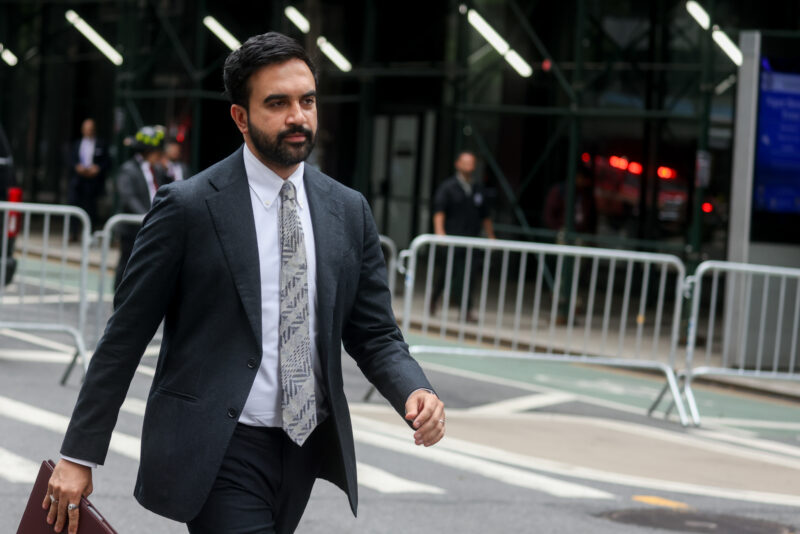
“The difference between [New York City Mayor Zohran] Mamdani and those podcasters is Mamdani is elected to the most important city in the world as mayor, and those other names are not elected, and I think are often overstated [in] their influence,” Stefanik said. “They would not be elected to local office, to state office, to congressional office. That’s why I think it’s very important for actual elected officials, actual leaders, to speak out on issues of importance.”
She praised Trump for calling out Carlson and Owens and making clear that they don’t represent him or his voters, and argued that similar voices represent just a small fringe of Republican members in Congress.
Pressed on the fact that such voices represented a similarly small fringe of the Democratic Party in Congress a decade ago, Stefanik insisted that Republican voters would not embrace such voices.
“The Democrat[ic] Party — it’s a full blown takeover of Hasan Piker, of these voices that The New York Times is now embracing, and ‘Pod Save America’ is now embracing,” Stefanik said. “That is not the case on the Republican side. And as a candidate who actually has stood in front of the voters for the past decade-plus — yes, those voices can say what they want, you actually represent the people that elect you, and that’s not what voters in my district [want].”
Despite the relatively small share of Jewish voters in her district, Stefanik said that her work on campus antisemitism still receives some of the strongest praise from constituents.
Though the administration’s initial blitz of action on campus antisemitism has faded from the headlines, Stefanik said its efforts to address issues in higher education are ongoing, and that the issue also remains top-of-mind for the country at large.
“It’s not just about antisemitism,” she added. “This is broader higher education reform. … That was the canary in the coal mine issue that brought up so many broader issues that were wrong with higher education.”
In Congress, she said that more legislation should be brought to the floor on campus antisemitism, adding that she’s also hoping to work on reining in funding to colleges, cracking down on tax advantages and loopholes that benefit colleges and further limiting foreign funding and foreign student populations at U.S. institutions in her remaining months on the Hill.
She pointed to Qatar as one driver of antisemitism on campuses, and said that the U.S. should make clear to Doha that, if it wants to remain a military partner with the U.S., it “can’t foment and fund this anti-Americanism on college campuses, full stop.”
Stefanik isn’t yet sharing her next steps, but said she wrote her new book in part to serve as a historical record of antisemitism on college campuses, so that “mainstream media” can’t “brush this chapter under the rug.” She said she intends to continue shining a light on the issue.
Though she ultimately passed on a gubernatorial run, Stefanik seems to have longer-term plans in New York politics, and said that Republicans will be in a stronger position to win in the state in the coming years.
Regarding her decision to drop out of the governor’s race, Stefanik argued that the political environment is not currently ripe for a GOP victory, that Republicans need more time to build their statewide infrastructure and that Mamdani’s policies will grow more unpopular in the next few years.
“I think the Democrat Party is going to be increasingly taken over [by Mamdani-aligned socialists],” Stefanik said. “That, long-term, is where Republicans can win back those independents and traditional Democrats.”
Stefanik drew a direct line between the anti-Israel encampment at Columbia University and Mamdani’s election — both because Mamdani’s father is “very much part of this antisemitic petri dish” at Columbia and because “the same people that were organizing the pro-Hamas encampment at Columbia directly were boots on the ground for [his] campaign.”
She called herself “the leader” among state Republicans in pushing back against “socialist and Democrat single-party rule of New York State,” and highlighted that she has her own statewide political apparatus — separate from the statewide GOP, which she said lacks infrastructure.
“There is going to be a long road in rebuilding that infrastructure to save the state,” she said.
She also said she wanted to spend more time with her four-year-old son at this stage of his life.
“My voice is not going anywhere. If anything, it’s more. I mean, we’re putting this [book] out in the world and helping set the tone for the type of leadership we need in New York and, frankly, across the country,” Stefanik said.
More Stories
CALLING IT OUT
Rep. Don Bacon blasts Dan Osborn over ‘anti-Jewish’ ad
HISTORY LESSON
Brett McGurk’s fact check of former Harris advisor Phil Gordon on hostage negotiations

Daily Kickoff
If not then, when? Hillel says Emory rabbi hid conflicts

Regional Responsibility
Amb. Tom Barrack: It’s ‘not America’s job’ to combat Iran-backed threats in the Middle East
UNLOCKING THE KEYSTONE
RJC drops $400,000 to boost Brian Fitzpatrick in Pennsylvania swing district

CANCEL CALLS
Democratic push grows for Ilhan Omar, Fateh to cancel Hasan Piker event
Please log in if you already have a subscription, or subscribe to access the latest updates.
 Continue with Google
 Continue with Apple