






















































In new book, Rachel Goldberg-Polin recounts the before and after (and ever after) of her son’s life and death
'When We See You Again,' Goldberg-Polin told JI, is ‘a pain-filled love story, or it's a love-filled pain story’
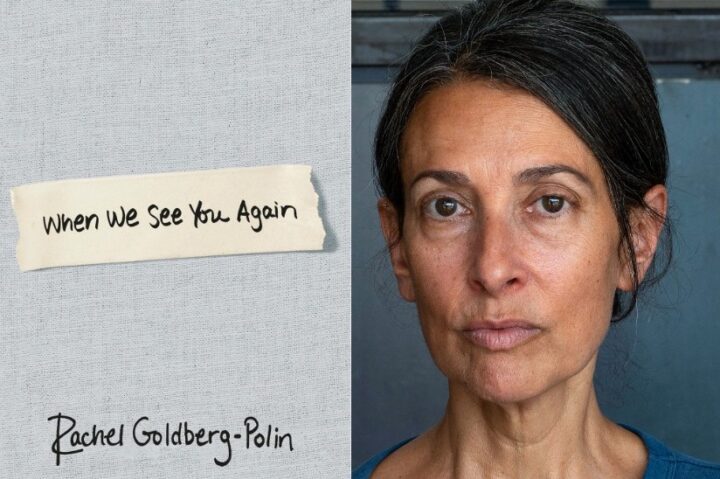
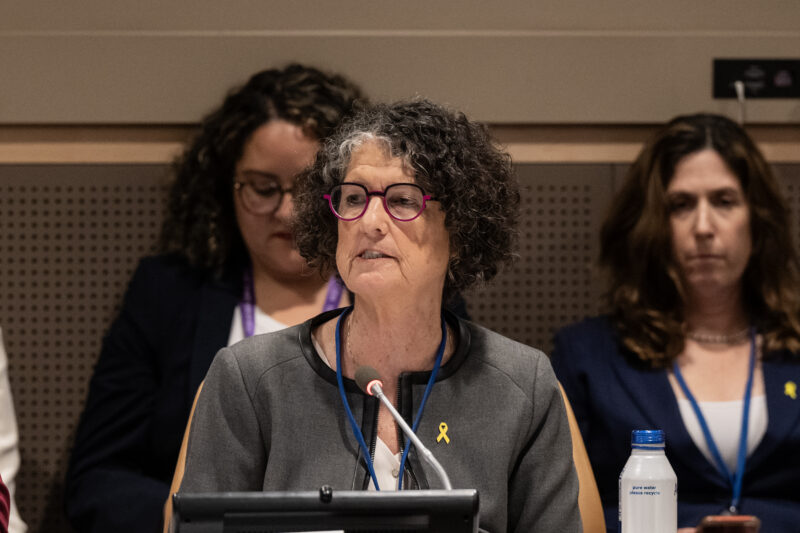
Amazon/AHIKAM SERI/AFP via Getty Images
Book cover/Rachel Goldberg-Polin


 Add JewishInsider on Google
On Oct. 10, 2023, Rachel Goldberg, an American Israeli woman from Chicago, told a roomful of reporters in Tel Aviv about her last communications — two text messages — from her son, Hersh Goldberg-Polin, that she had received three days prior.
“The first one said, ‘I love you’ and immediately at 8:11 also it said, ‘I’m sorry,’” Goldberg said. “And so I knew immediately wherever he was, it was a terrible situation.” Hersh, she would soon learn, had been kidnapped by Hamas terrorists near the Nova Music Festival and taken into Gaza.
As Goldberg spoke about the text messages, a man speaking loudly at the back of the room was shushed by someone near him. It would be among the last times anyone would try to speak over Rachel Goldberg.
She would soon become known as Rachel Goldberg-Polin, or, almost as often: Hersh’s mom. And for more than 300 days, she and her husband, Jon, traversed the globe as they worked to secure their son’s freedom from captivity in Gaza before he was killed in August 2024 by his Hamas captors.
In the months after their son’s death, the Goldberg-Polins, who had for nearly a year been the faces of hope and persistence, became the faces of a unique kind of grief — one that they experienced in the public eye.
Goldberg-Polin recounts some of those moments in her new book, When We See You Again, a chronicle of her life before, during and after her son’s captivity and murder.
“I think people don’t know what to expect,” she told Jewish Insider days before the release of When We See You Again, which comes out on Tuesday. “I know that, because people are writing, ‘Oh my gosh, I’m so excited,’ and I’m thinking, ‘Oh gosh, you are not excited. This is, like, not a fun read.’”
When We See You Again is separated into five parts, beginning with “The Before” and “The After,” which follow the Goldberg-Polin family’s life in the U.S. and then in Israel, where they moved in 2008, through Hersh’s murder, until the final day of the shiva.
The later parts — “Lost in The After,” “Still in The After” and “Ever After,” which comprise the majority of the book — detail Goldberg-Polin’s life as a bereaved mother navigating the world as one of what she calls “The Broken.”
“I don’t think of this book at all as a memoir or a tell-all,” she told JI. “It’s like little Tupperware of pieces of a life that was, and then figuring out a life that is, and how do you do this? How do we do this, breathing in a world where we no longer have air?”
She had started writing because she found it therapeutic. “I couldn’t bear the intensity of the suffering that I was carrying; [it] was making my knees buckle and my soul buckle,” Goldberg-Polin explained. “And I just really couldn’t shoulder it on my own, and so I was just writing.” It felt, she said, like “when you’re just drowning because there’s too much [and you have] to just get it out, to spill it out.”
Between the stories and anecdotes from the nearly 11 months she and her husband spent advocating for the release of the hostages, followed by the year of mourning after Hersh’s death, Goldberg-Polin intersperses vignettes from her childhood in Chicago, details about the family’s life as they adjusted to life in Israel and the Jewish teachings that have guided her.
She even reflects on the decision to change her last name to match her son’s, comparing it to the moment the biblical Jacob’s name was changed to Israel, after a tussle with a mysterious figure that causes him to walk with a limp for the rest of his life.
“I think of Jacob becoming Israel as I limp forward,” Goldberg-Polin writes, “noting all of the ways I, too, have been transformed, but also searching for the blessing this crisis must give me, looking for opportunities for birth and light.”
Something that has touched her in the 20 months since Hersh’s death is the vast number of people who have experienced loss who have made contact with her.
“Since Hersh was killed, we’ve had thousands and thousands and thousands of people from all different backgrounds and all different faiths and all different brands and all different spectrums who have reached out to share their pain and not commiserate, but sort of to come together in this enterprise of the human condition of loss.”
She feels especially close to the families of the five others who were killed alongside Hersh in that tunnel in Gaza — a group of young people now referred to as the “Beautiful Six”: Eden Yerushalmi, Carmel Gat, Almog Sarusi, Alexander Lobanov and Ori Danino. When they were found after their executions, Yerushalmi’s body was leaning on Hersh’s lap.
“There are literally five families on earth who’ve walked the path we’ve walked, and I’m grateful that I know they just breathe the way I breathe, so I don’t even have to talk to them every day in order to know that they get it,” she said. “They they know my torture, they know my torment, they know my pain. They know my misery.”
As someone who spent the majority of her life as a private person, she has struggled with the fame that has come with her public fight, which often includes being recognized while out and about with her family. Sometimes it’s a wave from a stranger. Other times it’s a conversation.
“When people do approach us and say these heartfelt, gorgeous words of comfort and connection, I am truly thankful for the benevolence,” she said. “It’s me that’s broken. It’s not them. They’re being human. I am trying to figure out how to behave in a normal way.”
“When people say, like, ‘We’re with you,’ I literally act like a crazy person. Because I am a crazy person. I’m a crazy person. I actually thought, well, I have a disorder, and what is the etymology, the root of ‘disorder’? It is ‘not in order.’ I’m not in order. You know what? Burying Hersh was out of order for me. I didn’t want that order.”
Those who know Goldberg-Polin have known since Oct. 7, 2023, not to ask her, “How are you?” (In the book, she shares that she and her father will jokingly ask the other the question and prompt them, “Lie to me,” garnering the response, “Dandy!”)
For her, the book is the answer to that question. “This book is saying, ‘I know you don’t see it, and I really don’t blame you for not seeing it, and I didn’t see it.’ I haven’t seen it before. I’ve met people who are bereaved, who are grieving, who are suffering, who are mourning, and I didn’t say the right thing because I didn’t get it either.”
“If someone was born blind,” she continued, “they don’t know what the color blue is, and it’s very difficult for someone who knows what the color blue is to describe it to someone who has never seen it. And the book is my attempt to describe blue. It’s my attempt to describe pain.”
“This is simply me giving over my love and my pain, and I hope that maybe people just understand me a little bit more, maybe understand people who are suffering and really in grief and mourning more, and I don’t know that it has to do anything beyond that.”
Ultimately, Goldberg-Polin said, “I think that it’s a book about two things. I think it’s about love and pain. It’s a pain-filled love story, or it’s a love-filled pain story, and that’s what the book is.”
More Stories

SANCTIONS SUPPORT
Lander endorses settlement sanctions bill while on West Bank trip

SUNSHINE STATE RETREAT
House GOP leadership super PAC pulls ad spending against Jared Moskowitz

NEW HIRE
El-Sayed hires veteran political consultant Lenore Goldman as Jewish liaison

SPEAKING OUT
Jewish groups call for apology after educators asked to condemn Israel to attend Italy trip

EXCLUSIVE
Jewish groups urge Treasury, State to clarify response to European settlement sanctions

EXCLUSIVE
JDCA launches streaming and digital ads supporting Cait Conley, attacking Lawler
Please log in if you already have a subscription, or subscribe to access the latest updates.
 Continue with Google
 Continue with Apple