
































Jewish leaders warn of new front in anti-Israel campus activity: targeting Hillels
Efforts to delegitimize Hillels tell Jewish students ‘that their identity is suspect and that their safety and belonging is up to the vote of their fellow students,’ AJC’s Laura Shaw Frank said
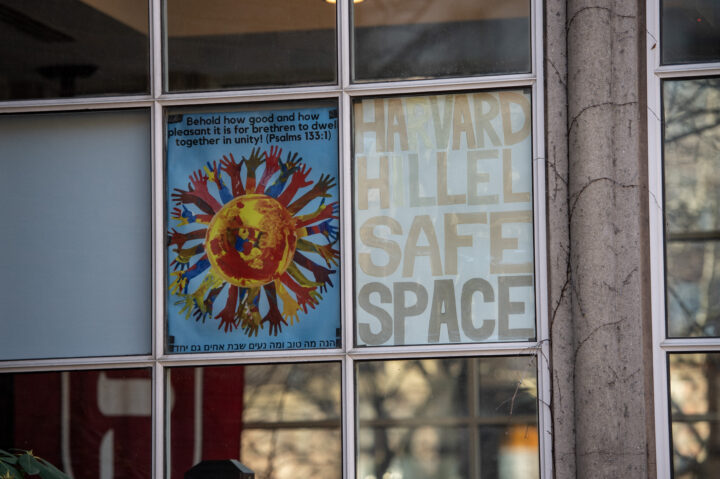
JOSEPH PREZIOSO/AFP via Getty Images
A sign calls the building a safe space at the Jewish student organization HILLEL society's building at Harvard University in Cambridge, Massachusetts on December 12, 2023.


 Add JewishInsider on Google
In the aftermath of the New School student government’s vote to defund and sever ties with Hillel, Jewish leaders are warning that the latest front in campus anti-Israel activity is designed to delegitimize the world’s largest Jewish campus organization.
“Hillel is a space of Jewish belonging on campus. It is a place Jewish students need, and particularly need right now. For anyone to call into question a place that Jewish students go for their needs is beyond the pale. This absolutely crosses a red line,” Laura Shaw Frank, vice president of the American Jewish Committee Center for Education Advocacy, told Jewish Insider.
Last week, the New School’s student senate approved a resolution to strip funding and cease collaboration with Hillel, alleging that Hillel violated international law by running programming in Israel, including Birthright trips and volunteer opportunities with the Israel Defense Forces.
While the New School’s administration rejected the vote, the move marked the first time a student government has moved to officially cut ties with the organization that acts as a hub of campus life for Jewish students — although many have called on their universities to end partnerships with Hillel, particularly after the Oct. 7, 2023, terrorist attacks in Israel and the ensuing war in Gaza.
Now some in the Jewish community believe that student governments on other campuses will imitate the behavior.
“We’re very heartened by the New School making clear this is not going to happen and we’re pretty confident other university leaders would do the same,” said Shaw Frank. “At the same time, it has to be made clear that Hillel is one of the key places on campus that Jewish students go for support, Jewish identity and celebration, and this kind of message is that their community spaces are conditional, that their identity is suspect and that their safety and belonging is up to the vote of their fellow students.”
“None of those things are acceptable, so we will be doing everything in our power to ensure that any kind of trend in this direction is shut down. It’s completely unacceptable and antisemitic.”
Shira Goodman, the Anti-Defamation League’s vice president of advocacy, labeled the incident at the New School “an escalation,” voicing concern that campus organizations are targeted solely for supporting Israel.
“We’ve seen in the last two years calls to dissociate from Hillel; that was among some of the encampment demands and there have been protests blocking access to Hillel and Chabad events,” Goodman told JI. “We hadn’t seen a campus resolution like that so we’re certainly worried that it will become a bigger trend.”
Those concerns come as campus antisemitism and anti-Israel activity — which reached historic levels during Israel’s war with Hamas and has quieted down since a ceasefire was reached in the fall — appears to be ramping up again as the end of the academic year approaches.
The outgoing chair of University of Michigan’s faculty senate, who has a history of anti-Israel advocacy, attacked Israel at a commencement ceremony on Saturday in comments that deviated from his prepared remarks. The university apologized for his behavior.
Last month, UCLA’s student government condemned a campus event featuring former Israeli hostage Omer Shem Tov, labeling the speaker selection as “selective platforming of narratives that obscure the broader reality of ongoing state violence” and “a troubling disregard for Palestinian life.” UCLA said it stood by Hillel for hosting the event.
On Monday, the ADL sent a letter to around 150 campuses expressing concern about the resurgence of antisemitic harassment, including the recent reestablishment of encampments at Occidental College and Smith College. (Both were quickly dismantled.)
Goodman was skeptical that resolutions aimed at shutting down Hillel will be successful or that they could replace campus Boycott, Divestment and Sanctions efforts. While BDS initiatives had largely disappeared prior to Oct. 7, the months following the Hamas attack and the start of the war in Gaza sparked a resurgence in efforts to enact them on various campuses.
“Given that most of those resolutions have been unsuccessful in getting campuses to divest — although some have led to being able to present to investment committees — I think these will also be unsuccessful,” she said.
Still, both types of resolutions lead to a hostile campus climate for Jewish students, she said.
“These student government bodies are supposed to be places that deal with student organizations, funding, policies that impact students and they’re spending a lot of time on these issues that don’t impact students daily lives and are becoming increasingly hostile to the Jewish students on campus.”
Shaw Frank and Goodman both said that a silver lining of recent campus turmoil is that institutions are now better equipped to handle antisemitism than they were in 2024, when anti-Israel encampments first roiled campuses nationwide and university administrators floundered in shutting them down and negotiating with student protesters.
“I think with respect to the demonstrations that took place in 2024, it was very clear to campus administrators that their campuses were being shut down and they were unable to continue their work as institutions of learning,” said Shaw Frank. “Employing time, place and manner restrictions as we and other Jewish organizations called for largely solved the problem.”
She added that the current situation “is much smaller” than it was two years ago. “Most students are no longer active in this space on campus, even in places that were hotbeds of protests in 2024. The protests are much more anemic now. We know that students who see themselves as activists tend to choose places like student government. A small number of students have a disproportionately powerful impact,” said Shaw Frank.
Jewish leaders are looking to university administrations to take decisive action in protecting Jewish students.
“We want to make sure that they use the policies that they enacted, or decided to enforce, after 2024 and that they continue to do that, they continue to be clear that there are consequences for violating university policies and that all students can access their educational and extracurricular activities equally,” said Goodman.
Shaw Frank added, “This is a moment when university leadership must not only speak out very clearly to state this is unacceptable, but also ensure that their codes of conduct and guidelines are up to date and their departments of student life are educated about antisemitism.
“We urge universities to ensure that it is very clear to their student governments and student bodies what types of resolutions are OK and what are not OK.”
More Stories

UNKNOWN HORIZON
Final Israeli polls point to stalemate ahead of Tuesday’s election
BIPARTISAN BOOST
Trump administration’s Board of Peace taps Biden’s Jewish liaison to leadership role
NEW HIRE
El-Sayed hires veteran political consultant Lenore Goldman as Jewish liaison
NO RESET
Israel’s U.S. critics prepare to keep the pressure on, regardless of election outcome
Daily Overtime
Cleanup on aisle El-Sayed
SCOOP
Former Haley Stevens campaign chair and prominent Democratic fundraiser says he plans to vote for Rogers
Please log in if you already have a subscription, or subscribe to access the latest updates.
 Continue with Google
 Continue with Apple