


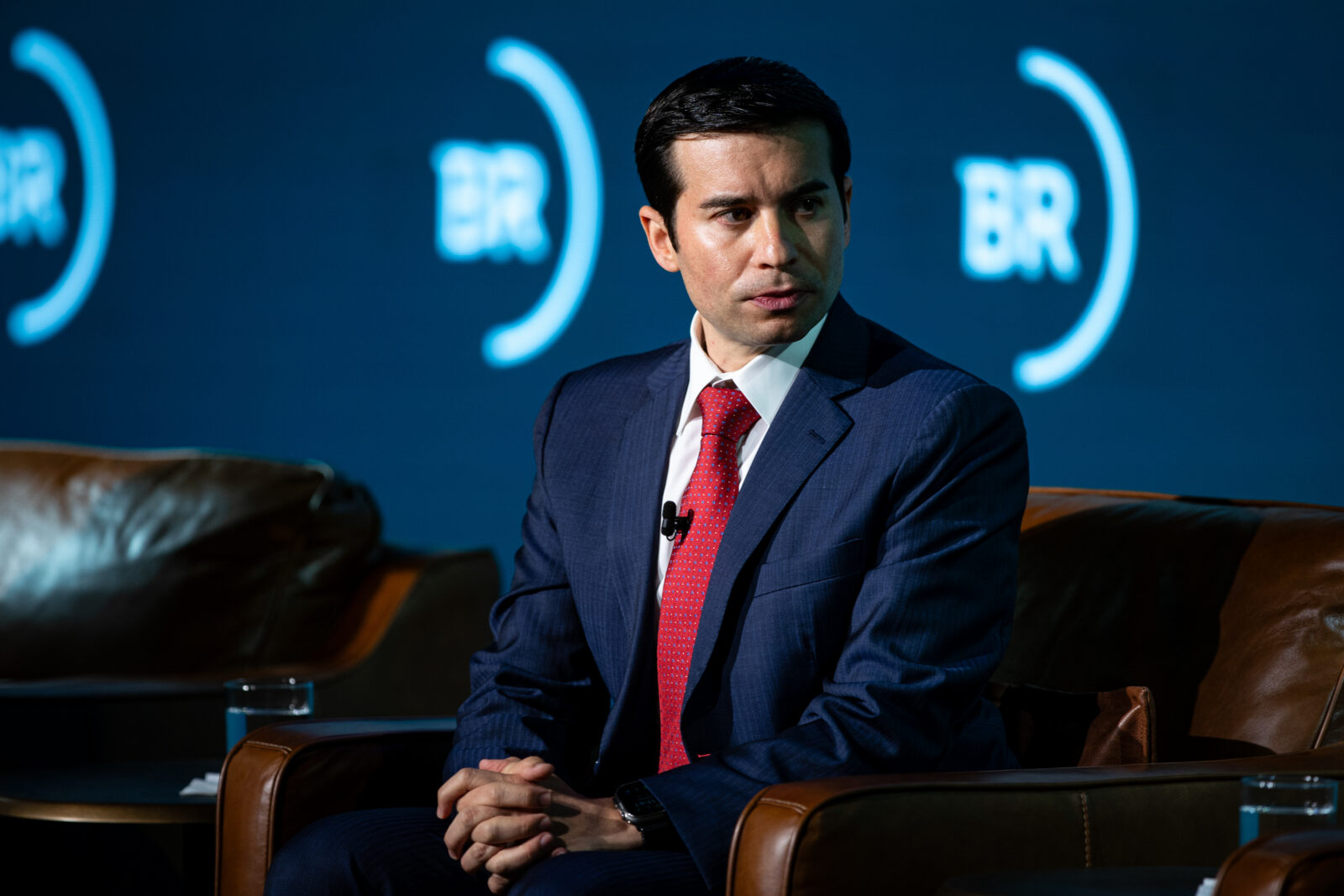
Al Drago/Bloomberg via Getty Images
Acting Labor Secretary Keith Sonderling guided by Holocaust survivor grandparents
'My interest in protecting all Americans' rights in the workplace is undoubtedly shaped by my grandparents,’ said Sonderling, who assumed leadership of the agency last week after Lori Chavez-DeRemer’s resignation


 Add JewishInsider on Google
Keith Sonderling’s path to leading the Department of Labor, a role he assumed last week, was relatively straightforward, professionally speaking — an upward climb from employment lawyer to government service, in a series of increasingly senior roles.
But for Sonderling, working to set American labor policy has a more personal resonance, too. He said in his Senate confirmation hearing to serve as deputy secretary that his Jewish grandparents faced religious discrimination at work once they arrived in the United States, after surviving the Holocaust.
“Although more than willing to work, my grandparents lost employment opportunities based solely on their religious beliefs and life circumstances,” Sonderling, 43, said last year. “It was only through their tenacity and relentless hard work that they overcame the barriers put before them, ultimately paving the path for me to appear here, before you, today.”
For the past year, since the Senate voted him in as deputy secretary, Sonderling has managed the day-to-day operations of the department’s $14 billion budget and its 16,000 employees. Now Sonderling finds himself somewhat unexpectedly leading the department, which has vast reach over employment policies and labor issues, after Secretary Lori Chavez-DeRemer resigned last week amid an investigation into allegations of misconduct.
Sonderling’s promotion to acting secretary elevates a relatively young policy wonk with traditional conservative bona fides, though Sonderling has also earned the respect of some liberals who view him as less rigidly ideological, even as he generally hews to the pro-employer positions of the modern Republican Party.
“I got the impression that throwing bombs against plaintiffs lawyers and against workers is not his style,” Matt Scherer, an employment lawyer who is a fellow at the center-left Open Markets Institute, told Jewish Insider. “I think he is, in many ways, kind of a traditional Republican, in the sense that he wants there to be free markets. He wants employers to have a certain amount of leeway with their employees. But he also seems sincere in wanting to help workers.”
Sonderling, who grew up in Boca Raton, Fla., got his start in Republican politics not through the world of Mar-a-Lago but rather a more traditional GOP path: through the world of Jeb Bush. Sonderling was on the national Jewish leadership committee for the former Florida governor’s 2016 presidential campaign. It was at a Jewish outreach event for Bush that Sonderling met his wife, Fara, a lobbyist. The pair were married in 2019 in Jerusalem.
The Labor Department is not the splashiest government posting, or at least is not the federal body that usually garners the most headlines. But its policy guidance affects millions of American workers, meaning the person who leads it has the capacity to be incredibly influential. (Sonderling declined a request for comment from JI.)
During President Donald Trump’s first term, Sonderling was best known for a major decision governing gig workers, like Uber and Lyft drivers. The Trump administration deemed these workers to be contractors, rather than full-time employees, when Sonderling led the department’s division governing wage and working-hours laws.
He is best known in recent years for his foresight in weighing in on artificial intelligence and the disruption it is expected to cause in the workplace. Sonderling was appointed to the Equal Employment Opportunity Commission in 2020, a role he held until his term expired in 2024 — and used his perch at the federal anti-discrimination agency to warn about how AI technology could lead to discrimination in hiring and other workplace decisions if employers aren’t careful.
He also used his time on the EEOC to educate the public about antisemitism. As part of the Biden administration’s 2023 national strategy to counter antisemitism, Sonderling helped author an EEOC informational flier about what an employer should do if they have experienced antisemitism at work. (Before moving to Washington in 2017, Sonderling had been involved with the Jewish Federation in Palm Beach County.)
“Unfortunately, people don’t check their anti-Jewish attitudes at the door when they enter work,” Sonderling said at a November 2023 webinar hosted by the Jewish Community Relations Council of Greater Washington. “There are so many people who believe … that there can’t be antisemitism in the workplace because Jewish people ‘control’ all these industries, whether it’s Hollywood, whether it’s the bank, whether it’s government, finance. You see it across the board. But that is still workplace harassment.”
Trump has not yet said whether he will formally nominate Sonderling to serve as labor secretary.
“Keith Sonderling will do a really great job as acting secretary and would be a great pick to handle the job permanently as well,” said Ken Marcus, a former Trump administration official who hosted Sonderling on a 2022 webinar for the organization he founded, the Louis D. Brandeis Center, which uses litigation to combat antisemitism at schools and universities.
Sonderling could conceivably stay in the role even without receiving Senate approval — under former President Joe Biden, Julie Su served as acting labor secretary for nearly two years when her nomination stalled in the Senate. And unlike some of Trump’s other Cabinet secretaries, Sonderling has so far avoided drama in his years in the government.
“He’s a very important person and someone that the president trusts with an incredibly important agency like the Department of Labor, and yet, relatively speaking, he’s kind of young by Washington standards,” said Gerald L. Maatman, Jr., a Chicago-based employment lawyer at the law firm Duane Morris. “I would think people would say that is a person to keep an eye on.”
Sonderling said in his confirmation hearing last year that his guiding principle is to help American workers achieve the American dream. It’s a view shaped by his grandparents’ post-Holocaust journey.
“My interest in protecting all Americans’ rights in the workplace is undoubtedly shaped by my grandparents,” Sonderling said, “who, despite suffering unspeakable tragedies, were able to achieve the American Dream.”


Please log in if you already have a subscription, or subscribe to access the latest updates.
 Continue with Google
 Continue with Apple