


Andrew Roth/Sipa USA via AP Images
Jewish Dems vow to keep fighting in Michigan, even as they question if they belong
Jewish Democrats described a ‘shell-shocked’ atmosphere at their statewide convention that saw marked hostility to pro-Israel voices


 Add JewishInsider on Google
When thousands of Michigan’s most ardent Democratic activists gathered in Detroit on Sunday for the party’s nominating convention, Decky Alexander was thrilled: 200 people were in the room for a Jewish Democratic Caucus meeting, more than double the 70 people who showed up last year in its first official gathering.
Candidates for statewide office, from the U.S. Senate to attorney general, came by to pitch voters as activists schmoozed over bagels.
“It was incredibly energizing and affirming. That’s how the day began,” Alexander, who chairs the caucus, told Jewish Insider in an interview on Tuesday. “It didn’t end that way.”
As the day went on, Jewish Democrats were alarmed to see pro-Israel voices within the party marginalized and shouted down.
“Our Jewish caucus brought a lot of people to the convention, and I was with many of those people who were first-time conventiongoers. They were — I would use the term shell-shocked,” said Joan Lowenstein, a lawyer and former Ann Arbor city councilmember.
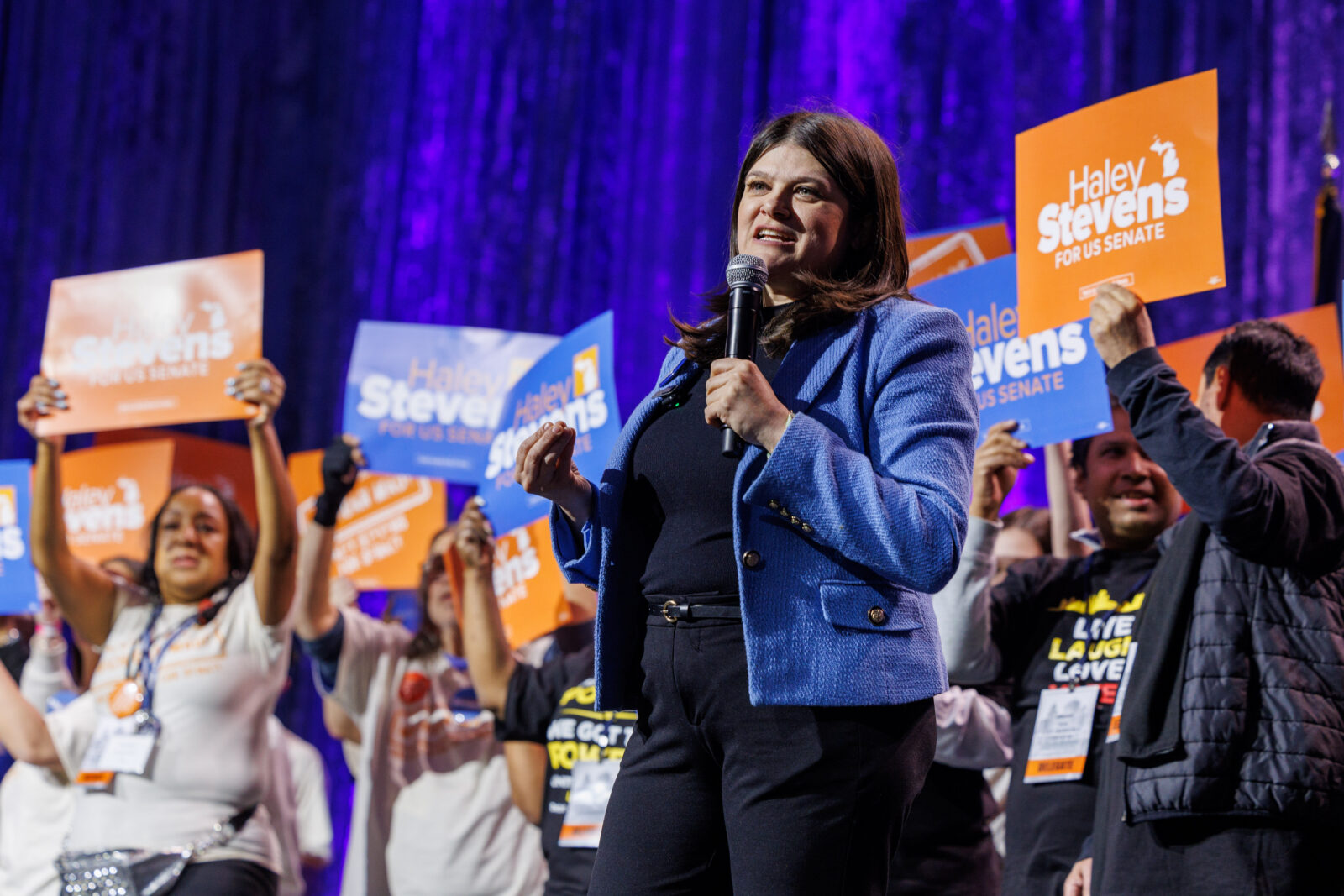
Rep. Haley Stevens (D-MI), a moderate and pro-Israel candidate for Senate, faced loud, sustained boos when she spoke in front of the main convention room. One person spotted an attendee on Sunday wearing a shirt that said “Resistance until liberation,” with an image showing someone wearing a keffiyeh throwing rocks.
The main reason that activists gathered that day was to vote to nominate candidates for a range of positions, including attorney general and secretary of state, distinct from other states where voters directly elect their party’s primary nominees.
The outcome of one relatively low-level race generated the most headlines: delegates’ decision to nominate Amir Makled, a Dearborn attorney with a history of social media posts praising Hezbollah, for a position on the University of Michigan Board of Regents. He unseated incumbent Jordan Acker, who is Jewish and was in part targeted due to his calls to discipline anti-Israel student protesters during the 2024 encampment at the Ann Arbor campus.
Acker told The Detroit News afterward that the level of antisemitism among Michigan Democrats is “extensive.”
“The question we have to ask as Jews is whether we still belong here,” said Acker, a Democrat.
The Democratic Party congratulated Makled in social media posts. What remains unclear is just how far party leaders will go to support Makled as he proceeds to the general election. Curtis Hertel, the chair of the Michigan Democratic Party, did not respond to a request for comment.
But Makled’s nomination is cause for concern among many Jewish Democrats.
“I certainly cannot vote for somebody who praises Hezbollah and uplifts posts that use ‘Jew’ as a slur. This was an unacceptable nomination, and I simply cannot affiliate with somebody who harbors those views,” Jeremy Moss, a state senator who is running for Congress in the Detroit suburbs, told JI on Tuesday.
Rep. Kristen McDonald Rivet (D-MI), a moderate Democrat representing a swing district, who is not Jewish, on Tuesday described the scenes from the convention as “deeply troubling,” and in particular criticized the party’s nomination of Makled.
For Jewish Democrats who are not willing to disavow Israel, the question of what to do in a race like the Board of Regents is uncertain. Lowenstein, the Ann Arbor activist, said she would “never” support Makled, but that she also would not vote for a Republican.
“I think Jewish voters are now in a position where we have to look at each person, and not look at their party, but look at what they stand for,” she said.
“I need to create the table, not just always be invited to the table. I just don’t know what that looks like,” said Decky Alexander, the Jewish caucus chair. “It’s a heartbreak. I felt, in moments, is this going to be a breakup? I don’t think so, but we’ve been feeling this way, a lot of us, for a long time.”
The Jewish voters who attended the convention on Sunday are among the most committed Democrats in the state, which makes it more notable that some were left questioning their place in the party.
“They think that there’s shrinking room for them in spaces that claim to be inclusive,” said Elyssa Schmier, the Anti-Defamation League’s Michigan director. “That’s kind of the saying of the Democratic Party: ‘We have a big tent, big-tent politics.’ It did not feel that way at the convention.”
Even the activists most disillusioned by Sunday’s events acknowledge that the convention attendees are not necessarily representative of the state’s Democratic electorate. All it took to attend the convention was registering as a party member a month beforehand and paying a nominal fee.
“I don’t know that it was an accurate representation of where the broader Democratic electorate would be, say, in a primary,” said Moss. “But there’s no question, there was incivility at best [and] displays of Jewish antagonism at worst in the convention hall.”
Jewish activists hope this moment of upheaval can be a chance for Jewish Democrats to reassert their place in the party, even if things feel tenuous and difficult at present.
“I need to create the table, not just always be invited to the table. I just don’t know what that looks like,” said Alexander, the Jewish caucus chair. “It’s a heartbreak. I felt, in moments, is this going to be a breakup? I don’t think so, but we’ve been feeling this way, a lot of us, for a long time.”
Between now and the general election, Alexander wants to talk to as many candidates as possible about whether they plan to take the concerns of Jewish voters seriously.
“I haven’t changed. I am not a Republican or a conservative. I cannot win my district as an independent. But I also wonder how I can continue to carry this party banner with anything approaching pride, or rather, without anxiety and ambivalence,” state Rep. Noah Arbit, a Democrat who represents West Bloomfield, told JI.
“This isn’t identity politics. This is figuring out, in a pluralistic nation like the United States, does everyone have a place? And we want the people who are running for office to answer: Do the Jews have a place in your vision and your platform?” she said.
Moss said he intends to use his platform as a state lawmaker and congressional candidate to answer that question clearly: Jews do have a place in the Democratic Party.
“My solution is to offer my candidacy for everybody and to ensure that folks know that there is a lane for Jewish Democrats in this moment, that we don’t have to feel hopeless, we don’t have to feel politically homeless, that this is a lane that we have to solidify here,” said Moss. “My core values as a Democrat are really Jewish values.”
For state Rep. Noah Arbit, a Democrat who represents West Bloomfield, the site of an antisemitic attack last month, Sunday’s convention adds to angst he has been feeling about his party for years. He was the one who founded the Jewish caucus in 2019, in response to rising antisemitism on the political left.
“I haven’t changed. I am not a Republican or a conservative. I cannot win my district as an independent. But I also wonder how I can continue to carry this party banner with anything approaching pride, or rather, without anxiety and ambivalence,” he told JI. Yet he said he will not cave to pressure from the party’s far-left flank.
“I certainly won’t be run out of representing my community by a band of extremists,” said Arbit. “So I need to stay.”
Featured Stories
partnership pitch
Somaliland president discusses expanded military cooperation with U.S. officials
ENVOY DEBATE
Congressional Jewish Caucus opposes proposal to combine State Dept. Holocaust, antisemitism offices
FAMILY TRAGEDY
Israeli ambassador’s son seriously wounded in West Bank car-ramming attack
Please log in if you already have a subscription, or subscribe to access the latest updates.
 Continue with Google
 Continue with Apple