





























The early winners — and losers — of the U.K.’s local elections
Starmer on Friday morning called the results 'really tough,' adding that the outcome 'hurts, and it should hurt, and I take responsibility'
Chris Radburn / AFP via Getty Images
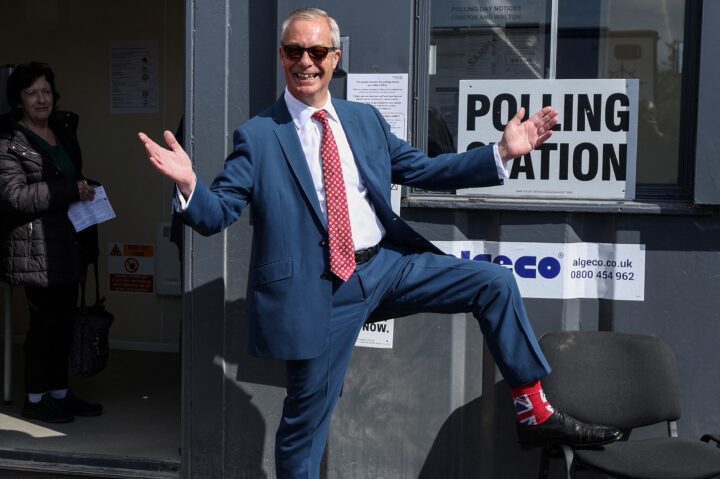
Reform UK leader Nigel Farage poses to show off his socks as he visits a polling station in Walton-on-the-Naze, eastern England on May 7, 2026, to cast his vote in the local elections.


 Add JewishInsider on Google
All politics is local, as the saying goes. And if true, that could be very bad news for U.K. Prime Minister Keir Starmer following yesterday’s local elections across the country that saw significant losses for his Labour Party — a showing that could prompt party officials to reassess the party’s direction.
With partial results in shortly after polls closed, Nigel Farage’s hard-right Reform U.K. party appeared to have made significant gains in working-class areas of the country, while Labour lost hundreds of local seats. Farage, who has faced multiple allegations of antisemitism — including bullying Jewish classmates as a teenager and promoting antisemitic conspiracy theories, as well as his multiple appearances on conspiracy theorist Alex Jones’ show — was the night’s clear victor.
All told, Labour did not lose as badly as some polls had predicted, but the significant losses it did suffer, compared to Reform’s gains, portend future challenges for Starmer as he works to hold onto the premiership, less than two years into his term.
Starmer on Friday morning called the results “really tough,” adding that the outcome “hurts, and it should hurt, and I take responsibility.” He insisted he had no intention of leaving 10 Downing St., telling BBC News repeatedly, “I’m not going to walk away.”
The other big loser in the day’s elections was Kemi Badenoch’s Conservative Party, which, aside from reclaiming London’s Wandsworth and Westminster districts (both of which it lost to Labour in the 2022 elections), made few significant gains, while the Green Party fared better than Labour and the Tories,pulling out modest wins and gaining at least a dozen seats.
The Greens’ rise comes as the party investigates more than two dozen members for antisemitism, and as its leader, Zack Polanski, draws heavy criticism for making inaccurate claims about police actions during last week’s terror attack targeting two Jewish men in the London suburb of Golders Green, for which he ultimately apologized.
That the two parties claiming the best outcomes fall on opposite — and extreme — ends of the political spectrum is deepening concerns among British Jews, who are already on edge amid spiking antisemitism and a wave of violent attacks targeting Jewish communities around the country. The country’s Jewish leaders have not come out in force against Farage, who is broadly supportive of Israel, and his Reform Party in the same way they’ve raised concerns about antisemitism in Labour and the Greens.
“Many British Jews have looked on with horror as the traditional domination of two political parties has been disrupted by the rise in support for populist parties on the extremes — both right with Nigel Farage’s Reform UK and left with Zack Polanski’s Greens,” Justin Cohen, the editor-in-chief of the U.K.’s Jewish News, told JI. “Both parties have had to remove candidates during this election campaign over antisemitic rhetoric, although the issue does appear more pronounced within the latter.”
“That’s not to dismiss the meteoric rise of Reform,” he added, “which was formed just four years ago and has now for the first time won considerable support at the ballot box. And it would be wrong to claim that the party’s positions on Israel — and claims of easy solutions to the extremism that threatens our community — haven’t attracted support in large sections of the community at a time of unprecedented attacks and fears for the future.”
Ultimately, Cohen said, “Just as there other Jews consider the party’s rhetoric to be utterly abhorrent. Where’s some of the community are happy to dismiss claims of Farage’s own antisemitic comments as a teen, others refuse to do so. Many of them will be hoping that the extra scrutiny that comes with this week’s electoral success, combined with the pressures of power they now hold at local level, will be their undoing before the next general election scheduled for three years time.”
More Stories

Daily Overtime
Barrack says Iran-backed threats are ‘not America’s job’
MINNESOTA MIC DROP
Jacob Frey, Betty McCollum join Minnesota Dem chorus condemning Piker event

STUDENT SAFETY
Federal civil rights complaint accuses Montgomery County, Md., schools of ignoring antisemitic harassment
CALLING IT OUT
Rep. Don Bacon blasts Dan Osborn over ‘anti-Jewish’ ad
NEW CHAPTER
High Line Publishing launches with fanfare to counter barriers for Jewish authors
THREAT THWARTED
Man arrested in Boca Raton for making death threat against Rep. Jared Moskowitz
Please log in if you already have a subscription, or subscribe to access the latest updates.
 Continue with Google
 Continue with Apple