


Shanie Roth for Jewish Insider
Adeena Sussman’s new cookbook spotlights simple cooking for complicated times
‘I had this concept that I put forth for myself, everything should have 12 or fewer ingredients, and I wanted to use very minimal pots and pans,’ Sussman told JI of her book, ‘Zariz: 100 Easy, Breezy, Tel Aviv-y Recipes’


 Add JewishInsider on Google
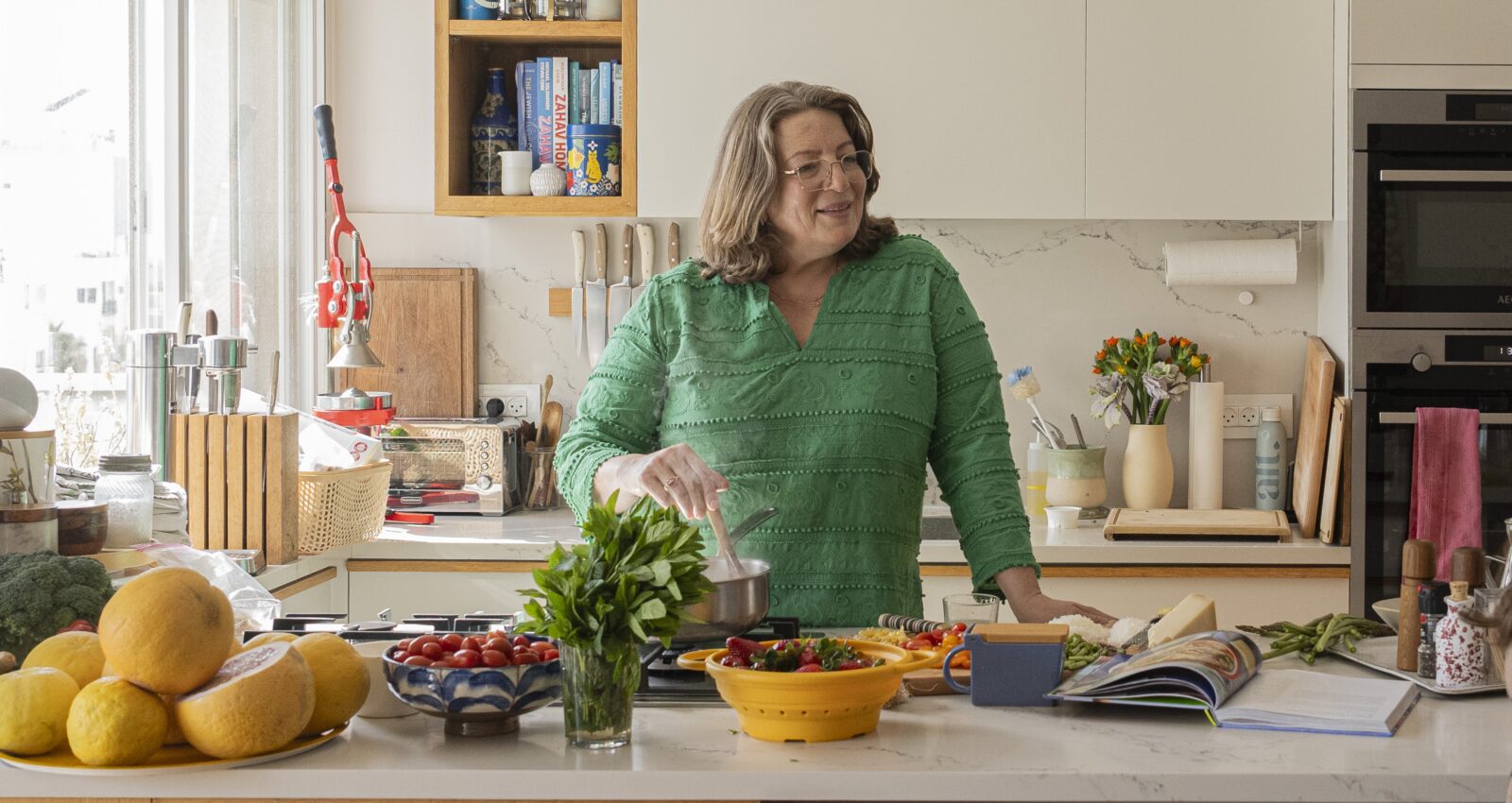
Adeena Sussman’s Tel Aviv kitchen is a chef’s dream. The long marble countertop next to the stove extends out from the gas range, perfect for preparing ingredients, pouring drinks and entertaining. A set of sharp knives is held in place by a magnetic holder affixed to the wall, while another set sits in a block on the counter. A bright red juicer stands next to the window. Hebrew and English cookbooks neatly line a shelf under the coffee presses and dried pasta, as well as additional shelves around the kitchen.
“This is my safe room,” Sussman half-jokingly tells Jewish Insider. Her actual safe room — called a mamad in Hebrew — is a floor below, used frequently during the war with Iran, in the midst of which JI visited the cookbook author last month, weeks before the release of her third book, Zariz: 100 Easy, Breezy, Tel Aviv-y Recipes, which was released on Tuesday.
“This is where I live,” Sussman said of her kitchen. “I get up in the morning, the first thing I do is come in here and make coffee and survey the fridge and decide what I’m going to cook or eat for breakfast for myself, and also just kind of commune with the space. It’s a really great place for me.”
The first sentence of the introduction of Zariz begins: “When the going gets tough, the cooking gets easy.” Sussman began writing the book in the weeks after the Oct. 7, 2023, Hamas terror attacks, amid regular rocket fire that frequently sent Israelis, including Sussman, who made aliyah in 2016, to their shelters.
“It’s simple cooking for complicated times,” Sussman explained of the book’s origins. Nearly two and a half years after she began writing the book, “it hasn’t gotten any less complicated.”
Indeed, hours before JI was set to arrive at Sussman’s home, she sent a version of a text message that far too many Israelis sent or received during the six-week war with Iran: “There was a direct hit right near the house,” she wrote, minutes after a cluster munition struck a building in her neighborhood.
She was OK, she said, and about to head to the shuk, which had gone back to its normal lively state minutes after Israel’s Homefront Command notified Tel Avivians they could reemerge from their bomb shelters.
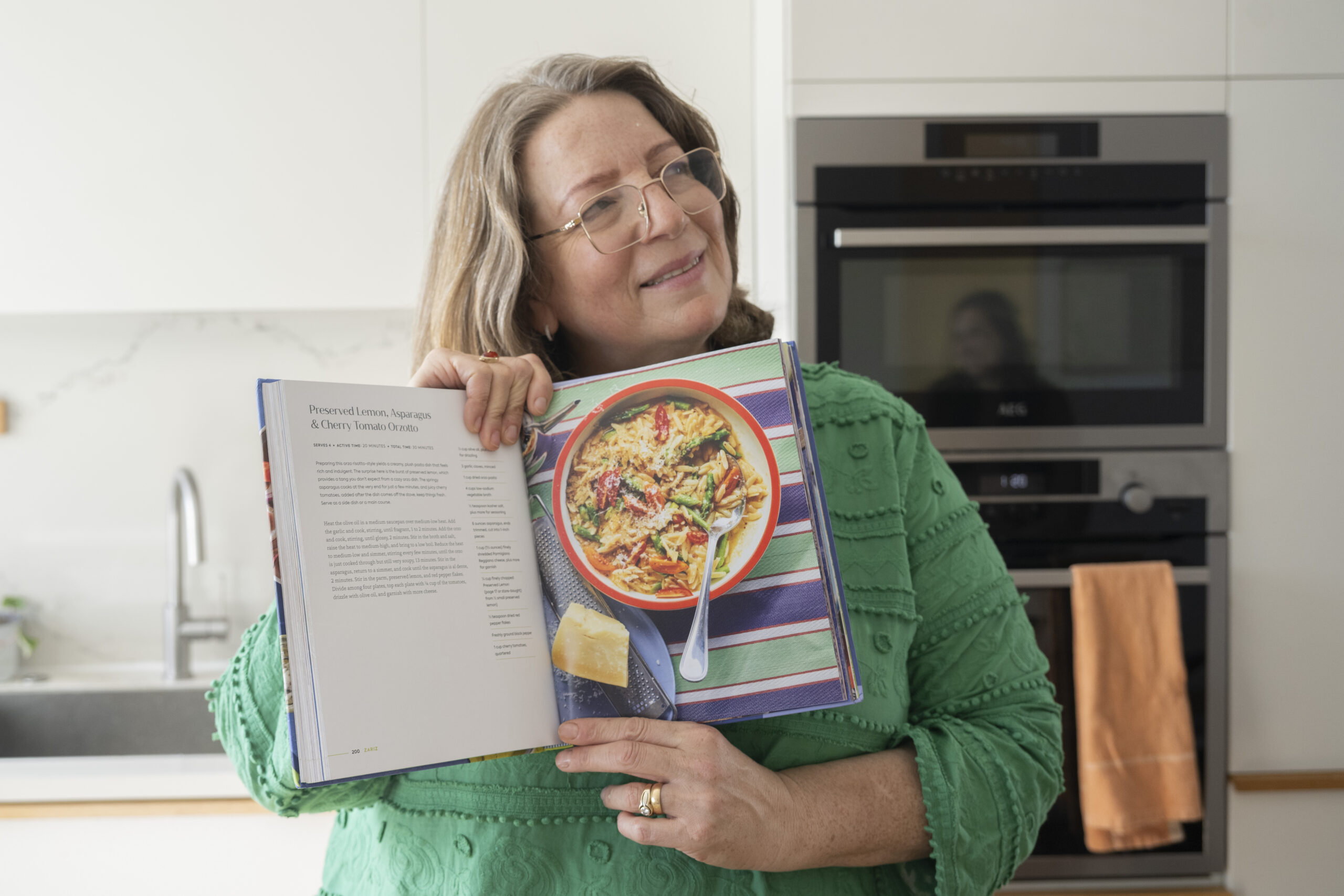
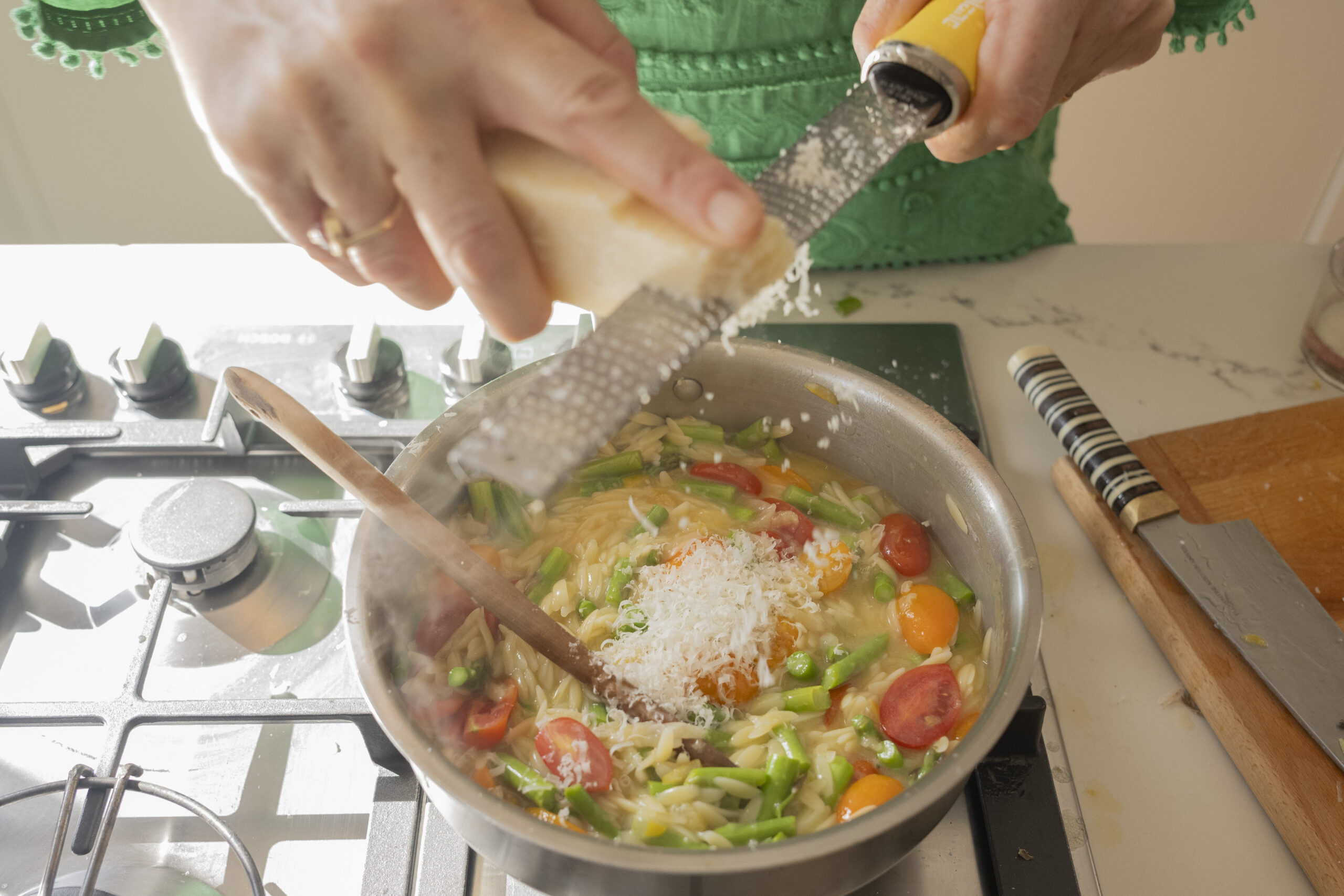
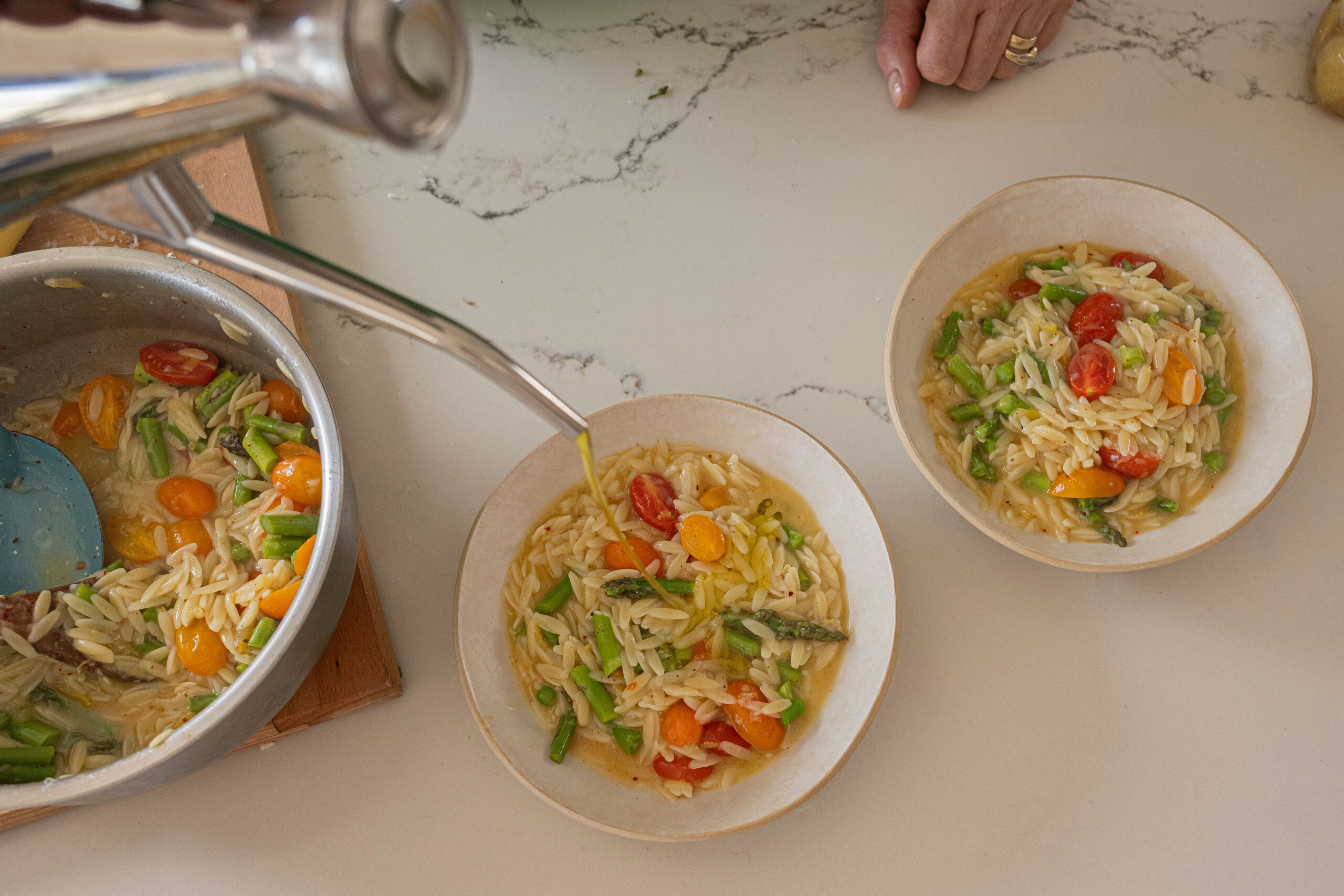
The shuk — an open-air market with fish, meat, produce and dairy vendors, as well as stalls selling tchotchkes, clothing and ready-to-eat food — is where Sussman does her shopping, and where she picked up the ingredients that day to make one of the dishes from Zariz: a preserved lemon, asparagus and cherry tomato orzotto (think orzo, but cooked in broth and given the risotto treatment).
The orzotto had a total preparation and cooking time of 30 minutes, and just a handful of ingredients beyond basic kitchen staples. That’s the vibe of Zariz — both the book and the Hebrew word itself: easy and agile.
“I had this concept that I put forth for myself, everything should have 12 or fewer ingredients, and I wanted to use very minimal pots and pans,” Sussman said as she toasted the orzo in a pan. “Making simple recipes is definitely more complicated, because every ingredient and every technique and everything has to have maximum impact.”
Limiting herself to a set number of ingredients — “fewer than a ‘bat mitzvah,’” she writes in the book’s introduction — was “a very intellectual exercise,” she told JI. “I actually enjoyed having those guardrails, especially because I had very limited mental bandwidth then.”
Sussman’s books — she’s written or cowritten more than a dozen in total, including three on her own — lean into local ingredients and what’s fresh in the moment.
“When you ask at the shuk when things are seasonally available, they respond by holiday, not by month,” she explained. “They’ll say, ‘Asparagus is between Tu B’shvat and Pesach, and rimonim (pomegranates) are Rosh Hashanah — [it’s a] very cool, very Israel-specific phenomenon.”
Many of the recipes in Zariz — like in her previous books Shabbat: Recipes and Rituals from My Table to Yours and Sababa: Fresh, Sunny Flavors From My Israeli Kitchen — lean into local ingredients familiar to Israelis, but are also easy to find at American supermarkets and specialty stores in the U.S.
“The Israeli pantry is my pantry,” she said. “Through all my books, the idea is that everyone gets familiar with this table of ingredients and that this is how I cook, and this is how I want people to cook. This is how this country cooks, and it’s multicultural, and the influences come from everywhere: Arab, Jewish, and the dozens of immigrant groups that comprise the fabric of the food here. And it’s very unique.”
That’s what she thinks many outside of Israel fail to understand about the country’s food scene — and it’s something she hopes to change.
“The shuk itself is like a late motif of life in Israel. Like when there’s an Arab holiday, 30% of people aren’t working there,” she said. “Now I know when Coptic Easter is because I have Eritrean friends who live in the shuk who celebrate it. And same with Ramadan and related holidays.”
The book combines local flavors with classic Western tastes: an onion dip made with labneh, guacamole with corn and schug (a spicy green sauce with origins in Yemen), a cheesy gnocchi with added heat from harissa paste.
But where Zariz differs from previous books is its focus on recipes that are faster, to account for having less time to grocery shop, prepare and cook — the reality of life for Israelis in wartime.
“The whole idea of this book was easy things that don’t lack for flavor or depth. It’s more relevant than ever,” Sussman said. “The recipes are not stupid simple. I still want you to have all the sensory pleasures of cooking, you know, like sizzling, stirring.”
Shortly after sitting down to eat Sussman’s fresh-off-the-stove orzotto, Israel’s Homefront Command sent out an alert notifying those in central Israel, which includes Tel Aviv, of an impending Iranian missile attack. (Sussman’s mamad is, as one would expect, cozy and full of snacks.)
“The mamad is like a necessary evil,” she said. But the kitchen remains “a pleasure.”
In a time when routines are hard to come by, and when, until the implementation of the ceasefire earlier this month, plans were frequently disrupted by missile attacks, Zariz is a reminder that cooking doesn’t have to be difficult or time-consuming.
“One of the beautiful things about cooking,” Sussman said, is that “cooking creates habits for you. The idea of having to make daily meals, you can view it as a chore, but then you can also view it as a privilege and pleasure, and also a method of self-care.”
Featured Stories



Please log in if you already have a subscription, or subscribe to access the latest updates.
 Continue with Google
 Continue with Apple