
















































Pete Hegseth warns Iran that U.S. forces are ‘maximally postured’ to resume military operations
The defense secretary also alluded to targeting energy infrastructure if Iran doesn’t agree to concessions in order to end the war
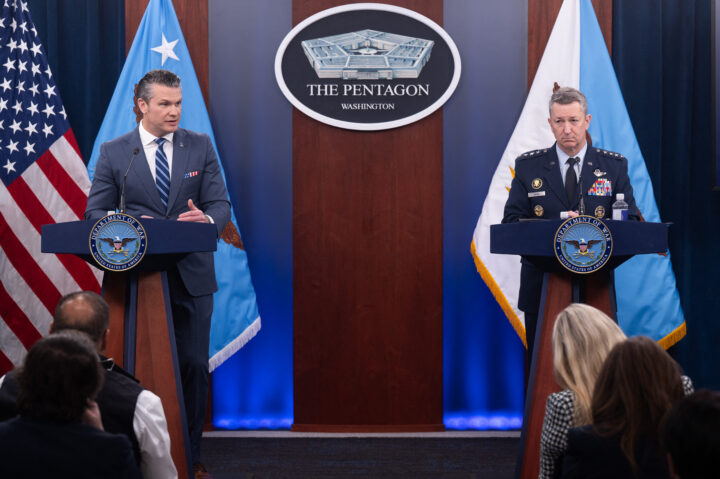
AUL LOEB / AFP via Getty Images
(L/R) Secretary of Defense Pete Hegseth speaks alongside Chairman of the Joint Chiefs of Staff General Dan Caine during a press briefing at the Pentagon in Washington, DC, on April 16, 2026.


 Add JewishInsider on Google
Defense Secretary Pete Hegseth warned on Thursday that U.S. forces are “maximally postured” to resume military operations in Iran, and specifically target energy infrastructure, should the country’s current leaders not agree to a negotiated settlement to end the war.
Hegseth made the comments during a press briefing at the Pentagon on Thursday morning alongside Joint Chiefs of Staff Chairman Gen. Dan Caine and Admiral Brad Cooper, the commander of U.S. Central Command. The defense secretary spoke directly to Iranian leadership in his opening remarks, cautioning that while President Donald Trump would “rather not have to” resume operations and go after Iran’s energy industry, the U.S. was prepared to do so if negotiations failed.
“There is an alternative, as our negotiators have said. You, Iran, can choose a prosperous future, a golden bridge, and we hope that you do for the people of Iran. In the meantime, and for as long as it takes, we will maintain this successful blockade,” Hegseth said. “But if Iran chooses poorly, then they will have a blockade and bombs dropping on infrastructure, power and energy.”
Hegseth said that CENTCOM was continuing “to implement an ironclad blockade” and ensuring “that our forces are maximally postured to restart combat operations should this new Iranian regime choose poorly and not agree to a deal. That is what we urge this morning, that this new Iranian regime choose wisely.”
“To the KH [Kataib Hezbollah] leadership and IRGC leadership: We’re watching you. Our capabilities are not the same, our military and yours,” Hegseth said. “Remember, this is not a fair fight, and we know what military assets you are moving and where you are moving them to. While you are digging out — and this is exactly what you’re doing, digging out of bombed out and devastated facilities — we are only getting stronger.”
Caine clarified during his remarks that the U.S. is not blockading the Strait of Hormuz in its entirety; rather, “the U.S. action is a blockade of Iran’s ports and coastline.”
“Let me be clear, this blockade applies to all ships regardless of nationality heading into or from Iranian ports,” Caine said. “Enforcement will occur inside Iran’s territorial seas and in international waters.”
In his message to Iranian leaders, Hegseth emphasized the work U.S. military and intelligence forces have done since the start of the ceasefire to ensure their readiness in the event of diplomatic efforts failing.
“You have no defense industry, no ability to replenish your offensive or defensive capabilities. You only have what you have. You know that and we know that. You can move things around but you can’t actually rebuild. You can dig out for now but you can’t reconstitute,” Hegseth said to the Iranians. “But we can. We are reloading with more power than ever before, and better intelligence, even more importantly better intelligence, than ever before.”
“As you expose yourself with your movement to our watchful eye, we are locked and loaded on your critical dual-use infrastructure, on your remaining power generation and on your energy industry,” he continued. “We would rather not have to do it, but we are ready to go at the command of our president.”
More Stories
THREAT THWARTED
Man arrested in Boca Raton for making death threat against Rep. Jared Moskowitz

Daily Overtime
Hillel disputes fired rabbi’s claim

NEW HIRE
El-Sayed hires veteran political consultant Lenore Goldman as Jewish liaison
CAMPAIGN CALCULUS
El-Sayed focuses on attacking Israel in closing stretch of the campaign

Presidential Prelude
Josh Shapiro launches federal PAC in potential signal of 2028 plans
POLL POSITION
U.S. experts split on Netanyahu’s prospects ahead of Israel’s election
Please log in if you already have a subscription, or subscribe to access the latest updates.
 Continue with Google
 Continue with Apple