


























Milken crowd sees dangerous convergence of populism and antisemitism
The executives, philanthropists and politicians who attended the gathering took note of the increasingly populist moment while discussing how to remedy some of the legitimate concerns of Americans

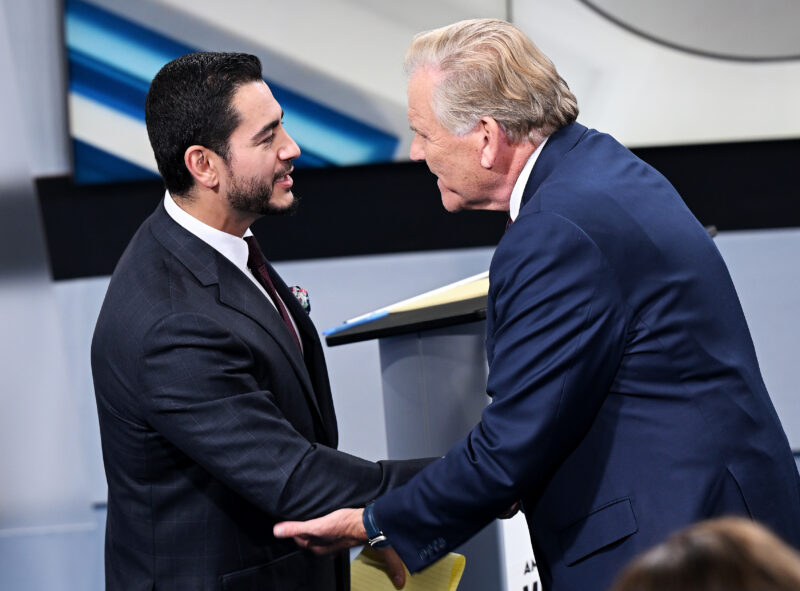
Patrick T. Fallon / AFP via Getty Images
US musician and tech entrepreneur Will.i.am shakes hands with Editorial Director of Bloomberg, Erik Schatzker, during the 29th annual Milken Institute Global Conference at the Beverly Hilton in Beverly Hills, California on May 5, 2026.


 Add JewishInsider on Google
The country’s consummate insiders gathered at the Milken Institute Global Conference in Beverly Hills this week. But far away from the five-star hotels where attendees closed business deals and mingled over salmon bento boxes, there is concern over an anti-elite sentiment that is dominating American politics.
The executives, philanthropists and politicians who attended the gathering took note of this increasingly populist moment while discussing how to remedy some of the legitimate concerns of Americans.
There were sessions focused on protecting the workforce in the face of disruption from AI, and on retirement planning for gig economy workers who cannot contribute to a typical 401(k). Behind the scenes, Trump Accounts — tax-advantaged savings accounts for American children, with $1,000 kicked in from Uncle Sam — were a big topic of conversation.
As some of America’s most important decision-makers discussed the turbulent downstream impacts of the AI boom, and the sense that many people are feeling left behind, a related topic that animated the many Jewish executives and investors who attended the conference.
They worry that the intermingling of populism and antisemitism, already heightened following the Oct. 7 Hamas attacks on Israel two and a half years ago, represents a dangerous combination.
“Antisemitism is a manifestation of extremism and populism,” TD Bank Vice Chair Jeffrey Solomon told Jewish Insider. “Extremism on the left and extremism on the right, neither one of those is good for us as Jews, but it’s not good for a lot of people.”
Solomon, a major Jewish philanthropist who chairs the board of the Foundation for Jewish Camp, spoke on a panel at Milken about macroeconomic trends. He said that fighting antisemitism requires also understanding that the problems in society run deeper than just anti-Jewish hate.
“Our job isn’t necessarily to just cure antisemitism. The job is to get at the root cause of what’s causing there to be stress in society. We have to acknowledge that the policies that have gotten us to this place have not been inclusive enough for enough people,” said Solomon, which requires “enabling [people] to be able to find their own path and be successful. The people that can make that happen are at this conference, and if we do that, antisemitism will take care of itself, because there will be no need for it.”
Sara Eisen, a CNBC reporter who was at the conference to moderate several conversations with big-name principals like Citadel CEO Ken Griffin, told JI she heard concerns about antisemitism, and the broader political environment, raised in conversation with other high-profile attendees.
“They see what’s happening in the political world. They see what’s happening in geopolitics,” she said. “This is the sideline conversation.”
At a Tuesday panel about antisemitism, Steven Weitzman, director of the Center of Advanced Judaic Studies at the University of Pennsylvania, made the case that antisemitism is itself anathema to the ideals espoused by Milken attendees.
“Not only is antisemitism the hatred of the Jews,” said Weitzman, “it’s also opposition to globalization, it’s opposition to what this very conference represents, which is peaceful cooperation across national borders.”
More Stories
TEXTBOOK TEST
Syrian textbooks under al-Sharaa deny Israel’s right to exist and promote antisemitism, report finds
AID ARGUMENTS
Michael Oren, Jonathan Schanzer split over when Israel should move past U.S. aid
CAMPAIGN CALCULUS
El-Sayed focuses on attacking Israel in closing stretch of the campaign
RIPPLE EFFECT
New York’s suburban Dems face a Mamdani dilemma
THREAT THWARTED
Man arrested in Boca Raton for making death threat against Rep. Jared Moskowitz

SCOOP
Chabad holding 250 menorah lightings in all 50 states to commemorate Chanukah, America’s 250th birthday
Please log in if you already have a subscription, or subscribe to access the latest updates.
 Continue with Google
 Continue with Apple