































Politico owner Axel Springer doubles down on corporate principles
‘Nobody should work for Axel Springer despite the essentials or in disagreement with one of the essentials,’ the company’s CEO told Politico staff on Monday
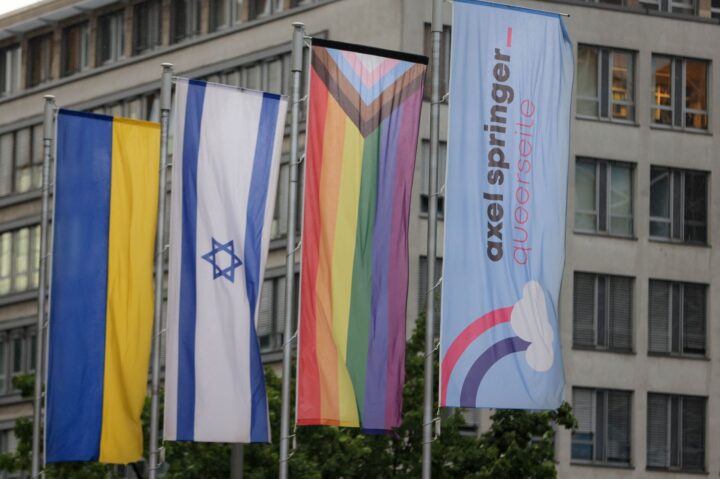
Krisztian Bocsi/Bloomberg via Getty Images
Flags outside the Axel Springer SE headquarters in Berlin, Germany, on Friday, July 12, 2024.


 Add JewishInsider on Google
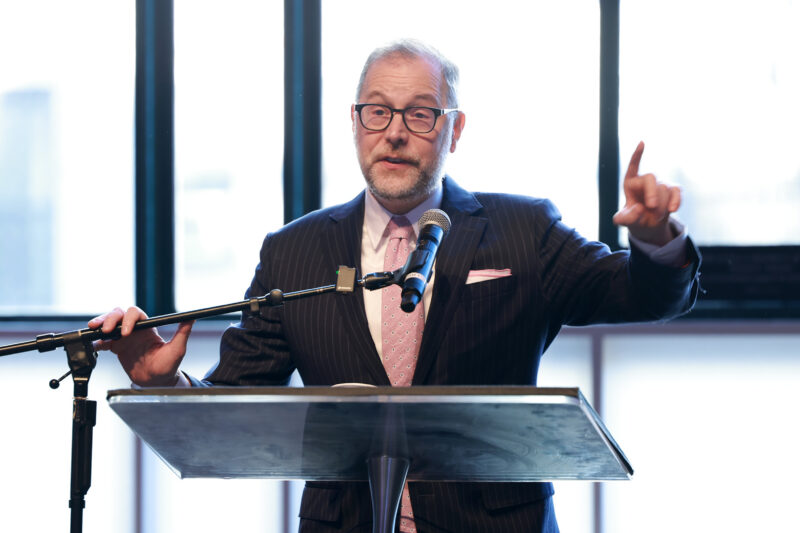
Mathias Döpfner, the CEO of Politico’s parent company, Axel Springer, doubled down in defense of the German publishing giant’s corporate values while addressing criticism from Politico’s editorial staff on Monday, suggesting to journalists that if they do not feel fully comfortable with a mission statement that includes support for Israel’s right to exist and other principles known as “the essentials,” they should find work elsewhere, according to audio of the discussion obtained by Jewish Insider.
“Nobody should work for Axel Springer despite the essentials or in disagreement with one of the essentials,” Döpfner said on a 40-minute call that also included feedback from Politico executives who expressed alignment with the CEO. “If the essentials are not attractive, if the essentials are not a magnet, if the essentials are not a reason why to work for this company, I can only recommend to work for other companies.”
“There are many options where values do not play such a role — or where other values play a role,” he added, citing NGOs, “financial investors” and “other publishers.”
His comments received no pushback and even some tacit backing from Politico leaders who participated in the meeting, including Jonathan Greenberger, the outlet’s incoming editor-in-chief who takes the helm on Friday; John Harris, the company’s founder and outgoing editor-in-chief; and Goli Sheikholeslami, its CEO.
The meeting came in response to a letter sent by Politico staffers to Greenberger on Friday, accusing Döpfner of using the outlet “to promote his political agenda” and raising concerns that two opinion pieces he wrote for the publication “risk undermining” its “reputation as an impartial news source.”
The letter referred, among other things, to opinion articles in which Döpfner exhorted Europe to stand with the United States and Israel in their war with Iran and said that European aid to Palestinians helped fund terrorists, while arguing that the continent was “on the wrong side of history” in pausing assistance to Israel. The letter and subsequent conversation was first reported by Semafor on Monday, which characterized the meeting as company leadership being receptive to staffers’ concerns.
In his remarks to Politico staffers, Döpfner said he found elements of the letter “a bit disturbing,” and vowed to “write more in the future, not less,” for the widely read Beltway news site, insisting his personal views do not reflect or influence the outlet’s editorial line.
“The thing that honestly irritated me most,” he explained on the call, taking issue with one of the letter’s complaints, “is that you said in the latest piece, ‘he refers to Iran as the aggressor that was systematically pursuing nuclear weapons,’ and you think that is misleading and irresponsible to publish that without clarification, and that in our style book, we refer to Iranians’ retaliation.”
Such a characterization, he countered, may in fact have been too understated to convey his argument in his March opinion piece.
“If you’re saying that one should not say that the Iranian leadership, the mullahs, are aggressors, you may be right,” Döpfner said. “The wording is more a euphemism. We should rather say they’re terrorists, or they are mass murderers. That would be more appropriate, given the kind of spread of terrorism with Iranian proxies from Hezbollah, Hamas, Houthi and other terrorist organizations. I think to position that as an aggressor is a mild version of what it is.”
He added that the letter had led him to suspect that “we may have very fundamental disagreement on the perception of fundamental values of democratic and open society models, but perhaps that then opens the room for discussion.”
If the Green Party in England is “saying Zionism is racism,” he continued, “I just want to make it very clear that we think Zionism is, and that is the official definition, Israel’s right of self-determination and of its right to exist as a safe haven for Jews” who have “almost been extinct during the Holocaust.”
“If that is something that somebody wants to question, then we are really reaching the very fundamental principles of our values,” Döpfner reiterated to the staff. “And that then may lead simply to the decision that, because we are very transparent about it, it is then an individual decision whether Axel Springer and somebody who has so fundamentally different beliefs is really a good fit.”
Later in the discussion, Döpfner fielded a question from a reporter who said that the description of Iran as an aggressor seeking nuclear weapons “didn’t meet the standards we’re expected to adhere to in our own reporting,” arguing that if Politico journalists were to use such language in their own news stories then “we would be asked to asked to back it up.”
Döpfner stressed that he did not feel it was necessary to muster evidence to support a point he viewed as self-evident. “I think you have to qualify or prove arguments or points if they are new or if they are debatable,” he said. “But for me at least, these two facts — that the Iranians are working on the nuclear bomb and that they are aggressors for decades — are so obvious, so proven for many times, they are almost — it’s like saying America is the biggest democracy in the world.”
“I don’t have to prove that,” he said. “That was my point. But also that is a room for debate. Why not?”
His remarks on the call underscored ongoing editorial frictions between Axel Springer and its flagship U.S. news property, which it acquired in 2021 for more than $1 billion amid an aggressive foray into international markets. While Politico’s staffers are not contractually required to uphold the essential values that have long been central to Axel Springer’s mission, Politico has appeared to chafe against such principles, particularly on supporting Israel’s right to exist, which its parent company describes as “non-negotiable” on its website.
“Nobody has to sign the essentials. The signing is a symbolic act. We don’t need that,” Döpfner said in the meeting. “More important is that employees of Axel Springer feel attracted [to] these very fundamental values.”
Some Politico staffers had reportedly expressed suspicion of Axel Springer’s values shortly after the outlet had come under its new ownership five years ago — presaging recent concerns voiced by anti-Israel activists after Axel Springer acquired The Daily Telegraph.
In recent weeks, Politico has drawn criticism for publishing a sympathetic profile about Francesca Albanese, the United Nation’s special rapporteur for the Palestinian territories, a fierce critic of Israel who has used antisemitic tropes. The journalist who wrote the story also came under scrutiny after now-deleted posts about the “Jewish lobby” had surfaced.
The outlet also provoked controversy last month over its decision to publish a political cartoon that invoked several antisemitic tropes while criticizing the U.S.-Israeli war with Iran. It depicted President Donald Trump and Republican lawmakers wearing blood-stained Jewish prayer shawls while seated in a waterfall-bound boat with Israeli Prime Minister Benjamin Netanyahu, whose nose was elongated. It also featured a blood-covered bag of money, among other stereotypes suggesting that the United States had been duped into joining Israel in attacking Iran by Jewish political and financial interests, a classic antisemitic trope.
The cartoon was removed amid backlash, replaced by an editor’s note that said it did not meet Politico’s editorial standards.
Döpfner, who received the Israeli Presidential Medal of Honor last October and has frequently warned about rising antisemitism in the aftermath of Hamas’ Oct. 7, 2023, terror attacks, has not publicly weighed in on such issues at Politico.
Politico did not respond to a request for comment on Tuesday.
“We appreciate internal discussions like this, because they help to clarify our principles on editorial independence and our non-negotiable values, which we call the Essentials,” a spokesperson for Axel Springer said in a statement to JI.
During the call on Monday, Döpfner broadly emphasized that the essentials represent “societal values” that define the “intellectual constitution of the company.” He said the support for Israel that is enshrined in its company-wide values “does not mean that you do not criticize the Israeli government, which happens every day.”
“But our values are clear,” Döpfner explained. “They are very transparent, transparent for our readers, transparent for our employees, and only those who feel very much attracted by the values should work for us.”
For his part, Greenberger, who was named editor-in-chief last month, defended what he described as Döpfner’s commitment to Politico’s editorial independence in comments at the beginning of the call. “He’s not going to tell me what to do,” he said of the CEO. “He’s a resource, and I appreciate that.”
Greenberger also endorsed the essentials as “our corporate values” that can “coexist” with Politico’s reporting. Referring to Axel Springer’s eponymous founder, an anti-communist and pro-Israel advocate who died in 1985, he said the company was created “in the rubble of World War II” and that its values reflect that history, including “support for the Allied partnership that defeated Nazism and Israel’s role as a safe haven for many of the people the Nazis tried but failed to exterminate.”
Such values “do not bar us from reporting critically about Israel or about NATO or about free trade,” Greenberger added. “In fact, they require critical coverage of it.”
“A lot of things are going to change,” Greenberger said during the meeting. “I hope that that’s exciting to you. I hope you want to join me in helping our journalism travel further and faster, in harnessing this disruption out there in the world to our benefit.
“But I know that some of you may say, as you take stock. that that doesn’t sit right, and that it doesn’t feel like it is something that will make you happy,” he continued. “What I say behind closed doors I’ll say to all of you right now: I’m a very firm believer that we do our best work where we are happy, where we feel fulfilled, where we feel aligned with the organization that we work for.”
He encouraged staffers on the call to “take stock at this moment and ask” themselves whether they are as “excited about this next chapter” as he is. “I hope the answer is yes.”
More Stories
SECURITY SETBACK
Saudi Arabia postpones ‘Davos in the Desert’ until 2027 amid Houthi attacks

EMPIRE STATE EXCHANGE
Debating Hochul, Blakeman reiterates graphic warnings about anti-Israel protesters
DRAWING A LINE
British PM rules out partnership with Greens over ‘Zionism is racism’ motion

booking bias
Irish Jewish leader says Dublin hotel canceled guest rooms for conference on fighting antisemitism
SMITHSONIAN STUDY
Commission studying potential Smithsonian Jewish museum holds first meeting

FIRING FALLOUT
Hillels of Georgia claims fired Emory rabbi not ‘truthful or transparent’ during hiring process
Please log in if you already have a subscription, or subscribe to access the latest updates.
 Continue with Google
 Continue with Apple