





































DOJ’s Harmeet Dhillon compares contemporary antisemitism of ‘educated elites’ to 1930s Germany
The assistant attorney general for civil rights emphasized that Nazis often had advanced degrees and impressive credentials
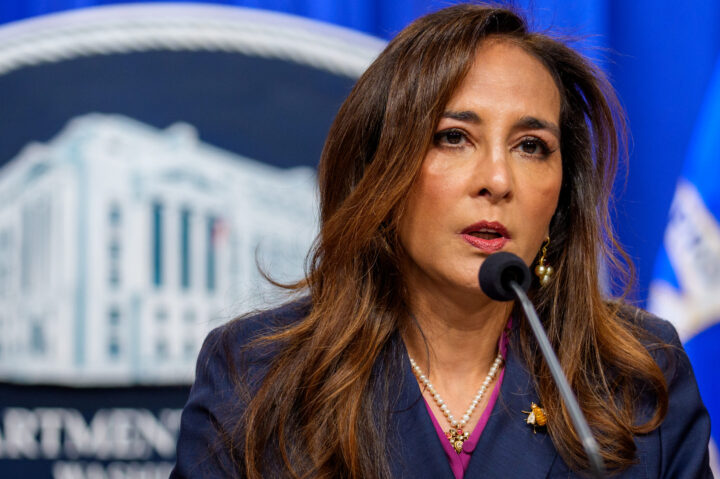
Andrew Harnik/Getty Images
Assistant Attorney General for Civil Rights Harmeet Dhillon speaks during a news conference at the Justice Department on September 29, 2025 in Washington, DC.


 Add JewishInsider on Google
In a speech at a federal government commemoration of the Holocaust on Thursday, Assistant Attorney General for Civil Rights Harmeet Dhillon argued that the post-Oct. 7 wave of antisemitism in the U.S. resembles 1930s Germany and warned that modern bigotry is often perpetrated by “educated elites” under the cover of intellectual language.
Dhillon, drawing on a speech that the late Supreme Court Justice Antonin Scalia gave at a Holocaust remembrance event nearly three decades ago, said that Germany’s reputation as an intellectual and scientific hub in the 1920s and 1930s is closely connected to the development of the Holocaust.
“The road to Auschwitz was incremental and methodical. It began with excluding Jews through the legal, political, economic and social life of everyday society,” Dhillon said. “Many perpetrators of the Holocaust were often the most educated intelligentsia in Germany.”
She was speaking at the 33rd annual Federal Interagency Holocaust Remembrance Program, an event organized by and for federal government employees. It took place in the Justice Department’s Great Hall, and as attendees arrived, they walked up a staircase lined with portraits of historic legal experts, like the Babylonian king Hammurabi. One showed Moses, pictured with the twin tablets of the Ten Commandments.
The fact that the perpetrators of the Holocaust often had advanced degrees and impressive credentials is relevant for our understanding of contemporary antisemitism, Dhillon said.
“Today we are experiencing a rise in antisemitism in the world, including right here at home. As in the past, it often begins with social exclusion. On some university campuses, Jews have been blocked by mobs from entering certain spaces,” said Dhillon. “As in 1930s Germany, these actions are often perpetrated by the educated elites of our nation, framed in intellectual language, giving them a veneer of legitimacy.”
She called on federal workers to pledge to stand up against antisemitism and to defend Western values.
“The task in front of all of us here today as federal employees and people of conscience is a difficult but straightforward one. We must defend our values: our values as Americans, as Westerners, as heirs to this great civilization, our values that hold that all men are created equal,” she said.
The Trump administration, Dhillon stated, is committed to protecting Jews and fighting discrimination.
“The Department of Justice will confront anti-Jewish bigotry and ensure peace and security for all people of faith. We are and will continue to aggressively prosecute individuals and organizations who attack Jews, and we will ensure that our institutions of higher learning treat students and faculty with the dignity through which they are all entitled, and all of us are entitled,” she stated.
Other speakers at the event included Ellen Germain, the State Department’s special envoy for Holocaust issues, and Under Secretary of State for Economic Affairs Jacob Helberg, who spoke via video about his grandparents, who came to the U.S. after surviving the Holocaust.
“Their experiences impressed upon me that the opportunities we have today are not guaranteed. That sense of duty informs our work in government as public servants,” said Helberg. “Remembrance isn’t passive. It requires action. It requires us to ensure that the facts of the Holocaust remain accessible and that distortion and denial are confronted.”
Frank Cohn, a 100-year-old Holocaust survivor and U.S. Army veteran, shared his story.
At the end of the event, Germain warned that Holocaust distortion is “alarmingly on the rise these days.” She called on everyone in the room who survived the Holocaust, or who is a descendant of Holocaust survivors, to stand. They received a standing ovation from a crowd that included White House Jewish liaison Martin Marks, State Department antisemitism special envoy Yehuda Kaploun and representatives from more than two dozen foreign embassies.
More Stories
l.a. rift
Nithya Raman snubs Jewish voters in hotly contested Los Angeles mayoral race
Daily Overtime
New York braces for Oct. 7 protests
PARTY OUTREACH
DNC bids to reengage Jewish voters with new constituency council ahead of 2028

LOOKING FORWARD
DMFI lays out proposal for future of U.S.-Israel relationship

Daylight Between Them
Trump, Cotton feud over daylight saving time legislation

drawing a line
Rising Jewish Democrat in Michigan won’t endorse El-Sayed
Please log in if you already have a subscription, or subscribe to access the latest updates.
 Continue with Google
 Continue with Apple