
















































Former Defense Minister Liberman warns clan is affiliated with ISIS and can turn on Israel; Netanyahu did not bring decision to security cabinet

BASHAR TALEB/AFP via Getty Images
A Palestinian Hamas fighter carries a rifle as terrorists and people gather at the site of the handing over of Israeli hostages at the Nuseirat refugee camp in the central Gaza Strip on February 22, 2025.


 Add JewishInsider on Google
Israel is providing weapons to an armed militia opposing Hamas, a defense source confirmed on Thursday.
Following reports in recent weeks that Israel was working with a gang led by Yasser Abu Shabab based in Rafah in southern Gaza, Avigdor Liberman, the former defense minister and current opposition lawmaker, said on Kan radio that “Israel provided assault rifles and light arms to crime families in Gaza, on [Israeli Prime Minister Benjamin] Netanyahu’s orders … These are the equivalent of ISIS in Gaza.”
Liberman said Israel’s security cabinet was not involved in or informed of the decision to give the Al Shabab clan guns, but the Shin Bet was aware of it.
“No one can ensure that these weapons will not be turned against Israel,” he added. “We have no way of supervising or following [where they go].”
Netanyahu’s office did not deny the allegation and responded that “Israel is acting to defeat Hamas in various ways upon the recommendation of the heads of the security establishment.”
Israel is providing the Al Shabab gang with Kalashnikov rifles, some of which were confiscated from Hamas during fighting in the past 20 months.
Liberman compared giving the Al Shabab militia guns to Netanyahu allowing Qatar to send aid to Gaza, based on an idea that keeping Palestinians divided is better for Israel.
“The prime minister of Oct. 7 hasn’t learned anything and is still continuing with the same idea that led us to the greatest massacre in the history of the state,” Liberman posted on X. “For years, Netanyahu nurtured Hamas and refused to listen to me when I said that he is severely damaging Israel’s national security.”
“Now he is making the exact same mistake and sending weapons to clans identified with ISIS in Gaza,” Liberman stated.
Israeli Defense Minister Israel Katz’s office did not respond to Jewish Insider’s request for comment, and National Security Minister Itamar Ben-Gvir declined to comment. Ben-Gvir began his career in political activism opposing the Oslo Accords; one of the Israeli right’s leading slogans against the accords was “don’t give [the Palestinians] guns.”
Hamas posted videos online of its members targeting the militia in Rafah, a city which the IDF controls. Hamas called Abu Shabab “the Israeli Robin Hood” in a social media post on Thursday, and other members of his clan distanced themselves from him.
Michael Milshtein, head of the Palestinian Studies Forum at Tel Aviv University, noted on X that Palestinian media have reported on Israeli cooperation with clan-based militias in recent weeks to secure humanitarian aid distribution in Gaza by the U.S.-backed Gaza Humanitarian Foundation. The Abu Shabab militia has a few hundred members who came together since the IDF entered Rafah in mid-2024.
Milshtein told JI that he does not know of any ties between ISIS and Yasser Abu Shabab, whose gang he called “psychopaths.”
Yasser Abu Shabab spent years in Hamas prisons, mostly for smuggling, theft and selling drugs, and was freed after Oct. 7, 2023, Milshtein said.
Judith Weinstein-Haggai and Gad Haggai were murdered in Kibbutz Nir Oz in the Oct. 7, 2023, Hamas-led attacks in Israel

Hostages and Missing Families Forum
Judy Weinstein-Haggai and Gad Haggai
The IDF found and returned the bodies of U.S.-Israeli citizens Judith Weinstein-Haggai and Gad Haggai, who were killed in the Oct. 7, 2023, Hamas-led attacks, the Israeli Prime Minister’s Office announced on Thursday.
The Haggais were murdered in Kibbutz Nir Oz during Hamas’ onslaught targeting Gaza border communities. Their bodies were held by Hamas, the PMO said.
The couple was on a morning walk when they were shot by terrorists on motorcycles. Weinstein-Haggai called emergency medical services, but the ambulance that was traveling to help them was hit by a rocket, according to her daughter.
Gad was 72 and Judith, a New York native who also held Canadian citizenship, was 70; they are survived by four children and seven grandchildren.
The Weinstein-Haggai family released a statement via the Hostage and Missing Families Forum, saying that their return “is painful and heartbreaking, yet it also brings healing to our uncertainty. Their return reminds us all that it is the state’s duty to bring everyone home, so that we, the families, together with all the people of Israel, can begin the process of healing and recovery … A grave is not a privilege. A grave is a basic human right, without which personal and national recovery is impossible.”
The family called on leaders to “do everything necessary to reach an agreement that will return all 56 remaining hostages — the living for rehabilitation and the deceased for burial.”
Israeli Prime Minister Benjamin Netanyahu thanked the IDF soldiers and Shin Bet fighters who recovered the bodies and added, “We will not rest until we bring all of our hostages home, living and deceased.”
Israeli Defense Minister Israel Katz sent condolences to the Weinstein-Haggai family and said that “the State of Israel is morally and nationally committed to returning our brothers and sisters, living and not living, and we will continue acting with determination until the mission is complete.”
The bodies of two American hostages, Itay Chen and Omer Neutra, remain in Gaza, out of a total of 56 hostages, 20 of whom are thought to be alive.
The top Republican lawmaker said that, if a deal cannot be reached, ‘Israel is going to do something about that’

Kevin Dietsch/Getty Images
Sen. James Risch (R-ID) walks to the Senate chambers on February 16, 2023, in Washington, D.C.
Sen. Jim Risch (R-ID), the top Republican on the Senate Foreign Relations Committee, said on Wednesday in remarks at the Hudson Institute that he’s skeptical that Iran would agree to a deal to dismantle its nuclear program.
Risch said that he is “not particularly optimistic” that a deal with Iran that stops it from enriching uranium can be reached, while adding that if Iran does not agree to a deal, “Israel is going to do something about that.”
“I’ve sat across the table from [Israeli Prime Minister Benjamin] Netanyahu, I don’t know how many times, and he has looked me in the eye and said, ‘Iran will not have a nuclear weapon,’” the top Senate Republican said. “And you know what? I believe him, and I think that’s a case for the United States to be in the exact same position.”
He called Iran a “failing country right now,” and said that the U.S. should be continuing to ratchet up sanctions on Iran and those purchasing Iranian oil. If Iran were eliminated as a threat, he continued, that would also effectively eliminate the other major bad actors in the region, Hamas, Hezbollah and the Houthis, as Iran’s proxies.
“They’re all Iran. They’re all proxies of Iran. If Iran was gone, the three Hs would be gone,” Risch said. “So we’re down to one bad actor, really, in the region.”
Addressing the push for a ceasefire between Israel and Hamas, Risch said that Israel needs to destroy Hamas completely, and that any deal that allows it to continue existing will only set up another war down the road. And he said that Arab states are privately hoping that Israel is successful in incapacitating Hamas and its Muslim Brotherhood affiliates.
Risch described Syria and Lebanon as “keystones in a peaceful and prosperous Middle East,” both of which, he said, are poised for change and progress.
He expressed support for the administration’s decision to waive sanctions on Syria but warned that “we need to proceed with caution,” given Syrian President Ahmad al-Sharaa’s jihadist past.
“There are conditions that I believe must be met” by Syria and the administration should consider reimposing sanctions if they are not, he continued, including full cooperation against ISIS, eliminating Syria’s chemical weapons stores, expelling Russian and Iranian influence from the country, dismantling the Assad regime’s drug empire and accounting for missing and detained Americans.
Risch said he was initially nervous about al-Sharaa when he took control of Syria, but said, in his defense, that al-Sharaa’s terrorist activity was “a long time ago,” that al-Sharaa had cut ties with terrorist groups “knowing full well what they were and what they stood for” and that the sorts of atrocities and violence that Western leaders have worried about occurring in post-Assad Syria largely have not.
He said he believes that al-Sharaa was not involved in the “one incident” — seemingly referring to a massacre targeting the Alawite religious minority — that has taken place since he took power.
“I think the guy needs to be given a chance, particularly when he is saying what he’s saying, doing what he’s doing,” Risch said. At the same time, the committee chair also acknowledged that Israel does not share his view of al-Sharaa.
Risch downplayed the recent U.S. military pullback from Syria, emphasizing that the U.S. remains committed to the fight against ISIS and is concentrating its remaining resources in the region where ISIS has the strongest presence.
Risch said he’s “skeptical of Turkey” as a “result of my dealings with [Turkish President Recep Tayyip] Erdogan directly.” He warned that the Turkish antagonism toward the Kurds “could be a really, really serious problem” in Syria, which has “enough problems as it is,” and said he is “very cautious” about Turkey maintaining influence inside Syria.
He framed the new Lebanese government as that country’s “best opportunity” but emphasized that it has a long way to go to implement reforms, solve financial issues, eliminate corruption and root out Hezbollah. He said both the Lebanese president and Parliament speaker have “shown great potential over the years.”
“Any hesitancy to meet the threats posed by Hezbollah would be deeply troubling and force the United States to reevaluate providing much needed support for the [Lebanese] military,” Risch continued.
Pushing back on some in the Republican Party who have argued that the U.S. must pull back from the Middle East and other foreign engagements to focus resources on the Indo-Pacific and the home front, Risch said that he’s concerned about the U.S. national debt, but emphasized that fiscal responsibility does not require abandoning U.S. allies.
“We have relationships around the world that are just as important to us for our national security as [are] our military operations. We need friends,” Risch said. “There are a lot of people around the world that share our values and share our view of what life should be for human beings, and we need to maintain that.”
He added that the U.S. should “prize” its global reputation, and warned that abandoning allies like Ukraine would show weakness to China and other adversaries, and ultimately kick off a global nuclear arms race.
Republicans blocked a bid to pass similar legislation in the Senate

Jeff Swensen/Getty Images
Rep. Jared Moskowitz (D-FL), a member of the Task Force on the Attempted Assassination of Donald J. Trump, speaks to the press after touring the shooting site at the Butler Farm Show Grounds on August 26, 2024 in Butler, Pennsylvania.
A group of four House Democrats introduced legislation on Wednesday that aims to exempt Israel and Ukraine from the recent global tariffs that President Donald Trump imposed by executive order.
Trump announced a 17% tariff on Israel in April, above the global 10% minimum tariff that the president said he would apply to U.S. trading partners.
The Trump administration is “alienating some of our closest allies around the world, including those that are currently facing aggression from hostile nations,” Rep. Jared Moskowitz (D-FL), the bill’s lead sponsor, said in a statement. “I support efforts to increase domestic manufacturing, but those efforts shouldn’t come at the expense of our global standing, our national security, and the strength of our economy. Congress has to stand up to the destruction these tariffs are threatening against American families and our allies Israel and Ukraine, and I’m leading the charge to do it.”
The bill is co-sponsored by Reps. Sheila Cherfilus-McCormick (D-FL), Dan Goldman (D-NY) and Josh Gottheimer (D-NJ).
Moskowitz accused the administration of placing on Americans “the largest tax increase since 1968” through the tariffs, describing them as “a tax on American families that makes goods inaccessible, threatens retirement accounts, and takes a sledgehammer to U.S. economic growth.”
The legislation is a companion to a bill Sen. Catherine Cortez Masto (D-NV) introduced in early April. She sought unanimous consent in the Senate at the time to pass the bill, but was blocked by Republicans.
“Both these countries are currently under attack. They need the United States to be standing with them, not hitting them with nonsensical tariffs that could cause them even more harm,” Cortez Masto said at the time. “It is outrageous that my Republican colleagues blocked an opportunity to fix this and come together to protect our allies.”
Some Republicans have been critical of the administration’s decision to place tariffs on Israel, particularly since Israel announced it would lift all of its own tariffs on the United States, but most have opposed efforts by Democrats in the Senate to force votes on legislation to block the tariffs.
The administration has delayed the implementation of tariffs and multiple federal courts have ruled that the president does not have the unilateral authority to impose them.
Many Jewish students are concerned about research cuts and a ban on international students, but others note that antisemitism has been on the decline since Trump’s crackdown

Zhu Ziyu/VCG via Getty Images
A glimpse into the Harvard University campus on May 24, 2025 in Cambridge, Massachusetts.
As Israeli students departed from Harvard University last month to begin summer break, the usual sense of relief and excitement at having completed another academic year was replaced by fear and uncertainty for many.
Amid the Trump administration’s battle with Harvard — which recently escalated to stripping the university of its ability to enroll foreign students entirely — “see you in the fall” was replaced with “I hope to see you in the fall” among international students exchanging goodbyes.
Harvard currently hosts more than 10,000 international students, according to university data. 160 of them are from Israel. On May 22, the White House issued a policy directive meant to completely cut off the university’s ability to admit international students, the first instance of the government doing so. A federal judge has since temporarily blocked President Donald Trump from implementing the policy, although the matter will work its way through the courts. If the White House is successful, international students must transfer schools or lose their visa.
Jewish students and faculty who conduct biomedical research at Harvard also face grim prospects, after Trump revoked billions of dollars in federal funds to the university.
“Jewish faculty may have grants, as well, that are being cut or canceled,” said Dr. Richard Schwartzstein, a professor at Harvard Medical School who has worked to raise awareness about antisemitism in medicine, and to incorporate lessons on antisemitism into the school’s anti-racism curriculum. “That has been disconcerting for everyone, because most of us don’t believe that biomedical research has much to do with the issues that the Trump administration seems to be concerned about. It seems to be merely used as a punishment.”
Rabbi Jason Rubenstein, executive director of Harvard Hillel, told Jewish Insider that “morale is low” among Jewish students planning a career in scientific and medical research, and among Jewish students from abroad.
“Those are major parts of the Harvard Jewish community, and they are really suffering and concerned about their future,” said Rubenstein.
At the same time, many Jewish students on campus expressed relief that the antisemitism and anti-Israel activism that was all too common in the aftermath of the Oct. 7, 2023 Hamas attacks had declined significantly in the previous school year.
Last year, for instance, hundreds of students and faculty members walked out of the school’s main commencement ceremony in solidarity with 13 anti-Israel student protesters who were denied degrees as a result of their involvement in the school’s illegal encampment that spring.
But last week, Harvard’s 374th Commencement appeared to run smoothly, with just a few subdued reminders of the campus chaos that has been wrought by Israel’s war with Hamas.
Harvard’s president, Alan Garber — booed at last year’s ceremony over his decision to not allow the demonstrators to graduate — received a standing ovation this year. A banner reading “There Are No Universities Left in Gaza” was briefly unfurled on the steps of the main library before being confiscated by campus police, the Harvard Crimson reported. Another, reading “Harvard Divest From Genocide in Gaza,” was dropped from a window of Sever Hall and taken down minutes later.
Alex Friedman, who just finished his second year at Harvard Law School, said he left Cambridge last month feeling “cautiously optimistic” about the direction in which the university is moving.
“Harvard is moving very quickly and aggressively to eliminate certain sources of anti-Israel bias on campus,” said Jesse Fried, a law school professor at Harvard. “If the Trump administration were not breathing down their neck, I believe progress would have been much slower.”
“There’s no question that campus was definitely quieter this year than in the previous year. That year was extraordinary, the outburst of antisemitism and anti-Israel activity on campus,” Friedman told JI last week. “The magnitude and consistency were definitely not the same. That, of course, doesn’t mean that the underlying issues have been solved. Antisemitism at Harvard has been a problem for decades, and it’s not going away overnight.”
Jesse Fried, a law school professor at Harvard, attributed to the change to a combination of “natural loss of energy” as students got bored of the topic, and “students’ sense that, ‘Okay, I could get into trouble.’”
Changes on campus were implemented at the beginning of the 2024-2025 school year, when Joe Biden was still president, Fried said, noting that Harvard’s progress in addressing antisemitism and students’ anti-Israel bias was not only a result of pressure from Trump. But once Trump came into office and began threatening Harvard — and then implementing policies that directly targeted the Ivy League university — change happened more quickly, Fried observed.
“Harvard is moving very quickly and aggressively to eliminate certain sources of anti-Israel bias on campus,” Fried said. “If the Trump administration were not breathing down their neck, I believe progress would have been much slower.”
Last month, under pressure from Trump, Harvard released a long-delayed report on campus antisemitism, which found that the university had “severe problems” in its handling of the issue. In March, before any funding had been revoked, Harvard paused a controversial partnership with a Palestinian university and let go leaders of its Center for Middle Eastern Studies.
Harvard’s Jewish community is “split” on how Trump is handling the problem, Fried said, although Trump’s revocation of federal research funding and his threat to bar international students from the university have upset many in the Jewish community.
“There might be some people who are supportive of what Trump is doing, because they see it as a necessary evil: ‘You have to do this in order to fix Harvard,’” said Fried. “But most of the Jewish community is appalled by what he’s doing and the tactics he’s using.”
Rubenstein echoed that the Jewish community has mixed reactions to Trump’s crackdowns. “Federal engagement has been helpful when it’s focused, measured and proportionate,” he said. “The threat of federal funding cuts was important in facilitating different actions throughout the university. For example, Harvard’s counsel was explicit that it wanted to settle the Title VI [of the Civil Rights Act of 1964] lawsuits before Trump’s inauguration.”
Before the government’s actions against Harvard escalated, aspects of the crackdown appeared to address antisemitism that had been pervasive on campus even before the Oct. 7 attacks, according to Rubenstein.
“Every time there’s an action taken by the Trump administration, an immediate email is sent discussing how Harvard will respond and offering support to students,” said Alex Friedman, who just finished his second year at Harvard Law School. “People are focusing on, ‘Oh, Harvard’s doing great. They’re really standing up,’ and understandably so. But this also shows that Harvard could have done that 18 months ago, after Oct. 7, when they were faced with what was happening on campus and what they were facing in the world, and yet they chose not to.”
“I’ve heard from faculty that they always felt Harvard has been one settlement away from the antisemitism policy we wanted,” Rubenstein said, “so they are grateful for the settlement [in January] which led to the adoption of the International Holocaust Remembrance Alliance’s working definition of antisemitism” as part of a resolution to two Title VI lawsuits.
Even as Harvard has made progress in tackling antisemitism, the university’s blundering response in the aftermath of the Oct. 7 attacks still stings for many Jewish Harvard affiliates, particularly when viewed in comparison to the urgency with which Harvard has responded to Trump’s policies.
“Every time there’s an action taken by the Trump administration, an immediate email is sent discussing how Harvard will respond and offering support to students,” said Friedman, the Harvard Law student. “People are focusing on, ‘Oh, Harvard’s doing great. They’re really standing up,’ and understandably so. But this also shows that Harvard could have done that 18 months ago, after Oct. 7, when they were faced with what was happening on campus and what they were facing in the world, and yet they chose not to.”
Looking ahead to the fall, Jewish leaders at Harvard expressed hope that their focus can return to strengthening Jewish life.
Rabbi Hirschy Zarchi, who leads the campus Chabad, said he intends to stay away from the “politics of the moment” and instead “focus on building and nurturing Jewish life and community … [which] we expect to continue to grow from strength-to-strength.”
Rubenstein expects “the disproportionate focus on Israel will really dissipate on campus when there’s peace in Israel, the hostages are returned, please God, and Hamas is no longer a threat in the Gaza Strip.”
Still, he predicts “several years of work and ongoing vigilance from the Jewish community, as antisemitism is ascendant in many corners where we didn’t used to think we had to combat it.”
And campus Jewish leaders are cautiously optimistic that the work won’t fall as heavily on them.
“What we hear consistently from Jewish students is by far the most important thing for their experience of being Jewish in college is the vibrancy of their Jewish community — the Shabbat dinners, friendship, trust, song, laughter. That need is not going anywhere,” Rubenstein said.
“That need is only growing, and in many ways we’ve lost track of it over the past year as we’ve turned attention to governance of the university, faculty politics and disciplinary procedures,” he continued. “That’s important, but our community needs to recommit to resources for the lives of Jewish students.”
One person has been arrested after throwing a Molotov cocktail towards demonstrators, injuring multiple victims

Screenshot/X
A man is arrested after throwing a Molotov cocktail at pro-Israel demonstrators in Boulder, CO on June 1, 2025.
The FBI and law enforcement in Colorado are investigating a possible act of terrorism after multiple people attending a weekly pro-Israel gathering in Boulder to honor hostages kidnapped by Hamas were attacked by a suspect seen throwing Molotov cocktails in their direction.
FBI Director Kash Patel wrote on X that the bureau was “fully investigating” what he described as a “targeted terror attack” in Boulder on Sunday, while FBI Deputy Director Dan Bongino said they were probing the incident as an “act of terror, and targeted violence” while asking for anyone with information to contact the bureau.
One person was arrested after throwing a Molotov cocktail towards the pro-Israel demonstrators, according to Boulder Police Chief Steve Redfearn. Speaking to reporters from the scene of the attack, Redfearn said authorities were called to the area responding to calls “that people were being set on fire” by “a man with a weapon.”
Redfearn also said that victims, attendees of the weekly Boulder Run for Their Lives event calling for the release of the remaining hostages in Gaza, had “injuries consistent with burns and other injuries,” though he could not provide an estimate for the number of individuals who were harmed in the attack.
He warned that some of those injuries could be life threatening. At a Sunday evening press conference, Redfearn said the victims ranged in age from 67 to 88 years old, “at least one” of whom “was very seriously injured, probably safe to say, [in] critical condition.” The 88 year old victim fled Nazi persecution in Europe, Rabbi Yisroel Wilhelm, the Chabad director at the University of Colorado Boulder, told CBS Colorado.
At a press conference Sunday, FBI Denver Special Agent in Charge Mike Michalek identified the suspect as Mohamed Sabry Soliman. Fox News reported that Soliman is an “Egyptian national in the U.S. illegally as a visa overstay who entered the U.S. during the Biden administration,” citing senior Department of Homeland Security officials.
Soliman arrived in the U.S. in August 2022 on a visa that expired in February 2023, filing a claim with U.S. Citizenship and Immigration Services in September 2022 for a work visa that was approved for a two-year period in March 2023. He remained in the U.S. illegally despite his work authorization expiring in March of this year.
Videos circulating on social media of the attack showed Soliman shouting “end Zionists.”
Colorado Gov. Jared Polis, a Democrat, said in a post on X that he was “closely monitoring the situation in Boulder” and said that his state was working “with local and federal law enforcement to support this investigation.”
In a second statement on his personal account, Polis wrote that, “As the American Jewish community continues to reel from the horrific antisemitic murders in Washington, D.C., it is unfathomable that the Jewish community is facing another terror attack here in Boulder, on the eve of the holiday of Shavuot no less.”
“Several individuals were brutally attacked while peacefully marching to draw attention to the plight of the hostages who have been held by Hamas terrorists in Gaza for 604 days. I condemn this vicious act of terrorism, and pray for the recovery of the victims,” he continued.
Sen. Michael Bennet (D-CO), who is running to replace the term-limited Polis, described the incident as a “horrifying terror attack” in a statement posted to X. “My thoughts are with the victims of the horrifying terror attack that occurred this afternoon in Boulder. Hate and violence of any kind will not be tolerated in Colorado,” Bennet wrote.
Sen. John Hickenlooper (D-CO) wrote on the platform that, “Hate of any kind has no home in Colorado. We’re monitoring the reports of a horrific terror attack in Boulder this afternoon. Our thoughts are with the victims and their loved ones.”
Senate Minority Leader Chuck Schumer (D-NY) also said that he was “closely monitoring the situation in Boulder,” adding, “This is horrifying, and this cannot continue. We must stand up to antisemitism.”
A White House official said late Sunday that President Donald Trump “has been briefed” on the attack.
The attack comes less than two weeks after the murder of two Israeli Embassy staffers attending an American Jewish Committee event in Washington. The alleged shooter yelled “Free Palestine” shortly after committing the crime.
In April, during the first night of Passover, an arsonist tried to burn down Gov. Josh Shapiro’s residence. The perpetrator cited the governor’s support for Israel as his motive.
The bill ‘is among some of the most concerning anti-Israel legislation we’ve seen in recent years,’ FDD’s Bradley Bowman said

Valerie Plesch via Getty Images
The U.S. flag flies in front of the U.S. Capitol.
A group of 22 left-wing House Democrats introduced legislation pushing for a series of sweeping and unprecedented new restrictions on U.S. aid to Israel, requiring specific authorizations from Congress for each transfer of numerous key weapons and guarantees from Israel about their use.
The legislation would prohibit the administration from transferring or selling a series of arms to Israel including several types of bombs, bomb guidance kits and tank and artillery ammunition without the passage of a distinct law from Congress authorizing the individual transfer.
The bill would require Congress, in those authorizations, to identify “the specific purpose or purposes for which such articles or services may be used for.” And Israel would have to provide “written assurances satisfactory to the President” that the weapons would be used in accordance with those specified purposes, as well as in line with existing U.S. arms sales law — which is already binding on Israel — and international law.
The proposal, which stands no chance of passing in the current Congress, goes beyond the conditions that have previously been proposed for U.S. arms sales to Israel or in place for any other recipients of U.S. aid. It contains no emergency waiver provision for the administration, should Israel face an attack.
Bradley Bowman, senior director of the Foundation for Defense of Democracies’ Center on Military and Political Power and a former Senate staffer, told Jewish Insider that the bill “would be an extraordinary measure targeting Israel alone in a unique manner with the clear purpose of depriving Israel of some of the munitions it needs most” and is “among some of the most concerning anti-Israel legislation we’ve seen in recent years.”
He said that, while Congress has placed conditions on arms transfers to other nations in the past, the requirement of specific congressional approval for each transfer is “particularly aggressive.” He described the bill as “part of a campaign on the far left in this country focused on depriving the world’s only majority Jewish state of the means of self defense.”
“If it were to become law, it essentially is an arms embargo against Israel for these munitions,” Bowman said, making it “incredibly time consuming” to provide those weapons and slow the transfers down by months, and giving anti-Israel members opportunities to further derail the process through procedural means.
The bill is led by Rep. Delia Ramirez (D-IL) and co-sponsored by Reps. Sara Jacobs (D-CA), Pramila Jayapal (D-WA), Mark Pocan (D-WI), Becca Balint (D-VT), Andre Carson (D-IN), Greg Casar (D-TX), Lloyd Doggett (D-TX), Veronica Escobar (D-TX), Maxwell Frost (D-FL), Chuy Garcia (D-IL), Jonathan Jackson (D-IL), Hank Johnson (D-GA), Summer Lee (D-PA), Alexandria Ocasio-Cortez (D-NY), Ilhan Omar (D-MN), Ayanna Pressley (D-MA), Jan Schakowsky (D-IL), Lateefah Simon (D-CA), Rashida Tlaib (D-MI), Nydia Velazquez (D-NY) and Bonnie Watson Coleman (D-NJ).
A Ramirez spokesperson told JI that Ramirez introduced the legislation prior to the news of the murder of two Israeli Embassy staffers in Washington last week. “Out of an abundance of respect and care for the communities and loved ones impacted by the murders of Yaron Lischinsky and Sarah Milgrim, Ramirez and the cosponsoring legislators decided to hold any plan to discuss it publicly, honoring the intention of the legislation to uphold our shared humanity and interconnectedness. We will be sharing more information on the legislation once members return to DC,” the spokesperson said.
Bowman noted that the group in support of this bill is nowhere near a majority in either chamber, but “could be increasingly problematic” as their numbers grow and members gain leadership roles in key committees.
He said the weapons in question are critical for Israel’s operations against Hamas and Hezbollah, as well as for preventing imminent launches of rockets toward Israeli cities. And, he noted, some of the weapons included, like the bomb guidance kits, are designed to improve targeting and decrease civilian casualties, making the effort counterproductive.
New UCLA chancellor: ‘With all transparency and humility, we need to acknowledge that we have an antisemitism problem in universities. Denying it would be dishonest’

Victor Boyko/Getty Images for Aurora Humanitarian Initiative
Julio Frenk speaks during the Humanitarian Summit and 2025 Human Rights and Humanitarian Forum at the UCLA Luskin Conference Center on May 7, 2025 in Los Angeles, California.
Julio Frenk was sitting at a Miami Hurricanes football game on Oct. 7, 2023, when he learned the details of the terror attacks in Israel that killed 1,200 people and saw over 250 taken hostage. Frenk, a public health scholar and sociologist who was then the president of the University of Miami, knew immediately that he had to weigh in with an unequivocal condemnation of the violence.
“I had no question that I had to respond and say something. It’s very personal for me,” Frenk, whose family settled in Mexico City after fleeing Nazi Germany in the 1930s, told Jewish Insider in an interview this week. His wife’s father survived Nazi concentration camps but lost nearly his entire family in the Holocaust. “I think it was one of the first messages by a university president, and it was unambiguous.”
In an email sent to university affiliates two days after Oct. 7, he touted UM’s “deep ties” to Israel. “We stand in solidarity with the people of Israel, with all those impacted by the violence and with all who seek peace,” wrote Frenk.
It was an unusually bold statement from a university president at a time when many other leaders of elite universities seemed afraid of issuing similar clear-eyed denunciations. He followed the email with straightforward guidance about the university’s rules around protesting, harassment and violence, and continued disavowals of antisemitism. There was no anti-Israel encampment at UM in the spring of 2024.
But that was in Florida, a conservative-minded state where Republican Gov. Ron DeSantis and other political officials have made clear that violent anti-Israel protest activity would be punished — bolstered by the leadership of Frenk at the University of Miami, Ben Sasse at the University of Florida and other academic leaders.
Now, Frenk, who is 71, is attempting to bring some Florida to deep-blue California as he wraps up his first semester as chancellor of the University of California, Los Angeles, a position he started in January. Both schools have among the largest Jewish student populations in the country.
Westwood, where UCLA is located, is a dramatically different environment for Frenk, who was the dean of the Harvard T.H. Chan School of Public Health before taking over in Coral Gables. UCLA, the top-rated public university in the country, has a budget double the size of Miami’s. It’s also a public university, which means greater free speech protections than at UM. But for Frenk, the core issue has nothing to do with infringing on students’ freedom of expression. It’s about teaching them what’s right and what’s wrong.
“When we engage with each other, we do that respectfully and without — obviously no hatred, no harassment, no incitement to violence, but also no expressions that are deeply offensive to the other side,” Frenk said to JI. He specified that he was referring specifically to the anti-Israel slogan “From the river to the sea” as one such expression. “That’s the same message here. It’s not a legalistic issue. It’s part of educating young people.”
During UCLA’s large anti-Israel encampment last spring, Jewish students were barred from accessing parts of campus by the protest organizers. The tents popped up just days after Frenk had accepted the offer from Michael Drake, president of the University of California system.
“I had already said yes, and he said, ‘Are you going to change your mind?’ And I said, ‘No, I’m not going to change my mind. I think this is a very important challenge to face and fix if I can, and I’m going to give it my all,’” Frenk recalled. “What drew me here is just the reputation, the standing, and I know that that spring, the images of UCLA going to the world were not very enticing. But to be honest, facing that challenge was something that attracted me.”
“My position has been that, with all transparency and humility, we need to acknowledge that we have an antisemitism problem in universities. Denying it would be dishonest,” Frenk added. “What we are telling the Department of Justice and others is yes, we acknowledge, and we are fixing the problem.”
Frenk took over the chancellorship of UCLA at a precarious time for the entire institution of higher education, which is facing “the greatest challenge in living memory,” he said in a speech to a Jewish communal advocacy day in Sacramento this month.
He committed early on to fighting antisemitism, even seeking to work proactively with the Trump administration on protecting Jewish students.
“We’re trying to respond to the federal government, first of all by saying that I applaud the decision to combat antisemitism, and secondly, that we acknowledge that there had been a problem with, there is a problem with, growing antisemitism. But we are determined to deal with that and eradicate antisemitism.”
But Frenk walks a fine line as he declares President Donald Trump’s goal of combating antisemitism to be laudable while also criticizing some of the administration’s strategies, such as cutting federal funds to Harvard and other institutions — all while the UC schools face the prospect of being sued by the Trump administration.
“That occupies me at night,” he said of the prospect of losing federal funds. UCLA receives hundreds of millions of dollars from the federal government each year.
“My position has been that, with all transparency and humility, we need to acknowledge that we have an antisemitism problem in universities. Denying it would be dishonest,” Frenk added. “What we are telling the Department of Justice and others is yes, we acknowledge, and we are fixing the problem.”
He cited a statement that UCLA signed onto, as a member of the American Association of Universities, which “clearly states that we applaud the decision to combat antisemitism, but that certainly withholding research money is not the way to do it,” Frenk explained. “We’re hoping that the administration will reconsider those kinds of measures.”
“My North Star is always to be explicit about the principles,” Frenk said. “[One] thing we said [at Miami], and I’m following the same idea at UCLA, is here are the rules: You cannot occupy space, you can have no encampments, etc., and here are the consequences of violating the rules.”
Early in his tenure at UCLA, Frenk suspended the undergraduate and graduate chapters of Students for Justice in Palestine after their members vandalized the home of UC Regent Jay Sures. In March, he announced an initiative to combat antisemitism that would implement the recommendations of a task force that studied antisemitism and anti-Israel bias on campus.
“It has a budget. It’s not just volunteer time. It has a full-time executive director,” said Frenk. “It has administrative support. It is real. It reports to me directly.” Its goals include hiring a Title VI officer to enforce federal civil rights statutes and implementing trainings for students and staff when they return in the fall. That’s in addition, he noted, to a UC-wide revision of rules about campus protests and gatherings that took place last year.
“My North Star is always to be explicit about the principles,” Frenk said. “[One] thing we said [at Miami], and I’m following the same idea at UCLA, is here are the rules: You cannot occupy space, you can have no encampments, etc., and here are the consequences of violating the rules.”
It was, he explained, a page out of his pandemic playbook, when Miami reopened in the fall of 2020 with strict precautions in place. He suspended a student soon after for hosting a party in her dorm room.
“The parents were pleading with me, and I said, ‘Look, I am responsible for protecting this campus. And furthermore, you’re paying us to educate your daughter, and part of their education is to learn that there is something called the rule of law, and that if you don’t follow the law, there are consequences,’” Frenk recalled. “She’s going to graduate into the real world, and is going to find that that’s not the way the rest of the world behaves. I see this as part of my educational duty, and it’s exactly the same principles we’re using in UCLA.”
So far, Frenk insists he “very much” has buy-in from the relevant stakeholders at UCLA in his quest to ensure that, contrary to last year, the school actually enforces its policies.
“We do it for our Jewish students, faculty and staff, for the rest of the members of our community and for the university itself,” said Frenk.
Fighting antisemitism and the impact it has on the entire campus environment will “save the university,” according to Frenk. That’s a lesson he learned from his grandparents, after they fled Germany.
“It was through antisemitism that German universities, which were the premier universities in the world in the 1920s and early 1930s, declined,” said Frenk. “It destroyed the soul of the university.”
As the Oval Office dominates foreign policy, pro-Israel advocates rethink their Congress-focused playbook

GETTY IMAGES
A general view of the U.S. Capitol Building from the National Mall, in Washington, D.C., on Thursday, May 29, 2025.
For decades, Jewish and pro-Israel groups invested significant resources in building bipartisan relationships with key members of Congress to steer legislation, while helping secure foreign aid and blocking unfavorable initiatives concerning the Middle East.
But that long-standing playbook has appeared less effective and relevant in recent years as Congress has increasingly ceded its authority on foreign policy to the executive branch, a trend that has accelerated with President Donald Trump’s return to office. The dynamic is frustrating pro-Israel advocates who had long prioritized Congress as a vehicle of influence, prompting many to reassess the most effective ways to advocate for preferred policies.
That Congress had no formal role in Trump’s recent decisions to unilaterally reach a ceasefire with the Houthis in Yemen and to lift sanctions on Syria, for example, has stoked speculation that legislators could also be sidelined from ratifying a potential nuclear deal with Iran.
There are any number of reasons why Congress has taken a back seat in shaping foreign affairs, experts say, including Trump’s efforts to consolidate power in the executive branch, most recently by gutting the National Security Council. And Trump’s own power in reshaping the ideological direction of his party, preferring diplomacy over military engagement, has made more-hawkish voices within the party more reluctant to speak out against administration policy.
“Congress is increasingly irrelevant except on nominations and taxes,” Elliott Abrams, a senior fellow at the Council on Foreign Relations who served as a special envoy for Iran in the first Trump administration, told Jewish Insider. “It has abandoned its once-central role on tariffs, and plays little role in other foreign affairs issues. That’s a long-term trend and we saw it in previous administrations, but it is worsened by the deadlocks on Capitol Hill, the need to get 60 votes to do almost anything, and by Trump’s centralization of power in the White House.”
Previously, “when there was real power in the departments, congressional oversight meant a lot more,” Abrams added. “If you’re a foreign ambassador in Washington, there’s no one to talk to at the NSC, lots of vacancies at State, and while there are plenty of people to meet with on the Hill, what are they going to do for you? You need to see Trump” Abrams said, or Steve Witkoff, the special envoy to the Middle East leading the negotiations with Iran.
The executive branch, to be sure, has long held significant control over foreign policy but it has expanded considerably in the decades following the 9/11 attacks. Since then, a law passed by Congress to authorize the invasion in Iraq in 2003 has been used — and, critics allege, abused — by successive administrations to initiate military action abroad without first seeking approval from lawmakers who are constitutionally empowered to decide when the country goes to war and oversee defense spending.
Still, Congress has also long shown “disinterest” in exercising its power over foreign policy, said Brian Katulis, a senior fellow at the Middle East Institute. “This was a preexisting condition,” he explained to JI. “By and large, Congress abdicated its oversight role before Trump even came to office,” especially as national security matters have been overshadowed by competing domestic issues such as inflation and immigration, which “resonate more saliently” with voters.
“Trump’s dominance over the Republican Party accounts for much of the acquiescence on the part of his Congress,” observed Stephen Schlesinger, a historian who specializes in international affairs. “But let us not forget that recent Democratic presidents have practically had a free hand, too, in pursuing their own global policies — with little reaction or opposition from their party members.”
Among other examples, Schlesinger cited former President Barack Obama’s nuclear deal with Iran — brokered without consent from Congress — as well as former President Joe Biden’s “total support” for Ukraine in its war against Russia.
Republican deference to Trump, however, has set a new standard for such acquiescence, Schlesinger argued, particularly on talks with Iran. “Given the past obsessive Republican fury against a deal with Iran during Democratic administrations, still none in Trump’s party have objected to a nuclear deal with Tehran under Trump, or, for that matter, his solo decision to lift sanctions on Syria, a country led by a former radical Islamic leader,” Schlesinger noted.
“Certainly the reality of governance in Washington today is that Congress may not be totally irrelevant, but they’re an appendage to the whims and desires of the Trump presidency,” said Norman Ornstein, a senior scholar at the American Enterprise Institute. “There is little if any pushback or oversight of what Trump” and his advisors “involved in foreign policy and diplomacy are doing — and that’s a change.”
The new dynamic has forced pro-Israel groups to adapt to a new political landscape in which their traditional advocacy has been weakened by Congress’ diminished clout and lack of interest in asserting meaningful supervision over Trump’s recent Middle East policy decisions.
“There are very few remedies for this kind of a standoff where the executive branch has arrogated to itself so much power that Congress is essentially marginalized,” said Danielle Pletka, a senior fellow at the American Enterprise Institute who previously worked on the Hill. “When you look at the question of Israel, you have to see it in the context of much broader trends.”
Marshall Wittmann, a spokesperson for AIPAC, argued that both “the administration and Congress play a critical role in strengthening and expanding the U.S.-Israel relationship, and AIPAC works with key leaders in power, on both sides of the aisle and both sides of Pennsylvania Avenue, to build support for the mutually beneficial alliance between America and Israel.”
The absence of congressional influence has come as disagreements have emerged between the Trump administration and the Netanyahu government over ending the war in Gaza and nuclear diplomacy with Iran. Trump’s recent trip to the Middle East — where he met with a range of Arab leaders but did not stop in Israel — was one of the latest indications of deprioritization of America’s closest ally in the region.
Tensions have also surfaced amid ongoing negotiations with Iran. Pro-Israel advocates have voiced concerns that Trump’s negotiating team is nearing an agreement that could simply reinstate the deal brokered by the Obama administration a decade ago — which detractors had criticized as a pathway to a nuclear weapon since it allowed Iran to continue enriching uranium.
The Trump administration has indicated it will not permit Iran to retain domestic nuclear enrichment — even as some officials have sent mixed signals on the matter, contributing to a sense of confusion over the ultimate terms of an agreement. Trump pulled out of the original deal — which was widely opposed by Republicans — during his first administration.
For pro-Israel groups, the risks of clashing with Trump on key issues likely outweigh the benefits, observers contend. “Any organization has to very carefully weigh its equities before publicly taking on the administration,” Daniel Silverberg, a former top foreign policy advisor to Rep. Steny Hoyer (D-MD), told JI.
The pro-Israel lobbying group AIPAC has recognized that it is now operating in a unique landscape, according to Manny Houle, a Democratic pro-Israel strategist who previously served as the group’s progressive outreach director in the Midwest. Before Trump was elected, Howard Kohr, AIPAC’s former president, frequently said the group “was all about Congress,” Houle recalled in a recent interview with JI. “Then, Trump was in office and he said we’re going to be dealing with the White House.”
Marshall Wittmann, a spokesperson for AIPAC, argued that both “the administration and Congress play a critical role in strengthening and expanding the U.S.-Israel relationship, and AIPAC works with key leaders in power, on both sides of the aisle and both sides of Pennsylvania Avenue, to build support for the mutually beneficial alliance between America and Israel.”
“President Trump has a strong pro-Israel and anti-Iran record, but his administration evinced early on a lack of expertise and consistency in its policy toward Iran’s nuclear program,” said Michael Makovsky, president and CEO of the Jewish Institute for National Security of America. “But recently that position has evolved and strengthened due in no small part to feedback it has gotten.”
“We applaud the administration’s strong statements and actions in support of our ally, commend Congress for passing pro-Israel legislation such as the annual appropriation for lifesaving security assistance to Israel, and appreciate President Trump and congressional leaders both making clear last week that Iran must completely dismantle its nuclear program,” Wittmann said in a statement to JI last week.
Even as Congress has failed to take formal action over points of disagreement with Trump’s recent Middle East directives, some pro-Israel activists suggested their outreach to lawmakers on the Iran talks in particular has yielded substantive results in recent weeks.
“President Trump has a strong pro-Israel and anti-Iran record, but his administration evinced early on a lack of expertise and consistency in its policy toward Iran’s nuclear program,” said Michael Makovsky, president and CEO of the Jewish Institute for National Security of America. “But recently that position has evolved and strengthened due in no small part to feedback it has gotten.”
In public and private settings, JINSA and other pro-Israel groups, as well as Israeli officials and congressional Republicans, “have made the case that Trump needs to stick to his initial policy of dismantlement of Iran’s enrichment facilities,” Makovsky said.
“This has contributed to Trump officials pivoting in the past couple weeks to a tougher ‘no enrichment’ stand,” Makovsky told JI last week.
Eric Levine, a top GOP fundraiser and a board member of the Republican Jewish Coalition who recently launched a federal lobbying practice, said “the most important voice Congress will have is if the president makes a deal with Iran. I think that it’s really important that the Senate remains steadfast and safeguards its powers and insists, if there is a deal, it should be counted as a treaty. If he thinks it’s an amazing deal, he should have no trouble passing it.”
Still, it remains to be seen if the toughest voices against Iran in the Senate who have expressed reservations with enrichment limits and other perceived weaknesses of a potential deal will push back against Trump if he lands on an agreement that does not meet their standards. While some Republican lawmakers have spoken out in recent weeks to set expectations for a deal, including Sens. Ted Cruz (R-TX), Tom Cotton (R-AR) and Lindsey Graham (R-SC), observers say they are skeptical that Congress will ultimately seek to flex its authority if an agreement comes forward.
“The ultimate test will be if there’s a vote on Iran,” said former Rep. Steve Israel (D-NY), a pro-Israel Democrat who opposed Obama’s deal in 2015. “As Congress has grown more performative, it has become less deliberative on foreign policy,” he added. “The speaker’s gavel has become a rubber stamp. The result is an abdication by Congress of its delineated responsibilities.”
Eric Levine, a top GOP fundraiser and a board member of the Republican Jewish Coalition who recently launched a federal lobbying practice, said “the most important voice Congress will have is if the president makes a deal with Iran.”
“I think that it’s really important that the Senate remains steadfast and safeguards its powers and insists, if there is a deal, it should be counted as a treaty,” said Levine. “If he thinks it’s an amazing deal, he should have no trouble passing it,” Levine said of Trump’s efforts to reach what he has suggested is an imminent accord.
It is unclear if the White House will seek approval from Congress for a deal, even as lawmakers have recently stressed that an agreement would have no guarantee of surviving in future administrations if not ratified by the legislative branch.
Secretary of State Marco Rubio affirmed during hearings on Capitol Hill last week that U.S. law requires that any deal with Iran be submitted to Congress for review and approval, noting that he had been in Congress when that law, the Iran Nuclear Agreement Review Act, was passed. A White House spokesperson declined to confirm if Trump plans to present a potential deal to Congress when reached by JI on Wednesday, deferring to the president and Witkoff’s remarks from the Oval Office — which did not address the matter.
With Congress increasingly on the sidelines, some pro-Israel groups have turned to alternative forms of advocacy to buttress their lobbying efforts in recent years.
“Advocacy tactics are always changing,” James Thurber, a distinguished professor of government at American University and a leading expert on federal lobbying, told JI. “It is like war where opponents must be flexible, try new tools, assess and adjust. It is essential to be persistently focused on the best strategy, theme and message and to not rely on outdated lobbying tactics.”
“Our world has changed,” said Ann Lewis, a veteran Democratic advisor and a former co-chair of Democratic Majority for Israel, whose formidable political arm has actively engaged in congressional primaries featuring sharp divisions over Israel. “Any definition of advocacy that begins post-election is less effective than it deserves to be.”
Indeed, AIPAC’s foray into campaign politics four years ago, marking a major tactical shift for the organization, was a sign of the changing power dynamics in Washington. The group has since helped to elect a range of congressional allies, while working to unseat some of the fiercest critics of Israel in the House and blocking potential antagonists from getting elected.
“Advocacy tactics are always changing,” James Thurber, a distinguished professor of government at American University and a leading expert on federal lobbying, told JI. “It is like war where opponents must be flexible, try new tools, assess and adjust. It is essential to be persistently focused on the best strategy, theme and message and to not rely on outdated lobbying tactics.”
But as most foreign policy decisions now emanate from the White House, some pro-Israel activists say they remain frustrated by the lack of will from Congress to assert its authority, even as they vow their efforts will continue.
“It is tragic that Congress has so blatantly shirked its responsibility to act as a check and balance on the executive branch,” a senior political operative involved in pro-Israel advocacy recently lamented. “But under no circumstances does that mean we stop fighting for the future of the U.S.-Israel relationship.”
The GOP congressman told JI that, should nuclear negotiations fail, Israel should not have to act against Iran without U.S. assistance
Bill Clark/CQ-Roll Call, Inc via Getty Images
Rep. Mike Lawler (R-NY) leaves the House Republicans' caucus meeting at the Capitol Hill Club in Washington on Tuesday, May 23, 2023.
Rep. Mike Lawler (R-NY), returning from a trip to Israel, Saudi Arabia and Jordan, characterized leaders in the region as being open to the Trump administration’s efforts to reach a new nuclear deal with Iran, but also suggested that they are skeptical that Iran will actually agree to a deal that dismantles its nuclear program.
“I think folks are realistic about the prospects of Iran coming to an agreement, but still want to give the process a chance and try to avoid a conflict if possible,” Lawler told Jewish Insider on Thursday. “But ultimately, you know, I think everybody is very clear about the fact that Iran cannot have a nuclear weapon.”
Lawler, joined by Reps. Michael McCaul (R-TX) and Sheila Cherfilus McCormick (D-FL), met with regional leaders, including Israeli Prime Minister Benjamin Netanyahu, Saudi Foreign Minister Adel al-Jubeir and Jordanian King Abdullah II.
On nuclear talks with Iran, the New York Republican said that leaders in the region are “cautiously optimistic that we can make progress in a negotiation, but I think realistic about the fact that we’ve been here before with Iran, and they continue to operate in the manner that they do.”
Lawler has been a leader in the House on Iran sanctions, sponsoring two bills that passed last year to crack down on the oil trade between Iran and China and a third that is moving ahead in the House this year.
Secretary of State Marco Rubio said in congressional testimony last week that negotiations between the U.S. and Iran are not engaging with Iran’s support for terrorism or its ballistic missile program, but said that sanctions targeting those areas would remain in place if they are not addressed under a deal. Many Republicans have argued in the past that Tehran would use any sanctions relief, regardless of target, to fund malign activities.
“Let’s see what actually comes out of these negotiations,” Lawler said, of Rubio’s comments. “But, my general view is that the nuclear program, obviously, is a major threat, but so too is their continued funding of terrorism, and all of these issues are going to have to be addressed, one way or the other.”
He said that “as part of any sanctions relief down the road, they would have to cease all terror activity and funding of it. But I think we’re a long ways away from that, and so that’s why I continue to push on the sanctions.”
Lawler described the Trump administration as being more aggressive than the Biden administration in implementing sanctions, including the two bills he spearheaded in the previous Congress, against Iran.
“This has been, from the standpoint of applying pressure, critical, but long term all of these issues are going to have to be addressed,” Lawler said. “One of the immediate issues is the nuclear program and trying to eliminate that through a diplomatic negotiation.”
Amid public reports that the U.S., Hamas and Israel are nearing an agreement on a new ceasefire proposal, Lawler said, “We’ll see if progress can be made there. Hamas continues to put in place demands that are never, ever going to be accepted by the United States or Israel.”
While Israel has said it would agree to the current U.S. proposal, Israeli officials have also implemented plans to expand operations in Gaza even as U.S. officials have reportedly been privately pressuring Israeli officials to end the war.
“Israel is continuing to proceed forward with respect to trying to eliminate the threat posed by Hamas. Obviously, the longer this drags on, the more difficult it is within the region,” Lawler said. “But I think everybody would like to see this come to an end, in which the hostages are released, the Palestinian people are able to live in a more stable area and get the humanitarian assistance that they need.”
Lawler also expressed support for the new American and Israeli effort to provide humanitarian aid to Palestinians, which began earlier this week.
He criticized the Biden administration for, in 2024, pressuring Israel against expanding operations against Hamas and Hezbollah, arguing that if Israel had heeded that pressure, Hamas and Hezbollah’s leadership would still be alive and the Assad regime would still be in power in Syria.
Lawler denied that the Trump administration had placed any similar pressure on Israel, despite public comments from President Donald Trump that Israel should not attack Iran’s nuclear program while talks are ongoing and reports of private pressure on a number of fronts.
“I think the administration has been very supportive, but they’re in the process of trying to negotiate,” Lawler said, of Trump’s recent comments opposing a strike on Iran. “And obviously, when you’re in the middle of a negotiation, any military action can undermine that negotiation … the talks are in a critical stage, and you have to allow those talks to unfold.”
He suggested that he believes that the administration would support a strike if the negotiations fail, and that Israel should not have to act on its own in such a scenario. “There should be coordination and cooperation if and when any action is taken,” Lawler said.
The congressman said that, despite the ongoing challenges, there are new opportunities in the Middle East and it is in some ways “in a stronger position for change than it was 19 months ago.”
“There’s a lot of work ahead, but I think the dialogue in all three countries was extremely positive and focused on the future and how we kind of bridge these divides and long-term normalization and economic cooperation between all countries in the region,” Lawler said.
Saudi Arabia, he said, was “extremely happy” with Trump’s recent visit. The U.S.-Saudi relationship, he continued, is on a “very positive” trajectory, and Saudi Arabia is poised to be a key player in helping to bring stability and prosperity to the Middle East.
Despite recent reports and public statements indicating that Saudi interest in normalizing relations with Israel has waned in the short term, Lawler said that “they understand how important it is both from the long-term stability and economic prosperity of the Middle East, but also on the global stage.”
“The sooner this conflict [in Gaza] comes to an end, I think the easier it will be to begin that process,” Lawler continued.
Lawler also described Jordan as “vital to the U.S., to Israel and to the peace and stability of the Middle East” and a “great ally and partner.”
He said that Jordan’s King Abdullah II had stressed the economic, natural resource and refugee challenges the country faces. Lawler argued that the U.S., Israel and Saudi Arabia should invest in Jordan to help support its stability, “which is vital to our national security interests and certainly that of Israel.”
Rep. Ritchie Torres said in remarks at the event, ‘We in the United States, both Jews and non-Jews, have a moral obligation to stand with our ally in ensuring that the Nova massacre is never forgotten and never repeated’

Haley Cohen
Mia Schem speaks at inaugural Tribe of Nova Foundation benefit held at Sony Hall, Times Square, May 30th 2025
Following her return to Israel, Mia Schem — who was kidnapped from the Nova music festival in southern Israel on Oct. 7, 2023, and spent 55 days in Hamas captivity — famously had the phrase “We will dance again” tattooed on her arm.
On Thursday night, approximately 800 New Yorkers joined Schem in dancing again at the sold-out inaugural Tribe of Nova Foundation benefit held at Sony Hall, a concert venue in Times Square. The event was held with the goal of raising at least $1 million to aid families of victims and survivors of Nova, where 411 festivalgoers, mostly young people, were killed and 44 were taken hostage.
“In Gaza, I lost my innocence,” Schem told attendees. “I brought back strength and the promise to live life, to help others and to fight with everything I have for the release of all hostages.” The event was held as 58 hostages remain captive in Gaza — about a third of whom are believed to be alive.
The Tribe of Nova Foundation was founded two weeks after the Oct. 7 attacks by five survivors of the massacre. It quickly drew support from high-profile entertainment and business executives including music manager Scooter Braun and tech entrepreneur Joe Teplow, both of whom attended Thursday’s event.
Ofir Amir, co-founder of the Tribe of Nova Foundation who was shot in both legs during the attack, told attendees that he went through a long period of rehabilitation and still carries “a life-long injury.”
“The Tribe of Nova Foundation was born out of an experience that we shared, our mutual values and sensitivity to one another,” he said. “I got my life back, but forever I will carry the memories of the friends I lost and the many beautiful souls we lost that day, our tribe of angels,” said Amir.
Rep. Ritchie Torres (D-NY) delivered remarks at the event, saying, “Israel cannot tolerate Oct. 7 being ignored because the world’s only Jewish state cannot survive it being repeated. We in the United States, both Jews and non-Jews, have a moral obligation to stand with our ally in ensuring that the Nova massacre is never forgotten and never repeated.”
“Resilience and renewal is encoded in the Jewish DNA … there is no doubt in my mind that the Jewish people will emerge better and stronger, more unified and more resilient than ever before, and that Israel will outlive its enemies: the Houthis, Hezbollah, Hamas and the Islamic Republic of Iran,” Torres continued, drawing applause from the crowd.
In North America, the foundation is best known for bringing the pop-up Nova Music Festival exhibition to cities including New York City, Miami and Toronto over the past year. The exhibit — an immersive experience that educates about the Oct. 7 attacks — is slated to arrive in Washington, D.C. this summer.
In Israel, the Tribe of Nova Foundation plans to open a community center to provide services and support by the end of the year, following a $2 million donation from UJA-Federation of New York in February. The UJA New York Nova House, projected to cost nearly $3 million, will provide rehabilitation, sports, cultural activities and workforce development to those directly affected by the attacks, as well as Israel Defense Force soldiers and individuals with special needs, according to the organization.
Attendees spotted on the dance floor included: Jonathan Greenblatt, CEO of the Anti-Defamation League; Eli Beer, founder of United Hatzalah of Israel; Josh Kadden, CEO of the Nova Festival Exhibition; former Israeli hostage Andrey Kozlov, who had been working as a security guard at the Nova festival when he was kidnapped; Martin Hoffstein, co-founder of JAJA Spirits and singer-songwriter Jeryko.
Months after their release, former hostages are quietly navigating the long, complex path to recovery inside a specialized ward at Beilinson Hospital in central Israel

Beilinson Hospital
Released hostages Naama Levy, Karina Ariyev, Agam Berger, Liri Albag and Daniella Gilboa gesture to well-wishers over a railing at Beilinson Hospital
When Israelis held hostage by terrorists in Gaza are released, there is a flurry of attention. Members of the media descend on the hospitals to which the newly freed hostages are sent. Dozens of photos of the former hostages and their families are disseminated from the hospitals. Siblings and other relatives give interviews about the returnees’ medical conditions and what they said about their treatment in Gaza.
Soon after, however, the public no longer hears much from most of them. To be sure, some gave high-profile interviews, while others found themselves on red carpets. Some were cheered by whole soccer arenas. The divorce of one former hostage from her husband has turned into gossip fodder in Israel. But for the most part, their day-to-day struggles are not on the public’s radar, even as the former hostages’ recoveries from their physical and mental injuries continues.
Beilinson Hospital in Petah Tikva, in central Israel, has treated and continues to treat hostages released in the ceasefire that took place earlier this year: female soldiers Naama Levy, Karina Ariyev, Agam Berger, Liri Albag and Daniella Gilboa, as well as Tal Shoham, Omer Wenkert, Eliya Cohen and Omer Shemtov.
Dr. Michael Bahar, director of the Rehabilitation Unit at Beilinson, who has been overseeing their recovery, told Jewish Insider in the hospital this week that his department “built rehabilitation programs based on each patient’s specific needs. It’s a multidisciplinary process, working with physical therapists, occupational therapists, dieticians, nurses and psychologists. For the rehabilitation of the female soldiers, “we work with the IDF,” he added.
“It’s been three months, and for some it continues, and we’re always thinking about the next stage,” Bahar said. “Every day of treatment has a schedule, matching each patient’s needs — physical, cognitive and beyond.”
The returnees come to the hospital multiple times a week for treatments that range from more traditional medical appointments to working with dieticians to ensure they are eating properly after over 500 days of malnutrition to exercises that strengthen injured limbs and improve aerobic activity.
Some of the treatments are in groups and include enjoyable but rehabilitative activities, such as cooking and dance classes. The returned hostages exercise using virtual reality headsets, and a ping-pong table was brought in at the request of one of the hostages, who then played with his family.
“They are accompanied by their psychologist, who plays a central role, because they can say when it’s too early to do something or if it’s the right time … They are starting to deal with participation in active lives in society, in school, with family,” Bahar said. The former hostages have had to consider whether the time is right to start working or studying, what kind of social activities they feel comfortable doing, whether they can drive and more.
The Rehabilitation Unit at Beilinson also treats many wounded soldiers, and Bahar said they and the former hostages have found it meaningful to undergo joint treatment and exercises together, including in the department’s pool.
“The soldiers felt that they were fighting to free the hostages, so we connected between them,” Bahar said. “One evening the [female soldier hostages] went to visit the wounded soldiers in the department. It was an indescribable moment. They couldn’t speak, they were so excited … It was very significant, very powerful for the soldiers and the returnees.”
Some of the hostages are still undergoing complex medical procedures, which they were given the option to delay. Freed hostage Romi Gonen, who was treated at Sheba Medical Center in Tel Hashomer, shared this week that she is undergoing a second surgery on her hand.
Dr. Noa Eliakim-Raz, head of the Returnees Ward and one of Beilinson’s six internal medicine departments, said that the staff has made sure to treat the returnees as “free people with the right to choose” after a year and a half in which their freedom was violently taken from them.
“Medically, we thought it was good to postpone some procedures and to give them the right to decide. If they say they want to postpone in order to go abroad, we can let them prioritize and decide for themselves. It’s clear to them that we are here for them, whenever they need us,” she said.
Beilinson set up the Returnees Ward on a floor of the Schneider Children’s Medical Center, which is in the same complex as the larger hospital. The entrance is through a corridor decorated with a cartoon dinosaur mural, with glass sliding doors that few hospital employees are able to access. They open up to signs that say “Now you’re home,” “We’ve waited for this moment,” and feature psalms thanking God for their return.
The department was set up after the November 2023 ceasefire, in which 105 hostages — mostly women and children — were released. Beilinson treated seven adult returnees — six mothers and a grandmother — while their children released from captivity were cared for at Schneider, all in the same department.
“Once that ended, we realized that everyone else who would come back would be adults and we started to prepare to receive them,” Eliakim-Raz said. “We hoped we would not have much time, but we had a lot of time to prepare.”
The department has room for up to 12 hostages, though the most it has treated simultaneously is nine. Two hospital rooms were designated for each returnee, one for the former hostage and another for family to sleep next door. Lounges were set up for the returnees to spend time together and to receive guests, including one with a sweeping view of the hospital campus, including the helipad on which the freed hostages arrived. A closet was filled with supplies the families may have forgotten to bring them: sweatsuits and pajamas, fluffy towels, slippers and flip-flops, stuffed animals, markers and paper — and lice removal shampoo.
Over time, Eliakim-Raz and her team compiled a medical protocol of hundreds of pages to prepare for the hostages’ return, listening to the testimony of those who already returned and poring over medical papers about other hostage situations, like in the Yom Kippur War, and Holocaust survivors. They also performed simulations of handling a group of freed hostages.
“So much changed, because being a hostage for 50 days is not like being there for over a year,” she said. “The preparation was complex. Soldiers male and female have different needs, there are other areas of care for young women, and much older adults have totally different problems. We prepared for every population and every scenario we could think of.”
“Every discipline involved needed to know what to prepare for, what it means psychologically and physically. The dieticians had to think about what they would encounter in someone who spent 550 days underground … What effect does a lack of stimuli have on younger and older people,” Eliakim-Raz said.
Dr. Michal Steinman, director of nursing at Beilinson, said that they also considered what being kept underground for long periods of time would mean, and whether the returnees would need dimmer lights or special glasses. They also thought they may need to help the returnees adapt to a more normal sleep schedule, though she found that “each one managed to keep track of time in their way. It was an amazing survival instinct, but it had psychological and bodily consequences.”
Steinman said she is “used to working on evidence-based medicine, but here we had to work based on clues. We examined the stories we heard and read and had to think of different variations to prepare. It was detective work.”
“We were well-prepared, but the real moment was indescribable,” Steinman said of the hostages’ arrival.
Each time hostages landed on the helipad in Beilinson, Eliakim-Raz said she “tried to give them a feeling of a home, more than a hospital. It’s a sort of warm capsule between captivity and home … It gives a lot of security. They are protected here. We didn’t let media in, and only people they wanted to see could be here. It was very closely managed.”
Steinman said the hospital’s treatment also extended to the hostages’ relatives, who in some cases had neglected their own health and underwent examinations by the doctors at Beilinson. Steinman and a mental health professional held nightly group meetings with the parents of the hostages when they were staying in the hospital, to answer questions about their children’s health.
“The public is excited about the hugs and kisses” when the hostages are reunited with their families, Eliakim-Raz said, “but the real difficult stage is at the end of the process when they have to go home.”
The continued outpatient rehabilitation program gives the returnees “continuity,” Bahar said. “They went back home but are still in this very safe environment.”

The medical literature about Holocaust survivors and Yom Kippur War prisoners of war who returned to Israel shows that those who are back from Gaza are likely to have long-term risks to their health.
“We see [in the literature] PTSD [post-traumatic stress disorder], depression and dangerous behaviors,” Eliakim-Raz said. “The body remembers and we don’t understand how, but it is in a more inflamed state than their peers. That can impact metabolic symptoms and cause a higher rate of strokes … I hope that they will have nothing and be healthy and happy, but the literature says that chances are that is not what’s going to happen.”
“If we don’t continue to reach out [to the hostages] now, maybe no one will make that connection in the future. They deserve that someone will examine them. We want to continue — they deserve that … We are going to actively invite them to checkup days and bring them in as a group to try to catch things early,” she said.
Like many Israelis, Steinman continues to try to follow what her patients are up to through the media.
“When I see them on TV, I’m so excited,” she said. “The group we met are inspirational. They went through a very difficult captivity and returned with a strong enough foundation to be rehabilitated and build a quality life. The scars will remain, but they all have great mental strength.”
That being said, the hostages who stayed at Beilinson all expressed forms of survivors’ guilt.
“They don’t feel ready to be fully rehabilitated until their friends get out” of Gaza, Eliakim-Raz said.
Meanwhile, the team at Beilinson is preparing in case they are entrusted with the care of some of the 20 remaining living hostages when they are released. Nurses check the medications in the department every week to make sure they aren’t expired, and the clothing to see that it fits the season.
Steinman said that recent hostage talks and the hope that the remaining hostages will be freed “takes me back to the long time we waited before … We’re back in the days of anticipation, and I don’t know when it will happen. For the 500 days of preparation before [the ceasefire that began in January], it was an emotional time. Sometimes we despaired.”
Steinman and Eliakim-Raz said that they put off travel plans because they don’t want to miss the hostages coming home: “This is where I need to be,” Steinman said.
“Everyone is waiting to see them return — though you can’t compare it to the families. For us, as a medical team, there is anticipation … We knew what to do and we did it well, and we want to do it again,” she added.
The statement also calls for a ‘serious and credible political and security plan’ for Gaza

Anna Moneymaker/Getty Images
Rep. Dan Goldman (D-NY) returns to a hearing with the House Committee on Homeland Security on Capitol Hill on January 30, 2024 in Washington, DC.
A group of 41 pro-Israel House Democrats released a statement on Wednesday praising the resumption of humanitarian aid to Gaza as helping to refocus international attention on releasing the hostages and calling for a comprehensive plan for postwar Gaza.
The statement, first shared with Jewish Insider, argues that the renewed delivery of aid, which began on Monday, was “essential to alleviate the humanitarian crisis in Gaza, so that the primary focus of the international community can return to releasing the hostages that remain in captivity.”
“We strongly believe that there can be no lasting peace while Hamas remains in power. Its tyrannical rule over Gaza must end. To achieve that objective, the United States, Israel, and key Arab partners must agree upon a serious and credible political and security plan to govern Gaza after the war,” the lawmakers added. “Then, with the hostages returned and Hamas removed from power, the rebuilding process can begin to ensure lasting peace and security for Israelis and Palestinians alike.”
The statement highlights that Israel has facilitated the entry of 1.78 million tons of aid into Gaza since Oct. 7, 2023, and states that aid “must be disbursed swiftly and safely to Palestinian civilians and not Hamas, which has been stealing aid since the start of the war.”
It notes that Hamas continues to hold 58 hostages, saying, “Every day that goes by without the hostages’ release is a dagger in the hearts of their families.”
“We call on President Trump and his administration to do everything within their power to secure the release of the hostages, facilitate the disbursement of aid, and bring a swift end to the war,” the statement concludes.
The statement was organized by Rep. Dan Goldman (D-NY), in cooperation with Democratic Majority for Israel.
The statement was co-signed by Reps. Haley Stevens (D-MI), Greg Landsman (D-OH), Jimmy Panetta (D-CA), Debbie Wasserman Schultz (D-FL), Jake Auchincloss (D-MA), Vicente Gonzalez (D-TX), Dina Titus (D-NV), Jared Moskowitz (D-FL) Don Davis (D-NC), Sheila Cherfilus-McCormick (D-FL), Ritchie Torres (D-NY), Lois Frankel (D-FL), Tom Suozzi (D-NY), Wesley Bell (D-MO), Brad Sherman (D-CA), Angie Craig (D-MN), Hillary Scholten (D-MI), Grace Meng (D-NY), Frank Pallone (D-NJ), Josh Gottheimer (D-NJ), Greg Stanton (D-AZ), George Latimer (D-NY), Emilia Sykes (D-OH), Sarah Elfreth (D-MD), Mike Levin (D-CA), Brad Schneider (D-IL), Steve Cohen (D-TN), Frederica Wilson (D-FL), Jim Costa (D-CA), Laura Friedman (D-CA), Laura Gillen (D-NY), Sarah McBride (D-DE), Marilyn Strickland (D-WA), Josh Riley (D-NY) and Janelle Bynum (D-OR), Adriano Espaillat (D-NY), Juan Vargas (D-CA), Marc Veasey (D-TX), Jimmy Gomez (D-CA) and Ted Lieu (D-CA).
“This statement from 41 congressional Democrats, spearheaded by DMFI, reflects a clear-eyed understanding of the moral and strategic imperatives at stake in the continuing Israel–Hamas war,” DMFI President Brian Romick said in a statement. “Hamas’s continued captivity of 58 hostages after some 600 days, including the remains of American citizens, is a humanitarian outrage that demands the world’s attention. At the same time, aid intended for Palestinian civilians must not be diverted by Hamas to fuel terror and prolong this devastating war.”
“Their voices send a powerful message: the United States must remain steadfast in its commitment to our ally Israel, to the return of the hostages — both living and dead — and to a post-conflict vision that rejects terror and embraces peace,” Romick continued.
The president said he did not issue a ‘warning’ to Netanyahu but said a strike 'is not appropriate’ during ongoing nuclear negotiations

JIM WATSON/AFP via Getty Images
President Donald Trump speaks during a swearing in ceremony for interim US Attorney for the District of Columbia Jeanine Pirro in the Oval Office of the White House in Washington, DC, on May 28, 2025.
President Donald Trump confirmed reports that he warned Israeli Prime Minister Benjamin Netanyahu in a phone call last week not to proceed with plans to attack Iran’s nuclear facilities while the U.S. and Iran continue negotiations, saying that he told the Israeli leader a strike “is not appropriate right now.”
Speaking to reporters in the Oval Office on Wednesday, the president responded to a question about the validity of the report by saying, “I’d like to be honest. Yes, I did.”
Pressed about the nature of the conversation, the president clarified, “It’s not a warning, I said I don’t think it’s appropriate. We’re having very good discussions with them [Iran] and I don’t think it’s appropriate right now.”
Trump suggested the U.S. may strike a “very strong document” with Iran “where we can go in with inspectors, we can take whatever we want, we can blow up whatever we want but nobody’s getting killed. We can blow up a lab but nobody’s going to be in the lab, as opposed to everybody being in the lab and blowing it up, right? Two ways of doing it.”
He affirmed he told Netanyahu to hold off “because we’re very close to a solution. Now, that could change at any moment. It could change with a phone call. But right now I think they want to make a deal and if we can make a deal, save a lot of lives.”
He said a deal with Iran could be reached “over the next couple of weeks.”
Netanyahu, for his part, denied a New York Times report that he had been pressing for military action against Iran, which could upend the talks, calling it “fake news.”
On the new U.S.-Israel aid distribution mechanism in Gaza that went into effect this week, Trump said, “We’re dealing with the whole situation in Gaza. We’re getting food to the people.”
Middle East envoy Steve Witkoff, speaking beside Trump, added, “I think that we are on the precipice of sending out a new terms sheet that hopefully will be delivered later on today. The president is going to review it. And I have some very good feelings about getting to a long-term resolution — temporary ceasefire and a long-term resolution, a peaceful resolution of that conflict.” Witkoff did not expand on the details of the “terms sheet” nor to whom it will be delivered.
The reopening will feature a program honoring the victims of last week’s shooting

Anna Moneymaker/Getty Images
A tribute and flowers for Israeli Embassy staff members Yaron Lischinsky and Sarah Lynn Milgrim are seen outside the Lillian and Albert Small Capital Jewish Museum on May 23, 2025 in Washington, DC.
The Lillian and Albert Small Capital Jewish Museum in Washington will reopen on Thursday, eight days after the fatal shooting of two Israeli Embassy staff members outside of the museum.
The building’s reopening will feature a program to honor the memories of Yaron Lischinsky and Sarah Lynn Milgrim, who were killed on May 21 while leaving an event at the museum for young diplomats and Jewish professionals hosted by the American Jewish Committee.
Speakers at the reopening program will include the museum’s leadership, Executive Director Beatrice Gurwitz and Board Chair Chris Wolf, local elected officials including Mayor Muriel Bowser and local clergy.
“We will gather as a community to remember Yaron and Sarah as our thoughts remain with their loved ones,” Gurwitz said in a statement. “This tragedy will not keep us from telling the story of the greater Washington region’s Jewish history for visitors from around the world.”
Lischinsky and Milgrim met while working at the embassy. Lischinsky recently purchased an engagement ring, Israeli Ambassador to the U.S. Yechiel Leiter said following the shooting, and he planned to propose on an upcoming trip to Jerusalem.
The alleged shooter, Elias Rodriguez, a 31-year-old man from Chicago, entered the building after carrying out the shooting and shouted “free Palestine” and “I did it for Gaza,” per an eyewitness. He has been charged with two counts of first-degree murder, the murder of foreign officials, causing death with a firearm and discharging a firearm in a violent crime. He is eligible for the death penalty, according to Jeanine Pirro, the interim U.S. attorney in Washington.
McCormick said his trip to Israel is a ‘show of solidarity’ during a ‘very tough time’ after killing of embassy staff

Maayan Toaff/GPO
Sen. Dave McCormick (R-PA) and his wife Dina Powell McCormick meet with Israeli Prime Minister Benjamin Netanyahu in Jerusalem on May 26, 2025.
With the Middle East in flux from Gaza to Lebanon, Syria and Iran, any week in the last 600 days would have been a busy one in Jerusalem. Still, Sen. Dave McCormick (R-PA) arrived in Israel on Monday at a particularly significant moment, with nuclear talks with Iran reaching a critical juncture and the U.S. and Israel moving forward with a plan to distribute humanitarian aid in Gaza.
Israel is one stop in McCormick’s first trip abroad after becoming chairman of the Senate Foreign Relations Subcommittee on Near East, South Asia, Central Asia, and Counterterrorism earlier this year.
“There are so many issues that will be coming before the Senate … so it felt like it was appropriate to come and get the truth on the ground,” McCormick said in an interview with Jewish Insider in Jerusalem on Tuesday. “We wanted to come to Israel as a show of solidarity. It’s a very tough time now, in the aftermath of [Israeli Embassy staffers] Yaron [Lischinsky] and Sarah [Milgrim] killed in Washington, and all the polarization and the challenges with Gaza and Iran.”
In between a visit to the Western Wall and minutes before his meeting with the Gaza Humanitarian Foundation, the group implementing the American-Israeli Gaza aid plan, which has come under fire from international aid groups on the ground, McCormick spoke with JI about the significant issues on his agenda. Tech investor Liran Tancman, one of the Israelis involved in arranging the aid distribution program, took part in the meeting with McCormick and GHF as well.
The GHF began distributing aid on Monday, though it had to pause at one point on Tuesday, reportedly due to overcrowding. Additionally, Hamas members reportedly threatened Gazans who cooperated with the American-led effort.
“I certainly recognize … how complex a problem this is,” McCormick said. “On one hand, you want to give the humanitarian assistance that is needed to make sure innocents are able to have the support they need. But it’s also a tool that’s been hijacked by Hamas as a source of revenue, as a source of leverage and control. So, how do you balance?”
The senator noted positively that hundreds of trucks had already entered Gaza, and expressed hope that the GHF could distribute aid to families in need.
McCormick also pointed out that “this whole thing could end overnight if [Hamas] release[s] the hostages.”
His message for countries such as the U.K., France and others that have threatened action against Israel if it does not allow the U.N. to distribute aid is “to actually look at the complexity of the problem and the good faith efforts that are being taken to address it. I think that will hopefully be confidence-building for them.”

McCormick was also in Israel at a time in which the Trump administration appears increasingly concerned that Israeli Prime Minister Benjamin Netanyahu is not on board with the White House’s efforts to reach a diplomatic deal with the Islamic Republic over its nuclear program. Israel is reportedly preparing contingency plans to strike Iran.
Tensions between Washington and Jerusalem led Homeland Security Secretary Kristi Noem to tell Fox News on Monday that she was dispatched to Israel to tell Netanyahu to allow negotiations to run their course.
The day after meeting with Netanyahu, McCormick said, “Nobody shared any battle plans with me. Obviously, the administration is in close contact with the Israeli government … I think, ultimately, the defining point is Iran can’t have a nuclear program and can’t be on the path to having a nuclear program. That’s a defining goal.”
“I think there is an opportunity because I think Iran is at a weak moment due in part to incredible actions that Israel has taken against the terrorist proxies supported by Iran,” he added. “The political pressure on Iran is at an all-time high, and the capability of the Iranians is at an all-time low. So you’ve got a moment of opportunity, and I’m hoping that forces will come together to make the most of it.”
McCormick argued that Trump and Netanyahu’s remarks on Iran’s nuclear program are consistent with one another.
“I go to what President Trump said, which is full dismantlement of the nuclear program and no enrichment, those are his two red lines, and I listen to what Netanyahu said yesterday, which is, ‘I don’t trust them, but we need full dismantlement of the nuclear program and no enrichment,’” he said.
McCormick noted that former Israeli Prime Minister Yair Lapid, Israel’s opposition leader, said the same thing as Netanyahu about Iran in their meeting.
“If the deal would come together in line with what President Trump has said, that would be something that would be welcome,” McCormick added. “It would be a huge step forward for the region and a huge step forward for the world.”
Asked if Republicans in the Senate would accept a deal that fell short of those lines, McCormick first said that while he is not privy to the details of the current negotiations with Iran, “I don’t necessarily believe any of what I read [in the media]. I’ll believe it when I hear the president … I’m not going to talk about something that doesn’t exist yet.”
The senator pointed to a letter signed by nearly all Senate Republicans urging the president to reject any deal that does not include the full dismantlement of Iran’s nuclear program.
“I’ve been with the president when he’s talked about this, and I’ve heard him talk about dismantling [the Iranian nuclear program] … That’s the position that I think he’s taken and that I would take,” he stated.
When one negotiates with Iran, McCormick said, the first consideration must be to “take Iran at its word when it says it wants to destroy Israel and the United States,” and the second is that “there’s a history of untrustworthiness.”
“If you start with those two premises, then you have to get an outcome where the likelihood of a reconstitution of a nuclear Iran program is not something that is in the cards,” he said.
Secretary of State Marco Rubio told Congress last week that the current negotiations with Iran are only about its nuclear program and not its terror proxies or ballistic missile program, though related sanctions remain in place.
However, McCormick said, “that doesn’t mean U.S. policy is only going to deal with [the nuclear program], and my basic view is Iran has been a bad actor and any … reducing sanctions should also require the complete termination of any support for terrorist proxies.”
Asked if that doesn’t contradict an offer to lift sanctions in exchange for a nuclear-only deal, McCormick said, “I don’t know what the deal is, but any treaty would ultimately come before the Senate and those are the kinds of questions I’ve asked.”
McCormick expressed confidence that the Trump administration would not try to circumvent the Senate, saying that “for any agreement to last, it needs to come through the Senate.”
The senator rejected the framing that there are two dueling foreign policy camps in the Trump administration, the more traditional Republicans and the “restrainers,” saying that Trump has been “very consistent” and that he has “a realpolitik view of supporting American interests.”
“I’ve seen lots of administrations … There are always conflicting views. That’s how good policies are made. You have a policy process where people get to argue and the president gets to decide,” he said.
Trump, McCormick said, has “made it very clear that the Israelis are our closest ally in the Middle East. There is no one that’s done more to support Israel … He’s been very clear on his stance on antisemitism. So listen, these are complex problems … but I think the administration stance has been a very clear one, and the president keeps coming back to peace through strength, which I think is one of the defining pieces of this foreign policy.”
As for the relationship between the U.S. and Qatar, which hosts Hamas leaders in its capital and represents Hamas’ interests in hostage and ceasefire negotiations with Israel, McCormick said: “From a realpolitik perspective, Qatar is an important part of bringing together the possibilities of a peace deal, but I think any funding that’s supporting terrorist organizations or any historical support should be an important consideration in the relationship.”
The senator posited that “our relationship with Qatar is moving in the right direction, but ultimately it depends on changing behavior where it’s not supporting groups that aren’t in line with U.S. objectives or allies of the United States.”
When it comes to concerns that Qatar is spending large sums of money to try to gain favor and influence the U.S., McCormick drew a distinction between the $400 million plane Qatar is planning to gift Trump to be used as Air Force One and then donated to his library, and Qatar’s large contributions to American universities.
McCormick has “concerns about the plane from a security perspective and an intel perspective. Obviously, we want to make sure that … there’s no national security risk associated with it.”
However, he called the donation of the plane “a sort of transaction between the U.S. government in many countries that happens in all sorts of different forms … It’ll go through whatever ethics review.”
McCormick said that funding for universities, however, is a major concern, not only from Qatar but from China, “particularly if there are motivations tied to it.”
“No one has been a stronger voice on antisemitism on campus than me,” he said. “Any foreign money that can be tied to supporting groups that are leading this antisemitism, I’m very opposed to. I think President Trump cracking down on these universities for their antisemitism, looking at the sources of funding, making federal funding contingent on dealing with antisemitism and making sure universities are doing their role is necessary.”
Plus, another purge at the NSC

AP Photo/Tsafrir Abayov
Investors attend the OurCrowd Global Summit in Jerusalem, Thursday, Feb. 1, 2018.
Good Tuesday morning.
In today’s Daily Kickoff, we look at efforts by Israeli tech leaders to encourage a strategy of “economic diplomacy” in Israel’s approach to the Trump administration, and report on the memorial events for the Israeli Embassy staffers killed in Washington last week. We also cover the mass firings of officials on the National Security Council, and report on new legislation put forward by Sens. John Cornyn and Richard Blumenthal to help Jewish families recover Nazi-looted art. Also in today’s Daily Kickoff: Homeland Security Secretary Kristi Noem, former Israeli Ambassador to the U.S. Mike Herzog and Idan Amedi.
What We’re Watching
- Homeland Security Secretary Kristi Noem is in Israel this week. More below.
- Also in Israel, but on separate visits, are Sens. David McCormick (R-PA) and Jacky Rosen (D-NV), as well as Reps. Mike Lawler (R-NY), Sheila Cherfilus-McCormick (D-FL) and Michael McCaul (R-TX).
- The Israel Democracy Institute is hosting its annual Eli Hurvitz Conference in Jerusalem today and tomorrow.
- This evening, the Foreign Ministers’ Conference on Combating Antisemitism, hosted by Israeli Foreign Minister Gideon Sa’ar, kicks off in Jerusalem. The conference will run through tomorrow evening. Earlier today, the Foreign Ministry welcomed Jewish leaders from around the world ahead of the start of the conference.
What You Should Know
A QUICK WORD WITH LAHAV HARKOV
Amid persistent reports of a rift with President Donald Trump, Israeli Prime Minister Benjamin Netanyahu has been seeking to reassure Israelis that everything is fine. But behind the scenes, there are continued signs that the relationship between the two leaders isn’t as close as it was during the president’s first term.
In a press conference last week, Netanyahu said Trump recently expressed his “total commitment” not only to Israel, but to Netanyahu, and that in a recent call with Vice President JD Vance, he told the prime minister, “Don’t pay attention to all the fake news spin about a rupture between us.” U.S. Ambassador to Israel Mike Huckabee called the reports “nonsense,” Netanyahu pointed out, quoting him as saying people should “listen to what the president said and not some source who’s not up to date and pretends that he knows.”
Netanyahu took such pains to say the U.S. and Israel are in constant communication and coordination — at least on Iran and humanitarian aid to Gaza — such that one may get the idea that the prime minister is overcompensating at a time when there’s one headline after another claiming there is friction between Jerusalem and Washington.
Words like “rupture” and “break” may be too strong to describe the current dynamic between Trump and Netanyahu, though there are signs of deep disagreements on some of the most important policy issues for Israel’s national security.
For example, on the issue of Iran’s nuclear program, Homeland Security Secretary Kristi Noem told Fox News from Jerusalem on Monday that “President Trump specifically sent me here to speak with the prime minister about how negotiations are going and how important it is that we stay united and let this process play out.” That conversation, she added, was “quite candid and direct.”
The comments imply that Trump is concerned that Netanyahu is not on the same page as he is and does not plan to wait and see how nuclear talks with Iran unfold before Israel potentially launches a strike. Noem’s comments came days after a phone call between Netanyahu and Trump, which the Prime Minister’s Office readout said included discussion of Iran, and that Israel’s Channel 12 reported was heated. Trump reportedly signaled his confidence in striking what he considers a good deal, and has signaled optimism in public comments over the holiday break that he will have “good news” on the Iranian front.
Trump also publicly pushed for an end to the war in Gaza. On Sunday, the president said “Israel, we’ve been talking to them, and we want to see if we can stop that whole situation” – aka the war in Gaza – “as quickly as possible.” Trump has made clear he wants to be seen as someone who ends wars, but the fighting in Gaza is grinding on without any indication that Hamas is ready to meet Netanyahu’s conditions to end the war: freeing all the hostages, laying down its arms, exile for Hamas leaders, demilitarizing Gaza and implementing Trump’s relocation plan. Netanyahu, however, said that the war will continue and the IDF will occupy more of Gaza to try to eliminate Hamas and pressure it to free the hostages.
Israel is also in a situation where it needs assistance from the U.S. and isn’t making any overtures of its own at this time — certainly, none that can compare to a $400 million presidential plane or a pledge to invest $600 million in the United States. With a president who often views the world through a transactional lens, that can make things more challenging for Israel, as Trump administration sources have noted to Jewish Insider in recent weeks.
In addition, Trump had several close confidantes who were very focused on Israel in his first term. Steve Witkoff and Jason Greenblatt may share similar titles as Trump’s current and former envoys to the region, but Witkoff lacked Greenblatt’s familiarity with Israel and its geopolitical position from the start, and is also responsible for leading nuclear diplomacy with Iran and pursuing a ceasefire between Russia and Ukraine.
Huckabee has only been in Israel for a few weeks and he doesn’t have as close of a relationship with the president as David Friedman did when he was U.S. ambassador. And Jared Kushner’s role as a close family advisor has been filled in the second term by Donald Trump, Jr.
This term, there are also the dueling foreign policy factions within the Trump administration, the so-called “restrainers” and the more traditional Republicans. The Trump administration’s moves to centralize its foreign policy decision-making — diminishing the role of Congress and the National Security Council — has created a situation in which some Israeli officials are uncertain of where to turn to make their case.
The restrainers look like they have the upper hand — with Mike Waltz out as national security advisor and Trump railing against the “so-called nation-builders, neocons or liberal nonprofits” in his recent speech in Saudi Arabia — and some of them hold positions on Israel and the Iranian threat that have raised concerns in Jerusalem.
MEETING THE MOMENT
Israel can’t compete in checkbook diplomacy. These tech leaders have other ideas

During President Donald Trump’s trip to the Middle East earlier this month, he shuttled between Gulf capitals to announce major economic deals. Missing from the list of deals announced on Trump’s Middle East junket was any kind of similar agreement with Israel, which Trump did not visit on his first major trip abroad since returning to office. Economic ties between the U.S. and Israel are strong. But the country lacks the liquid financial firepower that is available to the oil-rich Gulf monarchies, which risks placing Israel at a disadvantage in the eyes of an American president who sees the world as a series of business deals. Some Israeli business leaders and innovators are now urging the country to seriously consider adopting a strategy of “economic diplomacy” to place the country more firmly on Trump’s radar, Jewish Insider’s Gabby Deutch reports.
Pitching Israel: “Founders are Israel’s best ambassadors. They travel more than diplomats, pitch to the world’s biggest investors and solve real-world problems that transcend borders,” said Jon Medved, the Israel-based CEO of OurCrowd, a global venture investing platform. “Do they have a responsibility to engage in economic diplomacy? I think they already do, whether they realize it or not.”
LAID TO REST
Hundreds attend funeral outside Jerusalem for Israeli diplomat murdered in D.C.

Yaron Lischinsky was laid to rest on Sunday in Beit Zayit, a moshav outside of Jerusalem, after he was killed alongside his partner, Sarah Lynn Milgrim, by a shooter who shouted “Free Palestine” last Wednesday at the Capital Jewish Museum in Washington. Hundreds attended the funeral, which was closed to the media at the family’s request, according to sources present. Among those who attended were Israeli Foreign Minister Gideon Sa’ar, Deputy Foreign Minister Sharren Haskel and Lischinsky’s direct superior at the embassy, Minister-Counselor for Middle East Affairs Noa Ginosar, who accompanied his body to Israel. Former Israeli Ambassador to the U.S. Michael Herzog spoke at the funeral and told Jewish Insider’s Lahav Harkov that Lischinsky, a researcher in the embassy’s Middle East Affairs department, was someone “any ambassador would love to have serving in his embassy.”
Ambassador’s memories: “He was young, energetic and very talented,” Herzog, who finished his tenure as ambassador in January, said. “He had intellectual curiosity and a lot of knowledge. He was very devoted to his diplomatic work. He was creative and he was really a benefit to the embassy.” Lischinsky considered taking the Israeli Foreign Ministry’s cadets course, Herzog recalled, which he, along with other senior embassy staff encouraged him to do, believing he had the aptitude to be a successful diplomat. “We could rely on him, especially during the war,” the former ambassador added.
Community gathering: On Thursday night, dozens of people stopped by Lehrhaus, a Jewish tavern and house of learning near Boston, to gather with community in the aftermath of the attack. Among the guests at the popular Somerville, Mass., restaurant was Gov. Maura Healey, a first-time visitor, who went to express her “heartbreak and outrage over the murders of Sarah Milgrim and Yaron Lischinsky,” Jewish Insider’s Gabby Deutch reports.
SHOWING SOLIDARITY
‘We will not let hatred have the final word,’ Noem says at Jerusalem ceremony honoring slain diplomats
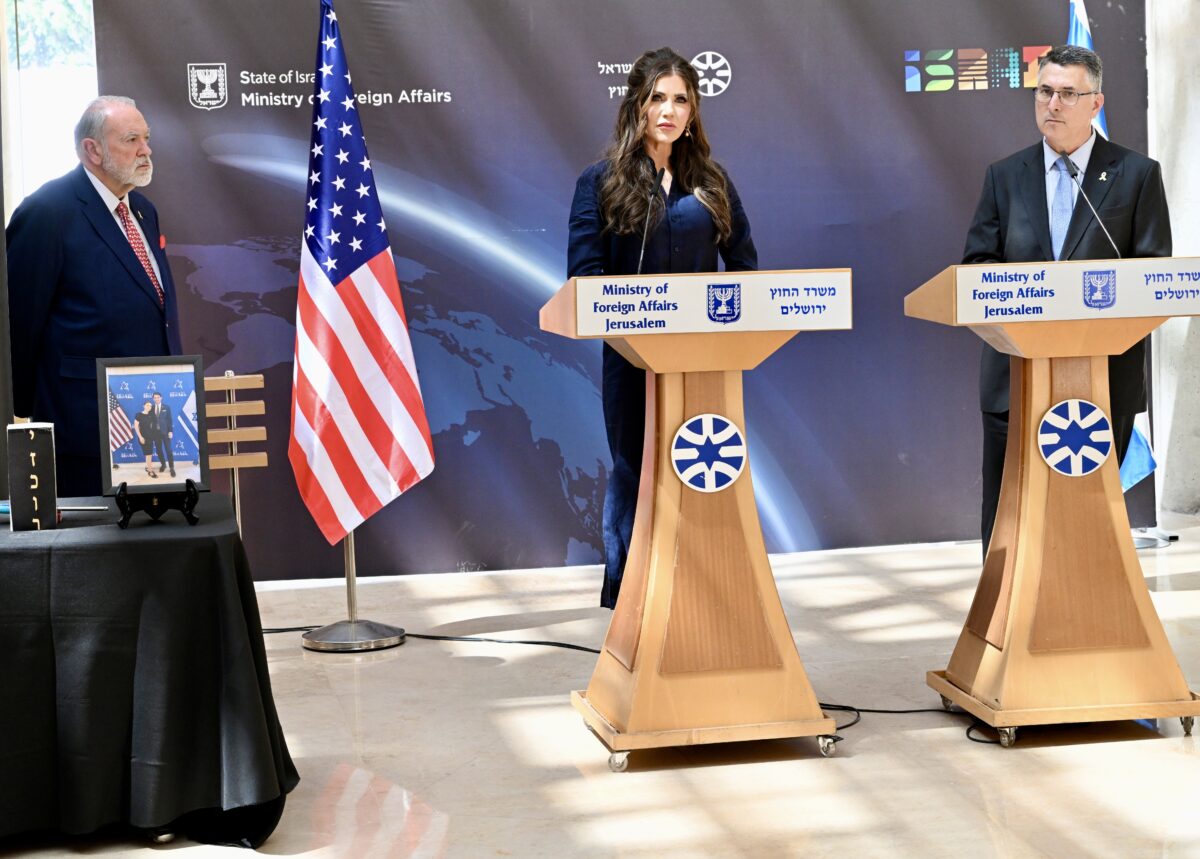
The murder of Yaron Lischinsky and Sarah Lynn Milgrim is a reminder “of the dreams that terrorism seeks to destroy every single day,” Homeland Security Secretary Kristi Noem said on Monday, standing alongside Israeli Foreign Minister Gideon Sa’ar at a memorial event held in Jerusalem for the young Israeli Embassy staffers who were killed last week in a terror attack outside the Capital Jewish Museum in Washington, Jewish Insider’s Tamara Zieve reports.
What she said: “Today, we stand together with profound grief, and our hearts are heavy with the loss of these two radiant souls that we will no longer have with us,” Noem said. “In this moment of sorrow, we also ask that you would gather with us to honor their light and the unbreakable spirit of the Israeli and the American people,” Noem continued. Lischinsky, Noem said, “was known for his infectious smile and his unwavering commitment to peace and the vision of the Abraham Accords.” Noem said that “Friends and family shared of Sarah that she glowed with warmth and compassion, dedicating her life to fostering peace and understanding,” mentioning Milgrim’s work for the Israeli peace-building nonprofit Tech2Peace and her career in public diplomacy.
Candidate’s call: Following the murder of the two Israeli Embassy employees, Rep. Mikie Sherrill (D-NJ), a New Jersey gubernatorial candidate, wrote to federal leaders to call for further action to protect the Jewish community and raised concerns about growing trends of antisemitic violence across the country, Jewish Insider’s Marc Rod reports.
SENIOR SHAKE-UP
Top Middle East, Israel and Iran officials pushed out of NSC
The top National Security Council officials overseeing the Middle East and Israel and Iran portfolios — seen as pro-Israel voices in the administration — were among the dozens of officials dismissed in a widespread purge at the NSC on Friday, two sources familiar with the situation told Jewish Insider’s Marc Rod and Emily Jacobs.
Who’s out: Eric Trager, who was the senior director for the Middle East and North Africa — the lead official on the Middle East — and Merav Ceren, the director for Israel and Iran, were both Trump administration political appointees but were pushed out in what one official called a purge of “the Deep State” inside the NSC. Their firings come as voices skeptical of the U.S.’ role in the Middle East increasingly establish a foothold in the administration, and as President Donald Trump and Secretary of State Marco Rubio, who is also the acting national security advisor, seek to restructure and slim down the key foreign policy-making body.
HAMAS HANDOUT
Report: U.K. one of the top three sources of funding for Hamas

One of Hamas’ top three sources of funding is the U.K., where it is a banned terrorist organization, an investigation from Israel’s Channel 12 found. That funding includes 25% of Hamas’ donors from non-state actors, as well as tens of millions of dollars from the government of the U.K. to a UNICEF program whose beneficiaries are determined by Hamas, Jewish Insider’s Lahav Harkov reports.
Follow the money: The U.K., France and Canada threatened Israel last week with “concrete actions” if it does not lift restrictions on humanitarian aid and work with United Nations agencies to distribute it. The U.K., Canada and the European Union — of which France is a member — as well as Switzerland, Norway, Sweden, Mauritius and Croatia, sponsored a project through UNICEF, the U.N. Children’s Emergency Fund, for which a Hamas-run ministry provides a list of people to receive funding. The program provides cash payments of $200-$300 per month to 546,000 needy people in Gaza. UNICEF said that it works with a “beneficiary list from the MoSD,” meaning the Hamas-controlled Ministry of Social Development, to determine who receives the cash. The program uses a digital platform funded by USAID to distribute the cash. UNICEF published an update on the program as recently as November 2024. U.K. officials have denied the allegations.
SCOOP
Sens. Cornyn, Blumenthal introduce bill to help Jewish families recover Nazi-looted art

Sens. John Cornyn (R-TX) and Richard Blumenthal (D-CT) introduced bipartisan legislation last week aimed at eliminating loopholes used by museums and other stakeholders to continue possessing Nazi-looted artwork that Jewish families have been trying to recover, Jewish Insider’s Emily Jacobs reports.
Details: Introduced on Thursday, the Holocaust Expropriated Art Recovery (HEAR) Act would expand on Cornyn’s 2016 legislation of the same name, which was passed at the time by unanimous consent, by ending the Dec. 31, 2026, sunset date on the original bill and strengthen the existing procedural protections to ensure that victims’ claims are not dismissed due to non-merit-based factors such as time constraints. “The artwork wrongfully ripped from Jewish hands during the Holocaust bears witness to a chapter in history when evil persisted and the worst of humanity was on full display,” Cornyn said in a statement.
Worthy Reads
Battering Rahm: The Free Press’ Peter Savodnik interviews former U.S. Ambassador to Japan Rahm Emanuel as the Democrat mulls a return to politics — and a 2028 presidential bid. “I asked him whether someone with his biography could win the Democratic nomination. It wasn’t just that he was part of the Democratic establishment. It was that he was a Jew with the middle name ‘Israel,’ and he was unequivocally supportive of the Jewish state’s right to exist. … He did not think of himself as enigmatic. ‘I’ve shown I’ve got the strength to say my views, and one of the key things about being a president is you got cojones, and you got strength,’ he told me. He added: ‘I’m not naive to antisemitism. I’m not naive to certain elements within the left.’ His point — about winning his House seat and being elected mayor — was that the people, the voters, mattered the most, and he believed that, in the end, they would be on his side. ‘There’s going to be people who try to bring up stereotypes or other types of things, and I’ve never hid my Judaism — not gonna — but I have confidence in the public.’” [FreePress]
The Future Sarah Saw: In The New York Times, Yasmina Asrarguis, a friend of Israeli Embassy staffer Sarah Lynn Milgrim, reflects on their friendship and the politicization of Milgrim’s death in the aftermath of the Capital Jewish Museum attack. “Sarah’s legacy must not be co-opted, not by the person who shot her, and not by those who now wish to brand her with their politics or make her a poster child for a cause. Sarah’s name should not become a pawn, nor a rallying cry, for those who seek to weaponize her death for political gain on either side of this conflict. … In his bullets, the killer could not have seen all that Sarah was, all that she believed in. Her Jewish identity was flattened into a target. In her murder he picked exactly the sort of person who might have altered the future. But just as the extremist misunderstood Sarah, so too do many of those who profess to weep for her loss. Those who mourn Sarah should reflect on her ideals, learn from her life’s work and aim as she did on creating the fragile groundwork for Middle East peace. It was a future she helped prepare for, one conversation, one relationship at a time.” [NYTimes]
When Violence Is Rationalized: In The Atlantic, the Manhattan Institute’s Reihan Salam and Jesse Arm consider the underlying root of American political violence following the Capital Jewish Museum attack. “What we’re witnessing is an issue not with Israel, but with America. When violence aimed at Jews — or those seen as aligned with them — is dismissed, excused, or rationalized, it undermines the civic norms that hold our society together. Elite institutions that once upheld liberal pluralism now indulge a form of identity politics that prizes grievance over justice. Some of the ugliest reactions to the D.C. shooting treated the murders as incidental — or even deserved. That’s not just moral failure. It represents a worldview that treats violence as politics by other means. Such rationalizations have been used to justify the ideological murder of a health-care executive, coordinated arson attacks on Tesla dealerships by anti-capitalist extremists, and, now, executions outside a Jewish museum in the nation’s capital.” [TheAtlantic]
Word on the Street
Kingsley Wilson, a deputy press secretary at the Department of Defense who has come under fire from Democratic and Republican lawmakers and Jewish communal organizations for promoting antisemitic conspiracy theories, has been promoted to serve as the department’s press secretary, the Pentagon announced on Friday, Jewish Insider’s Gabby Deutch reports…
President Donald Trump said he was “considering” taking $3 billion in grant funding to Harvard and redistributing the funds to trade schools across the country…
Trump also said on Sunday that he expected to have “good news” on the ongoing Iran nuclear talks later this week, ahead of a fifth round of talks slated for Friday in Rome…
Sens. Tim Scott (R-SC), Maggie Hassan (D-NH) and three bipartisan co-sponsors reintroduced legislation to repeal the sunset on energy sanctions on Iran first passed in 1996…
Sens. Chris Coons (D-DE) and David McCormick (R-PA) introduced legislation requiring a whole-of-government strategy to counter cooperation between Iran, Russia, China and North Korea…
A group of more than 50 House Republicans led by Rep. Addison McDowell (R-NC) introduced a resolution commemorating Israeli Embassy staffers Yaron Lischinsky and Sarah Milgrim, who were killed in an attack outside the Capital Jewish Museum last week…
The Washington Post’s Mark Lasswell reflects on “an extreme week in antisemitism,” including the murders of two Israeli Embassy staffers in Washington, the resignation of the BBC’s Gary Lineker following his posting of an antisemitic social media image and a widely reported but false statement by a U.N. official regarding infant deaths in Gaza…
Moldova extradited to the U.S. a Georgian national and Eastern European neo-Nazi group leader who had instructed an undercover federal agent to dress as Santa Claus and distribute poison-laced candy to Jewish children…
The New York Times reports on an extensive Russian spy operation with roots in Brazil; the spies were identified and in some cases apprehended using intelligence gathered from, among other countries, the U.S. and Israel…
Dozens of prominent Jewish philanthropists from the United States, U.K., Australia and Israel sent a letter to Israeli Foreign Minister Gideon Sa’ar decrying a proposed bill that would impose an 80% tax on foreign governments’ donations to Israeli nonprofits, ahead of a Knesset committee hearing on the legislation later this week, eJewishPhilanthropy’s Judah Ari Gross reports…
The Washington Post looks at the efforts by the mother of a U.S. Army soldier who was injured last year while working on the U.S.’ ill-fated humanitarian pier in Gaza and later died from his injuries to find answers to questions surrounding his death…
Israeli Opposition Leader Yair Lapid accused the Israeli government of setting up two shell companies, backed by taxpayer money, to fund the humanitarian aid effort in Gaza; the Prime Minister’s Office denied the claim…
The Gaza Humanitarian Foundation began operations on Monday, a day after its CEO, Jake Wood, resigned due to what he said was an inability to operate according to the “humanitarian principles of humanity, neutrality, impartiality, and independence”; the foundation’s chief operation officer also resigned…
Middle East envoy Steve Witkoff slammed Hamas’ “disappointing and completely unacceptable” response to a U.S.-proposed ceasefire and hostage-release agreement that would secure the release of 10 of the remaining 21 hostages believed to be alive…
Former Israeli hostage Liri Albag was briefly detained at New York’s JFK International Airport over an outdated system note that still listed Albag as still being in captivity in Gaza…
Far-right Israelis chanted anti-Arab slurs as tens of thousands marched through the Old City of Jerusalem to celebrate Jerusalem Day…
U.K. authorities said that an incident in which dozens of people in Liverpool were injured after a driver ploughed through a crowd of Liverpool FC supporters was not tied to terrorism…
The Financial Times reviews Uwe Wittstock’s Marseille 1940: The Flight of Literature, about the Emergency Rescue Committee’s formation and efforts to save German Jews, many of whom were writers and intellectuals, at the start of WWII…
Iranian filmmaker Jafar Panahi’s “Un Simple Accident” won the Palme d’Or prize at the Cannes Film Festival; the film was shot clandestinely inside Iran by Panahi, who was until recently barred from leaving the country…
Filmmaker Michael Roemer, who with his sister was rescued by the Kindertransport during WWII and whose work included “Nothing But a Man” and “The Plot Against Harry,” died at 97…
German-born documentarian Marcel Ophuls, whose film “The Sorrow and the Pity” debunked the myth of a widespread French resistance to the Nazis during WWII, died at 97…
Artist and children’s book author Judith Hope Blau, who made jewelry and other works out of bagels, died at 87…
Writer Leslie Epstein, whose “King of the Jews” received widespread acclaim, died at 87…
Pic of the Day

“Fauda” actor Idan Amedi, who was seriously injured during reserve duty in Gaza last year, spoke on Saturday evening in conversation with Rabbi Marc Schneier at the Hampton Synagogue in Westhampton Beach, N.Y.
Birthdays

Emmy Award-winning actor, comedian and director, Richard Schiff turns 70…
MONDAY: Public speaker, teacher and author, Richard Lederer turns 87… Journalist and educator, the mother of the late Susan (former CEO of YouTube), Janet (anthropologist and UCSF professor) and Anne (co-founder of 23andMe), Esther Hochman Wojcicki turns 84… Member of the U.S. House of Representatives (D-IL) since 1999, Janice Danoff “Jan” Schakowsky turns 81… Former SVP of News at NPR, after a lengthy career at the New York Daily News, The New York Times and the Associated Press, Michael Oreskes turns 71… Co-founder and CEO of Mobileye which he sold to Intel in 2017, he is also a professor at Hebrew University, Amnon Shashua turns 65… NYC real estate developer, board member of The Charles H. Revson Foundation and a former commissioner on the NYC Planning Commission, Cheryl Cohen Effron… Former brigadier general in the IDF, she has been a member of the Knesset for the Likud since 2009, currently serving as minister of transportation, Miriam “Miri” Regev turns 60… Counsel in the government affairs practice of Paul Hastings, Dina Ellis Rochkind… Photographer, her work has appeared in galleries and been published in books, Naomi Harris turns 52… South Florida entrepreneur, Sholom Zeines… Program officer for media and communications at Maimonides Fund, Rebecca Friedman… Former minor league baseball player, he has become one of the leading agents for NBA players, with five contracts of over $100 million each, Jason Glushon turns 40… Executive editor of Ark Media, she is the author of a book last year on the 1929 origins of the current Israeli-Arab conflict, Yardena Schwartz… CEO and director of the National Jewish Advocacy Center, Mark Goldfeder… Co-founder of Stories Abroad Tours, Arielle Gingold… Assistant professor of law at Wayne State University Law School, Benjamin L. Cavataro… Toronto-born Israeli actress and singer, best known as the protagonist of the Israeli television series “Split,” Melissa Amit Farkash turns 36… Strategic partnerships and engagement manager at U.S. Pharmacopeia, Morgan A. Jacobs… Catcher in the Philadelphia Phillies organization, he played for Team Israel in the 2023 World Baseball Classic, Garrett Patrick Stubbs turns 32… Eytan Merkin…
TUESDAY: Retired professor at Northwestern University’s Kellogg School of Management, he is the author of 80 books, Philip Kotler turns 94… Founder of Val d’Or Apparel and Cannon County Knitting Mills, Martin “Marty” Granoff turns 89… CEO of British real estate firm Heron International, he was knighted in 2024, Sir Gerald Ronson turns 86… Senior U.S. district judge for the Central District of California, Christina A. Snyder turns 78… Retired in 2014 as school rabbi and director of Jewish studies at The Rashi School, a K-8 Reform Jewish school in Dedham, Mass., Ellen Weinstein Pildis… Partner in the D.C. office of ArentFox Schiff, he wrote a book about the struggle for Jewish civil rights during the French Revolution, Gerard Leval turns 75… Analytical psychotherapist, author, and Jewish Renewal rabbi, Tirzah Firestone turns 71… Former MLB pitcher (1978-1982) who played for the White Sox and Pirates, he is now a financial advisor at RBC Wealth Management, Ross Baumgarten turns 70… Owner of a 900-acre plant nursery in Kansas, he is a former MLB pitcher (1979-1990) and was an MLB All Star in 1979 and 1982, Mark Clear turns 69… Marriage counselor, therapist and author, Sherry Amatenstein… U.S. ambassador to Argentina during the Biden administration, he served for six years as chairman of the National Jewish Democratic Council, Marc R. Stanley turns 68… Beverly Hills-based immigration attorney, founder and chairman of the Los Angeles Sephardic Jewish Film Festival, Neil J. Sheff… General manager of Phibro Israel and co-founder of LaKita, a non-profit crowd-funding platform for Israeli public schools, Jonathan Bendheim… Workplace and labor reporter at The New York Times, Noam Scheiber… Stage, film and television actor and producer, Ben Feldman turns 45… Director of development at the Livingston, N.J.-based Joseph Kushner Hebrew Academy, Grant Silverstein… “Science of Success” columnist for The Wall Street Journal, Benjamin Zachary Cohen… Director of legislative affairs and policy at General Atomics, Katherina (Katya) Dimenstein… Assistant district attorney for Bronx County, Joshua A. Fitterman… Reporter for the Philadelphia Inquirer since 2012, Andrew Seidman… Emily Cohen…
Blumenthal: ‘Our bipartisan effort seeks to strengthen measures to bring long overdue justice to families whose cherished art was brazenly stolen by the Nazis’

J. Scott Applewhite/AP Photo
Sen. John Cornyn, R-Texas, center, is flanked by Senate Judiciary Committee Chairman Dick Durbin, D-Ill., left, and Sen. Richard Blumenthal, D-Conn., at the Capitol in Washington, Thursday, Nov. 14, 2024.
Sens. John Cornyn (R-TX) and Richard Blumenthal (D-CT) introduced bipartisan legislation last week aimed at eliminating loopholes used by museums and other stakeholders to continue possessing Nazi-looted artwork that Jewish families have been trying to recover.
Introduced on Thursday, the Holocaust Expropriated Art Recovery (HEAR) Act would expand on Cornyn’s 2016 legislation of the same name, which was passed at the time by unanimous consent, by ending the Dec. 31, 2026, sunset date on the original bill and strengthen the existing procedural protections to ensure that victims’ claims are not dismissed due to non-merit-based factors such as time constraints.
“The artwork wrongfully ripped from Jewish hands during the Holocaust bears witness to a chapter in history when evil persisted and the worst of humanity was on full display. I’m proud to introduce this legislation to support the Jewish people and Holocaust survivors by helping them recover art confiscated by the Nazis that they are rightfully owed and give them the justice and restitution they deserve,” Cornyn said in a statement.
“The theft of art by the Nazi regime was more than a pilfering of property — it was an act of inhumanity. Our bipartisan effort seeks to strengthen measures to bring long overdue justice to families whose cherished art was brazenly stolen by the Nazis,” Blumenthal said.
Many families of Holocaust victims in the U.S. who have located artwork from deceased relatives and sued to recover those items face the deadline at the end of next year before the statute of limitations sets in. Thousands of stolen works of art remain unreturned to their rightful owners from the Nazi plunder, and there are scores of ongoing cases to resolve disputes over ownership of those items.
“Unfortunately, many museums, governments, and institutions have contradicted Congress’ intent and obstructed justice by stonewalling legitimate claims, obscuring provenance, and employing aggressive legal tactics designed to exhaust and outlast Survivors and their families. Rather than embracing transparency and reconciliation, too many have chosen to entrench and litigate, effectively preserving possession of stolen works rather than returning them to their rightful owners,” a press release for the bill states.
Sens. Thom Tillis (R-NC), Cory Booker (D-NJ), Marsha Blackburn (R-TN), John Fetterman (D-PA), Eric Schmitt (R-MO) and Katie Britt (R-AL) co-sponsored the bill, which was endorsed by a number of Jewish organizations including Agudath Israel of America, the American Jewish Committee, Anti-Defamation League, Jewish Federations of North America, StandWithUs and World Jewish Congress, among others.
“This legislation helps to right a historic wrong committed during one of the darkest chapters in history. By eliminating unnecessary legal obstacles, the HEAR Act establishes a clear path to restitution for Holocaust survivors and their families, ensuring that art and cultural property stolen by the Nazis can finally be returned to their rightful owners,” Tillis said.
Fetterman said in a statement, “Eighty years after the Holocaust, we have a moral responsibility to do right by the victims of these atrocities and their families. I’m grateful to join my colleagues from both sides of the aisle in introducing the HEAR Act to help return artwork stolen by the Nazis to its rightful owners.”
Some Israeli business leaders and innovators are urging the country to seriously consider adopting a strategy of ‘economic diplomacy’ to place the country more firmly on Trump’s radar

Win McNamee/Getty Images
U.S. President Donald J. Trump and Emir of Qatar Tamim bin Hamad al Thani attend a signing ceremony at the Amiri Diwan, the official workplace of the emir, on May 14, 2025, in Doha, Qatar.
During President Donald Trump’s trip to the Middle East earlier this month, he shuttled between Gulf capitals to announce major economic deals. In Qatar, it was an eye-popping $1.2 trillion economic commitment in trade agreements and direct investment. Saudi Arabia pledged to invest $600 billion in the United States in defense, energy and infrastructure. And in the United Arab Emirates, Trump announced a series of agreements — including one to build Stargate UAE, the largest artificial intelligence campus outside the United States, in partnership with OpenAI and Nvidia — worth more than $200 billion, on top of $1.4 trillion previously committed in U.S. investments.
Missing from the list of deals announced on Trump’s Middle East junket was any kind of similar agreement with Israel, which Trump did not visit on his first major trip abroad since returning to office. Economic ties between the U.S. and Israel are strong; Israel is a larger trading partner to the U.S. than either Saudi Arabia, the UAE or Qatar, and American investors are among the biggest investors in Israeli startups. But the country lacks the liquid financial firepower that is available to the oil-rich Gulf monarchies, which risks placing Israel at a disadvantage in the eyes of an American president who sees the world as a series of business deals.
“You try not to compete in areas where you have a disadvantage. We have a capital disadvantage. So we should compete where we have an advantage, which is on innovation and technology,” said Michael Eisenberg, who co-founded Aleph, an Israeli VC firm.
Some Israeli business leaders and innovators are now urging the country to seriously consider adopting a strategy of “economic diplomacy” to place the country more firmly on Trump’s radar. They think that startup founders and venture capitalists stand to serve as Israel’s best ambassadors, better suited to make the economic case for deepening U.S.-Israel ties than the buttoned-up bureaucrats who populate global capitals advancing Israel’s interests.
“Founders are Israel’s best ambassadors. They travel more than diplomats, pitch to the world’s biggest investors and solve real-world problems that transcend borders,” said Jon Medved, the Israel-based CEO of OurCrowd, a global venture investing platform. “Do they have a responsibility to engage in economic diplomacy? I think they already do, whether they realize it or not.”
Where the Gulf countries have the ability to spend seemingly endless sums of money on American investments and projects to woo Trump, Israel offers “deep tech expertise” and a venue for early stage collaboration that cannot easily be replicated.
“We’re the lab. The Gulf can be the scale-up market,” Medved continued. “There’s a powerful opportunity for synergy, not just competition.”
It’s not news to the American government that Israel excels in technology. In 2022, the two countries launched a strategic high-level dialogue on technology as a way to advance cooperation on artificial intelligence, climate change and pandemic preparedness. (The dialogue slowed down after the Oct. 7, 2023, Hamas attacks.)
Avner Golov, who until 2023 served as the senior director for foreign policy in Israel’s Prime Minister’s Office, thinks the collaboration between the two countries should be formalized with a photo op, like the signing ceremonies Trump participated in during his visit to the Gulf. The U.S.-Israel security memorandum of understanding, which promises Israel $3.3 billion in U.S. security assistance annually, expires in 2028, and Golov thinks the renegotiation of that agreement is an opportunity to strengthen the tech and economic ties between the countries — to put Israel’s tech diplomacy to the test.
“I envision going to the White House Rose Garden, signing, for the first time, a formal strategic partnership between Israel and America, approved in both Congress and the Israeli Knesset,” Golov told Jewish Insider. Such a deal, as Golov sees it, might also include ways to make it easier for American businesses to operate in Israel.
Eisenberg, who has invested in major Israeli startup successes such as WeWork and Lemonade, thinks changes to Israel’s “regulatory environment” can help make the sell to American companies and, by extension, Trump.
“We’re not going to do zero taxes like Dubai, but we need to be attracting more capital here by making our regulatory environment much simpler and lowering our capital gains taxes to be competitive with the United States so that we can bring capital formation vehicles like hedge funds to Israel,” Eisenberg said.
Of course, many leading tech companies already have large operations in Israel. The chip giant Nvidia announced a $500 million investment in an Israeli AI research data lab in January. In March, Google acquired the Israeli cybersecurity company Wiz for $32 billion, Google’s largest-ever acquisition. Nvidia CEO Jensen Huang and Google President Ruth Porat were with Trump in Saudi Arabia, along with other top CEOs.
“Many of them have employees in Israel because of our innovation, but we need to build a strategy around attracting them, getting deeper engagement and using them in our attempt to build us into a regional superpower,” added Eisenberg.
Israeli Prime Minister Benjamin Netanyahu has long touted Israel’s startup ecosystem, but some worry he has not sufficiently tapped into that world to meet the moment, when Trump — whom Netanyahu has always sought to present as a close friend — seeks flashy financial success on the world stage.
“[Netanyahu] should have realized that in a competition for the affections of a strongman like Trump, Israel had little to offer,” The Atlantic’s Yair Rosenberg wrote this month.
But the basis of the U.S.-Israel relationship has never been purely about dollars and cents.
“If we’re going to make sure, ‘Hey, don’t forget about us,’ it’s not about money. It’s about morality and humanity and the purpose of Israel on the world stage,” former U.S. Ambassador to Israel Tom Nides told JI. “Obviously there’s this whole notion that there are a lot of deals to be done. But that’s not how we compete.”
Israel’s controversial national security minister, Itamar Ben-Gvir, also met with Noem and says she invited him to visit the U.S.
David Azagury, U.S. Embassy Jerusalem
U.S. Secretary of Homeland Security Kristi Noem pays her condolences at a memory ceremony for slain Israeli Embassy staffers, Yaron Lischinsky and Sarah Milgrm who were killed in a terror attack in Washington D.C., on May 21, 2025. The Ceremony took place at the Israeli Ministry of Foreign Affairs headquarters on May 26, 2025.
The murder of Yaron Lischinsky and Sarah Lynn Milgrim is a reminder “of the dreams that terrorism seeks to destroy every single day,” Homeland Security Secretary Kristi Noem said on Monday, standing alongside Israeli Foreign Minister Gideon Sa’ar at a memorial event held in Jerusalem for the young Israeli Embassy staffers who were killed last week in a terror attack outside the Capital Jewish Museum in Washington.
“Today, we stand together with profound grief, and our hearts are heavy with the loss of these two radiant souls that we will no longer have with us,” Noem said. “In this moment of sorrow, we also ask that you would gather with us to honor their light and the unbreakable spirit of the Israeli and the American people,” Noem continued.
Lischinsky, Noem said, “was known for his infectious smile and his unwavering commitment to peace and the vision of the Abraham Accords.”
“Friends and family shared of Sarah that she glowed with warmth and compassion, dedicating her life to fostering peace and understanding,” Noem said, mentioning Milgrim’s work for the Israeli peace-building nonprofit Tech2Peace and her career in public diplomacy. “Their love for each other, a bond that was so strong that Yaron had already chosen a ring to propose to Sarah here in Jerusalem reminds us of the dreams that terrorism seeks to destroy every single day — but we will not let hatred have the final word.”
“Sarah and Yaron’s lives are a testament to the power of love and service,” Noem said. “They stood for something that was much larger than themselves, and their memory calls us to do the same. They have lived a life of significance that has forever changed us. Together they embody the very best of Israel: courageous, hopeful and dedicated to peace.”
Sa’ar thanked Noem for her visit to Israel, which he said, “shows solidarity and demonstrates the close relations between our people.” He also thanked the U.S. government for the investigation into the murder of Lischinsky and Milgrim.
U.S. Ambassador to Israel Mike Huckabee also spoke at the event, held at the Israeli Ministry of Foreign Affairs headquarters, and said that the memories of Lischinsky and Milgrim “will not be taken from any of us, and we should always be mindful that there are people who pay an incredible price to simply be Israelis and Jews.”
“And it’s why the United States must always stand, and it’s why it’s so very important that we welcome the secretary here to the State of Israel as she comes to offer in person an extraordinary sense — not just of condolences — but also a sense of confidence that the relationship between our nations will never waver, or will it ever falter.”
The remarks by both the American and Israeli officials emphasizing the importance of the strong bonds between the U.S. and Israel come amid recent reports about faltering ties, especially during President Donald Trump’s recent visit to the Middle East, which excluded Israel, and amid the Trump administration’s ongoing nuclear negotiations with Iran.
Noem arrived in Israel on Sunday evening when Jerusalem Day began, marking the city’s reunification in the 1967 Six-Day War, which made her the first U.S. cabinet secretary to mark that day, according to Huckabee. She prayed at the Western Wall and put a note between its cracks.
Noem later met with Israeli Prime Minister Benjamin Netanyahu, in which she “expressed unqualified support for the prime minister and the State of Israel,” a Prime Minister’s Office readout stated.
She also praised the border fence between Israel and Egypt, the PMO stated. The fence, which was completed in 2013, was built, in part, to block African migrants from crossing into Israel from the Sinai peninsula.
Noem also met last night with her counterpart, Itamar Ben-Gvir, in a meeting which was also attended by Netanyahu. According to a statement from Ben-Gvir’s office, the minister thanked Noem for American support for Israel and for Trump’s relocation plan for Gaza. The statement also noted that Noem invited Ben-Gvir for another visit to the U.S. During his last visit, in April, the far-right minister did not meet with Noem, who was in Texas at the time, nor anyone else in the Trump administration.
JI’s Lahav Harkov contributed to this report.
Killing of embassy workers ‘exemplifies the challenges facing people representing the State of Israel abroad,’ former ambassador Herzog tells JI

Kevin Dietsch/Getty Images
Mourners lights candles during a vigil outside of the White House on May 22, 2025 in Washington, DC for the victims of the Capital Jewish Museum shooting on Wednesday evening, Yaron Lischinsky and Sarah Lynn Milgrim.
Yaron Lischinsky was laid to rest on Sunday in Beit Zayit, a moshav outside of Jerusalem, after he was killed alongside his partner, Sarah Lynn Milgrim, by a shooter who shouted “Free Palestine” at the Capital Jewish Museum in Washington on Wednesday.
Hundreds attended the funeral, according to sources present. The funeral was closed to the media at the family’s request. Among those who attended were Israeli Foreign Minister Gideon Sa’ar, Deputy Foreign Minister Sharren Haskel and Lischinsky’s direct superior at the embassy, Minister-Counselor for Middle East Affairs Noa Ginosar, who accompanied his body to Israel.
Former Israeli Ambassador to the U.S. Michael Herzog spoke at the funeral and told Jewish Insider that Lischinsky, a researcher in the embassy’s Middle East Affairs department, was someone “any ambassador would love to have serving in his embassy.”
“He was young, energetic and very talented,” Herzog, who finished his tenure as ambassador in January, said. “He had intellectual curiosity and a lot of knowledge. He was very devoted to his diplomatic work. He was creative and he was really a benefit to the embassy.”
Lischinsky considered taking the Israeli Foreign Ministry’s cadets course, Herzog recalled, which he, along with other senior embassy staff encouraged him to do, believing he had the aptitude to be a successful diplomat.
“We could rely on him, especially during the war,” the former ambassador added.
Herzog said he told Lischinsky’s parents that “unfortunately, tragically, they cannot bring Yaron back, but they should be proud of what he did, what he achieved and the mark he left.”
The former ambassador also spoke about Milgrim, whose funeral is set to be held on Tuesday in Kansas City, near where her family lives. Milgrim’s work at the Israeli Embassy focused on environmental issues and outreach to progressive groups.
“Like [Lischinsky], she was beautiful on the inside and outside,” Herzog said. “It was very painful to see such young, beautiful flowers destroyed at such a young age.”
Herzog also said that Lischinsky and Milgrim’s murder “exemplifies the challenges facing people representing the state of Israel abroad.”
“They are at the forefront of the diplomatic efforts of the State of Israel, but also face a security challenge. Anybody who served in Washington can attest to the eruption of the crazy threat level after Oct. 7 [2023] and the incitement and brainwashing against Jewish people and the Jewish state, and they were victims of that,” he said.
“We have to continue the battle for the very legitimacy of Israel,” Herzog added. “They can light our path in that direction.”
Homeland Security Secretary Kristi Noem landed in Israel on Sunday evening, and will participate in a memorial tree-planting ceremony for Lischinsky and Milgrim at the Foreign Ministry in Jerusalem on Monday morning.
Countries threatening Israel if it does not work with U.N. on humanitarian aid are funding a Hamas-controlled program to distribute aid in Gaza; USAID also involved

OMAR AL-QATTAA/AFP via Getty Images
A Palestinian man stands next to a truck carrying UNICEF aid supplies outside a shopping mall in Gaza City on May 12, 2025.
One of Hamas’ top three sources of funding is the U.K., where it is a banned terrorist organization, an investigation from Israel’s Channel 12 found. That funding includes 25% of Hamas’ donors from non-state actors, as well as tens of millions of dollars from the government of the U.K. to a UNICEF program whose beneficiaries are determined by Hamas.
The U.K., France and Canada threatened Israel last week with “concrete actions” if it does not lift restrictions on humanitarian aid and work with United Nations agencies to distribute it.
The U.K., Canada and the European Union — of which France is a member— as well as Switzerland, Norway, Sweden, Mauritius and Croatia, sponsored a project through UNICEF, the U.N. Children’s Emergency Fund, for which a Hamas-run ministry provides a list of people to receive funding.
The program provides cash payments of $200-$300 per month to 546,000 needy people in Gaza. UNICEF said that it works with a “beneficiary list from the MoSD,” meaning the Hamas-controlled Ministry of Social Development, to determine who receives the cash. The program uses a digital platform funded by USAID to distribute the cash. UNICEF published an update on the program as recently as November 2024.
MoSD is led by Ghazi Hamad, a member of Hamas’ politburo, designated a “senior Hamas official” by the U.S. Treasury Department.
A 2022 document from the U.K. Foreign Office, uncovered by NGO Monitor, showed that London was aware of Hamas’ involvement with the program and that it had the potential for “severe” reputational damage.
“The cash assistance component will be implemented in coordination with the Ministry of Social Development MoSD. The MoSD in Gaza is affiliated with the de facto authorities and thus UK Aid can be linked directly or indirectly with supporting the de facto authority (Hamas) in Gaza which is part of a proscribed group,” the document reads.
The U.K. gave about $23.1 million to UNICEF projects in the West Bank and Gaza in 2024, and $4.8 million in 2023.
NGO Monitor’s legal Advisor, Anne Herzberg, noted that it is unclear how much of that funding went to the Gaza cash program.
“There is very little detail from the U.K. side about how much is going in, what oversight is in place, what exactly they are doing to mitigate the risk” of money going to Hamas, Herzberg told Jewish Insider on Sunday. “A lot of countries are giving funds to the U.N. and just leave it in their hands.”
Herzberg said that while a lot of attention has gone to UNRWA, the U.N. agency for Palestinian refugees and their descendants, which was recently banned from Israel after some of its employees participated in the Oct. 7, 2023, attacks, “UNRWA is just the tip of the iceberg, because 13 U.N. agencies are operating in Gaza. There is very little information into how these other U.N. agencies are operating.”
“Aid diversion is the main problem and why there have been so many issues with humanitarian aid in Gaza,” she said. “It’s inconceivable to me that these governments refuse to deal with this issue. They claim they want to help Palestinians, to end the conflict and bring peace, yet they don’t want to tackle this issue.”
Beyond government aid going to Hamas, what qualifies the U.K. as the leading non-Muslim country funding Hamas is nongovernmental contributions, Channel 12 reported.
In 2001, Muslim Brotherhood-affiliated Sheikh Yusuf Al-Qaradawi founded the Union of Good, a coalition of 50 Islamist charities with connections to Hamas and other proscribed terrorist groups. The group raised hundreds of millions of dollars for Hamas during the Second Intifada.
The organization was banned in the U.S. and U.K., and Qaradawi, who is Egyptian and lives in Doha, Qatar, has been barred from the U.S., U.K. and France.
Yet the organizations making up the Union of Good continued their fundraising activities.
The Channel 12 report names specific Hamas operatives based in the U.K., including Zahar Birawi, who is the head of the Palestinian Return Center in London, leads Hamas activities in Great Britain and has been instrumental in organizing weekly anti-Israel protests in London. Issam Yusef Mustafa, a former member of the Hamas politburo, is a U.K. citizen and is the biggest fundraiser for Hamas in Europe as the head of “Interpal,” a former Union of Good group sanctioned by the U.S. and Israel.
Herzberg explained that many of the organizations funneling money to Hamas are registered as businesses so they can avoid scrutiny from the Charity Commission.
“The monitoring in the U.K. does not seem as robust as what you see in the U.S., where there are many more investigations going on at the governmental level and more reporting, even though the U.K. government says it has robust control in its laws,” Herzberg said. “It’s unclear how those laws are being enforced.”
Erez Noy, a former Shin Bet official dealing with terror funding, told Channel 12 that “Hamas is strong in Britain because over the years they got used to being able to do almost anything they want there, compared to other countries in Europe … For years, Britain, for whatever reason, did not handle preventing and taking care of these systems [to fund terror]. When Hamas realizes there is a permissive arena, it tests the limits.”
Hamas petitioned the U.K. last month to be removed from the country’s list of banned terrorist organizations.
According to Udi Levy, the former head of the Mossad’s department for fighting terrorism funding, “these are businesses that raise funds under the guise of humanitarian aid, and reach Hamas in Gaza, Judea and Samaria [the West Bank] and anywhere else around the world.”
Levy told Channel 12 that “total victory over Hamas is not just in the Gaza Strip. We are making a huge mistake because even if we kill every last ‘soldier’ in Gaza, there is still a massive Hamas infrastructure that will continue to act and even rehabilitate its activities, unless we start taking care of it.”
The British Embassy in Israel said in response to a query from JI that “Hamas is a proscribed terrorist organization in the U.K. and funding or supporting it is a crime. We categorically reject the false and irresponsible allegations in the Channel 12 investigation that the UK Government funds Hamas run agencies in Gaza. No UK funding was provided to the Ministry of Social Development in Gaza … We are clear that Hamas must play no role in the future of Gaza. FCDO [the Foreign Office] conducted a thorough due diligence assessment of UNICEF, and we identify how U.K. funds are transferred until they reach the final beneficiaries.”
The embassy interpreted the claim made by the U.K. Foreign Office that “U.K. Aid can be linked directly or indirectly with supporting the de facto authority (Hamas) in Gaza which is part of a proscribed group,” as referring to the Ministry of Social Development in Ramallah run by the Palestinian Authority.
In addition, the embassy stated that it does “not recognize the claim that 25% of Hamas’s non-state funding comes from the U.K. To our knowledge, no official Israeli body has ever made such a claim.”
The firings come as President Trump is looking to centralize foreign policy decision making

J. David Ake/Getty Images
The North Portico of The White House is seen at dusk on April 24, 2025, in Washington, DC.
The top National Security Council officials overseeing the Middle East and Israel and Iran portfolios — seen as pro-Israel voices in the administration — were among the dozens of officials dismissed in a widespread purge of the NSC on Friday, two sources familiar with the situation told Jewish Insider.
Eric Trager, who was the senior director for the Middle East and North Africa — the lead official on the Middle East — and Merav Ceren, the director for Israel and Iran, were both Trump administration political appointees but were pushed out in what one official called a purge of “the Deep State” inside the NSC.
Their firings come as voices skeptical of the U.S.’ role in the Middle East increasingly establish a foothold in the administration, and as President Donald Trump and Secretary of State Marco Rubio, who is also the acting national security advisor, seek to restructure and slim down the key foreign policy-making body.
According to Axios, officials cut from the NSC will be moved to other positions in the government. Ceren previously came under fire from the far left and far right after false claims that she had previously worked as an Israeli Ministry of Defense official generated accusations of dual loyalty.
NSC spokesman Brian Hughes defended Ceren at the time and denied the accusations, describing her as “a patriotic American who has served in the United States government for years, including for President Trump, Senator Ted Cruz, and Congressman James Comer. We are thrilled to have her expertise in the NSC, where she carries out the President’s agenda on a range of Middle East issues.” He said she “was never employed by the Israeli Defense Ministry, let alone was she an Israeli official.”
Trager and Ceren were hired under former National Security Advisor Mike Waltz, who was pushed aside after he added a journalist to an administration group chat about U.S. strikes on the Houthis, and after right-wing provocateur Laura Loomer accused him of staffing the NSC with a host of neoconservatives out of step with Trump.
Trager and Ceren had maintained their positions at the time, even as several of Waltz’s top hires were dismissed.
Sen. John Fetterman asked members of the left, ‘Why can’t you just call it [antisemitism] what it is?’
Tom Williams/CQ-Roll Call, Inc via Getty Images
Sen. John Fetterman, (D-PA) talks with reporters after the Senate luncheons in the U.S. Capitol on Tuesday, March 11, 2025.
Pro-Israel leaders in the United States on Thursday connected the murder of two Israeli Embassy employees outside the Capital Jewish Museum in Washington to the anti-Israel advocacy seen on the political extremes throughout the country since the Oct. 7, 2023, attacks, characterizing it as a culmination of such rhetoric and, in some cases, the failure of some politicians to denounce it.
The suspected shooter, Elias Rodriguez, shouted “free, free Palestine” and “I did it for Gaza” following the shooting, according to an eyewitness and video from the arrest. He reportedly published a manifesto railing against Israel.
Sen. John Fetterman (D-PA) said that the attack should be a signal to the left that it needs to rethink its rhetoric on Israel and Zionism. He compared the anti-Israel movement in the United States to a “cult” that has been stoked online and is using inherently violent slogans while its members “try to hide behind this idea that it’s free speech to intimidate and terrorize members of the Jewish community.”
He said that too many on the left have failed to call out antisemitism in the anti-Israel movement.
“Why can’t you just call it what it is, and then address and assert the pressure on the aggressor,” which is Hamas,” Fetterman said. “I can’t even imagine having to live with that ever-present antisemitism and what? Why can’t people just acknowledge and call that what it is?”
Fetterman predicted that the same elements of the left that have supported Luigi Mangione, the alleged assassin of UnitedHealthcare CEO Brian Thompson, will also rally behind Rodriguez.
“What part of my party does this come from where it’s like, we try to defend or try to justify assassinating an executive in broad daylight or … somebody [who] guns down” two people at a Jewish event, Fetterman asked incredulously.
Israeli Ambassador Yechiel Leiter connected the shooting to the anti-Israel protests seen on college campuses and elsewhere in the country.
“The point of the matter is that on campuses around this country, where ideas — these are the temples of ideas — where smart ideas, intelligent ideas, moral ideas, truthful ideas, are supposed to be taught, we have useful idiots running around in support of the destruction of Israel,” Leiter said at a press conference.
“This is done in the name of a political agenda to eradicate the State of Israel,” Leiter added. “The State of Israel is now fighting a war on seven fronts. This is the eighth front, a war to demonize, delegitimize, to eradicate the right of the State of Israel to exist.”
He also connected rising global antisemitism to countries like France that have spoken out against Israel and are moving to recognize a Palestinian state.
A coalition of 42 Jewish organizations, in a statement, described the murders as “the direct consequence of rising antisemitic incitement in places such as college campuses, city council meetings, and social media that has normalized hate and emboldened those who wish to do harm.”
William Daroff, the CEO of the Conference of Presidents of Major American Jewish Organizations, said on X, “There is a direct line between demonizing Israel, tolerating antisemitic hate speech in the public square, and violent action.”
“We are now witnessing the deadly consequences of months of relentless antisemitic incitement — amplified by international organizations and political leaders across the globe — since the horrors of October 7,” Daroff said. “This is not a debate over policy; it is the mainstreaming of hatred, and its consequences are measured in blood.”
Rep. Josh Gottheimer (D-NJ) said on X the attack was “the deadly consequence of normalizing Jew-hatred.”
“Since October 7, antisemitic attacks have surged — fueled by violent chants to ‘globalize the intifada’ and slurs like ‘dirty Zionist,’” Gottheimer said.
Rep. Ritchie Torres (D-NY), highlighting a tweet from a local anti-Israel group that praised the attack, said that, “Violence is not a bug but a feature of virulent Anti-Zionism.”
Arizona state Rep. Alma Hernandez called out a series of progressive lawmakers, saying, “spare us the fake outrage.”
“Two Israeli diplomats were murdered in cold blood—and you dare act concerned? Y’all have spent years fueling the hate and antisemitism that’s now exploding across America. Don’t pretend to care,” Hernandez continued, in an X post. “You are constantly surrounded by keffiyehs and “Free Palestine” and have pushed rhetoric that’s radicalized Americans into thinking murdering Jews and harassing them in the streets will somehow “liberate” Palestine and end the so-called genocide. No thanks.”
“We don’t want prayers from politicians who support individuals and organizations that promote this hate and who are being actively supported by said individuals and organizations while they run for office,” Hernandez added.
“You can’t support chants of ‘Globalize the Intifada’ and then be ‘appalled’ when people act it out,” Georgia state Rep. Esther Panitch said on X in response to a statement on the attack from Rep. Ilhan Omar (D-MN) that did not acknowledge that the victims worked for the Israeli embassy and condemned “violence” broadly. Panitch also criticized other progressive Democrats who issued statements on the attack.
Panitch added, “Fascinating that those who campaigned against the Jewish community’s right to define their own experience of antisemitism are the ones who call ‘Globalizing the Intifada’ peaceful protests. The same ones who can’t say the word antisemitism in their posts.”
Jordan Acker, the University of Michigan regent who has been repeatedly targeted with antisemitic harassment and vandalism, drew a direct line between those incidents and demonstrations on the University of Michigan’s campus, and the Wednesday night murders.
“This isn’t protest. It’s a threat. This is what antisemitism looks like — and it’s escalating,” Acker said. “This is part of a terrifying trend: Jews in America being hunted, harassed, and attacked for being visibly Jewish — for existing in public. When we call it antisemitism, we’re told we’re overreacting. That our fear is political. That our pain is inconvenient. We’ve been gaslit for 18 months. Enough.”
He also called out progressives directly, saying “antisemitism isn’t any less dangerous when it comes wrapped in ‘progressive’ language.”
In response to the attack, some of the most prominent far-left critics of Israel on Capitol Hill have offered what many in the Jewish community have seen as half-hearted and inadequate responses.
“My heart breaks for the loved ones of the victims of last night’s attack in D.C. Nobody deserves such terrible violence. Everyone in our communities deserves to live in safety and in peace,” Rep. Rashida Tlaib (D-MI) said, linking to an article highlighting that the victims, Sarah Milgrim and Yaron Lischinsky, were Israeli Embassy workers, but not noting their backgrounds or the circumstances of the shooting in her own post.
Omar noted that the shooting took place at the Capital Jewish Museum but did not acknowledge the victims’ backgrounds and condemned violence broadly.
“I am appalled by the deadly shooting at the Capital Jewish Museum last night. Holding the victims, their families, and loved ones in my thoughts and prayers,” Omar said. “Violence should have no place in our country.”
New York mayoral candidate Zohran Mamdani said, ‘I believe Israel has a right to exist and it has a right to exist also with equal rights for all’

Screenshot
New York mayoral candidate and state Assemblyman Zohran Mamdani speaks at a candidate forum hosted by UJA AND JCRC-NY on May 22, 2025.
Zohran Mamdani, a leading Democratic candidate in New York City’s June mayoral primary, declined to say whether he believes Israel has a right to exist as a Jewish state, when pressed to confirm his view during a town hall on Thursday night hosted by the UJA-Federation of New York in Manhattan.
“I believe Israel has a right to exist and it has a right to exist also with equal rights for all,” Mamdani said in his carefully worded response to a question posed by Jewish Insider’s editor-in-chief, Josh Kraushaar, who co-moderated the event.
Despite some initial resistance to addressing such questions earlier in his campaign, Mamdani, a state assemblyman in Queens and a fierce critic of Israel, has in recent weeks acknowledged Israel has a right to exist. But his remarks on the matter have never recognized a Jewish state, an ambiguity he was forced to confront explicitly at the forum — where he notably avoided providing a direct answer to the question.
Many Jewish community members have expressed concerns about Mamdani, who is currently polling in second behind former Gov. Andrew Cuomo, and his outspoken opposition to Israel, including support for the Boycott, Divestment and Sanctions campaign targeting the Jewish state.
While some critics have dismissed BDS as antisemitic, he defended the movement as an effective tool to push Israel into “compliance with international law” that he has accused the country of violating before and after Hamas’ Oct. 7, 2023, terror attacks.
Mamdani, who has frequently alleged that Israel is committing genocide amid its ongoing war in Gaza — an argument he did not raise on Thursday night — also defended his decision last month to join the show of an antisemitic influencer, Hasan Piker, who has fueled controversy for justifying Hamas’ attacks, even as he has forcefully denied some of the group’s atrocities.
Asked if he regretted his appearance on the show in light of the shooting of two Israeli Embassy staffers in Washington on Wednesday, which he denounced at the beginning of his remarks, Mamdani refused to criticize Piker’s past comments, insisting his own “words speak for themselves.”
“I made very clear where I stood,” Mamdani said of his interview with Piker. “I think this is something that I have sought to embody throughout my career as a consistency — and I think that my actions, my words, even in that interview, spoke for themselves. But it is always helpful to hear feedback as to what I have said and how I’ve engaged.”
During the forum, which also featured Cuomo and other candidates vying for the Democratic nomination, Mamdani told the crowd he recognized “that there is no doubt disagreement at the heart of many of these questions.”
“What I strive to show is that it’s a disagreement still based on a shared sense of humanity,” he said, “not a disagreement that is based on the bigotry that is often characterized of these positions.”
The young couple met working at the embassy in Washington; Israeli Ambassador Yechiel Leiter said they were soon to be engaged

Tasos Katopodis/Getty Images
Handwritten notes are left at the site of the recent shooting outside the Lillian and Albert Small Capital Jewish Museum on May 22, 2025 in Washington, DC.
“The perfect diplomat.”
That’s how a former colleague and friend of Yaron Lischinsky remembered him on Thursday, the day after the Israeli Embassy staff member was shot dead alongside his girlfriend, Sarah Milgrim, outside of the Capital Jewish Museum in Washington as the couple was leaving an event for young diplomats and Jewish professionals hosted by the American Jewish Committee.
“He was diligent and went to DC to pursue his dream,” Klil, who interned with Lischinsky, 29, at the Abba Eban Institute for Diplomacy and Foreign Relations at Reichman University in Herzliya, Israel, in 2020 and requested to be identified only by her first name, told Jewish Insider. The internship centered around developing a platform for diplomats to stay connected online during COVID-19 pandemic lockdowns.
The two had an instant connection “because we both studied Asian studies and we both focused on Japan,” Klil recalled. “We spoke a lot about Israel and Asia.”
“His English was perfect,” she said. “I started the internship a bit before him and when they brought him in I was like ‘OK, he’s going to be the perfect diplomat.’ I wish I could tell his family that he was a great guy.”
The pair mostly lost touch after the internship, when Lischinsky — a Christian who was raised in Germany — moved to Washington to work at the Israeli Embassy after pursuing a masters’ degree at Reichman. But their interest in Japan kept the two connected via social media, where they would share cherry blossom photos — Lischinsky’s came each spring when the Japanese trees bloomed on the Tidal Basin in Washington. Klil shared her cherry blossom photos from London, where she was living after the internship. “We had a shared experience around that,” she said.
Recently, Lischinsky’s Instagram posts featured more than cherry blossoms.
Klil took note of the photos he had been posting, posing together with Milgrim. The couple met while both working at the embassy. “Just looking at the photos from afar,” Klil said, she had a feeling the relationship was serious. Lischinsky purchased a ring earlier this week, Israeli Ambassador to the U.S. Yechiel Leiter said on Wednesday night. The two victims were planning to get engaged next week in Jerusalem.
Milgrim, 26, was remembered by a former colleague and friend as “bright, helpful, smart and passionate.”
“Sarah was committed to working towards peace,” said Jake Shapiro, who worked with Milgrim in 2022-23 at Teach2Peace, an organization dedicated to building peace between Palestinians and Israelis.
“One small bright spot in all of this is seeing both Israelis and Palestinians that knew Sarah sending their condolences and remembering her together,” Shapiro told JI. That gives him hope that a “more peaceful reality is possible.”
Milgrim, who was Jewish and originally from Kansas, moved to Washington to receive a master’ s degree from American University. She graduated in 2023 with a degree in International Affairs. “I am deeply saddened by this senseless act,” Jonathan Alger, the university’s president, said in a statement. “Sarah was only beginning her life’s journey, and it is anguishing that her light was taken away because of hate.”
“Antisemitism is a scourge that must be stopped,” Alger said.
Growing up, Milgrim was active in the small, tightknit Jewish community of Overland Park, Kan. In high school, she participated in the Orthodox Union-run Jewish youth group NCSY’s Jewish Student Union network of public school clubs. “Sarah was one of ours. And we will not forget her,” Micah Greenland, director of NCSY, said in a statement.
“We were privileged to witness Sarah’s passion for Israel and the Jewish people firsthand through her involvement in the Senator Jerry Moran Israel Scholars program,” Greenland said, referring to the Kansas senator.
Those who knew both of the young victims echoed that the theme of Wednesday night’s event — “Turning Pain Into Purpose,” discussing humanitarian aid initiatives, including in Gaza, and working to counter the rising tide of “us versus them” narratives — was among the topics the two were most passionate about.
Paige Siegel, who was a guest at the event, told JI that she heard two sets of multiple shots ring out, and then an individual, who police have since identified as suspected shooter Elias Rodriguez, a 30-year-old man from Chicago, entered the building appearing disoriented and panicked, seconds after the shooting ended.
Siegel recounted that she spoke to the man, asking him if he had been shot. He appeared panicked and was mumbling and repeatedly told bystanders to call the police. Siegel, who attended the evening with her girlfriend who is not Jewish and was attending a Jewish event for the first time, said that she felt the man was suspicious. He was sitting in the building in a state of distress for approximately 10 to 15 minutes, according to Siegel who engaged him in conversation, informing him that he was in the Jewish museum.
After Siegel said that, she said the man started screaming, “I did it, I did it. Free Palestine. I did it for Gaza,” and opened a backpack, withdrawing a red keffiyeh before being detained by police. Security footage later confirmed that the man was Rodriguez, the shooter.
Jewish communities around the U.S. remained on high alert Thursday. Several D.C.-based Jewish organizations directed their employees to work from home. In New York, the state with the largest Jewish population, Gov. Kathy Hochul said enhanced security measures were implemented. New York City Mayor Eric Adams ordered increased NYPD presence at Jewish sites across the city, calling the murders “exactly what it means to globalize the intifada.”
Jewish Insider’s senior congressional correspondent Marc Rod contributed reporting.
The suspected shooter shouted “free Palestine” and “I did it for Gaza,” per an eyewitness

Marvin Joseph/The Washington Post via Getty Images
An exterior of the Lillian and Albert Small Capital Jewish Museum in Washington,DC on December 25, 2024.
Antisemitic violence struck at the heart of the nation’s capital on Wednesday evening when an assailant shot and killed two Israeli embassy employees outside an event at the Capital Jewish Museum for young diplomats and Jewish professionals hosted by the American Jewish Committee.
“Two staff members of the Israeli embassy were shot this evening at close range while attending a Jewish event at the Capital Jewish Museum in Washington DC,” embassy spokesperson Tal Naim Cohen said in a statement. “We have full faith in law enforcement authorities on both the local and federal levels to apprehend the shooter and protect Israel’s representatives and Jewish communities throughout the United States.”
Officials said there was no ongoing threat to public safety and that a suspect had been arrested.
“American Jewish Committee (AJC) can confirm that we hosted an event at the Capital Jewish Museum in Washington, D.C. this evening,” AJC CEO Ted Deutch said in a statement. “We are devastated that an unspeakable act of violence took place outside the venue. At this moment, as we await more information from the police about exactly what transpired, our attention and our hearts are solely with those who were harmed and their families.”
President Donald Trump said in a statement, “These horrible D.C. killings, based obviously on antisemitism, must end, NOW! Hatred and Radicalism have no place in the USA.”
D.C. Police Chief Pamela Smith said that a man and woman were killed in the incident. Israeli Ambassador Michael Leiter said that the two victims were a young couple and embassy employees who were planning to get engaged next week in Jerusalem — the man purchased a ring earlier this week.
Eyewitness Paige Siegel, who was a guest at the event, told Jewish Insider that she heard two sets of multiple shots ring out, and then an individual, who police have since identified as suspected shooter Elias Rodriguez, entered the building appearing disoriented and panicked, seconds after the shooting ended. She said security allowed the man in, as well as two other women separately.
Siegel said she spoke to the man, asking him if he had been shot. He appeared panicked and was mumbling and repeatedly told bystanders to call the police. Siegel said that she felt the man was suspicious.
JoJo Drake Kalin, a member of AJC’s DC Young Professional Board and an organizer of the event, also told JI the man appeared disheveled and out of breath when he entered the building. Kalin assumed he had been a bystander to the shooting who needed assistance and she handed him a glass of water.
Siegel said that the man was sitting in the building in a state of distress for approximately 10 to 15 minutes, and she and a friend engaged him in conversation, informing him that he was in the Jewish museum.
After Siegel said that, she said the man started screaming, “I did it, I did it. Free Palestine. I did it for Gaza,” and opened a backpack, withdrawing a red Keffiyeh. She said that an officer, who had already arrived, detained the man and took him outside. She said that she subsequently saw security footage of Rodriguez shooting the female and identified the shooter as the same individual. Kalin said that some attendees stayed for several hours at the museum into the night to be debriefed by police.
A short video obtained by JI showed an individual in the lobby of the museum chanting “Free, free Palestine” being detained by police and removed from the building.
A video obtained by Jewish Insider shows the suspected shooter, identified by police as Elias Rodriguez, in the lobby of the Capital Jewish Museum chanting “free, free Palestine” as he is detained by police and removed from the building.
— Jewish Insider (@J_Insider) May 22, 2025
Full story: https://t.co/ZGZBj9agQx pic.twitter.com/zZUbTvovFm
Smith said in a press conference that the suspect, Rodriguez, a 30-year-old from Chicago, opened fire on a group of four outside the museum, and then entered the building and was detained by event security. Smith said that Rodriguez, once in custody, implied that he carried out the shooting and chanted “free, free Palestine.”
Smith said Rodriguez had been pacing outside the event before the altercation.
Leiter said that he had spoken to President Donald Trump, who vowed that the administration would do everything it can to fight antisemitism and demonization and delegitimization of Israel.
“We’ll stand together tall and firm and confront this moral depravity without fear,” Leiter said.
Smith said that police would coordinate with local Jewish organizations to ensure sufficient security. She said police had not received any intelligence warning of the attack.
Mayor Muriel Bowser said, “we will not tolerate antisemitism,” and said the city would continue to assist Jewish organizations with security grants.
FBI officials and Attorney General Pam Bondi and interim U.S. Attorney Jeanine Pirro joined the response alongside D.C. police.
“We are a resilient people. The people of Israel are a resilient people. The people of the United States of America are a resilient people. Together, we won’t be afraid. Together we will stand and overcome moral depravity of people who think they’re going to achieve political gains through murder,” Leiter said.
According to an invitation to the event viewed by JI, the event planned to discuss efforts to respond to humanitarian crises in the Middle East and North Africa, including in Gaza.
Danny Danon, the Israeli ambassador to the United Nations, described the shooting as a “depraved act of anti-Semitic terrorism.”
House Speaker Mike Johnson (R-LA) told JI, “I’ve been informed of the tragic shooting that occurred outside of the Capitol Jewish Museum tonight in Washington D.C. We are monitoring the situation as more details become known and lifting up the victim’s families in our prayers.”
Senate Minority Leader Chuck Schumer (D-NY) said in a post, “This sickening shooting seems to be another horrific instance of antisemitism which as we know is all too rampant in our society.”
Richard Priem, the CEO of the Community Security Service, told eJewishPhilanthropy that there are still “so many unknowns” about the shooting, namely if it was a sophisticated attack specifically targeting Israeli Embassy staff or an attack more generally against the Jewish event itself. In any case, the organization called for “increased situational awareness” at Jewish institutions going forward, particularly ahead of Shabbat.
“Anytime there’s an attack, certain people get activated and think, ’Now’s the time,’” Priem said. “But we don’t know yet if there might be a direct correlated threat.”
eJewishPhilanthropy’s Judah Ari Gross contributed reporting
The secretary of state said Israel had acknowledged publicly that U.S. pressure had contributed to Israel’s decision to begin allowing aid back into the territory

John McDonnell/Getty Images
Secretary of State Marco Rubio testifies before the House Committee on Appropriations | Subcommittee on National Security, Department of State, and Related Programs at the Rayburn House Office Building on May 21, 2025 in Washington, DC.
Secretary of State Marco Rubio, in a shift, said in a House Appropriations Committee hearing on Wednesday that Israel’s 11-week blockade of aid into Gaza was damaging Israel’s national security and international standing and that U.S. pressure had contributed to Israel’s decision to release the hold. He also said that current levels of aid entering Gaza are not sufficient.
The remarks are strikingly similar to comments made since the beginning of the war in Gaza by Democrats, particularly progressives, who have criticized Israel’s policy toward aid to Gaza, and stand in contrast with Rubio’s and other Republicans’ previous comments arguing against allowing aid to flow back into Gaza.
“In the interim period, the one thing we’ve made abundantly clear is that the humanitarian situation — and I think this was acknowledged by the prime minister in his statement — the humanitarian situation, the direction that it was headed was undermining Israel’s standing and national security,” Rubio said.
He added that the Israelis had “acknowledged in their own statement that … the intervention of the United States and others is the reason why they’ve started to allow aid, albeit … not at the levels that are necessary.”
Israeli Prime Minister Benjamin Netanyahu acknowledged in a press conference on Wednesday, his first to Israeli media in five months, that friends of Israel, including U.S. senators, have said they support Israel in its war against Hamas but they have concerns regarding the humanitarian situation in Gaza.
Rubio said that U.S. officials, including Middle East envoy Steve Witkoff, are actively working to ensure that additional aid is provided “because, as we said, we were concerned about the conditions and the directions that they were headed.”
Throughout the post-Oct. 7 period, Rubio had argued repeatedly as a member of the Senate that any additional aid provided to Gaza “would go directly to Hamas and would be controlled by them,” concerns he again acknowledged in the hearing on Wednesday and other appearances on the Hill this week.
He said repeatedly that he spoke last weekend with Cindy McCain, who leads the World Food Program, about the WFP’s aid distribution mechanisms in Gaza. Israeli and U.S. officials have been working to implement alternative aid delivery processes rather than rely on U.N. agencies.
Rubio reiterated that the administration fully supports Israel’s right to defend itself against Hamas and that there is no future for the people of Gaza as long as Hamas is in power. He said he has “some level of optimism that we may have a breakthrough” in efforts to end the war and free the hostages “pretty quickly.”
But, Rubio continued, “I have felt that way now at least four separate times in the last couple of months, and for one reason or another, at the last minute, it didn’t happen, and so I don’t want to be disappointed on it again.”
Speaking to the media in Israel for the first time in five months, the Israeli prime minister denied reports of friction with the U.S.

MAYA ALLERUZZO/POOL/AFP via Getty Images
Israeli Prime Minister Benjamin Netanyahu speaks during a press conference in Jerusalem on December 9, 2024.
Striking a defiant tone on Wednesday amid intensifying international pressure to end the war in Gaza, Israeli Prime Minister Benjamin Netanyahu laid down his conditions for the end of hostilities.
“The world is telling us to end the war,” Netanyahu said, in the first press conference he has held in Israel since December. “I am prepared to end the war according to clear conditions: Hamas lays down its weapons, steps down from power, returns all the hostages, Gaza is demilitarized and we implement the Trump plan” to relocate residents of Gaza.
“Whoever is calling for us to end the war is calling for Hamas to stay in power,” Netanyahu said, a day after Britain suspended free trade talks with Israel and the EU said it will review whether Israel is violating the human rights clause of the EU-Israel Association Agreement and two days after France, the U.K. and Canada threatened sanctions against Israel.
Netanyahu stressed that if there was an option for a temporary ceasefire in exchange for the release of hostages, Israel would accept that. He said there are 20 hostages confirmed to be alive in Gaza and the remains of up to 38 deceased individuals.
The prime minister reiterated previous comments he has made that friends of Israel, including U.S. senators, have said they support Israel in its war against Hamas, but they cannot accept a humanitarian crisis in Gaza, which many have said worsened after Israel instituted an 11-week blockade of aid.
Addressing reports of strained ties between the U.S. and Israel, Netanyahu said that he spoke to President Donald Trump about 10 days ago and Trump told him, “Bibi, I want you to know I have a total commitment to you and to the State of Israel.”
Netanyahu said that both countries seek “together to ensure Iran doesn’t get nuclear weapons, that Hamas will be thrown out of Gaza, that Trump’s plan — which I think is a genius plan — will happen,” and “change the face of the Middle East.” He stressed that the relocation plan would only be for those who wish to leave Gaza.
Referring to Trump’s recent Middle East tour, which excluded Israel, Netanyahu said, “I have no opposition to the U.S. deepening its ties to the Arab world … I think this can help broaden the Abraham Accords that I’m very interested in.”
Turning to Iran, Netanyahu said, “Iran remains a serious threat to Israel. We are in full coordination with the U.S. — we talk to them all the time. We hope that it’s possible to reach an agreement that will prevent a nuclear weapon from Iran and will prevent Iran from having the ability to enrich uranium. If it is reached, of course, we will welcome it,” he said, before adding, “In any case, Israel reserves the right to defend itself against a regime that threatens to destroy us.”
Netanyahu previously called for total dismantlement of Iran’s nuclear infrastructure, which would go farther than stopping Iran from enriching uranium. However, an official in Netanyahu’s office denied that his remark reflects a change in policy.
Speaking on the IDF’s expanded engagement in Gaza, Netanyahu laid out three phases of “Operation Gideon’s Chariots,” as the latest stage in the war is called: the immediate entry of aid into Gaza; opening aid distribution points that will be managed by American companies and secured by the IDF; and the creation of a “sterile” humanitarian zone for civilians.’
Netanyahu said that at the end of the operation, “all of Gaza’s territories will be under Israeli security control, and Hamas will be totally defeated.”
Netanyahu slammed Britain’s decision to sanction veteran settler leader Daniella Weiss, calling it “shameful” that “instead of sanctioning Hamas, they sanction a woman who is threatened every day … they are under pressure from the Islamist minority, from a population that is repeating the Hamas propaganda, the false propaganda and they give in to it. We don’t. We responded aggressively to them calling to give the ultimate reward for Oct. 7 — to give a Palestinian state. There is no greater prize for terror.”
Lishay Lavi Miran spent her first trip to the United States advocating for the release of her husband, Omri Miran, who has been held in Gaza for nearly 600 days

Every morning, Lishay Lavi Miran’s young daughters ask her the same two questions: Why is daddy still in Gaza and when is daddy coming home?
In a desperate attempt to provide answers, Miran spent the past week in New York City — her first time in the U.S. — advocating for the release of her husband, Omri Miran, who was kidnapped from their home in Kibbutz Nahal Oz during the Oct. 7, 2023, terrorist attacks and has remained in Hamas captivity for nearly 600 days.
The family received the first sign of life from Omri in April when Hamas terrorists published a video in which he is seen walking through a tunnel in Gaza. The video was released right around his 48th birthday. “It was difficult to see him in those conditions,” Miran told Jewish Insider during her visit to the states, which concluded on Tuesday. The “exhausted” man in the video was a contrast to the guy known for having “the biggest smile in the world and spark in his eyes,” as Miran describes her husband.
Miran, who always dreamed of her first trip to America — but never could have imagined the dire circumstances under which it would come — participated in several meetings in New York to advocate for the release of the 58 hostages that remain held in Gaza. Together with other families of hostages and released survivors visiting the States, including Keith and Aviva Siegel, Miran met with government officials and Jewish leaders. Keith Siegel, who was released from Gaza in February in a U.S.-brokered deal, was at one point held in a Hamas tunnel together with Omri.
Miran’s message to the American Jewish community is that its advocacy efforts have provided a “warming sense of hope.”
“We know a lot of people are with us and we need you to continue telling our stories until the last one comes home,” she said. “Time is running out, at any second something can happen” to the remaining hostages in Gaza, where Israel launched an expanded ground operation this week. “We need to seal a deal,” Miran said.
“We came so that everyone will remember there are still 58 hostages over there,” Miran, 40, told JI. About a third of those hostages are believed to be alive. More than a year and a half since Oct. 7, she understands “why people have stopped paying attention, it’s really a long time.”
But back in Israel, two little girls haven’t turned their attention away for a second. Roni was 2 when her father was kidnapped and Alma was only 6 months old at the time. “Alma just knows him from photos and stories that Roni and I tell her. Every time she sees a photo she says, ‘I want to see daddy,’” said Miran, who remains displaced from the kibbutz.
“Roni remembers everything,” she continued, including witnessing Hamas kidnap her father when hundreds of terrorists infiltrated Nahal Oz.
Miran describes herself as “the careerist in the family.” But after the Oct. 7 attacks, she left her job as a director of pre-academic programs at Sapir College and is a full-time advocate for the hostages.
“For Omri, the most important thing is being a father. He stays at home with our daughters, takes them to school, that’s what he likes to do most,” she reflected.
“Omri is a survivor,” Miran said. “I know he is going to hear again the word ‘daddy.’”
The secretary of state said that terrorism and weapons sanctions would remain in place if Iran’s other malign activity is not addressed under a nuclear deal

Anna Moneymaker/Getty Images
Secretary of State Marco Rubio speaks during a Senate Foreign Relations Committee hearing in the Dirksen Senate Office Building on May 20, 2025 in Washington, DC. Rubio testified on President Trump's FY2026 budget request for the State Department.
Secretary of State Marco Rubio said in his first appearance on Capitol Hill since being confirmed as secretary of state that Iran’s support for regional terrorist proxies has not been part of the ongoing talks between the Iranian government and Middle East envoy Steve Witkoff, which Rubio said have been focused wholly on Iran’s nuclear program and enrichment capabilities.
At the same time, Rubio insisted that any sanctions related to terrorist activity and weapons proliferation would remain in place if such issues are not part of the nuclear deal.
Rubio’s comments indicate the deal might still be subject to what some critics in the United States and the region described as a key flaw of the original nuclear deal — that it failed to address other malign activity by the regime. One U.S. lawmaker who traveled to the Middle East recently said that U.S. partners in Israel and the Arab world had argued that any deal must include non-nuclear provocations.
Rubio added that sanctions will remain in place until a deal is reached, and that European partners are working separately on re-implementing snapback sanctions, potentially by October of this year, when such sanctions expire.
He also said that Iran cannot have any level of nuclear enrichment under a nuclear deal, as it would inevitably provide a pathway for Iran to enrich to weapons-grade levels.
“About 90% of the work of enrichment is getting to that 3.67% level [necessary for civilian nuclear power]. After that, the rest of it is just a matter of time,” Rubio said. “They [Iran] claim that enrichment is a matter of national pride. It is our view that they want enrichment as a deterrent. They believe that it makes them a threshold nuclear power, and as a result, [become] untouchable.”
Rubio said that reaching a nuclear deal will not be easy, but that it is the administration’s preference. He reiterated that Iran can be permitted to have nuclear energy for civilian use, but only if it imports nuclear material from elsewhere. He said at a second hearing later in the day that a so-called 123 Agreement for civilian nuclear cooperation with the United States or an equivalent deal would be possible if Iran dismantles its enrichment capacity.
Addressing the war in Gaza, Rubio said that the U.S. is ultimately hoping to end hostilities, adding that ending the war will require Hamas freeing the hostages and ensuring that Hamas and similar terrorist groups do not maintain power in Gaza. He placed blame on Hamas for failing to agree to a ceasefire.
Rubio said that regional partners are willing to step up to help support the reconstruction of Gaza, but said that the territory’s future governance will be the key question going forward. He said that a stable governing authority capable of providing peace and security will be necessary to keep Hamas out of power.
Rubio also denied any plans for forcible or permanent relocation of Palestinians in Gaza, but said that the administration had been engaged in discussions with other regional partners about allowing Gazans who want to temporarily relocate to do so. He said he was not aware of any such conversations with Libya, as a recent NBC News report suggested.
“You don’t want people trapped [in Gaza]. They may want to come back, they may want to live there in the future, but right now, they can’t,” Rubio said. “And if there’s some nation willing to accept them in the interim period, yes, we’ve asked countries preliminarily whether they would be open to accepting people, not as a permanent situation, but as a bridge towards reconstruction.”
He said that the U.S. was “pleased to see that aid is starting to flow” into Gaza, after Israel had blocked it for 11 weeks.
He rebutted accusations that Israel is seeking to destroy Gaza, saying that Israel has told the U.S. and the world that “they need to root out the remaining elements of Hamas — who, by the way, have been an impediment to multiple ceasefires.”
Later in the day, Rubio reiterated that the U.S. sees resuming humanitarian aid as a priority and has encouraged Israel to allow aid into Gaza — a divergence from some Israeli officials and congressional Republicans who have opposed allowing aid into Gaza. He appeared to acknowledge that the humanitarian situation in Gaza is dire.
“Many of you have noticed there’s been a growing number of anti-Hamas protests and demonstrations as well. So there are people there that understand that this is a root cause of it,” Rubio said. “That said, you have this, you have this acute, immediate challenge of food and aid not reaching people, and you have existing distribution systems that could get them there.”
He said that Israel can defeat Hamas and prevent diversion of aid while still permitting “sufficient quantities” of aid to move into the territory. He said that organizations like the World Food Program have the capacity to immediately begin distributing aid, reflecting the reticence of Israeli and U.S. officials to rely on the U.N. for distribution.
The secretary of state continued to embrace the administration’s policy of revoking student visas and residency permits from individuals alleged to be involved in anti-Israel activity on college campuses, adding that such revocations will continue.
“We’re going to do more. There are more coming. We’re going to continue to revoke the visas of people who are here as guests and are disrupting our higher education facilities,” Rubio said. “I want to do more, I hope we can find more.”
Rubio said later in the day that thousands of student visas have been revoked, but many for reasons unrelated to anti-Israel activity.
He denied reports that the administration is planning to eliminate the position of U.S. security coordinator for Israel and the Palestinian territories, saying that there had instead been discussions about bringing the mission under the authority of the U.S. embassy in Jerusalem.
Rubio also pushed back on accusations from Sen. Jacky Rosen (D-NV) that the administration was “abandoning” a push for normalization of relations between Israel and Saudi Arabia, saying instead that “the Saudis are the ones that have expressed their inability to move forward on it, so long as the conflict is happening in Gaza. But we would love to see normalization.”
The secretary of state spoke at length about the situation in Syria and the administration’s decision to remove sanctions on the country. He acknowledged that, even with U.S. engagement, the situation in Syria could still collapse, but argued that collapse would have been a certainty if the U.S. had not chosen to engage and lift sanctions.
“It is our assessment that, frankly, the transitional authority, given the challenges they’re facing, are maybe weeks, not many months, away from potential collapse and a full scale civil war of epic proportions, basically the country splitting up,” Rubio said.
Despite President Donald Trump’s announcement that the U.S. would remove “all” sanctions from Syria, Rubio said in the second hearing that the sanctions would be removed “incrementally.” He said that Syria’s designation as a state sponsor of terrorism should be removed if Syria meets the conditions for such a move.
Rubio said that resolving internal divisions, restoring a unified Syrian national identity and creating a situation in which millions of displaced persons can return will be critical challenges going forward.
Rubio described the fall of the Assad regime and the possibility of a stable and peaceful Syria as an “opportunity for Israel,” despite the Israeli government’s deep concerns about the new Syrian government and its leader’s past jihadi loyalties.
“They’re not viewing themselves as a launch pad for revolution. They’re not viewing themselves as a launch pad for attacks against Israel,” Rubio said. “So we think this is an extraordinary thing, if, in fact, you have in Syria a stable government that encompasses all the elements of their society and has no interest whatsoever in fighting wars with Israel over borders or anything else. I think that’s an extraordinary achievement for Israel’s security.”
He said that the U.S. has been working to mediate conflicts between Turkey and Israel inside Syria, but added that Syrian government decisions in the medium term about whether to allow Turkey or Russia to maintain bases inside Syria will be a key issue going forward.
He said Iran is still working to foment violence inside Syria, which he characterized as one of the most critical threats to the new government’s stability.
Rubio said Trump had moved more quickly than anticipated in meeting with Syrian President Ahmed al-Sharaa, but said that removing sanctions will allow regional partners to surge aid in, helping to build a more stable government and unify armed forces in the country.
But Rubio also said that action from Congress will be needed to repeal other sanctions legislation like the Caesar Act that can only be temporarily waived by the president, pending performance from the Syrian government.
He described the situation in Syria as the “first test” of what he characterized as a new approach to U.S. foreign aid and engagement driven more by local personnel and bureaus than Foggy Bottom.
Rubio said that the U.S. Embassy in Syria remains closed due to concerns about potential attacks from other armed groups in the country, explaining that the U.S. does not see the new government led by former jihadist fighters as a security threat.
He said that ISIS, with which al-Sharaa was previously affiliated, “hates the transitional authority, and they hate al-Sharaa, and they hate everybody in his government and I think pose a grave risk to them.”
He said that the Syrian government is willing to take over counter-ISIS operations but currently lacks the capacity to do so.
He added that stability in Syria would help bring stability in Lebanon, and if those two countries become stabilized, it “opens up incredible opportunities around the region for all kinds of peace and security and the end of conflicts and wars.”
Rubio denied any knowledge related to a potential gift of a Boeing 747 jet from Qatar to Trump or the U.S. government.
Asked about the situation, the secretary of state declined to speak publicly about conversations with the United Arab Emirates regarding its backing of one of the warring parties in Sudan that the U.S. has found is committing genocide, but said that it doesn’t “serve the interests” of international parties to back belligerents in the conflict “because instability there is going to create a breeding nest for radicalism.”
The Pennsylvania Democratic senator’s criticism of his party drew loud applause from pro-Israel activists

Gabby Deutch
Sen. John Fetterman (D-PA) speaks at a NORPAC advocacy event in Washington on May 20, 2025.
As Sen. John Fetterman (D-PA) faces attacks from the media and fellow lawmakers in the Democratic Party, he hit back at members of his own party on Tuesday in remarks to a group of bipartisan activists in Washington.
Speaking to members of NORPAC, a pro-Israel advocacy organization, Fetterman offered some of his sharpest criticism yet of the Democratic Party’s approach to Israel after the Oct. 7 Hamas attacks.
“Israel and your community deserves much better from my party,” Fetterman said, earning loud applause.
He described how American universities have produced a “monoculture that produced, actually, rampant antisemitism,” and called to address it — but suggested Democrats are not interested in doing so.
“We have to address that. But in my party, you will pay a price,” said Fetterman. “That’s OK. I think that’s what defines character … that you’re going to support things even if it moves against your own political interest.”
Several recent reports have suggested that Fetterman is struggling with mental health challenges, which Fetterman has denied.
EU to consider downgrading relations with Israel, calling for more humanitarian aid to enter Gaza ‘without obstruction,’ with support from most member states

ANGELA WEISS/AFP via Getty Images
United Kingdom Foreign Secretary David Lammy speaks as the United Nations Security Council meets to discuss the situation in the Middle East on November 18, 2024, at UN headquarters in New York City.
U.K. Foreign Secretary David Lammy announced that Britain has suspended negotiations with Israel on a new free trade agreement and will be “reviewing cooperation,” a day after the U.K., France and Canada threatened to take “concrete actions” and impose sanctions on Israel over its policies on humanitarian aid in Gaza and settlement activity in the West Bank.
Lammy, speaking to British lawmakers in the House of Commons on Tuesday, said the “Netanyahu government’s actions have made this necessary,” describing the lack of humanitarian aid entering Gaza as “intolerable” and “abominable.”
He said that Tzipi Hotovely, the Israeli ambassador to the U.K., has been summoned to the U.K. Foreign Office, where Middle East Minister Hamish Falconer will tell her that “the 11-week block on aid to Gaza has been cruel and indefensible” and that “dismissing concerns of friends and partners … must stop.”
Lammy also announced that the British government will impose sanctions on three individuals and four entities with ties to settlements in the West Bank, which the U.K., France and Canada called “illegal” in their joint statement.
Addressing the Israeli public, Lammy said that its government’s “egregious actions and rhetoric” are “isolating Israel from its friends and partners around the world, undermining the interests of the Israeli people and damaging the image of the state of Israel in the eyes of the world.”
Israel announced this week that it would allow some humanitarian aid into the Gaza Strip after an 11-week blockade intended to exert pressure on Hamas to release the remaining 58 hostages, and is working with the U.S. on a distribution mechanism that does not rely on the U.N. and will impede Hamas’ ability to intercept aid deliveries. The U.K. and other European countries have rejected these efforts and insist on the involvement of U.N. agencies.
Israeli Ministry of Foreign Affairs spokesperson Oren Marmorstein responded to Lammy’s speech on X, saying that, “Even prior to today’s announcement, the free trade agreement negotiations were not being advanced at all by the current UK government,” and that if the British government is “willing to harm the British economy” over “anti-Israel obsession and domestic political considerations … that is its own prerogative.”
The U.K. and Israel traded roughly $7.7 billion worth of goods and services in 2024, according to a U.K. Department for Business and Trade fact sheet.
Before Lammy’s speech, Israeli Foreign Minister Gideon Sa’ar responded to the joint statement from the three countries at the World Jewish Congress General Assembly in Jerusalem, where he said, “I want to tell to every country, mainly those who had colonial pasts — this [Israel] is a proud nation, an independent nation, fighting on its existence. We will not get any dictates from outside with regard to our national security.” Marmorstein noted in his post that the British Mandate for Palestine ended exactly 77 years ago this month.
Lammy has been critical of Israel’s handling of the humanitarian situation in Gaza throughout the war. He came under fire in December from Mandy Damari, the mother of the only British citizen who was then being held hostage in Gaza, Emily Damari, after he posted on social media condemning the “unacceptable humanitarian situation in Gaza” without noting the ongoing hostage situation, just hours after attending an event where Mandy gave a speech about her daughter’s captivity.
In Lammy’s post about Gazans needing more aid, Mandy said, “there was no mention of the need to get any of that aid to Emily or the other hostages.”
Later Tuesday, the EU’s foreign policy chief Kaja Kallas said that Brussels will review whether Israel is violating the human rights clause of the EU-Israel Association Agreement, which governs the high-level political and economic ties between the sides. Dutch Foreign Minister Caspar Veldkamp proposed the review with the backing of 17 of 27 EU members; however, a policy change would require unanimity within the bloc.
“The situation in Gaza is catastrophic,” Kaja told reporters outside an EU foreign ministers’ meeting in Brussels. “The aid that Israel has allowed in is, of course, welcomed, but it’s a drop in the ocean. Aid must flow immediately, without obstruction and at scale, because this is what is needed.”
The foreign ministers also voted on sanctioning “violent settlers,” but one country blocked them, Kaja said. That country was Hungary, Reuters reported, citing anonymous diplomats.
Israel’s Foreign Ministry said that it “completely reject[s] the direction taken in [Kallas’] statement, which reflects a total misunderstanding of the complex realities Israel is facing.”
Ignoring that Hamas has refused to release the hostages and has rejected American ceasefire proposals “only hardens Hamas’s position … Hamas’s recent praise for such criticism is a clear indication of this and results in prolonging the war,” the statement reads.
The Foreign Ministry thanked the countries that supported Israel and called on the EU “to exert pressure where it belongs — on Hamas.”
The EU vote came a day after 23 countries, including most of the EU, plus Australia, Canada, the U.K., New Zealand, Norway and Japan, called on Israel to “allow a full resumption of aid into Gaza immediately” and enable U.N. agencies to distribute it. The EU countries that did not sign the letter were Austria, Czech Republic, Hungary, Poland, Belgium, Bulgaria, Croatia, Cyprus, Greece, Malta, Romania and Slovakia.
Countries call on Israel to cancel Gaza escalation and let in more humanitarian aid or face 'concrete actions'

Antoine Gyori - Corbis/Corbis via Getty Images
British Prime Minister Keir Starmer is greeted by French President Emmanuel Macron ahead of the 'Coalition Of The Willing' summit in support of Ukraine at Elysee Palace on March 27, 2025 in Paris, France.
The United Kingdom, France and Canada threatened on Monday to take “concrete actions” and impose sanctions against Israel if it does not change its policies on humanitarian aid and the war in Gaza, as well as settlements in the West Bank.
The statement from the three countries came in response to Israel’s announcement that it had begun an escalation in the fighting in Gaza, while allowing in a limited amount of food, 11 weeks after blocking all aid in an attempt to pressure Hamas to free more hostages.
The countries said they “strongly oppose the expansion of Israel’s military operations in Gaza. The level of human suffering is intolerable. Israel’s denial of essential humanitarian assistance to the civilian population is unacceptable and risks breaching International Humanitarian Law.”
In addition, they said that the “basic quantity of food” to be allowed into Gaza “is wholly inadequate,” and that Israel must work with United Nations agencies. Israel and the U.S. have been working on an alternative mechanism to distribute aid rather than rely on U.N. agencies, which have not prevented Hamas from pocketing large quantities of aid and in some cases employed Hamas terrorists.
“If Israel does not cease the renewed military offensive and lift its restrictions on humanitarian aid, we will take further concrete actions in response,” the statement reads.
French Foreign Minister Jean-Noël Barrot said in an interview with French radio station France Inter on Tuesday that “further concrete actions” could include supporting a push led by the Netherlands to cancel the EU-Israel Association Agreement, which would in effect downgrade relations between Jerusalem and Brussels. Canada and the U.K. would not be involved, as they are not EU member states.
France, the U.K. and Canada also spoke out against Israeli settlements in the West Bank, calling them illegal and saying they “will not hesitate to take further action, including sanctions.”
In addition, they called to work towards a two-state solution, arguing that it is “the only way to bring long-lasting peace and security that both Israelis and Palestinians deserve.”
The three countries said they “have always supported Israel’s right to defend Israelis against terrorism” and called on Hamas to release the 58 hostages held since Oct. 7, 2023, at least 20 of whom are thought to be alive.
A second statement from 23 countries, including most of the EU, plus Australia, Canada, the U.K., New Zealand, Norway and Japan, also called on Israel to “allow a full resumption of aid into Gaza immediately” and enable U.N. agencies to distribute it, and called for a two-state solution. The EU countries that did not sign the letter were Austria, Czech Republic, Hungary, Poland, Belgium, Bulgaria, Croatia, Cyprus, Greece, Malta, Romania and Slovakia.
Israeli Prime Minister Benjamin Netanyahu responded that “the leaders in London, Ottawa and Paris are offering a huge prize for the genocidal attack on Israel on October 7 while inviting more such atrocities.”
“Israel accepts President [Donald] Trump’s vision and urges all European leaders to do the same,” he added. ”The war can end tomorrow if the remaining hostages are released, Hamas lays down its arms, its murderous leaders are exiled and Gaza is demilitarized. No nation can be expected to accept anything less and Israel certainly won’t. This is a war of civilization over barbarism. Israel will continue to defend itself by just means until total victory is achieved.”
Israeli Foreign Minister Gideon Saar shared on X a screenshot of a press release in which Hamas welcomed the countries’ threat, and added: “What a disgrace.”
French President Emmanuel Macron has been increasingly critical of Israel in recent weeks, calling Israel’s Gaza policies “shameful” and saying the EU should consider revoking its free trade agreement with Israel, to which Israeli Prime Minister Benjamin Netanyahu responded that Macron is standing with Hamas. France is also spearheading, together with Saudi Arabia, a high-level meeting at the U.N. next month calling for a two-state solution.
Marine Le Pen, president of the far-fight French party National Rally, told i24 News on Monday that she is “very concerned about the distance that Emmanuel Macron is creating with Israel, if I may put it this way, precisely at the worst possible time. At a time when Israel is fighting a war against terrorism, when it needs the support of its friends, and France has traditionally been a friendly country toward Israel.”
Plus, Baraka's bounce alarms N.J. Jewish leaders
Win McNamee/Getty Images
U.S. President Donald J. Trump and Emir of Qatar Tamim bin Hamad al Thani attend a signing ceremony at the Amiri Diwan, the official workplace of the emir, on May 14, 2025, in Doha, Qatar.
Good Thursday morning.
In today’s Daily Kickoff, we look at Newark Mayor Ras Baraka’s rising poll numbers in the final days before New Jersey’s Democratic gubernatorial primary, and look at how Jews in Australia and Canada are reacting to recent liberal party electoral victories in both countries. We also talk to experts about how Israel is viewing the White House’s warming relations with Syria, and report on a bipartisan, bicameral call to the Trump administration to prioritize hostage-release efforts. Also in today’s Daily Kickoff: Sen. Lindsey Graham, Josh Kushner and Sarah Abramson.
What We’re Watching
- President Donald Trump arrived in the United Arab Emirates today as he continues on his multi-country Middle East trip.
- The Senate Armed Services Committee is convening a hearing this morning on foreign military sales.
- Also this morning, the Senate Foreign Relations Committee is holding nomination hearings for Joel Rayburn to be assistant secretary of state for Near Eastern affairs and Chris Pratt to be assistant secretary of state for political-military affairs.
- Politico is hosting its Security Summit today in Washington. Speakers include: former National Security Advisors John Bolton and Jake Sullivan, the White House’s Seb Gorka, Sens. Deb Fischer (R-NE), Mark Kelly (D-AZ), Eric Schmitt (R-MO) and Reps. Mike Lawler (R-NY), Michael McCaul (R-TX), Raja Krishnamoorthi (D-IL), Rick Crawford (R-AR), Jim Himes (D-CT), Anne Neuberger, former deputy national security advisor for cyber and emerging technologies, and the Foundation for Defense of Democracies’ Craig Singleton.
What You Should Know
A QUICK WORD WITH JI’S MELISSA WEISS
On his first presidential visit to the Gulf nation eight years ago, Trump called Qatar “a funder of terrorism at a very high level.” Last night in Doha, the president praised Qatari Emir Sheikh Tamim bin Hamad al-Thani as an “outstanding man.”
It’s a remarkable turnaround that underscores Doha’s efforts to use its financial largesse to build goodwill and position itself as a global player.
Doha, which a decade ago was ostracized in the region and on the global stage but has since regained its standing, has in recent years served as an intermediary between the West and malign actors (some of which, like Hamas, it financially supports). Earlier this week, al-Thani acknowledged Qatar’s “long outreach” that has included diplomatic efforts in the Russia-Ukraine war, Rwanda, the Democratic Republic of the Congo and Afghanistan.
And at a state dinner given in Trump’s honor last night in Doha, the president asked al-Thani to “help me with the Iran situation.” (American negotiators reportedly presented Iran with a nuclear agreement proposal during the latest round of talks over the weekend.) As Trump left Qatar today, the White House announced that it had secured deals with the country worth $243.5 billion.
While the current and previous administrations have welcomed Qatar’s efforts (specifically with assistance in negotiations over the Israel-Hamas war), Capitol Hill is taking a more measured — and cautious — approach to the Gulf nation, potentially setting up clashes with the White House.
Sen. John Kennedy (R-LA), who earlier this week had hedged when asked about Qatar’s intention to gift a luxury jet to Trump, took a harder line against Doha days later, saying he trusts Qatar “like I trust a rest stop bathroom.” Senate Majority Leader John Thune (R-SD) said on Tuesday that the potential gift “will attract very serious questions.”
Qatar has long flexed its economic power and vast wealth to spread controlled messaging (as it does with its Al Jazeera network and affiliated channels), exert influence abroad (as it does with its deep-pocketed funding of American universities), avoid punishment for vast human rights abuses (as it did with the construction of the World Cup facilities) and mend frayed relations (as it did with its reentry into the Gulf Cooperation Council). Yesterday, The Free Press’ Jay Solomon and Frannie Block published an 8,600-word piece examining Qatar’s efforts to gain influence across American society.
Doha’s yearslong efforts have even won over some Republican legislators. Following the announcement yesterday that Qatar had inked an agreement to purchase up to 210 Boeing 787s and 777X aircraft — the largest purchase in the aviation manufacturer’s history — Sen. Lindsey Graham (R-SC) praised the deal, calling it a “game changer” and noting Boeing’s factory in Charleston. “Qatar Airways’ purchase will ensure the Charleston plant has work for many years to come … I appreciate our allies in Qatar for making this investment in Boeing aircraft and I appreciate everything the Trump Administration has done to make this possible,” Graham posted on X.
But more telling of Qatar’s efforts to boost its image is Sen. Roger Marshall’s (R-KS) 180 on Doha. Six years ago, Marshall blasted Qatar’s “well-documented support for terrorism and extremist groups [that] have fueled violence, civil war and bloodshed.” But in a Senate Health, Education, Labor and Pensions Committee hearing on campus antisemitism in March, Marshall denied that documented antisemitic incidents had occurred on campuses that have received Qatari funding and called the Gulf nation “a great ally to America.”
What happened in the intervening years? In 2023, Marshall visited Qatar, where he met with the emir. The following year, the senator met with Qatar’s prime minister in Washington, leading a meeting with a group of Republican senators. In addition, disclosures through the Foreign Agents Registration Act first obtained by the Washington Examiner indicate repeated outreach from lobbyists for Doha to Marshall’s longtime chief of staff, including an invitation to a March 2022 trip to Qatar.
Successive administrations and Capitol Hill have largely looked away from Qatar’s vast influence network. With the world focused on crises around the world, as well as more pressing concerns over Russia, China and Iran, it has been easy for concerns about Qatari influence to fall by the wayside. Doha’s evolution from regional pariah to global power broker reveals an ugly truth about politics: that enough patience and resources can restore the standing of dangerous entities. In the coming weeks and months, the White House and Capitol Hill may be forced to reckon with the true price of that partnership.
ELECTION JITTERS
Newark Mayor Ras Baraka’s late surge in N.J. gubernatorial primary alarms Jewish leaders

With less than a month until New Jersey’s June 10 gubernatorial primary, Jewish community leaders are now confronting the unexpected rise of a far-left Democrat whose campaign is surging even as he has faced scrutiny over his record of commentary on key issues including Israel and antisemitism. Ras Baraka, the longtime mayor of Newark, drew national headlines last week after he was arrested by federal agents on trespassing charges at an immigration detention facility where he had been protesting, in a made-for-TV moment caught on video. The high-profile confrontation has helped to propel Baraka, an outspoken progressive who until recently had been seen as a long shot, to the top of a crowded primary field. A new internal poll commissioned by his campaign showed the Newark mayor closing in on Rep. Mikie Sherrill (D-NJ), the establishment favorite, who led by just four points and claimed only 21% of the vote, Jewish Insider’s Matthew Kassel reports.
Community concerns: That Baraka is positioned to pull off a potential upset in the Democratic primary, where a relatively small plurality of the vote could secure his nomination, has raised alarms among some Jewish leaders in the state who have voiced concerns about the mayor’s past praise of Louis Farrakhan, the virulently antisemitic Nation of Islam leader, and his condemnation of Israel’s war in Gaza, among other issues. But as the primary draws closer, Jewish leaders acknowledge that they have not yet developed a playbook to counter Baraka’s ascendance, pointing to a broader pattern of organizational confusion in a state home to a sizable, diverse and politically active Jewish community. “I find the organizing very lacking right now,” one Jewish activist in New Jersey told JI on Wednesday, even as she described “grave concerns” among Jewish community members who have found Baraka’s rhetoric “over the top.”
Bonus: Former Anti-Defamation League National Director Abe Foxman endorsed Rep. Josh Gottheimer (D-NJ) in the Democratic primary.
DAMASCUS DEALINGS
Trump’s decision to lift Syria sanctions sparks concern in Israel

Lifting all U.S. sanctions on Syria risks bolstering a jihadist regime, Israeli analysts warned after President Donald Trump’s announcement in Saudi Arabia on Tuesday. After announcing the removal of sanctions, Trump met the following day in the capital city of Riyadh, with Syrian President Ahmed al-Sharaa, the former head of Al-Qaida in Syria whose nom de guerre was Ahmed al-Jolani. Trump urged al-Sharaa to join the Abraham Accords, and in doing so, recognize and normalize relations with Israel, Jewish Insider’s Lahav Harkov reports.
Israel on the outside: Carmit Valensi and Amal Hayek, researchers at INSS, wrote in a paper provided to JI before publication that “from the Israeli angle, the developments raise many concerns. The Syrian case is an additional expression of Trump’s independent moves that do not necessarily take Israeli interests into consideration.” In addition, Trump’s actions vis-a-vis Syria “show the increased weight given to Turkey and Syria in designing the regional order,” they wrote.
A different view: But Maj.-Gen (res). Amos Yadlin, the former IDF military intelligence chief, argued against the Israeli establishment view, which, he told JI’s Gabby Deutch, “decided not to give [al-Sharaa] a chance.” Yadlin supported Israel’s destruction of the Syrian military, but not its continued presence and strikes on its neighbor to the northeast. “The fact that [former Syrian President Bashar] Assad is gone is good for Israel, and now we have a new person that we don’t really know whether he is an Al-Qaida terrorist or if he is a new leader for Syria that will take it to a different relationship with its neighbors and a different Syria,” Yadlin said.
community concerns
Jews in Canada and Australia warily eye the future after liberal party electoral victories

In Australia, the much-publicized video of anti-Israel protesters shouting “where’s the Jew?” soon after Oct. 7 was not an anomaly but rather the beginning of a rapid increase in antisemitism in this country whose small but proud Jewish community had previously taken pride in Australia’s welcoming, pluralistic nature. Now, Australian Jews are making sense of a recent election in which the center-left Labor Party that has governed throughout the aftermath of Oct. 7 and the war in Gaza was reelected, giving Prime Minister Anthony Albanese — whose ties to the Jewish community have come under strain — another term in office. Meanwhile in Canada, which also has a sizable Jewish vote and a record of growing antisemitism, another left-learning party recently notched an even more unexpected victory. For Jewish community leaders in both countries, the recent elections present an opportunity to rebuild ties that have frayed. But it won’t be easy, with wounds still raw and antisemitism still elevated, Jewish Insider’s Gabby Deutch reports.
Looking ahead: “Some mistakes were made, and there were some oversights made, but we certainly think that there’s a willingness to make some improvements and to do what they can to improve the lives of Jewish people here in Australia,” said Naomi Levin, CEO of the Jewish Community Council of Victoria, which includes Melbourne, of the Australian government. “We didn’t have the leadership that we needed to crack down on it. Now it’s very hard to go back. Once that genie is out of the bottle, it’s very hard to put it back in.”
UNITED FRONT
Most congressional Republicans insist on no enrichment for Iran

Nearly all Senate Republicans sent a letter to President Donald Trump on Wednesday urging him only to agree to a nuclear deal with Iran that requires the full dismantlement of Tehran’s nuclear program. Eighty percent of House Republicans — 177 lawmakers — signed onto a nearly identical letter, Jewish Insider’s Emily Jacobs and Marc Rod report.
Red lines: The Senate letter, led by Sens. Pete Ricketts (R-NE) and Ted Cruz (R-TX) and co-signed by every Republican senator except Sen. Rand Paul (R-KY), calls on the Trump administration to follow through on their “explicit warnings” that Tehran “must permanently give up any capacity for enrichment.” The House version of the letter was led by Rep. August Pfluger (R-TX), the chairman of the Republican Study Committee, the largest conservative caucus in the House. The letters, drafts of which were first reported by JI last week, serve as a clear message to the president from congressional Republicans of their expectations that a new nuclear deal with Iran must cut off its nuclear enrichment capabilities permanently, amid inconsistent public messaging from the administration on the subject. The letters frame the appeal as a message of support for Trump’s position on the issue.
EXCLUSIVE
Bipartisan, bicameral resolutions urge White House to prioritize hostage release

New resolutions introduced Wednesday in the Senate by Sens. Jacky Rosen (D-NV) and Todd Young (R-IN) and in the House by Reps. Haley Stevens (D-MI) and French Hill (R-AR) condemn Hamas’ hostage-taking and other malign activities and urge the administration to focus on freeing the 58 remaining hostages being held in Gaza, Jewish Insider’s Marc Rod reports.
Keeping focus: The introduction of the resolutions coincides with President Donald Trump’s visit to the Middle East and comes days after Hamas released Israeli American hostage Edan Alexander following direct talks with the United States, in which Israel was not involved. The resolution “applauds the Administration for securing the release of Edan Alexander and calls on the White House to continue taking all possible steps to secure the release of all the hostages held captive by Hamas.”
AGREE TO DISAGREE
Graham highlights concerns about Houthi strikes on Israel amid U.S. ceasefire

Sen. Lindsey Graham (R-SC) expressed concern on Wednesday about continued Houthi attacks on Israel despite the U.S. ceasefire deal with the group, suggesting that President Donald Trump’s desire to quickly find resolutions to conflicts may not be conducive to U.S. interests, Jewish Insider’s Marc Rod reports. It’s the second time in two days the close Trump ally has appeared to put distance between himself and the president on foreign policy issues.
What he said: “I am very sad and disappointed to hear that after all the efforts to deal with the Houthis, they are still shooting ballistic missiles at our friends in Israel,” Graham said in a post on X. “I appreciate President Trump trying to pursue peace on multiple fronts, however we must hold bad actors accountable when they defy these efforts.” He said he expects Israel may take action against Iran directly in response to the strikes.
Worthy Reads
From Tee to Negotiating Table: In The Atlantic, Isaac Stanley-Becker spotlights Middle East envoy Steve Witkoff – of whose existence Stanley-Becker said “few people outside New York real-estate circles knew” prior to this year — as the White House official leads American teams navigating a series of international conflicts and crises. “[Secretary of State Marco] Rubio came into his role with one enormous disadvantage: He wasn’t a friend of Trump’s. Witkoff very much is. The two men have known each for 40 years. He is a regular at the president’s many golf clubs. Witkoff followed Trump into real-estate investing, a pursuit that made them both billionaires. He has been by Trump’s side through bankruptcy, two divorces, two impeachments, two assassination attempts, and two inaugurations. Now Trump has asked his friend to solve many of the world’s most dangerous problems, problems that have defeated generations of American presidents and diplomats.” [TheAtlantic]
The Trump Doctrine: The Free Press’ Eli Lake considers how President Donald Trump’s approach to global politics differs from traditional thinking. “As Trump sees it, how a government is organized internally — whether it’s a liberal democratic republic or a repressive police state — is irrelevant to America’s national interests. What matters is how that state behaves. If Iran sponsors terrorism and pursues a nuclear weapon, then Trump will use at least economic coercion to punish Iran’s adventurism. So long as Saudi Arabia and its ruling family are willing to invest in America’s economy and act as a stabilizing force in the region, then who cares if it is an undemocratic monarchy accused of murdering its critics abroad? … Trump is partially correct to survey the regime change wars in Iraq and Afghanistan and ask why these countries’ capitals pale in comparison to Abu Dhabi and Riyadh. But he’s wrong to suggest that Iraqis or Afghans were better off living under the tyrannies the U.S. systems replaced. In the case of Afghanistan, the country is back to living under the Taliban and the results are predictably horrendous.” [FreePress]
The Road Less Traveled: The Wall Street Journal’s Ben Cohen profiles AirBnb founder Brian Chesky as the company expands beyond stays and experiences to offer a range of services. “The son of two social workers, Chesky grew up in Niskayuna, New York, tinkering with his sneakers and hockey equipment. As he got older, he asked Santa for poorly designed toys so he could take a crack at improving them. By the time he was 11, he was asking neighbors if he could redesign their backyard decks. (‘No one commissioned me,’ he says.) As a teenager, he convinced his father to buy Disney stock so he could get his hands on the company’s annual reports to study architectural renderings of theme parks. After graduating from the Rhode Island School of Design, he took a job in Los Angeles as an industrial designer. Inspired by Walt Disney taking a chance and moving to Hollywood nearly a century earlier, Chesky moved to San Francisco and lived with his RISD buddy Joe Gebbia. … With a design conference coming to town, they realized other broke designers would need a place to crash, so they bought three air beds and welcomed their first guests. Chesky still has the receipt — a memento of the best $55 he ever spent. Before long, Chesky, Gebbia and Nathan Blecharczyk started a company they called AirBed & Breakfast. [WSJ]
Word on the Street
President Donald Trump, speaking in Doha, Qatar, suggested turning the Gaza Strip into a “freedom zone,” saying, “I’d be proud to have the United States have it, take it, make it a freedom zone”…
The National Security Council is expected to be overhauled in the coming days, including staff reductions and a restructuring of decision-making processes, amid a broader weakening of the department under the Trump administration…
Several top Biden and Obama administration foreign policy advisors, including suspended Iran envoy Rob Malley, backhandedly praised Trump’s willingness to bypass Israel in his Middle East diplomacy, in interviews with Axios; “It’s hard not to be simultaneously terrified at the thought of the damage he can cause with such power, and awed by his willingness to brazenly shatter so many harmful taboos,” Malley said…
Former Obama Deputy National Security Advisor Ben Rhodes also reacted to Trump’s Middle East policy in the Axios story: “I don’t like Trump’s motivations for lots of things he does but one thing you will say is he’s not tied to this constant fear of some bad faith right-wing attacks or stupid Blob-type, ‘we don’t do this, we must leverage the sanctions for blah blah blah.’ No! Sometimes you just have to try something different”…
The State Department announced sanctions on individuals and entities in China and Hong Kong tied to Iran’s ballistic-missile program…
Axios looks at Sen. Tom Cotton’s (R-AR) efforts to exert public pressure on the White House to reject an Iranian nuclear deal that allows Tehran to continue enriching uranium…
Speaking at a House Homeland Security Committee hearing, Rep. Tim Kennedy (D-NY) criticized the administration’s budget proposal to strip funding from programs designed to combat domestic violent extremism and accused the administration of ignoring the issue and “making excuses for domestic terrorists.” He invoked the white supremacist Buffalo supermarket shooting that took place three years ago yesterday…
The House of Representatives voted 421-1 on a resolution in favor of honoring Jewish American Heritage Month and calling on elected leaders to combat antisemitism, with only Rep. Thomas Massie (R-KY) voting against it…
Ronald Lauder, president of the World Jewish Congress and a prolific Jewish philanthropist and GOP donor, appeared among other guests at the Lusail Palace in Doha, Qatar, on Wednesday to greet Trump and Qatari Emir Tamim bin Hamad Al Thani, Jewish Insider’s Danielle Cohen reports…
A former Michigan National Guardsman accused of plotting to carry out a mass-shooting attack on a Detroit-area Army base was arrested by federal agents…
One of the first white South Africans to enter the U.S. through a refugee program was found to have made antisemitic posts on social media; Charl Kleinhaus said one of the posts, calling Jews “untrustworthy” and “a dangerous group,” was a mistake…
Josh Kushner’s Thrive Capital told investors it made a $522 million profit from its investment in Carvana…
Harvard President Alan Garber is taking a voluntary 25% pay cut for the upcoming fiscal year, as the school faces fiscal challenges in the wake of the Trump administration’s federal funding cuts to Harvard…
The Georgetown University researcher arrested by immigration authorities in March and held in a detention center was released following a judge’s order…
A spokesperson for NYU issued an apology following an incident at the Gallatin School’s commencement ceremony earlier this week in which a student speaker condemned “the genocide and atrocities in Gaza”…
The Department of Health and Human Services opened an investigation into Northwestern University’s handling of campus antisemitism; the Evanston, Ill., school was already facing a Department of Education investigation as well as a congressional inquiry on the issue…
The California Department of Education said that a Northern California school district mishandled a complaint that had alleged that a teacher had suggested there were “too many Jews in the district”…
A pregnant Israeli woman en route to a hospital to give birth was shot and killed in a terror attack in the West Bank on Wednesday night; the baby is in serious condition after doctors performed a cesarean section…
The newly created Gaza Aid Foundation said that Israel will resume aid to the enclave after a two-month freeze…
The Atlantic spotlights the challenges facing Syrian President Ahmed al-Sharaa five months after he led the overthrow of the Assad regime and assumed power in the war-torn country…
Sarah Abramson was named the next CEO of OneTable, succeeding Aliza Kline; Abramson will assume the position in August,eJewishPhilanthropy’s Judah Ari Gross reports…
Physicist Richard Garwin, who played a key role in the creation of the hydrogen bomb, died at 97…
Paul Strassmann, who as a teenager was a Resistance fighter in Nazi Europe and would go on to become an IT whiz in the corporate world, died at 96…
Pic of the Day

Israeli Minister of Foreign Affairs Gideon Sa’ar visited Israel’s pavilion at the World Expo in Osaka, Japan, on Thursday.
Birthdays

Owner/President of the NFL’s Minnesota Vikings, he is the chairman of the Board of Governors of The Jewish Agency for Israel, Mark Wilf turns 63…
Principal of Queens-based Muss Development, Joshua Lawrence Muss turns 84… Chairman emeritus of The Raoul Wallenberg Committee of the United States, Rachel Oestreicher Bernheim turns 82… Chairman of the Religious Zionists of America, he was born in a DP camp as a child of Holocaust survivors, Martin Oliner turns 78… Retired major general in the IDF, he served as Israel’s national security advisor and is now a senior fellow at the Jerusalem Institute for Strategic Studies, Yaakov Amidror turns 77… Israeli diplomat who served as Israel’s ambassador to the Holy See, Mordechay Lewy turns 77… CEO of Emigrant Bank, real estate developer, financier and philanthropist, Howard Philip Milstein turns 74… Professor of pathology and genetics at the Albert Einstein College of Medicine, he is the author of Legacy: A Genetic History of the Jewish People, Harry Ostrer turns 74… Professor of Jewish studies at Dartmouth College, she is the daughter of Abraham Joshua Heschel, Susannah Heschel turns 69… Owner of Midnight Music Management and one of the founders of The Happy Minyan in Los Angeles, Stuart Wax… Associate editor and columnist at the Washington Post until two months ago, Ruth Allyn Marcus turns 67… Five-time Emmy Award-winning journalist, producer, filmmaker and Latin media marketing entrepreneur, Giselle Fernandez turns 64… First lady of Israel, Michal Herzog turns 64… Founding rabbi of Kehilat Rayim Ahuvim in NYC and a member of the Talmud faculty at Yeshivat Maharat, Adam Mintz turns 64… Former member of the Nevada Assembly, she served as secretary of the National Association of Jewish Legislators, Ellen Barre Spiegel turns 63… Director, screenwriter and former film critic, Rod Lurie turns 63… Actor and filmmaker known for his collaborations with George Clooney, Grant Heslov turns 62… Vice chancellor of Brown University, she is the founder of Reeves Advisory, Pamela Ress Reeves… Actor and comedian, David Krumholtz turns 47… Executive director in the Office of Crime Victim Services at the Wisconsin Department of Justice, Shira Rosenthal Phelps… Noam Finger turns 47… Director of the center for civics, education and opportunity at the Ronald Reagan Presidential Foundation & Institute, Daniel M. Rothschild… Actress best known for her role as Tony Soprano’s daughter, Meadow, Jamie-Lynn Sigler turns 44… Pulitzer Prize-winning reporter and author, Eli Eric Saslow turns 43… Senior editor at Vogue, Chloe F. Schama… Director of career services at Georgetown’s McDonough School of Business, Lisa Dubler… Rochelle Wilner… Ofir Richman…
Sinwar has taken over as de facto leader of Hamas in Gaza since his older brother’s death

Mahmoud Issa/Anadolu via Getty Images
Smoke rises after Israeli airstrikes in Gaza City, Gaza, on April 29, 2025.
The IDF targeted Hamas leader Mohammad Sinwar in a strike on the European Hospital in southern Gaza, according to a report in The Times of Israel.
The IDF said it conducted a “precise strike on Hamas terrorists in a command and control center, located in an underground terrorist infrastructure site beneath the European hospital” on Monday evening local time, though did not name the targets.
Sources, including a senior Israeli official, told TOI and CNN that the intended target was Sinwar, the younger brother of former Hamas leader Yahya Sinwar who was assassinated by the IDF in October 2024. The younger Sinwar has become the de facto leader of Hamas in Gaza since his brother’s death.
Initial Palestinian media reports indicated at least four killed, though none named Sinwar.
The former hostage wrote to the board on social media: ‘This is not a question of politics. This is a question of humanity. And today, you have failed it’

Catherine Ivill - AMA/Getty Images
A sticker with an image of Emily Damari who is being held in Gaza during the Premier League match between Tottenham Hotspur FC and Liverpool FC at Tottenham Hotspur Stadium on December 22, 2024 in London, England.
A former British-Israeli hostage who was held by Hamas in Gaza for 15 months spoke out against the Pulitzer Prize Board on Thursday for bestowing an award to a Palestinian poet who has disparaged victims of the Oct. 7, 2023, attacks and appeared to legitimize the abduction of hostages, among other comments that have stirred controversy.
Emily Damari, who in January was released from Hamas captivity after she was shot and taken from her home in Kibbutz Kfar Aza in southern Israel on Oct. 7, expressed outrage at the Pulitzer committee board over its decision to honor Mosab Abu Toha, a Gazan-born writer whose New Yorker essays on the war-torn enclave won the award for commentary on Monday.
In an anguished statement posted to social media, Damari, 28, voiced “shock and pain” that Abu Toha had won the prestigious award, citing his past remarks, uncovered earlier this week by the pro-Israel media watchdog HonestReporting, in which he denigrated Israeli captives abducted by Hamas and questioned their status as hostages, while also casting doubt on Israeli findings that a baby and a toddler kidnapped by the terror group were “deliberately” murdered in Gaza with “bare hands.”
“If you haven’t seen any evidence, why did you publish this,” Abu Toha said in a social media post in February, criticizing a BBC report on the murder of Kfir and Ariel Bibas, the young siblings who were abducted by Hamas. “Well, that’s what you are, filthy people.”
Elsewhere, Abu Toha, who is now a visiting scholar at Syracuse University, took aim directly at Damari, arguing that she could not be described as a hostage because, like most Israelis, she previously served as a soldier in the Israel Defense Forces.
“How on earth is this girl called a hostage?” he said in a social media post in January, when Damari was among the first of three Israeli hostages to be freed amid a ceasefire deal that has since collapsed. “This soldier who was close to the border with a city that she and her country have been occupying is called a ‘hostage?’”
He likewise denounced another former Israeli hostage, Agam Berger, an IDF surveillance soldier freed in January. “These are the ones the world wants to share sympathy for, killers who join the army and have family in the army!” Abu Toha said in a social media post in February. “These are the ones whom CNN, BBC and the likes humanize in articles and TV programs and news bulletins.”
In her social media statement addressing the Pulitzer board on Thursday, Damari called Abu Toha “the modern-day equivalent of a Holocaust denier” and said that the committee had “joined him in the shadows of denial” by choosing to award his writing with one of the country’s top journalism prizes.
“This is a man who, in January, questioned the very fact of my captivity,” she wrote. “He posted about me on Facebook and asked, ‘How on earth is this girl called a hostage?’ He has denied the murder of the Bibas family. He has questioned whether Agam Berger was truly a hostage. These are not word games — they are outright denials of documented atrocities.”
Damari, who lost two fingers after she was shot in the left hand during the Hamas-led assault on Oct. 7, also recounted the harrowing circumstances of her nearly 500 days in captivity, writing that she had “lived in terror” as she was “starved, abused, and treated like I was less than human.”
“You claim to honor journalism that upholds truth, democracy, and human dignity,” Damari said in her statement to the Pulitzer board. “And yet you have chosen to elevate a voice that denies truth, erases victims, and desecrates the memory of the murdered. Do you not see what this means?”
“This is not a question of politics. This is a question of humanity. And today, you have failed it,” she concluded.
The Pulitzer board did not respond to a request for comment from Jewish Insider on Thursday, nor did Abu Toha.
The chairman of the Israeli Securities Authority said the Israeli stock exchange was not shaken by Trump’s tariff announcement or Iranian missile attacks

MENAHEM KAHANA/AFP via Getty Images
An employee of Bank of Israel holds new 50 Shekels' bills during a press conference at the bank's headquarters in Jerusalem on Sept. 10, 2014.
Financial experts and regulators touted the strength of the Israeli economy, tech sector and stock exchange after a year and a half of war during a panel at the Milken Institute Global Conference in Beverly Hills on Wednesday, saying that “resilience” is a “very core characteristic of the Israeli market.”
The panel, titled “Time to Build: Accelerating and De-risking Israel’s Economic Growth and Recovery,” featured Seffy Zinger, chairman of the Israel Securities Authority; Eugene Kandel, chairman of the Tel Aviv Stock Exchange; Tilli Kalisky-Bannett, managing partner at Pinegrove Venture Partners; and Michael Kashani, head of sustainable credit and platforms at Apollo Global Management.
Zinger admitted that after Oct. 7, “we as financial regulators were preparing ourselves again and again to collapse in the markets,” but “again and again, we found ourselves wrong.”
He told the story of the night of April 13, 2024, when Iran shot hundreds of drones and missiles at Israel, and as Israelis waited for the missiles to reach them, he received “dozens of calls and WhatsApps and text messages — all warned me that tomorrow we will see a bloodbath in the markets. Some of them urged me not to open the stock exchange.” To his surprise, though, “the day after came … and what we saw in the end of that day in the [Tel Aviv Stock Exchange] screen was green.”
Likewise, Zinger said, after President Donald Trump announced his tariff plan last month, the Israeli market saw only modest declines “comparing to what we saw in the world, compared to what we saw in New York.”
In 2024, he remarked, the Israeli stock exchange did better than the S&P 500: “You compare Israel, which was [in] a year of one of its worst wars in the last 30 or 40 years, comparing to the United States in one of its best years. And still, the Israeli market did better.” Zinger said that “reflects something, [a] very core characteristic of the Israeli market, which is its resilience.”
Kalisky-Bannett addressed the success of the tech sector in Israel, which, despite being “the size of New Jersey” is the “third largest tech hub after Silicon Valley and New York,” accounts for 10% of global unicorns and makes up 20% of Israel’s GDP and 70% of its exports.
After Oct. 7, Kalisky-Bannett said that Israel “saw was a small dip in in funding of Israeli tech companies that, by Q4 [the fourth quarter of 2023], came back, and in part that is a result of CEOs that were on the front line but had come up with continuity plans, companies that had relocated individuals in order to create their business continuity and then a resurgence of investments in 2024 and a resurgence of exits in 2024 as well.”
She referenced a story told earlier in the conference by Nvidia CEO Jensen Huang who was asked what makes him and his company successful, “and he believes it’s a history of suffering. … For the Jewish nation and for the Israelis, I believe that we have also had our fair share of suffering, which has, on the positive side, spawned a nation of very resilient, creative individuals who have to survive at all costs.”
Kandel suggested that the audience to “forget about the fact that you care about Israel” and to “think about Israel as an investment pitch.” To that end, he highlighted the sale of Tel Aviv Stock Exchange (TASE) stock in January 2024, when it took only three weeks to sell 20% of the shares of the exchange itself. Among the purchasers were 12 new foreign investors, including billionaire Bill Ackman who — along with his wife, Neri Oxman — purchased a nearly 5% stake in TASE for $17 million. (Ackman would later say, “We wanted to buy more but that’s all they had available for sale. … We view TASE as a permanent holding.”)
“If you look at the annual data, annual returns of the Tel Aviv Stock Exchange index, you look over the last 25 years,” Kandel said, “you would not find a war in those numbers. Even in 2023, let alone 2024, the market bounced down of course after Oct. 7, but it bounced back within two months.”
Kalisky-Bannett called attention to potential weaknesses in the Israeli market, including the race for AI supremacy. She said she believes Israel “has the opportunity and the potential to be at the forefront of AI research and development” behind the U.S. and China, but that not enough investment is happening in the industry yet.
Instead, she said, cyber, which represents about 7% of Israeli companies, received 36% of venture capital investments in 2024, along with a boom in aerospace, defense and government R&D spending. “But what we don’t see enough of is this AI, and it’s going to be existential and very important for the Israeli innovation economy.”
She also warned of the danger of 70-80% of funding for the Israeli tech sector coming from foreign investors, primarily in the U.S., which she called a “single point of failure” that “Israeli regulatory bodies are trying to amend.” One of those efforts is Yozma 2.0, which aims to bring institutional capital into the “local venture scene” (Yozma 1.0 was an effort to bring foreign funds into Israel in the ‘90s), as well as an expansion of the “Angel’s Law” that provides substantial tax incentives to investors in Israeli startups.
The speakers also discussed potential in Israel’s postwar recovery in sectors such as building energy security; reimagining Israel’s lending system to mix capital markets, philanthropy and government funding; and using private credit to address the impact of the war on mortgages in the western Negev where many homeowners were killed or displaced.

Anna Moneymaker/Getty Images
President Donald Trump delivers remarks during a swearing-in ceremony for Special Envoy to the Middle East Steve Witkoff in the Oval Office at the White House on May 06, 2025 in Washington, where he provided an update on the Houthi conflict in the Middle East.
Good Wednesday morning.
In today’s Daily Kickoff, we look at how Capitol Hill is responding to the Trump administration’s Houthi ceasefire agreement, and report on a Washington Post correspondent’s condemnation of Israel’s military conduct following the paper’s citation by the Pulitzer Prize Board for its Gaza reporting. We preview today’s House Education & Workforce Committee hearing on campus antisemitism, and report on Sen. James Lankford’s voicing of frustration over the stalled Antisemitism Awareness Act. Also in today’s Daily Kickoff: Education Secretary Linda McMahon, Jessica Tisch and Jonathan and Mindy Gray.
What We’re Watching
- The House Education & the Workforce Committee is holding a hearing on campus antisemitism. The presidents of Haverford College, DePaul University and California Polytechnic State University (San Luis Obispo) as well as Georgetown professor David Cole, the former national legal director of the American Civil Liberties Union, are slated to testify.
- In the afternoon, the House Appropriations Committee is holding a hearing on FEMA.
- Later tonight, Israeli Ambassador to the U.S. Yechiel Leiter is hosting a Yom Ha’atzmaut celebration at the ambassador’s residence.
- Israeli Strategic Affairs Minister Ron Dermer is in Washington today for meetings with senior officials, including Secretary of State Marco Rubio and Middle East envoy Steve Witkoff.
- The Milken Global Conference wraps up in Los Angeles today with a three-part series on Israel in a post-Oct. 7 world. Former hostage Noa Argamani is slated to speak in conversation with Milken’s Richard Sandler, followed by author Noa Tishby. A third session, focused on the Israeli economy, will feature Pinegrove Venture Partners’ Tilli Kalisky-Bannett, Apollo Global Management’s Michael Kashani, Tel Aviv Stock Exchange Chairman Eugene Kandel and Israel Securities Authority Chairman Seffy Zinger. Earlier in the day, Rabbi Sharon Brous will sit in conversation about her book, The Amen Effect.
- The papal conclave to select the successor to Pope Francis, who died last month, began today. More below on Vatican-Jewish relations.
What You Should Know
A QUICK WORD WITH JI’S TAMARA ZIEVE AND MELISSA WEISS
President Donald Trump surprised lawmakers in Washington — as well as senior officials in Israel — with his announcement on Tuesday that the U.S. had reached an agreement with the Houthis to end strikes on the Iran-backed terror group in Yemen in exchange for the group’s cessation of attacks on vessels in the Red Sea.
The Houthis said that Trump’s claim related only to the group’s attacks in the Red Sea, and that the group’s “operations to support Gaza” — i.e. attacks targeting Israel — would continue, days after a Houthi ballistic missile struck the Ben Gurion Airport complex, injuring six.
Trump’s decision to strike a deal with the Houthis — even as the group vowed to continue its attacks on Israel — underscores the growing influence of isolationist thinking in the administration, raising questions about how U.S. leadership might redefine its commitments to allies under fire and the message this sends to Israel’s adversaries.
Pressed by reporters in the Oval Office yesterday about how Israel’s security might be affected by the deal, Trump replied that the issue was not a term of this agreement. “No, I don’t know about that frankly, but I know one thing: they [the Houthis] want nothing to do with us, and they’ve let that be known through all of their surrogates and very strongly,” Trump said.
“Trump’s announcement that the US will stop attacking the Houthis is a resounding message to the entire region: attack Israel, just leave us Americans alone,” Israeli political analyst Amit Segal wrote on X. “If I were Iranian, that’s how I’d interpret it.”
The move also calls into question the strength of the relationship between Trump and Israeli Prime Minister Benjamin Netanyahu. Barak Ravid wrote in Walla, “The fact that the ceasefire was agreed upon behind Israel’s back during the very days that the Houthis were launching missiles at Ben Gurion Airport and the IDF was bombing Sana’a indicates extremely serious coordination and trust issues between the Netanyahu government and the Trump administration.” A senior official in Jerusalem was still unsure of the announcement’s impact on Israel as of Wednesday morning.
“No attacks on US ships is good news,” Dan Shapiro, who served in senior roles in both the Biden and Obama administrations, including as U.S. ambassador to Israel from 2011-2017, said. “But the win is modest if attacks on others’ ships or on Israel continue. A terror org launching missiles around the region (incl to Israel’s airport) can’t continue.” He said that Israeli strikes may need to continue.
Another close ally of the U.S. involved in striking the Houthis was also not informed before Trump’s statement, and Secretary of Defense Pete Hegseth received at least one angry phone call from a foreign counterpart on Tuesday, an Israeli defense source told JI.
The pushback on Capitol Hill was swift. “Clearly, that’s a problem,” Sen. James Lankford (R-OK) said of the deal excluding terms ensuring the Houthis would stop firing at Israel. “The initial statement was they’ve got to stop firing at American ships. As much as I know is what’s actually printed. But clearly, they shouldn’t be able to shoot at us, our allies or any of the shipping in the area.” Read the full story here with additional comments from Sens. Rick Scott (R-FL), Lindsey Graham (R-SC), Thom Tillis (R-NC), Ted Cruz (R-TX), Richard Blumenthal (D-CT), Chris Coons (D-DE) and Chris Murphy (D-CT).
Jonathan Schanzer, the executive director of the Foundation for Defense of Democracies, told JI that decreased Houthi attacks on targets in the Red Sea might not necessarily lead to an uptick in attacks against Israel, noting that the ballistic missiles often used to target Israel are different weapons than those the Houthis have frequently used in the Red Sea. But, he continued, if U.S. strikes drop off, it could give the Houthis more ability and opportunity to maneuver weapons to launch sites.
Trump’s announcement also comes days after Mike Waltz’s ouster as national security advisor. Waltz, a former Green Beret who has advocated for a tougher U.S. stance against the Houthis and their Iranian sponsor, was a leading voice backing military action against the Yemeni group, which has fired dozens of ballistic missiles at Israel since December and significantly disrupted shipping routes in the Red Sea.
MEDIA MATTERS
Washington Post’s Pulitzer finalist for Gaza coverage slams Israel’s military conduct in one-sided acceptance speech

A Washington Post correspondent who has faced scrutiny over major factual errors in her reporting on Gaza gave a scathing critique of Israel’s military conduct on Monday after the paper’s war coverage was named as a Pulitzer Prize finalist for international reporting — even as it has drawn accusations of bias stemming from its handling of the war with Hamas, Jewish Insider’s Matthew Kassel reports.
Critical comments: Louisa Loveluck, a London-based correspondent focusing on the Middle East who was cited among several Post journalists in the Pulitzer announcement for their reporting about the ongoing conflict, delivered virtual comments to the paper’s newsroom during which she decried Israel’s military actions in the wake of Hamas’ Oct. 7 terror attacks, according to audio of her remarks obtained by JI.
VATICAN VIEWS
Catholic cardinals shared Italian Jews’ concerns that pope ‘abandoned’ them, veteran journalist says

Italian Catholic cardinals showed solidarity with the local Jewish community, many of whose members felt Pope Francis was insensitive to the suffering of Israelis in the ongoing war, Maurizio Molinari, former editor-in-chief of major Italian daily la Repubblica, told Jewish Insider’s Lahav Harkov on Monday. Speaking as the cardinals began to gather in Rome to choose a new pope to replace Pope Francis, who died last month, Molinari noted that Italian Jewish and Catholic leaders have “historical strong relations.” Community leaders held one of their annual interfaith meetings in February, during which, Molinari said, “one of the rabbis who was there in the framework of this dialogue told the other side, the priesthood, ‘We felt that you abandoned us.’”
A journalist’s insights: Molinari said that the rabbi in the Jewish-Catholic interfaith meeting represented “the feeling that many [Italian] Jews had that after Oct. 7, the pope didn’t dedicate so much attention to the suffering of the Israeli victims as he did with the suffering of the Palestinian victims. No one is raising objections to solidarity towards the Palestinian victims. The question comes when there is no balance. That was the point raised.” While it is a taboo for senior figures in the Catholic Church to publicly criticize the pope, Molinari said that as part of his own reporting he found that “some of the most important cardinals that will sit inside the conclave to choose the pope share this feeling. They are well aware of the feeling of the Italian Jews, and they share it.”
The next pope: In The Atlantic, Vatican reporter Francis X. Rocca writes that with a globally diverse and unfamiliar College of Cardinals, the media is playing an outsized role in shaping the papal conclave, where Pope Francis’s successor remains uncertain.
campus questions
Three more college presidents to testify before House Education and Workforce Committee

The House Education and Workforce Committee is holding the latest in its series of hearings on campus antisemitism with college presidents on Wednesday, this time focusing on colleges and universities outside of the most elite circles, Jewish Insider’s Marc Rod reports.
What to watch: The hearing will feature the presidents of Haverford College, California Polytechnic State University (San Luis Obispo) and DePaul University. David Cole, the former national legal director of the American Civil Liberties Union, is also set to testify. “This isn’t just an Ivy League issue,” Rep. Lisa McClain (R-MI), the new chair of the House Republican Conference, told Jewish Insider on Tuesday. “This is a widespread issue across academia. This shouldn’t be about partisanship, this is about public safety … My hope for tomorrow is that we get some actionable change from the universities.”
Protest pandemonium: After more than 30 anti-Israel demonstrators were arrested for occupying a University of Washington engineering building — causing more than $1 million worth of damage — the Trump administration announced on Tuesday night that the public university in Seattle would be the latest target in its widespread investigations of colleges for not doing enough to combat antisemitic activity, Jewish Insider’s Haley Cohen reports.
POLICY STANDOFF
Lankford airs frustration with Senate impasse over Antisemitism Awareness Act

Sen. James Lankford (R-OK) expressed frustration on Tuesday about the debate in the Senate Health, Education, Labor and Pensions Committee last week that added poison-pill amendments to and stymied a vote on the Antisemitism Awareness Act, potentially halting its progress in the Senate, Jewish Insider’s Marc Rod reports.
What he said: “In the past week, I watched our committee here break into a battle about, ‘Does this interrupt free speech?’ which just makes me scratch my head and say, ‘Of course it does not,” Lankford said of the AAA at an Orthodox Union event. “This just protects the speech that we all have, and protects the rights of every single individual and clearly puts a definition of what antisemitism looks like.” He also discussed the conversations he’d had with the administration regarding the freeze in reimbursements for Nonprofit Security Grant Program funding for synagogues and other institutions facing security threats, and his initial concerns — now allayed — that the administration might cancel grant programs wholesale.
ANSWERS FOR ACADEMIA
University leaders differ on future of higher education at Milken Institute conference

University leaders sparred over the direction of higher education in the era of the second Trump administration at the Milken Institute’s Global Conference on Tuesday, largely agreeing that universities have not done enough to maintain freedom of expression but differing over ways to address it, Jewish Insider’s Danielle Cohen reports.
Addressing antisemitism: Speaking on a panel titled “Hurdles and Hopes in American Higher Education,” Yeshiva University President Ari Berman argued that universities and their formal bodies, including the American Association of Universities, need to more clearly denounce antisemitism in the name of academic freedom. “There’s certainly no place in the academy [for antisemitism], because the core of the academy is academic freedom. … And that needs to be said. Tenured professors need to know it. The presidents need to say it: that antisemitism is hate, and that hate attacks the foundation of the university, which is academic freedom,” Berman said.
Coalition admonition: The American Jewish Committee — together with major groups representing U.S. universities — on Tuesday released a statement asking the Trump administration to reconsider its approach to combatting campus antisemitism, which it said involves steps that “endanger” academic freedom, Jewish Insider’s Haley Cohen reports.
MILKEN MOMENT
McMahon raises ‘July Fourth Seder’ concept at Milken conference

Secretary of Education Linda McMahon said on Tuesday that she was inspired by a program by PragerU to teach American children and families the history of the Fourth of July like the “Seder in the Jewish religion” where “once a year families share the stories of their heritage.” McMahon made the comment at the Milken Institute Global Conference in Los Angeles, prompted by a question from moderator Nina Rees about promoting civics education, Jewish Insider’s Melissa Weiss reports.
What she said: “Civics has just been removed from so many schools’ curriculums,” McMahon said, noting that she had visited PragerU earlier in the day and learned about the conservative organization’s “4th of July Declaration Ceremony,” the brainchild of PragerU founder Dennis Prager, who first advocated for the idea in 2007. “To have a similar kind of a program that kind of brings it back to ‘let’s start it at home,’” McMahon told Rees. “And then let’s spread to all of the different schools that we have.”
Worthy Reads
Damascus Debate: In Foreign Affairs, The Washington Institute for Near East Policy’s David Makovsky and Simone Saidmehr look at Israel and Turkey’s diverging interests and goals in Syria, which borders both countries, following the ascension of Hayat Tahrir Al-Sham leader Ahmed al-Shara as Syria’s president. “Turkey is clearly the power behind the new Syrian regime, largely because of its long-standing ties to HTS, and has helped Syria’s new leaders plan for reconstruction. Ankara also appears to be pursuing a defense pact with Syria that would expand Turkey’s influence, currently concentrated in the north, to the rest of the country. Israel is deeply alarmed by this trajectory. Two competing schools of thought have emerged on how to manage relations with Syria’s new regime. One set of Israeli officials holds that Israel should try working with Shara before deciding that he is an enemy. But another set, which includes Israeli Prime Minister Benjamin Netanyahu, believes that a moderate, centralized Syrian government is unlikely to emerge under Sunni Islamist leadership and that Israel should prepare itself for hostility by establishing informal spheres of influence.” [ForeignAffairs]
Charity Case: In The Wall Street Journal, Ira Stoll considers the legality of the Trump administration’s efforts to revoke Harvard’s 501(c)3 status. “On the education-or-propaganda question, first-year Harvard medical students were required to take a course on the ‘principles of advocacy and activism’ while focusing on ‘a most consequential public health threat — climate change.’ A high-profile Harvard task force recently reported ‘that certain faculty were injecting highly partisan discussions of the Israeli-Palestinian conflict and of American Jewish groups in courses that had no direct connection with these subjects.’ The task force described a divinity school program on religion and public life as ‘one-sided, ideologically partisan, and biased.’ At the education school, some sections of a required course featured a ‘pyramid of white supremacy’ illustrating ‘the day-to-day racist norms’ at work in American culture. Examples include the Anti-Defamation League, opposition to boycotting Israel, Wall Street, the war on terror and community policing.” [WSJ]
Word on the Street
President Donald Trump is expected to announce plans to rename the Persian Gulf when he travels to Saudi Arabia next week; the president will announce that the U.S. will refer to the area as the Arabian Gulf or the Gulf of Arabia…
Trump declined the suggestion that he might add a stop in Israel to his trip to the region next week — an idea first proposed by Israeli Ambassador to the U.S. Yechiel Leiter — but said a trip could happen in the future…
The State Department is shuttering the Office of Palestinian Affairs and merging the office into the U.S. Embassy in Jerusalem; the office was opened by the Biden administration in June 2022 to work with Palestinians following the first Trump administration’s moving of the Embassy from Tel Aviv to Jerusalem…
Sen. Jim Risch (R-ID) and 19 Senate Republicans, as well as nine House members, re-introduced the No Official Palestine Entry (NOPE) Act, cutting U.S. funding to any U.N. Agency that provides additional rights or privileges to the Palestine Liberation Organization…
NYPD Commissioner Jessica Tisch met on Tuesday with Chabad-Lubavitch officials at Chabad World Headquarters…
A new campaign is targeting Hasidic and Orthodox Jewish voters in Monsey, N.Y., with ads calling on voters to contact Rep. Mike Lawler (R-NY) to oppose proposals cutting Medicaid funding. But the group behind those ads has its own checkered history with Jewish community issues, Jewish Insider’s Marc Rod reports…
A federal judge in Washington state ruled that a lawsuit filed by former Israeli hostages against the Palestine Chronicle can move forward; the nonprofit news site had employed a Palestinian man who held hostages in his Gaza home at the time he worked as a correspondent for the outlet…
Police in Philadelphia are investigating a weekend incident at a bar, owned by Barstool Sports’ Dave Portnoy, where servers held an antisemitic sign requested by patrons; Portnoy slammed one of the patrons, a Temple University student, for crowdfunding in the wake of the incident…
Howell Township, N.J., is facing a religious discrimination lawsuit after members of the town’s zoning committee rejected an application to build a Jewish cemetery…
The Wall Street Journal spotlights Penny Pritzker, the senior fellow on Harvard Corporation who “stands at the center of the most consequential battle between a school and the U.S. government in more than half a century” as the Trump administration and Harvard administrators battle over federal funding and campus oversight…
Blackstone President Jonathan Gray and his wife, Mindy, are donating $125 million to Tel Aviv University’s health science and medical school, eJewishPhilanthropy’s Judah Ari Gross reports…
Friedrich Merz, of Germany’s Christian Democratic Union party, won the Bundstag’s second round of voting to become Germany’s next chancellor, hours after falling short by six votes in the first round…
An American F-18 fighter jet fell off the USS Harry S. Truman as it was landing, the second time in two weeks that a fighter jet on the aircraft carrier has been lost in the Red Sea…
A federal judge ordered the NSO Group to pay Meta $167 million in damages over the cybersecurity firm’s hacking of 1,400 WhatsApp accounts of journalists, human-rights activists and government officials through its Pegasus spyware…
Israeli Prime Minister Benjamin Netanyahu spoke on Tuesday with Russian President Vladimir Putin, during which time Netanyahu thanked Moscow for its assistance in securing the release of Russian-Israeli hostage Sasha Trufanov…
An American-Jewish man was reportedly killed while visiting Turkey to photograph wildlife; the Yeshiva World reported that Yitzchak Alishayiv, a former gabbai of the Vorhand Shteibel on Manhattan’s Upper West Side, was fatally stabbed by his host in the country…
Dr. Philip Sunshine, a pioneer in the field of neonatalology, died at 94…
Holocaust survivor Eve Kugler, who escaped Nazi Germany as a 10-year-old when she and her sister were sent to live with foster families in the U.S., died at 94…
Pic of the Day

U.S. Ambassador to Israel Mike Huckabee met former Israeli hostage Omer Shem Tov at an event on Tuesday night hosted by the Friends of Zion Heritage Center in Jerusalem welcoming Huckabee to Israel.
Birthdays

President of Harvard University, Alan Michael Garber turns 70…
Member of the New York State Assembly from 1993 to 2022, Sandra R. “Sandy” Galef turns 85… Senior member of the Mobile, Ala. law firm of Silver, Voit & Thompson, Irving Silver turns 85… Napa, Calif.-based media executive and podcast host, Jeffrey Schechtman… Theatrical producer at Press the Button Productions in Monterey, Calif., Jane J. Press… Former member of the Knesset for the Shas party, Rabbi Meshulam Nahari turns 74… Former deputy secretary of state, deputy national security advisor, currently the dean of Johns Hopkins SAIS, James Braidy “Jim” Steinberg turns 72… Director of films including “Fast Times at Ridgemont High,” “National Lampoon’s European Vacation,” “Look Who’s Talking” and “Clueless,” Amy Heckerling turns 71… Mayor of El Paso, Texas, from 2013 to 2017 and again from 2021 to 2025, Oscar Leeser turns 67… Professional poker player and hedge fund manager, Daniel Shak turns 66… CEO of Rationalwave Capital Partners, Mark Rosenblatt… Emmy Award-winning film, television and music video director, Adam Bernstein turns 65… Mexican actor best known for his work in telenovelas and the stage, Ari Telch turns 63… Founder of JewBelong, an organization to introduce people to the joy, meaning, relevance and connection that Judaism has to offer, Archie Gottesman… Chairman and CEO of Hertz from 2022 to 2024, Stephen Scherr turns 61… Former member of the Virginia House of Delegates, Mark H. Levine turns 59… CEO of the American Jewish Committee, he was previously a member of Congress for 12 years, Ted Deutch turns 59… Principal at Cornerstone Government Affairs, Keith Stern… Chief judge of the United States Court of Federal Claims, Matthew Hillel Solomson turns 51… Former member of the Knesset who served as interior minister and justice minister, she now chairs Kardan Real Estate Group, Ayelet Shaked turns 49… AIPAC leader and activist, Yana J. Lukeman… VP of sales at Harvey, Robert Warren Saliterman… Head of school at Manhattan Day School, Dr. Pesha C. Kletenik… Social entrepreneur, winemaker and CEO of Napa Valley’s OneHope, Jake Kloberdanz turns 42… Director of government affairs for the Port of Los Angeles, Arthur L. Mandel turns 40… CEO of Austin-based Harris Media, he has worked on four presidential campaigns, Vincent Robert Harris turns 37… Adventurer, dogsled racer, advice columnist and writer, she raced in and completed the 2019 dog sled Iditarod, Blair Braverman turns 37… Las Vegas-based fashion blogger, model, DJ and writer, known as Bebe Zeva, Rebeccah Zeva Hershkovitz turns 32… Film and television actress, Dylan Nicole Gelula turns 31… Actor and singer, Andrew Barth Feldman turns 23…

AP Photo/Alex Brandon
Sen. John Kennedy, R-La., speaks with reporters at the White House, Friday, March 14, 2025, in Washington.
Good Tuesday morning.
In today’s Daily Kickoff, we talk to senators about how Israel and the U.S. should respond to the recent ballistic missile strike on Ben Gurion Airport, and interview Illinois state Sen. Laura Fine about her newly announced bid for the House seat being vacated by Rep. Jan Schakowsky. We also report on Middle East envoy Steve Witkoff’s prediction that other Arab countries will soon join the Abraham Accords, and talk to an Atlanta-area surgeon who is suing anti-Israel groups for defamation over their attacks over his volunteer IDF service. Also in today’s Daily Kickoff: Marc Rowan, Gal Gadot and Michigan AG Dana Nessel.
What We’re Watching
- Canadian Prime Minister Mark Carney is in Washington today, where he’ll meet with President Donald Trump at the White House.
- The House Appropriations Committee is holding simultaneous oversight hearings this morning with Treasury Secretary Scott Bessent and Homeland Security Secretary Kristi Noem.
- This afternoon, the House Foreign Affairs Middle East subcommittee is holding a public hearing on “Maximum Impact: Assessing the Effectiveness of the State Department’s Bureau of Counterterrorism and Charting the Path Forward.”
- The Israel Allies Foundation, in conjunction with Eagles’ Wings, the Zionist Rabbinic Coalition, American Christian Leaders for Israel and the Combat Antisemitism Movement, is hosting its Israel Advocacy Day and Independence Day Reception today in Washington. The groups will host a reception tonight with the co-chairs and members of the Congressional Israel Allies Caucus.
- The Orthodox Union is convening its annual Washington mission today and tomorrow. Tonight, they’ll host a kickoff dinner reception honoring Sen. James Lankford (R-OK).
- At the Milken Institute’s Global Conference in Los Angeles, IKAR’s Rabbi Sharon Brous will speak on a panel titled “What Faith Means to Me,” while Pershing Square’s Bill Ackman and Yeshiva University’s Rabbi Ari Berman will speak at back-to-back sessions on higher education. Also slated to address the gathering today: pollster Frank Luntz, Education Secretary Linda McMahon, Relativity Space CEO Eric Schmidt.
- The Future Summit continues today in Israel.
- We’re also keeping an eye on Berlin, where earlier today conservative leader Friedrich Merz failed to secure the number of parliamentary votes necessary to become the country’s next chancellor. Merz had allied his Christian Democratic Union party and associated Christian Social Union party with the more liberal Social Democrats. The Bundestag could hold a second round of voting as soon as today, but must elect a new chancellor in the next two weeks.
What You Should Know
A QUICK WORD WITH JI’S JOSH KRAUSHAAR
Even as deep ideological divisions within the Democratic Party persist, pro-Israel Democrats are growing bullish about their recruiting class of congressional candidates in key Senate and House races — as groups anticipate contested primaries against their favored frontrunners, Jewish Insider Editor-in-Chief Josh Kraushaar writes.
In three key Senate battleground races, the emergence of mainstream Democratic members of Congress with lengthy records supporting Israel — Reps. Haley Stevens (D-MI), Angie Craig (D-MN) and Chris Pappas (D-NH) — is a sign that for all the energy of the progressive left, traditional Democrats are still more reflective of their party’s overall electorate.
While the lawmakers start their campaigns with advantages, several face the prospect of competitive primary challenges coming from their left.
In Michigan, Stevens has emerged as one of the most outspoken backers of a strong U.S.-Israel relationship, boasts close connections to Jewish community leaders and already has ousted an Israel critic (former Rep. Andy Levin) in her young political career. She starts out the Senate race with a healthy $1.6 million cash on hand, according to first quarter FEC filings.
Stevens, however, is facing candidates courting the progressive base: State Sen. Mallory McMorrow became nationally known for her abortion rights activism, and launched her campaign by calling for a younger Senate leader to replace Minority Leader Chuck Schumer (D-NY). McMorrow, whose husband is Jewish, has also met with Jewish leaders to assure them of her pro-Israel bona fides.
The Michigan candidate courting anti-Israel elements of the electorate is former Michigan health official Abdul El-Sayed, who has run unsuccessfully for statewide office before. Former Michigan House Speaker Joe Tate, a former NFL player, is also seriously considering a run.
Many Jewish Democrats view Stevens as an ally in the same light as pro-Israel stalwarts like Sen. John Fetterman (D-PA) or Rep. Ritchie Torres (D-NY) — as someone principled and unafraid to speak out against antisemitism and anti-Israel extremism. Her candidacy will serve as an early bellwether for how much room there is for such moderate voices in today’s Democratic Party.
In Minnesota, Craig is another Israel ally looking as the early favorite in the Democratic primary against the state’s progressive lieutenant governor, Peggy Flanagan. Craig has been willing to speak out against anti-Israel Democratic colleagues amid Middle East policy disagreements; Flanagan is more closely aligned with J Street.
And in New Hampshire, Pappas is looking like the clear favorite for the Democratic nomination to succeed retiring Sen. Jeanne Shaheen (D-NH). A swing-district moderate, Pappas has generally held a more pro-Israel record than his Democratic colleagues in the state.
Outside the battlegrounds, Illinois’ wide-open Senate primary to succeed retiring Sen. Dick Durbin (D-IL) could potentially feature divisions over Middle East policy. Reps. Raja Krishnamoorthi (D-IL) and Robin Kelly (D-IL), both potential candidates, are listed on the AIPAC political portal for favored candidates, while Rep. Lauren Underwood (D-IL), another possible contender, is not.
There are also developing House race skirmishes over Israel. As JI’s Matthew Kassel scooped today, state Sen. Laura Fine announced her candidacy to succeed retiring Rep. Jan Schakowsky (D-IL) in a district with a significant Jewish constituency. Fine, who is running on a pro-Israel platform, is expected to face a challenge from Evanston Mayor Daniel Biss, who drew controversy in 2017 for initially tapping (and later dropping) an anti-Israel, DSA-affiliated running mate for his gubernatorial campaign.
Levin, the former Michigan congressman who has been critical of Israel, is also exploring a political comeback in two of the open House seats in the Detroit suburbs. If he runs in Stevens’ House seat, he could face state Sen. Jeremy Moss, who is one of the strongest allies of the Jewish community in the Michigan state legislature.
HANDLING THE HOUTHIS
GOP senators say U.S., Israel must escalate response to Houthis after Ben Gurion airport hit

Senate Republicans predicted a continued escalation of U.S. and Israeli attacks on the Houthis following the group’s ballistic missile attack on Tel Aviv’s Ben Gurion Airport over the weekend, which American and Israeli air defenses failed to intercept. The U.S. has been carrying out, and has pledged to continue, a heavy bombardment of the Iranian-backed Yemeni group for weeks. Though the pace of the Houthis’ onslaught has slowed, its continued attacks on Israel and repeated shoot-downs of U.S. drones have demonstrated that the group maintains significant capabilities. Israel launched its first direct attacks on Yemen in months on Monday, following the weekend strike, Jewish Insider’s Emily Jacobs and Marc Rod report.
GOP reactions: “It’s pretty scary. I mean, it’s scary that they were able to get through both the American defense and the Israeli defense. It’s a dangerous place, and the only way this is gonna stop is when we start holding Iran accountable. This is not the Houthis, it’s Iran, so until they get held accountable, it’s not going to stop,” Sen. Rick Scott (R-FL) told JI. Other Republican senators shared Scott’s view that the Houthis are unlikely to cease their attacks and that Israel must respond militarily. Sen. John Kennedy (R-LA) said, “I think the president needs to turn them into fish food.”
Kaine suggests listening to Houthi demands: Sen. Tim Kaine (D-VA) described the Houthi strikes as “very troubling,” but said that the previous ceasefire agreements in Gaza had been the sole mechanism by which the U.S. had made any progress with stopping the Houthis. “The only thing that’s worked with the Houthis in the last couple years has been the ceasefire in Gaza, that’s it. When the ceasefire happened in November of ‘23, the short one, they ratcheted down and they ratcheted down during the last ceasefire that we just had that completed.”
Read the full story here with additional comments from Sens. Markwayne Mullin (R-OK), Mike Rounds (R-SD), Richard Blumenthal (D-CT) and Chris Murphy (D-CT).
PRAIRIE STATE PRIMARY
Schakowsky retirement sets up Illinois Democratic primary battle over Mideast policy

The next big intra-Democratic primary battle over Middle East policy is shaping up on the North Shore of Chicago in one of the most heavily Jewish House districts in the country, where longtime Jewish Rep. Jan Schakowsky (D-IL) said on Monday that she would not seek reelection. Her widely anticipated retirement announcement had set off a behind-the-scenes scramble among several potential candidates eyeing the coveted open seat in Illinois’ deep blue 9th Congressional District, which includes part of Chicago and northern suburbs such as Evanston and Skokie, Jewish Insider’s Matthew Kassel reports.
Fine time to launch: The first major Democratic candidate to enter the race, Laura Fine, a Jewish state senator, launched her campaign on Tuesday morning and is emerging as a pro-Israel favorite in the developing primary, as she prepares to face several opponents who have been openly hostile to the longstanding U.S. alliance with Israel or drawn backlash from Jewish leaders over their approach to key issues involving Middle East policy. In an interview with JI on Monday, Fine touted her pro-Israel platform and described herself as a staunch defender of the Jewish state who has long been outspoken against rising antisemitism fueled by Hamas’ Oct. 7, 2023, terror attacks and the ensuing war in Gaza.
normalization news
Witkoff predicts expansion of Abraham Accords coming soon

Speaking at an event on Monday celebrating Israeli Independence Day, Middle East envoy Steve Witkoff suggested that he expects additional countries will join the Abraham Accords in the coming year, Jewish Insider’s Marc Rod reports.
What he said: “We think [we] will have some, or a lot of announcements, very, very shortly, which we hope will yield great progress by next year,” Witkoff said of the prospects for additional normalization between Israel and Arab states, at an event organized by the Israeli embassy in Washington.
Elsewhere in Washington: House Speaker Mike Johnson (R-LA) spoke at an event with the Zionist Rabbinic Coalition and pro-Israel Christian groups on Monday. Johnson pledged that the House will “continue to shed light on [college presidents’] failures and as long as I’m speaker of the House, the people’s House will continue to be a bulwark against antisemitism.” He also spoke about his visit to Columbia University’s encampment and his first trip to Israel. Sen. Cory Booker (D-NJ) and White House Faith Office Director Jenny Korn also addressed the group.
DEFAMED IN DEKALB
Jewish surgeon sues anti-Israel groups for defamation after volunteering in IDF

An Atlanta Jewish surgeon who served in the Israeli Defense Forces in the aftermath of the Oct. 7, 2023, Hamas terrorist attacks is suing several anti-Israel groups after a medical student made defamatory accusations that the surgeon’s service aided and abetted a genocide in Gaza, rendering him unfit to provide medical care. The statements were circulated by major organizations, including the Council on American-Islamic Relations and National Students for Justice in Palestine. After Oct. 7, Dr. Josh Winer took leave as a physician and professor at Emory University School of Medicine to serve as a doctor in an IDF reconnaissance unit in Gaza, providing medical care to wounded soldiers. Upon returning to Emory, Winer “encountered hostility as a supporter of Israel,” he told Jewish Insider’s Haley Cohen.
The accusations: Umaymah Mohammad, an Emory medical student, accused Winer of war crimes and genocide, according to the lawsuit. Her statements were initially made during a segment of “Democracy Now!,” a daily news program broadcast on the internet, television and radio. She repeated the statements in an op-ed, a podcast hosted by the International Union of Scientists and at a press conference. CAIR Georgia, CAIR National, Doctors Against Genocide Soceity, NSJP and Emory Students for Justice in Palestine — which are all named as defendants in the suit alongside Mohammad — published, reiterated and expanded upon Mohammad’s claims. Emory SJP, for instance, created social media posts that claimed Winer was a threat to students and patients of color.
KEMP-AIGN TRAIL
Kemp’s decision to pass on Senate race leaves Jewish voters up for grabs

Georgia Gov. Brian Kemp, one of the most popular officials in the state, announced on Monday he will not challenge Sen. Jon Ossoff (D-GA) when he is up for reelection in 2026, dealing a blow to Senate Republicans, who were hoping his candidacy would have given Republicans an edge in a critical battleground, Jewish Insider’s Emily Jacobs reports. Kemp said in a statement on Monday that he had “decided that being on the ballot next year is not the right decision for me and my family.”
What he said: Several Jewish Democratic leaders, disenchanted with anti-Israel elements of the Democratic Party, expressed an openness to backing Kemp over Ossoff, if the governor ran for the Senate. Ossoff’s vote last year to block military aid to Israel alienated many Jewish voters in the state, and the backlash led him to reject additional similar measures targeting the Jewish state when they came up for a vote last month. But Kemp’s decision not to run could help push skeptical Jewish Democrats and independents back toward Ossoff’s column, especially if the Democratic senator works more closely with the Jewish community in the state, which is strongly supportive of Israel.
VOTE VETOED
House cancels vote on IGO Anti-Boycott Act following right-wing objections

Following online outrage from the right, the House canceled a planned vote on the IGO Anti-Boycott Act, legislation expanding current U.S. anti-boycott laws to include international organizations, despite broad bipartisan support for the legislation last year, Jewish Insider’s Marc Rod reports.
Growing pattern: The fallout is just one recent example of how actors on the political fringes have mobilized to stymie pro-Israel legislation and bills to combat antisemitism that otherwise enjoy bipartisan support — often by misrepresenting their aims and impacts — and have ammassed sufficient influence to upend that bipartisan consensus and scuttle the legislative process. Bipartisan support for identical legislation last year was so strong that it passed the House by a voice vote in February 2024, after being reported out of the House Foreign Affairs Committee by a 42-3 vote in late 2023. But this year, it’s meeting a very different reception following vocal criticism from far-right House members and conservative influencers that caught fire on X.
Worthy Reads
Hard Look at Harvard: The Atlantic’s Eliot Cohen weighs in on Harvard’s recently released report documenting antisemitism on the Cambridge campus. “The widespread harassment of Jews reported at Harvard reflects the attitudes of hundreds if not thousands of students, faculty, and staff—that last group is an often underappreciated element in indulging or even encouraging this behavior. It reflects the development of identity-driven politics, for which responsibility lies outside the university as well as within it. It has been fed by witch-hunting for ‘white privilege’ (no matter that there are plenty of Jews of color, as a walk down the streets of Tel Aviv will show you). It flourishes in the bogus specializations that have hived off from more traditional and all-embracing disciplines such as history, literature, and anthropology. It has been nurtured in research centers whose very existence is premised not on the quest for truth but on the pursuit of a political or ideological agenda.” [TheAtlantic]
Life in the Big Apple: In The New Yorker, actress Lena Dunham reflects on her childhood and life in New York before she made a transatlantic move to the U.K. “In the city, by contrast, my mother could pack ten or eleven separate excursions into a single day — or, conversely, spend hours wandering the floors of the discount department store Century 21, striking up endless conversations in the communal dressing room. … My mom and her sisters — Jewish girls at the opposite end of the spectrum from the Margarets, Hazels, and Tesses of the world — lived to move. I distinctly remember my mother repeating that ‘what I love about Manhattan is that if you really want to you can always get from one end to the other in twenty minutes.’ (This is not, strictly speaking, true, and I blame the remark for my lifelong inability to properly judge commute times.) My aunt Susan once said of my mother, ‘Laurie is a ‘from’ girl — the lox is from one place, the bagels from another, the flowers from someplace else.’ Knowing how to get the best out of the city — from discount Manolos to vintage buttons to a ten-dollar blow-dry — gives my mother the satisfaction of a chess grand master stumping her opponent with a series of unexpected moves. But being a ‘from’ girl is about more than the provenance of goods; it’s about living at such high speeds that your inner life can never quite catch up to you.” [NewYorker]
Word on the Street
President Donald Trump is pushing Republican lawmakers to support the confirmation of Ed Martin, the administration’s nominee to be U.S. attorney for Washington, D.C., who had previously praised a Nazi sympathizer…
Defense Secretary Pete Hegseth issued a memo calling for a “minimum” 20% reduction in the number of four-star generals and admirals on active military duty…
Rep. Laura Gillen (D-NY) received the distinguished statesmanship award from the Council of Jewish Organizations Flatbush at the group’s annual legislative breakfast over the weekend. Previous recipients include Reps. Mike Lawler (R-NY), Ritchie Torres (D-NY) and Yvette Clarke (D-NY)…
The House of Representatives passed the Solidify Iran Sanctions Act, extending indefinitely existing energy sanctions on Iran first passed in 1996, by a voice vote…
Sheikh Bandar bin Mohammed bin Saoud al-Thani, the chairman of the Qatar Investment Authority and governor of the Qatar Central Bank, met on the sidelines of the Milken Global Conference in Los Angeles with senior business executives including Steve Mnuchin, Peter Chernin and Howard Marks…
Speaking at Milken, Apollo Global Management CEO Marc Rowan backed the Trump administration’s tariff policy while cautioning that the economy could slow down if “damage” to the U.S. brand isn’t addressed…
OpenAI CEO Sam Altman said the company was dropping its plan to pivot to a for-profit structure…
Michigan Attorney General Dana Nessel withdrew all charges against seven University of Michigan students arrested last year for their role in anti-Israel protests on the campus; Nessel said the decision was made in part due to the “impropriety” of a letter sent by the Jewish Federation of Greater Ann Arbor defending her against allegations of bias…
The Trump administration proposed that Columbia University enter into a consent decree by which the government would have oversight over the school’s efforts to ensure viewpoint diversity and not factor race into admissions decisions; the consent decree was suggested as an alternative to a court battle between the government and the Ivy League school…
Barstool Sports founder Dave Portnoy rescinded his offer to fund a trip to Auschwitz for at least one of two men involved in an incident in a Barstool bar in which an antisemitic sign was carried around the premises; Portnoy said one of the individuals, a student at Temple University, “did a 180” and absolved himself of responsibility for the incident…
New York’s City Park’s Foundation dropped singer Kehlani as a performer at an upcoming Pride concert in Central Park, following pushback, including from Rep. Ritchie Torres (D-NY), over Kehlani’s use of antisemitic and anti-Israel imagery and phrases in her performances and music videos…
Gal Gadot and Matthias Schoenaerts will star in the upcoming post-WWII thriller “Ruin,” about a Holocaust survivor and German soldier who partner to exact revenge on a Nazi unit…
If Hamas does not accept a ceasefire and hostage-release deal by the end of next week, Israel will launch “Operation Gideon’s Chariots,” escalating the war in Gaza until Jerusalem attains its war aims, a senior Israeli defense source said on Monday, Jewish Insider’s Lahav Harkov reports…
The Daily Mail interviews Israeli singer Yuval Raphael, who survived the Oct. 7, 2023, attack at the Nova music festival by hiding under bodies in a bomb shelter, about her journey to the Eurovision Song Contest…
The IDF said that two Hamas commanders, including one who participated in the Oct. 7 attacks and held hostages, surrendered to Israeli troops in Rafah…
Palestinian poet Mosab Abu Toha received the Pulitzer Prize in commentary for his essays, published in The New Yorker, about life in Gaza during the Israel-Hamas war…
Pope Francis, who died last week, had directed for the “popemobile” that transported him during a 2014 trip to the West Bank to be donated to a Catholic charity that operates in the Palestinian territories for use as a mobile children’s aid clinic in Gaza…
Pic of the Day

Rep. Dan Goldman (D-NY) and documentarian Wendy Sachs speak at the Capitol Hill screening of “October 8,” which looks at the rise of antisemitism on campus following the Oct. 7, 2023, Hamas terror attacks in Israel. Sen. Kirsten Gillibrand (D-NY) and Reps. Laura Gillen (D-NY) and Virginia Foxx (R-NC) were also in attendance.
Birthdays

Conductor, pianist, clarinetist, and composer, he is currently music director of The Louisville Orchestra, Edward “Teddy” Paul Maxwell Abrams turns 38…
U.S. senator (R-AL) from 1987 until 2023, Richard Shelby turns 91… Senior fellow at the Hoover Institution at Stanford, previously a Columbia law professor, a U.S. District Court judge and the State Department legal advisor, Abraham David Sofaer turns 87… Novelist, playwright and human rights activist, professor emeritus of Latin American studies at Duke University, Vladimiro Ariel Dorfman turns 83… Professor of law and philosophy at the University of Chicago, she has been awarded 69 honorary degrees from around the world, Martha Nussbaum turns 78… Israeli theoretical physicist and astrophysicist, he is best known for his work on gamma-ray bursts and on numerical relativity, Tsvi Piran turns 76… Partner at Wilmer Cutler Pickering Hale and Dorr, she was the deputy attorney general of the U.S. in the Clinton administration, Jamie S. Gorelick turns 75… Former prime minister of the United Kingdom, he then served as the special envoy of the Quartet on the Middle East, Tony Blair turns 72… President emeritus of the Jerusalem College of Technology / Lev Academic Center, Noah Dana-Picard turns 71… Director of the Jewish studies program at Northeastern University, Lori Hope Lefkovitz turns 69… Co-founder of Boston-based HighVista Strategies following 23 years at Goldman Sachs, he is the former board chair of Beth Israel Deaconess Medical Center, Daniel Jick turns 68… Member of the Knesset for Likud between 2003 and 2006, Daniel Benlulu turns 67… President and CEO of The Jewish Federations of North America, he was previously CEO of Hillel and a U.S. congressman, Eric David Fingerhut turns 66… Retired attorney and former member of the board of trustees of the Jewish Federation of Greater MetroWest NJ, Sheri Goldberg… Los Angeles-based attorney and real estate entrepreneur, Daniel Todd Gryczman… Israel’s minister of national security since 2025 and leader of the Otzma Yehudit party, Itamar Ben-Gvir turns 49… Member of the Knesset for the Yesh Atid party, Shelly Tal Meron turns 46… Los Angeles-based television personality, actress, writer and video blogger, Shira Lazar turns 42… Partner at Amiti, an early-stage deep tech fund, Brachie Sprung… Founder at ALC Hospitality, Alyse Cohen… Senior principal at Alterra climate investment fund, Benjamin Levine… Partner at Courtside Ventures and advisor to the board of directors of the Atlanta Hawks, Oliver Ressler… Head of business development at Seam, she is a conservative commentator across many social media platforms, Arynne Wexler… Actor and singer, Noah Egidi Galvin turns 31…
‘We think [we] will have some, or a lot of announcements, very, very shortly, which we hope will yield great progress by next year,’ the Middle East envoy said

CHIP SOMODEVILLA/GETTY IMAGES
White House special envoy Steve Witkoff briefly speaks to reporters as he walks back into the West Wing following a television interview on the North Lawn of the White House on March 19, 2025 in Washington, D.C.
Speaking at an event celebrating Israeli Independence Day on Monday, Middle East envoy Steve Witkoff suggested that he expects additional countries will join the Abraham Accords in the coming year.
“We think [we] will have some, or a lot of announcements, very, very shortly, which we hope will yield great progress by next year,” Witkoff said of the prospects for additional normalization between Israel and Arab states, at an event organized by the Israeli embassy in Washington.
Witkoff only gave a glancing mention of Iran, with which he is the lead U.S. negotiator, in his brief remarks, pledging that Tehran would never obtain a nuclear weapon, but not elaborating on the talks beyond that.
The U.S. envoy emphasized the need for Israeli unity, saying, “I urge the Israeli people to choose unity over division, vision over disagreement and hope over despair. When you do, Israel’s future will shine brighter than ever.”
Witkoff also said that one of the most joyous moments of his life was visiting with recently freed hostages from Gaza and singing Am Yisrael Chai with them and their families. He pledged to work “tirelessly this year” toward “peace, prosperity and for Israel, unity.”
The event for Yom Ha’Atzmaut also featured remarks from Secretary of Energy Doug Burgum.
CHIP SOMODEVILLA/GETTY IMAGES
White House special envoy Steve Witkoff briefly speaks to reporters as he walks back into the West Wing following a television interview on the North Lawn of the White House on March 19, 2025 in Washington, D.C.
Good Thursday morning.
In today’s Daily Kickoff, we report on how Israel is responding to wildfires that disrupted the country’s Yom Ha’atzmaut events, and do a deep dive into Middle East envoy Steve Witkoff’s handling of negotiations with Russia, Iran and Hamas and the real estate experience he brings to the negotiating table. We cover a bipartisan call from lawmakers for Wikipedia to address antisemitism and anti-Israel sentiment in its entries, and report on yesterday’s Senate Aging Committee hearing on antisemitism targeting older Americans. Also in today’s Daily Kickoff: Amos Hochstein, Ruby Chen and Israeli President Isaac Herzog.
What We’re Watching
- Today is Yom Ha’atzmaut, Israel’s Independence Day. More below on how the country is marking the day.
- Elsewhere in Israel, U.S. Ambassador to Israel Mike Huckabee will attend a Yom Ha’atzmaut event at the Museum of Tolerance Jerusalem hosted by United Hatzalah.
- Stateside, the Jewish Democratic Council of America is holding its annual summit today in Washington. Sens. Chris Coons (D-DE), Jacky Rosen (D-NV), Jon Ossoff (D-GA), Chris Murphy (D-CT), Brian Schatz (D-HA) and Adam Schiff (D-CA), House Minority Leader Hakeem Jeffries (D-NY), Reps. Dan Goldman (D-NY) and Haley Stevens (D-MI) and former Rep. Kathy Manning (D-NC), as well as Democratic National Committee Chairman Ken Martin, are slated to speak.
- This year’s Tony Award nominees will be announced at 9 a.m. ET today.
What You Should Know
As Yom HaZikaron, Israel’s Memorial Day, turned into Yom Ha’atzmaut, the country’s Independence Day, much of the fanfare and revelry was absent after wildfires shut down the country’s main highways and prompted the evacuation of some areas around Jerusalem, stranding many for hours, Jewish Insider Executive Editor Melissa Weiss reports.
The government scrapped plans for its annual Yom Ha’atzmaut ceremony at Mt. Herzl, opting to air a dress rehearsal that was recorded earlier in the week. Across the country, municipalities canceled events. A flyover to express solidarity with the hostages in Gaza, scheduled for Thursday morning, was also canceled.
At least one person was arrested on suspicion of attempting to ignite a fire in a field in the Jerusalem District. The man, from east Jerusalem, was apprehended with a lighter and flammable materials after police received a tip from a witness who had seen him attempting to ignite vegetation. Amid claims of arson terrorism, including from far-right National Security Minister Itamar Ben-Gvir, officials said that the origins of the blazes remained unclear and under investigation.
Hostage families and returned hostages had, prior to the rapidly deteriorating weather conditions, called for the country’s Yom Ha’atzmaut celebrations to be canceled, arguing that celebrations are moot while hostages remain in Gaza for a second Independence Day.
“On Israel’s 76th Independence Day, I was in a tunnel and didn’t think that Israel was celebrating Independence Day while at war and with hostages in captivity,” Yarden Bibas, whose wife and children were killed in captivity, said on social media. “This year, I cannot celebrate my independence because I have brothers and sisters who are still being held hostage and my heart is still there with them.”
The widespread cancellation of festivities — already contentious due to the country’s ongoing war in Gaza — against the backdrop of the destructive wildfires, underscores a fundamental challenge that Israel faces: the failure to address a threat before it spirals out of control.
During the Los Angeles wildfires that devastated portions of Southern California, Israeli officials cautioned that they would be ill-equipped to handle a similar challenge, citing budgeting issues, a lack of manpower and the drain on resources resulting from the fires that Israeli firefighters battled the previous summer, when Hezbollah rockets ignited portions of the country’s north.
A lack of preparedness was a key factor in the IDF’s failure to protect Israel’s border communities and army outposts on Oct. 7, 2023 — despite warnings that had been ignored. A year and a half later, the failure to prepare for wildfire season raises similar questions about accountability, readiness, and apparently unheeded warnings.
As Israel rings in 77 years, it continues to face challenges key to its survival. How it chooses to approach those challenges — face on, or by kicking the can down the road — will determine its future.
CONDOS TO CONCESSIONS
Witkoff’s zeal for deals faces geopolitical reality
When the billionaire developer Steve Witkoff was tapped as the Trump administration’s Middle East envoy last November, several of his former associates in real estate applauded the unorthodox appointment to a high-profile role overseeing some of the most sensitive foreign policy issues facing the United States. Even as he had no diplomatic experience, Witkoff, a close friend of President Donald Trump, won praise as a shrewd negotiator and creative dealmaker who could draw on decades of experience navigating New York City’s cutthroat real estate market, Jewish Insider’s Matthew Kassel reports.
Negotiation risks: But more than three months into his role, Witkoff, whose portfolio has expanded beyond the Middle East, critics are now casting doubt on his qualifications as he assumes a leading role in nuclear negotiations with Iran as well as discussions with Russia to end its war with Ukraine. Among some of Witkoff’s fellow developers who are souring on his early tenure as Trump’s top envoy, there is skepticism his insistent focus on striking a deal above all else, an asset in his former job, may be a liability as he engages in high-stakes talks with bad-faith actors seeking potentially dangerous concessions from the United States.
on shaky ground
Antisemitism Awareness Act’s future in question after committee approves amendments, postpones vote

Senators on the Health, Education, Labor and Pensions Committee postponed a final vote on advancing the Antisemitism Awareness Act after approving four amendments that could jeopardize GOP support for the bill and leave its future passage once again in question, Jewish Insider’s Marc Rod and Emily Jacobs report.
What happened: Sen. Bill Cassidy (R-LA), the committee’s chair and a major proponent of the legislation, told JI after the meeting that he needed to postpone the vote because Republicans could not return to the committee room quickly enough to vote for it, with just minutes remaining before a two-hour cut-off to the meeting. Democrats refused requests to waive the two-hour limit. “I couldn’t get my people back. And Democrats have limited debate until noon as an obvious tactic to defeat the bill,” Cassidy said. “They don’t care if Jewish students are harassed on college campuses. And so that is a procedural way in which, if you limit the two hours and we can’t get our votes back, then we can’t have the vote.”
What they’re saying: Multiple Republicans on the committee said that they will not support moving the Antisemitism Awareness Act forward in its amended form, Jewish Insider’s Marc Rod reports.
EXCLUSIVE
Lawmakers press Wikipedia to clarify and enforce editorial oversight to prevent anti-Israel bias

A bipartisan group of 23 members of Congress sent a letter on Thursday to the foundation that oversees Wikipedia, expressing concern about antisemitism and anti-Israel bias on the platform and seeking answers about how the influential online encyclopedia will work to combat prejudice and abuse by editors. The letter, authored by Reps. Debbie Wasserman Schultz (D-FL) and Don Bacon (R-NE), comes after the Anti-Defamation League published a report in March detailing allegations of Wikipedia editors conspiring to impose an anti-Israel bias across the site, Jewish Insider’s Gabby Deutch reports.
What they’re asking for: “It is clear that more needs to be done to ensure Wikipedia remains free of bias, antisemitism and pro-terrorist content,” the signatories wrote to Maryana Isakander, CEO of the Wikimedia Foundation, the San Francisco-based nonprofit that oversees Wikipedia’s operations. The letter asks Wikimedia to explain its oversight processes “to prevent biased or coordinated manipulation of content,” and to identify whether it takes specific measures to prevent antisemitic bias among its editors. The legislators also ask Wikimedia to take steps to prevent foreign interference “on behalf of adversaries of the United States,” such as Hamas and Iran, and to take steps to increase transparency. The edit history of all pages on Wikipedia is technically public, but the labyrinthine process is nearly impossible to understand for those without deep editing experience.
on the hill
Senate committee hearing highlights antisemitism’s toll on older Jews

The Senate Aging Committee convened a hearing on Wednesday on the recent surge in domestic antisemitism and its impact on older Americans, Jewish Insider’s Emily Jacobs and Marc Rod report. Sen. Rick Scott (R-FL), the committee’s chairman, said in his opening statement that he organized the hearing to highlight the fear permeating elderly Jewish communities in Florida and nationwide. “Older Jewish Americans overwhelmingly recognize the increasing threat of antisemitism. In fact, according to the American Jewish Committee’s 2024 State of Antisemitism in America report, 96% of Jewish Americans over the age of 65 recognize that antisemitism is a problem in the U.S. today,” Scott said.
Testimonies: Witnesses at the hearing included David Schaecter, president of the Holocaust Survivors Foundation USA (HSF); Rabbi Mark Rosenberg, a Florida law enforcement chaplain and director of Chesed Shel Emes Florida; American Jewish Committee CEO Ted Deutch; and Rebecca Federman, senior director of the security desk for the Community Security Initiative. “Survivors suffer from extreme physical and mental-health challenges due to the long-term effects of starvation, beatings, disease, malnutrition and the murders of our loved ones. I am here to remind everyone that there are still thousands of survivors alive today who are in desperate need, and who cannot be forgotten,” Schaecter said in his introductory remarks, going on to tout his support for the HEAR Act “and other legislation that will enable families to recover their property from those who still want to profit from the Holocaust.”
REPORT REFLECTIONS
Jewish leaders claim double standard with Harvard antisemitism, Islamophobia reports

Harvard University’s long-awaited twin reports on campus antisemitism and Islamophobia, which depicted an academic year marked by strife for Jewish and Muslim students in the wake of the Oct. 7 Hamas attacks and the ensuing war in Gaza, was largely praised by Jewish leaders — both on and off campus — as an “overdue and important step.” But when comparing the two reports side-by-side, some raised concern that there are “major holes” and “asymmetry,” Jewish Insider’s Haley Cohen reports.
Asymmetry observation: “My general take is that they did a good job in detailing what happened and in making recommendations about how to fix the immediate problems,” Rabbi David Wolpe, a former visiting scholar at Harvard’s Divinity School, told JI of the more than 300-page antisemitism report released on Tuesday, authored by the 15-member task force which was formed in January 2024. Wolpe was a former member of a separate antisemitism advisory group that the elite university formed last year as a response to record-high levels of antisemitism that roiled the campus. But after reading the nearly as lengthy 200-page Islamophobia report, Wolpe noticed a “a real difference in tone” between how the two were written, calling the report on Muslim students “more disparaging and negative about Harvard than the antisemitism report.”
Seeing Crimson: The Harvard Crimson’s Jacob Miller argues that the university’s task force on antisemitism fails to address deeper moral issues surrounding anti-Israel activism on campus, focusing instead on whether such actions constitute antisemitism.
BANKING ON THE MIDDLE
Sen. Jim Banks lays out his vision for the future of Republican foreign policy

Speaking on Wednesday at an event organized by the Vandenberg Coalition, Sen. Jim Banks (R-IN) attempted to lay out a middle path forward for conservative foreign policy balancing elements of the internationalism that has long dominated the party and the more restrictionist sentiments that have been ascendant in the Trump era, Jewish Insider’s Marc Rod reports.
Mideast matters: The first-term Indiana senator argued that the U.S. has critical interests in the Middle East, in countering the threat from Iran and supporting Israel, even as he leaned into elements of President Donald Trump’s foreign policy that are controversial among Republican traditionalists. He framed that policy as a return to a Reaganite peace through strength approach. Banks said that the U.S. “cannot accept another bad deal with Iran,” adding that he does not believe Trump would be interested in returning to a deal similar to the Obama-era Joint Comprehensive Plan of Action.
Worthy Reads
Talking Trump: The New York Times’ David Brooks considers the driving factors behind President Donald Trump’s policy moves since taking office. “I have come to think of the Trump team less as a presidential administration or even as representative of a political party and more as a revolutionary vanguard. History is filled with examples of passionate minorities seizing power over disorganized and passive majorities: the Jacobins during the French Revolution, the Bolsheviks during the Russian Revolution, Mao’s Communist Party in China, Castro’s 26th of July Movement in Cuba. These movements did not always possess superior resources; they possessed superior boldness, decisiveness and clarity of purpose.” [NYTimes]
Witkoff’s Way: In The New York Post, Douglas Murray looks at Middle East envoy Steve Witkoff’s handling of numerous high-profile diplomatic issues. “If Trump wants to stop a lineup of broken foreign-policy promises, he should sideline Witkoff as soon as possible. Or blame him for the failures and move on. There’s no job in government that is good to learn from scratch. But learning foreign affairs against regimes with long memories is the worst role of all. I once asked a great expert on the Middle East what one thing he wished people outside the region understood. It was this. Countries like America think in two-year electoral cycles — four years at the absolute most. But all the time, we have to try to understand and negotiate with groups and governments that think of a decade as the smallest fraction of time. … Trump himself has made great promises and great statements. But his negotiator has been hooked into negotiations. And the Kremlin, Iran, Qatar, Hamas and the rest of them have reckoned that they can string America along very nicely. A few more weeks will become a few more months and then a few more years. And then — no Trump — and behold a weaker American leader who will lead America and the world into a far worse place.” [NYPost]
Jewish Unity: In the Jewish News Syndicate, William Daroff, the CEO of the Conference of Presidents of American Jewish Organizations, reflects on the meaning of Yom Ha’atzmaut during a time of challenge for both Israeli and Diaspora Jewry. “At a time when antisemitism is surging — from elite university campuses to the halls of international institutions — Israel stands as a powerful reminder of Jewish dignity, perseverance and the eternal capacity for renewal. It is not merely a geopolitical entity. It is a civilizational statement: The Jewish people are not relics of the past but builders of the future. Despite immense challenges, the people of Israel rise each morning with resolve — to defend their communities, to mourn their losses and to rebuild with hope. Across the Jewish world, Israel continues to inspire and anchor Jewish life. This Yom Ha’atzmaut, we rededicate ourselves to the enduring bond between American Jewry and the State of Israel — and to the vital partnership between our two nations. Ours is not a transactional relationship. It is familial, forged by shared values of democracy, freedom, innovation and a belief in the sacred worth of every human life.” [JNS]
A Father’s Plea: In Haaretz, Ruby Chen, whose son Itay was killed on Oct. 7 and his body taken to Gaza, makes a plea for unity in an effort to bring the remaining 59 hostages home in the coming weeks. “I would like to ask us all to remember one word this week: unity. The Jewish people have prospered and survived for over 5,000 years on the principle of taking care of one another and not leaving anyone behind. This unity has been missing in Israel for the last few years. We must take a stand and demand the Israeli government prioritize this unity, the backbone of the Jewish faith. Prioritize the release of all the hostages and set a clear goal: That the very last hostage is home before the end of May. Work backwards knowing there is a difficult price to pay for the release of the last hostage, but that this is what is required to allow Israel to begin to heal and rebuild. We need a deal immediately, to release all of the 59 remaining hostages.” [Haaretz]
Conference Concern: In the Baltimore Sun, Rabbi Chai Posner raises concerns about an upcoming Jewish Voice for Peace conference in Baltimore, slated for this weekend. “JVP’s radical agenda is not just confined to inflammatory rhetoric — it is translated into real-world harassment, interruptions and public disturbances, such as violent and illegal demonstrations and snarling rush hour traffic, for which it is currently facing legal action. This extremism is consistent with JVP’s unwavering opposition to the existence of a Jewish state within any part of historic Israel. By distorting Judaism to minimize, or even erase, the Jewish connection to Israel, JVP seeks to undermine one of the most sacred tenets of our faith and identity. Their position rejects the possibility of compromise and coexistence, choosing radical zealotry instead. Despite JVP’s efforts to present itself as a significant voice within the Jewish community, its ideology is far from mainstream.” [BaltimoreSun]
Word on the Street
Defense Secretary Pete Hegseth warned Iran that it “will pay the consequence” for its “lethal” support to the Houthis in Yemen…
A State Department official speaking at the International Court of Justice backed Israel’s opposition to working with the U.N. Relief and Works Agency to deliver aid to Gaza…
National Security Advisor Mike Waltz, House Speaker Mike Johnson (R-LA), Rep. Ritchie Torres (D-NY), Josh Kushner, Ruth Porat, Safra Catz, Alex Karp, Shaun Maguire were featured speakers at the Hill & Valley Forum in Washington on Wednesday…
A federal judge in Vermont ordered the immediate release on Wednesday of Mohsen Mahdawi, a Palestinian student at Columbia University who helped organize campus anti-Israel demonstrations, Jewish Insider’s Haley Cohen reports…
TWG Global is taking a $2.5 billion minority stake in Mubadala Capital; Amos Hochstein, a senior advisor in the the Biden administration, joined the firm as a managing partner in March…
The Wall Street Journal looks at the relationship between the global Jewish community and the Catholic Church in the wake of the death of Pope Francis…
Israel said it conducted a strike on an extremist group that was poised to attack a Syrian Druze community amid growing violence targeting Druze areas south of Damascus…
Iranian Foreign Minister Abbas Araghchi confirmed that the next round of nuclear talks with the U.S. will occur on Saturday in Rome…
Iran executed a man who was convicted of working with Israel’s Mossad and assisting in the 2022 assasination of Islamic Revolutionary Guard Corps Col. Hassan Sayyad Khodaei…
The weekend explosion in an Iranian port originated in a facility owned by a charity overseen by Iranian Supreme Leader Ayatollah Ali Khamenei…
The Wall Street Journal reports on the challenges facing the new Syrian government as it formulates a strategy for dealing with the thousands of foreign fighters with hard-line and extremist views who helped overthrow the Assad regime and want to stay in Syria…
A Lebanese security official confirmed that the Lebanese army has dismantled the vast majority of Hezbollah installations across the country’s southern border with Israel…
Andrew Karpen, the founder and CEO of Bleecker Street Media, died at 59…
Thriller writer Andrew Gross, who coauthored five books with James Patterson, died at 72…
Pic of the Day

Israeli President Isaac Herzog held a ceremony at the president’s residence honoring 120 soldiers across the Israeli Defense Forces who were identified for their exemplary service.
“Even on our national holiday – and especially on our national holiday – we cannot celebrate independence with a whole heart when our brothers and sisters are not with us. Israel as a nation longs for them, for their freedom,” Herzog said.
Birthdays

Retired national director of the Anti-Defamation League, now national director emeritus, Abraham Henry Foxman turns 85…
Assistant professor at Yeshiva University and editor emeritus of Tradition, an Orthodox theological journal, Rabbi Shalom Carmy turns 76… Deborah Chin… Boston-area actor, David Alan Ross… Brigadier-General (res.) and former chief medical officer in the IDF, he was also a member of the Knesset for 10 years, Aryeh Eldad turns 75… Of counsel at D.C.-based Sandler Reiff where he specializes in redistricting law, Jeffrey M. Wice… Member of the U.S. House of Representatives (D-CO) from 2007 until 2023, Edwin George “Ed” Perlmutter turns 72… Israeli entrepreneur and software engineer, founder and CEO of Conduit, Israel’s first billion-dollar internet company, Ronen Shilo turns 67… Austrian-Israeli singer-songwriter, Timna Brauer turns 64… Real estate entrepreneur based in Southern California, Eli Tene turns 62… Member of the board of governors of the Jewish Federation of Greater Rochester, Rina F. Chessin… Member of the Computer Science and Artificial Intelligence Laboratory (CSAIL) at MIT, David R. Karger turns 58… Israeli judoka, she is a member of the International Olympic Committee and the head of the merchandise division of Paramount Israel, Yael Arad turns 58… Majority leader of the Washington state Senate until this past January, he is a co-owner of minor league baseball’s Spokane Indians, Andrew Swire “Andy” Billig turns 57… Senior attorney in the Newark office of Eckert Seamans, Laura E. Fein… Staff writer at The Atlantic, Jonathan Chait turns 53… Radio personality and voice-over artist, Gina Grad turns 47… Former professional tennis player with 23 USTA Pro Circuit singles titles, now a tennis coach, Michael Craig Russell turns 47… Attorney and co-founder of I Am a Voter, a nonpartisan civic engagement organization, Mandana Rivka Dayani turns 43… D.C.-based political reporter, Ben C. Jacobs turns 41… Pulitzer Prize-winning investigative producer at NBC News, Jonathan Gerberg… Member of the Parliament of the Republic of Moldova, Marina Tauber turns 39… Operations manager at GrowthSpace, Jenny Feuer… Principal at Forward Global, Omri Rahmil… Photographer known for incorporating Jewish culture into her work, she is the digital media editor at the Jewish Women’s Archive, Hannah Altman… Hudson Bay Capital’s Sam Zieve-Cohen…

Noam Moskovitz/Knesset Spokesperson
Amir Benayoun performs at the Knesset's “Songs in their Memory” event to mark Yom HaZikaron, April 29th, 2025
Good Wednesday morning.
In today’s Daily Kickoff, we report on a new musical project that aims to mark Yom HaZikaron, Israel’s national memorial day, and spotlight Sen. Bill Cassidy’s efforts to target antisemitism from his perch at the top of the Senate Health, Education, Labor and Pensions Committee. We also report on President Donald Trump’s dismissal of at least seven members of the U.S. Holocaust Memorial Council who were appointed by former President Joe Biden, and preview today’s Senate markup of the Antisemitism Awareness Act. Also in today’s Daily Kickoff: Abigail Mor Edan, Tom Barrack and Gov. Phil Murphy.
What We’re Watching
- Today is Yom HaZikaron, Israel’s day to honor and remember those killed in the country’s wars and in terror attacks. Official and unofficial events are being held around the country today. Yom Haatzmaut, the country’s independence day, begins at sundown tonight.
- The Israeli government’s official Yom Ha’atzmaut celebration was canceled due to high winds and adverse weather conditions.
- This morning in Washington, the Senate HELP Committee is voting on the Antisemitism Awareness Act and the Protecting Students on Campus Act. More below.
- The House Foreign Affairs Committee is holding a hearing on State Dept authorization.
- This afternoon, the House Armed Services Committee is holding a hearing on missile defense.
- Later today, the Senate Committee on Aging is holding a hearing on antisemitism targeting older Americans. Read more here.
- The Supreme Court is hearing oral arguments today in St. Isidore of Seville Catholic Virtual School v. Drummond, which focuses on funding for faith-based charter schools.
- Tonight, The Washington Institute for Near East Policy is holding its 40th anniversary gala dinner in Washington.
What You Should Know
A QUICK WORD WITH JI’S MELISSA WEISS
As a siren sounded last night at 8 p.m. and then again at 11 a.m. this morning local time, Israel came to a standstill as it honored some 25,000 Israelis killed in the nation’s wars and in terror attacks, Jewish Insider Executive Editor Melissa Weiss reports.
Cars stop on highways and their drivers step out. Neighbors step out onto their balconies, heads bowed. At public gatherings across the country, Israelis are briefly frozen in place — quiet, pensive — before coming to life again as the siren concludes.
As the siren ends and an altered version of normalcy resumes, Israelis are left to grapple with the dual realities of a nation at war that must simultaneously live and mourn, that must fight both an enemy committed to its destruction and tend to the millions traumatized by the Oct. 7 attacks and a year and a half of war, that is forced to fight both internal divisions and external threats.
In comments made at the Jewish News Syndicate‘s International Policy Summit in Jerusalem earlier this week, Israeli Strategic Affairs Minister Ron Dermer told attendees that Israel’s war with Hamas — the longest sustained war since the country’s fight for independence nearly eight decades ago — would be over within a year.
But it’s not the first time an Israeli official has given a timeline. In May 2024, Israeli National Security Advisor Tzachi Hanegbi predicted that the war would last through the end of the year — which at that point was a nearly unimaginable amount of time.
But today, the idea that the war could last another 12 months is draining to a populace that is fatigued from a year and a half of war, grieving those they have lost both in the war and the attacks that preceded it, and waiting for the return of the remaining 59 hostages.
Reservists, already struggling to maintain both their home lives and carry out their military duties, are buckling under the strain, amid a growing national anger over the failure of the government to make significant moves to draft soldiers from within the Haredi community, a segment of Israeli society that is among those that have suffered the fewest losses — both on Oct. 7 and in the ensuing war. (Read more on the topic from eJewishPhilanthropy’s Judah Ari Gross here.)
And the country’s military — the leadership of which has almost entirely turned over since last Yom HaZikaron — finds itself at odds both internally and with the government, amid debates over war strategy and priorities, as well as accountability for the Oct. 7 attacks.
In March, when the Israeli Democracy Institute last conducted a survey about how Israelis would prioritize the government’s stated war goals, 68% said that the release of the remaining hostages should be the top priority, with 25% saying that toppling Hamas should be the first priority. It’s a gulf that has widened since the question was first posed in January 2024, when 51% said that the hostages should be the first priority, and 36% wanted to prioritize the destruction of Hamas.
Concerns about the government’s attitude toward the hostages are even less likely to be allayed following a comment by Sara Netanyahu, made in a meeting on Tuesday with individuals selected to light torches in the state’s Independence Day ceremony, that fewer than 24 hostages remain alive — correcting her husband, who said that 24 were alive, in keeping with previous government information. The exchange was widely panned, with Channel 12’s Amit Segal saying it was “truly bizarre and inappropriate” for the families to learn of the devastating news “through an interjection by Sara Netanyahu.”
For the families of the remaining hostages, the prospect of another year of war is unthinkable.
Emily Damari, the British-Israeli hostage who was freed earlier this year, reflected on Yom HaZikaron in a social media post to her Instagram page. Damari said that last year, she and fellow hostage Romi Gonen realized the significance of the day as their captors watched Al Jazeera. “At 11 a.m.,” Damari said, “we decided to stand for a moment of silence in memory of the fallen, who in their death commanded us to live, in memory of our friends who were killed.”
Today in Gaza, miles from where Israelis commemorate the dead, the living hostages languish after 572 days in captivity, prisoners awaiting the kind of freedom that the rest of the world takes for granted while enduring the kind of inhumanity the rest of the world could not imagine. And across the country, parents, siblings and children mourn those who have died — some who were killed protecting the country, others who died simply for living in it.
More than 300 soldiers and 79 civilians were killed between last Yom HaZikaron and today. It is impossible to know how many of them attended Yom HaZikaron events last year in their communities and on their bases, listening to the stories of those fallen in battle and those killed in acts of terror. Did they think the war would have ended by the next Yom HaZikaron? Did they imagine that their names would be among those mourned this year?
It is in the days leading up to Yom Kippur that Jews ask to be inscribed in the Book of Life. But it is on Yom HaZikaron that many ponder their own mortality, and the country’s — and what it means to be Israeli.
ON THE HILL
Senate committee to mark up Antisemitism Awareness Act, amid growing Democratic opposition

The Senate Health, Education, Labor and Pensions Committee is set to meet on Wednesday to vote on the Antisemitism Awareness Act, in what could be a contentious meeting with a slew of potential amendments, some of which seek significant changes to the bill, Jewish Insider’s Marc Rod and Emily Jacobs report.
State of play: Sen. John Hickenlooper (D-CO), a HELP Committee member and co-sponsor of the AAA, told JI that “about 50 different amendments” have been introduced, and it remains to be seen what the bill will look like at the end of the committee’s markup. As a co-sponsor, he indicated that he is inclined to support the bill. Sens. Angela Alsobrooks (D-MD) and Lisa Blunt Rochester (D-DE), had been seen as potential or likely votes in favor, but are now expected to vote against the legislation. Some Democrats are framing the legislation as a giveaway of additional power to the Trump administration. Sen. Rand Paul (R-KY), who is seeking drastic changes to the legislation, is also likely to oppose it. A largely cosmetic amendment from GOP leadership appears aimed at mollifying freedom of speech and religion concerns from other Republicans.
Words of Warning: Matt Brooks, the CEO of the Republican Jewish Coalition, warned this week that anti-Israel sentiments that he said have taken over the Democratic Party are beginning to infiltrate the Republican Party and require a strong response, JI’s Marc Rod reports.
targeting hate
Bill Cassidy leans in to fight antisemitism as chair of key Senate committee

Sen. Bill Cassidy (R-LA), the chairman of the Senate Health, Education, Labor and Pensions (HELP) Committee, will bring up the Antisemitism Awareness Act and another piece of antisemitism legislation for consideration today — the latest in a series of steps Cassidy has taken to respond to campus antisemitism since the Oct. 7, 2023, Hamas attacks in Israel. AAA has been a priority for the Jewish community for years and for Cassidy, who told Jewish Insider’s Emily Jacobs in an interview this week that he expects both pieces of legislation to advance out of committee.
Legislative affairs: The Louisiana senator has made antisemitism a major focus for the HELP Committee this Congress. Cassidy has leaned in since taking over the chairmanship role from Sanders in January, signing on as a cosponsor of the AAA, reintroducing his Protecting Students on Campus Act with Sen. John Fetterman (D-PA) — which will also be marked up today — holding the panel’s first hearing on domestic antisemitism since Oct. 7 and launching an investigation into Americans Muslims for Palestine’s activities on college campuses. Cassidy says he wants to see the response from universities once the two bills become law, but is open to considering further legislative efforts if needed down the line. “I think we have to see how this plays, because, obviously, there’s executive orders, obviously there’s a greater sense of awareness among college and university presidents that they are being scrutinized because of this,” Cassidy said of next steps for Congress in finding policy avenues to address domestic antisemitism.
EXCLUSIVE DETAILS
Trump dismisses at least 7 Biden appointees to U.S. Holocaust Memorial Council

The Trump administration has dismissed multiple members of the U.S. Holocaust Memorial Council appointed by former President Joe Biden, Jewish Insider’s Marc Rod and Matthew Kassel report.
Who’s out: Sources familiar with the situation told JI that those fired from the board overseeing the U.S. Holocaust Memorial Museum and other Holocaust commemoration activities include former Second Gentleman Doug Emhoff, former White House Chief of Staff Ron Klain, former Ambassador Susan Rice, former Deputy National Security Advisor Jon Finer, former presidential senior advisor Tom Perez, former Ambassador Alan Solomont and Mary Zients (an activist and wife of former White House Chief of Staff Jeff Zients). “He’s talking all about fighting antisemitism, but he chooses to make a divisive call on the official arm of the federal government that was created to remember the Holocaust,” Solomont told JI. The New York Times also reported that Anthony Bernal, a senior advisor to former First Lady Jill Biden, had been dismissed.
REPORT RELEASE
Under fire, Harvard releases reports on antisemitism, Islamophobia on campus

Harvard University’s long-awaited dual reports on antisemitism and Islamophobia, released on Tuesday, reveal a campus beset by tension and simmering distrust — as well as a university struggling to handle competing claims of discrimination, animosity and exclusion made by Jewish and Muslim students, Jewish Insider’s Gabby Deutch and Haley Cohen report.
Commitments: In the 300-page antisemitism report, which was made public amid alumni frustration and pressure from the Trump administration, Harvard committed to partnering with an Israeli university; providing additional resources for the study of Hebrew and Judaic studies; hosting an annual academic symposium on antisemitism; asking the leadership of Sidechat, a social media app that allows college students to post anonymously, to enforce its content moderation policies; and launching a pilot program in the business school addressing contemporary antisemitism.
exclusive
Senate Republicans aim to defund U.N. agencies that penalize Israel

A group of more than 20 Senate Republicans led by Sen. Jim Risch (R-ID) is set to introduce legislation on Wednesday that would strip U.S. funding from any United Nations agency that takes action to expel, downgrade, suspend or restrict Israel’s participation, Jewish Insider’s Marc Rod reports. “Israel is one of America’s greatest allies, and under President Trump’s Administration, we will no longer tolerate — much less fund — the blatant antisemitism at the United Nations. This bill will send a clear message to the UN and any other antisemitic international organizations: if you want America’s money, you’ll need to respect our Israeli friends,” Risch, who chairs the Senate Foreign Relations Committee, said in a statement. “America will always stand with Israel.”
On board: The Stand with Israel Act is co-sponsored by Sens. Tom Cotton (R-AR), Ted Budd (R-NC), Mike Lee (R-UT), James Lankford (R-OK), Lindsey Graham (R-SC), Mike Crapo (R-ID), Dave McCormick (R-PA), Joni Ernst (R-IA), Katie Britt (R-AL), Bill Hagerty (R-TN), Thom Tillis (R-NC), Shelly Moore Capito (R-WV), John Boozman (R-AR), Marsha Blackburn (R-TN), Josh Hawley (R-MO), John Barrasso (R-WY), Pete Ricketts (R-NE), Jim Justice (R-WV), John Hoeven (R-ND), John Cornyn (R-TX) and Rick Scott (R-FL).
MEANINGFUL MUSIC
Songs of the fallen set the tone for Yom HaZikaron in Israel

Israelis start Yom HaZikaron, their day to honor those killed in wars or in terror attacks, by standing silently as a siren blares throughout the country. When the siren goes off, first at 8 p.m. and then at 11 the next morning, the nation comes to a standstill. Traffic stops in bustling intersections, and drivers get out to stand next to their cars. Bus drivers pull over on the side of the highway. But what do Israelis do after the evening siren? For many, the answer is easy: They sing. This year, Galgalatz and Army Radio, a news and talk station run by the IDF, worked on a joint project of reported audio features and songs relating to fallen soldiers and victims of terror. Army Radio shared details of the project with Jewish Insider’s Lahav Harkov before its release to the public planned for this afternoon.
Living lyrics: One new song, “You’re Out There Traveling,” is based on a poem written by Aharon Danino, brother of Ori Danino, who was kidnapped at the Nova festival on Oct. 7 and murdered soon after. Danino, 25, escaped the music festival in a car, but went back to help save the lives of Maya and Itay Regev and Omer Shemtov, who were taken hostage and later released. The song is performed by “M Hamistaarev,” an IDF reservist who goes undercover as a Palestinian and therefore performs with a mask covering his face. Tiktok videos of M singing in Gaza went viral soon after the war began in 2023, and he has since released original music. M went to the shiva for Ori Danino and became friendly with the family, and Danino’s brother brought him the poem, which they worked together to set to music.
Worthy Reads
A Country Divided: In his “Clarity” Substack, former Israeli Ambassador to the U.S. Michael Oren looks at the schisms dividing the country’s military that underscore deeper divisions across Israel. “Pilots fire from tens of thousands of feet in the air, far from almost any danger, while the ground troops are fighting in the ruins and mud of Gaza with indescribable dangers everywhere. But while seemingly about operational issues, the debate reflects the underlying divisions within Israeli society. The majority of the pilots come from a different socio-economic background than most of the Golani soldiers and paratroopers under the Southern Command. There are ethnic and religious schisms that separate the two groups as well. At stake is not only the differences between the blue uniforms of the air force and the ground forces’ green uniforms, but between people of Israel generally. … We must strive to achieve a compromise which, while not loved by all, will at least prove acceptable. Achieving that compromise is not just the job of the army but above all, the government’s, which must not retreat from its sovereign responsibility. We owe this all to the memory of the approximately 25,000 who fell in our wars and in terrorist attacks. We must honor them all with unity.” [Clarity]
A Pence for Your Thoughts: In The Wall Street Journal, former Vice President Mike Pence reflects on President Donald Trump’s first 100 days in office. “Similarly, reports of negotiations with the mullahs in Tehran sound increasingly like President Obama’s failed nuclear deal. In the interest of peace, and our cherished ally Israel, the Iranian nuclear program must be verifiably dismantled or destroyed. … President Trump deserves credit for an energetic and effective start. His instincts on security, strength and sovereignty are as sharp as ever. But if we want to see this nation become truly great again, we can’t exchange time-tested conservative principles for populist platitudes. We need to stand with our allies and stand up to our enemies. We need to cut taxes and tariffs, keep our military strong and well-funded, and lead on the world stage. A strong first 100 days is a foundation. But only a return to the conservative principles that guided our administration and achieved peace and prosperity during the president’s first term will ensure that this administration builds something lasting—for the president’s legacy, and for America’s future.” [WSJ]
Piker Problem: The Free Press’ Josh Code spotlights the mainstreaming of far-left anti-Israel streamer Hasan Piker, whose rise on Twitch has drawn scrutiny both of his rhetoric and of the platform’s decision to continue hosting him. “In an era when Democrats seem at a loss to counter the bro-y populism of the MAGA right, Piker uses the MAGA-coded activities of weightlifting and trips to the gun range to make socialist politics hip, courting an audience of young and very online men who have been drifting right. Mainstream news outlets have called him ‘The AOC of Twitch’ — Rep. Alexandria Ocasio-Cortez being one of the only other Democrats to successfully wield social media—and ‘a model for the future of progressive media.’ In the past year alone, he’s appeared at the Democratic National Convention, as well the left’s favorite podcast, ‘Pod Save America’ and the tour of Senator Bernie Sanders and AOC herself. He’s also done an interview with Jon Stewart for ‘The Daily Show,’ set to release in mid-May. … But Piker’s rise isn’t just the story of a young man realizing he can get rich by telling young Americans to hate their country and love their enemies — it’s the story of a platform that lets him promote it. Twitch’s 61-year-old CEO, Dan Clancy, is an apparent fan of Piker. In an interview with Bloomberg in April 2023, Clancy said he appreciates the streamer’s ‘frankness and bluntness.’” [FreePress]
Word on the Street
The Senate confirmed Tom Barrack as U.S. ambassador to Turkey by a 60-36 vote, with Democratic Sens. Michael Bennet (D-CO), Chris Coons (D-DE), Maggie Hassan (D-NH), Amy Klobuchar (D-MN), Jacky Rosen (D-NV), Jeanne Shaheen (D-NH) and Mark Warner (D-VA) supporting him…
The Qatari Diar and Dar Global are slated to announce a deal to construct a Trump International beachside project north of Doha, the company’s first real estate development in the Gulf nation…
The Trump administration is pushing Egypt to allow commercial and military American vessels free passage through the Suez Canal in exchange for the administration’s strikes on Houthi targets in Yemen that have targeted ships transiting through the Red Sea…
Defense Secretary Pete Hegseth is backing Vice Adm. Brad Cooper, the deputy commander of U.S. Central Command, to replace outgoing CENTCOM Gen. Michael “Erik” Kurilla, who is retiring this summer; Hegseth is boosting Cooper over Gen. James Mingus, an Army general who was widely expected to be tapped for the role…
The Treasury Department announced sanctions on six companies in China and Iran for their ties to Tehran’s ballistic missile program…
Secretary of State Marco Rubio is weighing the possibility of cutting the U.S. security coordinator role for the West Bank and Gaza Strip; the position, held by a three-star general, liaises between Israeli and Palestinian security officials…
New Jersey Gov. Phil Murphy, who is traveling in the Middle East with his family, met in Manama this week with members of the Jewish community, including former Bahraini Ambassador to the U.S. Houda Noonoo…
A Native American Democratic Party activist is challenging the results of the Democratic National Committee’s recent leadership vote, arguing that the election process, by which activist David Hogg was selected as one of the party’s vice chairs, had “discriminated against three women of color candidates”…
New York City Mayor Eric Adams, who is making his bid for reelection as an independent, is gathering signatures on a newly created “EndAntiSemitism” ballot line…
Washington, D.C., Mayor Muriel Bowser is facing questions over an unreported 2023 trip she and four staffers took to Qatar, for which Doha paid more than $60,000; Bowser’s office, which initially claimed the trip was paid for by the U.S. Conference of Mayors, has asked Doha to sign a donation agreement two years after the trip took place…
The Texas state legislature overwhelmingly passed legislation that would codify the International Holocaust Remembrance Alliance’s working definition of antisemitism; the bill, which has already been passed by the state Senate, will be sent to Gov. Greg Abbott’s desk…
A federal judge ruled that Mahmoud Khalil, the Columbia University graduate who has been detained by immigration authorities for the last month, can proceed with a lawsuit alleging that his detention violates his First Amendment rights…
Germany’s center-left Social Democrats party agreed to join a coalition government with the country’s center-right Christian Democratic Union and Christian Social Union, positioning CDU leader Friedrich Merz to be the country’s next chancellor…
A new survey by the Jewish Federations of North America found that a third of Jews are more engaged with the Jewish community than they were before Oct. 7, 2023, eJewishPhilanthropy’s Judah Ari Gross reports…
Israel’s Central Bureau of Statistics said in its annual report that the country’s population had exceeded 10 million for the first time in its history…
An Israeli man was sentenced to 10 years in prison for conspiring with Iranian agents to assassinate senior Israeli officials and for illegally entering an enemy country…
Iranian officials cited “false” documentation of the items stored at the Shahid Rajaee port prior to an explosion at the facility earlier this week…
Characterizing Turkey as a “potentially threatening regional power” led by a “pro-Hamas” president, a new report from the Jewish Institute for National Security of America released Wednesday argues that Turkey should not be considered for readmission into the F-35 fighter jet program, Jewish Insider’s Marc Rod reports…
Conservative commentator David Horowitz, the founder of the David Horowitz Freedom Center, died at 86…
Walter Frankenstein, who survived the Holocaust by hiding in locations throughout Germany before going on to fight in Israel’s War of Independence, died at 100…
World War II veteran and avid Mets fan Seymour Weiner, who became a viral sensation after he was honored as the team’s Veteran of the Game during Opening Day 2024, died at 98…
Pic of the Day

More than a dozen House lawmakers met on Tuesday with Abigail Mor Edan, an Israeli-American kidnapped by Hamas on Oct. 7, 2023, at age 3, and her family.
Lawmakers in attendance included Reps. Mike Lawler (R-NY), Ritchie Torres (D-NY), Nancy Pelosi (D-CA), Susie Lee (D-NV), Zoe Lofgren (D-CA), Nicole Malliotakis (R-NY), Laura Gillen (D-NY), Eugene Vindman (D-VA), Brad Schneider (D-IL), Grace Meng (D-NY), Sarah McBride (D-DE), Lois Frankel (D-FL), Debbie Wasserman Schultz (D-FL), Andrew Clyde (R-GA), Mike Levin (D-CA), Randy Fine (R-FL) and Pete Aguilar (D-CA).
Birthdays

“Wonder Woman” actress, Gal Gadot turns 40…
Rabbi, scholar and professor of Jewish studies at Yeshiva University, Saul J. Berman turns 86… Founder and CEO of Kansas City-based American Public Square, he was the U.S. ambassador to Portugal during the Obama administration, Allan J. Katz turns 78… Brooklyn-based clinical social worker, Marsha S. Rimler… Psychologist, author of several children’s books and president of the Saban Family Foundation, Cheryl Saban turns 74… Israeli Supreme Court justice until 2021, he was previously attorney general of Israel, Menachem “Meni” Mazuz turns 70… Partner in the communications and ad agency GMMB, he served as an advisor to President Obama in both his 2008 and 2012 presidential campaigns, James David (Jim) Margolis turns 70… London-based international real estate investor and developer, Zachariasz “Zak” Gertler turns 69… Cartoonist and illustrator, best known for his over 100 magazine covers appearing on The New Yorker and other publications, Barry Blitt turns 67… Former commissioner at the Equal Employment Opportunity Commission, she was a U.S. Supreme Court law clerk, Chai R. Feldblum turns 66… Professor of sociology at the Hebrew University in Jerusalem, she served as president of Jerusalem’s Bezalel Academy of Art and Design, Eva Illouz turns 64… Senior fellow at Misgav: the Institute for Zionist Strategy and National Security, David M. Weinberg… Borough president of Manhattan, Mark D. Levine turns 56… CEO of Newton, Mass.-based Gateways: Access to Jewish Education, focused on children with special educational needs, Tamar Davis… Senior director for U.S. Jewish grantmaking at the Charles and Lynn Schusterman Family Philanthropies, David Rittberg… Executive director of federal affairs at General Motors, Eric Feldman… Legislative director for U.S. Sen. Ted Cruz (R-TX), Omri Ceren… Senior policy advisor at Alston & Bird in Washington DC, Jonathan Jagoda… Chief communications officer at Business Insider, Ari Isaacman D’Angelo turns 40… Screen, stage and television actress and singer, Dianna Agron turns 39… Founder of Lubin Strategies, he is also an affiliate at Harvard’s Berkman Klein Center, Nathaniel (Nate) Lubin… Communications director for Sen. Mark R. Warner (D-VA), Rachel S. Cohen… Associate in the D.C office of Simpson Thacher & Bartlett, Daniel E. Wolman… Elementary schoolteacher at Broward County Public Schools, Jenna Luks… Reporter at The Wall Street Journal covering consumer behavior and economics, Rachel B. Wolfe… Director for NextGen at the World Jewish Congress, Yonatan (Yoni) Hammerman… Fund manager for a private foundation, Idan Megidish… Global account sales manager for Isotopia Molecular Imaging, Noam Aricha…
The conservative-leaning network has grown its audience in large liberal cities in the wake of Oct. 7 and campus protests

Erik McGregor/LightRocket via Getty Images
Sign at the main entrance to the FOX News Headquarters at NewsCorp Building in Manhattan.
For Fox News host Dana Perino, supporting Israel has been a given since the early days of her career, when she visited the Jewish state multiple times with President George W. Bush as his press secretary. Perino, who first arrived at the White House while the nation was reeling from the Sept. 11 terrorist attacks, worked alongside Bush, initially as his deputy press secretary, throughout the early years of the war on terror.
Two decades later, as co-anchor of Fox’s “America’s Newsroom,” Perino finds herself frequently drawing on those experiences, especially in the past year and a half as she’s reported on the aftermath of another crisis — Hamas’ Oct. 7, 2023, terrorist attacks in Israel, the ensuing war in Gaza and record-breaking levels of antisemitism in the U.S.
“Once you learn those issues, they are ingrained in you,” Perino told Jewish Insider, referring to the threats Jews face, in Israel and around the world. “Plus, if you care about doing the right thing — and an additional plus is working for a place that encourages you to do the right thing, that news comes first. To me, it was an obligation and an honor to tell the story the way it needed to be told: bluntly with really engaging guests that did not gloss over the complexities of the situation, but that [are] very honest about drawing a line between right and wrong.”
The sentiment has increasingly caught the eye of liberal-leaning American Jews who believe that much of the mainstream media’s coverage is unfairly hostile to Israel. Weeks after Oct. 7, Fox Corp.’s CEO, Lachlan Murdoch, told shareholders at the annual meeting that the network must “stand-up” to antisemitism.
It was then that even some staunchly liberal Jews found refuge in Fox’s coverage, which by the end of October 2023 had debuted a newsletter — and running section on its website — called “Antisemitism Exposed.”
Fox has also garnered attention for its Middle East coverage, with Tel Aviv-based chief foreign correspondent Trey Yingst leading the network’s coverage of the Israel-Hamas war. Yingst, who was the first reporter from a major American network on the scene on Oct. 7, 2023, following Hamas’ terrorist attack in southern Israel, detailed his firsthand account of the attacks and experience on the ground in Gaza in “Black Saturday,” his book published last fall.
Even as Fox has long been the leading news source for conservatives, ratings data from liberal-leaning major metropolitan areas show a spike in viewership that surpasses its rivals and has remained consistent since October 2023. (There is no publicly available data on the religious affiliation of the cable news viewing audience.)
According to Nielsen Ratings, between Oct. 8, 2023, and April 14, 2025, Fox News Channel viewership increased among its target demographic of 25-54 year-olds by 46% in L.A., 42% in New York, and 62% in Philadelphia. Comparatively, in those same cities, CNN viewership increased by 1%, 8% and 19%, respectively. MSNBC viewership declined by 8% in New York over the same period.
Fox News commentator and “The Five” co-host Jessica Tarlov, who is Jewish and one of the network’s liberal commentators, told JI she frequently hears from like-minded Jewish friends and peers in New York City that they’re increasingly watching Fox.
“A bunch of friends who are all Democratic voters, not part of the cohort who even switched over to voting for Trump on the issue of Israel in the 2024 election — I hear quite regularly people say they are making a choice to consume content that reflects the world they see — which is that there was a massive terrorist attack against the Israeli people and that’s the most important component of this and Hamas is the one that is regularly breaking these ceasefires,” Tarlov said.
“They are feeling underrepresented, and sometimes completely unrepresented, in some of the left-leaning coverage [at other networks]. They have found a home at Fox and are enjoying the rest of the coverage that we do on top of that.”
Reporting on college campus protests was “a huge lightning-bolt issue” on the topic of antisemitism, Tarlov said. But as university protests fizzle out in 2025 and other global and domestic events are taking attention away from the war in Gaza, Fox News has remained focused on the issue.
Earlier this month, its subscription service, Fox Nation, premiered “Rebound: A Year of Triumph and Tragedy at Yeshiva University Basketball,” a documentary that tells the story of YU’s basketball team’s challenges and successes in the wake of Oct. 7.
Perino said she’s made it a personal and professional goal to “never forget every day that there are hostages being held [in Gaza]. The story is not over.”
And it appears that more Jewish viewers are taking note of it these days — including in Israel, where an IDF soldier who accompanied Fox’s leadership on a visit to the Jerusalem bureau last year asked for a message to be delivered to “The Five” co-hosts in New York. “We love you all very much,” the soldier said in a video message. “Thanks for supporting Israel. This is a blessing from the IDF. Please come and visit us anytime. It is safe here. And when you come, you’re always welcome to each and every home.”
The New Jersey Democrat has asked diplomatic and intelligence officials for an update on the status of his constituent after Hamas claimed it had lost touch with his captors

Alexi J. Rosenfeld/Getty Images
A young relative of Edan Alexander looks up at Yael Alexander, Edan's mother, speaking at the “International Rally - United We Bring Them Home” rally in Hostage Square on May 18th, 2024 in Tel Aviv, Israel.
Sen. Andy Kim (D-NJ) has asked the State Department and intelligence community officials for a status update on the condition and whereabouts of Israeli American hostage Edan Alexander after Hamas claimed it had lost contact with his captors inside Gaza, the senator told Jewish Insider.
Alexander, a Tenafly, N.J., native, is the only American hostage in Gaza believed to be alive. Hamas released a video of Alexander earlier this month in which the terror group said he had been held captive for 551 days, implying the video was filmed on April 9 or 10, 2025.
One week later, a Hamas spokesperson alleged that the group had been unable to reach Alexander’s captors following an Israeli airstrike in the area where he was being held. The terror group has not provided an update on Alexander’s condition since. Hamas has lied about the status of hostages in the past and have also tried to attribute the deaths of hostages killed by their captors to Israeli bombing campaigns.
Speaking to JI at the Capitol on Monday, both Kim and Sen. Cory Booker (D-NJ) said they were seeking more information on Alexander from U.S. and international channels.
Booker declined to go into specifics, telling JI that there was “nothing I could share” given the fluidity of the situation. Kim, meanwhile, said that he was pressing the Trump administration for clarity about Alexander’s condition and was working on setting up meetings with the Egyptian and Qatari ambassadors in hopes that they could provide an update.
“We’ve asked the State Department and intel community to try to provide us any and all information that they might have. I talked to his parents about this and we’re just trying to figure out what’s what. Also, we just met with the hostage office at the State Department to try to press on the necessity for us to have a sense of what’s true or not on that front. I’m trying to see if I can meet with the ambassadors of Egypt and Qatar as well to see if they have any information through their own routes in terms of engagement,” Kim told JI.
The two senators have been in frequent touch with Alexander’s parents, especially in recent months as U.S. negotiators and the senators themselves pushed to include Alexander in the group of hostages that was released before a ceasefire deal between Israel and Hamas fell apart in March. The Tenafly native, who turned 21 while in captivity in December, was on IDF patrol at Kibbutz Nirim on Oct. 7 when he was kidnapped into Gaza by Hamas terrorists.
‘There is no chance we will agree to a ceasefire with Hamas that will only allow it to rearm, recover and continue its war against Israel,’ a senior Israeli official said

Mahmoud Issa/Anadolu via Getty Images
Smoke rises after Israeli army's attack on the Tuffah neighbourhood in the east of the Gaza City, Gaza on April 25, 2025.
Israel will not accept a Hamas-proposed five-year ceasefire and hostage-release deal, because it does not require the terrorist organization to disarm, a senior Israeli official said in a briefing to journalists on Monday.
A Hamas official said on Saturday the group would release at one time all of the remaining hostages in Gaza — 59 total, including at least 21 living — in exchange for a five-year ceasefire.
Hamas would not, however, agree to disarming and would only enter an agreement to end the current war in Gaza, rejecting a 45-day ceasefire and hostage deal proposal proffered by Israel earlier this month.
The Israeli official said that the five-year proposal has been “going around some Arab states.”
“There is no chance we will agree to a ceasefire with Hamas that will only allow it to rearm, recover and continue its war against Israel,” he said.
Regarding a recent report that Qatar encouraged Hamas to harden its stance in the negotiations, the official said that “the Qataris had a negative influence in the current negotiations.”
The official said that the reason Israel has been fighting at a lower intensity in Gaza since the last ceasefire ended on March 18 was to give hostage negotiations a chance.
”We want to exhaust the effort to return the hostages and that influences our patterns of action,” he said.
However, the official added, “our patience is not endless,” indicating that the war could increase in its intensity in the coming weeks.
With regard to President Donald Trump’s proposal for Gazans to emigrate, the official said that there are Western countries, including Canada, that told Israel they want to help their citizens or relatives of citizens get out of Gaza.
“People who want to leave should be able to, freely, and there are countries that want to absorb them,” the official stated.
Israel is still not allowing humanitarian aid into Gaza. The official said that the Coordinator of Government Activities in the Territories, a combined IDF-civilian unit that deals with aid, among other matters in the West Bank and Gaza, “is constantly monitoring, and if there is not enough food, the information will be given to decision-makers.”
“We have no obligation to feed the war machines of the enemy’s economy,” the official added. “The trucks strengthened Hamas’ economy … It was their main source of income. It led us to think about how to prevent this phenomenon.”
Rep. Marlin Stutzman visited Syria last week as one of the first members of Congress to visit the country following the fall of the Assad regime

Rami Alsayed/NurPhoto via Getty Images
The President of the Syrian Arab Republic, Ahmad Al-Sharaa, delivers a speech at the People's Palace during the swearing-in ceremony of the new government, in Damascus, Syria, on March 29, 2025.
New Syrian President Ahmad al-Sharaa discussed last week his conditions for normalizing relations with Israel with Rep. Marlin Stutzman (R-IN), who was one of the first American lawmakers to visit the country since the overthrow of the Assad regime.
Al-Sharaa’s apparent openness to normalization is a striking step given his history as a fighter and leader in Al-Qaida and ISIS, and the campaign of Israeli military strikes against Syria, motivated by concerns about al-Sharaa and other new Syrian leaders’ jihadist pasts, among other issues.
During a meeting at the presidential palace in Damascus, al-Sharaa told Stutzman that his concerns regarding Syria’s relationship with Israel are keeping Syria as a unified country and not allowing regions to be divided off, Israel’s military encroachment into Syria around the Golan Heights and the Israeli bombing campaign targeting Syrian military assets.
Al-Sharaa said any agreement with Israel would have to address those points, but Stutzman told Jewish Insider last week that “outside of those couple of items — and I’m sure there’s going to be other issues that he would bring to the table, but [al-Sharaa] was open to those conversations about normalizing relations with Israel.” Stutzman said he felt al-Sharaa was being honest and upfront about those conditions.
He said they did not specifically address the issue of whether al-Sharaa’s government is seeking to reclaim the Golan Heights, which Israel captured in the Six-Day War in 1967. Israel has floated the prospect of attempting to create and protect an autonomous zone for the Druze minority in southern Syria and strongly opposes any sanctions relief for the regime, as has been floated by lawmakers in the U.S.
The congressman noted that al-Sharaa used the word “Israel” on various occasions, rather than using euphemisms like “Zionist [entity]” preferred by Israel’s antagonists in the region, which Stutzman suggested was a positive sign.
The Indiana congressman said he believed al-Sharaa, who some in the United States and Israel — including members of the Trump administration — think still harbors jihadist aims, is sincere in his interest in reforming Syria and moving beyond Islamist extremism.
“He sees the prosperity of the West, it seems to me like he may want to be a part of that, and I think that’s something we should be open to,” Stutzman explained. “His past is dubious. We can’t ignore it. But at the same time, it seems like he’s stretching a hand to the West to have a dialogue.”
Stutzman called for a “trust-but-verify approach” to the new regime. He said that he and al-Sharaa had discussed the issue of lifting U.S. sanctions, which Stutzman said would ultimately be a decision best left to President Donald Trump and Secretary of State Marco Rubio.
“He wanted to keep Syria unified. That was a really top priority for him,” Stutzman said. “And respecting all human rights, religious rights, he seemed agreeable to that. Actions speak louder than words, and that’s what we have to watch, but I truly believe that we should be engaging in a conversation with him.”
“He’s already pushing Hezbollah and the Iranians out of the region, and he has a good relationship with Turkey for the most part, and is reaching out to the countries in the Middle East,” Stutzman added, saying that welcoming members of Congress into the country for an unrestricted visit was another positive sign.
Stutzman said he believes al-Sharaa is currently committed to keeping Iran, Russia and China out of Syria, but said that if al-Sharaa cannot find friends in the West, he will likely turn to American adversaries.
He said that al-Sharaa is highly interested in building economic relationships with Gulf states and making Syria peaceful and prosperous.
“He was very thoughtful and measured, but you could tell a couple of times he got excited, he was getting excited when I asked him about his vision for Syria economically, and he started talking about trade and commerce and tourism and the relationship with Qatar and Saudi Arabia and UAE, and the fact that they could be an energy resource to the West as well as trade routes,” Stutzman said.
Al-Sharaa pitched to Stutzman plans to build rail lines and trucking routes through Syria to the Gulf and the West to cut down shipping times, as well as a gas line to Europe that could help undermine Russia’s energy dominance.
The Indiana lawmaker noted that he was particularly struck by the fact that a Christian woman, Hind Kabawat, is a member of al-Sharaa’s Cabinet. She met with Stutzman and Rep. Cory Mills (R-FL), who also traveled to Syria, and took them to meet with other Christian leaders.
He said that he was also impressed by al-Sharaa’s opening of the presidential palace to the Syrian people.
Stutzman added that, in general, he saw a sense of optimism among the Syrian people, which “shows you how bad it was before.” He added, “their spirit is not broken,” drawing stark contrasts between his visit to Syria and the dejected people he saw on a visit to Russia in 1995 after the fall of the Soviet Union.
“There seemed to be a sense of hope and optimism,” he said. “The opportunities there are endless if President al-Sharaa takes advantage of it.”
He said that Christian leaders in Syria with whom he met were aware of but did not seem especially worried by al-Sharaa’s jihadist background. The Christian leaders noted that al-Sharaa’s father was an academic, that some of them had known al-Sharaa in their school days and that al-Sharaa, while a member of terrorist groups, had been fighting against the Assad regime.
The surprise trip came about through long relationships between Stutzman and members of the Syrian American community, including the leaders of the Syrian American advocacy group that organized the trip, who live in Indiana.
“I’ve learned a lot from them, and they asked me to be supportive of lifting sanctions,” Stutzman said. “I said, ‘It’s hard to just say that without knowing more and seeing what’s on the ground.’ And so the opportunity came to go over, and that’s why I went.”
‘It was made very clear to us it was not enough to just negotiate over their nuclear ambitions, that in their weakened state, you could not separate Iran's malignancy when it comes to all of their activity,’ she said

Anna Moneymaker/Getty Images
Rep. Debbie Wasserman Schultz (D-FL) speaks during a press conference on new legislation to support Holocaust education nationwide at the U.S. Capitol Building on January 27, 2023, in Washington, D.C.
Arab and Israeli leaders are insisting that any U.S. deal with Iran also include provisions to address Iran’s other malign activities in the region, including support for terrorist proxies, Rep. Debbie Wasserman Schultz (D-FL) told Jewish Insider following a trip earlier this month to meet with Israeli and Arab leaders in the Middle East.
Wasserman Schultz traveled with Sen. Joni Ernst (R-IA) to the Middle East for the third time since Oct. 7, 2023, visiting Israel, the United Arab Emirates, Bahrain and Jordan.
“There was a very clear urgency that the leaders we spoke to had to make sure that we … don’t let Iran up from their very weakened state. They’ve been badly pummeled and had significant defeats,” Wasserman Schultz told JI last week. “The consensus across the region, no matter where we went, was that we needed to make sure that continued and that we prevented them from achieving their nuclear weapons goals and that we particularly prevented them from continuing their support for terrorist activity.”
She said that notion was raised by multiple leaders without prompting from the U.S. lawmakers.
She said that “across the board” the leaders shared her view that any deal with Iran must “include defanging them — and that was a term that was used repeatedly, defanging them — and stopping them from continuing to terrorize” the region.
“It was made very clear to us it was not enough to just negotiate over their nuclear ambitions, that in their weakened state, you could not separate Iran’s malignancy when it comes to all of their activity — particularly if they got any relief from sanctions,” she said.
Middle East envoy Steve Witkoff, the lead negotiator for the U.S. in talks with Iran, suggested in a recent Fox News interview that the U.S. would consider allowing Iran to retain its enrichment capacity as part of a deal — a statement he later walked back — while Wasserman Schultz and Ernst were in the region. The outline Witkoff provided on Fox appeared to many to be equivalent to the original 2015 Joint Comprehensive Plan of Action which Trump withdrew from in his first term.
Wasserman Schultz called it “incredibly hypocritical” for officials from the new Trump administration, such as Witkoff, to endorse terms of a deal similar to the JCPOA. Wasserman Schultz ultimately voted for the JCPOA in 2015 and calls it “the most difficult vote I’ve cast in all the years I’ve been in Congress.”
She called on Witkoff and the American negotiators to seek a deal stronger than the original JCPOA, making her the latest pro-Israel Democrat to raise concerns about the potential terms of a new deal with Iran.
She said she’s “frustrated and concerned … and even angry” that the administration seems to be going “from pillar to post. Their discussions seem like they’re happening on quicksand and I have seen nothing that looks different than the agreement that [Trump] pulled out of.”
With Iran significantly weaker and more vulnerable than it was in 2015, Wasserman Schultz said the U.S. must seize the opportunity to push for a more comprehensive deal to prevent Iranian terrorist activity and stop Iran from obtaining a nuclear weapon.
If the U.S. does return to a deal similar to the JCPOA, Wasserman Schultz said that the ultimate result of Trump’s withdrawal from the original deal would have been allowing Iran to get “perilously close to a nuclear weapon” and removing the option to strengthen the original agreement through further negotiations.
Wasserman Schultz said that she told Israeli Prime Minister Benjamin Netanyahu, who aggressively opposed the 2015 deal, that she expected he would offer “the same howling pushback that occurred back during the Obama years when those negotiations were taking place” if Trump moves toward a deal similar to the JCPOA.
Wasserman Schultz and Ernst also discussed the ongoing war with Hamas in their meeting with Netanyahu. Compared to previous meetings, Wasserman Schultz said she believed that the prime minister and Israeli Minister of Strategic Affairs Ron Dermer outlined more comprehensive and specific strategies to achieve the release of the remaining hostages being held in Gaza.
“I probably have met with him five or six times over the course of the last year and a half there in Israel and in the U.S.,” Wasserman Schultz explained. “I was glad to see that they had varying approaches in terms of their negotiations and strategy with the ceasefire and hostage deals that they’re discussing. I was glad to see that and hear for the first time Dermer — and Netanyahu too — talk about the various options that they had, as opposed to it being a more minimalist conversation.”
Wasserman Schultz said she and Ernst had also spoken to Arab leaders about their proposals for post-war Gaza and achieving Saudi-Israeli normalization. She said the Arab leaders had been “very clear-eyed” about the difficulties of finding credible Palestinian leadership able to help move toward an eventual Palestinian state, but said they believed it was possible.
“I came away feeling like there could be some progress made. But it was clear that as a result of the war in Gaza, the signs of progress that we had hoped for when we were in Saudi Arabia on the night of Oct. 6 [2023] [were] further away at the moment than [they were] then,” Wasserman Schultz said.
But she added that the countries which have normalized relations with Israel are not retreating from those agreements and remain committed to them, highlighting as one example of the progress made that she was able to attend a Seder on the first night of Passover in Abu Dhabi.

Grace Yoon/Anadolu via Getty Images
Pro-Palestinian students at UCLA campus set up encampment in support of Gaza and protest the Israeli attacks in Los Angeles, California, United States on May 01, 2024.
Good Thursday morning.
In today’s Daily Kickoff, we look at the drop in anti-Israel campus activity this semester, and talk to Jewish Democrats in Georgia about Sen. Jon Ossoff’s recent votes on Israel legislation. We also spotlight the Zikaron BaSalon gatherings to commemorate Israel’s Holocaust Remembrance Day, and cover “Borrowed Spotlight,” a project that pairs Holocaust survivors with celebrities to raise awareness about antisemitism and the Holocaust. Also in today’s Daily Kickoff: Abe Foxman, Secretary of State Marco Rubio and Omri Miran.
What We’re Watching
- Yom Hashoah events continue in Israel and around the world today as governments and communities commemorate the Holocaust. In Poland, the International March of the Living’s ceremonies kick off this afternoon. Earlier today, Israeli Prime Minister Benjamin Netanyahu laid a wreath at Israel’s Yad Vashem memorial.
- The American Jewish Historical Society is hosting a virtual lunch with former Harvard President Lawrence Bacow.
What You Should Know
A QUICK WORD WITH JI’S MELISSA WEISS
“We have a very strong environment for Jews on campus.” It’s the kind of rhetoric often offered up by university presidents, whether they’re discussing campus climate with prospective students, journalists or members of Congress.
It’s what Cornell President Michael Kotlikoff told Jewish Insider last month, days after he was announced as the school’s president after serving in an interim role for eight months.
On Wednesday, Kotlikoff announced that the school was rescinding an invitation to R&B star Kehlani to perform at the school’s annual “Slope Day” event, citing the singer’s history of making antisemitic and anti-Israel comments. (In one of her music videos, Kehlani opens with the text “Long Live the Intifada”; in a social media post, she referred to Zionists as “scum of the earth.”)
The rapid and decisive response from Cornell, one of 60 schools that received a warning from the Department of Education’s Office for Civil Rights over allegations of antisemitic discrimination and harassment, is not an isolated example.
At Princeton, administrators swiftly moved to open an investigation earlier this month into an event disruption during a talk by former Israeli Prime Minister Naftali Bennett. In addition to the anti-Israel activists who disrupted Bennett’s talk inside the auditorium, more than 150 demonstrators gathered outside the on-campus event, which ended early after a fire alarm was pulled.
And Yale, a third school included on the Department of Education’s warning list, announced an investigation on Wednesday into an unauthorized encampment on the New Haven campus, which was quickly taken down by campus security. In a statement, the university vowed “immediate disciplinary action” against students who participated in the encampment despite prior warnings and disciplinary measures, in addition to revoking the status of Yalies4Palestine as a registered student organization.
Whether it’s the threats of funding cuts and freezes from the Trump administration (which has already frozen $1 billion in grants to Cornell), or an attempt at course correction, administrators are responding to campus unrest and anti-Israel organizing more rapidly — and forcefully — than in the past.
Call it the Trump effect. The combination of executive orders targeting universities, funding freezes and federal investigations — coupled with activist fatigue and a refocusing on other issues, such as the government’s immigration crackdown and deportation efforts — have reshaped the campus landscape this semester.
At this point last year, dozens of coordinated encampments had sprung up across the country. The encampments were followed by efforts to disrupt spring graduations — a threat so significant that Columbia canceled its main commencement ceremony last year, denying the traditional pomp and circumstance to the class of 2024.
This year’s commencement ceremonies, which will take place in the coming weeks, will be the next test for administrators. If they stand up to anti-Israel disruptors, it will be another feather in the Trump administration’s cap. But if they don’t, they may again face the ire of an administration that has shown little restraint — for better or for worse — in addressing the scourge of campus antisemitism.
losing steam
Campus protests fizzle out in 2025

For a brief moment, it looked like 2024 all over again: Tents were erected at Yale University’s central plaza on Tuesday night, with anti-Israel activists hoping to loudly protest the visit of far-right Israeli National Security Minister Itamar Ben-Gvir to campus. Videos of students in keffiyehs, shouting protest slogans, started to spread online on Tuesday night. But then something unexpected happened. University administrators showed up, threatening disciplinary action, and the protesters were told to leave — or face consequences. So they left. The new encampment didn’t last a couple hours, let alone overnight. The quick decision from administrators at Yale to shut down anti-Israel activity reflects something of a vibe shift on American campuses, Jewish Insider’s Gabby Deutch and Haley Cohen report.
Losing steam: “In general, protest activity is way down this year as compared to last year,” Hillel International CEO Adam Lehman told JI. There is no single reason that protests have subsided. Jewish students, campus Jewish leaders and professionals at Jewish advocacy organizations attribute the change to a mix of factors: stricter consequences from university leaders, fear of running afoul of President Donald Trump’s pledge to deport pro-Hamas foreign students and the issue generally losing steam and cachet among easily distracted students. But the lack of protests does not mean that campus life has returned to normal for Jewish students, many of whom still fear — and face — opprobrium for their pro-Israel views.
REBUILDING BRIDGES
Jewish Georgia leaders say Ossoff is making amends, but still has more work to do

Jewish leaders in Georgia say that Sen. Jon Ossoff’s (D-GA) reversal in early April on efforts to block U.S. aid to Israel marks an important step toward repairing relations with the Jewish community, but several said that he’ll need to do more and show he’ll remain on that track going forward to regain their trust, Jewish Insider’s Marc Rod reports.
State of play: Ossoff’s votes last November in favor of resolutions led by Sen. Bernie Sanders (I-VT) attempting to block arms sales to Israel shocked and frustrated Jewish Democrats in Georgia, who could help tip what could be a razor-thin margin of victory in Ossoff’s 2026 reelection campaign. The November votes prompted condemnation from a coalition of 50 Jewish organizations in Georgia and led a group of Democratic donors to offer to support Republican Gov. Brian Kemp if he runs for the seat. Jewish leaders said that Ossoff’s reversal on the aid resolutions, as well as a series of private meetings with Jewish leaders and other more public moves, have begun to rebuild trust. But some, including major donors, said they’re not yet committed to supporting him next year.
keeping their stories alive
She forgot Yom Hashoah – then created a movement that changed the way Israel remembers the Holocaust

Holocaust survivor Avigdor Neuman told his story in front of the Knesset’s Chagall tapestries, in Jerusalem. In Hostages Square in Tel Aviv, thousands gathered to hear survivor Aliza Landau recount her experiences, along with the parents of hostages speaking about their sons’ continued captivity in Gaza. Dozens of teenage volunteer EMTs gathered at a Magen David Adom ambulance station in northern Israel to hear Holocaust survivor David Peleg speak. Women gathered in a Pilates studio in central Israel to hear a fellow member share her mother’s story of survival. And in hundreds of living rooms around Israel on Wednesday evening, Holocaust survivors or their children told countless stories to small groups. One of those locations, in the central Israel city of Hod Hasharon, is the home of Adi Altschuler, the founder of Zikaron BaSalon – “memory in the living room.” In between preparations to host 40 people for her own Yom HaShoah event, Altschuler spoke to Jewish Insider’s Lahav Harkov about how her initiative has become a ubiquitous way for Israelis to mark Yom Hashoah, the day that Israel commemorates the Holocaust.
The spark: The idea for Zikaron BaSalon brewed slowly, beginning in 2010, when Altschuler, 38, forgot about Yom Hashoah altogether. “I don’t have a personal family connection to the Holocaust,” she recounted. “I felt that I couldn’t connect to the topic … I was scared of it and deterred from it.” Altschuler heard sad music on the radio one day, and then talked to her mother on the phone and asked if something tragic had happened – because in Israel, when there is a terror attack, the music stations only play sad songs. Her mother reminded her that Yom Hashoah was beginning in a few hours and asked her how she planned to commemorate the day. “I said, I don’t know, maybe I’ll watch ‘Schindler’s List,’” Altschuler said. “My mother was angry with me, so I went with her to a ceremony in Tel Aviv. I was 24 years old and I was the only one there who was under 60. That was when it occurred to me that I am part of the last generation who will meet Holocaust survivors … I said to myself, what will Yom Hashoah look like in 30 years? … What will happen when there aren’t survivors anymore?” she asked.
MIXED MESSAGING
Rubio suggests Iran can maintain civil nuclear program in new nuclear deal
Secretary of State Marco Rubio suggested he was open to Iran maintaining a civil nuclear program and did not explicitly rule out allowing the Islamic Republic to enrich uranium itself, even as he expressed concern about such activity in an interview with The Free Press’ Bari Weiss on Wednesday, Jewish Insider’s Matthew Kassel reports.
On the record: “If Iran wants a civil nuclear program, they can have one just like many other countries in the world have one, meaning they can import enriched material,” Rubio told Weiss on the Free Press’ “Honestly” podcast. “But if they insist on enriching uranium themselves, then they will be the only country in the world that ‘doesn’t have a weapons program’ but is enriching,” he added. “I think that’s problematic.” His comments came as the Trump administration faces scrutiny over its mixed messaging amid ongoing nuclear negotiations with Iran.
SOUNDING THE ALARM
Abe Foxman criticizes Trump administration in Holocaust Remembrance Day speech

Abe Foxman, the former Anti-Defamation League national director, offered pointed criticism of the Trump administration in a Holocaust Remembrance Day commemoration at the Capitol on Wednesday. “As a [Holocaust] survivor, my antenna quivers when I see books being banned, when I see people being abducted in the streets, when I see government trying to dictate what universities should teach and whom they should teach. As a survivor who came to this country as an immigrant, I’m troubled when I hear immigrants and immigration being demonized,” Foxman said, to sustained applause from the audience, Jewish Insider’s Emily Jacobs reports.
More from his speech: Foxman, who led the ADL for nearly three decades, made the comments while delivering an address at the 2025 Days of Remembrance, which was organized by the U.S. Holocaust Memorial Museum in Washington. Foxman also praised the Biden administration and the second Trump administration for each committing to addressing antisemitism. “We live in very chaotic times, where our values, our history, our democracy are being tested. As a survivor, I’m horrified at the explosion of antisemitism — global and in the U.S. I’m appreciative of President Biden’s historic initiative on antisemitism and thankful to President Trump’s strong condemnation of antisemitism and his promise to bring back consequences to antisemitic behavior,” Foxman said.
COUTURE MEMORY
Fashion photographer Bryce Thompson pairs Holocaust survivors with celebrities in new collection

Someone you recognize and someone you don’t. Someone who lives in the spotlight and someone who doesn’t — Hollywood A-listers posing with Holocaust survivors. That was the premise fashion photographer Bryce Thompson conjured up in an effort to amplify the stories of the last living generation of Holocaust survivors. The idea was initially fueled by antisemitism that Thompson, who is not Jewish, saw his friends, neighbors and mother, who converted to Judaism, facing in recent years. But the project — which took three years to complete — assumed even greater relevance after the Oct. 7, 2023, Hamas terrorist attacks, the ensuing war in Gaza and the record high levels of anti-Jewish incidents in the U.S. that followed, Jewish Insider’s Haley Cohen reports.
Behind the scenes: A new collection of photographs shot by Thompson, called “Borrowed Spotlight,” debuted on Tuesday to coincide with Yom Hashoah, Holocaust Remembrance Day, with the release of a coffee-table book and weeklong exhibition at Detour Gallery in Manhattan. It features Hollywood heavyweights including Cindy Crawford, Jennifer Garner and Chelsea Handler. With years of experience photographing high-profile shoots for publications including GQ, ELLE and Glamour, Thompson initially expected that the photos would speak for themselves. But he told JI that the most impactful moments were the ones between shots. “Those were the moments they interacted the most,” he said of his photography subjects.
Worthy Reads
Northern Exposure: In Foreign Affairs, Shira Efron and Danny Citrinowicz posit that Israel has an opportunity to combine diplomacy with military action to secure the border and prevent malign forces from retaking power in Syria. “If the new Syrian government remains moderate and can consolidate its authority, the upside for Israel would be huge. It would have a stable neighbor not beholden to Iran — one that possesses an effective military that can do its own work to address threats from extremist groups. Israel is not a passive bystander to the trajectory of Syrian politics. It can encourage Shara’s moderation by welcoming Damascus’s overtures, such as the arrest, on April 21, of two senior leaders of the Palestinian Islamic Jihad terror group. Further, Israel should articulate publicly that its territorial advances are designed to be temporary until a responsible force can secure the other side of the border. Until Damascus has such capabilities, Israel should minimize friction with Syria’s population and its new government by reducing its visible military footprint and communicating with Shara’s team through back channels. At the same time, Israel should capitalize on the gains it has made to secure the Israeli-Syrian border by demanding a diplomatic agreement to ensure the protection of Syria’s Druze community and to demilitarize the Golan Heights.” [ForeignAffairs]
Farewell to Arms: In Newsweek, the Foundation for Defense of Democracies’ Sinan Ciddi and Jonathan Schanzer argue against the U.S.’ potential sale of weapons to Turkey, spotlighting Turkish Foreign Minister Fidan’s ties to terror regimes and anti-American forces. “Before becoming foreign minister, Fidan headed Turkey’s intelligence agency (MIT) from 2010 to 2023. During that time, Fidan steered Turkey away from its Western alliances, aligning it instead with Islamist regimes and extremist movements. Fidan was central to making Turkey a safe haven for Hamas. Beginning in 2011, he enabled the group to operate on Turkish soil — raising funds, recruiting, and coordinating attacks against Israel. Hamas reportedly received a Turkish pledge of $300 million in 2011, and today maintains offices in Ankara and Istanbul with access to Turkish leadership, including President Recep Tayyip Erdogan. On October 7, as Hamas carried out its slaughter of 1,200 Israeli civilians, Hamas leader Ismail Haniyeh reportedly celebrated from Turkey. Fidan’s record extends beyond Hamas. Turkey became a strong advocate of the Muslim Brotherhood, allowing the Islamist movement to establish institutional presence in Turkey. Ankara championed the Muslim Brotherhood government under Mohamed Morsi in Egypt before its downfall in 2014.” [Newsweek]
Sounding the Alarm in Europe: In The Free Press, Haviv Rettig Gur considers how early Zionists understood the looming peril that awaited Europe’s Jewish community at the start of the 20th century. “At the start of the twentieth century, only a minority of Jews were political Zionists. Most Jews still clung to the hope that, despite pogroms and oppressive laws, European liberalism would ultimately win out; or to the promise of universal equality trumpeted by the communists; or to the ultra-Orthodox call for a return to the physical, cultural, and spiritual safety of a renewed ghetto. The Zionists were a minority. Right up until they weren’t. Right up until Europe itself left Jews with no other choice. Put very simply: Zionism, alone among Jewish movements and cultural worlds of the diaspora in the nineteenth and early twentieth centuries, knew what was coming. The early Zionists saw only dimly, vaguely, the bloodletting that would come. But this foreknowledge rested on serious analysis and theory, and recommended clear action. This was true across the political spectrum of the Zionist movement, from socialists to liberals to right-wing Revisionists.” [FreePress]
Word on the Street
White House senior official Seb Gorka said that the Trump administration’s counterterrorism plan, which he said would be “utterly, completely” different from the Biden administration’s approach, will likely be ready in a month…
Defense Secretary Pete Hegseth had the Signal messaging application, which was linked to the same application on his cell phone, installed on his desktop computer in the Pentagon in an effort to work around the building’s poor reception and communicate with senior administration officials…
Sen. John Fetterman (D-PA) called on the Trump administration to drop its nuclear talks with Iran and mount an attack on its nuclear program, saying, “You’re never going to be able to negotiate with that kind of regime that has been destabilizing the region for decades already, and now we have an incredible window, I believe, to do that, to strike and destroy Iran’s nuclear facilities”…
The Senate Health, Education, Labor and Pensions (HELP) Committee will hold a vote on the Antisemitism Awareness Act and another piece of antisemitism legislation next Wednesday, Sen. Bill Cassidy (R-LA) announced, Jewish Insider’s Emily Jacobs reports…
Sen. Dick Durbin (D-IL), the Senate Democratic whip, announced on Wednesday that he will not seek reelection to a sixth term, setting up a competitive primary contest to fill his seat and his leadership role, Jewish Insider’s Emily Jacobs reports…
Rep. Jan Schakowsky (D-IL) said she will make an announcement about her political plans in early May, following reports that she had told colleagues she intends to retire at the end of her current term…
The Department of Justice canceled hundreds of what Attorney General Pam Bondi called “wasteful grants” to community and local organizations, including funds for programs that were intended to decrease hate crimes against American Jews…
A Pennsylvania Air National Guard member and self-described “Hamas operative” who was already facing charges tied to the vandalism of a synagogue and Jewish federation office in Pittsburgh was charged this week with making false statements about his loyalty to the U.S. and building pipe bombs…
The FBI conducted several raids on homes in the Ann Arbor, Mich., area; an anti-Israel activist group in the area said that the raids were targeting protesters…
Harvard is delaying the release of reports from the school’s antisemitism and Islamophobia task forces, which were initially slated to be released in early April, amid its broader fight with the Trump administration over campus antisemitism and federal funding…
President Donald Trump signed an executive order requiring universities to disclose foreign funding in excess of $250,000…
Current and former Barnard College employees received a text message survey from the Equal Employment Opportunity Commission that asked whether the recipients had Jewish or Israeli ancestry and probed recipients’ experiences with antisemitism on the campus; the move is part of the government’s efforts to investigate discrimination at the New York City school…
A judge in New York ruled that the Art Institute of Chicago must return a 1916 drawing by Egon Schiele to the heirs of an Austrian Jewish art collector who was killed in the Holocaust…
Hamas released a video of Israeli hostage Omri Miran; the video was the first sign of life from the Kibbutz Nahal Oz resident since July, when hostages who were released earlier this year last reported having seen him in Gaza…
Palestinian Authority President Mahmoud Abbas called on Hamas to release the remaining 59 hostages, referring to the terror group as “sons of dogs” who had given Israel “excuses” to prolong the war in Gaza…
Jordan announced its planned enforcement of a ban on the Muslim Brotherhood’s operations in the Hashemite Kingdom, five years after a court ruling approving the group’s disbandment and nine years after shuttering the group’s headquarters in Amman; 16 people were arrested in Jordan earlier this month on charges that they planned to launch attacks in the country…
The New York Times interviews Syrian President Ahmed al-Shara about his first months leading the country following the ouster of Bashar al-Assad, as well as his approach to relationships with the West…
A new report from the Institute for Science and International Security found that Iran is fortifying the areas around two of its nuclear facilities, which it has refused to allow international inspectors access to…
Pic of the Day

Released Israeli hostage Agam Berger stood with Holocaust survivor Gita Kaufman at the entrance to the Auschwitz concentration camp in Oświęcim, Poland, on Wednesday. Berger is part of a delegation of released hostages participating in the annual International March of the Living program alongside Holocaust survivors from around the world.
Birthdays

Former president of basketball operations for the Washington Wizards of the NBA for 16 seasons, himself an NBA player for 9 seasons, Ernest “Ernie” Grunfeld turns 70…
Rabbi emeritus at Washington’s Adas Israel Congregation, Rabbi Jeffrey A. Wohlberg turns 84… Emmy, Grammy, Oscar, Tony and Peabody Award-winning singer and actress, Barbra Streisand turns 83… Delray Beach, Fla. resident, Phyllis Dupret… Distinguished professor emeritus at the University of Maryland, College Park, Jeffrey C. Herf turns 78… Former president and publisher of USA Today, then chairman of theStreet, Lawrence S. Kramer turns 75… Israeli designer, architect and artist, Ron Arad turns 74… President of Cincinnati-based Standard Textile, Gary Heiman… Israeli singer descended from the Jewish diaspora in Kurdistan, Ilana Eliya turns 70… Columnist for Foreign Policy, Michael Hirsh turns 68… Author of books for children and teens, Deborah Heiligman turns 67… Managing director at global consulting firm Actum, and author of books about Bernie Madoff and Rudy Giuliani, Andrew Kirtzman turns 64… CEO and President of Wells Fargo since 2019, he was previously the CEO of Visa, Charles Scharf turns 60… President of sales and marketing at Pimlico Capital, and rabbi of Baltimore’s Shomrei Mishmeres HaKodesh, Carl S. (Rabbi Chaim) Schwartz turns 55… Deputy chief of staff for Montgomery County (Md.) Councilmember Sidney Katz, Laurie Mintzer Edberg… Emmy Award-winning television writer, producer and film screenwriter, known as the co-creator and showrunner of the television series “Lost,” Damon Lindelof turns 52… National political director at AIPAC, Mark H. Waldman… Israeli model, actress, entrepreneur, lecturer and activist, Maayan Keret turns 49… Film and television actor, Eric Salter Balfour turns 48… Brandon Hersh… Partner at Apollo Global Management, Reed Rayman… Special assistant to POTUS and senior speechwriter in the Biden administration, Aviva Feuerstein turns 38… Tech and innovation reporter at Automotive News, Molly Boigon…
BIRTHWEEK: American Jewish Committee ACCESS New York board member, Sam Sorkin (was yesterday)…
After voting with Bernie Sanders to block aid to Israel, Ossoff is reaching out to Georgia’s Jewish community — with some success

Julia Beverly/Getty Images
Sen. Jon Ossoff (D-GA) appears onstage at a campaign rally for Democratic presidential candidate, U.S. Vice President Kamala Harris at the Georgia State Convocation Center on July 30, 2024 in Atlanta, Georgia.
Jewish leaders in Georgia say that Sen. Jon Ossoff’s (D-GA) reversal in early April on efforts to block U.S. aid to Israel marks an important step toward repairing relations with the Jewish community, but several said that he’ll need to do more and show he’ll remain on that track going forward to regain their trust.
Ossoff’s votes last November in favor of resolutions led by Sen. Bernie Sanders (I-VT) attempting to block arms sales to Israel shocked and frustrated Jewish Democrats in Georgia, who could help tip what might be a razor-thin margin of victory in Ossoff’s 2026 reelection campaign. The November votes prompted condemnation from a coalition of 50 Jewish organizations in Georgia and led a group of Democratic donors to offer to support Republican Gov. Brian Kemp if he runs for the seat.
Norman Radow, a major Democratic donor in Georgia, told Jewish Insider that Ossoff’s April votes against anti-Israel resolutions again brought by Sanders, are “helpful. I think we want that to continue.” But he noted that Ossoff had not apologized for his previous votes and comments. He said he appreciated Ossoff’s latest votes and comments, but said he wanted to see them become part of a consistent pattern, rather than a momentary shift.
“My fear is that that’s the real Jon, and that our political pressure and his running for reelection has temporarily moved him towards our position,” Radow continued. “I’m hoping that he recognizes the importance of the U.S.-Israel relationship, and that he will not only support us, but he’ll become a champion for the U.S.-Israel relationship and the Jewish community. That’s my hope.”
David Lubin, a former Democratic state Senate candidate, said that Ossoff’s latest votes were “exactly what we wanted to see happen.” He noted that Ossoff had also recently attended a play at a local Jewish day school, describing his attendance as an additional sign that Ossoff understands the frustration within the Jewish community and realizes that he has work to do.
“The healing process — I think it will take more for a lot of people,” Lubin continued. “I think it’s hard for people to explain why he voted that way, which makes it difficult for Democrats when you’re talking to people that are on the fence on who to vote for … The healing part is going to be tough, I think, for people that put Israel as one of their top priorities.”
Aaron Goldman, another Democratic Georgia donor, said that Ossoff had heard and responded to the widespread outcry from the Jewish community following the November votes and deserved thanks for his pivot. Goldman added that he wanted to see it followed by similar votes and actions, and called on Ossoff to remain communicative with and available to the Jewish community ahead of consequential votes on Israel, as well as to be more vocal in support of the U.S.-Israel relationship.
“Our door is open. We are here to work with him collaboratively, to support the U.S.-Israel relationship, which has historically been a strong Democratic value,” Goldman said.
Dov Wilker, the regional director of the American Jewish Committee in Atlanta, which was a lead signatory to the organizational letter, told JI, “We’re pleased with the direction of the senator’s votes and hope that his continued engagement with the Jewish community on behalf of the hostages, in support of Israel will continue.”
Cheryl Dorchinsky, the founder of Atlanta Israel Coalition, a grassroots pro-Israel nonprofit that signed the letter from local pro-Israel groups, told JI that she was “thrilled [Ossoff] changed his stance” which was “truly a sign that he was listening.” Dorchinsky declined to say whether she had supported Ossoff previously and said she does not associate with either political party.
“I think he has more to do,” Dorchinsky continued. “Now it’s about seeing how he votes and how he acts from that point moving forward. I applaud him for changing his stance … [but] it’s like if you kick someone, the pain doesn’t just go away. You wait, you heal, and you hope for the best.”
Dov Wilker, the regional director of the American Jewish Committee in Atlanta, which was a lead signatory to the organizational letter, told JI, “We’re pleased with the direction of the senator’s votes and hope that his continued engagement with the Jewish community on behalf of the hostages, in support of Israel will continue.”
Others in the community believe that Ossoff has addressed their concerns.
Lori Kagan Schwarz, a former board co-chair and current trustee of the Jewish Federation of Greater Atlanta, said she was “hugely disappointed and upset” by Ossoff’s votes in November. But she said his public advocacy against the similar resolutions in April had helped address her concerns, along with direct engagement with his staff. She said she believes that Ossoff was “surprised” by the level of outcry from Democratic Jews following the November votes.
Kagan Schwarz said that many Jewish Georgians she knows “were so upset by his vote in November, and even before he voted against the most recent resolution, they were encouraged by his outreach, by his words and actions.”
She added that supporters of Israel should and will continue to advocate to Ossoff, as they do with all elected leaders. “I’m not concerned at all, but I’m vigilant in terms of my advocacy and my deep concern for Israel.”
Both Goldman and Radow emphasized that it was not only Ossoff’s votes but also his floor speech in favor of the Sanders resolutions, in which Ossoff said Israel’s conduct of the war in Gaza had been “gratuitously brutal” and that it had shown “reckless disregard for the innocent,” that they and others had found particularly objectionable.
“Last November, Senator Ossoff was wrong to vote with Bernie Sanders to jeopardize Israel’s security as it fights a seven-front war against Iran and Iran-backed terrorists,” AIPAC spokesperson Marshall Wittmann said. “His recent vote was a notable step to rectify his previous mistake.”
Ossoff said following the April votes that he felt the new resolutions “would have been damaging” and that all focus should be on restoring a ceasefire and freeing the remaining hostages.
AIPAC was one of the lead signatories on the Jewish organizational letter. AIPAC spokesperson Marshall Wittmann told JI that the April vote had been a step to correct Ossoff’s past moves.
“Last November, Senator Ossoff was wrong to vote with Bernie Sanders to jeopardize Israel’s security as it fights a seven-front war against Iran and Iran-backed terrorists,” Wittmann said. “His recent vote was a notable step to rectify his previous mistake.”
There are some members of the Jewish community who supported Ossoff’s initial votes.
“Many of us in the Jewish community feel like it’s reasonable to want to see an end to the killing of innocent people and of course a return of the hostages,” Jodi Greenwald, a Jewish Ossoff supporter, told JI. “Jon Ossoff has supported Israel in so many ways and so many votes, and I think he’s just going with a reasonable approach to minimize the damage of loss of innocent life. I personally was not upset by that. I certainly did not interpret it as an abandonment of his support for Israel.”
Greenwald told JI that she felt the letter from 50 Jewish organizations criticizing Ossoff misrepresented the level of support for those views among the members of those institutions.
Lubin, the former state Senate candidate, said that for some in the community, frustrations with Ossoff were not limited to the Sanders votes, but rather reflected a broader sense that he was not standing with members of the Jewish community, even at a time of rampant antisemitism. Lubin said he’s concerned that Ossoff’s November votes were reflective of a larger and deeper pattern than just a few votes. Other previous Ossoff supporters echoed that view.
Kagan Schwarz disagreed that there has been a broader pattern of concern with Ossoff. “It never occurred to me that he was not hugely a proponent against antisemitism.”
She added that supporters of Israel “have to be a little accepting of people expressing concern about Israel’s leadership, especially right now.” She argued that such criticisms don’t mean that someone is not a supporter of Israel. “I love Israel and want to do everything I can to protect and preserve her. But it doesn’t mean that I love Israel’s government.
Radow said that Ossoff, after the November votes, avoided his and other longtime, major Jewish supporters’ outreach for months, until a February New York Times article highlighted Jewish donors interested in supporting a Kemp campaign.
Ossoff subsequently sat down with a group of around 50 Jewish leaders from Georgia, including Radow, at an AIPAC conference in Washington in February, where the Jewish leaders confronted him about his past votes and urged him to commit to supporting a series of three priority legislative initiatives.
Radow said that Ossoff, at the meeting, was not willing to commit to any of the three, including voting against further Sanders resolutions; however, Ossoff did so days after the meeting. He said Ossoff had tried to avoid discussing his past remarks and votes and told the leaders that they would have to agree to disagree, but the Jewish leaders pushed back.
“Jon is not out of the woodshed but he did come and meet with 50 of us. He spent an hour. He did meet with me privately for 45 minutes. He has voted for us on three important pieces of legislation since then,” Norman Radow, a major Democratic donor in Georgia, said. “I hope that that relationship can continue to build and we can reestablish trust.”
“What surprised me was, he’s coming to that audience, he was not prepared then to say he’d participate [in] or support any of the three,” Radow said. “It took him days, and all these issues were out there. He’d been contacted in advance. All this legislation was on his desk, and he hadn’t prepared for it.”
Radow also met privately with Ossoff following the AIPAC sit-down, where he said they had an “honest” and “forthright” discussion and “made progress.”
“Jon is not out of the woodshed but he did come and meet with 50 of us. He spent an hour. He did meet with me privately for 45 minutes. He has voted for us on three important pieces of legislation since then,” Radow said. “I hope that that relationship can continue to build and we can reestablish trust.”
Ossoff’s deputy chief of staff met separately with at least two groups of Jewish Democratic female leaders in Georgia, including Kagan Schwarz, in late March. The meetings were organized in collaboration with members of the Jewish Democratic Women’s Salon.
Kagan Schwarz said that Ossoff’s staffer told the group that Ossoff had heard the feedback from the Jewish community and wanted to keep an open conversation with community members. She said that the Ossoff staffer was open to discussing all of their concerns and explaining Ossoff’s November votes and why his positions had shifted since then.
She added that Ossoff’s staffer also highlighted other actions he’d taken in support of Jewish community priorities, like numerous meetings with hostage families and working with law enforcement to ensure adequate security for the Jewish community following Oct. 7 — reassuring actions Kagan Schwarz said Ossoff’s office should have better publicized.
Lubin said that, to rebuild bridges with those hurt by his past actions, Ossoff will need to continue to be present in the Jewish community, reach out to Jewish leaders and “make it clear that he is supporting Israel” and that he fully grasps the significance of the fight that Israel is facing. “It seems like there’s some disconnect with him, in regards to that,” Lubin said.
Going forward, Dorchinsky called on Ossoff to be more active in fighting antisemitism.
“Stand up for us. We are part of this community,” Dorchinsky said. “It’s not just impacting us, it impacts everyone … Our representatives are responsible for protecting their communities, regardless of religion.”
Radow, who signed the letter to Kemp encouraging him to run against Ossoff, said that he hasn’t yet made a decision on who he’ll support in 2026.
“It would be imprudent of me to say I would support Jon, not support Jon, until, A, I see how Jon continues to act in the next 18 months and, two, who the Republicans put up,” Radow said. “If it’s Marjorie Taylor Greene, I think the decision is clear.”
Goldman, who also signed onto the letter expressing support for Kemp, said that letter “reflected the frustration and the disappointment” in the community.
But Goldman noted that Kemp appears unlikely to run and that Ossoff “has shown his willingness to listen and deliberate and make a vote more reflective of not only his Jewish constituencies, but Georgia voters as a whole, and where they are on Israel … A continuation in that trend, as we’ve discussed, would be very comforting to Jewish Democrats in general.”
Lubin said he can’t yet speak firmly to how he will vote in 2026, given the many unknowns between now and the election, though he’s currently inclined to vote for Ossoff.
“There is concern to see that if we get closer, and other things do come up and he wavers too much, I think a lot of people will be looking at who to vote for,” Lubin said. “I can’t tell you where I’m going to vote in a couple of years from now.”
Lubin added that Ossoff’s April votes and outreach to the Jewish community will help some Democrats who were previously on the fence feel better about voting for him. He agreed that if Rep. Marjorie Taylor Greene (R-GA) becomes the Republican nominee, many otherwise undecided Democratic Jews will likely line up behind Ossoff.
“I think that folks who are abandoning support for a Georgia senator based on just one vote about one element of support to Israel and willing to throw everything else good that he does and supports and is for away in our representation in the Senate — I think that’s not in the interests of our lives as Georgians,” Jodi Greenwald, a Jewish Ossoff supporter, said. “He’s been a friend to the people of Georgia regardless of their faith.”
If the GOP nominee is someone like Rep. Buddy Carter (D-GA), a supporter of the Jewish community, or Insurance Commissioner John King, viewed as a moderate, that could raise a trickier dilemma for voters than an Ossoff-Greene race, one individual familiar with the situation noted. Jewish Democratic voters may also be faced with questions of how and whether to vote tactically in the primaries — to vote in next year’s Democratic gubernatorial primary or the GOP Senate primary.
Kagan Schwarz, an Ossoff supporter, said that Israel is one of her top issues, but she wants to see the candidates she supports be strong “on all my key issues, not just one,” and described Ossoff as the clear choice. She said she was “very disappointed” by the letter from Jewish donors to Kemp and would not have signed it — though she said she does not “begrudge” the signatories and said it “might have been a wake-up call” for Ossoff.
“I think that folks who are abandoning support for a Georgia senator based on just one vote about one element of support to Israel and willing to throw everything else good that he does and supports and is for away in our representation in the Senate — I think that’s not in the interests of our lives as Georgians,” Greenwald said. “He’s been a friend to the people of Georgia regardless of their faith.”
She forgot Yom Hashoah – then created a movement that changed the way Israel remembers the Holocaust
Adi Altschuler, founder of ‘Zikaron BaSalon,’ talks to Jewish Insider about how her initiative has turned into a ubiquitous way for Israelis to mark Israel’s Holocaust Remembrance Day

Noam Moskowitz, Office of the Knesset Spokesperson
Knesset Speaker Amir Ohana and Holocaust Survivor Avigdor Neuman, 2025
Holocaust Survivor Avigdor Neuman told his story in front of the Knesset’s Chagall tapestries, in Jerusalem. In Hostages Square in Tel Aviv, thousands gathered to hear survivor Aliza Landau recount her experiences, along with the parents of hostages speaking about their sons’ continued captivity in Gaza. Dozens of teenage volunteer EMTs gathered at a Magen David Adom ambulance station in northern Israel to hear Holocaust survivor David Peleg speak. Women gathered in a Pilates studio in central Israel to hear a fellow member share her mother’s story of survival.
And in hundreds of living rooms around Israel on Wednesday evening, Holocaust survivors or their children told countless stories to small groups. In the days leading up to Yom Hashoah, which began at sundown Wednesday, Israelis using the navigation app Waze could see the locations of such events and find links to sign up. One of those locations, in the central Israel city of Hod Hasharon, is the home of Adi Altschuler, the founder of Zikaron BaSalon – “memory in the living room.”
In between preparations to host 40 people for her own Yom Hashoah event, Altschuler spoke to Jewish Insider about how her initiative has become a ubiquitous way for Israelis to mark Yom Hashoah, the day that Israel commemorates the Holocaust. Over 2 million people attended Zikaron BaSalon events across the world this year, according to Altschuler.
Altschuler, 38, is an award-winning social entrepreneur who has been a well-known name in Israel for over 20 years since, as a teenager, she founded a youth movement for children with and without special needs to do activities together.
The idea for Zikaron BaSalon brewed slowly, beginning in 2010, when she forgot about Yom Hashoah altogether, Altschuler said.
“I don’t have a personal family connection to the Holocaust,” she recounted. “I felt that I couldn’t connect to the topic … I was scared of it and deterred from it.”

Altschuler heard sad music on the radio one day, and then talked to her mother on the phone and asked if something tragic had happened – because in Israel, when there is a terror attack, the music stations only play sad songs. Her mother reminded her that Yom Hashoah was beginning in a few hours and asked her how she planned to commemorate the day.
“I said, I don’t know, maybe I’ll watch ‘Schindler’s List,’” Altschuler said. “My mother was angry with me, so I went with her to a ceremony in Tel Aviv. I was 24 years old and I was the only one there who was under 60.”
“That was when it occurred to me that I am part of the last generation who will meet Holocaust survivors … I said to myself, what will Yom Hashoah look like in 30 years? … What will happen when there aren’t survivors anymore?” she asked.
Altschuler said she thought Yom Hashoah could end up either like Tisha B’Av – the day on which Jews fast to mark the destruction of the Temple, and something that most Israelis don’t observe – or the Passover Seder, which over 90% of Israeli Jews observe.
The following Yom Hashoah, Altschuler once again looked for a way to mark the day, and went to the same ceremony in Tel Aviv. On the way to her car, she heard shouting from an apartment, and could see through the windows that people her age were watching a soccer game.
“I thought, this is why people aren’t at the ceremony. They’re in their living rooms,” she said.
That was when the idea for Zikaron BaSalon started to come together. A year after that, Altschuler invited a Holocaust survivor to her home to tell her story, and 10 friends to hear her. Ultimately, 40 people attended.

For Altschuler, hearing a survivor’s testimony “took the big story of 6 million and turned it into the story of one person,” helping her connect.
And the survivor herself, who had previously been intimidated by the idea of speaking at Yad Vashem or an entire school, had a chance to tell her story. The survivor started by saying “I hope I won’t disappoint you,” because she was hidden as a child and did not survive a concentration camp. Altschuler said these events, which feature a broad range of survivors with varying experiences, also give recognition to people whose Holocaust stories are different from what people are used to hearing.
“For the survivors who are still with us,” Altschuler said, “they want to be remembered and they want us to remember those who are not with us. It gives them a lot of strength, even when it is difficult for them to tell their stories.”

Altschuler and her friends asked questions and at the end, a friend took out a guitar and they sang songs.
“It wasn’t a ceremony that was forced on us. We created the experience,” she said. “We started a conversation about what we need to remember and what we can learn today. We even argued. It wasn’t sterile. But there was something in the informality of a living room that was right and authentic.”
Altschuler then asked everyone who was in her living room to invite people to their homes the following year, which meant there were 40 salons in Israel, plus one in south Florida, where a friend of Altschuler’s lived, and where there is a large concentration of Holocaust survivors.
In the ensuing years, Zikaron BaSalon expanded to 2 million attendees across 65 countries — 1.5 million of whom are in Israel. The president of Germany hosts one each year. Israel’s three major TV channels broadcast live from the events.
After the Oct. 7 attacks on Israel, Altschuler said hearing survivors’ stories had an even deeper meaning: “Zikaron BaSalon gives us hope and shows us how we can get up again after the most destabilizing metaphysical event in human history. These people rose and started families and established a country. We can absorb those values and they give us hope now.”
Altschuler encouraged people around the world to host their own events, noting that the Zikaron BaSalon has resources in many languages and volunteers around the world who can provide kits to prospective hosts.
“You can do one with your family, or you can do something big — just do it. Just decide to take this responsibility to host, to tell the story … so it’s like a tradition, like a Seder, that our children will grow up with,” she said.
“The most amazing thing is this doesn’t belong to anyone. My name isn’t on the website,” Altschuler said. “It’s a social movement of individual people who decided to take responsibility for remembering the Holocaust and did it in their own way.”
The shift has been attributed to a mix of factors: stricter consequences from university leaders, fear of running afoul of Trump’s pledge to deport pro-Hamas foreign students and the issue generally losing steam among easily distracted students
Grace Yoon/Anadolu via Getty Images
Pro-Palestinian students at UCLA campus set up encampment in support of Gaza and protest the Israeli attacks in Los Angeles, California, United States on May 01, 2024.
For a brief moment, it looked like 2024 all over again: Tents were erected at Yale University’s central plaza on Tuesday night, with anti-Israel activists hoping to loudly protest the visit of far-right Israeli National Security Minister Itamar Ben-Gvir to campus. Videos of students in keffiyehs, shouting protest slogans, started to spread online on Tuesday night.
But then something unexpected happened. University administrators showed up, threatening disciplinary action, and the protesters were told to leave — or face consequences. So they left. The new encampment didn’t last a couple hours, let alone overnight. The next day, Yale announced that it had revoked its recognition of Yalies4Palestine, the student group that organized the protest. (On Wednesday night, a large protest occurred outside the off-campus building where Ben-Gvir was speaking.)
Meanwhile, at Cornell University, President Michael Kotlikoff announced on Wednesday that he had canceled an upcoming campus performance by R&B singer Kehlani because of her history of anti-Israel social media posts. He wrote in an email to Cornell affiliates that he had heard from many people who were “angry, hurt and confused” that the school’s annual spring music festival “would feature a performer who has espoused antisemitic, anti-Israel sentiments in performances, videos and on social media.”
The quick decisions from administrators at Yale and Cornell to shut down anti-Israel activity reflect something of a vibe shift on American campuses. One year ago, anti-Israel encampments were, for a few weeks, de rigueur on campus quads across the nation. University leaders seemed paralyzed, unsure of how to handle protests that in many cases explicitly excluded Jewish or Zionist students and at times became violent. That’s a markedly different environment from what’s happening at those same schools so far this spring.
“In general, protest activity is way down this year as compared to last year,” Hillel International CEO Adam Lehman told Jewish Insider.
There is no single reason that protests have subsided. Jewish students, campus Jewish leaders and professionals at Jewish advocacy organizations attribute the change to a mix of factors: stricter consequences from university leaders, fear of running afoul of President Donald Trump’s pledge to deport pro-Hamas foreign students and the issue generally losing steam and cachet among easily distracted students.
Last spring, an encampment at The George Washington University was only dismantled after the university faced threats from Congress. Now, no such protest is taking place — which Daniel Schwartz, a Jewish history professor, said was likely due in part to the “sense that the university was going to be responding much more fiercely to anything resembling what happened last year.”
“For the most part, the enforcement of rules, the understanding of what the rules are, what you can do, what you can’t do, requiring people to get permits for protests, has really calmed things down [from] the sort of violence that we saw last year,” said Jordan Acker, a member of the Board of Regents of the University of Michigan, who has faced antisemitic vandalism and targeted, personal protests from Michigan students.
Michael Simon, the executive director at Northwestern Hillel, came into the school year with a “big question mark” of how the school’s new policies, which provide strict guidance for student protests and the type of behavior allowed at them, would be applied. “I’m going to say it with a real hedging: at least up until now, I would say we’ve seen the lower end of what I would have expected,” he said of campus anti-Israel protests.
Many major universities like Northwestern spent last summer honing their campus codes of conduct and their regulations for student protests, making clear at the start of the school year that similar actions would not be tolerated again. In February, for instance, Barnard College expelled two students who loudly disrupted an Israeli history class at Columbia,.
“For the most part, the enforcement of rules, the understanding of what the rules are, what you can do, what you can’t do, requiring people to get permits for protests, has really calmed things down [from] the sort of violence that we saw last year,” said Jordan Acker, a member of the Board of Regents of the University of Michigan, who has faced antisemitic vandalism and targeted, personal protests from Michigan students.
In recent weeks, the Trump administration has pressured top universities to crack down on antisemitic activity. The president’s threats to revoke federal funding if universities don’t get antisemitism under control has drawn pushback — Harvard is suing the Trump administration over its decision to withhold $2.2 billion in federal funds from the school — but it has also led universities to take action to address the problem.
Sharon Nazarian, an adjunct professor at UCLA and the vice chair of the Anti-Defamation League’s board of directors, said there is “no question” that “the national atmosphere of fear among university administrators for castigation and targeting by the [Trump] administration is also present” at UCLA and other University of California campuses.
“My sense is that being anti-Israel is not as much of the popular thing anymore,” Evan Cohen, a senior at the University of Michigan, said at a Wednesday webinar hosted by Hillel International for Jewish high school seniors. “On my campus, there are other hot topic issues. There might be more focus on what’s happening with U.S. domestic politics.”
Rule-breaking student activists also face a heightened risk of law enforcement action. A dozen anti-Israel student protesters were charged with felonies this month for vandalizing the Stanford University president’s office last June. On Wednesday, local, state and federal law enforcement officials in Michigan raided the homes of three people connected to anti-Israel protests at the University of Michigan. Protesters’ extreme tactics have scared off some would-be allies.
“I think some of the most activist students went too far at the end of last year with the takeover of the president’s office and a lot of pretty intense graffiti in important places on campus,” said Rabbi Jessica Kirschner, the executive director of Hillel at Stanford. “I think a lot of other students looked at that and said, ‘Oh, this is perhaps not where we want to be.’”
Students’ priorities shift each year, and other issues beyond Israel are also vying for their attention. Trump’s policies targeting foreign students are drawing ire from students at liberal universities, many of which have large populations of international students.
“My sense is that being anti-Israel is not as much of the popular thing anymore,” Evan Cohen, a senior at the University of Michigan, said at a Wednesday webinar hosted by Hillel International for Jewish high school seniors. “On my campus, there are other hot topic issues. There might be more focus on what’s happening with U.S. domestic politics.”
But the lack of protests does not mean that campus life has returned to normal for Jewish students, many of whom still fear — and face — opprobrium for their pro-Israel views.
“It’s easy to avoid the protests but if you are an Israeli student or a Jewish student perceived to be a Zionist, you should expect to be discriminated against in social spaces at the university,” Rabbi Jason Rubenstein, executive director of Harvard Hillel, told JI. “That is the most powerful way students are impacted by all of this.”
Ken Marcus, founder and chairman of the Louis D. Brandeis Center for Human Rights Under Law, which since Oct. 7 has represented dozens of Jewish students in Title VI civil rights cases against their universities, said that campus-related lawsuits are only faintly slowing down this semester.
“A lot of the staff and the administration think that, ‘OK, since there’s no protest outside, all the Jewish students must feel OK, and let’s put all this stuff that happened in the spring behind us.’ It’s really not the case,” said Or Yahalom, a senior at Northwestern University who was born in Israel. “That doesn’t mean that it’s all better for students. Jewish students are increasingly afraid to speak openly about their identity or connection to Israel, except in private, safe Jewish spaces.”
“Some campuses have been less intense than during last year’s historically awful period, but others have been bad enough,” Marcus told JI. “I believe that the federal crackdown, coupled with the impact of lawsuits and Title VI cases, has had a favorable impact at many campuses, but the problems have hardly gone away.”
Or Yahalom, a senior at Northwestern University who was born in Israel, recently attended a dinner with Northwestern President Michael Schill, who has faced criticism from Jewish Northwestern affiliates — including several members of its antisemitism advisory committee — for what they saw as the administration’s failure to adequately address antisemitism.
“A lot of the staff and the administration think that, ‘OK, since there’s no protest outside, all the Jewish students must feel OK, and let’s put all this stuff that happened in the spring behind us.’ It’s really not the case,” said Yahalom. “That doesn’t mean that it’s all better for students. Jewish students are increasingly afraid to speak openly about their identity or connection to Israel, except in private, safe Jewish spaces.”
Even without massive encampments, disruptive anti-Israel protests and campus actions have not gone away entirely, though they have been more infrequent this academic year. A Northwestern academic building housing the school’s Holocaust center was vandalized with “DEATH TO ISRAEL” graffiti last week. The office of Joseph Pelzman, an economist at The George Washington University who authored a plan calling for the U.S. to relocate Palestinians in the Gaza Strip and redevelop the enclave, was vandalized in February. The Georgetown University Student Government Association is slated to hold a campus-wide referendum on university divestment from companies and academic institutions with ties to Israel at the end of the month. Smaller-scale protests continue at Columbia, with students chaining themselves to the Manhattan university’s main gate this week to protest the ICE detention of Mohsen Mahdawi and Mahmoud Khalil, two foreign students who had led protests last year.
Leaders of the University of Michigan’s anti-Israel coalition held a sham trial for the university president and Board of Regents members in the middle of the Diag, the main campus quad, this week. The event took place without issue, and the activists left when it ended.
“I wouldn’t want to say that it’s perfect,” said Acker, the Board of Regents member. “But it’s certainly much better than a year ago.”
The school year isn’t over. Some students at Columbia are planning to erect another encampment this month, NBC News reported on Wednesday.
But they’ll be doing so at an institution with new leadership, weeks after Columbia reached an agreement with the Trump administration, where the Ivy League university pledged to take stronger action against antisemitism to avoid a massive funding cut. The pressure on Columbia to crack down on any encampment will be massive.
Almost 30 years after the murder of David Boim, his parents’ quest for justice seems poised to finally reach its apex as their lawsuit against a leading pro-Palestinian advocacy group with alleged ties to Hamas nears a possible trial by what legal experts say could be the end of the year

M. Spencer Green/AP
Joyce and Stanley Boim get into a cab outside federal court in Chicago in this Dec. 8, 2004, after three Islamic charities and an alleged fund-raiser for Hamas were ordered to pay $156 million to the parents, whose 17-year-old son, David, was shot and killed by terrorists in 1996.

