



















Hiding under a table at the White House Correspondents’ Dinner
Two thoughts ran through my head. The main one: I’m getting married in six days. I can’t die now. The second: I can’t believe this is happening to me again
Nathan Howard/Getty Images
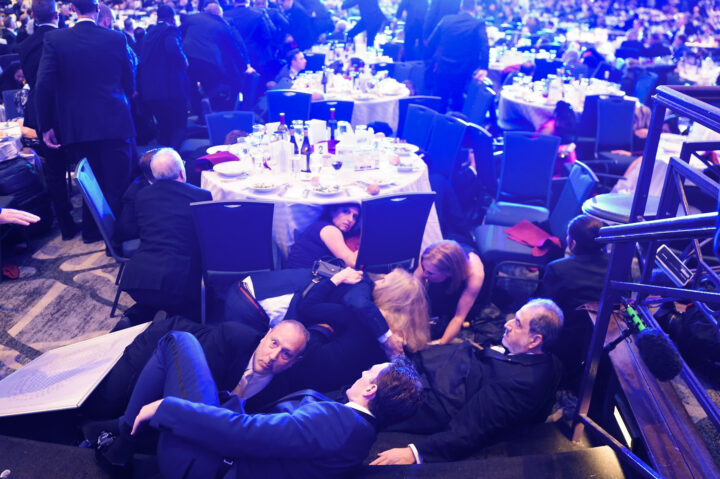
Guests take cover after a shooting attack took place as President Donald Trump was to speak to attendees of the annual White House Correspondents Association Dinner April 25, 2026 in Washington, DC.


 Add JewishInsider on Google
The White House Correspondents’ Dinner began normally enough — a bustle of reporters, administration officials and members of Congress among other A-listers streaming from the packed lobby of the Washington Hilton down into the basement ballroom.
White House Correspondents’ Association President Weija Jiang, a CBS News White House reporter, finished her introductory remarks, and the thousands of guests packed into the ballroom tucked into their salads.
Then, a loud, shattering bang rang out from the other side of the ballroom. Initially, I didn’t think anything of it — I thought someone had dropped a large tray of food (as President Donald Trump said later, he thought the same thing).
Videos and other accounts of the evening indicate that someone from the security staff shouted from the front of the room that guests should get down. I didn’t hear it. My first indication that something was wrong was when I started seeing other guests ducking under the tables and security officers drawing their guns.
I tried to duck under the tablecloth, but no luck — another occupant of the table was already underneath, and there was no room. My heart pounding, I was forced to do my best to stay low — but I was in the backmost row of tables, right by a door, sitting directly in the aisle.
If a shooter came into the ballroom from behind me, I was a sitting duck. I was completely helpless and exposed.
Two thoughts ran through my head. The main one: I’m getting married in six days. I can’t die now. The second: I can’t believe this is happening to me again. (For those readers who are newer to Jewish Insider — I was also on scene for the Jan. 6, 2021, attack on the U.S. Capitol.)
Just a few yards away from me, a Secret Service agent stood, gun drawn, surveying the room. She kept yelling for us to stay down.
Perhaps foolishly, I poked my head above the table. I saw a group of agents in suits, slowly trying to pick their way across the enormous ballroom toward the Cabinet secretaries and other VIPs in the center of the room. Even before the chaos broke out, it had been nearly impossible to traverse the crowded room. Chairs were literally back-to-back, completely blocking the aisles, to say nothing of the people now crouching and lying all over the floor.
It struck me at the time as a fire hazard. Now, it seemed all the more ominous. The most senior officials in the country could easily have been trapped in the line of fire with no real way to escape.
And then I looked up to the head table. The president and the other guests — including Jiang, First Lady Melania Trump, Vice President JD Vance, White House Press Secretary Karoline Leavitt and others — were gone. In their place was a group of Secret Service officers in heavy body armor, assault rifles at the ready, surveying the room.
For a venue chock full of journalists, information was strikingly hard to come by. X, once a reliable source of information in breaking news situations, had nothing. I was left asking my fiancée, who was at home, to send me information, because I could find nothing.
The first indication of the unfolding situation was a White House press pool report email, which said that an apparent shooter was in custody — but the reporter also said he’d seen Health and Human Services Secretary Robert F. Kennedy Jr. limping, which only increased our panic.
The pool report said that the shooter was in custody. My family told me that CNN was reporting that he was dead.
I’m sure we were only on the floor for a few minutes. But with no idea of what was happening, beyond the developing clarity that we’d just heard shots ring out, it felt like an eternity. My colleague, on the ground next to me, was in tears, near hyperventilating. I struggled to comfort her, not knowing what was going on, or if we were safe.
There were no announcements, at least that I heard, made to the group. My first indications that the situation might be safe were when the Secret Service officer nearby holstered her weapon, and when we saw a U.S. senator wandering toward an exit.
But we still had no real idea of what was going on.
Then, a door to the ballroom opened, and guests began to file out, first in a trickle then in a stream, pushing aside curtains that had been set up as security barriers, up the stairs and ultimately out the door of the hotel. Security kept telling us to keep moving, pushing us further and further from the scene.
On the way out, I saw C-SPAN CEO Sam Feist huddling with one of the cable network’s cameramen, positioned next to our table, who had kept filming through the entire event.
We ran into Rep. Jamie Raskin (D-MD) at the exit of the hotel and shook his hand in the glow of the red and blue lights from armored SUVs for top officials still idling in the turnaround at the hotel’s entrance — perhaps the most surreal interaction I’ve had with a member of Congress as we shared our relief that we were all safe.
My colleague and I finally reconnected with her partner, who had been in the upstairs bar, watching the events play out on TV. They embraced tearfully, a simultaneously heartwarming and heartbreaking sight.
We kept walking hurriedly, calling family to let them know we were OK, pushed further and further away from the venue. I was completely lost, teeth starting to chatter and my body shaking from an excess of adrenaline.
Much has been said over the past days about the security at the event — some say it was too lax, some say there was none at all, some describe the event as among the best-secured in the city. There’s a kernel of truth in all of them.
My experience, after having attended three previous dinners, is that security was unchanged from previous years. Entering the event, a block from the hotel, we were asked to flash our tickets, but plenty of people dressed in evening wear are regularly waved through the cordon. Protesters from the group Code Pink hassled guests as they entered the secured zone, having lined up along Connecticut Avenue outside the fenced-off area to chant and wave signs.
At no point during or before the evening were IDs checked. Tickets were assigned and sold by the WHCA to news outlets, rather than to individuals, and it’s up to the outlets to decide how to distribute the tickets. It’s a massive event — thousands of people in attendance. That’s significantly more than could reportedly be accommodated in the planned White House ballroom, which Trump and others have trumpeted as the solution to prevent future incidents like this.
At the top of the hotel’s driveway, we were again asked to present our tickets — either a ticket to the dinner itself, or an emailed invitation to one of the pre-dinner cocktail receptions hosted by various news outlets. With just a ticket or a screenshot of one of those invitations — or as a guest of the hotel, in the case of the shooter — one could gain access to the hotel. The hotel does not shut down for the event and hosts thousands of guests who are unrelated and can come and go as they please.
The ballroom is several floors below the lobby. To get on the escalator downstairs, I again had to flash my ticket to hotel staff. This is, seemingly, the only security checkpoint that did not perform as it was supposed to on Saturday evening. As a guest of the hotel, the shooter would have had access to all other areas of the hotel.
After making my way through a tangle of lines for red carpet photos, I finally came to the metal detectors, staffed by Secret Service and Transportation Security Administration staff.
Bags and pocket items were manually checked by security here — not in an X-ray machine — and I know at least one person who was allowed to proceed through with her bag unopened.
It was near this barrier that the shooter pulled out his weapons, and was ultimately subdued by law enforcement. The gunman did not reach the ballroom and there was seemingly only one injury — a Secret Service agent who was shot in his bulletproof vest and has reportedly since recovered.
The dinner itself is a short flight of stairs below the security checkpoint — the shooter seems to have been tackled at the top of those stairs, based on photos released by the White House, perilously close to the ballroom entrance. But there is also a large atrium area on the upper level, where hundreds of guests pack in for a cocktail reception before doors open to the ballroom, not to mention the long lines that formed as guests were waiting to clear security. If the shooter had decided to open fire a few hours earlier, he would have had no shortage of targets.
One final note: When I finally made it home, I was, perhaps unwisely, scrolling X and saw a quickly proliferating set of conspiracy theories about the night, from both sides of the aisle — it was staged, the entertainer was in on it, security was purposely loosened, and more. I experienced the same in the midst of the Jan. 6 attack. There are few things more surreal, or more infuriating, than seeing people pretend an event you lived through wasn’t real. And there are few things more poisonous to our collective political discourse.
Now, in the wake of at least the third thwarted assassination attempt on this president, we’re all left to grapple with many questions. How could security let this keep happening? And what does this mean for the state of our country and our civic bonds?
The Jewish community has become sadly familiar with politically motivated violence, having faced deadly attacks and attempted attacks across the country. But increasingly, it seems to be a society-wide problem — and one without a clear path back.
More Stories
NOT ON BOARD
Lansing Mayor Andy Schor, a Jewish Democrat, says he’s not supporting El-Sayed
PHONE A FRIEND
AOC launches campaign blitz for El-Sayed across Michigan
BACK FROM THE GULF
Sen. Murphy accuses admin of ‘active cover-up’ of Iran war, vows to leverage funding to end war
Arrivederci, Reggio
Jewish preschool educators forced to condemn Israel to attend Reggio Emilia conference
speaking out
In open letter, dozens of retired U.S. military leaders reject genocide allegations against Israel
REGIONAL SHIFT
Amb. Kaploun: More Latin American countries plan to adopt IHRA definition of antisemitism
Please log in if you already have a subscription, or subscribe to access the latest updates.
 Continue with Google
 Continue with Apple