




































Philanthropists Laura and Gary Lauder hope to boost in-depth investigative journalism in Israel

Moran Barak/Shomrim
The home page of the Shomrim website.


 Add JewishInsider on Google
A group of journalists, activists and philanthropists have joined together to support the creation of investigative reporting projects in Israel. The new organization, called Shomrim: The Center for Media and Democracy, has published an open call for proposals for reporting and documentary projects that will be granted financial and professional support. Shomrim co-founder Ethan Bronner and CEO Alona Vinograd explained the organization’s vision to Jewish Insider.
Sorely missing: “I do believe that this kind of reporting is sorely missing in Israel, where media are in financial crisis as they are in much of the world,” Bronner told JI. He said the organization is modeling itself partly on the U.S.-based ProPublica — whose president, Richard Tofel, serves on its advisory committee — and on the Center for Investigative Reporting — whose former executive director, Robert Rosenthal, also sits on the committee. According to The Marker, the initiative intends to spend $3 million over a period of three years.
A-team: Shomrim was co-founded by Bronner, a senior editor at Bloomberg, along with philanthropists Laura and Gary Lauder; venture capitalist and social activist Oded Hermoni; Prof. Moshe Zviran; photojournalist Vardi Kahana; Calcalist publisher Yoel Esteron and editor and journalist Tamar Prizan-Litani. In addition to Tofel and Rosenthal, its advisory committee includes leading journalists in both Israel and the U.S.: Channel 12’s Ilana Dayan; Channel 13’s Raviv Drucker; Times of Israel editor-in-chief David Horovitz; Haaretz‘s Amos Harel; KAN 11’s Guy Zohar; Bokra’s Ghada Zoabi; New York Times columnist Bret Stephens; former NPR president Vivian Schiller, former CBS legal advisor Richard Altabef; E. W. Scripps vice president Ellen Weiss; and film producer Isaac Lee.
Untold tales: Vinograd, who previously led the Center for Democratic Values and Institutions at the Israel Democracy Institute, said Shomrim is looking to support projects “that put a light on important issues in Israeli democracy,” citing gender, the environment and healthcare, as well as the marginalized voices “of those less heard in Israeli media — Arabs, Haredim, immigrants [and] disadvantaged communities.” Bronner said he wants the organization to focus on societal challenges, “because these tend to be undercovered in Israel, where politics and national security take up most of the space of serious journalism.”
Free press: Bronner, a former Jerusalem bureau chief for The New York Times, Reuters and The Boston Globe, has also worked as a journalist in London, Madrid and Brussels. “Media freedom is pretty strong in Israel,” Bronner noted, “which is one reason we believe this project can work and make a difference.”
Wide net: While the current open call for projects has a deadline of March 31st, Vinograd said the center intends to accept proposals three to four times a year. “We will support a large number of projects,” she said, “not only of the written word. We hope to work also on audio (podcasts) or video (documentary) stories, and photojournalism as well.”
2020 Democratic hopeful says the U.S. should not be taking sides in the Israeli-Palestinian conflict

AP Photo/John Locher
Democratic presidential candidate Sen. Elizabeth Warren, D-Mass., speaks at the Iowa Democratic Wing Ding at the Surf Ballroom, Friday, Aug. 9, 2019, in Clear Lake, Iowa.
Sen. Elizabeth Warren (D-MA) said during a live CNN town hall on Wednesday night that the U.S. embassy in Israel should be moved to wherever the capital is agreed upon in negotiations with the Palestinians.
Figure it out: “The parties should negotiate whether or not the capital is in Jerusalem, where the capital is, and then the United States should move its embassy to be in the capital of each of the two states in a two-state solution,” Warren said. But Warren did not say whether she would reverse President Donald Trump’s decision to move the embassy to Jerusalem.
Stop political handouts: Warren indirectly criticized Trump for taking unilateral moves to favor Israeli Prime Minister Benjamin Netanyahu. “Our job is to get [the Israelis and the Palestinians] to the negotiating table and stop handing out — for political reasons — just favors to one side and hurting the other,” she said.
Read the full exchange below:
Chris Cuomo: Senator, a key ally in the region, of course, Israel. President Trump moved the U.S. embassy from Tel Aviv to Jerusalem. Would you move the embassy back out of Jerusalem?
Warren: “I — here’s the overall approach we need to use. We need to encourage both Israel and the Palestinians to negotiate with each other. The United States should not be putting a thumb on the scale, should not be saying, in these negotiations, ‘We stand only with one party.’ We should recognize that Israel has a right to its security. The Palestinians have a right to self-determination and to be treated with respect.”
“The two-state solution has been the official policy of the United States and of Israel for nearly 70 years now. How do you make that happen? You want to be a good friend to Israel and to the Palestinians. Keep pushing them to the negotiating table. Let them negotiate, for all of the pieces they want, how they create a long-term, sustainable home for Palestinians and a safe, stable home for the Israelis. But our job is to get them to the negotiating table and stop handing out for political reasons just favors to one side and hurting the other. That does not in the long run move that region closer to peace and it does not treat the people in the region with the respect they deserve.”
Cuomo: So the embassy?
Warren: “The embassy is what they should be negotiating. They should be negotiating the capital.”
Cuomo: Where — where the U.S. embassy is?
Warren: “No, they should be negotiating what constitutes the capital. That’s really my point, is that that’s what the parties should decide. The parties should negotiate whether or not the capital is in Jerusalem, where the capital is, and then the United States should move its embassy to be in the capital of each of the two states in a two-state solution.”

United Nations Headquarters
versello/Flickr
The United Nations released an unprecedented report on Thursday highlighting a “disproportionate” 38 percent increase in antisemitism across the globe, even in countries that have no Jewish population. The report also identifies certain actions by the Boycott, Divestment and Sanctions (BDS) movement against Israel as “fundamentally antisemitic.”
Dr. Ahmed Shaheed, the U.N. special rapporteur on freedom of religion or belief, will present the final version of the report at the annual session of the U.N. General Assembly’s third committee on Thursday afternoon. An interim report was released last month. According to Shaheed, antisemitism is a threat that requires a “multi-pronged human rights approach” to address the issue.
In his presentation, Shaheed recommends that states adopt the International Holocaust Remembrance Alliance (IHRA) definition of antisemitism as a “non-legal educational tool” to enable them to identify, monitor and respond to antisemitic discourses and attacks. He also calls on the U.N. Secretary General António Guterres to appoint a senior-level envoy to coordinate global efforts to combat antisemitism, as well as the establishment of faith-based organizations to show solidarity and build resilience and trust between communities.
“My key purpose in doing the report is to motivate states and other actors to take action against antisemitism and seize on the very serious threat to everybody to take common action to stop this,” Shaheed said in an interview with Jewish Insider. “I am very clear that governments must respond to all antisemitism by taking preemptive steps, but there’s also an obligation to have laws in place and enforce them to protect people and provide remedy to the victims of such incidents.”
Shaheed suggested that the U.N. report could help sooth concerns among Israelis and members of the Jewish community that the international body is biased against the Jewish state. “If the secretary-general appoints an envoy to a very senior level in his office to deal with the matter, I think Jews will start feeling that the U.N. also works for them,” Shaheed told JI. “Right now, I feel a sense of grievance that the U.N. is a very biased body against Israel and the Jewish community, and I am hoping that one of the outcomes of this is that those within the U.N. system itself start taking more notice of the issues faced by Jewish communities across the world and that we build bridges in working together.”
Shaheed, a career diplomat from the Maldives, revealed that when he was appointed to the post in November 2016, he “found almost nothing” was done by this mandate established three decades ago on addressing concerns raised by Jews. This inspired him to “start a conversation” with Jewish groups and human rights monitors how to address the issue. “I think there’s a grave understand that we have to address this deficit and pay more attention to this subject. This is a very good start, and I think we need to build on this connection for the time to come.”
Shaheed noted that, since boycotts are internationally legal, he took “a very fine line” when spotlighting the “antisemitic tropes” invoked by the BDS movement. “There are elements in the BDS movement who are overtly and openly antisemitic,” he said. “The effects of this movement have been attacks on campuses and incidents against students and religious academics.” The report also connects online antisemitism as a driving tool that leads to violent attacks against the Jewish community.
“This is a landmark report that represents the first time that the U.N., a body that has too often in the past been identified as a source of Jew hatred has seriously grappled with the stark reality of current antisemitism,” Mark Weitzman, director of government affairs at the Simon Wiesenthal Center, tells JI. “In reading it we get a sense that the author of the report, Prof. Shaheed, is morally outraged not only by the surge in antisemitism but also by many governments lack of recognition and commitment to fighting antisemitism.”
People familiar with the singer’s visit deny she was paid, while official organizers remain tight-lipped

marcen27/flickr
Demi Lovato performs in Scotland last year.
As the buzz around pop singer Demi Lovato’s recent trip to Israel continues to reverberate, the funders and organizers of her visit are remaining tight-lipped about everything — including their identities. Meanwhile rumors, inaccuracies and sensationalizing have kept the story in the headlines both in Israel and around the world.
Who initiated and funded Lovato’s trip? Was she paid to come to Israel? Why did she visit, apologize and then delete the apology?
While the majority of the trip organizers refused to speak publicly, Jewish Insider interviewed several figures associated with Lovato’s visit to make sense of the situation.
Lovato — a 27-year-old Grammy-nominated singer with six studio albums, several top 10 singles and more than 74 million Instagram followers — paid a quiet visit to Israel last month, touring the country from top to bottom. Upon her return to the United States, she uploaded three Instagram posts about her trip, calling Israel “absolutely magical” and writing that she is “grateful for the memories” made during her visit.
Unsurprisingly, Lovato was bombarded with negative feedback from BDS advocates and anti-Israel activists, which led her to post and quickly delete an apology on her Instagram story. “I’m sorry if I’ve hurt or offended anyone, that was not my intention,” she wrote. “This was meant to be a spiritual experience for me, NOT A POLITICAL STATEMENT and now I realize it hurt people and for that I’m sorry.”
Yediot Aharonot originally reported that Lovato was paid $150,000 to visit Israel — a third of which was funded by the Israeli government — a claim that reverberated among BDS activists. But the newspaper later quietly edited its article, saying instead that the trip — which was free for the singer — cost $150,000 overall.
“As far as I know, [Lovato] didn’t receive a shekel to come here,” Moish Yaul, the spokesman for the Jerusalem Affairs Ministry, told JI. Rather, he said, the costs of the trip for her and her entourage were fully covered by several sources. Yaul said that the Jerusalem and Foreign Ministries together contributed around 200,000 shekel (approximately $57,000), and the rest was paid for by other private donors. During her visit, Lovato toured the City of David accompanied by Jerusalem Affairs Minister Ze’ev Elkin.
A Los Angeles-based source familiar with the details of the trip said the original Yediot report was “totally bogus.” Lovato herself commented on an Instagram post that cited Yediot’s reporting and denied she was ever paid: “This is actually not true at all,” she wrote. “This is in fact a lie. I never got paid. Simple.”
The popular singer was accompanied on the trip by her mother, Dianna De La Garza, who made it clear even after Lovato’s deleted apology that she had no regrets about the trip.
“We celebrated life and Christianity as we learned about the Jewish faith while listening to the Muslim Call to Prayer,” De La Garza wrote on Instagram alongside a photo of her and Lovato at the Western Wall. “There was no fighting, no judgement, no cruel words…only love. And I will undoubtedly, unapologetically go again one day.”
Industry insiders speculate that Lovato removed the apology post quickly because it violated a confidentiality agreement signed ahead of the trip. The singer was likely told not to reveal, as she did in the Instagram story, that she “accepted a free trip to Israel in exchange for a few posts.” One source familiar with the trip said that the funders themselves likely also signed a confidentiality agreement, explaining their reluctance to speak publicly about the trip.
Ari Ingel, the director of the Creative Community for Peace nonprofit, said while his organization was not involved in planning Lovato’s trip, it was disheartening to see how things played out.
“These weren’t her fans leaving messages, these were boycott activists, bots and trolls who were targeting her and her fans, in a successful attempt to turn her influential social media feed into their own bully pulpit,” said Ingel. “She took a spiritual trip to Israel, like millions of people every year, from all faiths and backgrounds, and boycott activists hijacked her social media page to turn it into something political.”
Ingel said CCFP — who were part of the team that brought actress and singer Hailee Steinfeld to Israel this summer — would have better prepared Lovato for the response she might face: “We would have advised that she disabled comments on all three [Instagram] posts from the beginning.”
Ashley Perry, the president of Reconectar, which seeks to reconnect the descendants of Spanish and Portuguese Jewish communities, met with Lovato and her mother while they were in Israel.
“Apparently she had done a DNA test in the past, and found out she had significant Jewish ancestry,” Perry said. Lovato met with Perry to explore that, and told him about her maternal family name and her family’s geographic roots. “It was clear to me that they definitely have Sephardic Jewish ancestry,” he said. “They were very, very excited and very, very interested and it seems like — from the meeting — they were interested to learn more.”
Perry, a veteran of the Foreign Ministry and longtime political advisor, said it was unfortunately no surprise that Lovato faced such a backlash.
“I know for a fact that they did prepare her, and she was aware that there are active forces who will try and get her to distance herself from the trip,” he said. “But no one can prepare you for the barrage of bloody pictures people post, claiming to be from Gaza but often from other Middle Eastern wars. Nothing can prepare you for that. The pictures are almost all a lie, but someone who’s not familiar with this sort of tactic will understandably will feel quite upset.”
Perry said it was his understanding that the government contributed around $50,000 toward the costs of the trip, but that “neither Demi Lovato herself nor anyone around her was paid.”
The organizers and backers of the trip, Perry said, “prefer not to be named.”
Israel Schachter, the co-founder and CEO of CharityBids, which organizes travel adventures for charity auctions and nonprofits, shared a Facebook post about Lovato’s trip before the backlash, implying he played a role in her visit. “Thanks to Shalva National Center, Aish HaTorah, Eitiel Goldwicht, City of David, Ancient Jerusalem, Yad Vashem: World Holocaust Center, Jerusalem and the many, many, other people and organizations who were involved in making this happen,” he wrote.
Contacted by JI, Schachter said he does “not wish to comment any further on the matter, nor am I at liberty to discuss any of the details.”
And Lovato herself continued to be on the defense about the trip and its fallout, replying to posts from fans and others across Instagram.
“I don’t have an opinion on Middle Eastern conflicts,” she commented on one Instagram post, “nor is it my place to have one being an American singer and you’re asking me to choose a side?”

Then-Vice President Biden meets with Prime Minister Benjamin Netanyahu in Jerusalem on January 13, 2014. (U.S. Embassy)
In a Rosh Hashanah statement first obtained by Jewish Insider, former Vice President Joe Biden reaffirmed his “unshakable commitment to the Jewish and democratic State of Israel.”
The former vice president had a strong pro-Israel voting record during his 36-year tenure in the Senate and served as an emissary from the Obama Administration to the pro-Israel community during the lead up to the Iran deal.
In the holiday greeting, Biden also made note of the antisemitic attacks at synagogues in Pittsburgh, Pennsylvania and Poway, California. “This last year was marked by horrific tragedies, but it was defined by the strength and resilience of the Jewish community,” said the former vice president.
The Democratic presidential hopeful, whose campaign has centered around what he sees as the unique threat to American values posed by Donald Trump’s presidency, tied Jewish values to that basic theme.
“As our first president declared unequivocally to the Hebrew Congregation of Newport, Rhode Island: ‘the Government of the United States gives to bigotry no sanction, to persecution no assistance.’ At a moment when that basic premise is being questioned by too many here at home and around the world, when we are in a battle for the very soul of this nation, the mission of Tikkun Olam bears renewed urgency,” wrote Biden.
The full statement is below:
On behalf of Jill and myself and the entire Biden family, Shanah Tovah to all celebrating the Jewish High Holidays. This time of year offers a moment to pause and reflect on all that has passed, to consider the new year of possibilities that lies ahead, and to reaffirm the values that unite family, friends, and all who strive to spark justice in the world.
This last year was marked by horrific tragedies, but it was defined by the strength and resilience of the Jewish community. In the wake of Pittsburgh and Poway, Americans across the country–Jewish and non-Jewish alike–challenged ourselves to reach for our highest ideals and recommit to fighting hatred wherever in the world we find it.
As our first president declared unequivocally to the Hebrew Congregation of Newport, Rhode Island: “the Government of the United States gives to bigotry no sanction, to persecution no assistance.”
At a moment when that basic premise is being questioned by too many here at home and around the world, when we are in a battle for the very soul of this nation, the mission of Tikkun Olam bears renewed urgency. This is a time to reawaken to our moral responsibilities, change our ways, and renew our commitments to our faith and fundamental values. We must come together and care for one another. In the year ahead, we must reconfirm our deepest-held democratic values and the idea that the American Dream is big enough for all of us.
Those shared values are also what unite us with the people of Israel and ground our unshakable commitment to the Jewish and democratic State of Israel–and to a future that is both peaceful and secure.
To everyone in the Jewish community, We wish you a very happy, healthy, and sweet New Year. May the sound of the shofar call each of us to do justice, impart kindness, and walk humbly with our God in the year ahead.
Reps. Brad Schneider and David Schweikert ask White House 'to explain’ lack of exemption

Bill Clark/CQ Roll Call/AP
Rep. Brad Schneider (D-IL) walks up the House steps on April 4, 2019.
Congressmen Brad Schneider (D-IL) and David Schweikert (R-AZ) have asked the Trump administration to explain why Israel has not been granted a waiver on new tariffs on steel and aluminum imports.
In a letter sent to U.S. Trade Representative Robert Lighthizer on Wednesday and obtained by Jewish Insider, the two lawmakers — both members of the House Ways and Means Committee — noted that while the administration has granted exemptions to a number of key allies, including South Korea, Australia, Argentina, Brazil, Canada and Mexico, the tariffs remain on imports from Israel, an ally and reliable strategic partner.
Last year, Israeli Prime Minister Benjamin Netanyahu reportedly failed to secure an exemption from the 25% steel and 10% aluminum tariffs imposed by the Trump administration in 2017.
“The United States and Israel have long enjoyed cooperation on a wide range of issues that enhance, not threaten, U.S. national security, such as development of the Iron Dome missile defense system and countering subterranean terrorist tunnels. This cooperation demonstrates the deep trust and mutual respect that encompasses this vital relationship,” the congressmen wrote.
The letter concluded, “We do not believe imports of steel and aluminum from Israel are a threat to U.S. national security and are asking you to explain why Israel has not been granted an exemption.”

State Department photo by Michael Gross
Ron Dermer in May 2019 (Michael Gross/State Department)
Israeli Ambassador to the U.S. Ron Dermer suggested on Wednesday that Israeli political and defense leaders are now united in opposing the terms of the 2015 Iranian nuclear deal.
In a conversation with Ambassador Dennis Ross at the United Against Nuclear Iran annual summit in New York, Dermer stressed that while some former high-level government and security officials expressed support for the Joint Comprehensive Plan of Action (JCPOA), “today you cannot find security and intelligence officials in Israel — I’m not aware of any of them — that would go back to the exact same deal.”
“The United States has got enormous leverage, and I think the idea of going back into the same deal with Iran, it gives them a clear path to nuclear weapons,” he explained.
Asked if Israel’s position on Iran would change if a national unity government is formed following last week’s redo election, Dermer said that “any new government” would continue to support Israel’s longstanding opposition to the JCPOA and be in favor of economic pressure on Iran “to ensure that: A, that Iran never gets nuclear weapons, and B, that everything is done to roll back Iran’s aggression.”
Dermer also noted that Blue and White leader Benny Gantz said earlier this year at the Munich security conference that there was no difference between him and Israeli Prime Minister Benjamin Netanyahu on the topic of Iran.
During the election, Netanyahu slammed his chief rival for “supporting the Iran nuclear deal” in 2015.
Dermer said that Israel “could live with” a new nuclear deal negotiated by the U.S. — but only if it addressed the sunset clause. “The one problem that you have to address is you have to prevent Iran from ever being a military nuclear power,” he stated. “And if you have a sunset clause, that’s a date certain for when you want to would be a military nuclear power, and that has enormous consequences for our region.”
New York Magazine, Wall Street Journal reports detail WeWork founder's political ambitions

Noam Galai/Getty Images
NEW YORK, NY - MAY 15: Co-Founder and CEO of WeWork Adam Neumann onstage during TechCrunch Disrupt NY 2017 at Pier 36 on May 15, 2017 in New York City.
WeWork founder and Israeli-born billionaire Adam Neumann has expressed interest in an ambitious political career, according to recent reports in New York Magazine and the Wall Street Journal.
New York Magazine referenced Neumann’s interest in a political career as part of a longer discussion about the political ambitions of Silicon Valley executives. According to the report, Neumann, who founded the office-sharing company in 2010, recently discussed his ambitions with an unnamed political operative. The Israeli CEO expressed particular interest in a run for the U.S. presidency. Such a proposition would necessitate an amendment to the Constitution, which requires that the president be a natural-born citizen.
When asked about the possibility of running for mayor or governor, Neumann reportedly replied, “Once you’ve reached my level of success, only president will do.” Though a source close to Neumann denied he made the comment, the WeWork CEO has yet to provide an official denial on any part of the report. Jewish Insider was unable to reach Neumann or a representative for comment.
But perhaps he would settle for something other than U.S. president. A Wall Street Journal report on Wednesday noted that the billionaire told at least one person that he’d like to be the prime minister of Israel. The WSJ also reported that Neumann told another individual the only thing he’d run for would be “president of the world.”
Though unscathed from government attention, WeWork has experienced a rocky year. After months of hype and media attention, earlier this week the company postponed its plan for a much-hyped initial public offering. Subsequent media and investor attention uncovered questions about company’s finances, profitability, and management. In addition to postponing the IPO, the WeWork board took recent steps to limit Neumann’s power as CEO.
The former British chief rabbi says that Jews may have enemies, but they also have very good friends

Kirsty Wigglesworth/AP
Rabbi Lord Jonathan Sacks speaks at a press conference in 2016.
Jews around the world facing rising antisemitism should know that they have a safe haven in the State of Israel, Rabbi Lord Jonathan Sacks said in a recent interview.
The former chief rabbi of the United Kingdom spoke to Jewish Insider about the rollout of his latest initiative, a network of Whatsapp channels that will disseminate daily inspirational ideas to individuals who sign up. The messages began on Sunday, the first day of the Hebrew month of Elul, which culminates in Rosh Hashana.
Sacks is particularly proud of this initiative, which as of Monday has reached more than 15,000 sign-ups.
“This is one of my passions,” he said. “Because I am a great believer that revolutions in information technology are the drivers of civilization… I see every single revolution in information technology as having huge spiritual implications. So as soon as the internet began to be important, it became central to our work.”
“Rabbis,” Sacks added, “are supposed to be teachers. It’s the oxygen we breathe. So when you have a new way of doing so — then I get very excited.”
Sacks said he wasn’t necessarily surprised by the outpouring of thousands of Jews signing up, since “people are looking for guidance in a very confused and confusing world,” he said. “And the wonderful thing about this new instant technology, is it allows us to communicate very fast and very directly to people without a lot of intermediaries.”
And what will those 15,000 people be receiving on their phones every day?
“It will be a big mix of spoken word, the written word, the visuals,” he said. “How can I connect with the [high holiday] prayers? Could you please explain some of the prayers to me? But also more general issues. How do I direct my life? How do I mend broken relationships? How do I get over some of the anger in my heart? We’re going to keep it very varied.”
Sacks is aware that many Jews around the globe are living in tense times and worried about the rising tide of antisemitism. But, he said, quoting Rabbi Nachman of Breslav, “the important thing is not to be afraid.”
“The terrifying thing about antisemitism in the 19th and early 20th century was that Jews had nowhere else to go,” he said. “Today we have a State of Israel. That means that every Jew in the world has a home — in the sense in which the poet Robert Frost defined it — as a place where, when you have to go there, they have to let you in. And that means that we walk without fear.”
There is one thing that Sacks pursued as chief rabbi, that he urges American Jews to embrace as well.
“We may have enemies out there, but we also have friends and they are very, very good friends,” he said. “So I would urge the American Jewish community do what I’m sure it’s done very well already… which is to go out and make friends, make friends among non-Jews, among other religious groups, among key figures in the political world, across parties.”
The relationships that he and the British Jewish community built with political figures has been crucial, Sacks said.
“When you get Tony Blair and Gordon Brown — both of whom were prime ministers from that party [of Labour leader Jeremy Corbyn] — coming out and saying this is absolutely unacceptable, it makes a huge difference when they are [the ones] saying it,” Sacks said. “They’ve been absolutely rock solid because they were the first people we ever enlisted… I believe the campaign against antisemitism in any country should be led by non-Jews.”
Asked about the internal divisions among the Jewish community, Sacks let out a laugh.
“I just get bored by internal divisions,” he said. “Haven’t we got enough enemies out there? It’s deja vu, been there done that. Let’s do something interesting for change. Let’s be friends.”
Sacks said that he put together two principles as British chief rabbi that helped solve many of the community’s conflicts.
“On all matters that affect us as Jews, regardless of our divisions, we will work together, regardless of our divisions,” he cited. “And on all matters that touch on our divisions, we will agree to differ but with respect.”
The Jewish veteran says Israel could serve as a model for national service in the United States
Courtesy
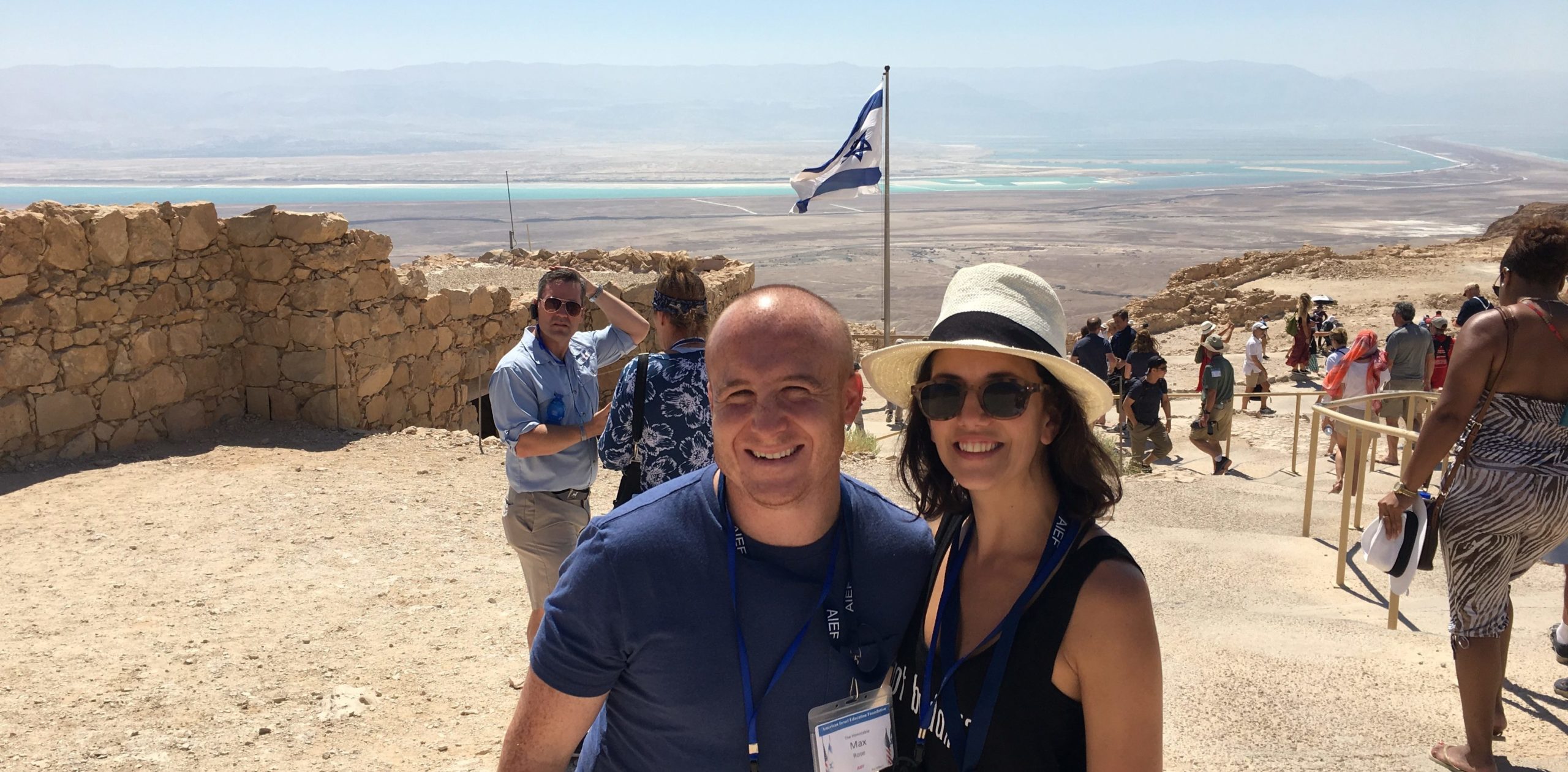
Rep. Max Rose (D-NY) and his wife, Leigh, pose for a photo atop Masada.
Congressman Max Rose (D-NY) returned from Israel this week with a renewed commitment to the U.S.-Israel relationship and an unflagging belief in the possibility of peace between Israelis and Palestinians.
“I will never lose hope on the potential for a peace resolution in the region, whether that is [with] Mahmoud Abbas or down the road, whoever replaces him,” Rose told Jewish Insider in a phone interview this week, just a day after he arrived back in the United States.
Similarly, on the Israeli side, Rose said that “irrespective of who leads Israel, whether it is Prime Minister [Benjamin] Netanyahu, whether it is Mr. [Benny] Gantz, or whether it is someone else down the road… I am especially hopeful after this trip that America’s firm alliance, strategic support for Israel as a Jewish, democratic nation will continue. This has got to be something that rises above politics. And that’s also the case for [whomever] is in political power in Washington DC.”
Rose was one of 41 Democrats — the majority of whom are, like him, freshman members of Congress — who took part in a weeklong visit to Israel led by the American Israel Education Foundation, an affiliate of AIPAC. The group met with Netanyahu, Gantz and Abbas, as well as Israeli and Palestinian entrepreneurs, business leaders and IDF troops.
But unlike the majority of the freshmen on the trip, this was not Rose’s first visit to Israel. The Jewish war veteran said he had traveled to Israel 10 years ago, though his experience this month was wildly different.
“The most memorable part was certainly the opportunity to see firsthand the incredible security conundrum that Israel finds itself in — and has found itself in since its inception,” Rose said. “To see that firsthand, to go to the border with Syria, to go to the border with Lebanon, to go near the border with Gaza, to travel through the West Bank, you can really see the incredibly tenuous situation that it’s in.”

Rep. Max Rose (D-NY) meets with active IDF soldiers.
Rose, a veteran of the war in Afghanistan, said he was particularly excited to meet with IDF soldiers during his time in Israel.
“Anytime that I get the opportunity to meet with and speak to soldiers… there’s such a shared bond and shared culture,” he said. Rose said he views the Israeli model as something that could “speak potentially to the need for a national service model in the United States. It brings people together from all different parts of the country, it establishes a common bond that rises above other divisions.”
Rose told JI that taking part in the AIPAC trip was a no-brainer for him, despite criticism that lawmakers should be remaining in their district or that the trip is a biased look at the region.
“In my district, many people of Jewish faith know that I have personally been to Israel as a member and witnessed firsthand the tenuous security situation that they’re in — as well as the economic and diplomatic and historical miracle… that’s very important to many people in my district,” Rose said. “It’s important to Jews and to Christians… as well as people who are concerned with issues of national security, both global and domestic.”
Rose said the AIPAC-affiliated trip was “very valuable and informative” but it was not a “silver bullet. This trip is representative of just the beginning of our work.”

Rose and his wife, Leigh, visit the Western Wall in Jerusalem.
The New York Democrat also pushed back against the media firestorm surrounding Reps. Rashida Tlaib (D-MI) and Ilhan Omar (D-MN), who are expected to visit Israel on a separate trip later this month.
“This is representative of a trend in media generally, because media enjoys this type of story,” he said. “The narrative that I was focused on throughout my time there, was the fact that this was the largest congressional delegation to Israel in history. That is monumental.”
Rose said he believes that “those who did not make this trip, they need to make some type of trip to Israel, and there are plenty of opportunities for them to do this.” The freshman Democrat said while “there are plenty of people who enjoy speaking about… drama, reality TV politics. I’m not one of them.”
He also addressed the reports of increased violent antisemitic attacks on Jews in New York, including in his district.
“We’re not seeing a revival of antisemitism,” he said. “We know antisemitism never went away, but it has certainly been increasing, and I do believe that — as it has been throughout history — it is often tied to culturally divisive rhetoric and economic anxiety.”
“We have got to invest in educating our youth about the history of antisemitism,” he continued. “We have to support our law enforcement as they show that there are consequences for engaging in acts like this. And we cannot be nuanced with our response either. This is wrong, and there’s no place for these types of actions in the United States of America.”
“Examining your own aggression prevents the next victim,” said filmmaker Joseph Cedar.

RAN MENDELSON/HBO
The contentious, dramatic events that marred the summer of 2014 in Israel will be dramatized in the HBO series “Our Boys,” which premieres a week from today on August 12.
On June 12, 2014, three Israeli teenagers — Eyal Yifrach, Gilad Sha’ear and Naftali Fraenkel — were kidnapped by Hamas terrorists. After a nationwide search of more than two weeks that left the country on edge, their bodies were found dumped in a field. Two days later, the burned body of Palestinian teenager Mohammed Abu Khdeir was discovered in a western Jerusalem forest. “Our Boys” follows the Shin Bet’s investigation into Abu Khdeir’s murder, revealing an unexpected story that the show’s creators believe is worth retelling — for both dramatic and political reasons.
While “Our Boys” begins with the kidnapping of the three Israeli teenagers, neither the boys nor their families appear as actual characters in the show. Viewers are instead brought up to speed courtesy of news footage from 2014. In contrast, Abu Khdeir and his family are introduced as well-developed characters with whom the audience can sympathize.
Hagai Levi, one of the show’s Israeli creators, explained the decision to Jewish Insider: “It’s much more interesting to deal with my own soul searching than why ‘the other’ would do something to me,” he said.
Levi, along with co-creators Joseph Cedar (who previously directed “Norman”) and Palestinian filmmaker Tawfik Abu Wael, visited New York City last week to promote the show. Joined by actor Shlomi Elkabetz (who plays Shin Bet operative Simon), the three filmmakers sat down with JI in the reading room of The Whitby Hotel in midtown Manhattan to share what drew them to the project.
“We’re on this wheel,” notes Cedar, who was born in New York but immigrated to Jerusalem at age six, regarding the Israeli-Palestinian conflict. “A cycle of where some kind of violent act creates victimhood, suffering, pain that then creates rage, that turns into a violent act that creates pain, suffering, victimhood and so on.” In Cedar’s view, “aggression is more interesting than victimhood and so dramatically that’s probably the reason.”
Cedar said the decision to focus on Khdeir also had political motivations. “There’s also a political reason for us focusing on the aggression and not the victimhood,” he said. “Holding onto victimhood creates more aggression. Examining your own aggression prevents the next victim. We’re not interested in our own victimhood, not because we don’t sympathize with the pain but, because we have an interest in stopping the cycle.”
For a show about a region with competing narratives, the creators embraced their own differences and didn’t shy away from the challenge of syncing those views into a single series.
Abu Wael, who directed the Palestinian scenes for “Our Boys,” said the series is written from an Israeli point of view, which created a challenge for him. “It is very difficult because from a Palestinian point of view, the first thing they will say is ‘but the occupation didn’t start with the kidnapping of the three boys. The killers of the three boys were living under apartheid.’”
Cedar, who argued that there are both Israeli and Palestinian points of view in the miniseries, conceded that for Abu Wael, even if the three Israeli boys aren’t characters in the show, “the decision to start the cycle with our victimhood is a cop-out on our side.”
It remains to be seen how the average HBO viewer will react to a show diving deep into the murky waters of the Israeli-Palestinian conflict. The Shin Bet’s investigation into Abu Khdeir’s murder leads them to a pair of Mizrahi yeshiva students in the West Jerusalem neighborhood of Har Nof, a group not typically associated with acts of extremism. “For us it was very important to show the hidden currents in society and not the obvious ones,” Levi said.

A scene from the upcoming miniseries “Our Boys.”
Cedar said the identity of Khdeir’s murderers reverberated through Israel in a unique way.
“One of the interesting things that happened when the identity of the killers became known is that all Israelis had a sigh of relief,” Cedar recalls. “They’re not one of us. It’s either an insane man who forces his young nephews to take part in this or they’re in some weird group that has no larger institutionalized base, or no belonging to something that reflects on us. It’s extremely rare and it probably will never happen again because it’s so rare.”
For Cedar, the series demonstrates how that perception is wrong, and in his view, there is no way for Israeli Jews to distance themselves from the murder.
Elkabetz, whose character leads the Shin Bet investigation on the show, said there might not have been an organization behind the murder, but “if individuals decide to do an act, you understand there are bigger influences. It’s in the air and they get permission from it.”
For fans of “Fauda” and “Shtisel,” “Our Boys” incorporates both similar dynamics and even several cast members from the two shows. Shadi Mar’i, who plays Walid on “Fauda,” appears on “Our Boys” as Abu Khdeir’s older brother, while Michael Aloni, who plays Akiva on “Shtisel,” is a Shin Bet investigator.
Abu Wael points out that there are only so many actors in Israel, but says there’s a key difference between “Fauda” and “Our Boys.”
“On Fauda, Palestinians are either terrorists or traitors,” he said. “This show is different because you have a very normal Palestinian family with dreams like everyone else.”
Please log in if you already have a subscription, or subscribe to access the latest updates.
 Continue with Google
 Continue with Apple