

























Plus, Israel ally draws the line at Syria
Andrew Harnik/Getty Images
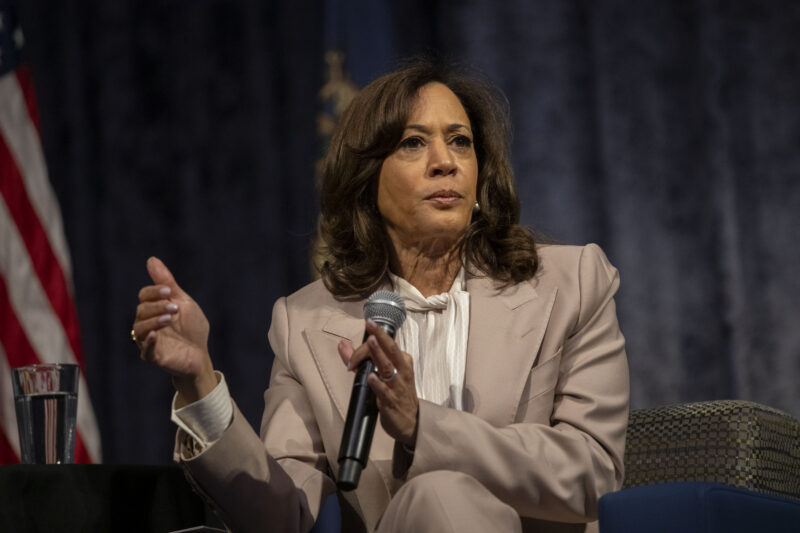
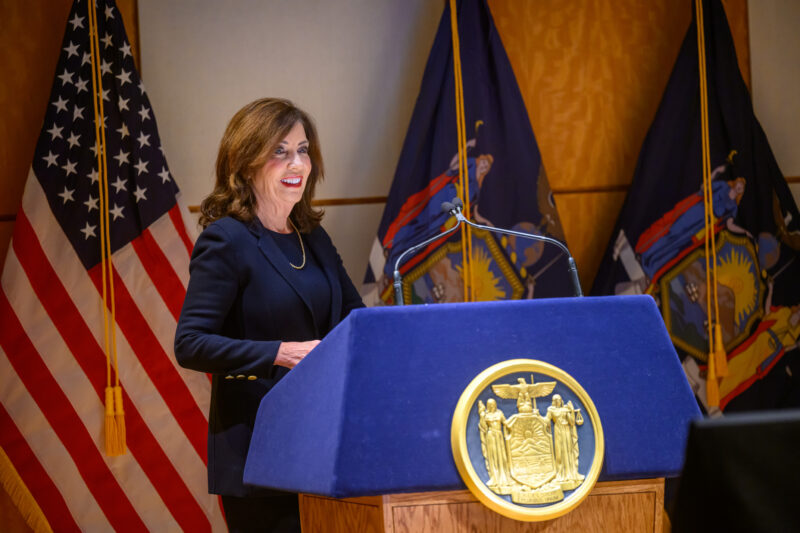
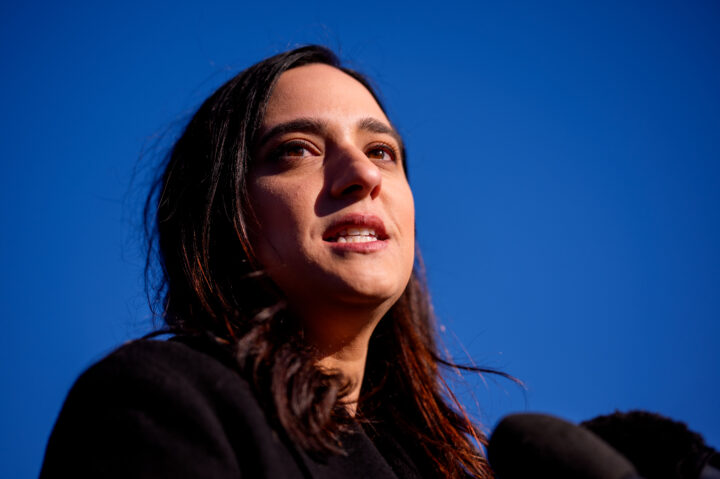
Rep. Yassamin Ansari (D-AZ) speaks during a news conference on Capitol Hill on November 13, 2025 in Washington, DC.


 Add JewishInsider on Google
Good Thursday afternoon.
This P.M. briefing is reserved for our premium subscribers like you — offering a forward-focused read on what we’re tracking now and what’s coming next.
Today’s Daily Overtime was curated by JI U.S. Editor Danielle Cohen-Kanik.
📡On Our Radar
Notable developments and interesting tidbits we’re tracking
In their indirect talks in Doha this week, the U.S. offered Iran access to some of its$100 billion in frozen funds in exchange for Tehran not instituting a toll on the Strait of Hormuz, but Iranian officials have continued to signal they plan to proceed with the move. Continued fighting between Israel and Hezbollah in Lebanon also caused tension during the discussions, The Wall Street Journal reports…
U.S. officials told The New York Times that Washington believed Israel was plotting to assassinate Iran’s top negotiators — Foreign Minister Abbas Araghchi and parliament speaker Mohammad Bagher Ghalibaf — as they were engaged in recent talks with the U.S. over the memorandum of understanding…
Arizona Jewish and pro-Israel leaders told Jewish Insider’s Matthew Kassel that they feel misled by Rep. Yassamin Ansari (D-AZ), whom they supported in her contested 2024 primary but who has since turned away from the pro-Israel views she espoused during the campaign — including now rejecting support from Democratic Majority for Israel, which backed her with a surge of spending in 2024…
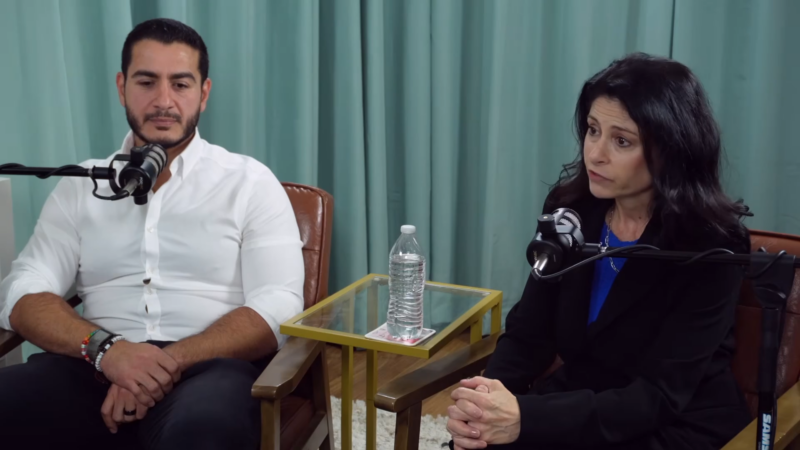
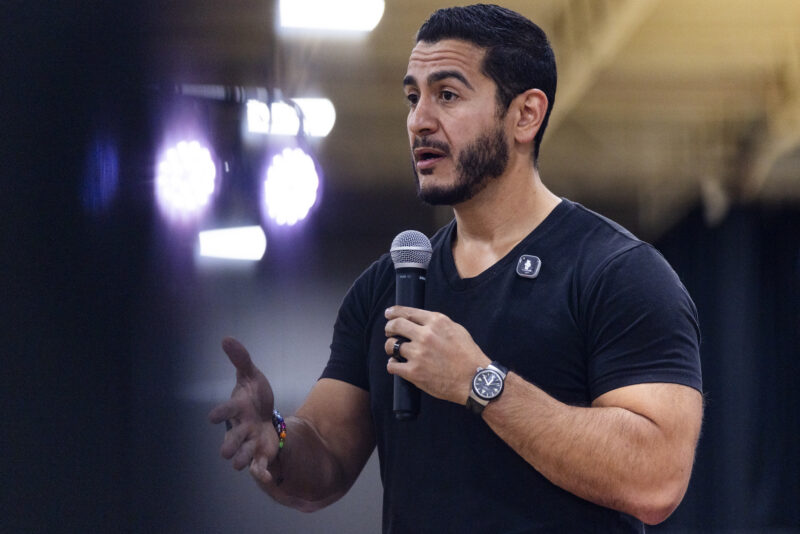
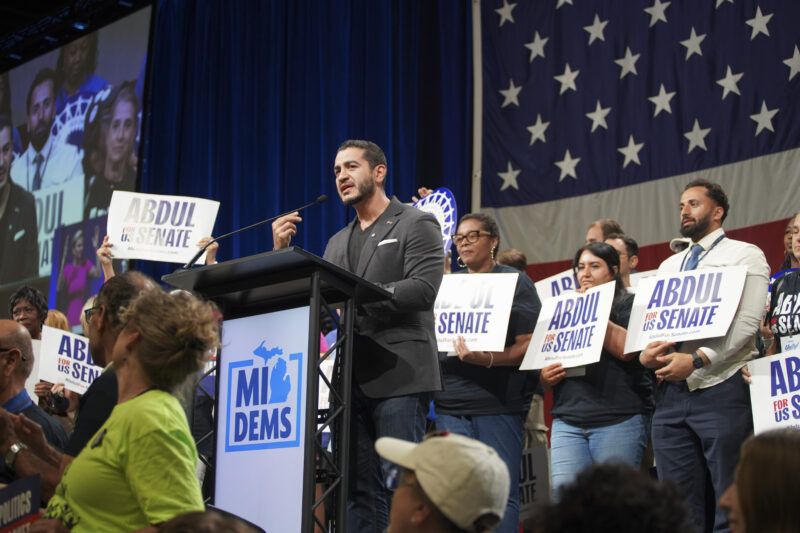
The AIPAC-linked United Democracy Project super PAC is up with its first negative ad against far-left Michigan Senate candidate Abdul El-Sayed, JI’s Marc Rod reports, hitting the Democrat in the initial $2 million ad buy for his “long history of disrespecting women.” Meanwhile, El-Sayed picked up a high-profile endorsement today from Rep. Alexandria Ocasio-Cortez (D-NY), her first in a contested Senate race this cycle.
UDP also made $400,000 in advertising reservations to support Rep. Wesley Bell (D-MO) as he faces a comeback primary challenge from former Rep. Cori Bush (D-MO), whom UDP helped Bell defeat in 2024…
Colorado Attorney General Phil Weiser, the Democratic nominee for governor, criticized his party’s socialist congressional nominee, Melat Kiros, for her refusal to describe the deadly firebombing of a Boulder, Colo., hostage awareness march last year as an act of antisemitism, JI’s Marc Rod reports…
New York City congressional nominee Brad Lander published a response to Rabbi Elliot Cosgrove’s letter earlier this week in which Cosgrove predicted that Lander’s hostility to Israel would not be enough to protect him from being targeted by the far left. Lander argued in his response that criticism of Israel — including describing its war in Gaza as a genocide — is consistent with Jewish values and that excluding anti-Zionist Jews weakens the Jewish community…
New polling data shows that a sizable majority of Jewish voters disapprove of New York City Mayor Zohran Mamdani’s job performance and fear he is pushing the Democratic Party too far to the left, in contrast with non-Jewish voters who hold a largely favorable view of the democratic socialist, JI’s Matthew Kassel reports…
A bipartisan group of House lawmakers, led by Reps. Mike Lawler (R-NY) and Brad Sherman (D-CA), wrote to President Donald Trump today to “express deep concern about any effort” to sell F-35 fighter jets to Turkey, JI’s Marc Rod reports, after Trump and Vice President JD Vance indicated they were looking into it last week…
Rep. Joe Wilson (R-SC), the founder of the Republican Israel Caucus and a reliable ally of the Jewish state, called Israel’s “continuing aggressive operations” in Syria “deeply disturbing,” “counterproductive” and “irresponsible.” Wilson accused Israel of “taking Syrian land and attacking Syrian cities,” saying the operations “need to end immediately”…
Wilson, along with Sens. Jeanne Shaheen (D-NH) and Elizabeth Warren (D-MA), also sent a letter to Secretary of State Marco Rubio urging the administration to remove Syriafrom the State Sponsor of Terrorism list…
Israel marked 1,000 days today since the Oct. 7, 2023, Hamas terror attacks, with memorials and protests taking place around the country…
Far-right commentator Tucker Carlson told the Columbia Journalism Review that he plans to help start a new political party — after saying last month he was renouncing the Republican Party — but does not plan to run as a candidate. He repeatedly railed against Israel in the interview and accused it of “taking over my political system and destroying my country”…
Fanatics CEO Michael Rubin hosted his annual White Party at his Hamptons estate yesterday featuring a host of high-profile attendees, including Ivanka Trump, New England Patriots owner Robert Kraft, former quarterback Tom Brady, actor Leonardo di Caprio and more…
⏩ Tomorrow’s Agenda, Today
An early look at tomorrow’s storylines and schedule to keep you a step ahead
Keep an eye on Jewish Insider for a look at Rep. Debbie Wasserman Schultz’s (D-FL) contentious primary race in Florida’s 20th Congressional District.
Fourth of July celebrations in the nation’s capital are kicking off with a bang (literally — the fireworks show on the National Mall could break world records). President Donald Trump is slated to give a speech on the Mall ahead of the fireworks show on Saturday night, followed by a military flyover debuting the new Qatari-gifted Air Force One jet.
Iran is slated to hold a massive, dayslong funeral procession for the late Supreme Leader Ayatollah Ali Khamenei beginning on Saturday in Tehran and including cities across Iran and Iraq. Pakistan’s Foreign Ministry said Prime Minister Shehbaz Sharif, a top mediator between the U.S. and Iran, will attend the memorial, alongside officials from dozens of other countries.
Christians United for Israel’s annual summit in Washington will begin on Sunday. Speakers over the three-day confab include State Department antisemitism envoy Rabbi Yehuda Kaploun; former Auburn University basketball coach Bruce Pearl; Malcolm Hoenlein, vice chair of the Conference of Presidents of Major American Jewish Organizations; Georgia state Rep. Esther Panitch; and former Israeli hostage Yair Horn.
We’ll be back in your inbox with the Daily Overtime on Monday. Shabbat shalom and happy Fourth of July weekend!
Stories You May Have Missed
LAND OF THE FREE

Rabbis, historians and communal leaders told JI that the nation’s semiquincentennial offers an opportunity to celebrate America’s promise even as they confront the antisemitism and political currents challenging Jewish life today
CAMPAIGN CONTROVERSY
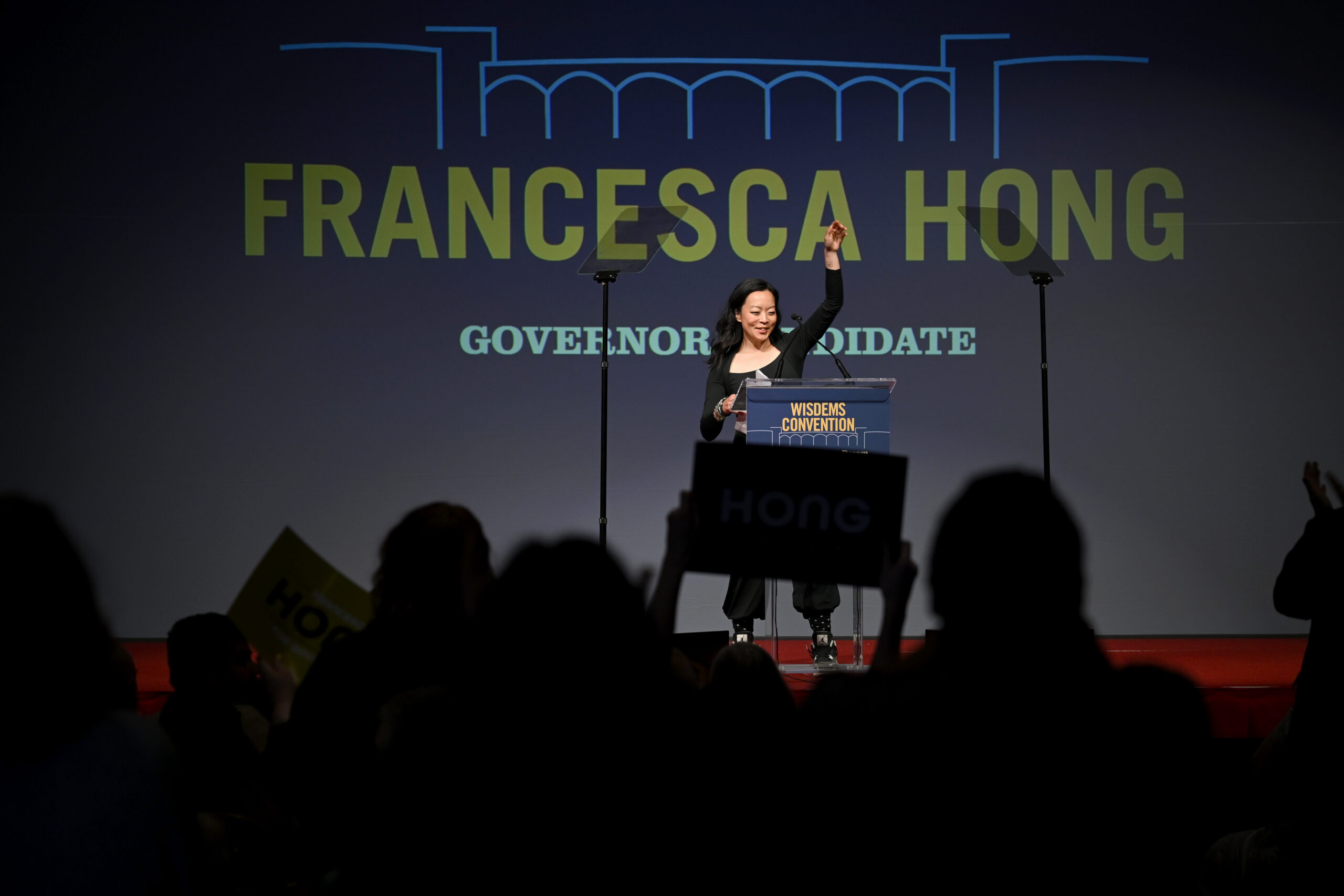
The same day Francesca Hong appeared on the livestream of antisemitic conspiracy theorist ‘Mike From PA,’ she also joined Hasan Piker’s Twitch show
Plus, NEA cracks down on antisemitism chaos

Amirhossein KHORGOOEI / ISNA / AFP via Getty Images
Vessels are pictured anchored in the Strait of Hormuz off Bandar Abbas in southern Iran on May 5, 2026.
Good Wednesday afternoon.
This P.M. briefing is reserved for our premium subscribers like you — offering a forward-focused read on what we’re tracking now and what’s coming next.
Today’s Daily Overtime was curated by JI U.S. Editor Danielle Cohen-Kanik.
📡On Our Radar
Notable developments and interesting tidbits we’re tracking
Talks in Doha about the U.S.-Iran memorandum of understanding have concluded, Iranian Deputy Foreign Minister Kazem Gharibabadi announced, with the countries agreeing to create a communication channel “by tomorrow” in order to address MOU violations.
The U.S. and Iran also agreed to “keep things quiet for the coming week,” a U.S. official told Axios, while Washington is reportedly continuing to press Tehran to abandon its plan to charge tolls in the Strait of Hormuz and “think bigger” on a nuclear deal. The sums Iran could generate from freely selling oil without sanctions under such a deal “would be 100 times more valuable to them,” the official said…
New York Times/Siena polls of the six Senate battleground states — Alaska, Iowa, Maine, North Carolina, Ohio and Texas — found that Democrats have a path, albeit an uphill one, to retake the chamber in November. All of the races are within the margin of error except in North Carolina, where former Democratic Gov. Roy Cooper leads Michael Whatley, former chair of the Republican National Committee, with the largest margin of seven points…
Poetica Coffee, the Brooklyn cafe that banned Rep. Dan Goldman (D-NY) last week over his support of Israel, claimed in an Instagram post today that Goldman intentionally “smear[ed]” the business in talking about his experience “possibly for election-eve media exposure”…
Rep. Adam Smith (D-WA), ranking member of the House Armed Services Committee, told CNN yesterday that some democratic socialist candidates have views that are “vastly more radical” than where the “Democratic coalition” stands, saying their support for communism, open borders and defunding the police represents “a fundamental attack on America itself”…
Asked about Republicans viewing him as easier to beat in a general election than his more-moderate primary opponents, far-left Michigan Democratic Senate candidate Abdul El-Sayed told Semafor, “The number of times I’m gonna define and redefine Mike Rogers!” referring to the GOP Senate front-runner and former Michigan representative. “By the time I’m done, his best friends are gonna look at him and think what I think, say what I say. I’m gonna define him into eternity”…
The National Education Association adopted new policies ahead of its convening this weekend in Denver after its Jewish Affairs Caucus and the Jewish Council for Public Affairs advocated for such changes, JCPA said, in response to last year’s assembly which grew contentious over antisemitism issues. The new changes include stronger conduct enforcement for delegates, electronic voting to reduce shouting on the floor during resolution votes, de-escalation training for NEA staff and repeated public reminders of the rules…
Loay Abdelfattah Alnaji was sentenced to one year in jail and two years of probation yesterday after pleading guilty to involuntary manslaughter and battery in the death of Paul Kessler, a 69-year-old Jewish man who died after Alnaji struck him with a megaphone at a protest in California shortly after the Oct. 7 Hamas attacks. The Anti-Defamation League’s California regional offices decried the sentence as “little more than a slap on the wrist” and expressed concern at the judge’s dismissive demeanor during sentencing…
A New York woman was arrested yesterday by the FBI for allegedly providing material support to the Palestinian Islamic Jihad, including over $30,000 in cryptocurrency. The woman is a leader of an extremist organization called the Direct Action Movement for Palestinian Liberation, according to the FBI, and had communicated with a person claiming to be a PIJ fighter in Gaza, whom she told she “wish[es] every day were October 7th”…
Speaking at the Herzliya Conference in Israel, Maj. Gen. (res.) Amir Baram, director general of the Israeli Ministry of Defense, addressed Israeli public criticism of the U.S.’ foreign policy, Jewish Insider’s Matthew Shea reports: “What some in Israel perceive as weakness or folly, an apparent disregard for every warning sign on the ground, is viewed in Washington as cold, calculated and clear-eyed risk management in an era of shifting global attention.”
“For us, Iran is an existential threat; for the United States, it is a chronic regional challenge,” Baram said of the countries’ differing priorities. “We think Tehran, they think Taiwan”…
U.S. Ambassador to Israel Mike Huckabee and Israeli Foreign Minister Gideon Sa’ar held a ceremony to sign the lease for the permanent new complex of the U.S. Embassy in Jerusalem; Huckabee handed Sa’ar a $1 bill as symbolic payment for the 99-year lease…
The New York Times looks at President Donald Trump’s insistence that Syria take over fighting Hezbollah in Lebanon from Israel, an idea that has been shot down by Syrian President Ahmad al-Sharaa and raised alarm across the Middle East…
CENTCOM hosted a regional security dialogue alongside the Bahrain Defense Force with participation from Egypt, Jordan, Kuwait, Lebanon, Oman, Qatar, Saudi Arabia, Syria, the UAE and Yemen — “the first time military leaders from Syria and Lebanon participated in a regional defense conference led by the United States,” CENTCOM said…
The U.S. Navy is searching for a missing aircrew member after a Sea Hawk helicopter made an emergency water landing in the Arabian Sea, with three of the four crew members rescued in stable condition. There’s no indication any hostile action was involved, the Navy’s 5th Fleet said…
⏩ Tomorrow’s Agenda, Today
An early look at tomorrow’s storylines and schedule to keep you a step ahead
Keep an eye on Jewish Insider for a look at how Jewish leaders are approaching America’s 250th birthday — and why many see the milestone, coming at a fraught moment, as a chance to reaffirm both their Jewish identity and their faith in the American experiment.
The Maccabiah Games, which kicked off today in Jerusalem with a grand opening ceremony, begin in earnest tomorrow as about 5,000 athletes — including 900 from the U.S. — compete in more than 30 sports over the next two weeks.
Stories You May Have Missed
PLATFORM PUNT

House Minority Leader Hakeem Jeffries and Reps. Alexandria Ocasio-Cortez and Greg Casar were noncommittal when pressed by JI
RED SCARE
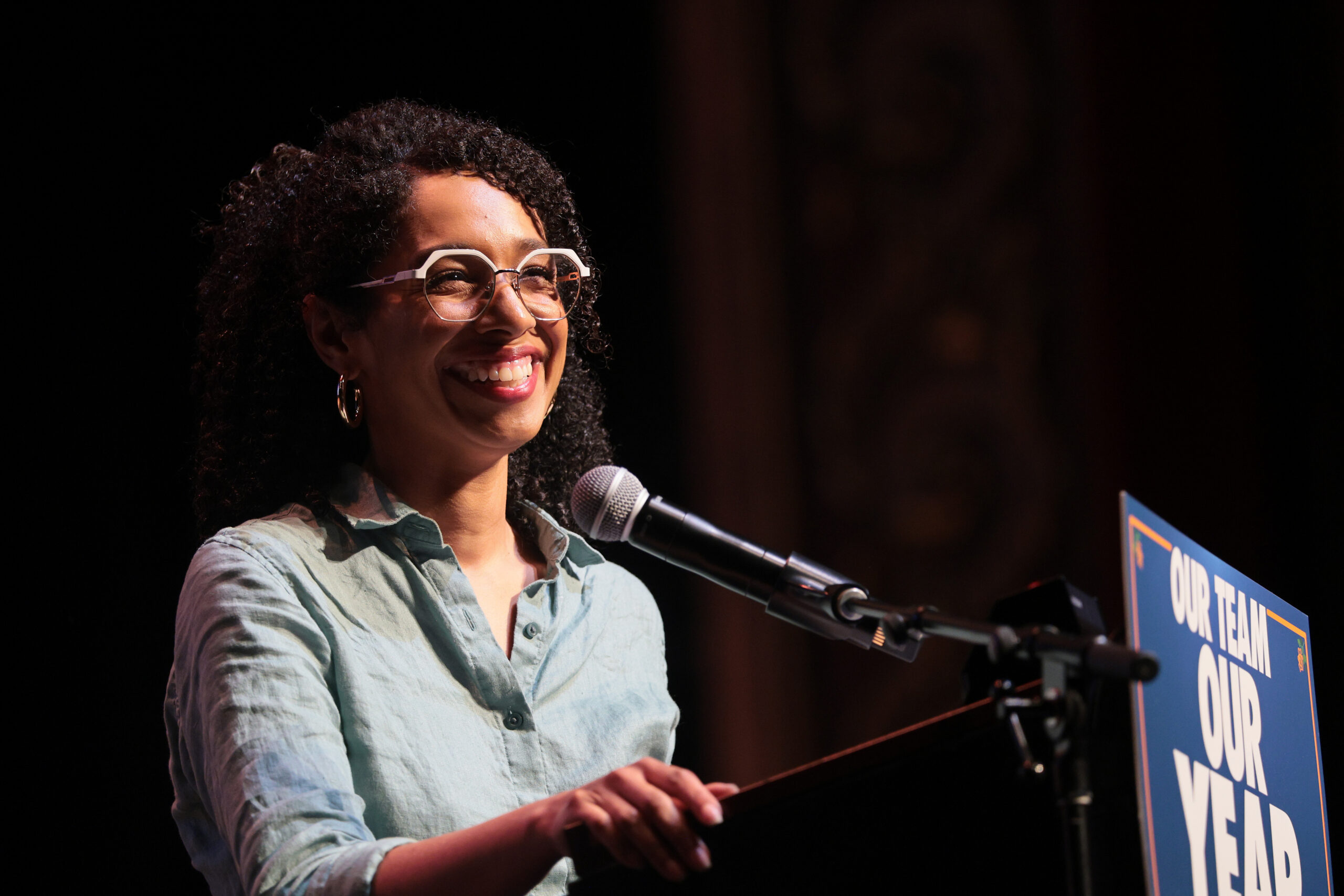
Jeffries said Avila Chevalier has ‘walked away from many of the things that have been unearthed’ following a CNN report on her past sympathetic posts about communism and Soviet figures
Groups including the AJC, HIAS, NCJW, JCPA and the Reform movement praised the decision, with some having joined an amicus brief alongside other faith-based organizations
Mehmet Eser/Anadolu via Getty Images
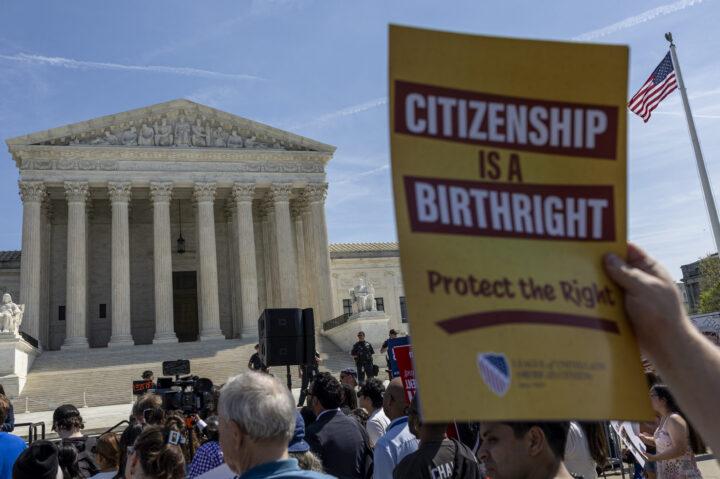
Demonstrators rally in support of birthright citizenship outside the U.S. Supreme Court on April 1, 2026 in Washington, DC.
Several Jewish groups celebrated the Supreme Court’s decision on Tuesday to uphold birthright citizenship and strike down a Trump administration executive order that aimed to eliminate citizenship for children of undocumented immigrants and those in the U.S. on temporary visas.
The American Jewish Committee, which joined an amicus brief against the executive order with various other religious groups, praised the Supreme Court’s decision.
“Birthright citizenship also ensures that children born in this country to parents who came here seeking religious freedom will not be deported to a country where their parents were persecuted, keeping with the United States’ long history of welcoming those seeking religious freedom,” the group said in a statement. “This is of particular importance to many American Jews, who descend from families who escaped persecution, oppression and discrimination.”
The AJC said the decision allows those seeking refuge in the U.S. “to become part of the nation’s fabric and pass on their traditions to their descendants without fear or favor.”
HIAS, which also joined the amicus brief, said that birthright citizenship has been foundational for the Jewish and other immigrant communities.
“The promise of birthright citizenship has allowed generations of immigrant families, including in our own Jewish community, to put down roots, build lives, and contribute to this country,” HIAS CEO Beth Oppenheim said. “As we reflect on 250 years of U.S. history, it is worth remembering that the United States has been shaped by the children and grandchildren of immigrants. Their stories are part of America’s story, and without them, the country we know today would be fundamentally different.”
Rabbi Jonah Pesner, director of the Religious Action Center of Reform Judaism, which also joined the brief, said that the court had “affirmed what has been clear since the 14th Amendment was crafted.”
“We were proud to join an amicus brief with 56 other faith-based organizations to make clear that birthright citizenship is an embodiment of our shared moral imperative to ‘welcome the stranger.’ As Jews, we know the dangers of policies that seek to exclude, marginalize, or revoke the citizenship of people in their own country,” Pesner said on behalf of the Union for Reform Judaism, Central Conference of American Rabbis and wider Reform movement.
The Conservative and Reconstructionist movements also joined the brief, as did other groups affiliated with the Reform movement and T’ruah.
Darcy Hirsh, the vice president of government relations and advocacy at the National Council of Jewish Women, said that the decision offered a “collective sign of relief.”
“From NCJW’s earliest days in 1893, we have welcomed immigrants and fought for their full inclusion in American life,” Hirsh said. “We know from our own experience as Jews what it means to be told you don’t truly belong — to have your citizenship questioned, and your community othered. That is why birthright citizenship has never been abstract to us, and why we will always fight against any effort to make belonging for anyone conditional.”
Jewish Council for Public Affairs CEO Amy Spitalnick called efforts to undermine birthright citizenship “bigoted” and “fringe.”
“As a community that found refuge in this country as immigrants, Jews know that the promise of belonging — the principle that if you are born here, you are from here — is a constitutional bedrock that has allowed our community, and so many others, to thrive in safety for generations,” she said.
Combat Antisemitism Movement is co-hosting the July 3 gathering at the U.S. Institute of Peace

Paul Morigi/Getty Images for The Hill & Valley Forum
Under Secretary of State Jacob Helberg participates in the The Hill & Valley Forum 2026 at Andrew W. Mellon Auditorium on March 24, 2026 in Washington, DC.
As Washington, D.C., prepares to host a weekend of July Fourth hoopla on the National Mall, senior Trump administration officials, diplomats and Jewish communal leaders will gather on Friday evening across from the Lincoln Memorial for a Shabbat dinner celebrating America’s 250th birthday.
Jacob Helberg, the under secretary of state for economic affairs, and Ambassador Yehuda Kaploun, the Trump administration’s special envoy to monitor and combat antisemitism, are hosting the Shabbat dinner at the U.S. Institute of Peace, according to an invitation obtained by Jewish Insider. The July 3rd gathering is co-hosted by the State Department and Combat Antisemitism Movement.
Attendees can expect to walk away with branded yarmulkes, Jewish prayer books and special challenge coins. Several hundred people are expected to attend, a source familiar with the event told JI.
Plus, Menin's measured rebuke of antisemitic Brooklyn Dem

Jabin Botsford/The Washington Post via Getty Images
Rep. Rashida Tlaib (D-MI) speaks during a hearing on Capitol Hill on Wednesday, Dec. 01, 2021, in Washington, D.C.
Good Tuesday afternoon.
This P.M. briefing is reserved for our premium subscribers like you — offering a forward-focused read on what we’re tracking now and what’s coming next.
Today’s Daily Overtime was curated by JI U.S. Editor Danielle Cohen-Kanik.
📡On Our Radar
Notable developments and interesting tidbits we’re tracking
Nearly all House Democrats voted in favor of a war powers resolution this afternoon that aimed to block U.S. support for Israeli operations against Hezbollah in Lebanon, Jewish Insider’s Marc Rod reports, though the legislation failed to secure a House majority, with nearly all Republicans and 22 Democrats voting against the measure…
White House Special Envoy Steve Witkoff and Jared Kushner are in Doha, Qatari Foreign Ministry spokesperson Majed al-Ansari confirmed, where they were set to meet with Qatari Prime Minister Sheikh Mohammed bin Abdulrahman Al Thani and other mediators, but did not hold talks with Iranian officials. It’s a step back from the direct negotiations that took place in Switzerland just a week ago…
Al-Ansari said further that the $6 billion in frozen Iranian assets has not yet been released to Tehran. “Whether the funds are transferred depends on the agreement of both parties and the progress of negotiations, which has not yet occurred,” he announced at a press briefing today…
Meanwhile, Oman has submitted a proposal to the U.S. for Muscat and Tehran to collect service fees from shipping companies seeking to transit the Strait of Hormuz, The New York Times reports. One of Iran’s deputy foreign ministers, Kazem Gharibabadi, said yesterday if Iran was unable to come to an arrangement with Oman it would move forward on its own…
A small group of House Republicans, led by Rep. Don Bacon (R-NE), is threatening not to support the Trump administration’s $88 billion Iran war supplemental funding request unless the White House replaces more than 4,000 U.S. troops who were pulled out of Poland last month, Politico reports. The effort could hold up the supplemental, already expected to face a tough fight, given the GOP’s razor-thin majority in the chamber…
A 20-year-old U.S. citizen living in Jerusalem is set to be charged by Israeli prosecutors for spying on Iran’s behalf. The suspect, arrested earlier this month, was allegedly paid to take pictures and videos of “sensitive sites” in Israel over several months…
Iranian Foreign Minister Abbas Araghchi met with Iraqi leaders in Baghdad today as both countries prepare for a “mass funeral” for the late Iranian Supreme Leader Ayatollah Ali Khamenei, Araghchi said, after Khamenei was killed in February in a joint U.S.-Israeli operation…
The Israeli Ministry of Defense and defense manufacturer Rafael completed a successful test integrating the Iron Beam laser system into the Iron Dome missile-defense array, marking a “major breakthrough,” Rafael announced…
Ellie Cohanim, who served as deputy special envoy to monitor and combat antisemitism in President Donald Trump’s first term, recently joined his administration as a senior policy advisor to U.S. Ambassador to the U.N. Mike Waltz, Waltz announced today…
A New York Times/Siena poll of the race for U.S. Senate in Texas found Republican Attorney General Ken Paxton and Democratic state Rep. James Talarico in a dead heat, 47-47%, among likely voters. The seat, once considered a long shot for Democrats in the deep-red state, has emerged as a top-tier pickup opportunity, given Paxton’s ethical and legal baggage…
New York City Council Speaker Julie Menin — the first Jewish person to hold her role — slammed a newly elected Brooklyn Democrat’s promotion of antisemitic conspiracy theories, but declined to call her commentary disqualifying, JI’s Will Bredderman reports…
After a monthslong unexplained absence from Congress, Rep. Tom Kean Jr. (R-NJ) returned to the House floor today to disclose that he had been hospitalized for depression. Kean faces a competitive reelection race against Democratic nominee Rebecca Bennett in a key battleground district in Democrats’ bid to retake the House…
Prominent pro-Israel activist Arsen Ostrovsky, who was injured in the Bondi Beach Hanukkah shooting in Sydney last year, testified before Australia’s Royal Commission on Antisemitism about how he faced “relentless” and “vicious” harassment online after the attack, including AI-altered images of his injuries and accusations that he was a crisis actor…
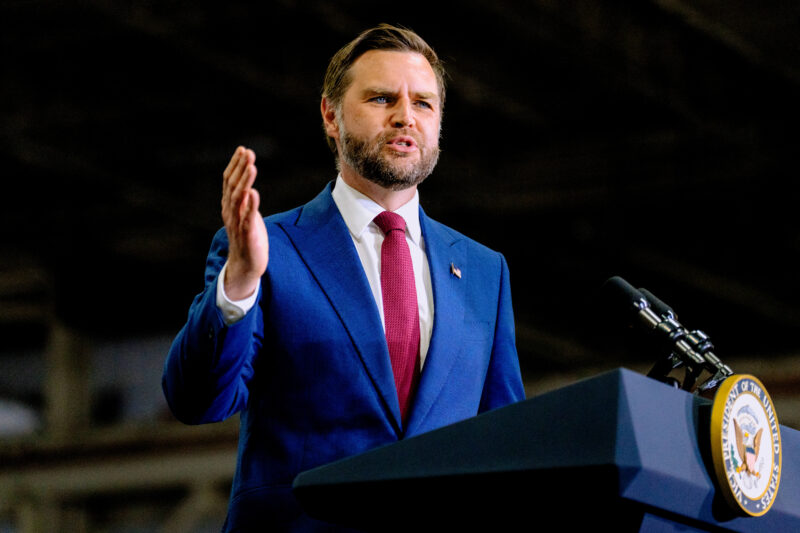
In a series of high-profiledecisions today, the Supreme Court sided with Vice President JD Vance in a case he brought as a Senate candidate, along with other plaintiffs, and lifted federal limits on coordinated spending between political parties and candidates.
The court also struck down Trump’s attempt to end birthright citizenship — a move that garnered praise from Jewish groups including the American Jewish Committee, the Union for Reform Judaism and the Jewish Council for Public Affairs…
⏩ Tomorrow’s Agenda, Today
An early look at tomorrow’s storylines and schedule to keep you a step ahead
Keep an eye on Jewish Insider for a look at Democrats’ ongoing divisions over an effort to cut aid to Israel led by Rep. Thomas Massie (R-KY).
Technical delegations from the U.S. and Iran are expected to meet separately with Qatari and Pakistani mediators in Doha — still with no direct talks planned.
Hard-line Republicans upended business on the House floor for the second week in a row, blocking the procedural measure that would have teed up consideration of the 2027 State Department funding bill and the 2027 National Defense Authorization Act. After a final vote this evening, the House will head to recess early, until July 13.
The Herzliya Conference continues in Israel: Among the many top national security and political officials speaking are former Prime Ministers Naftali Bennett and Yair Lapid; former Israeli Ambassadors to the U.S. Danny Ayalon and Michael Herzog; former U.S. Ambassador to Israel Dan Shapiro; EU Ambassador to Israel Michael Mann; Yashar party leader Gadi Eisenkot; Yisrael Beiteinu party leader Avigdor Liberman; Democrats party leader Yair Golan; Ra’am party leader Mansour Abbas; and Nadav Tamir, executive director of J Street Israel.
President Donald Trump is set to take his first trip on the jumbo jet gifted to him by Qatar as he travels to an event in North Dakota.
Stories You May Have Missed
PRIDE AND PREJUDICE
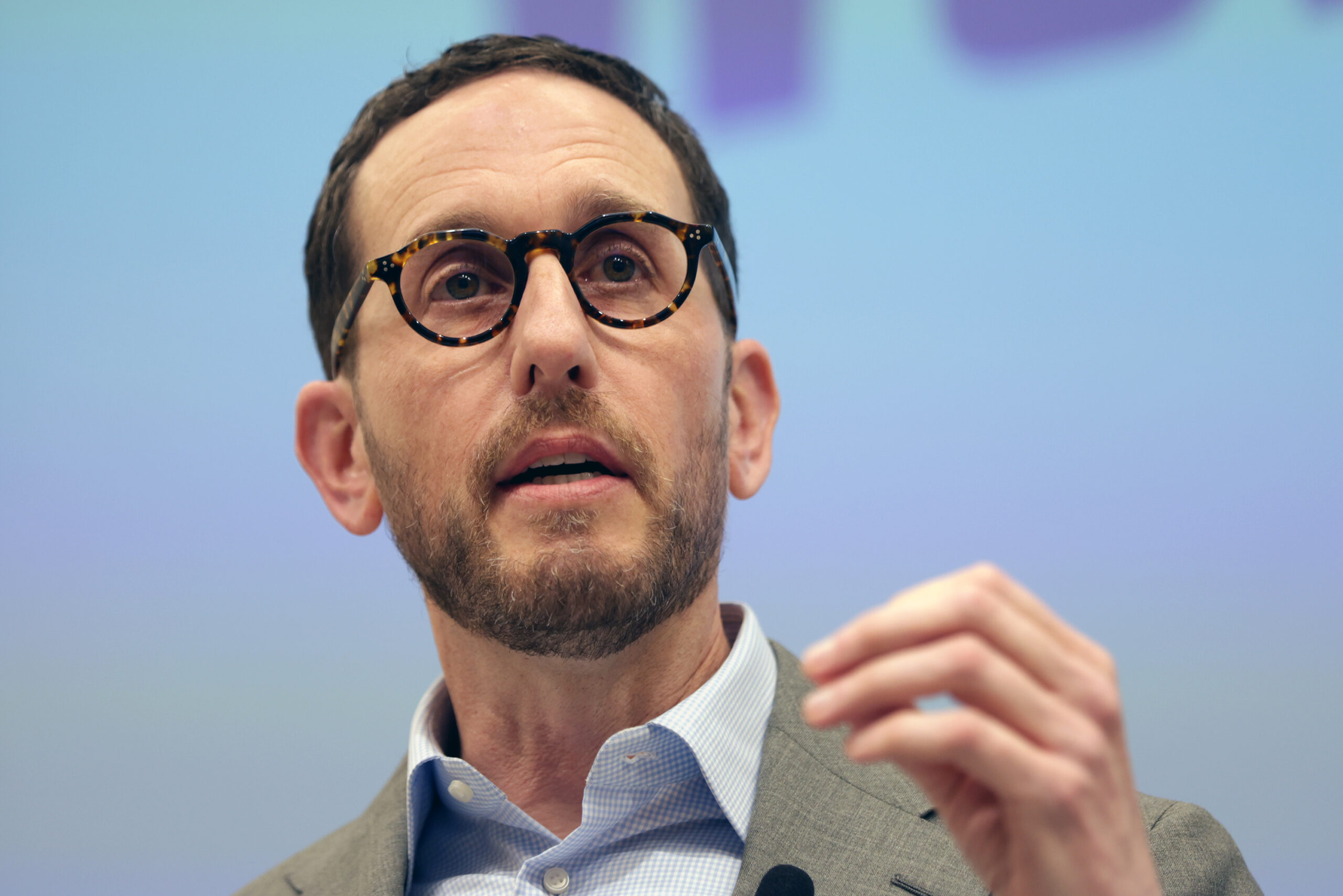
Wiener said the incident where he was accosted at a pride march was ‘absolutely’ antisemitic; only a few California elected officials said the same
WESTWARD BOUND

Gen. Frank McKenzie revealed that CENTCOM had previously proposed a similar western contingency plan to the Biden administration which was shot down
Cohanim served as deputy special envoy to monitor and combat antisemitism in the first Trump administration
Courtesy
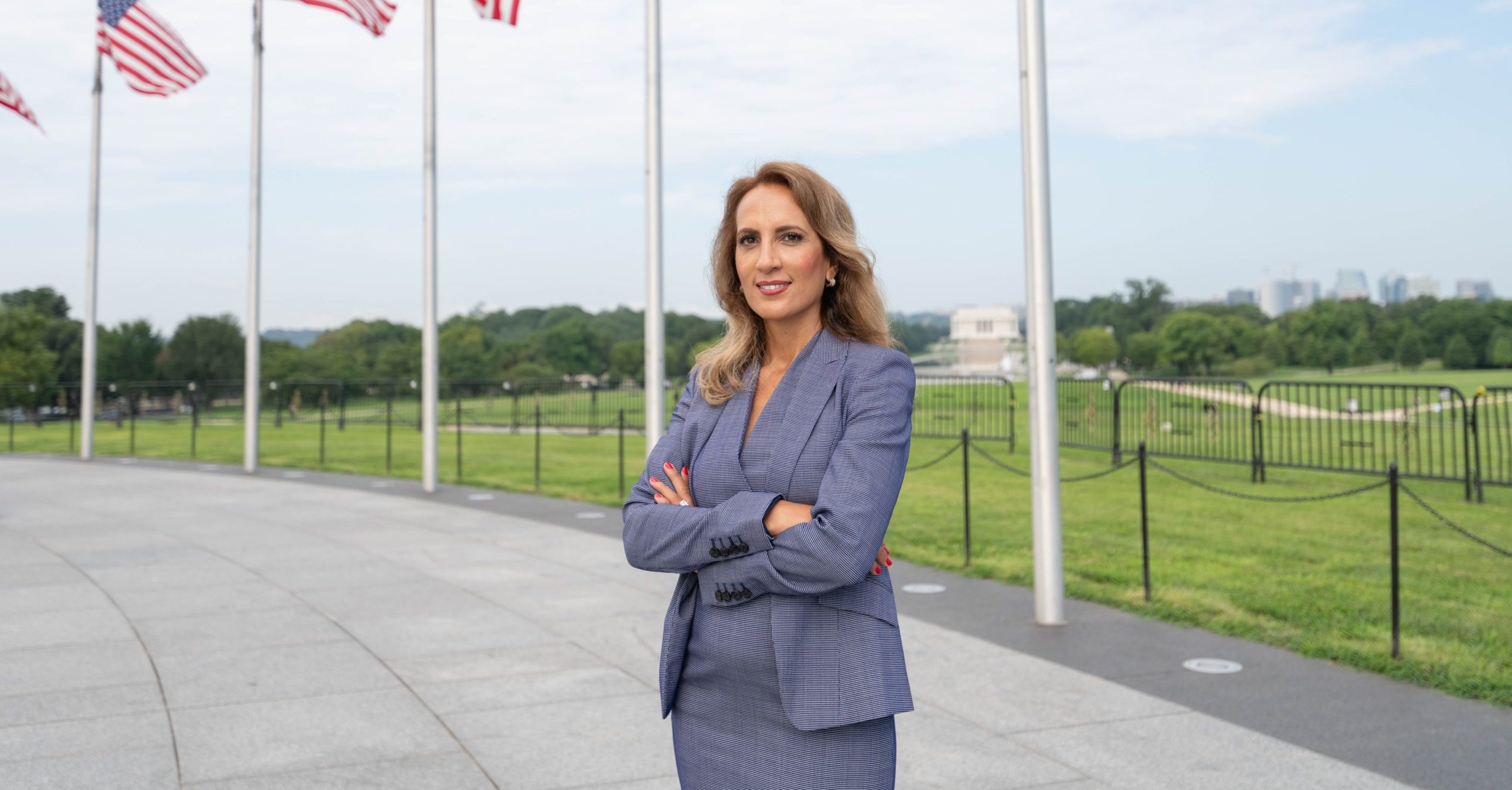
Ellie Cohanim, who served as deputy special envoy to monitor and combat antisemitism in President Donald Trump’s first term, recently joined his administration as a senior policy advisor to U.S. Ambassador to the U.N. Mike Waltz, Waltz announced on Tuesday.
Cohanim was born in Tehran and left Iran as a child in 1979, following the Islamic Revolution. She came with her family to New York.
“Ellie’s story is the American story,” Waltz said in a statement. “Her family fled persecution in Iran, built a life in New York, and she has spent her career looking for ways to serve America, fighting for freedom, standing with the persecuted, and calling out antisemitism wherever it hides. That is exactly the kind of conviction and courage we need at the United Nations.”
Cohanim regularly appears on Fox News as a booster of Trump’s foreign policy, and the announcement of her hiring described her as an advocate of “America First foreign policy.”
Cohanim served as co-chair of the National Task Force to Combat Antisemitism, a group created in 2023 to help the Heritage Foundation draft a conservative framework to combat antisemitism.
Last fall, the task force disaffiliated from Heritage after its president, Kevin Roberts, came to the defense of Tucker Carlson following the far-right podcaster’s interview with neo-Nazi provocateur Nick Fuentes. Since then, Cohanim and her co-chairs have been outspoken about antisemitism on the political right.
Rep. Debbie Wasserman Schultz said that Steve Witkoff denied that Iran had received any sanctions relief, and ended the call when pressed

Samuel Corum/Getty Images
Rep. Brian Mast (R-FL) speaks during a House Committee on Foreign Affairs hearing on Capitol Hill on January 11, 2024 in Washington, DC.
Rep. Brian Mast (R-FL), the chair of the House Foreign Affairs Committee, suggested following both unclassified and classified briefings from the Trump administration on Iran on Monday that talks with the regime for a final agreement could continue past the 60-day timeline laid out in the U.S.-Iran memorandum of understanding finalized earlier this month.
“I think [the] 60-day window … is probably more of a fluid thing, just like you think about some of the stuff that went on with the Gaza-Israel [negotiations and the] Board of Peace, right?” Mast said.
“You get to some things, you don’t necessarily get to everything … over a 60-day window,” Mast said. “I think you get to some, I don’t think you get to everything. I don’t think that it just ends after 60 days by any means.”
He said that the briefings didn’t specifically touch on whether there had been any reassurances that a final deal would be reached.
“There are reassurances that people want in specific sectors,” Mast said, including that Iran will not return to pursuing nuclear weapons. “That would be important to have inked.”
Talks over and efforts to implement the ceasefire plan in Gaza have continued long beyond their original timeline, particularly efforts to disarm Hamas — which the group continues to resist — and to deploy an international military force to stabilize the territory, both of which are lynchpins to moving the peace process forward.
Some in Washington have worried about similar stagnation in the U.S.-Iran talks, and that the MOU might become the new status quo.
The administration held an unclassified briefing open to all House members on the phone on Monday afternoon, which included Secretary of State Marco Rubio and White House Special Envoy Steve Witkoff. Immediately after, the top lawmakers on key House committees, including Mast, received a classified briefing from Deputy National Security Advisor Andy Baker.
Senate lawmakers, who are in recess, also participated in a separate phone briefing on Monday afternoon.
Rep. Debbie Wasserman Schultz (D-FL) told Jewish Insider she pressed Witkoff at the end of the unclassified phone briefing about comments he had made earlier in the briefing claiming that no waivers had been used to allow Iran to sell oil.
Wasserman Schultz pointed out to Witkoff that the Treasury Department issued a license last week to allow the sale and importation of Iranian oil and petrochemical products, and said Witkoff “really was taken aback and [he] had difficulty answering.”
She said Witkoff had initially denied that any sanctions had been waived or any oil sales had been permitted since the MOU was signed. But when confronted about the waiver, she said Witkoff “acted like he wasn’t aware of it.” She said that Witkoff said he would follow up with her and officials subsequently “turned tail and cut off the call.”
“What was clear to me was that Mr. Witkoff either, disturbingly, had no idea that what he was saying was not true, or he did know what he was saying wasn’t true,” she said. “I don’t know which it was. … We’ll see if they actually get back to me …. But really it’s part of a larger pattern with this administration of misleading Congress on Iran. They’re constantly moving the ball.”
Rep. Greg Meeks (D-NY), the ranking member of the House Foreign Affairs Committee, offered a similar account of confusion among administration officials over the sanctions relief, and said Rubio told lawmakers Iran would not receive any money if it did not comply with the MOU, something he said was out of step with the actual terms of the MOU.
“The secretary of state indicated that there was no money going to Iran, but when you look at the MOU, it says money would start going to Iran at the implementation of the MOU,” Meeks said. “The Iranians are claiming they are receiving some funds now. … The Treasury Department has made ways for money to go to Iran, and unfortunately I think that Mr. Witkoff in the [unclassified] briefing did not realize that.”
Both Meeks and Wasserman Schultz said the call indicated that Witkoff and others involved in the talks are not qualified to handle the negotiations.
Mast called the MOU a “work in progress” and said there are “reasons to be hopeful and reasons to be skeptical” about the deal. Chief among the reasons for skepticism, he said, is that Iran is untrustworthy and does not act in good faith.
But he said that the damage done through U.S. operations against Iran — burying Iran’s nuclear program and doing hundreds of billions of dollars of damage to the country and critical industries — provides reasons for optimism.
Asked about the sanctions relief already provided to Iran, and the potential additional financial benefits Iran stands to gain, Mast told JI it’s a question of “math” — he estimated that the U.S. did half a trillion dollars in damage to Iran, and said that any reconstruction funding or investments from other countries or released frozen assets “subtracts from that math.”
Mast also argued that reconstruction funding would be going to companies involved in the effort, including potentially American companies, rather than the regime, but acknowledged that money is fungible and “it affects the math equation.” He also argued that any release of frozen assets would be based on a “behavior change.”
Pressed on whether he thought Iran’s behavior to this point merited the oil sanctions waiver, Mast said that depends on the timeline of Iranian behavior examined — Iran’s pace of attacks on commercial shipping has slowed from its peak during the war, but its behavior now is “very similar” to “what was a year, or three years ago.”
“I think [the Iranians are] doing everything to prove they are who they are,” Mast said. “They will lie about everything and, you know, say they agree to something and then not [follow through]. It’s a very good reason to be skeptical of anything about them, but again, it’s a different world post-[Operation] Epic Fury.”
Rep. Adam Smith (D-WA), the ranking member of the House Armed Services Committee, emerged from the classified session pessimistic that the administration is in a position to achieve the goals it has set out for the talks.
“We know where they want to go, what they want to negotiate. The evidence that they’re progressing towards that outcome isn’t great,” Smith said. “They’re hoping to get the Strait [of Hormuz] open and reach some sort of economic deal with Iran and negotiate on the nuclear program, which they sort of outlined, and they said they’re optimistic about it. I don’t see as much cause for optimism personally.”
He said that the information provided in the classified briefing was not substantially different from that which was shared on the unclassified call.
Meeks said he left the classified briefing with “some of the same questions I had before I went in.” He said that he thinks the U.S. is in a worse position after the war, and said he wants to have additional briefings.
“I can’t tell you that I got information that says you’ve done anything or made any great progress subsequent to the war that had not already been accomplished before the war, and much of what they have talked about has been or was in the JCPOA,” Meeks said, referring to the 2015 Iran nuclear deal.
Mast said he does not plan to call any public hearings with administration officials on Iran in the Foreign Affairs Committee, but wants to hear in a classified setting from senior administration officials. He also said that administration officials said they would convey lawmakers’ desire for additional briefings.
Wasserman Schultz criticized the administration for calling the open briefing in the late afternoon on a day when many members are traveling to Washington, and holding it in an unclassified setting where they would be unable to discuss many substantive details.
Plus, Susie Wiles' Iran strike skepticism

Nathan Howard-Pool/Getty Images
Delegation staff members meet in the lobby during a quadrilateral meeting between the U.S., Iran, Pakistan, and Qatar at the Lake Lucerne Summit, aimed at advancing a deal to end the Middle East conflict at the Buergenstock Resort, Lake Lucerne on June 21, 2026 near Stansstad, Switzerland.
Good Monday afternoon.
This P.M. briefing is reserved for our premium subscribers like you — offering a forward-focused read on what we’re tracking now and what’s coming next.
Today’s Daily Overtime was curated by JI U.S. Editor Danielle Cohen-Kanik.
📡On Our Radar
Notable developments and interesting tidbits we’re tracking
The U.S. and Iran offered conflicting reports about whether talks will be heldthis week as the countries attempt to deescalate after a weekend exchange of military strikes: President Donald Trump claimed today that Iran had requested a meeting that would take place in Qatar on Tuesday, Jewish Insider’s Matthew Shea reports, while Iranian Foreign Ministry spokesperson Esmaeil Baghaei denied any scheduled meetings with the U.S…
White House Special Envoy Steve Witkoff and Secretary of State Marco Rubio briefed Congress this afternoon on the memorandum of understanding signed with Iran earlier this month, in the first member-wide update on the agreement…
CENTCOM head Adm. Brad Cooper met with Lebanese Armed Forces chief Gen. Rodolphe Haykal in Beirut today to discuss “implementing the security annex” to the Israel–Lebanon framework agreement signed on Friday, the LAF said in a statement. CENTCOM said Cooper also met with “senior civilian and military leaders” in Israel…
White House Chief of Staff Susie Wiles joined Vice President JD Vance in initially voicing skepticism to Israeli Prime Minister Benjamin Netanyahu’s pitch to Trump in February 2025 that the U.S. join Israel in striking Iran’s nuclear facilities, according to a new book by New York Times journalists Maggie Haberman and Jonathan Swan. Wiles feared that any involvement from the U.S. military could “spiral into an Israeli regime-change war,” the authors write…
The IDF’s Military Intelligence Directorate and Southern Command told Lt. Gen. Eyal Zamir, the IDF chief of staff, that Hamas is reconstitutingin order to resume war against Israel, according to Israeli media. The report indicates the IDF is urging a return to its campaign against the terror group, but the U.S. is opposed as it seeks to move forward with Trump’s Board of Peace…
Nika Soon-Shiong, the publisher of the Hamas-sympathetic outlet Drop Site News, claimed she was removed from the board of the Committee to Protect Journalists, sharing a letter she had written to the board objecting to CPJ’s announcement that it would audit its database of members of the media killed during the Israel-Hamas war. The move was undertaken after Hamas and Palestinian Islamic Jihad identified individuals CPJ listed as journalists as members of the terrorist groups…
In the lead-up to this summer’s primary elections, endorsement season is in full swing: In its first-ever endorsement, Jewish Voice for Peace Action, the political arm of the anti-Israel advocacy group, is backing far-left Abdul El-Sayed in the Democratic primary for U.S. Senate in Michigan. The Detroit Free Press, Michigan’s largest newspaper, endorsed one of his opponents, state Sen. Mallory McMorrow.
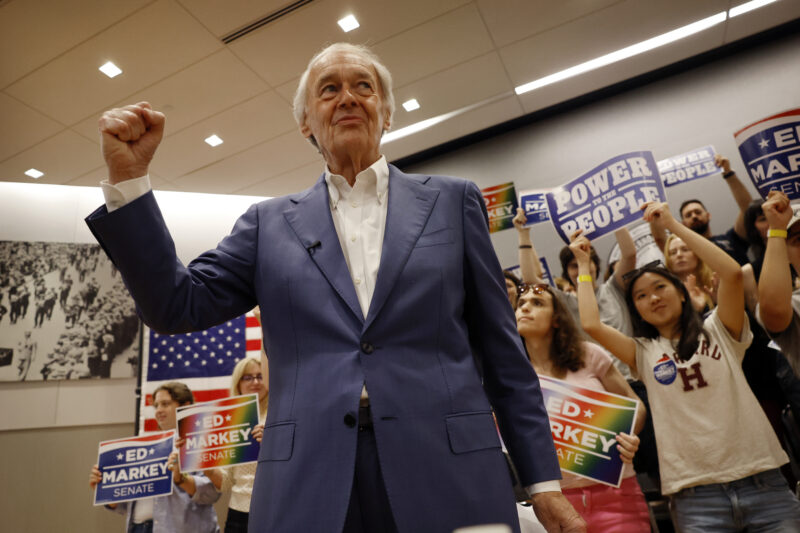
In Minnesota, Minneapolis Mayor Jacob Frey is backing Rep. Angie Craig (D-MN) for U.S. Senate against her more-progressive primary opponent, Lt. Gov. Peggy Flanagan, and in Massachusetts, Sen. Bernie Sanders (I-VT) endorsed Sen. Ed Markey (D-MA) as he fends off a generational primary challenge from Rep. Seth Moulton (D-MA)…
A new New York Times/Portland Press Herald/Siena poll shows Democratic candidate Graham Platner and Republican Sen. Susan Collins in a statistical tie, 49-47%, among likely voters in the Maine Senate race. The close margin reflects Platner’s struggles to consolidate Democratic support — 10% of voters who say they want Democrats to control the Senate indicated they plan to vote for Collins anyway.
Platner and the Democratic National Committee sent a joint fundraising email today, after Democratic leadership had hesitated to support him during the primary…
New York state Democratic Party Chairman Jay Jacobs acknowledged to The New York Post that the “Israel-Palestinian issue had an impact” in the state’s recent primary elections, where several socialist candidates prevailed. “It hurt establishment Democrats,” he said, including “people who may have voted against [Democratic incumbent Reps. Adriano] Espaillat and [Dan] Goldman because of it”…
Yair Rosenberg, a longtime journalist and commentator on American Jewry, is joining The New York Timesas a reporter covering Jewish American life, the Times announced today, amid criticism over the outlet’s alleged bias in covering antisemitism and Israel.
In the latest such incident, noted by Gabe Stutman, the former editor of J. The Jewish News of Northern California, the Times’ reporting on antisemitic harassment targeting California state Sen. Scott Wiener failed to mention Wiener is Jewish…
⏩ Tomorrow’s Agenda, Today
An early look at tomorrow’s storylines and schedule to keep you a step ahead
Keep an eye on Jewish Insider for a look at how California politicians are responding to the repeated harassment targeting Wiener, who is running to replace retiring Rep. Nancy Pelosi (D-CA) in Congress.
Witkoff and Jared Kushner are headed to Qatar in order to represent the U.S. in talks with Iran, White House spokesperson Karoline Leavitt told Fox News, as the status of the negotiations remains unclear.
The technical talks on the memorandum of understanding meant to be taking place separately are also up in the air — Iran’s Baghaei said an Iranian technical delegation will be in Doha this week but will not be meeting with American officials.
Colorado voters will head to the polls in tomorrow’s Democratic primaries, where moderate incumbents are fearing a far-left sweep similar to that of New York City’s primaries earlier this month. Internal polling from the campaigns of longtime state Democratic leaders Sen. Michael Bennet — who is running for governor — and Rep. Diana DeGette shows much tighter races than expected for the established politicians.
Russell Vought, director of the Office of Management and Budget, will testify before the House Appropriations Committee where he is expected to address the White House’s $88 billion supplemental funding request for the war with Iran and FY2027 budget request.
The Israeli Embassy in Washington will hold a “Zionist LGBTQ+ celebration” on the last day of Pride Month in memory of slain embassy staffer Sarah Milgrim’s allyship.
Reichman University’s Herzliya Conference kicks off in Israel, focusing this year on national security and national resilience. Israeli President Isaac Herzog will address the confab, as well as U.S. Ambassador to Israel Mike Huckabee; Amos Hochstein, who served as a Middle East envoy under former President Joe Biden; former Mossad chief Tamir Pardo; former Israeli National Security Advisor Tzachi Hanegbi; journalist Barak Ravid; and Aliyah Minister Ofir Sofer.
Stories You May Have Missed
WALK-BACK
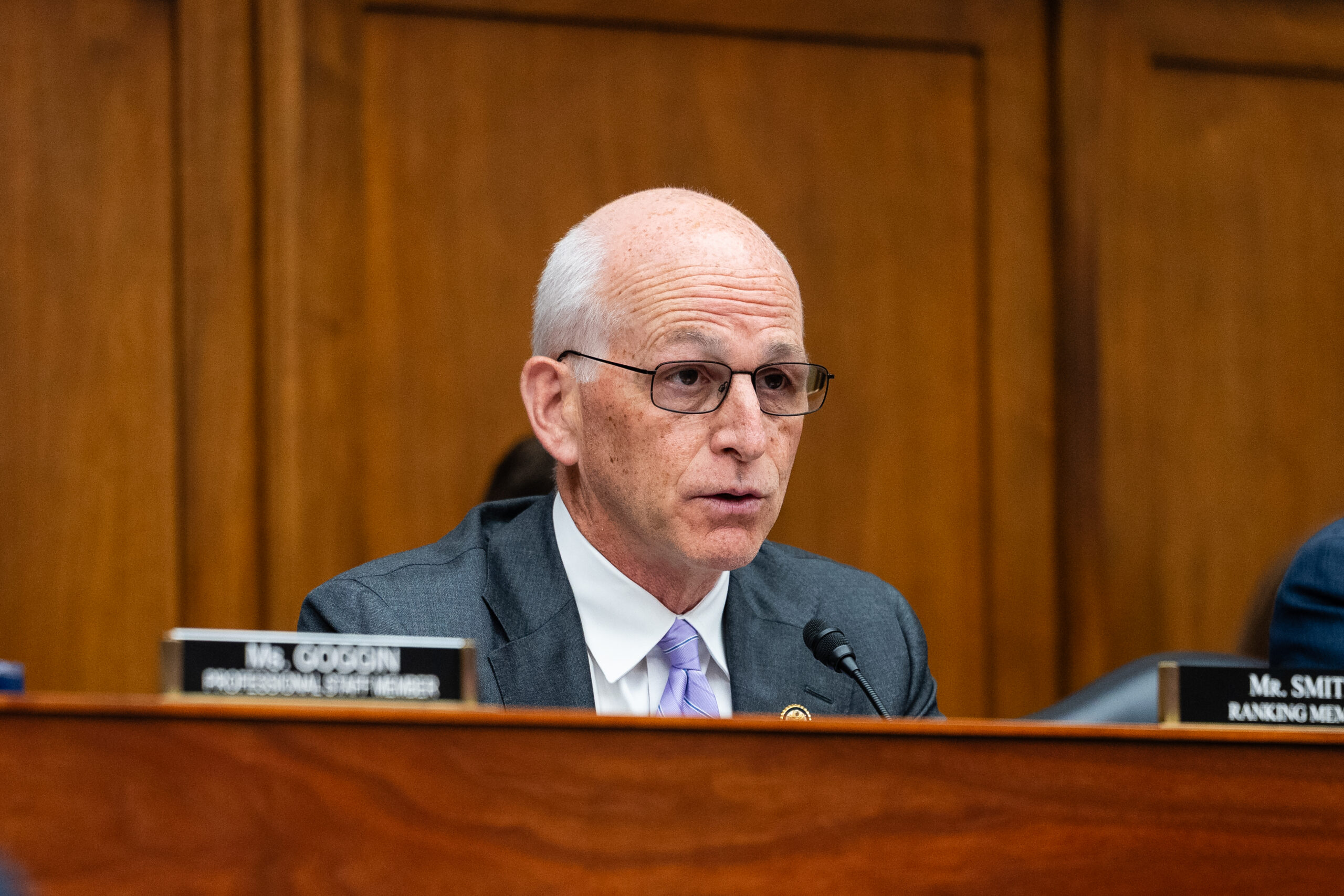
Adam Smith, a reliable supporter of Israel, said he would now join progressives in his party to oppose a provision bolstering a close U.S.-Israel alliance
POLICY PERSPECTIVE

In conversation with Biden foreign policy officials Jake Sullivan and Jon Finer, Kagan said, ‘Israel’s vision for the Middle East has never been a vision that the United States should sign up to’
Both Vance and Rubio will have their work cut out for them as they navigate the coming weeks
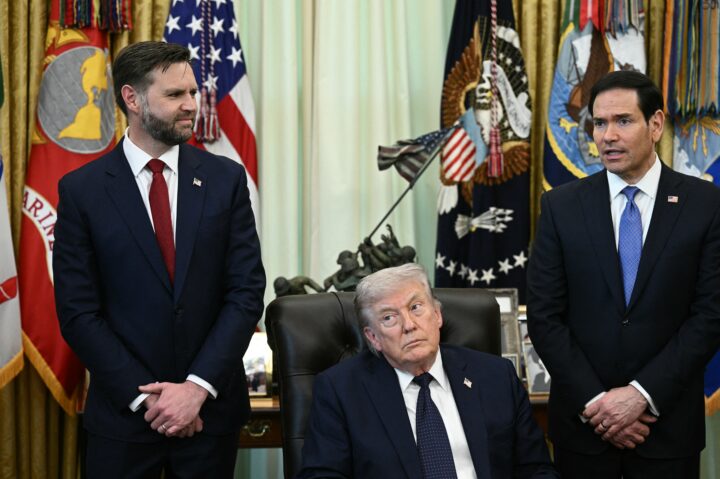
Photo by Brendan SMIALOWSKI / AFP via Getty Images
Vice President JD Vance and President Donald Trump listen to Secretary of State Marco Rubio speak during a meeting with Lebanon Ambassador to the U.S. and Israel Ambassador to the U.S., at the White House in Washington, D.C. on April 23, 2026.
As tensions run high in the Gulf following exchanges of fire between the U.S. and Iran over the weekend, a vastly different security situation is taking shape in Lebanon, with the Trump administration’s top officials — Vice President JD Vance and Secretary of State Marco Rubio — taking responsibility for the respective outcomes.
Vance, who led last week’s negotiations with Iran in Switzerland, said upon his departure from the talks that a “good foundation” had been established between the countries. But that foundation displayed its first cracks just three days later, when Iranian drones fired on a commercial vessel in the Strait of Hormuz, prompting the U.S. to strike Iranian military infrastructure.
The vice president’s tone changed by the weekend, when he said that if Iran had “disagreements about how the MOU is being applied, they can pick up the phone. But violence will be met with violence.” The Iranians skipped technical talks slated for Sunday, saying that the U.S. had not fulfilled the condition of the MOU that would release billions in frozen funds.
Now, officials say that the U.S. and Iranian delegations have agreed to hold fire and will meet in Doha, Qatar, on Tuesday to discuss the status of the Strait of Hormuz.
In Washington, officials are meanwhile celebrating the signing of a framework agreement between Israel and Lebanon that would see Israel scale back its presence in southern Lebanon, creating two “pilot zones” for the Lebanese Armed Forces to administer.
The Foundation for Defense of Democracies’ David Daoud cautioned that the celebration could be premature, telling JI that the fractious nature of Lebanon’s political and religious makeup — as well as Hezbollah’s role in the daily lives of many Lebanese citizens — makes the agreement difficult to implement, even with all the damage the Iranian-backed group has sustained over the last three years.
“Don’t underestimate Hezbollah’s ability to snatch victory from the jaws of defeat,” Daoud said. “I don’t want to overestimate their ability, but this group has proven itself very adaptable over the course of its existence.”
With the agreement signed, the next step will be its implementation. If the LAF is able to administer the pilot zones, there is the possibility of replicating the strategy elsewhere in southern Lebanon. The challenge will be when residents of southern Lebanon — which include Hezbollah members from the area — begin to return to villages south of the Litani River.
In Lebanon, the challenge is not only political will but Beirut’s capacity to address Hezbollah, which is deeply embedded in Lebanese society.
Both Vance and Rubio will have their work cut out for them as they navigate the coming weeks: Vance with continued talks with Iran and the pressure to reopen the Strait of Hormuz, and Rubio with the implementation of an agreement he hailed as the “beginning of the beginning.” Whether they are successful depends more on the actors themselves than the agreements they sign.
A U.S. official said the longstanding designation could be removed by the end of the summer
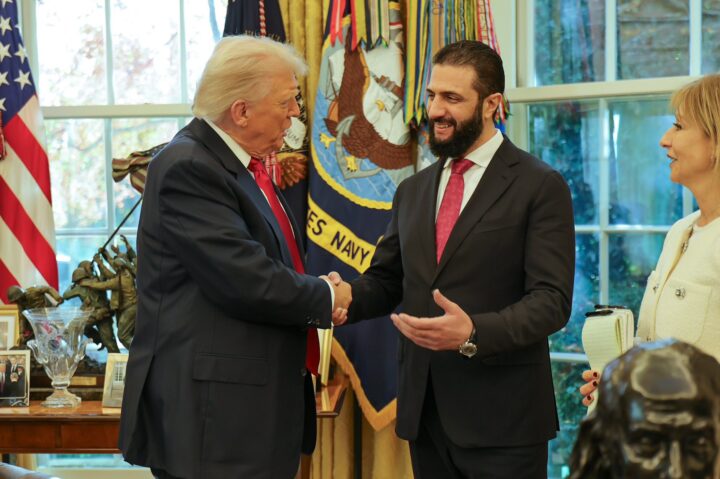
Syrian Presidency
President Donald Trump greets Syrian President Ahmad al-Sharaa in the Oval Office on Nov. 10, 2025.
As the Trump administration moves to dismantle much of the decades-old U.S. sanctions regime imposed on Syria, one major obstacle remains: Damascus is still designated as a state sponsor of terrorism by the U.S. The White House and lawmakers have signaled that could be about to change, in another move to attempt to pull Syria back into the global order.
Syria remains one of just four countries — alongside Cuba, North Korea, and Iran — designated as an SST. It is a status Damascus has held since 1979 and its current government, led by President Ahmad al-Sharaa, has actively sought to shed.
During the second Trump administration and following the ouster of former Syrian President Bashar al-Assad, President Donald Trump and Congress have worked to rapidly unwind U.S. sanctions on Damascus in an effort to integrate the country into the global economy.
Congress repealed the Caesar Act last year, which had long imposed crippling secondary sanctions on Syrian individuals, companies and entities tied to the Assad regime. Under the direction of an executive order from Trump, the Treasury Department subsequently reviewed and waived a sweeping array of sanctions, though Washington still maintains targeted restrictions on Assad and his immediate associates.
As part of Trump’s executive order last year, the administration mandated a formal review of Syria’s SST designation. While the State Department has publicly maintained that there is no specific timeline for a conclusion, a U.S. official said the sanctions “will be off by end of summer,” Politico reported on Thursday. Trump “made [Secretary of State Marco] Rubio move it forward after Sharaa asked him,” the official said in messages to Mouaz Moustafa, executive director of the Syrian Emergency Task Force.
The prospect of delisting has also garnered support from members of Congress. Senate Foreign Relations ranking member Jeanne Shaheen (D-NH) told Politico that “other sanctions like the State Sponsor of Terrorism designation remain obstacles in Syria’s path to economic recovery and stability.”
On the other side of the aisle, Rep. Joe Wilson (R-SC) said in a video alongside the Syrian American Council’s Mohammed Ghanem this week that he has “an agreement with Secretary of State Marco Rubio … to eliminate the State Sponsor [of Terrorism] sanctions.”
“I’m just so confident that it would be bipartisan … because the American people are united in the hopes and dreams and possibility of a sovereign, peaceful and prosperous Syria,” Wilson said. “We have faith in the people of Syria, we want the best for the people of Syria to have the freedoms that can be enjoyed in all of the Middle East.”
Ahmad Sharawi, a senior research analyst at the Foundation for Defense of Democracies, told Jewish Insider that Washington would like to see Syria removed from the list in an effort to “pull Damascus out of the Iranian-Russian orbit and move it toward a U.S.-aligned regional order.”
“That shift is already underway, given that President Trump has rolled back most Syria sanctions,” Sharawi said. “For Damascus, removal from the list is essential to unlocking investment and reconstruction, especially as Gulf states signal a willingness to pour money into the country. Syrian officials have argued that the designation continues to limit the country’s recovery.”
However, Sharawi said that Syria should not be removed “unconditionally.” He argued that while Syria has taken important steps — such as joining the anti-ISIS coalition and “disrupting some Hezbollah weapons flows through Syria” — that Damascus still has work to do.
“The right approach is conditional delisting,” Sharawi said. “There are still designated foreign jihadist factions that have been integrated into the Syrian army, and ISIS has reportedly infiltrated parts of Syria’s new security structures. The United States should use the designation to demand measurable progress that brings Syria closer into the regional order.”
Plus, David Harris' message for Dems

Morteza Nikoubazl/NurPhoto via Getty Images
Islamic Revolutionary Guard Corps (IRGC) military personnel stand guard on an avenue in downtown Tehran during a rally commemorating the International Quds Day, also known as the Jerusalem day, on April 29, 2022.
Good Thursday afternoon.
This P.M. briefing is reserved for our premium subscribers like you — offering a forward-focused read on what we’re tracking now and what’s coming next.
Today’s Daily Overtime was curated by JI U.S. Editor Danielle Cohen-Kanik.
📡On Our Radar
Notable developments and interesting tidbits we’re tracking
Vice President JD Vance said in an interview released todaythat U.S. military officials are going to “hang out” with representatives of the Islamic Revolutionary Guard Corps, a U.S.-designated terror organization, in Qatar in an effort to establish a conflict-reduction mechanism, Jewish Insider’s Danielle Cohen-Kanik reports.
“[Iran was] like, ‘OK, fine, we’ll send somebody from the IRGC to go hang out in Doha with somebody from CENTCOM,’ and that’s how we’re going to settle a lot of these disputes,” Vance said. He added that officials from the UAE — “by far the most hawkish, by far the most pro-Israel country in the [Gulf Cooperation Council]” — are also in touch directly with the IRGC…
Meanwhile, the IRGC reportedly attacked a cargo ship in the Strait of Hormuz today after issuing a warning to commercial vessels “to strictly refrain from any movement outside the designated routes.”
Iranian officials are further considering a plan to charge for security and environmental services in the strait that would generate $40 billion a year, sources told The Wall Street Journal. Tehran is seeking buy-in from other countries bordering the waterway and offering to share the revenue…
Secretary of State Marco Rubio, speaking to reporters in Bahrain as he wrapped up his Middle East tour today, said that U.S., Israeli and Lebanese representatives meeting for their last day of negotiations in Washington were “very close in our hopes of getting a commitment of intent” — a formal document typically used to outline preliminary terms between parties…
Rubio also spoke at a meeting of GCC foreign ministers where he vowed that Washington would not strike a deal with Iran that undermines “the security, the stability or the prosperity of any of our partners in the Gulf region”…
Iranian parliament speaker and top negotiator Mohammad Bagher Ghalibaf denied President Donald Trump’s claim that the funds received by Iran under the memorandum of understanding will be used to buy American agricultural products. “The only crop we’re harvesting is what you planted: decades of mistrust,” Ghalibaf wrote on X, adding, “apparently the US only exports GMO soybeans, broken promises and trash talks”…
A new Quinnipiac University poll released yesterday found 48% of American voters say the U.S. is too supportive of Israel — the highest level since the survey started posing the question in 2017 — including 66% of Democrats and 20% of Republicans.
Fifty-nine percent of voters said they are “not so confident” or “not confident at all” that Trump’s deal with Iran will work, while 37% said they are “very” or “somewhat” confident…
The New York Times reports on a February meeting between Carl Heastie, speaker of the New York State Assembly, and officials from the New York City Democratic Socialists of America chapter, where Heastie reiterated his request that the group stop targeting incumbent Democrats.
“We told him then, and we’ll tell him now: That’s not something we can do. We have to continue to grow our numbers and grow our influence, and that means challenging incumbents,” recalled Grace Mausser, an NYC-DSA co-chair…
Nassau County Executive Bruce Blakeman, the long-shot GOP candidate for New York governor, lashed out at congressional candidate Brad Lander on Wednesday night, telling Newsmax that the Jewish nominee is “antisemitic” and “would be a camp guard in the concentration camp if he could.” Blakeman, who is also Jewish, dialed back his remarks somewhat in a subsequent statement, saying, “Maybe camp guard was too strong, but certainly collaborator.”
Lander responded, “We named our son after Marek Edelman, a leader of the Warsaw ghetto uprising. That’s how seriously I take the legacy of Jews who fought Nazis”…
Sen. Chris Van Hollen (D-MD) became the second senator to endorsefar-left Michigan Senate candidate Abdul El-Sayed today, after Sen. Bernie Sanders (I-VT) became an early backer of the physician’s campaign. El-Sayed, who has drawn criticism for his heated anti-Israel rhetoric and campaigning with antisemitic streamer Hasan Piker, has previously advocated for Van Hollen to replace Senate Minority Leader Chuck Schumer (D-NY) as the Democratic leader in the Senate, due to Schumer’s continued support for U.S. aid to Israel…
Andy Burnham, the presumptive next prime minister of the U.K., has tapped as his chief of staff James Purnell, a former member of Parliament and lobbying executive who previously served as head of Labour Friends of Israel more than 20 years ago. Purnell also served as a Cabinet minister under former Prime Minister Tony Blair, who is now leading efforts on the Board of Peace for Gaza…
MIT professor Yossi Sheffi talks to the NYT about his forthcoming book on antisemitism at the elite school in the aftermath of the Oct. 7 Hamas attacks: Unsafe at M.I.T.: A Chronicle of a Campus War on the Jews. Sheffi said his book takes the place of an official study and report on campus antisemitism, which many universities undertook after the disruptive student protests of 2023-2024, but MIT did not…
Some Texas Jewish leaders are objecting to proposals under consideration by the State Board of Education that would require public school students to read Bible passages in class, saying they misrepresent Jewish tradition, despite their supporters touting the promotion of “Judeo-Christian” values…
⏩ Tomorrow’s Agenda, Today
An early look at tomorrow’s storylines and schedule to keep you a step ahead
Keep an eye on Jewish Insider for an interview with David Harris, the longtime former CEO of the American Jewish Committee, about his book, Antisemitism: What Everyone Needs to Know.
Harris’ view: “Every Jewish organization looking for a Democrat from Washington lines up to invite Sen. John Fetterman (D-PA). If he’s not available, they’re all baffled as to who else to invite from the contingent of Democrats in the U.S. Senate.”
Amid gridlock on the House floor driven by some Republicans’ frustration with the Senate’s failure to pass President Donald Trump’s signature voter ID bill, the House canceled many of its expected votes this week, including those on the 2027 State Department budget and an effort to cut U.S. aid to Israel. The chamber will return next week with plans to work on the 2027 National Defense Authorization Act.
The Aspen Ideas Festival in Colorado continues, including a session on higher education with Princeton University President Chris Eisgruber and a live recording of “The Long Game” with former National Security Advisor Jake Sullivan and his deputy Jon Finer, the podcast’s co-hosts, with Brookings senior fellow Robert Kagan.
We’ll be back in your inbox with the Daily Overtime on Monday. Shabbat Shalom!
Stories You May Have Missed
TORRES TACTICS

The pro-Israel congressman raised early campaign cash, defined his opponent aggressively and prioritized strong constituent services
ON THE HILL
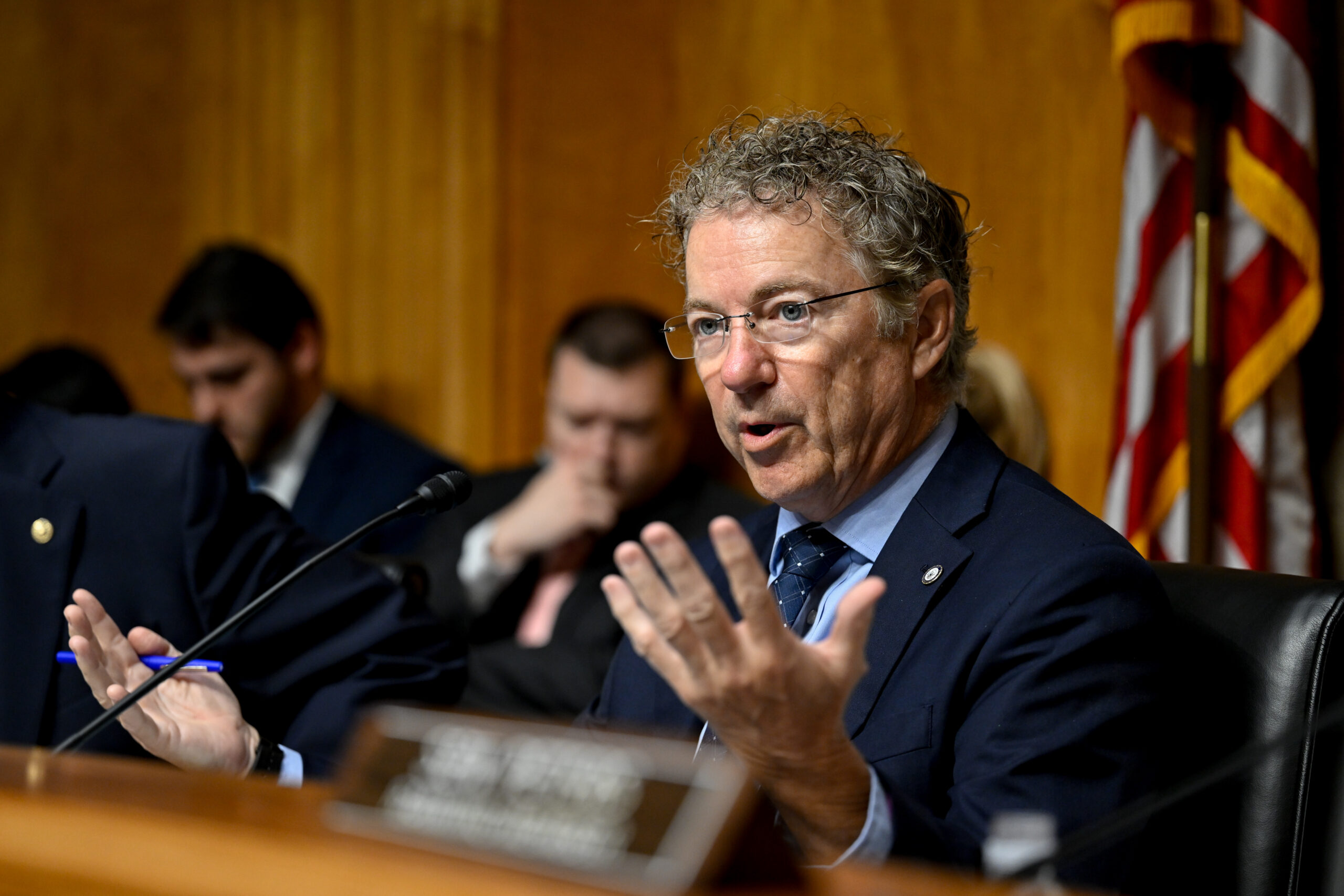
Sens. Bill Cassidy and Rand Paul, supporters of previous war powers efforts, changed their votes on the resolution, which had previously passed a procedural hurdle
Rep. Josh Gottheimer said ‘Erdoğan cannot be trusted’ and that the decision ‘must be reversed’
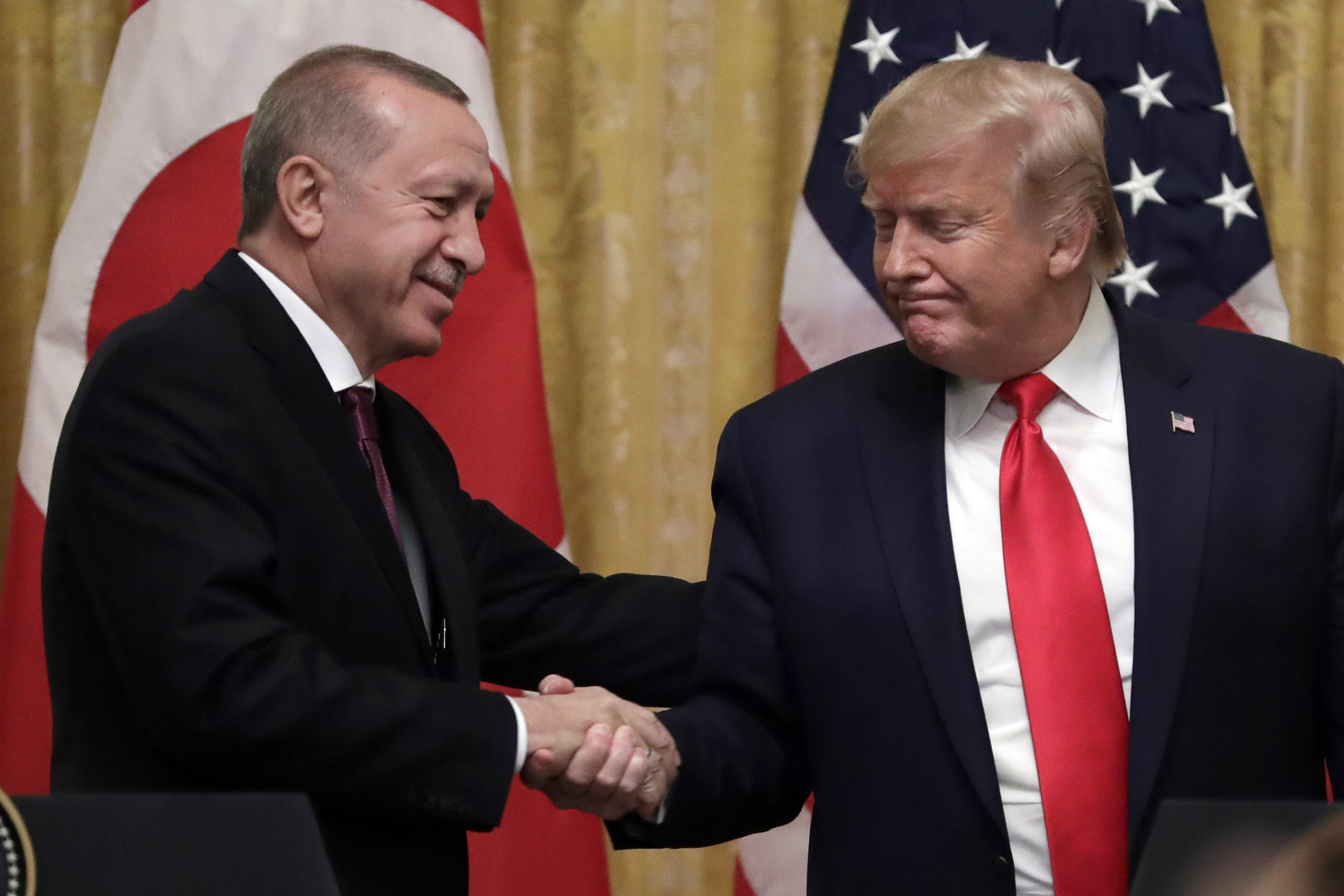
Evan Vucci
President Donald Trump shakes hands with Turkish President Recep Tayyip Erdoğan after a news conference in the East Room of the White House, Wednesday, Nov. 13, 2019, in Washington.
U.S. lawmakers across the political spectrum are sounding the alarm over the Trump administration’s plans to review whether it can sell F-35 fighter jets to Turkey, arguing that the move would raise national security concerns and that Ankara has not yet fulfilled its obligation to dump its Russian S-400s.
In the Oval Office on Wednesday, President Donald Trump said he was considering selling the advanced jet engines to Turkey, stating that he would “do something that’s going to make him [Turkish President Recep Tayyip Erdoğan] very happy.” Vice President JD Vance said the administration is “confirming” that Turkey has fulfilled its obligations under U.S. law in order to receive advanced F-35 fighter jets.
Ankara has long sought the advanced systems but has been barred from purchasing it since 2020, after it acquired the S-400 air-defense system from Russia. A report published last week by the Jewish Institute for National Security of America suggested that the S-400 system is inactive but still intact in Turkey.
The proposed deal has drawn fierce bipartisan pushback and notable criticism from within Trump’s own ranks.
Rep. Brad Schneider (D-IL) told Jewish Insider that he is “very concerned” about the prospect of Turkey acquiring the F-35s, arguing that such a move would raise significant national security concerns due to Ankara’s close security ties with Russia.
“Turkey has integrated its defenses with the Russian missiles. The F-35 is a technology platform that Russia would love to get information on and we can’t allow that to happen,” Schneider said. “Turkey has not been the best NATO ally. Its actions in the Eastern Mediterranean have been contrary to U.S. interests and regional interests, so I have real concerns.”
Schneider also noted that he does not believe Turkey has given up possession of the Russian S-400s, suggesting that Ankara has yet to fulfill the critical obligation that must be certified, in writing, to Congress.
“I have not seen that,” Schneider said. “I’d want to see that in concrete evidence from this administration.”
Rep. Nicole Malliotakis (R-NY) said on social media that there is “bipartisan opposition” to the move and posted a photo of Erdoğan hand-in-hand with Russian President Vladimir Putin and former Iranian President Ebrahim Raisi.
“As long as Turkey is under the leadership of Erdogan who aligns himself with Iran and Russia, harbors Hamas & remains the only NATO member to not sanction Russia, Turkey should NOT receive our best jets and military equipment,” Malliotakis wrote.
Rep. Josh Gottheimer (D-NJ) also criticized the move, saying in a post on X that “Erdogan cannot be trusted” and that the “decision must be reversed.”
“Turkish President Erdogan has cozied up to Hamas and Putin while threatening our allies in Israel, Greece and Cyprus,” Gottheimer wrote. “Yet, the Trump administration is happy to sell them advanced engines to power fighter jets.”
Rep. Dina Titus (D-NV) said that if Trump continued with the move she would “introduce a joint resolution of disapproval.
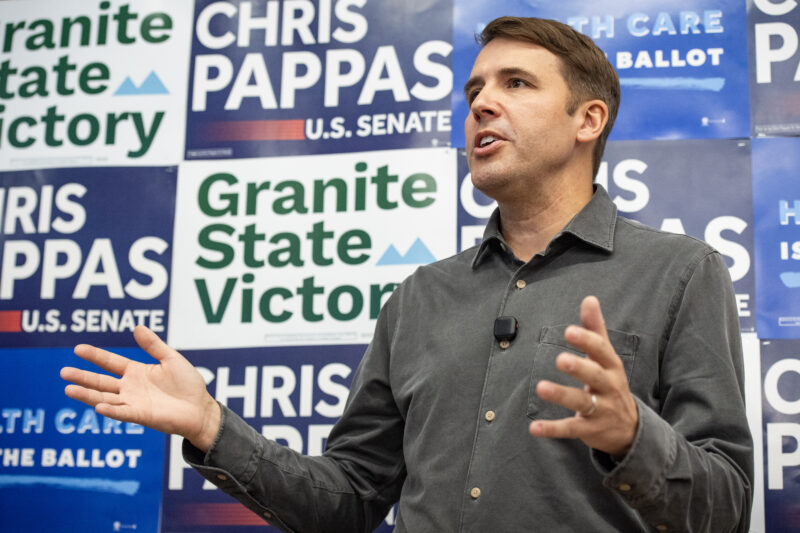
Rep. Chris Pappas (D-NH) also expressed sharp disapproval, saying, “Absolutely no F-35s to Turkey” in a post on social media.
“Turkey was kicked out of the F-35 program during the first Trump administration for purchasing Russian S-400 missiles, which it still possesses today,” Pappas wrote. “Since then Turkey has only grown more aggressive against critical American allies such as Greece and Cyprus, increased oppression of its people, and made the region even more unstable.”
“The law is clear: the Trump administration is required to certify to Congress that Turkey is in compliance with our laws before any sale can even be considered. We cannot reward Erdogan’s government while it continues to violate U.S. law and threaten our reliable, democratic allies,” he added.
Rep. Brian Mast (R-FL), the chair of the House Foreign Affairs Committee, said that he expects to receive a classified briefing on the F-35 sale and the status of the S-400 next week.
Asked about the administration’s praise of Erdoğan, Mast said that “Turkey as a whole is a large and important NATO ally.” On Wednesday, the president called the Turkish leader a “very good person,” despite also saying that he would fight “on the Iran side” of the war.
“I’m not going to go out there and defend Erdoğan in any way, shape or form,” Mast said. “Erdoğan and I don’t have a personal relationship. I think a number of activities by Turkey have been problematic and I have nothing that would make me go out there and personally defend Erdoğan. I have many relationships — that’s not one of them.”
Meanwhile, Schneider expressed concern over Trump’s praise of Erdoğan.
“I’m worried he [Trump] seems to get close to a lot of leaders who have totalitarian instincts,” Schneider said. “It’s a pattern.”
Mast’s Democratic counterpart, Rep. Greg Meeks (D-NY), said he opposed the sale of F-35s to Turkey, warning of its impact on other U.S. allies in the region such as Greece and Cyprus, and also expressed criticism of Erdoğan personally while calling Turkey an important ally with which to maintain conversations.
But Meeks said he’s open to the sale of advanced jet engines to Turkey “if I get my questions answered by the administration,” and expressed frustration that Trump is speaking publicly about the sale without communicating with him as the ranking member of the Foreign Affairs Committee, a break with precedent.
Sinan Ciddi, director of the Turkey program at the Foundation for Defense of Democracies, said that while Trump appears intent on making the sale, it is likely to meet significant hurdles. For instance, Ciddi confirmed that Turkey still possesses the S-400 defense system, which would not fulfill the obligations required under law to lift the sanctions.
“Turkey does still maintain the S-400 defense system,” Ciddi said. “We’re not talking about one or two missiles. I believe in total Turkey holds up to 200 air defense missiles that were sold to them by the Russians back in 2019. They are presently sitting under lock and key in Turkish warehouses.”
Ciddi noted that Turkey has not deployed the S-400s it currently holds as a precautionary measure because it would have “resulted in additional U.S. sanctions against Turkey.”
He said a major area of concern of selling Turkey F-35s while it still maintains the S-400s is the ability for sensitive information to be shared with U.S. adversaries.
“The concern is if they don’t get rid of those and the F-35 was delivered to Turkey, or became operational in Turkey, those S-400 systems could collect sensitive information about their stealth capabilities and share them with adversarial powers, such as the Chinese, the Russians, as well as the Iranians.”
“There’s been a relative consensus in opinion in congress, as well as political administrations, that you want to keep Turkey out of the F-35 program,” he added.
Ciddi also discussed Trump’s closeness to Erdoğan, arguing that the U.S. has not held Turkey accountable on key issues such as support for terrorism and the Muslim Brotherhood, due to Ankara’s role in helping mediate talks between Israel, Iran and the U.S. as well as in the Russia-Ukraine war.
“In Trump’s own words, he seems to admire and essentially have a strong affinity for Erdoğan,” Ciddi said, noting that another explanation is that Trump is listening closely to U.S. Ambassador to Turkey Tom Barrack on Turkish issues rather than “what he needs to hear from a variety of voices within his administration.”
Elliott Abrams, a former Iran envoy during the first Trump administration, also cautioned against the move and Trump’s “soft spot” for Erdogan.
“President Trump has a soft spot for Erdoğan for reasons that no one can understand, but that is no reason to risk American military secrets,” Abrams said. “Turkey has not abandoned the S-400 and therefore should be excluded from the F-35 program. This ought to be simple, because U.S. law is clear.”
Ciddi also expressed concern on what the potential move might mean for Israel and suggested that Turkey holds considerable military prowess even without the F-35s, although he noted that Israel holds an advantage having operated the F-35s for a longer period of time and also maintaining more sophisticated models.
“The Israelis are really concerned,” Ciddi said. “The acquisition of an F-35 would be a game changer, but there are significant hurdles ahead of that. Israel already has F-35s and operates them, and the Israeli variant of the F-35 is one of the most advanced and unique versions of the F-35 that is operated, and it’s unique to Israel – no other country possesses and operates the F-35 that has the boutique suite of operating capabilities that the Israelis have, so Israel does maintain a significant qualitative military edge.”
He said that even if the Trump administration authorized the sale, it would likely take years to come together and “would not be an immediate delivery of F-35 units beyond the six that Turkey already purchased back in 2019, which are essentially sitting in U.S. warehouses here and collecting dust.”
Democrats, and some Republicans skeptical of the war effort, have indicated that they’re hesitant if not outright opposed to voting for additional funding for the war

ATTA KENARE / AFP via Getty Images
Explosions erupt following strikes at Tehran Oil Refinery in Tehran on March 7, 2026.
The Trump administration on Wednesday formally sent an $87.6 billion supplemental funding request to replenish stockpiles and otherwise cover the costs of the war with Iran to Congress.
The official notification came in a letter from Office of Management and Budget Director Russell Vought on behalf of President Donald Trump to House Speaker Mike Johnson (R-LA), which was subsequently forwarded to Senate GOP leadership offices.
The defense supplemental request includes $67 billion for the Department of Defense to resupply munitions stocks and prevent the cost of the U.S. troop deployment to the Middle East during Operation Epic Fury, the operation conducted last summer against Iran, from cutting into the Pentagon’s budget.
The bill also requests some additional funding for the State Department and Coast Guard related to the operations.
Administration estimates for the cost of the war have fluctuated significantly: initial reports indicated the Pentagon wanted to ask Congress for $200 billion for the war alone, while officials testified that the munitions costs of the war were between $20 billion and $30 billion. Reconstruction costs for the U.S. bases damaged or destroyed during the war have not yet been accounted for.
Democrats, and some Republicans skeptical of the war effort, have indicated that they’re hesitant if not outright opposed to voting for additional funding for the war, meaning that the legislation might struggle to clear the 60-vote threshold necessary for passage in the Senate.
In addition to the Iran war funding, the supplemental includes a variety of other requests relating to a smorgasbord of other subjects from the Ebola outbreak to supporting farmers, construction projects in Washington, D.C., and New York’s Penn Station and others.
Sen. Roger Wicker (R-MS), the chairman of the Senate Armed Services Committee, released a statement expressing his full support for the supplemental request.
“I fully support the defense supplemental request submitted to Congress today and look forward to working with my colleagues to move it forward legislatively as soon as possible. We must ensure our service members have everything they need to face an increasingly dangerous world,” Wicker said in a statement. “This supplemental funding is essential in the near term to maintain readiness through training and military pay.”
He added that the “request would also accelerate immediate production of key capabilities, from exquisite munitions to low-cost hypersonics, strike weapons, and drones.”
Sen. Kevin Cramer (R-ND) told reporters that he supports the supplemental.
“I think there should be a lot of support for it — you don’t have to agree with the president’s decisions in Iran to understand we need to modernize, we need more munitions, we have some catching up to do in terms of our weapons systems,” Cramer said. “I, frankly, thought it was pretty modest.”
Sen. Susan Collins (R-ME), the chair of the Senate Appropriations Committee, told Jewish Insider that she hasn’t had a chance to review the request yet, but that the committee plans to hold a public hearing about it.
Collins said “I have no idea, I really don’t” as to whether Republicans will be able to secure the Democratic support that will be necessary to pass the bill, but she was skeptical.
“I haven’t looked at it, and it also depends on whether they’re going to play politics,” Collins added. “I was also not encouraged by Vice Chair [Patty] Murray’s comments.”
Sen. Bill Cassidy (R-LA), who lost the Republican primary contest for his reelection bid to a Trump-backed challenger last month and has since become one of the Senate’s leading swing votes, told JI that he will need to review the supplemental before deciding whether to support it.
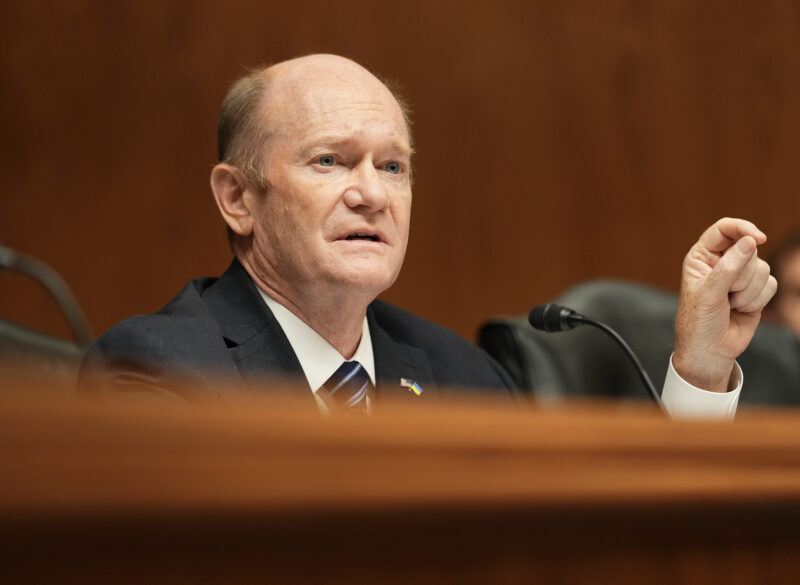
Sen. Chris Coons (D-DE), the top Democrat on the Senate Appropriations Defense subcommittee, told JI he was skeptical of the request.
“I’m still reviewing it. My initial reaction is I’m opposed to the supplemental as it is,” Coons said. “I’m open to finding ways to provide the resources that our war fighters need and that will defend our country, but I’m not open to billions of dollars for things like the Golden Fleet or the Golden Dome.”
Coons said that “it’s hard for me to get too excited about a supplemental when we don’t yet have clarity about if reconciliation 3.0 is the only supplemental and, frankly most importantly, what’s the status of the war. I’m not going to vote for a backdoor authorization for the war in Iran.”
The Delaware senator told JI that he has “pressed in every conversation” with the Trump administration “the importance of funding for Ukraine and securing cutting-edge drone interceptor capability to defend the United States.”
Sen. Patty Murray (D-WA), the top Democrat on the Appropriations Committee, released a statement late Wednesday criticizing the president for launching “a reckless and costly war with Iran — without authorization from Congress or the support of the American people — that he should never have started, and now, instead of doing anything to help families get by, he is asking taxpayers to pick up the tab and give him billions more to wage wars overseas.”
Murray noted that the president “is making this request for more funding as the Pentagon already has a historic annual budget and sits on over $100 billion in unspent funding Republicans provided in their Big Ugly Bill.”
She also argued that the Trump administration “has failed to answer basic questions about its aims and justification for the Iran war and failed to provide the most basic information about its costs.”
And the Washington senator said that the bill is “an attempt to secure tens of billions of additional dollars for unrelated Pentagon priorities that should rightly be considered through the annual appropriations process.”
Murray did not explicitly commit to voting against the supplemental request. She instead vowed to “closely review” it and said she would “ensure we take care of our servicemembers,” though she warned that, “I will not rubber-stamp tens of billions more for this disastrous war of choice.”
Secretary of Defense Pete Hegseth briefed some House Republicans in a classified setting on the supplemental, and the White House’s request for a $350 billion reconciliation bill to provide additional Pentagon funding, at the Capitol on Wednesday. Some Senate Republicans have said the reconciliation bill is a nonstarter.
The meeting took place a few hours before Vought’s letter to Johnson, which was sent earlier in the day, was made public and came ahead of an expected fight over the funding request to replenish stockpiles and otherwise pay for the war in Iran.
Rep. Don Bacon (R-NE) emphasized after the meeting that the supplemental is necessary to restock the munitions the U.S. needs to counter its adversaries, and to take care of servicemembers.
He also offered support for the larger $350 billion request, which he said is just a first step toward bringing the U.S.’ defense budget in line with where it needs to be to ensure the country’s global status and take care of troops.
He also praised Hegseth’s discussion of the U.S. memorandum of understanding with Iran. Bacon said he has not always been impressed by Hegseth, but found that he was “more prepared” and had a “good grasp” of the details.
Rep. August Pfluger (R-TX), the chair of the Republican Study Committee, the GOP caucus that organized the briefing, also made the case for the reconciliation bill, arguing that we “have a once in a lifetime opportunity to have a generational impact on our military,” and argued that it’s going to be up to Republicans “to make sure the future generations have the resources, have the weapons systems, are trained and are outfitted to make sure that they defend this country.”
Rep. Rich McCormick (R-GA) said that Hegseth argued to lawmakers that, before the Iran war, the Iranians were not negotiating in good faith, and “now they are,” which is a sign of progress.
“So you could say they accomplished that mission. I think it wasn’t good enough at all. I think we could have had an unconditional surrender,” McCormick said, arguing that the U.S. should have struck Iran’s oil facilities and set back Iran’s economy by decades, and could have ended the war by now on its own terms.
“I just don’t see how they had any negotiation power at all,” McCormick said. He said that if Iran doesn’t make a deal, he expects a return to war.
He also argued that, even prior to the supplemental, the U.S. has sufficient munitions to “obliterate all of Iran, easily, and then some.”
Plus, Trump brings the heat to Capitol Hill
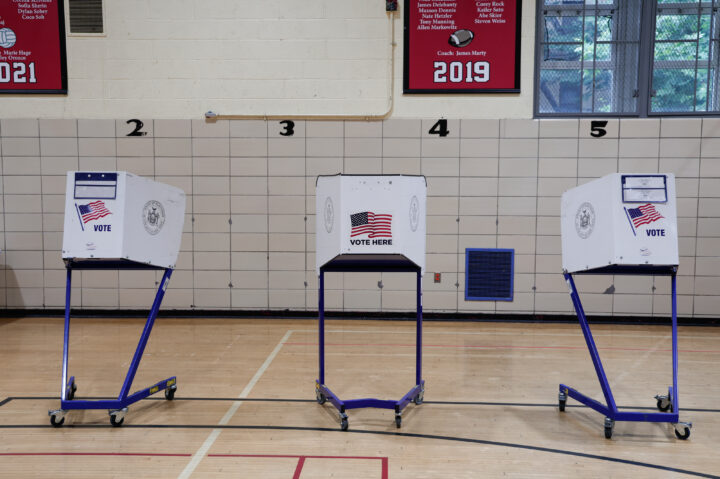
John Lamparski/Bloomberg via Getty Images
Voting booths at a polling location during a primary election in New York on June 23, 2026.
Good Wednesday afternoon.
This P.M. briefing is reserved for our premium subscribers like you — offering a forward-focused read on what we’re tracking now and what’s coming next.
Today’s Daily Overtime was curated by JI U.S. Editor Danielle Cohen-Kanik.
📡On Our Radar
Notable developments and interesting tidbits we’re tracking
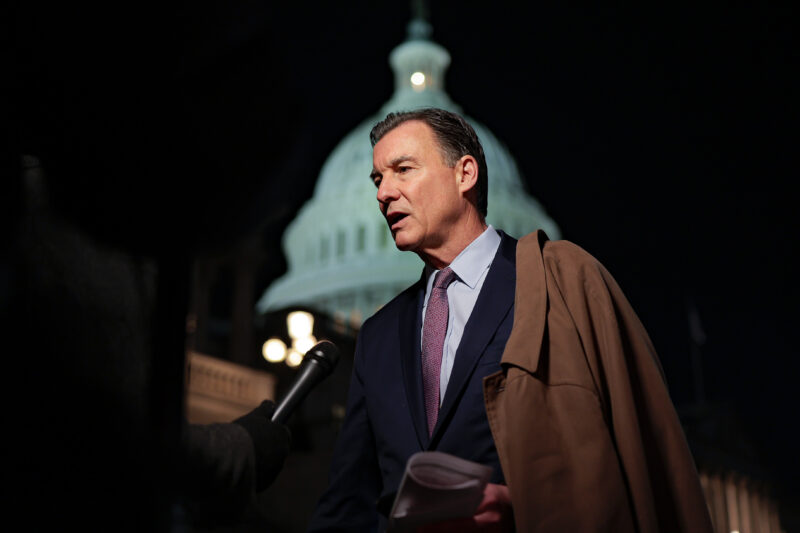
Moderate House Democrats were shaken by the success of several Democratic Socialists of America-backed candidates in New York City primaries last night, and particularly the ouster of two incumbents by their left-wing challengers. “People who do not support the DSA wring their hands at cocktail parties, while the DSA is organizing,” Rep. Tom Suozzi (D-NY) told Axios. “You can’t win with these guys by playing patty cake,” another centrist House Democrat said…
Jewish leaders also expressed dismay at the election results: Rabbi Ammiel Hirsch of the Reform Stephen Wise Free Synagogue, an outspoken critic of New York City Mayor Zohran Mamdani, told The New York Times that “a lot of American Jews” woke up today to “a sense of sadness, a sense that we’re losing something important.”
Rabbi Andy Bachman, a former rabbi at Congregation Beth Elohim in Brooklyn, said the “most disturbing” thing about the election results was that “if you declare genocide in Gaza, despite a distinct lack of experience compared to people that you’re running against, it can win you an election”…
Fresh off his election night victories, Mamdani announced today he would be meeting with House Minority Leader Hakeem Jeffries (D-NY), Jewish Insider’s Will Bredderman reports.
Jeffries said earlier that he and Mamdani “agree to strongly disagree about some of his endorsements,” after the mayor helped unseat two New York City Democrats: Reps. Dan Goldman and Adriano Espaillat. “He’s got work to do in terms of the conversations that he’s going to have with members of Congress moving forward,” Jeffries said of Mamdani…
After blindsiding lawmakers today when he abruptly canceled a bill signing for a widely supported bipartisan housing bill, President Donald Trump attended a tense GOP Senate luncheon where he railed against the Senate’s passage of an Iran war powers resolution yesterday and got into a shouting match with Sen. Bill Cassidy (R-LA), who voted in favor.
When Trump asked why any Republican would have supported the measure, Cassidy, who was recently defeated by a Trump-backed challenger, recalled, “I stood and said, ‘You have not told the American people what’s going on’”…
Secretary of State Marco Rubio met with UAE President Sheikh Mohamed bin Zayed in Abu Dhabi this morning, where Rubio said he “thanked the UAE leadership for their unparalleled support, praised their courage and resilience in the face of Iran’s attacks, and reaffirmed our commitment to Emirati security”…
Pictured sitting next to the secretary of state in a working lunch with MBZ was Michael Boulos, Trump’s son-in-law whose father serves as a senior advisor to the president on the Middle East. Rubio said later that his “good friend” Boulos was not involved in the policy discussions…
Rubio then traveled to Kuwait, where he told reporters that technical talks with Iran are slated to resume next week and dismissed speculation that Israel is attempting to undermine the memorandum of understanding: “The Israelis exactly know what we’re working on. All of our partners in the region know what we’re working on”…
Yesterday’s discussions between Israeli and Lebanese representatives for their fifth round of negotiations at the State Department ended without progress and at some points became “ugly,” Axios reports, as military officials from both countries presented conflicting plans for the IDF’s withdrawal from southern Lebanon.
Rubio told reporters that Jerusalem and Beirut are still working to establish pilot zones under the control of the Lebanese Armed Forces where the IDF will pull back, saying, “The more of that area that the LAF is able to secure, the less of it is in Hezbollah’s control, the less Israel will be in Lebanon.” But Israeli Defense Minister Israel Katz stated today that the IDF will not withdraw from southern Lebanon “even if there is an American demand”…
Rubio also presided over the official reopening of the U.S. Embassy in Kuwait City after it was shuttered for security reasons several months ago amid the Iran war…
Iranian parliament speaker and chief negotiator Mohammad Bagher Ghalibaf called the agreement signed with the U.S. “a declaration of America’s defeat,” saying at a conference in Azerbaijan that it was reached as a “result of the resistance and authority” of Iran…
The Trump administration is planning to approve the sale of dozens of jet engines worth more than $700 million to Turkey, according to Reuters, ahead of the NATO summit in Ankara next month. The move comes despite reported security concerns from Congress…
FBI Director Kash Patel met with Qatari Interior Minister Sheikh Khalifa bin Hamad Al-Thani in Washington…
CENTCOM announced that the U.S. killed senior ISIS leader Ali Husayn al-‘Ulaywi in an airstrike in northwest Syria on Friday…
Iranian negotiators are consulting Trump’s book, The Art of the Deal, and psychologists in order to navigate the president’s shifting tone in negotiations, sources told The Wall Street Journal…
⏩ Tomorrow’s Agenda, Today
An early look at tomorrow’s storylines and schedule to keep you a step ahead
Keep an eye on Jewish Insider for a look at how Rep. Ritchie Torres (D-NY) avoided a similar fate to his pro-Israel House colleagues who were ousted from their seats as he overwhelmingly defeated a left-wing challenger who made Torres’ support for Israel central to his attacks.
The House Committee on Education and Workforce will mark up Rep. Randy Fine’s (R-FL) No Antisemitism in Education Act.
Homeland Security Secretary Markwayne Mullin will testify at an oversight hearing in the House Appropriations Committee.
The State Department will begin its two-day Pax Silica Summit at the U.S. Institute of Peace, hosted by Under Secretary of State for Economic Affairs Jacob Helberg, focused on strengthening cooperation in AI supply chains, critical minerals, energy and more. The event will be attended by representatives from the Pax Silica signatory countries — which include Israel, Qatar, the UAE, India, Germany and the U.K., among others — and senior business executives.
The Texas Democratic State Convention begins tomorrow, featuring remarks over the three-day event from Sens. Cory Booker (D-NJ) and Bernie Sanders (I-VT), Texas U.S. Senate candidate James Talarico, Illinois Gov. JB Pritzker and Democratic National Committee Chair Ken Martin. Activists will consider close to 20 resolutions critical of Israel — some of which condemn AIPAC and DMFI — introduced by seven individuals at a party convention in June.
The annual Aspen Ideas Festival will kick off in Colorado, bringing together leading figures from politics, business, media and academia for a week of discussions on global challenges including AI, economic policy and national security.
Stories You May Have Missed
MAMDANI MAM-ENTUM
The mayor flexed his political muscle as Brad Lander, Claire Valdez and Darializa Avila Chevalier triumphed in their congressional primaries
2028 WATCH
Several Democrats considering presidential bids have cast the Iran agreement as evidence of weak leadership, arguing that Trump has been outmaneuvered by Tehran
The House speaker said he wants negotiations to play out before passing judgment
Andrew Harnik/Getty Images
Speaker of the House Mike Johnson (R-LA) speaks during a news conference on Capitol Hill on October 20, 2025 in Washington, DC.
Breaking with many Senate Republicans who have expressed skepticism about various elements of the Trump administration’s memorandum of understanding with Iran, House Speaker Mike Johnson defended the deal on Tuesday.
House Republicans returned to Washington on Tuesday for the first time since the deal with Iran was finalized.
“We need to keep forward with good progress, the details are still being negotiated, so I’m not going to prejudge,” Johnson said.
“There’s a lot of moving parts right now,” Johnson said, when asked whether he has concerns about the lifting of oil sanctions under the agreement, as he did for the Obama administration’s 2015 nuclear deal. “It is something the Trump administration is working around the clock on. I trust that they’re going to come to a lasting solution on that. The world desperately needs it and we do as well.”
When pressed, he said that he has “always been a supporter of strong sanctions against Iran” but added that there’s “a lot of moving parts to this” and that he’s “not going to tell the administration how to negotiate that.”
Johnson added that he is “heartened to see” gas prices decreasing and the Strait of Hormuz reopened.
While several Republican defense hawks in the Senate have criticized the administration’s deal with and concessions to Iran, others say they want to see the full effects of the agreement and the potential outcome of negotiations first.
Sen. Kevin Cramer (R-ND) said at an Orthodox Union luncheon on Tuesday that he is currently weighing in privately with Republican leadership and the White House about his views on the deal, “in the hopes that at the end of all of this, that Israel is in a better neighborhood, and I believe that … can happen.” He said he would speak out publicly if “appropriate.”
Other hawkish Republicans have pointed blame for the deal away from the president himself.
The package would face steep hurdles in the Senate, where lawmakers have already balked at the Pentagon's initial $1.5 trillion funding request

SAUL LOEB / AFP via Getty Images
Chairman of the Joint Chiefs of Staff Gen. Dan Caine speaks as a map of the Strait of Hormuz is displayed during a press briefing at the Pentagon in Washington, DC, on April 16, 2026.
The Trump administration is planning to ask Congress to approve an $80 billion request for additional funding to replenish stockpiles and otherwise pay for the war in Iran, according to several reports.
That request comes on top of a push for a $1.15 trillion regular defense budget for 2027 as well as another $350 billion for the Pentagon that the administration wants Congress to pass through a partisan reconciliation process — a $1.5 trillion request in total that Republican lawmakers have criticized and some key Senate Republicans have described as unrealistic.
The supplemental request, too, could prove difficult to pass, requiring 60 votes in the Senate. Many Democrats declared at the outset of the war that they would refuse to pass any supplemental funding for the effort, and have further balked at the initial $1.5 trillion defense budget request.
Secretary of Defense Pete Hegseth is set to brief some House Republicans on Wednesday about the administration’s defense funding requests and the war in Iran.
Sen. Thom Tillis (R-NC) indicated he’s generally supportive of the anticipated $80 billion request, and argued that many of his colleagues could be convinced to support it if it’s primarily focused on restocking expended U.S. munitions supplies.
“It doesn’t surprise me. I think a part of what we need to do is figure out how much of that is for replenishment, that’s basically to get us the base load pre-conflict,” Tillis told Jewish Insider. “So I think the more that people spend on describing at that level, the more likely it is you’ll get support for it, and particularly if they only focus on what’s critical to get back to pre-conflict baselines. I think most members would say we got to do that.”
Sen. Mark Kelly (D-AZ), a military veteran who has generally been more moderate on defense issues than some of his more progressive colleagues, indicated he’s more skeptical of the proposal.
“I always want to make sure that the troops have what they need to do a really hard job and defend themselves especially,” Kelly said.
But, he continued, when he joined the Senate in 2022, the total defense budget was $650 billion, and the $1.5 trillion the administration is now seeking is higher than much of the rest of the world’s defense budgets combined.
He said that some of the systems the administration is asking for, such as space-based missile defense, are impractical or unneeded, “so I want to see the munitions be replaced, but let’s do it within a responsible top line of the defense bill, not this crazy, overly inflated number.”
Sen. Josh Hawley (R-MO), who had called for a prompt end to the war and has been supportive of talks with the Iranian regime, said he was withholding judgement on the supplemental request until the administration actually submits it.
Initial reports indicated the Pentagon intended to request as much as $200 billion for the war, but Pentagon officials testified last month that the costs of the war — excluding anticipated rebuilding costs of U.S. facilities in the region, came in between $20 and $30 billion.
“I don’t want to get out ahead of what the Pentagon will propose here,” Hawley said. “There’s been multiple iterations, so next week it may be something different. Let’s let them come up with something.”
Plus, NYC first lady snubs Brad Lander on primary day
Oliver Contreras / AFP via Getty Images
Israel's Ambassador to the U.S. Yechiel Leiter speaks to reporters after a meeting between Israeli and Lebanese delegations hosted by the United States at the State Department in Washington, DC, on June 3, 2026.
Good Tuesday afternoon.
This P.M. briefing is reserved for our premium subscribers like you — offering a forward-focused read on what we’re tracking now and what’s coming next.
Today’s Daily Overtime was curated by JI U.S. Editor Danielle Cohen-Kanik.
📡On Our Radar
Notable developments and interesting tidbits we’re tracking
The U.S. and Iran continued to offer conflicting accounts of the agreement reached over the weekend: President Donald Trump posted on Truth Social this morning that Iran “fully and completely agreed to highest level Nuclear inspections long into the future,” without which “there would be no further negotiations.” But Iranian Foreign Ministry spokesperson Esmail Baghaei said it was untrue and that the parties had not discussed any nuclear issues.
About Tehran’s denial, Secretary of State Marco Rubio said the U.S. “know[s] what [Iran] agreed to do, and now they’ll either do it or they won’t. And if they do, the process moves forward. And if they don’t, the president will have some decisions to make”…
Trump also said in his post that the funds received by Iran through the deal will go “into escrow, controlled by the U.S.A., and will be used for the purchase of food and medical supplies.” Yet the Treasury Department’s waiver of Iranian oil sanctions contains no such language and the text of the memorandum of understanding says unfrozen Iranian assets “shall be made fully usable” for “any ultimate beneficiary designated by the Central Bank of the Islamic Republic of Iran”…
Meanwhile, Iranian Parliament Speaker Mohammad Bagher Ghalibaf and Foreign Minister Abbas Araghchi were in Muscat speaking with Omani leaders about the Strait of Hormuz: In a joint statement, the parties said their foreign ministries will work towards an agreement on the “future administration” of the strait, the “services that will be provided in this regard and the costs associated with them,” as the Trump administration has repeatedly stated it will not accept any tolls placed on transit through the key waterway…
Iranian President Masoud Pezeshkian was also abroad, meeting in Islamabad with Pakistani Prime Minister Shehbaz Sharif, where Pezeshkian said Iran’s ballistic missile program “will never be” up for negotiation with the U.S…
Jerusalem is publicly expressing concern about the Lebanon deconfliction mechanism established by the U.S. and Iran for the first time, Jewish Insider’s Emily Jacobs reports: At the opening of Israel and Lebanon’s fifth round of direct talks taking place in Washington today, Israeli Ambassador to the U.S. Yechiel Leiter claimed the parties are “heading towards a train wreck.”
Leiter said he’s “concerned the concept of deconfliction is misplaced” because “Israel is not in conflict with Lebanon,” and that Israel had assumed “the central issue was Lebanon and Hezbollah — not the extent to which Iran could restrain Hezbollah. That is not Iran’s role”…
Rubio, arriving in Abu Dhabi, said the U.S.-Iran and Israel-Lebanon tracks “are separate because Lebanon is a sovereign country,” and that the U.S. is “going to negotiate a deal directly with the Lebanese government,” without mentioning Israel.
Rubio also made clear that Iran is responsible for much of the terror activity in the Middle East, striking a different tone than that of Vice President JD Vance, JI’s Danielle Cohen-Kanik reports, after Vance said yesterday the U.S. is counting on Iran to “rein in” Hezbollah…
The Senate passed a war powers resolution this afternoon directing the administration to withdraw U.S. forces from Iran, 50-48, with GOP Sens. Rand Paul (R-KY), Lisa Murkowski (R-AK), Susan Collins (R-ME) and Bill Cassidy (R-LA) voting in favor with Democrats,JI’s Marc Rod reports.
The resolution, now passed by both chambers, came as a concurrent resolution — meaning it will not be submitted to the president and, based on past court precedent, is not seen as carrying the force of law…
A manifesto allegedly left by the gunman behind yesterday’s rampage in Côte-des-Neiges, a heavily Jewish neighborhood in Montreal, repeatedly targeted Jews and Zionists, specifically identifying “influential Zionists” among his intended victims, JI’s Haley Cohen reports…
New York City First Lady Rama Duwaji posted an Instagram story today flashing an “I Voted” sticker and encouraging her followers to support two congressional candidates endorsed by Mayor Zohran Mamdani and the Democratic Socialists of America: Assemblymember Claire Valdez and doctoral candidate Darializa Avila Chevalier. Not receiving a mention was the only Jewish congressional candidate endorsed by her husband: former New York City Comptroller Brad Lander, JI’s Will Bredderman reports…
Ammar Campa-Najjar, a DSA-backed candidate who was recently defeated in his run for a California congressional seat, launched a new PAC called Democratic Majority for America — a counter to Democratic Majority for Israel, which organized against him in the June primary — to support progressive candidates who want to end aid to Israel, Politico reports.
The PAC, which Campa-Najjar said has about $100,000 in cash on hand, has already endorsed California congressional candidate Randy Villegas and far-left Michigan Senate candidate Abdul El-Sayed…
AIPAC’s super PAC, the United Democracy Project, has spent more than $38 million backing candidates this election cycle so far through direct and indirect spending, according to Politico, surpassing the $26 million it spent on the 2022 midterms…
The Blue Square Alliance Against Hate, headed by New England Patriots owner Robert Kraft, announced the formation of its inaugural advisory board, including Bank of America CEO Brian Moynihan, Dentons CEO Kate Barton, Salesforce CEO Marc Benioff, former Secretary of State Condoleezza Rice and Warner Bros. CEO David Zaslav…
⏩ Tomorrow’s Agenda, Today
An early look at tomorrow’s storylines and schedule to keep you a step ahead
Keep an eye on Jewish Insider for primary results from key races in New York and Maryland, as well as a postmortem on New York City Mayor Zohran Mamdani’s ability to wield his political capital in the three congressional races where he endorsed progressive candidates.
President Donald Trump is expected to attend a GOP Senate luncheon as he remains at odds with his party over several legislative efforts and as some Republicans speak out against his efforts to curb Israeli operations against Hezbollah.
In the afternoon, Trump will hold a rally on the National Mall to kick off his Great American State Fair in the lead-up to the country’s 250th anniversary.
Defense Secretary Pete Hegseth is slated to brief House Republicans tomorrow as the Pentagon gears up for a contentious fight over an expected $80 billion supplemental funding request tied largely to the Iran war.
The House Appropriations Committee will mark up the 2027 defense spending bill.
Sen. Jacky Rosen (D-NV) will speak in conversation with Jewish Council for Public Affairs CEO Amy Spitalnick as well as leaders from other religious groups, including the Union for Reform Judaism and Orthodox Union, about the Jewish American Security Act.
Stories You May Have Missed
ACROSS THE POND

Jewish leaders view Andy Burnham as an ally in the fight against antisemitism, but his expected bid for the premiership is renewing scrutiny of his views on Israel and Labour’s post-Corbyn direction
RABBI ROADBLOCK
The mayor has inserted himself in the costly fight between Rabbi Stephanie Ruskay and lawyer Eli Northrup, spurning a key Jewish ally in the process
The vice president suggested Iran could help rein in Hezbollah, while the secretary of state emphasized Lebanon’s sovereignty and described the Iran and Lebanon talks as separate diplomatic tracks
Photo by Brendan SMIALOWSKI / AFP via Getty Images
Vice President JD Vance and President Donald Trump listen to Secretary of State Marco Rubio speak during a meeting with Lebanon Ambassador to the U.S. and Israel Ambassador to the U.S., at the White House in Washington, D.C. on April 23, 2026.
As the details around the memorandum of understanding between the U.S. and Iran emerge, Vice President JD Vance, who has been deputized with leading the effort, and Secretary of State Marco Rubio, ostensibly the Trump administration’s top diplomat, have offered different messaging around the issue of Lebanon and Hezbollah being subsumed into discussions with Tehran.
After the U.S. and Iran agreed to create a “deconfliction cell” for military operations in Lebanon — a mechanism that, notably, does not include Israel — Vance said on Monday that the U.S. will be counting on Iran to “rein in” its proxy Hezbollah, without referencing Tehran’s material support for the terror group.
Vance called on Israel to respond to Hezbollah’s attacks “in the context of a conversation that’s ongoing between Hezbollah, Lebanon, Israel and other partners in the region.” He said the conflict is “a bit of a chicken and egg problem,” in which he claimed lower-level Hezbollah operatives are firing on Israel without approval from their superiors.
Rubio, meanwhile, has been clearer about Iran’s role in propagating terror in the Middle East. Arriving in the United Arab Emirates on Tuesday, he said a “complete end of hostilities in the entire region” is “not possible … as long as Iranian proxies are launching missiles and drones from Iraq and are participating in terrorism like Hamas did and like Hezbollah did.”
WATCH: Marco Rubio said upon arriving in Abu Dhabi that the U.S.–Iran and Israel–Lebanon diplomatic tracks “are separate because Lebanon is a sovereign country,” while adding that Iran’s “support and sponsorship of Hezbollah” will be part of “our conversations with the Iranians.” pic.twitter.com/iADhszGTZC
— Jewish Insider (@jewishinsider) June 23, 2026
Rubio also distanced the Lebanon conflict from negotiations with Iran: Asked if he believes the Israel-Lebanon peace process should be separate from the Iran discussions, Rubio said, “That process is separate.”
“It’s separate because Lebanon is a sovereign country. … When it comes to Lebanon and what’s happening inside of Lebanon, we’re going to negotiate a deal directly with the Lebanese government,” he continued, again without mentioning Israel.
“Now, there’s an Iranian issue with regards to Lebanon, and that is their support and sponsorship of Hezbollah. And so that factor will be discussed as part of our conversation with the Iranians, but … the future of Lebanon belongs to the Lebanese people, through their sovereign, elected government, and that’s who we’re going to be working with,” Rubio said.
He referenced a phone call he and Vance held earlier on Tuesday with Lebanese President Joseph Aoun, who said in a readout that the deconfliction mechanism will now include Lebanon as a party.
Olivia Wales, a White House spokesperson, told Jewish Insider, “Both Vice President Vance and Secretary Rubio are in lockstep with President Trump: Iran can never have a nuclear weapon and must stop their proxies in Lebanon from causing trouble. What President Trump and his entire national security team achieved on the battlefield and at the negotiating table is nothing short of remarkable and will strengthen American security for years to come.”
This story was updated on June 23 to include comment from the White House.
‘The main discussion is about Lebanon and Hezbollah — not about the extent to which Iran can restrain Hezbollah. That is not Iran’s role,’ the Israeli envoy said of Tehran’s involvement in the conflict in Lebanon
Oliver Contreras / AFP via Getty Images
Israel's Ambassador to the U.S. Yechiel Leiter speaks to reporters after a meeting between Israeli and Lebanese delegations hosted by the United States at the State Department in Washington, DC, on June 3, 2026.
Israeli Ambassador to the U.S. Yechiel Leiter criticized the Trump administration on Tuesday for agreeing to establish a “deconfliction cell” to end military operations in Lebanon without Israel’s involvement as part of the ongoing peace talks with Iran, the first public statement from Jerusalem denouncing the move.
Leiter released a pair of statements in English and Hebrew at the start of the fifth round of multi-day diplomatic talks at the U.S. State Department between Israel and Lebanon, in which he warned that both parties were “heading towards a train wreck.”
The ambassador said that while the Israelis “support President Trump’s vision of ensuring that Iran no longer has nuclear capabilities, ballistic missiles or the ability to funnel money to its proxies to threaten its neighbors and maintain its regional hegemony,” he worried “that the concept of ‘deconfliction’ is misplaced.”
“Israel is not in conflict with Lebanon. Therefore, deconfliction is not the issue. All that is needed is coordination with Lebanon. The only issue is Hezbollah,” Leiter said.
In his Hebrew statement, he added that “the basic premise” of the talks out the outset “was that Iran was not involved, and the main discussion is about Lebanon and Hezbollah — not about the extent to which Iran can restrain Hezbollah. That is not Iran’s role. Its role is to get out of Lebanon.”
He went on to pose a series of questions, without specifically directing them toward the Trump administration or his Lebanese counterparts, about the aim of Israeli-Lebanese peace talks. “We agreed to a ceasefire that was conditional on Hezbollah withdrawing north. Is this agreement still binding?” he asked, referencing the parties’ agreement reached at the end of the last round of talks earlier this month. “We cannot afford commitments that fade away. And it is important to be clear: Israel will act against immediate and evolving threats to its citizens and soldiers.”
Leiter also pointed to the memorandum of understanding between the U.S. and Iran, asking how to assure that the funds Iran will gain access to “do not find their way to Hezbollah? If we cannot guarantee that, then all the words we agree to here will make no difference, because Hezbollah will simply rebuild itself.”
Leiter’s statements came as Secretary of State Marco Rubio pushed back on the notion that U.S. peace talks with Iran were tied to Israeli-Lebanese normalization efforts.
“That process is separate,” the secretary of state said while arriving in the United Arab Emirates on Tuesday when asked about the two efforts. “It’s separate because Lebanon is a sovereign country.”
“When it comes to Lebanon and what’s happening inside of Lebanon, we’re going to negotiate a deal directly with the Lebanese government,” he continued, making no mention of Israel.
Plus, GOP lawmakers speak out against WH's Hezbollah stance
Spencer Platt/Getty Images
New York City Mayor Zohran Mamdani speaks at a "Rental Ripoff" hearing at Fordham University in the Bronx borough of New York on March 11, 2026, in New York City.
Good Tuesday morning.
In today’s Daily Kickoff, we speak with former White House officials and Middle East experts about the Trump administration’s move to lift sanctions on Iranian oil sales through August, and report on the concerns of Senate Republicans over the U.S. effort to halt Israeli operations against Hezbollah. We report on New York City Mayor Zohran Mamdani’s intervention in today’s New York primaries, as well as the mayor’s comments doubling down on his rhetorical assault on AIPAC. We also report on a highly charged telephone call between President Donald Trump and Israeli Prime Minister Benjamin Netanyahu, as revealed in a new book by Maggie Haberman and Jonathan Swan. Also in today’s Daily Kickoff: Sen. Susan Collins, Rep. Steny Hoyer and Ambassador Yehuda Kaploun.
Today’s Daily Kickoff was curated by JI Israel Editor Tamara Zieve and U.S. Editor Danielle Cohen-Kanik, with an assist from Marc Rod. Have a tip? Email us here.
What We’re Watching
- Voters in Maryland, New York and Utah are heading to the polls for their primaries today. The biggest races to watch are in New York, where New York City Mayor Zohran Mamdani has endorsed three far-left, anti-Israel candidates running against Reps. Dan Goldman (D-NY), Adriano Espaillat (D-NY) and Brooklyn Borough President Antonio Reynoso. We’re also closely watching the hotly contested Democratic primary to succeed retiring Rep. Jerry Nadler (D-NY), in a Manhattan district with the largest Jewish constituency in the country.
- In Maryland, we’re keeping a close eye on the race to replace former House Majority Leader Steny Hoyer (D-MD), where state Del. Adrian Boafo, endorsed by the outgoing congressman and a strong ally of Israel, has emerged as the favorite. See more below.
- Israeli and Lebanese representatives are expected to begin multiday talks in Washington in a continuation of the countries’ direct negotiations, starting with a joint military and political session, days after the U.S. and Iran said they had established a “deconfliction cell” to end military operations in Lebanon without Israel’s involvement.
- Israeli Prime Minister Benjamin Netanyahu asserted multiple times on Monday that the IDF retains the right to act against Hezbollah in southern Lebanon if necessary, as Axios reported that the Israeli government fears the U.S. is limiting its freedom of action through its negotiations with Iran. On Tuesday morning, the IDF said it struck armed terrorists operating close to Israeli soldiers in Ali al-Taher Ridge area in southern Lebanon.
- Secretary of State Marco Rubio is departing for a three-day trip to the United Arab Emirates, Kuwait and Bahrain to discuss issues including the memorandum of understanding with Iran and transit through the Strait of Hormuz.
- Orthodox Union Advocacy will hold its annual lobbying day on the Hill, including a luncheon with senators from both parties.
What You Should Know
A QUICK WORD WITH JI’S matthew kassel
As Rep. Steny Hoyer (D-MD) prepares to step down at the end of his current term, the former Democratic House majority leader is staking his pro-Israel legacy on a little-known candidate who he hopes will uphold his long-standing commitment to maintaining a close relationship with the Jewish state.
In throwing his support behind Adrian Boafo, a 32-year-old Maryland state delegate who is among two dozen Democratic candidates running in Maryland’s 5th Congressional District primary on Tuesday, Hoyer, 87, is using his connections to establishment party leaders and ties with pro-Israel groups to boost his hand-picked choice to the nomination for a safely blue seat.
United Democracy Project, AIPAC’s super PAC, has emerged as the biggest spender in the race, investing more than $5.7 million as part of an aggressive effort to promote Boafo launched by Hoyer and his allies.
The well-funded foray is a useful illustration of the degree to which planning and organization helped put Boafo in contention for the seat Hoyer has held for 45 years, in contrast with recent primaries where UDP and other pro-Israel advocacy groups have been relatively cautious with their engagement while being outflanked by the far left.
A UDP source, granted anonymity to speak candidly about the race, said polling showed Boafo was not in the lead when Hoyer endorsed him in January. “It’s a super close race that could go either way,” the source told Jewish Insider on Monday, stressing a high level of undecided primary voters. “Many candidates are in contention.”
EASY MONEY

Former White House officials and Middle East experts are expressing concern over the Trump administration’s move to lift sanctions on Iranian oil sales through August, warning that Tehran will gain significant revenue it could use for malign activities before it demonstrates concrete progress on its diplomatic commitments, Jewish Insider’s Matthew Shea reports. The move was made in response to Tehran’s agreement to open the Strait of Hormuz and allow international nuclear inspectors into the country following weekend talks in Switzerland, according to Treasury Secretary Scott Bessent, a claim which Iranian officials have denied.
Airing concerns: When asked whether the Iranians could use the profits from oil sales for malign activity, President Donald Trump said “they’re not supposed to be doing that,” and that Tehran is meant to use the income to purchase agricultural goods from the U.S. “Why give them the money to stabilize the regime and start rebuilding their military before they have done anything at all on their nuclear program?” Elliott Abrams, who served as special envoy for Iran during the first Trump administration, asked. “Why do we just get promises while they get billions?”
Talking to terror: Vice President JD Vance on Monday backed Iran’s participation in bringing about the end of the military conflict between Israel and Hezbollah, while talking at a press conference in Switzerland. “Of course, Israel has to respond to that,” he said of Hezbollah attacks on northern Israeli towns, “but … we could actually have a better and more peaceful situation if Israel responds in the context of a conversation that’s ongoing between Hezbollah, Lebanon, Israel and other partners in the region.”
SKEPTICAL SENATORS
Senate Majority Leader John Thune (R-SD) said that Israel’s right to self-defense must be protected in U.S. talks with Iran, after administration officials publicly urged Israel to cease operations against Hezbollah as part of the recent memorandum of understanding — even though Israel, Hezbollah and Lebanon are not parties to that agreement, Jewish Insider’s Emily Jacobs and Marc Rod report.
Lebanon lens: “I just want to make sure that Israel is able to defend itself, and I think whatever happens as a result of these talks, that is something that needs to be maintained,” Thune said. “Hopefully the U.S.-Israeli relationship will remain such that we fully understand their need to be able to defend themselves, and right now on their northern border, they’re being attacked daily.” Other Senate Republicans also took issue with the administration’s efforts to halt anti-Hezbollah operations, as well as with the lifting of sanctions on Iran.
Read the full story here with additional comments from Sens. John Cornyn (R-TX), James Lankford (R-OK), Bill Cassidy (R-LA), Ted Budd (R-NC), John Kennedy (R-LA), Chris Coons (D-DE) and Tim Kaine (D-VA).
Standing strong: Sen. Susan Collins (R-ME) accused Maine Democratic Senate nominee Graham Platner of antisemitism and defended her support for Israel in a Fox News interview on Monday, JI’s Marc Rod reports. “I remain a very strong supporter of Israel, the one democracy in the Middle East, our true ally in the Middle East,” Collins said when asked about increasing hostility to Israel and AIPAC among the American public.
BOOK BOMBSHELL

President Donald Trump grew so frustrated with Israeli Prime Minister Benjamin Netanyahu during last September’s negotiations over a U.S.-brokered deal to end the Israel-Hamas war in Gaza, that Trump cursed and yelled at Netanyahu in a phone call days before the agreement was announced publicly, according to a new book, Jewish Insider’s Gabby Deutch reports.
Tense talk: “Everybody’s sick of you, Bibi,” Trump said in a phone call with Netanyahu, Jared Kushner and White House Special Envoy Steve Witkoff, according to a book published on Tuesday by New York Times journalists Maggie Haberman and Jonathan Swan chronicling the first year of Trump’s second term. “All the Jews are sick of you. Even the two Jews on this call are sick of you.”
Elsewhere: The White House’s “Rapid Response” X account boosted an Al Jazeera video interview about U.S.-Iran negotiations with Qatari Prime Minister Sheikh Mohammed bin Abdulrahman Al Thani, calling it “the real story from people actually in the room,” JI’s Emily Jacobs reports.
RABBI ROADBLOCK
New York City Mayor Zohran Mamdani’s intervention in a state-level race in Manhattan could also reverberate through the city’s Jewish community and beyond. The mayor has inserted himself in the costly fight between Rabbi Stephanie Ruskay and lawyer Eli Northrup for the 69th Assembly District on the Upper West Side, spurning a key Jewish ally in the process, Jewish Insider’s Will Bredderman reports.
Picking sides: Rival left-of-center Jewish factions have lined up behind each candidate: the anti-Zionist Jews for Racial and Economic Justice behind public defender Eli Northrup, and a suite of long-standing Jewish elected officials — including City Comptroller Mark Levine and his predecessor Scott Stringer — with Rabbi Stephanie Ruskay, associate dean of The Rabbinical School at the Jewish Theological Seminary. Ruskay’s prominent backers include her longtime friend and mentor, former Manhattan Borough President Ruth Messinger, one of Mamdani’s most prominent Jewish supporters. Multiple sources told JI that Messinger had personally asked the mayor not to get involved in the race, but Mamdani did so anyway, even releasing one of his signature social media videos featuring Northrup.
Doubling down: Mamdani doubled down on his rhetorical assault on AIPAC on Monday, after Jewish groups over the weekend criticized his comments about the pro-Israel organization at a Thursday rally last week that they argued evoked classic antisemitic tropes.
ACROSS THE POND
British Prime Minister Keir Starmer’s resignation on Monday set up a leadership battle within the Labour Party and raised the question of how his likely successor will deal with one of the issues that brought Starmer to office in the first place: combating antisemitism. Starmer’s successor is likely to be Andy Burnham, a newly sworn-in Labour MP representing a district that includes parts of the Greater Manchester region in the north of England. He spent the last nine years as mayor of Greater Manchester, home to the second-largest Jewish community in the U.K, Jewish Insider’s Gabby Deutch reports.
Community approach: Jewish community leaders in Manchester have close ties with Burnham, whom they view as an ally. He earned praise for strongly supporting the community after a terror attack on Manchester’s Heaton Park Hebrew Congregation last year on Yom Kippur, in which two congregants were murdered. Burnham’s record on Israel is relatively short — he has not brought Middle East politics into his mayoralty in the way that some other local leaders have focused on the issue. “I think he’ll be strong on antisemitism, on Holocaust education and on tackling Jew hatred, but it remains to be seen about Israel. I don’t think he’ll change the government’s position much, if at all,” said Raphi Bloom, director of fundraising and marketing at the Fed, a Jewish social services charity in Manchester.
moco moment
Ahead of Tuesday’s primary election for executive of Montgomery County, Md., progressives have largely broken for Montgomery County Councilmember Will Jawando, leaving the more moderate Councilmembers Andrew Friedson and Evan Glass to jockey for the remaining undecided voters, Jewish Insider’s Christina Sher reports. The vote of the Jewish community — which is, according to a source familiar with the race, expected to account for more than one-fifth of primary turnout in the county with Maryland’s largest Jewish population — could be especially critical.
Eye on antisemitism: Jewish leaders have raised the alarm on antisemitism in the deep-blue county — which saw the highest rate of incidents in the state in 2025 — and the particular issue of antisemitism in the area’s public schools. Ron Halber, CEO of the Jewish Community Relations Council of Greater Washington, told JI that Jawando, Glass and Friedson “have all denounced antisemitism during their eight-year terms in the council” and said he hopes that other community leaders “awake from their slumber” to speak out against hate without needing to be prompted by the Jewish community.
Worthy Reads
AI Accuracy?: ForumAI CEO Campbell Brown writes in The Wall Street Journal about AI models’ limitations in assessing accurate information. “We tested the major AI models on three dimensions this group identified as the foundation of trustworthy information: quality of sources, factual accuracy and whether they present a response with real balance or just the appearance of it. We found serious gaps: The models misstated public opinion on political topics and attributed quotations to people who didn’t say them … The most revealing failures were much subtler. When we asked the major models something as basic as what form of government the U.S. has, one of them, Claude Opus 4.7, cited Global Times, a Chinese state-run tabloid.” [WSJ]
MOU As Rough Draft: In Newsweek, former White House Middle East Special Envoy Jason Greenblatt offers a conflicted but measured assessment of the U.S.-Iran memorandum of understanding, drawing from his diplomatic experience during Trump’s first term. “I read the 14 points of the U.S.-Iran memorandum of understanding (MOU) the way I used to read drafts in the White House and, before that, for two decades at The Trump Organization: pen in hand, marking up every clause … My honest reaction, reading it that way, is that I have serious questions about its structure and its terms … And yet I know how incomplete my reaction is, coming from someone standing outside the room. I spent three years watching the gap between what the public saw and what was actually happening behind closed doors, and I learned that the view from outside the room almost always misses things the people inside knew or were reaching for.” [Newsweek]
Trump’s ‘Surrender’: Former Rep. Kathy Manning (D-NC), now board chair of Democratic Majority for Israel, slams President Donald Trump’s memorandum of understanding with Iran as a mirage obfuscating his negotiation failures. “Like the arsonist who wants credit for putting out the fire he started, Mr. Trump now claims victory with a deal that pauses Iran’s use of a previously unused weapon — a weapon that may be as powerful as its nuclear threat — the closing of the Strait of Hormuz. Add to that the release of hundreds of billions of dollars to Iran and you have the real Art of the Deal: surrender and betrayal of the American people, the Gulf States, Israel, and our NATO allies.” [Substack]
What Greenspan Meant: Greg Ip, The Wall Street Journal’s chief economics commentator, reflects on the impact Alan Greenspan, who died on Monday, left on the country and on Ip personally, after years covering him as he reported on the Federal Reserve. “He was introverted, but came alive when the topic of conversation interested him. Luckily, our interests overlapped. For my fellow journalists and me, Greenspan wasn’t just a news subject but a bottomless well of insight and ideas. And he loved that role. I came away from every meeting with Greenspan smarter. Admonished for not knowing Knut Wicksell’s theory of the natural rate of interest, I quickly brushed up. After a discussion of Keynesian prescriptions for preventing depression in the 1940s, he sent me to read George Terborgh, an obscure economist with a contrarian and bullish view on American potential.” [WSJ]
Word on the Street
The FBI announced the arrest of two more individuals who allegedly plotted to attack members of Congress connected to the “pro-Israel lobby” at the UFC event at the White House last week, joining five other suspects charged with conspiracy to commit murder…
Three people were killed in a shooting attack in Côte-des-Neiges, a heavily Jewish neighborhood in Montreal. A civilian, a police officer and the suspect were confirmed dead by Montreal police, while one other police officer was seriously injured but in stable condition, Jewish Insider’s Haley Cohen and Tamara Zieve report…
The Department of Justice’s Civil Rights Division is investigating a Brooklyn cafe after it banned Rep. Dan Goldman (D-NY) from its store, posting discriminatory messages online that accused the congressman of enabling genocide and tying him to AIPAC, JI’s Haley Cohen reports…
The coffee shop is owned by Parviz Mukhamadkulov, who, the Free Beacon reported, is a donor to scandal-plagued Maine Democratic Senate nominee Graham Platner…
Rep. Ro Khanna (D-CA) announced last week that he had been endorsed by the anti-Israel group TrackAIPAC, which has faced widespread accusations of antisemitism, after becoming the first politician or candidate to sign a new “pledge” promulgated by the group, JI’s Marc Rod reports…
Conservative commentator Ben Shapiro called Vice President JD Vance’s conduct in negotiations with Iran over the weekend “humiliating,” slamming Vance — while continuing to praise President Donald Trump — on his show on Monday for “looking weak in front of the Qataris, the Pakistanis and most of all, the Iranians”…
Three men killed in a small plane crash in Bowie, Md., on Saturday night have been identified as Israeli citizens, JI’s Haley Cohen reports…
Israeli defense contractor Elbit Systems announced it would phase out its use of Chinese-manufactured vehicles, following similar moves by other entities including the IDF and Rafael as the vehicles are increasingly viewed as a security risk by both Jerusalem and Washington…
Shin Bet chief David Zini has instructed officials to prepare for a potential attack in Israel’s southern resort city, warning that “the next October 7 will be in Eilat,” Haaretz reports, citing security sources…
An independent U.N. inquiry found that Israeli forces deliberately targeted Palestinian children, resulting in genocide, crimes against humanity and war crimes in Gaza, and war crimes in the West Bank. The Israeli Foreign Ministry rejected the report as a “libelous sham,” and said it “lacks any credible verification mechanism for its claims” and ignores “Hamas’ cynical use of Palestinian children as human shields”…
A federal investigation found that the condominium collapse in Surfside, Fla., almost exactly five years ago, that killed 98 people began with a structural failure in the building’s garage three weeks earlier…
The New York Times spotlights “Food Network” star Ina Garten’s foray into podcasting with her forthcoming show “Happy Hour With Ina Garten,” after Vox Media secured the in-demand contract in a seven-figure deal…
Alan Greenspan — the influential economist who led the Federal Reserve for 19 years across four presidencies — died on Monday at 100, JI’s Haley Cohen reports…
Music executive Clive Davis, who championed the careers of stars including Whitney Houston, Aretha Franklin and Barry Manilow, died on Monday at 94…
Pic of the Day
Ambassador Yehuda Kaploun, the Trump administration’s special envoy to monitor and combat antisemitism, said on Monday that his office, under President Donald Trump, had been given a broader remit across the federal government, including assisting in the recent arrest and indictment of an alleged mastermind of attacks on Jewish communities in Europe and the U.S.
Kaploun said at an Orthodox Union conference in Washington that his office had worked with the Department of Justice, FBI, intelligence community and the White House to help bring to justice Mohammed Al-Saadi, an Iranian Iraqi Kata-ib Hizballah operative allegedly involved in more than two dozen attacks and attempted attacks across Europe and the U.S., Jewish Insider’s Marc Rod reports.
Birthdays

Ethiopian-born Israeli model who won the title of Miss Israel in 2013, Yityish “Titi” Aynaw turns 35…
Real estate developer and co-founder of Tishman Speyer, Jerry Speyer turns 86… Associate justice of the Supreme Court of the United States, Justice Clarence Thomas turns 78… Senior advisor at Eurasia Group, a political risk consultancy, he is the author of 24 books on foreign affairs, global politics and travel, Robert D. Kaplan turns 74… Novelist and journalist, Roy Hoffman turns 73… Los Angeles-based socialite, restaurateur and breast cancer fundraiser, a 2008 Lifetime Television movie starring Renée Zellweger portrayed her cancer-fighting efforts, Lilly Tartikoff Karatz turns 73… Klezmer expert, violinist, composer, filmmaker, writer, photographer and playwright, Yale Strom turns 69… Senior director of health policy at the National Consumers League until 2024, Robin Strongin… President of the Harrington Discovery Institute at University Hospitals, Dr. Jonathan Solomon Stamler turns 67… Sports memorabilia marketer, in 2009 his firm sold all of the seats, signs and lockers from the old Yankee Stadium, Brandon Steiner turns 67… Member of the Pennsylvania state Senate until 2020, now president of Cannabis GPO, Daylin Leach turns 65… Editorial director of Ben Yehuda Press, Lawrence Yudelson… Former teacher for 19 years at Golda Och Academy in West Orange, N.J., she is on Hadassah’s 2025 list of 18 American Zionist Women You Should Know, Stephanie Z. Bonder… Israeli-American professor, journalist and filmmaker, Boaz Dvir turns 59… Film and television actor, her Hebrew name is Bat-Sheva, Selma Blair Beitner turns 54… U.S. special envoy for hostage response, Adam Seth Boehler turns 53… EVP and general manager of the NFL’s Philadelphia Eagles, Howie Roseman turns 51… President and COO of D1 Capital Partners, he was deputy director of the White House National Economic Council in the Trump 45 administration, Jeremy Katz… Founder of Innovation: Africa, which uses Israeli solar technology to bring electricity and solar-powered water pumps to impoverished African villages, Sivan Borowich-Ya’ari turns 48… Actor and comedian, best known for playing Dr. Bernadette Rostenkowski-Wolowitz on CBS’ sitcom “The Big Bang Theory,” Melissa Rauch turns 46… Actor, singer and model, Marielle Jaffe turns 37… Executive assistant to the CEO at Jazz, Gila Bublick turns 37… Western regional major gifts director at United Hatzalah of Israel, Ely Benhamo… Recent MBA graduate at Columbia Business School, Josh Lauder…
Kaploun said his office’s remit had been expanded under the Trump administration; ‘Every agency in Washington was told to work with me to combat the scourge of antisemitism,’ he said
Marc Rod
Ambassador Yehuda Kaploun, the Trump administration’s special envoy to monitor and combat antisemitism, speaks at an Orthodox Union conference, June 22, 2026
Ambassador Yehuda Kaploun, the Trump administration’s special envoy to monitor and combat antisemitism, said on Monday that his office, under President Donald Trump, had been given a broader remit across the federal government, including assisting in the recent arrest and indictment of an alleged mastermind of attacks on Jewish communities in Europe and the U.S.
Kaploun said at an Orthodox Union conference that his office had worked with the Department of Justice, FBI, intelligence community and the White House to help bring to justice Mohammed Al-Saadi, an Iranian Iraqi Kata-ib Hizballah operative allegedly involved in more than two dozen attacks and attempted attacks across Europe and the U.S.
“That is not the role of the previous ambassadors that had this role, but the president made certain that when I took the job, that every agency in Washington was told to work with me to combat the scourge of antisemitism,” Kaploun said. “Antisemitism has to have consequences.”
Kaploun emphasized that the threat of antisemitism is global — describing an attack in a Jewish neighborhood in Montreal on Monday as an antisemitic terrorist incident — and comes from international organizations, foreign terrorist organizations, “unchecked mass migration,” online radicalization and “hateful rhetoric from all sides.”
Montreal police said on Monday they were still investigating the shooting suspect’s motive and had not yet deemed it a terrorist attack.
Kaploun said that a new approach to antisemitism is needed, because the old “script” — more conferences, more groups, more “empty commitments from different governments around the world” — has clearly failed.
“America’s response to antisemitism has to be a collective response and a united response. Let’s face this moment and realize that it’s not slogans that are going to make a difference,” Kaploun said. “It’s real action, it’s real education, and we have to go back to Jewish unity, about teaching our children to be proud of being Jewish, to understand our Jewish history, to understand what makes our Jewish nation unique and to restore the pride that people have in being Jewish.”
He said the Trump administration is “leading by example and taking very decisive actions to protect Jewish communities worldwide.” He pointed to the administration’s moves against universities, hate crimes prosecutions by the Department of Justice, an “extremely tight visa vetting program,” the U.S. withdrawal from various international bodies that have demonstrated antisemitism and its push for other countries to adopt the International Holocaust Remembrance Alliance’s working definition of antisemitism.
“These are benchmarks that every country should really be doing the exact same thing,” Kaploun said.
He also touted his work on a trip to Belgium after a synagogue had been firebombed. He said that he began the visit by meeting with members of the Jewish community, who expressed their fear, only to go next to a meeting with Belgium’s foreign minister, who insisted that the country did not have an antisemitism problem.
He said he left the meeting having secured a commitment for Belgium’s military to protect the Jewish community — an effort that just two days later caught a group of Iranians trying to set fire to a Jewish grocery story in Antwerp.
“Because that happened, the Belgian government had to designate the Iranian terrorist group as a terrorist group. Little things matter,” Kaploun said.
‘Why do we just get promises while they get billions?’ former Trump Iran envoy Elliott Abrams said

Jonathan Raa/NurPhoto via Getty Images
The Brent crude oil price chart is displayed on a mobile screen on March 2, 2026.
Former White House officials and Middle East experts are expressing concern over the Trump administration’s move to lift sanctions on Iranian oil sales through August, warning that Tehran will gain significant revenue it could use for malign activities before it demonstrates concrete progress on its diplomatic commitments.
On Monday, the U.S. Treasury Department issued a temporary 60-day license authorizing the production, delivery and sale of Iranian oil, lifting decades-old sanctions. The move was made in response to Tehran’s agreement to open the Strait of Hormuz and allow international nuclear inspectors into the country following weekend talks in Switzerland, according to Treasury Secretary Scott Bessent, a claim which Iranian officials have denied.
Under the memorandum of understanding signed last week between Washington and Tehran, the U.S. agreed to authorize waivers allowing the export of Iranian crude oil, petroleum products and related derivatives, as well as associated services such as banking transactions, insurance and transportation.
The temporary license is set to expire on Aug. 21 and represents a historic pivot in U.S. policy. It marks the first time since Washington imposed strict energy sanctions on Iran in the wake of the 1979 Islamic Revolution that Iranian oil can be legally imported into the U.S. and purchased using U.S. dollars. The 2015 Joint Comprehensive Plan of Action suspended certain secondary sanctions, allowing foreign companies to purchase Iranian oil, but it did not authorize imports of Iranian oil into the U.S.
Tehran has previously relied on a “shadow fleet” of aging oil tankers to move its crude abroad, funneling most of it to Chinese refineries. Under the new license, the Treasury Department said Iran may now lawfully sell oil from these previously sanctioned vessels, temporarily legitimizing that clandestine network. The waiver also shields Iranian entities, including the Central Bank of Iran, from nonnuclear sanctions tied to terrorist activity.
When asked whether the Iranians could use the profits from oil sales for malign activity, President Donald Trump said “they’re not supposed to be doing that,” and that Tehran is meant to use the income to purchase agricultural goods from the U.S.
“We’ll see, but they’re supposed to use the money to buy food for their people,” Trump told reporters in the Oval Office on Monday. “They’re buying it exclusively from us … all that money is coming back [to the U.S.] in the form of purchase of food … largely to our farmers.”
Meanwhile, foreign policy experts told Jewish Insider that Iran could use the money for malign activity, also expressing concern that Tehran is receiving revenue before proving it will fulfill its long-term obligations under the deal.
“It doesn’t take a lot of imagination to guess what this oil revenue will be used for,” Dan Shapiro, a former U.S. ambassador to Israel under President Barack Obama, told JI. “It won’t be used to benefit the Iranian people. This early concession is just further evidence of how badly the United States conceded leverage to Iran in Trump’s misguided war. We are paying dearly now just to get the Strait of Hormuz reopened.”
Elliott Abrams, who served as special envoy for Iran during the first Trump administration, similarly indicated that the regime would likely use the funds in ways contrary to U.S. interests.
“Why give them the money to stabilize the regime and start rebuilding their military before they have done anything at all on their nuclear program?” Abrams asked. “Why do we just get promises while they get billions?”
Miad Maleki, a former senior Treasury official, said that the sanctions relief “could be an economic lifeline for the Islamic Republic,” in a post on X on Monday. Maleki said the move “theoretically unlocks” around 67 million barrels of oil that are stranded in the Gulf, which he estimated would be worth roughly $8-9 billion, as well as another $10-15 billion in potential relief through the sale of petrochemical tons.
“The license explicitly allows buyers to pay Iran — including the Iranian government and blacklisted Iranian entities — directly for the oil. This isn’t just permission to sell. It’s permission to get paid,” Maleki wrote. “And the payments can be made in U.S. dollars. The dollar is the backbone of global finance, and Iran has been largely locked out of it for years. Handing the regime dollar revenue restores access that sanctions were specifically designed to deny.”
He also noted that the Treasury Department’s authorization will allow Tehran’s “shadow market” to operate “cheaper, faster, and [be] dollar-denominated.”
“While major Western and new-market buyers won’t be rushing to do business with Iran, the license authorizes far more than Iran can currently produce, and there are more than enough willing buyers in China and across Asia to absorb every barrel and petrochemical ton Iran can move,” he wrote.
Abrams also took issue with Iran appearing to gain notable benefits without yet complying with all the U.S. demands.
“The benefits for Iran in the MOU seem to be frontloaded,” Abrams said. “That’s a mistake because to the extent that they benefit now, they have less and less incentive to comply with what we want.”
Abrams maintained that U.S. sanctions should continue even after the lifting of the U.S. naval blockade and the reopening of the Strait of Hormuz.
Shapiro told JI he held similar concerns, particularly regarding how Iran is securing immediate relief without any concessions on its nuclear program and noted that the agreement “doesn’t even mention Iran’s ballistic missile program or support for terrorist proxies.”
Jonathan Ruhe, a fellow at the Jewish Institute for National Security of America, argued that the move provides Iran “upfront sanctions relief,” while simultaneously requiring “fewer concessions” than the JCPOA signed in 2015 under Obama.
AIPAC similarly compared the agreement to the JCPOA, which the group spearheaded efforts to oppose when it was signed.“This license is broader than the terms detailed in the MOU or what was included in the JCPOA,” AIPAC wrote on X on Monday. “Waiving sanctions on production will allow Iran to increase its output and gain increased revenues under the terms of the MOU.”
Ruhe noted that such a move sidesteps mandatory congressional oversight by granting immediate waivers before lawmakers have had a chance to formally review or vote on the arrangement.
“It also runs afoul of the Iran Nuclear Agreement Review Act (INARA), which prohibits any sanctions relief until Congress can review the deal,” Ruhe said. “Iran’s regime should get sanctions relief only in exchange for meaningful concessions on its nuclear program, which it has not made, and congressional review of the deal, which has not happened.”
Plus, the White House amplifies Al Jazeera
Jonathan Raa/NurPhoto via Getty Images
The Brent crude oil price chart is displayed on a mobile screen on March 2, 2026.
Good Monday afternoon.
This P.M. briefing is reserved for our premium subscribers like you — offering a forward-focused read on what we’re tracking now and what’s coming next.
Today’s Daily Overtime was curated by JI U.S. Editor Danielle Cohen-Kanik.
📡On Our Radar
Notable developments and interesting tidbits we’re tracking
Three people were killed in a shooting attack today in Côte-des-Neiges, a heavily Jewish neighborhood in Montreal, Jewish Insider’s Haley Cohen and Tamara Zieve report. A civilian, a police officer and the suspect were confirmed dead by Montreal police, while one other police officer was seriously injured but in stable condition. Police said the suspect’s motive is still under investigation. Stay updated on this developing story with JI’s What We’re Watching briefing…
After the U.S. and Iran agreed to create a “deconfliction cell” for military operations in Lebanon during their negotiations yesterday, Vice President JD Vance said at a press conference today that the U.S. will be counting on Iran to “rein in” Hezbollah — without acknowledging that Tehran offers material backing to its proxy in Lebanon, JI’s Matthew Shea reports.
Vance called Hezbollah’s attacks on northern Israel and the IDF’s retaliation “a bit of a chicken and egg problem, that you’ve got a junior guy who fires a drone that didn’t have approval from the high command. Of course Israel has to respond to that,” he acknowledged, “but … we could actually have a better and more peaceful situation if Israel responds in the context of a conversation that’s ongoing between Hezbollah, Lebanon, Israel and other partners in the region”…
Israeli Prime Minister Benjamin Netanyahu appeared to push back on Vance’s framing, saying in a video statement this morning that his directive to the IDF “has not changed: Our fighters in southern Lebanon have full freedom of action to thwart any direct or developing threat to them or to the residents of the north. The IDF has no restrictions on this matter,” he said, while the tenuous ceasefire with Hezbollah appeared to hold today…
Vance also announced Iran had agreed to let U.N. nuclear inspectors back into the country, and President Donald Trump wrote on Truth Social that “everybody is fully aware” Iran will agree to “have Major Weapons Inspections in order to ensure ‘Nuclear Honesty’ long into the future,” but Esmail Baghaei, Iran’s foreign ministry spokesperson, told state media that Iran made “no new commitments” regarding inspections…
Pursuant to the agreement reached between the U.S. and Iran over the weekend, the Treasury Department issued a waiver lifting decades-old U.S. sanctions on Iranian oil for the next 60 days, permitting imports of Iranian oil directly to the U.S. and paying for the goods in U.S. dollars.
Asked this afternoon in the Oval Office if he can ensure that Iran won’t use the funds for military purposes, Trump said, “They’re not supposed to be doing that, so we’ll see, but they’re supposed to use the money to buy food for their people.” AIPAC described the waiver as “broader than the terms detailed in the MOU or what was included in the JCPOA”…
The White House’s “Rapid Response” X account boosted an Al Jazeera video interview about the negotiations with Qatari Prime Minister Sheikh Mohammed bin Abdulrahman Al Thani, calling it “the real story from people actually in the room”…
Avigdor Liberman, head of Israel’s Yisrael Beiteinu party and a leading opponent of Netanyahu, wrote in The Wall Street Journal that the “deal between Washington and Tehran won’t stop Iran from becoming a nuclear power. It will guarantee it.” He called for Jerusalem to “inform Washington that Israel won’t accept any linkage between Iran and Lebanon” and end its reliance on U.S. missile systems, preparing to attack key Iranian infrastructure if Tehran strikes Israel…
Asked about her stance on Israel in a rare nationally televised interview on Fox News today, Sen. Susan Collins (R-ME) said she “remain[s] a very strong supporter of Israel” despite rising hostility to Israel and AIPAC among the American public, which she said “sadly reflects rising antisemitism in our country that” her opponent, Democratic nominee Graham Platner, “certainly is part of.”
“It’s important to recognize that AIPAC is made up of Americans who care deeply about our relationship with Israel. Platner makes it sound like this is some sort of evil foreign influence and that is absolutely wrong,” Collins continued…
New York City Mayor Zohran Mamdani doubled down on his rhetorical assault on AIPAC today, JI’s Will Bredderman reports, after Jewish groups over the weekend criticized his comments about the pro-Israel organization at a rally last week that they argued evoked classic antisemitic tropes.
Mamdani defended naming AIPAC among the “monsters who move dark money” as a reference to a widely known misquote of 20th-century Marxist philosopher Antonio Gramsci, and backed up his argument with statistics from the Hamas-controlled Gaza Health Ministry alleging that the IDF has killed more than 1,000 Palestinians since the ceasefire last fall…
JI’s Christina Sher looks at the state of tomorrow’s Democratic primary for executive of Montgomery County, Md., as all three of the front-runners — County Councilmembers Will Jawando, Andrew Friedson and Evan Glass — have been outspoken against antisemitism, but diverge in their policy positions and views on Israel…
Three men killed in asmall plane crash in Bowie, Md., on Saturday night have been identified as Israeli citizens, JI’s Haley Cohen reports: Yoav Bomrind, 26, David Rabinovitz, 19, and Elad Neidik, 20, boarded the single-engine plane in Ocean City, N.J., for a training flight before it crashed just outside Washington, D.C…
Alan Greenspan — the influential economist who led the Federal Reserve across four presidencies and whose track record guiding economic growth earned him status as an economic “maestro” — died today at 100, JI’s Haley Cohen reports…
⏩ Tomorrow’s Agenda, Today
An early look at tomorrow’s storylines and schedule to keep you a step ahead
Keep an eye on Jewish Insider for a look at how pro-Israel groups’ intervention in the race to replace retiring Rep. Steny Hoyer (D-MD) — where they are supporting state Delegate Adrian Boafo — revealed a more proactive strategy for taking on the left than the one the groups have employed in New York City’s Democratic primaries, as voters in both states head to the polls tomorrow.
Israeli and Lebanese representatives are expected to meet in Washington to continue their direct negotiations, as the U.S. and Iran seek to intervene in ending military operations in Lebanon.
Secretary of State Marco Rubio will embark on a three-day trip to the United Arab Emirates, Kuwait and Bahrain to discuss issues including the memorandum of understanding with Iran and transit through the Strait of Hormuz.
Orthodox Union Advocacy will hold its annual lobbying day on the Hill, including a luncheon with senators from both parties and a speech by Israeli Ambassador to the U.S. Yechiel Leiter.
The Jerusalem News Syndicate’s policy summit continues in Jerusalem with remarks from former Israeli Prime Minister Naftali Bennett, former Defense Minister Benny Gantz, Foreign Minister Gideon Sa’ar, Diaspora Affairs Minister Amichai Chikli, Netanyahu advisor Michael Eisenberg and Magen David Adom President Gilad Erdan.
Stories You May Have Missed
WASHINGTON WATCH
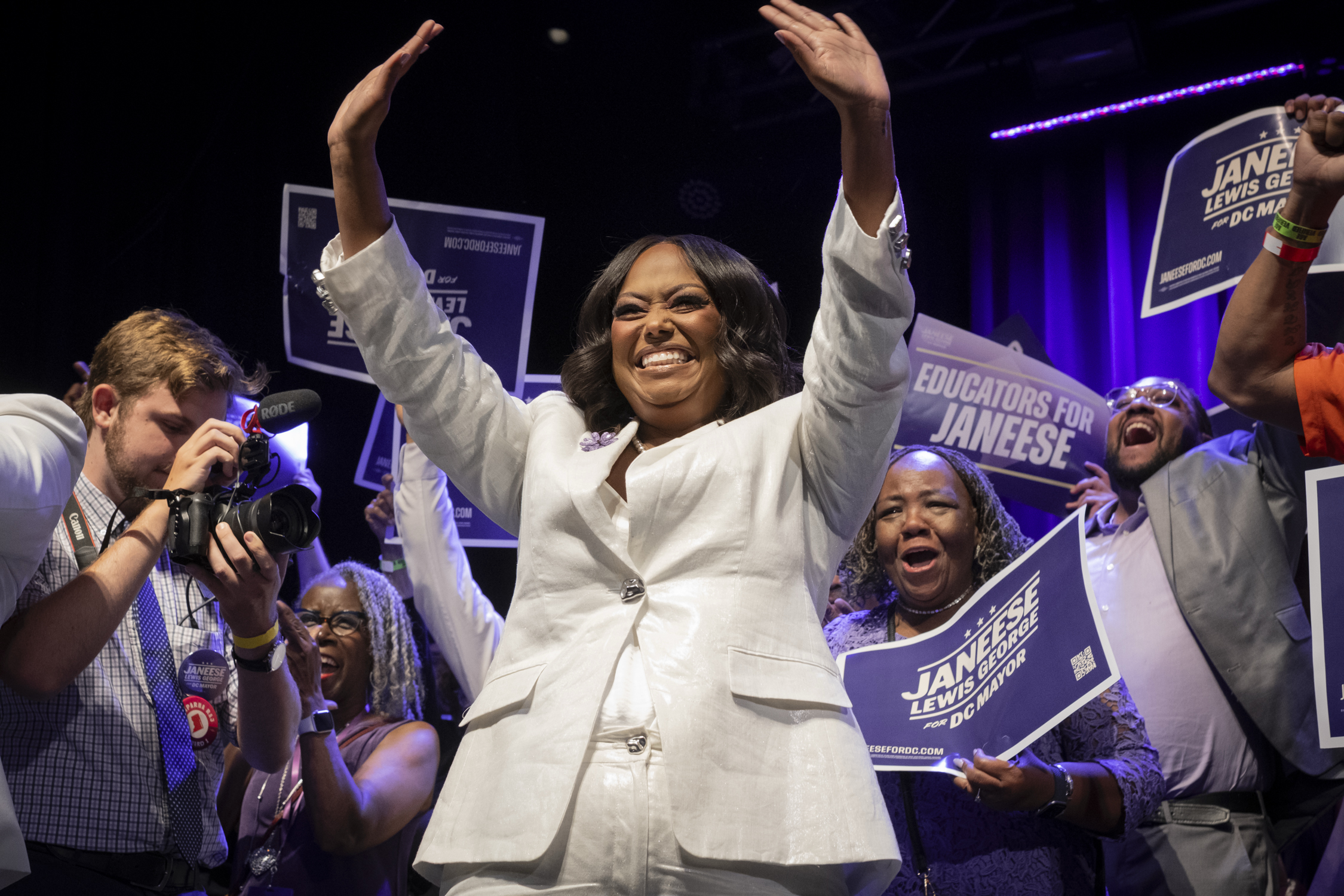
JCRC CEO Ron Halber said he hopes to work with the DSA member, despite his strident criticism of the group, while remaining vigilant
BLAME GAME

Nearly all Israelis surveyed said they believed Tehran was the victor, while 70% rated Trump’s management of the war as a failure or poor
The South Carolina senator also suggested that Saudi Arabia will join the Abraham Accords before the end of the year
Andrew Harnik/Getty Images
Sen. Lindsey Graham (R-SC) walks into the Senate Chamber on December 11, 2025 in Washington, DC.
Sen. Lindsey Graham (R-SC) defended the Trump administration’s diplomatic discussions with Iran on Sunday, but predicted that negotiations with the Islamic Republic will likely fail, and threatened that the U.S. will take over the Strait of Hormuz if no agreement is reached.
“Let’s try a diplomatic solution. I think it’s going to fail,” Graham said on CBS’ “Face the Nation” on Sunday regarding a negotiated agreement with Tehran.
He said that, following his lengthy meeting with Trump on Friday, he believes that, ”If this deal fails, President [Donald] Trump is going to take the Strait of Hormuz over by force. The United States will control the Strait of Hormuz” and charge fees for passage. President Donald Trump made similar comments on Saturday.
“If Iran continues to attack Israel and Lebanon, the new policy will be, we’ll hit Iran. So, to the Iranians, if you’re listening, when you use Hezbollah to attack Israel, I think the new policy will be, we will attack Iran,” Graham continued. The senator’s comments are at odds with recent remarks fromTrump and Vice President JD Vance rebuking Israel for its strikes on Hezbollah in Lebanon, responding to Hezbollah attacks on Israel.
Graham acknowledged the memorandum of understanding signed last week is “problematic” but said he’d rather “try diplomacy than take it off the table,” and downplayed the financial windfall that Iran will get from the deal in the form of the lifting of sanctions and unfreezing of sanctioned Iranian funds.
“The money Iran gets is not going to change the future of Iran,” Graham said. “It’s not enough to reconstruct the country.”
Graham and other Senate Republicans in 2023 criticized the Biden administration for releasing $6 billion in frozen Iranian funds as part of a hostage deal, a sum likely to be dwarfed by the amount Iran stands to gain from this deal.
Graham, who previously criticized the idea of a $300 billion reconstruction fund for Iran, now says he supports the prospect — as long as the funds come from Arab states, rather than from the United States. But he also raised doubts that such a fund would actually come to fruition.
Graham suggested that a fundamental change in Iran’s posture would be required to convince the Arab states to Invest in Iran: “It would mean that the Sunni Arabs believe that Iran has changed to the point they want to be a business partner. I pray that happens. I doubt if it will.”
The South Carolina senator also predicted Saudi Arabia will join the Abraham Accords before the end of the year, something that the Saudi government has publicly denied.
Asked whether Israel would be ready to recognize a Palestinian state before the end of the year, which has been Saudi Arabia’s demand in exchange for normalization, Graham said, “Donald Trump is going to empower me and others to jumpstart an effort to get Saudi to join Israel. There will be accommodations made by Saudi and Israel.”
He said that there had been plans to announce a Saudi-Israeli normalization framework by the end of October 2023, which were upended by Hamas’ Oct. 7 attack.
“I’m not asking you to do anything to jeopardize the future of Israel’s security, but I am asking you to be open to expanding the Abraham Accords and finding a solution to Palestinians that are good for Israel, and quite frankly, good for the world,” he continued, addressing the Israelis. “To Saudi Arabia, now is the time to open negotiations yet again.”
The South Carolina Republican said that Trump should allow Jay Clayton’s nomination to be director of national intelligence to proceed and unlock Democratic votes to reauthorize Section 702 of the Foreign Intelligence Surveillance Act.
He said that Trump blocked Clayton’s planned confirmation hearing last week because he was told, incorrectly, that Democrats did not plan to follow through on renewing FISA even if Clayton were confirmed.
Asked whether he has any concerns about acting DNI Bill Pulte, Graham responded, “I’m fine right now, but I won’t be fine much longer if we don’t get FISA up and running, and I think Clayton’s the perfect pick.”
The briefing is co-organized by the Center for International Policy, a far-left think tank that has described Israel's operations in Gaza as a genocide, and Win Without War

BRENDAN SMIALOWSKI/AFP via Getty Images
Robert Malley, Biden administration special envoy for Iran, waits to testify about the JCPOA (Joint Comprehensive Plan of Action) during a hearing of the Senate Foreign Relations on Capitol Hill May 25, 2022, in Washington, D.C.
J Street is slated to host a virtual briefing for congressional staff on the Trump administration’s memorandum of understanding with Iran featuring former Biden administration special envoy for Iran Rob Malley, who was suspended from his State Department role amid an investigation over his handling of classified materials.
The event, scheduled for next Tuesday, will feature Malley alongside Kelsey Davenport, director for nonproliferation policy at the Arms Control Association. It’s being co-organized by the Center for International Policy and Win Without War.
The Center for International Policy is a far-left think tank led in part by former Sen. Bernie Sanders (I-VT) advisor Matt Duss, that has taken a strongly hostile stance toward Israel, including opposing U.S. aid to Israel and describing Israel’s operations in Gaza as a genocide.
Malley was suspended for much of Biden’s term in office under suspicion of leaking classified documents, though he said the investigation into him had been closed during the Trump administration, and denied any knowledge of what the investigation pertained to.
A State Department inspector general’s report found that Malley was improperly allowed to continue working in his role for some time after his security clearance was suspended, and that his direct supervisor and other senior officials were not notified of his suspension.
Plus, Albania blames Iran for stoking Kushner-unrest
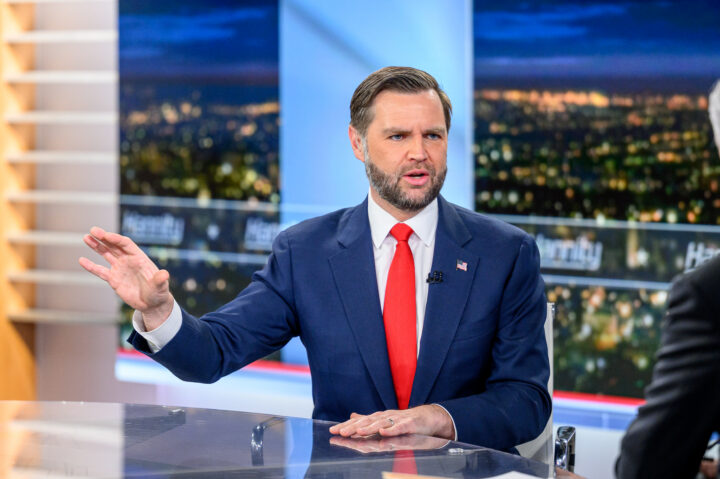
Roy Rochlin/Getty Images
Vice President JD Vance
Good Thursday afternoon.
This P.M. briefing is reserved for our premium subscribers like you — offering a forward-focused read on what we’re tracking now and what’s coming next.
Today’s Daily Overtime was curated by Senior National Correspondent Gabby Deutch.
📡On Our Radar
Notable developments and interesting tidbits we’re tracking
As the White House continues to promote the memorandum of understanding that will end the war with Iran and start negotiations between Washington and Tehran, Vice President JD Vance is out with a message that sounds strikingly familiar — at least to anyone who followed former President Barack Obama’s pitch on the 2015 nuclear deal with Iran, Jewish Insider’s Gabby Deutch reports.
“If you think this is a bad deal, what is your alternative?” Vance said in an interview this week with New York Times columnist Ross Douthat.
Obama used nearly identical phrasing at a 2015 White House press conference: “I’m hearing a lot of talking points being repeated about ‘this is a bad deal,’” he said. “What I haven’t heard is, what is your preferred alternative?”
Watch a side-by-side look at Vance and Obama here…
Vance also delivered a tough message to Israeli officials who have criticized the MOU, telling reporters on Thursday that Israel’s government should be careful not to alienate the only friend it has left: President Donald Trump, JI’s Emily Jacobs reports.
“Donald J. Trump is the only head of state in the entire world who is sympathetic to the nation of Israel at this moment in time and he happens to be the head of state of the world’s superpower. If I was in the Cabinet of the Israeli government, I might not be attacking the only powerful ally that I have anywhere left in the entire world,” said Vance…
Trump also had a word of caution for Israeli Prime Minister Benjamin Netanyahu, two days after he said Netanyahu was too “vicious” in his approach to fighting Hezbollah in Lebanon. Asked by a reporter for Israel’s Kan News if he will support Netanyahu in this year’s Israeli elections, Trump said he most likely would, but did not commit.
“I’ll have to look at who’s running, but I like Bibi very much. I would be most likely to endorse him,” said Trump. “He’s doing a very good job, he’s got to be a little bit more rational”…
United Against Nuclear Iran, an advocacy group that rallied opposition to the 2015 Joint Comprehensive Plan of Action, said on Thursday that it “cannot endorse the MoU in its current form”…
AIPAC released a policy memo on Thursday that said the MOU “raises significant questions,” and called on Congress to “play a critical role in ensuring a final deal meets President Trump’s stated objectives for the war”…
In a Thursday speech at the FII Priority summit in Rome, Albanian Prime Minister Edi Rama blamed Iran for “ruthless” cyberattacks against the country, claiming that Tehran has sought to sow unrest about a preliminarily approved luxury development project in the country from Ivanka Trump and Jared Kushner, Trump’s daughter and son-in-law, JI’s Matthew Shea reports…
Janeese Lewis George defeated Kenyan McDuffie in the Democratic primary for mayor of Washington, D.C., with the Associated Press calling the race on Thursday afternoon. Democratic socialist Lewis George leads McDuffie 53% to 36%…
American Priorities, a super PAC created as a progressive counterweight to AIPAC, has received $250,000 from a tech executive whose firm is developing AI data centers in New York State — while boosting two democratic socialist House candidates who oppose efforts to expand data centers, JI’s Matthew Kassel reports…
Rep. Tom Kean Jr. (R-NJ), who has been absent from Congress since March due to an unexplained personal health issue, plans to return to Washington on June 30…
Israel and Syria are expected to resume direct talks soon due to pressure from the U.S., the Israeli network Kan reports…
The FBI announced that it charged San Diego resident Reda Mazen Rida Sabassi with conspiring to provide material support to Hamas after he allegedly raised approximately $600,000 through fraudulent charitable campaigns and funneled a portion to the terrorist organization…
Former Presidents Joe Biden, George W. Bush and Bill Clinton attended the grand opening of the Obama Presidential Center in Chicago on Thursday afternoon.
Guests included a litany of ex-Obama administration staffers, including former White House liaison to the Jewish community Matt Nosanchuk and former U.S. Ambassador to Israel Dan Shapiro, who was spotted chatting with Obama…
⏩ Tomorrow’s Agenda, Today
An early look at tomorrow’s storylines and schedule to keep you a step ahead
Keep an eye on Jewish Insider for a look at how Jewish Republicans are feeling about the U.S.-Iran memorandum of understanding that was signed this week.
Vice President JD Vance plans to travel to Switzerland this weekend for talks with Iran, though the plans are not yet finalized, he told reporters on Thursday.
Bill Pulte, the director of the Federal Housing Finance Agency, will become the acting director of national intelligence on Friday after the confirmation of DNI nominee Jay Clayton was delayed this week at President Donald Trump’s request.
We’ll be monitoring the final days of the heated congressional primary campaigns in New York, where Israel and Gaza remain hot topics for progressive candidates.
We’ll be back in your inbox with the Daily Overtime on Monday. Shabbat Shalom!
Stories You May Have Missed
Transferring responsibilities
The letter urges American Jews to ‘double down’ on civic values as the country marks its 250th
BEHIND THE CURTAIN

Multiple sources identified Scott Stringer as a driving force behind two PACs spending to beat Mayor Zohran Mamdani’s House candidates
Vance borrows from the Obama playbook to argue there is no viable alternative to agreement with Iran
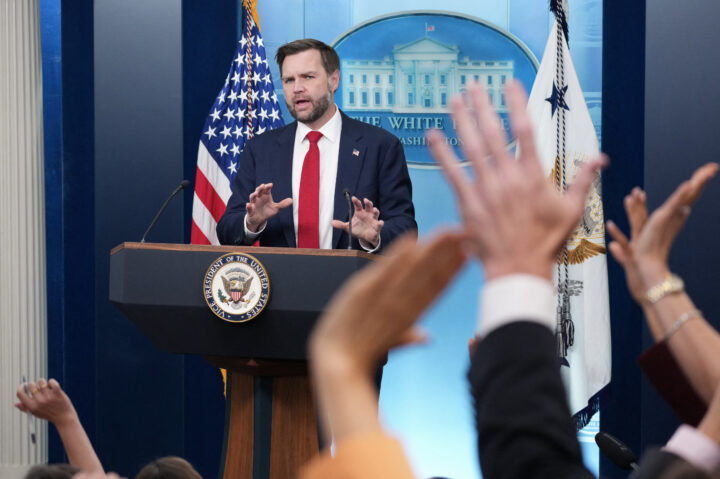
Photo by Ken Cedeno / AFP via Getty Images
Vice President JD Vance takes questions from reporters during a press briefing in the Brady Briefing Room of the White House in Washington, DC, on June 18, 2026.
As Vice President JD Vance takes on the role of chief defender of the U.S.-Iran memorandum of understanding and forthcoming talks, he has begun to sound a lot like someone whom the Trump administration has lately spent a lot of time attacking: former President Barack Obama.
Vance and President Donald Trump have both, in recent days, made clear that they view the MOU — which is set to deliver sanctions relief to Iran as nuclear negotiations get underway — as fundamentally different from, and better than, the 2015 Joint Comprehensive Plan of Action, the nuclear deal signed by Obama. But as the White House faces criticism from hawkish members of the Republican Party, the language Vance is using to defend the burgeoning deal closely resembles the arguments made by Obama 11 years ago.
“If you think this is a bad deal, what is your alternative?” Vance said in an interview this week with New York Times columnist Ross Douthat.
Flashback to a 2015 press conference at the White House soon after the JCPOA was announced.
“I’m hearing a lot of talking points being repeated about ‘this is a bad deal,’” Obama said. “What I haven’t heard is, what is your preferred alternative?”
Both Vance in 2026 and Obama in 2015 argued that the deals negotiated by their respective administrations were better than using military force — or in the case of the Trump deal, continuing to use military force — and that they would lead to a safer world.
“We could drop more bombs. We could destroy more of their country. We could kill the current iteration of their leadership. We know where all of them are. All of those things could happen,” Vance said. “But does that make the American people safer or more prosperous? The president of the United States and I think: No.”
Obama frequently argued similarly.
“If the alternative is that we should bring Iran to heel through military force, then those critics should say so,” he said at the 2015 press conference. “We’ve got a historic chance to pursue a safer and more secure world, an opportunity that may not come again in our lifetimes.”
“None of them have presented to me, or the American people, a better alternative.” -Obama, 2015
— Jewish Insider (@jewishinsider) June 18, 2026
“It’s not just whether this is good or bad, it’s what is the alternative.” -Vance, 2026
As Vice President JD Vance takes on the role of chief defender of the U.S.-Iran MOU and the… pic.twitter.com/TB5bvxINM5
There are substantive differences between the agreements notched by the Obama and Trump administrations, though both share the core assertion that they will not allow Iran to obtain a nuclear weapon.
“The Obama-Iran deal allowed them to generate a stockpile of enriched uranium,” Vance claimed, although the JCPOA required Iran to limit the level to which it enriched uranium, cut its stockpile by 98% and ship the rest of its enriched uranium out of the country. “Our deal ensures that stockpile is destroyed and eliminated, so that’s a very, very big difference, a very important difference for the American people,” Vance said this week. (The text of the 14-point MOU says only that the uranium will be discussed during the forthcoming negotiations.)
But both Vance and Obama, in their roles as salesmen of their administrations’ respective deals, argued that critics simply misunderstand the agreements.
“I just don’t think that people who are criticizing this, one, they’re not actually dealing with the reality of what’s in it, and No. 2, they don’t have an alternative,” Vance said in a podcast interview with Megyn Kelly this week.
Obama told NPR’s Steve Inskeep in 2015 that critics of his deal get the facts wrong.
“I’ve listened to the critics, some of them who announced their opposition before they had even read the bill, or read the agreement. And that is that they will put forward arguments that after a few minutes can be shown as illogical or based on the wrong facts,” said Obama.
Vance challenged critics to come up with a better alternative beyond more fighting.
“What is it that they wanted us to do besides put 300,000 ground troops in Iranian soil, which we were never going to do?” he said to Kelly. “If your alternative is just to drop bombs without any clear goal or any clear American interest implicated, then you’re not making wise decisions on behalf of the American people.”
Former Secretary of State John Kerry argued something similar before Congress in 2015.
“So what’s your plan?” he asked. “Totally go to war?”
Some GOP legislators swiftly moved to tie Vance to the MOU — hours after it was announced
Roy Rochlin/Getty Images
Vice President JD Vance
Vice President JD Vance is increasingly becoming the face of Washington’s negotiations with Iran — setting him up to claim victory if the agreement is successful, or to take the fall if talks with the historically intransigent adversary collapse.
President Donald Trump said as much yesterday in France: “If it works out, I’m going to take the credit. If it doesn’t work out, I’m blaming JD,” Trump quipped on the sidelines of the G7 summit, hours before signing the agreement alongside French President Emmanuel Macron in Versailles.
Trump is far from the only Republican in Washington to tie Vance to the deal. Some GOP legislators swiftly moved to tie Vance to the MOU — hours after it was announced. Sen. Lindsey Graham (R-SC), who has long advocated for military pressure against Iran, was one of the first, saying Sunday that it was “imperative that the architect of the deal, Vice President Vance and his negotiating partners, be part of the process in presenting the final deal to Congress.”
But the pressure on Vance quickly has spread through the party. On Wednesday, Sen. Josh Hawley (R-MO), a longtime backer of the president who is largely aligned with the GOP’s isolationist wing (where Vance has also found his political home), told reporters, “I wish the VP all the best of luck.” Sen. Ted Cruz (R-TX), without mentioning Vance by name, said that in moving forward with the MOU, “the president, unfortunately, is receiving bad advice once again.”
The criticism of Vance over the agreement with Iran extends beyond the capital. Conservative commentator Ben Shapiro said on Fox News on Wednesday that the MOU “appears to be, just from the text, a disaster that does not achieve any of the actual signal goals that were set by the administration at the beginning.” Directly addressing Vance’s role, Shapiro said, “The vice president of the United States, the chief negotiator on this particular project, has not well served the president.” Read more here on Shapiro’s comments.
Vance’s high-profile presence around the Iran negotiations draws attention to other senior members of the Trump administration — including Secretary of State Marco Rubio and Defense Secretary Pete Hegseth — who have been notably absent from the White House’s public efforts to talk up the MOU.
Axios reported earlier this week that Rubio and Hegseth — who during the course of the war with Iran had often been front and center explaining the administration’s policies and actions — had opposed the MOU, while Vance, White House Special Envoy Steve Witkoff and Jared Kushner backed the agreement.
Rubio, who has long taken a more hawkish approach to foreign policy — not just on Iran, but also on China, Russia, Cuba and other U.S. adversaries — was on hand this week at the G7. Rubio has been in France this week with Trump and was at his side when the president signed the agreement, but has largely avoided publicly commenting on the deal and its contours.
Iran has long boasted of its ability to drag out negotiations, betting (usually correctly) that it can take the economic hits and outlast the West. It may well be that Vance, who worked in venture capital and had not yet entered politics during the Obama administration’s yearslong talks that led to the 2015 Joint Comprehensive Plan of Action, is less familiar with Iran’s intransigence and ability to slow-walk diplomacy.
After the midterms — now less than five months away — attention will shift to 2028. By then, if the administration’s timeline holds, a deal with Iran will either have been struck or will have collapsed. For Vance, who along with Rubio is expected to make a White House bid in two years’ time, the failure to bring about a resolution with Iran could become a major liability in the 2028 GOP primary.
Also during the hearing, Cameron Hamilton, the nominee to be the FEMA administrator, said he plans to offer recommendations on reforms and additional funding for the NSGP in his first 30 days in office

Tom Williams/CQ-Roll Call, Inc via Getty Images
Then-Rep. Ruben Gallego (D-AZ) in Rayburn Building on Capitol Hill on June 9, 2022.
Sen. Ruben Gallego (D-AZ) grilled Trump administration nominee Charlton Allen on Wednesday at a Senate Homeland Security Committee hearing about a seemingly antisemitic cover and article published by a student newspaper while Allen was overseeing the publication as a college student.
Allen, the nominee to be the general counsel of the Federal Labor Relations Authority, which oversees federal workers’ labor issues, was the publisher of the Carolina Review when he was a student at the University of North Carolina.
Decades ago, under his leadership, the newspaper published a cover illustration depicting a Jewish student running for a student government position with devil’s horns and a pitchfork, connected to an article that, according to Gallego, highlighted the student’s Jewish faith in criticizing him for voting against funding for a campus Christian organization while supporting funding for Jewish and other groups.
Allen acknowledged at the hearing that the cover was a “mistake” but argued that it was not antisemitic and said it was being taken out of context. He claimed that the cover was intended to compare the Jewish student in question to the Blue Devils, the mascot of UNC’s rival, the Duke Blue Devils.
Allen also maintained that the student in question had discriminated against Christian student groups while supporting Jewish and other student groups.
Also during Wednesday’s hearing, Cameron Hamilton, the nominee to be the Federal Emergency Management Agency administrator, said that he plans to offer lawmakers recommendations on reforms and potential additional funding for the Nonprofit Security Grant Program in his first 30 days in office, in consultation with interested community groups.
He acknowledged calls for additional funding from religious groups, as well as for steps to ensure that funding flows quickly, though he did not definitively commit to supporting greater funding, saying he wanted to study the issue and speak to community groups first before providing a funding recommendation.
“I just want to convey to you the urgency, which I hear from my constituents, and it’s not just mine,” Sen. Andy Kim (D-NJ) said. “We see the rise of antisemitism surging across this country. I visited a temple that also has a school attached to it. They are so worried about what’s going to happen, and it’s not just our Jewish community.”
He also emphasized that the needs of these communities are ongoing, not periodic.
“This is now the highest line on the budget of so many of these institutions,” Kim said.
Plus, Qatar complicates Israel-VW deal
Photo by Anna Moneymaker/Getty Images
U.S. President Donald Trump is joined by (L-R) U.S. Trade Representative Jamieson Greer, U.S. Commerce Secretary Howard Lutnick, U.S. Secretary of State Marco Rubio and U.S. Treasury Secretary Scott Bessent as he speaks at a press conference during the G7 Leaders' Summit on June 17, 2026 in Evian-les-Bains, France.
Good Wednesday afternoon.
This P.M. briefing is reserved for our premium subscribers like you — offering a forward-focused read on what we’re tracking now and what’s coming next.
Today’s Daily Overtime was curated by Senior National Correspondent Gabby Deutch.
📡On Our Radar
Notable developments and interesting tidbits we’re tracking
After days in which President Donald Trump, Vice President JD Vance and other senior officials boosted the U.S.-Iran memorandum of understanding — and amid calls from Capitol Hill and beyond to make public the agreement’s details — the White House on Wednesday shared the text of the document that the Trump administration said will end the war against Tehran. Jewish Insider’s Emily Jacobs obtained the text of the MOU, which was read aloud to reporters during a call with a senior administration official.
The MOU states that the two nations “and their respective allies in the current war” will permanently end military operations — including against Lebanon, a stipulation that suggests the deal is meant to suspend Israel’s retaliatory strikes against Hezbollah, a provision for which Israel has not yet expressed approval. Iran “reaffirms” in the MOU that it will not “procure or develop nuclear weapons”…
The MOU text also reveals that the U.S. plans to issue a sanctions waiver to Iran so that it can sell oil, a major policy shift away from Trump’s use of sanctions against Iran. If a final deal is reached, the U.S. committed to ending all sanctions on Iran. Trump said earlier in the day at the G7 summit in France that the U.S. will not invest in Iran but would not stop other countries from doing so, JI’s Matthew Shea reports.
One new piece of information Trump shared on Wednesday that was not directly addressed in the MOU: a nuclear deal between Washington and Tehran would not prohibit the Iranians from possessing ballistic missiles, JI’s Matthew Shea reports. “I mean, they have to have some, because other people have some … It doesn’t work that way. And missiles aren’t the problem,” Trump said at the G7.
The agreement does not address Iran’s ballistic missiles or support for terrorist proxies. At the beginning of the war, the Trump administration said eliminating the ballistic missile threat from Iran was a key war aim…
The MOU asserts that a final deal will be negotiated within 60 days, unless both countries agree to extend the deadline. Iran’s naval blockade on the Strait of Hormuz must be lifted within 30 days.
When talking to reporters after landing in Paris this afternoon, Trump said he does not view the 60-day deadline as a hard deadline. “Just as long as they’re behaving, I really don’t care that much,” Trump said.
Vance, not Trump, will be signing the MOU in Switzerland on Friday. “This way if it works out, I’m going to take the credit. If it doesn’t work out, I’m blaming JD,” Trump said during the G7…
Some Republican senators criticized the MOU, with retiring Sen. Bill Cassidy (R-LA) calling it “the worst foreign policy blunder in decades,” JI’s Marc Rod reports…
Dario Amodei and Sam Altman, the CEOs, respectively, of Anthropic and OpenAI, joined Trump and the other G7 leaders for lunch on Wednesday, along with Salesforce CEO Marc Benioff and Google DeepMind CEO Demis Hassabis…
The planned Senate confirmation hearing for Jay Clayton, Trump’s nominee to serve as director of national intelligence, was scuttled on Wednesday morning after a last-minute Truth Social post from the president saying that the hearing would be canceled, prompting frustration from both Republican and Democratic lawmakers, JI’s Marc Rod reports…
As a major shareholder in Volkswagen, Qatar’s sovereign wealth fund is complicating talks between the German automaker and the Israeli state-owned defense company Rafael over Rafael’s intention to buy a plant from Volkswagen to manufacture components for Israel’s Iron Dome missile-defense systems…
The anti-Israel advocacy group TrackAIPAC, which attacks lawmakers who have received support from pro-Israel groups and donors who have supported Israel-related causes, endorsed Rep. Ro Khanna (D-CA), who once was targeted by TrackAIPAC before moving sharply to the left on Israel in recent months…
After eight people were indicted last week for allegedly threatening University of Michigan leaders and their families as part of an anti-Israel pressure campaign, former Michigan Democratic Party Chair Lon Johnson called on the party’s current leadership to review the actions of five of the suspects who were members of the Michigan Democratic Party…
The Department of Health and Human Services’ Office for Civil Rights announced on Wednesday that it is opening an antisemitism investigation into the American Psychological Association, the nation’s largest professional organization for mental health professionals. JI’s Gabby Deutch reported on the APA’s handling of antisemitism last summer…
⏩ Tomorrow’s Agenda, Today
An early look at tomorrow’s storylines and schedule to keep you a step ahead
Keep an eye out in Jewish Insider for a look at how some of the country’s most prominent Jewish communal leaders are marking America’s 250th birthday this July Fourth.
Sen. Joni Ernst (R-IA) will be speaking in the morning at a fireside chat at the Hudson Institute focused on “diplomacy, defense and debt.”
We’ll be monitoring the results of Tuesday’s mayoral primary election in Washington, D.C., which still has not been called, even as Janeese Lewis George leads Kenyan McDuffie 53% to 37%, with 68% of the vote counted.
Stories You May Have Missed
Transferring responsibilities
The move marks a major step in the White House’s efforts to dismantle the Education Department and significantly reduce or distribute its work
TRUST ISSUES

Senators on both sides of the aisle say they’re eager to see the text of the agreement, but the administration has not yet made plans to brief Congress
Text of the 14-point MOU was read aloud to reporters on a phone call with a senior administration official
Daniel SLIM / AFP via Getty Images
The White House is seen in Washington, DC, on December 17, 2025.
The Trump administration on Wednesday shared with journalists the official text of the memorandum of understanding between the U.S. and Iran to establish a ceasefire with Iran, permanently end Israel’s war against Hezbollah in Lebanon, reopen the Strait of Hormuz while ending the U.S. naval blockade and kickstart a 60-day negotiation period on the future of Iran’s nuclear program and the possibility of lifting U.S. sanctions on Tehran.
The 14-point agreement was read aloud by a senior administration official on a call with reporters. The White House did not provide a written copy of the agreement after the readout.
Below is the agreement as delivered on the call:
The United States of America and the Islamic Republic of Iran, hereinafter referred to as the “Parties,” have jointly agreed in good faith on [Date] to the following:
Paragraph 1 – Cessation of Hostilities
The Parties and their respective allies in the current war, by signing this MOU, declare the immediate and permanent termination of all military operations on every front, including in Lebanon. The Parties undertake not to initiate any war or military operation against each other, to refrain from the threat or use of force against one another, and to respect the territorial integrity and sovereignty of Lebanon. The final deal will confirm the permanent termination of the war on all fronts, including Lebanon, and will incorporate the other provisions of this paragraph.
Paragraph 2 – Sovereignty and Non-Interference
The Parties undertake to respect each other’s sovereignty and territorial integrity and to refrain from interfering in each other’s internal affairs.
Paragraph 3 – Timeline for Final Deal
The Parties commit to negotiating and concluding the final deal within a maximum of 60 days, extendable only by mutual consent.
Paragraph 4 – Naval Blockade and Force Posture
Immediately upon signing this MOU, the United States shall begin removing its naval blockade and any other impediments or disturbances imposed on the Islamic Republic of Iran, and shall fully lift the naval blockade within 30 days. During this period, vessel traffic shall be progressively restored toward pre-war levels. The United States further undertakes to withdraw its forces from the proximity of the Islamic Republic of Iran within 30 days after the conclusion of the final deal.
Paragraph 5 – Strait of Hormuz and Maritime Security
Upon signing this MOU, the Islamic Republic of Iran shall, using its best efforts, arrange for the safe and free passage of commercial vessels through the Strait of Hormuz with no charge for a period of 60 days, in both directions (Persian Gulf to Sea of Oman and vice versa). Commercial vessel traffic shall resume immediately. Iran shall complete the necessary technical and military measures, including demining, within 30 days. The Islamic Republic of Iran will engage in dialogue with the Sultanate of Oman and other Persian Gulf littoral states to define future administration and maritime services in the Strait of Hormuz, in accordance with applicable international law and the sovereign rights of coastal states.
Paragraph 6 – Reconstruction and Economic Development
The United States, in coordination with regional partners, undertakes to develop a definitive, mutually agreed reconstruction and economic development plan for the Islamic Republic of Iran valued at a minimum of $300 billion (USD). The implementation mechanism for this plan shall be finalized as part of the final deal within 60 days. The United States shall grant all required licenses, waivers, and permissions necessary for the relevant financial transactions.
Paragraph 7 – Sanctions Termination
The United States undertakes to terminate all sanctions against the Islamic Republic of Iran — including UN Security Council resolutions, IAEA Board of Governors resolutions, and all unilateral U.S. primary and secondary sanctions — according to an agreed schedule to be included in the final deal. The Parties acknowledge the critical importance of the sanctions issue and express their intention to address it immediately in negotiations to reach mutual agreement.
Paragraph 8 – Nuclear Issues
The Islamic Republic of Iran reaffirms that it shall not procure or develop nuclear weapons. The Parties agree to resolve the disposition of Iran’s stockpiled enriched material through a mutually agreed mechanism, with the baseline method being on-site down-blending under IAEA supervision, in accordance with the sanctions-termination schedule in Paragraph 7. The Parties will also discuss Iran’s enrichment activities and other nuclear-related matters within a satisfactory framework to be agreed in the final deal. The final deal will confirm the provisions of this paragraph. The Parties acknowledge the critical importance of these nuclear issues and intend to address them immediately in negotiations.
Paragraph 9 – Status Quo Pending Final Deal
Pending the final deal, the Parties agree to maintain the status quo: the Islamic Republic of Iran will maintain the current status of its nuclear program, and the United States will not impose any new sanctions or deploy additional forces in the region.
Paragraph 10 – Oil Export Waivers
Immediately upon signing this MOU and until the termination of sanctions, the U.S. Department of the Treasury shall issue waivers authorizing the export of Iranian crude oil, petroleum products, derivatives, and all associated services (including banking, insurance, and transportation).
Paragraph 11 – Access to Frozen Funds and Assets
The United States shall make fully available all frozen or restricted Iranian funds and assets. Upon implementation of this MOU, the Parties will mutually agree on procedures for the release and use of these funds during negotiations. Such funds shall be usable for payments to any ultimate beneficiary designated by the Central Bank of the Islamic Republic of Iran. The United States shall issue all necessary licenses and authorizations to this end.
Paragraph 12 – Monitoring Mechanism
The Parties agree to establish an executive mechanism to monitor the implementation of this MOU and future compliance with the final deal.
Paragraph 13 – Sequencing of Negotiations
After signing this MOU, and subject to the commencement and continued implementation of Paragraphs 1, 4, 5, 10, and 11, the Parties shall begin negotiations on the remaining elements of the final deal.
Paragraph 14 – UN Security Council Endorsement
The final deal shall be endorsed by a binding United Nations Security Council resolution.
Plus, Ron Dermer's new shop
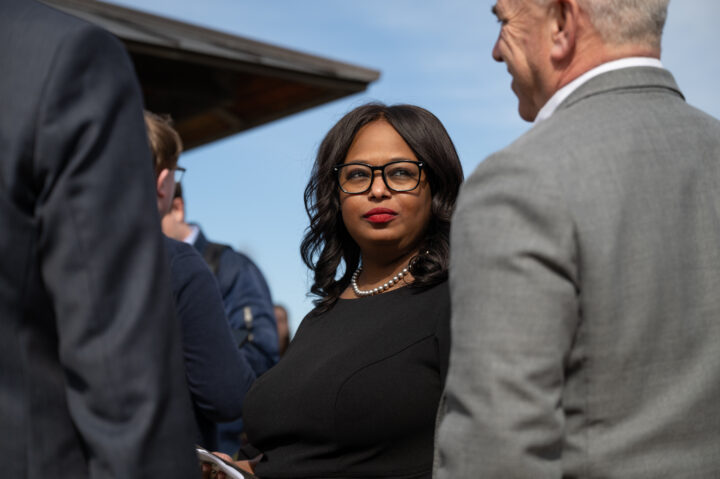
Craig Hudson for The Washington Post via Getty Images
D.C. councilmember and mayoral candidate Janeese Lewis George is seen on Capitol Hill for a press conference in Washington, DC on March 10, 2025.
Good Wednesday morning.
In today’s Daily Kickoff, we report on the Trump administration’s plan to transfer the Education Department’s Office for Civil Rights to the Department of Justice, and talk to Senate Republicans about their skepticism that Iran will follow through with any nuclear commitments it makes to the U.S. We scoop the launch of former Israeli Strategic Affairs Minister Ron Dermer’s new strategic advisory firm, and cover President Donald Trump’s comments on Qatar and Iran on the sidelines of the G7 in France. Also in today’s Daily Kickoff: Amir Tibon, Ken Marcus and Noa Kirel.
Today’s Daily Kickoff was curated by JI Executive Editor Melissa Weiss and Israel Editor Tamara Zieve. Have a tip? Email us here.
What We’re Watching
- We’re awaiting the White House’s release of the memorandum of understanding between the U.S. and Iran hours after Bloomberg published what it said was the 14-point draft MOU.
- President Donald Trump said earlier today that the U.S. would resume military activity against Iran if he didnt like the MOU, the text of which he noted was not final. “It’s a memorandum of understanding, and if I don’t like it, we’ll go back to shooting at them, dropping bombs on their heads. I don’t like it if they don’t behave. We’ll go right back to dropping bombs right smack in the middle of their head,” Trump said in France.
- Trump, who is returning to Washington after the G7 summit concludes later today, announced on Truth Social the postponement of the confirmation hearing for Jay Clayton to be director of national intelligence, which had been slated to take place this afternoon before the Senate Intelligence Committee. Trump said that before Clayton could be confirmed, the Senate needed to confirm Sullivan & Cromwell partner Jamie McDonald as U.S. attorney for the Southern District of New York.
- The Senate Homeland Security Committee is holding a hearing for a number of Trump administration nominations this morning, including Cameron Hamilton to be the administrator of FEMA.
- The Senate Foreign Relations Committee is holding its markup on a number of pieces of legislation, including the Iran Human Rights, Internet Freedom, and Accountability Act, the Eastern Mediterranean Gateway Act, the BANNED in Latin America Act targeting Hezbollah and Iran’s activities in the Western Hemisphere, and the Preventing External Aggression and Conflict Escalation in Sudan Act. The SFRC will also mark up legislation repealing some Syria sanctions.
- This afternoon on Capitol Hill, Sen. Peter Welch (D-VT) is holding a press conference with former Columbia University anti-Israel activist Mohsen Mahdawi.
- The Louis D. Brandeis Center for Human Rights Under Law is convening a daylong summit for more than 50 leading litigators and legal experts at the Capital Jewish Museum in Washington on Wednesday to address the legal challenges of defending Jewish students and employees. More below.
- The Atlantic Council is holding an event this afternoon with Sens. Jeanne Shaheen (D-NH) and Thom Tillis (R-NC) focused on next month’s NATO summit in Turkey.
- In New York, the Children’s Museum of Manhattan is holding a ticker tape celebration for kids to celebrate the New York Knicks’ NBA championship win over the weekend. Actor Amy Schumer and author Jessica Seinfeld are set to serve as the parade’s grand marshals.
What You Should Know
A QUICK WORD WITH JI’S GABBY DEUTCH AND mARC ROD
Voters in Washington, D.C., appeared poised to elect Councilmember Janeese Lewis George to be their Democratic nominee for mayor, all but guaranteeing, come November, that she will be elected in November to replace Mayor Muriel Bowser, who is not seeking another term after 12 years in office. The race has not been called, but Lewis George leads by more than 15,000 votes with 64% of the votes counted.
Lewis George, a 38-year-old member of the Democratic Socialists of America, ran a campaign powered by local labor unions that was focused on cost-of-living issues and countering President Donald Trump. She is on track to defeat Kenyan McDuffie, a former councilmember who ran on a more pragmatic platform that eschewed DSA’s brand of radical politics.
The candidates’ views on Israel did not define the race, but they were a throughline in the background. Lewis George filled out a DSA endorsement questionnaire early in the campaign in which she pledged to avoid engaging with “the Israeli government or Zionist lobby groups.” Later, she promised to stand firm in fighting antisemitism while also supporting Palestinian human rights. McDuffie tried to use the comments to appeal to anti-DSA voters and Jewish Washingtonians.
Lewis George will represent a shift from Bowser, a moderate Democrat who in 2019 led a trade mission to Israel and who regularly addressed the annual AIPAC policy conference in Washington before AIPAC canceled the event after 2020.
Meanwhile, it was a short night in Georgia, where Rep. Mike Collins (R-GA) quickly claimed victory over former college football coach Derek Dooley in a Senate primary runoff. Collins picked up a last-minute endorsement from President Donald Trump, while Dooley’s backing by Gov. Brian Kemp wasn’t enough to push him to victory.
Collins ultimately finished the race around 10 points ahead of Dooley, a similar margin as in the primary election earlier this year. Dooley was widely seen as the more moderate and more electable of the two Republicans, as compared to Collins, who has been trailed by a series of scandals. Republicans may struggle to reclaim the seat from Sen. Jon Ossoff (D-GA) with Collins as their standard-bearer in the race.
Transferring responsibilities
The Trump administration announced on Tuesday that it will transfer many of the responsibilities of the Education Department’s Office for Civil Rights, the division that investigates civil rights violations at American schools and universities, to the Justice Department, Jewish Insider’s Gabby Deutch reports.
What this means: The move marks a major step in the White House’s efforts to dismantle the Education Department and significantly reduce or distribute its work. The formal agreement hands to the Justice Department’s Civil Rights Division the core of OCR’s work: investigating and attempting to resolve discrimination complaints against schools and universities. It leaves OCR with the authority to refer cases out and sign off on the results, but has DOJ handling nearly every aspect of the investigation.
Exclusive: In an interview with JI’s Haley Cohen ahead of the National Legal Strategy Summit, Ken Marcus, founder and chairman of the Brandeis Center said, “We’re looking forward to getting the Justice Department perspective because coordination between the government and private organizations are so important.”
TRUST ISSUES
Republican senators said on Tuesday that they’re skeptical that Iran will hold to any commitments it has made or may make in negotiations with the U.S., and urged the administration to release the terms of the memorandum of understanding announced on Sunday. The administration has not yet communicated any specific plans to brief Congress on the deal, Jewish Insider’s Marc Rod and Emily Jacobs report.
Senators say: “Rather than an end to the activities in Iran, I think it’s more of an intermission,” Sen. John Cornyn (R-TX) told reporters. “We still haven’t seen what the documents look like, and regardless of what they look like, I don’t think you can trust the Iranian regime.” Sen. Thom Tillis (R-NC) emphasized that the U.S. has been in similar positions with Iran before, and that they have not resulted in a viable long-term agreement. He told JI that he thinks it’s “generous to call it a deal, it sounds like it’s a deal in progress … and if we’re making progress, that’s good.”
Read the full story here with additional comments from Senate Majority Leader John Thune (R-SD), Senate Minority Leader Chuck Schumer (D-NY) and Sens. John Kennedy (R-LA), Rick Scott (R-FL), Pete Ricketts (R-NE), Eric Schmitt (R-MO), Chris Coons (D-DE) and Tim Kaine (D-VA).
Trump talk: Trump said on Tuesday during a meeting with United Arab Emirates President Sheikh Mohamed bin Zayed Al Nahyan on the sidelines of the G7 Summit in France that he was hopeful that a full deal with Iran would come soon because, he asserted, U.S.-Iranian ties had improved “and the relationship is now normalized,” JI’s Gabby Deutch reports.
BIBI BACKLASH

President Donald Trump expressed disappointment on Tuesday with Israel’s recent military actions in response to Hezbollah, criticizing a strike on a Hezbollah stronghold in Beirut as “vicious” and suggesting that Israel step back and let Syria handle the fight against the Iranian-backed terror group, Jewish Insider’s Matthew Shea reports.
What he said: Speaking with the Qatari emir Sheikh Tamim bin Hamad Al Thani on the sidelines of the G7 summit in France, Trump said, “I didn’t like that he [Netanyahu] did an attack based on … a very minor little thing with some drones that were released,” Trump said, referring to a Hezbollah drone strike on northern Israeli communities on Sunday. “I saw that [Israeli] attack, I saw where that bomb went. That was vicious, that was too much.”
Reactions: Senators and Middle East policy experts expressed skepticism regarding Trump’s suggestion on Tuesday that Syria should handle Hezbollah in Lebanon, JI’s Marc Rod, Matthew Shea and Emily Jacobs report.
ON THE HILL

The Senate’s version of the 2027 National Defense Authorization Act proposes sweeping new conditions on U.S. support for the Lebanese Armed Forces. The proposed restrictions come after top Senate lawmakers publicly expressed frustration in recent months with the LAF’s failure to take concrete steps to fully disarm Hezbollah, and argued that the U.S. should not provide unconditional funding for the LAF, Jewish Insider’s Marc Rod reports.
Terms and conditions: Support for the LAF, which would be limited to no more than $36 million, is conditioned on the LAF’s work to disarm Hezbollah. No more than 5% of that funding can be provided until the administration certifies to Congress that Lebanon has outlawed Hezbollah’s activities and that the LAF is actively working to disarm Hezbollah, prevent the Iranian-backed group’s rearmament and prevent attacks on Lebanon’s neighbors — including Israel.
COPPER STATE CLASH
Alma Hernandez, a Jewish Democrat and Arizona representative now running for an open state Senate seat in Tucson, is raising alarms about rhetoric from her primary opponent that she and other Jewish leaders claim has crossed a line into antisemitism — with no pushback from local elected officials. Hernandez, who is term-limited in Arizona’s House, identifies as a “proud Zionist,” fueling tensions with some Democratic colleagues, particularly on the left, Jewish Insider’s Matthew Kassel reports.
Israel angle: Hernandez’s left-wing rival in the state’s July 21 primary election, Rocque Perez, a former Tucson city council member, has throughout his campaign fixated to an unusual degree on her pro-Israel views and frequently cast Hernandez as influenced by “foreign” and “overseas interests” in a thinly veiled allusion to Israel, saying that he is vying “to unseat” an “Israel-First Dem tied to big money.” Hernandez said in an interview with JI, “At the end of the day, I consider this guy to be an antisemite, and someone who is so obsessed that this is all he talks about.”
EXCLUSIVE
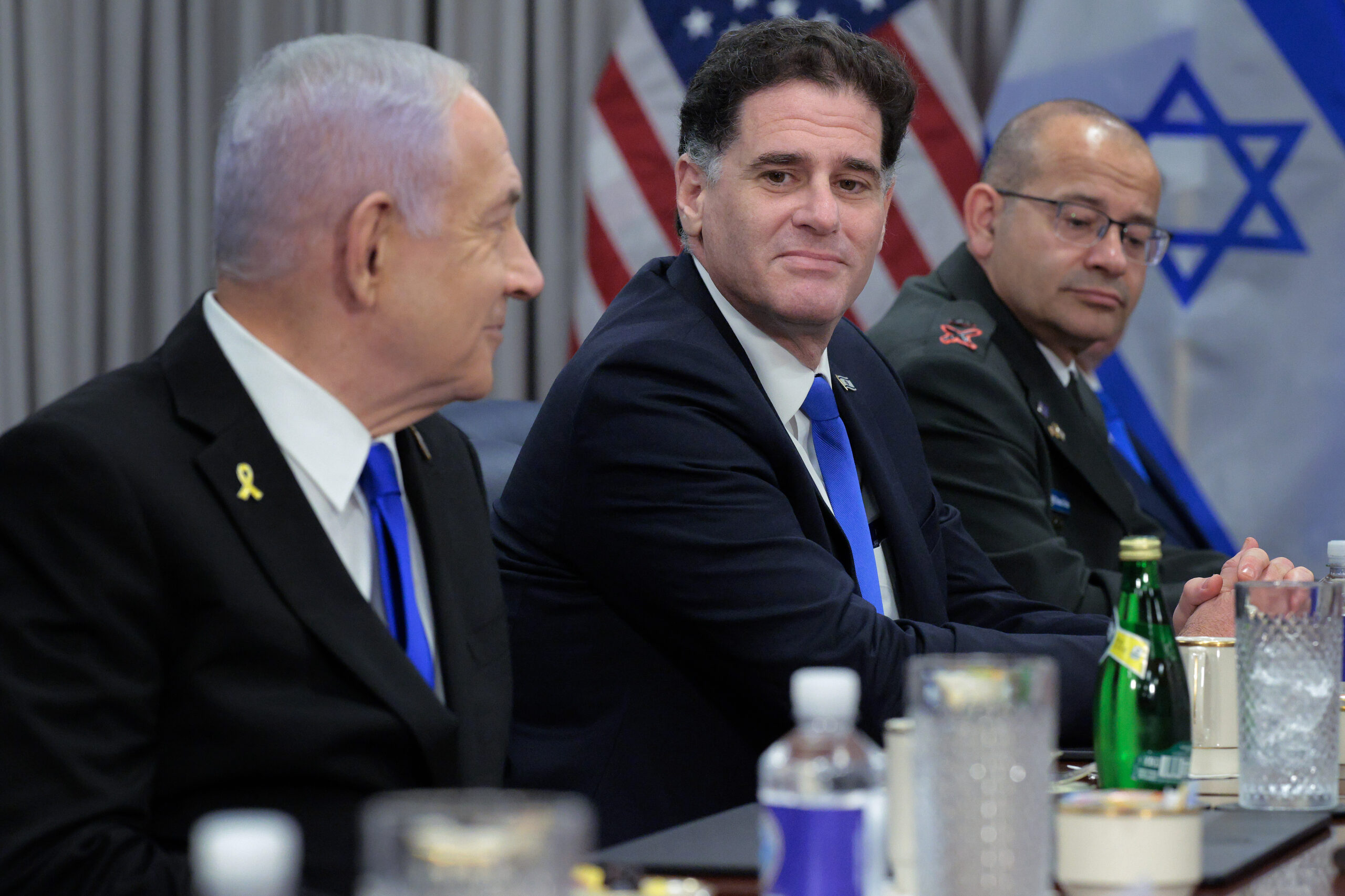
Former Israeli Strategic Affairs Minister Ron Dermer is launching the Dermer Consulting Group (DCG), a Jerusalem-based strategic advisory firm focusing on the U.S., Israel and the Middle East, Jewish Insider’s Melissa Weiss has learned.
Transition: Dermer, who has long been a part of Israeli Prime Minister Benjamin Netanyahu’s inner circle, officially departed the Israeli government in November, after twice extending his tenure. Dermer previously served as Israel’s ambassador to the U.S., leaving the posting in 2021 after eight years. He was named strategic affairs minister the following year. Yarden Golan, who previously served as Dermer’s chief of staff, is a co-founder of the firm and will serve as managing director.
Worthy Reads
Still Joined at the Hip: In The Washington Post, Michael Singh, the managing director and a senior fellow at The Washington Institute for Near East Policy, suggests that the relationship between Washington and Jerusalem remains strong amid reports of clashes between Israeli Prime Minister Benjamin Netanyahu and President Donald Trump. “It is the rare state that is not only capable but willing to act in America’s stead, projecting power far more effectively than U.S. allies with gross domestic products many times Israel’s. The Jewish state’s capability is the product of a unique mix of societal factors, but is also in part the product of a decades-long, bipartisan strategy of building up Israel’s capabilities and its interoperability with the U.S. military.” [WashPost]
War Wound: The New York Times’ Bret Stephens posits that Iran has emerged from the war with the U.S. and Israel as the victor. “War is a contest of wills. And in that contest, the hard men of Tehran appear to have scored a decisive victory over the vain man of Washington. … There’s a word for this: debacle. Not because the war, for all its costs or errors of execution, was a mistake. It’s because this pretense of a peace is an act of geopolitical self-harm that will haunt our standing in the world for years to come.” [NYTimes]
Hardliners’ Lament: The Guardian’s Patrick Wintour reports on anger over the memorandum of understanding between Washington and Tehran among Iran’s hardliners who view the agreement as a capitulation. “Faced with the onslaught, Iranian officials led by Mehdi Mohammadi, an adviser to the head of the negotiating team, Mohammad-Bagher Ghalibaf, mounted a detailed rebuttal in an audio message insisting the deal would end the war, including Israel’s offensive in Lebanon, and that Tehran has not been required to make any new commitments on its nuclear programme, leaving the means of disposal of its highly enriched uranium – including down-blending inside Iran – to future discussions lasting 60 days. Mohammadi also said that by referring to ‘Iranian arrangements,’ the text would allow Iran and Oman to charge fees for passage through the strait of Hormuz, and would even prevent Israeli commercial ships using the waterway.” [TheGuardian]
Word on the Street
In his new book, Communion: Finding My Way Back to Faith, Vice President JD Vance writes that TPUSA founder Charlie Kirk, who was killed at a campus event in September, had raised concerns to Vance shortly before his death that some young conservatives “were going from legitimate disagreement with the Israeli government to antisemitism”…
In a review of the book, Wall Street Journal columnist Barton Swaim criticized what he called Communion’s “egregious sloppiness,” noting that portions of the book about accountability for the circumstances of Vance’s upbringing differ widely from similar components of his 2016 memoir, Hillbilly Elegy…
The U.S. is reportedly in talks with the Palestinian Authority to deepen the strained relations between Washington and Ramallah; The Times of Israel reports that Saudi Arabia is assisting the PA in its reform efforts…
Despite having previously approved a similar motion, the Senate on Tuesday narrowly defeated a procedural vote on a war powers resolution to prevent further military action against Iran, as the administration moves forward in negotiations with Tehran, JI’s Marc Rod reports…
The FBI announced on Tuesday that it had disrupted a sophisticated attack targeting the UFC fight on the White House lawn on Sunday, with Fox News reporting that one suspect allegedly told investigators that the attack was targeting “capitalist elites,” “billionaires” and politicians who received donations from AIPAC, JI’s Marc Rod reports…
Rep. Josh Gottheimer (D-NJ) said he requested an “immediate” classified briefing on the attempted attack, calling on “every leader in every party” to reject political violence and saying, “the temperature must come down”…
Sen. Bernie Sanders (I-VT) endorsed former Rep. Cori Bush (D-MO), who while in Congress was a member of The Squad and a strident critic of Israel, in her comeback bid against Rep. Wesley Bell (D-MO)…
The Anti-Defamation League filed a complaint with the Department of Education’s Office for Civil Rights on behalf of a Boulder middle-school student whom the ADL said faced years of antisemitic harassment, alleging that teachers and administrators at a Boulder school did not address the situation…
The Wall Street Journal looks at how Iranian Americans in Los Angeles — where the Iranian national team played against New Zealand this week — are viewing Iran’s World Cup presence with a mix of emotions…
A new poll released by the Council for a Secure America found that a majority of Lebanese and Syrians have negative views of Hezbollah, with 68% of Syrians polled saying that the Iranian-backed group’s presence in Syria has been negative, and 59% of Lebanese surveyed saying Hezbollah has had a negative impact on Lebanon…
U.K. Foreign Secretary Yvette Cooper said the government had asked the country’s Advertising Standards Authority to probe whether a recent event at a London synagogue promoting home sales in Israel — which sparked large-scale protests in the synagogue’s vicinity — involved the sale or promotion of properties in the West Bank…
Israeli journalist Amir Tibon was awarded the Sami Rohr Prize for Jewish Literature on Tuesday for The Gates of Gaza: A Story of Betrayal, Survival, and Hope in Israel’s Borderlands, his harrowing account of survival on Oct. 7, 2023, JI’s Christina Sher reports…
Project Shema, which focuses on antisemitism in progressive spaces, relaunched as an independent 501(c)3 organization, four years after first beginning its activities, which included workshops and trainings, with the support of grants and workshop revenue, eJewishPhilanthropy’s Jay Deitcher reports…
Israeli Finance Minister Bezalel Smotrich said he had invalidated parts of the 1997 Hebron Agreement that gave construction and planning powers to Palestinian officials; Smotrich said that decision-making powers over the Jewish Tomb of the Patriarchs and the adjoining Muslim Ibrahimi Mosque now fall to Israeli authorities…
Song of the Day

Birthdays
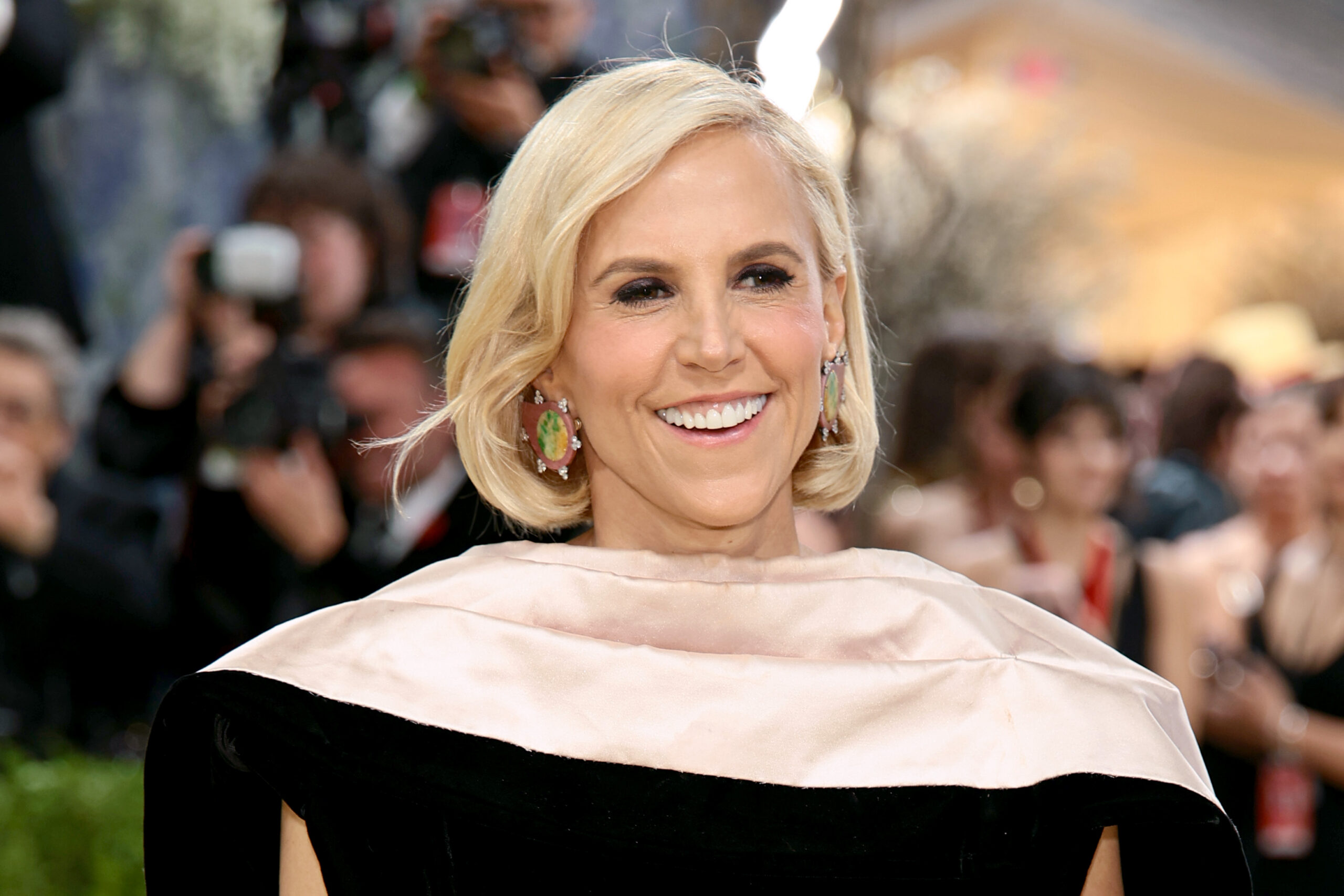
Fashion designer, daughter of Reva Schapira, Tory Burch turns 60…
Diplomat and attorney, undersecretary of state for international security affairs in the Carter administration, former longtime U.N. special representative, Matthew Nimetz turns 87… Winner of the 2001 Nobel Prize in economics, professor at Georgetown and UC Berkeley, he is married to former Treasury Secretary Janet Yellen, George Akerlof turns 86… One of the world’s best-selling singer-songwriters over the course of seven decades, born Barry Alan Pincus, Barry Manilow turns 83… Former member of the Knesset for the Zionist Union and Labor party, Eitan Broshi turns 76… Chairman of the Federal Trade Commission during the Obama administration, Jonathan David (“Jon”) Leibowitz turns 68… Deputy administrator of the Federal Highway Administration during the first two years of the Biden administration, Stephanie Pollack turns 66… President of the San Francisco Board of Supervisors until January 2025, Aaron Dan Peskin turns 62… Singer and composer, a pioneer of the Turkish and Arab music genres in Israel, Ofer Yoel Levy turns 62… Active in interfaith peace initiatives between Judaism and Islam and in encounters for Jews with Eastern religions, Rabbi Yakov Meir Nagen (born Genack) turns 59… Founder and chairman of Shavei Israel, Michael Freund turns 58… British historian, columnist and musician, Dominic Green, Ph.D. turns 56… Comedian, actor, director, writer and producer, Michael Showalter turns 56… International human rights attorney who serves as managing director of the law firm Perseus Strategies, Jared Matthew Genser turns 54… Screenwriter, television producer, director and voice actor, Matthew Ian Senreich turns 52… Advocacy, philanthropic and political counsel and founding partner at LAVA Strategies, David Elliot Horwich… SVP for the economic program at Third Way, a center-left think tank advancing a pro-growth economic agenda, Gabe Horwitz… Chief philanthropy officer of Jewish Federation of Broward County, Keith Mark Goldmann… VP of government affairs for the Conservation Lands Foundation, David Eric Feinman… Former rabbi of the Elmora Hills Minyan in Union County, N.J., now an LCSW therapist in private practice, Rabbi Michael Bleicher… NYC-based senior editor for The Hollywood Reporter, Alexander Weprin… Professional surfer and musician, his family owns Banzai Bagels on the Hawaiian island of Oahu, Makua Rothman turns 42… Founder and executive director of the Zioness Movement, designed to empower progressive Zionists, Amanda Berman… Director of national outreach for the East at the New Israel Fund, Alexander Willick… Award-winning college football and basketball analyst for NBC Sports and SiriusXM, Nicole Auerbach… Former member of the U.S. Ski Team’s alpine program, he competed for the USA in both the 2014 (Sochi) and 2018 (PyeongChang) Winter Olympics, Jared Goldberg turns 35… Senior art director at Business Insider, Rebecca Zisser… Shortstop for Team Israel at the 2020 Olympics, Scott Burcham turns 33… Actor known for her roles in the CBS series “Fam,” the Netflix series “Grand Army,” the HBO series “I Love LA,” and the film “Marty Supreme,” Odessa Zion Segall Adlon turns 26… D.C.-based real estate agent, Mounira Al Hmoud…
The move marks a major step in the White House’s efforts to dismantle the Education Department and significantly reduce or distribute its work
Win McNamee/Getty Images
A person walks past the U.S. Department of Education on March 20, 2025 in Washington, DC.
The Trump administration announced on Tuesday that it will transfer many of the responsibilities of the Education Department’s Office for Civil Rights, the division that investigates civil rights violations at American schools and universities, to the Justice Department.
The move marks a major step in the White House’s efforts to dismantle the Education Department and significantly reduce or distribute its work. The policy was first discussed in the Heritage Foundation’s controversial Project 2025 blueprint for the Trump administration, which was released in April 2023 during the run-up to the 2024 presidential election.
“The Department of Education will also team up with the DOJ to ensure stronger, more coordinated civil rights enforcement and robust protections for student privacy,” Education Secretary Linda McMahon said in a statement on Tuesday. An Education Department press release said the new agreement is “designed to reduce federal bureaucracy and improve the efficient delivery of federally funded programs and activities.”
The formal agreement hands to the Justice Department’s Civil Rights Division the core of OCR’s work: investigating and attempting to resolve discrimination complaints against schools and universities. It leaves OCR with the authority to refer cases out and sign off on the results, but has DOJ handling nearly every aspect of the investigation.
OCR has been a crucial tool for Jewish students who experienced antisemitism on their campuses, particularly after the Oct. 7, 2023, attacks in Israel and over the course of the ensuing war. Through Title VI of the Civil Rights Act of 1964, the office’s remit includes complaints of discrimination on the basis of one’s national origin, a broad category that encompasses antisemitism. Jewish organizations have for years encouraged Jewish students and parents to file complaints with the agency.
Now the civil rights office’s mandate and scope — already diminished because of widespread layoffs at the department last year — will for the most part move to the Justice Department. It is not clear whether the OCR staffers will move to DOJ.
The move sparked criticism from the left and praise from more conservative voices.
Kenneth Marcus, the founder of the Louis D. Brandeis Center for Human Rights Under Law who ran OCR during President Donald Trump’s first term, called the move a “promising” step from the White House.
“Much will depend on implementation,” Marcus said in a statement. “But if done right, this could mark a critical step forward for students whose rights have gone unprotected on campuses across the country.”
An Education Department press release said the new agreement between the DOJ and OCR, which accompanied related agreements from DOJ and the Department of Health and Human Services, is “designed to reduce federal bureaucracy and improve the efficient delivery of federally funded programs and activities.”
Jewish Council for Public Affairs CEO Amy Spitalnick said that the push to move OCR to DOJ “is weakening one of the most effective mechanisms for protecting Jewish students and for enforcing civil rights protections on campus.”
Most Jewish organizations have so far not commented on the announcement.
The Senate majority leader also said the deal triggers requirements for the administration to provide Congress with the opportunity to review the agreement under INARA

Kayla Bartkowski/Getty Images
Sen. Majority Leader John Thune (R-SD) calls on reporters following the weekly Senate Republican caucus policy luncheon at the U.S. Capitol on January 14, 2025 in Washington, DC. Senators spoke about the Laken Riley Act which was named after a nursing student who was murdered in February 2024 by Jose Ibarra, a migrant from Venezuela who crossed the border in September 2022, that could give state attorney generals far-reaching veto power over federal immigration policy.
With scant details provided by the Trump administration about the contours of the peace deal with Iran, Senate Majority Leader John Thune (R-SD) said on Monday afternoon that he doesn’t yet know enough about the administration’s deal with Iran to determine whether it is a good deal that will prevent Iran from acquiring a nuclear weapon.
“I don’t know enough about it to say,” Thune told reporters. “I think the issues are going to be compliance, and how you can enforce that, and what are the financial incentives that the Iranians have from our country, and what are they conditioned upon.”
The South Dakota Republican said that a positive deal would include financial incentives that are conditioned upon Iran winding down its nuclear program, the disposal of Iran’s enriched uranium and Tehran giving up its capacity to have a nuclear program in the future.
Thune also indicated that he believes the deal should be submitted to Congress for review under the Iran Nuclear Agreement Review Act.
“There are some requirements that are triggered because of the nuclear components of the deal, in terms of notification or informing Congress,” Thune said. “I know there is probably some expectation that there may be a vote at some point, whether that’s on a resolution of disapproval or something. We’ll see. I just don’t know enough about it yet. And I don’t think even the people who follow this stuff closely up here know that much.”
The administration hasn’t publicly commented on the issue of INARA yet, and has offered varying timelines for when it might release the text of the agreement. In media appearances, Vice President JD Vance has been framing specific nuclear issues as part of the next round of talks, rather than the current MOU, which could give the administration an avenue to attempt to dodge INARA review.
Thune said that “somebody” from the administration, whether that be Vance or other officials, “will need to” come to the Hill to brief members.
“For sure, our members are going to have a lot of questions about it,” Thune said.
Sen. John Barrasso (R-WY), the No. 2 Senate Republican, indicated he was similarly in the dark about the agreement.
“I haven’t seen anything from the president in terms of what’s in it. I’ve seen some press reports,” Barrasso told reporters. “I want to see what’s actually in it and I congratulate the president for his continued efforts.”
But asked whether he was concerned that the deal would be an effective surrender to Iran in providing sanctions relief, Barrasso rejected the idea out of hand.
“President Trump is never, ever going to do what you just suggested,” Barrasso said. “He’s not going to accept a deal that doesn’t eliminate nuclear weapons, isn’t enforceable, isn’t verifiable and doesn’t take Iran completely out of what they’ve been doing to try to undermine and attack us for the last 47 years.”
U.S. officials said that the Strait of Hormuz will remain toll-free and Lebanon is not part of the agreement

Michael M. Santiago/Getty Images
Vice President J.D. Vance and President Donald Trump
Top Trump administration officials shared new details on Monday about the memorandum of understanding reached by the U.S. and Iran over the weekend, arguing that the new agreement is substantially better than the 2015 Iran nuclear deal and could pave the way for a new relationship between Washington and Tehran.
During an interview with CNBC, Vice President JD Vance said he expects the Strait of Hormuz to be opened immediately “in a toll-free way for the long term.” Vance indicated that he has observed more traffic flow in the strait following the announcement of the deal, but that the way in which the strait fully opens will be determined in technical negotiations.
“What this agreement does is say to the Iranians that ‘You don’t have access to the money to rebuild that nuclear program, but if you’re willing to give up that program long-term, if you’re willing to accept the inspections and verification regime that’s necessary to give us the confidence you’re never going to have a nuclear weapon, then we want you to be a prosperous country, and we will re-invite you into the community of nations,’” Vance said.
Vance said that Iran has agreed to never develop or procure a nuclear weapon and that the U.S. will ensure its stockpile of enriched material is destroyed, adding that technical talks will determine if U.S. ground troops will observe or play an active role in destroying it. He also argued that the latest MOU differs from the Joint Comprehensive Plan of Action signed under former President Barack Obama in 2015.
The vice president has stated that Iran’s nuclear program and capacity to enrich uranium have both been devastated by the U.S. and Israeli military campaign.
“We have comprehensively destroyed their nuclear program, and this agreement is about ensuring that they don’t rebuild it,” Vance said. “The JCPOA was mainly about bribing them to stop the construction or to cease a nuclear program that was already in progress. It’s a very different background, a very different sort of leverage, and I think really a different outcome for the American people.”
Vance also dismissed reports that Iran would receive billions of dollars without the funding being conditioned on the completion of certain steps, a clarification he made during an interview with CBS.
“When people say that billions of dollars of assets will be released, that’s not true,” Vance said. “What is true is that [there will be] a much better and much more prosperous future if they [Iran] meet the obligations they make in this agreement … that’s one of the things we’re going to work out in the technical talks that will follow the official signing on Friday.”
Vance stressed that the Iranians would attain frozen or other monetary assets only upon meeting verifiable benchmarks. He confirmed that Iran could receive $300 billion in reconstruction funding, as well as $24 billion in frozen assets, but emphasized that the funding would be conditioned on Tehran meeting its obligations.
“It’s set up in such a way where we’re going to have to attach their commitments to deliverables that then are met with economic benefits for the Iranian people,” Vance said on CNN. “On the other hand, if they [Iran] try to rebuild it [their nuclear program] they’re never going to get the financial resources that they would need to rebuild.”
The vice president said that the U.S. has not expended “a single dollar of sanctions relief or unfrozen assets,” stating that reports otherwise are likely from hardliners “within the Iranian system…in an effort to sell it to certain domestic populations.”
However, Vance said the U.S. is “open to a lot of things that are on the table.”
“That $24 billion just doesn’t appear anywhere in any of the texts that we’ve talked about with the Iranians,” Vance said. “What we have said is that we’re willing to talk about unfreezing assets, but a much, much bigger deal is un-sanctioning their economy, so long as they make the long-term commitments on the nuclear program.”
When asked whether the agreement would require Iran to halt support for U.S.-designated terrorist groups such as Hamas, Hezbollah and the Houthis, Vance indicated that it would, although the specific wording in the agreement appeared to be vague.
“What paragraph one of the agreement says is effectively that Iran commits itself, just as the United States commits itself, to regional peace and stability and part of that is that the Iranians have to stop funding violent terrorist organizations,” Vance said. “They know that we don’t want them to fund terrorist organizations..and be a source of instability in the region.”
The vice president touted the “level of direct connection” established through the latest negotiations, noting that “the people at the highest levels of the United States government are talking to the people at the highest levels of the Iranian government.”
“This is a very interesting thing about these negotiations, is you see people, both the hardliners, but also the more political people, saying, ‘Our relationship with the United States over the past 47 years has been a mistake. Let’s turn over a new leaf,’” he added.
A senior administration official told reporters on Monday that an Israeli withdrawal from Lebanon would not be part of the deal, despite Iranian officials’ insistence that it would be included.
The senior administration official confirmed that nuclear discussions would likely occur first and said the agreement “contemplates” the reduction of U.S. military forces in the region “upon the agreement of a final deal.” However, the official noted that Iran will need to “make some concessions and give up some of their activities and some of their nuclear program.”
A senior U.S. official called out “hardliners on both sides,” saying that they are rooting against “compromise” and “making a lot of noise.”
“There’s a lot of misinformation out there,” the official said. “I think that in any field that I’ve been involved in, I would say nobody roots for the referee. There’s not really a constituency for compromise. So what you’re seeing now is that the hardliners on both sides…we have certain people in the American system who say there’s no deal you could ever do with Iran ever, are obviously making a lot of noise.”
While the full details of the MOU have yet to be released, President Donald Trump indicated on Monday that he expects the document to be made public “sometime after Friday.”
“I want it to be released because it is a really powerful document,” Trump told reporters during a bilateral meeting with French President Emmanuel Macron on the sidelines of the G7 summit in France. “It is not like the Obama documents.”
However, Trump warned that should the deal fall apart, tensions between the U.S. and Iran could return to “where we started.”
“We have done a great job and hopefully it is going to be a good relationship, and we are going to get along,” Trump said. “If we don’t, we go back to where we started, but I don’t think that is necessary.”
Jewish organizations across the political spectrum question whether the deal will curb Iran’s nuclear program or its support for regional proxies
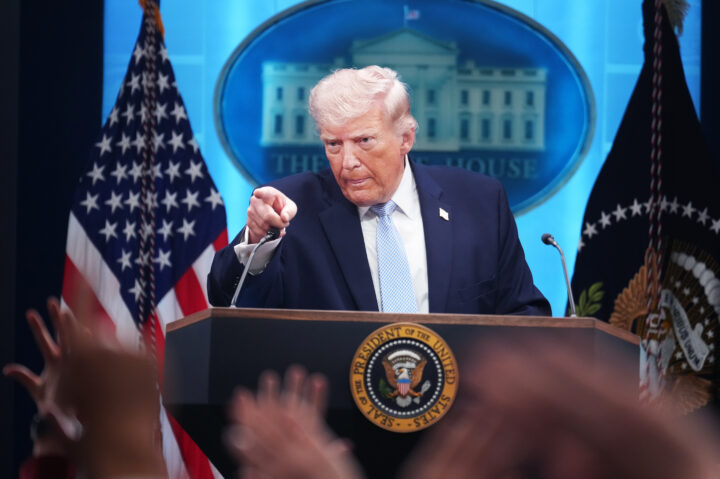
Tom Williams/CQ-Roll Call, Inc via Getty Images
President Donald Trump conducts a news conference in the White House briefing room about the war in Iran on Monday, April 6, 2026.
As details begin to emerge about the Trump administration’s agreement with Iran to end the war and lift the U.S. blockade of the Strait of Hormuz, some mainstream Jewish organizations are treating the deal as a preliminary step — focusing on the 60-day negotiating period ahead, while others are expressing skepticism about the contours of the agreement.
AIPAC, in a statement that came late Monday afternoon after many other organizations had already spoken out, framed the current MOU as a preliminary step, focusing more on the upcoming negotiations, while emphasizing the need for more details about how the current deal affects Israel.
“The announced MOU kicks off a new 60-day window for talks. We look forward to learning the full details of the framework for these negotiations, including whether the deal preserves the sovereign right of our democratic ally Israel to respond to the security threats it confronts,” AIPAC said in a statement.
The group also emphasized that “Congress will play a critical role in working with the administration throughout these negotiations and in reviewing the ultimate agreement.”
It said any deal should require the removal of all enriched uranium from Iran, the dismantling of its enrichment capacity and should address Iran’s missile and drone programs and end its support for terrorist proxies.
The American Jewish Committee also did not take a definitive position on the current agreement, saying on X that the organization “await[s] developments about the reported 60-day ceasefire agreement” but emphasized the need to continue to focus on Iran’s long-running threats.
The AJC said that any ultimate deal with Iran at the conclusion of the upcoming 60-day negotiating period should ensure Iran cannot obtain a nuclear weapon, rebuild its ballistic missile program, continue to support terror proxies, threaten U.S. allies and partners or hold the Strait of Hormuz hostage.
“AJC also strongly supports the legitimate aspirations of the Iranian people for greater freedom, opportunity and dignity, and hopes that those aspirations are eventually realized,” the statement continued. “As the contours of this and future agreements become more clear, we will continue to engage with our partners in the U.S., the Middle East, and around the world to make this vision a reality.”
Other groups offered a more directly negative reaction to the emerging details of the MOU.
The Zionist Organization of America, which has been strongly supportive of Trump administration policies and President Donald Trump himself, praised the president for carrying out military operations against Iran but said that “the pending deal with Iran is concerning.”
“The deal appears to be an ‘agreement to negotiate’ — which enables the Iranian regime to obtain massive oil revenue and time to build up its military and terror arsenals, while leaving the genocidal Iranian regime and its nuclear and missile stockpiles in place, and positioning the Iranian regime to continue and strengthen its 47-year war to destroy the U.S., Israel, and the West,” ZOA National President Mort Klein said. “[T]he little that we know is deeply problematic.”
Klein said it “makes no sense” for the U.S. to let up on its blockade of Iran unless Iran fully gives up its nuclear program and missile stockpile. He also expressed concerns that the deal will allow Hezbollah to regroup and rearm, and that Trump demanded that Israel stand down against Hezbollah.
“Pressuring Israel to not respond to threats of annihilation and attacks on her people is not, as the president called it, a ‘Great Deal [that] will bring Peace and Security to the whole Region,’” Klein said.
“Disturbingly, the interim Iran deal does not appear to be even close to the U.S.-Israel war goals of eliminating the existential dangers of Iran’s nuclear program and ballistic missiles, ending the Iranian regime’s support for its terror proxies, and helping the Iranian people overturn the brutal, genocidal Iranian regime,” he continued.
Democratic groups are also skeptical.
Democratic Majority for Israel CEO Brian Romick criticized the administration’s “incoherent and erratic strategy” and said that “there are concerning details about what is and isn’t in this deal.” Romick called on the administration to lean on “experienced negotiators and technical experts” in the next phases of talks, “rather than relying on friends, family, and donors.”
He said that any deal must permanently end Iran’s nuclear program, constrain its ballistic missiles, address Iran’s support for terrorism and ensure that the Islamic Revolutionary Guard Corps and Iran’s terrorist proxies do not receive additional support as a result of sanctions relief or the unfreezing of assets, and that it must be thoroughly vetted by Congress.
“Despite this tentative deal, the reality is Israel still faces constant threats from Iranian-backed terrorist groups like Hamas and Hezbollah. President Trump must not limit or interfere with our ally’s ability to defend itself from very real threats along its border,” Romick continued.
The Jewish Democratic Council of America’s CEO Halie Soifer took an even more strident tone.
“Donald Trump’s deal with Iran isn’t a deal at all. At best, it’s a statement of intention — a ‘concept of a plan’ — lacking details. At worst, it’s an admission of defeat by the United States,” Soifer said, describing it as a weaker deal than the 2015 Joint Comprehensive Plan of Action.
She argued that the “reckless war” gave Iran a “chokehold” on the U.S. and global economy that it will continue to exercise in the future, gave Iran a stronger hand in nuclear negotiations, solidified the current regime, harmed the Iranian people and gained the U.S. nothing.
“Today, Iran is unquestionably further from regime change — and this Iranian regime is stronger — than before the war,” Soifer said. “Trump repeatedly berated the Obama administration for offering sanctions relief and unfreezing Iranian assets as part of the JCPOA. The amount of financial benefit Iran received from the JCPOA will be dwarfed by the amount of money going to Iran following Trump’s defeat.”
Soifer also criticized Trump for sidelining and ignoring Israel throughout the talks.
J Street has thus far been an outlier in expressing support for the deal.
The group’s president, Jeremy Ben-Ami, said J Street “welcomes” the announcement, while also criticizing the war effort as a whole.
“The lesson is the same one many experts and former security officials have warned about for years: There is no sustainable military solution to the challenge posed by Iran’s nuclear diplomacy,” Ben-Ami said. “Durable constraints on Iran’s nuclear activities can only be achieved through pragmatic and sustained diplomacy.”
Ben-Ami argued that the deal would be largely similar to the JCPOA, adding, “We urge lawmakers to support this agreement to end the fighting and push to ensure future diplomatic efforts address the security threats presented by Iran.”
The Republican Jewish Coalition has not issued a full statement of its own on the deal, but has indicated support thus far, sharing on its X account two Truth Social posts from Trump about the Strait of Hormuz being reopened and the lifting of the U.S. blockade. RJC did not immediately respond to a request for comment.
Seattle Mayor Katie Wilson said she was briefed on a 'credible threat' to the city and decided to turn on CCTV cameras around the soccer stadium for the games

Harry How/Getty Images
Alireza Jahanbakhsh Iran trains with teammates one day ahead of the FIFA World Cup 2026 Group G match between IR Iran and New Zealand at Centro Xoloitzcuintle on June 14, 2026 in Tijuana, Mexico.
As the Iranian national soccer team begins the 2026 World Cup amid high-level diplomatic negotiations to end the war between the U.S. and Iran, American security officials — and American Jewish communities already operating under elevated threat conditions — are facing challenges beyond soccer,
The first security and political consideration concerns the Iranian delegation itself: The United States has occasionally restricted entry for sports officials and delegations from adversarial countries — from Soviet Olympic officials during the Cold War to Cuban baseball and Iranian karate representatives in recent years.
The Trump administration, facing pressure from FIFA, did eventually issue visas several weeks ago — after months of uncertainty — to the 26 members of Iran’s national team, though more than a dozen staff members and officials associated with the team were not granted visas due to security concerns. The team is set to play on Monday and next week in Los Angeles, against New Zealand and Belgium, respectively, and against Egypt in Seattle on June 26.
“The visas necessary for Iran to compete in the World Cup, including for athletes and necessary support staff, have been issued,” the State Department told ESPN. “We will not allow the Iranian team to abuse this system to sneak terrorists into the United States under false pretenses.”
One of the people rejected is reportedly Mehdi Taj, head of the Iranian soccer federation, who was previously a commander in Iran’s Islamic Revolutionary Guard Corps. The team is also not allowed to stay on U.S. soil overnight; it relocated its training camp from Tucson, Ariz., to Tijuana, Mexico, and will return to Mexico after the final whistle of each of its matches.
The host cities are already on alert: Seattle Mayor Katie Wilson, a Democrat, said she was briefed on a “credible threat” to the city during the World Cup, which so alarmed her that she decided to turn on CCTV cameras around the soccer stadium for the duration of the games, counter to her longstanding opposition to the surveillance system.
Amid an already heightened threat environment for Jewish communities in the aftermath of the Oct. 7 attacks and amid the Iran war, thousands of fans from around the world flocking to the U.S. to cheer on their favorite teams presents an additional security challenge.
Secure Community Network, a Jewish communal security organization, told Jewish Insider that “there are no known specific threats to the Jewish community directly related to the World Cup,” though the group “has been proactively engaged with the Jewish Federation of Greater Seattle and other World Cup host cities well in advance of the tournament.”
SCN cited the 2006 shooting attack on the Seattle Jewish Federation that killed one and wounded five others, perpetrated by a Pakistani national who said he was “angry at Israel,” as “continu[ing] to inform the local community’s commitment to security and preparedness.” The Seattle and Los Angeles Jewish federations declined to comment.
Oren Segal, the Anti-Defamation League’s senior vice president of counter-extremism and intelligence, called Iran’s participation in the World Cup “a moment for vigilance, not alarm.” He predicted that the event “will likely attract some protest activity from groups seeking to leverage the global attention surrounding the tournament to advance their causes,” and said “the appropriate response is proactive coordination with local law enforcement and ensuring that community members are informed, prepared, and supported.”
El-Sayed suggests anti-Israel activists indicted because of beliefs, not alleged criminal conspiracy
‘It's a lot more about what you're advocating for that gets you indicted or not indicted, rather than what you did,’ El-Sayed said
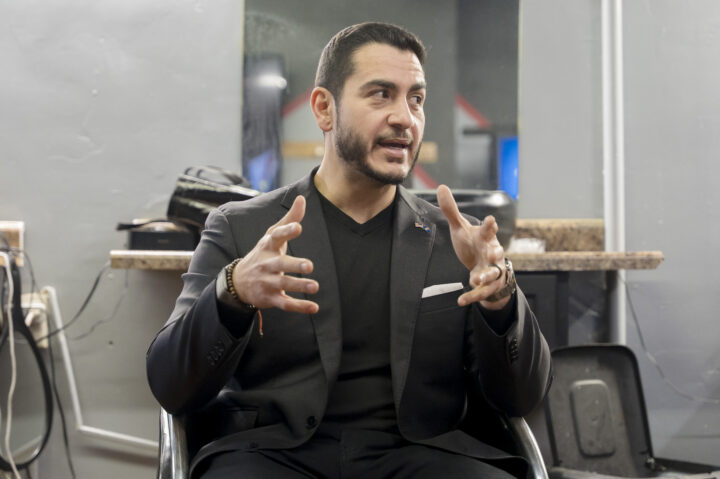
Evan Cobb for The Washington Post via Getty Images
Michigan Senate candidate Abdul El-Sayed speaks with customers and barbers at Blazin Wade Cuts in Grand Rapids, Michigan, on Saturday, Feb. 21, 2026.
Abdul El-Sayed, the far-left Democratic Senate candidate in Michigan, suggested at an event on Friday that the Trump administration had indicted a group of anti-Israel demonstrators at the University of Michigan for their beliefs, rather than their actions.
The eight defendants, including a former staffer on El-Sayed’s campaign, who were indicted Friday have been accused of a campaign of intimidation against university officials they saw as pro-Israel and vandalism of local Jewish organizations.
“It’s a lot more about what you’re advocating for that gets you indicted or not indicted, rather than what you did,” El-Sayed said, at a Friday campaign event, according to The Detroit News.
Speaking to reporters after the event, El-Sayed said that it’s “just wrong, full stop” to target families, businesses and property as the indicted individuals alleged did, but also drew a contrast between the treatment of the eight indicted individuals and the Trump administration’s mass pardon of those involved in the Jan. 6, 2021, attack on the U.S. Capitol.
“I believe in justice, because I believe that when you break the law, you should be held accountable, but I don’t love watching our justice system treat people differently based on what it is that they were advocating for,” El-Sayed said. “Targeting people, families, properties, businesses is wrong, of course it’s wrong, but it’s also wrong when Jan. 6 terrorists do it. To watch the same Trump administration use these terms in certain ways — I think we all need to be asking the questions.”
El-Sayed previously faced criticism for his response to the attack on Temple Israel in West Bloomfield, Mich., which some saw as excusing or rationalizing the attack.
Rep. Haley Stevens (D-MI) on X condemned El-Sayed for his “equivocation.”
“The reported planned violence and intimidation at the University of Michigan is wrong. This is simple and any leader should be able to say so,” she said. “The fact my opponent cannot bring himself to say that is concerning.”
In remarks to reporters, she said that she was “concerned about [El-Sayed’s] repeated patterns of embracing political violence and being out of step with Michigan voters,” pointing also to his decision to rally with far-left influencer Hasan Piker at the University of Michigan.
“We need leaders who are going to showcase leadership and be the leaders that we deserve, not continue to divide us and compensate for when people commit violence or threaten violence for political purposes,” she said.
Her comments have prompted scorn from El-Sayed’s campaign and allies.
Rep. Rashida Tlaib (D-MI) responded to Stevens’ X post by copying Stevens’ wording to criticize Stevens for refusing to describe the war in Gaza as a genocide.
Roxie Richner, El-Sayed’s communications director, accused Stevens on X of “sid[ing] with the Trump administration” and said she “can’t string two coherent sentences together.”
“Leadership requires that you have moral clarity and can say words that make sense when put in order,” Richner continued.
At an Iran International panel, Washington Institute for Near East Policy’s Rob Satloff outlined ways the U.S. could better engage with the Iranian public
(Photo by Kamran / Middle East Images / AFP via Getty Images)
Iranians gather while blocking a street during a protest in Kermanshah, Iran on January 8, 2026.
Experts said on Wednesday that the Trump administration has failed to adequately tap into pro-Western sentiment among the Iranian public following the regime’s violent crackdown on nationwide protests earlier this year, arguing that the White House is missing a key opportunity to cultivate internal pressure within Iran.
Robert Satloff, executive director of The Washington Institute for Near East Policy, argued that the Trump administration should expand U.S. broadcasting into Iran, improve internet access for Iranians and ease pathways for dissidents seeking refuge in the U.S. to “lay the groundwork for the day when it becomes a much more real possibility to have this sort of regime change.” Satloff outlined his proposals during a Wednesday town hall hosted by Iran International, a U.K.-based Persian-language news network. “None of [the Iranian people] are being invested in in any significant way by the Trump administration,” he said.
In February, PBS reported that over 7,000 Iranians were killed during the regime’s violent crackdowns on nationwide protests that began in December. President Donald Trump at the time urged Iranians to keep protesting, declaring that “help is on the way.” Recent surveys inside Iran have shown that roughly 89% of Iranians support a “democratic political system.”
However, with Trump rarely bringing up the human rights abuses of the Iranian government as he seeks a diplomatic deal with the Islamic Republic, the protesters who Trump initially promised to help have been deterred by the Iran’s intensive crackdowns and the lack of a response to counter them.
That vacuum, Satloff argued, is what Washington should be working to fill. He elaborated on the three proposals, each aimed at strengthening the U.S. relationship with the Iranian public.
First, Satloff said the U.S. would benefit from providing “better and more American broadcasting” to Iranians and ensuring that they “have internet access and that they cannot be denied this by their capricious government.”
To accomplish this, the Trump administration should “work with private companies,” Satloff told Jewish Insider.
“Much of this requires a shift of policy, not an allocation of money,” Satloff pointed out. “That is, to embrace U.S. international broadcasting as an important asset, not to try to run it out of business, as has been the case in this administration.” Following Trump’s 2025 attempts to dismantle Voice of America, including its Persian broadcasts, a federal judge ordered more than 1,000 laid-off staff reinstated this past March.
Satloff also argued that the U.S. should “change our visa and asylum regulations” to provide Iranians fleeing the regime with “a welcoming home” and a “base” to continue organizing against the regime.
Alex Vatanka, senior fellow at the Middle East Institute in Washington, reaffirmed that the “Iranian public sentiment is anti-regime by and large,” during the panel, elaborating on the importance of the U.S. screening visa applicants carefully and avoiding becoming the “bad guys.”
He called it “fair game” to deny a visa to someone with a background in the Islamic Revolutionary Guard Corps, but stressed the need for accuracy, warning that overbroad denials risk alienating the population the White House needs on its side.
Panelists acknowledged that these measures won’t dislodge the Islamic Republic on their own. Satloff said that under the current state of affairs, “none of this is going to bring down the government.”
“I think the important thing for us is to change behavior,” Satloff continued, arguing that “as the Iranian people see the weaknesses of their own regime then maybe you will find more organized elements that come forward in leadership that challenges” its leadership.
“I don’t even see that foundation yet for us to work with,” he added.
Rachel Brandenburg, Washington managing director and senior policy analyst at the Israel Policy Forum, told JI that “among the reasons the U.S. would provide the Iranians with ways to circumvent an internet blackout” is to support their ability to “communicate with each other and with the world.” Brandenburg explained this is “among [the] tools that could help the Iranian people organize protests and other opposition to the regime, whether openly or privately.”
Satloff tied his proposals back to potentially dismantling the IRGC — a goal the administration has stated but, in his telling, done little to pursue. Without sustained engagement with ordinary Iranians, he argued, there may be no constituency for Washington to work with when the moment for a regime change comes.
“All of this would expand U.S. engagement with ordinary Iranians,” Satloff told JI, “which is a necessary prerequisite for any serious effort at empowering Iranians to do what President Trump said he hoped they would do — take back their country.”
Gruenbaum will continue serving as a senior advisor to the Board of Peace
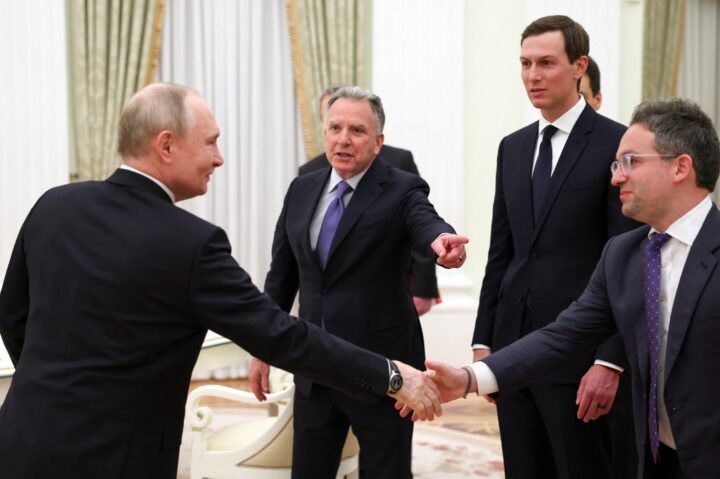
Alexander KAZAKOV / POOL / AFP via Getty Images
Russian President Vladimir Putin welcomes White House Special Envoy Steve Witkoff, Jared Kushner and Commissioner of the Federal Acquisition Service Josh Gruenbaum during a meeting at the Kremlin in Moscow on January 22, 2026.
Josh Gruenbaum, a former private equity investor who joined the Trump administration last year to lead the Federal Acquisition Service and has recently been detailed to the White House, has departed the federal government, a source with knowledge of the move told Jewish Insider.
Gruenbaum will continue serving as a senior advisor to the Board of Peace — a role he has held since earlier this year, with a focus on Gaza — in an unpaid capacity. He is set to join an investment firm. Gruenbaum declined to comment.
“The Board of Peace is thankful for Josh’s contributions in advancing the president’s vision of peace and prosperity in the Middle East,” a Board of Peace spokesperson told JI on Thursday. “We appreciate his continued engagement as a senior advisor for the Board as we pursue the next steps in implementing a sustainable reconstruction for the people of Gaza and peace for all peoples in the region.”
Gruenbaum quickly rose through the ranks of the administration after taking a DOGE-style approach to the FAS, the agency that oversees federal contracts. In that role, he served on the Trump administration’s interagency antisemitism task force.
He joined Steve Witkoff and Jared Kushner’s negotiating team earlier this year, appearing with them at a meeting in Russia with Russian President Vladimir Putin, and moved over to the White House in April.
Reses, who has worked with Vance since 2021, has been a part of the now-vice president’s inner circle since advising him on his 2022 Senate bid
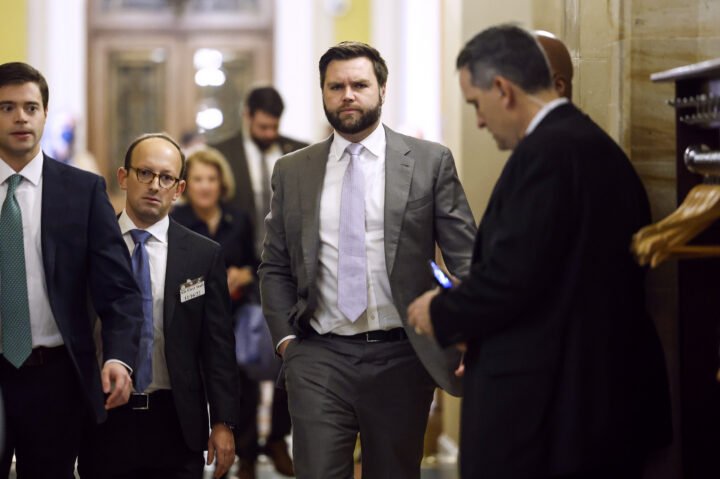
Anna Moneymaker/Getty Images
JD Vance, with advisor Jacob Reses (second from left), arrives to a meeting with Senate Republicans at the U.S. Capitol on November 16, 2022 in Washington, D.C.
Jacob Reses, the longtime chief of staff to Vice President JD Vance, will depart the Trump administration at the end of the summer, a source familiar with the matter confirms to Jewish Insider.
Reses, 35, became a confidante to Vance in 2021, advising the vice president through the heated primary and general election contests for the Ohio Senate seat Vance briefly held before being tapped by President Donald Trump as his running mate in 2024. Vance named Reses his chief of staff immediately after winning the Senate race. Sen. Josh Hawley (R-MO), who had employed Reses as a senior advisor in his Senate office, was among those who encouraged Vance to pick Reses as his chief at the time, according to two sources familiar with the matter.
News of his departure was first reported by NBC News.
Reses has not announced what his next role will be, though he informed the vice president of his plans to leave several months ago, after learning he and his wife were expecting their first child. He married Rachel Altman, the director of outreach at the Foundation for American Innovation, a tech think tank, in January. A source in the vice president’s office suggested to JI that Reses could rejoin the team at some point down the line, but did not elaborate beyond noting that it would come as no surprise if that occurred.
“Jacob’s been by my side for my whole career in public life. I can’t imagine having been on this life-changing journey without him,” Vance said in a statement. “From day one of my time as a senator-elect, I could not have asked for a more loyal and discerning advisor and friend as my chief of staff. I’ll miss him dearly, but he won’t be far, and I plan to keep his counsel close until our paths cross again.”
Other senior Trump administration officials similarly surmised that Reses would remain close.
“Don’t let Jacob fool you – beneath his kind exterior he’s a killer. It’s been a delight to get to know him through the vice president, and our foreign adventures from Israel to Pakistan have been historic,” White House Special Envoy Steve Witkoff said in a statement. “He commands respect in every room he walks into, and I’ve been proud to have him by my side in negotiating some of the toughest deals for the president. We haven’t seen the last of him.”
White House Chief of Staff Susie Wiles said in a statement that Reses “will always be a friend and ally we can all rely upon and I hope will come back often.”
“Jacob has been an important part of our White House leadership team and has served the Vice President with absolute distinction. From diplomacy and war, to complicated matters, to the most minute logistics, there has been no task too big or too small for him to tackle,” Wiles said. “It has been a privilege to have a partner like Jacob in the vice president’s office with such humility, discretion, and loyalty. He will be missed in the halls of the West Wing, but he will always be a friend and ally we can all rely upon and I hope will come back often.”
Acting Attorney General Todd Blanche described Reses as “tough, smart, hardworking, and loyal – the perfect combination to succeed in the Trump White House.”
“I’ll always appreciate his ability to give wise and honest counsel, and you’ll never meet anyone more focused on putting the team first,” Blanche said. “I’m grateful to have had Jacob as a colleague, and while I’m going to miss working with him to advance the president’s agenda, I’m excited to see what he does next.”
Secretary of State Marco Rubio and Treasury Secretary Scott Bessent also praised Reses and said he would be missed in the administration.
“When I met Jacob over dinner shortly before the Republican convention, I had no idea we would be such close partners in the years to come,” Bessent said. “His counsel to me and to the vice president has been invaluable as we have fought to reshore critical industries and rebalance the economy from debt-driven consumption to production, saving, and investment. We will miss him enormously.”
“Jacob has served the vice president and the entire administration with distinction. He understands the moment we’re in and he spent every day fighting to deliver results for the president,” Rubio’s statement read. “His intellect, leadership, and humor will be missed.”
Reses has worked with a number of prominent figures in the MAGA political movement besides Vance and Hawley, such as Tucker Carlson, Stephen Miller, Russell Vought and Michael Needham, as well as Heritage Action, an affiliate of the conservative Heritage Foundation.
‘Without the credible threat of a military option, Iran is unlikely to make any concessions that would lead to any semblance of a good deal,’ JINSA’s Ari Cicurel told JI
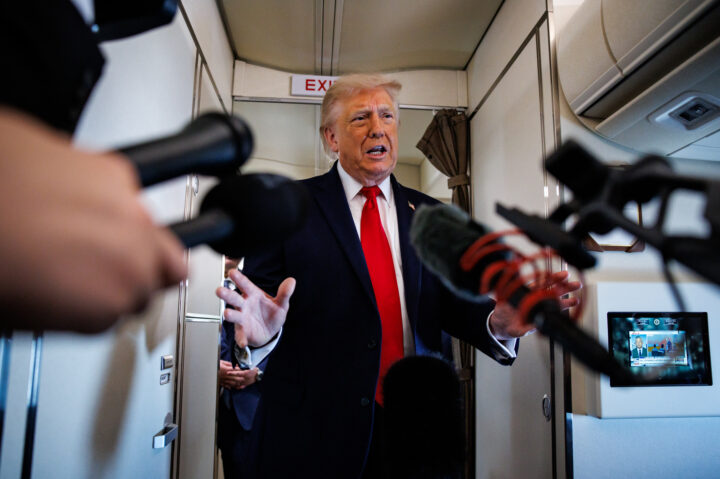
Samuel Corum/Getty Images
President Donald Trump speaks with reporters while aboard Air Force One on June 5, 2026 en route to Chippewa Falls, Wisconsin.
Middle East experts warned on Monday that the Trump administration’s attempts to prevent Israel’s military retaliation against Iran and its pursuit of a swift diplomatic breakthrough with Tehran are exposing a fundamental breakdown in strategic alignment between Washington and Jerusalem. This dynamic is actively undermining American leverage and hardening Tehran’s resolve both at the negotiating table and on the battlefield, the analysts argued.
Following an exchange of airstrikes on Sunday and Monday between Israel and Iran, Israeli Prime Minister Benjamin Netanyahu abided by a request from President Donald Trump to pause further strikes on Iranian territory. Jerusalem made clear, however, that it will proceed with operations against Hezbollah targets in southern Lebanon.
Analysts argued that Trump’s recent moves to restrain Israel are backfiring by degrading U.S. deterrence, emboldening Iran and showcasing the fundamentally diverging interests between Washington and Jerusalem regarding the ultimate outcome of the war.
Speaking at a webinar hosted by the hawkish Jewish Institute for National Security of America, Amb. Eric Edelman, a distinguished fellow at JINSA and former White House official, said that the president’s behavior makes the U.S. appear “desperate for a deal.”
“The president has, over the course of several weeks, basically signaled to the Iranians in multiple ways that he is very reluctant to return to kinetic military activity,” Edelman said. “I think that just continues this pattern of suggesting to the Iranians that he really is very anxious for a deal, and I think that’s actually undercutting his leverage with them because it only leads them [Iran] to harden their positions and makes it harder, not easier, to get a deal.”
Edelman added that Iran has actively sought to “take advantage” of this perceived diplomatic anxiety, taking a “much more forward position defending their proxies in Lebanon than they did earlier when Israel was reducing Hezbollah very significantly.”
Ari Cicurel, an assistant director of foreign policy at JINSA, agreed that the administration’s apparent urgency to reach a deal removes vital military deterrence to back up U.S. diplomacy.
“The president has signaled that he is highly prioritizing reaching some deal, and is willing to restrain Israel in order to do that,” Cicurel told Jewish Insider. “That’s a dangerous scenario, in terms of Iran’s potential for aggression, as well as undermines his own ability to reach that deal, because without the credible threat of a military option, Iran is unlikely to make any concessions that would lead to any semblance of a good deal.”
Cicurel noted that restraining Israel at this juncture is particularly “dangerous” given what is at stake regarding the “potential for resumption of major combat operations.” He cautioned that the moves by the Trump administration represent “another example of tensions between U.S. and Israeli leaders undermining deterrence,” giving Tehran a distinct operational gap to exploit.
Robert Satloff, executive director of The Washington Institute for Near East Policy, said the recent escalation was similar to April 2024, during which former President Joe Biden “urged Israel to ‘take the win’ of defending against Iranian missiles and not to retaliate.”
“In this instance, as then, Israel politely declined U.S. preferences and responded to the Iranian attack with a carefully calibrated retaliatory strike that quickly led to de-escalation,” he said.
The friction underscores a broadening rift in the wartime goals of the two close partners, experts said. While the White House remains intensely focused on domestic economic issues and regional stability, Jerusalem views the conflict as a historic window to permanently dismantle Iran’s ballistic missile capabilities and regional proxy architecture.
“At this point in the war, Trump and Netanyahu have different interests at play,” Rachel Brandenburg, a senior policy analyst at Israel Policy Forum, told JI. “Trump’s priority is to re-open the Strait of Hormuz to stabilize global energy markets and bring down the price of fuel, and Netanyahu wants to continue degrading Iran’s ballistic missile arsenal and nuclear program.”
Trump, she said, “promised Israel a level of victory over Iran that is far from what has transpired. Trump seems to want the war to end so he can move on, and Netanyahu would prefer the opportunity to finish the job Israel and the U.S. started on Feb. 28.” She added, “Both have election politics in mind, with Israeli elections on the horizon for [the fall] and U.S. midterm elections in November. At the moment the war isn’t helping either of them.”
Brandenburg noted that Trump has aimed to restrain Netanyahu “for some time” across both the Iran and Lebanon fronts, but emphasized that an independent Israeli strike after Iran’s ballistic missile attacks on Israel on Sunday remained necessary, despite Washington’s public calls for a pause. “It would have been too much for Israel to sit tight without responding after Iran targeted Israel directly. Whether Iran continues to strike Israel in retaliation for Israeli strikes against Hezbollah in Lebanon may have more bearing on what the next phase of the war looks like than Trump,” she said.
A central point of contention has emerged over the linkage of fighting with Hezbollah in Lebanon to the broader ceasefire with Iran. Experts warn that Washington has mistakenly tolerated an Iranian strategy designed to shield its primary proxy by tying the fighting in Lebanon directly to the broader U.S.-Iran diplomatic track, even as Trump told NBC’s “Meet the Press” on Sunday that he is “not demanding” Lebanon be part of a deal with Iran despite saying Tehran “would like to see it.”
“Clearly before the attacks, Iran had been seeking to tie the Israel-Hezbollah exchange of fire against one another, as well as the diplomacy between them, with the diplomacy and ceasefire in Iran,” Cicurel noted. “In President Trump seeking to restrain Israel after Iran has attacked it, it unfortunately encourages Iran to continue that linkage and further encourages Iranian aggression.”
Satloff said that the latest round of fighting “was won by those who oppose Iran’s protection-racket scheme to bring Lebanon into its security orbit and under the umbrella of broader U.S.-Iran negotiations.”
“What is different between this round and April 2024 is that Iran has no conceivable legitimate justification to take any action against Israel,” Satloff said. “Iran is trying to claim that Israel’s action against other nationals in another country — Hezbollah in Lebanon — legitimizes its action. This is totally unacceptable and cannot be tolerated.”
Edelman similarly noted that despite Israel’s extensive work to combat the network of Iranian-backed proxies surrounding the country, the administration’s pursuit of a swift ceasefire risks breathing new life into a severely weakened Iranian strategy.
“The Iranian strategy of creating a ring of fire around Israel is in shards,” Edelman said. “And I think as the ceasefire went on, as the Iranians perceived the president’s desire for an agreement, they came to believe that they might be able to rescue something.”
However, Edelman noted that the recent spike in violence does not signal that diplomacy is collapsing, explaining that all sides maintain incentives to pursue a deal.
“I don’t think it’s a signal that negotiations are over,” Edelman observed. He pointed out that “the Iranians actually kind of called a halt to this” round of exchanges to limit the blowback.
Edelman said that with the interior minister of Pakistan currently in Tehran, backchannel diplomatic contacts are actively continuing. He also said that “the Iranians are particularly anxious to get access to frozen funds,” but added that it is “a particular sore point” for Trump.
“I believe he [Trump] wants to try to persuade the American public that whatever deal this ends up being is going to be measurably better than the Joint Comprehensive Plan of Action that President Obama agreed to in 2015,” Edelman said. “In my view that’s going to be a pretty tall order, but not giving the Iranians access to money before they perform whatever obligations they undertake as part of this deal will be a key part of that.”
Iran had said it would not continue striking Israel as long as the IDF ceased its campaign against Hezbollah

Wisam Hashlamoun/Anadolu via Getty Images
Missiles launched from Iran toward Israel are seen in the sky over Hebron on June 7, 2026
Israel will abide by a request from the Trump administration to pause its strikes on Iran, two Israeli sources told CNN, though Jerusalem plans to continue its operations against Hezbollah targets in southern Lebanon.
The halt comes after Iran announced earlier Monday that it would suspend its military operations against Israel, after having launched a number of missile barrages at the Jewish state since Sunday evening. However, Tehran has threatened to resume strikes should Israel continue its campaign in Lebanon, which the IDF did on Monday after Hezbollah fired rockets at Israeli troops in southern Lebanon.
Israeli Defense Minister Israel Katz said in a statement on Monday that “any attack on [northern Israel] will lead to a strike on Dahiyeh,” referring to the Beirut suburb and Hezbollah stronghold that the IDF struck on Sunday in response to Hezbollah attacks targeting northern Israel earlier in the day. “We completely reject Iran’s threat,” Katz added. “Any Iranian attempt to link Lebanon and Iran and attack Israel will be met with great force, as happened yesterday.”
Israel had fired on Iranian strategic air defense systems and an Iranian petrochemical plant earlier on Monday after Tehran launched waves of ballistic missiles at northern and central Israel, the first such attacks since the U.S. and Iran reached a ceasefire in early April. Iran said it was retaliating for IDF strikes in Dahiyeh, which came after Hezbollah fired on northern Israeli towns.
After Israel’s strikes on Iran, the Houthis, an Iran-backed proxy group in Yemen, launched a ballistic missile at Israel and declared a ban on Israeli shipping in the Red Sea.
The exchange marked the most significant military hostilities between the two sides in months and prompted immediate diplomatic intervention from President Donald Trump, who called on both sides on Monday to “stop shooting.”
He had also reportedly urged Israeli Prime Minister Benjamin Netanyahu in a phone call to hold off on retaliatory strikes against Iran, though Israel fired on Iran afterwards. Trump also said that “Israel and Iran must immediately stop ‘shooting,’” in a post on Truth Social early Monday morning.
Although a U.S. official initially told CNN that American forces played no role in intercepting the Iranian missiles, officials later confirmed that Washington did fire interceptors at the incoming projectiles. The success of those intercept attempts remains unclear. The U.S. military stated it did not conduct any joint strikes in Iran alongside Israel.
Trump also said he was “not happy” about the Israeli strikes in Beirut on Sunday, after he attempted to broker a ceasefire between Israel and Hezbollah last week, which the terror group quickly rejected.
Netanyahu will reportedly convene a full Security Cabinet meeting Monday evening local time.
The diplomatic scramble unfolds as the U.S. and Iran attempt to maintain a fragile truce while negotiators seek to hammer out a comprehensive end to the conflict. Iranian President Masoud Pezeshkian stated that his nation has “abandoned neither the battlefield nor the negotiating table.”
“Our priority is national security and the peace of our people. We will firmly defend the rights of the nation and will not back down in the face of any threat,” Pezeshkian wrote on X on Monday, describing diplomacy and defense as the “two wings of national power.”
This story was updated on June 8 to reflect an updated CNN report that U.S. forces did attempt to assist Israel in intercepting Iranian missiles.
The framework, which will replace the MOU when it expires in 2028, will aim to ‘gradually transition from aid to a completely reciprocal relationship’
Israeli Ministry of Defense
Formal discussions begin between the Trump administration and the Israeli Ministry of Defense on a new security cooperation framework.
The Israeli Ministry of Defense and the Trump administration have launched formal talks on a “new security cooperation framework” to replace the current U.S.-Israel memorandum of understanding on military aid upon its expiration in 2028, the ministry said in a statement on Friday.
The Israeli team will be led by Defense Ministry Director-General Amir Baram and Israeli Ambassador to the U.S. Yechiel Leiter, while the U.S. team will be led by State Department counselor Daniel Holler and U.S. Ambassador to Israel Mike Huckabee.
The two sides held a formal inaugural meeting this week and have further discussions planned in both countries in the coming weeks, the ministry said, without specifying a timeline for when the talks might conclude.
The new agreement, according to the statement, is designed to “strengthen the IDF’s qualitative military edge through expanded joint investment in research, development, and co-production” as well as “deepen the U.S.-Israel partnership demonstrated during [the Iran war].”
The framework will also aim to “gradually transition from aid to a completely reciprocal relationship,” a goal Israeli Prime Minister Benjamin Netanyahu has championed in recent months.
Earlier this week, Netanyahu told CNBC’s Sara Eisen that he wants to start winding down U.S. aid to Israel “in the last two years of the Trump administration,” suggesting he may also be looking to alter the terms of the current MOU, which guarantees Israel $3.8 billion annually in military aid through FY 2028.
Experts told JI that the agreement in its current form would not require Riyadh to adhere to the nonproliferation ‘gold standard’ – a commitment to forgo domestic uranium enrichment and fuel reprocessing
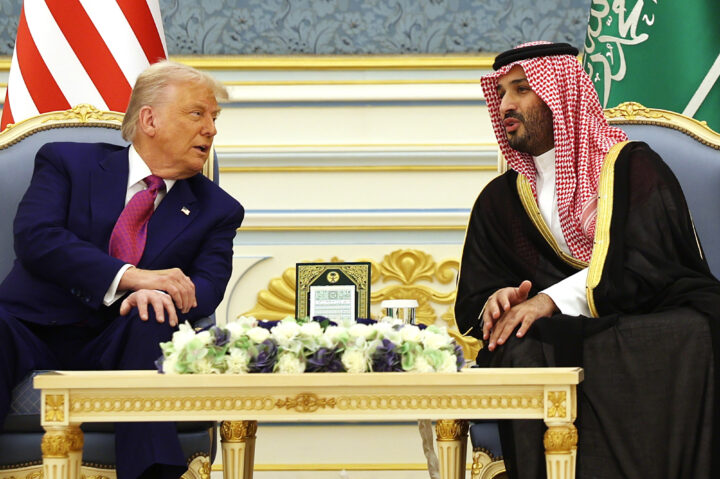
Win McNamee/Getty Images
President Donald Trump meets with Saudi Crown Prince Mohammed bin Salman during a “coffee ceremony” at the Saudi Royal Court on May 13, 2025, in Riyadh, Saudi Arabia.
As the Trump administration prepares to submit a proposed civil nuclear pact with Saudi Arabia to Congress, U.S. lawmakers are raising concerns about the potential agreement while nonproliferation experts and former Trump administration officials are sounding the alarm, warning that the pact abandons traditional safeguards and could ignite a nuclear arms race in the Middle East.
Last month, the Trump administration proposed the pact to assist Saudi Arabia with its development of civilian nuclear power, following indications last year that it would pursue such an agreement to strengthen bilateral diplomatic ties. Experts say the White House is looking to construct and operate a uranium enrichment plant within Saudi Arabia, safeguarding the facility through a bilateral framework.
The pact is currently undergoing final review before President Donald Trump can formally submit it to Congress. Once the president signs the agreement and transmits it to Capitol Hill, both chambers will have 90 days to pass resolutions of disapproval to block the deal. Otherwise, the pact will automatically go into effect, permitting the U.S. to share civilian nuclear power technology with the kingdom.
Experts told Jewish Insider that the agreement in its current form would not require Riyadh to adhere to the nonproliferation “gold standard” – a commitment to forgo domestic uranium enrichment and fuel reprocessing. Other regional partners, such as the United Arab Emirates, accepted this stringent safeguard in past U.S. deals specifically to prevent military or illicit nuclear activity.
The proposed pact would also exempt Riyadh from accepting the International Atomic Energy Agency’s (IAEA) “additional protocol.” This accord helps rule out clandestine military activities by granting international inspectors the authority to conduct sudden, unannounced visits to nuclear facilities. While the U.S. maintains numerous nuclear cooperation agreements globally, it rarely establishes them with nations that reject these baseline oversight protocols.
Democrats across the ideological spectrum have previously indicated concern over the potential civil nuclear pact, reflecting a historical trend in which Congress has typically supported a stringent nonproliferation policy toward Saudi Arabia that includes robust safeguards.
In May, a dozen Democratic lawmakers sent a letter to Secretary of State Marco Rubio asking that the administration follow strict U.N.-backed protocol, including IAEA inspection. However, in a letter from the State Department to Sen. Edward Markey (D-MA), the administration only indicated that the agreement would require the two sides to commit to a “bilateral safeguards agreement,” and did not make a mention of the “gold standard,” according to Reuters.
Rep. Brad Sherman (D-CA) told JI he was concerned about the administration pushing forward the agreement without safeguards, saying that “there’s only one reason not to have non-militarization safeguards and that’s militarization.”
“The idea that allowing Saudi Arabia to move toward a nuclear weapon defies history,” Sherman said. “A Saudi nuclear weapon leads to worldwide proliferation. Egypt and Turkey would feel that they need to match that, and then where’s Argentina and Brazil going to be?”
Sherman emphasized that Saudi Arabia should follow an agreement that mimics a 2009 nuclear agreement between the U.S. and UAE, in which the vital safeguard standard was followed.
“The UAE signed the good agreement. Why the hell can’t the Saudis sign the same agreement?” he said, noting that UAE would likely follow and “get out of the gold standard too,” in the event the pact goes through.
In February, Sherman, a longtime opponent of nuclear cooperation between the U.S. and Riyadh, announced that he would be introducing legislation to require an affirmative congressional vote prior to the administration finalizing any nuclear deal with Saudi Arabia.
Rep. Jared Moskowitz (D-FL) said he had heard about the discussions, but declined to comment on whether he would support the agreement in its current format. The Florida lawmaker, however, expressed little concern over the U.S. sharing civilian nuclear power with Riyadh or other regional players, calling the subject “fair to discuss.” Though he noted that such a deal should ultimately be tied to the “Abraham Accords framework.”
“I think it’s something that is fair to discuss, but also that’s why Iran not getting a nuclear weapon is such a big deal, because that will start a nuclear arms race,” Moskowitz said.
Rep. Tim Burchett (R-TN) declined to comment on whether he had reviewed or would support the potential pact, but expressed a firm desire to limit the expansion of nuclear weapons in the region.
“We can’t have anybody else over there [in the Middle East] with nuclear weapons,” Burchett said.
When asked about the potential deal by JI, several Senate Republicans indicated they were unfamiliar with the plan. Other lawmakers, including Rep. Dan Goldman (D-NY) and Rep. Marlin Stutzman (R-IN), also noted they had not yet heard much regarding the potential agreement, stating they would need to look into the matter further.
Sen. James Lankford (R-OK), however, said he was not concerned about the agreement breaking the “gold standard.”
“I don’t necessarily assume that would break the gold standard on it,” Lankford said. “The biggest issue is where is the uranium coming from and who’s actually producing it, and where are they stored?”
While it was previously thought that a civil nuclear agreement would be linked to Saudi normalization with Israel, the Trump administration has notably uncoupled the two initiatives. In May 2025, a group of nine Jewish House Democrats wrote to Trump to voice their displeasure over the separation of the two objectives.
Meanwhile, analysts continue to express deep concern over the arrangement in its current format, citing that the lack of safeguards could create severe risks to national security and set a poor precedent for current and future U.S. nuclear cooperation frameworks.
“The U.S. should be helping other countries with nuclear power but should strongly avoid helping them learn the fuel cycle and move closer to being able to build a nuclear weapon,” Elliott Abrams, an Iran envoy under the first Trump administration, said. “The gold standard remains our agreement with the UAE, where they agree not to enrich uranium. There is no reason the Saudis have to enrich uranium and the U.S. should not agree to it.”
Abrams called it “ironic” that the U.S. would remain locked in a confrontation with Iran over the threat of its nuclear weapons program while simultaneously considering “helping one of its neighbors enrich uranium.” He noted that the fallout from such a deal would inevitably compromise existing agreements and future negotiations with other Arab partners.
Experts also worry the concessions could undermine Washington’s strategic partnership with Abu Dhabi and incentivize other nations to pursue similar proliferation pathways.
“If we agree to this in the Saudi case, we will be abandoning a longstanding position and every deal we do after that will have to allow enrichment,” Abrams said. “In fact, we will have to renegotiate the UAE agreement as well.”
Jonathan Ruhe, a fellow at the Jewish Institute for National Security of America (JINSA), similarly expressed that the format of the deal could “undermine cooperation” with the UAE even as the Gulf state emerges as “America’s most valuable partner in the Gulf.”
He also cautioned that the pact could “threaten the global nonproliferation regime and raise the risks of a regional proliferation cascade.” Other experts joined in warning that bending established rules for Saudi Arabia could shift the calculus of neighboring states, prompting a rush to acquire enrichment and reprocessing capabilities.
“The fear is that other countries – Egypt, Turkey and the UAE – would use enrichment technology to develop the potential to make a nuclear weapon,” Simon Henderson, a senior fellow at the Washington Institute for Near East Policy, said. Additionally, while the UAE has already agreed to the “gold standard,” Henderson said that commitment could “change if other regional countries obtain the technology.”
Critics have also argued that Saudi Arabia could eventually seek to manufacture a nuclear weapon of its own. While Riyadh is a party to the Treaty on the Non-Proliferation of Nuclear Weapons (NPT) — which legally obligates the kingdom not to manufacture or acquire nuclear arms — several Saudi officials have explicitly stated in recent years that if Iran acquires a nuclear weapon, the kingdom would follow suit.
Andrea Stricker, director of the nonproliferation program at the Foundation for Defense of Democracies (FDD), said that the current U.S. approach “undermines decades of U.S. nonproliferation policy” and could allow Saudi Arabia with “the option to make fuel for nuclear weapons.”
“If the Saudis have access to the technology, and combined with weak IAEA inspections, they could build parallel covert capabilities. There is also little to stop Riyadh from ejecting U.S. officials from a plant and taking over,” Stricker said. “President Trump should stop this historic mistake before it is finalized, and if not, Congress should block the agreement.”
Ruhe shared similar concerns about Saudi Arabia’s potential long-term intentions.
“Such a deal raises real concerns that the kingdom would one day decide to slip free of the U.S. deal and enrich uranium on its own, either openly or secretly,” Ruhe said. “Given its past ties, this could include covert cooperation with Pakistan or China.”
Saudi Arabia has previously entered into several bilateral civil nuclear arrangements with foreign nations, including Argentina, France, Hungary, Kazakhstan, and South Korea. Of greater concern to Washington, however, are Riyadh’s active agreements with Russia and China. In recent years, Saudi Arabia has steadily expanded its nuclear cooperation with Beijing. The two U.S. adversaries are capable of providing similar nuclear products to Riyadh without the same strict demands and nonproliferation commitments.
“Washington appears to want to sell civil nuclear reactors to Saudi Arabia rather than allow a country like Russia or China to do so,” Henderson said. “The fear is that Saudi Arabia already has enrichment technology obtained from Pakistan and doesn’t want to give it up. Since Iran already has enrichment technology, Saudi Arabia thinks it deserves the same.”
U.S.–Saudi nuclear cooperation has historically remained limited. The two nations entered into a memorandum of understanding in 2008 that provided for low-level nuclear energy cooperation and later signed a nuclear safety cooperation memorandum of understanding in 2022.
“With Iran’s enrichment program degraded due to U.S. and Israeli strikes, it would be far sounder policy to continue rolling back Tehran’s efforts and insist the Saudis rule out enrichment and reprocessing and maintain control of the spread of this sensitive technology in a proliferation-sensitive region,” Stricker said. “The United States should also remind the Saudis of extensive economic, military, and defensive support that Washington provides, assistance which should not be available if Riyadh tilts toward China.”
In an interview on CNBC, the Israeli premier said ending U.S. aid to Israel will ‘take away the myth that Israel is depleting America's coffers’
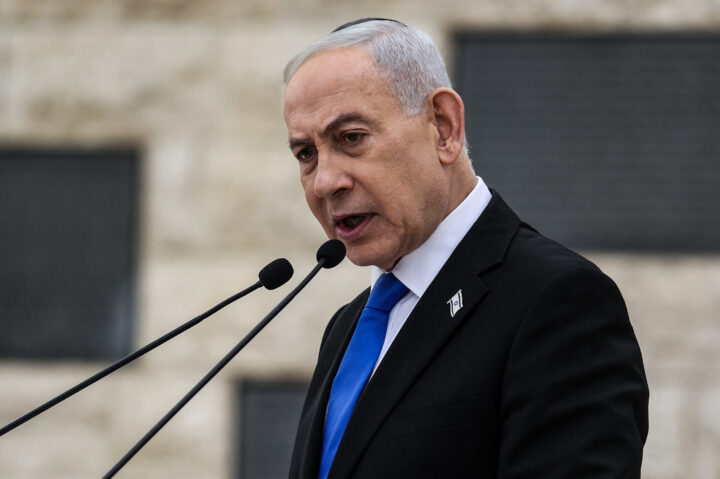
Ilia YEFIMOVICH / POOL / AFP via Getty Images
Israeli Prime Minister Benjamin Netanyahu speaks during a ceremony commemorating Israel's Remembrance Day on Mount Herzl in Jerusalem on April 21, 2026.
Israeli Prime Minister Benjamin Netanyahu said on Wednesday that he wants to start the process of winding down U.S. aid to Israel in the final two years of the Trump administration, as both countries work on a new memorandum of understanding.
Netanyahu made the comments in an interview with CNBC’s Sara Eisen after being asked about his political future and when Israel would be ready for new leadership. The prime minister responded by noting that while the Israeli people could decide at “any time” to remove him from power, he is currently focused on achieving four objectives: “finish[ing] the security envelope that we have to make vis-à-vis Iran and its proxies”; securing more investments globally to expand Israel’s AI and tech sectors; normalizing relations with several countries in the Middle East; and ending Israel’s reliance on U.S. aid.
“The other thing I want to do is move away, in America, from aid to partnership. We’re now working on a memorandum of understanding, which will bring down the aid,” Netanyahu said. “I want it to start now, I want it to start in the last two years of the Trump administration and I want it to keep going down, coming to zero, because I think we’ve come of age.”
The current MOU, which provides Israel with $3.8 billion in U.S. military aid annually, runs through FY 2028. Netanyahu did not clarify whether he would like to see aid begin to wind down through changes to the current agreement, or whether he is focused on ongoing negotiations for the next one.
“Israel has a robust economy, and I want us to go from aid to a partnership where we both invest equal amounts and both share equally in the fruits of our innovators and technologies,” he continued. “I think that’s very, very important. It will also take away the myth that Israel is depleting America’s coffers.”
Netanyahu has said on multiple occasions since January that he hopes to wean Israel off of U.S. aid, initially suggesting in January that Israel would work to end U.S. aid within the next ten years. He pitched the aid drawdown to President Donald Trump in late December, an idea the president was initially bewildered by and not supportive of.
Netanyahu also downplayed reports that Trump told him he is “f***ing crazy” in a phone call on Monday about Israel’s military escalation in Lebanon and rejected the notion that his relationship with the president had shifted, noting that the two speak as frequently as “every two days.”
Still, he did not deny that the conversation occurred as reported.
“Sometimes we have, as in the best of families, you have these tactical disagreements. We always find a way to work them out and we do so as great friends,” Netanyahu said. “We can disagree in the morning, and by the afternoon we have common action.”
Speaking at AJC’s Global Forum, the assistant attorney general highlighted antisemitic incidents at UCLA and Harvard: ‘This is outrageous behavior in America that this administration will not tolerate’
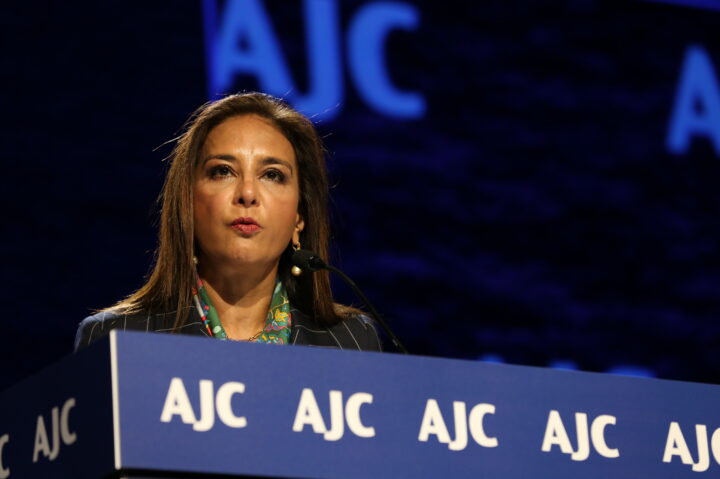
AJC
Assistant Attorney General for Civil Rights Harmeet Dhillon speaks at the American Jewish Committee's Global Forum in Washington on June 2, 2026.
Assistant Attorney General for Civil Rights Harmeet Dhillon said on Tuesday that the Trump administration will continue its legal battles against Harvard University and UCLA, accusing both institutions of continuing to neglect the civil rights of Jewish students and faculty.
Dhillon made the comments while appearing at the American Jewish Committee’s Global Forum in Washington, where she condemned what she described as “egregious examples of antisemitism that have transpired here at home on American soil” since Hamas’ Oct. 7, 2023, attacks on Israel as “devastating and antithetical to our values as a nation.”
The assistant attorney general highlighted the department’s most recent lawsuit against Harvard in March, saying that the Ivy League university had been “tolerating race and national origin discrimination against both Jewish and Israeli students.”
“After Oct. 7, antisemitic mobs at Harvard and other campuses harassed and intimidated these students all across the campus. Harvard failed to take meaningful action and it failed to enforce its own rules in an equal manner,” Dhillon said. “Its own presidential task force documented the exclusion of Israeli and Zionist students from social spaces and extracurricular activities, but these findings were ignored. Harvard’s actions are inexcusable, and it cannot continue to take taxpayer dollars while turning a blind eye to abuse against Jewish and Israeli students.”
Turning to UCLA, Dhillon noted that the Justice Department had filed suit against the school last week “for its deliberate indifference to race and national origin discrimination in violation of Title VI of the Civil Rights Act of 1964.”
She recounted visiting the Los Angeles campus in recent weeks, noting that “it almost brought tears to my eyes” to hear a recent UCLA School of Law graduate share how a student held up a large sign behind his head with an inverted red triangle, a symbol used by Hamas terrorists to mark Israeli targets.
“This is outrageous behavior in America that this administration will not tolerate,” she said of the incident, and vowed that the Justice Department would continue pursuing its litigation.
UCLA’s Initiative to Combat Antisemitism action group released a 42-page set of recommendations last month urging the university to intensify its crackdown on anti-Jewish harassment, which Chancellor Julio Frank said “makes clear that antisemitism and all other forms discrimination and bigotry have no place at UCLA.
“The Civil Rights Division will fight antisemitism in our American universities and elsewhere, wherever we will find it,” Dhillon told the crowd. “The fight for the Jewish community’s right to learn, worship or live freely is not a fight that I or the Civil Rights Division take lightly. It’s a fight that I’ve personally committed to, because no person in this country should ever have to live in fear because of his beliefs or where he came from. With every institution and individual we hold accountable, our Civil Rights Division fights tirelessly to protect America’s Jewish community.”
Donald Blome was tapped to serve as assistant secretary of state for Near Eastern affairs, which acts as the main advisor on foreign policy in the region
AFP via Getty Images
The U.S. Embassy headquarters in Riyadh is pictured on March 3, 2026, after it was hit by drone strikes earlier.
The Trump administration on Monday sent a fresh slate of diplomatic nominations to the Senate for approval. But noticeably absent was a full-throated push to fill critical vacancies across the Middle East and North Africa, even as the Iran conflict has increased the need for coordination and dialogue in the region.
The newest list of nominees included only two names for the MENA region: Donald Blome, tapped to serve as assistant secretary of state for Near Eastern affairs — a role that acts as the principal advisor on U.S. foreign policy across the region — and Nick Oberheiden, nominated to be U.S. ambassador to Egypt.
The lack of attention to Middle East ambassadorships underscores a broader staffing vacancy first reported by The Wall Street Journal in May, which noted that more than 100 U.S. ambassador posts remain unfilled under the current administration, including in Saudi Arabia, the United Arab Emirates, Qatar, Iraq and Kuwait.
Experts told Jewish Insider that the administration is rapidly running out of time to fill these vacancies and implement its preferred candidates before the midterm elections potentially change the makeup of Congress and threaten to leave the president with a less cooperative Senate.
Analysts have suggested that the vacancies may reflect a deliberate strategic preference, noting that President Donald Trump has bypassed traditional bureaucratic channels and instead relied on his immediate inner circle — including White House Special Envoy Steve Witkoff and Jared Kushner — to spearhead high-level engagement and negotiations in the region.
Even so, several foreign policy analysts have argued that leaving these senior posts vacant is an unwise strategy that risks eroding U.S. influence and diplomacy at a time of conflict and pivotal regional realignment.
Makovsky said Trump’s reported deal with Tehran ‘wouldn’t be worth the paper it’s written on’
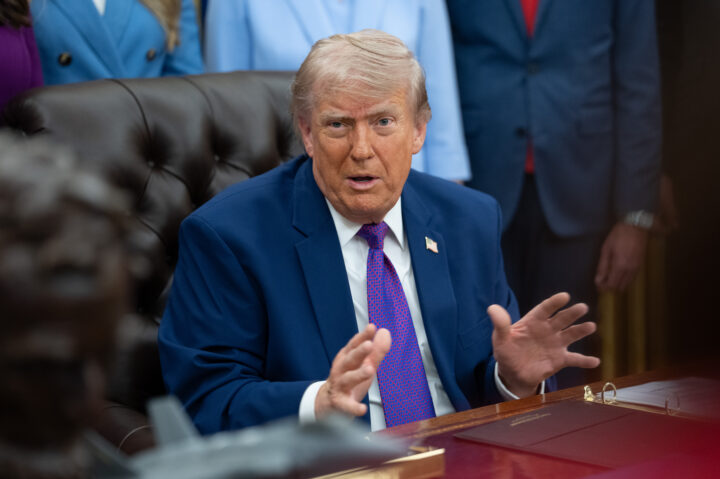
Aaron Schwartz/Sipa/Bloomberg via Getty Images
President Donald Trump speaks during a maternal healthcare event in the Oval Office of the White House in Washington, DC, US, on Monday, May 11, 2026.
Michael Makovsky, the president and CEO of the hawkish Jewish Institute for National Security of America, criticized the Trump administration’s recent handling of the U.S. war in Iran, expressing concern about the possibility of a broader peace deal that does not address key issues.
“The U.S. has lost the plot on Iran,” Makovsky told Jewish Insider on Friday. “After significant military achievements, declaring the ceasefire was a huge mistake, and there was too much hype about what pressure a blockade alone would achieve. The net result has reduced U.S. leverage, and the perception that America is vulnerable if gasoline nears $5 per gallon.”
Makovsky said that the U.S. “should not pursue a deal” with Iran, arguing that such an agreement “wouldn’t be worth the paper it’s written on.” He said that a deal “will only enrich and strengthen the regime and demoralize the Iranian people.”
“Instead, the U.S. should resume military operations for a couple weeks, weaken the regime and its nuclear and conventional capabilities further, cease the military campaign while maintaining the blockade and support the Iranian people in every way possible,” he said.
Makovsky spoke to JI in response after President Donald Trump’s announcement on Friday that he was nearing a decision on the agreement reportedly reached by U.S. and Iranian negotiators to extend the ongoing ceasefire by 60 days, reopen the Strait of Hormuz and continue nuclear talks. Makovsky made the comments prior to this weekend’s fighting between the two countries, with the U.S. striking Iranian air defenses and drone sites after Iran downed an American MQ-1 drone and shot missiles at U.S. forces based in Kuwait.
“Based on what appears to being negotiated, the Strait of Hormuz will be opened in return for certain Iranian pledges about what will be worked out in further negotiations,” Makovsky said. “There are even reports about a possible international investment fund in Iran, which would be preposterous with this regime.”
After holding a Situation Room meeting on Friday, Trump reportedly requested several amendments to the negotiated deal, including firmer commitments around Iran’s stockpile of enriched uranium, leading to another round of negotiations. Iranian state media reported on Monday that its delegation was suspending talks with the U.S. over Israel’s continued strikes against Hezbollah in Lebanon.
‘The Nazis may have the right to post, but also the Nazis are bad and sick and stupid,’ Rogers told JI
Screenshot
Sarah Rogers, under secretary of state for public diplomacy, speaks at the Hudson Institute on May 20, 2026.
Sarah Rogers, the under secretary of state for public diplomacy, maintained that the Trump administration’s commitment to free speech, including for extreme views, does not take away from its opposition to antisemitism, telling Jewish Insider in a wide-ranging interview that “the Nazis may have the right to post, but also the Nazis are bad and sick and stupid.”
The senior U.S. diplomat acknowledged the tension between allowing hateful views on social platforms and concerns about rising rates of antisemitism globally, though she maintained that the path to successfully responding to Jew hatred requires support for free speech protections, and said that she looks forward to visiting Israel in the future.
This interview has been condensed and edited for clarity.
Jewish Insider: You have been unequivocal in your public statements about the rise of antisemitism globally being a serious problem, while also maintaining your position on free speech protections. How do you draw that line between promoting free speech culture while ensuring you have the tools to fight antisemitism?
Sarah Rogers: I don’t see this as a line-drawing exercise between opposed priorities. There’s really no conflict between opposing antisemitism on the one hand and opposing censorship on the other. America has a proud history of opposing both. Censorship has not kept antisemites out of power, it has been deployed by antisemites who gain power.
[Supreme Court Justice] Oliver Wendell Holmes was the first to say that freedom of speech really means freedom for the thought that we hate. You can guard that principle while still saying, “Okay, there are some thoughts that we hate, and we’re going to speak against them, and we’re going to explain why these people are wrong, and we’re going to fight that battle in the marketplace of ideas.” I think every free speech advocate makes normative judgments about the speech that’s on offer, and a normative judgment I’ve always made is that the Nazis may have the right to post, but also the Nazis are bad and sick and stupid.
JI: How do you, or the State Department more broadly, view efforts to counter foreign operations and propaganda campaigns, especially with regard to media where the location of origin is often hidden?
SR: Countering what is called in the [State Department] statute “foreign malign influence” is part of my statutory mandate, and we take it seriously. There are a whole bunch of tools in what you might call the counter-propaganda toolbox.
This is an information environment where legitimacy and trust are more important than ever. Right now, we’re in this liminal zone. I think technology will refine this landscape a bit, but we’re in a zone where any image or any video can be fake, and so it is more important than ever if we were trying to persuade the global public that they can trust us.
What I’m looking for ways to do now, and what the State Department wants to do now, is to counter these kinds of influence operations chiefly through exposure and through counter speech. We can expose the foreign providence of a lot of information and the inauthentic nature of some of the behavior. That doesn’t mean we have to reach out behind closed doors to Twitter or Facebook and urge them to censor anyone concurring with a particular narrative. We don’t have to do that. It is not my job to dictate what Americans can say or see online, but I can tell Americans what we and our partners are seeing online and let them make up their own minds.
One thing that my office has done in the past also is try to promote technologies that improve the information environment and make that environment one in which we can more easily communicate about American priorities.
I don’t want to fund tools that put a centralized thumb on the scale of permissible opinion, or that try to choke off permissible opinion before it gets to the public sphere. What I’d rather do is prospect and promote tools that respect and empower the audience to discern true and authentic information and have the kinds of conversations they want to have.
Both X, formerly Twitter, and Meta have started rolling out the “Grok, is this true?” feature. It’s kind of interesting. Everyone knows the LLMs are trained on a consensus model of available opinion. A lot of them have gobbled up like most books ever written. They’ve scoured social media. When these models first debuted, they were pretty clunky. There was a whole genre of AI discourse that just consisted of people making their LLM say insane, woke, Kafkaesque things, but the models have gotten better. They’ve gotten better to the point where most people, even people with unpopular opinions, trust them to kind of collate facts.
There are now some early scientific studies showing that, as a result, interacting with AI chatbots depolarizes people politically. It is conducive to lessened political extremism, and I think making that kind of tool available is an example of something we can do that doesn’t make people feel coerced or condescended to, it doesn’t spark that kind of oppositional, anti-institutional reflex, because you’re just letting them have access to something that they want and they enjoy. We’ve also seen those exact tools used to push back on antisemitic propaganda online.
JI: Can you speak to how private industry and social media companies have responded to your engagement on these issues?
SR: I’ve had a lot of congenial interactions with the tech sector. I’ve been accused by critics, including in Europe, of essentially being too staunch an advocate for the tech sector, which is ironic because I started my free speech activism career as a thorn on the side of Big Tech. When we’re advocating for the freedom of our companies not to censor, then of course they’re grateful. I also think, though, that within Silicon Valley, within the investor class and the executive class, and then the user bases of these companies, there is a real organic demand for ways to harness the powers of invention to make the information environment better.
I have intentionally avoided having any interactions with tech companies that could reasonably be expected to result in the removal of content. If I ever had reason to do that, like if there was a tweet with the nuclear codes in it or something like that, I would try to make sure that I disclosed that to the public, but I avoid it as a matter of practice. Still, I have conversations all the time with people in the tech industry who are interested in how we discern content provenance, how we can help people integrate AI in ways that are less conducive to kind of AI psychosis type outcomes, how we can promote truthful information.
The only reason the information environment feels so new and different is because Americans are so good at innovating things that spread like wildfire and change the world. That’s fundamentally good. Now we’re in this new information environment, and you’ve probably heard me say this before, that this is on par with the invention of the telegraph or the film strip, and so there’s going to be some shudders and spasms as we adjust, but we can use the power of innovation and invention to make our environment better, not worse. I think tech is very receptive to that, especially because there’s all this kind of almost superstitious anti-tech discourse right now, and so there’s a natural appetite to prove that chorus wrong.
JI: With that in mind, how would you describe your role in terms of responding to this growing threat of foreign disinformation and the outgrowth of antisemitism that such propaganda efforts cause? Do you see your role as more of a behind the scenes dealmaker or something else?
SR: I would not say my role principally consists of brokering informal understandings with tech companies. I think because my role has a tech component of its portfolio, it’s just natural that I have some conversations and relationships with tech companies, but zooming out, my role is public diplomacy. That includes civil society grant making, it includes a lot of public advocacy, it oversees educational and cultural affairs, so I have a really broad umbrella of stuff I can do to interact with the information environment generally.
On antisemitism, we have funded interfaith cultural restoration projects and educational projects to promote cross-cultural understanding and diffuse hatred. We are trying to promote tools like AI to rationalize and depolarize the information environment. We’re doing all that stuff, but the information environment part is only part of it.
We are looking for more opportunities to publicly and candidly communicate on trends we’re seeing in the information environment, and we want to do it in a way where it doesn’t sound like we’re scolding the audience and telling them what not to believe. We just want to credibly share aggregated statistics and facts about what we’ve observed, and I want to make sure that we get that right.
That means number one, I’ve actually instructed my staff, like whenever we operate on this issue, we need to literally or figuratively make a commitment to not censor American speech or censor anybody. We want to do the counter speech and exposure, and I think you’re going to see more of that.
I’ve collaborated a lot on the antisemitism issue with Rabbi [Yehuda] Kaploun, who’s our special envoy to monitor and combat antisemitism. We have participated in the Shabbat dinners with him. We had Rabbi Kaploun organize a Shabbat with officials from Saudi Arabia and the Emirates, and with a bunch of members of the administration. It was a really powerful coming together around this issue, and I think you’re gonna see more of those kinds of activities that my office is proud to be involved with, too.
JI: Do you coordinate with other agencies and other departments to ensure that these efforts don’t overlap or contradict each other, be it about antisemitism or free speech or anything else that you’re doing?
SR: So one thing that I’ve done is I’ve encouraged my public diplomacy staff, who do kind of overt messaging for the State Department, to make sure that they are coordinated with other parts of the government, including, for example, the Department of War, who are engaged in messaging activities of overlapping topics in the same region. That’s just common sense, so we want to make sure that all of our messaging activities are aligned, or at least not at odds with each other.
I think a great thing about this administration compared to the first one is that when President Trump staffed his first administration, he was kind of newly triumphant and his coalition was still consolidating, so there wasn’t this existing infrastructure and existing talent pool of people who were aligned with the administration’s foreign policy vision, and now there are. Because of that, I have great relationships with counterparts at other agencies, and it’s very easy for us to have these conversations, though all conversations you have in the government take longer and are more kind of bureaucratically ritualized than they should be.
JI: Have you made any efforts in your role promoting public diplomacy to highlight the U.S.-Israel relationship?
SR: The answer is yes. I was actually just in close touch with the Israeli Embassy about some America 250 commemorative activities that we were going to undertake, including “America Day” celebrations at three university campuses in Israel. We’ve done a lot of interfaith and church restoration activities in the Middle East that Israel is very supportive of.
I also hope to visit Israel when scheduling considerations permit.
JI: Looking toward Europe, you and Sen. Eric Schmitt (R-MO) both spoke at the Hudson Institute last week about the free speech conversations we’re seeing across the Atlantic. What we’re also seeing are sharp rises in antisemitism across the continent. Do you connect the two? And if so, what do you see as the prescription for solving both issues?
SR: I absolutely connect the two. It’s interesting, another thing I always say when people ask me about this sort of tension between antisemitism and free speech is that I had my staff run numbers on this. When it comes to actual antisemitic hate crimes, not speech crimes, but crimes where someone gets hit or synagogues vandalized, the per capita rate of those in continental Europe and elsewhere in the Anglosphere is much higher by orders of magnitude than it is the United States, even though we have open season free speech, and they all reportedly have laws against antisemitism.
There was this incident in London a few years ago where a caravan of pro-Palestine protesters drove through a reputedly Jewish neighborhood in London, screaming through a megaphone, “F*** Jews. Rape their daughters. Free Palestine.” There were no hate crime charges. I think London police claimed there wasn’t enough evidence that they’d done it, even though it’s on video. So who does get prosecuted under these hate crime laws?
There is this famous Nazi hunter in France, Serge Klarsfeld. He’s one of the most famous Nazi hunters. He has a son, Arno Klarsfeld, who’s a well-regarded French jurist who actually helped prosecute some of the Nazi collaborators. Arno Klarsfeld was pursued by French authorities under French hate speech laws for basically saying that France should do mass deportations of people who’d already had their asylum hearings and were adjudicated as deportable. He was basically advocating for the same kind of policy that President Trump has tried to use to mitigate antisemitism in the United States.
You have this decorated French Jewish antisemitism jurist being threatened with legal punishment just for advocating a deportation policy, so that’s an obvious nexus, and I’m not saying it’s the only one, but it’s an obvious nexus between censorship law and antisemitism.
After the Bondi Beach massacre in Australia, you had a proposed hate speech law in response that would have had an exemption for any speech that’s religious. Well, if you were an ISIS jihadist, your speech was religious, so you’re basically carving out the exact ideology that appeared to have motivated that attack. So that’s how I see these issues in relation to one another.
JI: Is there anything else about Europe’s broader handling of antisemitism that concerns you?
SR: I think often there’s a sense that if you ban antisemitism legally then you have done the work required to oppose it, and I don’t think that is the story that the crime statistics tell. I don’t think it is the story that the political landscape tells. I’ve had many conversations with earnest European interlocutors who genuinely oppose antisemitism and want the best for the Jewish people in their countries, and so I don’t think bad faith is to blame. I just think that these laws are not the answer.
JI: One last question. I want to ask about Germany, specifically the far-right Alternative for Germany party. You’ve met with some of their officials and praised them specifically on free speech issues. AfD is a far-right ultra-nationalist party whose leaders have espoused antisemitic and pro-Nazi sentiments. Do you see these parties as antisemitic, and do you think the same free speech principles should apply to them despite their historical legacy?
SR: I had one meeting with one AfD official and immediately was lambasted for purportedly being pro-Russia. The point I made at the time was that if this guy were really a Russian asset, he’s a pretty bad Russian asset, because he condemned censorship in that meeting and Russia’s a big fan of censorship. I also stand by what I also said at the Hudson Institute, which is that European policymakers don’t need to give right-wing parties a monopoly on common sense when it comes to mass migration or things like internet regulation. In fact, it would be healthy to have a democracy where multiple parties are against destructive mass migration, for example.
In terms of Germany and its specific legacy on Holocaust denial laws, what I would say is this: I come from an American First Amendment tradition, so I would not want to see laws in the United States like that, but if the only thing these European countries were prohibiting was actual Holocaust denial or actual rank incitement of genocide against Jews, then I don’t think you’d be seeing as many arguments between, for example, European authorities and American internet platforms.
We didn’t sanction [Former European Commissioner] Thierry Breton for asking that X take down a Holocaust denial post — that post would be protected under the First Amendment, but that didn’t lead to the sanctions. What we sanctioned Thierry Breton for doing was threatening an American company with European regulatory penalties for allowing an American politician, President Trump, to speak on an American platform, so our laws do differ there, but if that were the only difference, I don’t think you’d be seeing these flare-ups. The differences are far greater than that.
‘Ultimately, UNRWA has not been a force for stability but has instead perpetuated the refugee crisis and reinforced the conditions that have allowed terrorism to persist,’ wrote the lawmakers, led in the house by Rep. Mike Lawler

Dawoud Abo Alkas/Anadolu via Getty Images
Palestinian families stand outside a school affiliated with the United Nations Relief and Works Agency (UNRWA) at the Daraj neighborhood as the Israeli attacks continue in Gaza City, Gaza on February 6, 2024.
Republicans in both chambers of Congress are urging the Trump administration to move to permanently dismantle the United Nations Relief and Works Agency, with a new letter from House Republicans calling for a reworking of Palestinian refugee programs in the region.
In a letter sent to President Donald Trump on Tuesday, more than 90 House Republicans, led by Rep. Mike Lawler (R-NY), called for a “broader view of the agency’s operations — not only in Gaza, but across the West Bank, Jordan, Lebanon, and Syria” and for the administration to ensure that the U.S. does not “continue to rely on failed systems that have further entrenched the Israeli-Palestinian conflict.”
The U.S. stopped funding UNRWA in early 2024, after revelations that several UNRWA employees participated in the Oct. 7, 2023, Hamas attacks on Israel, and Congress has continued to impose statutory bans on such funding since then, in spite of efforts by Democrats to reinstate funding for the aid agency.
“Ultimately, UNRWA has not been a force for stability but has instead perpetuated the refugee crisis and reinforced the conditions that have allowed terrorism to persist,” the lawmakers wrote. “We strongly urge your administration to take decisive action to fully dismantle UNRWA and transition its functions to more credible and trusted partners that are demonstrably free of ties to terrorism and committed to transparency, accountability, and peace.”
The letter suggests transferring funding for Palestinian refugee programs to their host countries directly or to other non-governmental organizations.
The letter states that UNRWA has “perpetuated and expanded” the Palestinian refugee crisis by conferring heritable refugee status across generations, “transforming what was once a finite humanitarian issue into a permanent and growing political challenge.”
The lawmakers also argued that in serving as the primary provider of public services in several countries and territories, UNRWA has “has reduced incentives for host governments to pursue long-term solutions, leaving millions dependent on the agency and prolonging the refugee crisis.”
And it raises concerns about the role that UNRWA educational curricula may have played in radicalizing young Palestinians.
The House letter follows a similar letter last week led by Sen. Tom Cotton (R-AR) with two dozen other Senate Republicans which also calls for dismantling UNRWA both in Gaza and throughout the region.
The letter highlights that UNRWA employees were involved in the Oct. 7 attacks and that 10% of UNRWA’s employees in Gaza have been found to have ties to terrorist groups. It also notes that Hamas has diverted UNRWA’s supplies and repeatedly used the agency’s facilities for terror purposes.
The letter urges the administration to eliminate UNRWA from the U.N. budget.
“Any aid organization in Gaza or otherwise must be demonstrably free of ties to terrorism and committed to transparency, accountability, and peace,” the senators wrote. “We must ensure this failed system doesn’t continue reinforcing the conditions that have fueled terrorism from generations.”
'We care a lot about the ability of the public to determine the authenticity of content … we just don't think that there should be a centralized thumb on the scale,’ Rogers said at the Hudson Institute
Screenshot
Sarah Rogers, under secretary of state for public diplomacy, speaks at the Hudson Institute on May 20, 2026.
Sarah Rogers, the under secretary of state for public diplomacy, refuted accusations that the Trump administration has been ineffective in combating the spread of misinformation and hateful content on social media, arguing that free speech protections and efforts to combat disinformation are not mutually exclusive.
Rogers made the comments while appearing at the Hudson Institute on Tuesday for a discussion on how the United States can modernize its public diplomacy strategy to advance American interests in a complex geopolitical environment without curtailing free speech.
“We are sometimes disingenuously accused of being nihilists about the health of the information ecosystem. ‘You guys don’t want to censor the Internet, so that must mean that you want spam and bots and foreign propaganda to proliferate,’” Rogers said. “That’s not true. We care a lot about the ability of the public to determine the authenticity of content, to determine the veracity of content, to have the kinds of conversations they want to have. We just don’t think that there should be a centralized thumb on the scale, certainly not any government one, telling people what opinions are allowed.”
Asked by Zineb Riboua, a research fellow at Hudson, how the U.S. could “strike that balance” between censorship and disinformation, the under secretary said the best solution was “to give people tools that they can deploy or interact with that help them determine authenticity and veracity” of the content they’re consuming.
Rogers noted that the U.S. is “using AI and other resources to trace what we do believe to be foreign propaganda,” without implementing measures to prevent that content from being accessible to the broader public. She specifically mentioned a disinformation effort targeting the U.S. after President Donald Trump launched the war in Iran earlier this year, during which an old map of American military assets in the Middle East “was proliferated online increasingly by Western journalists and by inauthentic accounts that are probably controlled by a foreign adversary.”
“They were proliferating this false information because there had been attacks on civilian population centers in a bunch of Gulf countries that were just totally unjustified, and the argument was, ‘No, look, there were American military assets on these countries.’ False,” Rogers said. “You saw Western leftists eagerly retweeting, for an adversary, fake propaganda.”
While noting that her office has a portfolio ranging from the upcoming U.S. World Cup and the series of celebrations honoring the nation’s 250th birthday,to tech policy matters concerning free speech issues, Rogers said the two subjects were intertwined in her view.
“I don’t see the free speech tech policy stuff and the America 250 sports and arts stuff as being that divergent,” she said. “I see them as a part of a combined stream of effort, which is to tell the American story you need the freedom to speak.”
Sen. Eric Schmitt (R-MO) delivered introductory remarks at the gathering where he criticized what he described as “a deeply troubling assault on free speech and democratic self-government” across “much of Europe.”
Schmitt said that Rogers “has been at the forefront of the effort to restore seriousness, sovereignty and strategic clarity to America’s statecraft, and we’re fortunate to have her with us today.”
Former Iran envoy Elliott Abrams: ‘It’s a foolish and damaging failure by the Trump administration, and there’s no excuse for it’

U.S. Department of State
Elliott Abrams
Former U.S. diplomatic officials and Middle East experts called on the Trump administration to fill dozens of ambassador-level Middle East posts, warning that not doing so could carry damaging consequences for U.S. influence and diplomacy in the region, while other former Trump officials argued the administration can manage regional diplomacy in its current format.
The Wall Street Journal first reported that more than 100 U.S. ambassador posts remain vacant under the Trump administration, including several key posts in the Middle East. The U.S. currently has no formal ambassadors in Saudi Arabia, the United Arab Emirates, Qatar, Iraq or Kuwait.
The vacancies stem from a mix of factors: a slower pace of nominations from President Donald Trump, a Senate confirmation process increasingly prone to delays and holds, and Secretary of State Marco Rubio’s December decision to abruptly recall nearly 30 career ambassadors.
The Trump administration has played down the vacancies, arguing that its foreign policy operation is running smoothly despite the empty posts. But several former U.S. officials and Middle East experts told Jewish Insider that leaving the post unfilled could be a serious diplomatic error.
Elliott Abrams, who served as Iran envoy during the first Trump administration and is now a senior fellow at the Council on Foreign Relations, called the vacancies a “huge mistake.”
“It’s a foolish and damaging failure by the Trump administration, and there’s no excuse for it,” Abrams said. “There are top career diplomats, such as the ones the administration has sent to Jordan, Bahrain and Oman, who could be sent, and surely there are potential political appointees who’d love to be in Riyadh or Abu Dhabi.”
Abrams noted that ambassadors often have access to members of royal families that lower-ranking U.S. diplomats do not, a dynamic that he said is especially important in monarchies.
“There’s simply no excuse for this, and no other country leaves such important posts vacant,” he added.
Aaron David Miller, a senior fellow at the Carnegie Endowment for International Peace and former State Department negotiator, expressed similar concern over the vacancies, saying “it would be better if they were filled with people.” He stressed, however, that the openings are more than a “narrow issue,” but rather a “reflection of a broader trend” in how the administration “makes decisions.”
“It’s a lack of priority in diplomacy, and in diplomats,” Miller said. “It reflects a situation where the analytical assessments of how these countries would behave in response to a crisis like the war, what I call the ‘ground truth,’ is not getting to the president because there’s no one out there doing it.”
Miller said he believes the administration does not rely heavily on the advice of career diplomats or ambassadors, with key foreign policy decisions instead shaped by Trump’s inner circle.
“I think this reflects the fact that this administration does not rely on the advice and counsel of probably most of its ambassadors,” he said. “So does this surprise me? No, because part of the issue is that the White House and the president’s political team, including Jared Kushner and [White House Special Envoy] Steve Witkoff, seem to have more say and more influence than a Department of State led by Marco Rubio.”
Still, Miller acknowledged that filling the vacant ambassador posts likely would not have altered Trump’s broader foreign policy or prevented the Iran war.
Dan Shapiro, who served as U.S. ambassador to Israel under President Barack Obama and later as the Biden administration’s special liaison to Israel on Iran, similarly warned that relying on senior officials in Washington rather than ambassadors on the ground could limit U.S. influence and understanding of regional dynamics.
“Senior Trump administration figures may believe they can manage these relationships just fine over the phone from Washington because of their close ties with Arab officials. But there are gaps and bandwidth limits that they cannot always overcome,” Shapiro said.
“Senate-confirmed ambassadors are the only senior U.S. officials who spend all day, every day in dialogue with foreign leaders. So they simply have greater access to key players in their host governments, knowledge of how they reach decisions, and ability to ensure they hear the views of the United States than do more junior diplomats,” he added.
Edmund Fitton-Brown, a senior fellow at the Foundation for Defense of Democracies and a former British diplomat, explained that the vacancies are partly the result of a “downsizing” problem at the State Department, noting that the Bureau of Near Eastern Affairs in particular has suffered “budget cuts and lost over 80 staff since President Trump returned to office.”
“Many of those departing were senior, experienced diplomats who would have been candidates for Chief of Mission posts that were not offered to political appointees,” Fitton-Brown said.
Others who served in Trump’s first administration were less concerned, arguing instead that the White House can still conduct effective regional diplomacy through senior officials and direct relationships with Middle Eastern leaders.
Jason Greenblatt, a former White House Middle East envoy during the first Trump administration, told JI that while ambassadors “play an important role,” he does “not believe the administration is at any disadvantage … because of these vacancies.”
“The leadership and senior diplomats in those countries have strong and trusted relationships with President Trump and with the group doing much of the day-to-day work, including Steve Witkoff, Secretary Rubio, Vice President Vance and Jared Kushner,” Greenblatt said. “Just as important, that group has President Trump’s deep trust and direct access to him. In this region, those trusted relationships, direct lines of communication and confidence from the president are more valuable than having an ambassador in place.”
Alexander Gray, who served as chief of staff to the National Security Council during Trump’s first term, similarly downplayed concerns over the vacancies, and said filling such positions is “one of the most difficult parts of American foreign policy.”
“This stems from multiple causes, including the arcane Senate confirmation process and the frequent holds placed by senators on ambassadorial nominees over unrelated issues,” Gray said. “The approval process for all presidential nominees, including ambassadors, needs a major overhaul by congressional leadership. President Trump has been diligent in nominating high-quality, non-career diplomats for critical posts.”
The State Department did not respond to a request for comment.
The report ‘makes clear that antisemitism and all other forms of discrimination and bigotry have no place at UCLA,’ said Chancellor Julio Frenk, who launched the task force
Myung J. Chun / Los Angeles Times via Getty Images
Campus of UCLA in Westwood, CA on Tuesday, May 5, 2026.
An antisemitism task force championed by UCLA Chancellor Julio Frenk released a report on Thursday urging the university to intensify its crackdown on anti-Jewish harassment, as the school continues to be enmeshed in legal battles with the Trump administration.
The 42-page set of recommendations, issued by the Initiative to Combat Antisemitism action group, suggested that UCLA set a deadline of 120 days to resolve disciplinary cases. It also said the university should more clearly define consequences for violations to Title VI of the Civil Rights Act of 1964.
The committee further urged UCLA to prevent faculty groups from using university resources or authority to express institutional support for anti-Zionism or the Boycott, Divestment and Sanctions movement and to implement the International Holocaust Remembrance Alliance’s working definition of antisemitism into rule enforcement and policy formation.
“The roadmap announced today turns our values into action. It makes clear that antisemitism and all other forms discrimination and bigotry have no place at UCLA,” said Frenk, who took over the school’s leadership last year.
UCLA’s Initiative to Combat Antisemitism was formed last year following recommendations of the 2024 Task Force to Combat Antisemitism and Anti-Israeli Bias. It is led by Stuart Gabriel, a professor in UCLA’s Anderson School of Management.
“Our work at UCLA is building a strong foundation for a campus free of discrimination, and we hope our initiative can serve as a blueprint for colleges and universities nationwide as they seek to build more inclusive campuses,” Gabriel said.
Daniel Gold, a member of the committee and executive director of UCLA Hillel, told Jewish Insider, “While initial work of our Initiative has concluded with the release of this important report, the work of everyone else at UCLA now begins to implement these changes and uphold the commitment towards a campus free of antisemitism.”
The report comes shortly after the school’s student government condemned a campus event featuring former Israeli hostage Omer Shem Tov, labeling the speaker selection as “selective platforming of narratives that obscure the broader reality of ongoing state violence” and “a troubling disregard for Palestinian life.”
UC Regent Jay Sures told JI at the time that UCLA’s student government was “shortsighted, antisemitic or both,” and called its members “lunatics” for condemning Shem Tov’s appearance. Sures, who is Jewish, had his home vandalized last year by UCLA Students for Justice in Palestine, which was since banned from campus.
The federal government has been in a monthslong legal battle with UCLA, including a February lawsuit alleging that the campus failed to protect Jewish and Israeli faculty and staff in accordance with Title VII of the Civil Rights Act of 1964, which prohibits employment discrimination.
The DOJ complaint alleges that since the Oct. 7, 2023, terrorist attacks in Israel, UCLA “has ignored, and continues to ignore, gross and repeated violations of viewpoint-neutral time, place, and manner restrictions. Jewish and Israeli faculty have been physically threatened, had their classrooms disrupted, and had their workplaces papered with disturbing images.”
Last year, UCLA settled a lawsuit with Jewish students who alleged that the university permitted antisemitic conduct during the spring 2024 anti-Israel encampments on the campus.
The new report does not specifically mention the Trump administration crackdown.
‘Should the president make the decision to recommence … we would have all the authorities necessary to do so,’ the defense secretary told lawmakers
SAUL LOEB / AFP via Getty Images
Secretary of Defense Pete Hegseth (C) and Chairman of the Joint Chiefs of Staff Gen. Dan Caine (R) testify during a House Committee on Appropriations, Subcommittee on Defense hearing to examine the 2027 budget for the Department of Defense on Capitol Hill in Washington, DC, on May 12, 2026.
Defense Secretary Pete Hegseth said during a Senate Appropriations Committee hearing on Tuesday that the Trump administration does not plan to and does not believe it needs to seek congressional approval should it decide to resume military operations in Iran, further sidelining Congress at a time when a growing number of Republicans are becoming hesitant about continued U.S. military operations.
Sen. Lisa Murkowski (R-AK), who has been working on an Authorization for Use of Military Force to set parameters for the operation in Iran, said that the War Powers Act makes clear that the administration must terminate hostilities within 60 days without congressional approval, a timeline that expired on April 28. She said it did not appear, despite the administration’s assertions, that the hostilities in the Gulf had actually ended.
“Our view is that, should the president make the decision to recommence, that we would have all the authorities necessary to do so,” Hegseth responded.
Hegseth and other top military leaders testified to both the Senate and House Appropriations Committees on Tuesday.
During the hearing, which took place a day before President Donald Trump is set to depart for China to meet with President Xi Jinping, Sen. Lindsey Graham (R-SC) emphasized that Beijing is “propping up Russia and Iran” and that it would have a significant capability to pressure Iran into changing course if it were to cease purchasing oil from Iran.
Graham also continued to voice concerns about Pakistan’s role as a mediator in the U.S.-Iran talks, citing a report from the day prior about Pakistan hosting Iranian military aircraft on its military bases. Both Hegseth and Gen. Dan Caine, the chairman of the Joint Chiefs of Staff, declined to comment on those reports.
“That tells me we should be looking maybe for somebody else to mediate” between the U.S. and Iran. “No wonder this damn thing is going nowhere,” Graham told the military officials. “I appreciate all you’ve done, I’m very supportive of it, but when it comes to Pakistan and China, enough already.”
Jules Hurst III, the acting Pentagon comptroller, said that the cost of the war thus far, including munitions used in the war, is around $29 billion, a sum that Democrats countered seemed low.
Hurst acknowledged that estimate didn’t include the potentially sizable costs for rebuilding U.S. installations damaged or destroyed in Iranian counterattacks. He said that the costs of such rebuilding would be dependent on the U.S.’ posture and needs going forward and potential contributions from host countries.
He indicated it could also increase further depending on costs for repairing or replacing damaged aircraft.
Hegseth and Caine insisted that the U.S. maintains sufficient munitions stockpiles to carry out any missions that are required, though Caine said that he appreciated efforts by Congress to provide funding for more munitions production.
Hegseth also asserted that the war had been massively successful in achieving the U.S.’ goals, and that the U.S. has the capabilities for a range of scenarios including resuming the war, to ensure that it will end on the U.S.’ terms.
“There are lots of different discussions with our negotiating team, they’re happening … different drafts, different perspectives. It’s a very dynamic situation where a negotiated settlement could be the outcome here, where Iran does not have nuclear capabilities,” Hegseth said. He sidestepped questions about the specific terms of the ceasefire agreement.
Pressed on whether Iran’s support for terrorism and ballistic missile program are part of negotiations, Hegseth said that the negotiations are not his responsibility but “we have world-class negotiators” and “the core of it is the nuclear weapons issue” but “those other factors are always a factor.”
Asked by Sen. Susan Collins (R-ME), chair of the Senate Appropriations Committee, whether the U.S. had anticipated the closure of the Strait of Hormuz, Caine declined to discuss the specific advice he provided to the administration but said that the military had considered the full range of potential consequences.
“It seems to me that there’s been a different plan almost daily [for] dealing with this problem,” Collins said.
Caine said that the issue of the Strait of Hormuz is a complex one, as Iran uses small boats and low-cost drones to attack larger vessels, but urged Iran to “think wisely about their next moves” and open the waterway voluntarily.
Hegseth emphasized the effectiveness of the U.S. blockade of Iranian ports, insisting that “the economic pressure that creates on them greatly outstrips the pressure on us. … Nothing’s going in that we don’t allow to go in. And trust me, when we look at what Iran’s thinking about that — they know they can’t break it.”
He repeatedly dodged questions about specific plans for reopening the strait and securing trade moving through it in the short-term. He said that there are “certainly” military means by which the strait could be re-opened, but said that a diplomatic deal is the “preferred long-term approach.”
On both sides of the aisle, in both hearings, senior lawmakers raised questions about the administration’s decision to split off more than $300 billion of the proposed $1.5 trillion defense budget request into a proposed partisan reconciliation package, rather than trying to pass it through regular order. That request was also finalized prior to the war in Iran.
Lawmakers warned that reconciliation packages would not be a sustainable path to growing and maintaining U.S. defense capabilities in the long term, and that a third reconciliation package might not be feasible at all this year.
JCRC CEO Ron Halber: ‘They're a fringe, radical, antisemitic organization’
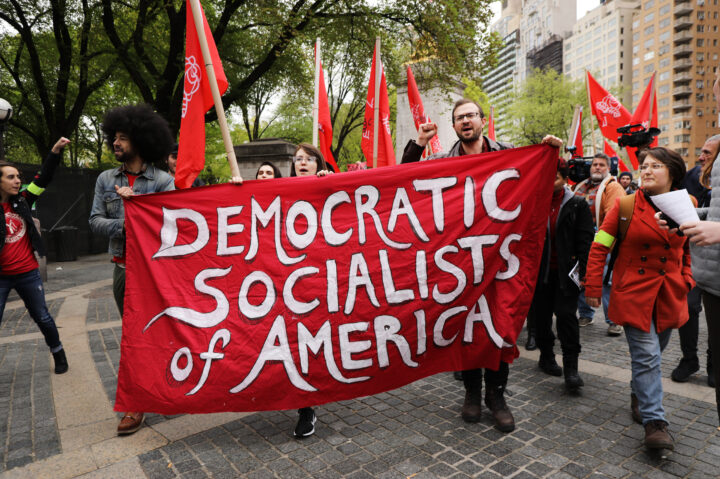
Spencer Platt/Getty Images
Members of the Democratic Socialists of America May 01, 2019 in New York City.
Amid the rise of a DSA-aligned mayoral candidate in the city, a senior Jewish community leader in Washington, D.C., excoriated the Democratic Socialists of America as an “evil” organization committed to driving Jews out of society.
Speaking on a webinar with other Washington-area Jewish leaders on Tuesday, Ron Halber, the CEO of the Jewish Community Relations Council of Greater Washington, stridently criticized the far-left group.
“I think they’re a fringe, radical, antisemitic organization, and I happen to even think they’re evil,” Halber said. “They are trying to do in America what [the Boycott, Divestment and Sanctions movement] seems to do internationally, which is to make being Jewish unacceptable in polite society.”
He said that the group wants to make Jews feel “isolated” and force them to “renounce Zionism” and their connection to Israel in order to participate in the political process. Antisemitism is “core to their belief,” he continued.
Halber described the activist group as emboldened and energized during the second Trump administration — as numerous DSA-aligned candidates make gains in local and national elections — and said that the Jewish community “should view DSA with alarm, because they are having a radical impact.”
And, he added, the Jewish community should be “very, very wary of political candidates who go out and seek their endorsement and who wish to affiliate.”
The Metro DC DSA did not immediately respond to a request for comment.
Halber said it’s the responsibility of Jewish organizations to come together with allies to expose the DSA as “the fringe of American society that most people in America would be repulsed by.”
Tali Cohen, the Anti-Defamation League’s Washington regional director, said on the webinar that she has been “astonished by the rhetoric coming out of the D.C. DSA chapter.”
Cohen said the group is attempting to “isolat[e] the Jewish community through exclusionary policies” — requiring endorsees to cut ties with “the overwhelming majority of organized Jewish community institutions” — and has “embrace[d] antisemitism as an organizational orthodoxy” through its embrace of anti-Zionism.
“If you read DSA’s platform, they have disproportionately and overwhelmingly chosen to focus on the world’s only Jewish state,” she continued. “The selective focus can suggest that something else is at work beyond just policy concerns.”
Cohen also raised concerns about the group’s opposition to the International Holocaust Remembrance Alliance’s working definition of antisemitism and its efforts to defund the D.C. police, a project she said endangers the Jewish community.
The event comes following a high-profile clash between Jewish communal groups and the Washington DSA chapter over its endorsement questionnaire for the city’s mayoral race that required candidates to pledge to refrain from engaging with “Zionist lobby groups.”
Mayoral candidate Janeese Lewis George, a DSA member endorsed by the group, said in response to the questionnaire that she would not attend events “promoting Zionism and apartheid.”
Alan Ronkin, the regional director of the American Jewish Committee in Washington, and ADL experts also spoke on the webinar.
Long shared a three-minute long clip of Fuentes railing against immigration
Greg Nash/Pool via AP
Rep. Billy Long (R-MO) asks questions during hearing May 14, 2020, on Capitol Hill in Washington.
Former Rep. Billy Long (R-MO), who has been nominated by the Trump administration to be U.S. ambassador to Iceland, shared a three-minute clip of a speech by neo-Nazi influencer Nick Fuentes on X on Sunday.
In the clip — shared originally by the account Wall Street Apes, which praised the speech without identifying Fuentes — Fuentes rails against immigration, but does not invoke the virulently antisemitic, pro-Nazi or racist rhetoric for which he is notorious.
Long re-shared the video without any caption.
Fuentes, in the video, is wearing a large nametag that identifies him by his full name, and a caption that appears onscreen in the middle of the video also identifies him by name.
Long and the State Department did not immediately respond to requests for comment.
The former congressman is active on X, frequently sharing content from a range of conservative accounts on a variety of subjects, including other posts from the Wall Street Apes account.
Long briefly served as the commissioner of the Internal Revenue Service early in the Trump administration. Long is a frequent speaker at gatherings of the Republican Jewish Coalition and received a shoutout from Trump at the 2023 RJC summit in Las Vegas. Trump referred to him as “a friend of mine who’s been incredible,” and gave a nod to his former career as “the greatest auctioneer” — professional skills that Long has occasionally showcased on the House floor.
In 2018, Long used an auction call to drown out protests by far-right influencer Laura Loomer, who had interrupted a House Energy and Commerce Committee hearing about Twitter.
Loomer on Monday tagged several top Trump administration officials in a response to Long’s post, calling it “disqualifying” — focusing primarily on Fuentes’ recent criticisms of Trump, rather than his history of antisemitism.
The measure garnered 47 votes in the Senate, with GOP Sen. Susan Collins joining with Democrats for the first time

Kevin Carter/Getty Images
The U.S. Capitol Building is seen at sunset on May 31, 2025 in Washington, DC.
The Senate rejected for the sixth time an effort from Democrats to force the Trump administration to halt the war in Iran — with the vote once again falling largely along party lines.
The vote was the last before the conflict approaches the 60-day mark outlined in the War Powers Resolution of 1973, which requires the executive to seek congressional approval for continuing hostilities or draw down U.S. forces.
“After 60 days of war, it is long past time for Republicans to hold Donald Trump accountable,” Sen. Adam Schiff (D-CA) said in a statement released prior to the vote. “Some of my colleagues have indicated that the War Powers Act’s 60-day mark is the moment they may join our efforts to bring this war to its conclusion. That time has come.”
The latest resolution, sponsored by Schiff and Senate Minority Leader Chuck Schumer (D-NY), failed by a measure of 50-47. Sens. Jerry Moran (R-KS), Patty Murray (D-WA) and Tommy Tuberville (R-AL) did not vote.
Sens. John Fetterman (D-PA), Rand Paul (R-KY) and Susan Collins (R-ME) voted with the opposition party. This was the first time in which Collins sided with the Democrats on the war powers votes.
“As I have said since these hostilities with Iran began, the President’s authority as Commander-in-Chief is not without limits,” Collins said in a statement following the vote. “Further military action against Iran must have a clear mission, achievable goals, and a defined strategy for bringing the conflict to a close. I voted to end the continuation of these military hostilities at this time until such a case is made.”
Collins added that the 60-day war powers deadline is “not a suggestion; it is a requirement.”
Sen. Josh Hawley (R-MO) said he was not surprised by Collins, noting that “she has been saying the 60-day clock is significant for her.”
He added that for him: “We haven’t reached the 60 days. That’s why I voted the way I voted.” However, Hawley said that he wants “to see an end to the war.”
Senate Republicans have told Jewish Insider they expect the White House to abide by the law and provide notification of a 30-day extension to Congress, which is permitted to ensure a safe withdrawal. However, the administration has not yet indicated publicly whether it will seek that extension or continue offensive operations, and Defense Secretary Pete Hegseth claimed at a Senate Armed Services Committee hearing on Thursday that the 60-day clock was “paused” during the ongoing ceasefire.
As the deadline approaches, a growing rift is emerging among Senate Republicans over whether to support an Authorization of Use of Military Force.
“I would hope it wouldn’t come to that,” Hawley said of the White House potentially extending the conflict past the 60-day mark. “I think the administration has tried to remain within the statute.” Hawley has said that should the conflict extend past the deadline with no further action from the White House that he would debate an AUMF, but said he would prefer not to support authorizing a war he wants to see “wind down.”
Hawley said he would “welcome further communication from the White House.”
Sen. Todd Young (R-IN) also said he expects that the White House will “communicate” and “make a very strong legal argument.” He also noted that he believes the administration has “followed the War Powers Act provision so far in a very careful way.”
Young said that should an AUMF be necessary, he could see himself voting for a “properly structured authorization.”
“That’s been my position throughout this exercise,” Young said, referring to the recent slate of war powers votes. “My hope would be that if we went down that road, we’d work with the administration to draft a properly scoped authorization for the use of military force.”
Meanwhile, Sen. Mike Rounds (R-SD) said he is “not ready to commit to anything.”
“I want to make sure that we continue to get classified information on a timely basis from the Pentagon,” Rounds said. “I think today we had a very good classified setting with a lot of good information being provided. I think they [the White House] did a good job of sharing their point of view on it. So we’re moving in a good direction.”
Asked whether he believes anything would change at the 60-day deadline, Rounds replied: “I have no reason to believe that’s the case right now.”
Rounds said he believes a path forward between the U.S. and Iran will be “extremely difficult without regime change.”
“But that doesn’t mean that there isn’t hope for an agreement with this particular regime under very strict observations by outside forces to make sure that they adhere to any agreements we make,” Rounds added.
Sen. Tim Kaine (D-VA) said that while he thinks the current war is “unwise” and “illegal,” he said that if Congress “were to pass an AUMF in both houses it would stop being illegal.”
“I would stop critiquing it as an illegal war if they [Congress] passed an AUMF,” Kaine said.
Kaine said he expects that another war powers vote “will come up right after [Congress adjourns for] recess.”
“I think the testimony this morning shows they [the White House] know they got a 60-day problem,” Kaine said, referring to Hegseth’s remarks at the hearing.
Rounds, who serves on the Senate Armed Services committee, said that he would need to “go back and do a good review of that particular” remark.
“We’re in the middle of it,” Rounds said. “Once I have a chance to actually go through it myself then I’ll have a comfort level. I’m not going to disagree with him [Hegseth] at this stage.”
McMahon said the Education Department is looking to hire more lawyers for civil rights cases, but the administration called for $49 million in cuts for the office

BRENDAN SMIALOWSKI/AFP via Getty Images
Secretary of Education Linda McMahon prepares to testify before a House Subcommittee on Labor, Health and Human Services, Education, and Related Agencies hearing on the budget for the Department of Education, on Capitol Hill in Washington, DC on May 21, 2025.
Education Secretary Linda McMahon claimed on Tuesday that she’s trying to rebuild and expand the Department of Education’s Office for Civil Rights (OCR), even as the administration pushes for tens of millions in funding cuts this year.
The Trump administration cut half of OCR’s staff and nationwide offices at the outset of President Donald Trump’s second term, eliciting strong condemnation from many Jewish community groups. OCR is the primary agency responsible for investigating and adjudicating complaints of antisemitism on college campuses.
The administration has continued to push for further budget cuts to OCR and is more broadly attempting to dismantle the Department of Education and transfer some of its functions to other federal agencies.
At a Senate Appropriations subcommittee hearing, McMahon largely brushed off responsibility for the initial force reduction, claiming that the process to carry out the firings had been initiated before she was confirmed for her post and carried out shortly after she was sworn in, blaming “very stringent budgetary requirements that we were given.”
“We were in the process of looking at how to make sure that our Office of Civil Rights was in fact going to be able to handle cases, trying to make sure that we could get as many of them as possible,” McMahon said.
McMahon further claimed that the 2027 budget submitted by the Trump administration contains more funding to hire lawyers at OCR. The budget, in fact, requests a $49 million cut, from $140 million in 2026 to $91 million in 2027.
“It is a budget of increasing dollars for civil rights,” McMahon said, refusing to acknowledge, under questioning by Sen. Chris Murphy (D-CT), that the budget submitted by the Trump administration called for a 35% cut to the OCR budget, to Murphy’s bewilderment.
“We are bringing back lawyers, we are hiring lawyers, with the person who has been so successful before in getting this done … we’re addressing [the case backlog] for rapid mediation, expanded resolution and multi-regional teams that we have now put back in place. Addressing the issues in the past were inadequate,” McMahon said.
McMahon was referring to Kim Richey, now the assistant secretary for civil rights, who has served in previous Republican administrations as well. McMahon praised her as highly “effective.” She also claimed to have re-hired all of the OCR attorneys who were fired, except those who took early retirement.
“It’s like black is white, it’s a 35% cut you’re proposing,” Murphy interjected.
Pressed by Murphy on the sweeping firings at the outset of the Trump administration, McMahon said, “That is hindsight.”
Pressed further, McMahon responded, “You know perfectly well what it is. We’ve brought people on board to handle these cases because I believe they should be handled. We should be dismissing these cases, we should be finding resolutions to them.”
In a detailed budget appendix submitted to Congress, the Trump administration also called for $274.5 million in funding for the Nonprofit Security Grant Program, flat funding with 2024 and 2025 but a cut from the proposed — but still not approved — $300 million expected for 2026.
Jewish groups and supporters of the program in Congress are pushing for between $750 million and $1 billion for the program.
Plus, a publisher's nutty smear targeting Jews
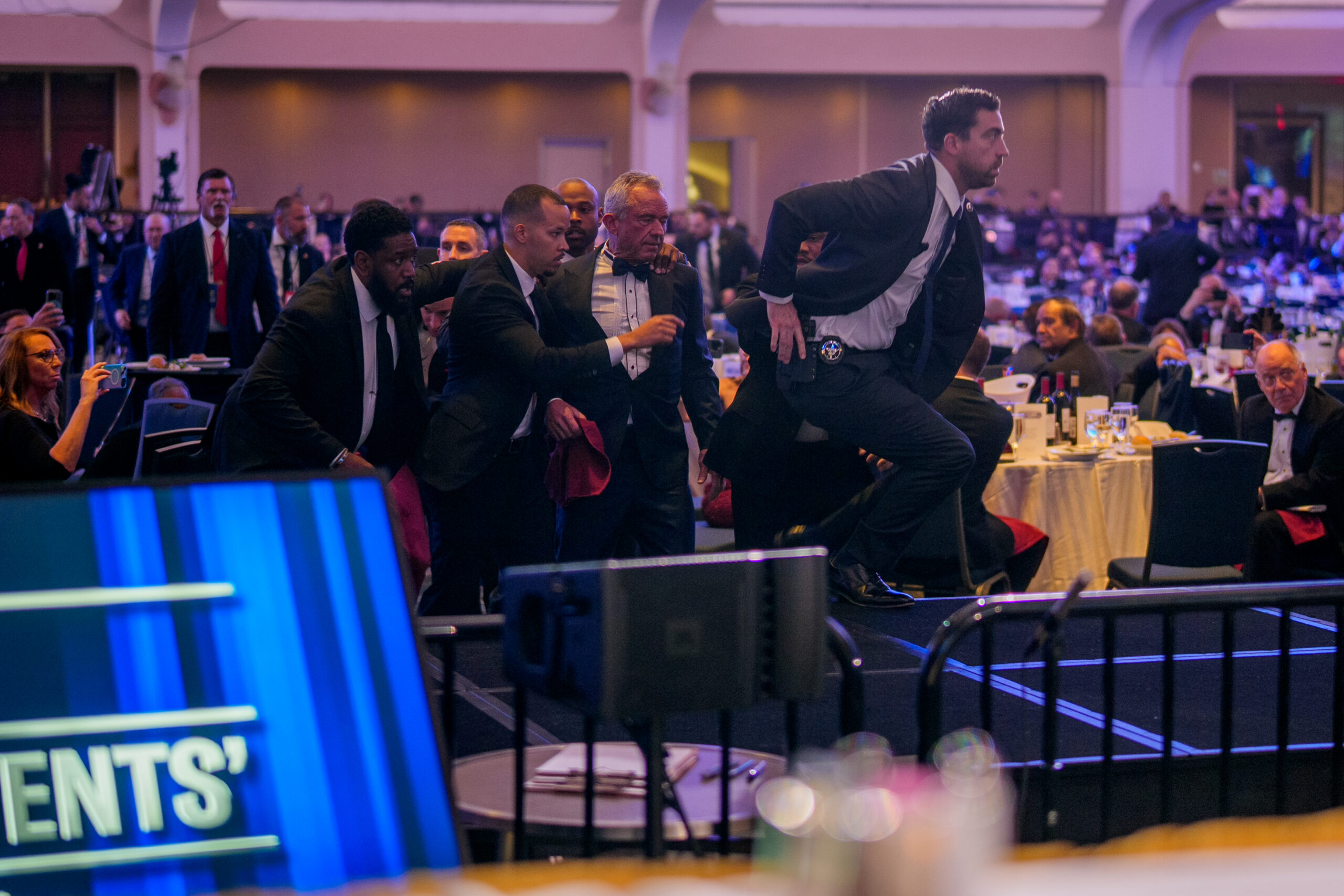
According to reports, President (Andrew Harnik/Getty Images)
Health and Human Services Secretary Robert F. Kennedy Jr. (C) is taken out of the ballroom by security agents during a shooting incident at the annual White House Correspondents Association Dinner at the Washington Hilton on April 25, 2026 in Washington, DC.
👋 Good Monday morning!
In today’s Daily Kickoff, JI’s Marc Rod gives a first-person account from inside the chaos of the White House Correspondents’ Dinner after an assassination attempt on Trump administration officials. We report on the merger between former Israeli Prime Ministers Naftali Bennett and Yair Lapid as they seek to oust Benjamin Netanyahu, and talk to University of California regent Jay Sures about the UCLA student government’s recent condemnation of an event with a former Israeli hostage. Also in today’s Daily Kickoff: Daniel Shapero, Josh Kushner and Tzipi Hotovely.
Today’s Daily Kickoff was curated by JI Executive Editor Melissa Weiss and Israel Editor Tamara Zieve, with an assist from Danielle Cohen-Kanik. Have a tip? Email us here.
What We’re Watching
- King Charles III and Queen Camilla land in Washington today for their first state visit to the U.S. since assuming the throne. They’ll arrive to a city reeling from this weekend’s attempted attack on Trump administration officials at the White House Correspondents’ Dinner. More below from JI’s Marc Rod, who was attending the event at the Washington Hilton on Saturday night.
- The king and queen will be welcomed by President Donald Trump and First Lady Melania Trump, and will have afternoon tea before attending a White House garden party.
- Trump is expected to convene a Situation Room meeting — sans King Charles — on Iran as the countries remain at an impasse amid stalled talks. The meeting comes days after plans for White House Special Envoy Steve Witkoff and Jared Kushner to go to Islamabad for a second round of talks were scrapped, with Trump telling Fox News on Sunday, “If they want to talk, they can come to us or they can call us.” Tehran has reportedly offered to reopen the Strait of Hormuz and end the war without resolving its disputes with Washington over the future of the Iranian nuclear program.
- Iranian Foreign Minister Abbas Araghchi is in Moscow today, where he is slated to meet with Russian President Vladimir Putin.
- Israeli President Isaac Herzog is in Kazakhstan today, where he is slated to meet with President Qasym-Jomart Toqayev.
- Israel Tech Week kicks off today in Miami. Speakers include Daniel Flesch, Phil Goldfeder and Gabe Groisman.
What You Should Know
A QUICK WORD WITH JI’S MARC ROD
The White House Correspondents’ Dinner on Saturday night began normally enough — a bustle of reporters, administration officials and members of Congress among other A-listers streaming from the packed lobby of the Washington Hilton down into the basement ballroom.
White House Correspondents’ Association President Weija Jiang, a CBS News White House reporter, finished her introductory remarks, and the thousands of guests packed into the ballroom tucked into their salads.
Then, a loud, shattering bang rang out from the other side of the ballroom. Initially, I didn’t think anything of it — I thought someone had dropped a large tray of food (as President Donald Trump said later, he thought the same thing).
Videos and other accounts of the evening indicate that someone from the security staff shouted from the front of the room that guests should get down. I didn’t hear it. My first indication that something was wrong was when I started seeing other guests ducking under the tables and security officers drawing their guns.
I tried to duck under the tablecloth, but no luck — another occupant of the table was already underneath, and there was no room. My heart pounding, I was forced to do my best to stay low — but I was in the backmost row of tables, right by a door, sitting directly in the aisle.
If a shooter came into the ballroom from behind me, I was a sitting duck. I was completely helpless and exposed.
Two thoughts ran through my head. The main one: I’m getting married in six days. I can’t die now. The second: I can’t believe this is happening to me again. (For those readers who are newer to Jewish Insider — I was also on scene for the Jan. 6, 2021, attack on the U.S. Capitol.)
JOINING FORCES
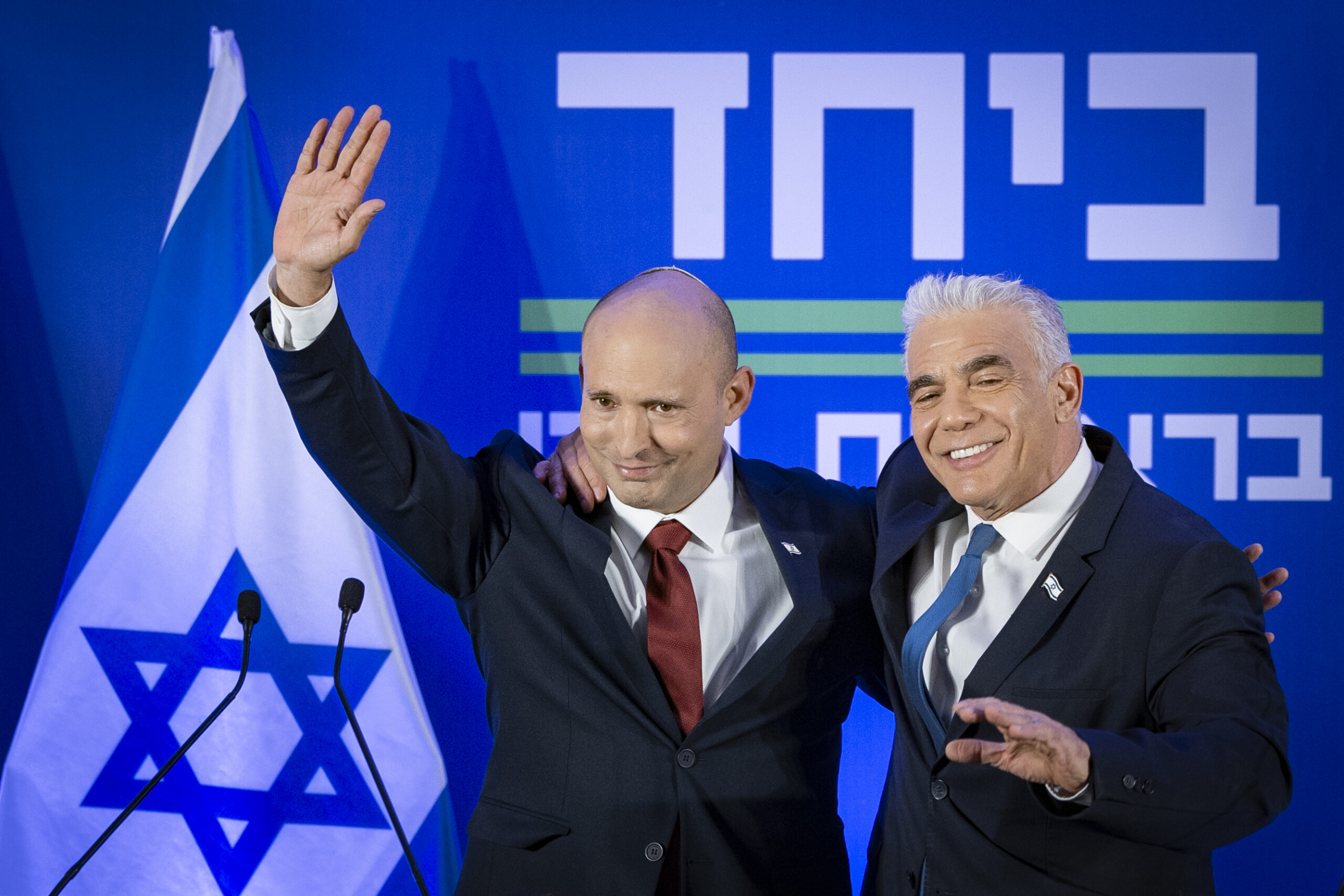
Former Israeli Prime Ministers Naftali Bennett and Yair Lapid will run in this year’s Knesset election as a joint party called “Together,” led by Bennett, they announced on Sunday. The move comes as the bloc of Zionist parties running against Prime Minister Benjamin Netanyahu’s bloc has recently polled higher than the parties in Netanyahu’s coalition, but with fewer than the 61-seat majority needed to form a government, Jewish Insider’s Lahav Harkov reports.
Behind the scenes: Sources close to both party leaders told JI that they began discussing a joint run a week ago, and reached the final decision on Saturday night. Bennett will lead the party after having a consistently stronger showing in polls in recent months. Bennett, a former IDF combat officer, described the merger as “the most Zionist and most patriotic thing we have ever done for our country.” Lapid said that the country “needs unity like air to breathe.”
Survey says: A poll conducted for Israel’s Walla news site on Monday found that Lapid and Bennett would lose seats if an election were held today, in comparison to previous polls when they were running separately.
EXCLUSIVE
Jay Sures, vice chairman of United Talent Agency and a regent of the University of California system, slammed the members of UCLA’s Undergraduate Student Association who authored a letter condemning former Israeli hostage Omer Shem Tov’s recent campus appearance as “shortsighted, antisemitic or both,” in an interview with Jewish Insider’s Haley Cohen.
What he said: “Why would anybody send out a letter condemning a hostage who is a student who was held in captivity for over 500 days? You have to be a complete lunatic to sign on to that letter,” Sures told JI on Friday, shortly after he issued a letter to the body stating he was “disgusted and appalled” by its condemnation.
SHELL GAME
Publisher of Drop Site News pushes conspiracy theory about a California Jewish family-owned business
Nika Soon-Shiong, the publisher of Drop Site News who is also the daughter of Los Angeles Times owner Patrick Soon-Shiong, is circulating conspiracy theories seeking to tie a California-based Jewish couple behind a major pistachio processor to the recent U.S.-Israeli military strikes in Iran, Jewish Insider’s Matthew Kassel reports.
Singled out: In a recent social media post that drew more than 1 million views, Soon-Shiong, citing unverified online claims that the United States and Israel had targeted pistachio warehouses in Iran this month, singled out Stewart and Lynda Resnick, the billionaire owners of the Wonderful Company, which grows and processes a large percentage of California’s pistachios as well as other products including almonds and mandarin oranges.
ON THE TRAIL
New York City Mayor Zohran Mamdani exercised his veto power for the first time since entering office on Friday to block a bill that would standardize NYPD policy around protests at educational institutions, Jewish Insider’s Will Bredderman reports.
What they said: “We are deeply disappointed by Mayor Mamdani’s decision,” said the UJA-Federation of New York, the Anti-Defamation League of New York/New Jersey, Jewish Community Relations Council of New York, American Jewish Committee New York, the Conference of Presidents of Major American Jewish Organizations, the New York Board of Rabbis, Orthodox Union, The Rabbinical Assembly, StandWithUs and Teach NYS, in a rare united response. “This veto is a profound failure of City Hall to demonstrate to all New Yorkers that our safety is a priority.”
STAYING PUT
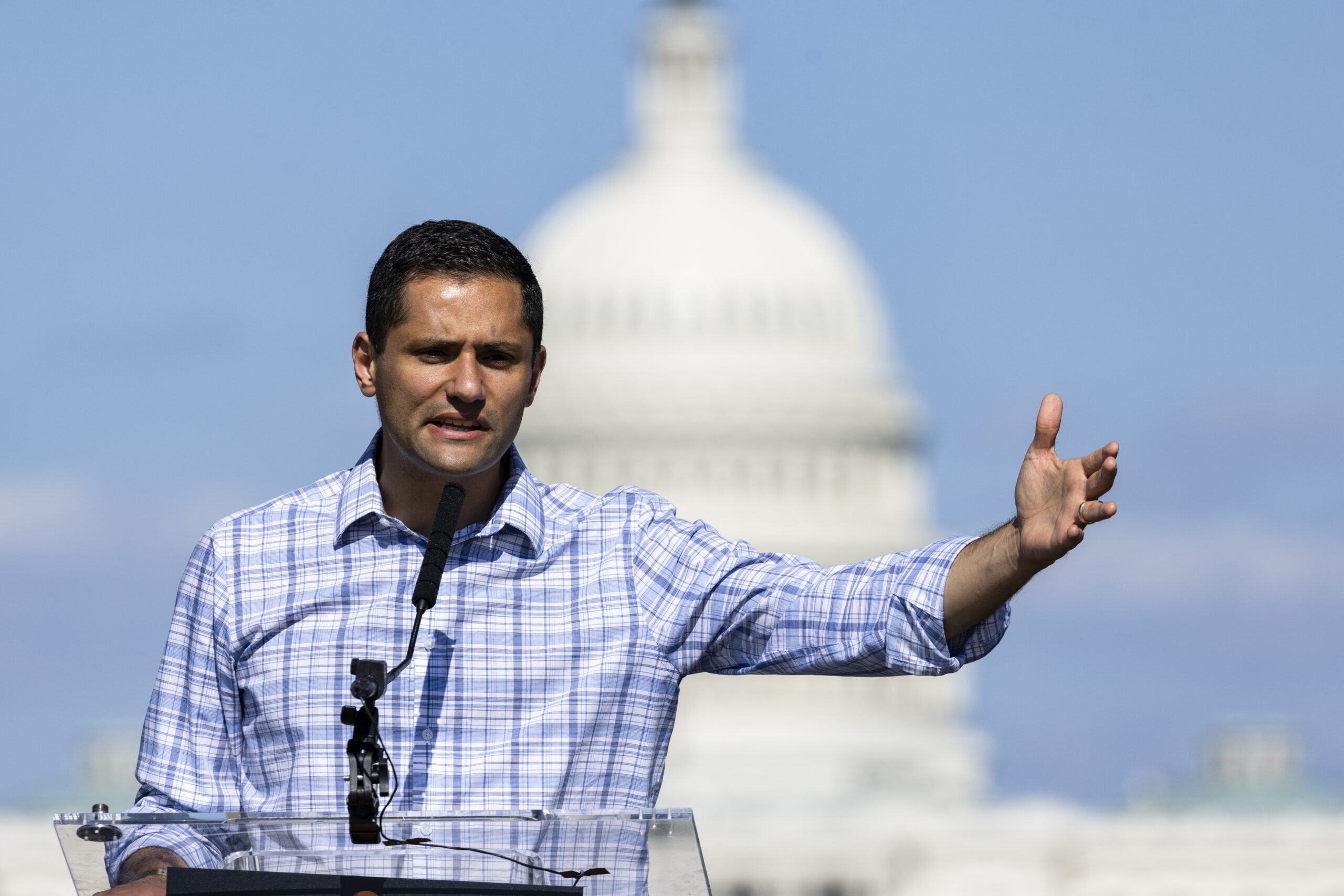
A Virginia state lawmaker with a history of inflammatory anti-Israel rhetoric who had been exploring a congressional run announced on Friday that he would instead remain in the state’s House of Delegates. Sam Rasoul, a Roanoke Democrat who is the son of Palestinian immigrants, said he would hold onto his seat in the state Legislature to continue focusing on his work chairing the Education Committee, a role that has garnered concern from the state’s Jewish community due to his heated comments, Jewish Insider’s Gabby Deutch reports.
Zoom out: The decision comes days after Virginia voters approved a new congressional map that is likely to deliver four additional House seats to Democrats, prompting a reshuffling as politicians in the state opt to run — or not to run — for the newly drawn Democratic-friendly seats.
LINKEDIN LEADER
Microsoft, the parent company of LinkedIn, has tapped Daniel Shapero, the professional networking site’s current chief operating officer, as its next CEO, current chief executive Ryan Roslansky announced earlier this week, Jewish Insider’s Haley Cohen reports.
Announcement: Shapero, who has been serving as COO since 2021, wrote on the platform Wednesday, “Today, I’m taking on the role as CEO of Linkedin. I joined Linkedin in May 2008 as employee #300ish, and it’s easy to say that my time at the company has been one of the most meaningful experiences of my life.” The network has close to 1.5 billion users worldwide.
Worthy Reads
Riyadh’s Reluctance: Foreign Policy’s Steven Cook considers why Saudi Arabia is not playing a more central role in the U.S. and Israeli conflict with Iran. “This is not to suggest that Saudi Arabia should get into the fight, but it is revealing that a country that billed itself as a rising power and the most important country in the Middle East is betwixt and between when its neighborhood is burning down. The Saudis clearly have interests at stake, but rather than taking action, they have been issuing strongly worded statements while others, including their adversaries, are shaping the region. It seems that Riyadh would be better off taking concrete steps to protect its interests. What is the saying about it’s better to be at the table than be the meal?” [FP]
Feeding Israel to the Left: In his Substack “The Abrahamic Metacritique,” Hussein Aboubakr Mansour raises concerns about the willingness of Democratic leaders to shift leftward on issues related to Israel amid pressure from the activist left. “The establishment’s reasoning is basic strategic calculation: the left will not relent on Israel; a civil war inside the party over the Jewish state would destroy the coalition; therefore, the rational move is to concede this issue, preserve party unity, and proceed with the moderate agenda on everything else: affordability, climate, migration, AI, etc. Feed this one thing to the beast, and the beast will be satisfied. It is an intelligent calculation, a genius one, really, but it is also a catastrophic one, because it rests on a complete misapprehension of what is being conceded and to whom.” [AbrahamicMetacritique]
Battle Royal: For Fox News, presidential historian Tevi Troy does a deep dive into the history of visits to the U.S. from U.K. royals. “When [Queen Elizabeth II] visited Eisenhower in 1957, she helped smooth over tensions that had emerged between Britain and the U.S. as a result of the Suez Crisis. … And now, as King Charles embarks on his first visit to the U.S. in President Donald Trump’s second term, the U.S. and Britain are in the midst of a disagreement over the war with Iran. Charles is not a political ruler, but perhaps his visit, like his mother’s in 1957, can smooth over tensions and help maintain the special relationship America has long had with the United Kingdom.” [FoxNews]
Word on the Street
Axios reports that during the active conflict with Iran in March, Israel sent the United Arab Emirates an Iron Dome battery, interceptors and several dozen IDF troops to operate the missile-defense system; a senior Emirati official told Axios, “We are not going to forget it,” while a second official said, “It was a real eye-opening moment. To see who our real friends are”…
A new memo from the State Department acknowledges that the U.S.’ decision to launch Operation Epic Fury against Iran came — at least in part — at Israel’s request, Jewish Insider’s Gabby Deutch reports…
An 11-year-old Israeli girl who was critically wounded in an Iranian cluster bomb attack on her home in Bnei Brak earlier this month died of her injuries…
In an interview with The Wall Street Journal, Tucker Carlson suggested that he was given advance notice of the joint U.S.-Israel operation targeting Iran in late February, saying he received a text message at 10 p.m. ET on Feb. 27 — hours before the start of the operation — that read, “We’re going”; Carlson did not say who sent the message, acknowledging only that it was not President Donald Trump or Vice President JD Vance…
The WSJ notes that at the last meeting between Trump and Carlson, the president displayed a letter from evangelical leader Franklin Graham calling Carlson an antisemite…
The Treasury Department announced sanctions on a Chinese oil refinery and more than three dozen shipping firms and vessels tied to Iran’s oil export industry…
The New York Times examines the Trump administration’s “haphazard” approach to sanctions on Russia and Iran as Moscow and Tehran leverage their oil reserves amid a volatile market…
The Financial Times looks at the United Arab Emirates’ recent request that Pakistan repay $3.5 billion in loans, citing Islamabad’s deepening ties with Saudi Arabia and what the UAE “considers Pakistan’s meek response to Iranian attacks on the Gulf”…
UAE President Mohamed bin Zayed’s son-in-law Mohammed bin Hamad Al Nahyan and EDGE Group CEO Faisal Al Bannai — both of whom advise MBZ — visited Trump at Mar-a-Lago in Palm Beach, Fla., and made a swing through the U.S. to meet with SpaceX founder Elon Musk, Jared Kushner, investors Marc Andreessen and Ben Horowitz and defense firm Anduril, The Circuit’s Jonathan Ferziger reports…
Talks between the U.S. and Israel on the next 10-year memorandum of understanding are expected to begin next month, and will include Maj. Gen. (res.) Amir Baram, the director-general of Israel’s Defense Ministry, and Israeli Ambassador to the U.S. Michael Leiter representing Israel and Secretary of State Marco Rubio, U.S. Ambassador to Israel Mike Huckabee and State Department senior advisor Michael Needham…
Sen. Thom Tillis (R-NC) dropped his opposition to Kevin Warsh’s nomination to be chairman of the Federal Reserve, clearing the way for Warsh to assume the role when Jerome Powell’s term ends next month…
A federal judge in Texas halted the deportations of six family members of an Egyptian man who firebombed demonstrators, killing an elderly woman, at a Boulder, Colo., march last year raising awareness about the Israeli hostages in captivity in Gaza…
Thrive Capital founder Joshua Kushner announced on Friday the launch of Thrive Eternal, a capital holding company that will acquire a minority, non-controlling stake in the San Francisco Giants as its first major partnership, Jewish Insider’s Melissa Weiss reports…
The New York Times interviews Hollywood agent Michael Glantz, who went viral after being filmed eating his burrata salad at the White House Correspondents’ Dinner on Saturday as other guests around him ducked for cover…
Counterterrorism authorities investigating a string of antisemitic attacks in London arrested a 37-year-old man on suspicion of preparing to carry out terrorist acts; more than two dozen people have been arrested in connection with attacks against the country’s Jewish community since late March…
The Telegraph goes behind the scenes of the Met Police’s effort to track down arsonists targeting synagogues in the London area…
Israeli President Isaac Herzog is expected to push for a mediated resolution to reach a plea deal in Prime Minister Benjamin Netanyahu’s ongoing corruption trial, bucking pressure from the White House to pardon the prime minister…
Israel’s Cabinet signed off on the nomination of Michael Lotam to be the country’s first ambassador to Somaliland, four months after Jerusalem recognized the sovereignty of the East African nation…
The Cabinet also approved the appointment of former Israeli Ambassador to the U.K. Tzipi Hotovely to serve as the head of the National Public Diplomacy Directorate within the Prime Minister’s Office, which has been vacant for more than two years…
Israel launched a wide-scale, multimillion-dollar campaign – led by former Trump administration official Brad Parscale — to create pro-Israel web content that would be picked up by AI platforms…
Cardiologist Eugene Braunwald, who as a child fled Nazi Europe and went on to reshape how modern medicine approaches heart attacks, died at 96…
Diplomat Lionel Rosenblatt, whose experiences living in Haifa, Israel, as a child inspired him to join the U.S. Foreign Service and later lead Refugees International, died at 82…
Pic of the Day

Birthdays
Showrunner, director, screenwriter and producer, Brian Koppelman turns 60…
Financial executive, he retired in 2014 as head of marketing for money manager Van Eck Global, Harvey Hirsch turns 85… Nonprofit executive who has managed the 92nd Street Y, the Robin Hood Foundation, the AT&T Foundation and Lincoln Center, Reynold Levy turns 81… U.S. senator (R-WV), Jim Justice turns 75… Physician and a former NASA astronaut, she is a veteran of three shuttle flights with more than 686 hours in space, Ellen Louise Shulman Baker, M.D., M.P.H. turns 73… Director-general of the Israel Antiquities Authority until 2020, he was previously a member of Knesset and deputy director of the Shin Bet, Yisrael Hasson turns 71… VP at Covington Fabric & Design, Donald Rifkin… Biologist and professor of pathology and genetics at Stanford University School of Medicine, he won the 2006 Nobel Prize in medicine, Andrew Zachary Fire turns 67… Co-founder of Casamigos Tequila and owner of restaurants, bars and lounges worldwide, Rande Gerber turns 64… Former member of the Knesset for the Shinui party, Yigal Yasinov turns 60… CEO of ZAM Asset Management, Elliot Mayerhoff… Founder and CEO of NYC-based Gotham Ghostwriters, he served as a senior advisor for Sen. Joseph Lieberman in his vice presidential and presidential campaigns, Daniel Gerstein turns 59… Israeli actor, entertainer and television host, Yitzhak “Aki” Avni turns 59… Attorney and journalist, she is a contributing editor at Newsweek and senior editor at Slate, Dahlia Lithwick turns 59… Author, political analyst and nationally syndicated op-ed columnist for The Washington Post, Dana Milbank turns 58… U.S. senator (D-NJ) since 2013, he was previously the mayor of Newark, Cory Booker turns 57… Israeli television and radio journalist and former member of the Knesset for the Jewish Home party, Yinon Magal turns 57… Professor of science writing at Massachusetts Institute of Technology, Seth Mnookin turns 54… Cinematographer and director, Rachel Morrison turns 48… Identical twin brothers, between the two of them they won 11 Israeli championships in the triathlon between 2001 and 2012, Dan and Ran Alterman both turn 46… Israeli screenwriter and producer, she has written numerous advertisements and screenplays, Savion Einstein turns 44… VP of AIPAC’s mid-Atlantic region, Leah Berry… Television and film actress, Ariel Geltman “Ari” Graynor turns 43… Basketball coach, analyst and writer, Benjamin Falk turns 38… Senior creative director at Trilogy Interactive, Jessica Ruby… Head of climate data at Watershed, Jonathan H. Glidden… Research fellow at Emory University law school, David Jonathan Benger… Entrepreneurial investor, Noah Swartz turns 33… Medical resident at UCLA Health, Amir Kashfi…
The report from the State Department provides the most comprehensive justification yet for the campaign, including that the U.S. had acted at the ‘request of and in collective self-defense of its Israeli ally’
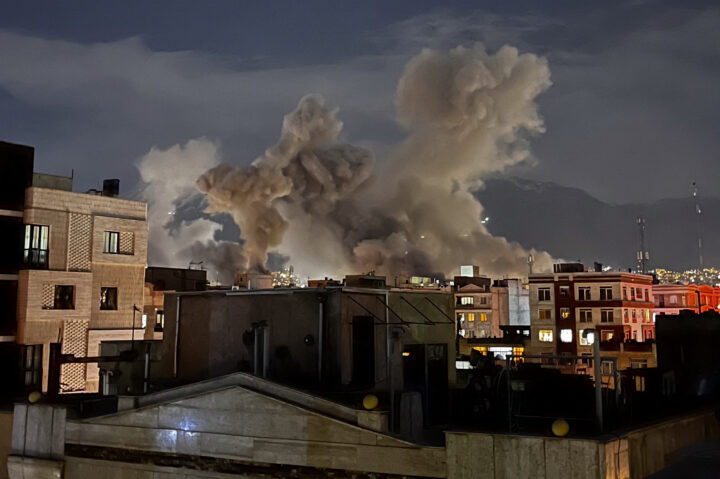
Mowj / Middle East Images / AFP via Getty Images
Plumes of smoke rise following reported explosions allegedly near Iran's Ministry of Intelligence on Araqi Street in Tehran on March 1, 2026.
Nearly two months after the U.S. and Israel jointly launched a military campaign against Iran dubbed Operation Epic Fury, Washington acknowledged in a new State Department memo that its decision to participate in the conflict came — at least in part — at Israel’s request.
The statement, in a document authored by State Department Legal Advisor Reed Rubinstein, notes that defending Israel is just one part of a larger rationale for attacking Iran’s capabilities that Rubinstein says relies on decades of evidence. But it comes after several Trump administration officials pushed back on the narrative that Israel had forced the White House’s hand.
“The United States is engaged in this conflict at the request of and in the collective self-defense of its Israeli ally, as well as in the exercise of the United States’ own inherent right of self-defense,” Rubinstein wrote in the document, dated Apr. 24.
The memo is the most detailed look yet at the Trump administration’s justification for the latest conflict with Iran, which began on Feb. 28. Lawmakers, including leading Republicans, have at times expressed frustration that the administration is not being transparent enough in providing information about the war effort.
There is currently a ceasefire in place as the two countries are engaged in negotiations, although President Donald Trump has threatened to restart military strikes if a deal is not reached.
While Rubinstein writes that Israel requested the U.S. participate in striking Iran, his broader argument is that Iran has demonstrated “malign aggression” against the U.S., Israel and other allies in the region for decades. Therefore, according to Rubinstein, this latest salvo is merely the next stage of a decades-old conflict that began anew last June.
“The operations recommenced in late February were part of an armed conflict with Iran that has been ongoing for years and, at the very least, since June 2025” when the U.S. and Israel struck Iran’s nuclear and military facilities, Rubinstein writes. Since the conflict did not officially end in June — a ceasefire is not the same as a formal agreement to end hostilities — he concludes that it has been ongoing, and the current fighting is just a new phase in the war.
“If a conflict has not ended, then it must be ongoing,” Rubinstein argues.
The memo documents Iran’s extensive history of targeting American forces and assets, including through its proxies like Hamas and Hezbollah. He dates this part of his analysis back to 1979, when the Islamic Republic was created, arguing that the country has been attacking the U.S. and its “interests and its allies” ever since. It was Iran’s “clear pattern of unprovoked aggression and direct and proxy attacks against Israel and the United States” that spurred the U.S. to act last June, he writes.
Rubinstein concludes by pointing out Iran’s response to the U.S. attacks: “wreaking havoc throughout the region.” That, according to Rubinstein, “further underscores the fundamental necessity, utility, reasonableness, and lawfulness of Operation Epic Fury’s mission and goals.”
The State Department-hosted discussions are expected to focus on extending the ceasefire, due to expire Sunday, and a U.S. request that Beirut repeal laws criminalizing contact between Lebanese citizens and Israelis
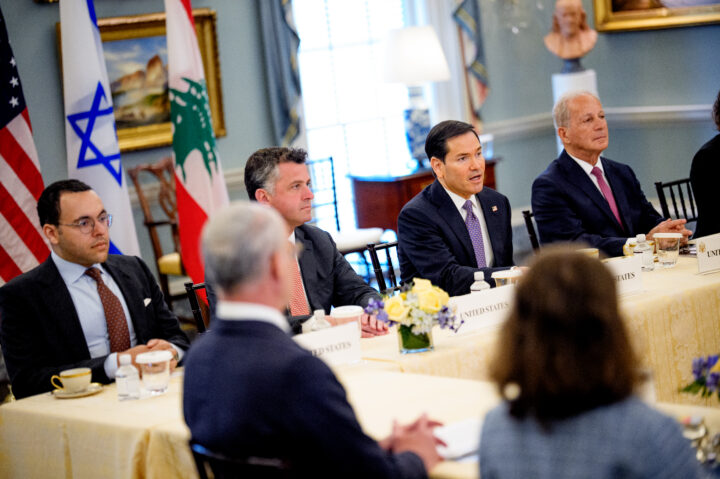
Andrew Harnik/Getty Images
U.S. Secretary of State Marco Rubio (2nd-R), accompanied by U.S. State Department Counselor Michael Needham (C), and U.S. Ambassador to Lebanon Michel Issa (R), speaks as they begin working-level peace talks with Lebanese Ambassador to the U.S. Nada Hamadeh Moawad and Israeli Ambassador to the U.S. Yechiel Leiter at the U.S. State Department on April 14, 2026 in Washington, DC.
The Trump administration’s latest push to ease tensions between Israel and Lebanon faces another key test this week as diplomats prepare for the second round of direct talks between the two countries on Thursday.
The State Department-hosted discussions are expected to focus on extending the current ceasefire, which is due to expire Sunday, and a reported U.S. request that Beirut repeal long-standing laws that criminalize contact between Lebanese citizens and Israelis. Lebanese President Joseph Aoun has said his aim in the talks is to see the IDF withdraw completely from the country.
The discussions follow a historic first meeting last week — the highest-level direct dialogue between the two nations in over 30 years. Since the ceasefire went into effect shortly after the meeting, Hezbollah has repeatedly fired on Israeli troops, provoking retaliation by the IDF. Both sides have accused the other of violating the ceasefire agreement.
Over the weekend, Hezbollah killed two French soldiers who were part of the U.N. peacekeeping force, prompting some leading Republican lawmakers to call for conditioning future U.S. support for the Lebanese Armed Forces on tangible action in disarming Hezbollah.
The talks also come as President Donald Trump extended the fragile ceasefire between the U.S. and Iran indefinitely until negotiations between Tehran and Washington are complete. Should the current halt in hostilities fall apart, experts suggested to JI, Hezbollah may reignite hostilities with Israel on an even broader scale.
Rep. Tim Burchett (R-TN) told Jewish Insider that he wants to see “peace” between Israel and Lebanon, adding that it would be a “great alternative” to the status quo.
“We’ve just got old leaders on all sides and all they want is war because it keeps them in power,” Burchett said. “Old men make decisions and young men die. I think they [Lebanon] are realizing maybe capitalism is probably a better route and not killing all their people.”
Burchett also expressed that he would “absolutely” back the U.S. pushing Lebanon to repeal its anti-contact laws. “I love the First Amendment, and I like it all over the world,” he said.
Rep. Jared Moskowitz (D-FL) shared the sentiment, telling JI he hopes “we can get a deal there,” adding that he would like to see a ceasefire extension to help achieve that.
“If the Lebanese people have made a decision that they don’t want Hezbollah in their country anymore, they don’t want the Iranians having control over their country, I think that’s great news for Lebanon,” Moskowitz said. He also expressed support for the U.S. urging Lebanon to repeal anti-normalization laws, stating, “If repealing the law is a step to get a deal, then I support it. There needs to be a deal.”
Rep. Brad Sherman (D-CA) said he is hoping to see the ceasefire extended, adding that “we all hope for the disarmament and hopefully disbanding of Hezbollah.”
“We’ll see whether the Lebanese government is going to make good on its promises to have a monopoly of force in its own territory,” Sherman said. He added that should the U.S. push Lebanon to repeal its anti-normalization laws, it would be an “excellent step.”
“It would be a good idea and hopefully done in coordination with other good steps by both Israel and Lebanon,” Sherman said.
Rep. Mike Lawler (R-NY) also agreed that such action “would be a positive step forward toward long-term peace and stability.” He added that he would like to see the current ceasefire between Israel and Lebanon be extended.
“Obviously we want long-term peace and stability,” Lawler said. “Talks have been going relatively well. We will see what comes next.”
Robert Satloff, executive director at The Washington Institute for Near East Policy, said he anticipates that the meeting “will be the bridge between last week’s historic opening on Lebanon-Israel direct talks and the start of formal negotiations between the two sides.” He said that it is “quite likely the two sides will agree to extend the ceasefire.”
“One can also expect discussion of other elements that will contribute to the success of the talks, including a possible meeting between U.S., Lebanese and Israeli leaders, the U.S. request that Lebanon repeal repressive laws that ban contact between citizens of the two countries and measures the Lebanese army and security forces should take to signal that this ceasefire will produce a better outcome for all parties than what followed the November 2024 ceasefire,” Satloff added.
Rachel Brandenburg, a senior policy analyst at Israel Policy Forum, said “the mere fact of a second meeting is a positive sign.”
“Top priority for Israel is the disarmament — and more so, dissolution — of Hezbollah, and retaining the freedom of action to continue to strike Hezbollah where and when they determine necessary for their own self defense,” Brandenburg said. “For the Lebanese government, sitting at the table with the Israeli government is both politically risky and an important opportunity for them to be recognized as and assert their place as the only recognized authority of the Lebanese state.”
David Daoud, a senior fellow at the Foundation for Defense of Democracies, meanwhile, said that expectations for talks “should be kept low” and expressed skepticism over whether Beirut would truly work to disarm Hezbollah. He argued that Lebanon is seeking a return to the status quo, noting that despite Trump’s intentions to bridge ties between the two nations, “President Aoun declined to speak with [Israeli Prime Minister Benjamin] Netanyahu and sources close to Aoun have rebuffed the possibility of a meeting between the two leaders as ‘premature.’”
“The question is whether Lebanon is seeking this breathing room as an end in and of itself or to begin gradually acting against Hezbollah,” Daoud said. “As matters stand, I see no indication of the latter.”
Daoud noted that Lebanon has had a “strong reluctance to call out Hezbollah by name since the ceasefire took effect” and also referenced a statement from Salam in which he said the country is “not seeking confrontation with Hezbollah.”
Yoni Tobin, a senior policy analyst at the Jewish Institute for National Security of America, also called for caution in optimism over the talks, stating that a ceasefire “does not constitute progress,” also noting that past ceasefires that halted fighting between Israel and Hezbollah “only kicked the can down the road in terms of disarming Hezbollah.” He also expressed skepticism over Lebanon repealing its anti-normalization law.
“Beirut repealing its law criminalizing communications should be a clear-cut U.S. demand in talks, but I haven’t seen any evidence to suggest that is on the table right now — though it should be,” Tobin said. “As one of the main funders of Lebanon’s military, Washington has the leverage to compel Beirut to reverse this arcane law, which remains an obstacle to what is squarely in the American interest: a normal, productive relationship between Israel and Lebanon.”
Trump’s former top diplomat sat down with JI to discuss the U.S. war in Iran, backsliding support for Israel among young Americans, and how he’s looking at the midterms

Siavosh Hosseini/SOPA Images/LightRocket via Getty Images
Former Secretary of State Mike Pompeo speaking at a conference titled "Iran: Organized Resistance, Key to Overthrow" held at the National Council of Resistance of Iran (NCRI) headquarters in January 2025.
Former Secretary of State Mike Pompeo is keeping the door open to a possible 2028 presidential run, saying “only the good Lord knows” what comes next as he continues to reestablish himself in the private sector and policy world after serving in the first Trump administration.
In a wide-ranging interview with Jewish Insider, Pompeo emphasized that there will be a “donnybrook” of competing visions for both parties in the next election cycle, and urged candidates to focus on “important issues” rather than online theatrics. He also praised Columbia University, where he now teaches at the School of International and Public Affairs, for “beg[inning] to get back the correct leadership … in a way where more voices can be heard.”
The conversation came one day after Pompeo made a brief visit to the State Department for a private ceremony unveiling his official portrait. The gathering included an appearance by Secretary of State Marco Rubio, who delivered remarks to the crowd on his predecessor’s tenure as the chief U.S. diplomat.
This interview has been condensed and edited for clarity.
Jewish Insider: What’s your message to the current Iranian leadership if you were traveling to Islamabad, Pakistan, on behalf of President Trump to negotiate an end to the war in Iran?
Mike Pompeo: My message would be that you’ve lost. You’ve lost the people of your country, who no longer want you to lead. You’ve lost the capacity to project terror around the world. You’re about to lose any capability to use nuclear weapons to continue to blackmail the world. The Strait [of Hormuz] is going to be reopened. You’re going to miss payroll in just a few weeks, because you’re not going to be able to ship product and receive currency that is usable in foreign exchange, and people will stop doing their jobs.
You miss payroll enough times and all of a sudden, Hezbollah decides it’s not as great a fighting force, or the Shia militias, or the knuckleheads in Yemen, the Houthis. They’ve all become hooked on Iranian money.
There is a solution that is different to that. It’ll mean you’re not in power. It will mean that you lose. It will mean that you personally lose power, but the other alternative is that you will be killed.
JI: Do you think that the president made the right decision by reentering negotiations with the Iranians when he did, or do you think there are targets he should have hit beforehand, for military or diplomatic leverage?
Pompeo: I think the blockade is sufficient to merit another try. Look, I’m deeply skeptical. I’m not sure there is a decision maker in Iran today. I think there are multiple fractured decision making processes and lots of confusion.
I don’t know that he needed to go after additional targets. The denial of their capacity to move product through the strait is a very significant impact on them, but I do think it’s the case if, in fact, the Iranian regime cannot coherently present a resolution that will look and feel to them like surrender … — because they’re going to give up the entirety of their nuclear program, they’re going to have to stop funding their proxy forces, their ballistic missile program is gone, their industrial base will have to be shut down and redirected towards commercial activity, not terror; that will feel like surrender to them — then I think the president will have to begin to go back at some of those industrial targets that continue to pose risk to Israeli and American servicemembers that are in the region, and more broadly, to commercial activity that needs to move through the region as well.
JI: We’re seeing a lot of reporting about various terms that the Trump administration has purportedly offered Iran in these talks, specifically when it comes to the enrichment of uranium. There have been reports suggesting the U.S. proposed a 20-year moratorium on Iran’s enrichment program, while others allege a 10-year pause is being discussed. What do you make of these reported offers and, more broadly speaking, what would a good deal look like to you?
Pompeo: Color me cynical, but having lived as a secretary of state for two and a half years, when I see that reporting — and I don’t have first hand knowledge — I suspect that is someone playing games.
I put no credit in anything that I read in The New York Times or The Washington Post, only in the sense that they don’t know or they heard from a single individual that wasn’t actually representing the holistic view of the U.S. government. I spend no time thinking about those. I do spend a lot of time thinking about what “good” looks like. Good is infinity.
I’m also practical as someone who was a practitioner. I get it. You don’t ever get forever, but you don’t put external constraints on duration when it comes to something as serious as a regime that is in power with the capacity to inflict enormous harm on the world, with a conventional force that is serious and a nuclear capability that is real.
There’s two things. One, you can’t pay them. That’s what President Obama, then President Biden tried to do, send pallets of cash to buy your way out of this solution. The regime is not for sale. Second, I think it’s also the case that you can’t falsely give them hope that says, ‘You’re going to be able to return to status quo in five years, 10 years, 20 years from now. I think it’s the case that we’ve reached the moment where now this is a durational change in the nature of the regime.
Maybe some of the names will be the same, maybe the good spirit will move them and they will become a normal nation again. These are the things we hope and pray for as Jews and Christians, but we also do it with the knowledge that it is unlikely, and that means we have to change the leaders that are actually directing activities inside of the country.
JI: Do you think NATO has handled this moment and responded to President Trump deciding to take action in Iran well? The president is vocally frustrated with them and thinks they’ve been a thorn in the administration’s side.
Pompeo: We all know that you figure out exactly who’s with you in times of stress. This is true in our personal lives. It’s true in our professional lives. It’s certainly true in sovereign interactions.
Putting aside NATO for the moment, the way some of the European nations have behaved is absolutely abhorrent. I get that they weren’t brought in at the beginning and how that makes it complicated and it creates hurt feelings, but this isn’t about feelings. This is about national sovereignty and the safety of their own citizens.
Whether it was Spain or another nation that wouldn’t do so much as to be quiet and allow our aircraft to fly through their space, for someone who has been a staunch defender of NATO, because I believe deeply it has been important to the United States of America and to global security, to watch a leader of a country cozy up to China while the United States is doing its level best to save the very security for his own citizens is deeply indecent.
I hope there will come to be an understanding that America is indeed the good guy in this all throughout Europe and many nations in Europe, that’s why I hesitate to broad brush NATO. Many nations in Europe have actually been great and have done their best with the tools that they have available. Others have chosen a path that is very different from that. I think that will be something that takes a long time to rebuild — the trust with those countries — and they’ll have to demonstrate that they are worthy of partnership with Israel or the United States or the West.
JI: Are you still facing death threats from Iran or has your standing with Tehran changed as a result of the war?
Pompeo: As far as I know, they have not lifted the fatwa on me, so yes. We still do our level best to have adequate security to keep me from being killed by the Iranians, who have repeatedly said that they would like to see me go away.
JI: How would you grade Israel as an ally, both historically and in the last few years in the post-Oct. 7, 2023, landscape?
Pompeo: First, the United States and Israel have sovereignty, they’re independent of each other, and a different set of priorities and a different set of understandings on particular matters, very full stop. Second, they are the most fundamentally important ally and a great partner and enormous friends and important to the United States in so many deep ways.
As a Christian, this matters to me, but more importantly as a security matter, I had no better partner than the Israeli intelligence services when I was CIA director and Prime Minister Netanyahu and the foreign policy and security team inside of Israel when I was secretary of state. They did so many things to help America, often when it was difficult and much more in our interest than theirs.
That doesn’t mean we’re not going to have knock down, drag out fights over certain things. I’m sure that’s going to be true. We’ll have different target priorities, and that’s normal. It would be odd if you didn’t find that, but boy, I don’t know that the United States has ever had a closer military and security relationship than today between the United States and Israel, and I think the Iranians found that out the hard way.
They saw us flying together. They saw us intelligence sharing together. They saw the hard work that is the logistical tail that sits behind all of this. It doesn’t get much glory, but you’ve got to move a lot of ammo, a lot of fuel, a lot of people, a lot of stuff. We did that alongside Israel, and it would have been very difficult for either of us to have achieved what’s been achieved today without the other.
JI: With that in mind, we’re seeing a real shift in attitude, especially with young people, both in the Democratic and Republican parties on supporting Israel. What’s your reaction to this and what do you think was the catalyst for this change? Do you attribute it to negative feelings about the war on terror in the 2000s? What role do you think antisemitic figures in the podcast space play?
Pompeo: The causation is so difficult to identify. I think probably each of those has some element of impact and shaping. Israel has always been a flashpoint because of the conflict between Israel and the terrorists, but it’s been framed as a Palestinian-Israeli conflict, with Israel pitched to most of the world as the bad guy in that. My judgment is nothing could be further from the truth.
Israel has simply wanted to live as a sovereign, independent nation. It’s made many offers. The Palestinian Authority rejected them for decades. I think that has worn on a certain piece of the intelligentsia, the American left and some pockets on the right for sure. Some of it’s rooted in antisemitism, almost certainly. Some of it’s rooted in that it’s popular. It’s cool on a campus because the faculty is all talking about the genocidal horrors inflicted by Israel, which, I mean, it’s just patently false. I think each of those things contribute to it.
My prayer and my hope is, and I think this will prove to be true, that in the end, decent people who are part of Western civilization can identify evil from good, and will see the difference between the two. They may not like a particular strike that the United States takes somewhere where innocent civilians are killed — it’s true, as collateral [damage], it happens — but they will be able to see the difference between genocidal intent, that is driven by the Iranian regime around the world, and a desire for peace, which is driven by nations like the United States and Israel.
That means those of us who see it that way have a duty to try and articulate it, to explain it, to be relentless in articulating why that’s true, not to call people names, not to mock them, but rather to make the arguments, to use reason to convince them of reality and of the truth about what’s really taking place there. I pray one day that the bad guys will lay down their weapons, because the moment they do, the reality will be before us all. There will be peace.
JI: Staying on politics, there’s a lot of trepidation from Republicans on Capitol Hill about how the November midterms are going to play out. Do you share that concern?
Pompeo: Having served in Congress, having been elected four times, I’m always mindful that this conversation isn’t that important. What’s really important is that you work your tail off, and you, the candidates, have the first responsibility, and the rest of us try our best to help them.
It is the case, I think, that there’s a lot of energy in the progressive movement on the left today. I think that energy is there that sometimes has been more on our side. When I got elected in 2010, we had 74 brand new Republicans in districts we hadn’t won in years and years, so there was more energy. I think the next six months require us to go build that energy. If we build that energy, I think we’ll do better than the mean.
These midterms are always tough for the party that’s in control. No reason to think that historical change will take place, but if you work hard and tell a story properly, which is that these conservative ideas will deliver better outcomes for America, then we’ll do better than I think some of the fearmongers are predicting.
JI: Do you worry about the situation in the Middle East hurting Republicans in November?
Pompeo: You’ve seen that already. You’ve seen Sen. [Chris] Murphy (D-CT) do this. You’ve seen Sen. [Bernie] Sanders (I-VT) do this. They’re already trying to say: ‘This was a war of choice. President Trump failed. This is a disaster. Look how expensive gasoline is.’ So yes, this will be part of the political conversation, but that just means you have to go and articulate the why of this.
I know how people are struggling, and I feel bad when I see gas prices high for everybody too, especially the least amongst us, but I’d remind them we just have lived in this false state for so long where we thought we could just ignore this problem when it had to be solved. If the price of that, of solving that and keeping Americans for decades to come from Iran with a nuclear weapon, then to pay a little bit more at the gas pump for a little while is an acceptable cost, in my view.
I think most Americans actually get that, and they just need to understand the why and the how. When explained, I think they’ll come to the same conclusion I do, that this was a noble and important decision that President Trump made, and that it is, in the long run, better for them and their children and their grandchildren. We [Republicans] shouldn’t play politics with it either, because this is about national security, but we should articulate the rationale for why this is the best outcome for every American, Democrat and Republican alike.
JI: How are you looking at the 2028 Republican presidential bench? Do you see yourself being a part of that race?
Pompeo: It’s gonna be a donnybrook on both sides. I think there will be lots of candidates who present themselves, and I love that. As for what comes for the Pompeo family next, only the good Lord knows. We’ll see. I have a brand new grandson, I’m loving life, but we’ll see.
But I will say something that I do think is really important about the 2028 election. I hope it’s fought over important issues in a rational way. I hope the progressives show up and make their best arguments to the American people, and that the center-left and center-right do the same, and the MAGA folks and the right wing, just everybody don’t do memes, don’t tell fibs, don’t think, ‘Gosh, I was really good. I owned a lib on X.’ That might bring a sugar high, but what it doesn’t do is really deliver for the American people. I hope the campaign will turn out to be about things that really matter and be discussed in a serious way, and if so, I always have confidence the American people will get it right.
JI: What are the next steps for you in your career?
Pompeo: I’m back in the business world. It’s what I did for most of my life, before I ran for Congress. I’m involved with a private equity firm. I’m helping a couple other businesses as a board member, back in the capitalist mode, and that’s great because there’s lots of risk but lots of joy. … I’m keeping my hand in the policy space too. I teach at Columbia University and at Liberty University, two very different institutions, and I love them both, each in their own way. Then I’m trying to help some candidates be successful in these midterm elections as well.
JI: We’ve covered Columbia closely at JI since Oct. 7, and it’s notable for them to have a voice like yours join their faculty. On that front, what’s your take on the lack of campus protests or encampments against the Iranian regime? We’re not seeing the same type of protests we saw against Israel taking place against Iran.
Pompeo: It’s a great question. It got out of control because of failed leadership. The institution’s leaders failed those students. They didn’t keep the students safe. They didn’t set the correct boundaries.
We all want to protect First Amendment freedoms. That’s what college is about. Knock yourself out. You can say crazy stuff, but you can’t threaten and you can’t put other students at risk, and you can’t blockade classrooms so the students can’t enter. That’s just functionally terrible leadership.
I think what you’re seeing is some of these institutions have begun to get back the correct leadership, and I think they’ve actually done it in a way where more voices can be heard.
I was at another liberal campus a few weeks back, and some of the conservative students were still saying to me that they felt like it was still difficult to speak up in class, and that the faculty was, they didn’t use the word oppressive, but they felt the faculty was difficult. I hope that veil will be lifted, and I hope those students and all students that have different views will all feel comfortable saying, ‘Here’s what I think, and here’s why I think that.’ Then somebody will challenge them and say, ‘Well, have you thought about X or Y,’ or ‘I see it differently.’ That’s what these institutions are all about. It’s what Columbia was when it was at its finest. That’s what Harvard and Dartmouth and Liberty all should aspire to.
Plus, Michigan Dems swap Jewish regent for Hezbollah cheerleader
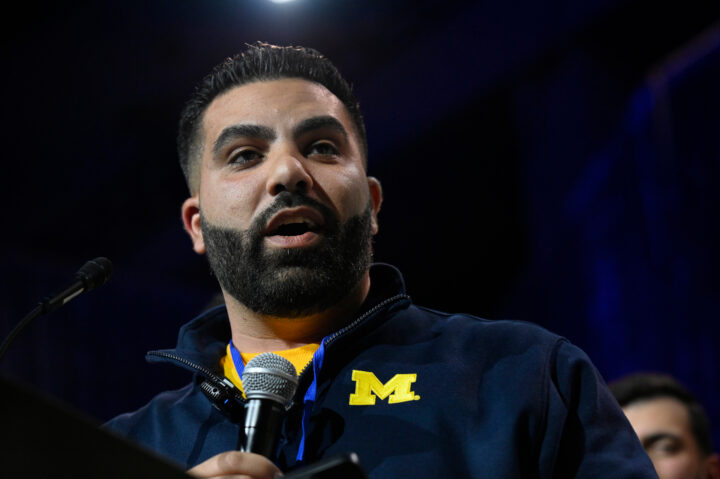
Jose Juarez/AP
Amir Makled, a candidate for the University of Michigan Board of Regents, addresses delegates after winning the party's nomination during the Michigan Democratic Party State Endorsement Convention, Sunday, April 19, 2026, in Detroit.
👋 Good Monday morning!
In today’s Daily Kickoff, we look at deepening concerns among Jewish Democrats over the party’s increasing embrace of terror supporters and antisemitism, and report on recent polling from Israel that indicates a divide in public opinion over the Trump administration-brokered recent ceasefires with Iran and Lebanon. We cover the weekend’s Alex Soros-backed inaugural Global Progressive Summit in Barcelona, and break down the results of last week’s special election in New Jersey’s 11th Congressional District, where progressive Analilia Mejia sailed to victory, despite a lack of support from some of the district’s most Jewish areas. Also in today’s Daily Kickoff: Rabbi Ephraim Mirvis, Raz Hershko and Luke Lindberg.
Today’s Daily Kickoff was curated by JI Executive Editor Melissa Weiss and Israel Editor Tamara Zieve, with assists from Danielle Cohen-Kanik and Marc Rod. Have a tip? Email us here.
What We’re Watching
- Vice President JD Vance is expected to return to Islamabad, Pakistan, this week for a second round of talks with senior Iranian officials amid conflicting reports over the status of the talks, with Iran saying it has not yet decided whether it will send representatives to the negotiations.
- Meanwhile, Tehran threatened retaliation this morning for the U.S.’ weekend attack on and seizure of an Iranian-flagged ship in the Gulf of Oman that had attempted to evade the Navy’s blockade of the Strait of Hormuz.
- Argentine President Javier Milei is in Israel today after arriving over the weekend ahead of events around Israel’s Yom HaZikaron and Yom HaAtzmaut, the country’s back-to-back commemorations of Israel’s fallen soldiers and victims of terror, and its Independence Day. Yesterday, Milei and Israeli Prime Minister Benjamin Netanyahu launched the Isaac Accords between the two countries. Read more about the initiative here.
- Israel will hold official Yom HaZikaron events at the Western Wall this evening and at Mt. Herzl, the country’s military cemetery, tomorrow morning.
- In Washington, Secretary of State Marco Rubio will speak this morning at a State Department ceremony unveiling the portrait of former Secretary of State Mike Pompeo.
What You Should Know
A QUICK WORD WITH JI’S JOSH KRAUSHAAR
Events in recent days may well be marking a tipping point in the decline of the Democratic Party — at least when it comes to its treatment of Jews, on top of its growing hostility toward Israel.
The weekend ended with the news that Michigan Democratic delegates, at their statewide convention Sunday, nominated a Hezbollah supporter, Amir Makled, to the University of Michigan Board of Regents, choosing to oust a Jewish member, Jordan Acker, whose home and car were repeatedly vandalized with antisemitic graffiti and his family threatened.
Acker’s offenses? He backed efforts to hold anti-Israel campus protesters at the University of Michigan accountable for assaulting police and engaging in intimidation of Jewish students, among other instances of student misconduct. He declined to support efforts to divest university funds from Israel, along with other members of the Board of Regents, as a radical faction of students had demanded.
Acker’s non-Jewish Democratic ticketmate, Paul Brown, who also supported discipline against anti-Israel students, wasn’t targeted and was renominated for election. But the Democratic delegates ousted Acker in exchange for Makled, who has posted on social media with comments praising Hezbollah’s leaders and retweeted antisemitic messages from the conspiracy-theorizing influencer Candace Owens.
The results mark a new low for Michigan Democrats. Also over the weekend, Michigan Senate candidate Abdul El-Sayed told CNN that he believes the Israeli government is just as evil as Hamas. Read more here.
In the same interview, El-Sayed also said that Sen. Chris Van Hollen (D-MD) should replace Senate Minority Leader Chuck Schumer (D-NY) as the Democratic leader in the upper chamber, citing Schumer’s continued support for U.S. aid to Israel. Van Hollen is among the most vocal critics of Israel in the Senate.
Michigan is a closely watched bellwether of the direction of the Democratic Party, and the latest developments underscore that a more radical faction of the party appears to be growing. This, in the state where dozens of Jewish preschoolers were nearly killed in a terrorist attack last month by a Hezbollah sympathizer who targeted the state’s largest synagogue.
dem defections
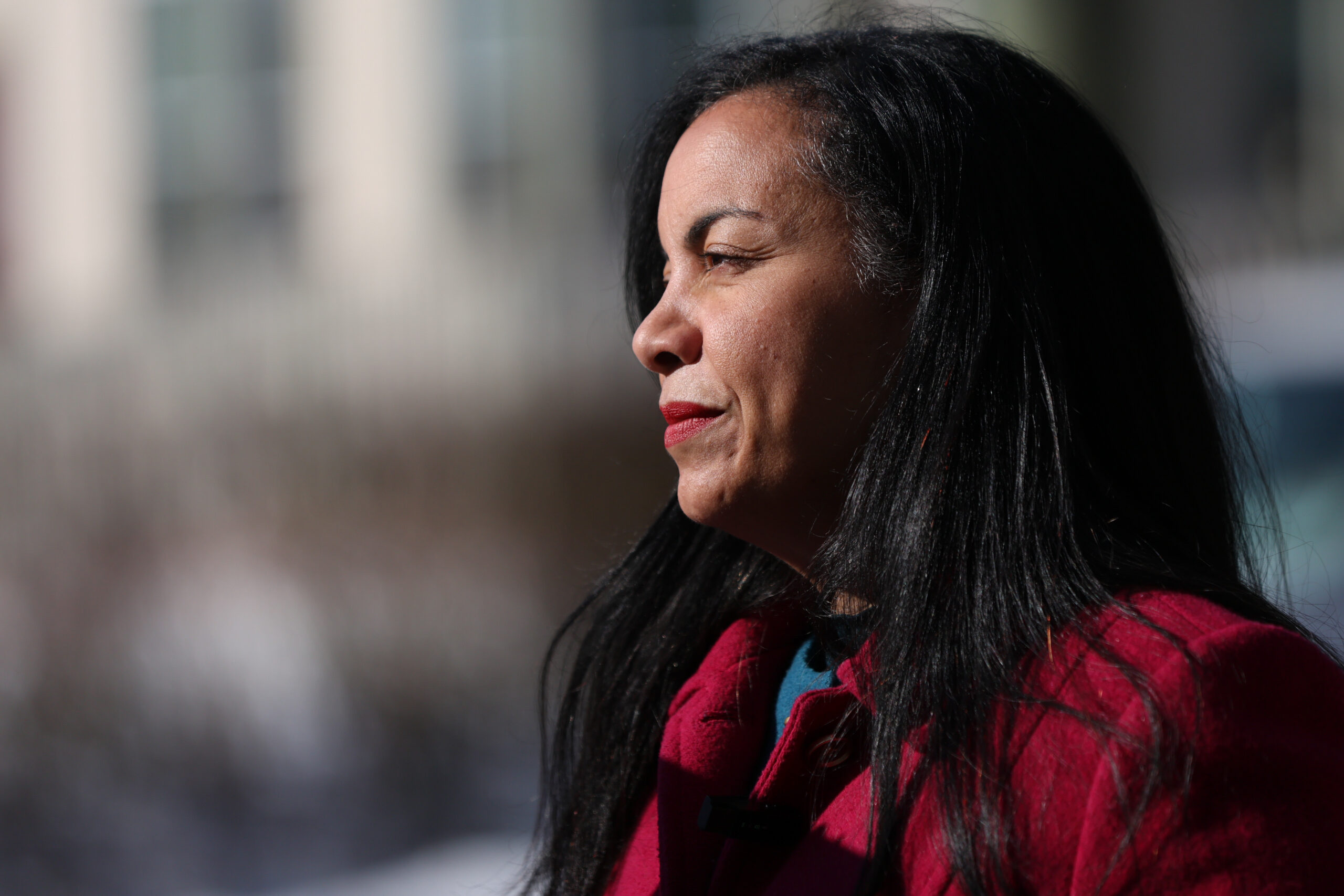
Rep.-elect Analilia Mejia (D-NJ) cruised to victory in last Thursday’s special election for New Jersey’s 11th Congressional District, but the results showed notable defections among Jewish Democrats — an early warning sign for both the left-wing Mejia and her party, Jewish Insider’s Marc Rod reports.
By the numbers: Mejia ran significantly behind other recent Democratic candidates in two municipalities that have traditionally strongly favored Democrats — Livingston Township and Millburn Township — both areas with significant Jewish populations. In Millburn, Mejia lagged 22 percentage points behind former Vice President Kamala Harris’ performance in the 2024 presidential election, and 17 percentage points behind Harris in Livingston.
SPEAKING OUT
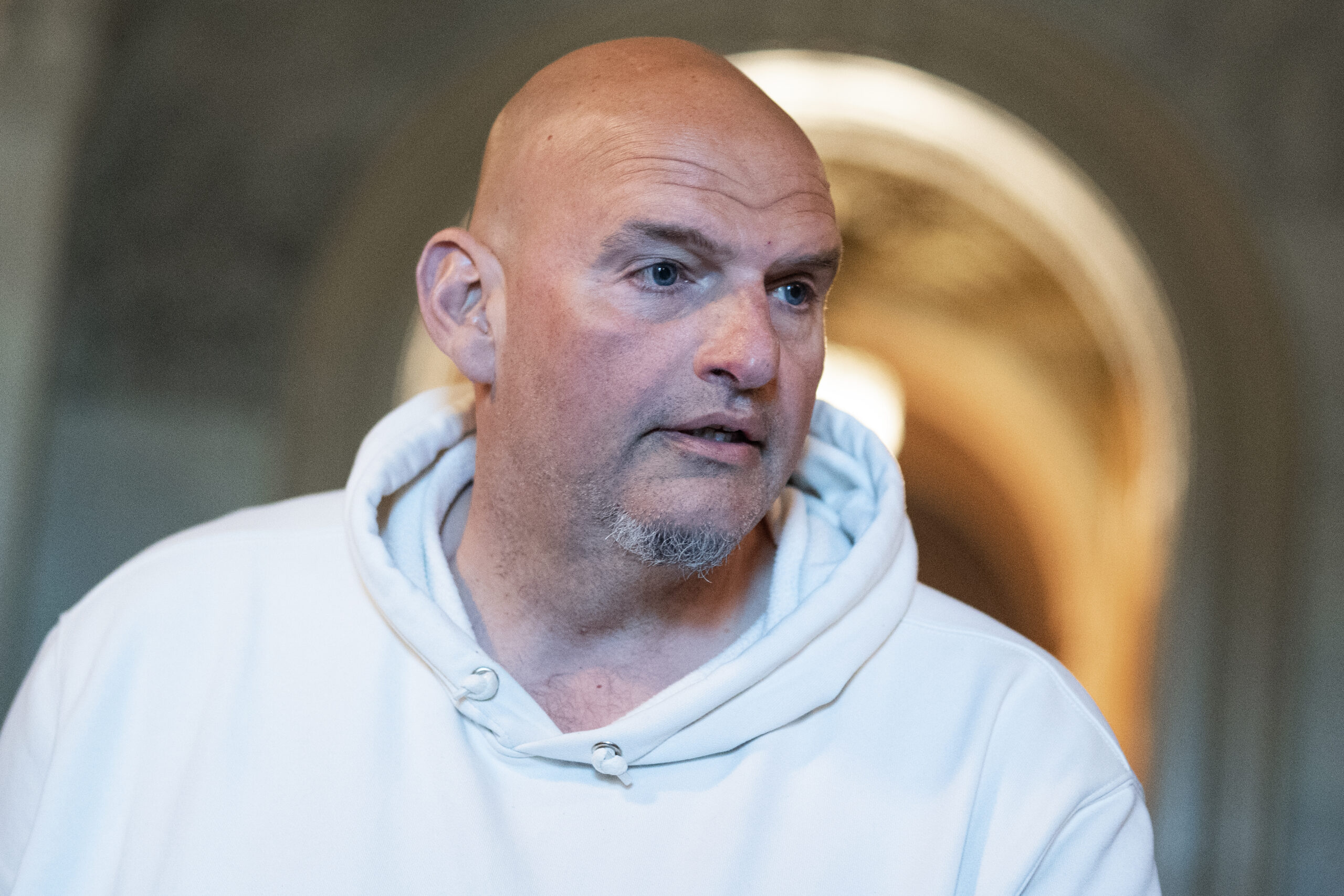
Sen. John Fetterman (D-PA) said on Friday that the Democratic Party “absolutely” has an issue with rising antisemitism, calling out the party’s embrace of candidates including Graham Platner in Maine and Abdul El-Sayed in Michigan while criticizing the recent progressive push to cut off defensive aid to Israel, Jewish Insider’s Emily Jacobs reports.
What he said: The Pennsylvania senator made the comments after being asked on CNN’s “The Arena with Kasie Hunt” if he believed the Democratic Party has a problem with antisemitism. Fetterman argued that the growing support for both candidates in their respective primaries was indicative of a tolerance for antisemitism within the party. “I mean, the guy that’s going to win the primary in Maine has a Nazi tattoo on his chest and now that’s no problem for a lot of voters,” Fetterman said.
IDENTITY CRISIS
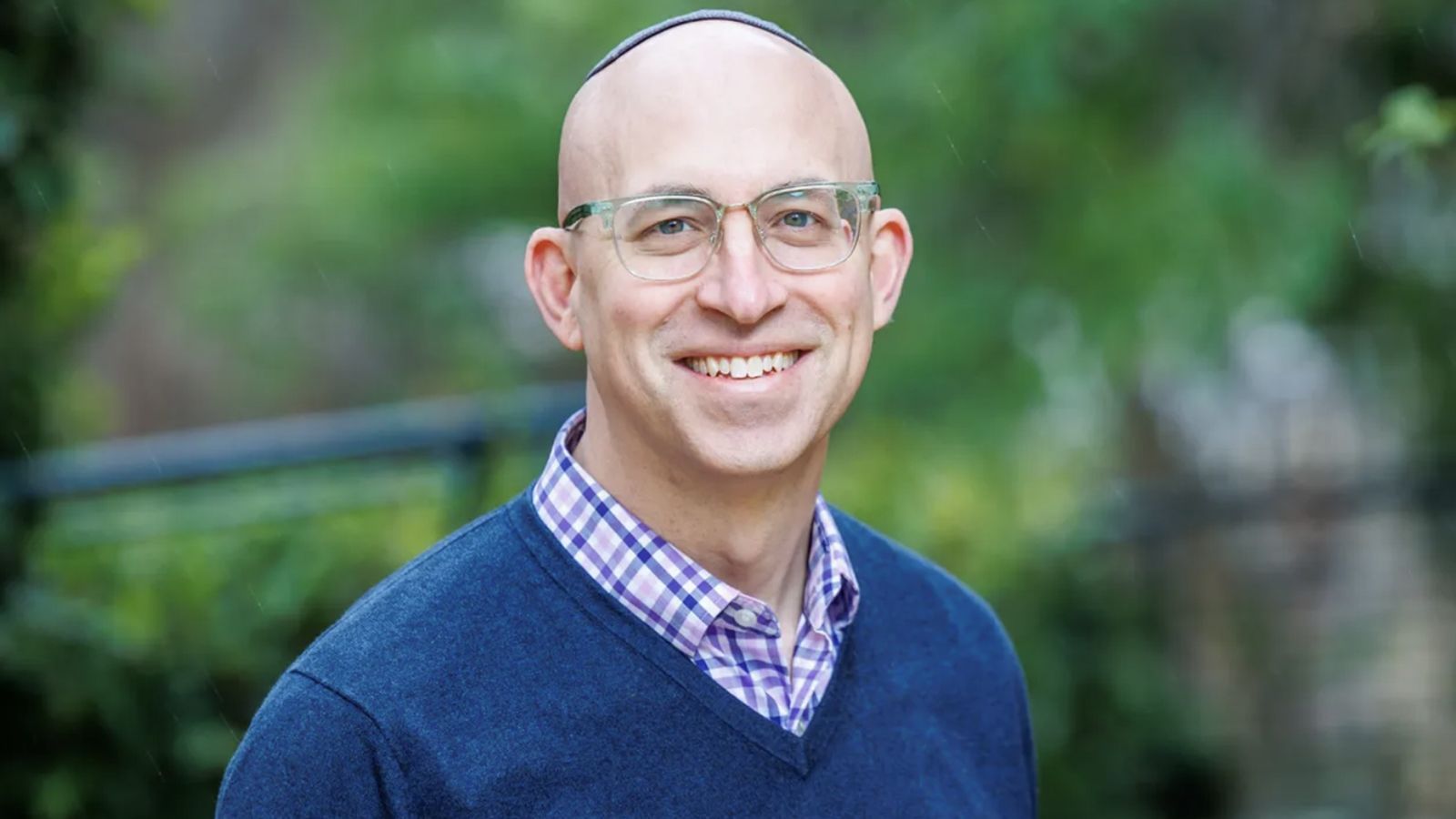
Amid a surge in antisemitism across the political spectrum, many American Jews have described feeling a growing sense of isolation. But for Yehuda Kurtzer, president of the Shalom Hartman Institute, being “politically homeless” is not a crisis to be solved, but rather a position to be embraced, Jewish Insider’s Matthew Shea reports.
A different perspective: “I don’t think some measure of political homelessness is a fundamentally bad thing,” Kurtzer said on Thursday while speaking alongside Jeffrey Goldberg, editor-in-chief of The Atlantic, at the Capital Jewish Museum in Washington. “I think Americans have become hyper-partisan in ways that reflect that partisan political identity has become part of our identities in ways that are not healthy for Americans.” Kurtzer and Goldberg sat in conversation at an event focused on American Jewry ahead of the upcoming 250th anniversary of the founding of the United States.
the view from israel

A weekend of diplomatic turbulence has deepened fault lines in Israel over the ceasefires in Lebanon and Iran, with public opinion split along political lines over whether President Donald Trump is serving Israeli interests — or overriding them. Trump’s announcement of a ceasefire in Lebanon on Thursday, before any known progress had been made in talks between Jerusalem and Beirut toward dismantling Hezbollah, already made waves in Israel, Jewish Insider’s Lahav Harkov reports.
Tough talk: Israeli Prime Minister Benjamin Netanyahu said on Friday that “we have not yet finished the job,” but said Israel was “provid[ing] an opportunity to advance an integrated diplomatic and military solution with the Lebanese government,” at Trump’s request. Within an hour of the release of Netanyahu’s statement, Trump published a Truth Social post in which he “PROHIBITED” Israel from continuing to bomb Hezbollah targets, adding: “Enough is enough!!!” Shira Efron, a senior fellow at RAND who serves as the think tank’s distinguished chair for Israel policy, told JI that “there is no question that the tone – ‘prohibited’ in upper case, ‘enough is enough’ – struck a sensitive note in Israel, and people are talking about a vassal state.”
Under pressure: Rep. Brian Fitzpatrick (R-PA), a moderate Republican and co-chair of the House Problem Solvers Caucus, introduced a war powers resolution on Thursday that aims to enforce the deadlines for the war in Iran laid out in the 1973 War Powers Act, breaking with all Republicans except Thomas Massie (R-KY) JI’s Marc Rod reports.
ENVOY SPOTLIGHT
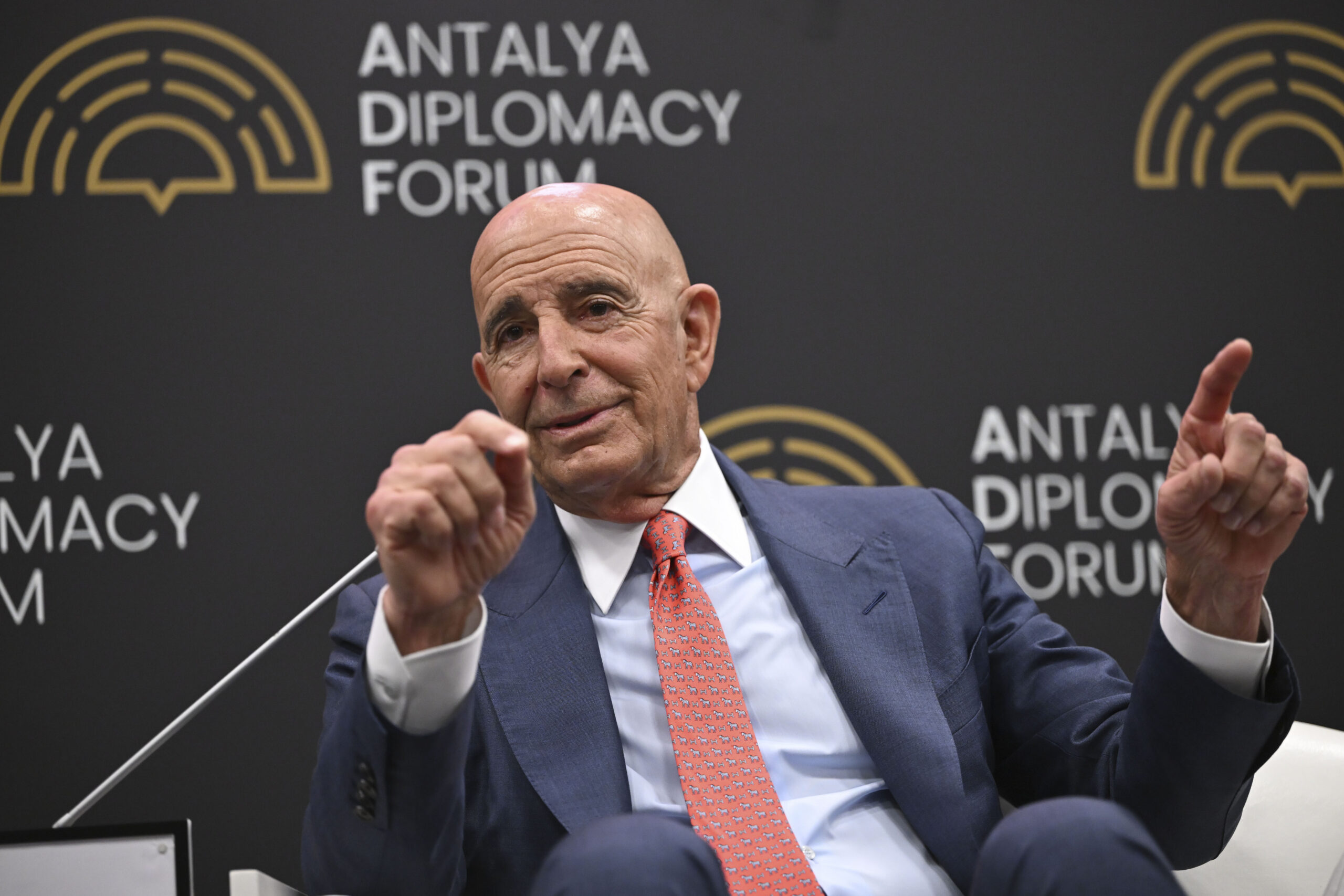
U.S. Ambassador to Turkey Tom Barrack faced fresh condemnation from two Senate Republicans and conservative influencers for a series of comments he made at the Antalya Diplomacy Forum in Turkey this weekend in which he repeatedly criticized Israel and praised Ankara, Jewish Insider’s Marc Rod reports.
Hezbollah hiccups: To comments by Barrack claiming that the current ceasefire in Lebanon “is so delicate because everybody has been equally untrustworthy” — referring to both Israel and Hezbollah — Sen. Lindsey Graham (R-SC) said he “respectfully and strongly disagree[s].” Barrack said at the conference there needs to be “a path with Hezbollah, and that path has to be not killing Hezbollah.” He further dismissed the idea that the Lebanese Armed Forces would act to disarm Hezbollah, as is required under the terms of the current and past ceasefires. “I always get in trouble because Hezbollah, in American parlance, and most of the West, is a foreign terrorist organization. Hezbollah, in Lebanon, is also a political organization,” Barrack added.
UNITING THE GLOBAL LEFT
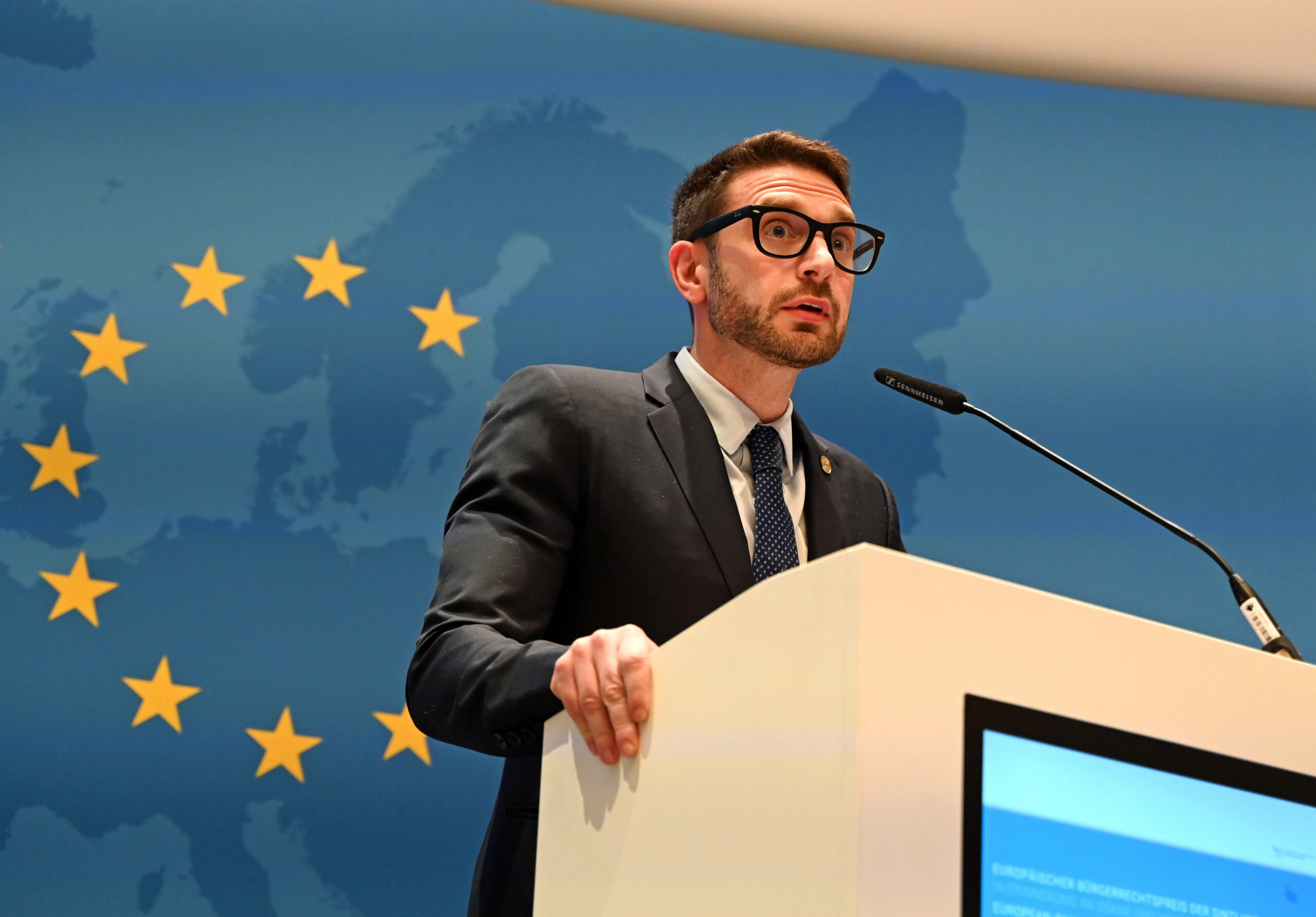
A range of Israel critics, from Sen. Chris Murphy (D-CT) to Israeli lawmaker Ahmed Tibi, were among those gathered in Barcelona, Spain, over the weekend for the inaugural Global Progressive Summit, backed by left-wing philanthropist Alex Soros. The conference brought together representatives from over 40 countries, offering, according to its website, “a necessary alternative to conservative and far-right forces,” Jewish Insider’s Lahav Harkov reports.
In attendance: Spanish Prime Minister Pedro Sánchez, an outspoken critic of Israel who called on Saturday to downgrade EU-Israel relations, hosted the two-day conference, whose American attendees also included Minnesota Gov. Tim Walz, with Soros. Sen. Bernie Sanders (I-VT), New York City Mayor Zohran Mamdani and former Secretary of State Hillary Clinton sent video messages. South African President Cyril Ramaphosa, whose government petitioned the International Criminal Court to prosecute Israeli leaders, Brazilian President Lula de Silva and U.K. Justice Secretary David Lammy were also in attendance.
Worthy Reads
Dumb and Dumber: The Atlantic’s Yair Rosenberg explores the expanding platforms of influencers and public figures who are uneducated on the issues about which they speak and unchallenged by interviewers. “Talking with Piker about a political coalition to save American democracy without discussing his affinity for China’s rulers is like teaming up with Carlson without interrogating his praise for Russian President Vladimir Putin — or with Donald Trump without examining his outlook toward Israeli Prime Minister Benjamin Netanyahu. And yet, only the debate over the latter tends to happen, such that Israel crowds out all other considerations, including extremely consequential beliefs that can end up going unchallenged.” [TheAtlantic]
It’s All Relative: In The Washington Post, the American Enterprise Institute’s Danielle Pletka raises concerns about the presence of relatives of officials from American adversaries who are living in the U.S., amid an effort to deport some of those family members. “The U.S. is littered with other nepo babies, wives and cousins — what the Iranians and Arabs call aghazadeh and the Russians call mazhor — enjoying the privileges of living in the land of the free, often made possible by the ill-gotten gains of the fam back home. It’s little wonder why they came. … It turns out the easiest route is through higher education, with some institutions explaining outright how F-1 student visa holders can transfer to permanent status upon graduating.” [WashPost]
Dropping the Trump Name: The New York Times’ Eric Lipton spotlights an effort by the wealthy Khayyat family in Syria to influence U.S. foreign policy in Syria through the Trump family’s business dealings. “Such a mixing of personal and diplomatic affairs has long been the norm in Middle Eastern nations, where a small set of players have historically run, and profited from, their dominant role in society. But it has become the way Washington operates in Mr. Trump’s second term, too. … [A friend of Mohamad Al-Khayyat, Syrian American businessman Tarek] Naemo, who is based in Florida and runs an investment firm that he said had done deals with partners including the Qatari Investment Authority, began with his wife to court at least a dozen members of Congress, starting with Speaker Mike Johnson.” [NYTimes]
Word on the Street
President Donald Trump nominated Under Secretary of Agriculture Luke Lindberg to serve as the next head of the World Food Program, following Cindy McCain’s announced departure from the role over health issues…
The New York Times looks at divisions within the conservative campus movement in the wake of Turning Point USA founder Charlie Kirk’s assassination in September, finding that members of some campus chapters and breakaway groups are split “over support for Israel, the showcasing of conspiracy theorists and who is rightfully American,” as well as disagreements over the war against Iran…
Buckley Carlson, the son of Tucker Carlson, departed his role as deputy press secretary to Vice President JD Vance to start his own consulting firm…
Commerce Secretary Howard Lutnick was spotted with Philadelphia 76ers owner Josh Harris as the 76ers took on the Boston Celtics in Massachusetts over the weekend…
Authorities in Los Angeles arrested an Iranian woman with permanent U.S. residency status accused of brokering sales of Iranian weapons to the Sudanese Armed Forces for use in the African country’s yearslong civil war…
A George Washington University alumna is suing the school and her former employer, Ernst & Young, as well as a number of GWU officials, alleging that she faced retaliation and discrimination in the wake of an address she delivered at one of the school’s 2025 commencement ceremonies; her remarks calling for GWU to divest from Israel deviated from those approved by the school…
Rümeysa Öztürk, the Tufts University graduate student who was detained for more than a month by immigration officials for co-authoring an op-ed critical of Israel, is returning to Turkey, having completed her Ph.D. studies at the Boston-area school…
The New York Times reviews When We See You Again, Rachel Goldberg-Polin’s account, which will be released tomorrow, of her life before and after the 2024 death of her son, Hersh Goldberg-Polin, at the hands of his Hamas captors…
Canada’s Centre for Israel and Jewish Affairs, with the backing of more than 80 Jewish groups, is calling on the federal government in Ottawa to increase funding to address “rising security demands” as the country sees a sharp increase in antisemitism…
A French peacekeeper was killed and three others members of UNIFIL, the U.N.’s peacekeeping force in Lebanon, were injured in what France and UNIFIL said was a Hezbollah attack; French President Emmanuel Macron, whose government was sidelined from recent U.S.-brokered talks between the Lebanese and Israeli ambassadors to Washington, called on Beirut to “immediately arrest those responsible and assume their responsibilities alongside UNIFIL”…
An appeals court in France ruled than an Algerian-born nanny who worked for a French Jewish family was not acting out of antisemitism when she poisoned family members, despite having told police, “Because they have money and power, I should never have worked for a Jewish woman; she only brought me trouble”; the woman was sentenced to two-and-a-half years in prison, less than if she was found to have been motivated by antisemitism…
Kanye West’s upcoming concert in Poland, which was slated to take place in June, was called off by organizers, one of whom cited “formal and legal reasons,” weeks after West’s planned concerts in France and the U.K. were also cancelled amid public outcries over his past antisemitic comments…
Helen Mirren, Skylar Astin and Liev Schreiber were among more than 1,000 signatories to an open letter organized by Creative Community for Peace in support of Israel’s continued participation in the Eurovision Song Contest…
U.K. Chief Rabbi Ephraim Mirvis decried the “sustained campaign of violence and intimidation” targeting British Jews amid a series of attacks on Jewish communities around the country…
Mirvis’ statement came shortly before the arrest of two teenagers in connection with an arson attack that caused minor damage to London’s Kenton United Synagogue; British authorities are investigating whether the recent spate of attacks targeting Jewish sites in the country is linked to Iran…
A British court rejected an effort by the International Centre of Justice for Palestinians to issue a summons for a dual U.K.-Israeli citizen who traveled to Israel on Oct. 8, 2023, to rejoin his unit as a reservist in the wake of Hamas’ deadly attacks the day prior…
Sixteen Arab and Muslim countries — including Saudi Arabia, Jordan and Egypt, but excluding Abraham Accords signatories the United Arab Emirates, Morocco and Bahrain — signed onto a Qatar-led statement condemning Israel for appointing former Israeli Ambassador to Kenya Michael Lotem as the country’s first ambassador to Somaliland, four months after Jerusalem recognized the African state…
The New York Times explores the impact of the war in Iran on Qatar and other U.S.-allied Gulf nations, finding Doha [t]rapped between their chief ally and their neighbor” and now being “forced to rethink their security strategies”…
The UAE’s minister of state for international cooperation said that 90% of the sites struck in the Gulf nation by Iran over the course of the recent conflict were civilian infrastructure; Reem Al Hashimy said that approximately 2,800 missiles and drones launched by Iran had hit targets in the UAE…
The governor of the UAE’s central bank, who met last week in Washington with Treasury Secretary Scott Bessent, introduced the possibility of working with Washington to create a currency-swap line as a potential financial backstop should the Gulf state face further economic challenges…
Iran said it executed two people alleged to have collaborated with Israel’s Mossad…
The IDF released a map showing the Lebanese territory under its control as it fights against Hezbollah in the southern part of the country…
IDF spokesperson Lt. Col. Nadav Shoshani said the military was conducting an investigation following the surfacing of a photo in which an IDF soldier is pictured desecrating a statue of Jesus in the southern Lebanese Christian village; Israeli Prime Minister condemned the incident, saying he “was stunned and saddened” and that Israel “express[es] regret for the incident and for any hurt this has caused to believers in Lebanon and around the world”…
Senior Hamas officials confirmed to The New York Times that the terror group was willing to relinquish some of its weapons to the Palestinian administrative committee operating under the Trump administration’s Board of Peace…
Israeli Olympic silver medalist Raz Hershko won gold in her weight class at the European Judo Championships in Tbilisi, Georgia…