



















Biden envoy Amos Hochstein defends Trump admin’s nuclear deal with Saudi Arabia
Hochstein, who negotiated civil nuclear issues with Riyadh under Biden, said the alternative is Saudi Arabia turning to China or Russia

JOSEPH EID/AFP via Getty Images
U.S. Special Envoy Amos Hochstein looks on during a meeting with Lebanon's caretaker prime minister in Beirut on November 7, 2023.


 Add JewishInsider on Google
Amos Hochstein, a senior Middle East negotiator in the Biden administration, on Thursday argued in favor of the Trump administration’s nuclear deal with Saudi Arabia, which opens the path for nuclear enrichment inside the kingdom.
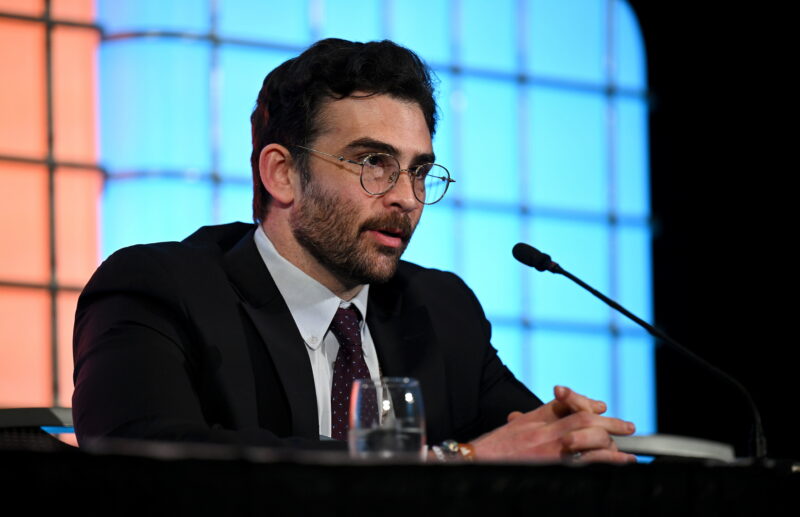
Hochstein, who was involved in negotiating civil nuclear issues with Saudi Arabia during the previous administration as part of a broader Saudi-Israeli normalization agreement, made the comments during a debate at the Council on Foreign Relations, organized by the nonprofit Open to Debate. The comments by Hochstein, currently a managing partner at TWG Global, come even as many congressional Democrats oppose the deal and some are taking steps to attempt to block it.
The deal would allow for a study and potential construction of a U.S.-controlled enrichment facility inside Saudi Arabia, which critics say would provide the seed for a Saudi nuclear bomb. They also argue that the deal doesn’t contain sufficient safeguards to ensure Saudi Arabia isn’t conducting other nuclear weapons research.
Though Hochstein said he wished the deal would have included Israeli-Saudi normalization, he said it gives fewer concessions than were considered during the Biden administration and that it is in the U.S. interest to finalize the agreement.
He argued that the U.S. does not have the luxury to dictate the terms of nuclear agreements to other countries as it may have been able to decades ago. He said that Saudi Arabia would turn to China, Russia or others for nuclear cooperation if the U.S. was unwilling to compromise — countries that would not impose the level of safety standards included in the U.S. deal — leading the U.S. to fall further behind in the global nuclear energy market.
“Do I want to do this? No. Do I feel the American national security interest is that we must do this deal? One-hundred percent, because the alternative is a lot worse,” Hochstein said.
He said that during the Biden administration’s negotiations, other countries, including U.S. allies, actively tried to coax the Saudis away from the U.S. by promising lower verification standards. The deal, he argued, would help keep Saudi Arabia, a critical ally, in the U.S.’s corner.
“Do you want a nuclear enrichment program in Saudi Arabia that is U.S. based, U.S. technology, U.S. verifications, U.S. control, or do you want it with someone else? Because having it with no one — that’s not one of the options on the menu,” Hochstein said. “I can’t sit back and allow the chance that another region and other countries will develop this expertise, know-how, without us.”
Hochstein was joined onstage by Daniel Poneman, deputy secretary of energy under the Obama administration, who also argued for the deal, and Sharon Squassoni, the former director of nonproliferation and prevention at the Center for Strategic and International Studies, and Joe Cirincione, the former president of the Ploughshares Fund, a nonproliferation nonprofit.
Hochstein also downplayed the idea that the deal is a path to enrichment inside Saudi Arabia, arguing that it only allows for a two-year study on potential enrichment and that further progress would require additional congressional review — which is not clear under the terms of the deal — and that that issue should therefore not be part of current negotiations.
“Maybe we’ll get to an enrichment facility, and maybe we won’t,” Hochstein said. “But if we do — and that’s a big if — it will be under our terms, and we have the ability to verify and to see what’s happening and to address it if something goes wrong. But the best chance of doing that is to keep Saudi Arabia on our side.”
He said that any nuclear enrichment facility would not be ready for around a dozen years and that reprocessing of uranium would be decades away — a timeline that could be moved up with the consent of both parties to the deal — and that the U.S. has many options that it can exercise to put an end to Saudi weaponization efforts long before the Saudis could utilize the proposed nuclear program to build a nuclear weapon.
Hochstein acknowledged that the deal does not require Saudi Arabia to sign the International Atomic Energy Agency’s Additional Protocol, which allows for intrusive at-will inspections, but said that oversight mechanisms included in the deal are, according to IAEA Chief Rafael Grossi, close to the standards of the Additional Protocol.
He said that he had spent hours discussing the Additional Protocol with senior Saudi officials, and that signing it was a nonstarter for the kingdom.
Hochstein said the U.S. does not have the luxury of insisting on the same specific standards that it has utilized for decades, suggesting that even the conditions, including the Additional Protocol and foregoing enrichment and reprocessing, included in the U.S. deal with the United Arab Emirates are outdated.
He also argued that observers should not allow concerns about corruption inside the Trump administration playing a role in the deal to color their view of the agreement’s value.
Poneman’s arguments largely echoed Hochstein’s, emphasizing the need for a U.S.-Saudi partnership and competition with Russia and China, describing the deal’s safety mechanisms as strong and downplaying the risks that Saudi Arabia could use the program to develop nuclear weapons.
Squassoni and Cirincione argued that the deal was a thinly veiled cover for Saudi Arabia to develop nuclear weapons, that it was primarily designed to enrich American energy companies and the Trump administration, that the verification standards are insufficient and that it is unprecedented in providing a pathway to enrichment to a country that does not otherwise have it.
More Stories
MINYAN MATTERS
Supreme Court to hear case of man blocked from holding minyan in his home
DESIGNATION PUSH
Cruz calls on Trump administration to designate CAIR as a terrorist organization
SHOW OF SUPPORT
Suozzi, Knott, Jewish groups rally for Right to Worship Act
ON THE HILL
House passes Iran war powers resolution with record seven Republican supporters

AID CONVERSATION
GOP Reps. Kustoff, Goldman say Republicans want to see U.S. aid to Israel continue
EXCLUSIVE
New House bill would allow synagogues to use security grants to hire full-time security guards
Please log in if you already have a subscription, or subscribe to access the latest updates.
 Continue with Google
 Continue with Apple