





















































Bipartisan alarm over Trump’s plan to sell F-35 fighter jets to Turkey
Rep. Josh Gottheimer said ‘Erdoğan cannot be trusted’ and that the decision ‘must be reversed’
Evan Vucci
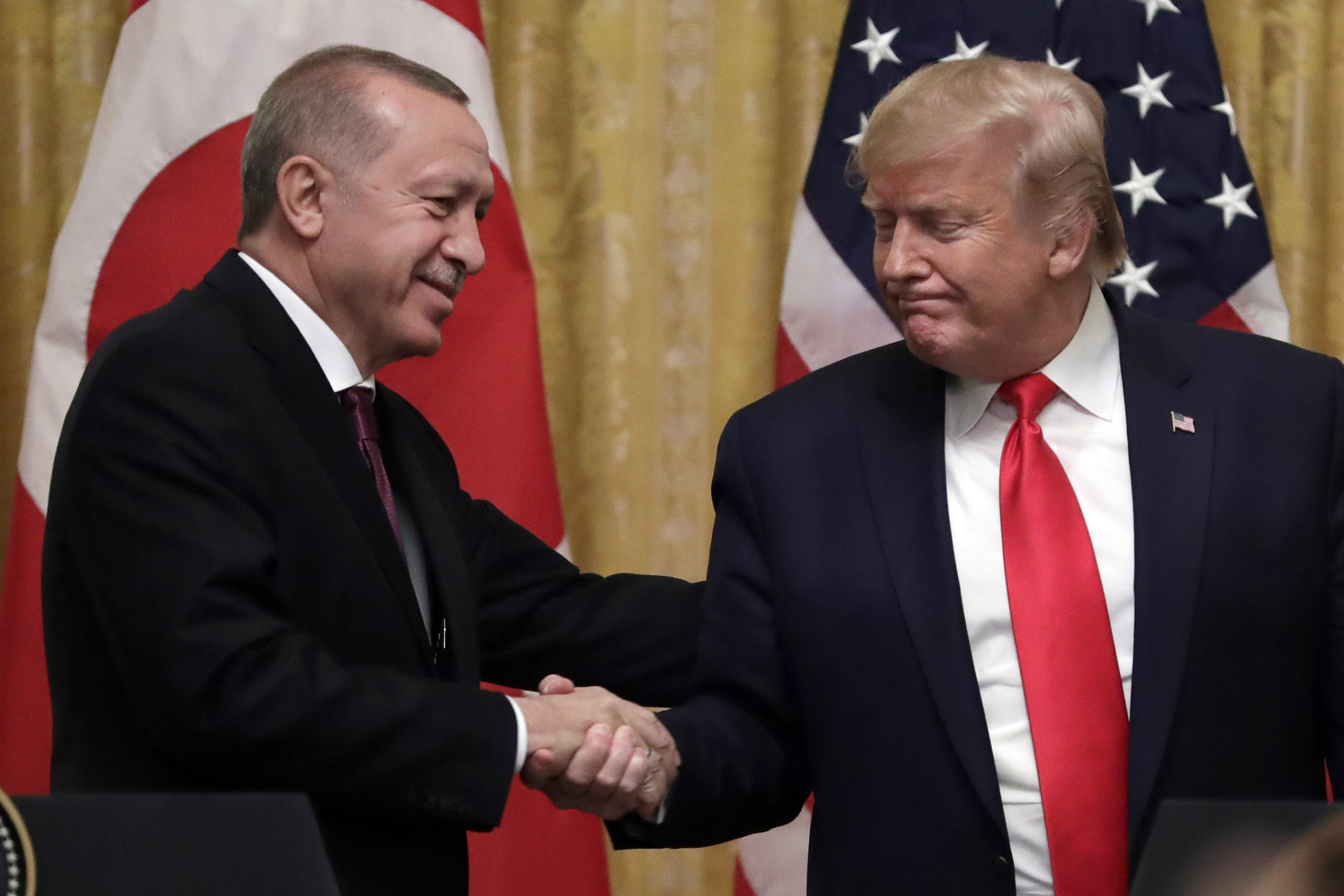
President Donald Trump shakes hands with Turkish President Recep Tayyip Erdoğan after a news conference in the East Room of the White House, Wednesday, Nov. 13, 2019, in Washington.


 Add JewishInsider on Google
U.S. lawmakers across the political spectrum are sounding the alarm over the Trump administration’s plans to review whether it can sell F-35 fighter jets to Turkey, arguing that the move would raise national security concerns and that Ankara has not yet fulfilled its obligation to dump its Russian S-400s.
In the Oval Office on Wednesday, President Donald Trump said he was considering selling the advanced jet engines to Turkey, stating that he would “do something that’s going to make him [Turkish President Recep Tayyip Erdoğan] very happy.” Vice President JD Vance said the administration is “confirming” that Turkey has fulfilled its obligations under U.S. law in order to receive advanced F-35 fighter jets.
Ankara has long sought the advanced systems but has been barred from purchasing it since 2020, after it acquired the S-400 air-defense system from Russia. A report published last week by the Jewish Institute for National Security of America suggested that the S-400 system is inactive but still intact in Turkey.
The proposed deal has drawn fierce bipartisan pushback and notable criticism from within Trump’s own ranks.
Rep. Brad Schneider (D-IL) told Jewish Insider that he is “very concerned” about the prospect of Turkey acquiring the F-35s, arguing that such a move would raise significant national security concerns due to Ankara’s close security ties with Russia.
“Turkey has integrated its defenses with the Russian missiles. The F-35 is a technology platform that Russia would love to get information on and we can’t allow that to happen,” Schneider said. “Turkey has not been the best NATO ally. Its actions in the Eastern Mediterranean have been contrary to U.S. interests and regional interests, so I have real concerns.”
Schneider also noted that he does not believe Turkey has given up possession of the Russian S-400s, suggesting that Ankara has yet to fulfill the critical obligation that must be certified, in writing, to Congress.
“I have not seen that,” Schneider said. “I’d want to see that in concrete evidence from this administration.”
Rep. Nicole Malliotakis (R-NY) said on social media that there is “bipartisan opposition” to the move and posted a photo of Erdoğan hand-in-hand with Russian President Vladimir Putin and former Iranian President Ebrahim Raisi.
“As long as Turkey is under the leadership of Erdogan who aligns himself with Iran and Russia, harbors Hamas & remains the only NATO member to not sanction Russia, Turkey should NOT receive our best jets and military equipment,” Malliotakis wrote.
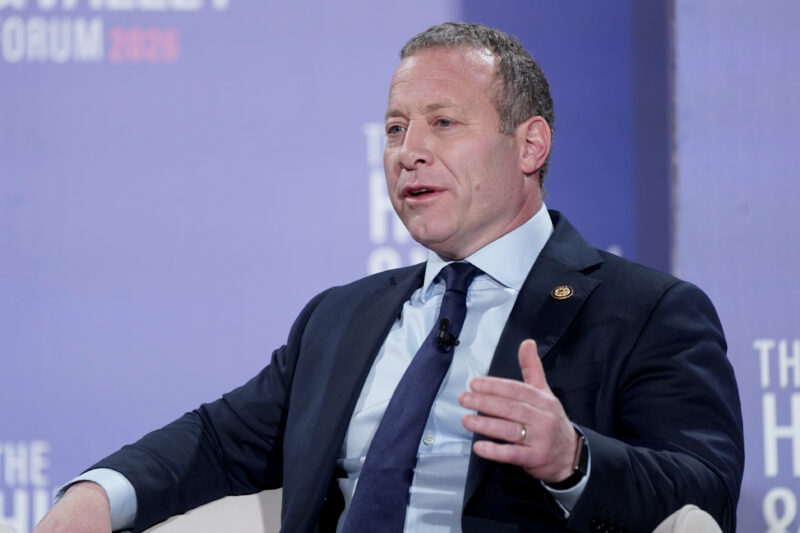
Rep. Josh Gottheimer (D-NJ) also criticized the move, saying in a post on X that “Erdogan cannot be trusted” and that the “decision must be reversed.”
“Turkish President Erdogan has cozied up to Hamas and Putin while threatening our allies in Israel, Greece and Cyprus,” Gottheimer wrote. “Yet, the Trump administration is happy to sell them advanced engines to power fighter jets.”
Rep. Dina Titus (D-NV) said that if Trump continued with the move she would “introduce a joint resolution of disapproval.
Rep. Chris Pappas (D-NH) also expressed sharp disapproval, saying, “Absolutely no F-35s to Turkey” in a post on social media.
“Turkey was kicked out of the F-35 program during the first Trump administration for purchasing Russian S-400 missiles, which it still possesses today,” Pappas wrote. “Since then Turkey has only grown more aggressive against critical American allies such as Greece and Cyprus, increased oppression of its people, and made the region even more unstable.”
“The law is clear: the Trump administration is required to certify to Congress that Turkey is in compliance with our laws before any sale can even be considered. We cannot reward Erdogan’s government while it continues to violate U.S. law and threaten our reliable, democratic allies,” he added.
Rep. Brian Mast (R-FL), the chair of the House Foreign Affairs Committee, said that he expects to receive a classified briefing on the F-35 sale and the status of the S-400 next week.
Asked about the administration’s praise of Erdoğan, Mast said that “Turkey as a whole is a large and important NATO ally.” On Wednesday, the president called the Turkish leader a “very good person,” despite also saying that he would fight “on the Iran side” of the war.
“I’m not going to go out there and defend Erdoğan in any way, shape or form,” Mast said. “Erdoğan and I don’t have a personal relationship. I think a number of activities by Turkey have been problematic and I have nothing that would make me go out there and personally defend Erdoğan. I have many relationships — that’s not one of them.”
Meanwhile, Schneider expressed concern over Trump’s praise of Erdoğan.
“I’m worried he [Trump] seems to get close to a lot of leaders who have totalitarian instincts,” Schneider said. “It’s a pattern.”
Mast’s Democratic counterpart, Rep. Greg Meeks (D-NY), said he opposed the sale of F-35s to Turkey, warning of its impact on other U.S. allies in the region such as Greece and Cyprus, and also expressed criticism of Erdoğan personally while calling Turkey an important ally with which to maintain conversations.
But Meeks said he’s open to the sale of advanced jet engines to Turkey “if I get my questions answered by the administration,” and expressed frustration that Trump is speaking publicly about the sale without communicating with him as the ranking member of the Foreign Affairs Committee, a break with precedent.
Sinan Ciddi, director of the Turkey program at the Foundation for Defense of Democracies, said that while Trump appears intent on making the sale, it is likely to meet significant hurdles. For instance, Ciddi confirmed that Turkey still possesses the S-400 defense system, which would not fulfill the obligations required under law to lift the sanctions.
“Turkey does still maintain the S-400 defense system,” Ciddi said. “We’re not talking about one or two missiles. I believe in total Turkey holds up to 200 air defense missiles that were sold to them by the Russians back in 2019. They are presently sitting under lock and key in Turkish warehouses.”
Ciddi noted that Turkey has not deployed the S-400s it currently holds as a precautionary measure because it would have “resulted in additional U.S. sanctions against Turkey.”
He said a major area of concern of selling Turkey F-35s while it still maintains the S-400s is the ability for sensitive information to be shared with U.S. adversaries.
“The concern is if they don’t get rid of those and the F-35 was delivered to Turkey, or became operational in Turkey, those S-400 systems could collect sensitive information about their stealth capabilities and share them with adversarial powers, such as the Chinese, the Russians, as well as the Iranians.”
“There’s been a relative consensus in opinion in congress, as well as political administrations, that you want to keep Turkey out of the F-35 program,” he added.
Ciddi also discussed Trump’s closeness to Erdoğan, arguing that the U.S. has not held Turkey accountable on key issues such as support for terrorism and the Muslim Brotherhood, due to Ankara’s role in helping mediate talks between Israel, Iran and the U.S. as well as in the Russia-Ukraine war.
“In Trump’s own words, he seems to admire and essentially have a strong affinity for Erdoğan,” Ciddi said, noting that another explanation is that Trump is listening closely to U.S. Ambassador to Turkey Tom Barrack on Turkish issues rather than “what he needs to hear from a variety of voices within his administration.”
Elliott Abrams, a former Iran envoy during the first Trump administration, also cautioned against the move and Trump’s “soft spot” for Erdogan.
“President Trump has a soft spot for Erdoğan for reasons that no one can understand, but that is no reason to risk American military secrets,” Abrams said. “Turkey has not abandoned the S-400 and therefore should be excluded from the F-35 program. This ought to be simple, because U.S. law is clear.”
Ciddi also expressed concern on what the potential move might mean for Israel and suggested that Turkey holds considerable military prowess even without the F-35s, although he noted that Israel holds an advantage having operated the F-35s for a longer period of time and also maintaining more sophisticated models.
“The Israelis are really concerned,” Ciddi said. “The acquisition of an F-35 would be a game changer, but there are significant hurdles ahead of that. Israel already has F-35s and operates them, and the Israeli variant of the F-35 is one of the most advanced and unique versions of the F-35 that is operated, and it’s unique to Israel – no other country possesses and operates the F-35 that has the boutique suite of operating capabilities that the Israelis have, so Israel does maintain a significant qualitative military edge.”
He said that even if the Trump administration authorized the sale, it would likely take years to come together and “would not be an immediate delivery of F-35 units beyond the six that Turkey already purchased back in 2019, which are essentially sitting in U.S. warehouses here and collecting dust.”
More Stories

TWO JEWS, THREE OPINIONS
Jewish podcast ‘Chosen People Problems’ finds new home with Ark Media

EVENT RESCHEDULED
State Department to hold Oct. 7 commemoration event on Wednesday

EMPIRE STATE EDUCATION
Hochul will opt New York into education tax credit that will help fund Jewish education
PROBLEMATIC POST
Paxton senior advisor endorsed antisemitic slur on social media
TISCH TENSIONS
Mamdani stands by NYPD’s Tisch as his allies demand her removal
CATCHING HEAT
Pro-Israel Democrats blast Mamdani for Oct. 7 anniversary statement
Please log in if you already have a subscription, or subscribe to access the latest updates.
 Continue with Google
 Continue with Apple