















































Trump official defends controversial antisemitism probe of University of Pennsylvania
EEOC Chair Andrea Lucas: ‘At some point, either the government will know information related to individuals’ religion, or we will not be able to enforce the laws on their behalf’
Dillon Meyer Media
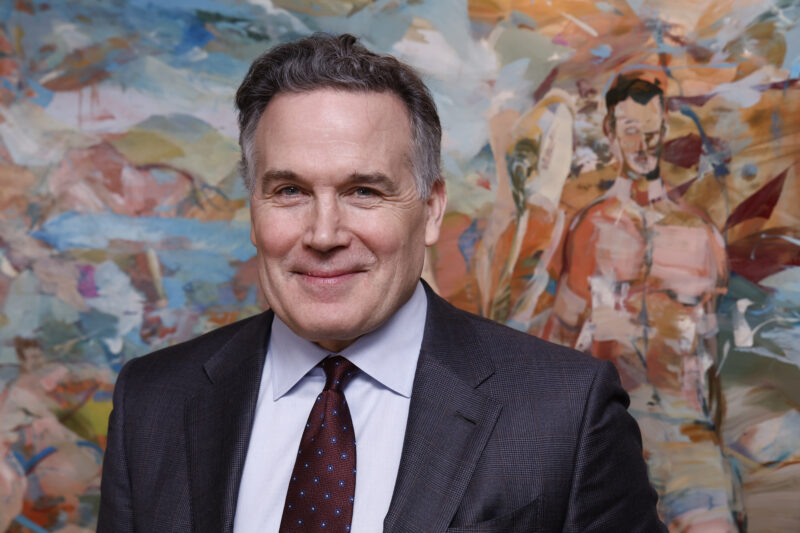
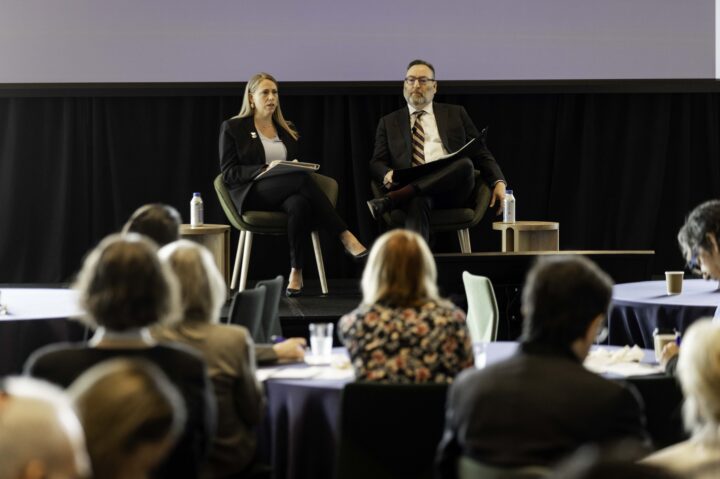
EEOC Chair Andrea Lucas and Brandeis Center founder Kenneth Marcus speak at the inaugural conference on antisemitism and civil rights law at Harvard University on April 16, 2026.


 Add JewishInsider on Google
The Trump administration official leading a controversial probe into antisemitism at the University of Pennsylvania told Jewish leaders and legal experts on Thursday that compiling a list of Jewish faculty with their detailed personal information was necessary to identify and protect victims.
“There is no other way to protect victims of harassment or discrimination unless you collect information about them,” Andrea Lucas, chair of the United States Equal Employment Opportunity Commission, said at the Louis D. Brandeis Center for Human Rights Under Law’s inaugural conference on antisemitism and civil rights law, held at Harvard University.
“We never collect information to contact someone on their work system,” she said. “The EEOC’s long-standing practice is to collect personal information because we want to make sure that there is not any clear monitoring of your email systems … that when you speak to a government agency you feel completely not pressured.”
Last month, a federal judge ordered Penn to comply with a subpoena from the Trump administration requesting detailed information about Jewish university affiliates as part of the EEOC’s ongoing investigation into Penn’s handling of antisemitism. The subpoena had requested the school turn over lists of Jewish employees and members of Jewish organizations — including their identifying details and phone numbers — which the school called “extraordinary and unconstitutional.” Critics on campus have likened the move to Nazi-era methods of collecting information about Jews.
During a fireside chat with Kenneth Marcus, founder of the Brandeis Center and former assistant secretary of education for civil rights under the first Trump administration, Lucas noted she was speaking generally and not about the Penn case specifically, as litigation is ongoing.
“At some point, either the government will know information related to individuals’ religion, or we will not be able to enforce the laws on their behalf,” continued Lucas, who is not Jewish but emphasized a personal interest in religious liberty as “a core thing the EEOC needs to be focusing on.”
“I understand the sensitivities around this issue … but fundamentally the Jewish community does have to decide: do you want to have civil rights enforcement in this space? If you do, there is no other way we can get money for victims.”
Experts told Jewish Insider in January that a more typical investigation might involve agency officials interviewing people who issued complaints directly with the agency, then visiting the campus and publicizing their investigation, calling the EEOC’s methods in the Penn case “incredibly unusual, if not completely unprecedented.”
Lucas asserted that the same standard applied for helping members of any race, religion or gender. None of the event’s speakers publicly disagreed with Lucas’ statements.
The daylong conference was born out of last year’s settlement between the Brandeis Center and Harvard over a Title VI lawsuit, and was framed around this year’s U.S. Semiquincentennial.
It opened with an address from Marcus and a benediction from Harvard Chabad’s Rabbi Hirschy Zarchi. Attendees included Harvard community members, Jewish activists, lawyers and scholars.
The plenary session, “Towards a Jewish Civil Rights Movement,” moderated by Marcus, featured William Daroff, CEO of the Conference of Presidents of Major American Jewish Organizations; Elan Carr, CEO of Israeli-American Council and former special envoy to monitor and combat antisemitism; and Miriam Elman, executive director of the Academic Engagement Network.
Carr called the battle against antisemitism “a war for the soul of America and the soul of civilization,” and advocated for a shift in classroom curriculums and federal funding.
“Jew-hatred is history’s greatest barometer of human ruin and suffering. We are fighting for the future of our country and American values. So we need to get serious about teaching American values … we can’t safeguard this republic unless we teach American kids what this republic is, why it was founded, what our values are and constitutional structures are,” he said. “This is a national crisis with national implications. The federal government needs to say ‘no money goes anywhere to any educational institution unless there’s Western values, American civics, basic principles of the United States as part of the curriculum.’”
After the session, Daroff told JI that “today’s conference brought a united American Jewish community together, aligned in action. We are not standing back. We are organizing, building and acting together with shared purpose and resolve.”
The conference also featured a panel titled “Defining Anti-Semitism at America’s 250th: New Challenges for a New Century.” Speakers debated the importance of pushing states to codify the International Holocaust Remembrance Alliance’s working definition of antisemitism, as many mainstream Jewish groups are using resources to do. Critics of IHRA say the definition chills political speech and criticism of Israel.
Nathan Diament, executive director for the Orthodox Union Advocacy Center, said that IHRA is not only important for combating campus antisemitism — as several of the speakers emphasized — but also regarding legislation in Washington.
At the same time, “in the political arena, vagueness around questions [of what is antisemitism] is unhelpful. The most important currency in politics is votes. Advocates and voters need to be able to say with clarity to politicians [what they will and will not support]. This is the most important need for the definition of antisemitism, to draw a line as clearly as we can and make clear to politicians that if they cross this line, there will be consequences,” said Diament.
“Even as the OU has, and continues to, support legislation to codify the IHRA definition, I don’t think at this stage in the game that’s the most important way to further the definition and to use our political capital,” he continued. “We don’t need Congress’ approval of how we want to define antisemitism. We don’t need them to codify it and we don’t need them to give us permission to use it to hold members of Congress and other politicians accountable. We can use the IHRA definition because we say that’s the definition.”
Alyza Lewin, president of U.S. affairs for the Combat Antisemitism Movement and former president of the Brandeis Center, pushed back by highlighting how the law enforcement trainings she provides varies based on local adoption of the IHRA definition. She noted a stark difference between training in states where it is codified, such as Georgia, and those where it is not, such as New York.
Law enforcement in Georgia “has a very concrete reason now to understand and use” the training, said Lewin. “In New York, especially after [Mayor Zohran Mamdani] reversed the executive order on IHRA, I can try to explain it to them but it’s just a nice thing I teach them. They are under no obligation to actually engage with it and utilize it. So I do think on a state by state level, it does make a difference whether or not a state has adopted the IHRA definition.”
In a separate panel, moderated by Anat Alon-Beck, a visiting professor at Harvard Law School, speakers explored new avenues for litigation against antisemitism.
“Nearly two years after the largest massacre of Jews since the Holocaust, the Jewish community still lacks unified messaging, coordinated toolkits and a clear strategy. At a time when antisemitic actors are highly organized and aligned, our disunity is a serious vulnerability,” Alon-Beck told JI following her session. “We need to come together — with clarity, courage and coordination — because the stakes could not be higher.”
According to the Brandeis Center, this conference was the first in an annual three-part series.
Charles Dabda, a third-year student at Touro Law Center and law clerk with National Jewish Advocacy Center, told JI he was leaving the conference with a clear sense that “antisemitism is rising in real time with real consequences across campuses, professional spaces and beyond. At the Brandeis Center, and NJAC, our commitment remains resolute and steadfast; we will confront antisemitism wherever it manifests — through advocacy, and, when necessary, the courtroom.”
More Stories

Daily Overtime
Mackle-no-more on Sheeran’s tour
PRESSURE CAMPAIGN
Rep. Jared Moskowitz: Pro-Israel Democrats are being ‘ostracized’ in the Democratic Party
SENSE OF SECURITY
Mamdani and NYPD unveil safety plans for 9/11 memorial, Rosh Hashanah

BEAN SET MATCH
Miznon’s green beans are the surprise ace of the U.S. Open

TEPID RESPONSE
Rubio holds back criticism of U.K. sanctions against Israeli settlements

EXCLUSIVE
Brandeis Center urges Qatar to provide ‘complete public accounting’ of campus funding
Please log in if you already have a subscription, or subscribe to access the latest updates.
 Continue with Google
 Continue with Apple