



























Lawmakers raise concerns as Trump prepares civilian nuclear deal with Saudi Arabia
Experts told JI that the agreement in its current form would not require Riyadh to adhere to the nonproliferation ‘gold standard’ – a commitment to forgo domestic uranium enrichment and fuel reprocessing
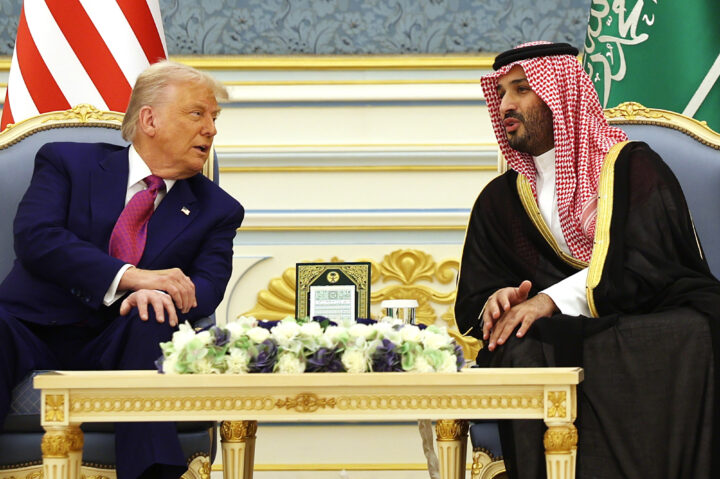
Win McNamee/Getty Images
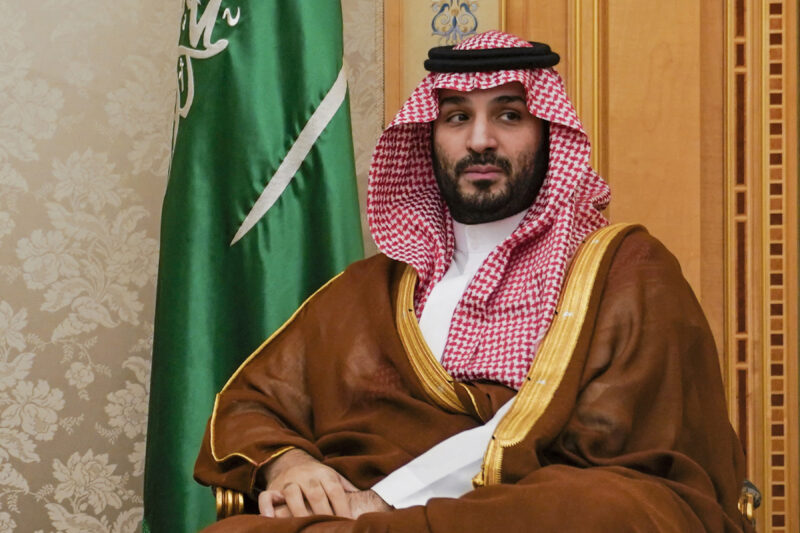
President Donald Trump meets with Saudi Crown Prince Mohammed bin Salman during a “coffee ceremony” at the Saudi Royal Court on May 13, 2025, in Riyadh, Saudi Arabia.


 Add JewishInsider on Google
As the Trump administration prepares to submit a proposed civil nuclear pact with Saudi Arabia to Congress, U.S. lawmakers are raising concerns about the potential agreement while nonproliferation experts and former Trump administration officials are sounding the alarm, warning that the pact abandons traditional safeguards and could ignite a nuclear arms race in the Middle East.
Last month, the Trump administration proposed the pact to assist Saudi Arabia with its development of civilian nuclear power, following indications last year that it would pursue such an agreement to strengthen bilateral diplomatic ties. Experts say the White House is looking to construct and operate a uranium enrichment plant within Saudi Arabia, safeguarding the facility through a bilateral framework.
The pact is currently undergoing final review before President Donald Trump can formally submit it to Congress. Once the president signs the agreement and transmits it to Capitol Hill, both chambers will have 90 days to pass resolutions of disapproval to block the deal. Otherwise, the pact will automatically go into effect, permitting the U.S. to share civilian nuclear power technology with the kingdom.
Experts told Jewish Insider that the agreement in its current form would not require Riyadh to adhere to the nonproliferation “gold standard” – a commitment to forgo domestic uranium enrichment and fuel reprocessing. Other regional partners, such as the United Arab Emirates, accepted this stringent safeguard in past U.S. deals specifically to prevent military or illicit nuclear activity.
The proposed pact would also exempt Riyadh from accepting the International Atomic Energy Agency’s (IAEA) “additional protocol.” This accord helps rule out clandestine military activities by granting international inspectors the authority to conduct sudden, unannounced visits to nuclear facilities. While the U.S. maintains numerous nuclear cooperation agreements globally, it rarely establishes them with nations that reject these baseline oversight protocols.
Democrats across the ideological spectrum have previously indicated concern over the potential civil nuclear pact, reflecting a historical trend in which Congress has typically supported a stringent nonproliferation policy toward Saudi Arabia that includes robust safeguards.
In May, a dozen Democratic lawmakers sent a letter to Secretary of State Marco Rubio asking that the administration follow strict U.N.-backed protocol, including IAEA inspection. However, in a letter from the State Department to Sen. Edward Markey (D-MA), the administration only indicated that the agreement would require the two sides to commit to a “bilateral safeguards agreement,” and did not make a mention of the “gold standard,” according to Reuters.
Rep. Brad Sherman (D-CA) told JI he was concerned about the administration pushing forward the agreement without safeguards, saying that “there’s only one reason not to have non-militarization safeguards and that’s militarization.”
“The idea that allowing Saudi Arabia to move toward a nuclear weapon defies history,” Sherman said. “A Saudi nuclear weapon leads to worldwide proliferation. Egypt and Turkey would feel that they need to match that, and then where’s Argentina and Brazil going to be?”
Sherman emphasized that Saudi Arabia should follow an agreement that mimics a 2009 nuclear agreement between the U.S. and UAE, in which the vital safeguard standard was followed.
“The UAE signed the good agreement. Why the hell can’t the Saudis sign the same agreement?” he said, noting that UAE would likely follow and “get out of the gold standard too,” in the event the pact goes through.
In February, Sherman, a longtime opponent of nuclear cooperation between the U.S. and Riyadh, announced that he would be introducing legislation to require an affirmative congressional vote prior to the administration finalizing any nuclear deal with Saudi Arabia.
Rep. Jared Moskowitz (D-FL) said he had heard about the discussions, but declined to comment on whether he would support the agreement in its current format. The Florida lawmaker, however, expressed little concern over the U.S. sharing civilian nuclear power with Riyadh or other regional players, calling the subject “fair to discuss.” Though he noted that such a deal should ultimately be tied to the “Abraham Accords framework.”
“I think it’s something that is fair to discuss, but also that’s why Iran not getting a nuclear weapon is such a big deal, because that will start a nuclear arms race,” Moskowitz said.
Rep. Tim Burchett (R-TN) declined to comment on whether he had reviewed or would support the potential pact, but expressed a firm desire to limit the expansion of nuclear weapons in the region.
“We can’t have anybody else over there [in the Middle East] with nuclear weapons,” Burchett said.
When asked about the potential deal by JI, several Senate Republicans indicated they were unfamiliar with the plan. Other lawmakers, including Rep. Dan Goldman (D-NY) and Rep. Marlin Stutzman (R-IN), also noted they had not yet heard much regarding the potential agreement, stating they would need to look into the matter further.
Sen. James Lankford (R-OK), however, said he was not concerned about the agreement breaking the “gold standard.”
“I don’t necessarily assume that would break the gold standard on it,” Lankford said. “The biggest issue is where is the uranium coming from and who’s actually producing it, and where are they stored?”
While it was previously thought that a civil nuclear agreement would be linked to Saudi normalization with Israel, the Trump administration has notably uncoupled the two initiatives. In May 2025, a group of nine Jewish House Democrats wrote to Trump to voice their displeasure over the separation of the two objectives.
Meanwhile, analysts continue to express deep concern over the arrangement in its current format, citing that the lack of safeguards could create severe risks to national security and set a poor precedent for current and future U.S. nuclear cooperation frameworks.
“The U.S. should be helping other countries with nuclear power but should strongly avoid helping them learn the fuel cycle and move closer to being able to build a nuclear weapon,” Elliott Abrams, an Iran envoy under the first Trump administration, said. “The gold standard remains our agreement with the UAE, where they agree not to enrich uranium. There is no reason the Saudis have to enrich uranium and the U.S. should not agree to it.”
Abrams called it “ironic” that the U.S. would remain locked in a confrontation with Iran over the threat of its nuclear weapons program while simultaneously considering “helping one of its neighbors enrich uranium.” He noted that the fallout from such a deal would inevitably compromise existing agreements and future negotiations with other Arab partners.
Experts also worry the concessions could undermine Washington’s strategic partnership with Abu Dhabi and incentivize other nations to pursue similar proliferation pathways.
“If we agree to this in the Saudi case, we will be abandoning a longstanding position and every deal we do after that will have to allow enrichment,” Abrams said. “In fact, we will have to renegotiate the UAE agreement as well.”
Jonathan Ruhe, a fellow at the Jewish Institute for National Security of America (JINSA), similarly expressed that the format of the deal could “undermine cooperation” with the UAE even as the Gulf state emerges as “America’s most valuable partner in the Gulf.”
He also cautioned that the pact could “threaten the global nonproliferation regime and raise the risks of a regional proliferation cascade.” Other experts joined in warning that bending established rules for Saudi Arabia could shift the calculus of neighboring states, prompting a rush to acquire enrichment and reprocessing capabilities.
“The fear is that other countries – Egypt, Turkey and the UAE – would use enrichment technology to develop the potential to make a nuclear weapon,” Simon Henderson, a senior fellow at the Washington Institute for Near East Policy, said. Additionally, while the UAE has already agreed to the “gold standard,” Henderson said that commitment could “change if other regional countries obtain the technology.”
Critics have also argued that Saudi Arabia could eventually seek to manufacture a nuclear weapon of its own. While Riyadh is a party to the Treaty on the Non-Proliferation of Nuclear Weapons (NPT) — which legally obligates the kingdom not to manufacture or acquire nuclear arms — several Saudi officials have explicitly stated in recent years that if Iran acquires a nuclear weapon, the kingdom would follow suit.
Andrea Stricker, director of the nonproliferation program at the Foundation for Defense of Democracies (FDD), said that the current U.S. approach “undermines decades of U.S. nonproliferation policy” and could allow Saudi Arabia with “the option to make fuel for nuclear weapons.”
“If the Saudis have access to the technology, and combined with weak IAEA inspections, they could build parallel covert capabilities. There is also little to stop Riyadh from ejecting U.S. officials from a plant and taking over,” Stricker said. “President Trump should stop this historic mistake before it is finalized, and if not, Congress should block the agreement.”
Ruhe shared similar concerns about Saudi Arabia’s potential long-term intentions.
“Such a deal raises real concerns that the kingdom would one day decide to slip free of the U.S. deal and enrich uranium on its own, either openly or secretly,” Ruhe said. “Given its past ties, this could include covert cooperation with Pakistan or China.”
Saudi Arabia has previously entered into several bilateral civil nuclear arrangements with foreign nations, including Argentina, France, Hungary, Kazakhstan, and South Korea. Of greater concern to Washington, however, are Riyadh’s active agreements with Russia and China. In recent years, Saudi Arabia has steadily expanded its nuclear cooperation with Beijing. The two U.S. adversaries are capable of providing similar nuclear products to Riyadh without the same strict demands and nonproliferation commitments.
“Washington appears to want to sell civil nuclear reactors to Saudi Arabia rather than allow a country like Russia or China to do so,” Henderson said. “The fear is that Saudi Arabia already has enrichment technology obtained from Pakistan and doesn’t want to give it up. Since Iran already has enrichment technology, Saudi Arabia thinks it deserves the same.”
U.S.–Saudi nuclear cooperation has historically remained limited. The two nations entered into a memorandum of understanding in 2008 that provided for low-level nuclear energy cooperation and later signed a nuclear safety cooperation memorandum of understanding in 2022.
“With Iran’s enrichment program degraded due to U.S. and Israeli strikes, it would be far sounder policy to continue rolling back Tehran’s efforts and insist the Saudis rule out enrichment and reprocessing and maintain control of the spread of this sensitive technology in a proliferation-sensitive region,” Stricker said. “The United States should also remind the Saudis of extensive economic, military, and defensive support that Washington provides, assistance which should not be available if Riyadh tilts toward China.”
More Stories
THREAT THWARTED
Man arrested in Boca Raton for making death threat against Rep. Jared Moskowitz
PRESIDENTIAL ENDORSEMENT
Trump gives Netanyahu ‘complete and total endorsement’

Daily Overtime
Syria’s new textbooks demonize Jews, report finds
analysis
Is Israel’s anti-Netanyahu bloc fracturing?
UNLOCKING THE KEYSTONE
RJC drops $400,000 to boost Brian Fitzpatrick in Pennsylvania swing district
Regional Responsibility
Amb. Tom Barrack: It’s ‘not America’s job’ to combat Iran-backed threats in the Middle East
Please log in if you already have a subscription, or subscribe to access the latest updates.
 Continue with Google
 Continue with Apple