





















































Senate Republicans urge Saudi response to Houthi attacks
Meanwhile, Senate Democrats framed the escalating Houthi offensive as more fallout from the Iran war
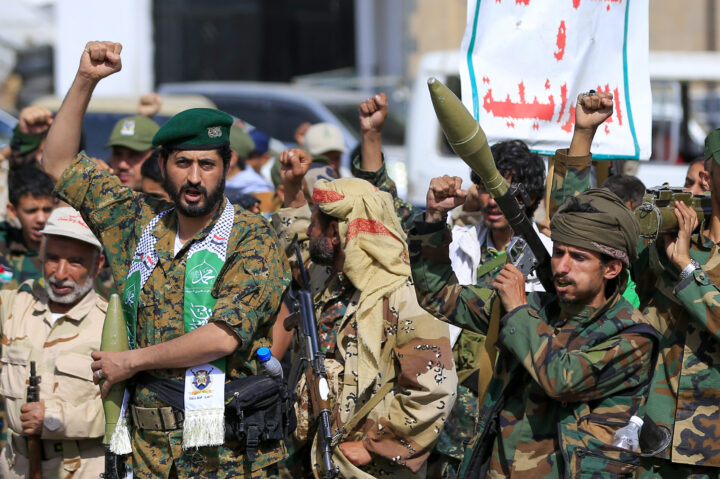
(Mohammed HUWAIS / AFP via Getty Images)
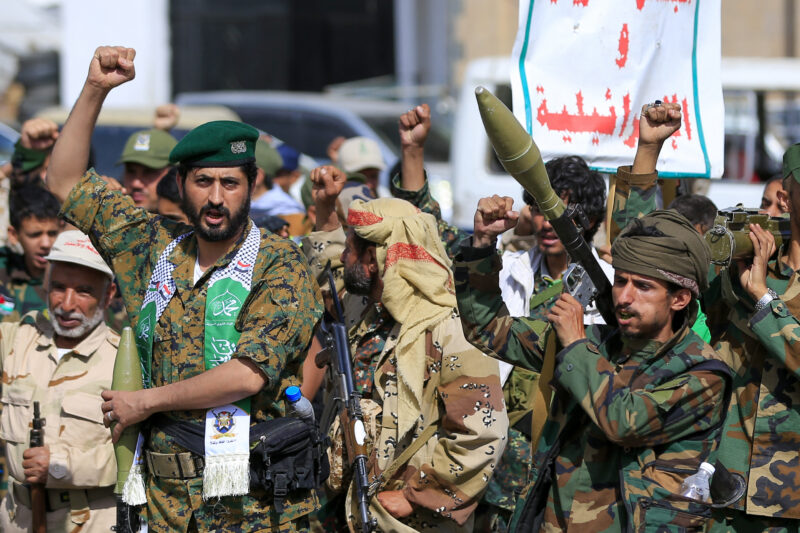
Fighters loyal to the Houthi authorities, shouts slogans during a rally to recruit more fighters, in Sanaa on September 10, 2026.


 Add JewishInsider on Google
Senators returning to Washington on Monday offered mixed responses to the recent Houthi offensive inside Yemen and Saudi Arabia, with some Republicans telling Jewish Insider that the Iran-backed terror group’s moves warranted a response, while some Democrats framed the Houthi attacks as further fallout from the U.S. war against Iran.
The Iran-backed Yemeni terrorist group seized control of key port cities along the Red Sea coast, near the vital Bab el-Mandeb Strait, as well as Perim Island inside the waterway and the Hanish archipelago to the north. Drones fired from Iraq also struck and disabled a critical Saudi oil pipeline that the country had been using to bypass the Strait of Hormuz. The U.S. has thus far declined to intervene.
Republicans who spoke to Jewish Insider said they had not been fully briefed on the situation since returning to Washington on Monday after being away for the Senate’s extended August recess. Still, they said a forceful response from the Saudis was warranted.
“Everybody ought to work together to destroy the Houthis,” Sen. Rick Scott (R-FL) said. “It’s not just the Trump administration, the Saudis have resources. They need to use all their resources to destroy them. You can’t play games here. You’ve got to destroy them.”
Asked if the U.S. should take action against the terror organization, Sen. John Kennedy (R-LA) said, “I think we need to do just what we’re doing right now. We need to crank the sanctions up as high as we can and continue the blockade. The Saudis can do something. They have an army. They have weapons.”
“If I were the Saudis, I’d hit them back,” the Louisiana senator added.
Sen. Mike Rounds (R-SD) told JI that he did not know “what the administration’s plans are” as far as how the U.S. will approach the Houthis after this latest series of attacks, though he emphasized that it was imperative to find a resolution that “contained” the Houthis as quickly as possible.
“Look, it’s a very dangerous neighborhood down there right now. The Houthis have been causing some real problems, not just for Saudi Arabia but for trade throughout the rest of the world,” Rounds said. “The sooner we get that resolved down there and get them contained once again, the better off we’re all going to be.”
“There needs to be a response to any adverse action that they take, in my view — and an amplified response,” Sen. Bill Hagerty (R-TN) told JI.
Democrats generally framed the Houthi offensive as an extension and expansion of the Iran war.
“This war is metastasizing out of control,” Sen. Richard Blumenthal (D-CT) said, referring to the conflict with Iran. “Whatever support for it there may have been when it was confined to a certain geographic area, it was done without a strategic plan, without realistic objectives, without a clear understanding of the enemy, and now it is metastasizing with the costs potentially looming larger than ever.”
Sen. Tim Kaine (D-VA) suggested that the Houthis would likely de-escalate if the U.S. de-escalated, similar to how the group wound down attacks on Red Sea shipping during ceasefires in Gaza.
“It is a very predictable consequence of the Iran war, which we never should have gone into,” Kaine said. “The ties between the Iranians and the Houthis are very well-known. When the pace of U.S. activity in the region abates, the Houthis tend to abate. … They’ve been threatening to do this, and so the right thing to do is to find a ceasefire and stop the war in Iran.”
More Stories
EXCLUSIVE
Lawmakers call for Congress to mandate creation of Pentagon hate symbols policy
Mayor Unmoved
Mamdani brushes off pro-Hamas heckling at Oct. 7 vigil

IN THE CROSSHAIRS
Posters target University of Oregon Hillel executive director as ‘enemy of the people’
DEBATE DEBACLE
El-Sayed dodges Rogers’ attacks on terrorism ties during heated Senate debate

PASTOR'S POSITION
Kansas Democratic Senate candidate wants to cut offensive aid to Israel, rejects genocide label
exclusive
Second local Jewish Democratic official endorses Republican Lawler, citing Israel and antisemitism
Please log in if you already have a subscription, or subscribe to access the latest updates.
 Continue with Google
 Continue with Apple