







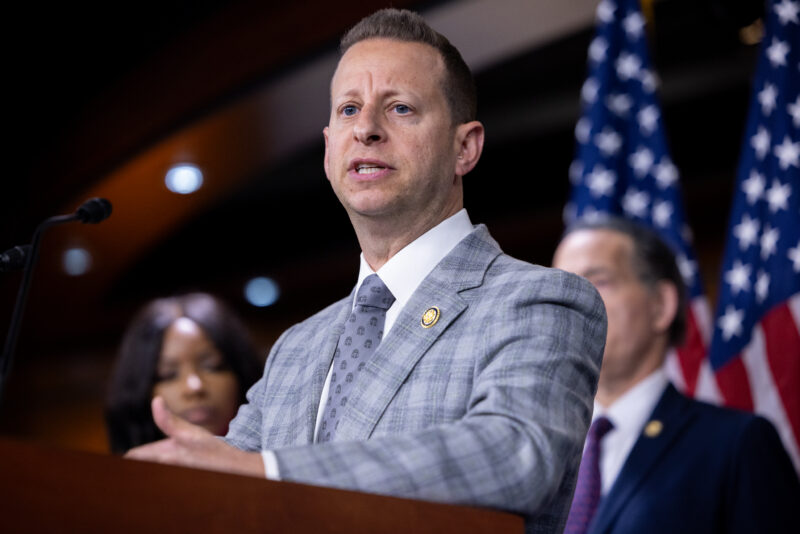













‘The irony is, we worked so hard to get those sanctions imposed and Republicans pushed so diligently,’ Blumenthal told JI
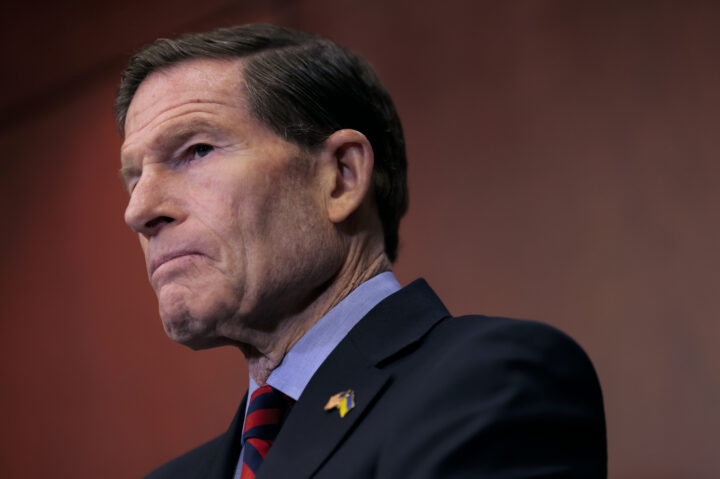
Heather Diehl/Getty Images
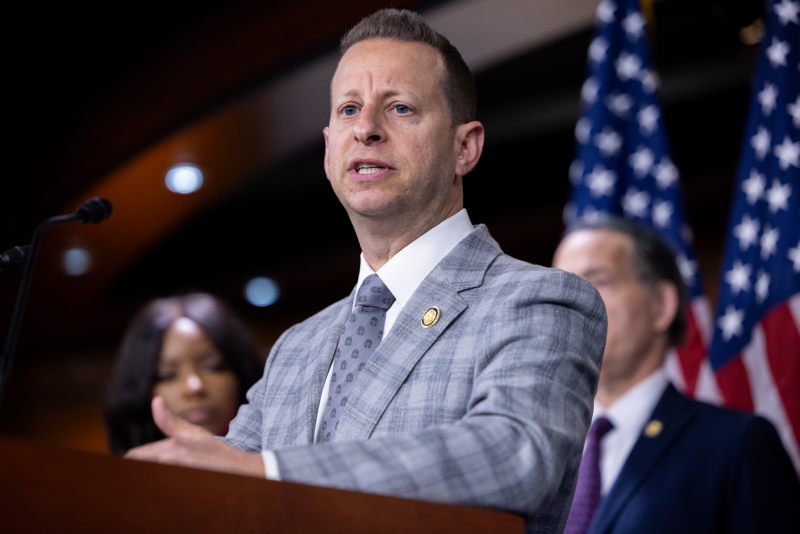
Sen. Richard Blumenthal (D-CT) holds a press conference at the U.S. Capitol on March 03, 2026 in Washington, DC.


 Add JewishInsider on Google
Sen. Richard Blumenthal (D-CT) lambasted the Trump administration for lifting sanctions on some Iranian oil last week, allowing the sale of 140 million barrels of oil currently at sea in a bid to bring down oil prices globally and potentially netting Iran $14 billion.
Lawmakers in both chambers, on a bipartisan basis, have spent years working to increase financial pressure on Iran, with broad support. Those efforts have been ongoing, including as recently as last week when the House passed the Enhanced Iran Sanctions Act by a bipartisan voice vote — in spite of concerns from the White House about sanctioning China, which predated the war, that delayed and watered down the bill.
“The irony is, we worked so hard to get those sanctions imposed and Republicans pushed so diligently, and now literally in the flick of a pen, [President Donald] Trump lifts them with very little benefit to consumers in America and tremendous boost to Iran and Russia, both of them trying to kill our troops and saying ‘death to America’ and ‘death to Israel,’” Blumenthal told Jewish Insider.
The administration had previously waived sanctions on Russian oil, which were designed to to pressure the Russian government to end its invasion of Ukraine.
“I’m having trouble wrapping my head around this really, seemingly, stupid action,” Blumenthal continues.
Sen. Pete Ricketts (R-NE) defended the move as an effort to bring down oil prices.
“What the president is trying to do is make sure that Americans aren’t seeing too high of gas prices at the pump,” Ricketts said.
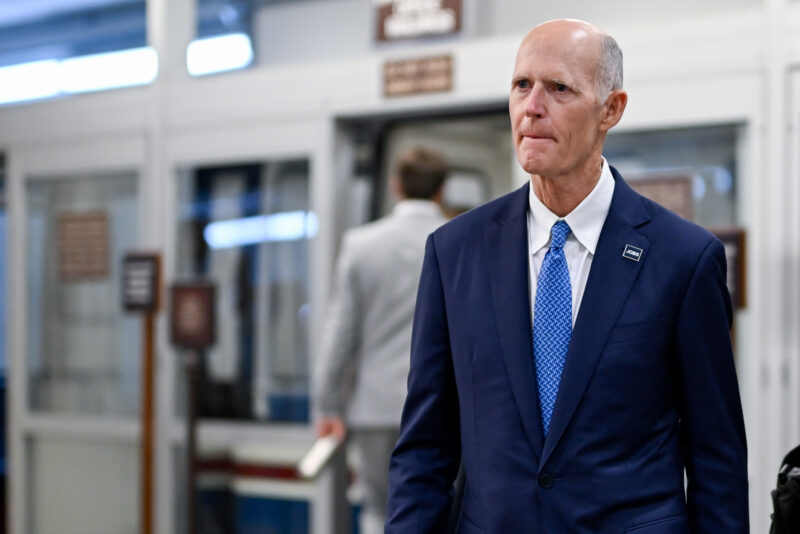
Sen. Rick Scott (R-FL) said that he does not have an issue with the sanctions relief “as long as the money doesn’t go to Iran, then it makes sense.”
“I don’t think that the money was going to go to Iran,” Scott said.
Treasury Secretary Scott Bessent claimed on Sunday that the U.S. was “jiujitsuing the Iranians” and “using their own oil against them,” suggesting that by lowering global oil prices, Iran would ultimately make less money from its oil exports.
He also claimed the U.S. would track the transactions and block the funds involved from actually reaching Iran, though the license issued to allow the oil sales did not provide any such specific provisions or restrictions. The license also allowed the U.S. to import Iranian oil, for the first time in decades.
Off Capitol Hill, the decision has been met with puzzlement and skepticism from Iran hawks, some of whom have raised questions about the actual impact the sanctions relief will have on lowering global oil prices.
Amid other ongoing legal battles, the federal government is seeking to reclaim millions in taxpayer dollars over Harvard’s alleged civil rights violations

JOSEPH PREZIOSO/AFP via Getty Images
Tents and signs fill Harvard Yard in the anti-Israel encampment at Harvard University in Cambridge, Massachusetts, on May 5, 2024.
The Trump administration filed a new lawsuit against Harvard University on Friday, claiming that its leadership violated the civil rights of Jewish students by failing to address ongoing antisemitism that has roiled the Ivy League campus since the Oct. 7, 2023, terrorist attacks in Israel.
In the 44-page lawsuit, filed in federal court in Boston, the Department of Justice said that Harvard unlawfully discriminated against Jewish students by its “intentional conduct and its deliberate indifference to discriminatory harassment of Jewish and Israeli students and creation of a hostile educational environment” since Oct. 7 and “up to the present day.”
Jewish and Israeli students “were repeatedly denied access to educational facilities by antisemitic demonstrators. Fearful for their safety, Jewish students wore baseball caps to conceal their yarmulkes or kept out of sight, effectively denying them access to federally funded educational opportunities,” the lawsuit argues.
It further claims that Harvard faculty and leadership’s response was to “turn a blind eye to antisemitism and discrimination against Jews and Israelis.”
The suit is seeking to recover millions of dollars in taxpayer funds that the school received as these alleged civil rights violations were ongoing.
The litigation marks the administration’s latest crackdown in its ongoing battle with several elite universities including Harvard, which have faced multibillion-dollar funding cuts since last year. The school sued the federal government over the funding freezes, and a federal judge ruled last September that the government violated Harvard’s First Amendment rights and federal law when it froze nearly $2 billion in federal grants. The Trump administration filed an appeal in December 2025, which is ongoing.
“Harvard University has failed to protect its Jewish students from harassment and has allowed discrimination to wreak havoc on its campus. President Trump is committed to ensuring every student can pursue their academic goals in a safe environment,” White House Regional Press Secretary Liz Huston said in a statement.
In a statement to Jewish Insider, a Harvard spokesperson said, “Harvard cares deeply about members of our Jewish and Israeli community and remains committed to ensuring they are embraced, respected, and can thrive on our campus. Our actions illustrate this. Harvard has taken substantive, proactive steps to address the root causes of antisemitism and actively enforces anti-harassment and anti-discrimination rules and policies on campus … Harvard’s efforts demonstrate the very opposite of deliberate indifference.”
Since Oct. 7, Harvard has also faced legal action from Jewish groups. In May 2024, the Louis D. Brandeis Center for Human Rights Under Law filed a federal lawsuit claiming that students and faculty on campus have called for violence against Jews and celebrated Hamas’ terrorism daily as the university ignored harassment— including a physical assault — of Jewish students.
The DOJ suit comes days after a new report was released by the university’s official Jewish alumni group that found Jewish enrollment at Harvard has fallen to roughly 7% — its lowest level since the pre-World War II era.
The international broadcaster, along with Radio Free Europe, has struggled to deploy its Persian-language services to provide coverage amid an internet blackout in Iran
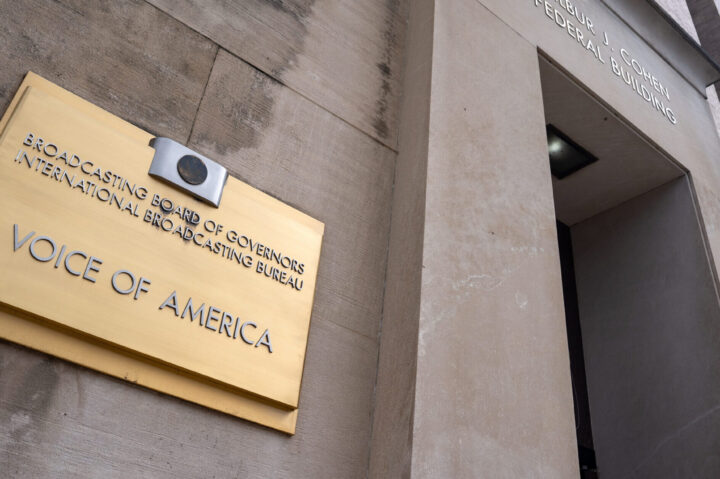
Kent Nishimura/Bloomberg via Getty Images
The Voice of America headquarters in Washington, DC on Thursday, May 29, 2025.
A federal judge’s ruling this week that voided the Trump administration’s efforts to shutter Voice of America, restoring more than 1,000 journalists and other employees by Monday, is raising some hopes that the embattled international broadcaster funded by the federal government may now be able to ramp up its Persian-language coverage to reach Iranians at a crucial moment amid war with the U.S. and Israel.
While VOA had resumed some of its Persian news broadcasting in recent months, it has been hobbled by a yearlong near shutdown ordered by the Trump administration that had reduced the organization to a skeletal staff — further battered by the tumultuous tenure of Kari Lake, who until recently served as the de facto leader of the U.S. Agency for Global Media, which oversees the network.
In a separate ruling earlier this month, the judge ordered that Lake’s appointment as acting chief had been unlawful and nullified her aggressive moves to gut VOA. President Donald Trump last week nominated Sarah Rogers, a senior State Department official, to take over USAGM — a position that requires Senate confirmation which Lake never received. The Department of Justice has not confirmed if it will seek to appeal the latest ruling.
One USAGM source expressed optimism that the judge’s decisions would result in “more resources,” but cautioned that “there are still leadership issues” in the Persian service — once one of VOA’s largest divisions — stifling its ability to report exhaustively on news developments and offer coverage without the appearance of bias.
The Persian division — whose content had seen a growing audience among Iranian news consumers before the shutdown, according to a VOA fact sheet — is now led by Ali Javanmardi, an Iranian Kurdish journalist who has drawn scrutiny for censoring the outlet’s reporting on Iranian opposition figures such as Reza Pahlavi, the exiled crown prince who gained renewed prominence amid mass protests that swept the country prior to the war. One journalist with the Persian service said this month he was fired because of disagreements with leadership over the network’s direction.
The editorial constraints and massive cuts to VOA’s stable of full-time reporters not only “decimated the Iran division” but also “politicized it at a time when it is more important than ever for the United States to be speaking directly to the Iranians,” the USAGM source told Jewish Insider before the recent rulings, speaking on the condition of anonymity to discuss a sensitive issue. “It’s a shame what has happened.”
Now, as the joint U.S.-Israeli military campaign in Iran continues amid a near-total internet blackout imposed by the country’s regime, the need to reach information-starved Iranians has only grown more urgent, several experts familiar with the matter told JI.
But there are ongoing concerns that VOA as well as a federally funded but independent network, Radio Free Europe/Free Liberty, which operates a Persian service called Radio Farda, will continue to struggle due to government roadblocks that have obstructed their ability to produce meaningful stories and even to transmit broadcasts that Iranians have viewed as trusted sources during previous domestic conflicts.
“By adhering to the truth, U.S. international broadcasting can be a powerful tool in America’s arsenal, particularly in Iran where RFE/RL and VOA have strong brands and audiences,” Jamie Fly, who led RFE/RL from 2019-2020 and now serves as chief executive of Freedom House, a think tank promoting global democracy, told JI on Thursday.
Under current management, however, USAGM “seems to be doing everything possible to ensure that President Trump’s messages to the Iranian people are not heard, and in some cases, directly contradicted,” Fly added.
RFE/RL, which Lake tried but failed to shut down, has faced a litany of obstacles that have particularly diminished Radio Farda’s broadcasting presence in Iran. In addition to withholding funding that forced its Persian service to furlough half of its staff, Lake’s efforts to target the network included cutting access to a key U.S. transmitter in Kuwait that allowed it to disseminate its broadcasts in Iran and inhibiting the use of virtual private networks that help circumvent internet shutdowns, among other hostile moves.
According to an RFE/RL source, USAGM “is still asking that” the network “use its own grant” resources to broadcast via short and medium wave radio from the Kuwait transmitter — which is federally funded. USAGM “resumed transmissions of Radio Farda” on shortwave in early February and medium wave in early March, the source told JI. The network has additionally paid for satellite as well as short and medium wave transmissions using its “own grant funds already through private vendors.”
“As the internet remains unstable” in Iran, the source said, “our journalists have been able to conduct interviews with and receive updates from Iranians on the ground only periodically.”
Despite such issues, Farda “continues to garner a significant audience online,” the source told JI. From Feb. 28 to March 17, for instance, “Farda published 738 posts on Instagram, recording 105.5 million impressions and 28.6 million video views.”
Even as the organization has managed to bypass some impediments to its operations, another RFE/RL source described intense frustration with USAGM, calling its oversight “dysfunctional” as the agency has sought to exert its control over a network that — unlike VOA — is not a government entity.
“They have no plan,” the source said on condition of anonymity to avoid reprisals. “There’s no strategy.”
USAGM “could and should be more cooperative when Iran blocks” internet access, the source told JI this week. “We should all be surging into Iran now,” where RFE/RL has learned that university students in the country have been “sharing shortwave radios to hear” its broadcasts amid the war.
USAGM did not respond to a request for comment. On social media, Lake has otherwise touted VOA’s efforts to reach Iranians, despite criticism that she has hampered its resources and diluted its Persian coverage — which she wrote in one recent post that she had tried to “realign” with “U.S. foreign policy.”
Experts raised doubts about the possibility of an imminent news surge into Iran even if the judge’s recent ruling is expected to soon restore VOA to its pre-shutdown capacity. As USAGM maintained an adversarial posture toward VOA, RFE/FL and other federally funded nonprofit groups, it still remains to be seen if Rogers, the nominee to succeed Lake, will change direction. Lake, meanwhile, has pledged she will appeal the ruling invalidating her role and said that she will continue at USAGM as its deputy CEO.
Amid the changes, Ilan Berman, an Iran expert at the American Foreign Policy Council who serves on the board of RFE/FL, told JI in an interview that he was “cautiously optimistic there is going to be more coherence to administration” inside USAGM, after a year in which he questioned its “strategic mission.”
During Lake’s tenure, “there was no coherence to the informational enterprise” except for a “focus on disruption,” Berman noted. “The people who suffer are the people of Iran.”
Khalil again declined to condemn Hamas during his hourlong conversation on ‘the cost of dissent’ at the festival

Spencer Platt/Getty Images
Palestinian activist Mahmoud Khalil, who was released from ICE detention, speaks during a rally on the steps of the Cathedral of St. John the Divine in Manhattan on June 22, 2025 in New York City.
The anti-Israel campus protest movement is facing “fear and exhaustion” amid the Trump administration’s crackdown, Mahmoud Khalil, who led demonstrations against Israel on Columbia University’s campus in the aftermath of the Oct. 7, 2023, terrorist attacks and the ensuing war in Gaza, said on Sunday at the annual South by Southwest (SXSW) festival in Austin, Texas.
“With the Biden administration, you protest because you feel you can move the needle a little bit,” said Khalil. “But with Trump, it’s like plain tyranny. They would not listen.”
Khalil, who spoke three days after an attempted terrorist attack at a synagogue in Michigan, noted that “antisemitism is real in this country” and condemned “violence against civilians.”
At the same time, he argued that “claims of antisemitism are being weaponized to silence any critique of the U.S. support to Israel.”
“All mainstream Jewish organizations in this country are disregarding real antisemitism in the Republican Party and just protecting Israel,” continued Khalil. He spoke in an hourlong conversation “on the cost of dissent,” with The Guardian editor Betsy Reed and Baher Azmy, legal director of the Center For Constitutional Rights who was a lawyer for Khalil in his ongoing deportation proceedings.
SXSW, a weeklong festival that convenes around 300,000 guests, including film and media professionals, executives and politicians to discuss culture, technology and innovation, faced scrutiny from some Jewish leaders over its decision to platform Khalil.
Greg Rosenbaum, SXSW senior vice president of programming, told the Austin American-Statesman that hosting the discussion does not mean the festival endorses Khalil’s views.
“While many people, including us, may strongly disagree with some of the views, the reality is that expressing some of those views in a country with free speech protections led him to be imprisoned,” said Rosenbaum. “That doesn’t mean we support what he says, but it does mean that there’s a broader conversation that’s worth having about speech, disagreement and the consequences people face for expressing controversial ideas.”
Ted Deutch, CEO of the American Jewish Committee, expressed dismay at this justification. “But platforms amplify voices — that’s the point,” he wrote on X prior to Khalil’s appearance. “Giving him this platform is a mistake.
Khalil was a key organizer of Columbia University’s anti-Israel encampment in April 2024, a two-week demonstration in the center of campus during Israel’s war in Gaza. The demonstration included several incidents of assault on Jewish students. Protesters used threatening and antisemitic slogans, including, “Go back to Poland”; signs with the Hamas symbol and the words “I’m with them”; and chants calling for Hamas attacks on Tel Aviv.
Khalil later described the Oct. 7 attacks as “a desperate attempt to tell the world that Palestinians are here. That was my interpretation of why Hamas did the Oct. 7 attacks on Israel,” he said in a New York Times interview.
A former Columbia graduate student who grew up in Syria but is of Palestinian descent, Khalil was released in June from the Immigration and Customs Enforcement detention center in Louisiana, where he had been held for three months pending deportation proceedings. A federal appeals court ruled in January that Khalil could be rearrested.
Asked on Sunday by Reed about his repeated refusal to denounce Hamas in a CNN interview shortly after being released from detention, Khalil still did not condemn the terrorist organization. Instead, he said he “would never answer such a question in a 20-second sound bite,” and argued that it was a “double standard” to be asked the question in the first place.
“When Palestinians get asked this question, they are not interested in my views,” he said. “That question was asked a month after my release. If you say yes, maybe you are worth listening to and if not, then you’re discredited. That’s why I refused to answer that question.
“You can never justify violence and Oct. 7 but to them you can never contextualize Oct. 7, [yet] Oct. 7 justifies everything that happened after. To me that’s a double standard. These are all deliberate attempts to silence people.”
Sources say that the administration had delayed the bill and watered it down due to a reluctance to impose sanctions on China, the primary importer of Iranian oil

Morteza Nikoubazl/NurPhoto via Getty Images
An oil tanker is being pictured in the Persian Gulf near the seaport city of Bushehr, in Bushehr Province, southern Iran, on April 29, 2024.
The Trump administration intervened to water down a broadly bipartisan sanctions bill targeting Iran’s oil exports to China, sources told Jewish Insider.
The House is set to vote next week on the Enhanced Iran Sanctions Act, led by Reps. Mike Lawler (R-NY) and Sheila Cherfilus McCormick (D-FL), which has nearly 300 cosponsors and advanced out of the House Foreign Affairs Committee in April 2025 by a voice vote, indicating broad bipartisan support. It began moving to the House floor earlier this year using a consensus measure for legislation with at least 290 cosponsors.
But the version of the bill now up for consideration is significantly different from the version that was first introduced and passed out of committee.
A congressional source and another person familiar with the legislation said that the changes, which they said would soften the impact of the bill, had been made at the behest of the Trump administration, which had delayed progress on the bill for months over concerns about placing sanctions on China, which would have been caught up in the expanded sanctions on Iran’s oil trade as the primary importer of Iranian oil.
The administration has been engaging in trade talks with Beijing, which it felt could have been disrupted by the enactment of sanctions, though the Treasury Department has still sanctioned some oil processing facilities in China under other authorities passed by Congress in 2024.
As currently written, the legislation gives the administration the authority to impose sanctions on foreign individuals or businesses that have “knowingly engaged in any significant transaction related or incidental to the processing, refining, export, transfer or sale of oil, condensates, or other petroleum or petrochemical product in whole or part from Iran” or conducted significant transactions with individuals or institutions sanctioned under a previous Iran oil sanctions bill.
The sanctions would also apply to corporate officers of such companies and immediate family members who “demonstrably benefit” from these activities.
The original version of the sanctions legislation, however, mandated the imposition of such sanctions — providing less latitude to the administration in implementing the bill — and specified that banks and financial institutions, insurance providers, ship-flagging registries, pipeline builders and operators of processing facilities would all specifically be subject to sanctions under the legislation.
It applied to successors and aliases of sanctioned companies, as well as to individuals or organizations that directly or indirectly owned or controlled a majority interest in a sanctioned institution or were majority owned or controlled by a sanctioned institution. And the sanctions applied to all immediate family members of those directly sanctioned.
The original bill applied to any transaction related to the Iranian petrochemical trade, rather than only “significant” transactions, and included specific mention of natural gas exports as well.
The updated legislation modifies the presidential waiver provision, which originally applied only if the president determined that waiving the sanctions was “vital to the national interests” of the U.S. The updated version allows a waiver if it is “in the national interests” of the country.
The original bill required the administration to notify Congress 15 days before it planned to renew a waiver, if applicable, whereas the new bill does not include any specific timeline for such notification.
The updated bill also entirely eliminates provisions creating an interagency working group responsible for working with international partners to coordinate sanctions and share intelligence.
The new version of the bill includes a provision that would terminate the sanctions if Iran ceases its malign activities.
The House will also vote next week on the Holocaust Expropriated Art Recovery (HEAR) Act, which aims to help Jewish families recover Nazi-looted artwork by eliminating loopholes used by museums and other stakeholders that have continued to hold such works.
The bill passed the Senate by unanimous consent.
Both bills are being offered under suspension of the rules, a procedure requiring two-thirds support from the chamber.
Rep. Debbie Wasserman Schultz said she would likely have voted to authorize force against Iran if the administration had approached Congress properly before launching the war
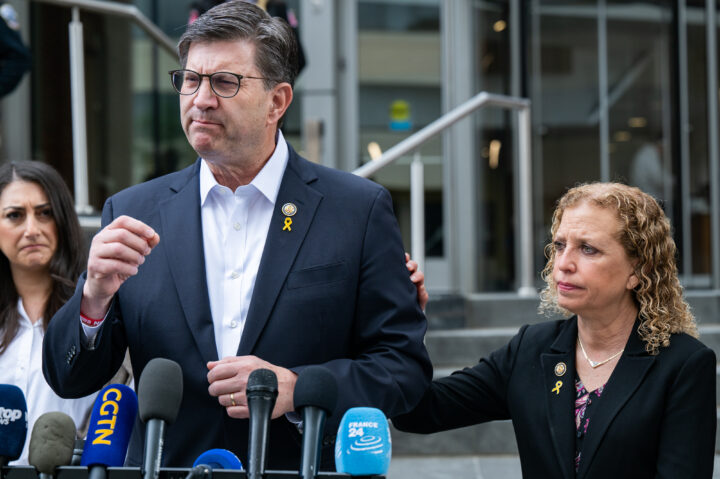
Annabelle Gordon/Bloomberg via Getty Image
Rep. Brad Schneider (D-IL) and Rep. Debbie Wasserman Schultz (D-FL), during a news conference in Washington, DC, US, on Thursday, May 22, 2025.
Remarks by pro-Israel stalwarts Reps. Debbie Wasserman Schultz (D-FL) and Brad Schneider (D-IL) on a Jewish Democratic Council of America webinar on Wednesday highlighted the delicate line that some pro-Israel Democratic lawmakers are walking on the war in Iran.
Wasserman Schultz and Schneider, along with some of their Democratic colleagues, are longtime Iran hawks and have previously supported many of the stated aims of the war, but express deep skepticism of how the Trump administration is handling the operation and its decision not to seek congressional authorization.
Both Democrats voted for a war powers resolution last week that sought to bring an immediate halt to the war.
Wasserman Schultz said that, in addition to legal and constitutional concerns, Trump made a “colossally stupid” decision in not coming to Congress because some lawmakers, including her, might have voted to support an operation against Iran if presented with the proper intelligence and a clear plan.
“I can tell you assuredly: had I been presented with an Authorization for Use of Military Force, that made sense, and that we were properly briefed, and there was a demonstrative, imminent threat — which we have really yet to be shown — I am someone on our side of the aisle that likely would have voted for an AUMF if all of those things were in place,” Wasserman Schultz said. “Instead, [President Donald Trump] has blown an opportunity to go in in the most prepared way.”
By sidestepping Congress, the administration left the U.S. unprepared for the implications and blowback from the war, Wasserman Schultz said, highlighting, among other issues, the administration’s failure to evacuate American citizens from the region before the war started.
“I am so frustrated because I think everyone on this call knows how dangerous, deeply evil Iran is as a regime,” Wasserman Schultz said. “I have been careful about just blanket-ly condemning everything [Trump is] doing here, but most certainly, the way that we got into this was really unacceptable, and my constituents are very concerned.”
While Wasserman Schultz said she supported diplomacy with Iran, she also expressed skepticism about its chances for success, explaining that the Iranian regime would likely have sought to string the U.S. along until Trump left office, buying time to continue building its nuclear and missile programs.
Schneider said he believes strongly that the U.S. needs to address the threat from Iran, as well “help the people of Iran free themselves” from the regime, but added that “the Constitution is clear” that only Congress can declare war, and the administration has still not clearly identified an imminent threat that would have allowed it to legally take action unilaterally. He also said he does not trust the administration to properly carry through the mission without oversight.
“We can agree on the objectives in confronting Iran. We have no idea what the goals of this war are, or the strategy for achieving those goals, or the endgame that is trying to be ultimately accomplished that would bring the war to an end,” Schneider said. “My biggest fear is Trump … declares victory and goes home with Iran’s regime still in place, the nuclear program not completely defeated, [the] ballistic missile program damaged but not eliminated.”
He said that he’s afraid that, if the administration doesn’t set clear objectives, it will stop the war prematurely and ultimately leave the Iranian regime “more entrenched, feeling more powerful.”
The Illinois congressman speculated that Iranian leadership, by gathering in one central location, could have “present[ed] an opportunity that was too good to pass up” in launching the war but said that the administration still hasn’t properly articulated to lawmakers its thinking and strategy, so he does not know if that is the case.
Schneider said that an ideal outcome would require removing Iran’s enriched uranium from the country, which would necessitate international inspectors and a diplomatic settlement.
“There is no military solution to get us where we ultimately need to be. It has to be a political solution,” he said. “The military action always needed to be on the table to help us achieve that political solution. But with this President, I think it’s more ready, fire, aim, as opposed to ready, aim, fire.”
Schneider also called for Secretary of Defense Pete Hegseth to be removed from his job, saying Hegseth has failed to prepare for easily anticipated Iranian responses like mining the Strait of Hormuz, or to ensure proper oversight to prevent civilian casualties.
Wasserman Schultz said that she would consider a supplemental funding request if and when the administration presents one, emphasizing that she wants to ensure U.S. troops have the resources they need because “it’s not their choice to be there,” even if she doesn’t fully agree with the administration’s approach.
Wasserman Schultz added that she’s concerned that the war is “compromising our ability” to protect the U.S. from Russia and China.
Asked about a supplemental request, Schneider emphasized that U.S. servicemembers have his strong support and are “doing their job, they’re succeeding, and we should all pray for the success of their mission and their safe return.”
But he said he’s disappointed with the political leadership in the administration, particularly its distribution of online videos intermixing footage from the war with movie clips and video games, even as U.S. servicemembers have been killed and injured. “No one should take glee in the killing of the enemy. It is a necessary act that is advancing our interests.”
JDCA itself also seems to be striking a delicate balance.
The group’s CEO Halie Soifer said JDCA agrees with the need to stop Iran’s missile and nuclear programs, but emphasized that Trump is going around Congress and that, while some Democrats might “support, perhaps, some of the short-term tactical gains” some also “believe the administration is lacking a long-term strategy for success in Iran.”
Schneider and Wasserman Schultz were also critical of comments by Secretary of State Marco Rubio suggesting that Israel had effectively dragged the U.S. into the war. Rubio has said those comments were mischaracterized. Both criticized that framing of the conflict as incorrect and as potential fodder for increased antisemitism.
“The president said it himself: He was not compelled, he may have compelled Israel,” Schneider said.
But he added, “in the end, it doesn’t really matter,” predicting a similar rise in antisemitism as occurred around the 1973 Yom Kippur War — launched by Egypt — when people in the U.S. blamed Jews and Israel for rising gas prices.
“Because this administration did not have that conversation with Congress and, through Congress, with the American people, people are going to look for scapegoats,” he said. “And when folks are looking for scapegoats, Jews are almost always one of those targets.”
Wasserman Schultz said that Rubio’s comments were “unbelievable” and “dangerous.”
“It is incredibly dangerous for Jews worldwide, and … unacceptable for him to have basically set it up that, ‘Well, we had to do this because it’s the Jews’ fault,’” Wasserman Schultz said. “Once it’s said, the impact — it remains.”
Speaking broadly, she said that the picture presented to lawmakers in a classified setting was “more subtle.”
The Education Department’s Noah Pollak argued at an antisemitism conference that IRS regulations could force nonprofits to increase transparency about funding and staff
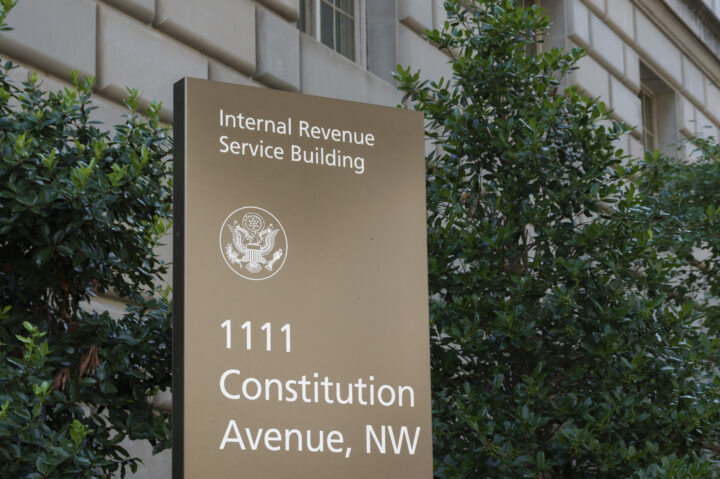
Kevin Carter/Getty Images
A sign is displayed outside of the Internal Revenue Service (IRS) Building on June 7, 2025 in Washington, DC.
The next frontier for the Trump administration’s war with higher education might be the U.S. tax code, a senior Education Department official said on Tuesday.
Speaking at a conference about antisemitism organized by the Republican Jewish Coalition and National Review, Noah Pollak, a senior advisor to Education Secretary Linda McMahon, said that making changes to American tax policy could be a useful vehicle to fight antisemitism on campuses.
His argument was a wonky one, suggesting that changes to IRS rules regulating nonprofits could increase transparency — and require the organizations fomenting antisemitism at U.S. universities to reveal much more information about their operations and staff.
Pollak called for the federal government to create limits on fiscal sponsorship, a tool by which an existing nonprofit incubates a new one. This allows a new nonprofit organization to launch quickly, with donations passing through a larger, more established organization. The idea is that once the new nonprofit has a steadier foundation, it will eventually incorporate as a 501(c)(3) nonprofit with the IRS, after which point it must meet certain federal requirements and make information about its finances and activities publicly available.
But there is currently no legal requirement that a nonprofit ever spin off from the organization where it is fiscally sponsored. That allows organizations seeking to avoid the spotlight to stay in the shadows, and to avoid having to file a Form 990, the IRS-mandated document that nonprofits must file yearly laying out the state of their finances, activities, senior staff and top board members.
“Over the past 15 years or so, particularly on the left and on the far left, they realized that there were really no restrictions on this, and you could just run whole organizations via fiscal sponsorships,” Pollak said. “It means you can raise money — tax deductible money, which is much easier to raise than non-tax deductible money — and never have to disclose who the money’s going to, what it’s funding [or] how much money.”
Pollak argued this transparency gap benefits organizations like Students for Justice in Palestine, which played a key role in fomenting anti-Israel sentiment on campuses after the Oct. 7 terror attacks.
“Changing the fiscal sponsorship rules to compel disclosure of who’s being funded via fiscal sponsorships would basically be a neutron bomb going off in the world of radical, left-wing, kind of criminal activism,” said Pollak. “You all know what Students for Justice in Palestine is. Go try to find their EIN [Employer Identification Number]. Go try to find a 990 for them. You can’t. They’re not a real organization. They’re not incorporated.”
“Things in the tax code, they may sound boring,” Pollak added. “But they would be very effective in creating some disclosure.”
Pollak said changes to the tax code might also force universities to cut back on spending on left-wing priorities.
“Over the past 40 or 50 years, the tax code has actually been tweaked and rigged and modified in so many different ways that creates a lot of advantages for universities, to the point where the universities now have so much money that they can spend on essentially luxury goods,” Pollak said. “For a university, the luxury goods they spend on is the gender studies department, and it’s DEI [diversity, equity and inclusion] bureaucracies.”
Pollak pointed to those “luxury goods” — left-wing programs in the humanities, for instance — as a key factor in the growth of antisemitism at elite universities. He did not offer a specific policy fix but said he thinks that the solution might be found in the tax code.
“If you actually look at adjustments to the tax code, that will translate into less antisemitism, because the universities would be compelled to sober up to get back to the core mission of education and the pursuit of knowledge and the pursuit of excellence,” said Pollak. “They would actually have to drop a lot of the kind of insane nonsense departments and fake academic programs.”
Universities’ status as nonprofit organizations should also come into play when the State Department determines how many foreign students should be allowed to enroll at those universities, Pollak said.
The Trump administration has sought to limit the number of foreign students at universities and deport those who are flouting American values; Pollak argued that the number of foreign students at elite institutions is so high that they push the campuses toward an anti-American sentiment.
“There’s so many of them, and many of them are from cultures that, frankly, are not particularly compatible with the type of values that we want on a campus, on a Western U.S. campus, and they get our kids spun up on third worldist-type causes and radical causes,” said Pollak.
“Universities in America are actually supposed to — they are charities. They’re 501(c)(3)s, and they are actually supposed to be operated for the benefit of Americans, and not just be kind of sold out to whoever wants to come from all over the world.”
The move marks the latest crackdown from the White House against Muslim Brotherhood affiliates
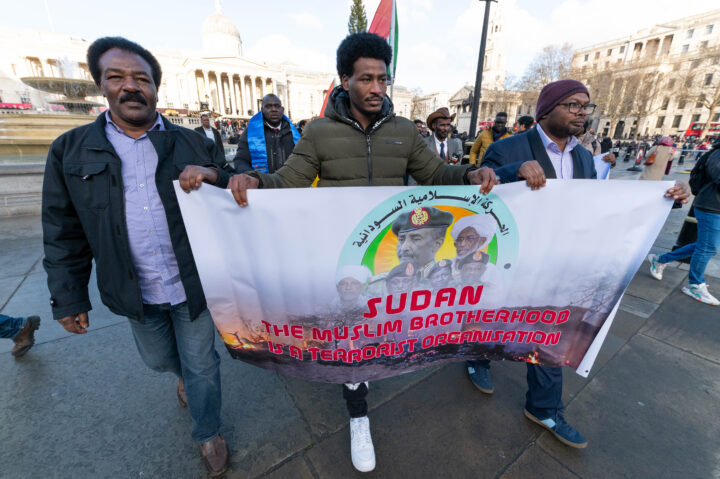
Andrea Domeniconi/SOPA Images/LightRocket via Getty Images
Man hold a banner reading "The Muslim Brotherhood is a terrorist organization" during a Sudanese rally in Trafalgar Square on Dec. 20, 2025.
On Monday, the Trump administration moved to designate the Sudanese Muslim Brotherhood (SMB) as a Specially Designated Global Terrorist (SDGT) entity and announced plans to impose a Foreign Terrorist Organization (FTO) designation on March 16.
“The Sudanese Muslim Brotherhood uses unrestrained violence against civilians to undermine efforts to resolve the conflict in Sudan and advance its violent Islamist ideology,” Secretary of State Marco Rubio said in a press release. “The United States will use all available tools to deprive the Iranian regime and Muslim Brotherhood chapters of the resources to engage in or support terrorism.”
The SMB is composed of the Sudanese Islamic Movement and its armed wing, the al-Baraa Bin Malik Brigade (BBMB). The Muslim Brotherhood has maintained a significant presence in Sudan since the 1940s and has played a role in the country’s ongoing civil war between the Sudanese Armed Forces (SAF) — backed by Iran, Russia, Egypt and Turkey — and the Rapid Support Forces, which have reportedly received support from the United Arab Emirates.
Experts have previously told Jewish Insider that the SAF is heavily influenced by the SMB, working alongside several Islamist militias and receiving attack drones from Iran’s Islamic Revolutionary Guard Corps (IRGC), which has been designated as a terrorist organization by both the U.S. and the European Union. The SMB has contributed roughly 20,000 fighters to the conflict, with many receiving “training and other support” from the IRGC, according to the State Department.
An alleged Muslim Brotherhood leader in the Sudanese Armed Forces was also caught on video last week asserting that the group is ready to defend Iran amid the ongoing conflict between Tehran and the U.S. and Israel. The leader suggested that the group would send battalions to fight alongside Iran, according to Sky News Arabia.
“As the world’s leading state sponsor of terrorism, the Iranian regime has financed and directed malign activities globally through its IRGC,” Rubio said in the statement, adding that the SMB has also “conducted mass executions of civilians.”
The designation marks the Trump administration’s latest crackdown on Muslim Brotherhood affiliates and represents a notable policy step into the Sudan conflict. In January, the administration designated three Muslim Brotherhood branches in Egypt, Lebanon and Jordan as SDGT entities, with the State Department citing their provision of “material support to Hamas.”
‘If anything, I might have forced Israel's hand,’ Trump said after Rubio’s previous comments were interpreted as placing blame on Israel
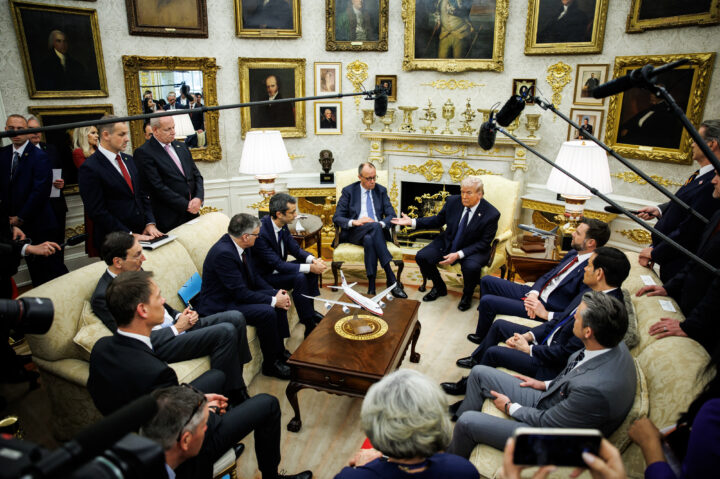
Samuel Corum/Sipa/Bloomberg via Getty Images
Friedrich Merz, Germany's chancellor, center left, and US President Donald Trump during a meeting in the Oval Office of the White House in Washington, DC, US, on Tuesday, March 3, 2026.
A chorus of senior Trump administration officials, including White House Press Secretary Karoline Leavitt, Secretary of State Marco Rubio and Defense Secretary Pete Hegseth sought to offer a decisive rebuttal on Tuesday to what they deemed to be a false narrative, which had spread like wildfire a day before.
They were all responding to the political tumult and online furor that erupted after Rubio briefed congressional leaders about the U.S. military operation in Iran on Monday afternoon.
A narrative quickly formed — based in large part on a viral post on X from the White House clipping an excerpt of Rubio’s comments — that Trump decided to strike Iran because Israel was already planning an attack, which would then prompt Iranian retaliation, thus putting American troops at risk.
“The president made the very wise decision — we knew that there was going to be an Israeli action, we knew that that would precipitate an attack against American forces, and we knew that if we didn’t preemptively go after them before they launched those attacks, we would suffer higher casualties,” Rubio told reporters.
The White House shared that sound bite in a post on X that was viewed more than 13 million times in less than a day. Rubio’s Monday messaging about Israel was echoed by House Speaker Mike Johnson (R-LA) after he and other congressional leaders received Rubio’s briefing.
The question that was then posed dozens of times by reporters to policymakers: Had Israel forced America’s hand and dragged the U.S. into war?
Never mind that Rubio also said in those same remarks the U.S. was not “forced” to strike because of an impending Israeli action. “No matter what, ultimately, this operation needed to happen,” Rubio said. The White House shared that sound bite on X Tuesday morning, drawing 500,000 views, a fraction of the visibility of the earlier post. “No, Marco Rubio Didn’t Claim That Israel Dragged Trump into War with Iran,” was the headline Leavitt posted on X. But the damage had already been done.
Fox News host Sean Hannity asked Israeli Prime Minister Benjamin Netanyahu the same question in a Monday night interview. “You don’t have to drag him into anything,” Netanyahu said of Trump. “He does what he thinks is right for America.”
Another reporter then posed the question to Trump directly on Tuesday during an Oval Office meeting between the president and German Chancellor Friedrich Merz.
“No,” Trump said decisively. “I might have forced their hand.” Hegseth then chimed in on X boosting Trump’s message: “This is 100% correct.”
Rubio similarly refuted a reporter who said the U.S. needed to get involved because Israel was going to strike Iran.
“Your statement is false,” he said Tuesday during another visit to Capitol Hill for all-member briefings in the House and Senate. “Somebody asked me the question yesterday, did we go in because of Israel … I told you this had to happen anyway. The president made a decision, and the decision he made was that Iran was not going to be allowed to hide behind its ballistic missile program, that Iran was not going to be allowed to hide behind its ability to conduct these attacks. That decision had been made.”
The question, he said, was “a question of timing, of why this had to happen as a joint operation. Not the question of the intent.”
Some questions remain unanswered. Trump told reporters alongside Merz that Iran was going to attack first, but it was not clear whom he expected Iran to attack, the Israelis or the Americans. A White House spokesperson did not respond to requests for comment.
“We were having negotiations with these lunatics, and it was my opinion that they were going to attack first,” Trump said. “Based on the way the negotiation was going, I think they were going to attack first, and I didn’t want that to happen. So if anything, I might have forced Israel’s hand, but Israel was ready, and we were ready, and we’ve had a very, very powerful impact.”
Even as the White House refuted the narrative that Israel had pulled the U.S. into war and put American servicemembers at risk, Democratic lawmakers and right-wing podcasters turned it into an online rallying cry.
“So Netanyahu now decides when we go to war? So much for America First,” Sen. Ruben Gallego (D-AZ) said in a post on X on Monday. Ben Rhodes, the deputy national security advisor to President Barack Obama, argued Trump could not bring himself to say no to Netanyahu: “Donald Trump is so weak that he couldn’t tell Bibi Netanyahu no, so now we are at war,” he said in response to the Rubio clip.
Sen. Mark Warner (D-VA), who was in Monday’s briefing by Rubio, afterward described the strikes as “dictated by Israel’s goals and timelines” and said he opposed them.
On the right, Matt Walsh of The Daily Wire sharply criticized Rubio. “So he’s flat out telling us that we’re in a war with Iran because Israel forced our hand. This is basically the worst possible thing he could have said,” Walsh wrote.
The conservative pundit Megyn Kelly said that the American servicemembers who have so far died in the campaign did not give their lives for the United States. “No one should have to die for a foreign country. I don’t think those four service members died for the United States. I think they died for Iran or for Israel,” she said on Monday.
Now progressive Jewish groups are attacking the White House, saying that pinning the war on Israel feeds into antisemitic conspiracy theories.
“Shifting blame for American military decisions to Netanyahu is an abdication of responsibility and comes with the dangerous side effect of fueling antisemitic sentiment in the United States,” J Street President Jeremy Ben-Ami said Tuesday.
The Jewish Democratic Council of America called Rubio’s language “unprecedented, dangerous and deeply irresponsible.”
“As Jewish Americans, we’re deeply concerned about the consequences of the White House effectively blaming Israel for its decision to launch a war against Iran, which has now spread to the entire Middle East,” JDCA said in a Tuesday statement.
The Republican Jewish Coalition, meanwhile, spent Tuesday reposting messages from the White House, the Senate Republican Caucus and the Pentagon that Israel had not, in fact, dragged the U.S. into war.
Rubio attempted to offer a final rebuttal of the narrative about Israel driving the war when he was back on Capitol Hill on Tuesday. He acknowledged how his comments the day before had spread — although he did not mention that the White House played a role in amplifying them.
“If you’re going to play the statements, you need to play the whole statement, and not clip it to reach a narrative,” said Rubio.
Plus, Alex Soros boosts antisemitic conspiracy theorist
Samuel Corum/Sipa/Bloomberg via Getty Images
Friedrich Merz, Germany's chancellor, center left, and US President Donald Trump during a meeting in the Oval Office of the White House in Washington, DC, US, on Tuesday, March 3, 2026.
Good Tuesday afternoon,
This P.M. edition is reserved for our premium subscribers — offering a forward-focused read on what we’re tracking now and what’s coming next.
It’s me again — Danielle Cohen-Kanik, U.S. editor at Jewish Insider and curator, along with assists from my colleagues, of the Daily Overtime. Please don’t hesitate to share your thoughts and feedback by replying to this email.
📡On Our Radar
Notable developments and interesting tidbits we’re tracking
The Trump administration emphatically denied reports, based on partial comments made by Secretary of State Marco Rubio yesterday, that Israel forced the U.S. to launch the operation against Iran.
“If anything, I might’ve forced Israel’s hand,” President Donald Trump told reporters while meeting with German Chancellor Friedrich Merz in the Oval Office today. “You see, we were having negotiations with these lunatics, and it was my opinion that they [Iran] were going to attack first.”
Defense Secretary Pete Hegseth boosted the president’s comments, saying, “This is 100% correct,” while Rubio insisted his original remarks were misrepresented…
Trump continues to share optimistic assessments of the war’s progress: he told Politico that Iran is running out of missile launchers while claiming the U.S. has “a virtually unlimited supply” of weapons, saying, “wars can be fought ‘forever,’ and very successfully, using just these supplies”…
The Israeli Air Force struck a building where senior clerics had gathered to elect Iran’s next supreme leader, Israeli Ambassador to the U.S. Yechiel Leiter told CNN, “and there’s a very good chance that the electors won’t be readily available for any further meetings”…
Trump is open to backing militias in Iran who will work to mount regime change, U.S. officials told The Wall Street Journal, after he held phone calls with Kurdish leaders who maintain armed groups along the Iran-Iraq border.
Trump has wavered in recent comments on his vision for the future of Iran, saying today that “somebody from within” might be the best option to lead, rather than individuals like exiled former crown prince, Reza Pahlavi. At the same time, Trump told reporters, “Most of the people we had in mind are dead. And now we have another group, they may be dead also. Pretty soon we’re not gonna know anybody”…
Trump ordered the U.S. Development Finance Corporation to provide political risk insurance for all maritime trade traveling through the Gulf, as oil traffic has essentially halted and energy prices have soared. The U.S. Navy will also, if necessary, begin physically escorting tankers through the Strait of Hormuz, Trump said…
Ukrainian President Volodymyr Zelensky offered his country’s assistance to the UAE, as the Gulf country has been targeted by over 1,000 Iranian drones and missiles since the operation began Saturday. Ukraine has become particularly skilled in combating Iranian Shahed drones, something the UAE has little experience with, as Russia has regularly used them in its attacks on Ukraine…
The U.S. Embassy in Saudi Arabia was struck with two Iranian drones, with no casualties reported; the embassy was closed, along with U.S. embassies in Kuwait and Beirut. The State Department ordered the mandatory departure of all non-emergency personnel in several countries and has begun “actively securing military aircraft and charter flights for American citizens who wish to leave” the region…
The International Atomic Energy Agency confirmed that Iran’s underground Natanz nuclear enrichment plant was struck in the course of hostilities in recent days. Trump has claimed the site was rendered inoperable during the U.S.’ June 2025 strikes…
Alex Soros, one of the progressive movement’s most influential donors, boosted a social media post today about U.S. casualties in the war with Iran from Max Blumenthal, a prominent anti-Israel conspiracy theorist, Jewish Insider‘s Matthew Kassel reports.
Soros also praised Spain for its refusal to allow the U.S. to use joint bases on its soil, calling Madrid the “leader of the free world” and reprimanding other European countries for not doing the same…
After issuing a statement solely attacking the U.S. and Israel over the campaign against Iran — which provoked backlash from members of the Iranian dissident and diaspora communities — New York City Mayor Zohran Mamdani acknowledged the “systematic repression” of the Iranian people by the regime, while declining to criticize the late Supreme Leader Ayatollah Ali Khamenei, JI’s Will Bredderman reports.
Even as he acknowledged Tehran’s bloody suppression of protesters, Mamdani did not directly answer a reporter’s question at a press conference today about whether the Middle Eastern nation was better off without the radical cleric who ruled for nearly 37 years…
Amazon Web Services operations are “significantly impaired” after three of its data centers in the Middle East were struck by Iranian drones — two directly hit in the UAE and one sustaining damage in Bahrain. The strikes “caused structural damage, disrupted power delivery to our infrastructure, and in some cases required fire suppression activities that resulted in additional water damage,” AWS said…
⏩ Tomorrow’s Agenda, Today
An early look at tomorrow’s storylines and schedule to keep you a step ahead
Keep an eye out in Jewish Insider for a look at the results of today’s high-stakes primary elections in North Carolina and Texas and their implications for pro-Israel voters.
The Heritage Foundation will hold an event to launch its 2026 “Index of U.S. Military Strength” with remarks from Sen. Jim Banks (R-IN) and Reps. August Pfluger (R-TX), Pat Harrigan (R-TX) and Matt Van Epps (R-TN).
The U.S. Commission on International Religious Freedom will release its annual report tomorrow on Capitol Hill.
Stories You May Have Missed
SQUARING OFF
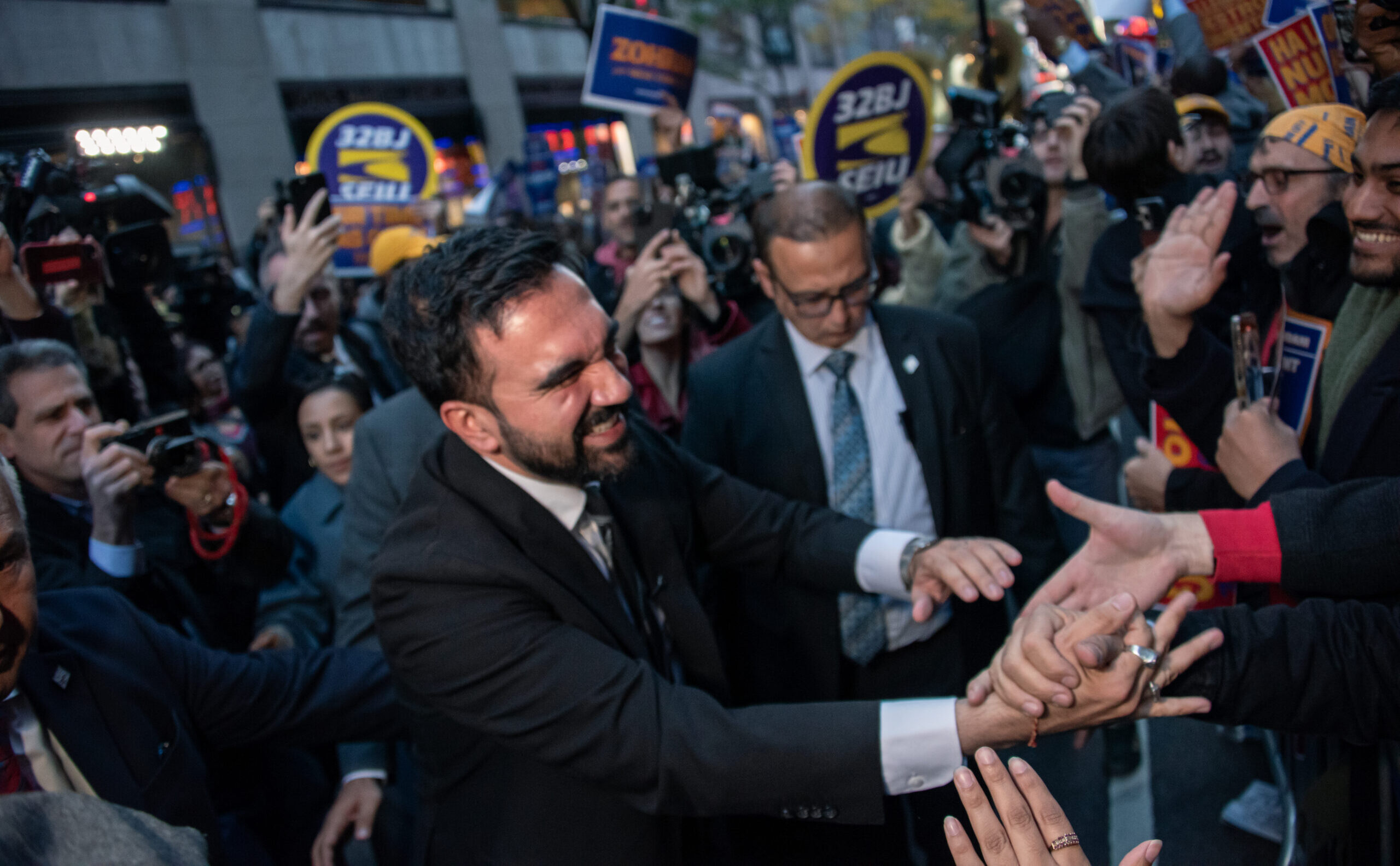
A trio of Mamdani backers united with tech and real estate investors to boost anti-Israel candidates
PARTY PERSPECTIVE

Speaking at J Street’s national summit, Sen. Tim Kaine also said ‘virtually all’ Democratic senators now seek the group’s endorsement
The lawsuit accuses UCLA of permitting harassment against Jewish and Israeli faculty

Getty Images
Royce Hall building on University of California (UCLA) campus in Los Angeles, California, USA - May 28, 2023.
Building on a monthslong battle between the Trump administration and the University of California, the Department of Justice filed a suit on Tuesday against the university system, alleging that its Los Angeles campus failed to protect Jewish and Israeli faculty and staff in accordance with Title VII of the Civil Rights Act of 1964, which prohibits employment discrimination.
The 81-page DOJ complaint, filed in California’s Central District, alleges that since the Oct. 7, 2023 terrorist attacks in Israel, UCLA “has ignored, and continues to ignore, gross and repeated violations of viewpoint-neutral time, place, and manner restrictions. Jewish and Israeli faculty have been physically threatened, had their classrooms disrupted, and had their workplaces papered with disturbing images.”
“Numerous Jewish and Israeli employees have been forced to take leave, work from home, and even leave their jobs to avoid the hostile work environment,” the suit alleges.
In a statement to Jewish Insider, Mary Osako, UCLA’s vice chancellor of strategic communications, said the university has “taken concrete and significant steps to strengthen campus safety, enforce policies, and combat antisemitism in a systemic and sustained manner.”
Osako said those efforts have included hiring a Title VI/Title VII officer “to ensure professionalized oversight and accountability” and strengthened time, place, and manner policies “to protect both free expression and campus operations.”
The federal suit is a significant escalation of the government’s crackdown on what it alleges are failures across the University of California system to address antisemitism. Multiple civil rights investigations have been launched into the system and individual campuses.
The lawsuit comes seven months after UCLA settled a federal lawsuit with Jewish students who alleged that the university permitted antisemitic conduct during the spring 2024 anti-Israel encampments on the campus.
Yitzchok Frankel, then a second-year law student at UCLA, filed suit against the university in June 2024, claiming that he was “harassed and blocked from approaching the encampment by antisemitic activists, all with the assistance of UCLA security.” Two other Jewish UCLA students and a UCLA medical school professor later joined the suit. As part of the settlement, UCLA agreed to provide support to community organizations engaged in combating antisemitism.
Last year, the Trump administration sought more than $1 billion and a range of concessions from the university in order to restore funding frozen over alleged antisemitism, which was never paid — even after some research money was restored.
A federal judge in San Francisco ruled in November in a preliminary injunction that the Trump administration could not fine the University of California or cut the school system’s federal funding over claims it allows antisemitism or other types of discrimination.
The government did not offer a specific financial demand of UCLA in Tuesday’s lawsuit, but it suggested “awarding damages” to “aggrieved Jewish and Israeli UCLA employees.”
The dinner was hosted by Rabbi Yehuda Kaploun, the U.S. antisemitism special envoy
Alex Kent/Bloomberg via Getty Images
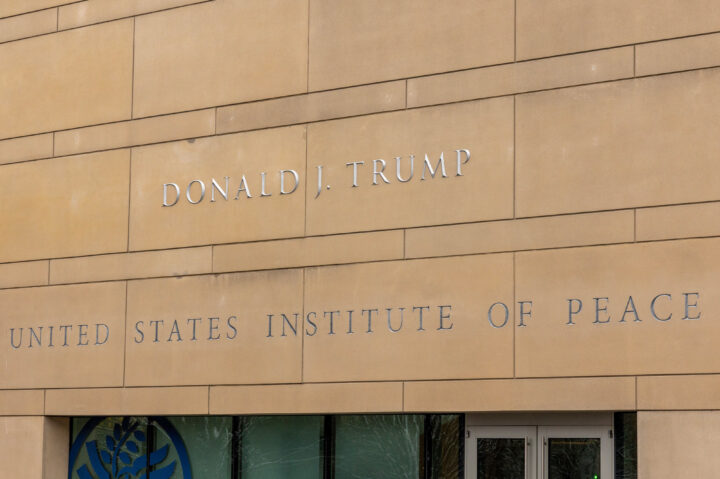
The US Institute of Peace (USIP) in Washington, DC, US, on Friday, Dec. 5, 2025.
Several dozen diplomats, senior Trump administration officials and Jewish communal leaders gathered at the Donald J. Trump Institute of Peace on Friday night for a Shabbat dinner hosted by Rabbi Yehuda Kaploun, the U.S. antisemitism special envoy, according to a source who attended the dinner.
A day earlier, that same space had hosted the inaugural Board of Peace meeting.
The gathering brought together a coterie of Washington officials, including Princess Reema, Saudi Arabia’s ambassador to the U.S., and United Arab Emirates Ambassador to the U.S. Yousef Al Otaiba, even though ties between the two Gulf nations have been strained in recent months. Other diplomats in the room came from France, Germany, Poland, Armenia, Azerbaijan, Lebanon and Jordan, according to the source.
Kaploun, who started at the State Department in December after being confirmed by the Senate, spoke at the event. He had recently returned from his first overseas trip, with stops in London, Switzerland and the Munich Security Forum. Reed Rubinstein, the State Department legal advisor, also spoke, as did Princess Reema. The Saudi diplomat talked about how close Israel and Saudi Arabia were to normalization before the Oct. 7, 2023, attacks in Israel and that she hoped to get back to that point, although normalization efforts have stalled.
“Kaploun hosting Arab and European diplomats for a traditional, family-style Shabbat and watching them love every minute of it is one the most clever displays of soft diplomacy I’ve ever seen,” the attendee, who requested anonymity to discuss an off-the-record event, told Jewish Insider. “The Saudis called for normalization. Who saw that coming?”
Most attendees were either diplomats or Trump administration officials, but Republican donor Miriam Adelson was also in the room. Combat Antisemitism Movement founder Adam Beren and board member Arie Lipnick, Conference of Presidents Chair Betsy Berns Korn and Jewish Federations of North America Chair Gary Torgow were also in attendance.
“Diplomats and leaders from across our country and across the world gathered together in a comfortable setting in our nation’s capital and shared a meaningful meal,” Korn told JI. “Ambassador Kaploun explained the importance of Shabbat as well as a heartfelt speech about the dangers of hatred. His powerful message of peace and community resonated throughout the room. We need more of this diplomacy.”
Guests noshed on Shabbat fish, potato kugel, matzah ball soup and more, along with Mediterranean desserts in honor of iftar for the Muslim diplomats in the room, according to the source.
Jeremy Lewin, the acting under secretary of state for foreign assistance, humanitarian affairs and religious freedom, attended the dinner, as did Sarah Rogers, under secretary of state for public diplomacy, and Pierre Gentin, general counsel at the Commerce Department.
Kaploun said at the event that he plans to host more Shabbat dinners in the future.
Plus, an anti-Israel Republican could win pivotal Texas primary
Fabrice COFFRINI / AFP via Getty Images
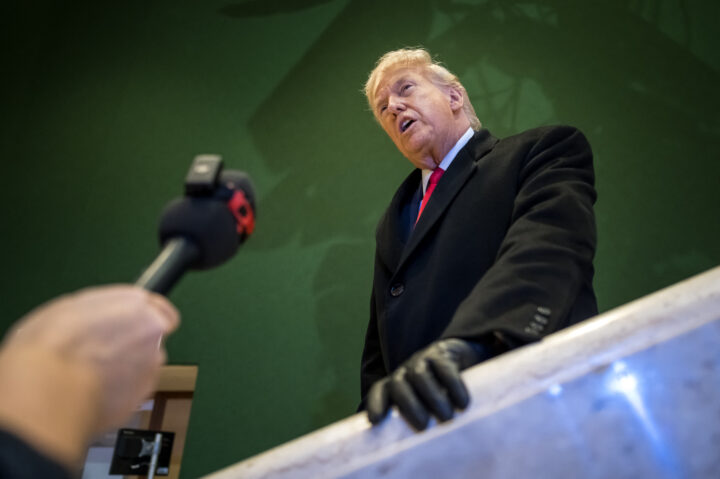
President Donald Trump as he leaves the World Economic Forum (WEF) annual meeting in Davos on January 21, 2026.
👋 Good Thursday morning!
In today’s Daily Kickoff, we preview today’s Board of Peace gathering in Washington as the Trump administration mulls military action against Tehran, and cover an effort by Reps. Ro Khanna and Thomas Massie to force a vote on a resolution blocking the Trump administration from conducting strikes on Iran. We report on the GOP primary in Texas’ 23rd District, where Rep. Tony Gonzales, who is facing allegations he had an affair with a staffer who has since died by suicide, is facing a challenge from a far-right influencer with a history of antisemitic social media activity, and talk to former Jersey City Mayor Steve Fulop about his new role leading the Partnership for New York City. Also in today’s Daily Kickoff: Bari Weiss, Roddie Edmonds and Amb. Mike Huckabee.
Today’s Daily Kickoff was curated by JI Executive Editor Melissa Weiss and Israel Editor Tamara Zieve, with assists from Danielle Cohen-Kanik and Marc Rod. Have a tip? Email us here.
What We’re Watching
- The Trump administration is convening its Board of Peace today in Washington. Among those attending the gathering are Argentine President Javier Milei, Indonesian President Prabowo Subianto, Hungarian Prime Minister Viktor Orban, Bahraini King Hamad bin Isa Al Khalifa, Azerbaijani President Ilham Aliyev, Israeli Foreign Minister Gideon Sa’ar, Emirati Foreign Minister Sheikh Abdullah bin Zayed, Belarus Foreign Minister Maxim Ryzhenkov and Turkish Foreign Minister Hakan Fidan. More below.
- Jewish Federations of North America CEO Eric Fingerhut will deliver the inaugural “State of the Jewish Union” address at the organization’s Washington headquarters.
- The U.S. Commission on Civil Rights is holding a daylong public briefing today on antisemitism on campus. Speakers include Jewish Council for Public Affairs CEO Amy Spitalnick, Louis D. Brandeis Center founder Kenneth Marcus, National Jewish Advocacy Center CEO Mark Goldfeder, law professor Eugene Volokh and The George Washington University Law School’s Matt Nosanchuk.
- The National Governors Association kicks off its annual Washington summit today.
- Minister of Economic Affairs at the Israel Embassy in Washington Noach Hacker is speaking at the Hudson Institute today, where he will sit with Hudson’s Mike Doran for a conversation about U.S.-Israel economic ties.
- French President Emmanuel Macron, Indian Prime Minister Narendra Modi, Google CEO Sundar Pichai, OpenAI CEO Sam Altman and Anthropic CEO Dario Amodei are attending the AI Impact Summit in New Delhi, India, that kicked off earlier today.
What You Should Know
A QUICK WORD WITH JI’S MELISSA WEISS
High-level foreign officials, top diplomats and heads of state will gather in Washington today for the first in-person convening of the Trump administration’s Board of Peace — as U.S. military assets flow into the Middle East and President Donald Trump mulls a potentially weekslong sustained military campaign in Iran.
The gathering, ostensibly focused on the disarmament of Hamas and the establishment of a peace-aligned administration in the Gaza Strip, comes as the U.S. moves dozens of fighter jets and support aircraft to the region — reportedly the largest buildup in military air power since the 2003 invasion of Iraq.
It’s a split screen befitting the president — who said at his inauguration last year that his “proudest legacy will be that of a peacemaker,” and who has claimed success in negotiating an end to numerous conflicts, as well as the release of the remaining Israeli hostages from Gaza last year — even as the U.S. has used force to enact political change, such as in Venezuela.
But a U.S. operation in Iran would differ significantly from what took place in Venezuela last month. In the place of ousted President Nicolás Maduro is Delcy Rodríguez, the former vice president who is now working with the Trump administration. No such natural successor to Iranian Supreme Leader Ayatollah Ali Khamenei exists. Behind the supreme leader is a laundry list of equally — if not more — radical hard-liners eager to take the ailing Khamenei’s place. Reza Pahlavi, the son of the deposed shah of Iran, who has spent most of his life living in exile, has sought to return to Iran to usher the Islamic Republic into a new democratic era — but does not appear to have the on-the-ground support as well as enough legitimacy among Iran’s vast diaspora community.
The Trump administration continues to signal publicly that it wants to find a diplomatic resolution to the situation in Iran, with White House Press Secretary Karoline Leavitt saying as much at yesterday’s press briefing.
But the White House is continuing to move forward with preparations for a military confrontation, which could include anything from targeted strikes on Iran’s nuclear facilities to a move toward regime change. Trump met on Wednesday with Secretary of State Marco Rubio, White House Special Envoy Steve Witkoff and Jared Kushner to discuss options for Iran.
TEHRAN TENSIONS

Tensions in Israel continued to rise over possible missile strikes from Iran, as signals increased that President Donald Trump is ready to order a strike on the Islamic Republic, possibly within days. Yet experts told Jewish Insider’s Lahav Harkov on Thursday that, despite the constant flow of reports that Trump favors a military response as negotiations with Iran falter, an American strike and Iranian retaliation against Israel are likely not imminent. In a moment that went viral in Israel and sparked hundreds of phone calls to the IDF Home Front Command, former IDF intelligence chief Amos Yadlin told Israel’s Channel 12 on Wednesday that while he went to the Munich Security Conference last week, “I would think twice about flying [abroad] on the coming weekend.”
On alert: IDF Spokesperson Effie Defrin, however, said that “there is no change in the situational assessment, and if there will be, we will update [the public]. There is no need to panic.” Defrin also noted that “there are negotiations, and the IDF has long been prepared for maximum defense. If we are attacked, we will respond forcefully.” However, while Israel’s leadership and the IDF’s assessment is that the U.S. will warn them before a strike, they plan to prepare quietly and not alert the public in advance, in order to increase the chances of success, Israel’s Kann News reported on Wednesday. Raz Zimmt, director of the Iran Program at Tel Aviv University’s Institute for National Security Studies, quipped to JI in reference to Yadlin’s remarks: “Don’t change your weekend plans.”
Central target: Home Front Command chief Maj.-Gen. Shay Klapper told the Knesset Foreign Affairs and Defense Committee on Wednesday that “the Home Front Command will be a central arena in relevant operational scenarios and is a significant component of Israeli society’s resilience and ability to save lives.”
ON THE AGENDA
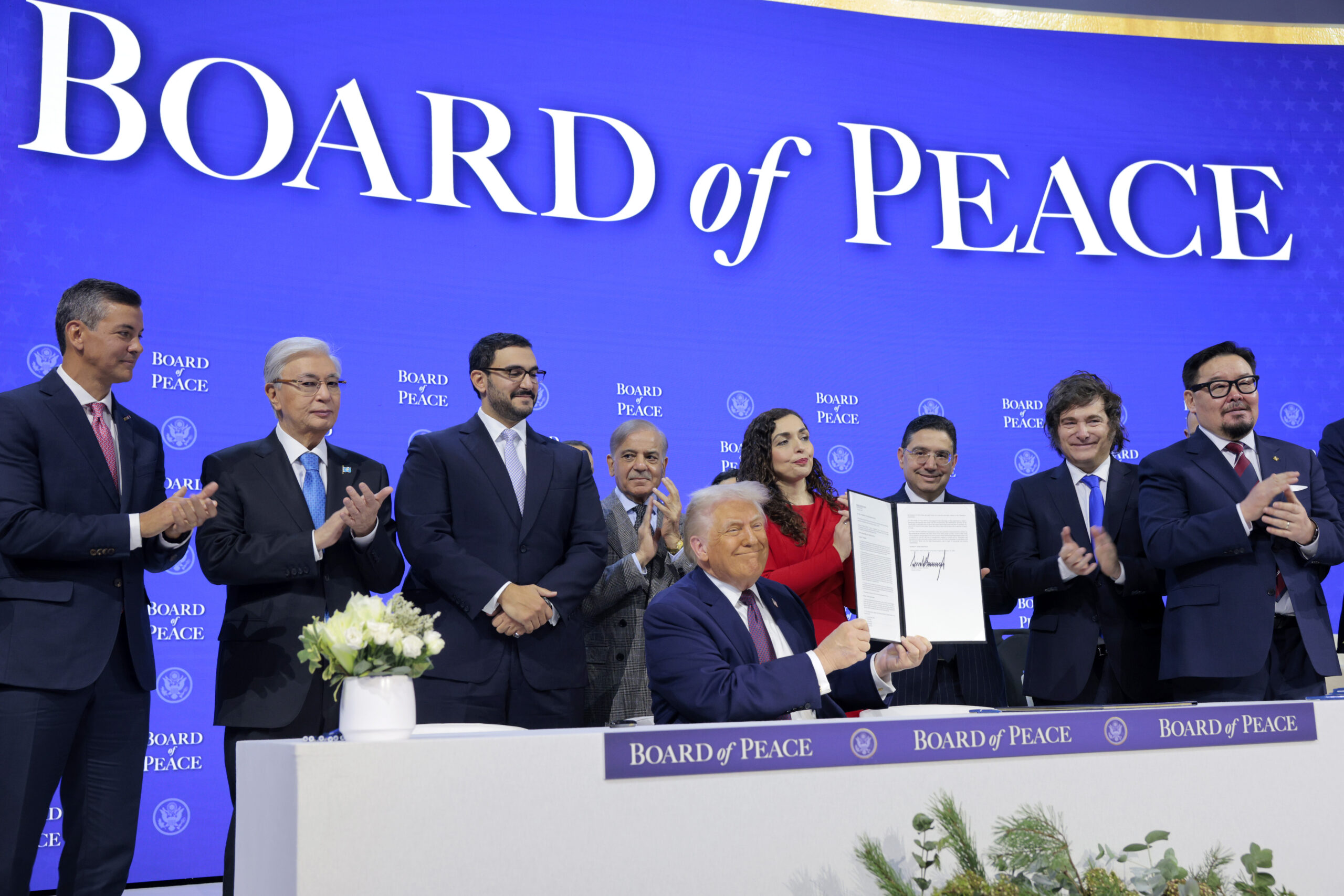
After a splashy debut at the World Economic Forum in Davos, Switzerland, last month, President Donald Trump’s Board of Peace will convene for its first meeting on Thursday in Washington. The new international body now faces a test of its ability to operationalize its goals: Observers will be watching whether the board makes any significant announcements toward its goal of implementing Phase 2 of Trump’s peace plan, which is focused on rebuilding Gaza and securing the enclave, Jewish Insider’s Gabby Deutch and Matthew Shea report.
Expected substance: A source familiar with Thursday’s meeting told JI that it is “not just pomp and circumstance,” and that they expect discussion about topics including humanitarian aid and the Palestinian technocratic government in Gaza. “It’s not window dressing at all,” the source said of the board’s work. According to a senior Trump administration official, speakers at the event will include Trump, Secretary of State Marco Rubio, Jared Kushner, former U.K. Prime Minister Tony Blair, U.S. Ambassador to the U.N. Mike Waltz, White House Special Envoy Steve Witkoff and Nickolay Mladenov, the former U.N. Middle East envoy now serving as the high representative for Gaza on the Board of Peace. Little has been shared publicly about what the format will be.
TEXAS TROUBLE

An unfolding scandal implicating Rep. Tony Gonzales (R-TX) could catapult an anti-Israel social media influencer with a history of antisemitic posts to Congress in Texas’ upcoming 23rd District Republican primary, Jewish Insider’s Marc Rod reports. Brandon Herrera, who ran against Gonzales in 2024, came under fire from Gonzales and Jewish and pro-Israel groups in the previous election cycle over a series of his YouTube videos replete with imagery, music and jokes about the Nazi regime and the Holocaust. He also expressed opposition to U.S. aid to Israel.
Shake-up: But Tuesday evening, corroborating a long-running rumor, the San Antonio Express News reported that Gonzales had been having an extramarital affair with a female staffer who died by suicide last year. The paper reported that the relationship was allegedly well-known and cited multiple sources close to the woman, including a former colleague, and a text message she sent confirming the relationship prior to her death.
FULOP’S FIGHT

As he settles into his role leading the Partnership for New York City, a prominent business advocacy group, Steve Fulop, the former longtime mayor of Jersey City, N.J., has a few major issues on his mind, chief among them countering the rise of antisemitism. For Fulop, a Jewish Democrat who assumed his new job last month, just five days after he left office on Jan. 15, such efforts are not only personal as a former yeshiva student who was also the grandson of Holocaust survivors. They are directly connected, he explained to Jewish Insider’s Matthew Kassel, to promoting a friendlier climate where businesses can feel safe and welcome in the city.
Should I stay or should I go: Many of the Partnership’s Jewish board members, representing some of the city’s most powerful firms in finance, real estate and other leading sectors, also share his sense of urgency, Fulop said, as do many of the 800,000 employees who make up his group’s core constituency. “They often say of the tax conversation that we could talk about whether people stay or go, if they migrate elsewhere,” Fulop said of his conversations with members in an interview with JI on Tuesday at his fifth-floor office in the Financial District, which looks out on Jersey City. “But if you continue on a trend where it feels like antisemitism is increasing and quality of life is decreasing, that is a trigger for people to leave very, very fast.”
CUBA CAMPAIGN

A raft of Democrats — including 23 members of the 51-seat New York City Council, multiple state lawmakers and four candidates for Congress — have joined forces with a Beijing-aligned tech tycoon to bail out the fuel-starved dictatorship in Cuba. The officials in question lent their names to the “Let Cuba Live” campaign, which denounces President Donald Trump’s oil embargo on the island nation and seeks to triage solar panels and generators to defray the crippling impact on its energy production, Jewish Insider’s Will Bredderman reports.
Who’s involved: All donations for the effort run through the People’s Forum, a Manhattan-based nonprofit established and financed by Shanghai-based magnate Neville “Roy” Singham, part of his sprawling web of organizations promoting the interests of China and its allies Russia and Iran. Let Cuba Live’s website reveals the involvement of other Singham-linked groups, including CODEPINK — co-founded by his wife, Jodie Evans — and the ANSWER Coalition, both of which spearheaded anti-Israel protests beginning the day after the Oct. 7, 2023, Hamas attacks on Israel. Jewish Voice for Peace and the Democratic Socialists of America are also signatories, along with well-known left-wing celebrities such as Susan Sarandon and Roger Waters who have long been vocally hostile to Israel.
WAR POWERS RUSH
Reps. Ro Khanna (D-CA) and Thomas Massie (R-KY) plan to introduce and attempt to force a vote on a war powers resolution blocking military action against Iran without congressional authorization, as the Trump administration appears to be moving closer to military action against the Islamic Republic, Jewish Insider’s Marc Rod reports.
What they’re saying: Khanna framed the legislation as an attempt to block a “disastrous war” with Iran. “Like the votes before the Iraq war, this could be one of the most consequential votes in the history of Congress,” Khanna said. “Are we going to stop another endless dumb foreign war? Or will the neoconservatives mislead us once again?” Once introduced, there will be a waiting period of 15 House session days before the lawmakers can force a vote on the resolution.
Worthy Reads
School of Hope: The New York Times’ David Halbfinger and Bilal Shbair spotlight the Academies of Hope network of private schools operating in Gaza, the brainchild of a Palestinian American doctor that is primarily funded by Jewish donors, which provides peace-focused education for 9,000 Palestinian students across five campuses. “Operating schools in any war zone is hard enough, and schools across the enclave are struggling to rebuild. But Dr. Hasan has compounded his challenges. He revamped a much-criticized national curriculum and worked to keep Hamas from endangering his schools. He also verifies that none of his staff have ties to militant groups, a charge Israel has leveled against the United Nations agency caring for Palestinians in Gaza and some international aid groups.” [NYTimes]
Poison PEN: In Tablet, Ari Ingel, executive director of the Creative Community for Peace, raises concerns about PEN America’s commitment to free speech, weeks after the literary organization walked back its condemnation of the cancellation of an event by an Israeli comedian. “The pattern has been consistent: They listen, offer no meaningful response, and then double down on a hostile anti-Zionist and anti-Israel posture. In doing so, PEN America has helped legitimize antisemitic discrimination at a moment when antisemitism in the United States is at historic levels. This is not an isolated failure of judgment, but a structural rot in the organization, one that reflects leadership choices, institutional culture, and a governing board that has failed to intervene.” [Tablet]
Sports Talk: The Hollywood Reporter’s Steven Zeitchik reflects on the recent sports successes of Israeli NBA star Deni Avdija and Israel’s first Olympic bobsled team, juxtaposed with the pushback they’ve faced from Israel critics. “But the sight of a Jew excelling in sports is even more than a bit of representational inspiration. So much of antisemitism, historic and resurgent, is bound up with demeaning Jews as genetically inferior — at the top line with Hitler and those infamous Olympics 90 years ago but also much more casually, in easy jokes and schoolyard assumptions, in the implication that genetic makeup makes Jews less athletic.” [HollywoodReporter]
Word on the Street
U.S. Ambassador to Israel Mike Huckabee and the Israel Airports Authority disputed Tucker Carlson‘s claim that he was detained and interrogated by Ben Gurion Airport security while at the airport for an interview with the ambassador; the IAA said that “Carlson and his party were politely asked a few routine questions, in accordance with standard procedures applied to many travelers” and that the questioning took place “in a separate room within the VIP lounge solely to protect their privacy and to avoid conducting such a discussion in public”…
Democratic Majority for Israel’s PAC announced its endorsement of 11 congressional candidates, including Cait Conley in NY-17, Scranton Mayor Paige Cognetti in PA-8, Janelle Stelson in PA-10, and former Rep. Elaine Luria (D-VA) in VA-2; the group also announced it is backing Cook County Commissioner Donna Miller in IL-2 and former Rep. Melissa Bean in IL-8, but is staying out of the contentious IL-9 Democratic primary, where AIPAC’s super PAC is backing state Sen. Laura Fine…
A Tennessee man who saved more than 200 Jewish soldiers under his command at a Nazi POW camp in Germany will be posthumously awarded the Medal of Honor by the White House for his efforts; Roddie Edmonds, who was taken captive during the Battle of the Bulge, famously refused to identify Jewish troops when asked by the camp’s commandant, saying, “We are all Jews here”…
An effort to expel Israel from the International Federation of Social Workers failed on Wednesday in a closed-door Zoom meeting; a second vote, on suspending Israel, also failed, Jewish Insider’s Gabby Deutch reports…
American, Israeli and African officials gathered with little fanfare but big plans on Wednesday, coming together in Rwanda for the trilateral Kigali Security Summit on issues including technology, innovation and national security, Jewish Insider’s Danielle Cohen-Kanik reports…
MS NOW inked an agreement with Crooked Media that will create a new weekly show, titled “Crooked on MS NOW,” that will compile content from the podcast and media company’s shows, including “Pod Save America” and “Pod Save the World”…
Bari Weiss withdrew from the University of California, Los Angeles’ upcoming annual Daniel Pearl Memorial Lecture, reportedly citing security concerns…
Chicago and DePaul University police are investigating an incident that occurred at a cafe in the city’s Lincoln Park neighborhood in which students from three Chicago-area schools said they were harassed while at a meetup for Jewish students at the Olive & Oak Cafe near DePaul’s campus…
An Australian man who pleaded guilty to publicly inciting hatred for antisemitic remarks he made last month at a Sydney rally against immigration was sentenced to a year in jail, with the chance for parole in October…
The U.S. is withdrawing its remaining 1,000 troops from Syria, with plans for the U.S.’ decade-long presence to fully end over the next two months…
Pic of the Day
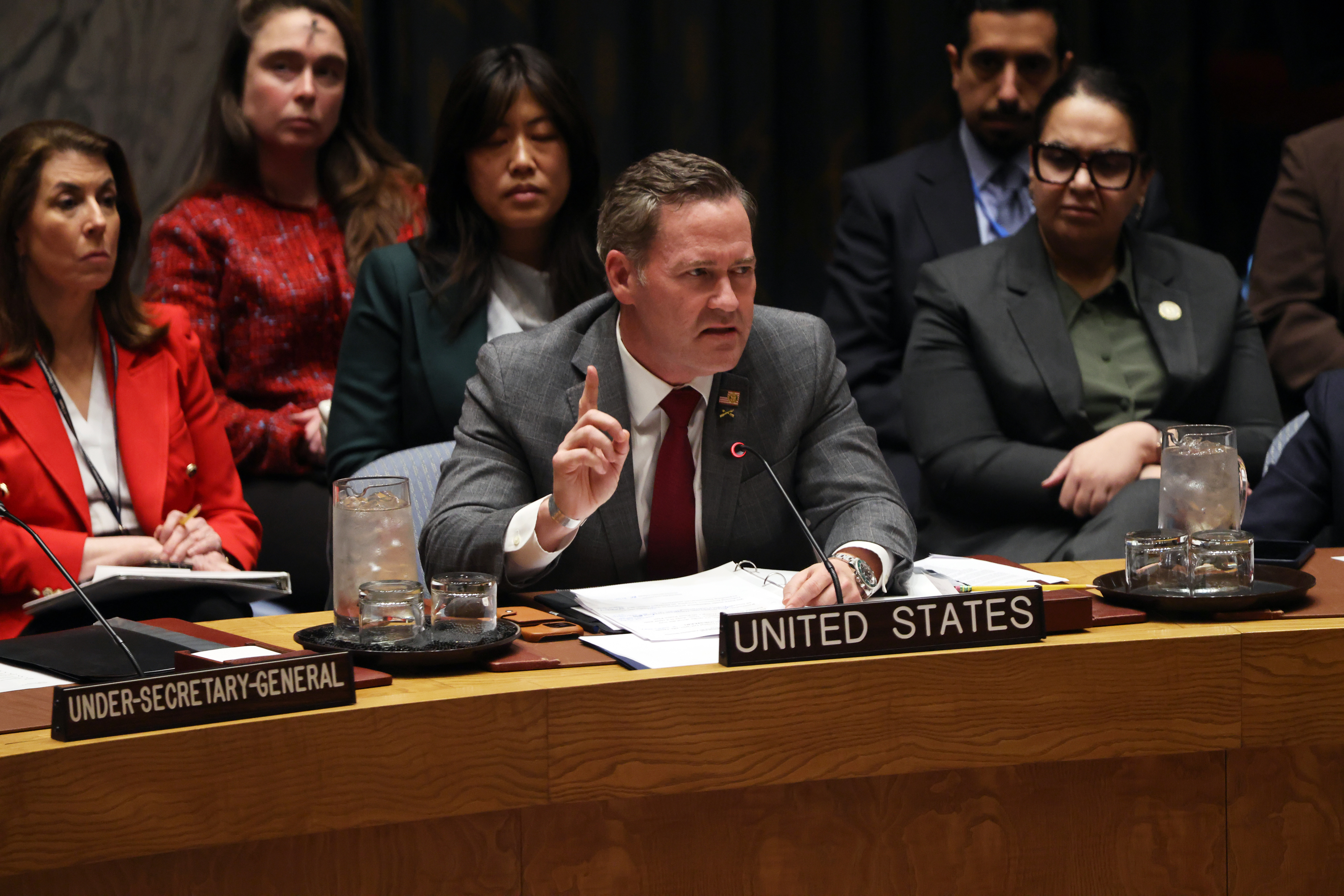
U.S. Ambassador to the U.N. Mike Waltz attended a Security Council meeting on Israel and the Palestinian territories on Wednesday, during which he defended President Donald Trump’s Board of Peace, a day ahead of the board’s gathering.
Birthdays

Actor who played the young autistic Jacob “Jake” Bohm in the Fox TV series “Touch,” later portraying a young Bruce Wayne in another Fox series “Gotham,” David Mazouz turns 25…
2004 Nobel Prize laureate in physics, he is a professor at the University of California Santa Barbara, David Jonathan Gross turns 85… Former chairman of the board and CEO of Sony Corporation, chairman of the board of trustees of the American Film Institute, Sir Howard Stringer turns 84… Retired co-founder of integrated digital marketing agency Hawkeye / Mosaic, now known as Publicis Hawkeye, Sharon Edelman… President of the Technion Israel Institute of Technology from 2009 until 2019, Peretz Lavie turns 77… Founder and president of the eponymous Laurie M. Tisch Illumination Fund, she is on the boards of the NFL’s NY Giants, Lincoln Center for the Performing Arts and the Aspen Institute, Laurie M. Tisch… and also the birthday of her first cousin once removed, co-founder and CEO of Atria (a private medical institute in NYC), Alan Tisch… Managing partner of Encino, Calif.-based Hager Pacific Properties, Adam Tuvia Milstein turns 74… Former Goldman Sachs partner and then a senior executive at JPMorgan Chase, he now serves on various corporate and nonprofit boards, Barry L. Zubrow turns 73… International CEO of Taglit Birthright Israel since 2008, Gidi Mark turns 70… Novelist, essayist and short story writer, he was a winner of a 2005 MacArthur genius fellowship, Jonathan Allen Lethem turns 62… Retired U.S. district court judge, he was a law clerk for Supreme Court Justice Anthony Kennedy (1993-1994) alongside future justices Neil Gorsuch and Brett Kavanaugh, Gary Scott Feinerman turns 61… SVP of government relations at Las Vegas Sands Corp., Andy Abboud… Co-founder of the band Phish where he is the lead drummer and frequent songwriter, Jon Fishman turns 61… Communications director for 27 years for Sen. Lindsey Graham (R-SC), now a consultant, Kevin D. Bishop… Chairman of the World Zionist Organization, Yaakov Hagoel turns 55… Canadian media personality, conservative political activist, writer and broadcaster, Ezra Levant turns 54… Partner at InfraStrategies and senior fellow at the UCLA Institute for Transportation Studies, Joshua Levi Schank, Ph.D…. Founder of The New York Times‘ “DealBook” and co-creator of Showtime’s “Billions,” Andrew Ross Sorkin turns 49… Hollywood writer and producer, best known for “The Newsroom” (2012) and “Quantico” (2015), Gideon Yago turns 48… Jewish rapper, part of the alternative hip hop group Darshan, better known by his stage name Eprhyme (pronounced “E-Prime”), Eden Daniel Pearlstein turns 46… Writer of the “In the Know” gossip column for The Hill newspaper in Washington, where she covers Congress, D.C.’s social scene, celebrities and politics, Judy Kurtz Altscher… Founder of a Middle East NGO, Regional Organization for Peace, Economics & Security (ROPES), Ben Birnbaum… Former MLB pitcher for the Phillies (2011-2012), he now runs Big League Advance, a company that invests in minor league players in exchange for a percentage of their future MLB earnings, Michael Schwimer turns 40… Samantha Zalaznick… Tight end for the NFL’s Kansas City Chiefs, he played college football at Harvard, Anthony Firkser turns 31… Daniel Blum…
The gathering, ostensibly focused on the disarmament of Hamas and the establishment of a peace-aligned administration in the Gaza Strip, comes as the U.S. moves dozens of fighter jets and support aircraft to the region
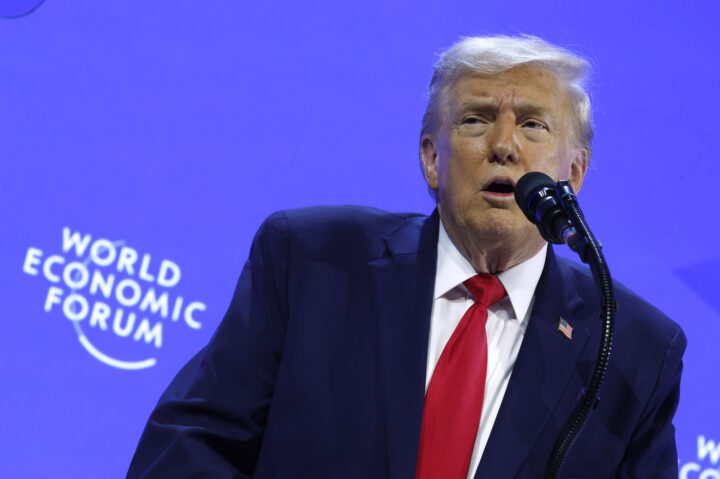
Chip Somodevilla/Getty Images
U.S. President Donald Trump gives a speech at the World Economic Forum (WEF) on January 21, 2026 in Davos, Switzerland.
High-level foreign officials, top diplomats and heads of state will gather in Washington today for the first in-person convening of the Trump administration’s Board of Peace — as U.S. military assets flow into the Middle East and President Donald Trump mulls a potentially weekslong sustained military campaign in Iran.
The gathering, ostensibly focused on the disarmament of Hamas and the establishment of a peace-aligned administration in the Gaza Strip, comes as the U.S. moves dozens of fighter jets and support aircraft to the region — reportedly the largest buildup in military air power since the 2003 invasion of Iraq.
It’s a split screen befitting the president — who said at his inauguration last year that his “proudest legacy will be that of a peacemaker,” and who has claimed success in negotiating an end to numerous conflicts, as well as the release of the remaining Israeli hostages from Gaza last year — even as the U.S. has used force to enact political change, such as in Venezuela.
But a U.S. operation in Iran would differ significantly from what took place in Venezuela last month. In the place of ousted President Nicolás Maduro is Delcy Rodríguez, the former vice president who is now working with the Trump administration. No such natural successor to Iranian Supreme Leader Ayatollah Ali Khamenei exists. Behind the supreme leader is a laundry list of equally — if not more — radical hard-liners eager to take the ailing Khamenei’s place. Reza Pahlavi, the son of the deposed shah of Iran, who has spent most of his life living in exile, has sought to return to Iran to usher the Islamic Republic into a new democratic era — but does not appear to have the on-the-ground support as well as enough legitimacy among Iran’s vast diaspora community.
The Trump administration continues to signal publicly that it wants to find a diplomatic resolution to the situation in Iran, with White House Press Secretary Karoline Leavitt saying as much at yesterday’s press briefing.
But the White House is continuing to move forward with preparations for a military confrontation, which could include anything from targeted strikes on Iran’s nuclear facilities to a move toward regime change. Trump met on Wednesday with Secretary of State Marco Rubio, White House Special Envoy Steve Witkoff and Jared Kushner to discuss options for Iran.
Rubio is set to travel to Israel on Feb. 28, an announcement that could signal that strikes are not imminent — or that could be a ruse by the administration.
Recall that in June, Trump gave Iran a two-week deadline to resume talks, choosing to strike the country’s nuclear facilities just three days later.
Meanwhile, Russian Foreign Minister Sergey Lavrov — whose country is participating in military exercises with Iran’s Islamic Revolutionary Guard Corps today in the Strait of Hormuz — warned against renewed strikes targeting Iran.
Iran is also preparing for a potential military conflict, fortifying its nuclear sites and reviving a chain of command that empowers lower-level military officials.
A month ago, as the world teetered on the edge of another U.S.-Iran military confrontation, diplomacy won out, and the parties agreed to talks. Now, Washington and Tehran — as well as Jerusalem — find themselves again on the brink. The next big decision belongs to Trump.
The document, published by PA President Mahmoud Abbas, recognizes Muslim and Christian — but not Jewish — rights
Kristian Tuxen Ladegaard Berg/NurPhoto via Getty Images
Palestinian Authority President Mahmoud Abbas attends a press conference in Oslo, Norway, on February 11, 2026.
The Palestinian Authority’s proposed interim constitution, a draft of which was released last week, includes support for incarcerated and deceased Palestinian terrorists and their families, a practice called “pay for slay” by its critics, which the PA claimed to have ended last year.
PA President Mahmoud Abbas published the interim constitution on Feb. 10, allowing for public comments over the next 60 days. The move comes as the Trump administration and the European Union have demanded reforms from the PA in recent months, including an end to the so-called “martyrs’ payments” to convicted and killed terrorists and their families.
Article 24 of the interim constitution states that “the State of Palestine and the relevant national institutions work to provide protection and care for the families of martyrs, and the wounded, and prisoners, and those released from the occupation prisons, and the victims of genocide.”
Article 44 states that “the law organizes the provision of comprehensive care for the families of martyrs, the wounded, and prisoners, and those released, in preservation of their national dignity and their humanitarian and living needs.”
“Martyrs” refers broadly to any Palestinian killed by Israelis, but historically the payments have gone to the families of those killed or imprisoned attempting to commit or committing acts of terror. The longer the sentence, the greater the payments, thus creating an incentive to kill more Israelis.
Israel, the U.S., EU and others have said the policy incentivizes terrorism. The Taylor Force Act, which was signed into law in 2018, bars the U.S. from sending most aid to the PA until the policy ends; an Israeli law passed the same year docks the equivalent of the funds paid annually from taxes and tariffs Israel collects on the PA’s behalf.
Palestinian law characterizes the payments as ensuring a “dignified life” for “partici[pants] in the struggle against the occupation.” The minimum payments are greater than government assistance provided to low-income families and above average for employees of the PA.
The PA has repeatedly made commitments to its Western benefactors to stop the payments to terrorists and their families, amounting to over $1 billion in recent years, but ultimately changed the funding process rather than ending it.
Abbas dismissed the Palestinian finance minister in November for continuing the payments, though Israeli Foreign Minister Gideon Sa’ar accused Abbas at the time of being complicit and trying to “fool the world.”
Maurice Hirsch, the former director of IDF military prosecution in the West Bank and the head of the PA Accountability and Reform Initiative at the Jerusalem Center for Security and Foreign Affairs, told Jewish Insider that “the fact that the draft constitution of the PA includes its commitment to ‘pay for slay’ was not in any way surprising.”
“This is something which has become a fundamental element of all PA governments,” he added. “It’s a commitment that the PA in all its different levels starting from Abbas all the way down has simply entrenched in all of Palestinian society. I don’t believe that there actually is a Palestinian leader who will have the ability to say, ‘We will no longer pay any rewards to the terrorists.'”
The payments, Hirsch said, are “in the draft constitution [as] part of the Palestinian ethos in the same way as you see their commitment to expunging the Jewish presence in Israel and same way you see the commitment to the return of every single one of the refugees, as it were, to Israel to destroy Israel demographically.”
The PA draft constitution begins with a preamble that accuses Israel — without mentioning the Jewish state by name — of ethnic cleansing and genocide.
It states that “Palestine is the cradle of heavenly religions,” mentioning only Islam and Christianity, not Judaism. “Jerusalem,” the constitution states, “is the capital of the State of Palestine,” which is “committed to preserving [Jerusalem’s] religious character and protecting its Islamic and Christian sanctities.” Islam is the official religion of the PA, while “Christianity has its status in Palestine, and its followers’ rights are respected,” but there is no mention of Judaism.
The document also states that “the permanent headquarters of the House of Representatives is in the city of Jerusalem, the capital of the State of Palestine,” though the Palestinian Parliament is currently located in Ramallah.
The Palestinian interim constitution not only seeks to extend its laws into Israel in its articles about Jerusalem, but also in “ensuring the right of return.” In Palestinian parlance, “the right of return” generally means returning to any place in which an Arab lived in Israel before 1948, though Abbas has, in the past, expressed a willingness to compromise. “The dream of return remains alive in the hearts of Palestinians everywhere, generation after generation,” the constitution states.
On Tuesday, the UN elected Abbas Tajik of the Islamic Republic of Iran as vice chair of its Commission for Social Development
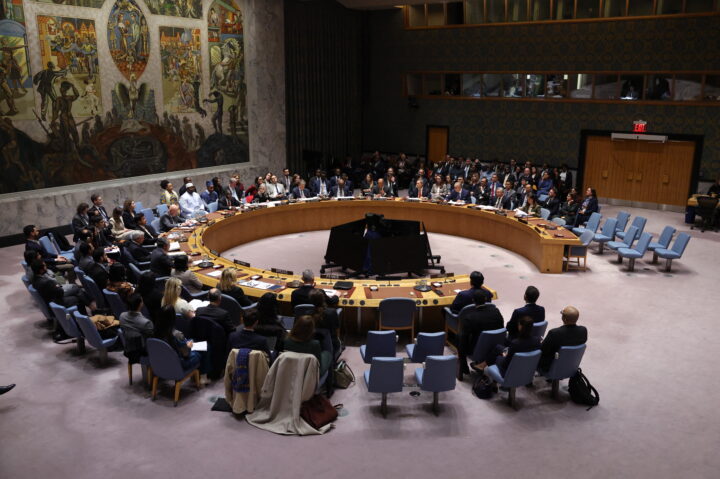
ANGELA WEISS/AFP via Getty Images
Ambassadors and representatives to the United Nations meet at the U.N. Security Council to vote on a U.S. resolution on the Gaza peace plan at the U.N. Headquarters in New York City, Nov. 17, 2025.
The United Nations this week elevated an Iranian official to a senior leadership role and publicly congratulated Tehran on the anniversary of the Islamic Revolution — moves that former Trump administration officials and Middle East policy analysts say reflect a troublingly conciliatory posture by the international body toward a regime accused of violently repressing its own people.
On Tuesday, the UN elected Abbas Tajik of the Islamic Republic of Iran as vice chair of its Commission for Social Development, a body tasked with advancing policies on poverty eradication, employment and social inclusion. The commission recently adopted resolutions focused on social justice, gender equality and combating gender-based violence — issues critics note remain acute inside Iran, where legal, social and cultural restrictions continue to limit women’s rights and political freedoms.
The following day, UN Secretary-General António Guterres congratulated Iran on the anniversary of the 1979 Islamic Revolution — the founding moment of the regime now facing widespread domestic unrest — weeks after authorities violently suppressed nationwide protests, imposed internet blackouts and oversaw a crackdown that, according to human rights groups, has resulted in thousands of deaths.
Guterres’ message was condemned by Israel’s Foreign Ministry, which posted on X that the gesture represented a “moral failure.”
“History will not remember your speeches. It will remember the regimes you chose to honor,” the statement read. “Sending congratulations to the Islamic Revolution regime — a state built on repression and terror — is not neutrality.”
Critics argue that the juxtaposition of congratulatory gestures and leadership appointments raises broader questions about institutional coherence and moral clarity — particularly as Iran continues to face internal unrest and international scrutiny.
Jason Greenblatt, a former White House Middle East envoy under President Donald Trump, told Jewish Insider that Iran’s latest promotion “tells you all you need to know about what the UN stands for.”
“It’s a bloated, broken, perhaps irredeemable system, and a colossal waste of money,” said Greenblatt.
Elliott Abrams, the former U.S. special representative for Iran during the first Trump administration, agreed, calling the UN a “morally bankrupt institution.”
“The secretary general congratulating the Iranian regime just days after it murdered thousands of its citizens is another example,” said Abrams.
However, Abrams also described the situation as more nuanced, noting that other parts of the UN have taken a firmer stance.
He pointed to a Jan. 26 resolution adopted by the UN Human Rights Council condemning the Iranian regime’s crackdown. During that session, Sara Hossain, chair of the U.N.’s fact-finding mission on Iran, described unfolding events in Tehran as “the deadliest crackdown against the Iranian people since the 1979 revolution.”
“The violent repression of the Iranian people doesn’t solve the country’s problems,” UN High Commissioner for Human Rights Volker Türk said at the time. “On the contrary, it creates conditions for further human rights violations, instability, and bloodshed.”
Still, several foreign policy analysts argued that the UN’s repeated elevation of Iran is misguided and at odds with the intended goals of the organization. David May, a senior research analyst at the Foundation for Defense of Democracies, suggested the UN’s actions are a pattern of hypocrisy, noting that the organization has previously elected Tehran to committees despite its poor track record on human rights.
In 2023, Tehran was elected to the UN Committee on Disarmament and International Security. However it was during the same time that Iran was significantly accelerating its nuclear weapons program.
Tehran was also elected by the UN Economic and Social Council (ECOSOC) in 2021 to the Commission on the Status of Women (CSW), a group responsible for empowering women and promoting gender equality. Former Vice President Kamala Harris supported a U.S-led effort in 2022 to oust Iran from the committee, calling out its “denial of women’s rights and brutal crackdown on its own people.”
Experts said the UN’s latest elevation of Tehran was not unexpected. Still, they argued that the continuation of this pattern is deeply troubling and reflects a broader institutional posture toward the Iranian regime.
“All of this would be laughably absurd if it wasn’t so actively counterproductive, both in terms of isolating Iran’s regime and, more fundamentally, what the UN supposedly stands for in founding documents like the UN Charter and Universal Declaration of Human Rights,” said Jonathan Ruhe, a fellow at the Jewish Institute for National Security of America.
Ruhe argued that the UN treats Iran as a “normal” member in “good standing,” creating what he described as a “dangerous equivalence between Tehran and Washington.”
“Promoting Iran to vice chair, and inviting its foreign minister to address the UN Human Rights Council, bestows a veneer of legitimacy on a regime that just brutally violated its citizens’ right to peaceful protest — a core right recognized in the Universal Declaration of Human Rights,” Ruhe said. “The UN is extending olive branches that rehabilitate Tehran at the exact moment it should be a pariah on par with North Korea.”
David May, a senior research analyst at the Foundation for Defense of Democracies, similarly argued that the UN has become a venue for Iran and other authoritarian governments to “launder their human rights records.”
“People are noticing the absurdity of the UN secretary-general congratulating the Islamic Republic on the anniversary of seizing power because it comes one month after the Tehran regime killed as many as tens of thousands of protesters,” May said.
He added that “when the spotlight is not on Tehran’s tyranny, the United Nations treats Iran like any other country.”
“If the United Nations wants to escape its reputation as a den of dictators, it should disinvite Iran’s foreign minister from addressing the opening of the Human Rights Council on February 23,” May said. “Otherwise, this will provide another opportunity for a human rights abuser to mask its violations by launching attacks against the United States and its allies.”
The upstate Republican urged the Trump administration to look into possible use of federal funds for the 'Global Oppression and Public Health' working group

Kent Nishimura/Getty Images
Rep. Elise Stefanik (R-NY) testifies before the Senate Foreign Relations Committee on her nomination to be Ambassador to the United Nations on Capitol Hill on January 21, 2025, in Washington, D.C.
Rep. Elise Stefanik (R-NY) urged the Trump administration Thursday to investigate reports that a clique of ideologically driven staffers at the New York City Department of Health and Mental Hygiene had launched an anti-Israel “working group” inside the agency.
In a letter addressed to Health and Human Services Secretary Robert F. Kennedy Jr., the upstate lawmaker decried reports that employees had met during work hours at the city bureaucracy’s Queens headquarters.
Stefanik raised the possibility the department’s federal funding might have gone toward a prohibited political purpose — or that the gathering may have violated civil rights protections by creating a discriminatory environment for Jewish New Yorkers.
“The use of federal funds to support or tolerate government-sponsored activities that veer into ideological advocacy or that risk emboldening hate is a grave matter with civil rights and public safety implications,” Stefanik wrote.
The letter requested Kennedy’s agency probe four questions: whether any federal resources went toward enabling the working group, whether it created a hostile context for Jewish employees and service recipients, whether higher-ups in the agency were aware or approved of its establishment and activities and whether HHS action against the agency is appropriate. Stefanik further asked for a briefing within 30 days on the federal department’s findings.
Neither HHS nor the Mamdani administration immediately replied to requests for comment.
The lack of clarity is reason for concern in Jerusalem, where the line on any potential American agreement with Iran has long been zero enrichment, extensive limitations on ballistic missiles and regional proxy activity
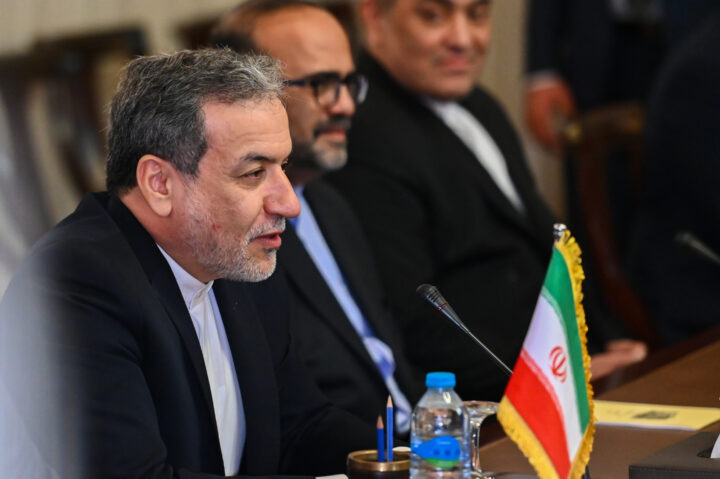
Sayed Hassan/Getty Images
Iran's Foreign Minister Abbas Araghchi meets with his Egyptian counterpart on October 17, 2024 in Cairo, Egypt.
For a brief moment on Wednesday, it looked like Iran talks were off. Tehran wanted to move their location from Turkey to Oman and narrow the scope of the negotiations to its nuclear program. The Trump administration saw this as a bad sign, and anonymous American officials began leaking to the media that Iran wasn’t taking the negotiations seriously.
Secretary of State Marco Rubio acknowledged that the negotiations were uncertain in remarks to the press at the Critical Minerals Ministerial, a conference of 43 foreign and other ministers: “As far as the talks are concerned, I think the Iranians had agreed to a certain format. For whatever reason, it changed … We’ll see if we can get back to the right place. The U.S. is prepared to meet them,” he said.
Meanwhile, President Donald Trump relayed a warning to Iranian Supreme Leader Ali Khamenei in a prerecorded interview with NBC News: “I would say he should be very worried.”
It didn’t take long – just over two hours, to be precise – between the news of the apparent collapse of talks between the U.S. and Iran and Iranian Foreign Minister Abbas Araghchi’s announcement on X that they were back on: “Nuclear talks with the United States are scheduled to be held in Muscat on about 10 am Friday.” Anonymous American sources then confirmed to various media that negotiations were set to take place, after leaders of Arab and Muslim countries urged the Trump administration to give them a chance, despite Iran’s prevarications.
Still, Araghchi’s statement alludes to one of the major reasons that the talks were, briefly, called off: Are they only “nuclear talks” or are they about a range of malign behavior by the Islamic Republic?
The Iranian answer to that question is clear, but the Trump administration sent mixed messages.
The Trump interview with NBC provided few clues. The president expressed support for the protesters against the Iranian regime, saying “we’ve had their back.”
Yet, in a bit of revisionist history, he portrayed his recent threats to Iran as being solely about the nuclear file: “They were thinking of starting a new [nuclear] site in a different part of the country. We found out about it and said, ‘you do that, we’re going to do very bad things to you,'” Trump said. He didn’t mention ballistic missiles in the interview.
Rubio, however, specified that “as far as the topics [of negotiations] and what the agenda needs to be, I think that in order for talks to actually lead to something meaningful, they will have to include certain things, and that includes the range of their ballistic missiles, that includes the sponsorship of terrorist organizations across the region, that includes the nuclear program and that includes the treatment of their own people.”
“Beyond that,” Rubio said, “the president retains a number of options as to how to respond to [the violent crackdown on protesters] and future events.”
Vice President JD Vance told Megyn Kelly that stopping Iran from getting a nuclear weapon was the main concern: “In a perfect world, would I love it if a bunch of freedom-loving Iranians… had a government that was much more friendly to the United States of America? Would that be a good thing? Absolutely.”
“But fundamentally,” he added, “the president has been focused … on this question of ensuring that they don’t get a nuclear weapon. .. I feel 100% confident that even if the Iranians were rushing toward a nuclear weapon, they couldn’t get one during the Trump administration. But we’re not thinking about the next three years; we’re thinking about the next 30 years.”
Vance argued that “global nuclear proliferation” is “the biggest threat to the world,” and as such, Trump is seeking to stop Iran from obtaining nuclear weapons so that other countries in the region do not seek to attain them, as well, and is willing to work with unfriendly countries like Russia and China to achieve that because it is “the most important thing you can do for peace and stability.”
The lack of clarity is reason for concern in Jerusalem, where the line on any potential American agreement with Iran, going back to the Obama-era negotiations, has long been zero enrichment and extensive limitations on ballistic missiles and regional proxy activity.
Israel regarded U.S.-Iran negotiations with deep skepticism even before the latest bumps on the road to Oman, with Israeli Prime Minister Benjamin Netanyahu telling White House Special Envoy Steve Witkoff during his visit to Israel on Tuesday that “Iran proved time after time that its promises cannot be trusted.” Talks that do not include missiles and proxies will likely be viewed with alarm.
With negotiations taking place this week, the secretary of state said any agreement would have to address Iran’s missile program, support for proxy terror groups and internal repression, in addition to the nuclear issue
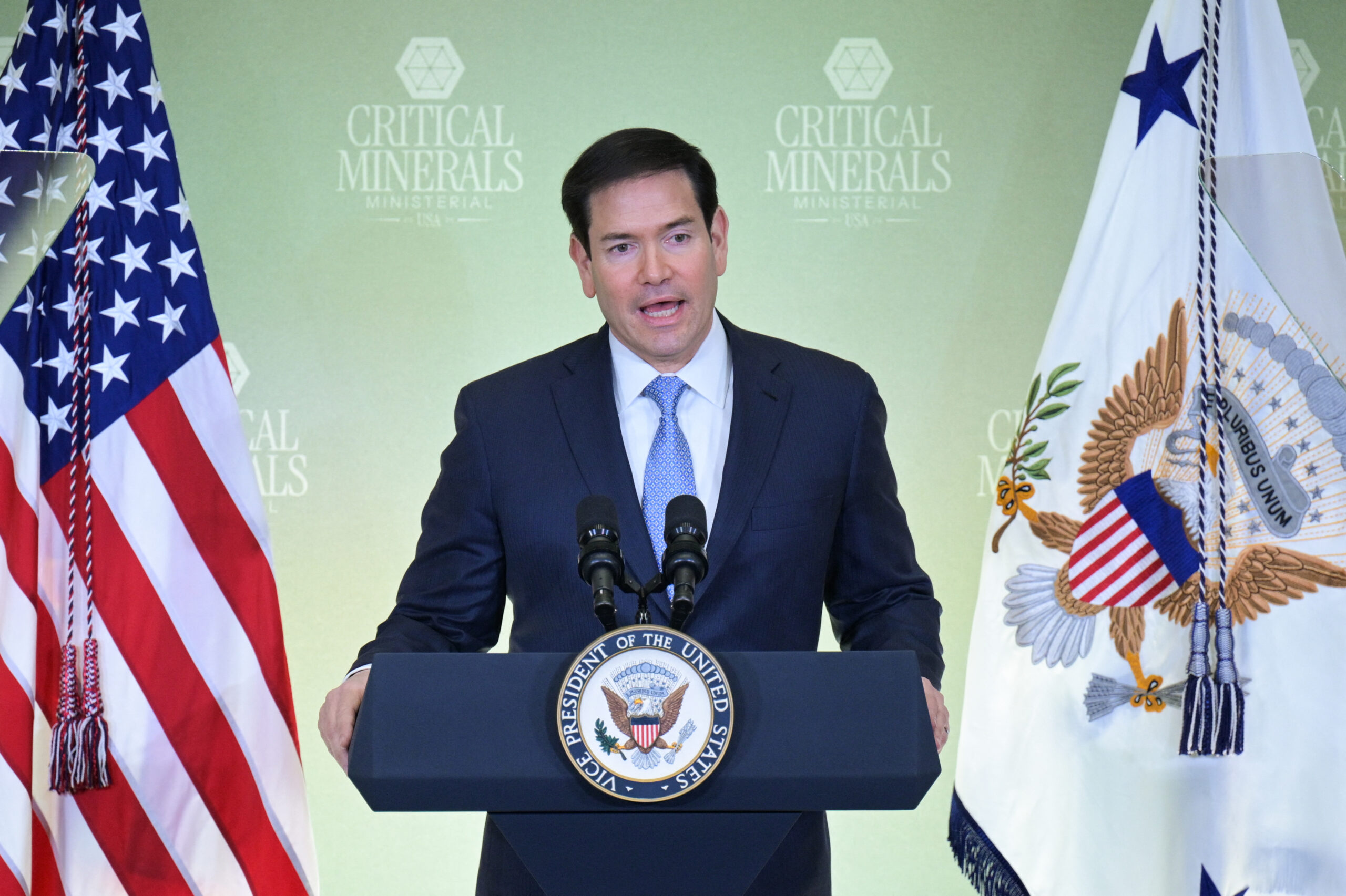
Oliver Contreras / AFP via Getty Images
Secretary of State Marco Rubio speaks during the inaugural Critical Minerals Ministerial meeting at the Sate Department in Washington, DC, on February 4, 2026.
Secretary of State Marco Rubio outlined on Wednesday what the Trump administration views as the minimum requirements for successful nuclear negotiations with Iran, insisting that any deal with Tehran be comprehensive and address its ballistic missile capabilities, support for regional terrorism and repression of its people, in addition to the nuclear issue.
“In order for talks to actually lead to something meaningful, they will have to include certain things,” Rubio said during his remarks at an event on critical minerals supply chains, which Israeli Foreign Minister Gideon Sa’ar attended. “That includes the range of their ballistic missiles, that includes their sponsorship of terrorist organizations across the region, that includes the nuclear program and that includes the treatment of their own people.”
U.S. and Iranian officials are expected to meet Friday for talks aimed at negotiating a new nuclear agreement, with Iranian Foreign Minister Abbas Araghchi and White House Special Envoy Steve Witkoff leading the delegations. While Iran has insisted the discussions be limited strictly to its nuclear program, the United States has pushed to include Tehran’s ballistic missile capabilities and support for regional proxy groups.
Iran has also demanded that the meeting location be moved from Turkey to Oman and that talks take place in a strictly bilateral format, excluding Arab mediators. Rubio acknowledged the shift on Wednesday, saying Washington remains prepared to engage despite the uncertainty.
“The Iranians had agreed to a certain format and for whatever reasons changed in their system,” Rubio said. “We’ll see if we can get back to the right place, but the United States is prepared to meet with them.”
The diplomatic maneuvering has unfolded against a backdrop of heightened military tensions between the two parties in recent days. On Tuesday, a U.S. F-35 fighter jet shot down an Iranian drone aggressively approaching the USS Abraham Lincoln aircraft carrier in the Arabian Sea.
Later that day, Iran’s Islamic Revolutionary Guard Corps (IRGC) deployed two fast-attack boats and a drone towards a U.S.-flagged commercial tanker, the Stena Imperative, in the Strait of Hormuz. U.S. officials said the IRGC appeared to be attempting to potentially seize the vessel before a U.S. missile destroyer intervened and escorted the tanker out of the area.
Israel has voiced skepticism over the prospects of renewed talks. During White House envoy Steve Witkoff’s visit to Israel on Tuesday, Prime Minister Benjamin Netanyahu told him that “Iran proved time after time that its promises cannot be trusted,” according to a statement from the Prime Minister’s Office.
Experts have also questioned whether negotiations with Tehran could lead to a meaningful outcome. Andrea Stricker, a research fellow at the Foundation for Defense of Democracies, previously told Jewish Insider that the Trump administration’s demands that Iran abandon its nuclear program, cap its missile program, halt support for regional proxies and terrorism and stop executing its people are “nonstarters for the regime.”
Should negotiations falter, experts have warned that U.S. military action against Iran remains a possibility. Rubio said that President Donald Trump retains “a number of options” for responding to “future events.”
Rubio also touched on what he described as fundamental differences between the despotic Iranian regime and the Iranian people, underscoring that Washington’s strategy is focused on confronting the regime rather than civilians.
“I remind everybody what I’ve been saying through my entire career in public service: the Iranian people and the Iranian regime are very unalike,” Rubio said. “This is a culture with deep history. I know of no other country where there’s a bigger difference between the people that lead the country and the people who live there.”
He added that the regime’s priorities remain a central obstacle to improving living conditions for Iranians.
“One of the reasons why the Iranian regime cannot provide the people of Iran the quality of life that they deserve is because they’re spending all their money,” Rubio said. “They’re spending all their resources, of what is a rich country, sponsoring terrorism, sponsoring all these proxy groups around the world, exporting, as they call it, a revolution.”
U.S.-Iran negotiations scheduled are ‘likely a diplomatic box-checking exercise and smokescreen,’ FDD’s Andrea Stricker said, while JINSA’s Jonathan Ruhe said U.S. military action is ‘unlikely for the moment’
Chip Somodevilla/Getty Images
U.S. President Donald Trump gives a speech at the World Economic Forum (WEF) on January 21, 2026 in Davos, Switzerland.
Despite the Trump administration’s willingness to diplomatically engage with Iranian officials, leading Middle East experts told Jewish Insider on Monday that military action against Tehran still remains a very real possibility.
“I can’t tell you what I’m going to do,” President Donald Trump told reporters on Monday evening when asked about the threshold for an Iran strike.
“We have a tremendous force going there [to the Middle East], just like we did in Venezuela,” said Trump. “I’d like to see a deal negotiated. But right now, we’re talking to [Iran] and if we could work something out, that’d be great. If we can’t, probably bad things will happen.”
White House Special Envoy Steve Witkoff and Iranian Foreign Minister Abbas Araghchi are expected to meet in Istanbul on Friday to discuss a potential new nuclear agreement, according to reports. Jared Kushner, who has played a key role in recent high-profile diplomatic negotiations, is also expected to attend, alongside the foreign ministers of Turkey, Qatar, Egypt, Oman, Saudi Arabia and Pakistan, in the first meeting between the U.S. and Iran since U.S. strikes on Iranian nuclear facilities last June.
The planned talks come as the administration continues to exert pressure on Tehran — in response to Iran’s violent crackdown on protesters last month, Trump has publicly weighed the possibility of U.S. military intervention, ordering the movement of additional military assets into the region and issuing a series of stark warnings on social media indicating that U.S. forces are “ready, willing and able to rapidly fulfill [their] mission, with speed and violence” should a deal fail to be made.
While the administration has emphasized diplomacy as its preferred path, analysts caution that negotiations do not necessarily signal that the U.S. will not strike.
“Military intervention remains likely in light of President Trump’s demonstrated willingness to use force and the U.S. military buildup in the region,” said Michael Koplow, chief policy officer at the Israel Policy Forum. “Given the gulf between the American and Iranian positions and the general hard-line position of the Iranian regime on nuclear issues, it is hard to tag a nuclear deal as a likely outcome.”
Andrea Stricker, a research fellow at the Foundation for Defense of Democracies, told JI that a strike does remain on the table. She said that a deal could be difficult to reach and the upcoming meeting in Istanbul is unlikely to yield meaningful results or concessions from Iran.
“The planned meeting is likely a diplomatic box-checking exercise and smokescreen to enable a continued U.S. military buildup before Trump authorizes strikes,” Stricker said. “The administration’s demands that Iran abandon nuclear enrichment, cap its missile program, and halt support for regional proxies and terrorism, as well as stop executing its people, are nonstarters for the regime.”
Koplow said the administration’s “mixed signals” on whether it will seek diplomacy or take military action are likely “not a ruse or a diversion,” but instead a signal that Trump “has not actually made up his mind” and is “unsure what his end goal is.”
Jason Greenblatt, who served as White House Middle East envoy in the first Trump administration, asserted that “there’s no mixed signals,” arguing that the president’s messaging has been clear.
“President Trump has made the choice clear: a real, enforceable deal that ends Iran’s nuclear and missile threats and protects the U.S., our allies, and the Iranian people — or decisive action,” said Greenblatt, who emphasized that while Trump is reluctant to engage in war, the president will not accept an agreement he views as insufficient.
“He is not a war president,” Greenblatt said, “but he will not accept a weak deal. Iran’s leadership should understand by now that President Trump means exactly what he says.”
Stricker also noted that Trump has consistently sought to avoid prolonged conflict, but argued that Iran’s internal repression and continued nuclear advances may push the president toward decisive action. On Saturday, satellite images revealed new activity at Iranian nuclear sites, a potential sign that Tehran is aiming to salvage remaining materials from the June strikes.
“President Trump favors stability and prioritizes ending violence in global affairs,” she said. “After achieving the defanging of Tehran’s nuclear program, the regime has shown it remains a threat — the ongoing massacre is too much for Trump to tolerate as the leader of the free world.” “The president will likely ensure the regime pays a price, but whether the price is regime change remains to be seen,” she added.
When detailing what potential U.S. military intervention could look like, Koplow said that it would likely be “limited” in scope.
“Any U.S. action is likely going to fall short of what the Israelis would like to see, which is a campaign that doesn’t stop until the regime has fallen,” said Koplow. “Trump seems to favor quick strikes, and he is also facing wall-to-wall opposition from Arab states regarding the prospects of a long campaign that destabilizes the region and damages prospects for trade, investment, and growth.”
However, other analysts read the shift to negotiations as a signal that intervention is increasingly unlikely. Jonathan Ruhe, a senior fellow at the Jewish Institute for National Security of America told JI that U.S. military action is “unlikely for the moment.”
“An even bigger concern now is that military action could be off the table indefinitely, in a way it wasn’t just a day or two ago, as renewed talks now seem more likely,” said Ruhe.
Ruhe also noted that a key indicator of Trump’s intentions will be “how long he keeps the ‘armada’ within striking distance,” referring to the U.S. military assets in the region. He added that negotiating with Tehran will likely result in an unfavorable outcome for the U.S.
“Negotiating with Iran is absolutely the worst possible option for the United States now, because Iran’s regime will go from being on the ropes to thinking it prevailed,” said Ruhe, noting that Tehran is unlikely to agree to an “acceptable deal,” instead using the “prospect of talks to stave off military threats.”
“[Iran] is trying to do what it always does, playing for time and seeing what concessions it can wrangle without ever giving up anything itself,” Ruhe added. “This leaves zero upside for the U.S., since Iran is too emboldened to agree to serious concessions. There’s plenty of downside, too, since U.S. credibility would be dangerously eroded in Tehran’s eyes if Trump fails to fulfill his earlier threats.”
Koplow said Jerusalem is also concerned about a potential nuclear deal and is likely to perceive Iran’s willingness to enter talks as a way of “dragging out the process indefinitely.”
“[The Israelis] are concerned that Trump will back off his threats to take action or end up signing a deal that falls short of addressing the entire basket of issues — nuclear, missiles, and proxies,” said Koplow.
Ali Shamkhani, a senior adviser to Iranian Supreme Leader Ali Khamenei, had said Tehran would strike Israel in response to any U.S. military action, in an interview with the Lebanese-based Al Mayadeen.
Stricker warned that any agreement that falls short of dismantling the regime’s power structure and fails to address key issues would be problematic not only for the U.S. and Israel, but for the Iranian public.
“Any deal with the Islamic Republic would represent a historic betrayal of the Iranian people,” Stricker said. “The only negotiation America should entertain with Tehran is the exit of top regime officials from Iran and their relinquishing of power prior to an orderly transition to democracy.”
The administration announced a $6 billion arms sale to Israel on Friday, in a move Meeks said ‘blatantly ignored long-standing Congressional prerogatives’

Tom Williams/CQ-Roll Call, Inc via Getty Images
Rep. Gregory Meeks (D-NY)
Rep. Gregory Meeks (D-NY), the ranking member of the House Foreign Affairs Committee, alleged on Friday that the Trump administration sidestepped standard congressional review procedures to fast-track a $6 billion arms sale to Israel.
“Just one hour before doing so, the Trump Administration informed me it would disregard Congressional oversight and years of standing practice, and immediately notify over $6 billion dollars in arms sales to Israel,” Meeks said in a statement.
Traditionally, the top members of the House Foreign Affairs Committee and the Senate Foreign Relations Committee are given advance notice of arms sales and are able to informally place holds on them before formal notification of such sales is sent to Congress. Meeks has, at times, temporarily placed such holds on sales to Israel during the war in Gaza, seeking additional information or assurances.
“Shamefully, this is now the second time the Trump Administration has blatantly ignored long-standing Congressional prerogatives while also refusing to engage Congress on critical questions about the next steps in Gaza and broader U.S.-Israel policy,” Meeks said.
He added that the administration has refused to provide the committee with briefings with White House Special Envoy Steve Witkoff or other senior administration officials and failed to provide a reason for bypassing standard procedures.
“In the United States we do not have kings — we are a democracy rooted in the Constitution, governed by laws,” Meeks continued. “Our founding fathers enshrined Congress’ role first in our Constitution — in Article I. Through his actions, President Trump has again made abundantly clear his disregard for Congress as a coequal branch of government and for the American people we represent.”
He also criticized Republican colleagues for not speaking out about the Trump administration’s moves.
The sale to Israel, announced by the administration on Friday, includes dozens of Apache attack helicopters, light utility helicopters, more than 3,000 light tactical vehicles and power packs for Namer armored personnel carriers, according to The Wall Street Journal.
“The proposed sale will enhance Israel’s capability to meet current and future threats by improving its ability to defend Israel’s borders, vital infrastructure, and population centers,” the Defense Security Cooperation Agency said in a statement. “This proposed sale will increase interoperability with U.S. forces and conveys U.S. commitment to Israel’s security and armed forces modernization. Israel will have no difficulty absorbing this equipment into its armed forces.”
The Pentagon said the sale “will not alter the basic military balance in the region.”
The administration also notified Congress of a $9 billion sale of Patriot interceptor missiles planned to Saudi Arabia.
The weapons in question would likely not be delivered to either country for multiple years.
The Ivy League school called the EEOC’s request for the personal information of Jewish employees as part of its antisemitism investigation ‘extraordinary and unconstitutional’

Getty Images
Exteriors of University of Pennsylvania (UPenn) located in Philadelphia
A burgeoning legal battle between the University of Pennsylvania and the Equal Employment Opportunity Commission escalated last week when the Ivy League university called the agency’s methods of investigating whether the school permitted an antisemitic work environment “extraordinary and unconstitutional.”
The EEOC subpoenaed the university to turn over lists of Jewish employees and members of Jewish organizations, along with detailed identifying and contact information, saying the information is needed for the agency to contact potential victims of antisemitic discrimination. The university’s president and trustees — with the support of Jewish campus organizations Hillel, Chabad and Meor, as well as the Jewish Federation of Greater Philadelphia — refused to do so.
Handing over those names would disregard “the frightening and well-documented history of governmental entities that undertook efforts to identify and assemble information regarding persons of Jewish ancestry,” the university asserted in a legal filing last Tuesday.
What may appear to be an arcane legal issue illuminates the tension at the heart of the Trump administration’s aggressive approach to combating campus antisemitism, with even some of the victims of that discrimination concerned that the methods of countering it have gone too far. While the EEOC said it is committed to doing whatever it can to investigate antisemitism among faculty and staff of the elite university, Jewish faculty and students see something worrisome.
“We are deeply concerned that the EEOC is now seeking lists of individuals identified as Jewish, including their personal home addresses, phone numbers, and private emails, based solely on their affiliation with Jewish organizations on campus — and without their consent,” Hillel and Meor wrote in a social media post in November. “Across history, the compelled cataloging of Jews has been a source of profound danger, and collection of Jews’ private information carries echoes of the very patterns that made Jewish communities vulnerable for centuries.”
Why does the EEOC, which examines complaints of discrimination and civil rights violations at American workplaces, want Penn to provide the lists of Jewish university affiliates? And why are Jewish faculty members — including some who support the federal government’s efforts to investigate antisemitism at their place of work — urging their employer not to comply?
The dispute dates back to December 2023, when the EEOC pledged to investigate whether Jewish employees at Penn had been subjected “to an unlawful hostile work environment.”
The inquiry was opened the same week that then-Penn President Liz Magill testified before Congress about her handling of antisemitism at the Philadelphia university in the weeks that followed the Oct. 7, 2023, terror attacks in Israel. The investigation continued quietly for nearly two years, overseen by EEOC Commissioner Andrea Lucas, who last year was appointed chair of the agency by President Donald Trump.
It spilled into public view in November when the EEOC filed suit against Penn, seeking to force the university to finally compile and hand over the lists of Jewish faculty members and students that the EEOC said are crucial to its investigation.
The sought-after lists would include the members of all Jewish clubs and student groups, the names of everyone who participated in confidential university listening sessions about antisemitism, faculty members who were criticized and doxxed in a social media post from an anti-Israel student group and all employees and faculty of the Jewish studies program. Karen McDonough, deputy director of the EEOC’s Philadelphia office, said in a legal filing that the university’s refusal to turn over the lists has “severely hampered” the investigation.
Penn disagrees. The university called the demand “not only disconcerting but entirely unnecessary,” pledging instead that it would send a message to all university employees telling them how to get in touch with the EEOC to share instances of antisemitism they experienced or witnessed. The university said it has “cooperated extensively” with the agency by turning over more than 100 documents.
A more typical investigation might involve agency officials interviewing people who issued complaints directly with the agency, then visiting the campus and publicizing their investigation, according to Samuel Bagenstos, a law professor at the University of Michigan with expertise in employment law.
“If there are those claims that should be followed up, they should definitely be followed up, and they should be followed up according to usual investigative practices and not this dragnet of, ‘Let’s compile a list of all the Jews at Penn,’” Bagenstos told Jewish Insider last week. “It’s an incredibly unusual, if not completely unprecedented, request. It’s not tailored at all to any particular allegations of discrimination.”
An EEOC spokesperson did not respond to a request for comment.
The agency appeared to follow a similar playbook last year when it investigated antisemitism among staff at Columbia University and the affiliated Barnard College. Employees from both institutions received text messages from the EEOC on their personal phones asking them to fill out a survey identifying whether they are Jewish or Israeli, and if they have faced antisemitic harassment.
In that case, university officials had agreed to hand over employee data. Columbia’s associate general counsel and deputy general counsel told the Columbia Daily Spectator, the student newspaper, that the university complied with a subpoena to share employee information with the EEOC. But because the dispute ended in July with a settlement — and not with legal action — the EEOC’s methods of information-gathering at Columbia and Barnard never became public. (Columbia agreed to pay $21 million to resolve antisemitism charges.)
The Penn faculty members and employees opposed to the efforts by the federal government to obtain the controversial lists are not saying that the university is free from antisemitism. The Penn Faculty Alliance to Combat Antisemitism, which formed after Oct. 7 in response to rising anti-Jewish antagonism on campus, filed a brief supporting the university, and its members said that while they want to see the EEOC’s efforts to combat antisemitism at Penn continue, they oppose the methods being used by the agency.
“While the Alliance supports the EEOC’s efforts to combat antisemitism at Penn, its members are gravely concerned that the scope of the EEOC subpoena, which effectively seeks full lists of Jewish individuals at Penn and their personal information, invokes the troubling historical persecution of Jews, and threatens the personal security of the Alliance’s members,” the group wrote in a legal filing last week.
As the case moves forward in federal court, Penn and the EEOC are poised to test the boundaries of how far a civil rights investigation can go in the name of protecting a vulnerable group.
Following on a November executive order, the Jordanian and Egyptian branches were deemed Specially Designated Global Terrorists and the Lebanese branch a Foreign Terrorist Organization

Salah Malkawi/Getty Images
Jordanian police close the entrance of a Muslim Brotherhood headquarter after the announcement of banning the society in the country on April 23, 2025 in Amman, Jordan.
The Trump administration labeled three Muslim Brotherhood branches as terrorist organizations, including chapters in Lebanon, Egypt and Jordan.
The move follows an executive order President Donald Trump signed in November, which tasked Secretary of State Marco Rubio and Treasury Secretary Scott Bessent with identifying whether branches of the Muslim Brotherhood in Jordan, Lebanon and Egypt should be designated as Foreign Terrorist Organizations and which should be deemed Specially Designated Global Terrorists.
Those determinations were released on Tuesday: Jordanian and Egyptian branches were placed under the category of Specially Designated Global Terrorist (SDGT), with the State Department citing their provision of “material support to Hamas.”
Meanwhile, the organization’s branch in Lebanon received the more stringent label of Foreign Terrorist Organization (FTO), a stronger categorization that makes it a criminal offense to provide material support to the group. The organization’s leader in Lebanon, Muhammad Fawzi Taqqosh, was named an SDGT.
“These designations reflect the opening actions of an ongoing, sustained effort to thwart Muslim Brotherhood chapters’ violence and destabilization wherever it occurs,” Rubio said in a statement. “The United States will use all available tools to deprive these Muslim Brotherhood chapters of the resources to engage in or support terrorism.”
Edmund Fitton-Brown, a senior fellow at the Foundation for Defense of Democracies, told Jewish Insider that while the organization poses a threat in all three countries, Lebanon’s determination was “more far reaching.”
“In the case of Lebanon, you can see why it’s been singled out, because the Lebanese chapter was directly involved in violence in the recent conflict between Hezbollah and Israel,” said Fitton-Brown. “In the case of the Jordanian and Egyptian chapters, they’re not necessarily a lesser threat, but the State Department evidently didn’t find enough information to justify a finding that they are a Foreign Terrorist Organization.”
Fitton-Brown added that this is just the “beginning” of the process, noting that the administration has moved “pretty quickly” and there is potentially “more to follow.”
“I understand that there is still interest in the [administration] in other chapters,” said Fitton-Brown. “This could be the first of a number of initiatives. We might see an initiative that looks at other specific chapters. One that’s been mentioned is Yemen, another that’s been mentioned is Libya.”
Dr. Charles Small, executive director of the Institute for the Study of Global Antisemitism & Policy, praised Trump and Rubio’s efforts, stating that the administration has taken an “enormous step to confront the threat the the Muslim Brotherhood poses around the world.”
“The Muslim Brotherhood works from within open and free societies to subvert the values that America and other Western democracies cherish, while advocating for the subjugation of women, the oppression of LGBTQ+ people, and the murder of Jews,” said Small. “We are hopeful that these vital efforts will continue, and ISGAP will keep supporting executive and legislative actions in Washington that aim to dismantle the Brotherhood’s networks and stop its continuing plan to undermine our way of life.”
Plus, Mamdani's first mayoral moves rankle Jewish community

Nicole Combeau/Bloomberg
A resident holds a newspaper with news about ousted Venezuelan President Nicolas Maduro during a celebration at El Arepazo in Doral, Florida, US, on Sunday, Jan. 4, 2026.
Good Monday morning.
In today’s Daily Kickoff, we look at what the Trump administration’s capture of Venezuelan President Nicolás Maduro could mean for Iran’s influence in South America, and report on New York City Mayor Zohran Mamdani’s first days in office, which included the revocation of executive orders on supporting Israel and combating antisemitism. We have the exclusive on AIPAC’s appointment of Deryn Sousa as the organization’s new spokesperson, succeeding Marshall Wittmann, and report on Jewish communal priorities on Capitol Hill in the new year. Also in today’s Daily Kickoff: Julie Menin, Rabbi Zvi Hershcovich and Este Haim.
Today’s Daily Kickoff was curated by Jewish Insider Executive Editor Melissa Weiss and Israel Editor Tamara Zieve, with assists from Danielle Cohen-Kanik and Marc Rod. Have a tip? Email us here.
What We’re Watching
- As Congress returns this week, we’ll be keeping an eye on the Hill’s response to the ongoing wave of protests across Iran, the ripple effects of the Trump administration’s arrest of Venezuelan President Nicolás Maduro and the emerging rift among the U.S.’ Gulf allies.
- Following the winter break, lawmakers’ top priority now will be finalizing a deal on government funding before the end-of-month deadline. It’s looking less likely that we’ll see a repeat of last year’s extended government shutdown. There are still plenty of areas to be negotiated between the two chambers, including security grant funding, United Nations funding and funding levels for U.S.-Israel cooperative programs.
- We’re keeping an eye on the ongoing protests in Iran. Speaking to reporters on Air Force One last night, President Donald Trump reiterated his recent comments that the U.S. would intervene if Iranian officials were to kill protesters, having said on his Truth Social site on Friday that “If Iran shoots and violently kills peaceful protesters, which is their custom, the United States of America will come to their rescue.”
- Venezuelan President Nicolás Maduro is scheduled to make his first appearance in U.S. federal court at 12 p.m. ET today, where he will appear before Judge Alvin Hellerstein, a 92-year-old Orthodox Jewish federal judge.
- Minnesota Gov. Tim Walz, who had been planning a 2026 reelection bid, is set to make an announcement regarding his political future this morning, a day after meeting with Sen. Amy Klobuchar (D-MN). The impromptu press conference comes as Walz’s administration faces criticism and an investigation into widespread fraud centered around the state’s Somali diaspora population.
- U.S. Ambassador to Turkey and Syria envoy Tom Barrack is mediating talks in Paris today between senior Israeli and Syrian officials, aimed at reaching a security agreement between the countries.
What You Should Know
A QUICK WORD WITH JI’S MELISSA WEISS
As protests continue to spread throughout Iran and the geopolitical repercussions of the Trump administration’s capture of Venezuelan President Nicolás Maduro ripple across world capitals, the sentiment around the Middle East and in Washington is that renewed conflict with the Islamic Republic may well be on the horizon.
While smaller than previous nationwide protests in 2019 and 2022, the newest demonstrations come as Iran is facing economic instability, crushing international sanctions and record droughts. The protests that have spread across the country in recent days are the first major demonstrations since the 12-day war between Iran and Israel, with an assist from the U.S., last June that damaged the Islamic Republic’s nuclear program and further destabilized Iran.
The protests in Iran were already gaining steam at the time a Delta Force team apprehended Maduro and his wife on Saturday and brought them to the U.S. to stand trial on drug trafficking charges. But the Trump administration’s decision to send elite forces into Caracas and forcibly remove Maduro signals to Tehran — as well as Moscow and Beijing — that Washington is taking a tougher approach to regimes it sees as destabilizing and threatening to U.S. interests.
The world is watching this geopolitical high-wire act with wariness. In Israel, officials are closely monitoring the instability in Iran, concerned that the regime in Tehran could move to strike Israel in an effort to consolidate domestic support and quell the protests; Israel could also see a window of opportunity to strike Iran at a weak moment, either of which could reignite warfare between Jerusalem and Tehran.
It was less than a week ago that Israeli Prime Minister Benjamin Netanyahu met with President Donald Trump at his Mar-a-Lago resort in Florida and discussed the threat posed by Iran’s ballistic missile program.
In his weekly Cabinet meeting yesterday, Netanyahu addressed Iran in the context of his Palm Beach meeting last week, saying that Israel “reiterated our joint position of zero enrichment on one hand, and the need to remove the 400 kilograms of enriched material from Iran and oversee the sites with tight and genuine supervision.”
Noting that his sit-down with Trump was taking place as anti-government protests broke out in Iran, Netanyahu added, “The Government of Israel, the State of Israel, and my policy, we identify with the struggle of the Iranian people, with their aspirations for freedom, liberty, and justice. It is very possible that we are standing at the moment when the Iranian people are taking their fate into their own hands.”
DOMINO EFFECT
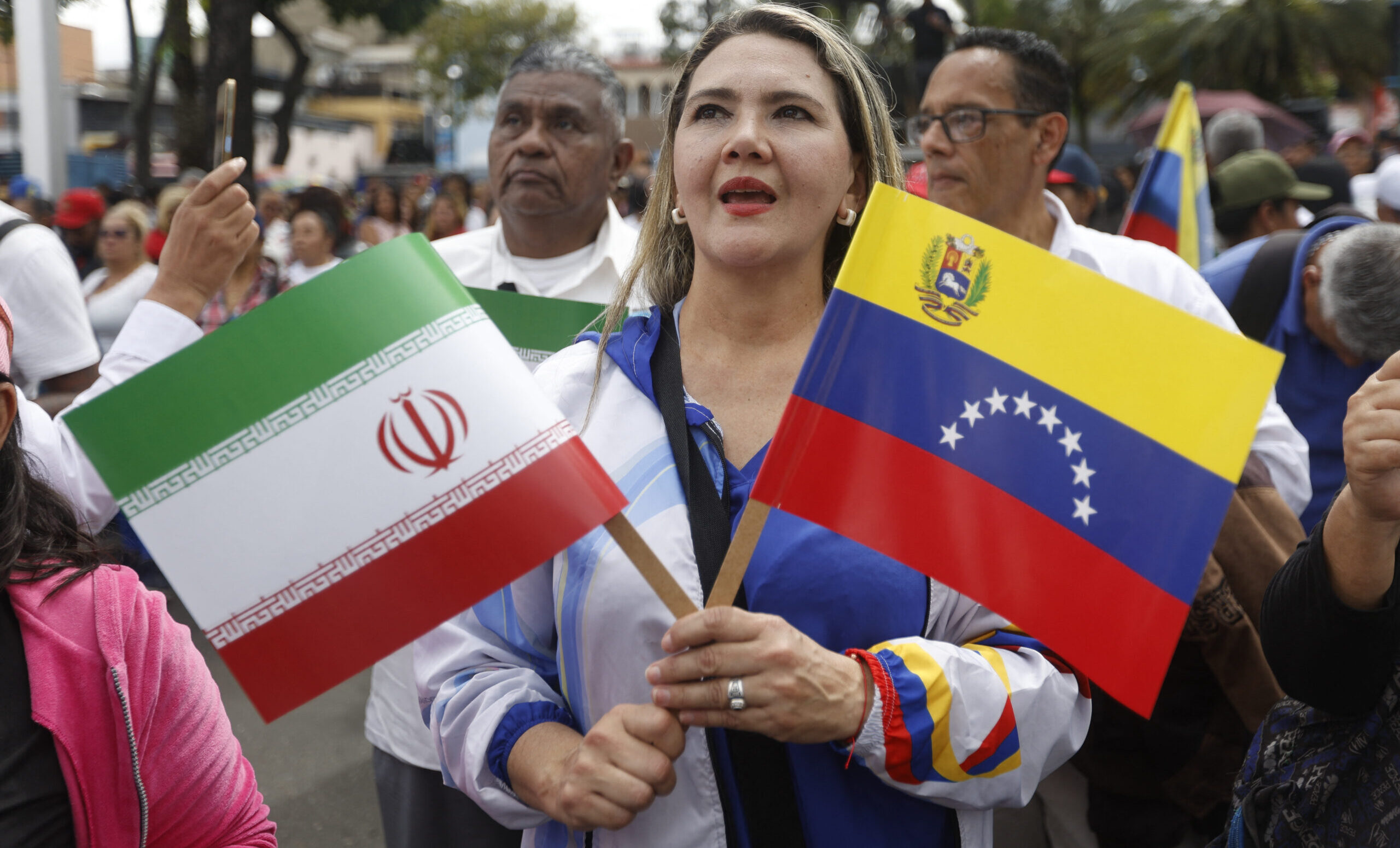
The U.S.’ capture of Venezuelan President Nicolás Maduro on Saturday is expected to weaken Iran’s terrorism efforts, weapons production and economic activity in Latin America, experts say. With Vice President Delcy Rodriguez taking power — and the Trump administration expressing willingness to work with her — it remains unclear whether Maduro’s regime will largely remain intact with American supervision or if the government will ultimately be replaced by the democratic opposition, led by Nobel Peace Prize recipient Maria Corina Machado, or someone else, Jewish Insider’s Lahav Harkov reports.
Expected impact: Emanuele Ottolenghi, senior research fellow at the Center for Research on Terror Financing, told JI that “if the regime remains in place [under Washington’s supervision], there will have to be adjustments in its regional posture and foreign policy. That means, of course, the role that nefarious foreign actors such as China, Russia, Cuba and Iran played in Venezuela will change.” Danny Citrinowicz, a senior researcher at the Institute for National Security Studies at Tel Aviv University, told JI that “the Iranians turned Venezuela into a strategic hub, and now that has disappeared.”
Bonus: Politico talks to Vandenberg Coalition head Carrie Filipetti, who served as principal deputy assistant secretary of state for Cuba and Venezuela during the first Trump administration, about the apprehension of Maduro and potential next steps for the U.S. vis-à-vis its Venezuela policy.
shifting alliances
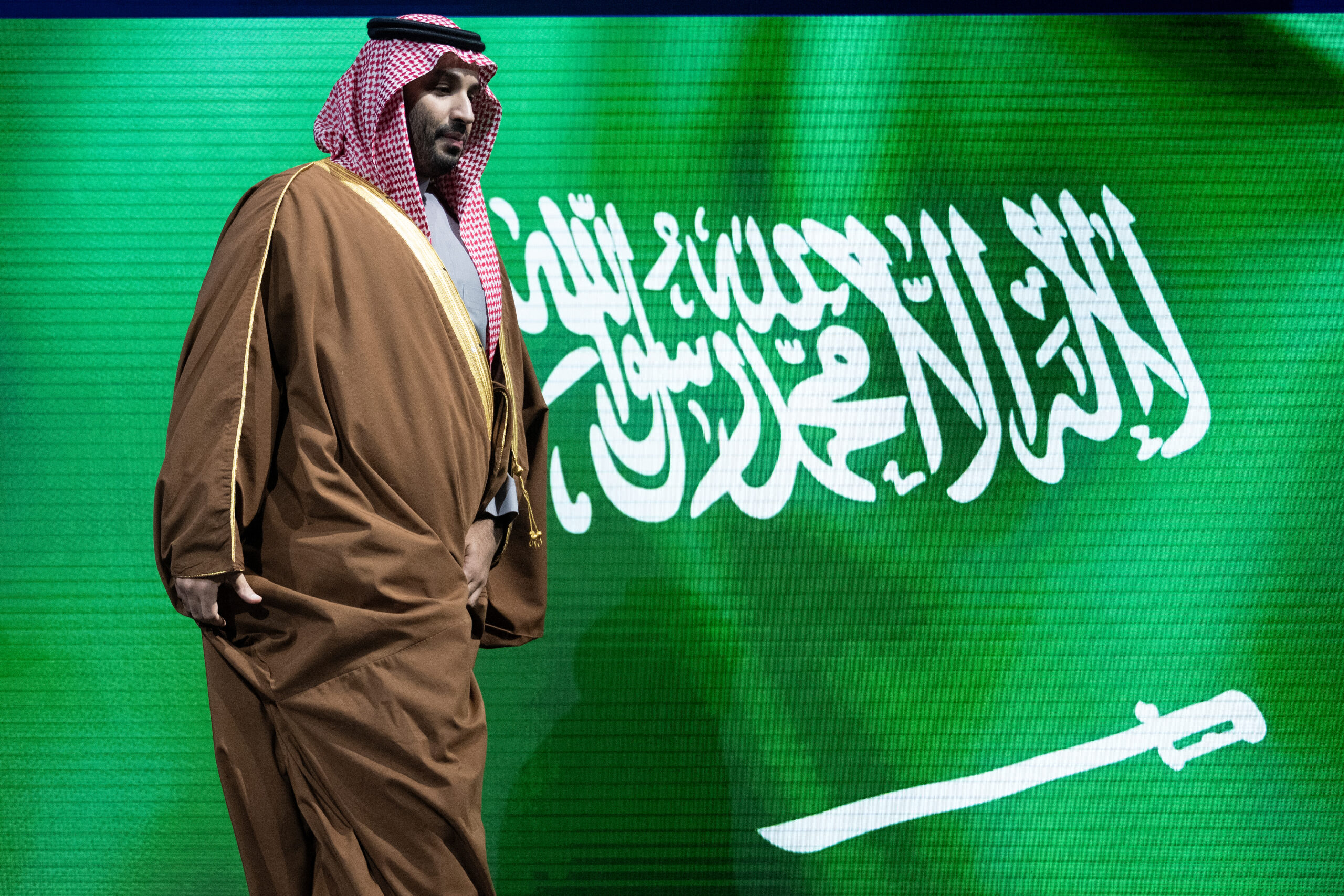
Saudi Arabia is recalibrating its regional posture in ways that are challenging long-held assumptions about Riyadh’s role as a moderating force in the Middle East, as recent moves across Yemen, Sudan and the Horn of Africa expose the country’s widening rift with the United Arab Emirates and a growing alignment with Qatar and Turkey — two countries with openly hostile positions toward Israel, Jewish Insider’s Emily Jacobs, Lahav Harkov and Matthew Shea report.
Series of events: The realignment has been most stark on the issue of Yemen, where Saudi Arabia led an airstrike on an Emirati shipment of vehicles last week that Riyadh claimed was intended for the UAE-backed Southern Transitional Council (STC), which has consolidated power in the country’s south as Saudi-backed efforts to stabilize the war-torn nation have stalled. Hours after the strike, the Emirati government announced it would withdraw its remaining troops from the country. The Saudis’ decision to embrace Islamist-aligned factions in Sudan, where the UAE is aligned with rival forces, has caused additional fissures with the Emiratis, putting the two U.S. allies and Gulf power players at odds. The Gulf states have also taken opposite sides on Somalia, with the UAE quietly supportive of Somaliland, while Saudi Arabia condemned Israel for recognizing its independence.
Qatari condolences: Qatari Education Minister Lolwah Al-Khater publicly mourned the death of Huthayfa Samir Abdullah Al-Kahlout, a senior Hamas military spokesman who served as the public face of the group’s media strategy during the war in Gaza, drawing renewed scrutiny of Qatar’s ties to the militant group, Jewish Insider’s Matthew Shea reports.
DAY ONE DOOZY

Newly inaugurated New York City Mayor Zohran Mamdani is facing criticism for repealing executive orders issued by former Mayor Eric Adams aimed at tackling antisemitism, including implementing the International Holocaust Remembrance Alliance’s working definition of antisemitism and an anti-Boycott, Divestment and Sanctions order. The revocation of those orders came as part of a blanket repeal of all of Adams’ executive orders following his September 2024 indictment on federal corruption charges, Jewish Insider’s Marc Rod reports.
Community reaction: In a joint statement, the UJA-Federation of New York, Jewish Community Relations Council of New York, American Jewish Committee of New York, Anti-Defamation League of New York/New Jersey, Agudath Israel of America, the New York Board of Rabbis and the Orthodox Union said that the Jewish community “will be looking for clear and sustained leadership that demonstrates a serious commitment to confronting antisemitism and ensures that the powers of the mayor’s office are used to promote safety and unity, not to advance divisive efforts such as BDS.” The statement continued, “Singling Israel out for sanction is not the way to make Jewish New Yorkers feel included and safe, and will undermine any words to that effect.”
Bonus: The New York Times reports that Mamdani’s decision to issue a blanket revocation of Adams’ executive orders was made in an effort to alleviate anger by Jewish groups over the rescinding of the two orders related to Israel and antisemitism.
EXCLUSIVE

The American Israel Public Affairs Committee appointed Deryn Sousa as spokesperson, replacing Marshall Wittmann, who retired at the end of 2025 after 13 years in the role. Sousa steps into the public-facing position during a time when AIPAC is regularly in the spotlight — and as the powerful pro-Israel organization faces outsized criticism from the far left and far right over its influence in the American political system, Jewish Insider’s Gabby Deutch reports.
Background: Sousa reflects a different career trajectory than that taken by Wittmann, who came to AIPAC toward the end of his career after decades working in politics in Washington, including as communications director for Sens. Joe Lieberman (I-CT) and John McCain (R-AZ). Sousa has worked for AIPAC for a decade, having joined the organization soon after she graduated from the University of Georgia, where she studied Arabic and international affairs. She moved to Washington for the spokesperson role from Houston, where she served until recently as AIPAC’s Southwest regional political director.
MONEY IN THE BANK
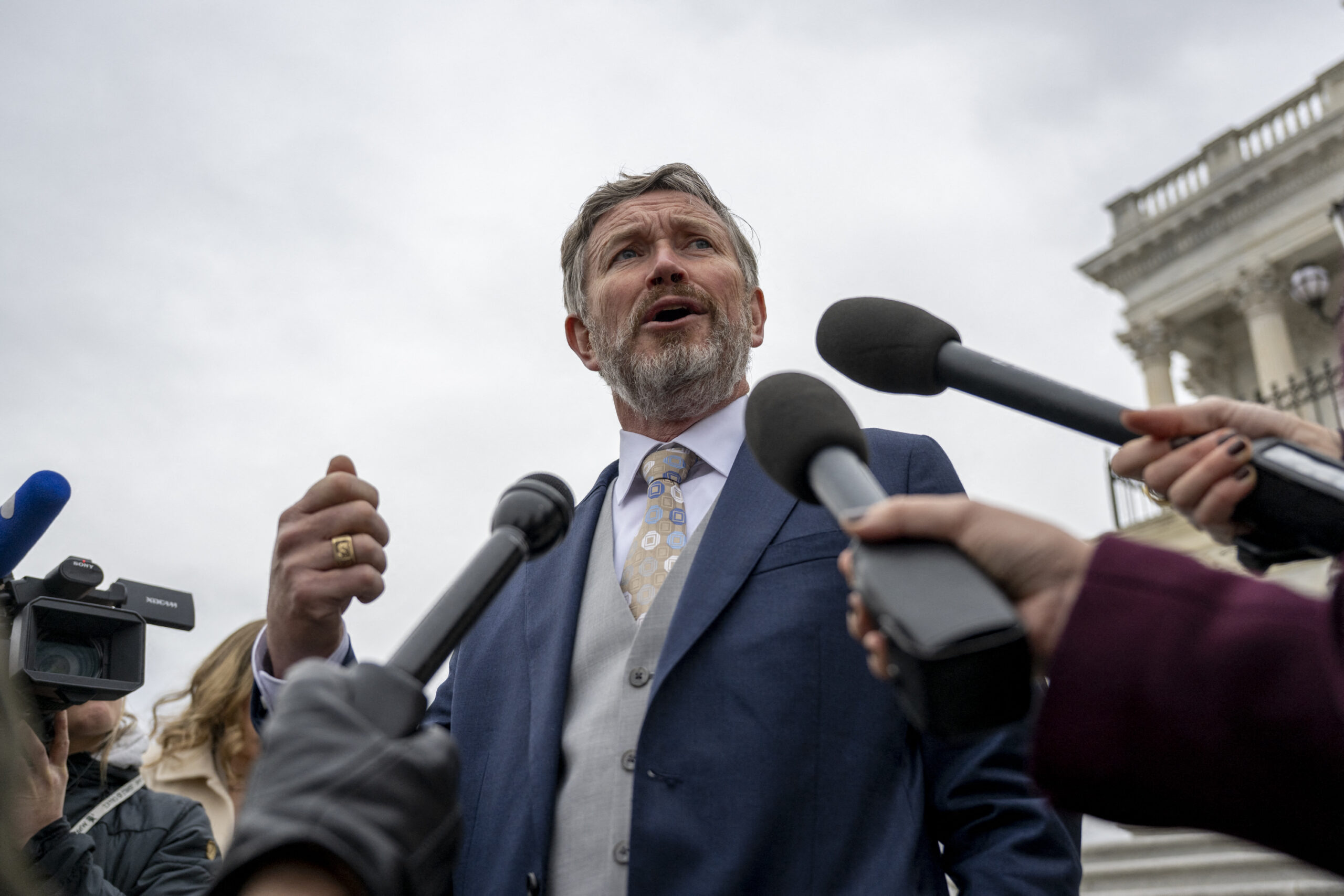
Ed Gallrein, the Republican primary challenger to Rep. Thomas Massie (R-KY) backed by President Donald Trump, said Friday that he had raised $1.2 million in the final quarter of 2025, a sizable sum that puts him in strong financial shape in preparation for a grueling race against Massie. Gallrein’s fundraising haul signals that he’s a more viable candidate than Massie’s previous challengers, and highlights the power of Trump’s endorsement, Jewish Insider’s Marc Rod reports.
Moving against Massie: Trump and his allies have also committed significant resources to the effort to defeat Massie, an isolationist Republican who has frequently opposed legislation to combat antisemitism and has broken with Trump on many key elements of his agenda, including on issues related to Israel and Iran. “This fundraising number reflects the overwhelming support Ed’s campaign has received right out of the gate,” Gallrein spokesperson Lance Trover said in a statement. “President Trump endorsed Ed because he knows Ed is fighting to put America First and will partner with him to unleash our economy, lower taxes, and stop the woke agenda.”
ON THE AGENDA
Going into 2026, Jewish community groups said their advocacy priorities for Congress and the federal government remain largely consistent, with a focus across many of the major advocacy organizations on bolstering community security through the Nonprofit Security Grant Program and tackling antisemitism online, Jewish Insider’s Marc Rod reports.
The hurdles: While Congress has increased its attention to Jewish communal issues in the years since the Oct. 7, 2023, Hamas attacks on Israel, including a string of high-profile hearings on antisemitism and several bills passed to support Israel and combat Iran, many key legislative priorities for the Jewish community — including bills on antisemitism and substantial increases to annual security funding for nonprofits — have remained stubbornly intractable.
Worthy Reads
American Muscle: Politico’s Sophia Cai, Felicia Schwartz, Dasha Burns and Eric Bazail-Eimil posit that the Trump administration is taking a more hawkish approach to foreign policy in its second term. “The Saturday morning raid is a brazen escalation of U.S. involvement in a foreign country that landed the same weekend Trump publicly threatened to defend Iranian demonstrators against their own government. It serves as a fitting coda to Trump’s first year back in power, one marked by dramatically more involvement in foreign conflicts than candidate Trump or first-term Trump predicted. … Still, the move against [Nicolás] Maduro would have been almost unimaginable during Trump’s first term and during the heat of the 2024 campaign, when Trump adopted the views of restrainers who were skeptical of unconditional aid to Ukraine and spoke of the need to stop engaging in ‘forever wars.’” [Politico]
The Ties That Bind: In The Wall Street Journal, Armin Rosen observes the relationship between Somaliland and Israel, the latter of which was the first country to recognize Hargeisa’s independence last month. “Across 1,600 miles of distance, there is a surprisingly deep kinship between Hargeisa and Jerusalem. … Both countries see themselves as global outsiders waging a long campaign for legitimacy and respect. Israeli citizens and products are still banned in dozens of Muslim countries. As an unrecognized state, Somaliland lacks access to the Swift system for clearing international financial transactions, and its government is effectively blocked from borrowing meaningful amounts of money. Like Israel, a poor, war-ravaged and diplomatically isolated desert outpost during its first decades of existence, Somaliland has to find its way without much help.” [WSJ]
Word on the Street
The New York Post interviews New York City Councilmember Julie Menin about New York City Mayor Zohran Mamdani as Menin, who is Jewish, is expected to become city council speaker; Menin said she called Mamdani shortly after his revocation of Israel- and antisemitism-related executive orders to express her concern over the moves…
Florida GOP gubernatorial candidate James Fishback is facing resurgent allegations that he had an inappropriate relationship with a minor who worked at his nonprofit organization in 2022; Fishback called the allegations “completely false”…
Jewish Insider’s Gabby Deutch interviews Zvi Hershcovich, the Philadelphia-based Chabad rabbi running a digital clubhouse for Jewish hockey fanatics…
The Chabad house in Kathmandu, Nepal, is temporarily closed following a dispute with the building’s landlord; Rabbi Chezki Lifshitz and Rebbetzin Chani Lifshitz are looking for a new site for the Chabad house, which is a popular site for Israeli and Jewish trekkers and gained fame for hosting the largest Passover Seder in the world…
The New York Times reports on efforts to repatriate items that had belonged to Holocaust victims to their descendants…
A new report from the Israel Advanced Technology Industries Association found that more than half of the companies surveyed saw an increase in requests from employees to relocate outside of Israel…
Einav Zangauker, who gained prominence in Israel for her advocacy on behalf of her son, Matan, who was a hostage in Gaza, announced Matan’s engagement to Ilana Gritzewsky; Zangauker was released from Hamas captivity in October 2025, while Gritzewsky, who was also taken hostage on Oct. 7, 2023, was freed in November 2023…
Former Israeli hostage Romi Gonen recounted multiple incidents of sexual assault during the 471 days she spent in Hamas captivity in Gaza, in an interview with Israel’s Channel 12…
The BBC reached a five-figure settlement with an Israeli family from the Gaza envelope whose home a BBC reporting team filmed from without permission in the aftermath of the Oct. 7, 2023, Hamas terror attacks…
Egypt and Qatar inked an agreement that will see Doha sending gas to Cairo as Egypt works to diversify its national gas imports…
Swiss officials identified the bodies of Israeli teenager Charlotte Needham and Jewish sisters Alicia and Diana Gunst, who died in a fire at a Swiss ski resort on New Year’s Eve…
Singer Este Haim married tech entrepreneur Jonathan Levin in a New Year’s Eve wedding in Los Angeles…
eJewishPhilanthropy talks to friends and colleagues of philanthropist Morris Kahn, who died last week at 95…
Former Orthodox Union head Rabbi Julius Berman, who previously served as chair of the Conference of Presidents of Major American Jewish Organizations and chair of the board at Yeshiva University’s Rabbi Isaac Elchanan Theological Seminary, died at 80… Holocaust survivor Eva Schloss, the stepsister of Anne Frank, died at 96… Holocaust survivor Edward Gastfriend, who was instrumental in the creation of Philadelphia’s Holocaust Memorial Plaza, died at 100… Record executive and political activist Howie Klein died at 77 (read Phil Klein’s obituary for his father in the National Review here)… Journalist Tatiana Schlossberg, the daughter of Amb. Caroline Kennedy and Edwin Schlossberg, died at 35… Former Rep. Dick Zimmer (R-NJ) died at 81… Richard Pollak, the founder and editor of More magazine, died at 91… Piano virtuoso Gary Graffman died at 87… Longtime Upper East Side veterinarian Lewis Berman, whose clientele included the pets of numerous celebrities and high-profile figures, died at 90…
Pic of the Day

Israel’s Noa Szollos finished 28th in the Women’s Slalom race in Kranjska Gora, Slovenia, at the FIS Alpine Ski World Cup 2025-2026, earning Israel’s first-ever World Cup points in alpine skiing.
Birthdays

Tennis player ranked No. 1 in Israel for most of 2022, Yshai Oliel turns 26..
Author of 10 books including Mitzvah Man and collections of short fiction including Minyan: Ten Interwoven Stories, John Jacob Clayton turns 91… Sports journalist, author and former ombudsman for ESPN, Robert Lipsyte turns 88… NBA superfan who attends over 100 basketball games nationally each season, James F. Goldstein turns 86… Former member of the Knesset for the National Religious Party, Eliyahu Gabai turns 83… Former Philadelphia mayor for eight years, and then another eight years as Pennsylvania’s governor, currently a special counsel at Ballard Spahr, Ed Rendell turns 82… Retired attorney from Latham & Watkins, Paul Israel Meyer… San Diego-based attorney, she served as a member of Congress and as chief of staff for former California Gov. Gray Davis, Lynn Alice Schenk turns 81… Former attorney general of the U.K, now London co-managing partner and chair of the European and Asian litigation practice at Debevoise & Plimpton, Lord Peter Goldsmith turns 76… CEO of Legacy Interactive / Legacy Games, Ariella Lehrer, Ph.D…. Founder and principal of DC-based Mager & Associates, a boutique public policy and advocacy consulting firm, Mimi Mager… Retired chairman of the Jewish National Fund (Keren Kayemet LeYisrael), Daniel “Danny” Atar turns 68… Journalist John F. Solomon turns 59… Actress and television personality, she is best known for her nine seasons on “The Real Housewives of Orange County,” Heather Paige Kent Dubrow turns 57… Partner of both the law firm Galper & Goldberg PLLC and the PR firm Trident GMG, Joshua P. Galper… Professional poker player with more than $29 million of winnings, including $10 million at the 2025 World Series of Poker Main Event Championship, Michael Mizrachi turns 45… NYC-based saxophonist, composer, bandleader and educator, Oded Tzur turns 42… Founder and creative director of Alsall Studio, a social media and web design firm, Alexandra Lauren Sall…
The newest demonstrations come as Iran is facing economic instability, crushing international sanctions and record drought
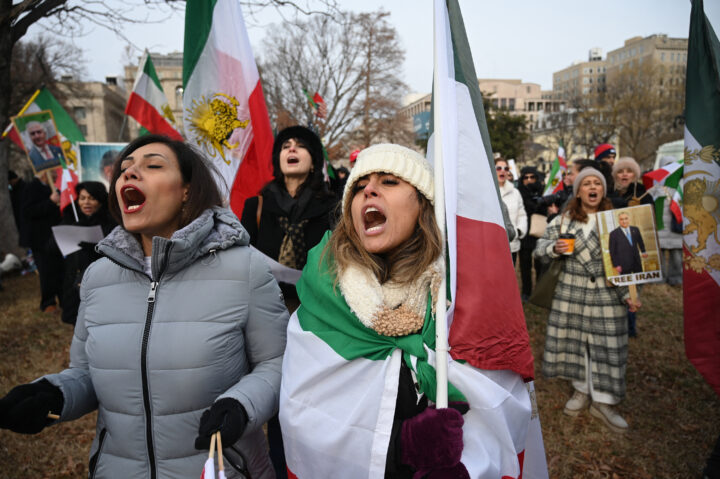
Olivier Douliery/Abaca/Sipa USA via AP Images
Activists take part in a rally supporting protestors in Iran at Lafayette Square, across from the White House in Washington, DC on January 3, 2026.
As protests continue to spread throughout Iran and the geopolitical repercussions of the Trump administration’s capture of Venezuelan President Nicolas Maduro ripple across world capitals, the sentiment around the Middle East and in Washington is that renewed conflict with the Islamic Republic may well be on the horizon.
While smaller than previous nationwide protests in 2019 and 2022, the newest demonstrations come as Iran is facing economic instability, crushing international sanctions and record droughts. The protests that have spread across the country in recent days are the first major demonstrations since the 12-day war between Iran and Israel, with an assist from the U.S., last June that damaged the Islamic Republic’s nuclear program and further destabilized Iran.
The protests in Iran were already gaining steam at the time a Delta Force team apprehended Maduro and his wife on Saturday and brought them to the U.S. to stand trial on drug trafficking charges. But the Trump administration’s decision to send elite forces into Caracas and forcibly remove Maduro signals to Tehran — as well as Moscow and Beijing — that Washington is taking a tougher approach to regimes it sees as destabilizing and threatening to U.S. interests.
The world is watching this geopolitical high-wire act with uncertainty. In Israel, officials are closely monitoring the instability in Iran, concerned that the regime in Tehran could move to strike Israel in an effort to consolidate domestic support and quell the protests; Israel could also see a window of opportunity to strike Iran at a weak moment, either of which could reignite warfare between Jerusalem and Tehran. It was less than a week ago that Israeli Prime Minister Benjamin Netanyahu met with President Donald Trump at his Mar-a-Lago resort in Florida and discussed the threat posed by Iran’s ballistic missile program.
In his weekly Cabinet meeting yesterday, Netanyahu addressed Iran in the context of his Palm Beach meeting last week, saying that Israel “reiterated our joint position of zero enrichment on one hand, and the need to remove the 400 kilograms of enriched material from Iran and oversee the sites with tight and genuine supervision.”
Noting that his sit-down with Trump was taking place as anti-government protests broke out in Iran, Netanyahu added, “The Government of Israel, the State of Israel, and my policy, we identify with the struggle of the Iranian people, with their aspirations for freedom, liberty, and justice. It is very possible that we are standing at the moment when the Iranian people are taking their fate into their own hands.”
With an eye toward Washington, the question is whether Trump will back future military action in Iran, after his success ousting Maduro in Caracas. Despite the widespread protests in Iran, there is no consolidated opposition, where the regime’s opponents are, as The Atlantic’s Arash Azizi writes, “hopelessly disorganized and disunited.”
Speaking to reporters on Air Force One last night, Trump reiterated his recent comments that the U.S. would intervene if Iranian officials were to kill protesters, having said on his Truth Social site on Friday that “If Iran shoots and violently kills peaceful protesters, which is their custom, the United States of America will come to their rescue.”
The Associated Press, citing human rights activists, reported that 15 people had been killed as of Saturday, the same day that Iranian Supreme Leader Ayatollah Ali Khamenei made his first public comments since the outbreak of protests, saying that “rioters must be put in their place.”
Iran’s political leadership appears at an impasse in its efforts to contain the demonstrations — or improve the conditions that led to them — with the hands of President Masoud Pezeshkian and other senior officials largely tied by the supreme leader. That could push the regime to act out of desperation — or to collapse entirely.
An increasingly unlikely scenario is that the protests fizzle out and Khamenei reasserts control — a move that would likely need to occur alongside an economic upturn to pull the rial up from record lows.
The first days of 2026 have seen tens of thousands of protesters taking to the streets across Iran and an administration in Washington flexing its military power, setting the stage for a potential power realignment in the Middle East and around the world.
The members say the Vermont senator hasn’t attended council meetings and that his rhetoric, accusing Israel of committing genocide, runs counter to the museum’s mission

Kevin Dietsch/Getty Images
Sen. Bernie Sanders (I-VT), joined by fellow senator Sen. Jeff Merkley (D-OR) (R), speaks at a news conference on restricting arms sales to Israel at the U.S. Capitol on November 19, 2024 in Washington, DC.
Several Trump appointees to the board of the United States Holocaust Memorial Museum are pushing for the ouster of Sen. Bernie Sanders (I-VT), alleging that he has rarely attended meetings and that his accusations of genocide against Israel run counter to the museum’s mission.
Sanders has served on the council for nearly two decades.
The board, formally known as the Holocaust Memorial Council, is mostly made up of presidential appointees who serve for five-year terms, joined by a handful of members from the House and Senate chosen by congressional leadership. Sanders was appointed in 2007. Lawmakers are technically subject to the same five-year term limits but in practice have often served until a successor is appointed or they leave office.
Jonathan Burkan, who was appointed to the council twice by President Donald Trump, said he’s never seen Sanders at any meetings of the council — which he said has not been the case for other lawmakers, both Democrats and Republicans.
“Everything that’s happened after Oct. 7, everything that has been going on with antisemitism, with the Holocaust — I do feel that if someone is a Jewish elected official, they should at least attend one meeting in over a 20-year period of time,” Burkan said. “They should find someone else besides Bernie just to be on the council.”
Each of the council members who spoke to Jewish Insider spoke in their personal capacities, not as representatives of the council as a whole.
Burkan added that “Bernie Sanders accusing Israel of genocide downplays the Holocaust, which actually hurts the museum which he serves.”
Stuart Eizenstat, the chair of the council, has pushed back on accusations of genocide against Israel and has argued that extreme anti-Israel rhetoric is fueling violent antisemitism. The museum’s director has also condemned comparisons between the war in Gaza and the Holocaust.
Daniel Huff, who was appointed to the board during Trump’s first administration, said that it’s “important that the museum be a bipartisan effort,” emphasizing that other Democratic lawmakers on the council have been frequent and active participants in its meetings.
“That’s the type of representation that we want,” Huff said. “My observation, simply, is that Sanders has not shown up to any meeting, as far as I can tell.”
“The problem is that he’s publicly out there advocating positions that are really at odds with some of the fundamental things that the museum does, and one of them is making sure that the word ‘genocide’ is carefully safeguarded, and deployed only when necessary, so as not to diminish the memory of those who died in the Holocaust,” Huff said.
Huff argued that, in a time of rising antisemitism, the Holocaust Museum has an important role to play, and it’s “important that everybody who’s in a leadership position there is focused on the importance of the moment, the urgency of the moment.”
“We’re living in a dangerous moment and everyone ought to be paying attention,” Huff said. “We need people who understand the fierce urgency of the moment we’re in, and the need to act wisely and decisively.”
He said that there are many Democrats who would be strong candidates and members of the board, but that Sanders does not fit that bill.
“It’s not a political statement … the ask is just, find someone who’s aligned and involved — that’s it, very simple,” Huff said.
Rob Garson, the president of the American Association of Jewish Lawyers and Jurists, who was recently appointed to the board for the first time, said that he was surprised to find out that Sanders was a member.
“It’s not as if they have that many [meetings] in any given year, and it’s not as if it’s in an inconvenient place for him to come to. He clearly just either doesn’t care or doesn’t want to care,” Garson said.
He added that Sanders’ public rhetoric is “diametrically opposed to the message of the Holocaust Memorial Council.”
“It should be people that actually are aligned with what the Holocaust Museum stands for, and Sanders just isn’t that,” Garson said.
Tila Falic, another recent Trump appointee, said that people selected for the board “represent Holocaust education, and it represents combating antisemitism for Jews and for non-Jews in the United States … people that are appointed should take their job seriously by, first of all, showing up.”
If Sanders is unable to attend or is not aligned with the Museum’s mission, “then he should be removed and give that seat to somebody who wants to take an active role and make a difference.”
Sanders did not respond to a request for comment. Nor did Eizenstat, the chair of the council. The museum also did not provide comment on the effort to remove Sanders or confirm how many meetings the senator has attended during his tenure.
Trump stirred controversy early this year when he removed a slew of Biden appointees from the board, replacing them with several of his own picks.
The EVP of American Friends of Lubavitch is a staple around town during the holiday, regardless of the party in power

One of Washington’s few remaining bipartisan traditions is the annual clamoring for a ticket to the White House Hanukkah party — an affair that was smaller than usual this year after the Trump administration tore down the East Wing, prompting disappointment even from some Republican allies who did not score an invite. If you’re a member of the opposing political party, forget about it.
But even as power changes hands in Washington, one person is a fixture at Republican and Democratic White House Hanukkah parties, as well as Hanukkah gatherings all across the Beltway, from the Pentagon to the Justice Department to the Capitol. That’s Rabbi Levi Shemtov, the executive vice president of American Friends of Lubavitch (Chabad), the Washington arm of the global Chabad movement, and Washington’s unofficial menorah-lighter-in-chief.
“I was raised during the Bicentennial, and I got a very patriotic education in our day school. I felt very American, and I thought this was a strong public expression of a deep Jewish pride that I was able to enjoy,” Shemtov said during Hanukkah last week. “I come from grandfathers on both sides of my family who were arrested and imprisoned, tortured and exiled for being Jews and for practicing Judaism and for leading Jewish communities. So I wasn’t going to let the freedom we are so fortunate to have here just pass without my active participation in it.”
In an interview with Jewish Insider, Shemtov reflected on the importance of spreading a Hanukkah message of light in a region where that’s often missing: the halls of power in Washington.
During Hanukkah this year Shemtov attended as many as four events in a day, shuttling between government institutions and reciting the blessings in front of dignitaries including President Donald Trump, Vice President JD Vance and Attorney General Pam Bondi. He led a bipartisan menorah lighting on Capitol Hill with House Speaker Mike Johnson (R-LA), House Minority Leader Hakeem Jeffries (D-NY) and Senate Minority Leader Chuck Schumer (D-NY).
“The menorah itself is a symbol of bipartisanship, in my opinion, because you almost always have four branches on one side, four branches on the other, and a shamash in the middle,” Shemtov reflected. “In the time of the Temple, we are told that the flames used to point towards the center from either side, and the center flame used to point towards heaven. And that was the connection of divinity with this world.”
“When we point towards the center,” Shemtov continued, “we bring more sensibility and, therefore, divinity to our existence across the board. That’s why, especially when we do this with the two leaders, the speaker and the minority leader together, I think it sends a very powerful message to whoever sees it that there’s hope for togetherness, even in a time of divisiveness.”
It was Shemtov’s father, Rabbi Abraham Shemtov, who is most responsible for bringing public observances of Hanukkah to Washington. In 1979, Abraham Shemtov participated in the first National Menorah Lighting with President Jimmy Carter, a tradition that his son now leads on the Ellipse, outside the White House, each year.
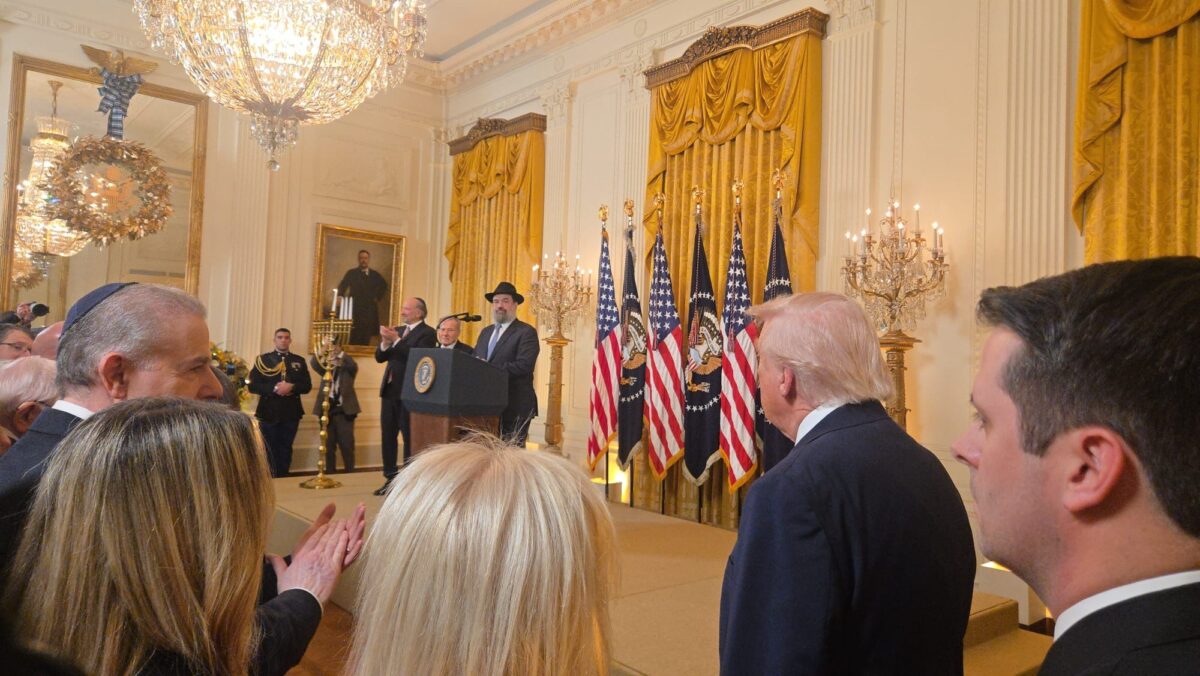
But this year’s National Menorah Lighting would be different than the usual large, boisterous affair. Shemtov knew that as soon as he woke up.
“I was able to tell that it was going to be a very cold day, but that was a small problem compared to what I saw was an unprecedented vicious terrorist attack on a Hanukkah celebration in Sydney, Australia. Sydney is very close to me,” Shemtov said. His wife Nechama is from Sydney and lived down the street from Bondi Beach, where 15 people were killed on the first day of the holiday by terrorists who reportedly pledged allegiance to the Islamic State.
But the brutality of that day, which sent his wife’s family huddling together for safety, did not keep Shemtov from spreading the message of Hanukkah around Washington. “I think that it’s an important opportunity to bring a message of life, unity, warmth and positivity in a way which might otherwise not even be possible,” Shemtov said.
It’s no longer a surprise to arrive at the White House or the Naval Observatory and find kosher brisket, freshly made latkes and sufganiyot in a variety of flavors. But the White House Hanukkah party is a relatively recent invention. The first one took place in 2001, hosted by President George W. Bush. It would be a few more years before the event was certified kosher — by Rabbi Shemtov, of course. It’s a responsibility he oversees regardless of who is president.
“They say about the White House, etc., that the moment you don’t feel it’s special to walk into these places — the White House, the Capitol, VPR [the vice president’s residence] — you should stop working there,” said Shemtov. “Access, acceptance and prominence within these hallowed and rarefied quarters of society is something our forebears can only have dreamed of in an ambitious fantasy, and here we are, able to live it. We just have to want to be proud enough to do so, and that’s why, of course, it’s always an honor to be invited, involved, participating and particularly in helping organize such respectable recognitions of our faith.”
Shemtov’s job is to drive for hours around the Beltway, helping Jews in positions of power practice their faith proudly and publicly. This year, he made it a priority to also be home in time to light his own menorah.
“I have to have a Jewish home as well, not just a Jewish expression to the outside world. And to do that takes effort because scheduling is so crazy,” said Shemtov. “We have to remember it’s like an airplane. You have to put your own oxygen mask on, or else you won’t be able to help anyone at all.”
Carl mused about the need to address the ‘Jewish Question’ and characterized Jews as religiously incorrect and in need of conversion
DOMINIC GWINN/Middle East Images/AFP via Getty Images
Jeremy Carl speaks at the National Conservatism Conference in Washington D.C., Sept. 3, 2025.
Jeremy Carl, a Trump administration nominee for a senior position at the State Department, has expressed a range of derogatory views of the Jewish community, characterizing in writings and public interviews the community as holding a victim mentality, downplaying the significance of the Holocaust to the Jewish story and experience, musing about the need to address the what he called the “Jewish Question” and characterizing Jews as religiously incorrect and in need of conversion.
Carl also rejected the argument that Israel is the United States’ strongest ally and was deeply critical of Christian Zionism. He has additionally espoused a view of the United States as a white, Christian nation, claiming that white people are undergoing a “cultural genocide” and deliberate replacement.
Carl was nominated to be the assistant secretary of state for international organizations in June, but did not move forward to a hearing in the Senate Foreign Relations Committee before the end of this year’s Senate session. Should the Trump administration still want Carl in the role, it will have to re-file his nomination in the new year. Carl said in a response on X that neither he nor the administration have decided whether to resubmit the nomination. Carl served as deputy assistant secretary of the Interior in the first Trump administration.
“Jews have often loved to play the victim rather than accept that they are participants in history. That means that at times of course they’ve been victims but they also can be perpetrators,” Carl, who was raised in a secular Jewish household but converted to Christianity, said in a 2024 interview with “The Christian Ghetto” podcast, saying that some Christians have been “understandably” resentful of Jews throughout history.
“I think it’s inevitable of course that people will always take their own side in [a] historical quarrel. The Jewish community has kind of done [that] to an unusual extent,” Carl continued.
While he offered disclaimers that he was not speaking about all Jews, he generally painted with a broad brush, characterizing the majority of the Jewish community in largely pejorative ways.
He said that the Holocaust “kind of dominates so much of modern Jewish thinking,” adding that he believed it to be “very unhealthy.”
“Now, when you’re getting to this next generation — everybody has traumas in their past. How much are we going to relitigate them?” Carl asked rhetorically. “There’s a level of [self]-involvement there that I kind of find a little distasteful.”
He also said that he feels that “mainline Christian[s]” do not expect as much from Jews as they could and are “very reluctant to criticize Jews or Jewish communal behavior even when, in my view, that might be very warranted.”
Carl said that Jews, meanwhile, “tend to see evangelical Christians in a very negative light … and I frankly think reflects poorly on the Jewish community.”
He claimed that the Jewish community is afraid of Christian communal unity as a legacy of past conversion efforts.
Carl also declared that Jews have never been oppressed in the U.S. and added that “the notion that Jews are the downtrodden here just doesn’t really match with actual reality. I understand why this type of attitude can cause resentment among some Christians who observe it. … Even when I was Jewish, I found it distasteful.”
In a lengthy response on X, Carl dismissed Jewish Insider’s reporting as a misleading and agenda-driven smear.
“I have never ‘downplayed’ the Holocaust, one of the great horrors of modern history, except in the overactive imagination and perhaps bad faith portrayal of the author,” Carl said.
At the same time, in “The Christian Ghetto” interview he claimed to reject conspiracy theories about the Jewish community as a whole and the neo-Nazi Groyper movement, saying that adherents go too far in their hatred of Jews in unproductive ways.
“Nobody can just take a small sip of the drink in front of them, which is the ‘Jewish Question,’ and imbibe carefully and have a mature discussion on it,” Carl said. “[They] need to overdose massively on it, to the point that they just begin saying completely ridiculous and absurd things.”
Carl said that such activity makes him shy away from “critique” of the Jewish community “because you don’t want to be lumped in with these clowns.” He declared that Jewish activists “love the Groypers because they’re just so discrediting of anyone who would ask questions about any of this,” referring to Jewish political activism.
He also claimed that Jews are “more susceptible to political radicalisms of all types and political ultra-enthusiasms” due to a “misplaced religious impulse” of Judaism “searching for the Messiah that had actually been found.”
“I have, of course, been very critical of the political activities of much of the establishment Jewish community since most of the community is liberal and I am a conservative. This should surprise nobody, nor is it a scandal. I have also been critical of the extreme neoconservatives such as those who seem to be pushing this hit piece,” Carl said in his response.
Carl also said on “The Christian Ghetto” podcast the U.S. should have less of a relationship with Israel, and was highly critical of Christian Zionist ideology that attaches a theological dimension to support for Israel.
He said that while from a secular perspective, he feels “vaguely positively disposed to Israel,” he rejects Christian Zionism and the “theological trappings that some Christians put around Israel.”
“At a basis, I have a very pro-Israel view of the Israeli-Palestinian conflict in abstract, I just don’t want us involved in it that much,” Carl said. “The amount of time and energy that America spends on this question — often to the detriment of our own national interest. Nor do I accept that Israel is our greatest ally.”
He characterized himself as a “Buchananite” and a “Paul-ite” in his ideology.
Carl said in his response that he is fully supportive of the Trump administration’s foreign policy and support for Israel, including the administration’s sanctions on the International Criminal Court and the UN’s “Israel monomania.”
He said in an interview with “The Will Spencer Podcast” that conversion from Judaism is a “very fraught thing” and that, in many Jewish families, “it would be easier to convert to Satanism honestly, in some ways.”
He said on “The Christian Ghetto” podcast that Jews have been a “particularly thorny problem” in their resistance to conversion to Christianity. He said he does not believe, from a theological perspective, in religious pluralism, and characterized Judaism as an incorrect and invalid religious practice, arguing that Christians should be trying to convert Jews “where we can.”
In his response, Carl said, “As a Christian I want everyone to embrace the Christian faith, especially my family and friends, because I believe Christianity to be true, and other religions false. Again, this is not a scandal except perhaps in the minds of the author and his editors who evidently believe that standard beliefs held by the vast majority of Christians throughout history are scandalous.”
Carl has also espoused a vision of America as a white, Christian nation, and asserted that white people in America are subject to “persecution” and a “cultural genocide.”
“American whites are victims of a cultural genocide,” Carl said at the 2024 National Conservatism conference. “I’m suggesting this partially again to troll any leftist media who might be in the room and furiously scribbling my unforgivable hate speech in their notebooks. But I’m not saying it entirely for that purpose.”
He’s the author of The Unprotected Class: How Anti-White Racism is Tearing America Apart, which dismisses the idea of rising white supremacy and focuses on the thesis that anti-white policies are endemic in modern America.
The original title of the book, Carl revealed in a 2024 essay, was It’s Okay to Be White, which has become a slogan used by white supremacists.
He states in that essay that demographic shifts in the country are the result of “a great replacement of whites,” referencing the conspiracy theory that a shadowy force is attempting to replace the country’s white population with immigrants. He declared that the great replacement is “a fact” and “a basic statement of the Democratic Party’s platform.”
“I can understand why [Indian President Narendra] Modi wants India to be a Hindu nation, because I want America to be a Christian nation, defined not in total but in part by its European historic identity,” he continued.
He added in “The Christian Ghetto” podcast interview that he does not “really believe in Judeo-Christian — I think America is a Christian nation.”
He said in “The Will Spencer Podcast” interview that his book was designed to help white people “figure out a way as a white person to navigate around the issue and also understand that you’re not crazy. The sorts of things you’re experiencing in terms of discrimination or racism, etc. are very real and that you don’t need to put up with that.”
At the same time, Carl did acknowledge in that interview that America would never be an “ethnically uniform” or “racially uniform” way and “that’s okay, that’s manageable,” but that the country should have a “sense of a majority tradition … majority religious practice” and a “tolerance for other minority groups to all be within that culture.”
The State Department did not respond to a request for comment.
CNN previously reported that Carl scrubbed thousands of inflammatory posts after his nomination.
This article was updated on 12/21/2025 to include Carl’s response.
The GOP pushback indicates that a significant number of Republican lawmakers remain concerned about the Syrian government’s conduct

Kevin Carter/Getty Images
The U.S. Capitol Building is seen at sunset on May 31, 2025 in Washington, DC.
A group of 136 House Republicans released a joint statement on Friday calling for increased oversight of and accountability from Syria, days after voting to repeal the last major sanctions package on the country as part of the 2026 National Defense Authorization Act.
The Trump administration had pushed Congress to repeal the so-called Caesar Act sanctions, an action finalized when Trump signed the 2026 NDAA Thursday evening, but some lawmakers on the Hill have harbored continued reservations about the new government in Syria and ensuring it continues to make progress on democracy building.
The statement indicates that a significant number of Republican lawmakers remain concerned about the Syrian government’s conduct going forward. It follows an attack by ISIS affiliates who also reportedly had ties to the Syrian government that killed two U.S. service members and a civilian interpreter in Syria last weekend. The statement has been in the works since last week, shortly after the House voted to pass the NDAA, a source familiar with the situation told Jewish Insider.
“Bringing religious freedom into Syria is the only way the country will fully stabilize. The sanctions repealed by the NDAA will help economically, but violence will not cease until [Syrian President Ahmad] al-Sharaa uses his position to denounce religiously motivated attacks,” Rep. Marlin Stutzman (R-IN), a co-lead of the joint statement, told Jewish Insider.
The lawmakers, led by Stutzman and Rep. Josh Brecheen (R-OK), said in the joint statement that members of Congress interested in protecting religious minorities in the region “worked with the Trump Administration and House leadership to secure assurances that snapback conditions … would be enforced if Syria does not comply with the terms highlighted in the repeal language.”
The NDAA includes language calling for the administration to reimpose sanctions on Syria if a variety of human rights, security and anti-corruption conditions are not met, and for reporting to Congress on those benchmarks — but the language is not binding and the strict and sweeping Caesar Act sanctions could not be reimposed by executive authority without another act of Congress.
The lawmakers said that the “the mass murder of the Syrian Christians, Druze, Alawites, Kurds, and other religious and ethnic minorities must be a thing of the past” and that they are “committed to keeping a watchful eye on the new al-Sharaa Administration to ensure protections for religious and ethnic minorities.”
They said they would like to travel to Syria to see firsthand that religious protections are being upheld, particularly in Suweida, the city with a substantial Druze population where government-aligned forces carried out mass atrocities earlier this year.
“We look forward to confirming that these terms have not been squandered by the Syrian government — whether by their president or by rogue military officials — and seeing for ourselves that the al-Sharaa Administration has created a safe environment for the religious and ethnic minorities historically persecuted in the region,” the statement continued.
The lawmakers also said that House Speaker Mike Johnson (R-LA) and House Foreign Affairs Committee Chairman Brian Mast (R-FL) had agreed to hold a hearing on “the verified change of treatment for religious minorities in Syria.”
Mast himself, who had been the last major roadblock on the Hill to sanctions repeal and pushed for the nonbinding snapback language to be included, is one of the first signatories on the statement.
Sen. Jim Risch (R-ID), the chair of the Senate Foreign Relations Committee, said in a statement that the “unconditional” sanctions repeal is a significant step, while highlighting the congressional oversight and monitoring obligations.
“After long and serious consideration, we have worked closely with the Trump Administration to responsibly repeal the Caesar Act, which played an important role in the fall of the Assad Regime,” Risch said. “This unconditional repeal removes a significant roadblock to U.S. and international commercial investments in Syria. It also increases reporting and monitoring on benchmarks such as ethnic and religious persecution to ensure Syria remains on the path to becoming a U.S. partner that makes America safer, stronger, and more prosperous.”
The U.S. Commission on International Religious Freedom held a hearing with Syrian minority group leaders last month, where representatives of the Syrian Druze, Christian and Alawite communities warned of systemic religious persecution by the new government and urged Congress to place conditions on the repeal of sanctions.
But others, including the Jewish Heritage in Syria Foundation (JHS), a group of U.S.-based Syrian Jews working to restore Jewish sites and relics in Syria, celebrated the sanctions repeal.
“Once President Trump signs the bill into law, we will be able to increase our efforts to preserve Jewish heritage, continue the search for those we have lost, and move forward with healing and restoration,” JHS said in a statement. “We can now begin rebuilding our synagogues, especially the ancient and historic Jobar Synagogue, one of the oldest Jewish sites in the world.”
Other leaders in the Syrian Jewish community have distanced themselves from the leadership of JHS and its affiliates, claiming they do not speak for the Syrian Jewish community in the U.S. at large.
The legislation attacks the administration for its push against antisemitism, saying the White House is weaponizing antisemitism accusations for unrelated political aims

GETTY IMAGES
A general view of the U.S. Capitol Building from the National Mall, in Washington, D.C., on Thursday, May 29, 2025.
A new bill introduced by several prominent House progressives blasts the Trump administration’s agenda and actions on combating antisemitism, while also implementing new posts and requirements across a series of federal departments to fight Jewish hate.
The new bill, the Antisemitism Response and Prevention Act, is led by Reps. Jerry Nadler (D-NY), Rosa DeLauro (D-CT), Becca Balint (D-VT) and Maxwell Frost (D-FL).
The legislation accuses the Trump administration, at length, of weaponizing antisemitism to “pursue ideological and partisan political objectives unrelated to protecting Jewish communities,” including attacking educational institutions, suppressing speech and enforcing “ideological conformity.”
Citing the Heritage Foundation’s Project Esther report, which the legislation describes as the framework for the administration’s strategy, the lawmakers link the Trump administration’s actions to a “Christian Zionism theology and beliefs that Jewish presence in the Holy Land will precipitate End Times.”
It claims the administration has used the “false pretext of antisemitism investigations” to undermine academic freedom on college campuses, eliminate diversity and Middle Eastern studies programs and silence criticism of Israel.
The legislators also allege the Trump administration “inappropriately appropriated the International Holocaust Remembrance Alliance (IHRA) definition of antisemitism as a tool for immigration enforcement and deportation proceedings,” citing the administration’s efforts to deport students engaged in antisemitic and anti-Israel activity and scrutinize the social media activity of visa applicants.
They accuse the administration of holding Jewish institutions’ security “hostage” to political objectives through new conditions on Nonprofit Security Grant Program funding.
The legislation downplays the IHRA definition of antisemitism, describing it as one of “several definitions of antisemitism which serve as valuable tools to raise awareness and increase understanding of antisemitism,” despite widespread adoption by the mainstream Jewish community and its use by multiple administrations of both parties.
The bill describes various definitions, also naming the Nexus Document, as “valuable tools to raise awareness and increase understanding of antisemitism” which “should be utilized by Federal, State, and local agencies” and as “non-legally binding educational tools [which] should not be applied in punitive legal contexts.”
It further emphasizes that “criticism of Israeli government policies, when not motivated by or expressed through antisemitic tropes or discrimination against Jews, is a form of political speech protected by the First Amendment and does not constitute antisemitism.”
And it states that “the weaponization of antisemitism accusations to pursue partisan political agendas undermines genuine efforts to protect Jewish communities and breeds additional antisemitism.”
The legislation includes some provisions which have enjoyed bipartisan support, including several aspects of the Protecting Students on Campus Act: requiring universities to publicize to students how to file discrimination complaints and to report annually to the Department of Education on the complaints they have received and for the Department of Education to report to Congress monthly for a year on the complaints it has received and how long they remain open.
The Protecting Students on Campus Act was re-introduced by its bipartisan sponsors — Reps. Lucy McBath (D-GA), Lois Frankel (D-FL), Don Bacon (R-NE), Juan Ciscomani (R-AZ) and Haley Stevens (D-MI) — on Thursday, the same day Nadler’s legislation was announced.
The Antisemitism Response and Prevention Act additionally requires the administration to create an office in the Department of Justice to combat antisemitism, to be headed by a career DOJ official as the full-time national coordinator to counter antisemitism, similar to a provision previously sought by the mainstream Jewish community and included in bipartisan legislation in the prior Congress.
The bill requires the Department of Education to reopen and staff all regional offices of the Office for Civil Rights that were closed earlier in the Trump administration, and prevents the department from closing such offices going forward. It proposes providing $280 million for the program annually.
It also requires colleges and universities to designate a Title VI coordinator to handle complaints.
Additionally, it requires the FBI to establish a hate crimes reporting center, to be led by a designated coordinator, for the purpose of collecting and overseeing hate crimes data. It proposes $50 million in funding annually for the office.
Regarding the Nonprofit Security Grant Program, the legislation requires the administration to ensure sufficient personnel to support the implementation of the program and prohibits the imposition of conditions on DEI, immigration, political advocacy or affiliation or protected characteristics for grant awardees. It mandates the administration provide specific detail to Congress on approved and rejected grant applications.
It proposes providing $500 million for the program annually.
The legislation makes repeated reference to the Biden administration’s national strategy on antisemitism, and is framed as an effort to build off of that approach.
“This bill shows that moderates and those aligned with the current Israeli government do not enjoy a monopoly over the fight against antisemitism and hate,” Nadler said in a statement. “I am proud to introduce, with my cherished colleagues, the Antisemitism Response and Prevention Act, which embodies a comprehensive and principled framework — one that steadfastly upholds and celebrates progressive values without compromise, diminution, or equivocation.”
DeLauro said the bill “lays out a national strategy for combating the rising threat of antisemitism while protecting freedom of speech, and calls out the Trump Administration’s co-opting of antisemitism for its own political agenda.”
Balint said the legislation would provide critical resources while also implementing “strong Congressional oversight and guardrails to prevent any administration from politicizing antisemitism to further attack their opponents.”
Frost said the legislation “creates a coordinated, whole-of-government response to confront antisemitism wherever it appears in our communities. Unity is our greatest strength, and when we act together, hate has nowhere to take hold.”
Experts said the White House needs to clarify how governance and security structures will operate in Gaza moving forward
Majdi Fathi/NurPhoto via Getty Images
A photograph shows destroyed buildings in Jabalia, in the northern Gaza Strip, on December 9, 2025.
It has been nearly three months since President Donald Trump unveiled his 20-point peace proposal for Gaza, but officials have yet to explain how key aspects would function in practice or how Hamas’ entrenched presence in the enclave will be addressed.
Under the plan, Gaza’s governance would be overseen by a Trump-led “Board of Peace,” followed by an international executive board expected to include Jared Kushner and White House Special Envoy Steve Witkoff. Beneath the board would sit a technocratic Palestinian government of approximately a dozen Palestinians who are not affiliated with Hamas.
Trump initially planned to announce board members by Christmas, but that timeline has slipped to early next year. On Thursday, the White House proposed that Nickolay Mladenov, a Bulgarian diplomat and former UN Middle East envoy, join the Trump-led board as an on-the-ground representative in Gaza. In such a role, Mladenov would be expected to work with a future Palestinian technocratic government.
But as Trump focuses on hand-picking members for his ideal Palestinian governing body, experts told Jewish Insider that the administration has offered little clarity on how this layered structure would actually govern Gaza — or, more consequentially, how it can operate while armed Hamas terrorists remain in control of much of the enclave.
“It just hasn’t been made clear on the issue of governance or security how this stuff is actually going to work, or how Hamas is going to be persuaded to step aside,” said Aaron David Miller, a senior fellow at the Carnegie Endowment for International Peace. “Is [the Board of Peace] the overriding executive authority that has the final say in Palestinian governance and security? If that’s the case, it’s going to fail because none of these members of the Board of Peace have the time or inclination to make those decisions.”
Israel currently controls 53% of Gaza, as demarcated by the “Yellow Line,” while Hamas maintains control in the remaining western part of the enclave. Despite heavy losses, Hamas fighters continue to operate and have given no indication of relinquishing power. Miller called the task of ensuring Hamas is “stripped of its weapons” an “extremely difficult” objective.
“There is no indication that Hamas is ready to meet its commitments to disarm,” said Dana Stroul, research director at The Washington Institute for Near East Policy. “If anything, [Hamas’] surviving leaders are deliberately muddying the messaging to make their terrorist organization appear reasonable and a legitimate representative of the Palestinian people.”
To prevent a Hamas resurgence, Trump has made the deployment of an International Stabilization Force (ISF) a central pillar of the plan. But the administration has yet to define the composition of the force. Israel has objected to Turkish participation, and while countries such as Azerbaijan and Indonesia have been floated as part of the force, it lacks definitive commitments.
Elliott Abrams, who served as Iran envoy during Trump’s first term, told JI that the White House has yet to “seriously address the question of who would maintain security in Gaza and prevent a Hamas recovery.”
“To answer that question you have to answer, ‘Who is willing to shoot at Hamas terrorists?’” said Abrams. “The ISF proposal was unrealistic in that it never even asked this, much less answered it. The idea that Muslim or European or U.N. forces would shoot [at Hamas] was never realistic.”
Miller echoed that concern and questioned how an international force would respond in the event Hamas fighters “emerge from tunnels crossing the line of control.”
“Would forces from Arab and Muslim countries fire on Palestinians? Will they be able to maintain their legitimacy if the Israelis are unhappy or dissatisfied with the response of this force and choose to undertake a response of their own?” said Miller. “That’s an extraordinarily challenging set of problems that need to be unpacked.”
The Trump administration indicated on Thursday that it is planning to appoint a two-star American general to command the stabilization force. But experts said the administration should first lay out a concrete plan of what it expects from ISF participants.
“Who heads [the stabilization force] is much less important, frankly, then what it’s going to do,” said Miller. “It doesn’t matter who sits on top of the organization or the construct if it’s feckless, weak and riddled with contradictions and dysfunction.”
Stroul agreed, adding that without “clarity on the missions and activities” of the ISF, the force will “encounter challenges.”
“Without a clear plan of responsibility for security on the ground, it is difficult to imagine international organizations and funding coming into Gaza to start the work of rubble clearing and reconstruction,” said Stroul.
Many academics who have fought antisemitism in education said they have concerns towards Trump’s plan
David L. Ryan/The Boston Globe via Getty Images
Signs at a MIT Grad Student Union press conference on October 10, 2025.
As the Trump administration ratchets up its efforts to influence higher education, the latest White House proposal for colleges and universities is being met with skepticism from academics — even as its authors say its implementation should be a no-brainer.
That’s in reference to a White House document called the “Compact for Academic Excellence in Higher Education,” a 10-point plan that the federal government is asking universities to sign in order to get preferential treatment for the federal funds upon which many research universities rely.
If the schools don’t agree to the terms in the compact — which include commitments to end race-based hiring and admissions, limits on foreign enrollment and a pledge to foster greater ideological diversity — they risk losing billions of dollars.
The compact reflects an evolution of a familiar Trump administration argument: that America’s preeminent educational institutions have strayed from their mission, letting politics interfere with their raison d’etre as centers of academic excellence. Combating antisemitism on college campuses — a cause the White House has prioritized this year — provided President Donald Trump a foray into greater oversight of higher education. But there appears to be no direct line from that fight against antisemitism to the broader ideological framework in this compact, which makes only a passing reference to antisemitism.
A White House official who worked on the compact called it a “basic, basic easy low hurdle,” telling Jewish Insider that the document is “a nonpartisan, neutral concept.”
Many academics, including several who have spoken out against antisemitism and against universities’ handling of it in recent years, don’t agree.
“Fundamentally, the premise of the document is inconsistent with our core belief that scientific funding should be based on scientific merit alone,” Massachusetts Institute of Technology President Sally Kornbluth said last week, making MIT the first university to formally reject the compact.
The White House wrote to MIT and eight other campuses this month, giving them early access. Brown University joined MIT in rejecting the compact on Wednesday, but the other seven universities haven’t yet responded ahead of the Oct. 20 deadline.
With the compact, Trump is making the case that universities have a fiduciary responsibility to American citizens that they have not met, as academia has “lost its way,” according to the administration official.
“It’s for the taxpayers,” said the official, who requested anonymity to speak openly about a negotiating process that is mostly taking place behind closed doors. “This administration is here to support research … but at the same time we also can’t abdicate our responsibility to you and myself. There are a lot of people who are cutting checks to the IRS because that’s what they have to do, and they don’t even go to college.”
But where the Trump administration sees “good hygiene,” according to the official, many academics worry the compact’s far-reaching goals could amount to an overreach that impinges on free speech and academic freedom.
“It’s something that everybody’s talking about, and people are taking it very seriously,” said David Myers, a professor and the chair of Jewish history at the University of California, Los Angeles. “It really seems to touch upon one of the cardinal principles of university governance, which is autonomy and independence.”
Menachem Rosensaft, an adjunct law professor who teaches about antisemitism and the Holocaust at Cornell University, called the compact “overkill, with a number of positive items in it, but overall problematic for any independent university of college.”
Rosensaft questioned how the compact addresses antisemitism, if at all: Antisemitism is only mentioned in a section about foreign students, which accuses those who are “not properly vetted” with “saturating the campus with noxious values such as antisemitism and other anti-American values.”
Academics concerned about antisemitism told JI that the Trump administration is right to point out that severe problems exist in higher education. But many are unsure how this compact will address the issues Jewish students face.
“I often wonder if a compact like this had come out of the Biden administration or a Harris administration, whether, from the faculty, there’d be that same kind of knee-jerk reaction [that] we have to oppose everything that comes out of the administration — when actually, when you read this line by line, there’s a lot of things we can agree with,” said Miriam Elman, a former political science professor at Syracuse University.
“If you look at certain things individually, they’re OK. I don’t have any problem with freezing tuition, for example, or with arresting grade inflation. I don’t have any problem with teaching [Western civilization]. The problem is that, as a whole package, it’s kind of the antithesis of what universities are meant to do,” said Norman Goda, a historian and professor of Holocaust studies at the University of Florida. “And if the addressing of antisemitism is one of the aims of this, then I don’t know how that is done.”
Miriam Elman, a former political science professor at Syracuse University, said that some of the immediate skepticism of the compact is likely due to politics. But that doesn’t alleviate all of her concerns.
“I often wonder if a compact like this had come out of the Biden administration or a Harris administration, whether, from the faculty, there’d be that same kind of knee-jerk reaction [that] we have to oppose everything that comes out of the administration — when actually, when you read this line by line, there’s a lot of things we can agree with,” said Elman, who is the executive director of the Academic Engagement Network, which fights academic boycotts of Israel.
“But we also are not naive. The Trump administration does have an agenda. It does have priorities, and it is wrapping those priorities into the fight against campus antisemitism. So there is a lot of concern.”
The compact appears to be primarily directed at undergraduate programs. Dr. Philip Greenland, a professor of medicine at Northwestern University, said his colleagues at the medical school are generally not worried about the compact in the way many humanities professors are. “It could affect the medical school in a secondary way: If Northwestern is drawn into this and doesn’t comply, we may never get our federal funding back,” said Greenland. The Trump administration froze $790 million in federal funding for Northwestern in April.
“Although the compact doesn’t seem to be talking about antisemitism, in the end, people will remember: How did the administration go after the universities?” said Pamela Nadell, the chair in women’s and gender history at American University and the author of a new book about antisemitism in America. “They said that they were promoting antisemitism.”
“I think it’s in some sense a good thing that it doesn’t call out, specifically, that this is about antisemitism,” Greenland continued. “What the compact seems to be more about is a claim, which is justifiable, that universities have become very, very ideological in one direction … People are claiming that the compact will deprive them of their free speech. But what that doesn’t recognize is that the current situation deprives other people of their free speech and their free expression.”
The Trump administration official told JI that the compact is “all-encompassing,” and argued that its broad mandate includes antisemitism — but not only that.
“It overlaps, but the compact isn’t a compact to stop antisemitism. It’s a compact to return to lawful academic excellence and a marketplace of ideas, [and] that includes eradicating antisemitism,” said the official.
Pamela Nadell, the chair in women’s and gender history at American University and the author of a new book about antisemitism in America, argued that the Trump administration’s earlier actions targeting antisemitism will come to be viewed as the pretext for what is now a much larger and more strategic rewriting of federal policy toward institutions of higher education.
“Although the compact doesn’t seem to be talking about antisemitism, in the end, people will remember: How did the administration go after the universities?” said Nadell. “They said that they were promoting antisemitism.”
Mailman: ‘When you see numbers like that, then you pay attention, and you look, and then you’re able to learn a little bit more, something maybe you wouldn’t normally learn’
Mostafa Bassim/Anadolu via Getty Images
Students enter campus on the first day of the fall semester at Columbia University in New York City, United States on September 2, 2025.
The Trump administration’s settlements with Ivy League universities, negotiated in response to alleged violations of federal civil rights law, are meant primarily as an attention-grabbing measure — a way to get more people to pay attention to President Donald Trump’s aggressive approach to tackling discrimination in higher education, according to an architect of those settlements.
“When you see numbers like that, then you pay attention, and you look, and then you’re able to learn a little bit more, something maybe you wouldn’t normally learn,” May Mailman, a conservative attorney who until last month served as a senior White House strategist, told The New York Times’ Ross Douthat on an episode of his “Interesting Times” podcast that was released on Thursday.
The Trump administration has so far secured a $221 million payment from Columbia and a $50 million commitment from Brown. A deal with Harvard has been under negotiation for months, but no agreement has yet been reached.
These deals have included commitments from the universities on antisemitism policy, race-based hiring and admissions standards and diversity, equity and inclusion programs. What remains unclear is how they will be enforced. But Mailman told Douthat that the optics alone mark a significant achievement for the Trump administration.
“A settlement on its own without a fine might not be taken as seriously by the public or by other universities as when there is a fine,” said Mailman. “These are small dollar figures compared to the amounts that they are getting every year from the federal government and from their donors — but I think it provides a seriousness and a focus on these in ways that promises only wouldn’t.”
The deals have not included a recognition of fault on the part of the universities. But, Mailman added, they convey to the public “a sense of acknowledgment of wrongdoing, not a legal sense but sort of a moral sense of, ‘We’ve taken all this money, and we did it in ways that were not merit based, or they weren’t safe for our students, and so we’re paying a small amount of it back.’”
Douthat engaged Mailman in a conversation about what he called the “very blurry zone of critiques of the policies of the state of Israel and critiques of Zionism,” and suggested that the Trump administration had been “micromanaging” academic departments by asking them to discipline “radical critics of Israel.” Mailman seemed to acknowledge that some of those efforts appear to some as an infringement on free speech.
“I acknowledge that there are some letters that were sent by the antisemitism task force, in some way, that either incorporated the IHRA definition or otherwise were perceived to have been speech codes,” Mailman said, referring to the International Holocaust Remembrance Alliance’s working definition of antisemitism, which some on the left and right have argued marks a threat to free speech.
Still, she added that the deal at Columbia did not create a “speech code.” (Columbia did announce its adoption of the IHRA definition this summer, but that was not formally articulated in its deal with the federal government.)
“The Columbia deal — and I think everyone would acknowledge that Columbia had a major antisemitism problem — but the Columbia deal in no way creates any speech code, whether it be on Israel or anything else,” said Mailman. “It does not — it specifically says that this is not intended to create any First Amendment conflict or otherwise govern speech on Columbia’s campus.”
Leiter compared Israel’s campaign against Hamas to the U.S. pursuing the perpetrators of 9/11
Martin H. Simon/AJC
Israeli Ambassador to the U.S. Yechiel Leiter speaks at AJC's Abraham Accords 5th Anniversary Commemoration on Capitol Hill in Washington on Sept. 10, 2025.
Israeli Ambassador to the U.S. Yechiel Leiter offered a strong defense of Israel’s strike on Hamas leaders in Doha, Qatar, as the Israeli government doubled down on the strategy in the face of strong pushback from the Trump administration.
Speaking at an American Jewish Committee event on Capitol Hill, Leiter argued that, in carrying out the strike, Israel was only doing what it and other countries have always done in the past: hunting down terrorists who perpetrate attacks on them wherever they may be.
He made repeated reference to Jordan’s King Hussein’s Black September campaign against Palestinian terrorists in Jordan, Israeli Prime Minister Golda Meir pursuing those responsible for the 1972 Munich Olympics attack and the U.S. launching wars to hunt down those responsible for the 9/11 attacks.
“Israel acted in the context of what any normal country does, it pursues terrorists and eliminates them, like King Hussein, like Golda Meir, like the United States of America,” Leiter said.
Leiter also highlighted U.N. Security Council Resolution 1373, presented by the U.S. and passed weeks after the 9/11 attacks, which “obligates states to prevent and suppress the financing and support of terrorism, including the harboring of terrorists.”
“Now what is Qatar doing if not financing and supporting terrorism by playing host to Hamas, the very people who sent the terrorists who murdered six people sitting at a bus stop in Jerusalem, waiting to go about their business?” Leiter said, referencing a Hamas-linked attack days before the Israeli strike in Doha.
“Who sent them? The terrorists we targeted in Doha. They celebrated the murder of these six innocents the same way they celebrated, on camera, the slaughter of 1,200 innocents on Oct. 7,” Leiter added.
Leiter said that, in striking Hamas leaders in Doha, “We are acting in the context of the U.N. charter, of international law, in the cause of sanity and morality.”
He noted that the campaigns by both Jordan against Palestinian terrorists and the United States against terrorist groups in Iraq could also have been considered “disproportionate,” a criticism that some in the international community have leveled over Israel’s operations in Gaza.
Leiter also argued that Israel’s ongoing military operations in the Middle East increase, rather than hurt, the prospects for expanded normalization, “because we are empowering the moderate elements within Islam.” The AJC event was a celebration of the fifth anniversary of the Abraham Accords.
Addressing criticisms that Israel has failed to properly plan for the day after the war in Gaza, Leiter insisted that those plans are in place — but can’t be safely discussed in public.
“We’re preparing for the day after. The day after is going to be brilliant and for it to succeed, we can’t talk too much about it, and it certainly can’t be an Israel-sponsored day after to enjoy success,” Leiter said.
Securing government payouts as the primary achievement for using state power to freeze a private university’s funds makes the whole enterprise seem like extortion
Mostafa Bassim/Anadolu via Getty Images
Students enter campus on the first day of the fall semester at Columbia University in New York City, United States on September 2, 2025.
Over the weekend, The New York Times published a story contending that the momentum for settlements with elite universities was stalling amid divisions between those in the Trump administration looking to make a deal and those looking for more meaningful reforms in combating antisemitism.
The story glossed over the related development we’ve been hearing from officials involved in the negotiating process: that a zeal for dealmaking from some officials is overshadowing the main reason the Trump administration was playing hardball with these schools in the first place — the rampant antisemitism that has been festering on campus.
In fact, the word “antisemitism” was hardly mentioned in the lengthy NYT story, a sign in itself of the administration’s flagging focus.
Indeed, many of the deals struck — along with the outlines of potential future deals — have focused on the dollar amounts in the settlement, without requiring many significant reforms that would deal with antisemitism at the elite schools.
Columbia University agreed in July, following a lengthy legal battle, to pay a $200 million settlement over three years to the federal government. In addition to the legal penalty, the Ivy League school — which did not admit to wrongdoing in the resolution agreement — pledged to implement a series of commitments aimed at protecting Jewish students.
These include further incorporating the International Holocaust Remembrance Alliance’s working definition of antisemitism by requiring its Office of Institutional Equity to embrace the definition; appointing a Title VI coordinator to review alleged violations of the Civil Rights Act; requiring antisemitism training for all students, faculty and staff; and refusing to recognize or meet with anti-Israel student coalition Columbia University Apartheid Divest.
On Columbia’s campus, some pro-Israel students expressed disappointment over those “largely symbolic” commitments, which diverged from a list of reforms initially demanded by the Trump administration.
Soon after Columbia, Brown University entered into an agreement with the Trump administration to restore hundreds of millions of dollars in federal funding. The settlement also primarily focused on money rather than reform, although unlike Columbia, Brown was not required to pay a fine directly to the federal government. The university instead agreed to pay $50 million over 10 years to workforce development organizations in Rhode Island. It also agreed to launch a third-party campus climate survey in an effort to protect Jewish students.
Meanwhile, the conversation surrounding a possible settlement with Harvard has increasingly centered on the significant size of the potential payment — a whopping half-billion dollars — over any of the institutional changes the university will need to make. Sources familiar with the dealmaking confirm to Jewish Insider that President Donald Trump himself is increasingly enamored with the size of the payment, which has led some of his advisors to focus less on reforms and more on the money.
“There’s growing dissatisfaction with the White House letting universities buy their way out of accountability with no meaningful change. It’s clear they’ve been totally out-negotiated,” said one source familiar with the negotiations.
Reading the Times story, the administration officials working to fight against the universities’ harassment of their Jewish students were caricatured as “ideologically driven aides,” whereas those looking to cut lucrative financial deals were portrayed as the pragmatists.
The reality is the opposite. Securing government payouts as the primary achievement for using state power to freeze a private university’s funds makes the whole enterprise seem like extortion. Putting in the work to make sure these abuses don’t happen again is what would make the exertion of government power more justifiable.
Indeed, the outcome of this showdown with elite universities — with negotiations with Cornell and Northwestern taking place now — will be a test of whether many of the systemic abuses that led to the extraordinary freeze on research funding will be rolled back, or whether the tolerance of anti-Jewish discrimination on campus could become the new normal.
The Pennsylvania senator suggested tariffs, visa sanctions and restricting Norway’s market access should be ‘on the table’
Israel on Campus Coalition/X
Rep. Dave McCormick (R-PA) speaks at the ICC National Leadership Summit in Washington on July 29, 2025.
Sen. Dave McCormick (R-PA) wrote to top trade officials in the Trump administration urging them to take action to respond to the decision by the Norges Bank Investment Fund, Norway’s sovereign wealth fund, to divest from U.S. equipment firm Caterpillar because of the Israeli military’s use of its products in the West Bank and Gaza.
“As the Trump Administration continues to take bold action to rebalance global trade, I urge you to also address the disturbing politicization of sovereign wealth fund investment decisions against American companies,” McCormick said in a letter, sent Thursday, to Commerce Secretary Howard Lutnick and U.S. Trade Representative Jamieson Greer.
He called on the administration to take Norges’ moves against American companies into account in ongoing trade negotiations with Norway, calling the effort a “form of economic warfare directed by a foreign government against the U.S. economy.”
He said that “all options should be on the table to address this issue,” including tariffs, “restrictions on Norges’ access to U.S. financial markets, and visa sanctions” on those involved in moves against American companies.
McCormick served from 2020-2022 as CEO of Bridgewater Associates, which manages portions of Norges’ portfolio. Bridgewater CIO Greg Jensen addressed Norges’ 2024 investment conference.
Sen. Lindsey Graham (R-SC) called publicly for similar retaliatory action last week.
McCormick said he’d confronted Norway’s prime minister about the Caterpillar decision during a visit to the country last month, and said the prime minister had told him the decision “merely followed Norges’ ethical guidelines and was not political.”
“I respectfully disagree. While I recognize the value of Norges’ investments of nearly $1 trillion of U.S. assets, I have significant concerns that these decisions are entirely political and are driven by an agenda that has consistently targeted American companies and is explicitly anti-Israel,” McCormick continued.
McCormick emphasized that Caterpillar is a frequent target of the Boycott, Divestment and Sanctions movement targeting Israel, and noted that Norges has also previously divested from U.S. fossil fuel and defense companies — in some cases including companies that Norway itself purchases weapons systems from.
The Pennsylvania senator called on the administration to “look more broadly at instances of sovereign wealth funds adopting restrictive, unfair trade policies against U.S. companies as a result of political pressure” in other cases as well.
McCormick separately wrote to Norway’s ambassador to the United States, stating that he “remain[s] extremely concerned” by Norges’ moves against American companies, adding that he “brought this issue up directly with Prime Minister [Jonas Gahr] Støre and was unsatisfied with his response.”
The Commerce Department did not respond to a request for comment on whether it plans to address Norges’ divestment from Caterpillar.
Richard Goldberg, a senior advisor at the Foundation for Defense of Democracies and former Trump administration official, said that Norges’ decisions have a significant impact on global investment trends.
“Norges is such a large player … It moves capital markets with its decisions,” Goldberg explained. “It causes other sovereign wealth funds, pension funds to follow. It causes institutional investors to follow. It really does set trends in investment and an inversion of capital can have impacts.”
He said that Norges’ investment decisions in relation to Israel are a major political issue in Norway’s upcoming elections, and some of the left-wing parties who could become part of the next governing coalition are demanding divestment from a “laundry list” of other American companies over their relations to Israel.
Goldberg also argued that the “danger of weaponized sovereign wealth funds” both in terms of BDS efforts and other anti-American moves is an ongoing and growing issue, and that the administration should insist that sovereign wealth funds be covered in U.S. trade deals with foreign countries.
“This is a long standing attack on U.S. interests, attack on American energy companies, an attack on American defense companies and now an attack on any company that does business with the State of Israel — all of this to the detriment of our national economic security, all of it politicized by the Norwegians by a state-run, state-controlled entity” Goldberg said.
If the U.S. fails to respond, he continued, “we’re literally allowing supposed democratic allies for whom we provide a blanket of freedom the ability to conduct economic warfare against America and American interests.”
The administration alleges that GW’s anti-Israel encampment last spring led to harassment, abuse and assault

Ingfbruno/Flickr
George Washington University became the latest target of the Trump administration’s crackdown on campus antisemitism on Tuesday when the Department of Justice notified the D.C. private school that it is in violation of federal civil rights law.
In a letter addressed to GW President Ellen Granberg, the DOJ described the university administration as “deliberately indifferent” to antisemitism on campus and claimed that it took “no meaningful action” to combat increased antisemitism since the Oct. 7, 2023 terrorist attacks. More than 25% of the undergraduate students on GW’s campus identify as Jewish.
The letter called the anti-Israel encampment that overtook the center of GW’s campus for nearly two weeks in 2024 a “hostile environment” where “Jewish students [were] being harassed, abused, intimidated and assaulted by protesters.” The encampment, which began on April 25, was cleared on May 8 just hours before a planned Capitol Hill hearing on the D.C. government’s handling of the protest, after repeated public requests for assistance from GW’s administration.
“Based on its investigation, the Department has concluded that GW took no meaningful action and instead was deliberately indifferent to the hostile educational environment on its campus in violation of Title VI,” the letter said.
“We have received the letter and are currently reviewing its contents to respond in a timely manner,” Shannon McClendon, a GW spokesperson, told Jewish Insider.
“GW condemns antisemitism, which has absolutely no place on our campuses or in a civil and humane society. Moreover, our actions clearly demonstrate our commitment to addressing antisemitic actions and promoting an inclusive campus environment by upholding a safe, respectful, and accountable environment. We have taken appropriate action under university policy and the law to hold individuals or organizations accountable, including during the encampment, and we do not tolerate behavior that threatens our community or undermines meaningful dialogue.”
Teddy Schneiderman, a rising junior at GW who is president of the campus chapter of Alpha Epsilon Pi, told JI that if the university makes changes in light of the government crackdown, he would like to see it provide a campus police presence at Jewish events and institutions, such as Shabbat dinners.
“This would offer visible reassurance and protection at a time when safety is a significant concern for the Jewish community, especially following the tragic murder of two Israeli Embassy staff earlier this year in Washington, D.C. Taking such action would send a clear message that GW is committed to safeguarding all students, including the Jewish community and allow us to continue to safely demonstrate our Jewish pride,” said Schneiderman.
Rabbi Levi Shemtov, the executive vice president of American Friends of Lubavitch (Chabad), which oversees Chabad’s national and local activities, including on GW’s campus, told JI that during the encampment, he would have agreed with the government’s allegation of GW’s indifference. “I’ll never forget what I saw with my own eyes for weeks,” Shemtov said. “But I do believe things have slightly improved, given President Granberg’s increased focus on the problem.”
“If the university wants to resolve this without prosecution, they are being given a very generous chance by the DOJ to do so,” said Shemtov.
“We expect that the steps taken to resolve this matter will result in a GW that is safe and welcoming for Jewish students and faculty, and where teaching and research can thrive,” Abbey Frank, interim executive director of GW Hillel, said in a statement.
The DOJ wrote that it seeks “immediate remediation” with the university, giving campus administration until Aug. 22 to indicate whether it would like to engage in dialogue. Similar investigations earlier this year at schools including Harvard and Columbia resulted in the Trump administration pulling millions of dollars in federal funding. It restored Columbia’s funding in July, following months of negotiations and a $200 million settlement.
Speaking to the media in Israel for the first time in five months, the Israeli prime minister denied reports of friction with the U.S.

MAYA ALLERUZZO/POOL/AFP via Getty Images
Israeli Prime Minister Benjamin Netanyahu speaks during a press conference in Jerusalem on December 9, 2024.
Striking a defiant tone on Wednesday amid intensifying international pressure to end the war in Gaza, Israeli Prime Minister Benjamin Netanyahu laid down his conditions for the end of hostilities.
“The world is telling us to end the war,” Netanyahu said, in the first press conference he has held in Israel since December. “I am prepared to end the war according to clear conditions: Hamas lays down its weapons, steps down from power, returns all the hostages, Gaza is demilitarized and we implement the Trump plan” to relocate residents of Gaza.
“Whoever is calling for us to end the war is calling for Hamas to stay in power,” Netanyahu said, a day after Britain suspended free trade talks with Israel and the EU said it will review whether Israel is violating the human rights clause of the EU-Israel Association Agreement and two days after France, the U.K. and Canada threatened sanctions against Israel.
Netanyahu stressed that if there was an option for a temporary ceasefire in exchange for the release of hostages, Israel would accept that. He said there are 20 hostages confirmed to be alive in Gaza and the remains of up to 38 deceased individuals.
The prime minister reiterated previous comments he has made that friends of Israel, including U.S. senators, have said they support Israel in its war against Hamas, but they cannot accept a humanitarian crisis in Gaza, which many have said worsened after Israel instituted an 11-week blockade of aid.
Addressing reports of strained ties between the U.S. and Israel, Netanyahu said that he spoke to President Donald Trump about 10 days ago and Trump told him, “Bibi, I want you to know I have a total commitment to you and to the State of Israel.”
Netanyahu said that both countries seek “together to ensure Iran doesn’t get nuclear weapons, that Hamas will be thrown out of Gaza, that Trump’s plan — which I think is a genius plan — will happen,” and “change the face of the Middle East.” He stressed that the relocation plan would only be for those who wish to leave Gaza.
Referring to Trump’s recent Middle East tour, which excluded Israel, Netanyahu said, “I have no opposition to the U.S. deepening its ties to the Arab world … I think this can help broaden the Abraham Accords that I’m very interested in.”
Turning to Iran, Netanyahu said, “Iran remains a serious threat to Israel. We are in full coordination with the U.S. — we talk to them all the time. We hope that it’s possible to reach an agreement that will prevent a nuclear weapon from Iran and will prevent Iran from having the ability to enrich uranium. If it is reached, of course, we will welcome it,” he said, before adding, “In any case, Israel reserves the right to defend itself against a regime that threatens to destroy us.”
Netanyahu previously called for total dismantlement of Iran’s nuclear infrastructure, which would go farther than stopping Iran from enriching uranium. However, an official in Netanyahu’s office denied that his remark reflects a change in policy.
Speaking on the IDF’s expanded engagement in Gaza, Netanyahu laid out three phases of “Operation Gideon’s Chariots,” as the latest stage in the war is called: the immediate entry of aid into Gaza; opening aid distribution points that will be managed by American companies and secured by the IDF; and the creation of a “sterile” humanitarian zone for civilians.’
Netanyahu said that at the end of the operation, “all of Gaza’s territories will be under Israeli security control, and Hamas will be totally defeated.”
Netanyahu slammed Britain’s decision to sanction veteran settler leader Daniella Weiss, calling it “shameful” that “instead of sanctioning Hamas, they sanction a woman who is threatened every day … they are under pressure from the Islamist minority, from a population that is repeating the Hamas propaganda, the false propaganda and they give in to it. We don’t. We responded aggressively to them calling to give the ultimate reward for Oct. 7 — to give a Palestinian state. There is no greater prize for terror.”
Anton told JI in 2020 that Trump’s foreign policy approach is a ‘focused doctrine’ aiming to decrease U.S. involvement globally and hone in on U.S. national interests

AP Photo/Pablo Martinez Monsivais
Michael Anton, National Security Adviser, waits in the East Room of the White House in Washington of the start of President Donald Trump's news conference, Thursday, Feb. 16, 2017.
The Trump administration tapped Michael Anton, the State Department’s director of policy planning, to lead a team of technical experts in negotiations with the Iranian regime about its nuclear program.
According to Politico, Anton will lead a team of around 12 mostly career officials in discussions set to begin this weekend.
Anton is a conservative essayist and speechwriter who served in the first Trump administration as a deputy assistant to the president for strategic communications on the National Security Council. He was subsequently a senior fellow at the Claremont Institute.
In a 2020 Fox News interview, Anton said that the original Iran deal was flawed in part because it provided significant up-front financial benefits to Iran before the provisions more favorable to the U.S. took effect, which Iran used to fuel terrorism. He said Trump was “right to object to that” and reimpose sanctions. He said that cutting off Iranian resources would de-escalate, rather than escalate conflict.
He also supported the U.S. strike that killed Gen. Qassem Soleimani.
Anton said on Fox and in a 2019 interview with NPR that he views Iran as generally cautious, retreating if it faces strong resistance.
“When and where Iran sees either weakness and/or a lack of vigilance — America not paying attention — it tends to try to exploit what it sees as gaps,” Anton said. “When it sees that we are being strong, that we are being vigilant, that we’re not leaving them opportunities to harm our interests, it tends to back down and turn its attentions elsewhere.”
He said that the U.S. and its allies can deter Iranian aggression by presenting a strong and united front. He also emphasized that all administration officials should ultimately defer to the president’s judgement on any issues to do with Iran or be fired.
Anton is known as an ardent defender of Trump and his foreign policy approach, which he described in a past interview with Jewish Insider as aiming to roll back U.S. involvement throughout the world and focusing instead on defending U.S. national security, economic interests, competitiveness and alliance structure.
“It’s a more focused doctrine than what Trumpism replaced. It’s seeing American interest through a more narrow lens,” Anton said. “Once you define everything as a priority, nothing is a priority. Once you define everything as an interest, it means nothing is an interest.”
He also told JI that he sees the U.S.-Israel relationship as critical to the U.S.’ security strategy but also based on more than “dollars and cents,” including a “shared conviction and shared interests” and a “natural affinity to democracies that share common values and so on.”
Michael Makovsky, the CEO of the Jewish Institute for National Security of America, who has expressed some concerns about the direction of the nuclear talks, said that the actual technical details of the talks are the paramount question.
“It depends upon what the technical team intends to do. If it’s to work out the technical details of dismantlement of Iran’s nuclear program, including its enrichment facilities, as well as limits on its missile program, that would be most welcome,” Makovsky said. “However, if it’s to work out the technical minutiae of a new version of Obama’s JCPOA, then that would be dangerous. The administration should clear up the confusion and clarify to the American people what its policy is.”
Daneille Pletka, a distinguished fellow at the American Enterprise Institute, told JI that Anton is a “weird choice” because “this is not his bailiwick. And there are others inside the administration who know more about Iran.”
“Donald Trump has had some success historically thinking outside the box about long-term challenges,” Pletka said. “But the technical issues are actually pretty challenging. Anton is no dummy, and so I suspect he can get up to speed. But I really worry about [Middle East Envoy Steve] Witkoff, and about the fact that there is no Venn diagram in which our red lines and the Iranian red lines intersect. So what are we negotiating about?”
Witkoff, the lead U.S. negotiator, has raised concerns among Iran hawks with inconsistent public explanations of the U.S.’ negotiating position on the issue of whether Iran can maintain domestic nuclear enrichment.
Dan Shapiro, a senior official in the Pentagon under the Biden administration and an ambassador to Israel under the Obama administration who is now a senior fellow at the Atlantic Council, said that he does not know Anton personally but “as a policy lead, it makes sense if he has the confidence of” Secretary of State Marco Rubio.
“But even more important is to staff the delegation for technical talks with bona fide nuclear technology experts,” Shapiro continued. “The Iranians know their brief cold. The U.S. team has to be able to match their expertise and call BS on loopholes that would sustain a pathway to a nuclear weapon.”
The news of Anton’s selection comes amid reports in Israeli media that Israeli officials are concerned the U.S. is approaching an insufficient deal that will not prevent Iran from obtaining nuclear weapons, that the talks are already far along and that Israel is not being kept informed on critical issues.
The former ADL director said he is ‘troubled’ by the ‘demonizing’ of immigrants and attacks on universities

Anna Moneymaker/Getty Images
Holocaust survivor and former National Director of the Anti-Defamation League Abraham Foxman delivers remarks during the U.S. Holocaust Memorial Museum's Annual Days of Remembrance ceremony at the U.S. Capitol on April 23, 2025 in Washington, DC.
Abe Foxman, the former Anti-Defamation League national director, offered pointed criticism of the Trump administration in a Holocaust Remembrance Day commemoration at the Capitol on Wednesday.
“As a [Holocaust] survivor, my antenna quivers when I see books being banned, when I see people being abducted in the streets, when I see government trying to dictate what universities should teach and whom they should teach. As a survivor who came to this country as an immigrant, I’m troubled when I hear immigrants and immigration being demonized,” Foxman said, to sustained applause from the audience.
Foxman, who led the ADL for nearly three decades, made the comments while delivering an address at the 2025 Days of Remembrance, which was organized by the U.S. Holocaust Memorial Museum in Washington.
Foxman also praised the Biden administration and the second Trump administration for each committing to addressing antisemitism. “We live in very chaotic times, where our values, our history, our democracy are being tested. As a survivor, I’m horrified at the explosion of antisemitism — global and in the U.S. I’m appreciative of President Biden’s historic initiative on antisemitism and thankful to President Trump’s strong condemnation of antisemitism and his promise to bring back consequences to antisemitic behavior,” Foxman said.
“We look around us and what do we see? Rampant antisemitism on college campuses and in cities worldwide in the aftermath of that horrific terror attack on our cherished Jewish state, Israel. We see social media algorithms that promote extreme views, conspiracy theories,” Foxman continued, adding that “online conspiracy theories are just one click away from antisemitism.”
“We also see forms of antisemitism that seemed unthinkable: Holocaust denial, distortion, civilization, exploitation and even glorification. We look around and see here in America antisemitism on both the far left and far right. The 20th-century history of Nazism and communism should be an alarm bell as to just how dangerous this is, and not just for us Jews, but for all of society, for all who care about democracy, individual freedom and dignity,” he said.
Foxman also noted that the scourge in domestic antisemitism was reminiscent of how Jew hatred worsened for years prior to Adolf Hitler’s rise to power. “Antisemitism [is] not so different from the conspiracy theories that permeated Europe for centuries, long before Hitler was born and helped make the killings of two-thirds of our people possible,” he said.
Commerce Secretary Howard Lutnick also spoke at Wednesday’s reception, where he described the Holocaust as a “failure of humanity” and argued that the evil that perpetrated it was akin to the Sept. 11, 2001, attacks and the Oct. 7, 2023, attacks on Israel.
“The Holocaust was a failure of humanity. But as we all know, no matter how hard we try, that kind of hatred continues to exist, just in many, many other forms. It shows up in different ways, and it shows up at different times,” Lutnick said.
The Oct. 7 attack, Lutnick argued, was “carried out with the same genocidal hatred that fueled Auschwitz, and it’s that same disregard for human life that fueled the Sept. 11 attacks. It’s just the same hate, it just comes at a different time with a different name.”
Becoming emotional, Lutnick vowed “in very, very clear and plain language” that Trump “will never back down from defending the Jewish people, never.”
The Foreign Relations Committee leaders called on the admin to ‘remove barriers to expanded engagement with the Syrian interim government’

Al Drago-Pool/Getty Images
Ranking member of the Senate Foreign Relations Committee U.S. Sen. Jim Risch (R-ID) speaks during a Senate Foreign Relations Committee hearing on April 26, 2022 in Washington, DC.
Sens. Jim Risch (R-ID) and Jeanne Shaheen (D-NH), the chair and ranking member of the Senate Foreign Relations Committee, this week urged the Trump administration in a letter to consider expanded sanctions relief for Syria.
Their letter, addressed to Secretary of State Marco Rubio and Treasury Secretary Scott Bessent, marked a notable new push from two of Congress’ most senior foreign policy leaders for targeted and conditional sanctions relief for the new Syrian government, an effort that has seen broad bipartisan support in Washington, but which is opposed by the Israeli government.
Risch and Shaheen urged the administration to “remove barriers to expanded engagement with the Syrian interim government,” with an aim of balancing “opportunity and risk” and providing opportunities for U.S. partners to engage in Syria even if the U.S. takes a more cautious approach.
“We recommend a thorough review of existing U.S. regulations on Syria, to include the extension and expansion of existing general licenses and limited or short-term sanctions relief in the near term,” the lawmakers said.
They urged the Cabinet officials to offer sanctions relief for a wide range of critical fields including agriculture, energy and energy infrastructure, finance, telecommunications and education.
The two said the U.S. should expand general license provisions to allow “more time and geographic flexibility to those on the ground” and consider “short-term sanctions relief” to increase liquidity and prevent instability, goals they believed are “essential to achieving the conditions to advance U.S. interests.”
Risch and Shaheen said that the U.S. should also work to push the new government to intensify efforts to crack down on terrorism, prevent Iranian and Russian entrenchment, destroy remaining chemical weapons, eliminate narcotics and find missing U.S. citizens.
The senators argued that the administration should reward “irreversible” progress on these issues with “fulsome sanctions relief,” and pursue “deeper economic and diplomatic isolation” if such progress does not materialize.
They warned that some recent reports out of Syria “raise serious concerns” about backsliding on some of these issues.
Risch and Shaheen further noted the “growing competition between Israel and Türkiye over Syria’s trajectory that may threaten American interests,” urging the administration “to move quickly to mediate between our allies.”
‘It’s outrageous, and Secretary Hegseth must fire her now,’ Senate Minority Leader Chuck Schumer said in a statement

Screenshot/X
Kingsley Wilson
Congressional Democrats lambasted the Trump administration for hiring Kingsley Wilson, who has a lengthy history of posting antisemitic conspiracy theories, as a deputy press secretary at the Pentagon. Republicans have largely remained silent on the issue.
“As antisemitism continues to surge around the world since October 7th: The Trump administration hired a top Pentagon official with a history of antisemitic conspiracy theories and extremism,” Senate Minority Leader Chuck Schumer (D-NY) said in a statement. “It’s outrageous, and Secretary [Pete] Hegseth must fire her now.”
Sen. Jacky Rosen (D-NV), the co-chair of the Senate antisemitism task force, told Jewish Insider that Wilson’s “appalling comments and conspiracy theories paint a disturbing pattern of behavior.”
“No one who engages in this antisemitic rhetoric should ever hold a position in the U.S. government, and it is alarming that the Trump administration hired her in the first place,” Rosen continued.
Sen. Elissa Slotkin (D-MI), who previously served in the Pentagon, told JI, “Whether it’s her antisemitic comments, delegitimizing Kosovo or promoting conspiracy theories, this woman is unfit to serve alongside our men and women in uniform.”
Rep. Debbie Wasserman Schultz (D-FL) also described Wilson’s hiring as characteristic of the Trump administration.
“Wilson has a long history of antisemitism and her comments are egregious and disqualifying,” Wasserman Schultz said. “But Trump has always surrounded himself with extremists, conspiracy theorists, and the far-right fringe, so I can’t say I’m surprised. She is not fit to serve in any role given her bigoted views.”
Rep. Jerry Nadler (D-NY), a co-chair of the House Jewish Caucus, described Wilson as the latest in a series of problematic hires.
“It is outrageous that someone with a history of promoting antisemitic conspiracy theories is now speaking for the Pentagon,” Nadler said in a statement. “Kingsley Wilson’s extremist views have no place in our government — yet under President Trump, they are not the exception, they are the rule. She is just the latest addition to a disgraceful roster of staffers who reflect this administration’s disturbing embrace of hate and bigotry. The American people deserve better.”
Rep. Dan Goldman (D-NY), the co-chair of the House antisemitism task force, said that Wilson “must be removed immediately.”
“To stomp out antisemitism, we must do it on the extreme left & right,” Goldman said. “No one who compares Hamas’ infanticide to abortion, promotes Great Replacement Theory, or celebrates the lynching of Jews should get an important DOD appointment.”
Rep. Ritchie Torres (D-NY) wrote to Hegseth, calling Wilson’s hiring “an insult to the integrity of the Department of Defense” and that she is “unfit for any position of public trust,” and demanding she be fired immediately.
“If Kingsley Wilson is the type of person you believe should represent the Department of Defense, it raises serious questions about your judgement — and your commitment to the values that define this nation,” Torres wrote, adding that a failure to fire her would be “reasonably understood by the public as an endorsement on behalf of yourself and the Pentagon of her repugnant views.”
Sen. Tim Kaine (D-VA), who serves on the Senate Foreign Relations Committee and the Senate Armed Services Committee, said that he had not been briefed beyond the basic details about the situation, but expressed sadness at the notion of a young person being so bigoted.
The Virginia senator said that the “first thing” he asked himself upon learning of Wilson’s comments was, “I wonder how old this person is, because you should never see this from a young person.”
“How could a young person have their mind so poisoned by this? I mean, I don’t get it. There’s no excuse for antisemitism or bigotry, but I, sort of I guess naively, think that young people would be more immune to it,” Kaine told JI. “What has been your life experience that has led you to that belief?”
No congressional Republicans commented on the situation to JI on Thursday, with several saying they weren’t familiar with the situation and saying they would look into the matter. Others did not respond to requests for comment.
On Wednesday, Sen. Deb Fischer (R-NE) told Politico the comments were “horrible” and “not appropriate.” She was not the only member of her conference to speak out.
“I’m not gonna tell them who to hire, but I do know that [President Donald] Trump doesn’t believe any of the things she’s talking about, and I’ll leave it up to them to determine if they think she’s the right spokesperson,” Sen. Lindsey Graham (R-SC) told the outlet. “If what you say about these posts are true, then she’s completely off-script with President Trump.”
The RJC’s decision to back Colby comes even as the group has differed with the foreign policy analyst on key issues — especially Iran

Dominic Gwinn / Middle East Images /via AFP)
Elbridge Colby speaks at the National Conservative Conference in Washington D.C., Tuesday, July 9, 2024.
The Republican Jewish Coalition urged the “swift confirmation” of Elbridge Colby as undersecretary of defense for policy in the Trump administration, according to a new letter, even as he faced scrutiny from pro-Israel conservatives over his dovish views on Iran and frequent calls to scale back U.S. involvement in the broader Middle East.
In the letter, which was sent on Thursday to Sen. Roger Wicker (R-MS), the chairman of the Senate Armed Services Committee, RJC leadership said it was “confident” Colby “will enact the strong pro-Israel policy of” President Donald Trump and Secretary of Defense Pete Hegseth, arguing the nominee “will be an asset to” the administration’s national security team.
“Mr. Colby understands that a strong and secure Israel is in America’s interests as well,” RJC CEO Matt Brooks and Norm Coleman, the group’s national chairman, wrote in their letter backing Colby. “He fully supports the continued robust U.S. political, military and financial support of Israel,” they added, noting Colby has “called Israel a model ally” and “will ensure that Israel can continue to check the aggression of our common enemies in Iran and its proxies in the region.”
The letter suggested the RJC was willing to overlook major potential differences with Colby, as Trump’s allies continued to fall in line behind some of his more divisive nominees awaiting confirmation.
Colby’s possible ascendancy also underscores how a new generation of defense advisors deeply skeptical of U.S. engagement abroad is poised to shape the Trump administration’s foreign policy — overshadowing more traditionally conservative voices raising concerns about recent hires at the Pentagon.
In contrast with the RJC, Colby, a so-called defense “prioritizer,” has voiced a more sanguine assessment of Iran, which he regards as a less urgent threat to U.S. interests than China. Colby has also argued that containing a nuclear Iran “is an eminently plausible and practical objective.”
Colby, who has called the Middle East “relatively unimportant,” has supported a withdrawal of U.S. military forces in the Persian Gulf that have helped defend Israel from Iranian missile attacks, saying that the U.S. can “more efficiently” deter Iran “by bolstering the military capabilities of its partners in the region.”
“If Iran’s provocations need to be answered, Washington must do so in a way that limits military involvement in the Middle East,” he wrote in a 2019 article. “If this means doing less than we might like against Iran, so be it.”
More recently, Colby questioned the Biden administration’s efforts to counter the Houthis, the Iran-backed proxy group in Yemen that has targeted Israel and global shipping lanes. While Colby has voiced support for Israel, he has called for a “reset” on the U.S.-Israel alliance to confront Beijing.
“America should be ready to provide potent material and political support to Israel,” Colby wrote shortly before the Hamas Oct. 7, 2023, attacks. “But at the same time, Israel should understand that the United States, which cannot afford to be enmeshed in another Middle Eastern war, will take a supporting role.”
He has otherwise opposed U.S. military assistance to Ukraine amid its war with Russia, which he has dismissed as a “peripheral conflict” with respect to U.S. national security interests. For its part, the RJC has urged Congress to back aid to Ukraine, saying “it is in America’s national interest to see Russia’s military might diminished and its malign strategic aims thwarted.”
Colby, whose confirmation hearing has not yet been scheduled, served in the first Trump administration as a deputy assistant secretary of defense and more recently worked at WestExec Advisors, a consulting firm co-founded by former Secretary of State Tony Blinken. Colby is an ally of Tucker Carlson, who has also pushed his inclusion in the Trump administration.
Sam Markstein, a spokesperson for RJC, said that “the letter in support of Mr. Colby came about as a result of extensive conversations with” Brooks and Coleman, “as we do with a wide range of various appointees and nominees for key administration positions.”
“After the conversation, in which we asked a wide range of questions and drilled down on his views, his commitment to support for Israel is clear,” Markstein told Jewish Insider on Sunday, “and as we said in the letter, Mr. Colby ‘will be an asset to President Trump’s solidly pro-Israel national security team.’”
Robert O’Brien, a former national security advisor in the first Trump administration, said he believed Colby’s foreign policy approach has “in some ways” been “mischaracterized,” calling Colby a “hawk when it comes to Israel and the Middle East.”
“I think Bridge’s concern is that the United States can only do so much,” O’Brien explained in a recent interview with JI.
Colby did not respond to a request for comment on Sunday.
In addition to Colby, some other Pentagon picks have also recently drawn backlash from pro-Israel Republicans, including Michael DiMino, the newly appointed deputy assistant secretary of defense for the Middle East, who has called for a reduced U.S. presence in the Middle East and said the U.S. does not have any critical interests in the region.
Dan Caldwell, a Pentagon advisor who helped lead the transition process at the Defense Department, has likewise advocated for a more restrained foreign policy that would have the U.S. “significantly” pull back its long-standing focus on the Middle East and regional adversaries such as Iran, while expressing a largely skeptical attitude toward Israel, among other views espoused by a growing isolationist wing of the GOP.
As Colby awaits Senate confirmation, his position is currently being held by a protégé, Alex Velez-Green, who most recently worked as a senior policy advisor at the Heritage Foundation.
One Republican foreign policy expert who served in the first Trump administration recently speculated to JI that Colby’s confirmation will be “a real tough one” — though the RJC’s recent letter could serve as a valuable stamp of approval amid broader skepticism from the pro-Israel community.
Eric Levine, a top GOP fundraiser and RJC board member who has vocally opposed the confirmation of Tulsi Gabbard, Trump’s pick to serve as the director of national intelligence, expressed comfort with Colby in an email to JI on Friday. “I’m with RJC,” he said.
The incoming Trump administration’s nominee to be secretary of state is expected to enjoy an easy glide-path to confirmation with overwhelming bipartisan support

Kevin Dietsch/Getty Images
President-elect Donald Trump’s nominee for Secretary of State, Sen. Marco Rubio (R-FL) testifies during his Senate Foreign Relations confirmation hearing at Dirksen Senate Office Building on January 15, 2025 in Washington, DC.
Sen. Marco Rubio (R-FL), the incoming Trump administration’s nominee to be secretary of state, said at his Senate confirmation hearing on Wednesday that President-elect Donald Trump’s administration is open to a new nuclear deal with Iran, under strict conditions.
Over the course of his testimony, Rubio also framed the announcement of a cease-fire between Israel and Gaza and recent losses for Iran and its proxies in the region as creating an opportunity for major steps forward on regional normalization and Israeli-Palestinian peace, condemned the International Criminal Court’s targeting of Israel and spoke forcefully about the need to combat antisemitism globally.
Overall, Rubio’s hearing — businesslike and cordial, focused on details of every region of the globe — marked a striking difference from the heated partisan slug-fests at confirmation hearings for other top Trump nominees this week. Rubio is expected to enjoy an easy glide-path to confirmation with overwhelming bipartisan support.
“My view is that we should be open to any arrangement that allows us to have safety and stability in the region, but one in which we’re clear-eyed,” Rubio said on the subject of Iran’s nuclear program. “Any concessions that we make to the Iranian regime, we should anticipate that they will use, as they have used in the past, to build their weapons systems and to try to restart their sponsorship of Hezbollah and other related entities around the region.”
He described the Iranian regime as at its “weakest point in recent memory, maybe ever,” with its air defenses degraded, its regional partners and proxies undermined and its economy in dire straits.
Secretary of State Nominee @marcorubio appeared at his confirmation hearing today, and discussed Israel, the ICC and Iran, among other issues. The following thread includes some of the highlights:
— Jewish Insider (@J_Insider) January 15, 2025
"How can any nation state on the planet co-exist side-by-side with a group of… pic.twitter.com/8x2Jl5oRab
Rubio said that this could push the Iranian regime in one of two directions: toward negotiations to buy time to rebuild, or toward rapid nuclearization as a method of regime protection.
He said that recent outreach from the regime to European nations, in the context of the expiration of snapback sanctions under the 2015 nuclear deal later this year, indicates that Iran may be leaning toward pursuing negotiations.
He said the U.S. cannot allow “under any circumstances” Iran to become a nuclear weapons state, to continue to sponsor terrorism or have the ability to attack its neighbors and the United States. He also noted that U.S. policy would be shaped by Iran’s yearslong efforts to assassinate Trump and other U.S. officials.
Rubio was careful to repeatedly draw a clear distinction between the Iranian regime of “radical Shia clerics” and the people of Iran, arguing that the gap between the regime and Iranian citizens is perhaps the widest of any country on Earth.
“In no way [are] the clerics who run that country representative of the people of that country and of its history and of the contributions it has made to humanity,” Rubio said.
He also noted that in Iran and other key U.S. adversaries, a “market” has developed for kidnapping and holding American citizens hostage, emphasizing the need for greater awareness about those risks.
Rubio described the cease-fire and hostage-release agreement between Israel and Hamas — announced in the middle of his hearing — as “a foundation to build upon” toward broader regional change, including Israeli-Palestinian peace and regional normalization. He said that the deal, in combination with the cratering of Hezbollah in Lebanon and the fall of the Assad regime, had altered the landscape of the Middle East, potentially opening pathways to renewed normalization and an Israeli-Palestinian peace process.
"I don't know of any nation on earth in which there is a bigger difference between the people and those who govern them than what exists in Iran. And that's a fact that needs to be made repeatedly." pic.twitter.com/cVAx1iUFCU
— Jewish Insider (@J_Insider) January 15, 2025
“There are opportunities now in the Middle East that did not exist 90 days ago,” Rubio said. “There are now factors at play in the Middle East that I think we can build upon and may open the door to extraordinary and historic opportunities, not just to provide for Israel’s security but ultimately begin to confront some of these other factors. But these things are going to be hard work and they’re going to require us to take advantage of those opportunities if they exist.”
Rubio said that the six-week first phase of the deal will be a critical period to build international cooperation to bring stability and new governance into Gaza. He said that both President Joe Biden and Trump deserved credit for working in tandem in the negotiations.
But he also noted that the deal did not ensure the release of all of the hostages, and emphasized that any cease-fire would be short-lived if hostages remain in Hamas captivity.
“Without the hostage situation resolved, this situation will not be resolved. It is the lynchpin,” Rubio said. “Hamas has been severely degraded, but these people, who include a number of American citizens, need to be home as soon as possible, and that will remain a priority in any engagement that we’re involved in.”
Rubio said that potential normalization between Saudi Arabia and Israel would be “one of the most historic developments in the history of the region,” adding that the Saudis and other partners in the Middle East should be part of the post-war stabilization efforts in Gaza and that a normalization agreement would help bring “a level of stability and peace” to the entire region.
He said that a key part of expanding and strengthening the Abraham Accords is ensuring that there are benefits to the countries joining the pact, such as, for Saudi Arabia, high tech investment, economic diversification and security against the mutual Iranian threat. He said the U.S. could help provide security assurances as well.
"Any concessions we make to the Iranian regime we should anticipate that they will use as they have used in the past to rebuild their weapons systems and to try to restart their sponsorship of Hezbollah and other related entities around the region." pic.twitter.com/CjH9BNsJVA
— Jewish Insider (@J_Insider) January 15, 2025
“We’re still going to have some issues with UAE and with Saudi Arabia, but we also have to be pragmatic enough to understand what an enormous achievement it would be if, in fact, you not just get a cease-fire but that leads to the opportunity of a Saudi-Israeli partnership and joint recognition,” Rubio said.
One such issue with the United Arab Emirates that Rubio said the U.S. should raise is Abu Dhabi’s support for a militant group in Sudan that Rubio and the Biden administration have said is commiting genocide. At the same time, he described the UAE as a critical partner to build stability in the Middle East.
On the subject of Israeli-Palestinian peace and a two-state solution, Rubio argued that the “conditions for that have not been in place for some time” — noting that the Palestinian Authority had rejected a Trump administration peace proposal in 2020.
He argued that if Israel had not responded forcefully to the Oct. 7 attack, the country may have faced existential threats from enemies on its various borders.
But Rubio said that there has been a potential “dynamic shift in the region” that has “an historic opportunity, if appropriately structured and pursued, that changes the dynamics of what might be possible.” He emphasized that for Israel, its existential safety is the non-negotiable starting point. If Israeli security can be guaranteed, Rubio said, there may be more opportunities for a peace process.
He said the key question for the Palestinians moving forward will be the future of governance in Gaza. “[Israel] can’t turn it over to people who seek [it’s] destruction … You cannot coexist with armed elements at your border who seek your destruction and evisceration as a state.”
Pressed by Sen. Ted Cruz (R-TX) — who accused the administration of secretly prohibiting Jews in the West Bank from accessing U.S. grants — Rubio committed to ending any waivers to sanctions in Gaza and the West Bank, ending what Cruz described as “discriminatory policies, including the Biden administration’s secret boycott policies” in the territory and ending the Biden administration’s sanctions regime against Israeli settlers accused of inciting violence in the West Bank.
One of the alleged boycotts, through the Development Finance Corporation, does not appear to have been revealed publicly before the hearing.
Senator @tedcruz pressed Senator @marcorubio during his secretary of state confirmation hearing on reversing discriminatory sanctions against Israeli Jews living in Judea and Samaria.
— Jewish Insider (@J_Insider) January 15, 2025
Rubio responded: "I'm confident in saying that President Trump's administration will continue… pic.twitter.com/i4p9mNkwny
He did not address a question from Sen. Chris Van Hollen (D-MD) about whether the Trump administration would oppose potential Israeli annexation of the West Bank.
Addressing the ICC prosecutions targeting Israeli leaders, Rubio said that the court had “done tremendous damage to its global credibility” with the effort, calling the case “completely flawed” and “completely offensive” in drawing equivalency between Israel and Hamas.
“Hamas carried out an atrocious operation. They sent a bunch of savages into Israel with the express and explicit purpose of targeting civilians,” Rubio said. “They deliberately targeted civilians. The ones they didn’t murder, the families they didn’t eviscerate, the people whose skulls they didn’t crack open, they kidnapped, and to this day continue to hold people, innocents that they took.”
He said that Israel cannot be expected to “coexist side-by-side with a group of savages like Hamas. They have to defend their national security and their national interest. And they didn’t target civilians.”
Rubio said that innocent people had been caught up in the war, “but there is a difference between those who in the conduct of armed action deliberately target civilians and those who do as much as they can to avoid civilians being caught up against an enemy that doesn’t wear a uniform, against an enemy that hides in tunnels, against an enemy that hides behind women and children.”
Further, Rubio said the case appeared to be a “test run” for a future case targeting U.S. leaders and military personnel.
Echoing rhetoric from other top Trump nominees, Rubio said that any individuals in the U.S. on visas who express support for Hamas or other terrorist groups should lose their visas and be forced out of the country.
Rubio committed to Sen. Jacky Rosen (D-NV) that the Trump administration would quickly nominate a qualified individual to serve as U.S. special envoy to monitor and combat antisemitism, saying that the nominee “needs to be someone that enjoys broad support across different sectors.”
He also said that the administration would promptly name a deputy envoy to run the office until an envoy is confirmed. Rubio said the antisemitism envoy role is particularly urgent in light of a recent Anti-Defamation League report that showed 60% of people hold some antisemitic views.
“Antisemitism is a unique danger. The suffering that it inflicted on the world historically, but within the last century, is unimaginable and can never be allowed to be repeated, and it’s something that we should make sure we’re constantly speaking out against, and identifying for what it is,” Rubio said. “I think the U.S.’s role in speaking out in that regard is indispensable, and we need to be forceful about it.”
Asked by multiple senators about the incoming administration’s approach to multilateral organizations such as the United Nations, Rubio said that the guiding philosophy for the administration’s engagement with such organizations will be whether engagement with them makes the U.S. safer and more prosperous. He said that no international organizations would be allowed to hold a veto over U.S. security interests.
Any funding to such organizations will require strict examination, Rubio added, suggesting that the administration may pull back funding from some of them.
He further described the U.N. Security Council as having become “almost irrelevant” and “weaponized” against the United States because of the power of Russia and China, which he called two of the top drivers of global conflict.
Rubio also said that international organizations had become “havens” for antisemitism, undermining their credibility.
Rubio characterized the new regime in Syria, led by leaders of an Al-Qaeda offshoot, as “not ideal” but nonetheless “worth exploring.”
“I do think it’s important to respond to this opportunity in Syria,” Rubio said. “It is in the national interest of the United States, if possible, to have a Syria that’s no longer a playground for ISIS, that respects religious minorities … that protects the Kurds and at the same time is not a vehicle through which Iran can spread its terrorism.”
Rubio said that an improved situation in Syria could positively impact Lebanon, Israel, Gaza and the Middle East as a whole. He said Iran and Russia would return to fill the gap in Syria if the U.S. does not “explore these opportunities.”
He described Turkish President Recep Tayyip Erdoğan as an “impediment” to that path forward, and said the Trump administration would communicate immediately to Erdoğan not to move against the Kurds in Syria. He said the U.S. should maintain its support for the Kurdish Syrian Democratic Forces — something Trump sought to pull back in his first administration.
FDD
Richard Goldberg
Richard Goldberg, a senior advisor at the Foundation for Defense of Democracies and former Trump administration official, discussed the need for bipartisan action on Iran in an interview with Jewish Insider’s Jacob Kornbluh on the sidelines of AIPAC’s policy conference in Washington, D.C.
Congress on one side: Goldberg noted that until the 2015 nuclear deal was signed, Democrats and Republicans addressed the Iranian nuclear threat in a bipartisan manner, and even then several Democrats chose to vote against the deal. “You’re talking about less than five years ago, a solid majority of Congress in a bipartisan fashion was against the deal,” he explained. “Those people are still in Congress,” he added, and while “it may be politically impossible for some people to say we oppose the deal now, there are things that can and should win a bipartisan majority.” Goldberg cited the arms embargo on Iran and missile and nuclear restrictions as matters that both sides agree on when it comes to legislation.
His time in the Trump administration: Goldberg joined the White House’s National Security Council as its director for countering Iranian weapons of mass destruction in 2019. He departed a year later after the birth of his baby. “It was an incredible opportunity, I am honored beyond belief to have had the opportunity to serve the national security advisor and the president in that capacity,” he said. “From my perspective, the strategy that President Trump was pursuing on Iran is exactly the right one.”
Trump can do more: According to Goldberg, “examples include designating the financial sector of Iran in its entirety, for secondary sanctions, disconnect all remaining banks from the SWIFT international system, [cutting] off their access to investment capital and resources around the world. That would be a big statement to make, and the administration has the authority to do that on its own. They don’t need Congress for that.” The reason the administration is not doing so, Goldberg suggested, is because they are hoping to avoid a diplomatic fight at the United Nations Security Council, with respect to “snapback” sanctions, waiting for European countries to take action.
Please log in if you already have a subscription, or subscribe to access the latest updates.
 Continue with Google
 Continue with Apple