





































































Senate blocks procedural motion on Iran war powers resolution
Four Republicans again broke with their party, but absences handed the GOP a narrow 48-47 win
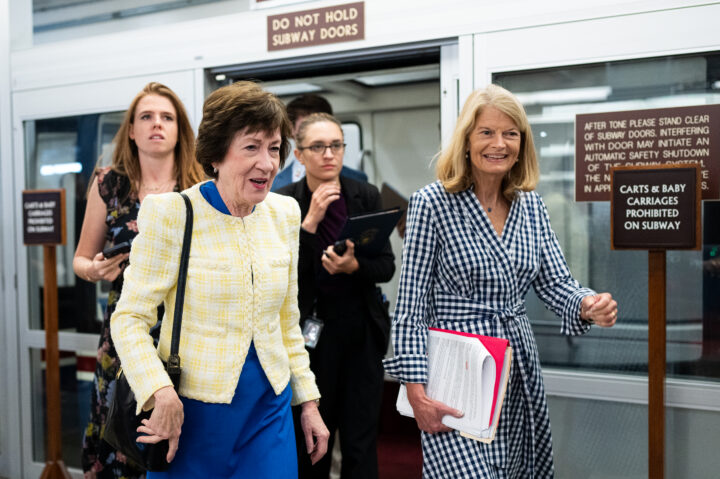
UNITED STATES - APRIL 30: From left, Sen. Susan Collins, R-Maine, and Sen. Lisa Murkowski, R-Alaska, talk as they arrive for a vote in the U.S. Capitol on Wednesday, April 30, 2025. (Bill Clark/CQ-Roll Call, Inc via Getty Images)


 Add JewishInsider on Google
Despite having previously approved a similar motion, the Senate on Tuesday narrowly defeated a procedural vote on a war powers resolution to prevent further military action against Iran, as the administration moves forward in negotiations with Tehran.
The same four Senate Republicans — Sens. Susan Collins (R-ME), Lisa Murkowski (R-AK), Rand Paul (R-KY) and Bill Cassidy (R-LA) — voted to advance the resolution, but absences favored Republicans this time, defeating the resolution 48-47.
Sen. John Fetterman (D-PA) was again the sole Democrat who voted against the effort.
Sen. Tim Kaine (D-VA), who led the previous war powers resolution that successfully advanced, explained to reporters that he hasn’t yet called up that resolution for further votes because he needs to secure one more vote in support to ensure passage.
“I would like to call up mine when I know I’ve got a win,” Kaine said. “I don’t yet have a fifth. I need a fifth vote. … I’ve been working some people to try to get that, but I haven’t gotten any solid commitments.”
He said that he’s still trying to persuade colleagues that, even if the war is paused now, it should not restart without congressional approval, and that Democrats still want to have weekly votes on the war. He said he’s hopeful that the current ceasefire could give some additional Republicans the leeway to vote for the effort.
Sen. Thom Tillis (R-NC), seen as a potential GOP swing vote, ultimately voted against the motion after telling reporters that the current uncertainty could warrant some involvement by Congress.
“I don’t even know what we’re doing right now. … Are we in a ceasefire, are we in an agreement that is basically a new agreement on a ceasefire? Are we working towards a real lasting agreement that may be subject to ratification of Congress?” Tillis said before the vote.
The North Carolina Republican said he would decline to take a firm position before hearing arguments on both sides of the issue.
“[If y]ou’ve got all that uncertainty, then maybe, if we do still think that the U.S. forces need to be put at risk and be kept there, then we should probably be talking about an authorization for the use of military force,” Tillis continued.
More Stories
MICHIGAN MANEUVER
After holding out for weeks, Michigan AG Nessel endorses El-Sayed
ENVOY DEBATE
Congressional Jewish Caucus opposes proposal to combine State Dept. Holocaust, antisemitism offices

BOOKSHELF
In new book, Zibby Owens weaves memoir with a reckoning of Jewish life after Oct. 7

POLAND IN FOCUS
Jacky Rosen visits Poland to discuss antisemitism, Holocaust issues

VEEP APPEAL
Michigan Jewish leaders urge Kamala Harris to appeal to El-Sayed on antisemitism, Israel
UNGA UNFILTERED
Trump talks tough on Iran, even as he predicts diplomatic deal after midterms
Please log in if you already have a subscription, or subscribe to access the latest updates.
 Continue with Google
 Continue with Apple