




























Chicago Mayor Brandon Johnson targets top Jewish Democratic donor amid rocky road to reelection
Jewish leaders in Chicago say Johnson's attack on Michael Sacks and AIPAC invokes tropes about Jewish influence — and point out that AIPAC isn't even in the race

Kevin Dietsch/Getty Images
Mayor of Chicago Brandon Johnson delivers remarks at the stage unveiling ahead of the Democratic National Convention (DNC) at the United Center on August 15, 2024 in Chicago.


 Add JewishInsider on Google
Chicago Mayor Brandon Johnson is facing a long list of challengers in his reelection campaign next year — not to mention dismal job approval ratings and paltry fundraising. He kicked off his bid for a second term at an event on Sunday, however, directly targeting AIPAC as well as a Jewish Democratic donor who has contributed both to the pro-Israel group and, more recently, a top rival of Johnson’s.
“When you hear that someone wants to be your mayor and they claim to be progressive but they take money from AIPAC and Michael Sacks and corporate interests and shell PACs,” Johnson said at a rally over the weekend, “you know who has the power. It’s not you.”
The embattled mayor was likely making a thinly veiled reference to Illinois Secretary of State Alexi Giannoulias, the front-runner in a race that has so far drawn over a dozen candidates. Sacks, an asset manager and longtime ally of former Chicago Mayor Rahm Emanuel, has given $500,000 to Giannoulias’ campaign.
But Johnson’s statement, which has faced criticism from local Jewish leaders for espousing what they decry as antisemitic tropes about Jewish influence, was misleading, as AIPAC is not involved in his race. Sacks himself has no formal ties to the organization aside from donations to its super PAC and affiliated groups that drew scrutiny for engagement in a series of Illinois Democratic congressional primaries earlier this election cycle.
Debra Silverstein, the only Jewish alderman on the Chicago City Council and a Democratic critic of Johnson’s, told JI that she believed the mayor had targeted Sacks simply “because he’s Jewish,” noting there are “many large donors” who are involved in the election.
She called Johnson’s speech part of a “pattern of disrespect to the Jewish community” while in office. “We have been feeling alienated and disrespected for a very long time,” she explained to Jewish Insider, “and this is his latest attempt.”
In a March opinion piece, Sacks argued that growing efforts to demonize AIPAC’s political engagement are part of a more sinister plan to make pro-Israel Jewish Democrats feel unwelcome in their party — including in Chicago, which is home to the third-largest Jewish community in the country.
Perhaps exemplifying that point, Johnson’s rhetoric on Sunday underscored the degree to which AIPAC has increasingly emerged as a shibboleth on the far left, which regularly invokes the group as a stand-in for a set of broader systemic problems in the United States and abroad — raising concerns among Jewish leaders who worry that the singular focus is creating a hostile political environment.
Even as AIPAC only engages in federal races to support allied candidates, the pro-Israel group has become a source of tension in both city and state races where it is not involved. Recently, for instance, Alma Hernandez, a pro-Israel Jewish state legislator in Arizona, drew attacks from a far-left primary rival who claimed she was “bankrolled” by AIPAC, among other charges she denounced as fueling antisemitism.
Yet Johnson’s attack line was unique for its highly personal target in a prominent setting, even as the mayor and his allies frequently take aim at Sacks — who has helped fund a local group that has run ads opposing his administration. Johnson doubled down after the rally, dismissing Sacks as a “source of pain” for Chicago families because of his close connections to Emanuel’s mayoral tenure, which has long been a target of criticism on the left.
In a statement, Sacks called Johnson’s remarks “a disingenuous campaign of defamation and lies” and said the mayor “needs some better dance moves.”
Frank Calabrese, a political consultant in Chicago, said that he was surprised by Johnson’s comments — not only because “AIPAC has nothing to do with local mayor elections.”
“His comments could be interpreted as equating AIPAC money with a Jewish billionaire,” Calabrese told JI on Tuesday. “Obviously, that’s a road that politicians should avoid.”
Daniel Goldwin, the chief public affairs officer of the Jewish United Fund, Chicago’s Jewish federation, denounced Johnson’s recent rhetoric in a statement. “Singling out Jewish people or Jewish organizations as symbols of political influence or control carries a dangerous history that should be understood and rejected — not repurposed as a political rally and cry,” he told JI on Tuesday.
The Jewish community “cannot remain silent when rhetoric from the city’s highest elected official singles out Jewish individuals or organizations in ways that invoke long-standing stereotypes about Jewish power and influence,” he added. “All Chicagoans deserve to know that their mayor will not use their identity as a political weapon.”
Johnson’s team did not respond to JI’s request for comment on Tuesday. A spokesperson for AIPAC declined to comment.
Despite backlash from some of the city’s leading Jewish officials, Johnson’s recent tactics have been met with silence from top Democrats in the state. A spokesperson for Gov. JB Pritzker, a former AIPAC contributor who has said he lost faith in the group’s commitment to bipartisanship, did not respond to a request for comment.
Pritzker previously defended Sacks’ support for AIPAC in March, saying that it was “very unfair for people” to attack a fellow Democrat whom he praised as a “decent, honorable human being” dedicated to values shared across the party.
On Tuesday, The Chicago Tribune, the city’s largest daily paper, published a scathing editorial accusing Johnson of using divisive methods to distract from an unimpressive record of achievement. “We get the hardball nature of Chicago politics,” the board wrote, “but inserting AIPAC into a race in which it is not participating, never mind the antisemitic implication of demonizing Sacks and AIPAC, is unseemly even for this city.”
“A sitting Chicago mayor should not stoop this low even in a political campaign,” the editorial added.
Manny Houle, a Democratic strategist and former AIPAC staffer who has worked in Chicago, said that Johnson’s approach represents a broader trend on the far left in which activists, candidates and elected officials use AIPAC “as a catch-all for problems they don’t want to address.”
“Blaming AIPAC or using it as the big scary political bogeyman is not only irresponsible, it’s dangerous,” he told JI on Tuesday. “It doesn’t address the actual problems voters are facing, and inflames feelings on issues many struggle to understand.”
More Stories
NOT ON BOARD
Lansing Mayor Andy Schor, a Jewish Democrat, says he’s not supporting El-Sayed
NEXT CHAPTER
After years of hostage advocacy, Kibbutz Be’eri survivor turns toward the future
Mayor Unmoved
Mamdani brushes off pro-Hamas heckling at Oct. 7 vigil

EXCLUSIVE
Bipartisan House resolution honors pilot, passengers who stopped FlyDubai hijacking
SURVEY SAYS
Poll finds sliding NYC Jewish support for Dems since Oct. 7, substantial concern about DSA
OBAMA BOOST
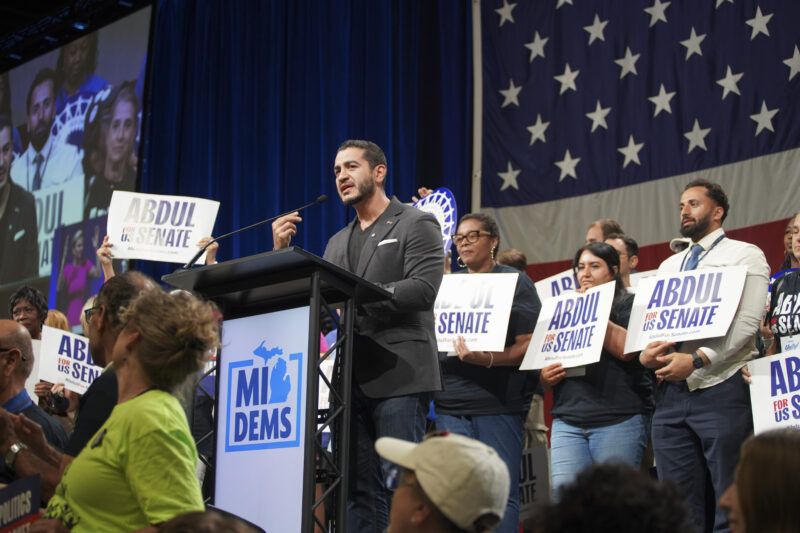
Obama to campaign with Abdul El-Sayed at rally with Michigan Dems
Please log in if you already have a subscription, or subscribe to access the latest updates.
 Continue with Google
 Continue with Apple