










Netanyahu’s U.N. visit presents test for Mamdani and NYPD
The Israeli prime minister’s trip could spark protests and ‘a perfect storm’ of political and logistical complications for Zohran Mamdani and Jessica Tisch
Michael M. Santiago/Getty Images
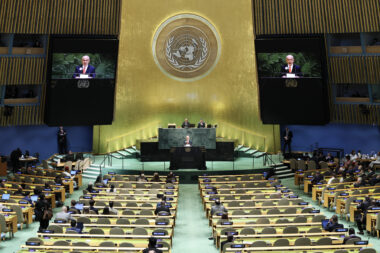
Israeli Prime Minister Benjamin Netanyahu addresses world leaders during the United Nations General Assembly (UNGA) at the United Nations headquarters on September 26, 2025 in New York City.


 Add JewishInsider on Google
Israeli Prime Minister Benjamin Netanyahu’s trip to New York City for the U.N. General Assembly later this month is expected to set up political and logistical challenges for Mayor Zohran Mamdani, one of Netanyahu’s foremost U.S. critics, experts tell Jewish Insider — a challenge that protests, which Mamdani has tacitly encouraged, may only exacerbate.
The Israeli leader is scheduled to arrive in New York on Sept. 23 and address the global gathering the following day, during which time the NYPD’s dignitary protection detail will help ensure Netanyahu’s personal protection, its intelligence and counterterrorism teams will work to secure the gathering as a whole and an array of its officers will manage the Manhattan streets. The department reports to the mayor’s office.
The various law enforcement veterans who spoke to JI all underscored the scale of the department’s annual efforts to head off potential threats to the diplomatic summit, even without this year’s furor around Netanyahu’s attendance, the ongoing conflict with Iran and the proximity to both the Jewish High Holy Days and the 25th anniversary of 9/11.
“It’s a perfect storm of high-intensity events,” said Mitchell Silber, the former NYPD director of intelligence analysis who now serves as CEO of the Community Security Initiative, which helps address safety concerns for Jewish groups in the New York metro area. “At the same time, [the] NYPD is trying to bend over backwards to make sure that freedom of speech is allowed and robust.”
Silber noted that the struggle between the U.S., Israel and Iran has already spawned an alleged bomb plot against a New York synagogue from one of Tehran’s proxies. If recent remarks from Mamdani draw out larger than normal demonstrations, Silber warned such a scenario could create additional issues for both the department and the city’s Jewish institutions.
“They do have a possibility of reverberating, and have a chance of turning those forces and their ire against the Jewish community,” warned Silber, though he added that there was no specific threat. “It’s just going to make the NYPD’s job harder.”
Retired NYPD detective and John Jay College of Criminal Justice adjunct professor Michael Alcazar, meanwhile, recalled a March incident in which dueling pro- and anti-Mamdani demonstrations at Gracie Mansion saw an alleged ISIS acolyte hurl improvised explosives — an example, he said, of the kind of security risks a protest can present. He predicted a beefed-up presence of uniformed officers in the streets following remarks from Mamdani earlier this year, on top of standard security protocols.
“I’m sure the NYPD is expecting a lot more protests because of what the mayor said in support of protesting against Netanyahu,” said Alcazar. “You know his supporters are reading between the lines.”
Mamdani, for his part, has recently stepped up outreach to the Jewish community and vowed to “work tirelessly” for their security, though he has not backed away from his criticism of Israel. Asked in an August interview how he planned to host Netanyahu, he told commentator Joy Reid the city was readying “in the manner that we prepare every year.”
When JI asked the NYPD what special precautions it would take around Netanyahu’s visit, including around houses of worship, the agency provided only a general statement.
“As we do every year, the NYPD works with the Secret Service, the State Department, and other federal agencies to provide protection to foreign dignitaries traveling to New York City based on the level of threat assessed,” the public affairs office wrote in an email to JI.
New York has already seen, however, the result of tensions between a mayor’s political sympathies and executive duties.
In 2014, his first year in office, then-Mayor Bill de Blasio — whom Mamdani has cited as a role model — seemed a rising progressive star, having ascended to office on a platform of law enforcement reform, a cause many Democrats had hesitated to champion. Then Eric Garner, a Black man from Staten Island, died after an NYPD officer placed him in a banned chokehold, and thousands took to the streets. De Blasio was expected to stand with the protesters, but he also ran the police department that was policing them.
The demonstrations swelled into a national spectacle and saw violent altercations between protesters and police, followed by the killings of two officers and cops turning their backs on the mayor during the patrolmen’s funerals. As the situation spiraled, the mayor sought to align himself more with his politically moderate police commissioner, Bill Bratton. But this cost de Blasio much of his credibility on the left, both in New York and nationwide.
De Blasio went on to win reelection, but he lost much of his ability to project political power. His subsequent efforts to influence the direction of the Democratic Party across the state and nation ended in embarrassment.
Mamdani too captured the left’s affections, and ultimately Gracie Mansion, by embracing a scorching political issue his co-partisans had avoided: Israel and its military campaign in Gaza. As a candidate he pledged to arrest Netanyahu, and continued to float the notion long after city lawyers told him it lay outside his power. When he finally acknowledged he lacked the authority to do so, he made the comments in a viral video with the caption, “Benjamin Netanyahu is a war criminal,” in which he accused the Israeli leader of being a mass murderer responsible for the “maiming” of Palestinian children.
Pressed as to what opponents of the Israeli leader should do about his impending visit to New York, the mayor signaled his support for street demonstrations.
“One of the bedrocks of our city is protest,” the mayor said. “This is a city where, if anyone feels a level of frustration or opposition, protest is something that we will always respect. I leave it to New Yorkers themselves to make that decision.”
What made 2014 “a year of chaos,” according to John Jay lecturer Jillian Snider, was a large number of unpermitted protests with no central organization that drew large crowds and at times escalated into vandalism and violence. She warned that if similar “pop-up” demonstrations broke out during the U.N. General Assembly, it could complicate the work of the department.
“I would hope that a political figure would not encourage these large demonstrations, especially these undocumented events where we don’t have advance notice,” said Snider, who managed protests as an NYPD officer. “Members of the public often are influenced by city leaders. If they really, really, support that leader, they are going to do what that person supports.”
Veteran political consultant Chris Coffey, who counted the city’s largest police union among his clients during the de Blasio administration, noted that Mamdani is a far more agile politician than his progressive predecessor. Further, he argued Mamdani learned from de Blasio’s experience that he cannot alienate the department or allow the appearance of public disorder.
Yet Netanyahu’s visit could prove an exception.
“The one place where it’s a little bit unclear is that the Israel stuff is so personal to him that it might trump that philosophy,” Coffey said. “Or they’ve just decided they can do both, ‘we can condemn Netanyahu, we can encourage protest, and the police department can handle it.’”
But short of “something horrific” occurring during the General Assembly, Coffey argued that intense political polarization around Israel and Mamdani’s fervent personal following would likely allow the mayor to escape any political fallout. He also pointed out that NYPD Commissioner Jessica Tisch is a strong Israel supporter, and that the mayor has granted her broad latitude in her role as the city’s top cop.
Alcazar and Snider agreed, both lauding Tisch’s independence — with Snider even comparing Mamdani favorably with former Mayor Eric Adams, an ex-police captain who she complained excessively inserted himself into NYPD policy. Both predicted Mamdani’s views on Israel would have little influence on her handling of the U.N. event.
Silber, for his part, urged Jewish New Yorkers not to allow tension around Netanyahu’s visit or General Assembly security to interfere with their participation in religious and civic life.
“Keep calm and carry on,” he advised.
Please log in if you already have a subscription, or subscribe to access the latest updates.
 Continue with Google
 Continue with Apple