


The Jewish Grad Org
Jewish graduate students arrive on the Hill to urge lawmakers to tackle campus antisemitism
Students said they were buoyed by the response they received during their advocacy meetings, including with staff for House Speaker Mike Johnson


 Add JewishInsider on Google
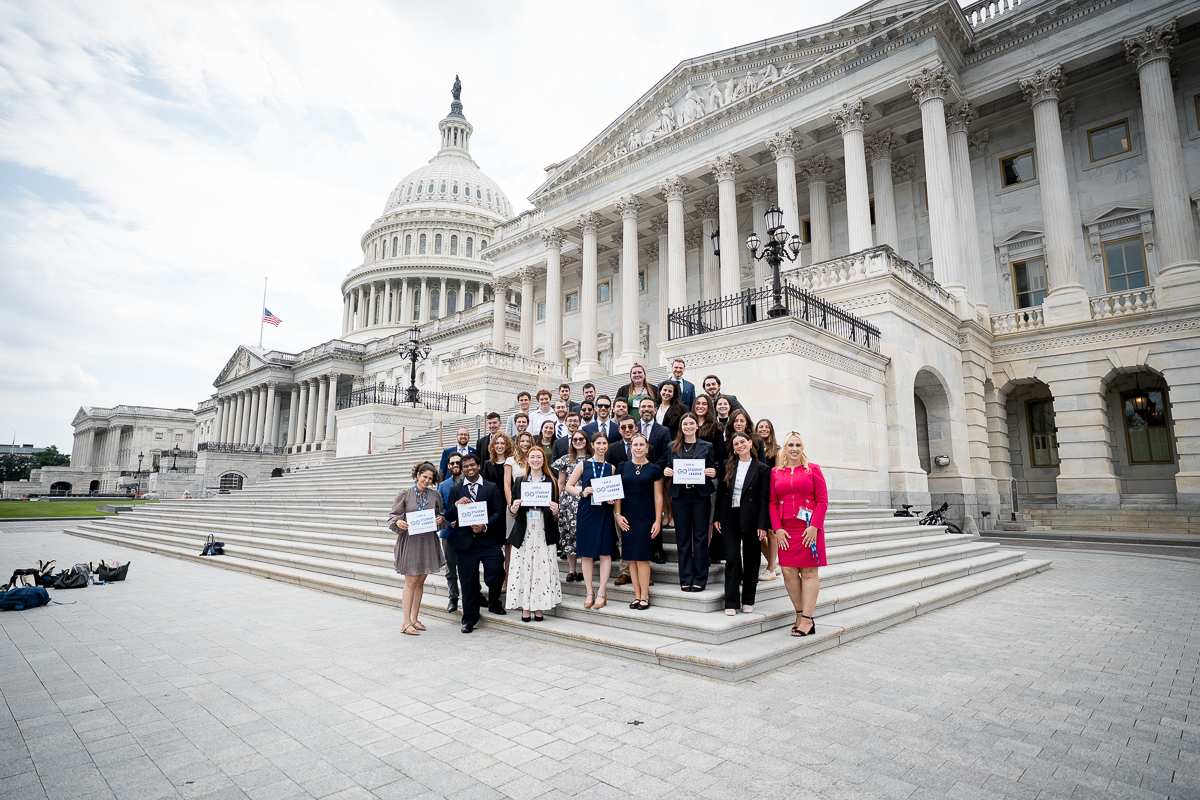
For 40 Jewish graduate students gathered on Capitol Hill on Monday, the trip to Washington was not simply an exercise in advocacy. Many arrived carrying stories from campuses where they had felt increasingly isolated, targeted or ignored — and left with a desire to do something about it.
The students gathered for the Jewish Grad Organization’s Partners Summit, sponsored by Adam Miller and Family, and met with congressional offices throughout the day to advocate for the Jewish American Security Act, a bipartisan bill designed to strengthen security on university campuses, among other efforts to combat antisemitism across American society. They also discussed campus codes of conduct and equal protection, and shared their personal experiences with antisemitism.
For Rachel Applefield, the stakes of the legislation were deeply personal.
Applefield, a second-year student at Indiana University Maurer School of Law and president of the school’s Jewish Law Student Association, grew up in West Bloomfield, Mich. She is a member of Temple Israel, where an attacker drove a truck into the synagogue’s early childhood center in March. That attack underscored for her the vital need for robust Jewish security—and reinforced her belief that college campuses require similar resources to protect students.
“It’s been very, very difficult and very personal,” Applefield told Jewish Insider. “I’m sure it’s personal for everyone, but it’s very personal for me, this Jewish American Security Act.”
Applefield said the security resources at Temple Israel helped prevent the attack from becoming deadly.
“My temple is so blessed and lucky to have had all of the resources to prevent anything bad from happening,” she said. “Obviously, it was an awful event, what happened, but what went right went right. Like, everything that was supposed to correctly happen happened.”
“All of the security that was in place really saved lives,” she continued, “and you don’t see that level of security, those resources, on college campuses.”
Applefield shared her experience during meetings with staff for House Speaker Mike Johnson (R-LA) and Rep. Mike Quigley (D-IL), as well as with Rep. Gabe Amo (D-RI).
She said her meeting with Amo was particularly meaningful because her rabbi had met the lawmaker following the Temple Israel attack. Applefield noted that the connection helped make the conversation feel less like a routine congressional meeting and more like an opportunity to have someone in Washington understand what she had been through.
“My rabbi actually came down to D.C. a few months ago, right after the incident at our temple happened, and she met with him, so he knew exactly what I was talking about, and he was very empathetic, and I really connected with him,” she said. “I felt like I could tell he really cared.”
Applefield’s experiences with campus antisemitism have extended beyond concerns about physical security. She was president of Indiana University’s Hillel during the aftermath of the Oct. 7, 2023, Hamas terror attacks and later wrote an article for the Herald-Times about antisemitism and pro-Hamas graffiti on campus. A professor responded by publishing a piece attacking her.
“He called me heartless and just really took my name and made a story out of something I didn’t really talk about,” she said. “It’s just very scary, that power dynamic. Just knowing that a professor would do that to a student is just — it’s so inappropriate and scary.”
Applefield said she had entered law school unsure whether she would find much of a Jewish community. However, she said the summit gave her and the other students a national network of peers and leadership training. More importantly, Applefield said, it offered a form of support that she said students do not always receive from their universities.
“Just knowing that there’s that external support that we might not be getting from the university, knowing that this kind of organization exists is just so important,” she said.
Cassandra White, a third-year law student at Suffolk University Law School in Boston, came to Washington with a similar personal experience of antisemitism in an academic setting.
During her second year of law school, while serving as president of her school’s Jewish Law Students Association, White encountered what she described as antisemitic tropes in a legal writing final that she said was worth roughly 60% to 70% of her grade. One of the exam questions, she said, centered on a Jewish woman confiding in her rabbi about a money embezzlement scheme, with characters given names such as David and Rachel.
“It’s not this crazy encampment story where somebody gets physically assaulted or anything along those lines,” White told JI. “But it just shows that antisemitism really can be quite subtle and can also present itself in the content that we’re receiving as students in the graduate and in the undergraduate level as well.”

White said that while the incident was not as obvious as others that made headlines in the aftermath of Oct. 7, it was precisely what made it significant to her: antisemitism could be embedded in an ordinary academic exercise.
“Jews and stereotypically Jewish names and money embezzlement … it was very insensitive, and a lot of first-year students, Jewish students, were quite put off by that,” White said.
She turned to JGO, which connected her with an attorney who helped her navigate how to respond. The group also helped bring the Anti-Defamation League to campus for a training meant to prevent similar incidents.
“I actually went to JGO for assistance, and they put me in contact with an attorney,” White said. “She walked me through the entire process, and they actually ended up having the ADL come do a training at my school in order to mitigate this sort of thing happening again.”
“For any other minority group, this would not be considered acceptable,” she continued. “So why are Jews the exception?”
That question followed White to Capitol Hill, where she joined Applefield – her roommate for the overnight program – and the other Jewish graduate students in urging lawmakers to take campus antisemitism more seriously. Over the course of the day, she met with staff from the offices of Reps. Laura Friedman (D-CA), John McGuire (R-VA) and Suzanne Bonamici (D-OR).
“Overall, I would say my experience was absolutely incredible,” she said. “It was sort of like a roundtable discussion where all of the students shared their experiences, and we advocated in favor of them co-signing the Jewish American Security Act, drawing off of our own personal anecdotes and stories, experiencing antisemitism on campus or online.”
White said the meetings “felt extremely successful,” with aides engaging substantively with the students’ concerns.
“I do think it was very impactful,” she said. “The staff were actively taking notes, and it was also a great experience for us. I think as graduate students, I’ve never really been in that sort of advocacy position, you know, on Capitol Hill, talking to representatives and their staff. So I really enjoyed it a lot. I would definitely do it again.”
The program on Capitol Hill culminated in a congressional dinner, hosted by Rep. Debbie Wasserman Schultz (D-FL), where Rep. Greg Landsman (D-OH) spoke candidly to the students about navigating antisemitism and the broader turbulence of the moment.
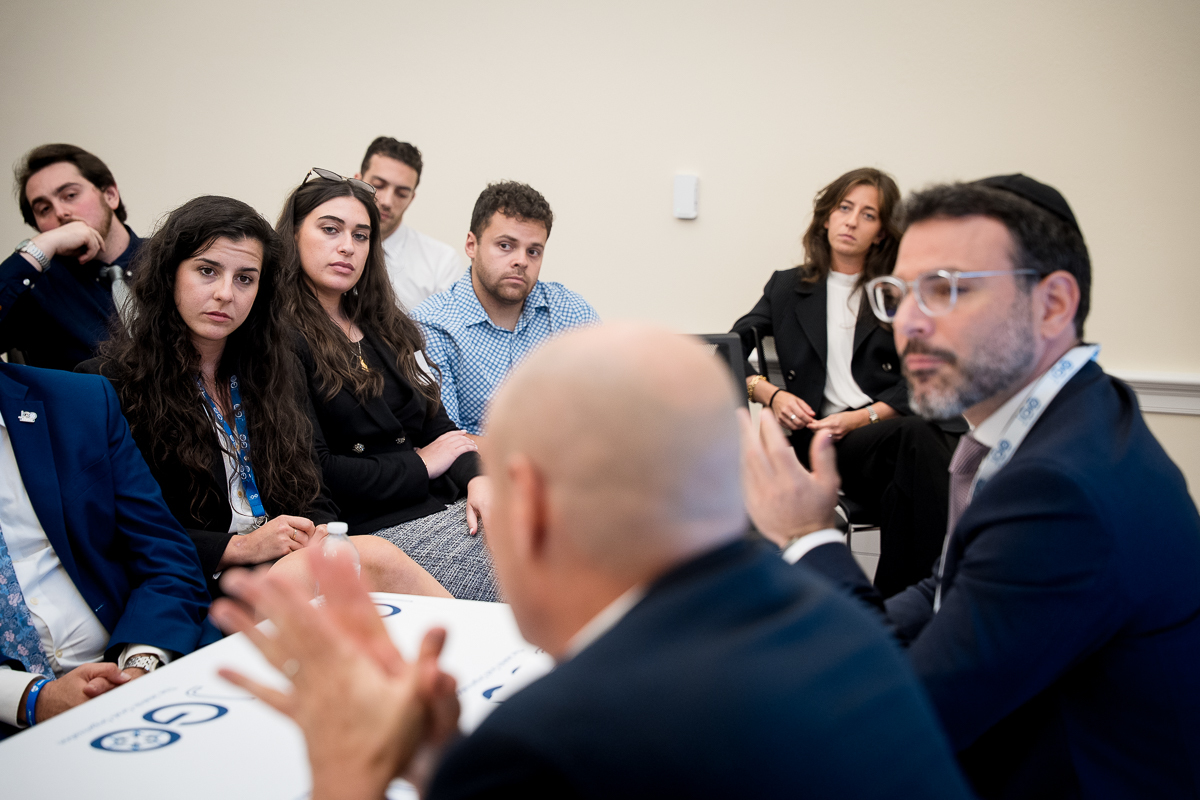
Landsman told the group that the frustration, isolation and anger many of them feel is not only real – but reasonable.
“This is a hard time. There’s no question that this is a very difficult time,” he said. “So it’s understandable if you’re frustrated or you feel isolated or you get angry. It’s all understandable considering how hard it is. It’s not you — it’s the moment.”
But he urged them not to assume they are facing it alone.
“You’re not alone,” Landsman said. “There’s this huge community that you’re a part of, and that is a really important thing you’ve just got to remember, because it feels so isolating.”
Landsman also pushed back against the notion that “everyone” on campus opposes pro-Israel or visibly Jewish students, arguing that the loudest voices often distort reality.
“There are a lot more folks out there that are curious but don’t want to get in the middle of all this because it seems so complicated and awful,” he said. “They’re curious, and it’s worth having those conversations and reaching out. It feels like everyone is against us because the folks who are so loud are very much in our faces. But they still represent a very small number of your classmates.”
To illustrate his personal connection to the challenges students face, Landsman described an incident in which his son, who is a freshman in high school, was recently confronted by a peer for his father’s political positions, pro-Israel advocacy, and being Jewish.
“He’s a freshman, and he went to the high school football game on Friday night, and a girl came up to him and got in his face about me and Israel and being Jewish, it was actually quite excessive,” Landsman said. “And I felt bad for him because he didn’t ask for this. I certainly stepped out for some leadership role — he didn’t. He wasn’t feeling bad about it, you know, it was more just that this is part of life now.”
What struck him, he told the students, was how his son chose to respond.
“I asked him how he handled it,” Landsman recalled. “He said, ‘I was very kind, very nice. I told her, “That’s not true,” [in response to her claims about Israel] and then I helped her.’ He was very generous with her.”
“There is something very Jewish about responding with kindness and generosity,” he continued. “We don’t use the word ‘grace,’ but that is a word in the religious community — to give that kind of kindness. In the end, it’ll make you feel better, and it’s just a better strategy.”
That sense of isolation from peers extends beyond campus life. Asked how Jewish Americans who feel alienated from the Democratic Party should navigate a growing sense of political homelessness, Landsman offered a direct answer: “Stay” in the party.
“There are a set of values that made you believe that you were a Democrat. Those values still exist. Don’t let anyone take that away from you,” Landsman said. “Just because somebody else showed up doesn’t mean you have to leave. If that’s where you’re supposed to be, don’t leave. Stay.”
Landsman cautioned the students that campus antisemitism “isn’t going to get solved overnight.”
“You’re in this for the long haul,” he said. “Do as much as you can, but don’t beat yourself up or expect things that no one person can do. We’re all doing our best, and we make as much progress as we can every day.”
For the students, the summit offered a chance to turn painful and often isolating experiences on their campuses into conversations with lawmakers — while also connecting them with other young Jewish leaders confronting many of the same issues.
White said the experience may also have reshaped what she plans to do after law school.
“I had never ever considered lobbying as a potential career path until yesterday,” White said. “I absolutely adored the advocacy program that we did with the representatives on Capitol Hill, it just spoke to me. I felt really in my element. I enjoyed it so deeply, and it was so satisfying to be able to speak my truth.”
“So it definitely has changed my potential career track, if you can believe it,” she continued. “I’m still going to graduate from law school, don’t worry … But I am genuinely and very strongly considering potentially lobbying as a post-law school career after yesterday because of just how enjoyable it was.”
Meanwhile, Applefield said she left the summit feeling more hopeful because of the support she received from Jewish peers and members of Congress and their staff. She said the meetings made her feel the issue was finally on the radar in Washington.
“I definitely have hope, just from feeling so supported throughout the two days, knowing that this is on the minds of congressmen, especially the speaker of the House,” Applefield said.
“I was very upset to hear what everyone was going through, because we’ve all experienced it, you know,” she continued. “But I do feel empowered in a way — how JGO brought us all together, gave us this training, gave us the opportunity to share our stories — and I really do hope that with the past few days we can continue the conversation.”
Please log in if you already have a subscription, or subscribe to access the latest updates.
 Continue with Google
 Continue with Apple