




































As Trump renews attacks on Iran, debate over engagement hardens along party lines
Democrats say the administration has no clear endgame in its standoff with Tehran, while Republicans maintain the pressure campaign is working
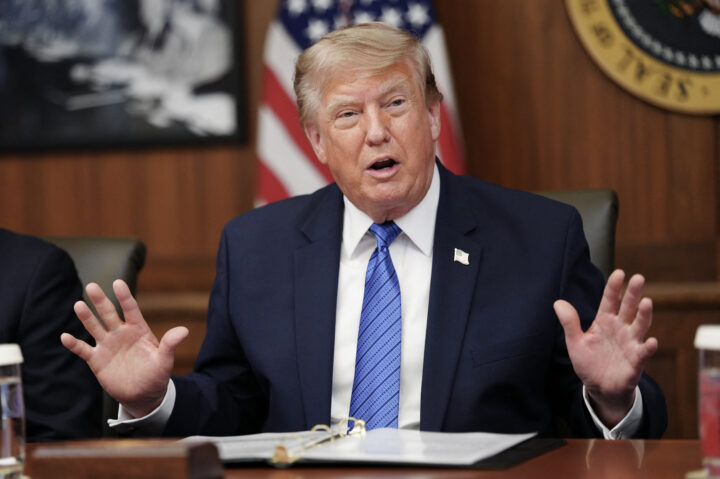
Aaron Schwartz / AFP via Getty Images
US President Donald Trump speaks during a Cabinet meeting at Camp David in Maryland, on July 31, 2026.


 Add JewishInsider on Google
More than six months into the conflict between the United States and Iran, House lawmakers remain split largely along partisan lines on whether the Trump administration’s strategy of targeted economic pressure and naval blockades is helping Washington gain a strategic edge in the conflict.
While the administration recently has said its focus remains on carrying out a new economic campaign against the regime, recent military flare-ups between the two sides threaten to drag the conflict back into broader hostilities. On Tuesday, the U.S. resumed strikes on Islamic Revolutionary Guard Corps targets in Iran, CETNCOM announced, following Iran’s weekend attacks on American forces in the region and two Iranian strikes on oil tankers in the Strait of Hormuz on Monday.
President Donald Trump vowed that any response would be met with further confrontation, shortly before Iran launched retaliatory strikes on U.S. bases across the region.
House Armed Services Committee Chairman Rep. Mike Rogers (R-AL) warned that lawmakers “can expect intensification” of U.S. strikes. Rogers was briefed Tuesday by CENTCOM commander Adm. Brad Cooper alongside Democrats on the committee.
When asked by Jewish Insider whether the administration’s strategy is working and whether the U.S. or Iran holds more leverage at this moment in the conflict, lawmakers were divided.
Rep. Greg Landsman (D-OH) said it is “very difficult to know” which side holds the advantage, arguing that the White House has failed to outline a clear end goal. He added that as long as Tehran threatens shipping in the Strait of Hormuz, “there is leverage there” in Iran’s favor.
“I have made the case that taking out the weapons shield was one thing — getting in the middle of a standoff in the strait is something else and could have been avoided,” Landsman said. “Pursuing an all-out regime change undertaking, as opposed to simply going in and getting out, to me is a huge gamble and one I wouldn’t have taken. I would have stayed focused on the incremental things you can do to further weaken the regime until change materializes, as opposed to forcing it like they’re trying to do with the blockade.”
Landsman added that lawmakers on both sides of the aisle remain largely in the dark regarding the administration’s strategy.
“One, there’s no briefings, there are no hearings, there’s no engagement — and I think that’s true for Republicans as well as Democrats, which is a huge problem,” Landsman said. “Two, based on everything I’ve read, there’s no clear strategy. I don’t know what the end goal is. Is it to topple the regime? If it’s not to topple the regime, what is it? Is it to regain the strait?”
Rep. Gregory Meeks (D-NY), the ranking member of the House Foreign Affairs Committee, told JI that the recent escalation between the two sides shows the administration’s strategy is not working.
“We still don’t have a plan. Everything that [President Donald Trump] ever said in regards to this war has all gone wrong,” Meeks said.
Meeks argued that preventing a nuclear-armed Iran requires diplomatic engagement rather than isolated military or economic actions.
“If you want to stop Iran from having a nuclear weapon and move forward, then you have to do it diplomatically. You need to be able to bring — as we did with the [2015 Iran nuclear deal] — China to the table, Russia to the table, our European allies to the table,” Meeks said. “All of the experts that know how to deal with diplomacy, none of them are doing it. Not even [Secretary of State Marco] Rubio is part of those negotiations. You have two real-estate developers [White House Special Envoy Steve Witkoff and Jared Kushner] doing that kind of negotiations, and none of it is successful because none of it makes any sense.”
Rep. Brad Schneider (D-IL) similarly expressed that he felt the administration lacked a clear strategy and criticized the economic pressure campaign as not fully thought through.
“I think most of the world saw the goals as ending their nuclear program, thwarting their development of missiles, rockets, drones, addressing their support for terrorism in the region and around the world and supporting its citizens, the people of Iran, against human rights violations of this terrorist regime,” Schneider said. “None of those seem to have been fully addressed.”
Schneider said that the closure of the Strait of Hormuz has given Tehran “leverage over the global economy” and claimed that the administration’s economic pressure campaign is not being applied to “countries that are doing economic trading with Iran.”
“Last week [Treasury Secretary Scott] Bessent said we’re going back to maximum economic pressure without mentioning China that provides Iran 90% of their revenues from their oil production,” Schneider said. “That’s not pressure if you’re not putting your finger on the pressure point.”
“Iran holds cards that the administration either doesn’t recognize or doesn’t know how to address, and we need to figure out how to apply the pressure on Iran and return all the leverage back to the United States,” he continued.
Rep. Brad Sherman (D-CA) said that the administration has appeared to regain “very little” leverage through its economic pressure strategy and questioned the long-term efficacy of the plan.
“We’ve been imposing sanctions on [Iran] for decades. Presumably these tougher sanctions could work in less than a decade, but I think Trump’s time horizon is remarkably short, so I can’t imagine that they would work anywhere near the timeframe he’s thinking about,” Sherman said. “I suspect that the Iranians have a higher tolerance for pain because the extremists running the country don’t care about whether their people are doing well as long as they can shoot those who are upset.”
Republicans, however, contended that the administration’s strategy is working.
Rep. Tim Burchett (R-TN) argued that the U.S. holds more leverage in the conflict, noting that gaining a strategic edge is Trump’s “strong point.” The Tennessee lawmaker said the current posture is “accomplishing its goals” by neutralizing regional security threats.
“We’re keeping nuclear weapons out of the hands of Islamic radicals. I think that’s a great thing,” Burchett said. “I think ultimately that’s the overall goal. I think [Iran] were rapidly approaching the ability to use those.”
Rep. Randy Fine (R-FL) expressed an even more optimistic note. “I think we’ve always had leverage,” Fine said. “I think we’ve been winning all along.”
Fine pointed to Iran’s worsening economic situation as evidence that the administration’s approach is delivering results.
“Breaking them economically is a winner and that’s what’s happening. I think their economy is in free fall and hopefully that brings them to their knees, which is where we all want this thing to end up,” Fine said. “First we destroyed their military — they don’t have a military anymore — and now we’re destroying their economy.”
More Stories
PRESIDENTIAL POV
Obama scrutinizes Israel’s founding, says Palestinians want their ‘land back’
analysis
MBS bet Saudi Arabia’s future on economic transformation. The Houthis are testing that wager
SPENDING SCRAPPED
GOP leadership super PAC cancels spending plans against Rep. Landsman

IN THEIR MEMORY
Administration officials join bereaved families for Oct. 7 commemoration event

Daily Overtime
Dublin hotel dumps antisemitism conference

Daily Kickoff
Barack to 1948
Please log in if you already have a subscription, or subscribe to access the latest updates.
 Continue with Google
 Continue with Apple