


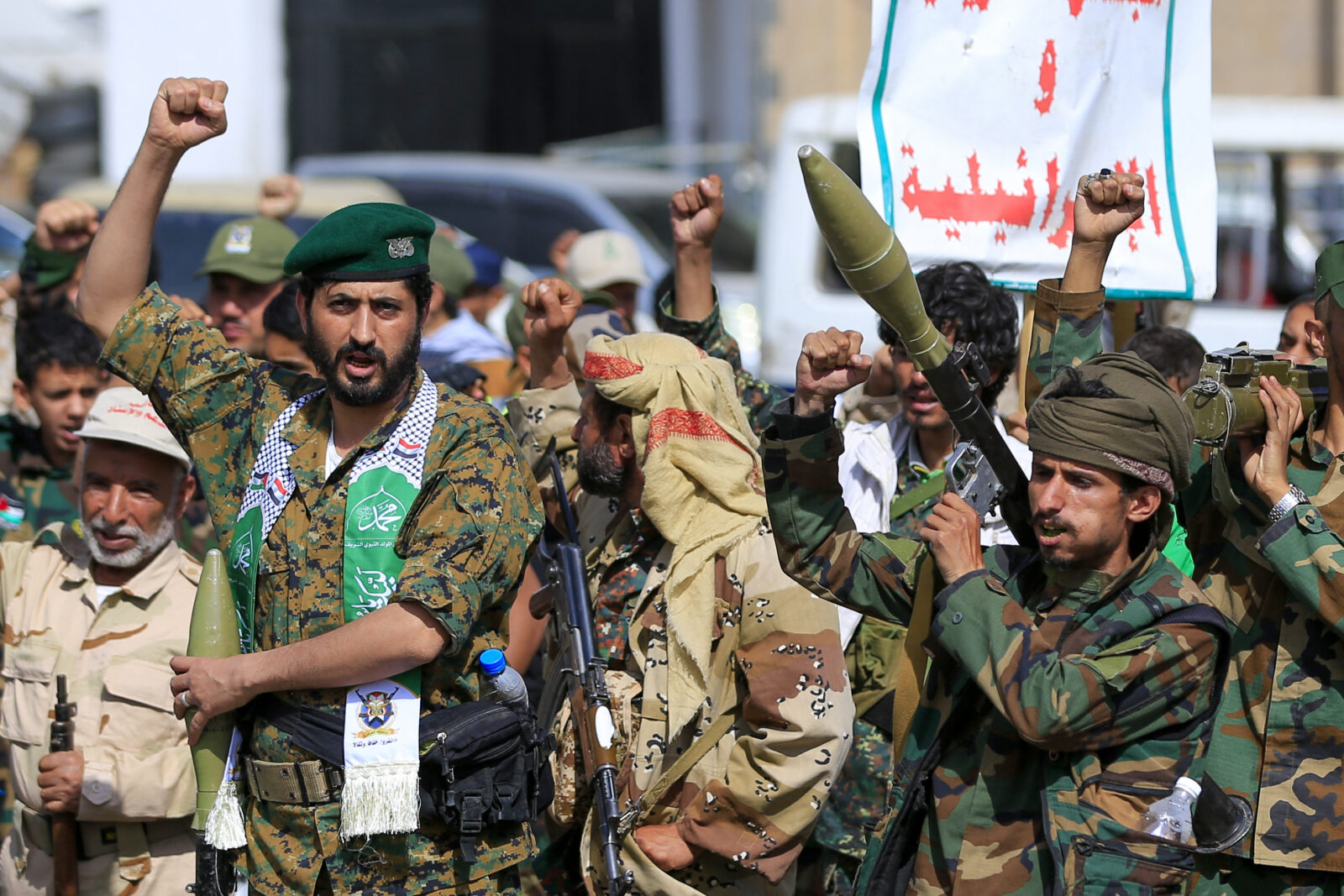
(Mohammed HUWAIS / AFP via Getty Images)
Saudi Arabia’s Houthi crisis is partly of its own making, analysts say
Riyadh squandered a yearslong lull and fractured the anti-Houthi coalition with its UAE split, experts tell JI — and its new defense partners are hanging back


 Add JewishInsider on Google
Saudi Arabia is facing an escalating Houthi offensive along the Red Sea coast and direct attacks on its own territory, in what regional analysts describe as a turning point in Riyadh’s conflict with the Iran-backed terror group — and a crisis they say was created in part by Riyadh’s own miscalculations.
The Houthis recently gained major ground along the Red Sea, including the port city of Mokha and around the Bab al-Mandeb Strait, and escalated their attacks over the weekend by directly striking Riyadh’s King Khalid International Airport.
Regional analysts told Jewish Insider that Saudi Arabia’s current position stems in part from its failure to strategically prepare during a yearslong pause in fighting. Experts say that Riyadh’s rift with the United Arab Emirates has also weakened the anti-Houthi coalition in Yemen, making the challenge more daunting.
Current hostilities follow years of relative calm between Saudi Arabia and the Houthis that Riyadh worked deliberately to maintain. A U.N.-negotiated truce took effect in April 2022 and was extended twice in 60-day increments before formally expiring that October.
After its expiration, “instead of a formal U.N. truce, we had a backchannel between the Houthis and Saudi Arabia that kind of settled the conflict into a de facto truce,” said Allison Minor, director of the Atlantic Council’s Project for Middle East Integration. “Those conversations between the Saudis and the Houthis — there were discussions about what the future of Yemen would look like, the future of Saudi Arabia’s relationship with Yemen, and something certainly kept the Houthis from restarting the fight up until just recently.”
Underpinning that quiet was a broader diplomatic framework aimed at ending the Yemeni civil war, a conflict Saudi Arabia had been involved in for nearly 12 years.
“There was an international consensus around the need to wind down Yemen’s war through an agreement that included the Houthis,” April Longley Alley, a senior fellow at The Washington Institute for Near East Policy, said. That roadmap, she said, “would have included significant financial advantages for the Houthis in return for a ceasefire and for them being part of a political process.”
Riyadh kept that offer available even after the U.S. first designated the Houthis a foreign terrorist organization in 2021 — a designation revoked by the Biden administration and reinstated last year — and after the group began attacking Red Sea shipping in late 2023.
“The Saudis worked hard to keep the Yemen front quiet,” Alley said. “They kept communicating with the Houthis. They kept this potential for a deal very much on the table, but what we saw was just the limits of that approach.”
Riyadh’s tactic carried a risk that analysts say was well understood at the time: The Houthis have historically treated pauses in fighting as opportunities to strengthen themselves, including during the 2022 truce, Alley said.
Minor said Saudi officials were not naive about the group and had understood that another confrontation was likely, a conclusion she said they reached after the Houthis launched a campaign against Red Sea shipping that the group cast as solidarity with the Palestinians following the Oct. 7, 2023, Hamas terrorist attacks. The problem, she said, was what Riyadh did with the intervening time.
“I think that the criticism here is that the Saudis did not do as much as they could have to be prepared for that confrontation with the Houthis once it came,” she said.
Jonathan Schanzer, executive director at the Foundation for Defense of Democracies, similarly argued that Riyadh missed an opportunity in the pause in fighting. He noted that an agreement between Saudi Arabia and Iran, brokered by China in the spring of 2023, also provided Riyadh with time it didn’t take advantage of.
“The Saudis agreed to stop delegitimizing the Iranians in their media, including [the outlet] Iran International, and the Iranians agreed to restrain the Houthis. That was the arrangement that held, until it didn’t hold,” Schanzer said. “There is a legitimate question to ask about whether the Saudis exploited that time appropriately — whether they took advantage of that hiatus in fighting. I think the answer is no. I think they did not manage this time properly, and for that reason the Saudis have themselves to blame in part.”
The clearest evidence of that gap is the current state of the Yemeni forces. After a rift with the United Arab Emirates – which began developing in 2019 over differing visions for Yemen’s political future – recently ruptured, Saudi Arabia moved to consolidate its influence over the Yemeni government and merge its fragmented armed factions under a single command — an effort that was never completed, Minor said.
Attempting to finish that work now, she said, “while an active war is going on, when they’ve already lost significant territory on the west coast, is not going to be easy.”
Alley said Riyadh’s efforts to build deterrence on the ground, conducted in parallel with its diplomatic outreach, failed their first serious test. The Saudis, she said, were “building up the government of Yemen and trying to regroup and coordinate this very factious anti-Houthi coalition after they had in some ways pushed the UAE out.”
“They were trying to kind of have some deterrence on the ground,” Alley said. “But what we saw was that it wasn’t effective in defending Mokha and the Red Sea coast. The Houthis just were more militarily dominant on the ground.”
“I don’t see how you can have Yemeni forces on the ground really effectively confronting the Houthis and holding off further Houthi territorial gains if you don’t at least have Emirati acquiescence,” Allison Minor, director of the Atlantic Council’s Project for Middle East Integration, said. “Obviously, Saudi-Emirati tensions remain quite high, but as the Saudis are going to Egypt, to Turkey, to Pakistan, to the U.S., U.K., I really just feel like Abu Dhabi has to be part of that.”
The split with Abu Dhabi weakened the anti-Houthi coalition at a moment when Saudi Arabia needed it most, Alley said. “The Houthis are one command, one mission, and this other side has a tendency to fight each other.”
Minor said the damage from that rift is still visible in the current fighting. Expectations among Yemenis that government forces would perform better without Emirati involvement “does not seem to have been the case,” she said. The units hit hardest in the Houthi advance on the west coast were those of Tareq Saleh, long backed by the UAE, while forces tied to the Southern Transitional Council have stayed out of the fight.
“I don’t see how you can have Yemeni forces on the ground really effectively confronting the Houthis and holding off further Houthi territorial gains if you don’t at least have Emirati acquiescence,” Minor said. “Obviously, Saudi-Emirati tensions remain quite high, but as the Saudis are going to Egypt, to Turkey, to Pakistan, to the U.S., U.K., I really just feel like Abu Dhabi has to be part of that.”
Meanwhile, Riyadh has been unable to rely on its own partners for help. Despite having signed a mutual defense agreement with Turkey and Pakistan last month, neither has thus far come to Saudi Arabia’s aid. Pakistani officials have said publicly that Saudi Arabia has not activated the pact or specifically requested help inside Yemen.
Analysts said they were skeptical that the pact would hold significant weight even before the current fighting began.
“I was always pretty skeptical that the Mecca agreement would look like NATO Article V in the way that we tend to think about it,” Minor said. “It’s simply not the same. It’s not rooted in superpowers with the capabilities to actually provide a nuclear umbrella.”
Minor said the absence of a superpower guarantor is the defining limitation. Pakistan possesses nuclear weapons, she noted, but its officials “have been hesitant about the idea of extending that nuclear umbrella.”
“The Mecca Pact is, in my view, at least right now, a pact that was born of desperation in the face of Houthi and Iranian attacks on the kingdom,” Jonathan Schanzer, executive director at the Foundation for Defense of Democracies, said. “The notion of Turkey and/or Pakistan intervening on the Saudis’ behalf does not sound likely to me.”
“Simply the lack of a superpower also means that these are essentially middle powers who have much more nuance in their foreign relations and tend to be much more wary of getting involved in armed conflicts, especially outside of their own immediate environs,” she said. “It’s not surprising to me that they haven’t come to Saudi Arabia’s defense.”
The agreement’s real function, Minor said, is likely to be “much more in terms of security cooperation, sharing of technology, arms sales, etcetera, perhaps training and that sort of thing, than it is actively coming to their defense in the way that the U.S. has done for allies and partners in the past.”
Schanzer also noted that the Mecca agreement appeared to be “born out of desperation,” and predicted that Ankara and Islamabad are unlikely to intervene.
“The Mecca Pact is, in my view, at least right now, a pact that was born of desperation in the face of Houthi and Iranian attacks on the kingdom,” he said. “The notion of Turkey and/or Pakistan intervening on the Saudis’ behalf does not sound likely to me.”
“It may end up being a disappointment — there’s not much that they’re going to get out of this that they could take to the bank, so to speak,” Schanzer continued. “I think [Saudi Arabia is] going to find that they are still on their own.”
Alley said the pact appears to function primarily as posturing rather than a true defense mechanism. Still, she said she believes it is “too early” to make a final call on how the alliance will shake out, noting that the region is still at an “inflection point” with its aftermath still to be determined.
Analysts also drew a distinction between defending Saudi territory, which Riyadh’s partners are assisting with, and fighting inside Yemen, which they are not.
“From what I’ve seen, the Pakistanis and the Turks, just like other Saudi allies, are helping with the defense of Saudi territory,” Alley said. “But asking for these countries to help with a war inside of Yemen is just a very different type of ask that would come with pretty significant consequences for a country like Pakistan, who has a significant Shia population in particular.”
Minor said Riyadh’s broader search for backing has produced little. Saudi Arabia “feels that they need a strong international coalition to counter the Houthis,” she said, both for material support and to avoid the international criticism it drew earlier in the war. “But they haven’t been getting a ton of traction there, at least not yet.”
“It seems to me that the bar for U.S. intervention is still really high,” April Longley Alley, a senior fellow at The Washington Institute for Near East Policy, said. “President Trump in particular, from what we’ve seen from the reporting, is still trying very much to keep this bilateral truce with the Houthis and not to explicitly expand the war, particularly the regional war right now.”
The Trump administration, which declared a ceasefire with the Houthis in May 2025, has so far confined its role to intelligence, logistical support and helping defend Saudi territory, while maintaining direct communication with the Houthis. According to The New York Times, President Donald Trump had considered carrying out military strikes against the terror group over the weekend, however he abruptly called them off.
Secretary of State Marco Rubio, when asked about the Houthi attacks, told Fox News on Tuesday that the United States has a defense agreement with Saudi Arabia and intends to live up to its commitments. But experts said Trump appears “very hesitant” about becoming involved and they do not expect American forces to enter the Yemen war.
“It seems to me that the bar for U.S. intervention is still really high,” Alley said. “President Trump in particular, from what we’ve seen from the reporting, is still trying very much to keep this bilateral truce with the Houthis and not to explicitly expand the war, particularly the regional war right now.”
“Stepping up support — logistical support, intelligence sharing, help with the defense of Saudi territory — is something that I would expect to see,” she continued. “Doing more in Yemen, I think, is a really high bar right now. But you never know with this administration.”
Even defense assistance from Israel is “not off the table” for Riyadh, according to Schanzer, who argued that enlisting help from Jerusalem has “got to be in the back of the minds of Saudi decisionmakers right now.” However, he said the issue is whether Turkey and Pakistan would “put up with such an arrangement.”
Furthermore, Schanzer argued that Saudi Arabia’s problem does not stem from a lack of partners, but rather from a lack of genuine commitments.
“When you look right now at the number of partners that the Saudis have enlisted, at least on paper, to be partners or defenders of the kingdom, it’s actually rather lengthy,” he said. “The question really right now is whether the Saudis, with this help, are going to be able to do much to defend against Houthi attacks and to prevent debilitating strikes on key assets inside the kingdom. And on that, I have to say that I have doubts, because I don’t think that any one of these partners are fully committed to the mission at hand.”
Still, he said many countries are afraid to intervene out of a desire not to join the fight, something that has further hindered Riyadh.
“The fear actually comes from these Western countries that if they begin to help, they also may find themselves under attack — and that is a debilitating factor for the Saudis,” Schanzer said. “There’s not a lot of wiggle room here for them. They need more help than they’re getting, and I don’t see anyone stepping up to give it.”
Featured Stories
Please log in if you already have a subscription, or subscribe to access the latest updates.
 Continue with Google
 Continue with Apple