



























































Administration won’t seek congressional authorization if Iran war resumes, Hegseth says
‘Should the president make the decision to recommence … we would have all the authorities necessary to do so,’ the defense secretary told lawmakers

SAUL LOEB / AFP via Getty Images
Secretary of Defense Pete Hegseth (C) and Chairman of the Joint Chiefs of Staff Gen. Dan Caine (R) testify during a House Committee on Appropriations, Subcommittee on Defense hearing to examine the 2027 budget for the Department of Defense on Capitol Hill in Washington, DC, on May 12, 2026.


 Add JewishInsider on Google
Defense Secretary Pete Hegseth said during a Senate Appropriations Committee hearing on Tuesday that the Trump administration does not plan to and does not believe it needs to seek congressional approval should it decide to resume military operations in Iran, further sidelining Congress at a time when a growing number of Republicans are becoming hesitant about continued U.S. military operations.
Sen. Lisa Murkowski (R-AK), who has been working on an Authorization for Use of Military Force to set parameters for the operation in Iran, said that the War Powers Act makes clear that the administration must terminate hostilities within 60 days without congressional approval, a timeline that expired on April 28. She said it did not appear, despite the administration’s assertions, that the hostilities in the Gulf had actually ended.
“Our view is that, should the president make the decision to recommence, that we would have all the authorities necessary to do so,” Hegseth responded.
Hegseth and other top military leaders testified to both the Senate and House Appropriations Committees on Tuesday.
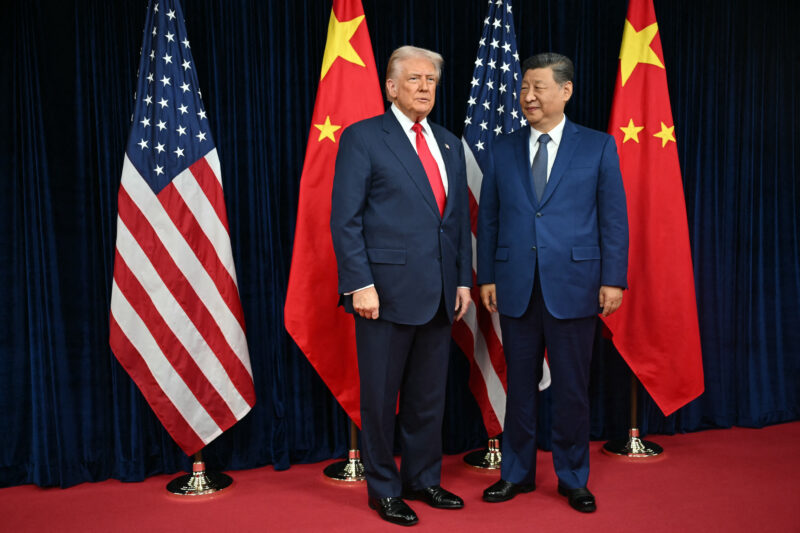
During the hearing, which took place a day before President Donald Trump is set to depart for China to meet with President Xi Jinping, Sen. Lindsey Graham (R-SC) emphasized that Beijing is “propping up Russia and Iran” and that it would have a significant capability to pressure Iran into changing course if it were to cease purchasing oil from Iran.
Graham also continued to voice concerns about Pakistan’s role as a mediator in the U.S.-Iran talks, citing a report from the day prior about Pakistan hosting Iranian military aircraft on its military bases. Both Hegseth and Gen. Dan Caine, the chairman of the Joint Chiefs of Staff, declined to comment on those reports.
“That tells me we should be looking maybe for somebody else to mediate” between the U.S. and Iran. “No wonder this damn thing is going nowhere,” Graham told the military officials. “I appreciate all you’ve done, I’m very supportive of it, but when it comes to Pakistan and China, enough already.”
Jules Hurst III, the acting Pentagon comptroller, said that the cost of the war thus far, including munitions used in the war, is around $29 billion, a sum that Democrats countered seemed low.
Hurst acknowledged that estimate didn’t include the potentially sizable costs for rebuilding U.S. installations damaged or destroyed in Iranian counterattacks. He said that the costs of such rebuilding would be dependent on the U.S.’ posture and needs going forward and potential contributions from host countries.
He indicated it could also increase further depending on costs for repairing or replacing damaged aircraft.
Hegseth and Caine insisted that the U.S. maintains sufficient munitions stockpiles to carry out any missions that are required, though Caine said that he appreciated efforts by Congress to provide funding for more munitions production.
Hegseth also asserted that the war had been massively successful in achieving the U.S.’ goals, and that the U.S. has the capabilities for a range of scenarios including resuming the war, to ensure that it will end on the U.S.’ terms.
“There are lots of different discussions with our negotiating team, they’re happening … different drafts, different perspectives. It’s a very dynamic situation where a negotiated settlement could be the outcome here, where Iran does not have nuclear capabilities,” Hegseth said. He sidestepped questions about the specific terms of the ceasefire agreement.
Pressed on whether Iran’s support for terrorism and ballistic missile program are part of negotiations, Hegseth said that the negotiations are not his responsibility but “we have world-class negotiators” and “the core of it is the nuclear weapons issue” but “those other factors are always a factor.”
Asked by Sen. Susan Collins (R-ME), chair of the Senate Appropriations Committee, whether the U.S. had anticipated the closure of the Strait of Hormuz, Caine declined to discuss the specific advice he provided to the administration but said that the military had considered the full range of potential consequences.
“It seems to me that there’s been a different plan almost daily [for] dealing with this problem,” Collins said.
Caine said that the issue of the Strait of Hormuz is a complex one, as Iran uses small boats and low-cost drones to attack larger vessels, but urged Iran to “think wisely about their next moves” and open the waterway voluntarily.
Hegseth emphasized the effectiveness of the U.S. blockade of Iranian ports, insisting that “the economic pressure that creates on them greatly outstrips the pressure on us. … Nothing’s going in that we don’t allow to go in. And trust me, when we look at what Iran’s thinking about that — they know they can’t break it.”
He repeatedly dodged questions about specific plans for reopening the strait and securing trade moving through it in the short-term. He said that there are “certainly” military means by which the strait could be re-opened, but said that a diplomatic deal is the “preferred long-term approach.”
On both sides of the aisle, in both hearings, senior lawmakers raised questions about the administration’s decision to split off more than $300 billion of the proposed $1.5 trillion defense budget request into a proposed partisan reconciliation package, rather than trying to pass it through regular order. That request was also finalized prior to the war in Iran.
Lawmakers warned that reconciliation packages would not be a sustainable path to growing and maintaining U.S. defense capabilities in the long term, and that a third reconciliation package might not be feasible at all this year.
More Stories
supper club
AI, tech execs to attend White House state dinner for Xi Jinping

QUESTIONABLE COMPANY
Democratic nominee Chris Rabb photographed with Code Pink leader

POLICY PIPELINE
Deborah Lipstadt launches Emory institute to train the next generation of policymakers fighting antisemitism

POLAND IN FOCUS
Jacky Rosen visits Poland to discuss antisemitism, Holocaust issues

VEEP APPEAL
Michigan Jewish leaders urge Kamala Harris to appeal to El-Sayed on antisemitism, Israel
UNGA UNFILTERED
Trump talks tough on Iran, even as he predicts diplomatic deal after midterms
Please log in if you already have a subscription, or subscribe to access the latest updates.
 Continue with Google
 Continue with Apple