
















































Senate Republicans split over the prospect of resuming military operations against Iran
Sen. Rick Scott said military action is ‘the only thing that’s going to work,’ while Sen. Josh Hawley urged the president not to reengage

Fatemeh Bahrami/Anadolu via Getty Images
Smoke rises after airstrikes in Tehran, Iran on March 13, 2026.


 Add JewishInsider on Google
With President Donald Trump reportedly mulling the resumption of military action against Iran, fault lines are opening up among Senate Republicans over the prospect of a renewed military effort.
Some prominent Senate Republicans publicly called for the U.S. to resume military operations this weekend, after Trump dismissed as a nonstarter Iran’s latest negotiating proposal. Other colleagues joined them on Monday.
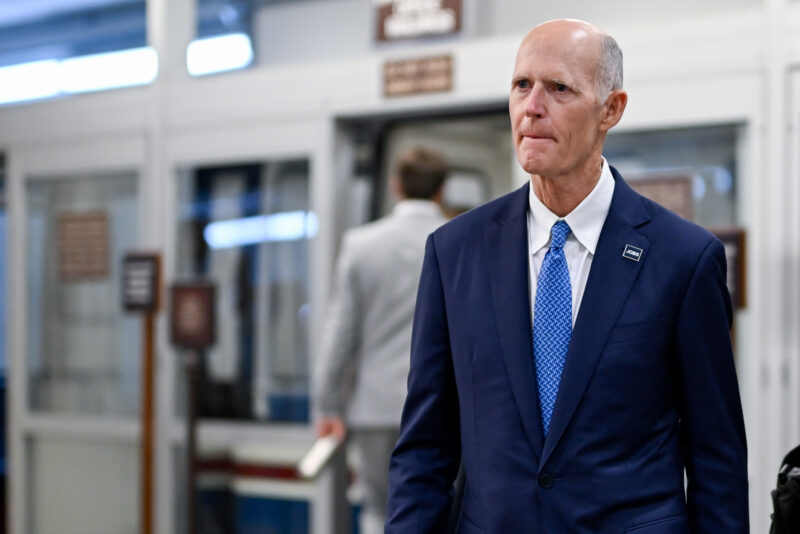
Sen. Rick Scott (R-FL) said he thinks military operations must resume. “It’s the only thing that’s going to work, unfortunately,” Scott told Jewish Insider. Asked whether the administration needs to seek congressional approval to resume fighting, he said, “I think the president should go forward.
Sen. Roger Wicker (R-MS), chairman of the Senate Armed Services Committee, reiterated that he “hope[s]” Project Freedom, the administration’s effort to protect shipping in the Strait of Hormuz, is resumed, after writing to Trump on X on Sunday that it’s time to “get back to business.” He said that he would not expect the administration to come to Congress for authorization if that effort were to continue.
Others are leaving the prospect of military action on the table without fully ruling out a diplomatic path, while offering varying degrees of skepticism about how realistic a deal actually would be.
Asked about resuming the war, Sen. John Cornyn (R-TX) said, “We need to clear the Strait of Hormuz, and I support doing that by whatever means necessary.” Cornyn faces a competitive primary runoff in late May, and a hotly contested general election race in November should he be victorious in the primary.
Sen. Mike Rounds (R-SD) said that the U.S. “has a problem” as long as the Iranian regime remains in place and has the capacity to produce a nuclear weapon, “and we’re going to have to address it one way or the other.”
“I’m hopeful for a diplomatic solution, but I don’t think these fanatics over there necessarily believe that a diplomatic solution is what they really want,” Rounds continued. “I think they’d rather martyr themselves, and I think they’d murder millions of their own people if they could.”
“I think we all want to get this resolved as quickly as possible,” Sen. Ted Budd (R-NC) said. “I would say, let’s focus right now. Let’s see if China wants to play a role in this, and we should probably know more by this weekend. But I don’t think anyone wants to end this in a decisive way more than President Trump.”
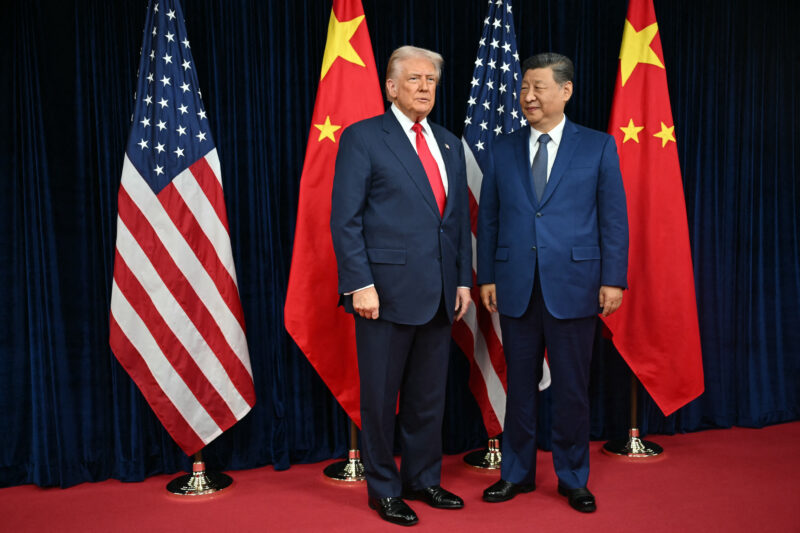
He predicted that the war would be a major topic of conversation in Trump’s meetings with leaders in Beijing later this week.
“The whole world’s watching right now,” Budd continued. “But look, we need to resolve this permanently, and we want to resolve it as soon as possible. And I know that’s President Trump’s goal.”
Sen. Josh Hawley (R-MO), among the most prominent advocates in the Senate for keeping the war brief, praised the administration for notifying Congress at the beginning of the month that it considered hostilities concluded, and urged the administration not to reengage.
“I welcome his statement that the president sent … saying that the original operation — he had terminated those hostilities. That’s a good thing. That’s a good outcome. I certainly hope that will hold,” Hawley said. “I think we’re in a posture now where he’s clearly trying to conclude a long-term peace, which I think is good. But I welcomed his statement that hostilities have terminated.”
He praised Trump for not following his colleagues’ calls to return to war.
“I want to applaud the termination of hostilities,” Hawley said. “He’s been urged to return to full scale bombing, to his original bombing campaign by many of my colleagues over the last two weeks. He’s very pointedly not done so. … I’m glad that so far the president’s not listened to my colleagues who want to do something very different.”
Hawley dismissed followup questions about whether he believed that the hostilities had indeed terminated as the administration claimed, with U.S. forces remaining in the region and continuing certain operations even during the ceasefire.
The administration faced a 60-day statutory deadline to conclude operations against Iran without congressional approval under the War Powers Act at the end of April. Hawley said the administration appears to be following the same precedent set by the Obama administration during operations in Libya.
“The ‘war’ is a very broad term. The statute speaks particularly to ‘hostilities,’” he said.
More Stories
RIPPING ON RIYADH
Trump’s pick for Saudi ambassador once suggested kingdom is not a ‘true ally’

partnership pitch
Somaliland president discusses expanded military cooperation with U.S. officials
VEEP APPEAL
Michigan Jewish leaders urge Kamala Harris to appeal to El-Sayed on antisemitism, Israel
analysis
Attack on Ambassador Leiter’s son casts pall over Netanyahu’s abbreviated UNGA visit
supper club
AI, tech execs to attend White House state dinner for Xi Jinping

Schmear campaign
Politico picks Yom Kippur to attack Huckabee’s observant Jewish aide
Please log in if you already have a subscription, or subscribe to access the latest updates.
 Continue with Google
 Continue with Apple