










































Experts warn Trump White House isn’t sufficiently engaging Iranian public to pressure regime
At an Iran International panel, Washington Institute for Near East Policy’s Rob Satloff outlined ways the U.S. could better engage with the Iranian public
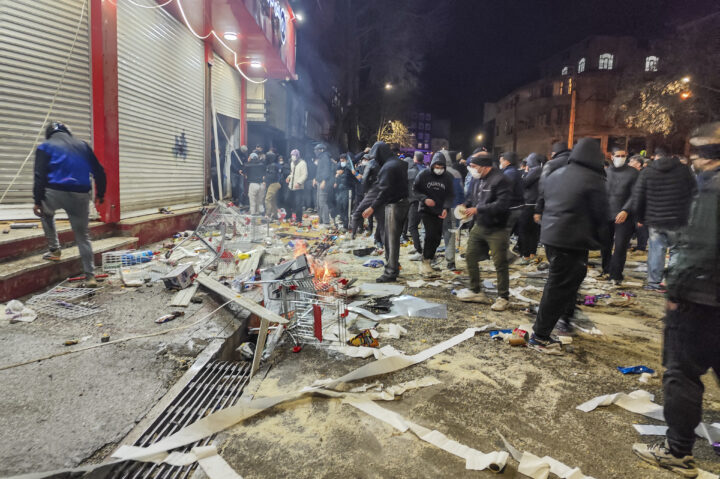
(Photo by Kamran / Middle East Images / AFP via Getty Images)
Iranians gather while blocking a street during a protest in Kermanshah, Iran on January 8, 2026.


 Add JewishInsider on Google
Experts said on Wednesday that the Trump administration has failed to adequately tap into pro-Western sentiment among the Iranian public following the regime’s violent crackdown on nationwide protests earlier this year, arguing that the White House is missing a key opportunity to cultivate internal pressure within Iran.
Robert Satloff, executive director of The Washington Institute for Near East Policy, argued that the Trump administration should expand U.S. broadcasting into Iran, improve internet access for Iranians and ease pathways for dissidents seeking refuge in the U.S. to “lay the groundwork for the day when it becomes a much more real possibility to have this sort of regime change.” Satloff outlined his proposals during a Wednesday town hall hosted by Iran International, a U.K.-based Persian-language news network. “None of [the Iranian people] are being invested in in any significant way by the Trump administration,” he said.
In February, PBS reported that over 7,000 Iranians were killed during the regime’s violent crackdowns on nationwide protests that began in December. President Donald Trump at the time urged Iranians to keep protesting, declaring that “help is on the way.” Recent surveys inside Iran have shown that roughly 89% of Iranians support a “democratic political system.”
However, with Trump rarely bringing up the human rights abuses of the Iranian government as he seeks a diplomatic deal with the Islamic Republic, the protesters who Trump initially promised to help have been deterred by the Iran’s intensive crackdowns and the lack of a response to counter them.
That vacuum, Satloff argued, is what Washington should be working to fill. He elaborated on the three proposals, each aimed at strengthening the U.S. relationship with the Iranian public.
First, Satloff said the U.S. would benefit from providing “better and more American broadcasting” to Iranians and ensuring that they “have internet access and that they cannot be denied this by their capricious government.”
To accomplish this, the Trump administration should “work with private companies,” Satloff told Jewish Insider.
“Much of this requires a shift of policy, not an allocation of money,” Satloff pointed out. “That is, to embrace U.S. international broadcasting as an important asset, not to try to run it out of business, as has been the case in this administration.” Following Trump’s 2025 attempts to dismantle Voice of America, including its Persian broadcasts, a federal judge ordered more than 1,000 laid-off staff reinstated this past March.
Satloff also argued that the U.S. should “change our visa and asylum regulations” to provide Iranians fleeing the regime with “a welcoming home” and a “base” to continue organizing against the regime.
Alex Vatanka, senior fellow at the Middle East Institute in Washington, reaffirmed that the “Iranian public sentiment is anti-regime by and large,” during the panel, elaborating on the importance of the U.S. screening visa applicants carefully and avoiding becoming the “bad guys.”
He called it “fair game” to deny a visa to someone with a background in the Islamic Revolutionary Guard Corps, but stressed the need for accuracy, warning that overbroad denials risk alienating the population the White House needs on its side.
Panelists acknowledged that these measures won’t dislodge the Islamic Republic on their own. Satloff said that under the current state of affairs, “none of this is going to bring down the government.”
“I think the important thing for us is to change behavior,” Satloff continued, arguing that “as the Iranian people see the weaknesses of their own regime then maybe you will find more organized elements that come forward in leadership that challenges” its leadership.
“I don’t even see that foundation yet for us to work with,” he added.
Rachel Brandenburg, Washington managing director and senior policy analyst at the Israel Policy Forum, told JI that “among the reasons the U.S. would provide the Iranians with ways to circumvent an internet blackout” is to support their ability to “communicate with each other and with the world.” Brandenburg explained this is “among [the] tools that could help the Iranian people organize protests and other opposition to the regime, whether openly or privately.”
Satloff tied his proposals back to potentially dismantling the IRGC — a goal the administration has stated but, in his telling, done little to pursue. Without sustained engagement with ordinary Iranians, he argued, there may be no constituency for Washington to work with when the moment for a regime change comes.
“All of this would expand U.S. engagement with ordinary Iranians,” Satloff told JI, “which is a necessary prerequisite for any serious effort at empowering Iranians to do what President Trump said he hoped they would do — take back their country.”
More Stories
BACKUP PLAN
Buffer zone bill aims to protect worshipers when prosecutors fail to act, lead GOP sponsor says

BOOKSHELF
Jessica Tarlov on her new book, Hasan Piker and the limits of being able to ‘acknowledge without accepting’

TEXAS TROUBLE
Ted Cruz slams Dems for not speaking out against College Dems’ Hasan Piker invitation
analysis
Netanyahu’s U.N. visit presents test for Mamdani and NYPD

BOOKSHELF
New book ‘In the War Room’ offers candid look at Netanyahu’s wartime decisionmaking
ON THE HILL
Senate Republicans urge Saudi response to Houthi attacks
Please log in if you already have a subscription, or subscribe to access the latest updates.
 Continue with Google
 Continue with Apple