



























The president called Iran’s leaders ‘a little loco’ and said he was no longer sure he wanted a deal, while insisting that renewed strikes did not mean the war was resuming
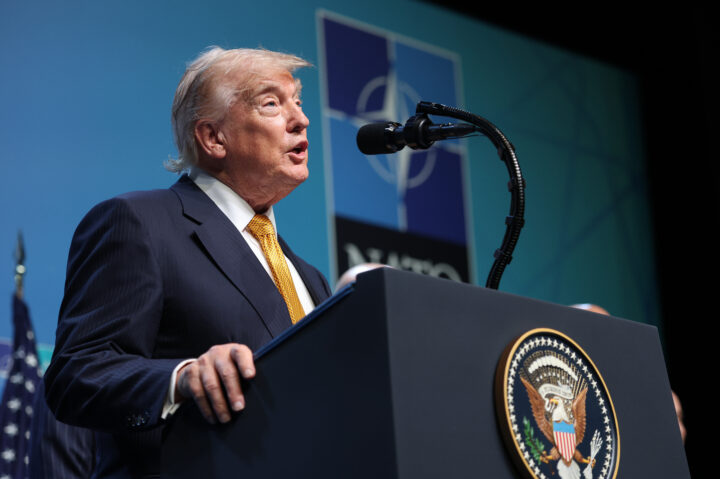
Photo by Win McNamee/Getty Images
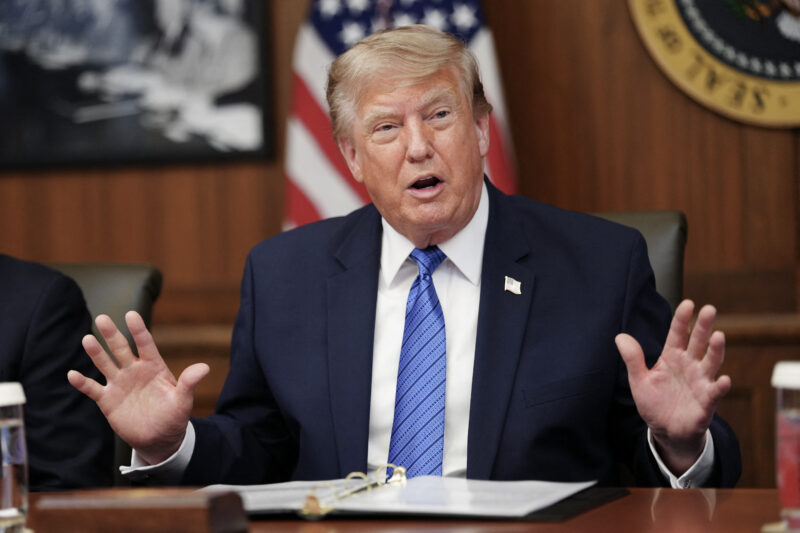
U.S. President Donald Trump speaks at a press conference during the 2026 NATO Leaders Summit at the Beştepe Presidential Compound on July 08, 2026 in Ankara, Turkey.


 Add JewishInsider on Google
President Donald Trump on Wednesday reiterated his threat to “finish the job” in Iran and said the current ceasefire is “over” while denying that renewed U.S. strikes in the country mark a return to war.
Trump told reporters during a press conference at the NATO summit in Ankara, Turkey, on Wednesday that he was no longer sure if he was interested in a peace deal with Iran and was questioning if the country’s leadership was rational enough to work with.
Hours after Trump’s remarks, CENTCOM announced additional strikes on Iranian targets “at the direction of” the president, saying in a statement that the operation was intended to “further degrade [Iran’s] ability to threaten freedom of navigation in the Strait of Hormuz.”
Asked during the press conference what caused him to sour on Iran’s leadership — whom he referred to on Wednesday as “scum” and “sick people,” after praising them last month as “very rational” and “nice to deal with” — Trump replied: “I got to know them.”
Trump noted that he was comparing the current regime to the previous two regimes in his prior complimentary statements.“I think they’re much more rational than level one, level two. Level one is gone, level two is gone. This is level three,” Trump said. “I think they are more rational, but based on their actions over the last week or two, they’re not doing a service to the people.”
“I’m not sure I want to make a deal with them,” he continued. “We can play games, but I’m not sure I want to make a deal. Let’s just finish the job.”
The comments came hours after the president said that the memorandum of understanding between the U.S. and Iran was “over” and said “I don’t want to deal with them anymore.”
Trump went on to criticize Iran’s leaders as “a little loco. They’re a little crazy,” pointing to Iran’s continued attacks against commercial shipping in the Strait of Hormuz and claiming he’s Iran’s top target for assassination.
“They want to make a deal, but they don’t know how to make the deal, and then they go around shooting ships at night [in the Strait of Hormuz]. I don’t like that,” he said. “I’m the No. 1 target. … I’m the No. 1, because they’re scum. That’s the way they act, and that’s the way they’ve done it for 47 years.”
Still, he rejected the idea that the military operations meant that the U.S. was resuming full-scale warfare with Iran.
“I don’t think it’s going to start again. I think it’s going to go very quickly. They hit a couple of ships, and so we hit them much harder,” Trump said of the war. “When they hit, we hit. We use their language. We speak their language. No, I don’t think so. I think anything that happens is going to be over very quickly and will only make [the region] safer.”
A U.S. official called Iran's actions ‘wholly unacceptable’ but said negotiators continue to work ‘in good faith’ toward a final deal

Photo by Elke Scholiers/Getty Images
Crude oil tankers, bulk carriers and vessels sit anchored around Qaboos Port on June 22, 2026 in Muscat, Oman.
A brief window of U.S. sanctions relief for Tehran closed on Tuesday as the Trump administration revoked a waiver that allowed the sale of Iranian oil in response to continued Iranian attacks on shipping vessels in the Strait of Hormuz.
Last month, the Treasury Department lifted sanctions on Iranian oil sales by issuing a 60-day license, a decision experts told Jewish Insider risked providing Tehran with significant revenue for malign activity. Treasury Secretary Scott Bessent had said the temporary license was issued due to Iran’s commitments under the memorandum of understanding, including guaranteeing safe passage through the Strait of Hormuz and inviting international nuclear inspectors back into the country — a claim that Iran swiftly denied. The license allowed Iran to produce, deliver and sell oil, including to U.S. importers, through Aug. 21.
But since the agreement was signed, Iran has since continued its attacks on commercial vessels navigating the Strait of Hormuz, including strikes on three commercial tankers since the beginning of the week, which a U.S. official called “wholly unacceptable.”
“As President [Donald] Trump and the administration have repeatedly affirmed, the MOU in effect with Iran is entirely performance-based. Iran will only reap benefits if they exhibit good behavior,” the official told JI. “Iran’s actions in the Strait were wholly unacceptable to the United States and will be met with consequences. Our negotiators continue to work in good faith towards a final deal.”
An Iranian Foreign Ministry spokesperson had warned that commercial vessels using routes outside of Iranian control could face consequences and said that Iran was “diligently fulfilling its commitments” within the MOU to manage the strait, according to Axios.
The New York City mayor, whose advisor Morris Katz also worked for Graham Platner, called on the Maine Senate contender to forfeit
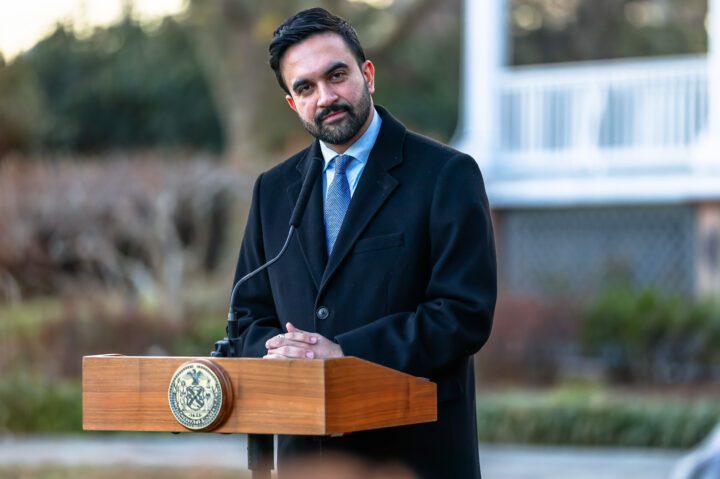
Michael M. Santiago/Getty Images
Mayor Zohran Mamdani speaks at a press conference during moving day at Gracie Mansion on January 12, 2026 in New York City.
New York City Mayor Zohran Mamdani on Tuesday joined the swelling chorus of Democratic voices demanding the party’s nominee for Senate in Maine, Graham Platner, abandon his campaign in the aftermath of a rape allegation revealed in a Politico report on Monday — a campaign the mayor’s own top political advisor helped start and steer.
Mamdani’s remarks came shortly after an unrelated event at City Hall, a day after a former romantic partner of Platner’s accused him of drunkenly entering her home and sexually assaulting her in 2021. The mayor’s nearest political aide, Morris Katz, was one of the architects of Platner’s Senate run and one of his fiercest public defenders amid prior allegations of personal misconduct and the discovery that the candidate had a tattoo of a Nazi symbol.
But Mamdani made no remarks on Katz’s role in Platner’s rise, and declined to comment on the long-term consequences for the insurgent left-wing movement the two have championed.
“I believe that it’s time for him to drop out of the race,” the mayor said of Platner. “I think the focus of today should be on the campaign coming to a close. And I think there will be many more days to have conversations for what it means beyond that.”
The 27-year-old Katz reportedly talked up congressional candidate Darializa Avila Chevalier to Mamdani, leading the mayor to endorse her in the final days of her ultimately successful challenge to Rep. Adriano Espaillat (D-NY).
It soon emerged that Avila Chevalier had bragged online about wiping her hands on the American flag, praised Soviet despots, pushed Russian government talking points and spread a conspiracy theory about COVID-19 — creating uncomfortable questions for Democratic leaders after she won the primary in the deep-blue district.
Katz also advised Democratic candidates Clare Valdez, Micah Lasher and Brad Lander in their successful primary bids elsewhere in New York City.
The ambassador announced that the next round of Israel-Lebanon negotiations will take place next week in Rome
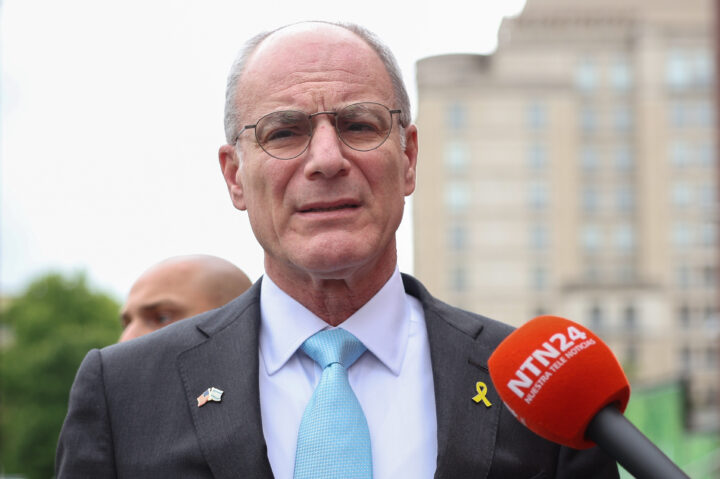
Tasos Katopodis/Getty Images
Israeli Ambassador to the United States Yechiel Leiter
Jerusalem and Beirut see their trilateral agreement signed with the U.S. last month as “superseding” the memorandum of understanding signed between the U.S. and Iran, Israeli Ambassador to the U.S. Yechiel Leiter said on Monday.
“Whether the United States does, you’ll have to ask the administration spokesman,” he added, speaking at an event hosted by the Council on Foreign Relations in Washington.
Leiter specifically referenced the first clause of the MOU, to which Israel and Lebanon were not parties, which called for an end in hostilities around the region, including Israel’s war against Hezbollah in southern Lebanon. Leiter acknowledged that Iran — as well as mediating countries Pakistan and Qatar — views the MOU differently and believes it overrides the Israel-Lebanon framework deal.
The next round of talks between Israel and Lebanon will take place on July 14 and 15 in Rome, Leiter said, and revealed that Lebanese President Joseph Aoun will meet with President Donald Trump at the White House on July 21.
Leiter described the MOU as primarily a mechanism to reopen the Strait of Hormuz rather than a broad peace deal, and urged a “wait and see” approach to future negotiations regarding long-term limits on Iran’s nuclear and ballistic missile programs.
The deal is “clearly an agreement to get the strait open. This is not an agreement to end the nuclear weaponization of Iran,” he said.
“We have to wait and see what that looks like when it’s done, whether that’s 60 days, 90 days or after the midterms,” he continued. “I’m quite sure the administration didn’t go to war to go back into a situation where Iran has a pathway to once again try and produce nuclear weapons [and] ballistic missiles.”
Leiter added that Trump has said any deal with Iran would have to curtail its support for proxies and its ballistic missile program, though such issues were not mentioned in the MOU. He also warned against U.S. sanctions relief that could fund Tehran’s proxies.
“All we can do is weigh in,” Leiter said of Israel’s role in U.S.-Iran negotiations. “We can’t be part of that decision-making process. That’s too big for us. We know our size.”
Leiter dismissed as exaggerated reports of a rupture in Israel-U.S. relations.
“Media loves drama. So, if the president and the prime minister have 100 conversations that are pleasant, and then there are two conversations in which the president is having a bad day, is a little irritable and makes that known — that becomes the tenor of the relationship between the two men,” he said.
“I’ve been in all those conversations, all the meetings … arguments happen among people who are close. The relationship is good, the relationship is solid. There are differences along the way, and those are legitimate,” Leiter said, pointing to Israel’s opposition to the proposed U.S. sale of F-35 fighter jets to Turkey. Leiter said that Israel has made its position clear and that the U.S. has the right to decide how it wants to proceed.
He rejected claims that Israeli Prime Minister Benjamin Netanyahu dragged the U.S. into the war with Iran, dismissing such accusations as “sheer stupidity” rooted in antisemitic conspiracy theories.
“We presented our case as any self-respecting country does and it’s up to the United States to make a decision whether or not to embark on a war,” said Leiter. “It doesn’t do that because of AIPAC or other diabolical Jews.”
Leiter also dismissed a recent claim from Vice President JD Vance that Trump is the only world leader sympathetic to Israel. “It’s just not true. We just had an invitation to India. The relations we have with the United Arab Emirates have never been stronger. We have wonderful relations with Azerbaijan … our relations with Armenia now are quite good … and Somaliland.”
Alongside navigating divisions over Israel, the Democratic Party is currently grappling with “the Mamdani effect,” said Leiter, referring to a string of primary victories by progressive and democratic socialist candidates backed by New York City Mayor Zohran Mamdani.
“Israel is part of a much larger social metamorphosis,” he said.
The state lawmaker did not offer an endorsement of either of her former Democratic primary rivals, Rep. Haley Stevens and Abdul El-Sayed
Jacek Boczarski/Anadolu via Getty Images
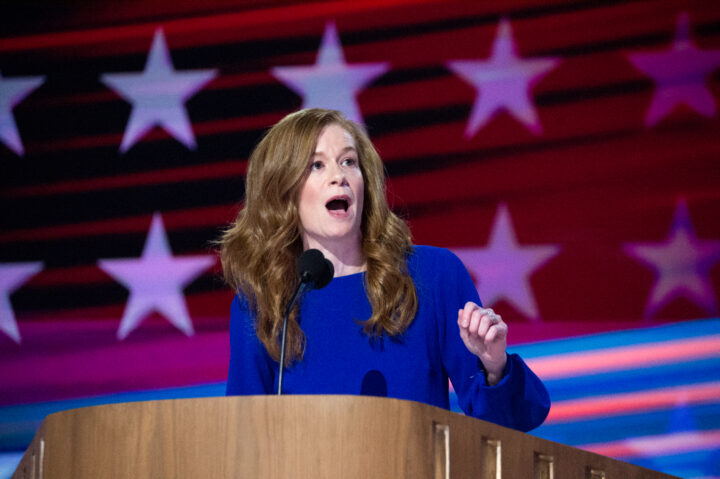
State Sen. Mallory McMorrow, a Democrat from Michigan speaks during the 2024 Democratic National Convention in Chicago, Illinois, United States on August 19, 2024.
Michigan state Sen. Mallory McMorrow dropped out of the Democratic primary for U.S. Senate on Sunday, without offering her support to either of her opponents in the hotly contested race.
“Here’s what we do next. Every day through November 3rd. We win this Senate seat and send Mike Rogers back to Florida for good,” McMorrow wrote in her announcement on X, referring to the expected GOP nominee.
“Whoever wins this primary on August 4th will have my full support,” she continued, declining to endorse either Rep. Haley Stevens (D-MI) or Abdul El-Sayed.
Fundraising figures released at the end of the first quarter of the year showed Stevens trailing El-Sayed in fundraising but having the most cash on hand, at $3.4 million to El-Sayed’s $2.5 million. El-Sayed has held a slight lead in the latest polls.
Following McMorrow’s announcement, Michigan Attorney General Dana Nessel, a Jewish Democrat, said the “choice is clear” and “wholeheartedly” issued her endorsement of Stevens.
Stevens also has the backing of other Democratic leaders including Senate Minority Leader Chuck Schumer (D-NY) and former Sen. Debbie Stabenow (D-MI).
El-Sayed, meanwhile, is backed by leading progressives including Sens. Bernie Sanders (I-VT) and Chris Van Hollen (D-MD), and Rep. Alexandria Ocasio-Cortez (D-NY). Last week, the AIPAC-linked United Democracy Project super PAC, which has boosted Stevens with more than $10 million, issued its first negative ad against El-Sayed.
Rep. Dina Titus is leading the Joint Resolution of Disapproval against the Trump administration's $700 million sale of F110 jet engines to Turkey despite legal restrictions on U.S. military sales to the country

Mahmut Serdar Alakus/Anadolu via Getty Images
Turkish Stars, aerobatic team of the Turkish Air Force perform a demonstration flight during the Youth and Aviation Festival organized by the Ministry of National Defense to mark the 115th anniversary of the Turkish Air Force in Izmir, Turkiye on June 07, 2026.
A group of House Democrats introduced a resolution last week that aims to block the sale of advanced jet engines to Turkey, as the Trump administration pushes ahead with the sale despite legal restrictions on U.S. military sales to the country.
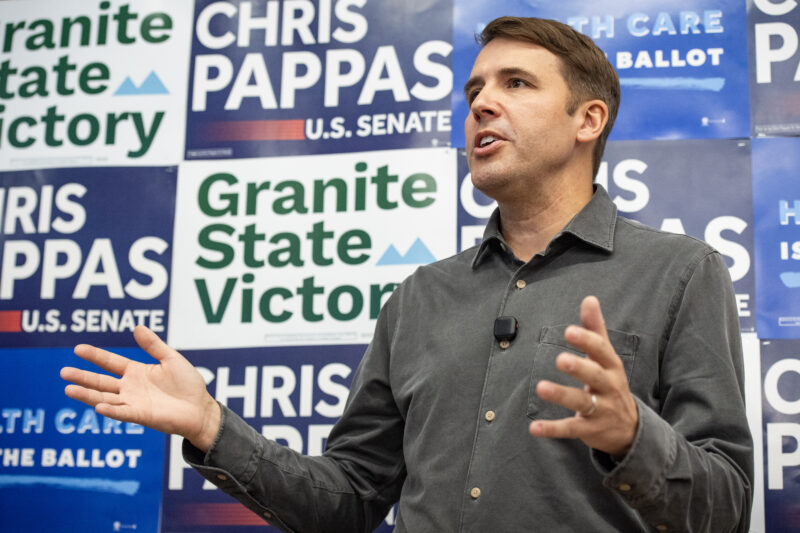
The resolution is led by Rep. Dina Titus (D-NV), a vocal critic of Ankara, and co-sponsored by Reps. Chris Pappas (D-NH), Brad Schneider (D-IL), Josh Gottheimer (D-NJ), Mike Quigley (D-IL), Jim Costa (D-CA), Jim McGovern (D-MA), George Latimer (D-NY) and Brad Sherman (D-CA).
“The regime of Turkish President Erdoğan has made repeated threats of military action against NATO allies and other partner nations throughout the Middle East,” Titus said on X. “I am introducing a Joint Resolution of Disapproval to stop the $700 million sale of F110 jet engines to Turkey which would undermine regional stability and pose a threat to U.S. allies.”
Titus also said on X that she’s working on a letter to House leadership “to prevent any attempt to readmit Turkey into the F-35 program,” urging a Republican colleague who is also critical of the Turkish government to support her initiative.
Ansari is now rejecting support from Democratic Majority for Israel after the group championed her 2024 candidacy
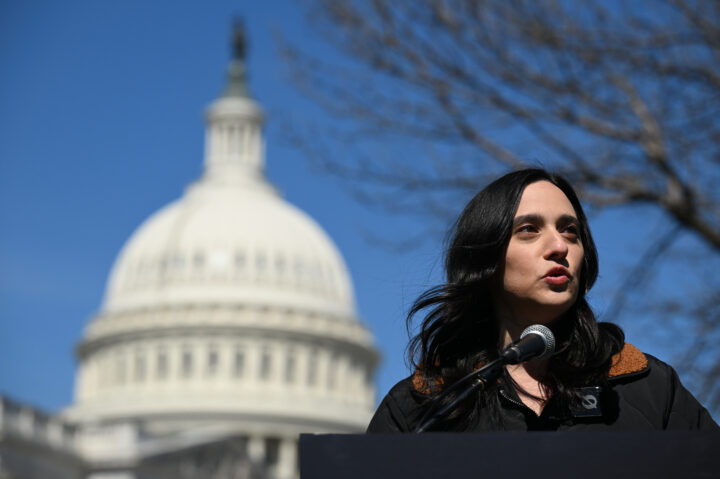
Photo by Matt McClain/Getty Images
Rep. Yassamin Ansari (D-AZ) speaks at a press conference calling for an end to the conflict in Iran outside the United States Capitol on March 18, 2026 in Washington, D.C.
When Rep. Yassamin Ansari (D-AZ) narrowly prevailed in the Democratic primary for an open House seat in Phoenix in 2024, winning by just 39 votes in a deep-blue district, the Arizona lawmaker could attribute her success, in part, to strong backing from the local Jewish community as well as a surge of outside spending from a prominent pro-Israel group.
Many Jewish and pro-Israel leaders in the state and beyond were encouraged that Ansari, who identifies as a progressive, staked out what seemed at the time like a moderate approach to Middle East policy issues amid rising Democratic hostility toward Israel over the war in Gaza — particularly in the party’s far-left wing.
Ansari, an Iranian American and former vice mayor of Phoenix, drew a contrast with her top rival, Raquel Terán, a former state lawmaker and party chair who had raised concerns among Jewish activists over her lack of clarity on key issues, such as whether she supported aid to Israel. For her part, Ansari stressed her commitment to U.S. military funding for Israel “without additional conditions,” while saying in a position paper that the United States “must do everything in its power to stop” Iran “from acquiring a nuclear weapon,” which she argued “would pose an existential threat to Israel.”
Now, however, Ansari, 34, has largely turned away from the stances she embraced during her primary, aligning with a range of far-left policy positions that have led several Jewish and pro-Israel leaders to feel they were misled, they told Jewish Insider.
Alma Hernandez, a Democratic state representative in Tucson who had been one of Ansari’s top Jewish campaign surrogates in the 2024 primary, said she “was really excited for the idea of having someone like” Ansari in office, noting that she attended the congresswoman’s swearing-in ceremony in Washington to demonstrate her solidarity.
“I have not talked to her since,” Hernandez said last week in an interview with JI. “I think a lot of folks in the community feel they were really used in a sense,” she added, alleging that Ansari “was very careful with all her words because she wanted the support and the financial backing” in a closely contested race.
Hernandez added that she did not think she could reasonably support Ansari’s reelection or ask Jewish community members to get behind her as she had in the primary race two years ago.
In an interview with JI on Wednesday, Ansari said that she has received positive feedback from Jewish voters in her district about her position on Israel. “I do believe I still have significant support from the Jewish community in Arizona,” she added, affirming that her “relationship to Arizona’s Jewish community has always been, and will continue to be, one of deep engagement and mutual respect.”
“I’m sorry that some people may feel misled, but that’s not how I see it at all,” she said, arguing that her views on the Middle East simply underscore the extent to which “the context and the situation on the ground have changed dramatically since a couple of years ago.”
Ansari said her office keeps a log of local outreach that shows most of her constituents, “if not the vast majority, are pretty in line with the American public on this issue,” stressing voters overwhelmingly agree “that what has happened in Gaza has been atrocious, that we need to really consider using U.S. leverage on how to influence Israeli policy and deep opposition to the far-right Netanyahu government.”
Still, her erstwhile Jewish supporters said they felt betrayed by her shift and questioned her sincerity. “I still really can’t believe how she played us,” said one pro-Israel leader in the state who had enthusiastically backed Ansari’s 2024 bid and was granted anonymity to speak freely about frustrations with the freshman lawmaker. “I thought she was somebody different.”
In her first Middle East policy test as a member of Congress in January, Ansari broke with progressives in backing Republican-led legislation to sanction the International Criminal Court for issuing arrest warrants against senior Israeli officials, even as she clarified it “wasn’t an easy vote.”
But since then, Ansari has adopted a more openly hostile approach to Israel that has fueled a mounting sense of disappointment among her Jewish allies who had believed she would strike a balanced tone while in the House. She is a co-sponsor of the Block the Bombs Act, which would impose sweeping new restrictions on weapons sales or transfers to Israel, for instance, and was an early backer of a Lebanon war powers resolution, introduced by Rep. Rashida Tlaib (D-MI), aimed at blocking U.S. support for Israeli military operations against Hezbollah, an Iranian terrorist proxy.
During an interview this week with Mehdi Hasan of the media outlet Zeteo that underscored her growing ties to the far left, Ansari said for the first time she believed that Israel had committed genocide in Gaza as well as Lebanon, citing a U.N. report released this month. “I just don’t think we can continue to mince our words or deny what so many credible actors and institutions and doctors are saying,” she said of her thinking.
Ansari told JI she was “deeply sympathetic” to Jewish colleagues and constituents who “find the term genocide to be extremely hurtful,” saying that she did not “believe that a word should be used as a litmus test” in political debates over Israel that have consumed several recent Democratic primary races.
“Ultimately,” she said, “being clear about what has happened in Gaza and what continues to happen is not to minimize the horrors of either the Holocaust or the violence committed on Oct. 7 by Hamas, and I continue to condemn that forcefully and continue to believe Israelis deserve to live in peace and security in the state of Israel, and I believe we need a secure Palestinian state.”
Elsewhere in the Zeteo discussion, Ansari said that she remained uncertain about where she would land on an anticipated House vote over an amendment led by Rep. Thomas Massie (R-KY) to slash the annual $3.3 billion in military aid the U.S. is set to provide Israel in the 2027 State Department funding bill, a controversial effort that Jewish activists in Arizona have urged her to oppose, according to a recent email shared with JI.
She also vowed to reject financial assistance from pro-Israel groups including AIPAC and Democratic Majority for Israel, the latter of which endorsed her 2024 campaign and pumped more than $400,000 into the race to boost her bid, hailing her victory as proof “that being pro-Israel is not just wise policy, but also winning politics.”
“I just don’t want anyone to think that any of my decisions are influenced by any organization,” she explained to Zeteo. “They never, quite frankly, have been or should.”
Speaking with JI, Ansari said she has continued to engage with DMFI and has a “respectful relationship” with the group, even as she now disavows its support. “I really do find the villainization of the members of these organizations to be very problematic,” she said of the pro-Israel community. “That’s why I have very much not been antagonistic, because I don’t want to give in to that.”
DMFI’s super PAC declined to comment on Ansari’s remarks. A spokesperson for AIPAC did not return a request for comment.
Ansari’s lack of interest in backing from AIPAC comes as the group’s brand has become toxic in a number of Democratic primaries, particularly those in progressive-minded districts. And her shift to a more skeptical position on the U.S.-Israel alliance is reflective of broader polling trends that show eroding support for Israel in both parties — especially among younger voters.
But according to a source with first-hand knowledge of the matter who spoke with JI on the condition of anonymity to address a sensitive subject, Ansari had “worked tirelessly” in her primary to claim an AIPAC endorsement, crafting a position paper with its policy expectations in mind, meeting with AIPAC’s staff and pledging to visit Israel on an AIPAC-sponsored trip if elected to Congress.
AIPAC held off on supporting Ansari because it was unconvinced about her views and out of deference to Sen. Mark Kelly (D-AZ), who was backing Terán and asked the group to remain neutral in the primary, the source noted.
Not long after she had entered the House, Ansari privately reiterated her interest in visiting Israel on an AIPAC-led congressional delegation, according to the source. But despite her prior outreach, her team said then that she did not want an AIPAC endorsement — indicating that it was too early in her tenure and she needed more time to acquaint herself with the group.
Ansari did not dispute that account but added there were irreconcilable disagreements with AIPAC that precluded constructive conversation, not to mention an endorsement. “The truth, from my perspective, is that there was never any room for policy differences with AIPAC,” she said, while stressing that the group “continued to provide feedback on” her positions that she was “unwilling to make.”
Despite having voiced interest in visiting Israel with AIPAC, Ansari said she “could not justify taking part” in a trip last year, amid “the continuation of violence in Gaza” and “well into the Trump administration.” Her outspoken opposition to the war in Iran subsequently hardened her resistance to such a trip, she suggested.
One pro-Israel activist in Arizona said that Jewish leaders who got behind Ansari in 2024 and are now stung by her reversals should not necessarily feel surprised, noting she had no demonstrable record as a strong supporter of Israel prior to her campaign for Congress.
In some ways, Ansari’s evolution echoes that of Rep. Maxwell Frost (D-FL), a fellow progressive who was elected in 2022 after making a range of commitments to uphold support for Israel that he has since reneged on in Congress, stoking disenchantment among local Jewish leaders who were initially energized over his campaign.
But while Frost had engaged in private diplomacy with DMFI to preempt attacks as he ran against the group’s preferred candidate, Ansari actively courted and accepted support from the pro-Israel community in her primary, a key distinguishing factor of the race featuring an opponent seen as more critical of Israel.
Zachary Bell, a Jewish community activist in Phoenix who has spoken to Ansari about Israel and Gaza, said that he was “very happy with how she has responded” to the wars in the Middle East. “I am far from a super far-left, anti-Israel person,” he clarified. “I think there is a wide range of opinions on this issue in the Jewish community,” he added. “She has done a very good job seriously engaging with people across that spectrum.”
Bell volunteers with J Street, the progressive Israel advocacy group, but said he was speaking for himself. J Street endorsed Terán, Ansari’s primary rival, in 2024, and it has not backed Ansari this cycle, as she runs unopposed for a second term in Arizona’s solidly Democratic 3rd Congressional District.
A Jewish community leader in Arizona said Ansari’s shifting stances on Israel indicate that she no longer feels she needs support from former pro-Israel allies to continue holding her seat. “She’s packing her bags for reelection, and there is a weight limit,” the Jewish leader told JI. “Israel, right now, weighs too much for her.”
Adam Goodman, a Jewish activist in Phoenix who supported Ansari’s campaign in 2024, said he was aligned with the congresswoman “on many issues,” calling her “smart, pragmatic and engaging, with a long political career ahead of her.”
But while he had once praised Ansari as “unequivocal in her support for Israel,” Goodman suggested he has since grown disillusioned about the congresswoman’s current approach.
“Unfortunately,” he told JI, “she is demagoguing Israel without holding other countries to the same standard.”
Ansari, for her part, said that her views were more carefully considered than her critics speculated and dismissed accusations that she is playing politics on Israel. “I’m not somebody who jumps on any sort of bandwagon,” she insisted to JI. “I think very deeply about foreign policy.”
“We are having quite the reckoning within the Democratic caucus and Congress about all of these issues right now,” she said.
The study by Combat Antisemitism Movement, conducted in May, found that the more visibly Jewish a person is, the risk of facing antisemitic hate rises significantly

Hannes P Albert/picture alliance via Getty Images
A participant with a kippah stands in front of a menorah.
As the U.S. celebrates its 250th anniversary this weekend, a new study by Combat Antisemitism Movement reveals a stark reality for American Jews: 57% reported experiencing antisemitism — frequently manifesting online — in the past year.
Conducted by Ira Sheskin, director of the Jewish Demography Project at the University of Miami and administered by the National Opinion Research Center at the University of Chicago, the survey — which polled 1,060 Jewish American adults over three weeks in May — found that antisemitism is causing them to actively alter everyday behavior.
A clear majority of respondents (58%) said they felt less safe as Jews in the U.S. than a year ago.
Over one-third (38%) of Jewish American respondents now conceal items that identify them as Jewish, with 32% avoiding posting identifying information online and 23% reporting that they skip Jewish events out of fear.
Even as the number of antisemitic incidents in the U.S. declined by a third last year, according to the Anti-Defamation League’s 2025 audit, the overall global increase in attacks on Jews that came after the Oct. 7, 2023, Hamas terrorist attacks and ensuring war in Gaza continues to have lasting ramifications —- and may even be getting worse for some, according to the CAM survey.
Much of the antisemitism reported was experienced on the Internet, with 59% of respondents saying they had seen antisemitic content directed at someone else online. Only 10% reported being the personal target of online antisemitism.
But the more visibly Jewish a person identifies, the more antisemitism they report facing: 46% of Orthodox Jews and 44% of those active in Jewish communal life reported experiencing antisemitism, compared with 17% of those not involved.
Other forms of antisemitism respondents said they faced over the past year included anti-Jewish vandalism (36%), slurs from colleagues or neighbors (36%) and being socially excluded (14%).
Only 8% of respondents reported being physically threatened or attacked, though 40% also noted that a non-Jewish person had expressed solidarity with them.
“These findings are a stark reminder that antisemitism is a lived daily reality for Jewish Americans,” said Alyza Lewin, CAM’s president of U.S. affairs . “The more openly Jewish you are, the more likely you are to experience antisemitism. Unsurprisingly, as a result, Jews are changing their behavior and thinking twice about how openly Jewish to be.”
“One of the unique aspects of antisemitism is that it manifests as a horseshoe,” said Aaron Keyak, a former U.S. deputy special envoy to monitor and combat antisemitism and CAM’s special representative on international affairs. “As it gets more and more extreme on the left and on the right, the antisemites come to converge on their views of Jews — even though they disagree about every other policy and political issue.”
The survey also revealed strong Jewish communal backing for the International Holocaust Remembrance Alliance’s working definition of antisemitism. Upon reading it, 71% of those polled found it accurate, and over two-thirds supported its adoption by institutions.
‘We think Tehran, they think Taiwan,’ Maj. Gen. (res.) Amir Baram said of diverging U.S.-Israeli foreign policy at the Herzliya Conference at Reichman University
Israeli Ministry of Defense/LinkedIn
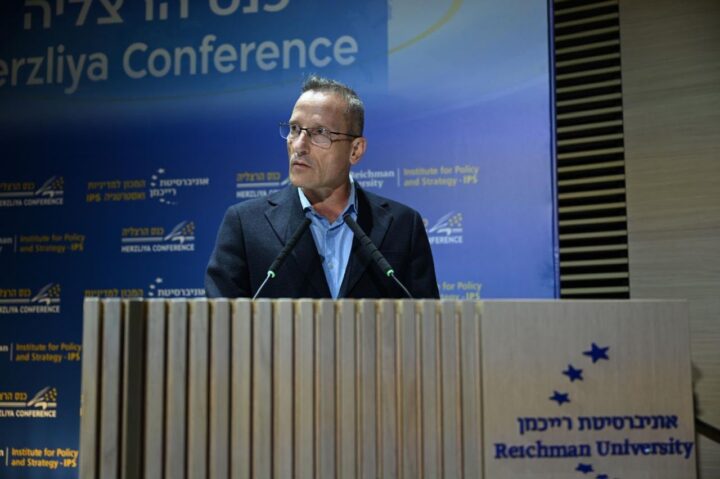
Maj. Gen. (res.) Amir Baram, director general of Israel’s Ministry of Defense, speaks at the Herzliya Conference at Reichman University on July 1, 2026.
The director general of Israel’s Ministry of Defense, Maj. Gen. (res.) Amir Baram, urged Israelis on Wednesday to understand Washington’s perspective as the U.S. and Israel negotiate the next memorandum of understanding, cautioning against judging American policy through a purely “provincial lens.”
“What some in Israel perceive as weakness or folly, an apparent disregard for every warning sign on the ground, is viewed in Washington as cold, calculated and clear-eyed risk management in an era of shifting global attention,” he said at the annual Herzliya Conference at Reichman University.
The divergence between the two allies, he concluded, is not a misunderstanding of the fundamental threat, but rather a byproduct of different national security priorities.
“For us, Iran is an existential threat; for the United States, it is a chronic regional challenge, while China and the Indo-Pacific theater remain the core concern,” Baram said. “We think Tehran, they think Taiwan.”
“At the same time, based on my deep familiarity with the range of views within the American system, if there is one thing Americans hate more than this war that has dragged on for them, it is losing a campaign they have already won,” he added of the conflict with Iran.
Ultimately, Baram asserted that as Washington increasingly operates under an “America First” framework, the historic bilateral relationship must pivot toward concrete, mutually beneficial strategic dividends.
“Our partnership cannot rest on shared values alone. It must also rest on hard interests: a strong, independent, and proactive Israel that stabilizes the Middle East is the very asset that allows the United States to redirect resources toward Asia,” Baram stated. “This is the foundation of the next memorandum of understanding on security cooperation now being formulated. The agreement will need to generate security, economic, and strategic benefits for both countries for years to come.”
The director general also noted that he understands the differing strategic realities in Washington, including a growing American desire to avoid prolonged Middle East entanglements while prioritizing competing global theaters.
“From the Pentagon’s perspective, with American munitions stretched between supporting current wars and preparing for a potential confrontation in the Taiwan Strait, a prolonged war in the Middle East runs counter to America’s global posture,” Baram observed.
Baram emphasized that the war with Iran has fundamentally transformed Jerusalem’s strategic military calculus, warning that an escalating Iranian threat necessitates a sweeping, expanded regional security alliance.
“The war has sharpened, for every actor in the region, the price of Iran’s military buildup,” Baram said. “It has created a shared interest in forging a broader alliance, from India through the UAE to Greece and Cyprus. Israel’s strengths in technology, proven operational experience, and defense innovation, combined with the Gulf’s financial power, could enable a new security-economic front.”
Baram said that building these alternative multilateral partnerships is “not a substitute” for Israel’s bedrock security relationship with the United States. Rather, he argued, the strategy allows Israel to “broaden its room to maneuver and its standing on the international stage, and allow us to diversify our strategic footing.”
Mark Dubowitz and Karim Sadjadpour held opposing views but agreed that the MOU is ‘fatally flawed’ and favors Iran
Screenshot/YouTube
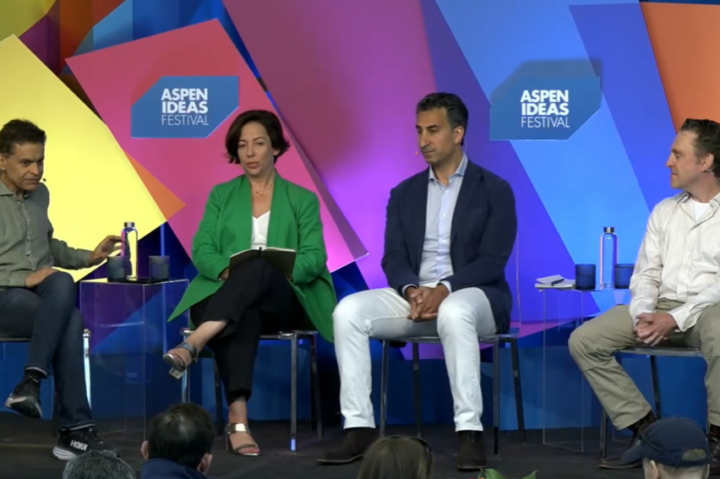
Karim Sadjadpour, Mark Dubowitz and Kim Ghattas speak at the Aspen Ideas Festival with CNN's Fareed Zakaria.
Top Middle East analysts — including the Carnegie Endowment’s Karim Sadjadpour and Foundation for Defense of Democracies’ Mark Dubowitz — offered starkly different takes on whether the United States or Iran has emerged in a stronger strategic position following the recent U.S.-Iran conflict, yet shared a deeply critical view of the preliminary memorandum of understanding brokered between Washington and Tehran.
Speaking on Monday at the Aspen Ideas Festival in Colorado during a panel discussion moderated by CNN’s Fareed Zakaria, Sadjadpour, a senior fellow at the Carnegie Endowment for International Peace, argued that Tehran successfully leveraged the crisis to its advantage.
“Iran is in a much better place now than it was four months ago, before the war,” Sadjadpour said. “I think the biggest advantage they now have is controlling the Strait of Hormuz. They want to try to turn it, if not into the Panama Canal, at least have administrative control over it.”
Sadjadpour expressed deep skepticism that the Islamic Republic has any intention of making the fundamental concessions that the Trump administration has long demanded.
“I don’t think that they plan to make any meaningful compromises on the points which President Trump hoped to advance before the war, which is their nuclear program, their missile program, their regional proxies,” Sadjadpour said. “If you read that memorandum of understanding, which I call a ‘memorandum of misunderstanding,’ the two sides have very different takeaways from that. Really, the only thing it asks of Iran is a vague nuclear compromise, but it concedes the idea that after 60 days, perhaps they could control the strait. There’s nothing in there about missiles or proxies.”
Sadjadpour added that the conflict has inadvertently reinvigorated an Iranian regime that had otherwise appeared to be buckling under domestic dissent prior to the outbreak of hostilities.
“Four months ago, I used to describe the Islamic Republic as a zombie regime with a dying ideology, a dying leader, and dying legitimacy,” he observed. “I fear, at least in the immediate term, that we’ve kind of breathed new life into this zombie regime. It has a newfound self-confidence.”
He noted that while the war and protests among the Iranian public should have forced Tehran to rethink its priorities, the regime ultimately drew the wrong conclusions from the conflict.
“A lot of governments would say, ‘You know what? It is time for us to prioritize our economic and national interests first, instead of our ideology being death to America and death to Israel’ — which has gotten them into two catastrophic wars and triggered continuous popular uprisings,” Sadjadpour said. “But I actually think the regime has reached the opposite conclusion: that revolutionary ideology is not an albatross around the neck that’s going to sink the regime, it’s actually proven to be a life preserver, and we’re going to double down on it.”
Veteran Middle East journalist Ghattas similarly argued that the war has not led to a favorable outcome for the U.S. and has left the Iranian people in a worse position.
“I don’t see yet how this leads us to a better place in the region, and there’s a sense of despair in Iran,” Ghattas said. “It’s hard to get access to voices in Iran, but I think people feel betrayed.”
She added, however, that Tehran did suffer some losses, including that its “regional project has been severely damaged.” Ghattas also notedthat Iran has “lost their foothold in Syria.”
Offering an opposing perspective, Dubowitz, CEO of FDD, countered that Tehran has actually suffered an unprecedented, devastating strategic and military defeat.
“The United States of America is winning, Israel is winning and the Islamic Republic of Iran is losing,” Dubowitz insisted, pointing to the physical damage inflicted on Iran’s sensitive facilities.
“Their nuclear infrastructure is severely degraded, the top 40 of their nuclear weapons scientists have been eliminated, and their nuclear sites are in ruins, with nuclear dust under the rubble,” Dubowitz added. “Their nuclear program has been set back by years, and their missile program has been severely curtailed.” Iran’s intercontinental ballistic missile program, he argued could have allowed Tehran to target America, is “obliterated.”
But Dubowitz agreed that the White House squandered its upper hand by rushing into a substandard diplomatic framework.
“Why would you take that incredible military leverage and negotiate a fatally flawed MOU, which looks like it was written by the Qataris, written by the Iranians, and translated by ChatGPT into English?” Dubowitz asked. “It’s a terrible agreement. Why would you squander all that leverage at the negotiating table?”
According to Dubowitz, the driving force behind the agreement stemmed from domestic political pressures rather than long-term geopolitical strategy. Trump, he argued, felt compelled to secure a quick pause in hostilities to stabilize the U.S. economy ahead of the upcoming midterm elections.
“Why? Because Trump needs to hold the House, he needs to hold the Senate, he needs to punt to November,” Dubowitz said. “He needs to open Hormuz, he needs to get gasoline and oil prices down, inflation down, and punt to November. And then he’s got two years and three months to double down on his Iran strategy” until his term is over.
“I think what Trump did is he realized ‘I have serious leverage, but I have a time issue,’” he continued. “So two parties are going in for an MOU, neither believes that either party is going to comply with it, and for their own reasons they need to hit the pause button.”
Sadjadpour noted, however, that those within the president’s inner circle remain deeply divided over whether the current diplomatic pause represents a genuine policy shift or a mere tactical intermission.
“When you talk to people who are in daily contact with the president, they will tell you very different things about where his mind is on this,” Sadjadpour said. “Some will tell you that this MOU was just temporary, don’t take it that seriously — ‘We needed to bring down the price of oil, and if within two months the Iranians are not playing ball, he’ll go back to the blockade or back to bombing.’ I speak to other people who are in daily contact with the president who say no, he’s done with Iran.”
Plus, Bruce Pearl's warning to JD Vance

Photo by Michael Ciaglo/Getty Images
Democratic congressional candidate Melat Kiros speaks to supporters at an election-night watch party after winning the Colorado primary on June 30, 2026 in Denver, Colorado.
Good Wednesday morning.
In today’s Daily Kickoff, we cover the results of yesterday’s Democratic primaries in Colorado, where the momentum for far-left, anti-Israel candidates in the party continued. We talk to House Democrats about whether they think Israel’s right to exist in safety and security should continue to be a policy position of their party and highlight the division within their party over a push by Rep. Thomas Massie (R-KY) to slash $3.3 billion in military aid the U.S. is set to provide Israel. We also report on a failed effort, which most House Democrats voted for, to block U.S. support for Israeli operations against Hezbollah. Also in today’s Daily Kickoff: Ellie Cohanim, Bruce Pearl and Mark Isakowitz.
Today’s Daily Kickoff was curated by JI Israel Editor Tamara Zieve and U.S. Editor Danielle Cohen-Kanik with an assist from Marc Rod. Have a tip? Email us here.
What We’re Watching
- Technical delegations from the U.S. and Iran are meeting separately with Qatari and Pakistani mediators in Doha, but have no plans to meet directly. A senior Iranian official told Reuters that the focus of the discussions is the release of Tehran’s frozen funds and the Strait of Hormuz, while President Donald Trump indicated on Monday that the negotiations would focus on Iran’s nuclear program.
- The Wall Street Journal reveals that after Saudi Arabia blocked U.S. military access needed for Project Freedom — Trump’s operation to crack open the Strait of Hormuz — and prompted the White House to threaten to withhold missile interceptors from the kingdom, the confrontation triggered a widening rift in the U.S.-Saudi relationship, with the U.S. now considering reducing its military footprint in the kingdom. Secretary of State Marco Rubio visited the Gulf last week but skipped a visit to Saudi Arabia; the week before, Saudi Crown Prince Mohammed bin Salman declined an invitation to attend the G7 summit in France, reportedly in protest of the U.S.’ handling of the war with Iran.
- Some of the most prominent figures in U.S.-Israel diplomacy, Israeli national security and the American Jewish community are gathering at Bar-Ilan University in Ramat Gan, Israel, to help train a new generation of leaders confronting Israel’s evolving strategic challenges, as part of a pilot program that ends on Thursday. Among the faculty is former Ambassador Dennis Ross, the veteran Middle East negotiator who advised four U.S. presidents; Howard Kohr, the former longtime executive director of AIPAC; and Malcolm Hoenlein, who for decades served as executive vice chairman of the Conference of Presidents of Major American Jewish Organizations. Read more in eJewishPhilanthropy.
- The Herzliya Conference wraps up today in Israel: Among the many top national security and political officials speaking are former Prime Ministers Naftali Bennett and Yair Lapid; former Israeli Ambassadors to the U.S. Danny Ayalon and Michael Herzog; former U.S. Ambassador to Israel Dan Shapiro; EU Ambassador to Israel Michael Mann; Yashar party leader Gadi Eisenkot; Yisrael Beiteinu party leader Avigdor Liberman; Democrats party leader Yair Golan; Ra’am party leader Mansour Abbas; and Nadav Tamir, executive director of J Street Israel.
- And the Aspen Ideas Festival concludes today in Colorado. Jeff Flake, the former U.S. senator and former U.S. ambassador to Turkey; the Atlantic Council’s Ian Brzezinski; and the Stimson Center’s Emma Ashford will speak on a panel about the “next chapter of the trans-Atlantic relationship.”
What You Should Know
A QUICK WORD WITH JI’S JOSH KRAUSHAAR
Progressives in Colorado scored a number of key victories Tuesday night, including Democratic Socialists of America-aligned candidate Melat Kiros’ defeat of Rep. Diana DeGette (D-CO) in the state’s 1st Congressional District.
The Colorado results suggest that, far from being contained to a few scattered congressional districts in New York City, the momentum for far-left, anti-Israel candidates is only growing within the Democratic Party, especially within urban population centers.
Kiros, a 29-year-old doctoral student, campaigned on her hostility to Israel and faced scrutiny when she declined to call the firebombing attack on a hostage awareness march in Boulder, Colo., antisemitic. DeGette, despite a long-standing progressive record in Congress, struggled to satisfy a critical mass of Democratic voters who preferred a more radical choice, especially when it came to opposing Israel.
Sen. John Hickenlooper (D-CO) survived a scare from a little-known socialist challenger, state Sen. Julie Gonzales, but only won renomination with less than 60% of the Democratic vote. Even in the vote-rich Denver suburbs, the far-left challenger came within striking distance of the state’s well-known senator and former governor.
Former state Rep. Shannon Bird, a moderate championed by Democratic Majority for Israel, lost badly to state Rep. Manny Rutinel for the Democratic nomination in Colorado’s swing 8th District, currently held by Rep. Gabe Evans (R-CO). With most votes counted, Rutinel holds a 28-point lead over Bird, 62-34%.
PLATFORM PUNT

The official 2024 Democratic Party Platform, released by the DNC for former President Joe Biden and former Vice President Kamala Harris, stated that party leaders “believe a strong, secure, and democratic Israel is vital to the interests of the United States” and that the party’s “commitment to Israel’s security, its qualitative military edge, its right to defend itself … is ironclad.” Several House Democrats, including in leadership and top progressives, however, remain divided or noncommittal over whether Israel’s right to exist in safety and security should continue to be a policy position of the Democratic Party, Jewish Insider’s Matthew Shea reports.
What they’re saying: When asked on Tuesday whether support for Israel’s right to exist in safety and security should continue to be an official policy position of the Democratic Party moving forward, House Minority Leader Rep. Hakeem Jeffries (D-NY) instead told JI that Democrats are “continuing to focus on driving down the high cost of living, fixing our broken healthcare system and cleaning up corruption in an environment where the Trump cartel is the most corrupt administration in American history.” Rep. Alexandria Ocasio-Cortez (D-NY) also did not provide a concrete answer, telling JI she is “less concerned with slogans” and more interested in “what it would mean in terms of policy.”
Read the full story here with additional comments from Reps. Greg Casar (D-TX), Pete Aguilar (D-CA), Jamie Raskin (D-MD) and Jim McGovern (D-MA).
Breaking away: Rep. Rosa DeLauro (D-CT), the ranking Democrat on the House Appropriations Committee, said she’ll no longer accept support from AIPAC, a major break with the pro-Israel group by one of the key power players in the House, JI’s Marc Rod reports.
DEM DEBATE
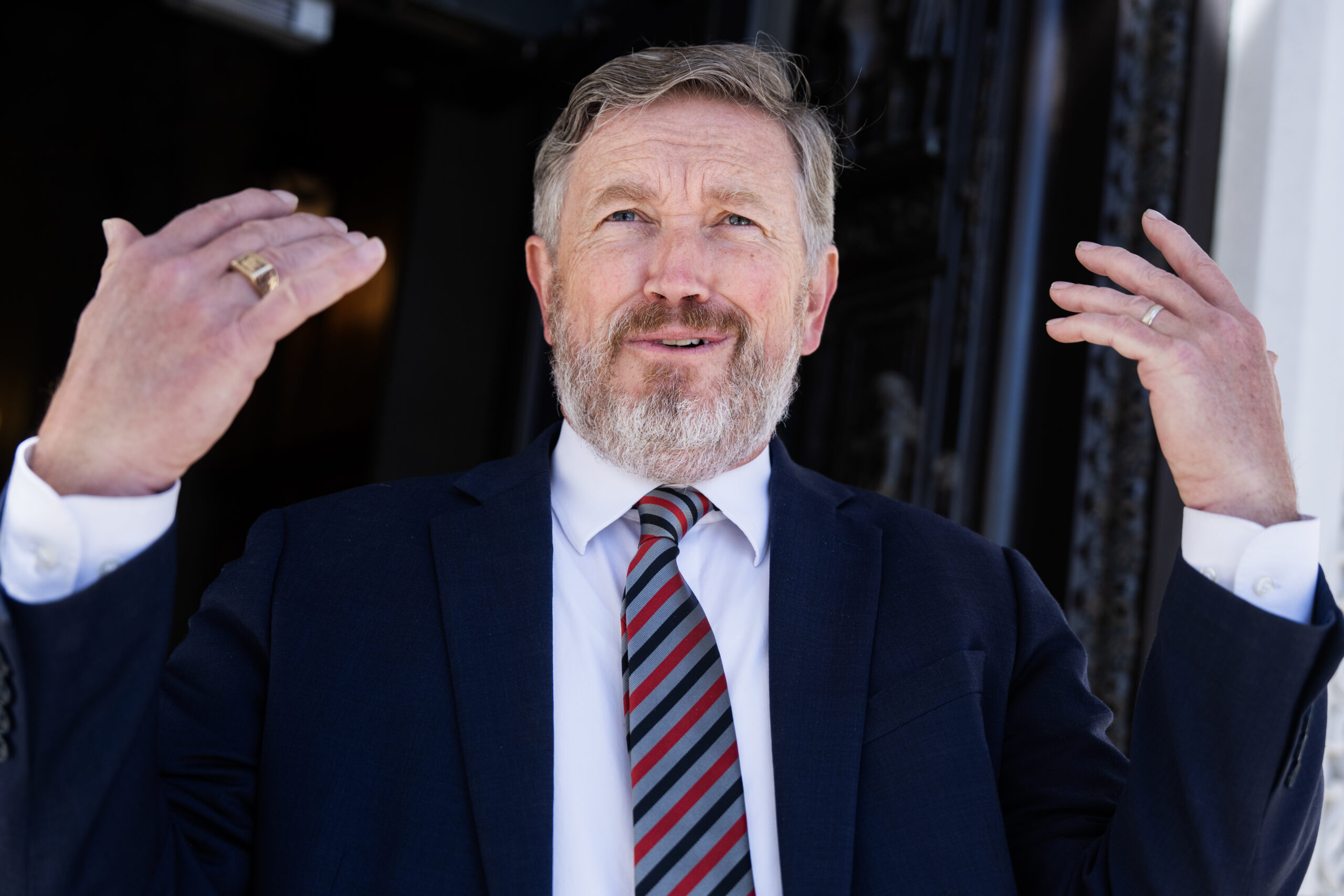
House Democrats remain divided over a push by Rep. Thomas Massie (R-KY) to slash $3.3 billion in military aid the U.S. is set to provide Israel in the 2027 State Department funding bill, and top Democratic leaders are continuing to keep their own positions vague, Jewish Insider’s Marc Rod reports. Consideration of the amendment is now delayed until at least July 13, after hard-right Republicans again brought proceedings on the House floor to a halt.
Where things stand: House Democratic leaders on Tuesday declined to say how they plan to vote or advise other members to vote following a closed-door caucus meeting. Minority Leader Hakeem Jeffries (D-NY) said, “Those conversations are ongoing,” while No. 3 House Democrat Rep. Pete Aguilar (D-CA) suggested that U.S. “aid and support” for Israel may not “go on forever.” Meanwhile, Rep. Jim Himes (D-CT), the top Democrat on the Intelligence Committee, joined colleagues on other national security committees in saying he’ll oppose the amendment, but progressive leaders maintained that many members will support the effort.
War powers play: Nearly all House Democrats voted for a war powers resolution on Tuesday that aimed to block U.S. support for Israeli operations against Hezbollah in Lebanon, though the legislation failed to secure a House majority, with nearly all Republicans and 22 Democrats voting against the measure.
RED SCARE
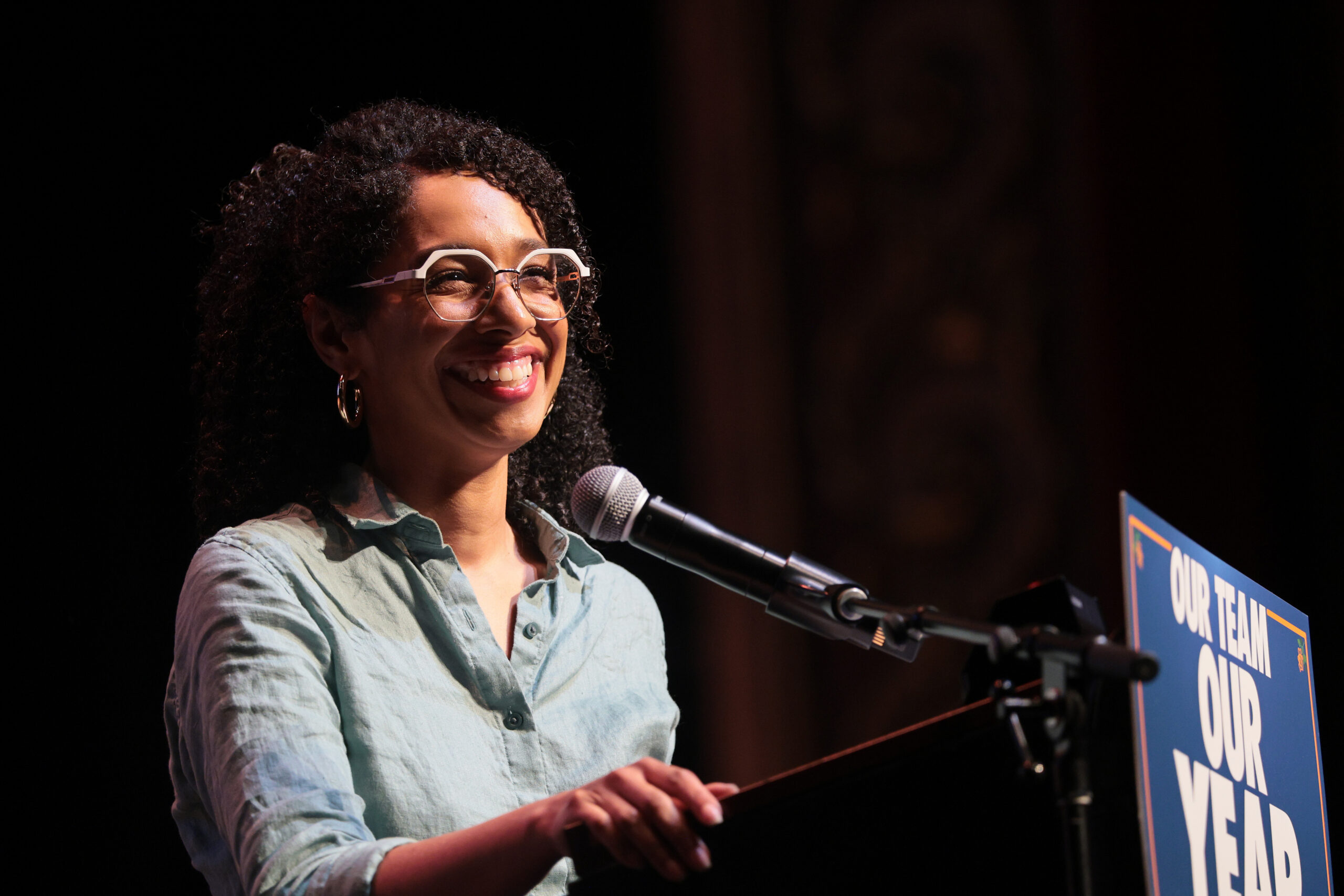
Asked about New York City congressional candidate Darializa Avila Chevalier’s reported past comments supporting communism, House Democratic leaders suggested this week that she had changed and moderated her views,Jewish Insider’s Marc Rod reports.
Jeffries’s defense: House Minority Leader Hakeem Jeffries (D-NY) said, when asked about Avila Chevalier’s previous comments supportive of communism, that Avila Chevalier is “going to have to speak for herself in terms of what she said in the past” but said she has been “pretty clear that she’s walked away from many of the things that have been unearthed, and has pretty clearly indicated that she’s a different person, but that’s for her, ultimately, to communicate, and I’m confident that she will, as best she can.”
Party problem: New York City Council Speaker Julie Menin — the first Jewish person to hold her role — slammed a newly elected Brooklyn Democrat’s promotion of antisemitic conspiracy theories, but declined to call her commentary disqualifying, JI’s Will Bredderman reports.
BORN IN THE USA
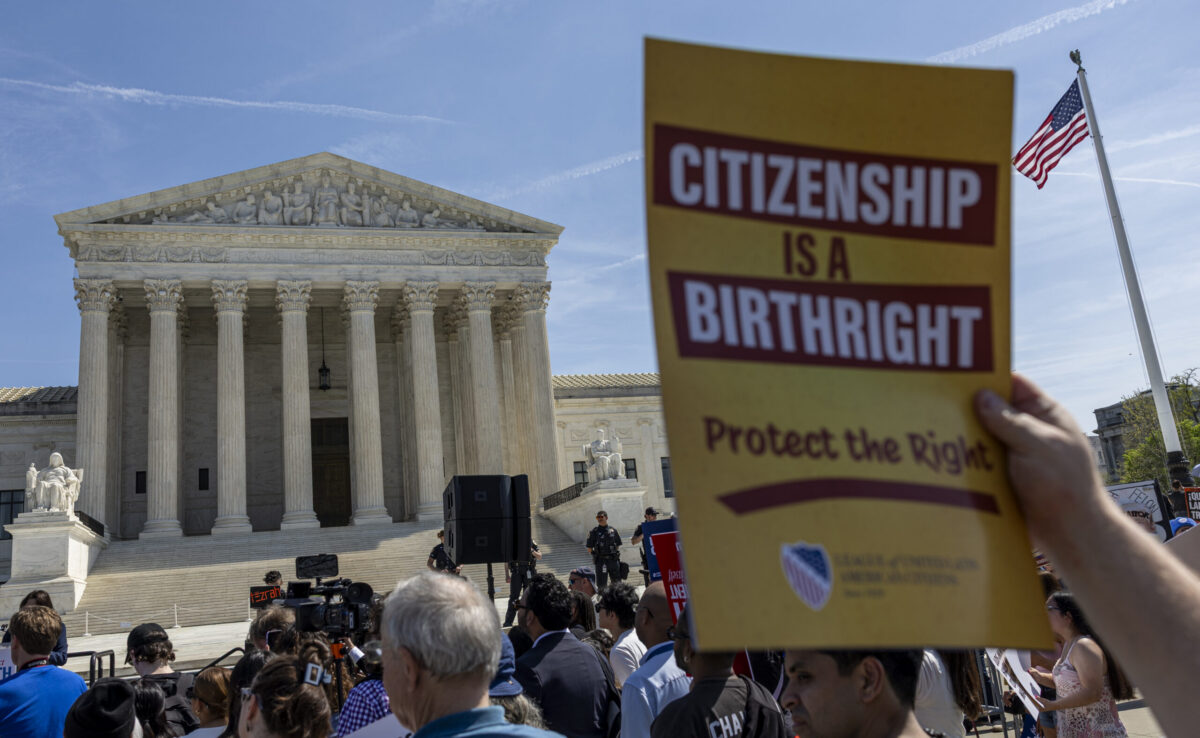
Several Jewish groups celebrated the Supreme Court’s decision on Tuesday to uphold birthright citizenship and strike down a Trump administration executive order that aimed to eliminate citizenship for children of undocumented immigrants and those in the U.S. on temporary visas, Jewish Insider’s Marc Rod reports.
Weighing in: The American Jewish Committee, HIAS and the Religious Action Center of Reform Judaism all joined an amicus brief against the executive order with various other religious groups, and praised the Supreme Court’s decision. The National Council of Jewish Women and Jewish Council for Public Affairs also weighed in in support of the justices’ ruling.
PEARL OF WISDOM
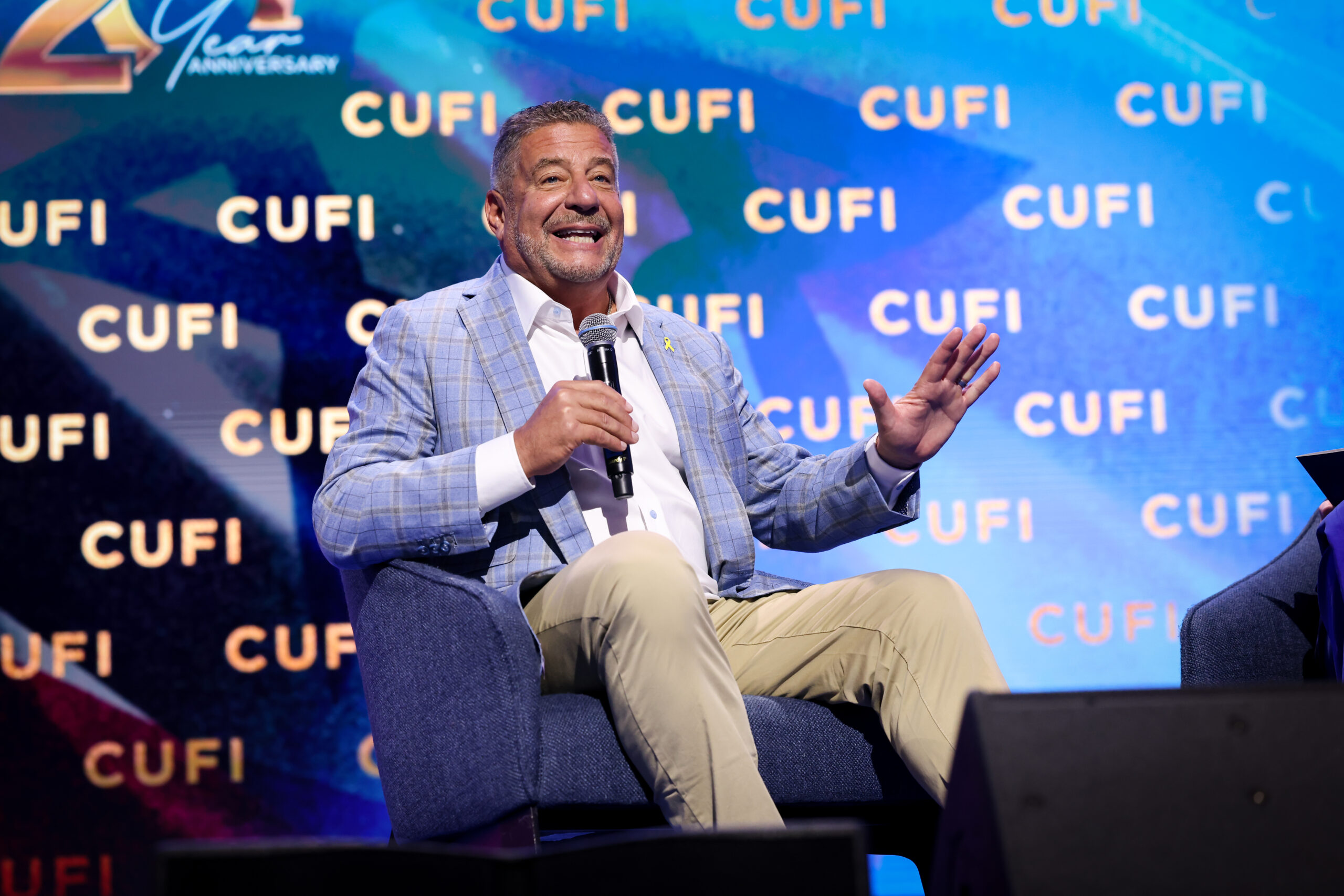
Bruce Pearl, the veteran former Auburn University men’s basketball coach, told Jewish Insider’s Emily Jacobs that Vice President JD Vance needs to “make a decision” about his continued association with far-right commentator Tucker Carlson, warning that his support of Vance’s expected 2028 presidential bid will be contingent on the vice president severing ties with the antisemitic podcaster.
‘Enemies of the state’: Pearl, who is currently splitting his time between pro-Israel political advocacy and serving as an analyst for TNT and CBS Sports, made the comments in an interview with JI on Monday while discussing the rise of right-wing antisemitism and the prominence of Carlson, neo-Nazi Nick Fuentes and other commentators who promote antisemitic ideas within the America First right-wing movement. Pearl argued that Carlson and Fuentes “are absolutely enemies of the state. What they’re doing is treasonous, it’s disgusting and it’s not based on fact. It’s based on lies and propaganda and antisemitism. They’re bought and paid for, but they’ve got huge followings.”
COHANIM COMEBACK
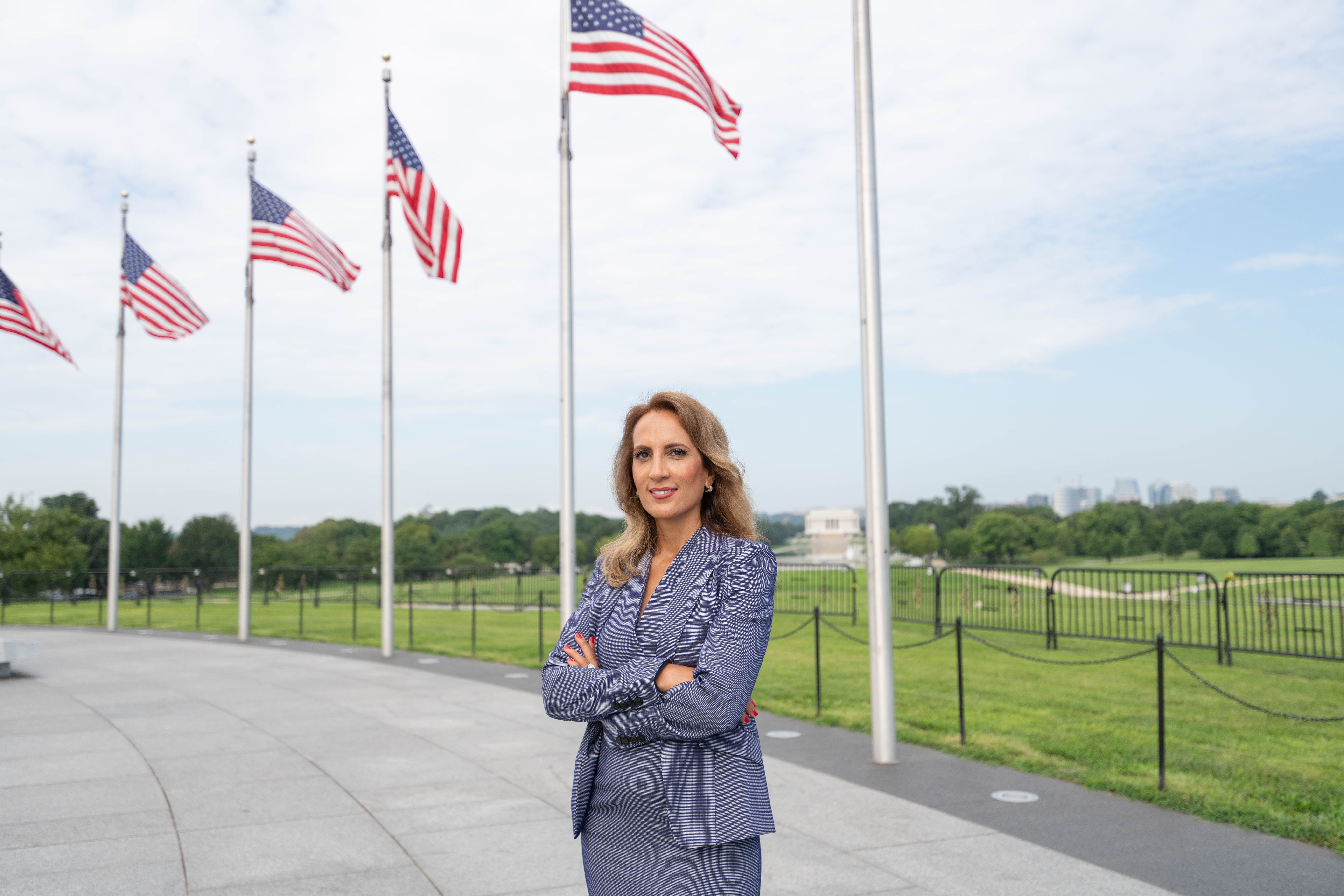
Ellie Cohanim, who served as deputy special envoy to monitor and combat antisemitism in President Donald Trump’s first term, recently joined his administration as a senior policy advisor to U.S. Ambassador to the U.N. Mike Waltz, Waltz announced on Tuesday, Jewish Insider’s Gabby Deutch reports. Cohanim was born in Tehran and left Iran as a child in 1979, following the Islamic Revolution. She came with her family to New York.
Waltz’s words: “Ellie’s story is the American story,” Waltz said in a statement. “Her family fled persecution in Iran, built a life in New York, and she has spent her career looking for ways to serve America, fighting for freedom, standing with the persecuted, and calling out antisemitism wherever it hides. That is exactly the kind of conviction and courage we need at the United Nations.”
Scoop: As Washington prepares to host a weekend of July Fourth hoopla on the National Mall, senior Trump administration officials, diplomats and Jewish communal leaders will gather on Friday evening across from the Lincoln Memorial for a Shabbat dinner celebrating America’s 250th birthday.
Worthy Reads
When the DSA Came for Lander: Park Avenue Synagogue Rabbi Elliot Cosgrove penned a letter dated two years from now, published in the New York Daily News, to New York Democratic congressional nominee Brad Lander, predicting that he will be ousted by a Democratic Socialists of America-backed candidate in the next primary. “They told you it was never about being a Jew — only about being a Zionist — as if the two could be peeled apart, as if your Jewishness had nothing to do with the nation they demanded you disown. There’s an old teaching about the man who thinks he can ride the tiger and dismount whenever he likes. You didn’t tame the coalition you joined. You were, for one term, useful — until the moment it decided to disown you. You could renounce the policy, the lobby, even Zionism, but you could not renounce being a Jew.” [Daily News]
Drone Prone: Foreign Policy’s John Haltiwanger unpacks Israel’s “Hezbollah drone problem.” “After the fighting resumed in March, it wasn’t long before explosive drones were a leading cause of battlefield deaths for Israel in Lebanon. As a result, Netanyahu established a team of experts to address the issue and pledged to give the IDF an unlimited budget to address the Hezbollah drone threat. But there are no simple solutions. … In ancient Rome, gladiators used nets to entangle opponents before moving in for the kill. Today, Israeli troops are using the same primitive tool to defend against drones and intercept them before they reach their targets. The situation is indicative of how militaries have struggled to find countermeasures to drones and have been forced to adapt, particularly as the technology evolves at such a rapid pace.” [FP]
Separate But Equal: Hannah Rosenthal, former special envoy to monitor and combat antisemitism under the Obama administration, argues in the Jewish Telegraphic Agency against the proposal of combining the role of the antisemitism envoy with that of the special envoy on Holocaust issues. “The office of special envoy on antisemitism and the special envoy on the Holocaust are complementary, but not duplicative. The former works to address contemporary antisemitism, hate crimes, extremism and government policy around the world. The latter focuses on historical justice, restitution, remembrance, archives and Holocaust-era accountability. The United States deliberately created separate offices because both missions are full time responsibilities.” [JTA]
Jews Turning on Israel: Actor and Jewish commentator Jonah Platt argues in a post on X against the trope of the young, “self-hating” Jew in an essay on X. “It’s maddening. It’s dangerous. It’s irresponsible. It’s shameful. But it isn’t nefarious. It isn’t Jew-hatred, it isn’t self-hatred, and honestly, it isn’t that hard to understand. These are disconnected, uneducated people, surrounded by like-minded peers, all reinforcing one another in a disconnected, uneducated worldview — one they’re not especially invested in anyway, and focus on only because progressive society says they’re supposed to.” [X]
Word on the Street
President Donald Trump is considering returning to a full-scale military conflict with Iran and has discussed the idea with Defense Secretary Pete Hegseth and Joint Chiefs Chairman Dan Caine in recent days, The Wall Street Journal reports, but has decided to continue on the diplomatic track for now…
In an analysis of the U.S.-Iran memorandum of understanding, the Foundation for Defense of Democracies found that the Trump administration is “evidently not applying [the 2015 Iran Nuclear Agreement Review Act’s] requirements and restrictions to the MOU, apparently on the basis of an opinion from the Department of Justice,” but the White House and DOJ “have apparently not shared this surprising opinion, or its arguments, with either Congress or the public”…
Homeland Security Secretary Markwayne Mullin said on Monday that he did a “happy dance,” after Iran was knocked out of the FIFA World Cup, telling reporters that Iranian officials tried to bring into the U.S. individuals with ties to the Islamic Revolutionary Guard Corps and that accommodating the team while protecting national security had demanded incomparable attention…
The Terrorist Financing Targeting Center — a coalition comprised of Bahrain, Kuwait, Oman, Qatar, Saudi Arabia, the UAE and the U.S. — announced joint sanctions against five entities and 16 individuals tied to Hezbollah’s financial network…
Oman has submitted a proposal to the U.S. for Muscat and Tehran to collect service fees from shipping companies seeking to transit the Strait of Hormuz, according to The New York Times. One of Iran’s deputy foreign ministers, Kazem Gharibabadi, said on Monday if Iran was unable to come to an arrangement with Oman it would move forward on its own…
A person close to the anti-Israel American Priorities super PAC told CNN many of its contributors weren’t very politically active until New York City Mayor Zohran Mamdani’s campaign victory, which was the “moment that inspired them and brought them into the fold”…
Former Vice President Kamala Harris called Mamdani last week, and is holding lengthy, closed-door meetings with Palestinian activists in the run-up to a possible presidential campaign, Axios reports…
Rep. Dan Goldman (D-NY), speaking to CNN’s Jake Tapper, warned of the “tremendous danger and fear” for American Jews as they are being “dehumanized” and antisemitism is “becoming normalized”…
Phylisa Wisdom, the liberal activist appointed by New York City Mayor Zohran Mamdani as executive director of his Office to Combat Antisemitism, got a harsh reception at a Holocaust memorial event in Brooklyn on Sunday. Video from the event shows a small group of hecklers booing, calling Wisdom a “kapo” and shouting that she was supportive of Adolf Hitler, JI’s Will Bredderman reports…
Far-left Michigan Senate candidate Abdul El-Sayed dismissed a question on CNN about the Democratic Party’s “embrace” of antisemitic streamer Hasan Piker as a “ridiculous way to think about politics”…
Adam Jentleson, former chief of staff to Sen. John Fetterman (D-PA) who went on to found the center-left Searchlight Institute think tank, urged Democrats to “just say no to AIPAC,” arguing the pro-Israel organization has “evolved from a group to a ‘Group,’” in the pejorative sense…
Israeli Prime Minister Benjamin Netanyahu visited southern Lebanon on Tuesday for the first time since the U.S.-brokered security agreement was signed last Friday. Netanyahu told IDF troops, “We will not leave southern Lebanon until the threat is removed”…
“Pod Save America” co-host Jon Lovett said the harassment of California state Sen. Scott Wiener at a transgender pride march last week was “as pure antisemitism as you can see”…
The Supreme Court agreed to hear the case of Daniel Grand, an Orthodox Jewish man from Ohio who was barred from holding Shabbat prayer meetings in his home without a “special use permit” and later faced harassment from city officials who encouraged neighbors to watch his home for signs of religious activity…
Haaretz tracks the carbon footprint of FIFA President Gianni Infantino as he has traveled between World Cup matches across North America on a Qatari private jet, racking up 47,337 kilometers (29,000 miles) from the tournament’s opening days through the first knockout match, after championing the body’s sustainability strategy…
Ellie Gottheimer and Larra Mullin, the children of Rep. Josh Gottheimer (D-NJ) and Homeland Security Secretary Markwayne Mullin, are releasing Shmoo & Ozzie Go to Washington today, a children’s book on bipartisanship. Proceeds from the book will go to support homeless children…
Mark Isakowitz, Sen. Dave McCormick (R-PA)’s chief of staff, is set to release a book in January about his personal journey following the loss of his father, who immigrated to America after surviving Auschwitz, and Isakowitz’s daily practice of reciting the mourner’s prayer at a synagogue in Washington, JI’s Gabby Deutch reports…
Axel Springer CEO Mathias Döpfner tapped Carolin Hulshoff Pol to serve as CEO of Telegraph Media Group following the German media company’s completion of its £575 million acquisition of the British publisher, ending a three-year ownership transition…
Former Israeli Air Force Commander Maj. Gen. (res.) Amikam Norkin is a leading candidate to head Anduril’s operations in Israel, as the American defense tech company explores a major expansion into the Israeli market, Calcalist reports…
The Iranian regime plans to take over St. Peter Evangelical Church, the oldest Protestant church in Iran, and evict the 20 families living there, The Free Press reports. The theocratic regime had thus far left it alone in fear of the U.S.’ retaliation, according to the outlet…
The Washington State Democratic Party adopted into its platform during its June convention an amendment blaming the “dramatic resurgence in antisemitism … in part [on] actions taken by the Israeli government,” Jewish News Syndicate reports…
Pentagon official Jason Olson has departed his position as the director of deradicalization for the Gaza Board of Peace, an official from the body told The Times of Israel, as the BoP is convening for discussions in Cyprus…
Tuesday marked the end of Steffen Seibert‘s four-year term as German ambassador to Israel. In a farewell social media video, he paid tribute to the country by listing 25 things he will miss. Seibert is succeeded by Alexander Graf Lambsdorff, who most recently served as the German Ambassador to Moscow…
Judah Gribetz, who as a top aide to Gov. Hugh Carey helped negotiate New York City‘s rescue from financial collapse in the 1970s and later devised a distribution plan for $1.25 billion in restitution to Holocaust survivors in a landmark class-action suit against Swiss banks, died Friday at 97…
Pic of the Day

Comedian Judy Gold spoke at an event hosted by the Israeli Embassy in Washington, “A Zionist LGBTQ+ Celebration,” at Adas Israel Congregation on Tuesday — a night of solidarity in memory of Sarah Milgrim, the embassy staffer murdered alongside her partner, Yaron Lischinsky, outside the Capital Jewish Museum in May 2025. Milgrim spent her time at the embassy building bridges between Israel and marginalized communities, including D.C.’s LGBTQ+ Jewish community.
Birthdays

Television, film and theater actor, including early career roles in Yiddish theater, Michael Burstein turns 81…
Applied mathematician, statistician and physicist, professor emeritus at both MIT and Harvard, Herman Chernoff turns 103… Former U.S. assistant secretary of education and former research professor at NYU, Diane Silvers Ravitch turns 88… Nobel laureate in economics for 1997 and co-creator of the Black-Scholes model for valuing options and other derivatives, Myron Scholes turns 85… Noted British art dealer and founder of an eponymous London art gallery, Victoria Marion Miro turns 81… Born in a DP Camp to her Holocaust survivor parents, she was the first Jewish woman to serve on the Canadian Supreme Court, Rosalie Silberman Abella turns 80… Israeli-Russian businessman, with holdings in energy and international real estate development, Shalva Chigirinsky turns 77… Partner in the Encino, Calif.-based law firm of Nolan Heimann, Douglas E. Mirell… Campaign, communications and fundraising consultant, Robert Kaplan turns 69… Hall of Fame player and coach in the WNBA and now an NBA broadcaster, Nancy Lieberman turns 68… Attorney and longtime Democratic activist in Pittsburgh, he is a regional chair of the ADL, Steven D. Irwin turns 67… Senior columnist at The Forward and former CEO of the A-Mark Foundation, Rob Eshman… President emeritus of the Orthodox Union and a retired partner at Ropes & Gray, Mark “Moishe” Bane… Under secretary of state for political affairs during most of the Biden administration, Victoria Jane Nuland (family name was Nudelman) turns 65… Journalist, filmmaker and educator, he is the co-founder of Aish[dot]com, Shraga Simmons turns 65… Professor of Jewish thought at Hebrew University, Benjamin Brown turns 60… Member of the Virginia House of Delegates since 2014, Marcus Bertram Simon turns 56… U.S. senator (R-IA), Joni Ernst turns 56… Screenwriter, producer and film director known for romantic comedy films, Marc Silverstein turns 55… Los Angeles resident, Adam B. Siegel… NASA astronaut, on her 2019 trip to the International Space Station she took novelty socks with Stars of David and menorahs, Jessica Meir turns 49… Co-founder of Edgeline Films, Elyse Steinberg… Hasidic musician mixing elements of dancehall, reggae, hip-hop and R&B, known by his stage name DeScribe, Shneur Hasofer turns 44…
Jeffries said Avila Chevalier has ‘walked away from many of the things that have been unearthed’ following a CNN report on her past sympathetic posts about communism and Soviet figures
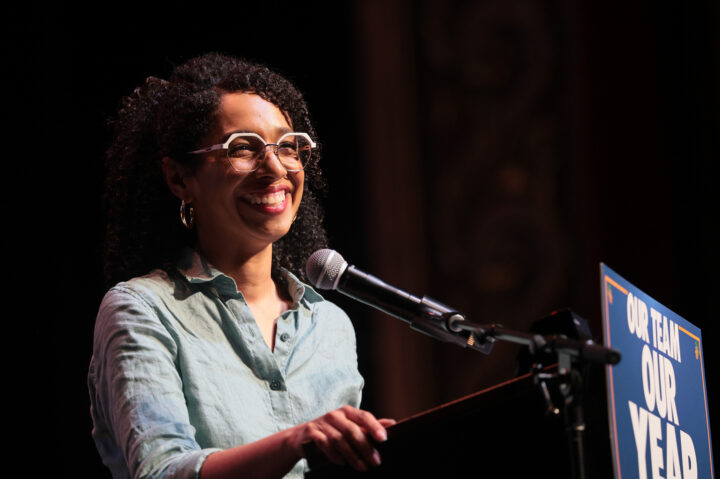
Photo by Michael M. Santiago/Getty Images
Congressional candidate Darializa Avila Chevalier speaks at a rally at King's Theater on June 18, 2026 in New York City.
Asked about New York City congressional candidate Darializa Avila Chevalier’s reported past comments supporting communism, House Democratic leaders suggested this week that she had changed and moderated her views.
CNN reported earlier this week that Avila Chevalier had repeatedly shared on a now-deleted Twitter account sympathetic posts about communism, Marxism and Soviet figures including revolutionary Vladimir Lenin. In an MS NOW interview on Monday, she denied being a communist and said that scrutiny of her past comments is a “distraction.”
Asked about the CNN report and whether communists have a place in the Democratic caucus, House Minority Leader Hakeem Jeffries (D-NY) said, “I don’t think there’s a single member of the House Democratic Caucus right now that identifies as communist.”
He said that Avila Chevalier is “going to have to speak for herself in terms of what she said in the past” but said she has been “pretty clear that she’s walked away from many of the things that have been unearthed, and has pretty clearly indicated that she’s a different person, but that’s for her, ultimately, to communicate, and I’m confident that she will, as best she can.”
Jeffries then pivoted to discussing affordability issues.
Rep. Pete Aguilar (D-CA), the No. 3 House Democrat, offered a similar response, telling Jewish Insider that he is personally a capitalist and that New York City Mayor Zohran Mamdani had indicated that some of the candidates he endorsed, including Avila Chevalier, had changed their views. He said that he would give all of the incoming members a “clean slate” as they enter the House.
Asked more broadly about progressive-versus-moderate divides in the Democratic caucus, Aguilar said at a Tuesday press conference, “This is a big-tent Democratic Party. Going into the fall [general elections], there is room for you, no matter where, no matter where you are.”
He denied any clashes between Democratic factions, saying “every person in that tent” is focused on holding the Trump administration accountable and delivering on Democratic priority issues.
“There may be different places within the broad tent that candidates and members come from, but all of us are aligned on that agenda, and that comes down to the values that we share,” Aguilar said. “This is what a coalition looks like, and people might not be used to it, because the Republican Party is the party of [President Donald] Trump, there’s no room for disagreeing with him.”
He insisted the party could remain united despite ideological differences, and would hash out differences, even if there may be “friction” at times.
Democratic leaders including Hakeem Jeffries continued to withhold their positions on the Massie amendment as right-wing Republicans stalled the House floor for a second straight week
Kevin Dietsch/Getty Images
House Minority Leader Hakeem Jeffries (D-NY) walks to a House Democrat caucus meeting at the U.S. Capitol on May 31, 2023 in Washington, D.C.
House Democrats remain divided over a push by Rep. Thomas Massie (R-KY) to slash $3.3 billion in military aid the U.S. is set to provide Israel in the 2027 State Department funding bill, and top Democratic leaders are continuing to keep their own positions vague.
But when that vote comes to the floor is still uncertain, as a handful of hard-line Republican rebels have pushed normal House business to a halt. Some senior House Democrats indicated that, even if they don’t support this particular effort, they still seek changes to the U.S.-Israel relationship.
House Minority Leader Hakeem Jeffries (D-NY) continued to withhold his position on the amendment, after saying a day prior he might have more to share on the subject after a caucus meeting on Tuesday morning.
“Those conversations are ongoing,” Jeffries said. “We had a very productive meeting today, and as I’ve indicated, there’s a lot that needs to happen differently to get to a place where there’s a just and lasting peace between Israel and the Palestinians, and we all need to focus on actually achieving a two-state solution once and for all.”
Rep. Pete Aguilar (D-CA), the No. 3 House Democrat, said at a press conference on Tuesday that Democrats had continued to air a variety of views on the issue at the caucus meeting. But he again declined to offer Democratic leadership’s view on the subject, pending whether the amendment would actually come up for a vote.
“Whether you are supportive or in opposition to the Massie amendment, that doesn’t mean that we feel everything is going well in that region, and that doesn’t mean that [Israeli Prime Minister Benjamin] Netanyahu has a blank check,” Aguilar — generally viewed as one of the more staunchly pro-Israel members of Democratic leadership — said. “It also doesn’t mean that our aid and support will go on forever, and we will continue to work through that.”
He said that Democratic leaders would have more to share if and when the amendment comes up for a vote. Pressed on how and whether Democrats can explain their decision on the issue, Aguilar called it “tough and emotional for the American people,” before pivoting to criticize GOP policies.
The timing of the vote on the amendment remains in question, as right-wing Republicans have stalled the House floor for the second week in a row, blocking the procedural measure that would advance consideration of the State Department funding bill, as well as the 2027 National Defense Authorization Act.
Rep. Jim Himes (D-CT) — the top Democrat on the House Intelligence Committee — joined his counterparts on the Foreign Affairs and Armed Services committees in opposing the amendment, putting the top Democrats on each national security committee in agreement. But he said he would support conditioning U.S. aid to Israel.
“The Massie amendment is way too overbroad,” Himes told Jewish Insider. “I am all in favor of making sure that the Israelis don’t get weapons that can find their way into settlers’ hands in the West Bank, [and] put some conditions on the way they conduct their wars in Gaza and in Lebanon. But this proposal is way overbroad.”
Rep. Greg Landsman (D-OH) criticized Republicans for allowing the amendment to come to the floor at all. Republicans blocked another Massie-led amendment aiming to strip U.S.-Israel cooperation provisions out of the 2027 National Defense Authorization Act from coming to the House floor.
“I still hope that [House Speaker Mike] Johnson (R-LA) pulls it,” Landsman told JI. “The other side allowing this to come to the floor is truly a mystery to me. My hope is that ultimately Johnson appreciates how terrible this is and the kind of conflict and division it creates. It hurts us, it hurts our partner [and] everything we’re working to do in the Middle East.”
He said he believes Republicans are allowing the amendment to move forward as a deliberate wedge to divide Democrats.
“You don’t play around with issues like this,” Landsman said. “This stuff can become very dangerous very quickly. … Why does he keep using Israel this way? It’s not right, and I think he’s getting a lot of calls from his supporters saying, ‘Stop doing this. Leave this issue alone unless you’re actually voting on something meaningful, but don’t give Thomas Massie airtimes for his grievances as it relates to an entire community of people.’”
Progressive Caucus Chair Rep. Greg Casar (D-TX) told reporters that he expects a “significant number of Democrats” to support the amendment. He said there’s a “growing number of members” that do not support providing additional weapons “for Netanyahu” but “I respect that others may have a different opinion.”
“What I think we’re all trying to get united around is the idea that everybody in the Democratic caucus should be working towards there being peace in the region, stability for Israeli and Palestinian civilians alike, and working to make sure that the Israeli government does not drag us back into war with Iran,” Casar said.
Asked about Democratic leadership’s silence on the issue, Casar said “the leadership should listen to our members, listen to our voters and do their best to provide guidance and information.”
Rep. Alexandria Ocasio-Cortez (D-NY) said that “after witnessing U.S.-funded weapons help perpetuate genocide of Palestinians,” the American people “want to see more accountability into where public taxpayer dollars are going.”
Plus, moderates’ big Colorado test

Miikka Skaffari/Getty Images
California state Sen. Scott Wiener during the San Francisco Pride Parade on June 28, 2026 in San Francisco, Calif.
Good Tuesday morning.
In today’s Daily Kickoff, we preview tonight’s Democratic primaries in Colorado, where a wave of Democratic Socialists of America-backed challengers is testing whether even the party’s pragmatic epicenter is vulnerable to the socialist left, and report on comments by Rep. Suzan DelBene (D-WA), the chair of the Democratic Congressional Campaign Committee, downplaying concerns about the party’s response to antisemitism. We cover the conflicting messaging put out by the U.S. and Iran about the continuation of talks in Qatar, and report on remarks by Rep. Brian Mast (R-FL) on the expected timeline for a final agreement between the countries. We also follow up on the reactions to the harassment of California state Sen. Scott Wiener at a transgender pride march, highlighting a divide between politicians who described the incident as antisemitic and those who did not. Also in today’s Daily Kickoff: Susie Wiles, Gen. Frank McKenzie and Luke Moon.
Today’s Daily Kickoff was curated by JI Israel Editor Tamara Zieve and U.S. Editor Danielle Cohen-Kanik with an assist from Marc Rod. Have a tip? Email us here.
What We’re Watching
- White House Special Envoy Steve Witkoff and Jared Kushner arrived in Qatar to represent the U.S. in talks with Iran, as the status of the negotiations remains unclear. The technical talks on the memorandum of understanding meant to be taking place separately are also up in the air — Iran’s foreign ministry said an Iranian technical delegation will be in Doha this week but will not be meeting with American officials. More below.
- Representatives of President Donald Trump’s Board of Peace are meeting this week in Cyprus as they seek to advance plans for a committee of Palestinian technocrats to replace Hamas in governing the Gaza Strip, The Times of Israel reports. Former U.K. Prime Minister Tony Blair, who sits on the Board of Peace’s executive board and has recently taken on a larger role in the organization, is set to participate in the “strategic workshop” being held from Tuesday to Thursday.
- Colorado voters will head to the polls in today’s Democratic primaries, where moderate candidates are fearing a far-left wave. More below.
- Russell Vought, director of the Office of Management and Budget, will testify before the House Appropriations Committee where he is expected to address the White House’s $88 billion supplemental funding request for the war with Iran and FY2027 budget request.
- The Israeli Embassy in Washington will hold a “Zionist LGBTQ+ celebration” on the last day of Pride Month in memory of slain embassy staffer Sarah Milgrim’s allyship.
- In Israel, Reichman University’s Herzliya Conference kicks off, focusing this year on national security and national resilience. Israeli President Isaac Herzog will address the confab, as well as U.S. Ambassador to Israel Mike Huckabee; Amos Hochstein, who served as a Middle East envoy under former President Joe Biden; former Mossad chief Tamir Pardo; former Israeli National Security Advisor Tzachi Hanegbi; journalist Barak Ravid; and Aliyah Minister Ofir Sofer.
What You Should Know
A QUICK WORD WITH JI’S JOSH KRAUSHAAR
Colorado is a state famous for its moderation, with its governor (Jared Polis) and two senators (Michael Bennet and John Hickenlooper) among the most pragmatic figures in Democratic politics. So if a far-left, anti-Israel wave sweeps over the Democratic Party in tonight’s statewide primaries, it will be a true wake-up call for those downplaying the rise of the socialist left.
The biggest race we’re tracking — and the one where a Democratic incumbent looks most vulnerable — is the primary between longtime Rep. Diana DeGette, 68, an influential progressive who has left an imprint on major legislation in Congress, and Democratic Socialists of America-affiliated 29-year-old doctoral student Melat Kiros, whose deep-seated antagonism against Israel is a top focus of her campaign.
Kiros is the latest example of how radical candidates running for office on their hostility toward Israel are also indulgent of the rising antisemitism around them. Her political awakening came after she was fired from the law firm Sidley Austin for writing a public letter denouncing the hundreds of law firms that signed a petition calling on law schools to do a better job addressing antisemitism on their campuses.
Kiros was angered that the law firms considered those calling for the elimination of Israel as antisemitic. In the last week, she also refused to call the firebombing of a hostage awareness march in Boulder, Colo., antisemitic. Sense a pattern?
As JI’s Marc Rod reported, Kiros’ extreme views have done little to dent her support in a progressive Denver-area district that DeGette has easily held for the last three decades. In March, DeGette barely won the 30% of the vote from party activists necessary to qualify for the primary ballot — in what could be a foreshadowing of the primary results tonight.
PRIDE AND PREJUDICE
Elected officials in California swiftly condemned an incident last week in which protesters accosted and harassed California state Sen. Scott Wiener at a transgender pride march, with one demonstrator shouting “F*** you and your Zionist handlers. F*** you and your Israeli masters.” A divide emerged, however, between the politicians who described the incident as antisemitic and those who did not. It was the second such incident in days, after Wiener was harassed at a bar by a protester demanding he say “Free Palestine” on camera, Jewish Insider’s Gabby Deutch reports.
Reactions: Wiener told CNN on Monday that the incident was “absolutely” antisemitic. “There were elected officials in that march who have not taken the positions that I’ve taken, and they were left alone,” said Wiener, who is running to replace retiring Rep. Nancy Pelosi (D-CA) in the San Francisco-based seat. San Francisco Mayor Daniel Lurie, who is Jewish, criticized the incident as “targeted, hateful and antisemitic.” San Francisco Supervisor Connie Chan, Wiener’s competitor in the congressional race who is running to his left, said in a statement that she stands “firm against threats of violence and hate speech. There is no place for hate and violence in our city.” Asked whether Chan believed the specific incident targeting Wiener to be hate speech, a spokesperson for Chan declined to say.
Read the full story here with additional comments from Sens. Adam Schiff (D-CA) and Alex Padilla (D-CA), Pelosi, Rep. Ro Khanna (D-CA) and former Health and Human Services Secretary Xavier Becerra, the Democratic nominee for governor in California.
Leadership message: Rep. Suzan DelBene (D-WA), the chair of the Democratic Congressional Campaign Committee, responsible for electing House Democrats, downplayed concerns about the party’s response to antisemitism in the wake of New York City elections that elevated several far-left candidates, JI’s Marc Rod reports. “If you look across the board and talk to individual candidates, that’s not representative of where other candidates land,” she said in an interview with former NBC News anchor Chuck Todd.
ON THE HILL

The top House Democrats on the Foreign Affairs and Armed Services committees said Monday that they will oppose efforts led by Rep. Thomas Massie (R-KY) to cut the $3.3 billion in U.S. aid to Israel expected under the memorandum of understanding if and when they come to a vote on the House floor, Jewish Insider’s Marc Rod reports.
No go: Reps. Greg Meeks (D-NY) and Adam Smith (D-WA), the ranking Democrats on the House Foreign Affairs and Armed Services committees, both told JI they intend to oppose the amendment. Meeks said there are “so many unanswered questions” about the implications and effects of the amendment. “I know there is still danger [in Israel]. I don’t want Israel to be without what they need,” Meeks said. He also noted that many of the weapons that would be purchased with the funding would not be built for years to come.
Read the full story here with additional comments from Reps. Rosa DeLauro (D-CT) and Greg Casar (D-TX).
Tehran talk: Rep. Brian Mast (R-FL), the chair of the House Foreign Affairs Committee, suggested following both unclassified and classified briefings from the Trump administration on Iran on Monday that talks with the regime for a final agreement could continue past the 60-day timeline laid out in the U.S.-Iran memorandum of understanding finalized earlier this month.
BOMBS TO BARGAINS

President Donald Trump confirmed on Monday that the U.S. and Iran will meet in Qatar on Tuesday to continue negotiations, as both nations attempt to step back from a weekend exchange of military strikes that threatened to derail the fragile ceasefire agreement. “IRAN HAS REQUESTED A MEETING. IT WILL TAKE PLACE TOMORROW IN DOHA!” Trump posted on Truth Social, Jewish Insider’s Matthew Shea reports.
Yes, but: Iran’s deputy foreign minister and senior negotiator Kazem Gharibabadi, however, dismissed the reports, telling Iranian state news agency IRNA that the technical talks in the Qatari capital “are not confirmed.” Esmaeil Baghaei, a spokesperson for Iran’s foreign ministry, later said Iran has no discussions scheduled with the U.S. and that an Iranian technical delegation heading to Qatar this week will not be meeting with U.S. officials.
Chief concerns: White House Chief of Staff Susie Wiles, according to a new book by New York Times journalists Maggie Haberman and Jonathan Swan, initially pushed back on U.S. military engagement against Iran, skeptical of Israel’s efforts to convince Trump to join a bombing campaign on Iran’s nuclear sites and fearful that any involvement from the U.S. military could “spiral into an Israeli regime-change war,” JI’s Gabby Deutch reports.
TEXAS TILT
Texas Democrats adopted several anti-Israel amendments into their party platform at a state party convention last weekend — a significant move to the left on Israel policy in a generally conservative state with marquee Senate and gubernatorial races this November. That said, much of the anti-Israel language was toned down from the original amendments as introduced — and the party also adopted some pro-Israel language in the platform, Jewish Insider’s Marc Rod reports.
Notable provisions: The platform offers support for the right of return for Palestinian refugees as well as for Palestine becoming a U.N. member state “when qualified under the U.N. Charter” and the International Court of Justice’s interim judgement in the genocide case against Israel — though it acknowledges that the ICJ has not ruled that Israel committed genocide — and recognizes the Palestinian “Nakba.” The platform urges Texas Democratic members of Congress to support the Block the Bombs Act and the end of U.S. offensive weapons sales to Israel, as well as calling for the repeal of Texas’ anti-Boycott, Divestment and Sanctions legislation.
WESTWARD BOUND

Former U.S. CENTCOM Commander Gen. Frank McKenzie on Monday voiced his support for the U.S. to shift its military footprint in the Middle East westward, including in Israel, to mitigate threats from Iran, Jewish Insider’s Matthew Shea reports.
Location, location, location: Speaking on a Jewish Institute for National Security of America webinar, McKenzie said, “No one in their right mind would ever put the CENTCOM forward headquarters, you know, 100 miles away from Iran [in Qatar], yet that’s where it is. Because when we put it in place many years ago, we were thinking Iraq, we were thinking Afghanistan, we were thinking other things, and not the growing threat from Iran.”
BACK IN THE FOLD
Luke Moon, a conservative Christian activist who has emerged in recent months as an outspoken critic of antisemitism on the right, has joined the Heritage Foundation as a part-time visiting fellow supporting the think tank’s work to combat antisemitism, Jewish Insider’s Gabby Deutch reports. Moon publicly disaffiliated from the prominent conservative institution in November after its president, Kevin Roberts, released a controversial video defending Tucker Carlson following the podcast host’s friendly interview with neo-Nazi Nick Fuentes.
Shift in position: Moon told JI in an interview on Monday that he believes the conservative movement has begun to make progress in fighting back against antisemitism within its ranks. “It’s a war where we lose some battles and win some battles, and I think I’m winning more than I’m losing,” Moon said. “What I didn’t have a year ago was enough allies and tools, and now I have a lot more allies, and I think I have a lot more tools, and so I’m actually optimistic.”
Worthy Reads
Mamdani’s Misunderstanding: Israeli journalist Nadav Eyal argues in his Substack that New York City Mayor Zohran Mamdani’s comments to ABC News rejecting support for Israel as a Jewish state reveal a fundamental misunderstanding of the Jewish people. “Either he knows very little about Judaism — an astonishing level of ignorance for the mayor of New York — or his hostility toward Israel has blinded him to one of the most elementary historical facts about the Jewish people. Judaism is both a religion and a nation. For thousands of years, Jews have understood themselves as a people with a shared history, a common language, collective institutions, diverse religious traditions, and — crucially — a homeland from which they originated.” [Substack]
Unfortunate Turn of Events: In The Wall Street Journal’s “Free Expression” newsletter, Masada Siegel uses “A Series of Unfortunate Events” — the children’s book series about orphans trying to elude a disguised villain and his followers — as a lens to examine institutional failure in addressing antisemitism in American schools and universities. “In the series, the children’s guardian Mr. Poe hesitates, doubts the children and is useless whenever the villain reappears. Mr. Poe isn’t evil; he’s self-absorbed and personifies institutions that exist to stop threats, but refuse to do their jobs. Since Oct. 7, the international community has acted as a global Mr. Poe. Institutions like the United Nations and Red Cross allowed hostages, including children, to be held by Hamas and to languish in terror tunnels. In the U.S., institutions failed our youth. School boards and Ivy League administrations showed little to no moral clarity, leaving Jewish students to fend for themselves in hostile environments.” [WSJ]
The Rubio Accord: The Wall Street Journal’s editorial board applauds Secretary of State Marco Rubio’s work securing the U.S.-Israel-Lebanon agreement signed last week. “Some Iran analysts associated with Vice President JD Vance have criticized the framework as ‘incompatible’ with the memorandum of understanding with Iran. But Trump Administration sources tell us this framework is the U.S. interpretation of the MOU’s language regarding Lebanon. On this the Vice President backs Mr. Rubio; nobody on the Trump team wants to force Israel to cede all of southern Lebanon to Iran’s proxy, as Iran demands.” [WSJ]
From Corbyn to Mamdani: Simone Rodan-Benzaquen, the Foundation for Defense of Democracies’ senior envoy for Europe, argues that New York City Mayor Zohran Mamdani poses the same threat to the Democratic Party as Jeremy Corbyn did to the U.K.’s Labour Party when he served as leader. “From London to Paris, from Paris to New York, one finds the same mechanism: anti-Zionism presented as courage, accusations of antisemitism dismissed as a right-wing maneuver, and the worried Jew transformed into an obstacle to progress. Labour thought it could absorb Corbyn. Part of the French left thought it could contain [Jean-Luc] Mélenchon. The Democratic Party may believe it can confine Mamdani and the DSA to a handful of urban districts. This is always how capitulations begin: with the idea that the problem will remain local.” [FDD]
Word on the Street
CENTCOM Commander Adm. Brad Cooper met with Lebanese Armed Forces chief Gen. Rodolphe Haykal in Beirut and senior civilian and military personnel in Israel to discuss implementing the Israel–Lebanon framework agreement signed last week…
New documents released by the State Department under Freedom of Information Act litigation show top Trump administration staffers continued to use the encrypted messaging app Signal for government communications after President Donald Trump suggested they stop when Atlantic Editor-in-Chief Jeffrey Goldberg was inadvertently added to an administration chat about bombing the Houthis last year…
New York state Democratic Party Chairman Jay Jacobs told the New York Post that anti-Israel sentiment helped propel to victory New York City Mayor Zohran Mamdani’s slate of candidates for Congress in last week’s primaries…
A new New York Times/Portland Press Herald/Siena poll shows Democratic Senate candidate Graham Platner and Republican Sen. Susan Collins in a statistical tie in Maine, 49-47%, among likely voters…
J Street President Jeremy Ben-Ami wrote on Substack that Mamdani “missed the mark” when he called AIPAC the “monsters of our time” and warned broadly against characterizing “every organization connected to Israel … as part of a uniquely sinister enterprise”…
Trump nominated acting Labor Secretary Keith Sonderling, who is the grandson of Holocaust survivors, to assume the role permanently. Read JI’s profile of Sonderling here…
CNN reports on since-deleted tweets from far-left New York congressional candidate Darializa Avila Chevalier hailing communism, Marxism and Soviet figures, including revolutionary Vladimir Lenin…
Jewish Voice for Peace Action, the political arm of the anti-Israel advocacy group, issued its first-ever Senate endorsement, backing far-left candidate Abdul El-Sayed in the Democratic primary for U.S. Senate in Michigan. The Detroit Free Press endorsed one of his opponents, state Sen. Mallory McMorrow…
Minneapolis Mayor Jacob Frey is backing Rep. Angie Craig (D-MN) for U.S. Senate against her more-progressive primary opponent, Lt. Gov. Peggy Flanagan, and Sen. Bernie Sanders (I-VT) endorsed Sen. Ed Markey (D-MA) as he fends off a generational primary challenge from Rep. Seth Moulton (D-MA)….
The New York Times talks to Jennifer Mnookin, who on Wednesday will begin her role as Columbia University’s fifth president in four years — and first Jewish leader in three decades…
TheNYTexplores how the raging debates over Israel and Iran are fracturing both parties ahead of the midterms, with far-left primary victories in New York rattling establishment Democrats and isolationist MAGA voters souring on Trump over the Iran war…
The Wall Street Journal reports that while a Trump administration waiver last week to let Iran sell its oil and receive dollar payments could bring in up to $10 billion over two months, it is likely to take much longer to reach the pockets of ordinary Iranians, some of whom have expressed skepticism that the deal will improve their daily life…
The IDF’s Military Intelligence Directorate and Southern Command told Chief of Staff Lt. Gen. Eyal Zamir last week that Hamas is reconstituting in order to resume war against Israel, Israeli broadcaster Kan reports, indicating the IDF is urging a return to fighting against the terror group but that the U.S. is opposed as it seeks to promote Trump’s Board of Peace…
Armenian Prime Minister Nikol Pashinyan, asked about Israel’s recent recognition of the Armenian Genocide, said, “We do not see a need for response,” adding that it is in his country’s interest to avoid “the weaponization of the Armenian Genocide”…
The New Yorker‘s Oscar Schwartz examines how former Prime Minister John Howard — architect of Australia’s celebrated post-Port Arthur gun laws — broke with Prime Minister Anthony Albanese after the massacre at a Hanukkah party at Bondi Beach, arguing the real culprit was rising antisemitism rather than lax gun control, a framing that has reshaped the country’s political discourse…
Former Walt Disney Co. CEO Bob Iger and Thrive Capital founder Josh Kushner are weighing making a bid for the NBA expansion team in Las Vegas, Bloomberg reports…
Yair Rosenberg, a longtime journalist and commentator on American Jewry, is joining The New York Times as a reporter covering Jewish American life, the Times announced on Monday, JI’s Haley Cohen reports…
Pic of the Day
Conference of Presidents of Major American Jewish Organizations CEO William Daroff (left) and Chair Betsy Berns Korn met with Under Secretary of Defense Elbridge Colby (second from left) and Alex Velez-Green, the embattled nominee to be deputy under secretary, at the Pentagon on Monday. The group’s discussion focused on the rapidly evolving geopolitical environment, regional security dynamics and the strategic challenges and opportunities facing the United States, Israel and the broader Middle East.
Birthdays

Film and television actor, Elizabeth Anne “Lizzy” Caplan turns 44…
Rapid City, S.D., resident, Leedel Chittim Williamson turns 82… Palm Beach Gardens, Fla., resident, podiatrist, Dr. David Peter Bartos… Executive coach to nonprofit leaders, he was the founding director of the Museum of Jewish Heritage, Dr. David Altshuler… Former New York state assemblyman for 36 years, he is the founder of Americans Against Antisemitism, Dov Hikind turns 76… Former Harvard professor and author of books on the Holocaust and antisemitism, Daniel Goldhagen turns 67… Staff writer at The Atlantic, podcaster, author of 10 books and former Bush 43 speechwriter, David Frum turns 66… Chief justice of the New Jersey Supreme Court, Stuart Jeff Rabner turns 66… Professor of astrophysics at McGill University, Victoria Michelle Kaspi turns 59… Independent philanthropic advisor, formerly the founding executive director of JOIN for Justice: the Jewish Organizing Institute and Network, Karla Van Praag… Professor of Jewish studies at the University of Georgia, he is the co-editor of a handbook on 25 different Jewish languages, Aaron David Rubin turns 50… Columnist, author, poet and screenwriter, Matthew “Matthue” Roth turns 48… Former sports business analyst and reporter, now focused on the collectibles market, Darren Rovell turns 48… Reggae and alternative rock musician, known by his stage name Matisyahu, Matthew Paul Miller turns 47… Partner at OnMessage Public Strategies, Kyle J. Plotkin turns 44… Senior software engineer at Bloomberg LP, Noam Lustiger… Chief marketing officer for Aleph Venture Capital, Erica Marom (Chernofsky)… COO at the Conference of Presidents of Major American Jewish Organizations, Stephanie Hausner… Head coach of the men’s lacrosse program at Long Island University, Jordan Levine turns 40… Rhythmic gymnast who represented the U.S. at the 2012 Olympic Games, now a fitness coach and personal trainer, Julie Ashley Zetlin turns 36… English teacher in Tel Aviv, Michal Adar… Real estate director at AIPAC in New York, Abbey Taub…
Rep. Debbie Wasserman Schultz said that Steve Witkoff denied that Iran had received any sanctions relief, and ended the call when pressed

Samuel Corum/Getty Images
Rep. Brian Mast (R-FL) speaks during a House Committee on Foreign Affairs hearing on Capitol Hill on January 11, 2024 in Washington, DC.
Rep. Brian Mast (R-FL), the chair of the House Foreign Affairs Committee, suggested following both unclassified and classified briefings from the Trump administration on Iran on Monday that talks with the regime for a final agreement could continue past the 60-day timeline laid out in the U.S.-Iran memorandum of understanding finalized earlier this month.
“I think [the] 60-day window … is probably more of a fluid thing, just like you think about some of the stuff that went on with the Gaza-Israel [negotiations and the] Board of Peace, right?” Mast said.
“You get to some things, you don’t necessarily get to everything … over a 60-day window,” Mast said. “I think you get to some, I don’t think you get to everything. I don’t think that it just ends after 60 days by any means.”
He said that the briefings didn’t specifically touch on whether there had been any reassurances that a final deal would be reached.
“There are reassurances that people want in specific sectors,” Mast said, including that Iran will not return to pursuing nuclear weapons. “That would be important to have inked.”
Talks over and efforts to implement the ceasefire plan in Gaza have continued long beyond their original timeline, particularly efforts to disarm Hamas — which the group continues to resist — and to deploy an international military force to stabilize the territory, both of which are lynchpins to moving the peace process forward.
Some in Washington have worried about similar stagnation in the U.S.-Iran talks, and that the MOU might become the new status quo.
The administration held an unclassified briefing open to all House members on the phone on Monday afternoon, which included Secretary of State Marco Rubio and White House Special Envoy Steve Witkoff. Immediately after, the top lawmakers on key House committees, including Mast, received a classified briefing from Deputy National Security Advisor Andy Baker.
Senate lawmakers, who are in recess, also participated in a separate phone briefing on Monday afternoon.
Rep. Debbie Wasserman Schultz (D-FL) told Jewish Insider she pressed Witkoff at the end of the unclassified phone briefing about comments he had made earlier in the briefing claiming that no waivers had been used to allow Iran to sell oil.
Wasserman Schultz pointed out to Witkoff that the Treasury Department issued a license last week to allow the sale and importation of Iranian oil and petrochemical products, and said Witkoff “really was taken aback and [he] had difficulty answering.”
She said Witkoff had initially denied that any sanctions had been waived or any oil sales had been permitted since the MOU was signed. But when confronted about the waiver, she said Witkoff “acted like he wasn’t aware of it.” She said that Witkoff said he would follow up with her and officials subsequently “turned tail and cut off the call.”
“What was clear to me was that Mr. Witkoff either, disturbingly, had no idea that what he was saying was not true, or he did know what he was saying wasn’t true,” she said. “I don’t know which it was. … We’ll see if they actually get back to me …. But really it’s part of a larger pattern with this administration of misleading Congress on Iran. They’re constantly moving the ball.”
Rep. Greg Meeks (D-NY), the ranking member of the House Foreign Affairs Committee, offered a similar account of confusion among administration officials over the sanctions relief, and said Rubio told lawmakers Iran would not receive any money if it did not comply with the MOU, something he said was out of step with the actual terms of the MOU.
“The secretary of state indicated that there was no money going to Iran, but when you look at the MOU, it says money would start going to Iran at the implementation of the MOU,” Meeks said. “The Iranians are claiming they are receiving some funds now. … The Treasury Department has made ways for money to go to Iran, and unfortunately I think that Mr. Witkoff in the [unclassified] briefing did not realize that.”
Both Meeks and Wasserman Schultz said the call indicated that Witkoff and others involved in the talks are not qualified to handle the negotiations.
Mast called the MOU a “work in progress” and said there are “reasons to be hopeful and reasons to be skeptical” about the deal. Chief among the reasons for skepticism, he said, is that Iran is untrustworthy and does not act in good faith.
But he said that the damage done through U.S. operations against Iran — burying Iran’s nuclear program and doing hundreds of billions of dollars of damage to the country and critical industries — provides reasons for optimism.
Asked about the sanctions relief already provided to Iran, and the potential additional financial benefits Iran stands to gain, Mast told JI it’s a question of “math” — he estimated that the U.S. did half a trillion dollars in damage to Iran, and said that any reconstruction funding or investments from other countries or released frozen assets “subtracts from that math.”
Mast also argued that reconstruction funding would be going to companies involved in the effort, including potentially American companies, rather than the regime, but acknowledged that money is fungible and “it affects the math equation.” He also argued that any release of frozen assets would be based on a “behavior change.”
Pressed on whether he thought Iran’s behavior to this point merited the oil sanctions waiver, Mast said that depends on the timeline of Iranian behavior examined — Iran’s pace of attacks on commercial shipping has slowed from its peak during the war, but its behavior now is “very similar” to “what was a year, or three years ago.”
“I think [the Iranians are] doing everything to prove they are who they are,” Mast said. “They will lie about everything and, you know, say they agree to something and then not [follow through]. It’s a very good reason to be skeptical of anything about them, but again, it’s a different world post-[Operation] Epic Fury.”
Rep. Adam Smith (D-WA), the ranking member of the House Armed Services Committee, emerged from the classified session pessimistic that the administration is in a position to achieve the goals it has set out for the talks.
“We know where they want to go, what they want to negotiate. The evidence that they’re progressing towards that outcome isn’t great,” Smith said. “They’re hoping to get the Strait [of Hormuz] open and reach some sort of economic deal with Iran and negotiate on the nuclear program, which they sort of outlined, and they said they’re optimistic about it. I don’t see as much cause for optimism personally.”
He said that the information provided in the classified briefing was not substantially different from that which was shared on the unclassified call.
Meeks said he left the classified briefing with “some of the same questions I had before I went in.” He said that he thinks the U.S. is in a worse position after the war, and said he wants to have additional briefings.
“I can’t tell you that I got information that says you’ve done anything or made any great progress subsequent to the war that had not already been accomplished before the war, and much of what they have talked about has been or was in the JCPOA,” Meeks said, referring to the 2015 Iran nuclear deal.
Mast said he does not plan to call any public hearings with administration officials on Iran in the Foreign Affairs Committee, but wants to hear in a classified setting from senior administration officials. He also said that administration officials said they would convey lawmakers’ desire for additional briefings.
Wasserman Schultz criticized the administration for calling the open briefing in the late afternoon on a day when many members are traveling to Washington, and holding it in an unclassified setting where they would be unable to discuss many substantive details.
Luke Moon said he returned to Heritage to fight antisemitism from within, calling himself as ‘part of [the] change’ skeptics have been waiting for

Photo by Roy Rochlin/Getty Images for End Jew Hatred / The Lawfare Project
Luke Moon speaks onstage during the Allied to Fight Extremism panel at Unite Against Extremism on April 29, 2026 in New York City.
Luke Moon, a conservative Christian activist who has emerged in recent months as an outspoken critic of antisemitism on the right, has joined the Heritage Foundation as a part-time visiting fellow supporting the think tank’s work to combat antisemitism.
Moon, who recently founded an organization called Gen Zion to build ties between Christians and Jews in support of Israel, once worked closely with Heritage on antisemitism-related issues. He helped draft a 2024 report called Project Esther, which outlined a conservative framework for fighting antisemitism.
But he publicly disaffiliated from the prominent conservative institution in November after its president, Kevin Roberts, released a controversial video defending Tucker Carlson following the podcast host’s friendly interview with neo-Nazi Nick Fuentes.
At the time, Moon was one of four co-chairs of the National Task Force to Combat Antisemitism, which had been responsible for the Project Esther strategy. One of the co-chairs — Victoria Coates, a former national security official in President Donald Trump’s first term — remained at Heritage, where she has served as vice president of its national security institute since 2023.
It was Coates who announced Moon’s hiring on Monday.
“It’s an honor to have [Moon] join Heritage’s efforts to combat antisemitism and support the Jewish people in the United States across the political spectrum,” Coates said in a statement. “Regardless of its source, Jew hatred cannot be tolerated in a healthy society.”
Soon after the task force spun off from Heritage last fall, it hosted a daylong convening in Washington on the topic of right-wing antisemitism. In a speech that day, Moon described an impending battle against antisemitism on his side of the aisle.
“It’s the early days of this war. I don’t feel like we did win the last battle, but we didn’t lose yet either,” said Moon.
Moon told Jewish Insider in an interview on Monday that he believes the conservative movement has begun to make progress in fighting back against antisemitism within its ranks.
“It’s a war where we lose some battles and win some battles, and I think I’m winning more than I’m losing,” Moon said. “What I didn’t have a year ago was enough allies and tools, and now I have a lot more allies, and I think I have a lot more tools, and so I’m actually optimistic.”
Heritage first reached out to him about the position in January, Moon said, but he was not sure at the time if “there was a real desire to change.” He decided to join the organization after it tapped Yoram Hazony, an Israeli scholar and advocate for political nationalism, to join its board in May.
“One of the things that I get from people is, ‘We haven’t necessarily seen enough change from Heritage,’ and I’m like, ‘I think I’m part of that change,’” said Moon.
Even though Moon has seen improvements on the right, he said he still sees a lot of ignorance about Israel and the Jewish community from conservatives — particularly, he said, those who do not know any Jews personally.
He said that Vice President JD Vance, who has been highly critical of Israel this month in his role as the public face of U.S. negotiations with Iran, at times uses rhetoric that falls into that category.
“The problem is that the way JD talks about it is probably like I would have talked about it in 2009 before I knew any Jews, before I had anything to do with this space at all, and the challenge is that it’s probably [how] a lot of people would talk about it,” said Moon.
Moon spent 12 years, most recently as executive director, at the Philos Project, an organization that promotes Christian engagement with the Middle East.
“I don’t think JD is on the antisemite side. I think he’s also not been in the pro-Israel space at all,” said Moon. “I wish he would frame things differently. I think that some of the stuff he frames is not helpful at all, and can certainly be perceived as being antagonistic towards Israel, but I mean, if you had asked me in 2009 what do you think about Israel and Jews, I would have said nothing.”
Moon has built close ties with members of the Jewish community, and he said that allows him to feel “the anxiety of the moment.”
“Unfortunately, because most people don’t know any Jews, they just don’t see that. They don’t feel it,” said Moon. “Most of that’s going to go straight over the head of most people, and I think JD doesn’t realize the kind of existential angst that I think a lot of Jews are feeling.”
Gen. Frank McKenzie revealed that CENTCOM had previously proposed a similar western contingency plan to the Biden administration which was shot down
Ahmad Seir/AP
Marine Gen. Frank McKenzie, then- head of U.S. Central Command, attends at a ceremony where Gen. Scott Miller, who has served as America's top commander in Afghanistan since 2018, handed over command, at Resolute Support headquarters, in Kabul, Afghanistan, July 12, 2021.
Former U.S. CENTCOM Commander Gen. Frank McKenzie on Monday voiced his support for the U.S. to shift its military footprint in the Middle East westward, including in Israel, to mitigate threats from Iran.
Speaking on a Jewish Institute for National Security of America webinar, McKenzie said, “No one in their right mind would ever put the CENTCOM forward headquarters, you know, 100 miles away from Iran [in Qatar], yet that’s where it is. Because when we put it in place many years ago, we were thinking Iraq, we were thinking Afghanistan, we were thinking other things, and not the growing threat from Iran.”
The U.S. has long operated a sprawling network of bases across the Middle East as critical hubs for air operations, naval logistics, and intelligence gathering, housing between 40,000 and 50,000 personnel. These include Qatar’s Al Udeid Air Base — the largest U.S. military facility in the region — and Al Dhafra Air Base in the United Arab Emirates, alongside key installations in Bahrain, Iraq, Jordan, Kuwait and Saudi Arabia.
However, throughout the conflict with Iran, U.S. bases across the region came under repeated drone and missile fire from Tehran and its proxies. Recent reports have suggested that the U.S. is considering moving the damaged bases westward further out of Iran’s range, including in Israel.
The U.S. does not currently maintain a permanent, sovereign military base in Israel, though American forces temporarily operated out of Israel’s Ovda Air Base during the conflict with Iran and the U.S. stationed dozens of military refueling and cargo aircraft at Ben Gurion Airport.
McKenzie argued in support of JINSA’s position that the U.S. should continue operations at Israel’s Ovda Air Base on an ongoing basis.
“What we’ve got is a situation where it’s good to be close to your potential enemy, because it’s a short commute to the fight,” McKenzie said. “But it’s bad to be close to your potential enemy, because he has the ability to strike you very quickly.”
While McKenzie argued that the U.S. should maintain its existing Gulf footprint to signal continued solidarity with regional partners, he noted that an anchor in Israel would grant Washington unparalleled operational flexibility. “The goal is to spread out that necklace of bases far to the west, where you make it harder for the Iranians to reach you,” he said, though he cautioned that the strategy faces a shelf-life as Tehran continues to expand its missile capabilities.
“We need to look at basing in Israel. I think it’s a great idea,” McKenzie said, suggesting that Ben Gurion could continue to serve as a vital refueling hub for American tankers. He also pointed to Egypt, Jordan, and Oman as viable components of a broader western basing network designed to complicate Iran’s targeting calculus.
Israel provides a unique advantage over traditional Gulf hosts, McKenzie argued, because it is far less likely to impose strict political or operational parameters on American missions.
“Of all the countries, one thing that’s significant is the [host] country … they’re going to want to have a say in where those jets go when they take off,” McKenzie explained. “Probably Israel is the place where you’re going to have the fewest ABO [access, basing, and overflight] restrictions on your airplanes. That’s why Israel is a particularly attractive location.”
Beyond fewer diplomatic hurdles, McKenzie emphasized that Israel remains an ideal option because its multi-layered air-defense architecture makes it uniquely resilient against incoming fire. “That’s probably the most significant thing,” he said. Iranian strikes on U.S. facilities in Qatar and Bahrain forced the U.S. to evacuate or disperse personnel and relocate troops after missiles damaged several facilities.
McKenzie revealed that CENTCOM had previously proposed a similar western contingency plan to the Biden administration, but encountered stiff bureaucratic resistance.
“We had plans to do this, plans that were not supported by the policy shop in the Pentagon during the Biden administration. But I think now is the time to go back and take a look at it,” McKenzie said. “It just really was a refusal to examine the reality of the situation on the ground and the growing trend of Iranian rearmament weaponization, which placed these bases at a very close range to Iran under increasing degrees of risk.”
When asked whether shifting forces westward would satisfy the ongoing memorandum of understanding between Washington and Tehran — which requires the U.S. to withdraw forces from the “immediate proximity” of Iran within 30 days of a final deal — McKenzie remained noncommittal, expressing strong skepticism.
“I think we still need to further negotiate what removal from immediate proximity of Iran means,” McKenzie said. “It would be easy to say moving west would grant you that visibility. I’m just not sure I’d recommend that, and I’m not sure that this administration is going to want to do that.”
Addressing whether a permanent U.S. presence would put Israel at a heightened risk for more frequent or intense Iranian or proxy strikes, McKenzie acknowledged the potential but argued the protective benefits outweigh the downsides, stating: “I’m not sure how we could get to a higher level” of threat environment.
“Yes, possibly. But on the other hand, what you gain by U.S. basing there is you gain the use of those aircraft against [Iran] in order to reduce the frequency, duration and intensity of those attacks,” McKenzie said. “I’d rather have U.S. forces there than not.”
The White House said Special Envoy Steve Witkoff and Jared Kushner will participate in the talks, which Iran has denied

Nathan Howard-Pool/Getty Images
Delegation staff members meet in the lobby during a quadrilateral meeting between the U.S., Iran, Pakistan, and Qatar at the Lake Lucerne Summit, aimed at advancing a deal to end the Middle East conflict at the Buergenstock Resort, Lake Lucerne on June 21, 2026 near Stansstad, Switzerland.
President Donald Trump confirmed on Monday that the U.S. and Iran will meet in Qatar on Tuesday to continue negotiations, as both nations attempt to step back from a weekend exchange of military strikes that threatened to derail the fragile ceasefire agreement.
“IRAN HAS REQUESTED A MEETING. IT WILL TAKE PLACE TOMORROW IN DOHA!” Trump posted on Truth Social.
White House spokesperson Karoline Leavitt said on Fox News that White House Special Envoy Steve Witkoff and Jared Kushner would be attending the talks. “On the sidelines of those high-level talks, there will be the technical talks” to move forward the memorandum of understanding, she said.
Tehran, however, has indicated that no meeting is scheduled to take place. Iran’s deputy foreign minister and senior negotiator Kazem Gharibabadi dismissed the reports, telling Iranian state news agency IRNA that the technical talks in the Qatari capital “are not confirmed.” Esmaeil Baghaei, a spokesperson for Iran’s foreign ministry, later said Iran has no discussions scheduled with the U.S. and that an Iranian technical delegation heading to Qatar this week will not be meeting with U.S. officials.
Over the weekend, the U.S. launched targeted strikes against multiple military sites in Iran after Iran struck two oil tankers, first on Thursday and again on Saturday. Iran’s Islamic Revolutionary Guard Corps responded by firing a volley of missiles and drones at U.S. military infrastructure in Kuwait and Bahrain on Sunday.
The renewed fighting stemmed from Iran’s insistence that commercial vessels transiting the Strait of Hormuz do so within a lane under its jurisdiction, rather than Oman’s, and obtain permits to do so. Meanwhile, Trump has insisted that the ceasefire terms dictate the critical shipping lane immediately be reopened to international transit without restrictions.
Underscoring the high stakes of the breakdown, Trump warned on Truth Social following Saturday’s strikes that Iran may “never learn.”
“There may come a point when we are no longer able to be reasonable, and will be forced to militarily complete the job that we very successfully started,” Trump wrote. “If that happens, the Islamic Republic of Iran will no longer exist!”
Plus, Adam Smith's about-face
Ken Cedeno / AFP via Getty Images
US Vice President JD Vance speaks during a press briefing in the Brady Briefing Room of the White House in Washington, DC, on June 18, 2026.
Good Monday morning.
In today’s Daily Kickoff, we spotlight tomorrow’s Colorado Democratic primaries as far-left insurgents target two of the state’s top Democrats, and report on the weekend clashes between the U.S. and Iran following Tehran’s violations of the MOU signed earlier this month. We look at an effort by the California Faculty Association to repeal restrictions on gatherings put into place after the wave of anti-Israel encampments on college campuses, and report on the pivot by Rep. Adam Smith, the top Democrat on the House Armed Services Committee, to oppose a U.S.-Israel cooperation provision in the 2027 NDAA. Also in today’s Daily Kickoff: Scott Wiener, Mike Waltz and Robby Hoffman.
Today’s Daily Kickoff was curated by JI Executive Editor Melissa Weiss and Israel Editor Tamara Zieve, with assists from Danielle Cohen-Kanik and Marc Rod. Have a tip? Email us here.
What We’re Watching
- We’re keeping a close eye on the situation in the Gulf, following Iran’s targeting of commercial vessels last week and retaliatory U.S. strikes on Iranian military infrastructure. Earlier today, Iranian state media published comments from President Masoud Pezeshkian calling the agreement with the U.S. — which will include the unfreezing of some $6 billion in Iranian funds — “a great victory for the Iranian people.”
- It’s the final day of campaigning ahead of Colorado’s primaries on Tuesday. More below on the top races we’re watching.
- Elsewhere in Colorado, the Aspen Ideas Festival continues today. This afternoon, Sens. Cynthia Lummis (R-WY) and Kirsten Gillibrand (D-NY) will sit for a conversation about the role of government in the cryptocurrency market, followed by a conversation between Kim Ghattas, Karim Sadjadpour and Mark Dubowitz about Iran.
What You Should Know
A QUICK WORD WITH JI’S MELISSA WEISS
As tensions run high in the Gulf following exchanges of fire between the U.S. and Iran over the weekend, a vastly different security situation is taking shape in Lebanon, with the Trump administration’s top officials — Vice President JD Vance and Secretary of State Marco Rubio — taking responsibility for the respective outcomes.
Vance, who led last week’s negotiations with Iran in Switzerland, said upon his departure from the talks that a “good foundation” had been established between the countries. But that foundation displayed its first cracks just three days later, when Iranian drones fired on a commercial vessel in the Strait of Hormuz, prompting the U.S. to strike Iranian military infrastructure.
The vice president’s tone changed by the weekend, when he said that if Iran had “disagreements about how the MOU is being applied, they can pick up the phone. But violence will be met with violence.” The Iranians skipped technical talks slated for Sunday, saying that the U.S. had not fulfilled the condition of the MOU that would release billions in frozen funds.
Now, officials say that the U.S. and Iranian delegations have agreed to hold fire and will meet in Doha, Qatar, on Tuesday to discuss the status of the Strait of Hormuz.
In Washington, officials are meanwhile celebrating the signing of a framework agreement between Israel and Lebanon that would see Israel scale back its presence in southern Lebanon, creating two “pilot zones” for the Lebanese Armed Forces to administer.
ROCKY ROAD
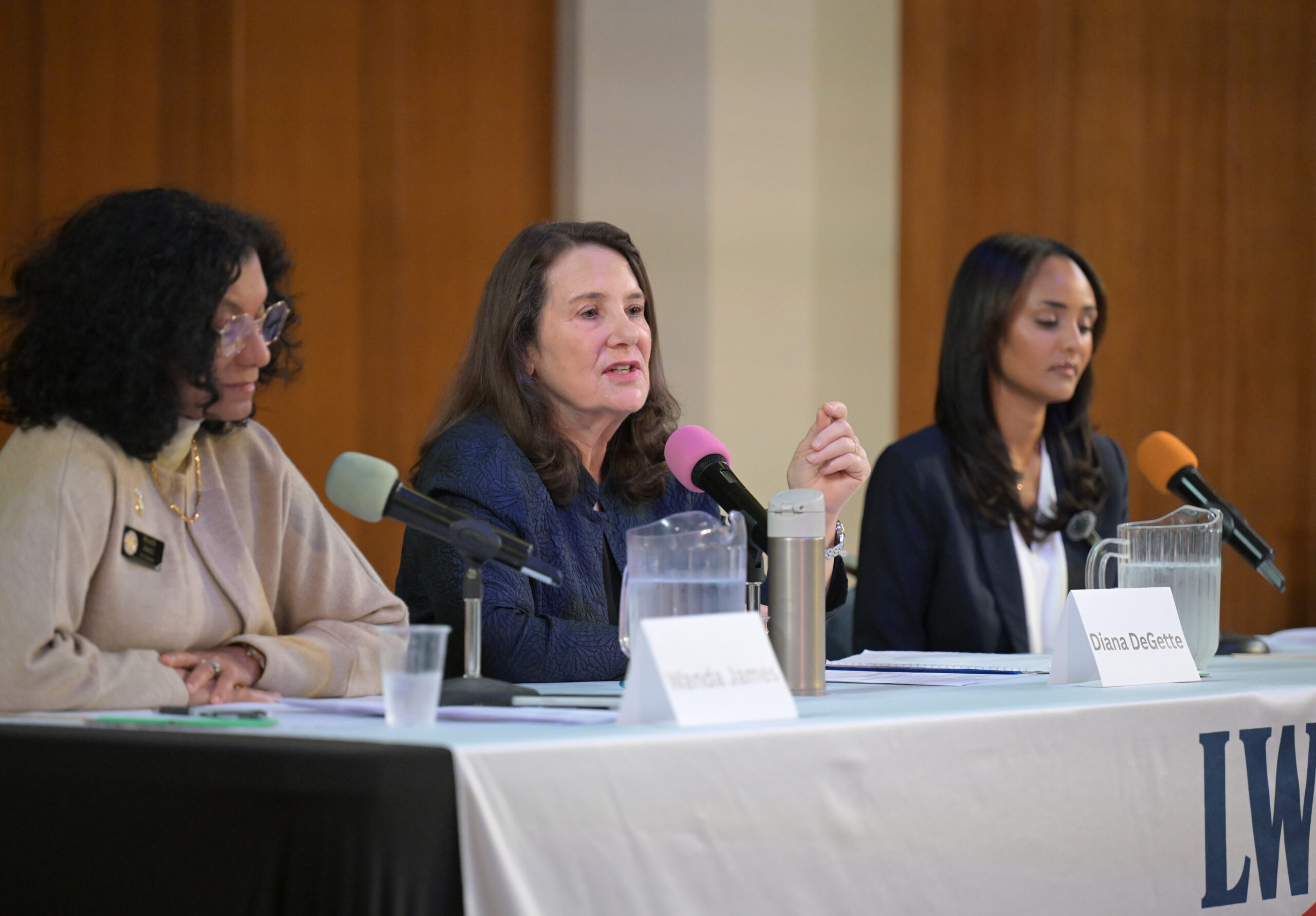
The wave of victories for Democratic Socialists of America-aligned candidates in New York City on Tuesday is buoying the hopes of progressives that the far left can pull off upsets against two Democratic incumbents in Colorado’s Tuesday primary elections, Jewish Insider’s Marc Rod reports.
Off to the races: Rep. Diana DeGette (D-CO) is facing a challenge from Melat Kiros, whose campaign has attracted substantial national attention and backing from several anti-Israel organizations and individuals. Just this week, she declined to call the firebombing of a Boulder, Colo., hostage awareness march as antisemitic. Sen. John Hickenlooper (D-CO) is also facing a DSA-aligned challenger, state Sen. Julie Gonzales, though her campaign hasn’t garnered as much attention as Kiros’. A local Democratic strategist said that he expects DeGette to be victorious but that the race is the most serious challenge she’s faced in her time in office. He also predicted a Hickenlooper victory.
SINGLED OUT
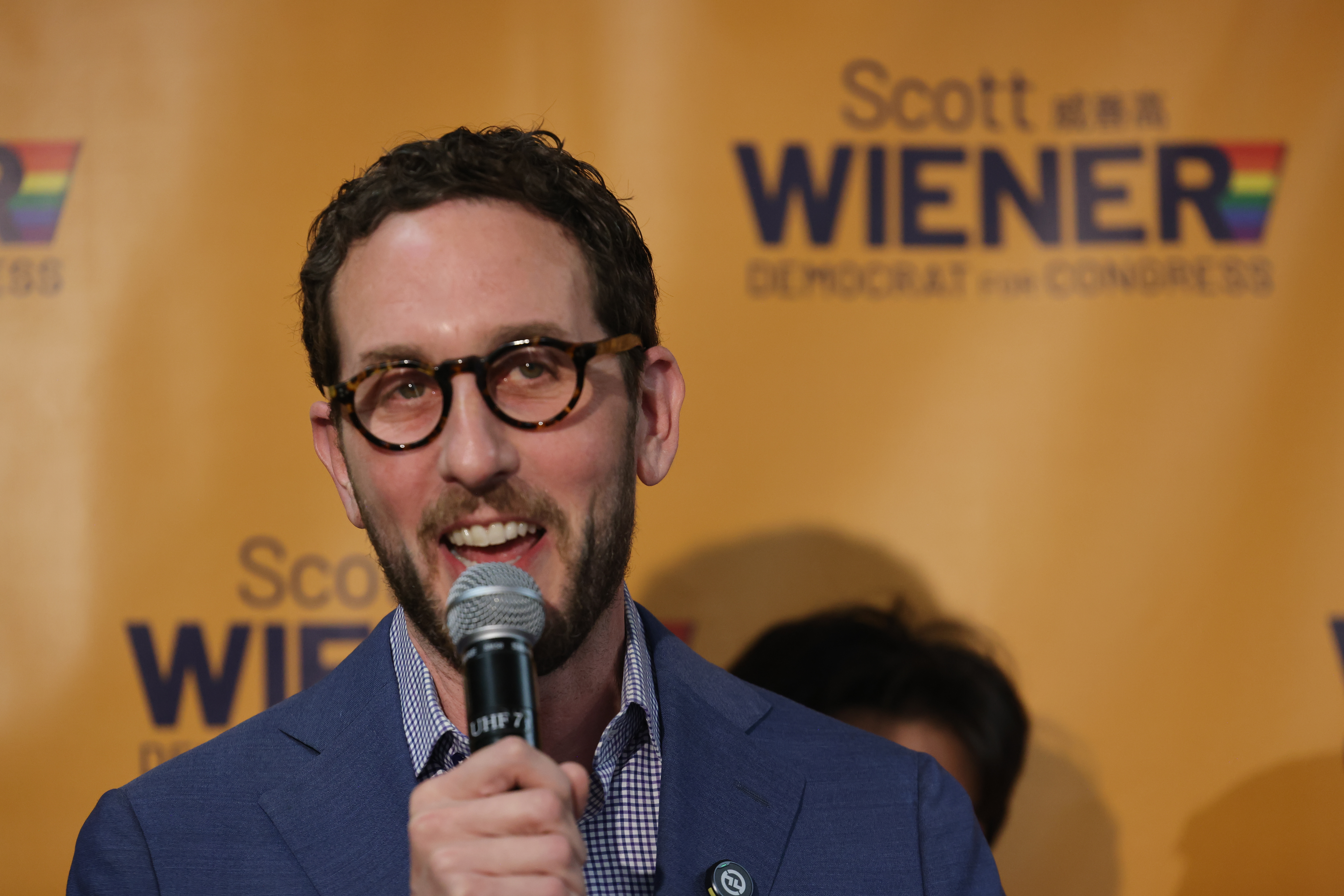
California state Sen. Scott Wiener, the front-runner to succeed retiring Rep. Nancy Pelosi (D-CA) in Congress, has become the target of antisemitic harassment twice in the last week in his San Francisco district, marking the latest example of a high-profile progressive Jewish politician being singled out and facing threats for his background, Jewish Insider’s Josh Kraushaar reports.
Forced out: On Friday, Wiener, on his way to participate in a Pride Shabbat service at a transgender march in San Francisco, was chased out of the event by anti-Israel activists. In a video posted by one local anti-Israel activist, the activist follows Wiener around, attacking him for “being terrible on Gaza,” adding, “You do not belong here anymore, Scott. And it breaks my f—ing heart.” Soon after the initial engagement, other even-more hostile activists start cursing at Wiener, with one calling him a “genocidal piece of sh—” and another saying, “F— you and your Zionist handlers.” Two days earlier, Wiener, while watching a World Cup game with staffers at a local bar, was berated by another anti-Israel activist who demanded he say the words “Free Palestine” on camera.
TRUCE TESTED

The U.S. and Iran traded strikes over the weekend, testing the fragile memorandum of understanding signed between the countries earlier this month. The U.S. first accused Iran of violating the ceasefire after it launched drone attacks on a Singapore-flagged oil tanker in the Strait of Hormuz on Thursday, Jewish Insider’s Danielle Cohen-Kanik reports.
Tit for tat: In a “powerful response” to Iran’s “unwarranted aggression,” CENTCOM said, the U.S. struck Iranian missile and drone storage locations and coastal radar sites on Friday. On Saturday, CENTCOM said Iran was “given [another] chance to honor the ceasefire agreement but elected not to” when it launched another one-way attack drone on a Panama-flagged oil tanker earlier that morning. In retaliation, the U.S. targeted Iranian military surveillance infrastructure, communication systems, air-defense sites, drone storage facilities and minelayer capabilities, CENTCOM said. By Sunday afternoon, the U.S. and Iran had agreed to cease their strikes and meet on Tuesday in Qatar to discuss the dispute over the Strait of Hormuz, Axios reported.
Policy shift: As the Trump administration moves to dismantle much of the decades-old U.S. sanctions regime imposed on Syria, the White House and lawmakers have signaled that it could soon lift its designation of Damascus as a state sponsor of terrorism, JI’s Matthew Shea reports.
WALK-BACK
Rep. Adam Smith (D-WA), the top Democrat on the House Armed Services Committee, now says he plans to support efforts to strip a provision on U.S.-Israel cooperation from the 2027 National Defense Authorization Act, after arguing strenuously against similar efforts during the committee’s markup of the same bill weeks ago, Jewish Insider’s Marc Rod reports.
Breaking it down: The provision, based on the FUTURES Act, is relatively routine, creating a single official to oversee all U.S.-Israel cooperative programs in developing and acquiring defense technologies, and builds on existing programs. But critics have falsely claimed the provision would irrevocably link the U.S. and Israeli militaries and undermine American sovereignty. Smith himself said during the committee markup that the way critics have described the amendment “is simply not accurate” and that the provision should not be treated as a referendum on the U.S.-Israel relationship. In a message to constituents viewed by JI, Smith said he now supports removing the provision.
Elsewhere on the Hill: Democrats on the House Appropriations Committee are warning that an effort by Rep. Thomas Massie (R-KY) to cut aid to Israel from the State Department’s annual funding bill could have further-reaching consequences than intended and could impact a range of other programs and issues, JI has learned.
POLICY PERSPECTIVE

Historian and prominent neoconservative foreign policy analyst Robert Kagan claimed the U.S. was “never supporting Israel for strategic reasons” and that American strategy in the Middle East has come “to be about defending the interests of Israel,” during a live taping on Friday of “The Long Game” podcast — hosted by former National Security Advisor Jake Sullivan and Jon Finer — at the Aspen Ideas Festival in Colorado, Jewish Insider’s Danielle Cohen-Kanik reports.
Podcast playback: Finer, who served as principal deputy national security advisor in the Biden administration and also worked with him under President Barack Obama, asked Kagan if he believes Israel is still a democracy and if Israel is still a U.S. ally, “given [their] increasingly divergent interests.” Calling Israel “at least an imperfect democracy,” Kagan said, “Our discussion of Israel [has become] one in which we began to believe that we had a vital interest in supporting Israel. We started supporting Israel out of a sense of moral obligation. And I think that was a noble thing to do after World War II and the Holocaust, etc. But we never were supporting Israel for strategic reasons.”
REPEAL PUSH
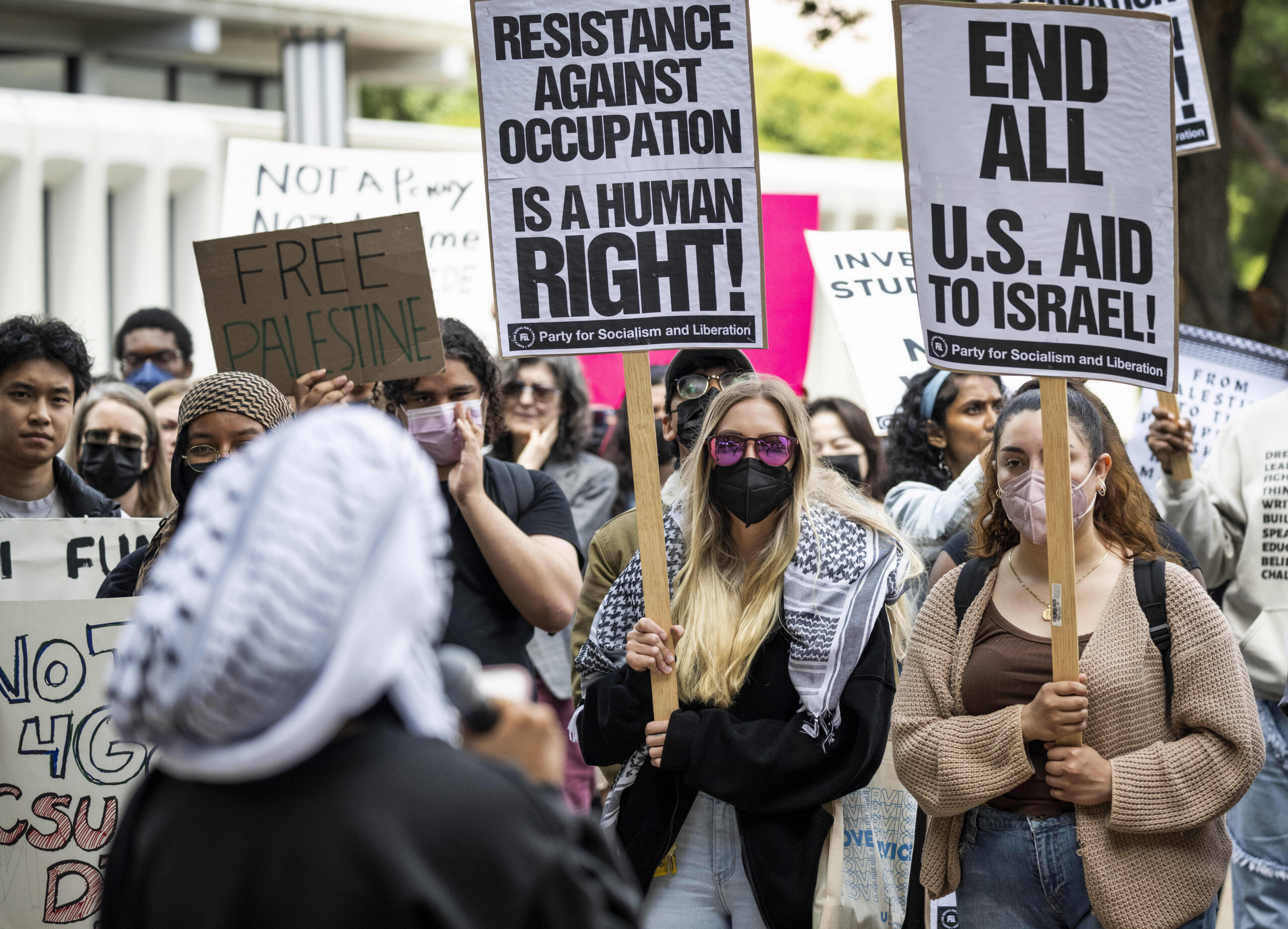
The 29,000-member California Faculty Association, California State University’s teachers’ union, is spearheading a backdoor legislative push to repeal the time, place and manner restrictions implemented across the state’s university system following its 2024 anti-Israel encampments, Jewish Insider’s Haley Cohen reports.
Campus beat: The California Faculty Association, which represents faculty across the 23 campuses of the California State University system, announced it would sponsor AB 2551, authored by Assemblymember Sade Elhawary. AB 2551 would repeal SB 1287 — California’s landmark campus safety and civil rights law — in its entirety by Jan. 1, 2029. Under SB 1287, which was introduced in 2024, California’s public universities and colleges must adopt and enforce rules against violence, harassment, intimidation and discrimination.
Worthy Reads
Perks for Pakistan: The Financial Times’ Humza Jilani spotlights Pakistani Field Marshal Asim Munir’s efforts to position Islamabad to financially benefit from a deal between the U.S. and Iran. “The larger hope is to ensure the country remains sufficiently relevant to its key partners in the U.S. and the Gulf to guarantee steady support and wean the country off a mountain of external debt, analysts and officials say. The relationship with the Trump administration helped position ‘Pakistan as a long-term stakeholder in West Asian security and stability, and provides a major opportunity to reap the economic dividends that will come with the role,’ said Kamran Bokhari, senior resident fellow with the Middle East Policy Council in Washington.” [FT]
Lesson From Louisiana: In The Wall Street Journal, Peter Kovacs, the former editor of New Orleans’ Times-Picayune, contrasts Democrats’ embrace of Maine Senate candidate Graham Platner, whose tattoo of a Nazi totenkopf has drawn widespread scrutiny, with Republicans’ rejection of former KKK leader David Duke, the party’s candidate in Louisiana’s 1991 gubernatorial runoff. “Republicans gave up the Louisiana governorship, but they achieved something more important: David Duke faded from the scene, though he kept running for office until 2016, when he finished seventh in a U.S. Senate jungle primary. … Democrats may wish they had followed the GOP’s 1991 example. Mr. Platner could win, but Republicans and their media supporters will make [Sens. Bernie] Sanders and [Chuck] Schumer — and their party’s presidential nominees — wear that tattoo for years.” [WSJ]
Slip, Sliding Away: The New York Times’ David Halbfinger talks to Israeli officials and analysts about Washington’s slipping support for the country following the latest wave of Democratic Socialists of America primary wins. “[Asaf] Zamir, the Tel Aviv deputy mayor, said, ‘I’m waking up and hearing that we’re “genocidal” and “apartheid.” I’m a left wing, two-state, pro-peace Israeli, but I’m not blind or crazy,’ he added. ‘I know what the situation in Israel is, and we’re not those things we’re being called. And yet, more and more Americans are buying into and voting on those grounds. That troubles me.’” [NYTimes]
Bondi and Beyond: In The New Yorker, Oscar Schwartz looks at how last year’s terror attack at a Hanukkah celebration in Sydney ignited a political debate in Australia that goes beyond the events at Bondi Beach. “In the immediate fallout of the mass shooting, Australia’s political discourse was dominated by two topics, gun control and antisemitism, with some casting the issues in oppositional terms. … The political backlash to the shooting at Bondi can be seen as a product of fear stoked by the attack, of course, but beneath that a deeper anxiety about the transformations occurring in Australian society can be detected.” [NewYorker]
Word on the Street
New York City Mayor Zohran Mamdani declined to express support for Israel as a Jewish state in an interview with ABC News aired Sunday, saying, “Any state that privileges one religion over the other is one that I can’t tell you I support, whether it be Israel or Saudi Arabia or anywhere else”…
U.S. Ambassador to the U.N. Mike Waltz posted a photo from Saturday’s Argentina-Jordan World Cup match alongside his wife, former Homeland Security Advisor Julia Nesheiwat — whose parents immigrated from Jordan — and the Jordanian royal family, writing, “Only in America!”…
The Washington Post does a deep dive into the “extraordinary feud” between leading Senate Republicans and Elbridge Colby, the Pentagon’s under secretary of defense for policy; the Post also reports that Sen. Rick Scott (R-FL) is continuing to block the nominations of Colby acolytes Alex Velez-Green and Austin Dahmer…
Sen. Rick Scott (R-FL) raised concerns about Qatar‘s relationship with Iran and role as an intermediary in U.S.-Iran talks, telling “Fox News Sunday” that Doha is “not our friend”…
Sen. Peter Welch (D-VT) introduced a resolution requesting information on Israel’s human rights practices in its campaign in Lebanon and whether Israel has used U.S.-provided equipment in such activities…
Sens. John Hoeven (R-ND) and Kirsten Gillibrand (D-NY) introduced a bill to expand the BARD program, which supports joint U.S.-Israel agricultural cooperation, to support mid-stage research…
U.C. Berkeley announced the planned launch of the Nancy Pelosi Institute for Representative Democracy, a nonpartisan institute named after the former House speaker that will focus on civic engagement…
The Committee to Protect Journalists said it is conducting a review of its database of journalists killed during the Israel-Hamas war after Hamas and Palestinian Islamic Jihad posted obituaries for combatants who had been listed by CPJ as journalists in Gaza…
Montgomery County, Md., Councilmember Will Jawondo on Friday declared victory in the race for county executive, having secured 40% of the tallied vote; County Councilmember Andrew Friedson, who had 34% of the vote, conceded on Sunday…
The New York Times Magazine profiles comic Robby Hoffman about the “Hacks” star’s religious upbringing in Crown Heights and career trajectory…
The head of Venezuela’s largest Ashkenazi congregation said that three members of the country’s 5,000-strong Jewish community were confirmed to have been killed in the dual earthquakes that rocked the country last week…
Whole Foods, Sprouts Farmers Market and H-E-B will begin selling products from plant-based meat company Chunk Foods as the Israeli company, founded by Amos Golan, continues its U.S. expansion…
More than two dozen people were killed in clashes along the Pakistan–Afghanistan border after Pakistani forces launched strikes and a ground operation it said targeted militant hideouts; Afghan officials said women and children were killed and injured in the attack…
Israel‘s government unanimously voted on Sunday to recognize the Armenian Genocide, a move expected to deepen already strained ties with Turkey, which rejects the genocide label. The vote came a day after Turkish President Recep Tayyip Erdoğan declared that Zionism is a “genocidal, occupying, expansionist ideology” that “threatens everyone”…
The Israeli government approved a NIS 100 million ($33.4 million) budget, which will be matched by philanthropic donations, to support Jewish day school education in the United States and Canada through the Jewish Federations of North America, eJewishPhilanthropy’s Judah Ari Gross reports…
The Financial Times spotlights U.S. efforts to modernize the production of its military arsenal and shift from expensive and time-intensive weapons to artillery that can be quickly mass-produced…
The Iran-backed Houthis in Yemen are reportedly using the recent calm in the region to conduct missile tests in preparation for potential future conflict with Israel…
The U.K.’s Times reports that Qatar provided all-expenses-paid trips to the World Cup for 1,000 “fake” fans to support the Gulf team at its matches…
Pic of the Day
The Jewish War Veterans Department of Michigan, alongside the leaders of Temple Israel in West Bloomfield, Mich., held a ceremony on Sunday honoring the first responders to the March terror attack at the synagogue by a Hezbollah sympathizer.
Birthdays
Screenwriter, director and producer, he has won nine Emmy Awards for his work on AMC’s “Mad Men” and HBO’s “The Sopranos,” Matthew Hoffman Weiner turns 61…
Baltimore-area gastroenterologist, he is an assistant professor at the Johns Hopkins University School of Medicine, Marshall S. Bedine, M.D…. Chairman of Carnival Corporation, the world’s largest cruise ship operator (includes Carnival, Cunard, Holland America and others), and owner of the NBA’s Miami Heat, Micky Arison turns 77… Rosh yeshiva of Yeshivas Brisk in Jerusalem, Rabbi Avraham Yehoshua Soloveitchik turns 77… Former assistant surgeon general of the U.S. and deputy assistant secretary of HHS for women’s health, Susan Jane Blumenthal, M.D. turns 74… Former SVP and counsel at Columbus, Ohio-based L Brands for almost 30 years, now a consultant, Bruce A. Soll… CEO of two firms including Aliya Marketing Group, Joshua Karlin… Israeli actor, screenwriter, playwright and film director, Hanna Azoulay-Hasfari turns 66… Founder and president of Medallion Financial Corp., Andrew Murstein turns 62… Senior rabbi of Toronto’s Beth Tzedec Congregation, Rabbi Steven C. Wernick turns 59… Theater, film and television screenwriter, his credits include the 2017 film “Wonder Woman,” Allan Heinberg turns 59… Israeli political consultant and former chief of staff to Prime Minister Netanyahu, Ari Harow turns 53… Consultant, facilitator, trainer and coach, Nanette Rochelle Fridman… Rabbi of The Young Israel of Bal Harbour (Fla.), Gidon Moskovitz… Film and television director and writer, she is known for writing and directing the films “Obvious Child” and “Landline,” Gillian Robespierre turns 48… Former member of the U.K. Parliament for the Labour party, she is now a member of the House of Lords, Baroness Ruth Smeeth turns 47… Israeli actor and model, Yehuda Levi turns 47… President and dean of Phoenix-based Valley Beit Midrash and author of 30 books, Rabbi Shmuly Yanklowitz… Partner at FGS Global, Andrew Duberstein… Pitcher for Team Israel in the 2023 World Baseball Classic, he then played in the Mexican League, Charles Irvin “Bubby” Rossman turns 34… Campaign finance consultant, who has raised money for Hillary Clinton and the DNC, David Wolf… Steven Kohn… Sara Sansone… Fred Gruber…
Both Vance and Rubio will have their work cut out for them as they navigate the coming weeks
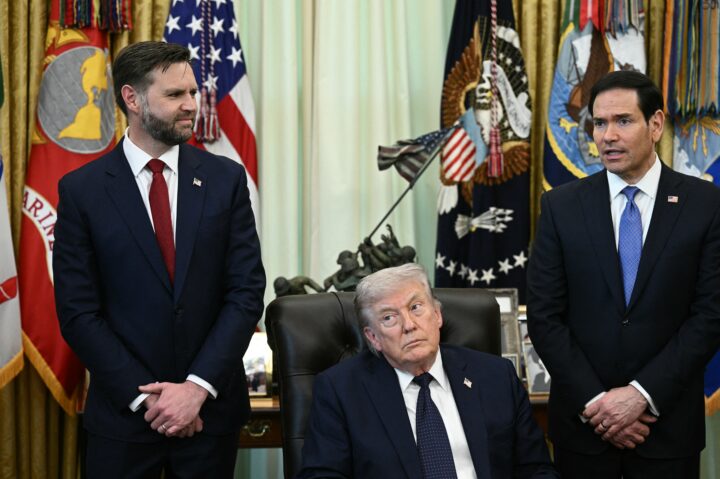
Photo by Brendan SMIALOWSKI / AFP via Getty Images
Vice President JD Vance and President Donald Trump listen to Secretary of State Marco Rubio speak during a meeting with Lebanon Ambassador to the U.S. and Israel Ambassador to the U.S., at the White House in Washington, D.C. on April 23, 2026.
As tensions run high in the Gulf following exchanges of fire between the U.S. and Iran over the weekend, a vastly different security situation is taking shape in Lebanon, with the Trump administration’s top officials — Vice President JD Vance and Secretary of State Marco Rubio — taking responsibility for the respective outcomes.
Vance, who led last week’s negotiations with Iran in Switzerland, said upon his departure from the talks that a “good foundation” had been established between the countries. But that foundation displayed its first cracks just three days later, when Iranian drones fired on a commercial vessel in the Strait of Hormuz, prompting the U.S. to strike Iranian military infrastructure.
The vice president’s tone changed by the weekend, when he said that if Iran had “disagreements about how the MOU is being applied, they can pick up the phone. But violence will be met with violence.” The Iranians skipped technical talks slated for Sunday, saying that the U.S. had not fulfilled the condition of the MOU that would release billions in frozen funds.
Now, officials say that the U.S. and Iranian delegations have agreed to hold fire and will meet in Doha, Qatar, on Tuesday to discuss the status of the Strait of Hormuz.
In Washington, officials are meanwhile celebrating the signing of a framework agreement between Israel and Lebanon that would see Israel scale back its presence in southern Lebanon, creating two “pilot zones” for the Lebanese Armed Forces to administer.
The Foundation for Defense of Democracies’ David Daoud cautioned that the celebration could be premature, telling JI that the fractious nature of Lebanon’s political and religious makeup — as well as Hezbollah’s role in the daily lives of many Lebanese citizens — makes the agreement difficult to implement, even with all the damage the Iranian-backed group has sustained over the last three years.
“Don’t underestimate Hezbollah’s ability to snatch victory from the jaws of defeat,” Daoud said. “I don’t want to overestimate their ability, but this group has proven itself very adaptable over the course of its existence.”
With the agreement signed, the next step will be its implementation. If the LAF is able to administer the pilot zones, there is the possibility of replicating the strategy elsewhere in southern Lebanon. The challenge will be when residents of southern Lebanon — which include Hezbollah members from the area — begin to return to villages south of the Litani River.
In Lebanon, the challenge is not only political will but Beirut’s capacity to address Hezbollah, which is deeply embedded in Lebanese society.
Both Vance and Rubio will have their work cut out for them as they navigate the coming weeks: Vance with continued talks with Iran and the pressure to reopen the Strait of Hormuz, and Rubio with the implementation of an agreement he hailed as the “beginning of the beginning.” Whether they are successful depends more on the actors themselves than the agreements they sign.
Adam Smith, a reliable supporter of Israel, said he would now join progressives in his party to oppose a provision bolstering a close U.S.-Israel alliance
Eric Lee/Bloomberg via Getty Images
Rep. Adam Smith (D-WA), ranking member of the House Armed Services Committee, during a hearing on May 14, 2026.
Rep. Adam Smith (D-WA), the top Democrat on the House Armed Services Committee, now says he plans to support efforts to strip a provision on U.S.-Israel cooperation from the 2027 National Defense Authorization Act, after arguing strenuously against similar efforts during the committee’s markup of the same bill weeks ago.
The provision, based on the FUTURES Act, is relatively routine, creating a single official to oversee all U.S.-Israel cooperative programs in developing and acquiring defense technologies, and builds on existing programs. But critics have falsely claimed the provision would irrevocably link the U.S. and Israeli militaries and undermine American sovereignty.
Smith himself said during the committee markup that the way critics have described the amendment “is simply not accurate” and that the provision should not be treated as a referendum on the U.S.-Israel relationship.
In a message to constituents viewed by Jewish Insider, Smith said he now supports removing the provision.
“I previously opposed removing Section 224 because I looked at the ways the provision benefits the U.S. and helps us improve our anti-drone and anti-missile technologies,” Smith said in the message. “I still believe that Section 224 is something that primarily benefits the U.S., but after several conversations with constituents, I agree with the position that this provision is about more than just the U.S. working to improve our defense technology.”
Smith described his new opposition as based on Israeli activities in Gaza, the West Bank, Lebanon and Iran — despite arguing just weeks ago that, “taking a step back from using technology that is available to us just because we strongly disagree with where Israel is at right now, I think would be a mistake.”
“In the context of these ongoing conflicts, Section 224 carries meaning beyond the plain text substance of the provision. I want to advocate for peace and pressure Israel to meaningfully work with partners in the region to bring these conflicts to an end,” Smith said. “I cannot support endless conflict even though I support Israel’s right to exist. For these reasons, I will vote to remove Section 224 from the National Defense Authorization Act if it comes to the Floor.”
He emphasized in his message his criticisms of Israel and suggested that constituent feedback on the issue had helped shape his changing position on the subject — an indication of how grassroots pressure in blue districts is pushing traditionally pro-Israel members to the left on Israel policy issues.
Smith said previously that the amendment is ultimately a boon to the U.S. military by allowing it to benefit from Israeli innovations, and that its actual impacts are relatively minor.
“This is not a new framework,” Smith said during the committee meeting, noting that the U.S. already has three existing cooperative programs with Israel to develop new technologies, and that the provision does not create any new programs. “To say that this is us bowing to the bidding of Israel on this is completely inaccurate. The reason we’re doing this is because we benefit from that technology development.”
Smith did not respond to a request for comment about his new position on the provision.
An effort to strip the provision out of the bill did not come to a recorded vote in the committee — they were blocked by a voice vote. But Smith’s newfound support for removing it suggests that a significant number of Democrats will vote similarly.
In conversation with Biden foreign policy officials Jake Sullivan and Jon Finer, Kagan said, ‘Israel's vision for the Middle East has never been a vision that the United States should sign up to’

Screenshot/YouTube
Robert Kagan speaks at Aspen Ideas Festival on June 26, 2026.
Historian and prominent neoconservative foreign policy analyst Robert Kagan claimed the U.S. was “never supporting Israel for strategic reasons” and that American strategy in the Middle East has come “to be about defending the interests of Israel,” during a live taping on Friday of “The Long Game” podcast — hosted by former National Security Advisor Jake Sullivan and Jon Finer — at the Aspen Ideas Festival in Colorado.
Finer, who served as principal deputy national security advisor in the Biden administration and also worked with Sullivan under President Barack Obama, asked Kagan if he believes Israel is still a democracy and if Israel is still a U.S. ally, “given [their] increasingly divergent interests.”
Calling Israel “at least an imperfect democracy,” Kagan said, “Our discussion of Israel [has become] one in which we began to believe that we had a vital interest in supporting Israel. We started supporting Israel out of a sense of moral obligation. And I think that was a noble thing to do after World War II and the Holocaust, etc. But we never were supporting Israel for strategic reasons.”
“In fact, much of our strategy in the region came to be about defending the interests of Israel, because they were an ally, because we felt an obligation to them,” Kagan, who has been a vocal critic of President Donald Trump and Israeli Prime Minister Benjamin Netanyahu, continued.
“I’ve always felt about Israel roughly the way I feel about Taiwan, you know, that we have an obligation as a defender of a country that we have the responsibility for, but not that, you know, not that it somehow transcends basic understanding of our interests.”
Kagan said that in his view, “Israel’s vision for the Middle East has never been a vision that the United States should sign up to, because Israel’s attitude is basically the Arab Muslim peoples can’t — ‘we don’t want them in democracies, we want them ruled by strong men who can control them. We fear a public opinion among Arabs and Palestinians, and therefore we don’t want to give them that opportunity.’”
“I just don’t think that is a sustainable position to take over the long run in the Middle East, and it should never have been America’s position,” he contended.
Kagan rose to prominence as a co-founder of the Project for the New American Century, the influential neoconservative think tank that advocated for an assertive American global role, and helped shape Republican foreign policy debates before and after the 9/11 attacks. He generally viewed Israel as a key U.S. democratic ally in the Middle East and supported a close U.S.-Israel strategic partnership.
Kagan later became one of Trump’s earliest conservative critics, leaving the Republican Party in 2016 as he argued that Trump’s “America First” foreign policy represented a break with decades of U.S. global leadership.
On the war with Iran and the U.S.’ involvement in the Middle East generally, Sullivan read from Kagan’s March 2026 piece in The Atlantic, where he argued that American intervention in the region is a causal factor of terrorism: “Had the United States not been deeply and consistently involved in the Muslim world since the 1940s, Islamic militants would have little interest in attacking an indifferent nation 5,000 miles and two oceans away. Contrary to much mythology, they have hated us not so much because of ‘who we are’ but because of where we are,” he wrote in the piece.
“The thing that I find surprising about Americans is that we’re constantly shocked that others are reacting to us,” Kagan said in response on Friday, saying the same dynamic was at play in Japan’s 1941 attack on Pearl Harbor, which the U.S. “brought on” by embargoing Japan.
He said U.S. involvement in the Middle East made more sense “when America was solidly behind the American world order, when we were solidly behind supporting our allies in Europe and Asia, when we took it on as responsibility to maintain the overall security of our allies.” But “when we are actively abandoning any thought of supporting the international system we’ve supported” under Trump, “the one place we’re going to go to war is in the Persian Gulf? That’s what makes no sense to me.”
On Sunday afternoon, the U.S. and Iran agreed to cease their strikes and meet later in the week in Doha, Axios reported

ATTA KENARE / AFP via Getty Images
Explosions erupt following strikes at Tehran Oil Refinery in Tehran on March 7, 2026.
The U.S. and Iran traded strikes over the weekend, testing the fragile memorandum of understanding signed between the countries earlier this month.
The U.S. first accused Iran of violating the ceasefire after it launched drone attacks on a Singapore-flagged oil tanker in the Strait of Hormuz on Thursday. The Islamic Revolutionary Guard Corps had earlier issued a warning to commercial vessels “to strictly refrain from any movement outside the designated routes,” which are in parts of the waterway that it controls.
In a “powerful response” to Iran’s “unwarranted aggression,” CENTCOM said, the U.S. struck Iranian missile and drone storage locations and coastal radar sites on Friday.
On Saturday, CENTCOM said Iran was “given [another] chance to honor the ceasefire agreement but elected not to” when it launched another one-way attack drone on a Panama-flagged oil tanker earlier that morning. In retaliation, the U.S. targeted Iranian military surveillance infrastructure, communication systems, air-defense sites, drone storage facilities and minelayer capabilities, CENTCOM said.
President Donald Trump sounded his frustration in a post on Truth Social on Saturday, writing, “There may come a point when we are no longer able to be reasonable, and will be forced to militarily complete the job that we very successfully started” in Iran. “If that happens, the Islamic Republic of Iran will no longer exist!”
After the U.S. strikes, the governments of Bahrain and Kuwait said they were targeted by Iranian drone and missile attacks, which the IRGC said were attempted strikes on U.S. military bases in the country.
The IRGC added in its statement that vessels violating Iran’s instruction in the Strait of Hormuz “will be dealt with even more forcefully” and that U.S. bases in the region will be “experiencing hell” in the coming days.
By Sunday afternoon, the U.S. and Iran had agreed to cease their strikes and meet on Tuesday in Qatar to discuss the dispute over the Strait of Hormuz, Axios reported.
Under the preliminary agreement, Israel will withdraw from two ‘pilot zones’ while maintaining its security zone in southern Lebanon
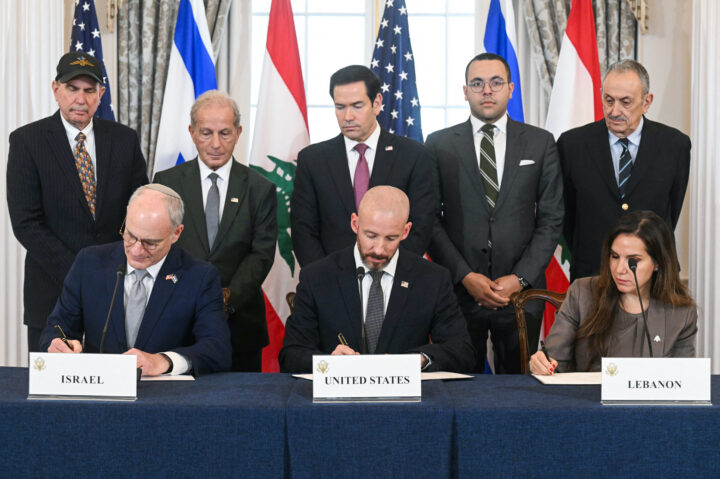
Photo by SAUL LOEB / AFP via Getty Images
Secretary of State Marco Rubio looks on as Israeli Ambassador to the U.S. Yechiel Leiter, State Department Chief of Staff Daniel Holler, and Lebanese Ambassador to the U.S. Nada Hamadeh sign a framework agreement at the U.S. Department of State in Washington, DC, on June 26, 2026.
Secretary of State Marco Rubio and the ambassadors of Israel and Lebanon signed a framework agreement in Washington on Friday aimed at scaling back Israel’s military presence in Lebanon, where the IDF has established a presence for the last three months as part of its campaign against Hezbollah.
Israeli Ambassador to the U.S. Yechiel Leiter and Lebanese Ambassador to the U.S. Nada Hamadeh Moawad announced the deal at a press conference with Rubio, following four days of negotiations in Washington during the fifth round of direct talks between Jerusalem and Beirut.
Under the deal, Israel will withdraw from two “pilot zones,” one north of the Litani river and one in southern Lebanon, and transfer administration of the areas to the Lebanese Armed Forces.
The preliminary deal between Israel, Lebanon and the U.S. is aimed at enabling a broader agreement in the future, a senior Israeli official told CNN.
Israeli Prime Minister Benjamin Netanyahu hailed the framework agreement as a “major blow to Iran,” emphasizing in a video statement that Israeli forces will maintain their presence in Israel’s security zone in southern Lebanon until Hezbollah is disarmed.
“Iran is trying to force us into a withdrawal from southern Lebanon by force. In effect, Israel, Lebanon and the United States are telling them: this is none of your business,” Netanyahu said.
Today is “the beginning of the beginning,” Rubio said at the signing ceremony. “There’s a lot of work ahead. We don’t, in any way, underestimate the difficulty of the task ahead. But we understand the importance of it, how vital it is. And we are honored to play a part in bringing this together.”
Moawad said at the signing that the agreement would be the “first step on the road to restoring Lebanese sovereignty and territorial integrity.”
The announcement comes after months of negotiations and on the heels of the Trump administration signing a memorandum of understanding with Iran and launching a deconfliction mechanism to end the fighting in Lebanon without Israel’s participation.
Qatar’s once-quiet intermediary role is now not only public, but a key element of the infrastructure supporting the new regional dynamics
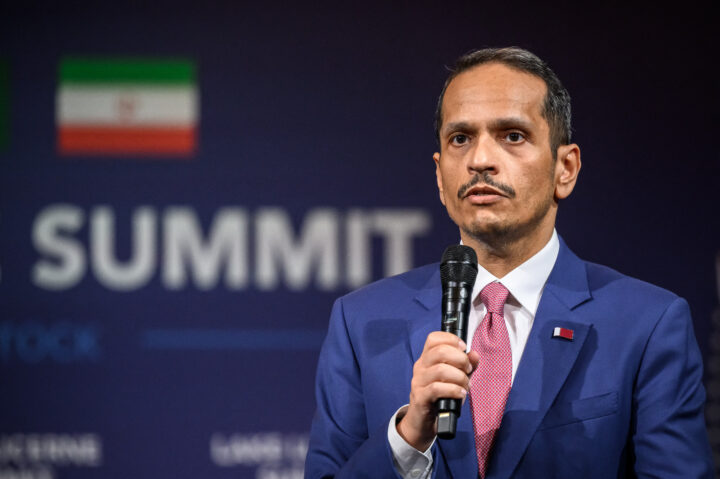
Fabrice Coffrini / POOL / AFP via Getty Images
Qatar's Prime Minister Sheikh Mohammed bin Abdulrahman bin Jassim al-Thani speaks prior to a quadrilateral meeting between the United States, Iran, Pakistan and Qatar at the Burgenstock luxury hotel complex overlooking Lake Lucerne, Switzerland, on June 21, 2026.
As diplomacy between the U.S. and Iran continues following the adoption of the memorandum of understanding between the two countries last week, Washington is again leaning on Qatar to serve as a critical interlocutor, further cementing Doha’s standing as an intermediary despite the significant setbacks sustained by the Gulf state during the recent war with Iran.
In an interview with UnHerd that was published on Thursday, Vice President JD Vance, traveling back from the Iran talks in Switzerland earlier this week, said that Doha would serve as the location for CENTCOM to meet with Islamic Revolutionary Guard Corps officials — despite the IRGC’s designation as a foreign terror organization by the U.S. (a move undertaken by President Donald Trump in his first term).
“One of the things we wanted to come out [of the negotiations] with” was a “channel on the Iranian side” to seek conflict resolution, Vance told UnHerd aboard Air Force Two. “Which we did. They were like, ‘OK, fine, we’ll send somebody from the IRGC to go hang out in Doha with somebody from CENTCOM,’ and that’s how we’re going to settle a lot of these disputes,” he said.
Doha has long played a role in the back-channel communications between the U.S. and adversaries. But Vance’s comments underscore the degree to which Qatar’s once-quiet intermediary role is now not only public, but a key element of the infrastructure supporting the new regional dynamics.
The close relationship between Washington and Doha was on full display during the Switzerland talks. On Sunday, Qatari Prime Minister Sheikh Mohammed bin Abdulrahman Al Thani posted a photo of himself with Vance and Jared Kushner as the three huddled around a laptop. “Live from Lucerne, work continues” with Vance and Kushner, Al Thani wrote in separate English and Arabic posts.
Earlier this week, the White House leaned on Al Jazeera, the Qatari-owned media outlet, to deny a report that Vance had been snubbed by the Iranians at a press conference following talks in Switzerland — a signal that Washington is increasingly treating Qatari institutions as useful and legitimate when its message is being amplified.
Qatar wasn’t affected by the war in the same way as the UAE, which faced more missile fire than any other country in the region, including Israel. But it also wasn’t immune from Iranian attacks. Early in the war, Iranian missiles targeted the Gulf state’s Ras Laffan gas complex, causing some $20 billion in annual revenue loss and damage that is estimated to take five years to fully repair.
The strike on Ras Laffan came in spite of a secret effort by Qatar, first reported by The Washington Post, to press Iran not to target the facility. In exchange, the Post reported, Doha offered to use its leverage to halt gas production and send oil costs up — moves intended to increase pressure on the U.S. and Israel to wind down the war quickly.
Qatar has long tried to play to all sides in conflicts even as it serves as a mediator — despite the inherent risks. It was an Iranian strike on the U.S. base in Qatar last June that marked one of the final salvos of the 12-day war. Months later, five Hamas members and a Qatari security guard were killed in an Israeli strike on a building used by Hamas for its senior officials who live in Doha.
Doha’s strategy over the last two decades of investing anywhere and everywhere has largely paid off (though not through sports prowess, as evidenced by the Qatari team’s World Cup loss to Bosnia and Herzegovina on Wednesday). In this next phase, Qatar will continue to seek to play a key role in Iran talks and the implementation of any agreements — ensuring that the Gulf state has significant buy-in in shaping the future of the region.
The Pax Silica initiative is designed to help allies reduce their dependence on China
Nine new parties signed on to Pax Silica during the Pax Silica Summit at the U.S. Institute of Peace in Washington, June 25, 2026
Under Secretary of State for Economic Affairs Jacob Helberg/X
The State Department announced on Thursday that nine new parties had signed on to Pax Silica, the U.S.-led initiative uniting American allies with the aim of developing global supply chains for artificial intelligence and the production of semiconductors, chips, critical minerals and energy sources to reduce global dependence on China.
The announcement came from Jacob Helberg, the under secretary of state for economic affairs and the architect of the project, during the Pax Silica Summit at the U.S. Institute of Peace in Washington, which brought together artificial intelligence and tech companies, prominent investors, senior business executives and top officials from at least two dozen countries seeking partnerships and investment opportunities with fellow signatories of the alliance.
Helberg told attendees that the European Commission, the Netherlands, Germany and Greece had officially joined the alliance and that Argentina, Chile, Costa Rica, Kazakhstan and Panama would sign on this week, bringing the total number of signatories to 22.
Helberg also suggested Italy would soon join the alliance and said that 35 countries had signed on to a global AI opportunity declaration that the U.S. had spearheaded as part of the initiative.
Among those in attendance for the opening of the two-day summit were American Israeli venture capitalist Michael Eisenberg, U.S. Ambassador to India Sergio Gor, Indian Information Technology Minister Ashwini Vaishnaw and former Italian Ambassador to the U.S. Armando Varricchio.
The summit also was the setting for the “first trilateral economic dialogue” between the U.S., Israel and the UAE, Helberg said., where he was joined by Israel’s National AI Directorate head, Brig.-Gen. (Res.) Erez Eskel, and United Arab Emirates Minister of State Saeed Bin Mubarak Al Hajeri.
Helberg posted a photo of the three men standing in front of their respective countries’ flags to X and said, “In President Trump’s first term, the Abraham Accords showed peace builds prosperity. In his second term, under Secretary Rubio leadership, Pax Silica is showing shared supply chains builds shared economic security.”
It came more than seven months after the State Department launched Pax Silica with the goal of boosting diplomatic ties between U.S. allies by encouraging the partnerships that create shared economic incentives. Israel was one of the founding nations of Pax Silica when the U.S. launched the initiative last December alongside Australia, Japan, Singapore and South Korea. The United Arab Emirates and Qatar joined the alliance in January.
Helberg used his remarks on Thursday to encourage U.S. allies to embrace collective efforts to address shared challenges on AI and energy.
“Governments everywhere are asking many of the same questions,” Helberg said. “How do we build trusted AI ecosystems? How do we secure resilient supply chains? How do we ensure our citizens share in the prosperity that AI can create?”
“No country can answer those questions alone,” he continued.
The undersecretary of state touted to Jewish Insider in February Israel and Qatar’s participation in the expanding alliance, despite the deeply hostile relationship between the two countries, as proof that bypassing traditional security agreements and instead encouraging increased economic cooperation through U.S.-led frameworks can create pathways to diplomacy.
“This is the first time that Israel and Qatar have been brought under the same framework and signed the same document to actually agree that shared supply chains are more important than shared ideologies,” Helberg told JI at the time.
He told the Financial Times this week that Israel and the UAE’s successful use of American technology in building out their respective tech sectors served as evidence that the U.S. was not using the initiative to solely promote its own interests. “These countries punch far above their weight, so that should be a really strong counterexample to folks,” he said.
Helberg posted on X on Thursday that the U.S., Israel and the UAE held a first trilateral economic dialogue on the margins of the summit. “In President Trump’s first term, the Abraham Accords showed peace builds prosperity,” he said. “In his second term, under Secretary Rubio leadership, Pax Silica is showing shared supply chains builds shared economic security.”
Helberg unveiled several new ventures on the first day of the summit, including the Pax Silica Artificial Intelligence Assistance Project, which he described as a service “for Pax partners that ship high-value AI supply chain products through Panama,” and PaxPass, an application he said was aimed at streamlining the movement of “the critical goods that power the AI economy,” along with a $50 million commitment from the U.S. to finance the platform. He also revealed plans for the U.S. and Kazakhstan to jointly establish an economic security zone in the Central Asian country to protect mineral security.
He announced the establishment of The Foundry School, a workforce development initiative partnering the State Department with Stanford University to “equip entrepreneurs, engineers and advanced manufacturing leaders across the Pax Silica economies.” Helberg said the State Department would also sign a memorandum of understanding with Stanford to “develop a first-of-its-kind curriculum for institutions across Pax Silica economies to adopt and teach.”
“Our hope is that this is only the first of a handful of such zones across the Pax Silica network, creating a connected ecosystem where investment, innovation and trusted production reinforce one another across partner countries,” Helberg told attendees.
Harris told JI he’s both ‘a believer in the possibility of change’ and has ‘never been more worried in my adult lifetime than I am right now’

David Harris/book cover
David Harris spent more than three decades leading the American Jewish Committee, where he navigated crises facing the Jewish community and built bipartisan coalitions to advance the group’s mission of supporting Israel and Diaspora Jewry.
His book, Antisemitism: What Everyone Needs to Know, published by Oxford University Press last year, is Harris’ attempt to reach beyond the Jewish community — churches, classrooms and the “average New York Times reader.” His goal, he said, is to turn the “silent majority” into the “loud majority.”
Written in the shadow of the Oct. 7, 2023, Hamas terror attacks in Israel, the book arrived at a moment of surging antisemitism in the U.S. and around the world. It traces antisemitism from its ancient roots through the Holocaust, the Soviet era and its recent resurgence — the explosion on college campuses and beyond after Oct. 7 and the ensuing war in Gaza.
Harris, who quipped that he retired “for about 30 seconds” after serving as AJC’s CEO from 1990–2022, sat down with Jewish Insider on Thursday to discuss the book at a moment in which he said he has “never been more worried” about antisemitism — yet also remains optimistic about the Jewish future.
This interview has been edited for length and clarity.
Jewish Insider: Oxford University Press called you about writing this book in the fall of 2023 — weeks after the Oct. 7 attacks. You write that you were “honored but distressed by the need for such a book.” How much did the aftermath of the attacks reshape the book you thought you were going to write?
David Harris: That call was not directly related to Oct. 7, it was too close to the attacks to even have associated [the rise of] antisemitism with it. Antisemitism was surging [already] in general. They needed a book that would be easily accessible to a high number of people, to be able to reach the average New York Times reader. It was also meant for high school and college classrooms and churches. They understood the emerging problem and this was their contribution.
I wrote the book over the span of close to two years during the post-Oct. 7 period. Two things impacted me: the speed and virulence of which history was turned on its head. The worst day in Israeli and Jewish history since the end of World War II had before our eyes suddenly become directed at Jews, Zionists [and] friends of Israel who were suddenly seen as the perpetrators. Even with my understanding of the subject matter, I was stunned by how quickly and viciously it turned.
Number two is that I kept needing to add to the book because every day brought new events, insights and tragedies. At a certain point the publishers had to remind me this wasn’t a newspaper, we have to close the book at some point. There’s already room for a sequel, unfortunately.
JI: How are you reaching a wider, non-Jewish audience? Does the average American want to read about antisemitism? What has been their reaction to the book?
DH: Because Oxford University Press [is a major publisher], it’s not so easy for people who are otherwise ready to go after a book on antisemitism, such as the one that I wrote, to discredit or marginalize it with accusations like “Harris is a Zionist.” The publisher’s label is enormously important for the book’s credibility and reach.
Jews are also an important part of the audience. I learned from writing the book. Others can learn from reading the book.
I wrote this book with the hope that I’d be able to speak to non-Jewish audiences as well. So when one of the largest Methodist churches in the U.S., in Kansas City, with more than 30,000 worshippers a week, invited me to come speak, I was in my happy place. They invited me to come and could not have been more gracious. The response was very good. There was also a large gathering of interfaith leaders while I was in Kansas City. I want to reach well beyond the Jewish community because antisemitism is not a Jewish problem that can be solved by Jews. We need to engage good people, the silent majority, and help turn them into the loud majority.
It seems to me the larger goal, and this book is only a part of it, is to reach and mobilize the heart of America to understand the situation and the implications not just for Jews but for liberal values for all of us. It may begin with Jews, it never ends with Jews. The people burning the American flag are the very same people trampling on the Israeli flag and threatening Jews.
JI: Where do you see the line between criticism of Israel and antisemitism — and has that line shifted since Oct. 7?
DH: For me, the line has not shifted. It’s just been more revealed. In the book I quote Natan Sharansky, one of my heroes, who wrote a number of years ago there’s “three Ds” to answer that question. When criticism of Israel evolves into delegitimization of Israel, demonizing of Israel and the use of double standards, it’s clear people cannot hide behind their defense of just being critical.
It’s a more elegantly linguistic way of being antisemitic while claiming you’re only anti-Zionist.
JI: The book documents the near-total disappearance of 850,000 Jews from Muslim-majority countries since 1948. Why does that history get so little mainstream attention, and why does it matter now?
DH: It’s a question I know all too well because I’m married to one of those 850,000 Jews and have been for 51 years. I’ve seen this issue play out through my wife’s experience post-expulsion from Libya in 1967 and I’ve seen it play out in my global diplomacy where every time I raise this issue I’m usually met by an eye roll — a complete lack of interest.
One reason is the Palestinians have done an exceptionally good job of making the world believe they are the perpetual refugees and have elevated victimhood to a whole new level. Those 850,000 Jews really determined from the get-go that they were not going to create lifelong victimhood, they were going to build new lives. And they did very successfully, so they didn’t become professional storytellers of their plight and loss.
But my wife says they are triple victims. First, they were expelled or forced to flee their country, their ancestral homeland. Two, the world looked away. Three, there is no trace of a 2,000-plus year history of the Jewish presence in Libyan history today. There is nothing, they’ve been completely wiped out. With the exception of Morocoo, that is true for most of these countries which these refugees had to flee.
JI: There’s a chapter detailing the campus antisemitism surge. Jewish groups told Jewish Insider two months after the Oct. 7 attacks that they were taking an engage-and-influence approach with diversity, equity and inclusion frameworks that have been used to exclude Jews from protected minority status on some campuses, which some attribute to the rise in antisemitism. Then in 2024, the same groups said they were reassessing their embrace of DEI. What is your approach? Is DEI fixable?
DH: For many years Jewish organizations relied on one weapon with campuses, so to speak. That was called reason, sitting down with the president or provost and reasoning with them to help them understand why antisemitism is unacceptable. Clearly, after Oct. 7 that dependence on reason was proven to be totally ineffective in most places.
What instead is more effective is taking the gloves off — lawfare. I particularly applaud the students at Harvard, Penn, George Washington University and other schools who took the lead here. While sitting on campuses, they were suing those campuses for violation of their rights. The organizations that got behind the students, groups like the Lawfare Project and Louis D. Brandeis Center for Human Rights Under Law and law firms that have stepped up pro bono, all deserve huge credit.
I retired for about 30 seconds after I stepped down from my position at AJC. I joined the Institute for the Study of Global Antisemitism and Policy because I thought they were really onto something regarding campuses that no one else that I knew was looking at carefully, long before Oct. 7, and that was foreign funding — where was it coming from? What was its intent? Why were universities in many cases violating American law by not reporting those gifts? Today it’s part of the national discourse to follow the money. These ecosystems directly and indirectly penetrated campuses at many levels, student organizations, faculty and staff, liberal arts, social sciences, Middle East study centers. They penetrated over many years in a very systematic and focused way.
The combination of deep research and the ability to get the research into policymakers, in the university world and the political world together with lawfare are the strategies that I think are most effective.
The students on campus are the frontline warriors of the Jewish people. They deserve the absolute backing of the American Jewish community.
JI: You led AJC for more than 30 years — you’ve seen Jewish organizational leadership up close across decades of crises. How do you assess how today’s Jewish leaders have responded to the post-Oct. 7 surge in antisemitism, and what would you tell them to do differently?
DH: Our community is several steps behind where it should be. We are at war. It’s a war designed to drive a wedge between the U.S. and Israel. It has fueled antisemitism and in many cases attacked and isolated Jews. Unlike in Israel, I don’t see the war mindset, plans and leaders here. I sometimes wonder, if the American Jewish community had been asked to organize D-Day, could the community have actually come together and created a single, comprehensive plan and followed it? I’m not sure. Based on the post-Oct. 7 situation here in this country, I worry we are not where we should be — where we need to be.
JI: You built AJC’s influence partly through bipartisan relationships. Is that model still viable, or does the current political environment force Jewish organizations to choose sides?
DH: It certainly elevates the importance of groups like the Republican Jewish Coalition and the Democratic Majority for Israel. Support for Israel, in both political parties, can obviously no longer be taken for granted. That’s especially true now in the Democratic Party, all the more so after the primary election in New York earlier this week.
But there’s also an emerging cultural war inside the Republican Party. While I operated for nearly 50 years in the nonpartisan space, and positioned AJC as a nonpartisan organization with outreach at the highest level to both parties, today I would say it’s particularly important Jewish groups are operating inside multiple parties in a very partisan way.
It’s clear that we have enormous work to do in the Democratic Party. It was not long ago that [Sens.] Bernie Sanders (I-VT) and Elizabeth Warren (D-MA) were the outliers when it came to Israel and the Middle East. Fast forward a couple of years and they are now the clear majority. Every Jewish organization looking for a Democrat from Washington lines up to invite Sen. John Fetterman (D-PA). If he’s not available, they’re all baffled as to who else to invite from the contingent of Democrats in the U.S. Senate.
The question for the 501(c)(3) groups that are nonpartisan is, what do they bring to the table? In an earlier era, Jews were seen as a very important constituency with many voices, reach and impact. I’m not sure what the power equation is today for nonprofit Jewish organizations and why people in Washington should listen to them as they would have a few years ago.
The challenge for Jewish organizations is how to restore their indispensability to the national conversation. Posting on X, issuing statements, if no one is reading them or thinking about the messaging then what’s been accomplished? There is a huge amount of work to be done. I hope and pray the American Jewish community is up to the task.
JI: After immersing yourself in this history, are you more or less optimistic than when you started?
DH: I could not have spent 50 plus years in global Jewish advocacy without being a believer in the possibility of change for the better. I’ve seen it in my lifetime. I’ve seen the miracle of the rescue of Jews from the Soviet Union and the rescue of Jews from Ethiopia.
I also understand as a Jew I’m commanded to believe in the possibility of a better tomorrow and not to succumb to despair. Having said all of that, I would be totally dishonest if I didn’t tell you that I’ve never been more worried in my adult lifetime than I am right now.
Rep. Josh Gottheimer said ‘Erdoğan cannot be trusted’ and that the decision ‘must be reversed’
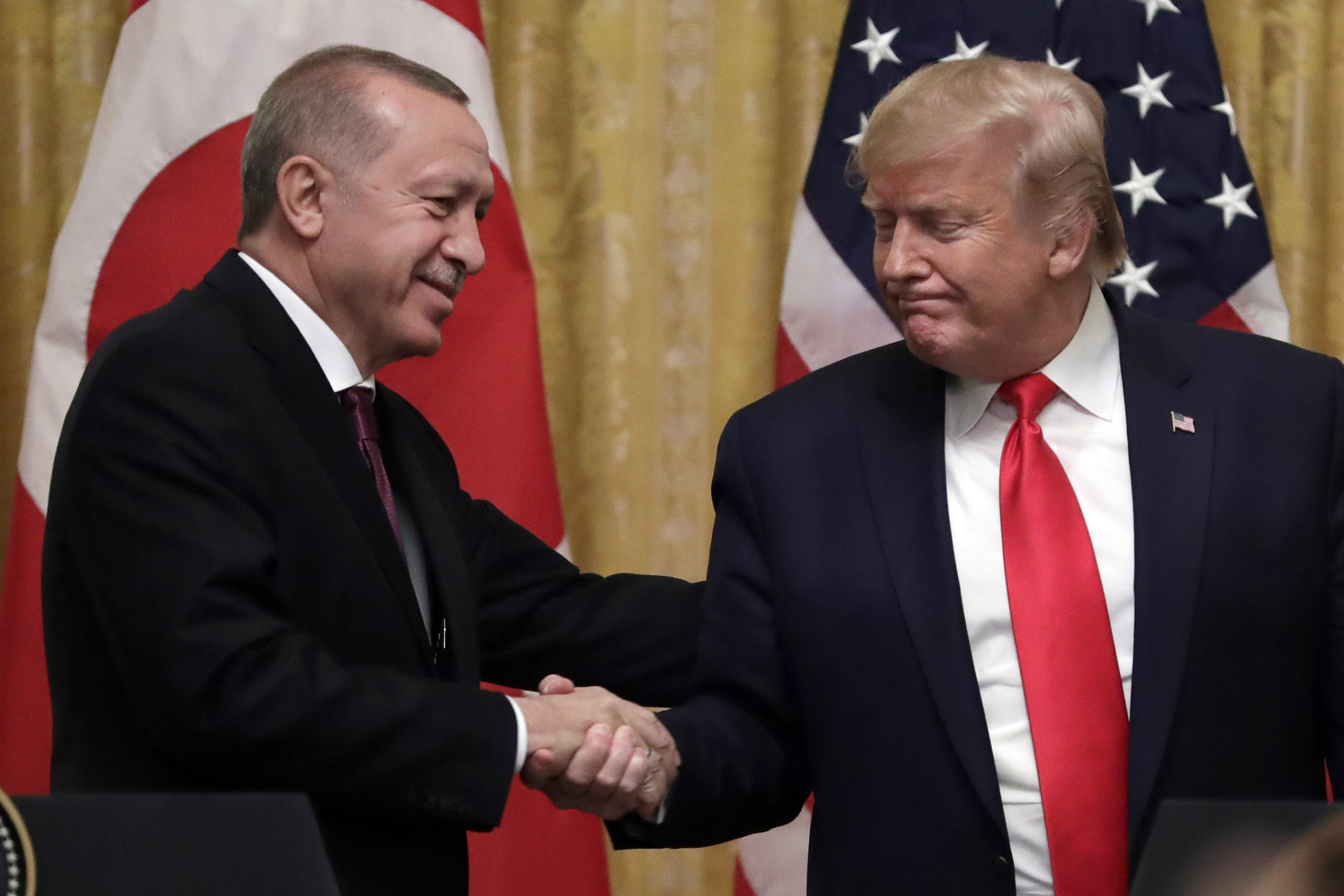
Evan Vucci
President Donald Trump shakes hands with Turkish President Recep Tayyip Erdoğan after a news conference in the East Room of the White House, Wednesday, Nov. 13, 2019, in Washington.
U.S. lawmakers across the political spectrum are sounding the alarm over the Trump administration’s plans to review whether it can sell F-35 fighter jets to Turkey, arguing that the move would raise national security concerns and that Ankara has not yet fulfilled its obligation to dump its Russian S-400s.
In the Oval Office on Wednesday, President Donald Trump said he was considering selling the advanced jet engines to Turkey, stating that he would “do something that’s going to make him [Turkish President Recep Tayyip Erdoğan] very happy.” Vice President JD Vance said the administration is “confirming” that Turkey has fulfilled its obligations under U.S. law in order to receive advanced F-35 fighter jets.
Ankara has long sought the advanced systems but has been barred from purchasing it since 2020, after it acquired the S-400 air-defense system from Russia. A report published last week by the Jewish Institute for National Security of America suggested that the S-400 system is inactive but still intact in Turkey.
The proposed deal has drawn fierce bipartisan pushback and notable criticism from within Trump’s own ranks.
Rep. Brad Schneider (D-IL) told Jewish Insider that he is “very concerned” about the prospect of Turkey acquiring the F-35s, arguing that such a move would raise significant national security concerns due to Ankara’s close security ties with Russia.
“Turkey has integrated its defenses with the Russian missiles. The F-35 is a technology platform that Russia would love to get information on and we can’t allow that to happen,” Schneider said. “Turkey has not been the best NATO ally. Its actions in the Eastern Mediterranean have been contrary to U.S. interests and regional interests, so I have real concerns.”
Schneider also noted that he does not believe Turkey has given up possession of the Russian S-400s, suggesting that Ankara has yet to fulfill the critical obligation that must be certified, in writing, to Congress.
“I have not seen that,” Schneider said. “I’d want to see that in concrete evidence from this administration.”
Rep. Nicole Malliotakis (R-NY) said on social media that there is “bipartisan opposition” to the move and posted a photo of Erdoğan hand-in-hand with Russian President Vladimir Putin and former Iranian President Ebrahim Raisi.
“As long as Turkey is under the leadership of Erdogan who aligns himself with Iran and Russia, harbors Hamas & remains the only NATO member to not sanction Russia, Turkey should NOT receive our best jets and military equipment,” Malliotakis wrote.
Rep. Josh Gottheimer (D-NJ) also criticized the move, saying in a post on X that “Erdogan cannot be trusted” and that the “decision must be reversed.”
“Turkish President Erdogan has cozied up to Hamas and Putin while threatening our allies in Israel, Greece and Cyprus,” Gottheimer wrote. “Yet, the Trump administration is happy to sell them advanced engines to power fighter jets.”
Rep. Dina Titus (D-NV) said that if Trump continued with the move she would “introduce a joint resolution of disapproval.
Rep. Chris Pappas (D-NH) also expressed sharp disapproval, saying, “Absolutely no F-35s to Turkey” in a post on social media.
“Turkey was kicked out of the F-35 program during the first Trump administration for purchasing Russian S-400 missiles, which it still possesses today,” Pappas wrote. “Since then Turkey has only grown more aggressive against critical American allies such as Greece and Cyprus, increased oppression of its people, and made the region even more unstable.”
“The law is clear: the Trump administration is required to certify to Congress that Turkey is in compliance with our laws before any sale can even be considered. We cannot reward Erdogan’s government while it continues to violate U.S. law and threaten our reliable, democratic allies,” he added.
Rep. Brian Mast (R-FL), the chair of the House Foreign Affairs Committee, said that he expects to receive a classified briefing on the F-35 sale and the status of the S-400 next week.
Asked about the administration’s praise of Erdoğan, Mast said that “Turkey as a whole is a large and important NATO ally.” On Wednesday, the president called the Turkish leader a “very good person,” despite also saying that he would fight “on the Iran side” of the war.
“I’m not going to go out there and defend Erdoğan in any way, shape or form,” Mast said. “Erdoğan and I don’t have a personal relationship. I think a number of activities by Turkey have been problematic and I have nothing that would make me go out there and personally defend Erdoğan. I have many relationships — that’s not one of them.”
Meanwhile, Schneider expressed concern over Trump’s praise of Erdoğan.
“I’m worried he [Trump] seems to get close to a lot of leaders who have totalitarian instincts,” Schneider said. “It’s a pattern.”
Mast’s Democratic counterpart, Rep. Greg Meeks (D-NY), said he opposed the sale of F-35s to Turkey, warning of its impact on other U.S. allies in the region such as Greece and Cyprus, and also expressed criticism of Erdoğan personally while calling Turkey an important ally with which to maintain conversations.
But Meeks said he’s open to the sale of advanced jet engines to Turkey “if I get my questions answered by the administration,” and expressed frustration that Trump is speaking publicly about the sale without communicating with him as the ranking member of the Foreign Affairs Committee, a break with precedent.
Sinan Ciddi, director of the Turkey program at the Foundation for Defense of Democracies, said that while Trump appears intent on making the sale, it is likely to meet significant hurdles. For instance, Ciddi confirmed that Turkey still possesses the S-400 defense system, which would not fulfill the obligations required under law to lift the sanctions.
“Turkey does still maintain the S-400 defense system,” Ciddi said. “We’re not talking about one or two missiles. I believe in total Turkey holds up to 200 air defense missiles that were sold to them by the Russians back in 2019. They are presently sitting under lock and key in Turkish warehouses.”
Ciddi noted that Turkey has not deployed the S-400s it currently holds as a precautionary measure because it would have “resulted in additional U.S. sanctions against Turkey.”
He said a major area of concern of selling Turkey F-35s while it still maintains the S-400s is the ability for sensitive information to be shared with U.S. adversaries.
“The concern is if they don’t get rid of those and the F-35 was delivered to Turkey, or became operational in Turkey, those S-400 systems could collect sensitive information about their stealth capabilities and share them with adversarial powers, such as the Chinese, the Russians, as well as the Iranians.”
“There’s been a relative consensus in opinion in congress, as well as political administrations, that you want to keep Turkey out of the F-35 program,” he added.
Ciddi also discussed Trump’s closeness to Erdoğan, arguing that the U.S. has not held Turkey accountable on key issues such as support for terrorism and the Muslim Brotherhood, due to Ankara’s role in helping mediate talks between Israel, Iran and the U.S. as well as in the Russia-Ukraine war.
“In Trump’s own words, he seems to admire and essentially have a strong affinity for Erdoğan,” Ciddi said, noting that another explanation is that Trump is listening closely to U.S. Ambassador to Turkey Tom Barrack on Turkish issues rather than “what he needs to hear from a variety of voices within his administration.”
Elliott Abrams, a former Iran envoy during the first Trump administration, also cautioned against the move and Trump’s “soft spot” for Erdogan.
“President Trump has a soft spot for Erdoğan for reasons that no one can understand, but that is no reason to risk American military secrets,” Abrams said. “Turkey has not abandoned the S-400 and therefore should be excluded from the F-35 program. This ought to be simple, because U.S. law is clear.”
Ciddi also expressed concern on what the potential move might mean for Israel and suggested that Turkey holds considerable military prowess even without the F-35s, although he noted that Israel holds an advantage having operated the F-35s for a longer period of time and also maintaining more sophisticated models.
“The Israelis are really concerned,” Ciddi said. “The acquisition of an F-35 would be a game changer, but there are significant hurdles ahead of that. Israel already has F-35s and operates them, and the Israeli variant of the F-35 is one of the most advanced and unique versions of the F-35 that is operated, and it’s unique to Israel – no other country possesses and operates the F-35 that has the boutique suite of operating capabilities that the Israelis have, so Israel does maintain a significant qualitative military edge.”
He said that even if the Trump administration authorized the sale, it would likely take years to come together and “would not be an immediate delivery of F-35 units beyond the six that Turkey already purchased back in 2019, which are essentially sitting in U.S. warehouses here and collecting dust.”
Trump designated the Islamic Revolutionary Guard Corps as a terrorist organization during his first term; the group has been tied to plots to assassinate him and other U.S. officials
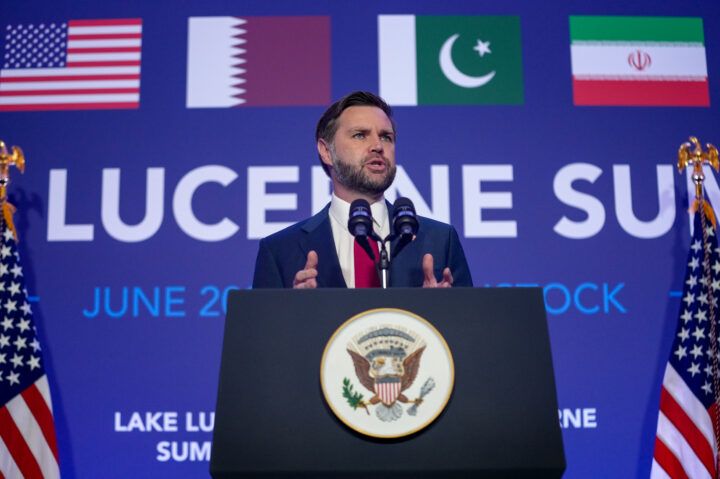
Nathan Howard-Pool/Getty Images
Vice President JD Vance speaks to members of the media at the Buergenstock Resort Lake Lucerne, after the U.S. and Iran held high-level talks at the Lake Lucerne Summit on June 22, 2026 near Stansstad, Switzerland.
Vice President JD Vance said this week that U.S. military officials are working directly with Iran’s Islamic Revolutionary Guard Corps, a U.S.-designated Foreign Terrorist Organization. The vice president made the comments after departing Switzerland following the conclusion of talks with Iran that lasted until Monday.
“One of the things we wanted to come out [of the negotiations]” was a “channel on the Iranian side” to seek conflict resolution, Vance told the outlet UnHerd aboard Air Force Two. “Which we did. They were like, ‘OK, fine, we’ll send somebody from the IRGC to go hang out in Doha with somebody from CENTCOM,’ and that’s how we’re going to settle a lot of these disputes,” he said.
President Donald Trump designated the IRGC an FTO during his first term in 2019 and ordered the strike that killed IRGC Quds Force head Qasem Soleimani in 2020. Announcing the designation, the State Department said the group “has been directly involved in terrorist plotting; its support for terrorism is foundational and institutional, and it has killed U.S. citizens.” The IRGC also “continues to provide financial and other material support” for terror groups including Hezbollah, Kataib Hezbollah, Hamas and Palestinian Islamic Jihad, the statement added.
The group played a central role in Iran’s attacks around the region during the U.S.-Iran war, including an attack on the U.S. Fifth Fleet headquarters in Bahrain earlier this month, and is linked to dozens of recent plots and attacks in Europe. U.S. authorities have also repeatedly alleged IRGC involvement in assassination schemes targeting current and former American officials, including Trump.
Vance said that the Emiratis — “by far the most hawkish, by far the most pro-Israel country in the [Gulf Cooperation Council]” — are also “having conversations with the Iranians that have never happened before, including with the IRGC,” namely about economic incentives to urge Iran to cooperate.
Regarding criticism of the memorandum of understanding reached with Iran, Vance said, “There are many things I don’t like about the comparison to the [2015 Joint Comprehensive Plan of Action], but one of them is that the MOU is a much more generic document than the JCPOA.”
“It really is a foundational document,” he said of the MOU. “Let’s open the strait, let’s stop shooting at each other, and let’s see if we can make a nuclear deal. And from their perspective, it’s, ‘Let’s lift the blockade, let’s stop shooting at each other, and let’s see if there’s a sanctions deal.’ That’s fundamentally where it’s coming from.”
Vance claimed the Iranians are now offering “things radically different from the JCPOA” and “want a fundamentally transformed relationship with the United States and the world.”
Plus, how Ritchie Torres outplayed the far left
Evan Vucci
President Donald Trump shakes hands with Turkish President Recep Tayyip Erdoğan after a news conference in the East Room of the White House, Wednesday, Nov. 13, 2019, in Washington.
Good Thursday morning.
In today’s Daily Kickoff, we talk to moderate and establishment Democrats who are raising alarms over the surge of socialists in Tuesday’s New York City congressional primaries and report on how Rep. Ritchie Torres (D-NY) dodged the DSA wave in the city. We cover last night’s Senate vote to block a Democratic-led war powers resolution seeking to end military operations against Iran and report on the shouting match between President Donald Trump and Sen. Bill Cassidy (R-LA) that preceded it. We also report on the Trump administration’s consideration of Turkey’s eligibility to receive F-35 fighter jets. Also in today’s Daily Kickoff: Rep. Dan Goldman, Sen. Adam Schiff and Rep. Judy Chu.
Today’s Daily Kickoff was curated by JI Israel Editor Tamara Zieve and U.S. Editor Danielle Cohen-Kanik, with an assist from Marc Rod. Have a tip? Email us here.
What We’re Watching
- Jewish and Israeli aid and rescue organizations are preparing to send teams to Venezuela after the poverty-stricken South American country was hit by massive back-to-back earthquakes on Wednesday night, representatives of the groups told eJewishPhilanthropy’s Judah Ari Gross. At least 164 people have been pronounced dead so far, and the number is expected to rise considerably as search efforts get underway, with some projections putting the death toll into the tens of thousands. Read more here.
- Under Secretary of State for Economic Affairs Jacob Helberg is hosting the State Department’s two-day Pax Silica Summit at the U.S. Institute of Peace. Attendees include representatives from the signatory countries to the strategic initiative — which include Israel, Qatar, the UAE, India, Germany and the U.K., among others — and senior business executives.
- On the Hill, acting Pentagon Comptroller Jules W. Hurst III will appear before the Senate Armed Services Committee for his confirmation hearing to be permanently appointed to the role — Hurst is likely to face questions about the Trump administration’s $88 billion supplemental funding request, largely to cover the cost of the Iran war, sent to Congress on Wednesday.
- The House Committee on Education and Workforce will mark up the No Antisemitism in Education Act, and Homeland Security Secretary Markwayne Mullin is slated to testify at an oversight hearing in the House Appropriations Committee.
- The Alliance for Responsible Citizenship‘s third annual conference wraps up in London today. Speakers at the summit, which focused on the future of Western civilization at the 250th anniversary of the United States, included House Speaker Mike Johnson; Energy Secretary Chris Wright; former Virginia Gov. Glenn Youngkin; Under Secretary of State for Public Diplomacy Sarah Rogers; and Axel Springer CEO Mathias Döpfner.
- The Texas Democratic State Convention begins today: The three-day event will feature remarks from Sens. Cory Booker (D-NJ) and Bernie Sanders (I-VT), Texas U.S. Senate candidate James Talarico, Illinois Gov. JB Pritzker and Democratic National Committee Chair Ken Martin. Activists are set to consider close to 20 resolutions critical of Israel.
- The annual Aspen Ideas Festival, which brings together leading figures from politics, business, media and academia, kicks off in Colorado with an opening session featuring Aspen Institute leaders and journalists Fareed Zakaria and David Brooks.
What You Should Know
A QUICK WORD WITH JI’S JOSH KRAUSHAAR
There’s little doubt that socialism is on the march within the Democratic Party after the latest primaries, with extreme candidates who would have been dismissed as nonviable prevailing in numerous congressional primaries and mayoral contests from coast to coast.
Factor in the political resilience of far-left Maine Senate nominee Graham Platner despite numerous scandals and the momentum of anti-Israel Senate candidate Abdul El-Sayed in a contested Michigan primary despite facing well-funded opposition, and there’s the potential of radicals toppling mainstream candidates well outside the deep-blue confines of major urban centers.
Ultimately, that’s a major question looming for the Democratic Party’s future — and the health of our democracy. Is the rise of socialism primarily a product of urban angst and college-age naivete, or does it have staying power beyond the most-progressive precincts in the country? Can left-wing candidates prevail in swing districts, far away from the urban progressive centers that make up its base? Or will they end up being more of a noisy but powerless faction in Congress?
Either way, socialist candidates have gone from a curiosity that rarely won any congressional seats to riding a Democratic Socialists of America-organized grassroots wave that now has to be reckoned with. You could count the number of Squad members on one hand when Rep. Alexandria Ocasio Cortez (D-NY) and her like-minded allies were first elected in 2018 and 2020. Now their representation is poised to double from its previous peak — and AOC now counts as downright pragmatic, compared to several of her soon-to-be-colleagues.
SOCIALIST SWEEP
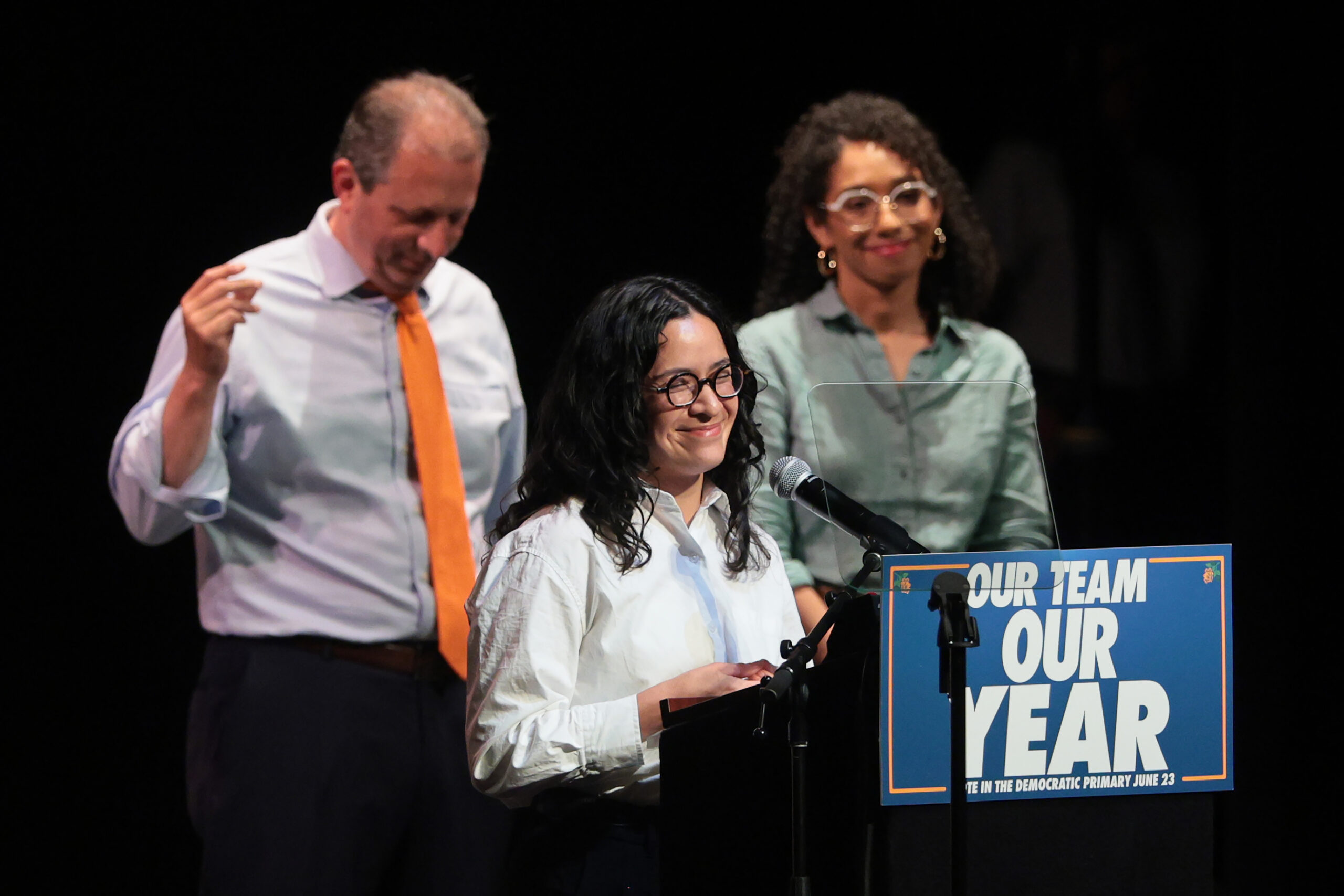
Some moderate and establishment Democrats are raising alarms over the surge of democratic socialists in New York City congressional primaries on Tuesday — which took down two Democratic incumbents. But others are dismissing the phenomenon as one localized to New York City and not applicable to the party at large, Jewish Insider’s Marc Rod, Matthew Shea and Christina Sher report.
Wider view: Rep. Greg Meeks (D-NY), a longtime Democratic leader from Queens, lamented Tuesday’s results, particularly Rep. Adriano Espaillat’s (D-NY) loss. Meeks told reporters that the party as a whole is not a socialist party, and that socialist ideas are very much out of step with the country overall. “That’s not where America is, that only happens in certain parts — like New York City now, apparently — deep, deep, deep blue,” Meeks said. If the entire party follows the same path, “that means that all the other seats that are not [deep blue], we can never win, which means we will never be in the majority, and we [will] never get anything done.”
Read the full story here with additional comments from Senate Minority Leader Chuck Schumer (D-NY), Reps. Tom Suozzi (D-NY), Josh Gottheimer (D-NJ), Wesley Bell (D-MO), Jared Moskowitz (D-FL), Pete Aguilar (D-CA), Jamie Raskin (D-MD) and Ro Khanna (D-CA) and Sens. John Fetterman (D-PA), Ruben Gallego (D-AZ), Gary Peters (D-MI), Raphael Warnock (D-GA), Dick Durbin (D-IL), Tim Kaine (D-VA) and Bernie Sanders (I-VT).
Eye on Washington: Having conquered New York City with a stunning primary night sweep on Tuesday, Mayor Zohran Mamdani is wasting no time in moving on Capitol Hill. In an uncharacteristically long question-and-answer session at an unrelated announcement on Wednesday, the mayor announced he would sit down later in the day with House Minority Leader Hakeem Jeffries (D-NY), JI’s Will Bredderman reports.
TORRES TACTICS

Rep. Ritchie Torres (D-NY) has long been a target of the far left in New York City, largely because of his outspoken support for Israel and his Jewish constituents. But Torres emerged with a commanding victory over a far-left challenger in Tuesday’s Democratic primaries, even as pro-Israel Reps. Dan Goldman (D-NY) and Adriano Espaillat (D-NY) were defeated by democratic socialist-aligned challengers, Jewish Insider’s Marc Rod reports.
Standout factors: Observers attribute Torres’ landslide win against former New York Assemblymember Michael Blake to a variety of factors, including the different demographics of his district — which includes the heavily Jewish neighborhood of Riverdale, as well as some of the poorest neighborhoods in the city — his strength as a member of Congress and as a campaigner and Blake’s own weaknesses as a candidate. Torres is popular in the district, has prioritized constituent services, has been a longtime presence in the district — as a city councilman from 2014 to 2020 before his time in the House — and maintains a strong reputation locally, Torres campaign spokesperson Benny Stanislawski said.
Concession speech: Goldman, a pro-Israel Jewish Democrat who was unseated in a bitter primary on Tuesday, warned in his concession speech that antisemitism “will ultimately be the undoing of our democracy if we all don’t lean in and speak out,” JI’s Matthew Kassel reports.
ON THE HILL
The Senate voted on Wednesday night to block a Democratic-led war powers resolution seeking to end military operations against Iran, after a heated meeting between President Donald Trump and Senate Republicans where he berated a handful of lawmakers over their votes in favor of a successful war powers resolution the previous day, Jewish Insider’s Marc Rod and Emily Jacobs report.
How it happened: Sens. Bill Cassidy (R-LA) and Rand Paul (R-KY), supporters of previous war powers efforts, changed their votes on the resolution on Wednesday, which had previously passed a procedural hurdle — Cassidy now voting no and Paul voting present. Sens. Susan Collins (R-ME) and Lisa Murkowski (R-AK) again voted yes, while Sen. John Fetterman (D-PA) voted no. The final vote was 50-47. Cassidy, who engaged in a shouting match with Trump in the meeting over his recent war powers votes, told reporters after the meeting that he would not change his vote until he had been briefed on the war. Hours later, Cassidy received a private briefing on the war from Vice President JD Vance and White House Special Envoy Steve Witkoff.
Supplemental request: The Trump administration on Wednesday formally sent an $87.6 billion supplemental funding request to replenish stockpiles and otherwise cover the costs of the war with Iran to Congress, JI’s Emily Jacobs and Marc Rod report.
SHOWN THE DOOR

Acting Director of National Intelligence Bill Pulte forced out Will Ruger, the deputy director for mission integration, from the agency as part of a series of cuts said to be targeting the “deep state,” according to CBS News. Ruger previously held senior positions at groups tied to the libertarian Koch network, and had been affiliated with the isolationist Defense Priorities think tank, Jewish Insider’s Marc Rod reports.
Background: Ruger had been a vocal opponent, prior to his government service, of both the maximum pressure sanctions campaign against Iran and potential U.S. military operations against the regime. He was also a defender of the 2015 Iran nuclear deal. Ruger’s role included overseeing the president’s daily intelligence briefing.
ANKARA OPPORTUNITY
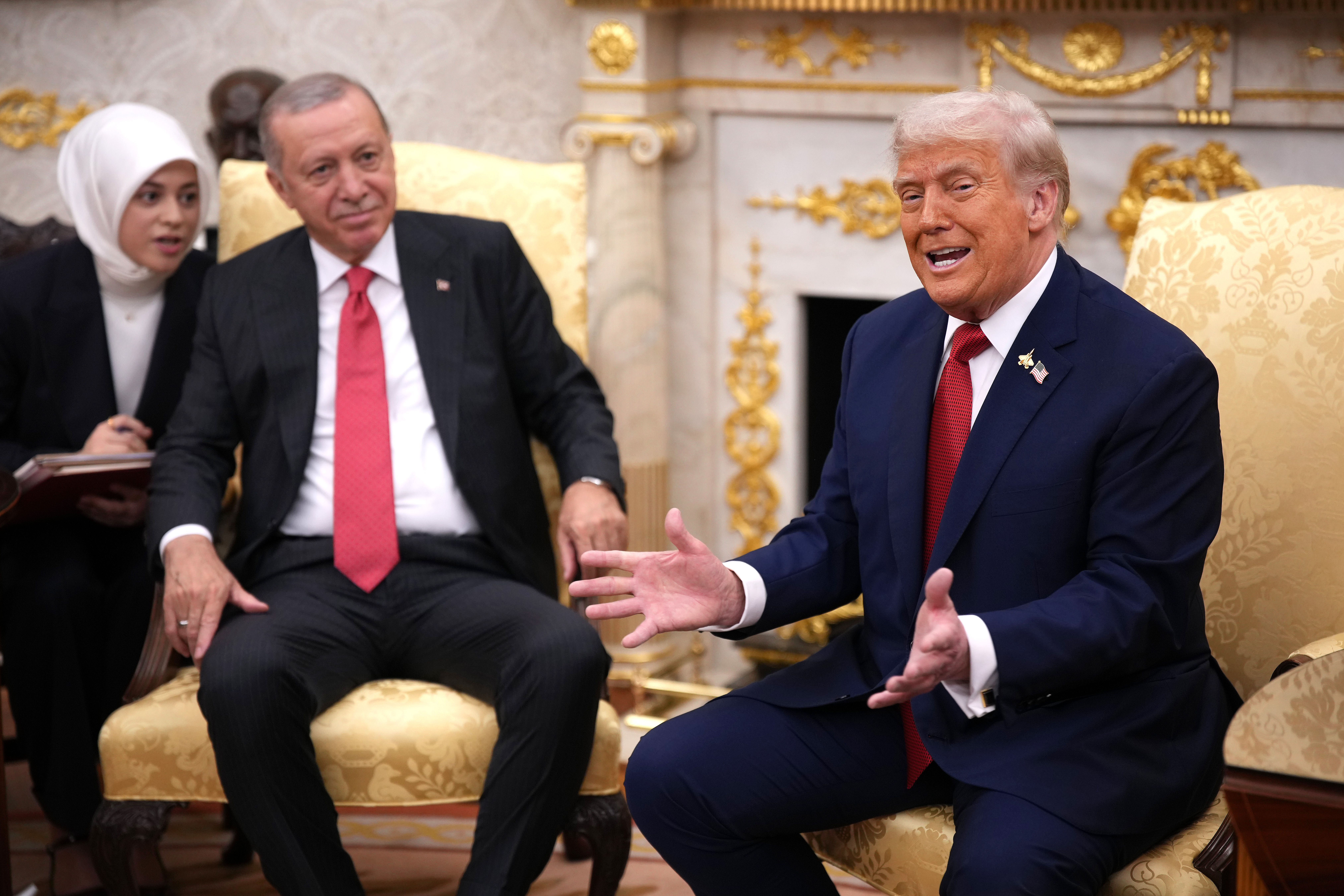
Vice President JD Vance said on Wednesday that the administration is “confirming” Turkey has fulfilled its obligations under U.S. law in order to receive advanced F-35 fighter jets, which Ankara has long sought but has been barred from purchasing since 2020 after it acquired the S-400 air-defense system from Russia, Jewish Insider’s Danielle Cohen-Kanik and Christina Sher report.
Legal requirement: U.S. law requires the secretaries of state and defense to certify to Congress in writing, prior to any F-35 transfer, that Turkey no longer possesses the S-400 system and has provided credible assurances it will not acquire similar Russian air-defense systems. Latest reports indicate the S-400 system is inactive but still intact in Turkey, which would not fulfill the obligations required under law to lift the sanctions.
Strait security: Lawmakers and Middle East analysts are expressing support for Washington’s reported agreement to help Oman strengthen its maritime intelligence and monitoring of transit through the Strait of Hormuz, saying the move could help secure free access to the critical waterway and deter Iranian influence, JI’s Matthew Shea reports.
SCHOOL CONTROVERSY

A Massachusetts middle school principal is receiving criticism from Jewish groups for apologizing to Arab students who he claimed “felt unseen” during a Holocaust education lesson, Jewish Insider’s Haley Cohen reports.
Back and forth: In a message sent to seventh graders via a school portal, a screenshot of which was obtained by JI, Diamond Middle School Principal Johnny Cole said the lesson at the Lexington, Mass., school was aimed at teaching the students to recognize hate and to speak out against it, something he called “an important goal.” Cole then apologized after he said some students’ families had expressed that the lesson left them feeling “unseen.” Cole wrote, “Some of you felt like your own history, your identity, or your community was left out or erased. Some of you left that session feeling less safe, not more. We have heard this from families, and we believe you.”
Worthy Reads
Radical Shift: Reason’s senior editor Robby Soave examines Democratic congressional candidate Darializa Avila Chevalier’s record as she is set to become what he calls Congress’ “first campus radical.” “In 2019, when I published my first book, Panic Attack: Young Radicals in the Age of Trump, I predicted that the era’s campus protesters would not shed their radicalism when they graduated college and moved out into the so-called real world — rather, they would force the world to conform to their quixotic expectations. This would be particularly felt in the areas of American life most susceptible to their influence: education, media, entertainment, and eventually, politics. Now that day has finally arrived. Welcome, congresswoman.” [Reason]
The Socratic AI Method: The Economist examines the rise in philosophers being hired by AI firms. “Some of the lessons that philosophy can offer AI researchers are ancient. The Socratic method — as described by Plato, an ancient Greek philosopher — uses feigned ignorance and sequential questioning to clarify meanings, spot contradictions and reveal ramifications. Many current AI systems tend towards sycophancy. Models trained in the Socratic method, says Jörg Noller, an expert on philosophy and AI at Ludwig Maximilian University of Munich, are less keen on people-pleasing and more willing to pursue the truth.” [Economist]
House Majority Math: Joel Wanger, DMFI PAC’s chief political officer, breaks down the results from Tuesday night’s primary elections. “Here’s the thing about House Majority math, and it’s something I’ve said before: it isn’t won in New York City or San Francisco. It’s won in places like San Diego and South Texas — and that’s exactly where pro-Israel Democrats had some of their best nights this cycle, nominating strong general-election candidates in competitive seats. … The pattern I’ve tracked all cycle keeps repeating: pro-Israel Democrats win decisively when they take primary challenges seriously and early, build broad coalitions rather than narrow ones, and talk about the kitchen-table issues — affordability, economic anxiety — that are actually driving voters right now. Where that didn’t happen, races were close. Where it did, they weren’t.” [Substack]
No Socialist Takeover: The Atlantic’s Adam Serwer argues that the Democratic Party is not being taken over by democratic socialists as a unified national force, but rather is becoming more ideologically diverse and locally shaped. “The modern Democratic Party, by virtue of its class and ethnic diversity, has always been ideologically heterodox. An approach that works for a Zohran Mamdani or a Janeese Lewis George will not necessarily work for a James Talarico in Texas or a Mary Peltola in Alaska. Many people outside of the democratic socialists’ cities and districts will focus on whether the candidates’ stances on Israel and Palestinian rights reflect a shift within the party (and they do) and the fact that they differ from more centrist Democrats (also correct). But whether they succeed as leaders and politicians will depend on much more local concerns — matters such as jobs, public safety, and affordability.” [Atlantic]
Word on the Street
Israeli and Lebanese officials have reportedly denied a claim by a State Department official, cited by Reuters, who said that Israel had withdrawn from some of the southern Lebanese territory it has held during its war against Hezbollah…
Saudi Arabia is planning to host reconciliation talks between Gulf countries and Iran, a diplomat with knowledge of the arrangements told Agence France Presse. The summit, aimed at mending ties between Gulf nations, Iran and possibly other regional neighbors in the aftermath of the war, will be independent of ongoing U.S.-Iran talks, the diplomat said…
Secretary of State Marco Rubio met with UAE President Sheikh Mohamed bin Zayed in Abu Dhabi on Wednesday; pictured sitting next to the secretary of state in a working lunch with MBZ was Michael Boulos, Trump’s son-in-law, whose father serves as a senior advisor to the president on the Middle East…
Bahraini National Security Advisor Sheikh Nasser bin Hamad Al Khalifa met separately with Sens. Jacky Rosen (D-NV), Lindsey Graham(R-SC) and Brian Schatz (D-HI) and Rep. Brian Mast(R-FL) during a visit to Washington…
FBI Director Kash Patel hosted Qatari Interior Minister Sheikh Khalifa bin Hamad Al Thani in Washington…
CENTCOM announced that the U.S. killed senior ISIS leader Ali Husayn al-‘Ulaywi in an airstrike in northwest Syria last Friday…
Sen. Adam Schiff (D-CA) and Rep. Judy Chu (D-CA) introduced a resolution to award a Congressional Gold Medal to Americans and relief organizations involved in saving Jewish Holocaust refugees…
An intelligence report obtained by journalists from the Israeli public broadcaster Kan details how Qatar became a central channel of economic and military strength for Iran, helping it to circumvent sanctions after the 2018 cancellation of the Joint Comprehensive Plan of Action and also after the Oct. 7, 2023, Hamas attacks on Israel…
A Kuwaiti air-defense officer shared a firsthand account of the opening moments of Iran’s missile and drone attacks on the Gulf country, describing at a conference in London the frantic five minutes as ballistic missiles filled the sky and the air-defense network scrambled to respond…
Vice President JD Vance and his allies are embracing his role as the public face of President Donald Trump’s Iran deal, Semafor reports, arguing that backing an end to the conflict distinguishes him from the GOP’s neoconservative wing and strengthens his standing with the MAGA base ahead of a potential 2028 presidential run…
The New York Times traces a generational and ideological shift on the American right toward viewing Iran as a pragmatic country the U.S. can learn to live with — a pivot led by Trump but driven by other factors that include younger Republicans’ war fatigue and waning support for Israel…
New Lines Magazine spotlights the unrest surrounding a resort project in Albania’s Vjosa-Narta protected area by Jared Kushner and Ivanka Trump that has sparked unprecedented mass protests in the country; the demonstrations have evolved from an environmental campaign to a broad expression of frustration with long-serving Prime Minister Edi Rama…
Ari Emanuel, TKO CEO and Mari Group founder, is in advanced talks to buy theater group ATG for $6 billion…
Morris Dancyger, a child survivor of Auschwitz who built a successful pharmacy and real estate career and co-founded the first modern art gallery in Calgary, Canada, died at 86…
Pic of the Day

Haredi demonstrators blocked major highways in Israel on Wednesday, causing massive traffic disruptions, in a nationwide protest against the imprisonment of yeshiva students who fail to comply with military draft orders.
Birthdays

Free agent center fielder, formerly in the San Francisco Giants organization, he was the 10th overall pick in the 2019 MLB draft, Hunter David Bishop turns 28…
Music publicist in the 1970s and 1980s for Prince, Billy Joel and Styx, later an author on human behavior, Howard Bloom turns 83… Founder and CEO of Bel Air Partners, a financial advisory firm for automotive retailers, Sheldon J. Sandler turns 82… Real estate developer in Brooklyn, Manhattan, Las Vegas and Miami and founder of The Continuum Company, Ian Bruce Eichner turns 81… Florida resident, Joseph C. Goldberg… Southern California-based mentor, coach and consultant for business executives through Vistage International, Gary Brennglass… Associate justice of the Supreme Court of the United States, Justice Sonia Sotomayor turns 72… Former member of the Knesset for the Meretz party, Michal Rozin turns 57… Founder and CEO of The Agency, a high-end real estate brokerage, Mauricio Umansky turns 56… Managing director of A-Street, an investment fund focused on seeding and scaling innovative K-12 student learning, Mora Segal… Senior media and PR specialist at Hadassah, Helen Chernikoff… Israeli philosopher, writer and publicist, he teaches at Yeshivat Har Etzion and Midreshet Lindenbaum, Rabbi Chaim Navon turns 53… Founder and director of The Biblical Museum of Natural History in Beit Shemesh, Israel, popularly known as the “Zoo Rabbi,” Natan Slifkin turns 51… Former fashion model and television presenter, Michele Merkin turns 51… Deputy director of government relations at Bread for the World, Zachary Silberman… President of Gratz College in Melrose Park, Pa., Zev Eleff turns 41… One-half of the husband-and-wife duo known for their YouTube channel h3h3Productions with more than 1.3 billion views, Ethan Edward Klein turns 41… Organizational change management specialist at CACI International, Isaac Snyder… VP of strategy at Saint Paul Commodities and co-founder of Veriflux, Daniel “Dani” Charles turns 39… Family Medicine Residency Faculty at Jefferson Einstein Hospital in Philadelphia, Pa., Avital Mintz-Morgenthau, MD… Senior reporter and writer covering the White House for CNN, Betsy Klein…
Cassidy said Trump raised his voice after the senator defended his vote backing a resolution directing the administration to withdraw U.S. forces from Iran
Bill Clark/CQ-Roll Call, Inc via Getty Images
Sen. Bill Cassidy, (R-LA), walks through the Ohio Clock Corridor before President Donald Trump arrives for the Senate Republicans' lunch meeting in the U.S. Capitol on Wednesday, June 24, 2026.
President Donald Trump engaged in a shouting match with Sen. Bill Cassidy (R-LA) during a closed-door lunch with Senate Republicans on Wednesday over the outgoing Louisiana senator’s support for a war powers resolution directing the administration to withdraw U.S. forces from Iran that passed the chamber the previous day.
Cassidy acknowledged the incident after the luncheon concluded, telling reporters that the dispute began when the president questioned aloud why any Republican would vote for the resolution. The Louisiana senator stood up from his chair and asked Trump if his question was rhetorical or if he wanted an explanation. Cassidy said Trump responded by asking for an explanation, which the senator obliged.
The Louisiana senator said that he told the president, “You have not told the American people what’s going on. It was supposed to last four weeks, it has lasted for four months. Our original objectives have not been achieved. And I want to know what’s going on.”
He went on to say that Trump “did not particularly care for my comments” and “raised his voice,” prompting Cassidy to grow angry. At some point during the confrontation, other GOP senators encouraged Cassidy to sit down and tried to “deescalate” the situation. Cassidy obliged his colleagues and stopped engaging the president.
“I lost my temper,” Cassidy said. “That’s not appropriate, it’s the Irish in me. But I, again, matched his tone, and his volume. It went back and forth.”
Cassidy accused Trump of making several negative comments about him, including a remark about Cassidy losing his reelection bid to a Trump-backed challenger. Another GOP senator said that Cassidy referred to Trump as “my brother” at one point instead of his formal title, which Trump responded to angrily.
Still, the senator said that Cassidy remained respectful of the president during the exchange, and attributed the blowup in part to Trump’s longstanding frustration with Cassidy on a range of issues, including his impeachment in 2021.
Cassidy noted that he would continue to vote for the war powers resolutions until he is briefed on the war effort. Sens. Lisa Murkowski (R-AK), Susan Collins (R-ME) and Rand Paul (R-KY) joined Cassidy in helping Democrats pass a war powers resolution in the Senate for the first time on Tuesday, delivering the upper chamber’s first rebuke of the president’s war.
He added that he will be satisfied once the administration briefs Congress on the details of the U.S. memorandum of understanding with Iran. “You say everything’s fine, but on the outside, it doesn’t look like everything’s fine,” he said of the Trump administration’s handling of diplomatic efforts to end the war in Iran.
“I make no apologies for standing up to the president, if you will, trying to demand that more information be shared with the American people,” Cassidy said. “If someone tries to bully you into not asking that question, I’m not going to accept that either. I am sticking up for the American people, even if I’m speaking to the president.”
The meeting was organized by Sen. Rick Scott (R-FL) and comes at a time of heightened tension between Trump and the Senate Republican conference over the war powers vote; Trump’s demands that the Senate pass his signature voter ID bill, for which Senate Republicans say they lack the votes; and, most recently, Trump’s last-minute decision on Wednesday morning to cancel a signing ceremony at the Capitol for a much-anticipated bipartisan housing package.
A large group of Senate Republicans — including Senate Majority Leader John Thune (R-SD), Majority Whip John Barrasso (R-WY), Sens. John Hoeven (R-ND), Jerry Moran (R-KS), Thom Tillis (R-NC), Mike Rounds (R-SD), Katie Britt (R-AL), Kevin Cramer (R-ND), Tim Scott (R-SC), Mike Crapo (R-ID), John Kennedy (R-LA), Collins, Murkowski and others — huddled on the Senate floor for an extended period after the contentious meeting, in what appeared to be an at-times animated conversation.
Following the luncheon, Scott told reporters that Trump was “very forceful about what he cares about,” also noting that the president talked about Iran “a lot.”
“[Trump] is very comfortable he’s going to get a deal,” Scott said. “[Iran is] doing exactly what he wants. He was very disappointed that somebody would vote on the war powers resolution to stop him in the middle of negotiations, so that frustrates him.”
Scott suggested he understands Trump’s heated demeanor: “If I was the president, I was in the middle of a negotiation to protect American lives, I would be frustrated too.”
Scott said that Trump told senators that Iran is not telling the truth about the talks, and that if Iran doesn’t agree to a good deal, the U.S. will return to military action.
“He said Iran’s agreeing to whatever his requests are. Don’t believe in anything [that] the Iranian press is putting out, because it’s a complete lie,” Scott said. “He’s very comfortable that they’re not gonna have nuclear weapons, they’re not going to have the money to be able to continue to support Hamas, Hezbollah and the Houthis, so he’s very comfortable that we’re going to have a good deal.”
Kennedy, who has been skeptical that the Iranian regime will hold to the terms of any deal but supportive of the administration’s negotiation efforts, offered a similar view.
“I’m in the middle of serious negotiations, trying to settle a conflict, and one of my mates undermines me,” Kennedy said of the president’s perspective. “I’m going to be mad too, and he was mad as a murder hornet about that. He’s right to be mad, in my opinion. Not criticizing anybody for their vote, but these next 60 days are critical,” he added, referring to the 60-day window for further negotiations established in the agreement with Iran.
“We ought to support him, whether you like him or not,” Kennedy continued. “I don’t know how it’s going to end up, you’ll have plenty of time to assess it after 60 days, but we’re going to give peace a chance for 60 days.”
Cramer said that Trump was “very detailed” in his discussion of the situation in the Middle East, but he and other Republicans said there was little opportunity for them to ask questions.
Like Scott, Cramer said Trump disputed Iran’s characterizations of the talks. “He emphasized again that everything they’re saying they’re not giving up, they’re giving up,” Cramer said. “My trust is in our administration until such time as they sign something that’s foolish.”
Another GOP senator, speaking on condition of anonymity, said that Trump emphasized to the group that he could “blow everything up” but that that would have harmed many Iranians, which he wanted to avoid.
The senator told JI that the president explained the MOU to senators — including the financial benefits Iran stands to gain and his decision to strike Iranian nuclear sites in 2025 — and defended his diplomatic overtures to the Iranian regime. They said that Trump told the group, “Without any question in his mind, the number one thing is that Iran is just not going to be able to have a nuclear weapon, ever.” The senator said Trump expressed “so much compassion for Israel” in his remarks.
Trump also warned the lawmakers, according to the senator, that, “If we don’t watch out, what we do here can screw up a whole lot of stuff when you’ve got people that are negotiating” a possible deal with Iran.
Rounds said the president provided senators “more of a briefing in terms of what [the administration is] doing over [in Iran] than we’ve heard to date.” However, Rounds noted that “most of it to me was consistent with what we’ve learned” in previous classified briefings.
When asked whether Republican senators explained to Trump that there is a lack of votes to pass his voter ID bill, the SAVE America Act, Rounds said, “We really didn’t get into that.”
Sen. Tommy Tuberville (R-AL), a strong supporter of the president, praised Trump’s performance in the meeting, telling reporters after the luncheon, “You can’t take it personal. You’ve got to go in knowing that the head coach is coming into the … room.”
“The president did a hell of a job of getting his message over, and sometimes in a loud voice, sometimes not so loud,” Tuberville said. “That’s how you do it. That’s how I did it. Not to say it’s perfect. He came in and got his point across, and I think when we all left, we understood where he [stands].”
Sen. Roger Marshall (R-KS) similarly dismissed the shouting match between Trump and Cassidy as indicative of the president having an issue with the Senate GOP conference.
“I think it’s great for a family to have these types of discussions,” Marshall said. “You all act like no one ever yelled at each other. I didn’t go into a doctor’s hospital board meeting where there wasn’t yelling at each other. I think it’s perfectly fine if you’re trying to air your grievances.”
Sen. John Cornyn (R-TX), meanwhile, sarcastically told reporters that there “was quite a unity message” during the meeting.
Cornyn also remarked that Trump spoke for an hour and 15 minutes and that there “wasn’t really an opportunity” for him to get a question in.
The president’s continued push for the Senate to pass the SAVE America Act, despite lacking the votes without abolishing the 60-vote filibuster threshold, was also a major point of contention.
“He wants the SAVE Act, that much is clear,” Kennedy told reporters. “I want to say that I’m on the record for any way to get the SAVE Act passed. I still think there’s potential through reconciliation, but some of my Senate colleagues don’t agree with it. … It’s clear he wants it.”
“I know there’s frustration over the SAVE Act passage, but we simply don’t have the votes because we’re not going to nuke the filibuster,” Tillis said. “We’ve made it clear multiple times, if the SAVE Act requires nuking the filibuster it’s simply not going to happen and that’s been obvious long before today.”
Plus, Israeli alarm over Iran’s role in Lebanon
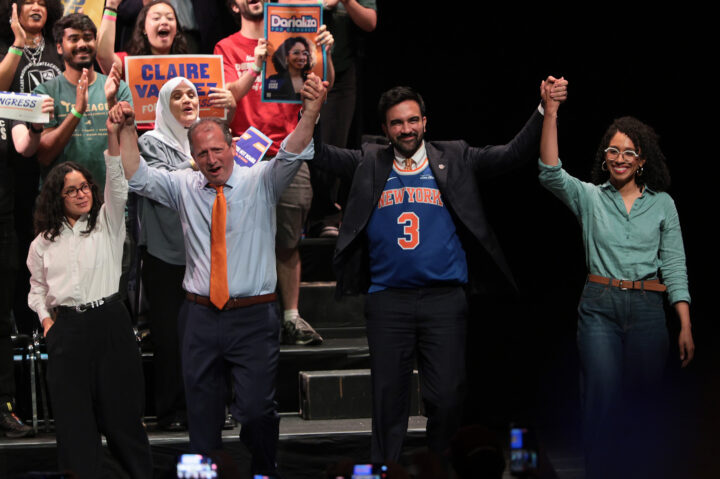
Congressional candidate Claire Valdez, Congressional candidate Brad Lander, Mayor Zohran Mamdani, and Congressional candidate Darializa Avila Chevalier raise their hands during a Get Out the Vote (GOTV) rally at King's Theater on June 18, 2026 in New York City (Photo by Michael M. Santiago/Getty Images)
Good Wednesday morning.
In today’s Daily Kickoff, we cover the results of yesterday’s primary elections in New York City and Maryland, and report on criticism by prospective 2028 Democratic presidential contenders of the U.S.-Iran memorandum of understanding. We also highlight Israeli Ambassador to the U.S. Yechiel Leiter’s statement of concern over the U.S.-Iran agreement to establish a “deconfliction cell” to end military operations in Lebanon and over Tehran’s role in that, and examine the contrasting messaging Vice President JD Vance and Secretary of State Marco Rubio have offered around Iran’s involvement in the conflict between Hezbollah and Israel. Also in today’s Daily Kickoff: Robert Kraft, Gene Simmons and Sir Liam Fox.
Today’s Daily Kickoff was curated by JI Israel Editor Tamara Zieve and U.S. Editor Danielle Cohen-Kanik, with an assist from Marc Rod. Have a tip? Email us here.
What We’re Watching
- Far-left, anti-Israel congressional candidates backed by New York City Mayor Zohran Mamdani swept a trifecta of contested primaries Tuesday night. But pro-Israel stalwart Rep. Ritchie Torres (D-NY) won renomination in a landslide with 72% of the vote, and state Assemblyman Micah Lasher, an ally of Israel who holds close relations with the Jewish community, won the Democratic nomination to succeed Rep. Jerry Nadler (D-NY). (Read more below.)
- Outside of the deep-blue city, Democrats turned to pro-Israel moderates in key races. State Del. Adrian Boafo, who was the recipient of millions of dollars of supportive ads from AIPAC’s super PAC, easily prevailed in the Democratic primary to succeed retiring Rep. Steny Hoyer (D-MD). (Read more below.) Military veteran Cait Conley, meanwhile, won comfortably in a crowded Democratic primary, and will face Rep. Mike Lawler (R-NY) in a swing suburban New York City seat. And in Utah, former Rep. Ben McAdams (D-UT) easily defeated a challenger who campaigned on his anti-Israel bona fides.
- Rep. April McClain Delaney (D-MD) held off a well-funded challenge from former Rep. David Trone. Trone spent over $25 million of his own money on the race, but only won about 37% of the primary vote. And in Montgomery County, Md., progressive Councilmember Will Jawando is currently leading the more moderate Councilmember Andrew Friedson 41-33%in the Democratic primary for county executive with 70% of votes counted.
- President Donald Trump is expected to attend a GOP Senate luncheon as he remains at odds with his party over several legislative efforts. Later, he’ll hold a rally on the National Mall to kick off his 16-day Great American State Fair to celebrate the country’s 250th anniversary.
- Defense Secretary Pete Hegseth is slated to brief House Republicans as the Pentagon gears up for a contentious fight over an expected $80 billion supplemental funding request to replenish stockpiles and otherwise pay for the war in Iran, according to several reports. Read more here.
- The House Appropriations Committee is set to mark up the 2027 defense spending bill.
- Sen. Jacky Rosen (D-NV) will speak in conversation with Jewish Council for Public Affairs CEO Amy Spitalnick as well as leaders from other religious groups, including the Union for Reform Judaism and Orthodox Union, about the Jewish American Security Act.
- Conservative commentator Ben Shapiro’s media site, The Daily Wire, is co-hosting alongside ad agency LSKR a day of programming at the Cannes Lions International Festival of Creativity in the south of France, marking the company’s debut at the advertising industry’s premier annual gathering.
What You Should Know
A QUICK WORD WITH JI’S WILL BREDDERMAN
It’s New York City Mayor Zohran Mamdani’s party now — even if not everybody in the Big Apple feels invited.
The mayor’s candidates for Congress jumped out to early leads Tuesday night, with former City Comptroller Brad Lander comfortably defeating Rep. Dan Goldman (D-NY), a stalwart opponent of President Donald Trump who nonetheless lost support from his party’s base over his lukewarm support for the new mayor and longstanding pro-Israel record. Lander won 66% of the vote to Goldman’s 34%, with 90% of the vote counted as of Wednesday morning.
The shocks to the party establishment continued throughout the night, as Democratic Socialists of America-endorsed state Assemblywoman Claire Valdez jumped to a commanding advantage over party favorite, Brooklyn Borough President Antonio Reynoso. Valdez easily defeated Reynoso, 56%-36%, with 92% of the vote counted.
And the capstone on the night for Mamdani’s anti-Israel congressional trifecta came when networks announced the ouster of Rep. Adriano Espaillat (D-NY), the chairman of the Congressional Hispanic Caucus, against radical doctoral student and Columbia encampment leader Darializa Avila Chevalier, whose inflammatory X feed — and attendance at an anti-Israel rally the day after the Oct. 7 Hamas attacks — did little to derail her candidacy. In a much tighter race, Avila Chevalier beat the incumbent, 49%-46%, with 88% of the vote counted.
Signs of the ascendance of the far left within overwhelmingly Democratic big cities have been visible for months. Mamdani’s astounding mayoral victory in 2025 mobilized a slew of like-minded candidates to run for office — in New York City and beyond. In Philadelphia, DSA-endorsed candidate Chris Rabb won a Philadelphia-based congressional seat last month. Last week, DSA-backed Janeese Lewis George romped to victory in the race for mayor in the nation’s capital, and is on track to become the city’s next top executive.
ESTABLISHMENT WIN
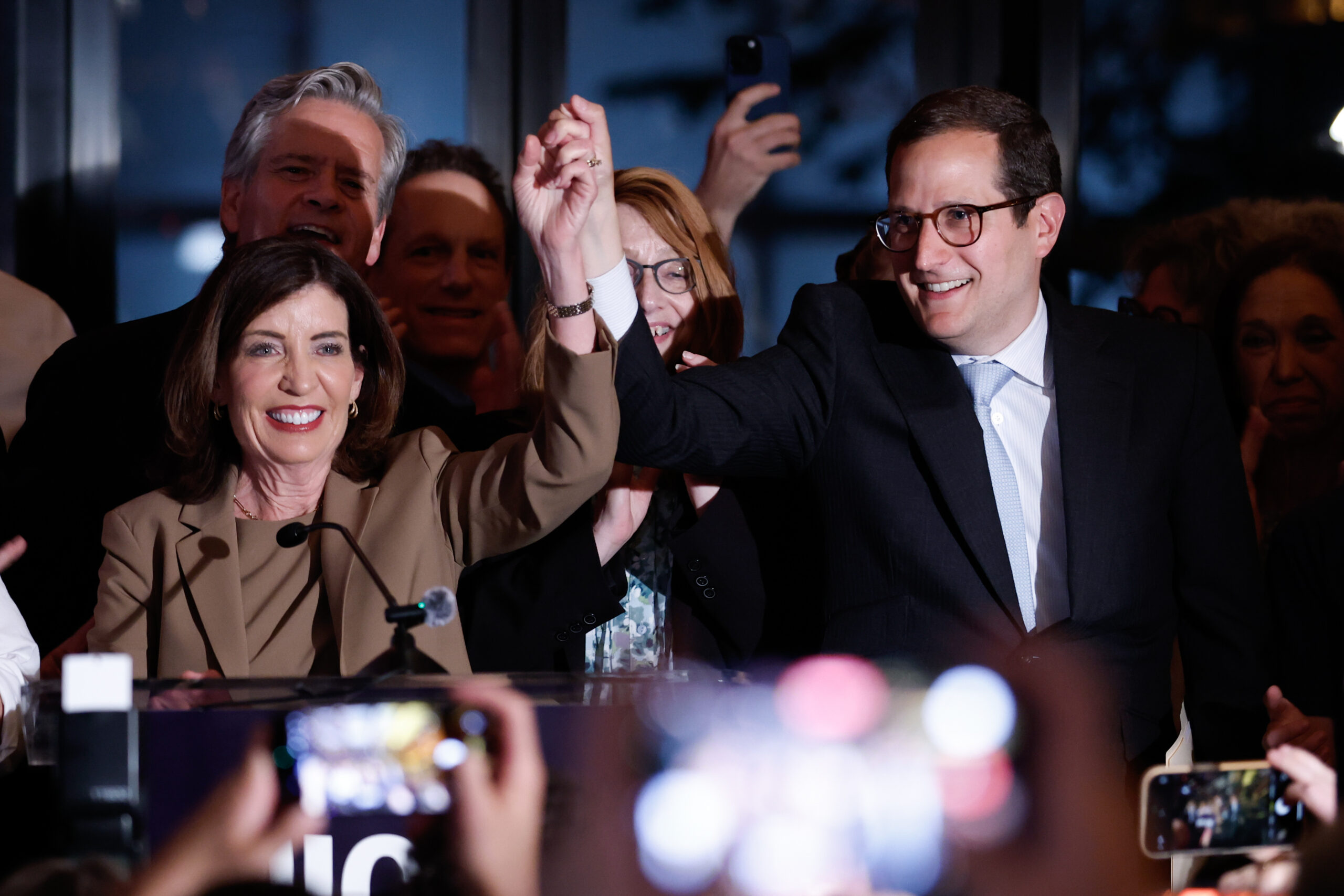
New York state Assemblymember Micah Lasher, a Jewish Democrat, claimed victory on Tuesday night in a hard-fought primary for a coveted House seat in the heart of Manhattan, according to the Associated Press. Lasher had won 39% with most of the vote tallied by the time his race had been called. He prevailed over a fellow assemblymember, Alex Bores, who pulled in 35%, as well as Jack Schlossberg, the Kennedy scion, who came in third with just 10% — followed by Nina Schwalbe and George Conway, both in single digits, Jewish Insider’s Matthew Kassel reports.
Background: Lasher, 44, a longtime member of the Democratic establishment in New York, pitched himself as the most experienced candidate in the race, leaning into his identification as a policy wonk. He was backed by the district’s retiring congressman, Rep. Jerry Nadler (D-NY), as well as Gov. Kathy Hochul. He also drew a significant share of outside support from former New York City Mayor Michael Bloomberg, who spent $10 million to help boost Lasher’s campaign.
MARYLAND MANDATE
Maryland state Del. Adrian Boafo prevailed on Tuesday in the crowded Democratic primary to replace retiring Rep. Steny Hoyer (D-MD), who endorsed him, marking a legacy-burnishing victory for the veteran congressman and his pro-Israel allies, Jewish Insider’s Matthew Kassel reports.
Strong lead: The Associated Press called the race after Boafo had secured 32% of the vote with about one-half of ballots counted Tuesday night. His nearest competitor, businesswoman Quincy Bareebe, lagged well behind with 19%. Boafo’s win came after a forceful push by Hoyer, pro-Israel groups and establishment Democrats to help elevate the congressman’s hand-picked former campaign manager in a race that featured two dozen candidates vying to represent Maryland’s 5th Congressional District.
2028 WATCH
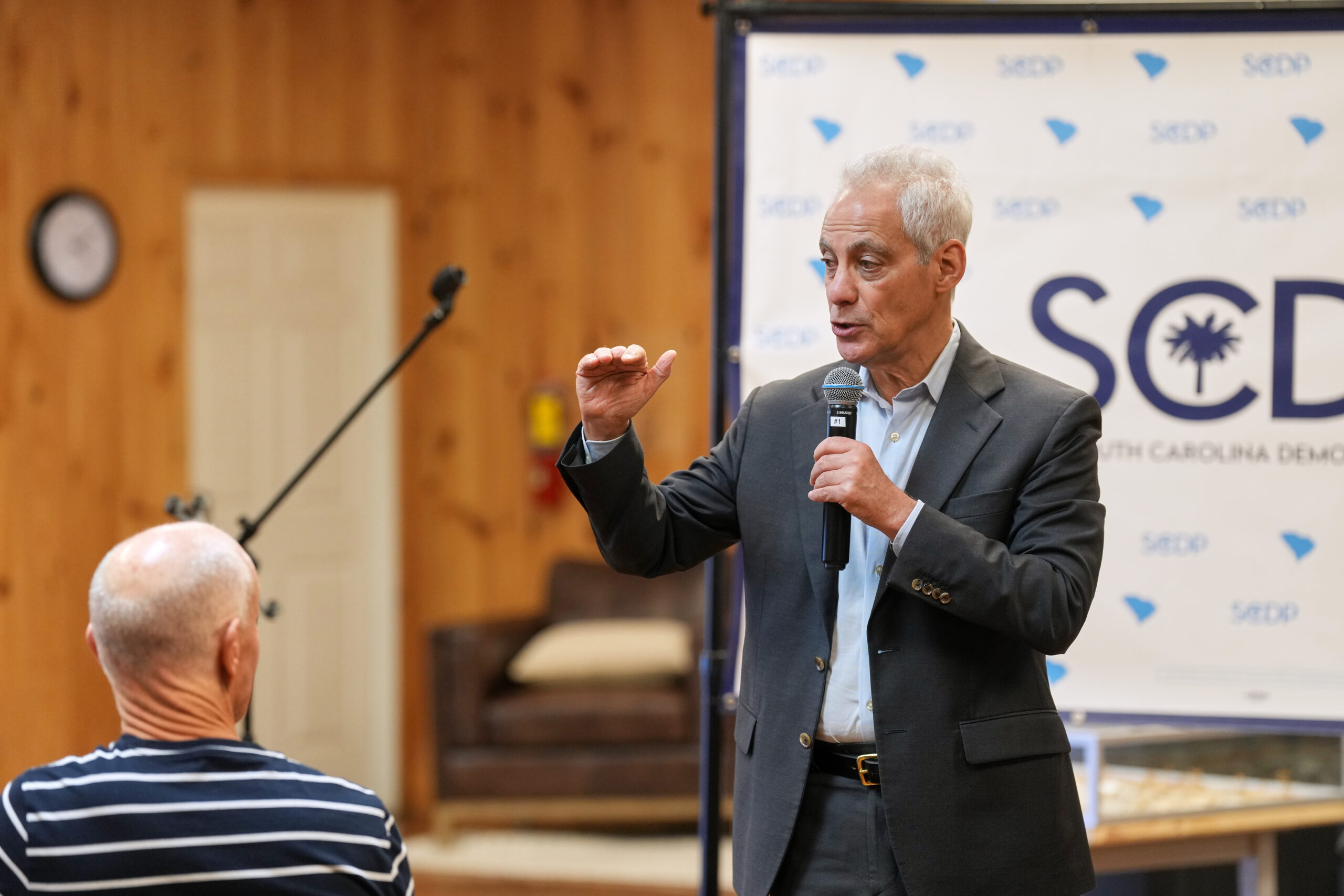
Among the Democrats mulling a presidential run in 2028, there was a unified reaction in February when President Donald Trump decided to attack Iran: opposition to a war they viewed as reckless and unconstitutional. As those Democrats respond to the U.S.-Iran memorandum of understanding that Trump announced last week, another consensus is emerging, holding that the deal is just another example of Trump’s ineffectual leadership — yet another instance, these Democrats argue, of Trump getting taken advantage of and undermining the American people, Jewish Insider’s Gabby Deutch reports.
Taking jabs: “They’re negotiating a deal that, truthfully, every single detail we continue to hear just looks like the Iranians continue to do better than us. I think they should have been the one to write The Art of the Deal, not Donald Trump,” Maryland Gov. Wes Moore said in a TV interview on Tuesday. Rahm Emanuel, the former U.S. ambassador to Japan, member of Congress and chief of staff to President Barack Obama, offered a similar quip at a recent Financial Times event after describing the deal as “the memorandum of misunderstanding.” Emanuel said, “While the president thinks he wrote a book called The Art of the Deal, they’re going to teach him a lesson, which is the Persian lesson: the art of the negotiation. And he just got schooled, unbelievably.”
Deal defense: Breaking with many Senate Republicans who have expressed skepticism about various elements of the Trump administration’s memorandum of understanding with Iran, House Speaker Mike Johnson (R-LA) defended the deal on Tuesday, JI’s Marc Rod reports.
DAYLIGHT EMERGING
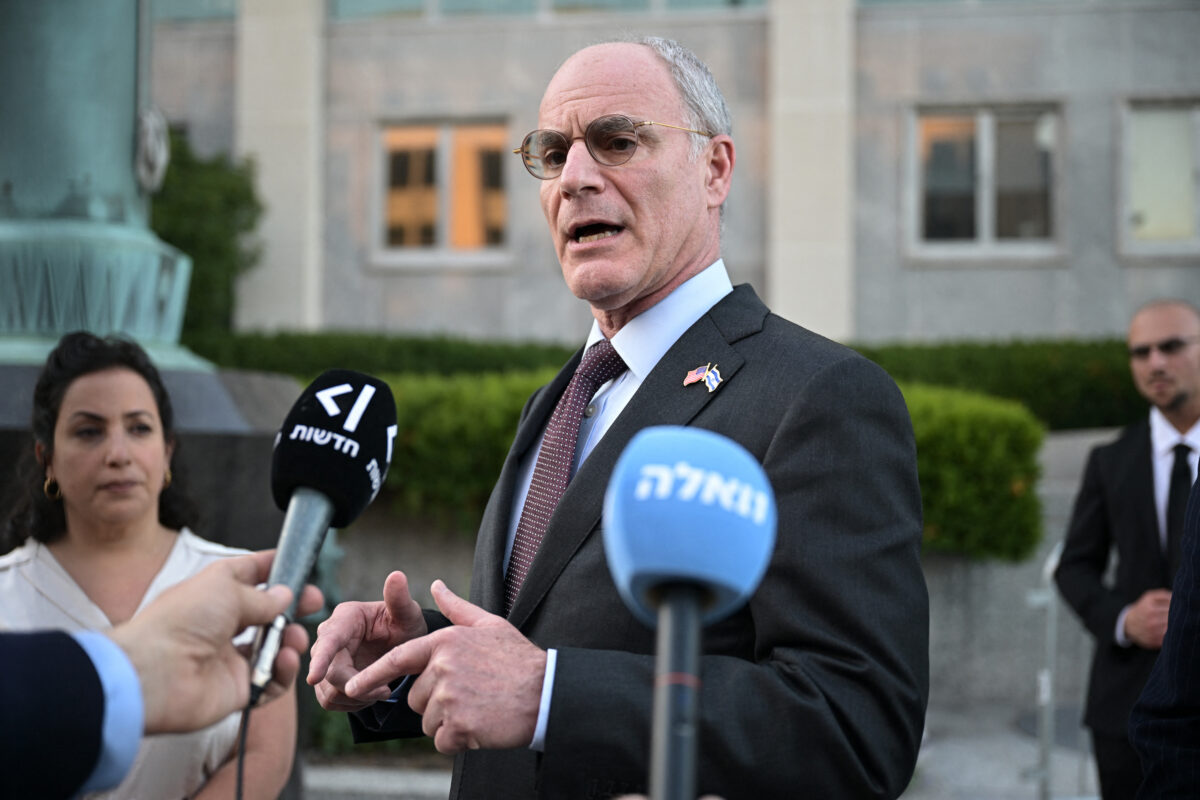
Israeli Ambassador to the U.S. Yechiel Leiter criticized the Trump administration on Tuesday for agreeing to establish a “deconfliction cell” to end military operations in Lebanon without Israel’s involvement as part of the ongoing peace talks with Iran, the first public statement from Jerusalem denouncing the move, Jewish Insider’s Emily Jacobs reports.
Ambassador’s alarm: Leiter released a pair of statements in English and Hebrew at the start of the fifth round of multi-day diplomatic talks at the U.S. State Department between Israel and Lebanon, in which he warned that both parties were “heading towards a train wreck.” The ambassador said that while the Israelis “support President Trump’s vision of ensuring that Iran no longer has nuclear capabilities, ballistic missiles or the ability to funnel money to its proxies to threaten its neighbors and maintain its regional hegemony,” he worried “that the concept of ‘deconfliction’ is misplaced.”
Fault lines: Vice President JD Vance and Secretary of State Marco Rubio have offered different messaging around the issue of Lebanon and Hezbollah being subsumed into discussions with Tehran, JI’s Danielle Cohen-Kanik reports. Vance said on Monday that the U.S. will be counting on Iran to “rein in” its proxy Hezbollah. Rubio, meanwhile, arriving in the United Arab Emirates on Tuesday, said Iran’s sponsorship of Hezbollah “will be discussed as part of our conversation with the Iranians, but … the future of Lebanon belongs to the Lebanese people, through their sovereign, elected government, and that’s who we’re going to be working with.”
BLINKEN WEIGHS IN
Former Secretary of State Tony Blinken offered support for Rep. Ro Khanna’s (D-CA) stance on the Iran war and the U.S. deal with Iran in a post on X on Tuesday. Blinken praised the “wise words from my friend [Khanna],” reposting a Fox News op-ed by the congressman making the case that “stopping the Iran war is good. But Trump’s deal is worse than the JCPOA,” Jewish Insider’s Marc Rod reports.
Zoom out: He’s the second prominent former Biden administration official to draw closer to Khanna in the lead-up to the 2028 presidential primary, joining former White House Chief of Staff Ron Klain, who has reportedly been advising Khanna behind the scenes as he prepares for a presidential run. The comments also come as some progressive presidential contenders call for the Democratic Party to purge its ranks of foreign policy advisors who served in the Biden administration, given its general support for Israel.
CONGRESSIONAL REBUKE
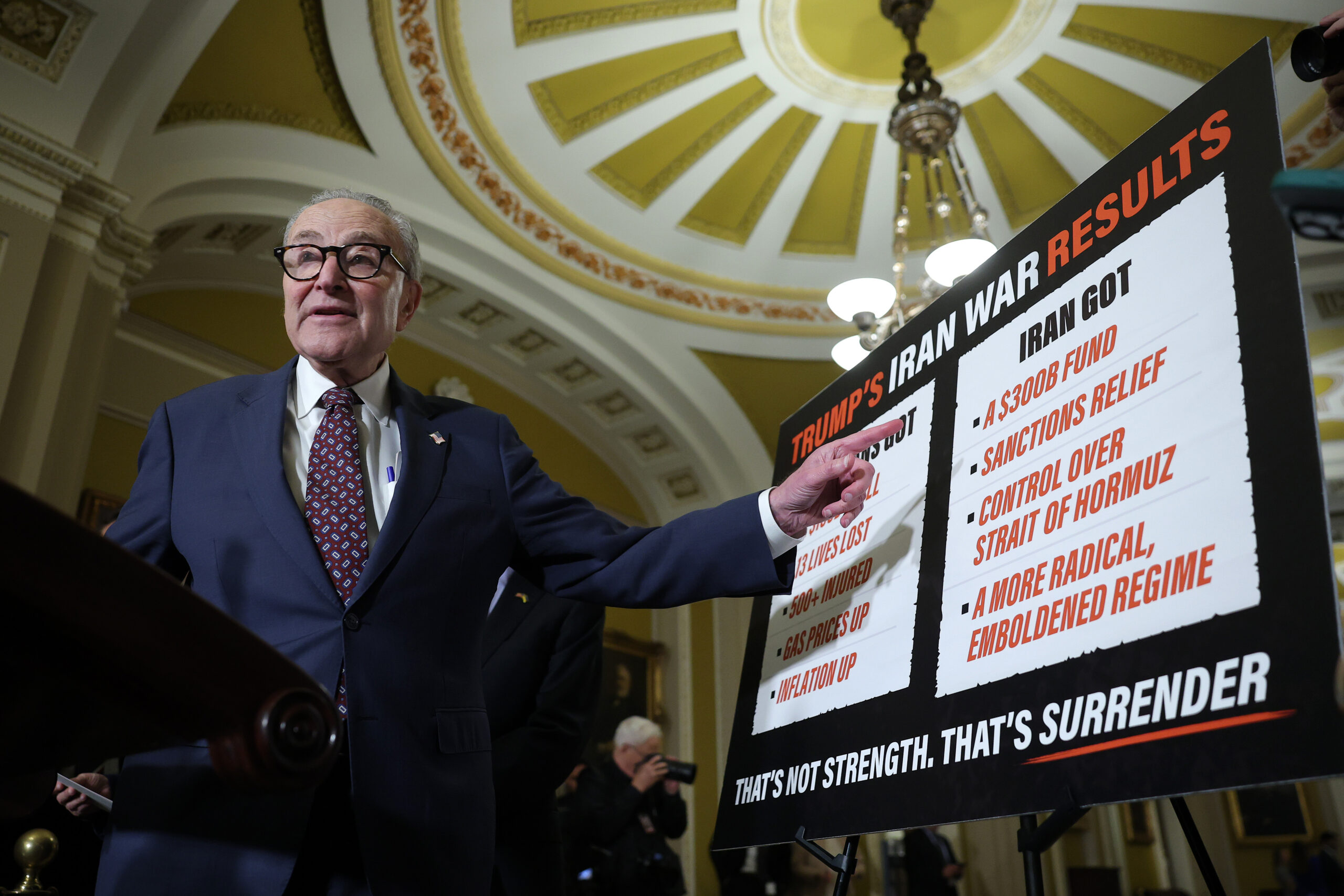
The Senate voted on Tuesday to pass a House-passed war powers resolution directing the administration to withdraw U.S. forces from Iran, Jewish Insider’s Marc Rod reports. The resolution passed by a 50-48 vote, with Republican Sens. Rand Paul (R-KY), Lisa Murkowski (R-AK), Susan Collins (R-ME) and Bill Cassidy (R-LA) again voting in favor and Sen. John Fetterman (D-PA) voting against it. Ultimately, GOP absences enabled the resolution to go forward.
State of play: But the resolution, now passed by both chambers, came in the form of a concurrent resolution, which is not submitted to the president and, based on past court precedent, is not seen as carrying the force of law. Rep. Greg Meeks (D-NY), the ranking member of the House Foreign Affairs Committee and lead Democratic sponsor of the war powers resolution, insisted in a statement, “Regardless of what President Trump says, this measure is binding under the War Powers Resolution, and I will explore all legal avenues to ensure the Executive complies with the will of Congress.”
Worthy Reads
Thin Air: Navy and Army National Guard veteran Brynn Tannehill argues in The Atlantic that the U.S. and Israel’s strategy toward Iran was flawed from the outset because it ignored historical lessons and relied primarily on airpower to force either regime change or surrender. “The U.S. plan for attacking Iran was doomed from the start because it relied on airpower without the benefit of external factors that would have made an air campaign successful. There was no credible threat of mass ground invasion to overthrow the Iranian regime. It was either internal revolution or nothing. The U.S. was also unwilling to inflict the sort of mass casualties and suffering that might have caused Iran to decide that capitulation was less damaging than continued resistance.” [TheAtlantic]
The Burgeoning Question about Burnham: The Jewish Chronicle’s Angela Epstein considers whether Labor MP Andy Burnham’s potential premiership in Britain will be “good for the Jews.” “Look to how recently, when asked for his views on the baseless allegations of genocide in Gaza, Burnham declined to take a clear position. Arguing he was too far removed from the situation to make such a judgement. Why not state plainly that no court has upheld the genocide claim [against Israel]? … So the rap sheet is troubling. Factor in the wider perception of Burnham as a weathervane politician, with an impressive number of U-turns under his belt, and there is justifiable cause for concern for British Jewry.” [JewishChronicle]
The Witkoff-Kushner Show: Journalist and editor Tina Brown, in her Substack “Fresh Hell,” reviews New York Times journalists Maggie Haberman and Jonathan Swan’s new book about the first year of President Donald Trump’s second administration. “Surprising to me in these pages is how well the odd couple of global diplomacy, the ever-sunny real estate deal man Steve Witkoff and Trump’s effete-looking son-in-law Jared Kushner, come across. After bringing home the Abraham Accords in the first term and wrangling Bibi and Hamas to a Gaza ceasefire in the second, it’s time to acknowledge that Kushner is a skilled, pragmatic closer and the garrulous Witkoff, dispatched round the world to end three wars at once, never stops trying.” [Substack]
Word on the Street
International Atomic Energy Agency head Rafael Grossi said on Wednesday that inspectors would visit Iranian nuclear enrichment sites, after conflicting remarks on the matter by U.S. and Iranian officials. The parties’ agreement “says explicitly that the nuclear activities that are going to be carried out with the regards to the nuclear material facilities will be supervised by the IAEA — in all letters,” Grossi told reporters.…
Iranian Foreign Minister Abbas Araghchi spoke on the phone with senior Hamas official Basem Naim about the “latest developments” in the region, according to Iranian TV…
Victoria Coates, a vice president of the Heritage Foundation, met with Israeli Prime Minister Benjamin Netanyahu in Jerusalem, she said in an X post on Wednesday, noting that they discussed “Lebanon, Europe, the future of Western Civilization, and, of course, Iran”…
A U.S. fighter jet pilot who was shot down over Iran and rescued in April told intelligence officials he witnessed Iranian drones flying in a single swarm formation, CNN reports, which would mark a significant advancement in Tehran’s drone technology…
The Washington Post examines how President Donald Trump’s decision to go to war with Iran has impacted his popularity in the United Arab Emirates…
Robert Kraft’s Blue Square Alliance Against Hate announced the formation of its inaugural advisory board, including former Secretary of State Condoleezza Rice, Bank of America CEO Brian Moynihan, Dentons CEO Kate Barton, Salesforce CEO Marc Benioff and Warner Bros. CEO David Zaslav, Jewish Insider’s Haley Cohen reports exclusively…
The House Rules Committee yesterday teed up amendment votes on the 2027 State Department funding bill on cutting $3.3 billion in military aid to Israel, cutting U.S. aid to Jordan, blocking funding for the United Nations and blocking funding for the Middle East Partnership for Peace initiative. The amendments are expected to come up for votes later this week…
Sen. Susan Collins (R-ME) reiterated her criticism of Maine Democratic Senate candidate Graham Platner and accused him and his supporters of antisemitism at an Orthodox Union event on Tuesday, JI’s Marc Rod reports. “Our support for Israel remains as strong as ever,” Collins said, to a standing ovation. “We must all stand with Israel. In my case, I learned that lesson at an early age”…
New York City’s First Lady Rama Duwaji posted an Instagram story Tuesday flashing an “I Voted” sticker and encouraging her followers to support the two congressional candidates endorsed by both her husband and the Democratic Socialists of America: Assemblymember Claire Valdez and doctoral student Darializa Avila Chevalier. The post excluded Former New York City Comptroller Brad Lander, who alone among Mayor Zohran Mamdani’s candidates identifies as a Zionist, JI’s Will Bredderman reports…
A manifesto allegedly left by the gunman behind Monday’s rampage in Côte-des-Neiges, a heavily Jewish neighborhood in Montreal, repeatedly targeted Jews and Zionists, specifically identifying “influential Zionists” among his intended victims, according to a copy of the document published by Rebel News, JI’s Haley Cohen reports…
Jewish Democrats in Texas are gearing up for the state party’s convention, which starts Thursday, as delegates are set to consider nearly 20 resolutions condemning Israel…
Israeli officials are exploring listing Israel Aerospace Industries and defense manufacturer Rafael on U.S. stock exchanges rather than in Israel, where they may face more burdensome disclosure requirements, according to Bloomberg. The Israeli government is reportedly looking to sell up to a 30% stake in the companies, which manufacture the Arrow and Iron Dome missile-defense systems…
Around 50 career and political appointee intelligence officials have been removed from their roles at the Office of the Director of National Intelligence since Bill Pulte assumed the role of acting DNI last week, CBS reports, including six employees who were fired and 45 who were sent back to other agencies…
Top Senate Democrats sent a letter to Republican committee chairs on Tuesday calling for hearings into a $500 million deal that sold nearly half of World Liberty Financial — a crypto company founded by members of the Trump and Witkoff families — to a group led by Sheikh Tahnoon bin Zayed al Nahyan, the UAE’s national security advisor, The Wall Street Journal reports…
Gen. Chris Donahue, the highly regarded commanding general of United States Army Europe and Africa who was seen as a rising star in the U.S. defense establishment, is expected to announce he is stepping down from his role in the coming days, adding to a growing list of senior military leaders who have departed or been pushed out during Defense Secretary Pete Hegseth’s tenure…
Netanyahu on Wednesday completed his testimony, after 98 hearings over the past year and a half, in his ongoing corruption trial…
Israeli-born KISS co-founder and bassist Gene Simmons tells The Wall Street Journal about the impact his mother, who was a Holocaust survivor, had on his worldview…
Breaker Media reports that New York Times columnist Bret Stephens was briefly mistaken by security for an intruder as he arrived at Times Publisher A.G. Sulzberger’s annual Catskills BBQ wearing a fedora, which is usually worn by Breaker Media’s reporter when he stakes out media gatherings…
The Wall Street Journal reports on how Larry Ellison quietly donated $45 million to a pro-Trump political nonprofit in 2024 — one of the largest single injections of capital that cycle — and how his private friendship with Trump has since paid dividends for both his tech company Oracle and his son David‘s growing media empire…
The New York Times spotlights the annual Great Nosh picnic that took place on Governors Island on Sunday, calling it “a kind of New York-centric Coachella for Jewish food and culture”…
“SportsCenter” anchor Linda Cohn, who presented more episodes of the ESPN show than anyone else in its history, is set to retire at the end of the month…
Longtime New Yorker staff writer Mark Singer, who specialized in profiles, died on Friday at 75…
Pic of the Day
Sen. Joni Ernst (R-IA), (left), and Reps. Brad Schneider (D-IL) and Eric Burlison (R-MO) spoke at a launch event on Tuesday for the Abraham Accords Prosperity Group in Washington hosted by Sir Liam Fox (second from left), a former British minister. The group aims to promote investment and collaboration across the Abraham Accords countries.
Birthdays

Actor and singer, Elizabeth Greer “Beanie” Feldstein turns 33…
Activist investor, he is a co-founder of Trian Partners, Nelson Peltz turns 84… Professor emeritus in the Lam Family College of Business at San Francisco State University, Sam S. Gill turns 84… Former chairman and CEO of New York Life Insurance Company, Seymour “Sy” Sternberg turns 83… Professor of philosophy at American Jewish University and founding dean of its rabbinical program, Rabbi Elliot N. Dorff turns 83… Founder of Yeshivat Chovevei Torah, he is also the founder of Yeshivat Maharat for Orthodox women, Rabbi Avraham Haim Yosef (Avi) Weiss turns 82… Former secretary of labor in the Clinton administration, he is an author and professor emeritus at UC Berkeley, his newest book came out in 2025, Robert Reich turns 80… Former member of Knesset and former chief of staff of the IDF, Moshe “Bogie” Ya’alon turns 76… Early childhood specialist at Columbus City Schools and Columbus School for Girls in Columbus, Ohio, Carol Glassman… Former EVP at Edelman, he is the author of a book on the Saatchi & Saatchi ad firm, Kevin Goldman… President and CEO of public relations firm Steinreich Communications, Stanley Steinreich… U.S. district judge for the Southern District of Florida, Beth Francine Bloom turns 64… Principal from 2007 to 2023 of Mount Scopus Memorial College located in Melbourne, Australia, Rabbi James Kennard turns 62… The first on-air talent of the NFL Network when it debuted in 2003, he has become the face of the network, which merged with ESPN in 2025, Rich Eisen turns 57… Israeli businesswoman and owner of the soccer team, Hapoel Beer Sheva, her brother-in-law is Israel’s minister of economy, Nir Barkat, Alona Barkat turns 57… Author and columnist, he is the managing editor at Shtetl, Shulem Deen turns 52… Singer and songwriter known professionally as Ariel Pink, Ariel Marcus Rosenberg turns 48… Film director, screenwriter, producer, editor and cinematographer, Todd Strauss-Schulson turns 46… Director of domestic policy studies at the American Enterprise Institute, he is the son-in-law of political analyst and commentator Bill Kristol, Matthew Continetti turns 45… Digital marketing manager at Guardian Pharmacy Services, Brett Rosner… VP of Houston-based RIDA Development, a multi-national real estate development company, Steven C. Mitzner… A 2015 contestant on “Jeopardy!” who earned $413,612 by winning 13 consecutive episodes, he is a son of United States District Court Senior Judge Amy Berman Jackson, Matthew Barnett “Matt” Jackson turns 34… Director of legislative fiscal affairs at the Rockland County (N.Y.) legislature, Moshe Gruber… College basketball player for the Harvard Crimson until 2022, then a graduate transfer player at NYU until 2024, Spencer Freedman turns 28… Lois Charles…
Several Democrats considering presidential bids have cast the Iran agreement as evidence of weak leadership, arguing that Trump has been outmaneuvered by Tehran
Meg Kinnard/AP
Former U.S. ambassador to Japan Rahm Emanuel speaks to voters as he participates in the South Carolina Democratic Party's "On the Road" series on Thursday, April 2, 2026, in Abbeville, S.C.
Among the Democrats mulling a presidential run in 2028 — a group that is ideologically divided, each with their own diagnosis about what’s wrong with the Democratic Party and how to fix it — there was a unified reaction in February when President Donald Trump decided to attack Iran: opposition to a war they viewed as reckless and unconstitutional.
As those Democrats respond to the U.S.-Iran memorandum of understanding that Trump announced last week, another consensus is emerging, which holds that the deal is just another example of Trump’s ineffectual leadership — yet another instance, these Democrats argue, of Trump getting taken advantage of and undermining the American people.
“They’re negotiating a deal that, truthfully, every single detail we continue to hear just looks like the Iranians continue to do better than us. I think they should have been the one to write The Art of the Deal, not Donald Trump,” Maryland Gov. Wes Moore said in a TV interview on Tuesday.
Rahm Emanuel, the former U.S. ambassador to Japan, member of Congress and chief of staff to President Barack Obama, offered a similar quip at a recent Financial Times event after describing the deal as “the memorandum of misunderstanding.”
“While the president thinks he wrote a book called The Art of the Deal, they’re going to teach him a lesson, which is the Persian lesson: the art of the negotiation,” Emanuel said. “And he just got schooled, unbelievably.” He called the war with Iran “the single worst — and there’s a lot of competition for it — American national security mess that I’ve ever seen.”
The MOU offered immediate sanctions relief for the Islamic Republic and launched a 60-day window for nuclear negotiations.
The 2028 contenders who have commented on the deal have generally done so without much detail. Pennsylvania Gov. Josh Shapiro criticized the agreement in an interview with CNBC on Monday, though he shared little in the way of specific critiques or concerns.
“I think what’s clear is the Trump administration, the president, specifically chose to enter this war and had absolutely no plan when he went in, and that’s why he’s got no idea how to get out,” said Shapiro. “The president created a mess, and now he’s dispatched JD Vance … to try and figure out a way out of it, and seemingly both of them are getting played by the Iranians.”
A spokesperson for Shapiro declined to comment further.
Illinois Gov. JB Pritzker has used the deal as a political talking point. He was asked by reporters on Monday and Tuesday to respond to a social media post where Trump called on Pritzker to seek his help in responding to gun violence in Chicago. In response, Pritzker referred to Trump’s Iran negotiations as a reason why he would never want to ask Trump for help.
“This is the president who wants to blame everybody else for algae that showed up at the Reflecting Pool in Washington, D.C.,” Pritzker told reporters during an event in Illinois on Tuesday, “the same president that thinks that after bombing Iran, that they should pick up the phone and call him, and indeed, who’s failing to put together an agreement that is anywhere near as good as the JCPOA [Joint Comprehensive Plan of Action], that was the agreement that he ripped up as president of the United States.”
Last week, he said at a Punchbowl News event that the deal sounds like it is “really just a cessation of hostilities and pushing off into the future negotiations about things.”
Some Democrats considering a 2028 run are avoiding the question entirely for now.
California Gov. Gavin Newsom, who on the day the U.S. began its campaign in Iran referred to the American actions as an “illegal, dangerous war,” has thus far not weighed on the MOU. Anthony Martinez, a spokesperson for Newsom, said that “Trump’s reckless war” has been costly to Americans. “That’s a bad deal for hardworking Americans, plain and simple,” Martinez said. He declined to comment on the MOU.
Kentucky Gov. Andy Beshear, Sen. Jon Ossoff (D-GA) and Rep. Alexandria Ocasio-Cortez (D-NY) have also criticized the war but so far refrained from discussing the agreement.
Most potential Democratic 2028 contenders view the Iran war as a hard-to-solve morass, with little offered in the way of alternatives to a war and deal that they oppose. Merely criticizing Trump for an unpopular war appears to be enough.
Shapiro acknowledged that he wants the U.S. to come out ahead in the war, but he said he doesn’t see how that will be possible with Trump leading the negotiations.
“I’m on Team USA. I want us to win, but this is the problem when you have a president who is just hell-bent on creating chaos around the world,” Shapiro said on CNBC. “What we need instead is steady-handed leadership, and we don’t have that right now.”
Pritzker pointed to the 2015 Obama nuclear deal as the best-case alternative, although that deal is now defunct.
“It’s a real question whether there’s any advancement at all of U.S. interests,” said Pritzker. “I think the question I think we’re all going to have to ask is, is this any better than the JCPOA that was already in place when Donald Trump tore it up in his first term?”
It was a line that former Vice President Kamala Harris, who is also mulling a presidential bid in 2028, echoed recently.
“This is a president who has proven himself to be entirely self-indulgent. And we will see what happens in the coming hours and days in terms of the negotiation. And really, it’s a concept of an agreement,” Harris said last week at a speech during a conference in Vienna. “Whatever is being negotiated, this president is going to declare victory, and we’ll end up where we were after the JCPOA and call that a victory.”
Far-left lawmaker Rep. Ro Khanna (D-CA), who has said he is considering a 2028 run, called the ceasefire between the U.S. and Iran “welcome news that Americans should support.” But he said it “delivers Iran a better deal” than the JCPOA that Trump “spent years ridiculing.” His message got a boost on X on Tuesday from former Secretary of State Tony Blinken.
“Wise words from my friend,” Blinken wrote.
Plus, NYC first lady snubs Brad Lander on primary day
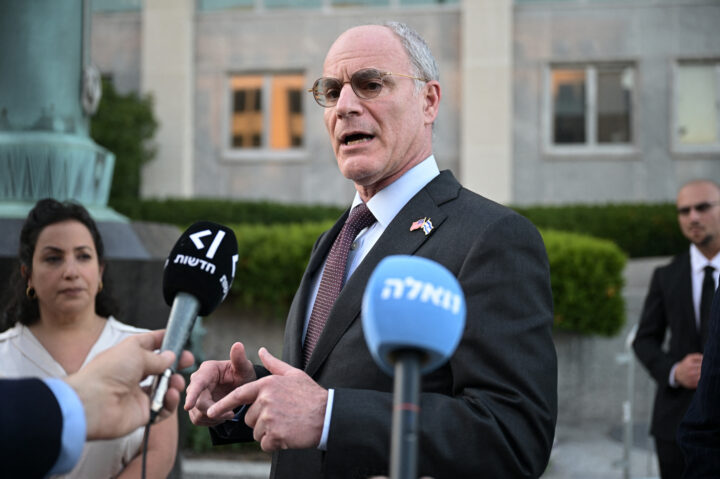
Oliver Contreras / AFP via Getty Images
Israel's Ambassador to the U.S. Yechiel Leiter speaks to reporters after a meeting between Israeli and Lebanese delegations hosted by the United States at the State Department in Washington, DC, on June 3, 2026.
Good Tuesday afternoon.
This P.M. briefing is reserved for our premium subscribers like you — offering a forward-focused read on what we’re tracking now and what’s coming next.
Today’s Daily Overtime was curated by JI U.S. Editor Danielle Cohen-Kanik.
📡On Our Radar
Notable developments and interesting tidbits we’re tracking
The U.S. and Iran continued to offer conflicting accounts of the agreement reached over the weekend: President Donald Trump posted on Truth Social this morning that Iran “fully and completely agreed to highest level Nuclear inspections long into the future,” without which “there would be no further negotiations.” But Iranian Foreign Ministry spokesperson Esmail Baghaei said it was untrue and that the parties had not discussed any nuclear issues.
About Tehran’s denial, Secretary of State Marco Rubio said the U.S. “know[s] what [Iran] agreed to do, and now they’ll either do it or they won’t. And if they do, the process moves forward. And if they don’t, the president will have some decisions to make”…
Trump also said in his post that the funds received by Iran through the deal will go “into escrow, controlled by the U.S.A., and will be used for the purchase of food and medical supplies.” Yet the Treasury Department’s waiver of Iranian oil sanctions contains no such language and the text of the memorandum of understanding says unfrozen Iranian assets “shall be made fully usable” for “any ultimate beneficiary designated by the Central Bank of the Islamic Republic of Iran”…
Meanwhile, Iranian Parliament Speaker Mohammad Bagher Ghalibaf and Foreign Minister Abbas Araghchi were in Muscat speaking with Omani leaders about the Strait of Hormuz: In a joint statement, the parties said their foreign ministries will work towards an agreement on the “future administration” of the strait, the “services that will be provided in this regard and the costs associated with them,” as the Trump administration has repeatedly stated it will not accept any tolls placed on transit through the key waterway…
Iranian President Masoud Pezeshkian was also abroad, meeting in Islamabad with Pakistani Prime Minister Shehbaz Sharif, where Pezeshkian said Iran’s ballistic missile program “will never be” up for negotiation with the U.S…
Jerusalem is publicly expressing concern about the Lebanon deconfliction mechanism established by the U.S. and Iran for the first time, Jewish Insider’s Emily Jacobs reports: At the opening of Israel and Lebanon’s fifth round of direct talks taking place in Washington today, Israeli Ambassador to the U.S. Yechiel Leiter claimed the parties are “heading towards a train wreck.”
Leiter said he’s “concerned the concept of deconfliction is misplaced” because “Israel is not in conflict with Lebanon,” and that Israel had assumed “the central issue was Lebanon and Hezbollah — not the extent to which Iran could restrain Hezbollah. That is not Iran’s role”…
Rubio, arriving in Abu Dhabi, said the U.S.-Iran and Israel-Lebanon tracks “are separate because Lebanon is a sovereign country,” and that the U.S. is “going to negotiate a deal directly with the Lebanese government,” without mentioning Israel.
Rubio also made clear that Iran is responsible for much of the terror activity in the Middle East, striking a different tone than that of Vice President JD Vance, JI’s Danielle Cohen-Kanik reports, after Vance said yesterday the U.S. is counting on Iran to “rein in” Hezbollah…
The Senate passed a war powers resolution this afternoon directing the administration to withdraw U.S. forces from Iran, 50-48, with GOP Sens. Rand Paul (R-KY), Lisa Murkowski (R-AK), Susan Collins (R-ME) and Bill Cassidy (R-LA) voting in favor with Democrats,JI’s Marc Rod reports.
The resolution, now passed by both chambers, came as a concurrent resolution — meaning it will not be submitted to the president and, based on past court precedent, is not seen as carrying the force of law…
A manifesto allegedly left by the gunman behind yesterday’s rampage in Côte-des-Neiges, a heavily Jewish neighborhood in Montreal, repeatedly targeted Jews and Zionists, specifically identifying “influential Zionists” among his intended victims, JI’s Haley Cohen reports…
New York City First Lady Rama Duwaji posted an Instagram story today flashing an “I Voted” sticker and encouraging her followers to support two congressional candidates endorsed by Mayor Zohran Mamdani and the Democratic Socialists of America: Assemblymember Claire Valdez and doctoral candidate Darializa Avila Chevalier. Not receiving a mention was the only Jewish congressional candidate endorsed by her husband: former New York City Comptroller Brad Lander, JI’s Will Bredderman reports…
Ammar Campa-Najjar, a DSA-backed candidate who was recently defeated in his run for a California congressional seat, launched a new PAC called Democratic Majority for America — a counter to Democratic Majority for Israel, which organized against him in the June primary — to support progressive candidates who want to end aid to Israel, Politico reports.
The PAC, which Campa-Najjar said has about $100,000 in cash on hand, has already endorsed California congressional candidate Randy Villegas and far-left Michigan Senate candidate Abdul El-Sayed…
AIPAC’s super PAC, the United Democracy Project, has spent more than $38 million backing candidates this election cycle so far through direct and indirect spending, according to Politico, surpassing the $26 million it spent on the 2022 midterms…
The Blue Square Alliance Against Hate, headed by New England Patriots owner Robert Kraft, announced the formation of its inaugural advisory board, including Bank of America CEO Brian Moynihan, Dentons CEO Kate Barton, Salesforce CEO Marc Benioff, former Secretary of State Condoleezza Rice and Warner Bros. CEO David Zaslav…
⏩ Tomorrow’s Agenda, Today
An early look at tomorrow’s storylines and schedule to keep you a step ahead
Keep an eye on Jewish Insider for primary results from key races in New York and Maryland, as well as a postmortem on New York City Mayor Zohran Mamdani’s ability to wield his political capital in the three congressional races where he endorsed progressive candidates.
President Donald Trump is expected to attend a GOP Senate luncheon as he remains at odds with his party over several legislative efforts and as some Republicans speak out against his efforts to curb Israeli operations against Hezbollah.
In the afternoon, Trump will hold a rally on the National Mall to kick off his Great American State Fair in the lead-up to the country’s 250th anniversary.
Defense Secretary Pete Hegseth is slated to brief House Republicans tomorrow as the Pentagon gears up for a contentious fight over an expected $80 billion supplemental funding request tied largely to the Iran war.
The House Appropriations Committee will mark up the 2027 defense spending bill.
Sen. Jacky Rosen (D-NV) will speak in conversation with Jewish Council for Public Affairs CEO Amy Spitalnick as well as leaders from other religious groups, including the Union for Reform Judaism and Orthodox Union, about the Jewish American Security Act.
Stories You May Have Missed
ACROSS THE POND

Jewish leaders view Andy Burnham as an ally in the fight against antisemitism, but his expected bid for the premiership is renewing scrutiny of his views on Israel and Labour’s post-Corbyn direction
RABBI ROADBLOCK
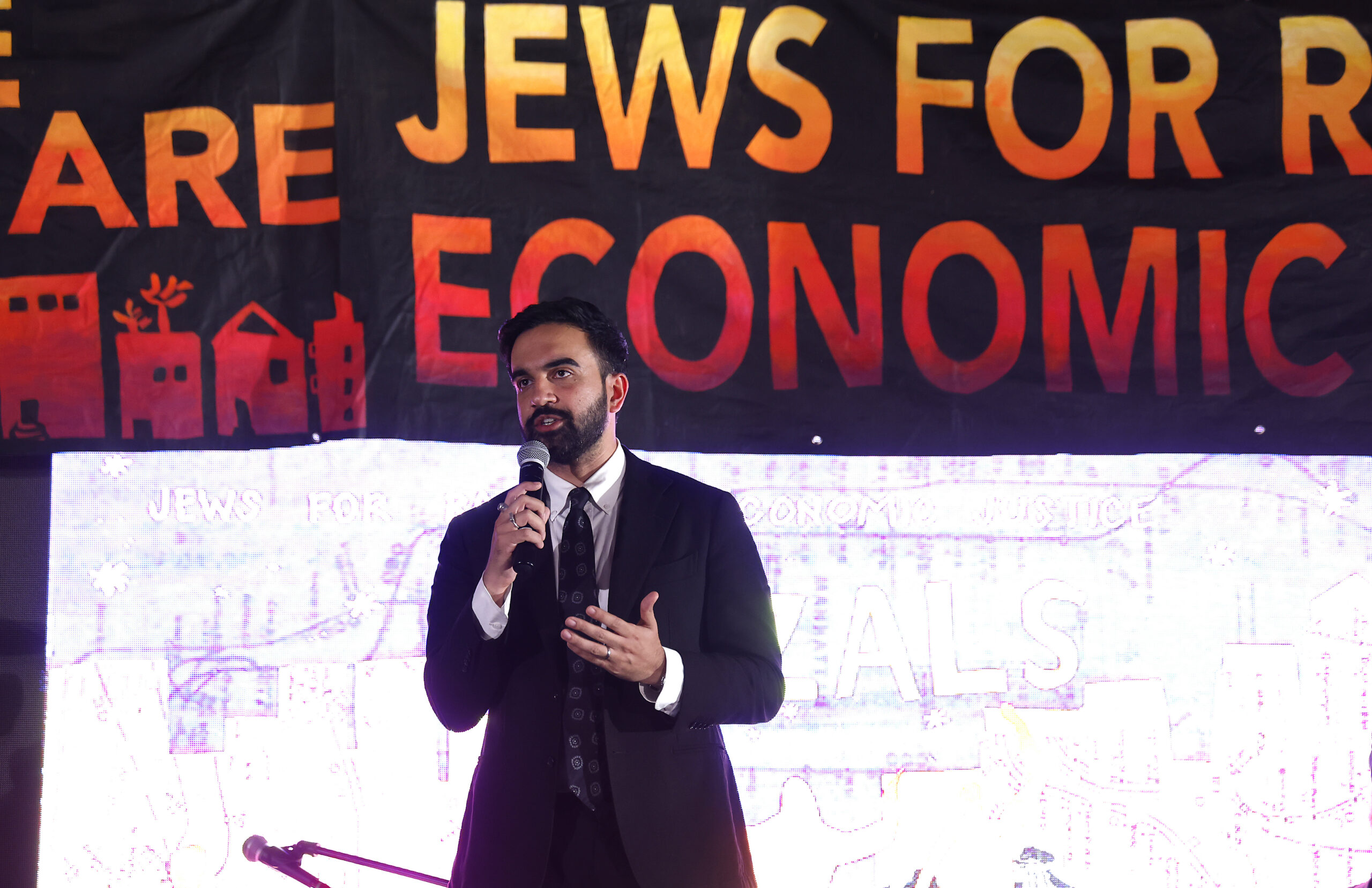
The mayor has inserted himself in the costly fight between Rabbi Stephanie Ruskay and lawyer Eli Northrup, spurning a key Jewish ally in the process
Blinken is the second top Biden administration official to champion Khanna, a likely 2028 presidential prospect and outspoken critic of Israel

Andrew Caballero-Reynolds/AFP via Getty Images
Secretary of State Tony Blinken speaks at the Atlantic Council in Washington, D.C, on January 14, 2025.
Former Secretary of State Tony Blinken offered support for Rep. Ro Khanna’s (D-CA) stance on the Iran war and the U.S. deal with Iran in a post on X on Tuesday.
Blinken praised the “wise words from my friend [Khanna],” reposting a Fox News op-ed by the congressman making the case that “stopping the Iran war is good. But Trump’s deal is worse than the JCPOA.”
He’s the second prominent former Biden administration official to draw closer to Khanna in the lead-up to the 2028 presidential primary, joining former White House Chief of Staff Ron Klain, who has reportedly been advising Khanna behind the scenes as he prepares for a presidential run.
The comments also come as some progressive presidential contenders call for the Democratic Party to purge its ranks of foreign policy advisors who served in the Biden administration, given its general support for Israel.
Khanna, in the op-ed published on Fox News’ website, praised the “welcome news” of the end of the war in Iran, but called the war “a self-inflicted disaster that cost American lives and burned through taxpayer dollars” and said the deal reached is more favorable for Iran than the 2015 Joint Comprehensive Plan of Action from which President Donald Trump withdrew.
“The details of the ceasefire released this week show that Vice President [JD] Vance woefully misled Americans on at least five accounts when he claimed the administration’s deal was better than the JCPOA that President Obama negotiated in 2015,” Khanna continued. “A better deal for ending this war would have been anchored in tough diplomacy and economic pressure rather than blunt force.”
The only times in the op-ed Khanna mentioned Israel — a frequent target of criticism by the congressman — were to argue that “through tough diplomacy” the U.S. could have worked with Lebanon to disarm Hezbollah so it could not threaten the Lebanese people or Israel, and “used Iran’s temporary loss of military capabilities as an opportunity to restart negotiations over a two-state solution for Israelis” along the lines of the Arab Peace Initiative.
The resolution passed 50-48 with GOP Sens. Paul, Murkowski, Collins and Cassidy voting with Democrats in favor
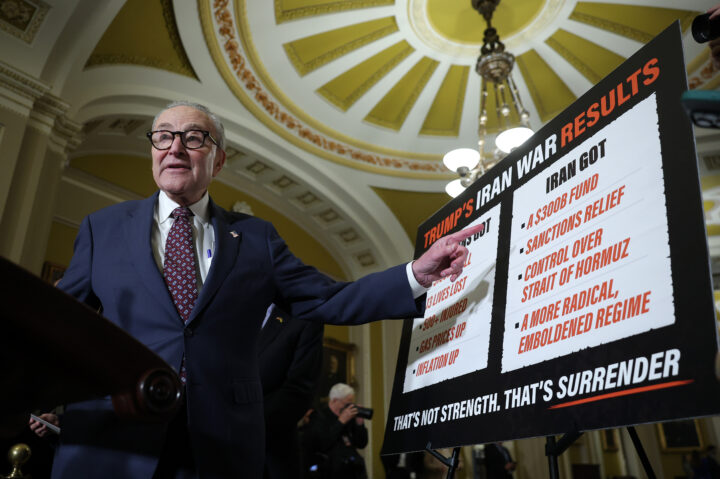
Photo by Kevin Dietsch/Getty Images
U.S. Senate Minority Leader Chuck Schumer (D-NY) speaks to reporters after the weekly Senate policy luncheons at the U.S. Capitol on June 23, 2026 in Washington. Schumer spoke out against President Trump's Iran deal and a the need for the Senate to pass a War Powers Resolution regarding Iran.
The Senate voted on Tuesday to pass a House-passed war powers resolution directing the administration to withdraw U.S. forces from Iran — a congressional rebuke of the administration over the war in Iran — though legally its effects are likely to be largely symbolic.
The resolution passed by a 50-48 vote, with Republican Sens. Rand Paul (R-KY), Lisa Murkowski (R-AK), Susan Collins (R-ME) and Bill Cassidy (R-LA) again voting in favor and Sen. John Fetterman (D-PA) voting against it. Ultimately, GOP absences enabled the resolution to go forward.
But the resolution, now passed by both chambers, came in the form of a concurrent resolution, which is not submitted to the president and, based on past court precedent, is not seen as carrying the force of law — though a House Democratic aide argued to CNN that the measure would be binding.
Rep. Greg Meeks (D-NY), the ranking member of the House Foreign Affairs Committee and lead Democratic sponsor of the war powers resolution, insisted in a statement, “Regardless of what President Trump says, this measure is binding under the War Powers Resolution, and I will explore all legal avenues to ensure the Executive complies with the will of Congress.”
Unlike previous efforts, however, the concurrent resolution did not require other procedural votes by the Senate, allowing Democrats to take advantage of the Republican absences and move directly toward final passage to deliver a message of rebuke to the administration.
The Senate still has other war powers resolutions pending, including one which passed an initial procedural hurdle, but currently lacks the support to pass through an additional procedural vote and final passage with full attendance. That legislation, which comes in a different form as joint resolutions, would be presented to the president if passed and set up a potential veto or other legal fight.
Republicans warned that adopting the resolution would send a further signal to Iran that it does not need to negotiate or make any compromises with the U.S. as part of ongoing talks.
The vice president suggested Iran could help rein in Hezbollah, while the secretary of state emphasized Lebanon’s sovereignty and described the Iran and Lebanon talks as separate diplomatic tracks
Photo by Brendan SMIALOWSKI / AFP via Getty Images
Vice President JD Vance and President Donald Trump listen to Secretary of State Marco Rubio speak during a meeting with Lebanon Ambassador to the U.S. and Israel Ambassador to the U.S., at the White House in Washington, D.C. on April 23, 2026.
As the details around the memorandum of understanding between the U.S. and Iran emerge, Vice President JD Vance, who has been deputized with leading the effort, and Secretary of State Marco Rubio, ostensibly the Trump administration’s top diplomat, have offered different messaging around the issue of Lebanon and Hezbollah being subsumed into discussions with Tehran.
After the U.S. and Iran agreed to create a “deconfliction cell” for military operations in Lebanon — a mechanism that, notably, does not include Israel — Vance said on Monday that the U.S. will be counting on Iran to “rein in” its proxy Hezbollah, without referencing Tehran’s material support for the terror group.
Vance called on Israel to respond to Hezbollah’s attacks “in the context of a conversation that’s ongoing between Hezbollah, Lebanon, Israel and other partners in the region.” He said the conflict is “a bit of a chicken and egg problem,” in which he claimed lower-level Hezbollah operatives are firing on Israel without approval from their superiors.
Rubio, meanwhile, has been clearer about Iran’s role in propagating terror in the Middle East. Arriving in the United Arab Emirates on Tuesday, he said a “complete end of hostilities in the entire region” is “not possible … as long as Iranian proxies are launching missiles and drones from Iraq and are participating in terrorism like Hamas did and like Hezbollah did.”
WATCH: Marco Rubio said upon arriving in Abu Dhabi that the U.S.–Iran and Israel–Lebanon diplomatic tracks “are separate because Lebanon is a sovereign country,” while adding that Iran’s “support and sponsorship of Hezbollah” will be part of “our conversations with the Iranians.” pic.twitter.com/iADhszGTZC
— Jewish Insider (@jewishinsider) June 23, 2026
Rubio also distanced the Lebanon conflict from negotiations with Iran: Asked if he believes the Israel-Lebanon peace process should be separate from the Iran discussions, Rubio said, “That process is separate.”
“It’s separate because Lebanon is a sovereign country. … When it comes to Lebanon and what’s happening inside of Lebanon, we’re going to negotiate a deal directly with the Lebanese government,” he continued, again without mentioning Israel.
“Now, there’s an Iranian issue with regards to Lebanon, and that is their support and sponsorship of Hezbollah. And so that factor will be discussed as part of our conversation with the Iranians, but … the future of Lebanon belongs to the Lebanese people, through their sovereign, elected government, and that’s who we’re going to be working with,” Rubio said.
He referenced a phone call he and Vance held earlier on Tuesday with Lebanese President Joseph Aoun, who said in a readout that the deconfliction mechanism will now include Lebanon as a party.
Olivia Wales, a White House spokesperson, told Jewish Insider, “Both Vice President Vance and Secretary Rubio are in lockstep with President Trump: Iran can never have a nuclear weapon and must stop their proxies in Lebanon from causing trouble. What President Trump and his entire national security team achieved on the battlefield and at the negotiating table is nothing short of remarkable and will strengthen American security for years to come.”
This story was updated on June 23 to include comment from the White House.
Trump cursed and yelled at the Israeli PM in a phone call with Steve Witkoff and Jared Kushner, according to book by NYT journalists Maggie Haberman and Jonathan Swan

Kevin Dietsch/Getty Images
President Donald Trump (R) speaks alongside Israeli Prime Minister Benjamin Netanyahu with a model of Air Force One on the table, during a meeting in the Oval Office of the White House on April 7, 2025 in Washington, DC.
President Donald Trump grew so frustrated with Israeli Prime Minister Benjamin Netanyahu during last September’s negotiations over a U.S.-brokered deal to end the Israel-Hamas war in Gaza, that Trump cursed and yelled at Netanyahu in a phone call days before the agreement was announced publicly, according to a new book.
“Everybody’s sick of you, Bibi,” Trump said in a phone call with Netanyahu, Jared Kushner and White House Special Envoy Steve Witkoff, according to a book published on Tuesday by New York Times journalists Maggie Haberman and Jonathan Swan chronicling the first year of Trump’s second term. “All the Jews are sick of you. Even the two Jews on this call are sick of you.”
The conversation came during the United Nations General Assembly last September, when Trump was selling the deal that became his 20-point plan to end the Gaza war that began after the Oct. 7, 2023, Hamas attacks. In the book, titled Regime Change: Inside the Imperial Presidency of Donald Trump, Haberman and Swan recount the turbulent couple of weeks that led to the deal — starting with Kushner’s searing anger at the Israeli government after the Israel Defense Forces conducted an airstrike that targeted Hamas leadership in Doha. The September 9 attack came one day after Kushner and Witkoff met in Witkoff’s Miami home with Ron Dermer, a top advisor to Netanyahu, to discuss day-after plans for Gaza.
“Dermer lied to us,” Kushner and Witkoff told officials at the White House after the strikes in Qatar.
The Qataris, according to Haberman and Swan, initially reacted by deciding they no longer wanted to help Israel. Kushner felt the same.
“I’m f**king out. The Israelis are crazy,” Kushner reportedly told an associate at the time. Then he realized it could provide an opening to rein in Netanyahu after nearly two years of war.
In the aftermath, Kushner drafted what would become Trump’s 20-point peace plan. Days later, on the sidelines of the UNGA in New York, Kushner and Witkoff met with Sheikh Mohammed bin Abdulrahman Al Thani, Qatar’s prime minister. The Americans told Al Thani that he had two options: isolate Israel further, which would be “understandable,” or use the moment “for leverage” to get Israel to negotiate.
Al Thani took Kushner’s laptop and began typing edits directly into the draft document, according to the book.
Trump brought the deal to Arab and Muslim leaders before he showed it to Netanyahu. Witkoff and Kushner warned White House Chief of Staff Susie Wiles that Netanyahu might try to call Trump to scuttle the plan. When he did finally call the White House, Wiles patched through Kushner and Witkoff, who stayed on the phone with Trump and Netanyahu.
As soon as Trump got on the phone, he began yelling at Netanyahu — the tirade where he said everyone was sick of the prime minister.
“You can’t back out of this. I’m the best friend Israel ever had. Everybody hates you, and I’ve stood by you,” Trump said, according to the book. “This is a great deal for Israel.”
Netanyahu said he would agree to the deal. The two men announced it together at a joint press conference two days later, though the deal was not yet official. They presented a united front. Trump said Netanyahu would have his “full backing” to continue the war if Hamas did not agree to the deal.
On the evening of Oct. 8, just over a week later, the deal was finalized. Soon after, the 20 living hostages who remained in Gaza were released.
Trump officials pointed to the Qatari state-controlled outlet to deny reports that Vance was being ignored by Iranian and Qatari officials during the peace talks
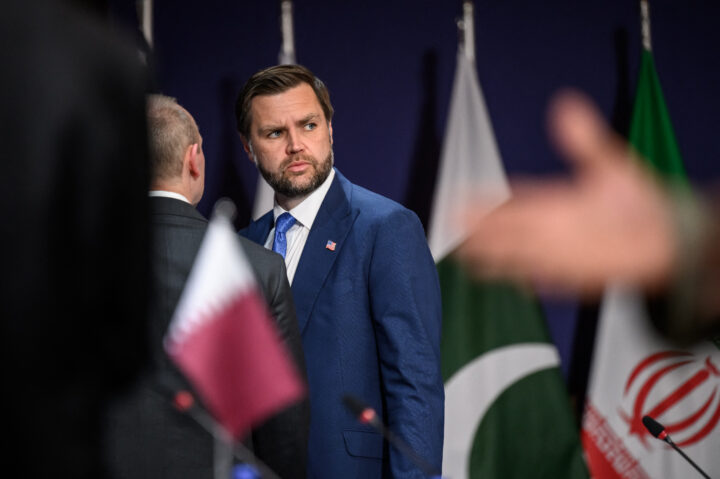
Photo by Fabrice Coffrini / POOL / AFP via Getty Images
U.S. Vice President JD Vance looks on prior to a quadrilateral meeting between the United States, Iran, Pakistan and Qatar in Switzerland, on June 21, 2026.
The White House’s rapid response social media account on Monday criticized media coverage of Vice President JD Vance’s participation in U.S. peace talks with Iran in Switzerland — and pointed to Al Jazeera’s reporting as evidence.
The rapid response team, a part of the White House’s communications office that defends the Trump administration’s record through social media, criticized media outlets on X that reported on Iranian Foreign Minister Abbas Araghchi declining to participate in a photo op with Vance, and Qatari officials not shaking Vance’s hand when photos were taken, as intentional digs at the United States.
“A lot of biased media outlets and Democrats were pushing a fake narrative yesterday about the talks in Switzerland,” the rapid response team wrote. “Here’s the real story from people actually in the room,” it said, referring to a tweet from Al Jazeera that included video of Qatari Prime Minister Mohammed bin Abdulrahman Al Thani rejecting such reports. Al Thani told Al Jazeera, according to the outlet’s social media post that the White House team shared, “that reports of him snubbing the US vice president were unfounded, saying they had spent hours together during negotiations and maintained a strong partnership throughout the process.”
Al Jazeera is a Qatari state-controlled news organization long criticized for its sympathetic coverage of Hamas and hostility to Israel. The outlet, which is financed by the Qatari government and ruling Al Thani family, has faced accusations that it spreads misinformation to promote Qatar’s preferred narrative on a range of sensitive topics, including the Israeli-Palestinian conflict.
The White House did not respond to a request for comment on the rapid response team’s post complimenting Al Jazeera’s coverage.
Video footage from the peace talks began to circulate on social media on Sunday showing Al Thani walking past the vice president and instead embracing Pakistani Prime Minister Shehbaz Sharif and Field Marshal Syed Asim Munir. The footage also showed Araghchi walking into the room and greeting Al Thani before exiting without acknowledging Vance.
Several media outlets went on to describe the incident as a “snub” of the vice president by the Iranians and Qataris, which a U.S. official pushed back on by noting that Vance had met with Al Thani for hours beforehand.
“This is complete nonsense,” the official said. “The U.S. delegation had just spent hours with the Qataris and there was no need to re-greet someone having just spent hours with.”
The official said that “Iranian representatives previously agreed to a press availability at the beginning of the meeting. They even brought state media with them to cover it, who were pre-staged at the event. Despite this, they left the meeting upon seeing the volume of press in attendance and then distributed an inaccurate account of the situation through state media.”
Even as the official refuted the characterization of both incidents as a snub, Iranian state media wrote on Sunday that Iran’s delegation to the peace talks declined an offer by the U.S. and others to participate in the photo op.
Plus, the White House amplifies Al Jazeera

Jonathan Raa/NurPhoto via Getty Images
The Brent crude oil price chart is displayed on a mobile screen on March 2, 2026.
Good Monday afternoon.
This P.M. briefing is reserved for our premium subscribers like you — offering a forward-focused read on what we’re tracking now and what’s coming next.
Today’s Daily Overtime was curated by JI U.S. Editor Danielle Cohen-Kanik.
📡On Our Radar
Notable developments and interesting tidbits we’re tracking
Three people were killed in a shooting attack today in Côte-des-Neiges, a heavily Jewish neighborhood in Montreal, Jewish Insider’s Haley Cohen and Tamara Zieve report. A civilian, a police officer and the suspect were confirmed dead by Montreal police, while one other police officer was seriously injured but in stable condition. Police said the suspect’s motive is still under investigation. Stay updated on this developing story with JI’s What We’re Watching briefing…
After the U.S. and Iran agreed to create a “deconfliction cell” for military operations in Lebanon during their negotiations yesterday, Vice President JD Vance said at a press conference today that the U.S. will be counting on Iran to “rein in” Hezbollah — without acknowledging that Tehran offers material backing to its proxy in Lebanon, JI’s Matthew Shea reports.
Vance called Hezbollah’s attacks on northern Israel and the IDF’s retaliation “a bit of a chicken and egg problem, that you’ve got a junior guy who fires a drone that didn’t have approval from the high command. Of course Israel has to respond to that,” he acknowledged, “but … we could actually have a better and more peaceful situation if Israel responds in the context of a conversation that’s ongoing between Hezbollah, Lebanon, Israel and other partners in the region”…
Israeli Prime Minister Benjamin Netanyahu appeared to push back on Vance’s framing, saying in a video statement this morning that his directive to the IDF “has not changed: Our fighters in southern Lebanon have full freedom of action to thwart any direct or developing threat to them or to the residents of the north. The IDF has no restrictions on this matter,” he said, while the tenuous ceasefire with Hezbollah appeared to hold today…
Vance also announced Iran had agreed to let U.N. nuclear inspectors back into the country, and President Donald Trump wrote on Truth Social that “everybody is fully aware” Iran will agree to “have Major Weapons Inspections in order to ensure ‘Nuclear Honesty’ long into the future,” but Esmail Baghaei, Iran’s foreign ministry spokesperson, told state media that Iran made “no new commitments” regarding inspections…
Pursuant to the agreement reached between the U.S. and Iran over the weekend, the Treasury Department issued a waiver lifting decades-old U.S. sanctions on Iranian oil for the next 60 days, permitting imports of Iranian oil directly to the U.S. and paying for the goods in U.S. dollars.
Asked this afternoon in the Oval Office if he can ensure that Iran won’t use the funds for military purposes, Trump said, “They’re not supposed to be doing that, so we’ll see, but they’re supposed to use the money to buy food for their people.” AIPAC described the waiver as “broader than the terms detailed in the MOU or what was included in the JCPOA”…
The White House’s “Rapid Response” X account boosted an Al Jazeera video interview about the negotiations with Qatari Prime Minister Sheikh Mohammed bin Abdulrahman Al Thani, calling it “the real story from people actually in the room”…
Avigdor Liberman, head of Israel’s Yisrael Beiteinu party and a leading opponent of Netanyahu, wrote in The Wall Street Journal that the “deal between Washington and Tehran won’t stop Iran from becoming a nuclear power. It will guarantee it.” He called for Jerusalem to “inform Washington that Israel won’t accept any linkage between Iran and Lebanon” and end its reliance on U.S. missile systems, preparing to attack key Iranian infrastructure if Tehran strikes Israel…
Asked about her stance on Israel in a rare nationally televised interview on Fox News today, Sen. Susan Collins (R-ME) said she “remain[s] a very strong supporter of Israel” despite rising hostility to Israel and AIPAC among the American public, which she said “sadly reflects rising antisemitism in our country that” her opponent, Democratic nominee Graham Platner, “certainly is part of.”
“It’s important to recognize that AIPAC is made up of Americans who care deeply about our relationship with Israel. Platner makes it sound like this is some sort of evil foreign influence and that is absolutely wrong,” Collins continued…
New York City Mayor Zohran Mamdani doubled down on his rhetorical assault on AIPAC today, JI’s Will Bredderman reports, after Jewish groups over the weekend criticized his comments about the pro-Israel organization at a rally last week that they argued evoked classic antisemitic tropes.
Mamdani defended naming AIPAC among the “monsters who move dark money” as a reference to a widely known misquote of 20th-century Marxist philosopher Antonio Gramsci, and backed up his argument with statistics from the Hamas-controlled Gaza Health Ministry alleging that the IDF has killed more than 1,000 Palestinians since the ceasefire last fall…
JI’s Christina Sher looks at the state of tomorrow’s Democratic primary for executive of Montgomery County, Md., as all three of the front-runners — County Councilmembers Will Jawando, Andrew Friedson and Evan Glass — have been outspoken against antisemitism, but diverge in their policy positions and views on Israel…
Three men killed in asmall plane crash in Bowie, Md., on Saturday night have been identified as Israeli citizens, JI’s Haley Cohen reports: Yoav Bomrind, 26, David Rabinovitz, 19, and Elad Neidik, 20, boarded the single-engine plane in Ocean City, N.J., for a training flight before it crashed just outside Washington, D.C…
Alan Greenspan — the influential economist who led the Federal Reserve across four presidencies and whose track record guiding economic growth earned him status as an economic “maestro” — died today at 100, JI’s Haley Cohen reports…
⏩ Tomorrow’s Agenda, Today
An early look at tomorrow’s storylines and schedule to keep you a step ahead
Keep an eye on Jewish Insider for a look at how pro-Israel groups’ intervention in the race to replace retiring Rep. Steny Hoyer (D-MD) — where they are supporting state Delegate Adrian Boafo — revealed a more proactive strategy for taking on the left than the one the groups have employed in New York City’s Democratic primaries, as voters in both states head to the polls tomorrow.
Israeli and Lebanese representatives are expected to meet in Washington to continue their direct negotiations, as the U.S. and Iran seek to intervene in ending military operations in Lebanon.
Secretary of State Marco Rubio will embark on a three-day trip to the United Arab Emirates, Kuwait and Bahrain to discuss issues including the memorandum of understanding with Iran and transit through the Strait of Hormuz.
Orthodox Union Advocacy will hold its annual lobbying day on the Hill, including a luncheon with senators from both parties and a speech by Israeli Ambassador to the U.S. Yechiel Leiter.
The Jerusalem News Syndicate’s policy summit continues in Jerusalem with remarks from former Israeli Prime Minister Naftali Bennett, former Defense Minister Benny Gantz, Foreign Minister Gideon Sa’ar, Diaspora Affairs Minister Amichai Chikli, Netanyahu advisor Michael Eisenberg and Magen David Adom President Gilad Erdan.
Stories You May Have Missed
WASHINGTON WATCH
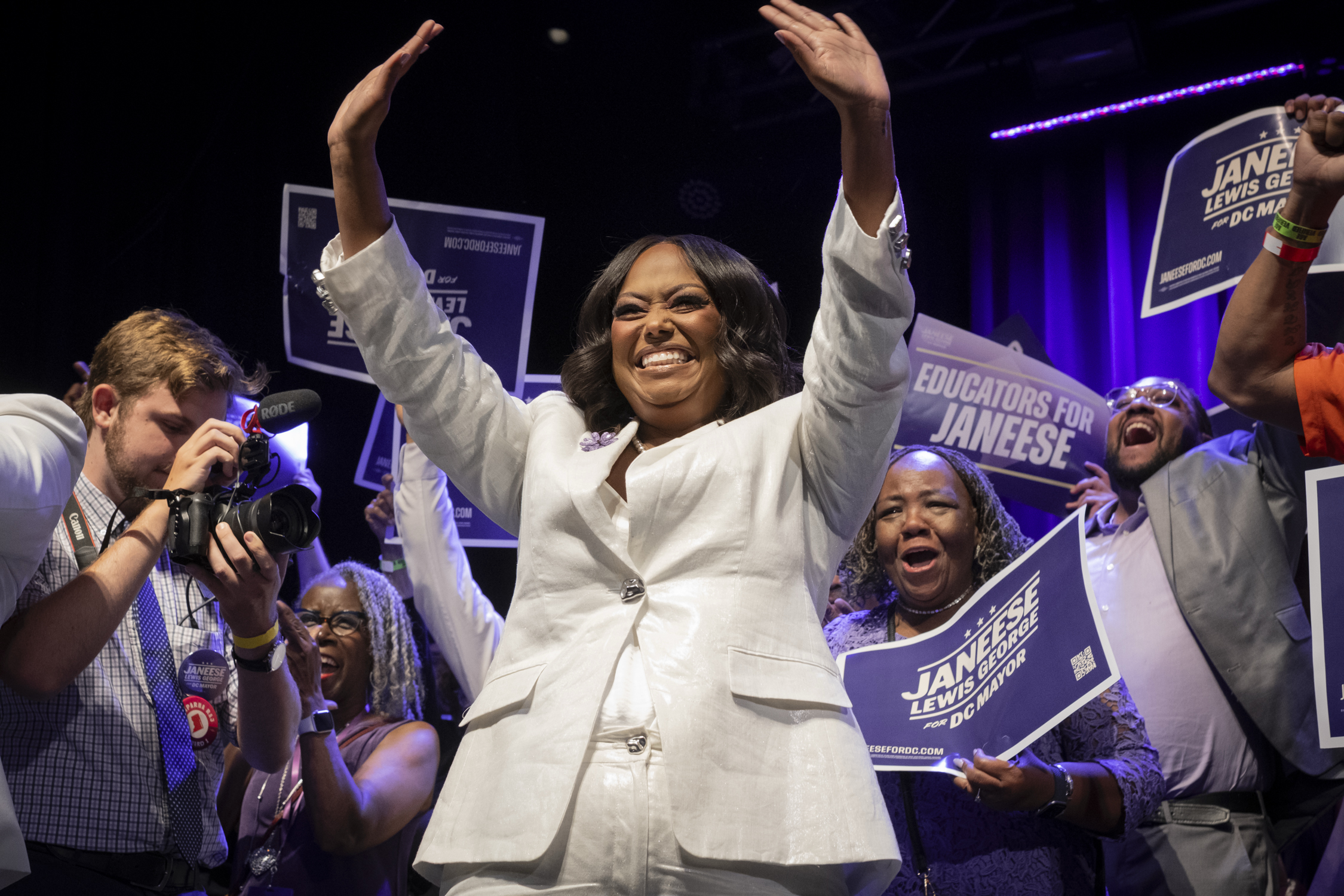
JCRC CEO Ron Halber said he hopes to work with the DSA member, despite his strident criticism of the group, while remaining vigilant
BLAME GAME

Nearly all Israelis surveyed said they believed Tehran was the victor, while 70% rated Trump’s management of the war as a failure or poor
Vance, announcing the deconfliction mechanism established with Iran, said, ‘We could have a better and more peaceful situation if Israel responds in the context of a conversation that’s ongoing between Hezbollah, Lebanon, Israel and other partners in the region’
Nathan Howard-Pool/Getty Images
Vice President JD Vance speaks to members of the media at the Buergenstock Resort Lake Lucerne, after the U.S. and Iran held high-level talks at the Lake Lucerne Summit on June 22, 2026 near Stansstad, Switzerland.
Vice President JD Vance on Monday backed Iran’s participation in bringing about the end of Israel and Hezbollah’s military conflict, calling the terror group’s ongoing strikes and Israel’s response “a chicken and egg problem.”
Vance said at a press conference in Switzerland that the U.S. will be counting on Iran to “rein in” Hezbollah, after the U.S. and Iran agreed to create a “deconfliction cell” for military operations in Lebanon during negotiations on Sunday. The statement announcing the mechanism, released by mediating countries Pakistan and Qatar, did not reference Israel.
When asked if he expected Lebanon to be such a linchpin in negotiations, Vance said, “We want Hezbollah to stop firing at our friends in Israel. We want Israelis to be able to live in peace. We also want to make sure that … when things happen, they don’t spiral into a broader escalation, and so we’ve been, I think, very good at setting up what we’re calling a deconfliction mechanism.”
“Sometimes you’ve got a bit of a chicken and egg problem, that you’ve got a junior guy who fires a drone that didn’t have approval from the high command,” he continued, referring to Hezbollah’s ongoing attacks on northern Israeli towns.
“Of course, Israel has to respond to that, but … we could actually have a better and more peaceful situation if Israel responds in the context of a conversation that’s ongoing between Hezbollah, Lebanon, Israel and other partners in the region.”
Vance added that ongoing negotiations will require close coordination with the U.S.-backed Lebanese Armed Forces and will “also require the Iranians to rein in Hezbollah,” without acknowledging that Iran offers material backing to its proxy in Lebanon.
Reports have indicated that some Lebanese lawmakers have expressed dissatisfaction with the U.S. and Iran including Beirut in their negotiations, as opposed to leaving Lebanon to its separate U.S.-backed track directly with Israel, which is set to continue in Washington this week.
When asked whether the U.S. expects an Israeli withdrawal from Lebanon, Vance demurred, affirming instead that Israel has a “right to self-defense” and that the U.S. wants “Israel’s security to be protected.””
“We want Israel’s security to be protected, and we also want Lebanon’s sovereignty to be protected,” Vance said. “The Israelis have been very clear: they do not have territorial intentions on south Lebanon. The reason they feel they have to be there is because they’re worried about Hezbollah fighters in south Lebanon firing into Israel.”
Vance noted that the U.S. made additional “good progress” in the high-level talks over the weekend, claiming that Tehran has agreed to invite International Atomic Energy Agency inspectors back into the country to monitor its nuclear program.“That is a major milestone for the American people, and the first step in permanently denuclearizing, or permanently ending a nuclear weapons program in Iran,” Vance said at his press conference.
The IAEA inspectors would verify that Iran is only using nuclear material for peaceful purposes, a parameter that Vance noted was “exactly what we asked to happen.”
“In terms of when the nuclear inspectors are going to start … I expect that will happen at the minimum this week, but we think even some of those conversations with the inspectors and with the IAEA could happen as soon as today,” Vance said.
Vance said that talks will proceed on a “technical level” with diplomatic teams in Switzerland continuing negotiations “over the weeks and days to come.”
“The final deal is the house; we set the foundation,” Vance said. “We haven’t built the house, but we’ve laid a successful foundation to get to a good place for the American people. I think it’s important for all of us to appreciate how much was done, but honestly, there is still a lot to do.”
Vance also defended a social media post by President Donald Trump on Sunday, in which the president threatened to “hit Iran very hard again” if it did not “immediately stop” supporting regional proxies. The vice president argued the warning did not derail the diplomatic progress.
“We were negotiating well past one in the morning, so they didn’t walk out, and their technical team is still here working with our technical team as we speak,” Vance said. “What we told the Iranians yesterday is, ‘When you guys engage in what us millennials might call “trash talk,” you can’t expect the president of the United States not to respond and not to correct the record.’”
“So yes, there was a little bit of threatening, there was a little bit of whining, but at the end of the day, the talks continued and we made great progress,” he added.
TrackAIPAC has garnered ongoing accusations of antisemitism for its targeting of individual Jewish donors with, in many cases, tenuous ties to pro-Israel organizations

Chip Somodevilla/Getty Images
Rep. Ro Khanna (D-CA) leaves the U.S. Capitol on March 13, 2024 in Washington.
Rep. Ro Khanna (D-CA) announced last week that he had been endorsed by the anti-Israel group TrackAIPAC, which has faced widespread accusations of antisemitism, after he became the first politician or candidate to sign a new “pledge” promulgated by the group.
TrackAIPAC has garnered ongoing accusations of antisemitism for its targeting of individual Jewish donors with, in some cases, distant or long-ago ties to pro-Israel organizations, fueling accusations that the group aims to broadly stigmatize Jewish political participation. Its inconsistent methodology and practices for determining which politicians it labels as “pro-Israel” have also generated criticism.
The group faced further scrutiny for endorsing antisemitic Texas Democratic candidate Maureen Galindo, though it belatedly revoked its endorsement after her antisemitic stances gained widespread national attention.
The “PEACE Pledge” requires signatories to reject any support from AIPAC, Democratic Majority for Israel, Republican Jewish Coalition, Christians United for Israel “or similar organizations and large donor networks promoting unconditional support for Israel” and to “reject spending and funds routed by groups like AIPAC and their allies through intermediary organizations or coordinated donor activity.”
The pledge is “pretty common sense. It means that we shouldn’t be sending our tax dollar money for foreign wars overseas. We should be spending it here at home,” Khanna said in a video before signing it. “It says that we shouldn’t be taking money from AIPAC or all of its affiliate PACs or bundled money from those organizations, and that we have to recognize the genocide that took place in Gaza.”
“I am proud to be the first Democrat to take this pledge to reject money from AIPAC and affiliated groups, recognize the genocide in Gaza and oppose aid to Israel and military sales that kill civilians,” he added.
Khanna has recently increased his national profile through vocal criticism of Israel, ahead of a potential 2028 presidential run. He joins Rep. Alexandria Ocasio-Cortez (D-NY) and Sen. Chris Van Hollen (D-MD) as the third potential 2028 presidential candidate endorsed by TrackAIPAC, which has faced persistent accusations of antisemitism.
TrackAIPAC has in some cases previously labeled J Street support as verboten pro-Israel funding, as well as targeted individual donors who have previously had ties to pro-Israel groups, even if their donations are not given in connection to those groups.
But a Khanna campaign spokesperson said that the pledge does not require Khanna to reject support from J Street or from individual pro-Israel donors.
“Ro believes strongly in the political participation of the Jewish American community. He is proud to be endorsed by J Street and engages with many synagogues and leaders, including those who may not share all his views,” the spokesperson said.
The pledge also demands that signatories recognize the war in Gaza as a genocide and support legislation to that effect; oppose any military aid to “any country whose security forces are committing gross violations of human rights, war crimes, ethnic cleansing, apartheid, genocide”; and oppose sanctions on the International Criminal Court, among other measures.
It appears to demand that signatories not support anti-Boycott, Divestment and Sanctions legislation, as well as legislation addressing anti-Zionism as a manifestation of antisemitism: “I pledge that I will oppose all measures to restrict protected First Amendment speech and assembly, including the exercise of longstanding economic tools of expression, including by opposing measures that aim to limit these freedoms through the conflation of criticism of a foreign country with any form of bigotry.”
“The pledge does not require support for BDS and Ro has not supported it. It says that you cannot criminalize BDS, which has always been Ro’s position as a supporter of the First Amendment,” the Khanna spokesperson said.
The spokesperson also noted that Khanna “believes in dialogue and engagement to bring peace,” and noted that he recently met with leaders from the Bay Area Jewish Coalition — who have described Khanna as actively hostile to and endangering the Jewish community — as well as the local Jewish Community Relations Council and Jewish federation.
The spokesperson said he has also met with AIPAC members. And, the spokesperson noted, Khanna recently scored a decisive primary victory. Khanna’s challenger had sought to cultivate support among Jewish voters.
Tali Klima, a spokesperson for the Bay Area Jewish Coalition, said in a statement following the initial publication of this story that the group “reluctantly” met with Khanna following the recent primary, but had asked his office not to publicize the meeting.
“Despite assurances, Khanna has once again chosen to leverage a private meeting for his agenda and to insinuate that he is open to dialogue and inclusion of our perspectives. We are disappointed but not surprised by his team’s actions,” Klima said.
Klima said that during the meeting, her group and other Jewish leaders “reiterated how his rhetoric and political agenda hurt our community. Indeed, we gave him examples of recent antisemitic attacks against children right in his district.”
“Although he promised to ‘tone down’ his rhetoric, he has since proceeded with business as usual, for example, by signing the ridiculous anti-AIPAC pledge,” Klima continued. “We will not accept his attempts to excuse vile anti-Israel propaganda that fuels prejudice, harassment and assaults against us.”
Nearly all Israelis surveyed said they believed Tehran was the victor, while 70% rated Trump’s management of the war as a failure or poor

Kobi Wolf/Bloomberg via Getty Images
Damaged buildings at the site of an Iranian missile strike in Arad, southern Israel, on Sunday, March 22, 2026.
Israelis overwhelmingly believe Iran won the war against the U.S. and Israel and view its conclusion negatively, a new survey by the Hebrew University of Jerusalem has found.
Over 9 in 10 respondents (92%), surveyed between June 17-20, said Tehran emerged as the victor, according to The Times of Israel, and nearly 70% said President Donald Trump’s management of the war classifies as “failed” or “poor.”
Israeli Prime Minister Benjamin Netanyahu fared slightly better, with 56% of respondents saying his handling of the war was either a failure or poor.
Nearly all Israelis surveyed (88%) said the country did not achieve its stated goals of ending Iran’s nuclear and ballistic missile programs and bringing down the regime. About half (48%) of respondents said Israel should restart major military action against Hezbollah in Lebanon, even at the risk of clashing with Trump, who has pushed for the fighting to end — while only 21% said they were opposed to such action.
A vast majority of Israelis are pessimistic about the conflict’s apparent conclusion — 83% said the war with Iran weakened Israel’s long-term security position and 86% have a negative view of the outcome of the war. Nearly three-quarters (73%) of respondents said they did not believe Netanyahu’s claims that Israel made significant progress in the conflict.
The vice president acknowledged that some conservatives wrongly blame Israel for too many of America’s problems, but argued that pro-Israel advocates are often too quick to accuse critics of antisemitism
Roy Rochlin/Getty Images
Vice President JD Vance
Vice President JD Vance warned pro-Israel advocates against seeing Israel and the U.S. as always aligned and cautioned against conflating criticism of the Israeli government with antisemitism, saying that “if everything is Jew hatred, then nothing is Jew hatred.”
In an episode of Christian conservative commentator Allie Beth Stuckey’s podcast podcast released on Friday, Vance said that “pro-Israel people in the United States make two critical mistakes. One … is not delineating between America’s interests and Israeli interests, because they’re not always the same.”
“But the second is conflating criticism of a particular government with Jew hatred. Because if everything is Jew hatred, then nothing is Jew hatred,” he continued. “And we have to be very careful not to, you know, in order to serve a certain foreign policy objective, try to criticize somebody as antisemitic when they’re just not.”
Asked by Stuckey if Israel has an “outsized influence in the U.S.,” Vance said, “I certainly think that Israel, like a lot of other countries, tries to influence American politics. I sort of take that as a given. And what I think is that American leaders have to be very careful that when we pursue something, we’re doing it for America’s best interest and not for any other country’s best interest.”
Vance added that the late conservative influencer Charlie Kirk “was very worried about Israeli influence in American politics. He also really disliked antisemitism.”
Stuckey raised the “the obsession that some people have, I would say on the right, with blaming all of their problems on Israel, all of their disagreements with Trump on some secret Israeli influence,” which she said she sees “more prominently on the right than I see the true ‘Israel first’ kind of obsession that you seem to be describing.”
“I see both, and I think both are bad,” Vance responded. But he said he’s “particularly sensitive” to what he views as the elevation of Israel’s interests because he’s “been defending the president’s decision to end the Iran [war], and I find often the arguments are, ‘Well, Israel doesn’t think this is good, therefore it’s bad.’ And my reaction is: Israel’s opinions matter, but fundamentally they are separate.”
“But you’re right. I mean, there are certainly people who take every frustration with the Trump administration, every policy disagreement becomes because of Israel, and that is absolutely wrong. And again, I think that that is one of those things that can bleed into some very dark places,” he continued.
Vance also defended the emerging deal with Iran, prior to departing over the weekend for direct negotiations with Tehran’s representatives in Switzerland. “You do still have terrorist elements within the regime, but you also have pragmatic elements within the regime who are actually affirmatively trying to have a better relationship with the United States,” he said.
Far-left antisemitic streamer Hasan Piker, replying to a video of Vance’s comments about criticism of the Israeli government and antisemitism, wrote on X, “I GOT BANNED FROM THE UK FOR SAYING THIS VERBATIM BTW.”
The Detroit convention also featured Abdul El-Sayed, a United Auto Workers-endorsed Michigan Senate candidate who has said the Israeli government is ‘just as evil as Hamas’
Jim West/UCG/Universal Images Group via Getty Images
Abdul El-Sayed speaks at a union rally in Detroit on June 17, 2026.
Delegates at the United Auto Workers convention in Detroit voted on Thursday to divest from Israel Bonds, citing the war in Gaza.
One of the largest unions in the country, the UAW previously held an estimated $400,000 to $700,000 in Israeli bonds and securities, according to the Detroit Free Press. It has not been disclosed how much money the divestment will affect or how many members voted to pass the resolution.
The annual convention also featured a speech from Abdul El-Sayed, a far-left, UAW-endorsed Democratic Senate candidate in Michigan who told Jewish supporters last month that he “often struggle[s]” to answer whether he believes Israel has a right to exist as a Jewish state. He said in an interview with CNN in April that he believes the Israeli government is just as evil as Hamas.
While UAW historically evokes imagery of assembly lines, picket lines and blue-collar solidarity, the union has increasingly drifted away from its core mission of representing autoworkers, largely driven by individuals pushing extreme political agendas that leave critics questioning their relevance to workplace issues.
In January, 30% of the 275 employees of the Israeli-owned Breads Bakery signed union authorization cards for UAW Local 2179, the percentage necessary to petition the National Labor Relations Board for a union election. The group, which calls itself “Breaking Breads,” said in a statement, “Workers are demanding a living wage, safe workplace, and basic respect.” But the group’s demands also included that the management of the New York-based bakery chain, CEO Yonatan Floman and founder Gadi Peleg, “halt use of bakery profit to materially support the Israeli occupation.” Breaking Breads also condemned the bakery’s participation in the Great Nosh, an annual Jewish food festival in New York City, and said it will not participate in baking cookies with an image of the Israeli flag.
A number of labor unions have seen a rise of antisemitism and anti-Israel activity since the Oct. 7, 2023, Hamas terrorist attacks, despite many being historically supportive of Israel, dating back nearly a century, when many American unions donated money to the Histadrut, Israel’s national labor union. Multiple groups — including the Louis D. Brandeis Center for Human Rights Under Law — have now taken legal action against UAW branches in response to certain campaigns, which some legal experts allege were discriminatory against Israelis and Jews.
UAW did not respond to a request for comment from Jewish Insider.
Plus, Tirana points the finger at Tehran
Screenshot
Vice President JD Vance and former President Barack Obama
👋 Good Friday morning!
In today’s Daily Kickoff, we have the latest on the scrapped U.S.-Iran talks that had been slated to begin this weekend in Switzerland and on the overnight attack by Hezbollah, in violation of the just-signed memorandum of understanding, in which four Israeli soldiers were killed. We look at how Vice President JD Vance’s rhetoric around the MOU mirrors how Obama administration officials talked about the 2015 Joint Comprehensive Plan of Action, and look at the divide among Jewish communal groups over the potential merger of the State Department’s antisemitism and Holocaust affairs offices. Also in today’s Daily Kickoff: Albanian Prime Minister Edi Rama, Yoav Gallant and Hillary Clinton.
Today’s Daily Kickoff was curated by JI Executive Editor Melissa Weiss and Israel Editor Tamara Zieve, with an assist from Marc Rod. Have a tip? Email us here.
For less-distracted reading over the weekend, browse this week’s edition of The Weekly Print, a curated print-friendly PDF featuring a selection of recent Jewish Insider and eJewishPhilanthropy stories, including: A Lebanese Zionist’s longshot bid to reshape the Middle East; ‘The single best diaspora experience’: Jewish leaders mark America’s 250th with open letter; and Ivanka Trump unveils Meta initiative to distribute AI glasses to visually impaired veterans. Print the latest edition here.
What We’re Watching
- Four Israeli soldiers were killed in a Hezbollah attack on an IDF tank in southern Lebanon overnight and five others injured in an additional attack in violation of the newly implemented memorandum of understanding, prompting dozens of retaliatory Israeli strikes in the area. The incident, which was the deadliest attack on Israeli troops by Hezbollah in months, came hours after Vice President JD Vance assailed Israeli government officials — one of whom, Finance Minister Bezalel Smotrich, warned that the Iranian-backed group would exploit the diplomacy between Tehran and Washington to attack Israel — for their opposition to the deal. Read more here.
- The escalation comes as Reps. Josh Gottheimer (D-NJ) and Mike Lawler (R-NY) circulate a resolution among lawmakers condemning Hezbollah for its “repeated violations of ceasefire agreements” through its attacks against Israel and calling for the terrorist group to be disarmed, Jewish Insider‘s Marc Rod and Emily Jacobs have learned.
- Vance had been scheduled to travel today to Switzerland, where he was set to begin talks with Iran, following the signing this week of the MOU between the countries. But the trip was scrapped overnight, with a White House spokesperson saying that “the logistics of these negotiations have never been simple or predictable.”
- Elsewhere in Washington, Bill Pulte, the Trump administration’s housing-finance regulator, takes over as interim director of national intelligence today, days after President Donald Trump postponed DNI nominee Jay Clayton’s confirmation hearing, drawing the ire of senators from both sides of the aisle concerned over Pulte’s potential access to classified documents.
- FII Priority Europe wraps up today in Rome. On the main stage yesterday, Albanian Prime Minister Edi Rama blasted Iran for stoking protests in the Balkan nation tied to efforts by Jared Kushner and Ivanka Trump to develop a new real estate project in the country. More below.
- In New York, the Jewish Food Society’s Great Nosh will take place on Sunday on Governors Island.
- The Jewish News Syndicate’s annual policy summit begins on Sunday in Jerusalem.
- Also Sunday, Orthodox Union Advocacy’s annual Attorneys Conference kicks off in Washington.
- We’ll also be keeping an eye on Colombia on Sunday, where far-right attorney Abelardo de la Espriella and far-left activist Iván Cepeda, backed by current President Gustavo Petro, will face off in a presidential runoff. De la Espriella, who has the endorsement of Trump, has also gotten support from Israeli Foreign Minister Gideon Sa’ar, with whom he met last year in Argentina. After the votes from the first round of voting were tallied, Sa’ar posted a photo of the two and congratulated de la Espriella.
What You Should Know
A QUICK WORD WITH GILI COHEN
The long love affair between Israelis and President Donald Trump, on the rocks over the last few weeks as the U.S. and Iran hammered out an end to the war, appears to be over, with humiliations mounting for Jerusalem. “I call all the shots,” not Israeli Prime Minister Benjamin Netanyahu, Trump said earlier this month. More recently, the Israeli leader’s bombing campaign in Beirut was “vicious,” Trump said. And perhaps most humiliating of all, Trump suggested that Syrian President Ahmad al-Sharaa could better take care of Hezbollah than the IDF.
The Israeli public — the spurned lover who once hailed the U.S. president with billboards hung in the center of Tel Aviv reading “Thank you God & Donald Trump” — is not taking it well. Former Israeli Ambassador to the U.S. Michael Herzog told JI, “President Trump, who has been a hero to many Israelis, is now openly criticized from within the Israeli government, including Netanyahu’s close circle.”
And this criticism is not only expressed behind closed doors. Channel 14, the popular right-wing outlet that promotes Netanyahu, has been criticizing Trump resolutely, with some of its anchors publicly cursing Vice President JD Vance and the president’s close advisors, White House Special Envoy Steve Witkoff and Jared Kushner.
It was not always this way. For most of the time since Trump reentered the White House in January 2025, he has been popular in Israel, with polls consistently showing high ratings for the American president.
For Israelis, Trump is the one who brokered the hostage-release agreement with Hamas; Trump is the one who made the strikes in Iran and the bombing of the nuclear enrichment facilities in Fordow and Natanz a reality; and Trump is the one who established the Abraham Accords and is willing to expand them, giving Israelis the chance to sunbathe in the UAE, and perhaps in other countries in the Gulf in the near future. And although some won’t admit it, many Israelis also like his tendency to speak very bluntly, and crudely: a president born in Queens, full of Israeli chutzpah.
NEW DEAL, SAME LYRICS
As Vice President JD Vance takes on the role of chief defender of the U.S.-Iran memorandum of understanding and forthcoming talks, he has begun to sound a lot like someone whom the Trump administration has lately spent a lot of time attacking: former President Barack Obama, Jewish Insider’s Gabby Deutch reports. Vance and President Donald Trump have both made clear that they view the MOU as fundamentally different from the 2015 Joint Comprehensive Plan of Action.
Sounds familiar: But as the White House faces criticism from hawkish members of the Republican Party, the language Vance is using to defend the burgeoning deal closely resembles the arguments made by Obama 11 years ago. “If you think this is a bad deal, what is your alternative?” Vance said in an interview this week with New York Times columnist Ross Douthat. Flashback to a 2015 press conference at the White House soon after the JCPOA was announced. “I’m hearing a lot of talking points being repeated about ‘this is a bad deal,’” Obama said. “What I haven’t heard is, what is your preferred alternative?”
Read the full story here and watch a side-by-side video comparison here.
Bonus: In The Washington Post, the Hudson Institute’s Douglas Feith, who served in the George W. Bush administration, posits that Vance’s defense of the agreement resembles “the standard reassurance Western leaders over the past century have offered when they make deals of this kind with bad actors — but it has generally proved hollow.”
DEAL DISCONTENT
Jewish Republican donors and activists are voicing their strong disappointment with President Donald Trump’s newly announced memorandum of understanding with Iran, which has been met with criticism from GOP lawmakers as well as influential hawkish conservatives, Jewish Insider’s Matthew Kassel reports.
Flagging concerns: In interviews with JI on Thursday, several Jewish conservatives who supported the war expressed misgivings about the deal that reopens the Strait of Hormuz, saying that it had granted too many concessions to a weakened Iran — including waiving sanctions on oil exports — while neglecting to broach the regime’s funding of terror proxies and its ballistic missile arsenal. They also raised concerns that the memorandum of understanding with Tehran had not been favorable to Israel, a U.S. partner in the war, pointing to a term of the preliminary agreement that calls for a permanent end to military operations in Lebanon, where Israel is fighting Hezbollah, a key Iranian ally.
MOU blues: Senate Republicans continued on Thursday to air concerns about the U.S. memorandum of understanding with Iran, in some cases fueled further by Vice President JD Vance’s comments dismissing the effectiveness of U.S. sanctions and lambasting Israeli government officials who have objected to the deal, JI’s Marc Rod and Emily Jacobs report.
TEHRAN STIRRING TIRANA

Albanian Prime Minister Edi Rama on Thursday blamed Iran for what he described as “ruthless” cyberattacks, warning that Tehran has sowed unrest and amplified false information about environmental protests over a new luxury development project in the country from President Donald Trump’s daughter Ivanka Trump and son-in-law Jared Kushner, Jewish Insider’s Matthew Shea reports.
Details: The project, which has been preliminarily approved, has not obtained building permits, but has drawn fierce backlash and sparked daily protests from thousands of demonstrators outside Rama’s office due to environmental concerns. “The amount of posts that have been entering there from our enemy, we have only one enemy, which is the [Islamic] Republic of Iran, and they are engaged in three years in a ruthless cyber-attack against Albania,” Rama said. “They [Iran] entered also in this game…freedom of reach is what every regime, through every propaganda, has done to go in every brain and to put the lie in the brain.”
OFFICE SPACE

Jewish communal groups are at loggerheads over the possibility of merging two related but distinct State Department offices: the special envoy to monitor and combat antisemitism and special envoy for Holocaust issues. Some Jewish groups recently sent a letter to Secretary of State Marco Rubio in support of the concept of merging the two offices, while others have sent letters in recent months opposing such a move,Jewish Insider’s Marc Rod reports.
For and against: Proponents of combining the two offices say that doing so consolidates linked issues under the authority of one envoy with ambassador-rank status, while maintaining the work of both offices. Opponents say that combining the two teams would undermine and diminish the work of the Holocaust affairs envoy and risk politicizing critical work on Holocaust restitution. The reexamination of the two roles comes ahead of the expected retirement of Ellen Germain, who has served as special envoy for Holocaust issues since 2021.
PAC CONTRADICTIONS

American Priorities, a new super PAC created as a progressive counterweight to pro-Israel spending in Democratic primaries, has drawn scrutiny in recent weeks for accepting contributions from donors who have given to Republicans — even as its allies on the far left have accused AIPAC, a chief rival, of serving as a Trojan horse to advance GOP-linked interests in safe blue districts, Jewish Insider’s Matthew Kassel reports.
Follow the money: Meanwhile, filings show that the anti-Israel group has received $250,000 from a tech executive whose firm is developing AI data centers in New York State. That money has boosted two democratic socialist House candidates in New York City who oppose efforts to expand data centers. Claire Valdez, a state assemblymember running to succeed retiring Rep. Nydia Velazquez (D-NY), and Darializa Avila Chevalier, an anti-Israel activist who is challenging Rep. Adriano Espaillat (D-NY), have benefited from over $2 million in estimated support from American Priorities in the final stretch of their closely contested primaries set for next Tuesday.
OFFSHORE ALLIANCE
The Department of Energy is leaning on Israel’s offshore gas resources and cybersecurity prowess to help an emerging Eastern Mediterranean energy alliance, with officials telling Jewish Insider’s Matthew Sheathat Israeli participation uniquely “strengthens” the newly formed coalition. Earlier this month, the U.S., Cyprus, Greece and Israel formalized the partnership, announcing the establishment of the Eastern Mediterranean Energy Center (EMEC) on the campus of Rice University in Houston.
Aims: The center will serve as a permanent hub for research, policy dialogue, technical cooperation, and public‑private partnerships focused on infrastructure, investment, emerging technologies, and regional connectivity, according to the department. A spokesperson for the Department of Energy told JI that the agreement was part of a “longstanding effort to deepen cooperation” and that Israel’s involvement in the newly established EMEC partnership is vital to the coalition’s geopolitical objectives.
Worthy Reads
Getting Going in Gaza: In the Financial Times, former Secretary of State Hillary Clinton posits that the West should embrace the Trump administration’s 20-point peace plan for Gaza and the Board of Peace’s efforts in the enclave, arguing that they offer the most viable opportunity for progress. “The gleeful anticipation of failure is not just unhelpful. It is strategically self-defeating. The Board of Peace is an improbable vehicle, and the 20-point plan leaves many legitimate concerns unresolved. Governments will continue to disagree with important elements of both. But diplomacy rarely offers a choice between good options and bad ones. The international community cannot claim concern for Palestinian civilians while refusing to engage with the only mechanism currently capable of shifting conditions on the ground.” [FT]
Wrong on U.S. Aid: In The Free Press, former Israeli Defense Minister Yoav Gallant clarifies the contours of U.S. military aid to Israel. “No matter where you fall on this issue, almost everyone seems to agree on the premise that American support for Israel is a donation, and that the only remaining question is how generous the benefactor should be. But that premise is wrong. It has been wrong for a long time. And because it is wrong, the debate built on top of it misrepresents to the American people what their money has actually been doing for the past half-century. … But U.S. aid to Israel is not charity. American dollars flow into American factories; American assistance frees Israeli capital for innovation; and American forces eventually receive Israeli-developed capabilities refined in real combat.” [FreePress]
Strait Jacket: In The New York Times, Ed Fishman warns that other countries will use Iran’s closure of the Strait of Hormuz as a blueprint for exacting economic and military concessions of their own. “Even if the deal holds, Iran is poised to emerge from the war battered militarily and economically but strengthened strategically, the newly empowered gatekeeper of the world’s most important energy chokepoint. Other countries will take note — and seek their own chokepoints to exploit. … The irony is that Iran’s success at the Strait of Hormuz may set off a different kind of arms race — one in which every country searches for chokepoints to convert into money and power.” [NYTimes]
Wrong Turn for the Left: In The Atlantic, Adam Louis-Klein argues that anti-Zionism runs counter to progressive values. “How can it be that an ideology that has produced repeated acts of discrimination, dispossession, and violence now bears the mantle of progressivism in the West and has been normalized within the Democratic Party? Like Stalinism or the Khmer Rouge, anti-Zionism represents a wrong turn for the left. Anti-Zionism claims to be concerned with rights of minorities, opposition to racism, and universal justice. In truth, though, it has appropriated the language of anti-colonial liberation to justify oppression, transformed anti-racism into a racist accusation, and turned hatred of Israel into a global ritual.” [TheAtlantic]
Word on the Street
U.S. Ambassador to Israel Mike Huckabee responded rhetorically to French Foreign Minister Jean-Noël Barrot’s comments that Israel should halt its attacks on Hezbollah by asking, “Does France get all its info from Hezbollah?” adding that “Ceasefire happens when Hezbollah stops shooting & killing”…
The New York Times spotlights the “last-minute scramble” that produced the memorandum of understanding between the U.S. and Iran; at one point last weekend, the Times reports, President Donald Trump “placed a call to a New York Times reporter to explain the deal, even as, he said, his ‘wonderful family’ was waiting for his birthday dinner to begin”…
Spotted at the opening of the Obama Presidential Center in Chicago on Thursday: Former Presidents Bill Clinton, George W. Bush and Joe Biden; former Secretaries of State Hillary Clinton and Tony Blinken, former Vice President Kamala Harris and Doug Emhoff; Illinois Gov. J.B. Pritzker, former U.S. Ambassadors to Israel Dan Shapiro, Jack Lew and Tom Nides; former Commerce Secretary Penny Pritzker, former U.S. Ambassador to Japan Rahm Emanuel and Karlie Kloss…
J Street is slated to host a virtual briefing for congressional staff on the Trump administration’s memorandum of understanding with Iran featuring former Biden administration special envoy for Iran Rob Malley, who was suspended from his State Department role amid an investigation over his handling of classified materials, Jewish Insider’s Marc Rod reports…
The Associated Press projected Washington, D.C., Councilmember Janeese Lewis George, a democratic socialist, to win the city’s Democratic mayoral primary, shortly after former Councilmember Kenyan McDuffie conceded…
A federal grand jury indicted a Florida man facing hate crime charges over a foiled plot to attack Jewish employees of a pro-Israel nonprofit organization…
Lion Raisins condemned the recent antisemitic and racist behavior by Bruce Lion, one of the company’s heirs, who was arrested last week on charges of making criminal threats targeting a neighbor in his Pacific Palisades, Calif., community who is a rabbi; Lion, who was charged with three felony hate crimes, faces up to nine years in prison if convicted…
The New York Times Magazine does a deep dive into the term “goyslop,” which was popularized as an antisemitic trope by the far right and has increasingly become part of the discourse among the Zoomer generation…
Police in Canada arrested a 19-year-old man in connection with a shooting in March targeting the U.S. consulate in Toronto…
The U.K. government is pledging £1 million to support the Jewish Museum London; U.K. Culture Secretary Lisa Nandy said the funding would go to sharing the “stories, the connections and the understanding that are the basis of a cohesive society and the future of our country”…
U.K. Labour party member Andy Burnham won a special parliamentary election, positioning the Greater Manchester mayor to mount a challenge to Prime Minister Keir Starmer…
The Koum Family Foundation donated $36 million to Los Angeles’ Milken Community School, one of the largest non-Orthodox Jewish day schools in the country, as part of a major capital campaign, eJewishPhilanthropy’s Judah Ari Gross reports…
Shalev Hulio and Sebastian Kurz’s Israeli AI cybersecurity firm Dream, whose technology works to protect governments against cyberattacks, raised $260 million, at a $3 billion valuation, in a private round of funding…
Pic of the Day

Tens of thousands of people participated in this week’s annual pilgrimage to the grave of the Lubavitcher Rebbe, Menachem Mendel Schneerson, in Queens, N.Y., to mark the 32nd anniversary of his death yesterday.
Birthdays

Singer-songwriter known as Jeryko, Yaniv Hoffman turns 35 on Sunday…
FRIDAY: Attorney, investment banker, film producer and former deputy mayor of NYC, Kenneth Lipper turns 85… Rabbi emeritus of Anshe Emeth Memorial Temple in New Brunswick, N.J., Rabbi Bennett F. Miller… Historian of the Jews in Muslim lands in the modern era, he won the Israel Prize in 2025 for Jewish history, Yaron Tsur turns 78… Retired president and CEO of The Jewish Federation of Greater Los Angeles, he is now the president of American Jewish University, Jay Sanderson turns 69… Inna N. Zalevsky… Former director of communications for Kings Bay Y, Adrienne M. Knoll… Member of the European Jewish Parliament for Latvia, Valery Engel, Ph.D. turns 65… Physician specializing in reproductive endocrinology and infertility, Jessica Rosenberg Brown, MD… Co-founder of Centerview Partners, a boutique investment bank based in NYC, Blair Effron turns 64… Singer-songwriter, actor and television personality, she was a cheerleader for the Los Angeles Lakers at the age of 18, Paula Abdul turns 64… Former member of Knesset for the Zionist Union party, in the 1990s she was an assistant legal advisor to then Prime Minister Yitzhak Rabin, Ayelet Nahmias-Verbin turns 56… Human rights activist and advocate for women and minorities in Iran, Marjan Keypour Greenblatt… Co-founder of nine venture-backed companies in the telecom, high-tech, pharmaceuticals, energy, water and biotechnology industries, Andrew T. Perlman turns 51… Consul general of Israel to the Southeastern United States, Eitan Weiss… Staff writer at The New Yorker, Isaac Chotiner… Director of affinities and major gifts at the Minneapolis Jewish Federation, Tslil Shtulsaft… Founder of JSwipe, a Jewish dating app created in 2014, David Austin Yarus… Retired rhythmic gymnast from Israel who competed in the 2008 (Beijing), 2012 (London) and 2016 (Rio) Olympics, Neta Rivkin turns 35… VP at Jewish Federations of North America, Anna Langer… COO at Lightning Inspiration, Alex Jakubowski… Organization director at Senate Leadership Fund & One Nation, Cydney Couch… Singer, popular on video and streaming services, known as Skye for short, Daniel Skye turns 26… Vice president for education at the American Jewish Committee and director of its Center for Education Advocacy, Laura Shaw Frank…
SATURDAY: Weston, Fla., resident Harold Kurte turns 97… Former member of Knesset for the Meretz party, Ran Cohen turns 89… Owner of Schulman Small Business Services in Atlanta, Alan Schulman… Detroit-based pawnbroker, reality TV star, author and speaker, Leslie “Les” Gold turns 76… Chef, baker and author of eight books, she popularized sourdough and artisan breads in the U.S., Nancy Silverton turns 72… Writer of the “Bully Pulpit” Substack from Booksmart Studios, Bob Garfield turns 71… Former assistant managing editor for politics at NBC News, now an adjunct professor at the University of Florida and FIU, Gregg Birnbaum… Co-founder of Brilliant Detroit (helping children out of poverty) and owner of Riverstone Communities, James Bellinson… Rosh yeshiva at Yeshiva University and rabbi of Congregation Ohr HaTorah in Bergenfield, N.J., Rabbi Zvi Sobolofsky turns 61… Israeli-American screenwriter, film director, writer and producer of 20 films, Boaz Yakin turns 60… Senior legal affairs reporter at Politico, Josh Gerstein… Governor of Pennsylvania, one of three current Jewish governors that are named Josh, Joshua David Shapiro turns 53… U.S. Sen. Eric Stephen Schmitt (R-MO) turns 51… Singer, songwriter and hazzan, he is a co-founder of the band Moshav, Yehuda Solomon turns 49… Senior program director of civic initiatives at The Teagle Foundation, Tamara Mann Tweel, Ph.D…. Israeli author of crime and thriller books that have sold more than 2.5 million copies in more than 20 languages, Mike Omer turns 47… Journalist, blogger and EMT in NYC, formerly editor for Gawker and director of public relations for the Village Voice, Maggie Shnayerson turns 45… EVP of Moxie Strategies, Pearl Gabel… French-Israeli singer and songwriter, Amir Haddad turns 42… Deputy communications director in the Trump 45 White House, now head of corporate affairs at Standard Industries, Josh Raffel… Jennifer Bernstein… Photographer, producer and digital strategist, she is a supervising producer at HardPin, Sara Pearl Kenigsberg… Writer, director, comedian, YouTuber, podcaster and mental health advocate, Allison Beth Raskin turns 37… Team captain of Maccabi Tel Aviv of the Israeli Basketball Premier League and the EuroLeague, John DiBartolomeo turns 35… Chief campus and culture officer at Hillel Ontario, Bev Shimansky Ades… Development Director at Ashkenaz Foundation, Jaime Reich…
SUNDAY: Former member of the U.S. House of Representatives, she is the mother-in-law of Chelsea Clinton, Marjorie Margolies turns 84… Investment banker, he was the U.S. ambassador to El Salvador in the Bush 43 administration, Charles L. Glazer turns 83… Philanthropist, she is vice chair of the Museum of Jewish Heritage, Ingeborg Hanna Rennert… British businessman, co-founder with his brother Charles of advertising agency Saatchi & Saatchi which became the largest in the world, appointed to the House of Lords in 1996, Baron Maurice Saatchi turns 80… U.K. Cabinet minister in both the Thatcher and Major governments, Sir Malcolm Leslie Rifkind turns 80… Retired creditors rights attorney in the Chicago area, David Stephen Miller… Retired senior editor and writer at The Washington Post for 33 years, now chief editor at The Reis Group, Peter Perl… Member of the Knesset since 2013 for the Yesh Atid party, Mickey Levy turns 75… Susan Gutman… CEO of Amir Development Company in Beverly Hills, he is a member of the national council of AIPAC, Keenan L. Wolens… Punk rock singer and songwriter, known as the Gangsta Rabbi, Steve Lieberman turns 68… Washington Institute director and adjunct professor at Johns Hopkins SAIS, David Makovsky turns 66… Pulitzer Prize-winning journalist and author, David L. Marcus… Co-founder and executive editor of Axios since 2016, Mike Allen turns 62… National education writer for The Washington Post, Laura Meckler… Founder and leader of Beautifully Jewish, Tanya Rebecca Singer… Actor, singer and entrepreneur, who now raises awareness about amyotrophic lateral sclerosis, Aaron Scott Lazar turns 50… Yale Law School graduate, journalist and author, Abigail Krauser Shrier turns 48… Public affairs consultant based in Manhattan, Sam Nunberg turns 45… Co-founder and former CEO of Kaggle, a data science platform acquired by Google in 2017, Anthony Goldbloom turns 43… Former member of the Knesset where she was the first-ever Druze woman, she then became a Jewish Agency shlicha to Washington, Gadeer Kamal Mreeh turns 42… Head of Communications for Paramount+, Jacqueline (Jackie) Berkowitz… Chief of staff to the chairman and CEO at Saban Capital Group, Amitai Raziel… Award-winning Israeli classical pianist, Boris Giltburg turns 42… Executive director at Hunter Hillel, Merav Fine Braun… Editor for the global programming team at CNN, Madeleine Morgenstern… Singer-songwriter and actor, known by his mononym Max, Maxwell George Schneider turns 34…
Former Israeli Ambassador to the U.S. Michael Herzog told JI, 'President Trump, who has been a hero to many Israelis, is now openly criticized from within the Israeli government, including Netanyahu's close circle.'

Jack GUEZ / AFP via Getty Images
A billboard depicting an image of President Donald Trump with a message thanking him, is displayed on the side of a building in the Israeli coastal city of Tel Aviv on March 12, 2026.
The long love affair between Israelis and President Donald Trump, on the rocks over the last few weeks as the U.S. and Iran hammered out an end to the war, appears to be over, with humiliations mounting for Jerusalem. “I call all the shots,” not Israeli Prime Minister Benjamin Netanyahu, Trump said earlier this month. More recently, the Israeli leader’s bombing campaign in Beirut was “vicious,” Trump said. And perhaps most humiliating of all, Trump suggested that Syrian President Ahmad al-Sharaa could better take care of Hezbollah than the IDF.
The Israeli public — the spurned lover who once hailed the U.S. president with billboards hung in the center of Tel Aviv reading “Thank you God & Donald Trump” — is not taking it well. Former Israeli Ambassador to the U.S. Michael Herzog told JI, “President Trump, who has been a hero to many Israelis, is now openly criticized from within the Israeli government, including Netanyahu’s close circle.”
And this criticism is not only expressed behind closed doors. Channel 14, the popular right-wing outlet that promotes Netanyahu, has been criticizing Trump resolutely, with some of its anchors publicly cursing Vice President JD Vance and the president’s close advisors, White House Special Envoy Steve Witkoff and Jared Kushner.
It was not always this way. For most of the time since Trump reentered the White House in January 2025, he has been popular in Israel, with polls consistently showing high ratings for the American president.
For Israelis, Trump is the one who brokered the hostage-release agreement with Hamas; Trump is the one who made the strikes in Iran and the bombing of the nuclear enrichment facilities in Fordow and Natanz a reality; and Trump is the one who established the Abraham Accords and is willing to expand them, giving Israelis the chance to sunbathe in the UAE, and perhaps in other countries in the Gulf in the near future. And although some won’t admit it, many Israelis also like his tendency to speak very bluntly, and crudely: a president born in Queens, full of Israeli chutzpah.
In recent weeks, the attitude toward Trump among the Israeli public, and the Israeli leadership, has radically and rapidly changed. But this process began even before the signing of the memorandum of understanding with Iran. Over the past few months, time and again, Netanyahu has tried to convince Trump to resume strikes on Iran, only to be rejected. A source familiar with the discourse between the two leaders described to JI a situation that has played out repeatedly since April: the Israeli prime minister explains why only the military option is the correct approach to Iran, while Trump listens but prefers the diplomatic path.
And then Trump, in his typical fashion, says that Netanyahu will do whatever the U.S. president tells him to do — which has some degree of truth — but is not a good look for a prime minister seeking reelection. Trump has repeatedly criticized Israeli policy in Lebanon and publicly reprimanded Netanyahu for not being responsible enough. When the U.S. president once again floated the possibility that al-Sharaa should handle Hezbollah, which has fired thousands of rockets and drones toward Israel and most recently killed four Israeli soldiers overnight Thursday, the criticism in Israel escalated.
Trump had previously suggested that the Syrians take on Hezbollah, as reported by Kann earlier this week, during an official meeting between the Israeli and Lebanese ambassadors in April, though those in attendance were unenthusiastic about the idea. To understand the Israeli approach toward Trump’s suggestion, one can look at what the chairman of the Knesset Foreign Affairs and Defense Committee, Likud MK Boaz Bismuth, posted on X: “President Trump, we don’t trust the terrorist Jolani, we have Golani,” referencing a well-known IDF combat infantry brigade.
The opinion within the Trump administration has been made clear. “Trump is the only head of state in the entire world who is sympathetic to the nation of Israel at this moment and time,” Vance told reporters on Thursday. “If I was in the Cabinet of the Israeli government, I might not be attacking the only powerful ally that I have left in the entire world,” he said. “The problem for Israel is not Donald J. Trump. And anybody in Israel who thinks their biggest problem is the president of the U.S. needs to wake up and smell the reality of the situation that country is in.”
Yet now, after the agreement has been published, the criticism remains unchanged. An Israeli official told JI that the agreement raises several troubling signs, among them: the uncertainty over whether all enriched uranium will be removed from Iran, or only the high-level uranium; under the terms of the agreement, Iran, it appears, will be allowed to enrich uranium at a low level on its soil, meaning it can continue to operate centrifuges; and the issue of oversight is not explained.
“The second shocking thing here is the betrayal of the Iranian people. The second clause in the MOU agreement states that neither country will interfere in the internal affairs of the other. This means the Iranians can execute protesters, and nothing will be done to them,” the Israeli official said. “This entire war started because Trump said that ‘help is on the way,’ and that we would not allow tens of thousands of protesters to be shot and slaughtered. Beyond the concern that Iran will remain a nuclear threshold state, there is also a moral problem here.”
Avner Vilan, a former senior security official and Iran expert, also raised concerns about the agreement. “Iran is receiving a great deal of relief right now, but there is still a long way to go to reach an agreement in the nuclear field. This is an agreement that gives the murderous terror regime in Iran infinite immunity and incentives, allowing it to survive almost indefinitely, while recognizing the strategic significance of Hormuz,” he told JI.
Vilan also referred to the statements made by Trump in recent days that sparked concern within the Israeli defense establishment. Trump has legitimized Iran’s ballistic missile arsenal, and this, as Vilan points out, despite the fact that Israel defined this threat as an existential threat almost on par with the nuclear one. “This is more disturbing than the state of relations between Trump and Netanyahu, and of course, it doesn’t help that the president calls the State of Israel a ‘very small partner.’ At the beginning of the war, we were a ‘Model Ally.’ Not a small partner,” Vilan notes. “Israel’s point of strength for years was that the way to D.C. goes through Jerusalem. Today, that is no longer the case at all.”
“Israelis expected that the amazing military achievements the U.S. and Israel scored together would be translated into a strong, enduring diplomatic outcome focused on the nuclear issue,” says former Ambassador Herzog. “Instead, the U.S. opted out of the war with a general MOU that focuses on the Strait of Hormuz and the global economy, in return for releasing generous funds to Iran and postponing the core nuclear negotiations. There is little reason to believe that the Iranian regime will now agree to give up the nuclear option or change its orientation, especially as the U.S. military option is taken off the table.”
What looked like a year of celebrating blue, white and red cooperation has been fading more and more in recent weeks. The disappointment among senior Israeli officials is likely intensifying, due in part to the widespread praise that Trump has long received in Israel. It wasn’t for nothing that Trump said last month that he could run in the upcoming elections for prime minister in Israel and win. Even if he were on the ballot, with the thrill now gone, he wouldn’t stand a chance.
Plus, Albania blames Iran for stoking Kushner-unrest
Roy Rochlin/Getty Images
Vice President JD Vance
Good Thursday afternoon.
This P.M. briefing is reserved for our premium subscribers like you — offering a forward-focused read on what we’re tracking now and what’s coming next.
Today’s Daily Overtime was curated by Senior National Correspondent Gabby Deutch.
📡On Our Radar
Notable developments and interesting tidbits we’re tracking
As the White House continues to promote the memorandum of understanding that will end the war with Iran and start negotiations between Washington and Tehran, Vice President JD Vance is out with a message that sounds strikingly familiar — at least to anyone who followed former President Barack Obama’s pitch on the 2015 nuclear deal with Iran, Jewish Insider’s Gabby Deutch reports.
“If you think this is a bad deal, what is your alternative?” Vance said in an interview this week with New York Times columnist Ross Douthat.
Obama used nearly identical phrasing at a 2015 White House press conference: “I’m hearing a lot of talking points being repeated about ‘this is a bad deal,’” he said. “What I haven’t heard is, what is your preferred alternative?”
Watch a side-by-side look at Vance and Obama here…
Vance also delivered a tough message to Israeli officials who have criticized the MOU, telling reporters on Thursday that Israel’s government should be careful not to alienate the only friend it has left: President Donald Trump, JI’s Emily Jacobs reports.
“Donald J. Trump is the only head of state in the entire world who is sympathetic to the nation of Israel at this moment in time and he happens to be the head of state of the world’s superpower. If I was in the Cabinet of the Israeli government, I might not be attacking the only powerful ally that I have anywhere left in the entire world,” said Vance…
Trump also had a word of caution for Israeli Prime Minister Benjamin Netanyahu, two days after he said Netanyahu was too “vicious” in his approach to fighting Hezbollah in Lebanon. Asked by a reporter for Israel’s Kan News if he will support Netanyahu in this year’s Israeli elections, Trump said he most likely would, but did not commit.
“I’ll have to look at who’s running, but I like Bibi very much. I would be most likely to endorse him,” said Trump. “He’s doing a very good job, he’s got to be a little bit more rational”…
United Against Nuclear Iran, an advocacy group that rallied opposition to the 2015 Joint Comprehensive Plan of Action, said on Thursday that it “cannot endorse the MoU in its current form”…
AIPAC released a policy memo on Thursday that said the MOU “raises significant questions,” and called on Congress to “play a critical role in ensuring a final deal meets President Trump’s stated objectives for the war”…
In a Thursday speech at the FII Priority summit in Rome, Albanian Prime Minister Edi Rama blamed Iran for “ruthless” cyberattacks against the country, claiming that Tehran has sought to sow unrest about a preliminarily approved luxury development project in the country from Ivanka Trump and Jared Kushner, Trump’s daughter and son-in-law, JI’s Matthew Shea reports…
Janeese Lewis George defeated Kenyan McDuffie in the Democratic primary for mayor of Washington, D.C., with the Associated Press calling the race on Thursday afternoon. Democratic socialist Lewis George leads McDuffie 53% to 36%…
American Priorities, a super PAC created as a progressive counterweight to AIPAC, has received $250,000 from a tech executive whose firm is developing AI data centers in New York State — while boosting two democratic socialist House candidates who oppose efforts to expand data centers, JI’s Matthew Kassel reports…
Rep. Tom Kean Jr. (R-NJ), who has been absent from Congress since March due to an unexplained personal health issue, plans to return to Washington on June 30…
Israel and Syria are expected to resume direct talks soon due to pressure from the U.S., the Israeli network Kan reports…
The FBI announced that it charged San Diego resident Reda Mazen Rida Sabassi with conspiring to provide material support to Hamas after he allegedly raised approximately $600,000 through fraudulent charitable campaigns and funneled a portion to the terrorist organization…
Former Presidents Joe Biden, George W. Bush and Bill Clinton attended the grand opening of the Obama Presidential Center in Chicago on Thursday afternoon.
Guests included a litany of ex-Obama administration staffers, including former White House liaison to the Jewish community Matt Nosanchuk and former U.S. Ambassador to Israel Dan Shapiro, who was spotted chatting with Obama…
⏩ Tomorrow’s Agenda, Today
An early look at tomorrow’s storylines and schedule to keep you a step ahead
Keep an eye on Jewish Insider for a look at how Jewish Republicans are feeling about the U.S.-Iran memorandum of understanding that was signed this week.
Vice President JD Vance plans to travel to Switzerland this weekend for talks with Iran, though the plans are not yet finalized, he told reporters on Thursday.
Bill Pulte, the director of the Federal Housing Finance Agency, will become the acting director of national intelligence on Friday after the confirmation of DNI nominee Jay Clayton was delayed this week at President Donald Trump’s request.
We’ll be monitoring the final days of the heated congressional primary campaigns in New York, where Israel and Gaza remain hot topics for progressive candidates.
We’ll be back in your inbox with the Daily Overtime on Monday. Shabbat Shalom!
Stories You May Have Missed
Transferring responsibilities
The letter urges American Jews to ‘double down’ on civic values as the country marks its 250th
BEHIND THE CURTAIN

Multiple sources identified Scott Stringer as a driving force behind two PACs spending to beat Mayor Zohran Mamdani’s House candidates
Vance borrows from the Obama playbook to argue there is no viable alternative to agreement with Iran
Photo by Ken Cedeno / AFP via Getty Images
Vice President JD Vance takes questions from reporters during a press briefing in the Brady Briefing Room of the White House in Washington, DC, on June 18, 2026.
As Vice President JD Vance takes on the role of chief defender of the U.S.-Iran memorandum of understanding and forthcoming talks, he has begun to sound a lot like someone whom the Trump administration has lately spent a lot of time attacking: former President Barack Obama.
Vance and President Donald Trump have both, in recent days, made clear that they view the MOU — which is set to deliver sanctions relief to Iran as nuclear negotiations get underway — as fundamentally different from, and better than, the 2015 Joint Comprehensive Plan of Action, the nuclear deal signed by Obama. But as the White House faces criticism from hawkish members of the Republican Party, the language Vance is using to defend the burgeoning deal closely resembles the arguments made by Obama 11 years ago.
“If you think this is a bad deal, what is your alternative?” Vance said in an interview this week with New York Times columnist Ross Douthat.
Flashback to a 2015 press conference at the White House soon after the JCPOA was announced.
“I’m hearing a lot of talking points being repeated about ‘this is a bad deal,’” Obama said. “What I haven’t heard is, what is your preferred alternative?”
Both Vance in 2026 and Obama in 2015 argued that the deals negotiated by their respective administrations were better than using military force — or in the case of the Trump deal, continuing to use military force — and that they would lead to a safer world.
“We could drop more bombs. We could destroy more of their country. We could kill the current iteration of their leadership. We know where all of them are. All of those things could happen,” Vance said. “But does that make the American people safer or more prosperous? The president of the United States and I think: No.”
Obama frequently argued similarly.
“If the alternative is that we should bring Iran to heel through military force, then those critics should say so,” he said at the 2015 press conference. “We’ve got a historic chance to pursue a safer and more secure world, an opportunity that may not come again in our lifetimes.”
“None of them have presented to me, or the American people, a better alternative.” -Obama, 2015
— Jewish Insider (@jewishinsider) June 18, 2026
“It’s not just whether this is good or bad, it’s what is the alternative.” -Vance, 2026
As Vice President JD Vance takes on the role of chief defender of the U.S.-Iran MOU and the… pic.twitter.com/TB5bvxINM5
There are substantive differences between the agreements notched by the Obama and Trump administrations, though both share the core assertion that they will not allow Iran to obtain a nuclear weapon.
“The Obama-Iran deal allowed them to generate a stockpile of enriched uranium,” Vance claimed, although the JCPOA required Iran to limit the level to which it enriched uranium, cut its stockpile by 98% and ship the rest of its enriched uranium out of the country. “Our deal ensures that stockpile is destroyed and eliminated, so that’s a very, very big difference, a very important difference for the American people,” Vance said this week. (The text of the 14-point MOU says only that the uranium will be discussed during the forthcoming negotiations.)
But both Vance and Obama, in their roles as salesmen of their administrations’ respective deals, argued that critics simply misunderstand the agreements.
“I just don’t think that people who are criticizing this, one, they’re not actually dealing with the reality of what’s in it, and No. 2, they don’t have an alternative,” Vance said in a podcast interview with Megyn Kelly this week.
Obama told NPR’s Steve Inskeep in 2015 that critics of his deal get the facts wrong.
“I’ve listened to the critics, some of them who announced their opposition before they had even read the bill, or read the agreement. And that is that they will put forward arguments that after a few minutes can be shown as illogical or based on the wrong facts,” said Obama.
Vance challenged critics to come up with a better alternative beyond more fighting.
“What is it that they wanted us to do besides put 300,000 ground troops in Iranian soil, which we were never going to do?” he said to Kelly. “If your alternative is just to drop bombs without any clear goal or any clear American interest implicated, then you’re not making wise decisions on behalf of the American people.”
Former Secretary of State John Kerry argued something similar before Congress in 2015.
“So what’s your plan?” he asked. “Totally go to war?”
The vice president said Trump is "the only head of state in the entire world who is sympathetic to the nation of Israel at this moment in time" and warned Israeli officials not to take that for granted
Ken Cedeno / AFP via Getty Images
US Vice President JD Vance speaks during a press briefing in the Brady Briefing Room of the White House in Washington, DC, on June 18, 2026.
Vice President JD Vance on Thursday issued a scathing public rebuke of Israeli officials who have criticized President Donald Trump for approving the memorandum of understanding between the U.S. and Iran, cautioning Israeli skeptics of the deal against “attacking the only powerful ally” it has left and urging them to “wake up and smell the reality of the situation that country is in.”
Vance made the comments as part of his final answer at a White House press briefing regarding the MOU, directing his ire at members of Israeli Prime Minister Benjamin Netanyahu’s Cabinet who have criticized the deal or the president himself. The vice president said he was angered by the harsh commentary, which he credited Netanyahu for not participating in.
“What I will say, and it does bother me, is that you have seen people within Bibi’s Cabinet who have come out and attacked the deal, and in some ways very personally attacked the president of the United States, and I guess my message to them would be twofold,” Vance said. “Number one, Donald J. Trump is the only head of state in the entire world who is sympathetic to the nation of Israel at this moment in time and he happens to be the head of state of the world’s superpower. If I was in the Cabinet of the Israeli government, I might not be attacking the only powerful ally that I have anywhere left in the entire world.”
“The second message I would give to some of those Cabinet members — Bibi, to his credit, has not gone down this path,” Vance continued. “But to some of these Cabinet members in Israel who are attacking the president of the United States, the other thing that I would say is that over the last three months, two-thirds of the defensive weapons that have protected your homeland have been built by American hands and paid for by American tax dollars,” he added.
Vance then said, “The problem for Israel is not Donald J. Trump, and anybody in Israel who thinks their biggest problem is the president of the United States needs to wake up and smell the reality of the situation that country is in.”
The vice president pushed back on comparisons between the MOU and the Joint Comprehensive Plan of Action that the Obama administration signed in 2015, arguing that the Arab world’s reaction to this current effort has been far more positive than its response to former President Barack Obama’s Iran deal.
“There are going to be any number of opinions about the negotiations, about where it’s ultimately going to go, but I tend to think that you should trust the people who know the Iranians the best and who have the most to lose,” Vance said. “What are the Gulf Arab states saying about this deal? What are they saying about this deal compared to the JCPOA in 2015? This is the Obama nuclear deal. Well, back then they hated that deal. They felt like it empowered the Iranians to be bad actors across the region, and of course that’s exactly what happened.”
“What are they saying about the president’s peace deal? They’re saying this is an amazingly transformative thing for the region, because either way we and the broader region win,” he continued. “Iran is weakened, their nuclear program destroyed, their economy in desperate straits, and if they change their behavior, big things are going to happen for Iran and for the world.”
Vance doubled down when asked about Trump’s comments on Wednesday that the U.S. would not forbid Iran from possessing ballistic missiles and downplaying the threat of the regime continuing to have those weapons — despite it being a key goal of the negotiations.
“All the president said yesterday is that of course, countries don’t give up the right of self-defense. Israel doesn’t give up the right of self-defense if Hezbollah fires rockets or drones at Israel,” Vance said.
“The Iranians don’t give up the right of self-defense in their country,” he added. “But we do expect that as part of the final deal, they are not going to be able to build the kind of missiles that can broadly threaten the entire world, and that’s what the president of the United States said yesterday. It’s very simple. You can’t tell a country whether Israel, Iran, they are not allowed to have any self-defense.”
Vance criticized U.S. sanctions against Iran, arguing that the effort to isolate Iran economically has been “fundamentally ineffective” despite it being a core part of Trump’s longstanding maximum-pressure campaign. The vice president said that the sanctions had forced Iran to “move the Iranian financial system to the shadow-banking system” where it was no longer subject to those penalties.
“We didn’t see that as a major concession to the Iranians, frankly,” Vance told reporters, adding that Iran “didn’t see that as a concession to them, because what prevented them from selling oil was not the sanctions.”
He argued that the lifting of sanctions would allow the U.S. to have greater oversight of Iran’s financial activities while defending the Trump administration’s decision to allow Iran to immediately resume selling oil.
“The number one thing is that we actually see where the money moves now because of what we’ve done with the financial sanctions. We actually know where the money is going to move,” he explained. “So we have great confidence that we’re going to be able to see if they try to fund terrorist organizations.”
Still, he reiterated his claim that the MOU does not involve millions in payouts to Iran despite the agreement text stating that the U.S. “undertakes to develop a definitive, mutually agreed reconstruction and economic development plan for the Islamic Republic of Iran valued at a minimum of $300 billion (USD).”
“The United States isn’t giving up a cent of money to Iran, and even the economic benefits, the sanctions relief and so forth that comes along with this bargain, only happens if the Iranians perform,” Vance said. “We have them in an economic chokehold right now that we’re not going to release until they fundamentally change their behavior.”
“I’ve seen skeptics of the deal. People say the Iranians will never change their behavior. Well, maybe that’s true, and if so, they don’t get any of the benefits of the bargain. But isn’t it worth trying?” he continued. “Isn’t it worth seeing whether this incredibly weakened position that the president of the United States has put the Iranians under, whether that motivates them to change their behavior, not just vis-à-vis the West but vis-à-vis the Middle East.”
The vice president also expressed confidence that the Trump administration would be able to lift the sanctions without congressional approval, though he said that White House Legislative Affairs Director James Braid planned “to brief Congress very soon” on the broader terms of the deal.
“There are certain things that require congressional approval. There are certain things that don’t require congressional approval,” he said. “We feel quite confident that we can temporarily lift those sanctions without going to Congress and seeking their approval on that.”
American Priorities’ spending has aided two Democratic Socialists of America-backed House hopefuls while drawing scrutiny over contributions from GOP donors and AI investors

Erik McGregor/LightRocket via Getty Images
NY Assemblymember Claire Valdez
American Priorities, a new super PAC created as a progressive counterweight to pro-Israel spending in Democratic primaries, has drawn scrutiny in recent weeks for accepting contributions from donors who have given to Republicans — even as its allies on the far left have accused AIPAC, a chief rival, of serving as a Trojan horse to advance GOP-linked interests in safe blue districts.
Meanwhile, filings show that the anti-Israel group has received $250,000 from a tech executive whose firm is developing AI data centers in New York State. That money has boosted two democratic socialist House candidates in New York City who oppose efforts to expand data centers.
Claire Valdez, a state assemblymember running to succeed retiring Rep. Nydia Velazquez (D-NY), and Darializa Avila Chevalier, an anti-Israel activist who is challenging Rep. Adriano Espaillat (D-NY), have benefited from over $2 million in estimated support from American Priorities in the final stretch of their closely contested primaries set for next Tuesday.
But the source of the group’s spending has not neatly aligned with the values its preferred candidates have promoted during their campaigns, underscoring the degree to which American Priorities has become a liability as well as a financial lifeline while emerging as a dominant player in the midterms.
Both Valdez and Avila Chevalier, for instance, have advocated for a federal moratorium on AI data center construction — despite the significant contribution to American Priorities from Nazar Khan, the co-founder of TeraWulf, a bitcoin mining company pivoting to AI infrastructure development. The firm is now pressing to move forward with proposed construction of an AI data center in New York’s Finger Lakes region, which has faced local opposition from residents questioning its environmental impact.
TeraWulf is also in the process of expanding another data center in western New York that “is expected to rank among the largest” facilities of its kind in North America, according to a February press release.
Khan did not respond to a request for comment from Jewish Insider, nor did campaign representatives for Valdez or Avila Chevalier.
Brad Lander, the former New York City comptroller mounting a challenge to Rep. Dan Goldman (D-NY), has also said he favors an AI data center moratorium. American Priorities has indicated that it would spend on his behalf as part of a multimillion-dollar pledge to elevate Mayor Zohran Mamdani’s endorsed slate of far-left House candidates, but it has yet to do so as it has focused on Valdez and Avila Chevalier, who are also backed by the Democratic Socialists of America.
The anti-Israel group has helped elevate a range of House candidates on the left this election cycle. But its aggressive spending in New York City has stoked backlash, particularly in light of its small handful of donors who have also given to far-right Republicans such as former Rep. Marjorie Taylor Greene (R-GA) and recently ousted Rep. Thomas Massie (R-KY).
For his part, Espaillat, a veteran incumbent backed by AIPAC, has accused Avila Chevalier of accepting support from “a millionaire in Texas” who “funded [Texas Gov.] Greg Abbott,” a reference to Hussein Mahrouq, who has contributed $525,000 to American Priorities in recent months.
Avila Chevalier, who vows to ban super PAC money from elections on her campaign website, has denied knowledge of American Priorities’ spending, though she has not discouraged the group from engaging in her primary.
“I control my campaign and the money that my campaign receives,” Avila Chevalier, whose past inflammatory social media posts have featured in attack ads from pro-Espaillat groups, said recently.
Meanwhile, Brooklyn Borough President Antonio Reynoso and City Councilmember Julie Won, who are both facing Valdez in the primary in the 7th District, teamed up in a joint statement last week to accuse their opponent of reneging on her pledge to reject super PAC spending.
“Claire has turned what should have been a race about our records and vision for the people of Brooklyn and Queens into a Super PAC-driven negative election,” Reynoso and Won wrote.
Valdez, who has sought to highlight small-dollar donations, has cautiously justified the super PAC investments as a response to heavy spending from the AI and crypto industries as well as AIPAC. “The way that some people are countering that is by also spending money,” she said last week.
Earlier this week, Valdez drew criticism for falsely speculating that AIPAC was behind a newly formed super PAC, Real Fight NYC, that is spending to boost Reynoso’s campaign. But AIPAC’s super PAC, United Democracy Project, said it had no involvement, while the American Federation of Teachers took credit for a large donation.
While AIPAC has been a regular source of attacks from Valdez and Avila Chevalier, the group’s super PAC has not been directly involved in their primaries.
The Kansas Republican made the comments after President Donald Trump said it would be ‘a little bit unfair’ for Iran not to have ballistic missiles

Kayla Bartkowski/Getty Images
Sen. Roger Marshall (R-KS) leaves the Senate Majority Whip John Barrasso's (R-WY) office during a Senate "vote-a-rama" on February 20, 2025 in Washington, DC.
Sen. Roger Marshall (R-KS) said on Wednesday that Iran has to be “able to defend themselves,” suggesting the U.S. would “never” get a full surrender from Tehran.
The Kansas Republican was responding to a question from CNN’s Kaitlan Collins, who asked Marshall if he was OK with Tehran having missiles.
“I’m hesitating. I’d prefer that they not,” Marshall replied. “I certainly don’t want them to have long-distance missiles. I don’t want them to have nuclear-armed missiles. I would prefer they didn’t. But I don’t think that’s the key issue here. I think that they have to be able to defend themselves.”
Collins interjected, asking, “You think Iran needs to be able to defend itself?”
“I do. I think they have to be able to defend themselves,” Marshall replied. “Otherwise we turn this into a forever war. You’re never going to get them — short of boots on the ground — of surrendering everything, an unconditional agreement, if you will.”
The comments from the senator, who has in recent years been an outlier in his party over his defense of Qatar, came shortly after President Donald Trump said in France that it would be “OK” for Iran to retain some of its ballistic missile capabilities. “If other countries have them, it’s a little bit unfair for them not to have some,” the president said on the sidelines of the G7 summit.
The letter urges American Jews to ‘double down’ on civic values as the country marks its 250th
Aaron Schwartz/Bloomberg via Getty Images
An America 250 US flag on the Dwight D. Eisenhower Executive Office Building (EEOB) in Washington, DC, US, on Wednesday, June 17, 2026.
As the U.S. approaches its 250th anniversary, American Jewish leaders have signed an open letter expressing gratitude to a nation “unlike so many others through Jewish history [that] did not merely tolerate Jewish life, but made possible its flourishing,” while also highlighting Jewish contributions to the country’s founding.
“From the earliest days of the American experiment, Jews were drawn to the promise of a nation founded not on bloodline, monarchy, or established religion, but on liberty, covenant, and the dignity of the individual,” the letter reads. “Having known the weight of persecution and exclusion, Jews recognized in America’s founding ideals something rare in human history: the possibility of belonging without surrendering our identity.”
The letter continues, “Here, Jewish immigrants arrived with little and built lives of dignity. Here, Jewish communities established synagogues, schools, charities, businesses, and institutions of civic life. Here, Jews rose not because success was guaranteed, but because freedom made striving possible.”
The letter was spearheaded by David Bernstein, CEO of the North American Values Institute, and Phil Darivoff, chairman emeritus of the Weitzman National Museum of American Jewish History in Philadelphia, to increase American Jewish involvement in America 250 celebrations.
“America 250 is an opportunity to express gratitude to America, the country that’s been the single best diaspora experience that Jews have ever had,” Bernstein told Jewish Insider. “American Jews have been an integral part of this country and its story from the very beginning and we want to remind our fellow Americans of that.”
“It’s also an opportunity to ensure that America lives up to its founding ideal,” continued Bernstein. He asserted that America’s core civic values, such as freedom of conscience and the rule of law, “are the best defense against antisemitism,” which reached historic levels in America following Hamas’ Oct. 7, 2023, terrorist attacks in Israel and the ensuing war in Gaza.
“It’s incumbent on the American Jewish community to double down on those values, both because they protect us and because they allow America to live up to its highest potential,” said Bernstein.
The letter also acknowledges America’s shortcomings, noting, “America has not always lived up to its own ideals. Its history is marked by acts and periods of injustice, exclusion and failures that wounded many communities, including at times our own.”
It concludes with a call to action for American Jews.
“At a time of division, distrust, and fragmentation, we recommit ourselves to strengthening the bonds of citizenship, renewing a culture of democratic responsibility, and modeling a patriotic pluralism that makes room for deep difference within shared national purpose. We also commit ourselves to teach these values to our children and our children’s children.”
“We are proud to contribute to helping America more fully realize the promise of a more perfect union.”
Inaugural signatories include William Daroff, CEO of the Conference of Presidents of Major American Jewish Organizations; Jonathan Greenblatt, CEO of the Anti-Defamation League; Ted Deutch, CEO of the American Jewish Committee; former Rep. Kathy Manning (D-NC); and author Dara Horn.
The conservative commentator said Vance has not served the president well in his most direct criticism of the VP’s job performance

Samuel Corum/Getty Images
Ben Shapiro walks the red carpet at the Turning Point USA Inaugural-Eve Ball at the Salamander Hotel on January 19, 2025 in Washington, DC.
Conservative commentator Ben Shapiro criticized Vice President JD Vance on Wednesday, arguing that Vance’s support for the memorandum of understanding between the U.S. and Iran suggested that he was not serving President Donald Trump well.
Shapiro made the comments, which mark his most direct criticism to date of Vance’s approach to Iran, to Fox News’ “The Story with Martha MacCallum”while offering a harsh assessment of the MOU in the hours after the Trump administration released the text of the agreement. He described the deal as “a disaster” and called out the vice president for his role in leading this particular diplomatic effort.
“The president deciding to go into Iran and to hit nuclear facilities in Operation Midnight Hammer and then to go after Iran’s ballistic missile facilities and nuclear facilities, army, navy and air force in this current operation was the signal act of political bravery perhaps of my lifetime,” Shapiro said.
“With that said, this MOU appears to be, just from the text, a disaster that does not achieve any of the actual signal goals that were set by the administration at the beginning,” he continued. “In my opinion, the vice president of the United States, the chief negotiator on this particular project, has not well served the president.”
On his latest podcast episode on Wednesday, Shapiro praised Vance for his appearance on ABC’s “The View” and described him as an “undeniably talented politician,” though he questioned Vance’s decision to appear on Megyn Kelly’s show “to make overtures to Tucker Carlson.”
“Megyn Kelly is a person who has said that the Israelis manipulated the administration into war, who has laughed along to the proposition that the Republican Party is a bunch of Israel-loving pedophiles,” Shapiro said. “This is where the vice president chose to retail the argument.”
Shapiro also disputed Vance’s assertion to Kelly that opponents of the MOU were “promoting endless conflict” in the region. “They don’t have an alternative. If your alternative is just to drop bombs without any clear goal or any clear American interest implicated, then you’re not making wise decisions on behalf of the American people,” Vance said.
“An entire field of strawmen is now burning because this is what we colloquially call a lie. This is a lie,” Shapiro said. “An endless conflict would be, say, a 47-year conflict with an intransigent radical Islamist enemy that wants to destroy America.”
“Some of us have been calling for the president to end this war quickly, like from the beginning,” he continued. “I’ve been saying for literally months that instead of signing onto a useless ceasefire, that we ought to take or bomb Kharg Island, open the Straits with operations like Project Freedom, which the president announced and then unannounced, and then leave overwatch to our allies like Israel and the UAE. That is not an endless war.”
Shapiro went on to detail his objections to the MOU itself in his Fox appearance, arguing that the text of the deal did not address several major sticking points that led to the U.S. launching the war in the first place.
“There were effectively five goals that were set by the administration at the beginning. One was ending the nuclear program, not just nuclear weapons, no nuclear enrichment, zero enrichment. That is not in the deal. Ballistic missiles ended, that is not in the deal,” Shapiro said. “Then you have the support of terrorism, that is not part of the deal, anything that looks like an attempt to end terrorism.”
“A permanent opening of the Strait of Hormuz toll free, not only is that not in the deal, the deal appears to have a provision allowing Iran and Oman to attempt to toll the Straits after 60 days,” he added. “Then finally, the idea that Iran would receive some sort of sanctions relief after all of those things happened. We are already seeing, from day one, relief in their ability to ship oil out of Iran.”
Shapiro expressed bewilderment at Trump’s comments earlier Wednesday suggesting that the U.S. would not forbid Iran from possessing ballistic missiles and downplaying the threat of the regime continuing to have those weapons — despite it being a key goal in entering the conflict. He also responded to Trump’s criticism of Israel’s conduct in its war against Hezbollah, defending the Israelis and pointing to previous statements by the president in support of Israel’s war aims.
“The president today suggested that ballistic missiles should actually continue to be held by the Iranians because the Saudis, our allies, also hold ballistic missiles,” Shapiro said. “The fact is that the president himself has suggested that Israel has a right to defend itself. Ambassador [Mike] Huckabee, our ambassador to Israel, has said that Israel has a right to defend itself. Hezbollah is a terrorist group. It’s not the government of Lebanon, and in fact is opposed to the government of Lebanon. They’ve been firing ordnance over the border at Israel for literally years at this point.”
“The idea that Israel should be held back from defending itself against a terror group that is a proxy army of Iran, because we have some sort of deal over the Strait of Hormuz, is a massive tactical blunder that gives Iran one of the things that Iran actually wants, which is to reconstitute its forward operating base in Lebanon,” he continued. “Anything that allows them to reconstitute their terror army would be a huge regional mistake.”
Sen. Ted Cruz (R-TX) offered a similar take on Wednesday, arguing that Trump was given “some very poor advice on this deal” while declining to go after the vice president by name.
“Giving billions of dollars to theocratic lunatics who want to murder us is not a good idea. Setting up Iran to be in charge of the Strait of Hormuz in perpetuity, and to charge tolls is not in America’s interest, in my view. The Ayatollah should not reap a single penny from the free transit of the seas,” Cruz told reporters. “I think the president, unfortunately, is receiving bad advice once again.”
Asked if he believes the president should not sign the MOU and abandon peace talks, the Texas senator replied: “That’s a decision he’s going to have to make.”
Donald Trump Jr., the president’s son and one of Vance’s closest allies outside the White House, went on to attack Cruz on social media for his criticisms of the agreement.
Trump Jr. accused Cruz of “lying thru [sic] his teeth about the deal,” claiming in a post on X that the U.S. is “not giving them [Iran] a cent and he [Cruz] knows that.” He then alleged Cruz was “using fake news about the peace deal to undermine” the president, which he described as “the opposite of MAGA.”
According to the text of the MOU released on Wednesday, however, the U.S. “undertakes to develop a definitive, mutually agreed reconstruction and economic development plan for the Islamic Republic of Iran valued at a minimum of $300 billion (USD).”
The deal also includes language terminating “all sanctions against the Islamic Republic of Iran — including UN Security Council resolutions, IAEA Board of Governors resolutions, and all unilateral U.S. primary and secondary sanctions.”
Plus, Qatar complicates Israel-VW deal
Photo by Anna Moneymaker/Getty Images
U.S. President Donald Trump is joined by (L-R) U.S. Trade Representative Jamieson Greer, U.S. Commerce Secretary Howard Lutnick, U.S. Secretary of State Marco Rubio and U.S. Treasury Secretary Scott Bessent as he speaks at a press conference during the G7 Leaders' Summit on June 17, 2026 in Evian-les-Bains, France.
Good Wednesday afternoon.
This P.M. briefing is reserved for our premium subscribers like you — offering a forward-focused read on what we’re tracking now and what’s coming next.
Today’s Daily Overtime was curated by Senior National Correspondent Gabby Deutch.
📡On Our Radar
Notable developments and interesting tidbits we’re tracking
After days in which President Donald Trump, Vice President JD Vance and other senior officials boosted the U.S.-Iran memorandum of understanding — and amid calls from Capitol Hill and beyond to make public the agreement’s details — the White House on Wednesday shared the text of the document that the Trump administration said will end the war against Tehran. Jewish Insider’s Emily Jacobs obtained the text of the MOU, which was read aloud to reporters during a call with a senior administration official.
The MOU states that the two nations “and their respective allies in the current war” will permanently end military operations — including against Lebanon, a stipulation that suggests the deal is meant to suspend Israel’s retaliatory strikes against Hezbollah, a provision for which Israel has not yet expressed approval. Iran “reaffirms” in the MOU that it will not “procure or develop nuclear weapons”…
The MOU text also reveals that the U.S. plans to issue a sanctions waiver to Iran so that it can sell oil, a major policy shift away from Trump’s use of sanctions against Iran. If a final deal is reached, the U.S. committed to ending all sanctions on Iran. Trump said earlier in the day at the G7 summit in France that the U.S. will not invest in Iran but would not stop other countries from doing so, JI’s Matthew Shea reports.
One new piece of information Trump shared on Wednesday that was not directly addressed in the MOU: a nuclear deal between Washington and Tehran would not prohibit the Iranians from possessing ballistic missiles, JI’s Matthew Shea reports. “I mean, they have to have some, because other people have some … It doesn’t work that way. And missiles aren’t the problem,” Trump said at the G7.
The agreement does not address Iran’s ballistic missiles or support for terrorist proxies. At the beginning of the war, the Trump administration said eliminating the ballistic missile threat from Iran was a key war aim…
The MOU asserts that a final deal will be negotiated within 60 days, unless both countries agree to extend the deadline. Iran’s naval blockade on the Strait of Hormuz must be lifted within 30 days.
When talking to reporters after landing in Paris this afternoon, Trump said he does not view the 60-day deadline as a hard deadline. “Just as long as they’re behaving, I really don’t care that much,” Trump said.
Vance, not Trump, will be signing the MOU in Switzerland on Friday. “This way if it works out, I’m going to take the credit. If it doesn’t work out, I’m blaming JD,” Trump said during the G7…
Some Republican senators criticized the MOU, with retiring Sen. Bill Cassidy (R-LA) calling it “the worst foreign policy blunder in decades,” JI’s Marc Rod reports…
Dario Amodei and Sam Altman, the CEOs, respectively, of Anthropic and OpenAI, joined Trump and the other G7 leaders for lunch on Wednesday, along with Salesforce CEO Marc Benioff and Google DeepMind CEO Demis Hassabis…
The planned Senate confirmation hearing for Jay Clayton, Trump’s nominee to serve as director of national intelligence, was scuttled on Wednesday morning after a last-minute Truth Social post from the president saying that the hearing would be canceled, prompting frustration from both Republican and Democratic lawmakers, JI’s Marc Rod reports…
As a major shareholder in Volkswagen, Qatar’s sovereign wealth fund is complicating talks between the German automaker and the Israeli state-owned defense company Rafael over Rafael’s intention to buy a plant from Volkswagen to manufacture components for Israel’s Iron Dome missile-defense systems…
The anti-Israel advocacy group TrackAIPAC, which attacks lawmakers who have received support from pro-Israel groups and donors who have supported Israel-related causes, endorsed Rep. Ro Khanna (D-CA), who once was targeted by TrackAIPAC before moving sharply to the left on Israel in recent months…
After eight people were indicted last week for allegedly threatening University of Michigan leaders and their families as part of an anti-Israel pressure campaign, former Michigan Democratic Party Chair Lon Johnson called on the party’s current leadership to review the actions of five of the suspects who were members of the Michigan Democratic Party…
The Department of Health and Human Services’ Office for Civil Rights announced on Wednesday that it is opening an antisemitism investigation into the American Psychological Association, the nation’s largest professional organization for mental health professionals. JI’s Gabby Deutch reported on the APA’s handling of antisemitism last summer…
⏩ Tomorrow’s Agenda, Today
An early look at tomorrow’s storylines and schedule to keep you a step ahead
Keep an eye out in Jewish Insider for a look at how some of the country’s most prominent Jewish communal leaders are marking America’s 250th birthday this July Fourth.
Sen. Joni Ernst (R-IA) will be speaking in the morning at a fireside chat at the Hudson Institute focused on “diplomacy, defense and debt.”
We’ll be monitoring the results of Tuesday’s mayoral primary election in Washington, D.C., which still has not been called, even as Janeese Lewis George leads Kenyan McDuffie 53% to 37%, with 68% of the vote counted.
Stories You May Have Missed
Transferring responsibilities

The move marks a major step in the White House’s efforts to dismantle the Education Department and significantly reduce or distribute its work
TRUST ISSUES

Senators on both sides of the aisle say they’re eager to see the text of the agreement, but the administration has not yet made plans to brief Congress
Cassidy said the deal leaves Iran stronger and sanctions-free, while senators including Tillis, Cruz and Scott pushed back on Trump's acceptance of Iranian ballistic missiles
Photo by Al Drago/Getty Images)
Sen. Bill Cassidy (R-LA) departs a meeting with Senate Republicans in the U.S. Capitol on June 28, 2025 in Washington, DC.
Some Senate Republicans are breaking with President Donald Trump over his handling of Iran, pushing back on the memorandum of understanding’s significant financial relief to the regime and Trump’s comments on Wednesday that he is willing to accept an Iranian ballistic missile program and some level of nuclear enrichment.
“Reagan is rolling over in his grave,” retiring Sen. Bill Cassidy (R-LA) said on X. “Iran’s nuclear ambitions were not curbed, and they have learned that threatening the Strait of Hormuz works and will undoubtedly leverage it in the future. Now, Iran gets to build brand-new infrastructure under this deal.”
Cassidy recently voted in favor of war powers resolutions that aimed to prevent further combat operations in Iran. He’s retiring after being defeated by a Trump-backed primary challenger.
“Before the war, the Strait [of Hormuz] was open, Iran was being crushed by sanctions and 13 service members were still alive,” Cassidy said. “Now, 13 Americans are dead, families have paid billions at the pump, sanctions will be lifted, and the bombing has stopped. This is the worst foreign policy blunder in decades.”
He subsequently explained to reporters: “Iran went from having sanctions and now is having no sanctions. Hundreds of billions of dollars [are] being paid to it. Our allies are weaker. Our opponent is stronger. You say the strait’s open — the strait was open four months ago.”
Asked whether he thought the deal was worse than the Obama-era Joint Comprehensive Plan of Action, Cassidy responded, “I didn’t like the JCPOA the first time. I don’t like it the second time.”
While Cassidy was perhaps the most strident critic, numerous Republican senators also expressed their disagreement with Trump’s comments, the deal, or both.
Given that eliminating Iran’s nuclear enrichment and ballistic missile capacity were stated objectives of the war, “$100 billion and 13 lives later, I’ll need to understand that rationalization,” Sen. Thom Tillis (R-NC) told Jewish Insider of Trump’s comments.
He added later that the $300 billion reconstruction fund laid out in the MOU is “concerning,” though he called the deal preliminary and said he needed to see more details.
“I need to see it taken as a whole. I can’t be against it because I need to see the net. I need to see, have we accomplished what the president set out to accomplish?” Tillis continued. “If you remember, we were going to obliterate their military, we were going to take all of the uranium or any weapons grade uranium out of the country — we’re equivocating on that now. I just need to see what the new deal is now.”
He said that, given the costs of the war, “there needs to be some accountability for Iran. We can’t just walk out because we’re getting a bit skittish over the economic consequences of going to war to begin with.”
While Trump argued that Iran should be able to have ballistic missiles because others in the region do as well, Sen. Rick Scott (R-FL) said that the difference is that other countries in the region aren’t American adversaries.
“I would be fine [with them having missiles] if they didn’t want to kill Americans. I don’t care if Saudi Arabia has them, or if Israel has them because they don’t want to kill us,” Scott told JI. “But if somebody wants to kill me, I don’t want them to have a ballistic missile.”
Asked about the financial benefits Iran is set to receive under the deal, Scott said that he does not want any U.S. funding to support Iran, and that Iran should be paying the U.S. reparations instead.
“I’m not spending a dime for Iran. I want them to pay us for what we had to do,” Scott continued.
Sen. Ted Cruz (R-TX) warned against giving Iran a financial windfall, though he placed blame for the situation on those around the president, rather than Trump himself.
“History teaches that giving billions of dollars to theocratic lunatics who want to murder us is not a good idea,” Cruz said. “I think the President is receiving some very poor advice on this deal.”
Cruz said on his podcast that “if this deal is giving them $300 billion, that’s a mistake. I hope that is not the case.” But he also said that it is “absurd” to compare it to the JCPOA in light of the U.S. military action against Iran’s nuclear program.
“What I’m urging the president, what I’m saying to him, is don’t give away the victory. I don’t believe he’s doing so, I hope he’s not doing so, I hope his administration is not doing so,” Cruz said. “We have defeated their military, don’t suddenly come in with massive buckets of cash to let them rebuild and become a threat to America again.”
He added on X that the fact that Biden Iran Envoy Rob Malley supported the deal “may be the most serious criticism that can possibly be leveled against it.”
Sen. Pete Ricketts (R-NE) said that “it’s a bad idea to allow Iran to have a ballistic missile program,” though he said he was waiting to see what the text of the deal says on the issue of enrichment. Sen. Mike Rounds (R-SD) told JI, “I don’t feel the same way” as Trump on the missile and enrichment issues.
Sen. Lindsey Graham (R-SC), one of the most vocal supporters of the Iran war on Capitol Hill, offered his support for the MOU in a lengthy X post following a conversation with special envoy Steve Witkoff.
“It is my opinion that signing the MOU will be beneficial to the United States, in as much as the Strait of Hormuz will begin to open, and the hostilities with Iran will stop,” Graham said. “Whether or not the United States can reach an acceptable, verifiable deal with Iran regarding its nuclear program and other issues is yet to be determined, but I see little downside to trying.”
He added that the MOU would also be worthwhile as an “essential step” toward enabling the normalization of relations between Saudi Arabia and Israel, restoring economic stability and ending the war.
Despite that, Graham still broke with Trump on his comments on Iranian nuclear enrichment.
“I’m not OK with nuclear enrichment at all,” Graham said.
Sen. Josh Hawley (R-MO), who has been one of the most vocal GOP advocates for bringing the war to a close, said that he’s “glad the strait is reopening” and “glad that their nuclear program is under rubble and presumably will stay that way.”
“I don’t really want to give them any money,” Hawley continued. “I discourage that. I would not want to do that. But, let’s see what happens and I wish the VP all the best of luck.”
Sen. Roger Wicker (R-MS), the chairman of the Senate Armed Services Committee, told JI he would continue to withhold comment on Iran, the same response he’s been offering to reporters on the deal throughout the week.
On the Democratic side, Sen. Richard Blumenthal (D-CT) said that the deal constituted “unconditional surrender … by us, not by Iran,” referencing Trump’s demands earlier in the war.
“There seems to be no objective of this war that has been accomplished and in fact has emboldened Iran internally and strengthened their standing in the world community,” Blumenthal continued. “They’ve taken the best punch we could give them and they seem bolder than ever.”
He said that the financial benefits Iran is set to receive under the MOU “will enable them to support their malign proxies in the region, causing more instability and bloodshed.”
Blumenthal said that Iran’s objectives of “death to America and death to Israel … will only be advanced by this huge amount of money and additional freedom they have to sell their oil with lifting sanctions.”
Text of the 14-point MOU was read aloud to reporters on a phone call with a senior administration official
Daniel SLIM / AFP via Getty Images
The White House is seen in Washington, DC, on December 17, 2025.
The Trump administration on Wednesday shared with journalists the official text of the memorandum of understanding between the U.S. and Iran to establish a ceasefire with Iran, permanently end Israel’s war against Hezbollah in Lebanon, reopen the Strait of Hormuz while ending the U.S. naval blockade and kickstart a 60-day negotiation period on the future of Iran’s nuclear program and the possibility of lifting U.S. sanctions on Tehran.
The 14-point agreement was read aloud by a senior administration official on a call with reporters. The White House did not provide a written copy of the agreement after the readout.
Below is the agreement as delivered on the call:
The United States of America and the Islamic Republic of Iran, hereinafter referred to as the “Parties,” have jointly agreed in good faith on [Date] to the following:
Paragraph 1 – Cessation of Hostilities
The Parties and their respective allies in the current war, by signing this MOU, declare the immediate and permanent termination of all military operations on every front, including in Lebanon. The Parties undertake not to initiate any war or military operation against each other, to refrain from the threat or use of force against one another, and to respect the territorial integrity and sovereignty of Lebanon. The final deal will confirm the permanent termination of the war on all fronts, including Lebanon, and will incorporate the other provisions of this paragraph.
Paragraph 2 – Sovereignty and Non-Interference
The Parties undertake to respect each other’s sovereignty and territorial integrity and to refrain from interfering in each other’s internal affairs.
Paragraph 3 – Timeline for Final Deal
The Parties commit to negotiating and concluding the final deal within a maximum of 60 days, extendable only by mutual consent.
Paragraph 4 – Naval Blockade and Force Posture
Immediately upon signing this MOU, the United States shall begin removing its naval blockade and any other impediments or disturbances imposed on the Islamic Republic of Iran, and shall fully lift the naval blockade within 30 days. During this period, vessel traffic shall be progressively restored toward pre-war levels. The United States further undertakes to withdraw its forces from the proximity of the Islamic Republic of Iran within 30 days after the conclusion of the final deal.
Paragraph 5 – Strait of Hormuz and Maritime Security
Upon signing this MOU, the Islamic Republic of Iran shall, using its best efforts, arrange for the safe and free passage of commercial vessels through the Strait of Hormuz with no charge for a period of 60 days, in both directions (Persian Gulf to Sea of Oman and vice versa). Commercial vessel traffic shall resume immediately. Iran shall complete the necessary technical and military measures, including demining, within 30 days. The Islamic Republic of Iran will engage in dialogue with the Sultanate of Oman and other Persian Gulf littoral states to define future administration and maritime services in the Strait of Hormuz, in accordance with applicable international law and the sovereign rights of coastal states.
Paragraph 6 – Reconstruction and Economic Development
The United States, in coordination with regional partners, undertakes to develop a definitive, mutually agreed reconstruction and economic development plan for the Islamic Republic of Iran valued at a minimum of $300 billion (USD). The implementation mechanism for this plan shall be finalized as part of the final deal within 60 days. The United States shall grant all required licenses, waivers, and permissions necessary for the relevant financial transactions.
Paragraph 7 – Sanctions Termination
The United States undertakes to terminate all sanctions against the Islamic Republic of Iran — including UN Security Council resolutions, IAEA Board of Governors resolutions, and all unilateral U.S. primary and secondary sanctions — according to an agreed schedule to be included in the final deal. The Parties acknowledge the critical importance of the sanctions issue and express their intention to address it immediately in negotiations to reach mutual agreement.
Paragraph 8 – Nuclear Issues
The Islamic Republic of Iran reaffirms that it shall not procure or develop nuclear weapons. The Parties agree to resolve the disposition of Iran’s stockpiled enriched material through a mutually agreed mechanism, with the baseline method being on-site down-blending under IAEA supervision, in accordance with the sanctions-termination schedule in Paragraph 7. The Parties will also discuss Iran’s enrichment activities and other nuclear-related matters within a satisfactory framework to be agreed in the final deal. The final deal will confirm the provisions of this paragraph. The Parties acknowledge the critical importance of these nuclear issues and intend to address them immediately in negotiations.
Paragraph 9 – Status Quo Pending Final Deal
Pending the final deal, the Parties agree to maintain the status quo: the Islamic Republic of Iran will maintain the current status of its nuclear program, and the United States will not impose any new sanctions or deploy additional forces in the region.
Paragraph 10 – Oil Export Waivers
Immediately upon signing this MOU and until the termination of sanctions, the U.S. Department of the Treasury shall issue waivers authorizing the export of Iranian crude oil, petroleum products, derivatives, and all associated services (including banking, insurance, and transportation).
Paragraph 11 – Access to Frozen Funds and Assets
The United States shall make fully available all frozen or restricted Iranian funds and assets. Upon implementation of this MOU, the Parties will mutually agree on procedures for the release and use of these funds during negotiations. Such funds shall be usable for payments to any ultimate beneficiary designated by the Central Bank of the Islamic Republic of Iran. The United States shall issue all necessary licenses and authorizations to this end.
Paragraph 12 – Monitoring Mechanism
The Parties agree to establish an executive mechanism to monitor the implementation of this MOU and future compliance with the final deal.
Paragraph 13 – Sequencing of Negotiations
After signing this MOU, and subject to the commencement and continued implementation of Paragraphs 1, 4, 5, 10, and 11, the Parties shall begin negotiations on the remaining elements of the final deal.
Paragraph 14 – UN Security Council Endorsement
The final deal shall be endorsed by a binding United Nations Security Council resolution.
Speaking at the G7 summit in France, the president said he could not enforce the provision since other countries also ‘have some.’
Photo by Anna Moneymaker/Getty Images
U.S. President Donald Trump is joined by (L-R) U.S. Trade Representative Jamieson Greer, U.S. Commerce Secretary Howard Lutnick, U.S. Secretary of State Marco Rubio and U.S. Treasury Secretary Scott Bessent as he speaks at a press conference during the G7 Leaders' Summit on June 17, 2026 in Evian-les-Bains, France.
President Donald Trump on Wednesday said that the U.S. would not forbid Iran from possessing ballistic missiles, downplaying the threat despite it being a key war aim in the onset of the conflict. Speaking at the G7 summit in France, the president asserted that the majority of Iran’s missile capabilities have been destroyed and that he could not enforce the provision since other countries also “have some.”
Secretary of State Marco Rubio asserted in March that a key U.S. aim in the war would be “the destruction of Iran’s ballistic missile capabilities and their ability to manufacture them.”
“I mean, they have to have some, because other people have some … It doesn’t work that way. And missiles aren’t the problem,” Trump explained. “Missiles are, they hurt a little location, but they don’t blow up the planet.”
When asked whether it would be acceptable for the administration to allow Iran to keep its ballistic missiles, Trump argued that Tehran’s capacity has been significantly depleted over the course of the conflict.
“What are they keeping?” Trump responded. “We knocked out probably 84%-85% of their missiles. The rest are underground, they can’t even get them out. On the first night we knocked out hundreds of their missiles.”
Trump also asserted that Iran does not “want to be firing missiles right now,” noting that instead Tehran is likely focused on rebuilding what has been damaged during the war.
WATCH: When asked whether it would be acceptable for the administration to allow Iran to keep its ballistic missiles, Trump argued that their capacity has been significantly depleted over the course of the conflict.
— Jewish Insider (@jewishinsider) June 17, 2026
“What are they keeping?” Trump responded. “We knocked out… pic.twitter.com/Ysu5MfiZjt
The president also praised Israel as a “good partner” in the conflict and argued that the nuclear restrictions laid out in the U.S.’ agreement with Tehran are the ultimate victory for Jerusalem. According to Trump, if Iran were to acquire a nuclear weapon, “Israel would have been blown away.”
“Look, think of what Israel’s getting, they’re not going to be nuked, very simple,” Trump said. “I told [Israeli Prime Minister Benjamin Netanyahu], ‘Your biggest risk was that they [Iran] drop a nuclear weapon into the middle of Israel. They’d only need one, and there would be no more Israel. Think of it, Bibi, you got the best, the most important thing that you were asking for is that. So, I think they’re happy.”
Regarding the technical specifics of the deal, Trump stated that Iran has agreed to work with the U.S. to “turn over” its enriched material. He noted that while the material is secured “deep in the bowels of the earth” and monitored by cameras, technical discussions to remove the stockpiles would begin immediately. He insisted that, unlike the Obama administration’s implementation of the JCPOA, any relief Iran receives under this framework would be strictly “based on merit.”
Additionally, while Trump maintained that the U.S. did not enter the conflict seeking “regime change,” he argued that the war’s casualties effectively accomplished that by wiping out multiple tiers of Iranian leadership.
“They have a new group of leaders that I think is actually very smart, I think they’re far less radicalized, and I think they’re really good. They love their country,” Trump said. “You talk about regime change, nobody will say that, but … one set of leaders is all gone, the second set of leaders is all gone, their third set of leaders a little bit gone, but for the most part, I think that’s regime change.”
Trump also returned to vocalizing his frustrations with Israel’s military approach against Hezbollah in Lebanon.
“Israel, by the way, they’ve been a good partner again. I love them as a partner. They were terrific, but they could do a much better job with Hezbollah. On that, I don’t think they’re doing well, and I feel very bad for Lebanon,” Trump said. “I’m not saying they shouldn’t protect themselves. I’m saying, when two drones are shot into the desert and drop harmlessly, you don’t have to knock down buildings in Beirut. [Israel] could behave better, and frankly, they could do a better job.”
Trump characterized the ongoing conflict between Israel and Hezbollah as a “very small piece of the puzzle” compared to the agreement with Iran, though he said it “makes a lot of noise,” adding that he has urged Netanyahu to use a “softer touch” when conducting strikes.
“He happens to be a very good man. We’ve had an amazing partnership,” Trump said of Netanyahu. “We have a little dispute over Lebanon. I say you can do a little softer touch, maybe you don’t have to knock down a building every time somebody walks into it that’s from Hezbollah … but he will say we’re the big partner, he’s the very small partner, that’s true.”
The president contrasted the situation in Lebanon with what he described as major progress in the Gaza Strip, claiming that “Hamas has been very silent” as the U.S. attempts to disarm the group.
“Look at the job we’ve done in Gaza. Look at Hamas. Hamas has been very silent. You haven’t read anything about Hamas. We’re trying to get them unarmed,” Trump remarked. “They grew up with a machine gun in their hand … but they’ve actually behaved pretty well, considering this was not the lifestyle that they were taught to have.”
The president warned that the U.S. would resume military operations if Iran fails to ‘behave,’ and denied that the deal would automatically release billions in frozen Iranian assets
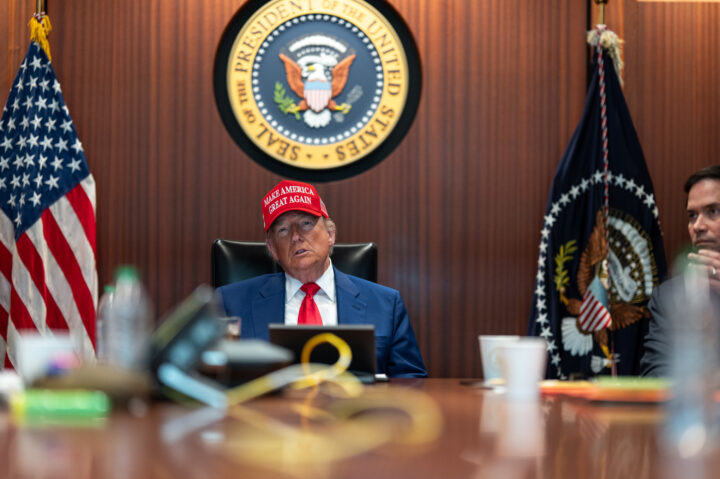
Daniel Torok/The White House via Getty Images
President Donald Trump and Secretary of State Marco Rubio (R) sit in the Situation Room as they monitor the mission that took out three Iranian nuclear enrichment sites, at the White House on June 21, 2025 in Washington, DC.
President Donald Trump said on Wednesday that the agreement reached between the U.S. and Iran earlier this week to end the conflict has not been finalized, warning that the U.S. would “go right back to dropping bombs” if he is dissatisfied with the final deal or if Iran fails to “behave.”
“No, it’s not final. It’s a memorandum of understanding, and if I don’t like it, we’ll go back to shooting at them, dropping bombs on their head,” Trump said during a bilateral meeting with Egyptian President Abdel Fattah el-Sissi on the sidelines of the G7 summit in Évian-les-Bains, France. “If I don’t like it, if they don’t behave, we’ll go right back to dropping bombs right smack in the middle of their head, because they have misbehaved for 47 years.”
Reports indicate that the memorandum of understanding announced this week could release $24 billion in Iranian frozen assets and provide $300 billion in reconstruction relief. Senior administration officials have stated that while the U.S. is open to these terms, they have denied reports that the funds would automatically be released, instead arguing that it would remain strictly conditioned on Iran fulfilling its obligations within the agreement.
WATCH: Trump warns he’ll go back to military operations if the Iran deal falls apart.
— Jewish Insider (@jewishinsider) June 17, 2026
“If I don’t like it, if they don’t behave, we’ll go right back to dropping bombs right smack in the middle of their head.”
Read the full story from @MatthewShea__: https://t.co/JXdeZk63DY pic.twitter.com/QRQCU3UQZe
When asked whether the money would be released, Trump stated: “That’s false.”
“That’s a false story that got picked up incorrectly,” he said.
The president also said that while the U.S. would not invest in Iran, Washington will not stop other countries from doing so.
“People can decide to do that, but that’s up to them. I would say they won’t be doing it for a while until they find out [whether Iran has changed] the behavior. It’s a behavior thing,” Trump said. “Do you want me to say that nobody’s ever allowed to invest in a country? We are not investing in it [Iran], we do not have a fund.”
Trump also touted U.S. military accomplishments, saying that Iran’s navy, military and air force have been “wiped out.” He argued that operations to guide and protect ships through the Strait of Hormuz have been successful and are keeping oil prices down.
“They have no anti-aircraft, they have no radar,” Trump said. “The reason oil stayed low is because we were taking ships out every night…We averaged 15 to 25 ships a night. Nobody knew that our navy did a great job, nobody knew that was happening. That’s why oil didn’t go to $300 million a barrel, it went to $125, $115, now it’s at $72-$73.”
The president also renewed his sharp criticism of the Joint Comprehensive Plan of Action, the nuclear deal signed with Iran in 2015 under former President Barack Obama. Trump argued that the fundamental flaw of that agreement was the transfer of cash to “bribe” the Iranian government.
“Nobody could have made this deal. The JCPOA done by Obama… he gave them $1.7 billion in green cash from banks into a Boeing 757 and flew it into Iran,” Trump said. “They [the Iranians] stood at the plane, I have pictures of it, like, ‘Oh my, look at this money he’s giving us.’ He [Obama] tried to bribe his way out. I didn’t do that… and you know what the Iranians did, they laughed at Obama and they said he’s a stupid son of a b****.”
Senators on both sides of the aisle say they’re eager to see the text of the agreement, but the administration has not yet made plans to brief Congress
Tom Williams/CQ-Roll Call, Inc via Getty Images
Sen. John Cornyn (R-TX) attends the Senate Foreign Relations Committee hearing titled "Arms Control and Transforming International Security Functions at the State Department," in Dirksen building on Tuesday, March 24, 2026.
Republican senators said on Tuesday that they’re skeptical that Iran will hold to any commitments it has made or may make in negotiations with the U.S., and urged the administration to release the terms of the memorandum of understanding announced on Sunday.
The administration has not yet communicated any specific plans to brief Congress on the deal.
“Rather than an end to the activities in Iran, I think it’s more of an intermission,” Sen. John Cornyn (R-TX) told reporters. “We still haven’t seen what the documents look like, and regardless of what they look like, I don’t think you can trust the Iranian regime.”
Cornyn added, “I need to see the writing — I need to see the print. But I don’t believe that the regime will abide by it.”
Sen. Thom Tillis (R-NC) emphasized that the U.S. has been in similar positions with Iran before, and that they have not resulted in a viable long-term agreement. He told Jewish Insider that he thinks it’s “generous to call it a deal, it sounds like it’s a deal in progress … and if we’re making progress, that’s good.”
But he said that it’s hard for him to assess an agreement “that we only get described in broad strokes.”
He said he would also be uncomfortable with any arrangement that provided Iran with a financial windfall. Multiple outlets reported Tuesday afternoon that the MOU includes financial incentives for Iran, including lifting various sanctions.
“I’m worried only because at least some of our decisions seem to be affected by the short-term economic impact [of the war], and that’s not a good decision,” Tillis said. “Talking about some of the money that Iran’s going to start receiving. … If all of the sudden we’re pulling back some of the things that were in place even before the operation, I’ve got a real concern because they’re a totalitarian regime.”
He told JI that the U.S.’s current posture and negotiations with Iran make it appear that “we’re willing to accept a totalitarian regime, and so the question is, how does this agreement match up against the original objectives of this initiative” as laid out by the administration at the beginning of the war.
Tillis added that Trump should explain to the country the national security interests and necessities of the U.S. operations against Iran, and that some short-term economic harm might be a consequence of that.
“That should be the case to the American people, and then you stay strong, versus have a sub-optimal or bad deal that actually enriches the very people that you were focused on trying to take out,” Tillis said. “Now that we’re here, you can’t all of a sudden say that because people are really frustrated with gas prices, that the nuclear threat in Iran is a manageable risk, because that is 180 degrees away from the predicate for going in there to begin with.”
Tillis said that the final deal should be made public, or at least shown to members in a classified setting — though he said he was skeptical there was much substance in the page-and-a-half document described by Vice President JD Vance, given its length.
He also reiterated comments from Monday that any final agreement should be subject to ratification by Congress, as the only way to ensure that such a deal would last.
“Trump could have a real foreign policy legacy but he’s been poorly influenced because he’s just so insecure. I’ve never seen anything like it. His conviction is his own popularity, his own attention, his own credit. It hurts my heart a little,” another Republican senator told JI. “I just was hoping that the second term he wouldn’t do what he’s done, and that is to make it all about himself like his first term.”
“I don’t know what’s in [the MOU],” the senator added. “Don’t trust any senator who says they know what’s in the deal. They don’t know. I mean, none of us know, not really.”
Sen. John Kennedy (R-LA) told JI the agreement “looks to me like it’s a deal to make a deal.”
“The only facts I know today are that the blockades on both sides have been lifted. We’re supposed to negotiate more over [60] days,” Kennedy continued. “The Iranian government Iran lies like fish swim. I have no idea, and neither does anyone else, whether they will make concessions. The other thing I know is that Iran is immeasurably weaker today than it was a year ago.”
He added that he does not expect that the “religious zealots” in Iran have “had an epiphany” and will give up their nuclear program.
Kennedy said he’s “sure” the text of the deal will be released this week. In the interim, “If you don’t know [what’s in it], you should shut up, and none of us … know what’s in it. I think we ought to wait and see what’s in it first,” Kennedy continued.
Asked about reports that Iran would be receiving up-front sanctions relief as part of the MOU, Sen. Rick Scott (R-FL) said, “I’d be surprised, I haven’t seen that. I think we’re all in the position we’d like to see the MOU. Unless there’s something in there that they’ve already changed their ways, I don’t know how you’d be entitled to sanctions relief.”
“I think we’d all like to see it,” Scott reiterated, when asked whether he was concerned the administration hasn’t released the text yet. “Then we’d be able to answer questions on specifics.”
Though some Senate Republicans are eager to see the agreement, there do not yet appear to be any specific plans to brief them on it. Senate Majority Leader John Thune (R-SD) told JI on Tuesday that he was not yet aware of any plans for the administration to brief Congress on the contents of the MOU between the U.S. and Iran, as lawmakers continue to call for transparency on the agreement.
“Not that I’m aware of yet. [I’m] going to find that out,” Thune told JI, when asked whether the administration had notified him of plans to brief lawmakers.
On the other hand, Sen. Pete Ricketts (R-NE), said, “The administration probably has a reason for doing what they’re doing. I don’t know what it is, have not been briefed. We’ll all find out on Friday, and then I expect a briefing after that.”
Sen. Eric Schmitt (R-MO) likewise said his understanding is that the text of the agreement will be released after the formal signing ceremony on Friday.
Democrats have also been critical of the administration for failing to release the text of the MOU, and described it as a bad deal — though many say they support an end to the conflict anyway.
“He has not released text, but we know one thing about this president: if he had a great deal, he’d be jumping up and down, and doing a press event with the text. The fact that he announced the deal, got on a plane, left the country, and is now letting JD Vance explain it tells you everything you need to know,” Sen. Chris Coons (D-DE) told JI.
He said he doesn’t expect the administration to come to “consult, brief or include us” in any capacity, including under the Iran Nuclear Agreement Review Act.
“They should have come to us, consulted us, briefed us and explained to the American people what their objectives were at the outset, but I don’t expect their conduct to be any different at the conclusion, if there is one. This is such an internally flawed arrangement that it seems to be inevitable that it will fall apart in a matter of weeks,” Coons continued.
“Trump must hold a classified meeting on his so-called ‘understanding’ with Iran. He must brief all of Congress,” Senate Minority Leader Chuck Schumer (D-NY) said. “He must inform the American people and make the ‘understanding’ public. … Americans need to know how and when this war will truly end.”
Sen. Tim Kaine (D-VA) said that if the deal touches on Iran’s nuclear program, the administration legally has to submit the agreement to Congress, but if the current deal does not include specific commitments on the nuclear program, it may not need to be submitted.
“We’ll know on Friday, and at that point, when it’s all out on the table, I probably have more to say,” Kaine said, declining to comment on potential concessions in the deal until it has been publicized.
The Dermer Consulting Group will work with clients with a focus on the U.S., Israel and the Middle East
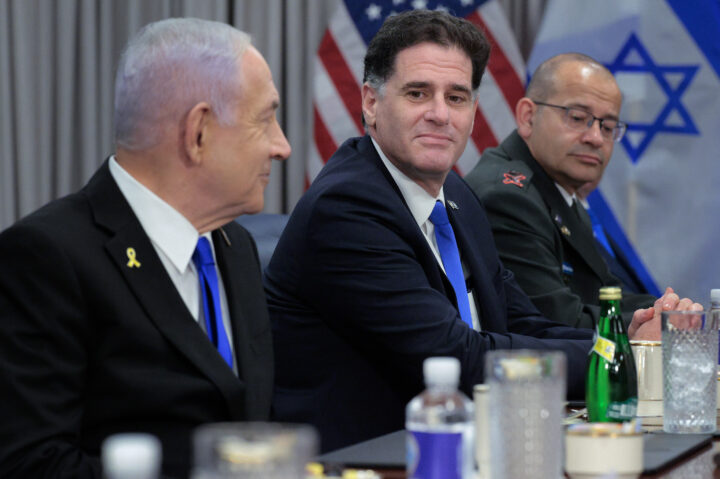
Chip Somodevilla/Getty Images
Israeli Prime Minister Benjamin Netanyahu (L) is joined by Israeli Minister of Strategic Affairs Ron Dermer and other officials for a meeting with U.S. Secretary of Defense Pete Hegseth at the Pentagon on July 09, 2025 in Arlington, Virginia.

