


































Trump, Cassidy clash over war Iran powers vote in closed-door Senate meeting
Cassidy said Trump raised his voice after the senator defended his vote backing a resolution directing the administration to withdraw U.S. forces from Iran
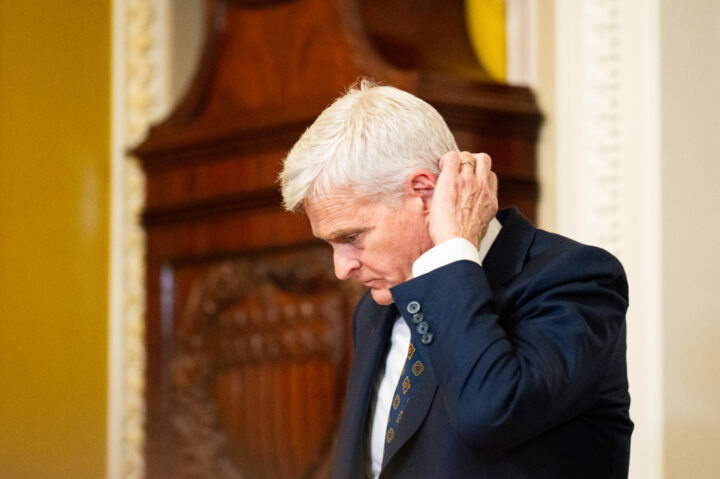
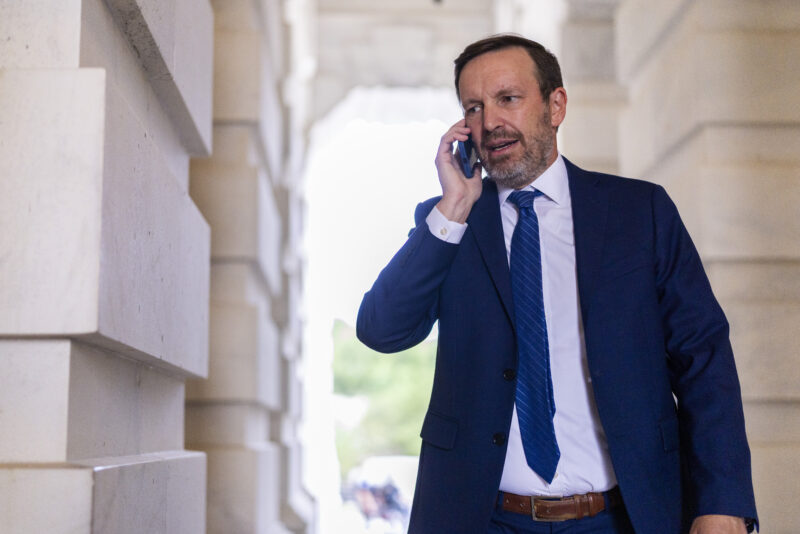
Bill Clark/CQ-Roll Call, Inc via Getty Images
Sen. Bill Cassidy, (R-LA), walks through the Ohio Clock Corridor before President Donald Trump arrives for the Senate Republicans' lunch meeting in the U.S. Capitol on Wednesday, June 24, 2026.


 Add JewishInsider on Google
President Donald Trump engaged in a shouting match with Sen. Bill Cassidy (R-LA) during a closed-door lunch with Senate Republicans on Wednesday over the outgoing Louisiana senator’s support for a war powers resolution directing the administration to withdraw U.S. forces from Iran that passed the chamber the previous day.
Cassidy acknowledged the incident after the luncheon concluded, telling reporters that the dispute began when the president questioned aloud why any Republican would vote for the resolution. The Louisiana senator stood up from his chair and asked Trump if his question was rhetorical or if he wanted an explanation. Cassidy said Trump responded by asking for an explanation, which the senator obliged.
The Louisiana senator said that he told the president, “You have not told the American people what’s going on. It was supposed to last four weeks, it has lasted for four months. Our original objectives have not been achieved. And I want to know what’s going on.”
He went on to say that Trump “did not particularly care for my comments” and “raised his voice,” prompting Cassidy to grow angry. At some point during the confrontation, other GOP senators encouraged Cassidy to sit down and tried to “deescalate” the situation. Cassidy obliged his colleagues and stopped engaging the president.
“I lost my temper,” Cassidy said. “That’s not appropriate, it’s the Irish in me. But I, again, matched his tone, and his volume. It went back and forth.”
Cassidy accused Trump of making several negative comments about him, including a remark about Cassidy losing his reelection bid to a Trump-backed challenger. Another GOP senator said that Cassidy referred to Trump as “my brother” at one point instead of his formal title, which Trump responded to angrily.
Still, the senator said that Cassidy remained respectful of the president during the exchange, and attributed the blowup in part to Trump’s longstanding frustration with Cassidy on a range of issues, including his impeachment in 2021.
Cassidy noted that he would continue to vote for the war powers resolutions until he is briefed on the war effort. Sens. Lisa Murkowski (R-AK), Susan Collins (R-ME) and Rand Paul (R-KY) joined Cassidy in helping Democrats pass a war powers resolution in the Senate for the first time on Tuesday, delivering the upper chamber’s first rebuke of the president’s war.
He added that he will be satisfied once the administration briefs Congress on the details of the U.S. memorandum of understanding with Iran. “You say everything’s fine, but on the outside, it doesn’t look like everything’s fine,” he said of the Trump administration’s handling of diplomatic efforts to end the war in Iran.
“I make no apologies for standing up to the president, if you will, trying to demand that more information be shared with the American people,” Cassidy said. “If someone tries to bully you into not asking that question, I’m not going to accept that either. I am sticking up for the American people, even if I’m speaking to the president.”
The meeting was organized by Sen. Rick Scott (R-FL) and comes at a time of heightened tension between Trump and the Senate Republican conference over the war powers vote; Trump’s demands that the Senate pass his signature voter ID bill, for which Senate Republicans say they lack the votes; and, most recently, Trump’s last-minute decision on Wednesday morning to cancel a signing ceremony at the Capitol for a much-anticipated bipartisan housing package.
A large group of Senate Republicans — including Senate Majority Leader John Thune (R-SD), Majority Whip John Barrasso (R-WY), Sens. John Hoeven (R-ND), Jerry Moran (R-KS), Thom Tillis (R-NC), Mike Rounds (R-SD), Katie Britt (R-AL), Kevin Cramer (R-ND), Tim Scott (R-SC), Mike Crapo (R-ID), John Kennedy (R-LA), Collins, Murkowski and others — huddled on the Senate floor for an extended period after the contentious meeting, in what appeared to be an at-times animated conversation.
Following the luncheon, Scott told reporters that Trump was “very forceful about what he cares about,” also noting that the president talked about Iran “a lot.”
“[Trump] is very comfortable he’s going to get a deal,” Scott said. “[Iran is] doing exactly what he wants. He was very disappointed that somebody would vote on the war powers resolution to stop him in the middle of negotiations, so that frustrates him.”
Scott suggested he understands Trump’s heated demeanor: “If I was the president, I was in the middle of a negotiation to protect American lives, I would be frustrated too.”
Scott said that Trump told senators that Iran is not telling the truth about the talks, and that if Iran doesn’t agree to a good deal, the U.S. will return to military action.
“He said Iran’s agreeing to whatever his requests are. Don’t believe in anything [that] the Iranian press is putting out, because it’s a complete lie,” Scott said. “He’s very comfortable that they’re not gonna have nuclear weapons, they’re not going to have the money to be able to continue to support Hamas, Hezbollah and the Houthis, so he’s very comfortable that we’re going to have a good deal.”
Kennedy, who has been skeptical that the Iranian regime will hold to the terms of any deal but supportive of the administration’s negotiation efforts, offered a similar view.
“I’m in the middle of serious negotiations, trying to settle a conflict, and one of my mates undermines me,” Kennedy said of the president’s perspective. “I’m going to be mad too, and he was mad as a murder hornet about that. He’s right to be mad, in my opinion. Not criticizing anybody for their vote, but these next 60 days are critical,” he added, referring to the 60-day window for further negotiations established in the agreement with Iran.
“We ought to support him, whether you like him or not,” Kennedy continued. “I don’t know how it’s going to end up, you’ll have plenty of time to assess it after 60 days, but we’re going to give peace a chance for 60 days.”
Cramer said that Trump was “very detailed” in his discussion of the situation in the Middle East, but he and other Republicans said there was little opportunity for them to ask questions.
Like Scott, Cramer said Trump disputed Iran’s characterizations of the talks. “He emphasized again that everything they’re saying they’re not giving up, they’re giving up,” Cramer said. “My trust is in our administration until such time as they sign something that’s foolish.”
Another GOP senator, speaking on condition of anonymity, said that Trump emphasized to the group that he could “blow everything up” but that that would have harmed many Iranians, which he wanted to avoid.
The senator told JI that the president explained the MOU to senators — including the financial benefits Iran stands to gain and his decision to strike Iranian nuclear sites in 2025 — and defended his diplomatic overtures to the Iranian regime. They said that Trump told the group, “Without any question in his mind, the number one thing is that Iran is just not going to be able to have a nuclear weapon, ever.” The senator said Trump expressed “so much compassion for Israel” in his remarks.
Trump also warned the lawmakers, according to the senator, that, “If we don’t watch out, what we do here can screw up a whole lot of stuff when you’ve got people that are negotiating” a possible deal with Iran.
Rounds said the president provided senators “more of a briefing in terms of what [the administration is] doing over [in Iran] than we’ve heard to date.” However, Rounds noted that “most of it to me was consistent with what we’ve learned” in previous classified briefings.
When asked whether Republican senators explained to Trump that there is a lack of votes to pass his voter ID bill, the SAVE America Act, Rounds said, “We really didn’t get into that.”
Sen. Tommy Tuberville (R-AL), a strong supporter of the president, praised Trump’s performance in the meeting, telling reporters after the luncheon, “You can’t take it personal. You’ve got to go in knowing that the head coach is coming into the … room.”
“The president did a hell of a job of getting his message over, and sometimes in a loud voice, sometimes not so loud,” Tuberville said. “That’s how you do it. That’s how I did it. Not to say it’s perfect. He came in and got his point across, and I think when we all left, we understood where he [stands].”
Sen. Roger Marshall (R-KS) similarly dismissed the shouting match between Trump and Cassidy as indicative of the president having an issue with the Senate GOP conference.
“I think it’s great for a family to have these types of discussions,” Marshall said. “You all act like no one ever yelled at each other. I didn’t go into a doctor’s hospital board meeting where there wasn’t yelling at each other. I think it’s perfectly fine if you’re trying to air your grievances.”
Sen. John Cornyn (R-TX), meanwhile, sarcastically told reporters that there “was quite a unity message” during the meeting.
Cornyn also remarked that Trump spoke for an hour and 15 minutes and that there “wasn’t really an opportunity” for him to get a question in.
The president’s continued push for the Senate to pass the SAVE America Act, despite lacking the votes without abolishing the 60-vote filibuster threshold, was also a major point of contention.
“He wants the SAVE Act, that much is clear,” Kennedy told reporters. “I want to say that I’m on the record for any way to get the SAVE Act passed. I still think there’s potential through reconciliation, but some of my Senate colleagues don’t agree with it. … It’s clear he wants it.”
“I know there’s frustration over the SAVE Act passage, but we simply don’t have the votes because we’re not going to nuke the filibuster,” Tillis said. “We’ve made it clear multiple times, if the SAVE Act requires nuking the filibuster it’s simply not going to happen and that’s been obvious long before today.”
More Stories

PACKED PEWS
Scholten, Gottheimer and Bret Stephens join Dan Senor before packed Michigan crowd

CAMPAIGN BLITZ
AIPAC’s super PAC wades into Michigan Senate race
EXCLUSIVE
Colorado senators introduce bill to expand federal security grant program
NEXT CHAPTER
After years of hostage advocacy, Kibbutz Be’eri survivor turns toward the future
PEACH STATE POLITICS
Ossoff defers to ICC on Israel genocide accusations, but says IDF violated int’l law
TWO JEWS, THREE OPINIONS
Jewish podcast ‘Chosen People Problems’ finds new home with Ark Media
Please log in if you already have a subscription, or subscribe to access the latest updates.
 Continue with Google
 Continue with Apple