












Trump administration tees up Capitol Hill fight over Saudi nuclear deal
Blocking the deal would likely require a veto-proof majority — assuming the admin is fully committed to pursuing the agreement — which would be a tough lift with many Republicans likely to follow Trump’s lead
Win McNamee/Getty Images
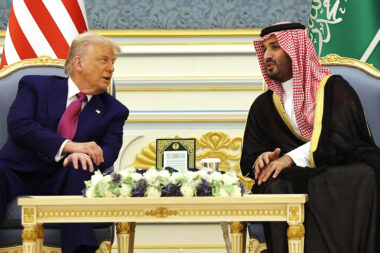
President Donald Trump meets with Saudi Crown Prince Mohammed bin Salman during a “coffee ceremony” at the Saudi Royal Court on May 13, 2025, in Riyadh, Saudi Arabia.


 Add JewishInsider on Google
The Trump administration this week submitted the civilian nuclear deal it signed with Saudi Arabia to Congress for a legally mandated review period — during which time Congress could, theoretically, vote to block the deal.
Of most concern for lawmakers, the agreement would reportedly allow for nuclear enrichment inside Saudi Arabia, which critics warn could provide a path toward a Saudi nuclear weapon and set off a race for nuclear enrichment and arms around the region or even the world, with other U.S. allies demanding similar privileges.
Once the administration submits the deal to Congress, it is subject to a 90-day consultation and review period, during which the House and Senate foreign relations committees are expected to hold hearings and recommend to the full Congress whether to approve the deal.
Congress can vote during that period to pass a joint resolution of disapproval, which would block the deal from going into effect.
But ultimately, blocking the deal would likely require a veto-proof majority — assuming the administration is fully committed to pursuing the agreement even if Congress objects — which would be a tough lift with many Republicans likely to follow President Donald Trump’s lead.
At the same time, there has historically been widespread concern and skepticism about Saudi nuclear enrichment from both sides of the aisle, so the deal is likely to face intense bipartisan scrutiny.
Democrats have voiced particularly strong objections to the nascent agreement. Concerns about the deal are numerous: that it is not apparent how reliant it is on normalization with Israel; that it doesn’t include the same nonproliferation safeguards in place for the United Arab Emirates; that it could set off a race for enrichment; and that it could be tied to the personal or business interests of Trump or his associates.
Trump asserted, after the deal was already signed, that it wouldn’t move forward without a Saudi agreement to normalize relations with Israel. But the deal is continuing to move through the congressional approval process anyway.
Further inflaming tensions, Democrats on the relevant committees have accused the administration of sidestepping required notification procedures earlier this year to alert Congress that a deal was under negotiation. Democrats said that the notification was provided to Republicans only, and that they didn’t find out about it until months later.
Yet some Democrats have indicated they might end up getting behind the deal in the interest of supporting the U.S.-Saudi relationship.
Republicans, in late July as details of the deal began to leak out, took a more sanguine approach, largely supporting the deal and arguing that the enrichment provisions, as reported, would only allow the kingdom to enrich to levels necessary for civilian nuclear power and would be carried out by an American company.
Yet at least a few Republicans seem likely to approach the deal with more hesitance, raising concerns about global nuclear proliferation.
Thus far, key lawmakers largely aren’t commenting on the deal, as Congress remains on August recess. Sen. Ed Markey (D-MA) is one of the few who has weighed in so far, emphasizing that Secretary of State Marco Rubio previously opposed Saudi enrichment and urging Congress to reject the deal.
Bottom line: There’s likely to be an intense fight on Capitol Hill over this deal leading into the midterms and the end of the congressional session. But if the Trump administration wants it to go into effect, it probably will.
Please log in if you already have a subscription, or subscribe to access the latest updates.
 Continue with Google
 Continue with Apple