


















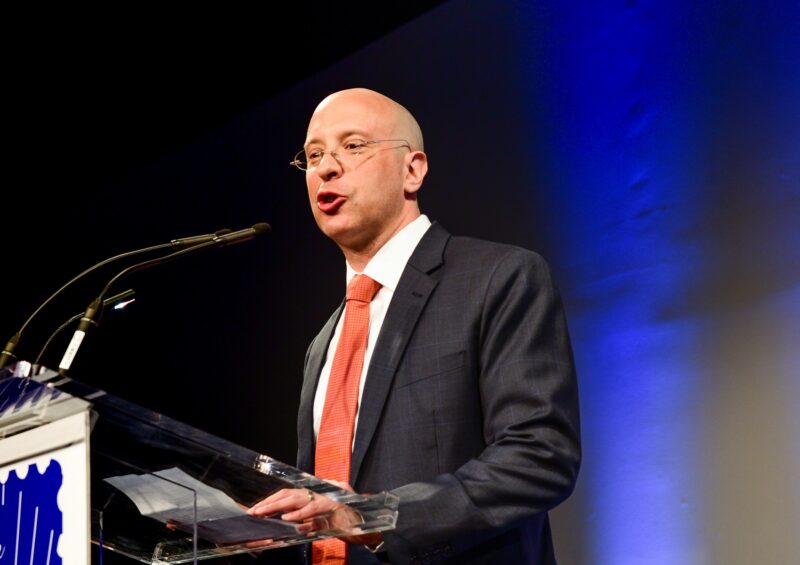


























In new book, former AJC chief David Harris traces antisemitism’s past — and warns about its present
Harris told JI he’s both ‘a believer in the possibility of change’ and has ‘never been more worried in my adult lifetime than I am right now’

David Harris/book cover


 Add JewishInsider on Google
David Harris spent more than three decades leading the American Jewish Committee, where he navigated crises facing the Jewish community and built bipartisan coalitions to advance the group’s mission of supporting Israel and Diaspora Jewry.
His book, Antisemitism: What Everyone Needs to Know, published by Oxford University Press last year, is Harris’ attempt to reach beyond the Jewish community — churches, classrooms and the “average New York Times reader.” His goal, he said, is to turn the “silent majority” into the “loud majority.”
Written in the shadow of the Oct. 7, 2023, Hamas terror attacks in Israel, the book arrived at a moment of surging antisemitism in the U.S. and around the world. It traces antisemitism from its ancient roots through the Holocaust, the Soviet era and its recent resurgence — the explosion on college campuses and beyond after Oct. 7 and the ensuing war in Gaza.
Harris, who quipped that he retired “for about 30 seconds” after serving as AJC’s CEO from 1990–2022, sat down with Jewish Insider on Thursday to discuss the book at a moment in which he said he has “never been more worried” about antisemitism — yet also remains optimistic about the Jewish future.
This interview has been edited for length and clarity.
Jewish Insider: Oxford University Press called you about writing this book in the fall of 2023 — weeks after the Oct. 7 attacks. You write that you were “honored but distressed by the need for such a book.” How much did the aftermath of the attacks reshape the book you thought you were going to write?
David Harris: That call was not directly related to Oct. 7, it was too close to the attacks to even have associated [the rise of] antisemitism with it. Antisemitism was surging [already] in general. They needed a book that would be easily accessible to a high number of people, to be able to reach the average New York Times reader. It was also meant for high school and college classrooms and churches. They understood the emerging problem and this was their contribution.
I wrote the book over the span of close to two years during the post-Oct. 7 period. Two things impacted me: the speed and virulence of which history was turned on its head. The worst day in Israeli and Jewish history since the end of World War II had before our eyes suddenly become directed at Jews, Zionists [and] friends of Israel who were suddenly seen as the perpetrators. Even with my understanding of the subject matter, I was stunned by how quickly and viciously it turned.
Number two is that I kept needing to add to the book because every day brought new events, insights and tragedies. At a certain point the publishers had to remind me this wasn’t a newspaper, we have to close the book at some point. There’s already room for a sequel, unfortunately.
JI: How are you reaching a wider, non-Jewish audience? Does the average American want to read about antisemitism? What has been their reaction to the book?
DH: Because Oxford University Press [is a major publisher], it’s not so easy for people who are otherwise ready to go after a book on antisemitism, such as the one that I wrote, to discredit or marginalize it with accusations like “Harris is a Zionist.” The publisher’s label is enormously important for the book’s credibility and reach.
Jews are also an important part of the audience. I learned from writing the book. Others can learn from reading the book.
I wrote this book with the hope that I’d be able to speak to non-Jewish audiences as well. So when one of the largest Methodist churches in the U.S., in Kansas City, with more than 30,000 worshippers a week, invited me to come speak, I was in my happy place. They invited me to come and could not have been more gracious. The response was very good. There was also a large gathering of interfaith leaders while I was in Kansas City. I want to reach well beyond the Jewish community because antisemitism is not a Jewish problem that can be solved by Jews. We need to engage good people, the silent majority, and help turn them into the loud majority.
It seems to me the larger goal, and this book is only a part of it, is to reach and mobilize the heart of America to understand the situation and the implications not just for Jews but for liberal values for all of us. It may begin with Jews, it never ends with Jews. The people burning the American flag are the very same people trampling on the Israeli flag and threatening Jews.
JI: Where do you see the line between criticism of Israel and antisemitism — and has that line shifted since Oct. 7?
DH: For me, the line has not shifted. It’s just been more revealed. In the book I quote Natan Sharansky, one of my heroes, who wrote a number of years ago there’s “three Ds” to answer that question. When criticism of Israel evolves into delegitimization of Israel, demonizing of Israel and the use of double standards, it’s clear people cannot hide behind their defense of just being critical.
It’s a more elegantly linguistic way of being antisemitic while claiming you’re only anti-Zionist.
JI: The book documents the near-total disappearance of 850,000 Jews from Muslim-majority countries since 1948. Why does that history get so little mainstream attention, and why does it matter now?
DH: It’s a question I know all too well because I’m married to one of those 850,000 Jews and have been for 51 years. I’ve seen this issue play out through my wife’s experience post-expulsion from Libya in 1967 and I’ve seen it play out in my global diplomacy where every time I raise this issue I’m usually met by an eye roll — a complete lack of interest.
One reason is the Palestinians have done an exceptionally good job of making the world believe they are the perpetual refugees and have elevated victimhood to a whole new level. Those 850,000 Jews really determined from the get-go that they were not going to create lifelong victimhood, they were going to build new lives. And they did very successfully, so they didn’t become professional storytellers of their plight and loss.
But my wife says they are triple victims. First, they were expelled or forced to flee their country, their ancestral homeland. Two, the world looked away. Three, there is no trace of a 2,000-plus year history of the Jewish presence in Libyan history today. There is nothing, they’ve been completely wiped out. With the exception of Morocoo, that is true for most of these countries which these refugees had to flee.
JI: There’s a chapter detailing the campus antisemitism surge. Jewish groups told Jewish Insider two months after the Oct. 7 attacks that they were taking an engage-and-influence approach with diversity, equity and inclusion frameworks that have been used to exclude Jews from protected minority status on some campuses, which some attribute to the rise in antisemitism. Then in 2024, the same groups said they were reassessing their embrace of DEI. What is your approach? Is DEI fixable?
DH: For many years Jewish organizations relied on one weapon with campuses, so to speak. That was called reason, sitting down with the president or provost and reasoning with them to help them understand why antisemitism is unacceptable. Clearly, after Oct. 7 that dependence on reason was proven to be totally ineffective in most places.
What instead is more effective is taking the gloves off — lawfare. I particularly applaud the students at Harvard, Penn, George Washington University and other schools who took the lead here. While sitting on campuses, they were suing those campuses for violation of their rights. The organizations that got behind the students, groups like the Lawfare Project and Louis D. Brandeis Center for Human Rights Under Law and law firms that have stepped up pro bono, all deserve huge credit.
I retired for about 30 seconds after I stepped down from my position at AJC. I joined the Institute for the Study of Global Antisemitism and Policy because I thought they were really onto something regarding campuses that no one else that I knew was looking at carefully, long before Oct. 7, and that was foreign funding — where was it coming from? What was its intent? Why were universities in many cases violating American law by not reporting those gifts? Today it’s part of the national discourse to follow the money. These ecosystems directly and indirectly penetrated campuses at many levels, student organizations, faculty and staff, liberal arts, social sciences, Middle East study centers. They penetrated over many years in a very systematic and focused way.
The combination of deep research and the ability to get the research into policymakers, in the university world and the political world together with lawfare are the strategies that I think are most effective.
The students on campus are the frontline warriors of the Jewish people. They deserve the absolute backing of the American Jewish community.
JI: You led AJC for more than 30 years — you’ve seen Jewish organizational leadership up close across decades of crises. How do you assess how today’s Jewish leaders have responded to the post-Oct. 7 surge in antisemitism, and what would you tell them to do differently?
DH: Our community is several steps behind where it should be. We are at war. It’s a war designed to drive a wedge between the U.S. and Israel. It has fueled antisemitism and in many cases attacked and isolated Jews. Unlike in Israel, I don’t see the war mindset, plans and leaders here. I sometimes wonder, if the American Jewish community had been asked to organize D-Day, could the community have actually come together and created a single, comprehensive plan and followed it? I’m not sure. Based on the post-Oct. 7 situation here in this country, I worry we are not where we should be — where we need to be.
JI: You built AJC’s influence partly through bipartisan relationships. Is that model still viable, or does the current political environment force Jewish organizations to choose sides?
DH: It certainly elevates the importance of groups like the Republican Jewish Coalition and the Democratic Majority for Israel. Support for Israel, in both political parties, can obviously no longer be taken for granted. That’s especially true now in the Democratic Party, all the more so after the primary election in New York earlier this week.
But there’s also an emerging cultural war inside the Republican Party. While I operated for nearly 50 years in the nonpartisan space, and positioned AJC as a nonpartisan organization with outreach at the highest level to both parties, today I would say it’s particularly important Jewish groups are operating inside multiple parties in a very partisan way.
It’s clear that we have enormous work to do in the Democratic Party. It was not long ago that [Sens.] Bernie Sanders (I-VT) and Elizabeth Warren (D-MA) were the outliers when it came to Israel and the Middle East. Fast forward a couple of years and they are now the clear majority. Every Jewish organization looking for a Democrat from Washington lines up to invite Sen. John Fetterman (D-PA). If he’s not available, they’re all baffled as to who else to invite from the contingent of Democrats in the U.S. Senate.
The question for the 501(c)(3) groups that are nonpartisan is, what do they bring to the table? In an earlier era, Jews were seen as a very important constituency with many voices, reach and impact. I’m not sure what the power equation is today for nonprofit Jewish organizations and why people in Washington should listen to them as they would have a few years ago.
The challenge for Jewish organizations is how to restore their indispensability to the national conversation. Posting on X, issuing statements, if no one is reading them or thinking about the messaging then what’s been accomplished? There is a huge amount of work to be done. I hope and pray the American Jewish community is up to the task.
JI: After immersing yourself in this history, are you more or less optimistic than when you started?
DH: I could not have spent 50 plus years in global Jewish advocacy without being a believer in the possibility of change for the better. I’ve seen it in my lifetime. I’ve seen the miracle of the rescue of Jews from the Soviet Union and the rescue of Jews from Ethiopia.
I also understand as a Jew I’m commanded to believe in the possibility of a better tomorrow and not to succumb to despair. Having said all of that, I would be totally dishonest if I didn’t tell you that I’ve never been more worried in my adult lifetime than I am right now.
More Stories

PROBLEMATIC POST
Paxton senior advisor endorsed antisemitic slur on social media
Daily Overtime
New York braces for Oct. 7 protests
NOT ON BOARD
Lansing Mayor Andy Schor, a Jewish Democrat, says he’s not supporting El-Sayed

Daily Overtime
Jewish leaders press Miliband on U.K. antisemitism

analysis
From Oct. 7 to FlyDubai, ordinary Israelis keep filling the gaps left by the government
Life after captivity
The Siegels lost their home and community on Oct. 7. Now they’re finding their way forward
Please log in if you already have a subscription, or subscribe to access the latest updates.
 Continue with Google
 Continue with Apple