








































































Republican state senator aims to be ‘boring enough to win’ Rep. Angie Craig’s seat
Eric Pratt faces far-left former state Sen. Matt Little in Minnesota’s 2nd Congressional District, and is aiming to cast himself as a common-sense moderate

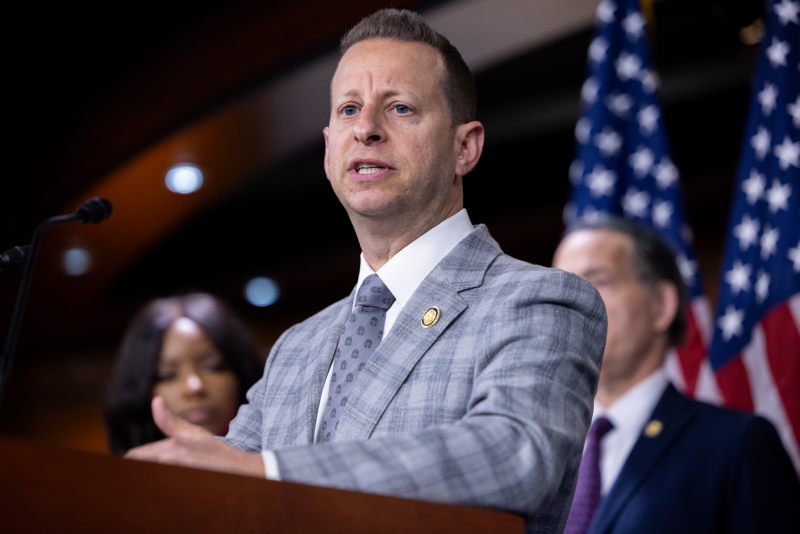
Carlos Gonzalez/The Minnesota Star Tribune via Getty Images
Minnesota state Sen. Eric Pratt answers a question during a Congressional Candidate Forum at Minnesota Farmfest in Morgan, Minn., on Tuesday, August 4, 2026.


 Add JewishInsider on Google
Facing down a far-left candidate in a swing district near Minnesota’s Twin Cities, Republican state Sen. Eric Pratt is hoping he’s “boring enough to win.”
In a bid to replace Rep. Angie Craig (D-MN), a moderate who flipped the district in 2018, Democrats nominated former state Sen. Matt Little, who defeated two primary rivals as the farthest-left candidate in the race, while staking out anti-Israel policies, including calling for a full arms embargo on the Jewish state.
Pratt, in an interview with Jewish Insider this week, argued that the seat, which the Cook Political Report rates as “likely Democrat,” remains a swing district and “is a much different race without Angie Craig.”
He’s pitching himself as a moderate voice in contrast to Little.
“My opponent is not an Angie Craig Democrat,” Pratt continued. “He’s been endorsed by Bernie Sanders, Keith Ellison, he runs in circles with Ilhan Omar and Peggy Flanagan. He’s on the extreme side of his party and that’s not what the 2nd District is.”
He argued that the district has many “independent voters with conservative values” who are open to splitting their tickets. The district, he said, “wants stability and common sense over chaos … and that’s the appeal that I’m trying to make, that I am the common-sense candidate.”
Pratt is running on issues including the cost of living, controlling federal spending, growing the economy and deregulation.
“Somebody was just telling me, I might be boring enough to win this seat. And I think they’re kind of right in that,” Pratt said. “These are suburban families. They want great opportunities for their kids. They want good education. They want to make sure that they have jobs that they can support their families in and get ahead.”
Pratt said he’s running for Congress to be a “problem solver” and to serve his community as he did as a school board member and state senator. He emphasized that every bill he’s passed in the state Senate has been bipartisan and that he’s “really more focused on trying to help my neighbors than play politics.”
Pratt also takes a starkly different view of the U.S.-Israel relationship than Little, who he accused of pursuing a strategy of isolationism, rather than building alliances.
“Having a Democratic society, an ally in the Middle East, helps the United States be safe. And we have to foster that alliance,” Pratt said. “Allies can be critical of each other and they can question each other, but at the end of the day, we’ve got to be friends marching in the same direction. … We can’t demonize our friends, we’ve got to support them.”
He said that the U.S. needs to make sure that all of its allies, including both Israel and European nations, have the resources they need to defend themselves and withstand attacks — “that’s what it means to be a good ally” — but he said he also welcomes efforts by allies, including Israel, to become more self-sufficient.
Pratt said that he’s open to a two-state solution between Israel and the Palestinians, so long as Israel has a role in negotiating it and that its sovereignty remains intact. He also emphasized that terrorist organizations cannot control the Palestinian government.
Asked about the war in Iran, Pratt said that he saw Iran’s nuclear program and the threat of an Iranian nuclear weapon as a “clear and present danger to the United States.” He lamented that the popular uprising that many had hoped for to topple the Iranian regime ultimately didn’t come to fruition and it has proved more resilient than expected, “but at the end of the day, failure can’t be an option.”
“We have to find a way out of this — but we have to find a way out of this that allows us to claim a victory, to make sure Iran never gets a nuclear weapon and make sure that we have the free flow of resources coming through the Strait of Hormuz,” Pratt said. “Whatever we do, we have to finish this. It’s been almost 50 years that Iran has been at war with us, and we’ve got to finish it.”
Asked about antisemitism in the United States, Pratt emphasized the need to protect civil liberties and said that attacks on Jewish institutions and harassment of Jewish students on campuses shouldn’t be permitted. He said that institutions, including schools, that allow discrimination should lose their federal funding.
He also said that Congress and lawmakers should oppose any Boycott, Divestment and Sanctions efforts targeting Israel.
More Stories

NOT SO FAST
Democrats push back on White House’s planned $2.8 billion sale of bombs to Israel

partnership pitch
Somaliland president discusses expanded military cooperation with U.S. officials

supper club
AI, tech execs to attend White House state dinner for Xi Jinping
CANDIDATE CALCULATIONS
Vulnerable Republican candidates urge end to Iran war

Protest politics
Mamdani says he won’t protest Netanyahu — and doesn’t urge New Yorkers to, either

Schmear campaign
Politico picks Yom Kippur to attack Huckabee’s observant Jewish aide
Please log in if you already have a subscription, or subscribe to access the latest updates.
 Continue with Google
 Continue with Apple