







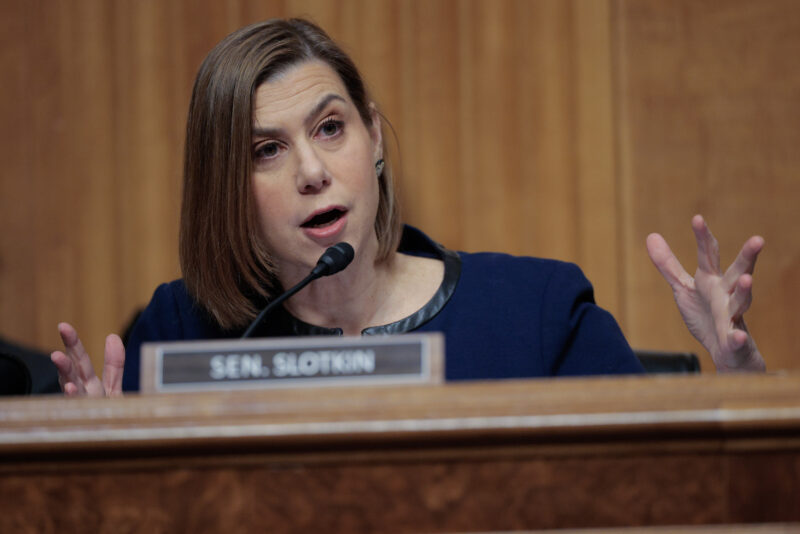
















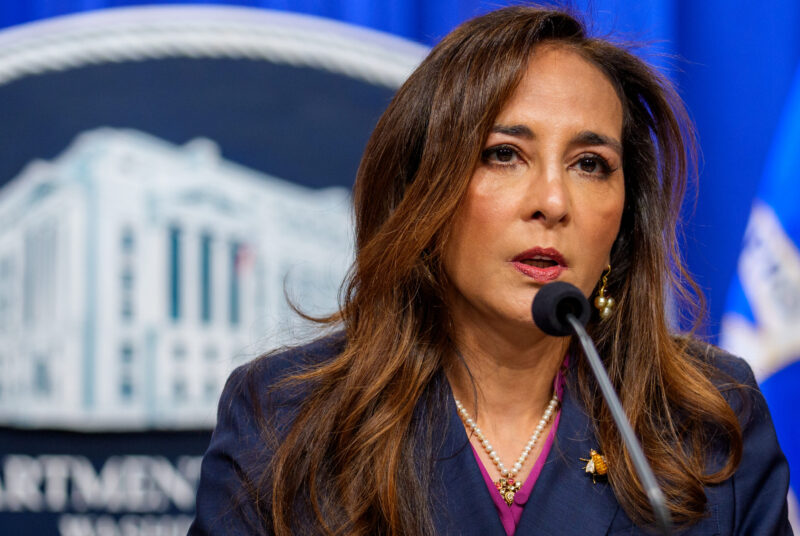













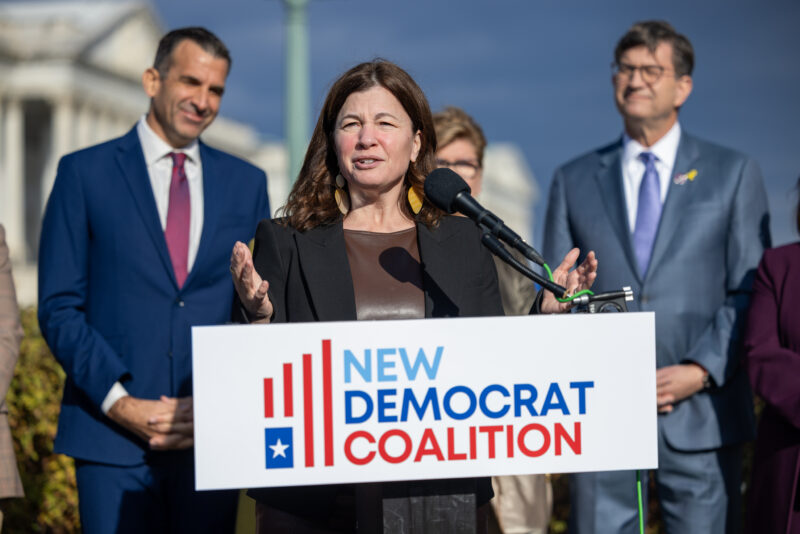











McCormick: ’We have to eradicate [and] destroy the evil’ that caused the Oct. 7 attacks

Israel on Campus Coalition/X
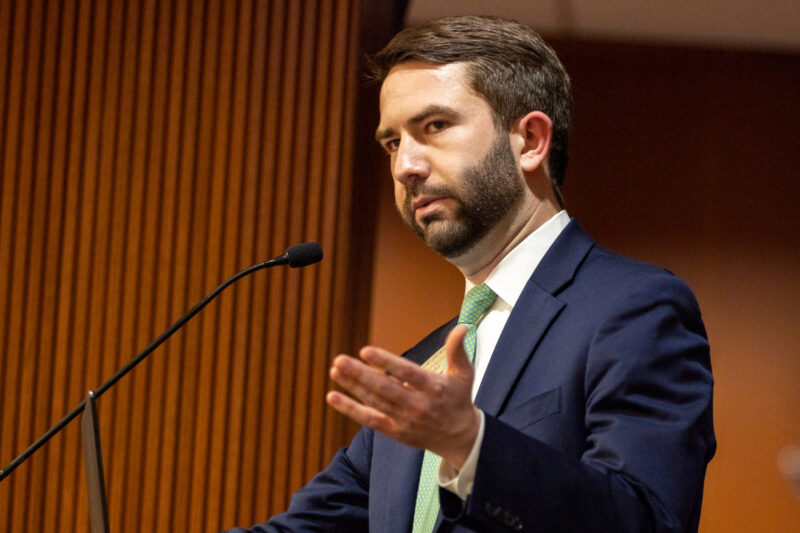
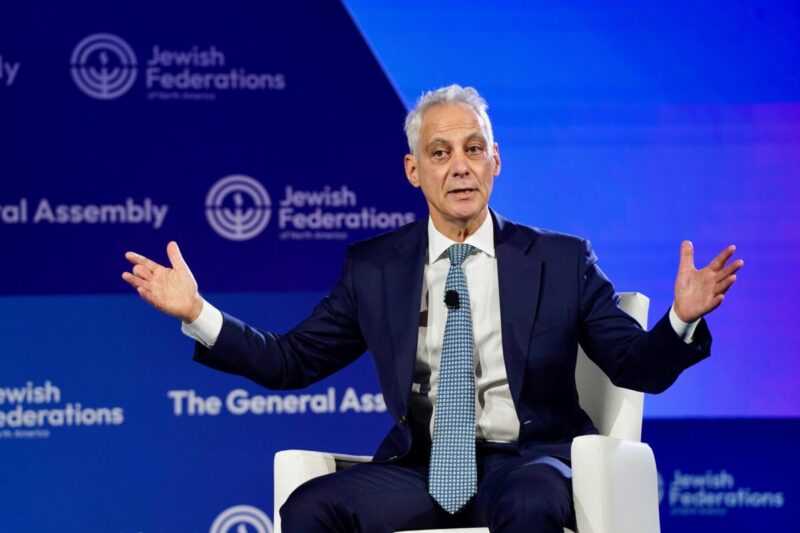
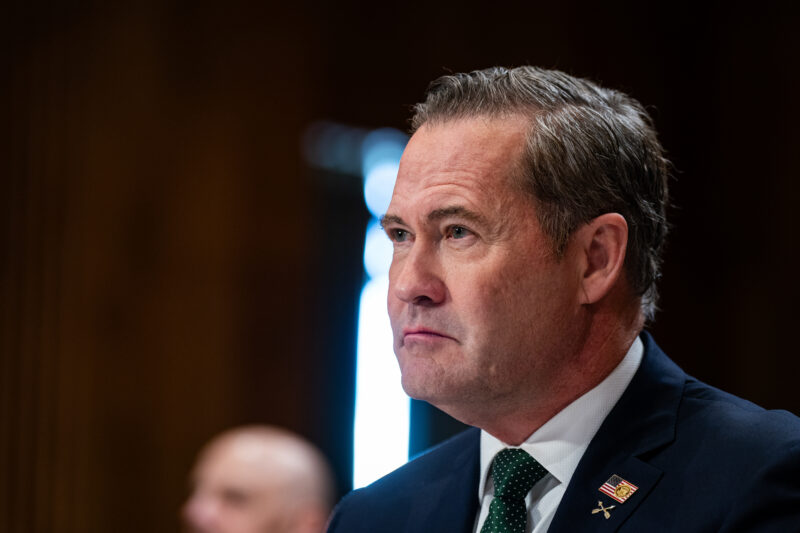
Rep. Dave McCormick (R-PA) speaks at the ICC National Leadership Summit in Washington on July 29, 2025.


 Add JewishInsider on Google
Israel’s response to the Oct. 7, 2023 Hamas terror attacks “changed the landscape in ways that could be for the good” and lead to the “possibility of a secure region,” Sen. Dave McCormick (R-PA) told a group of pro-Israel college students on Tuesday.
McCormick lauded Israel’s “historic” military efforts that led to the degradation of Iran’s terrorist proxies across the Middle East.
“What’s happened with the conduct of military operations since then in the fight against Hezbollah, the fight against Hamas, taking out much of Iran’s [nuclear] capabilities, what has happened with Israel’s incredible military leadership … has reset the possibility of a secure region,” McCormick told about 700 attendees on the final day of Israel on Campus Coalition’s three-day national leadership summit in Washington.
“It has changed the possibilities in the Middle East and I hope it’s brought an awareness and change to our complacency here at home in the need to fight against that pure evil [and] reset the table in the Middle East.”
“We have to eradicate [and] destroy the evil” that caused the Oct. 7 attacks, McCormick continued, referring to Hamas.
McCormick also took aim at the rise of antisemitism across the country, including in his home state.
After Oct. 7 “there was a second surprise attack. That’s the evil of antisemitism that we saw across our campuses,” McCormick said. “Most of us didn’t know the degree to which antisemitism would rear its ugly head on campuses across Pennsylvania and across our country.”
“It has shown us that we have to engage in a constant battle against the kind of hatred and evil that we saw in Israel on Oct. 7, but also that we saw across our campuses.”
‘The full disarmament of Hezbollah is not optional. It is essential,’ Michel Issa said
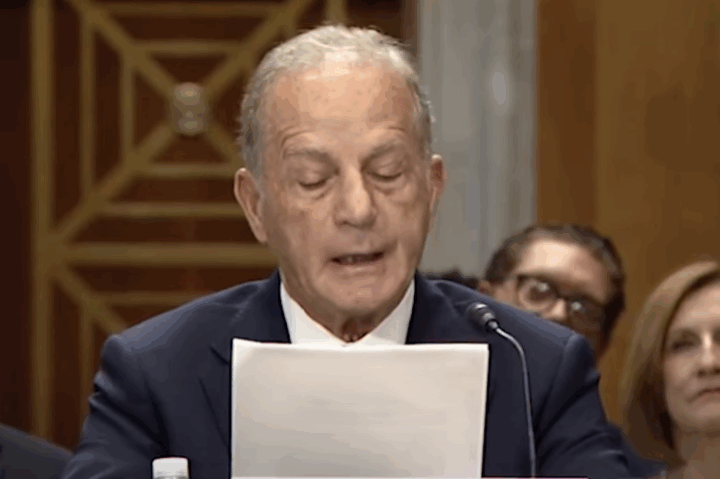
Screenshot/YouTube
Michel Issa, nominee to be U.S. ambassador to Lebanon, speaks to the Senate Foreign Relations Committee during his confirmation hearing on July 29, 2025.
Michel Issa, the Lebanese-American businessman nominated by the Trump administration to serve as U.S. ambassador to Lebanon, said Tuesday that the Lebanese government and armed forces must act swiftly and decisively to disarm Hezbollah and remove its influence across Lebanese society.
Issa argued at his Senate Foreign Relations Committee confirmation hearing that the war between Israel and Hezbollah, “while devastating, has opened a narrow but meaningful window for progress,” in combination with the Israel-Lebanon ceasefire deal, the fall of the Assad regime in Syria and recent blows to Iran’s military and nuclear program.
He praised the new Lebanese government as a “promising development,” saying it has made progress in combating Hezbollah’s influence.
“The Iran-Israel escalation is a reminder of how delicate an opportunity this is that could be squandered if Iran drags Lebanon back down to the path of conflict,” Issa continued. “The government has made clear it will not tolerate any violation of the cessation of hostility, and since implementation, they have begun to curb Hezbollah’s influence. But more must be done. Urgently. The full disarmament of Hezbollah is not optional. It is essential. The time to act is now.”
Finishing that job and rooting out Hezbollah’s influence across Lebanon will be difficult and take time, he added, given its decades of influence and domination across Lebanese society.
“Hezbollah needs to go. Hezbollah needs to be disarmed to bring some kind of hope to Lebanon,” he said. As long as supply lines from Iran remain cut and with continued support from the United States and other partners, he continued, he believes that over time Hezbollah’s influence can be minimized and the government can secure its hold on power.
Issa said that it’s critical that the Lebanese government maintain full control of rebuilding efforts in southern Lebanon, and that it cannot allow Hezbollah to “hijack” that work as it has in the past. He added that the country must work to ensure governance reform and financial stability, accountability and growth.
He also argued that the U.S. should continue to push for a final settlement regarding the borders between Israel and Lebanon and ultimately normalize relations between the two countries.
Issa spoke highly of the Lebanese Armed Forces, saying that they will be critical to efforts to combat Hezbollah and have been a partner to the United States, which the LAF should continue to support and cooperate with. He said that the LAF is one of the few institutions that enjoys widespread trust and support within Lebanon.
“They are doing a great role in creating stability that is very well needed in Lebanon,” Issa said. “I believe they are ready to do whatever they need to do, to take over and to become the sole military power for the Lebanese government.”
Asked about whether the mandate for the United Nations peacekeeping force in Lebanon, UNIFIL, should be extended, Issa did not offer a definitive answer, saying that its role is changing with the LAF stepping up its role in monitoring the border with Israel and ensuring that Hezbollah does not continue to threaten the Jewish state.
Issa, who was born in Beirut, said that he had renounced his Lebanese citizenship in connection with his nomination, to show his commitment to the American people and the U.S.’ interests.
Duke Buchan, an investment banker who served as U.S. ambassador to Spain in Trump’s first term and is now nominated to be U.S. ambassador to Morocco, testified alongside Issa.
Buchan said repeatedly that he would work to support the Abraham Accords, both to expand the relationship between Israel and Morocco and to urge Morocco to encourage other countries to normalize relations with Israel.
He said it would be one of his “highest priorities” to work to reestablish the Negev Forum dialogue among Israel and its Arab allies, and to convince Morocco to “step up even more.”
Buchan said he supports U.S. recognition of Moroccan sovereignty over the Western Sahara, a former Spanish colony claimed by both Morocco and the indigenous Sahrawi people, a significant contingent of whom are refugees living in Algeria. The U.S. agreed to recognize Moroccan sovereignty over the territory when the country joined the Abraham Accords in 2020.
“Secretary [of State Marco] Rubio reiterated that the United States recognizes Moroccan sovereignty over Western Sahara and supports Morocco’s serious, credible and realistic autonomy proposal as the only basis for a just and lasting solution to the dispute,” Buchan said. “If confirmed, I will facilitate progress towards this goal.”
But pressed later in the hearing on bipartisan concerns about the U.S.’ decision to recognize Moroccan sovereignty, Buchan said he was not familiar with those concerns and that he would defer to the president and secretary of state to set policy.
Torres: ‘The accusations against Israel, whether it’s genocide, apartheid or [deliberate] starvation, are all false. It’s all a propaganda campaign’

Israel on Campus Coalition on X
Rep. Ritchie Torres (D-NY) speaks at the ICC National Leadership Summit in Washington on July 29, 2025.
In comments to a supportive crowd of pro-Israel college students in Washington, Rep. Ritchie Torres (D-NY) said Tuesday that the world needs to be reminded that “Hamas is the central cause of the war in Gaza.”
“We have to remind the world that despite the amnesia, Hamas is the central cause of [Israel’s] war in Gaza. The primary responsibility for a war lies with its cause … Hamas is morally responsible, principally responsible for the war in Gaza,” Torres, a pro-Israel Democratic stalwart in Congress, told about 700 attendees gathered in Washington for the Israel on Campus Coalition’s three-day annual national leadership summit.
Torres went on: “The accusations against Israel, whether it’s genocide, apartheid or [deliberate] starvation, are all false. It’s all a propaganda campaign. But we also have to recognize there is a humanitarian crisis in Gaza … We should be doing everything we can to alleviate the human suffering in Gaza.”
At the same time, Torres offered criticism of the Israeli government’s public diplomacy, saying that it should be “mindful of the words” it speaks.
“Israel is the first country in history to be conducting a war under the scrutiny of 24/7 cable news and social media … so given those realities, you have to be more effective, not only in the actual war but the informational war and be mindful of the words you speak.”
“There are moments when I feel like the Israeli government has the worst PR operation I’ve ever seen,” Torres said. “We are morally better than the other side. We have the moral high ground, we should act like it.”
Asked about the ideological direction of the Democratic Party, which has become increasingly critical of Israel, Torres sidestepped the question. “Look, I reject isolationism whether it’s coming from the far left or the far right. In the end, isolationism is no friend of the United States and it’s no friend of the U.S.-Israel relationship,” Torres said.
Good Tuesday afternoon,
This P.M. briefing is reserved for our premium subscribers like you — offering a forward-focused read on what we’re tracking now and what’s coming next.
I’m Danielle Cohen-Kanik, U.S. editor at Jewish Insider. I’ll be curating the Daily Overtime for you, along with assists from my colleagues. We hope you enjoy the inaugural edition and would love to hear your thoughts and feedback. Please don’t hesitate to drop us a line by replying to this email.
📡On Our Radar
Notable developments and interesting tidbits we’re tracking
Today, we remember Wesley LePatner, a Jewish philanthropist and Blackstone executive killed in Monday’s shooting at the firm’s Manhattan headquarters. LePatner, 43, served on the boards of the pluralistic Abraham Joshua Heschel School and the UJA-Federation of New York. The federation called LePatner “extraordinary in every way” in a statement, saying she “lived with courage and conviction, instilling in her two children a deep love for Judaism and the Jewish people.” Hindy Poupko, deputy chief planning officer at UJA, said in remarks at the Israel on Campus Coalition’s National Leadership Summit in Washington today that there was a second Jewish victim of the shooting, Julia Hyman. Hyman, a Cornell graduate, worked for Rudin Management in the Midtown skyscraper…
Concerns among Democrats about the humanitarian situation in Gaza and Israel’s role in it are intensifying. On Capitol Hill, the majority of Senate Democrats, led by a group including Senate Minority Leader Chuck Schumer (D-NY) and Sen. Jacky Rosen (D-NV), sent a letter to Secretary of State Marco Rubio and Middle East envoy Steve Witkoff calling the humanitarian crisis in Gaza “unsustainable” and saying that the Israeli- and American-backed Gaza Humanitarian Foundation has “failed” to properly deliver aid…
One Democrat standing up for Israel is Rep. Ritchie Torres (D-NY), who said at the ICC summit today, “We have to remind the world that, despite the amnesia, Hamas was the central cause of the war in Gaza. … Hamas is morally responsible, principally responsible for the war in Gaza.” Read more on Torres’ speech in JI’s Daily Kickoff tomorrow…
Sen. Bernie Sanders (I-VT), who did not sign the Senate Democrats’ letter, jumped into the fray by introducing another resolution to block an arms transfer to Israel — his third since November 2024. In a novel twist, this resolution would block the sale of $1 million worth of assault rifles to Israel’s police force overseen by far-right Minister of National Security Itamar Ben-Gvir, potentially opening the door for more Democrats to vote in favor, given Ben-Gvir’s less-than-favorable reputation within the party…
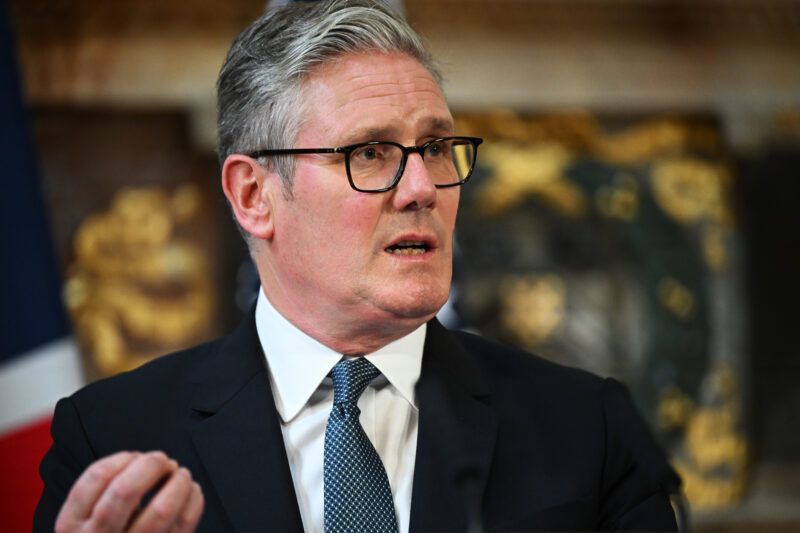
British Prime Minister Keir Starmer, applying pressure of his own, announced today that the U.K. will recognize a Palestinian state at the U.N. General Assembly in September — matching France’s timeline, announced last week — unless Israel takes “substantive steps to end the appalling situation” in Gaza, reaches a ceasefire with Hamas and commits to reviving the possibility of a two-state solution and not annexing the West Bank. President Donald Trump, who met with Starmer in Scotland yesterday, told reporters that the British PM didn’t discuss the move with him and that he has no view on it, but that the U.S. is “not in that camp”…
On the home front, UCLA settled a lawsuit with Jewish students who alleged that the university permitted antisemitic conduct during the campus’ anti-Israel encampments in spring 2024. According to the agreement announced today, the university cannot allow or facilitate the exclusion of Jewish students, faculty or staff from UCLA programs or campus areas. Notably, the agreement specifies that Jews cannot be excluded “based on religious beliefs concerning the Jewish state of Israel.” Also getting a windfall in the settlement: UCLA agreed to pay over $2.3 million combined to UCLA Hillel and Chabad, the Anti-Defamation League, the Academic Engagement Network and other Jewish organizations combating antisemitism on campus…
⏩ Tomorrow’s Agenda, Today
An early look at tomorrow’s storylines and schedule to keep you a step ahead
Keep an eye on Jewish Insider later this week where we’ll feature an interview with Jeanine Pirro, interim U.S. attorney for D.C., who spoke with JI about the ongoing prosecution of the assailant responsible for the deadly May shooting at the Capital Jewish Museum. We’ll also cover Rep. Mike Collins’ (R-GA) record on antisemitism as he jumps in the race to challenge Sen. Jon Ossoff (D-GA), and report on Harvard’s overtures to the Jewish community while it gears up for a settlement with the federal government.
We’re staying tuned for how President Donald Trump may react as some of the U.S.’ closest allies gear up to recognize a Palestinian state, a policy the U.S. has rejected as unhelpful to peace efforts for decades. Though he said today he has “no view” on the matter, as the U.N. General Assembly nears, will Trump take a tougher line on his European partners?
Stories You May Have Missed
WAIT-AND-SEE APPROACH
New York Jewish leaders reluctant to fight against Mamdani
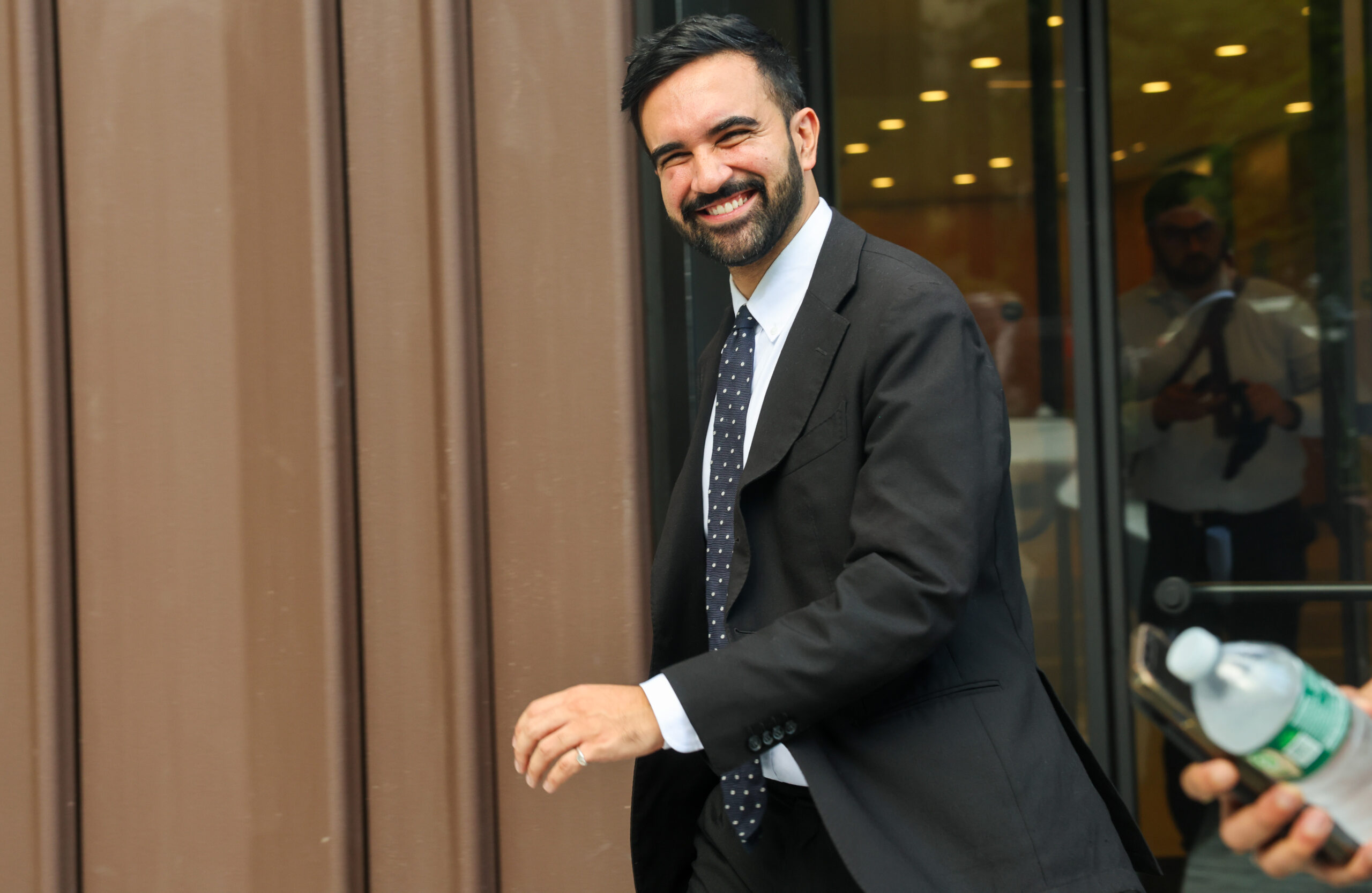
One Jewish political leader: ‘No one thinks it’s going to be good for the Jewish community to be hostile and to be in constant war with the next mayor’
PODCAST POLITICS
Former Obama staffers turned podcasters reemerge to lead anti-Israel chorus

Ben Rhodes and Tommy Vietor shaped the story of the Iran nuclear deal. Now they’re trying to turn Democrats away from Israel
The senators said that aid should be surged to NGOs and multilateral organizations

Kevin Carter/Getty Images
U.S. Capitol Building on January 18, 2025 in Washington, DC.
A group of 40 Senate Democrats, nearly all of the caucus, wrote to administration officials on Tuesday raising concerns about the humanitarian situation in Gaza and calling for a significant expansion of aid, describing the Gaza Humanitarian Foundation as a failure.
The letter to Secretary of State Marco Rubio and Middle East envoy Steve Witkoff, led by Sens. Adam Schiff (D-CA), Brian Schatz (D-HI), Chuck Schumer (D-NY) and Jacky Rosen (D-NV), highlights the extent of the concern even among Democratic leaders and pro-Israel stalwarts.
“The acute humanitarian crisis in Gaza is … unsustainable and worsens by the day,” the lawmakers said. “Hunger and malnutrition are widespread, and, alarmingly, deaths due to starvation, especially among children, are increasing.”
The senators said that the Israeli- and American-backed GHF aid distribution system had “failed to address the deepening humanitarian crisis and contributed to an unacceptable and mounting civilian death toll around the organization’s sites.”
They argued that aid must be significantly expanded, including through “experienced multilateral bodies and NGOs that can get life-saving aid directly to those in need and prevent diversion.” Israel has argued that other aid distribution mechanisms, particularly those affiliated with the United Nations, have failed to effectively distribute aid and prevent Hamas diversion.
The letter further states that efforts to finalize a ceasefire in Gaza “are as critical and urgent as ever and we urge the resumption of good-faith talks as quickly as possible.” The administration walked away from talks with Hamas last week, saying that Hamas was not negotiating in good faith.
“There still remains a viable pathway to end this war, bring home Israeli hostages, and achieve a diplomatic resolution of the Israeli-Palestinian conflict,” the senators asserted.
They emphasized that the living hostages in Gaza “have suffered too long, as have their families” and that “it is imperative that those still living be brought home as soon as possible, before more perish as the war drags on.” They also noted the need to return the bodies of deceased hostages.
The Democrats also voiced “our strong opposition to the permanent forced displacement of the Palestinian people” from Gaza, as has been floated by some Israeli and American leaders, calling such an outcome “antithetical to international humanitarian law,” to the security of Israelis and Palestinians, to lasting peace and to the expansion of the Abraham Accords.
They urged the administration to clearly reject such a plan.
“Beyond a negotiated ceasefire, a permanent end to this war will also require an end to Hamas rule in Gaza and ensuring that Hamas can no longer pose a serious military threat to Israel,” the letter continues. “We reaffirm our strong support for continued U.S.-led diplomacy with Israel, Palestinian leaders, and other partners in the Middle East in pursuit of the long-term goal of a negotiated two-state solution with Israelis and Palestinians living side by side in lasting peace, security, dignity, and mutual recognition.”
The only Senate Democrats who did not sign the letter were Sen. John Fetterman (D-PA) — who has generally abstained from letters by other Democrats critical of Israel — as well as Sens. Andy Kim (D-NJ), Ed Markey (D-MA), Jeff Merkley (D-OR), Tina Smith (D-MN) and Elizabeth Warren (D-MA). Sen. Bernie Sanders (I-VT) also did not sign.
It follows a letter earlier this week from 21 progressive Senate Democrats that more strongly condemned the GHF, describing it as a “private group supported by U.S. security contractors and connected to deadly violence against starving people seeking food in Gaza” that “blur[s] the lines between delivery of aid and security operations.”
That letter called on the administration to “immediately cease all U.S. funding for GHF and resume support for the existing UN-led aid coordination mechanisms with enhanced oversight to ensure that humanitarian aid reaches civilians in need.”
The progressive lawmakers said that the GHF system is insufficient to replace the United Nations aid network and that it is facilitating efforts to displace Palestinians and depopulate Gaza, as well as highlighted incidents in which aid recipients were allegedly attacked at distribution sites.
The lawmakers said the administration had dodged legal and vetting requirements in its provision of aid to the GHF. They also argued that the American military contractors employed to guard the GHF sites are at risk from both Hamas and anti-Hamas militia forces in Gaza.
This is the third such effort Sen. Bernie Sanders has initiated since November 2024

Win McNamee/Getty Images
Sen. Bernie Sanders (I-VT)
Sen. Bernie Sanders (I-VT) introduced a joint resolution of disapproval on Monday to block an arms transfer to Israel, setting up another Senate floor battle on Wednesday over U.S. aid to Israel — the third since November of last year.
The resolution comes as criticism of Israel has reached new heights among Senate Democrats over the humanitarian situation in Gaza, a state of affairs that could generate increased support for Sanders’ latest effort.
A Sanders spokesperson said that the resolution would block the sale of $1 million worth of assault rifles to “to the police force overseen by extremist minister Itamar Ben-Gvir, who has long advocated for the forcible expulsion of Palestinians from the region, has been convicted by an Israeli court of racist incitement and supporting the Kahanist terror organization, and has been distributing weapons to violent settlers in the West Bank.”
“At a time when Israeli soldiers are shooting civilians trying to get food aid on a near-daily basis, the United States should not be providing more weapons to Israeli security forces,” the Sanders spokesperson said.
Sanders is forcing a vote on Wednesday on this new resolution as well as one relating to bombs and bomb guidance kits for Israel that he introduced months ago but had not previously called up for a vote.
The spokesperson did not say whether Sanders will force a vote on the resolution, but if he does, it would likely not happen until September, with the Senate expected to depart for its August recess at the end of the week.
“American taxpayer dollars are being used to starve children, bomb civilians and support the cruelty of Netanyahu and his criminal ministers. … The White House and Congress must immediately act to end this war using the full scope of American influence,” Sanders said in a statement last week. “No more military aid to the Netanyahu government. History will condemn those who fail to act in the face of this horror.”
The Vermont senator accused Israel of “using mass starvation to engineer the ethnic cleansing of Gaza” and described the Israeli- and American-backed Gaza Humanitarian Foundation’s aid distribution sites as “death traps for Palestinian civilians, with near-daily massacres.”
In November, the first time Sanders forced votes on aid to Israel, 19 Senate Democrats voted for at least one of three resolutions that came up for consideration. In April, 15 voted for a pair of similar measures.
At least one lawmaker, Sen. Angus King (I-ME), who voted for the first set of resolutions but against the second, would likely flip back to support a new effort to block aid.
“I am through supporting the actions of the current Israeli government and will advocate—and vote — for an end to any United States support whatsoever until there is a demonstrable change in the direction of Israeli policy,” King said in a statement earlier this week. “My litmus test will be simple: no aid of any kind as long as there are starving children in Gaza due to the action or inaction of the Israeli government.”
Connecting Ben-Gvir, a highly controversial figure, to the arms sales could also make some Senate Democrats who’ve opposed other Sanders-led efforts — like those to block the sale of bomb guidance kits — more open to supporting this one.
LePatner, a Blackstone executive, served on the boards of the Abraham Joshua Heschel School and UJA-Federation of New York
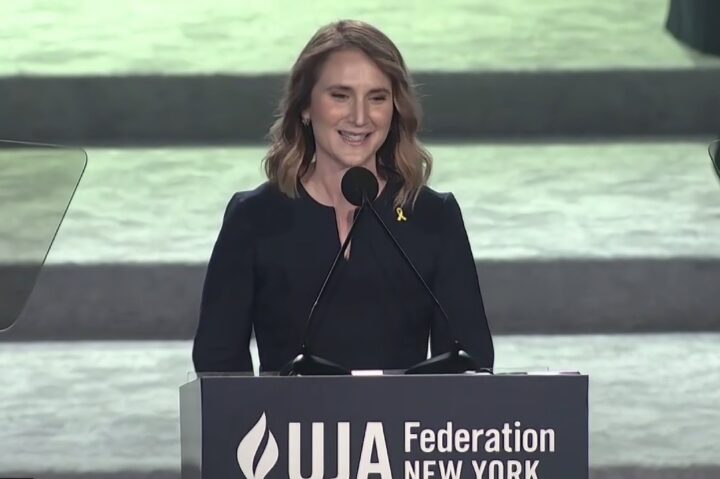
courtesy/UJA-Federation of NY
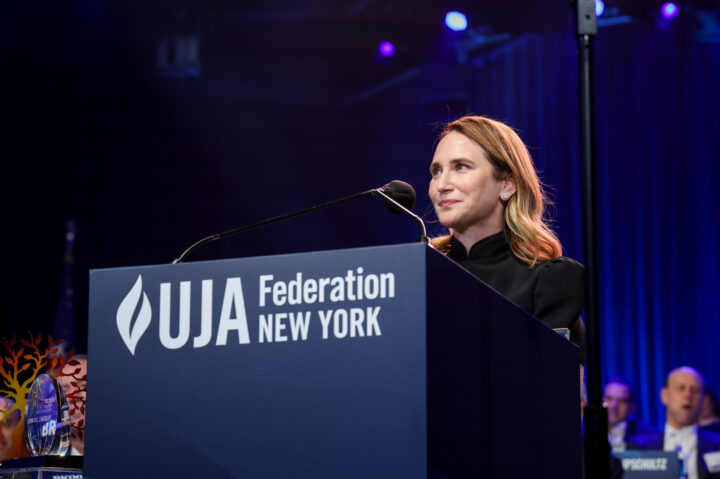
Wesley LePatner speaks at the UJA-Federation of New York's annual Wall Street Dinner in December 2023.
Wesley LePatner, a Blackstone executive who was involved with Jewish communal organizations in New York City, was killed in the Monday shooting at the firm’s Midtown headquarters, the company confirmed on Tuesday.
LePatner was the global head of Core+ Real Estate at Blackstone and CEO of Blackstone Real Estate Income Trust, according to Blackstone’s website. A Yale graduate, she joined the company in 2014 after more than a decade at Goldman Sachs.
She served on the board of trustees at the Abraham Joshua Heschel School, a pluralistic Jewish day school in New York, and she joined the board of directors at UJA-Federation of New York earlier this month.
“We are devastated by the tragic loss of Wesley LePatner, a beloved member of UJA’s community and a member of our board of directors, who was killed in yesterday’s mass shooting in Midtown,” the federation said in a statement.
“Wesley was extraordinary in every way — personally, professionally, and philanthropically,” the organization said. “In the wake of Oct. 7, Wesley led a solidarity mission with UJA to Israel, demonstrating her enduring commitment in Israel’s moment of heartache. She lived with courage and conviction, instilling in her two children a deep love for Judaism and the Jewish people.”
In 2023, LePatner was awarded the Alan C. Greenberg Young Leadership Award at UJA’s 2023 annual Wall Street dinner. In a speech, she outlined her involvement with the organization, dating back nearly two decades.
“I first attended the UJA Wall Street dinner as a young analyst in 2004, where I am pretty certain I sat in one of the last tables at the back of the room,” LePatner said at the event, which took place two months after the Oct. 7 attacks. “Never in my wildest imagination could I have believed that I would be up on this stage two decades later. UJA has many super-powers, but its most important in my view is its power to create a sense of community and belonging, and that ability to create a sense of community and belonging matters now more than ever.”
LePatner also sat on the board of the Metropolitan Museum of Art, the Yale University Library Council and Nareit, a real estate organization.
The shooting also claimed a second Jewish victim, Julia Hyman. A Cornell graduate, Hyman worked for Rudin Management in the Midtown skyscraper.
Ofir Akunis, consul general of Israel in New York, called the murder of LePatner and Hyman — as well as NYPD Officer Didarul Islam — “horrific and senseless” at the Israel on Campus Coalition’s National Leadership Summit in Washington on Tuesday. “In this difficult moment, Israel stands in solidarity with New Yorkers and all Americans,” Akunis said.
Ben Rhodes, Tommy Vietor shaped the story of the Iran nuclear deal. Now they’re trying to turn Democrats away from Israel
BRENDAN SMIALOWSKI/Getty Images
White House Deputy National Security Advisor Ben Rhodes speaks to reporters in the briefing room of the White House, April 7, 2015.
Former Obama administration officials Ben Rhodes and Tommy Vietor took to social media over the weekend to attack Israel and slam the American Israel Public Affairs Committee, asking how it’s possible to “trust Democrats to fight for anything” if they take money from the pro-Israel lobby group.
The anti-Israel activism from the Democratic influencers is a public example of the intense lobbying taking place in party circles and how progressive foreign policy officials such as Rhodes who have long been deeply critical of Israel are pushing to turn humanitarian concerns in Gaza into a more permanent split between the Democratic Party and Israel.
They’ve especially directed their ire at AIPAC, which played a key role in Democrats electing some moderate candidates supportive of a close U.S.-Israel alliance to office last year.
The left-wing commentators who host a weekly foreign policy podcast, “Pod Save the World,” decried AIPAC for a post on X where the organization said that “food, medicine and aid are IN Gaza. The @UN won’t distribute it.”
Rhodes said AIPAC is “spreading lies. The Israeli government is starving Palestinians and everyone knows it. How can we trust Democrats to fight for anything if they take money from people who lie like this about starving kids,” the former Obama deputy national security advisor posted on Friday.
Vietor, a former spokesman for Obama and the National Security Council, posted a recent clip from “Pod Save the World” where Rhodes said, “If you think you can continue to take money from AIPAC, whether you’re Hakeem Jeffries or Chuck Schumer or whomever, AIPAC is part of the constellation of forces that have delivered this country into the hands of Donald Trump and Stephen Miller.”
“And you cannot give them a carveout,” Rhodes continued. “And we need to have this fight as a party because these are the wrong people to have under your tent. I’m usually a big-tent person, but the kind of people who are supporting Bibi Netanyahu and Donald Trump, I don’t want them — my leaders of my political party — like, cozying up to those people.”
During his time at the White House, Rhodes was one of Obama’s closest advisors and masterminded the public relations push behind the 2015 Iran nuclear deal. He told The New York Times in 2016 that he “created an echo chamber” of experts who would feed reporters positive analyses of the deal. “They were saying things that validated what we had given them to say,” Rhodes stated.
Rhodes was a strident critic of Israel and Prime Minister Benjamin Netanyahu, reportedly earning himself the nickname of “Hamas” in the White House. In his 2019 book The World as It Is: A Memoir of the Obama White House, Rhodes wrote that Israel was “driven by the settler movement and ultra-Orthodox emigres” and that Netanyahu used “political pressure within the United States to demoralize any meaningful push for peace, just as he used settlements as a means of demoralizing Palestinians.”
As Obama’s spokesman, Vietor’s personal views on Israel were less public. Since leaving government though, he has frequently lambasted Israel on the podcast and on social media, posting earlier this month that Israel is “trying to globalize the ethnic cleansing.”
The podcast hosts were highly critical of the Biden administration for, in their view, not doing enough to pressure Israel, with Vietor calling the Democratic president’s “handling of Netanyahu” and the war in Gaza “disastrous.”
Vietor also dismissed the recent U.S. and Israeli strikes on Iran’s nuclear infrastructure as “failed,” saying that Trump and Netanyahu both lied about the success of the operation. Rhodes again took the opportunity to critique his party, saying that “Democrats afraid to stand against Trump on Iran — for fear of AIPAC or being called weak — are showing Americans that they won’t stand up for them when it’s hard.”
Rhodes told The New York Times in 2019 that “the Washington view of Israel-Palestine is still shaped by the donor class. … We’re one moment away from this changing, once someone breaks through the fear factor.”
Stein, the state’s first Jewish governor, told JI that he ‘disagree[s]’ with the resolutions and said the state party ‘should focus on issues we’re facing here’

Gary D. Robertson/AP Photo
North Carolina Democratic Gov. Josh Stein speaks to reporters after a bill-signing ceremony at the Executive Mansion in Raleigh, N.C., on Tuesday, July 8, 2025.
North Carolina Gov. Josh Stein criticized the resolutions passed by the state’s Democratic Party last month targeting Israel, urging party leaders on Monday to instead prioritize efforts that tackle the problems “we’re facing here in North Carolina.”
One of the adopted resolutions calls for an arms embargo on Israel and accuses the Jewish state of apartheid and genocide, while another draws an equivalence between Hamas and Israel, claiming that both have committed “terrorism” and taken “hostages.” Another resolution calls on the U.S. to exert influence to remove certain Israeli officials from power.
Stein, a Democrat and the state’s first Jewish governor, told Jewish Insider in a statement on Monday that he was not in support of the measures, all of which were approved by the North Carolina Democratic Party’s State Executive Committee in late June.
“I disagree with the party’s anti-Israel resolutions and believe that our state party should focus on issues we’re facing here in North Carolina like the high cost of living, harmful cuts to people’s health care, and rising levels of antisemitism, Islamophobia, and other forms of hate. What’s happening in Gaza is devastating. Israel must allow in food and humanitarian supplies; Hamas must free the hostages; and they must work to achieve a just and lasting peace,” Stein told JI.
The resolutions have faced pushback from other Jewish leaders in the Tar Heel State, including former Rep. Kathy Manning (D-NC), who now chairs the board of Democratic Majority for Israel, and former Gov. Roy Cooper, who announced his bid on Monday for retiring Sen. Thom Tillis’ (R-NC) Senate seat.
Cooper similarly called for Israel to ensure enough humanitarian assistance is allowed into Gaza to support Palestinians on the ground in his statement on the measures, which was provided to JI on Monday.
“I don’t agree with the party resolution, and Israel is an important ally. Israel needs to take seriously the job of getting humanitarian aid into Gaza right now. The hostages must be returned and I continue to pray for a swift end to this war and a meaningful peace in the region,” Cooper told JI.
The resolutions have also highlighted tensions between Jewish Democrats in the state and the NCDP, which voted against recognizing the NCDP Jewish Caucus in 2023 and has been beset by intra-party fights over Israel in its state policy platform.
The NCDP Jewish Caucus said in a statement at the time that it had been trying to work “in good faith with party leaders to promote a balanced, inclusive approach to complex international issues” but that “those efforts have been met with resistance throughout the party’s resolutions process.”
After meeting with U.K. Prime Minister Starmer, the president said the U.S. will be getting more involved in providing aid

Tasos Katopodis/Getty Images
President Donald Trump
President Donald Trump decried the humanitarian situation in Gaza on Monday, telling reporters that he does “not particularly” agree with Israeli Prime Minister Benjamin Netanyahu’s assessment that there is no starvation taking place in the enclave.
“That’s real starvation stuff,” Trump said, following a meeting in Scotland with U.K. Prime Minister Keir Starmer. “I see it, and you can’t fake that.”
Trump said the U.S. will be getting “even more involved” in taking steps toward addressing hunger in Gaza, including by setting up “food centers.” A White House spokesperson declined to comment when asked for specifics about what this plan might entail. Trump said “all of the European nations” would be part of the project.
“We’re going to do it in conjunction with some very good people, and we’re going to supply funds,” said Trump.
Food distribution in Gaza is currently being operated by the Gaza Humanitarian Foundation, which is backed by both the U.S. and Israel. The organization has faced criticism for failing to meet the needs of Gazans, and scenes of chaos at the gates of its distribution centers have spread online.
Without mentioning GHF by name, Trump appeared to take aim at the existing aid mechanisms, saying that the new “food centers” will not have fences to keep people out.
“We’re also going to make sure that they don’t have barriers stopping people here. You’ve seen the areas where they actually have food, and the people are screaming for the food in there, they’re 35-40 yards away, and they won’t let them because they have lines that are set up,” said Trump. “And whether they’re set up by Hamas or whoever, but they’re very strict lines. We have to get rid of those lines.”
Trump blamed Hamas for the failure of recent ceasefire talks and for prolonging the war, including the humanitarian crisis. The president’s comments come after European leaders have pressed Israel to allow a freer flow of humanitarian aid into Gaza.
“We have a good group of countries who can help with the humanitarian needs, which is food, sanitation, some other things. It’s very difficult to deal with Hamas,” said Trump. “Hamas has become very difficult to deal with in the last couple of days, because they don’t want to give up these last 20 [hostages], because they think as long as they have them, they have protection. But I don’t think it can work that way.”
Fifty hostages remain in Gaza, and Israel believes at least 27 of them are dead. The most recent ceasefire proposal would only have seen the release of about half of the living hostages.
Trump also said Iran played a role in the failure of ceasefire talks, saying Iran “interjected themselves in this last negotiation.”
“I think they got involved in this negotiation, telling Hamas and giving Hamas signals and orders. And that’s not good,” Trump said. “For a country that just got wiped out, they’ve been sending very bad signals, very nasty signals. And they shouldn’t be doing that.”
Plus: TikTok hires a hate speech manager
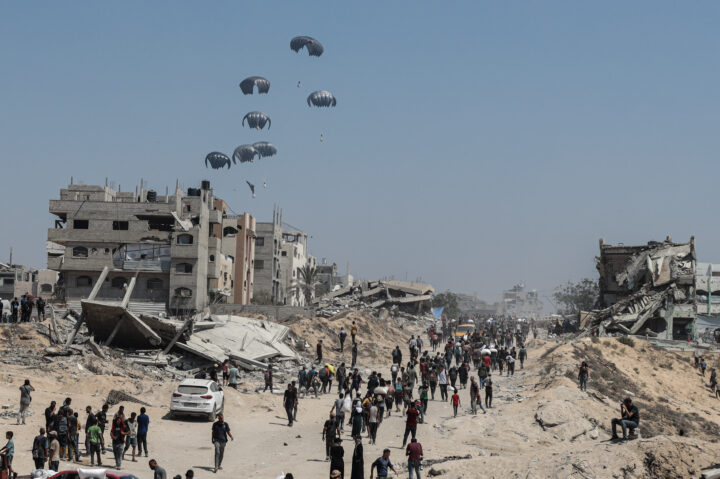
GAZA CITY, GAZA - JULY 27: An aircraft from the United Arab Emirates drops humanitarian aid balloons over the al-Sudaniyya area of Gaza City, Gaza on July 27, 2025 following Israeli army's announcement of a 'tactical suspension' of military operations in 3 parts of Gaza Strip. Suspension began at 0700GMT and applies to 3 key areas, including Al-Mawasi, Deir al-Balah, and Gaza City, according to Israeli army spokesman. Aid packages were collected by Palestinians struggling to access food. (Photo by Khames Alrefi/Anadolu via Getty Images)
Good Monday morning.
In today’s Daily Kickoff, we report on the mounting international pressure on Israel — including among some pro-Israel Democrats — to resolve the humanitarian crisis in Gaza, the subsequent measures taken by Israel and how they are expected to impact diplomatic ties with European allies. We report on DoJ senior counsel Leo Terrell’s comments yesterday at the Israel on Campus Coalition National Leadership Summit and report on the new TikTok hire with professional roots in the Jewish world who was brought on board to tackle hate speech on the platform. Also in today’s Daily Kickoff: Rep. Ritchie Torres, Ofer Calderon and Penny Pritzker.
What We’re Watching
- Today in New York, France and Saudi Arabia are co-hosting a conference focused on reviving two-state solution talks. The gathering, initially scheduled for June, now comes days after French President Emmanuel Macron said he planned to recognize a Palestinian state at this year’s U.N. General Assembly. Macron is skipping the conference, but his foreign minister, Jean-Noël Barrot, is expected to, per The Economist, “formally present” Paris’ U.N. plans. Barrot, for his part, attempted to meet with Jewish groups while in New York, but was shut down after Macron’s announcement last week. More below.
- The Israel on Campus Coalition’s National Leadership Summit continues today in Washington. Former Israeli Prime Minister Naftali Bennett and Leo Terrell, senior counsel at the Department of Justice, addressed the gathering of more than 600 students yesterday. More below.
- In North Carolina, former Gov. Roy Cooper, a Democrat, is expected to announce his bid for the Senate seat being vacated by Sen. Thom Tillis (R-NC). Cooper’s upcoming announcement comes as former Rep. Wiley Nickel (D-NC) plans to step aside from the race and endorse Cooper, consolidating Democratic support around the former governor. On the GOP side, Republican National Committee Chairman Michael Whatley is expected to announce his bid for the seat in the coming days, setting up what is likely to be one of the most expensive Senate races of the upcoming cycle.
What You Should Know
A QUICK WORD WITH ji’S melissa Weiss and Tamara zIEVE
In Israel’s effort to conduct a pressure campaign on Hamas to oust the terror group and release the remaining hostages held in Gaza, it has found itself instead on the receiving end of another global pressure campaign.
Facing mounting pressure amid a worsening humanitarian crisis in Gaza, Israel over the weekend announced a series of measures aimed at alleviating the widespread malnutrition and security issues in the enclave, including temporary ceasefires, aid airdrops, facilitating a massive increase in Gaza’s water supply and establishing designated humanitarian corridors — even as the IDF called claims of starvation in Gaza “a false campaign promoted by Hamas” and Israeli Prime Minister Benjamin Netanyahu denied that there was starvation in Gaza.
The crisis hit a fever pitch over the weekend as opposition to Israel’s efforts and limits on aid — first put into place in March as a pressure tactic to push Hamas to release the remaining hostages — surged to the highest levels of government around the world.
Dozens of countries called for an end to the war, a restoration of the flow of humanitarian aid into Gaza and the immediate release of the hostages. The shift in the political dynamic extended to Capitol Hill, where Democratic legislators, including many who have been strong supporters of Israel, expressed their concerns over Israel’s approach to the worsening humanitarian crisis in Gaza.
SPEAKING UP
As humanitarian situation in Gaza worsens, pro-Israel Democrats express concern
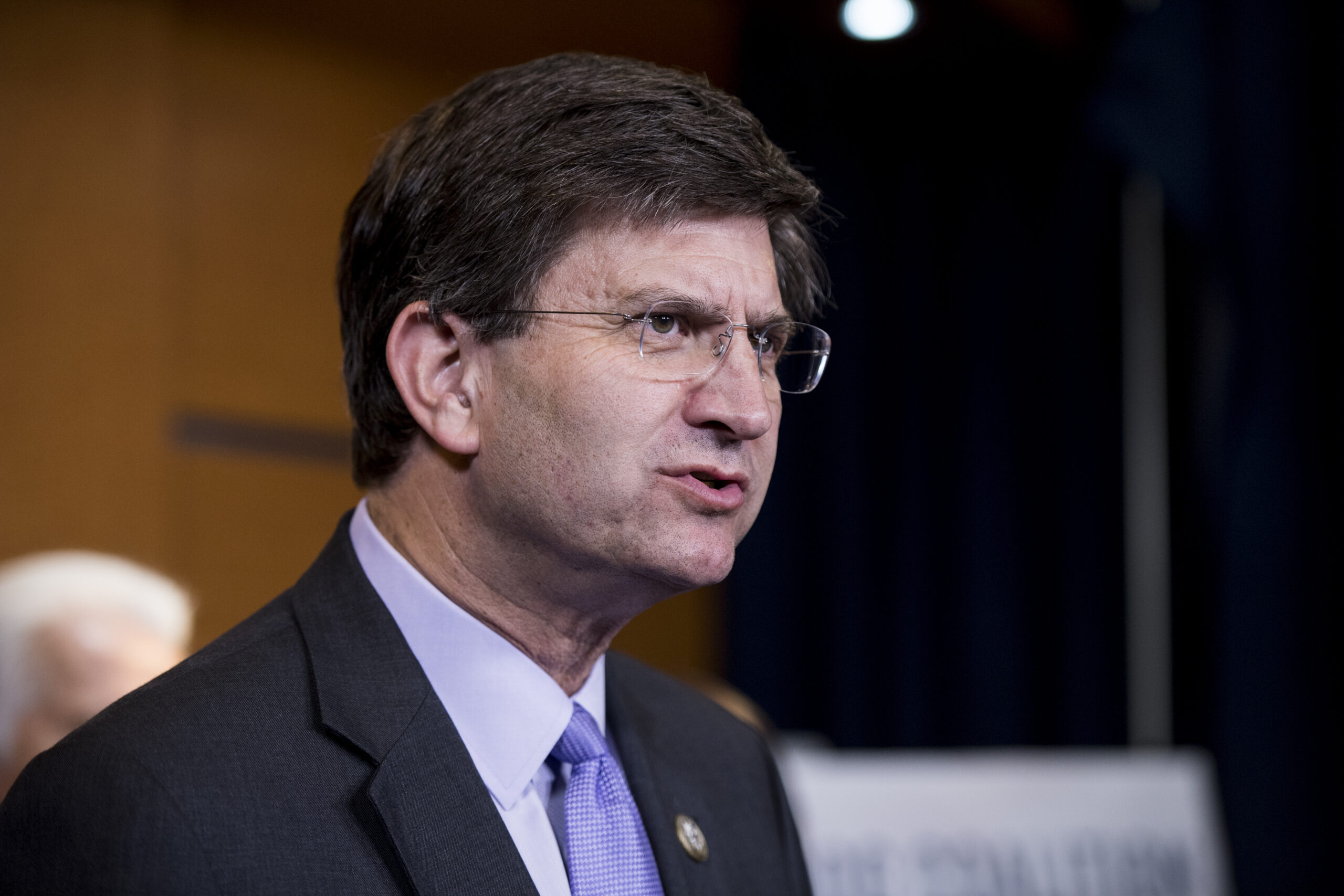
Amid reports of a mounting hunger crisis in Gaza, some of Israel’s staunchest defenders in the Democratic Party are now calling for Israel to do more to get humanitarian aid to Gazans — a signal that deteriorating conditions in the enclave are shifting public opinion even among those firmly in the pro-Israel camp. In a series of Friday statements, two major pro-Israel Democratic groups and a top Jewish Democrat in Congress raised concerns about what Rep. Brad Schneider (D-IL) described as “undeniably dire” circumstances in Gaza, Jewish Insider’s Gabby Deutch reports.
A matter of responsibility: “Israel must take immediate action to ensure sufficient food gets into the territory and to the people in desperate need. The world must not turn a blind eye to the fact that children are starving because of this war,” Schneider said in a statement. “It is Israel’s responsibility, and within its capacity, to address and resolve the situation.” Democratic Majority for Israel CEO Brian Romick said Friday that even though Hamas has no interest in mitigating human suffering in Gaza, Israel still has a responsibility to help starving children. “Even as Hamas works to prolong this war and prevent food from getting to people in need, Israel — along with the United States, Egypt, Qatar, and the rest of the international community — must continue to work to get food to innocent children in Gaza,” Romick said in a statement.
TORRES’ TAKE
Ritchie Torres: Netanyahu has done ‘irreparable damage’ to relationship with Democrats

Rep. Ritchie Torres (D-NY), a vocal Democratic supporter of Israel in Congress, said in an interview with journalist Chuck Todd on Sunday that Israeli Prime Minister Benjamin Netanyahu had done “irreparable damage” to Israel’s relationship with and support among Democrats, Jewish Insider’s Marc Rod reports.
Notable quotable: “If you’re a Democrat, and if you’re a Democrat of color and if you’re a Black Democrat, you take immense pride in Barack Obama. He represents one of the greatest achievements in politics. We take great pride in his presidency,” Torres said. “To see a foreign leader visibly disrespect him in the manner that Bibi Netanyahu did, I feel did irreparable damage to the relationship with the Democratic Party.” He also said that, despite his support for the Jewish state, he has “no real relationship” with the Israeli government.
Israel’s standing
‘Like Tylenol for a cancer patient:’ Israeli aid measures unlikely to allay European pressure

For European leaders who are ratcheting up pressure on Israel to end the humanitarian crisis in Gaza, the Jewish state’s moves to pause military activity to allow a freer flow of humanitarian aid and begin airdrops of aid are “steps in the right direction,” the German foreign minister said on Sunday. But the aid crisis is inextricably linked, observers say, to a much larger and even thornier issue — a deal to end the grinding 21-month war with Hamas and a release of the hostages. Until such a deal is struck, the pressure from Europe, and from some inside Israel, likely won’t ease. And it could worsen, with some experts warning that European sanctions on Israel aren’t out of the question, Jewish Insider’s Lahav Harkov reports.
Wider issue: Daniel Shek, a former Israeli ambassador to France and a member of the Hostage Families Forum’s diplomatic team, said that the aid airdrops are “a result of international pressure and not sudden altruism.” However, Shek said, they are “like Tylenol for a cancer patient. Surgery is needed, meaning the end of the war.” A spokesperson for German Chancellor Friedrich Merz said that he is “prepared to increase the pressure if progress [on a ceasefire and humanitarian aid] is not made.”
Red lines: A coalition of major American Jewish organizations refused an invitation on Friday to meet with Jean-Noel Barrot, France’s minister for Europe and foreign affairs, after French President Emmanuel Macron announced that the country will recognize a Palestinian state in September, eJewishPhilanthropy’s Nira Dayanim reports.
COLUMBIA COMMITMENTS
Jewish leaders express cautious optimism over Trump administration settlement with Columbia

Jewish leaders on and off Columbia University’s campus praised the settlement reached last week between the university and the Trump administration to restore some $400 million in federal funding that was slashed in March due to the Ivy League’s record dealing with antisemitism. While some Jewish leaders, students and alumni are taking a wait-and-see-approach, others expressed cautious optimism that the deal could lead to a safer environment for Jewish students following nearly two years of antisemitic protests and disruptions on campus in the aftermath of the Oct. 7, 2023, Hamas terror attacks in Israel, Jewish Insider’s Haley Cohen reports.
Positive perspective: “I am heartened to see the resolution agreement for several reasons,” Adam Lehman, president and CEO of Hillel International, told JI last week. “It recognizes both the clear, egregious violations of the civil rights of Jewish students and staff at Columbia and Barnard [an affiliate of Columbia] during the past two academic years, and the concrete steps Columbia has recently pursued to address these issues.”
Reservations: Still, some said that key reforms are missing from the deal, which falls short of several demands initially made by the Trump administration. Among the demands were putting the Middle Eastern, South Asian and African studies department and the Center for Palestine Studies under the purview of a senior vice provost, who would be appointed by the university to supervise course material and non-tenure faculty hiring, as well as the formation of a presidential search committee to replace acting President Claire Shipman.
security surcharge
Antisemitism task force head Leo Terrell decries ‘Jewish tax’ in rising communal security costs

Leo Terrell, senior counsel to the assistant attorney general for civil rights, said he is intent on eliminating what he called “the Jewish tax” in an address on Sunday to hundreds of Jewish college students gathered for the Israel on Campus Coalition’s three-day annual leadership summit held in Washington, Jewish Insider’s Haley Cohen reports.
What he said: “For those who don’t know what the Jewish tax is — for you to have this convention, for you to walk your child to a synagogue down the street — you have to pay for extra security,” said Terrell, who heads the Department of Justice’s antisemitism task force. “It makes no sense. It’s unfair. It’s wrong. I find it offensive that it’s being allowed throughout this country. I’m doing everything I can to eliminate it.” Terrell’s comments came as the Federal Emergency Management Agency announced last month that it had awarded $94.4 million in security grant funding to a total of 512 Jewish organizations nationwide.
DEDICATED ROLE
TikTok hires new hate speech manager amid concerns over rising antisemitic content on the platform

TikTok recently hired a new hate speech manager with long-standing ties to the Jewish community, the company confirmed to Jewish Insider’s Matthew Kassel, as the social media platform faces growing pressure to confront a sharp rise in antisemitic content. The streaming platform enlisted Erica Mindel, a former State Department contractor who worked for Ambassador Deborah Lipstadt, the Biden administration’s special envoy to monitor and combat antisemitism, to join TikTok’s global public policy and government affairs team.
Taking action: The hire comes as TikTok has drawn accusations that it has failed to address a spike in antisemitic and anti-Israel content in the wake of Hamas’ Oct. 7, 2023, terror attacks and amid the ensuing war in Gaza. In her newly created role, Mindel will “develop and drive the company’s positions on hate speech,” seek to “influence legislative and regulatory frameworks” and “analyze hate speech trends,” with a particular focus on “antisemitic content,” among other duties cited in an official job description shared by TikTok.
Worthy Reads
Just Cause, Unjust Tactics: The New York Times’ Ross Douthat argues that Israel’s war against Hamas in Gaza — which he describes as “a war for a just cause” — is now being fought unjustly. “One can have a righteous cause, one’s foe can be wicked and brutal and primarily responsible for the conflict’s toll, and still — under any coherent theory of just war — there is an obligation to refrain from certain tactics if they create too much collateral damage, to mitigate certain predictable forms of civilian suffering and to have a strategy that makes the war’s outcome worth the cost. These are tests that Israel is failing.” [NYTimes]
RJC Rising: The Dispatch’s David Drucker explores the growing influence of the Republican Jewish Coalition. “Since Election Day 2024, the Republican Jewish Coalition has been telling anyone who will listen that Trump’s performance among Jewish voters was a historic success — due in no small part to the money and manpower invested by the RJC. There’s data to back that assertion up…To understand the real and consequential movement toward Trump by Jewish voters in 2024, you have to look under the hood, at the exit polls of battleground states and local precincts with significant populations of Jewish voters. That’s where Trump made his mark with a cohort usually elusive for Republicans; it’s what helped propel him past Harris in swing states that were quite close despite the president’s sweep.” [TheDispatch]
Art of the Steal: In AirMail, Ezra Chowaiki reflects on his dealings with forged looted artworks whose sellers wrongly claim them to be works that belonged to high-ranking Nazi officials. “Art dealers know the back of a painting is more important than its front. The back is where you trace the painting’s history, and the clues for each artwork in Jimmy’s collection were incredible, including incidental marks and labels on each painting, not to mention all those Nazi stamps. … In my years of meeting collectors, I’ve realized that many prefer the forbidden fruit. In its own perverse way, it just tastes a little sweeter. But beware: your perverse fascination with forbidden provenance — the back of the canvas — may keep you from examining a painting’s more obvious faults on the front.” [AirMail]
Word on the Street
Darren Beattie, who was fired from his role as a speechwriter in the first Trump administration over his ties to white nationalists, was tapped to serve as acting president of the U.S. Institute of Peace in addition to his role as under secretary of state for public diplomacy and public affairs at the State Department…
Sen. Lindsey Graham (R-SC) told NBC’s “Meet The Press” that he believes Israel will be unable to negotiate an end to its war with Hamas and will have to do “what [the Allied forces] did in Tokyo and Berlin, take the place by force and start over again, presenting a better future for the Palestinians, hopefully having the Arabs take over the West Bank and Gaza”…
Secretary of State Marco Rubio is reportedly favoring “a more comprehensive approach to end the war and free all the remaining hostages” after meeting with hostage families at the State Department on Friday…
A Palestinian boy referenced in images that went viral last week as a symbol of the humanitarian crisis in Gaza was discovered to be suffering from a preexisting genetic muscle disorder…
A growing number of news organizations are calling on Israel to allow journalists access to the Gaza Strip…
The New York Times reports on speculation that funding for the refurbishment of the Qatari plane being gifted to the Trump administration is coming from funds allocated from a nuclear modernization program inside the Pentagon…
A White House official told The Wall Street Journal that it will use its recent settlement with Columbia University as a blueprint for its legal battles with other universities…
The New York Times spotlights former Commerce Secretary Penny Pritzker’s role as head of the Harvard Corporation, as both the Trump administration and the Corporation raise concerns about her continued leadership and involvement…
Minnesota Democratic activist Latonya Reeves, a member of the Democratic National Committee, is mulling a primary challenge to Rep. Ilhan Omar (D-MN)…
French authorities are investigating the circumstances behind the removal last week of several dozen French Jewish campers and camp staffers from a Vueling flight amid claims from the group that it was deplaned because the campers were Jewish; Vueling has denied the allegations and said the group was removed due to the unruly behavior of some of the campers prior to takeoff…
The New York Times looks at the impact of Iran’s deepening water crisis amid record-setting heat and energy shortages around the country…
Mathematician-turned-singer Tom Lehrer, whose satirical tunes from the 1950s and ‘60s gained new audiences when Cameron Mackintosh compiled Lehrer’s music into the 1980 revue “Tomfoolery,” died at 97…
Pic of the Day

Ofer Calderon (right), who was held hostage by Hamas in Gaza for 484 days, cycled yesterday alongside Israel-Premier Tech team owner and philanthropist Sylvan Adams in the final stage of the Tour de France on the Champs-Élysées in Paris. On the 100th day of the hostages’ captivity, Adams led a global cycling event in their honor and promised that when Calderson would be released, he would ride alongside him at the Tour de France.
Birthdays
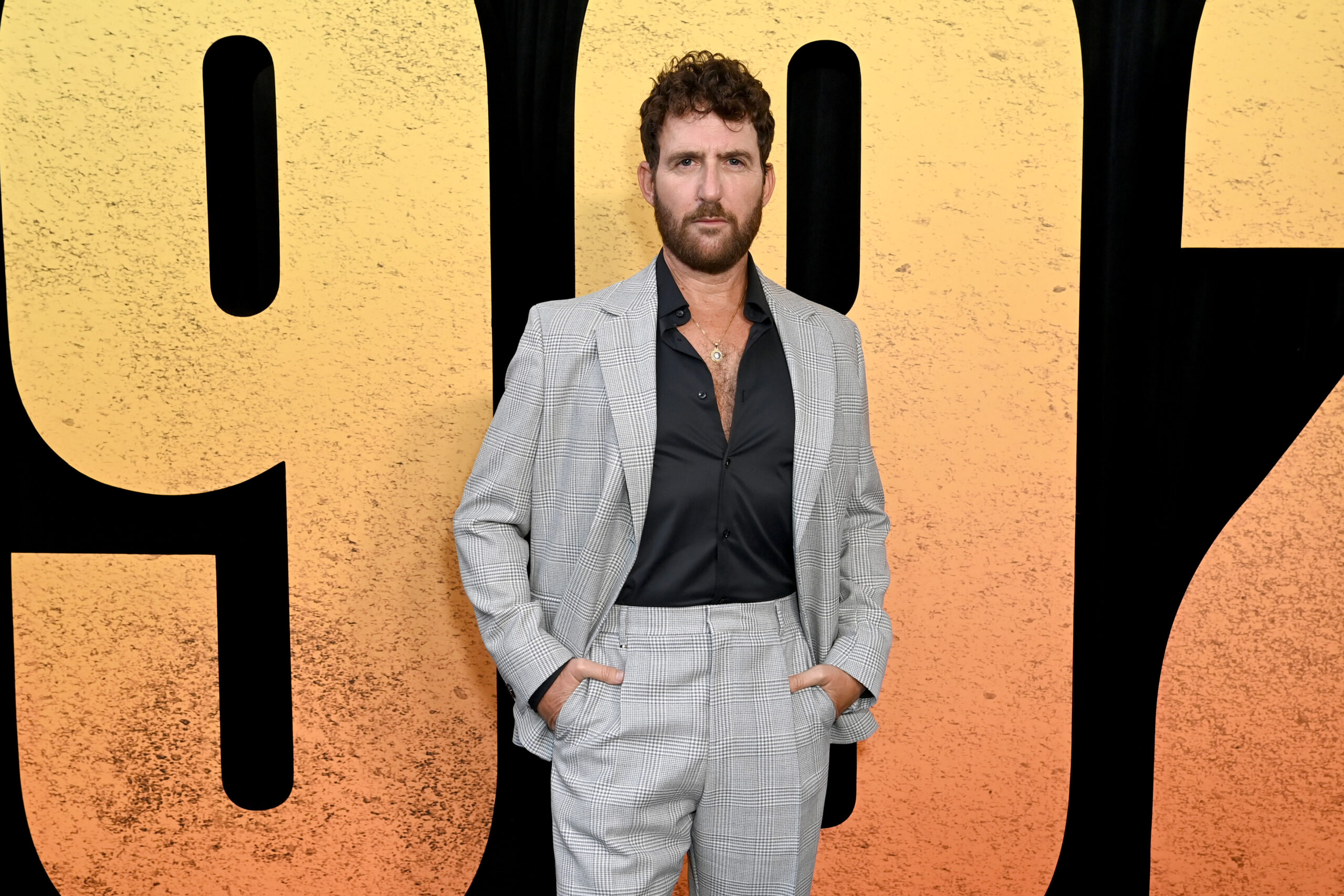
Jerusalem-born actor with more than 30 movie and television roles in the U.S., Ori Pfeffer turns 50…
Survivor of Auschwitz-Birkenau as a teen, he emigrated to Israel and became an artist, Yehuda Bacon turns 96… Chicago radio news personality, from 1973 to 2013 he was a television news anchor in Chicago, Walter David Jacobson turns 88… U.S. District Court judge in Manhattan until 2006, then U.S. attorney general for the last 14 months of the Bush 43 administration, now of counsel at the international law firm of Debevoise & Plimpton, Michael Mukasey turns 84… Swedish industrialist, chairman of the Nobel Foundation (manager of the Nobel Prize) from 2005 to 2013, Marcus Storch Ph.D. turns 83… In 1986 she became the first woman in the IDF to hold the rank of brigadier general, she then served as a member of Knesset, and now serves on multiple for-profit and nonprofit boards, Amira Dotan turns 78… Oldest active quarterback, he also manages football teams in Baltimore and Jerusalem, Joe Pollak turns 75… President of the Council on Foreign Relations for 20 years until he retired in 2023, Richard N. Haass turns 74… Tel Aviv-born real estate developer, restorer of historic buildings in downtown Los Angeles, Izek Shomof turns 66… Partner and managing director of Meadow Lane Advisors, Marty Friedman… French-Israeli hairdresser and entrepreneur, Michel Mercier turns 64… Sports executive, attorney and former president of basketball operations for the NBA’s Minnesota Timberwolves, David Kahn turns 64… American schoolteacher, wrongfully detained by Russia in 2022, he was released in the early weeks of the Trump 47 administration, Marc Hilliard Fogel turns 64… Talent booker, publicist and television and radio personality in Atlanta, Mara Davis turns 56… Tech entrepreneur who has invested in more than 100 startups, New York Times bestselling author, Joshua M. “Josh” Linkner turns 55… Co-founder of 23andMe, she recently regained control of the company, Anne Wojcicki turns 52… Actress and reality show personality, Elizabeth Berkley Lauren turns 51… Deputy CEO at UpStart, Jennifer Lew Goldstone… Associate justice of the Supreme Court of California, Leondra Kruger turns 49… Israeli journalist and former member of the Knesset, Ksenia Svetlova turns 48… Managing partner at Altitude Ventures, a health-care venture capital firm, he is a former White House liaison to the Jewish community, Jay Zeidman… Senior reporter at Bloomberg News, Laura Nahmias… CEO and CTO at Diagnostic Robotics in Jerusalem, Kira Radinsky Ph.D. turns 39… VP of player personnel at MLB’s Miami Marlins, Samuel Mondry-Cohen… Administrator at Lehigh Valley Homecare in Allentown, Pa., Menachem (Mark) Perl… Actor and producer who stars in the CBS series “Ghosts,” Asher Chazen Grodman turns 38… National narrative enterprise reporter at The Washington Post, Ruby Cramer… Larry Gordon…
Israel announces new aid measures and temporary ceasefires while defending its broader war strategy
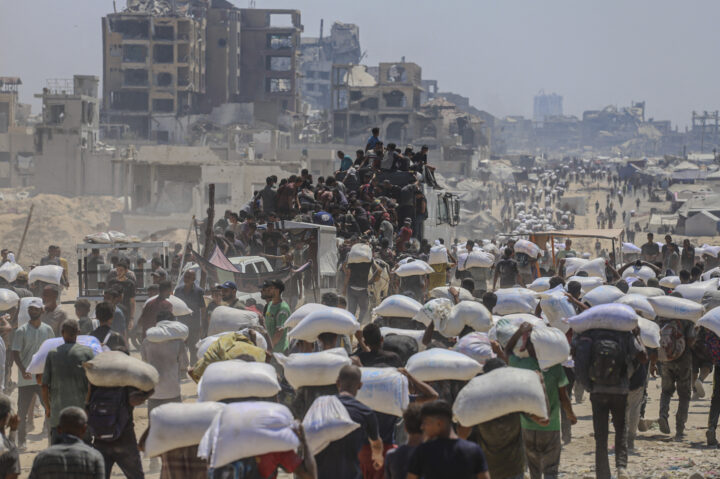
Ramez Habboub/Abaca/Sipa USA via AP Images
Palestinians carry humanitarian aid received through the Zikim crossing as they return to their families near the Al-Sudaniya area in northern Gaza, on July 27 2025 amid the beginning of airdrop operations.
In Israel’s effort to conduct a pressure campaign on Hamas to oust the terror group and release the remaining hostages held in Gaza, it has found itself instead on the receiving end of another global pressure campaign.
Facing mounting pressure amid a worsening humanitarian crisis in Gaza, Israel over the weekend announced a series of measures aimed at alleviating the widespread malnutrition and security issues in the enclave, including temporary ceasefires, aid airdrops, facilitating a massive increase in Gaza’s water supply and establishing designated humanitarian corridors — even as the IDF called claims of starvation in Gaza “a false campaign promoted by Hamas” and Israeli Prime Minister Benjamin Netanyahu denied that there was starvation in Gaza.
The crisis hit a fever pitch over the weekend as opposition to Israel’s efforts and limits on aid — first put into place in March as a pressure tactic to push Hamas to release the remaining hostages — surged to the highest levels of government around the world.
Dozens of countries called for an end to the war, a restoration of the flow of humanitarian aid into Gaza and the immediate release of the hostages. The shift in the political dynamic extended to Capitol Hill, where Democratic legislators, including many who have been strong supporters of Israel, expressed their concerns over Israel’s approach to the worsening humanitarian crisis in Gaza.
That backdrop led to a late-night announcement from the IDF’s on Saturday: “In accordance with directives from the political echelon and following a situational assessment held this evening, the IDF has begun a series of actions aimed at improving the humanitarian response in the Gaza Strip, and to refute the false claim of deliberate starvation in the Gaza Strip.”
On Israel’s most-watched news channel, Channel 12, journalists Almog Boker and Amit Segal described the move as a victory for Hamas after a successful propaganda campaign that captivated global opinion.
But not everyone agreed. On the same network, anchor Yonit Levi said, “It’s time to understand that this is not a failure of public diplomacy, but a moral failure.”
Domestically, the resumption of aid has the potential to cause divisions within Netanyahu’s coalition, whose right-wing members have in the past threatened to leave the coalition over moves that have been seen as concessions to Hamas.
Israeli National Security Minister Itamar Ben-Gvir and Finance Minister Bezalel Smotrich — both vocal opponents of allowing aid into Gaza — were excluded from a phone call on Saturday during which the decision was taken to increase aid. According to Ben-Gvir, an official from the Prime Minister’s Office claimed he had been left out to avoid forcing him to violate Shabbat — which Ben-Gvir denied, saying he was “available on Shabbat for any event or important security consultation.”
Smotrich, for his part, reportedly said overnight that he will not quit the government over the decision.
Addressing the move on Sunday during a visit to an Israeli Air Force base, Netanyahu defended the decision, calling it a continuation of existing policy. He said that while continuing efforts to defeat Hamas and release the hostages, “we will need to continue to allow the entry of minimal humanitarian supplies. We have done this until now.”
Amid the cacophony of criticism, Israel has largely stayed in the good graces of the White House. President Donald Trump on Sunday said that “Israel is gonna have to make a decision” about what to do with Hamas. “I know what I’d do, but I don’t think it’s appropriate that I say it.” U.S. Ambassador to Israel Mike Huckabee slammed the United Nations, The New York Times and Hamas for the humanitarian crisis, saying that their “lies & propaganda destroyed cease-fire deal, tried to discredit safe and functioning GHF effort, emboldened Hamas & will result in this complete balagan! Most sad for hostage families-grief prolonged.”
The U.N. World Food Program, which has not shied away from criticizing Israeli government actions, praised the influx of aid, saying the agency has “enough food in – or on its way to – the region to feed the entire population of 2.1 million people for almost three months.”
But while the most immediate concerns are being allayed, Israel will have to face another crisis of its own making — attempting to restore its standing with many of its traditional allies.
Indeed, when Rep. Ritchie Torres (D-NY), a pro-Israel stalwart, is sounding an alarm about his own frosty relationship with the Israeli government, it’s a glaring red flag about the state of Israel’s public diplomacy.
At the ICC summit, the DOJ’s Terrell said extra security costs borne by Jewish communities are ‘offensive’

Haley Cohen
Leo Terrell, senior counsel to the assistant attorney general for civil rights, addresses the Israel on Campus Coalition three-day annual leadership summit held in Washington on Sunday, July 27th, 2025.
Leo Terrell, senior counsel to the assistant attorney general for civil rights, said he is intent on eliminating what he called “the Jewish tax” in an address on Sunday to hundreds of Jewish college students gathered for the Israel on Campus Coalition’s three-day annual leadership summit held in Washington.
“For those who don’t know what the Jewish tax is — for you to have this convention, for you to walk your child to a synagogue down the street — you have to pay for extra security,” said Terrell, who heads the Department of Justice’s antisemitism task force. “It makes no sense. It’s unfair. It’s wrong. I find it offensive that it’s being allowed throughout this country. I’m doing everything I can to eliminate it.”
Terrell’s comments came as the Federal Emergency Management Agency announced last month that it had awarded $94.4 million in security grant funding to a total of 512 Jewish organizations nationwide.
Terrell, who wore a baseball cap embroidered with the name “Hadar Goldin,” an IDF soldier abducted and killed by Hamas in 2014 whose body remains held by the terrorist group, shared that he has faced “fights and arguments” with some colleagues over how to strategically address antisemitism. He said that some colleagues have called to “cut a deal, to move on,” an apparent reference to the Trump administration’s recent settlement with Columbia University following a monthslong battle over the Ivy League university’s record dealing with antisemitism.
“I will not compromise,” Terrell said. “No, how can you ask a group [to] compromise freedom? There is no compromise on your equality, your freedom, you have the right to go to schools, to walk down the streets and not be worried and not be afraid.”
Terrell, a former civil rights attorney and a conservative media personality, told the crowd that eradicating antisemitism is a “full-time commitment,” one that he’s decided to take on in part due to Jewish involvement in the Civil Rights Movement.
“I’m not a Jewish American. I’m a Black American. I also understand the history of this great country. Before becoming a lawyer, I was a school teacher. I grew up in the ‘60s,” Terrell said. “I remember Jewish Americans walking hand in hand with Black Americans making sure they got their civil rights.”
The vocal pro-Israel Democrat said he has ‘no real relationship’ with the Israeli government

Al Drago-Pool/Getty Images
Rep. Ritchie Torres, a Democrat from New York, speaks at a House Financial Services Committee hearing on oversight of the Treasury Department and Federal Reserve coronavirus pandemic response on Capitol Hillon September 30, 2021 in Washington, DC.
Rep. Ritchie Torres (D-NY), a vocal Democratic supporter of Israel in Congress, said in an interview with journalist Chuck Todd on Sunday that Israeli Prime Minister Benjamin Netanyahu had done “irreparable damage” to Israel’s relationship with and support among Democrats, tracing the origin of the breach to Netanyahu’s public clashes with President Barack Obama.
“If you’re a Democrat, and if you’re a Democrat of color and if you’re a Black Democrat, you take immense pride in Barack Obama. He represents one of the greatest achievements in politics. We take great pride in his presidency,” Torres said. “To see a foreign leader visibly disrespect him in the manner that Bibi Netanyahu did, I feel did irreparable damage to the relationship with the Democratic Party.”
Asked by Todd how he would advise the Israeli government to repair its relationship with the party, Torres offered no suggestions, repeating that “it feels like the damage may be irreparable.” He added that support for the U.S.-Israel relationship is “eroding, and anyone who denies it is ignoring the numbers.”
(Torres subsequently told Jewish Insider that the “irreparable damage” was referring to “the relationship between Netanyahu and the Democratic Party, not the relationship between Israel and the Democratic Party.”)
Torres also said that he has “no real relationship” with the Israeli government, despite his support for the Jewish state, and said that his conversations are usually general and high-level, and do not yield “useful information.”
“I do not consider myself having a good relationship with the Israeli government,” Torres said.
He said Netanyahu should have been able to disagree with Obama, “but when you inject yourself into partisan politics and put your thumb on the scale in favor of one political party, that sets a dangerous precedent, and I believe that the consequences of geopolitical calculation continue to reverberate to this day.”
Netanyahu and Obama split publicly over the U.S.’s nuclear deal with Iran, and Netanyahu accepted an invitation from then-Speaker of the House John Boehner, a Republican, to address Congress to condemn the deal.
He said that the U.S.-Israel relationship requires bipartisanship and that “if you politicize it, you’re not a friend of the relationship, you’re an enemy.”
Torres said Netanyahu had “made a terrible mistake” and that there is a “legitimate perception that the present Israeli government is just aligned with the Republican Party.”
The Democratic congressman also called for an end to the war in Gaza, the release of hostages, increased humanitarian aid to Palestinians, new Palestinian governance in Gaza and efforts to build on the Abraham Accords, arguing that warnings from Israeli reporters about the deteriorating humanitarian situation in Gaza must be heeded.
He’s one of several pro-Israel Democrats who have grown more critical of the Israeli government’s handling of the humanitarian situation in Gaza in recent days. Additionally, some congressional Republicans have warned that Israel’s conduct is risking American support.
Torres argued that the impact of the war for Israel has been mixed — even as it has severely degraded Iran and its proxies and “emerged from Oct. 7 stronger and … reestablished deterrence,” it has lost significant support in the United States.
The New York congressman has also recently raised eyebrows with his defenses of Democratic New York City mayoral candidate Zohran Mamdani — though Torres has not endorsed Mamdani and said that Mamdani must address “real concerns” in the Jewish community.
Israel’s former ambassador to France said the airdrops of aid are a result of condemnation from European capitals

Antoine Gyori - Corbis/Corbis via Getty Images
British Prime Minister Keir Starmer is greeted by French President Emmanuel Macron ahead of the 'Coalition Of The Willing' summit in support of Ukraine at Elysee Palace on March 27, 2025 in Paris, France.
For European leaders who are ratcheting up pressure on Israel to end the humanitarian crisis in Gaza, the Jewish state’s moves to pause military activity to allow a freer flow of humanitarian aid and begin airdrops of aid are “steps in the right direction,” the German foreign minister said on Sunday.
But the aid crisis is inextricably linked, observers say, to a much larger and even thornier issue — a deal to end the grinding 21-month war with Hamas and a release of the hostages. Until such a deal is struck, the pressure from Europe, and from some inside Israel, likely won’t ease. And it could worsen, with some experts warning that European sanctions on Israel aren’t out of the question.
Daniel Shek, a former Israeli ambassador to France and a member of the Hostage Families Forum’s diplomatic team, said that the aid airdrops are “a result of international pressure and not sudden altruism.”
However, Shek said, they are “like Tylenol for a cancer patient. Surgery is needed, meaning the end of the war.”
A spokesperson for German Chancellor Friedrich Merz said that he is “prepared to increase the pressure if progress [on a ceasefire and humanitarian aid] is not made.”
French President Emmanuel Macron announced last week that his country would recognize a Palestinian state. French Foreign Minister Jean-Noël Barrot argued that the move “proves [Hamas] wrong. It supports the side of peace against that of war,” because “Hamas has always rejected the two-state solution.”
The terrorist group praised France’s “positive step in the right direction.”
England and Germany declined to join France in recognizing a Palestinian state, but their leaders released a statement with Macron focusing on the “humanitarian catastrophe” in Gaza and calling for “the most basic needs of the civilian population, including access to water and food [to be] met without further delay” and for Israel “to immediately lift restrictions on the flow of aid.”
Israel has argued that it is not restricting the flow of aid into Gaza, but that the U.N. refuses to cooperate with the U.S. and Israel supported Gaza Humanitarian Foundation to distribute it.
U.K. Prime Minister Keir Starmer said that he is “unequivocal” in his support for a Palestinian state, but that recognition must come as “part of a wider plan which ultimately results in a two-state solution and lasting security for Palestinians and Israelis. This is the way to ensure it is a tool of maximum utility.”
The IDF noted that “responsibility for food distribution to the population lies with the U.N. and international aid organizations. Therefore, the U.N. and international organizations are expected to improve the effectiveness of aid distribution and to ensure that the aid does not reach Hamas.”
Israel initiated on Sunday 10-hour “pauses” in the coming days in areas of Gaza in which there are no IDF ground troops, daily until further notice, “aimed at improving the humanitarian response in the Gaza Strip and to refute the false claim of deliberate starvation.”
In addition to 28 airdrops on the first day, the IDF established corridors to allow the safe movement of U.N. convoys of food and medicine. The military also noted that “responsibility for food distribution to the population lies with the U.N. and international aid organizations. Therefore, the U.N. and international organizations are expected to improve the effectiveness of aid distribution and to ensure that the aid does not reach Hamas.”
Starmer, however, said after the airdrops were announced on Saturday that “Israel must allow aid in over land…The situation is desperate.”
German Foreign Minister Johann Wadephul said that “humanitarian pauses and aid deliveries into Gaza are steps in the right direction, results of many direct conversations in the last few days. Yet the situation remains unbearable: Hamas must release all hostages, a comprehensive ceasefire is badly needed.”
Starmer reportedly plans to ask President Donald Trump to return to ceasefire talks with Hamas, during the president’s visit to Scotland on Monday. A source in his office told The Guardian over the weekend that Starmer will “discuss further with [Trump] what more can be done to secure the ceasefire urgently, bring an end to the unspeakable suffering and starvation in Gaza and free the hostages who have been held so cruelly for so long.”
The U.S. and Israel withdrew their teams from the negotiations in Doha, Qatar, last week, after Hamas rejected a ceasefire and hostage deal by making new demands in areas that had previously been resolved. U.S. envoy Steve Witkoff said that Washington was looking for “alternative options,” which Israeli Prime Minister Benjamin Netanyahu later echoed.
Germany similarly remained concerned about the humanitarian situation in Gaza, with Foreign Minister Johann Wadephul saying that “humanitarian pauses and aid deliveries into Gaza are steps in the right direction, results of many direct conversations in the last few days. Yet the situation remains unbearable: Hamas must release all hostages, a comprehensive ceasefire is badly needed.”
Merz and Netanyahu spoke on the phone on Sunday. Following the call, Merz said he asked Netanyahu “to do everything in his power to bring about an immediate ceasefire and called on him to allow urgently needed humanitarian aid to reach the starving civilian population in Gaza without delay.”
Israel is taking a different approach to each major European capital and its statements and actions on Israel, a Foreign Ministry source told Jewish Insider.
The Israeli Foreign Ministry summoned the French charge d’affaires for a demarche by Director-General Eden Bar-Tal on Sunday. A statement from the ministry said that France “chose to harm Israel in its most difficult hour…France directly harmed the negotiations to return the hostages and for a ceasefire and all future diplomatic negotiations.”
Soon after Macron’s announcement on Thursday, Netanyahu said that it “rewards terror and risks creating another Iranian proxy, just as Gaza became. A Palestinian state in these conditions would be a launch pad to annihilate Israel — not to live in peace beside it. Let’s be clear: the Palestinians do not seek a state alongside Israel; they seek a state instead of Israel.”
If the war continues, Daniel Shek, a former Israeli ambassador to France and a member of the Hostage Families Forum’s diplomatic team, warned, “we could find ourselves under real pressure, such as sanctions, even from friendly countries that blocked [such steps] until now. Israel is isolating itself.”
Though Berlin has continued to make critical statements, the Foreign Ministry source indicated that Jerusalem still views Germany as a largely supportive country.
The source noted that while there was significant domestic pressure over Germany’s Israel policy, it has not backed down, such as last week when Berlin declined to join a letter of 28 countries calling to end the war immediately.
In addition, Germany did not support moves to reexamine Israel’s “association agreement” with the EU, which could result in a chill in relations between Israel and its largest trade partner. Changes in the association agreement would require consensus from all 28 EU member states, several of whom would be unlikely to support downgrading ties with Israel.
Wadephul and Israeli Foreign Minister Gideon Sa’ar have met three times since the former entered office three months ago. In one of the meetings he said that Germany would not cut off arms sales to Israel.
Emmanuel Navon, an international relations lecturer at Tel Aviv University and fellow at the Jerusalem Institute for Security Studies, said that the aid drops would likely be enough to stop Germany from taking action against Israel.
“I find it hard to believe that Germany, who we have very close ties with, would do something like [downgrade the association agreement] unless Israel has totally cut off humanitarian aid … For German public agreement, you need aid flowing into Gaza,” he added.
Shek was skeptical that Germany would follow Macron in recognizing a Palestinian state, but said “even Germany is showing signs of impatience and urgency,” and that there are other steps that Berlin could take.
The former ambassador also said he thought that canceling the EU-Israel Association Agreement was unlikely, because Hungary and Eastern European states would not support it. However, he said that the Brussels bureaucracy could slow-walk agreements and cooperation with Jerusalem in areas that often depend on EU grants such as scientific research and culture.
If the war continues, Shek warned, “we could find ourselves under real pressure, such as sanctions, even from friendly countries that blocked [such steps] until now. Israel is isolating itself.”
That being said, Shek and Navon doubted that the latest moves from Europe actually constituted pressure on Jerusalem.
Shek dismissed angry Israeli reactions to Macron’s “recognition of a virtual Palestinian state state that doesn’t exist … Those reactions are only aimed at the Israeli voter and have no value in international relations.”
“We need to say Hamas is looting and the U.N. won’t distribute the aid — we don’t need to wait to be accused of starving [Gazans] to say it,” said Emmanuel Navon, an international relations lecturer at Tel Aviv University and fellow at the Jerusalem Institute for Security Studies. “The problem is that we wait to be attacked and then we react. Once the accusation is out, it’s hard to correct.”
Navon noted that other G7 countries were not on board with Macron’s initiatives, even those with left-wing governments like the U.K. and Canada.
“Macron has brought relations with Israel to the low of the early to mid 1970s … when France was graded as hostile in Israel’s foreign policy,” Navon said. “It will take years to repair after [Macron].”
Navon said that Israel needs to be more proactive in communicating what is happening in Gaza: “We need to say Hamas is looting and the U.N. won’t distribute the aid — we don’t need to wait to be accused of starving [Gazans] to say it. The problem is that we wait to be attacked and then we react. Once the accusation is out, it’s hard to correct.”
In addition, Navon said, “Netanyahu needs to get his act together and tell his ministers to shut up or take away their phones.”
He referred to remarks by Heritage Minister Amichai Eliyahu in a radio interview last week that “the government is racing ahead to wipe out Gaza … All of Gaza will be Jewish.”
“The prime minister has to have better control of rogue members of his government and party who are causing us terrible damage,” Navon added.
Shek, however, said the way to improve Israel’s relations with Europe and the rest of the world is to end the war in Gaza.
The former ambassador argued that the issue is not one of Israel doing a poor job at explaining the situation to the world: “If all of these countries have reached the conclusion that the war needs to end, then Israel needs to have a discussion with them to find out how they can contribute to a better reality after the war … We need to just get into a conversation about an exit strategy … which is something that the Israeli government has refused to do from Oct. 8, 2023, to this day.”
Rep. Brad Schneider (D-IL): ‘The world must not turn a blind eye to the fact that children are starving because of this war’
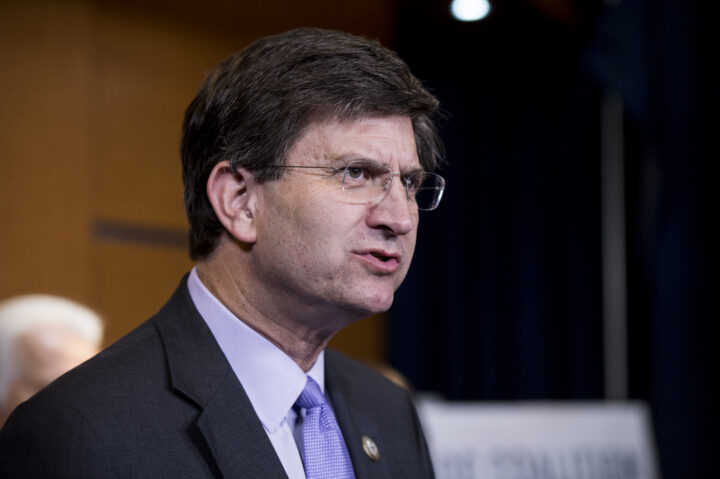
Bill Clark/CQ Roll Call
Rep. Brad Schneider (D-IL)
Amid reports of a mounting hunger crisis in Gaza, some of Israel’s staunchest defenders in the Democratic Party are now calling for Israel to do more to get humanitarian aid to Gazans — a signal that deteriorating conditions in the enclave are shifting public opinion even among those firmly in the pro-Israel camp.
In a series of Friday statements, two major pro-Israel Democratic groups and a top Jewish Democrat in Congress raised concerns about what Rep. Brad Schneider (D-IL) described as “undeniably dire” circumstances in Gaza.
“Israel must take immediate action to ensure sufficient food gets into the territory and to the people in desperate need. The world must not turn a blind eye to the fact that children are starving because of this war,” Schneider said in a statement. “It is Israel’s responsibility, and within its capacity, to address and resolve the situation.”
Israel has said the United Nations is to blame for conditions in the Gaza Strip, alleging that the agency is responsible for failing to distribute much of the assistance. The U.N. has blamed Israel for not giving agency officials the necessary approvals to reach the aid piled up on the Gaza side of Israel’s border crossings.
Israel’s backers in Washington have generally agreed with Israeli leaders that the U.N. and Hamas, which Israel has accused of stealing aid, share the blame for the humanitarian situation in Gaza. U.S. Ambassador to Israel Mike Huckabee told Jewish Insider on Thursday that Hamas is the “biggest reason that people are not getting the food and medicine they need.”
But that patience appears to be growing thin among some Democratic allies.
Democratic Majority for Israel CEO Brian Romick said Friday that even though Hamas has no interest in mitigating human suffering in Gaza, Israel still has a responsibility to help starving children.
“Even as Hamas works to prolong this war and prevent food from getting to people in need, Israel — along with the United States, Egypt, Qatar, and the rest of the international community — must continue to work to get food to innocent children in Gaza,” Romick said in a statement.
Rep. Ritchie Torres (D-NY) called out Rep. Randy Fine (R-FL) for a post in which Fine called for the release of the hostages, writing “until then, starve away.”
“Telling Palestinians in Gaza to ‘starve away’ is an evil thing to say,” Torres wrote on X on Thursday.
Halie Soifer, the CEO of the Jewish Democratic Council of America, expressed “deep concern for Israel’s security, international standing and future as a Jewish and democratic state” while calling “for immediate steps to alleviate the dire and growing humanitarian crisis in Gaza.”
“The situation in Gaza is unacceptable and antithetical to our Jewish values, and it’s incumbent on the Israeli government, the United States and all parties to ensure that Gazans have access to food,” Soifer said in a statement.
The rhetorical shift comes as Israeli reporters acknowledge that the humanitarian situation in Gaza has grown worse in recent weeks.
“Gaza may well be approaching a real hunger crisis,” Israeli journalist Amit Segal wrote in The Free Press on Thursday. “There have been tremendous lies told about Israel’s war. That doesn’t mean the threat of starvation isn’t real. It is.”
Times of Israel editor David Horovitz wrote this week that Israel shoulders some blame for the suffering in Gaza, having refused to distribute the aid itself while at the same time putting untrained Israeli soldiers in charge of controlling access to humanitarian aid sites run by the Gaza Humanitarian Foundation — which has led to the deaths of Palestinians converging on the crowded aid sites.
In an interview with JI, Huckabee pinned the humanitarian issues in Gaza on Hamas and the U.N.
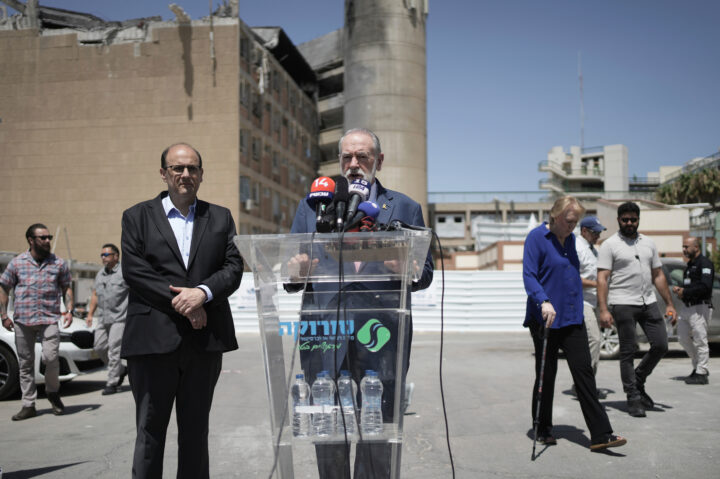
Maya Alleruzzo/AP Photo
U.S. Ambassador to Israel Mike Huckabee speaks to journalists with Director General of Soroka Medical Center Dr. Shlomi Codish, left, outside a hospital building that was struck by an Iranian missile, Thursday, June 26, 2025 in Beersheba, Israel.
Since his arrival in Israel in April, former Arkansas Gov. Mike Huckabee has made his mark as the first evangelical U.S. ambassador to Israel — and possibly the most effusive in his remarks about the Jewish state.
That may be why a leaked letter he wrote to Israeli Interior Minister Moshe Arbel last week, expressing “profound disappointment” that an issue delaying work visas for Christian organizations had gone unresolved and suggesting that Israelis may be treated in kind by the U.S., drew so much attention.
A day after the letter leaked, the ambassador visited Taybeh, a Palestinian village in the West Bank where there had been a fire in a field near a church, writing on X that “desecrating a church, mosque or synagogue is a crime against humanity and God,” and “I will demand those responsible be held accountable.” With Taybeh church leaders blaming settlers, Huckabee’s comments were interpreted in many media accounts as doing the same, though he later clarified that he was not attributing the fire to anyone.
But with the visa issue resolved and the world’s attention on the humanitarian situation in Gaza and the latest round of collapsed negotiations for a ceasefire and hostage-release deal, Huckabee was back to standing firmly behind Israel in an interview with Jewish Insider in his office at the U.S. Embassy in Jerusalem on Thursday. With an a guitar hanging on the wall behind him emblazoned with an American flag and President Donald Trump’s slogan “make America great again,” Huckabee pinned the humanitarian issues in Gaza on Hamas and the U.N and the failure of negotiations on Hamas, and was critical of other Western countries that have come out against Israel, accusing them of emboldening the Gazan terrorist group.
The interview has been condensed and edited for clarity.
Jewish Insider: There’s a lot of pressure on Israel over humanitarian aid in Gaza and claims that residents of Gaza are starving. Israel says that they are letting more food in but no one is distributing it, while much of the world doesn’t believe that. I want to ask you: Do you think there is really starvation in Gaza? What is really happening?
Ambassador Mike Huckabee: This very morning, I had a visit from someone who returned yesterday from three days in Gaza. He firsthand went and saw the [Gaza Humanitarian Foundation] feeding sites, talked to people, not only from the staffing and the distribution, but he talked to people in Gaza … He came to the conclusion, first of all, that absolute lies that are being told, not only about GHF and what they’re doing, but are also being told about the deprivation.
There are clearly people who need food and medicine. That’s not a doubt. But the biggest reason that people are not getting the food and medicine they need is that Hamas is doing its best to cause the people to suffer. They want to get the photos of the most disastrous consequences possible.
The photos that I also saw, which were very disturbing but also revealing, [were of] hundreds and hundreds of pallets of food that are sitting out in the sun ready to be distributed, but the U.N. won’t move them. Hundreds of trucks filled with food and medicine, and the U.N. claims that they’re trying to help. No, they’re not. They are as much a part of the problem, if not the biggest part of the problem there is. And this food could be distributed right now, but the U.N. isn’t doing it. The NGOs aren’t doing it, and the World Food Program isn’t doing it, because they just drop it off. Then, basically, they’re waiting on Hamas to come and steal it so [the group] can turn around and sell it to the people that ought to be getting it for free. It is a scam.
It is a disgrace and an outrage that the story that is being told is that GHF is killing people, and they’re not. They haven’t fired one round at anybody … It’s simply not true. It is sadly being reported sometimes because Hamas will release a news story and the Associated Press, CNN, The Washington Post, will gobble it up. They’ll print it without any verification … That’s what Israel is up against. It’s what the U.S. is up against every single day, with really, really horrible misinformation about what’s happening.
JI: Why do you think countries that purport to be friends of Israel and the U.S. — 26 countries signed a letter to Israel about the aid including the U.K., Canada, France — are believing Hamas?
MH: It’s hard for me to understand why they would do that without doing a little better job of verifying the information. If they would, they would have a totally different picture…
The other day there was the story of the 26 countries that came out and did this condemnation of Israel. If you read the news release, it’s all about Israel, all about what they haven’t done right, and a lot of the things in the story are just untrue. The biggest just shocker of it all, was that there was one brief mention of the fact that the war was started by Hamas on Oct. 7, as a passing reference, without really giving the qualifier that this war should have ended on Oct. the 8th, but Hamas doesn’t want it to, and they’re doing everything they can to make sure it doesn’t…
I’ve been shocked that very few other nations and even nonprofit organizations have been willing to stand up and help in the distribution of the food through the GHF, because the whole model was based on … No. 1, get food to people who are hungry, and No. 2, do it in a way that it doesn’t get stolen by Hamas. That’s been accomplished; over 85 million meals now have been served and continues to operate at almost 2 million meals a day.
It hasn’t been perfect. There have been hiccups, but [that happens] when you have that many people coming to a site and trying to get that much food out to people. Heck, you can go to Walmart on Christmas Eve … and it’s bedlam. Sometimes you stand in the long line and sometimes they ran out of what you wanted, but that’s true in the most efficient retailer on the planet. This is being done out in the middle of a desert for heaven’s sakes, and has really worked pretty doggone good.
Well, we just want people to get the truth and to get the food, but we don’t want Hamas to steal it, which is what they have done through the U.N. model, which has been an absolute disaster.
Maybe the U.N. is more interested in preserving the machinery of the U.N. than they are in feeding people. And I know that sounds harsh, but I absolutely am on the record for that, because when I see just thousands of pallets, thousands of tons of food sitting that could be consumed by people, it’s sitting there because the U.N. doesn’t really have any incentive to go out and actually get it to the people. They can just present that ‘We carried X number of trucks in.’ How many people got fed from that? Bigger question is, how many of those trucks or pallets are going to be looted by Hamas, who will then sell it to the people that are hungry?
JI: Do you think that there’s something that Israel needs to be doing differently at this point with regards to humanitarian aid?
MH: Get their message out more strongly. You know, they have a good message about what they’re trying to do. They’re trying to protect the people who are delivering the food. Food isn’t being delivered by the IDF. That was one of the key points; they didn’t want the military giving the food, because there’s a distrust, and we understand that, so we brought our own contractors in. But you can’t give food away in a war zone without having the military who’s prosecuting the war involved, at least on the perimeter, so that they can make sure that there’s a secure route in and a secure route out … Israel has a much better story to tell than the world is hearing, and it’s very frustrating, especially when so-called allies are attacking Israel and not even really mentioning Hamas.
JI: Hamas is degraded, but it’s still a force in Gaza and it’s still holding hostages. We’re talking a day after Hamas essentially rejected the temporary ceasefire and hostage deal being offered. But there was talk before that of turning the proposed 60-day ceasefire into a permanent one, even though Hamas has not been eliminated. How does the Trump administration see things going forward?
MH: The president has said repeatedly, without any equivocation, that Hamas can’t stay, and they can’t govern. … And frankly, it’s the right message. They can’t stay, they can’t govern. It would be like saying the Nazis can stay in Germany after World War II and have a hand in governing the future; nobody would have thought that was a good idea … Hamas built tunnels bigger than the London Underground so they could kill Jews. It’s a horrible, horrible story, and people need to put the blame where it falls, and that’s on Hamas and not on Israel.
JI: The negotiations seem to have reached a dead end. What more do you think that could be done to get the hostages home?
MH: If everyone in the world puts enough pressure on Hamas and says it won’t be just Israel and the U.S. coming to get you, it’ll be the whole world coming to get you. It’s like in the movie “Tombstone” and Wyatt Earp says, “I’m coming for you, and hell is coming with me.” That’s the kind of message that we need to say. The problem is Israel has made concession after concession. They have made offer after offer. The U.S. has intervened time and time and time again and gone to, I don’t know how many different talks, meetings and negotiations, but every time you will hear “we’re close,” we think we’re about there, and then Hamas changes all the conditions at the last minute, or just outright rejects them…
[On Wednesday, Hamas] went back to a position that [it] had abandoned in the past. So when there’s not a good faith negotiation going on, and then you have to ask: Whoever thought there was going to be? These are the people that murdered pregnant women in front of their families, and that raped women in front of their children. When people do things like that, these aren’t people you sit down and work out a negotiation to buy a home from or sell a car to. So, while everybody has hopes that this is going to end and soon, all the hostages returned and Hamas is gone, it’s up to Hamas whether or not that’s going to happen.
JI: Do you think the letter from the 26 countries emboldened Hamas to harden its position?
MH: That’s the real tragedy. It’s not just that they’re condemning Israel, but by condemning Israel and barely mentioning Hamas, they’re empowering Hamas to just keep hanging on.
There needs to be a collective across-the-whole-globe condemnation of Hamas with this clarity of message that what they’ve done is evil and holding hostages for nearly 700 days can’t be justified under any conditions … The families who have been put through a living hell over this deserve to be relieved.
JI: What about the Qataris? Do you think that the U.S. is doing enough to put pressure on them? It seems that they are doing everything they can to try to stay on President Trump’s good side.
MH: One thing they could do — if that’s their goal, to be in the president’s good graces — would be to be key in bringing this to a resolve. And I hope they do. I hope they use every influence they have, and they truly have some. I mean, they’ve been housing some of the Hamas leaders since all of this started. And Al Jazeera, which is one of the most despicable propaganda machines in the world, is financed by them…
I’ll leave [the details] to the headquarters in Washington, but nobody would be disappointed if [Qatar] did more.
JI: There’s also President Trump’s plan to to turn Gaza into a ‘riviera.’ There has not been a lot of progress. Where do things stand? Is the U.S. asking any countries to accept Gazan refugees?
MH: I think it’s more of an Israeli mission to make that decision. What the president has said is U.S. policy is that people who are there who want to leave should be free to leave. They shouldn’t be forced to leave and face expulsion, but neither should people be forced to stay. It ought to be an individual, personal decision on the part of the people who are right now living in what is anything less than an ideal circumstance.
JI: So you’re saying the U.S. is not involved in trying to find countries that will accept them?
MH: It’s not something that has been shared with me as to being an immediate issue. I know that there is definitely talk that this would be a great opportunity for people to have a fresh start that has been discussed at both the U.S. and Israeli levels. And I think everybody thinks that would be a wonderful thing if people had that option, and if countries were willing to say, “Hey, we’d love to have people come and be part of our labor force and immigrate to our country.” But I don’t know that there’s any specific plans that the U.S. has made on that…
The U.S. took a position several months ago when the president said … ’We’ll just take [Gaza] over. Immediately, within 24 hours, you had four or five Gulf countries saying, “Oh no, no, we want a piece of it. We’ll help govern.” People who don’t understand the president and how he works probably didn’t get it that the whole point was to force people to pony up and get in the game, and that’s exactly what happened…
What he does want to do is to see that these people have a chance for a better life, economically, and just from a security standpoint, they’re never going to have it under Hamas … Who runs [Gaza in the future]? Good question. Maybe it comes to the place where there’s a number of Middle Eastern countries that come and really make a partnership and a coalition and invest the money to rebuild it and give people an opportunity to have a decent and deserved life.
JI: There have been terrible clashes and massacres of the Druze minority in Syria in recent weeks. It seems from U.S. Ambassador to Turkey Tom Barrack, who’s also envoy to Syria, that the Trump administration still wants to give new Syrian President Ahmed al-Sharaa a chance. Is that causing friction with Israel, which tried to stop the violence against the Druze with airstrikes?
MH: Right now, the ceasefire has held for two days, which doesn’t seem like a lot of time, but in Syrian time, that’s a lot of time. There were some horrific things that have happened, especially to the Druze. The Israelis were very bold in standing up for the Druze and showing their support … literally going in and trying to help them with supplies and standing up assistance in every way they could. I thought it was an admirable thing, because the Druze have stood with Israel.
The head sheikh of the Druze community [Muwaffaq Tarif] was sitting right where you are on Tuesday afternoon. We had a very candid meeting about the situation they faced. They’re deeply grateful for Israel’s support. It did mean a lot to them that they weren’t just left hanging…
I’ve had several conversations with Ambassador Barrack over the course of the last week and before. It’s a fragile situation. Nobody’s going to deny that al-Sharaa is not exactly the person the U.S. would have picked … but he’s who we got.
What the president [Trump] did was, I think, bold, but also brilliant, at a time when al-Sharaa realized he doesn’t have the military or economic capacity to make Syria viable. He’s got to find a partner. He’s like the kid that goes to the prom and doesn’t have a date. Somebody’s going to go over there and say, “Would you dance with me?” Do we want it to be Iran, Russia, China? Absolutely not. President Trump comes in and says, “You can dance with me, but if you do, terrorism has to go away.” We can’t have these relationships with bad guys and remilitarize Syria and turn it into another nightmare like Assad. [Al-Sharaa] wisely decided that that was a better partnership than any offer he had. That’s where we are now.
Everybody has anxieties about where this could go, but we also are in a place where it could turn the corner, go very well, and we could see normalization between Syria and Israel, and that would have looked really unthinkable two years ago.
JI: You don’t think that the last couple weeks have taken a Syria-Israel agreement off the table?
MH: No, I don’t at all. I think it showed some of the challenges that we face. A lot of things happened because of misunderstanding and lack of communication. When [the Syrian military] went south of Damascus with artillery and tanks, it looked like they were getting ready for a military operation. They should have better communicated to the Israelis [and said,] “This is not a threat to you. We’re not moving this equipment in there because we’re going to come across the border.” You know, everybody should have talked to each other better.
JI: But Israel wants that part of Syria, the south, entirely demilitarized. Do you think that’s something that Syria would agree to?
MH: Yes, I do. You want Syria to have some security forces, you’ve got to have that, but they don’t need a full-scale military with an air force and all the others. I think there are regional interests that would help provide a level of security for them that does not require the standing up of a navy and army … The ideal is to help them to become stable economically.
JI: There was reporting after the Israeli strikes in Syria that some people in the Trump administration called Netanyahu a madman and asked, “What country are they going to bomb next?” Does that ring true to you?
MH: I think that people who know don’t talk, and people who talk don’t know … I hate this kind of stuff where a person pretends that he knows something and blabs it out. The president has been very clear, again, without equivocation, that he and [Netanyahu] are very close friends. I saw with my own eyes and was in the room when there was an extraordinary level of camaraderie and cooperation … For all this talk about how there’s this terrible clash and all I would say, look at what is on the record, what is sourced with firsthand source, and dismiss the nonsense that people say … I discount it as somebody who’s trying to be important when they’re not that important.
JI: Still, it seems like there’s a kernel of truth to there being some sort of push and pull within the Trump administration, and even more so within the broader Republican Party, about foreign policy and how to relate to Israel. Do you think this is going to be a problem for Israel?
MH: I really don’t see that. I mean, are there moments where Israel and the U.S. will disagree? Of course, [it] happens in partnerships, whether you’re in business or in marriage. I’ve been married 51 years. I guarantee you, my wife and I have had disagreements, sometimes, some pretty strong ones. She would tell you that she’s right and I’m always wrong. That’s part of the way we’ve stayed together 51 years. But it doesn’t mean that you don’t love each other and that you don’t stay together.
It’s part of the process of being adults that you hash out your differences. So I don’t have any doubts that there are times they may have a conversation that they’re not on the same page … I haven’t been privy to those, but that would be normal.
JI: We’re coming out of a complicated week for Israel and Christians. There was an issue with work visas for people working in Christian organizations. How is that going to work going forward?
MH: It really wasn’t a big issue, except within that one area. And fortunately, we have it all resolved, and everybody’s happy … Really the new arrangement is the old arrangement, and that was that the process through which people would be granted visas coming to teach or to be a part of a Christian organization. It’s been handled the same exact way for decades, and we were very clear. We didn’t want anything new … Just do what you’ve been doing. It’s been working very well. There have been no problems with it. And then all of a sudden, in January, before I came, apparently there was a change in the way it was processed, and it was creating an enormous level of bureaucratic problems for the organizations, and they were frustrated, and it involved deep investigations and a lot of paperwork and cost…
So we had a meeting with a minister. Thought it went well and thought everything was resolved. The problem continued to happen. So if we would call with one specific case, it would get resolved, but then another one would come up, and then another … So I sent a letter. It was terse, but I felt it was an honest assessment of, look, we thought this was fixed. It isn’t. Here’s the problems it’s causing. We did not leak the letter, but it got leaked. I don’t know who sent it out, but that’s beyond the point. It resulted in immediate attention…
The point that I was making was that at a time when Israel needs all the friends it can get, and some of the best friends you have, the evangelical Christians in America, you really don’t want to tell them they’re not welcome, and that’s the message that’s being sent … We have to get it fixed. So we did, so everybody’s happy.
JI: By unfortunate coincidence, this was the same week where an IDF shell hit the church in Gaza, and then there was a fire near a church in Taybeh that Palestinians blamed on Israel.
MH: I think that it was unfortunate they were all happening at the same time, but they’re totally separate and not tied together in any way. The State of Israel didn’t do anything in Taybeh. And you know, [the shelling of] the Church of the Holy Family was a horrible thing, but to their credit, [the IDF] admitted that it was a terrible mistake and they apologized for it. It’s not something you would ever want to see happen. But Israel doesn’t get enough credit for owning up to a mistake when they make one and trying to make it right, and I appreciate that about them.
JI: You hear these voices of people saying Israel is going to lose Christian support. And there are polls that show young evangelical support for Israel in decline. Do you think that Israel needs to be doing something differently or reaching out more?
MH: I think there is some lessening of the support … There are several things at play. One is the advent of a lot of Middle Eastern studies on college and university campuses, highly funded by Gulf states that are pouring billions of dollars into these programs, and they’re somewhat indoctrinating influences … That’s part of it, and a lot of it is that maybe there’s just not a good historical context for some of the younger people that they don’t know.
I’m convinced that one of the most important things people can do is to come to Israel and see for themselves. Don’t even take my word for it. You just come. That’s what I’ve been doing for 52 years. When I tell people my views of Israel, I tell them, look, it’s not something I read in a book or watched on a documentary or listened to some people give lectures. I’ve been coming here for 52 consecutive years. I’ve watched this country develop and grow and change … which I think had more credibility than just “I was at a march somewhere in Palo Alto [Calif.] and carried a sign for a few blocks. That’s something I hope happens more and more. The Jewish community has Birthright that brings a lot of young Jewish people here. There’s now an organization called Passages, and it’s bringing a lot of Christian kids here. I think that’s the most wonderful thing that can happen.
JI: Is the Trump administration still trying to negotiate with Iran? The Europeans said they will snap back sanctions if there isn’t an agreement by the end of August, and an Israeli official recently said the U.S. was hoping they would do it sooner. Is that true?
MH: I don’t know whether there’s any U.S. policy on hoping it would come sooner. Frankly, I’m just glad to hear the Europeans stand up for something that is right for a change. You know, they’ve been beating up Israel instead of Hamas for a while, and it’s kind of refreshing for them to realize that Iran’s playing games, and they’re still beating their chest and making threats that make no sense in light of what they’ve just been through.
In “Monty Python and the Holy Grail,” King Arthur cuts off [the Black Knight’s] arm, then his other arm, and then his legs. And the guy says, “‘tis but a scratch.” I mean, that’s Iran. They got their arms and legs cut off, and they’re hollering, “Just a scratch, you didn’t get me’” … And you just want to say to them, “Did you not get the message? You just got your brains kicked out, and this would be a good time for you to experience a little humility and recognize you’re never going to have a nuclear weapon. Everybody’s telling you this, even Europe is telling you this. They’re about to put sanctions on you because of it, and this might be a good time to reassess your aspirations to be a nuclear-weapon country.” So I’m grateful that Europe is talking this way, and if they do it in August, wonderful. That’s better than not doing it at all. And maybe — probably not, but maybe — Iran comes to [its] senses.
JI: You recently made an appearance in the courtroom for [Israeli Prime Minister Benjamin] Netanyahu’s trial with a Bugs Bunny doll. Was that something that the president wanted you to do, or was that your idea? Some Israelis are concerned that the country or the judiciary could be penalized over Netanyahu’s trial the way President Trump threatened to raise tariffs on Brazil over the corruption trials against former President Jair Bolsonaro. Is that a possibility?
MH: I have not heard anything like that … [Trump] had two very significant, substantial statements about the trials here because he himself has been put through an extraordinary level of lawfare. It’s just been shocking as an American citizen, to watch this, where they try to file charges, both civil and criminal, anywhere they can find a court that’ll take him, New York, the District of Columbia, Georgia, Florida…
I think what he’s trying to say is that if you’re going to want to change the government, do it at the ballot box. You don’t do it in the courtroom. What he saw happening to the prime minister here, he saw as a mirror reflection of what was going on there [in the U.S.]. And it’s not so much that it’s an accusation about the courts or their integrity here, but the act of prosecuting and the tenacity of prosecution while a prime minister is going through the middle of two wars and trying to get hostages released.
As far as my being there, I hadn’t seen a circus in a long time, so I decided to go.
The senator asked several pro-Israel organizations to refrain from involvement in races where he endorsed candidates without Jewish communal support

Kevin Dietsch/Getty Images
Sen. Mark Kelly (D-AZ) talks to campaign volunteers on Election Day on November 08, 2022 in Tucson, Arizona.
Sen. Mark Kelly (D-AZ) is facing new scrutiny from some Jewish community leaders in Arizona who are frustrated by his endorsements boosting the activist left in a series of recent House primaries in which he has withheld support for pro-Israel candidates and has even worked to actively oppose their campaigns behind the scenes, according to people familiar with the matter.
Kelly’s engagement has strained what had been seen as a positive relationship with the pro-Israel community in Arizona, according to multiple local Jewish leaders who have voiced disappointment with his approach. Meanwhile, his recent interventions have raised questions about the political motivations of the Democratic senator in a key battleground state who has long been associated with his party’s moderate, centrist wing.
The most recent source of tension with Jewish and pro-Israel leaders stems from Kelly’s endorsement of Adelita Grijalva in a Tucson House primary this month to succeed her late father, former Rep. Raul Grijalva (D-AZ), a longtime critic of Israel who died in March.
While the younger Grijalva, a former Pima County supervisor, has a limited record of commentary on Israel and Middle East policy, her affiliation with a range of far-left leaders, including Rep. Ilhan Omar (D-MN) and Alexandria Ocasio-Cortez (D-NY), has raised concerns among mainstream Jewish activists who favored one of her primary opponents, Daniel Hernandez, a former state lawmaker and pro-Israel progressive.
Grijalva, who struggled to articulate her positions on key issues such as conditioning aid to Israel — suggesting during the race, for instance, that U.S. involvement in the ongoing conflict “has not been helpful at all” — handily won the primary and is all but assured a seat in the deeply Democratic district.
“Senator Kelly supports Adelita because she’s ready to fight for his home district in Congress, and clearly the district agrees,” a spokesperson for Kelly said in a statement to Jewish Insider on Thursday. “He respects that some folks may have a difference of opinion, and values the strong relationships he has in the Arizona Jewish community.”
Still, the pro-Israel community in Arizona was troubled that Kelly had bolstered her campaign, owing in part to their differences in tone on Middle East policy. Among other issues, Grijalva called for a ceasefire just 10 days after Hamas’ Oct. 7, 2023, terror attacks, whereas Kelly expressed continued support for Israel in the aftermath of the incursion and faced protesters outside his Phoenix office who demanded he back an end to the war. While serving as a county supervisor, Grijalva had also reluctantly voted for a resolution condemning Hamas, voicing frustration that she “couldn’t talk about peace and humanitarian aid” for Gaza.
One Jewish activist in Tucson, who like others spoke on condition of anonymity to avoid reprisals, called Kelly’s endorsement “a slap in the face” to the pro-Israel community in Arizona. “He tries to make himself seem like a very moderate, pro-Israel guy — especially when he’s fundraising,” the local activist claimed. “There’s a lot of mistrust in the community right now.”
From an even more personal standpoint, the senator and his wife, former Rep. Gabby Giffords (D-AZ) — who also endorsed Grijalva — have long been close with Hernandez and his family. In 2011, Hernandez, who was then a 20-year-old intern for Giffords, had been credited with helping to save her life immediately after she was shot in the head by a gunman during a political event in the Tucson area.
Despite such history, Kelly privately urged a leading pro-Israel group, Democratic Majority for Israel, to stay out of the primary, according to people familiar with the matter who spoke with JI this week. The organization’s political arm, DMFI PAC, ultimately endorsed Hernandez a month before the election, but it did not invest financial resources in the race, where polling indicated he was unlikely to prevail. He came in third place with just 14% of the vote.
“If you know the story, your mouth was wide open,” one Jewish community leader in Arizona remarked on Kelly’s decision to oppose Hernandez. “It could easily have been ‘I can’t help you but I’m not going to hurt you.’ But it wasn’t — it was like a stab in the heart.”
In a statement to JI on Wednesday, a spokesperson for DMFI PAC — which has backed Kelly in both of his previous Senate races — said the group “makes its own decisions on endorsements and spending,” adding, “No one else does.”
Hernandez did not respond to a message seeking comment.
Thomas J. Volgy, a former mayor of Tucson and a professor of political science at the University of Arizona, pushed back against accusations that Kelly is now emboldening the party’s far left. He said that Kelly is “not a single-issue politician” and had likely endorsed Grijalva based on “his understanding that she was the most qualified candidate in the field” — and “because she is consistent with his position on a range of issues, including on Israel but also across the spectrum.”
In a more closely contested Phoenix House race last cycle, Kelly had also engaged in private outreach to AIPAC, asking the pro-Israel lobbying group to keep away from the open-seat race in which he endorsed Raquel Terán, a left-leaning former state lawmaker and party chair, according to people with knowledge of the situation.
Like Grijalva, Terán, a prominent progressive activist who drew support from Squad-aligned House members, refused to publicly clarify her views on key Middle East policy questions during the race, fueling concerns among Jewish leaders who had backed Yassamin Ansari, a former vice mayor of Phoenix endorsed by DMFI’s political arm. Terán had also drawn criticism from Jewish community members over her decision to oppose an antisemitism reporting bill that had been widely approved by the Arizona state Legislature while she was in office.
In his outreach to AIPAC, whose super PAC has engaged in several recent primaries, Kelly sought to allay reservations with Terán’s continued lack of clarity on Middle East policy issues, offering assurances that if she were elected, he would help to personally oversee her House votes related to Israel, according to people familiar with the situation.
A spokesperson for AIPAC, which chose not to get involved in the race last year, declined to comment.
Ansari, the first Iranian-American to hold public office in Arizona who had explicitly opposed placing conditions on aid to Israel, won the primary by just 39 votes after a closely watched recount, buoyed in part by nearly $300,000 in outside spending from DMFI PAC.
Jason Morris, a pro-Israel activist and attorney in suburban Phoenix who supported Ansari and was informed of Kelly’s conversation with AIPAC during the race, said he found the senator’s endorsement of Terán “baffling,” and he voiced skepticism about the senator’s apparent proposal to serve as a counsel on Middle East issues in Congress.
Morris acknowledged that he assesses candidates “from a much more narrow perspective than the senator,” a former NASA astronaut and Navy pilot who is perhaps best known for his advocacy on gun control. But he said that Kelly’s efforts have left an impression that the senator is largely unconcerned about rising hostility toward Israel within the party, arguing that his endorsements are, inadvertently or not, “fueling the left and the most progressive Israel haters in the Capitol.”
Jewish and pro-Israel activists in Arizona have been puzzled over Kelly’s moves, with some speculating that he is seeking to appease the left even as he continues to be identified as a moderate Democrat. “He’s watched the party shift to the left in Arizona,” one pro-Israel leader told JI, arguing that Kelly has helped “create a permission structure” in the state for establishment Democrats to support candidates who are not seen as dependable allies on Israel. “I think he thinks he can have his cake and eat it too.”
“He wants to make sure that he’s got cred with the lefties,” another Jewish community leader said of Kelly, who saw his national profile rise last year as he was cited among a handful of candidates under consideration to be former Vice President Kamala Harris’ running mate. “In the Jewish community in Arizona, there’s a growing anxiety of, is this what’s to come?”
Kelly, who has visited Israel at least twice since the Oct. 7 Hamas attacks, has maintained his support for Israel in the Senate, even as he has been a critic of Israel’s military actions in Gaza and its handling of the unfolding humanitarian crisis in the enclave.
Last year, he raised the prospect of conditioning aid to Israel if the country did not “do better” to prevent civilian deaths in Gaza, though he later clarified that he was not yet ready to support such measures.
More recently, he has registered concerns with President Donald Trump’s decision to strike Iran’s nuclear facilities without congressional approval. In April, Kelly, who serves on the Senate Armed Services Committee, was among just three Democrats who broke with his party to confirm Elbridge Colby as under secretary of defense for policy — despite the nominee’s public skepticism of support for Ukraine and comments on containing a nuclear Iran that had provoked anxiety in the pro-Israel community.
But while some pro-Israel leaders in Arizona have interpreted such activity as a sign that Kelly is now beginning to gradually move away from reflexively backing Israel, Morris, the Phoenix-based attorney, said he is more concerned about what he called the senator’s “indifference” to the pro-Israel community as it raises objections to his recent endorsements in key House races.
“Ultimately,” Morris told JI in a recent interview, “you have to conclude that this is about what’s best for the senator — and not necessarily what’s best for the pro-Israel community.”
Druze Israeli women attempted to smuggle emergency contraception to women who were allegedly sexually assaulted in the clashes

Stringer/Getty Images
Forces with the Syrian interior ministry ride in trucks on July 15, 2025 near Sweida, Syria.
Amid clashes between Druze residents of Syria, Bedouins, militias supporting Syrian President Ahmad al-Sharaa and Syrian government forces in recent weeks, videos and eyewitness testimony has emerged of brutal executions, torture and rape in Sweida, a Druze town in southern Syria.
A group of Israelis has been working together to provide medical aid to Syrian Druze women who were allegedly sexually assaulted, an Israeli Druze source who is part of the initiative told Jewish Insider on Wednesday. There have been reports of rape of Druze girls and women, including the rape and murder of a five-year-old girl, though the number of victims is still unknown.
Israel began transferring NIS 2 million (over $600,000) in humanitarian aid to the Sweida area in recent days, including food, first aid kits and other medical equipment. Hundreds of Israelis donated blood to be sent to Syria. On Sunday, four Israeli Air Force helicopters reportedly reached the hospital in Sweida, which was attacked in last week’s clashes.
In addition to the official aid packages, Druze Israeli women attempted to smuggle emergency contraception delaying or preventing ovulation, to minimize the likelihood of pregnancy among women reportedly raped in the clashes. However, those packages were intercepted.
The Druze Israeli women are continuing their effort to send other kinds of medical aid to victims of rape in the attacks, the source said.
Laila Khalife, an Israeli Druze activist, said that pro-government militias and Bedouin in the area have “targeted aid for the Druze community, whether it’s food or medicine, it’s been stolen. Even medical crews were killed so they can’t help.”
The IDF declined to comment on the matter.
One widely circulated video showed a reporter from the Qatar-backed Al-Araby channel interviewing a Bedouin man who claimed to have kidnapped the Druze women and children in his car. A woman in the car confirmed that she was Druze and that she and her family had hid in their home for a week before being taken captive. Reports indicated that 97 Druze women were missing on Tuesday, though Druze sources in Israel put the number as high as 1,000.
Khalife, a resident of Maghar in northern Israel, is part of a small group of Israelis — Druze and Jewish — who have been in constant contact with the Druze community in Syria and are working to provide them with aid.
She said that “almost 1,000 women were abducted and many more were murdered, some were raped before they were murdered and many were brutally violated. Their husbands and sons were murdered in front of them … There is no one left to fight for [the abducted women].”
Khalife expressed concern that the missing women would be “forced to convert to Islam, violated and used for sex trafficking.”
The women who remain in Sweida are “struggling with emotional and physical scars,” Khalife said.
Attacking Druze women is particularly painful for the community, Khalife added, because “in the Druze religion, [women] are sacred and protected. They are symbols of honor, of dignity.”
Khalife said that a fatwa, the Islamic religious ruling, calling to attack Sweida permitted the sexual violence: “It’s a vile war tactic that existed hundreds and thousands of years ago. It has no place in today’s world … The human conscience cannot comprehend it.”
Khalife called on women worldwide “to raise protests in every street, every city and every country. Women should not remain silent.”
“It’s like Oct. 7,” she added, referring to the 2023 Hamas attacks on southern Israel. “The world still doesn’t believe and doesn’t condemn all of the war crimes. The women’s organizations did not condemn the rape and violation of women on Oct. 7. And that was only one day — this has been more than a week [in Sweida].”
The Syrian Observatory for Human Rights reported earlier this week that 634 Druze were killed in the clashes in Sweida, about half of whom were combatants, and 194 of whom were executed, including a U.S. citizen, 35-year-old Hosam Saraya. In addition, 342 members of government-affiliated militias were killed, as well as 21 members of Bedouin tribes in the region.
Though U.S. Ambassador to Turkey Tom Barrack, who is also serving as the Trump administration’s Syria envoy, claimed that “these atrocities that are happening … are not by Syrian regime troops,” the Syrian Observatory said it documented the massacre of 12 members of one family by Syrian Defense Ministry forces.
Over 150,000 Israelis are members of the Druze religious and ethnic minority. The population is deeply integrated in Israel — most of the men serve in the IDF, including at very high ranks. Israel has committed to protecting the Druze in Syria, and the IDF launched airstrikes in Syria last week, aiming to stop the attacks in Sweida, some 25 miles from the border. As many as 1,000 Israeli Druze illegally crossed into Syria to try to defend their brethren.
Khalife said that the attacks are “a horrifying act of ethnic cleansing, not just fighting in a war zone. We are witnessing hell on earth in real time, entire villages being invaded and crushed.”
She said that the names and photos of some Druze university students in Damascus have been published on social media with calls to rape, abduct and kill them.
Druze in Israel continue to be in contact with their Syrian counterparts to try to help.
“For the Druze community, it doesn’t matter where you are in the world, we are very connected,” Khalife said. “People don’t understand the bond we share. It’s like having a twin, and you can feel their pain.”
Bipartisan group of experts urges members of the Senate Foreign Relations Near East, South Asia, Central Asia and Counterterrorism subcommittee to keeping engaging with Mideast allies

Leigh Vogel/Getty Images for Concordia Summit
Brian Hook, former U.S. special representative for Iran and senior advisor to the U.S. secretary of state, speaks onstage during the 2021 Concordia Annual Summit at Sheraton New York on September 21, 2021, in New York City.
Members of the Senate Foreign Relations Near East, South Asia, Central Asia and Counterterrorism subcommittee were urged by a bipartisan group of experts on Wednesday to support efforts to keep the U.S. engaged with Israel and other allies in the Middle East. The experts, including former Trump and Biden administration officials, warned that a U.S. retreat from the region would create a vacuum quickly filled by American adversaries.
Wednesday’s proceedings, which marked the subcommittee’s first hearing of this Congress, focused on “U.S. diplomatic strategies for a dynamic Middle East,” and was organized by Sen. Dave McCormick (R-PA), the subcommittee chairman, and Sen. Jacky Rosen (D-NV), the top Democrat on the panel.
Brian Hook, who served as U.S. special representative for Iran in the first Trump administration; Daniel Shapiro, who served as former U.S. ambassador to Israel under President Barack Obama and then as special liaison to Israel in the Biden administration; and Shelly Culbertson, a senior policy researcher at RAND focused on disaster and post-conflict recovery appeared as witnesses. All three concurred that U.S. diplomatic and military engagement was critical for ensuring that mistakes of the past are not repeated.
“The old order in the Middle East is passing away, and a new, better order is coming into view. We have too much proof of a better order to return to the failed strategies that perpetuated the old order. American diplomacy should support the new and dynamic Middle East,” Hook said. “In broad strokes, I think this means diplomacy that stands by our allies in good times and in bad. It means deterring our adversaries, and it means sustaining the incredible gains made over the last two years, especially during the recent 12-day war against the Iranian regime.”
“The United States can help midwife a regional dynamic of sovereign states anchored by Israel and Arab Gulf nations, who together counter extremism, invest in their own citizens and recognize the right of the Jewish people to live in peace alongside their neighbors. President Trump described this vision in his 2017 Riyadh speech. He deserves great credit for realizing this vision across his first term and into the second term,” he continued.
Hook went on to say that the U.S. “should help organize our allies around shared interests.”
“For example, countering Iran’s threats to the U.S. and the region, advancing the peace process through the Abraham Accords and deepening economic and cultural ties. But continued success in the region is not inevitable. American leadership coupled with burden sharing by our partners is essential for this vision to become a reality. We should convert the recent military gains into an enduring balance of power that favors America and her regional allies. The U.S. and its partners should continue resisting Iran’s expansionist, antisemitic designs in the region,” he argued.
Shapiro offered a similar message, telling senators that the U.S. has “a once-in-a-generation opportunity to help reshape the region in ways that will bring more peace and prosperity and less conflict and violence to those who live there and significant benefit to the interests of the United States.”
“President Trump was right to seek a nuclear deal with Iran through diplomacy, but given how close Iran was to a nuclear weapon and its proven willingness to attack Israel directly, I believe a military confrontation was necessary and inevitable,” Shapiro said, praising the president’s handling of the nuclear issue.
“Israeli and U.S. operations caused severe damage to Iran’s nuclear facilities. They’ll be unusable for a significant period of time, and that’s time we can perhaps extend through a range of means. Now, none of this means the threats posed by Iran and its proxies are eliminated. But the significant gains produced by military power now give us the opportunity to use all the tools at our disposal – deterrence, but also diplomacy – to consolidate those gains,” Shapiro continued.
Shapiro urged members to capitalize “on the damage to Iran’s nuclear program and the weakening of the Iranian allied access to secure a long-term improvement in the regional security environment.”
“That means seeking renewed negotiations with Iran to sustain the gains of the military strikes, prevent the nuclear programs reconstitution, secure full access for IEA inspectors, locate and remove Iran’s enriched uranium stockpile, assure zero enrichment going forward, and achieve meaningful limits on Iran’s ballistic missile inventory. It also means maintaining pressure on Iran by coordinating with European partners on the snapback of JCPOA sanctions, increasing efforts to scale back Iranian oil exports to China, and making clear that additional military strikes by Israel or the United States are possible,” he said.
Shapiro warned, however, that no progress could be made “until the Gaza war ends” and encouraged all parties to work toward a 60-day ceasefire that “really must transition directly into the end of the war.”
“That will require Israeli agreement to certain terms, but also intense pressure on Hamas by Qatar and other actors,” Shapiro explained.
Hook told senators he had “never been more optimistic about the future of the Middle East than I am now,” following the degradation of Iran’s nuclear program, while cautioning that he hoped that Israel’s actions to ensure Hamas “is uprooted from Gaza” could be conducted “in a way to maintain support here in the United States.”
Culbertson similarly praised the U.S. and Israel’s operations against Iran’s proxies and the regime’s nuclear program, while arguing that an emphasis on diplomatic efforts was necessary to “set a new course for the Middle East” and allow the U.S. to “reestablish itself as the partner of choice” in the region.
“This means rethinking what constitutes U.S. interests. Civilian displacement, state collapse and economic despair are not peripheral. They’re central to long-term global stability. These are, of course, primarily the responsibility of regional governments, but the United States has powerful tools to support progress. Doing so is not charity, it’s strategy,” Culbertson explained.
“The U.S. has repeatedly sought to reduce its footprint in the Middle East, only to be drawn back in again and again. Every administration since Jimmy Carter has launched new military operations there in response to threats to American interests. This has meant chasing symptoms instead of solving underlying problems. We now have an opportunity to break that cycle,” she added.
Culbertson also said the U.S. should mediate the ends of the conflicts in Gaza, Syria, Lebanon, Yemen and Libya, address the region’s long-term humanitarian and refugee crisis, support and facilitate post-war recovery efforts, help improve governance and job prospects in these countries, and focus on “strategic priority locations” such as Iraq, Syria, the West Bank and Gaza that “could become a model of recovery and partnership.”
Culbertson presented two potential futures, one where “conflicts grind on, economies remain stagnant, Iran, Russia and China fill the vacuum, extremist groups like Hamas and ISIS exploit social gaps, refugees flee and the United States is pulled back in again and again,” and another where “the United States steps forward with strategic leadership. We help end wars. We support governments in rebuilding. Cities recover. Youths find work. The region stabilizes and draws closer to us and our allies.”
“We can choose, at least in part, which future unfolds,” Culbertson argued.
Plus, Qatar picks up another Beltway lobbyist

Anna Moneymaker/Getty Images
Sen. Lindsey Graham (R-SC) in the Senate Judiciary Committee on January 30, 2025 in Washington, D.C.
Good Wednesday morning.
In today’s Daily Kickoff, we talk to Sen. Lindsey Graham about recent incidents on and near Christian sites in Gaza and the West Bank, and interview Anti-Defamation League CEO Jonathan Greenblatt about the National Education Association’s recent rejection of a proposal to cut ties with his organization. We report from a conference this week in New York City hosted by Reut USA and The Rabbi Sacks Legacy focused on the future of Jewish education, and cover the House Foreign Affairs Committee’s vote to advance legislation that aims to expedite arms sales to Abraham Accords signatories. Also in today’s Daily Kickoff: Gal Gadot, Rom Braslavski, Eyal Shani and Shahar Segal.
What We’re Watching
- President Donald Trump is slated to give an address today on AI at a Washington summit co-hosted by the Hill & Valley Forum and the “All In” podcast.
- Secretary of State Marco Rubio is meeting with Jordanian Foreign Minister Ayman Safadi this afternoon in Washington.
- White House Middle East envoy Steve Witkoff heads to Rome today ahead of a meeting on Thursday with Israeli and Qatari negotiators to discuss ceasefire and hostage-release efforts.
- The House Appropriations Committee is holding a full committee markup this morning for the FY 2026 National Security, State and Related Programs bill.
- Also this morning, the House Foreign Affairs Committee is holding a hearing with Under Secretary of State for Political Affairs Allison Hooker.
- In the afternoon, HFAC’s Middle East and North Africa subcommittee is holding a hearing with the State Department’s acting coordinator for counterterrorism, Greg LoGerfo.
- On the other side of the Capitol, the Senate Foreign Relations Committee is holding a hearing on diplomatic strategies for the Middle East. Former Iran envoy Brian Hook, former U.S. Ambassador to Israel Dan Shapiro and RAND senior analyst Shelly Culbertson are slated to testify.
- Later today on the Hill, Reps. Josh Gottheimer (D-NJ) and Don Bacon (R-NE), joined by Anti-Defamation League CEO Jonathan Greenblatt, will announce bipartisan legislation to combat antisemitism and disinformation on social media platforms.
- Elsewhere on the Hill, footwear enthusiast Rep. Jared Moskowitz (D-FL) is celebrating the third annual “Sneaker Day.”
- Also this afternoon, the Foundation for Defense of Democracies is hosting a conversation on U.S. counterterrorism efforts between FDD Executive Director Jonathan Schanzer and Seb Gorka, the Trump administration’s deputy assistant to the president and senior director for counterterrorism.
- Israeli Foreign Minister Gideon Sa’ar is in Ukraine today for meetings with senior Ukrainian officials.
What You Should Know
A QUICK WORD WITH JI’S JOSH KRAUSHAAR
One of the biggest challenges in our modern media ecosystem is breaking out of the echo chambers that so many are locked into.
Ezra Klein’s New York Times column this week, headlined “Why American Jews No Longer Understand Each Other,” is a worthwhile example of how even the best-intentioned columnists can struggle to understand the world outside their own social and informational bubble.
The column portrays a vocal minority of anti-Zionist sentiment within the Jewish community as much larger than it actually is. The characterization of a roughly even divide within the Jewish community between Zionists and anti-Israel Jews is at odds with numerous reputable polls tracking Jewish public opinion.
Public polling serves as a useful reality check to much of the framing in the column, and underscores the breadth of Jewish support towards Israel. An April 2025 Pew Research Center survey found 72% of Jewish Americans held a favorable view towards Israel. A fall 2024 poll of Jewish voters commissioned by the conservative Manhattan Institute found 86% of Jews considering themselves “a supporter of Israel.” A spring 2024 survey of Jewish voters commissioned by the Democrat-affiliated Jewish Electoral Institute (JEI) found 81% of Jewish respondents were emotionally attached to Israel.
This doesn’t paint the portrait of a community that is meaningfully divided over Israel — even amid the wave of negative, if not hostile, coverage towards the Jewish state in recent months.
Klein’s column quotes four Jewish voices — from anti-Israel polemicist Peter Beinart to the publisher of the anti-Zionist Jewish Currents publication to the rabbi of a deeply progressive Park Slope synagogue to self-proclaimed “progressive Zionist” Brad Lander — while just one (former Biden antisemitism envoy Deborah Lipstadt) reflects the mainstream Jewish majority.
foreign agent walking
Conservative commentator Bill Bennett registers as Qatar lobbyist
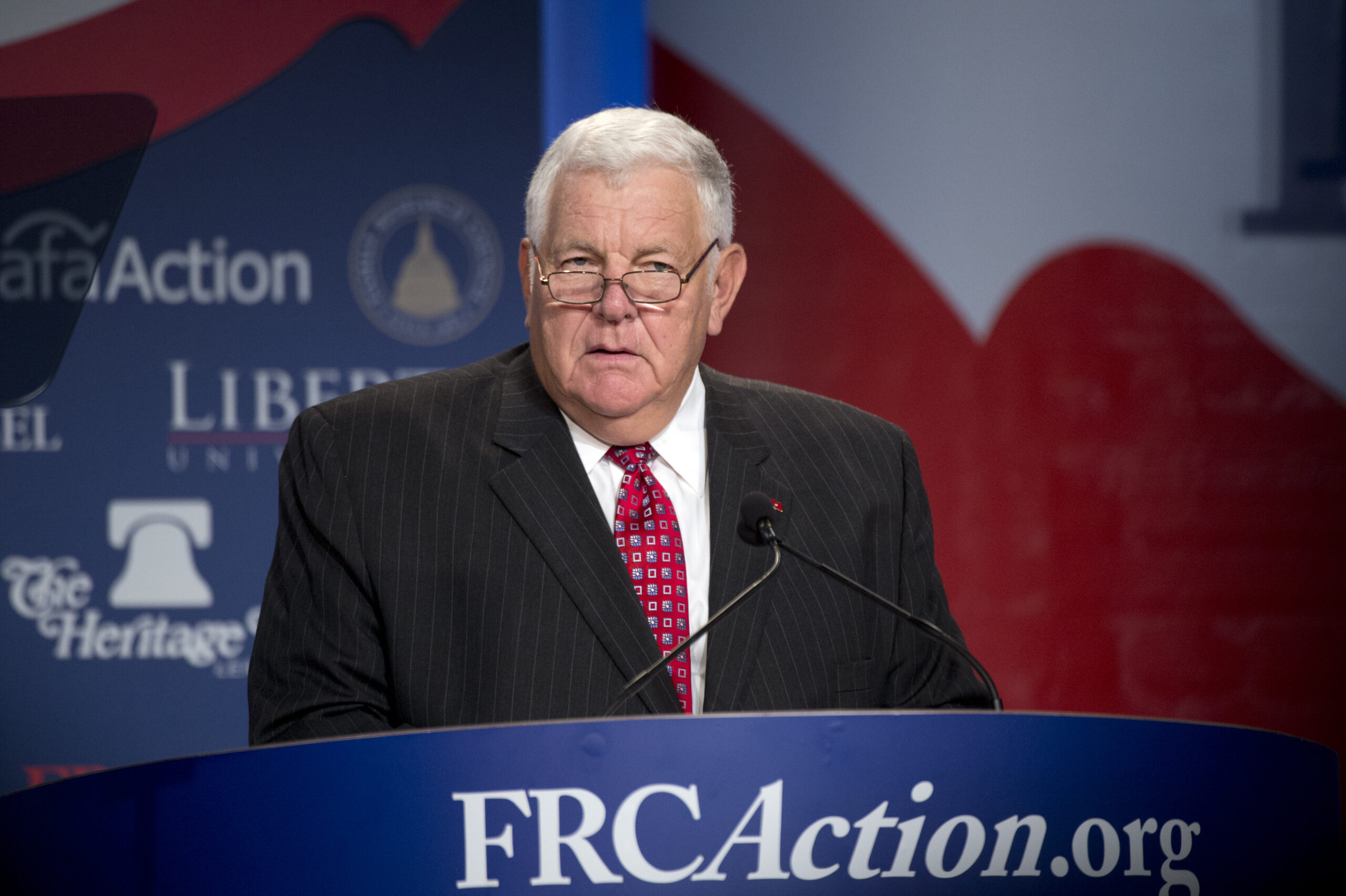
William Bennett, a former U.S. secretary of education under former President Ronald Reagan, registered in early July as an agent for Qatar, to advocate for the country on education-related issues, Jewish Insider’s Marc Rod reports.
Defending Qatar: Bennett, according to a Foreign Agents Registration Act filing first highlighted by analyst Eitan Fischberger, will receive a total of $210,000 over seven months to serve as a “senior education advisor” to the Qatari Embassy to “make efforts to publicize the fact that Qatari higher education efforts to do not support radical Islamicist movements or positions, and his engaging in publicized efforts — potentially including communications to U.S. political office holders — would help dispel contrary notions.”
WORDS OF WARNING
Lindsey Graham urges Israel to conduct itself in a way that maintains support in the U.S.
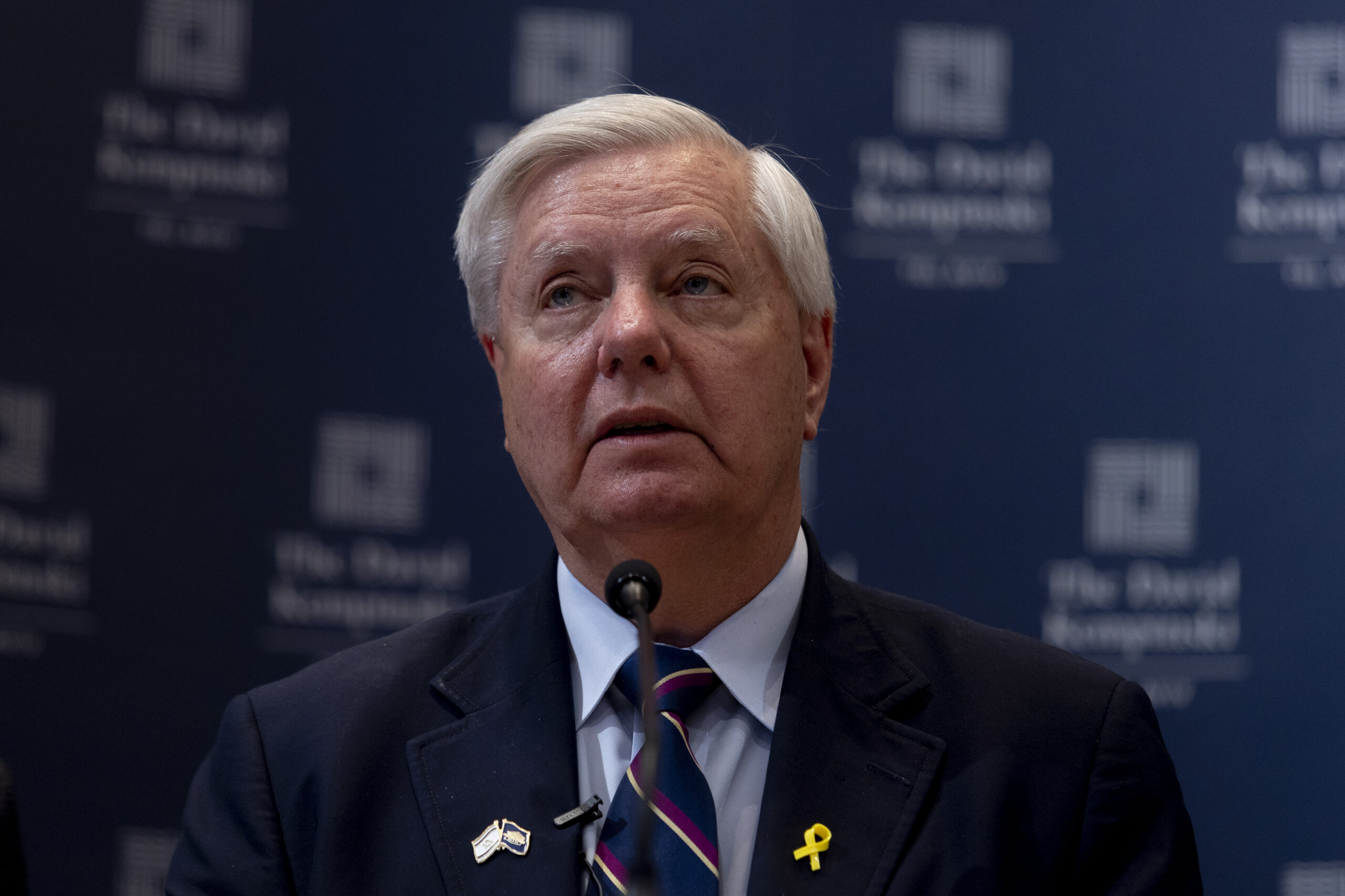
Sen. Lindsey Graham (R-SC) said that future military actions by Israel must be “conducted in a way to maintain support here at home” amid backlash to the Jewish state’s most recent operations in Syria and the strike that killed three at a Catholic church in Gaza. Speaking to Jewish Insider’s Emily Jacobs from the Capitol on Tuesday, Graham warned that Christians in the West Bank must not face the same fate as other Middle Eastern Christian communities, including in Syria, where as many as 1,000 Christians were killed between the fall of former Syrian leader Bashar al-Assad in November and March of this year under the new Syrian government.
Protecting the community: “Support for Christians throughout the region is eroded, and we need to make sure that doesn’t happen in the West Bank,” Graham told JI when asked how Israel had handled the backlash against its recent military actions in Gaza, last week’s fatal strike on the Holy Family Catholic Church, the only Catholic church in Gaza, and reports of an arson attack in the area of the fifth-century Church of St. George in the West Bank town of Taybeh — which an Israeli police probe found to be unfounded, stating that the fire had been “in an adjacent open area, with no buildings, no crops, and no infrastructure of the site damaged.”
union dues
Jonathan Greenblatt ‘pleased’ with NEA reversal but says ADL is ‘still in this fight’

Days after the National Education Association walked back a decision by its members to cut ties with the Anti-Defamation League, ADL CEO Jonathan Greenblatt praised the move but cautioned that the union still has a “long way to go” toward making clear that it respects the Jewish community, he said in an interview on Monday. “I am glad that they recognize what’s wrong about calling out the most consequential organization fighting antisemitism at a time of rising antisemitism,” Greenblatt told Jewish Insider’s Gabby Deutch. “Yet at the same time, there are elements of even the statement that lead me to believe that we’re still in this fight. We’ve got a long way to go to make sure that the ADL and our community is respected for who we are.”
Caveats: While the board of directors of the NEA — the largest teachers union in the country — condemned antisemitism in the statement released last week, the board also stated that the organization’s rejection of the anti-ADL measure was “in no way an endorsement of the ADL’s full body of work.” Further, the NEA called on the ADL “to support the free speech and association rights of all students and educators.”
DOUBLING DOWN
Columbia anti-Israel activist Mahmoud Khalil refuses to condemn Hamas in CNN interview

Anti-Israel activist Mahmoud Khalil, who was a prominent leader of the Columbia University protest movement, repeatedly declined to condemn Hamas in a CNN interview on Tuesday, Jewish Insider’s Haley Cohen reports.
No straight answer: “It’s disingenuous to ask about condemning Hamas while Palestinians are the ones being starved now by Israel,” Khalil told CNN’s Wolf Blitzer and Pamela Brown when asked whether he condemns the U.S.-designated terrorist organization. Khalil also accused the Trump administration of “weaponizing antisemitism” to “silence my speech” and denied that he engaged in any antisemitic activity.
250 years later
Experts champion Jewish education as the key to thriving Jewish communities

Making Jewish education more accessible is the key to many of the challenges facing American Jews today, several Jewish leaders said on Monday at a conference on the future of American Jewry, held at the UJA-Federation of New York headquarters in Manhattan, Jewish Insider’s Haley Cohen reports for eJewishPhilanthropy.
Community questions: Drawing inspiration from the teachings of the late Rabbi Lord Jonathan Sacks, some 100 rabbis, lay leaders, entrepreneurs and CEOs of Jewish organizations debated how to expand Jewish education — as well as a number of other issues facing American Jewry — at the daylong conference organized by Reut USA and The Rabbi Sacks Legacy. “A greater threat even than the antisemites is our own well-being internally, our own loss of identity, our own distance from our history, values and knowledge from our texts,” Elan Carr, CEO of the Israeli-American Council and former U.S. special envoy for monitoring and combating antisemitism in the first Trump administration, told attendees.
Read the full story here and sign up for eJewishPhilanthropy’s Your Daily Phil newsletter here.
MONEY MATTERS
House Appropriations Committee backs funding increase for antisemitism envoy
Republicans on the House Appropriations Committee’s National Security, Department of State and Related Programs subcommittee are backing a significant increase in funding for the State Department’s special envoy to monitor and combat antisemitism, Jewish Insider’s Marc Rod reports.
New provisions: The explanatory report accompanying the subcommittee’s 2026 funding bill, which it advanced last week, proposes $2.5 million for the office, up from the $1.75 million provided in 2024 and 2025. The report also includes provisions requesting new oversight mechanisms for U.S. funding abroad to combat the Boycott, Divestment and Sanctions movement that targets Israel and prevent U.S. funding of political groups. It additionally raises concerns about Turkey’s relationship with Hamas. And it offers funding for cultural heritage projects in Israel, like the City of David.
Worthy Reads
Isn’t It Rich: On her podcast “Honestly,” The Free Press’ Bari Weiss interviews journalist and author Evan Osnos about the evolution of technology and industry and his new book, The Haves and Have-Yachts, which looks at American wealth in today’s society. “Not only is it going to mean that our jobs are suddenly in much shorter supply, that kids coming out of school, as we’re already seeing today, are finding themselves in a much harder position to find that first job and get that first rung on the job ladder, but also our whole sense of purpose as an individual. I mean, the first time that you pick up your phone and realize that it is able to do your job better than you are, to reach judgments, to parse complicated, conflicting pieces of information, that’s going to be also a crisis of meaning and purpose in our society.” [Honestly]
The Case Against Genocide: The New York Times’ Bret Stephens counters a recent NYT op-ed accusing Israel of committing genocide. “In short, the first question the anti-Israel genocide chorus needs to answer is: Why isn’t the death count higher? The answer, of course, is that Israel is manifestly not committing genocide, a legally specific and morally freighted term that is defined by the United Nations convention on genocide as the ‘intent to destroy, in whole or in part, a national, ethnical, racial or religious group, as such.’ … But bungled humanitarian schemes or trigger-happy soldiers or strikes that hit the wrong target or politicians reaching for vengeful sound bites do not come close to adding up to genocide. They are war in its usual tragic dimensions.” [NYTimes]
The Fruits of Brokering: The Guardian’s Nesrine Malik looks at Qatar’s efforts to become a “global middleman” that facilitates conversations aimed at resolving local and regional conflicts, as part of its broader ambitions to become a major global player. “‘This is a job that not many people do,’ minister of state Al-Khulaifi told me. ‘Sometimes we feel like we are doctors, trying to develop the right solution for the most complicated cases, trying to offer them the medicine they need.’ The rewards Qatar seeks from this work are not immediate, tangible ones. They’re not looking for investment opportunities, access to raw materials or a say in what happens after a deal is agreed. ‘They don’t ask anything from the participants,’ said one source who had recently been involved in a Qatari-brokered mediation process. The source’s counterpart on the other side echoed his comments: ‘All they wanted was to be recognised as a player.’ The fruits of the brokering – building status and trust, which in turn deepen international influence and relationships – are the prize.” [TheGuardian]
The “Z” Word: In The Wall Street Journal, Rabbi Avi Shafran considers how the term “Zionist” is used by both Israel’s supporters and opponents. “How Israel wages that war is rightly open to criticism, but it is subject, too, to reasoned defense. When someone angrily shouts ‘Zionist!’ at those who offer the latter, that person is using the word to portray defenders of Israel as monstrous murderers. It is meant to defame as evil the belief that Hamas and other terrorist entities need to be destroyed. … Civilians suffer and die in the prosecution of justifiable, even necessary, wars. That tragedy is intensified when you are fighting an enemy who hides behind human shields. Eradicating the engines of terror in Gaza requires attacking the places from which they operate: hospitals, schools and mosques. But whatever one thinks of Israel’s actions, this twisted definition of “Zionist” as evildoer fails the basic purpose of a word: It reveals nothing about its purported subjects, and everything about their accusers.” [WSJ]
Word on the Street
U.S. Ambassador to Turkey Tom Barrack, who is also serving as the White House’s Syria envoy, is convening U.S., Israeli and Syrian officials on Thursday to discuss security measures in Syria following last week’s sectarian violence; ahead of the meeting, Barrack said he advised Syrian President Ahmed al-Sharaa to reconsider some of Damascus’ policies regarding military structure and the integration of minority communities…
U.S. Ambassador to Israel Mike Huckabee met on Tuesday in Ramallah with Palestinian Authority Vice President Hussein al-Sheikh; the meeting underscores the change in approach to the Trump administration by the PA, which had previously refused to meet with Ambassador David Friedman when he served as ambassador during the first Trump term…
Sens. Jacky Rosen (D-NV) and James Lankford (R-OK) led more than a dozen Senate lawmakers on a letter to X owner Elon Musk, raising concerns over his xAI’s inability to take “reasonable measures” to keep its Grok chatbot from engaging in hate speech…
The House Financial Services Committee voted Tuesday to advance a bill that would place a series of conditions on the lifting of U.S. human rights sanctions on Syria, after a debate over whether the U.S. should instead pursue complete sanctions relief for the new Syrian government, Jewish Insider’s Marc Rod reports…
The House Foreign Affairs Committee voted on Tuesday to advance legislation that aims to expedite arms sales to U.S. partners that are members of the Abraham Accords, as well as bills to review the U.S.-South Africa relationship and to combat the proliferation of Western-made parts in Iranian drones, Jewish Insider’s Marc Rod reports…
Columbia University suspended or expelled more than 70 students who participated in disruptive anti-Israel protests at the school’s Butler Library and at the campus’ encampment last year…
The New York Times reports on the controversy surrounding the funding behind the revitalization of Germany’s Hamburg State Opera; the funding for the project comes from German billionaire Klaus-Michael Kühne, whose family’s company collaborated with the Nazis during World War II to transport items looted from European Jews…
The Qatar Olympic Committee confirmed it is engaging in conversation with the International Olympic Committee as part of a bid to host the 2036 Olympic and Paralympic Games…
The planned launch of Gila and Nancy, a new restaurant in Berlin from Eyal Shani and Shahar Segal, was postponed by several weeks following anti-Israel protests outside the restaurant…
Palestinian Islamic Jihad said it lost contact with the captors of Israeli hostage Rom Braslavski, who is believed to be held alone; PIJ in April released a video of Braslavski, who was kidnapped from the Nova music festival on Oct. 7, 2023…
Avera Mengistu, who was held in Gaza for over a decade before his release earlier this year, was released from Tel Aviv’s Ichilov hospital after five months; the Ethiopian-Israeli man, who suffers from mental illness, will be moved into a special residential facility…
The New York Times reports on a string of near-daily fires and explosions across Iran in recent weeks that regime authorities increasingly believe are part of a coordinated sabotage campaign…
Saudi Arabia’s investment ministry said it will convene a Saudi-Syrian investment forum in Damascus to help spur economic development in the country…
The Wall Street Journal does a deep dive into the origins of the recent sectarian violence in Syria…
Pic of the Day

Actor Gal Gadot (second from left) met on Tuesday with former Israeli hostages (from left) Moran Stela Yanai, Doron Steinbrecher, Naama Levy and Liri Albag. Not pictured is Ilana Gritzewsky, who also joined the group.
Birthdays

Starting right fielder for Team Israel at the 2017 World Baseball Classic, Zach Borenstein turns 35…
Banker who distributed $60 million to his 400 employees when he sold City National Bank of Florida in 2008, Leonard L. Abess turns 77… Former U.S. ambassador to the Netherlands, she was the chair of the Harry and Jeanette Weinberg Foundation until 2023, Fay Hartog-Levin turns 77… Retired after serving for 32 years on the U.S. Court of Appeals for the 9th Circuit, Judge Alex Kozinski turns 75… Businessman and real estate investor who made his fortune in the trade and manufacture of fertilizer in the former Soviet Union, Alexander Rovt turns 73… Senior rabbi of the Great Neck Synagogue for over 30 years, he served as president of the Rabbinical Council of America, Rabbi Dale Polakoff turns 68… President of the Marcus Foundation founded by the late Bernie Marcus of Home Depot, Jay Kaiman… Proprietor of Oy Vey Jewish Bakery and Delicatessen in Terre Haute, Ind., Chavah Stair… Freelance journalist, she is the widow of Daniel Pearl and wrote a book about his kidnapping and murder in Pakistan in 2002, Mariane Pearl turns 58… Director, producer and actor in movies and television, Shawn Adam Levy turns 57… Executive director and chief creative officer at the Milken Center for Advancing the American Dream, Rachel Eva Goslins turns 56… U.S. senator (D-GA), Raphael Warnock turns 56… Dov M. Katz… Freelance television writer and author of two books, Joel Stein… Psychologist in private practice in both Manhattan and Great Neck, Long Island, Lynn Glasman, Ph.D…. Activist and fashion designer, Monica Lewinsky… Israeli film actress best known for her performances as a Jedi Master in the “Star Wars” prequel trilogy, Orli Shoshan turns 51… Music producer and songwriter, Jonathan Reuven “J.R.” Rotem turns 50… Professor at Georgetown University Law Center, Itai Grinberg… Singer, he represented Israel in the 2001 Eurovision Song Contest, Tal Sondak turns 49… Radio disc jockey, television show host and professional wrestling personality, Peter Elliot Rosenberg turns 46… Mayor of Minneapolis since 2018, Jacob Lawrence Frey turns 44… Sports studio host and play-by-play announcer for Westwood One, Sirius XM and ESPN, Jason M. Horowitz… Comedian and actor, Rick Glassman turns 41… Reporter for The Washington Post, Perry Stein… Joseph Stern…
In an interview with JI, Sen. Lindsey Graham said Israel is ‘the most tolerant place in the region’ but must be careful to ‘maintain support’ in the U.S.

Amir Levy/Getty Images
Senator Lindsey Graham (R-SC) speaks at a press conference on US-Israel relations on February 17, 2025 at the Kempinski Hotel in Tel Aviv, Israel.
Sen. Lindsey Graham (R-SC) said that future military actions by Israel must be “conducted in a way to maintain support here at home” amid GOP backlash to the Jewish state’s most recent operations in Syria and the strike that killed three at a Catholic church in Gaza.
Speaking to Jewish Insider from the Capitol on Tuesday, Graham warned that Christians in the West Bank must not face the same fate as other Middle Eastern Christian communities, including in Syria, where as many as 1,000 Christians were killed between the fall of former Syrian leader Bashar al-Assad in November and March of this year under the new Syrian government.
“Support for Christians throughout the region is eroded, and we need to make sure that doesn’t happen in the West Bank,” Graham told JI when asked how Israel had handled the backlash against its recent military actions in Gaza, last week’s fatal strike on the Holy Family Catholic Church, the only Catholic church in Gaza, and reports of an arson attack in the area of the fifth-century Church of St. George in the West Bank town of Taybeh — which an Israeli police probe found to be unfounded, stating that the fire had been “in an adjacent open area, with no buildings, no crops, and no infrastructure of the site damaged.”
“I think it’s very important for us to stand up for Americans wherever they’re at, minority faiths, particularly the Christian faith. As to Israel, it is the most tolerant place in the region for minorities. They’re in a war for their lives, but we’ve got to make sure that the war is conducted in a way to maintain support here at home,” he continued.
His comments reflect recent unease within the Trump administration over Israel’s latest military actions. U.S. Ambassador to Israel Mike Huckabee visited the Church of St. George on Saturday, where he decried the attack as an “act of terror” and demanded “harsh consequences” for the perpetrators, while White House Press Secretary Karoline Leavitt said on Monday that President Donald Trump was “caught off guard” by the moves.
The strike on the church in Gaza killed three and injured 10, including a priest. Following a conversation between Trump and Israeli Prime Minister Benjamin Netanyahu, the latter publicly apologized and vowed to investigate what his office described in a statement as “stray ammunition” hitting the house of worship.
The South Carolina senator added that the Taybeh fire and the killing of 20-year-old Palestinian American Saifullah Musallet in the West Bank earlier this month, which the IDF is investigating as possibly being perpetrated by Israeli settlers, should be prosecuted to the fullest extent of the law.
“The attempted arson, whatever you want to call it, I don’t know who did it but I’m glad the church was saved. The Israeli police said that no damage was done. Just keep looking. The 20-year-old Palestinian American, keep investigating,” Graham said, going on to praise Netanyahu’s decision to call Pope Leo XIV after the church attack in Gaza.
Graham emphasized his continued support for Israel, which he argued should be differentiated as a state and a people from individual or small groups of Israelis committing acts of violence in the West Bank.
“There may be some rogue settlers, but they are not Israel. I think Israel, through its very founding, has demonstrated religious tolerance better than any country in the region, and, quite frankly, Israel is about as good as any place in the world. Do you have some aggressive settlers? Maybe so, I don’t know, but I’m not going to judge an entire country by some people,” Graham said.
“The issue is not whether Israel has abandoned Christians. It’s whether or not the damage that’s been done to the Christian community, will those responsible be held accountable?” he asked.
Graham said he hoped to be helpful to both sides as daylight between the White House and Netanyahu over Israel’s actions in Syria entered public view, explaining that he was amenable to the points of view of the Trump administration and the Israelis.
“As to Israel, their security concerns in Syria are legitimate. They’re very important to me, but I also want to help the president with his efforts to integrate the country. So there’s some tension, and I hope we can clear it up,” he said.
He explained that finding out which parties were responsible for the recent attacks on Druze minorities in the war-torn country was a critical next step, and would help establish whether the U.S. needs to reimpose sanctions on Syria.
“It has been the policy of the Trump administration to lift sanctions and give [Syrian leader Abu Mohammed al] Jolani a chance. This fight between the Druze and the Bedouins, what role did the Syrian army play? I don’t know. Israel has been making the argument that the Syrian regular army forces were part of the massacre, that’s very important to me. If that proves to be the case, we’ll reimpose sanctions. If it proves not to be the case, then I want to know that also,” Graham said.
“What role did the Syrian army regime forces play in all this and how much control do they have of this coalition that they formed? That, to me, is the most important question. Is Syria under the command and control of the government? If it’s not, what factions are outside their control? And let’s try to fix it,” he continued.
Pressed by CNN anchor Pamela Brown, Khalil said: ‘I hate the selective outrage of condemnation because this wouldn’t lead to a constructive conversation’

Spencer Platt/Getty Images
Palestinian activist Mahmoud Khalil, who was released from ICE detention, speaks during a rally on the steps of the Cathedral of St. John the Divine in Manhattan on June 22, 2025 in New York City.
Anti-Israel activist Mahmoud Khalil, who was a prominent leader of the Columbia University protest movement, repeatedly declined to condemn Hamas in a CNN interview on Tuesday.
“It’s disingenuous to ask about condemning Hamas while Palestinians are the ones being starved now by Israel,” Khalil told CNN’s Wolf Blitzer and Pamela Brown when asked whether he condemns the U.S.-designated terrorist organization. “It’s not condemning Oct. 6, where 260 Palestinians were killed by Israel before Oct. 7. I hate the selective outrage of condemnation because this wouldn’t lead to a constructive conversation.”
Khalil also accused the Trump administration of “weaponizing antisemitism” to “silence my speech” and denied that he engaged in any antisemitic activity.
Khalil, a U.S. green card holder, was detained in March with the Trump administration claiming that he posed adverse foreign policy consequences to the country, though he was never charged with a crime. Last month, Khalil was released from the immigration detention center where he had been held for three months after a district judge said it would be “highly, highly unusual” for the government to continue detaining a legal U.S. resident who was unlikely to flee and hadn’t been accused of any violence.
In response to Khalil’s remarks, the Department of Homeland Security doubled down on its allegations against him.
“Mahmoud Khalil refuses to condemn Hamas because he IS a terrorist sympathizer not because DHS ‘painted’ him as one,” DHS wrote on X. “He ‘branded’ himself as antisemite through his own hateful behavior and rhetoric.”
“It is a privilege to be granted a visa or green card to live and study in the United States of America,” the DHS post continued. “The Trump Administration acted well within its statutory and constitutional authority to detain Khalil, as it does with any alien who advocates for violence, glorifies and supports terrorists, harasses Jews, and damages property.”
Just one day after his release, Khalil, who grew up in Syria but is of Palestinian descent, appeared at a rally in New York City organized by a group accused of ties to the Iranian regime protesting the U.S.’ airstrikes on Iran’s nuclear facilities.
Good Tuesday morning.
In today’s Daily Kickoff, we talk to Jewish Capitol Hill staffers in Democratic offices who feel increasingly isolated at work over their colleagues’ growing antipathy toward Israel and antisemitism, and report on the Young Democrats of America’s decision to accuse Israel of genocide in its updated foreign policy plank. We report on the latest developments following Israel’s just-launched ground operations in Deir al-Balah, Gaza, and look at the critical approaches to Israel being taken by GOP challengers to freshman Rep. Nellie Pou in New Jersey. Also in today’s Daily Kickoff: David Ellison, Sam Altman and Rep. Andrew Garbarino.
What We’re Watching
- A number of House committees are meeting for hearings and markups this week. This morning, we’re keeping an eye on a House Foreign Affairs Committee markup that includes a bill expediting arms sales to Abraham Accords signatories. Read more here.
- At 10:30 a.m. ET, the House Financial Services Committee is holding a markup that includes new legislation introduced by Rep. Mike Lawler (R-NY) that aims to create oversight and set conditions for lifting sanctions on Syria. Read more here.
- On the Senate side of the Capitol, the Senate Armed Services Committee is holding a confirmation hearing for the Navy’s Vice Adm. Frank Bradley to be head of Special Operations Command.
- At noon, the American Jewish Congress is holding a virtual briefing with Gaza Humanitarian Foundation Executive Director Johnnie Moore.
- Elsewhere in Washington, OpenAI CEO Sam Altman will appear today at a Federal Reserve conference to push the economic benefits of artificial intelligence.
- Tonight, UJA-Federation of New York is hosting a bnai mitzvah party for more than three dozen Israeli teenagers who have lost a parent on or since Oct. 7, 2023. The IDF Widows and Orphans Organization facilitated the trip.
- And in Israel, the Israel Democracy Institute is holding a conference in Jerusalem focused on the Knesset’s upcoming summer recess, which begins on Sunday.
What You Should Know
A QUICK WORD WITH JI’S MELISSA WEISS
It’s a scenario that has played out many times over since Oct. 7, 2023: Against the backdrop of ceasefire and hostage-release negotiations, Israeli actions in Gaza draw widespread condemnation. World leaders call for a ceasefire. Amid that growing criticism, Hamas, sensing increased pressure on Israel, responds by escalating its demands or backing away from negotiations entirely.
This week is no different, with Israel’s launch on Monday of a ground operation in central Gaza’s Deir al-Balah, where it had not previously operated, the same day that more than two dozen Western countries released a joint statement calling for “unconditional and permanent ceasefire.” Hamas negotiators in Doha, Qatar, have reportedly spent the last two weeks dragging out ceasefire talks, over issues ranging from the number of Palestinian prisoners to be released to the areas where the IDF is allowed to operate.
In yesterday’s statement, the countries’ demand of Hamas is only for the “immediate and unconditional release” of the remaining 50 hostages, with no mention of disarmament or the terror group’s removal from power — key Israeli demands since Hamas’ brutal attacks on the Jewish state almost two years ago.
Hamas has since October 2023 faced limited pressure to acquiesce to Israeli and American demands. The terror group’s backers in Doha, where senior Hamas officials have long lived in opulence and security, have similarly faced little international pressure — even as Qatar plays a key role in negotiations. Israel has not been a perfect actor, and at times has walked away from the negotiating table. But Jerusalem’s refusals have been outpaced by Hamas’ intransigence, the latter of which has frustrated White House officials in both the current and former administrations.
CAPITOL CLIMATE
The new normal for Jewish Democratic staffers on Capitol Hill: isolated, fearful, united

Many of the liberal-minded Jewish staffers on Capitol Hill came to Washington to work on issues such as reproductive rights, access to health care and environmental policy. But for nearly two years — following the Oct. 7, 2023, Hamas attacks on Israel and the ensuing war in Gaza — they have had to navigate a professional environment that demands an air of detached professionalism while their fellow staffers and Democrats writ large adopt a more critical approach to Israel and antisemitism. Several Democratic Jewish staffers, ranging from junior aides to chiefs of staff — most of whom requested anonymity, wary of being made a target of antisemitism and concerned about putting themselves at risk professionally at a time when Democratic jobs are hard to come by — told Jewish Insider’s Gabby Deutch and Danielle Cohen-Kanik that, in the face of growing antipathy to Israel and continued antisemitic terror and threats, they have turned to each other to build a tight-knit community among Jews working on Capitol Hill.
Ties that bind: “It has led to increased camaraderie and dialogue and kind of just a common understanding and bond … We work for a lot of different members: members who are Jewish, members who are not Jewish, members who one of their main issues is the U.S.-Israel relationship, members who are not mainly concerned with it,” a legislative aide for a Democratic member of Congress. “But nonetheless, I think a lot of us are united and brought together by the aftermath of Oct. 7.”
POLICY SHIFT
Young Democrats of America calls Israel’s war in Gaza ‘ongoing genocide’
The Young Democrats of America, a leading youth advocacy group representing party members under the age of 36, approved a new platform at its recent national convention accusing Israel of “genocide” in Gaza, raising long-simmering internal tensions over Middle East policy, Jewish Insider’s Matthew Kassel reports.
Amendment: The organization, whose biennial convention concluded in Philadelphia on Saturday, narrowly passed an amendment expressing opposition to the “Israeli government’s ongoing genocide in Gaza, its occupation of the West Bank, and its denial of civil and political rights on an equal basis in the territories it militarily occupies,” according to an updated foreign policy plank reviewed by JI. The change, which added the “genocide” reference to an existing amendment, was proposed “to reflect current events and align with present-day actions,” according to a platform committee document from the convention.
MILITARY MANEUVERS
IDF enters Gaza’s Deir al-Balah, amid renewed international call for a ceasefire

The IDF entered the central Gaza city of Deir al-Balah for the first time on Monday, amid stalled hostage and ceasefire negotiations in Doha, Qatar. The maneuver in Deir el-Balah began a day after an evacuation order from the city, built on the Mediterranean coast around an UNRWA refugee camp. Israeli officials believe some of the remaining 50 hostages may be held in the area. In June 2024, the IDF freed four hostages, Noa Argamani, Shlomi Ziv, Almog Meir Jan and Andrey Kozlov in a raid in adjacent Nuseirat, Jewish Insider’s Lahav Harkov and Tamara Zieve report.
Background: Deir el-Balah has been relatively unscathed during the war that began after the Hamas terrorist attacks on southern Israel on Oct. 7, 2023. The April 2024 incident in which the IDF killed World Central Kitchen aid workers whom it had mistakenly identified as terrorists took place near Deir el-Balah. Before the latest operation in the Gaza war began in May, a senior defense official told JI that the plan was to start from Gaza’s perimeter and work its way to the center, which the military now appears to be doing.
Presidential surprise: White House Press Secretary Karoline Leavitt said on Monday that President Donald Trump was “caught off guard” by recent Israeli actions in Syria and Gaza, noting that he had called Israeli Prime Minister Benjamin Netanyahu to air his concerns, Jewish Insider’s Emily Jacobs reports.
representation consternation
Minneapolis Jews sound an early alarm on Democratic Party endorsement of DSA lawmaker
Jewish community activists in Minneapolis are voicing concerns about the rise of state Sen. Omar Fateh, a far-left lawmaker who, in a surprise upset, narrowly clinched the state Democratic Party endorsement on Saturday against incumbent Mayor Jacob Frey, Jewish Insider’s Matthew Kassel reports. Fateh, a 35-year-old democratic socialist, has rarely commented on Israel or rising antisemitism during his time in the state Senate, even as he called for a ceasefire in the war between Israel and Hamas just 10 days after the Oct. 7, 2023, terror attacks.
Community concerns: Fateh’s close alliances with anti-Israel voices such as the Twin Cities arm of the Democratic Socialists of America — which backs efforts to boycott and divest from Israel — have raised questions over his approach to key issues and his potential outreach to the organized Jewish community as he vies for the mayorship. In its mayoral endorsement questionnaire, the DSA asked candidates to pledge “to refrain from any and all affiliation with the Israeli government or Zionist lobby groups” — citing AIPAC, J Street and even the nonpartisan Jewish Community Relations Council.
pino’s positions
Israel record of Rosemary Pino, leading GOP candidate against Rep. Nellie Pou, raises questions
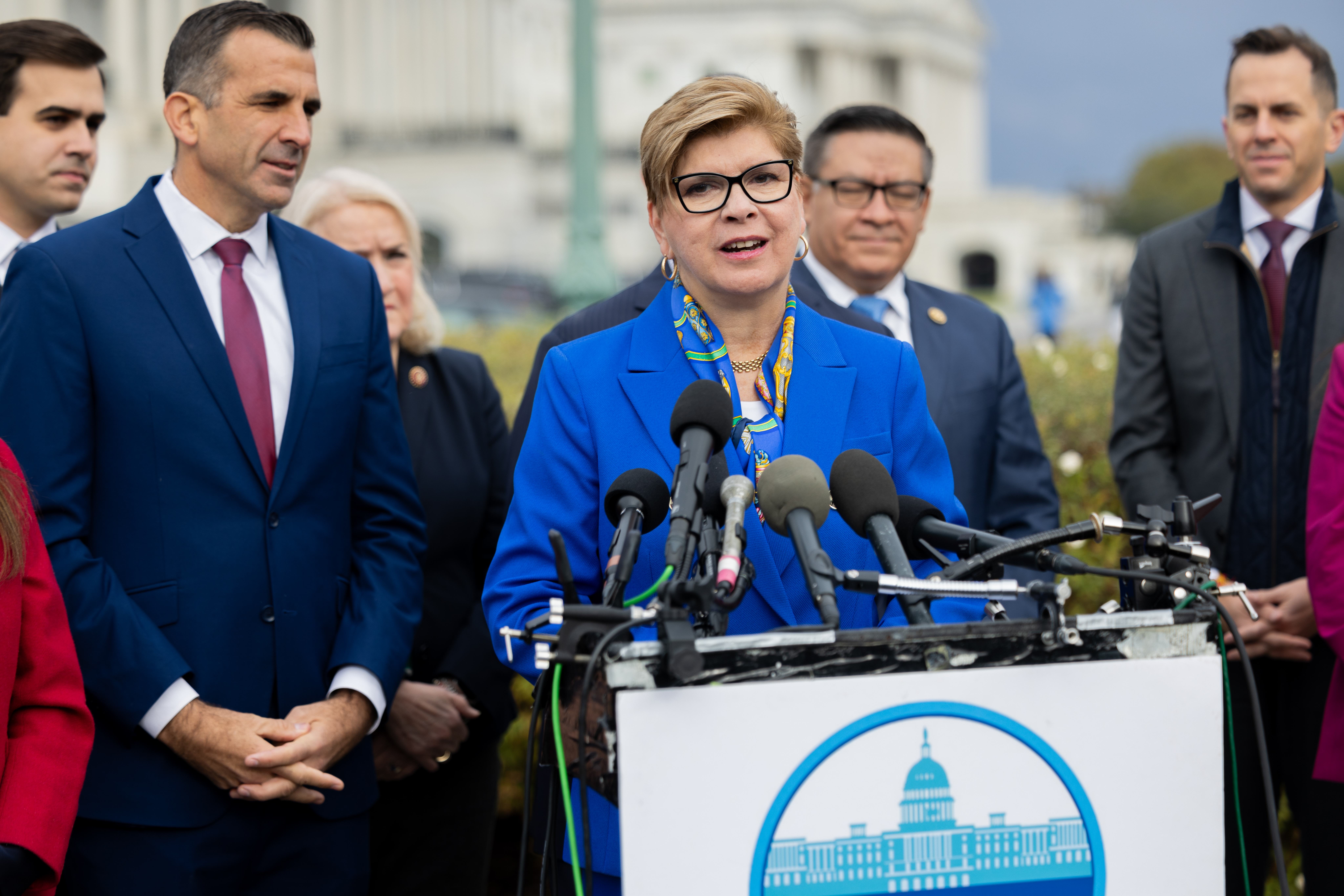
The leading Republican candidates in a New Jersey swing district that President Donald Trump narrowly carried in 2024 hold questionable track records on Israel and antisemitism — in sharp contrast to most GOP candidates across the country, Jewish Insider’s Marc Rod reports.
The latest: Rosemary Pino, the Clifton, N.J., City Council member who recently entered the race against Rep. Nellie Pou (D-NJ), posted a video last month from a Palestinian flag-raising event in Clifton where speakers accused Israel of genocide, though she told JI her attendance at the event did not signal support for the sentiments expressed, and that she supports the U.S.-Israel relationship. Pino also expressed concerns in 2023 about city council legislation that would have adopted the International Holocaust Remembrance Alliance’s working definition of antisemitism. She told JI she “strongly condemn[s] antisemitism in all shapes and forms.”
GEN Z OUTREACH
Netanyahu says young people will ‘wise up’ to oppose Mamdani’s policies if elected
Israeli Prime Minister Benjamin Netanyahu argued that young people in America are won over “pretty quickly” by the truth about the situation in Israel, when discussing New York City Democratic mayoral candidate Zohran Mamdani on a podcast released Monday, and suggested that Mamdani’s policies would be unpopular if he’s elected, Jewish Insider’s Marc Rod reports.
Quotable: “A lot of people have been taken in by this nonsense,” Netanyahu said, on the “Full Send” podcast, hosted by a social media influencer group called the Nelk Boys popular with young men. “Sometimes folly overtakes human affairs for a while, but not for long, because reality steps in,” Netanyahu continued. “I’m obviously not happy with it, but I’m less concerned with it, because I think if we can speak the truth to the young people of America, they wise up pretty quickly.”
Worthy Reads
Postwar Patriotism in Tehran: The New York Times’ Erika Solomon and Sanam Mahoozi look at how Iran has channeled its recent military losses and attacks on its nuclear program into a resurgent nationalism. “Iran has emerged from its war with Israel — briefly joined by the United States — deeply wounded. … Amid that bleak outlook, the country’s leaders see an opportunity. Outrage over the attacks has sparked an outpouring of nationalist sentiment, and they hope to channel that into a patriotic moment to shore up a government facing daunting economic and political challenges. The result has been an embrace of ancient folklore and patriotic symbols that many of Iran’s secular nationalists once saw as their domain, not that of a conservative theocracy that often shunned Iran’s pre-Islamic revolutionary heritage.” [NYTimes]
The Gaza Tragedy: The Washington Post’s David Ignatius considers how the humanitarian situation in Gaza has approached the brink of collapse. “At the heart of this catastrophe is that Hamas and Israel seem unable to end a war that has been ruinous for both sides. Hamas is beaten but won’t surrender, and it seems eager to manipulate the chaos. Israel has won but has failed to consolidate its victory with a transitional scheme for governance that would replace Hamas with an Arab force backed by the Palestinian Authority. Meanwhile, the remaining Israeli hostages are trapped in this unending nightmare.” [WashPost]
Mandy’s Wrong Note: In his Substack, Michael Granoff responds to actor Mandy Patinkin’s recent comments critical of Israeli Prime Minister Benjamin Netanyahu and Israel’s war against Hamas. “Finally, Mandy, one of my favorites of your recording, is your brilliant medley of ‘Everybody Says Don’t,’ from Sondheim’s ‘Anyone Can Whistle,’ and ‘The King’s New Clothes.’ The emotion you convey at the climax of the latter number, ‘…one little boy who for some reason didn’t know what he was SUPPOSED TO SEE…’ I bet you always fancied yourself that virtuous little boy. But you know what? You are actually with ‘the Ministers, the Ambassadors, the Counts and the Dukes,’ who repeat the lie promulgated by terrorists and by institutions like the United Nations, the International Criminal Court, Al Jazeera, and more. The King’s new clothes? Those are the accusations against us – apartheid, war criminals, baby killers, genocide. Lies just as naked as the king.” [Substack]
Messing’s Message: In The Times of Israel, actress Debra Messing reflects on the rise of antisemitism in the progressive movement where she had long found a political home. “What troubles me most is not the presence of hate. Hate has always found a way to survive. What troubles me is the way it is being rationalized. Dismissed. The way it is reframed as something noble. The way it becomes invisible, especially to those who should know better. Jewish safety and progressive values should never be in conflict. If they are, we have to ask whether we’ve drifted from our humanity. The test is whether progressivism stands firm, not just when it is easy but when it’s hard; when it forces us to confront multiple truths. In the end, every movement tells you who belongs by what it is willing to protect. I still believe in the progressive vision. But I’m watching closely, because if it can’t make space for my community, then it’s not what it claims to be.” [TOI]
Word on the Street
The Trump administration is reportedly planning to withdraw the U.S. from UNESCO over what it alleges is the body’s anti-Israel and pro-China bias, as well as its focus on diversity, equity and inclusion initiatives…
Rep. Andrew Garbarino (R-NY) was elected chair of the House Homeland Security Committee, following committee chair Rep. Mark Green’s (R-TN) resignation from Congress on Monday…
In a letter to members of the House Homeland Security Committee’s Counterterrorism and Intelligence subcommittee, the Jewish Federations of North America highlighted the significant security costs facing the Jewish community, as advocates push for additional security assistance from the federal government at a time of heightened antisemitism,Jewish Insider’s Marc Rod reports…
The Bronx campaign office of Rep. Alexandria Ocasio-Cortez (D-NY) was vandalized with anti-Israel graffiti days after the New York Democrat voted against an amendment pushed by Rep. Marjorie Taylor Greene (R-GA) to end funding for Israel’s missile-defense programs…
Larry Ellison’s Oracle is in talks with Skydance Media, founded and led by Ellison’s son, David, over a potential $100 million annual deal that would take shape following Skydance’s acquisition of Paramount; the deal would see Paramount use Oracle’s cloud-sharing software…
The Wall Street Journal looks at the legal and financial battle between Fortress Investment Group and real estate investor Charles Cohen as Fortress attempts to seize hundreds of millions of dollars it says it is owed by Cohen…
The CEO and board chair of Friends of the IDF are stepping down, weeks after the leak of an internal report alleging internal dysfunction, inappropriate spending and a toxic work environment, eJewishPhilanthropy’s Judah Ari Gross reports…
An anti-Israel activist in New York City was arrested and charged with setting nearly a dozen police vehicles on fire last month; Jakhi McCray had previously been arrested in 2024 for torching Israeli and American flags outside the Israeli consulate in New York…
In its “Overlooked” series, The New York Times spotlights Soviet aviator Polina Gelman, who during World War II was part of an elite group of female navigators known as the “Night Witches”; Gelman, who died in 2005, was the only Jewish woman to earn the USSR’s Hero of the Soviet Union medal during the war…
A federal appeals court overturned the conviction of the man found guilty of kidnapping and killing 6-year-old Etan Patz in 1979; Pedro Hernandez will have a new trial — his third, after the first was deadlocked, prompting the 2017 trial that found him guilty…
Former Brigham Young University quarterback Jake Retzlaff is transferring to Tulane, following a seven-game suspension for violating BYU’s honor code…
The Washington Post looks at Hamas’ deepening financial crisis, as the terror group, which had not prepared for its war with Israel to extend past a year, finds itself unable to pay salaries and rebuild its vast underground tunnel system…
Israeli officials warned that the country’s port in Eilat is at risk of shutting down entirely unless it receives financial assistance, citing the impact of the Houthis’ constant ballistic missile attacks that have caused a 90% drop in activity at the Red Sea port…
Iranian Foreign Minister Abbas Araghchi told Fox News that Tehran will not give up its nuclear enrichment program, while an Iranian Foreign Ministry spokesperson said that the country will not resume nuclear talks with the U.S., despite planning to continue talks with European powers…
Iran launched a suborbital test flight satellite carrying Ghased rockets, the first time since last month’s war with Israel that Tehran has launched such a test…
Government offices, businesses and banks across Tehran will shutter tomorrow as the region faces a heat wave, with temperatures expected to exceed 104 degrees Fahrenheit…
Turkey is closing in on an agreement to purchase up to 40 Eurofighter Typhoon fighter jets; Ankara has been waiting on required approval from Germany, which had been stalled since 2023 over Berlin’s opposition to some elements of Turkish foreign policy…
Egyptian Prime Minister Mostafa Madbouly directed his government to prepare a package of joint Egypt-U.S. investment opportunities, as part of a broader effort to deepen Egyptian relations with Washington…
Real estate mogul Don Soffer, a key driver behind the establishment and development of Aventura, Fla., died at 92…
Former University of Baltimore Law School Dean and president of the Charles Crane Family Foundation, Larry Katz died at 85…
Pic of the Day

A delegation from the Conference of Presidents of Major American Jewish Organizations met on Monday with Israeli Foreign Minister Gideon Sa’ar in Jerusalem.
Birthdays

British biochemist and professor at the University of Dundee in Scotland, Sir Philip Cohen turns 80…
Actress, prominent in Israeli theater, television and film, Gila Almagor turns 86… British Conservative Party member of Parliament for 36 years until 2010, a leading figure in the fight against human trafficking in the UK and worldwide, Anthony Steen CBE turns 86… Historian, author and professor emerita at the University of Wisconsin-Madison, Judith Walzer Leavitt turns 85… Actor, director and comedian, Albert Brooks (born Albert Lawrence Einstein) turns 78… Past president of the Jewish Community Relations Council of Detroit, owner of Nodel Parks (operator of 37 manufactured home parks in nine states), Richard Martin Nodel… One of only 21 EGOT winners, including eight Academy Awards and 11 Grammy awards, pianist and composer of many Disney movie musical scores, Alan Menken turns 76… Owner of Baltimore’s Seven Mile Market, Hershel Boehm… Managing director of a German public affairs firm, he works to ensure that the Holocaust and its many victims are not forgotten, Terry Swartzberg turns 72… Publisher of the 5 Towns Jewish Times, Larry Gordon turns 72… Judge of the U.S. District Court for the District of Columbia since 2011 (senior status since May 2023), Judge Amy Berman Jackson turns 71… Canadian sports journalist, radio host and mental health advocate, Michael Elliott Landsberg turns 68… Member of the board of governors of the American Jewish Committee, Cindy Masters… Secretary of veterans affairs in the first year of the Trump 45 administration, David Jonathon Shulkin turns 66… Director of government relations for the Zionist Organization of America, Dan Pollak turns 66… Federal prosecutor for 25 years, she was the U.S. attorney for the Northern District of Alabama throughout the Obama administration, Joyce Alene Vance turns 65… Founding partner of the D.C.-based intellectual property law firm, Greenberg & Lieberman, Stevan Lieberman turns 60… Democratic member of the West Virginia House of Delegates since 2018, Evan Hansen turns 59… Television journalist, David Shuster turns 58… CEO of Leviathan Productions, focused on Jewish history, folklore and literature, Ben Cosgrove… Pentagon speechwriter during the prior administration, Warren Bass… Owner of West Bloomfield, Mich.-based Saltsman Industries and Saltsman Financial Group, Daniel A. Saltsman… Branch chief and senior advisor for policy and readiness at the U.S. Army, Jonathan Freeman… Contemporary artist, he is the founder and director of Pioneer Works, a cultural institution in Brooklyn, Dustin Yellin turns 50… Manager of global issues for ExxonMobil, Elise Rachel Shutzer… Associate justice on the New Jersey Supreme Court, Rachel Wainer Apter turns 45… Former White House assistant press secretary, now the executive producer for news and politics at Crooked Media, Reid Cherlin… White House correspondent at The Independent, Andrew Grant Feinberg turns 43… Member of the House of Representatives (D-RI) since 2023, Seth Michael Magaziner turns 42… Executive director of the American Sephardi Federation since 2014, Jason Guberman-Pfeffer… Actor best known for his role in the Freeform series “Pretty Little Liars,” Keegan Phillip Allen turns 36… Director at the Peterson Health Technology Institute, Maor Cohen… Talia Joyce Thurm Abramson… Serial entrepreneur, software consultant and product strategist, Yoela Palkin… Actor, his career started when he was 10 years old, he played Jimmy Olson in the 2025 version of “Superman,” Skyler Gisondo turns 29…
Against the backdrop of ceasefire and hostage-release negotiations, Israeli actions in Gaza draw widespread condemnation

BASHAR TALEB/AFP via Getty Images
A Palestinian Hamas fighter carries a rifle as terrorists and people gather at the site of the handing over of Israeli hostages at the Nuseirat refugee camp in the central Gaza Strip on February 22, 2025.
It’s a scenario that has played out many times over since Oct. 7, 2023: Against the backdrop of ceasefire and hostage-release negotiations, Israeli actions in Gaza draw widespread condemnation. World leaders call for a ceasefire. Amid that growing criticism, Hamas, sensing increased pressure on Israel, responds by escalating its demands or backing away from negotiations entirely.
This week is no different, with Israel’s launch on Monday of a ground operation in central Gaza’s Deir al-Balah, where it had not previously operated, the same day that more than two dozen Western countries released a joint statement calling for “unconditional and permanent ceasefire.” Hamas negotiators in Doha, Qatar, have reportedly spent the last two weeks dragging out ceasefire talks, over issues ranging from the number of Palestinian prisoners to be released to the areas where the IDF is allowed to operate.
In yesterday’s statement, the countries’ demand of Hamas is only for the “immediate and unconditional release” of the remaining 50 hostages, with no mention of disarmament or the terror group’s removal from power — key Israeli demands since Hamas’ brutal attacks on the Jewish state almost two years ago.
Hamas has since October 2023 faced limited pressure to acquiesce to Israeli and American demands. The terror group’s backers in Doha, where senior Hamas officials have long lived in opulence and security, have similarly faced little international pressure — even as Qatar plays a key role in negotiations. Israel has not been a perfect actor, and at times has walked away from the negotiating table. But Jerusalem’s refusals have been outpaced by Hamas’ intransigence, the latter of which has frustrated White House officials in both the current and former administrations.
At his final press briefing as secretary of state in January, Tony Blinken warned that Hamas benefitted from international pressure on Israel, saying, “Hamas held back [from agreeing to deals] at various points because it saw or hoped that public international pressure was mounting on Israel, and it could just wait it out and that pressure would get to a point where Israel would have to accede to all of Hamas’ demands.”
And in a Washington Post op-ed shortly after leaving the White House, Brett McGurk acknowledged that “throughout the ceasefire negotiations, Hamas consistently held back on a commitment to release hostages and aimed to ensure that it remains in power after the war ends.”
What’s more, McGurk wrote in his op-ed, Israel faced demands in the weeks and months after the onset of the war “that the only way to stop the fighting was for Israel to accept all of Hamas’s terms. Calls to restrict weapons shipments to Israel, or to increase pressure on Israel (rather than on those who kept attacking it), or to back U.N. Security Council resolutions demanding ‘unconditional’ ceasefires with Hamas, discounted this regional equation and the intent of Israel’s adversaries.”
There is a popular adage that insanity is doing the same thing over and over again and expecting different results. For nearly two years, Israel, Hamas and the international community have fallen into an endless cycle of talks, official statements and Hamas backtracking. Far from getting a different result, the world has seen more of the same: the continued captivity of the hostages, deepening global ostracization of Israel, ongoing death and destruction in Gaza and a Hamas that feels emboldened to up its demands.
Pou is one of the few House Democrats representing a district that President Trump carried in 2024
Nathan Posner/Anadolu via Getty Images
Rep.-elect Nellie Pou (D-NJ) speaks during a press conference introducing new members of the Congressional Hispanic Caucus in Washington, DC on November 15, 2024.
The leading Republican candidates in a New Jersey swing district that President Donald Trump narrowly carried in 2024 hold questionable track records on Israel and antisemitism as the GOP targets the district in the midterms next year.
Rosemary Pino, the Clifton, N.J., City Council member who recently entered the race against Rep. Nellie Pou (D-NJ), posted a video last month from a Palestinian flag-raising event in Clifton where speakers accused Israel of genocide.
“The Palestine Flag Raising event was more than a gathering. To everyone who showed up, spoke up, and raised their voices alongside the flag thank you. Your presence matters. Your solidarity matters,” Pino wrote in a Facebook post she shared alongside clips from the event.
The event, hosted by the Palestinian American Community Center in Clifton, included denunciations by several speakers of Israel, and featured a condemnation of the Trump administration’s deportation policies that it says are aimed at combating antisemitism.
Speakers accused Israel of “genocide” in Gaza and of deliberately manufacturing a famine in the territory, which a speaker described as a “war crime,” and called for “no money for wars.”
Another speaker at the event condemned the Trump administration’s detention of Columbia University anti-Israel activist Mahmoud Khalil, saying, “His story is a reminder that this system seeks to fracture us and oppress and repress our people. It’s part of a broader system designed to criminalize dissent, fracture our communities and punish those who resist it.”
Pino said in a statement to Jewish Insider, “The City of Clifton conducts more than a dozen flag raisings every year. As a Councilwoman, I attend as many of the flag raisings as I can. I attend the flag raisings to show that I care about the various communities in our city, not as a political nor ideological statement.”
“I support the State of Israel, its right to exist, and its right to defend itself,” she added. “I believe that what happened on October 7th was a horrific and evil terrorist act by Hamas. Israel is a strong ally of the United States, and I believe we must maintain that alliance, not cut it.”
Pino continued, “Like President Trump, I support a ceasefire and an end to the hostilities in Gaza. I support a two-state solution where Hamas’s rule of terror ends. I support ensuring humanitarian aid is made available to those who need it. I believe President Trump is working to bring lasting peace to the region, and I support those efforts.”
The PACC organization has a long record of anti-Israel activity. The group sent a bus of community members to protest Israeli Prime Minister Benjamin Netanyahu’s 2024 speech to Congress, which devolved into violence and vandalism of D.C.’s Union Station, and the group’s magazine published a poem in its March 2024 issue advocating for a free Palestine “from the river to the sea” — a call for the elimination of Israel.
The flag-raising event Pino attended did not, however, include some of the eliminationist anti-Israel and anti-American rhetoric and slogans that have proliferated at other pro-Palestinian events in the past two years, and speakers also called for peace, justice and security for all, and recited the Pledge of Allegiance.
In 2023, Pino, as a member of the city council, also expressed concerns about legislation that would have adopted the International Holocaust Remembrance Alliance’s working definition of antisemitism in Clifton, highlighting concerns from the Arab-American community, according to contemporaneous news reports.
The resolution was ultimately tabled and never passed the city council. Pino also argued against assigning the resolution to be discussed by the Civil Rights Committee, which she chaired, saying the committee was too new at the time and not “equipped to handle this,” adding that “it’s only right that we not pawn it off to the committee.”
Pino told JI, “I strongly condemn antisemitism in all shapes and forms.”
“At the time, there were concerns in the community regarding the [First] Amendment implications of that specific resolution. Although that particular resolution did not pass, the Civil Rights Committee did, in fact, take up the issue,” she continued. “The Committee, and subsequently the City Council, passed a resolution which explicitly condemned antisemitism and called for renewed efforts to combat it in the City of Clifton.”
The 9th Congressional District has significant Jewish and Palestinian populations, making Israel policy and antisemitism potentially critical flashpoints in the upcoming race. It is also an unexpectedly competitive battleground, swinging from backing President Joe Biden by 19 points in the 2020 presidential election to narrowly backing Trump four years later.
Pou is one of only 13 House Democrats representing a district that Trump carried in 2024.
The other Republican candidate in the race, Billy Prempeh, who was the 2024 GOP nominee, was endorsed by the New Jersey chapter of the Council on American-Islamic Relations last year, supported cutting off U.S. aid to Israel to stop the war in Gaza, opposed Israeli strikes on Gaza and opposed the Antisemitism Awareness Act.
Mayor Andre Sayegh, a potential primary challenger to Pou, also attended the flag-raising event, and delivered a speech.
Pou is a supporter of Israel, though she has a mixed voting record in the House on issues related to Israel and antisemitism.
Some of the remaining 50 hostages are believed to be in the central Gazan city

EYAD BABA/AFP via Getty Images
Smoke billows from Israeli bombardment as pictured from Deir el-Balah in the central Gaza Strip on July 21, 2025.
The IDF entered the central Gaza city of Deir al-Balah for the first time on Monday, amid stalled hostage and ceasefire negotiations in Doha, Qatar.
The maneuver in Deir el-Balah began a day after an evacuation order from the central Gaza city, built on the Mediterranean coast around an UNRWA refugee camp. Israeli officials believe some of the remaining 50 hostages may be being held in the area. In June 2024, the IDF freed four hostages, Noa Argamani, Shlomi Ziv, Almog Meir Jan and Andrey Kozlov in a raid in adjacent Nuseirat.
Deir el-Balah has been relatively unscathed during the war that began after the Hamas terrorist attacks on southern Israel on Oct. 7, 2023. The April 2024 incident in which the IDF killed World Central Kitchen aid workers whom it had mistakenly identified as terrorists took place near Deir el-Balah.
Before the latest operation in the Gaza war began in May, a senior defense official told Jewish Insider that the plan was to start from Gaza’s perimeter and work its way to the center, which the military now appears to be doing.
The Hostages and Missing Families Forum said that relatives of the 50 remaining hostages in Gaza — 20 of whom are thought to be alive — were “shocked and alarmed” to learn of the maneuver and demanded that Prime Minister Benjamin Netanyahu or other senior officials tell the Israeli public “why the offensive in the Dier al-Balah area does not put the hostages at serious risk.”
“We have received no official, organized updates or satisfactory answers on this matter,” the forum added. “The people of Israel will not forgive anyone who knowingly endangered the hostages, both the living and the deceased. No one will be able to claim they didn’t know what was at stake.”
Despite optimism in Jerusalem and Washington in recent weeks about the prospects for a 60-day ceasefire in which half of the remaining 50 hostages would be released, talks have been on hold for the past week. Hamas representatives in Doha, Qatar, are reportedly unable to contact the terrorist group’s leaders in Gaza.
The Word Health Organization said Tuesday that the IDF hit the residence compound belonging to local staff members and its main warehouse in Deir al-Balah on Monday. The organization also said that two of its staff and two family members were detained, three of whom were later released. The WHO demanded the immediate release of the staff member who remained in detention.
In a statement released Tuesday, the IDF said troops identified shots being fired toward them in the Deir al-Balah area, and responded toward the area from which the shooting originated. The army highlighted that, “Prior to the start of IDF activities in the area, the IDF warned the civilian population to evacuate from the area for their safety, and was in contact with the international organizations working in the area.”
It also noted that the troops detained several individuals suspected of involvement in terrorism and after questioning in the field, the majority were released and evacuated from the area in coordination with the international organizations.
IDF Chief of Staff Eyal Zamir said during a multi-arena situational assessment on Monday that “the IDF must be prepared for a continued wide-scale and comprehensive campaign, while managing a complex and challenging reality that requires multi-arena operations.”
“The war in the Gaza Strip is one of the most complex the IDF has ever known,” Zamir said. “We have achieved significant accomplishments – Southern Command continues to lead with regular and reserve brigades operating every day in both offense and defense.”
Also Monday, 25 countries — including most of the European Union, the U.K., Canada and Australia — called for an end to the war in Gaza and for the flow of humanitarian aid.
“The Israeli government’s aid delivery model is dangerous,” the countries said, apparently referring to the U.S.-backed Gaza Humanitarian Foundation that was installed as part of an effort to thwart Hamas’ practice of stealing and hoarding humanitarian aid.
The countries called for the hostages to be released immediately and expressed concern about the undermining of a two-state solution.
Israel’s Foreign Ministry rejected the statement, “as it is disconnected from reality and sends the wrong message to Hamas,” which welcomed the international statement.
“All statements and all claims should be directed at the only party responsible for the lack of a deal for the release of the hostages and a ceasefire: Hamas, which started this war and is prolonging it,” the Foreign Ministry stated.
The statement also argued that “Hamas is busy running a campaign to spread lies about Israel. At the same time, Hamas is deliberately acting to increase friction and harm to civilians who come to receive humanitarian aid.”
U.S. Ambassador to Israel Mike Huckabee called the 25 countries’ statement “disgusting” in that it “puts pressure on Israel instead of [the] savages of Hamas. Gaza suffers for one reason: Hamas rejects every proposal. Blaming Israel is irrational.”
In an interview with JI, Varela said that ending the war in Gaza requires Israel’s ousting of Hamas from power
Campaign website
Brian Varela
In a Democratic Party that has lost its grip on the working class — long its base of support and wellspring of its values — Brian Varela is offering a way back home.
Varela, a small business owner and New Jersey political activist vying for the Democratic nomination for New Jersey’s 7th Congressional District, is leaning in to his working-class Colombian roots, suggesting that the Democrats need candidates, like him, who are better connected to the middle-class voters in his district.
“I think that one of the things that the national Democrats really messed up on last year was not understanding what the working-class voter was going through,” said Varela, both of whose immigrant parents worked blue-collar jobs. “And that’s why, while national Democrats were talking about how great the economy was, working-class voters did not understand. I understood that because I’ve lived it. And I think that being able to have that background that is very much aligned with a lot of the people in the district puts you in a unique position, not just to understand them, to represent them.”
With that moderate pitch as a first-generation American who has made good, Varela, 36, has firmly established himself as a serious contender for the Democratic nomination for New Jersey’s 7th Congressional District with his recent announcement of a $700,000 fundraising haul in his first three months in the race.
Varela, who self-funded around half of that total, is one of several Democrats, including former Biden administration official Michael Roth, former Navy helicopter pilot Rebecca Bennett and local Democratic official Greg Vartan, aiming to defeat Rep. Tom Kean Jr. (R-NJ), in a district Kean won by five points in 2024.
Varela has been active for years in various capacities in New Jersey politics: He started as a press intern for Republican Gov. Chris Christie in 2010, later running as a Democratic candidate opposing the party machine against now-Rep. Rob Menendez (D-NJ) and subsequently leading the New Jersey chapter of the Forward Party, the centrist third party founded by former presidential candidate Andrew Yang.
“I consider myself more of a moderate,” Varela told Jewish Insider in an interview. “I do believe that we do need to be tight around budgets, and we can’t just go and haphazardly be cutting programs, but we do need to understand that we cannot allow the deficit to continue increasing. But at the same time, I think that there are some great programs that may seem like social programs, but are actually more programs that are going to help us grow our economy.”
He said he also supports “economic populist” programs like growing the middle class through universal childcare, and investing in research and development, infrastructure and education — particularly in skilled trade programs in high schools and trade schools.
He said his life story and the hardships he faced growing up separate him from the Democratic field — as well as from Kean, whose father was the governor of New Jersey and whose grandfather also served in Congress — and align him with the voters in the district, adding that Democrats need candidates who are better connected to the working class.
Varela said that Israel has been a “strong ally for us, and I think it’s important to make sure that we are there for Israel, that we help Israel with their ability to defend themselves.”
He said he supports continued U.S. aid to Israel, as well as aid to Gaza, and supports a two-state solution in the long term. He said that bringing the conflict in Gaza to a close will require “root[ing] out Hamas entirely,” ending attacks from both sides and bringing “all shareholders to the table” including the United States, the United Nations and surrounding countries.
Varela said he did not have sufficient information to weigh in on the Trump administration’s strikes on Iran, but said that it’s “absolutely critical” that Tehran not obtain a nuclear weapon and that he would support renewed diplomatic efforts floated by the Trump administration.
To address rising antisemitic attacks and other incidents at home, Varela said that the U.S. needs to step up hate crimes enforcement, specifically voicing support for legislation raising the penalties for such activity.
“As a society, as an American culture, any hate crime performed is ultimately destroying our fabric, destroying the future of our country, and we need to be unequivocally and unapologetically at the front lines of combating this kind of hate,” Varela said.
Varela said he entered the race because “I think we need a fighter, and I’ve been a fighter my whole life,” from working full-time to cover his schooling costs to supporting his family when his mother got sick, struggling with financial difficulties, raising his younger brother and building a childcare business during the COVID-19 pandemic.
“But we navigated that and fast forward to now, we built the business with over 100 employees,” Varela said, adding that his company has been recognized locally and nationally for its growth.
He added that he thinks that Congress needs more leaders from different backgrounds and more “humble beginnings,” and said, “I can bring a serious diversity of perspective to representation, and not just the Congress, to our party as a whole.”
He said that Kean is “disconnected … from his voters” and doesn’t understand the impacts of legislation cutting assistance programs like the recently passed budget reconciliation bill.
Varela’s fundraising places him second in the Democratic primary, behind Bennett, who has raised $914,000 total, and ahead of Roth, who has raised $303,000 total and Vartan, who has raised $157,000.
Bennett closed the quarter with $672,000 on hand, Varela with $622,000, Roth with $225,000 and Vartan with $79,000.
Facing antisemitism in the workplace, these staffers have turned to each other in group chats and at the Shabbat dinner table for comfort

Kevin Carter/Getty Images
The U.S. Capitol Building is seen at sunset on May 31, 2025 in Washington, DC.
On the night of May 21, several dozen young diplomats and political aides gathered at the Capital Jewish Museum in Washington for a reception focused on humanitarian aid efforts in Gaza.
The event was one of dozens of similar programs that happen around Washington, offering networking opportunities and social connection (alongside tasty hors d’oeuvres) to the overworked, largely underpaid employees that power Congress and the federal bureaucracy. But this event imprinted on the minds of young Jewish politicos because of what happened as it was ending, when Sarah Lynn Milgrim and Yaron Lischinsky, two Israeli Embassy staffers, were shot and killed just after leaving the American Jewish Committee event by an assailant who said that he carried out the attack “for Gaza.”
“I saw the news and I said, ‘Could’ve been any of us,’” a legislative aide for a Democratic member of Congress, who had a ticket to that night’s event, told Jewish Insider last week.
For that staffer, the event brought back to the fore the kind of visceral pain and discomfort that Jewish congressional aides — especially those in Democratic offices and social circles — have gotten used to dealing with since the Oct. 7, 2023, Hamas terror attacks in Israel.
Confronting the aftermath of that day and the ongoing war in Gaza has been a challenge for American Jews in all fields, many of whom have had to face growing antisemitism and antipathy to Israel in their professional lives. But in the Democratic spaces of Capitol Hill — one of the most consequential and most scrutinized workplaces in the country, which is in large part managed by young staffers in their 20s and 30s — the issue is inescapable.
Many of the liberal-minded Jewish staffers on the Hill came to Washington to work on issues such as reproductive rights, access to health care and environmental policy. Now, for nearly two years, they have had to navigate a professional environment that demands an air of detached professionalism while their fellow staffers and Democrats writ large adopt a more critical approach to Israel and antisemitism.
A June poll showed Democratic sympathy toward Israel at an all-time low, with 12% saying they sympathize more with Israelis, and 60% saying they sympathize more with Palestinians. That was a major drop from November 2023, when 34% of Democrats said they were more sympathetic to Israelis and 41% said they were more sympathetic to Palestinians.
Several Democratic Jewish staffers, ranging from junior aides to chiefs of staff — most of whom requested anonymity, wary of being made a target of antisemitism and concerned about putting themselves at risk professionally at a time when Democratic jobs are hard to come by — told JI that, in the face of growing antipathy to Israel and continued antisemitic terror and threats, they have turned to each other to build a tight-knit community among Jews working on Capitol Hill.
“It has led to increased camaraderie and dialogue and kind of just a common understanding and bond … We work for a lot of different members: members who are Jewish, members who are not Jewish, members who one of their main issues is the U.S.-Israel relationship, members who are not mainly concerned with it,” said the legislative staffer. “But nonetheless, I think a lot of us are united and brought together by the aftermath of Oct. 7.”
“If you’re just going to pick up lunch, and you just hear something about ‘apartheid Israel’ in the cafeteria, that hurts. You feel something on that,” said one former senior Jewish staffer who no longer works on Capitol Hill.
Laurie Saroff spent more than 20 years on Capitol Hill, most recently as chief of staff to Rep. Lou Correa (D-CA). When she left Congress in 2022, she started a bipartisan networking organization called the Capitol Jewish Women’s Network.
“So many of us, which is something people don’t understand, are grieving. We’ve been grieving for 650-plus days. Everyone is touched at a different level, but it’s very personal, and sometimes I’m with people who are not Jewish and don’t understand how this impacts us so much,” Saroff told JI. “I think there’s a need for people to come together that I hadn’t seen in the past.”
Part of that desire to connect came from a feeling of alienation from other colleagues on Capitol Hill. Encountering charged anti-Israel rhetoric in the hallways of the Capitol and its fortress of office buildings has become commonplace.
“If you’re just going to pick up lunch, and you just hear something about ‘apartheid Israel’ in the cafeteria, that hurts. You feel something on that,” said one former senior Jewish staffer who no longer works on Capitol Hill. Whenever the war in Gaza intensifies, congressional offices face a barrage of angry, often confrontational phone calls seeking to pressure the members not to support Israel, which the Jewish staffer called “absolutely brutal” for the interns tasked with picking up the phone.
“The things that we hear in our day-to-day about the way that people talk about Jewish communities or Israel groups is so outside the boundaries of what could be considered polite or not antisemitic statements – ‘AIPAC controlling the government,’ AIPAC’s money in races where they don’t even spend it, and yet it’s blamed on AIPAC,” a Jewish foreign policy staffer told JI. “We hear from callers all day long about AIPAC money. Clearly at this point, it’s just a stand-in for saying Jewish money. That’s how I hear it.”
Soon after the Oct. 7 attacks, some Democratic congressional staffers began to pressure their bosses to call for a ceasefire between Israel and Hamas. “Dear White Staffers,” an Instagram account that first went viral several years ago for revealing allegations of lawmaker misconduct, has taken a sharply anti-Israel turn, frustrating many Jewish aides who see their colleagues continuing to follow and engage with the account.
In 2024, some staffers who wanted the U.S. to take a tougher line against Israel created a website that they dubbed the Congressional Dissent Channel. “We are congressional aides dedicated to changing the paradigm of U.S. support for the genocide against Palestinians in Gaza being carried out by the state of Israel,” the organizers wrote on the website, which has since been taken offline.
“I also have had a lot of Dem staff who are not Jewish — who kind of privately don’t agree with this sort of orthodoxy on the topic that is emerging — reach out to me and be like, ‘This is kind of crazy,’” a Jewish Democratic staffer said. “And it’s really nice to hear that. And I’ve definitely gotten closer to some people for that reason,” she told JI, though she added that the anti-Israel contingent in the Democratic Party and on the Hill “feel like there’s a lot of permissiveness for them to say things that are really not acceptable.”
“It’s the small things, like Dear White Staffers. You can’t even explain to your colleagues how repugnant some of these posts are. For any other group, it feels like they would be disciplined. The post would be removed. There would have to be apologies,” the foreign policy staffer told JI. “It’s no secret that — how do I say this? — that diversity is something that seems to be really valued, except for when it comes to Jewish voices.”
Another Jewish Democratic staffer wanted to make clear that many of her non-Jewish colleagues were similarly alarmed by the language that other Hill staffers had adopted after Oct. 7.
“I also have had a lot of Dem staff who are not Jewish — who kind of privately don’t agree with this sort of orthodoxy on the topic that is emerging — reach out to me and be like, ‘This is kind of crazy.’ And it’s really nice to hear that. And I’ve definitely gotten closer to some people for that reason,” she told JI, though she added that the anti-Israel contingent in the Democratic Party and on the Hill “feel like there’s a lot of permissiveness for them to say things that are really not acceptable.”
A senior staffer for a pro-Israel member of Congress said that when their office interviewed potential new hires after Oct. 7, the interviewers began asking job candidates — mostly younger people seeking early career roles — if they were comfortable with the member’s views on Israel and other topics, and what they would do if they disagreed.
“You had to walk on eggshells with your staff, because staff are way more progressive than the offices we were representing. It was a very, very challenging thing, while you’re also dealing with the personal ramifications and trauma of the actual events that happened,” said the former senior staffer who no longer works on the Hill. “I remember there was this one junior staff walkout, and it was the craziest thing to me, because if you’re not from the community, if you’re not a constituent, what are you trying to do? Members are trying to represent the interests of their district, not what their staff or interns want them to do.”
With these experiences casting a shadow over Jewish staffers’ time on the Hill and their understanding of politics and identity, they’ve found comfort in each other and in Jewish tradition.
“There’s a deep desire amongst people to lean on the most beautiful parts of the [Jewish] identity,” a Jewish policy staffer told JI. “I think that gives people a lot of strength because it’s really hard to hear all these things about your community all the time, and then you go to something like a Shabbat dinner … and you’re really reminded that this negative barrage is something that you have to endure for the sake of something that is really meaningful and powerful.”
The legislative aide who had purchased a ticket to the Capital Jewish Museum event said that the aftermath of Oct. 7 and rising antisemitism are “not theoretical and are extraordinarily personal,” which “is a theme that I have found has united and brought together a lot of Jewish staffers on the Hill.” The past two years have also led to “increased camaraderie and dialogue and a common understanding and bond,” bringing these staffers together both inside and outside the workplace.
The staffer who found solidarity with some non-Jewish colleagues said Jewish staff “have formed group chats to support each other and check in and … vent about frustrating experiences that they’re having, stuff like that. So I definitely think professionally and personally the community has deepened a lot and people are really leaning on each other.”
“Shabbat has really been an anchor, I think,” the aide told JI. Congressional staffers endure “lots of busy weeks, lots of long weeknights.” Joining together for a Shabbat meal, as groups of staffers do frequently, becomes “an intentional place to kind of withdraw from that and exist in our Jewish selves.”
The staffer said that, in attending Shabbat dinners, “there’s a deep desire amongst people to lean on the most beautiful parts of the [Jewish] identity. I think that gives people a lot of strength because it’s really hard to hear all these things about your community all the time, and then you go to something like a Shabbat dinner … and you’re really reminded that this negative barrage is something that you have to endure for the sake of something that is really meaningful and powerful.”
Shabbat, she added, is “a good antidote for the constant gaslighting.”
The party’s youth advocacy arm amended its platform last weekend, incorporating growing anti-Israel sentiment in its ranks
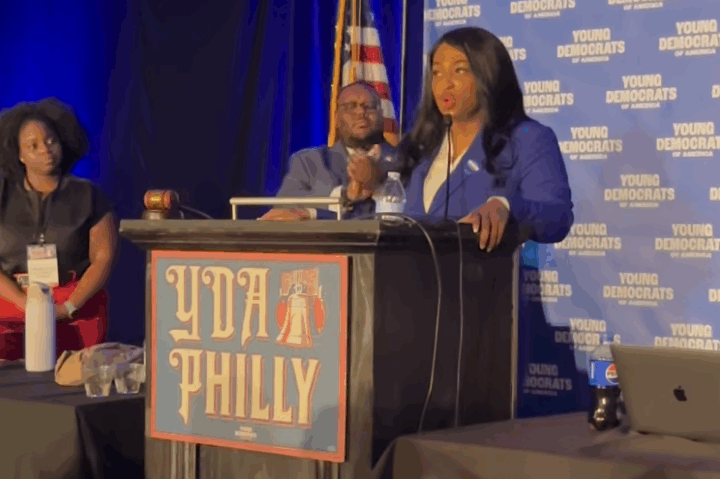
Screenshot
Fatima Heyward was elected as the new president of Young Democrats of America president on July 19th, 2025
The Young Democrats of America, a leading youth advocacy group representing party members under the age of 36, approved a new platform at its recent national convention accusing Israel of “genocide” in Gaza, raising long-simmering internal tensions over Middle East policy.
The organization, whose biennial convention concluded in Philadelphia on Saturday, narrowly passed a new amendment expressing opposition to the “Israeli government’s ongoing genocide in Gaza, its occupation of the West Bank, and its denial of civil and political rights on an equal basis in the territories it militarily occupies,” according to an updated foreign policy plank reviewed by Jewish Insider.
The change, which added the “genocide” reference to an existing amendment, was proposed “to reflect current events and align with present-day actions,” according to a platform committee document from the convention.
Other efforts to amend YDA’s Middle East policy plank, which ultimately failed to be adopted, included striking a line endorsing Israel’s “right to exist as a Jewish democratic state,” screenshots shared with JI show. Meanwhile, some delegates also proposed removing language condemning “the oppression of the Iranian government” and backing “anti-regime protests,” among other suggested changes that were met with alarm by Jewish members who are now weighing a collective response.
Even as those proposals were rejected, that such changes were suggested at all “presents a scary reality,” one member of YDA’s Jewish caucus told JI after the convention.
The Jewish caucus declined to comment on the new platform as it decides “how to move forward,” it told JI on Monday.
YDA’s decision to formally describe Israel’s conduct in Gaza as a genocide more broadly underscores how the party is moving away from support for Israel as Democrats show declining sympathy for the Jewish state, according to polls.
The group also approved a resolution at its convention that voiced support for student protests “against U.S. complicity” in what it called the “Israeli government’s genocidal actions in Gaza,” according to a document shared with JI.
YDA, which claims more than 24,000 members, has grappled with internal divisions over its approach to Israel and antisemitism in the aftermath of Hamas’ Oct. 7, 2023, terror attacks. It faced pushback from Jewish caucus members, for instance, who criticized the group’s denunciation of President Joe Biden for condemning violence at campus anti-Israel protests.
YDA did not respond to a request for comment on Monday.
Press Secretary Karoline Leavitt: ‘In both accounts, the president quickly called the prime minister to rectify those situations’

ANDREW CABALLERO-REYNOLDS/AFP via Getty Images
President Donald Trump (R) meets with Israel's Prime Minister Benjamin Netanyahu in the Oval Office of the White House in Washington, DC, on February 4, 2025.
White House Press Secretary Karoline Leavitt said on Monday that President Donald Trump was “caught off guard” by recent Israeli actions in Syria and Gaza, noting that he had called Israeli Prime Minister Benjamin Netanyahu to air his concerns.
Leavitt made the comments after being asked if the president had “expressed his frustration” with Netanyahu directly over the fatal attack on the Holy Family Catholic Church, the only Catholic church in Gaza, and the IDF’s move to strike government buildings in Damascus, Syria’s capital, last week during sectarian clashes that drew in Syrian government forces and left more than 1,000 people dead. The strikes on Syria came as the Trump administration has thrown its full support behind the new government and urged Israel to normalize relations with the war-torn country.
“The president enjoys a good working relationship with Prime Minister Bibi Netanyahu and stays in frequent communication with him. He was caught off guard by the bombing in Syria and also the bombing of the Catholic Church in Gaza,” Leavitt told reporters outside the White House.
The White House press secretary went on to note that Trump and Secretary of State Marco Rubio stepped in to prevent an escalation in Damascus and to demand answers on the church strike.
“In both accounts, the president quickly called the prime minister to rectify those situations, and we saw Secretary Rubio intervene when it came to Syria. We saw a deescalation there. And as for the bombing of the Catholic church in Gaza, the prime minister did put out a statement saying this was an accident and they deeply regretted that action on behalf of the State of Israel following his conversation with the president,” Leavitt explained.
The strike on the church killed three and injured 10, including a priest.
Leavitt later added when asked about the church bombing, “The president’s message on this conflict we’ve seen in the Middle East taking place for far too long, that has become quite brutal, especially in recent days, you’ve seen reports of more people dying. I think the president never likes to see that. He wants the killing to end.”
Earlier Monday, U.S. Ambassador to Turkey Tom Barrack, who is also serving as special envoy to Syria, criticized Israel’s actions in the country, telling the Associated Press that Jerusalem’s intervention in Syria “creates another very confusing chapter” in the region and “came at a very bad time.”
“The United States was not asked, nor did they participate in that decision, nor was it the United States’ responsibility in matters that Israel feels is for its own self-defense,” Barrack told the outlet of Israel’s strikes on Syria.
Barrack conceded that “both sides did the best they can” in negotiations leading up to the ceasefire he announced between Israel and Syria over the weekend, praising the two countries for trying to find common ground on issues such as the transfer of Syrian forces and military equipment from Damascus to Sweida, where members of the Druze religious minority have been under frequent attacks from Sunni Muslim Bedouin tribes.
The Israeli leader called Zohran Mamdani’s policy proposals ‘a one-term effort ... A lot of people have been taken in by this nonsense’
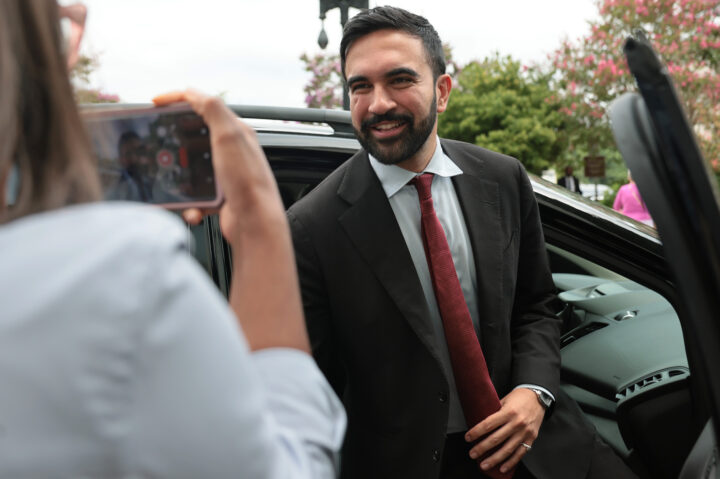
Michael M. Santiago/Getty Images
NYC Mayor Zohran Mamdani briefly speaks with reporters as he leaves the Dirksen Senate Office Building on July 16, 2025 in Washington, DC.
Israeli Prime Minister Benjamin Netanyahu argued that young people in America are won over “pretty quickly” by the truth about the situation in Israel, when discussing New York City Democratic mayoral candidate Zohran Mamdani on a podcast released Monday, and suggested that Mamdani’s policies would be unpopular if he’s elected.
“A lot of people have been taken in by this nonsense,” Netanyahu said, on the “Full Send” podcast, hosted by a social media influencer group called the Nelk Boys popular with young men.
“Sometimes folly overtakes human affairs for a while, but not for long, because reality steps in,” Netanyahu said. “I’m obviously not happy with it, but I’m less concerned with it, because I think if we can speak the truth to the young people of America, they wise up pretty quickly.”
The Israeli leader also addressed other policies supported by Mamdani, including the Democratic mayoral nominee’s past support for defunding the police and raising taxes.
“You want to defund the police? You want to have people go into stores and rob them and be free? You think that really creates a good society? You want to crush all enterprise? You want to tax people to death?” Netanyahu said. “That’s a one-term effort, but sometimes you have to get mugged by reality to understand how stupid that is. So that’s silly.”
Plus, Huckabee resolves Israeli visa squabble

Rami Alsayed/NurPhoto via Getty Images
The President of the Syrian Arab Republic, Ahmad Al-Sharaa, delivers a speech at the People's Palace during the swearing-in ceremony of the new government, in Damascus, Syria, on March 29, 2025.
Good Monday morning.
In today’s Daily Kickoff, we report on the resolution of tensions between U.S. Ambassador to Israel Mike Huckabee and Israel’s Interior Ministry over visa hurdles faced by Christian Zionists, and talk to Sen. Mark Warner about the American strikes last month targeting Iran’s nuclear program. We preview the House Financial Services Committee‘s upcoming vote on Rep. Mike Lawler‘s legislation conditioning the repeal of Syria sanctions, and cover Columbia University’s announcement that its faculty-run University Senate will no longer have oversight over student disciplinary procedures. Also in today’s Daily Kickoff: Jacob Frey, Adam Katz and Yoav Segev.
What We’re Watching
- The Conference of Presidents of Major American Jewish Organizations kicks off a three-day mission to Israel today.
- Oral arguments in Harvard‘s lawsuit against the Trump administration‘s freezing of approximately $3 billion in federal funds begin today in Boston.
- Lawmakers in Texas return to Austin today for the start of a special legislative session that will take up, among other issues, potential statewide redistricting that could potentially give Republicans an additional five House seats but may make other safe GOP districts more competitive.
- Israel launched fresh drone strikes on Houthi targets in Yemen earlier today, days after a ballistic missile fired by the Iran-backed terror group triggered sirens across central Israel.
- We’re keeping an eye on Iranian nuclear talks, following an announcement this morning from Iran’s Foreign Ministry that Tehran’s deputy foreign minister will meet this Friday in Istanbul with his counterparts from the U.K., France and Germany to continue negotiations. Over the weekend, Russian President Vladimir Putin met with senior Iranian official Ali Larijani.
What You Should Know
A QUICK WORD WITH JI’S JOSH KRAUSHAAR
A newly released CNN poll, conducted this month, illustrates the resilience of a hawkish DNA within the Republican Party and among its voters even amid the rise of an isolationist strain that has sought to gain influence in the GOP during President Donald Trump’s second term.
The poll asked respondents: “Do you think the United States should or should not take the leading role among all other countries in the world in trying to solve international problems?” Overall, 43% took the more active approach, while 56% took a more isolationist view.
Republicans, however, remained the strongest advocates of a muscular American role in world affairs, with 52% supporting America taking a leading role, with 47% opposed. By contrast, just 42% of Democrats and 39% of independents shared the more hawkish worldview.
Notably, the shift in more isolationist sentiment was almost entirely driven by Democrats and independents since the last CNN survey in March, which found majority support for significant American global engagement. In the March survey, a 57% majority of Democrats preferred more American involvement in the world, a number that dropped 15 points in the last four months. The Republican share of those preferring American engagement remained steady at 52%.
The results from the CNN polls suggest there’s a more committed core of Republican-voting hawks that is more resilient than the shifting political winds, whereas the Democratic foreign policy worldview appears more dependent on partisanship and what’s happening in the news at the time.
christian controversy
Netanyahu’s office resolves high-profile visa issue for American Christian groups

Israeli Prime Minister Benjamin Netanyahu’s office resolved a dispute between U.S. Ambassador to Israel Mike Huckabee and Israeli Interior Minister Moshe Arbel over the denial of visas to workers and volunteers for several evangelical Christian organizations, two sources involved in the matter told Jewish Insider’s Lahav Harkov on Sunday. Huckabee sent a letter to Arbel last Wednesday, expressing “great distress” and “profound disappointment” that after the two met to discuss the matter earlier this year, the Interior Ministry’s visa department continued to conduct investigations into American and other evangelical organizations seeking visas for their workers.
Solution found: “A solution has been reached to the satisfaction of all parties. The evangelical Christian organizations active in Israel, which represent the vast majority of Zionists in the world today, will receive all of the visas they need through a streamlined and efficient application process,” Calev Myers, the attorney for the organizations told JI on Monday. Hours before the issue was resolved, a source in the Prime Minister’s Office told JI, “this is something that we consider to be of urgent importance. We have every intention of solving this problem very quickly … It is being handled with the proper sensitivity between the Prime Minister’s Office and the embassy.”
ON THE HILL
House committee to vote on Lawler bill modifying Syria sanctions
The House Financial Services Committee is set to consider legislation by Rep. Mike Lawler (R-NY) this week that aims to create oversight and set conditions for lifting sanctions on Syria, but stops short of full repeal of the 2019 Caesar Syria Civilian Protection Act sanctions bill that other lawmakers are pushing on a bipartisan basis, Jewish Insider’s Marc Rod reports.
Why it matters: That the House is moving forward with Lawler’s legislation, which sets conditions for waiving Caesar Act sanctions, rather than the bipartisan Caesar Act repeal effort may indicate a level of continued skepticism from some House members about the prospect of full sanctions relief for the new Syrian government pushed by the Trump administration.
REVERSING COURSE
National Education Association rejects ADL boycott proposal
The National Education Association, the largest teachers’ union in the country, announced on Friday that it would not cut ties with the Anti-Defamation League, declining to implement a contentious resolution approved by its governing body earlier this month that sought to target the Jewish civil rights organization, Jewish Insider’s Gabby Deutch reports.
What is said: “After consideration, it was determined that this proposal would not further NEA’s commitment to academic freedom, our membership or our goals,” the union’s board of directors said in a statement. The decision came nearly two weeks after the measure was adopted by the NEA’s representative assembly, its annual leadership gathering that drew more than 6,000 union delegates. “There is no doubt that antisemitism is on the rise. Without equivocation, NEA stands strongly against antisemitism. We always have and we always will,” the NEA’s board wrote. “In this time of division, fighting antisemitism, anti-Arab racism, and other forms of discrimination will take more resources, not fewer. We are ready.”
WORDS WITH WARNER
Sen. Mark Warner: U.S. strikes on Iran were a ‘success,’ but what happens next is critical

Sen. Mark Warner (D-VA) told Jewish Insider’s Marc Rod on Friday that he’s inclined to view the Trump administration’s strikes on Iran’s nuclear facilities as a “success,” if negotiations with Tehran resume and barring substantial future retaliation from Iran.
What he’s saying: “I will acknowledge the successfulness of the Israeli attacks and how back-foot the regime was. The fact that they didn’t launch the thousands of missiles,” Warner told JI on the sidelines of the Aspen Security Forum. “I was concerned about an attack that didn’t bring Congress along. And I do think there was a huge process foul when the Gang of Eight wasn’t notified and the Republicans [were] — Trump[’s first administration] never did that — but I have never contested the success. … If the current status quo is the same a year from now and it actually leads towards further negotiation — success.”
CREDIT WHERE DUE
Sen. Chris Coons: U.S. strikes on Iran could ultimately be a positive step

Sen. Chris Coons (D-DE) said on Friday that the U.S. strikes on Iran could ultimately produce a positive outcome, a softening of the Delaware senator’s previous skepticism, Jewish Insider’s Marc Rod reports from the Aspen Security Forum.
What he said: “The strike on Iran is one that I disagreed with because of the process, the lack of consultation with Congress, the partisan way that Republicans were notified at the most senior levels [and] Democrats were not,” Coons said at the conference. He said he also had not expected that the administration would be able to avoid significant Iranian retaliation and an escalating conflict. “I frankly, did not believe that we would end up in the period we seem to be in where a counter-strike by Iran against American soldiers and interests has not yet come,” Coons continued.
Also speaking at the forum: Retired Gen. David Petraeus, the former director of the CIA and head of U.S. Central Command, said on Friday that, in the post Oct. 7, 2023, environment, Israel will no longer tolerate threats to its security throughout the region, including a resumption of Iran’s nuclear program.
Differing worldview: Former National Security Advisor Jake Sullivan suggested at the Aspen Security Forum on Friday that the U.S. strikes on Iran had not been necessary and didn’t accomplish the fundamental goal of permanently stopping Iran’s nuclear program.
WINDS OF CHANGE
Columbia moves student disciplinary authority out of University Senate

In a move called for by pro-Israel students at Columbia University, the school announced on Friday that disciplinary action and rules surrounding student protests would be moved out of the purview of the faculty-run University Senate and into the provost’s office, Jewish Insider’s Haley Cohen reports.
Student reaction: “This is the most encouraging and commendable action taken by Columbia’s administration to address the systemic problems within the university since [the Oct. 7, 2023, Hamas terrorist attacks],” Noa Fay, a graduate student entering her last year in Columbia’s School of International and Public Affairs, told JI. “Revoking the University Senate’s power over disciplinary and rule-making procedures has been top of the institutional reform list for many Columbians who wish to see our university restored to order and excellence.”
Worthy Reads
The Trump Whisperer: The New Yorker’s Antonia Hitchens profiles Commerce Secretary Howard Lutnick, looking at the former Cantor Fitzgerald CEO’s yearslong friendship with President Donald Trump. “Lutnick and President Donald Trump speak on the phone most nights, at around one in the morning, just after Lutnick gets in bed. They talk about ‘real stuff,’ like Canadian steel tariffs, Lutnick told me, and also about ‘nothing,’ which he summarized as ‘sporting events, people, who’d you have dinner with, what was this guy like, can you believe what this guy did, what’s the TV like, I saw this on TV, what’d you think of what this guy said on TV, what did you think about my press conference, how about this Truth?’ Of course, Lutnick said, ‘Trump has other people he calls late at night.’ But does he have other people he always calls?” [NewYorker]
Confronting Cambridge: The Atlantic’s Franklin Foer does a deep dive into the tenure of Harvard President Alan Garber, who has handled much of the fallout from the school’s handling of post-Oct. 7 campus antisemitism as well as Harvard’s legal battles with the Trump administration. “Even as Harvard sits on the receiving end of vitriolic attacks from the right, Garber has turned inward — willing to engage with Harvard’s harshest critics and to admit that even bad-faith attacks sometimes land on uncomfortable truths. He’s treated the university’s crisis as an opportunity, leveraging the looming threat of Trump to make changes that would have been politically impossible in less ominous times. The leader of Harvard, bane of MAGA, agrees with much of the underlying substance of the MAGA critique of higher education, at least when stripped of its rhetorical froth and fury. He knows that elite higher education is suffering a crisis of legitimacy, one that is, in no small measure, of its own making, because it gives fodder to those who caricature it as arrogant and privileged.” [TheAtlantic]
The Gaza Debate: In eJewishPhilanthropy, Michael Berenbaum and Menachem Z. Rosensaft respond to genocide scholar Omer Bartov’s recent New York Times op-ed alleging Israel is engaging in genocide. “We are not arguing that this war has always been waged appropriately or that it has been waged proportionally. Nor do we suggest that Israel or any other country involved in warfare cannot be accused of or should not be held accountable for other alleged violations of international law, including crimes against humanity, war crimes and even ethnic cleansing. But those are separate questions from whether a genocide is being committed; and unless such alleged violations of international law satisfy the elements, including specific intent, as defined in Article II of the Convention, they do not constitute genocide.” [eJP]
Cowed on Campus: In Tablet, Eric Kaufmann looks at recent survey data from the Foundation for Individual Rights and Expression that indicates shifts in the behaviors of Jewish college students as campus climates become increasingly politicized in the wake of the Oct. 7, 2023, Hamas attacks and ensuing war in Gaza. “A closer look at the 2024 data shows that the pro-Palestinian tent encampments had a big impact: Before they went up on April 17, 28% of Ivy League Jewish students self-censored. Afterward, 40% did. Across all institutions in the FIRE data, statistical analysis shows that the encampments increased Jewish self-censorship while reducing it for conservatives. Conservative speech has for years been the least free of any major demographic, but Jews have now converged with them. In the Ivy League, Jews now self-censor more than conservatives do.” [Tablet]
Word on the Street
Unnamed Trump administration officials are reportedly angry with Israeli Prime Minister Benjamin Netanyahu‘s recent actions, telling Axios that the prime minister has “acted like a madman” who “bombs everything all the time”; the White House officials expressed concerns that Netanyahu’s actions could “undermine” President Donald Trump’s efforts in the region…
House Minority Leader Hakeem Jeffries (D-NY) met for an hour on Friday with New York City Democratic mayoral nominee Zohran Mamdani but did not issue an endorsement for the candidate; a spokesperson for Jeffries said the two had a “constructive, candid and community-centered” conversation that also included “a variety of other important issues, including public safety, rising antisemitism, gentrification and the importance of taking back the House in 2026”…
Reps. Mark Alford (R-MO), Don Davis (D-NC), Tony Gonzales (R-TX), John Carter (R-TX), Sam Graves (R-MO) and Juan Ciscomani (R-AZ) introduced a resolution congratulating the fighter and bomber wings involved in the U.S. attack on Iran’s nuclear facilities…
Sens. John Curtis (R-UT) and Jacky Rosen (D-NV) introduced a resolution commemorating the anniversaries of the bombings of the Israeli Embassy in Argentina and the Buenos Aires AMIA Jewish community center; in the House, Reps. Debbie Wasserman Schultz (D-FL), Mario Diaz-Balart (R-FL), Adriano Espaillat (D-NY) and Tony Gonzales (R-TX) introduced a resolution condemning the AMIA bombing…
Reps. Jefferson Shreve (R-IN), Josh Gottheimer (D-NJ), Bill Huizenga (R-MI), Maria Elvira Salazar (R-FL) and Mark Messmer (R-IN) introduced a bill requiring the administration to provide a strategy to counter Iran and Hezbollah’s influence in Latin America…
Pennsylvania state Sen. Doug Mastriano, who in 2022 lost to Gov. Josh Shapiro in the commonwealth’s gubernatorial race, teased a potential rematch, posting different logos for a “Doug Mastriano for Governor” campaign…
Minnesota’s statewide Democratic-Farmer-Labor Party endorsed state Sen. Omar Fateh, a democratic socialist, over incumbent Mayor Jacob Frey…
The Wall Street Journal spotlights the efforts of Robert Kraft’s Foundation to Combat Antisemitism, under the leadership of Adam Katz, to use analytics to identify digital trends in antisemitism, craft countermessaging and share data with social media platforms and universities…
Harvard Business School graduate Yoav Segev filed a lawsuit against the university and its police department, alleging that both failed to protect him from being assaulted by anti-Israel campus activists and that school officials obstructed an investigation into the incident…
Israeli Prime Minister Benjamin Netanyahu sought medical attention over the weekend after falling ill from eating spoiled food; the prime minister will work from home until Tuesday while he recovers…
Israel, working with the U.S., reportedly delivered aid to the Syrian Druze city of Sweida as a ceasefire reached late last week appeared to hold; more than 1,100 are believed to be dead in the sectarian violence that drew in Syrian government forces…
Israel will not renew the visa of Jonathan Whittall, the head of the United Nations Office for the Coordination of Humanitarian Affairs in the West Bank and Gaza, citing his “biased and hostile conduct against Israel”…
Hamas officials in Gaza claimed at least 85 people were killed trying to access humanitarian aid near the Zikim border crossing; the IDF, which said it fired “warning shots” to remove an “immediate threat,” disputed the number, saying the “reported number of casualties does not align with the existing information”…
The Wall Street Journal looks at the logistical and operational challenges facing the Gaza Humanitarian Foundation amid increasing concerns over humanitarian aid distribution in the enclave…
Senior Christian leaders from Jerusalem, including Cardinal Pierbattista Pizzaballa, visited the sole Catholic church in Gaza, which was damaged by an Israeli strike last week that also killed three people…
Brig. Gen. (res.) Giora Even Epstein, the most decorated Israeli Air Force fighter pilot in the country’s history, died at 87…
Pic of the Day

Israeli President Isaac Herzog (right) received the credentials of Polish Ambassador to Israel Maciej Hunia. Hunia’s arrival marks the first time in four years that Warsaw has had an ambassador posted to Israel. In addition to Hunia, Herzog also received the credentials of Malta’s new envoy to Israel, Ambassador Claude Bonello.
Birthdays

Actress and producer, Alysia Reiner turns 55…
Laureate of the 1992 Nobel Prize in chemistry, Rudolph A. Marcus turns 102… President at Admar Group, Henry Dean Ostberg turns 97… Retired CEO of Sony/ATV, a large music publishing firm, he is a member of the Songwriters Hall of Fame, Martin Bandier turns 84… Professor emeritus in the Department of Physics at Bar-Ilan University, he won the Israel Prize in 2018, Shlomo Havlin turns 83… Director of the Center for the Political Future at USC, Robert Shrum turns 82… Criminal defense attorney, known for representing many politicians, celebrities and organized crime defendants, Benjamin Brafman turns 77… Former member of the U.K.’s House of Commons, now in the House of Lords, Baroness Susan Veronica Kramer turns 75… U.S. senator (R-WY), John Barrasso turns 73… Chairman and CEO at Quantitative Financial Strategies, Sanford “Sandy” Jay Grossman turns 72… Endocrinologist and professor at Columbia University’s medical school, she is an honorary president of NYC’s Central Synagogue, Shonni Joy Silverberg, MD… Professor at Columbia Law School and daughter of the late Justice Ruth Bader Ginsburg, Jane Carol Ginsburg turns 70… Brooklyn resident, Irene Ostrovsky… Comedian and actor, best known for his five seasons on “Saturday Night Live” ending in 1990, Jon Lovitz turns 68… Former chief rabbi of Moscow, his opposition to the Ukraine war forced him to leave Russia, Rabbi Pinchas Goldschmidt turns 62… Literary agent at the William Morris Endeavor book department, Eric Matthew Simonoff turns 58… Professor of astronomy at MIT and winner of a 2013 MacArthur genius award, Sara Seager turns 54… Brazilian fashion designer best known for avant-garde designs and eclectic prints, Alexandre Herchcovitch turns 54… CEO of Fanatics, licensed sports merchandise and digital sports platform, Michael G. Rubin turns 53… Founder, president and CEO of Securing America’s Future Energy (SAFE) and the Electrification Coalition, Raphael “Robbie” Diamond… Rabbi of Congregation Bais Naftali in Los Angeles, his YouTube channel has over 4.6 million views, Rabbi Yoel Gold… Online media personality and director of product management at Electronic Arts (EA) in Vancouver, British Columbia, Veronica Belmont turns 43… CEO of Women of Reform Judaism since 2023, Rabbi Liz P.G. Hirsch… Clinical social worker, Aniko Gomory-Pink… Entrepreneur and political activist, Chloé Simone Valdary turns 32… Policy advisor at Brownstein Hyatt Farber Schreck, Zachary A. Marshall… Recruiter at Tines, Rachel Elizabeth Nieves… Attorney in Madrid and secretary general of the Federation of Jewish Communities of Spain until 2021, Elias Cohen…
‘If the current status quo is the same a year from now and it actually leads towards further negotiation — success,’ Warner told JI

Francis Chung/POLITICO via AP Images
Sen. Mark Warner (D-VA) ascends on an escalator on his way to a vote at the U.S. Capitol on June 17, 2025.
Sen. Mark Warner (D-VA) told Jewish Insider on Friday that he’s inclined to view the Trump administration’s strikes last month on Iran’s nuclear facilities as a “success,” if negotiations with Tehran resume and barring substantial future retaliation from Iran.
His comments largely echo sentiments shared earlier in the day by Sen. Chris Coons (D-DE) at the Aspen Security Forum, suggesting an increasing willingness by moderate, national security-minded Democrats to publicly acknowledge positive outcomes of the strikes, even if they maintain other concerns about the process that produced them.
“I will acknowledge the successfulness of the Israeli attacks and how back-foot the regime was. The fact that they didn’t launch the thousands of missiles,” Warner told JI on the sidelines of the forum. “I was concerned about an attack that didn’t bring Congress along. And I do think there was a huge process foul when the Gang of Eight wasn’t notified and the Republicans [were]. Trump[’s first administration] never did that — but I have never contested the success.”
Warner, the vice chair of the Senate Intelligence Committee, said he’s been pleased that there has not been ongoing asymmetric retaliation against the U.S. by Iran, such as cyber, sleeper cell or Iraqi militia attacks.
“If the current status quo is the same a year from now and it actually leads towards further negotiation — success.”
Warner, Coons and other top Democrats had cautioned the administration against unilateral action against Iran without congressional approval just days before the attack.
“Let’s make no doubt that the Iranian regime [are] bad guys, and that is why I’ve been such a consistent supporter of Israel,” Warner told JI.
“Iran’s, at least so far, been shown to be more of a paper tiger,” Warner said. “If we could just get to the resolution in Gaza, there really could be a fresh start.”
The senator said that his ongoing concern is how President Donald Trump has responded to the attacks, declaring that Iran’s nuclear program had been completely obliterated.
“The president, within two hours of the strike, set an arbitrary, almost impossible standard to meet, in terms of ‘total obliteration,’” Warner said. “To get the enriched uranium you’re going to need troops on the ground. And there are more than three sites — the vast majority [of the activity] was [at] those three, but there was some bad stuff happening elsewhere.”
He said the intelligence community had also been pressured to “contort itself to meet” the assessment Trump put forward.
In the immediate aftermath of the strikes, Warner and other Democrats expressed frustration that the Trump administration took days to brief Congress about them. Warner said he’s received “some additional clarity” in the weeks since the strikes about their effects. But he said that without physically sending operatives into the facilities, it’s difficult to know for sure the impacts of the strikes.
“Other nations have made assessments that were more in the multiple months” of delay to Iran’s nuclear program, “but I’m not even sure that’s the right metric,” Warner said. “It was a success. So the question is, what’s next? That, I don’t have visibility on.”
Going forward, Warner emphasized the need for negotiations to bring International Atomic Energy Agency inspectors back into Iran, adding that he wants to look further into the source of the delays in resuming talks.
Warner said he’s also seeking information on the timeline on which Iran would be able to build a less sophisticated nuclear device that could be delivered in a truck, rather than via a ballistic missile.
Though he noted that U.S. intelligence had not assessed that Iran was actively constructing a nuclear weapon, he said he had heard reports about an Israeli assessment that offered a different view and that he is looking further into it.
Asked about the fluid situation in Syria, in which Israel went, in the span of just a week, from floating normalization with the new Syrian government to bombing key government facilities in response to attacks on the Druze population, Warner indicated he’s still gathering information.
He said that Israel is “appropriately … very protective of its Druze population,” adding that he does not know at this point whether the Syrian government forces attacking the Druze population are doing so at the orders of that government.
He said he’s hopeful that Israel and other parties involved will not miss an opportunity to find a peaceful resolution that could defuse a major longtime threat to Israel’s north.
Warner said he also wants to see Trump use his “enormous influence in Israel” to “[force] Bibi’s government into a return of the hostages, a ceasefire,” saying that would open up opportunities for transformational change in the region, including Saudi-Israeli normalization.
Warner said that while he’s been critical of Israeli Prime Minister Benjamin Netanyahu, Israel and the IDF deserve credit for their surprise accomplishments in taking down Iran’s proxy network and in their strikes against Iran itself.
“The [Jewish community’s] concern is real and understandable,” Warner said. He said that he has been struck by the “level of anger, animosity, vile things said” in anti-Israel protests that have targeted him — “and I’m not Jewish. And I can only imagine.”
“Iran’s, at least so far, been shown to be more of a paper tiger,” Warner said. “If we could just get to the resolution in Gaza, there really could be a fresh start.”
Asked how concerned he is about the possibility of homeland attacks against the Jewish community carried out by or in the name of Iran, Warner said that U.S. intelligence monitors potential threats fairly comprehensively, but indicated that he’s most worried about radicalized lone-wolf attacks, like those in Washington and Boulder, Colo.
“The [Jewish community’s] concern is real and understandable,” Warner said. He said that he has been struck by the “level of anger, animosity, vile things said” in anti-Israel protests that have targeted him — “and I’m not Jewish. And I can only imagine.”
Warner expressed frustration at the way that the Palestinian cause has crowded out other global issues on college campuses. He said that it “would be healthy” if young people “have the chance to get exposed to other things in the world,” offering as examples the conflict in Sudan — which he said has been more deadly than Gaza and Ukraine combined — and the military junta in Myanmar.
On the subject of the Houthis, who have ramped up attacks against commercial shipping and Israel in recent weeks, Warner called the group a “tough nut to crack,” noting that a protracted Saudi and Emirati campaign against the Iran-backed terrorist group in Yemen had failed to put the issue to bed. But he said that the U.S. can’t rule out further military action against the group.
“I hope that those plans would be kept classified and not shared … on a device that’s not secure,” he quipped, referencing the Signalgate scandal, which he said had prompted concern from the Israeli government.
******
Last week’s Aspen summit, which typically prioritizes bipartisan and nonpartisan discussion and solution-making, became particularly politicized after nearly all Trump administration speakers canceled their participation, followed by a handful of foreign and private sector leaders and former government officials disappearing from the week’s agenda.
The issue was a frequent topic of discussion both on the main stage and across the Aspen Meadows campus last week, seen by many as a sign of the ways that intense partisanship has infiltrated U.S. foreign policy, once seen as a less antagonistic space.
Warner’s own panel featured himself and Coons, but not a Republican senator, as has been tradition.
Nevertheless, Warner said that bipartisanship on foreign policy issues still lives in the Senate, noting that the Intelligence Committee had passed an Intelligence Authorization Act recently in a nearly unanimous vote.
Looking ahead, he said the “easiest place to rebuild that consensus is around China,” which he described as an unprecedented competitor. He said there has been a long and difficult journey across multiple administrations to refocus on China, but he said there has been bipartisan success in pushing back against China.
He also argued that the Trump administration’s transactional and short-sighted approach to foreign policy goes against a longtime bipartisan tradition of viewing U.S. international relationships as an effort in “mutual trust-building.”
He said that his Republican colleagues privately disagree with many of Trump’s more outlandish foreign policy efforts — like annexing Canada. “At some point, there’s got to be a break,” he responded, when pressed on the fact that some Republicans defend Trump’s policies publicly despite those private disagreements.
Warner told JI that the bill the Intelligence Committee recently passed would cut the size of the Office of the Director of National Intelligence. But, despite offering biting criticisms of DNI Tulsi Gabbard, Warner said that the reform efforts are not a reflection of or specifically prompted by concerns about her conduct in the role.
“I’m very comfortable with the idea of bringing the mission closer to what it was originally, but also making sure that people who are at the ODNI get returned to their original home agency and don’t get [fired],” Warner said.
Clarifying comments that he made on the panel about close U.S. intelligence partners in the Five Eyes group curtailing their intelligence sharing with the United States, Warner said he was not aware of specific instances in which that had happened, but said that U.S. partners are concerned about the state of the U.S. intelligence community.
“The challenge about intelligence sharing is [that] this is all based on trust,” Warner said.
A source in the PMO told JI that Israel has ‘absolutely no interest in undermining the freedom [of workers and volunteers for Christian organizations] coming to Israel’
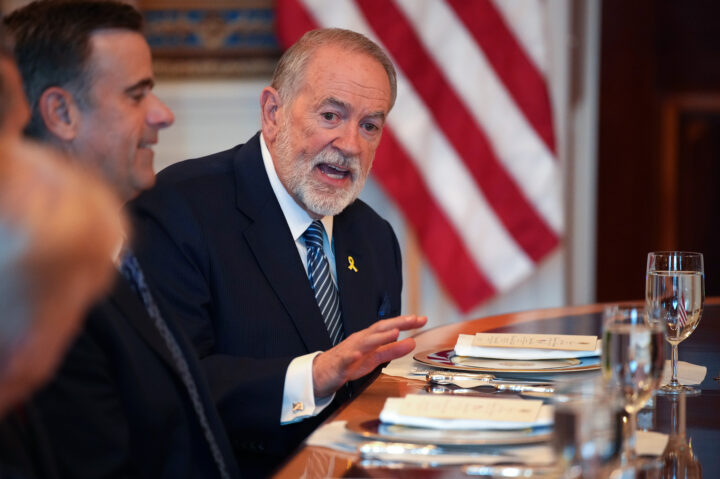
Andrew Harnik/Getty Images
U.S. Ambassador to Israel Mike Huckabee delivers remarks as President Donald Trump hosts Israeli Prime Minister Benjamin Netanyahu for a dinner in the Blue Room of the White House on July 7, 2025, in Washington, DC.
Israeli Prime Minister Benjamin Netanyahu’s office resolved a dispute between U.S. Ambassador to Israel Mike Huckabee and Israeli Interior Minister Moshe Arbel over the denial of visas to workers and volunteers for several evangelical Christian organizations, two sources involved in the matter told Jewish Insider on Sunday.
“A solution has been reached to the satisfaction of all parties. The Evangelical Christian organizations active in Israel, which represent the vast majority of Zionists in the world today, will receive all of the visas they need through a streamlined and efficient application process,” Calev Myers, the attorney for the organizations told JI on Monday.
Hours before the issue was resolved, a source in the Prime Minister’s Office told JI, “this is something that we consider to be of urgent importance. We have every intention of solving this problem very quickly … It is being handled with the proper sensitivity between the Prime Minister’s Office and the embassy.”
The PMO source said that Israel has “absolutely no interest in undermining the freedom [of workers and volunteers for Christian organizations] coming to Israel … We value evangelicals. It’s very regrettable that there is a problem and we obviously have to fix it.”
Huckabee sent a letter to Arbel last Wednesday, expressing “great distress” and “profound disappointment” that after the two met to discuss the matter earlier this year, the Interior Ministry’s visa department continued to conduct investigations into American and other evangelical organizations seeking visas for their workers.
“It would be very unfortunate that our embassy would have to publicly announce throughout the United States that the State of Israel is no longer welcoming Christian organizations … and is instead engaging in harassment and negative treatment towards organizations with long-standing relationships and positive involvement toward Zionism and friendship to the Jewish people and the State of Israel,” Huckabee wrote.
If the situation continues, Huckabee added, he will instruct the U.S. Embassy’s consular section to treat Israeli citizens in kind.
“Surely this is not the relationship the State of Israel wishes to have with its best partner and friend on the planet,” he wrote.
A source close to Huckabee told JI that the ambassador did not intend for the letter to go public, which it did on Channel 12 news on Thursday evening.
Arbel responded on Thursday that he had committed “to reviewing such applications with the utmost efficiency,” instructed his staff to do so as well earlier this year, and that every specific case raised by Huckabee’s office was addressed “within an exceptionally short timeframe.” The interior minister argued that the specific organizations Huckabee mentioned in his letter were not the ones they had discussed in their meeting earlier this year.
Arbel also said he was surprised by the way Huckabee handled the matter — sending copies of the letter to Netanyahu, President Isaac Herzog, Foreign Minister Gideon Sa’ar and Knesset Speaker Amir Ohana — which, he said, “deviates from accepting working norms and does not reflect the direct and constructive relationship we have established.”
Rabbi Pesach Wolicki, executive director of Israel365action, an organization connecting Christians to pro-Israel advocacy, said that this has been a long-standing issue regarding clergy and other workers and long-term volunteers, and not Christian pilgrims coming to Israel for short visits.
Huckabee and attorney Calev Myers met with Arbel about six months ago to work out issues with a specific group of organizations, and Arbel said he would solve it, but the issue remained unresolved, Wolicki explained.
The exchange of letters also came up at a time of increased tensions between Israel and Christians, after what Israel said was an errant tank shell hit the only Catholic church in Gaza and killed three people, and after several incidents of harassment and attacks by extremist settlers against the Christian population of Taybeh in the West Bank.
Huckabee wrote on X on Saturday that “Taybeh is a quiet Palestinian Christian village south of Jerusalem w/ a lot of American citizens that has been vandalized-including fires set at ancient church. I visited there today. Desecrating a church,mosque or synagogue is a crime against humanity and God.”
“I work for all American citizens who live in Israel –Jewish, Muslim or Christian. When they are terrorized or victims of crime[s], I will demand those responsible be held accountable [with] real consequences,” the ambassador added.
Wolicki said that “the timing couldn’t have been worse.”
Israel has laws restricting missionary activity, and the visa issue has been exacerbated by the fact that the Shas party, whose Haredi constituency is especially sensitive to missionizing, has run the Interior Ministry for much of the last 25 years, he added.
“Any situation in which you have noncitizens in the country for the long term, it’s a bureaucratic process, and because of sensitivity about missionizing, this has always been an issue,” Wolicki said, noting that Israel365 has also had problems obtaining visas for Christian employees in the past.
The organizations Huckabee mentioned in his letter, the Baptist Convention of Israel, Christian Missionary Alliance and Assemblies of God are missionary groups, Wolicki said.
“There are official restrictions on missionary activity that, when Christians learn of them — and I say this with a lot of firsthand experience — it really moves them from support for Israel, even from the American level of valuing free speech … but also they feel like, how can you say you respect Christians and you want Christian support but we’re not even allowed to talk about Jesus when we’re there,” Wolicki said.
“Christians don’t think you’re offending anyone when you preach the gospel, and Jews view that as you have a knife and you’re trying to stab them,” he added.
Wolicki argued that the laws against missionary activity are problematic, though he acknowledged that abolishing them would likely be unpopular in Israel.
“Missionaries are active all over Israel anyway. There are Israelis who are active … Anyone concerned about missionary activity, which is a legitimate concern, should know this is not the solution. It causes more harm than good and makes Christians more hostile to the Jewish people,” he said.
Josh Reinstein, director of the Israel Allies Foundation, which promotes faith-based diplomacy, said that he has seen this issue come up repeatedly over the 21 years since the foundation was founded.
“It’s an ongoing issue because they always change the requirements for Bible-believing Christians and their organizations,” Reinstein said. “There are no protections for Evangelicals like the 14 mainline churches [the Israeli Religious Affairs Ministry] recognizes.”
“This needs a solution, but it is definitely not a crisis or a problem of Israel not wanting Christians as the enemies of Israel are making it out to be,” he added.
Reinstein questioned why what he called a minor issue was making bigger news than Christians under attack in Syria.
“Israel is the only place in the region where Christians grow and thrive, as opposed to in the 22 countries around us,” he said. “People understand the relations bewteen Jews and Christians is so important today…which is why they are trying to make it into a bigger deal than it is. Huckabee is one of the greatest allies and friends Israel has. I don’t think it was his intention to cause a rift.”
Pro-Israel students have been advocating for the move since the faculty Senate refused to discipline anti-Israel student protesters

Mary Altaffer-Pool/Getty Images
Student protesters camp on the campus of Columbia University on April 30, 2024 in New York City.
In a move called for by pro-Israel students at Columbia University, the school announced on Friday that disciplinary action and rules surrounding student protests would be moved out of the purview of the faculty-run University Senate and into the provost’s office.
“This is the most encouraging and commendable action taken by Columbia’s administration to address the systemic problems within the university since [the Oct. 7, 2023, Hamas terrorist attacks],” Noa Fay, a graduate student entering her last year in Columbia’s School of International and Public Affairs, told Jewish Insider.
“Revoking the University Senate’s power over disciplinary and rule-making procedures has been top of the institutional reform list for many Columbians who wish to see our university restored to order and excellence.”
Critics of the University Senate say that since Oct. 7 and the ensuing protests that have roiled Columbia’s campus, the 111-elected member body has blocked discipline against anti-Israel protesters and removed protest regulations aimed at protecting Jewish students.
Earlier this week, when the university released a list of commitments to address antisemitism on campus, several Jewish students expressed concern that structural reform to the University Senate was missing.
Fay, a student member of the Columbia-SIPA Anti-Hate Task Force, suggested to JI earlier this week that changes to the University Senate are one of the most important measures that could create a safer climate for Jewish students “as it has served most reliably and forcefully to protect those guilty of antisemitic racism at school.”
Last August, the University Senate passed revised guidelines for the Rules of University Conduct that removed an interim demonstration policy that the university implemented following disruptive — and sometimes violent — Gaza solidarity encampments that spring, put in place to restrict the location and times that protests were allowed.
Lishi Baker, a rising senior at Columbia studying Middle East history, wrote in a 2024 Columbia Spectator op-ed that the University Senate had refused to let Jewish students share their experiences of antisemitism on campus when the university’s task force on antisemitism presented its second report to the body.
“I was one of the students asked by the task force to speak,” Baker wrote. “However, when the task force co-chairs informed members of the Senate leadership of their desire to bring students, those Senate leaders dismissed the idea outright.”
The Senate has been under university review since April. The decision by Columbia’s trustees to diminish the Senate’s power comes as university leadership is in the final stages of talks with the Trump administration to make a deal that would restore some $400 million in federal funding that was cut by the government in March due to the university’s record dealing with antisemitism.
The former CIA director warned that the Islamic Revolutionary Guard Corps may attempt to consolidate power in Iran

Maxym Marusenko/NurPhoto via Getty Images
Former CIA Director and retired US General David H. Petraeus speaks at a special event of the Kyiv Security Forum, Kyiv, Ukraine, September 05, 2023.
ASPEN, Colo. — Retired Gen. David Petraeus, the former director of the CIA and head of U.S. Central Command, said Friday at the Aspen Security Forum that, in the post Oct. 7, 2023 environment, Israel will no longer tolerate threats to its security throughout the region, including a resumption of Iran’s nuclear program.
Petraeus said, “We have to step back a little bit and recognize that Israel’s strategic calculation is very, very different from before Oct. 7, and that’s a big deal for the region,” explaining that Israel will no longer allow threats to metastasize anywhere in the Middle East.
He added that Iran must understand that it is vulnerable and that no Israeli leader will allow it to resume its push for a nuclear weapon.
“[The Iranians] have to recognize that if they make another move, they’re going to get hammered once again,” Petraeus said. “And I don’t think that an Israeli prime minister, even if it’s not Bibi Netanyahu, will allow the Iranians to proceed down the path to a nuclear device.”
He predicted that Russia would not be helpful to Iran in replacing its Russian-manufactured air-defense systems that Israel destroyed, since it doesn’t have sufficient systems to protect itself from Ukraine’s counter-strikes at this point.
Petraeus argued that Iran’s future direction and leadership will depend on what sort of leader or leadership structure succeeds Ayatollah Ali Khamenei — whether the country remains ruled by a hardline religious cleric or whether a new body, potentially one dominated by the Islamic Revolutionary Guard Corps, emerges.
“You can actually entertain at least a notion that, since they control 30 to 40% of the economy, that the Revolutionary Guard Corps says, ‘Hey, why are we doing all this stuff? We could be living high on the hog and stop getting bombed and our headquarters getting taken out, us individually targeted, if we just cut loose Hezbollah, and all these others. Who cares about this nuclear stuff? What has this brought us now?’” Petraeus said.
Journalist Kim Ghattas, speaking alongside Petraeus, said that “this 40 year arc of the Islamic Revolution is coming to an end,” citing knowledge from an unnamed Western diplomat previously based in Iran, “but exactly how it ends we just don’t know yet.”
She argued that the “inconclusive” nature of the Israel-Iran war “has actually complicated matters internally and in the region” and may allow the Iranian regime to recalibrate and consolidate power. She suggested that the IRGC could take charge and transform the country into more of a military dictatorship, sidelining the mullahs.
“I think that in the medium term, we’re looking at a more oppressive, more militaristic Iranian regime,” Ghattas said.
And she predicted that Iran would push ahead with its nuclear program as its only option for deterrence.
Ghattas also said that the fact that Iran had managed to survive the Israeli attacks had complicated efforts to sideline Hezbollah in Lebanon, sending a message to the group that it should hold out; she said that Hezbollah is unlikely to disarm without instruction from Iran, and that it would require political concessions in order to do so.
“We had a really golden opportunity at the beginning of the year, when everything was in flux, Hezbollah was very much on the back foot. [Syrian dictator Bashar al-]Assad was gone. Gaza had a ceasefire in January,” Ghattas said. “This was the moment to strike with a grand political vision, diplomatic vision, for the region. Now, everybody’s recalibrating. Iran is trying to see how it can get a foothold stronger again, into Lebanon, even into Syria.”
Petraeus said that he supports Israel’s objectives it has laid out in Gaza — destroying Hamas, removing it from governance and freeing the hostages — “but I’ve said publicly from the very beginning and written about it as well, that I just don’t think they’re going about it the right way.”
He said Israel should be pursuing a “comprehensive civil-military counterinsurgency campaign — clear, hold, build and transition,” including establishing security and governance measures in Gaza as the campaign proceeds and allowing Gazan Palestinians return to their homes.
“And that requires a fourth objective, which has never been stated, and that is to provide a better future for the Palestinian people in Gaza without Hamas in their lives,” he continued.
He said that, though Hamas has been degraded, it still has the largest armed force in Gaza and would reemerge as the dominant force in a vacuum, despite Israel’s arming of some Palestinian clans in Gaza.
“I’m really worried about what is the future of Gaza, for which there’s been no real vision provided for what life of the Palestinian people will look like,” Petraues said.
The retired general indicated that he’s optimistic about Syrian President Ahmad al-Sharaa, explaining, “We believe that he understands the need for a government that has representation from all of these different elements and not only assures majority rule, but also ensures minority rights.”
Ghattas warned that the ongoing Israeli military campaign in Syria risks spawning a revitalized terrorist threat in Lebanon and a renewed threat from Syria.
She said she supports the Trump administration’s policy in opening a door to the new Syrian government, but said that the U.S. has “gone a little bit too far in embracing al-Sharaa.”
“Great about lifting the sanctions, but you still need to breathe down his neck, because international support does not translate into national legitimacy, yet, and he’s not done enough in terms of national legitimacy,” Ghattas said.
The panelists also discussed Saudi Crown Prince Mohamed Bin Salman’s rise to power and vision for the region.
Petraeus said that bin Salman had overhauled a slow and indecisive government to consolidate power.
“There’s never been a consolidation of power like we see there, and there’s never been someone with the kind of vision that he has put forward as well,” Petraeus said. “You can ask if some of that is beyond realistic. … But he knows that.”
He said that bin Salman’s initiative has established Saudi Arabia as one of the key centers of power in the region, alongside the United Arab Emirates and Qatar, supplanting traditional power-players like Egypt.
Ghattas said that bin Salman had evolved over time and “transformed, for the better, the lives of millions of young Saudis.”
“I think the opportunities are great, but I think Saudi Arabia, which wanted to establish relations with Israel before Oct. 7, is finding itself with a conundrum that it cannot solve on its own without pressure from the United States on Israel,” Ghattas said, “which is [that] it is not going to reach out to Israel anymore unless they get a promise of a Palestinian state. The bar for that has risen tremendously.”
'I must say, I was disappointed by the response of some senior people on the Democratic side,' Herzog told JI

Aspen Security Forum
Former Israeli Ambassador to the U.S. Michael Herzog
ASPEN, Colo. — Former Israeli Ambassador to the U.S. Michael Herzog and other pro-Israel speakers received a warm reception from the crowd at the Aspen Security Forum this week, as they discussed continued efforts to free the hostages in Gaza and Israel’s strikes on Iran.
But Herzog told Jewish Insider, on the sidelines of the conference after his panel on Wednesday, that he’s been disappointed by the response to the strikes from Democratic lawmakers in Washington, which has been overwhelmingly negative.
It’s a response that also stands in contrast to Herzog’s description of the transition he observed in the Biden administration’s thinking on Iran: from pushing for a nuclear deal with Iran that Herzog said would have been weaker than the Obama-era Joint Comprehensive Plan of Action to, by the time President Joe Biden left office, active discussions of strikes on Iran.
“I must say, I was disappointed by the response of some senior people on the Democratic side,” Herzog told JI. “I’m saying it carefully because I never interfere in domestic politics here, but from a strategic point of view, I was disappointed by the response of some senior Democrats to the war on Iran.”
Herzog said that maintaining bipartisan support for Israel was the central goal of his ambassadorship and that he engaged with nearly everyone, including critics, with the exception of the most extreme voices. He said he expected U.S. leaders on both sides of the aisle to realize that the strikes offered a “unique opportunity” to counter a “malign actor” and “changed the strategic landscape in the Middle East.”
“People who either criticize it on procedural issues or people who say, ‘[It] wasn’t the right timing because they were talking to each other about a deal’ — there’s never a right time. Never,” Herzog said, emphasizing that the strikes had not, as critics warned, spiraled into a protracted war similar to Iraq or Afghanistan.
Herzog said Israel must “put a lot of work into maintaining that dialogue with both sides of the aisle, explaining our common interest, away from domestic politics here … and exploring the new opportunities that have been created in the Middle East.”
Herzog said that Israel has been preparing for an attack on Iran for decades, but the specific planning for what became Israel’s Operation Rising Lion and the U.S.’ Operation Midnight Hammer began in earnest in November 2024, after the second Iranian strike on Israel and Israel’s elimination of Iran’s air-defense systems. By that time, U.S. nuclear talks with Iran, which Herzog criticized as misguided, had been long stalled.
He said the fall of the Assad regime in Syria the following month provided a further opportunity to take action.
“If you look at the journey the Biden administration took from the initial days when they were rushing to a deal with Iran, to the last few months of the Biden administration where they were talking to us about military options against Iran, they went a long way,” Herzog recounted.
Herzog said he believes that the Biden administration underwent “disillusionment with the possibility of reaching a good deal with Iran,” as Iran made unrealistic demands, such as removing the Islamic Revolutionary Guard Corps’ terrorism designation. And he said Iran’s supply of weapons for Russia’s invasion of Ukraine made the talks “much more difficult.”
“I just could see that movement with time, to the last phase of Biden’s presidency, when, after we turned the tables on the Iranian axis and opened that huge opportunity, we actually started looking with them at the military option,” he said. “It was too late in the day [to carry out the strikes before Biden left office], but it was a very interesting journey that I noticed.”
Looking at the rising isolationist sentiments on the Republican side of the aisle, Herzog said he’s been monitoring the issue and has “been concerned about it,” but also argued that such voices aren’t dominant in the Trump administration’s decision-making.
“It’s like a swing of a pendulum because the U.S. ultimately decided to follow Israel and strike Iran, and this is really historic, in that it’s a first-of-its-kind coordinated offensive operation. … This is the first time that we are coordinated in our offensive operations, that’s a very big deal for a long time to come in my view,” Herzog said.
He said he sees the pendulum swinging against the isolationists in the administration’s recent moves to provide additional support to Ukraine and take a tougher stance toward Russia as well.
“So all in all, I don’t think that the administration is following this isolationist trend, but I do follow it and I am concerned about it,” Herzog said. “I do believe that the world needs American leadership, [an] American dominant role. The world needs America to be a force of good, as it has always been, and that’s what we’d like to see.”
Herzog — reflecting on the panel he spoke on, “Israel at a Crossroads” — said that the U.S. and Israel need to be closely coordinated and in lockstep on the path forward on Iran, including the limits of a diplomatic deal and the red lines that would prompt further military action to prevent Iran from rebuilding its nuclear program, as well as ways to capitalize on Iran’s weakness throughout the region and prevent it from rebuilding its proxy network.
“We managed to surprise the Iranians, hit all the main centers of gravity and take them completely off balance. But challenges are still ahead of us because we have to assume that Iran will seek to rebuild those threatening capabilities,” Herzog said. “We should not rest on our laurels.”
He also emphasized that the strikes and the degradation of Iran’s proxies had “created the conditions for a different Middle East.”
Asked about the Israeli government’s policy on Syria — which shifted in the span of a week, from Israeli Prime Minister Benjamin Netanyahu actively discussing normalization and diplomatic paths with President Donald Trump in the White House to Israel bombing key Syrian government sites in recent days — Herzog described the new Syria as a “mixed bag” with both risks and opportunities, and said that it may be too early to judge.
“On one hand, I believe that this new leader, Ahmad al-Sharaa, a.k.a. Mohammad al-Jolani, doesn’t want, he doesn’t seek war with Israel, and he sends across messages, and that’s what he told the Trump administration,” Herzog said, adding that Israel had started a dialogue through the U.S. on what Herzog termed a formal or informal non-aggression agreement and the demilitarization of southern Syria.
“On the other hand, we should not forget the background of al-Sharaa and the people surrounding him or subordinate to him,” Herzog said. “They all grew up in the school of jihadism.”
He criticized al-Sharaa for what he said was an effort to “subjugate [Syrian minorities] so they become part of his Syria, his vision of Syria” rather than allowing for a federalist system. Herzog said the Israeli strikes “sent a very strong message … that we will not tolerate the scenes of humiliating the Druze and endangering their lives,” and aimed to block the Syrian army from conquering Druze areas and carrying out atrocities.
“What we’ve seen, first with the Alawites and now with the Druze, is very troubling,” Herzog said. “We in Israel, our concerns are about, first, the security situation in southern Syria, and second about the state of minorities, especially the Druze, because not only are they close to our border, [but] because we have an important Druze community in Israel. They are our brothers in arms.”
He added that it’s unclear to what extent al-Sharaa himself is in control over Syrian government forces’ actions.
The Israeli ambassador also reflected on the ways that the Oct. 7, 2023, Hamas attacks on Israel seemingly activated a global wave of antisemitism.
“You’re hit hard, you’re bleeding, and all your enemies smell the blood and rise to hit you,” Herzog said. “That pertains to all of our enemies in the region, the Iranian axis, but also pertains to anti-Israel, antisemitic forces here in the U.S. and elsewhere.”
He said that Israel has “gone a long way” against its military adversaries in the Middle East, “really turned the tables on Iran and the Iranian axis” and “created the conditions for a different Middle East.”
“But,” he continued, “we still have a long way to go against these anti-Israel, antisemitic forces. That’s an open front.”
The amendment sought to cut $500 million in cooperative missile defense funding
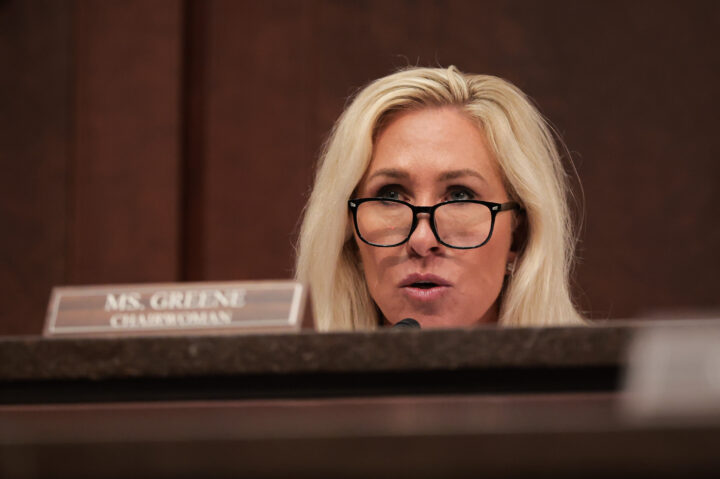
Kayla Bartkowski/Getty Images
Rep. Marjorie Taylor Greene (R-GA) speaks at the U.S. Capitol on May 07, 2025 in Washington, DC.
The House of Representatives on Thursday rejected, in a 422-6 vote, a bid by Rep. Marjorie Taylor Greene (R-GA) to block the $500 million in cooperative missile-defense funding the U.S. provides annually to Israel.
Greene’s amendment sought to strip the funding, provided annually under the terms of the U.S.-Israel memorandum of understanding, from the House’s 2026 Defense funding bill. Rep. Ilhan Omar (D-MN), had introduced a similar amendment.
Greene, Omar and Reps. Al Green (D-TX), Summer Lee (D-PA), Thomas Massie (R-KY) and Rashida Tlaib (D-MI) voted for the aid cutoff.
The House also defeated Greene-led amendments that would have cut military funding for Jordan by a 400-30 vote, for Ukraine by a 353-76 vote and for Taiwan by a 421-6 vote. Only Republicans voted for each of those amendments.
Legislators also rejected, by a 355-76 vote, an amendment by Rep. Greg Steube (R-FL) to cut funding for the Lebanese Armed Forces. All of the votes in favor came from Republicans.
Steube has long opposed funding for the LAF, arguing that it is complicit in Hezbollah’s actions against Israel and infiltrated by Hezbollah members and sympathizers.
Greene argued on the House floor that the Israel funding is “money we don’t have” and that Israel is “very capable of defending themselves.”
Referring repeatedly to the Jewish state as “nuclear-armed Israel,” Greene suggested that Israel’s undeclared nuclear capabilities should deter any threats — even though that has not been the case in the past. Israel has long maintained a policy of nuclear ambiguity, neither confirming nor denying its possession of a nuclear arsenal.
She also highlighted the U.S.’ extensive use of its own ballistic missile interceptors to defend Israel during the recent Iran-Israel war.
Greene noted Israel’s bombing this week of a church in Gaza, for which the Israeli government apologized, calling it a mistake, and said that “an entire population is being wiped out as they continue their aggressive war in Gaza.”
The funding in question supports programs including Iron Dome, Arrow and David’s Sling that are jointly developed by Israel and the United States. The systems, designed to intercept threats like missiles and drones, do not have offensive applications.
Reps. Ken Calvert (R-CA) and Betty McCollum (D-MN), the chair and ranking member of the House Appropriations Committee’s Defense Subcommittee, both spoke on the House floor against Greene’s amendment, as did Rep. Randy Fine (R-FL).
Calvert said that Israel’s success in intercepting ongoing attacks has come partly as a result of the U.S. missile-defense funding provided in past years. He highlighted that the funding supports the U.S.’ defense industrial base, funding production of the systems in both the U.S. and Israel and joint technological development.
McCollum is a vocal longtime critic of Israeli policy toward the Palestinians and the Israeli military operations in Gaza.
“To be clear, I have disagreements with Prime Minister Netanyahu’s government,” McCollum said, describing the war in Gaza as a “tragedy.” “But the funding in this bill does not support offensive weapons for Israel. … This bill provides for defensive measures only.”
McCollum said that everyone in the region deserves safety and that “Israeli children deserve to go to bed at night knowing that missiles from Yemen, Iran or from the Houthis or anywhere else in the region will not rain down on them.”
Fine highlighted that there is a significant American population in Israel under threat from air attacks. He said the co-development of missile-defense programs with Israel helps support America’s own air defense, including President Donald Trump’s Golden Dome proposal for a national air-defense infrastructure.
Addressing Greene’s comments, he noted that America has nuclear weapons, but that hasn’t deterred some adversaries from trying to attack it.
“When we oppose this amendment, when we vote it down, we are not only standing with Israel, we are standing with the best interests of the United States,” Fine said.
Reps. Jim Jordan and Brian Mast have also been investigating grants received by six Israeli NGOs that played a role in the judicial overhaul protest movement
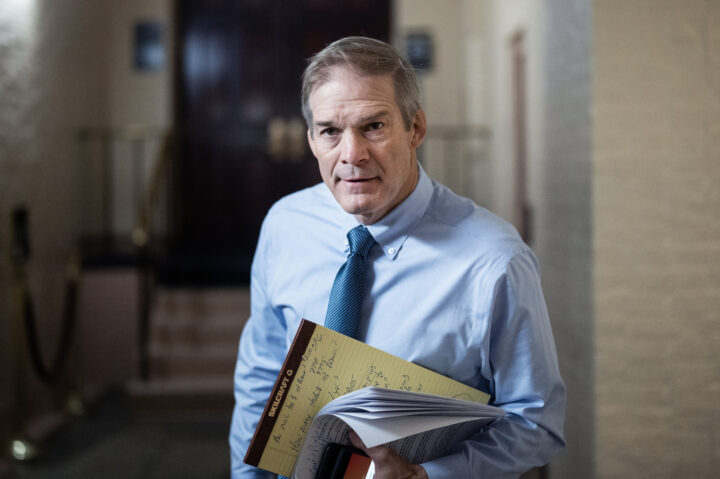
Tom Williams/CQ-Roll Call, Inc via Getty Images
Rep. Jim Jordan (R-OH) leaves a meeting of the House Republican Conference in the U.S. Capitol on Wednesday, June 4, 2025.
The GOP-led House Judiciary Committee drafted a new memo on Thursday alleging that federal funding granted to USAID and nongovernmental organizations under the Biden administration was given to Palestinian nonprofits with ties to proscribed terror groups.
“Oversight conducted by the Committee reflects the Biden-Harris Administration’s neglect and misuse of taxpayer dollars through USAID, the State Department, and other federal agencies, which were used to directly and indirectly fund the efforts of anti-Netanyahu organizations and terrorist groups,” the memo sent to committee members, which was obtained by Jewish Insider, states.
Judiciary Committee Republicans also revealed in the memo that they were “expanding” their investigation “to include additional American and Israeli NGOs that may be involved in funneling U.S. government funds with the purpose of undermining the Israeli government or for the support or fiscal sponsorship of terrorist groups.”
The memo comes nearly four months after Rep. Jim Jordan (R-OH), who chairs the Judiciary Committee, and Rep. Brian Mast (R-FL), chairman of the House Foreign Affairs Committee, began reaching out to six NGOs to determine if they had received U.S. tax dollars through USAID or the State Department and the role they individually played in the protest movement. The inquiries specifically requested documentation and communications from the organizations about the funding applications, any communications between the NGOs in question and details about how the funds were spent. So far, the probe has not published evidence indicating that they have received federal funding.
The organizations — the Jewish Communal Fund, Middle East Dialogue Network, Movement for Quality Government in Israel, PEF Israel Endowment Funds, Rockefeller Philanthropy Advisors and Blue and White Future — “produced 380 total documents” to the committees to date in the ongoing probe into “the Biden-Harris Administration’s use of U.S. taxpayer funds to undermine Israel’s democratically elected government,” according to the memo.
Blue and White Future categorically denied the notion that the organization received any federal funding in a statement to JI and in communications with House lawmakers.
“No state entity, administration or government body – American or otherwise (USAID included) – has ever provided funding to the organization, whether directly or indirectly. All donations to the organization originate from private donors who care deeply about Israel’s security and its future. Every donation received and every activity undertaken by the organization is fully documented, reported, and independently audited in strict compliance with applicable law,” a BWF spokesperson told JI.
“The letters circulated by members of the U.S. Congress rely on biased and factually incorrect publications that bear no connection to reality. These claims are entirely baseless. The organization has clearly and comprehensively addressed these allegations in its responses to all relevant inquiries,” they added.
After legal and structural changes, the anti-Israel group has switched its focus from protests and advocacy to organizing for and against candidates

Tierney L. Cross/Getty Images
Demonstrators from Jewish Voice For Peace protest the war in Gaza at the Canon House Building on July 23, 2024 in Washington, DC.
Jewish Voice for Peace, a far-left anti-Israel advocacy group that has built a growing profile in the wake of Hamas’ Oct. 7, 2023, terror attacks, is pivoting to a new organizational structure that will soon allow it to engage more forcefully in electoral politics.
The group recently began the process of consolidating its membership and organizing in an affiliated but lesser-known political nonprofit called Jewish Voice for Peace Action, devoting the bulk of its resources to lobbying and political activities, such as supporting and opposing candidates that had not traditionally been a part of its core focus.
As a nonpartisan tax-exempt group, JVP, which has been at the forefront of campus anti-Israel protests and promotes efforts to divest from Israel, has been legally prohibited from taking sides in campaigns — a limitation the new structural change is designed to address.
The shift comes as the activist left has felt newly emboldened by Zohran Mamdani’s shocking victory in New York City’s Democratic mayoral primary in June, fueling debates over the ideological direction of the party as it gears up for next year’s midterms.
JVP Action, which recently changed its public name to Jewish Voice for Peace to match its sister organization, was an early supporter of Mamdani and has cited his outspoken opposition to Israel as a sign of evolving voter attitudes about the Israeli-Palestinian conflict.
“There is unprecedented, mass support for Palestinians. Our movement has already grown larger, and more quickly, than many of us thought possible. But it’s clear we have not begun to tap our full potential,” JVP writes in a detailed new page on its website about the decision-making behind its shift. “The U.S. government has not budged from its commitment to sponsor Israel’s genocide. Public polling and public displays of opposition alone will not shift U.S. policy. Our movement must contend for real power.”
JVP, which until now had been the primary home for the group’s organizing work, will become a “supporter-based” rather than a “membership-based” organization renamed JVP Leadership & Culture Lab — with a focus on educational training and arts and culture programming to help promote “anti-Zionist Jewish” advocacy, according to its tentative mission statement.
The change was approved in a recent membership vote and will be implemented by Oct. 15, according to a lengthy agenda from a virtual meeting last week shared with Jewish Insider.
JVP Action’s board, for its part, had already voted to change its name and structure independently of the recent all-members meeting, in anticipation of the organizational inversion.
During the meeting, a recording of which was reviewed by JI, one member raised a concern that the change could “lead to a deemphasis” on JVP’s involvement in “mobilizing of protests and direct action” in favor of “electoralism and support for progressive Democrats.” The member was reassured by leadership that such approaches are complementary and that electoral work is a “key tactic inside a set of tools” including “civil disobedience” and divestment campaigns.
In moving to now operate primarily as a political nonprofit, “the barriers between the work of JVP and JVP Action organizations will be removed,” JVP further explains on its website.
“This has long been a challenge, creating silos and firewalls in our respective work that keep us from drawing clear connections between the political, electoral, cultural and financial forces that uphold the U.S.-Israeli relationship,” the group adds.
JVP, which is closely aligned with American Muslims for Palestine, a leading pro-Palestinian advocacy group that has faced legal scrutiny for alleged ties to terror organizations such as Hamas, has significantly bolstered its fundraising in recent years.
The organization raised a record $11 million in revenue from July 2023 to June 2024, according to its latest tax filing, far outpacing previous figures. It is not required to share the names of its donors as a 501(c)(3) to which contributions are tax-deductible.
As a so-called “dark money” group, JVP Action, a 501(c)(4) that is not tax-exempt, can also shield its contributors from the public, even as it engages in elections — unlike political action committees that must disclose their donors.
JVP Action pulled in $800,000 in revenue from July 2022 to June 2023, its most recent tax filing shows, marking its strongest showing since it was established in 2020.
A smaller PAC affiliated with JVP raised only $133,000 last election cycle and does not seem to be part of the new restructuring. The Anti-Defamation League filed a complaint last year accusing the PAC of engaging in a pattern of misrepresentations that violate federal campaign finance law.
In its efforts to stake out a more prominent role in elections, JVP Action is borrowing a page from one of its primary adversaries, the pro-Israel lobbying group AIPAC, which launched a super PAC as well as a political action committee in 2021 to wield its more considerable resources in congressional races where divisions over Israel have drawn significant outside spending.
“For a century, our opposition — the American Zionist establishment — has employed a long-term multipronged strategy to build U.S. support for Zionism and genocide and they have used all the tactics in the book,” JVP says in its recent meeting agenda. “They have a cultural strategy, an electoral strategy, a lobbying arm, youth organizations, mass movement organizations and funding vehicles.”
But the group argues that its opponents are “now experiencing a crack in their power.”
JVP Action, which has previously endorsed a range of Squad members in the House, has not indicated how it plans to approach the upcoming midterms in its more streamlined role.
The group did not return a request for comment on Wednesday, nor did JVP.
A poll released in February by The Jewish Majority, a pro-Israel research group in Washington, showed most Jewish Americans oppose the confrontational protest tactics used by JVP and regard anti-Zionist movements as antisemitic, among other findings.
Jonathan Schulman, the executive director of The Jewish Majority, said that JVP’s “decision to more vigorously engage in electoral politics signals their growing ambition to influence policy in ways that undermine Israel’s very existence as a Jewish state.”
“As they pursue this goal,” Schulman said in a statement to JI on Wednesday, “the pro-Israel community must make it clear to both the public and policymakers that the rhetoric and tactics of anti-Zionism undermine any prospects for a peaceful resolution to the conflict and contribute to the rise in violent attacks against Jews in America. JVP seeks to disprove any connection between anti-Zionism and antisemitism. We must expose that anti-Zionism is fundamentally opposed to peace.”
But with Mamdani’s resounding win over former New York Gov. Andrew Cuomo, who had touted his staunch support for Israel and opposition to rising antisemitism in the primary, JVP now claims to see evidence its “movement work” is gaining traction.
“It is no longer popular for the U.S. to be sending endless weapons and funding to Israel,” the group said in its meeting agenda. “People are questioning the U.S.’ support for genocide and violence against the Palestinian people. Our movement is growing! And we still have a long way to go to break open this crack and end U.S. support for Israel.”
The former Biden administration official said that the Israel-Hamas war 'could have stopped multiple times if Hamas stopped the war and released hostages — multiple, multiple times'
Aspen Security Forum
Former national security official Brett McGurk speaks at the Aspen Security Forum on July 16, 2025.
ASPEN, Colo. – Former U.S. and Israeli officials speaking at the Aspen Security Forum on Wednesday emphasized that Hamas bears responsibility for the failure of hostage release and ceasefire talks, and discussed the possible paths to ending the war in Gaza.
Brett McGurk, the top National Security Council official responsible for the Middle East under the Biden administration, argued on Wednesday that the history of ceasefire talks between Israel and Hamas “is being rewritten by people that weren’t involved in this.”
He emphasized that Hamas repeatedly ignored and rejected proposals that fulfilled many of its demands over the course of the last year, arguing that Israel’s attacks on Hezbollah had helped force Hamas’ hand to a temporary ceasefire deal that went into effect in early 2025.
“The moral toll of this awful situation tears at the soul of anyone who’s worked on this, anyone,” McGurk said. “But this war could have stopped multiple times if Hamas stopped the war and released hostages — multiple, multiple times.”
He said that, to this day, the “fundamental issue” is that the pressure for the deal has been on Israel, with “no pressure on Hamas.” He said the group has “not budged” on its demand to be allowed to remain in power in exchange for the release of hostages.
“Hamas started the war on Oct. 7, this panel is about Israel, but the enemies of Israel have agency,” McGurk said, emphasizing that Hamas made a choice to start the war, joined by Hezbollah and various Iranian proxies, in addition to Iran itself.
McGurk said he believes that if both sides accept the current U.S.-sponsored proposal to pause the war for 60 days while negotiating a permanent ceasefire, the war would end.
Former Israeli Ambassador to the U.S. Michael Herzog said that Israel “never developed a coherent plan [of] alternatives to Hamas.”
Herzog argued that Israel needs to propose an end to the war in exchange for the release of hostages, and that Hamas can be dealt with again at a later point while Israel focuses in the short term on Iran, normalization with Arab countries in the region and beginning to heal its own people and society.
Herzog framed the ceasefire deal with Hezbollah as a potentially successful model.
Former IDF Intelligence Directorate head Amos Yadlin said that the Gaza war is the “most justified war ever; however, at this moment, continuing the war is not serving Israeli interests.”
He said Israel should agree to end the war in exchange for a one-time release of all remaining hostages and the exile of some Hamas leaders, and work to bring in Arab partners to demilitarize the territory, with the understanding that Israel will continue to attack Hamas forces that reemerge as it has done with Hezbollah in Lebanon. Even if some Hamas forces remain, he said, they will not have the strength or capabilities they did before the war.
Yadlin also emphasized that Hamas leaders are to blame for the civilian casualties in Gaza, since they could have ended the war by releasing the hostages at any time.
Author and “Call Me Back” podcast host Dan Senor noted that Israel’s military was ill-prepared for the kind of extended, grinding, close-to-home war it is fighting in Gaza, and described the challenges of Hamas’ diversion of humanitarian aid and hostage-taking as unprecedented. And, he said, fear of Hamas has hampered efforts to cultivate alternative civilian leadership in Gaza.
“I think the idea that we could have a permanent ceasefire would only work if Israel would agree for Hamas to stay in Gaza and … in terms of the objectives of war, there is no world in which Israel can agree to Hamas staying in power in Gaza,” Senor said.
Pushing back on the comparisons between a potential Hamas deal and the Hezbollah ceasefire, Senor noted that in Lebanon, the Lebanese government and Lebanese Armed Forces provide a domestic counterweight to Hezbollah able to enforce demilitarization. In Gaza, no Arab states have stepped forward to carry out governance and demilitarization.
At the same time, Senor said that President Donald Trump’s proposal of mass relocation of the Palestinian population is not a realistic solution. He added that Israel will need a substantial buffer zone between its population in the south and the population in Gaza to feel safe in returning people to communities close to the Gaza border.
Yadlin pushed back, arguing that the relocation threat would provide Arab states the necessary motivation to become directly involved.
Yadlin added that Trump’s work to cultivate investments from the Gulf in combination with the strikes on Iran have shown the American people that the Middle East does not have to only be a region of loss and suffering, but one that has real promise.
Asked if Israel and the United States’ quick and devastating military campaign against Iran was a signal that the world had overestimated the threat from Iran, the panelists argued that was not the case. Instead, they said, many had underestimated Israel’s own capabilities and preparations, and the destruction of Iran’s proxies significantly undermined Iran’s ability to threaten Israel.
“You have to remember that Israel has prepared this war for decades, for many, many years, especially the last few months, but for decades,” he said.
McGurk added that the U.S. and Israeli interceptions of missiles fired during Iran’s October 2024 attack on Israel and Israel’s subsequent destruction of Iran’s air defense systems under the Biden administration set the stage for last month’s strikes, which he characterized as the result of close coordination across multiple administrations for years.
Looking ahead, Herzog said that there are not yet clear answers on the extent to which Iran maintains nuclear capabilities, but said that the strikes’ impact on Iran’s decision-making is also critical: whether it will race to a nuclear device to protect itself or — as Herzog said he believes — it is deterred and will move slowly and carefully if it attempts to resume its nuclear program.
He said there are two paths ahead: a new nuclear deal, including no enrichment and with intrusive inspections, which is nevertheless controversial in Israel because it would provide Iran with sanctions relief to rebuild its capabilities, or Israel’s continued use of force, which brings its own set of questions and challenges.
Herzog also said he’s hopeful that the strikes have deepened the divide between the Iranian regime and the Iranian people.
Yadlin similarly argued that the timetable for Iran’s nuclear program is less important than what kind of agreement can now be reached.
He said that the attacks had disproven Iran’s key calculus about its nuclear program: that Israel had the will but not the capabilities to do significant damage to the program, and that the U.S. had the capabilities but not the will.
McGurk and Herzog both spoke about the initial hours of the Oct. 7, 2023, attacks on Israel and their perspectives as the situation developed. Herzog, who was serving as the Israeli envoy in Washington at the time, said he received a call shortly after the onset of the attacks on Israel from a senior general shouting, “Mike, this is war, it’s not another round. It’s a war.”
McGurk said that Herzog had informed him about the attack, relaying along that same message: “It’s a massive attack, this is war.”
Herzog described McGurk, who has remained one of the most vocally pro-Israel members of President Joe Biden’s team since leaving office, as “the best partner that I could wish for,” adding that the then-White House official immediately offered full U.S. support for Israel.
McGurk emphasized that, early in the war, there were significant fears that Hezbollah and other Iranian proxies, or even Iran itself, would also mobilize against Israel, which would constitute an “existential threat.”
He recounted a call between Biden and Israeli Prime Minister Benjamin Netanyahu in the first days of the war. “Netanyahu said, ‘Joe, we’re in the Middle East, and in the Middle East, if you’re weak, you’re roadkill.’ Everybody sharpened their knives, and that’s what was happening,” McGurk said.
He said that intelligence showed early signs Hezbollah was preparing a ground invasion, and that Israeli and American officials had intensively discussed the possibility of a preemptive, Israeli attack in Lebanon, ultimately deciding against it due to Hezbollah’s strength at the time and Israel’s need to focus on Gaza. McGurk said he still believes that was the right decision.
McGurk, seen as one of the strongest champions in the Biden administration for the expansion of the Abraham Accords to include Saudi Arabia, said he’d been in discussion on Oct. 6 with visiting Saudi and other Middle Eastern leaders about “some things that were potentially going to be quite positive over the coming six months a year.”
He also pushed back on narratives from critics that the normalization efforts were a “white whale” that the U.S. chased in spite of reality. Instead, he said, the talks began because the Israelis and Saudis both approached the U.S. and asked them to mediate. He said the constant media leaks about the talks had hampered the process, and that they should have been conducted more privately.
“I think ultimately it will happen,” McGurk said. “What knocked it off was Hamas.”
Addressing the global spread of antisemitism and anti-Israel sentiment, Herzog said that “we [Israel] should do a better job” of pushing back on anti-Israel narratives, describing the public and diplomatic debate as an additional front in the war Israel is fighting.
Senor added that the Oct. 7 attack “brought something to the surface that was not about the way Israel should operate in Gaza,” appearing to be a “trigger moment for trying to drive Jews underground” in a way he had not expected.
Looking particularly at college campuses, Senor urged Jews to turn to alternative schools than the higher education institutions where they have faced harassment and discrimination, and to invest in those institutions rather than the ones that have not served them well in recent years.
Strikes come as Damascus, Jerusalem held U.S.-backed negotiations, but Israeli Druze doubt Syrian President al-Sharaa is ‘capable or wants’ to stop violence against minorities

Ilia Yefimovich/picture alliance via Getty Images
Israeli Druze cross the border near Majdal Shams in a show of support for the Druze community in Hader on the Syrian side on July 16, 2025.
Israel struck the Syrian Defense Ministry’s headquarters in Damascus on Wednesday in response to violence against the country’s Druze minority, a week after Israeli Prime Minister Benjamin Netanyahu spoke in the White House of the “opportunity for stability, security and eventually peace” with Syria.
The strikes came after clashes between Druze and Bedouin groups that began on Sunday, leaving as many as 250 dead over four days in Sweida, some 25 miles from the border with Israel and in the area of Syria that Israel seeks to have demilitarized.
Syrian government forces entered the fray on Tuesday, saying they aimed to stop the fighting and bring about a ceasefire, which they said they had reached on Wednesday. Syrian President Ahmed al-Sharaa, formerly the head of the Syrian branch of Al Qaida, seeks to disarm Druze and other militias and have them integrate under the new government.
Israeli Druze called for Israel to intervene from the outset of the violence on Sunday, saying that their Syrian counterparts were being massacred, raped and tortured by forces aligned with al-Sharaa. In Israel, videos and images circulated of Druze religious figures’ mustaches being forcibly shaved off by men in military fatigues.
Secretary of State Marco Rubio said on Wednesday afternoon that Washington has “engaged all the parties involved in the clashes in Syria. We have agreed on specific steps that will bring this troubling and horrifying situation to an end tonight. This will require all parties to deliver on the commitments they have made and this is what we fully expect them to do.”
An Israeli official said that the U.S. had been in talks to stop the violence in Syria since Monday.
Reda Mansour, a Middle Eastern Studies professor at Reichman University, former Israeli ambassador to Brazil and a member of Israel’s Druze community, told Jewish Insider that “there is not really one Syrian army; it’s different armed groups that do what they think. It will take time until everyone is convinced to hold their fire.”
Mansour expressed hope that the Israeli strikes convinced al-Sharaa to “stop the rampage.”
The former ambassador compared the violence against the Druze in Syria to the Oct. 7, 2023 Hamas attack on Israel and said that the Druze in Syria had not faced such violence since the 1925 rebellion against the French Mandate.
“In the rebellion against the French, it was mostly between soldiers,” Mansour said. “This ISIS and Al Qaida-style attack is a massacre, rape, burning of holy sites, torture of the elderly and religious leaders.”
Mansour also said the community has not had electricity in three days and is running out of food and medical supplies, after attacks on the city’s hospital and its medical staff.
Syrian Druze “are in distress and they are asking [Israel] for help all of the time,” Mansour said, and argued that “al-Sharaa wants to get rid of the Druze.”
“If he wanted to stop the attack, it wouldn’t have happened,” Mansour said. “His people said they are coming to Sweida to defend the Druze from the Bedouin, and then they conquered Druze villages. The people murdering and torturing the elderly are wearing his military’s uniforms.”
On Tuesday, dozens of Israeli Druze men began crossing into Syria, breaching a border fence near the town of Majdal Shams in the Golan Heights.
Netanyahu called on the Israeli Druze to remain in Israel: “You could be murdered, you could be taken hostage, and you are impeding the efforts of the IDF,” he said.
Yet, on Wednesday, the number of Israeli Druze in Syria rose to at least 1,000. The IDF also used tear gas and other crowd control methods to stop Syrian Druze from crossing into Israel.
IDF Chief of Staff Lt.-Gen. Eyal Zamir said that Israel is “acting with determination to prevent hostile elements from establishing a presence beyond the border, to protect the citizens of the State of Israel, and to prevent the harming of Druze civilians … We will not allow southern Syria to become a terror stronghold.”
Zamir called on Druze Israelis to “uphold the law and preserve your lives. We are committed to you and your security and are doing everything possible to support you. I have ordered a further reinforcement of intelligence and strike capabilities in order to increase the pace of strikes and halt the assaults against the Druze in Syria as needed.”
Israeli Foreign Minister Gideon Sa’ar, who has held a hard line on al-Sharaa since the fall of the Assad regime last year, called on the new Syrian government “to come to its senses and to restore order,” lest it lose control of the country and risk the economic engagement it has sought with the West.
Sa’ar called on the international community to speak out against the violence against minorities in Syria, asking rhetorically, “What else needs to happen? What are they still waiting for?”
“We are seeing a recurring phenomenon of persecution of minorities to the point of murder and pogroms in Syria,” Sa’ar said in a briefing to reporters on Wednesday. “Sometimes it is the regime’s forces. Sometimes it is Jihadist militias that are the basis of the regime. And usually, it is both.”
Sa’ar pointed to violence against the Syrian Alawite community, the burning and bombing of churches in recent weeks and repeated waves of violence against Druze in Syria.
The foreign minister said that Israel will act to keep regime forces out of southern Syria and protect its border, and to protect the Druze minority.
Sa’ar also took aim at Western leaders looking to engage with al-Sharaa. “This is not a democratically elected regime,” he said. “Because sometimes, when I am in political meetings [with foreign counterparts], people talk to me about the ‘transition.’ This is not an elected regime at all. This is a regime that … took control by force.”
Sa’ar later spoke to his counterparts in the EU, Germany and Greece, pointing out that the EU set the protection of minority rights as a condition for lifting sanctions on Syria. Sa’ar said there is a “consistent pattern of exploiting these riots [against minorities] for the regime’s interests.” He also called the Syrian government’s claim that there would be an independent investigation of the events a “farce,” noting that al-Sharaa made a similar statement about the massacre of Alawites in March, and no results have materialized.
However, IDF Lt.-Col. (res.) Sarit Zehavi, founder and president of the Alma Research and Education Center focusing on the security of Israel’s northern border, argued to JI that “Israel really had no choice.”
“It had to send a sharp and clear message of defense to the Druze in Syria because it committed to defending them, because the Druze in Israel are real partners,” she said.
In addition, Zehavi said that “whoever doesn’t protect minorities in Syria, especially those on the border [with Israel], will end up being attacked by the same jihadis.”
That being said, Zehavi doubted that the strike on the Syrian Defense Ministry would be effective and said that Israel should focus on targets that are relevant specifically to stopping the attacks on Syrian Druze.
Michael Doran, director of the Center for Peace and Security in the Middle East at the Hudson Institute, questioned whether Israel was certain al-Sharaa was behind the violence in Sweida. Doran wrote that he is not convinced that al-Sharaa “traveled to Baku and met with Israelis there, [and] then chose to provoke a conflict with [Israel] over the Druze,” referring to a meeting between Syrian and Israeli officials over the weekend.
“A policy that holds al-Sharaa responsible for forces he doesn’t control won’t strengthen him—it will weaken him,” Doran wrote on X. “In practice, it becomes a tacit, perhaps unwitting, vote for a disintegrated Syria. But a disintegrated Syria serves Iran more than it serves Israel. And it won’t help with Turkey either.”
Last week, Netanyahu praised President Donald Trump in the White House for having “opened up a channel” with the Syrian regime for negotiations. Talks were underway, with Israeli representatives reportedly meeting with al-Sharaa in the UAE and Azerbaijan last week, for a non-aggression pact between the countries, though not for normalization.
An Israeli official speaking about the future of Israel-Syria talks on condition of anonymity said on Wednesday that Israeli “policy is not based on illusions, but on reality. We want security first.”
Recently, Israel was willing to engage more with the regime in Syria because “things stabilized a bit,” the official said, “but we are not deluding ourselves. They are talking nicely … but there is a difference between what they say and what they do. As their neighbors, we cannot ignore what they do. We send messages [to Western countries] that reflect these things.”
Mansour, who is an expert on modern Syrian history, was skeptical that negotiations between Israel and Syria can be fruitful, saying, “There is not much hope for a political culture that will create stability … There is an inability of the Sunnis, the majority, to understand and accept that there are many minorities, over 30% of the population.”
The former ambassador said that regime-affiliated forces have been harassing minorities on a daily basis. “They enter Christian areas and call on loudspeakers to convert to Islam,” he said. “They check couples to see if they’re married and if not they harass them. There is daily pressure on the Druze, Christians, Alawites and Kurds, and it cannot continue. When they are threatened, they will react.”
Al-Sharaa, Mansour said, “does not look like he’s capable or wants to change it. He wears a suit and tie, but he was in Al Qaida from age 16 … He hinted he’s willing to let Israel keep the Golan Heights and that he wants peace, but on the ground the signs are not encouraging. He speaks nicely, but on the ground he wants to get rid of the Druze — and if he succeeds, he’ll attack the Kurds next.”
“The problem,” Mansour lamented, “is that the Americans believed his show.”
Zehavi said that Israel is likely to return to talks but will be better informed about where the al-Sharaa regime is headed after recent events.
“The first question is whether [al-Sharaa] controls his forces so they won’t massacre minorities, whether he really controls Syria,” she said.
This week also clarified Israel’s red lines for al-Sharaa, she said: “It’s clear why it is important for southern Syria to be demilitarized. You cannot mix Druze and jihadi militias.”
Jason Bordoff said at the Aspen Security Forum that ‘some measure of security’ came from ‘the fact that we’re in a global oil market and we’re all in this together’

Aspen Security Forum
Jason Bordoff, the founding director of the Center on Global Energy Policy at Columbia University, speaks on a panel on energy security at the Aspen Security Forum on July 16, 2025.
The pressures of the global oil market restrained Israel from bombing Iran’s Kharg Island oil facilities and Iran from closing the Strait of Hormuz or attacking Saudi Arabia’s Abqaiq oil facilities, an energy policy analyst argued at the Aspen Security Forum on Wednesday.
“There was some measure of security that came from the fact that we’re in a global oil market and we’re all in this together,” Jason Bordoff, the founding director of the Center on Global Energy Policy at Columbia University, said on a panel on energy security. “If Iran had tried to do that, it would have imposed pain on itself, it would have imposed pain on China, it would have imposed pain on Gulf countries it was trying to keep on its side.”
Meghan O’Sullivan, the director of the Belfer Center for Science and International Affairs at Harvard University, said on the same panel that the Gulf states’ work to develop both oil and renewable energy sources place them in a key role in the global AI race.
“The Gulf, particularly, I would say, Saudi Arabia and the UAE, are really playing into this in a very significant way that I think will really accrue to their geopolitical and economic advantages,” O’Sullivan said, discussing renewable energy development. “They’re in the midst of managing an uncertain but somewhat inevitable energy transition, and they’re thinking about what are the other sources of strength in their economy.”
She said the Saudi energy transition in particular is designed “to really drive home to places, particularly the United States, that they have the advantage when it comes to energy, and the energy needs for AI.”
O’Sullivan said that Saudi Arabia’s continued development of both oil and alternative energy sources has allowed it to provide “guaranteed, low-price energy” to support AI development.
“This is part of the reason why President [Donald] Trump, when he went to visit the Gulf in May, was able to get agreement on some deals that would actually place the heart of American AI advantage in the Gulf,” she said.
The co-chair of the Aspen Security Forum, a member of Biden’s national security team, noted Israel’s ‘extraordinary’ military successes

Aspen Security Forum
Former U.S. Ambassador to China Nicholas Burns speaks at the Aspen Security Forum on July 15, 2025.
Former U.S. Ambassador to China Nicholas Burns said at the Aspen Security Forum on Wednesday that Israel is now in the strongest geopolitical position in its history following the seismic changes throughout the Middle East that have taken place in the past two years.
Burns is a co-chair of the Aspen Security Forum and was a top member of President Joe Biden’s national security team.
“Israel is in such an extraordinary position. … Think about Israel being born, created May 14, 1948, besieged over decades by attacks and enmity from all of its Arab neighbors, now the strongest country in the Middle East,” Burns said as he opened the forum’s second day of events. “Israel’s in the strongest geopolitical position it’s ever been in, after the extraordinary events in Lebanon, in Gaza, in Iran, in Syria over the last two years.”
In his opening remarks at the conference the day prior, Burns said that Iran is “in its weakest strategic position since the Iranian revolution.”
“Consider the impact these turbulent series of events of the last few years have had on Yemen and on poor Lebanon, which is searching for true stability and independence, on the people of Syria. Consider the impact on the people of Gaza and the desperate situation that the people in Gaza are suffering right now,” Burns added.
The BIRD Health Act builds on the existing Binational Industrial Research and Development Foundation program by allocating funding for joint healthcare innovation
Andrew Harnik/Getty Images/Tom Williams/CQ-Roll Call, Inc via Getty Images
Reps. Randy Weber (R-TX) and Chris Pappas (D-NH)
A new bipartisan House bill set to be introduced on Wednesday aims to expand U.S.-Israeli research and development cooperative programs in the medical field.
The BIRD Health Act, led by Reps. Randy Weber (R-TX) and Chris Pappas (D-NH), builds on the long-running Binational Industrial Research and Development Foundation program.
Around a third of BIRD projects in the past decade have been related to the health-care sector, and the U.S. and Israel have pursued growing cooperation in the field in recent years. The bill would further formalize those efforts by establishing a new $10 million annual funding stream and joint management structure between the Department of Health and Human Services and the Israeli Ministry of Health specifically focused on supporting such projects.
It would support research and development between institutions and companies in both countries, including startups, as well as health systems, telemedicine, disease prevention efforts and biological product manufacturing.
“The United States and Israel share one of the strongest, most enduring alliances in the world, and it just makes sense to join forces in advancing life-saving health technologies that benefit both our nations,” Weber said in a statement. “The BIRD Health Act of 2025 builds on our shared strengths to support cutting-edge medical innovation, strengthen supply chains, and improve health outcomes for American families.”
“U.S. and Israeli doctors, scientists, and researchers are leading the world in groundbreaking medical advancements, including regenerative medicine, disease prevention, and cancer research,” Pappas said in a statement. “The health technology and innovation program created through this bipartisan legislation will strengthen the bilateral partnership between the U.S. and Israel to address emerging health issues, develop innovative solutions, and save lives.”
The former national security advisor, now U.N. ambassador nominee, was largely spared from expected questions over his participation in the ‘Signalgate’ controversy
Michael M. Santiago/Getty Images
Former National Security Advisor Mike Waltz testifies during his confirmation hearing before the Senate Committee on Foreign Relations in the Dirksen Senate Office Building on July 15, 2025 in Washington, DC.
Former White House National Security Advisor Mike Waltz laid out an aggressive approach to countering anti-Israel sentiment at the United Nations during his Senate confirmation hearing on Tuesday to be U.S. ambassador to the global body, accusing the organization in his opening statement of “pervasive antisemitism.”
Waltz, a staunch supporter of Israel and an outspoken critic of Iran who was nominated for the U.N. post in May after being removed from his position as national security advisor, said he would seek to block “anti-Israel resolutions” in the General Assembly and would push for the dismantlement of the United Nations Relief and Works Agency over some of its employees’ involvement in the Oct. 7, 2023, Hamas attacks.
He also voiced support for U.S. sanctions against Francesca Albanese, the U.N. special rapporteur for Israel and the Palestinian territories, who has faced widespread accusations of espousing antisemitism in her commentary on Israel.
More broadly, Waltz — echoing the “America First” ethos of President Donald Trump — said he would “focus on peacekeeping, not nation-building,” and expressed support for the administration’s plans to slash funding to the U.N., calling for “major reform” to make the organization “great again.”
“The U.S. must ensure that every foreign aid dollar and every contribution to an international organization, particularly the U.N., draws a straight and direct line to a compelling U.S. national interest — one that puts America first, not last,” Waltz said.
Waltz was largely spared of the grilling he had been expected to face from Democrats at the hearing over his widely criticized handling of the use of a nonsecure messaging app to discuss sensitive U.S. attack plans in Yemen last March.
The so-called Signalgate controversy, in which Waltz inadvertently added a journalist to a group chat on the encrypted messaging app Signal while discussing a military operation against the Houthis with top Trump administration officials, was first raised around halfway into the two and a half hour hearing — after several Democrats on the Senate Foreign Relations Committee had bypassed the topic in favor of other issues, such as countering China’s global influence.
Still, Waltz strained to defend his misuse of the app, claiming no classified information had been shared and suggesting he had been following Biden-era guidance that recommended the app for end-to-end encrypted chats.
“The use of Signal was not only authorized, it’s still authorized, and highly recommended,” Waltz said at the hearing.
He also said the White House had investigated the matter and no disciplinary action had been taken — while adding that the Defense Department was still conducting a review of the incident.
“I was hoping to hear from you that you had some sense of regret over sharing what was very sensitive, timely information about a military strike on a commercially available app that’s not, as we both know, the appropriate way to share such critical information,” Sen. Chris Coons (D-DE), who first brought up the Signal controversy, said during the hearing.
Sen. Cory Booker (D-NJ), who issued the most forceful remarks against Waltz, said he had no questions for the nominee, accusing him of lying about his involvement in the Signal debacle and failing to take accountability for his actions while smearing the journalist he had added to the chat.
“Smearing people, attacking folks, singling them out just compounds what I think is disqualifying about you for this position,” he said of the former Florida congressman and Green Beret. “It also, to me, just shows profound cowardice.”
Booker said he would not support Waltz’s nomination.
Despite such opposition, Waltz, who is expected to be confirmed by the GOP-controlled Senate, was otherwise presented with a range of friendlier questions from Republicans on the panel, many of whom expressed concerns about the U.N.’s long-standing hostility toward Israel.
Trump had weighed firing Waltz in the wake of the Signal debacle, but ultimately chose to remove him from his national security post and nominate him to serve at the U.N., where he will be based in New York City rather than the West Wing — far removed from the internecine battles that plagued his brief time in the White House.
Near the end of the hearing, Waltz dismissed a new report that he has continued to receive a White House salary in recent months despite being removed from his role — calling the story “fake news.”
“I was not fired,” Waltz said in response to Sen. Jacky Rosen (D-NV). “The president never said that, nor did the vice president.”
The U.S. ambassador to Israel called Saif Musallet’s death a ‘criminal and terrorist act’
Andrew Harnik/Getty Images
U.S. Ambassador to Israel Mike Huckabee delivers remarks as President Donald Trump hosts Israeli Prime Minister Benjamin Netanyahu for a dinner in the Blue Room of the White House on July 7, 2025, in Washington, DC.
U.S. Ambassador to Israel Mike Huckabee on Tuesday called on Israel to “aggressively investigate” the death of Saif Musallet, a Palestinian-American man from Florida who was killed by Israeli settlers in the West Bank last Friday.
In a statement posted to X, Huckabee called the incident a “criminal and terrorist act” and said “there must be accountability.”
Musallet, 20, was attacked by Israeli settlers while visiting his family in Sinjil, a village north of Ramallah. The Palestinian Authority Ministry of Health reported a second man was also shot and killed during the incident.
Democratic lawmakers in Washington also weighed in on the attack. Rep. Brad Schneider (D-IL), a pro-Israel stalwart, said on Tuesday that he was “appalled and heartbroken” by the news, adding he had “repeatedly called on the Israeli government to address the growing number of violent attacks by Israeli settlers in the West Bank.”
“Israeli authorities must fully investigate this incident and hold the perpetrators to account,” he continued.
House Minority Leader Hakeem Jeffries (D-NY) called the “brutal killing” of Musallet “shocking and appalling” and said the Israeli government “must thoroughly investigate this killing and hold any and all settlers responsible.” He called the rise in violence of against Palestinians in the West Bank by Israeli settlers “completely and totally unacceptable.”
Sen. Elissa Slotkin (D-MI) wrote of Musallet’s killing, “This totals 5 Americans killed in the West Bank since October 7, 2023 and more than a dozen Palestinians killed by lawless settler violence. It’s hard to understand this lack of accountability by the Netanyahu government as anything other than tacit approval by the state — something that should be treated as abhorrent by all decent people.”
Plus, antisemitism inside the American Psychological Association
AP Photo/Mark Schiefelbein
Pentagon spokesman Sean Parnell speaks during a press briefing at the Pentagon, Wednesday, July 2, 2025, in Washington.
Good Tuesday morning.
In today’s Daily Kickoff, we preview the Aspen Security Forum, which begins today, and report on concerns from Jewish members of the American Psychological Association over the group’s approach to antisemitism and Israel. We report on the backlash facing Rep. Jerry Nadler over his support for New York City Democratic mayoral candidate Zohran Mamdani, and do a deep dive into Georgetown administrators’ handling of antisemitism issues on campus and the school’s financial support from Qatar ahead of today’s congressional hearing on the topics. Also in today’s Daily Kickoff: Sen. Dave McCormick, Alex Edelman and Ron Dermer.
What We’re Watching
- The Aspen Security Forum kicks off tonight. More below.
- President Donald Trump is in Pittsburgh this afternoon for Sen. Dave McCormick’s (R-PA) inaugural Pennsylvania Energy and Innovation Summit. More below.
- In Washington, the House Education and Workforce Committee is holding a hearing this morning on campus antisemitism — with a specific focus on the drivers of antisemitism in higher education. Representatives from Georgetown University, the University of California, Berkeley and the City University of New York are slated to testify. More below.
- Elsewhere on the Hill, the Senate Foreign Relations Committee will hold its confirmation hearing this morning for former National Security Advisor Mike Waltz to be U.S. ambassador to the U.N. Waltz’s hearing comes two months after he was removed over a series of clashes with the Trump administration on policy as well as his role in “Signalgate.”
- Tonight, the Argentine Embassy in Washington is hosting an event commemorating the upcoming anniversary of the 1994 bombing of the AMIA Jewish community center in Buenos Aires. Rep. Brian Mast (R-FL), AMIA President Osvaldo Armoza and State Department officials are slated to speak.
- Today is the special election in Arizona’s 7th Congressional District, where Adelita Grijalva is the front-runner to succeed her father, Rep. Raúl Grijalva (D-AZ), who died earlier this year. Grijalva is facing off against former state Rep. Daniel Hernandez and Deja Foxx.
- In Israel, we’re keeping an eye on Prime Minister Benjamin Netanyahu’s coalition, following United Torah Judaism’s decision last night to both quit the government and leave the ruling coalition over the Haredi draft law. Netanyahu will have until tomorrow evening to convince the party to reverse course before the 48-hour long resignation process takes effect.
- In Tianjin, China, Iranian Foreign Minister Abbas Araghchi is holding talks with his counterparts from Moscow and Beijing on the sidelines of the Shanghai Cooperation Organisation summit.
What You Should Know
A QUICK WORD WITH JI’S Marc rod
The 2025 Aspen Security Forum kicks off today and finds itself unexpectedly thrust into the ideological fights gripping the administration.
The Defense Department announced Monday that it would be withdrawing numerous senior military and civilian officials who had been set to speak at the conference.
Pentagon spokesperson Sean Parnell told Jewish Insider: “Senior Department of Defense officials will no longer be participating at the Aspen Security Forum because their values do not align with the values of the DoD. The Department will remain strong in its focus to increase the lethality of our warfighters, revitalize the warrior ethos, and project ‘Peace Through Strength’ on the world stage. It is clear the ASF is not in alignment with these goals.” Spokesperson Kinglsey Wilson offered even more pointed criticism to right-leaning outlet Just the News, saying the conference “promotes the evil of globalism, disdain for our great country, and hatred for the President of the United States.”
It’s tough criticism of a forum that prides itself on bipartisanship and aims to foster cross-partisan dialogue and solution-making, even as those attributes are in short supply in today’s Washington. The forum said in a statement, “we will miss the participation of the Pentagon, but our invitations remain open. … The Aspen Security Forum remains committed to providing a platform for informed, non-partisan debate about the most important security challenges facing the world,” noting that voices across the political spectrum will be speaking this week.
Many had been hoping to hear Defense Intelligence Agency Director Lt. Gen. Jeffrey Kruse, who was originally scheduled for a panel discussing the evolution of warfare, speak about his agency’s leaked report suggesting the strikes on Iran’s nuclear facilities had minimal effects, but Kruse was among the speakers withdrawn by the Pentagon.
Among the administration speakers still scheduled to appear are hostage envoy Adam Boehler, speaking on Thursday, and Tom Barrack, the U.S. ambassador to Turkey and special envoy to Syria. Barrack will be speaking on a Friday panel about the Middle East alongside former CIA Director David Petraeus and former Deputy National Security Advisor Dina Powell McCormick.
Read the rest of ‘What You Should Know’ here, and please get in touch if you’ll be attending the Aspen Security Forum. JI’s senior congressional correspondent Marc Rod will be reporting from the gathering all week.
COGNITIVE DISSONANCE
The psychology of denial: American Psychological Association struggles to confront antisemitism in its ranks
Concerns about antisemitism in the field of psychology have followed the American Psychological Association since soon after the Oct. 7, 2023, Hamas terror attacks. With 172,000 members, it is the largest body dedicated to the study of psychology in the world. The issue has become a flashpoint again in the run-up to the APA’s flagship annual conference, which will be held next month in Denver and is set to feature several lectures — including some offering continuing education credit — that offer sharply anti-Israel narratives, Jewish Insider’s Gabby Deutch reports in a new investigation.
Exclusive psychology: Several leading Jewish psychologists told JI that the APA has repeatedly failed to respond to the concerns of its Jewish members, despite a stated commitment to promoting an “accessible, equitable and inclusive psychology that promotes human rights, fairness and dignity for all,” according to the organization’s diversity mission. They say the APA has avoided taking a stand against double standards and litmus tests applied to Jewish psychologists who are vilified for their support for Israel. Instead, the organization has been almost paralyzed in the aftermath of Oct. 7, seemingly afraid to take sides between the Jewish psychologists seeking support and an increasingly vocal contingent of anti-Israel voices in the field, some of whom have described Zionism as a pathology to root out.
JI is committed to covering antisemitism. Catch up by reading our investigations on what Jewish professionals face in the mental health field and in pediatric medicine. Got a tip? Email us.
NADLER’S NOD
Nadler faces blowback from Jewish leaders for his Mamdani outreach
Rep. Jerry Nadler (D-NY) is facing backlash from some Jewish community leaders over his efforts to boost Zohran Mamdani, the Democratic nominee for mayor of New York City whose fierce criticism of Israel and refusal to condemn calls to “globalize the intifada” have stoked accusations of antisemitism, Jewish Insider’s Matthew Kassel reports.
Details: Nadler, the dean of New York City’s congressional delegation and co-chair of the House Jewish Caucus, endorsed Mamdani shortly after his stunning upset over former New York Gov. Andrew Cuomo in last month’s primary, and he has been working behind the scenes to build support for the nominee within the Jewish community, sources told JI. The 78-year-old congressman organized a meeting on Monday between Mamdani and local Jewish elected officials, some of whom chose not to join because of Mamdani’s hostility toward Israel, according to one person familiar with the matter.
Dem divisions: The pro-Israel Democratic party group Democratic Majority for Israel issued a scathing statement on Monday criticizing the party’s progressive wing amid Mamdani’s refusal to condemn the “globalize the intifada” slogan and the North Carolina state party’s recent passage of several anti-Israel resolutions, including one endorsing an arms embargo against the Jewish state, Jewish Insider’s Emily Jacobs reports.
On the calendar: House Minority Leader Hakeem Jeffries (D-NY) is slated to meet with Mamdani this week to discuss an array of issues, including Mamdani’s defense of the “globalize the intifada” slogan.
EXCLUSIVE
Leading Jewish organizations, synagogues express alarm about antisemitism in teachers’ unions
Around 400 Jewish organizations and synagogues signed onto an Anti-Defamation League backed letter Monday expressing concern over the “growing level of antisemitic activity” within teachers’ unions, which recently escalated with the National Education Association’s adoption of a measure targeting the leading Jewish civil rights organization, Jewish Insider’s Haley Cohen has learned. Signatories include the American Jewish Committee, Jewish Federations of North America, Conference of Presidents of Major American Jewish Organizations, National Council of Jewish Women, Orthodox Union, Rabbinical Assembly and Union for Reform Judaism.
What they said: The letter, addressed to Rebecca Pringle, president of the NEA — the largest teachers’ union in the U.S. — comes on the heels of a measure passed last week by the association that bars the union from using any teaching materials from the ADL. “The ADL has been a national leader in anti-hate education in K-12 schools for decades and is widely recognized as one of the country’s foremost experts on antisemitism,” the letter states, raising concern that, “although the measure does not explicitly say so, we understand that much of the underlying concern prompting this resolution is directed at ADL’s Holocaust education materials.”
Hoyas in the hot seat: As Georgetown University’s interim president, Robert Groves, is set to be questioned about campus antisemitism on Tuesday morning by the House Education and Workforce Committee, the university is contending with several thorny issues centered around the Jesuit school’s Prince Alwaleed Bin Talal Center for Muslim-Christian Understanding, one of the country’s leading centers for Islamic and Middle Eastern studies, JI’s Haley Cohen reports.
KEYSTONE CONFAB
Trump, McCormick prepare for innovation summit in Pittsburgh

A who’s who of U.S. and Gulf officials and some of the world’s leading tech and energy investors are en route to Pittsburgh ahead of Sen. Dave McCormick’s (R-PA) first-ever innovation summit on Tuesday, where he and President Donald Trump will announce $70 billion in investments aimed at turning Pennsylvania into a hub for artificial intelligence and new energy technologies, Jewish Insider’s Emily Jacobs reports from Pittsburgh.
On the guest list: More than 60 CEOs and scores of top energy and AI investors are slated to be at the freshman senator’s inaugural Pennsylvania Energy and Innovation Summit at Carnegie Mellon University, home to one of the world’s most advanced AI programs. Among the CEOs expected to appear are BlackRock’s Larry Fink, Palantir’s Alex Karp, Bridgewater’s Nir Bar Dea, Anthropic’s Dario Amodei, Amazon Web Services’ Matt Garman, Bechtel’s Brendan Bechtel, Chevron’s Mike Wirth, GIC’s Lim Chow Kiat, Brookfield’s Bruce Flatt, CPP Investments’ John Graham, EQT’s Toby Rice and ExxonMobil’s Darren Woods. (McCormick’s wife, Dina Powell McCormick, is on the ExxonMobil board of directors.) Others on the guest list include Ruth Porat, Alphabet’s president and chief investment officer; Raj Agrawal, global head of real assets at KKR; and Khaldoon Khalifa Al Mubarak, managing director and group CEO of Mubadala Investment Company.
PODCAST PLAYBACK
Ron Dermer: Israeli opposition to 2015 nuclear deal led to U.S.-Israel strikes on Iran
In a wide-ranging interview, Israeli Minister of Strategic Affairs Ron Dermer connected Israel’s strikes against Iran’s nuclear facilities with Israeli Prime Minister Benjamin Netanyahu’s opposition to the U.S.’ 2015 nuclear deal with Tehran, saying that President Donald Trump wouldn’t have pulled out of the deal during his first administration without that precedent, Jewish Insider’s Danielle Cohen-Kanik reports. “I believe that what Iran’s strategy was [before Oct. 7] is to surround Israel with this ring of fire,” including Hamas in Gaza, Hezbollah in Lebanon and militias in Syria and Iraq. “And this is another reason why I was so opposed to the nuclear deal that was done in 2015,” Dermer said in the first installment of his interview on Dan Senor’s “Call Me Back” podcast, which dropped on Monday.
Tracing it back: “And by the way, the attack [on Iran’s nuclear facilities] that happens now does not happen if Prime Minister Netanyahu doesn’t show up and confront that deal then. People don’t make the connection. I do, because I’ve lived it every day since then,” Dermer continued. “I don’t see Trump withdrawing if Netanyahu doesn’t take a stand, because no one’s going to be more Catholic than the pope, and no one’s going to be more pro-Israel than the prime minister of Israel.”
BUDEGET BLOCKS
House Appropriations Committee aims to leverage U.N. funding for UNRWA accountability

The House Appropriations Committee’s draft 2026 National Security, Department of State and Related Programs Appropriations bill, released on Monday, aims to leverage U.S. funding for the United Nations to secure accountability for United Nations Relief and Works Agency employees’ involvement in the Oct. 7, 2023, Hamas attacks on Israel, Jewish Insider’s Marc Rod reports. It also more broadly aims to enact cuts for the U.N. system, cutting all U.S. funding for the U.N.’s regular budget and barring funding for the U.N. Human Rights Council, including its commission of inquiry investigating Israel, the International Court of Justice and the International Criminal Court.
Concrete steps: The bill would ban any funding for the U.N. Secretariat, the arm of the U.N. led by the secretary-general responsible for daily management and operations matters, until several conditions relating to UNRWA accountability are met. The bill would hold the funds until the U.N. provides the State Department with a full and unredacted copy of the U.N.’s internal investigation into UNRWA affiliates’ involvement in the Oct. 7 attacks and until the findings of U.S. investigations into the situation are referred to the Department of Justice for appropriate criminal or civil action.
Exclusive: A bipartisan House bill set to be introduced on Tuesday aims to designate the Muslim Brotherhood as a terrorist organization, a step forward for an effort that gained steam following the terrorist attack in Boulder, Colo., targeting Jews advocating for the release of hostages in Gaza by a man who appeared to have expressed support for the group years earlier, Jewish Insider’s Marc Rod reports.
Worthy Reads
Digital Battleground: The New York Times’ Steven Lee Myers, Natan Odenheimer and Erika Solomon look at how Israel and Iran’s use of AI and deceptive social media posting during last month’s war between the countries has “ushered in” a new era of information warfare. “Over 12 days of attacks, Israel and Iran turned social media into a digital battlefield, using deception and falsehoods to try to sway the outcome even as they traded kinetic missile strikes that killed hundreds and roiled an already turbulent Middle East. … Iran, for example, sent alerts in Hebrew to thousands of Israeli mobile phones warning recipients to avoid bomb shelters because militants planned to infiltrate them and attack those inside, according to researchers and official statements. A network of accounts on X attributed to Israel spread messages in Persian trying to erode confidence in Iran’s government, including ones narrated by an A.I.-generated woman.” [NYTimes]
The MAGA Rebellion: NBC News’ Allan Smith looks at policy disagreements between President Donald Trump and the MAGA wing of the party, including commentator Tucker Carlson, who openly clashed with Trump over the White House’s approach to the Israel-Iran war. “Carlson was center stage among MAGA influencers arguing for the United States to stay out of Iran, a position that has gained popularity on the right as some right-wing influencers have increasingly viewed the U.S.-Israel alliance with skepticism. That stance is also informed by Trump’s having promoted similar anti-war and anti-interventionist views for years, even as he has used military force as president. Ultimately, Carlson said, the most important voice arguing the case to Trump for the U.S. bombing of Iran’s nuclear facilities was Israeli Prime Minister Benjamin Netanyahu. ‘Turns out a head of state of an important ally has a more compelling message than I do,’ he said. ‘That seems reasonable to me. I still disagree, but I don’t think it’s like Trump has changed his views entirely.’” [NBCNews]
No Direction Home: In The Atlantic, Guy Ben-Aharon considers the challenges of his identity as an Israeli pacifist both at home and abroad. “In Israel, I’m hated for opposing a war that many say they don’t support but still fight in, defend, or explain away as necessary. Abroad, I’m no longer welcome among those who say that all Israelis are colonizers. I’m too Israeli to be a victim and too resistant to be a patriot. I’m in exile, even when I’m at home. … My own relatives question whether I belong in Israel, because I criticize the troops in Gaza for the killing and starvation of Palestinians. Abroad, a theater colleague once told me to ‘go back to where you came from’ — that I don’t belong in the land where I was born but in the lands where my ancestors faced pogroms and the Holocaust. Nuance has no currency in a world addicted to absolutes.” [TheAtlantic]
Word on the Street
The Supreme Court ordered that the Trump administration be allowed to proceed with its efforts to enact mass layoffs at the Department of Education as part of its efforts to significantly downsize the department…
The Pentagon reached an agreement with ElonMusk’s xAI to use the company’s chatbot, Grok, as part of xAI’s new “Grok for Government”; the announcement by xAI of the deal, part of $200 million agreement, came days after the Grok chatbot sent a series of antisemitic and sexually explicit replies to X users…
The Hill reports on tensions between Secretary of State Marco Rubio and Ric Grenell, who is serving as a special presidential envoy, as the two attempted to negotiate separate agreements to free Americans being held in Venezuela…
Politico’s “West Wing Playbook” looks at Steve Davis’ departure from the Department of Governmental Efficiency, where he reportedly dispatched Josh Gruenbaum and two other aides to assess department staffers’ loyalty…
Rep. Mike Lawler (R-NY) is reportedly backing away from plans to mount a gubernatorial challenge to New York Gov. Kathy Hochul…
Former New York Gov. Andrew Cuomo announced he would continue his bid to become mayor of New York City, following his 12-point loss last month to Zohran Mamdani; Cuomo pledged to drop out of the race by mid-September if polls indicated that he was not the highest-ranked challenger to the Queens assemblymember, and called on other candidates to do the same…
Inside Higher Ed looks at how universities are increasingly hiring staff to oversee compliance with Title VI of the Civil Rights Act following a crackdown by the Trump administration on dozens of campuses over alleged violations…
Alex Edelman will perform his new show, “What Are You Going to Do,” at the New York Comedy Festival at Carnegie Hall in November; the show is a follow-up to his award-winning “Just For Us” one-man play about attending a white supremacist gathering…
Hungarian low-cost carrier Wizz Air will end its operations at Abu Dhabi’s Zayed International Airport, effective Sept. 1; the airline’s CEO, József Váradi, cited “supply chain constraints, geopolitical instability, and limited market access” as factors that contributed to the decision, which was announced weeks after the Israel-Iran war caused travel disruptions across the region…
The Shin Bet confirmed that the Hamas terrorist who held British Israeli hostage Emily Damari captive was killed last month in an airstrike…
The IDF struck Syrian military vehicles operating in southern Syria, amid clashes between Syrian government forces and local Druze communities…
Attorney Danielle Sassoon, who previously served as U.S. attorney for the Southern District of New York, is joining the Manhattan Institute as a senior fellow; Sassoon resigned from her position weeks after being appointed to avoid carrying out a directive from the Justice Department to drop corruption charges against New York City Mayor Eric Adams…
Israeli-American writer Sol Stern died at 89…
Song of the Day

Edan Golan recently released the music video for her single “You & I.”
Birthdays
Israeli actor, he played Boaz in Season 1 of “Fauda,” Tomer Kapon turns 40…
President and chairman of the board of the Annenberg Foundation, Wallis Annenberg turns 86… Member of the British House of Lords, he is a professor, medical doctor, scientist, television anchor and Labour Party politician, Baron Robert Maurice Lipson Winston turns 85… Israeli composer and conductor, he composed and conducted the winning entry at the 1979 Eurovision Song Contest, Kobi Oshrat turns 81… Professional sports bettor and poker player, he is a four-time winner of World Series of Poker bracelets, Mickey Appleman turns 80… Physician and life fellow of the American Psychiatric Association, Dr. David Harris Lippman… Rosh Yeshiva of Beth Medrash Govoha in Lakewood, N.J., one of the largest yeshivas in the world with more than 10,000 students, Rabbi Dovid Schustal turns 78… Longtime congresswoman from Florida for 30 years until 2019, Ileana Ros-Lehtinen turns 73… EVP at the Aspen Institute responsible for policy programs and its international partners, Elliot Gerson… Israel’s ambassador to the U.S. from 2021 until this past January, Michael (Mike) Herzog turns 73… Retired California-based appellate attorney, Feris M. Greenberger… Executive director of Friends of OU Israel, Miriam Baron (Mimi) Jankovits… Immediate past board chair of The Jewish Federations of North America, Julie Beren Platt… Professor at the UCLA School of Law, Richard Harold Steinberg turns 65… Former political news director at Bloomberg, Jodi Schneider… Member of Congress (D-RI) until 2023, his mother is Sabra née Peskin, David Nicola Cicilline turns 64… Anchorage-based attorney, a member of the Alaska House of Representatives since 2012, Andrew Lewis “Andy” Josephson turns 61… Former U.K. Labour Party MP including three years as foreign secretary, now CEO of NYC-based International Rescue Committee, David Miliband turns 60… Co-founder and chief investment officer of Toronto-based EdgeStone Capital Partners, Gilbert S. Palter… Israeli actress and singer, she is the 1991 and 1998 winner of the Ophir Award for best actress, Dafna Rechter turns 60… Senior advisor at investment bank Greif & Co., he was the CFO of Jewish Family Service of Los Angeles, David S. Felman… Senior business development representative at Atera, Sam Kalmowicz… Senior correspondent at New York magazine, she is a co-author of Notorious RBG: The Life and Times of Ruth Bader Ginsburg, Irin Carmon turns 42… Filmmaker and co-founder of the Square Peg film production company, Ari Aster turns 39… Managing editor of the U.S. deals team at Bloomberg, Liana Balinsky-Baker… Former deputy assistant secretary for travel and tourism at the U.S. Department of Commerce, now CEO of the FIFA World Cup 26 NYNJ host committee, Alexander Lasry turns 38… VP of Israel Action and Addressing Antisemitism Program at Hillel International, Jonathan Steven (“Jon”) Falk… Director of news experimentation at Southern California Public Radio until last year, Ariel Zirulnick… Senior NFL reporter at Yahoo Sports, she is also the author of a biography of a Holocaust survivor, Jori Epstein…
On Dan Senor’s ‘Call Me Back’ podcast, the Israeli minister of strategic affairs discussed erroneous press leaks about relations between Trump and Netanyahu and ceasefire negotiations with Hamas
Chip Somodevilla/Getty Images
Israeli Prime Minister Benjamin Netanyahu (L) is joined by Israeli Minister of Strategic Affairs Ron Dermer and other officials for a meeting with U.S. Secretary of Defense Pete Hegseth at the Pentagon on July 09, 2025 in Arlington, Virginia.
In a wide-ranging interview, Israeli Minister of Strategic Affairs Ron Dermer connected Israel’s strikes against Iran’s nuclear facilities with Israeli Prime Minister Benjamin Netanyahu’s opposition to the U.S.’ 2015 nuclear deal with Tehran, saying that President Donald Trump wouldn’t have pulled out of the deal during his first administration without that precedent.
“I believe that what Iran’s strategy was [before Oct. 7] is to surround Israel with this ring of fire,” including Hamas in Gaza, Hezbollah in Lebanon and militias in Syria and Iraq. “And this is another reason why I was so opposed to the nuclear deal that was done in 2015,” Dermer said in the first installment of his interview on Dan Senor’s “Call Me Back” podcast, which dropped on Monday.
“And by the way, the attack [on Iran’s nuclear facilities] that happens now does not happen if Prime Minister Netanyahu doesn’t show up and confront that deal then. People don’t make the connection. I do, because I’ve lived it every day since then,” Dermer continued. “I don’t see Trump withdrawing if Netanyahu doesn’t take a stand, because no one’s going to be more Catholic than the pope, and no one’s going to be more pro-Israel than the prime minister of Israel.”
Dermer said he and Netanyahu began discussing striking Iran shortly after the Oct. 7, 2023, Hamas terror attacks on Israel. “I don’t know if it was Oct. 8, Oct, 9, Oct. 10, but I remember having conversations with [Netanyahu] early that we need to turn the tables on this, but ultimately the address is Iran. If you don’t deal with Iran and you don’t deal with its support for the proxies, then what is the impact you’re going to have if they can just sort of rebuild this stuff over and over and over again?”
“I think we have removed that threat [of the Iranian nuclear program] for the foreseeable future, particularly if we do the things that we need to do now in the aftermath” of the Israeli and U.S. strikes, Dermer continued, without elaborating.
Senor asked Dermer about leaks to the press prior to Israel’s war with Iran that portrayed a strained relationship between Trump and Netanyahu, with the two leaders reportedly at odds over whether to pursue military action or diplomacy with Tehran. “How much of it was orchestrated to throw everyone off, especially the Iranians?” Senor asked.
“I will tell you as somebody who’s been involved at the highest levels of the U.S.-Israel relationship …. [for] around 15 years, you’ve never had a level of coordination and cooperation that you had,” Dermer replied.
“I don’t know if it was the Monday or Tuesday [before the strikes began], there was a conversation between the prime minister and the president. And 50 years from now, people will say that was one of the best conversations ever between a prime minister and a president,” he continued. After press reports arose saying it was a “really tough call,” Dermer said he asked Netanyahu, “Did we leak that to make it look like it was a terrible call? He’s like, ‘No, no. Somebody else came and just assumed that this was a very, very terrible call’ … But we didn’t say anything at the time, because we thought it would help us, ultimately, with what we were trying to do.”
On the ceasefire negotiations with Hamas, which are ongoing in Doha, Qatar, Demer laid out the Israeli objective of removing Hamas from power in Gaza.
“I think the question is, how do you demilitarize Gaza and end Hamas’ political rule?” Dermer said, noting that “to kill every single Hamas terrorist in Gaza … would require us to take over everything and to stay there indefinitely. That’s not what the goal is. Hamas exists today in Judea and Samaria, in the West Bank … But they don’t control it.”
“Now, it might be that Hamas is willing to give up de jure control, and they say, ‘Well, somebody else will take out the trash, but we’ll continue to have this militia again.’ That’s something that’s not acceptable,” the minister continued.
In reference to the proposal under consideration — which includes a 60-day temporary ceasefire during which time around half of the remaining hostages would gradually be returned and the parties would begin to negotiate terms for a permanent ceasefire — Dermer said the question remains to be answered: “Can [Israel’s] minimal security requirements, can our minimum hit the maximum that they [Hamas] are capable of living with?”
“And we’re not going to know that until you have that engagement. And that’s the engagement that you need to have in the 60 days,” he said. “Because is there only one answer for what Gaza can look like the day after? No, I think there are several potential answers of what could happen. I worked on this last year, I mean, very quietly, of a potential plan that could work. And we will continue to work on it now.”
DMFI president Brian Romick cited Zohran Mamdani’s refusal to condemn ‘globalize the intifada’ rhetoric and N.C. Dems’ adoption of anti-Israel resolutions

Courtesy DMFI
Brian Romick
The pro-Israel Democratic party group Democratic Majority for Israel issued a scathing statement on Monday criticizing the party’s progressive wing amid New York City Democratic mayoral nominee Zohran Mamdani’s refusal to condemn the “globalize the intifada” slogan and the North Carolina state party’s recent passage of several anti-Israel resolutions, including one endorsing an arms embargo against the Jewish state.
DMFI President Brian Romick said in a lengthy statement that the incidents, which he described as “a series of deeply troubling developments” — including the National Education Association’s adoption of a measure barring the use of any teaching materials from the Anti-Defamation League — were a reflection of “a growing willingness to excuse or embrace rhetoric and policies hostile to the safety of Jewish Americans, to Israel, and to those who support its right to exist in peace and security.”
“None of these incidents occurred in isolation. Together, they reflect a troubling pattern: the erosion of core pillars of the Democratic Party and the marginalization of pro-Israel voices across the progressive landscape,” Romick, who took over as president and CEO of the group in May, said.
“The path forward demands courage, clarity, and conviction — and DMFI will not waver. In this moment, Democrats must remain united in defending democracy and our shared values. The pro-Israel community has always been and will always be part of that coalition, working together to ensure our party reflects both our ideals and our commitment to a just, inclusive future for all,” he added.
Regarding Mamdani and the debate over how to treat the phrase “globalize the intifada,” Romick said, “Let’s be clear: this phrase is not a call for justice or equality. It is a call for bloodshed. We urge Mr. Mamdani to say so plainly and unequivocally and to engage with Jewish New Yorkers, whether they supported him in the primary or not, in order to understand the community’s legitimate fears and concerns. There should be no place in our party nor our country for slogans that celebrate terror or glorify violence.”
The DMFI president also criticized North Carolina state party leaders for even considering a resolution to call for an arms embargo, calling it “factually inaccurate and morally unserious” and accusing leading Democrats of forcing it “through without following the proper process and procedures, ignoring the valid concerns of many party members who sought a more thoughtful debate.”
“Rather than building consensus to help elect Democrats, the resolution deepened divisions at a moment when the party should be united,” Romick said.
Romick defended the ADL following the NEA’s decision to cut ties with the group, describing the group as “an organization with a long and bipartisan record of fighting hate and educating students about civil rights, antisemitism, and the Holocaust.”
“We urge the NEA’s executive committee to reject this proposal and reaffirm the union’s commitment to combating hate and uphold its responsibility to educate our children with history, facts, and without bias,” he said.
Reached for comment on Romick’s criticisms, a Democratic National Committee spokesperson referred Jewish Insider to a newly released statement from DNC Chairman Ken Martin, made before Romick spoke out.
“The Democratic Party is a big tent. It means we are a political home for people from every background who believe in justice, equality, dignity and opportunity for all. It means we champion those who have been marginalized — including Jewish Americans, who have joined with others in the big tent to help shape the values of this party. But being a big tent doesn’t mean there’s space for hate,” Martin said, days after he made a more ambivalent statement regarding Mamdani’s refusal to condemn “globalize the intifada” rhetoric.
“Let me be clear, at a time of rising antisemitism, there’s no place for rhetoric that can be seen as a call to violence. There is no room in the Democratic Party for hate speech or incitement to violence and calls to ‘globalize the intifada.’ That is not progressive. That is not justice. And let me be clear: there is no room in the Democratic Party for that rhetoric or any rhetoric that can be seen as a green light to terror,” he continued.
Martin pointed to his relationship with former Minnesota House Speaker Melissa Hortman and her husband Mark, who were killed in a politically motivated assassination last month.
“This is personal to me. Two of my close, close friends – Melissa and Mark Hortman – were just murdered in cold blood by a madman. There are real life consequences to hate speech that incites people to violence,” Martin said.
The 78-year-old congressman, who co-chairs the Jewish Caucus in the House, has been working to build support for Mamdani in the Jewish community
Michael M. Santiago/Getty Images
Rep. Jerrold Nadler (D-NY) arrives to view proceedings in immigration court at the Jacob K. Javitz Federal Building on June 18, 2025 in New York City.
Rep. Jerry Nadler (D-NY) is facing backlash from some Jewish community leaders over his efforts to boost Zohran Mamdani, the Democratic nominee for mayor of New York City whose criticism of Israel and refusal to condemn calls to “globalize the intifada” have stoked accusations of antisemitism.
Nadler, the dean of New York City’s congressional delegation and co-chair of the House Jewish Caucus, endorsed Mamdani shortly after his stunning upset over former New York Gov. Andrew Cuomo in last month’s primary, and he has been working behind the scenes to build support for the nominee within the Jewish community, sources told Jewish Insider.
The 78-year-old congressman organized a meeting on Monday between Mamdani and state and local Jewish elected officials, some of whom chose not to join because of Mamdani’s hostility toward Israel, according to one person familiar with the matter.
Nadler’s advocacy has fueled frustration and anger among some local Jewish community activists and elected officials who oppose Mamdani and feel that the congressman is misguided in his support for the democratic socialist Queens assemblyman whose stances on Israel he has long rejected. Others suggested that Nadler chose to endorse Mamdani simply to ward off a primary challenge from his left as he plans to seek reelection next year — amid speculation he could soon retire from the House.
Nadler’s support for Mamdani stands in sharp contrast to the lack of endorsements for the Democratic mayoral nominee from some of the state’s leading New York Democratic officials, including Senate Minority Leader Chuck Schumer (D-NY), House Minority Leader Hakeem Jeffries (D-NY), Gov. Kathy Hochul and Sen. Kirsten Gillibrand (D-NY).
Kalman Yeger, an Orthodox assemblyman from Brooklyn who has called Mamdani “one of the most vile antisemites in public office,” said of Nadler that “many people are disappointed that someone who considers himself a pro-Israel Democrat and fighter against antisemitism would endorse the assemblyman just a day after the primary, without addressing any of the multitude of his troubling positions.”
“I have no idea why the congressman felt the need to make his endorsement, but it’s certainly fair to question his judgment and commitment to standing up for the safety of Jewish New Yorkers,” Yeger, a former city councilman who shared representation with Nadler of the Hasidic enclave of Borough Park in Brooklyn, told JI on Monday.
Nadler, for his part, has said he has spoken to Mamdani “about his commitment to fighting antisemitism,” but the congressman has remained relatively quiet with regard to their differences on Israel. While Mamdani has long backed the Boycott, Divestment and Sanctions movement against Israel, for instance, Nadler has characterized BDS as a form of “pernicious antisemitism” and touted his “opposition to efforts legitimize and expand” the movement “within New York’s higher education institutions.”
Mamdani, 33, has also repeatedly declined invitations to speak out against the phrase “globalize the intifada,” which critics view as a call to antisemitic violence.
Nadler’s congressional colleagues in New York who have so far refrained from backing Mamdani — including Schumer and Jeffries — have indicated that Mamdani’s continued refusal to condemn the slogan remains a key sticking point in their evaluation of the nominee as he seeks to shore up Democratic support.
Mamdani, who is facing a crowded general election field including Cuomo and Mayor Eric Adams, both running as independents, has rejected accusations of antisemitism, while pledging to protect the safety of Jewish New Yorkers amid a rise in anti-Jewish hate crimes.
A spokesperson for Nadler said the congressman has “reiterated” to Mamdani that he is “a strong Zionist and that he believes in a democratic Jewish state,” which the nominee has declined to support.
“We are working with him to inform him about concerns within the Jewish community,” the spokesperson told JI, noting that the meeting with Jewish leaders on Monday was a part of such outreach and that the nominee “is listening.”
Mamdani’s team did not respond to a request for comment about the meeting with Jewish officials brokered by Nadler.
Some Jewish community activists expressed anger that Nadler has helped validate Mamdani among Jewish voters without first having sought public reassurances other Democratic leaders seem to be awaiting.
“There’s definitely a frustration that Jerry just endorsed him for free, so to speak,” said one Jewish leader who asked to remain anonymous to speak candidly, claiming that Nadler had “thrown the Jewish community under the bus” to protect his seat in Congress.
Jeff Leb, a political consultant involved in Jewish causes who is helping to organize a newly created anti-Mamdani independent expenditure committee, said Nadler had “sold out” the Jewish community in backing the nominee, adding that the congressman is “clinging to his seat.”
“He is very, very nervous about having a progressive opponent backed by Zohran if he makes the bad decision to run again,” Leb told JI on Monday.
Nadler’s team insisted that he is not concerned about a challenge, even as the congressman’s district — which covers Manhattan’s Upper East and West Sides — voted overwhelmingly in favor of Mamdani and Brad Lander, the Jewish comptroller who cross-endorsed with the nominee during the primary.
The groups signed a letter to NEA President Rebecca Pringle calling out the hostile climate for Jews at the nation’s largest teachers’ union

Dominick Sokotoff/SOPA Images/LightRocket via Getty Images
National Education Association President Rebecca Pringle speaks during the Get Out the Vote Rally in Detroit ahead of the 2022 midterm elections.
Around 400 Jewish organizations and synagogues signed onto an Anti-Defamation League backed letter Monday expressing concern over the “growing level of antisemitic activity” within teachers’ unions, which recently escalated with the National Education Association’s adoption of a measure targeting the leading Jewish civil rights organization, Jewish Insider has learned.
Signatories include the American Jewish Committee, Jewish Federations of North America, Conference of Presidents of Major American Jewish Organizations, National Council of Jewish Women, Orthodox Union, Rabbinical Assembly and Union for Reform Judaism.
The letter, addressed to Rebecca Pringle, president of the NEA — the largest teachers’ union in the U.S. — comes on the heels of a measure passed last week by the association that bars the union from using any teaching materials from the ADL.
The letter urges Pringle to reject the measure, referred to as New Business Item 39, as well as to issue a condemnation of and plan of action to address antisemitism and anti-Israel rhetoric in the NEA.
“The ADL has been a national leader in anti-hate education in K-12 schools for decades and is widely recognized as one of the country’s foremost experts on antisemitism,” the letter states, raising concern that, “although NBI 39 does not explicitly say so, we understand that much of the underlying concern prompting this resolution is directed at ADL’s Holocaust education materials.”
“That reality makes this proposal especially disturbing,” the letter continues. “This is precisely the kind of education that is vital not only to combat antisemitism, but also to fighting hatred and intolerance of all kinds. The effort to exclude ADL’s voice from educational spaces at a time of skyrocketing antisemitism — including in K-12 classrooms — speaks volumes about the climate within NEA that allowed this measure to pass, and the lack of understanding, if not outright hostility, behind it.”
The letter also references several Jewish teachers who spoke out against the resolution at the Representative Assembly, claiming that they were “harassed and shouted down during the proceedings.”
“It is our belief that the goal of those who introduced NBI 39 is to marginalize mainstream Jewish voices within this country’s public school systems and to limit the ability of educators to address the growing threat of antisemitism with their students,” the letter states.
The ADL has criticized the vote, calling it “profoundly disturbing that a group of NEA activists would brazenly attempt to further isolate their Jewish colleagues and push a radical, antisemitic agenda on students.”
“Excluding ADL’s gold-standard educational resources is not just an attack on our organization – it’s a dangerous attack on the entire Jewish community,” Jonathan Greenblatt, the group’s CEO, said in a statement. “We urge the NEA Executive Committee to reverse this biased, fringe effort, and reaffirm its commitment to supporting all Jewish students and educators.”
Even outside of the recent measure, antisemitism and anti-Israel activism in teachers’ unions has been increasing since the Oct. 7, 2023, Hamas terror attacks in Israel. At their conventions last year, both the NEA and the American Federation of Teachers, the second largest teachers’ union in the U.S. — which together represent 4.7 million members — made anti-Israel resolutions a notable part of both gatherings. In July 2024, the NEA signed a joint letter calling on President Joe Biden to halt all military aid to Israel amid its war against Hamas.
Also in July of last year, at the AFT convention, members voted on a total of seven resolutions regarding Israel, including one against the “weaponization of antisemitism” to defend Israel. One of the seven proposed resolutions critical of Israel at the AFT convention passed.

Chip Somodevilla/Getty Images
U.S. Census Bureau Director Robert Groves holds a news conference at the National Press Club August 25, 2011, in Washington, D.C.
School may be out of session for the summer, but officials from Georgetown University, the University of California, Berkeley and the City University of New York will be in the hot seat this week when they testify on Tuesday before the House Education and Workforce Committee.
This is not the first time that university officials have appeared in front of Congress to account for the situations on their campuses, but this week’s hearing aims to focus on more than just the anti-Israel activism that has permeated many campuses since the Oct. 7, 2023, Hamas terror attacks on Israel and the ensuing war in Gaza to focus on root issues, including foreign funding in higher education as well as faculty anti-Israel organizing efforts.
With that as the backdrop, Georgetown’s interim president, Robert Groves, is likely to face hard-hitting questioning about the school’s donations from authoritarian regimes.
Nearly a decade ago, Georgetown took a $10 million donation from an organization connected to Beijing’s ruling Chinese Communist Party — more specifically, according to The Washington Post, to “the specific CCP organizations that manage overseas influence operations” — to establish the Initiative for U.S.-China Dialogue on Global Issues.
But that $10 million is a drop in the bucket compared to the amount of money Qatar is alleged to have sent to Georgetown. According to a study by the research institute ISGAP — which primarily focuses on progressive and Islamist antisemitism — Qatar has donated more than $1 billion dollars to the Jesuit school in recent decades. In addition, Qatar has long had a partnership with Georgetown that includes an outpost of the school in Doha. Earlier this year, the school extended its contract with Doha for another decade.
UC Berkeley’s own handling of foreign funding will be under the microscope during Tuesday’s hearing. Earlier this year, the Department Education launched an investigation into the school’s alleged failure to report hundreds of million dollars in foreign funding — including $220 million from China for the creation of a Berkeley-linked campus in the city of Shenzhen.
The CUNY system doesn’t receive foreign funding. But it is likely to face scrutiny for its handling of campus antisemitism issues, which date back long before the Oct. 7 attacks. A decade ago, CUNY’s graduate student union was one of the first to push an anti-Israel vote on Shabbat.
In the years since, the school has seen a number of issues across its campuses and disciplines. CUNY Law School’s 2022 commencement speaker, Nerdeen Kiswani, said from the lectern that she had been targeted by “well-funded organizations with ties to the Israeli government.”
Kiswani, one of the founders of the far-left anti-Israel Within Our Lifetime organization, was a national leader of Students for Justice in Palestine when she was an undergraduate attending both Hunter College and the College of Staten Island.
We also expect a number of committee members to grill Georgetown and Berkeley leaders on their handling of campus incidents, such as the Georgetown’s support for a professor earlier this year who was alleged to have ties to Hamas, as well as the more recent call last month by the chair of the school’s Islamic studies department to call for “symbolic” Iranian strikes on American bases in the Middle East.
Past hearings have proven to be significant moments for some of those testifying, as well as members of Congress. Rep. Elise Stefanik’s (R-NY) profile was elevated following her grilling of University of Pennsylvania, Massachusetts Institute of Technology and Harvard leaders — two of whom resigned shortly after appearing before the committee.
But they are perhaps most consequential for the Jewish students on those campuses — many of whom matriculated amid the COVID-19 pandemic after having lost out on key adolescent and teenage experiences. For some of these students, their desire to have a “normal” college experience was taken from them by the protests and anti-Israel activity that swept across campuses nearly two years ago. But still, many continue to apply to these schools, hopeful that the worst is in the past.
There’s a saying that has floated around many a conference, Jewish organizational board meeting and Shabbat dinner table in recent years: Jews endow buildings, their enemies endow what happens inside of them. Tomorrow’s hearing will see just how deeply those efforts have permeated.
With no long-term ceasefire in Gaza and a strategy of trying to contain and balance Iran’s power in the region, the Saudis are in no rush to normalize relations with Israel, experts told JI

Win McNamee/Getty Images
President Donald Trump and Saudi Crown Prince Mohammed bin Salman interact with officials during a “coffee ceremony” at the Saudi Royal Court on May 13, 2025, in Riyadh, Saudi Arabia.
One of the original drivers of the 2020 Abraham Accords, in which the United Arab Emirates and Bahrain normalized relations with Israel, was Israel’s vocal, public stance against Iran’s nuclear program and regional aggression. That stance also brought Israel and Saudi Arabia closer, a relationship that developed to the point that in the summer of 2023, it seemed like normalization was just around the corner — which officials, including former Secretary of State Tony Blinken, have since confirmed.
By extension, it might make sense for the Abraham Accords and a Saudi-Israel rapprochement to be back in the headlines after Israel took the ultimate stand against Iran’s nuclear program last month, bombing it with assistance from the U.S. President Donald Trump has expressed hope to expand the accords in recent weeks, ahead of and during his meetings with Israeli Prime Minister Benjamin Netanyahu last week.
Yet there has been almost no serious talk about Saudi Arabia joining the Abraham Accords in recent weeks.
Riyadh has also been publicly signaling that its relationship with Tehran is still on track since China brokered a deal between the two countries in 2023. Saudi Arabia, like other Gulf States, spoke out last month against the Israeli and American airstrikes on Iran. Last week, Iranian Foreign Minister Abbas Araghchi met with Saudi Crown Prince Mohammed bin Salman in Jeddah.
With no long-term ceasefire in Gaza and a strategy of trying to contain and balance Iran’s power in the region, the Saudis are in no rush to normalize relations with Israel, experts told Jewish Insider.
Bernard Haykel, a professor of Near Eastern Studies at Princeton University, told JI that the Saudis’ statements came out of a fear that “if Iran is attacked by Israel and the U.S., the Iranians would retaliate against them … The public statements are all basically defending Iran’s right as a sovereign state to get the Iranians not to see them as an ally or a proxy of America and Israel.”
But, “in fact, they are allies of America,” he added.
“There’s all this public condemnation of the attacks on Iran,” Haykel said, “but when the U.S. pulled its forces from the Air Force base in Qatar [due to Iran’s retaliation], they moved their planes to a Saudi base. So they condemned the U.S. for attacking Iran, but they also gave the U.S. protection.”
In addition, he noted, Saudi Arabia is in CENTCOM, as is Israel, such that if any Iranian drones or missiles were detected over Saudi territory, the information would be relayed to Washington and Jerusalem. “It is a fact that [the Saudis] are part of a security architecture that protects Israel as much as it protects them.”
Haykel said there is a sense of relief in Riyadh from how the 12-day Israel-Iran war played out, but Saudi officials are still concerned about Iran’s remaining ballistic and cruise missiles: “[Iran is] very close and can swarm Saudi Arabia. Unlike Israel, the Saudis don’t have an Iron Dome. They’re much more vulnerable.”
The meeting between bin Salman and Araghchi is “part of the strategy to protect themselves from an Iranian attack,” Haykel added.
Hussein Aboubakr Mansour, a senior fellow at the Jerusalem Center for Security and Foreign Affairs and a researcher at the Institute for the Study of Global Antisemitism and Policy, told JI that “the Gulf states are immediate neighbors of Iran and will always have to live with them.”
“Iran will always be a problem for them no matter who is in power. It is a huge, advanced state, and they are these tiny Gulf states. They can’t stop Iran’s ambition and wish for hegemony,” he said.
Aboubakr Mansour argued that the Saudis have an interest in keeping the current Iranian regime in place, because a more liberal Iranian regime may turn itself into Washington’s favored Middle Eastern power, as it was in the 1960s and ‘70s, threatening the close relationship Riyadh has with the Trump administration.
“They have an interest in Iran remaining the pariah that it is,” he said.
Haykel said that the Saudis “are not going to shed tears for Iran, regardless of their public statements.”
“They sound like they’re anti-Israel, but in actual fact, the Israeli military capability that has been on display vis-a-vis Iran, the attack on the Iranian nuclear facilities and the Israeli capability to defend itself from Iranian attacks are all things the Saudis want,” he added. “They want an Iran chastened, that doesn’t use non-state actors and doesn’t have a nuclear program. They want a contained Iran.”
Saudi Arabia’s strategy has been “trying to get Iran to behave more responsibly,” rather than as a “hugely destabilizing factor in the region through its proxies,” Haykel said. That was also the motivation behind the 2023 China-mediated detente between Saudi Arabia and Iran, he explained.
Aboubakr Mansour said that balancing the other major powers in the Middle East — Iran, Israel and Turkey — is a priority for Riyadh.
A decade ago, “standing up to Iran was one of the main attractions of Israel [for the Saudis], that was true then,” Aboubakr Mansour said. “Now there’s a main factor they need to calculate, that the U.S. is not reliable and maybe it isn’t going to be again … [The Saudis] had four good years with Trump and the Abraham Accords, and then the Biden administration [and the Saudis] couldn’t stand each other.”
In addition, he said that the Gulf states “have a complete lack of hard power compared to Israel, Iran and Turkey,” and bin Salman has big ambitions for his country and its economy.
“All of these elements together lead them to calculate their national interests and strategy in a way that gives them maximum leverage over everyone all the time,” he said. “It’s about balancing everyone against everyone else … The Saudis’ ambition is huge and they can’t allow the Iranians, Turks or Israelis to become a hegemonic force in the region.”
As such, Aboubakr Mansour posited that “the Saudis are in a place where they want to see neither the Israelis nor the Iranians win. [The Saudis] want them to put each other in check, which will give [the Saudis] more leverage.”
As for what the means for Saudi-Israel normalization, Aboubakr Mansour argued that “the Saudis are comfortable playing the normalization game for as long as they can … because they can gain more from their current position than actually normalizing.”
Normalization talk gives the Saudis positive attention from the media, attracts investment and makes them look better in Washington, but “it’s a good show. There’s no reality to it,” Aboubakr Mansour said.
“They cooperate with the Israelis — they have a new class of statesmen who are [Millenials], they are not interested in the ‘resistance’ and see the positive in Israel — but interests dictate everything. They will play the game as long as they can extract more leverage from it … Normalizing with Israel doesn’t have the incentives for the Saudis that it did five years ago,” he said.
Haykel similarly said that “the Saudis are very good at temporizing, kicking the can down the road until they feel the time is right,” he added.
The Saudis “have their own constraints — domestic, regional and the Islamic public – that they have to keep in mind,” Haykel said. “They are insisting first and foremost on a ceasefire … They seem to be talking less about irreversible steps towards Palestinian statehood, but I think it is still a condition for normalization.”
Still, he said, “Palestinian statehood is seen in Israel as rewarding terrorism and not something the Israeli public is willing to entertain at the moment, and the Saudis know this well.”
Because of that, the Saudis have been “pushing for more cosmetic things … [such as] working with France to get as many states as possible to recognize a Palestinian state through the U.N.”
According to Haykel, the Saudis want to be able to say that a solution for Palestinian self-determination has been found, without making specific demands of what that means, whether the Palestinians would have an army or not, or if they would have full or partial sovereignty.
In that regard, not much has changed since Oct. 7, 2023, in that the Saudi leadership “never had much respect for the Palestinian Authority, with a few exceptions,” and as such, Riyadh does not want to be saddled with the bill for Gaza’s reconstruction because they do not think the PA is up to the task, Haykel said.
“They want some kind of face-saving solution with the ceasefire being a precondition,” he said. “They’re waiting for President Trump to put pressure on Netanyahu to reach a ceasefire and then make gestures toward the Palestinians.”
At the same time, Haykel warned that there is some talk in Riyadh of pushing for a U.N. Security Council resolution that would enshrine a right for the Palestinians to have sovereignty over the West Bank and to have a capital in east Jerusalem. The idea, he said, came from former PA Prime Minister Salam Fayyad.
“They would like the U.S. to push for this regardless of what Israel says or thinks or does,” he added, “but they have not moved to do this yet.”
Meanwhile, the only recent public movement toward Israeli-Saudi normalization was the appearance last week of Saudi journalist Abdulaziz Alkhamis in the Knesset for a meeting of the Caucus to Advance a Regional Security Arrangement.
Alkhamis said that the Oct. 7 terrorist attacks and subsequent war, along with the Israeli strikes on Iran, are a sign that the region’s “tectonic plates” are moving, and that Israel exposed Iran’s strategic limitations. However, he emphasized that “normalization, from a Saudi point of view, is not just a bilateral agreement. It is a regional alignment and must include a credible, irreversible path to Palestinian sovereignty.”
Former Israeli Defense Minister Benny Gantz said in the caucus meeting that “there is too much weight given to the Palestinian matter and it is being turned into [an excuse] to stay in place. We must be daring and make advances — we must, but we should also demand this courage from neighboring countries that want to advance normalization.”
The Ohio Democrat suggested the responses to the strikes from within his party are motivated by the current political environment, fears about a broader war and concerns about the future of diplomatic talks and the safety of people in the region
Tom Williams/CQ-Roll Call, Inc via Getty Images
Rep. Greg Landsman (D-OH) is interviewed by CQ-Roll Call, Inc via Getty Images in his Longworth Building office on Friday, November 3, 2023.
Rep. Greg Landsman (D-OH) has stood apart in recent weeks as one of a small number of congressional Democrats who’ve been supportive of the Trump administration’s strikes on Iranian nuclear facilities.
He argued in an interview with Jewish Insider last week and in a recent op-ed that the Israeli and American show of force, alongside the undermining of Iran’s proxies across the region, could be the key to weakening the Iranian regime to a point where it will agree to a fundamental change of course going forward, unlocking opportunities for regional peace and prosperity. And, he said, it’s critical that the U.S. move forward in a truly unified and bipartisan manner to capitalize on that opportunity.
Landsman told JI he thinks that his Democratic colleagues’ responses to the strikes are motivated by the current political environment, fears about a broader war and concerns about the future of diplomatic talks and the safety of people in the region.
“We’re just in a different political environment than the one I grew up in,” Landsman, 48, said. “The one I grew up in was ‘politics stops at the water’s edge,’ which I loved. … The thinking behind it … is that when we take on these really complicated foreign policy issues, that we do it in a bipartisan way, and that’s not the environment we live in right now.”
He said there’s also a “legitimate concern that it would provoke further attacks or it would instigate a broader war.” Landsman has argued that the current situation is fundamentally different from the run-up to the Iraq war that many skeptics of the strikes have invoked.
Some colleagues, he added, may have also had concerns about compromising diplomatic efforts or “legitimate concerns for people’s safety. But I think for others, and for a lot of folks, it’s just political,” he said.
Landsman said he still hews to the older approach, believing that it’s critical to work toward bipartisan common ground in critical foreign policy questions. He highlighted that the American people overwhelmingly oppose the prospect of an Iranian nuclear weapon.
“I think the American people want [our Middle East policy] to be bipartisan, all of it,” Landsman said. “I think they’re tired of the partisanship in general, but in particular, as it relates to how we resolve these international conflicts and how we take advantage of international or global opportunities, I think they are done with all of this being so partisan.”
He said he still believes a diplomatic solution with Iran is possible and necessary, but said the regime needed to be weakened and see that the U.S. is willing to use force in order to agree to totally dismantle its nuclear program and allow comprehensive international inspections and to dismantle its terrorist proxies .
Unlike some supporters of the strikes, Landsman said he doesn’t think regime change in Iran is the most productive goal, and that the U.S. should instead leverage the regime’s vulnerability for a more favorable deal and fundamental change to the regime’s posture.
“This regime wants to stay in power. If they decide — which they can, and now they’re so weakened that it’s an easier decision for them, and that’s why the strikes were important — they can decide, ‘We’re going to focus on the Iranian people’” and abandon terrorism and their ambitions to destroy Israel, Landsman said. “They could unlock the talent of tens of millions of incredibly brilliant people that have been stuck in Iran under this regime.”
He said that achieving that will “require real engagement and leadership” from both Congress and the executive branch.
Landsman has proposed establishing a bipartisan and bicameral congressional committee to work toward Middle East peace, and argued that the administration needs an expanded team working on the issue, describing Middle East envoy Steve Witkoff as stretched too thin.
“They need to lay out a vision for ending hostilities with Iran and ending the war in Gaza and giving people a sense of what will happen next in terms of peace and stability and security,” Landsman said.
The congressman argued that these issues are too difficult and too important for Congress to be excluded, or to be treated in a partisan manner. He pushed for deep and ongoing executive branch engagement with Congress, not just providing briefings, but in strategizing and building a lasting solution going forward.
Finally putting the Iranian threat to bed would set the Middle East on a fundamentally different course, Landsman argued. “[The Middle East] should be Europe, [if not] for Iran. It hasn’t been able to break out that way because Iran has been the primary obstacle.”
“Getting to a point where Iran is slowly but surely being removed as a threat opens up all the doors,” he said. “It just changes the dynamic for everybody.”
He said he believes leaders across the region see a path toward ending the war in Gaza and the long-running conflicts and building “a Middle East that’s entirely free from terror and countries are working together” and prospering.
In spite of the deep divisions that have increasingly characterized discussions in the United States on Israel and the Middle East since the Oct. 7, 2023, terror attacks, Landsman said he still believes that “the list of what we agree on is way bigger than the list of what folks may disagree on.”
The points of agreement across the American political spectrum include: that Iran cannot have a nuclear weapon; that Iran needs to be subject to stringent inspections; that Iran needs to cease its support for terrorists; that Hezbollah must be disarmed; that the war in Gaza needs to end; that the hostages need to be returned; that Hamas needs to be removed from power; and that international investment in collaboration with Israel and non-Hamas Palestinian leaders is needed to move Gaza forward.
“More international pressure can be brought to bear on Iran and Hamas and Hezbollah and the Houthis to separate them … and say ‘The world has come together. We are going to pick the side of those who want to rebuild the region and rebuild it free of terror and corruption,’” Landsman said. “Ultimately, when you have the kind of security that any country would need and expect, then you get back to the negotiating table.”
Landsman has spoken on multiple occasions in recent months about his aspirations for an abiding peace in the Middle East, a vision that he says is driven by a lifetime of connection and passion for Israel and the region.
He said his Jewish upbringing had inculcated in him a sense of connection to the importance of Israel for the Jewish people.
Landsman said that efforts to negotiate between Israel and the Palestinians were also a constant feature of his youth, and that he believes that there is still broad agreement on the goal of a durable peace that can provide security for Israel and self-determination and self-governance for the Palestinians.
A Harvard Divinity School graduate, the Ohio congressman has visited Israel numerous times as a lawmaker, but also traveled there frequently and built connections in his previous work in education advocacy. After implementing new preschool programs in the Cincinnati area, Landsman was asked to help work with Ethiopian Israelis to improve educational outcomes, an effort that grew between 2015 and 2020.
He said his time on the ground in Israel showed him that Jews and Palestinians “have a lot in common” — shared history, a shared home and common experiences of expulsion and rejection. And it highlighted to him the extent to which Arab Israelis are part of and integrated into Israeli society.
“I have built up this legitimate affection and love for these two communities of people that, because of circumstance, have been fighting,” Landsman said. “Ending that would transform everything — not just their lives, but the region and the world.”
Rabbi Doron Perez said waiting for his son Daniel’s body to be returned ‘is looking forward to something painful, which is an unusual thing, but it’s the end to an ongoing saga’

Alexi J. Rosenfeld/Getty Images
Sisters Shira Perez and Adina Perez, mother Shelly Perez, father Doron Perez and brother Yonatan Perez salute and cover their ears during the gun salute to IDF Capt. Daniel Perez at the end of the funeral at Mount Herzl National Cemetery on March 18, 2024 in Jerusalem.
As negotiations continue for a temporary ceasefire in Gaza, in which half of the remaining 50 hostages are expected to return to Israel over 60 days, families of those still being held are waiting to learn if their loved ones will be among those coming home soon. About 20 of the hostages are thought to be alive, but the families of the 30 others are also hoping to have a measure of closure, with their loved ones’ remains returned to be buried in Israel.
Rabbi Doron Perez told Jewish Insider that this period, in which there is constant discussion of a possible deal with hostages’ bodies returned to Israel, “is very nerve-wracking. … It aggravates the wound.”
His son Daniel was a 22-year-old officer in the IDF armored corps on Oct. 7, 2023, when Hamas attacked Israel. For five months, the family thought Daniel had been kidnapped, before learning that he had been killed on the day of the terrorist attacks and his body taken to Gaza.
When there is no talk of negotiations, Perez said, “You start thinking again, ‘Where is Daniel? Where is his body? Where is he being held?’ Some were found in cemeteries, some in tunnels, some in cupboards. You try to put it out of your mind, the vivid thoughts of where he may be, but [news about negotiations] brings it up again.”
Yafa Rudaeff is the wife of Lior Rudaeff, who was 61 years old and a member of the emergency squad in Kibbutz Nir Yitzhak, where they lived. He was killed by terrorists on Oct. 7 while defending the kibbutz; his body was taken to Gaza. He is survived by his wife, their four children and three grandchildren.
Rudaeff described the constant news about hostage talks to JI as emotionally wrenching. “It’s a roller coaster; sometimes yes, sometimes no,” she said. “It’s crazy.”
She was skeptical even as she called for a deal that would bring home all of the hostages.
“I live near the Gaza border, I hear what happens every evening [in Gaza] and wake up every morning to hear of another soldier killed,” she said. “I think that the best thing would be to get them all out in a deal so no more soldiers are killed.”
Rudaeff called for all of the living hostages to be released as soon as possible: “You cannot divide them. There is no one hostage whose situation is better or worse after so much time. They must all come home now.”
Perez said that the families of living hostages are going through “unimaginable suffering” and that he is praying for them, but he emphasized that it is important that the bodies not be left for the end, “because then you’ll never know if you’ll get them back.”
He noted that negotiations take a different view of living and deceased hostages.
“For a body, [Israel] gives something appropriate for a body, not a live, murderous terrorist,” he said, referring to some of the Palestinian prisoners released in exchange for living hostages. “It’s not bodies [of hostages] returning in place of those alive.”
In the past Israel has exchanged live terrorists for soldiers, such as in 2008, when it gave up five Hezbollah terrorists, including the infamous Samir Kuntar, who murdered Israeli children, in exchange for the bodies of Ehud Goldwasser and Eldad Regev.
Even if a temporary deal is reached, only half of the remaining hostages would be freed. Perez said that “in an ideal world, I would hope and pray that they can all come out, but I don’t think that is going to happen … because I don’t think Israel and Hamas can see eye-to-eye over what is considered the end of the conflict.”
But he is hoping for some degree of closure if Daniel’s body is returned.
“As a parent of someone deceased, you know the best you can hope for is to get a body back in a coffin,” he said. “There is no joy. … It is looking forward to something painful, which is an unusual thing, but it’s the end to an ongoing saga.”
Perez said his family is relatively lucky because they have a gravesite to visit, which they find to be “very meaningful.” Daniel’s bloodied uniform was found and buried, because under Jewish law all parts of the body, including any blood found, must be interred.
“There is a measure of comfort in that,” he said. “We don’t have a body, but we have a place. For people who don’t have a grave, it’s even worse. They have nowhere to go to pay respects.”
Rudaeff, however, has no gravesite for her husband. “We had a parting ceremony, but we haven’t really parted from him. We don’t have anything tangible.” she said. “I’m not delusional; I don’t think he’ll return, but we need the closure to successfully move forward.”
“This situation is not natural in any way,” she added.
Rudaeff expressed concern that her husband’s body will not be found “after all of the destruction in Gaza.”
She said the families of the deceased hostages “want to be able to end this chapter and start building something else without our loved ones. Now, we can’t do anything; we don’t know how to behave. To successfully rise up from this situation, we have to end it.”
Shlomi Nahumson, CEO of the IDF Widows and Orphans Organization, has been advocating for Rudaeff, whose husband is considered an IDF fallen because he was in the emergency squad, and five others widowed on Oct. 7 whose husbands remain in Gaza. There have been 317 new IDF widows and 735 new orphans since Oct. 7.
“These men put everything on the line to protect our future,” Nahumson said. “But until they can lay their loved ones to rest, they remain trapped in a tormenting state of uncertainty. It is imperative that we bring all their loved ones home — so that these families can find closure and begin to heal.”
Perez, who serves as the executive director of the World Mizrachi movement, said that in the nearly two years of advocating for his son’s return, he has seen that some cultures do not value the sanctity of a body after death, and he has had to explain this Jewish value to ambassadors and heads of state.
“I often quote Deuteronomy 21:24, which says you are not allowed to leave a body hanging, because it has the curse of God on it,” he said. “Our sages say the body has the image of God, a soul. A human body is not just a physical entity; it was infused during its life with something godly, soulful, beyond the physical world.”
“By not respecting the body, you are not respecting life, because a body is a receptacle of life, a fusion between heaven and earth. If you leave a body hanging, it is sacrilege … The desecration of the human body is a desecration of God’s name and the spirit and value of life,” he added.
Rep. Lawler: ‘I am committed to strengthening our relationships with regional partners and putting our ally Israel in the best position possible to do the same’
Kevin Carter/Getty Images
The U.S. Capitol Building is seen at sunset on May 31, 2025 in Washington, DC.
Rep. Mike Lawler (R-NY) introduced bipartisan legislation on Thursday that would expedite arms sales to U.S. partners that normalize relations with Israel and work with the U.S. in its efforts to counter Iran and its terrorist proxies.
The Abraham Accords Defense Against Terror Act would “narrow the timeline for congressional consideration after arms sales are accepted, while maintaining existing eligibility criteria for arms sales themselves,” according to a press release on the bill. The legislation would provide “the same preferential treatment that our NATO allies receive” to eligible countries.
Reps. Jared Moskowitz (D-FL), Ryan Zinke (R-MT), Don Davis (D-NC), Bryan Steil (R-WI), Don Bacon (R-NE), Michael Baumgartner (R-WA), Buddy Carter (R-GA), Jeff Crank (R-CO), Chuck Edwards (R-NC), Brian Fitzpatrick (R-PA), Brad Finstad (R-MN), Chuck Fleischmann (R-TN), Andrew Garbarino (R-NY), Josh Gottheimer (D-NJ), Abe Hamadeh (R-AZ), Dave Kustoff (R-TN), Anna Paulina Luna (R-FL), Michael McCaul (R-TX), Mark Messmer (R-IN), Zach Nunn (R-IA), John Rose (R-TN), Maria Salazar (R-FL), Pete Stauber (R-MN), Elise Stefanik (R-NY) and Joe Wilson (R-SC) signed on to the bill as co-sponsors.
“This legislation will … [provide] greater benefits to our Abraham Accords and counterterrorism partners. It represents a key step toward implementation of the Abraham Accords and turning shared diplomatic commitments into real-world cooperation. Lastly, it sends a strong message to adversaries: the United States and its allies will not allow Iran’s proxies to destabilize the region unchecked,” Lawler, who chairs the House Foreign Affairs subcommittee on the Middle East and North Africa, said in a statement.
He continued, “I am committed to strengthening our relationships with regional partners and putting our ally Israel in the best position possible to do the same. There is no question that fostering deeper security relationships is key here.”
“The Abraham Accords have been a historic model for peace between Israel and its neighbors, and we should be doing everything we can to expand it and bring more states into the fold,” Moskowitz said.
“This common-sense bill builds on the progress of the Abraham Accords to incentivize others to normalize relations with Israel and cooperate against the threat of Iran and Iranian proxies, safeguarding our ally Israel’s very right to exist in the process,” he added.
Efforts to expedite arms sales to U.S. partners has been a long-term priority for lawmakers and administrations on a bipartisan basis, and the House currently has a dedicated task force on overhauling the military sales process.
“There are too many bureaucratic barriers that prevent us from assisting our closest allies in global security,” Zinke, who chairs that task force, said in a statement. “This bill strengthens the ties forged by the Abraham Accords by ensuring our partners have expedited access to the tools they need to stand against Iran and its terrorist proxies. Israel is one of our closest and most vital allies, and peace through strength is the only way to secure the region and protect American interests.”
Dr. Shay Laps alleged that his lab supervisor also pressured him to leave the country by falsely claiming he was being investigated by the university

Gabby Deutch
White Plaza, the site of last spring's Gaza encampment at Stanford, on the first Friday of the school year, 2024.
An Israeli chemist who resigned from Stanford University is suing the school after he claims it was complicit in antisemitism that he faced at the school — including the alleged tampering with his lab results, Jewish Insider has learned.
The Brandeis Center for Human Rights Under Law and Los Angeles-based law firm Cohen Williams LLP filed a federal lawsuit on Thursday on behalf of Shay Laps, a Jewish Israeli postdoctoral researcher who was hired by Stanford in April 2024 after being recommended by a Nobel laureate. Laps’ research focused on synthetic and “smart” insulin, aiming to revolutionize diabetes treatment.
According to the lawsuit, after arriving in professor Danny Chou’s Stanford lab, Laps was targeted by a lab staffer who knew that he was a Jewish scientist from Israel. At their first meeting, the suit alleges, the staffer told Laps, the only Israeli in the building, never to speak to her, and later excluded Laps from sitting with her and other staffers during lunch. Laps expressed that the staffer treated other colleagues kindly.
The complaint also names Chou, an associate professor of pediatrics and the lab’s leader and mentor, as a defendant.
The discrimination escalated when, according to Laps, the lab staffer tampered with his research, producing fraudulent results without his knowledge. Laps said that upon the discovery of the alleged sabotage of his experiments, Chou refused to address the issue — and eventually pressured Laps to leave the country by falsely claiming that Stanford’s Title IX Office had alerted Chou to a complaint and formal investigation against Laps and that his immigration status was on the line. Stanford’s Title IX Office later confirmed that there was no complaint or investigation against Laps, according to the suit.
Stanford President Jonathan Levin and the School of Medicine Dean Lloyd Minor disregarded Laps’ attempts for help, the lawsuit alleges. Ultimately, Laps felt he had no choice but to resign.
Talia Nissimyan, a lawyer at Cohen Williams who is representing Laps, said that as Laps “suffered discrimination and retaliation based on his religion, national origin, and ethnicity, the university preferred not to look.”
“Instead, they attempted to bury Dr. Laps’ career, and when that didn’t work, to bully him into rescinding his complaints,” Nissimyan said in a statement. “Stanford succumbed to the rising tide of campus antisemitism and anti-Israeli bias, costing Dr. Laps critical years of his career, and costing the world the potential fruits of his talents.”
Israel used Syrian airspace for its strikes on Iran last month, and the two countries are discussing a non-aggression pact that would lead to a return to pre-2025 borders
Rami Alsayed/NurPhoto via Getty Images
The President of the Syrian Arab Republic, Ahmad Al-Sharaa, delivers a speech at the People's Palace during the swearing-in ceremony of the new government, in Damascus, Syria, on March 29, 2025.
The goodwill gestures toward Israel from Syrian President Ahmed al-Sharaa began modestly.
In a surprise move that came only months after he and his Hayat Tahrir al-Sham group toppled the brutal regime of Bashar al-Assad, the Syrian president — “a jihadi in a suit,” as Israeli Foreign Minister Gideon Sa’ar called him over past ties to Al-Qaida — gave Israel Syria’s archive of documents relating to captured Israeli spy Eli Cohen, who was captured and executed in Syria in 1965, and the remains of soldier Zvi Feldman, who was killed in battle in 1982.
Then, al-Sharaa pressured the terrorist groups Palestinian Islamic Jihad and the Popular Front for the Liberation of Palestine to disarm, leading some of the groups’ leaders to flee the country.
And when Israel sent its bombers streaking toward Iran’s nuclear sites last month, Syria did not intervene with or publicly oppose Israel’s use of its airspace.
Taken together, these steps and others are leading to a warming of relations between Israel and its northern neighbor, a reality that seemed almost unthinkable just a few months ago. While officials and analysts are stopping short of calling the rapprochement peace talks, there is a new optimism — albeit cautious — following the strikes.
While at the White House on Monday, Israeli Prime Minister Benjamin Netanyahu spoke positively about an “opportunity for stability, security and eventually peace” with Syria. He said that prospect stems from “the fact that [President Trump] has opened up a channel … and the change of security situation brought about by the collapse of the Assad regime.”
Last week, Sa’ar said in a press conference that Israel “would like to have all our neighbors … in the camp of normalization and peace in the region. That includes Syria, as much as it includes Saudi Arabia … It is too early to prejudge what will happen in the future. We have certain security needs and interests, which we must take into account.”
A senior official in Netanyahu’s delegation to Washington emphasized this week that talk of peace between Israel and Syria is premature, saying that “agreements with Lebanon and Syria are not a matter of the short term, but they’re possible.”
“There are a lot of challenges,” the official said. “It would be irresponsible to talk about Syria entering the Abraham Accords or normalization at this time. We aren’t there.”
Still, the official said that opportunities opened up after the successful Israeli and American strikes on Iran, among them an agreement with Syria.
One way the 12-day Israeli operation against Iran’s nuclear and ballistic missile programs may have contributed to Israel’s cautious optimism about reaching understandings with Syria is that its airspace played an important role in Israel’s strikes and defense during that time — and Damascus did not get in the way.
Carmit Valensi, head of the Syria program at the Institute for National Security Studies at Tel Aviv University, told Jewish Insider that “there was intensive Israeli activity in Syria’s airspace on the way to attack Iran, and Israel shot down [Iranian] drones and missiles over Syrian territory.”
While al-Sharaa’s view of Iran as a “strategic threat to the entire region” is not unique among leaders in the Middle East, Valensi pointed out, “unlike other Arab countries that condemned Israel [for the strikes on Iran], al-Sharaa was totally quiet.”
Israel and Syria “have a shared goal to weaken Iran and its influence,” Valensi said. “I think that gave another push for the interests to bring relations closer.”
Ronni Shaked, a research fellow at the Harry S. Truman Institute for the Advancement of Peace at Hebrew University, views Syria’s willingness to allow Israel use of its airspace to strike Iran as the most significant of a number of “goodwill gestures” from Damascus to Jerusalem that may be contributing to Israel’s shifting approach to Syria.
Letting Israel use Syrian airspace during its war with Iran “gave Israel unusual freedom of action to easily reach the Iraqi border and then Iran, which took a great weight off of Israel,” Shaked said.
“He [Syrian President Ahmed al-Sharaa] is showing signs that he knows he has to change to get help from the West and so the world will recognize him as the legitimate leader,” said IDF Maj.-Gen. (res.) Ya’acov Amidror, a former Israeli national security advisor. “It’s also clear that Arab leaders are not willing to live next to a Taliban state.”
Other gestures in the months since al-Sharaa’s rise included giving Israel Syria’s archive of documents relating to Israeli spy Eli Cohen, who was captured and executed in Syria in 1965, and the remains of soldier Zvi Feldman, who was killed in battle in 1982.
In addition, Shaked noted that al-Sharaa pressured the terror groups Palestinian Islamic Jihad and the Popular Front for the Liberation of Palestine to disarm, leading some of the groups’ leaders to flee the country.
IDF Maj.-Gen. (res.) Ya’acov Amidror, a former Israeli national security advisor, told JI that the main reason for the shift was that “time passed, that’s all.”
“In the beginning, he was a mystery. No one knew who [al-Sharaa] was, only that he came from Al-Qaida, and we only saw Al-Qaida-type people around him,” Amidror said.
Since assuming leadership of Syria in December, however, Israel has seen that al-Sharaa “is trying to build something else in Syria,” Amidror said. “He is showing signs that he knows he has to change to get help from the West and so the world will recognize him as the legitimate leader. It’s also clear that Arab leaders are not willing to live next to a Taliban state.”
“Taking all of that together, Israel is willing to talk,” he added.
Trump’s May meeting with al-Sharaa in Saudi Arabia also motivated Jerusalem and Damascus to enter talks.
Shaked said that Syria “jumped on [the opportunity] … and said, ‘If Trump is willing to recognize us, then we can get rid of the sanctions and receive grants’” to help rebuild the country.
The meeting between Trump and al-Shaara “was the breakthrough that set the path we are on,” he added.
Valensi concurred, saying that “the direct motivation for Israel to change its approach is the Americans’ embrace of al-Sharaa.”
After Assad’s fall in December, Israel struck Syria’s air defenses, missile stockpiles and other military capabilities, and moved into the buffer zone between the countries. Valensi said that the “hawkish approach to al-Sharaa came from … the trauma of Oct. 7 [2023 terror attacks]. Israel is much more determined to stop threats that may develop on its border. And paradoxically, Israel had a feeling of increased self-confidence, strength and power after its significant military achievements against the axis of resistance and Hezbollah, including the beeper operation and killing [Hezbollah leader Hassan] Nasrallah.”
Even before the May meeting in Riyadh, Valensi said, Israel had begun to soften its approach, with indirect talks between the countries, fewer military strikes and talks about deconfliction with Turkey, mediated by Azerbaijan.
“I think Israel started to understand that there were risks to its approach, and was starting to create a hostile dynamic to Israel” within Syria, Valensi said.
Amidror stopped short of describing the current situation as a shift in Israel’s approach: “There isn’t a change yet. We aren’t giving anything up, but we are in talks … We’re not withdrawing [from the Syrian Golan] so fast.”
That could change in the future, however, Amidror added, saying that if al-Sharaa “really distances himself from where he came from and goes to a less extreme and more normal place, there is no reason for Israel to ignore it.”
Syrian media describes the talks as a “non-aggression pact,” Valensi said. Damascus has said it is looking to return to the 1974 ceasefire agreement that went into effect after the Yom Kippur War, which would entail Israel withdrawing from the Syrian side of the Golan Heights to where it was before the fall of former President Bashar al-Assad last year, and for there to be a buffer zone with U.N. forces between the countries.
Valensi was skeptical that Israel would be willing to withdraw from the peak of Mount Hermon, a point in Syria which the IDF deployed troops to shortly after the fall of Assad, after so many senior Israeli security figures have called it a strategic achievement.
“Peace with Syria removes the entire threat from the eastern front, which is Israel’s longest front and a strategic one. We have peace with Jordan, and if we had peace with Syria, it would be the greatest gift to Israel,” said Ronni Shaked, a research fellow at the Harry S. Truman Institute for the Advancement of Peace at Hebrew University.
“Israel may want a more gradual formula, a withdrawal in stages. I don’t know if al-Sharaa will accept that, and [withdrawal] is his basic condition,” she said.
Shaked argued that “Israel has no need for the Syrian Golan. I don’t know what we’re doing there. It’s nonsense, it’s a symbol. If we want peace, we need to stop conquering territory.”
“Peace with Syria removes the entire threat from the eastern front, which is Israel’s longest front and a strategic one. We have peace with Jordan, and if we had peace with Syria, it would be the greatest gift to Israel,” he said.
While talks are not focused on a comprehensive peace treaty yet, Shaked said anything is possible: “It was a great surprise when [former Egyptian President Anwar] Sadat came to Israel. We pinched ourselves and asked when we’re dreaming. New realities are created by brave leaders. If Netanyahu will be brave enough, he can give a little attention to this issue and make advances towards peace.”
Valensi, however, argued that “the conversation about expanding the Abraham Accords or normalization is not relevant now.” She noted that al-Sharaa has said that public opinion in Syria would not support normalization with Israel, and it would be too drastic of a shift. “Al-Sharaa is a new leader with very limited legitimacy. It’s a fragile situation … It’s unclear that al-Sharaa would want to take on that political risk,” she said.
Johnnie Moore, an evangelical leader and director of the Gaza Humanitarian Foundation who met with al-Sharaa last month, told the “Misgav Mideast Horizons” podcast last week that he “absolutely believe[s] that there will be peace between Syria and Israel. No question. It’s just a matter of time.”
As to an unconfirmed report that Netanyahu and al-Sharaa will meet in September before the U.N. General Assembly, Valensi said that “so many things can change in two months … Reality is so dynamic so I would not go that far. But if things continue on this trajectory, then it is possible.”
Still, al-Sharaa would have to do a lot of work on Syrian public opinion before being photographed with Netanyahu, she added.
Johnnie Moore, an evangelical leader and director of the Gaza Humanitarian Foundation who met with al-Sharaa last month, told the “Misgav Mideast Horizons” podcast last week that he “absolutely believe[s] that there will be peace between Syria and Israel. No question. It’s just a matter of time.” (The writer is a co-host of the podcast.)
Al-Sharaa, Moore said, is part of a new generation of Middle Eastern leaders who are “future-oriented” and focused on solving problems, in contrast with “older leaders who think only about the past.”
To get there, however, Moore said “there are practical things that have to be done, and there are things that will make the Syrians uncomfortable and things that will make Israel uncomfortable. And yet, I think it will be done.”
“I’m not sure it’s going to be done as quickly as everybody wants it, but I am certain it’s not going to take as long as people think it might,” he added.
Other air carriers, including American Airlines and Delta, are also planning to resume flights

AaronP/Bauer-Griffin/GC Images
United Airlines Boeing 787-10 Dreamliner on January 24, 2025.

