



































































Iranian capabilities severely degraded, CENTCOM head testifies
Adm. Brad Cooper told members of the Senate Armed Services Committee that 90% of Iran’s defense industrial base had been destroyed, setting the country back years
Win McNamee/Getty Images
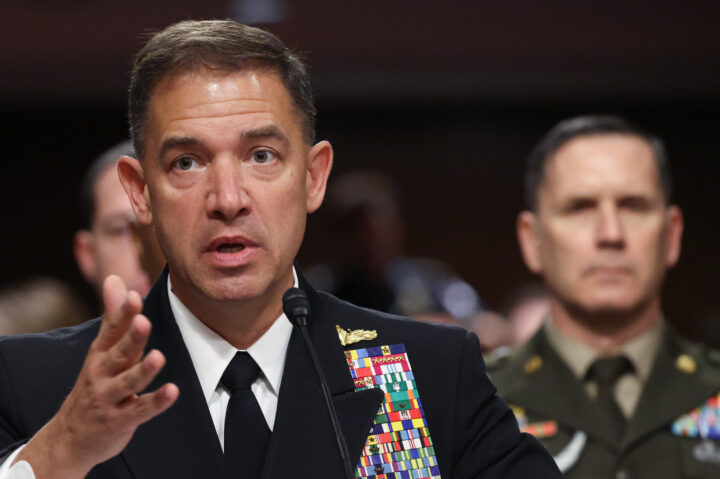
CENTCOM Commander Adm. Brad Cooper testifies during a Senate Armed Services Committee hearing in the Dirksen Senate Office Building on Capitol Hill on May 14, 2026 in Washington, DC.


 Add JewishInsider on Google
Adm. Brad Cooper, the head of U.S. Central Command, testified on Thursday that the U.S. and Israeli campaign against Iran had severely degraded its capabilities across a variety of fronts, to the extent that it will take years to reconstitute.
Cooper told members of the Senate Armed Services Committee that 90% of Iran’s defense industrial base had been destroyed, setting the country back years, and that support to key Iranian proxies Hamas, Hezbollah and and the Houthis had been “completely cut off,” across all areas of support that Iran had previously provided. He said that the operation had also set back Iran’s nuclear breakout time.
“We met every military objective for Epic Fury,” Cooper said.
Pressed on reports that Iran still has access to nearly three-quarters of its missiles and missile launchers, Cooper declined to discuss specific numbers in a public setting, but said that open source data on the subject were not accurate.
He added that it is important to note that Iran’s command and control has been “shattered,” that its capabilities have been significantly reduced and it does not have the ability to rebuild its stockpiles at the moment.
He said Iran maintains a “moderate, if not small, capability” to continue to strike targets in the region, including Gulf oil infrastructure, and that the U.S. is prepared for that contingency.
Cooper said Iran’s abilities to harass shipping in the Strait of Hormuz have also been reduced — he described its navy as completely destroyed, and said that, anecdotally, its stock of fastboats appears to have been significantly reduced.
The top military official said that Iran’s ballistic missile production capacity had undergone a “dramatic escalation” in the final months of 2025, making its destruction an important part of the U.S. operations. He said that if the U.S. had not intervened, Iran would have ultimately reached a point where it could no longer be neutralized militarily.
He also highlighted Iran’s long-running pattern of attacks directly and through proxies on U.S. personnel — he said that there had been 350 attacks on U.S. servicemembers and diplomats in the two-and-a-half years prior to the war.
Cooper emphasized the key role of several partners — in addition to Israel — in the operation, including the United Arab Emirates, Bahrain, Kuwait, Qatar, Saudi Arabia and Jordan during the operations, praising the military partners for standing with the U.S. and working to protect Americans.
He described other allies as having been “less than stellar” in their cooperation, but declined to name them in public.
He said that the regional air defense umbrella that has been under development for years has been “fully realized.”
Cooper also said that the nature of the Iranian drone threat and program has been misrepresented publicly. While many have characterized the situation as an asymmetrical one, in which Iran is using cheap drones that require expensive U.S. equipment to intercept, Cooper said that, in actuality, the drones Iran has been more recently using are far more expensive and sophisticated. He said that the U.S. has “very capably defeated” Iran’s drone force.
He said the U.S., by contrast, has been able to deploy its own lower cost systems and force Iran to utilize its more expensive systems. “I confidently say we’ve flipped the cost curve in many ways,” Cooper said, though he added that there’s “always work to be done.”
Should they be called upon to do so, Cooper said that the U.S. and its allies have the military capability to re-open the Strait of Hormuz by force, but said that the military defers to policymakers on how to go about doing so, noting that the administration is are currently in the midst of negotiations.
Cooper echoed top administration officials in describing Operation Epic Fury as having ended, and said that, in spite of the ongoing blockade of Iranian ports, the U.S. is not engaged in hostilities against Iran.
He also said that the U.S. had and continues to have sufficient mine clearing capacity, through a variety of systems.
Asked about public reports that the U.S. has struck numerous hospitals and schools inside Iran, Cooper insisted that was not the case, and said that there has only been one active civilian casualty investigation, related to a strike on a girls’ school adjacent to an Islamic Revolutionary Guard Corps base early in the war.
Addressing the situation in Gaza, Cooper said that four countries have thus far committed to provide forces for the International Stabilization Force, but that plans for the force are still in their “infancy” and that he would be able to provide more details on the ISF’s plans and structure at a later date.
More Stories

BEAN SET MATCH
Miznon’s green beans are the surprise ace of the U.S. Open

Norm-alizing?
Norm Eisen’s alliances with Israel critics raise eyebrows within Jewish community

CLAUDE CONTROLS
Anthropic report reveals Iran-linked actors used AI tools to target Jews, develop weapons

Daily Overtime
Mackle-no-more on Sheeran’s tour

Democracy Deficit
New report warns civics education crisis is fueling antisemitism, eroding support for Israel

COMMUNITY VOICE
Coalition of Michigan Jewish leaders sets out ‘nonnegotiable’ demands for El-Sayed, Democrats
Please log in if you already have a subscription, or subscribe to access the latest updates.
 Continue with Google
 Continue with Apple