
























Israeli, Lebanese officials to continue peace talks at State Department
The parties concluded all-day talks on Thursday with no further developments and plan to reconvene on Friday
Andrew Harnik/Getty Images
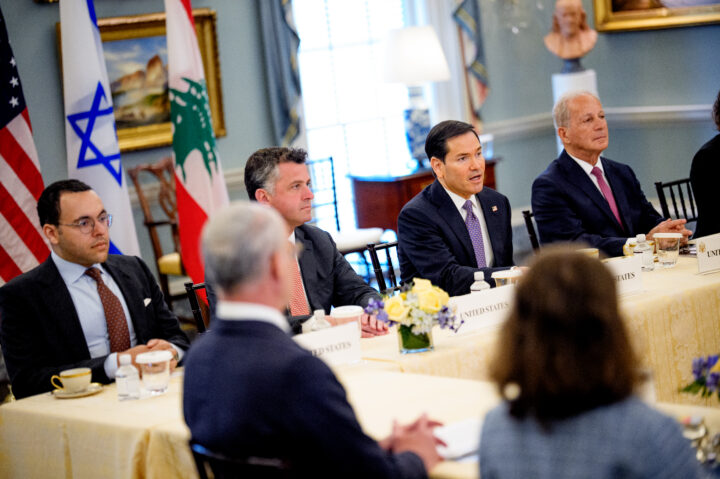
U.S. Secretary of State Marco Rubio (2nd-R), accompanied by U.S. State Department Counselor Michael Needham (C), and U.S. Ambassador to Lebanon Michel Issa (R), speaks as they begin working-level peace talks with Lebanese Ambassador to the U.S. Nada Hamadeh Moawad and Israeli Ambassador to the U.S. Yechiel Leiter at the U.S. State Department on April 14, 2026 in Washington, DC.


 Add JewishInsider on Google
Senior Israeli and Lebanese officials will reconvene on Friday at the State Department to continue peace talks, a State Department official said, after the parties concluded the first day of negotiations in the third round of the U.S.-led talks on Thursday with no further agreements secured.
The official said in a statement, “We had a full day of productive and positive talks that lasted from 9 a.m to 5 p.m. We look forward to continuing this tomorrow and hope to have more to share then.”
Israeli and Lebanese officials did not speak to the media on their way out of the Harry S. Truman Building, though all parties are expected back at the State Department headquarters at 9 a.m. ET on Friday to resume talks.
The talks come three days before the three-week ceasefire which was extended during the second round of talks late last month is set to expire.
Participants on Thursday included U.S. Ambassador to Israel Mike Huckabee; Israeli Ambassador to the U.S. Yechiel Leiter; Brig. Gen. Amichai Levin, the IDF’s chief of strategy; Brig. Gen. Erik Ben-Dov, the acting Israeli military attaché in the U.S.; Yossi Draznin, Israel’s deputy national security advisor; U.S. Ambassador to Lebanon Michel Issa; Lebanese Ambassador to the U.S. Nada Hamadah; Simon Karam, Lebanon’s former top envoy to Washington; and Brig. Gen. Oliver Hakmeh, Lebanon’s military attaché in Washington. U.S. State Department Counselor Michael Needham, a close Rubio advisor, was also present, as were other senior Israeli military representatives.
Ahead of Thursday’s talks, Lebanese officials told the Associated Press that their main objective was to get their Israeli counterparts to agree to a permanent ceasefire and the withdrawal of IDF forces from Lebanese territory, and that they would address the domestic political issues in Lebanon surrounding Hezbollah’s disarmament after that.
Israeli officials, on the other hand, have described disarming Hezbollah as a necessity to furthering an agreement with Lebanon.
As was the case with prior rounds of talks, representatives for Hezbollah were not invited to participate. The terrorist organization has condemned the Lebanese government for engaging directly with Israel and refused to participate in the U.S.-led ceasefire.
President Donald Trump said while announcing the three-week ceasefire extension that he would not prevent the Israelis from responding if under threat by Hezbollah, and the parties have continued to exchange fire regularly throughout the ceasefire.
The president also expressed his hope that Israeli Prime Minister Benjamin Netanyahu and Lebanese President Joseph Aoun would meet in person during that three-week period, a prospect which Aoun has thus far continued to reject.
More Stories
SHARING A STAGE
Top N.J. Dem recruit campaigned alongside New Jersey mayor accused of antisemitism
TWO JEWS, THREE OPINIONS
Jewish podcast ‘Chosen People Problems’ finds new home with Ark Media
PACKED PEWS
Scholten, Gottheimer and Bret Stephens join Dan Senor before packed Michigan crowd
SPENDING SCRAPPED
GOP leadership super PAC cancels spending plans against Rep. Landsman
RELATIONSHIP STATUS
How Israel’s parties say they would rebuild support in America

Daily Kickoff
Wikipedia’s edit scandal, unedited
Please log in if you already have a subscription, or subscribe to access the latest updates.
 Continue with Google
 Continue with Apple