












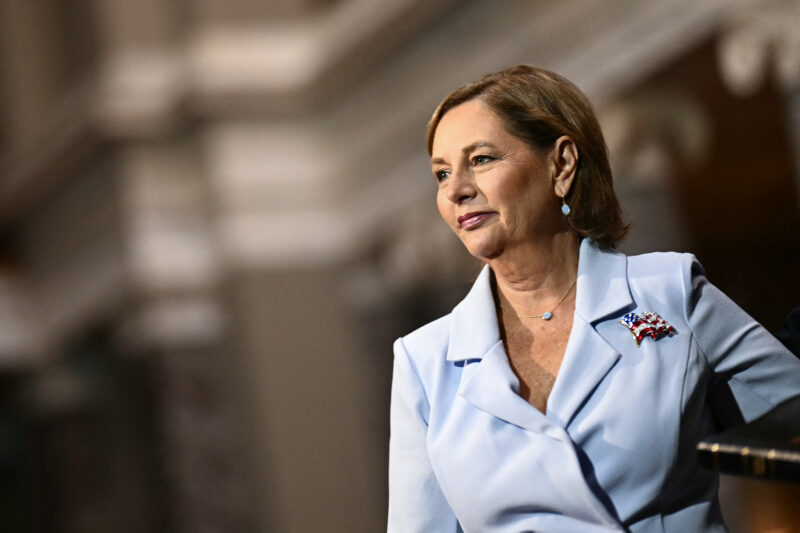
























Eileen Filler-Corn, the fast-rising speaker of the House, maintains strong ties to the Jewish community in a state that has turned solidly blue

Steve Helber/AP
Virginia House of Delegates, Speaker Eileen Filler-Corn, D-Fairfax, applauds as she delivers remarks during opening ceremonies of the 2020 Virginia General Assembly at the Capitol in Richmond, Va., Wednesday, Jan. 8, 2020. Filler-Corn is the first woman to hold the position.


 Add JewishInsider on Google
In Washington, D.C., the synagogues of choice for prominent politicians, pundits and the literary set are seen as spiritual status symbols. Indeed, certain ambitious political types have been known to choose a popular congregation because of its prestigious membership roster.
Supreme Court Justices Elena Kagan and Ruth Bader Ginsburg attended High Holiday services at Adas Israel Congregation in Cleveland Park. Former Treasury Secretary Jack Lew famously did not work on Shabbat, which he often observed at Georgetown’s Kesher Israel, where Joe Lieberman was also a member when he served in the U.S. Senate. During the Trump administration, Jared Kushner and Ivanka Trump attended services at the D.C. Chabad in Kalorama.
Half an hour from downtown D.C., in Springfield, Va., Congregation Adat Reyim does not have the name recognition or the cachet of the Beltway’s most esteemed congregations. But the synagogue has long counted Eileen Filler-Corn as a member. Elected to Virginia’s House of Delegates in 2010 by a margin of just 37 votes, Filler-Corn, a Democrat, is now entering her second year as Virginia’s speaker of the House — the first Jewish person and first woman to hold the position. A year ago, just before she struck the gavel for the first time, she attended a celebratory Havdalah send-off at Adat Reyim. The music of choice? Filler-Corn’s favorite: Debbie Friedman, the late Jewish folk musician whose music is a mainstay at Reform congregations and summer camps.
“We might have done a Mi Shebeirach, that [Filler-Corn] would continue to have the courage to make her life a blessing,” said Rabbi Bruce Aft, the congregation’s rabbi emeritus, referring to Friedman’s classic song about the Jewish prayer for healing. When Aft gave the invocation on the morning Filler-Corn was sworn in as speaker last year, his prayer incorporated more Friedman music, the Hanukkah song “Don’t Let the Light Go Out,” and Peter, Paul, and Mary.
***
Filler-Corn’s rise from rookie lawmaker to House speaker in just 10 years owes much to Virginia’s fast-changing political identity, which saw the state change from purple to almost firmly blue over just a few years. As she rose in the party’s ranks, Filler-Corn kept her Jewish community close, inviting Aft to deliver invocations at the statehouse and hosting receptions in Richmond, the capital, for her Jewish supporters from around the state.
“She is incredibly proud of her Jewish background,” Ron Halber, executive director of the Jewish Community Relations Council (JCRC) of Greater Washington, told Jewish Insider, calling Filler-Corn “unapologetically pro-Israel” with “Jewish identity coursing through her veins.”
Filler-Corn served on the JCRC’s board before she was elected, and she remains on the boards of the American Jewish Committee’s Washington office and the Jewish Foundation for Group Homes, an organization that provides housing and other services for people with disabilities and mental illness in the Washington region.
Supporting the disabled community was one of Filler-Corn’s first forays into social action. As a child in West Windsor, N.J., Filler-Corn sold lemonade and hosted fundraisers to benefit the Multiple Sclerosis Society and the Braille Society. The issue was personal to her: “Growing up, my mother had multiple sclerosis. And growing up, she was blind for much of my youth,” Filler-Corn told JI in a recent Zoom interview.
“What got me involved in politics really was tikkun olam, and just from a young [age] really wanting to give back and wanting to repair the world,” Filler-Corn explained.
Before starting at Ithaca College, Filler-Corn spent a gap year in Israel on Young Judaea’s Year Course program. One of her fellow participants was Gil Preuss, CEO of the Jewish Federation of Greater Washington. When he moved to the area almost four years ago, Filler-Corn was one of the first people he reached out to. Now, he turns to her regularly for guidance on what he described as “the challenges we’re facing as a Jewish community during COVID.”
Filler-Corn’s tenure in the Virginia statehouse has been punctuated by other challenges for Virginia’s Jewish community. In early 2017, she spoke at a Jewish day school in Northern Virginia after it received bomb threats. That summer, white supremacists marched through the normally serene streets of Charlottesville, chanting “Jews will not replace us.” Three months later, Democrats got within a coin toss — literally — of taking the majority in the House of Delegates, flipping 15 Republican seats. Filler-Corn was elected minority leader. “The past couple years have not been easy for her,” Preuss said. “She’s had threats against her.”
***
Filler-Corn’s political career has served as a kind of bellwether to national political trends: She was first elected in a special election in early 2010, just months after Republicans swept statewide offices in Virginia, foreshadowing the widespread losses Democrats would face in the 2010 midterms under then-President Barack Obama. When Republican State Sen. Ken Cuccinelli was elected attorney general, the Democrat representing Filler-Corn’s district decided to run for Cuccinelli’s seat, leaving an open House seat.
When she became minority leader in 2018, Virginia was fresh off an election seen as a repudiation of then-President Donald Trump. A year later, Virginia’s “blue wave” replicated itself across the country, with the Democrats winning control of the U.S. House for the first time since 2010.
But Filler-Corn’s electoral career began 11 years earlier, when she ran for the same seat and lost.
At the time her children were toddlers, and at a public debate, “somebody held up a picture of my children. And they said, ‘If you want to start making a difference, why don’t you start by raising your own children.’” Filler-Corn said she received criticism like this often in that campaign, noting that “no one ever asked [these questions] of men.” Later, as speaker, one of the first items on Filler-Corn’s agenda was pushing for Virginia to ratify the Equal Rights Amendment.
She only decided to run again after being approached by Mark Sickles, another member of the Virginia House of Delegates from Fairfax County. “Often, with women, you need to be asked many times,” Filler-Corn explained.
After talking to Sickles, she heard from now-Sen. Tim Kaine (D-VA), who at the time had recently left the governor’s mansion, and Sen. Mark Warner (D-VA); she had worked in both of the Virginia senators’ gubernatorial administrations, running their Washington offices. But it was a conversation with Anne Holton, Kaine’s wife (and the daughter of former Virginia Gov. Linwood Holton, a Republican), that convinced her to run. Holton told Filler-Corn that it was possible to reconcile public service and motherhood. “She just gave me the push that I needed,” Filler-Corn said.
Sickles told JI that it was “characteristic” of Filler-Corn to weigh her options, being a person who “likes to think through things.” That careful consideration has served her well in office. Being House speaker “is one of the hardest jobs I can imagine,” Sickles said, noting that Filler-Corn has to corral both a diverse group of vocal Democrats along with a rambunctious Republican caucus.

Eileen Filler-Corn being sworn into office as the speaker of the Virginia House of Delegates in January 2020. (Courtesy)
In 2016, she built a broad coalition of lawmakers to pass a resolution condemning the Boycott, Divestment, and Sanctions (BDS) movement against Israel. Filler-Corn wanted to showcase Virginia’s opposition to BDS, but she knew that the legislation would not send the right message unless it was supported by members of both parties.
“The goal is to get broad bipartisan support, so that it would be rejected by the entire legislature. This piece of legislation was dividing people along political lines,” said Halber of the JCRC. “With [Filler-Corn’s] magic touch, we were able to turn this into a win-win, where the legislature overwhelmingly condemned BDS and did it in a bipartisan fashion.” The bill passed with near-unanimous majorities in both houses.
***
Filler-Corn works mainly on the progressive priorities championed by Democrats across the country. After the police killing of George Floyd in Minneapolis last spring, she reconvened the House for a special session on racial justice. One of her first acts in office last winter was passing a slate of gun-violence-prevention bills, which Gov. Ralph Northam had tried to pass the year before after a 2019 mass shooting in Virginia Beach. “The Republican majority gaveled out after 90 minutes of not passing any of those bills,” she said — but a year later, the Democrats had taken the majority.
Members of the Virginia Jewish community say that Filler-Corn has also proven a champion of Jewish issues. In a body not known for engaging with international affairs, Filler-Corn worked with the Israeli Embassy and the Virginia Israel Advisory Board, on whose board she previously sat, to pass a resolution commemorating Israel’s 65th anniversary in 2013. She said it just made sense that, as a pro-Israel Jew, she would work on that issue: “That was not something I necessarily had always thought of, but once I was there in that position, of course, I’m going to do that,” Filler-Corn said.
Filler-Corn has worked to beef up spending to nonprofits in the state. Halber told JI that Virginia “has traditionally been a state where nonprofits are not well-supported,” but added that Filler-Corn has been “a great ally to the nonprofit sector” who is “strengthening the social safety net for all Virginians.” She has helped bring government dollars to smaller nonprofits, he said, including religious providers of social services. “I’ll always work to help the 501(c)3 Jewish social services,” said Filler-Corn.
She has also sought to bring more Judaism to the state capitol. Last year she changed the institution’s weekly Bible study to an “interfaith devotional,” bringing together “members of clergy from all different religions and races” to discuss religious teachings. The devotional’s first guest: Rabbi Aft, Filler-Corn’s longtime rabbi and friend from Adat Reyim.
Just last month, the devotional met for the first time virtually, and it now takes place weekly on Zoom. Of course, that meeting isn’t the only part of legislating that has changed with the pandemic. Last year, Virginia’s legislative session — constitutionally mandated to take place over 60 days at the start of the year — wrapped up just hours before Northam declared a state of emergency for the pandemic.
The legislature met six weeks later under outdoor tents for the annual reconvened session, “usually a perfunctory exercise to address the governor’s amendments and vetoes to legislation,” according to the Virginia Mercury. But Filler-Corn had the difficult task of working with the governor to walk back key policy proposals Democrats had passed, including a delay in increasing the state’s minimum wage, to amend the budget to meet the needs of the coronavirus crisis. It was “very depressing,” said Sickles. “But at least we’re in pretty good financial condition in the state, and we were able to put some of that [money] back later.” Now, Filler-Corn conducts the legislative session from an empty chamber in Richmond, while everyone else attends via Zoom.
Filler-Corn’s religious community moved online as well. She attended a Zoom Seder last year, and she acknowledges that she is “clicking on to services on a much more regular basis” these days. “Whether we’re focused on the discrimination or the hate and misogyny or antisemitism,” she explained, “or we’re talking about just how divided we are as a country… I think people need, really, to connect and unify even more. There’s more of a need for that. And we weren’t able to do that in person, but we can do that on Zoom.”
What continues to guide Filler-Corn is her connection to the Jewish community. “There are numerous times when she would either be giving a speech sponsoring a bill or having a vote on something, where she would contact me and ask me, ‘What does Judaism say about this?’” said Aft. “She wasn’t just putting on a show.”
The congresswoman’s comments came during a JFNA event with new members of Congress Monday night

Gerry Broome/AP
Rep. Kathy Manning (D-NC)
Freshman Rep. Kathy Manning (D-NC), a former chair of the Jewish Federations of North America, says her time with the organization has served her well on Capitol Hill, but in an unexpected way: The experience of fleeing from a Gazan rocket attack in Israel while on a JFNA trip prepared her to flee from the House gallery during the Jan. 6 Capitol riot, the congresswoman said Monday.
“Many of my colleagues were panicked, with good reason,” Manning said during a virtual JFNA meeting featuring nine freshman members of Congress. “But as my heart started to race, I thought to myself, ‘I’ve been through much worse. I’ve had to run to bomb shelters in Sderot with sirens blaring and rockets overhead coming in from Gaza.’”
Manning was inside the House gallery, a balcony with spectator seating that overlooks the House floor, with several dozen other members of Congress when rioters breached the building last month and attempted to access both the gallery and the House floor. They initially took cover under seats, with gas masks on, and then had to climb through the seating area and under guardrails to reach an exit.
A Manning spokesperson did not immediately respond to a request for more information about the Sderot incident.
“Who knew that being chair of JFNA would prepare me so well to be a member of Congress,” Manning added with a slight chuckle. “I’m sure I’ll be able to use things I learned there in the future, hopefully in less fraught circumstances.”
Rep. Sara Jacobs (D-CA), who recently joined the House Foreign Affairs Committee, discussed the need for bipartisan support for Israel.
“We have to be very intentional about not making [Israel] a political issue, not making it a partisan issue, not making it a political football, not using it as a wedge to separate different candidates of different parties,” Jacobs said.
She also wants to see the U.S.’s position as a credible negotiator for the Israeli-Palestinian conflict restored.
“It will be important for us to show that we can look ahead and really think about what the United States can do to help push for peace, push for a two-state solution, that we can become the trusted mediator again,” Jacobs said. “A lot of that has been eroded by the last four years, but I’m confident that the Biden administration is going to be doing everything they can to really be able to move us forward and push us closer to a two-state solution that I think we have a very short window to be able to do.”
Rep. Jake Auchincloss (D-MA), who is also Jewish and whose district in the Boston suburbs has a significant Jewish population, laid out the measures he believes are necessary to protect Jewish institutions.
The Massachusetts congressman called for stricter firearms regulations, explaining that he does not believe civilians should have access to assault weapons or high-capacity magazines and said that background checks should be mandatory for gun sales.
“As we have seen on January 6 and has been bubbling up for years now, we have a right-wing domestic terrorism problem in this country. And it’s got to be ripped out by the very roots,” Auchincloss said.
He said that solidarity with other groups targeted by extremists, including Black and Latino Americans, is crucial to pushing back against their influence. “If we’re not standing up for African Americans and Latinos, we’re not standing up for Jews either.”
The only problem: five of the six Jewish leaders slated to be on the call with Cawthorn weren’t informed of the meeting

Gage Skidmore/Flickr
Madison Cawthorn
For nearly six months, Jewish leaders in Western North Carolina have been working behind the scenes to arrange a meeting with freshman Rep. Madison Cawthorn (R-NC). The GOP firebrand, who represents the traditionally conservative 11th congressional district, coasted to victory in the recent November election. But some of his past statements — including an Instagram post in which he described Adolf Hitler as “the Führer” as well an admission that he has tried to convert Jews to Christianity — have raised questions that the district’s small but tight-knit Jewish community would like the 25-year-old congressman to address directly.
“How can we have a person who is our representative feel as though the desire to convert people is a good thing?” said Rabbi Rachael Jackson of Agudas Israel Congregation, a Reform synagogue in Hendersonville, N.C., where Cawthorn lives. Since August, she has been leading the effort to meet with the newly elected congressman. “It’s not our desire to change somebody,” she said. “It is our desire to help someone recognize that there is diversity in their region and to appreciate that diversity and to be more sensitive to the things that they are saying and why it would be offensive.”
Despite expressing a desire to meet with Jewish leaders back in September, Cawthorn didn’t appear to be prioritizing the engagement. However, last Thursday, a spokesman confirmed to Jewish Insider that Cawthorn’s office had finally set a date to meet with Jewish community members on February 8. “Madison is going to do a Skype call with them, discuss his overall goals for the district and then have them ask him some questions about what their priorities are and how he can best facilitate their priorities,” said Micah Bock, Cawthorn’s communications director, “and just hopefully engage in a productive dialogue.”
The only problem: five of the six Jewish leaders Bock claimed would be on the call weren’t informed of the meeting when asked about it by JI.
As of Sunday evening, Jackson said she had “not heard a word” from Cawthorn’s team. “I have not received an invitation from Madison Cawthorn for any meeting,” said Ashley Lasher, executive director of the Asheville Jewish Community Center. “Crickets,” echoed Rabbi Batsheva H. Meiri of Congregation Beth HaTephila, a Reform synagogue in Asheville. “I have not heard from his office or anyone else,” said Jessica Whitehill, executive director at Jewish Family Services of WNC. Rabbi Shaya Susskind, executive director of the Chabad House of Asheville, did not respond to email inquiries from JI, but a source who spoke with him on Friday said he was unaware of the call.
Only Adrienne Skolnik, who chairs the North Carolina chapter of the Conference of Jewish Affairs, appears to have received advance notice. She told JI via email on Friday night that she had been in contact with Bock about the February call. “I see this as a wonderful opportunity and plan to attend,” said Skolnik, a vocal Trump supporter who has criticized what she perceives as liberal bias in local synagogues. Her hope, she said, is that the meeting will engender “mutual respect between the Jewish community and Madison Cawthorn.”
Several Jewish community members appeared undecided about whether they will attend Cawthorn’s call. “We haven’t had a chance to discuss as Jewish leaders that there would be a meeting,” Jackson said. “I can say with a fair bit of certainty that we could not take the meeting offered on February 8, given the lack of time and the lack of planning.”
The list of invitees, several leaders added, was also incomplete, having omitted Congregation Beth Israel, an independent synagogue in Asheville.
For Rochelle Reich, executive director at Congregation Beth Israel, the hastily scheduled Skype event underscored what she has come to regard as a lack of local engagement on the part of the congressman. “I feel that his exclusion of Beth Israel may illustrate how little he cares about really hearing from his constituency.”
Initially, Jackson recalled, Cawthorn’s campaign was receptive to a meeting when she reached out last summer. But scheduling issues made it difficult to lock down a time.
In a January 19 email obtained by Time magazine, Cawthorn told Republican colleagues: “I have built my staff around comms rather than legislation” — a message that may provide one explanation for his office’s scheduling challenges.
Some Jewish leaders had already decided against meeting with Cawthorn after he spoke at a rally of Trump supporters before the Capitol was stormed on January 6.
“The Western North Carolina Jewish community had been looking forward to having a constructive dialogue with Madison Cawthorn, our newly elected congressional representative,” Deborah Miles of the Jewish Community Relations Council of Western NC and David Hurand of Carolina Jews for Justice wrote last month in Asheville’s Citizen-Times. “We had asked for a meeting date and were awaiting a response. Now, however, after witnessing his role in the January 6 attack on the U.S. Capitol, we have decided that our differences are beyond the pale of conversation. We are instead calling for his immediate resignation as representative of North Carolina’s 11th congressional district.”
Bock, Cawthorn’s spokesman, said it was “frustrating to hear that some people have already written off the idea of having a meeting at all, but it’s been scheduled.”
Jackson said she would still be open to meeting with the congressman despite finding his actions and comments disturbing. “I have a hard time completely shutting the door on dialogue,” she told JI. But she was frustrated that Cawthorn’s office hadn’t yet alerted her to the upcoming call. “There’s no excuse that we haven’t heard from them.”
On Thursday evening, Bock said that Cawthorn’s office would be reaching out to Jewish community leaders over the next couple of days, but then added that he believed the process had already begun.
Linda Thomas-Greenfield said she’d stand ‘against the unfair targeting of Israel’ and oppose BDS

Greg Nash/Associated Press
United States Ambassador to the United Nations nominee Linda Thomas-Greenfield listens during for her confirmation hearing before the Senate Foreign Relations Committee on Capitol Hill
Linda Thomas-Greenfield, President Joe Biden’s pick for ambassador to the United Nations, pledged to stand behind Israel in her role at the U.N. during her Senate Foreign Relations Committee confirmation hearing Wednesday.
In response to a question from Sen. Ben Cardin (D-MD), Greenfield addressed attacks on the Jewish state at the U.N.
“I look forward to standing with Israel, standing against the unfair targeting of Israel, the relentless resolutions that are proposed against Israel unfairly and… look forward to working closely with the Israeli embassy, with the Israeli ambassador to work to bolster Israel’s security and to expand economic opportunities for Israelis and Americans alike and widen the circle of peace,” Thomas-Greenfield said. “It goes without saying that Israel has no closer friend than the United States and I will reflect that in my actions at the United Nations.”
The former assistant secretary of state for African affairs also praised the recent normalization agreements between Israel, Bahrain and the United Arab Emirates, describing them as opportunities for further progress both within the U.N. and around the globe.
“I see the Abraham Accords as offering us an opportunity to work in a different way with the countries who have recognized Israel… We need to push those countries to change their approach at the United Nations. If they’re going to recognize Israel in the Abraham Accords, they need to recognize Israel’s rights at the United Nations,” she said. “I intend to work closely with the Israeli ambassador, with my colleagues across the globe, because this is not just an issue in New York — but also pushing our colleagues to address these issues with their countries bilaterally so that we can get a better recognition of Israel in New York.”
She also condemned the Boycott, Divestment and Sanctions movement.
“I find the actions and the approach that BDS has taken toward Israel unacceptable. It verges on antisemitism,” she said. “It is important that they not be allowed to have a voice at the United Nations.”
Thomas-Greenfield also said she plans to implement a robust approach to thwarting Iran’s nuclear ambitions, with the goal of engaging both U.S. allies and adversaries in countering the Iranian regime.
“We will be working with our allies, our friends, but we also have to work with other members of the Security Council to ensure that we hold Iran accountable,” Thomas-Greenfield said. “As the ambassador to the United Nations, if I’m confirmed, I will work across all of those areas to ensure that we get the support but [also] see where we can find common ground with the Russians and the Chinese to put more pressure on the Iranians to push them back into strict compliance.”
Senators on the Foreign Relations Committee did not raise the issue of U.N. Security Council Resolution 2334, a 2016 measure that declared that Israeli settlements in the Palestinian territories have “no legal validity” and constitute “a flagrant violation under international law.” In a rare step, the U.S. broke with Israel at the time and abstained in the Security Council vote on the resolution. In 2017, 78 senators cosponsored a resolution condemning the resolution.
Many of the Republicans who voted against Blinken’s confirmation cited his position on Iran

Jacquelyn Martin/AP
Then-Deputy National Security Advisor Tony Blinken speaks at the White House in 2014.
The Senate confirmed Secretary of State Tony Blinken Tuesday afternoon by a vote of 78-22, the closest vote thus far for any of President Joe Biden’s Cabinet nominees.
Nearly half of the Republican caucus opposed Blinken’s confirmation, with many citing both his and the Biden administration’s approach to Iran as primary reasons for their votes.
“What’s clear from Blinken’s desire to reenter a nuclear deal with Iran is that he did not learn from the many foreign policy blunders of the Obama years,” Sen. Tommy Tuberville (R-AL) said in a statement to Jewish Insider. “We need accountability and clear thinking, not a retread of Obama’s failed foreign policy.”
Sen. Ted Cruz (R-TX), who has been critical of the new administration’s emerging policy on Iran, echoed those views.
“The policies that Mr. Blinken has committed to implementing as secretary of state, especially regarding Iran, will dangerously erode America’s national security and will put the Biden administration on a collision course with Congress, and I could not support his confirmation,” Cruz said in a public statement. Cruz told JI last week ahead of a private meeting with the then-nominee that he believed Blinken’s statements on Iran reflected “naivete.”
A spokesman for Sen. Mike Lee (R-UT) also cited Blinken’s positions on Middle East policy as one of the senator’s reasons for voting against the nomination, in a statement to JI.
“Senator Lee maintains significant reservations about Mr. Blinken’s approach to U.S. involvement in the Middle East, his blanket deference to multilateral organizations and agreements, and a posture that limits Article I input in foreign policy decisions where constitutionally required,” the spokesman said, referring to the U.S. Constitution’s system of checks and balances between the executive and Congress.
Also on Tuesday, the Senate Homeland Security and Government Affairs Committee voted 7-5 to advance Homeland Security Secretary-designate Alejandro Mayorkas’s confirmation to a full Senate vote. Two Republicans, Sens. Mitt Romney (R-UT) and Rob Portman (R-OH), voted with the panel’s five Democrats in favor of Mayorkas.
Sen. Gary Peters (D-MI), the incoming committee chair, told reporters after the committee vote that Senate Democrats are working to set a date for Mayorkas’s confirmation vote.
'It was the most meaningful inauguration, I think, for anybody that has lived and worked in this town for 30 years'

Gage Skidmore/Flickr
Chuck Todd, who moderates NBC’s long-running political program, “Meet the Press,” has covered every presidential inauguration since 1992, when he began his career in journalism as an intern at the Hotline, National Journal’s Washington tip sheet. Joe Biden’s swearing-in ceremony, he says, is one he won’t soon forget. “It was the most meaningful inauguration, I think, for anybody that has lived and worked in this town for 30 years after what happened on January 6,” Todd said in an interview with Jewish Insider on Wednesday, alluding to the deadly Capitol breach that left Washington, D.C., in turmoil.
“I’ll be frank, you spend this much time in this town, you become numb to the pageantry and the ceremony because we never had it any other way,” Todd, 48, elaborated. “It was always ceremonial, and we all knew the order of how this worked.” But the riot two weeks ago changed all that. Washington, on lockdown in the lead-up to the inauguration, had become a veritable military zone. “You suddenly feel vulnerable in what you thought was the safest city in the world,” Todd said. “That was the backdrop today. All of a sudden, every ceremonial part of the inauguration, you couldn’t help but wonder, ‘What’s the vulnerability here?’”
The proceedings went as smoothly as possible, all things considered. Still, Todd recalls a time when his adopted city was considerably more laissez-faire — and he wonders what we have lost in the process of increasing security in the capital. “When I first got here in Washington, D.C.,” he told JI, “you could drive and I think you could even parallel park next to the White House on Pennsylvania Avenue.”
Things have changed since then. “We boarded up our network’s windows, and we weren’t the only network that did this — all the networks that have a presence on Capitol Hill covered up their presence, covered the signs up with Hefty bags,” Todd said. “The question I have is, ‘How long are we going to live that way in this town?’ And that I don’t know the answer to. Is this going to be the start of where D.C. has to constantly feel on edge the way I think New Yorkers felt for a couple of years after 9/11?”
Whatever the outcome, Todd was hard-pressed to imagine a time when that tension goes away entirely. “People may feel relieved today, or they’re exhaling or whatever you want to call it,” he said. “But I can tell you how I feel. None of us believe what happened on January 6 is isolated. I mean, I hope it is. Obviously, we all hope it’s an isolated uprising that will never happen again. But what we’re seeing here, I think there’s a lot of concern that this is the beginning of a new way that D.C. is treated for a while.”
Even with that view in mind, Todd was still encouraged by the president’s inauguration speech calling for unity in an increasingly fractured political environment. “I do think that that only adds to the credibility of what he’s going to try to do,” Todd said of Biden’s appeal to bipartisan cooperation. “I don’t know if it’s going to work. But one thing about it is that I think there’s a genuine belief he’s going to try.”
“Biden’s going to want to work with Congress,” Todd added. “We haven’t had a president since LBJ who has actually looked forward to working with Congress. Don’t underestimate what that means.” Todd, who also serves as the political director for NBC News, speculated that Biden might be capable of bringing more Republicans to his side than such occasional moderate allies as Sens. Mitt Romney (R-UT), Lisa Murkowski (R-AK) and Susan Collins (R-ME). “I have this theory that in the first six months, he will find two dozen Republicans, on various issues, who he can work with.”
Asked to envision the journalistic landscape under the new president, Todd predicted that Biden’s apparent willingness to work with Congress will most likely change the way reporters seek out scoops. Though the president’s administration is expected to be a much more disciplined vessel than Trump’s leaky ship, there are ways to bypass tight-lipped presidential staffers, according to Todd.
“One of the hallmarks of the Obama years is it was easier to almost cover it outside in,” Todd said. “It was harder to cover it inside out because they were a tight unit. Not to say that there weren’t plenty of ways to report from the inside. I was inside being a White House correspondent. But it was always a lot easier to report on the White House through Congress.”
That precedent will serve reporters well, Todd suggested, as they cover the Biden administration. “If you’re a reporter in this town, the best White House scoops are going to come off from Capitol Hill,” he said. “As we all know, Capitol Hill isn’t as tight of a ship as the White House, now is it? So you’ll have that.”
Still, Todd is hopeful that Biden, who has appeared on Meet the Press a number of times in the past, will make himself available to the news media. “There’s a couple things that they can learn from Trump both on what to do and what not to do,” he mused. “One thing that they ought to learn from Trump is that, don’t have one story a day, don’t have one item a day that you’re trying to push or do, don’t get stubborn like that. Flood the zone, because you might get more accomplished if you do that. But the other thing is, be careful. I do think Trump’s words became meaningless. I can’t tell you the day they became meaningless, but you know what I mean?”
“If you worked or lived in Washington,” the past four years were “a bit traumatic in different ways,” according to Todd, who was often singled out for ridicule by the former president. Not that he worried too much about Trump’s taunts. “Look, I’m a big boy. That’s fine,” he told JI. “In some ways, I got numb to it,” Todd added. “But my family didn’t.”
Todd described his chaotic experience bearing witness to the Trump years on national television as akin to a non-stop roller coaster ride. “The closer you were to covering him, the more unstable it always felt,” he said. The ride stopped, he said, not on inauguration day but when Trump’s Twitter account was suspended, leaving the former president without his most powerful megaphone in his final two weeks in office.
“It finally stopped and it’s like, I’m finally off the ride, I’m not going to throw up anymore,” Todd said. Finding his bearings, though, could take some time. “You might still be trying to steady yourself, and I do think a lot of the press corps feels this way.”
The inaugural proceedings, despite the ominous militarized backdrop, appear to have helped Todd find his balance, even if only temporarily. “I just felt like I sat up straighter paying more attention to every little part of this inauguration,” he said. “It’s not as if I never did, but it was like, you just didn’t want to take it for granted.”
Blinken discusses a range of Middle East issues during his Senate confirmation hearing Tuesday

U.S. Embassy
Secretary of State Tony Blinken
Antony Blinken, President-elect Joe Biden’s pick for secretary of state, said that diplomatic progress on Iran’s nuclear ambitions and other provocations or on the Israeli-Palestinian conflict are likely long-term goals unlikely to see significant progress in the near future during his Senate Foreign Relations Committee confirmation hearing Tuesday afternoon.
Blinken reiterated the Biden team’s commitment to preventing Iran from acquiring a nuclear weapon and said that if Iran returns to full compliance with the JCPOA, the Biden administration would do so as well — potentially indicating that the U.S. will not unilaterally roll back the Trump administration’s “maximum pressure” sanctions without initial steps from the Iranian government.
Iran’s recent moves toward enhancing its nuclear program “potentially [bring] us right back to the crisis that we were reaching before the deal was negotiated,” Blinken said. “We have an urgent responsibility to do whatever we can to prevent Iran from acquiring a weapon or getting close to the capacity to have the fissile material to break out on short notice.”
But the secretary-designate cautioned that “we’re a long way from” Iran returning to compliance with the JCPOA. “There is a lot that Iran would need to do to come back into compliance. We would then have to evaluate whether it had actually done so,” he said.
“We would have to see, once the president-elect is in office, what steps Iran actually takes and is prepared to take,” Blinken continued. “We would then have to evaluate whether they were actually making good and if they say they’re coming back into compliance with their obligations.”
Should Iran return to compliance with the deal, the U.S. could then “use that as a platform” to create a longer-term and more robust agreement with Iran that also encompassed Iran’s non-nuclear weapons and other destabilizing activities,” Blinken added.
The U.S.’s rejection of the Iran deal has also handicapped the country’s ability to respond to Iran’s terrorist activities and other provocations, Blinken added, since it caused a fracture between the U.S. and its European allies on the issue of Iran.
Blinken committed to working together with Congress on the Iran deal, although that proposition will likely be a difficult one. Sen. Bob Menendez (D-NJ), who will become the chair of the Foreign Relations Committee Wednesday, was an opponent of the Iran deal and expressed skepticism Tuesday about proposals to rejoin the agreement as it stood in 2015.
“I fear returning to the JCPOA without concrete efforts to address Iran’s other dangerous and destabilizing activity would be insufficient,” Menendez said. “I believe there’s bipartisan support to find a comprehensive diplomatic approach with Iran that includes working closely with our European and regional partners if we take those other issues into consideration.”
Senators on the other side of the aisle were also skeptical of the Biden team’s intended approach to Iran. Sen. Jim Risch (R-ID), the current committee chairman, said during the hearing that a new agreement must address Iran’s nuclear and non-nuclear programs, and that Biden should submit any deal he does reach to the Senate for ratification as a treaty.
Sen. Mitt Romney (R-UT), who questioned Blinken on Iran and encouraged him to review intelligence about current conditions within Iran before making any moves, expressed positivity about Blinken’s response after leaving the hearing.
“He expressed a willingness to consider the current views of the intelligence community and fashion a policy with regards to Iran consistent with that, and not just jumping to the conclusion that what was done by the prior administration was necessarily wrong,” Romney told Jewish Insider. “I think there may well be some opportunities as a result of the current conditions in Iran, that may suggest a different approach than that was applied in the past.”
Blinken also said that he believes that the 2001 Authorization for Use of Military Force does not grant the president the authority to go to war with Iran without prior congressional approval, and that the Biden administration would seek congressional approval for such an action.
He added that, while “no one is shedding a tear for the demise of [Iranian General] Qassem Soleimani,” who was killed in a Trump administration drone strike, he believes that Iran’s actions since Soleimani’s death prove that Soleimani’s killing made the U.S. less safe on the whole.
During the hearing, Blinken also reiterated that the U.S.’s “commitment to Israel’s security is sacrosanct” and said the U.S. is committed to a two-state solution, but acknowledged that it is “hard to see near-term prospects for moving forward on that.”
“[A two-state solution] seems more distant than it’s ever been, at least since Oslo,” Blinken added.
He said that, in the current environment, the priority is to avoid unilateral actions that set back the peace process further, and subsequently working to rebuild confidence for peace negotiations.
The secretary-designate said later in the hearing that he sees an opportunity to build on the Abraham Accords to achieve further progress on the Israeli-Palestinian conflict, referring to the Trump administration-brokered recent deal that normalizes relations between Israel, the United Arab Emirates and Bahrain.
“I hope that also might create a greater sense of confidence and security in Israel as it considers its relationship with the Palestinians. Whether we like it or not, whether they like it or not, it’s not just going away,” Blinken said.
Blinken also reiterated his and Biden’s opposition to the Boycott, Divestment and Sanctions movement, which he said “unfairly and inappropriately singles out Israel.” He also acknowledged Jerusalem as Israel’s capital, and said the Biden administration did not plan to move the U.S. embassy from Jerusalem.
While the former deputy secretary of state praised the Abraham Accords, he also said “there are certain commitments that may have been made in the context of getting those countries to normalize relations with Israel that I think we should take a hard look at” — likely referring to the sale of F-35s and other arms to the U.A.E., U.S. recognition of Moroccan sovereignty over the Western Sahara and Sudan’s removal from the list of state sponsors of terror.
Menendez said earlier Tuesday that the committee will vote on Blinken’s nomination on Monday. Some Republicans, including Sen. Lindsey Graham (R-SC), indicated during the hearing that they might support Blinken’s nomination.
Torres joined the inaugural episode of JI’s ‘Limited Liability’ podcast
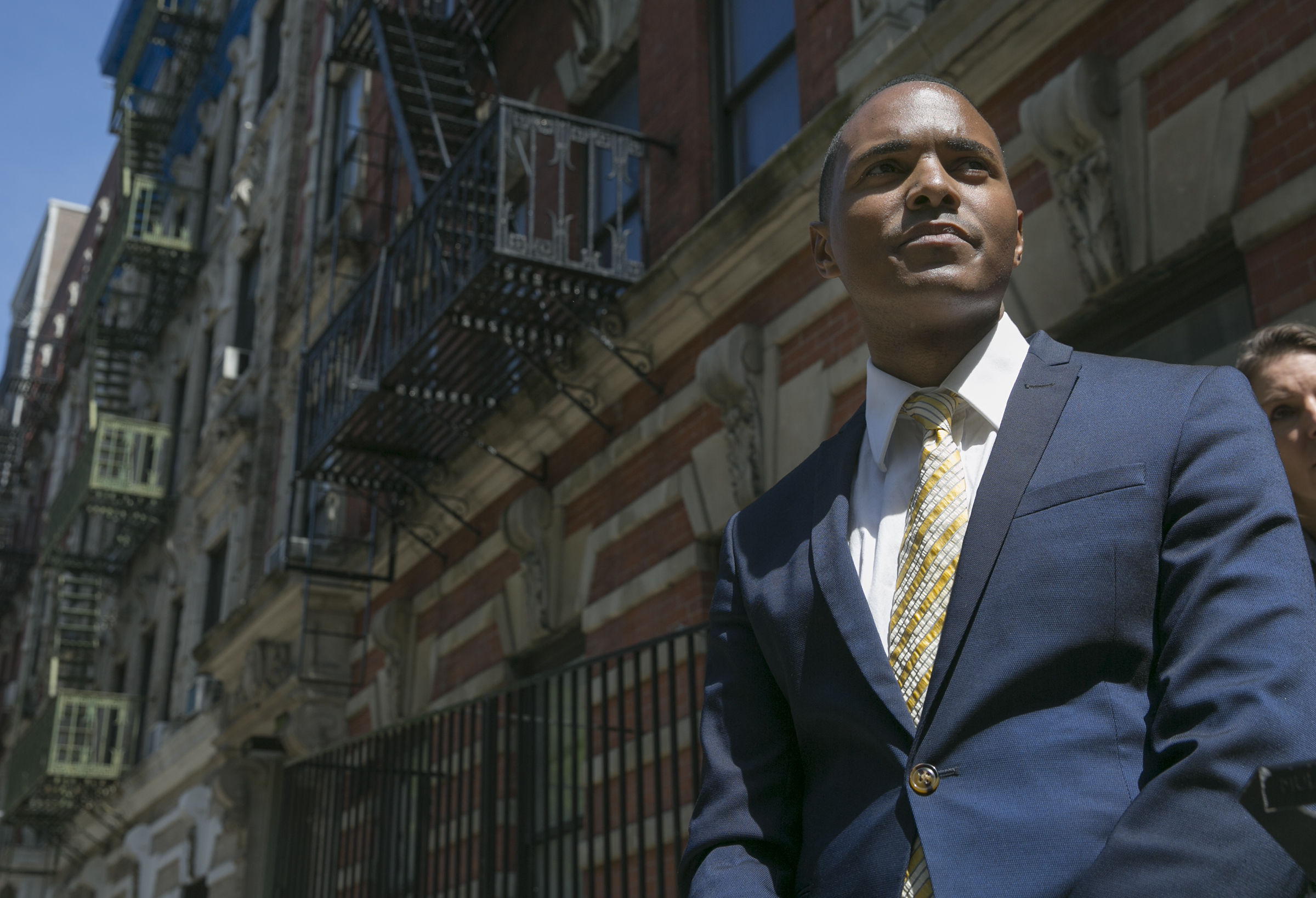
WILLIAM ALATRISTE
Freshman Rep. Ritchie Torres (D-NY) cautioned about the rise of antisemitism in progressive politics during a wide-ranging conversation in the inaugural episode of Jewish Insider’s “Limited Liability Podcast,” hosted by Rich Goldberg and Jarrod Bernstein.
Torres, who describes himself as “the embodiment of a pro-Israel progressive,” said he is mindful of anti-Israel elements within the Democratic Party that have the ability to turn antisemitic. “We have an obligation to combat antisemitism no matter where it emerges, whether it’s from the right, from the left. It has to be fought at every turn and in every form,” he said.
“My concern is that the pro-BDS left could be to the Democratic Party in American politics what Jeremy Corbyn has been to the Labour Party in British politics,” Torres cautioned. “It only takes a few demagogues to pump antisemitic poison into the bloodstream of a political party. And so I see it as my mission to resist the Jeremy Corbynization of progressive politics in the United States.”

Torres, a freshman representing New York’s 15th congressional district, addressed his hard-fought primary victory, which pitted him against a diverse group of Democratic candidates, from the conservative Rubén Díaz, Sr. to Democratic socialist Samelys López, who had the backing of high-profile progressive leaders and groups.
“New York City has become ground zero for Democratic socialism. In the latest election cycle, the [Democratic Socialists of America] won every single race in which it endorsed, except mine,” noted Torres, who on Thursday endorsed New York City mayoral candidate Andrew Yang.
“I had powerful forces arrayed against me — I had Bernie Sanders, [Alexandria Ocasio-Cortez], the [Working Families Party], the DSA, all endorsed Samelys López against me. And not only did I win, but I won decisively,” Torres said of his primary victory. “And I sent a powerful message that you can run as a pro-Israel, pragmatic progressive without catering to the extremes and you can win decisively in a place like the South Bronx.”
“Limited Liability Podcast” is a new weekly podcast for readers of Jewish Insider. Hear from the key players generating buzz and making headlines in conversation with two top political operatives, Jarrod Bernstein and Rich Goldberg. One Democrat, one Republican. Both hosts have extensive experience in the political arena and a deep rolodex to match. It’s Jewish Insider’s Daily Kickoff brought to life.
Leaf, the former ambassador to the UAE, has been vocal on recent developments in the region

Tech. Sgt. Anthony Nelson Jr/U.S. Air Force
Barbara Leaf
Like so much about the Trump administration, its Middle East policy sought to disrupt conventional wisdom, and de-couple the Israeli-Palestinian question from Israel’s warming relations with the wider Arab world.
Barbara Leaf, who will reportedly join President-elect Joe Biden’s Middle East team at the National Security Council, believes the new administration will look to repair relations with the Palestinians in the wake of the historic Abraham Accords, which normalized relations between Israel, Bahrain and the United Arab Emirates.
Leaf, a fellow at The Washington Institute for Near East Policy, has tempered her optimism for progress on Israeli-Palestinian peace talks during the Biden administration. In late November, she explained to JMORE, a Jewish publication in Baltimore, “The Biden administration is not intending to launch into any kind of full-scale engagement on a peace process but will look to knit up relations with the Palestinian community and its leadership. That will be a good starting place.”
She added that the Trump administration’s policies have not been productive to the cause of peace.
“I would have liked to have seen the move on the [U.S. Embassy to Jerusalem] done within a wider set of steps — not even necessarily a fully-defined peace negotiation/effort — that would have signaled a commitment by the U.S. administration to seeing things through to a two-state outcome,” Leaf commented to JMORE.
Leaf has also downplayed the larger implications of the Accords, arguing that the Trump administration does not deserve much credit for the United Arab Emirates deal. She explained to JMORE that she believes the UAE-Israel peace talks were motivated by the then-upcoming U.S. presidential election, rather than the Trump administration’s broader Middle East policy.
“The Trump peace plan had not, in fact, moved things in the region,” she said. “I suspect the U.S. presidential elections had as much to do with the shift to normalization as anything — the UAE desiring to position itself well in either outcome, and the Trump administration hoping to notch a few foreign policy wins.”
In the Biden administration, Leaf may find herself at odds with congressional Democrats over the issue of arms sales to the UAE. Senate Democrats voted almost unanimously to block the $23 billion sale of F-35 fighter jets, drones and other munitions last month.
Leaf told Vox in December that Israel’s decision to drop its objection to the sale indicated that the deal does not pose serious concerns for the Jewish state’s qualitative military edge.
“It’s now more about the foreign policy dimensions of the proposed sale,” Leaf said of the arms sales tied into the Abraham Accords. “This won’t change the military balance in the Middle East.”
In August, Leaf emphasized that the “alliance [between Israel and the UAE] will not significantly shift the balance of power in the region, although Tehran will monitor closely the direction of Emirati-Israeli intelligence and defense cooperation.”
In the October JCRC talk, Leaf encouraged the next administration to take its time in addressing rapprochement with Iran.
“Let them just sit and think about where Washington will end up,” she said, referring to Iranian leaders. “Consult deeply and thoroughly with those countries… who feel themselves very much on the front lines of Iran’s disruptive behavior, and think through a process that is not wholly interlocking,” she said. “You’ve got to have Tehran understand that it doesn’t just go back to [2015 Joint Comprehensive Plan of Action], [that] all’s forgiven,” she said, referring to the Iran nuclear deal.
Leaf said in the JCRC appearance that relying on “bumper stickers” foreign policy, including demanding that Iran leave Syria and Iraq, will not be effective. Leaf instead encouraged the incoming Biden administration to set benchmarks for different sets of talks on different issues, and to pursue them “in concert with each other.”
This would allow the next administration to avoid the Obama administration’s perceived failure to tackle additional issues after the JCPOA, which caused the Gulf states to ditch their support for the Iran deal.
Ron Halber, the executive director of the JCRC of Greater Washington, who moderated the panel with Leaf, told Jewish Insider he was impressed by her during their conversation.
“She’s clearly an experienced Middle East hand… She provided a very cogent and comprehensive analysis,” Halber said. “It makes perfect sense based on her background, and the variety of her postings, and where the president-[elect] stands philosophically that she would be part of the team.”
“No one who’s going to voluntarily work at The Washington Institute of Near East Policy is going to have negative feelings toward Israel,” Halber noted.
‘He should challenge Donald Trump for the leadership of the Republican Party,’ says prominent Hoosier Bernard Hasten

Gage Skidmore
As more Republican lawmakers come out in favor of impeaching President Donald Trump for inciting a mob of violent extremists to storm the U.S. Capitol last week — leaving his political and legal future in jeopardy — Vice President Mike Pence has characteristically abstained from taking an active role in the debate.
On Tuesday night, Pence clarified that he had no intention of invoking the 25th amendment and removing Trump from office before his term ends next week, preempting a House vote calling on him to do so. “I will not now yield to efforts in the House of Representatives to play political games at a time so serious in the life of our nation,” Pence said in a letter to House Speaker Nancy Pelosi (D-CA).
It remains to be seen how Pence will move forward with only a week remaining until Joe Biden’s presidential inauguration on January 20. But equally intriguing is what he has planned when leaves his official residence on the grounds of the U.S. Naval Observatory and enters life as a private citizen — a question he has yet to address publicly.
Tom Rose, a Pence senior advisor and chief strategist, deflected an email inquiry from Jewish Insider regarding the vice president’s post-Trump prospects, offering that “perhaps we can communicate when all this is over” — meaning, it seemed, the final chaotic days of Trump’s term.
Yet a number of Pence confidants from his home state of Indiana, where he served one term as governor before joining the current administration, tell JI that they are eager for the vice president to come out of the shadows and assert himself when Trump’s tempestuous run comes to an end.
“Mike Pence can be and should be the next Republican leader, and he should take the bull by the horns and take the reins of the Republican Party,” Bernard Hasten, an Indianapolis businessman and pro-Israel activist who has known the vice president for decades, said emphatically in a phone interview on Tuesday afternoon.
Hasten, whose father, Hart, is one of Pence’s earliest political mentors, added his hope that Pence would make his own bid for the Oval Office — and that he would announce his candidacy as soon as possible. “He should run,” Hasten said.
Over the past four years, Pence has walked a delicate line, positioning himself as the president’s dutiful servant and ever mindful to play his part as right-hand man always just a few steps away from the spotlight occupied by his volatile boss.
But their fragile relationship came apart at the seams last week, when Pence ignored Trump’s demand that he overturn the election results during a joint session of Congress, prompting an accusatory tweet from the president as insurrectionists made their way into the Capitol. The two have apparently only spoken once since the siege.
Forced to choose between Trump and Pence, the vice president’s Hoosier State allies are quick to make their loyalties known.
“He did the right thing,” Bob Shuckit, an attorney who serves as Indiana council chair for AIPAC, said of Pence, whom he describes as a close acquaintance. “I think people respect him for what he ultimately did last week. It was an opportunity for him to demonstrate that, although people may criticize him for doing his job, his job doesn’t lend itself to being a conservative or a liberal.”
“I don’t know what the future holds for him,” added Shuckit, acknowledging an uncertain political landscape that has caused a rift in the Republican Party between Trump’s most ardent supporters and those who are turning away from him after the events of last week. “I hope it leads to more government positions,” he said of Pence’s post-administration future, echoing Hasten’s view that he should set his sights high. “I think that he would be a terrific vice president again or a terrific president.”
Despite such enthusiasm, Leslie Lenkowsky, a professor emeritus in public affairs and philanthropy at Indiana University who has known Pence for 30 years, believes that the vice president will likely slink away from public view after he leaves office and as he makes preparations for his next move.
“My hunch is that Mike will keep his head fairly low for a while,” said Lenkowsky. “He’s not a very wealthy man, and I’m sure he’ll have some offers coming his way, so he might take some of them up in order to earn some money.”
Those offers could potentially include a book deal, an appointment to lead a think tank or perhaps a teaching gig at a prestigious Indiana college like the University of Notre Dame, according to Michael Wolf, a professor of political science at Purdue University in Fort Wayne, Indiana.

Pence and Israeli Prime Minister Benjamin Netanyahu at a special Knesset session in Jerusalem. (GPO)
But any return to the political sphere would still likely depend on Trump’s standing within the Republican Party — an open question at the moment. “If the base remains so steady with Trump then it’s going to be hard to see the oxygen for him to move forward,” Wolf said of Pence, adding that Democrats could also use his close connection with the president against him in the coming years. “That said, if there’s a turn against [Trump], he’s a name brand and not only that, he’s able to kind of say, ‘I stared Trump down.’”
A barometer of Pence’s political appeal, Wolf argued, may become apparent during the upcoming 2022 midterm elections, when the GOP begins recruiting congressional candidates. “Is he going to be invited anywhere?” Wolf asked. “That, I think, will be the indicator of his future.”
For some Pence partisans, however, the vice president has already proven himself a worthy candidate for the White House. “I think people really want a fighter,” said Allon Friedman, a physician in Indianapolis and the vice president of the Jewish American Affairs Committee of Indiana, who told JI that he would back a Pence bid in 2024.
“He’ll advocate for good policies, Republican types of policies,” said Hasten. “He’ll argue his case for any venue that will listen to him. Hopefully his policies and advocacy will take root with people.”
They certainly took root in the Trump administration, according to Hasten, who claimed to know “first hand” that Pence played a major role in moving the U.S. Embassy in Israel from Tel Aviv to Jerusalem and recognizing Israeli sovereignty over the Golan Heights — signature Trump administration policies he supports.
Shuckit agreed. “I’m confident that he purposely stayed under the radar so that we are unable to say exactly what his role is,” he said of Pence’s purported understated but influential involvement in many of the Trump administration’s major foreign policy achievements in the Middle East, including the normalization deals between Israel and the United Arab Emirates and Bahrain. “But I’m confident that his role was huge.”
“He’s a real friend of Israel, and not just a political friend,” Rabbi Yisrael Gettinger, who leads B’nai Torah, an Orthodox Jewish congregation in Indianapolis, told JI. “I think there’s something about his tie to the country that really comes from his soul.”
“I found him to be a person who we were proud to have as a governor,” Gettinger added. “He was very close to the Jewish community, and particularly the Orthodox Community,” Gettinger said, noting that when Pence would host governor’s mansion parties at which a number of Jews were in attendance, he always made sure that the food was kosher — a gesture the rabbi appreciated.
As political observers speculate about Pence, Lenkowsky made sure to note that his future isn’t confined to the next presidential race, even if many of his supporters hope he will run.
“I think it’s important to remember that Mike is still a very young man,” he said of the 61-year-old vice president. “Well, it may very well be that 2024 will not be the year for him, but 2028 could be. He’s still certainly well within the range given the people we’ve been electing. The real challenge will be how he keeps himself in the public eye between now and if he does decide to run again.”
For Hasten, the answer to that question is simple. “The day after Joe Biden is inaugurated as the 46th president,” he said, “I hope Mike Pence puts his hat in the ring as running for president of the United States.”
Even if Trump declares his candidacy — a possibility that has been repeatedly floated — Hasten emphasized that Pence should still enter the race.
“He should challenge Donald Trump for the leadership of the Republican Party,” Hasten said, suggesting that the time had come for Pence to abandon his subservience to the president. “What is he going to lose?”
'Joining the dots wasn’t very difficult,' the London native said of his now-viral tweet

Julio Cortez/AP
Trump supporters try to break through a police barrier, Wednesday, Jan. 6, 2021, at the Capitol in Washington.
On the morning of December 21, a 39-year-old corporate communications specialist shared a startling prophecy on Twitter that is now widely regarded as one of the most accurate and clear-eyed predictions of last week’s Capitol breach.
“On January 6, armed Trumpist militias will be rallying in D.C., at Trump’s orders,” Arieh Kovler wrote in his now-viral tweet more than two weeks before the violent siege, the first post in a longer thread in which he presciently detailed his lack of faith in the Capitol Police force as well as his belief that there would be fatalities should Trump’s supporters revolt. “It’s highly likely that they’ll try to storm the Capitol after it certifies Joe Biden’s win. I don’t think this has sunk in yet.”
Equally surprising was that Kovler had delivered his grim prognostication from Jerusalem — nearly 6,000 miles removed from Washington, D.C. — where he lives and works as a consultant advising Israeli startups.
“Joining the dots wasn’t very difficult,” Kovler, a native of London, confessed in a recent interview with Jewish Insider, noting that he tends to keep an eye on right-wing messaging sites like Gab, 4chan and 8kun, where the siege was planned in public view. “I could see the way the wind was blowing.”
There were two primary indicators Kovler saw as he looked out on a volatile political landscape from his home in Israel. “These guys, they’re absolutely convinced that Trump has won — that’s the starting point,” Kovler said of the pro-Trump extremists who mounted a failed insurrection on Wednesday. “They never were ready to lose, and of course Trump himself didn’t give them any reason to think that they did lose.”
“Part two is, Donald Trump says ‘Come to Washington, D.C., on January 6, it’s going to be wild,’” Kovler continued. “Most of these people thought they were going to watch Donald Trump win, and that was clear. They really thought that they were going to watch him or to help him win.”
That combination, Kovler rightly surmised, would be disastrous.
And yet Kovler’s tweet wasn’t intended entirely as a doomsday prediction. He described his social media missive, first and foremost, as a kind of warning for those in the United States who may not have been mentally prepared for what he imagined would be a failed attack. Despite his pessimism, Kovler never envisioned that Capitol Police would be stranded without immediate backup from the National Guard as rioters made their way into the halls of Congress.
“I wasn’t seeing people take it seriously enough, and by people, I didn’t mean the authorities,” Kovler told JI. “I assumed the authorities would have it all in hand. I actually meant the general public. I kind of wanted to try and essentially warn people to be psychologically prepared for what I assumed was going to happen.”

Arieh Kovler (Courtesy)
As his tweet has gained traction — earning him more than 50,000 new followers — Kovler said he has occasionally been asked why he didn’t reach out to authorities ahead of the incursion.
The answer, he says, is obvious. “To me, that would be like if you saw a weather forecast about a big storm tomorrow, you might post on Facebook, ‘Hey everyone, there’s going to be a big storm tomorrow, take your clothes in,’” Kovler told JI. “But you probably wouldn’t call up the government and tell them there’s going to be a storm, because the government knows there’s going to be a storm.”
Though Kovler has no background in threat analysis, his professional training may have made him slightly more well-suited than most to anticipate the events of January 6, given that he is responsible for considering a variety of trends and contingencies in his capacity as a communications strategist.
Before he made aliyah about a decade ago, Kovler worked as a political consultant for various Jewish groups in Britain, including the Fair Play Campaign Group and the Jewish Leadership Council.
One of his most formative political moments, he said, came in 2009, when violent protesters marched on the Israeli Embassy in London during the war in Gaza. “I remember sort of pacing around watching the footage of that and writing, on that night, a position paper that kind of led to the development of a lot of big changes in the way in which the British Jewish community did politics and community engagement,” Kovler recalled.
As for whether there will be any future violence in D.C., Kovler offered a more sanguine analysis than his December warning. “I think January 17 in Washington will be a damp squib,” he said of the day on which federal authorities are preparing for the possibility of more rioting by right-wing extremists.
The inauguration three days later doesn’t concern him much either. “I don’t think the inauguration is going to be much of a worry,” Kovler added, emphasizing that an increased security presence — including the Secret Service and the National Guard — will likely ward off any threats. “It’s a different level of event.”
Not that he doesn’t worry more generally about the prospect of increased violence as some suggestible right-wingers who are prone to aggression get sucked in by online conspiracy theories like QAnon and decide to take action — as many did last week.
“Essentially, that guy in rural Pennsylvania who decides that his local Democratic city councilman is secretly murdering children in his basement to eat their adrenochrome glands and then goes and breaks into his house,” Kovler said dryly of one possible scenario he sees playing out. “You know, attacks on media — sorry — and tech companies wouldn’t surprise me.”
But Kovler suspects that the perpetrators who stormed the Capitol are likely now in retreat, if they haven’t been arrested already.
“At the moment,” he surmised, “the movement that led to the mob on January 6 is currently a bit splintered, a bit confused, trying to work out what it’s about, and mostly talking about how unfair it is that Trump doesn’t have a Twitter account right now.”
‘This is crossing the line. People are going to get hurt and possibly die,’ said Rep. Lou Correa

Tom Williams/CQ Roll Call via AP Images
Rep. Madeleine Dean (D-PA) and other members take cover as protesters disrupt the joint session of Congress to certify the Electoral College vote on Wednesday, January 6, 2021.
Clutching still-humming emergency gas masks, members of the House of Representatives flooded the Longworth House Office Building on Wednesday afternoon fleeing a mob of violent protesters. Earlier, many members of Congress were forced to take shelter on the House floor after the pro-Trump rioters stormed the Capitol building during a joint session of Congress to count electoral college votes.
The chaos unfolded following a speech by President Donald Trump earlier Wednesday on the White House Ellipse calling on protestors to march on the Capitol.
Rep. Tim Burchett (R-TN), who told Jewish Insider that he was the last House member to leave the floor when it was evacuated, said Trump erred in telling supporters to “fight” the election results.
“He needs to tell people to do it in a peaceful manner. That’s what he should have done,” Burchett said. “The president needs to call off the dogs. He needs to get on the airwaves, he needs to call a press conference and say, ‘Everybody stand down, let Congress do its job.’” (Trump later tweeted a pre-recorded video telling protestors to “go home now,” but repeated the lie that the election was stolen.)
“He needs to tell them to quit all the nonsense and go home. That’s what the president needs to do. He needs to lead,” Burchett added. “He can do that, he needs to do it.”
The Tennessee congressman told JI the U.S. looks “like a banana republic” and “a bunch of idiots” amid the day’s events. “It’s not gonna solve anything, somebody’s going to lose their life over nothing. We need to address it at the ballot box.”
Burchett has publicly opposed the results of the presidential election, but said Wednesday that the riot was inconsistent with American values.
“I realize people are comparing this to 1776. It is not 1776,” he said. “This is disorder. This is anarchy.”
Other Republicans sought to deflect blame away from the president.
“There’s one thing to fight against the result. The other thing is to act in a disorderly way to breach the Capitol security. I don’t believe anybody is saying that is appropriate,” Rep. Greg Murphy (R-NC) told JI. “When you fight against something, you oppose it. I don’t think he meant physically.”
Democrats were quick to criticize the GOP for the chaos that reigned at the Capitol on Wednesday.
“[Trump] has certainly accomplished what he wanted to. If this doesn’t establish that he’s a reckless president, I don’t know what does,” said Rep. Jackie Speier (D-CA). Asked by a reporter if she blamed Trump, Speier scoffed and said, “Oh, come on.”

Rep. Lou Correa, D-CA, and other members take cover as protesters attempt to disrupt the joint session of Congress to certify the Electoral College vote on Wednesday, January 6, 2021.
“He’s also been aided and abetted by Republicans who wanted to make a travesty of the Constitution and our obligations under that document,” she continued. “We have no authority but to open those votes and count them. If they’re all originalists, as they promote themselves to be, they have violated that by even having this debate.”
“This is crossing the line. People are going to get hurt and possibly die,” Rep. Lou Correa (D-CA) said. “This is not the way to exercise your first amendment rights.”
Concerted efforts from Sen. Jacky Rosen and outside groups helped push the long-delayed measure through a divided Congress

Courtesy
Sen. Jacky Rosen
A bill elevating the State Department’s special envoy to monitor and combat antisemitism to the rank of ambassador passed Congress on Thursday, nearly two years after first being introduced. Prior to its passage, the legislation appeared to stall in the Senate, raising concerns in the final days of the 116th Congress that legislators might have had to start over in the new Congress.
The House of Representatives first passed its version of the bill on Jan. 11, 2019. But — despite broad bipartisan support for the legislation — procedural issues bogged down the bill once it reached the Senate.
Several proponents of the bill both inside and outside Congress told JI that they believed the bill was going to die in the Senate, forcing a reset in the new session of Congress, which began January 3. This characterization was disputed by other Hill staffers and activists who had been communicating with senators to advance the legislation.
“I wouldn’t say it was dead, but it needed outside help,” a Republican aide told JI.
The bill was hampered by a dispute over whether to pass an amended version of the House bill or an identical bill that originated in the Senate, according to two Senate aides familiar with the bill, as well as American Jewish Congress President Jack Rosen.
Rosen, who spoke to several senators in an effort to move the bill forward, said Foreign Relations Committee ranking member Sen. Bob Menendez (D-NJ) preferred to pass the bill as a Senate measure. Menendez did not respond to a request for comment.
Backers of the legislation told JI that Sen. Jacky Rosen (D-NV) was critical to clearing the roadblocks that stood in the way of the bill’s passage.
“Rosen became incredibly engaged and helpful,” a Senate Republican aide familiar with the bill told JI. Both Senate staffers familiar with the bill said that the senator had aggressively pushed colleagues to pass the legislation.
“Senator Rosen… moved this up in her agenda and began to push her colleagues,” Karen Barall, director of government relations for Hadassah, told JI. “She was very effective in ensuring this was understood to be an important measure. Without her, this would not have passed the Senate.”
Rosen told JI she was pleased that the bill passed through both chambers by unanimous consent — a procedure used to expedite legislation without requiring a formal vote. “In the Senate, I was able to build on my bipartisan record of working with colleagues to fight antisemitism by ensuring this critically important bill was brought to the floor and passed,” she said.
The Senate passed the bill on December 16, leaving a narrow window for the House to pass the amended bill and send it to the president’s desk before the end of the 116th Congress.
To ensure the bill made it through the House, supporters had to contend with a chamber focused on urgent debates over government funding and COVID-19 relief payments, as well as disputes between Republican and Democratic leadership, generating concerns that the bill would not make it back through the House before the end of session.
“The issue that came up was not a substantive issue related to the text of the legislation, but rather they got caught up in Republican and Democratic food fight over other issues,” a pro-Israel activist involved in discussions about the bill said.
In addition to Rosen and the bill’s lead sponsors in the House, Reps. Chris Smith (R-NJ) and Brad Schneider (D-IL), a number of Jewish advocacy organizations joined the effort, including the Anti-Defamation League, Hadassah, the Orthodox Union, American Jewish Congress, American Jewish Committee, Jewish Federations of North America and the Conference of Presidents of Major American Jewish Organizations.
“After the Senate voted, there was very little time for the House leadership to act and major legislation — the NDAA, the omnibus, COVID relief — were understandably top priorities for House leadership,” said Barall. “Hadassah and other organizations made an aggressive push to get this done though, and send the bill to the president.”
The pro-Israel activist who asked not to be named credited Smith and Schneider for winning the support of their respective parties’ leaders to allow the bill to pass by unanimous consent on December 31.
Assuming President Donald Trump signs the bill, President-elect Joe Biden will become the first president to nominate a special envoy on antisemitism for Senate confirmation, although it will likely take time before he announces a pick for the spot, and even longer for the nominee to be confirmed.
Trump took 23 months to nominate the current special envoy, Elan Carr, for the position. An individual involved in discussions over the bill told JI that he expects an extended delay to fill the slot, noting that Senate-confirmed nominees face a more expansive background check process, and must go through the lengthy confirmation process, which can take months.
Given that Biden still has yet to nominate some Cabinet secretaries and a range of other high-level appointees that will require Senate confirmation, it’s unlikely the president-elect will name his pick for the position before his inauguration on January 20, the source added.
Among the names said to be under consideration by the Biden transition team are former ADL national director Abe Foxman, past envoy Ira Forman, Emory University professor and noted Holocaust historian Deborah Lipstadt, University of California, Berkeley professor Ethan Katz and ADL senior vice president of international affairs Sharon Nazarian. Foxman and Katz declined to comment to JI. Lipstadt did not respond to a request for comment.
Nazarian confirmed to JI she has spoken to members of the Biden transition team about the role and is submitting a formal application. She posited that her experience at ADL, as well as her personal experiences as an Iranian-born Jew, uniquely qualify her to expand and advance the special envoy’s office.
“My number one mission every day… is to advocate and to monitor and to educate, and to train as many people, stakeholders, government officials, as I can to first of all, make them aware of the threat of global antisemitism, and how it manifests in our lives today,” Nazarian said. “I feel like I’m well-positioned both as a practitioner of this work, as someone who’s led a very large team at ADL at the senior executive level, and also [as] someone who’s lived it through my own intersectional identity.”
Nazarian argued that the special envoy’s office, to date, has not taken a sufficiently modern or forward-looking approach to antisemitism, and has relied too heavily on 20th-century understandings of and approaches to global antisemitism.
Forman, who served as special envoy under former President Barack Obama from 2013 to the end of Obama’s term, declined to say if he was in consideration for the slot, but told JI, “I know there are a number of highly qualified people who could undertake this critical work and I am confident the Biden team will make an excellent choice.”
Festive swearing-in process roiled by discord over election results, COVID precautions

Bill Clark/AP
House Speaker Nancy Pelosi administers the oath of office to members of the 117th Congress.
The deep divisions that marked the 116th Congress showed no signs of abating on the first day of the 117th session on Sunday. As new members in both houses were sworn in, Capitol Hill was focused on challenges to the results of the November election and discord over congressional COVID-19 protections.
In the Senate, all four first-term GOP senators are joining a long shot effort by Sen. Ted Cruz (R-TX) to delay the counting of the Electoral College votes.
Sen. Roger Marshall (R-KS), said that he felt voters wanted representatives to continue to “follow through” on “irregularities” in the election.
“This is a decision of the heart that we need to follow through on some of these irregularities,” Marshall said Sunday in a press gaggle. “We want our day in court where everybody’s in the same room, put all the facts down and then let America decide.”
State and federal courts nationwide have repeatedly thrown out a series of lawsuits from President Donald Trump and his allies over the election results. Despite the dismissal of dozens of related court cases, Marshall insisted: “I don’t think that the courts have heard all of the facts.”
The Kansas freshman demurred when asked if he thought Senate Majority Leader Mitch McConnell (R-KY) had erred in attempting to quash the election challenges in the Senate, adding that he thinks the divisions in the conference will “make us stronger” and “prove that we can listen to each other and still come to some type of agreement that we’re professionals and we can respect each other’s opinion.”
Shortly afterward, Sen. Roy Blunt (R-MO), who opposes the election challenges, took a different tone, remarking that efforts to overturn the results are bound to fail. “I actually like to come up with plans that have a chance of being successful,” he said.
Sen. Tom Cotton (R-AR), usually a close ally of the president and a likely 2024 presidential hopeful, broke with Trump Sunday night, announcing he would also oppose the election challenge.
Incoming Democrats also faced questions about Republican moves to overturn the election results.
Sen. John Hickenlooper (D-CO), the only Senate Democrat to flip a Republican-held seat this cycle, cast an optimistic tone despite the tension in the chamber.
“Many Republicans are being torn in different directions. This is a great experiment in democracy. And this is a test and I think we’re going to get through it,” Hickenlooper said.
On the other side of the Capitol, House Speaker Nancy Pelosi (D-CA) eked out another term as speaker of the House — one she previously said would be her last — with the votes of 216 Democrats, having secured support from several representatives who opposed her in the past.
Two Democrats voted for alternative picks — Rep. Jared Golden (D-ME) cast his vote for Sen. Tammy Duckworth (D-IL), while Rep. Conor Lamb (D-PA) voted for Rep. Hakeem Jeffries (D-NY). Reps. Mikie Sherrill (D-NJ), Elissa Slotkin (D-MI) and Abigail Spanberger (D-VA) — all centrist Democrats with backgrounds in national security — voted present.
All 209 Republicans present for the vote backed House Minority Leader Kevin McCarthy (R-CA).
Res. Alexandria Ocasio-Cortez (D-NY) and Rep. Cori Bush (D-MO) — a progressive upstart who unseated a longtime Democratic congressman in Missouri’s first district — cast their votes for Pelosi late in the afternoon, after missing their assigned voting time — which had been divvied up alphabetically to limit the number of representatives on the floor and allow for social distancing.
Ocasio-Cortez’s delayed vote prompted questions about whether she had been holding out for concessions from Pelosi, something Ocasio-Cortez rejected after casting her vote. Ocasio-Cortez told The Intercept last month that she thought the House leader and other top Democrats needed to be replaced, but that there were currently no viable alternatives.
“We are just an extremely slim amount of votes away from our side risking the speakership to the Republican Party,” Ocasio-Cortez said Sunday. “This is bigger than any one of us and that is consequential… This is not just about being united as a party. It’s about being united as people with basic respect for rule of law, our Constitution and the actual underpinnings of American democracy.”
The New York congresswoman added that she believed Trump should be impeached over his call with Georgia Secretary of State Brad Raffensperger, reported by the Washington Post on Sunday, during which Trump suggested that Raffensperger “find” enough votes to reverse his defeat in Georgia.
“If it was up to me, there’ll be articles on the floor quite quickly,” Ocasio-Cortez said.
Rep. Ilhan Omar (D-MN) similarly called for Trump’s impeachment, and criminal prosecution, on Twitter on Sunday night.
Hostilities in the House began even earlier in the day, during the early afternoon quorum call to open the new session of Congress, when Rep. Marjorie Taylor Greene (R-GA) — who has promoted antisemitic conspiracy theories — and another incoming Republican legislator prompted a “screaming match” between Republican and Democratic staffers by refusing to wear masks on the House floor, in violation of House coronavirus rules.
House Republicans also objected to a new plexiglass enclosure on the House floor designed to allow House members who are nominally quarantining for COVID-19 exposure but have tested negative to vote on the floor, prompting a dispute between Rep. Rodney Davis (R-IL), the ranking member of the Committee on House Administration, and attending physician Brian Monahan.
Davis described Monahan’s explanations of the setup as “horseshit” and claimed that the “only reason this is happening is because Speaker Pelosi needs to be re-elected speaker.”
Once the speaker election wrapped up in the late afternoon, the House hit another snag when Rep. Chip Roy (R-TX) forced a recorded House vote on whether to swar in elected members from Arizona, Georgia, Michigan, Nevada, Pennsylvania and Wisconsin, which was widely viewed as an attempt to put his GOP colleagues on record as accepting all the election results in these states, despite disputing the results of the presidential race.
“It would confound reason if the presidential results of these states were to face objection while the congressional results of the same process escaped public scrutiny,” he explained on Twitter. Two Republicans, Reps. Morgan Griffith (R-VA) and Andy Harris (R-MD) voted against swearing in all new members of Congress.
Roy was one of seven House members, including Reps. Thomas Massie (R-KY), Tom McClintock (R-CA), Ken Buck (R-CO), Kelly Armstrong (R-ND), Mike Gallagher (R-WI) and Nancy Mace (R-SC) who released a joint statement Sunday afternoon denouncing their colleagues’ challenge to the election results.
The day’s events concluded when Pelosi swore in the new Congress — mostly in one large group of members who had rushed to the floor to vote on the swearing-in issue — scrapping a previous plan to swear in members in small groups.
After the first swearing-in, hundreds of representatives flooded out of the House chamber, packing nearly shoulder-to-shoulder into the hallway outside, social distancing forgotten.
Jewish California politicos praised Gov. Gavin Newsom’s selection of the state's secretary of state

Rich Pedroncelli/AP
California Secretary of State Alex Padilla talks during a news conference Monday, Jan. 28, 2019, at the Capitol in Sacramento, Calif.
California Secretary of State Alex Padilla will serve out the final two years of Vice President-elect Kamala Harris’s Senate term, Gov. Gavin Newsom announced on Tuesday.
Padilla, the son of Mexican immigrants, grew up in Los Angeles and earned a degree in mechanical engineering from the Massachusetts Institute of Technology. After a brief career in aerospace, he entered politics, winning a seat on the Los Angeles City Council in 1999 at age 26. Two years later, he became the body’s first Latino leader and youngest president. He subsequently served in the California State Senate from 2006 to 2014, and was elected secretary of state in 2014.
“I think it’s an excellent choice,” Zev Yaroslavsky, a former member of the Los Angeles County Board of Supervisors, told Jewish Insider. “He’s very smart. He’s an adult, in a world of political figures that are increasingly falling short of adulthood. He’s a progressive who believes in paying his bills. He’s a center left person.”
“I think he will become an instant player in the Senate and increasingly on the national scene,” Yaroslavsky added.
Padilla has a “very close relationship” with California’s Jewish community, Yaroslavsky noted. He has visited Israel at least twice, Richard Hirschhaut, the head of the American Jewish Committee in Los Angeles, told JI.
“I know just in speaking with friends and colleagues that he has had a particular affinity and fondness for the State of Israel,” Hirschhaut said, recounting that Padilla visited the Israeli consulate in 2016 to pay his respects after the death of former Prime Minister Shimon Peres. “I think it spoke volumes of his genuine affection for the Jewish community and the State of Israel.”
California Assembly Majority Whip Jesse Gabriel, the newly elected chair of the California Legislative Jewish Caucus, described Padilla as a “good friend and ally to our community” and said that Jewish and pro-Israel leaders became excited when it became public that Padilla was under consideration to replace Harris.
“There’s a lot of warmth and affection for him in our community,” Gabriel said. “Alex Padilla is a huge mensch. I think that as more and more folks in the national Jewish community get to meet him and interact with him and work with him on issues important to our community, I think more people are going to share that assessment.”
Padilla, who will be the first Latino senator to represent the Golden State in the Senate, has long been seen as a top candidate for the seat. Gabriel said the announcement did not surprise him.
According to Sam Lauter, a California political consultant and longtime Newsom associate, the governor’s choice was likely influenced by his strong relationship with Padilla, as well as a desire to recognize the state’s Latino community — which makes up 40% of the state population — and Padilla’s track record in office.
The pick also gave Newsom the opportunity to select a secretary of state to replace Padilla, Lauter added. Newsom announced Tuesday night that he chose Assemblywoman Shirley Weber, the first Black woman to ever hold the position.
Some California Democrats have expressed concerns about Newsom’s decision to replace the only Black woman in the Senate with a non-Black man. A significant lobbying campaign had emerged in the weeks prior to the announcement for Newsom to appoint either Rep. Karen Bass (D-CA) or Rep. Barbara Lee (D-CA), both Black women, to the seat.
Yaroslavsky argued that, given the large Latino population in the state, it would have been “unthinkable not to select a member of that community to represent the state of California.”
Lauter noted that, given the wide field of potential candidates, many of whom had strong qualifications, “no matter what, he was going to pick someone that disappointed an important community.” He said that there were concerted lobbying campaigns not only from the Black community, but also the Latino and Asian-American communities.
“The governor was in a tough situation because there are a lot of different perspectives, obviously, in a state with 40 million people in a lot of different communities. Different folks from different ethnic [groups] and communities who wanted to see themselves represented in the Senate,” Gabriel concurred. “But there’s broad consensus that Secretary Padilla was the leading candidate and very well qualified.”
“For a lot of people this is a really strong choice,” Gabriel added. “Even though there are folks who are disappointed, I think there’s a lot more folks who are excited by the pick.”
Padilla will face California voters in 2022 to secure a full six-year term in the Senate, though he is likely to encounter some resistance from warring factions within the Democratic Party.
But observers say he has a strong shot at maintaining the seat, particularly given his previous statewide electoral victories.
Gabriel said he expects Padilla to “cruise” to reelection in two years.
Lauter was less sanguine, emphasizing that Padilla will certainly face challengers, some of whom have a “significant head start” in terms of fundraising and organizing for a potential Senate run.
He acknowledged however, that it is “longshot” that Padilla would lose, even if he does face a difficult race.
There has also been speculation that Newsom could end up naming a replacement to succeed California’s other senator, Sen. Dianne Feinstein (D-CA) — who is 87 years old and is facing questions about her health and memory — should she choose to step down before her term ends in 2024. Should that position open up, Newsom will once again have a wide field to choose from.
Rosenwald would become the first Jewish American to be honored with a U.S. national park

Wikipedia
Julius Rosenwald, November 1929.
How should Congress memorialize one of America’s greatest Jewish philanthropists? With a national park, according to new legislation. A bill which passed Congress Monday afternoon would kickstart the process of creating a national park dedicated to Julius Rosenwald, the former chairman of Sears, Roebuck and Co. and a prolific philanthropist in the early 20th century.
In collaboration with famed educator Booker T. Washington, Rosenwald spent millions of dollars to fund the construction of more than 5,000 schools for Black communities throughout the South beginning in 1910. The schools educated hundreds of thousands of Black Americans, including poet and activist Maya Angelou and the late Rep. John Lewis (D-GA). Rosenwald was also one of the founders of the organization that became Chicago’s Jewish United Fund (JUF).
Should the president sign it into law, the bill would require the National Parks Service to examine creating a national park honoring Rosenwald, including a museum in Chicago — Rosenwald’s home city — chronicling the businessman’s life, and satellite sites at several of the remaining schools he financed throughout the South.
The Senate passed the bill Monday by a voice vote, after a House vote of 387-5, with 37 members not voting, last Thursday. Reps. Justin Amash (I-MI), Andy Biggs (R-AZ), Thomas Massie (R-KY), Tom Rice (R-SC) and Chip Roy (R-TX) voted against the bill.
The bill’s passage in Congress marks the culmination of a yearslong campaign in which advocates lobbied members of Congress, in particular Rep. Danny Davis (D-IL), who introduced the House resolution, and Sen. Dick Durbin (D-IL), who introduced a corresponding resolution in the Senate.
Dorothy Canter, president of the Julius Rosenwald & Rosenwald Schools National Historic Park Campaign, said she first learned about Rosenwald and his philanthropic work — as well as his success at Sears — from the 2015 documentary “Rosenwald,” directed by award-winning filmmaker Aviva Kempner.
Canter, who described herself to JI as a “national parks fanatic,” said she then discovered that there are currently no national parks dedicated to Jewish Americans.
“This was a story that needed to be told,” Canter said.
After Canter conceived of the Rosenwald park concept, she worked with the National Parks Conservation Association — with which she is also deeply involved — and the National Trust for Historic Preservation to begin building the campaign and researching which Rosenwald schools were the best preserved.
They next approached legislators from the Illinois delegation to push the introduction of legislation to honor Rosenwald, according to Steve Nasatir, a former president of JUF and a member of the campaign’s advisory board.
Davis told JI on Friday that his connection to Rosenwald runs deep, including a stint as a clerk in the Sears flagship store in Chicago.
“When we were approached relative to this bill it was an automatic,” Davis said. “Julius Rosenwald has not gotten the kind of recognition that he is due, period… The reason it means so much to me is I grew up in rural America. I know the history of these communities that didn’t have a school.”
“If there was ever an individual who deserved [this], not for himself — because… he wasn’t that kind of guy — but for what it has meant and what it means and what he has done for America and the world,” Davis added.
Davis caused a stir in the Jewish community in March 2018, when he praised Nation of Islam leader Louis Farrakhan and dismissed Farrakhan’s antisemitic rhetoric. Those comments led J Street to consider pulling its endorsement of Davis — although the congressman later condemned Farrakhan’s statements about Jews and Judaism.
Some of Rosenwald’s descendants are hesitant about the park project, arguing that Rosenwald strongly eschewed personal fame and recognition for his philanthropic works during his lifetime.
David Stern, one of Rosenwald’s great-grandchildren, said he has mixed feelings about the project and has remained uninvolved in the campaign because the Rosenwald descendants “have never really been into legacy, into institutional memories. We don’t believe in building the buildings and naming them after people, things like that. So there’s something a little inconsistent about this with our general philosophy.”
But he also noted that Rosenwald’s legacy of supporting the Black community is worthy of acknowledgement and has inspired philanthropy in others, pointing to columnist Courtland Milloy’s recent Washington Post article touting the Rosenwald schools as a model for improving Black community education in a post-pandemic world.
Stern added that, in an early discussion with Canter, he was skeptical that the project would even make it off the ground.
“I really thought it was never going to happen,” he said. “I’ve been watching her with incredible admiration at the speed and ability to move this along as quickly as she has.”
Rosenwald’s grandson Peter Ascoli, who wrote a biography about his grandfather, called the project a positive step honoring Jewish Americans and an important part of Black history, but said that he’d be more comfortable if it was funded by private sources, rather than the National Parks Service’s already-strained resources.
Canter told JI that when she first met Ascoli in 2016, he told her that Rosenwald would not have approved of the campaign.
“My response was that this is bigger than [Rosenwald]; this is the story of the son of German Jewish immigrants who did not finish high school but used his tremendous business acumen to catapult Sears, Roebuck into the predominant retailing powerhouse of the early 20th century… and then used his vast resources to help others in need to gain a foothold on the American dream,” Canter told JI.
Ascoli is now a member of the Rosenwald Park Campaign’s advisory council.
Stephanie Deutsch, who is married to another of Rosenwald’s great-grandsons, agreed.
“He had two things that kind of propelled his work. One was the Jewish idea of tzedakah [charity] and giving,” said Deutsch, who also wrote a biography about Rosenwald’s work and is a member of the campaign’s board. “And then his sense of identification… he said ‘as a member of a persecuted minority,’ he being Jewish, identified with African Americans. So I see the park as something really exciting. And it tells a story that’s so important and significant, but it’s largely not known today. So I think it’s about more than honoring a person.”
Earlier this year, Annamie Paul became both the first Jewish woman to helm a federal party in Canada and the first Black party leader in Canadian history

Courtesy
On Wednesday evening last week, Annamie Paul, Canada’s newly elected Green Party leader, gathered with friends and family for a virtual menorah lighting ceremony on Zoom. Ever since she clinched the leadership role nearly three months ago, Paul has kept up a demanding schedule, including hundreds of events and interviews, but with Hanukkah in full swing, she seemed grateful for the opportunity to briefly slow down and reflect on her achievement in the company of those who are close to her.
“I’m incredibly moved somehow,” Paul, 48, told the group. “I don’t know what exactly it is. I think it’s a combination of things: being with so many people that I have not seen for a long time, seeing some people for the first time that I’ve spoken with on the phone but never actually seen face to face, knowing that we’re celebrating Hanukkah — and that I am the first Jewish woman as a federal leader to be able to do this, and the first Jewish person since 1975.”
Paul, a lawyer who lives in Toronto with her husband and two sons, broke a number of barriers when she prevailed through eight rounds of ranked-ballot voting and emerged victorious in early October to become not only the first Jewish woman to take the helm of a federal party in Canada, but also the first Black party leader in Canadian history.
“Those were a lot of firsts packed into one person,” Paul told Jewish Insider in a recent interview, noting that she didn’t try to make her identity a central part of her campaign but recognizes that it may have inspired some supporters.
Still, Paul acknowledges that the historic win may give her increased license to help reshape her party’s image, which is often associated with environmental advocacy. “But that’s not really the source of everything,” said Paul, emphasizing her ambition to bring new attention to a broader array of social policies on which, she argues, her party has been at the forefront, such as instituting a guaranteed livable income and decriminalizing illicit drugs.
“I do believe that being who I am gives me more scope to talk about those things because my background — being a Black woman, being a Jewish woman, all of these things — allows people more readily to imagine that I may have other things that I care about beyond the climate,” she mused. “If I talk about affordable housing or urban poverty or systemic discrimination, people don’t question why I’m talking about things, even as a Green Party leader, because of who I am.”
The daughter of Caribbean immigrants, Paul grew up in a Jewish neighborhood in Toronto and has always felt something of an affinity for Judaism. “It was a space and a culture and civilization that I became familiar with at a relatively early age,” Paul told JI. In law school, she met her husband, Mark Freeman, a human rights lawyer who is Jewish. “It was very clear to both of us that we wanted to have a Jewish life and raise a Jewish family,” Paul recalled. “It was something that I knew I would do at some point.”
Paul was drawn to Judaism, she said, because it felt to her like a civilization that is grounded in religion but extends well beyond matters of faith. “The value that was placed on human life, the recognition of our interconnectedness, those were things that really attracted me,” she said. “When I think about it in terms of my life and how I live my life, it’s very attuned and aligned.”

Annamie Paul poses for a photo with Green Party supporters in downtown Toronto during the 2019 federal election. (Courtesy)
She converted in 2000 during her time at Princeton University, where she received her master’s in public affairs. Her spiritual guide was Rabbi Jim Diamond, the university’s Hillel director, who died in a car crash in 2013. “He was a wonderful mentor,” said Paul, who spent a year studying closely with Diamond. “I knew a lot more than Rabbi Diamond expected,” she said with a laugh, citing her childhood experience parsing Old Testament passages alongside her grandmother, whom Paul described as a religious Christian.
“It’s been 20-plus years now, and it’s an important part of my life,” Paul said of her faith. “We have two kids, and they’re both bar mitzvahed, one in Spain and one here in Toronto.”
Rabbi Edward Elkin, who leads the First Narayever Congregation in Toronto, the independent synagogue where Paul’s younger son had his bar mitzvah, told JI that he followed Paul’s race for the Green Party leadership with interest. “She cares very deeply about Judaism, about the Jewish people, about Israel, and really takes great pride in being the leader of a federal political party in Canada who is Jewish,” he said. “Obviously it’s not her only identity, but it’s a very sincere and central part of her identity.”
“Her prominence as a Jewish woman of color,” Elkin added, “helps us to remind ourselves within the Jewish world that there are Jews of color and they have a voice and a presence and they’ve got a lot to contribute to society at large but also to the Jewish community.”
Elkin’s enthusiasm notwithstanding, Paul was subject to a litany of antisemitic and racist attacks throughout her campaign, including from members of her own party, one of whom, invoking an antisemitic trope, suggested that a reporter should follow her into a synagogue “to observe her membership drives and fundraising.”
Paul fought back against such rhetoric in a July essay for the Canadian Jewish Record, responding to an incident at a virtual debate in which bigoted language appeared on-screen.
“The moment it became known that I was Jewish, I was bombarded with questions about my positions on Israel, the Boycott, Divestment and Sanctions campaign and the proposed annexation of West Bank territories,” Paul wrote. “Despite having posted public statements on these matters, questions persist. My loyalty to Canada has also been called into question, and I have been accused of taking bribes from Israel, leading a Zionist take-over of the Green Party of Canada and of spreading hasbarah.”
Paul’s views on Israel are, at least from an American standpoint, primarily aligned with the liberal advocacy group J Street, says Richard Marceau, vice president of the Centre for Israel and Jewish Affairs and a former member of the Bloc Québécois.

Paul, who has visited Israel twice because her husband has family there, supports a two-state solution to the Israeli-Palestinian conflict and opposes annexation as well as the BDS movement. In August, Canadians for Justice and Peace in the Middle East and Independent Jewish Voices Canada, both non-profit organizations that support BDS, prepared a report evaluating the Green Party leadership candidates on Middle East issues. Paul ranked last, earning a C-.
Coming in first with an A grade was Dimitri Lascaris, a lawyer and anti-Israel activist who ran for Green Party leader and lost to Paul in the final round of voting. Two years ago, Lascaris came under fire when he suggested that two Jewish members of Parliament were more loyal to “apartheid Israel” than their own party — accusations Canadian Prime Minister Justin Trudeau described as “vile antisemitic smears.”
Lascaris is no outlier in the Green Party, according to Marceau. In 2016, the party passed a controversial resolution supporting BDS over the objections of former longtime Green Party leader Elizabeth May, who stepped down from her role last year. May considered resigning in protest of the resolution four years ago but found compromise with a revised policy whose first bullet point called “on the legitimate representatives of the Palestinian people and the State of Israel to accord mutually recognized statehood.”
Marceau expressed hope that Paul would push back against BDS during her tenure as Green Party leader. “I think she brings a lot to the discussion,” he said. Still, he argued, Paul could often find herself swimming against the current. “If she wants the party to look like her and sound like her, she has work to do.”
Paul is well-attuned to international affairs thanks to her years working abroad in Europe. In Brussels, she was a political affairs officer at Canada’s mission to the European Union, later serving as an advisor for the International Criminal Court and as the director of a conflict prevention organization called Crisis Action. In 2014, she founded the Barcelona International Public Policy Hub, which advises international NGOs.
But Paul made clear in conversation with JI that she is largely focused on domestic concerns, noting that she had no immediate plans to visit Israel again because she is trying to reduce her carbon footprint.
The Green Party, founded in 1983, has always been something of an underdog in Canadian politics. It currently holds just three seats in Parliament, all of which are in the lower chamber formally known as the House of Commons. By comparison, the Liberals hold 156 seats in the House of Commons, the most of any party, while the Conservatives occupy 121.

Annamie Paul speaking to Green Party members and supporters at the 2019 Toronto Centre nomination meeting. (Courtesy)
Last year, Paul tried to expand the party’s federal presence but lost her bid for a seat in Parliament. She tried once more in a recent October by-election shortly after claiming victory in the leadership race, but lost again.
Despite her defeat, Paul sees it as a promising development that she was able to come in second place with nearly 33% of the vote in a district that has long been regarded as a Liberal Party redoubt. “I really believe that that tells us that people are willing to take a chance on something new,” Paul said, noting that the coronavirus pandemic has only underscored the need for Green Party policies like affordable housing and universal pharmacare.
In her first few months as party leader, Paul has been working around the clock to introduce herself to Canadians while giving them a sense of her approach. Though her relatively low profile in national politics may hinder her effort to popularize Green Party talking points, she believes that the pandemic has forced Canadians to rethink their priorities and embrace a new path forward. “I think it’s very clear that people don’t want to go back to where we were,” she told JI.
“Around the world, when Green Parties make breakthroughs, it’s usually in moments like that, in moments of disruption,” Paul said, “moments where people are ready to take a leap.”
The envoy would require Senate confirmation and report directly to Secretary of State

U.S. Embassy in Ukraine
Former U.S. Special Envoy to Monitor and Combat Anti-Semitism Elan Carr
The Senate passed a bipartisan bill by unanimous consent on Wednesday night which upgrades the status of the State Department special envoy to monitor and combat antisemitism. The bill now goes to the House for a final vote.
Under the new bill, the special envoy would become an ambassador-level position requiring Senate confirmation.
Per the terms of the legislation, the special envoy — a position currently held by former Los Angeles County deputy district attorney Elan Carr — would be the primary advisor and coordinator for U.S. government efforts to monitor and combat antisemitism abroad.
“I welcome the passage of this important bipartisan bill that will ensure that the U.S. remains a leader in the fight against antisemitism worldwide,” Sen. Marco Rubio (R-FL), one of the legislation’s original cosponsors, said in a statement. “I commend my Senate colleagues for passing this legislation, and look forward to the House quickly passing it and sending it to the president to be signed into law.”
The bill’s other original cosponsors were Sens. Kirsten Gillibrand (D-NY), Lindsey Graham (R-SC), Bob Menendez (D-NJ), Jacky Rosen (D-NV), Elizabeth Warren (D-MA) and Cory Gardner (R-CO).
In her own statement, Rosen said, “To equip the State Department to better address rising antisemitism, it is critical that we elevate the role of the Special Envoy to Monitor and Combat Antisemitism to Ambassador-at-Large,” and that the bill will ensure “that the United States remains a leader in combating anti-Semitism internationally and has the tools needed to track and respond to this growing scourge.”
Sens. Ted Cruz (R-TX), Mike Rounds (R-SD), Patty Murray (D-WA), Tammy Duckworth (D-IL), Ed Markey (D-MA) and Amy Klobuchar (D-MN) signed on as cosponsors after the bill was introduced.
The House passed a version of the bill, introduced by Reps. Chris Smith (R-NJ), Brad Schneider (D-IL) and Eliot Engel (D-NY), in January of 2019 by a vote of 411 to 1 — Libertarian Rep. Justin Amash (I-MI) was the only representative to vote against the legislation.
Rubio, Gillibrand, Engel and Smith introduced similar legislation during the 115th Congress, but it did not pass the Senate during the previous term.
Outside advocates applauded the Senate for passing the legislation, with Anti-Defamation League CEO Jonathan Greenblatt calling it “an important step today to ensure that our government can better fight rising antisemitism around the world.”
American Jewish Committee Director of International Jewish Affairs Rabbi Andrew Baker concurred, saying the bill “will enable the U.S. to enhance our leadership addressing the scourge of antisemitism across the globe.”
Orthodox Union Executive Director for Public Policy Nathan Diament said in a separate statement, “With the passage of this legislation, the Senate is providing powerful new tools to the State Department to lead impactful international efforts to combat what has been aptly called ‘the world’s oldest form of hatred’ and roll back the tide of anti-Jewish hate.”
The Senate voted 84 to 13 in favor of the NDAA. The House passed the bill 335-78 on Tuesday.

Robert Sullivan
A fleet of F-35 "Joint Strike Fighter's" over Edwards Air Force Base, California.
The Senate on Friday passed the National Defense Authorization Act (NDAA) for 2021, a massive bill which provides $740 billion in funding for a range of defense-related issues for the next fiscal year, including at least $3.3 billion that will go to Israel security assistance.
The Senate voted 84 to 13 in favor of the NDAA. The House passed the bill 335-78 on Tuesday.
Under the terms of the 2021 NDAA, the U.S. will provide a total of $3.3 billion in military assistance for Israel each year through 2028. At least $200 million for missile defense programs will be provided to Israel during the 2021 fiscal year — $73 million for the Iron Dome rocket defense system, $50 million for the David’s Sling anti-missile and anti-aircraft weapons system and $77 million for the Arrow 3 anti-ballistic missile system.
It also includes provisions that permit the transfer of additional precision-guided munitions to the Jewish state in the event of imminent need, and call on the president to include Israel on a list of countries eligible for an exception to weapons export regulations.
The package also sets the parameters for collaboration on defense acquisitions between the Pentagon and Israel’s Ministry of Defense and a joint directed energy weapons program.
The bill provides funding for non-military initiatives, including $4 million for a joint health technology development program; $4 million for the United States-Israel Energy Center; at least $2 million annually for cooperative industrial research and $2 million for energy, water, homeland security, agriculture and alternative fuel development.
The bill directs the State Department and USAID to establish joint Arab-Israeli high tech projects and tasks other relevant U.S. agencies with exploring joint U.S.-Israel space exploration, desalination and post traumatic stress disorder research initiatives.
A push by Senate Democrats over the summer to include an amendment preventing Israel from using U.S. security assistance funds to unilaterally annex territory in the West Bank was defeated.
President Donald Trump has repeatedly threatened to veto the bill if it does not include a repeal of Section 230 of the Communications Decency Act, which indemnifies internet companies against certain types of lawsuits, and has also objected to an amendment that would rename 10 military bases whose names honor the Confederacy.
Congress has not moved on either issue, but the large majorities by which both bills passed have led observers to expect lawmakers will be able to override a potential veto.
Sen. Rand Paul (R-KY) delayed the expected passage of the bill on Thursday in protest of a provision that would limit the president’s ability to remove U.S. troops from Afghanistan.
As a candidate in the special election to fill a vacant City Council seat in the Bronx, Haller wants to bring Jewish values to public office

Courtesy
For Jessica Haller, 2006 was a watershed year. A managing consultant at MasterCard, her daily commute — from her home in the Bronx to New York’s Westchester County — gave her plenty of time to contemplate the issues of the day. That summer, some 5,000 miles away, a deadly war was raging between Israel and Hezbollah. Haller, whose father is Israeli and who has family in Israel, felt a mixture of discontent and helplessness.
It was during one of those commutes that Haller made the decision to quit her job and refocus her time on making a lasting impact.
“I remember driving to work up the highway to Westchester from the Bronx and the absolute utter frustration I had knowing that there is not anything that I could do for my people and the State of Israel,” Haller recounted in a recent interview with Jewish Insider.
Knowing she was unable to end a war on the other side of the globe, Haller considered the ways she could make an impact a little closer to home. A national conversation about climate change was beginning around that time, and Haller’s interest was piqued.
“That was sort of my evolution, waking up and saying, ‘I need to learn about this. I am frustrated by not being able to help or prepare anything for my children in the future,’” explained Haller, who announced her run for the New York City Council in early 2020.
Months later, she took part in a climate change-focused training session led by former Vice President Al Gore and began applying for graduate school to study environmental science. The rest, as they say, is history.
***
Haller, 46, was born and raised on Manhattan’s Upper West Side. Her father, who was born to Polish Holocaust survivors in a displaced persons camp in post-World War II Germany, grew up in Azor, near Holon in central Israel. He came to the U.S. in 1970 and married Haller’s mother, a native of the Bronx.
After graduating from the Wharton School at the University of Pennsylvania, Haller worked as a consultant for the accounting firm Coopers & Lybrand and later as a managing consultant for MasterCard.
She received her master’s degree in environmental science and policy at Columbia University’s School of International & Public Affairs. After graduating, Haller partnered with two NASA scientists to create a climate data startup to bring data from the global climate models to municipalities and businesses. After it failed to secure funding, she started her own entrepreneurial and environmental consulting firm while working for various nonprofits and in local government.
Haller, a mother of four, suggested that climate change “has come to the point where we need leaders in elected office to understand what’s going on so that we can move as quickly as we need to.”

Candidate Jessica Haller during a recent interview in a New York City park. (Jacob Kornbluh)
***
With many New York City councilmembers term-limited and leaving office at the end of next year, Haller had hoped to become one of at least 35 freshmen entering the 51-member chamber on January 1, 2022, as part of a new group of local legislators ready to push a progressive agenda. But the coronavirus pandemic and the early retirement of Councilmember Andrew Cohen, who will vacate his seat in the coming weeks after winning a state Supreme Court judgeship in November, has changed both Haller’s priorities and her timetable.
The special election to represent the 11th district, which includes the Bronx neighborhoods of Bedford Park, Kingsbridge, Riverdale, Wakefield, Woodlawn, Norwood and Van Courtland Village, will take place within 80 days of Cohen leaving his post.
Haller is running in a seven-person race, which includes Eric Dinowitz, a local public school teacher and son of State Assemblyman Jeffrey Dinowitz; attorney Daniel Padernacht; social worker Abigail Martin; and local Democratic district leader Marcos Sierra. Dinowitz, who has both name recognition and establishment support in the district, is considered a leading candidate along with Haller. The two have each raised more than $70,000, enough to grant them public matching funds of $142,000.
The winner of the nonpartisan election — which will be one of the first races to use the city’s new ranked-choice voting system — will serve out the remainder of Cohen’s second term, which ends next December. The winner of the special election will have to simultaneously campaign for a full term that will begin in 2022. The winner of the district’s June primary is all but assured to win the general election later next year.
For Haller, winning the special election will give her a seat at the table ahead of the upcoming city budget debate, with the assistance of some veteran lawmakers including Councilmembers Brad Lander and Helen Rosenthal, with whom she has established relationships. “It’s exciting to hit the ground running and to learn from people currently serving in senior positions, and I think it would put me in a very good position for the new council,” Haller said in an interview with Jewish Insider in the River Run Playground in Manhattan, where she once played as a child.
Haller is a supporter of the Green New Deal and backs an initiative to cut the New York Police Department’s budget by $1 billion. But she is hesitant to define herself as a progressive candidate, in the mold of fellow Bronx native Rep. Alexandria Ocasio-Cortez (D-NY). “All these things come with so much baggage, and I don’t want to carry the baggage,” Haller explained.
“I share a lot of progressive values, but I’m not waving flags and screaming hashtags that are absolutes,” she continued. “There’s a lot of nuance and there’s a lot of balance that needs to go into making policy decisions for the future of the city.”
Haller has the backing of the Vote Mama PAC, the 21 in ’21 initiative, Women for the Win, the Jewish Climate Action Network, Bronx Climate Justice North and North Bronx Racial Justice.
***
Haller has another reason to run for City Council. Of the 16 members that are not term-limited and up for re-election in 2021, only Kalman Yeger (D-Brooklyn) is Jewish. The current council has 14 Jewish members, all but one of whom are part of the council’s Jewish Caucus, which was founded in 1991. Haller is worried that the number of Jewish legislators will be largely reduced after the 2021 election, leaving a lack of “voices of Jewish leadership for the next eight years in the council.”
And Haller is determined to serve on the council as both a woman and as a Jew, to speak out and advocate for the issues that she believes are most important.
Haller said she feels that her progressive bona fides are sometimes met with skepticism by her colleagues, which she attributes to her staunch pro-Israel positions. “I feel like sometimes that I’m holding it in, that I have to say that ‘I’m willing to stand with you for equity, and I’m willing to stand with you about Rikers Island, and I’m willing to stand with you and fight for racial justice, for climate justice, and that I have to make you comfortable, and you have to make me comfortable.’” she said. “And not everybody is willing to do that.”
Stu Loeser, a political consultant and resident of Riverdale, described Haller as “a model for a lot of young women who know they want to bring change in the world and also want to be great mothers of strong Jewish kids, an approach I think we can use more of in politics.”
Loeser, who first met Haller at Wharton, told JI that the candidate “has propelled herself forward in multiple worlds at the same time” and used her learning “to drive the fight against climate change forward.”
***
Despite suggestions from supporters that she should seek the backing of more progressive political groups, Haller told JI she would not seek the endorsement of the Democratic Socialists of America.
In August, the DSA’s New York City chapter came under fire for distributing a questionnaire that asked city council candidates to agree “not to travel to Israel if elected… in solidarity with Palestinians living under occupation.”
Haller told JI that the DSA erred by inserting themselves in a debate that is largely irrelevant to the local races. Educational trips to Israel, she suggested, are of interest for lawmakers serving in the U.S. Congress because it is “vitally important” for them to experience what is happening on the ground before making foreign policy decisions. But for candidates running for city council, “we’re not going to govern differently” having been on a trip to Israel.
Even though the city council doesn’t determine foreign policy, Haller noted that many rising political stars use the council as an entryway to a further political career. It would be, she said, “a mistake to cut off a learning opportunity” for them by placing conditions on an organization’s support.
Haller suggested that the DSA questionnaire underscores why it’s “really, really important to have a voice that represents the width, the breadth and the depth of the Jewish community in this city, and why we need that voice to be strengthened by a Jewish caucus.”

Jessica Haller (Courtesy)
***
In addition to being members of the Hebrew Institute of Riverdale, Haller and her husband, Chad, co-founded The Kehilah of Riverdale led by Rabbi Dina Najman in 2014. The synagogue, which has no permanent location, has about 120 active members.
Since the beginning of the COVID-19 outbreak in March, the congregation has met regularly for prayer services in Haller’s backyard — in compliance with social distancing requirements — with a screen separating the area where they have only 14 men and 14 women at the weekly prayers.
Najman told JI that Haller “has inspired our synagogue to be committed to not only being responsible citizens and to encourage sustainability in our community, but to also be teachers and exemplars. And when we’re not, she makes sure — in a very responsible and respectful way — to reshift course, to make sure that we don’t lose sight of what’s important.”
In the wake of Gov. Andrew Cuomo’s recent COVID-19 restrictions on houses of worship, Haller told JI that the pandemic has highlighted the importance of having an observant Jew on the city council. Having Jewish councilmembers, she suggested, may result in government officials being more sensitive to religious practices.
“I think there needs to be Jewish engagement around what the future of the Jewish caucus and the council looks like,” Haller said. “Given what’s going on, and given that there are different kinds of Jews with all different kinds of views, do we care? I maintain that I do care.”
Ari Hoffnung, COO of Vireo Health, a leading multi-state cannabis company, who considers himself a close friend of Haller and worked with her in the city comptroller’s office in the early 2010s, told JI: “There’s no question that she could be a passionate voice for Jewish New Yorkers, and that she will stand up against antisemitism and hatred in all of its forms.”
Part of that inspiration is derived from Haller’s mentor, former Manhattan Borough President Ruth Messinger, with whom she served on the board of Hazon. Messinger was one of the first people to encourage Haller to seek public office, and continues to offer her political advice from time to time.
Messinger told JI that she has long found Haller to be an “analytic and strategic thinker and somebody who is very interested in policy change, which is where I come from — it’s not just to do the right thing in your home kitchen, but try to change the government policies.”
In a post Haller published on her campaign website last week, she described her Shabbat observance and pledged to keep her office open with a dedicated and diverse staff so that constituents are served even when she’s disconnected and home with her family. “Shabbat, in my tradition, is not meant for working. It is a time for being with the community and for reflecting on our collective values and responsibilities: to ourselves, to the planet, and to the society we live in,” she wrote. “You can trust that my office will be available and if the community needs me, I’ll be there.”
Najman suggested that as a lifelong public servant, Haller “will continue to use her voice as an elected official for more action and more advocacy and be a voice for the people.”
Messinger said she was “very impressed” to see Haller committed to public service as she squares it with her Shabbat observance. “I think it takes skill in the industry to do a good job of representing everyone in your district.”
But upcoming Republican-controlled redistricting could spell danger for the representative-elect from Georgia

BOURDEAUX FOR CONGRESS
Carolyn Bourdeaux’s hard-fought effort to flip Georgia’s 7th congressional district paid off this cycle when she prevailed over her Republican opponent, Rich McCormick, by nearly three percentage points in the heated open-seat race to succeed retiring Rep. Rob Woodall (R-GA).
“I am honored to be a part of the effort to turn Georgia blue,” Bourdeaux, a former public policy professor at Georgia State University, told Jewish Insider in an interview on Monday afternoon. “It was a four-year project for me to really work on building the community of people involved in the race in this district, and it is very moving to be a part of this sort of transformational change.”
The 50-year-old representative-elect came within just 433 votes of beating Woodall last cycle in a district controlled by Republicans since 1995. But thanks in large part to demographic shifts that experts say have changed the political calculus and given Democrats an edge, the GOP lost its hold on the majority-minority district of metropolitan Atlanta that is home to a growing immigrant population.
Bourdeaux, whose campaign website includes promotional literature in Spanish, Mandarin, Korean and Vietnamese, worked to make inroads with the district’s multicultural cross-section of voters throughout her first campaign — and she built on those connections in her successful second attempt at claiming the seat.
“Just engaging the very diverse communities of this district, I think, made a huge difference,” said Bourdeaux, who was one of just a few congressional candidates to turn a district blue during an election year which saw Democrats lose seats in the House.
Looking ahead to her first term, Bourdeaux’s immediate goals, she said, include curbing the coronavirus crisis, passing an economic relief package and improving healthcare. “The pandemic has really highlighted the gaping holes in our safety net, how each and every one of us is only one lost job, one medical crisis away from medical bankruptcy,” she said. “We have to tackle the system. It is badly broken.”
During freshman orientation, she has found common cause with such new Democratic members as Nikema Williams of Georgia and Deborah Ross and Kathy Manning of North Carolina, the latter two of whom also picked up Republican-held seats. “Just as Southerners, we’ve talked a good deal,” Bourdeaux told JI, adding that she had also been making efforts to forge relationships with Republicans.
“It’s a little bit more challenging to reach across the aisle right now, but I have collected some numbers and reached out to some of my counterparts,” she said, declining to name names. “I don’t want to get them into trouble.”
Bourdeaux draws the line, however, at collaborating with fringe members of the Republican Party like Marjorie Taylor Greene, the newly elected Georgia businesswoman and QAnon adherent.
“The QAnon stuff is beyond the pale. It is not OK. And that is something we are going to call out whenever it crops up,” said Bourdeaux, who — in a questionnaire solicited by JI in August — accused Greene of espousing antisemitic conspiracy theories, “such as the claim that George Soros betrayed other Jews during the Holocaust.”
Bourdeaux said she has spoken with the American Jewish Committee about strategies for addressing antisemitism in Congress. “I don’t know if there’s any legislative paths,” she said, adding that she was determined not to “let people get away with that kind of antisemitic talk and rhetoric.”
“When we met we discussed her personal connection to the Jewish community and some of the antisemitism that she faced during her campaign,” Dov Wilker, AJC’s regional director in Atlanta, said of the group’s conversations with Bourdeaux, whose husband is Jewish. “She will be a wonderful representative for the state of Georgia when it comes to fighting antisemitism in the United States.”
Bourdeaux, who sends her son to Hebrew school, has developed close ties with Jewish community members in Atlanta. Steve Oppenheimer, a local pro-Israel activist, said he met Bourdeaux when she first ran for Congress and was impressed by the methodical approach she brought to crafting her position paper on Middle East foreign policy.
“We really developed our relationship discussing and reviewing that paper, giving us both an opportunity to dive deeper to understand the issues,” Oppenheimer told JI. “I’ve done this many times over the years, but it was particularly interesting doing this with someone who is a professor in a school of public policy. I learned a lot in the process.”

Rep.-elect Carolyn Bourdeaux and her family. (Courtesy)
Bourdeaux supports continued aid to Israel, opposes the Boycott, Divestment and Sanctions movement and is in favor of returning to the Iran nuclear deal.
“She researches everything,” said Jeanney Kutner, a member of J Street’s local steering committee in Atlanta. “She’s thorough.”
Bourdeaux got her start in politics as a legislative aide to Sen. Ron Wyden (D-OR) and later earned a Ph.D. in public administration from Syracuse University. During the recession, she took a leave of absence from her position as a professor in the Andrew Young School of Policy Studies at Georgia State University to serve as director of Georgia’s Senate Budget and Evaluation Office. She took another leave from the university to run for Congress.
As she works to set up her offices in-district and on the Hill, Bourdeaux said she is simultaneously operating as a surrogate for Jon Ossoff and Raphael Warnock, the Democratic Senate candidates in Georgia who are locked in a heated battle with their Republican opponents ahead of the January 5 runoff that will decide which party controls the upper chamber.
Bourdeaux, who has lent her field staff to the effort, is hopeful that the Democrats can pull off an upset this cycle. “What we know is that we have voters to win,” she said. “We just have to turn them out to vote.”
Meanwhile, Bourdeaux’s opponent, Rich McCormick — an emergency room physician and military veteran who has also flirted with QAnon — recently filed a statement of candidacy for 2022, when the district could very well be redrawn to favor Republican candidates.
Bourdeaux, in conversation with JI, was unaware that McCormick had filed to run again. Her campaign manager, Shelbi Dantic, said the filing may simply indicate that he is “trying to retire campaign debt” and that it is unclear if he is running again. A spokesperson for McCormick did not respond to requests for comment.
Still, Charles S. Bullock III, a professor of political science at the University of Georgia’s School of Public and International Affairs, predicts that Republicans, who will control redistricting in the state, could alter the 7th district’s map for the next cycle by jettisoning portions of the blue-leaning Gwinnett County population and pulling in Republicans from Forsyth and Hall Counties.
That makeup, he postulated, could freeze Bourdeaux out of another term. “I think Bourdeaux is the one who is endangered,” he said of Georgia’s upcoming redistricting.
Despite the possible threat, Bourdeaux was intent on staying focused on the present as she prepares to be sworn into public office. “I can only say we will cross that bridge when we get there,” she said.
After a bruising election for House Democrats, the powerful caucus chair wants to overcome intraparty conflict and focus on the future

J. Scott Applewhite/AP
House Democratic Caucus Chair Hakeem Jeffries, D-N.Y., and Vice Chair Katherine Clark, D-Mass., left, talk to reporters at the Capitol in Washington, Tuesday, Nov. 17, 2020. (AP Photo/J. Scott Applewhite)
Rep. Hakeem Jeffries (D-NY) is ready to move past the bickering after weeks of squabbling by House Democrats over messaging tactics following their poor showing in November.
At a moment when party leaders, clinging to a slim congressional majority, are hoping for consensus within their ranks, growing discord between moderates and progressives has threatened to overshadow Democrats’ successful effort to put aside their ideological differences, at least temporarily, and rally behind President-elect Joe Biden.
Nevertheless, in a recent interview with Jewish Insider, Jeffries sought to accentuate the positive, even if he is reported to have privately vented about his dissatisfaction with far-left rhetoric that many credit for pushing voters to check the Republican box in swing districts around the country.
“Donald Trump is on his way out. Joe Biden is on his way in. Our long national nightmare is about to come to a close. And we’re excited about a new chapter opening up in the United States,” Jeffries said matter-of-factly in a phone conversation before heading to the House floor one recent morning. “We are approaching the next Congress with a great deal of enthusiasm, understanding that there are a lot of problems and challenges we need to address. And we’re looking forward to getting to work on behalf of the American people.”
Jeffries, a gifted orator who is known to deliver extemporaneous speeches, seemed cautious in the interview, often sounding as if he were sticking to a script — an indication, perhaps, that he is wary of igniting any new controversies as he looks to foster comity ahead of the next term.
The powerful House Democratic Caucus chair, who worked to craft the messaging that helped his party take back the lower chamber in 2018, put forth a succinct list of straightforward directives when asked how Democrats could work together to support a common vision.
Emphasizing that the “first order of business” was “crushing the coronavirus,” Jeffries added that the party was focused on “providing direct relief to everyday Americans, strengthening the economy and rebuilding our relationships throughout the world.”
“Then,” he said later, “we have to address many of the social, economic and racial justice issues that have plagued our society for far too long so we can bring to life the principle of liberty and justice for all.”
It remains to be seen if Jeffries — who is viewed as a likely successor to House Speaker Nancy Pelosi (D-CA) — will be capable of doing his part to repair the deepening schism between centrist Democrats and progressives that is sure to cause tension in the coming years.
Jeffries, for his part, made clear in conversation with JI that he was intent on staying the course. “Moving forward, there’ll be a time to work through the upcoming election cycle,” he said. “But now is a moment to focus on getting things done on behalf of everyday Americans.”
Still, the 50-year-old Brooklynite has found himself at odds with the party’s progressive wing in recent years as Justice Democrats-backed candidates have taken on establishment players like Rep. Joyce Beatty (D-OH), who managed to fend off a formidable opponent during a cycle in which Democratic incumbents were felled by insurgents from the left.
Jeffries was unequivocal in expressing his disdain for Beatty’s challenger, Morgan Harper, during the primary, telling JI last March that Beatty was “being targeted by hard left ideologues determined to prove they can defeat a sitting member of the Congressional Black Caucus.”
His conclusion then, reiterated on social media: “We didn’t start this fight. But we will finish it.”
Closer to home, Jeffries appears to have developed something of an icy relationship with Rep. Alexandria Ocasio-Cortez (D-NY), who in 2018 was rumored to be recruiting possible primary challengers to unseat him — something her office denied at the time.
Regardless, it is difficult to imagine that Jeffries’s position in the House is in any way at risk. In the recent election, he garnered nearly 85% of the vote in New York’s 8th congressional district, which includes sections of Brooklyn and Queens.
And since assuming office in 2013, he has established himself as a national player as well as an effective lawmaker among his constituents, who speak admiringly of his in-depth involvement in catering to their needs.
“It’s a high honor and distinct privilege to represent one of the largest Jewish communities in the country and to represent more Russian-speaking Jewish immigrants from the former Soviet Union than any member of Congress in the country,” Jeffries said. “In fact, in my incredibly diverse district, I represent the ninth most African-American district in the country and the 16th most Jewish. I have the best of both worlds.”
Jeffries was rehashing a line he often trots out while discussing his district, but the sentiment is nevertheless heartfelt, according to Julie Fishman Rayman, deputy director of policy and diplomatic affairs at the American Jewish Committee.
“It’s the kind of quote that’s like, ‘Oh, he says that all the time.’ And, yeah, he says it all the time, but it’s because it’s that important to him,” Rayman said. “That’s what it is. It’s not schtick. It’s actually how he sees his role as the member of Congress from Brooklyn. That’s how he best represents his people.”

Rep. Hakeem Jeffries speaks at an ADL conference in 2019. (Courtesy)
Jeffries, a member of the Congressional Caucus on Black-Jewish Relations, has always felt an affinity for his Jewish constituents. “The relationship between the Black and Jewish community over the decades has been a long and important one,” he said in the interview with JI. “We’ve stood with each other in times of peril, and I look forward to building upon that foundation to strengthen our relationship even more into the future.”
Even before he was elected to Congress, Jeffries went out of his way to forge relationships with Jewish community leaders in New York and endeavored to learn more about Israel first-hand.
As a member of the New York State Assembly, he first visited the Jewish state on a trip sponsored by the Jewish Community Relations Council of New York. “It was really evident at the time that he stood out as a very cerebral, inquisitive individual with leadership qualities,” said Michael Miller, executive vice president and CEO of the JCRC.
According to Miller, Jewish community leaders were initially apprehensive about Jeffries because of his uncle Leonard Jeffries’s controversial reputation when he was a professor of Black studies at the City College of New York. The elder Jeffries was accused of espousing antisemitic conspiracy theories.
But that was only a fleeting concern, Miller told JI.
“Obviously, all that has been disabused over the years,” said Miller, adding: “He has been an outspoken ally in support of Israel on Capitol Hill, highly influential within Black leadership circles as well as feeling very comfortable in front of Jewish audiences with the sponsorship of a variety of Jewish organizations.”
Former Rep. Steve Israel (D-NY), who chaired the Democratic Congressional Campaign Committee from 2011 to 2015, recalled his initial phone conversation with Jeffries as he was mulling a run for the House.
“I called him and was immediately impressed with his depth of knowledge on the relationship between the United States and Israel and the future leadership qualities that he demonstrated even before he ran for Congress,” Israel, who represented parts of Long Island from 2001 to 2017, told JI. “Since then, I’ve seen him as a bridge-builder for Israel across the entirety of the caucus. He is listened to because of his credibility and his seriousness. The caucus understands that he represents a district that has a significant population of American Jews and African Americans — and so he’s been able to take that bridge-building capacity from the streets of his district to the Democratic caucus on Capitol Hill.”
“For a guy who ascended so quickly to the leadership and became the chairman of the caucus,” Israel added, “it’s clear that his colleagues have tremendous faith and confidence in his leadership abilities.”
Ritchie Torres, the newly elected Bronx congressman, offered an enthusiastic appraisal of the Democratic leader. “I have the deepest respect for Hakeem Jeffries, who manages to be progressive and effective without being divisive,” Torres told JI. “As a bridge between progressives and moderates, he has emerged as a unifying leader in a time of division. I hope to one day call him Speaker Jeffries.”
As an elected official, Jeffries has also forged alliances with powerful Democrats outside the halls of Congress, including New York Gov. Andrew Cuomo, who clashed with Orthodox Jewish communities in Brooklyn over coronavirus restrictions during the High Holy Days and has struggled to mend the relationship.
“New York City is a gorgeous mosaic of different communities, people of different races, ethnicities, religions — and within that context, it’s important to make sure that we respect the dignity and humanity of every single person,” Jeffries told JI. “In my view, that is something that Gov. Cuomo has consistently done. The COVID-19 pandemic has been a tough moment for all of us, and the best way for us to proceed is to get through it together.”
Though he has occasionally butted heads with progressives, Jeffries has demonstrated a willingness to work with his left-leaning colleagues.
In a Zoom call hosted by AJC in August, Jeffries took a conciliatory stance regarding congressman-elect Jamaal Bowman, who ousted long-serving Rep. Eliot Engel (D-NY) in New York’s June primary. Bowman has argued in favor of conditioning aid to Israel, but he has also made clear that he does not support the Boycott, Divestment and Sanctions movement — a promising sign, in Jeffries’s view.
Bowman’s opposition to the movement, Jeffries said during the call, creates a path for “dialogue because he’s clearly open to a perspective of the shared values, the shared strategic importance” of relations with Israel.

Rep. Hakeem Jeffries (Ken Stein)
Speaking with JI, Jeffries — who called for unconditional U.S. aid to Israel from the main stage of AIPAC’s 2020 conference — maintained that he sees strong support for the Jewish state among his colleagues in Congress in spite of other differences.
“The overwhelming majority of the House Democratic Caucus recognizes the special relationship between the United States and Israel anchored in our shared values and strategic interests,” Jeffries observed.
“At home in New York City, we tend to view Jerusalem as the sixth borough,” the congressman quipped, adding that he has visited the Jewish state four times during his tenure as an elected official. “That’s because of the fact that there’s been a longstanding and intimate connection between the people of New York City and the people of Israel. And my expectation is that that will continue robustly.”
Jeffries hasn’t always walked in unison with his Jewish constituents. “The only place that we had conflict was when he supported the Iran deal,” said Leon Goldenberg, an Orthodox Jewish real estate executive and radio host in Midwood who is active in Jewish causes and describes Jeffries as a close friend — so close that the congressman invoked Goldenberg’s name in his opening remarks as a House manager in Trump’s impeachment trial.
“Other than that, he’s been a supporter,” Goldenberg said of Jeffries’s decision to back the nuclear agreement with Iran brokered by former President Barack Obama.
According to a spokesperson, Jeffries “looks forward to working closely with the Biden administration to ensure that Iran never becomes nuclear capable.”
Despite his strong opposition to many of Trump’s policies, Jeffries has at times shown interest in collaborating with Republicans, as when he worked to pass the First Step Act, a sweeping bipartisan criminal justice reform bill the president signed into law two years ago.
“He acts on his beliefs,” said Rabbi Moshe Wiener, executive director of the Jewish Community Council of Greater Coney Island, describing Jeffries as a “highly accessible” congressman who is always willing to lend an ear, even amid disagreement.
The rabbi noted a distinction in the Talmud between what he characterized as disputes that are “for the sake of heaven” and those that are not.
“The differentiation between the two is if when people disagree, is the disagreement only about a concept or an issue or is it also personal?” Wiener mused. “Hakeem Jeffries is 100% totally a friend, and even if there are issues that we might not be in agreement on, I’m sure everyone in the leadership of the Jewish community feels total affiliation with him, affection towards him and belief in him because he’s genuine.”
That attitude will no doubt serve Jeffries well in the coming term. While he can rely on strong support from his constituents in the 8th district, which encompasses a diverse cross-section of neighborhoods from Bedford Stuyvesant to Brighton Beach, election results across the city suggest that Democrats have their work cut out for them as they seek to maintain their narrow margin in the House and craft messaging that party members can agree to adopt.
In an outcome that defies easy analysis, Trump is reported to have gained support by 7.6 points among New York City voters between the 2016 and 2020 presidential elections, while losing support by 5.1 points in the rest of the state.
Asked for his take on the surprising numbers, Jeffries avoided speculating in detail on the dynamics at play.
For the moment, he appears largely uninterested in engaging in post-mortem pontification, at least publicly, opting instead for an optimistic attitude as Biden’s first term comes into view after a bruising election season.
“I’m looking forward to the day when we no longer have to talk about Donald Trump, and that day is fast arriving,” Jeffries said. “He’s in the past, Joe Biden is the present and the future, and that’s a great thing for our country. It’s very difficult to defeat an incumbent president. Joe Biden did it decisively. And the results at this point speak for themselves.”
More than 30 House Republicans signed on to a letter requesting a specific provision to block any relocation of the U.S. Embassy in Israel

Michael Brochstein/Sipa via AP
Rep. Andy Barr (R-KY) speaks at a press conference in D.C.
A group of more than 30 House Republicans is requesting that the bill funding the State Department and other foreign affairs activities for 2021 expressly prohibit the relocation of the U.S. Embassy in Israel out of Jerusalem.
“We respectfully request that language be included that prohibits any [Fiscal Year 2021] funding… being used to move the United States’ embassy out of Jerusalem,” the legislators, led by Rep. Andy Barr (R-KY), wrote in a letter addressed to House Speaker Nancy Pelosi (D-CA), Senate Majority Leader Mitch McConnell (R-KY), Senate Minority Leader Chuck Schumer (D-NY) and House Minority Leader Kevin McCarthy (R-CA).
“In a time when we are seeing the increasing normalization of relations between Israel and its Arab neighbors, we must ensure that the United States does not take a step backward by moving the U.S. embassy out of Jerusalem,” the letter continues.
There is not currently a significant push in Congress to relocate the embassy back to Tel Aviv, and President-elect Joe Biden has pledged not to do so. Israeli media reported last month that Palestinian Authority President Mahmoud Abbas had pressured Biden to change his stance on keeping the embassy in Jerusalem — and a number of President Donald Trump’s other Mideast policy moves — in exchange for the PA’s return to the negotiating table.
“Congress must ensure that America’s embassy to Israel remains in Jerusalem — the rightful capital of Israel,” Barr told JI. “This was a diplomatic victory two decades in the making when it was finally achieved in 2018. America must stand behind its most sacred ally in the region against radical assertions that Israel’s capital city is in dispute.”
Rep. Jim Banks (R-IN), who also signed the letter, was more explicit about his concerns.
“Moving the U.S. embassy to Jerusalem was one of this administrations’ many important foreign policy victories in the Middle East,” Banks said in a statement to JI. “Unfortunately, it’s one of many I’m worried Joe Biden will undo by returning to Obama-era policies of appeasement.”
The former Republican senator cautioned the incoming Biden administration against rushing to reenter the 2015 nuclear deal with Iran

U.S. Embassy Moldova
Former Sen. Bob Corker (R-TN)
Former Sen. Bob Corker (R-TN) cautioned the incoming Biden administration on Monday against rushing to reenter the 2015 nuclear deal with Iran in wake of recent peace accords between Israel and the United Arab Emirates and Bahrain.
“The normalizing of relations between the Arab countries and Israel is a phenomenal thing that is taking place,” Corker said during a panel discussion with Richard Haass, president of the Council on Foreign Relations, at the Milken Institute’s 2020 Asia Summit. “I know that President-elect [Joe] Biden is talking about renegotiating a deal with Iran. I would just urge them to be very careful, to think about that, because right now we have something that is so powerful for that region — economically [and] politically.”
Corker, the former chairman of the Senate Foreign Relations Committee, called the current situation “the greatest opportunity that the Trump administration has created. It’s almost a gold rush taking place in the Middle East.”
Corker also praised President Donald Trump and White House senior advisor Jared Kushner “for the way that they have handled this and the tremendous opportunities that the Biden administration, hopefully, will build upon.”
Haass also expressed reservations about returning to the 2015 deal with Tehran. “I don’t think going back to the old agreement is adequate. Important parts of it and the nuclear side begin to expire in five years,” he explained, describing the Iranian issue as “one of the bigger and tougher challenges facing the new administration.”
Last week, Biden said it was too early to know whether the killing of Iranian nuclear scientist Mohsen Fakhrizadeh, which was attributed to Israel, complicated his plan to return to the nuclear deal. Haass told moderator Gerard Baker of The Wall Street Journal that the assassination won’t matter much.
“I never thought going back to the 2015 agreement made a whole lot of sense. So to me, the challenge is still, how do you structure things? And I don’t think this changes the fundamentals,” Haass explained. “I think there’s the one associated question, do you seek a nuclear-only agreement or do you seek something broader? That question was there before the assassination, It’s there now.”
Haass did express hope that the Biden administration would advance the normalization deals to create a path for negotiations between Israel and the Palestinian Authority. “If you want Israel to be a democratic Jewish state,” he said, “that future is more at risk today than it was before any of this.”
“I think a really quite interesting question is what conditions would Saudi Arabia set vis-à-vis the Palestinians if it were to normalize relations with Israel?” Haass wondered, adding, “I would simply say — watch that space.”
DeVos was initially opposed to adopting the IHRA definition of antisemitism, former officials said

Gage Skidmore
U.S. Secretary of Education Betsy DeVos speaking at the 2017 Conservative Political Action Conference (CPAC) in National Harbor, Maryland.
Over the past four years, Secretary of Education Betsy DeVos found support among some in the Jewish community for her department’s aggressive approach to tackling antisemitism on college campuses and her advocacy of government funding for non-public elementary and secondary schools.
But former Department of Education officials who served under DeVos relayed to Jewish Insider how the administration was often divided on issues of interest to the Jewish community.
In December 2019, in an effort to address rising antisemitism on college campuses, the administration issued an executive order including antisemitism on a list of forms of discrimination addressed in the Civil Rights Act of 1964.
The administration was split over tackling antisemitism on campuses, according to Ken Marcus, who served as the assistant secretary of education for civil rights from 2018 until earlier this year.
“There are some people [in the Trump administration] who questioned whether [the Office of Civil Rights] should continue to provide any protections for Jewish students,” Marcus told JI. “This was basically a legal question [about] Jewish students under Title VI… provided by some constitutional lawyers. It wasn’t malicious. But it took quite a while to convince some of the lawyers within the administration why the Trump administration should continue to protect Jewish student rights.”
Since the executive order was signed, there have been several complaints filed alleging university administrations did not adequately protect Jewish students or provide a campus environment free of discrimination, and there is at least one currently open investigation into antisemitic activity on a campus.
While serving in the George W. Bush administration in 2004, Marcus, then the deputy assistant secretary for enforcement at the DOE’s Office of Civil Rights, wrote that the department would protect students harassed due to their religion. Six years later, Russlynn Ali, who held Marcus’s role in the Obama administration, reaffirmed that guidance.
Marcus said that officials within the White House Counsel’s Office, as well as Jared Kushner’s office, assisted in upholding pre-existing protections.
But according to Marcus, DeVos was initially opposed to adopting the International Holocaust Remembrance Alliance’s working definition of antisemitism within the department, ultimately a key part of the Trump administration’s executive order.

U.S. Education Secretary Betsy DeVos steps out of the Manhattan High School for Girls on May 15, 2018, after several hours at the Orthodox Jewish private school. (Mark Lennihan/AP)
“Her reasoning was that the department did not adopt definitions of discrimination under Title VI. So at the beginning, that was the view that she had developed prior to my arrival at the department, and prior to the discussions with the White House,” Marcus said. “By the end of the administration, of course, President Trump had adopted the executive order and Secretary Betsy DeVos welcomed it and of course, under her leadership, it is being administered.”
Additionally, a Trump administration push to pass a federal tax credit program for contributions to scholarship organizations — a key plank of DeVos’s and the administration’s school choice push, which was a top priority for parochial schooling advocates — died in Congress.
Jason Botel, who served as a senior White House advisor for education and an acting assistant secretary education, among other roles, told Jewish Insider that DeVos’s efforts were undercut by a lack of support from the White House and from Trump.
“I just didn’t see the president weighing in all that much when it came to education issues of any kind,” Botel told JI.
Botel said the White House repeatedly failed to advocate strongly for the Education Freedom Scholarships and Opportunity Act and similar initiatives during the budget negotiating process with Congress.
“In spite of some of the rhetoric that we heard from President Trump when he was a candidate and even afterward, we just didn’t see… the White House really push for those things,” Botel said. “When the White House was really pushing the things that mattered most to it to get into a budget, that was not on there, it never really made it through. If it was a true priority, there’s a lot more that could have been done.”
White House Deputy Press Secretary Judd Deere disputed Botel’s claims in a statement to JI.
“Under the leadership of Secretary DeVos, the Department of Education has advanced many of the president’s policy priorities for America’s students and families,” Deere said. “The president and his administration have been a tireless advocate for school choice and instrumental in implementing policies responsible for bettering the education and lives of children across the country.”
Marcus praised DeVos for working to implement a new set of questions to gauge the level of antisemitic activity in elementary and secondary schools within the Office of Civil Rights’s Civil Rights Data Collection program.
“It certainly was a tribute to Secretary Betsy DeVos that she accepted my recommendation that the department do this,” Marcus said. “There had been some within the department taking different views… but I’m pleased that Secretary DeVos has been strongly behind this.”
Marcus also highlighted the steps the department has taken under DeVos to investigate colleges’ Middle East studies programs, as well as foreign funding — particularly from Qatar — received by some American universities, and some schools’ failure to properly disclose the contributions. Marcus argued that such funding can shape the way Israel-related issues are taught on campuses.
“These [foreign funding] investigations under Secretary Betsy DeVos, with particular leadership from Deputy Secretary Mick Zais and acting General Counsel Reed Rubinstein, have been an eye-opener,” Marcus said. “And they’ve been the first of its kind within the history of the department.”
Marcus further praised DeVos as a fierce opponent of the Boycott, Divestment and Sanctions movement.
“DeVos was perhaps the first cabinet secretary to be very specific and explicit about the evils of BDS,” Marcus said, referring to a speech DeVos made last year at a Justice Department summit on antisemitism. “She said… BDS stands for antisemitism. That brought down the house. And she’s been very clear since then, that BDS is not just a political movement, it’s a form of bigotry. So I think that her thought leadership on this issue has been important.”
Marcus believes DeVos’s commitment to fighting BDS and other antisemitism is deeply rooted in her own beliefs.
“I think it starts with her own faith as a Christian and her belief in the importance of religious freedom. I think that she has a strong sense of justice and injustice,” he said. “And in her heart, I think that she is deeply concerned with what’s happening to Jewish Americans in colleges and universities.”
***
Although DeVos and the Trump administration failed to pass legislation advancing school choice initiatives — the most significant federal moves on school choice under Trump came in a July Supreme Court ruling — Jewish parochial schooling advocates nonetheless praised DeVos for elevating the issue in the national discourse.
“She clearly put school choice at the forefront of the education agenda in Washington and the policy debate that no previous secretary of education had,” said Nathan Diament, executive director of the Orthodox Union Advocacy Center. “The next time that Republicans return to power her legacy might be that it is more at the forefront of the next Republican president’s agenda.”
Rabbi A.D. Motzen, the national director of state relations for Agudath Israel of America, added that the administration’s work has helped advance school choice initiatives at the state level.
“Most school choice issues [are] really on the state level. The secretary and president and vice president have talked about this issue when they were in other states. And I think that has helped raise the issue on a state level,” Motzen said. “So I think that might have a lasting effect, no matter who is running the Department of Education or sits in the White House.”
“Even within the Republican Party, there is more support for school choice over the last few years,” he added,”because of the constant public education on this issue through the secretary’s comments and through the White House.”
***
Despite what they saw as progress on private schooling under the Trump administration, neither Diament nor Motzen were optimistic about further steps under the incoming Biden administration.
“The rumors are that [Biden’s secretary of education pick] is going to be somebody from the world of teachers unions, who are not traditionally supportive of school choice,” Diament said. “So in the relatively short term, if it plays out that way, there’s not going to be much of a school choice agenda in Washington.”
Biden officials have pledged that the president-elect will choose a former public school educator as his secretary of education, although they have not clarified whether they are considering individuals with backgrounds in higher education.

Secretary of Education Betsy Devos
Two union leaders, Lily Eskelsen Garcia — the former president of the National Education Association — and American Federation of Teachers head Randi Weingarten are both possible Biden picks.
Motzen emphasized that significant steps can continue at the state level, even if the Biden administration de-emphasizes the issue.
“Overall, we have always maintained relationships with the U.S. Department of Education, with the administration, no matter who sits in the White House, and I think this administration will be no different,” Motzen said. “We hope to find at least some common ground — it may not be the same common ground as we had with the DeVos administration about school choice, but I think there are other areas.”
On the issue of antisemitism, Brandeis Center President Alyza Lewin said she’s hopeful that progress will continue under the Biden administration, as it has among recent previous administrations. “Each administration builds on what came before it,” she explained.
***
Motzen characterized DeVos as a committed friend to the Jewish community, recounting a story from the 2018 White House Hanukkah party.
According to Motzen, DeVos was informed that a group of Holocaust survivors was sitting at the back of the room. DeVos spoke with the survivors and spoke to White House staff to ensure the group was moved to the front row of the event — a feat Motzen compared to dividing the Red Sea.
“She literally went down on her knees, held their hands, talked to them, listened to their stories,” she said. “And then she turned to me and said, ‘This is not right. Why are they all the way in the back?’”
At the event, DeVos also told the survivors that her great-aunt and uncle — who ran a bakery in the Netherlands — had saved Dutch Jews by hiding them in flour sacks. The department did not respond to a JI request for more details about this account.
“That’s the kind of thing that I have experienced with her,” Motzen said. “She listens. She’s a caring, compassionate person. She cares about kids. People have disagreements on her policies — OK, I get it. But she does not get enough credit for the person that she is, which I’ve known for many years.”
The speaker of the House is expected to struggle to maintain tight control over the Democratic caucus

Perry Bindelglass
Although Democrats will enter the 117th Congress in January with a significantly narrower House majority than they have enjoyed for the last two years, House staffers say they are not expecting Speaker Nancy Pelosi (D-CA) to significantly change her strategy in the next term.
Pelosi will likely continue to keep a firm grip on her caucus to manage the ongoing rift between the progressive and moderate wings of the party, three House staffers told JI.
“I think Pelosi and [House Majority Leader Steny] Hoyer continue to be effective notwithstanding their age because they are extraordinary bridge-builders,” one aide said. “They are able to coalesce and bring disparate parts of the caucus together in ways that few people can… I don’t see leadership changing their modus operandi much.”
A second aide agreed, noting that Pelosi “demands loyalty and… perfection.”
The aide predicted Pelosi will be willing to cut deals with both the progressive members in her party and moderate Republicans — when needed — to pass bills. But they also acknowledged that the Democrats’ smaller majority will create “legislative barriers.”
“I think the goal will be to pass legislation, so however that gets done,” the aide said. “Whether that’s through progressives demanding change or compromise with Republicans, I think she’ll know when to make that judgement.”
Rep. Dan Lipinski (D-IL), a conservative Chicago-area Democrat who has served in Congress since 2005 and who lost his primary race earlier this year to a progressive challenger, said Pelosi will have a tough challenge holding her caucus together during the upcoming term.
“The narrow House majority is going to make things incredibly difficult,” Lipinski said. “There will be a lot of interesting politics going on in the House as Speaker Pelosi tries to keep both the left flank and the right flank of the Democratic Party on board for any bipartisan legislation that comes out of the Senate that President Biden really wants to get passed into law.”
He predicted that the Senate will likely be the main engine of legislation in the upcoming term, and that President-elect Joe Biden will likely have a significant role to play both in helping to wrangle House Democrats and in encouraging Democrats in both chambers to moderate their stances.
“The question is going to be how does the House… pass what the Senate passes,” Lipinski said. “President Biden is going to have to step in and really ask the Democratic Caucus in the House to go along with some legislation that probably the progressives are not going to be happy with in the House. And if they don’t, [Democratic leaders will] probably have to reach out to moderate Republicans in the House.”
The House’s approach to Israel going forward will be set in large part by new House Foreign Affairs Committee Chairman Gregory Meeks (D-NY), the second aide told JI, but said prior to Meeks’s election that they “don’t anticipate that much will change on the big issues.”
The first House aide also noted that the Democratic leadership “feel a debt of gratitude towards the frontline vulnerable members who flipped the Republican seats [in 2018] upon whose backs we kept the majority” — several of whom voted against Pelosi’s speaker bid in 2019.
While Pelosi is expected to retain the gavel, her position is dependent on the support of a handful of her previous rivals — as of now, she can only afford to lose four votes in the race for speaker, Lipinski noted.
Three of the Democrats who voted against Pelosi in 2019, Reps. Kurt Schrader (D-OR), Jason Crow (D-CO) and Jim Cooper (D-TN), told JI they will vote for Pelosi, while several other members who opposed her last bid lost their seats in last month’s elections.
Two legislators — Reps. Elissa Slotkin (D-MI) and Jared Golden (D-ME) — have publicly said they will not vote for Pelosi, but others have yet to publicly commit either way.
A spokesperson for Rep. Kathleen Rice (D-NY) — who helped lead the insurgency against Pelosi in the 2019 election — did not comment when JI asked if she’d vote for Pelosi in January, and several others have declined to say how they plan to vote.
Former Shin Bet chief Ami Ayalon and former Defense Minister Naftali Bennett have disparate expectations from the next U.S. president

Debbie Hill, Pool via AP
Then-Vice President Joe Biden gives a statement in Jerusalem on March 9, 2016.
Former Israeli defense officials offered differing views of the incoming Biden administration’s top Middle East priorities this week. Former Shin Bet chief Ami Ayalon celebrated the former vice president’s victory, while former Defense Minister Naftali Bennett praised President Donald Trump for his work in the region and expressed hope that President-elect Joe Biden’s administration will chart a different course from previous Democratic administrations.
Bennett said the outgoing Trump administration “was simply outstanding in so many dimensions of support of Israel,” highlighting the U.S. Embassy move to Jerusalem; the killing earlier this year of Qassem Soleimani, the head of Iran’s Quds Force; and the maximum pressure campaign on Iran.
For Ayalon, Biden’s election and the selection of his national security team are a welcome moment for the security and future of Israel as a Jewish and democratic state.
In a recent interview with Jewish Insider, Ayalon emphasized that the Biden administration’s emphasis on diplomacy will prioritize both resolving the Israeli-Palestinian conflict as part of a broad initiative to move forward with advancing peace and countering Iran’s efforts to destabilize the region.
“Israel will not be safe, it will not be a Jewish democracy, unless we come to an agreement with the Palestinians,” posited Ayalon, who co-founded the Israeli NGO Blue White Future in 2009 to push for a negotiated peace deal between Israel and the Palestinians. “I believe that in order to create this Sunni coalition as a future basis to confront Iran and create more stability in the region, we have to come to an agreement with the Palestinians.”
Ayalon suggested that while Israelis appreciated Trump’s support of Israel, the foreign policy team Biden has assembled will gauge Israeli concerns about a return to the Obama administration’s approach to the conflict, which was perceived by Israeli leadership at the time as aggressive and somewhat hostile. “Even if they are the same people [who served in the Obama administration], they are older and they are much more experienced,” he stressed.
Israeli leaders may also be more willing to consider peace process concessions depending on the next administration’s approach to Iran, Ayalon said. “If Israelis will feel that [a two-state solution] is the price that Israel will have to pay in order to remove the Iranian threat, a majority will support it,” he suggested.
Bennett expressed different expectations from the Biden administration. In a Zoom call hosted by the Zionist Organization of America on Wednesday, Bennett — whose party, Yamina, is polling in second place behind its right-wing rival Likud — projected that the Biden administration will learn from the mistakes of the past and take a different approach that will be more acceptable to the nationalist camp.
“The other path has been taken so many times and failed so many times, and brought immense damage and suffering on the region,” Bennett asserted. “There is a price to pay for failed so-called peace attempts — usually it ends up with another round of violence and people die. And I think the incoming administration is very experienced. They’ve been there, seen that, done that. I’m not ignoring the well-known opinions, but I do think that we need to sit down and think thoroughly about how to manage the disagreements that we might have.”
It is unlikely that U.S.-Israel ties will be as strained as they were during the Obama administration, Bennett said, explaining that the peace process is likely to be “far down the list” of Biden’s priorities. Bennett also expressed hope that “stopping Iran from acquiring a nuclear weapon does not become a partisan issue” in the U.S.
The former defense minister predicted that as more Arab countries express willingness to normalize relations with Israel, the paradigm of first resolving the Palestinian issue will become irrelevant. “I’ve always said that I’m okay with ‘land for peace’ — we are willing to accept land for peace from anyone who wants to provide us [with land],” Bennett quipped, adding, that “more seriously, the notion of ‘land for peace’ is crazy, and certainly, this will be one of the issues that we’re going to have to address.”
Advocacy groups say a potentially divided government will not change their approach, priorities

Amos Ben Gershom/GPO
Israeli Prime Minister Benjamin Netanyahu and his wife, Sara, meet with U.S. Vice President Joe Biden and his wife, Jill, at the Prime Minister’s Office in Jerusalem on March 9, 2016. (Amos Ben Gershom/GPO)
As President-elect Joe Biden’s cabinet shapes up and the final few days of the 116th Congress tick by, national Jewish and pro-Israel groups are planning out their agendas for the next administration and new Congress.
Priorities and approaches, laid out in a series of interviews with Jewish Insider, vary from group to group, but frequent themes for at least three — including J Street, the American Jewish Committee and the Jewish Federations of North America — unsurprisingly include diplomacy with Iran, the Israeli-Palestinian peace process and tackling domestic antisemitism.
Some of the organizations, like JFNA, have communicated with Biden’s transition team in the weeks following the election. The group laid out a detailed set of priorities in a memo to Biden’s transition team, according to Elana Broitman, JFNA’s senior vice president for public affairs, that fall into several categories including COVID relief, increasing nonprofit security funding and fighting antisemitism. Broitman added that the organization is pushing legislators to codify the International Holocaust Remembrance Alliance working definition of antisemitism, prioritize healthcare and increase efforts to support Holocaust survivors.
J Street’s policy agenda includes reentering the 2015 nuclear deal with Iran and deescalating military tensions, rolling back Trump administration actions the organization sees as antithetical to Israeli-Palestinian peace, opposing annexation and settlement expansion and otherwise promoting peace.
Dylan Williams, J Street’s senior vice president for policy and strategy, told JI the Biden administration should take a number of major early steps toward peace, including reestablishing a separate consulate in Jerusalem to serve Palestinians, reissuing State Department guidance on discussing settlements and reinstating and expanding humanitarian aid to the Palestinians, including through the U.N. agency tasked with working with Palestinians.
Williams added that the organization has urged Palestinian leadership to “take advantage of the opportunity that this new administration provides” and change its policy of paying Palestinian prisoners jailed for terrorist activities — something the Palestinian Authority is reportedly working toward.
“I think that you will see a vast amount of opportunity for improvements in U.S.-Palestinian relations, in the event that Palestinian leadership follows through on those discussions,” he added.
In the longer term, Williams argued that Congress will be critical in pushing back against “deepening occupation and creeping annexation,” and called for legislators to investigate the Trump administration’s efforts to “blur the distinction between Israel and the settlements,” introducing new measures to clarify that distinction and conducting oversight of how Israel is using American aid.
J Street communications director Logan Bayroff added that he’s hopeful the Biden transition team and Congress will signal their commitment to re-entering the Iran deal to counter what he described as the Trump administration’s efforts to foreclose the possibility of diplomacy with Iran.
“Trump’s trying to start a lot of fires and deliberately trying to provoke the Iranians into saying, ‘Well, we can’t work with any American administration,’” Bayroff said.
The American Jewish Committee, which opposed the JCPOA in 2015, is taking a more restrained approach. “We had grave concerns about the Joint Comprehensive Plan of Action,” said Jason Isaacson, the group’s chief policy and political affairs officer. “We will be urging the Biden administration to work in close coordination with our European and Middle East allies.”
The group — in contrast with J Street — will encourage the administration not to “remove from the U.S. negotiating arsenal the leverage that exists because of the sanctions imposed under President Trump,” Isaacson added.
AJC intends to focus on two pieces of legislation it supported during the current session of Congress in the event that they do not pass this year: the Jabara-Heyer NO HATE Act and the Partnership for Peace Act.
AIPAC declined to discuss its policy agenda until it announces its priorities for the new Congress next year, but spokesman Marshall Wittmann said: “We look forward to working with the incoming administration and Congress on an agenda of further strengthening the U.S.-Israel relationship and advancing our mutual interests in the region.”
Each group will also have to contend with a potentially divided Congress, should Democrats not sweep January’s Senate run-offs, and a shrunken Democratic majority in the House, which will likely create hurdles for lawmaking on a range of issues.
While Williams was not optimistic about the possibility of bipartisan compromise, he noted that a divided Congress is “a situation we’ve been in for some time.”
“I can’t point to anything that we’re not pushing for anymore, just because the Senate doesn’t happen to be held by Democrats,” he added.
Leaders from AJC and JFNA highlighted their groups’ abilities to work with both Republicans and Democrats.
“AJC has always been an organization that values nonpartisanship, that worked with members of Congress from both sides, administrations of both parties, that hews to the center representing the broad mainstream of the American Jewish community,” Isaacson said. “I believe that in the center lie solutions to many of the problems we’re discussing.”
“We’ve been in the business of advocacy on issues of concern to our community for more than a century… We have found ways over the years to work with leaders on both sides of the Hill and both sides of the aisle,” Isaacson continued. “I believe the message from the voters is stop playing games. Try solutions.”
JFNA President Eric Fingerhut said his organization is in a similar position.
“Our strength is in bipartisan work,” he said, noting JFNA’s longstanding relationships with officials in Washington and among state and local legislators.
“This is, I think, the moment when the longstanding work of our community to build relationships on all sides comes to fruition,” Fingerhut said. “We’re in a very strong position to put forward the priorities of the Jewish community… We have leaders who are on both sides of the aisle, and we’ve always had that.”
Following a tough reelection, the Democratic congressman spoke to JI about his victory and close friendship with the incoming secretary of state

April Brady
Rep. Tom Malinowski (D-NJ)
It took just over two weeks for Rep. Tom Malinowski (D-NJ) to be formally declared the winner in New Jersey’s 7th district election. The Associated Press called the race for Malinowski hours after polls closed, but his sizable lead over State Senate Minority Leader Tom Kean, Jr., shrank from 28,000 votes to just 5,314 — a 1% margin — by November 24. The first-term incumbent, who beat longtime incumbent Rep. Leonard Lance (R-NJ) by more than 16,000 votes in 2018 is, nonetheless, satisfied with the win.
In an interview with Jewish Insider on the eve of Thanksgiving, Malinowski sounded relieved. “I had a tougher challenge than many people,” said Malinowski, one of roughly a dozen Democrats reelected in districts that went for President Donald Trump. “[The Republicans] really put up a strong opponent, spent a lot of money. So I feel like we overcame a lot.”
Malinowski is also grateful that during his second term, he will serve both in the House majority and alongside a White House he feels he can work with, opening the door to collaborate on issues important to the New Jersey congressman.
President-elect Joe Biden’s recently announced pick for secretary of state, Tony Blinken, added to the New Jersey congressman’s excitement. Malinowski and Blinken are longtime colleagues, having both served together under former Presidents Bill Clinton and Barack Obama. The pair were also teammates on the Edlavitch Jewish Community Center of Washington, D.C.’s indoor soccer team.
Last week, when reports emerged that Blinken had been nominated to be the country’s top diplomat, Malinowski tweeted a picture of the team after their only championship win, from the the winter of 2005, with the caption, “[Blinken] will be joining the best foreign policy team since this one… which was undefeated!”
“You don’t realize. This is a great honor for you,” Malinowski gleefully bragged in his JI interview. “You are talking to the goalie of the D.C. Jewish community center championship indoor soccer team.”
“We were just awesome. We were just so good,” Malinowski said of his team, which also included former Obama administration officials Robert Malley and Philip Gordon.

Rep. Tom Malinowski (D-NJ) and Anthony Blinken on the Edlavitch Jewish Community Center of Washington, D.C.’s indoor soccer team in 2005. (Twitter)
Malinowski first met Blinken at the State Department in the Clinton administration during the tenure of former Secretary of State Warren Christopher. Malinowski was Christopher’s speechwriter, while Blinken worked in the European Bureau. In 1994, Blinken left Foggy Bottom to become Clinton’s chief foreign policy speechwriter and director for speechwriting at the National Security Council, a role Malinowski took over four years later.
Malinowski shared with JI that while serving in the Clinton White House, he and Blinken “teamed up” to write “parody versions of famous songs, where we changed the lyrics to make fun of our foreign policy” and “directed a couple of self-parody movies together.” When pressed, Malinowski declined to leak the revised lyrics or share footage of the films — at least not before Blinken’s Senate confirmation.
The two friends later “revived the band” when they served together in the State Department under Obama.
“Tony and I share a sense of humor about the world, a belief that the more serious your job, the more important it is to find some humor in it,” Malinowski explained.
Blinken is “a great diplomat,” Malinowski said of his close friend. “He has the right personality for the job. He will be a good leader for the people at the State Department who have been disparaged and dismissed by the current [Trump] administration.”
“I think this is the first president in my lifetime who is appointing, from my point of view, the perfect person for every job,” Malinowski added, speaking more broadly about Biden’s key administration appointments.
Malinowki said that both Blinken and Jake Sullivan, who was tapped as Biden’s national security advisor, “are strong believers in the idea that American power comes from American principles, and that there has to be a moral component to our foreign policy if we are to advance our interests effectively. They both have a tendency to challenge conventional wisdom. They are comfortable with being challenged by others, and I think they’ll always tell the president what he needs to hear, not just what he wants to hear.”
Even if Republicans maintain control of the Senate following two Georgia runoffs in early January, Malinowski predicted a smooth confirmation process for Biden’s foreign policy team. “I’m sure the Republicans will suddenly rediscover their obligation to conduct oversight now that there’s a Democratic president,” he quipped. “But so far the people Biden has nominated are people who enjoy broad bipartisan respect in Washington.”
The Democratic congressman — who was endorsed for his reelection bid by J Street, the Jewish Democratic Council of America, and Democratic Majority for Israel — sought to reassure supporters of Israel that as the chief diplomat representing the Biden administration, Blinken “is always going to listen” on issues affecting Israel. Malinowski also noted that there are “few leaders in the Democratic Party, or any party, who will be more grounded in a traditional American approach in support for Israel security, who understand more clearly the moral and historical basis for America’s relationship with Israel.”
“And if you come to him with a thoughtful and principled argument, he’s going to hear you out,” Malinowski emphasized, “Tony’s not an ideologue. He’s not insecure in the way I think [Secretary of State Mike] Pompeo was.”
Still, Malinowski cautioned that the Israeli government “has to understand that there are going to be significant changes” in the Biden administration’s approach in the Middle East, particularly toward Saudi Arabia. “I think it would be a very serious mistake for the Israeli government to think that they can somehow shield a guy like [Saudi Crown Prince Mohammed bin Salman] from that change, solely because he has — for pragmatic and self-interest reasons — moved closer to the Israeli perspective on some issues,” Malinowski warned. “This is an administration that is going to care about human rights, for example. It is going to care about the plight of civilians in Yemen. It’s not going to tolerate governments in the Middle East that kidnapped and chopped to pieces journalists,” referencing journalist Jamal Khashoggi, who was killed after entering the Saudi consulate in Istanbul in 2018.
According to Malinowski, the recent secret meeting between bin Salman and Israeli Prime Minister Benjamin Netanyahu “is not an alignment that is in Israel’s medium- to long-term interests.”
“This is the administration that will be very pro-Israel,” he continued, “but that alignment has to be disentangled from our relationship with Gulf states that have been behaving in many ways that are directly contrary to U.S. interests.”
With just under two months remaining until Inauguration Day, the 'Axios' reporter remains on the prowl

Courtesy
Jonathan Swan
Jonathan Swan, the star national political correspondent at Axios, has built a reputation as one of the most enterprising and deeply sourced reporters covering the White House. But for a brief period over the summer, his exasperated visage, captured in a combative TV interview with President Donald Trump and memed into the annals of internet fame, earned him a moment of celebrity that is rarely afforded even the most high-profile of journalists.
For Swan, 35, the realization that his face had unexpectedly become a social media sensation became clear when friends from his native Australia, who don’t normally follow American politics, messaged him in shock that his well-coiffed mug had hit their shores. “They’d realized I’d finally made it when Snoop Dogg Instagrammed me,” he said wryly in an interview with Jewish Insider on Monday. “That was, I think, one of the things that really impressed my friends more than anything else.”
Of course, Swan’s quizzical expression, which spoke to many Americans dismayed by Trump’s response to the coronavirus pandemic, would not have gone viral at all if his aggressive line of questioning hadn’t so effectively exposed the president’s effort to deflect responsibility for his mishandling of an unprecedented national crisis. But Swan, a tireless Trumpologist, was well prepared for the task, thanks to his four years delivering a fusillade of scoops on such consequential matters as the president’s decision to pull out of the Paris climate deal and to recognize Jerusalem as Israel’s capital while providing readers with a fly-on-the-wall portrait of Trump’s mostly unstructured life in the White House.
His reporting, in its totality, amounts to no less than a scrupulously detailed chronicle of the president’s time in office — one historians will surely appreciate, and which his colleagues in the field have had no choice but to reckon with as they’ve sought to keep up. “He bedeviled me,” Maggie Haberman, The New York Times’s White House correspondent and another uniquely sourced Trump whisperer, told JI, laughing with what sounded like a mix of awe and frustration. “There are many instances in which he has scooped me, which I think I’ve repressed the specifics of,” she said. “You just always have to watch out for him.”
With just under two months remaining until Inauguration Day — when Trump’s tumultuous run finally comes to an end — Swan remains on the prowl, averring that he has no intention of letting up in his coverage before the clock strikes noon on January 20.
At least for the moment, he is reluctant to reflect on Trump’s legacy, noting that he won’t yet allow himself to “get philosophical about what it means for the country” because he doesn’t think he has anything profound to say. “I haven’t sat back on a rocking chair and pondered my time covering Trump,” he said. “It’s obviously been a bizarre experience.”
His reporting, the implication was, should speak for itself.
But from a procedural standpoint, Swan was more than ready to expound on his experience covering the White House during what has been one of the most tumultuous periods in American history, culminating in what Swan described as a “poisonous non-transfer of power.”
The Trump administration is a singularly leaky vessel, discharging an unmitigated stream of secrets from anonymous officials and other ensigns in Trump’s orbit. Swan, a beneficiary of many of those secrets, said there was never any dependable rhyme or reason to the pattern with which leaks spewed out. Reporters simply had to be ready with their buckets to catch the excess drippage.
“Things were sort of blurted out and leaked out and shaken out,” he recalled. “I used to laugh at some of the commentary you’d get from people who used to work in previous administrations — ‘Oh, this story was clearly the press shop.’ It’s like, give me a break. That’s not how this Trump White House worked. There was not this delicate strategic planning going on where they packaged things up and put them out. It was just a daily fire hose where they were sort of reacting to mostly overwhelmingly negative stories.”
Even in the twilight of the Trump era, Swan said, the leaks continue to flow. “We just published a story this morning about Trump’s legal team having yelling matches, a lot of infighting over their strategy, and they’ve just thrown Sidney Powell under the bus for floating a conspiracy theory that was too much even for Rudy Giuliani,” he said. “The leaks are still there.”
Despite his reporting prowess, Swan has at times been accused of being too cozy with the Trump administration. Two years ago, in another televised interview with the president — the first installment in Axios’s new HBO show — Swan broke the news that Trump was planning to sign an executive order ending birthright citizenship for immigrant children. But he was ridiculed for the seemingly giddy manner in which he brought up the order, and for failing to challenge Trump on a factual inaccuracy.
“It was a bad interview,” Swan acknowledged to JI, noting that it was his first TV interview and he hadn’t adequately prepared for it.
“Literally, the first television interview I ever did was the president of the United States,” he said. “I’ve been on plenty of TV shows over the years as a panelist, but I’d never actually done a sit-down TV interview. Probably’d be nice to start with, like, the mayor of some city or something and work your way up. It wasn’t probably an ideal situation, and I think it showed. I don’t think I did a very good job the first time.”
On the second go-round, this past July, he had sharpened his knives, arriving armed with an assortment of counterpoints as he challenged Trump’s misstatements at virtually every turn.
The fallout, according to Swan, has been long-lasting. “None of our Trump administration interview requests have been fulfilled since then,” he said.
In many ways, Swan’s needling of the president was a return to his roots. “The television interviewing in Australia and Britain is more adversarial and less deferential,” Swan said. “In Australia, there’s much less pomp and circumstance around the office of the prime minister than there is around the American president.”
Before decamping to the United States, Swan worked as a political correspondent at The Sydney Morning Herald, and he recalls his years down under with affection. “It’s a smaller pond,” he said, but that didn’t mean its reporters were any less effective at their jobs.
He singled out Pamela Williams, a writer-at-large at The Australian Financial Review, for praise. “Now, I’m a little biased — she is my mentor, and she’s a dear friend — but she is, in my opinion, the best investigative journalist in Australia over the last 30 years,” he said, “and she would clean the clocks of most reporters here in the U.S. at major publications.”
The feeling is mutual. “Jonathan’s been the most exceptional young journalist I’ve ever mentored,” Williams told JI in an enthusiastic email, adding: “He has a level of diligence, and a commitment to building sources that is a result of intense pressure: new to America, he was determined to dive into the deep and competitive pool of top Beltway journalism around the White House. And to work as hard as it took to rise to the surface.”
As the Trump era comes to an end, Swan — who worked as a political reporter at The Hill before joining Axios in 2016 — is now making preparations to cover the incoming Biden administration, even as he keeps one foot in the current White House and plans to stay connected to his sources with the hope that they can provide newsworthy material down the road.
He has found, for the moment, that it has been more difficult to cultivate sources in Biden’s orbit relative to Trump’s — a dynamic he anticipated but which he is still learning to navigate. “I’ve been told by my elders that I shouldn’t expect another West Wing to leak as prolifically as the Trump West Wing did,” he said. “I suppose that’s a shame. There was sort of real-time leaking out of the Oval Office, out of the Situation Room, and the culture of infighting and backstabbing — that will be hard to replicate, I imagine, for future administrations.”
The Biden camp, by comparison, “is a very disciplined and very tight-knit group of people who actually have real information,” Swan observed. In taking stock of the Biden landscape, Swan is coming to the conclusion that his reporting will “require a different mindset and a different approach,” he said with some level of mystification. “There’s just not going to be as many people willing to talk in an unauthorized capacity.”
Swan didn’t elaborate on what that approach would be, but Haberman — who will also be writing about the Biden administration — was confident that Swan’s coverage will be solid as he becomes familiar with the new terrain. “I’m sure it will drive the Biden folks crazy,” she said. “It will be great.”
Looking ahead to the larger stories, Swan mentioned the Iran nuclear deal, which Trump pulled out of in 2018 and which Biden has vowed to reenter. “I’ll be covering the China story very closely,” Swan added. “I think the relationship with China, how they manage that, how they manage the politics of it and pressures from the left, pressures from the right, a willingness of some on his team to want to find areas to cooperate with China, but a political atmosphere where you’re going to get punished for that — it’s going to be a really interesting and obviously consequential dynamic to report on.”
Swan can also look forward to a new personal chapter. In September, he and his wife, Betsy Woodruff Swan, a national correspondent at Politico, had their first child. Swan took paternity leave after his daughter, Esther, was born, but he seems to have returned to work relatively quickly. “I took a couple of weeks — ish,” he said.
“It was hard to have a baby probably anytime, I imagined, but this year was challenging,” Swan added. “But my wife, Betsy, is amazing, and I think one of the hard things has been my family hasn’t been able to come out for their first grandchild. They’re all back in Australia.”
Swan, who is Jewish, finds downtime with his family on Friday nights, when they sit down for Shabbat dinner. Woodruff Swan, who is not Jewish, has learned how to make challah for the occasion, Swan told JI with pride. “She’s very good at it,” he said. “We love doing Shabbat dinner.”
Otherwise, according to Swan, “you make your own weekends as a reporter.” Swan — who harbors ambitions to write books or perhaps longer magazine pieces — has little sympathy for reporters who complain about the notion that Trump has stolen their time and thrown their schedules into a state of flux because of his haphazard and unpredictable approach to governing.
While some journalists may be looking forward to a more tranquil period of American politics, Swan seems intent on maintaining the same competitive pace he has kept up for the past four years.
“There are plenty of people who have had it really tough in America over the last year, and particularly during the pandemic,” Swan said. “I don’t put White House reporters at the top of the list.”
New York Attorney General Letitia James said police and community members both shoulder blame for underreporting such incidents

Alec Perkins
New York Attorney General Letitia James
Recently released statistics from the Federal Bureau of Investigation — indicating the highest number of antisemitic hate crimes in a decade — “severely” undercounted the number of incidents, New York Attorney General Letitia James said on Monday.
James and Ohio Attorney General Dave Yost joined a webcast hosted by the American Jewish Committee to discuss the release of the FBI’s annual hate crimes report, which found that hate crimes targeting the Jewish community had increased by 14% in 2019.
James said she questioned the accuracy of the data, suggesting that underreporting from both local law enforcement and the impacted communities themselves led to a lower number.
The New York attorney general — who described herself as an “honorary member of the Orthodox community,” having represented Crown Heights in the New York City Council for 10 years — sees the latter issue as a particular problem in what she called the “insular” Orthodox Jewish community.
“Going forward, obviously we’ve got to do a better job, particularly in the Orthodox community,” she said. “We’ve got to inform them and educate them and encourage them with respect to reporting these crimes.”
Yost agreed that underreporting is an issue for many categories of crimes, not just hate crimes, but noted that the victims of hate crimes are more than statistics laid out in data.
“We’re talking about hate crimes. That’s measured one life at a time. One case file at a time. This doesn’t happen to X number of people, it happens to one person… Someone who’s going to carry that trauma with them, the rest of their lives,” he said. “As much as I care about the data, it’s not the numbers that move me, it’s the stories.”
The Ohio attorney general criticized New York City Mayor Bill de Blasio for his particularly stringent enforcement of coronavirus mitigation measures in Orthodox Jewish communities.
“When you single out a particular group and other similarly situated groups are not called out, I think you’re really sending a subtle message that helps to create a fertile seed bed for antisemitism or for racism or what have you,” Yost said.
James and Yost diverged on recent discussions and protests over police accountability. While James saw them as a potential step toward rebuilding trust between citizens and the police — thereby increasing reporting of hate crimes — Yost painted a darker picture.
“The notion of law enforcement being a tool of the popular will frightens me and… it should frighten every American who knows anything about history,” he said. “The Holocaust, the things that happened in Nazi Germany were popularly supported. Law enforcement famously looked by while lynchings occurred in the South. Why? Because it was popularly supported… I’m really concerned that in our rush to make policing more responsive in some communities, that we risk unleashing the genie from the bottle.”
The former congressman is poised to represent the historically conservative 50th district of California, which includes a large swath of San Diego County

AP Photo/Gregory Bull
Former congressman Darrell Issa listens during a news conference Thursday, Sept. 26, 2019, in El Cajon, California.
After a brief spell in the political wilderness, Darrell Issa, the former longtime California congressman and car alarm magnate, is now preparing to rejoin his Republican colleagues in the House — and he wants to make clear that he hasn’t gotten rusty in the interim.
“I’m just a little bit more refreshed,” he said in an interview with Jewish Insider on Friday.
The past two years have been unusually sedate for the 67-year-old Issa, who established a reputation as one of the Obama administration’s most dedicated adversaries during his combative tenure chairing the House Oversight Committee, where he led the Benghazi investigation. In 2018, however, he gave up the fight, relinquishing his seat in California’s 49th congressional district when it looked as if he would lose to a Democrat — ending a nearly two-decade run in the House.
Issa had set his sights on the U.S. Trade and Development Agency, thanks to an appointment from President Donald Trump in 2018. But his nomination was stonewalled in the Senate Foreign Relations Committee by ranking member Sen. Bob Menendez (D-NJ) over an FBI background check, and he was never confirmed. “I think Bob Menendez was just looking to get a pound of revenge,” Issa speculated in an interview with JI last March.
If Issa is still sore about losing the post, he also sought to convey the impression that he had by no means been defanged. “I was supposed to have a hearing, and Sen. Menendez blew up the hearing,” he said on Friday afternoon. “I went back to the White House the following day and told the president I thought I should switch to holding this seat for my party, and he agreed.”
The congressman is poised to represent the historically conservative 50th district of California, which includes a large swath of San Diego County. Issa was accused of opportunism as he campaigned in a district that sits adjacent to his old one, but he said his priorities have always remained the same and rejected the notion that congressional lines had much meaning.
“The idea that you represent some very fine lines drawn by some gerrymandering authority, I think, just wouldn’t be appropriate,” he said. “I think anyone would say, wait a second, you represent your country first, your state second and a region third.”
Despite polling that suggested Issa would have a close race, he prevailed over his Democratic opponent, Ammar Campa-Najjar, by more than eight percentage points in the November 3 election.
Issa, for his part, said he never doubted that he would defeat Campa-Najjar — who told JI that he is now planning to write a book about his complex relationship to his late Palestinian grandfather’s alleged involvement in the 1972 Munich Olympics massacre. But Issa nevertheless acknowledged that he had to fight for the seat after a contentious primary battle that hobbled him leading into the general election.
“You don’t have to be a rocket scientist, and I’m not, to know that when $5 million is spent bashing you in the primary you have some work to do in the general to fix that,” he said, alluding in part to an attack ad from American Unity PAC that took aim at some of his past statements on Israel. “It’s not only not my first rodeo,” he added, “but it’s not the first time the bull threw me either.”
The general election battle was also strained as Issa and Campa-Najjar, both of Arab descent, took turns attacking one another over, among other things, their fealty to Israel — even though, according to questionnaires solicited by JI, they hold largely the same views when it comes to the Jewish state.
While Issa, whose paternal grandfather was born in Lebanon, accused his opponent without evidence of being against a two-state solution to the Israeli-Palestinian conflict, Campa-Najjar charged that Issa had called Israel an “apartheid state” and expressed sympathy for Hezbollah.
Issa has denied the allegations, noting that some of his comments have been taken out of context. “Whether someone agrees with me or not, I have two things I’m consistent about,” he said. “I’m an unapologetic supporter of Israel, and I’m willing to go and meet with any leader any time to be better educated without necessarily agreeing with them, but at least hearing them out.”
During his time in Congress, Issa noted, he met with Muammar Gaddafi as well as Yasser Arafat and Bashar al-Assad. “I’m not afraid to listen to people that I disagree with in the hopes that they will listen to me and their ways will be changed.”
It was such an attitude, Issa believes, that allowed the Trump administration to broker historic normalization deals with Bahrain, Sudan and the United Arab Emirates, which he supports enthusiastically. “For Jared Kushner and the rest of the team,” he said, referring to Trump’s son-in-law and senior advisor, “it happened because they believed in it and because they were willing to go anywhere, meet with anyone, to try to achieve it.”
Issa supports a two-state solution and claims that he is “perfectly willing” to engage in good faith with the Palestinian Authority, but he is doubtful that he will be able to do that in the immediate future. “I view these normalizations as an opportunity for the Palestinians to say we would like to normalize relations, let’s sit down and really make that effort anew, and do it sooner rather than later,” he said. “But so far, I see no movement.”
He amended his remark by pointing out that he has seen “a lot of good people within the Palestinian community who want to go a different way.” But, he added, “I don’t see a Palestinian Authority that’s geared to do it, and obviously, as long as Hamas is funded, and well-funded, by Iran, and Hezbollah is still a reality, I’m not sure where we go except to have those conversations and tell them that these are the changes that are needed if they’re going to enjoy what they tell us is their goal.”

President Donald Trump greets Rep. Darrell Issa at a White House event on August 14, 2017. (Alex Brandon/AP)
Though he was initially cold to Trump at the beginning of the 2016 presidential campaign, Issa has since embraced the president wholeheartedly (and the feeling is apparently mutual). In conversation with JI, he singled out Trump’s approach to Israel for praise, commending his decision to move the U.S. embassy from Tel Aviv to Jerusalem.
“President after president promised to move the embassy to the building we built for that purpose,” Issa said. “Even though it was called a consulate, that building was built to be the embassy just waiting for a president to issue the order.”
Issa refused to acknowledge that Trump had lost the election, even as the president’s increasingly desperate legal efforts to disenfranchise millions of voters have been struck down in the courts and condemned by a smattering of Republican leaders.
“We don’t know the outcome of the legal battles, so I don’t want to be presumptuous beyond what’s fair, but I think the one thing that we can know is that President Trump has grown the party,” Issa said, citing the president’s strong showing with Latino voters this cycle. “He’s given us an opportunity to continue reaching out to people who became Trump voters.”
Still, Issa seemed willing to allow for the possibility that Trump wouldn’t be in the White House next term. “I would be much happier if President Trump prevails in these legal challenges,” Issa said, “but for a moment, assuming he didn’t, then our job is to work with the president but not to work for the president.”
One issue on which he isn’t willing to budge is the Iran nuclear deal. President-elect Joe Biden has vowed to return to the agreement brokered by his old boss, former President Barack Obama, and which Trump abandoned in 2018. But Issa, who described Iran as “an existential threat to the region,” said that he would fight to keep the United States out of it.
“The undoing of that agreement, and the successes based on a much closer relationship with Israel and asking for and getting Arab nations to come to the table, has worked,” he said. “So, with all due respect if Biden becomes president, the failed policies of President Obama should not be considered for a return. I mean, they’re just that, they’re proven to have failed, versus the policies that have gotten us a lot further down the peace trail.”
That isn’t to say he doesn’t envision reaching across the aisle on occasion. Issa expressed admiration for some Democratic members of his California congressional delegation, including Reps. Juan Vargas (D-CA) and Scott Peters (D-CA). On foreign affairs, he said, “Juan and I see eye-to-eye with some frequency, and Scott and I have done immigration reform and other issues together.”
On the Republican side, Issa said he is looking forward to reengaging with House Minority Leader Kevin McCarthy (R-CA) as well as minority whip Steve Scalise (R-LA). “They early on endorsed me and supported me,” Issa said, “and that makes a difference when it’s not a close call in the beginning.”
Issa told JI that the leading Republicans on the three House committees he previously sat on — including judiciary, oversight and foreign affairs — have all asked him back. “The intent,” he said, summarizing his approach as he readies himself for a new term in Congress, “is to return to the committees of jurisdiction I’ve historically been involved with and continue a lot of the work that I was doing on transparency.”
“I always tell people, the idea that you’re going to do something new after 18 years — the only thing new is that two years of sitting on the sidelines, waiting to be confirmed, gave me a perspective,” he said. “But it’s not going to change the basic goals that I had when I was in Congress.”
The newly reelected congresswoman from Nevada says the election shows America needs bipartisanship

Courtesy Susie Lee for Congress
Rep. Susie Lee‘s (D-NV) reelection in Nevada’s 3rd district on Nov. 3 was an anomaly this year.
Although House Democrats lost many of the swing districts they hoped to pick up — or in several cases, hold onto — Lee eked out a three-point win over former WWE fighter Republican Dan Rodimer, down from her nine-point margin of victory in 2018 when she ran for the seat being vacated by now-Sen. Jacky Rosen (D-NV).
The newly reelected congresswoman told Jewish Insider that she believes presidential election year dynamics were the source of the closer-than-expected race.
“This is an electorate that performs better for Republicans in a presidential year than a midterm,” Lee said. “There was increased turnout… I think that was reflected on both Democrats and Republicans, and independents.”
Lee’s district, which covers southern Nevada, was one of many across the country that proved to be a tough fight for Democrats. Lee was hesitant to weigh in definitively on why Democrats struggled to win at the polls until she had a chance to examine the data closely.
“In 2018, many of my colleagues, like myself, won in districts that Trump had carried by many, many points, and Trump was not on the ballot,” she said. “And so you have to weigh that dynamic when you’re looking at these results, the impact of him being at the top of the ballot.”
Lee also acknowledged that, contrary to Democratic assumptions, large turnout benefited both parties.
“Ultimately, we all knew these were gonna be tough races,” Lee continued. “These are districts that traditionally had been Republican for years… The fact that Democrats won them in the midterm, we knew it was going to be a tough fight to hold on to them.”
In light of that dynamic, Lee expressed optimism that Democrats were able to hold on to many of the districts that they flipped in 2018.
The congresswoman interpreted the election results as a signal that the country remains divided, and that voters expect their representatives to work in a bipartisan manner to solve problems.
“I take it as a mandate to continue the work that I have done to continue to find common ground, to work to find solutions that are going to impact the lives of the people I serve,” she said. “I think that there is a yearning for us to work together. I’m personally gonna take that to heart and continue to do the work that I’ve been doing.”
To shore up their House majority in 2022, Lee said, Democrats need to continue to focus on middle-class issues — like health care, family leave and raising the minimum wage. The congresswoman emphasized that congressional Democrats did push such legislation over the last two years, but she blamed Senate Majority Leader Mitch McConnell (R-KY) for failing to take up the legislation in the Senate.
“I think we need to do what Democrats are known to do, which is to protect our middle class and make sure that everyone has equal access to opportunity,” she said. “We need to focus on kitchen table issues, which is exactly what we did in the 116th Congress.”
But Lee added that her party must also work to bring Republicans to the table to ensure that the legislation is “sustainable.”
“It’s tough work. It’s not the work that you see on TV, but it’s the work that ultimately produces the types of solutions that we’re going to need,” she said. “It all comes from forming relationships, having those conversations, finding the space to be safe and have that type of conversation.”
“Not just now but always,” she added, “that’s really what Congress should be about.”
The letter, led by Rep. Mark Pocan, was signed by more than 40 Democratic members of Congress

USDA
Rep. Mark Pocan (D-WI)
A letter sent by several dozen congressional Democrats to Secretary of State Mike Pompeo this week raises concerns about the Israeli government’s demolition of a Palestinian Bedouin community earlier this month.
The Israeli government demolished the Khirbet Humsah village in the West Bank, displacing 73 Palestinians, in early November. The Israeli military claimed the settlement was illegally constructed in a firing range in the Jordan Valley.
The letter, spearheaded by Rep. Mark Pocan (D-WI) urges Pompeo, who is visiting Israel this week, to communicate U.S. disapproval of the demolition to the Israeli government, and push the Israeli government to cease similar actions going forward.
The letter — which describes the demolition as “a serious violation of international law” and a “grave humanitarian issue” — also requests information on whether Israel used military equipment it received from the U.S. in the demolition.
Rep. Alan Lowenthal (D-CA), one of the letter’s signatories, told Jewish Insider he signed on because he sees the Israeli government’s actions as impediments to peace.
“I think these Israeli demolitions bring us further away from a two-state solution at a time when we need to see both sides moving in the opposite and more peaceful direction,” Lowenthal said. “We do not believe the U.S. should support, directly or indirectly, any action which undermines a two-state solution.”
Rep. Ro Khanna (D-CA) characterized Pompeo’s failure to address the demolitions as particularly concerning given his upcoming visit to a West Bank settlement.
“For the secretary of state to visit the West Bank without even acknowledging the home demolitions, that’s counter to American values and our framework for a two state solution,” Khanna said. “The only way we’ll make progress in the region is by standing up for both Israel’s security and the human rights of Palestinians.”
Other notable signatories include Reps. Joaquín Castro (D-TX) — a candidate for the House Foreign Affairs Committee chairmanship — Debbie Dingell (D-MI), Jamie Raskin (D-MD) and Nydia Velázquez (D-NY).
Adams is among a dozen contenders, including City Comptroller Scott Stringer, Councilmember Carlos Menchaca (D-Brooklyn) and several former de Blasio administration officials

Screenshot
Brooklyn Borough President Eric Adams during the Zoom announcement for his mayoral campaign.
Brooklyn Borough President Eric Adams became the third elected official to formally announce his bid to become the next mayor of New York City on Wednesday.
In a virtual kickoff rally conducted over Zoom, Adams pledged to make the government “work much better than it is now” to lower the number of coronavirus cases in the city and deal with the devastating impact the pandemic has had on the city’s most vulnerable communities. Evoking a phrase Mayor Bill de Blasio used in his first mayoral campaign in 2013, Adams said, “People talk about a ‘tale of two cities,’ but we need to acknowledge that the dysfunctionality of government is the author of that book. We need action, and we need it now.”
Adams is among a dozen candidates, including City Comptroller Scott Stringer, Councilmember Carlos Menchaca (D-Brooklyn) and several former de Blasio administration officials, to announce a mayoral bid ahead of the Democratic primary on June 22, 2021. City Council Speaker Corey Johnson, who was considering a run for the city’s top job, bowed out earlier this year to focus on his mental health.
Adams has already raised more than $2.5 million for his race, according to recent campaign finance board filings.
Adams, 60, who previously represented Brooklyn’s 20th state Senate district, has longstanding ties to the borough’s Jewish community. He has been a leading voice in combating the rise of antisemitism across the city’s five boroughs. In 2018, following the deadly shooting at the Tree of Life synagogue in Pittsburgh, Adams, a retired NYPD captain, said he would begin carrying his handgun whenever he attends religious services.
In recent months, Adams criticized de Blasio for the lack of outreach to the city’s Orthodox Jewish community amid an uptick in coronavirus cases in neighborhoods with large Jewish populations. “For the last six months, I’ve sounded the alarm to demand the city’s COVID-19 outreach reach those who don’t access traditional media, those whose first language isn’t English,” Adams said after de Blasio expressed ‘regrets’ for the approach he took in responding to the virus.
In 2016, Adams headed a delegation of law enforcement officials to Israel in a trip sponsored by the Jewish Community Relations Council of New York. Earlier this year, Adams denounced the Democratic Socialists of America (DSA) for the distribution of a questionnaire asking local candidates seeking their support to agree not to visit Israel if elected. “I encourage every New Yorker to visit Israel and other places important to understanding the cultures essential to the history of people in our great city,” Adams said in a tweet.
The newly elected congresswoman says 'it’s going to take a lot of work to rebuild' foreign relationships post-Trump

Gerry Broome/AP
Rep. Kathy Manning (D-NC)
As the first woman to chair the Jewish Federations of North America, Congresswoman-elect Kathy Manning (D-NC) is no stranger to big jobs. But during orientation for newly elected members of the House of Representatives — which began last week — she’s come to terms with just how busy her schedule as a congresswoman will be.
“One of the things I’ve learned is how precious a commodity my time will be,” Manning said in an interview with Jewish Insider on Tuesday afternoon. “Because there’s so much to get done, and so many ways to approach the problems that we want to solve for the American people. So managing my time is going to be a challenge.”
With her limited time, Manning said her top priority is to assist in efforts to control the COVID-19 pandemic, but she’s also eyeing a spot on the House Foreign Affairs Committee, in part because of her commitment to and “deep knowledge” of the U.S.-Israel relationship.
“Being on that committee would allow me, I think, to stand up for what I believe is such an important relationship,” she said.
“The other reason I find that committee interesting is that President [Donald] Trump had done a lot of damage to the relationships with our allies around the world,” Manning continued. “And it’s going to take a lot of work to rebuild those very important relationships. And I wouldn’t mind being part of that work.”
Although all incoming members of Congress are meeting together at orientation events, bipartisan cooperation for the incoming class may be hampered by coronavirus concerns.
“It’s been a little difficult to get to know the Republican members in our new class. We are trying to social distance. There have been some different approaches to mask wearing and social distancing that have made it difficult for me to get to know some members on the Republican side,” Manning said.
“On the other hand,” she added, “I have really been able to get to know and bond with the Democratic new members. And that’s been a big advantage.”
Manning was one of a small number of Democrats to flip a Republican-held House seat blue this cycle — although her victory is due in no small part to a court-mandated redrawing of the now-blue district.
Manning seemed relatively sanguine about Democrats’ losses in House and Senate races across the country, noting that many of them were in districts and states that were previously considered reliably Republican.
“They were very, very difficult races. So I think there was always a risk that we would lose some of those seats,” Manning said. “I think the good news is that we won the presidency. And that was the big prize that we were all hoping we would be able to accomplish. And we feel great about that.”
The newly elected congresswoman told JI she believes Democrats can shore up their House majority in 2022 by focusing on controlling the pandemic, facilitating better health care access, decreasing unemployment and improving education over the next two years.
Manning’s former colleagues at JFNA say she’s well placed to get things done in Congress.
“I couldn’t be more proud that a former chair, the first woman chair of JFNA, is continuing her service as an elected member of Congress,” JFNA President and CEO Eric Fingerhut, a former congressman, told JI. “It’s a testament to her leadership and that our leaders continue their love of public affairs in the elected realm. I couldn’t be more excited for her, she’ll make a great representative. It’s a moment of great pride.”
The outgoing congressman, who represents parts of the Bronx and Westchester County, reflects on his recent electoral loss and decades-long tenure in the House

AP Photo/J. Scott Applewhite
House Foreign Affairs Committee Chair Eliot Engel, D-N.Y., walks through the Hall of Columns at the Capitol as House Democratic chairs gather for a meeting with Majority Leader Steny Hoyer, D-Md., in Washington, Wednesday, March 27, 2019.
Rep. Eliot Engel (D-NY) admits that he has some regrets about his performance in the June 23 Democratic primary, when the 16-term congressman lost in an upset to Jamaal Bowman, the former Bronx principal and political upstart who is heading to Congress next year.
“There are always things you would have done differently, things that you see that might have been changed,” Engel explained in an interview with Jewish Insider on Tuesday. “I think we should look to the future. I can’t change the past. I’m obviously disappointed that I didn’t win reelection.”
Engel said there was “absolutely no indication beforehand” that he should have worried about the race, but he offered one explanation for why Bowman may have beaten him by double digits. “We had these terrible killings, George Floyd and whatever, and that seemed to stir the pot,” Engel said, alluding to mass protests against police brutality that took place over the summer and appear to have given momentum to a number of progressive candidates. “I think that played a role in this race.”
As Engel prepares to step down, the congressman, who represents parts of the Bronx and Westchester County, reflected not only on his recent electoral loss but also his decades-long tenure in the House. “I’ve been in Congress for 32 glorious years,” he said. “I grew up in a Bronx housing project. We didn’t have much money, and we didn’t have any contacts.”
Engel, 73, still seemed somewhat gobsmacked that he had managed to get elected to Congress in 1989, and that he had risen through the ranks to become chair of the House Foreign Affairs Committee, a position he achieved in 2019 and which, coupled with his strong support for Israel, he views as one of the crowning accomplishments of his legacy.
“I said when I ran that I would be the best friend that Israel ever had in Congress, and I think that I have kept up that bargain,” he told JI, adding his belief that the U.S.-Israel relationship is in better shape than ever. “It’s no longer built on security and cultural ties, but on economic ties and cooperation in every sector, supported not just by Jewish Americans but by all Americans, or many Americans, and Israel is a strategic partner in every sense of the word.”
The recent normalization deals between Israel and Sudan, Bahrain and the United Arab Emirates, according to Engel, have positively changed the geopolitical calculus in the Middle East. “It used to be where the Palestinians blocked everything,” he said. “They complained and whined and cried that they weren’t being treated fairly, and then when we tried to get together to treat them fairly, they rejected everything we did.”
“The old fights are really antiquated,” Engel said. “I would always talk to the Arab leaders and say, ‘You and Israel sound very much alike, why do you continue to be enemies?’And I think that the Arabs are finally realizing this, and that’s why you’re having diplomatic relations with all these different [Arab] countries.”
The congressman added his belief that U.S.-Israel relations would be in good shape going forward, and that both parties would be able to work together in a bipartisan manner, at least with regard to the Jewish state.
“We have a situation now where, if you think of one thing where there’s bipartisan consensus, it’s Israel,” he said. “It doesn’t mean that everybody feels the way I feel. I mean, I think that Israel is one of our most important strategic partnerships, and I think that people understand that the relationship is very important. I don’t like when one side tries to politicize. It’s a nonpartisan issue, and I think it shouldn’t be used as a political football.”
Bowman, 44, has called for conditioning aid to Israel, which Engel regards as foolhardy. “We support Israel because Israel supports us, and we have values that we stand for, and Israel stands for the same values,” Engel told JI. “So to treat our closest friends the way we would treat our adversaries and condition aid on this or that is just ridiculous. It’s just absolutely ridiculous. And if people are going to push that, I don’t think it’s going to pass.”
Engel said he had called Bowman after the primary to congratulate him on his victory and to wish him good luck, but that otherwise, the two haven’t spoken. “I know that some of the things he’s been saying about Israel or whatever are inaccurate and just plain wrong, and I hope that he takes the time to learn the issues, so that he wouldn’t make the statements that he has made,” Engel said. “That’s really not helpful to achieve peace in the Middle East.”

Rep. Eliot Engel (D-NY) with Israeli Prime Minister Benjamin Netanyahu in 2011. (Facebook)
Engel is leaving Congress during a tense moment for the Democratic Party as moderate candidates in swing districts have butted heads with progressives over messaging on issues like defunding the police and socialism. For his part, Engel hopes that such “infighting” will “fall by the wayside” and that Democrats can work together to achieve what he described as shared goals around job creation and raising the federal minimum wage.
“By and large, there’s not that much difference between members of Congress,” Engel said, while cautioning, “I do think that we have to be careful. You talk about defunding police or any of these other things, they are not correct, in my opinion, and they are not good issues for the country and we need to be careful. We need to show people that we want to have a big tent. I think that’s important. And we want to show people that they can feel comfortable in the Democratic Party.”
“Of course, there are going to be different people who are going to have different ideas on different things,” Engel added. “We need to be careful, that’s all. A freshman in New York is different than a freshman in middle America somewhere. So we need to be doing everything we can to help get our new people reelected, not fighting and then insisting that people pass some kind of purity test.”
In the last six weeks of his final term, Engel told JI that he is most focused on helping his constituents as the coronavirus pandemic enters a third wave.
While a number of Democratic congressmen are vying to succeed him in the Foreign Affairs Committee — including Reps. Joaquin Castro (D-TX), Gregory Meeks (D-NY) and Brad Sherman (D-CA) — Engel declined to offer his endorsement.
“I’ve stayed out of it because I think it’s not right for me as I’m leaving to say who I want to replace me,” he told JI. “I think they’re all capable people doing it. I’ve done lots and lots of things with Gregory Meeks through the years, we both represent districts in New York. Brad Sherman has been a good friend. So, we have competent leadership.” (He did not mention Castro in his appraisal.)
As for his next move, “I figured I would let the term end, and then I would sit down and try to figure out what makes most sense for me,” he said.
“I know one thing I’m not going to do is retire.”
Engel did express an interest in joining President-elect Joe Biden’s administration, but was vague on details.
“That’s certainly something I’d consider. People have said to me, would you want to be an ambassador, would you want to be an undersecretary?” Engel told JI without going into specifics. “I’ll see. When Congress ends, I’ll step back and I’ll see what makes most sense for me. I still want to contribute.”
Asked if he had any plans to challenge Bowman when his term expires in two years, Engel was tight-lipped. “I think it’s really too early to see,” he said, adding, “Let’s look at him and let’s see what he does. There are lots of people that I didn’t care for who turned out to be good and a lot of people I liked who turned out to be not so good.”
“Let’s see who he reaches out to,” Engel said of Bowman. “I made it a point to reach out to everyone. Hopefully, he’ll do the same, and we’ll see. That’s the last thing on my mind, worrying about what’s going to happen in two more years. I think that we have a lot of work to do now.”
Glick was terminated 'pursuant to the direction of the president' two days after the presidential election

USAID/Mwangi Kirubi
USAID Deputy Administrator Bonnie Glick helps a resident fill his jerrycans with water after commissioning the Mwangaza Prepaid Meter Water Kiosk in Isiolo on April 5, 2019.
Bonnie Glick had some unfinished tasks on her agenda as she anticipated the final months of her brief stint as deputy administrator of the U.S. Agency for International Development (USAID) under President Donald Trump.
Among the items atop her list were stopping China from leading the 5G mobile technology competition around the world and building upon the recent Middle East agreements — including the Abraham Accords between the United Arab Emirates, Israel and Bahrain and a more recent deal with Sudan — as part of the agency’s primary focus of distributing resources to poor and developing countries.
The agency’s acting administrator, John Barsa, was supposed to hand over the reins to Glick and return to his previous role as assistant administrator at the bureau for Latin America and the Caribbean at the end of the 210-day legal limit on his appointment. But three days after the November election, Glick, who became the second highest-ranking official at USAID in January 2019, was fired in a move to extend Barsa’s term as acting administrator.
The maneuver came after Glick was unwilling to say, in public or in private, that she would not transition to the incoming Biden administration, an official in the current administration, speaking on the condition of anonymity, told JI. In a letter delivered to her on Friday afternoon, John McEntee, the director of the Presidential Personnel Office, wrote that “pursuant to the direction of the president,” she was immediately terminated.
In an interview with Jewish Insider on Friday, Glick refused to discuss the reason for her firing in what she described as a “little bit of a topsy-turvy week,” but acknowledged that there was “general consensus” that her termination was “without cause.”
In a statement released on November 6, the agency said, “The entire USAID family owes Bonnie a debt of gratitude for her leadership and her accomplishments and wishes her well in all of her future endeavors.”
The White House did not return a request for comment.
Glick has since joined the Center for Strategic and International Studies as a senior advisor, where she intends to continue the work she was doing at USAID. “It’s a wonderful opportunity for me to be able to continue what I was doing, to participate in the discussions around the issues that are important to me,” she said.
Glick told JI she will not be joining the Biden administration, but expressed hope that the issues she worked on while at the agency will be picked up by the next administration. “And one of the things that I’m committed to is ensuring, to the extent that I’m able, that there’s an orderly transition from the Trump administration to the Biden administration, and I’m hopeful that the career staff who are there will be allowed to proceed with transition-planning,” she added.
A government official told JI the staff at the agency “are angry and in silent revolt.”
Glick expressed concern about the lack of cooperation on behalf of the Trump administration to ensure a smooth transition of power. “One of the things that USAID promotes around the world is democracy and transparent government. And so now, I believe we need to practice what we preach,” she explained. “And to the extent that the [Trump administration] is not properly transitioning to an incoming administration it sends a really bad signal to developing countries.”
The 25-year-old Republican upstart defeated his opponent Moe Davis in the race to represent western North Carolina

Madison Cawthorn for Congress
Madison Cawthorn
Madison Cawthorn was in a jubilant mood on election night, and for good reason. The 25-year-old Republican upstart had defeated his Democratic opponent, retired Air Force Colonel Moe Davis, in the race to represent a district in western North Carolina. Though Cawthorn has never held elective office or worked full-time in government, he had convinced a majority of voters to send him to Congress next year, making him the youngest U.S. representative in decades. “It was freakin’ awesome,” Cawthorn recalled. “I mean, the mood was just electric.”
The first thing he did, according to a post on his Instagram page published the following day, was bow his head in prayer and “give glory to God.” But the first thing many outside his immediate orbit saw was a short but provocative tweet that was far less conciliatory than the seemingly inclusive message he had preached throughout his campaign.
“Cry more, lib,” Cawthorn wrote at 9:24 p.m., just a few minutes after the election had been called.
For many who read it, Cawthorn’s message was an indication that the young conservative had yet to settle into his role as a congressman-elect. But in an interview on Saturday afternoon, Cawthorn sought to dispel that impression and admitted that, “in the heat of victory,” he had gone too far.
“I’m a fierce competitor, always have been, love competition, love really getting into it,” he told Jewish Insider in a 30-minute interview. “Even with my brothers, I love talking smack, you know, that kind of thing.”
Still, he made sure to note that the tweet wasn’t directed at Davis, with whom he said he has not spoken since claiming victory. “I will say that it was directed at a sect of the liberal party that has really bought into cancel culture,” Cawthorn said. “There’s just been so much, you know, blatant lies about me, specifically when it comes to questions of Nazism and racism.”
“It was a lash out at that cancel culture saying, ‘You know what, people saw through your lies,’ and it was kind of just, like, gloating in victory. But I’ll say it was probably not the most congressional thing I’ve ever done,” Cawthorn added. “I have to represent everybody now, so I shouldn’t have done that.”
The North Carolina native experienced a tumultuous campaign as he struggled to fend off accusations of racism, antisemitism and white nationalism along with allegations of sexual impropriety. Perhaps most notably, Cawthorn came under scrutiny for a July 2017 social media post in which he appeared to glorify Adolf Hitler during a visit to the Nazi leader’s former mountain chalet, referring to him as “the Führer.”
Cawthorn is succeeding former Rep. Mark Meadows (R-NC), who in March vacated the seat in North Carolina’s 11th district to serve as President Donald Trump’s chief of staff. Meadows contracted the coronavirus about a week ago, but Cawthorn said that the former congressman has been helpful in assisting with his transition to the Hill.
Cawthorn spoke to JI from Washington, D.C., where he is attending freshman orientation for new House members through Saturday.
“It’s actually incredible,” Cawthorn said of orientation. “I’m a lover of history, so it’s incredible to be in a place where we had the vote to decide to have the Emancipation Proclamation, where we decided to go to World War II, where the civil rights battles were fought. I mean, it’s just, I got to spend about 30 minutes all by myself on the House floor yesterday — and just to be frank with you, I was in awe.”
The Emancipation Proclamation, a precursor to the abolition of slavery, was signed by President Abraham Lincoln in 1863 and was not voted on by Congress.
Cawthorn said he was impressed by the new class. “We have some real rock stars,” he said. “It’s a diverse field. You’ve got the charismatic people who can really carry a message and communicate with broad spectrums of the American people about what our mission is. You also have some really great thought leaders. You have a few people who are mixtures of those two. And it’s so diverse. There’s so many young patriotic women in our conference this year.”
The congressman-elect said he had talked to “just about every single person” new to the class and that he had been particularly impressed with Texas Rep.-elect Ronny Jackson, Trump’s former doctor, and Burgess Owens, the retired NFL safety whose Utah congressional race has not yet been called but who is in D.C. anyway. “He’s just a badass,” Cawthorn said. “So kind, so generous, but you can tell that he is an immovable object.”
Cawthorn told JI that he had not met Marjorie Taylor Greene, the Georgia Republican and QAnon adherent who has been stirring up controversy since she arrived in Washington thanks to her incendiary Twitter feed attacking coronavirus restrictions, nor has he had the chance to speak with Rep. Alexandria Ocasio-Cortez (D-NY), for whom he has expressed admiration despite taking issue with her policies.
“I’m looking forward to it, though, for sure,” he said. “Disagree with just about everything she believes in, but I think that we need more people of conviction.”
As for President Donald Trump, with whom Cawthorn hobnobbed over the summer: no interactions yet.
Cawthorn has argued on his Instagram page that the American electorate should stand up to defend a free and fair election process as Trump has made baseless claims about voter fraud. But in conversation with JI, Cawthorn seemed ready to accept that former Vice President Joe Biden would be the next president.
“If you could put this in, please, and keep the whole quote: I do completely support our president, I support the democratic process that we have,” Cawthorn said. “I will tell you right now, if I was a betting man, I would say it does not look like Donald Trump is going to be the president. I do think that there’s still a Hail Mary’s chance that we get it. If we can keep Biden under 270 and then it goes to the House of Representatives, I think that the president will win. But I admit, from where I’m sitting, that it seems like an unlikely scenario.”
Whatever the outcome, he said he would go along with it. “If Biden becomes president, I will respect the office,” Cawthorn told JI. “I will oppose him where I have to. Hopefully there’ll be some common ground. I doubt it. But one point I do think that we’ll be able to have common ground is infrastructure reform.”
Broadband infrastructure is Cawthorn’s rallying cry, but he also made clear that he is interested in a wide array of changes. “I want to make sure that we have the best road system, I want to make sure that we update all bridges, I want to make sure that we upgrade the wall, I want to make sure that we have better ports, better pipelines,” he said. “I want to make sure that we are energy diverse. I don’t want to get rid of fossil fuels, but I do see the wisdom in diversifying our energy portfolio.”
Cawthorn emphasized that, with such goals in mind, he hopes to sit on the appropriations committee but would also settle for foreign affairs. “I really think that our foreign policy positions have just been terrible for the last few decades,” he said. “You know, we’re wasting our money, wasting our blood, wasting our resources. I think we just need to be more shrewd with our foreign policy positions.”
Did that mean a less hawkish approach than before?
“Absolutely, for sure,” he said. “I think the military industrial complex is a thing, and I think that, you know, all life is precious.” He added, “When we say, you know, walk around carrying a big stick, speak softly and carry a big stick, we’ve forgotten what it meant to speak softly. If we dug more wells instead of launched more warheads, I think the world would be a much safer place right now, and it would be cheaper.”

Madison Cawthorn and some young fans. (Courtesy)
Asked to describe his mission statement with about two months remaining until he is sworn in, Cawthorn got lofty.
“I think kind of an overarching value you can say is freedom, but it’s more just strong conservative ideas, but delivered empathetically, that also take into account that not everybody has the same life or lifestyle or the same experiences and we need to do the best we can for everybody. But there are certain people in our community we need to cater to, which is not a hugely winning argument among the deep red conservative base,” he said. “But really, my accident really showed me that there are people who struggle with some things that you just can’t know about unless you’ve lived it. And so that’s my big message.”
Cawthorn was paralyzed from the waist down in a near-fatal car accident six years ago. Until recently, he had been training to compete in the Paralympic Games, but he switched paths when it became clear that his workout regimen was degrading the integrity of his spine.
After the crash, he also picked up a sideline as a preacher, delivering sermons to churches throughout North Carolina. “It really gave me a great platform to really share my testimony,” he said.
The congressman-elect, who was raised Baptist but is now nondenominational, said that he is a devout Christian. “I would say I have a very, very, very strong faith and [am] very grounded in the actual word,” he told JI, adding that he had read through “just about every single religious work there is,” including the Torah and the Quran.
At first, Cawthorn asked that his admission about reading the Quran be off the record, but he then agreed to allow it to be published. The biggest reason he read through the Quran, he said, is because he wanted to become a better proselytizer if he was “ever was presented with the opportunity to speak to a practicing Muslim who was kind of thinking like, ‘Hey, you know, I’ve kind of got a feeling in my heart, I’m interested in Christianity.’”
“The thing I found when I was actually reading through the Quran is that Christianity — that is a very easy switch to make to lead a Muslim to Christ,” Cawthorn said.
“They believe Jesus is a real person,” he said of Muslims. “They believe he was a prophet, though. And so when you’re trying to lead an atheist to Christ, or, say, kind of a traditional Jewish person, you kind of have to make people really — you have to sell Jesus a lot, because, one, they don’t really believe that, you know — some very devout Jews just think he’s kind of a good guy. That’s great. But, you know, the Muslims, they already believe that he was somewhat divine, and so all you have to do is just be like, he wasn’t just a good man, he was a god, and now if you can submit to that then you believe in Christ.”
Cawthorn said he had converted “several Muslims to Christ because of that,” including a “young woman” who lived in New York and someone “down in Atlanta” when he was in rehab after his accident. “It was pretty incredible.”
He did not go into specifics, but seemed to believe that evangelism was a calling on par with public service. “If all you are is friends with other Christians, then how are you ever going to lead somebody to Christ?” Cawthorn mused. “If you’re not wanting to lead somebody to Christ, then you’re probably not really a Christian.”
Had he ever tried to convert any Jews to the Christian faith?
“I have,” he said with a laugh. “I have, unsuccessfully. I have switched a lot of, uh, you know, I guess, culturally Jewish people. But being a practicing Jew, like, people who are religious about it, they are very difficult. I’ve had a hard time connecting with them in that way.”
Cawthorn expressed a similar sentiment during a July 2019 sermon at a church in Highlands, North Carolina. “If you have Jewish blood running through your veins today,” he told the crowd, mulling on a chapter from the Gospel of Mark, “this might not mean as much to you, but for someone like me, who’s a gentile, this means a lot.”
Cawthorn told JI that he has been making efforts to commune with the Jewish community in his district but because services are online, he has been unsuccessful. He’s planning to arrange an event at which he can reach out to a diverse section of his community, including people of different races and religions.
It is unclear, however, if his more left-leaning constituents are ready to hear from him. “Among Democrats, there is a deep disappointment that Madison Cawthorn was elected over Moe Davis, and, frankly, surprise, given the inexperience, missteps and exclusionary viewpoints of Mr. Cawthorn,” Esther Manheimer, the mayor of Asheville, which sits in Cawthorn’s district, told JI in an email. “However, I understand that, purely from a political standpoint, the congressional district heavily favors any Republican candidate and that may be what happened here.”
After JI inquired about Cawthorn’s thoughts on the separation of church and state, he said that many people have asked him if he will be able to divorce himself from his faith as a congressman. “That is the basis of all of my experience and everything I’ve learned, everything that I believe in, how I’ve formed all of my worldview,” he said of his religion. “I always think of that question as just so silly.”
“The Lord and the Bible and the value systems I’ve gotten through Judeo-Christian values,” he added, “it affects every single decision I make.”
“My family is a bunch of true frickin’ believers,” Cawthorn said. “It’s Christians that are, like, fun to be around, too. It’s not like guys who are like, ‘Oh, that’s a sin,’ ‘Oh, you’re awful,’ ‘Oh, X Y and Z.’ It’s people who just meet you where you are. If you want to cuss and drink, that’s your prerogative. I cuss and drink. I probably shouldn’t, but, you know.”
In his new memoir, former President Barack Obama shines a light on tensions with the Israeli premier and AIPAC

In a new book looking back at his eight years in the White House, former President Barack Obama details his sometimes turbulent relationship with Israeli Prime Minister Benjamin Netanyahu going back to 2009, when both world leaders took office. A Promised Land, the first of two memoirs the former president is writing about his time in office, is set to be released on Tuesday.
Obama describes Netanyahu as “smart, canny, tough and a gifted communicator” who could be “charming, or at least solicitous” when it benefited him, Obama writes in the book, a copy of which was reviewed in advance by Jewish Insider.
Obama points to a conversation the pair had in a Chicago airport lounge in 2005, shortly after Obama was elected to the Senate, in which Netanyahu was “lavishing praise” on him for “an inconsequential pro-Israel bill” the newly elected senator had supported when he served in the Illinois state legislature. But when it came to policy disagreements, Obama observed, Netanyahu was able to use his familiarity with U.S. politics and media to push back against efforts by his administration.
Netanyahu’s “vision of himself as the chief defender of the Jewish people against calamity allowed him to justify almost anything that would keep him in power,” Obama wrote.
The former president writes that his chief of staff at the time, former Chicago Mayor Rahm Emanuel, warned him when he took office, “You don’t get progress on peace when the American president and the Israeli prime minister come from different political backgrounds.” Obama said he began to understand that perspective as he spent time with Netanyahu and Palestinian Authority President Mahmoud Abbas.
Looking back, Obama wrote, he sometimes wondered whether “things might have played out differently” if there was a different president in the Oval Office, if someone other than Netanyahu represented Israel and if Abbas had been younger.
In the book, the former president also grumbles about the treatment he received from leaders of the American Israel Public Affairs Committee (AIPAC), who questioned his policies on Israel. Obama wrote that as Israeli politics moved to the right, AIPAC’s broad policy positions shifted accordingly, “even when Israel took actions that were contrary to U.S. policy” and that lawmakers and candidates who “criticized Israel policy too loudly risked being tagged as ‘anti-Israel’ (and possibly anti-Semitic) and [were] confronted with a well-funded opponent in the next election.”
Obama writes that he was “on the receiving end” of a “whisper campaign” that portrayed him as being “insufficiently supportive — or even hostile toward — Israel” during his 2008 presidential run. “On Election Day, I’d end up getting more than 70 percent of the Jewish vote, but as far as many AIPAC board members were concerned, I remained suspect, a man of divided loyalties; someone whose support for Israel, as one of [David Axelrod’s] friends colorfully put it, wasn’t ‘felt in his kishkes’ — ‘guts,’ in Yiddish.”
Obama wrote that former deputy national security advisor Ben Rhodes, who worked as a speechwriter for the 2008 campaign, told him that the attacks against him were a result of him being “a Black man with a Muslim name who lived in the same neighborhood as Louis Farrakhan and went to Jeremia Wright’s church” and not based on his policy views that were aligned with the positions of other political candidates.
The former president writes that while in college, he was intrigued by the influence of Jewish philosophers on the civil rights movement. He noted that some of his “most stalwart friends and supporters” came from the Chicago’s Jewish community and that he had admired how Jewish voters “tended to be more progressive” on issues than any other“ethnic group. Obama writes that a feeling of being bound to the Jewish community by “a common story of exile and suffering” made him “fiercely protective” of the rights of the Jewish people to have a state of their own, though these values also made it “impossible to ignore the conditions under which Palestinians in the occupied territories were forced to live.”

President Barack Obama talks with Israeli Prime Minister Benjamin Netanyahu, center, and White House Chief of Staff Rahm Emanuel in the Oval Office Monday, May 18, 2009.
According to Obama, while Republican lawmakers cared less about the right of Palestinians to have a state of their own, Democratic members of Congress — who represented districts with sizable Jewish populations — were reluctant to speak out about the matter because they were “worried” about losing support from AIPAC’s key supporters and donors and imperiling their reelection chances.
In the memoir, Obama recalled his visit to the Western Wall as a presidential candidate in the summer of 2008 and the publication of the prayer note he stuffed into the cracks of the wall by an Israeli newspaper. The episode was a reminder of the price that came with stepping onto the world stage, he wrote. “Get used to it, I told myself. It’s part of the deal.”
The book provides an inside look into the political jockeying between the Israeli government and the administration over the Israeli-Palestinian conflict. Obama maintains that he thought it was “reasonable” to ask for Israel, which he viewed as the “stronger party,” to take a “bigger first step” and freeze settlements in the West Bank. But “as expected,” Netanyahu’s response was “sharply negative.” That was followed by an aggressive pressure campaign by the prime minister’s allies in Washington.
“The White House phones started ringing off the hook,” Obama recounts, as his national security team fielded calls from lawmakers, Jewish leaders and reporters “wondering why we were picking on Israel.” He wrote that Rhodes once arrived late for a staff meeting “looking particularly harried” after a lengthy phone call with a “highly agitated” liberal Democratic congressman who pushed back against the administration’s attempt to stop settlement activity.
Obama accused Netanyahu of an “orchestrated” effort to put his administration on the defensive, “reminding me that normal policy differences with an Israeli prime minister exacted a domestic political cost” that didn’t exist in relations with other world leaders.
In 2010, when Netanyahu visited Washington to attend the annual AIPAC policy conference, media reports claimed that Obama deliberately “snubbed” Netanyahu by walking out from a tense meeting and leaving the Israeli leader and his aides in the Roosevelt Room until they came up with a solution to the impasse in peace talks.
But in the book, Obama insists he suggested to Netanyahu to “pause” their meeting and reconvene after he returned from a previously scheduled commitment. The discussion, the former president said, ran well over the allotted time, and “Netanyahu still had a few items he wanted to cover.” Netanyahu said “he was happy to wait,” Obama writes, and the second meeting ended on “cordial terms.” However, the next morning, Emanuel “stormed into” the Oval Office citing the media reports that he humiliated Netanyahu, “leading to accusations” that the president had allowed his personal feelings to damage the U.S.-Israel relationship. “That was a rare instance when I outcursed Rahm,” Obama writes, referencing Emanuel’s well-known use of profanity.
Klain is the first announced senior staffer for the incoming administration

Adam Schultz
In his first appointment since declaring victory last week, President-elect Joe Biden named longtime aide Ronald “Ron” Alan Klain as incoming White House chief of staff on Wednesday evening.
Klain, a Harvard Law School graduate, served as chief of staff to former Vice President Al Gore and later as chief of staff to Biden during his first term as vice president. In 2014 he was appointed as President Barack Obama’s Ebola response coordinator.
For the last eight months, Klain has played a key role in drafting Biden’s plan to address COVID-19.
Born and raised in Indianapolis, Klain, 59, grew up in a Jewish household. His father, Stanley Klain, was a building contractor. His mother, Sarann Warner, is a retired travel agent. Klain shared in a recent interview that he had his bar mitzvah at Indianapolis’s Congregation Beth-El Zedeck postponed because his mother became sick just before the event and “I had to learn my Torah portion a second time.”
In an interview with The New York Times in 2007, Klain said that when he married his wife, Monica Medina, who is not Jewish, they agreed that their three children — Daniel, Hannah and Michael — would be raised in the Jewish faith, but that the family would celebrate Christmas. Every year, the couple would wait to put up a Christmas tree at their home in Chevy Chase, Md. until after his mother had already come for a visit — and left. “I grew up in Indiana, with a decent-size Jewish community, but we were a distinct minority,” Klain shared with the Times. “Not having a Christmas tree was very much part of our Jewish identity in a place where everyone else did.”
In a Zoom call with members of his childhood congregation earlier this year, Klain said that 2020 was the first year he couldn’t attend his mother’s Passover Seder. On the call, he said he drew inspiration from the story of Passover. “The tenth plague — the slaying of the firstborn — was probably some kind of infectious disease. And so this Exodus is the first example of social distancing. The Jews are instructed on the night of the plague to put blood over their doors, but to stay in their homes,” Klain said. “When people say, ‘Well, we’ve never seen one of these stay-at-home orders.’ There’s a stay-at-home order in the Torah in the face of a plague. And that reminds us that throughout human history we’ve been dealing with these kinds of challenges. Our people have been dealing with these kinds of challenges and we’ve overcome [them].”
Klain, who occasionally weighs in on Middle East politics, also told the group that while it was “heartwarming” that Israelis and Palestinians were working together to combat the coronavirus in the early months of the pandemic, he expressed his concern that “as things get more dire in a place, as resources get squeezed, sometimes those exacerbate conflicts.”
Klain — an active Twitter user — once criticized Israeli Prime Minister Benjamin Netnayahu for his warm relationship with President Donald Trump. ”[The] Prime Minister of Israel apparently had no trouble with Trump embracing nazis chanting ‘Jews will not replace us,’” Klain tweeted on March 17, 2018.
Former Israeli Ambassador to the U.N. Danny Danon suggests Israel ‘will have to recalculate’ its approach if Biden returns to the JCPOA

Israel's Mission at the UN
Amb. Danny Danon
As the Biden-Harris transition team begins to build out its incoming administration and speak with foreign leaders, Israeli political observers caution that an immediate return to the 2015 Joint Comprehensive Plan of Action (JCPOA) with Iran — while renegotiating the agreement’s terms — could put the Biden administration and the Israeli government on a collision course.
“I believe that on most issues, we will be able to work with the new administration. But I think the key question is the Iranian issue,” former Israeli Ambassador to the United Nations Danny Danon said in an interview with Jewish Insider. “This is a crucial issue for Israel. We heard Joe Biden speak about re-entering the JCPOA with some amendments. And the question is how it will look at the end. If the U.S. returns to an agreement that will be similar to the [previous] agreement, it means that Israel will have to recalculate its approach regarding Iran.”
Danon suggested that if a new Iran deal were to have the same outcome, just “with different titles,” Israel would be obligated to oppose the deal and “take the necessary steps to ensure Iran will never obtain nuclear capabilities.”
The former Israeli diplomat, who is a member of Israeli Prime Minister Benjamin Netanyahu’s Likud Party, said that Israel will have to “carefully” examine the Biden administration’s approach to the Middle East and engagement with international organizations as it shifts away from President Donald Trump’s policies. Danon, who represented Israel at the U.N. during the last year of former President Barack Obama’s second term and for most of Trump’s time in office, said that while he expects some changes to Israel’s standing at the U.N. — especially if the new administration rejoins the Human Rights Council and reinstates currently frozen U.S. funds to the U.N. body that supports Palestinian refugees — “I think we will still have the support of the U.S., but it will require more effort from our side.”
Danon added that if Biden is “supportive of Israel, he will gain the trust and support of Israelis very fast.”
Israeli author Yossi Klein Halevi suggested that the two sides will “inevitably come into conflict” over the Iranian issue, predicting a “tough fight” for Israel to keep the U.S. from returning to the terms of the 2015 deal.
“The Palestinian issue is not going to cause a major rupture between Israel and America,” explained Klein Halevi, a senior fellow at the Shalom Hartman Institute in Jerusalem. “Biden isn’t Obama. He’s not going to go to war for a two-state solution. He is a seasoned enough politician to understand what Obama did not understand, which is that you don’t go for broke on an issue that you don’t have sufficient leverage on for both sides.”
But on the Iranian threat, he argued, Israel has more leverage than it had in 2015. In the wake of the recently signed normalization agreements with the United Arab Emirates and Bahrain, Klein Halevi suggested, Israel now has “a shared strategic structure to confront the international community.”
On Tuesday, Netanyahu pushed back against the notion that strained ties between Israel and the Democratic Party in recent years would undercut a good working relationship with the Biden administration. “What I see before my eyes is not Democrats and not Republicans. It is just the State of Israel,” Netanyahu said during a speech at the Knesset. “I am committed to stand behind the interests that are crucial to our future and our existence and this is how I will continue even with the next American administration.”
In his remarks, Netanyahu pointed to his decades-long relationship with Biden and the personal moments they shared “that are beyond politics and beyond diplomacy.”
The Israeli premier said that over the last four years, he has met with 134 Democratic members of Congress — of the 292 who have visited Israel since 2017 — including House Speaker Nancy Pelosi (D-CA) and House Majority Leader Steny Hoyer (D-MD), as well as Vice President-elect Kamala Harris. Netanyahu said the meetings occurred “because I believe that strengthening the bipartisan support for Israel is a basic foundation of our foreign policy.”
Netanyahu noted that even amid tension with the Obama administration, Israel and the U.S. signed a record $38 billion memorandum of understanding of security assistance. “That’s how a prime minister in Israel must act,” he said. “Not by submitting or groveling and also not arrogantly but with the wisdom, courage, dignity of a person who fights for his people, for his land and for his country.”
Shimrit Meir, an Israeli analyst and commentator, told JI that Netanyahu’s defense “was mainly about domestic politics at the moment.” According to Meir, Netanyahu needs to position himself as “a strong experienced prime minister” who is able to handle relations with the U.S. regardless of which party controls the White House.
Meir noted that while Netanyahu speaks perfect English, “I don’t think he speaks their language.”
Klein Halevi concurred: “Bibi has burned most bridges with the Democrats.”
'To confuse politics for absolute truth is how societies unravel'

Following President-elect Joe Biden’s victory, we asked JI readers about the future of U.S. politics and American civil discourse in the wake of a bruising election campaign.
Yossi Klein Halevi, senior fellow of the Shalom Hartman Institute: “What worries me is the contempt that has been coming out the last few days. Certainly there are those voices that are calling for reconciliation and generosity, but you also have many voices calling for a kind of political revenge. The person who summed up that mean-spirited approach was [Rep. Alexandria Ocasio-Cortez (D-NY)], who called for the creation of an enemies list of all those in positions of authority who supported [Donald] Trump. That rhetoric of, ‘We won’t forget, we won’t forgive’ is how society self destructs. I worry about an America that treats politics like theology. Politics is not or shouldn’t be religion. Politics is an approximation of truth. It’s not true itself. Politics is dealing with a flawed world on its own terms, of trying to make it a little better. But to confuse politics for absolute truth is how societies unravel.”
Former Rep. Steve Israel (D-NY): “Joe Biden took the first step by extending an olive branch and acknowledging that we have to lower the temperature and listen to one another again. I’ve called him the conciliator-in-chief. He has demonstrated an ability to bring people together and to bridge gaps. That makes me feel hopeful that we’re going to return to some form of respectful discourse. It won’t be easy because there is bias. There are some people who will reject compromise. But Biden has been saying that we’ve got to stop yelling at each other and begin talking with one another, and he’s got the skill set to address it meaningfully.”
Former U.S. Ambassador to Israel Martin Indyk: “I am optimistic at the fact that the Democrats will control the White House and the House, while the Republicans will control the Senate. Rather than being a recipe for further division, I’m hopeful that it will work as a recipe for coming together. Everybody has had enough of the complete craziness of the last four years and they’re anxious to try to find ways to come together. God knows there’s enough common ground when it comes to the pandemic and the economy… there’s potential for coming together.”
Former national director of the Anti-Defamation League Abe Foxman: “It can’t get worse. It will get better. How quickly, how soon, how [much will] people be willing to reach out to each other, even though they disagree? Time will tell. But certainly, I think, at the head of this country will be someone whose voice and whose neshamah (soul) is to embrace everybody. It starts from the top. So I hope it will quickly filter down to the nation.”
Former U.S. Ambassador Daniel Kurtzer: “Halevai (if only), as they say, but I am fearful that because we will have a split presidency and Congress that we’re going to run into the same partisanship, particularly on appointments and on some of the core issues that Biden does believe in, like health care, immigration reform and race relations. I think there will be constant tension between the administration and Senate that’s still run by Mitch McConnell on those issues. I hope I’m wrong, but I am not persuaded that I’ll be wrong.”
J Street President Jeremy Ben-Ami: “The Jewish people have thrived on debate over the centuries. The differences in views within our community — both in this country and globally — are real and meaningful. There are starkly different views on the best path forward for the U.S., Israel and the Jewish people. We’ll continue to argue and fight in the political arena here and in Israel. What I hope is that we can do it with a spirit of respect and with empathy and an understanding that while we may never agree with each other, we are stronger as a people when we work our differences out civilly, respect the rule of law and value the worth of every individual.”
Holocaust historian and author Deborah Lipstadt: “I think, at the very least, we will have a leader of the country who will unequivocally condemn antisemitism and extremism, and will unequivocally say this is not right. My fear is that after four years of being given dog whistles, wink-wink nod-nod, it’s not going to go away. I am very concerned. I’m a little bit more sanguine than I would have been otherwise, but we are facing very difficult days because we have four years of these groups feeling that they had a friend in the White House. And whether they had it or not, they had someone there who was not willing to really take them on. They feel they’ve gotten a green light and they’re going to run with it.”
Rabbi Avi Shafran: “The devolution in American society of civility, and the seeming loss of the ability to respectfully disagree with one another, have been tragic consequences of recent years. Blame can be placed on both sides of the political divide, but pointing fingers is pointless. I hope that a President Biden will indeed, as he pledged during the campaign, make the bringing of Americans together a major goal. And that doesn’t mean a dearth of dialectic. It simply means that disagreements will be able to be voiced without rancor or insult. Halevai.”
Nathan Diament, the Orthodox Union’s executive director for public policy: “I think anybody has to be worried. But I think the worry has to be translated into action and effort. We shouldn’t want to keep living in this hyper-polarized environment. But to focus on the Jewish community, in particular, we should be placing a lot of value on community, our appreciation for the fact that in the broader Jewish community there’s more that unites us than divides us. Even if we have disagreements about political issues, we need to make efforts to reduce polarization.”
Aaron David Miller, a senior fellow at the Carnegie Endowment for International Peace: “What did these elections show? Trump was rejected, but he was not repudiated. And I think that’s the real difference. It would not surprise me at all if Biden were a one-term president and the game is thrown wide open again in 2024 with people like Tom Cotton, Mike Pompeo, and especially if Trump remains on the scene. I don’t think we are anywhere near the kind of reset for civility in our politics. Our national nightmare might be ending, but it’s going to be a long, painful goodbye.”
Sheila Katz, CEO of the National Council of Jewish Women: “NCJW always seeks to advocate for the issues we believe in with respect and civility, and we believe the Biden/Harris administration will only help restore productive discourse in our nation.”
Ben Wikler's core strategy in the lead-up to the presidential election, he said, was 'to take no one for granted, leave no one behind'

Wikicommons
Wisconsin Democratic Party Chair Ben Wikler
When Joe Biden took a narrow lead over President Donald Trump in the battleground state of Wisconsin at around 4:30 a.m. on Wednesday, November 4, Ben Wikler was seated at his kitchen table, wide awake, apprehensively watching the results trickle in. “I think I was eating some leftover Thai food, and my shoulders just went down about three inches,” he recalled in an interview with Jewish Insider on Monday. “It was just like a wave of tension escaping my body.”
Wikler, the 39-year-old chair of the Democratic Party of Wisconsin, had reason to feel a sense of accomplishment as the mail-in tally in Milwaukee, Green Bay and Kenosha helped vault Biden — now the president-elect — to a decisive victory in the Badger State. “We were recalculating and recalculating spreadsheets throughout the night,” Wikler said. “It was a wave of relief, a real sense that everything had mattered, and that it had all worked.”
Things could easily have gone sideways. Before the election, polling suggested that Biden was safely ahead in Wisconsin, with one survey giving the former vice president a 17-point advantage over Trump, who won the state by a narrow margin of approximately 23,000 votes against Hillary Clinton in 2016. With the results of the last election still fresh in their minds, Wikler said, local Democratic organizers chose to ignore the polls this year and assume they were operating at a disadvantage.
“The risk is that if a survey tells you you’re ahead, you think you can slack off a little bit, and this time, no Democrat fell into that trap,” said Wikler, who also canvassed for Clinton four years ago in Wisconsin. “Everyone added shifts and added more shifts, conscious that polls got it wrong in 2016. If anyone had been lulled into complacency by the polls, then we would have lost our state, and it’s because people refused to be lulled into a false sense of security that voters and organizers and activists pulled out all the stops.”
Biden flipped the Badger State by just 20,500 votes so far this cycle. It was one of the first battlegrounds to turn in his favor on election night — a pivotal win foreshadowing the former vice president’s successful effort to rebuild the “blue wall” of Rust Belt states that Democrats had counted on before Trump claimed them last cycle. Biden also won Michigan and Pennsylvania, the results of which were called by all major media outlets on Saturday, handing him a victory over Trump.
“Wisconsin was long predicted to be the hardest of the ‘blue wall’ states to win back, and it’s probably going to turn out to be the closest,” Wikler said. “Yet we won here first, and that was a tremendous credit to the poll workers and municipal clerks and election administrators all over the state who spent months and months preparing so that they could deliver a result as quickly as possible with tremendous care and accuracy and transparency.”
Wikler, who previously worked as the Washington director for the progressive group MoveOn, came back to his home city of Madison, Wisconsin’s capital, in December 2018. “I knew I wanted to try to help turn my state blue,” he said, noting that he had spent several months in Wisconsin that year volunteering for Wisconsin’s Democratic governor, Tony Evers, and Sen. Tammy Baldwin (D-WI).
His plan was to stay at MoveOn, but when Martha Laning retired from her position leading the Democratic Party of Wisconsin, Wikler saw an opportunity. “I jumped in, ran in the spring and was elected June 2, 2019, as chair of the state party,” he said. “And I have been working around the clock.”
Wikler’s core strategy in the lead-up to the presidential election, he said, was “to take no one for granted, leave no one behind, write no one off, to organize in red communities and deep blue communities, across lines of race, across language, across geography, even in areas where Democrats have recently lost enormous ground.”
Under normal circumstances, Democratic organizers’ primary tactic would have been knocking on doors. But as the coronavirus pandemic took hold in the state — where cases are now surging — Wikler adapted, using a spring Supreme Court election in Wisconsin as a kind of “dress rehearsal” for the fall.
“We decided to take a huge gamble and switch to a 100% virtual organizing strategy, 100% focused on absentee ballots,” he said. “Most Wisconsinites had never voted absentee at that point. This is new. This is a state that votes in person, traditionally, and it’s hard to vote by mail here.”
“You have to upload a photo of your voter ID to request an absentee ballot, which obviously pushes out anyone who doesn’t have a voter ID,” Wikler added. “One county clerk told me they had hundreds of selfies that seniors had sent in thinking that that counted.”
So, while there was a “massive, record-breaking number of absentee ballots cast, we also learned a ton about what can go wrong,” Wikler said. “That became, for us, an obsession for the fall,” he added, “to help voters figure out how to navigate this hostile system and to mobilize, to help people get their ballots in early so that if there were problems they could be flagged and addressed.”
Not that he ever felt as if the presidential race was by any means a lock. “I was telling people that the polling average on election day in 2016 had Clinton six-and-a-half points up in Wisconsin,” he said, “and this time, it had Biden 6.3 points up. So we just had to keep both feet on the gas all the way through.”
Roy Bahat, the Bay Area venture capitalist who moved to Wisconsin in September to help get out the vote, told JI that Wikler “set an inspiring example for many of us” in his effort to shore up Democratic support in the state.
“He plunked himself back home, planned ahead on how to bring change to life and then pulled us all along with him to execute his plan,” Bahat said. “I mean, the guy brought the ‘Princess Bride’ cast back together. “If he can do that, surely he can change the country. If we had 1,000 more Ben Wiklers the country would be in a much better place.”
During the campaign season, Wikler was responsible for organizing a live-streamed reunion of “Princess Bride” cast members to raise money for Wisconsin’s state Democratic Party. His fundraising efforts also included bringing together actors from “Superbad,” “Veep” and “Parks and Recreation” for virtual events.
Wikler is now in the process of buying his childhood home from his mother and has no plans to leave his home state. His term as Wisconsin’s Democratic Party chair ends in June, but he said he would run for reelection.
His work, he told JI, is far from complete. “It’s clear that the fight is going to continue,” he said. “Wisconsin is almost perfectly divided between Democrats and Republicans at this point, and 2022 is going to be an extraordinarily important year. Wisconsin might determine the balance of power in the Senate. And we have a governor’s reelection campaign against Republican opposition that is determined to undermine him even at the expense of public health.”
“While we’re celebrating and debriefing and learning everything we can from what just happened,” he added, “the work for next cycle is starting already.”
Rep. Alexandria Ocasio-Cortez has blamed candidates who did not mount an aggressive digital campaign

Ståle Grut/NRKbeta
Rep. Alexandria Ocasio-Cortez (D-NY) at SXSW 2019.
Moderate and progressive House Democrats continued to trade blame over the party’s Election Day losses in critical swing districts across the country, after numerous vulnerable members of the party were ousted and the Democrats failed to flip most of their swing-state targets.
Contentious call: Tensions within the House Democratic caucus spilled into the public through extensive leaks from a caucus call on Thursday, in which Rep. Abigail Spanberger (D-VA) and Majority Whip James Clyburn (D-SC) raised concerns that key progressive issues like socialism, Medicare for All and the defunding of the police had hurt the party in the general election. Progressives including Reps. Pramila Jayapal (D-WA) and Rashida Tlaib (D-MI) fired back, arguing that progressive policies appeal to the party’s base.
Speaking out: After the call, Rep. Alexandria Ocasio-Cortez (D-NY) blamed the party’s House losses on under-spending on digital campaigning and door-knocking in the final stretch of the campaign. “I’ve looked through a lot of these campaigns that lost, and the fact of the matter is, if you’re not spending $200,000 on Facebook with fundraising, persuasion, volunteer recruitment, get-out-the-vote the week before the election, you are not firing on all cylinders,” Ocasio-Cortez told The New York Times. She also said that the party has failed to accept the help and advice that progressive activists could provide.
Out of the game: Ocasio-Cortez also told the Times that she is not sure if she will remain in politics, due to perceived hostility from her party. “I don’t even know if I want to be in politics. You know, for real, in the first six months of my term, I didn’t even know if I was going to run for reelection this year,” she said. The New York congresswoman added that President-elect Joe Biden’s administration needs to bring in progressives, rather than Republicans and other conservatives who campaigned for him.
Pushback: In his own interview with the Times, Rep. Conor Lamb (D-PA), whom Ocasio-Cortez singled out for criticism, said: “She doesn’t have any idea how we ran our campaign, or what we spent,” and argued that that Ocasio-Cortez was not a consistent “team player” during the presidential race. He also made the case that “completely unrealistic… false promises” like defunding the police and banning fracking frustrated swing voters and led to the House Democrats’ electoral struggles. “The rhetoric and the policies and all that stuff — it has gone way too far. It needs to be dialed back. It needs to be rooted in common sense, in reality, and yes, politics. Because we need districts like mine to stay in the majority and get something done for the people that we care about the most,” he said.
Big tent: Clyburn reiterated in an NBC interview Sunday that candidates must be allowed to “represent their districts,” and that candidates like Jaime Harrison and Rep. Joe Cunningham (D-SC) were hampered by progressive rhetoric. He added that labels, including “progressive” and “conservative,” can be counterproductive. “I just want us to be Democrats in a big tent,” he said.
Fallout: The tension within the caucus could foreshadow a tough leadership battle for House Speaker Nancy Pelosi (D-CA), who officially announced her bid for reelection as speaker last week. Ocasio-Cortez, who was reluctant to back Pelosi in 2019, has not committed to voting for her in January.
Mace was one of a handful of Republican women who won their races in competitive districts nationwide

South Carolina State Rep. Nancy Mace joined a wave of Republican women who won critical House races across the country on Tuesday, unseating first-term Rep. Joe Cunningham (D-SC) — despite indications that the race had slipped away from her in the final days of the campaign.
In conversation with Jewish Insider on Thursday, Mace attributed her victory to high voter turnout around the district. She echoed other Republicans who won competitive races across the country Tuesday night, suggesting that if the Republican Party wanted to be successful in future races, party leaders should recruit a diverse slate of “fresh voices and fresh faces.”
“We’ve got to be looking for folks that are diverse,” she said. “Our conservative policies are compassionate policies, and we need to find candidates who can articulate that message in a way that resonates with voters on both sides of the aisle. And Republicans for years now have done a poor job of that.”
Mace — the first Republican woman ever elected to Congress from South Carolina — emphasized that the election was a landmark one for women in her party.
“It’s not just Democrat women who are breaking glass ceilings. Republican women are doing it and we’re doing it in big numbers this year,” she said. “We just basically doubled the number of Republican women that will be in the House. That’s huge for us and I’m just honored to be a part of that history making.”
More than 20 Republican women won seats in the House in the election, putting the GOP conference on track for its highest-ever number of female legislators.
Cunningham, a member of the Problem Solvers Caucus, had received accolades for his efforts to work across the aisle, and was one of 20 members to receive the U.S. Chamber of Commerce’s Jefferson-Hamilton Award for Bipartisanship in June. Mace touted her own bipartisan credentials, and said her experience in the state house would serve her well in Washington.
“Generally when I’m drafting legislation, I don’t do it with just Republicans in mind, I do it with everybody in mind,” she said. “And the way that I operate is I always reach across the aisle to get input and feedback from members of the other party.”
“I believe it’s really important, no matter who’s in the majority, that we reach across the aisle. Even in the Republican-majority Senate and State House and General Assembly in South Carolina, I didn’t have to reach across the aisle to get bills passed, but I did it because it was the right thing to do,” Mace added. “And I will continue that posture in Congress, nothing will change.”
Headed to Washington in two months, Mace plans to prioritize issues impacting her district, including unemployment, support for small businesses, infrastructure, transportation and the environment. She also pledged to address health care, an issue on which she claimed both parties have fallen short. “Republicans and Democrats have just fumbled the health care issue, both sides of the aisle.”
While determinations on committee assignments won’t be made for some time, Mace — the first woman to graduate from The Citadel — is hoping to serve on the House Committee on Transportation and Infrastructure, as well as the Veterans Affairs Committee.
Mace, who previously told JI she’s a staunch supporter of President Donald Trump’s approach to Israel and the Middle East, also said she’s hoping to visit the Jewish state during her first term. She had planned to travel to Israel on an AIPAC-affiliated trip in 2019, but pulled out when she realized the trip’s schedule would conflict with preparations to announce her congressional run.
“Charleston and the 1st congressional district has a strong Jewish community and I think it’s very important that I learn as much as I can and that I express and show that support in every way possible,” she said.
Mace beat Cunningham by just under 2 percentage points, a fact that is not lost on her as she prepares to head to Washington.
“My door is always going to be open for those voters that were not with us in the general election,” she said. “I’m just asking for a chance to prove that I will be a good listener, that I will be an independent thinker and a compassionate leader.”
Raphael Warnock, the Democratic Senate candidate in Georgia’s special election, signed a statement last year comparing Israel to 'previous oppressive regimes'

Raphael Warnock/Flickr
Georgia Senate candidate Rev. Raphael Warnock
Rev. Raphael Warnock, the Democratic Senate candidate who on Tuesday advanced to a January runoff in Georgia’s hotly contested special election, last year signed his name to a statement likening Israeli control of the West Bank to “previous oppressive regimes” such as “apartheid South Africa” and suggesting that “ever-present physical walls that wall in Palestinians” are “reminiscent of the Berlin Wall.”
The statement, published on the website of the National Council of Churches, was signed by several Christian faith leaders who traveled to Israel and the Palestinian territories in late February and early March of 2019 as part of a joint delegation including representatives of “historic black denominations of the National Council of Churches” as well as “heads of South African church denominations of the South African Council of Churches.”
The Progressive National Baptist Convention also released the same statement but included additional resolutions, one of which calls on the United States to end military aid to the Jewish state “and to work in cooperation with the United Nations to demand,” among other things, that Israel “cease the building of new, or expansion of existing, illegal Israeli settlements, checkpoints and apartheid roads in the occupied Palestinian territories.”
In the National Council of Churches statement, the faith leaders did not go so far as to call for an end to military aid but expressed hope for “an end of weapons sales and proliferation to all sides in the conflict and, indeed, to the entire region.”
Describing their trip as a “religious pilgrimage,” the faith leaders said in the statement that they had traveled to the Middle East “in the hope of meeting Israeli and Palestinian citizens” and to “better understand the realities on the ground, particularly related to the Occupied Palestinian territories” including East Jerusalem, the West Bank and the Gaza Strip.
“We came as people with a shared history of racial segregation, victims of injustice, people who have been dehumanized and marginalized,” the statement says. “We came as people who stand against racism, against antisemitism, against Islamophobia.”
On their trip, the religious leaders visited Yad Vashem and held a Bible study session with a rabbi. “We heard the Jewish perspective that proposes a continuum from the biblical lands of Israel taken from the Canaanites, and the present-day political State of Israel,” they wrote.
They also toured Palestinian communities, a refugee camp and “met with families who are fighting to keep their homes from being taken for Jewish settlements and developments.”
“We saw the patterns that seem to have been borrowed and perfected from other previous oppressive regimes,” the statement says, citing the “ever-present physical walls that wall in Palestinians in a political wall reminiscent of the Berlin Wall” and a “heavy militarization of the West Bank, reminiscent of the military occupation of Namibia by apartheid South Africa.”
The faith leaders returned from their trip “with heavy hearts” and “a forlorn sense” that the conflict would continue for many generations if appropriate action is not taken. “We are shocked,” the statement said, “at what appears to be an unstoppable gobbling up of Palestinian lands to almost render the proposed two-state solution unworkable.”
“We realize that there is little or no space for the Palestinian story to be heard by the ordinary Israelis,” they wrote, “and for the Israeli story to be heard by ordinary Palestinians.”
Warnock is senior pastor of the Ebenezer Baptist Church in Atlanta, where Martin Luther King, Jr., previously served as a co-pastor. In a statement to Jewish Insider, Terrence Clark, a spokesman for Warnock’s campaign, said that Warnock does not support ending military aid to Israel and that he values the longstanding relationship between the United States and Israel.
“Reverend Warnock has deep respect for the invaluable relationship the United States has with Israel and how Georgia continues to benefit from that friendship,” Clark said. “The reservations he has expressed about settlement activity do not change his strong support for Israel and belief in its security — which is exactly why he opposes ending direct military aid to such a strong ally. Reverend Warnock is proud to be a part of interfaith communities that model respect and work to seek unity instead of division, he believes people of faith working together is essential to making progress on the issues important to our families, from access to affordable health care to creating a peaceful and secure world.”
Warnock came in first with more than 32% of the vote in Georgia’s Senate special election on Tuesday. On January 5, he will face off against Republican Sen. Kelly Loeffler (R-GA), who was appointed to replace retiring Sen. Johnny Isakson at the beginning of the year and is now vying to serve out the remaining two years of his term.
This article was updated at 1:30 a.m. ET on Nov. 6 to include a statement from the Warnock campaign.
The Jewish Federations of North America president called on the next administration to provide additional COVID-19 relief

Courtesy/JFNA
CEO and President of the Jewish Federations of North America and former Congressman Eric Fingerhut
While Americans anxiously awaited the outcome of the presidential election, Eric Fingerhut, CEO and president of the Jewish Federations of North America and a former U.S. representative, called on the next administration and Congress to provide additional pandemic relief to “ailing non-profits” and increase funding for non-profit organizations’ security needs.
In an interview with Jewish Insider, Fingerhut — who represented Ohio’s 19th congressional district from 1993 to 1995 — said that at a time of deep divisions, he views the way that North America’s 146 Jewish federations function as a model for all Americans.
“Leaders of our community, many members of JFNA’s board and at most federations, are on both sides of this election,” he said. “This has always been the case.”
On Tuesday night, past JFNA board chair Kathy Manning flipped a redistricted House seat and will represent North Carolina’s 6th congressional district as a Democrat. Detroit oil and real estate magnate Max Fisher, a major philanthropist to Jewish causes until his death in 2005 and a member of JFNA’s board, served as an advisor to Republican presidents on Israel and Jewish concerns. Current JFNA board chair Mark Wilf, who co-owns the Milwaukee Bucks franchise, is a longtime Democratic donor who in March contributed $21,250 to the Biden Victory Fund.
“We have always had people on both sides of the political aisle, and always been a model of how we’ve worked together on matters of common concern for Jewish life, Israel and the Jewish people around the world,” said Fingerhut. “We have maintained that unity on that common agenda even as we’ve disagreed politically and worked against each other vigorously. We will continue to, no matter the outcome of this election.”
Fingerhut also noted that the Jewish community is “disproportionately deeply engaged in the civic affairs of the United States as candidates, campaign workers and as supporters of the democratic process, like as poll workers.” The community’s effort, he said, “reflects both our caring for the health and welfare of the country and our appreciation for the unbelievable welcoming and prosperity and success the Jewish community has achieved in this open, democratic society.”
JFNA has representatives in Washington who lobby Congress and the administration on a wide range of issues, including funding for human services — most Jewish federations fund or manage facilities for senior citizens and the mentally and physically disabled — but usually refrains from commenting on specific policies. Earlier this year, the organization worked with the Orthodox Union, the Union for Reform Judaism, Agudath Israel of America, the Anti-Defamation League and other groups to push legislators to provide relief to faith-based charities and religious nonprofits struggling from the economic impact of the COVID-19 pandemic.
Fingerhut was hopeful that the next president will sign into law the International Holocaust Remembrance Alliance’s working definition of antisemitism, and ensure that Medicaid and Medicare programs are extended.
Fingerhut was quick to point out that today’s political climate bears resemblance to other tumultuous times in modern American history.
His 2004 run for Senate coincided with former President George W. Bush’s campaign for a second term, and the country, he said, was terribly split over the Iraq war. His state, Ohio, a swing state, was “deeply divided. The rhetoric was very acute.”
“We have had very close elections in our recent past, have been very divided over very contentious issues, and we’ve gotten through,” Fingerhut told JI, adding that Jewish values have something to teach all of America at this tense time.
“One of the things we have in our Jewish tradition is a commitment to civility and respect for differences of opinion. We need to exemplify that in our own behavior, and insist on it in others in public life.”
Bloomberg Beta’s Roy Bahat recently relocated to the crucial swing state with his wife and two kids to help ensure that every vote is counted

Courtesy
Bloomberg Beta's Roy Bahat
Not too long ago, the venture capitalist Roy Bahat — who runs Bloomberg Beta in San Francisco and is active in Democratic politics — concluded that the stakes were too high this election season for him to sit back and watch the proceedings from the comfortable vantage point of a dependably blue state. So in September he packed up his belongings and moved with his wife and two kids to Whitefish Bay, a suburb of Milwaukee, to help get out the vote.
His decision to relocate to the Badger State for three months or so may seem peculiar given that Wisconsin is now experiencing a massive spike in coronavirus cases and is not widely known for its inviting autumn weather. Couldn’t Bahat have set up shop in another battleground state with a more temperate climate, like Florida or Arizona? But no, Wisconsin made the most sense. Bahat’s wife, Sara Fenske Bahat, a Milwaukee native who chairs the MBA program at the California College of the Arts, has long been active in supporting the Democratic Party of Wisconsin — and this cycle, the couple felt it was imperative to get involved on the ground.
“We just realized that our time is better spent in a swing state than it is in California,” Bahat, whose fund is backed by Bloomberg L.P., told Jewish Insider in a phone interview on Monday. “Once we started talking about that, we realized that if we thought about doing it, talked with our kids about it, decided not to do it, and then the worst happens, shame on us for the example we’d be setting for our children. So we decided to go for it.”
Wisconsin has always been a key swing state courted by Democrats and Republicans alike. But this cycle, it carries some extra weight. While former Vice President Joe Biden, the Democratic presidential candidate, is favored to win the state, President Donald Trump has put Democrats on edge thanks to his narrow victory over Hillary Clinton in Wisconsin four years ago. Adding to the sense of urgency was a decision last week in which the Supreme Court ruled against counting absentee ballots in Wisconsin received after the election.
Since he arrived in Wisconsin about a month and a half ago with his family — his kids have been able to attend school remotely, a consequence of the pandemic — Bahat has been busy fundraising for Wisconsin Democrats and working to help re-erect the blue wall of Rust Belt states that Democrats had relied on before Trump obliterated it in 2016.
Bahat has also been active in another effort at “last-minute organizing,” volunteering for Walk the Vote, a nationwide grassroots endeavor that encourages voters to join local “parades” so they can safely and securely deliver their ballots to nearby drop boxes amid concerns that votes will not be counted if they are not submitted on time.
“You can do as many of them as you want in New York and California,” said Bahat, who voted in Wisconsin this year. “You’re not going to change who wins the national office.”
Bahat made sure to point out that his advocacy on behalf of the Democratic Party is independent of his Walk the Vote work because the group is nonpartisan.
The experience of living in a crucial swing state in the weeks leading up to one of the most consequential elections in American history has been eye-opening for Bahat.
“It’s obviously a very different feel than being in a coastal city,” he told JI. “This is a place that has struggled economically and is now doing well. It’s a place where the struggles over race and wealth inequality are front and center. And it’s a rare place where you see Biden and Trump signs lawn next to lawn, and people who are friends and neighbors feeling really differently about this race. So in that way, it’s kind of emblematic of what’s happening in America.”
“I’d also say it’s a place where the political traditions in the Jewish community are very deeply interwoven,” Bahat added. “It’s not something we’ve had a chance to engage with deeply since getting here. But one of the things that I grew up believing is that, as Jews, we’re responsible for engaging civically in our time. I went to the Abraham Joshua Heschel School, and the iconic image in my head is him marching with Martin Luther King. It just feels like we’ve had the beginnings of a return to that in this election.”
On Sunday, Bahat helped organize a Walk the Vote event in Whitefish, where he currently lives. The crowd was thin, but he saw that as a promising development. “Very few people showed up because 91% of mailed-out ballots have already been cast,” he said, referring to the situation in Milwaukee County. “That’s a great sign.”
Across the state, approximately 1.9 million voters have cast their ballots before Election Day, according to a Monday morning count. The number amounts to 63% of the state’s turnout in 2016.
For Bahat, the biggest issue this election is “the stability of our democracy,” he said with an air of gravity. “We need that in order to do anything else.” Assuming democracy is preserved, however, Bahat said that as a venture capitalist who invests in startups focused on the future of work he is also thinking about issues of economic justice as unemployment levels have skyrocketed.
“How do we handle support for the new gig economy?” he said. “How do we handle disparities around race and gender and other forms of difference? Those are mostly issues I’m focused on.”
The pandemic has only made work-related concerns all the more pressing, but Bahat noted that such matters have varied depending on socioeconomic status. “It’s certainly reshaped how we work for people who, like you and me, deal in information,” Bahat told JI. But, he added, it has “less reshaped how we’ve worked, unfortunately, for people who are essential workers.”
Bahat declined to offer his views on Biden’s prospects in Wisconsin. “I’ve intentionally not thought about likelihoods because it does not matter to my actions,” he said. “My main effort is making sure every vote gets out and gets counted. I do not have any special view on the odds.”
Bahat predicted that he will be in Wisconsin until at least the end of January. By that point, it is safe to assume that, no matter which way the election goes, he will be ready to escape Wisconsin’s winter weather and make his retreat to San Francisco’s more clement environs.
“It snowed a week ago today,” Bahat said with only a slight sense of alarm. Still, he has made the calculation that his efforts have been worth the trouble. “We’re paying the price with our fingertips,” he told JI. “But that’s OK.”
Rep. Max Rose (D-NY) and Nicole Malliotakis are locked in a tight race for New York’s 11th congressional district

Nicole Malliotakis (courtesy) and Rep. Max Rose (D-NY) Photo: Kathy Willens/AP
In an email to supporters this week, Rep. Max Rose’s (D-NY) campaign manager admitted that the first-term congressman’s seat in New York’s 11th congressional district is in danger of flipping.
“In the past few weeks alone, political experts at Roll Call, CNN, and now the National Journal have singled Max out as one of the most vulnerable incumbents anywhere in the country,” read the message. A similar email, sent out by the campaign of Nicole Malliotakis read, “Roll Call named Max Rose the 3rd most vulnerable member of the House.”
The emails underscore just how close the race has become in recent weeks ahead of Rose’s first reelection battle. The 11th district is considered the most conservative part of New York City — won by President Donald Trump in 2016 by 10 points — and one of the couple dozen districts the Cook Political Report rates a “toss-up.”
A NBC4/Marist poll released on Monday showed a neck-and-neck race, consistent with polling in recent weeks.
***
In a recent interview with Jewish Insider, Rose, a Purple Heart recipient and National Guard veteran of the war in Afghanistan, said he tries not to pay attention to the polls, instead choosing to focus on serving “the interests of my community, according to my own values and according to my never-ending commitment to give everything for this country, including my life. I will give my life to this country. I’m a patriot through and through.”
Ultimately, Rose believes that Republican and Democratic voters alike will appreciate that, despite his membership in the Democratic caucus, he “has been willing to stand up to both parties” when he thinks things in Washington are heading in the wrong direction.
Rose also prides himself on standing up for what he believes is right, regardless of which party originated the idea or legislation. He pointed to his support of Trump’s executive order to combat antisemitism on campus, issued last December, and his approval of the targeted killing of Qassim Soleimani, the commander of Iran’s elite Quds Force, earlier this year, as instances where he chose values over politics.
An elected official “can’t be thinking about parties, the polls, the next election and what your donors want,” Rose explained. “That very false commitment is why people hate politics. And when we talk about changing politics, that’s what we have to change.”
Malliotakis contested Rose’s effort to portray himself as an independent by highlighting his vote to impeach Trump as well as backing he received from a super PAC aligned with House Speaker Nancy Pelosi (D-CA). “It’s very disingenuous to tell the community that you are independent when you turn around and go to Washington and vote [96%] of time with Nancy Pelosi, including for the most partisan measure we’ve seen in years — which is the impeachment vote against the president,” Malliotakis told JI.
She further suggested Pelosi’s investment on behalf of Rose — who voted against Pelosi in her bid for House speaker last year — is an attempt to “save him because she wants to keep him as a rubber stamp” in Washington.
Outside political groups have been pouring millions into the race for the swing-district seat — adding to the string of attack ads the two candidates have aired. Rose outraised his opponent 3-to-1, raking in about $8.3 million, according to recent FEC filings.
In the interview with JI, Rose avoided attacking his opponent — a pivot away from campaign ads and viral campaign clips that targeted Malliotakis. “Service is a privilege for me,” Rose explained. “I count my lucky stars for the love and the support of my family and the commitment that the community has shown towards building a better country, and I just strive to be there for them. That brings great joy and a great sense of fulfillment.”

Rep. Max Rose (D-NY) and his wife, Leigh, pose for a photo atop Masada.
***
Both candidates have strong ties to the Jewish community and enjoy a nearly even amount of support among members of the large Sephardic segment of the community in the portion of the district that lies in Brooklyn, according to conversations with a handful of constituents.
For Rose’s supporters, his record speaks for itself. In his short time in Congress, the Democratic congressman has stood out as a staunch supporter of Israel and an important voice in the effort to combat rising antisemitism, which has included speaking out against controversial language used by members of his own party.
Rose has also earned points in the Orthodox Jewish community — which has aligned more with the Republican Party in recent years — by supporting the president’s executive order to protect Jewish college students, inviting the administration’s antisemitism envoy to the district and being openly critical of New York City Mayor Bill de Blasio.
Jack Ashkenazie, a community activist in Brooklyn, told JI that as a member of Congress, Rose “has shown his support for the issues that are important to us, and it’s prudent for us to support moderate Democrats who share our values.”
Ashkenazie, a registered Republican, said that the community is split in its support for Rose, largely because of his vote on impeachment. While the Sephardic Community Federation, based in South Brooklyn, endorsed a number of candidates for state office, it chose not to endorse either Rose or Malliotakis. Similarly, it did not make an endorsement in the presidential race.
But Ashkenazie said he’d vote for Rose as the incumbent, calling him “a staunch leader within his own party on the issues that affect us.”
“I can vote for President Trump, and I can also vote for Max Rose,” Ashkenazie told JI, “because it’s the right thing to do.”
Malliotakis has represented parts of Brooklyn and Staten Island in the New York State Assembly since 2010. She also ran for mayor in the 2017 election, losing to De Blasio by nearly 40 points, but winning her home borough. Malliotakis first visited Israel in 2019 with former Arkansas Gov. Mike Huckabee.
Former New York Assemblyman Dov Hikind told JI that he chose to endorse Malliotakis to take a stance against the rise in antisemitism, because when it comes to support for Israel, both candidates are on the same page. Hikind — who is not a resident of the district — suggested the incumbent hasn’t been forceful enough, just “fulfilling the most minimum requirements” to challenge the progressive members of his party.
“These days are different from normal days. During a time of unprecedented antisemitism, when people are concerned about their future, we need people who are dedicated and devoted to fight antisemitism and hate,” he explained. “And especially someone like Rose, with his background — he’s no pushover. He has a strong personality, he could have done so much more within the Democratic Party to take a stand against the hate that exists in that party.”
Malliotakis criticized Rose for not condemning Rep. Alexandria Ocasio-Cortez’s (D-NY) comments last year comparing ICE’s detention facilities to concentration camps. “To this day, I have not heard him condemn that,” Malliotakis told JI, adding that last year, Rose called Rep. Ilhan Omar (D-MN), whose controversial comments about pro-Israel legislators drew widespread ire and sparked a congressional resolution condemning antisemitism, a “friend” with whom he “shares values.”
“Voters in this district deserve to know what values he’s referring to,” she said.

Nicole Malliotakis visits the Western Wall in Jerusalem. (Facebook)
In a statement to JI, Rose said, “No one should compare anything to the atrocities of the Holocaust,” adding, “Nicole [Malliotakis] lacking the self-awareness to realize how offensive it is to lecture a Jew about the Holocaust demonstrates exactly who she is and why she doesn’t belong anywhere near Congress.”
In a recent letter of support for Rose, more than two dozen prominent members of the Jewish community in Brooklyn — including a number of Republicans — noted that “electing a Republican to Congress will guarantee that our voice remains in the minority for the coming years. Max unequivocally supports every piece of legislation promoting the US-Israel relationship, and we should support those who are fighting to keep the Democrat party firmly pro-Israel.”
But for some, Rose doesn’t deserve credit for the diplomatic successes of the Trump administration when it comes to Israel.
“To give him any credit for anything that happened to Israel in the last two years, while Trump was in office, it would be akin to thanking Pharaoh for letting the Jews out of Egypt,” Morris Benun, a local activist supporting Malliotakis, told JI.
In his interview with JI, Rose maintained that his support for Israel is absolute, regardless of who sits in the White House or has a majority in the House, pointing out that he’s a lead sponsor of a bipartisan House resolution that expresses support for the recently signed Abraham Accords. “It’s got to be ‘country first.’ You cannot be blinded by partisanship,” he explained. “When we change those two things, we will dramatically fix our politics for the better. And I believe with all my heart and soul, that that is the direction we’re gonna take this country.”
“That’s why I’m in Congress to focus on things like this. This is why I’m there,” Rose added.
***
Rose has put his bipartisan credentials on display as a member of the Problem Solvers Caucus, a group of 50 Republican and Democratic legislators who meet regularly and work to craft legislation that can garner support from both parties.
Asked whether she would join the bipartisan panel if elected to Congress, Malliotakis was noncommittal. “I’ll certainly look into it, but I have to learn more about every caucus and what they stand for” before making a decision, she said.
But she was quick to point out that as a minority member of the New York State Assembly, “I’ve been willing to cross party lines and work with my colleagues to achieve positive things, but at the same time, I’m going to hold anybody who is going to be hurting the people in my district accountable.”
Malliotakis was also reluctant to point to instances where she would stand with a future President Joe Biden if they are both elected next month. “We haven’t really heard much from Joe Biden, other than he is not going to support law and order fully, and that he’s going to raise taxes. But I think one example, both [candidates] said they want to preserve [health care] coverage for pre-existing conditions. That’s something that I agree with,” she said.
Rose told JI he does not regret the positions he’s taken during his first term in office, even if he loses his reelection bid. “You have got to do what’s right for the country, you have to do what’s right for the community, you have to uphold your values, and you have to uphold the Constitution.”
The move comes after an independent EHRC report on antisemitism found ‘unlawful acts of harassment and discrimination’ during his tenure

House of Commons/PA Wire
Labour leader Jeremy Corbyn speaks during Prime Minister's Questions in the House of Commons, London. Wednesday July 10, 2019.
Former U.K. Labour leader Jeremy Corbyn was suspended by the party on Thursday for rejecting the findings of a long-awaited report by the Equality and Human Rights Commission (EHRC) that found “unlawful acts of harassment and discrimination for which the Labour Party is responsible.”
The report detailed numerous instances of unlawful behavior, examining at least 70 complaints of antisemitism made since 2016.
In a press conference following the release, current Labour leader Keir Starmer accepted the findings, calling the report “comprehensive, rigorous and thoroughly professional.” Apologizing to the Jewish community, Starmer admitted: “I found this report hard to read and it is a day of shame for the Labour Party… On behalf of the Labour Party, I am truly sorry for all the pain and grief that has been caused.”
The EHRC report, which concluded the party “at best, did not do enough to prevent antisemitism and, at worst, could be seen to accept it,” directed a series of changes to Labour’s reporting and investigation process. Under U.K. law, the mandates of the non-departmental government agency are legally enforceable.
In a statement, Gideon Falter, CEO of the Campaign Against Antisemitism (CAA), which submitted one of the first complaints to the EHRC, called the report “groundbreaking.”
“The EHRC’s report utterly vindicates Britain’s Jews who were accused of lying and exaggerating, acting as agents of another country and using their religion to ‘smear’ the Labour Party. In an unprecedented finding, it concludes that those who made such accusations broke the law and were responsible for illegal discrimination and harassment,” Falter continued. “The debate is over. Under Jeremy Corbyn’s leadership, the Labour Party became institutionally antisemitic. It drove almost half of British Jews to consider leaving the country.”
In addition to finding a persistent culture accepting antisemitism, the report found that the party had a “practice or policy of Political Interference” in responding to internal reports of antisemitism. This included efforts to “smear” complaints as fake, incidents which the EHRC found to have violated the Equality Act of 2010.
Complaints of antisemitism first emerged not long after Corbyn’s election as Labour leader in 2015. A left-leaning longtime backbencher, Corbyn rose swiftly through the party’s ranks following the resignation of former leader Ed Milliband. The allegations of antisemitism continued through Corbyn’s time as opposition leader, resulting in the resignation of numerous high-ranking Labour MPs, who accused him of harboring antisemitic views and protecting others accused of antisemitism. The controversy was a major campaign issue during the 2019 parliamentary election, which Labour lost. Corbyn eventually resigned following Labour’s landslide defeat.
Starmer, who previously served in Corbyn’s shadow government, skirted calls to punish the former party leader after succeeding him earlier this year. On Thursday, Starmer, in response to repeated media questions, again refused to criticize his predecessor, calling the findings of the EHRC a “collective failure of leadership.”
Corbyn, however, appeared far less accommodating. In a statement released on Facebook, Corbyn — while denouncing antisemitism — claimed “the scale of the problem was also dramatically overstated for political reasons by our opponents inside and outside the party, as well as by much of the media.”
The comment appeared to be the last straw for the Labour leaders who were already found by the EHRC to have unlawfully smeared and minimized complaints of antisemitism. Shortly after Starmer finished answering media questions — and reportedly after the Labour leadership failed to persuade Corbyn to retract his statement — a party spokesperson announced the suspension of the former leader pending an investigation.
The suspension sent shockwaves across the U.K. and U.S., where progressive politicians, including Sen. Bernie Sanders (I-VT) and Rep. Alexandria Ocasio-Cortez (D-NY), had previously praised Corbyn. Neither Sanders or Ocasio-Cortez responded to a request for comment, but shortly after news of the suspension, the Democratic Socialist Party, of which the New York representative is a member, tweeted a message of support for Corbyn.
In his remarks, Starmer urged Jewish Labour members, including Louise Ellman and Luciana Berger, to return to the party after having been “driven out.” Neither Ellman nor Berger, who acknowledged speaking personally with Starmer, indicated if they would rejoin the party.
In a statement, Ellman called the report “devastating.” Calling for the party to create an independent investigations system and adopt the IHRA’s working definition of antisemitism, the former MP added, “It is only by facing up to the enormity of what has happened and adopting these measures that the Labour party can be a safe place for Jewish people and a truly anti-racist party.”
If elected, Strickland would be the first Korean-American woman in Congress and the first Black representative from the Pacific Northwest

Courtesy
Marilyn Strickland
In Washington’s 10th congressional district, two Democratic candidates are competing to succeed outgoing Rep. Denny Heck (D-WA) in a race that is viewed as representative of the growing ideological rift between moderates and progressives.
Marilyn Strickland, the former mayor of Tacoma, has earned establishment support from local and national leaders, among them two former Washington governors as well as Reps. Jim Clyburn (D-SC) and Hakeem Jeffries (D-NY). Most recently, she was CEO of the Seattle Metropolitan Chamber of Commerce, where she led the opposition to a head tax on businesses that her opponent holds up as evidence of Strickland’s fealty to corporate interests.
Meanwhile, Beth Doglio, a community organizer and climate activist who serves in the Washington House of Representatives, has pulled in endorsements from labor groups along with progressive stalwarts like Sen. Bernie Sanders (I-VT) and Rep. Alexandria Ocasio-Cortez (D-NY).
“We are running a very good campaign that highlights the differences between myself and my opponent,” Doglio, 55, told Jewish Insider in a recent interview, arguing that her support for such progressive policies as Medicare for All and the Green New Deal stands in contrast to Strickland’s more measured approach to healthcare and the environment.
But in conversation with JI, Strickland rejected the notion that she is on the moderate end of a binary that many have put forth, she suggested, to create false distinctions.
“We love labels because it makes it easy,” Strickland, 58, said in a phone interview earlier this month. “As a woman who is Black and Korean, I’ve been labeled my entire life, or people have been trying to assign a label to me. My lane is left-of-center. There are times when I am very progressive on issues, and there are times when I’m more moderate — it really depends on the needs of the people that I want to represent.”
On Israel and the Middle East, however, both candidates seem to hold relatively similar views that are common among the vast majority of Democrats. Strickland and Doglio both support rejoining the Iran nuclear deal and back a two-state solution to the Israeli-Palestinian conflict. Neither candidate has been to Israel, but each expressed a strong desire to visit if elected to Congress. Both say that they do not support the Boycott, Divestment and Sanctions movement, though the candidates speak differently about the reasoning behind their decisions.
While Strickland worries that BDS could cause damage to Israel’s economy, she believes that it has failed to gain enough traction to do so. Her larger concern is that the movement “paints an inaccurate picture of Israeli life,” she told JI. “It’s antisemitic.”
For her part, Doglio also firmly renounced the movement. “I don’t support what BDS stands for because it would eliminate the Jewish state, which is not a two-state solution,” she said matter-of-factly. Still, Doglio noted that even though she won’t back the movement, she respects BDS as an organizational effort given her background in community activism. “It’s hard for me to take tools out of the toolbox for people who feel strongly about something,” she said.
According to Doglio, many activists in the Evergreen State are supportive of BDS, which she described as a “tough issue” in her community because of a young Washington native, Rachel Corrie, who in 2003 was killed by an Israeli military bulldozer while defending Palestinian homes in the Gaza Strip. Though a court ruled in 2012 that Israel was not at fault for Corrie’s death — and an appeal also was later rejected — Doglio said the issue is still a raw one at the local level.
“There’s a strong BDS presence in Washington because of that,” she told JI.
Doglio said she has had several discussions with community members as part of an evolving effort to better understand the Israeli-Palestinian conflict. “There is not a consensus around what a solution looks like,” she said. “The range of views on that within the Jewish community is big, and so I’ve been taking that in and learning as much as I can.”
Doglio, whose Jewish husband has family in Israel, described her “strong connection” to the Jewish state despite never having visited. Doglio said she met with AIPAC about the possibility of going this past December but wasn’t able to make it happen. She told JI that it would be a priority if she is elected.

Washington State Representative Beth Doglio and her family. (Courtesy)
Strickland, though, is the candidate who appears to have garnered more support from the pro-Israel community. Last month, she earned an endorsement from the grassroots advocacy group Pro-Israel America, whose executive director, Jeff Mendelsohn, described Strickland as a “strong champion of the U.S.-Israel relationship” in a statement to JI. “There has never been a more critical moment to elect officials to Congress who support clear and consistent pro-U.S.-Israel policies.”
In her interview with JI, Strickland made clear that she was committed unequivocally to such policies, which she came to support after having spent time with members of the Jewish community in Washington who are pro-Israel. “It has just given me the opportunity to learn a lot more about the history,” she said.
“I have an understanding now that the U.S. and Israel have a deep and abiding commitment to supporting democracies around the world,” she said. “This is a very special relationship between the two nations, and it’s important to strengthen this relationship, to partner, to ensure that we are sharing our goals of peace and free speech and democracy.”
Her own identity as a Black and Korean woman, she added, has led her to feel a “shared experience of bigotry and prejudice” with the Jewish people as antisemitism is on the rise. “We just want to make sure that, as I have the chance to serve in Congress, my door will always be open,” she said, “and I’m going to be a friend of Israel and a friend of people who want to support Israel.”
“At the end of the day, we all want peace and prosperity, and that is both for Israel and for the Palestinians,” Strickland said, noting that that she was currently reading Yossi Klein Halevi’s Letters to My Palestinian Neighbor to gain more insight into the Israeli-Palestinian conflict.
Jessyn Farrell, a member of Seattle’s Jewish community and a former state representative, said that Strickland brought a similar sense of care to her position as Tacoma’s mayor. “She’s been a real leader on issues that Jewish community leaders have focused on,” said Farrell, who has endorsed Strickland.

Former Tacoma Mayor Marilyn Strickland. (Courtesy)
According to Farrell, gun violence is a major concern among Washington Jews after a deadly shooting at the Seattle Jewish Federation in 2006 — and as mayor, Strickland passed a resolution supporting universal background checks that Farrell found reassuring. Shortly after President Donald Trump’s election, Farrell recalled, Strickland also reintroduced a resolution to reaffirm Tacoma’s commitment to diversity and inclusion.
“It was important to me to make sure that the people of the city I represented understood that we were not going to waver on treating all people with respect and dignity,” Strickland said.
Doglio, who lives in Olympia, has served as a state legislator since 2017 and for the past 13 years has been a senior advisor and campaign director for Climate Solutions, a nonprofit advocating for clean energy. She announced her bid for Congress in February, joining a crowded primary election.
Strickland would be the first Black representative from the Pacific Northwest and also the first Korean-American woman in Congress if she prevails on November 3. Born in Seoul, Strickland moved to Tacoma with her family in the late 1960s. She was on the Tacoma City Council before being elected as the city’s mayor in 2010 and served in that role until 2018. She announced her candidacy in December 2019, shortly after the incumbent, Denny Heck, said he would retire.
The candidates are vying to represent a district in the western portion of the state that includes the capital of Olympia. There is scant polling in the race, though one internal survey conducted in late August for Strickland’s campaign suggests that she is the favorite, leading Doglio by a margin of 21 percentage points.
“I feel like, win or lose, we’ve raised really, really important issues,” Doglio told JI.
Michael McCann, a professor in the department of political science at the University of Washington, said that Doglio’s support from organized labor has helped her stand apart from Strickland, whose ties to business when she led the Seattle Chamber of Commerce have been an issue in the race.
“That said, the difference on policy issues and ideology are not great,” McCann told JI in an email, “a moderate progressive vs. more progressive.”
Rep. Josh Gottheimer expressed hope Biden would extend the Trump administration’s actions to project Jewish students

Lt. Col. Angela Wallace
Rep. Josh Gottheimer
As the presidential election draws near, at least one House Democrat — Rep. Josh Gottheimer (D-NJ) — is hopeful that a potential Biden administration will maintain protections for Jewish college students, introduced by President Donald Trump in a 2019 executive order on antisemitism.
Speaking during a webinar on antisemitism alongside State Department Special Envoy Elan Carr on Tuesday, Gottheimer expressed support for continued action from the executive branch to address antisemitism and the Boycott, Divestment and Sanctions (BDS) movement, which has become widespread on U.S. college campuses.
“As a policy matter, whether it’s through executive action or other forms of standing up to the BDS movement, I would hope that the next administration continues that effort, because the BDS movement is antisemitic,” said Gottheimer, who attended the executive order’s signing ceremony last year.
In December 2019, Trump signed an executive order adding antisemitism to a list of punishable offenses included in the Civil Rights Act of 1964. The executive order originated as guidance in the George W. Bush and Barack Obama Departments of Education, but was made official by the president’s signature.
Since the executive order’s implementation, one school — New York University — has reached a settlement with the Education Department over its handling of antisemitism on the campus. It was announced last week that a similar complaint had been filed against the University of Illinois, Urbana-Champaign, due to years of unchecked antisemitic activity at the school.
Gottheimer also spoke about legislative efforts to address antisemitism, emphasizing that the 2019 House resolution condemning the BDS movement received broad bipartisan support, which he believes will serve as a signal to a potential Biden administration.
“I would hope, given the strength of that message and that resolution, that it would be carried forth as policy in the next administration,” he continued. “I think it’s very important that we remain vigilant. Regardless of who is the next president, I believe this must continue in force… I wouldn’t see any reason why we wouldn’t continue that posture in the years ahead.”
Few congressional Democrats have explicitly praised the executive order, but many legislators who have spoken to JI indicated that they hope more will be done to address the uptick in antisemitism around the country
In a statement to JI, Sen. Jacky Rosen (D-NV) skirted directly addressing the administration’s executive order, but highlighted the importance of applying the International Holocaust Remembrance Alliance’s working definition of antisemitism in the Department of Education.
Rosen pointed to the Anti-Semitism Awareness Act, which she is cosponosoring, that would codify the Department of Education’s use of the IHRA definition. “To protect Jewish students and others on campus from antisemitic hate, we must have the tools to enforce federal antidiscrimination laws in education,” she said.
The legislation comes in response to Iran’s purported progress toward a nuclear bomb

Tom Williams/CQ Roll Call via AP Images
Rep. Josh Gottheimer (D-NJ) holds a news conference in the Capitol on Wednesday, December 4, 2019.
Reps. Josh Gottheimer (D-NJ) and Brian Mast (R-FL) are expected to introduce bipartisan legislation this week that would seek to provide Israel with the largest non-nuclear bomb in the U.S. arsenal, with the ability to strike at Iran’s well-protected nuclear facilities, a source familiar with the legislation told Jewish Insider.
The bill would open the possibility of transferring the Massive Ordnance Penetrator (MOP) — the largest non-nuclear bomb in the U.S. arsenal, designed to take out targets deep underground — to Israel if Iran accelerates its nuclear program and reaches a breakout moment.
“We must ensure our ally Israel is equipped and prepared to confront a full range of threats, including the threat of a nuclear-armed Iran. That is why I’m proud to introduce this bipartisan bill to defend Israel from Iran and Hezbollah and reinforce our historic ally’s qualitative military edge in the region with ‘bunker buster’ munitions,” Gottheimer said in a statement to JI. “Iran and its terrorist proxies throughout the region must never be able to threaten the U.S. or Israel with a nuclear weapon.”
The measure would require the Department of Defense to confer with Israeli officials and report to Congress on Israel’s deterrence abilities, as well as the strategic benefits of a transfer. It also re-emphasizes U.S. support for Israel’s qualitative military edge and Israel’s security in the face of the Iranian threat.
Gottheimer plans to introduce the text of the bill, which is still being finalized, during a pro forma House session on Friday.
The Virginia senator called the Abraham Accords 'good for Israel and good for the Middle East'

Mark Warner/Flickr
Sen. Mark Warner (D-VA)
In a highly polarized political environment, the divides between Republicans and Democrats can at times seem insurmountable. But according to Sen. Mark Warner (D-VA), there is a great deal of collaboration happening behind the scenes on Capitol Hill.
“I think there is a lot more bipartisanship in Washington than what people acknowledge,” Warner told Jewish Insider while traveling between campaign stops in Virginia’s Northern Neck Peninsula and Hampton Roads. “I’ve got 55 bills and they are all bipartisan.”
Warner pointed to “growing consensus” around the need to confront China, backing the semiconductor industry and support for Israel as issues that have remained relatively bipartisan. “You get sometimes, at the leadership level, sniping back and forth, but where real legislation is passed it’s almost always bipartisan,” the Democratic senator explained. “It’s like the people who get the most news are not often the people who pass the most laws.”
Warner, who was a venture capitalist and founder of investment banking firm Columbia Capital Corp before entering politics and becoming governor of Virginia in the early 2000s, said that coming from the business world, “you measure what you get done.”
The two-term incumbent is being challenged by Iraq War veteran Daniel Gade. Warner described life on the campaign trail as “living the dream.” A new Washington Post/Schar School poll shows Warner leading his Republican opponent by 18 points — 57% to 39% — while also outperforming Democratic presidential nominee Joe Biden in the commonwealth.
It’s a much more comfortable margin than Warner had in his first reelection bid in 2014, when the senator eked out a thin 0.8-percentage point win over former Republican National Committee Chair Ed Gillespie.
Warner — who is the ranking member of the Senate Intelligence Committee and on a path to become chair of the high-profile committee if the Democrats win back the majority of the Senate in November — told JI he has been working “with a lot of Democrats and Republicans about how America needs to reassert its leadership in technology legislation and building technology-related alliances,” which is something he feels he has made “a lot of progress on” in his second term.
Warner has also led the charge against the QAnon conspiracy theory movement, pushing social media platforms to impose new restrictions to prevent the group from gaining support. In the interview with JI, Warner suggested that “this kind of nonfact-based hatred is often reinforced by the Trump administration,” pointing to President Donald Trump’s “both sides” statement following the 2017 Charlottesville protests and his refusal to condemn the far-right Proud Boys group during the first televised presidential debate last month. “I think all Americans should be concerned when they see QAnon move from a crazy fringe to a quasi-movement,” he said.
Warner welcomed the recently signed Abraham Accords, calling the agreements “good for Israel and good for the Middle East.”
Regarding the possible sale of F-35 jets to the United Arab Emirates, Warner said he would like to see the administration be transparent about the talks and would want the input of Israel and its supporters before backing such a measure. “I think Israel should maintain military superiority. I need a much better brief on how much of that military superiority would be eroded by that deal,” he stated.
Despite his comfortable lead, Warner told JI: ”I don’t take anything for granted. It ended up being much closer in 2014 than anyone expected. So I don’t presume anything at this point.”
The Florida congressman argues the administration’s plans are politically-motivated and counterproductive to combatting antisemitism

YouTube
Rep. Ted Deutch (D-FL)
Rep. Ted Deutch (D-FL) condemned the Trump Administration’s reported plans to label the human rights groups Amnesty International, OxFam and Human Rights Watch as antisemitic, in a statement provided to Jewish Insider Friday morning.
Rather than a legitimate attempt to fight antisemitism, the move reflects “a continuation of this Administration’s sorry withdrawal from international leadership on human rights and humanitarian assistance throughout the world,” Deutch said.
Deutch, who founded the House Bipartisan Task Force for Combating Antisemitism as well as an international Inter-Parliamentary Task Force to address online antisemitism, accused the Trump administration of “misapplying” the International Holocaust Rememberance Alliance (IHRA) definition of antisemitism to these organizations to advance its own political agenda in a way that ultimately hampers the fight against antisemitism.
“Misapplying the IHRA definition of antisemitism to politicize antisemitism and retreat from our historic defense of human rights throughout the world would weaken our ability to promote democracy and free speech, strengthen the rights of women, and prevent crimes against humanity,” he continued. “We should use the IHRA definition the way it is intended… not to take action which would weaken vital efforts to stand up to autocrats who do not share our commitment to human rights.”
'The Iranians understand how to manipulate the American media better than almost any U.S. adversary,' posits FDD's Richard Goldberg

AP Photo/Charlie Neibergall
Princess Walker of Des Moines votes in Iowa's primary election at the Polk County Central Senior Center on Tuesday, June 2, 2020.
Director of National Intelligence John Ratcliffe’s announcement late Wednesday that the Iranian government, posing as members of the far-right Proud Boys group, was responsible for a voter intimidation campaign directed at swing-state Democrats set off waves of concern, confusion, and in some cases, suspicion.
National security officials believe Iran has been conducting a broader campaign to undermine President Donald Trump and prevent his reelection. But some experts told Jewish Insider that, although the emails encouraged targets to vote for Trump, the threats fit with Iran’s broader goals.
“The Iranians understand how to manipulate the American media better than almost any U.S. adversary,” Richard Goldberg, a senior advisor at the Foundation for Defense of Democracies — and a former member of Trump’s National Security Council — told JI. “The intent here is not to actually stop Biden supporters from voting but rather to generate negative media coverage about President Trump feeding off the Proud Boys controversy from the first debate.”
But Senate Majority Leader Chuck Schumer (D-NY) said yesterday — following a classified briefing — that he was not convinced the efforts were aimed at discrediting Trump.
“I can’t discuss the details but I can tell you one thing it was clear to me, that the intent of Iran in this case, and Russia in many more cases is to… basically undermine confidence in our elections,” he said. “This action, I do not believe was aimed — from my surmise — was aimed at discrediting President Trump.”
Behnam Ben Taleblu, a senior fellow at FDD, noted that the emails would help Iran sow chaos and distrust in the U.S. electoral system.
“In my view, this opposite message is not in favor of the president, this opposite message is designed to press on existing fault lines in society that already may have doubts in an election, or that are already hyperpartisan, or that already may be able to be deterred from voting,” Ben Taleblu told JI.
Ben Taleblu cautioned that Iran has appeared to become increasingly bold in its influence operations in recent years, particularly in trying to manipulate partisan divides in American public discourse. He expects Iran will continue to intensify its efforts up to and beyond Election Day.
“The ultimate goal of any of these actors,” he said, “is to have Americans perceive their neighbors to be the enemy, is to have America divided at home, and America rendered impotent to act abroad.”
In the face of further interference efforts, Goldberg urged Americans to be both cautious and proactive.
“Don’t be a passive collector of information; question what you see and hear,” he said. “On an individual level, practice good common-sense cyber security to safeguard your personal information — and ask questions of your local, state and federal leaders as to what steps they are taking to be proactive in your defense.”

Flickr
Rep. Lee Zeldin (R-NY) speaks at the U.S. Institute of Peace in May, 2019.
A second Donald Trump administration would “do even more to strengthen the relationship between the United States and Israel,” Rep. Lee Zeldin (R-NY) said in a pitch to participants at a virtual candidate forum hosted by the Orthodox Union on Wednesday, highlighting the administration’s Mideast policy achievements.
Zeldin praised the Trump administration’s record on Israel, contrasting it with the way the Obama administration handled the U.S.-Israel relationship since he entered Congress in 2015.
“Finally our country was starting to treat Israel like Israel and Iran like Iran, and I do not want to go back to my experience of my first term,” Zeldin, who is running for reelection in New York’s 1st congressional district,, told the group. “I would love to see us build on his progress.”
“Israelis know that President Trump has had their back every step of the way,” Zeldin continued “Just think of the possibilities if President Trump has four more years in office. Because, with President Trump, he does not wake up the next day and look to just move on to the next unrelated battle. When he scores a win, he asks himself and asks his advisors, ‘What else can we do?’ That’s why we’ve had so many successes in strengthening the U.S.-Israel relationship — because the president wakes up the next day saying that he wants to accomplish even more.”
Earlier this week, the OU hosted a conversation with surrogates from former Vice President Joe Biden’s presidential campaign.
In a separate Zoom call hosted by the Biden campaign on Wednesday, Israeli-American mogul Haim Saban said Trump’s moves on Israel were largely symbolic. He compared the Jerusalem embassy move to a “bar mitzvah,” noting that only one country, Guatemala, followed the U.S. lead and moved its embassy to Jerusalem.
Another Central American country, Honduras, is expected to move its embassy from Tel Aviv to Jerusalem before the end of the year, according to a social media post from Honduran President Juan Orlando Hernández last month.
Saban was also skeptical that the president’s withdrawal from the Iran deal had bolstered Israel’s security.
“In the test of results — where are we from a security standpoint — we have Iran opening a new front against Israel from Syria and we have Iran with three times more enriched uranium,” Saban explained. “You draw your own conclusion.”
Saban, who has maintained close ties with Trump’s son-in-law and White House senior advisor Jared Kushner and reportedly helped broker the recent normalization deal between Israel and the United Arab Emirates, suggested that the president was only a participant of a “photo op” and did not deserve credit for the Abraham Accords. “All the credit should really be going here to Jared Kushner and [Mideast peace envoy] Avi Berkowitz, who worked really hard on it,” Saban said.
After staying on the sidelines during the 2020 Democratic presidential primary, Saban, a major Democratic donor and bundler, endorsed Biden in September, hosting a virtual fundraiser in support of the Democratic nominee.
Highlighting Biden’s longstanding support for Israel, Saban said, “The facts speak for themselves. Facts, you know, are a very stubborn thing. Look at the track record. Andall Jews in America [who] care about the U.S.-Israel alliance know that they can sleep peacefully as far as Israel’s security goes under a Biden presidency.”
‘Joe Biden would never compromise the security of Israel, or the basic commitments that we've made towards Israel’s security’

Michael Brochstein/AP
Senator Ben Cardin (D-MD) speaking about the Clean Economy Act of 2020.
Sen. Ben Cardin (D-MD) assured members of the Orthodox Jewish community on Monday that Democratic presidential nominee Joe Biden would be a “true trusted ally” who would use his long-standing relationships and credibility amongst world players to “always stand by Israel. Cardin was speaking as a campaign surrogate at a virtual candidate forum hosted by the Orthodox Union, one of two events hosted by the group this week featuring representatives from the presidential campaigns.
A poll, conducted for the American Jewish Committee between September 9 and October 4 with a margin of error of ±4.2%, showed Jewish voters — by a margin of 75-22 — favor Biden over President Donald Trump in the presidential race. The survey, however, showed Trump earning the support of 75% of Orthodox Jews, with Biden receiving only 18%.
Asked how a Biden administration would differ from the Obama administration, Cardin told the group that the former vice president “will never be a mystery” to the pro-Israel community. In a Biden-Harris administration, the Maryland senator suggested, “there will never be a question about U.S. support for Israel. But there will be candid discussions as to what are the best strategies in order to keep [the U.S.-Israel] relationship strong and to protect Israel’s security.”
According to the AJC poll, which was conducted by phone and had a sample size of 1,334, American Jews believe Biden would be better suited to strengthen the U.S.-Israel relationship by a margin of 12%. Still 42% approve of Trump’s handling of relations with the Jewish state.
“I’m sure he will disagree with some decisions made by the State of Israel, but Joe Biden would never compromise the security of Israel, or the basic commitments that we’ve made towards Israel’s security — I am convinced about that,” Cardin stressed. “Joe Biden has said so, and Joe Biden is a person of his word. When Joe Biden tells you something, you know, that he’ll live by those words. His credibility, his honesty is beyond any question. And you’ll have a true friend in the White House.”
Cardin, who voted against the nuclear deal with Iran in 2015, defended Biden’s current position on the Iranian threat, saying that he’s right in pointing out that Trump’s withdrawal from the international accord has made the U.S. “less safer.” Cardin said that by leaving the JCPOA, the U.S. “lost a key vote in the United Nations on the [arms] embargo against Iran.”

On the Zoom call, Rep. Grace Meng (D-NY) pointed to the rise in antisemitism, saying that “Biden is committed to continuing to protect our Jewish communities, whether through nonprofit security grants… establishing a faith-based law enforcement program dedicated to preventing attacks against houses of worship, strengthening prosecutions of hate crimes, or combating antisemitism abroad.”
The OU will hold a call with a Trump campaign surrogate Wednesday evening.
The internal poll puts Mace two points ahead of Joe Cunningham

Mace for Congress
A new internal poll shows Republican state Rep. Nancy Mace and incumbent Rep. Joe Cunningham (D-SC) in a statistical tie in South Carolina’s 1st congressional district, despite some indications that the race has been trending toward Cunningham.
The poll of 400 likely voters, conducted by landline and cellphone calls between Oct. 14 and 16, showed Mace with support from 47% of likely voters, compared to Cunningham’s 45%. The poll had a margin of error of 4 percentage points.
This poll is a welcome sign for Mace compared to another internal poll three weeks ago, which showed Mace 6 points behind Cunningham, according to a polling memo shared with JI. Yet another poll, commissioned by the Democratic Congressional Campaign Committee released last week, gave Cunningham a whopping 13-point lead.
Gibbs Knotts, a political science professor at the College of Charleston, told Jewish Insider last week that he expects the final race to be close, predicting a single-digit margin of victory for Cunningham.
The new polling numbers also arrive shortly after Mace announced strong third-quarter fundraising, beating Cunningham by $500,000 and giving her a $500,000 cash-on-hand advantage heading into the race’s final weeks.
Republican challenger Nancy Mace leads the incumbent Joe Cunningham in fundraising in run-up to the election

AP Photo/Meg Kinnard
U.S. Rep. Joe Cunningham addresses the South Carolina Democratic Party's convention on Saturday, June 22, 2019, in Columbia, S.C. In 2018, Cunningham became the first Democrat to flip a South Carolina congressional seat in decades.
Republicans had high hopes that the party would be able to take back South Carolina’s first congressional district this election. They had a candidate with an impressive resume and solid financial support, a district that President Donald Trump won by 12 points and a first-term incumbent who had been elected by just 1.4 points.
But three weeks out from Election Day, Rep. Joe Cunningham (D-SC) appears to have secured a solid lead over Republican state Rep. Nancy Mace.
A new poll commissioned by the Democratic Congressional Campaign Committee found Cunningham leading Mace by 13 points, and race handicappers including the Cook Political Report and Sabato’s Crystal Ball have moved the race from “Tossup” to “Lean Democratic” in recent weeks.
Gibbs Knotts, a political science professor at the College of Charleston, credited Cunningham’s fundraising and “really effective commercials” for his success in widening the polling gap between himself and Mace.
“[He’s] somebody who’s really about not being super ideological,” Knotts told Jewish Insider. “That message has been able to get out, and he’s been able to tell that story a bit more.”

State Rep. Nancy Mace
Cunningham’s advertising has emphasized bipartisanship, Knotts continued, and highlighted votes in which he has bucked the party line. Several of Cunningham’s ads point to the freshman legislator’s fight against a congressional pay raise proposed by Democratic leaders. “There’s nothing I won’t do in D.C. to put the Lowcountry first,” Cunningham says in one ad.
Cunningham even received praise from Sen. Lindsey Graham (R-SC) for his position on coronavirus-related unemployment benefits in a recent senatorial debate.
Nevertheless, Knotts cautioned that the DCCC-commissioned poll may somewhat overstate Cunningham’s lead. “It’s going to be close even with a strong candidate like Joe Cunningham,” he said. “I expect it to remain in the single digits.”
Mace’s campaign disputed the results of the DCCC’s poll.
“Right on cue, after blockbuster Q3 fundraising that breaks national records for amount raised over D incumbents, the DCCC comes out with a polling memo that defies science,” Mace campaign manager Mara Mellstrom told JI. “This race is a toss-up and all interested parties are acting accordingly… Believe your eyes — not a selectively leaked hack poll designed to scare money away at the close.”
Mace raised $2.3 million in the third quarter of 2020, while Cunningham raised $1.8 million. This gives Mace a cash on hand advantage going into the final month of the election — Mace has $1.7 million on hand compared to Cunningham’s $1.2 million, The State reported.
Knotts characterized Mace as having failed to “articulate her clear vision,” according to Knotts.
“She did not have a breakout moment in the debates,” Knotts said. “She had some bright spots… [but] I think Cunningham certainly held his own.”
Knotts also noted that Cunningham has solidified his support among college-educated suburbanites in the district, who are proving to be a key constituency for Democrats nationwide this cycle.
This support also “bodes well” for Democratic Senate candidate Jaime Harrison and Vice President Joe Biden in this year’s surprisingly competitive statewide races, Knotts said.
The retired Nevada senator predicts a blue wave this cycle as Republicans have struggled to distance themselves from Trump

Premier UNLV fireworks held on the North Field on August 26, 2010 /UNLV Photo Services / GERI KODEY
Since he retired from the Senate four years ago, Harry Reid has watched with dismay as the chamber he inhabited for three decades has deteriorated into what he regards as a cauldron of incivility.
The 80-year-old Nevada-born Democrat, who ended his run in 2017 as his party’s leader in the Senate— and served for eight years, from 2007 to 2015, as Senate majority leader — blames the Republican Party.
“I don’t think it was bad when I left,” he told Jewish Insider in a recent phone interview from his home in Las Vegas, where he now lives with his wife, Landra Gould. “What has happened is Republican senators have been dismal failures, as far as I’m concerned, because they’re lap dogs for [President Donald] Trump.”
Still, Reid sees an upside to this dynamic as November 3 comes into view. “It’s going to be a change election,” he predicted, charging that the GOP has badly damaged its reputation in cozying up to the president, whose popularity has waned as he goes up against Democratic nominee Joe Biden. “I think Trump’s going to be beaten.”
The former senator, who has kept a close eye on the national political scene notwithstanding his absence from Washington, envisions a Democratic sweep in which the party maintains control of the House and picks up a majority in the Senate.
“You’re going to see many down-ballot races decided in favor of Democrats,” Reid said, “just because people don’t like Trump.”
He believes that Sen. Cory Gardner (R-CO) will fall in Colorado, as will Sen. Thom Tillis (R-NC) in North Carolina, Sen. Steve Daines (R-MT) in Montana and Sen. Martha McSally (R-AZ) in Arizona. He is optimistic, too, that Sen. David Perdue (R-GA) will lose his seat in Georgia and that Dan Sullivan (R-AK) will be vanquished in Alaska.
As for Sen. Lindsey Graham (R-SC), who is currently engaged in a fight for his political life as Jaime Harrison, his Democratic challenger, outraises him at every turn?
“I hope he loses,” Reid said.
The outspoken Democrat and former amateur pugilist who is a member of the Nevada Boxing Hall of Fame has never been one to pull his punches. “People always know where I stood,” Reid said, “and where I stand.”
And in conversation with JI, Reid was in a spirited mood, despite the occasional cough, as he discussed the upcoming election. In 2015, Reid suffered an exercise accident that left him blind in his right eye, followed three years later by a pancreatic cancer diagnosis.
He says that he is now cancer-free, but according to a spokesperson, Reid is still undergoing chemotherapy treatment to keep the disease at bay. Nevertheless, he is staying busy. “I’m doing fine,” said Reid, who now co-chairs a public policy institute at the University of Nevada, Las Vegas, with former House Speaker John Boehner (R-OH).
Reid’s partnership with Boehner underscores his conviction that Democrats should reach across the aisle, along with his faith in a “strong, two-party system.” To this day, he maintains ties with his former colleague, Sen. Richard Shelby (R-AL), as well as the billionaire GOP donor Sheldon Adelson.
“I’ve known him so long, I knew him when he was a Democrat,” Reid said of Adelson, who is one of Trump’s most deep-pocketed backers. “I understand his politics have changed. I accept that. We have an agreement where he respects what I do, and I respect what he does. I don’t get involved in his politics, and I appreciate him staying out of mine. So I still keep in touch with him.”
But the senator is less forgiving of those who currently represent the GOP in D.C., even as some Republicans have sought to distance themselves from the president.
“Mitch McConnell’s had his arm wrapped around Trump pretty tightly for many years now,” Reid said of the Kentucky senator. The Senate majority leader recently said that he had not visited the White House since August 6 in an apparent effort to separate himself from the president’s haphazard approach to the coronavirus pandemic.
For Reid, such statements are insufficient. “We’re less than three weeks before the election,” he said of McConnell, “and he can’t unwrap his arm.”
Either way, Reid added his belief that the Republican Party could rebuild itself after the election, noting that such groups as the Lincoln Project — the political action committee made up of former Republican strategists who oppose the president — have given him hope for the future of the party post-Trump.
“Republicans are going to get rid of him,” he said, “and reestablish the brand.”
Reid believes his own party, on the other hand, is in good shape. Tom Perez, the chairman of the Democratic National Committee, has done a “remarkably good job,” and Sen. Chuck Schumer (D-NY) will make a fine majority leader if the Democrats take control of the upper chamber, according to Reid.
“He’s done a wonderful job leading the Democrats since I left,” Reid said of his successor in the Senate. “I have nothing but good things to say about Chuck Schumer. He’s a unique individual. People don’t realize how smart he is. He got a perfect score on his SAT, perfect score on his LSAT exam. He’s extremely smart. He knows the Senate. I think he’ll do just fine.”
The senator said that he had no advice to impart to Schumer. “He doesn’t need my words of wisdom,” Reid said. “I taught him everything I know.”
As for Biden, Reid said that he will make a good president who may even be able to instill a sense of normalcy in the legislative branch. “That’s not going to happen overnight,” he said, while suggesting that Biden is a “peacemaker” who could help bring about a shared sense of cooperation between the two parties if he is elected. “I think that it could turn out to be like the old Senate.”
He declined to reveal his views on court packing as pundits and politicians alike have speculated whether a Biden administration would seek to expand the Supreme Court bench in response to the Republican effort to rush the nomination of Judge Amy Coney Barrett before the November election.
“This is something that should not be done lightly,” he said. “I think it’s a terribly important decision to make. Certainly, everyone knows it can be done with a simple majority vote in the Senate and the House. But I think I think we should wait and see how the elections turn out.”
A staunch supporter of Israel, Reid is unworried by some progressive Democrats in Congress who have expressed views that are critical of the Jewish state. “That’s just a very small group,” he said. “That’s not the Democratic Party in any way.”
“Democrats have always stood up for Israel,” he added, “and they’ll continue to do so in the future.”
Reid, who is Mormon, said he had no special insight into the views of religious voters, remarking that he has always tried to separate his religious views from his political convictions. “I try not to wear religion on my sleeve,” he said.
He provided one insight, however, when asked about his views on the similarities and differences between Mormon and Jewish voters. “I think that there are more Democrats who are Jewish than Republicans,” he said, “and there are more Republicans who are Mormons than Democrats.”
Reid is concerned about the rise of antisemitism, citing recent incidents in which swastikas were painted on a stairwell at the University of Nevada, Reno.
“White supremacists have risen their ugly heads,” he said. “I think antisemitism is a real issue that we need to understand. It’s alive and well.”
Reid was instrumental in launching an effort that culminated in Trump’s recent executive order on antisemitism, which penalizes colleges and universities for ignoring antisemitic behavior.
Though Reid demurred when asked if he thought Biden would enforce the order, he said that the presidential nominee was in a good position to address antisemitism. “He’s well-equipped to understand and handle the antisemitism that has risen its ugly head,” Reid told JI.
Despite his antipathy toward the president, Reid did reserve one bit of praise for Trump, giving a nod to his role in brokering peace deals between Israel and the United Arab Emirates and Bahrain. “I think it’s one of the highlights of the Trump administration,” Reid said, characterizing the effort as “commendable.”
Not that he thinks such diplomacy has indemnified the president from what Reid regards as an otherwise abysmal run in public office — one he believes will soon come to an end.
“Instead of giving him a D-,” Reid said, “I guess we’ll give him a D+.”
Check out in-depth interviews and candidate questionnaires in some of the most highly watched matchups this November

JI
Jewish Insider's interactive election map.
With three weeks until the 2020 general election, the Jewish Insider elections team has created a short guide to the key Senate and House races to watch in the wildest election year of our time. Read through interviews, in-depth looks at races across the country and candidate questionnaires with answers to some of the questions that matter most to JI readers. Daily Kickoff updates on these races will continue over the next three weeks.
House:
New York 22nd: Former Rep. Claudia Tenney (R-NY) held her seat for just one term before losing to Rep. Anthony Brindisi (D-NY) by less than 2 percentage points in 2018. A recent poll shows Brindisi in the lead in this year’s rematch.
New York 11th: Freshman Rep. Max Rose (D-NY) faces a tough reelection against New York Assembly Member Nicole Malliotakis in a Staten Island district Trump won by 10 points.
New York 2nd: Following the retirement of Rep. Peter King (R-NY), Democrat Jackie Gordon and Republican Andrew Garbarino are fighting to win the toss-up seat in this Long Island district.
New York 1st: Rep. Lee Zeldin (R-NY), one of two Jewish Republicans in Congress, is facing a challenge from Democrat Nancy Goroff in this Long Island swing district that the GOP expects to hold on to in November.
California 50th: After losing to then-incumbent Rep. Duncan Hunter (R-CA) in 2018, Ammar Campa-Najjar — who grew up in Gaza — is mounting a second bid for Congress in the district. Due to Hunter’s resignation and arrest, Campa-Najjar this time faces former Rep. Darrell Issa (R-CA), who served in Congress in a neighboring district for nearly 20 years. An early September poll showed the two in a statistical tie.
California 53rd: San Diego City Council President Georgette Gómez has the backing of the pro-Israel community — as well as progressives like Sen. Bernie Sanders (I-VT) and Rep. Alexandria Ocasio-Cortez (D-NY) — in her race against Qualcomm heiress and fellow Democrat Sara Jacobs. A late September poll found Jacobs with a solid lead, but nearly 40% of voters said they were still undecided.
Pennsylvania 7th: Freshman Rep. Susan Wild (D-PA) appears to have shot ahead of Republican challenger Lisa Scheller. A poll in late September found Wild more than 10 points ahead of Scheller, and the Cook Political Report recently moved the district from “Leans Democratic” to “Likely Democratic.”
Pennsylvania 10th: Freedom Caucus member Rep. Scott Perry (R-PA) is fending off a challenge from Auditor General Eugene DePasquale, who appears to have the momentum in the final weeks of the race. Perry recently faced scrutiny from the Republican Jewish Coalition, which endorsed him, for being one of the few lawmakers to vote against a resolution condemning the QAnon conspiracy theory.
Georgia 7th: After losing by less than 500 votes in 2018, Democrat Carolyn Bourdeaux is making another bid for this seat. The GOP is hoping that political newcomer Rich McCormick, a veteran and doctor, can keep the seat in Republican hands, despite a “Lean Democratic” rating from the Cook Political Report.
New Jersey 2nd: Recent polling shows Democrat Amy Kennedy leading Rep. Jeff Van Drew (R-NJ), a former Democrat who voted against impeachment, switched parties and pledged his “undying support” for the president in late 2019.
Virginia 2nd: In a rematch of the 2018 race, first-term Rep. Elaine Luria (D-VA) and former Rep. Scott Taylor (R-VA) are working to win over undecided voters. Their military-heavy district has increasingly tipped toward Democrats in recent years, but the race remains a tossup, according to the Cook Political Report.
Virginia 5th: Virginia’s 5th district was initially considered a relatively reliable Republican seat. But with religious conservative Bob Good’s primary win over incumbent Republican Denver Riggleman (R-VA), Democrat Cameron Webb is surging in a race the Cook Political Report recently rated as a tossup.
Indiana 5th: With early backing from the Democratic Congressional Campaign Committee, State Rep. Christina Hale has maintained a lead in most polls over State Sen. Victoria Spartz, who self-funded her campaign to break through a crowded Republican primary field. Both candidates have heavily emphasized their bipartisan credentials.
Michigan 8th: Although first-term Rep. Elissa Slotkin (D-MI) is running in a Republican stronghold and has established a reputation as a Trump administration critic on national security issues, she is favored to win reelection. Slotkin and her allies have attacked opponent Paul Junge for advertisements they say are antisemitic.
Minnesota 7th: Former Lt. Gov. Michelle Fischbach has a solid shot at unseating Rep. Collin Peterson (D-MN), a rare Democrat in a conservative-leaning district. While Peterson has maintained a reputation as a centrist and is popular with the agriculture industry, Republicans believe Fischbach may give them a chance to flip this seat.
North Carolina 11th: Political newcomer Madison Cawthorn nabbed a surprise victory in the runoff to succeed former Rep. Mark Meadows (R-NC), who departed the seat for a job as the president’s chief of staff. The paraplegic 25-year-old’s campaign has been riddled with controversy, including social media posts about Adolf Hitler, and he’s found a formidable challenger in retired Air Force Colonel Moe Davis.
Nebraska 2nd: After narrowly losing to Rep. Don Bacon (R-NE) in 2018, Kara Eastman is again neck-and-neck with the incumbent congressman in her second bid to unseat him. Bacon’s campaign has sought to paint the progressive Eastman as too far left for the district.
New Mexico 2nd: Despite struggling through a bruising Republican primary, State Rep. Yvette Herrell has managed to remain neck-and-neck with Rep. Xochitl Torres Small (D-NM) in this rematch of their 2018 faceoff. Torres Small defeated Herrell by less than 2 percentage points in 2018, and Herrell has continued to insist the election was stolen.
Texas 10th: After a narrow loss in 2018 to incumbent Rep. Mike McCaul (R-TX) in the Austin-area district, attorney Mike Siegel is again challenging the longtime Republican congressman. An early September poll commissioned by Siegel’s campaign had McCaul with a two-point lead over Siegel.
(Check out JI’s interactive election map for more profiles, questionnaires, results and endorsements.)
Senate
Georgia: Much of the recent polling in Georgia — once a Republican stronghold — shows Sen. David Perdue (D-GA) in a dead heat with Democratic challenger Jon Ossoff, although one survey gave Perdue an edge.
Georgia special election: With no candidate close to 50% in the polls, the race to replace former Sen. Johnny Isakson (R-GA), who retired in late 2019 amid health concerns, appears headed to a runoff. Republicans Sen. Kelly Loeffler and Rep. Doug Collins are neck-and-neck in most recent surveys, although Loeffler seems to hold a slight edge. Meanwhile, Democrats worry that Matt Lieberman — son of former Sen. Joe Lieberman (D-CT) — could serve as a spoiler and prevent Rev. Raphael Warnock, who is currently leading the Democratic pack, from making the runoff ballot.
Arizona: Democrat Mark Kelly leads Sen. Martha McSally (R-AZ) in recent polling in Arizona, which appears to be shifting increasingly toward Democrats, given a growing population of Latino voters and shifts among college-educated whites and opposition to President Donald Trump within the state.
Maine: Sen. Susan Collins (R-ME) — one of the most moderate Republicans in Congress — is looking to save her seat in a tough matchup against speaker of the Maine House of Representatives Sara Gideon. With both candidates statistically tied in recent polls, the race will come down to the wire in a seat considered vital to Democrats’ chances of retaking the Senate.
Colorado: Former Gov. John Hickenlooper appears poised to unseat Sen. Cory Gardner (R-CO) as their state turns increasingly blue. Gardner’s campaign seems to have been hampered by Trump’s unpopular reputation within the state.
South Carolina: Sen. Lindsey Graham is scrambling to hold onto his Senate seat amid a fierce challenge from Jaime Harrison, who has shattered fundraising records and pulled even in recent polls. As the campaign approaches its finish line, Graham also finds himself chairing Amy Coney Barrett’s confirmation hearings, reneging on a promise he made in 2016 not to support a confirmation in an election year.
Kansas: Although some Democrats had written off the Kansas Senate race as a lost cause after Rep. Roger Marshall (R-KS) defeated controversial immigration hardliner Kris Kobach, state Sen. Barbara Bollier has delivered a strong campaign, with recent polls indicating that the race will come down to the wire.
Michigan: Sen. Gary Peters (D-MI) is locked in a tight race with veteran and businessman John James. James lost a 2018 challenge to Sen. Debbie Stabenow (D-MI), but has risen in the polls against Peters in the final weeks of the campaign. A poll released Monday found Peters and James virtually tied.
Alaska: The Senate race in Alaska is tightening, with Al Gross — a Democratic-backed independent — closing the gap with incumbent Sen. Dan Sullivan (R-AK). Both parties are pouring money into the state, in a race that has turned out to be unexpectedly competitive.
The legislation reaffirms U.S. support for Israel’s qualitative military edge

Bill Clark/CQ Roll Call/AP
Rep. Brad Schneider (D-IL) walks up the House steps on April 4, 2019.
As the Trump administration reportedly nears a deal to sell F-35 fighter jets to the United Arab Emirates, a group of Democratic and Republican members of Congress are reaffirming their commitment to Israel maintaining its qualitative military edge (QME).
On Friday, Rep. Brad Schneider (D-IL) introduced a bill, with 17 cosponsors, reaffirming U.S. support for Israel’s QME and adding new requirements, including mandating the president consult with Israeli government officials before making any arms sales in the Middle East that could affect the QME. The bill’s cosponsors include Reps. Ted Deutch (D-FL), Brian Fitzpatrick (R-PA) and Debbie Wasserman Schultz (D-FL). Rep. Brad Sherman (D-CA), who is vying for chairmanship of the House Foreign Affairs Committee, is also a cosponsor.
The bill would also require the president to submit an assessment to Congress of the impact such a deal would have on Israel’s QME within 60 days of notifying Congress of a Middle East arms deal.
While Schneider’s bill does not specifically mention the F-35 sale to the UAE, he stressed to Jewish Insider that the issue was the impetus for the legislation.
“I thought it was important to reiterate that the United States has a commitment to ensure Israel’s qualitative military edge,” Schneider told JI. “God willing, there’ll be peace, not just with the UAE and Bahrain, but with all of Israel’s Arab neighbors. That doesn’t change the fact that Israel always needs to have that qualitative military advantage, because things change. Just look at Turkey.”
Although House Democrats have been more vocal in their opposition to the F-35 sale, Schneider believes that support for Israel remains bipartisan.
“I think that’s reflected in the fact that this was a bill introduced with Republican and Democratic support,” he said. “And I have no doubt that my Republican colleagues are just as committed to Israel’s security as my Democratic colleagues.”
Schneider added that he is concerned that an F-35 sale to the UAE would create a precedent and lead other Arab nations to seek the aircraft as well.
“We’ll look for the president to take whatever steps necessary to comply with the law and protect our ally,” Schneider said.

Michael Brochstein/Sipa USA via AP Images
Yousef Al Otaiba, Ambassador of the United Arab Emirates to the United States, at the United Against Nuclear Iran (UANI) 2018 Iran Summit in New York City, New York on September 25, 2018
During Tuesday’s Jewish Insider webcast conversation with United Arab Emirates Ambassador to the U.S. Yousef Al Otaiba, Israeli-American businessman Haim Saban, and former White House deputy national security advisor Dina Powell McCormick, live viewers were treated to some bonus content in Zoom’s comments section. Al Otaiba pulled an impressive feat of multitasking as he generously engaged with attendees and their questions while fully participating in the panel conversation.
Below are some of the highlights from Al Otaiba’s brief responses to JI readers’ questions during the live event. (The questions and responses have been lightly edited for clarity.)
Question: “How much credit goes to the Trump administration for this agreement between the UAE and Israel and between Bahrain and Israel?”
Al Otaiba: “A lot of credit!”
Question: “What challenges did you face when coming up with the [2019 op-ed] piece and subsequently drafting the Abraham Accords?”
Al Otaiba: “Domestic Israeli politics.”
Question: “Do you see UAE citizens visiting Jerusalem and the Islamic holy sites….What if the Palestinans object?”
Al Otaiba: “Honestly, not sure yet. It’s something we will discuss.”
Question: “The initial Palestinian reaction notwithstanding, does the UAE see a role for itself — in concert with others or otherwise — in prepping the PA/PLO for eventual negotiations?”
Al Otaiba: “If it’s part of a team effort, possibly.”
Question: “When do you think flights start?”
Al Otaiba: “Hopefully within a few months.”
Question: “Some on the Jewish right have been critical of streets in Sharjah that are named for who they perceive to be Palestinian terrorists as well as Intifada roads, and that because of that Israelis and Jews should be skeptical of the UAE. How does the UAE respond to this criticism?”
Al Otaiba: ”We’re moving in the right direction. This is a process of evolution. And the best sign of that forward progress is the Abraham Accords.”
Question: “How can U.S. and Israeli venture capitalists and entrepreneurs collaborate with the UAE on potential investments? Can the embassy help in any way?”
Al Otaiba: “We can always help entities find the right partners. We can be guides.”
Question: “According to you what are the future possible agreements which will be signed by UAE and Israel as this agreement is a framework for future relations?”
Al Otaiba: “Technical agreements on civil aviation, investment, trade, finance, research, technology among others.”
(Watch a complete recording of the conversation here.)
New Jersey State Senate Minority Leader Tom Kean, Jr., is challenging first-term Rep. Tom Malinowski in the state’s 7th congressional district

Courtesy
Tom Kean, Jr.
It would be unlikely to find a New Jersey voter over the age of 40 who hasn’t heard of the Kean family. Tom Kean, Jr., who has served as minority leader in the New Jersey State Senate since 2008, is part of the newest generation of one of the state’s oldest political dynasties.
His family’s legacy in public service extends as far back as the country’s founding, when Kean’s great-great-great-great-grandfather, John Kean, served in the Continental Congress.
And now, Kean is hoping to be the next in his family to hold a seat in the U.S. Congress.
In pursuing a life in politics, Kean is an outlier among his siblings, both of whom chose careers away from politics — his twin brother, Reed, is a realtor and his sister Alexandra is an educator. But Kean is used to being in the minority — it’s where, he told Jewish Insider, he has felt most able to find common ground with those with whom he disagrees and achieve tangible results.
The son of former New Jersey Gov. Thomas Kean, grandson of former Rep. Robert Kean (R-NJ) and great-grandson of former Sen. Hamilton Fish Kean (R-NJ), the junior Kean is challenging first-term incumbent Rep. Tom Malinowski (D-NJ) for his seat representing New Jersey’s 7th congressional district.
As part of the “blue wave” in 2018 that saw Democrats take control of the House of Representatives, Malinowski defeated five-term Republican Rep. Leonard Lance by four points. The district — one of 25 Republican-held House districts that Hillary Clinton won two years earlier in the 2016 presidential election — is considered “lean Democratic” by the Cook Political Report, and rated as a “toss-up” by Politico. A poll conducted in March by Basswood Research showed the two in a statistical tie. So far this cycle, Malinowski has outraised Kean two to one, according to the most recent FEC filings.
In a recent sit-down interview with Jewish Insider at his campaign headquarters in Westfield, N.J., Kean said though his parents never directed him to seek public office, watching them giving back to their community had inspired him not just to enter public service after graduating from college, but also to work across the aisle to find common ground with Democratic legislators and seek solutions that benefited everyone.
Kean said his parents didn’t raise their kids to seek public service. “They were always focused on giving back,” he said. “Whether it was in a volunteer capacity as a camp counselor, or as a volunteer firefighter, or whether it was working in a food bank, they always thought it’s very important to give back and help your neighbor.”
***
He first entered public service and politics, immediately after graduating from college, was serving as a special assistant at the U.S. Environmental Protection Agency in the George H. W. Bush administration. When Bush lost his reelection bid, Kean remained in Washington, where he got a job, focusing on constituent service, in the office of the late Rep. Bob Franks (R-NJ).
“In each step of the progression, growing up and that experience at the executive branch as well as in the congressional branch, I witnessed in real-time that you can have a huge positive impact on people’s lives by being in public service — by listening to people’s stories, by understanding where they came from,” Kean explained. “And what fascinated me was the ability to listen to people, find the common definitions, and therefore be able to find the solution in a way that helps people. Being able to do that, as a public servant, has been incredible.”
After an unsuccessful run for Congress in 2000, Kean was appointed to New Jersey’s General Assembly, the lower house of the state legislature, where he replaced Alan Augustine, who left office in March 2001 for health reasons. Kean was elected to a full term that fall. One of his early bills, which he pushed as a member of the legislature’s majority, extended voting hours on Election Day. Kean co-sponsored the legislation with Democrat Albio Sires, who now represents the state’s 8th congressional district. “I’ve made sure that the very first step, you always get the best possible solutions trying to find common ground to get things done,” Kean said.
In early 2003, Kean was again tapped for a new role — this time in New Jersey’s upper chamber to represent the State Senate’s 21st district after a decision by State Sen. Richard Bagger to vacate the seat. The following year, he was elected to be the party’s minority whip, and has held leadership positions in the body ever since..
***
Now, Kean says he wants to bring the model of bipartisanship to help constituents in New Jersey’s 7th congressional district. Malinowski, he suggested, is not in tune with the needs of the district. “[Malinowski] spent 25 years in Washington D.C. and I am sure that it has an impact on his thought process, on the way he approaches decisions, and that approach is one that’s much more Washington D.C.-focused than New Jersey-focused,” Kean said.
Kean charges Malinowski is beholden to the Democratic Party’s leadership and priorities, and that it’s kept him from fighting for the needs of his constituents. “When you go down to Washington, D.C., you have to recognize that there are people on both sides of the aisle that can actually work together on the priorities of their district, and he just has not shown that,” Kean explained.

State Sen. Loretta Weinberg, left, D-Teaneck, listens as Senate Republican leader Sen. Thomas H. Kean Jr., R- Westfield, addresses a Senate committee hearing proposals to reform the Port Authority of New York and New Jersey, Thursday, Jan. 14, 2016, in Trenton, N.J.
In a recent interview with Jewish Insider, Malinowski maintained that he worked to deliver on his campaign promises and be present in the district — he noted that he has held more than 50 town halls since he took office — and is “focused on the needs” of his district. “I have not shied away from taking a clear stance on the big moral questions facing our country, especially democracy, which I was doing what I think my constituents required me to — to check misconduct by this president and protect what I consider to be our country’s foundational values,” he said.
If elected, Kean said he would immediately join the House Problem Solvers Caucus, a group of Democrats and Republicans who focus on finding bipartisan solutions to top policy issues, chaired by Reps. Josh Gottheimer (D-NJ) and Tom Reed (R-NY). “That’s the type of model you need to get down in Washington, DC, as an individual who can achieve things, work with both sides of the aisle, and understand that a handshake is important,” Kean said, noting that Malinowski chose not to follow his predecessor’s path and join the bipartisan group.
***
If victorious in November, Kean would be the first in his family to represent the 7th district in Congress, but not the first Kean to represent a New Jersey district. His grandfather Robert served ten terms in the House of Representatives representing New Jersey’s 12th district.
In the late 1930s, Robert Kean became the first member of Congress to speak about the Holocaust on the House floor and in 1943 called for the U.S. to admit Jewish refugees. He was also an early advocate for U.S. recognition of Israel’s independence. Kean told JI that his grandfather was motivated to act because he felt a sense of duty to speak out on behalf of his constituents, many of whom were Jewish.
Robert’s son, Bob Kean Sr., soon after taking office as governor of New Jersey in 1982, signed an executive order creating the New Jersey Advisory Council on Holocaust Education in memory of his late father. A year later, he was invited by the Israeli government to attend a special ceremony at Yad Vashem to mark the 40th anniversary of his father’s plea to rescue Jews from extermination by the Nazis.
In October 1988, the younger Kean — then 20 years old — visited the Auschwitz-Birkenau concentration camp in Poland to pay his respects to those perished in the Holocaust. At the time, Kean was studying in nearby Budapest, Hungary, and some friends were planning a trip to Poland. “Because I knew the things that my grandfather had done, and the things that my father had done, I said that if we’re going to Poland we have to go by Auschwitz,” Kean recalled.
Two months later, Kean met up with his father, who was visiting the Soviet Union to meet with Jewish refuseniks he had symbolically adopted, among them Boris Klotz. Kean recalled that his father had been told by refuseniks that they wanted to immigrate to Israel out of fear that the KGB would try to kill them.
In a phone interview with Jewish Insider, Kean Sr. explained that he used his position as an American politician to save refuseniks whose lives were at risk. Kean said former President Ronald Reagan had an understanding with Mikhail Gorbachev, then the president of the Soviet Union, that during meetings he would slip the Soviet leader a piece of paper with the names of prominent activists that should be allowed to flee to Israel. “I would give [Reagan] names to put on that piece of paper so those people would then be able to get to Israel,” the elder Kean revealed.
***
Kean told JI his visit to Auschwitz and his experience in Moscow stayed with him for his “entire approach to public service, especially my entire approach towards the State of Israel.” Kean first visited Israel in 2006 as part of a state delegation, and later traveled to Israel again in 2007 with The Aspen Institute.
In the state legislature in 2012, Kean sponsored legislation denying public contracts to contractors that do business in Iran, and also backed a measure that would prohibit state pension and annuity funds from being invested in companies that support the Boycott, Divestment and Sanctions movement against Israel. Last year, Kean co-led the effort, with Demorcratic Senate Majority Leader Loretta Weinberg, to deny state investments in Airbnb after the company announced it would not list Israeli homes located in the West Bank. After several months, Airbnb reversed its decision.
A supporter of the two-state solution and the Trump administration’s peace plan, Kean welcomed the recently signed Abraham Accords between Israel and the United Arab Emirates and Bahrain, calling the agreements “a meaningful change” in how Israel is viewed by other countries in the region.
***
During the interview, Kean repeatedly sought to highlight and describe Malinowski’s background as a lifelong Washington insider, noting that the congressman previously served as a lobbyist for Human Rights Watch and briefly worked at the State Department under President Barack Obama.
“You cannot have individuals that change their positions depending on the positions they hold. When he was in the Obama administration, he was a strong advocate for the Iran nuclear deal, and is still supportive. And when you look at issues related to Israel, he has not been where he needed to be,” Kean charged.
Malinowski defended his work with the United Nations Human Rights Council in his role as assistant secretary of state for democracy, human rights, and labor, to which he was confirmed in 2014. “I’m realistic about the U.N. It’s not as if strong American leadership alone would instantly cure the anti-Israel bias that exists in a lot of the U.N.’s voting bodies. But we were certainly in a much better position to fight against it when we were present and we are in no position to fight against it when we’re absent,” Malinowski told JI. “Our ability to defend Israel against unfair attacks is tangibly diminished by the administration’s withdrawal from the Human Rights Council,” he added.
The first-term incumbent explained that his transition from diplomat to politician was natural. “All the values that I fought for on behalf of my country as a diplomat are now being debated within our country, and I felt that the most useful thing I could do was to throw myself into that debate,” he said.

N.J. Senate Minority Leader Sen. Thomas H. Kean Jr., R-Union addresses members of the Senate after they were sworn in for the new session Tuesday, Jan. 8, 2008, in Trenton, N.J.
“I have a strong pro-Israel record in Congress, and as a representative of our country during my State Department days,” Malinowski maintained.
Kean disagrees and argues that Malinowski has been less vocal on issues relating to Israel in recent years because the current U.S. has a friendlier relationship with the Israeli government. “I believe that your past is your future,” he said. “When an individual has positions, that all the way up until about a year ago was facing in one direction, and then only over the course of the last year in a different direction, I’m concerned that if there’s a new executive with a different policy focus then the current one in the executive branch, that he would go back to where his course was charted in the first instance.”
Malinowski, who traveled to Israel during last summer’s August recess on a trip to Israel sponsored by the American Israel Education Foundation, an affiliate of AIPAC, contended that “the Democratic Party stands by Israel despite all the turmoil in America and all the turmoil in Israel. But at the same time, we still believe that a two-state solution is the best way for Israel to remain secure as a Jewish and democratic state.”
“Any efforts to turn Israel into a partisan issue in my district are going to rebound against anybody who is seen as doing that,” Malinowski declared.
***
Earlier this month, Malinowski and Rep. Denver Riggleman (R-VA), who was defeated by a primary challenger and will wrap up his term in January, introduced a bipartisan resolution condemning the QAnon conspiracy theory, after Marjorie Taylor Greene, who has promoted QAnon ideas, won the Republican nomination in Georgia’s 14th congressional district in August. While several Republican leaders — including House Minority Leader Kevin McCarthy (R-CA) — have condemned QAnon, many Republicans, including McCarthy, have declined to distance themselves from Greene, who also received the backing of President Donald Trump.
Pointing to his record in speaking out against antisemitism as head of the Repulbican Senate delegation in New Jersey, Kean said that if elected he will be “absolutely” be forceful in speaking out against members of his own caucus who engage in and support hateful rhetoric and activities. “I think Kevin McCarthy has been very strong against [defeated Rep.] Steve King (R-IA) when he deprived him of committee assignments, and King ultimately lost the primary,” Kean said of the controversial Iowa congressman. “And I think it’s important to stand up. I think that we need to have around the country a very strong conversation — in both parties — about the importance of getting rid of antisemitism, of making sure that people should understand we have a shared common future. And both parties need to do better job policing that and stepping up.”
Kean attempted to shift the spotlight back onto Malinowski, suggesting that the Democratic Congressman had failed to speak out forcefully against antisemitism on the far-left.
Malinowski told JI that lawmakers “have a responsibility to speak out when people on our side cross the line.” He insisted that while in the Democratic Party, those voices are “on the fringes — people without significant power and influence in the party,” in the Republican Party, “this nonsense isn’t just coming from their fringes, it’s coming from the very top. And they have a harder time standing up to them because taking a principled stand comes with a cost.”
***
Kean Sr., who delivered the keynote speech at the Republican National Convention in 1988, told JI he didn’t encourage any of his children to follow his path in politics, “but [Kean Jr.] chose it. He likes to do it, he likes helping people.”
Both father and son support the Trump’s reelection bid, although the younger Kean says he doesn’t expect the president to campaign for him.
“I agree with Trump on some things, I disagree with him on a number of things, and I think Tom will say the same thing that he will vote for him but he has some reservations,” Kean Sr. told JI.
The elder Kean doesn’t have those same reservations about his son. He believes Congress is in need of leaders who are willing to compromise and work together to get things done. “[Tom Kean Jr.] can bring people together. He understands how to talk to people about his beliefs in a way that brings them in and not keeps them out,” Kean said of his son. “These problems we have are all created by people, and the only way we’re going to solve them is through people. You can’t solve them if you are going to yell at each other the way they yell at each other now.”
Rabbi Yehuda Sarna said hundreds of thousands of Israeli and Jewish tourists could soon be visiting Dubai and Abu Dhabi

Screenshot
Rabbi Yehuda Sarna
United Arab Emirates Chief Rabbi Yehuda Sarna predicted during a Jewish Insider webcast yesterday that the small Jewish community in Dubai and Abu Dhabi could soon number in the thousands.
“It would not surprise me if in a number of years, if we’re not looking at 1,000 Jews in the UAE, but we’re looking at something closer to 10,000 — and we’re looking at hundreds of thousands of Israeli and Jewish tourists a year,” Sarna said.
When Sarna was named the inaugural chief rabbi of the UAE in March 2019, the announcement made waves around the world. But, said UAE Ambassador to the United Nations Lana Nusseibeh during the JI virtual event, the appointment marked an important moment in relations between Israel and the UAE, and more broadly, between Jews and Muslims across the globe.
“I think what it demonstrated to colleagues at the U.N. is that this is what is at stake in our work every day in multilateral diplomacy and these agreements that we sign, that ultimately they are about the people-to-people connection,” Nusseibeh said.
Sarna first visited the UAE after New York University — where he has served as a university chaplain since 2002 — opened a campus in Abu Dhabi in 2008.
“When I received the invitation from [then NYU] President John Sexton to come to Abu Dhabi, truth is I’d never heard of it before, I could not have pointed to it on a map and knew nothing of its history or heritage,” Sarna admitted.
“From that first moment when I landed in the airport in Abu Dhabi and was just treated like everyone else, was treated with such a sense of welcoming and hospitality. But [what] it almost immediately did is it began pulling apart my own stereotypes. Even though I had been the one working to combat Islamophobia, nevertheless, there were still remnants, which I had to come to terms with on my own.”
And the recent UAE-Israel peace accord, Sarna said, will have a major global impact.
“I think what we’re looking at is really a tipping point in Muslim-Jewish relations worldwide,” Sarna added. “There is a tremendous, tremendous enthusiasm, curiosity, energy, excitement, about building out not just the political dimensions of the accord, but building out everything else that it’s giving a platform to.”

UAE Ambassador to the United Nations Lana Nusseibeh
Nusseibeh agreed, telling the webcast: “I don’t find it surprising that I spent Yom Kippur yesterday speaking to a synagogue in Rye, [New York].”
Both panelists agreed that the normalization process could serve as a model for future relationships in the region.
“Our foreign minister announced today that we would be seeking election to the U.N. Security Council, the highest body for peace and security,” Nusseibeh shared. “The vote will happen in June next year. And I think it’s an opportunity for us to demonstrate everything that we have been discussing here today about our model, our perspective for the region, a perspective of openness, tolerance, integration, working to find regional solutions.”
Beyond the political and cultural impacts of the normalization agreement, both Nusseibeh and Sarna expressed optimism for the economic opportunities afforded by the normalization of two growing economies.
“Jews who are living in the UAE came, for the most part, because they feel safe there. And for economic opportunity, whether they’re coming from Europe or South Africa, or the United States, or Canada, or Syria, or Lebanon or Tunisia,” Sarna explained. “With rising antisemitism in several countries, and with economies in certain countries not being as strong, they felt like there was opportunity.”
Nusseibeh echoed that sentiment. “I think, on the people-to-people level, everyone is looking for the opportunities for growth,” she said. “We understand we have a massive youth demographic, we need to provide opportunities for that youth demographic around our region. And we’re looking at ways to innovate startups, AI, and all these other industries.”
“What struck me is that while we’re witnessing a moment and an opportunity,” she continued, “we’re also taking on a responsibility, all of us who witnessed that, who supported that, who thought it was the right step for the region. And I think that responsibility is to make this work, to realize this vision for peace in our region.”
Sarna shared with the webcast that he spent Rosh Hashanah in Abu Dhabi this year. He said he met Israelis who had already moved to the UAE in the weeks since the Abraham Accords were announced. And he believes the free movement between the countries will have a long-lasting effect.
“I think one unforeseen consequence of this is that a deeper engagement between Israelis and Emiratis will actually challenge, for many Israelis, their notion of what does it mean to be Arab,” Sarna concluded. “And I think that will very much have a bit of a moderating effect on the Israeli political spectrum.”
The UAE ambassador to the U.S. discussed the deal on a Jewish Insider webcast with Haim Saban and Dina Powell McCormick

Screenshot
Dina Powell McCormick (left), Haim Saban (top), and Yousef Al Otaiba (bottom).
United Arab Emirates Ambassador to the United States Yousef Al Otaiba on Tuesday hailed the Trump administration for working to finalize a normalization agreement between the UAE and Israel, which he said came as a result of Emirati efforts to halt Israel’s planned annexation of parts of the West Bank.
During a Jewish Insider webcast alongside Israeli-American businessman Haim Saban — moderated by former White House deputy national security advisor Dina Powell McCormick — Al Otaiba described the behind-the-scenes efforts that culminated in the groundbreaking Abraham Accords.
One of the first steps in the process, Al Otaiba said, came when he asked Saban to help him publish an op-ed aimed at the Israeli public during the time that annexation was being considered. “Haim told me where it should be placed, when it should be placed and, the most important piece of advice on this was, you have to do it in Hebrew,” the ambassador said. “If you really want to speak to the Israelis, it has to be translated in Hebrew.”
“I remember a subsequent conversation with [Saban], asking, ‘Hey, do you think this article made an impact?’” Al Otaiba recalled. “He started laughing at me, like laughing loudly. He’s like, ‘You have no idea how much impact this article had.’ And it was shortly after the article we then started thinking of actual concrete ideas to avoid annexation.”
Al Otaiba said he remembered “having a really serious conversation with [White House Mideast peace envoy] Avi Berkowitz on July 2, right after he returned from Israel, and figuring out what we can do to prevent [annexation], how do we trade this? How do we give something better?”
The deal, which was formally signed earlier this month during a ceremony on the White House South Lawn, jump-started the normalization of relations between the two countries in exchange for Israel’s commitment to shelve a planned annexation of West Bank territory.
The panelists noted that while the threat of annexation may have brought the sides to the negotiating table, there was little doubt that the larger threat posed by Iran was also a driving force. “There is no question that when you have a common enemy that is, basically, a cancer in the region, you unite forces against that enemy,” remarked Saban, who explained that “people have realized that there is much more upside, aligning with Israel, and forming a front against Iran.”
Both Saban and Al Otaiba credited U.S. leadership for helping to manage the negotiation process and deliver on the agreements. “I think the United States government came through every single time,” Al Otaiba said. “And that’s the reason we had the signing ceremony two weeks ago at the White House.”
The Emirati ambassador lauded Berkowitz, Jared Kushner and Brig. Gen. Miguel Correa for their efforts. “I spoke and talked to them and met with them, probably more in that four weeks than I did with anybody else, including my own family. If it wasn’t for them, I’m not sure this deal would be done,” Al Otaiba said, adding: “for anything like this to happen, it takes an incredible amount of trust.”
Saban, a longtime donor to Democratic candidates and causes, including the presidential campaign of former Vice President Joe Biden, also praised Kushner, Al Otaiba, UAE Foreign Minister Abdullah Bin Zayed, Emirati Crown Prince Mohamed Bin Zayed and Mossad director Yossi Cohen for paving the way for the deal. The Israeli-American businessman called the agreement “game-changing,” explaining: “There was no precedent for public commitment to normalization… Israelis would give their right arm to have peace with all its Arab neighbors.”
Al Otaiba echoed a similar interest in bilateral peace on the Emirati side, telling the webcast: “People always think we do not pay attention to public opinion inside the Emirates because we’re not a democracy. And it’s actually quite the opposite. Because we’re not a democracy, we have to be very in tune with what our people want, and what the streets feel. And people really wanted this. This is not something that we are forcing against the popular will of the parties that live in the country. There is a genuine energy, that people are excited about this.”
The three participants also sought to emphasize the economic benefits of the recent agreement.
Powell McCormick, who serves on Goldman Sachs’s management committee, noted that “we’re already having clients call us and ask about investment opportunities.”
Al Otaiba said he thinks “people forget about the immediate benefits that we’re going to have once you have direct commercial flights and tourism, about trade, investment, research, development, COVID research.” The ambassador added: “It is not a coincidence that when Jared Kushner came from Tel Aviv to Abu Dhabi on that historic flight, the first set of MOUs that we submitted to the United States to get done were on consular affairs, civil aviation, trade, prevention of double taxation, protection of investments — what we feel is the foundation, the infrastructure for any healthy relationship, so we can have mutual wins, so you can have trade investment R&D.”
Saban said at least five Israeli entrepreneurs have reached out to him with ideas to invest in the UAE. “Even my chief investment officer and the head of my VC division, they came to me and they said, ‘We have an idea that we can do with the Emiratis.’”
Al Otaiba noted how much has already occurred in just the few weeks since the accord was announced.
“We’ve already seen MOUs on AI, on COVID research, on health care and just today, a very prominent soccer club in Dubai bought an Israeli soccer player,” he noted. “Once an Emirati investor feels that he can invest in Israel safely, and an Israeli investor feels that he can invest in the UAE safely and not get taxed twice… I think the stars are the limit.”
‘We know that what may begin as online threats in the virtual world can lead to violence in the real world,’ Rep. Ted Deutch tells JI
YouTube
Rep. Ted Deutch (D-FL)
A bipartisan group of members of Congress will announce on Tuesday the creation of a new global inter-parliamentary task force to combat digital antisemitism.
Members of the task force include Reps. Ted Deutch (D-FL), Debbie Wasserman Schultz (D-FL), Chris Smith (R-NJ) and Mario Diaz-Balart (R-FL), along with elected officials from major parties in Canada, the U.K. and Australia. Another member of the panel is member of Knesset Michal Cotler-Wunsh from Israel’s Blue and White Party, the daughter of former Canadian Justice Minister Irwin Cotler. In July, Cotler-Wunsh challenged a Twitter spokesperson during a Knesset hearing over the company’s decision not to delete or flag a post by Iran’s Ayatollah Ali Khamenei that she said was “calling for genocide.” In a May tweet, Khamenei called for “firm, armed resistance” to bring about the “elimination of the Zionist regime.”
In an interview with Jewish Insider, Deutch said the lawmakers coalesced around the issue of online antisemitism because as social media continues to grow, “it’s unfortunately more and more being used to spread hatred and antisemitism. And we know that what may begin as online threats in the virtual world can lead to violence in the real world.”
Deutch said conversations about combatting global antisemitism began when he attended the World Holocaust Forum at Yad Vashem in Jerusalem earlier this year, and felt “compelled to move forward” with more action after social media platforms — including Twitter, Facebook, TikTok and Google — failed to counter it. “We are aware that there are efforts by multiple groups, and non-governmental organizations who are trying to address this,” Deutch said. “We think that it’s important for elected officials from countries that are experiencing concerning and really upsetting increases in antisemitism to speak out.”
The goals set by the task force, as reviewed by Jewish Insider, include raising awareness about online antisemitism and establishing a consistent message in legislatures across the world to hold social media platforms accountable. The group will also work to adopt and publish transparent policies related to hate speech.
“Always and at this time in particular as we stand united in fighting a global pandemic, another virus rages that requires global collaboration and cooperation,” Cotler-Wunsh said in a statement. “By working with multi-partisan allies in parliaments around the world, we hope to create best practices and real change in holding the social media giants accountable to the hatred that exists on their platforms.”
Deutch maintained that “the power of having a group of elected officials” from different parties across the globe come together on this issue “will highlight the need for action by the companies and the need for action by our respective legislative bodies.” He added: “And most importantly, we hope this will help advance the conversation that’s premised upon the fundamental understanding that we just shouldn’t accept this spread of antisemitism that we’ve seen on social media platforms.”
The Florida congressman told JI that as the group gains traction, its organizers will look to expand “into many more countries.”
Please log in if you already have a subscription, or subscribe to access the latest updates.
 Continue with Google
 Continue with Apple
