








































































Ron Dermer: Israel has responsibility to expose foreign actors fomenting antisemitism
In an interview with JI, the former Israeli strategic affairs minister also defended his approach in prioritizing outreach to the evangelical community during his time as ambassador to the U.S.
ICC
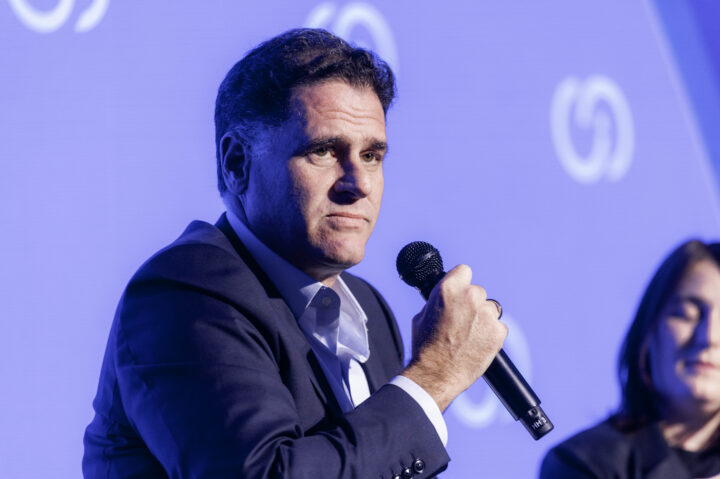
Ron Dermer, Israel’s former minister of strategic affairs, speaks at the Israel on Campus Coalition’s conference in Washington, August 3, 2026.


 Add JewishInsider on Google
Former Israeli Strategic Affairs Minister Ron Dermer said Israel should deploy its intelligence and cyber capabilities to help combat rising antisemitism around the world, arguing that the Jewish state is not currently doing enough to protect diaspora communities facing growing threats.
In an interview with Jewish Insider on Wednesday while he was in New York City to speak at Yeshiva University and the Stephen Wise Free Synagogue, Dermer, a longtime confidant of Israeli Prime Minister Benjamin Netanyahu and a former member of Israel’s war Cabinet, said Israel has a responsibility to go beyond public diplomacy and use its intelligence capabilities to expose foreign actors seeking to foment antisemitism.
The interview comes a year after Dermer stepped away from the front lines of Israeli politics, shortly after he helped secure the hostage-release deal. Rather than navigating the halls of government, he is now on a U.S. speaking tour — hoping to reach 24 cities by Passover — to make the case for Israel to American Jewish audiences. While sitting down with JI, he also weighed in on the future of U.S. military aid, the erosion of bipartisan support for the Jewish state and his hope for a broad national unity government under Netanyahu.
“Israel has capabilities that no Jewish community has. We have intel and cyber capabilities. We have to use those in helping Jews around the world who are facing a wave of antisemitism,” Dermer told JI.
“I’m not talking about hasbara,” he said, using the Hebrew term for Israel’s public diplomacy. “No matter how good and effective Jewish communities are, they can’t reveal foreign actors trying to poison people around the world against Jews. That’s a fight Israel should get involved in to expose and defend them. We haven’t had that.”
Dermer also offered an endorsement of Netanyahu’s continued leadership, saying he hopes the prime minister will head a broad national unity government.
“I’d like to see Netanyahu head that national unity government,” Dermer said, though he acknowledged that he is not an impartial observer of the prime minister’s leadership. “Ultimately, I don’t believe the right path for Israel is to go to a new election and I don’t believe a minority government is good.”
Dermer said a broad coalition incorporating smaller parties would be best positioned to address Israel’s domestic challenges, including judicial reform and the debate over ultra-Orthodox military service, alongside its external security threats.
Dermer defended the rationale for eventually phasing out U.S. military aid to Israel, arguing that Israel is in a different position economically and militarily than it was when the aid agreements were first established. He noted that the economic assistance component was phased out decades ago and said nearly all of the military aid Israel currently receives is returned to the U.S. to purchase American military equipment.
He said Netanyahu — if he remains prime minister — and Trump will need to determine the best path forward, with Israeli Ambassador to the U.S. Yechiel Leiter leading the discussions.
Dermer went on to address the challenge of maintaining bipartisan backing for the Jewish state. He said he prioritized dialogue with evangelicals during his tenure as ambassador to the U.S. from 2013-2021 in part because he was concerned about whether younger generations would maintain the community’s historically strong support for Israel. “They had been for two decades, at the time, really the backbone of Israel’s support in the U.S.,” Dermer said. He attributed the decline in support among younger evangelicals in part to weakening religious ties, saying the younger generation has “a more attenuated Christian identity” and attends church less frequently.
“I’ve been a believer for as long as I’ve been doing this that Israel had to engage with evangelicals, explain to them what our priorities are, make sure they are aware of the situation on the ground and work with them as an ally,” he said.
But Dermer rejected the suggestion that cultivating evangelical support came at the expense of relationships with Democrats or American Jews, arguing that Israel can engage different constituencies simultaneously. “You have to do that to strengthen bipartisan support,” he said.
In 2021, Dermer said publicly that Israel’s focus on strengthening ties with evangelicals should come instead of American Jews, whom he described as “disproportionately among our critics.” The approach and comments sparked backlash from American Jewish leaders who criticized Dermer for appearing to frame Israel’s relationship with evangelical Christians as more valuable than its ties to the American Jewish community. He clarified the statement at the time in an interview with JI, saying that “some of Israel’s greatest champions are Jewish Americans, but you also have some of our fiercest critics. That’s something you tend to not see among evangelicals.”
With Democrats set to take control of Congress in January, Dermer said he expects Leiter to continue outreach to the party’s leadership and its more moderate, pro-Israel members.
“As the new leadership comes from the Democratic Party, I have no doubt the ambassador will engage with them, listen to all of their concerns and to make the case for Israel on both sides,” he said.
Dermer reiterated his longstanding view that relations between countries are ultimately driven by national interests, rather than necessarily by shared values. Pointing to then-President Joe Biden’s decision to repair relations with Saudi Crown Prince Mohammed bin Salman after previously calling him a “pariah,” Dermer asked rhetorically whether Saudi Arabia’s values had changed in the intervening years or whether American interests had driven the shift in policy.
He said that while countries may have different perceptions of one another’s values, “the question is what are the interests of the country, and interests tend to drive the relations.”
At the same time, Dermer rejected the suggestion that the U.S. and Israel do not share democratic values, calling such criticism “false.”
He described Israel as the only country in the Middle East where Americans would feel they are “actually in a free society of a people who share their values.” He argued that the alliance goes beyond both shared values and strategic interests, describing it as “a shared sense of destiny” because “America and Israel are not just countries, we’re causes.”
He said his greatest concern for the future of the relationship is that a generation of Americans could be raised to “not love, or even hate, America,” which he warned could have long-term implications for the U.S.-Israel alliance.
Dermer declined to weigh in on potential 2028 presidential candidates in either party, offering instead a hope for the next occupant of the White House — “I just hope the American people will elect a president who loves America,” he said. “If that’s the case, everything else will take care of itself.”
More Stories
ROCKY START
Rep.-elect Chris Rabb’s silence on antisemitic protest frustrates Philly’s Jewish community
FRESHMAN FILES
Where the incoming Democratic freshmen stand on Israel
Daily Overtime
MKs back Eisenkot, but Herzog withholds mandate
PENTAGON SHOWDOWN
Hegseth accuses Massie of carrying out personal vendetta in impeachment effort

DIFFERENCE OF OPINION
GOP senators skeptical of Vance’s post-election analysis blaming Israel, Iran war
SANCTIONS STRATEGY
Rubio: Military operations in Iran unnecessary — for now
Please log in if you already have a subscription, or subscribe to access the latest updates.
 Continue with Google

 Continue with Apple