





































































Jewish voters stuck with Democrats in 2026 — but were the only group to drift right
Despite Trump being the central factor in many voters’ minds, there was a clear concern about rising antisemitism and anti-Israel sentiment among partisans in both parties
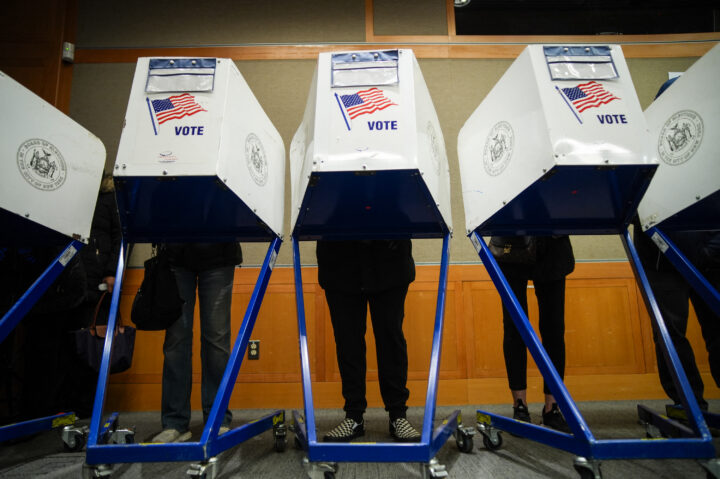
(Ryan MURPHY/AFP via Getty Images)
People cast their ballots on the first day of early voting for the US midterm elections, in New York, on October 24, 2026.


 Add JewishInsider on Google
Jewish voters remained broadly supportive of Democratic candidates in the 2026 midterms, according to a new comprehensive survey, but also were the only demographic group that swung rightward from 2024, suggesting a notable vulnerability as the party grows increasingly critical toward Israel and accommodating of socialist candidates.
The Mellman Group survey, conducted for the Jewish Electoral Institute from Oct. 29 to Nov. 6, found that 69% of Jewish voters supported Democrats in the midterms, while 25% voted for Republicans. While Jews remained one of the biggest Democratic voting blocs, support for the party slightly declined from the 2024 presidential election, when 72% of Jewish voters backed Democrats for Congress.
That slippage may not sound like a big deal, but it’s meaningful given that 2024 was the Republican Party’s strongest performance in a presidential election in 20 years, while 2026 is shaping up to be the biggest Democratic wave since 1974.
Overall, deep-seated antipathy toward President Donald Trump, anxiety over rising costs and threats to American democracy were viewed as the biggest factors driving Jewish voters, particularly Democrats. Among Republicans, however, fears over antisemitism and Israel’s security were the most important factors in their vote. (The Jewish independent voters’ turn against Trump was also clear: In 2024, one-third of Jewish independents viewed the president favorably, but only 1% said the same this year.)
But despite Trump being the central factor in many voters’ minds, there was a clear concern about rising antisemitism and anti-Israel sentiment among partisans in both parties. Over one-third (36%) of Jewish Democrats said their party has become “too accepting” of antisemitic rhetoric, while one-quarter of Jewish Republicans said the same of their party.
Similarly, there was widespread concern about growing extremism within both parties. Over one-third (34%) of Jewish Republicans said they see the party as becoming too accommodating of white nationalists and right-wing extremists, while about one-quarter (24%) of Jewish Democrats said the party was becoming too much of a home for socialists and the far left.
The bipartisan resistance to extreme candidates could be seen in some of the individual election results.
Most notably, Jewish voters in Michigan swung dramatically away from anti-Israel Democrat Abdul El-Sayed in the state’s Senate race, though the Jewish vote was closely divided. A poll of Michigan Jewish voters commissioned by The Jewish Majority found 50% of Jewish voters backed El-Sayed, 43% supported Republican Mike Rogers, 4% left the Senate race blank and 3% voted for a third-party candidate.
Typically, seven in 10 Jewish voters in Michigan back Democrats, making the swing away from El-Sayed dramatic. Democratic Gov.-elect Jocelyn Benson won 69% of the Jewish vote, according to the survey, marking a significant 19-point gap between the two statewide nominees. In suburban Oakland County, the center of the state’s Jewish community, the Jewish vote broke for Rogers by 13 points, 52%-39%, according to the survey.
At the same time, around half of Michigan’s Jewish voters still backed El-Sayed despite well-documented concerns about his initial “hurt people hurt people” reaction to a terrorist attack at Temple Israel, the largest synagogue in Michigan. (He apologized for those comments five months later.)
But in races where Democrats nominated mainstream candidates (and/or where Republicans tapped far-right extremists) — such as the Texas Senate contest between Sen.-elect James Talarico (D-TX) and Republican Ken Paxton — indications are that the Jewish vote remained heavily Democratic, comfortable supporting a typical Democrat — even one with progressive leanings — over an ethically plagued ideologue.
The Mellman Group survey also found that the Democratic Socialists of America label is a red flag for many Jewish voters across the board, with 46% saying the role of socialist candidates in the election was a “very” or “somewhat” concerning development, including 29% of Democrats. When specifically asked about the DSA, the unfavorability rating far surpassed those who viewed the group favorably.
Just over one-quarter (28%) of Jewish Democratic voters said they backed a Democrat whose views on Israel they found concerning but supported them for other reasons, while 48% said they did not. Only 16% of Republicans said the same.
“In this historic landslide, the Jewish vote was driven in great part by the national concerns that swept the country,” said Michael Bloomfield, managing director of the Mellman Group. “Even as Israel, antisemitism, and the Jewish community itself became campaign issues, they were overwhelmed by the larger referendum on Trump and rising costs. But the underlying potential flash points have not gone away.”
More Stories
Daily Overtime
Senate Dems call to nix Israel cooperation provision

TRANSITION TENSIONS
Eisenkot warns Netanyahu against launching war during coalition talks

DOHA DIPLOMACY
Trump touts ‘positive momentum’ toward ending Iran war after meeting Qatari PM

Daily Overtime
Trump says military action against Iran ‘quite unlikely’
analysis
Unity talk, scorched earth: Netanyahu’s Knesset speech blows up first Likud-Yashar meeting

DEM DIRECTION
David Axelrod downplays DSA ascendance within Democratic Party
Please log in if you already have a subscription, or subscribe to access the latest updates.
 Continue with Google

 Continue with Apple