






































There are a number of upcoming key elections that will test the power of the mainstream against extremist forces
Spencer Platt/Getty Images
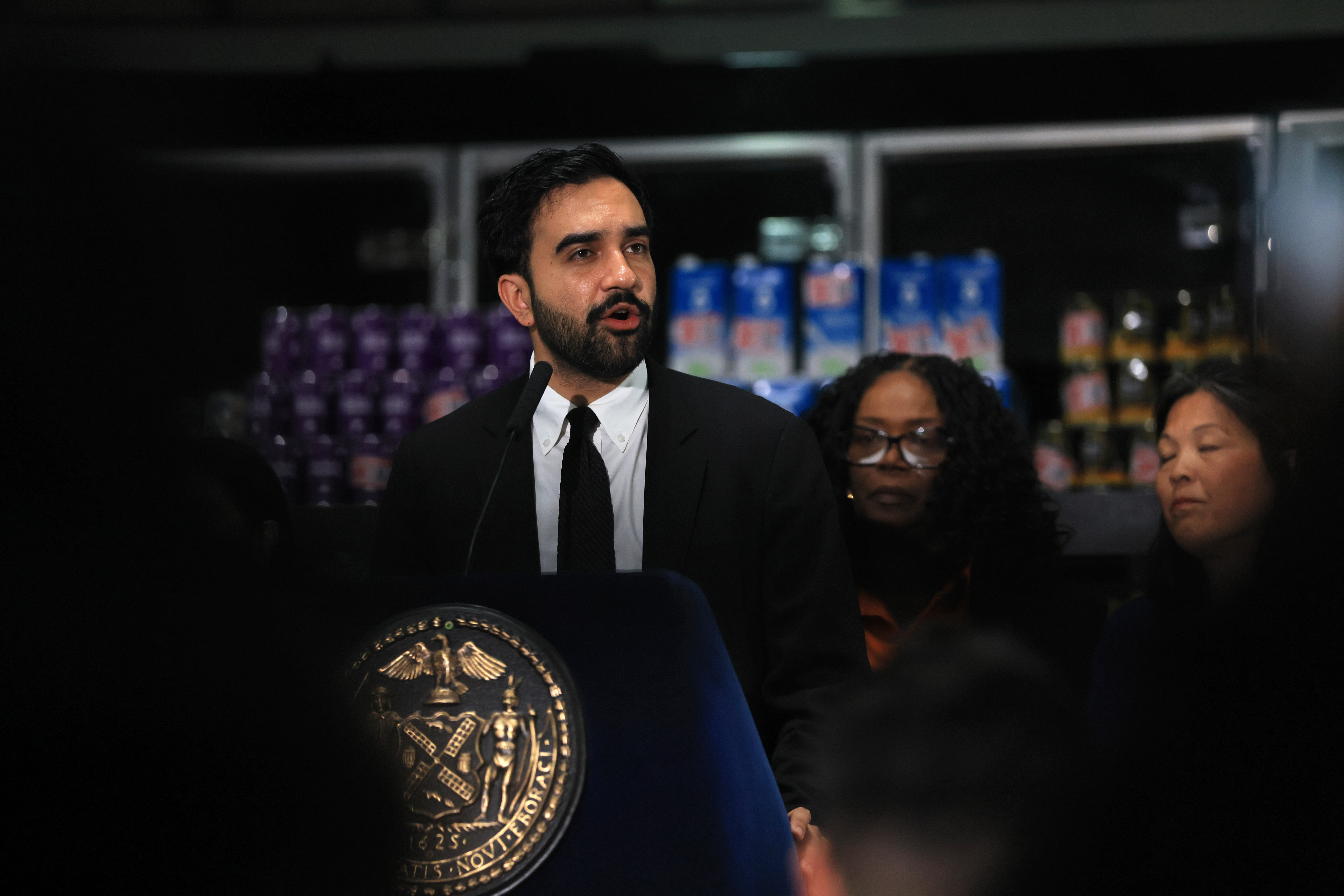
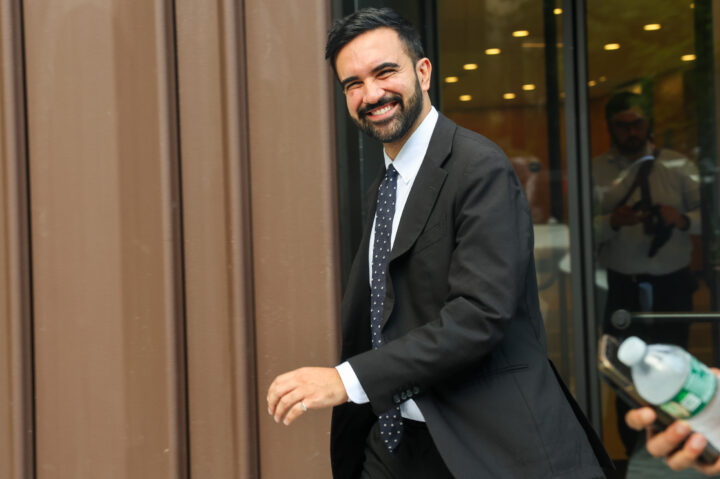
Democratic socialist candidate Zohran Mamdani, who won the Democratic primary for mayor of New York City, attends an endorsement event from the union DC 37 on July 15, 2025, in New York City.


 Add JewishInsider on Google
Last Friday, we laid out how American Jewry is facing a fork in the road in the aftermath of the Gaza war and release of hostages, and that the coming months will be crucial in assessing whether Jews will experience a renewed period of normalcy or whether the rising tide of anti-Israel sentiment and antisemitism will continue unabated.
There are a number of upcoming key elections that will test the power of the mainstream against extremist forces. Here are the developments we’ll be watching most closely.
Will Zohran Mamdani win a majority of the New York City vote, and how will he govern if elected as mayor? Right now, without any surge in funding and organization among anti-Mamdani forces in Gotham, it’s looking very likely that the far-left candidate will prevail. But polls still show him consistently under 50%, without gaining any real momentum since winning the Democratic primary. And half of the six most recent public polls in the race (as tracked by RealClearPolitics) show the anti-Mamdani candidates collectively winning more of the vote than the front-runner. This race doesn’t at all look like a mandate for the far left.
If Mamdani wins, the next big question is whether he’ll govern more pragmatically than his past record would suggest. Will he try to arrest Israeli Prime Minister Benjamin Netanyahu if he visits New York City, as he has consistently said he would do on the campaign trail? Will he threaten the tax-exempt status of Jewish groups because they support Israel? Will he reappoint Jessica Tisch, the effective NYPD chief, as a signal of his willingness to moderate?
He’s been wooing business leaders and working to spin reporters that he’s not as ideological as his political career suggests, but that may be more wishful thinking than anything based on a careful scrutiny of his comments and record.
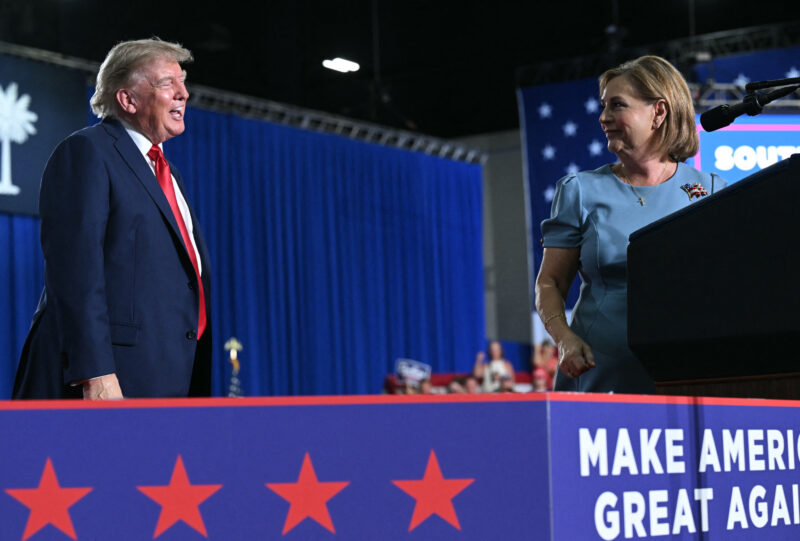
Will Reps. Thomas Massie (R-KY) or Marjorie Taylor Greene (R-GA) receive a serious primary challenge? Massie and Greene are the two members of the small but loud faction of the anti-Israel and increasingly antisemitic crowd among House Republicans. Not coincidentally, they also are the two Republicans that are most antagonistic towards President Donald Trump — from calling for a release of the government files on Jeffrey Epstein to, in Greene’s case, agreeing with some Democratic health care demands during the government shutdown.
Massie looks more politically vulnerable, with Trump and his allies actively recruiting a challenger to run against him and releasing internal polling showing he can be defeated. Former Navy SEAL Ed Gallrein, who ran unsuccessfully for a seat in the Kentucky Senate last year, looks like Trump’s favored candidate. But no one has yet announced a challenge, with the filing deadline less than three months away (Jan. 9).
Greene looks safer, but her increasing Trump criticism could change that dynamic. The filing deadline in Georgia isn’t until March 2026.
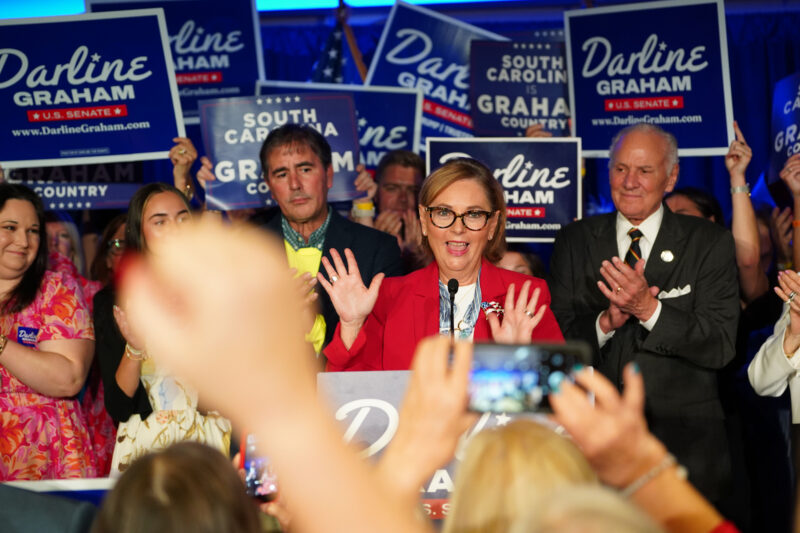
How credible a threat will Graham Platner pose to Gov. Janet Mills in Maine’s Democratic Senate primary? Under normal political circumstances, an established two-term governor would hold a commanding advantage over an oyster farmer without any elective experience in a race for the Senate. That’s especially true given that the challenger has a long paper trail of comments calling himself a communist and embracing a laundry list of radical views.
Yet Platner has parlayed his rough-and-tumble biography and anti-establishment authenticity into media buzz, and raised an impressive $4 million for the race since announcing his candidacy over the summer.
Mills, who is 77 and the favorite of Democratic Party leaders, starts out as the favorite to win the nomination. Platner has lately been facing scrutiny over his lengthy string of social media posts where he identified as a communist, called all police “bastards” and said rural Americans are racist and stupid, among other incendiary comments. He also downplayed concerns of sexual assault in the military in online forums.
Normally, those types of views and comments would be political career-enders. But in this anti-establishment, populist moment, it’s hard to be confident in assuming the traditional rules of politics apply. After all, Mamdani has weathered scrutiny of his own radical affiliations without suffering outsized political consequences.
In addition to holding down-the-line progressive views on the economy, Platner is also uniquely hostile to Israel, even to the point of releasing a digital attack ad against the pro-Israel advocacy group AIPAC. Shortly after launching his campaign for the Senate, Platner labeled Israel’s war against Hamas a genocide.
Mills, as governor, doesn’t have much of a foreign policy record but has spoken out against Israel boycott measures embraced by municipal leaders in Portland. But as the candidate representing more-mainstream Maine Democrats, it’s likely she will adopt a more-moderate posture when it comes to Middle East policy.
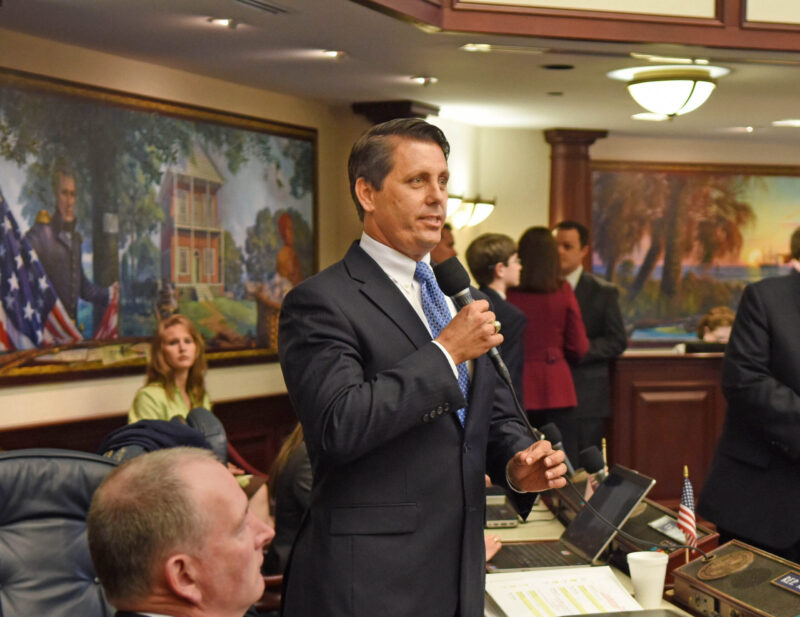
Will Virginia Attorney General Jason Miyares be rewarded for his work against antisemitism? For a while, it looked like there would be a sizable blue wave in this November’s Virginia statewide elections, with Trump unpopular in the state and the DOGE-fueled government layoffs juicing up Democratic engagement.
That leaves Miyares, the state’s Republican attorney general who has targeted terrorist funding from anti-Israel groups in the state and called on Virginia’s universities to aggressively confront antisemitism, in a precarious political position.
But a shocking scandal involving his Democratic opponent, former state legislator Jay Jones, has upended the race and given Miyares a good chance to win reelection. The revelation of text messages from Jones wishing violence against one of his GOP colleagues has drawn bipartisan outrage, and led some Democrats to distance themselves from him. Public polling has been sparse, but recent surveys have shown Miyares pulling ahead in the race after trailing throughout the year.
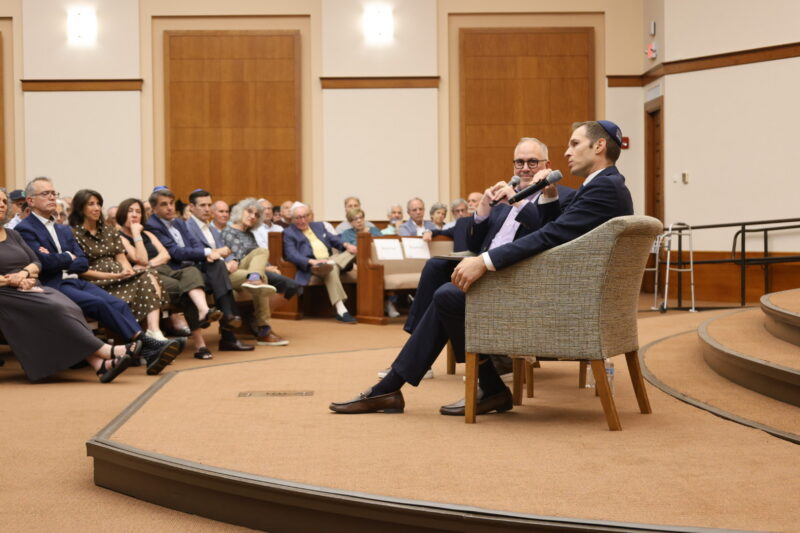
One nonpartisan Jewish leader in Virginia told Jewish Insider that Miyares was one of the most effective and engaged elected officials in countering antisemitism, and the race was emerging as a key bellwether of whether Jewish voters would reward GOP officials for their allyship.
One example of Miyares’ bipartisanship: the Virginia attorney general played a key role in working to remove the anti-Israel protest encampment outside former Secretary of State Tony Blinken’s Northern Virginia home after progressive local government officials declined to do so.
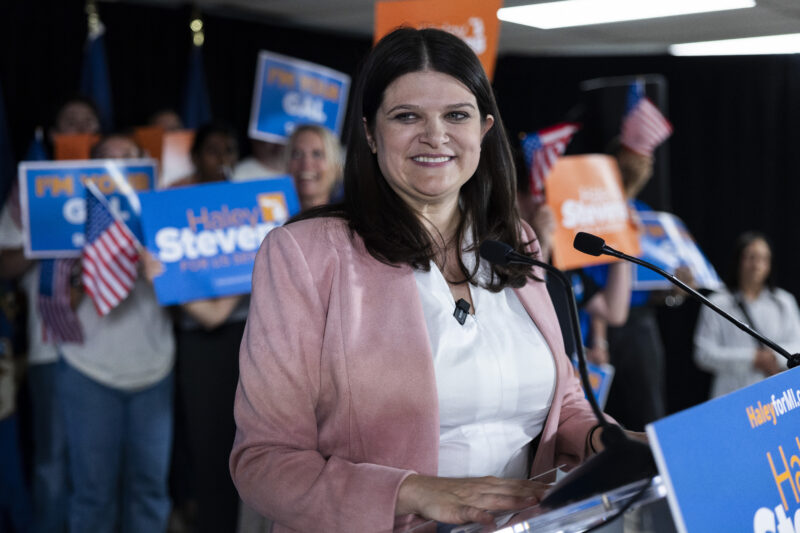
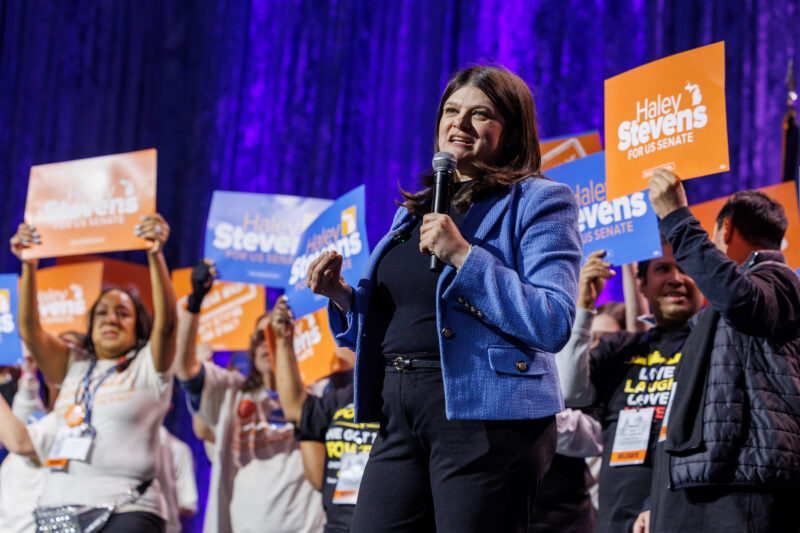
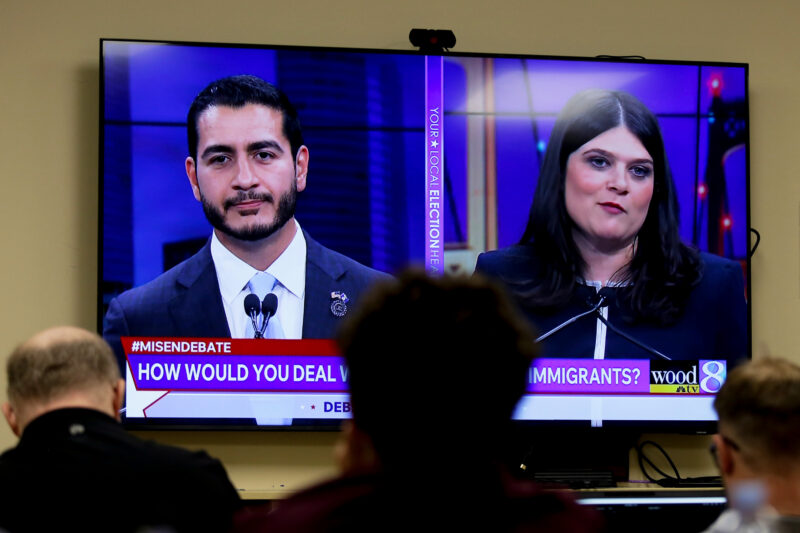
Can Rep. Haley Stevens (D-MI) prove anti-Israel activists on social media are more bark than bite? The other big Democratic Senate showdown is taking place in Michigan, the state with a sizable Jewish constituency but also the largest share of Arab voters in the country.
Stevens starts out as the front-runner, thanks to her record of winning tough elections, successful fundraising and backing from many national Democratic leaders. She has also been a stalwart supporter of Israel, easily toppling an anti-Israel Democratic challenger in a closely watched 2022 Democratic primary against another sitting member of Congress. She’s a favorite of the politically engaged Jewish Democratic community, many of whom have championed her candidacy.
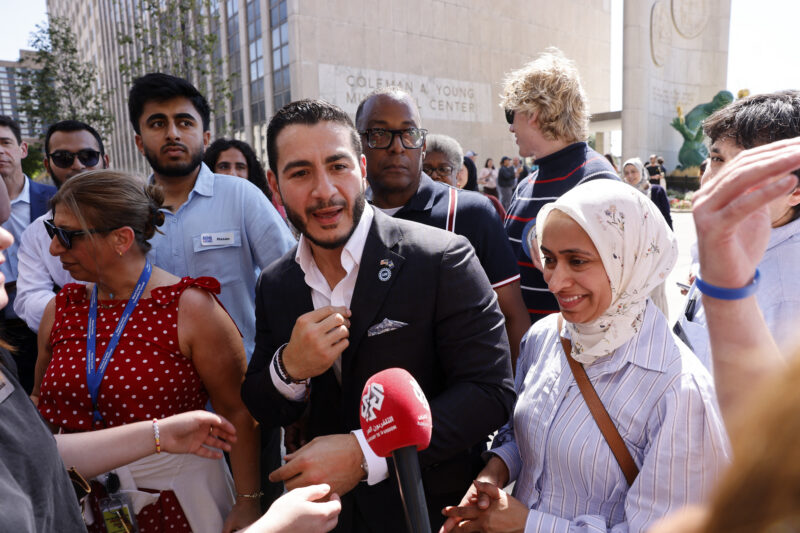
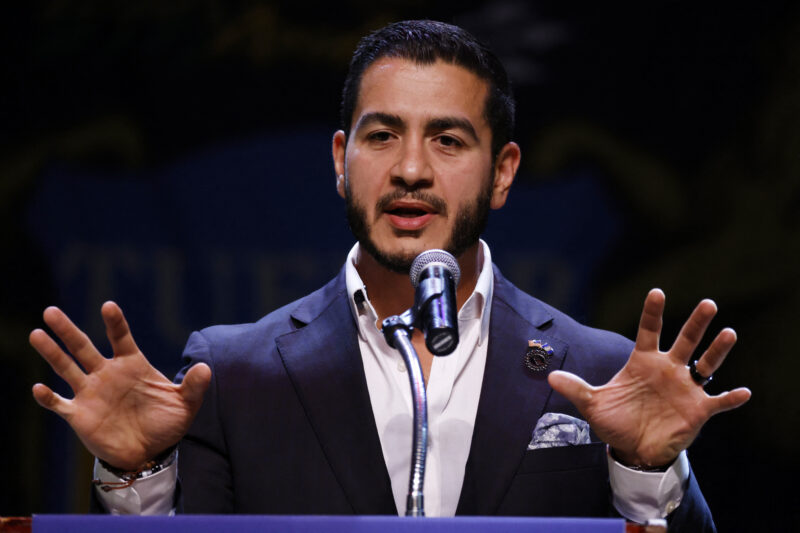
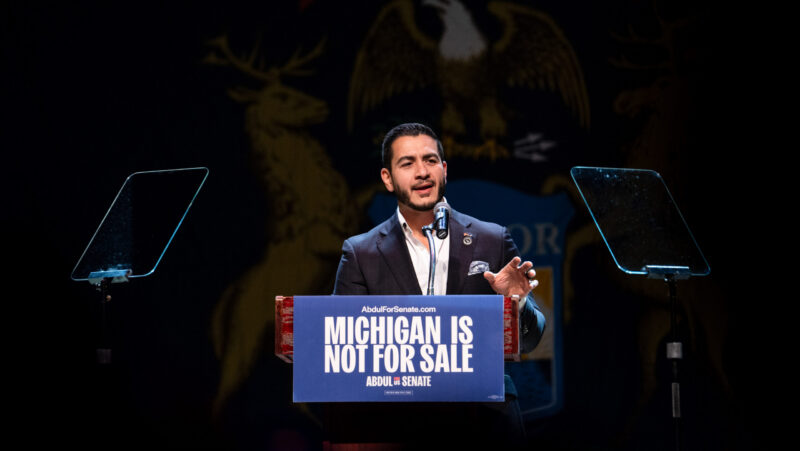
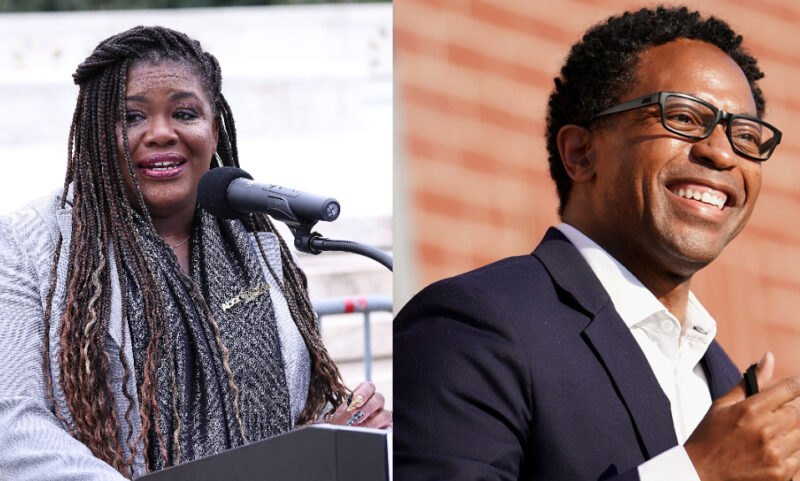
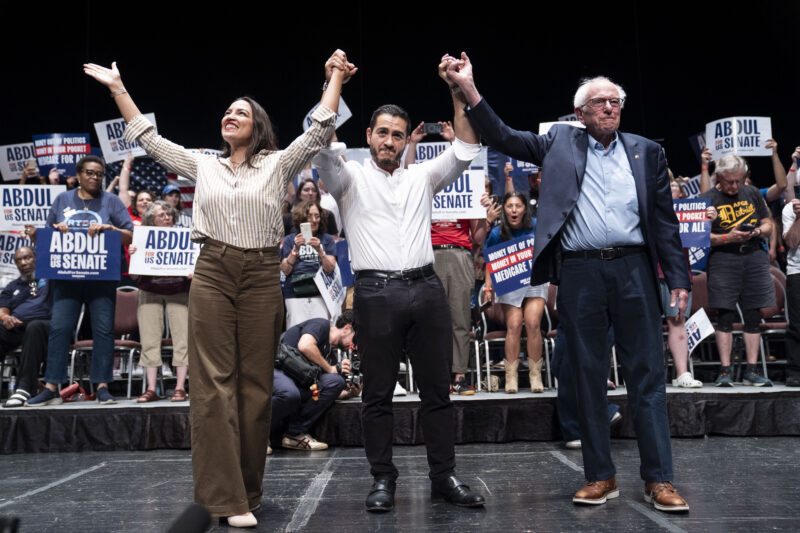
But with the political winds on Israel in the Democratic Party shifting, Stevens will be facing her fiercest test against two challengers running campaigns that are decidedly more hostile towards Israel. Abdul el-Sayed, an acolyte of Sen. Bernie Sanders (I-VT), has long been an opponent of the Jewish state, and is likely to win over many Arab-American voters with anti-Israel views.
State Sen. Mallory McMorrow began her campaign sounding more in the pro-Israel camp, but has grown steadily more hostile as Democratic voters have turned more critical of the Jewish state. This month, she said she considered Israel’s war in Gaza to be a genocide.
Stevens is still widely viewed as a favorite, and led the pack in fundraising in the just-completed third fundraising quarter. She also benefits from the possibility that McMorrow and el-Sayed split the progressive, anti-Israel vote, leaving more-mainstream Democratic voters in her camp.
But if anti-Israel sentiment becomes a litmus test for more Democratic primary voters, Stevens could face headwinds down the road. This primary, taking place next August, is as clear a test as there is of the size and depth of hostility towards Israel in the Democratic Party.
Will socialist, anti-Israel candidates prevail outside of New York City? While Mamdani’s Democratic Socialists of America-aligned mayoral campaign has gotten outsized attention, socialist candidates in the mold of Mamdani are running for mayor of other big cities across the country.
In Minneapolis, the city’s liberal Minneapolis mayor, Jacob Frey (who is Jewish), is facing a DSA-backed challenge from Omar Fateh. Fateh, a state senator, is a BDS supporter and hired senior staffers who defended the Oct. 7 terror attacks, and have called for the dismantlement of Israel. This race is expected to be close, according to in-state analysts.
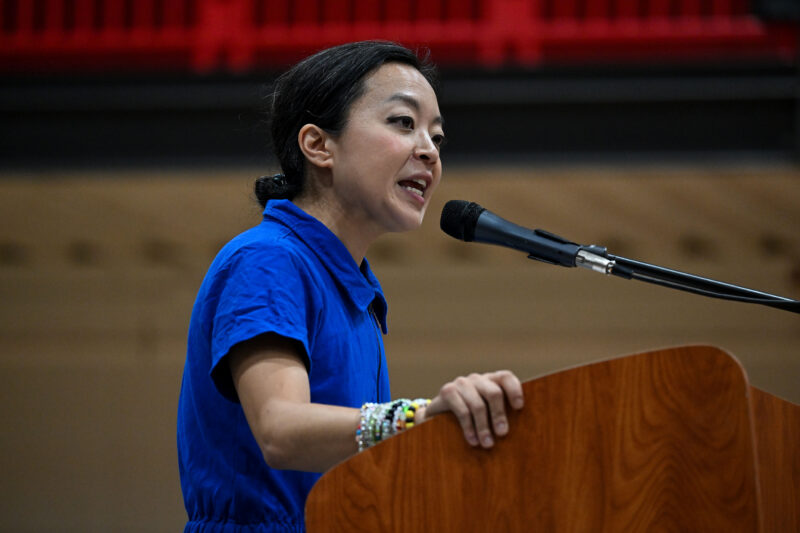
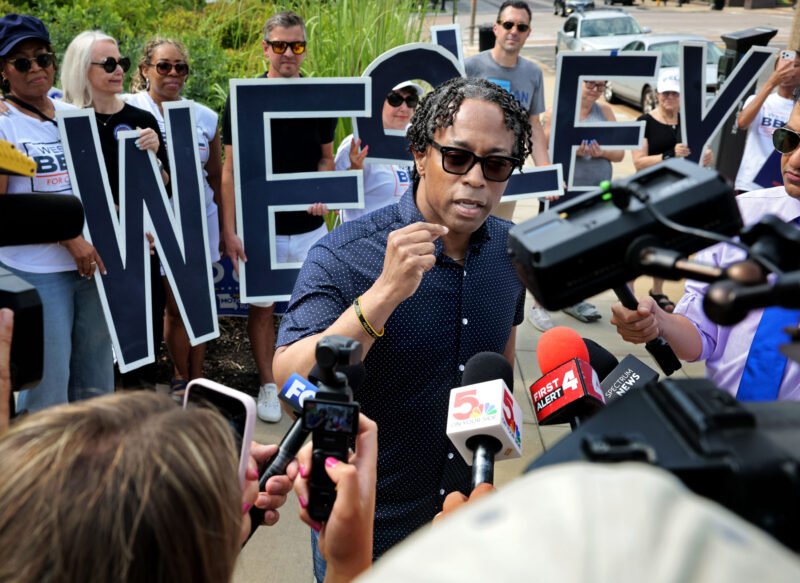
The other notable contest is in Seattle, where Mayor Bruce Harrell finished in second place in an August primary to a self-declared socialist challenger, Katie Wilson. The two candidates are facing off in the general election, where Harrell is now seen as an underdog. Wilson has spoken out less about Israel and the war in Gaza than many of her socialist counterparts, but many Jewish leaders in Seattle are concerned about her overall record.
Plus, Mandela's granddaughters visit Israel, Gaza
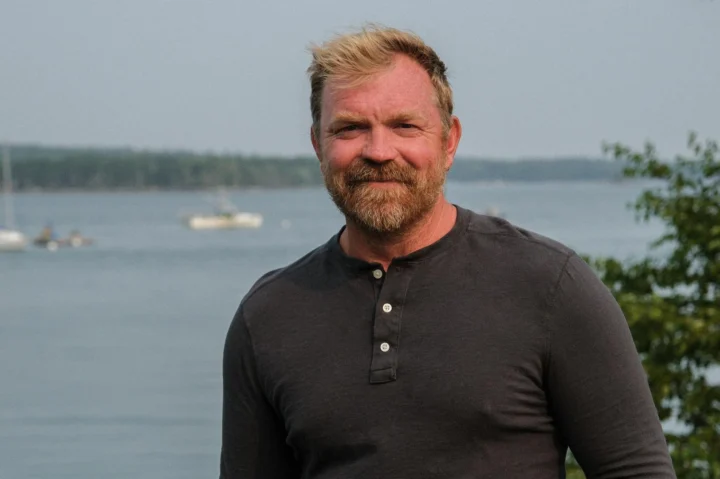
Graham Platner campaign
Graham Platner
Good Friday morning.
In today’s Daily Kickoff, we report on Rep. Seth Moulton’s plans to return money bundled by AIPAC following his entry into Massachusetts’ Senate race, and cover White House Special Envoy Steve Witkoff’s prediction that the Abraham Accords will “significantly expand” as the Israel-Hamas war winds down. We talk to the granddaughters of Nelson Mandela about their recent trip to Israel and Gaza, and report on Zohran Mamdani’s efforts to distance himself from far-left streamer Hasan Piker. Also in today’s Daily Kickoff: Jacob Helberg, Ari’el Stachel and Rep. Mikie Sherrill.
Today’s Daily Kickoff was curated by Jewish Insider Executive Editor Melissa Weiss and Tamara Zieve with assists from Marc Rod and Danielle Cohen-Kanik. Have a tip? Email us here.
What We’re Watching
- Ukrainian President Volodymyr Zelensky returns to Washington today for a sit-down at the White House with President Donald Trump.
- We’re keeping an eye on the fragile ceasefire between Israel and Hamas, amid reports that Sunni Arab states, including Saudi Arabia, the United Arab Emirates and Bahrain, have warned senior White House officials that Hamas’ ongoing refusal to disarm could collapse the agreement.
- Republican Party leaders in New York State are set to hold a vote to disband the state’s Young Republicans chapter today, after the publication of racist text messages shared in a chat of the national Young Republican leaders that implicated members of New York’s delegation. The state party plans to eliminate the group’s charter and rebuild the group with new leadership.
- On Sunday, Americans for Ben-Gurion University is holding a benefit in New York City featuring former Israeli hostage Sasha Troufanov and comedian Alex Edelman.
What You Should Know
A QUICK WORD WITH JI’S JOSH KRAUSHAAR
With all of the living hostages released from Gaza and an end (at least for the time being) of Israel’s war in the Palestinian territory, the coming months could offer the mainstream Jewish community something of a breather to assess the changed political landscape.
In the war’s final months, the anti-Israel far left gained a foothold in Democratic Party politics, most prominently in the New York City mayoral race with Zohran Mamdani, but also in urban contests ranging from Seattle to Somerville, Mass. The antisemitic forces on the far right have been less of a political force, but have gained strength on podcasts and among younger right-wingers, and have been embraced to a greater extent by a few populist lawmakers like Rep. Marjorie Taylor Greene (R-GA).
With the return of the living hostages, Israel’s success in degrading Hamas and additional enemies, and the apparent end of the Gaza war, Jewish optimists can plausibly argue that some degree of normalcy could creep back in the political sphere. Israel should become a less salient issue for low-information scrollers, with the war’s end reducing the constant anti-Israel and antisemitic propaganda being fed on so many screens.
With a ceasefire finally achieved, the anti-Israel forces have been remarkably silent, and have been exposed for the Hamas-sympathizing extremists that they always have been. That faction of the anti-Israel Democratic left is as politically exposed as it’s been since the immediate aftermath of Oct. 7, 2023.
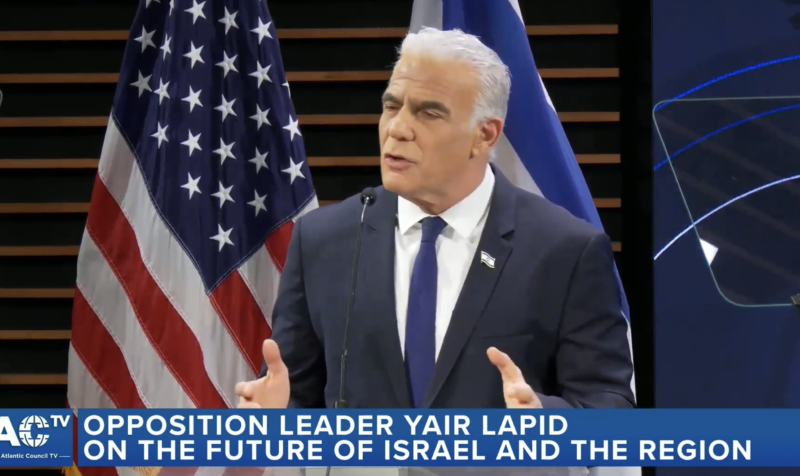
There’s also the possibility that, with Israeli elections being held next year, a new Israeli prime minister would get elected, bringing with him or her a new Israeli government that may not be as polarizing to liberal critics of Israel back in the U.S.
Jewish pessimists also have a plausible case to make. Support for Israel has declined in the past year, with the most significant slippage coming from Democratic Party voters and some independents. It’s hard to imagine it will rebound anytime soon. The youngest Gen Z voters are the most hostile towards Israel and have been even before Oct. 7. It’s reasonable to expect their future growth in the electorate will only grow the pool of anti-Israel voters.
Furthermore, the rise of anti-Israel and antisemitic sentiment isn’t happening in isolation; it’s a symptom of the rise of larger illiberal and extreme forces within both parties. The fact that polls show an upward tick in the toleration of political violence, growing antipathy to capitalism on the left, and growing sympathy for authoritarianism on the right is the broader context of the growing hostility Jews are facing, and it’s not showing any signs of abatement.
In the coming year, it will be important to track whether the political outlook for Jews is getting better or whether the trends we’ve seen worsen in the last couple years are accelerating.
We’ll be debuting an election scorecard next week, examining the most meaningful elections in the coming year that will test the influence of the political mainstream against the extremes. Stay tuned: it will be worth bookmarking and tracking as we approach Election Day this November, and in the runup to next year’s congressional primaries.
CUTTING TIES
Seth Moulton says he will return, reject AIPAC donations in Senate campaign
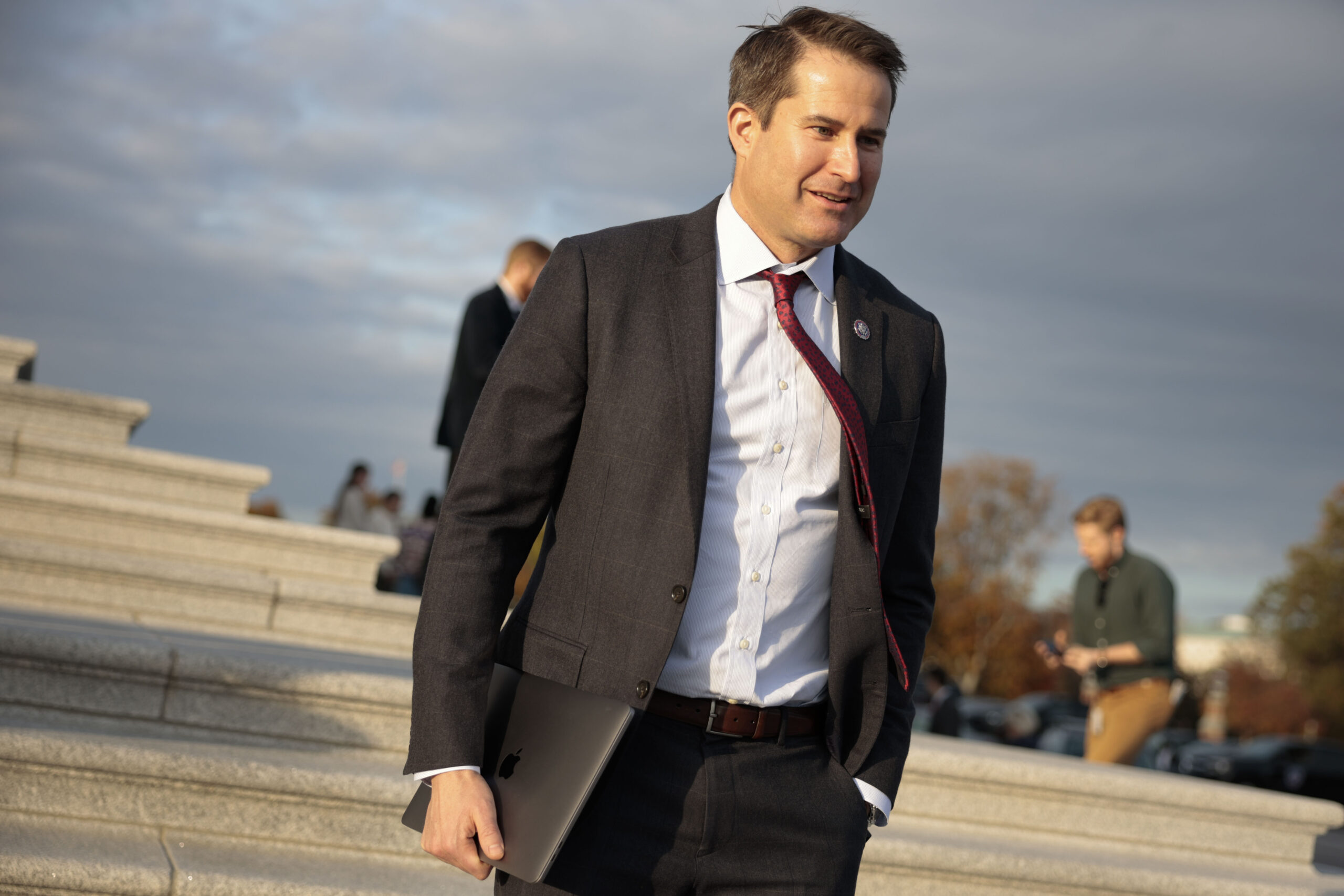
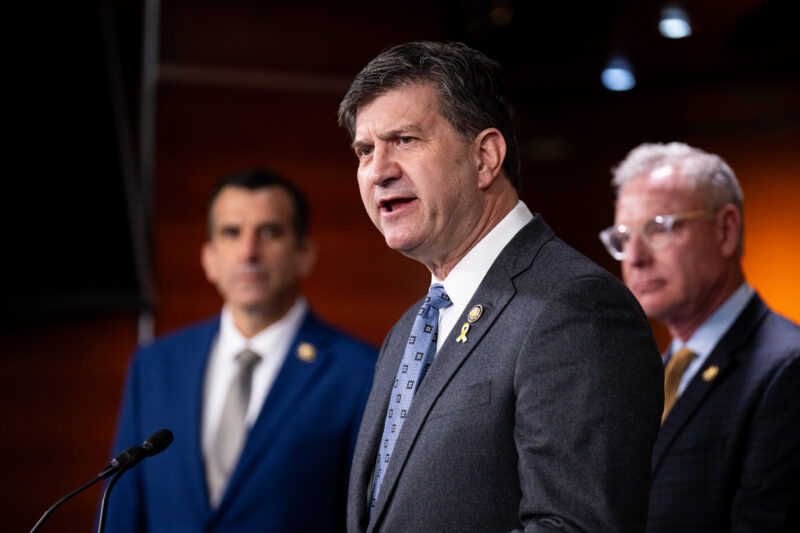
Rep. Seth Moulton (D-MA), who on Wednesday announced a primary challenge to Sen. Ed Markey (D-MA), announced Thursday that he will return donations he has received from AIPAC and will reject further donations from the group, Jewish Insider’s Marc Rod reports. Moulton’s changed stance on accepting support from AIPAC is a sign of how even more-moderate Democrats are facing pressure from the party’s activist base to distance themselves from embracing Israel.
What they’re saying: “I support Israel’s right to exist, but I’ve also never been afraid to disagree openly with AIPAC when I believe they’re wrong. In recent years, AIPAC has aligned itself too closely with Prime Minister [Benjamin] Netanyahu’s government,” Moulton said in a statement. AIPAC spokesperson Marshall Wittmann responded, “Rep. Moulton is abandoning his friends to grab a headline, capitulating to the extremes rather than standing on conviction.”
DEBATE DISPATCH
Mamdani distances himself from Hasan Piker’s 9/11 comments at mayoral debate
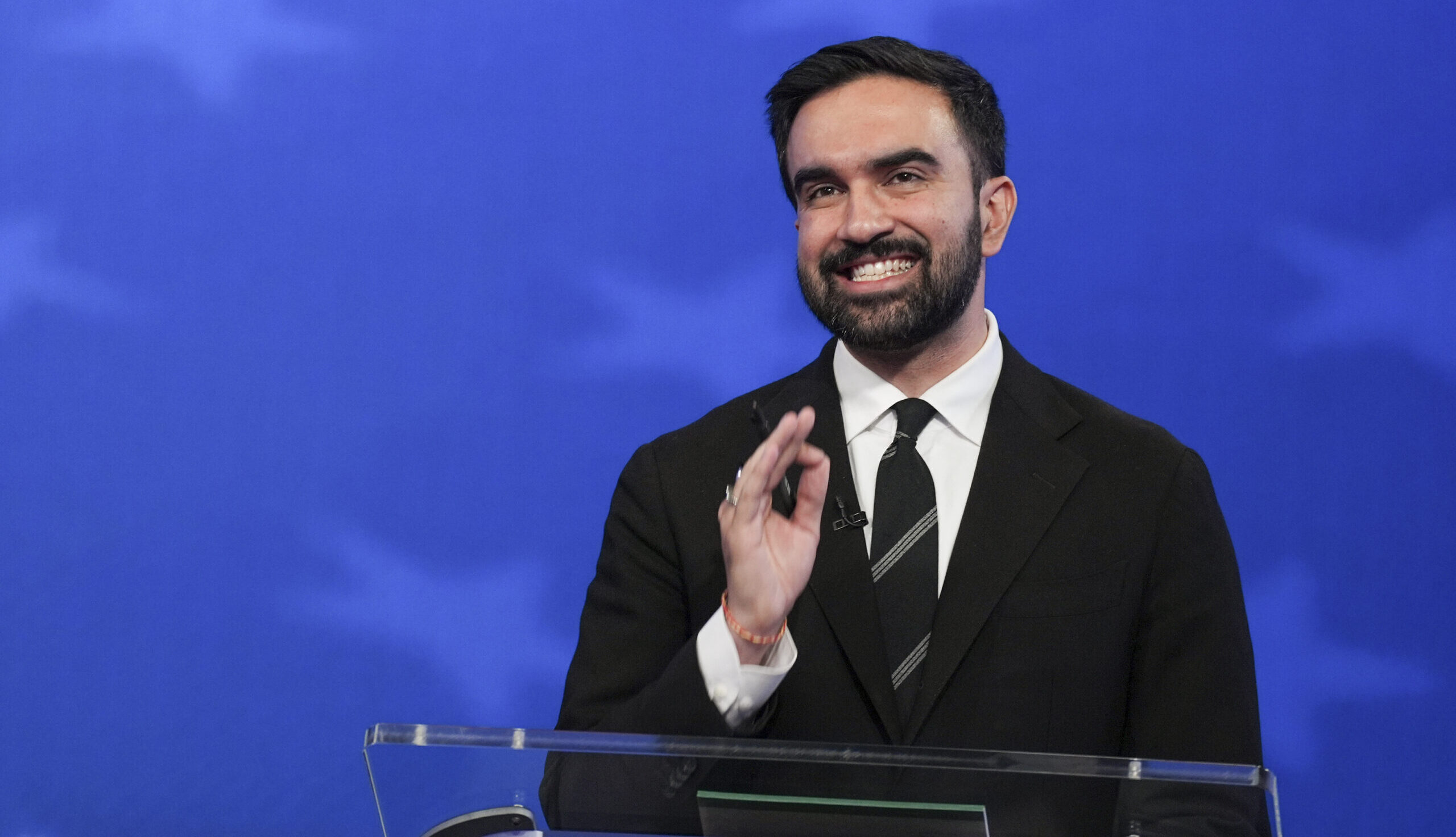
Zohran Mamdani, the Democratic nominee for mayor of New York City, expressed disagreement on Thursday with comments by Hasan Piker, a far-left streamer who has said “America deserved 9/11,” after several months in which the state assembly member had declined to condemn such rhetoric, Jewish Insider’s Matthew Kassel reports. “I find the comments that Hasan made on 9/11 to be objectionable and reprehensible,” Mamdani said during the first general election debate on Thursday night, where he traded barbs with former New York Gov. Andrew Cuomo, who is trailing in the polls as he mounts an independent run following his primary loss to Mamdani in June.
More from Mamdani: Elsewhere during the debate, Mamdani, an outspoken critic of Israel who was arrested in October 2023 during a ceasefire demonstration outside the Brooklyn home of then-Senate Majority Leader Chuck Schumer (D-NY), declined to confirm that he would not participate in protests if he is elected mayor. “The important thing is to lead from City Hall,” Mamdani said. “That’s what I’ll be doing.” Mamdani had faced intense backlash before the debate for comments during a Fox News interview released on Wednesday in which he avoided directly answering a question about whether Hamas should disarm and relinquish its leadership role in Gaza. He clarified at the debate that Hamas, as well as “all parties,” “should lay down” their arms but did not comment on its future role in the conflict.
PROXY BATTLE
Maine Senate primary emerging as bellwether of Democrats’ ideological direction
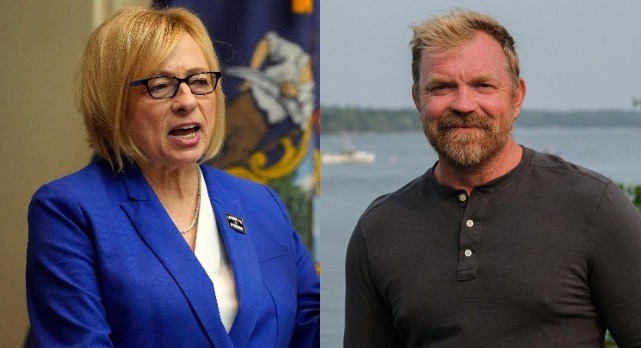
The Democratic Senate primary in Maine is shaping up to be among the most significant proxy battles over Israel in the upcoming midterm elections, pitting the state’s moderate two-term governor against a left-wing populist upstart who has vocally embraced an anti-Israel platform. Gov. Janet Mills, who announced her campaign to unseat Sen. Susan Collins (R-ME) on Tuesday and is backed by Senate Democratic leadership, is set to face a well-funded challenge from Graham Platner, a veteran and oyster farmer who boasts high-profile support from Sen. Bernie Sanders (I-VT), Jewish Insider’s Matthew Kassel reports.
Platner’s positions: In contrast with Mills, who has criticized anti-Israel divestment efforts in her state and warned against a “deeply troubling” rise in antisemitic incidents after Hamas’ Oct. 7, 2023, attacks, Platner has promoted more hostile views on Israel and its alliance with the United States. Since entering the race in August, Platner has accused Israel of genocide in Gaza and endorsed measures to block U.S. arms sales to Israel. His campaign did not respond to a request for comment regarding the recently brokered ceasefire and hostage-release deal between Israel and Hamas. Platner has also been an outspoken critic of the pro-Israel advocacy group AIPAC, whose affiliated political arm is supporting Collins, one of the most vulnerable Republicans now seeking reelection — in a state President Donald Trump lost by seven points in 2024.
SHERRILL SAYS
Mikie Sherrill previews New Jersey state antisemitism plan if elected governor

Speaking on a Jewish Democratic Council of America webinar on Thursday, Rep. Mikie Sherrill (D-NJ) outlined a plan of action on antisemitism she said she would implement statewide if she wins next month’s gubernatorial race in the Garden State, Jewish Insider’s Marc Rod reports. Sherrill and Republican nominee Jack Ciattarelli look likely to split the Jewish vote in next month’s election.
Notable quotable: She emphasized her willingness to call out antisemitism among her political allies, pointing to the example of an employee of the New Jersey Educational Association — which endorsed Sherrill — who had made “horrible antisemitic [comments] online.” Sherrill said she had condemned the individual and demanded she be fired. “I’m going to call out anybody in this space that is promoting hate in any way against all of our citizens, but especially our children,” Sherrill said.
WITKOFF’S WORDS
Steve Witkoff predicts Abraham Accords will ‘seriously expand’ after Gaza ceasefire
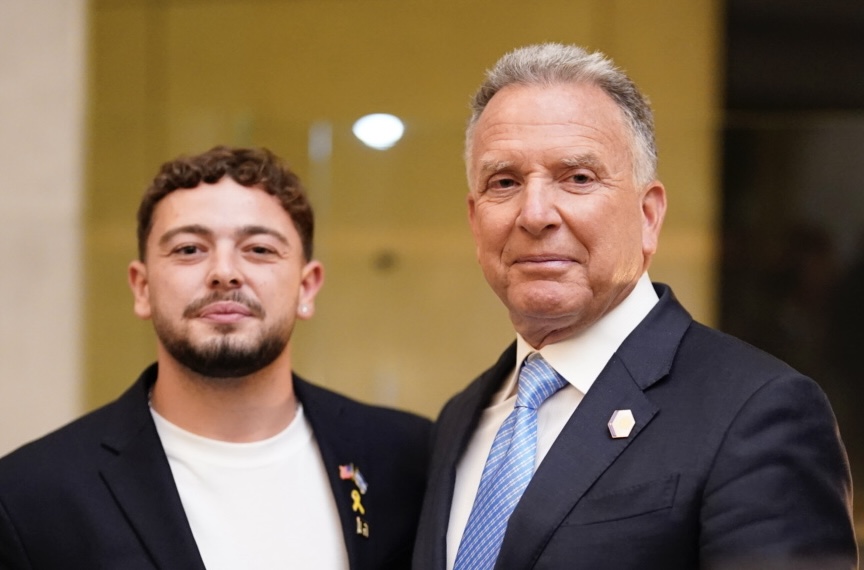
White House Special Envoy Steve Witkoff predicted on Thursday that the Abraham Accords will “seriously expand” in response to the end of fighting in Gaza. Witkoff was addressing attendees at an event commemorating the second anniversary of the Oct. 7, 2023, Hamas terror attacks, Jewish Insider’s Emily Jacobs reports.
What he said: “No leader has done more for the Jewish people or the State of Israel than President Trump,” Witkoff, speaking at an event at the U.S. Holocaust Memorial Museum in Washington, said. “He moved our embassy to Jerusalem, he recognized Israel’s sovereignty over Judea and Samaria [the West Bank] and the Golan Heights. He forged the Abraham peace Accords, which will seriously expand now,” Witkoff said. The White House envoy, who returned from the region earlier this week after the implementation of the first phase of the ceasefire, posited that Trump winning a second term last November was “the major breakthrough of this conflict.”
HERITAGE OF HOPE
In Israel and Gaza, Nelson Mandela’s granddaughters find hope amid devastation

“What has emerged from all my conversations is that the yearning for peace is very intense,” former South African President Nelson Mandela, visiting Israel in 1999 as part of a broader Middle East, said as he reflected on his meetings with leaders across the region. More than a quarter century later — despite the ceasefire between Israel and Hamas, the degradation of Iran and its proxy network and numerous wars between Israel and its neighbors — that peace remains elusive. It was against that backdrop that two of Mandela’s granddaughters, Zamaswazi (Swati) Dlamini-Mandela and Zaziwe Dlamini-Manaway, traveled to Israel and the Gaza Strip earlier this month. Dlamini-Manaway and Dlamini-Mandela spoke to Jewish Insider’s Melissa Weiss about their trip.
Mutual motivation: “For us, it’s important to actually go and actually experience the story for yourself,” Dlamini-Mandela said of the trip, which was organized by the National Black Empowerment Council and included meetings with Israeli hostage families and survivors of the Oct. 7, 2023, Hamas terror attacks, as well as a day on the ground in Gaza where Mandela’s granddaughters assisted the Gaza Humanitarian Foundation in its efforts to distribute aid in the enclave. “Coming from a high-profile family like ours, and also living in the media for years, all our lives have been pretty much lived in public, it’s very interesting what type of bias or viewpoints the news can take. So we always felt like, ‘Let’s go and see for ourselves. Let’s experience for ourselves, and let’s actually go on humanitarian missions to try and understand and really get to know what’s going on.’
Worthy Reads
Political Cover: In The New York Times, Dana Stroul, who served as deputy assistant secretary of defense for the Middle East in the Biden administration, posits that President Donald Trump’s “key intervention” in the Israel-Hamas war “was to give a political lifeline” to Israeli Prime Minister Benjamin Netanyahu, who had faced threats from the far-right members of his government over efforts to reach a ceasefire. “Many analysts assumed Mr. Netanyahu, constrained by his far-right coalition, would not accept any end to the war without a complete Hamas surrender. Any compromise in which Hamas could reassert itself could have triggered early elections in Israel, costing Mr. Netanyahu the premiership and exposing him to his ongoing trials for corruption. Mr. Trump flipped the script. Mr. Trump lavished praise on his counterpart, extending him the political protection of Trump’s overwhelming popularity in Israel. In return, Mr. Netanyahu agreed to Trump’s proposal to free the hostages and let Hamas survive, for now.” [NYTimes]
JD’s Deflection: The Atlantic’s Jonathan Chait considers what Vice President JD Vance’s response to leaked racist text messages sent by Young Republican leaders portends for the future of the party. “Some Republicans, including those who have directly employed the people in these chats, condemned these messages. But Vice President J. D. Vance had a different, and more telling, response. ‘I refuse to join the pearl clutching,’ he posted on X defiantly. … Given Vance’s evident ambitions to succeed Donald Trump as the Republican standard-bearer, his response is revealing. The vice president apparently grasps that openly defending references to Black people as ‘watermelon eaters’ and quips about sending political rivals ‘to the gas chamber’ would hurt his political standing, but he also clearly needs these Young Republican leaders if he hopes to consolidate the Trump base behind him. Deflection is a calculated response.” [TheAtlantic]
Rabbi Hauer’s Chavruta: In eJewishPhilanthropy, Rabbi Rick Jacobs reflects on his friendship with Rabbi Moshe Hauer, the Orthodox Union leader who died earlier this week. “A few years back, Rabbi Hauer sent me a marked-up copy of a statement I had published. My words were covered with his voluminous comments in red ink. He took issue with pretty much every point I had made. Rather than just thanking him for ‘sharing his thoughts,’ I asked if we could sit and discuss his rather extensive rebuttal. How could I not be impressed by the seriousness with which he debated my views about the latest news from Israel? With his characteristic humility, he took me to task, never once raising his voice or dismissing my deeply held convictions. As consummate students of Torah, our session felt like a chavruta, an intense one-on-one learning session with a wise colleague. I thanked him for his thoughtful critique.” [eJP]
Word on the Street
Former National Security Advisor John Bolton was indicted by a federal grand jury on a combined 18 counts of transmitting or retaining national defense information, stemming from his keeping and sharing of digital diaries — according to the indictment, more than 1,000 pages of entries, some including confidential information — that detailed his work during the first Trump administration…
Jacob Helberg was sworn in as under secretary of state for economic growth, energy and the environment…
Rep. Dave Taylor (R-OH) blamed the appearance of an American flag bearing a swastika in his office on an orchestrated “ruse” to distribute such flags that were “initially indistinguishable from an ordinary American flag to the naked eye.” But Politico reported that a staffer from another office that received such a flag in the mail said that “it was plainly obvious to us that there was a swastika on the flag with the naked eye.” Taylor denied any intentional wrongdoing by any of his staff…
California state Sen. Scott Weiner is reportedly planning to announce a bid for the congressional seat held by former House Speaker Nancy Pelosi (D-CA)…
Claudia Milne, who served as head of standards at CBS News since 2021, is departing the media company; Milne is the first senior CBS News executive to leave the network following CBS parent company Skydance’s acquisition of Bari Weiss’ The Free Press and installation of Weiss as editor-in-chief of CBS News…
Warner Bros. Discovery rejected calls for the media company to boycott Israeli film institutions, saying that such a move would run afoul of its nondiscrimination policy…
Pomona College opened an investigation on Thursday after an on-campus event held Wednesday commemorating the second anniversary of Hamas’ Oct. 7, 2023, terrorist attacks was disrupted by four masked and keffiyah-clad individuals who barged in chanting “Zionists not welcome here,” Jewish Insider’s Haley Cohen reports…
The owners of the Washington-area vegetarian chain Shouk, which served Israeli fare in the capital region for a decade, closed all its locations, citing financial losses resulting from a sustained boycott of the chain; Shouk is co-owned by Dennis Friedman and Israeli entrepreneur Ran Nussbacher…
The New York Times interviews actor Ari’el Stachel about his new one-man, off-Broadway show “Other,” about his conflicting identities as an Arab Jew…
Australia’s National Gallery of Victoria quietly restituted a 17th-century Gerard ter Borch painting to the descendants of Max Emden, a Swiss-German art collector who was forced to sell some of his pieces under financial duress in the lead-up to World War II…
U.K. Prime Minister Keir Starmer ordered a review of antisemitism within the country’s National Health Service, citing “too many examples, clear examples, of antisemitism that have not been dealt with adequately or effectively”; 10 Downing Street is also asking the NHS to adopt the International Holocaust Remembrance Alliance’s working definition of antisemitism…
Starmer also condemned the decision by English Premier League team Aston Villa to prohibit attendance by Maccabi Tel Aviv supporters at an upcoming match in Birmingham and called on Aston Villa to reverse the decision, which the team said was due to “a number of physical and safety factors”; Emily Damari, a British-Israeli former hostage and a fan of Maccabi Tel Aviv, called on Aston Villa to “come to your senses and reconsider”…
A court in Oslo convicted a Norwegian man who worked as a guard at the U.S. Embassy of espionage on behalf of Russia and Iran…
The Iran-backed Houthis in Yemen confirmed that the terror group’s chief of staff, Maj. Gen. Muhammad Abdul Karim al-Ghamari, had been killed in an Israeli airstrike in August…
The Washington Post spotlights the difficult and traumatic conditions, including beatings, starvation and uncertainty over the fates of their loved ones, that the last group of living Israeli hostages, who remained in Gaza until earlier this week, endured while in captivity…
The Wall Street Journal reports on the challenges in repatriating the bodies of the remaining Israeli hostages, citing both the difficulty in locating all of the bodies as well as Israel’s allegations that Hamas is holding onto some bodies as future leverage…
The New York Times does a deep dive into the whereabouts of former Syrian officials who have fled the country or otherwise evaded officials amid a broader crackdown on Assad-era officials believed to be complicit in the regime’s atrocities…
Michael Ratney, Nimrod Novik, Farah Bdour, Ibrahim Dalalsha, Elisa Ewers, Garrett Nada and Neri Zilber were named as members of a new Israel Policy Forum policy council…
Susan Stamberg, an early employee of NPR who hosted its “All Things Considered” from 1972-1986, died at 87…
Arts journalist Milton Esterow, whose brand of investigative journalism focused on artwork looted by the Nazis, died at 97…
Independent film distributor Toby Talbot, who with her husband operated art-house cinemas in New York City from 1960-2018, died at 96…
Pic of the Day

Israeli Prime Minister Benjamin Netanyahu participated in a state memorial ceremony on Thursday for the fallen soldiers of the Israel-Hamas war at Jerusalem’s Mount Herzl.
Birthdays

Emmy Award-winning film and television music composer, Nicholas Britell turns 45…
FRIDAY: Chair emeritus of the board of directors of NYC’s 92nd Street Y, Jody Gottfried Arnhold turns 82… Judge of the U.S. Court of Appeals for the 9th Circuit since 1999, Ronald Murray Gould turns 79… Filmmaker and novelist, Michael L. Tolkin turns 75… U.S. district judge for the District of Connecticut since 1994, he took senior status in 2017, Robert Neil Chatigny turns 74… Movie and television producer, Lawrence Bender turns 68… Rochester, N.Y., resident, Peggy Futerman… Number theorist and professor at the University of Waterloo in Ontario, he has written a highly critical report on the world’s leading Holocaust deniers, Jeffrey Shallit turns 68… Partner in Becker & Poliakoff, she has been a member of both houses of the Florida Legislature, Ellyn Setnor Bogdanoff turns 66… Rosh yeshiva at Yeshiva University, he is a son of professor Isadore Twersky and a grandson of Rabbi Joseph B. Soloveitchik, he also serves as the rebbe of the Talne Hasidic dynasty, Rabbi Mayer E. Twersky turns 65… Former Northwest regional director of J Street, Andrew Straus… Professor of economics at Harvard, he served as a member of the Board of Governors of the Federal Reserve System, Jeremy Chaim Stein turns 65… Ramsey, N.J.-based licensed professional counselor, Shemsi Prinzivalli… Member of the California state Senate until last November, Josh Newman turns 61… Co-founder of AQR Capital Management, Cliff Asness turns 59… Jerusalem bureau chief of The New York Times, David Halbfinger turns 57… Founder of Maniv Investments in 1997 and Maniv Mobility, Michael Granoff turns 57… U.S. senator (D-NM), Martin Heinrich turns 54… CEO and founder of Crosscut Strategies, a D.C.-based public affairs firm, Kenneth Baer… Rheumatologist and director of the rehabilitation division of Arthritis and Rheumatism Associates in the D.C. area, Dr. Shari B. Diamond… Author and staff writer at The New Yorker magazine, Ariel Levy turns 51… VP and head of U.S. public policy at TikTok, Michael Beckerman turns 47… Los Angeles-based consultant to the beauty industry and former CEO of several companies, Jessica Goldin turns 46… CEO at Citizen AI, Tomer Kagan turns 42… D.C.-based director of federal affairs for New York University, Katharine Nasielski… Co-founder and executive director at the Constructive Dialogue Institute, Caroline Mehl… Member of the Maryland state Senate since early this year following seven years in the Maryland House of Delegates, Dalya Attar turns 35… Staff software engineer at Zocdoc, Adam Greenspan…
SATURDAY: Co-founder and former chairman of Qualcomm, Irwin M. Jacobs turns 92… Former mayor of Amsterdam and leader of the Dutch Labour Party, Marius Job Cohen turns 78… Linguist, he is a professor emeritus at the University of Chicago, Victor A. Friedman turns 76… Former U.S. ambassador to Morocco, he is president of the Coalition for a Safer Web, Marc Ginsberg turns 75… Physician and political activist In Henrico County, Va., Dr. Max S. Maizels turns 74… Professor of intelligence and global security studies at Capitol Technology University, Joshua B. Sinai, Ph.D…. Bakersfield, Calif.-based attorney focused on adoption and reproductive law, Marc Dennis Widelock… Television director, writer, producer, composer and actor, Chuck Lorre (born Chaim Levine) turns 73… Film producer and founder and head of Dimension Films, Robert “Bob” Weinstein turns 71… President of the Economic Future Group, a consulting firm, Jonathan Bernard Yoav Tasini turns 69… Award-winning illustrator and writer of books for children, Eugene Yelchin turns 69… Chair of the U.S. Securities and Exchange Commission during almost all of the Biden administration, Gary Gensler turns 68… Retired NFL running back, he writes of his conversion in From Rose Bowl to Rashi: My Unique Journey to Judaism, Leon Calvin (now Yosef) Murray turns 67… Israeli journalist, political commentator and author of two books highly critical of PM Benjamin Netanyahu, Ben Caspit turns 65… Retired in 2021 after 20 years as the director at Rutgers Hillel, followed by a year at Harvard Hillel, Andrew Getraer… Founder of Coalesce Advisors, he is a former president at Birthright Israel Foundation, David Fisher… Professor and director of Jewish studies at the University of Pennsylvania, Steven Phillip Weitzman turns 60… Weather anchor for NBC 4 New York, David M. Price turns 59… Former ESPN television host, sports reporter and anchor, Rachel Nichols turns 52… CEO of Future Today Strategy Group, she is an adjunct professor of strategic foresight at NYU, Amy Lynn Webb turns 51… Fashion designer, stylist and art director, Maryna Asauliuk turns 45… SVP and COO at the American Enterprise Institute, Suzanne Gershowitz… Academy Award-winning screenwriter and author, Graham Moore turns 44… Founding partner and Washington correspondent for Puck News, Julia Ioffe turns 43… Congressional correspondent for The New York Times, Annie Karni… Support team leader at Moovit, Ayal Kellman… Popular Israeli singer, Idan Yaniv turns 39… Staff writer at The New Yorker, Emma Green…
SUNDAY: Professor emeritus and first-ever Jewish president of the University of Minnesota, Kenneth Harrison Keller turns 91… CEO of Aramark Corporation for 34 years ending in 2014, he is a past chairman of the University of Chicago’s Board of Trustees, Joseph Neubauer turns 84… Founder and former ringmaster of the Big Apple Circus, Paul Binder turns 83… Pulmonologist in Plano, Texas, he is also the author of six mystery novels, Dr. Kenneth L. Toppell turns 83… Writer, scholar and former Israeli ambassador, Yoram Ettinger turns 80… Obstetrician and gynecologist at the Center for Fetal Medicine in Los Angeles, Lawrence David Platt, MD… Retired hospitality executive, Michelle Fischler… Pulitzer Prize-winning reporter, she directed the journalism program at the Massachusetts Institute of Technology until this past July, Deborah Blum turns 71… Founder and president of Americans for Tax Reform, Grover Norquist turns 69… Retired supervisor for Minnesota’s Pollution Control Agency, David Alan Cera… Israel’s minister of the economy and former mayor of Jerusalem for 10 years, both positions following a successful high-tech career, Nir Barkat turns 66… Co-owner of the NFL’s Tampa Bay Buccaneers and English soccer club Manchester United, Avram A. “Avie” Glazer turns 65… Social psychologist and professor at New York University focused on the psychology of morality and moral emotions, Jonathan David Haidt turns 62… Canadian business executive and board member of Toronto’s Mount Sinai Hospital, David Cynamon turns 62… Chief rabbi of Ukraine, Rabbi Yaakov Dov Bleich turns 61… Founder of Global Policy Associates where he is now an advisory board member, he was the White House Jewish Liaison in the Clinton administration, Jay Footlik… Ritual coordinator at Congregation Emanu El in Houston, Shira Kosoy Moses… Actor, director, producer and screenwriter, his television production company is Golem Creations, Jon Favreau turns 59… Former mayor of Portland, Maine, now a non-profit executive, Ethan King Strimling turns 58… Technology journalist and record producer, Joshua Ryan Topolsky turns 48… Film director, screenwriter and producer, Jason R. Reitman turns 48… Chief growth officer at itrek, Evan Majzner… Executive at Nefco, David Ochs… Pittsburgh-based founder and CEO of Mamalux, Lindsay Applebaum Stuart… Founder of iTrade[dot]TV, equities trader and financial marketer, Elie Litvin… Infielder in the Athletics organization, he played for Team Israel in the 2023 World Baseball Classic, Zack Gelof turns 26… Jim Vespe…
The coming months could offer the mainstream Jewish community something of a breather to assess the changed political landscape

(Noam Galai/Getty Images)
The Maccabeats perform during 'March For Israel' at the National Mall on November 14, 2023 in Washington, DC.
With all of the living hostages released from Gaza and an end (at least for the time being) of Israel’s war in the Palestinian territory, the coming months could offer the mainstream Jewish community something of a breather to assess the changed political landscape.
In the war’s final months, the anti-Israel far left gained a foothold in Democratic Party politics, most prominently in the New York City mayoral race with Zohran Mamdani, but also in urban contests ranging from Seattle to Somerville, Mass. The antisemitic forces on the far right have been less of a political force, but have gained strength on podcasts and among younger right-wingers, and have been embraced to a greater extent by a few populist lawmakers like Rep. Marjorie Taylor Greene (R-GA).
With the return of the living hostages, Israel’s success in degrading Hamas and additional enemies, and the apparent end of the Gaza war, Jewish optimists can plausibly argue that some degree of normalcy could creep back in the political sphere. Israel should become a less salient issue for low-information scrollers, with the war’s end reducing the constant anti-Israel and antisemitic propaganda being fed on so many screens.
With a ceasefire finally achieved, the anti-Israel forces have been remarkably silent, and have been exposed for the Hamas-sympathizing extremists that they always have been. That faction of the anti-Israel Democratic left is as politically exposed as it’s been since the immediate aftermath of Oct. 7, 2023.
There’s also the possibility that, with Israeli elections being held next year, a new Israeli prime minister would get elected, bringing with him or her a new Israeli government that may not be as polarizing to liberal critics of Israel back in the U.S.
Jewish pessimists also have a plausible case to make. Support for Israel has declined in the past year, with the most significant slippage coming from Democratic Party voters and some independents. It’s hard to imagine it will rebound anytime soon. The youngest Gen Z voters are the most hostile towards Israel and have been even before Oct. 7. It’s reasonable to expect their future growth in the electorate will only grow the pool of anti-Israel voters.
Furthermore, the rise of anti-Israel and antisemitic sentiment isn’t happening in isolation; it’s a symptom of the rise of larger illiberal and extreme forces within both parties. The fact that polls show an upward tick in the toleration of political violence, growing antipathy to capitalism on the left, and growing sympathy for authoritarianism on the right is the broader context of the growing hostility Jews are facing, and it’s not showing any signs of abatement.
In the coming year, it will be important to track whether the political outlook for Jews is getting better or whether the trends we’ve seen worsen in the last couple years are accelerating.
We’ll be debuting an election scorecard next week, examining the most meaningful elections in the coming year that will test the influence of the political mainstream against the extremes. Stay tuned: it will be worth bookmarking and tracking as we approach Election Day this November, and in the runup to next year’s congressional primaries.
Plus, NYC Jewish leaders unpersuaded by Mamdani overtures
Anna Moneymaker/Getty Images
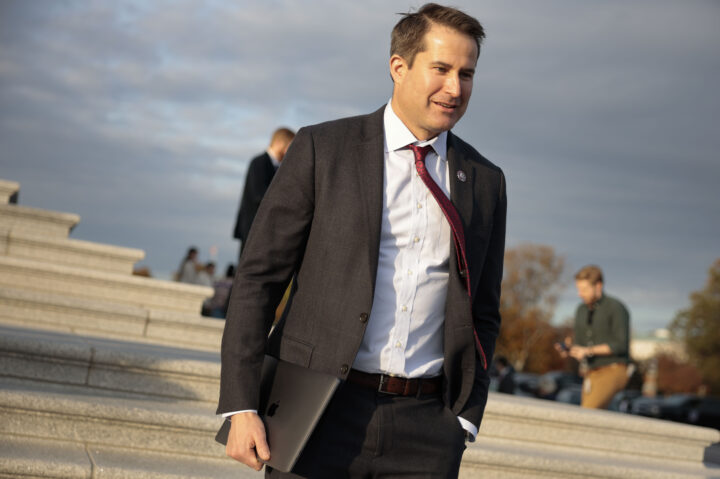
Rep. Seth Moulton (D-MA) speaks with a reporter outside of the U.S. Capitol Building on November 16, 2021 in Washington.
Good Thursday afternoon!
This P.M. briefing is reserved for our premium subscribers like you — offering a forward-focused read on what we’re tracking now and what’s coming next.
I’m Danielle Cohen-Kanik, U.S. editor at Jewish Insider and curator, along with assists from my colleagues, of the Daily Overtime briefing. Please don’t hesitate to share your thoughts and feedback by replying to this email.
📡On Our Radar
Notable developments and interesting tidbits we’re tracking
Hamas continues to delay its return of the deceased hostages in Gaza, citing difficulty in locating and unearthing them. The terror group has so far returned nine out of the 28 bodies it holds, though Israel told mediators yesterday that it believes Hamas knows the whereabouts of at least six other bodies, Arab officials told The Wall Street Journal. Israel shared some of its own intelligence on their locations today and is convening an international task force, including Egypt and Turkey, to work on recovering the rest of the remains…
Hamas is also continuing its campaign to execute its rivals in the enclave; President Donald Trump posted this afternoon on Truth Social, “If Hamas continues to kill people in Gaza, which was not the Deal, we will have no choice but to go in and kill them”…
Israel took credit for the death of Houthi Chief of Staff Muhammad al-Ghamari, announced by the terror group today, as a result of an Israeli strike on Houthi leadership in Yemen in August. Israeli Defense Minister Israel Katz said in a statement that al-Ghamari has “joined his comrades from the thwarted axis of evil in the depths of hell”…
Meanwhile on the campaign trial, New York City Democratic mayoral nominee Zohran Mamdani refused to say that Hamas should disarm on a Wednesday appearance on Fox News, instead asserting, “I don’t really have opinions about the future of Hamas and Israel beyond the question of justice and safety, and the fact that anything has to abide by international law. That applies to Hamas, that applies to the Israeli military, applies to anyone you could ask me about.”
In response, Rep. Laura Gillen (D-NY), a Long Island swing district Democrat who has remained vocally opposed to Mamdani’s candidacy, said on social media, “Pro-Hamas Zohran is unfit to hold any office in the United States”…
Despite maintaining his anti-Israel positions, Mamdani continued his outreach to Jewish leaders in the city over the holiday of Sukkot, including meeting with representatives of the Satmar Hasidic community in Williamsburg as well as with leadership at Reform Congregation Beth Elohim in Park Slope, The New York Times reports.
The conversations have not assuaged communal concerns over his potential mayoralty, with at least one meeting ending with Mamdani and “some attendees ‘totally apart from one another’ on key issues.”
Rabbi Ammiel Hirsch, a progressive Reform leader and senior rabbi at Manhattan’s Stephen Wise Free Synagogue, likewise was unpersuaded in a video and statement he released today, telling Mamdani, “I do not speak for all Jews, but I do represent the views of the large majority of the NY Jewish community, which is increasingly concerned about your statements about Israel and the Jewish people”…
Rep. Seth Moulton (D-MA), mounting a primary challenge to Israel critic Sen. Ed Markey (D-MA), said today that he is returning political donations he has received from AIPAC and will reject the group’s support going forward, Jewish Insider’s Marc Rod reports.
AIPAC said in a statement that Moulton “is abandoning his friends to grab a headline, capitulating to the extremes rather than standing on conviction. His statement comes after years of him repeatedly asking for our endorsement and is a clear message to AIPAC members in Massachusetts, and millions of pro-Israel Democrats nationwide, that he rejects their support and will not stand with them.”
Moulton’s changed stance on accepting support from AIPAC is yet another sign of how even more-moderate Democrats are facing pressure from the party’s activist base to distance themselves from embracing Israel…
CNN unearthed since-deleted social media comments from Maine Senate candidate Graham Platner, who has made opposition to Israel and AIPAC a central focus of his campaign, on a range of far-left issues, including calling himself a communist, saying he’s “disgusted” with America and repeatedly disparaging police officers. “I can honestly say that that is me just being an a**hole on the Internet,” Platner said about the posts…
Claudia Milne, senior vice president for standards and practices at CBS News, announced today that she is stepping down from her position, the first executive to do so since Free Press founder Bari Weiss was named editor-in-chief of the outlet.
Milne oversaw the standards department during a period of perceived anti-Israel bias by the news organization, including when the department instructed CBS employees not to refer to Jerusalem as being in Israel (reported on by The Free Press)…
⏩ Tomorrow’s Agenda, Today
An early look at tomorrow’s storylines and schedule to keep you a step ahead
Keep an eye on Jewish Insider tomorrow morning for reporting on the New York City mayoral debate and an appearance by Middle East envoy Steve Witkoff and antisemitism envoy nominee Yehuda Kaploun at the U.S. Holocaust Memorial Museum in Washington, both taking place this evening.
On Sunday evening, Americans for Ben-Gurion University will hold a benefit in New York City featuring a performance by comedian Alex Edelman and honoring special guest Sasha Troufanov, who was held hostage by Hamas for almost 500 days.
We’ll be back in your inbox with the Daily Overtime on Monday. Shabbat Shalom!
Stories You May Have Missed
EDUCATION CONSTERNATION
With new higher ed compact, Trump’s antisemitism crusade broadens to fight academic bias

Many academics who have fought antisemitism in education said they have concerns towards Trump’s plan
MTG MOMENTUM
As she emerges as populist GOP critic, Marjorie Taylor Greene amplifies antisemitic rhetoric
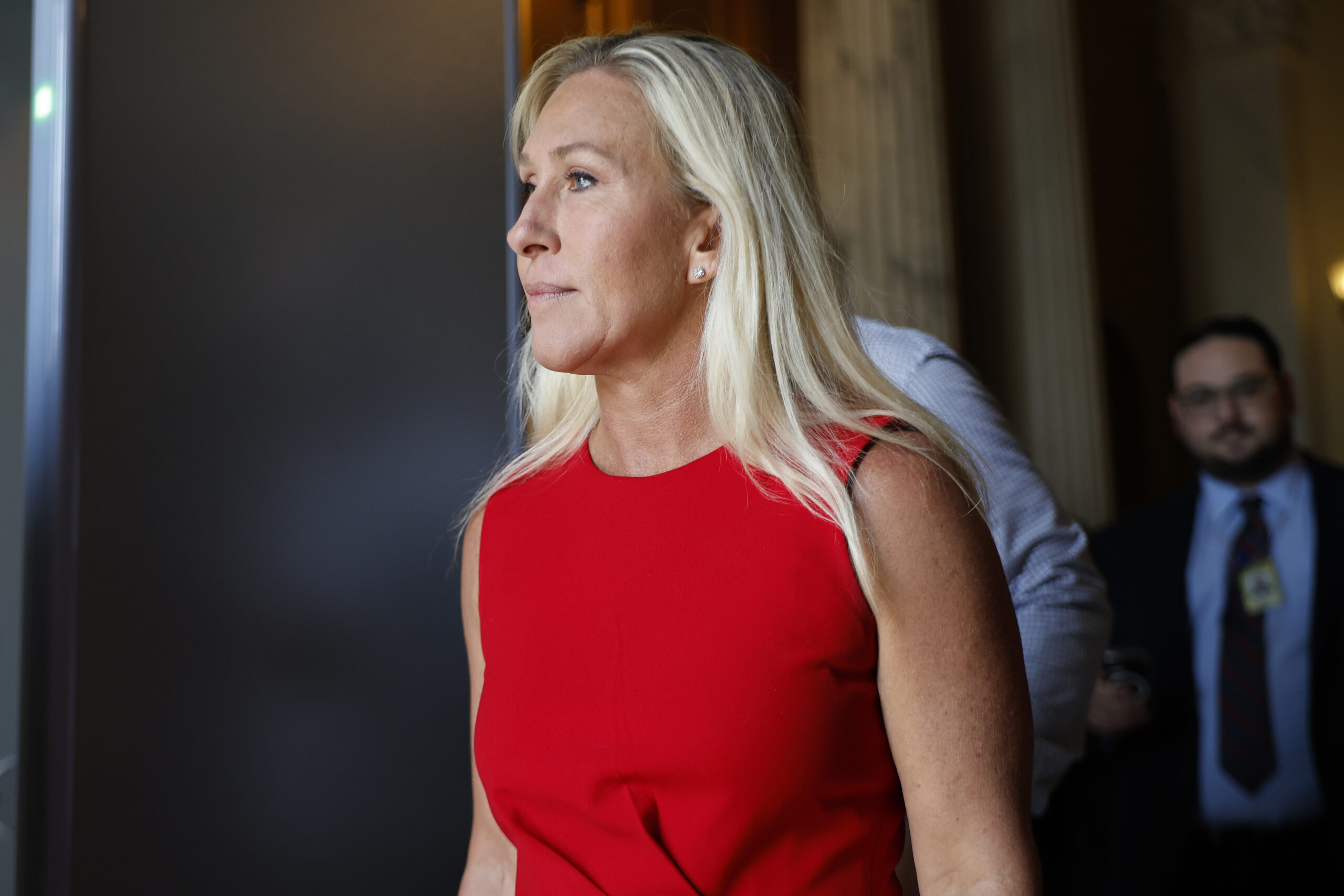
The Georgia congresswoman has recently boosted claims Israel had a hand in assassinating Charlie Kirk, and has baselessly accused the Jewish state of meddling in American elections
American University Professor Pamela Nadell: ‘The closing off of spaces to Jews today is happening once again’
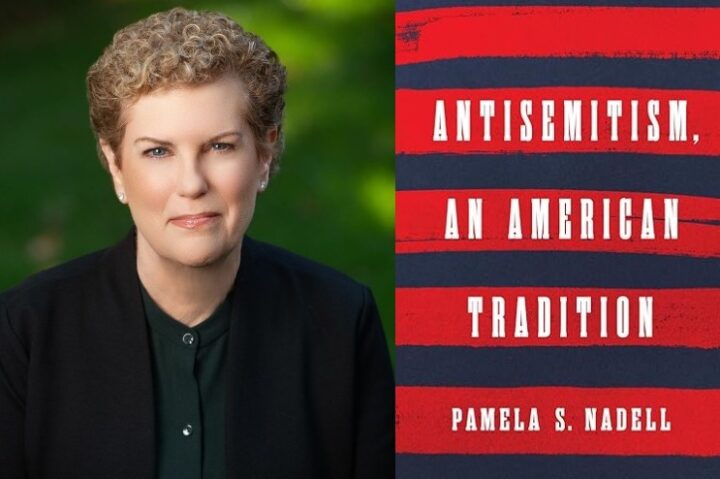
Pamela Nadell
Historian Pamela Nadell is very familiar with the rituals of publishing a book, as she has written nine of them: Secure a release date, present at academic conferences, maybe headline a handful of general-public events. Although she is at the forefront of her field at American University — chair in Women’s and Gender History, director of the Jewish studies program and past president of the Association of Jewish Studies — Nadell knows that success in academia does not often translate to strong book sales.
Things appear to be different for her latest book, Antisemitism: An American Tradition.
Nadell began to understand how much interest a book on antisemitism would generate when her publisher assigned a full-time publicist to promote the book, which will be published on Oct. 14. Nadell is booked at speaking engagements across the country into 2027, starting with an event at the Washington bookstore Politics and Prose this week.
The book that she began researching six years ago will now appear on bookshelves at a time when antisemitism has reached record levels since the Anti-Defamation League began tracking data in 1979.
“I had hoped, frankly, that the subject would be seen as a historic subject by the time [the book] came out into the world,” Nadell told Jewish Insider in a recent interview. “And that’s absolutely not the case.”
Nadell argues in her book that antisemitism is not an aberration in the United States. Instead, she writes, it is intricately woven into the American experience — as American as, say, apple pie.
Jews came from Europe seeking freedom from religious persecution, and while they escaped the pogroms that had haunted them overseas, they did not arrive in a world magically free from antisemitism. She traced the history of anti-Jewish sentiment in America from colonial days to the present, identifying the aftermath of the Civil War as the moment it really gained a foothold in American society.
“America is different [from Europe] in that we never had state sponsored violence against American Jews,” Nadell said. “But the roots of anti-Judaism in America start immediately … the roots of anti-Judaism in America rest on traditional Christian ideas about who the Jews are and what they did to Jesus.”
While antisemitism has always been present in America, the tenor and intensity of it has ebbed and flowed. “We’re in a moment,” she said, “where it’s really bad.”
The reason she is most concerned about the state of antisemitism in America is not just the frequency of antisemitic incidents or the toll of violent attacks on Jews. According to a study published this week by the Anti-Defamation League and Jewish Federations of North America, more than half of American Jews now say antisemitism is a normal part of the Jewish experience.
It’s that doors are once again closing to Jews in a way that reminds her of the quotas, housing covenants and employment restrictions that were baked into American life until the 1950s and 1960s.
“The perception that [antisemitism] was over was because of how much American Jews ascended into American life as those structural barriers fell,” Nadell said. “The doors to corporations opened up, the doors to the colleges opened up. But antisemitism — it’s like it was a nagging factor.”
America is now experiencing another period “where Jewish life once again seems to be constricting,” Nadell argued. “Not in exactly the same ways that it did in those years between World War I and World War II, when there were so many structural limitations. But the closing off of spaces to Jews today is happening once again.”
She pointed to boycotts of Jewish and Zionist writers in the publishing industry, and antisemitic litmus tests appearing in unexpected places like the mental health profession.
“Being told that you have to denounce Israel in order to join a student club? Those students are going to carry those memories forward into their future,” said Nadell.
In recent years, and particularly following the wave of antisemitism that was unleashed after the Oct. 7 attacks two years ago, several Jewish thinkers have posited that the American Jewish community’s best days are behind it. Franklin Foer wrote an Atlantic cover story under the alarming headline, “The Golden Age of American Jews is ending.”
Nadell argues that the notion that there ever was a “golden age” is a myth. “The idea that there was a golden age of Jews in Spain actually emerges during the Dreyfus Affair [in 1894], when things are so terrible in Europe,” she noted. Similarly, Nadell argues that the supposedly now-over golden age for American Jews after the end of quotas and de jure discrimination is not really so straightforward.
“By the time we get to the late ‘60s and on in the 20th century, American Jews feel really secure. The places that used to be closed to us have now opened, and that’s what leads to the perception of the golden age,” said Nadell. “The problem … is the assumption that antisemitism disappeared, but it didn’t.”
Still, Nadell considers herself an optimist. Antisemitism is part of the American fabric. And while that might be a demoralizing conclusion, she views it the other way: Jews have thrived in this country despite antisemitism, and they will continue to do so.
“The reality is that it is part of the normative Jewish experience to experience antisemitism,” said Nadell. “But I think ultimately, American Jews will be okay in the United States.”
Kushner, Witkoff join Israeli Cabinet meeting
Samuel Corum/Sipa/Bloomberg via Getty Images
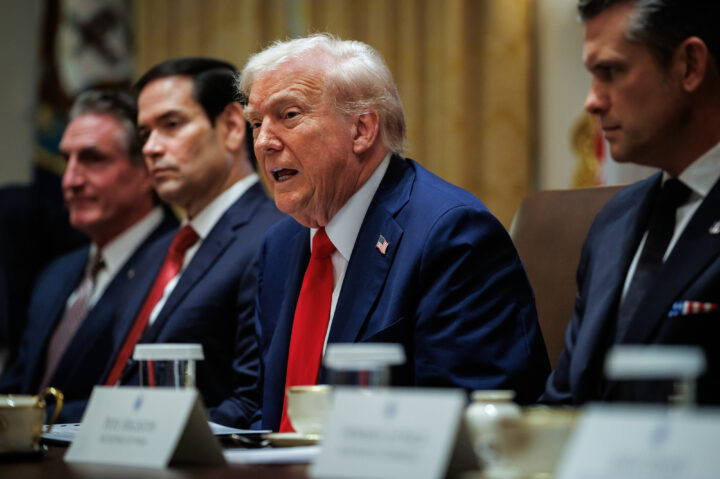
President Donald Trump during a Cabinet meeting at the White House in Washington on Oct. 9, 2025.
Good Thursday afternoon.
This P.M. briefing is reserved for our premium subscribers like you — offering a forward-focused read on what we’re tracking now and what’s coming next.
I’m Danielle Cohen-Kanik, U.S. editor at Jewish Insider and curator, along with assists from my colleagues, of the Daily Overtime briefing. Please don’t hesitate to share your thoughts and feedback by replying to this email.
📡On Our Radar
Notable developments and interesting tidbits we’re tracking
President Donald Trump heaped praise on the leaders of Qatar, Egypt, Saudi Arabia, Turkey and Indonesia at a Cabinet meeting at the White House today, lauding them as key parties responsible for getting Israel and Hamas to agree to the first phase of his peace plan for the region, Jewish Insider’s Emily Jacobs reports.
Trump also confirmed in his remarks that his team is organizing a Mideast trip for him to commemorate the deal, which would include stops in Egypt and Israel, where he’s been invited to address the Knesset.
The president said he is planning to depart from Washington on Sunday and hopes to time his trip to be there when the remaining hostages are released, which he said will happen on Monday or Tuesday. That’s later than some reports which speculated they could be returned to Israel as soon as this weekend…
Israeli and Hamas negotiators signed the final draft of phase one of the deal in Egypt today, and the Israeli Cabinet is now meeting to vote to approve it.
Former Mideast envoy Jared Kushner and current envoy Steve Witkoff joined the Cabinet meeting in Jerusalem, coming off of negotiations in Egypt and having already met with Israeli President Isaac Herzog and Prime Minister Benjamin Netanyahu.
The deal is expected to be approved, despite statements from National Security Minister Itamar Ben-Gvir and Finance Minister Bezalel Smotrich that their parties will oppose it. The meeting, as well as an earlier Security Cabinet briefing, were delayed after Ben-Gvir demanded to retain a veto on the release of specific Palestinian prisoners in the exchange, according to Israeli media…
Preparations are underway for Trump’s brief visit, with the Knesset lit up today in red, white and blue and the King David Hotel reportedly getting ready to boot out guests staying in the luxury lodgings for Sukkot to accommodate the president and his entourage…
Anti-Israel Democratic lawmakers offered tepid support for the deal throughout the day, while reiterating their strident criticisms of Israel, JI’s Marc Rod reports.
Sen. Bernie Sanders (I-VT) didn’t explicitly praise the deal but said he hopes it will lead to the end of a “horrific war.” He made no mention of the Israeli hostages set to be released, but asserted one-tenth of the Gazan population was killed or injured during the war. Read more reactions from lawmakers here…
Joining the pack, New York City Democratic mayoral nominee Zohran Mamdani told a local radio station today that he hopes the deal is “lasting” and “brings peace” but that it shouldn’t erase “Hamas’ horrific war crime on Oct. 7 … and the Israeli government’s horrific war crimes since then”…
The Atlantic Council’s Ahmed Fouad Alkhatib, who grew up in Gaza, writes in The Free Press about the “self-styled peace activists” in the West denouncing the peace deal as a “colonial attempt to continue the genocide” who have “little understanding or interest in how dealmaking works.”
“One of the first steps to freeing Palestinians from the horrors of war is to free them from the ‘Free Palestine Movement’ in the diaspora and Western world. The unholy alliance between the far left, far right, and Islamist hooligans who normalize Hamas’s narrative is harmful first and foremost to the Palestinian people,” Alkhatib argues…
In her first week as editor-in-chief of CBS News, The Free Press founder Bari Weiss reportedly told staff today that former secretaries of state Hillary Clinton, Antony Blinken and Mike Pompeo have agreed to appear on a Middle East roundtable on the network…
The New York Times profiles Jewish stand-up comedian Mordechi Rosenfeld, known as Modi, who has a “personal mantra that guides his comedy: ‘Moshiach energy’ … For Mr. Rosenfeld, the slogan reflects a Messianic idea inspired by the last leader of the Chabad-Lubavitch Orthodox movement, Rabbi Menachem Mendel Schneerson. Mr. Rosenfeld interprets it as a mandate to pour positive energy into the world to help bring the Messiah”…
⏩ Tomorrow’s Agenda, Today
An early look at tomorrow’s storylines and schedule to keep you a step ahead
Keep an eye on Jewish Insider tomorrow morning for reporting on the Senate’s agreement, which had been stalled for weeks, to move toward passage of the 2026 National Defense Authorization Act today.
Tomorrow, NOTUS will host a virtual event on “Mapping the New Global Order” with former Secretary of Defense Chuck Hagel and Reps. Don Bacon (R-NE) and Jason Crow (D-CO).
Over the weekend, we’ll be keeping an eye on President Donald Trump’s travels to the region and engagement with Israeli officials, as well as developments in the hostage-release process.
In observance of Shemini Atzeret and Simchat Torah, we’ll be back in your inbox with the Daily Overtime on Thursday. Chag Sameach and Shabbat Shalom!
Stories You May Have Missed
TWO YEARS
How Oct. 7 changed the world — two years later

Five reflections on how Oct. 7 reshaped politics, diplomacy, advocacy, higher ed, and Jewish life
FILM IN FOCUS
‘A story about family’: Noam Tibon, director Barry Avrich reflect on ‘The Road Between Us’ premiere

Tibon told JI that the documentary’s eventual debut, despite significant roadblocks, was ‘a victory for the movie and a victory for the truth of what happened on Oct. 7’
To mark the second anniversary of the Oct. 7 attacks in Israel, the Jewish Insider team asked leading thinkers and practitioners to reflect on how that day has changed the world. Here, we look at how Oct. 7 changed American Politics

Worawat/Adobe Stock
The United States Capitol with reflection at night Washington DC USA
Plus, right-wing influencers defame the ADL
Francis Chung/Politico/Bloomberg via Getty Images
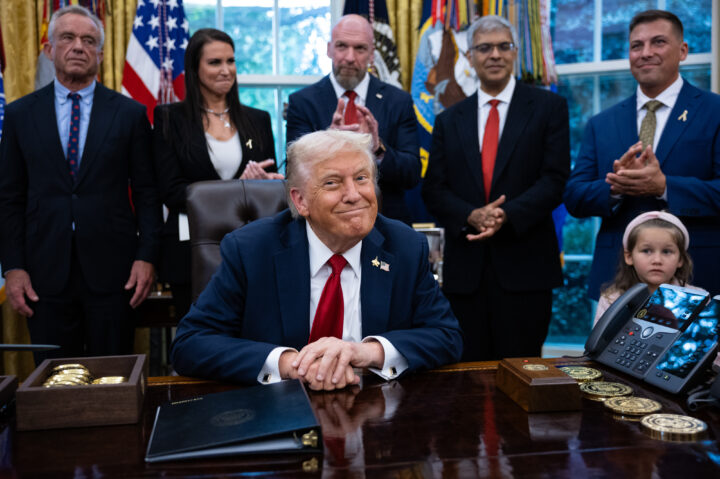
President Donal Trump, center, during an executive order signing in the Oval Office of the White House on Tuesday, Sept. 30, 2025.
Good Tuesday afternoon.
This P.M. briefing is reserved for our premium subscribers like you — offering a forward-focused read on what we’re tracking now and what’s coming next.
I’m Danielle Cohen-Kanik, U.S. editor at Jewish Insider and curator, along with assists from my colleagues, of the Daily Overtime briefing. Please don’t hesitate to share your thoughts and feedback by replying to this email.
📡On Our Radar
Notable developments and interesting tidbits we’re tracking
The clock continues to tick on whether Hamas will accept President Donald Trump’s 20-point plan to end the war in Gaza, presented with Israeli Prime Minister Benjamin Netanyahu at the White House yesterday.
The plan itself says in Point No. 4 that “within 72 hours of Israel publicly accepting this agreement, all hostages, alive and deceased, will be returned.”
Trump affirmed that timeline, telling reporters this morning that he would give Hamas “three or four days” to agree to the ceasefire and said later during remarks to military leaders in Quantico, Va., “We have one signature that we need, and that signature will pay in hell if they don’t sign”…
Officials from Egypt, Qatar and Turkey are urging Hamas to agree, despite being angered by several changes to the plan negotiated by Netanyahu, particularly on the conditions and timeline for the IDF’s withdrawal from Gaza, before it was presented to the public yesterday, Axios reports…
U.S. Ambassador to Israel Mike Huckabee postponed a rare trip to Egypt, originally planned for Sunday, to mid-October. Huckabee said the purpose of his visit, requested by Egyptian officials, is to “build dialogue, trust and understanding,” without providing further details on the agenda or the reason for the delay…
The Israeli Foreign Ministry today claimed that the Sumud Flotilla currently making its way to Gaza, including anti-Israel activist Greta Thunberg and around 500 others, was organized and funded indirectly by Hamas through the Palestinian Conference for Palestinians Abroad, an organization led and endorsed by Hamas affiliates.
The flotilla and the Israeli Navy are expected to make contact as the ships approach Gaza tomorrow. Italy and Spain dispatched their own navies to accompany the flotilla, though those ships will turn back before reaching Israeli waters.
Italian Prime Minister Giorgia Meloni called in a statement today for the flotilla to cease its operation for risk of “blowing up” the “fragile balance” created by Trump’s peace proposal. In the U.S., meanwhile, Rep. Rashida Tlaib (D-MI) and 18 other House progressives wrote to Secretary of State Marco Rubio demanding that the U.S. protect the flotilla…
Elon Musk and several right-wing influencers misrepresented the Anti-Defamation League’s classification of the antisemitic Christian Identity movement as an extremist group, circulating a partial, out-of-context screenshot on social media purporting that the civil rights organization was disparaging the Christian religion at large, Jewish Insider’s Emily Jacobs and Marc Rod report.
Musk said the ADL “hates Christians” and called it a “hate group,” while Rep. Anna Paulina Luna (R-FL) said the group is “intentionally creating a targeted hate campaign against Christians.” In reality, the Christian Identity movement, which the ADL lists on its website as an extremist group, “is a virulently antisemitic and loosely organized movement that has nothing to do with mainstream Christianity,” ADL CEO Jonathan Greenblatt wrote on X…
Trump told reporters this afternoon that his administration is close to reaching a deal with Harvard after a monthslong deadlock and legal battle that will see the university pay around $500 million to open and operate trade schools. “They’re going to be teaching people how to do AI and lots of other things,” Trump said at an executive order signing.
The potential deal comes after the Department of Health and Human Services said yesterday that it was initiating the process of “debarment” against Harvard, which would cut the school off from future federal research funding, a large blow to its financial standing.
Harvard had sent a scathing letter to the administration on Sept. 19 accusing it of relying on “inaccurate and incomplete facts” in determining that the school had violated civil rights laws, The New York Times reports. The letter also said the administration failed to meet legal requirements to prove discrimination and relied on findings from a fraction of a percentage of the student body…
Meanwhile, a federal judge ruled today that the Trump administration’s moves to arrest and deport international students for actions at anti-Israel protests were illegal, saying that the Department of Homeland Security and State Department aimed to “tamp down pro-Palestinian student protests and terrorize” students.
A DHS official testified during the trial that the department relied heavily on the advocacy work of the pro-Israel group Canary Mission, creating reports on between 100-200 student protesters based of the group’s profiles of people involved in anti-Israel activity on campus…
In another legal loss, the administration was forced to restore almost all of the 500 National Institutes of Health grants it had suspended from the University of California, Los Angeles after a federal ruling last week…
Another campus drawing attention: The University of Maryland’s Student Government Association is set to consider a resolution at the start of Yom Kippur on Wednesday evening, calling on the university and its charitable foundation to implement a boycott of companies and academic institutions with ties to “Israel’s regime of apartheid and occupation,” JI’s Haley Cohen reports…
⏩ Tomorrow’s Agenda, Today
An early look at tomorrow’s storylines and schedule to keep you a step ahead
Keep an eye on Jewish Insider tomorrow morning for reporting on the rise of DSA-aligned candidates in key congressional and mayoral contests.
On Sunday, Democratic Jewish Outreach of Pennsylvania, a Jewish Democratic PAC, will present its annual Defender of Democracy award to Illinois Gov. JB Pritzker at an event with special guest Pennsylvania Gov. Josh Shapiro.
Also on Sunday, the Museum of Jewish Heritage – A Living Memorial to the Holocaust in New York will open its exhibit honoring the 2018 Tree of Life Synagogue shooting in Pittsburgh.
In observance of Yom Kippur, we’ll be back in your inbox with the Daily Overtime on Monday. G’mar chatima tova and Shabbat shalom!
Stories You May Have Missed
HILL REACTIONS
Senators react to Trump’s Gaza plan with cautious optimism
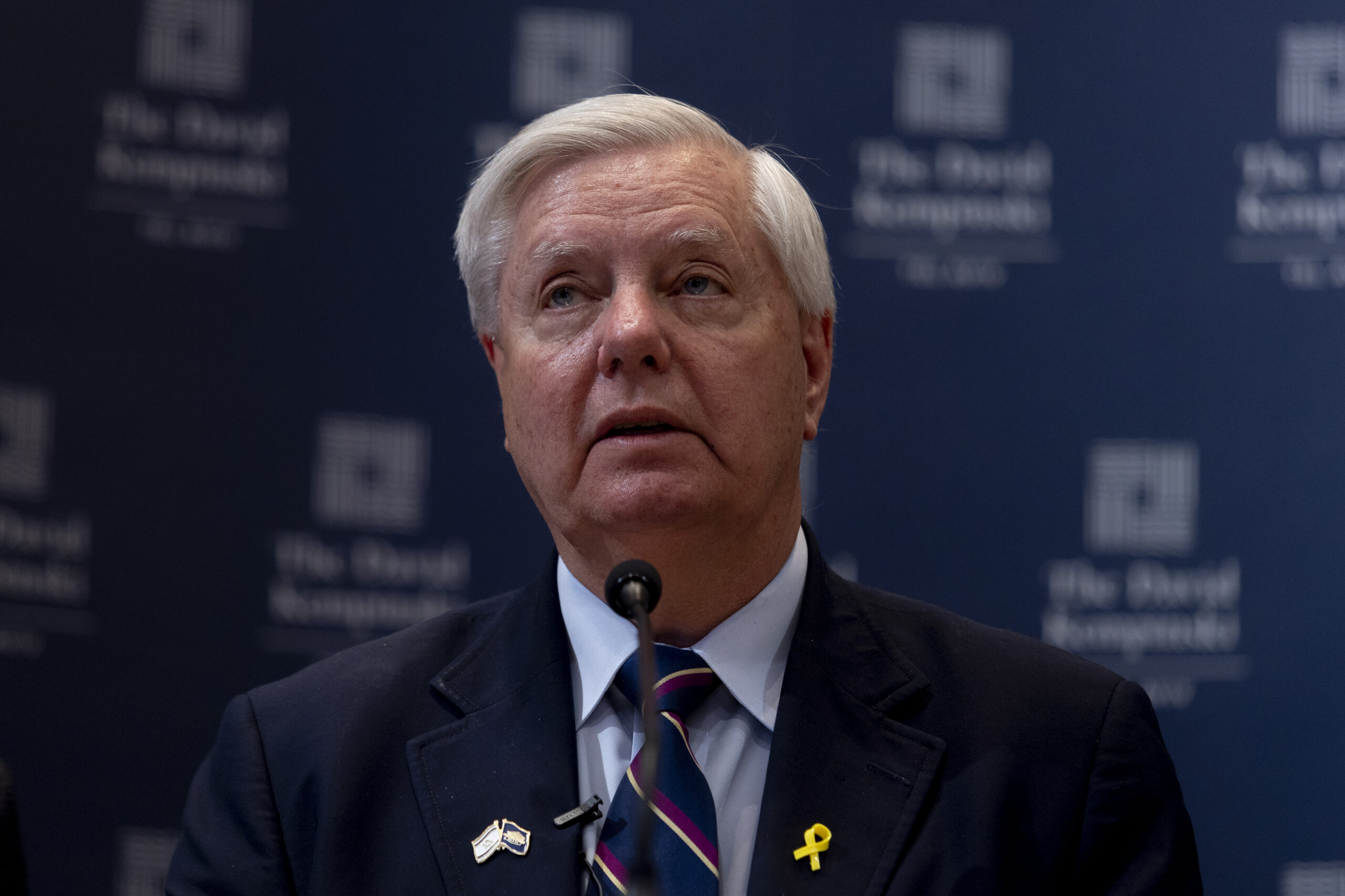
Sen. Lindsey Graham sounded skeptical that Hamas would accept the deal: ‘Distrust and verify with these guys’
CONFERENCE CONTROVERSY
Khanna distances himself from pro-terror speakers at anti-Israel conference and defends ‘free speech’

At ArabCon, several panelists laughed at the notion of condemning Hamas’ Oct. 7 attacks and defended the terrorist group as ‘Palestinian resistance’
Plus, new study suggests X is safe harbor for antisemitism

Jim Lo Scalzo/EPA/Bloomberg via Getty Images
President Donald Trump, right, and Benjamin Netanyahu, Israel's prime minister, during a news conference in the State Dining Room of the White House in Washington, DC, US, on Monday, Sept. 29, 2025.
Good Monday afternoon.
This P.M. briefing is reserved for our premium subscribers like you — offering a forward-focused read on what we’re tracking now and what’s coming next.
I’m Danielle Cohen-Kanik, U.S. editor at Jewish Insider and curator, along with assists from my colleagues, of the Daily Overtime briefing. Please don’t hesitate to share your thoughts and feedback by replying to this email.
📡On Our Radar
Notable developments and interesting tidbits we’re tracking
In a press conference this afternoon at the White House, President Donald Trump and Israeli Prime Minister Benjamin Netanyahu announced that Israel had agreed to sign onto the White House’s 20-point peace plan to end the war in Gaza.
The plan, which has not yet been agreed to by Hamas, would see the release of all of the remaining hostages in Gaza in exchange for an immediate end to the war and the release of 2,250 Palestinians in Israeli jails, including 250 serving life sentences. Hamas would be removed from power in Gaza with its members offered amnesty if they “commit to peaceful co-existence and to decommission their weapons.”
Netanyahu and Trump weren’t in lockstep on the future of Gaza, though. The Israeli PM said in his remarks that “Gaza will have a peaceful civilian administration that is run neither by Hamas nor by the Palestinian Authority,” while the White House’s plan says that the PA will control Gaza once the body has reformed (a process that could take years).
Even if Hamas rejects the plan, humanitarian aid operations will continue to be scaled up, and terror-free areas of Gaza will be handed over from the IDF to an international stabilization force. But Trump said that Israel will have the “full backing” of the U.S. to resume fighting in Gaza if Hamas does not accept.
“If Hamas rejects the deal — which is always possible, they’re the only one left. Everyone else has accepted it. But I have a feeling that we’re going to have a positive answer. But if not, as you know, Bibi, you’d have our full backing,” said Trump. Read JI’s coverage of the press conference here…
During their meeting beforehand in the Oval Office, Netanyahu and Trump held a phone call with Qatar’s prime minister, Sheikh Mohammed bin Abdulrahman al-Thani, where Netanyahu apologized for killing a Qatari serviceman in an attempted strike on Hamas leadership in Doha and promised not to violate Qatari sovereignty again.
The conversation came after Trump has repeatedly expressed his dissatisfaction with Israel’s decision to strike a major non-NATO U.S. ally without providing sufficient notice to the White House.
The apology was met with frustration and scorn from Netanyahu’s right-wing political allies and left-wing opponents in Israel. Finance Minister Bezalel Smotrich compared the apology to U.K. Prime Minister Neville Chamberlain’s appeasement of Adolf Hitler during World War II. Netanyahu’s “groveling apology to a state that supports and funds terror is a disgrace,” Smotrich said on X…
A New York Times/Siena College poll released today found dramatic declines in American support for Israel, with slightly more American voters saying they sympathize more with Palestinians (35%) than with Israelis (34%) for the first time since the Times started asking the question in 1998, though there remains a large segment of the population that is unsure or that sympathizes with both equally (31%).
Around 60% of voters said that Israel should end the war in Gaza “in order to protect against civilian casualties” even if the remaining hostages are not released and even if Hamas is not fully eliminated. Among Democrats, that figure is an overwhelming 81%.
The majority of the shifting sentiment against Israel comes from Democrats: 59% also think that Israel is intentionally killing Gazan civilians. Within the party, the biggest shift is coming from white, college-educated, older voters. In a similar poll two years ago, Democrats ages 45 and older “sympathized with Israel over Palestinians 2-to-1. That is now reversed, with 42% saying they sympathize more with Palestinians, compared with 17% who feel more sympathetic toward Israel”…
Among Israel’s detractors, New York City Democratic mayoral nominee Zohran Mamdani declined to denounce Hamas on Friday, when asked if he agreed with Netanyahu’s remarks at the U.N. General Assembly that Hamas is a terrorist group that needs to be destroyed.
“I’m not going to echo the words of Benjamin Netanyahu,” Mamdani said. “I can, however, share my own words and say them right here, which is that my politics is built on a universality. I can think of no better illustration of that than from the words of the hostage families themselves: Everyone for everyone.”
“What has been so infuriating to me and so many New Yorkers, frankly, is Benjamin Netanyahu’s use of the hostages as a justification to continue a war that has only continued to endanger the lives of those very hostages, as well as of so many Palestinians,” Mamdani said…
A new study by the Center for Countering Digital Hate and the Jewish Council for Public Affairs found that antisemitism is “thriving” on the social media platform X in an analysis of over 679,000 posts. The study found that X took action on only 36 out of the 300 most-viewed posts espousing antisemitic conspiracy theories and only four of them received community notes, which X owner Elon Musk has touted as the antidote to harmful content instead of increased moderation…
⏩ Tomorrow’s Agenda, Today
An early look at tomorrow’s storylines and schedule to keep you a step ahead
Keep an eye on Jewish Insider tomorrow morning for the latest reporting and analysis of the White House’s Gaza peace plan and a breakdown of the anti-Israel candidates running for all four open Chicago-area House seats in hotly contested Democratic primaries.
Tomorrow evening, Democratic Majority for Israel will host a virtual briefing with Rep. Greg Landsman (D-OH) and Jacob Magid, The Times of Israel‘s U.S. bureau chief, on the implications of today’s White House meeting, the status of the war, political developments in Jerusalem and Landsman’s reflections from his recent trip to Israel.
Stories You May Have Missed
BOWING OUT
Eric Adams’ campaign suspension may come too late to block Mamdani’s path to victory
Individuals involved in the race told JI impediments remain to consolidating support behind Andrew Cuomo
INFLUENCER INSIGHTS
TikTok sale could be ‘consequential’ for Israel, Jews, Netanyahu tells influencers

‘We have to fight the fight’ on social media, shore up support on American right, Netanyahu says
Plus, Mamdani rings in new year at anti-Zionist synagogue

Photo by Andrew Harnik/Getty Images
President Donald Trump delivers remarks during a meeting with President of Turkey Recep Tayyip Erdogan in the Oval Office at the White House on September 25, 2025 in Washington, D.C.
Good Thursday afternoon.
This P.M. briefing is reserved for our premium subscribers like you — offering a forward-focused read on what we’re tracking now and what’s coming next.
I’m Danielle Cohen-Kanik, U.S. editor at Jewish Insider and curator, along with assists from my colleagues, of the Daily Overtime briefing. Please don’t hesitate to share your thoughts and feedback by replying to this email.
📡On Our Radar
Notable developments and interesting tidbits we’re tracking
Asked about reports that he had told Arab leaders this week he will not allow Israel to annex the West Bank, President Donald Trump confirmed to reporters in the Oval Office this afternoon, “I will not allow Israel to annex the West Bank, nope, I will not allow it. It’s not gonna happen.”
Pressed if he spoke with Israeli Prime Minister Benjamin Netanyahu about the issue, Trump said, “Yeah, but I’m not going to allow it. Whether I spoke to him or not — I did — but I’m not allowing Israel to annex the West Bank. There’s been enough, it’s time to stop now”…
The comments came shortly after Trump met with Turkish President Recep Tayyip Erdogan at the White House today, where Trump suggested that he may permit Ankara to purchase F-35 fighter jets, which it has been prohibited from doing since it acquired a Russian S-400 missile defense system in 2017.
Trump said without mentioning the F-35s or the less-advanced F-16 jets by name that he expected Erdogan would “be successful with buying the things” he would “like to buy.” “He needs certain things, and we need certain things, and we’re going to come to a conclusion. You’ll know by the end of the day,” Trump said.
The prospect of the sale has sparked concern from lawmakers: Bipartisan groups have urged the administration on several occasions not to change policy on the issue, including in a new letter today…
Elsewhere in the White House, one of the architects of the Trump administration’s negotiations with universities said that the large financial sums being extracted in the settlements are meant to bring attention to the administration’s aggressive approach to tackling discrimination in higher education, rather than punish the schools financially.
May Mailman, a conservative attorney who until last month served as a senior White House strategist, told The New York Times that “These are small dollar figures compared to the amounts that they are getting every year from the federal government and from their donors — but I think it provides a seriousness and a focus on these in ways that promises only wouldn’t.”
“When you see numbers like that, then you pay attention, and you look, and then you’re able to learn a little bit more, something maybe you wouldn’t normally learn,” Mailman said…
Getting in the holiday spirit, New York City Democratic mayoral nominee Zohran Mamdani joined Rosh Hashanah services on Monday night at Kolot Chayeinu, a Brooklyn synagogue known for its anti-Zionist activism, where the rabbi spoke extensively about Israel carrying out a “genocide” in Gaza.
The congregation, one of the first to call for a ceasefire just weeks after the Oct. 7 attacks, faced criticism last year for promoting anti-Israel views in its Hebrew school curriculum. One of its rabbis, a member of Jewish Voice for Peace’s Rabbinical Council, was kicked out of a White House event for disrupting former First Lady Jill Biden to call for an arms embargo on Israel.
Two of Mamdani’s challengers also spent time in NYC synagogues over the holiday: Former New York Gov. Andrew Cuomo joined the Park East Synagogue for its services and Mayor Eric Adams spoke to the Sephardic Lebanese Congregation.
Mamdani also plans to join Rep. Jerry Nadler (D-NY) for Yom Kippur services next week, where Nadler said some of the congregants will be “frankly very upset to see” Mamdani. It remains unclear which synagogue they will attend; the B’nai Jeshurun synagogue on the Upper West Side, which Nadler frequents, told Jewish Insider that Mamdani “will not be joining services with our community”…
Also in New York, Palestinian Authority President Mahmoud Abbas addressed the U.N. General Assembly by video today after the Trump administration revoked his visa to attend in person. He called Israel’s actions in Gaza “war crimes” and said the PA would be willing to govern the enclave, which he said is an integral part of a future Palestinian state…
Elon Musk’s xAI announced today it has reached a deal with the Trump administration to allow federal agencies to use its AI chatbot Grok, just months after the bot went rogue on X proclaiming itself to be “MechaHitler” and espousing extreme antisemitic rhetoric…
Over 1,200 celebrities including Mayim Bialik, Debra Messing, Sharon Osbourne, Howie Mandel, Haim Saban, Gene Simmons and Liev Schreiber have signed on to an open letter urging over 4,000 of their Hollywood colleagues to reconsider their signatures on a recent pledge to boycott Israeli film institutions. “We cannot stay silent when a story is turned into a weapon, when lies are dressed up as justice, and when artists are misled into amplifying antisemitic propaganda,” the letter reads…
⏩ Tomorrow’s Agenda, Today
An early look at tomorrow’s storylines and schedule to keep you a step ahead
Keep an eye on Jewish Insider for reporting on Microsoft’s decision to restrict the IDF’s use of its software after repeated protests by its employees and on what the sale of TikTok’s U.S. business may mean for the platform’s algorithm, which has been accused of promoting antisemitic and anti-Israel content.
This evening, UCLA Chancellor Julio Frenk will speak on Jews United for Democracy & Justice’s “America at a Crossroads” series about President Donald Trump’s approach to higher education. Read JI’s interview with Frenk here.
Israeli Prime Minister Benjamin Netanyahu will be the first world leader to speak at the U.N. General Assembly tomorrow morning, after many of the week’s speeches by world leaders included condemnations of Israel and recognition of a Palestinian state. On Monday, Netanyahu will meet with Trump at the White House.
Also tomorrow, the Nova Music Festival Exhibition opens in Boston.
We’ll be back in your inbox with the Daily Overtime on Monday. Shabbat shalom!
Stories You May Have Missed
Q&A
Post-Paramount sale, Shari Redstone is ‘full speed ahead’ on addressing antisemitism
The media mogul told JI she’s excited to show the world a different view of Israel through the Sipur production company, which she joined as chair
EYE ON UNESCO
Concern mounts in Jerusalem as Qatar, Egypt set to take key roles in UNESCO

‘It’s bad for Israel and bad for America,’ an Israeli diplomat told JI this week
Carlson: ‘I can just sort of picture the scene in a lamp-lit room with a bunch of guys sitting around eating hummus, thinking about, ‘What do we do about this guy telling the truth about us?’

Joe Raedle/Getty Images
Tucker Carlson speaks during the memorial service for political activist Charlie Kirk at State Farm Stadium on September 21, 2025 in Glendale, Arizona.
Right-wing political commentator Tucker Carlson, who has hosted Holocaust deniers and antisemitic influencers on his podcast, used his address at the memorial for conservative influencer Charlie Kirk in Arizona on Sunday to compare Kirk’s assassination to the killing of Jesus.
The former Fox News host began his remarks to the more than 70,000 people in attendance at State Farm Stadium in Glendale by noting that the political engagement brought on by Kirk’s killing “actually reminds me of my favorite story ever,” before offering an account of how Jesus was killed in Jerusalem. While he never brought up the Jewish people by name, he made references to Jewish culture to suggest that he was referring to the antisemitic trope that Jews were responsible for the killing of Jesus.
“It’s about 2,000 years ago in Jerusalem and Jesus shows up, and he starts talking about the people in power, and he starts doing the worst thing that you can do: just telling the truth about people, and they hate it, and they just go bonkers. They hate it, and they become obsessed with making him stop. ‘This guy’s got to stop talking. We’ve got to shut this guy up,’” Carlson said.
“I can just sort of picture the scene in a lamp-lit room with a bunch of guys sitting around eating hummus, thinking about, ‘What do we do about this guy telling the truth about us? We must make him stop talking.’ There’s always one guy with the bright idea, and I can just hear him say, ‘I’ve got an idea. Let me just kill him. That’ll shut him up, that’ll fix the problem.’ It doesn’t work that way,” he continued.
Carlson, who spoke for just under six minutes, then quoted the beatitude from Matthew 5:4: “Blessed are those who mourn, for they will be comforted.” He connected the passage to Kirk’s political message, making the argument that the slain conservative activist “was bringing the gospel to the country. He was doing the thing that the people in charge hate most, which is calling for them to repent.”
“How is Charlie’s message different? Charlie was a political person who was deeply interested in coalition building and getting the right people in office, because he knew that vast improvements are possible politically, but he also knew that politics is not the final answer. It can’t answer the deepest questions, actually, that the only real solution is Jesus,” Carlson said. “Politics at its core is a process of critiquing other people and getting them to change. Christianity, the gospel message, the message of Jesus, begins with repentance.”
Carlson went on to praise Kirk for not having “hate in his heart” and being able to “forgive other people” by following “a call to change our hearts from Jesus,” before acknowledging his own shortcomings.
“Charlie was fearless at all times, truly fearless. To his last moment, he was unafraid. He was not defensive, and there was no hate in his heart. I know that because I’ve got a little hate compartment in my heart, and I would often express that surely about various people,” Carlson said. “He would always say, ‘That’s a sad person, that’s a broken person, that’s a person who needs help, that’s a person who needs Jesus’. He said that in private, because he meant it.”
Plus, NY Dem party chair rejects Mamdani
Leon Neal/Getty Images
President Donald Trump and U.K. Prime Minister Keir Starmer hold a press conference at Chequers at the conclusion of a state visit on September 18, 2025 in Aylesbury, England.
Good Thursday afternoon.
This P.M. briefing is reserved for our premium subscribers like you — offering a forward-focused read on what we’re tracking now and what’s coming next.
I’m Danielle Cohen-Kanik, U.S. editor at Jewish Insider and curator, along with assists from my colleagues, of the Daily Overtime briefing. Please don’t hesitate to share your thoughts and feedback by replying to this email.
📡On Our Radar
Notable developments and interesting tidbits we’re tracking
President Donald Trump said at a press conference with British Prime Minister Keir Starmer today that the recognition of a Palestinian state, which the U.K. plans to do this weekend, is “one of [the] few disagreements” between the two leaders.
“We want [the war] to end. We have to have the hostages back immediately. That’s what the people of Israel want, they want them back. And we want the fighting to stop,” the president continued.
Asked why he couldn’t recognize a Palestinian state next to Trump at the press conference — the British PM delayed the announcement of recognition until after Trump departs — Starmer said, “Let me be really clear about Hamas. They’re a terrorist organization who can have no part in any future government in Palestine.” Trump patted Starmer on the back and said, “That’s good”…
One of Starmer’s predecessors, former British Prime Minister Tony Blair, was authorized by Trump to develop a plan for postwar Gaza; a draft of that plan, obtained by The Times of Israel, would create a Gaza International Transitional Authority and guarantee Gazans the right to return to properties they vacate voluntarily in the enclave…
Syrian Foreign Minister Asaad al-Shaibani was on Capitol Hill today lobbying lawmakers to repeal the Caesar Syria Civilian Protection Act, the remaining congressionally mandated sanctions on Syria. The move has bipartisan support in both chambers.
Shaibani, fresh off a visit to London where he met with Israeli Strategic Affairs Minister Ron Dermer and U.S. envoy Tom Barrack to discuss Israel-Syria security arrangements, met with Sen. Lindsey Graham (R-SC), Sen. Jim Risch (R-ID), Rep. Joe Wilson (R-SC), Rep. Abe Hamadeh (R-AZ) and Treasury Department officials, among others, and is scheduled to meet with Secretary of State Marco Rubio tomorrow. It’s the first visit of a Syrian foreign minister to Washington in more than 25 years…
Syrian President Ahmad al-Sharaa told reporters yesterday that Syria and Israel could reach such a security agreement “within days”…
French President Emmanuel Macron told Israel’s Channel 12 that, despite European attempts at negotiating with Iran over its nuclear program, U.N. Security Council snapback sanctions will be implemented at the end of the month, likely on Sept. 27…
i24 News reports it has obtained recent audio of Macron speaking to former French parliament member Meyer Habib where Macron is heard saying, “I will not recognize a Palestinian state without the release of the hostages,” contrary to his reported plan to do so next week…
Two Israelis were killed today at the Allenby Crossing between Jordan and the West Bank by an assailant driving a truck of humanitarian aid destined for the Gaza Strip…
Reps. Josh Gottheimer (D-NJ) and Mike Lawler (R-NY) called on the House today to advance the long-stalled Antisemitism Awareness Act in response to New York City Democratic mayoral nominee Zohran Mamdani’s stated plans to revoke the city’s use of the International Holocaust Remembrance Alliance’s working definition of antisemitism.
The lawmakers, in a joint statement, called Mamdani’s effort “shameful, dangerous, and completely disgusting”…
Jay Jacobs, the chair of the New York Democratic Party, said in a statement today that he will not be endorsing Mamdani because he “strongly disagree[s] with [Mamdani’s] views on the State of Israel, along with certain key policy positions,” including the Queens assemblyman’s affiliation with the Democratic Socialists of America…
New York Gov. Kathy Hochul, meanwhile, facing backlash to her own endorsement of Mamdani, is still trying to “please the hyper-engaged hard-left, protect vulnerable House members and still win reelection with a statewide electorate that is far more moderate than in New York City,” per Politico.
“Behind closed doors, Hochul has pledged to anxious private sector leaders that she will use her power to act as a check on Mamdani’s agenda — much of which relies on state approval”…
Former President Barack Obama said that the firing of Karen Attiah — the anti-Israel Washington Post columnist who justified the Oct. 7 attacks and was let go from the Post earlier this week over social media posts on Charlie Kirk’s killing — is “precisely the kind of government coercion that the First Amendment was designed to prevent”…
The board of directors of Turning Point USA, the organization Kirk founded, unanimously named Erika Kirk, his widow, as its new CEO and board chair…
⏩ Tomorrow’s Agenda, Today
An early look at tomorrow’s storylines and schedule to keep you a step ahead
Keep an eye on Jewish Insider tomorrow morning for a look at how three Biden administration officials’ views have diverged over Israel since leaving the White House.
The Atlantic Festival continues in New York City through Saturday.
Also in New York, an event on “Breaking the Chain: Global Action Against Hostage-Taking” will take place tomorrow and feature the first public remarks from former Israeli hostage Na’ama Levy. Also speaking are a Yazidi survivor of ISIS captivity; Danny Danon, Israel’s ambassador to the U.N.; Dorothy Shea, acting U.S. representative to the U.N.; and Ibrahim Olabi, Syria’s ambassador to the U.N.; among others.
Chabad at Vanderbilt University will honor Vanderbilt Chancellor Daniel Diermeier with Chabad’s Lamplighter award tomorrow. Read JI’s interview with Diermeier and Washington University in St. Louis Chancellor Andrew Martin here.
On Saturday, the Milken Center for Advancing the American Dream is opening with its flagship exhibition, the “American Dream Experience,” in Washington.
On Sunday, Charlie Kirk’s memorial will be held at the State Farm Stadium in Arizona, where speakers will include President Donald Trump, Vice President JD Vance, White House Chief of Staff Susie Wiles, Secretary of State Marco Rubio, Secretary of Defense Pete Hegseth, Director of National Intelligence Tulsi Gabbard and far-right podcast host Tucker Carlson, who has advanced conspiracy theories in the aftermath of Kirk’s murder claiming the conservative activist was being pressured by Israel.
The high-level meetings of the U.N. General Assembly are set to begin next week, with several countries expected to announce their recognition of a Palestinian state.
We’ll be back in your inbox with the Daily Overtime on Monday. Shabbat shalom!
Stories You May Have Missed
BITING THE BULLET
New York Jewish leaders reckon with a potential Mamdani win
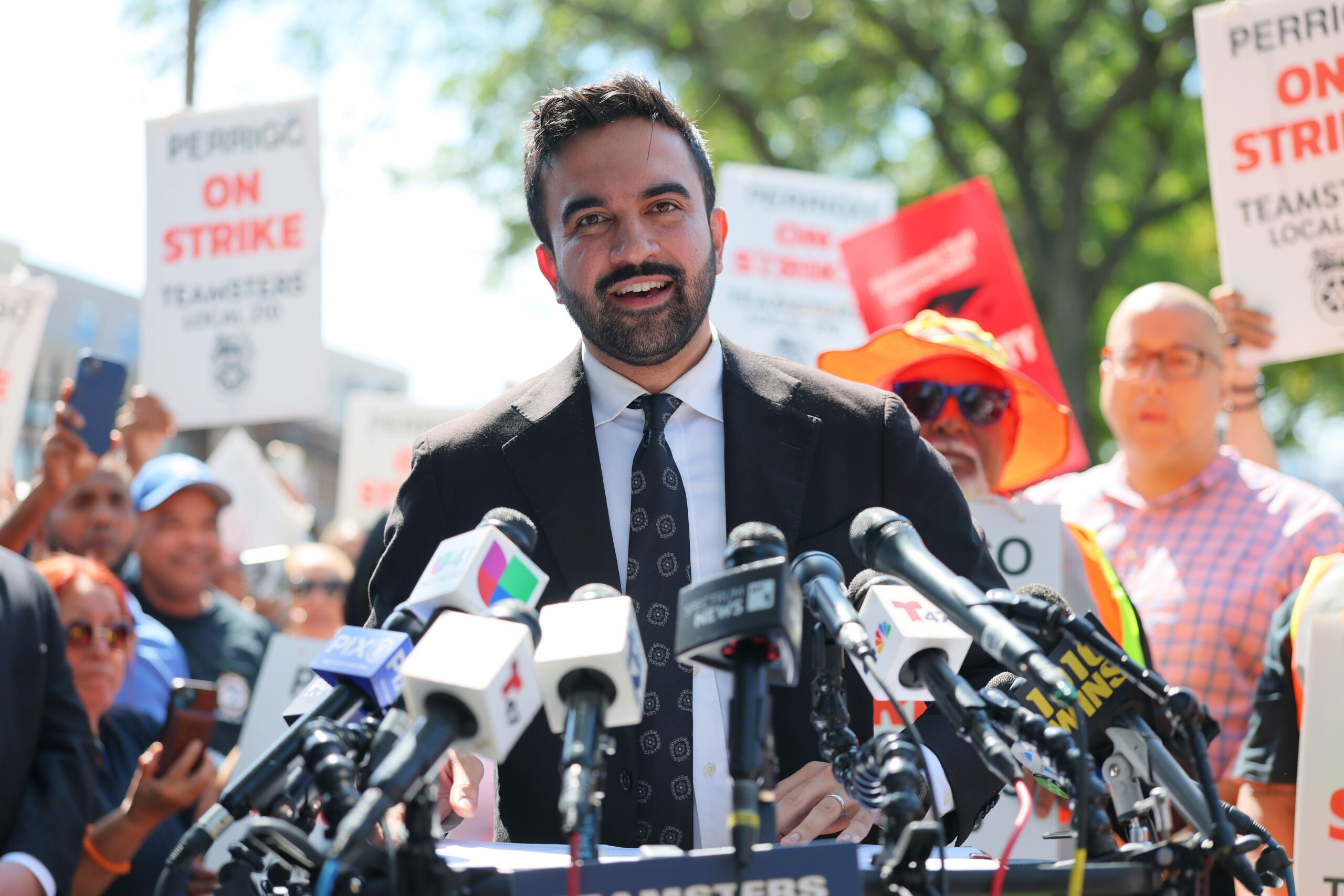
Several leaders in the community told JI they continue to have concerns about his record, while others are quietly engaging
EXPLAINING SNAPBACK
What to expect from snapback sanctions on Iran
If sanctions return, the Iran nuclear deal ‘is dead, we’re sitting shiva, it is over. That is an unpredictable reality for the regime, for its economy and its financial stability,’ Rich Goldberg said
Plus, Iron Beam laser system ready for action

Paul Sancya/Pool/Getty Images
Sen. Elissa Slotkin (D-MI) rehearses the Democratic response to President Donald Trump's address to a joint session of Congress.
Good Wednesday afternoon.
This P.M. briefing is reserved for our premium subscribers like you — offering a forward-focused read on what we’re tracking now and what’s coming next.
I’m Danielle Cohen-Kanik, U.S. editor at Jewish Insider and curator, along with assists from my colleagues, of the Daily Overtime briefing. Please don’t hesitate to share your thoughts and feedback by replying to this email.
📡On Our Radar
Notable developments and interesting tidbits we’re tracking
In a moment of Democratic soul-searching, Sen. Elissa Slotkin (D-MI) said in remarks at a security briefing hosted by Jewish groups on Capitol Hill today that she’s grown concerned with left-wing animus towards the Jewish community.
“We’re used to the right-wing side. What is new and what I think has so many in the Jewish community on our heels is that new left-wing antisemitism and how to approach it. How do we counteract it? How do we protect against it? How do we educate?” she said.
“And certainly, we’re watching, on many college campuses, a lot of young people who actually maybe didn’t grow up with the Jewish community at all, get to campus and maybe repeat what they’re hearing, sometimes not even understanding or knowing. I would just say that one of our responsibilities as Jewish leaders and Jewish activists is to try and really parse through how to deal with antisemitism on the left, since antisemitism on the right isn’t good, but it’s more of a well-known threat,” Slotkin continued…
On the other side of the aisle, House Speaker Mike Johnson (R-LA) told a group of pro-Israel leaders in a private meeting today that he’s attempting to push back on the isolationist wing of the GOP in the House and in his candidate recruiting efforts, but that the party is likely bound for a major debate on the issue after President Donald Trump leaves office, attendees told Jewish Insider’s Marc Rod…
Sen. Bernie Sanders (I-VT) and Rep. Becca Balint (D-VT) separately accused Israel of committing genocide in Gaza today, the first Jewish lawmakers to do so…
British Prime Minister Keir Starmer delayed his announcement to recognize a Palestinian state until this weekend, after Trump has departed from his state visit to London…
On the campus beat, Education Secretary Linda McMahon said this morning at the Federalist Society and the Defense of Freedom Institute’s annual Education Law & Policy Conference that the Trump administration is hopeful in reaching a settlement with Harvard and seeing changes in its approach to antisemitism implemented on the elite campus without a protracted legal battle.
“Harvard has already started to put in place some of the things we wanted them to do. They reassessed their Middle East policies. They actually fired a couple of their professors. They are looking at having safe measures on campus, and so without even admitting any guilt in any way, they have started to change their policies, and that is the ultimate goal of our investigation, of making sure that things are proper on campus,” McMahon said.
A federal court recently ruled in favor of Harvard in its First Amendment lawsuit against the Trump administration; McMahon said they intend to appeal…
Engaged in its own negotiations with the Trump administration over hundreds of millions of dollars in frozen federal funding, regents of the University of California met today in San Francisco; this month, UC Berkeley notified 160 people connected to allegations of antisemitism that it had given their information to the federal government as part of the investigation into the school, sparking community uproar at the meeting…
The New York Times spotlights the upcoming governors’ races in New Jersey and Virginia, considered predictive for the 2026 midterms. Yesterday, the Democratic National Committee announced it was doubling its support of Rep. Mikie Sherrill (D-NJ) in the Garden State to a total of $3 million, the most it’s ever contributed to a New Jersey gubernatorial election, in a sign of tightening polls in the Democratic state…
Meanwhile in New York, The Gothamist reports on growing tensions between Democratic New York City mayoral nominee Zohran Mamdani and City Comptroller Brad Lander, just months after they cross-endorsed each other in the primary race.
Lander is reportedly insinuating behind closed doors that he’ll be appointed first deputy mayor, the mayor’s right hand, should Mamdani win the election, while Mamdani is said to have told him to back off and insists no personnel decisions have been made…
Billionaire pro-Israel philanthropist Ronald Lauder injected $750,000 to the Fix the City PAC, which is backing former New York Gov. Andrew Cuomo in his bid to defeat Mamdani as an independent, despite Cuomo’s recent turn away from his full-throated support of Israel…
The Israeli Ministry of Defense announced today that it has completed the development of the Iron Beam laser missile interception system, which will be operational by the end of the year. Each laser interception costs less than $5, while Iron Dome interceptions cost around $40,000-$50,000 each…
The Senate Foreign Relations Committee voted to advance several nominees out of committee for consideration of the full Senate, including Sergio Gor for ambassador to India, Mike Waltz for U.S. ambassador to the U.N., Michel Issa for ambassador to Lebanon and Richard Buchan for ambassador to Morocco…
Top EU diplomat Kaja Kallas announced plans today for the EU to impose tariffs on Israel and sanction Israeli National Security Minister Itamar Ben-Gvir and Finance Minister Bezalel Smotrich, following on European Commission President Ursula von der Leyen’s call last week for the EU to suspend free trade measures with Israel.
The tariffs on Israeli imports, which currently receive preferential access to the EU under existing free trade initiatives, would require a majority of EU countries’ support, while the sanctions would have to be unanimous, neither of which currently has the requisite support from European capitals to pass. While Kallas’ proposals are more limited than some European leaders have called for, the move is another sign of the increasing demand for action against Israel in Brussels…
⏩ Tomorrow’s Agenda, Today
An early look at tomorrow’s storylines and schedule to keep you a step ahead
Keep an eye on Jewish Insider tomorrow morning for a rundown of what to expect from the reimposition of U.N. Security Council snapback sanctions on Iran.
Tomorrow morning, the Senate Committee on Health, Education, Labor and Pensions will hold a hearing on the state of K-12 education.
The Atlantic Festival begins in New York City tomorrow, opening with a session including former Vice President Mike Pence and former National Security Advisor H.R. McMaster.
In the evening, the Israeli Embassy will host its Rosh Hashanah reception in Washington.
United Hatzalah will hold its 2025 Los Angeles gala with honorary guest Gal Gadot. Israeli Eurovision performer Yuval Raphael will receive United Hatzalah’s Hero Award and American venture capitalist Shaun Maguire, fresh off a visit to Israel, will receive its Am Israel award.
Stories You May Have Missed
KARP’S CALL
Palantir’s Alex Karp says Jews need to ‘leave their comfort zone’ to defend community

The Palantir CEO was honored at the American Friends of Lubavitch (Chabad) annual Lamplighter Awards in Washington, D.C.
scoop
Fifty Senate Republicans call on European foreign ministers to hold firm on snapback, enforce Iran sanctions

‘The regime has abused diplomatic processes for years to avoid penalties. Sanctions relief should only be negotiated after snapback is fully implemented,’ the lawmakers wrote
Plus, Shari Redstone's new Israeli venture

SAUL LOEB/AFP via Getty Images
President Donald Trump shakes hands with Israeli Prime Minister Benjamin Netanyahu during a meeting in the Oval Office of the White House in Washington, DC, on April 7, 2025.
Good Tuesday afternoon.
This P.M. briefing is reserved for our premium subscribers like you — offering a forward-focused read on what we’re tracking now and what’s coming next.
I’m Danielle Cohen-Kanik, U.S. editor at Jewish Insider and curator, along with assists from my colleagues, of the Daily Overtime briefing. Please don’t hesitate to share your thoughts and feedback by replying to this email.
📡On Our Radar
Notable developments and interesting tidbits we’re tracking
Israeli Prime Minister Benjamin Netanyahu announced today that President Donald Trump invited him to the White House on Sept. 29, after the prime minister’s Sept. 26 speech at the U.N. General Assembly in New York. This will be Netanyahu’s fourth visit to the White House during Trump’s second term…
At the same press conference, Netanyahu attempted to walk back comments he made yesterday about Israel needing to look towards a self-sufficient, or “autarkic,” economy after the Israeli market reacted negatively, saying that it was a “misunderstanding.”
Netanyahu pointed out the performance of the Israeli stock market and the shekel, unemployment numbers and foreign investment into the country as signs of economic strength, and said he had specifically been speaking about the Israeli defense industry, which has been impacted by western European arms embargoes…
As the IDF begins its takeover of Gaza City, Lt. Gen. Eyal Zamir, the IDF’s chief of staff, responded to concerns about the safety of the remaining hostages, many of whom are thought to be held in the city, in a statement on the operation, saying, “I want to emphasize: the return of our hostages is a war aim and a national and moral commitment.”
Noa Argamani, a former hostage whose boyfriend, Avinatan Or, remains held in Gaza after they were kidnapped together on Oct. 7 from the Nova Music Festival, said on X, “I cannot breathe watching the fighting inside Gaza City. As a former hostage, I know exactly what these moments feel like. The booming blasts, the gunfire, the walls shaking, the helplessness and despair that take over. The emotions come rushing back all at once, and it is unbearable. Right now, I fear deeply for Avinatan’s life”…
In a view from the U.S., former U.S. Ambassador to Israel Dan Shapiro said that as of May 2024, concessions that the U.S. would make to Saudi Arabia in exchange for Saudi-Israel normalization were “all but finished,” having continued to be negotiated even during the Israel-Hamas war, but that the deal cannot be finalized until the war ends.
Speaking at a briefing hosted by the Democratic Majority for Israel, he characterized Netanyahu’s “autarky” comments as the opposite of the goal of the Abraham Accords and regional integration.
Shapiro also called Hamas leaders in Doha “legitimate targets” and said it’s “appropriate” for Israel to eliminate them, but that the “who and the how and the where matters” and the Israeli strike in Doha has “backfired” for Israel.
Rep. Josh Gottheimer (D-NJ), who spoke after Shapiro, encouraged Israel to let Western press into Gaza to see that the issue with humanitarian aid is the U.N.’s failure to distribute it, rather than a lack of it. Shapiro said the humanitarian situation is “not nearly as dire” now as a few months ago but that international reporting hasn’t reflected that…
On the domestic front, Pennsylvania Gov. Josh Shapiro said in an address at the Eradicate Hate Global Summit today in Pittsburgh that “we need to create more opportunities for peaceful and respectful dialogue, respecting each other’s fundamental rights as Americans.”
He invoked the Priestly Blessing, sent to him by a chaplain of a local fire department after his residence was attacked by an arsonist last Passover, which he said he recites to his children every night. “Those are words of healing, words of hopefulness to me. They are also words that again remind us of our shared humanity.”
After his address, Shapiro, who is seen as a Democratic contender for the 2028 presidential election, answered questions from reporters about Israel’s campaign in Gaza City, saying, “I’ve been very outspoken about the fact that these children in Gaza need to be fed, that the violence needs to end, the hostages need to come home, and this war needs to be over.”
“I’ve also been very clear that I think Benjamin Netanyahu is taking Israel down a very dark and dangerous path, isolating Israel in the world even more than they were before, which I think threatens Israel’s security,” Shapiro continued, following on comments he made last month calling Netanyahu’s claim that there is no starvation in Gaza “quite abhorrent”…
Meanwhile in New York, Carl Heastie, the Democratic speaker of the New York State Assembly, is expected to endorse New York City Democratic mayoral nominee Zohran Mamdani this week, The New York Times reports, one of several state leaders in the party who have thus far resisted doing so. Rep. Yvette Clarke (D-NY), chair of the Congressional Black Caucus, is reportedly also set to do so on Monday…
Rep. Elise Stefanik (R-NY) introduced a bill that would “prohibit state and local law enforcement from arresting foreign nationals within the United States” solely based on warrants from the International Criminal Court, as Mamdani has threatened to do to Netanyahu…
After selling Paramount to Skydance Media, Shari Redstone has taken on a new venture: The media mogul was named chair of the Israeli production company Sipur, which she called a “hands-on investment” to build a “global production powerhouse”…
⏩ Tomorrow’s Agenda, Today
An early look at tomorrow’s storylines and schedule to keep you a step ahead
Keep an eye on Jewish Insider tomorrow morning for an analysis of a new poll of Gen Z conservatives’ views on Israel and antisemitism.
This evening, Sens. John Fetterman (D-PA) and Dave McCormick (R-PA) will join Fox News’ “Special Report” to discuss political civility.
Tomorrow morning, the House Foreign Affairs Committee will hold a markup of bills aimed at reorganizing and reforming the State Department. Read JI’s breakdown of the legislation here.
The Senate Foreign Relations Committee will vote to advance a series of nominees out of committee — including Michel Issa to be ambassador to Lebanon; Richard Buchan to be ambassador to Morocco; Ben Black to lead the U.S. International Development Finance Corporation; and a second vote on the nomination of Mike Waltz, the former national security advisor, to be U.S. ambassador to the U.N., in order to prevent a procedural challenge from Democrats.
Also on the Hill, the U.S. Helsinki Commission will hold a briefing on “conspiracy theories, antisemitism and democratic decline.”
The annual Defense of Freedom-Federalist Society Education, Law & Policy Conference begins in D.C. tomorrow, including featured speakers Secretary of Education Linda McMahon and Brandeis Center Chairman Ken Marcus.
Stories You May Have Missed
FIELD FRACTURES
Jewish social workers warn of growing antisemitism in the field: ‘Counter to everything that we learn in social work school’

A new report details the ‘exclusion, isolation and public targeting’ that Jewish social workers have faced — particularly since Oct. 7
WATER UNDER THE BRIDGE
Rubio looking to move past criticism of Israel after Qatar strike

At a press conference with Israeli PM Netanyahu, Rubio said an agreement with Hamas to end war ‘probably won’t happen’ because ‘savage terrorists don’t often agree to disarm’
Plus, anti-Israel WaPo columnist fired over Charlie Kirk commentary
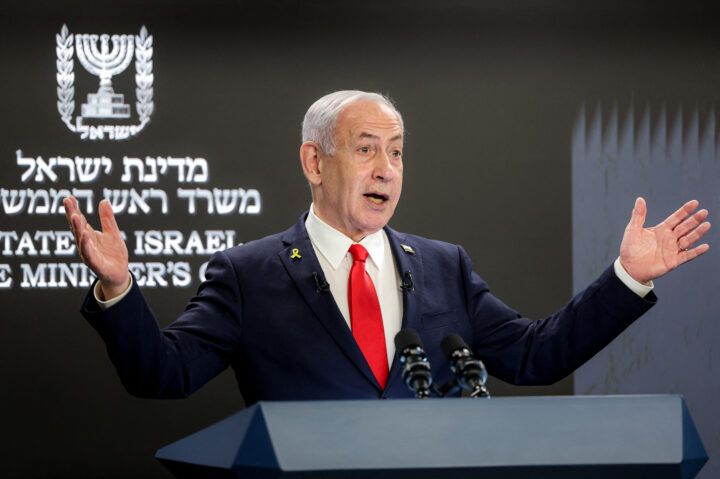
ABIR SULTAN/POOL/AFP via Getty Images
Israel's Prime Minister Benjamin Netanyahu gives a press conference at the Prime minister's office in Jerusalem on August 10, 2025.
Good Monday afternoon.
This P.M. briefing is reserved for our premium subscribers like you — offering a forward-focused read on what we’re tracking now and what’s coming next.
I’m Danielle Cohen-Kanik, U.S. editor at Jewish Insider and curator, along with assists from my colleagues, of the Daily Overtime briefing. Please don’t hesitate to share your thoughts and feedback by replying to this email.
📡On Our Radar
Notable developments and interesting tidbits we’re tracking
Israeli Prime Minister Benjamin Netanyahu predicted that Israel will have to become increasingly self-reliant as countries call for embargoes and sanctions against the Jewish state. Speaking at a Finance Ministry conference in Jerusalem today, Netanyahu said, “We will increasingly need to adapt to an economy with autarkic characteristics.”
“I am a believer in the free market, but we may find ourselves in a situation where our arms industries are blocked. We will need to develop arms industries here — not only research and development, but also the ability to produce what we need,” the Israeli PM said…
Secretary of State Marco Rubio met with Israeli President Isaac Herzog in Jerusalem today, where they gave remarks on the occasion of the fifth anniversary of the Abraham Accords. “Imagine, despite the difficulties the region has confronted over the last few years, how much more difficult it would have been had the Abraham Accords not been in place,” Rubio said…
Elsewhere in the region, after an emergency summit of Arab states convened in Qatar to discuss last week’s Israeli strike in Doha, the leaders of the Gulf Cooperation Council countries today directed the GCC defense ministers to hold an “urgent meeting” to “assess the defense situation of the Council states.”
The countries also issued a communique calling on states to “review diplomatic and economic relations” and “initiate legal proceedings” against Israel…
At the International Atomic Energy Agency’s annual conference happening now in Vienna, Iran is circulating a resolution to censure the U.S. and Israel over their strikes on Iran’s nuclear facilities in June. Iran was unexpectedly elected by other Middle Eastern countries to serve as vice president of the gathering.
Mohammad Eslami, the head of the Atomic Energy Organization of Iran, said in an interview that “if [participating countries] want to obey the law of the jungle and the rule of coercion and force” by blocking the motion, “it’ll end in chaos”…
Stateside, Rep. Tom Suozzi (D-NY) announced he will not be endorsing Democratic nominee Zohran Mamdani for New York City mayor, on the heels of New York Gov. Kathy Hochul’s announcement that she’s supporting the candidate.
Suozzi, who represents a swing district on Long Island, said that, “While I share [Mamdani’s] concern about the issue of affordability, I fundamentally disagree with his proposed solutions. Like the voters I represent, I believe socialism has consistently failed to deliver real, sustainable progress.”
On Hochul, Suozzi said that he did not discuss his decision with her and is “not in a position to give the Governor political advice considering the fact that when I ran against her she beat me soundly”…
In another high-profile New York race, Micah Lasher, a state assemblyman and former aide to Rep. Jerry Nadler (D-NY), officially launched his campaign for his former mentor’s congressional seat today, joining a Democratic primary that’s likely to become crowded in the heavily Jewish Manhattan district. Nadler is expected to offer Lasher his support, a key endorsement in the race…
The New York Times investigates a series of trade and business dealings over the UAE’s access to AI chips that appear to be connected with cryptocurrency windfalls for the Witkoff and Trump families.
When David Feith, then senior director for technology on the National Security Council, attempted to change AI chip policy, which would have inhibited that access, he was fired by President Donald Trump, after a conversation with his influential advisor Laura Loomer…
The fallout from Charlie Kirk’s killing continues: Semafor’s Editor-in-Chief Ben Smith writes about Kirk’s legacy on Israel within the GOP and how both the isolationist and pro-Israel camps of the party are now claiming him as their own.
“A bereft White House official told me that Kirk functioned as something like a Republican chairman and Rush Limbaugh ‘rolled into one.’ Clips of his speeches and debates are everywhere, but movement-building is a subtler thing, and Kirk’s public statements, friends said, often reflected attempts at intraparty diplomacy,” Smith wrote…
Karen Attiah, an opinion columnist at The Washington Post who regularly espoused anti-Israel views, was fired from the paper over her posts on social media about Kirk’s death, including mischaracterizing some of his positions and positing that her “journalistic and moral values” prevented her from “engaging in excessive, false mourning” for Kirk.
Attiah, the Post’s founding Global Opinions editor, retweeted social media messages justifying the Oct. 7 Hamas attacks on Israel as they were taking place and wrote a piece on Oct. 13, less than a week after the attacks, headlined, “We cannot stand by and watch Israel commit atrocities”…
Also in the media, Jewish influencer Hen Mazzig reacts to Jewish actress Hannah Einbinder’s pro-Palestinian commentary at the Emmys last night in The Hollywood Reporter: “Hannah should know there is no such thing as a ‘good Jew’ who can launder antisemitism. The ‘good Jews’ trope — the ones who sign boycott pledges or reassure progressives that this isn’t about hatred — are always used as cover. They are never enough. And at the end of the day, the people demanding ‘good Jews’ don’t actually believe there is anything good about being Jewish”…
After the Vuelta a Espana bike race in Madrid was called off during its finale on Sunday due to anti-Israel protests on the route, Spanish Prime Minister Pedro Sánchez called today for Israel to be banned from sports events due to its military campaign in Gaza, despite the team being protested, Israel-Premier Tech, not being an official Israeli team.
The international union of cyclists voiced its disapproval of Sánchez’s stance, saying in a statement that it “strongly condemns the exploitation of sport for political purposes in general, and especially coming from a government”…
Lynn Forester de Rothschild is exploring a sale of a minority stake in the parent company of The Economist magazine, according to Bloomberg, which would mark the publication’s first ownership shake-up in over a decade…
⏩ Tomorrow’s Agenda, Today
An early look at tomorrow’s storylines and schedule to keep you a step ahead
Keep an eye on Jewish Insider tomorrow morning for an interview with Yaakov Katz, former editor-in-chief of The Jerusalem Post, on his new book about Oct. 7 and an interview with Rep. Zach Nunn (R-IA), a rising national security voice on Capitol Hill.
Pennsylvania Gov. Josh Shapiro will deliver a major address on political violence at the Eradicate Hate Global Summit in Pittsburgh tomorrow, nearly a week after the fatal shooting of Charlie Kirk and several months after the firebombing of Shapiro’s residence over Passover.
Also speaking at the summit will be KIND Snacks founder and former CEO Daniel Lubetzky alongside Lonnie Ali, founder of the Muhammad Ali Center with her eponymous late husband.
The Senate Judiciary Committee will hold a hearing tomorrow morning on oversight of the FBI with FBI Director Kash Patel.
Democratic Majority for Israel will host a live briefing tomorrow with Rep. Josh Gottheimer (D-NJ) and former U.S. Ambassador to Israel Dan Shapiro on Gottheimer’s recent trip to Israel, next steps for the Abraham Accords and the latest in the Israel-Hamas war.
The Center for a New American Security will hold a live fireside chat tomorrow with Adam Boehler, the U.S. special envoy for hostage response.
Alan Dershowitz, a former Harvard Law School professor and prominent defense attorney and Israel advocate, will speak tomorrow at the JFK Jr. forum at Harvard at the first “Middle East Dialogues” event of the academic year, hosted by professor Tarek Masoud, who invites polarizing speakers to debate the Israeli-Palestinian conflict.
In the evening, American Friends of Lubavitch (Chabad) will host its Lamplighter Awards at D.C.’s Union Station. This year’s honoree is Palantir CEO Alex Karp, and House Minority Leader Hakeem Jeffries (D-NY) will receive a leadership award.
Magen David Adom will host its 2025 New York City Gala in Manhattan, where political commentator Meghan McCain will receive its Champion of Israel Award.
Stories You May Have Missed
INTERVIEW TACTICS
Isaac Chotiner, The New Yorker’s interrogator out to trip up Israel supporters

Chotiner recently devoted six consecutive Q&A interviews with guests about Israel, many of them contentious and combative
HAWKEYE STATE RACE
Ashley Hinson emerges as odds-on favorite to succeed Ernst in the Senate
The former TV news anchor boasts a consistently conservative, pro-Israel voting record, and has a history of winning tough races
Cohen told JI that he’s considering getting into politics but it’s ‘definitely not the time’ with Netanyahu still dominating the scene

Rami Zarnegar
Book cover/Yossi Cohen
Like any former Mossad chief, Yossi Cohen has long been a relatively elusive figure in Israeli public life. So his recent embrace of the spotlight has left Israeli politicos wondering whether he will run for prime minister in the next election.
While the name “Yossi Cohen” is so generic in Israel that one may think it’s an alias akin to “John Smith,” it is, in fact, the real name of the intelligence officer who was nicknamed “Callan” for his favorite British spy show, and “the model” for his dapper style and perfectly-gelled coif. He first received public attention as deputy Mossad chief known only as “Y,” and emerged from the shadows with his real name and face in 2013 when Israeli Prime Minister Benjamin Netanyahu appointed him national security advisor. Cohen was appointed head of the Mossad two years later, a job he retained for six years.
Cohen received attention for commanding ambitious Mossad operations, such as smuggling Iran’s nuclear archive to Israel, and for Netanyahu reportedly naming him as one of his possible heirs, but he rarely gave interviews — until now.
Cohen has been on a Hebrew media blitz ahead of Tuesday’s release of his new book, The Sword of Freedom: Israel, Mossad and the Secret War, in Hebrew and English.
The book is a mix of memoir, in which he discusses becoming the first kippah-wearing graduate of the Mossad cadets’ course and his undercover missions, recruiting spies within Hezbollah and the Iranian nuclear program, as well as his rise to head the organization and lead major operations. It also includes commentary on recent events, including the failures of the defense establishment — and less so of politicians, in his description — on Oct. 7, 2023, the ongoing war and hostage negotiations. Cohen laments that things would have gone better if his advice in past years had been heeded.
It reads, in many ways, like the kind of book a politician would publish before a big run, to let potential voters get to know him — albeit with the much more exciting elements of spycraft.
Yet, in an interview with Jewish Insider last week at his office in a Tel Aviv high-rise, where Cohen’s day job is representing the Japanese investment holding company SoftBank in Israel, he dismissed the idea that his book was the first step in a political campaign.
“That was not the reason for me to write the book,” he said. “I started writing the book something like three years ago, much earlier. I decided to [publish the book] now, because I believe that now is the time … Since I started the book we had the judicial reform, the seventh of October, a war against Hezbollah and the Iranian events. Each of those chapters had to be updated.”
Still, Cohen added, “I can’t say that one day it will not serve my political goals if I will decide to go into politics.”
Thus far, Cohen has kept politics as an “if.” In the past, it was a “no,” he said, but now, he’s thinking about it.
“I am not entering any politics right now,” he clarified. “I stay uninvolved in this kind of politics because nothing is happening. The entire Israeli political system is a little bit stuck. I’m not assessing that any kind of election will happen before the end of next year, November 2026 as planned,” when the next Israeli elections are scheduled to occur.
Cohen said he does not have a team ready for a political campaign, and that all he is doing currently is promoting his book.
The former Mossad chief said that “I was always a Likudnik,” identifying with ideas of the party’s ideological forebear Ze’ev Jabotinsky, but “all options are open” as to whether he would join an existing party or start his own.
He would not join Likud in its current iteration unless it is “reshaped,” he said, in an apparent reference to the vocal populism from within the party’s ranks in the Knesset.
“I don’t want to criticize people personally … but it’s a different party today. It’s not the party that I grew up on. It’s so totally different.”
As to whether he would wait for Netanyahu to leave the political scene, Cohen said, “Definitely this is not the time. …Currently, I am staying in business, 100%.”
Cohen and Netanyahu have not spoken in over a year and a half, when several months into the war the former intelligence chief warned the prime minister that senior defense figures may try to manipulate investigations into the failure of Oct. 7 to exonerate themselves.
Despite the long disconnect, Cohen said that there is no rupture between them, because they had an excellent working relationship, but they were not personal friends. He noted that before the war they had not spoken for a long time; Netanyahu offered him the role of defense minister in late 2022, but Cohen could not legally take it because of a required cooling-off period between serving as a senior defense officer and entering politics.
Cohen has somewhat shielded Netanyahu from blame for the failures surrounding the Oct. 7 attacks, referring in his book to the security establishment’s failure and asserting that “there is no one else to blame.”
He clarified in his interview with JI that “the political leadership always has responsibility” for events such as Oct. 7 and called for a state commission of inquiry to be established, something that Netanyahu has sought to avoid.
“We must make sure to investigate what has to be investigated,” Cohen said. “The intelligence level was poor. It was either not gathered properly or not interpreted properly, but the result was super poor. We didn’t give the State of Israel any alerts about a major attack. … We didn’t have any workable defense lines operating correctly at our borders.”
“There’s the Shin Bet and IDF intelligence who have to know these things, and since they didn’t, and they didn’t push back the enemy when it entered the State of Israel or counter the enemy before it entered Israel, that’s a failure. You don’t need an investigation to know that. Then, of course, I think that the government was responsible for everything that happened under its auspices,” he said.
Soon after Oct. 7, Netanyahu tasked Cohen with trying to find a way to get Palestinian civilians out of Gaza so Israel would be able to fight Hamas with fewer civilian casualties.
“The Mossad and I were trying to convince [Egypt] to let the Palestinians leave, even for a short time, only the civilians … without anything, no cellular, no electronics, no armaments, no physical threats, to the Egyptian side,” he recalled. “Take them into the Sinai Peninsula for six months, one year at a time, a million or a million and a half people. …That was the plan. It didn’t work because [Egyptian President Abdelfatah] Sisi and his consultants said it will cause a kind of revolution in Egypt because of the hatred of Hamas…and their [affiliation] with the Muslim Brotherhood.”
Nearly two years later, Cohen says “it’s hard to explain why … the world does not really embrace any Gazan immigrants. Indonesia, Malaysia, Qatar even, or Egypt and Libya — a long list of Muslim countries — could say ‘I would take 50,000,’ ‘I would take 100,000,’ ‘Come live with us.’ No one said that, not even Muslim countries. Even if … they would all be sent back home.”
Cohen said the story demonstrates the lengths to which Israel went to protect Gazan civilians from the war.
“Israel does not mean to harm civilians,” he said. “We do not starve them, we do not fight a war against any of the civilians. We keep the international war laws very tightly. But now they’re in [Gaza] and we can’t do much. We try to help them, but it’s a war zone. What I was trying to do is send them away from a war zone.”
As to how the war in Gaza should end, “the best case scenario should be connected to a hostage deal. If there is a hostage deal today, Israel should take it,” he said, days before Israel attempted to strike Hamas leaders in Qatar, which has mediated the hostage and ceasefire talks.
While Cohen said he is not privy to the details of the talks, he said “if there is a deal that gets some of our hostages home and for this we have to pay a price of pausing our military action as we did in the past, I will be very much in favor.”
At the same time, he said “the State of Israel cannot afford to not complete the defeat of Hamas.”
Cohen said he did not have an answer as to who should administer Gaza after the war. He dismissed the control some Gazan families have of small areas, saying “it’s two and a half people … Someone has to take care of them, to supply them with … social services, health services.
He was, however, certain that the Palestinian Authority should not be involved, because it is not capable of managing Gaza. “We tried that,” he said, referring to Hamas deposing the PA in Gaza in 2006. He also noted that Israel has been protecting PA President Mahmoud Abbas: “We’re fighting for him and with him against Hamas in his territories.”
Cohen wrote in the book about his involvement in another element of the war in the past two years: the pager attack in which Israel detonated hundreds of beepers belonging to Hezbollah terrorist operatives in Lebanon.
“It started 25 or so years ago, when I was the head of a division in the Mossad,” he recounted. “We understood … there is something new that we can do, and that is selling to our enemies tampered, manipulated equipment. That is the family of the pagers and walkie-talkies.”
One of the early operations in that vein was the sale of a special calibrated table sold to Iran for use in its nuclear program, which later exploded, but the pager operation was the largest in magnitude. Other tampered equipment was used for surveillance or for tracking locations.
“These are things we learned to do 20 years ago,” he said. “Building up this kind of relationship with the buyers is something very hard to do because they check you … they go into everything, so you have to be real. The concept was invented, and now you see the results.”
Cohen said that the IDF and Mossad “did a beautiful job” in the 12-day war against Iran in June: “We prepared a lot of capabilities inside Iran to allow for that and it was operated correctly during the war.”
Israel must always be prepared for the next round against Iran, he added.
“We’re not sure that Iran will not go back and try to enrich uranium again,” he said. “They claim that they can rebuild their sites …They [the West] said the destruction was huge, and I believe the Western side on that. Nevertheless, if they [rebuild] and there is a threat coming from that direction, the only thing that I can suggest my government and the administration [do] is to attack it.”
Cohen frequently lamented in his book that the Israeli defense establishment is insufficiently aggressive and overly cautious.
The former Mossad chief said he felt that his “responsibility was to counter our enemies brutally. If I see terrorism, I have to counter it. If I see Iranian nuclear sites, I have to counter them. If I see someone anywhere, anyhow trying to plan something against the State of Israel, I have to counter it. And I did not always feel that this was the methodology being practiced in other bodies.”
By not nipping growing threats in the bud, Cohen argued, Israel allowed them to grow to a magnitude that it became too hesitant to act against.
The war in Iran, however, was an example of a positive change, Cohen said.
“I think that [Eyal] Zamir as [IDF] chief of staff is doing an amazing job,” he said. “He’s much more aggressive. He’s telling the government … ‘Yeah, there will be some missiles coming back to our side, but we can deal with it.’”
“Now, on the Iranian side, they know we can do it and we may do it again,” Cohen added.
Cohen has been deeply involved in Israel’s unofficial relations with Arab states, and said he is still optimistic that Saudi Crown Prince Mohammed bin Salman will seek normalization with Israel, but only after the war ends.
“They cannot make a peace treaty with a country at war. It doesn’t work in the Muslim world. … He would be very cautious entering these kinds of negotiations right now, because people are saying about Israelis, ‘Look what they do to our brothers in Palestine.’ But the minute the whole war will be over, I expect that he will sign an agreement with us,” Cohen said.
As to the Saudi demand for concrete steps towards Palestinian statehood in exchange for establishing diplomatic relations with Israel, Cohen said “a Palestinian state is something that is not realistic anymore,” again citing the PA’s inability to govern Gaza.
At the same time, Cohen opposed Israeli annexation of parts or all of the West Bank and said he finds it unlikely that the government will do it.
“Countries that have an agreement with us don’t want that to happen because it kills the idea of any future Palestinian negotiations and they can’t live with that,” he said.
Cohen posited that Israel will not annex parts of the West Bank because it “closes the door” on an eventual arrangement with the Palestinians.
“The reality is that since 1967, we haven’t annexed anything in the West Bank, right?” he said. “And why is that? … Because we want to leave a door open for negotiations with the Palestinians. That is why any government, even the right of [Menachem] Begin and Netanyahu, have not annexed anything in the West Bank.”
Cohen predicted that will continue to be the case for decades.
“I’m not sure how long it will take to create something better with the Palestinians that we see today, that will transform them into a friendly country and territory. They’re a deadly enemy, this is what we have, even in the West Bank. And on the other hand, this is territory that we cannot confiscate.”
“I think the status quo should be kept,” he added.
Early in the book, Cohen expressed his appreciation for Russian President Vladimir Putin, calling him “a deeply strategic thinker and natural leader,” and in the interview last week, he stuck with that position, despite the ongoing war in Ukraine and Russia’s turn away from Israel and alliance with its enemies in recent years.
Cohen said that “many things that the State of Israel has done with Putin are unknown to the public. When I stated that, I based it on things that we have done with the Russian administration for many years, and Syria is an example,” referring to the deconfliction mechanism between Jerusalem and Moscow when the Russian Army was in Syria to prop up then-President Bashar al-Assad.
“The only mediators [between Israel and Syria] were the Russians, and what we saw happening was that the Iranian Revolutionary Guards and Hezbollah terrorists were coming down to our borders,” Cohen recalled. “We didn’t want that, and we couldn’t speak to Hezbollah or to the IRGC. So the only one that was taking part in these negotiations was Putin, who eventually pushed [Iran-backed troops] back 40 kilometers. … We needed him to be on our side, and he was.”
Cohen also spoke of Russia finding and returning the body of IDF soldier Zachary Baumel, which had been missing in Syria since 1982.
“The operation that [Putin] conducted inside Syria … was amazing. I was there in the Russian Ministry of Defense in a ceremony where we got the body of an Israeli soldier to be brought back to a Jewish grave… I was in Moscow and Jerusalem on the same day. We had a ceremony late in the afternoon to bury him. I was involved in looking for his body my whole life, and here Russia did it for us. … That’s a big thing,” Cohen said.
Cohen also mentioned the criticism of Israel soon after Russia’s invasion of Ukraine. “Israel cannot fight all wars. [The Biden administration] said we have to support Ukraine with more weapons. Come on. If you want to support Ukraine with more weapons, you’re welcome to do that. I mean, Israel has other interests in the region, like with Russia. [Israel is] a small country at the end of the day … and very vulnerable.”
When confronted with the idea that American audiences may not appreciate his praise of Putin, Cohen said “you don’t have to agree with everything Russia does, and they will conduct their own policies if you agree to it or not.”
Israel needs to “negotiate, engage with leaders on the other side, to make sure that good things happen,” Cohen said. “This is what I cherish, the way President [Donald] Trump conducts things with Russia, because disengagement with them will not make the war [in Ukraine] end just because you wish for it to end. … You have to know how to conduct your international relationships, and somehow you have to conduct them with your enemies … that are not in line with your values.”
Asked why he first wrote his book, together with a team, in English and then had it translated into Hebrew, Cohen said that the American audience is important to him because “America is the only friend we have” in Israel.
The book, he said, “is not only about me, it’s about the world and international relationships, and I thought America is the right place to [publish] that first.”
In addition, Cohen said he wanted to communicate to the Jewish communities in the U.S. and other countries “to tell them what the State of Israel is and how important the relationship with Jewish communities is to me. They are very dear to me. … I know there is a lot of work that’s missing recently with the Jewish communities in the U.S. and I want to be a positive player.”
The former TV news anchor boasts a consistently conservative, pro-Israel voting record, and has a history of winning tough races

Scott Olson/Getty Images
U.S. Rep. Ashley Hinson speaks to guests during her Ashley's BBQ Bash fundraiser on August 23, 2025 in Cedar Rapids, Iowa. The event was the fifth annual, which she holds to support Iowa Republican causes and candidates.
Rep. Ashley Hinson (R-IA) has emerged as the front-runner in the contest to replace retiring Sen. Joni Ernst (R-IA), with national Republicans swiftly coalescing around her bid for the GOP nomination as they look to avoid a messy primary battle.
Hinson, a politically tested lawmaker who has long been viewed as a potential successor to Ernst, launched her Senate campaign within hours of Ernst’s announcement last Tuesday that she would not seek a third term.
Hinson, in her candidate announcement, said that she would be President Donald Trump’s “strongest ally” in the Senate and would work to “deliver the America First agenda.” She also praised Ernst for her military service and time in public office, saying that, “Our country and state are better off because of Joni’s selfless service.”
Hinson, a prolific fundraiser who entered the race with a $2.8 million war chest, began racking up endorsements shortly after her campaign launch. Trump endorsed Hinson on Friday, as did Senate Majority Leader John Thune (R-SD) and Sen. Tim Scott (R-SC), chairman of the National Republican Senatorial Committee, Senate Republicans’ campaign arm.
Trump described Hinson as “a wonderful person” whom he knows “well,” and praised her devotion to her family before touting her commitment to “our incredible Iowa workers.”
“She is working hard to Create Jobs, Cut Taxes, Promote Products and Services MADE IN AMERICA by our incredible Iowa Workers, Support our Great Farmers and American Agriculture, Champion Innovation, Continue to Help Secure our now very Secure Southern Border, Stop Migrant Crime, Murderers, and other Criminals from illegally entering our Country, Strengthen our Military/Veterans, and Defend our always under siege Second Amendment,” Trump wrote of Hinson on his Truth Social platform.
“From a foreign policy perspective, or even culturally with respect to antisemitism and all that sort of thing, I don’t think that you’re going to see a lot of difference between Joni Ernst, who’s been a strong supporter of Israel and who I think has been a really effective leader on the national stage, and Ashley,” David Kochel, a veteran GOP campaign operative, told JI.
Ernst and Hinson are close professionally and personally; in addition to being friends, the two have long been aligned on foreign and domestic policy and worked together on scores of bicameral legislative efforts.
Both lawmakers have been repeatedly endorsed by AIPAC and the Republican Jewish Coalition, though neither organizations have officially gotten behind Hinson’s Senate bid yet. While Ernst hasn’t endorsed in the race either, Hinson is the candidate she is most aligned with ideologically.
“From a foreign policy perspective, or even culturally with respect to antisemitism and all that sort of thing, I don’t think that you’re going to see a lot of difference between Joni Ernst, who’s been a strong supporter of Israel and who I think has been a really effective leader on the national stage, and Ashley,” David Kochel, a veteran GOP campaign operative, told Jewish Insider.
“On issues of concern to Jewish Americans, Ashley Hinson has been an absolute stalwart,” Sam Markstein, who serves as national political director for the RJC, told JI.
Markstein described Hinson as “an incredibly strong voice in Israel’s defense,” citing her “calling Hamas’ terror attack ‘evil,’ and affirming Israel’s right to defend itself immediately” after the Oct. 7, 2023, attacks on Israel as examples. He also noted that she has “consistently voted for vital military aid to Israel and Iron Dome defense systems,” and pointed to her cosponsoring legislation “to pressure the Biden administration to deliver critical aid that they were holding up as the Jewish state was fighting a seven-front war.”
“She has stood strongly against the Iranian regime by supporting measures to reinstitute maximum pressure and reimpose crippling sanctions. Ashley Hinson also has a very strong record on combating antisemitism. Notably, unlike some on the neo-isolationist far right, when Ashley Hinson says, ‘America First,’ for her, and for the RJC, that means standing strongly with our allies, like Israel, peace through strength, using decisive military action when necessary and rejecting forever wars,” Markstein said.
The swift action on Hinson’s part in launching her campaign and locking down major endorsements has propelled her campaign to front-runner status in the race, and a smooth primary contest could benefit what are already strong general election chances for Republicans in the Hawkeye State.
“Ashley’s been pretty good on the Trump record,” Kochel said. “I think things are going to consolidate pretty quickly around her.”
“She is definitely going to be the leading candidate in the Republican primary, and she’s going to be a very tough candidate in the general election as well,” he told JI.
Thus far in the primary, Hinson is facing Jim Carlin, a Republican former state senator who initially entered the contest to challenge Ernst from the right after winning 27% of the vote against Sen. Chuck Grassley (R-IA) in a 2022 primary, and Joshua Smith, a former libertarian and podcast host who is a sharp critic of the U.S.-Israel relationship.
Smith has espoused virulently anti-Israel beliefs on social media, posting in March of this year on X that Israel is a “fake state of anti Jesus heathens who are fine with killing children” and claiming in a post last May that Jewish people suffer from a “Jewish victim complex.”
Hinson began her career in local television as a broadcast journalist in Cedar Rapids, Iowa, and went on to win two Midwest regional Emmy Awards and become a health reporting fellow for the Radio Television Digital News Association. She entered politics in 2016, when she won a competitive seat in the Iowa state House of Representatives representing the purple Cedar Rapids area by a two-to-one margin.
Hinson was elected to the House in 2020 after defeating former Rep. Abby Finkenauer, a Democrat who flipped Iowa’s 1st Congressional District blue in 2018, by more than two points.
The other rumored candidate looking at the race is U.S. Ambassador to NATO Matt Whitaker, Trump’s former acting attorney general during his first term who lost to Ernst in the GOP primary for her Senate seat in 2014. But with Trump and leading Republicans rallying behind Hinson, the prospects of Whitaker running has dimmed.
The Democratic side of the aisle has a crowded field of candidates competing for the party’s nomination, including state Rep. Josh Turek, state Sen. Zach Wahls and Jackie Norris, chairwoman of the Des Moines Public Schools board.
“Whoever wins the Republican nomination for U.S. Senate in Iowa will have a very, very strong chance of succeeding Joni Ernst,” Sam Markstein, who serves as national political director for the RJC, told JI. “Regarding Ashley Hinson specifically, ask yourself what the telltale signs of a well-run operation are, and you’ll see she is clearly checking all of the boxes: the speed and efficiency of her campaign launch, announcing support from President Trump, as well as House and Senate leadership.”
Democrats have expressed an interest in contesting the open Senate seat in Iowa, a now reliably Republican state that was a battleground before Trump’s political ascendance.
The party has some renewed confidence in their political standing in the state, after Democrats flipped a state Senate seat in a special election last month. The state currently has one state elected official that’s a Democrat: State Auditor Rob Sand.
Whether national Democrats will allocate resources to the Hawkeye State remains to be determined, but winning statewide as a Democrat in deep red Iowa will be a difficult challenge. Democrats haven’t won a Senate race in Iowa since 2008, when former Sen. Tom Harkin handily won a fifth term, prompting Republicans to dismiss the notion that this race will be competitive.
“Whoever wins the Republican nomination for U.S. Senate in Iowa will have a very, very strong chance of succeeding Joni Ernst,” Markstein told JI.
“Regarding Ashley Hinson specifically, ask yourself what the telltale signs of a well-run operation are, and you’ll see she is clearly checking all of the boxes: the speed and efficiency of her campaign launch, announcing support from President Trump, as well as House and Senate leadership. This, and more, illustrates that she’s focused, organized, and has an excellent team around her, all of which is needed to win,” he continued.
The NRSC sent a memo to donors last week expressing confidence that Democrats would face an uphill slog in Iowa, and touted Hinson as a “formidable contender” who “would be exceedingly difficult for any Democrat to challenge.”
A source familiar with how the NRSC is viewing the contest told JI that, “Democrats are trying really hard to say that Iowa is in play and that it is a competitive race. That’s just not electorally where we view it.”
“It’s also just not ultimately what the field on their side signals. They have a very messy, competitive primary right now. It does not appear that [Senate Minority Leader Chuck] Schumer is going to be able to clear the field. That is obviously a direct contrast to what we’re seeing so far on our side,” the source said, noting the growing support for Hinson on the GOP side of the aisle.
Kochel noted that, “Iowa historically was a swing state. [Former President Barack] Obama won it twice and Trump’s won it three times, but certainly the registration advantage that Republicans have has been growing. As the electorate has changed in the last 10 years, more non-college [educated], white, working-class voters are becoming more and more Republican. We’ve got a lot of those in Iowa.”
“Demographically, Iowa is kind of getting away from the Democrats a little bit,” he continued, predicting, “We’ll see this race settle into a pretty familiar framework.”
Plus, Paramount Skydance looks to merge with Warner Bros

Kevin Dietsch/Getty Images
U.S. President Donald Trump speaks to members of the media as he signs executive orders during a press availability in the Oval Office of the White House on September 05, 2025 in Washington, DC.
Good Thursday afternoon.
This P.M. briefing is reserved for our premium subscribers like you — offering a forward-focused read on what we’re tracking now and what’s coming next.
I’m Danielle Cohen-Kanik, U.S. editor at Jewish Insider and curator, along with assists from my colleagues, of the Daily Overtime briefing. Please don’t hesitate to share your thoughts and feedback by replying to this email.
📡On Our Radar
Notable developments and interesting tidbits we’re tracking
Lawmakers, candidates and officials from across the political spectrum continued to reel in the aftermath of the killing of conservative activist Charlie Kirk in Utah yesterday, with many changing their planned appearances.
Vice President JD Vance went to pay his respects to the Kirk family in Salt Lake City instead of attending a 9/11 memorial ceremony at Ground Zero in New York. Kirk’s casket will be flown back to his home state of Arizona on Air Force 2 along with his family and friends.
In addition, President Donald Trump moved a Pentagon 9/11 memorial event to a more secure location, as his team was especially shaken by Kirk’s death; Texas Democratic Senate candidate James Talarico devoted his campaign kickoff speech in San Antonio last night to memorializing Kirk; right-wing media personality Ben Shapiro, a close friend of Kirk, canceled an event tonight at the Ronald Reagan Presidential Foundation in California; Rep. Alexandria Ocasio-Cortez (D-NY) announced she is postponing a rally in North Carolina this weekend out of respect for Kirk and security concerns; and more…
The fallout continues from Israel’s strike against Hamas leaders in Doha this week, with Democratic Majority for Israel accusing Trump in a new scathing statement of betraying Israel by coming out publicly against the strike and potentially foiling its effectiveness by tipping off Qatar (though U.S. and Qatari officials have said that the warning call from Middle East envoy Steve Witkoff came as the strike was already underway).
The statement puts the group at odds with many Democratic lawmakers, who have come out against the strike.
“After years of criticizing Democrats — despite our party’s 75-year history of supporting Israel — President Donald Trump yesterday broke with our vital ally in an unprecedented manner,” DMFI CEO Brian Romick said. “The White House must answer whether their pre-warning of the attack in any way compromised Israel’s ability to eliminate Hamas’ terrorist leadership”…
Doubling down in its displeasure, the Trump administration joined a unanimous U.N. Security Council statement today that condemns the strike, though it does not mention Israel nor Hamas.
“Council members underscored the importance of de-escalation and expressed their solidarity with Qatar. They underlined their support for the sovereignty and territorial integrity of Qatar, in line with the principles of the UN Charter. Council members recalled their support for the vital role that Qatar continues to play in mediation efforts in the region,” the statement read…
Qatari Prime Minister Sheikh Mohammed bin Abdulrahman Al Thani will travel to Washington tomorrow to discuss the incident, Israeli media reports, meeting with senior Trump administration officials and potentially the president himself, and Qatar will host an emergency summit beginning Sunday with Arab states.
Al Thani said in an interview that, prior to the strike, a meeting had been scheduled for Friday between himself, Egyptian and Turkish intelligence officials and Witkoff, but Israel’s attack “destroyed the mediation efforts” for a ceasefire with Hamas and “extinguished the last glimmer of hope”…
Back in Israel, Prime Minister Benjamin Netanyahu authorized a plan to build the long-disputed E1 settlement project, which would make a contiguous Palestinian state nearly impossible, at a signing ceremony today at the Ma’ale Adumim settlement, where the new units will be added.
“We said a Palestinian state will not be established — and indeed, a Palestinian state will not be established,” Netanyahu said at the event…
The New York Times’ Jerusalem bureau announced that David Halbfinger is returning to Israel to serve as the paper’s bureau chief, and Isabel Kershner was named senior correspondent.
The newly merged Paramount Skydance is now preparing a bid to purchase Warner Bros. Discovery, The Wall Street Journal reports, including its cable networks and movie studio. The bid is backed by the Ellison family — Paramount owner David Ellison is the son of billionaire Oracle co-founder Larry Ellison…
⏩ Tomorrow’s Agenda, Today
An early look at tomorrow’s storylines and schedule to keep you a step ahead
Keep an eye on Jewish Insider tomorrow morning for reporting on the belated passage of a K-12 antisemitism bill in the California Legislature that pitted Jewish Democrats and their allies against teachers’ unions in the state.
The Capital Jewish Museum in Washington will host a gala Sunday evening honoring Esther Safran Foer, the former executive director of D.C.’s Sixth & I Synagogue, and David Rubenstein, chairman of the Carlyle Group.
Secretary of State Marco Rubio is expected to land in Israel early next week, with a planned appearance at the opening of the Pilgrimage Road at the City of David archaeological site on Monday. (Read JI’s coverage of the Pilgrimage Road excavation here).
A bipartisan delegation of 250 U.S. state legislators will also land in Israel for a trip next week.
The Climate Solutions Prize Tour, in partnership with the Jewish Climate Trust, will begin in Israel on Sunday, after several days in the UAE.
We’ll be back in your inbox with the Daily Overtime on Monday. Shabbat shalom!
Stories You May Have Missed
IN MEMORIAM
Charlie Kirk remembered as a bulwark against antisemitism on the right
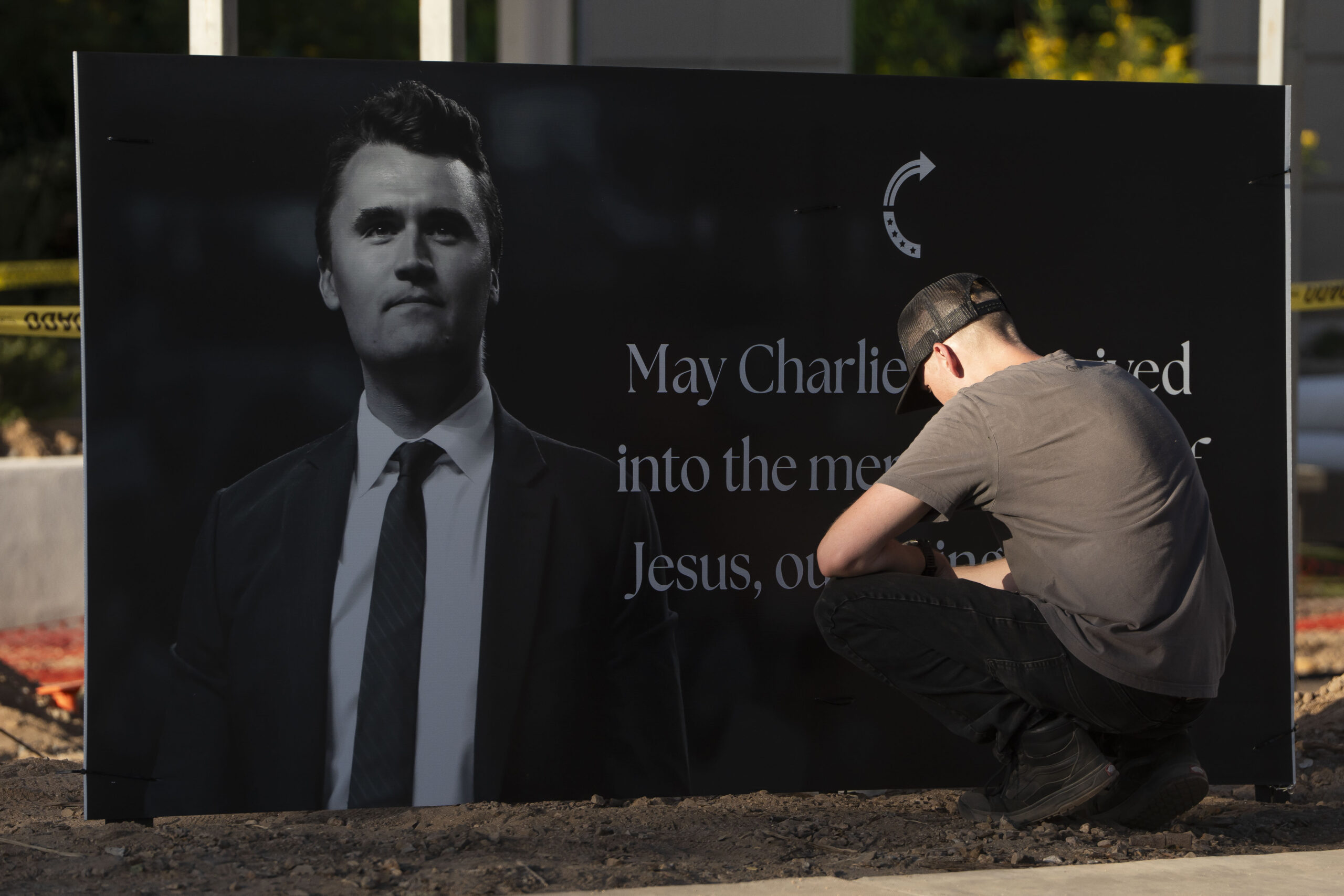
Josh Hammer told JI: ‘He was really holding back some really nasty stuff in some very young, far-right online circles. … Part of me kind of worries, frankly, about what that energy does from here in his absence’
DEFIANT DEFENSE
Amb. Leiter defends Doha strike, amid Trump criticism
Leiter compared Israel’s campaign against Hamas to the U.S. pursuing the perpetrators of 9/11
Plus, Netanyahu links 9/11 to 10/7

George Frey/Getty Images
Law enforcement responds to the scene where political activist Charlie Kirk was shot during an event at Utah Valley University on September 10, 2025 in Orem, Utah.
Good Wednesday afternoon.
This P.M. briefing is reserved for our premium subscribers like you — offering a forward-focused read on what we’re tracking now and what’s coming next.
I’m Danielle Cohen-Kanik, U.S. editor at Jewish Insider and curator, along with assists from my colleagues, of the Daily Overtime briefing. Please don’t hesitate to share your thoughts and feedback by replying to this email.
📡On Our Radar
Notable developments and interesting tidbits we’re tracking
Conservative activist Charlie Kirk died this afternoon after being shot in the neck while speaking at an event at Utah Valley University.
President Donald Trump posted on Truth Social, “The Great, and even Legendary, Charlie Kirk, is dead. No one understood or had the Heart of the Youth in the United States of America better than Charlie. He was loved and admired by ALL, especially me, and now, he is no longer with us.”
Kirk, 31, was a highly influential right-wing leader, co-founding Turning Point USA, one of the most prominent conservative youth organizations in the U.S. The Republican Jewish Coalition said in a statement, “Charlie has been a shining light in these troubled times for the American Jewish community, and we are deeply saddened at his passing. All people of good will must condemn this horrific murder and demand justice for Charlie.”
Law enforcement officials told CNN that there is no suspect in custody. Prior to news of Kirk’s death, the shooting was condemned by lawmakers and activists across the political spectrum…
Ahead of the 24th anniversary of the 9/11 attacks tomorrow, Israeli Prime Minister Benjamin Netanyahu said in a statement today that Israel “also [has] a Sept. 11,” comparing it to the Oct. 7, 2023 Hamas attacks, and drawing parallels between Israel’s strike yesterday targeting senior Hamas officials in Doha, Qatar, to the U.S. killing Osama bin Laden in Pakistan.
Netanyahu highlighted the U.S. resolution at the U.N. Security Council, passed two weeks after 9/11, that said “governments cannot give harbor to terrorists,” accusing Qatar of providing “terrorist chieftains” with “sumptuous villas” and safe haven.
“And I say to Qatar and all nations who harbor terrorists, you either expel them or you bring them to justice. Because if you don’t, we will,” Netanyahu concluded.
The Israeli PM’s remarks seem to contradict the White House, after Trump made clear yesterday that he’s “very unhappy with every aspect” of the strike and White House Press Secretary Karoline Leavitt said the president had assured Qatari leaders “that such a thing will not happen again on their soil”…
Netanyahu’s opposition was busy on Capitol Hill, meanwhile, with Israeli Opposition Leader Yair Lapid spotted walking into House Minority Leader Hakeem Jeffries’ (D-NY) office — Lapid declined to tell reporters what they discussed — and MK Benny Gantz meeting with Sen. John Fetterman (D-PA), the two of whom covered “the importance of leaving no stone unturned in eliminating terrorist Hamas; in Gaza or abroad.” Lapid and Gantz are both attending the MEAD Summit in Washington this week…
Nearby at the White House, Trump met with a delegation of former hostages, including Ohad and Raz Ben Ami, and hostage families, including Ilay and Yeela David, siblings of Evyatar David…
Another former hostage, Elizabeth Tsurkov, the Israeli-Russian academic held captive by an Iranian-backed militant group in Iraq since 2023 and released to the U.S. Embassy in Baghdad yesterday, has landed in Israel, the Prime Minister’s Office and Mossad announced…
On the campaign trail, Maine Democratic Gov. Janet Mills is reportedly interviewing staff for a potential bid against Sen. Susan Collins (R-ME), Punchbowl News reports. Mills would be a strong contender in the race, likely overshadowing Democratic candidate and oyster farmer Graham Platner, who has made his anti-Israel stance a focus of his bid thus far…
European Commission President Ursula von der Leyen said the body would propose suspending EU free trade measures with Israel, in an annual state of the union speech to the European Parliament today. The move is unlikely to be put into effect as it would need broad support from EU countries, which remain divided on the issue, but it’s a concerning step from the EU, which is Israel’s largest trading partner…
In an excerpt from former Vice President Kamala Harris’ forthcoming book, 107 Days, released in The Atlantic, Harris remarks on those in the Biden administration who were worried her visibility as VP would negatively impact President Joe Biden’s standing.
She writes about her appearance in Selma, Ala., in March 2024 where “I gave a strong speech on the humanitarian crisis in Gaza. … It was a speech that had been vetted and approved by the White House and the National Security Council. It went viral, and the West Wing was displeased. I was castigated for, apparently, delivering it too well”…
Oracle co-founder Larry Ellison surpassed Elon Musk as the world’s richest person today after the software giant reported higher quarterly earnings than expected, largely due to significant AI contracts…
Also getting in on the AI rush is Jared Kushner, whose AI firm Brain Co., co-founded with Israeli angel investor Elad Gil and former Mexican Foreign Minister Luis Videgaray, came out of stealth today with an announcement that it raised $30 million in its first funding round…
⏩ Tomorrow’s Agenda, Today
An early look at tomorrow’s storylines and schedule to keep you a step ahead
Keep an eye on Jewish Insider tomorrow morning for news on a surprising congressional endorsement of Democratic nominee Zohran Mamdani.
On the Hill, the Senate Foreign Relations Committee will hold a nomination hearing tomorrow for several diplomats including Sergio Gor, former head of the Presidential Personnel Office, to be ambassador to India. Read JI’s coverage of Gor’s departure from the White House here.
In Jerusalem, the Jewish National Fund and U.S. Embassy will be hosting a 9/11 Memorial Ceremony.
Stories You May Have Missed
SOMEBR DAY
‘We won’t normalize it’: Friends of Ziv and Gali Berman mark twins’ 28th birthday in Hamas captivity
As the Israeli twins spend their second birthday in captivity in Gaza, their close-knit circle from Kibbutz Kfar Aza continues a grassroots campaign to keep their story alive — and push for their release
TALARICO TALK
Texas Democratic Senate recruit James Talarico takes critical view of Israel

The newly minted candidate casts himself as a moderate, but called out his party for not criticizing Israel more in the 2024 election
Plus, Elizabeth Tsurkov released from captivity

SAUL LOEB/AFP via Getty Images
White House Press Secretary Karoline Leavitt speaks during a press briefing in the Brady Briefing Room of the White House in Washington, DC, on September 9, 2025.
Good Tuesday afternoon.
This P.M. briefing is reserved for our premium subscribers like you — offering a forward-focused read on what we’re tracking now and what’s coming next.
I’m Danielle Cohen-Kanik, U.S. editor at Jewish Insider and curator, along with assists from my colleagues, of the Daily Overtime briefing. Please don’t hesitate to share your thoughts and feedback by replying to this email.
📡On Our Radar
Notable developments and interesting tidbits we’re tracking
President Donald Trump was unhappy with Israel’s surprise strike this morning on Hamas leaders in Doha, Qatar, White House Press Secretary Karoline Leavitt conveyed in a statement on behalf of the president today.
Leavitt said Trump was made aware of the strike by the U.S. military, without specifying whether Israel had alerted it or if the operation was detected independently, and “immediately directed” Middle East envoy Steve Witkoff to notify Doha about the impending attack.
(The Qatari Ministry of Foreign Affairs said reports that Qatar was informed in advance are “baseless” and the “call from a U.S. official came during the sound of explosions caused by the Israeli attack.”)
“Unilaterally bombing inside Qatar, a sovereign nation and close ally of the United States that is working very hard and bravely taking risks with us to broker peace, does not advance Israel or America’s goals,” Leavitt said. “The president views Qatar as a strong ally and friend of the United States and feels very badly about the location of this attack.”
The White House spokeswoman said Trump had spoken with Qatari leaders and assured them “that such a thing will not happen again on their soil” and conveyed his displeasure about the location of the strike to Israeli Prime Minister Benjamin Netanyahu…
The president’s reaction puts him at odds with many senior Senate Republicans, who told Jewish Insider’s Marc Rod that they view the attack as justified and unsurprising. Sen. Roger Wicker (R-MS), chair of the Senate Armed Services Committee, said, “I think Hamas has got to be destroyed, and there’s no sense in doing half measures.”
Sen. Lindsey Graham (R-SC) posted on X, “To those who planned and cheered on the October 7 attack against Israel, the United States’ greatest ally in the region: This is your fate.”
Senate Democrats, meanwhile, described the strike as “aggressive,” “provocative” and “unfortunate,” saying it jeopardized ceasefire negotiations and was an insult to Qatar, a longtime U.S. ally.
Sen. Jack Reed (D-RI), the ranking member of the Senate Armed Services Committee, called the move “extremely disruptive, provocative and dangerous” and a “great strategic mistake.” (Read comments from more lawmakers here).
The only Democrats to publicly break with the partisan line were Sen. Richard Blumenthal (D-CT), who told JI that “anything done to destroy Hamas’ leadership or its terrorist capability or military capacity is a step in the right direction,” and Sen. John Fetterman (D-PA)…
Also condemning the strike are several world leaders, including French President Emmanuel Macron who called it “unacceptable, whatever the reason,” and U.K. Prime Minister Keir Starmer, who said it “violate[s] Qatar’s sovereignty and risk[s] further escalation”…
Hamas released a statement claiming Israel failed to assassinate its top leadership in the strike but killed five of its members, including the son of the group’s chief negotiator…
In another hostage crisis, Elizabeth Tsurkov, a Russian-Israeli academic from Princeton University, has been released from captivity of the Kata’ib Hezbollah Iraqi militant group, Trump announced on Truth Social this afternoon.
Tsurkov was kidnapped while doing research in Baghdad in March 2023 and was “tortured for many months,” Trump said.
Tsurkov’s sister, Emma, said on X that their family is “so thankful to President Trump and his Special Envoy, Adam Boehler. If Adam had not made my sister’s return his personal mission, I do not know where we would be”…
Meanwhile, the IDF ordered the first full-scale evacuation of Gaza City in preparation for Israel’s impending takeover, after several days of issuing limited evacuations before targeted strikes and demolitions of buildings in the area. Leaflets dropped by the IDF in the city instructed residents to follow a coastal road to designated humanitarian zones in the south of the enclave…
In Jerusalem, Netanyahu appeared at a belated U.S. Embassy Fourth of July celebration at the Museum of Tolerance where he said in remarks that he convened the heads of Israel’s security organizations earlier today to authorize “a surgical precision strike” on Hamas leaders in Doha after the terror group took responsibility for the death of four IDF soldiers in Gaza and six civilians at a bus stop in Jerusalem yesterday.
“These are the same terrorist chiefs who planned, launched and celebrated the horrific massacres of Oct. 7 … They were meeting in exactly the same place where they celebrated this savagery almost two years ago. At the beginning of the war, I promised that Israel would reach those who perpetrated this horror. And today, Israel and I have kept that promise,” Netanyahu continued.
The event was later briefly interrupted by a missile fired by the Houthis, with rocket sirens causing guests to move temporarily into bomb shelters.
The celebration continued with a musical performance, including U.S. Ambassador to Israel Mike Huckabee on guitar and philanthropist and major Republican donor Paul Singer playing the keyboard, as captured by JI’s Lahav Harkov…
Hedge fund billionaire Bill Ackman is also in Jerusalem this week, meeting with Israeli President Isaac Herzog today and reportedly attending Jefferies TechTrek, Israel’s largest institutional investor technology conference.
Also attending Jefferies are Singer, DreamWorks CEO Jeffrey Katzenberg, venture capitalist Shaun Maguire, hedge fund manager Daniel Loeb and former U.S. Ambassador to Israel Tom Nides…
The MEAD Summit in Washington is lacking some punch this year with no Saudi representation, as opposed to years past, Israeli journalist Yaakov Katz said during an on-record panel with Sen. Jim Risch (R-ID) at the convening…
Down south, Texas state Rep. James Talarico, seen as an up-and-coming leader in Texas politics, jumped into the Democratic primary to run against Sen. John Cornyn (R-TX) today. Talarico will face a competitive race against former Rep. Colin Allred (D-TX), also a former NFL player. Cornyn faces his own high-stakes primary against Texas Attorney General Ken Paxton.
Talarico, 36, is pitching himself for Senate as a Washington outsider coming to shake up the system. When asked by HuffPost today if Israel’s war in Gaza constitutes a genocide, Talarico answered, “I worry that some of these debates happening within elite political circles tend to be a distraction from the immediate goal, which is stopping the human suffering in Gaza. And so getting into discussions about particular legal terms, or, you know, history from, you know, a century ago, to me, feel like more like playing politics than actually trying to get something done”…
⏩ Tomorrow’s Agenda, Today
An early look at tomorrow’s storylines and schedule to keep you a step ahead
Keep an eye on Jewish Insider tomorrow morning for an interview with friends of twins Gali and Ziv Berman who are turning 28 tomorrow, the second birthday they’ve marked in Hamas captivity.
“The Road Between Us: The Ultimate Rescue,” a documentary about retired Israeli general Noam Tibon’s historic rescue of his family from Kibbutz Nahal Oz on Oct. 7, is scheduled to premiere at the Toronto International Film Festival tomorrow, after the festival initially canceled the screening due to the film’s usage of Hamas footage from the attacks, saying the terror organization had not approved it for use.
The House Committee on Education and Workforce’s Subcommittee on Early Childhood, Elementary and Secondary Education will hold a hearing tomorrow morning titled “From Playground to Classroom: The Spread of Antisemitism in K-12 Schools.”
Also on the Hill, the American Jewish Committee will host an event marking the fifth anniversary of the Abraham Accords including remarks from Israeli Ambassador to the U.S. Yechiel Leiter and co-chairs of the House and Senate Abraham Accords caucuses: Sens. James Lankford (R-OK), Joni Ernst (R-IA) and Jacky Rosen (D-NV) and Reps. Sheila Cherfilus-McCormick (D-FL), Brad Schneider (D-IL), Debbie Wasserman Schultz (D-FL), Mike Lawler (R-NY) and Craig Goldman (R-TX).
Around Washington, Sen. Ed Markey (D-MA) will give remarks at the National Press Club at a Brandeis University event on “Reimagining Liberal Arts Education: A National Conversation on Real-World Readiness,” and Sen. Ted Cruz (R-TX) will speak at the Heritage Foundation on “the Muslim Brotherhood Threat, National Security, and America’s Global Leadership.”
In Pittsburgh, Talya Lubit will be sentenced on charges of conspiracy and defacing and damaging a religious building for vandalizing the Chabad of Squirrel Hill and the Jewish Federation of Pittsburgh in July 2024.
Abroad, Israeli President Isaac Herzog is heading to London on a trip his office said was organized to deliver speeches at Jewish organizations’ conferences and to “show solidarity with the Jewish community, which is under severe attack and facing a wave of antisemitism.” His office did not say if he would meet with Prime Minister Keir Starmer or other officials; though Starmer hosted Palestinian Authority President Mahmoud Abbas yesterday.
Stories You May Have Missed
BOOK SHELF
In new book, former Obama speechwriter calls on Jews to stand proud for their values
Sarah Hurwitz said she hopes her second book, As a Jew, resonates with progressive Jews who have distanced themselves from Zionism
ONLINE FOOTPRINT
Newly appointed GM head of global philanthropy has long record of anti-Israel hostility

Sirene Abou-Chakra claimed that pro-Hamas protests during Netanyahu’s D.C. visit were part of a pro-Israel op
Plus, Gillibrand cautions Dems over anti-Israel rhetoric
Michael Brochstein/SOPA Images/LightRocket via Getty Images
Kenneth Weinstein, President and Chief Executive Officer of Hudson Institute, speaking at the Hudson Institute in Washington, DC.
Good Monday afternoon.
This P.M. briefing is reserved for our premium subscribers like you — offering a forward-focused read on what we’re tracking now and what’s coming next.
I’m Danielle Cohen-Kanik, U.S. editor at Jewish Insider and curator, along with assists from my colleagues, of the Daily Overtime briefing. Please don’t hesitate to share your thoughts and feedback by replying to this email.
📡On Our Radar
Notable developments and interesting tidbits we’re tracking
We’re watching developments in ceasefire and hostage-release negotiations after President Donald Trump called for Hamas to accept the latest U.S.-sponsored deal over the weekend, which would see all the hostages, living and dead, released on the first day of the ceasefire.
Middle East envoy Steve Witkoff and former Trump Mideast advisor Jared Kushner met with Israeli Minister for Strategic Affairs Ron Dermer in Miami today to discuss developments in Gaza, Axios’ Barak Ravid reports.
Hamas had claimed it was ready to “immediately sit at the negotiating table” in response to Trump’s statement, but sources for the terror group told a Saudi newspaper today that a complete hostage release would not be possible immediately, claiming a ceasefire would have to go into effect first to reach all the bodies…
In other national security news, The New York Times spotlights the race between defense firms to develop technologies for a future “Golden Dome” missile-defense system.
“Companies chosen for Golden Dome are likely to become the new cornerstones of U.S. defense, military officials involved in the project said,” and firms including Palantir and Anduril as well as innovative startups have been in discussions with the Trump administration, the Times reports.
Mark Montgomery, senior director of the Center for Cyber and Technology Innovation at the Foundation for Defense of Democracies, said, “There are more than 100 companies out there with a sensor, satellite or other devices they want to sell to Golden Dome. This is the Wild West, and this is a massive opportunity for whoever is selected”…
Diplomatic tensions are rising between Israel and Spain after Spanish Prime Minister Pedro Sanchez announced today that his country would be formalizing an existing de facto arms embargo against Israel and banning anyone who has participated in “genocide” in Gaza from entering Spain as well as ships carrying fuel for the IDF from Spanish ports.
“This is not self-defense, it’s not even an attack — it’s the extermination of a defenseless people,” Sanchez said of Israel’s war in Gaza.
In response, Israeli Foreign Minister Gideon Sa’ar announced that Israel had banned two anti-Israel Spanish ministers from entering the country; Spain then summoned its ambassador in Tel Aviv, all shortly after a young Spanish immigrant to Israel was killed in this morning’s terror attack on a bus stop in Jerusalem…
The U.K. has come to a different conclusion about Israel’s actions in Gaza, according to a letter sent last week by former Foreign Secretary David Lammy before he was replaced in a reshuffling of Prime Minister Keir Starmer’s Cabinet.
Lammy wrote to the chair of the U.K.’s international development committee that the Foreign Office had found in an assessment that Israel was not committing a genocide as it was missing “intent” to do so. It’s the first time the U.K. has said so explicitly, previously holding that the matter of genocide was up to international courts to determine, just weeks before the country is expected to recognize a Palestinian state…
Former Hudson Institute CEO and President Kenneth Weinstein will serve as CBS News’ ombudsman, a new role that oversees editorial concerns from employees and viewers, Paramount announced Monday. Alongside reports that Paramount is expected to purchase Bari Weiss’ Free Press and bring her into an editorial role at CBS, the moves mark a new era for the network that has been accused of systemic anti-Israel bias…
Embracing their anti-Israel bona fides, hundreds of actors, filmmakers and film industry workers recently signed a pledge to boycott Israel, which says it was inspired by filmmakers who refused to screen their films in apartheid South Africa.
The signatories, including Hollywood stars such as Alyssa Milano, Mark Ruffalo, Anna Shaffer, Ayo Edebiri, Cynthia Nixon, Hannah Einbinder and Ilana Glazer, promised “not to screen films, appear at or otherwise work with Israeli film institutions — including festivals, cinemas, broadcasters and production companies — that are implicated in genocide and apartheid against the Palestinian people”…
Sen. Kirsten Gillibrand (D-NY) said in comments to Jewish leaders in New York City today that some of her fellow Democratic lawmakers are inadvertently fueling antisemitism through the rhetoric and slogans they use, Jewish Insider’s Marc Rod reports.
“When they say words like ‘river to the sea,’ whey they say words like ‘globalize the intifada,’ it means end Israel. It means destroy Jews,” Gillibrand said. Intifada, she continued, is “not a social movement. It’s terrorism, it’s destruction, it’s death.”
The New York senator had previously offered strong condemnation of NYC Democratic mayoral nominee Zohran Mamdani for his refusal to condemn the “globalize the intifada” slogan and has not endorsed his bid for mayor…
Mamdani’s opponent, New York City Mayor Eric Adams, meanwhile, officially dropped the ballot line “EndAntiSemitism,” running only on the “Safe & Affordable” line, after the New York City Board of Elections said he couldn’t run on both. Adams’ campaign spokesperson said he intends to pursue legal options over the issue…
Graham Platner, an anti-Israel Democratic Senate candidate in Maine, wrote in a high school op-ed shortly after 9/11, during the Second Intifada in Israel, that the media provides an “incomplete story” of terrorist acts and writes “incomplete coverage” of the Israeli-Palestinian conflict “where a sometimes-oppressive Israeli state can be, and often is, portrayed as a victim.”
Platner and his co-authors argued in the article in a local Maine outlet, unearthed by the Free Beacon, that ending terrorist acts would be “best achieved by understanding the circumstances under which they were committed”…
⏩ Tomorrow’s Agenda, Today
An early look at tomorrow’s storylines and schedule to keep you a step ahead
Keep an eye on Jewish Insider tomorrow morning for an interview with former Obama speechwriter Sarah Hurwitz, whose new book As A Jew: Reclaiming Our Story From Those Who Blame, Shame, and Try to Erase Us, comes out Tuesday.
It’s a busy week in Washington, where the 2025 MEAD Summit will kick off tomorrow. The high-profile but elusive gathering will bring together top American and U.S. security officials, diplomats, lawmakers, philanthropists, CEOs and journalists. If you’re attending, make sure to say hello to JI’s Josh Kraushaar and Gabby Deutch!
The Iran Conference, hosted by the National Union for Democracy in Iran, will also begin in Washington tomorrow for analysts, policymakers and activists to discuss Iran policy, just two months after U.S. and Israeli strikes decimated Tehran’s nuclear and military infrastructure.
On the Hill, the House Education and Workforce Committee’s Subcommittee on Health, Employment, Labor and Pensions will hold a hearing on “unmasking union antisemitism.”
Virginia’s 11th Congressional District is holding its special election tomorrow to fill the seat of the late Rep. Gerry Connolly (D-VA). James Walkinshaw, Connolly’s longtime former aide, is the heavy favorite to win. Read JI’s interview with Walkinshaw here.
Looking to New York City, The MirYam Institute will hold an international security benefit briefing tomorrow featuring former Israeli Prime Minister Naftali Bennett; nearby, the Soufan Center will begin its Global Summit on Terrorism and Political Violence, meant to honor the memory of 9/11 victims and address emerging global threats.
The Florida Holocaust Museum is reopening tomorrow with a ribbon-cutting ceremony after an extensive period of renovation.
Abroad, the U.S. Embassy in Jerusalem will host its belated July 4 party tomorrow, and the Hili Forum will convene its last day in Abu Dhabi, United Arab Emirates, covering trade, tech and governance. DSEI U.K., a large defense trade show, is starting up in London, where protests are expected against the dozens of Israeli firms that are participating.
Stories You May Have Missed
CANDIDATE CRITIQUE
Lawler challenger Peter Chatzky says Israel violating U.S. arms sales laws
The Democratic candidate also said he does not believe that far-left NYC mayoral candidate Zohran Mamdani is ‘taking actions I would claim to be antisemitic’
ACROSS THE POND
U.K. Cabinet shake-up not likely to change British position on Israel, experts say
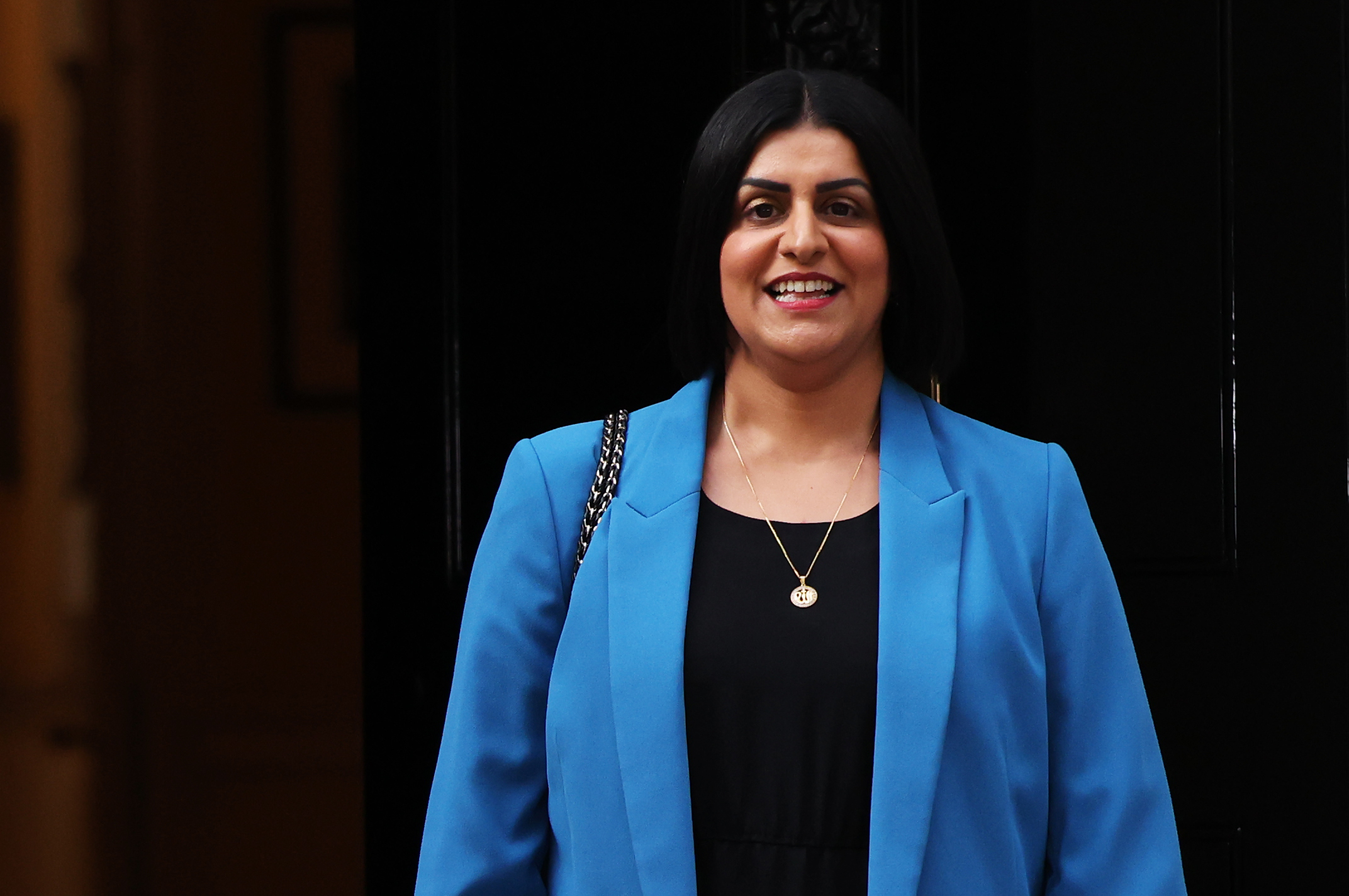
On Sunday, British Jews marched to protest against rising antisemitism in the country
All told, Trump’s team is doing everything it can behind the scenes to eliminate the structural hurdles for a successful anti-Mamdani coalition
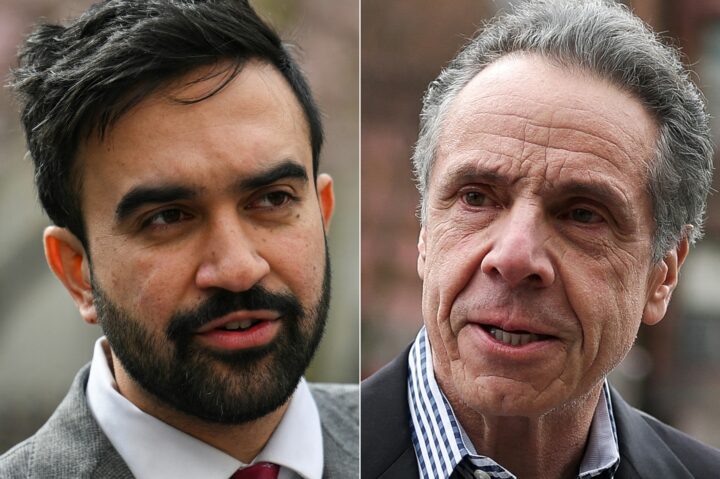
ANGELA WEISS,CHARLY TRIBALLEAU/AFP via Getty Images
New York City mayoral candidate and democratic State Representative Zohran Mamdani (L) in New York City on April 16, 2025 and New York City mayoral candidate Andrew Cuomo (R) in New York City on April 13, 2025.
Just when it looked like far-left New York City mayoral candidate Zohran Mamdani was on track to become mayor, in part thanks to persistent divisions among his opposition, there are signs of a possible consolidation of the crowded field.
The New York Times reported that embattled Mayor Eric Adams is considering a job offer from the Trump administration — a position at the Department of Housing and Urban Development or an ambassadorship have been floated — that would entice him to withdraw from the race. The paper is also reporting that Republican nominee Curtis Sliwa has also been approached by Trump allies, but Sliwa has remained adamant that he is sticking in the race.
All told, Trump’s team is doing everything it can behind the scenes to eliminate the structural hurdles for a successful anti-Mamdani coalition, without publicly putting its finger on the scale for the leading Mamdani challenger, former Gov. Andrew Cuomo. (It’s also notable that Trump, even though it would be in his political interest to use a Mamdani mayoralty as a battering ram against Democrats, is more concerned about the policy consequences of a socialist mayor in his hometown.)
A one-on-one Mamdani-Cuomo general election showdown is still far from a sure thing, but it’s worth noting that the matchup would be quite competitive, according to the available public polling. Even the pro-Mamdani pollster Adam Carlson found in July that Mamdani only led Cuomo by three points among registered voters in a head-to-head matchup, though the lead expanded to double digits when the most likely voters were polled.
An August poll conducted by Gotham Polling and Analytics for the AARP found Mamdani leading Cuomo 44-25% with all the candidates running, but also found that only 4% of respondents chose Mamdani as their second choice. (Adams was the second choice of 17% of respondents, while Cuomo was the second choice of 14%.)
The data suggest Mamdani would remain the front-runner, but the race would get a lot more competitive if the field narrowed. It would also put renewed pressure on business groups, Jewish organizations and moderate Democratic politicians who have refused to endorse Mamdani to decide whether to go all in for Cuomo — or maintain the same cautious posture that has defined the post-primary portion of the campaign.
For New York’s Democratic leaders who haven’t backed Mamdani, the partisan instinct to support the nominee of one’s party will probably prevent party leaders from siding with Cuomo. Indeed, for Senate Minority Leader Chuck Schumer (D-NY) and House Minority Leader Hakeem Jeffries (D-NY), their hesitance to support Mamdani is driven by a realization that his brand of left-wing politics could taint the party’s candidates down the ballot — and it’s simply smart politics to keep their distance. It’s hard to see them going as far as backing Cuomo, even in a close race.
For New York Democrats in moderate districts, the calculation could get a lot more interesting. Swing-district moderates such as Reps. Tom Suozzi and Laura Gillen have been among the most outspoken critics against Mamdani, but aren’t endorsing an alternative. But if Cuomo looked like he was within striking distance of winning, there would be a lot of pressure for them to step off the sidelines.
The biggest test will be whether outside groups truly mount an all-out offensive against Mamdani if the race gets close. So far, many business leaders and other skeptical stakeholders have preferred to see if they can negotiate with the mayoral front-runner, in hopes of persuading him to moderate his past positions.
That looked like a smart play with the opposition hopelessly divided, and Mamdani on cruise control. But if Trump, of all people, manages to do the hard, dirty work of opening up an opportunity for Cuomo, will the Mamdani opposition take advantage of the new political dynamic?
Plus, United resumes Washington, Chicago routes to TLV
Michael A. McCoy/Getty Images
(L-R) Mr. Michael Schill, President, Northwestern University, Dr. Jonathan Holloway, President, Rutgers University and Mr. Frederick Lawrence testify at a hearing called "Calling for Accountability: Stopping Antisemitic College Chaos" before the House Committee on Education and the Workforce on Capitol Hill on May 23, 2024, in Washington, D.C.
Good Thursday afternoon.
This P.M. briefing is reserved for our premium subscribers like you — offering a forward-focused read on what we’re tracking now and what’s coming next.
I’m Danielle Cohen-Kanik, U.S. editor at Jewish Insider and curator, along with assists from my colleagues, of the Daily Overtime briefing. Please don’t hesitate to share your thoughts and feedback by replying to this email.
📡On Our Radar
Notable developments and interesting tidbits we’re tracking
Kicking off the new school year, embattled Northwestern University President Michael Schill announced today he is stepping down as president, remaining in an interim role until his successor is chosen.
Schill’s tenure coincided with a period of antisemitic turmoil on the Chicago-area campus and he was accused of handling the issue poorly, leading some lawmakers to call for his resignation.
A brief recap of Schill’s troubled tenure: He acceded to several demands of an anti-Israel encampment on campus in the spring of 2024, drawing condemnation from Jewish leaders and leading several Jewish members of Northwestern’s antisemitism advisory committee to step down. He then defended the move in a heated House Education and Workforce Committee hearing as being in the interest of Jewish students and was recalled by the committee this spring due to his alleged failure to live up to his own commitments from the previous hearing.
Committee Chairman Tim Walberg (R-MI) said in a statement today that “President Schill will leave behind a legacy of not only failing to deter antisemitism on campus but worsening it. … Northwestern’s next president must take prompt and effective action to protect Jewish students.”
In his resignation announcement, Schill said that “from the very beginning of my tenure, Northwestern faced serious and often painful challenges. … I was always guided by enduring values of our University: protecting students, fostering academic excellence, and defending faculty, academic freedom, due process and the integrity of the institution”…
Columbia University, meanwhile, hired Jonathon Kahn as its senior associate dean of community and culture, a new position created to “build and lead initiatives that cultivate curiosity, civic purpose and meaningful dialogue” and “reimagine what a liberal arts and sciences education can be in the next century,” Jewish Insider’s Haley Cohen reports.
Kahn signed a 2021 letter supporting the Palestinian “indigenous resistance movement” and rejecting “the fiction of a ‘two-sided conflict,’” accusing Israel of carrying out “settler colonialism, apartheid, and ethnic cleansing”…
Secretary of State Marco Rubio called an Israeli proposal by far-right Finance Minister Bezalel Smotrich to annex parts of the West Bank “wholly predictable” in response to European countries’ planned recognition of a Palestinian state.
Rubio said, “We told all these countries. We said, if you guys do this recognition stuff — it’s all fake, it’s not even real — if you do it, you’re going to create big problems. There’s going to be a response from Israel … and it may even trigger these sorts of actions that you’ve seen, or at least these attempts at these actions. So we’re watching it closely.”
Rubio, who was asked about the issue today at a press conference in Quito, Ecuador, continued, “What you’re seeing with the West Bank and the annexation, that’s not a final thing. That’s something that’s being discussed among some elements of Israeli politics. I’m not going to opine on that today.”
“And by the way, let me tell you something. The minute, the day that the French announced their [intent to recognize a Palestinian state], Hamas walked away from the negotiating table. … We also warned that that would happen, and it did. Sometimes, these guys don’t listen,” Rubio said.
The issue of West Bank annexation was due to be discussed in a high-level meeting convened by Israeli Prime Minister Benjamin Netanyahu today but was reportedly removed from the agenda after the UAE warned such a move would be a “red line” for regional normalization…
Israeli officials told The Wall Street Journal that Mossad Director David Barnea and Foreign Minister Gideon Sa’ar have joined IDF Chief of Staff Eyal Zamir in expressing hesitation to Netanyahu over the IDF’s plan to expand its offensive into Gaza City. They have also argued in favor of reaching a partial hostage-release deal with Hamas as an alternative to the comprehensive deal Israel is currently seeking…
A viral accusation that the IDF killed an 8-year-old Palestinian boy at a Gaza Humanitarian Foundation aid site in May was proven false when the boy was found to be alive and safely extracted from the Gaza Strip. The claim had been made by Anthony Aguilar, a former GHF contractor and Green Beret, who repeated the story on far-right and far-left media outlets.
Johnnie Moore, head of the GHF, said in a statement today, “When this lie was brazenly, cravenly shared from the press to the halls of Congress, our team set out to find this little boy — whatever it took.” He attributed the success to “veterans who never stopped working to find him and bring him to safety in the most complex environment imaginable”…
A report by the U.N.’s International Atomic Energy Agency, obtained by the Associated Press, found that, as of one day before Israel’s strikes on Iran’s nuclear facilities began, Iran had escalated its nuclear enrichment and increased its stockpile of near weapons-grade enriched uranium to where it could soon produce at least one atomic bomb…
On the Hill, Sen. Tom Cotton (R-AR) asked the FBI to investigate the Palestinian Youth Movement as a “threat to U.S. national security” after one of its leader, Aisha Nizar, called for Palestinian activists to “disrupt” the supply chain for F-35 fighter jets at the recent People’s Conference for Palestine in Michigan…
Rep. Buddy Carter (R-GA), who is running for Senate in Georgia, filed a resolution today to censure Rep. Rashida Tlaib (D-MI) for “promoting and cheering on terrorism and antisemitism” at the same conference…
Semafor’s David Weigel reports from this year’s National Conservatism conference, which is winding down in Washington today and featured a host of high-level right-wing personalities from Trump administration officials to lawmakers and influencers.
Conference speakers and attendees were jubilant over what they view as conservative successes in President Donald Trump’s second term, but there was one “possible future sore point that conference organizer Yoram Hazony acknowledged openly: Israel.”
“Hazony was upset by the ‘depth of the slander of Jews as a people’ that he saw in corners of the online right. The Israel critics in their fold could make the nationalist ‘revolution consume itself,’ he added, and risk everything,” Weigel wrote…
In long anticipated news, United Airlines announced today it’s restarting direct flights to Tel Aviv from Chicago O’Hare and Washington Dulles in early November…
⏩ Tomorrow’s Agenda, Today
An early look at tomorrow’s storylines and schedule to keep you a step ahead
Keep an eye on Jewish Insider tomorrow morning for reporting on a new cross-faith initiative to address antisemitism led by Robert Kraft’s Foundation to Combat Antisemitism.
This weekend, Sen. Bernie Sanders (I-VT) will be campaigning with New York City Democratic mayoral nominee Zohran Mamdani in the next installment of Sanders’ Fighting Oligarchy tour, after an appearance in Maine last weekend with anti-Israel Democratic Senate candidate Graham Platner.
We’ll be back in your inbox with the Daily Overtime on Monday. Shabbat shalom!
Stories You May Have Missed
ENVOY INTERVIEW
Amb. Leiter: Nature of U.S.-Israel aid may change in coming years
‘It’s a very partisan atmosphere in Washington right now. Strong support for Israel in the [Trump] administration almost drives the Democratic opposition into opposing very close support for Israel,’ the ambassador said
EYE ON ANKARA
Lawmakers take aim at Turkey in 2026 defense bill

House lawmakers introduce series of amendments seeking to place further restrictions on U.S. aid on Ankara over its support for Hamas and hostility toward Israel

Then-Rep. Cori Bush (D-MO) speaks at the "Just Majority" Supreme Court press conference on June 22, 2023 in Washington, DC. / Then-Louis County Prosecutor, Wesley Bell gives remarks at the Urban League Empowerment Center on June 17, 2020.
Good Thursday morning.
In today’s Daily Kickoff, we report on the prospect of Rep. Wesley Bell facing a rematch against anti-Israel former Rep. Cori Bush, and talk to national security experts about potential Islamic Revolutionary Guard Corps plots against Jewish communities in the U.S. We cover the ADL’s assessment that the Minneapolis Catholic school shooter used weapons inscribed with antisemitic and anti-Israel messages, and report on France’s walkback of its call for the “right of return” for Palestinians as part of Paris’ Palestinian statehood push. Also in today’s Daily Kickoff: Rep. Debbie Wasserman Schultz, Jake Sullivan and Michael Anton.Ed. note: The next Daily Kickoff will arrive on Tuesday, Sept. 2. Happy Labor Day Weekend!
What We’re Watching
- We’re keeping an eye on Washington following yesterday’s White House meeting — which included Jared Kushner and former U.K. Prime Minister Tony Blair — aimed at winding down the Israel-Hamas war, securing the release of the remaining hostages and laying out “day-after” plans for Gaza. Israeli Strategic Minister Ron Dermer scrapped a planned meeting in Israel with World Food Program head Cindy McCain to travel to Washington for the meeting.
- The E3 — the U.K., Germany and France — are set to trigger snapback sanctions against Iran today, following talks between the countries’ foreign minister that failed to yield significant progress. Read more from JI’s Danielle Cohen-Kanik here.
- The Atlantic Council is hosting an event this morning titled “Understanding IMEC: A pathway to connectivity amid global uncertainty,” focused on the India-Middle East-Europe Economic Corridor project. Read our 2023 coverage of the IMEC project here.
- We’re also monitoring the U.N. Security Council’s expected vote on extending the UNIFIL peacekeeping force’s mandate along the Israel-Lebanon border. The initial vote, slated for earlier this week, was postponed and could take place as soon as tomorrow.
- On Sunday, Jewish sports fans in Washington are taking part in Jewish Community Day at Nationals Park, when the Nats take on the Tampa Bay Rays.
What You Should Know
A QUICK WORD WITH JI’S JOSH KRAUSHAAR
Last year’s election cycle marked a high point for pro-Israel groups, buoyed by the ouster of two virulently anti-Israel House Democrats (former Reps. Cori Bush of Missouri and Jamaal Bowman in New York), the defeat of a House Republican who opposed funding to Israel (former Rep. Bob Good of Virginia) and the success of mainstream Democrats in numerous contested primaries.
But the political environment for next year’s midterms is looking somewhat choppier in the Jewish world, amid growing anti-Israel sentiment in the Democratic Party, an anti-establishment, transgressive mood in both parties and the reticence of moderate voices to speak up.
In this less hospitable landscape, pro-Israel groups will be playing more defense than offense — ensuring like-minded incumbents are able to avert serious primary challenges, while working to prevent virulently anti-Israel voices from emerging as nominees in key races.
One of the biggest potential showdowns is developing in St. Louis, where Rep. Wesley Bell (D-MO) faces the prospect of a rematch against Bush, whom he comfortably defeated by six points in last year’s primary. With the benefit of incumbency, Bell would be favored in any rematch, but he is facing an organized campaign by anti-Israel protesters who disrupted his recent town hall after he returned from a trip to the Jewish state.
AIPAC’s super PAC spent over $8 million against Bush in the 2024 race, and would be expected to prioritize Bell’s reelection as a top priority if she ran again. Bush, for all her celebrity in leftist spaces, has numerous vulnerabilities that haven’t gone away since her last defeat — from her calls to defund the police, lackadaisical constituent service and ethical improprieties involving the use of campaign funds in paying her husband to provide personal security.
Still, in a sign that advocating against Israel can get far-left candidates some traction in deep-blue districts, a Bush comeback will be worth monitoring closely. Indeed, any pro-Israel Democrat running in an urban district with a distinct progressive bent will have to pay attention to any real or prospective primary challenges.
bell curve
Contentious Wesley Bell town hall portends a potential primary challenge
A town hall organized by Rep. Wesley Bell (D-MO) last week in St. Louis turned contentious as a large group of demonstrators turned out to heckle the freshman congressman — fresh off a trip to Israel — over his support for the Jewish state, Jewish Insider’s Marc Rod reports. A scuffle later broke out between security guards and some of the demonstrators.
Looking ahead: The situation highlights the ongoing antagonism from the local far left against Bell, which could foreshadow a primary challenge to the congressman from former Rep. Cori Bush (D-MO), whom Bell unseated, or one of her political allies. Braxton Payne, a St. Louis-based Democratic strategist, told JI he recognized some of the individuals involved in the demonstrations as longtime backers of Bush. He said that the political coalitions supporting and opposing Bell in 2024 have remained largely unchanged since Bell took office. “You’re still seeing the same bases, cohorts of support” as in the 2024 race, Payne said. “I do think there is a sentiment for someone to run against [Bell] in a primary” with support from the “de-facto Cori Bush base.”
minneapolis attack
ADL: Minneapolis school shooter’s gun featured antisemitic, anti-Israel writings

The alleged gunman who opened fire on a Catholic school in Minneapolis on Wednesday, killing two children and injuring at least 17 people, most of them students at the school, used a gun that had antisemitic and anti-Israel writings across it, according to the Anti-Defamation League, Jewish Insider’s Gabby Deutch reports.
Gunman’s inspiration?: The assailant’s gun also included praise for mass killers “across the ideological spectrum,” including white supremacist, anti-Muslim and anti-government actors, the ADL stated. Two of the names that appeared on the gun were Natalie Rupnow, who killed a staff member and a student at Abundant Life Christian School in Madison, Wis., last December, and Brenton Tarrant, who killed 51 people at two mosques in New Zealand in 2019.
community concerns
National security experts warn of Iranian threats to Jewish communities around the world

National security experts are warning that Jewish communities around the world could face increased Iranian threats following the recent accusation by Australian Prime Minister Anthony Albanese that the Islamic Revolutionary Guard Corps orchestrated attacks last year on a synagogue and kosher restaurant in the country, Jewish Insider’s Haley Cohen reports.
Threat level: “We’ve seen Iranian penetration in many Westernized countries, with Australia now being the latest. Though to see direct evidence of a linkage to actual violence — not just disinformation campaigns or cyber campaigns — is very frightening,” Rich Goldberg, a senior advisor at Foundation for Defense of Democracies, said. “The FBI and NYPD have had live investigations that have resulted in arrests of Hezbollah operatives in New York City casing out institutions,” Mitch Silber, executive director of the Community Security Initiative, which works to safeguard Jewish communities, told JI. “Iranians have a long timeline. Just because [an attack] hasn’t happened in the last six to eight weeks [since the Israel-Iran war] doesn’t mean that the Iranians haven’t stopped plotting.”
PARIS PIVOT
France walks back call for Palestinian ‘right of return,’ but not recognition

France plans to remove a call for the “right of return” for millions of Palestinian refugees to Israel from its declaration, made alongside 60 other countries, for a Palestinian state, Ofer Bronchtein, an advisor to French President Emmanuel Macron, told Jewish Insider’s Lahav Harkov on Wednesday. Article 39 of the declaration calls for “a regional and international framework offering appropriate support to resolving the refugee question, while reiterating the right of return.”
About-face: Bronchtein told JI that opponents of the declaration are nitpicking to undermine it, and said that the declaration “is almost 20 pages long, and those are two words.” Still, he acknowledged that the wording of Article 39 “could be problematic” and that Paris is “working with the Saudis to find a way to make it clear that was not our intention at all. Macron will say this is our stance. We are not planning to force the return of Palestinian refugees anywhere.”
view from south florida
Wasserman Schultz: Trump admin not concerned with antisemitism, only about ‘maintaining power’

Speaking to members of the Florida Democratic Party Jewish Caucus over Zoom on Wednesday, Rep. Debbie Wasserman Schultz (D-FL) accused the Trump administration of not working in good faith to combat antisemitism, discussed recent Democratic National Committee votes on Israel and offered a strong defense of Israel against a growing chorus of critics, Jewish Insider’s Marc Rod reports.
Power grab: Wasserman Schultz argued that a series of moves by the Trump administration — attempting to place new conditions on Nonprofit Security Grant Program funding, gutting the Department of Education’s Office for Civil Rights and eliminating Justice Department programs focused on hate crimes — show that the administration’s focus on antisemitism isn’t genuine. “None of that makes us safer, and all of it demonstrates that they don’t really care about taking care of our community. They aren’t concerned about antisemitism, they are concerned about maintaining power,” she said. “Let’s not let our community members believe the rhetoric and the BS.”
sullivan says
Jake Sullivan says he now supports withholding weapons from Israel
Former National Security Advisor Jake Sullivan said on Wednesday that the “case for withholding weapons from Israel today is much stronger than it was one year ago,” adding that he now backs such efforts, Jewish Insider’s Melissa Weiss reports.
Situation shift: “The thing that we were grappling with throughout all of 2024, which is not the case today, is that Israel was under attack from multiple fronts,” Sullivan, who served under President Joe Biden, told The Bulwark’s Tim Miller. “It was under attack from Hezbollah, from the Houthis, from Syria, from Iraq, obviously from Hamas and from Iran itself. So the idea of saying, ‘Israel, we’re not going to give you a whole set of military tools’ in that context was challenging.”
Worthy Reads
Podhoretz’s Path: In The Free Press, Norman Podhoretz, who is 95, reflects on the “double life” he has led as a child of Brooklyn who was welcomed into Manhattan’s aristocracy before falling out of favor with the city’s elite. “In a peculiar way, my journey began when I escaped death at 6 years old, which I learned later was a very close call. It makes me laugh to think about how many people, how many of my former friends, might have reacted if they knew about my early brush with death. Damn, they might have said. If only. But I was, after all, rather good at escaping dire situations. The trauma of falling from the precipice of New York’s intellectual aristocracy in 1967 — a kind of social death — has stayed with me ever since. But over time, as I sat with and bore it, refusing to apologize for its truth or hide it from public view, the immediacy of the pain softened. In its place came opportunity.” [FreePress]
Get Tough on the Quad: In the Jewish News Syndicate, William Daroff and Betsy Berns Korn, respectively the CEO and chair of the Conference of Presidents of Major American Jewish Organizations, call on universities to take a strong stance against campus antisemitism as the academic year begins. “Rules against disruption and harassment must be applied evenly, not bent by politics. Online harassment and doxxing against Jews should be treated with the same seriousness as other threats and harassment on campus. … Campuses must recognize that for most Jews, support for the State of Israel is not a political slogan but an expression of identity. Treating Zionism as illegitimate means treating Jewish identity itself as suspect. Administrators and student-life offices must apply the same clear standards to safeguarding Jewish students as they do for all others. To that end, organizations and their members who target Jewish students must face consequences. Universities must clearly and broadly communicate their rules regarding protests and harassment, and then enforce them vigorously and consistently.” [JNS]
Word on the Street
Michael Anton, who serves as the director of the secretary of state’s policy planning staff, is departing his post in Foggy Bottom this fall…
A new Quinnipiac survey found that 60% of Americans do not support sending additional military aid to Israel; half of those surveyed — 77% of Democrats and 20% of Republicans — said they believed Israel was commiting genocide in Gaza…
The New York Times does a deep dive into the federal investigation into former National Security Advisor John Bolton, following last week’s FBI raids of Bolton’s home and office; the investigation centers around the interception by a foreign country of emails sent by Bolton to individuals assisting with his 2020 memoir…
xAI, the parent company of the social media platform X and creator of the Grok artificial intelligence chatbot, said in a letter to lawmakers earlier this month that the antisemitic and violent rants posted by the chatbot last month were the results of an “unintended update” to Grok’s code, Jewish Insider’s Marc Rod reports…
Microsoft fired two employees who participated in a sit-in in the Washington state office of the company’s president, Brad Smith, and demanded the company cut ties with Israel…
The Beverly Hills Unified School District, in a 3-2 vote, approved a proposal to fly the Israeli flag inside all schools and district buildings; the proposal also designates Oct. 7 as a day of remembrance and recognizes May as Jewish American Heritage Month…
State legislators in California are weighing new legislation that would establish an Office of the Antisemitism Prevention Coordinator and would prevent the use of learning materials “that would subject a pupil to unlawful discrimination”…
Brad Pitt, Joaquin Phoenix and Jonathan Glazer signed on as executive producers of an upcoming film about the death of Hind Rajab, a Palestinian girl alleged to have been killed by IDF fire in January 2024…
Authorities in Argentina raided a Buenos Aires villa in search of the “Portrait of a Lady,” a 17th-century portrait by Italian artist Giuseppe Vittore Ghislandi that was believed to have been looted nearly a century ago from its Jewish owners by a Nazi official who took the artwork to South America after the war…
A group of policy experts from the N7 Initiative — a joint project of the Atlantic Council and the Jeffrey M. Talpins Foundation — met with senior Syrian officials, including Syria’s minister of defense, in Damascus this week. “We heard [a] real desire to find a way to not just have a ceasefire, but to have a security deal with Israel,” William Wechsler, the senior director of Middle East programs at the Atlantic Council, told Jewish Insider. He said a security deal is the first step on the path toward Israel-Syria normalization — which, he said, is not likely to come soon, but “there’s so many things that can be done in the interim”…
The International Atomic Energy Agency assessed that no enriched uranium has been moved from Iran’s nuclear site in Isfahan since the country’s 12-day war with Israel in June…
Florida businessman and philanthropist Stephen Muss, who saved both the Fontainebleau Hotel in Miami Beach and the Alexander Muss High School in Israel from closure, died at 97…
Pic of the Day
Israeli Foreign Minister Gideon Sa’ar (left) and Secretary of State Marco Rubio met on Wednesday in Washington during Sa’ar’s first trip to the capital since becoming foreign minister.
Birthdays

British actress, known professionally as Emma Samms, she is best known for her soap opera roles, Emma Elizabeth Wylie Samuelson turns 65…
Artist and chemist, he survived the Holocaust by living in a hole in the ground for seven months, Tibor Spitz turns 96… Independent international trade and development professional, Bernard Kupferschmid turns 94… Professor emeritus of quantum physics at Tel Aviv University, now on the faculty of Chapman University in Southern California, Yakir Aharonov turns 93… Honorary president of the Israel Policy Forum and the immediate past president of American Jewish Committee (AJC), Robert H. Elman… Filmmaker and the founder of Brave New Films, Robert Greenwald turns 80… Retired general counsel of Queens College of the City University of New York, Jane Denkensohn… Founder and CEO of retail chain Indigo Books & Music and co-founder and past chair of Kobo, Heather Maxine Reisman turns 77… Psychoanalyst and author of a 2019 memoir about her father Norman Mailer, Susan Mailer turns 76… Chairman of the SUNY Board of Trustees and former chancellor of the New York State Board of Regents, Merryl Hiat Tisch turns 70… CEO of the Consumer Technology Association and author of the New York Times best-seller “Ninja Innovation,” Gary J. Shapiro turns 69… Senior rabbi of B’nai Jeshurun on the Upper West Side of Manhattan, Jose Rolando Matalon… Actor, best known for his roles in two “Home Alone” films and two “City Slickers” films, Daniel Jacob Stern turns 68… Professor at George Washington University, he was deputy counsel in the Biden administration and the National Security Council legal advisor, Jonathan G. Cedarbaum turns 64… Television writer and producer, he is best known as the original showrunner and executive producer of the animated comedy series “Family Guy,” David J. Zuckerman turns 63… FCC commissioner from 2002 until 2009, then CEO of the Wireless Infrastructure Association, Jonathan Steven Adelstein turns 63… CEO and founder of PharmStars and managing partner and co-founder of Ambit Health Ventures, Naomi Fried, Ph.D…. COO of Meta / Facebook from 2008 until 2022, Sheryl Sandberg turns 56… Actor, comedian and musician, in 2018 he was awarded a star on the Hollywood Walk of Fame, Thomas Jacob “Jack” Black turns 56… Early pioneer of contemporary Jewish rock music, Richard Samuel “Rick” Recht turns 55… General counsel of The Guardian US, she is a lecturer at Columbia Law School, Kai Falkenberg… First VP in the Hunt Valley, Md., office of Newmark Valuation & Advisory, Daniel “Doni” Greenwald… Olympic gold medalist in four-man bobsleigh in 2010, he is the co-founder and CEO of Classroom Champions, Steven Michael Mesler turns 47… Israeli soldier held captive for over five years by Hamas, released in 2011 as part of a prisoner exchange deal, Gilad Shalit turns 39… Offensive lineman for five different NFL teams since 2017, he was cut by the San Francisco 49ers earlier this week, Michael Dunn turns 31… Ari Willner…
The possibility of new elections taking place soon, more than any particular shift in military strategy or policy decisions, is looking like the most likely factor that could advance progress in the region
ABIR SULTAN/POOL/AFP via Getty Images
Israel's Prime Minister Benjamin Netanyahu gives a press conference at the Prime minister's office in Jerusalem on August 10, 2025.
In the run-up to the U.S. presidential election last year, one common refrain heard in Israeli leadership was to wait out the election in the hope of a friendlier Trump administration taking over.
Increasingly, many pro-Israel voices in the United States are quietly saying the same thing about upcoming Israeli elections, which polls suggest could usher in a more moderate coalition, and diminish the influence of far-right leaders in the current Israeli government.
The possibility of new elections taking place soon, more than any particular shift in military strategy or policy decisions, is looking like the most likely factor that could advance progress in the region.
While Israeli elections are not guaranteed to take place until October 2026, the legislative crisis over Haredi conscription in the IDF is looking like it could collapse Israeli Prime Minister Benjamin Netanyahu’s coalition, and move up the election timetable to as early as next January.
What has prevented elections until now is the fact that all members of the governing coalition are projected to lose seats if elections are held. That most Israelis want new elections is the very reason why they haven’t happened – yet.
Indeed, if elections were held today, Netanyahu would be in serious trouble. A recent poll commissioned by Israel’s Channel 12 found the anti-Netanyahu bloc making up a narrow majority of 61 of the Knesset’s 120 seats, with the current Likud-led coalition sitting at 49 seats, and Arab parties making up the remaining 10 seats.
Likud won 32 seats in the 2022 election that brought Netanyahu back to power; his party polls at 24 seats right now. The far-right parties led by Finance Minister Bezalel Smotrich and National Security Minister Itamar Ben-Gvir also lost significant support since 2022, dropping from their current 14 seats to 10.
Public polling in Israel also shows majority sentiment favoring a deal that would return all the hostages for an end to the war, along with broad concern that an extended war or occupation in Gaza would wreak havoc on Israel’s social cohesion and economic vitality.
There has been a political subtext to much of the Israeli government’s decision-making in the last several years. Even amid the remarkable success of Israel’s 12-day war against Iran, Netanyahu didn’t get the type of political bump successful wartime leaders typically do.
Throughout the war, he’s been in a defensive crouch, with his playbook focused on keeping his far-right partners, Smotrich and Ben-Gvir, satisfied to avert a collapse in the government that would necessitate early elections.
But with Israel’s international isolation becoming a growing political issue, and the concern over the fate of the remaining hostages driving domestic discourse, the politics have changed in Israel. That means Israel’s political calendar — and the prospect of elections around the corner — may end up playing a decisive role in the future of the war.
Longtime observers of the U.S.-Israel relationship expressed concern that Jerusalem has not developed a strategic long-term approach to deal with the emerging political realities in the U.S.

Andrew Harnik/Getty Images
President Donald Trump, seated next to Secretary of Defense Pete Hegseth, hosts Israeli Prime Minister Benjamin Netanyahu for a dinner in the Blue Room of the White House on July 7, 2025, in Washington, DC.
After a tumultuous decade in American politics, both major parties are undergoing ideological and generational shifts that are likely to redefine America’s standing in the world — and its relationship with Israel.
On the left, a new generation of lawmakers from the progressive wing of the Democratic Party, many with more critical views of Israel than those who came before them, is making gains in major cities, state capitals and on Capitol Hill. On the right, the ascendance of the isolationist MAGA movement and the decline in support for Israel among younger evangelical Christians, traditionally a bastion of support for the Jewish state, is challenging what has long been traditional, unequivocal GOP support for Israel.
Longtime observers of the U.S.-Israel relationship with whom JI spoke over the weekend expressed concern that Jerusalem has not developed a strategic long-term approach to deal with the emerging political realities in the U.S.
When asked if he believed there’s a serious effort in Jerusalem to address the longterm political challenges in the U.S., former Israeli Ambassador to the U.S. Michael Oren was succinct: “I do not.”
The U.S.-Israel relationship, Yossi Klein Halevi, a senior fellow at the Shalom Hartman Institute, told JI on Sunday, “has never been in bigger trouble.” What’s so significant about this moment, he said, is that “the erosion is happening in both parties.”
In the past, Halevi explained, “we could always rely on one party or the other to bail us out. And of course, in the past, it was usually the Democrats, and the fact that the erosion is now beginning in the Republican Party should be sending major, major alarms in Jerusalem, but I don’t see any indication of that.”
Former Knesset member Einat Wilf told JI that the warning signs had been evident for years, and that she had pushed for conversations on the future of the U.S.-Israel relationship when Rep. Ilhan Omar (D-MN) began to criticize Israel. “I remember at the time I started talking with people,” Wilf recalled, “And I told them, ‘Look, if I’m Israel, then I’m putting [together] a team now. Doesn’t have to be overt, but I’m putting [together] a team now that begins to plan for a world where we don’t have such strong support.’”
Wilf said that the idea of Rep.Alexandria Ocasio-Cortez as a future president, which would have been “a fringe scenario not long a time ago,” is no longer such a long shot. “Now, it’s almost the mainstream scenario. So we need to take that into consideration. We need to look at it as at least a serious or likely scenario.”
The problem, Halevi said, is that Israel’s government is not thinking long term. “It’s all day-to-day, and it’s all tactical, and it’s not strategic. What happens after Trump and Netanyahu? Scorched earth, as far as [Netanyahu is] concerned. So there’s no one in the government thinking seriously about the relationship with Washington, because he didn’t allow that. It all has to go through him. It goes through him and [Strategic Affairs Minister Ron] Dermer.”
America’s shifting political winds “are not existential issues for Israel, but they’re very, very serious strategic issues for Israel,” Oren said.
Much of the concern from the activist wings of both parties in recent months has been about U.S. military support for Israel amid the IDF’s campaign in Gaza. Lawmakers on the far left and far right have advocated for rolling back military support for Israel. But that sentiment is being to percolate into the mainstream — note former Transportation Secretary Pete Buttigieg’s opposition earlier this month to a new Memorandum of Understanding between the U.S. and Israel, ahead of the current MOU’s expiration in 2028.
Oren had suggested in 2021 a rethinking of U.S. military aid to Israel, from a traditional “donor-to-recipient” model to “a collaborative relationship based on both countries’ interests and strengths.” That sort of cooperation, he suggested at the time, “would bring immediate benefits to American and Israeli security and strengthen their abilities to counter common threats.”
Such a redefined military relationship with the U.S. would likely serve to combat concerns from the isolationist branch of the GOP over entrenchment in foreign conflicts at a time when such engagement is unpopular among the MAGA wing of the party. And it would address, to some degree, concerns from progressive Democrats, some of whom are pushing the “Block the Bombs” bill to end the U.S.’ sale of offensive weapons to Israel.
But ultimately, Israel is at its best strategically and militarily when it gives itself time and runway to prepare for future challenges and threats. Its wars against Hamas and Hezbollah have underscored the results of Israel’s long-term planning: Hezbollah’s dismantlement as a serious threat came swiftly and as the result of years of preparation, while, nearly two years after the start of the Israel’s war in Gaza, Hamas remains in power, holding both Israelis and the entire enclave hostage as Israel fights an elusive threat on the ground and a losing battle for public opinion around the world.
Those with whom JI spoke agreed that taking on an evolvingU.S. political reality now will help future Israeli governments address the long-term challenges facing the U.S.-Israel relationship.
“We’re a crisis-oriented society. That’s partly our strength, that helps us cope, because we don’t think too far in advance,” Halevi said. “It helps us. It keeps us from getting too depressed. But the downside is that you don’t have the kind of serious, strategic conversations that we desperately need, and certainly we should be having those conversations now about what happens after Trump, what happens if we find ourselves stranded without any major party to rely on.”
Former Rep. Jim Moran and his team have held dozens of meetings with members of Congress since the Oct. 7 Hamas terror attacks in 2023, mainly to talk about the Qatari role in the Middle East peace process

YASUYOSHI CHIBA/AFP via Getty Images
Former Rep. Jim Moran (D-VA) arrives to address a rally attended by supporters of Sudan's ruling Transitional Military Council (TMC) in the village of Abraq, about 60 kilometers northwest of Khartoum, on June 23, 2019.
During Jim Moran’s 24 years in Congress, the Virginia Democrat had a habit of putting his foot in his mouth, particularly when it came to his Jewish constituents.
In 2003, he blamed the Jewish community for President George W. Bush’s decision to invade Iraq, prompting several local rabbis to call for his resignation. Four years later he blamed AIPAC for the war. The blowback was so strong that when then-Sen. Barack Obama accepted Moran’s endorsement of his presidential campaign in 2008, he stated plainly that he disagreed with Moran’s views of the Jewish community.
Moran retired from Congress in 2015, but the 80-year-old still walks the halls of Capitol Hill. Now, he’s there as a lobbyist — primarily as a registered foreign agent lobbying on behalf of the government of Qatar.
He is a regular in the offices of high-ranking members of Congress and senators. And last month, during a House Education Committee hearing about antisemitism in higher education, Moran was conspicuously seated directly behind Robert M. Groves, the president of Georgetown University, which has a campus in Doha and has received more than $1 billion from the Gulf monarchy.
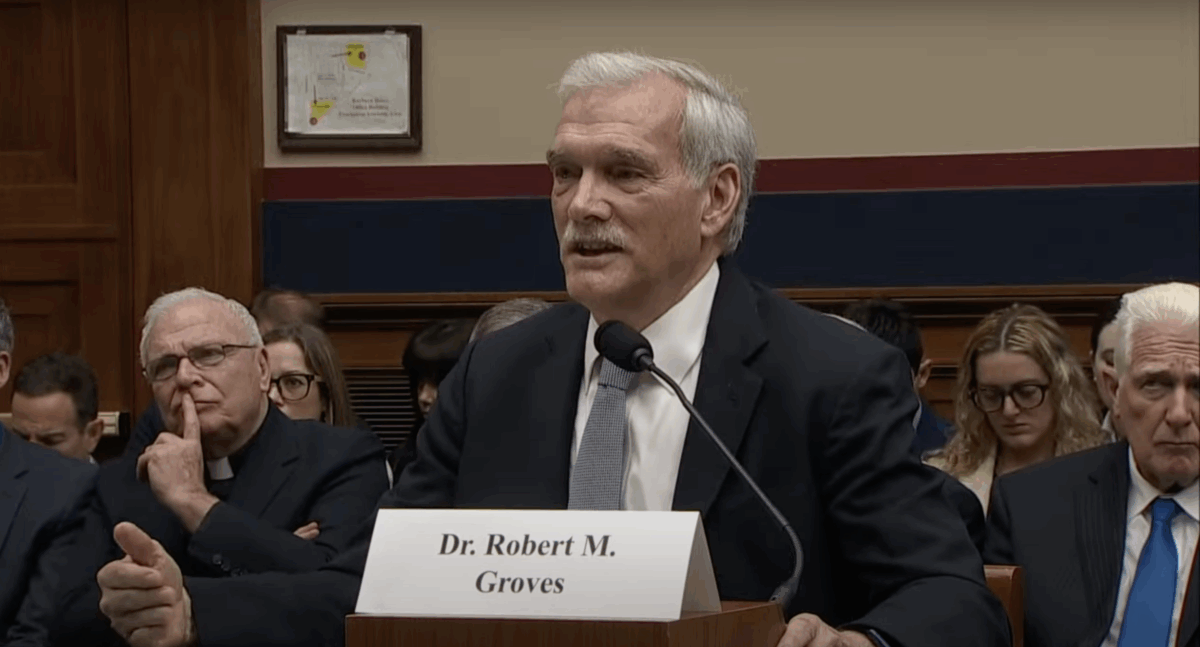
“Jim is one of these guys that people seem to like on both sides of the aisle. He’s been able to keep in contact with a lot of members when needed,” Tom Davis, a former Republican congressman from Virginia who Moran hired to help represent Qatar, told Jewish Insider.
A Georgetown source said Moran was not working with the university or sitting in one of Georgetown’s three allotted seats at the hearing. Still, there’s no doubt he is a highly influential foreign policy voice in Washington on behalf of a country with which America has a complicated relationship.
Qatar is a major non-NATO ally of the U.S., an official designation conferred by President Joe Biden, and is home to the largest U.S. military base in the Middle East. But it also has financial and diplomatic ties with Hamas and other terror groups. Qatar’s leaders say that is necessary so the country can maintain its role as a trusted mediator, while its critics say Qatar’s close relationship with Hamas makes it unlikely to put real pressure on the terror group to make a deal with Israel or to release the hostages. Some on Capitol Hill and in the pro-Israel community have expressed concerns that Qatar’s massive investment in American universities has fueled anti-Israel activism and antisemitism on campuses.
With a Boston accent leftover from his childhood, Moran has a penchant for talking tough — and acting tough, too. In the 1990s, at the start of his time in Congress, he occasionally threatened to brawl with fellow lawmakers, and once shoved another member of Congress off the House floor.
Moran was an early and consistent critic of Israel, long before the wave of anti-Israel sentiment that has exploded on the far left over the past two years. He has kept up ties with Jewish leaders in Northern Virginia, but those relationships grew strained as Moran repeatedly criticized pro-Israel advocates and Jewish activists.
“Jim is an extraordinarily compassionate man. He has trouble with suffering. His judgment about what constitutes suffering and who’s causing it is not always accurate, and so that has gotten him in a considerable amount of trouble over the course of his long political career,” said Rabbi Jack Moline, who served for 27 years as the rabbi at Agudas Achim Congregation in Alexandria. Moline met regularly with Moran until the rabbi called for Moran’s resignation in 2003, after Moran blamed Jews for the Iraq war, a comment the former congressman later said he “deeply regret[s].”
“His relationship with the Jewish community fell apart,” Moline told JI. “It didn’t surprise anybody when, after he finally did retire from Congress, he was offered and accepted work lobbying for Qatar.” He first registered as a lobbyist for Qatar in 2017. His firm, Moran Global Strategies, has been paid more than $2 million by Qatar in the last two years, according to data compiled by OpenSecrets. A spokesperson for the Qatari Embassy did not respond to a request for comment, nor did Moran Global Strategies.
Though Moran expressed contrition for his antisemitic remarks during the lead-up to the Iraq war, his rhetoric toward the Jewish community has only grown more inflammatory in the decade since he left Congress. In recent years, he has appeared on several virtual panel discussions held by the Arab Organization for Human Rights in the U.K., a London-based NGO led by Mohammad Jamil Hersh, a former Hamas activist who has been sanctioned by Israel and was deported by the country more than three decades ago. In those conversations, he regularly blasted the influence of American Jews and the “pro-Israel lobby.”
During a February 2023 AOHR event, Moran tried to explain Washington’s support for “apartheid” in Gaza by pointing the finger at American Jews and suggesting that they are unduly involved in the American political system.
“It’s about domestic politics and it always has been. The majority of people who contribute to the Democratic Party in America have Jewish surnames. Now think about that,” said Moran. He described them as people “whose principal reason for contributing to the political system in America has been the sine qua non of support for Israel, and unqualified support for Israel.”
In this and several other interviews, Moran recognized that his language was rather impolitic.
“I don’t want to sound antisemitic, and Palestinians are a Semitic people,” Moran said. “I’m just saying that let’s deal with the political reality in the United States that’s driving and reinforcing the injustice that’s occurring within Palestine.”
Moran and his team have held dozens of meetings with members of Congress since the Oct. 7 Hamas terror attacks in 2023 that spurred the ongoing war in Gaza, mainly to talk about “Qatar’s role in the Middle East peace process,” according to documents he filed with the Justice Department as required by the Foreign Agents Registration Act. At the same time, he has continued to question Jewish involvement in the American political system — including just days after Oct. 7, in a call hosted by the Muslim Public Affairs Council.
“The reality is that campaign contributions have corrupted the United States Congress. One of the motivating factors is, ‘How do I please my political supporters, particularly my financial supporters?’ The reality is that the Jewish community, and frankly to their credit, is deeply engaged in the American political process,” Moran said in the MPAC call. “That’s one of the motivating factors that causes the Congress to look the other way where the Middle East is concerned.”
Although he expressed skepticism about the supposed influence of American Jews in electoral politics, he encouraged Muslim, Palestinian and Arab Americans to increase their own influence. But his prognosis for their potential efficacy was grim. “I’m not sure they’re ever going to be able to successfully catch up,” Moran said.
Even as Moran took aim at Jews’ participation in the political process, he routinely downplayed accusations of antisemitism that have been lobbed at him directly and at the broader anti-Israel movement.
In September 2024, in another AOHR virtual briefing, Moran acknowledged that he would likely be called antisemitic for his comments accusing Israel of committing war crimes “daily” and for describing the situation in Gaza as “comparable to the Holocaust.”
“Foreign aid going into committing war crimes on a daily basis because of the politics, because of the campaign financing, because of the control of the media — it’s inexcusable. It’s an indictment of what has become of this democracy,” said Moran, without saying who, exactly, he thinks controls the media. “It’s an indictment of the fact that our foreign policy has been Israeli-centric, and let me say one other thing so that people don’t particularly accuse me of being antisemitic, although I’m sure many will: Many of those protests across the country were led by Jewish students.”
This spring, after President Donald Trump returned to office and began targeting universities, Moran was dispatched to Capitol Hill to talk to Democrats on the Senate Health, Education, Labor and Pensions Committee about Qatar’s funding of American higher education, which has come under the microscope.
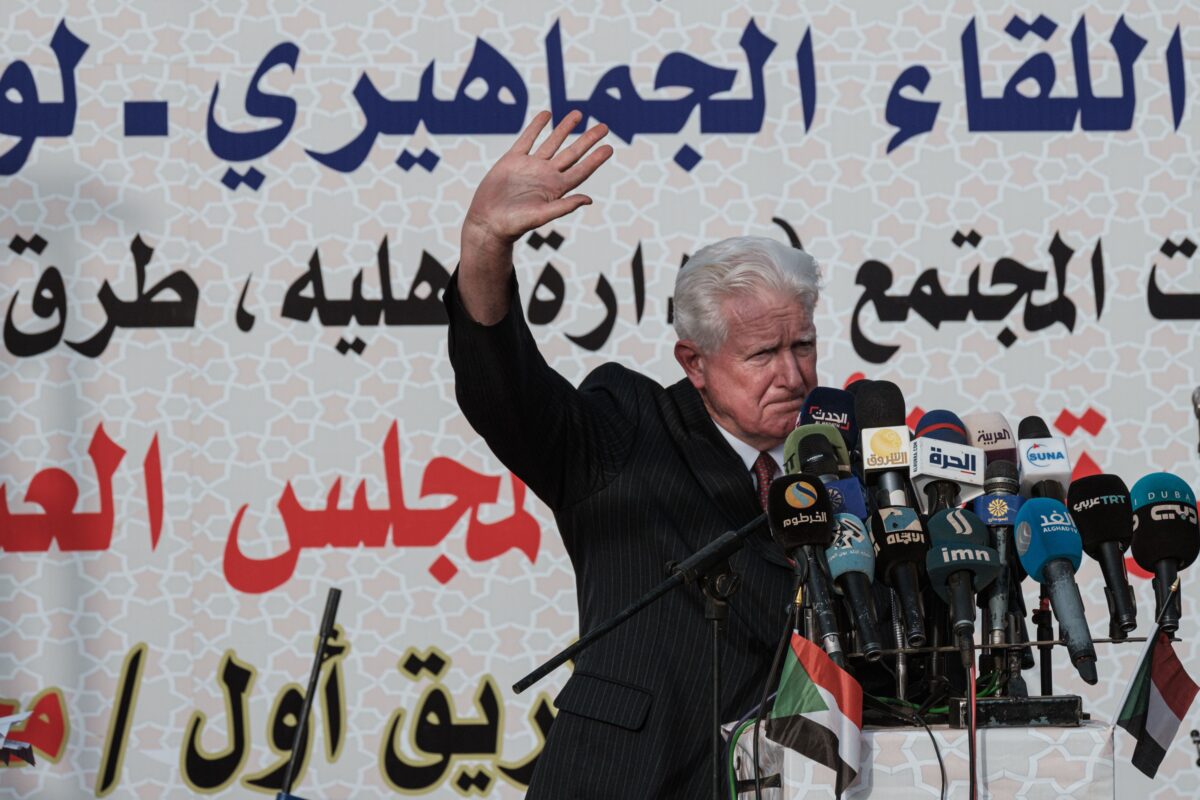
It is notable that one of the people tasked with advocating for a country that is close to both America and Hamas seems to have a deeply rooted hostility to Israel and even to American Jews, particularly at a moment when Qatar’s dealings in the U.S. are facing greater scrutiny — such as when Trump said earlier this year that the U.S. would accept a Qatari gift of a luxury jet to use as Air Force One.
But Qatar has a suite of lobbyists who span the political spectrum. Moran primarily deals with Democrats. Qatar has in the past also targeted hundreds of conservative “influencers” to reach Trump’s inner circle, and employs several Republicans as lobbyists. Partisan politics is at play, too; Democratic lawmakers blasted the Air Force One move, while Republicans fell in line behind Trump.
Several prominent Trump administration officials have ties to Qatar, including Attorney General Pam Bondi, who said in her January Senate confirmation hearing that she remains “very proud” of the lobbying work she did for Qatar ahead of the 2022 World Cup. Steve Witkoff, Trump’s Middle East envoy and chief negotiator, has a history of business dealings with the country.
“If you take a look at the folks they’ve got representing them, they’ve been all over the lot on that issue. It’s certainly not a pro-Arab versus Israel issue,” said Davis, the Virginia Republican who works with Moran on the Qatar file. “There’s nothing there to indicate that their lobbyists have any kind of ideological bent on that issue.”
Correction: This story has been corrected to reflect that Moran began lobbying for Qatar in 2017, not 2023.
Senior Biden official: ‘We’re seeing a trend that’s extremely disturbing’
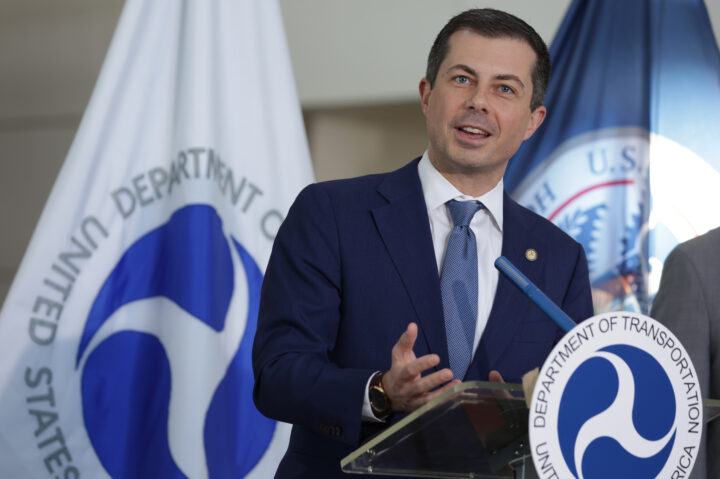
Alex Wong/Getty Images
U.S. Secretary of Transportation Pete Buttigieg speaks during a news conference at Ronald Reagan Washington National Airport November 21, 2024 in Arlington, Virginia.
When Pete Buttigieg was asked a question about Israel and Gaza this week on “Pod Save America,” the former transportation secretary and possible 2028 presidential contender answered in a way that matched many Democrats’ stances on Israel: broadly supportive of the U.S.-Israel relationship while sharply critical of Israeli Prime Minister Benjamin Netanyahu and his role in the humanitarian crisis.
But after facing a barrage of attacks on social media from progressives and anti-Israel activists, Buttigieg did an about face and gave in to critics, telling Politico on Thursday that he would have supported recent Senate resolutions seeking to block certain arms sales to Israel and that he would recognize a Palestinian state as part of a two-state solution.
Most surprisingly, he said the U.S. should not negotiate another 10-year memorandum of understanding with Israel laying out Washington’s military support for the Jewish state — a crucial component of America’s Middle East policy that was last negotiated in the Obama administration and runs through 2028.
“Pete Buttigieg is a viable [contender for] president of the United States. He won the Iowa caucus. He was the transportation secretary. And his words really matter,” one former senior Biden administration official told Jewish Insider. “The fact that he so quickly got wobbly and said his comments about the 10-year MOU suggests that those who still believe in standing strong really need to stand up right now, because we’re seeing a trend that’s extremely disturbing.”
In 2016, the U.S. and Israel signed a 10-year deal that pledged $3.8 billion in military assistance to Israel each year, which President Barack Obama celebrated at the time: “Under President Obama’s leadership, the multifaceted cooperation between the United States and Israel has reached unprecedented levels,” the White House said nine years ago. Even as some progressive Democrats have sought to condition or limit military assistance to Israel, there has not yet been a concerted effort to cancel or significantly alter the MOU.
A spokesperson for Buttigieg said the former South Bend, Ind. mayor stood by his comments and suggested he wants to see a major change in American military support for Israel.
“He said we have to shift to a more case-by-case approach, instead of a blanket approach,” the Buttigieg spokesperson told JI on Thursday. “There is a difference between providing defensive equipment so that they can shoot down Iranian missiles raining down on them, versus contributing to the conduct of a war that now has civilians starving within a few miles of food that is intended for them.”
That Buttigieg so rapidly gave in to pressure from the progressive left is an indication of where the party’s center of gravity is moving when it comes to Israel and Gaza. When Buttigieg ran for president in the 2020 Democratic primary, he was viewed as more liberal than Joe Biden on Israel, but much more centrist than Sen. Bernie Sanders (I-VT).
Buttigieg has for years been seen a more moderate voice in the party who could speak to both progressives and conservatives — as indicated by his frequent appearances on Fox News last year during the 2024 campaign. His willingness to acquiesce to the left in just a matter of days suggests the influence of the left-wing base in Democratic politics is growing.
At a J Street conference in 2019, Buttigieg criticized some Israeli actions and said America should express that disagreement — as a friend. “What you do in that situation is you put your arm around your friends and you try to guide them to a better place,” Buttigieg said. He also said that year that he would not consider cutting aid to Israel.
A year earlier, in 2018, he traveled to Israel with the American Jewish Committee, and said afterward that support for Israel “shouldn’t be” a “left vs. right issue.”
In the original “Pod Save America” interview that aired earlier this week, Buttigieg hinted at frustration with Israel’s actions in Gaza while declining to answer questions about the Senate resolutions or Palestinian statehood. “I think we need to insist that if American taxpayer funding is going to weaponry that is going to Israel, that that is not going to things that shock the conscience,” he said.
Buttigieg suggested, though, that his concerns about Israel’s actions in Gaza come from a position of caring about the country.
“We — I think especially including voices who care about Israel, who believe in Israel’s right to exist, who have stood with Israel in response to the unbelievable cruelty and terrorism of Oct. 7 — I think there’s a reason why so many of those voices are speaking up now too,” he said. “Because this is not just something that is on its face and in itself a moral catastrophe. It is also a catastrophe for Israel for the long run.”
His response was criticized by former Obama administration official Ben Rhodes and Rep. Ro Khanna (D-CA), who has in recent weeks been leading the charge for the U.S. to recognize a Palestinian state.
Andrew Bates, who serves as a deputy press secretary in the Biden administration, told JI he viewed Buttigieg’s answer as pro-Israel and anti-Netanyahu.
“I took Buttigieg’s interview to mean he is strongly committed to America’s alliance with Israel and Israel’s right to self-defense, but that he does not support Netanyahu’s new offensive. I agree,” said Bates. But he declined to weigh in on Buttigieg’s about-face.
Some of the leading pro-Israel voices in the Democratic Party have tried to avoid the intra-party squabble about the Senate resolutions and whether to recognize a Palestinian state. Gov. Josh Shapiro of Pennsylvania and Gov. Wes Moore of Maryland both declined to comment on the topic to Politico.
Shapiro said recently the U.S. has a “moral responsibility” to get aid to Gaza, and he told JI last month that support for Israel should remain bipartisan.
Plus, Buttigieg balks on Israel
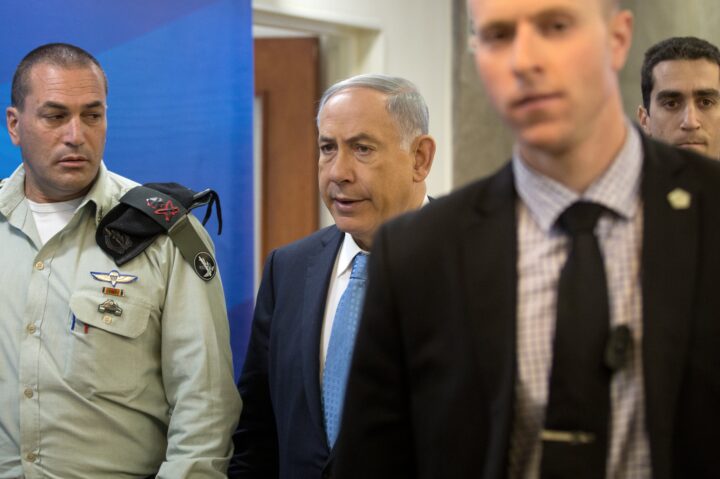
Israeli Prime Minister Benjamin Netanyahu (C) walks in to the weekly cabinet meeting escorted by government military secretary Eyal Zamir (L) in his Jerusalem office, on April 19, 2015. AFP PHOTO / POOL / MENAHEM KAHANA (Photo credit should read MENAHEM KAHANA/AFP via Getty Images)
Good Thursday morning.
In today’s Daily Kickoff, we spotlight the extreme comments of two political activists closely affiliated with Minneapolis mayoral candidate Omar Fateh, and talk to Jewish Democrats working to promote a balanced Israel-related resolution at an upcoming Democratic National Committee meeting as party delegates consider a measure that calls for an arms embargo and a suspension of U.S. military aid to Israel. We also cover the reactions of Jewish groups and Canadian politicians to the Toronto International Film Festival’s decision to cancel the screening of an Oct. 7 documentary due to the absence of Hamas’ approval to use footage of its attacks on Israel, and talk to Rep. Brad Schneider about this week’s Democratic congressional delegation visit to Israel. Also in today’s Daily Kickoff: Pete Buttigieg, Boris Epshteyn and Alex Sagel.
What We’re Watching
- We’re keeping an eye on comments on Israel and Gaza from 2028 Democratic hopefuls, following the publication this morning of an interview with Pete Buttigieg, who, under pressure from anti-Israel activists, clarified his comments about the Israel-Hamas war made on a podcast last week. The former transportation secretary said that he would have backed Sen. Bernie Sanders’ (I-VT) proposals to ban arms sales to Israel, supports the recognition of a Palestinian state as part of a two-state solution and would not back a new 10-year Memorandum of Understanding between the U.S. and Israel.
- The Rohr Jewish Learning Institute’s National Jewish Retreat continues today in Washington. Rabbi Dovid Bashevkin, former senior Treasury official Mitchell Silk and Rabbi Levi Shemtov are all slated to speak today.
- On the heels of Lebanese President Joseph Aoun’s warning this week against foreign support for armed groups in Lebanon, The Washington Institute for Near East Policy’s Khalil Helou, Assaf Orion, Sarit Zehavi are speaking at a virtual event this afternoon focused on Hezbollah’s disarmament and the future of UNIFIL in Lebanon.
What You Should Know
A QUICK WORD WITH JI’S MELISSA WEISS
Tensions between Israeli Prime Minister Benjamin Netanyahu and Eyal Zamir, the chief of staff of the IDF, are as high as the record-setting temperatures that have swept the region this week.
The IDF’s top officials and the Israeli government have clashed on a series of issues in recent days, including the appointments of more than two dozen military officials and Zamir’s initial opposition to Netanyahu’s plan to take over Gaza City and expand IDF operations in the Gaza Strip, which was approved by Israel’s Security Cabinet last week.
The IDF chief of staff has warned that the new approach to Gaza risks the lives of the 20 remaining living hostages in the enclave, and would further deplete the military’s resources in Gaza. The army, under strain after nearly two years of war, has — even prior to Zamir’s appointment in March — been at odds with the government over the continued exemption of the majority of the country’s Haredi population from the mandatory conscription required of most Israelis.
Israel Democracy Institute President Yohanan Plesner told Jewish Insider this morning that “historically, the relationship between the political level — prime minister, defense minister — and the top brass of the defense establishment, and mainly the IDF chief of staff, has been based on the premise that when Israel engages or embarks on significant security endeavors, operations and so on, it’s based on mutual consent,” with both parties having “de facto … veto power.”
But now, Plesner said, Netanyahu “is violating this decision-making norm that characterized the way decisions on core security [and] national security issues were made in the past.”
online archive
Omar Fateh’s allies defended Oct. 7, denied Israel’s right to exist
Two political activists closely affiliated with Omar Fateh, a far-left Minnesota state senator who is now running for mayor of Minneapolis, have expressed a range of extreme views on the Hamas terror attacks of Oct. 7, 2023, endorsing the violence as a justified act of resistance and accusing Israel of initiating the war in Gaza, among other inflammatory comments, Jewish Insider’s Matthew Kassel reports. Their rhetoric could fuel concerns among local Jewish leaders who sounded alarms about Fateh’s close alliances with anti-Israel activists after he won the state Democratic Party endorsement last month over Jacob Frey, the incumbent seeking a third and final term. Fateh, a 35-year-old democratic socialist has been a staunch critic of Israel, calling its conduct in Gaza a genocide and pushing for a ceasefire 10 days after Hamas’ attack.
Friends like these: But some of Fateh’s campaign staffers have gone significantly further than the state legislator, raising questions over his tolerance for incendiary language on a sensitive issue that has stoked growing internal tensions in the state party and could possibly inflect an increasingly bitter mayoral race in the lead-up to November. In a series of now-deleted social media posts, for instance, Fateh’s communications manager, Anya Smith-Kooiman, stated that Israel “does not have a ‘right’ to exist” and “must be dismantled,” while amplifying comments dismissing widespread reports of sexual violence on Oct. 7 as “propaganda” and hailing the attacks as a form of “resistance” that succeeded where the peace process had failed.
FAMILY FEUD
DNC confronts anti-Israel push from party delegates
When Democratic National Committee members gather in Minneapolis later this month for the party’s summer meeting, they’ll consider two Israel-related resolutions — a more balanced one, which has the backing of party chair Ken Martin, and an anti-Israel measure that calls for an arms embargo and a suspension of U.S. military aid to Israel. Sources within the DNC say they don’t expect the anti-Israel resolution, which was authored by a committee member from Florida, to pass. But the fact that it will be considered by the body has unnerved Jewish Democrats, who are working behind the scenes to promote the more balanced resolution, Jewish Insider’s Gabby Deutch reports.
Alternative approach: That one calls for an “immediate ceasefire and the unconditional release of all hostages, living and deceased, held by Hamas.” It also reiterates Democratic Party support for a two-state solution. (The text of the two resolutions was first reported by Semafor.) The Martin-backed resolution is co-sponsored by the DNC’s entire leadership, including DNC associate chair Stuart Appelbaum, the president of the Jewish Labor Committee, according to a copy of the resolution obtained by JI. Both measures will first be voted on by the DNC’s Resolutions Committee.
festival fiasco
Jewish groups, Canadian politicians outraged over film festival’s cancellation of Oct. 7 documentary

Pro-Israel groups and Canadian politicians expressed outrage on Wednesday after organizers of the Toronto International Film Festival canceled an invitation to show the documentary “The Road Between Us: The Ultimate Rescue,” about the Oct. 7, 2023, Hamas terror attacks, at its upcoming festival, citing the use of Hamas footage of the attacks that had not been approved for use by the terror group, Jewish Insider’s Haley Cohen reports.
‘Shamelessly disturbing’: “The Toronto International Film Festival’s reasoning for canceling the October 7 documentary screening is completely absurd and transparently dishonest,” the American Jewish Committee said in a statement. “Pulling a movie because footage wasn’t cleared for copyright by a terror group is so ridiculous that it would almost be laughable — if it weren’t so deeply, shamelessly disturbing.” In an open letter, Creative Community for Peace, a nonprofit that mobilizes prominent members of the entertainment community to oppose boycotts of Israel, wrote that “instead of advancing peace, TIFF has chosen to amplify hate.”
Walking it back?: In a statement released last night, TIFF CEO Cameron Bailey recognized the concerns, expressed “sincere apologies for any pain” caused and said he is “committed to working with the filmmaker to meet TIFF’s screening requirements to allow the film to be screened at this year’s festival. I have asked our legal team to work with the filmmaker on considering all options available.” He also noted “the urgent need for compassion amid rising antisemitism and Islamophobia,” underscored by Oct. 7 and the ensuing war in Gaza.
TRIP TALK
Democrats discussed Gaza aid, day-after plans with Israeli leadership, Schneider says
A group of congressional Democrats visiting Israel this week, including 11 first-term lawmakers, pressed Israeli leaders on the humanitarian situation in Gaza, emphasizing the need for them to increase aid flows into Gaza, Rep. Brad Schneider (D-IL) told Jewish Insider’s Marc Rod on Wednesday.
Readout: Schneider said the “focus of the trip, without question, was understanding Israel’s existential war against Hamas — Hamas attacked on Oct. 7 … understanding the implications of that. But also understanding the humanitarian crisis that’s taking place in Gaza.” He said that the humanitarian crisis, the obstacles to providing aid and what can be done to increase aid flows were a key focus of each of the group’s meetings, including with Prime Minister Benjamin Netanyahu.
CHANGING OF THE GUARD
Kibbutz Nir Oz, the hardest-hit community in the 10/7 attacks, welcomes 50 new, idealistic residents as it looks to rebuild

Walking along a path on Kibbutz Nir Oz, Yahel Meirovich and Raz Baruch felt the surreal contrast between the quiet birdsong, the deceptively pastoral stillness of the near-deserted kibbutz and the steady thud of bombs heard from the Gaza Strip, less than a mile away. Part of a group of 50 young adults — all of them educators from the Hashomer HaTzair Labor Zionist youth movement (literally, “the young guard”) — who have recently relocated to the kibbutz, the two were keenly aware of the emotional tension hanging in the air, Meirovich told eJewishPhilanthropy’s Judith Sudilovsky a week after their Aug. 3 arrival.
Raised right: The move of the young Hashomer HaTzair educators to Nir Oz is part of the youth movement’s Mefalsei Nativ (“Path Levelers”) program, in partnership with Kibbutz Nir Oz, which was founded by Hashomer HaTzair pioneers, with core support from the Kibbutz Movement Rehabilitation Fund — the body leading the recovery efforts of kibbutz communities in the Gaza border region since Oct.7, 2023. The Homeward Initiative, an educational foundation strengthening southern and northern communities since the war’s outbreak, has also played a key role in supporting the project from its inception as part of a broader joint effort to build young, vibrant communities in the heart of the hardest-hit kibbutzim. “For us, the decision to move to Nir Oz is the embodiment of everything we were raised on in Hashomer HaTzair – acting together with courage and stepping in where we’re needed,” Meirovich said
Read the full story here and sign up for eJewishPhilanthropy’s Your Daily Phil here.
Worthy Reads
Tanker Trouble: In The Wall Street Journal, the Foundation for Defense of Democracies’ Max Meizlish and Bridget Toomey look at how the U.N.’s attempt to remove oil from a moored tanker off the coast of Yemen has served to benefit the country’s Iran-backed Houthis. “Following the transfer of oil, the [tanker] was supposed to be operated by Yemen’s state oil company under the advisory oversight of the U.N. Development Program. In practice, the vessel serves as a floating fuel station for the Houthis. On paper, the U.N. transferred ownership to Yemen’s internationally recognized government — but control is what matters, and the Houthis have it. … All this is being underwritten by the international community. While the Houthis attack commercial vessels and threaten global shipping, the U.N. is bankrolling their offshore oil logistics by paying $450,000 a month for the [tanker]’s operations. A vessel designed to prevent one catastrophe is facilitating another — moving Russian oil in defiance of sanctions, sustaining the Houthis’ illicit fuel economy, and prolonging a regional war.” [WSJ]
Silent Suffering: In the Jewish News Syndicate, U.S. Ambassador to Israel Mike Huckabee joins Yehuda Kaploun and Mark Walker, respectively the Trump administration’s nominees to be antisemitism envoy and ambassador-at-large for international freedom, to suggest that recent images from Gaza underscore the need for Hamas to be removed from power. “In today’s world, photos and videos spread faster than any news story. They can capture raw human suffering in a way words never could. We see the faces of Gaza’s civilians bearing witness to Hamas’s brutality, too. We see children hollow-eyed with fear, women clinging to life, men bruised and beaten, each one telling a story of pain and desperation under Hamas’s rule. But for every image we see, there are countless others suffering in silence, locked away in tunnels or makeshift prisons, hidden from view and stripped of their dignity.” [JNS]
Across the Pond: The New York Times’ David Wallace-Wells considers the lessons — and warnings — U.S. politicos can take from U.K. politics as London’s two major parties fail to win over broad swathes of the electorate. “Lately, the spirit of Democratic defeatism that was so obvious right after the election has given way to something a little more confident and combative — though national approval of Democrats is at 30-year lows, the Democratic voters dragging down the figure are still loyal to the party, and Democrats have regained an advantage in party affiliation and opened up a sturdy lead in generic-ballot congressional surveys. The British experience, though, suggests a different interpretive framework entirely: that after an anomalous period of left-liberal unanimity, the two factions are again veering apart, giving off sparks of hostility along the way. That may be manageable, or even healthy, heading into 2026. But 2028? Look out.” [NYTimes]
Word on the Street
The New York Times’ Mara Gay looks at how former President Barack Obama and some of his closest advisors, including David Axelrod, Jon Favreau and Dan Pfeiffer, have warmed to New York City Democratic mayoral nominee Zohran Mamdani, reporting on a call between the former president and the candidate and saying, “[t]he interest from the closely guarded world of Obama and those around him is the clearest sign yet that Mr. Mamdani is likely to be embraced by the Democratic mainstream, whether the party’s leaders and donors like it or not”; Patrick Gaspard, who served as political director for Obama’s 2008 campaign, is also serving as an advisor to Mamdani and introduced Axelrod to the candidate…
Boris Epshteyn, the personal lawyer to President Donald Trump, connected two of the law firms that reached settlements with the administration — which Epshteyn personally brokered — with the Department of Commerce to assist on trade deals…
Senate Minority Leader Chuck Schumer (D-NY) tapped Jack Schlossberg to the America 250 Commission ahead of the U.S. Semiquincentennial next year…
A woman who sprayed a foul-smelling liquid on Jewish marchers at Montreal’s Pride parade was arrested following the incident; a member of the local activist group Faction Against Genocide, in Solidarity said the substance, which smelled like urine, was nettle extract…
Alex Sagel, the CEO of Germany-based defense contractor Renk, said the company could move parts of its business out of the country should Berlin move forward with plans to ban arms sales to Israel…
South Sudan’s Foreign Ministry denied reports that Juba had engaged in talks regarding the potential relocation of Palestinians from Gaza; the Foreign Ministry’s announcement came the same day as Israeli Deputy Foreign Minister Sharren Heskel visited the East African nation, where she held meetings with the country’s president, foreign minister and deputy foreign minister…
Lebanese President Joseph Aoun said that Beirut will not permit the presence of armed groups in the country and warned against foreign interference in Lebanese affairs; Aoun made the comments in a meeting with senior Iranian official Ali Larijani, who was on a three-day visit to Lebanon…
Israeli Finance Minister Bezalel Smotrich said that he will approve tenders to build more than 3,000 housing units in the controversial E1 area between Jerusalem and Ma’ale Adumim in the West Bank; in a statement, Smotrich said the construction “buries the idea of a Palestinian state”…
Businessman and philanthropist Bruce Slovin, who oversaw the creation and later served as chairman of the Center for Jewish History, died at 89…
Cable industry pioneer and philanthropist Leonard Tow, who with his wife, Claire, funded journalism initiatives at a number of New York City universities, died at 97…
Pic of the Day

The National Library of Israel received the original manuscript of Naomi Shemer’s song ‘Al Kol Eleh’ this week, gifted by the family of Ruth Nussbaum, Shemer’s sister, for whom the song was written. Nussbaum’s children —Tair, Noa, Yaakov and Avshalom — spoke at the donation event, together with Shemer’s daughter, Lali.
Birthdays
Historian and VP of alumni relations for MLB’s New York Mets, the press box at Citi Field is named in his honor, Jay Edward Horwitz turns 80…
Social media influencer, Dorothy Katz Wiggins turns 100… American-born British novelist, biographer, journalist and Oscar-winning screenwriter, Frederic Michael Raphael turns 94… Former attorney general of New Jersey and chairman of the Port Authority of New York and New Jersey, David Samson turns 86… President of the Hampton Synagogue until 2024 and former board member of the UJA Federation-New York, Carol Levin… Member of the New York State Assembly since 2005, Charles D. Lavine turns 78… Professor at Columbia University’s School of International and Public Affairs, Ester R. Fuchs turns 74… Professor of Neurosurgery at Johns Hopkins, Henry Brem, MD turns 73… U.S. District Court judge in South Carolina, he is the co-author of a book on the early Jews of Columbia, S.C., Judge Richard Mark Gergel turns 71… Turkish-born economist and professor at Harvard’s Kennedy School of Government, Dani Rodrik turns 68… U.S. senator (R-TN) since 2021, Bill Hagerty turns 66… Home fragrance and décor guru, Harry Slatkin turns 65… Lecturer at Purdue University, Martin J. Sweet turns 55… Winner of three Pulitzer Prizes as a journalist, Adam Goldman turns 52… Filmmaker and producer, she is the executive director of DOC NYC, a major documentary film festival in NYC, Raphaela Neihausen turns 49… VP at J.P. Morgan Private Bank, Jeremy Scott Wynes… Professional tennis player for 15 years, primarily a doubles specialist, now an assistant athletic director, Scott Lipsky turns 44… Senior advisor to President Donald Trump, Boris Epshteyn turns 43… Ukrainian-born actress, she moved to Los Angeles at the age of seven and has appeared in dozens of films, Mila Kunis turns 42… Opinion editor at eJewishPhilanthropy, Rachel Kohn… Internet entrepreneur and former CTO at Facebook, he is the co-founder and CEO of Quora, Adam D’Angelo turns 41… Retired lacrosse player, he played for ten seasons in Major League Lacrosse and for Team Israel in 2018, Maxwell (Max) Oren Seibald turns 38… Principal at Marcus & Associates Executive Recruiters, Jacob Lefkowitz… Member of Knesset for Otzma Yehudit, he serves as the minister for the development of the periphery, the Negev and the Galilee, Yitzhak Shimon Wasserlauf turns 33… Ryan Smith… Dylan Cooper… Tim Carney…
The American Eagle CEO is building a legacy in business — and in Jewish giving
NEW YORK, NEW YORK - JUNE 14: Jay Schottenstein attends the 80th Annual Father of the Year Awards on June 14, 2022 in New York City. (Photo by Noam Galai/Getty Images)
In the recent viral debate surrounding American Eagle’s “great jeans” ad campaign with Sydney Sweeney, which used a double entendre that drew accusations of promoting eugenics, it seemed many critics overlooked that the clothing retailer’s chief executive is a leading Jewish philanthropist who has long been committed to fighting antisemitism.
It was the sort of irony befitting Jay Schottenstein, 71, a mild-mannered billionaire entrepreneur from Columbus, Ohio, who oversees a sprawling business network that, in addition to American Eagle, includes DSW, the designer shoe chain he leads as executive chairman, among other holdings in wine, real estate and furniture.
But outside of philanthropic circles — where he is widely recognized as one of the most consequential sponsors of Jewish causes in the United States and Israel — his relatively private lifestyle has otherwise obscured his long-standing dedication to a range of issues including educational efforts, archeological research and translations of ancient Jewish texts.

“I think most people really don’t know who he is,” said Brad Kastan, a Jewish Republican donor who lives in Columbus and has long been friendly with Schottenstein. “He kind of keeps a low profile.”
Still, Schottenstein, who is Modern Orthodox, remains “accessible,” according to Kastan. The retail mogul, he told Jewish Insider, often can be seen walking to synagogue on Shabbat from his home in Bexley, a Columbus suburb, to attend Congregation Torat Emet, which he has endowed. “Because he’s a proud observant Jew,” Kastan added, Schottenstein “literally walks from Bexley to Ohio State, which has got to be six or seven miles, to go to football games on Shabbos.”
Meanwhile, Schottenstein, whose family is friendly with President Donald Trump, is a major player in Ohio politics, contributing to candidates from both parties, even as he largely favors Republicans. Most recently, he has donated to Vivek Ramaswamy, who is the likely GOP nominee in next year’s Ohio governor’s race.
For years, Schottenstein, who was instrumental in lobbying for legislation to allow Ohio to buy Israel bonds, has been a go-to resource among pro-Israel candidates looking for guidance on key issues about the Middle East. “If you support Israel and you’re running for office and you’re looking for advice or support in the Jewish community in central Ohio,” said Kastan, “you’re going to find your way to Jay’s office.”
The Ohio benefactor has built deep ties to Israel, where the National Campus for the Archaeology of Israel, which is under construction, bears his name. Ehud Olmert, the former Israeli prime minister, has called him a friend, and he was a top contributor to Israeli Prime Minister Benjamin Netanyahu’s 2015 reelection bid. American Eagle also operates dozens of stores in Israel.
Schottenstein, who has said he was in Israel during the Oct. 7, 2023, Hamas attacks, has stepped up his efforts to support the Jewish state in the aftermath of the incursion. He has led donations to victims of the attacks and co-founded a fund to lend financial support to families of IDF soldiers killed in the war in Gaza, among other things.
“You watch what’s going on in Israel, how everyone’s pulling together, and there’s a lot of pain,” Schottenstein said in a podcast interview last year. “I mean, this is real pain to the Jewish people. In my lifetime, I don’t think we’ve ever experienced a war like this — never experienced a time like this. But thank God, we have a strong Israel. We have a strong sense of being.”
Through his foundation, which he leads with his wife, Jeanie, whom he met at Hillel as an undergrad at Indiana University, Schottenstein has supported a growing number of Jewish institutions. These include Chabad, Agudath Israel, Hillel, Hadassah, Yeshiva University and United Hatzalah, the latter of which honored him with a humanitarian award last year.
Howie Beigelman, president and CEO of Ohio Jewish Communities, which represents the state’s eight Jewish Federations and affiliated nonprofit agencies, said that the “Schottensteins broadly are among the most generous and committed givers today,” adding that “their giving also now includes their children and grandchildren in an unmatched dedication to Jewish causes close to home and across the globe.”
Eli Beer, the founder of United Hatzalah, an Israeli emergency medical services volunteer organization, told JI that he has known Schottenstein and his wife for 18 years.
“I can say with certainty that the most important value for them is tikkun olam, repairing the world and making it a better place,” Beer explained. “Eighty percent of our conversations and time together, whether at their home for a weekend or just visiting, revolve around charity and how they can help more people in education, health and even sports, especially those who are underprivileged.”
Howie Beigelman, president and CEO of Ohio Jewish Communities, which represents the state’s eight Jewish Federations and affiliated nonprofit agencies, said that the “Schottensteins broadly are among the most generous and committed givers today,” adding that “their giving also now includes their children and grandchildren in an unmatched dedication to Jewish causes close to home and across the globe.”
“Where they stand out, of course, is in transformation projects that are charitable moonshots,” Beigelman told JI. “But they also work to find leaders they believe in and work with them to ensure the mission and the cause they champion has what it needs to succeed. And despite the reach of their generosity, and the significant amounts, they also remain deeply connected to each cause and each organization.”
Schottenstein, a descendant of Lithuanian immigrants who inherited his family’s retail business in the early 1990s, credits his late father, Jerome, a prominent supporter of Jewish causes, with fueling his continued devotion to philanthropy.
For some religious Jews, the Schottenstein name is all but synonymous with the eponymous, 73-book English translation of the Babylonian Talmud that the family sponsored over 15 years at an estimated cost of $250,000 to produce each volume.
“I think the Schottenstein name, the tradition established by his father and his grandfather, they have established a worldwide brand not just in their stores, but in Torah learning,” Malcolm Hoenlein, executive vice chairman emeritus of the Conference of Presidents of Major American Jewish Organizations, told JI. “In many cases they are models of philanthropy — and really exemplify impact giving.”
Schottenstein, who calls the translation one of his proudest achievements, took over the project from his father when he died in 1992. Published by ArtScroll, it was completed in 2005 and has since “revolutionized the study of the texts,” Malcolm Hoenlein, executive vice chairman emeritus of the Conference of Presidents of Major American Jewish Organizations, told JI recently.
Earlier this year, Schottenstein, speaking at a gathering of the Mesorah Heritage Foundation, which supports ArtScroll, said the organization, where he serves as board chair, had distributed paperback copies of the Talmud to Israeli soldiers fighting in the war. “Nobody could have imagined how the Gemaras would be used, on the battlefield, in tanks, in bunkers, in buildings,” he said in a speech in February. “Every rest period, you’d see guys studying.”
“I think the Schottenstein name, the tradition established by his father and his grandfather, they have established a worldwide brand not just in their stores, but in Torah learning,” Hoenlein told JI. “In many cases they are models of philanthropy — and really exemplify impact giving.”
Schottenstein’s passion for Jewish causes has on occasion intersected with his business. In 2024, for instance, he chose to mark the 30-year anniversary of American Eagle as a publicly traded company on the New York Stock Exchange by blowing a shofar rather than ringing the opening bell. Months before the Oct. 7 attacks, meanwhile, American Eagle placed a mezuzah on the front door of its flagship location in Times Square.
And the fashion company itself has partnered with the Anti-Defamation League on initiatives to help raise awareness about rising antisemitism, an American Eagle spokesperson confirmed to JI.
“My affinity for philanthropy is guided by faith, family and caring for others,” Schottenstein said in a statement to JI on Monday. “One’s value is not determined by possessions, rather by the number of people we have positively impacted. Of all the accomplishments in my life, the most rewarding have been giving back to those who need it most.”
He declined to comment on his company’s recent jeans ads.
Plus, Roy Cooper is running 🏃♂️
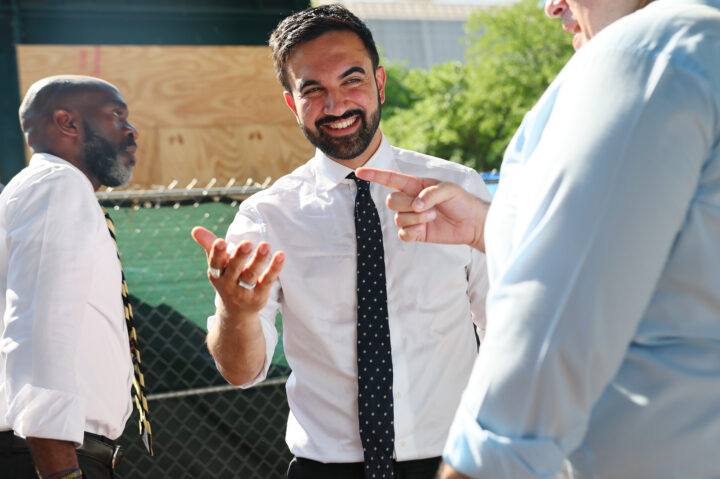
Michael M. Santiago/Getty Images
New York mayoral candidate, State Rep. Zohran Mamdani (D-NY) greets voters with Democratic mayoral candidate Michael Blake on 161st Street on June 24, 2025 in the South Bronx in New York City. Mamdani held several campaign events throughout the day including greeting voters with mayoral candidates Blake and NYC Comptroller and Mayoral Candidate Brad Lander as voters in NYC vote for the democratic nominee for mayor to replace Mayor Eric Adams.
Good Tuesday morning.
In today’s Daily Kickoff, we talk to Jewish communal leaders in New York City about the reluctance to publicly oppose Democratic mayoral nominee Zohran Mamdani’s candidacy in the absence of a viable challenger, and look at former North Carolina Gov. Roy Cooper’s record on Israel following the launch of his Senate bid. We spotlight the increasingly anti-Israel rhetoric from former senior Obama administration officials, and report on FEMA’s delayed opening of applications for 2025 Nonprofit Security Grant Program funding. Also in today’s Daily Kickoff: Eden Golan, Wallis Annenberg and Matti Friedman.
What We’re Watching
- The Senate Armed Services Committee is holding a classified briefing today on the U.S.’ June strikes targeting Iranian nuclear facilities.
- The Senate Foreign Relations Committee is holding confirmation hearings today for Michel Issa to be U.S. ambassador to Lebanon and Duke Buchan, the former Republican National Committee finance director, to be ambassador to Morocco.
- The Israel on Campus Coalition’s National Leadership Conference wraps up today in Washington. Sen. Dave McCormick (R-PA) and Rep. Ritchie Torres (D-NY) are slated to speak at the confab’s closing session.
What You Should Know
A QUICK WORD WITH JI’S Josh kraushaar
One of the defining features of our politics over the last decade has been the declining power of institutions, combined with the growing influence of individuals acting in their narrow self-interest, frequently at the expense of the public interest.
President Donald Trump’s ability in 2016 to bypass the Republican establishment benefitting from a crowded, self-interested opposition, was one of the seminal moments in our brave new world of individualism over institutionalism. Party institutions, outside-group spending and strident media criticism were no match for the grassroots army that rallied to Trump in that election.
Ten years later, the inability of moderate Democrats and other mainstream institutions to organize any coalition against the campaign of far-left New York City Democratic mayoral nominee Zohran Mamdani looks like the culmination of a dynamic where leaders feel powerless to lead, and are instead simply standing aside, ceding any influence to a cadre of ideological activists within the party.
What’s remarkable about this moment is that the top Democratic leaders in New York, over a month after the primary, aren’t supporting Mamdani — but aren’t willing to speak out against him, either. Senate Minority Leader Chuck Schumer (D-NY), House Minority Leader Hakeem Jeffries (D-NY), New York Gov. Kathy Hochul and Sen. Kirsten Gillibrand (D-NY) have all stayed on the sidelines, reflecting the state of political purgatory that many mainstream leaders are in right now.
WAIT-AND-SEE APPROACH
New York Jewish leaders reluctant to fight against Mamdani
In recent weeks, a creeping sense of frustration has settled in among many Jewish leaders in New York City as they have reckoned with the dawning reality that no one is stepping up to organize opposition to Zohran Mamdani, the Democratic nominee for mayor, Jewish Insider’s Matthew Kassel reports. Without a well-funded outside effort, Mamdani faces few obstacles in the general election despite numerous political vulnerabilities.
‘Just grasping’: The complacency comes even as top Democratic leaders in New York have so far declined to endorse Mamdani, whose antagonistic views on Israel and democratic socialist affiliation have engendered criticism. But with a divided field of warring and baggage-laden candidates, Jewish leaders have privately voiced disappointment at the current state of the race. “Big-money people are talking every week about how we have to do something, but I haven’t seen a real plan,” said one Jewish leader. “People are just grasping,” he added. “There’s a sense of frustration out there and fear of a letdown.”
TARHEEL STATE TEST
Cooper brings moderate record, political success to pivotal Senate battleground

Former North Carolina Gov. Roy Cooper’s decision to seek the Democratic nomination for North Carolina’s open Senate seat has equipped the party with a moderate standard-bearer with a strong relationship with the state’s Jewish community. But his handling of anti-Israel activism within the North Carolina Democratic party is expected to become an issue in the Senate race, one that Republicans are already seeking to exploit, Jewish Insider’s Emily Jacobs reports.
Looking inwards: When confronted with anti-Israel extremism within his own state party, Cooper has been more cautious. The former governor did not initially weigh in on the resolution passed by the North Carolina Democratic Party last month calling for an arms embargo on Israel, as well as on the other anti-Israel measures adopted by the state party. Reached for comment on the state party measures by JI on Monday, Cooper said in a statement: “I don’t agree with the party resolution, and Israel is an important ally. Israel needs to take seriously the job of getting humanitarian aid into Gaza right now. The hostages must be returned and I continue to pray for a swift end to this war and a meaningful peace in the region.”
Stein says: North Carolina Gov. Josh Stein, a Democrat, also criticized the resolutions passed by the state’s Democratic Party last month targeting Israel, urging party leaders on Monday to instead prioritize efforts that tackle the problems “we’re facing here in North Carolina,” Jewish Insider’s Emily Jacobs reports.
MIXED MESSAGES
Trump breaks with Netanyahu on acknowledging ‘starvation’ in Gaza
President Donald Trump decried the humanitarian situation in Gaza on Monday, telling reporters that he does “not particularly” agree with Israeli Prime Minister Benjamin Netanyahu’s assessment that there is no starvation taking place in the enclave, Jewish Insider’s Gabby Deutch reports. “That’s real starvation stuff,” Trump said, following a meeting in Scotland with U.K. Prime Minister Keir Starmer. “I see it, and you can’t fake that.”
Seeking solutions: Trump said the U.S. will be getting “even more involved” in taking steps toward addressing hunger in Gaza, including by setting up “food centers.” A White House spokesperson declined to comment when asked for specifics about what this plan might entail. Trump said “all of the European nations” would be part of the project. “We’re going to do it in conjunction with some very good people, and we’re going to supply funds,” said Trump.
Meanwhile in Jerusalem: Israeli Foreign Minister Gideon Sa’ar doubled down on the argument that claims of starvation in Gaza are the result of a “distorted campaign,” during a press conference on Tuesday, Jewish Insider’s Lahav Harkov reports. “We have been working very hard under complicated circumstances from the beginning of the war to this day to facilitate humanitarian aid into Gaza.”
PODCAST POLITICS
Former Obama staffers turned podcasters reemerge to lead anti-Israel chorus
Former Obama administration officials Ben Rhodes and Tommy Vietor took to social media over the weekend to attack Israel and slam the American Israel Public Affairs Committee, asking how it’s possible to “trust Democrats to fight for anything” if they take money from the pro-Israel lobby group. The anti-Israel activism from the Democratic influencers is a public example of the intense lobbying taking place in party circles and how progressive foreign policy officials such as Rhodes who have long been deeply critical of Israel are pushing to turn humanitarian concerns in Gaza into a more permanent split between the Democratic Party and Israel, Jewish Insider’s Danielle Cohen-Kanik reports.
AIPAC attack: Rhodes and Vietor especially directed their ire at AIPAC, which played a key role in Democrats electing some moderate candidates supportive of a close U.S.-Israel alliance to office last year. The left-wing commentators who host a weekly foreign policy podcast, “Pod Save the World,” decried AIPAC for a post on X where the organization said that “food, medicine and aid are IN Gaza. The @UN won’t distribute it.” Rhodes said AIPAC is “spreading lies. The Israeli government is starving Palestinians and everyone knows it. How can we trust Democrats to fight for anything if they take money from people who lie like this about starving kids,” the former Obama deputy national security advisor posted on Friday.
LATE ROLLOUT
Under pressure, FEMA opens applications for 2025 Nonprofit Security Grant Program funding

The Federal Emergency Management Agency opened applications on Monday for 2025 Nonprofit Security Grant Program funding, months after the applications traditionally open and amid pressure from lawmakers and community stakeholders, Jewish Insider’s Marc Rod reports.
Status check: Applications for the funding round are due Aug. 11. This application round pertains to the $274.5 million in funding that Congress appropriated for the 2025 grant cycle. An additional $126 million in funding for the NSGP remains outstanding from the national security supplemental bill Congress passed last year. Organizations have already applied for that funding tranche. FEMA did not respond to a request for comment on when that funding will be allocated.
Bonus: The Senate Appropriations Committee’s Justice Department budget bill released last week sets up a clash with the House over funds aimed at combating hate crimes. The House bill aims to eliminate that funding, supported by key Jewish groups, for 2026, while the Senate bill would preserve it.
Worthy Reads
The Hunger Games: The Free Press’ Matti Friedman lays out the challenges in getting accurate information regarding humanitarian aid and malnutrition in Gaza. “The transformation of truth-telling institutions into ideological megaphones has had a high price for citizens in liberal societies and for the institutions themselves, as we’re now seeing at places like Harvard and NPR. The feeling of being unmoored from objective reality — of rowing a boat through a choppy sea of lies and propaganda — is very much a feature of the present moment, and not only in Israel. But one of the most awful prices was made clear this past week, with reports of acute hunger in Gaza. In a blizzard of ideological fiction, how are sane citizens in Israel, or anywhere else, supposed to know what’s true and to do the right thing? It’s not an exaggeration to say, as we’re seeing right now, that the answer to this question can be a matter of life and death.” [FreePress]
Screen Time: Against the backdrop of media coverage of the growing food crisis in Gaza, The Atlantic’s David Graham looks at the role television news plays in informing President Donald Trump. “As president, Trump has access to the most powerful information-gathering network in the world, yet he takes his cues from what he watches on television. This helps him see the news from the same perspective as the general public, which has enabled his political success. But it also narrows his understanding, and it makes him highly susceptible to manipulation. … This means that despite access to high-quality information about what’s going on in Gaza, he seems to really perk up only once it’s on the tube. Such a narrow information stream is a problem, because TV is not a good source of information on its own; it should be consumed as part of a balanced news diet.” [TheAtlantic]
For Pete’s Sake: Politico’s Rachael Bade looks at the relationship between President Donald Trump and Defense Secretary Pete Hegseth following a series of missteps and moves that are at odds with the White House. “Concerned that the laundry list of scandals could lead to his downfall, they’ve implored Hegseth in private conversations to rethink surrounding himself with people the White House distrusts. Others are urging Hegseth to make peace with the former employees he ousted and accused of leaking. A smaller group is even quietly working to help those employees land a public apology or some sort of exoneration of their character. ‘If there’s any chance at Pete resetting and ensuring that whatever time he has left in this position is well served, he’s got to do it — otherwise Pete is just doubling down on the lie,’ said the person close to Hegseth. So far, however, he has yet to heed the warning.” [Politico]
Water Woes: The Financial Times’ Chloe Cornish, Eleni Varvitsioti and Ahmed Al Omran spotlight the growing use of desalinization plants by governments in the Middle East and southern Mediterranean, as the region grapples with mounting water crises and rising temperatures. “Reducing energy consumption has made producing desalinated water less polluting in terms of greenhouse gas emissions, and reduced the costs. In Israel, water produced by the Sorek B desalination plant is priced at about 40 cents per cubic metre, which is enough for 25 showers, according to Thames Water. Dubai utility Dewa will get a price of 37 cents per cubic metre for water from its Hassyan desalination plant, which is due to start operations next year. … Academics in Saudi Arabia, the world’s biggest desalinated water producer, are trying to tackle the brine problem. Zhiping Lai, a professor at the King Abdullah University of Science and Technology, is mining the brine for valuable elements such as lithium and potassium, which have commercial uses.” [FT]
Word on the Street
A Blackstone executive and NYPD officer were among four people killed in a shooting last night at Blackstone’s Park Avenue headquarters in Manhattan; the suspect, who was reportedly targeting NFL headquarters in the same building, died from a self-inflicted gunshot wound…
Defense Secretary Pete Hegseth signed an MOU earlier this month with Qatar for the “unconditional donation” of a luxury jet…
The Senate Appropriations Committee‘s Justice Department budget bill released last week sets up a clash with the House over funds aimed at combating hate crimes; the House bill aims to eliminate that funding, supported by key Jewish groups, for 2026, while the Senate bill would preserve it…
Sen. Angus King (I-ME) accused Israel of deliberately causing a famine in Gaza, calling its actions in Gaza “an affront to human decency,” and said that he “will advocate — and vote — for an end to any United States support whatsoever [for Israel] until there is a demonstrable change in the direction of Israeli policy.”…
Two members of the Boulder, Colo., City Council accused a colleague of posting content on social media that “crossed a serious line into antisemitism”…
Harvard is reportedly open to spending as much as $500 million to resolve its legal disputes with the Trump administration, following an agreement between the government and Columbia University last week in which the New York school agreed to pay $200 million and undertake a series of steps to address campus antisemitism…
Singer Regina Spektor‘s weekend concert in Portland, Ore., was disrupted by anti-Israel protesters…
An Oregon man was sentenced to 60 months in prison over a series of bomb threats to Jewish institutions in the New York area dating back to 2021…
Palestinian activist Awdah Hathaleen, who appeared in the recent Oscar-winning film “No Other Land,” was shot and killed by an Israeli settler in the West Bank on Monday; the Trump administration had recently lifted sanctions that had been imposed on Hathaleen’s alleged assailant, Yinon Levi, by the Biden administration…
Israel’s Elbit Systems was awarded a $260 million contract with the German government to supply defensive systems for Berlin’s A400M aircraft fleet…
The Financial Times reviews Scott Anderson’s King of Kings, which focuses on the fall of the shah in Iran in 1979…
Iran’s Foreign Ministry said that officials from the International Atomic Energy Agency are expected to travel to the country in the next two weeks for talks aimed at restarting inspections of Iran’s nuclear sites…
Los Angeles-based philanthropist Wallis Annenberg, whose family foundation, which she led for more than 30 years, gave over $3 billion to an array of causes, died at 86…
Longtime Washington Post reporter Morton Mintz died at 103…
Pic of the Day

Israeli singer Eden Golan performed her 2024 Eurovision Song Contest entry “Hurricane” on Monday at the Israel on Campus Coalition’s National Leadership Summit in Washington.
Birthdays
Tony Award-winning actor, Ari’el Stachel turns 34…
Chairman of BOK Financial Corporation in Tulsa, Okla., George Bruce Kaiser turns 83… Shoe designer, entrepreneur and founder of an eponymous shoe company, Stuart A. Weitzman turns 76… Denver-based trial lawyer, film producer and author of both fiction and nonfiction, Kenneth Eichner turns 71… Israeli electrical engineer and inventor, he is best known as the inventor of the USB memory stick, Dov Moran turns 70… Former deputy health and science editor at The Washington Post, Carol Eisenberg… Attorney general of Israel from 2016 to 2022, Avichai Mandelblit turns 62… Global economics and geopolitical correspondent for The New York Times, Peter S. Goodman turns 59… Actor and comedian, best known for his voice work in animation and video games, Richard Steven Horvitz turns 59… Twin brothers, Los Angeles based philanthropists and businessmen, Shlomo Yehuda Rechnitz and Yisroel Zev Rechnitz turn 54… Actor, filmmaker and musician, he is best known for his role in the CBS sitcom “How I Met Your Mother,” Joshua Radnor turns 51… Chief White House correspondent for NBC News, Peter Alexander turns 49… SVP of philanthropic engagement at BBYO, Jayme David… Director of the Straus Center at Yeshiva University, he is also the Rabbi of NYC’s Congregation Shearith Israel (The Spanish and Portuguese Synagogue), Rabbi Meir Yaakov Soloveichik turns 48… Data scientist and journalist focused on elections for the Associated Press, Aaron Kessler… Former member of the Canadian Parliament, David de Burgh Graham turns 44… Iraq war veteran, political and communications strategist, she is now serving as an adjunct professor at Duke University, Allison Jaslow… Rabbi, writer, educator and physician assistant, Rabbi Levi Welton… White House principal deputy communications director during the Biden administration, Herbie Ziskend… SVP in the Los Angeles office of Edelman, Jason Levin… Israeli actress, model and television presenter, Maya Wertheimer turns 35… D.C. attorney, Daniel Ryan Vinik… Uriel Wassner… Broadcaster and media relations manager for the Chicago Dogs and Windy City Bulls, Sam Brief… Quarterback for the NFL’s Washington Commanders, Sam Hartman turns 26…
The top Democratic leaders in New York, over a month after the primary, aren’t supporting Mamdani — but aren’t willing to speak out against him, either
Michael M. Santiago/Getty Images
NYC Mayor Zohran Mamdani briefly speaks with reporters as he leaves the Dirksen Senate Office Building on July 16, 2025 in Washington, DC.
One of the defining features of our politics over the last decade has been the declining power of institutions, combined with the growing influence of individuals acting in their narrow self-interest, frequently at the expense of the public interest.
President Donald Trump’s ability in 2016 to bypass the Republican establishment benefitting from a crowded, self-interested opposition, was one of the seminal moments in our brave new world of individualism over institutionalism. Party institutions, outside-group spending and strident media criticism were no match for the grassroots army that rallied to Trump in that election.
Ten years later, the inability of moderate Democrats and other mainstream institutions to organize any coalition against the campaign of far-left New York City Democratic mayoral nominee Zohran Mamdani looks like the culmination of a dynamic where leaders feel powerless to lead, and are instead simply standing aside, ceding any influence to a cadre of ideological activists within the party.
What’s remarkable about this moment is that the top Democratic leaders in New York, over a month after the primary, aren’t supporting Mamdani — but aren’t willing to speak out against him, either. Senate Minority Leader Chuck Schumer (D-NY), House Minority Leader Hakeem Jeffries (D-NY), New York Gov. Kathy Hochul and Sen. Kirsten Gillibrand (D-NY) have all stayed on the sidelines, reflecting the state of political purgatory that many mainstream leaders are in right now.
There are a handful of Democratic leaders who are speaking out more directly in response to Mamdani’s rise. Pennsylvania Gov. Josh Shapiro, a potential 2028 presidential contender, offered moral clarity in his interview with JI’s Gabby Deutch last week. “When supporters of yours say things that are blatantly antisemitic, you can’t leave room for that to just sit there,” Shapiro said of Mamdani.
Rep. Laura Gillen (D-NY), representing a suburban Long Island district with a sizable Jewish constituency, called Mamdani “a threat to my constituents.” Jeffries, to his credit, has all but conditioned his support for Mamdani to the candidate’s condemnation of “globalize the intifada” rhetoric.
What’s missing is any organized effort to rally behind one of the other Democratic options on the general election ballot in order to consolidate the Mamdani opposition. It’s not for lack of options — with the sitting New York City mayor and the former New York governor on the ballot — even if the alternatives are deeply flawed. Only about half of Democratic voters are lining up behind Mamdani, and he’s polling under 40% in the post-primary polls — an unusually weak position for a Democratic nominee in a deep-blue city.
With Mamdani celebrating his recent marriage in his birthplace of Uganda this past week amid creeping criticism from prominent elected officials, it would have been an opportune time for anti-Mamdani forces to go on offense. But instead, the race is stuck in neutral, with Mayor Eric Adams and former Gov. Andrew Cuomo spending as much time sniping against each other instead of the front-runner.
What’s holding the Mamdani opposition back is a generalized fear of leadership’s ability to make a difference. Would Schumer or Jeffries taking a tougher line against Mamdani significantly move the political needle, or drive the left-wing grassroots against them? Just look at the blowback Gillibrand received for noting in a radio interview that Jewish New Yorkers were alarmed by Mamdani’s public statements on Israel and antisemitic rhetoric.
For Jewish groups, is it worth further antagonizing Mamdani when he remains the favorite to become the city’s next mayor? The fact that a candidate excusing “globalize the intifada” rhetoric was able to comfortably win a Democratic primary — in the place with the largest Jewish population of any city in the world — was a shock to the system.
Coloring all these deliberations is the sense that something has shifted in our body politic — that radicalism isn’t the political turnoff that it once was. But there’s something of a Catch-22 to these internal deliberations: The less willing leaders are to confront the extremes, the more the Overton window shifts to accommodate them.
In an interview with JI, Varela said that ending the war in Gaza requires Israel’s ousting of Hamas from power
Campaign website
Brian Varela
In a Democratic Party that has lost its grip on the working class — long its base of support and wellspring of its values — Brian Varela is offering a way back home.
Varela, a small business owner and New Jersey political activist vying for the Democratic nomination for New Jersey’s 7th Congressional District, is leaning in to his working-class Colombian roots, suggesting that the Democrats need candidates, like him, who are better connected to the middle-class voters in his district.
“I think that one of the things that the national Democrats really messed up on last year was not understanding what the working-class voter was going through,” said Varela, both of whose immigrant parents worked blue-collar jobs. “And that’s why, while national Democrats were talking about how great the economy was, working-class voters did not understand. I understood that because I’ve lived it. And I think that being able to have that background that is very much aligned with a lot of the people in the district puts you in a unique position, not just to understand them, to represent them.”
With that moderate pitch as a first-generation American who has made good, Varela, 36, has firmly established himself as a serious contender for the Democratic nomination for New Jersey’s 7th Congressional District with his recent announcement of a $700,000 fundraising haul in his first three months in the race.
Varela, who self-funded around half of that total, is one of several Democrats, including former Biden administration official Michael Roth, former Navy helicopter pilot Rebecca Bennett and local Democratic official Greg Vartan, aiming to defeat Rep. Tom Kean Jr. (R-NJ), in a district Kean won by five points in 2024.
Varela has been active for years in various capacities in New Jersey politics: He started as a press intern for Republican Gov. Chris Christie in 2010, later running as a Democratic candidate opposing the party machine against now-Rep. Rob Menendez (D-NJ) and subsequently leading the New Jersey chapter of the Forward Party, the centrist third party founded by former presidential candidate Andrew Yang.
“I consider myself more of a moderate,” Varela told Jewish Insider in an interview. “I do believe that we do need to be tight around budgets, and we can’t just go and haphazardly be cutting programs, but we do need to understand that we cannot allow the deficit to continue increasing. But at the same time, I think that there are some great programs that may seem like social programs, but are actually more programs that are going to help us grow our economy.”
He said he also supports “economic populist” programs like growing the middle class through universal childcare, and investing in research and development, infrastructure and education — particularly in skilled trade programs in high schools and trade schools.
He said his life story and the hardships he faced growing up separate him from the Democratic field — as well as from Kean, whose father was the governor of New Jersey and whose grandfather also served in Congress — and align him with the voters in the district, adding that Democrats need candidates who are better connected to the working class.
Varela said that Israel has been a “strong ally for us, and I think it’s important to make sure that we are there for Israel, that we help Israel with their ability to defend themselves.”
He said he supports continued U.S. aid to Israel, as well as aid to Gaza, and supports a two-state solution in the long term. He said that bringing the conflict in Gaza to a close will require “root[ing] out Hamas entirely,” ending attacks from both sides and bringing “all shareholders to the table” including the United States, the United Nations and surrounding countries.
Varela said he did not have sufficient information to weigh in on the Trump administration’s strikes on Iran, but said that it’s “absolutely critical” that Tehran not obtain a nuclear weapon and that he would support renewed diplomatic efforts floated by the Trump administration.
To address rising antisemitic attacks and other incidents at home, Varela said that the U.S. needs to step up hate crimes enforcement, specifically voicing support for legislation raising the penalties for such activity.
“As a society, as an American culture, any hate crime performed is ultimately destroying our fabric, destroying the future of our country, and we need to be unequivocally and unapologetically at the front lines of combating this kind of hate,” Varela said.
Varela said he entered the race because “I think we need a fighter, and I’ve been a fighter my whole life,” from working full-time to cover his schooling costs to supporting his family when his mother got sick, struggling with financial difficulties, raising his younger brother and building a childcare business during the COVID-19 pandemic.
“But we navigated that and fast forward to now, we built the business with over 100 employees,” Varela said, adding that his company has been recognized locally and nationally for its growth.
He added that he thinks that Congress needs more leaders from different backgrounds and more “humble beginnings,” and said, “I can bring a serious diversity of perspective to representation, and not just the Congress, to our party as a whole.”
He said that Kean is “disconnected … from his voters” and doesn’t understand the impacts of legislation cutting assistance programs like the recently passed budget reconciliation bill.
Varela’s fundraising places him second in the Democratic primary, behind Bennett, who has raised $914,000 total, and ahead of Roth, who has raised $303,000 total and Vartan, who has raised $157,000.
Bennett closed the quarter with $672,000 on hand, Varela with $622,000, Roth with $225,000 and Vartan with $79,000.
Facing antisemitism in the workplace, these staffers have turned to each other in group chats and at the Shabbat dinner table for comfort

Kevin Carter/Getty Images
The U.S. Capitol Building is seen at sunset on May 31, 2025 in Washington, DC.
On the night of May 21, several dozen young diplomats and political aides gathered at the Capital Jewish Museum in Washington for a reception focused on humanitarian aid efforts in Gaza.
The event was one of dozens of similar programs that happen around Washington, offering networking opportunities and social connection (alongside tasty hors d’oeuvres) to the overworked, largely underpaid employees that power Congress and the federal bureaucracy. But this event imprinted on the minds of young Jewish politicos because of what happened as it was ending, when Sarah Lynn Milgrim and Yaron Lischinsky, two Israeli Embassy staffers, were shot and killed just after leaving the American Jewish Committee event by an assailant who said that he carried out the attack “for Gaza.”
“I saw the news and I said, ‘Could’ve been any of us,’” a legislative aide for a Democratic member of Congress, who had a ticket to that night’s event, told Jewish Insider last week.
For that staffer, the event brought back to the fore the kind of visceral pain and discomfort that Jewish congressional aides — especially those in Democratic offices and social circles — have gotten used to dealing with since the Oct. 7, 2023, Hamas terror attacks in Israel.
Confronting the aftermath of that day and the ongoing war in Gaza has been a challenge for American Jews in all fields, many of whom have had to face growing antisemitism and antipathy to Israel in their professional lives. But in the Democratic spaces of Capitol Hill — one of the most consequential and most scrutinized workplaces in the country, which is in large part managed by young staffers in their 20s and 30s — the issue is inescapable.
Many of the liberal-minded Jewish staffers on the Hill came to Washington to work on issues such as reproductive rights, access to health care and environmental policy. Now, for nearly two years, they have had to navigate a professional environment that demands an air of detached professionalism while their fellow staffers and Democrats writ large adopt a more critical approach to Israel and antisemitism.
A June poll showed Democratic sympathy toward Israel at an all-time low, with 12% saying they sympathize more with Israelis, and 60% saying they sympathize more with Palestinians. That was a major drop from November 2023, when 34% of Democrats said they were more sympathetic to Israelis and 41% said they were more sympathetic to Palestinians.
Several Democratic Jewish staffers, ranging from junior aides to chiefs of staff — most of whom requested anonymity, wary of being made a target of antisemitism and concerned about putting themselves at risk professionally at a time when Democratic jobs are hard to come by — told JI that, in the face of growing antipathy to Israel and continued antisemitic terror and threats, they have turned to each other to build a tight-knit community among Jews working on Capitol Hill.
“It has led to increased camaraderie and dialogue and kind of just a common understanding and bond … We work for a lot of different members: members who are Jewish, members who are not Jewish, members who one of their main issues is the U.S.-Israel relationship, members who are not mainly concerned with it,” said the legislative staffer. “But nonetheless, I think a lot of us are united and brought together by the aftermath of Oct. 7.”
“If you’re just going to pick up lunch, and you just hear something about ‘apartheid Israel’ in the cafeteria, that hurts. You feel something on that,” said one former senior Jewish staffer who no longer works on Capitol Hill.
Laurie Saroff spent more than 20 years on Capitol Hill, most recently as chief of staff to Rep. Lou Correa (D-CA). When she left Congress in 2022, she started a bipartisan networking organization called the Capitol Jewish Women’s Network.
“So many of us, which is something people don’t understand, are grieving. We’ve been grieving for 650-plus days. Everyone is touched at a different level, but it’s very personal, and sometimes I’m with people who are not Jewish and don’t understand how this impacts us so much,” Saroff told JI. “I think there’s a need for people to come together that I hadn’t seen in the past.”
Part of that desire to connect came from a feeling of alienation from other colleagues on Capitol Hill. Encountering charged anti-Israel rhetoric in the hallways of the Capitol and its fortress of office buildings has become commonplace.
“If you’re just going to pick up lunch, and you just hear something about ‘apartheid Israel’ in the cafeteria, that hurts. You feel something on that,” said one former senior Jewish staffer who no longer works on Capitol Hill. Whenever the war in Gaza intensifies, congressional offices face a barrage of angry, often confrontational phone calls seeking to pressure the members not to support Israel, which the Jewish staffer called “absolutely brutal” for the interns tasked with picking up the phone.
“The things that we hear in our day-to-day about the way that people talk about Jewish communities or Israel groups is so outside the boundaries of what could be considered polite or not antisemitic statements – ‘AIPAC controlling the government,’ AIPAC’s money in races where they don’t even spend it, and yet it’s blamed on AIPAC,” a Jewish foreign policy staffer told JI. “We hear from callers all day long about AIPAC money. Clearly at this point, it’s just a stand-in for saying Jewish money. That’s how I hear it.”
Soon after the Oct. 7 attacks, some Democratic congressional staffers began to pressure their bosses to call for a ceasefire between Israel and Hamas. “Dear White Staffers,” an Instagram account that first went viral several years ago for revealing allegations of lawmaker misconduct, has taken a sharply anti-Israel turn, frustrating many Jewish aides who see their colleagues continuing to follow and engage with the account.
In 2024, some staffers who wanted the U.S. to take a tougher line against Israel created a website that they dubbed the Congressional Dissent Channel. “We are congressional aides dedicated to changing the paradigm of U.S. support for the genocide against Palestinians in Gaza being carried out by the state of Israel,” the organizers wrote on the website, which has since been taken offline.
“I also have had a lot of Dem staff who are not Jewish — who kind of privately don’t agree with this sort of orthodoxy on the topic that is emerging — reach out to me and be like, ‘This is kind of crazy,’” a Jewish Democratic staffer said. “And it’s really nice to hear that. And I’ve definitely gotten closer to some people for that reason,” she told JI, though she added that the anti-Israel contingent in the Democratic Party and on the Hill “feel like there’s a lot of permissiveness for them to say things that are really not acceptable.”
“It’s the small things, like Dear White Staffers. You can’t even explain to your colleagues how repugnant some of these posts are. For any other group, it feels like they would be disciplined. The post would be removed. There would have to be apologies,” the foreign policy staffer told JI. “It’s no secret that — how do I say this? — that diversity is something that seems to be really valued, except for when it comes to Jewish voices.”
Another Jewish Democratic staffer wanted to make clear that many of her non-Jewish colleagues were similarly alarmed by the language that other Hill staffers had adopted after Oct. 7.
“I also have had a lot of Dem staff who are not Jewish — who kind of privately don’t agree with this sort of orthodoxy on the topic that is emerging — reach out to me and be like, ‘This is kind of crazy.’ And it’s really nice to hear that. And I’ve definitely gotten closer to some people for that reason,” she told JI, though she added that the anti-Israel contingent in the Democratic Party and on the Hill “feel like there’s a lot of permissiveness for them to say things that are really not acceptable.”
A senior staffer for a pro-Israel member of Congress said that when their office interviewed potential new hires after Oct. 7, the interviewers began asking job candidates — mostly younger people seeking early career roles — if they were comfortable with the member’s views on Israel and other topics, and what they would do if they disagreed.
“You had to walk on eggshells with your staff, because staff are way more progressive than the offices we were representing. It was a very, very challenging thing, while you’re also dealing with the personal ramifications and trauma of the actual events that happened,” said the former senior staffer who no longer works on the Hill. “I remember there was this one junior staff walkout, and it was the craziest thing to me, because if you’re not from the community, if you’re not a constituent, what are you trying to do? Members are trying to represent the interests of their district, not what their staff or interns want them to do.”
With these experiences casting a shadow over Jewish staffers’ time on the Hill and their understanding of politics and identity, they’ve found comfort in each other and in Jewish tradition.
“There’s a deep desire amongst people to lean on the most beautiful parts of the [Jewish] identity,” a Jewish policy staffer told JI. “I think that gives people a lot of strength because it’s really hard to hear all these things about your community all the time, and then you go to something like a Shabbat dinner … and you’re really reminded that this negative barrage is something that you have to endure for the sake of something that is really meaningful and powerful.”
The legislative aide who had purchased a ticket to the Capital Jewish Museum event said that the aftermath of Oct. 7 and rising antisemitism are “not theoretical and are extraordinarily personal,” which “is a theme that I have found has united and brought together a lot of Jewish staffers on the Hill.” The past two years have also led to “increased camaraderie and dialogue and a common understanding and bond,” bringing these staffers together both inside and outside the workplace.
The staffer who found solidarity with some non-Jewish colleagues said Jewish staff “have formed group chats to support each other and check in and … vent about frustrating experiences that they’re having, stuff like that. So I definitely think professionally and personally the community has deepened a lot and people are really leaning on each other.”
“Shabbat has really been an anchor, I think,” the aide told JI. Congressional staffers endure “lots of busy weeks, lots of long weeknights.” Joining together for a Shabbat meal, as groups of staffers do frequently, becomes “an intentional place to kind of withdraw from that and exist in our Jewish selves.”
The staffer said that, in attending Shabbat dinners, “there’s a deep desire amongst people to lean on the most beautiful parts of the [Jewish] identity. I think that gives people a lot of strength because it’s really hard to hear all these things about your community all the time, and then you go to something like a Shabbat dinner … and you’re really reminded that this negative barrage is something that you have to endure for the sake of something that is really meaningful and powerful.”
Shabbat, she added, is “a good antidote for the constant gaslighting.”
Plus, Jewish Voice for Peace's political pivot

Tom Williams/CQ-Roll Call, Inc via Getty Images
Brett McGurk, then-White House Coordinator for the Middle East and North Africa, arrives to the U.S. Capitol on Thursday, April 18, 2024.
Good Thursday morning.
In today’s Daily Kickoff, we cover former White House senior official Brett McGurk’s condemnation of Hamas’ repeated refusals to reach a ceasefire agreement, and report on the anti-Israel group Jewish Voice for Peace’s pivot to electoral politics. We report on Israel’s strikes on Syria amid widespread attacks on the Syrian Druze community, and cover the departure of United Torah Judaism from Israeli Prime Minister Benjamin Netanyahu’s ruling coalition. Also in today’s Daily Kickoff: Wally Adeyemo, Ari Aster and Tali Cohen.
What We’re Watching
- This afternoon at the Aspen Security Forum, Adam Boehler, the Trump administration’s special envoy for hostage affairs, is set to take the stage for a one-on-one conversation with CNN’s Kaitlan Collins. Boehler’s appearance comes amid the cancellation of a number of Pentagon officials who had been slated to address the annual Colorado gathering.
- Later in the afternoon, former National Security Advisor Stephen Hadley, The New York Times’ David Sanger and Johns Hopkins’ Vali Nasr will participate in a panel discussion on Iran. Immediately following that session, former Commerce Secretary Penny Pritzker is slated to speak on a panel about international trade and economics.
- At a reception later in the evening, former Deputy National Security Advisor Dina Powell McCormick will speak about the book she co-authored with her husband, Sen. Dave McCormick (R-PA), Who Believed in You? How Purposeful Mentorship Changes the World.
What You Should Know
A QUICK WORD WITH JI’S JOSH KRAUSHAAR
The latest round of fundraising reports for members of Congress paints a concerning picture about the future of the ideological center. Many lawmakers from both parties known for their pragmatism and moderation struggled to raise big bucks for their campaigns, while a number of insurgent candidates on the left and the right wings of their parties scored significant fundraising hauls.
Some of the middling fundraising numbers from experienced, establishment-oriented lawmakers will lead to speculation they are considering retirement.
On the GOP side, Sen. Joni Ernst (R-IA), a senator deeply immersed in national security issues, only raised $723,000 in the last three months — barely inching past two of her Democratic opponents. That’s an underwhelming sum for Ernst, who has typically been a strong fundraiser but has been taking heat from both the right and left. It will only raise speculation about her political future.
Sen. John Cornyn (R-TX), facing a primary challenge from right-wing Texas Attorney General Ken Paxton, also didn’t hit the $1 million mark in fundraising, bringing in just $804,000. Paxton, despite worries about his electability and scandals surrounding him, raised $2.9 million.
In the House, Rep. Mike McCaul (R-TX), the respected former chairman of the House Foreign Affairs Committee, raised just $93,000 for the quarter, with less than $100,000 in his campaign account. While he’s not in a competitive district, that small sum has raised retirement speculation as well.
On the Democratic side, there were some fresh signs that mainstream, pro-Israel candidates aren’t getting quite the same fundraising traction as they have in the past.
CONFERENCE CONVERSATION
McGurk: History of Israel-Hamas talks is ‘being rewritten by people that weren’t involved’
Former U.S. and Israeli officials speaking at the Aspen Security Forum on Wednesday emphasized that Hamas bears responsibility for the failure of hostage release and ceasefire talks, and discussed the possible paths to ending the war in Gaza, Jewish Insider’s Marc Rod reports from the conference. Brett McGurk, the top National Security Council official responsible for the Middle East under the Biden administration, argued on Wednesday that the history of ceasefire talks between Israel and Hamas “is being rewritten by people that weren’t involved in this.”
Missed opportunities: McGurk emphasized that Hamas repeatedly ignored and rejected proposals that fulfilled many of its demands over the course of the last year, arguing that Israel’s attacks on Hezbollah had helped force Hamas’ hand to a temporary ceasefire deal that went into effect in early 2025. “The moral toll of this awful situation tears at the soul of anyone who’s worked on this, anyone,” McGurk said. “But this war could have stopped multiple times if Hamas stopped the war and released hostages — multiple, multiple times.”
Looking ahead: Wally Adeyemo, the deputy secretary of the Treasury Department during the Biden administration, argued on an Aspen panel that postwar reconstruction of Gaza will require new tools, methods and partners.
UNDER THREAT
Israel strikes Syria ‘to halt the assaults against the Druze’

Israel struck the Syrian Defense Ministry’s headquarters in Damascus on Wednesday in response to violence against the country’s Druze minority, a week after Israeli Prime Minister Benjamin Netanyahu spoke in the White House of the “opportunity for stability, security and eventually peace” with Syria. The strikes came after clashes between Druze and Bedouin groups that began on Sunday, leaving as many as 250 dead over four days in Sweida, some 25 miles from the border with Israel and in the area of Syria that Israel seeks to have demilitarized, Jewish Insider’s Lahav Harkov reports.
Developments: Syrian government forces entered the fray on Tuesday, saying they aimed to stop the fighting and bring about a ceasefire, which they said they had reached on Wednesday. Syrian President Ahmed al-Sharaa, formerly the head of the Syrian branch of Al-Qaida, seeks to disarm Druze and other militias and have them integrate under the new government. Israeli Druze called for Israel to intervene from the outset of the violence on Sunday, saying that their Syrian counterparts were being massacred, raped and tortured by forces aligned with al-Sharaa. In Israel, videos and images circulated of Druze religious figures’ mustaches being forcibly shaved off by men in military fatigues. Secretary of State Marco Rubio said on Wednesday afternoon that Washington has “engaged all the parties involved in the clashes in Syria. We have agreed on specific steps that will bring this troubling and horrifying situation to an end tonight.”
Heard at Aspen: “Israel is in such an extraordinary position. … Think about Israel being born, created May 14, 1948, besieged over decades by attacks and enmity from all of its Arab neighbors, now the strongest country in the Middle East,” former U.S. Ambassador to China Nicholas Burns, a top foreign policy advisor to President Joe Biden, said in Aspen. “Israel’s in the strongest geopolitical position it’s ever been in, after the extraordinary events in Lebanon, in Gaza, in Iran, in Syria over the last two years.”
EXPLAINER
Netanyahu’s coalition is teetering – but his government is likely to last the year
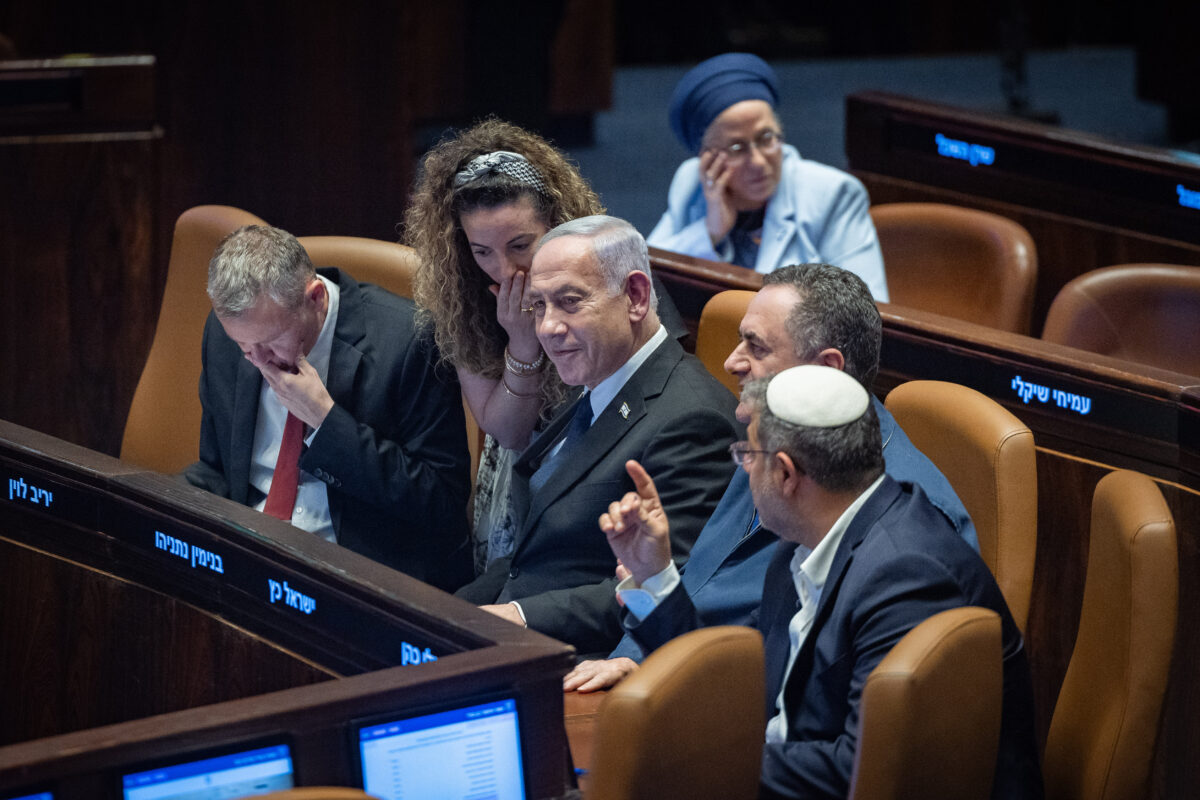
New Israeli elections are unlikely to happen this year, despite the departure on Wednesday of two parties from Israeli Prime Minister Benjamin Netanyahu’s government over disagreements over Haredi military exemption legislation, Jewish Insider’s Lahav Harkov reports. After months of disagreements, Ashkenazi Haredi faction United Torah Judaism left Netanyahu’s coalition in protest, leaving it with 61 out of the Knesset’s 120 seats.
Hanging on: On Wednesday, Sephardic Haredi party Shas’ five Cabinet ministers quit the government, though party leader Aryeh Deri will remain an observer in the Security Cabinet. Shas only quit the government — meaning its Cabinet posts — and did not pull its 11 lawmakers out of the parliamentary coalition. Shas, whose voter base is right-wing and even more supportive of Netanyahu than the prime minister’s own Likud party, said it will not vote with the opposition. This means that Netanyahu retains a majority in the Knesset, albeit a razor-thin one.
switching gears
Jewish Voice for Peace restructures, sets its sights on the ballot box

Jewish Voice for Peace, a far-left anti-Israel advocacy group that has built a growing profile in the wake of Hamas’ Oct. 7, 2023, terror attacks, is pivoting to a new organizational structure that will soon allow it to engage more forcefully in electoral politics. The group recently began the process of consolidating its membership and organizing in an affiliated but lesser-known political nonprofit called Jewish Voice for Peace Action, devoting the bulk of its resources to lobbying and political activities, such as supporting and opposing candidates that had not traditionally been a part of its core focus. As a nonpartisan tax-exempt group, JVP, which has been at the forefront of campus anti-Israel protests and promotes efforts to divest from Israel, has been legally prohibited from taking sides in campaigns — a limitation the new structural change is designed to address, Jewish Insider’s Matthew Kassel reports.
Behind the decision: The shift comes as the activist left has felt newly emboldened by Zohran Mamdani’s shocking victory in New York City’s Democratic mayoral primary in June, fueling debates over the ideological direction of the party as it gears up for next year’s midterms. JVP Action, which recently changed its public name to Jewish Voice for Peace to match its sister organization, was an early supporter of Mamdani and has cited his outspoken opposition to Israel as a sign of evolving voter attitudes about the Israeli-Palestinian conflict. “There is unprecedented, mass support for Palestinians. Our movement has already grown larger, and more quickly, than many of us thought possible. But it’s clear we have not begun to tap our full potential,” JVP writes in a detailed new page on its website about the decision-making behind its shift.
HILL TALK
House Armed Services Committee Democrats criticize Pentagon for rogue moves on Ukraine

Members of the House Armed Services Committee sparred on Tuesday at their annual meeting on the National Defense Authorization Act, the massive annual defense and national security policy legislation, over reportedly rogue actions by Secretary of Defense Pete Hegseth and Under Secretary Elbridge Colby to pause U.S. aid to Ukraine without White House knowledge or support, Jewish Insider’s Marc Rod reports.
Other developments: The committee also approved a series of amendments on the Middle East and antisemitism during its markup, and voted on party lines to defeat amendments seeking to block the conversion of a Qatari jumbo jet to be Air Force One and to take the Pentagon to task over the Signalgate scandal.
ALL IN THIS TOGETHER
Global oil market pressures restrained Israeli, Iranian attacks on oil infrastructure, analyst says
The pressures of the global oil market restrained Israel from bombing Iran’s Kharg Island oil facilities and Iran from closing the Strait of Hormuz or attacking Saudi Arabia’s Abqaiq oil facilities, an energy policy analyst argued at the Aspen Security Forum on Wednesday, Jewish Insider’s Marc Rod reports.
Explanation: “There was some measure of security that came from the fact that we’re in a global oil market and we’re all in this together,” Jason Bordoff, the founding director of the Center on Global Energy Policy at Columbia University, said on a panel on energy security. “If Iran had tried to do that, it would have imposed pain on itself, it would have imposed pain on China, it would have imposed pain on Gulf countries it was trying to keep on its side.”
Worthy Reads
Hamas’ MO: In Newsweek, former White House Middle East envoy Jason Greenblatt suggests that Hamas has committed “dehumanicide” against the Palestinian people. “I define ‘dehumanicide’ as when a people’s leadership condemns its population to death by treating them not as humans but as props. By camouflaging among civilians — placing weapons, tunnels, and command posts in and under hospitals, schools, mosques, and apartment buildings — Hamas has committed an act of dehumanicide. Hamas transformed civilian lives into strategic assets for international outrage. Hamas instrumentalized Gazans not as people to be protected, but as tools of their horrific, twisted, evil warfare. Hamas accepts these civilian deaths as the ‘cost of doing business.’ Indeed, Hamas welcomes the deaths because it knows the world will use them as cudgels against Israel so that Hamas can prolong its long war against the Jewish state.” [Newsweek]
MAGA Revisionism: In The Free Press, Rebeccah Heinrichs looks at the effort by “conspiracy theorists, cranks, and the craven” of the MAGA wing of the Republican Party to revise how Americans view their own history. “While Donald Trump reaffirms the principles that underpinned his first term — that America remains the leader of the world’s most successful military alliance (NATO), a committed supporter of the Jewish State, lead defender of the global commons, and is willing to use military force when necessary — he is increasingly out of step with a critical constellation of right-wing influencers, podcasters, and contrarian intellectuals. For them, America’s history as a global superpower is morally suspect, if not outright criminal. Our victories become losses, our alliances sinister entanglements, and our deterrence campaigns provocations. Why? Because they must revise the past to justify and satisfy their policy preferences in the present.” [FreePress]
Dear Zohran…: The New York Times’ Tom Friedman raises concerns about New York City Democratic mayoral candidate Zohran Mamdani’s continued defense of the phrase “globalize the intifada,” despite pushback from Democratic officials and the Jewish community. “First, if you are discussing a mantra — like ‘globalize the intifada’ — that takes 15 minutes to explain why it doesn’t mean what it obviously means, I’d suggest that you distance yourself further from that mantra. … When I see someone running for mayor defending a useless, meaningless, far-left mantra that helps no one, and who prefers commenting at a distance and not convening energetically, it makes me wonder how he will deal with the really hard issues on the West Bank of the East River — not the West Bank of the Jordan — that most New York voters care most about.” [NYTimes]
A Grieving Mother’s Plea: In The Hill, Leah Goldin, whose son Hadar was killed in 2014 by Hamas, which has held his body since, calls on Saudi Arabia and President Donald Trump to prioritize the release of the remaining 50 hostages in Gaza as Israel and Hamas work toward a ceasefire agreement and Trump looks to expand the Abraham Accords. “This week marks 4,000 days since Hadar’s abduction. In that time, I have knocked on the doors of leaders and diplomats around the world. I have appealed not only as a grieving mother but as a citizen of a country that shares the United States’s values of justice and humanity. … I beseech the president: use your influence to ensure that Saudi Arabia helps to bring them home. Peace and normalization will be your historic legacy in the Middle East, but they cannot come at the expense of the hostages. Their return is a critical confidence-building step toward the peace that you are building.” [TheHill]
Word on the Street
U.S. Ambassador to Israel Mike Huckabee made a brief appearance at Israeli Prime Minister Benjamin Netanyahu’s corruption trial in Jerusalem on Wednesday, telling reporters earlier in the day that the visit to court was “an act of friendship”; days prior, President Donald Trump had posted on his Truth Social site in support of Netanyahu, calling on the charges to be dropped or for the prime minister to be pardoned…
The International Criminal Court denied a request from Israel to withdraw the arrest warrants issued against Netanyahu and former Defense Minister Yoav Gallant while the court reviews Israeli challenges to the warrants…
A new American intelligence assessment indicates that American strikes on Iranian nuclear facilities last month largely destroyed Fordow, but left Natanz and Isfahan largely intact, albeit somewhat degraded…
New York City Democratic mayoral candidate Zohran Mamdani met on Wednesday with House Democrats, including Reps. Jerry Nadler (D-NY), Ayanna Pressley (D-MA) and Melanie Stansbury (D-NM) at a breakfast in Washington hosted by Rep. Alexandria Ocasio-Cortez (D-NY)…
New York Gov. Kathy Hochul told MSNBC that she had conveyed to Mamdani that he has “a lot of healing to do with the Jewish community” over his anti-Israel activism and support for rhetoric that is widely viewed by the Jewish community as incitement to antisemitic violence…
Les Wexner purchased Norman Foster’s Martha’s Vineyard estate for $37 million…
The New York Times profiles thriller filmmaker Ari Aster ahead of the theatrical release of his new film, “Eddington”…
The Modern Orthodox organization Uri L’Zedek, which has brought lessons from the Torah into the social justice ecosystem for nearly 20 years, is expanding into advocacy work in Washington, hoping to “lower the temperature” of the country’s partisan politics, eJewishPhilanthropy’s Nira Dayanim reports…
An Australian Muslim cleric, who was ordered by a court to cease giving inflammatory and antisemitic sermons, was ordered to prominently display notices detailing the court’s findings across the social media platforms of the Islamic center he oversees…
Tali Cohen is joining the Anti-Defamation League as the director of the group’s Washington office, following more than two decades at FEMA and the Department of Homeland Security…
Pic of the Day

The inaugural meeting of the Belgrade Strategic Dialogue: Serbia-United States-Israel Partnership was hosted by the Serbian National Assembly this week, attended by Serbian parliamentarians, Israeli Ambassador to Serbia Avivit Bar-Ilan, members of the Jewish community, business leaders and policy experts from the American Foreign Policy Council, Atlantic Council and AIPAC.
Birthdays
Emmy Award-winning actor and comedian, Brett Goldstein turns 45…
Chef and two-time James Beard Foundation Award winner, Joyce Goldstein turns 90… Professor emeritus at Tel Aviv University and former Israeli foreign minister, Shlomo Ben-Ami turns 82… Emmy Award-winning play-by-play announcer on radio and TV, currently with the Los Angeles Dodgers, Charley Steiner turns 76… Co-editor of The Big Book of Jewish Humor, Moshe Waldoks turns 76… Civil rights and criminal defense attorney, co-founder of the Innocence Project, Peter J. Neufeld turns 75… Rabbi emeritus at Reform Congregation Keneseth Israel in Elkins Park, Pa., Lance J. Sussman turns 71… Managing GP and co-founder of Pitango Venture Capital, Nechemia (Chemi) Peres turns 67… Television and film director, Joshua Seftel turns 57… Actress best known for playing Sharona on “Monk,” Bitty Schram turns 57… Rabbi of the Young Israel of Woodmere, N.Y., Shalom Axelrod turns 56… Founder and CEO of Zeta Global, David A. Steinberg turns 55… Stand-up comedian, Gary Gulman turns 55… Treasurer of Australia until 2022, now chairman of the Future Fund, Josh Frydenberg turns 54… Blogger, journalist, and science fiction author, Cory Doctorow turns 54… Member of the Knesset for the Yesh Atid party, Boaz Toporovsky turns 45… Para table tennis player and Paralympic gold medalist, Ian Seidenfeld turns 24… Arabella Rose Kushner turns 14…
The progressive lawmaker eked out a victory in a politically evolving district that swung heavily to Trump. Now she’s facing a highly touted GOP challenger
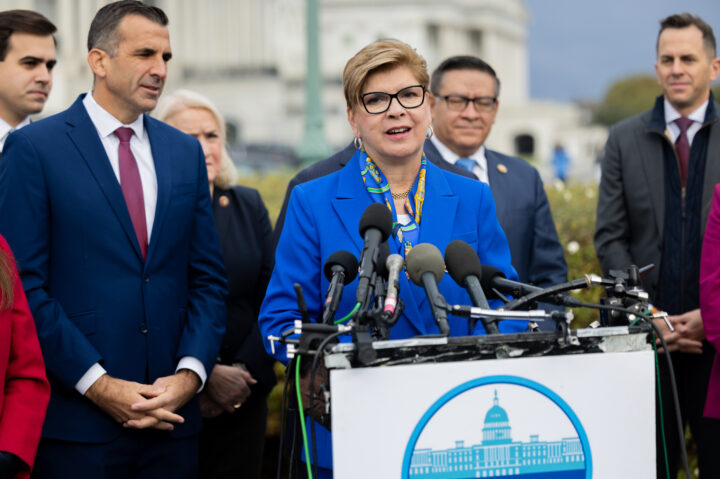
Nathan Posner/Anadolu via Getty Images
Rep.-elect Nellie Pou (D-NJ) speaks during a press conference introducing new members of the Congressional Hispanic Caucus in Washington, DC on November 15, 2024.
Rep. Nellie Pou (D-NJ) starts out her first re-election campaign at a crossroads: Running in a historically deep-blue district that President Trump surprisingly carried, she’s caught between her background as a liberal leader and the pressures of a purple district that could pull her toward the political middle to preempt Republican opposition.
Pou — who has never faced such a competitive general election in her political career — has generally leaned left while keeping a relatively low profile on the Hill. She joined the Congressional Progressive Caucus and stuck with the majority of her party on many key votes, including some pertaining to antisemitism and Israel that divided the Democratic caucus. She now faces a well-credentialed GOP challenger — Clifton, N.J., councilmember Rose Pino — as the Republican Party hopes to keep her urban north New Jersey district on its target list.
Despite representing a district with a sizable Jewish population, she didn’t join many of the moderates in her party in voting for a Republican-led resolution last month condemning the antisemitic attack in Boulder, Colo., urging stronger enforcement of immigration laws and supporting Immigration and Customs Enforcement.
The Boulder resolution split the Democratic caucus, with 75 lawmakers voting for the resolution and 113 voting against it. Some Democrats objected to the immigration-related language.
Pou, and nearly all other Democrats, voted in favor of a second resolution condemning a series of recent antisemitic attacks without that language.
“Congresswoman Pou believes that the rise of antisemitism in the United States and across the world is alarming and unacceptable. That’s why Congresswoman Pou voted in favor of a resolution on the House floor fully condemning antisemitism,” Pou spokesperson Mark Greenbaum told Jewish Insider. “And it’s why she is using her position on the Homeland Security Counterterrorism and Intelligence Subcommittee to demand increased funding for law enforcement to keep our Jewish communities safe and greater federal grants for synagogues and schools to upgrade their security.”
Pou also voted earlier this year against sanctioning the International Criminal Court, another vote that split House Democrats. Forty-five Democrats supported the sanctions.
But she has joined other efforts to support Israel and the Jewish community during her tenure, including signing a letter urging prompt federal approval of additional flights by Israeli airlines between the U.S. and Israel and calling for $500 million in funding for the Nonprofit Security Grant Program in 2025.
Pou’s district, New Jersey’s 9th, has both significant Jewish and Palestinian constituencies. Rep. Bill Pascrell (D-NJ), Pou’s predecessor who died in August 2024, faced a primary challenge from Prospect Park, N.J., Mayor Mohamed Khairullah, who focused his campaign squarely on criticizing Pascrell’s support for Israel.
Pou was tapped by New Jersey Democratic leaders to replace Pascrell on the ballot after the congressman died during the election cycle — and they assumed she would face little opposition in future elections.
Pou’s district was considered a safe Democratic seat before the election, and Trump’s performance came as a surprise to Democrats, leaving Pou, the former majority leader in the state Senate, on guard as she prepares to defend her seat next year.
Pou told the New Jersey Globe she takes political pressures into consideration on divisive votes, “But I also think it’s [about] doing the right thing.”
“Politics is very important, and I would love to make sure I have the opportunity to return back to Congress,” Pou said. “But I also think that we are here to do a job, and that we should be doing it with the right reasons in mind.”
Pino, a leading GOP recruit, announced her campaign on Thursday. Pino is a longtime local official and the child of Ecuadorian immigrants. Pou herself is the first Latina woman from New Jersey to serve in Congress. The district has a sizable Hispanic population.
Republican Billy Prempeh, whom Pou beat by five percentage points in the 2024 election, is also running again. Prempeh was endorsed by the New Jersey chapter of the Council on American-Islamic Relations last year and supported cutting off U.S. aid to Israel to stop the war in Gaza; opposed Israeli strikes on Gaza, saying in part, “I’m not dying for Israel”; and opposed the Antisemitism Awareness Act.
Andre Sayegh, the mayor of Paterson, N.J., who called his city “the capital of Palestine in the United States of America” and has been critical of Israel, is a potential primary challenger to Pou.
Pou’s re-election campaign raised $500,000 in the second quarter, reporting $780,000 on hand.
Trump won the district by a point, after President Joe Biden won it by nearly 20 points in 2020. Pou’s margin of victory was also substantially smaller than Pascrell’s in previous races, and Republicans see her as a top target in 2026.
“Nellie Pou went to Congress pledging to be a friend of Israel and the Jewish community, but that was a pledge she never intended to keep,” National Republican Campaign Committee spokesperson Maureen O’Toole said. “The truth is, Pou is backed and bankrolled by rabid antisemites, and her vote … makes it clear that she stands with them. Nellie Pou won’t be sitting in her Trump-won district much longer.”
The Democratic Congressional Campaign Committee pushed back, noting her vote in favor of the second antisemitism resolution that passed the House nearly unanimously.
“Congresswoman Nellie Pou has been outspoken on combatting antisemitism and joined Republicans and Democrats in voting for a bipartisan resolution to condemn the horrific attack in Boulder, Colorado,” a DCCC spokesperson told JI. “Nellie is working hard to lower costs and deliver for New Jersey’s 9th District, which is exactly what her constituents elected her to do.”
The DCCC spokesperson also highlighted Pou’s work in supporting police funding and opposing the GOP reconciliation bill.
The ADL accused the nation’s largest teachers union of pushing a ‘radical, antisemitic agenda on students’
Kristoffer Tripplaar/Sipa via AP Images
A logo sign outside of the headquarters of the National Education Association (NEA) labor union in Washington, D.C. on July 11, 2015.
A grassroots campaign urging educators to stop using teaching materials from the Anti-Defamation League reached the highest levels of K-12 education over the weekend.
Inside a packed conference hall in Portland, Ore., the thousands of delegates who make up the governing body of the National Education Association — the largest teachers union in the country — passed a measure that bars the union from using, endorsing or publicizing any materials from the ADL.
In the moments before the vote, several Jewish delegates spoke passionately in opposition of the measure.
“I stand here and ask you to oppose [the measure] to show that all are truly welcome here,” a teacher from New Jersey said, according to audio of the closed-door meeting obtained by Jewish Insider.
Another Jewish teacher quoted NEA Executive Director Kim Anderson from her keynote address earlier in the weekend. “This union has your back,” Anderson told the more than 6,000 assembled delegates.
“Does that include stopping Jewish hate, antisemitism? Some of our members don’t feel they are safe,” the Jewish teacher said during Sunday’s debate.
The vote occurred by voice. The margin was so close that delegates had to vote three times as the chair considered whether the loudest cheers were in support of the measure or in opposition, but, ultimately, it still received the backing of more than half the delegates. It now heads to the NEA’s nine-member executive committee, which gets the final word on whether the measure will be put into effect. (The passage of the anti-ADL measure was first reported by the North American Values Institute.)
The episode garnered criticism from Jewish teachers and allies. NEA’s national leadership has not yet weighed in on the measure.
“At a time when incidents of hate and bias are on the rise across the country, this action sends a troubling message of exclusion and undermines our shared goal of ensuring every student feels safe and supported,” a spokesperson for the NEA’s Jewish affairs caucus said in a statement to JI. The caucus said its members plan to continue using ADL materials in their classrooms.
The ADL slammed the vote, calling it “profoundly disturbing that a group of NEA activists would brazenly attempt to further isolate their Jewish colleagues and push a radical, antisemitic agenda on students,” according to an ADL spokesperson.
Staci Maiers, an NEA spokesperson, declined to comment on the specific measure. “NEA members will continue to educate and organize against antisemitism, anti-Muslim bigotry and all forms of hate and discrimination,” Maiers told JI in a statement. “We will not shy away from difficult or controversial issues that affect our members, our students or our schools.” (The NEA assembly also adopted a measure pledging to highlight Jewish American Heritage Month each May.)
The NEA’s adoption of a measure targeting the leading Jewish civil rights organization may be an escalation, but it is only the most recent example of antisemitism — and divisive politics surrounding the war in Gaza — spilling into K-12 education, and teachers unions in particular.
Since the 2023 Hamas attacks, Jewish parents have raised concerns about discrimination against Jewish students and about the increasingly frequent use of anti-Israel materials in classrooms. Last week, for instance, the parents of an 11-year-old sued their child’s Virginia private school, alleging school administrators ignored antisemitic harassment directed against her for months.
The NEA’s vote on the anti-ADL measure grew out of a campaign called #DropTheADLFromSchools, which began with an online open letter and gradually garnered the support of some of the country’s most powerful local unions, including United Teachers Los Angeles, which represents 35,000 LA teachers.
In March, UTLA president Cecily Myart-Cruz wrote a letter asking the superintendent of the LA Unified School District and the LAUSD school board to stop using ADL materials and “refuse to contract or partner” with the ADL, because of its “focus on indoctrination rather than education.” (An LAUSD spokesperson said no action had been taken in reference to the letter.)
Last year, the NEA joined a campaign to pressure then-President Joe Biden to halt all U.S. military aid to Israel. The Massachusetts Teachers Association, an NEA affiliate, has encouraged members to introduce anti-Israel materials into classrooms.
Last week, the largest teachers union in California published a letter urging state senators to vote against a bill focused on fighting and preventing antisemitism.
“While we share the same overarching goal of the AB 715 author and sponsors of combating antisemitism, we have serious reservations about the proposed methods for achieving it,” wrote Seth Bramble, legislative relations manager of the California Teachers Association, a 300,000-member affiliate of the NEA. “We are also concerned with academic freedom and the ability of educators to ensure that instruction include perspectives and materials that reflect the cultural and ethnic diversity of all of California’s students.”
In May, the state assembly voted unanimously to approve the bill, which was co-sponsored by the Jewish, Black, Latino, Native American and Asian American and Pacific Islander legislative caucuses. The legislation would create a statewide antisemitism coordinator in the state’s Education Department and strengthen anti-discrimination protections, while providing additional guidelines to keep antisemitism out of teaching materials.
But the bill’s fate is now in jeopardy as senators face pressure from one of the state’s most powerful unions to reject it. The California Senate’s education committee is set to vote on the bill on Wednesday. State Sen. Sasha Renée Pérez, the Los Angeles-area Democrat who chairs the committee, did not respond to a request for comment about whether she plans to vote for the bill.
State Sen. Scott Wiener, a Democrat from San Francisco and the co-chair of the legislative Jewish caucus, said it is “frustrating” seeing the CTA oppose the bill instead of collaborating with its authors.
“We need, as a matter of state policy, to be very, very clear that antisemitism will not be tolerated in California public schools,” Wiener told JI. “I was really disappointed to see CTA’s letter which basically says, ‘Oh, we hate antisemitism, but we can’t possibly do anything meaningful about it.’” (A CTA spokesperson did not respond to a request for comment.)
More than two dozen California Jewish groups released a statement on Monday slamming the CTA, saying that advocates for the bill have already put its passage on hold for more than a year to try to negotiate with the union. The sponsors pivoted from an earlier version of the bill — which was intended to root out antisemitism in the state’s ethnic studies curriculum — at the urging of the CTA.
“We call on the legislature to stand firmly in support of California’s Jewish students and move the bill forward,” wrote the Jewish organizations, including the ADL, StandWithUs, American Jewish Committee and the Jewish federations in Los Angeles, San Diego, San Francisco and several other communities.
Jewish community activists plan to spend the next two days lobbying for passage of the bill. Jay Goldfischer, a teacher in Los Angeles County, is traveling to Sacramento to urge lawmakers to vote for it.
“Jewish students across California are being silenced. Many are afraid to walk into their schools, unsure if they’ll be targeted for who they are,” Goldfischer told JI. “As a CTA member, I am personally disappointed that CTA doesn’t feel Jewish students are worth protecting.”
The former Pima County supervisor has struggled to articulate her approach to Israel as she faces Daniel Hernandez, who identities a pro-Israel progressive

Adelita Grijalva campaign page
Adelita Grijalva
The latest Democratic primary battle between the left and center where Israel has emerged as a point of division is playing out in a special House election in Tucson, Ariz., later this month, as five candidates vie to replace former longtime Rep. Raul Grijalva (D-AZ), who died in March.
The July 15 primary in Arizona’s dependably blue 7th Congressional District has kept a relatively low profile, even as it features ideological tensions over Middle East policy that could hold implications for the party’s increasingly fractious approach to Israel in the lead-up to next year’s midterm elections.
Adelita Grijalva, 54, a former Pima County supervisor, is viewed as the heavy favorite to win the seat in what is expected to be a low-turnout race, owing in part to her significant name recognition in the area represented by her late father for over two decades.
She has also consolidated endorsements from top establishment Democrats, including Sens. Mark Kelly (D-AZ) and Ruben Gallego (D-AZ), while securing the backing of progressive leaders such as Reps. Alexandria Ocasio-Cortez (D-NY) and Sen. Bernie Sanders (I-VT), among other high-profile critics of Israel in Congress.
But her limited record of commentary on Israel has raised questions among pro-Israel activists rallying behind one of Grijalva’s chief primary rivals, Daniel Hernandez, a former state lawmaker who identifies as a pro-Israel progressive and claims support from Rep. Ritchie Torres (D-NY) and the political arm of Democratic Majority for Israel.
The 35-year-old Hernandez, recently named the board chair of the Zionist LGTBQ organization A Wider Bridge, has pitched himself as a “consistent champion” of pro-Israel causes, in contrast with the late Grijalva, who during his long tenure embraced hostile positions toward Israel — most prominently when he joined a small handful of House Democrats to oppose additional funding for Israel’s Iron Dome missile-defense system in 2021.
Like her father, the younger Grijalva appears more skeptical of Israel amid its war in Gaza, even as she has yet to publicly clarify her own views on a range of key issues, such as continued U.S. security aid to Israel, which has faced vocal resistance from some of her supporters on the left.
Grijalva called for a ceasefire between Israel and Hamas 10 days after the Oct. 7, 2023, attacks. In her role as a county supervisor, she also reluctantly voted for a resolution that condemned Hamas, while voicing frustration that she “couldn’t talk about peace and humanitarian aid” for Gaza.
More recently, Grijalva has struggled to clearly articulate her approach to Israel and the broader Middle East, suggesting in a recent discussion with a progressive organization that speaking candidly about her views could draw outside spending from pro-Israel advocacy groups such as AIPAC, which has targeted Israel critics in Democratic primaries, into the race.
“The frustration for me, and it will always be, I think, is that there were some things that my dad could get away with that a lot of these organizations that come in and try to influence races and stuff, he predated them,” Grijalva explained during a Zoom call in May with Progressive Democrats of America, an anti-Israel group that is backing her campaign.
Her father, who died at 77, “was like this mountain in the middle, like no one’s moving him one way or the other,” she continued on the call, some portions of which were recently reviewed by Jewish Insider. “But I do think that in this environment, when we are not in normal times and you can’t negotiate with terrorists, there is a difference here, where walking in, I know it’s going to be a different experience for me than it was for my dad.”
A spokesperson for AIPAC said on Wednesday that the group is “not involved” in the race. DMFI PAC, which has also engaged in several House primaries in recent cycles, has so far refrained from investing in the race, despite backing Hernandez. The group did not respond to a request for comment about its plans for the final days of the election, now less than two weeks away.
Elsewhere in the Zoom discussion, Grijalva dodged a question about her position on sending U.S. arms to Israel amid its war against Hamas in Gaza, which she called an “atrocity,” while echoing a section on her campaign site calling for “an immediate release of the remaining hostages in Hamas captivity” and “rapid and complete restoration of humanitarian aid into the Gaza Strip” to set “the foundation for a two-state solution.”
“The surest way to bring them home, defeat Hamas and begin the process of rebuilding Gaza for the Palestinian people,” Grijalva said on the call, “is through a long-term, just and peaceful resolution, which the United States has a responsibility to work towards.”
Still, she suggested that U.S. involvement in the ongoing conflict “has not been helpful at all,” and vaguely argued that “the United States has been a part of interfering with this process and trying to aid in different ways.”
Pro-Israel activists in Arizona, none of whom would agree to speak on the record over concerns of antagonizing a likely future member of Congress, have voiced apprehension about Grijalva’s comments on Middle East policy, pointing to a lack of general clarity on major issues.
During a Zoom conversation this week with the Arizona Democratic Party Jewish Caucus, for example, Grijalva was asked about her “understanding of the term ‘intifada,’” a recent subject of heated debate as Zohran Mamdani, the far-left Democratic nominee for mayor of New York City, has faced backlash for doubling down on defending calls to “globalize” the Palestinian uprisings against Israel — which critics have interpreted as stoking violence against Jews.
Grijalva, who has condemned recent antisemitic attacks, indicated that she was unfamiliar with the term, according to a brief recording of the Zoom discussion shared with JI on Wednesday. “I don’t really know in this case what that means,” she said in response.
Grijalva’s campaign did not respond to a request for comment.
Limited public polling on the primary has shown Grijalva leading the field, which includes Deja Foxx, a 25-year-old political influencer who says she has raised $500,000 as her campaign has continued to gain some traction. On Wednesday, Foxx notched an endorsement from David Hogg’s political action group, which said “she has translated her story to represent a new vision of generational change that speaks truth to” President Donald Trump’s “cruel policies.”
An internal poll commissioned by Foxx’s campaign and publicized earlier this week reportedly showed her in second place behind Grijalva with 35%, marking a major improvement over her standing in a previous survey, released in April, where she claimed 5% of the vote.
Foxx has rarely addressed developments in the Middle East, but she has indicated that she would be among the more outspoken critics of Israel if elected. In a video she shared on social media late last month, Foxx is seen addressing voters about the war in Gaza, arguing that “this is the issue that has politicized my entire generation.”
“We have watched devastation unfold on our screens as we have come of age,” she said in her remarks, while adding, “I want to be really clear that in one of the richest countries in the world, it is unconscionable that we send money abroad for weapons that disproportionately hurt women and children and families when families right here do not have food or insurance or housing.”
Jose Malvido Jr., a longshot candidate who has appeared in debates, has for his part repeatedly called Israel’s military actions in Gaza a “genocide,” an accusation his opponents have at least publicly avoided.
In perhaps a rare moment of unity on Middle East policy, both Grijalva and Hernandez have suggested that they would support an impeachment inquiry on Trump’s unilateral decision to strike Iran’s nuclear facilities last month. Foxx forcefully condemned the attacks, saying that the U.S. “should not be dragged into another endless war by a reality TV president.”
Mike Noble, a pollster and political analyst in Arizona, said Grijalva is “in the driver’s seat” as the primary enters its final stretch, noting it is “her race to lose.” Foxx, he speculated, could potentially peel support from Grijalva’s progressive base, but said it is unlikely that even a split vote would amount to a meaningful change in the outcome. “I’m less bullish on Hernandez,” he told JI, even as he acknowledged that the former state lawmaker could “pull off some votes.”
Grijalva’s ambiguous comments addressing Israel, meanwhile, do not appear to have tangibly stunted her path to the nomination — particularly as recent political developments have shown that embracing firm pro-Israel positions may no longer be as strong a prerequisite for a winning Democratic campaign amid declining voter sympathy for the Jewish state.
Pro-Israel activists are also preparing for a Grijalva victory, while continuing to voice reservations over the direction she will take on key Middle East policy issues if she is elected to succeed her father in the House.
No such questions surround Hernandez, said Alma Hernandez, his sister and a top campaign surrogate, who is an outspoken defender of Israel in the state Legislature.
“His record speaks for itself,” she told JI, saying that he “will always fight for what’s right and bring principled leadership to Congress.”
GHF head Johnnie Moore said the world is turning a blind eye to Hamas violence against aid workers
Jerritt Clark/Getty Images for Museum of Tolerance
Reverend Dr. Johnnie Moore, President of the Congress of Christian Leaders attends the Museum Of Tolerance Commemoration of the one-year anniversary of the October 7 attacks at Museum Of Tolerance on October 06, 2024 in Los Angeles, California.
Rev. Johnnie Moore, a member of President Donald Trump’s evangelical advisory committee, has years of experience with complex situations in the Middle East. He helped evacuate Christian refugees under threat from ISIS and has advocated for religious freedom and tolerance for minorities in the region.
But the challenges Moore faces as executive chairman of the Gaza Humanitarian Foundation, the U.S. group, supported by Israel, that began distributing food and humanitarian aid in Gaza in May, have been unique.
Since its inception, GHF has faced a pervasive negative narrative in the international media and among aid organizations. More recent statements from U.N. and other aid groups in effect accuse the GHF of being an IDF front luring Gaza residents to one place so they can be attacked, while largely ignoring Hamas violence against Palestinians working with the GHF.
In a wide-ranging interview this week with the Misgav Institute for National Security’s “Mideast Horizons” podcast, co-hosted by Jewish Insider’s Lahav Harkov, Moore pushed back against what he says are false narratives about the group’s work and accused aid organizations of “sabotage” and spreading disinformation, while acknowledging the challenges of aid distribution in an active war zone.
*****
GHF is addressing “a problem that everyone knew and admitted existed … and now everyone has amnesia,” Moore said. “The vast majority of humanitarian assistance that has gone into the Gaza Strip over many, many, many years, was almost immediately diverted into the hands of Hamas, and then used for various nefarious purposes. And I’m not talking about some of the aid — I’m talking about almost all of the aid.”
As such, the mission of GHF is to equally and directly distribute aid to Gazans without having it be “used to prolong a conflict or hoarded,” he said.
Since the beginning of GHF’s operations on May 26, the organization has opened four distribution sites in southern Gaza, from which it said it has provided Gazans with over 958,000 boxes of food. Moore said the GHF calculates meals with a greater caloric value than what the U.N. aid organizations distribute, and by the GHF’s count, it has distributed over 54.8 million meals.
“In an objective world, this would be viewed as an incredible success,” Moore said. “To my great surprise, we poked a number of bears that I wasn’t anticipating, and not all of them are Hamas threatening our local aid workers and the Americans helping these people. A lot of [the antagonists] wear suits and are in places like Geneva and New York City.”
Moore quipped that he has faced “lots of trouble” in his career advocating for religious freedom for Christian minorities around the world, including death threats and sanctions from the Chinese Communist Party, but that the negative response to GHF is unique.
“Respectable — I don’t even call them respectable anymore — elite organizations that we would assume [have] good intent have just attacked us again and again. The whole time, we’re like ‘cooperate with us … teach us, let’s find ways of solving problems together,’” to no avail, he said.
Moore said he would have liked to collaborate with major humanitarian organizations, such as the World Food Program, but that the U.N. has “been trying to sabotage us from the very beginning.”
“We’d really like the people whose job it has been to do this for many years to decide to help us,” he added. “Instead, they spread lies that originate in Hamas and try to shut us down, and I can’t think of anything more immoral than trying to shut down an operation that’s … feeding millions and millions of meals every day.”
Moore said details his staff on the ground in Gaza have heard from residents have been “a shock to us,” and revealing about other humanitarian aid groups’ conduct.
“Early on, we had a number of people who wanted to confirm that the aid was free, because in every other circumstance, their experience was that the aid that was coming in from the United Nations and other organizations was being taken and sold to them. It was unbelievable to them that we were giving this stuff away for free,” Moore said.
Moore pushed back against news stories associating death and killing in Gaza with the GHF and its distribution sites, slamming them as “lies.”
“We didn’t wait for a ceasefire to start our aid distribution. We’re distributing aid in the middle of a hot war,” he said. “There have been incidents in the Gaza Strip of civilians being killed. But what’s clear is that there is this very intentional disinformation campaign that is trying to say that … the GHF is a death trap, that we exist not to feed people 50 million meals, but to lure people. This is the lie that they keep telling.”
Hamas has dedicated extensive efforts to delegitimizing GHF in the eyes of the world and trying to threaten and scare Gaza residents seeking food from GHF, Moore said.
“They release these statistics every single day and they say that all these people are being killed at our aid sites or in close proximity to our aid sites,” Moore said. “This is their primary way of both trying to scare Gazans [from] getting our aid, trying to force us to shut down, trying to force European governments not to fund us, for the United Nations to continue opposing us.”
Moore has been actively pushing back on social media against false claims about GHF, and called on the media and international organizations to scrutinize claims from the terrorist organization in Gaza, “but no one is asking hard questions,” he lamented.
“What about the prolific evidence that we do have of Hamas intentionally killing people and then attributing their murder to the GHF or others?” he added.
Moore said that “sometimes you read all these crazy headlines and you’re like, ‘Am I deceiving myself here?’ but we’re actually talking to the people [of Gaza] every day, and it seems [reality] really is in many cases the exact opposite.”
On the ground in Gaza, Moore says people are adapting to GHF’s mode of distribution, with families often getting together to trade if one needs more of one product than another. GHF also tries to be flexible under the circumstances, having morning and evening distribution times when needed to keep the process more orderly.
Some Israeli politicians have maintained that providing aid for Gaza hinders the achievement of Israel’s war aims. Some on the right, who oppose letting any aid into Gaza, argue that if Hamas can pocket humanitarian aid and make money selling it, they will continue to control the enclave. And Hamas does still retain a significant measure of control over the area, despite more than 20 months of IDF operations.
Moore agreed with the argument that Hamas’ ability to take control of aid was “prolonging the conflict,” but said that GHF’s “mission is not related to the war.”
Still, he said that he thinks Hamas feels very threatened by GHF: “The fact is that Hamas continues to threaten Gazans and killed 12 of our local workers two weeks ago and nearly killed others and tortured others … Hamas took them to the Al Nasr Hospital and piled the dead and the injured outside … and wouldn’t let them get medical treatment, in order to send a message.”
“So I think it’s a hard argument to make that Hamas doesn’t oppose what we’re doing or isn’t somehow feeling threatened by what we’re doing,” Moore added. “Think of the fact that they issued bounties on the heads of Americans … They’re doing everything they can to shut [the GHF] down, which means that every time our aid workers, local or American, step into [Gaza], they are risking their lives in order to feed people.”
Moore noted that GHF does not operate in northern Gaza, where U.N. trucks continue to enter and are often taken by Hamas: “There was one day where 55 U.N. trucks went in and literally 52 were hijacked at gunpoint by Hamas or Hamas-linked militants,” he said. Another example he recalled was a time when “there was a [U.N.] truck that went in … Hamas wasn’t able to hijack the truck. So what does Hamas do? Hamas kills civilians around the truck to try to keep the civilians from getting what they can.”
“Amidst all of this, the U.N. literally told the BBC that none of their aid had been diverted. Zero. That was the official statement,” Moore said. “The U.N. is just lying through their teeth.”
Moore declined to share who funds GHF, but said that “the seed funding … principally came from a couple of countries, not Israel, that wanted to remain totally secret for political reasons.” Moore said he supports the decision of those countries not to reveal themselves, because of the negative narrative about the GHF, and expressed appreciation for the Trump administration for contributing to the foundation and encouraging others to do the same.
*****
Last month, Moore visited Syria with Rabbi Abraham Cooper of the Simon Wiesenthal Foundation and a Syrian Muslim refugee who had fled the country. In Damascus, Moore met with al-Sharaa for nearly three hours.
Moore’s approach to al-Sharaa’s new government in Syria, he said, “comes down to two things. Number one … You’re saying nice things, but can we trust you? And number two, if we can trust you, are you actually capable of doing these things?”
Following the meeting, Moore said, “I absolutely believe there will be peace between Syria and Israel.”
“I think the first priority in Syria has to be the stabilization of Syria. But I definitely left that conversation with a very clear idea of what needed to be done, of how it could be done, and of the probability in the right time of it being done in order to see peace all across the region.”
There have been contradictory reports in recent days as to whether al-Sharaa is willing to acknowledge Israeli sovereignty in the Golan Heights. Moore suggested that peace between the countries may involve things that make both sides “uncomfortable.”
“I do think many of us, including many people in Israel, misread certain aspects of this new government, all for good reasons,” Moore added, referring to those who highlight al-Sharaa’s history as a leader of an Al Qaeda affiliate in Syria. “Those of us who focus on the Middle East … have a tendency to be, we can be cynical, we can be conspiratorial, we can be a bit paranoid sometimes … But I always say the most valuable commodity in the Middle East is not oil or gas, it’s trust. If there’s no trust, nothing exists. And our visit was a trust-building exercise, and it was far more beneficial than I expected.”
Moore called al-Sharaa “a type of unicorn.”
“He comes from an Islamist orientation, no question whatsoever. But I’m not sure you can take this person and easily profile him,” Moore said. “This is the last gasp of a lot of extremists and when I met with Shahra, I viewed him as being more like [Saudi Crown Prince Mohammed bin Salman] as almost any other of the leaders that I’ve that I’ve met with, in terms of his generation, and the way he talks about solving problems and all of these things. This is a younger generation of leaders in a region with a lot of older leaders who think only about the past. I think al-Sharaa, like MBS, and a few other leaders, are future-oriented.”
Moore called for the U.S. to help Syria rebuild, because the country’s economy and infrastructure are in shambles.
*****
Moore has also been a longstanding advocate for a strong U.S.-Israel relationship and evangelical support for Israel.
Asked about polls showing decreasing support for Israel among young evangelicals, and the rise of figures such as Candace Owens and Tucker Carlson who have used Christianity as an argument against such support, Moore said he thinks the decline is exaggerated as is the influence of the podcasters.
“For a long time, there was exaggerated concern about a rise of antisemitism on the right while we were watching this incredible surging of antisemitism on the left. Well, now, I’m sorry to say, but we’re seeing it on both sides,” Moore said. “Yet, it actually isn’t the right. OK, it’s a type of pseudo-libertarianism. You know that isn’t a part of the institutional right, but because of the internet, it’s much more influential.”
Still, he added, “I’m not seeing some of these actors becoming more influential among evangelicals. I’m seeing evangelicals reject these influencers as they start talking about things that evangelicals actually know quite well … like skepticism about, you know, the evangelical relationship with Israel.”
Moore said he summarizes the relationship between evangelicals worldwide with the Jewish community, and Israel in one sentence: “Your book is our book; your heroes are our heroes; and your values, while we interpret them differently, are our values.”
“You have this massively dispersed religious movement around the world, 700 million people, and they all generally feel the same, 80-90% of them, about the Jewish community and Israel, because they get it from the Bible,” he said. “I’m not focused very much on politics these days, as we try to feed Gaza, but I think the evangelical community all around the world is a positive force and I don’t think the macro trends are changing at all.”
Plus, Bibi plans a Beltway blitz

Jemal Countess/Getty Images for Fair Share America
Sen. Chris Murphy (D-CT) speaks at the U.S. Capitol on April 10, 2025 in Washington, DC.
Good Tuesday morning.
In today’s Daily Kickoff, we look at Sen. Chris Murphy’s leftward shift on Israel, and spotlight Rep. Raja Krishnamoorthi’s congressional votes and relations with Illinois’ Jewish community as he mounts a bid for Senate. We cover Israeli Prime Minister Benjamin Netanyahu’s upcoming trip to Washington, and report on a new lawsuit alleging the Nysmith School in Northern Virginia discriminated against Jewish students. Also in today’s Daily Kickoff: Doron Spielman, Karen Diamond and Susan Rice.
What We’re Watching
- Secretary of State Marco Rubio is meeting in Washington today with his counterparts from Japan, China and Australia.
- The Carnegie Endowment for International Peace’s Aaron David Miller is hosting a web event this morning with former CIA Director David Petraeus and analyst Karim Sadjadpour focused on Israel, Iran and the U.S.
- Former U.S. Ambassador to Israel Dan Shapiro is speaking this morning at a Center for International & Strategic Studies event on ties between North Korea and Iran.
- The Christians United For Israel summit continues today in Washington. Virginia Attorney General Jason Miyares, the Brandeis Center’s Ken Marcus and Israel Ambassador to the U.N. Danny Danon are slated to speak today.
- The Aspen Ideas Festival in Colorado wraps up today.
- New York City is slated to release the first round of ranked-choice voting results from last week’s primaries
What You Should Know
A QUICK WORD WITH JI’S JOSH KRAUSHAAR
The political developments over the last week couldn’t send a more dispiriting message about the viability of the political center — in both parties.
Last Tuesday, a self-proclaimed democratic socialist, Zohran Mamdani, who campaigned on a far-left agenda on issues ranging from the economy, crime and antisemitism, emerged as the Democratic standard-bearer for mayor of New York City.
Over the weekend, Sen. Thom Tillis (R-NC), one of the most pragmatic Republicans in the upper chamber, announced he wouldn’t be running for reelection after signaling he’d be one of two GOP votes against President Donald Trump’s “big, beautiful” budget reconciliation bill. His decision to retire came after Trump, in a Truth Social post, threatened to support a primary challenger.
Tillis, notably, was the deciding Republican vote scuttling the nomination of interim D.C. U.S. Attorney Ed Martin for, among other issues, his associations with a Nazi sympathizer.
And on Monday, Rep. Don Bacon (R-NE), one of only three House Republicans who represents a district that former Vice President Kamala Harris won in 2024, formally announced his retirement, making it all the more likely a more-partisan Democratic lawmaker will succeed him in the seat.
These are just the latest developments that underscore that moderation, pragmatism and bipartisanship are becoming endangered principles in a polarized political environment that rewards extremism and hot takes over thoughtful policymaking.
SOLIDARITY SNUB
Connecticut’s Jewish community wonders: What happened to Chris Murphy?

Two days after the Oct. 7, 2023, Hamas terror attacks, Sen. Chris Murphy (D-CT) spoke emotionally at the “Rally for Israel” in West Hartford, Conn. “This is a moment where we are going to have to stand as a nation with greater force, with greater purpose than ever, to make sure that Israel has what it needs,” Murphy said. But members of Connecticut’s Jewish community say Murphy strayed from that promise just weeks later. In late November 2023, Murphy said on CNN that he was open to placing conditions on U.S. aid to Israel, a position that astounded many of the people who had stood with him in West Hartford not long before. Since then, he has emerged as a vocal critic of Israel’s handling of the war in Gaza, and more than 18 months after the attack, the Connecticut Jewish community’s frustration with him has only grown, Jewish Insider’s Gabby Deutch reports.
Veering off: Murphy voted twice in support of resolutions put forward by Sen. Bernie Sanders (I-VT) that would block certain arms sales to Israel. Following Israel’s strikes on Iranian nuclear facilities, Murphy slammed Israeli Prime Minister Benjamin Netanyahu for sending the Middle East into a “new, deadly conflict.” His shift to the party’s left flank on Israel comes as Murphy positions himself as a leading voice in the Democratic Party in opposition to President Donald Trump’s policies and builds a stronger public profile for himself. He’s a regular on cable news shows and recently created a new political action committee to encourage protests against Trump, with plans to spend $2 million in the 2026 midterms, sparking rumors that he could mount a presidential bid in 2028. It’s not just Murphy’s foreign policy views that are concerning his Jewish constituents. Recently, the senator has emerged as one of the most prominent boosters of presumptive New York City Democratic mayoral nominee Zohran Mamdani, even as some of his Democratic colleagues have raised concerns about Mamdani’s refusal to condemn the phrase “globalize the intifada.”
Communal concerns: Rabbi Tuvia Brander, the spiritual leader of Young Israel of West Hartford, told JI that Murphy’s praise of Mamdani is “so beyond the pale of what is just in the basic interests of many of his constituents.”
PRAIRIE STATE OF PLAY
Rep. Raja Krishnamoorthi hopes to win the Jewish vote in Illinois Senate contest

As he competes for Illinois’ open Senate seat, Rep. Raja Krishnamoorthi (D-IL) is hoping that the state’s sizable Jewish community, concentrated in the Chicago area, will help him chart a path to victory in the Democratic primary, Jewish Insider’s Marc Rod reports.
Making his pitch: “I do think that [Jewish voters] have a desire for a strong U.S.-Israel relationship,” Krishnamoorthi said, “and I don’t think there’s anybody else with the track record in this race that I possess, showing strong support for that relationship, but also knowing why that relationship needs to continue to be strong on a bipartisan basis, and we need to take this out of politics.” Krishnamoorthi spoke to JI about his approach to antisemitism, Iran and the U.S.-Israel relationship.
WAR OF WORDS
Responding to Mamdani, Senate Democrats say ‘globalize the intifada’ slogan must be condemned

Several Senate Democrats told Jewish Insider’s Emily Jacobs and Marc Rod on Monday that calls to “globalize the intifada” are unacceptable and must be condemned, amid concerns from Jewish leaders and organizations over presumptive New York City Democratic mayoral nominee Zohran Mamdani’s defense of the slogan.
Mamdani musings: Senate Minority Leader Chuck Schumer (D-NY), who has thus far not endorsed Mamdani, told JI he plans to meet with Mamdani in a few weeks, when asked about Mamdani’s refusal to condemn the slogan. “Sen. Schumer condemns the phrase ‘Globalize the Intifada’ and believes it should not be used because it has such dangerous implications. As Senator Schumer said after the death of Karen Diamond, the attack in Boulder continues to serve as a grave reminder of the deadly consequences of the rise in antisemitism,” a spokesperson for Schumer told JI. “I don’t know what [Mamdani’s] position is on it, but I certainly think that the call to spread the intifada is the kind of incitement that can lead to extremist violence,” Sen. Richard Blumenthal (D-CT) told JI.
Read the full story here with additional comments from Sens. Jacky Rosen (D-NV), John Fetterman (D-PA) and Kirsten Gillibrand (D-NY) and Rep. Ritchie Torres (D-NY).
TRIP TALK
Netanyahu heading to D.C. next week to ‘take advantage of the victory’ in Iran

Israeli Prime Minister Benjamin Netanyahu’s White House visit next week is a chance to “take advantage of the victory” in Iran, he said at the start of a Cabinet meeting on Tuesday,Jewish Insider’s Lahav Harkov reports.
On the agenda: The trip to Washington “comes as a continuation of the great victory we achieved in Operation Rising Lion,” Netanyahu said, referring to Israel’s 12-day operation against Iran’s nuclear and ballistic missile program, which the U.S. joined. “Taking advantage of the victory is no less important than achieving the victory.” An Israeli official told JI on Tuesday that “everything” is on the agenda, including U.S.-Israel cooperation to stop Iran from rebuilding its nuclear program, next steps in Gaza and the possibility of establishing diplomatic relations with Syria and other Arab and Muslim countries.
Meanwhile at Aspen: Susan Rice, who served as national security advisor during the Obama administration’s inking of the nuclear deal with Iran, sharply criticized Trump’s decision to strike Tehran’s nuclear program while defending the 2015 agreement during a panel discussion at the Aspen Institute’s Ideas Festival on Monday,Jewish Insider’s Jake Schlanger reports. Rice joins a chorus of former Obama and Biden administration officials who have criticized Trump’s decision to strike Iran’s nuclear facilities, despite many experts concluding the damage to the program was significant.
Worth noting: The New York Times’ David Brooks, writing in a piece headlined “I Detest Netanyahu, but on Some Things He’s Actually Right,” adds context to consider when evaluating the strikes. “We may know in time what the bombings accomplished. In the meantime, we do know that Israel and the United States have the will and capacity to attack Iran anytime and anyplace. We do know that if Iran reconstitutes its nuclear program, Israel and America have the capacity to deliver a much more devastating and regime-threatening blow. We also know that Iran and its proxies have made some insanely self-destructive miscalculations since Oct. 7, 2023, and they must know that, too. These are ominous omens for the theocrats in Tehran.”
HOSTILE ENVIRONMENT
Brandeis Center files complaint alleging antisemitism at Virginia private school

The parents of an 11-year-old Jewish student at a private school in Northern Virginia say their daughter faced months of antisemitic harassment that went unaddressed by school officials, who also cancelled an annual event featuring a Holocaust survivor due to concerns that the event might exacerbate tensions related to the Israel-Hamas war. Days after the parents addressed the campus environment with school leadership, all three of their children were expelled, according to a complaint filed on Tuesday with the Office for Civil Rights in the Virginia Attorney General’s Office, Jewish Insider’s Haley Cohen has learned.
The allegations: According to the complaint, Kenneth Nysmith, headmaster and owner of The Nysmith School for the Gifted in Herndon, Va., canceled the event with the Holocaust survivor and expressed concern that it might inflame tensions within the school community in light of Israel’s ongoing war against Hamas in Gaza. The complaint, filed by the Louis D. Brandeis Center for Human Rights under Law and Washington-based firm Dillon PLLC, alleges several antisemitic incidents that the parents of the 11-year-old Jewish student say she faced in the months leading up to the cancellation of the Holocaust survivor event. The complaint recounts that in October 2024, their daughter’s history teacher asked students to work together on an art project to create a large drawing featuring the attributes of “strong historical leaders.” The students collaborated on a large artistic rendering of a strong leader, featuring Adolf Hitler’s face.
Elsewhere: The Brandeis Center, working with the Anti-Defamation League and Mayer Brown, filed a brief on Monday with the Department of Education’s Office for Civil Rights, alleging that officials in a Massachusetts school district did not adequately protect Jewish students from antisemitic harassment and discrimination.
BOOK REVIEW
‘When the Stones Speak’: Doron Spielman connects Jewish history to present-day Israel
After Israel waged war against an Iranian regime that has vowed to destroy the Jewish state and diaspora Jews face a heightened atmosphere of antisemitism stemming from the Israel-Gaza war, a new book aims to equip Israel supporters with “a foundation” to refute claims that Jews do not have ancient roots in the land of Israel. When the Stones Speak: The Remarkable Discovery of the City of David and What Israel’s Enemies Don’t Want You to Know, written by former IDF spokesperson Doron Spielman, does so by recounting discoveries made in Israel’s largest excavation site, the City of David, where Spielman has worked closely with archaeologists for two decades to uncover and promote the site’s historical significance. The book, Spielman suggested in an interview with Jewish Insider’s Haley Cohen, is aimed at what he calls “the middle group of people” — “logical, reasonable people” who don’t know whether they’re pro-Israel or anti-Israel.
Lay of the land: “When they understand that ‘when the stones speak,’ they tell the story of the truth of the Jewish people’s connection to the land,” that could help sway the conversation on college campuses. This middle group will come to understand, he said, that “at the very least [the Israeli-Palestinian conflict] is a fight between two people who think they’re indigenous, and at the very best they understand the Jews are people who have only one land, they’ve been there for 3,800 years and therefore they have a right to defend it.”
New York state of mind: Spielman hopes the book’s impact will also reach supporters of New York City mayoral candidate Zohran Mamdani, the presumptive winner of the Democratic primary last week amid his refusal to condemn the phrase “globalize the intifada” and denial that Israel has a right to exist as a Jewish state. “He’s denying the Jewish people their right to live as a nation in the one place they ever called home,” Spielman told JI. “When the Stones Speak cuts through the lies with facts on the ground — literally.”
Worthy Reads
Knockout Blow, But Not the End: The Times of Israel’s David Horovitz reflects on the 12-day war between Israel and Iran. “There is, however, absolutely no room or reason for hubris. Israel allowed itself to slip into existential peril, and the astounding success of the 12-day war is a temporary accomplishment. Iran is not going anywhere. And so long as the ayatollahs retain power, they can be relied upon to recommit to their efforts to wipe out Israel. … Along with delight and profound relief at the achievements of the war, the military and security top brass are resolved not to underestimate the regime and its single-minded determination to destroy Israel. This was a knockout blow in a life-or-death fight. But it is not the end of the existential struggle.” [TOI]
Not Science Fiction: In The Free Press, Matti Friedman considers the impact of Iran’s ballistic missile attack on the Weizmann Institute of Science. “When [neurobiologist Oren Schuldiner] heard that his lab was hit, he said, he had trouble grasping what this meant, and kept texting colleagues to ask what could be salvaged — there were two microscopes in the lab, for example, each worth nearly $1 million, and thousands of fruit fly specimens that he uses to map neural changes that may one day help us better understand diseases like schizophrenia and autism. Finally, a colleague who’d lost her own lab sent him a link to the Wikipedia page detailing the five stages of grief. ‘I understood that I was in denial,’ he said. Only when he made it back did he understand that the lab wasn’t damaged — it was gone, along with most of his work of the past 17 years.” [FreePress]
Lula’s Lurch:The Economist spotlights Brazilian President Luiz Inácio Lula da Silva, whose declining domestic popularity has coincided with his country’s deepening ties with Iran, Russia and China. “On June 22nd, hours after the United States struck Iranian nuclear sites with huge bunker-buster bombs, Brazil’s foreign ministry put out a statement. It said that Brazil’s government ‘strongly condemns’ the American attack, and that the strikes were a ‘violation of Iran’s sovereignty and international law.’ This strength of language put Brazil at odds with all other Western democracies, which either supported the strikes or merely expressed concern. Brazil’s friendliness with Iran is set to continue on July 6th and 7th when the BRICS, a group of 11 emerging-market economies including Brazil, China, Russia and South Africa, holds its annual summit in Rio de Janeiro. Iran, which became a member of the BRICS in 2024, is expected to send a delegation. The club is currently chaired by Brazil’s president, Luiz Inácio Lula da Silva, known as Lula. Originally, being a member had offered Brazil a platform from which to exert global influence. Now it makes Brazil look increasingly hostile to the West.” [TheEconomist]
Word on the Street
President Donald Trump signed an executive order lifting the majority of sanctions imposed on Syria over the last 50 years; the executive order includes steps to lift the Foreign Terrorist Organization status of the Hayat Tahrir al-Sham group that Syrian President Ahmed al-Sharaa previously led, as well as a review of Damascus’ role as a state sponsor of terror…
An Iran-linked hacking group that had previously accessed email accounts associated with Trump’s 2024 campaign threatened to release a new tranche of emails sent from Trump aides…
Satellite images obtained by CNN over the weekend indicate “ongoing activity at and near the ventilation shafts and holes caused by last week’s airstrikes” on Iran’s Fordow nuclear facility…
The Department of Health and Human Services’ Office for Civil Rights issued a 57-page report accusing Harvard of having acted with “deliberate indifference” toward antisemitism and anti-Israel discrimination on the Cambridge campus…
Elon Musk said he planned to support Rep. Thomas Massie (R-KY), who is facing an effort by the White House to recruit a primary challenger over Massie’s refusal to back the administration’s budget reconciliation bill; Musk was prompted by a social media post from former Rep. Justin Amash (R-MI) calling on the X owner to back Massie, but is already facing pushback from some in the Kentucky Jewish community…
Former Rep. Colin Allred (D-TX), who fell short in his bid to unseat Sen. Tex Cruz (R-TX) last year, announced his entry into Texas’ Senate race; Allred is seeking to challenge Sen. John Cornyn (R-TX), who is already facing a tough primary battle…
Karen Diamond, one of the more than two dozen people injured in last month’s antisemitic firebombing attack targeting a Boulder, Colo., march in support of the remaining Israeli hostages, died from her injuries, Jewish Insider’s Gabby Deutch reports…
Unilever cut off financial support for the charitable arm of its Ben & Jerry’s subsidiary, alleging that the ice cream company foundation’s trustees “have continued to resist basic oversight” and refused to provide audit documents…
A British court rejected a legal challenge by the Palestinian NGO Al-Haq that sought to stop the government’s exports to Israel of components of F-35 fighter jets; the court determined it lacked jurisdiction over the U.K.’s defense sector…
British musical group Bob Vylan is facing a criminal investigation over chants the duo led at the weekend Glastonbury music festival calling for “death to the IDF”; U.K. Prime Minister Keir Starmer also denounced the chants, which resulted in the State Department’s canceling of group members’ visas ahead of a planned U.S. tour…
An Australian court ordered a Sydney imam to remove from the internet past speeches that the court said were “fundamentally racist and antisemitic”; the cleric was also instructed to refrain from making similar speeches in the future…
The newly created Kinetica VC fund, founded by Yoav Knoll, Aaron Applbaum, Yitz Applbaum and Frederic Landau, is raising $150 million for investments focused on Israel’s tech industry; the firm has also recruited former U.S. Navy Secretary Kenneth Braithwaite, Joe Lonsdale and former Sen. Norm Coleman (R-MN) to join its advisory board…
Former Israeli hostages Liri Elbag, Karina Ariev, Naama Levy, Danielle Gilboa and Agam Berger visited the set of “Fauda” as the series films its fifth season…
Pic of the Day

Auburn men’s basketball coach Bruce Pearl spoke on Monday at the Christians United For Israel conference in Washington.
Birthdays

Television, film and theater actor, including early career roles in Yiddish theater, Michael Burstein turns 80…
Applied mathematician, statistician and physicist, professor emeritus at both MIT and Harvard, Herman Chernoff turns 102… Former U.S. assistant aecretary of education and research professor at NYU, Diane Silvers Ravitch turns 87… Nobel laureate in economics for 1997 and co-creator of the Black-Scholes model for valuing options and other derivatives, Myron Scholes turns 84… Noted British art dealer and founder of an eponymous London art gallery, Victoria Marion Miro turns 80… Born in a DP camp to her Holocaust survivor parents, she was the first Jewish woman to serve on the Canadian Supreme Court, Rosalie Silberman Abella turns 79… Israeli-Russian businessman, with holdings in energy and international real estate development, Shalva Chigirinsky turns 76… Partner in the Encino, Calif.-based law firm of Nolan Heimann, Douglas E. Mirell… Hall of Fame player and coach in the Women’s National Basketball Association and now an NBA broadcaster, Nancy Lieberman turns 67… Attorney and longtime Democratic activist in Pittsburgh, he is a regional chair of the ADL, Steven D. Irwin turns 66… Contributing editor at The Forward and CEO of the A-Mark Foundation, Rob Eshman… President emeritus of the Orthodox Union and a retired partner at Ropes & Gray, Mark (Moishe) Bane… Undersecretary of state for political affairs during most of the Biden administration, Victoria Jane Nuland (family name was Nudelman) turns 64… Journalist, filmmaker and educator, he is the co-founder of Aish[dot]com, Shraga Simmons turns 64… Professor of Jewish thought at Hebrew University, Benjamin Brown turns 59… Member of the Virginia House of Delegates since 2014, Marcus Bertram Simon turns 55… U.S. senator (R-IA), Joni Ernst turns 55… Screenwriter, producer and film director known for romantic comedy films, Marc Silverstein turns 54… Los Angeles resident, Adam B. Siegel… NASA astronaut, on her 2019 trip to the International Space Station she took novelty socks with Stars of David and menorahs, Jessica Meir turns 48… Co-founder of Edgeline Films, Elyse Steinberg… Hasidic musician mixing elements of dancehall, reggae, hip-hop and R&B, known by his stage name DeScribe, Shneur Hasofer turns 43… Rising senior and president of the school of business and finance at Ocean Township High School in Oakhurst, N.J., Samuel Peretz Fields…
Moderation, pragmatism and bipartisanship are becoming endangered principles in a polarized political environment that rewards extremism and hot takes over thoughtful policymaking
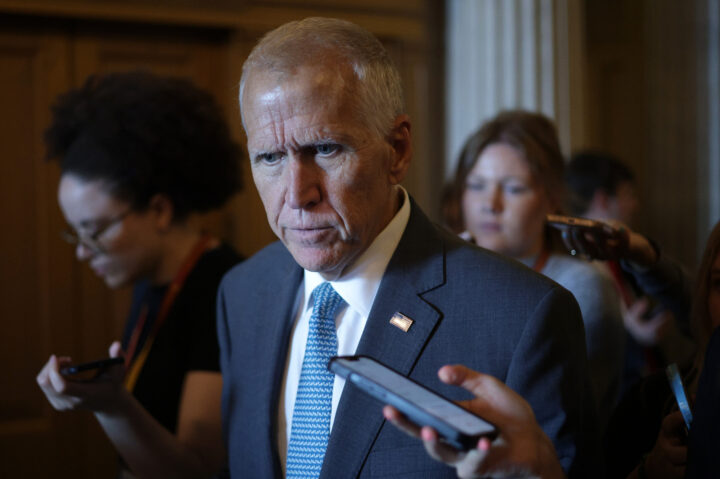
Alex Wong/Getty Images
U.S. Sen. Thom Tillis (R-NC) speaks to reporters at the U.S. Capitol Building on June 30, 2025 in Washington, DC.
The political developments over the last week couldn’t send a more dispiriting message about the viability of the political center — in both parties.
Last Tuesday, a self-proclaimed democratic socialist, Zohran Mamdani, who campaigned on a far-left agenda on issues ranging from the economy, crime and antisemitism, emerged as the Democratic standard-bearer for mayor of New York City.
Over the weekend, Sen. Thom Tillis (R-NC), one of the most pragmatic Republicans in the upper chamber, announced he wouldn’t be running for reelection after signaling he’d be one of two GOP votes against President Donald Trump’s “big, beautiful” budget reconciliation bill. His decision to retire came after Trump, in a Truth Social post, threatened to support a primary challenger.
Tillis, notably, was the deciding Republican vote scuttling the nomination of interim D.C. U.S. Attorney Ed Martin for, among other issues, his associations with a Nazi sympathizer.
And on Monday, Rep. Don Bacon (R-NE), one of only three House Republicans who represents a district that former Vice President Kamala Harris won in 2024, formally announced his retirement, making it all the more likely a more-partisan Democratic lawmaker will succeed him in the seat.
These are just the latest developments that underscore that moderation, pragmatism and bipartisanship are becoming endangered principles in a polarized political environment that rewards extremism and hot takes over thoughtful policymaking.
The list of threats to the mainstream middle are all over: Sen. John Cornyn (R-TX) is facing a serious threat from far-right Texas Attorney General Ken Paxton in next year’s primary despite his long record of pragmatism and thoughtful policymaking as Texas’ senior senator.
Sen. Bill Cassidy (R-LA), who reluctantly cast the tiebreaking vote to confirm Robert F. Kennedy Jr. as HHS secretary despite his record opposing vaccines, is nonetheless facing the likelihood of a tough renomination fight against state Treasurer John Fleming, a former GOP congressman.
Meanwhile, on the Democratic side, Mamdani’s surprise victory threatens to activate the left-wing grassroots in numerous congressional primaries. For a while, it looked like the moderates in the party held the upper hand after an embarrassing 2024 election where activists’ preferred policies badly hurt the Democratic ticket. But amid a DSA victory in New York, anti-ICE activism percolating again throughout the party and significant crowds showing up for anti-Trump “No Kings” protests last month, there are signs of an empowered progressive flank of the Democratic Party.
The emergence of liberal lawmakers like Sen. Chris Murphy (D-CT), who are accommodating out-of-the-mainstream views in the party, is an ominous sign of where the party could be headed.
Murphy told NBC’s “Meet the Press” about Mamdani’s primary win: “He was authentic, right? I mean, yes, he’s got some views that are a little bit out of the conventional mainstream. But you know what? The traditional political pundits have no idea what’s actually mainstream in this country … And so Democrats should learn from his victory.”
We could be close to a time where both parties’ populist, activist wings become the dominant forces in primaries, a trend that has been apparent in recent years and may be past the point of no return. That would be a blow to good governance and a win for performative politics and nonstop narcissism being the driving force in American elections.
In the aftermath of Trump’s decision to order strikes against Iran’s nuclear sites over the weekend, the views of the institutional Jewish community and many rank-and-file Democrats couldn’t have been more divergent

Andrew Harnik/Getty Images
Chairman of the Joint Chiefs of Staff Air Force Gen. Dan Caine discusses the mission details of a strike on Iran during a news conference at the Pentagon on June 22, 2025 in Arlington, Virginia.
In my years of covering politics, it’s pretty rare for mainstream Jewish organizations to be wildly out of step with the predominant views of the Democratic Party. But in the aftermath of President Donald Trump’s decision to order bunker-busting strikes against Iran’s nuclear sites over the weekend, the views of the institutional Jewish community and many rank-and-file Democrats couldn’t have been more divergent.
Consider: The American Jewish Committee’s CEO Ted Deutch, a former Democratic congressman, praised Trump’s decision and called it “an historic moment for the United States, Israel and the world.” Anti-Defamation League CEO Jonathan Greenblatt thanked Trump for “holding true to the commitment that the United States will not stand by and watch the world’s leading state sponsor of terrorism and antisemitism develop nuclear weapons.”
Even the more-partisan Democratic pro-Israel group DMFI, which normally can be counted on to criticize the president, rejected its own party’s predominant view that further congressional approval should have been received before the strikes. “Iran was unwilling to give up its nuclear program through diplomatic negotiations across three different administrations, so the United States was left with no choice but to take decisive military action,” DMFI CEO Brian Romick said.
By contrast, it was tough to find many Democratic lawmakers — even among the many who are typical allies of Israel — to offer praise of the strikes severely degrading Iran’s nuclear program.
Senate Minority Leader Chuck Schumer (D-NY), who earlier this month recorded a video taunting Trump for “folding” against Iran, criticized the president for carrying out the strikes without congressional authority. Sen. Jacky Rosen (D-NV), one of the strongest pro-Israel stalwarts in the Democratic Party, likewise withheld support for striking Iran’s nuclear facilities while also reiterating her view that Iran should never be able to obtain a nuclear weapon. Like Schumer, she called on more congressional involvement.
Rep. Haley Stevens (D-MI), another strong pro-Israel ally running as the moderate Democrat in a Michigan Senate primary, sounded wary about the U.S. decision to take out Iran’s nuclear facilities. “The last thing our country needs is to be involved in another foreign war,” she said, echoing rhetoric from more progressive voices in the party.
To be sure, there have been a handful of Democrats sounding like the pro-Israel lawmakers that once dominated the party. Just look at the comments from Rep. Josh Gottheimer (D-NJ), Ritchie Torres (D-NY), Sen. John Fetterman (D-PA), Rep. Jared Moskowitz (D-FL), Rep. Greg Landsman (D-OH), Rep. Debbie Wasserman Schultz (D-FL), Rep. Tom Suozzi (D-NY) and former House Majority Leader Steny Hoyer (D-MD), all of whom described the all-too-urgent threat that a nuclear Iran posed to Israel and the world.
As one pro-Israel Democrat put it to JI: There were notably more Democrats putting out statements cheering anti-Israel activist Mahmoud Khalil being released from immigration detention than those expressing solidarity with Israel in its time of great need.
The debate over dealing with Iran’s nuclear ambitions has been a fraught one within the Democratic Party, ever since former President Barack Obama cut a nuclear deal with Iran in 2015 that many pro-Israel leaders found too accommodating towards the Islamic Republic. There were very messy internal divisions in the party back then as well.
But with public support for Israel among Democratic voters waning, according to recent polling, it looks like it’s getting harder for even sympathetic Democrats to vocally support the position, as Landsman did, that preventing Iran from getting a nuclear weapon is a step towards peace. It’s possible to quibble with the administration’s lack of legislative outreach while also acknowledging the positive end result.
On national security, this is becoming a moment of truth for the Democratic Party at large, which is trying to moderate its record to win back power in Washington, but still is beholden to its activist base. The fact that Zohran Mamdani, a radical anti-Israel candidate defending the slogan “globalize the intifada” is running as competitively as he is in tomorrow’s New York City Democratic mayoral primary, is a sign of where the party could be headed without more mainstream leaders speaking out.
Plus, CNN terms 'Palestinian-Israeli towns'

Tom Williams/CQ-Roll Call, Inc via Getty Images
CIA Director John Ratcliffe arrives to the U.S. Capitol for a Senate Appropriations Subcommittee on Defense closed hearing titled "A Review of the President's FY2026 Budget Request for the Intelligence Community," on Tuesday, June 17, 2025.
Good Friday morning.
In today’s Daily Kickoff, we report on Iran’s second ballistic missile strike on Beersheba in as many days, and cover CIA Director John Ratcliffe’s suggestion that Iran is like a football team nearing the 1-yard line in its quest for a nuclear weapon. We report on a Democratic primary between a DSA candidate and a more moderate challenger in South Brooklyn, and talk to Rep. Randy Fine, the newest Jewish member of Congress. Also in today’s Daily Kickoff: Rep. Max Miller, Josh Kesselman and Edan Alexander.
For less-distracted reading over the weekend, browse this week’s edition of The Weekly Print, a curated print-friendly PDF featuring a selection of recent Jewish Insider and eJewishPhilanthropy stories, including: Persian Jews in the U.S. watch Israeli strikes on Iran and dare to hope; How a Mediterranean vacation destination for Israelis turned into a displaced persons hub; and Leonard Lauder, who supercharged his family’s cosmetics firm and became an arts patron, dies at 92. Print the latest edition here.
What We’re Watching
- President Donald Trump is convening the National Security Council at 11 a.m. as senior U.S. officials mull American involvement in what has been to date a conflict between Israel and Iran.
- Iranian Foreign Minister Abbas Araghchi is meeting for nuclear talks today in Geneva with his counterparts from France, Germany and the U.K. The European delegation is also set to meet with the EU’s top diplomat, Kaja Kallas.
- The Washington Institute for Near East Policy’s Anna Borshchevskaya, Michael Knights, Farzin Nadimi and Assaf Orion are headlining a virtual event this afternoon focused on the Israel-Iran war.
- The Jewish Democratic Council of America is hosting a briefing on the Israel-Iran war with Reps. Ritchie Torres (D-NY), Adam Smith (D-WA) and Debbie Wasserman Schultz (D-FL).
- Israeli Ambassador Yechiel Leiter is appearing on CBS’ “Face the Nation” on Sunday.
What You Should Know
A QUICK WORD WITH JI’S melissa weiss
On Thursday, NBC News reported a claim from Iran’s Ministry of Health that “over 2,500 injured people were treated in public and university hospitals, with 1,600 discharged and about 500 still hospitalized.” Earlier this week, CBS News reported 224 Iranians were dead from Israeli airstrikes, also attributed to Iran’s Ministry of Health.
There is no free press in Iran, and journalists have been arrested and imprisoned simply for practicing journalism in the Islamic Republic. There is no real way to verify the Iranian Health Ministry’s numbers, and so many journalists report them, unscrupulously.
In a fast-paced, constantly evolving news environment, accuracy is paramount. The ability to try to authenticate a statistic by attributing it to an official government source, while knowing that the source is unreliable, can serve as the basis for an inaccurate narrative with wide-ranging effects.
An ABC News report from earlier this week on violence near humanitarian aid distribution sites in Gaza leads with the headline “More than 30 killed at controversial foundation’s aid distribution sites in Gaza: Health officials,” giving an air of legitimacy to the claim — even though a reader would have to move down to the story before learning that those health officials came from the “Hamas-run Gaza Ministry of Health.” And nowhere in the story does ABC News note that the Gaza Health Ministry doesn’t distinguish between civilians and combatants.
The inclination to publish talking points and statistics from terror groups and regimes incentivizes a playbook for malign actors — from Iran to the Houthis to Hamas — to provide misleading casualty figures for the media to carry that lack the intricacies and nuances necessary in such reporting.
ISRAEL-IRAN WAR, DAY 8
Iran strikes Beersheba again as Trump defers strike decision for up to two weeks

An Iranian missile struck Beersheba, the largest city in southern Israel, for the second consecutive day on Friday, hours after President Donald Trump said he would decide in the next two weeks whether to join Israel in striking the Islamic Republic, Jewish Insider’s Lahav Harkov reports. The IDF unsuccessfully attempted to intercept the surface-to-surface missile from Iran, which injured seven and left a crater at the blast site and damage to buildings in the area of Beersheba’s HiTech Park. One of the sites reportedly damaged is Microsoft’s office in Beersheba, which the Islamic Revolutionary Guard Corps claimed worked in “close collaboration with the Israeli military” and was “part of the system supporting aggression, not merely a civilian entity.”
Trump’s timeline: White House Press Secretary Karoline Leavitt said on Thursday that Trump would take up to two weeks to decide if the U.S. will join Israel’s operation against Iran. Key components of Iran’s nuclear program are in a facility in Fordow built under a mountain, and experts said Israel does not have the capability to destroy it from the air, while the U.S. has Massive Ordinance Penetrators and B-2 heavy stealth bombers, which are thought to be have the capacity to destroy it. “I have a message directly from the president, and I quote, ‘Based on the fact that there’s a substantial chance of negotiations that may or may not take place with Iran in the near future, I will make my decision whether or not to go within the next two weeks,'” the press secretary said at a White House briefing.
THE RED ZONE
Ratcliffe: Iran’s at the nuclear goal line — and wants to score

CIA Director John Ratcliffe has told colleagues behind closed doors he believes Iran is actively working toward building a nuclear weapon, comparing the claim that Tehran isn’t working on building a nuclear weapon to the idea that football players at the 1-yard line would not attempt to score a touchdown, per CBS News, citing an unnamed U.S. official, Jewish Insider’s Jake Schlanger reports.
Background: Ratcliffe’s reported comments function as a rebuke of other U.S. intelligence assessments that Iran is not actively developing a nuclear weapon, in spite of its accelerating efforts to amass stockpiles of highly enriched uranium in violation of nuclear Non-Proliferation Treaty commitments and construction of ballistic missiles with which a nuclear weapon could be launched.
language choices
In apparent shift, CNN describes Arab-Israeli towns as Palestinian

After an Iranian ballistic missile struck a home in the northern Israeli city of Tamra, killing a woman, her two daughters and her sister-in-law, news outlets faced an additional challenge beyond the sober responsibility of covering a tragic loss: choosing what language to use to describe these women and their ethnic identity, Jewish Insider’s Gabby Deutch reports.
Media matters: Tamra is an Arab town, with a history dating back hundreds of years. When Israeli President Isaac Herzog visited on Wednesday, he talked about the “shared society of Jews and Arabs” in Israel that “believe in our common life together,” and described the victims as “Muslim women.” Most news reports — in major international outlets including the Associated Press, Reuters, The New York Times and The Wall Street Journal — referred to Tamra as either an “Arab-Israeli city” or an “Arab town in Israel.” CNN, however, chose a different word for Tamra, a city that is firmly inside Israel’s original 1948 borders: Palestinian. “Iranian strikes expose bomb shelter shortage for Palestinian towns inside Israel,” read one headline from this week. The accompanying article described Tamra’s residents as “Palestinian citizens of Israel.” Another story called Tamra a “Palestinian-Israeli town.”
Label politics: “There’s a growing trend going on in the past, I want to say 10, maybe 20, years, of people who are saying, ‘We are going to reclaim our identity as Palestinians, and we’re not going to be ashamed to call ourselves Palestinians,’” said Yasmeen Abu Fraiha, a fellow at the Harvard Kennedy School who is completing a fellowship at Harvard Medical School. She counts herself among that trend: She didn’t use the term “Palestinian citizen of Israel” to describe herself until her late 20s, after she studied at Hebrew University in Jerusalem.
More from CNN: In a segment about Tucker Carlson published yesterday, one of the most vocal critics of the U.S.-Israel relationship, CNN’s Donie O’Sullivan described Carlson as “a frequent supporter of Israel,” and stated that “U.S. intelligence suggests that Iran is years away from a nuclear bomb.”
ROAD RAGE
Rep. Max Miller says he was run off the road, threatened by pro-Palestinian activist

Rep. Max Miller (R-OH), one of four Jewish Republicans in the House, said on Thursday that his car was run off the road by a pro-Palestinian activist who threatened his and his family’s lives, earlier in the day, Jewish Insider’s Marc Rod reports.
What happened: Miller said in the video that on his way to work in his district on Thursday morning, an “unhinged, deranged man” leaned on his car horn and ran Miller off the road “when he couldn’t get my attention, to show me a Palestinian flag, not to mention ‘death to Israel, death to me’ — that he wanted to kill me — and my family.” He explained in the X post that the man threw a Palestinian flag out of his car before driving off and threatened his life and his family’s lives. Miller did not specify what the individual said. Miller said that he had reported the incident to local and U.S. Capitol Police, and that the individual had been identified and would face consequences.
COUNCIL CLASH
With Ling Ye, pro-Israel activists see opportunity to unseat DSA-backed Alexa Avilés in City Council primary in South Brooklyn

In recent years, Jewish and pro-Israel activists in New York City have been successful in defending favored incumbents while boosting candidates in open-seat local races. But they have struggled to go on the offensive against far-left Israel critics on the City Council aligned with the Democratic Socialists of America, which has gained prominence in some districts. Now, however, some Jewish community activists and pro-Israel strategists are expressing optimism that a competitive City Council election in southern Brooklyn could be their best pick-up opportunity in next week’s citywide primaries, delivering a possible upset that has so far proved elusive at the local level, Jewish Insider’s Matthew Kassel reports.
The players: In one of the city’s most hotly contested local races, Alexa Avilés, a two-term councilmember backed by the DSA, is facing a formidable challenge from Ling Ye, a moderate former congressional staffer making her first bid for elective office with a focus largely on public safety. The race is playing out in a redrawn district that now includes more moderate constituents in Dyker Heights who are likely less receptive to reelecting a socialist, strategists say, fueling hopes among allies of Ye eager to pick off an incumbent whose hostility to Israel while in office has rankled Jewish leaders.
A FINE MISSION
Rep. Randy Fine says he’s on Capitol Hill to be a leader against antisemitism

Rep. Randy Fine (R-FL) believes that he was sent to Congress, at least in part, to take a leading role in fighting for the Jewish community against antisemitism. Fine, during a lengthy interview with Jewish Insider’s Marc Rod in his congressional office earlier this month, said he sees himself as having a mostly unique ability among House members to help tackle the rise of antisemitism nationwide, as one of only four Jewish Republicans in the lower chamber.
It’s personal: “I think I can play that role. I’m willing to do it. Certainly happy to share the spotlight with the other three [Jewish Republicans] if they wish to do it, but, but this is deeply personal to me,” Fine said. “This affects my children and so I understand it better than others.” Fine added, “This must be why [I’m in Congress]. This is what He wants me to do. … I think this is one of the reasons that I am here, to solve this problem, much like we did in Florida.”
Worthy Reads
Battle of Wills: The Atlantic’s Eliot Cohen considers the implications of Israel’s preemptive strike on Iran’s nuclear program. “Israel’s current campaign is built around two realities often missed by so-called realists: first, that the Iranian government is determined to acquire nuclear weapons and cannot be deterred, bought off, or persuaded to do otherwise, and second, that Israel reasonably believes itself to be facing an existential threat. … It takes a particular kind of idiocy or bad faith to disregard the speeches, propaganda, and shouts of ‘death to Israel.’ The Israeli lesson learned from the previous century — and, indeed, the Jewish one learned over a much longer span of time — is that if someone says they want to exterminate you, they mean it.” [TheAtlantic]
The Case for a U.S. Attack: In The Free Press, Niall Ferguson and former Israeli Defense Minister Yoav Gallant posit that the U.S. should help Israel destroy the Fordow nuclear facility in order to “shorten the war, prevent wider escalation, and end the principal threat to Middle Eastern stability” posed by Iran. “A nuclear-armed Iran would pose more than a threat to the Israeli people and their state. Its missiles could reach Gulf capitals and Europe. Those missiles could allow Iran to sponsor terror and wage conventional war with impunity. The result would be a nuclear arms race in the Gulf. By destroying Fordow, President Trump would create a new equilibrium in the Middle East and reestablish American leadership. The strike would focus solely on eliminating Iran’s nuclear arms program, but it should be accompanied by a clear message: If Iran attempts to target the United States or its Gulf allies, it will risk the elimination of its regime.” [FreePress]
Back to Begin: In The Wall Street Journal, Amit Segal considers how Israeli Prime Minister Benjamin Netanyahu has employed the “Begin Doctrine” established four decades ago that seeks to keep bad actors from acquiring nuclear weapons. “Persuading the Trump administration to support the attack was a historic diplomatic success. The ayatollahs spread their tentacles throughout the Middle East, but now Iran stands completely vulnerable. If only the free world had adopted its own Begin doctrine against countries like North Korea and Pakistan, so that a dictator’s temper tantrum couldn’t lead to nuclear winter. At least Israel has become the world’s bomb squad, a stroke of good fortune for which we can thank Menachem Begin.” [WSJ]
Word on the Street
The FBI is increasing its surveillance of Iran-backed operatives and suspected sleeper cells in the U.S….
U.S. carriers including United and American Airlines are suspending service to parts of the Middle East, including Qatar and the United Arab Emirates, amid heightened tensions in the region around the Israel-Iran war…
Bloomberg reports on the surprise of Arab states by the timing and speed of Israel’s attack on Iranian nuclear facilities last week; one Gulf official told the publication that it was “beneficial for his own country and the wider region to see Iran’s nuclear program set back or destroyed.” Satellite imagery indicates that Iran has made a concerted push to export oil since the eruption last week or war with Israel…
The Wall Street Journal looks at the rising financial cost of the Israel-Iran war, finding that the costs of interceptors alone can cost Israel hundreds of millions of dollars a day…
Iran is reportedly using Israeli home-camera systems to spy inside Israel and obtain better information about its missile targets…
The Washington Post spotlights Sen. Elissa Slotkin (D-MI), Rep. Mikie Sherrill (D-NJ) and former Rep. Abigail Spanberger (D-VA) as the trio seek to lead the Democratic Party into the next generation; the Post describes the three as “centrist women with national security backgrounds who helped retake the House in 2018 and this year hope to steer their beleaguered party back toward winning”…
Edan Alexander, the Israeli-American citizen who was held hostage in Gaza for more than 580 days, returned on Thursday to his family’s home in Tenafly, N.J….
Josh Kesselman, the founder of the Raw rolling paper company, purchased the cannabis magazine High Times this week for $3.5 million…
The Wall Street Journal reports on the behind-the-scenes efforts that go into planning luxury weddings, ahead of Jeff Bezos and Lauren Sanchez’s upcoming nuptials; luxury event planner Ruth Minkowitz, whose Elite Kosher Events company works with clients in Italy, told the WSJ, “Food, plates, material, everything, it all goes by boat … You need a lot more personnel, just to schlep.”
Rabbi Leo Dee, whose wife and two daughters were killed in a terror attack in the West Bank in 2023, announced his engagement to Aliza Teplitsky…
Pic of the Day

A view of the Khatib family home yesterday in the northern Israeli village of Tamra that was destroyed in an Iranian missile strike, killing four women inside. During a solidarity visit to the family, Jewish Agency Chair Doron Almog said he hoped to connect the Arab town to a Jewish community in the United States, reports eJewishPhilanthropy’s Judah Ari Gross from Tamra. “We have come here to be in pain together with the Khatib family. We are in pain with you,” Almog said, speaking at a mourning gathering with the family. “There is great pain and loss here. And from that pain, I want us to cultivate partnership, to cultivate love, to cultivate hope.”
Birthdays

Writer, director and film producer, he is a two-time Israeli Academy Award winner and the founder of Hey Jude Productions, Dani Menkin turns 55 on Sunday…
FRIDAY: Weston, Fla., resident, Harold Kurte turns 96… Former member of Knesset for the Ratz party, Ran Cohen turns 88… Owner of Schulman Small Business Services in Atlanta, Alan Schulman… Detroit-based pawnbroker, reality TV star, author and speaker, Leslie “Les” Gold turns 75… Chef, baker and author of eight books, she popularized sourdough and artisan breads in the U.S., Nancy Silverton turns 71… Host of “Bully Pulpit from Booksmart Studios,” Bob Garfield turns 70… Former assistant managing editor for politics at NBC News, now an adjunct professor at the University of Florida and FIU, Gregg Birnbaum… Federation leader, co-founder of Brilliant Detroit (helping children out of poverty) and of Riverstone Communities (it owns and operates over 80 manufactured housing communities in 12 states), James Bellinson… EVP of the Orthodox Union, Rabbi Moshe Hauer turns 60… Professor of Talmud at Yeshiva University and rabbi of Congregation Ohr HaTorah in Bergenfield, N.J., Rabbi Zvi Sobolofsky turns 60… Israeli-American screenwriter, film director, writer and producer of 20 films, Boaz Yakin turns 59… Senior legal affairs reporter at Politico, Josh Gerstein… Governor of Pennsylvania, Joshua David Shapiro turns 52… U.S. senator (R-MI), Eric Stephen Schmitt turns 50… Singer, songwriter and hazzan, he is a co-founder of the band Moshav, Yehuda Solomon turns 48… Senior program director of civic initiatives at The Teagle Foundation, Tamara Mann Tweel, Ph.D…. Israeli author of crime and thriller books, Mike Omer turns 46… Journalist, blogger and EMT in NYC, Maggie Shnayerson turns 44… EVP of Moxie Strategies, Pearl Gabel… French-Israeli singer and songwriter, Amir Haddad turns 41… Deputy communications director in the Trump 45 White House, now head of external affairs at Standard Industries, Josh Raffel… Jennifer Bernstein… Photographer, producer and digital strategist, she is a supervising producer at HardPin, Sara Pearl Kenigsberg… Writer, director, comedian, YouTuber, podcaster and mental health advocate, Allison Beth Raskin turns 36… Team captain of Maccabi Tel Aviv of the Israeli Basketball Premier League and the EuroLeague, John DiBartolomeo turns 34… Chief campus officer at Hillel Ontario, Beverley Shimansky… Director of advocacy initiatives at The Centre for Israel and Jewish Affairs, Jaime Reich…
SATURDAY: Former member of the U.S. House of Representatives, Marjorie Margolies turns 83… Investment banker, he was the U.S. ambassador to El Salvador in the Bush 43 administration, Charles L. Glazer turns 82… Philanthropist, she is vice-chair of the Museum of Jewish Heritage, Ingeborg Hanna Rennert… British businessman, co-founder with his brother Charles of advertising agency Saatchi & Saatchi, appointed to the House of Lords in 1996, Baron Maurice Saatchi turns 79… U.K. cabinet minister in both the Thatcher and Major governments, Sir Malcolm Leslie Rifkind turns 79… Retired creditors rights attorney in the Chicago area, David Stephen Miller… Retired managing editor and writer at The Washington Post for 33 years, now chief editor at The Reis Group, Peter Perl… Member of the Knesset since 2013 for the Yesh Atid party, Mickey Levy turns 74… Susan Gutman… CEO of Amir Development Company in Beverly Hills, Keenan L. Wolens… Punk rock singer and songwriter, known as the Gangsta Rabbi, Steve Lieberman turns 67… Washington Institute distinguished fellow and adjunct professor at Johns Hopkins SAIS, David Makovsky turns 65… Chief communications officer at Minerva University until last month, he is a Pulitzer Prize-winning journalist and author, David L. Marcus… Co-founder and executive editor of Axios, Mike Allen turns 61… National education policy reporter for The Washington Post, Laura Meckler… Founder and leader of Beautifully Jewish, Tanya Rebecca Singer… Actor, singer and entrepreneur known for his work on Broadway, television, film and concerts, Aaron Scott Lazar turns 49… Journalist and author, Abigail Krauser Shrier turns 47… Public affairs consultant based in Manhattan, Sam Nunberg turns 44… Co-founder and former CEO of Kaggle, a data science platform acquired by Google in 2017, Anthony Goldbloom turns 42… Former member of the Knesset where she was the first-ever Druze woman, she then became a Jewish Agency shlicha to Washington, Gadeer Kamal Mreeh turns 41… Communications executive at Netflix, she was previously a communications officer at the U.S. Holocaust Memorial Museum, Jacqueline (Jackie) Berkowitz… Chief of staff to the chairman and CEO at Saban Capital Group, Amitai Raziel… Award-winning Israeli classical pianist, Boris Giltburg turns 41… Executive director at Hunter Hillel, Merav Fine Braun… Editor for the global programming team at CNN, Madeleine Morgenstern… Singer-songwriter known as Jeryko, Yaniv Hoffman turns 34… Singer-songwriter and actor, known by his mononym Max, Maxwell George Schneider turns 33…
SUNDAY: A leading securities, corporate and M&A attorney, he is a founding partner of the law firm of Wachtell, Lipton, Rosen & Katz, Martin Lipton turns 94… D.C.-based VP of Israel Aerospace Industries from 1969 until 2017, Marvin Klemow turns 88… Jerusalem-born 2009 winner of the Nobel Prize for chemistry, she is the director of a research center at the Weizmann Institute of Science, Ada Yonath turns 86… Retired U.K. judge, who chaired high-profile hearings on ethics in the media, prompted by the 2011 News of the World phone hacking affair, Sir Brian Henry Leveson turns 82… Winner of the 2016 Nobel Prize for physics, he is a professor at Brown University, J. Michael Kosterlitz turns 82… Justice on Israel’s Supreme Court until 2014, she was previously the Israeli State Prosecutor for eight years, Edna Arbel turns 81… U.S. senator (D-MA), Elizabeth Warren turns 76… Member of the California State Assembly until 2022, now a judge on the Superior Court of Los Angeles County, Richard Hershel Bloom turns 72… Partner at Shibolet & Co., one of Israel’s largest corporate law firms, Yoram Raved turns 69… AIPAC director for Greater Washington, Deborah Adler… Chair of the kindergarten and pre-K division of Bowman Ashe Elementary in Miami, Fla., Cynthia Rosenbluth Huss… Past president of the UJA-Federation of New York, Alisa Robbins Doctoroff… U.S. senator (D-CA), Adam Schiff turns 65… Former member of the Knesset for the Hatnuah and Zionist Union parties, Robert Tiviaev turns 64… Creator of the Android operating system which he sold to Google, Andy Rubin turns 63… Member of the Knesset for the Likud party, now serving as deputy prime minister and minister of justice, Yariv Gideon Levin turns 56… SVP at Red Banyan PR, Kelcey Kintner… Program director at the Harry and Jeanette Weinberg Foundation, Rafi Rone… The Economist‘s Israel correspondent and author of a biography of PM Benjamin Netanyahu, Anshel Pfeffer turns 52… Israeli jazz vocalist and composer, Julia Feldman turns 46… COO of TR Capital Management, Ahron Rosenthal… Retired MLB second baseman, he played for Team Israel at the 2020 Summer Olympics and managed the team at the 2023 World Baseball Classic, Ian Kinsler turns 43… Russian-Israeli Internet entrepreneur, co-founder of Russia’s largest social network VK[dot]com and Selectel network centers, Lev Binzumovich Leviev turns 41… Baltimore-based endodontist, Jeffrey H. Gardyn, DDS… Israeli Muay Thai kick boxing champion, Ilya Grad turns 38… Israeli-born basketball player with 11 NBA seasons, Omri Casspi turns 37… Former outfielder for Team Israel in the 2016 World Baseball Classic qualifier round, now a real estate investor based in Nashville, Rhett Wiseman turns 31…
Ye, who most recently was a staffer for Rep. Dan Goldman, is backed by a pro-Israel super PAC as well as a group with ties to the real estate industry

Michael M. Santiago/Getty Images
Council Member Alexa Aviles speaks during a press conference outside of City Hall on April 10, 2025 in New York City.
In recent years, Jewish and pro-Israel activists in New York City have been successful in defending favored incumbents while boosting candidates in open-seat local races. But they have struggled to go on the offensive against far-left Israel critics on the City Council aligned with the Democratic Socialists of America, which has gained prominence in some districts.
Now, however, some Jewish community activists and pro-Israel strategists are expressing optimism that a competitive City Council election in southern Brooklyn could be their best pick-up opportunity in next week’s citywide primaries, delivering a possible upset that has so far proved elusive at the local level.
In one of the city’s most hotly contested local races, Alexa Avilés, a two-term councilmember backed by the DSA, is facing a formidable challenge from Ling Ye, a moderate former congressional staffer making her first bid for elective office with a focus largely on public safety.
The race is playing out in a redrawn district that now includes more moderate constituents in Dyker Heights who are likely less receptive to reelecting a socialist, strategists say, fueling hopes among allies of Ye eager to pick off an incumbent whose hostility to Israel while in office has rankled Jewish leaders.
Ye, who immigrated to the United States from China in her early teens, is also depending on the sizable population of Chinese American voters who live in the ethnically diverse district — which covers such progressive pockets as Red Hook, winds down through a heavily Latino section of Sunset Park and terminates around Bensonhurst and Dyker Heights in southwestern Brooklyn.
“She is hyper focused on the issues impacting the community she grew up in and served through her many roles in government,” Haley Scott, a spokesperson for Ye, told JI. “She’s fighting to make south Brooklyn safer and more affordable, and to make sure every community in this district is being heard and represented in City Hall.”
One political consultant supportive of Ye said that he had seen recent polling showing Avilés with an eight-point lead over her opponent, but cautioned the district is difficult to accurately survey because the electorate is so diverse and voters speak several different languages.
“There are a bunch of voting pockets, between the Asian population and working-class moderate white voters, that could break toward Ye,” the consultant, who spoke on condition of anonymity to address the race, told Jewish Insider this week.
Haley Scott, a spokesperson for Ye, also projected confidence ahead of Tuesday’s primary, saying the first-time candidate “is running a campaign to win” and built “overwhelming grassroots support and an aggressive turnout operation to make sure everyone who can vote exercises that right.”
“She is hyper focused on the issues impacting the community she grew up in and served through her many roles in government,” Scott told JI. “She’s fighting to make south Brooklyn safer and more affordable, and to make sure every community in this district is being heard and represented in City Hall.”
Ye, who most recently was a staffer for Rep. Dan Goldman (D-NY), is backed by a pro-Israel super PAC as well as a group with ties to the real estate industry that has invested in attack ads targeting Avilés over past calls to defund the police, among other issues.
Like some other candidates who have previously endorsed such efforts — which have more recently become a political liability — Avilés has softened her rhetoric on public safety issues as she faces scrutiny over her positions while seeking reelection to a third term in the changed district.
As recently as last August, for instance, Avilés had explicitly advocated for “defunding the NYPD” in a platform section on her campaign site, according to archived screenshots on the Wayback Machine. But her current platform features no such language, and even acknowledges that a “police presence” coupled with public services like “better street lighting” have helped constituents “feel safe” in their communities.
Rather than calling for a wholesale divestment from law enforcement, Avilés’ platform now pushes for increased police accountability while arguing that officers are unfit to respond to mental health calls, among other things.
Her campaign did not return a request for comment from JI on Thursday.
The Puerto Rican-born councilwoman, who chairs the Committee on Immigration, has otherwise been emphasizing constituent services, citing her efforts to protect residents from federal agents conducting what she has called “unlawful” raids and arrests as President Donald Trump’s immigration crackdown targets New York City.
For her part, Ye has countered that Avilés’ tenure has been more defined by what she characterizes as performative gestures such as voting against the city budget, while suggesting that her vociferous support for defunding the police has damaged relations with law enforcement at the expense of the community’s immediate needs. Ye has called for “strengthening relationships between local police precincts and the neighborhoods they serve” amid local concerns over violent crime, among other policies that she casts as practical solutions better aligned with the district.
Ye, who has drawn donations from Jewish and pro-Israel donors, is supportive of Israel but has stressed that the City Council is not an appropriate venue for litigating foreign policy and has sought to focus on local issues throughout the race, according to her campaign. The district is home to just a small number of Jewish voters, according to experts, even as it includes some parts of Borough Park, a Hasidic enclave.
“New York’s AIPAC is spending big against me,” Avilés said during her speech on Saturday before a packed audience at Terminal 5, referring to Solidarity PAC, a local pro-Israel advocacy group supporting Ye that has no formal ties to the Washington-based federal lobbying organization. “Because I’ve stood up over and over to demand a ceasefire in Gaza,” she added defiantly to cheers from the crowd. “We want to end the genocide and we want a free Palestine!”
Still, Israel’s ongoing wars have fueled tension in the district. Pro-Palestinian activists have heckled Ye on the campaign trail, according to video seen by JI, accusing her of supporting “genocide” and taking “blood money” from Israel, a false claim that echoes antisemitic tropes about Jewish control of American politics. Ye has also faced xenophobic rhetoric amid the race, as one of her public campaign posters was defaced with graffiti labeling her a “Zionist” as well an affiliate of the “CCP,” or the Chinese Communist Party, a photo recently shared with JI shows.
Even as Avilés has somewhat tempered her rhetoric on law enforcement, she has continued to speak out stridently in opposition to Israel, most recently at a campaign rally in Manhattan for Zohran Mamdani, a far-left state assemblyman from Queens polling in second place in the Democratic mayoral primary on Tuesday.
“New York’s AIPAC is spending big against me,” Avilés said during her speech on Saturday before a packed audience at Terminal 5, referring to Solidarity PAC, a local pro-Israel advocacy group supporting Ye that has no formal ties to the Washington-based federal lobbying organization. “Because I’ve stood up over and over to demand a ceasefire in Gaza,” she added defiantly to cheers from the crowd. “We want to end the genocide and we want a free Palestine!”
In keeping with the DSA, which drew widespread backlash for promoting a Manhattan rally at which attendees were seen celebrating Hamas shortly after the Oct. 7, 2023, attacks, Avilés backs the Boycott, Divestment and Sanctions moment targeting Israel and has faced scrutiny for being among a handful of City Council members who abstained from voting in favor of a City Council resolution to establish an annual “End Jewish Hatred Day.”
Sara Forman, who leads Solidarity PAC, criticized Avilés in a statement to JI as “a DSA ideologue” who during her time in office has “sidelined” key issues such as affordable housing “in favor of empty promises, an obsession with foreign policy and political posturing.”
Solidarity PAC, Forman said, “proudly supports Ling Ye, who has called Brooklyn’s 38th District home since immigrating to the United States at 14, as someone who understands the real and pressing needs of the community.”
As she seeks to fend off her primary challenger, Aviles’ allies have raised some concerns about the race, even as she has won a range of high-profile endorsements from such progressive leaders as Rep. Alexandria Ocasio-Cortez (D-NY) and the Working Families Party. In a recent Zoom discussion about the “Israel lobby,” Yuh-Line Niou, a former far-left state assemblywoman who lost a tight congressional contest in 2022, warned that Avilés is running in “a very tough race” and urged viewers to support her campaign.
“There are people who are Asian voters who will literally see an Asian name on the ballot and be willing to vote for them,” suggested Niou, who is Taiwanese American.
Despite some unease among supporters of Avilés, the race has largely flown under the radar and has been overshadowed by a separate City Council race in Brooklyn where Shahana Hanif, the DSA-aligned incumbent, has drawn backlash from Jewish voters over her strident criticism of Israel.
“It’s going to be the closest of the DSA races,” said one Jewish leader, speaking anonymously to discuss the primary. “But Alexa still wins,” he predicted, while speculating that Mamdani’s “coattails” in the district “will help.”
In her primary, Hanif is defending her seat against Maya Kornberg, a pro-Israel Jewish Democrat also backed by Solidarity PAC who, like Ye, has accused her opponent of failing to provide solid constituent services while advocating for policies like defunding the police that have not helped the district.
But while the race has drawn national attention as well as spending from outside groups backing both candidates, some strategists and Jewish leaders who are eager to see Kornberg win expressed skepticism she will ultimately unseat Hanif — owing largely to the ideological makeup of the district that includes deeply progressive Park Slope.
Some Jewish community activists are also cautious about Ye’s race further south. “It’s going to be the closest of the DSA races,” said one Jewish leader, speaking anonymously to discuss the primary. “But Alexa still wins,” he predicted, while speculating that Mamdani’s “coattails” in the district “will help.”
Still, others following the race are holding out hope that Avilés’ new district lines will favor a moderate Democrat like Ye, who has argued the community “doesn’t need another professional protester” in City Hall.
“There’s a really good chance for a pick-up here,” said another Jewish community activist who has tracked the race.
The former New York governor said about his rival’s comments, ‘We know all too well that words matter. They fuel hate. They fuel murder’

Jose Perez/Bauer-Griffin/GC Images
New York mayoral candidate, Andrew Cuomo attends a labor union rally in Union Square on June 17, 2025 in New York City.
Former New York Gov. Andrew Cuomo spoke out against Zohran Mamdani, his top rival in New York City’s Democratic mayoral primary on Tuesday, for defending calls to “globalize the intifada” in a widely criticized podcast appearance this week.
“Yesterday when Zohran Mamdani was asked a direct question about what he thought of the phrase ‘globalize the intifada,’ he dismissed it as ‘language that is subject to interpretation,’” Cuomo said in a social media post on Wednesday. “That is not only wrong — it is dangerous. At a time when we are seeing antisemitism on the rise and in fact witnessing once again violence against Jews resulting in their deaths in Washington, D.C., or their burning in Denver — we know all too well that words matter. They fuel hate. They fuel murder.”
Mamdani, a far-left state assemblyman from Queens who is polling in second place behind Cuomo, has faced backlash over his comments in an interview with The Bulwark, where he characterized the slogan heard frequently at anti-Israel protests as an expression of Palestinian rights and invoked a prominent act of Jewish resistance to Nazi Germany to justify its usage, even as the phrase has been criticized as a call to violence against Jews.
“I think what’s difficult also is that the very word has been used by the Holocaust Museum when translating the Warsaw Ghetto Uprising into Arabic, because it’s a word that means struggle,” Mamdani said on the podcast, in an apparent reference to the U.S. Holocaust Memorial Museum in Washington.
For its part, the museum, which rarely weighs in on domestic politics, dismissed Mamdani’s comments in a sharply worded social media post on Wednesday that did not mention him by name.
“Exploiting the Museum and the Warsaw Ghetto Uprising to sanitize ‘globalize the intifada’ is outrageous and especially offensive to survivors,” the museum said. “Since 1987 Jews have been attacked and murdered under its banner. All leaders must condemn its use and the abuse of history.”
Pressed to respond to the outage over his comments, Mamdani said in an emotional press conference on Wednesday that he is frequently targeted for his Muslim faith. “I try not to talk about it,” he said, choking up. “My focus has always been on making this a city that’s affordable, on making this a city that every New Yorker sees themself in,” he added, “and it takes a toll.”
“The thing that’s made me proudest in this campaign is that the strength of our movement is built on our ability to have built something across Jewish and Muslim New Yorkers,” he said, adding that “antisemitism is such a real issue in this city, and it has been hard to see it weaponized by candidates who do not seem to have any sincere interest in tackling it but rather in using it as a pretext to make political points.”
Ted Deutch, the CEO of the American Jewish Committee, also took offense at Mamdani’s framing, saying his invocation of the Holocaust Museum “is as offensive as it is outrageous” in comments posted to social media on Wednesday.
“I don’t know this candidate, but I know a lot of fine elected officials in the city he wants to run,” Deutch added. “ALL OF THEM should condemn the use of ‘globalize the intifada’ as the call to violence that it is. And they should tell Mr. Mamdani that if he really wants to keep Jews safe, he must do the same.”
Cuomo, who along with his allies has accused Mamdani of espousing anti-Israel rhetoric amid a recent surge of antisemitic incidents, likewise called on his opponents in the primary “to join together to denounce Mr. Mamdani’s comments because hate has no place in New York.”
“There are no two sides here,” Cuomo wrote. “There is nothing complicated about what this means.”
Whitney Tilson, a former hedge fund executive seeking the Democratic nomination who has been highly critical of Mamdani’s anti-Israel views, also took aim at the state assemblyman in a statement on Wednesday.
“Mamdani’s refusal to disavow terrorism against Jews is utterly disqualifying,” Tilson argued. “His assurances that he will protect Jewish New Yorkers ring hollow.”
A spokesperson for Mamdani did not immediately respond to a request for comment.
Brad Lander, the Jewish city comptroller who is polling in third place and recently cross-endorsed with Mamdani, said at a town hall hosted by the UJA-Federation of New York earlier this month that he does not immediately view calls to “globalize the intifada” as antisemitic, arguing the phrase is “really complicated” and that such judgements depend on context.
“The First Intifada was relatively nonviolent, and the Second Intifada was quite violent,” Lander said of the Palestinian uprisings that began in 1987 and ended in the early 2000s, killing more than 1,000 Israelis in a series of attacks targeting civilians and soldiers alike. “So if you say ‘globalize the intifada,’ you are at very least, at the very least, playing with vague language.”
The phrase has also stirred controversy further down the ballot. Shahana Hanif, a far-left city councilwoman in Brooklyn who has clinched endorsements from Lander and Mamdani as she faces a primary challenge, has also drawn scrutiny for amplifying a call to “globalize the intifada” on social media before she took office.
While she had initially dismissed complaints from Jewish leaders who took issue with her decision to endorse the phrase, Hanif, an outspoken critic of Israel, ultimately relented — deleting the post and expressing regret for boosting a message that many voters had found concerning.
“I unequivocally apologize for this,” Hanif wrote in a letter to Jewish community members last fall. “I understand now that the phrase can invoke feelings of hostility, discrimination and fear for Jewish people. It was never my intention to promote such messaging, and I removed the post as soon as I recognized its harmful implications.”
As the Oval Office dominates foreign policy, pro-Israel advocates rethink their Congress-focused playbook

GETTY IMAGES
A general view of the U.S. Capitol Building from the National Mall, in Washington, D.C., on Thursday, May 29, 2025.
For decades, Jewish and pro-Israel groups invested significant resources in building bipartisan relationships with key members of Congress to steer legislation, while helping secure foreign aid and blocking unfavorable initiatives concerning the Middle East.
But that long-standing playbook has appeared less effective and relevant in recent years as Congress has increasingly ceded its authority on foreign policy to the executive branch, a trend that has accelerated with President Donald Trump’s return to office. The dynamic is frustrating pro-Israel advocates who had long prioritized Congress as a vehicle of influence, prompting many to reassess the most effective ways to advocate for preferred policies.
That Congress had no formal role in Trump’s recent decisions to unilaterally reach a ceasefire with the Houthis in Yemen and to lift sanctions on Syria, for example, has stoked speculation that legislators could also be sidelined from ratifying a potential nuclear deal with Iran.
There are any number of reasons why Congress has taken a back seat in shaping foreign affairs, experts say, including Trump’s efforts to consolidate power in the executive branch, most recently by gutting the National Security Council. And Trump’s own power in reshaping the ideological direction of his party, preferring diplomacy over military engagement, has made more-hawkish voices within the party more reluctant to speak out against administration policy.
“Congress is increasingly irrelevant except on nominations and taxes,” Elliott Abrams, a senior fellow at the Council on Foreign Relations who served as a special envoy for Iran in the first Trump administration, told Jewish Insider. “It has abandoned its once-central role on tariffs, and plays little role in other foreign affairs issues. That’s a long-term trend and we saw it in previous administrations, but it is worsened by the deadlocks on Capitol Hill, the need to get 60 votes to do almost anything, and by Trump’s centralization of power in the White House.”
Previously, “when there was real power in the departments, congressional oversight meant a lot more,” Abrams added. “If you’re a foreign ambassador in Washington, there’s no one to talk to at the NSC, lots of vacancies at State, and while there are plenty of people to meet with on the Hill, what are they going to do for you? You need to see Trump” Abrams said, or Steve Witkoff, the special envoy to the Middle East leading the negotiations with Iran.
The executive branch, to be sure, has long held significant control over foreign policy but it has expanded considerably in the decades following the 9/11 attacks. Since then, a law passed by Congress to authorize the invasion in Iraq in 2003 has been used — and, critics allege, abused — by successive administrations to initiate military action abroad without first seeking approval from lawmakers who are constitutionally empowered to decide when the country goes to war and oversee defense spending.
Still, Congress has also long shown “disinterest” in exercising its power over foreign policy, said Brian Katulis, a senior fellow at the Middle East Institute. “This was a preexisting condition,” he explained to JI. “By and large, Congress abdicated its oversight role before Trump even came to office,” especially as national security matters have been overshadowed by competing domestic issues such as inflation and immigration, which “resonate more saliently” with voters.
“Trump’s dominance over the Republican Party accounts for much of the acquiescence on the part of his Congress,” observed Stephen Schlesinger, a historian who specializes in international affairs. “But let us not forget that recent Democratic presidents have practically had a free hand, too, in pursuing their own global policies — with little reaction or opposition from their party members.”
Among other examples, Schlesinger cited former President Barack Obama’s nuclear deal with Iran — brokered without consent from Congress — as well as former President Joe Biden’s “total support” for Ukraine in its war against Russia.
Republican deference to Trump, however, has set a new standard for such acquiescence, Schlesinger argued, particularly on talks with Iran. “Given the past obsessive Republican fury against a deal with Iran during Democratic administrations, still none in Trump’s party have objected to a nuclear deal with Tehran under Trump, or, for that matter, his solo decision to lift sanctions on Syria, a country led by a former radical Islamic leader,” Schlesinger noted.
“Certainly the reality of governance in Washington today is that Congress may not be totally irrelevant, but they’re an appendage to the whims and desires of the Trump presidency,” said Norman Ornstein, a senior scholar at the American Enterprise Institute. “There is little if any pushback or oversight of what Trump” and his advisors “involved in foreign policy and diplomacy are doing — and that’s a change.”
The new dynamic has forced pro-Israel groups to adapt to a new political landscape in which their traditional advocacy has been weakened by Congress’ diminished clout and lack of interest in asserting meaningful supervision over Trump’s recent Middle East policy decisions.
“There are very few remedies for this kind of a standoff where the executive branch has arrogated to itself so much power that Congress is essentially marginalized,” said Danielle Pletka, a senior fellow at the American Enterprise Institute who previously worked on the Hill. “When you look at the question of Israel, you have to see it in the context of much broader trends.”
Marshall Wittmann, a spokesperson for AIPAC, argued that both “the administration and Congress play a critical role in strengthening and expanding the U.S.-Israel relationship, and AIPAC works with key leaders in power, on both sides of the aisle and both sides of Pennsylvania Avenue, to build support for the mutually beneficial alliance between America and Israel.”
The absence of congressional influence has come as disagreements have emerged between the Trump administration and the Netanyahu government over ending the war in Gaza and nuclear diplomacy with Iran. Trump’s recent trip to the Middle East — where he met with a range of Arab leaders but did not stop in Israel — was one of the latest indications of deprioritization of America’s closest ally in the region.
Tensions have also surfaced amid ongoing negotiations with Iran. Pro-Israel advocates have voiced concerns that Trump’s negotiating team is nearing an agreement that could simply reinstate the deal brokered by the Obama administration a decade ago — which detractors had criticized as a pathway to a nuclear weapon since it allowed Iran to continue enriching uranium.
The Trump administration has indicated it will not permit Iran to retain domestic nuclear enrichment — even as some officials have sent mixed signals on the matter, contributing to a sense of confusion over the ultimate terms of an agreement. Trump pulled out of the original deal — which was widely opposed by Republicans — during his first administration.
For pro-Israel groups, the risks of clashing with Trump on key issues likely outweigh the benefits, observers contend. “Any organization has to very carefully weigh its equities before publicly taking on the administration,” Daniel Silverberg, a former top foreign policy advisor to Rep. Steny Hoyer (D-MD), told JI.
The pro-Israel lobbying group AIPAC has recognized that it is now operating in a unique landscape, according to Manny Houle, a Democratic pro-Israel strategist who previously served as the group’s progressive outreach director in the Midwest. Before Trump was elected, Howard Kohr, AIPAC’s former president, frequently said the group “was all about Congress,” Houle recalled in a recent interview with JI. “Then, Trump was in office and he said we’re going to be dealing with the White House.”
Marshall Wittmann, a spokesperson for AIPAC, argued that both “the administration and Congress play a critical role in strengthening and expanding the U.S.-Israel relationship, and AIPAC works with key leaders in power, on both sides of the aisle and both sides of Pennsylvania Avenue, to build support for the mutually beneficial alliance between America and Israel.”
“President Trump has a strong pro-Israel and anti-Iran record, but his administration evinced early on a lack of expertise and consistency in its policy toward Iran’s nuclear program,” said Michael Makovsky, president and CEO of the Jewish Institute for National Security of America. “But recently that position has evolved and strengthened due in no small part to feedback it has gotten.”
“We applaud the administration’s strong statements and actions in support of our ally, commend Congress for passing pro-Israel legislation such as the annual appropriation for lifesaving security assistance to Israel, and appreciate President Trump and congressional leaders both making clear last week that Iran must completely dismantle its nuclear program,” Wittmann said in a statement to JI last week.
Even as Congress has failed to take formal action over points of disagreement with Trump’s recent Middle East directives, some pro-Israel activists suggested their outreach to lawmakers on the Iran talks in particular has yielded substantive results in recent weeks.
“President Trump has a strong pro-Israel and anti-Iran record, but his administration evinced early on a lack of expertise and consistency in its policy toward Iran’s nuclear program,” said Michael Makovsky, president and CEO of the Jewish Institute for National Security of America. “But recently that position has evolved and strengthened due in no small part to feedback it has gotten.”
In public and private settings, JINSA and other pro-Israel groups, as well as Israeli officials and congressional Republicans, “have made the case that Trump needs to stick to his initial policy of dismantlement of Iran’s enrichment facilities,” Makovsky said.
“This has contributed to Trump officials pivoting in the past couple weeks to a tougher ‘no enrichment’ stand,” Makovsky told JI last week.
Eric Levine, a top GOP fundraiser and a board member of the Republican Jewish Coalition who recently launched a federal lobbying practice, said “the most important voice Congress will have is if the president makes a deal with Iran. I think that it’s really important that the Senate remains steadfast and safeguards its powers and insists, if there is a deal, it should be counted as a treaty. If he thinks it’s an amazing deal, he should have no trouble passing it.”
Still, it remains to be seen if the toughest voices against Iran in the Senate who have expressed reservations with enrichment limits and other perceived weaknesses of a potential deal will push back against Trump if he lands on an agreement that does not meet their standards. While some Republican lawmakers have spoken out in recent weeks to set expectations for a deal, including Sens. Ted Cruz (R-TX), Tom Cotton (R-AR) and Lindsey Graham (R-SC), observers say they are skeptical that Congress will ultimately seek to flex its authority if an agreement comes forward.
“The ultimate test will be if there’s a vote on Iran,” said former Rep. Steve Israel (D-NY), a pro-Israel Democrat who opposed Obama’s deal in 2015. “As Congress has grown more performative, it has become less deliberative on foreign policy,” he added. “The speaker’s gavel has become a rubber stamp. The result is an abdication by Congress of its delineated responsibilities.”
Eric Levine, a top GOP fundraiser and a board member of the Republican Jewish Coalition who recently launched a federal lobbying practice, said “the most important voice Congress will have is if the president makes a deal with Iran.”
“I think that it’s really important that the Senate remains steadfast and safeguards its powers and insists, if there is a deal, it should be counted as a treaty,” said Levine. “If he thinks it’s an amazing deal, he should have no trouble passing it,” Levine said of Trump’s efforts to reach what he has suggested is an imminent accord.
It is unclear if the White House will seek approval from Congress for a deal, even as lawmakers have recently stressed that an agreement would have no guarantee of surviving in future administrations if not ratified by the legislative branch.
Secretary of State Marco Rubio affirmed during hearings on Capitol Hill last week that U.S. law requires that any deal with Iran be submitted to Congress for review and approval, noting that he had been in Congress when that law, the Iran Nuclear Agreement Review Act, was passed. A White House spokesperson declined to confirm if Trump plans to present a potential deal to Congress when reached by JI on Wednesday, deferring to the president and Witkoff’s remarks from the Oval Office — which did not address the matter.
With Congress increasingly on the sidelines, some pro-Israel groups have turned to alternative forms of advocacy to buttress their lobbying efforts in recent years.
“Advocacy tactics are always changing,” James Thurber, a distinguished professor of government at American University and a leading expert on federal lobbying, told JI. “It is like war where opponents must be flexible, try new tools, assess and adjust. It is essential to be persistently focused on the best strategy, theme and message and to not rely on outdated lobbying tactics.”
“Our world has changed,” said Ann Lewis, a veteran Democratic advisor and a former co-chair of Democratic Majority for Israel, whose formidable political arm has actively engaged in congressional primaries featuring sharp divisions over Israel. “Any definition of advocacy that begins post-election is less effective than it deserves to be.”
Indeed, AIPAC’s foray into campaign politics four years ago, marking a major tactical shift for the organization, was a sign of the changing power dynamics in Washington. The group has since helped to elect a range of congressional allies, while working to unseat some of the fiercest critics of Israel in the House and blocking potential antagonists from getting elected.
“Advocacy tactics are always changing,” James Thurber, a distinguished professor of government at American University and a leading expert on federal lobbying, told JI. “It is like war where opponents must be flexible, try new tools, assess and adjust. It is essential to be persistently focused on the best strategy, theme and message and to not rely on outdated lobbying tactics.”
But as most foreign policy decisions now emanate from the White House, some pro-Israel activists say they remain frustrated by the lack of will from Congress to assert its authority, even as they vow their efforts will continue.
“It is tragic that Congress has so blatantly shirked its responsibility to act as a check and balance on the executive branch,” a senior political operative involved in pro-Israel advocacy recently lamented. “But under no circumstances does that mean we stop fighting for the future of the U.S.-Israel relationship.”
Plus, DMFI names new president & board chair

JACK GUEZ/AFP via Getty Images
This picture taken from a position in southern Israel on the border with the Gaza Strip shows Israeli tanks and bulldozers deployed as smoke billows over destroyed buildings in Gaza during Israeli bombardment on May 17, 2025.
Good Monday morning.
In today’s Daily Kickoff, we spotlight Andrew Cuomo’s efforts to make amends with the Orthodox Jewish community for his COVID policies as governor in the final weeks of the New York City mayoral primary race and report on Democratic Majority for Israel’s new president and board chair. We interview New Jersey congressional candidate Michael Roth, cover a debate at the Center for Jewish History about the future of Jewish students at elite schools and report on criticism of Chicago Mayor Brandon Johnson over the appointment to a prominent city commission of a local activist who tore down hostage posters. Also in today’s Daily Kickoff: Keith and Aviva Siegel, Pope Leo XIV and Yuval Raphael.
What We’re Watching
- South African President Cyril Ramaphosa is traveling to D.C. today and will meet with President Donald Trump at the White House tomorrow amid tensions between the two countries…
- U.S. Special Envoy to the Middle East Steve Witkoff, hostage envoy Adam Boehler and Yehuda Kaploun, President Donald Trump’s nominee for antisemitism envoy, are among the speakers today at The Jerusalem Post’sconference in New York.
- The National Council of Jewish Women will honor Sen. Cory Booker (D-NJ) and Jennifer Klein, former director of the White House Gender Policy Council and now professor of professional practice at Columbia University, at a Washington Institute event this evening.
- The annual ICSC real estate confab is underway at the Las Vegas Convention Center.
- The second and final day of ELNET’s International Policy Conference in Paris will be held today.
- The three-day Middle East Forum 2025 Policy Conference begins today in Washington. Keynote speakers include Daniel Pipes, Masih Alinejad and Rep. Randy Fine (R-FL).
- The World Jewish Congress is holding its 17th Plenary Assembly in Jerusalem today. Israeli President Isaac Herzog presented WJC President Ronald Lauder, who is up for reelection at the plenary, with a Presidential Medal of Honor. Read eJewishPhilanthropy’s report from the WJC gala here.
What You Should Know
A QUICK WORD WITH JI’S LAHAV HARKOV
What does “total victory” in Gaza mean for Israel? It’s a question that’s been asked since the launch of the war against Hamas in response to the Oct. 7, 2023, mass terror attacks.
The answer has generally been two-pronged: Bringing home the hostages and defeating Hamas, in that order for most of the public, but in the reverse for Israeli Prime Minister Benjamin Netanyahu and much of his government. The first goal is unambiguous, even quantitative, but the second has often seemed amorphous: Destroying its military capabilities? Wiping out its leadership? Killing everyone affiliated with Hamas, including those involved in its civil administration of Gaza?
The Israeli government may be getting closer to what it can call “defeating Hamas.” As Israeli analysts have repeatedly noted in the days since a recent IDF operation targeted Hamas’ leader in Gaza, Muhammad Sinwar, and spokesman Hudayfa Samir Abdallah al-Kahlout, known as Abu Obeida, there aren’t any Hamas leaders left in Gaza that most Israelis can name.
Netanyahu’s office indicated an openness to ending the war in a statement about the ongoing talks in Doha, Qatar, to which the prime minister sent his negotiating team minus its leader, Strategic Affairs Minister Ron Dermer, who is sitting shiva in Jerusalem for his mother, but has been involved remotely.
The negotiators are “acting to exhaust every chance for a deal,” the Prime Minister’s Office said yesterday, “whether it is according to the Witkoff outline” — referring to the release of 10 living hostages in exchange for a temporary ceasefire and hundreds of Palestinian prisoners, including terrorists, as offered by Mideast envoy Steve Witkoff — “or in the framework of ending the war, which would include releasing all the hostages, exiling Hamas terrorists and demilitarizing the Gaza Strip.”
Those have been Israel’s conditions for much of the war, which is why, when asked by Jewish Insider, Netanyahu’s spokesman, Omer Dostri, said that sentence was “nothing new.” Yet the Prime Minister’s Office was more reticent in the past to highlight the option of negotiating an end to the war. Mentioning the conditions at this time may indicate that the Israeli team in Doha sees that as a viable option, now that all that is left of Hamas’ leadership in Gaza is effectively anonymous middle management.
Until there’s a deal, Israel is continuing its policy of “negotiations under fire” to pressure Hamas, with the IDF announcing “extensive ground operations” in Gaza on Sunday, as planned for after President Donald Trump’s Middle East trip, which ended on Friday. The Israeli military’s latest maneuvers involve five divisions, amounting to tens of thousands of soldiers. The IDF killed what it said was a senior terrorist on Monday, apprehending his family; the military denied reports that the special ops mission was meant to rescue hostages.
At the same time, Israel announced it would let “a basic amount of food [into Gaza], to ensure that there will not be a starvation crisis,” 11 weeks after cutting off all humanitarian aid because Hamas was hoarding some of it and using it as a means to pocket money and survive. The policy change came “at the recommendation of the IDF,” the Prime Minister’s Office said, “and out of an operational need to allow for the expansion of intensive fighting to defeat Hamas … Such a crisis would endanger the continuation of [Operation] Gideon’s Chariots to defeat Hamas.”
The shift also comes days after Trump talked about “a lot of people … starving” in Gaza, and, as Netanyahu said in a video posted to social media today, “senators I know as supporters of Israel … say ‘we’ll give you all the help you need to win the war … but there is one thing we cannot stand: We can’t get pictures of famine’” in Gaza.
The U.S. and Israel have been working on a mechanism to allow in aid without Hamas getting access to it. That system has yet to be put into place, though American security contractors who will reportedly be involved in distributing the aid arrived at Ben Gurion Airport yesterday. The Israeli Cabinet did not vote on allowing in food without a new distribution mechanism, and the response from ministers has been somewhat mixed, with Public Security Minister Itamar Ben-Gvir railing against it, while Finance Minister Bezalel Smotrich tried to reassure the public that aid would not end up in Hamas hands.
APOLOGY TOUR
Cuomo faces hurdles to winning over Orthodox Jewish voters in mayoral race

In recent weeks, as Andrew Cuomo has stepped up his outreach to Orthodox Jewish leaders across New York City who represent sizable voting blocs crucial to his mayoral bid, he has found himself involved in an effort that is no doubt unfamiliar to the famously hard-nosed former New York governor: an apology tour, Jewish Insider’s Matthew Kassel reports.
Mending ties: Even as Cuomo has been outspoken in his support for Israel and opposition to rising antisemitism that he has called “the most important issue” in the race, he has continued to face lingering resentment from Orthodox voters who remain bitter over restrictions he implemented during the COVID pandemic. In ongoing listening sessions with Orthodox leaders, Cuomo has sought to mend relationships that deteriorated over his crackdown on religious gatherings.
NEW BOSS
DMFI announces new president and board chair following leadership shake-up

Democratic Majority for Israel, a top pro-Israel advocacy group, is announcing a new president and board chair, after a recent leadership shake-up that resulted in the sudden departure of its founder last month. The organization said in a statement to Jewish Insider’s Matthew Kassel on Friday that Brian Romick, a longtime senior aide to Rep. Steny Hoyer (D-MD), will serve as president and CEO, succeeding Mark Mellman, a veteran Democratic pollster who founded the group in 2019 to counter growing anti-Israel sentiment on the left. Former Rep. Kathy Manning (D-NC), a pro-Israel stalwart and Jewish Democrat who has previously chaired the Jewish Federations of North America, will lead DMFI’s board of directors, the group said.
Romick’s statement: Romick, who has helped guide Hoyer’s efforts to advance pro-Israel legislation and fight antisemitism, said in a statement shared with JI that DMFI is “an essential voice in Washington and in the pro-Israel community across the country,” particularly during what he characterized as a “critical moment in the U.S.-Israel relationship.”
ROTH’S RACE
NJ congressional candidate Michael Roth says he wants to be a strong pro-Israel voice for a new generation

Michael Roth, the former Small Business Administration head running as a Democrat against Rep. Tom Kean Jr. (R-NJ) in a northern New Jersey swing district, says he wants to be a leader of a new generation of voices in support of Israel, pushing back on what he sees as concerning trends and rhetoric infiltrating his generation and American politics, Jewish Insider’s Marc Rod reports.
About the candidate: Roth is the grandson of Holocaust survivors who moved to Israel before settling in New Jersey. “When I go to Israel, it feels like I’m going home again,” Roth said. “My guiding light around Israel is I want my grandkids to feel the same way about Israel as I do, and we’ve got a lot of work to do in order to make that happen. We have to think in long terms.” He added, “I don’t care if you’re a Democrat or Republican, if you’re representing the best interest of America, you must support the elimination of Hamas, and you must have extreme resistance to the growing threats in Iran.” With Israel policy becoming increasingly partisan, “I think it’s really important that we elect Democrats in the primary who are staunchly pro-Israel.”
CAMPUS CLIMATE
At Center for Jewish History event, scholars debate the future of Jewish students at elite schools

Will the recent surge of antisemitism on college campuses mark the end of an era for Jews at elite universities? Jewish scholars and funders analyzed the current crisis — and debated whether Jewish students still belong at elite bastions of higher education — at a symposium on Sunday hosted by the Center for Jewish History in Manhattan, Jewish Insider’s Haley Cohen reports.
Wolpe’s words: Rabbi David Wolpe, a former visiting scholar at Harvard University’s Divinity School, delivered the event’s opening address. “I certainly don’t think that we should abandon great citadels of learning or be chased out of them, although to be there takes fortitude that I don’t think should be asked of every student,” Wolpe said. “So I’m going to give a selective answer: it depends who … It was a dream of our ancestors that Jews be able to go to places like Harvard, Stanford, Yale and Princeton, and on and on, certainly Columbia,” Wolpe continued. “It was their dream and they invested their souls in enabling their children and grandchildren to realize that dream. With all my caveats, I’m not ready to give up on the entire investment of all of those souls because others have been so cruel, so thoughtless, so blunt and even evil in the treatment of their descendants. How many souls have we invested? The answer is a lot.”

