










































































GOP senators skeptical of Vance’s post-election analysis blaming Israel, Iran war
But many acknowledged the role affordability played in voters’ decisions, as the war raised the price of gas and other goods

AP Photo/Alex Brandon
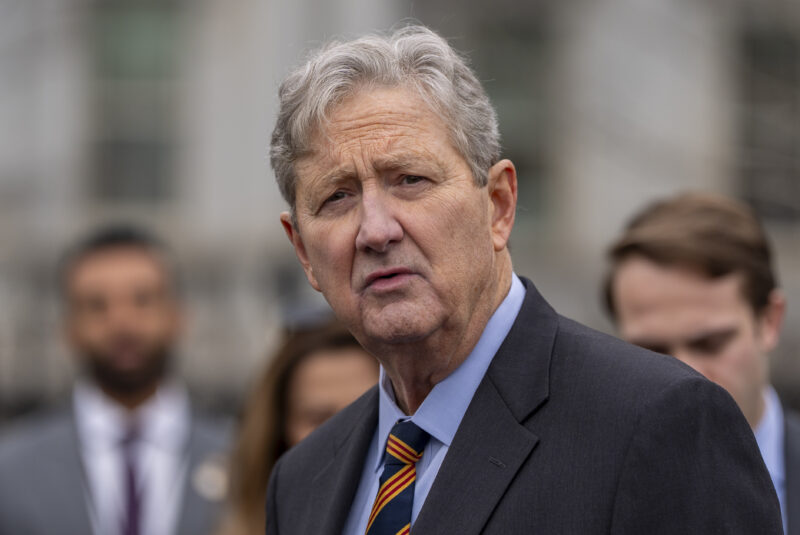
Sen. John Kennedy, R-La., speaks with reporters at the White House, Friday, March 14, 2025, in Washington.


 Add JewishInsider on Google
Republican senators reacted skeptically to Vice President JD Vance’s assessment that the GOP’s midterm losses were a sign of voters’ desire for the party to end the war in Iran and rethink its relationship with Israel.
Vance wrote last week that it was “obvious to almost everyone” that voters flipped to Democrats in the election over the war and U.S.-Israel relationship, as well as the cost of living, inflation and a desire to “put America First.”
President Donald Trump also said on “60 Minutes” that the war and a “great dislike, incredibly, for Israel” had been reasons for Republicans’ losses.
Several Republicans, by contrast, argued that the economy was the primary driver of Republicans’ midterm blowout, and dismissed that the war was singularly responsible for voters’ economic woes, even as it did contribute to increased gas and other prices.
Sen. John Cornyn (R-TX), who lost his primary to a Trump-backed challenger who ultimately lost the general election contest, called Vance’s explanation for the midterm loss “ridiculous.”
“I think it was the economy and affordability issue,” Cornyn said. “Voters don’t tend to make decisions based on foreign relations or international affairs. They tend to be more focused on what’s happening at their own kitchen table, and I think that’s what happened here. So this narrative that it was all about Israel and we shouldn’t have gone into Iran to stop the nuclear weapons, I just think is misguided.”
He also said that Trump has failed to properly articulate the end goal for the stop-and-start operation in Iran.
Sen. John Kennedy (R-LA) likewise said that economic difficulties were central to Democrats’ victories.
“Republicans lost the midterms because the Democrats did a better job of acknowledging the economic pain of the American people, and everything flows from that,” Kennedy said. “People have a multitude of reasons for voting as they do — the war and corruption and tariffs and all that — but the overarching reason is what I just said, and I think once everybody has a chance to analyze the data, that’s what they’ll see.”
Sen. Ron Johnson (R-WI) emphasized that a clear majority of voters had said that they personally and the U.S. economy writ large had been harmed by the administration’s tariff policies. He also emphasized the impact of high gas prices.
Johnson additionally pointed blame toward the administration’s failure to follow through on health-related priorities of so-called Make America Healthy Again (MAHA) voters, and said that Republicans had not been playing on a level field in the media.
Sen. Thom Tillis (R-NC), who declined to run for reelection amid a frosty relationship with Trump, said, “I don’t buy it,” in reference to Vance’s explanation for the midterm loss. He attributed GOP losses in North Carolina to low turnout among Republicans and high turnout among independent voters.
“JD needs to go back and really look at the cross-tabs, needs to look at the turnout in my state — the unaffiliated who showed up in droves, and some right-of-center Republicans that didn’t. That’s why we lost,” Tillis said. “If you read anything other [than that] into it, then you’re demonstrating tone deafness before you even start the next election cycle. So let’s just be realistic about why we won, why we lost, and move forward.”
He also insisted that the “American people are pro-Israel.”
Others pushed back on the need to rethink the U.S. relationship with Israel.
“JD is welcome to have his own opinion. Mine on this question is quite different, and I have made it public for a long, long time,” Sen. Ted Cruz (R-TX), seen as a potential challenger to Vance in the 2028 presidential primary, told JI.
Sen. Ted Budd (R-NC) argued that the U.S. needs to keep Israel as a close ally.
“I want to know exactly what [Vance] means by that because that is the only democracy in the Middle East, and it’s been a longtime ally of ours,” Budd said. “They’re a strong economy, incredible defense. So I think the nature of the partnership is going to change, but [we] need to make sure that we maintain them as an ally.”
Sen. Rick Scott (R-FL) suggested that Republicans had failed to follow through on their promises to voters and said that the American people are worried about their job security amid the growth of artificial intelligence and about the cost of living.
Scott acknowledged that military engagement against Iran is unpopular, but added, “Nobody wants to get killed by a nuclear weapon.”
Sen. Josh Hawley (R-MO) said that he’d “let the vice president speak for himself” about the U.S.-Israel relationship. “I’m not sure exactly what he means by that.”
He said that the Iran war was “an issue” but not “the only issue” in the election. Hawley was one of the earliest Senate Republicans to call for the war to wind down.
More Stories
analysis
Silver linings playbook for pro-Israel allies in next Congress

PAGE TO SCREEN
Gal Gadot to bring Golodryga and Levi’s ‘Don’t Feed the Lion’ to the big screen
STAFF SHAKEUP
Trump taps Stephen Miller as chief of staff after Susie Wiles resigns

BORROWED TIME
House scuttles Hegseth impeachment push — for now

SHOW OF SOLIDARITY
Philadelphians rally in support of Jewish businesses threatened by antisemitic bike protest

CHRIS CROSSED
Philadelphia Jewish federation blasts Chris Rabb’s silence on bike protest
Please log in if you already have a subscription, or subscribe to access the latest updates.
 Continue with Google

 Continue with Apple