



































Rubio looking to move past criticism of Israel after Qatar strike
At a press conference with Israeli PM Netanyahu, Rubio said an agreement with Hamas to end war ‘probably won’t happen’ because ‘savage terrorists don’t often agree to disarm’
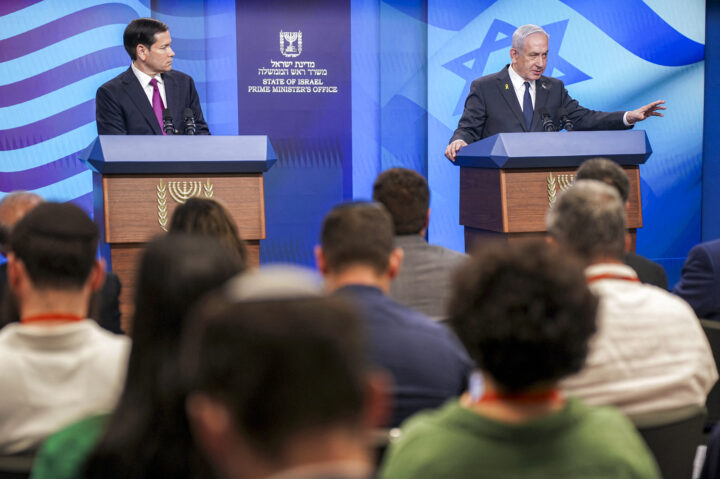
NATHAN HOWARD/POOL/AFP via Getty Images
Secretary of State Marco Rubio and Israeli Prime Minister Benjamin Netanyahu give a joint press conference at the Prime Minister's Office in Jerusalem on September 15, 2025.


 Add JewishInsider on Google
Secretary of State Marco Rubio said the U.S. is focused on moving forward from Israel’s strike on Qatar last week, refraining from doubling down on criticism during a joint press conference with Israeli Prime Minister Benjamin Netanyahu in Jerusalem on Monday.
“We are just focused on what happens next,” Rubio said, when asked about Tuesday’s strike aiming at Hamas’ leadership in Doha, Qatar’s capital. On Saturday, Rubio had echoed comments by President Donald Trump that the U.S. “is not happy” about the strike.
“Some fundamentals still remain that have to be addressed, regardless of what has occurred,” Rubio said at the press conference on Monday. “We still have 48 hostages. Hamas is holding not only 48 hostages but all of Gaza hostage … As long as they still exist, are still around, there will be no peace in this region.”
Rubio said the end of the war in Gaza, disarmament of Hamas and freeing the hostages are “pillars of what we hope will happen in the region.”
The secretary of state said that the U.S. not only wants Qatar to continue to play a role in those matters “but also in a better future for the people of Gaza, which cannot happen with Hamas intact. We are going to continue to encourage Qatar to play a constructive role in that regard.” Rubio is scheduled to visit Qatar on Tuesday after concluding his trip in Israel.
As to the chance of a negotiated deal to end the war, Rubio said that “the problem is Hamas is a terrorist group, a barbaric group, committed to destroying the Jewish state, so it probably won’t happen.”
“I don’t think there’s anyone who wouldn’t prefer a negotiated settlement,” he added. “That would be the ideal outcome we can see, one we worked on, but we need to be prepared for the reality that savage terrorists don’t often agree to disarm.”
Netanyahu reiterated that “Israel’s decision to act against Hamas’ terrorist leadership was a wholly independent decision by Israel … It was conducted by us and we assume full responsibility for it, because we believe terrorists should not be given a haven.”
As to those saying Israel violated Qatari sovereignty, Netanyahu said that the U.S. took similar action against the Taliban in Afghanistan and Osama bin Laden in Pakistan.
“You don’t have such sovereignty when you are effectively giving a base to terrorists, a place where they can ply their gruesome trade,” he said.
Netanyahu also took issue with a claim made by a reporter during the press conference that the Doha strike was a failure, because it remains unclear if any of Hamas’ leaders were killed. The prime minister said Israel is waiting for further reports on the matter.
“I’ll tell you the results,” he added. “We sent a message to the terrorists. You can run, you can hide, but we’ll get you. … I don’t accept the premise that the raid failed, because it had one central message. … If the terrorists think they enjoy immunity they’ll do it again and again, and if you deny that immunity, they’ll think twice.”
Netanyahu opened the press conference by paying tribute to the “powerful bond” between Israel and the U.S. and thanking Trump for helping target Iran’s nuclear facilities in June, as well as his efforts to free the hostages remaining in Gaza, 20 of whom are believed to still be alive.
Rubio said that Iran is a threat not only because of its pursuit of nuclear weapons, but because of its development of short and midrange missiles that can reach across the Middle East and into Europe.
“This is an unacceptable risk not just for Israel but for the U.S. and the world, which is why the president has continued with his campaign of maximum pressure on Iran until they change course,” Rubio said. “We are encouraged by our partners in Europe beginning the process of snapping back [sanctions] on Iran, who are clearly out of compliance [with the 2015 nuclear deal]. We 100% support that; that’s what needs to happen.”
The secretary of state criticized countries that recently announced they would recognize a Palestinian state.
“The things these nations are doing in the U.N. are largely because of domestic politics. They’re largely symbolic. The only impact they have is to make Hamas feel emboldened … You know, there’s a negotiation going on and maybe you think you made some progress on getting hostages released and ending the war, and then these things come out and Hamas walks away … They see international support, they believe they’re getting what they want, and they walk away,” Rubio said.
Rubio also spoke about his plan to attend the inauguration of the Pilgrims Road on Monday evening. The site features the path on which Jewish pilgrims walked to the Second Temple in Jerusalem, which Rubio described as “perhaps one of the most important archeological sites on the planet, important to many in the U.S.”
The secretary of state arrived in Israel on Sunday, beginning his visit with prayers at the Western Wall with Netanyahu. He also met with Israeli Foreign Minister Gideon Sa’ar and Strategic Affairs Minister Ron Dermer on Monday.
More Stories
road to riyadh
Trump taps Rep. Wesley Hunt as U.S. ambassador to Saudi Arabia

delay deja vu
Department of Education again delays report on foreign funding to universities

Daily Kickoff
Longhorns lock horns over Piker

SELF-SCRUTINY
Most Middle East scholars say U.S. academia has lost its way since 9/11, survey finds

SURVEY SAYS
New poll shows Vance with very low support among Jewish voters

Hard cover, soft launch
Assouline puts Tel Aviv on the coffee table at last
Please log in if you already have a subscription, or subscribe to access the latest updates.
 Continue with Google
 Continue with Apple