
























































After political defeat and loss of U.S. trade perks, South Africa’s ANC shows no sign of shifting on Israel
Pretoria’s case against Israel at the ICJ likely contributed to deteriorating trade relations with Washington
(Per-Anders Pettersson/Getty Images)
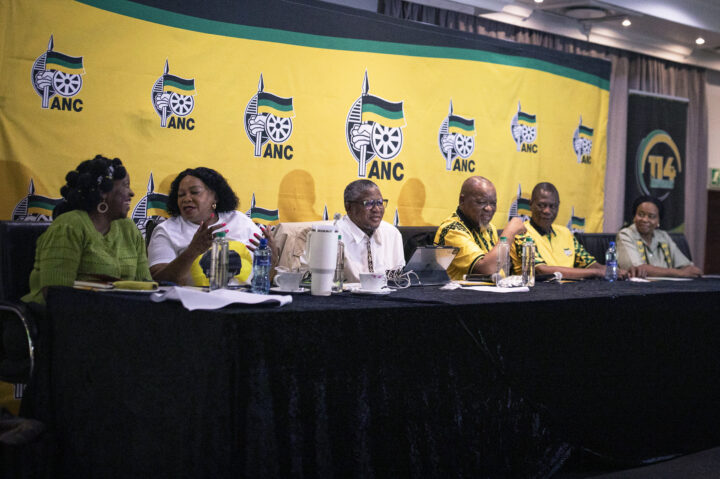
African National Congress (ANC) leadership (from left) 1st Deputy Secretary-General Nomvula Mokonyane, Secretary-General Fikile Mabula, National Chairperson Gwede Mantashe, Deputy President Paul Mashatile and Treasury General Gwen Ramokgopa wait for President Cyril Ramaphosa to arrive during a Special National Executive Committee (NEC) meeting at Birchwood Hotel & Conference Centre on November 12, 2026 in Boksburg, South Africa.


 Add JewishInsider on Google
The African National Congress, South Africa’s leading party since the end of apartheid in 1994, has long drawn parallels between the Palestinians and itself, poisoning relations between its country and Israel to the point of withdrawing its ambassador in 2018 and accusing Israel of genocide at the International Court of Justice in 2023.
In parallel, the ANC has been losing its hold on South Africa. Earlier this month, the party faced its worst-ever showing in local elections, part of a downward trend during this decade, in the same week as the loss of Pretoria’s preferential access to the U.S. market.
Meanwhile, South Africa suffered an economic loss that pro-Israel voices in the country link to its antagonism to Israel when President Donald Trump notified Congress earlier this month that he planned to remove Pretoria from the African Growth and Opportunity Act, which grants eligible countries preferential trade conditions. The country will no longer be able to export to the U.S. duty-free, beginning on Jan. 1, 2027.
Exports under the AGOA program accounted for about 10% of South Africa’s exports in 2025.
U.S. Trade Representative Jamieson Greer said that South Africa and Rwanda, which was also removed from the program, implemented “concerning and pervasive practices [that] include … barriers that undermine American trade and investment and practices that pose a threat to U.S. national security and foreign policy interests in the region.”
Among American concerns about South Africa undermining American security and foreign policy interests is its case against Israel at the International Court of Justice, where Pretoria has claimed the Jewish state committed genocide against Palestinians.
South African Zionist Federation National Chairman Craig Pantanowitz told Jewish Insider that “the ANC got the international attention it wanted [when it petitioned the ICJ against Israel] in 2023, and South Africa is still paying for it in strained relations with the partners who drive our trade and investment. Meanwhile, the same government has had little to say about mass atrocities elsewhere on our own continent.”
Benji Shulman, the executive director of the Middle East Africa Research Institute, told the South African Jewish Report that Pretoria’s problem with Washington “predates the ICJ, but I think the ICJ and the Israel issues really started to put things on the agenda.”
However, Shulman added, “the ANC doesn’t want to shift its focus on these core issues, especially international relations.”
The ANC received less than a third of the vote in the local election, continuing a trend in recent years in which the party once led by Nelson Mandela has lost public support. The ANC won 53 municipalities, down from 122 in 2021 and 161 out of 257 in 2016.
In 2024, the ANC failed to win a majority in parliament for the first time since 1994, and is governing in a coalition with the Democratic Alliance, which advocates for a freer economy and has consistently won Cape Town in recent decades.
The Democratic Alliance also holds a more typical moderate view on Israel of Western governments, condemning Hamas and affirming Israel’s right to exist, while condemning West Bank settlements and calling for a two-state solution.
In Johannesburg, the Democratic Alliance, led by the party’s former national leader and anti-apartheid activist Helen Zille — who has Jewish ancestry but is Christian — led the mayoral race. If she forms a coalition in the city council, she would be Johannesburg’s first white mayor since 1994.
Pantanowitz argued that the election result showed that “the ANC’s foreign policy has lost its mandate” and that the ICJ “genocide” case displays the ANC’s misplaced priorities.
“For three years, the governing party has put more energy into its campaign against Israel than into fixing the towns and cities it runs. Voters noticed,” he said.
Pantanowitz cited a Pew Research Center poll from June that found that South Africans were less hostile to Israel than Americans, Canadians or any European country except Hungary. “The hostility belongs to the ANC and its allies. Most South Africans are far more worried about whether the lights stay on and the water runs.
“A party that now commands fewer than one in three votes cannot keep lecturing the nation on a policy it never put to the people,” he added. “We hope this result opens the door to rebuilding that relationship [with Israel]. Not as a favor to Israel, but for the benefit of ordinary South Africans who have waited decades for ideology to stop standing in the way of their progress.”
Howard Feldman, a political commentator and host on South Africa’s Jewish radio station ChaiFM, told JI that “these local election results are among the clearest signals yet that many South Africans have lost confidence in the ANC. At the municipal level, that loss of confidence is easy to understand. People judge a party by whether the water comes out of the tap, the rubbish is collected, and someone answers when they call the municipality.”
Feldman said it was “striking” that the Palestinian issue did not rise much in the election, since “in the previous election campaign, there were moments when you could be forgiven for wondering whether you were watching an ANC rally or a rally for Palestine. This time, the issue barely featured in the campaigning I saw.”
As such, he argued, the municipal election does not say much about what South Africans think of their country’s relations with Israel.
“The ANC can take whatever position it chooses on the world stage. At home, voters are asking a more immediate question: can you run my city?” Feldman said.
Wendy Kahn, national director of the South African Jewish Board of Deputies, agreed that the municipal elections were unlikely to impact international relations.
Kahn said that the election results “demonstrate that the South African democracy is maturing, and that we’re no longer a one-dominant-party state. We are also heartened to see the high voter turnout, which shows that South Africans want change.”
The South African Jewish Report said that turnout was high in Jewish areas of Johannesburg and Cape Town.
The Report documented cases of polling places in Glenhazel, a Johannesburg neighborhood with one of the highest concentrations of Jews in the country, running out of paper ballots, forcing many to wait in the summer sun.
More Stories
pushed back
Senate Judiciary Committee postpones vote on religious institution buffer zone bill
Left Huang-ing?
Jensen Huang’s resignation raises questions about Nvidia’s Israel presence

PAGE TO SCREEN
Gal Gadot to bring Golodryga and Levi’s ‘Don’t Feed the Lion’ to the big screen
HOLDING THE LINE
Rubio offers sustained defense of Iran war at Federalist Society: ‘Iran can never have a nuclear weapon’
RABB RESPONDS
Rabb declines to condemn rally targeting Jewish-owned businesses, criticizes counterprotesters
CONDITIONAL CONFIRMATION
Cruz ties support for Somalia ambassador nominee to U.S. recognition of Somaliland
Please log in if you already have a subscription, or subscribe to access the latest updates.
 Continue with Google

 Continue with Apple