









































































Board of Peace advisor warns: Israel ‘squandering’ a ‘historic window of opportunity’ under Trump
‘Why are Prime Minister Netanyahu and his team not honoring their commitments?’ Josh Gruenbaum asked. ‘What is driving their decision-making?’
Win McNamee/Getty Images
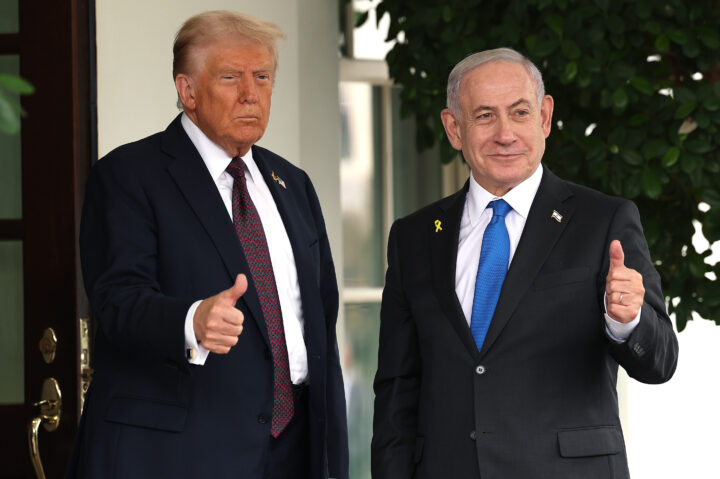
President Donald Trump (L) greets Israeli Prime Minister Benjamin Netanyahu as he arrives at the White House on September 29, 2025 in Washington, DC.


 Add JewishInsider on Google
Israel may lose the chance to have a solution for Gaza overseen by a president who is supportive of Israel if Jerusalem does not move forward with President Donald Trump’s 20-point plan for Gaza, Josh Gruenbaum, senior advisor to the Board of Peace, which was formed to see the plan’s implementation, told Jewish Insider on Saturday.
Israel agreed to Trump’s plan in September 2025; the deal put a ceasefire in place and led to the release of all of the remaining Israeli hostages in Gaza, with the demilitarization of the coastal enclave still to come. Other steps in the plan include training an International Stability Force to maintain the ceasefire and establishing a technocratic Palestinian administration, called the National Committee for the Administration of Gaza. According to the plan, Gaza can only be rebuilt after Hamas is disarmed.
Hamas did not agree in principle to relinquish its weapons until July 30 of this year, after new details were added to the plan. Soon after, Israeli Prime Minister Benjamin Netanyahu said that the demilitarization plan the Palestinian terrorist organization accepted was insufficient and that Israel would not withdraw from the parts of Gaza it controls until Hamas is disarmed.
Gruenbaum spoke to JI after briefing Israeli think tanks and national security experts on the situation in Gaza. He expressed frustration at the slow pace of the Gaza plan’s implementation, though he acknowledged that Israel is in the middle of an uncertain political moment, amid the ongoing coalition-building process following the country’s elections last month.
“We have been eminently reasonable with Israel; obviously they just had their own political process, and we wanted to give them space out of respect, so that any party building a coalition wouldn’t feel unnecessary pressures from outside of the system during the election cycle,” he said.
Netanyahu’s government “has delayed [implementation] for months, with the latest excuse that this is a caretaker government,” Gruenbaum added.
“Why are Prime Minister Netanyahu and his team not honoring their commitments?” he asked. “What is driving their decision-making?”
An Israeli interim government, which remains in place until a new governing coalition is formed, retains all the powers of a regular government. However, Israel’s Supreme Court has ruled that caretaker governments must show greater restraint and avoid making major moves except in the case of a “vital public need for action.” The court has been more deferential when significant actions relate to foreign affairs or national security.
Gruenbaum said that it is essential that Israel move forward with the plan because “a historic window of opportunity is rapidly closing” as Trump enters the second half of his second term as president.
Trump, he said, “is arguably the most favorable and allied partner the State of Israel has ever seen, and they’re squandering this time by constantly dragging their feet.”
While Gruenbaum said it is likely the U.N. Security Council, which approved the 20-point plan, would be likely to extend its mandate past 2028, “it is only sensible to ask for an extension if we’re making progress. We’re not here to just be another bureaucratic entity that convenes and issues communiques — the world has enough of that. We are here to produce results.”
Israel has not signed a Status of Forces Agreement, which is necessary for the ISF to deploy in Gaza, nor has it made clear if it would allow NCAG police to return to Gaza if it left for training in Egypt. Gruenbaum argued that the police and ISF need to be in place to take Hamas’ weapons.
The Board of Peace official pointed out that the 20-point plan explicitly says that Gazans should be allowed to leave and return freely, and said the police officers would only be using non-lethal weapons, such as tasers.
As for the ISF, he noted that it would be a “U.S.-led force, headed by a two-star general, and the partners are not Turkey and Qatar, they’re Kosovo, Albania and Morocco, who the prime minister feels comfortable with.”
“Hamas did agree to lay down arms,” Gruenbaum said, calling the promise “historic.”
“We can debate about what that means, but we certainly can’t know what that means if we can’t test the hypothesis.”
Earlier this month, Netanyahu argued that Israel was working with the Board of Peace and remained committed to the 20-point plan.
“Under the plan, Hamas must disarm and Gaza must be demilitarized before reconstruction begins,” Netanyahu said in a statement. “Israel had hoped that Hamas would honor its commitment to disarm, demilitarize, step down from governance, and begin de-radicalizing Gaza. To date, Hamas has not surrendered a single weapon, and it continues to hold the people of Gaza hostage to its terrorist rule. Hamas has done what it has always done: lie, steal, exploit, and rearm. … Hamas steals from Gazans to arm itself, systematically diverting humanitarian aid to military infrastructure while the United Nations and UNRWA turn a blind eye.”
“Israel and the Board of Peace face a common challenge. As long as Hamas remains in power, it will use every dual-use item entering Gaza to entrench its terror regime and expand its military arsenal,” Netanyahu stated. “Hamas alone is responsible for the suffering of the people of Gaza, and it is now cynically exploiting that suffering to shift blame onto Israel once again. Hamas started this war with its murderous terrorist attack of October 7. Its continued refusal to disarm remains the principal obstacle to the reconstruction of Gaza.”
Gruenbaum, however, said that “Israel is saying Hamas hasn’t done anything yet, but that’s not how the plan works. It’s predicated on the ISF and NCAG being there to implement demilitarization. The plan was never for Hamas to throw their guns into a pit unsupervised. If the Israeli public wants to know why Hamas has not begun the process of laying down arms, they should be asking the critical question of their government, ‘why have you not allowed the implementing entities to enter and operate in the Gaza Strip?’”
He called the argument one of three “false narratives in the Israeli public discourse:” That Hamas can “demilitarize in a vacuum,” that reconstruction of Gaza is beginning already, and that the Board of Peace “is asking Israelis to withdraw from anywhere [in Gaza] — that’s also not true until there is demilitarization.”
Gruenbaum also noted that the deradicalization process cannot move forward when Hamas is still armed.
Gruenbaum made the case that the 20-point plan is good for Israel, citing recent remarks by former Strategic Affairs Minister Ron Dermer on the “School of War” podcast, who said that “Israel should work with the Board of Peace now. … I think we have in the Board of Peace the actual opportunity to work with a new government that is not the Palestinian Authority.”
Trump’s Gaza plan, Gruenbaum said, means that Israel “doesn’t have to use its own forces; doesn’t have the disruption of its economy that comes with being at war; doesn’t have the international blame because [the plan] comes with pledges [from the UN Security Council]; and saves [Israel] from being perceived as the ones saying no to a reasonable pathway, which continues to harm its reputation in the international community.”
With rainy winter weather likely to arrive in the coming weeks, the humanitarian situation in Gaza has received renewed international attention as NGOs have criticized Israel for not allowing in materials to improve Gazans’ living situation.
Gruenbaum acknowledged that Hamas “put its population in this predicament by starting a war on 10/7, used critical material to build tunnels, and it’s their fault that there is no drainage and sewage” for the rainy season, but also echoed the criticism of Israel, saying that the Coordinator of Government Activities in the Territories, which oversees the crossings into Gaza, is “tagging nearly everything as ‘dual-use materials,’” meaning building materials that can also be used for terrorism.
“No one is calling for reconstruction at this stage before demilitarization is completed and confirmed. There is a difference between tents for a civilian population as opposed to full-scale reconstruction. A sewage system is not reconstruction; it’s a basic human need,” he added.
Gruenbaum also expressed concern that the narrative of the Gaza plan has turned negative for Israel: “We all know who Hamas is. They’re saying they’re ready to go, and Israel is the one who has a problem honoring the commitments it made to President Trump. That is the perception in Washington and across the world.”
Gruenbaum repeatedly emphasized that Israel is a U.S. ally and Hamas is responsible for the Oct. 7 attacks, saying that the way Hamas is describing the situation is “backward” and “the burden of proof should be whether Hamas will do what it said it will do.”
However, he noted that “Israel is using up a lot of international capital.”
“Israel throwing impediments and hurdles is leading the international community to say, ‘What is going on? Why are you doing this?’ If Israel would [sign off on the ISF and Palestinian police officers entering Gaza], the burden of proof would shift to Hamas immediately,” he posited.
Netanyahu’s spokesperson, Doron Spielman, said, “Israel fully supports President Trump’s 20-point plan. We are determined to make it succeed. That means ensuring that Gaza’s future is built on the three Ds: Disarmament, Demilitarization and Deradicalization. Hamas could surrender its weapons this afternoon. It has not surrendered a single one.”
Spielman praised Trump’s plan, saying that it “offers Gaza a different future. The people of Gaza should not have to wait another generation for it.”
“Hamas continues to recruit terrorists, steal humanitarian aid, pose as aid workers and rebuild its military infrastructure,” Spielman added. “Just last week, Israeli forces began destroying a terror tunnel that ran from Hamas-controlled territory into the Israeli security buffer zone to attack our soldiers.”
Spielman also argued that Israel allowed nearly 100,000 tents, 9,000 trucks of winter supplies and 27,000 tons of medical supplies into Gaza, and has approved an additional 65,000 tents that NGOs have yet to supply, urging them to “do their jobs rather than blame Israel for their inefficiency.”
The sanitation issues in Gaza predate the Oct. 7, 2023 attacks, Spielman pointed out, and also impact Israeli aquifiers.
“Israel restricts items only where there is a real risk they will be diverted to military use. We know how Hamas operates. Cement meant for homes becomes terror tunnels, water pipes become rocket launchers, and sewage pumps are exploited to manufacture rockets. Generators needed for sanitation are stolen to power Hamas’ underground terror grid, which is itself a violation of demilitarization. Reconstruction must rebuild Gaza, not Hamas,” he stated.
“Israel suffered the worst attack since the Holocaust on October 7. While we are working intently to improve conditions for Gazans, we will not do it by supplying items Hamas intends to use for another such attack,” Spielman stated.
JI spoke with multiple Israeli and American sources who heard Gruenbaum’s perspective in recent weeks. Among the arguments they made was that waiting several weeks to see how the political situation in Israel will play out would not make a major difference.
The specifics of Hamas’ disarmament were only worked out in July, raising doubts about the viability of a plan that involved the terror group giving up weapons to a police force that only has non-lethal means.
Another concern raised was that only Israel has been asked to take tangible steps and that Hamas should have to do something concrete to assuage Israel’s worries that proceeding with the plan will endanger Israeli national security.
Still, Gruenbaum added, “it’s foolhardy for people to suggest the effort has failed because we didn’t solve this overnight … [because] we haven’t had the same velocity of momentum that we would have liked. The facts still remain that concrete results have been achieved in a very short amount of time: return of all hostages, historic humanitarian aid entering Gaza, a ceasefire that, while imperfect, has held, and the build-out of the first-ever technocratic government for the people of Gaza.”
He expressed some optimism because Israel, Hamas and regional mediators such as Egypt still say they are committed to the plan.
“This is one of the most intractable problems in the world,” he said. “It’s wrong to say the framework itself and the strategy and execution of the plan have failed. I think it’s frustration at the standstill that we’re seeing. … No one has taken their eyes off the ball of what this 20-point plan is, which has two key north stars to achieve national security for the people of Israel and peace and prosperity for the people of Gaza no longer under Hamas’ rule: full demilitarization of Hamas; and a deradicalized Gaza Strip.”
More Stories
SURVEY SAYS
Poll finds cost of living, not Israel, dominated voters’ midterm concerns

PLAYING TO HIS BASE
Van Hollen targets Schumer over opposition to Obama’s Iran deal in Senate leadership fight
Daily Overtime
Van Hollen’s Iran playbook for leader

Daily Overtime
Vance takes on friendly fire

BRUSHBACK PITCH
Menin challenges Mamdani over controversial NYPD protest bill

analysis
Success of federal education tax credit program hanging in the balance
Please log in if you already have a subscription, or subscribe to access the latest updates.
 Continue with Google

 Continue with Apple