



































































Senate Republicans unlikely to move ahead with Trump’s $350 billion defense funding request
But Republicans are hoping there’s a path for a smaller package to fund military priorities

Kayla Bartkowski/Getty Images
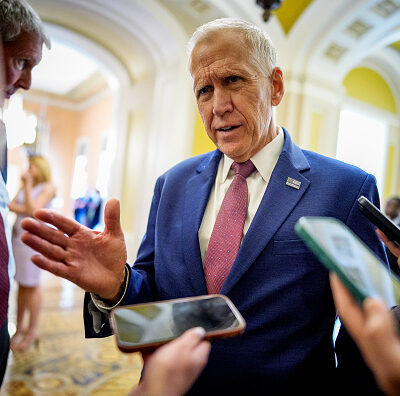
Sen. Majority Leader John Thune (R-SD) calls on reporters following the weekly Senate Republican caucus policy luncheon at the U.S. Capitol on January 14, 2025 in Washington, DC.


 Add JewishInsider on Google
Senate Republicans are unlikely to move ahead with a $350 billion partisan reconciliation bill to fund the Pentagon and the U.S. war in Iran that the Trump administration wants them to pass in the lame-duck session before Democrats retake control of Congress.
Republicans left an hours-long briefing with Deputy Defense Secretary Steve Feinberg on Wednesday, which followed multiple meetings on the reconciliation proposal this week, expressing doubt that the party-line funding request could make it to the president’s desk.
Two sources told Jewish Insider that Feinberg lobbied skeptical GOP senators by emphasizing the difficulty the White House expects to face in getting the president’s reconciliation request approved when Democrats take control of Congress in January.
While Senate Majority Leader John Thune (R-SD) has declined to rule out the possibility that Republicans will try to pass the bill through the budget reconciliation process, he acknowledged to reporters that he is considering several paths forward and making overtures to Democratic leadership about negotiating a bipartisan defense deal.
“We want to explore all the possibilities for funding the military, one of which would be seeing whether or not there is an appetite on the Democrat side to do it,” Thune told reporters on Wednesday. “I don’t know that they will, but we think that we ought to at least explore that possibility.”
“That’s kind of a consensus view that our members have at the moment,” he continued. “There are multiple ways in which we can do that, so we’re working through it.”
Democratic leadership, however, is not expected to engage much on negotiations before their own leadership elections on Dec. 1, which will determine if Sen. Chuck Schumer (D-NY) remains Senate Democratic leader. Senate Democrats are also weighing whether to demand that any funding stopgap to keep the government open beyond a Dec. 11 deadline blocks or places limits on funding for the Iran war.
Thune defended keeping the bipartisan option open, despite the possibility that there won’t be time to salvage the reconciliation bill if talks with Democrats fail, acknowledging Wednesday that “it’s an open question” if Republicans have the 50 votes necessary to pass the legislation, which would provide $17 billion for the Golden Dome missile-defense system, $47 billion for expanded munitions production and $48 billion for critical minerals.
Several GOP senators have come out publicly against the reconciliation push, with varying reasons for their opposition, and the party cannot afford additional defections given the partisan nature of the bill and the fact that Sen. Jon Husted (R-OH) is leaving the Senate on Dec. 15, when Sen.-elect Sherrod Brown (D-OH) will be sworn in.
Sen. Mitch McConnell (R-KY), whose support is needed to advance the bill as the chairman of the Senate Appropriations subcommittee responsible for defense funding, released a statement on Thursday expressing opposition to the reconciliation push, instead calling on Congress to provide the funding through the regular appropriations process.
“I’ll keep saying what I’ve said throughout the process: the way to show we’re serious about defense is to build new investments into sustainable, full-year appropriations,” McConnell said. “Reconciliation should never have been a substitute for finishing our work on FY27. Let’s get it done.”
Sen. Rand Paul (R-KY), the leading libertarian and fiscal hawk in the upper chamber, told reporters on Wednesday that, “I’m not for a partisan Republican bill to spend more money or borrow more money. There’s quite a few of them that I guess did not, were not aware of what happened with the election recently. All the exit polling showed that people were upset about the price of gas and the Iran war.”
Speaking on condition of anonymity, one senior Senate GOP aide told Jewish Insider that Republican leadership has concerns about the flurry of amendments Democrats and anti-reconciliation Republicans will offer on the reconciliation package — including bills undoing some of the party’s accomplishments this cycle, like cuts to Medicaid — that would result in some GOP defections.
Timing is also a factor in Thune’s considerations. Republicans have just weeks to finalize and pass any reconciliation bill through both chambers. The effort will need significant negotiation and floor time, and could require Thune to keep the Senate in session during some of the Thanksgiving and Christmas recess periods given that the upper chamber is only scheduled to be in session for three more weeks this year.
Two sources with direct knowledge of GOP leadership’s thinking told JI that passing a reconciliation package is being treated as a lower priority than confirming judicial nominations and negotiating with Democrats to avert a government shutdown.
“I don’t know if we’re going to do anything. I think we’re going to continue to confirm judges. I’m pretty sure of that,” Sen. John Kennedy (R-LA) told reporters after the Feinberg briefing. “Everything else, I have no idea what we’re going to do.”
For his part, Thune dismissed the concerns over timing constraints and rejected the suggestion that the Senate must begin consideration of the bill before leaving Washington for next week’s Thanksgiving recess to pass it in the lame-duck. “There’s a window in which we could still do it if we don’t get on it before Thanksgiving holiday,” he told reporters on Wednesday.
Senate GOP leadership is also concerned about the possibility that their House counterparts would not be able to pass the reconciliation package, and don’t want to devote floor time to negotiating and passing the bill in the Senate if it will die in the House, according to two sources.
More Stories
War Powers
Senate again rejects resolution calling for end to Iran war
OVERSIGHT OUTLOOK
Incoming House Oversight Chair Garcia touts settlement sanctions bill
KEEP CALM AND CARRY ON
DNI Jay Clayton tells lawmakers: No Iran ties to wave of tech outages

CRUZ CONTROL
Cruz rebukes Vance after GOP midterm losses: ‘No mandate to abandon Israel’

DOUBLING DOWN
El-Sayed says Israel should not identify with a faith, pushes back on antisemitism concerns

Coin of the Realm
Israeli mentalist Lior Suchard to join Trump at exclusive cryptocurrency dinner
Please log in if you already have a subscription, or subscribe to access the latest updates.
 Continue with Google

 Continue with Apple