


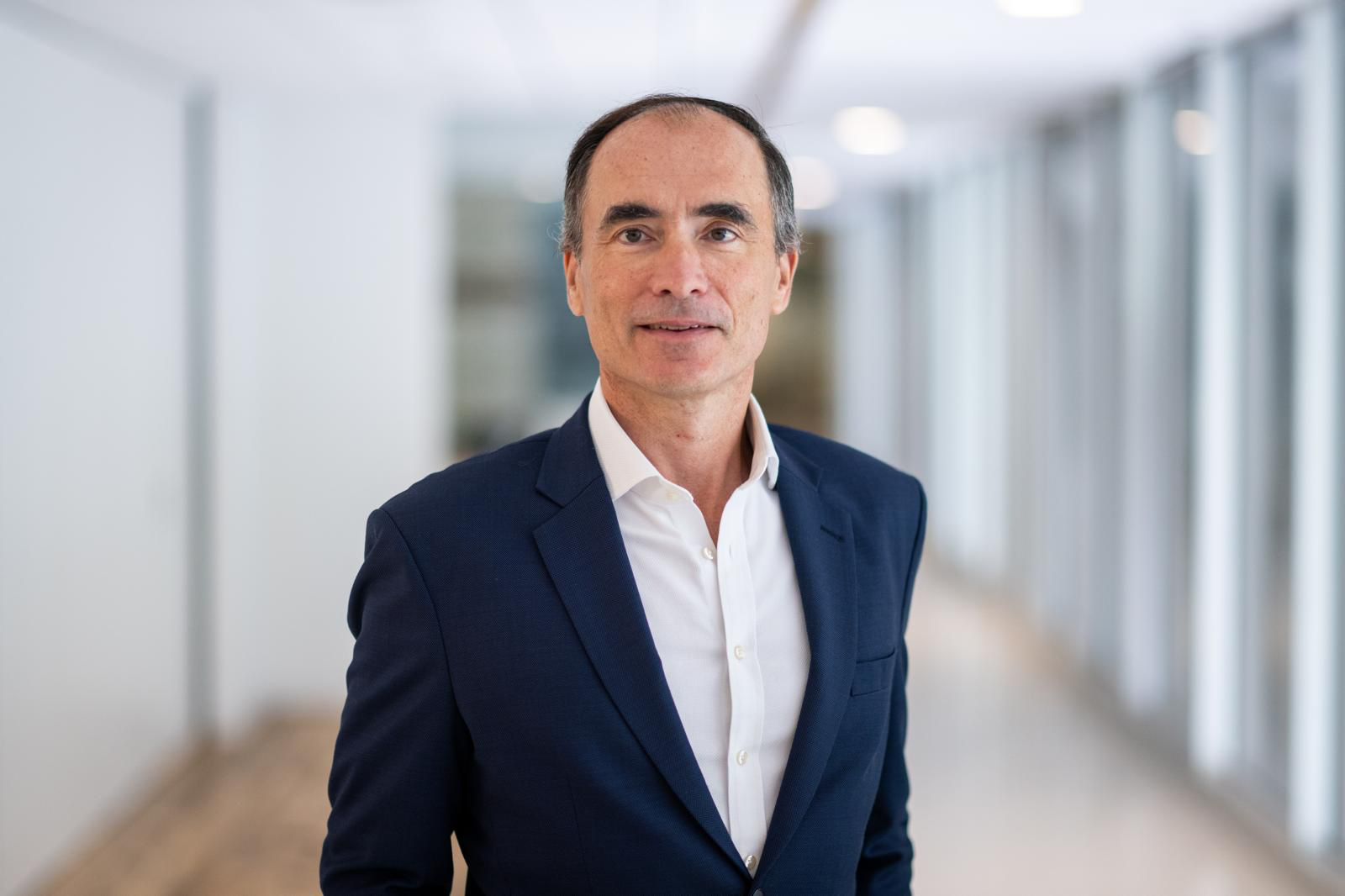
Courtesy
After two decades in diplomacy, Ludo Hood weighs in on antisemitism, Ukraine and Washington’s foreign policy battles
In an interview with JI, Hood reflected on a career included stints working on Iran policy, relations with Gulf states during the fraught Arab Spring and antisemitism policy in the tense aftermath of the Oct. 7 Hamas attacks in 2023


 Add JewishInsider on Google
After a career in the foreign service, where officers are obliged to keep their political views to themselves and promote the positions of the current U.S. administration, some retiring diplomats have a hard time getting used to speaking their minds, particularly when the press is involved.
Ludo Hood is not one of those people.
The 53-year-old retired from the U.S. Foreign Service last week after two decades of service, a career that took him to Kuwait, Bahrain, France and Qatar. Most recently, he served as a senior advisor to Keith Kellogg, President Donald Trump’s former special envoy for Ukraine, and before that as a close advisor to Deborah Lipstadt, the former U.S. special envoy to monitor and combat antisemitism — two roles that put him in the crossfire of some of the biggest political debates in Washington.
Hood, who is preparing to take on a role at a think tank, sat down with Jewish Insider this week to reflect on a career representing the U.S. that included stints working on Iran policy during negotiations for the 2015 nuclear deal, relations with Gulf states during the fraught Arab Spring and antisemitism policy in the tense aftermath of the Oct. 7 Hamas attacks in 2023.
Through all those foreign postings and geopolitical flashpoints, one of the most “alarming and shocking” moments of Hood’s time as a foreign service officer came within the halls of Foggy Bottom — when, in the months after Oct. 7, the State Department hosted listening sessions for staffers to express anti-Israel views and bash the policies espoused by the federal government.
“It was the only time in my career where active dissent against the elected president’s overall policy and strategic direction was allowed to be aired in the open, and was actually in many ways encouraged,” Hood told JI.
The gatherings were hosted by then-Deputy Secretary of State Kurt Campbell, and they came as some rank-and-file diplomats, plus many political appointees from the Biden administration, voiced dissent against President Joe Biden’s support for Israel.
“In terms of being politically correct, you had to give a lot of deference to a heavy anti-Israel point of view, which maybe is fine in the context of a social studies program at a university,” Hood said. “But it’s the State Department. We are national security professionals who are supposed to be implementing the policy of the duly elected president.”
Hood compared that moment to the sentiment among some foreign service officers who have struggled to represent the U.S. under Trump. Hood acknowledged that some diplomats do not agree with Trump’s approach to foreign policy, but said that they should not express that view publicly as part of their job — and that Trump would not stand for so much public expression of dissent.
“There was and perhaps remains opposition to the way that Trump does and says certain things in the State Department,” said Hood. “The difference here is the Trump people, either under [former Secretary of State Mike] Pompeo or now, would never tolerate unprofessional behavior, and it is unprofessional.”
“Obviously, you’re allowed to have your own personal points of view,” Hood continued. “But if you’re going to sign up to do this work, you ought to be reasonable.”
That doesn’t mean he always agreed with the positions that he was meant to promote as a diplomat. During the Biden administration, Hood took issue with the White House’s policy that nearly anytime antisemitism was mentioned, it had to be coupled with a mention of Islamophobia, a policy that Hood called “illogical and irrational.” (Lipstadt, his former boss, has called for antisemitism and Islamophobia to be discussed as distinct forms of hate.)
“It was official policy at the Biden White House in terms of how they named task forces and so forth,” said Hood. “We had to accept the horrendously problematic addition of ‘counter-Islamophobia efforts’ into what we were doing or what we were commemorating. I say ‘horrendously problematic’ because it undermines the fight against Muslim hatred or other forms of religious hatred to start conflating them for politicized reasons that have nothing to do with the actual strategies needed to curb that kind of discrimination.”
Even before Oct. 7, Hood said, getting certain State Department diplomats to include antisemitism in meetings with foreign leaders could be challenging.
“It could be painfully difficult to say and do certain things because of an institutional reluctance to highlight antisemitism,” Hood said, particularly in Europe.
When Trump was inaugurated early last year, Hood transitioned to the Ukraine file, the first time in his career when his portfolio did not include the Middle East.
He was more sympathetic to the plight of Ukraine than many members of the incoming Trump administration, which he said was more amenable to appeasing Russian President Vladimir Putin and less interested in continuing to spend billions on Ukraine’s defense. Kellogg, the Ukraine envoy, was also more supportive of Kyiv than Trump, leading to some of his portfolio being taken over by White House Special Envoy Steve Witkoff. Kellogg ultimately stepped down in January.
“It was frustrating to see how that played out, partly because the guy is a decent, honorable man who probably could have been treated better by some people operating in the White House and elsewhere,” said Hood. “Perhaps more relevantly, more substantively, I think Kellogg had a view on the Russian invasion of Ukraine, which, from where I stood, reflected reality and reflected how we should be approaching the conflict.”
On the other side of the Ukraine issue was the increasingly influential isolationist right. Hood called the ongoing intra-Republican feud about foreign policy “a profoundly important debate,” even as he came down hard against the isolationist wing.
“I think there’s very easy arguments to be had to push back on isolationism and restrainers,” said Hood. “I think those of us who want an assertive America aren’t asking for forever wars, aren’t asking to invade in the name of democracy. I think there are ways of putting America first on the global stage without deploying what has now become known as neocon objectives, basically democracy promotion.”
It’s fair to say Hood is aligned with the more traditional, interventionist wing of the Republican Party; he recently joined the Hudson Institute, a pro-Israel think tank closely aligned with several former top Bush administration officials. He said that over his two decades in diplomacy, his central views about the world and foreign policy have not changed. But he said he has come to hold a more realpolitik view of the world that is less Pollyannaish about democracy as a strategic objective.
“I think maybe democracy promotion, or even having a heavy focus on human rights, is probably at best naive, if not a lost cause, in some parts of the world,” said Hood. “We shouldn’t necessarily allow those issues to always get in the way of a bilateral strategic partnership that is broadly speaking good for stability and prosperity for that country or for that region.”
Hood is leaving the foreign service at a time when the institution’s future is in question. More than 1,300 State Department staffers — including many foreign service officers — were laid off last summer. The American Foreign Service Association, the union representing foreign service officers, called it “a catastrophic blow to our national interests.”
Hood called Trump’s “top-down approach,” where he leans heavily on personal advisors like Witkoff and Jared Kushner, “understandable in some respects.” He is not instinctually opposed to the cuts and thinks some were necessary.
“We needed a lot of disruption in the national security establishment. There’s still so much bloat to be cut,” said Hood. But, speaking diplomatically, Hood tentatively suggested that Trump might actually does have something to gain from the bureaucrats in Foggy Bottom and America’s embassies around the world.
“What you don’t have now is bottom-up information and recommendations being aired, discussed, debated,” said Hood. “Sometimes there are real questions about implementation and messaging.”
Next stop: the well-trodden Washington path of helping public officials hone their messages. In other words: a think tank.
Featured Stories
Please log in if you already have a subscription, or subscribe to access the latest updates.
 Continue with Google
 Continue with Apple